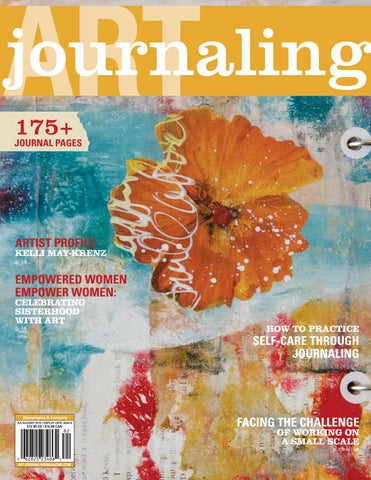
ART
journaling journ 175+
JOURNAL PAGES
ARTIST PROFILE: KELLI MAY-KRENZ p. 18
EMPOWERED WOMEN EMPOWER WOMEN: CELEBRATING SISTERHOOD WITH ART p. 14
HOW TO PRACTICE
SELF-CARE THROUGH JOURNALING
Stampington & Company JUL/AUG/SEP 2018 s DISPLAY UNTIL 9/24/18
86 ‡ &$1
FACING THE CHALLENGE OF WORKING ON A SMALL SCALE p. 68 &106
ARTJOURNALINGMAGAZINE.COM
After three doctor’s visits, two rounds of strong antibiotics, two courses of oral Prednisone, and countless bottles of cough syrup, I finally began to bounce back, but many weeks would pass before I felt even close to normal again. It took a long time to build up enough endurance to exercise, and I was feeling demoralized. My physician advised me that I needed to be patient because there was simply no way to rush nature’s healing process. SEEKING POSITIVITY My Little Book of Healing originated during this very slow period of recuperation. Because I couldn’t go outside and be as active as I’d planned, I occupied and consoled myself by retreating to my studio and creating a tiny journal that I could look at whenever I needed a reminder of what my body (and mind) needed most. Using a collection of blank ATCs, small white cardstock tags, and small daily planner dividers, I began the journal by covering them on both sides with white gesso, and then collaged them with tiny scraps of paper and bits of decorative tape. I added texture with rubber stamps and color with stenciled spray inks. Each page featured a positive affirmation and a corresponding image, as well as rub-ons, rhinestone embellishments, and pen doodles. I punched holes in each page, inserted small binder rings, and decorated each ring with knotted ribbon in matching colors. » 10
journaling ART
Summer 2018
artjournalingmagazine.com
journaling ART
11
Empowered Women EMPOWER WOMEN BY DEANNE OLGUIN WILLIAMSON
14
journaling ART
Summer 2018
I
f there is one thing I know for sure, it is that women are powerful. Women have strength beyond compare and important truths to express. I have come to realize this on more than one occasion in my life. The best example occured when my children were very young. I had quit working to stay home and raise them. I was so joyful to finally be a mother, and my husband was incredibly supportive and helpful. My home was beautiful and everything was in place. For some reason, however, I had this nagging notion that something was missing. It didn’t take me long to realize that I was craving the support and camaraderie of other women. When you go from a professional life to a stay-at-home life, the people in your life shift. Being a new mom, I didn’t know anyone with kids, so I had to go on a quest to find my tribe. LIFTING EACH OTHER UP Once I did, I still felt that we could go deeper. I was craving connections that went below the surface of playdates and school anecdotes. I took a risk and invited a few women to my house to form a group. I wasn’t exactly sure what form it would take, but I wanted to talk about common issues and concerns and goals and dreams. I’m so grateful they were willing to jump in with me. Once a month, we circled together and shared. We supported each other, we listened, and we flourished. It’s true what they say: empowered women empower women. My life changed and I believe the lives of all the women who took part greatly improved. I had found my tribe. We helped each other through difficulties and we cheered for each other. We shared our goals and dreams and, in so doing, we found the courage to pursue them. We were kind of shocked by how much this group meant to us. But for me, I learned something I will carry with me forever: I learned that the support and energy of other women in my life is invaluable. » artjournalingmagazine.com
journaling ART
15
ART JOURNALING
Defined
B Y T I N A WA L K E R
W
hat is art? The origin of the word “art” comes from the Latin accusative of “ars/artem,” which means “skill, craft, or craftsmanship.” The word originated in the 12th century and has various definitions, depending on its use. As a noun, it can mean the production or expression of what is beautiful, appealing, or of more than ordinary significance. Or, it can be used to describe a class of objects subject to a certain aesthetic criteria or collection. What is journaling? The origin of the word “journaling” comes from the late Latin equivalent “diurnal,” which means “daily” or “diary.” The word originated in the 14th century and is used to describe a daily record of experiences or observations, typically recorded in a book or ledger. When you combine both art and journaling, you arrive in a wonderful world. The artist can express, in a collection, what is significant in daily life. A notebook kept by an artist records a visual representation of their thoughts and memories, incorporating words to further express themselves. This is what makes art journaling such a powerful, healing, and therapeutic instrument. » 40
journaling ART
Summer 2018
artjournalingmagazine.com
journaling ART
41
Art Feeding Faith FEEDING ART BY TRACY WOODSFORD
54
journaling ART
Summer 2018
A
s a clergy wife, I spend some time each morning in quiet contemplation. For years I tried to keep a journal, writing down my insights in straight lines across the page. It was a hit-and-miss affair, and not very inspiring. It took the purchase of Gwen Diehn’s “The Decorated Page” (Lark Books, 2003) for me to realize that journaling didn’t have to be purely words. I could put color on the page, do drawings, or write in different directions and in differing styles. This was my journal and there were no rules — it was freeing. EVERYDAY PRACTICE As soon as I started to combine journaling with art, it took off. Journaling every day became a joy, the thing I started to look forward to. This was roughly 12 years ago, and I’ve been using art journaling as part of my everyday practice ever since. To start with, I kept one journal that had more words than images but was colorful. Soon, though, I was keeping a separate journal that was a lot more art with just a single thought or phrase written in it. This was my contemplation journal. I still keep both and work on them most days. The pages shown here are from my contemplation journal. » artjournalingmagazine.com
journaling ART
55
DIVING INTO DREAMS My journaling process is usually layering various papers onto each other and securing them with glue. I try to give the pages an eye-catching element, but often my focus is to put as much as possible on one page. I work as though I’m losing myself in the pages — I dive into the world of vintage dreams. I very much like mixing different kinds of materials together, like handwritten vintage papers, vintage tickets, kraft paper, decorative tapes, vintage photos, dried leaves, and wax seals. I trim to bring my personal touch to it with my own 3-D printed stencils that my husband prints for me.
DEVELOPING A PAGE I love to write down my thoughts in Old German Kurrent font from the 1920s with a fountain pen, brush pen, or my vintage typewriter. Additionally, I use the stamps from Darkroom Door or Wintertime Crafts, as they are perfect at giving my pages a vintage touch. Sometimes I add a pattern on the background with stencils and ink applied with a sponge. I never think about what a page must look like when it is finished — I just start and let the page develop. »
64
journaling ART
Summer 2018
D E TA I L
artjournalingmagazine.com
journaling ART
65
WITHOUT JUDGEMENT My journals, at times, have been my best friends. They’ve allowed me to have security, clarity of thought, and balance. They have listened to me process, pray, sing, and rant, always without judgment. For someone whose brain wants to speak three sentences at once and for a girl who grew up with a lisp, having the ability to spill secret writings into a journal means having the confidence to be expressive and mix those sentences around! When I became awakened to art journaling and learned various techniques, there was a completeness that came about, connecting my mind and heart. I know my creativity levels were pushed into higher dimensions of wonder with the introduction to visual journaling.
COLORFUL WORLD My process is very intuitive. I usually start a page with “journal spilling” in my loose secret writings, and then apply gesso on top so some of the journaling is covered. In this art journal, which is the 9" x 12" Jane Davenport Canvas Journal, I wanted to explore more with ink. I used Jane Davenport Mermaid Markers and various Liquitex inks. I carried water brushes with me everywhere so I had a portable means to move the ink around, but when I was home at my desk, I would experiment moving the inks with gesso and white paint, letting them drip, and even adding Tombow brush markers on top. The results were vibrant, messy pages, with a ton of Jane-inspired faces, and a lot of “journal spilling” in my secret writing. There are songs in these pages. There are prayers. There are frustrations and lists of gratitude, just like before. There’s just more color in my world! » 98
journaling ART
Summer 2018
TIPS t 5P QSBDUJDF NBSL NBLJOH EJWJEF B TIFFU PG QBQFS JOUP OJOF TRVBSFT CZ ESBXJOH B HJBOU HBNF PG UJD UBD UPF *O FBDI TRVBSF DIPPTF B EJGGFSFOU NBSL UP NBLF BOE B EJGGFSFOU NFEJVN UP GJMM UIF FOUJSF TRVBSF 'PS FYBNQMF 5IF GJSTU TRVBSF DPVME CF UJOZ EBTI NBSLT NBEF XJUI B CBMMQPJOU QFO 5IF TFDPOE TRVBSF DPVME CF USJBOHMFT NBEF XJUI B HPME HFM QFO 5IF UIJSE TRVBSF DPVME CF DJSDMFT NBEF XJUI B UIJO SPVOE QBJOUCSVTI BOE BDSZMJD QBJOU t 6TF THSBGGJUP BT B UFDIOJRVF GPS iKPVSOBM TQJMMJOHw CZ XSJUJOH XJUI B DIPQTUJDL QMBTUJD GPSL QFODJM FUD UP TDSBUDI GSFTI QBJOU 4HSBGGJUP JT FWFO NPSF FGGFDUJWF XIFO UIFSF T B ESJFE MBZFS PG QBJOU JO B EJGGFSFOU DPMPS VOEFSOFBUI UIF GSFTI QBJOU t %SJQT PO BO BSU KPVSOBM QBHF BSF B RVJDL BOE GVO XBZ UP BEE MBZFST %SJQ JOL IJHI GMPX BDSZMJDT PS XBUFSDPMPST EPXO ZPVS QBHFT *G UIF ESJQT HFU TUVDL TIBLF ZPVS KPVSOBM PS MJHIUMZ CMPX PO UIF ESJQT UP FODPVSBHF UIFN UP GBMM NPSF t -BSHF OJC QBJOU NBSLFST MJLF .POUBOB PS -JRVJUFY NBSLFST IBWF B SFDUBOHVMBS GFMU OJC UIBU JT QFSGFDU GPS BQQMZJOH NVMUJQMF NBSLT 6TF JU MJLF B TUBNQ UP BEE QPQT PG DPMPS PO ZPVS QBHFT t 3FEVDF UIF BNPVOU PG QBJOU PO ZPVS QBHF CZ MBZJOH B TIFFU PG EFMJ QBQFS PWFS ZPVS TVCTUSBUF BOE QSFTTJOH /PU POMZ XJMM JU QSJOU B DPPM FGGFDU PO ZPVS KPVSOBM QBHF CVU ZPV XJMM BMTP CF DSFBUJOH B GVUVSF DPMMBHF JUFN PG EFMJ QBQFS DPWFSFE JO B DPMMFDUJPO PG PSHBOJD CMPCT PG QBJOU BSUKPVSOBMJOHNBHB[JOF DPN
journaling ART
99
A Study
IN SIMPLICITY B Y D I A N N E FA G O
106
journaling ART
Summer 2018
I
’m not sure why, but 2017 was my most creatively dry year — ever. I felt overwhelmed with keeping up with what I was doing, which was combined with a strong desire and need to break free from my usual creative style. I eventually became so distraught with not knowing what to do that I ended up completely shutting down and stopped creating all together. By late August, I knew something had to be done and done altogether differently. I follow a lot of artists who share their journals on Instagram and YouTube, and I was drawn to the sense of simplicity and minimalism in their pages, as well as something that was totally foreign to me: white space. Their pages had only one image on them with a handful of words — one image with blank space surrounding it! Could I even do this? And if I tried, would I like what I created? The idea of simple pages while incorporating areas of uncovered space started to sound like the perfect way to freshen up my style and get me back on a creative path. » artjournalingmagazine.com
journaling ART
107