What Have We Here?
A Beachcomber’s Guide to Treasures in the Sand
 By Lenore Tedesco, Executive Director of The Wetlands Institute
What can be more relaxing and exciting than an early-morning stroll along our beachfront? The warm breezes, sounds of the waves, and freedom from the everyday grind makes our quiet time on the beach so special. The serendipitous uncovering of Mother Nature’s gifts from the sea adds another level of joy. Finding shells and other signs of the many animals that live, hunt, burrow and reproduce in this challenging and remarkable shoreline ecosystem is an exercise in discovery.
We enjoy nding evidence of the animals that call this environment home, and assigning a name to what we nd makes it all the more special. Join us on this journey, and the next time you are walking the beach, see how many of these creatures (or evidence of their presence) you can nd.
We are going to focus on the more unusual items you may nd. The easiest way to catalog these animals is by breaking them into a few basic categories.

BIVALVES: These are mollusks with two shells, but the shells are most commonly found as single halves along the beach.
Surf Clams are the largest bivalves found in the western North Atlantic and can grow to almost 9 inches. They are very common at Seven Mile Beach and seem to be a collectors’ favorite for soap dishes and knickknacks. They are found in sandy bottoms in waters up to 8 feet deep and burrow just below the surface. They are lter feeders and eat microscopic plants and animals. They wash up on our beaches following storms and with dredged material.
Coquina Clams (Donax) are a small species of colorful clam that occurs in very high concentrations in the surf zone. They align their shells vertically in the sand. When the waves wash these clams out of the sand, they can quickly dig back in, only to be exposed by the next wave. They are a sign of a healthy
beach and are an important food source for moon snails, shorebirds, and ghost crabs. Scientists are concerned that this species is becoming less common with repetitive beach nourishment. Watching them borrow into the sand after waves is a real treat.
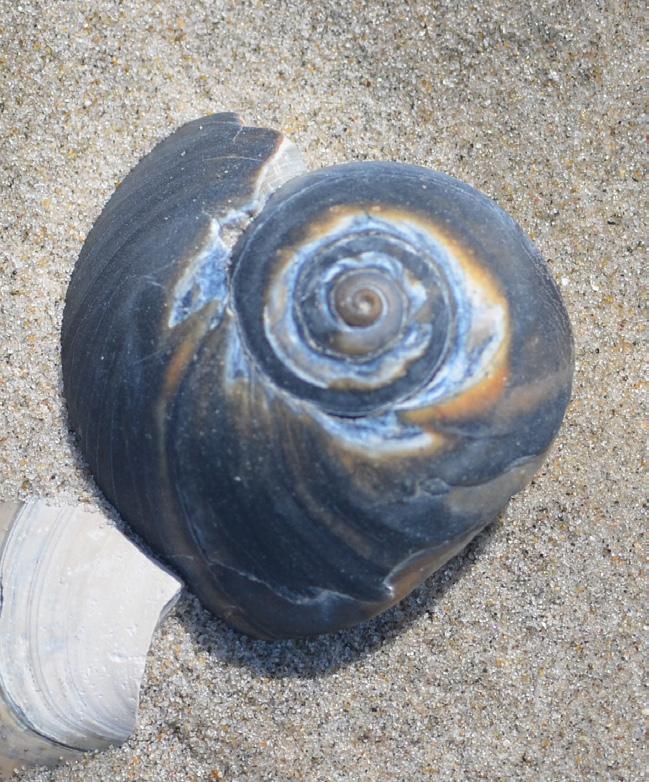


SNAILS: A large variety of snails can be found on our Atlantic beaches and a similarly large number, albeit di erent ones, are found in the marshes. Snails are mollusks with one shell and most have an operculum, which means “little lid.” The operculum acts like a trapdoor, closing o the shell to protect the snail from predators and also from drying out if they get caught out of the water. You can sometimes nd opercula on the beach. Most snails are carnivorous animals that have a strong muscular foot that helps them move through the sand.
Moon snails are nocturnal and move through the sand of the swash zone in search of their next meal. They have a radula, a sharp toothy-tongue that they use to drill through the shell of their prey: other mollusks. When you nd a shell with a perfectly round hole in it, it could have been the meal of a moon snail.
Whelks are the largest snails that live along our beaches. When they are alive, they cruise the intertidal zone and tide pools looking for food. They use the sharp edges of their shells to pry open the shells continued on page 62


We s t i l l d o n o t kno w one thousandth of one percent of what n a t u re has revealed to us. ~Alber t E i n stein
continued from page 60
of their favorite prey: clams and oysters. Knobbed whelks have a spiral shell with knobs or bumps along their shoulder. They can grow up to 9 inches long. Channeled whelks are similar but have ve or six whorls instead of the knobs, are nocturnal, and are smaller than knobbed whelks.


EGG CASINGS are some of the most curious and least recognized things you may nd on our beaches. Snails and other animals create unusual egg casings to protect their eggs and young as they grow and prepare to hatch. Whelks make long strings of egg casings that can contain more than 150 capsules, with each capsule holding up to 100 eggs. As they grow, the tiny whelks (which look exactly like they will as adults) feed on each other, so it’s common to nd the tiny shells of the weaker ones still inside. The egg cases are anchored to the sand; when
we nd them on the beach, it’s usually after a storm or rough seas have dislodged them. Most of the whelk egg strings have small holes in each capsule where the baby whelks have eaten their way out. Knobbed whelk cases have decorative edges, while channeled whelk cases have a simple straight edge.

Sand collars are the egg cases from moon snails. They are made of gelatinous material and sand, with the eggs embedded within the matrix. Each sand collar contains thousands of capsules, each one holding several live embryos. Larger sand collars are laid by larger moon snails.


Mermaid’s purses are the egg casings of skates. Skates are non-boney sh that resemble stingrays. The most common skates in our area are clearnose skates. Female skates may lay more than 65 eggs in a season and each is protected by a black, pouch made

of keratin (similar to our ngernails). The black case has two hollow “horns” on each end. The horns act as anchors that catch on seaweed to help keep the case on the bottom until the baby emerges. The egg casing washes up on the beach after the juvenile skate hatches.
BURROWS AND OTHER THINGS THAT BURROW: Mole Crabs (also called sand crabs) are small crabs that lack claws. They are 1 to 2 inches long and you have likely seen their shells littering the surf zone. They are lter feeders that bury themselves in the sand in the area of breaking waves. They leave their eyes and antenna above the ground. When the water from a breaking wave receded, they uncoil their antenna and feed on the microscopic plants as they ow across the antenna. They are an important food source for seabirds, shorebirds, and sh.

Ghost Crabs are semiterrestrial crabs that live on the upper part of beaches and in the dunes. They are about 2 to 3 inches in size and have a pale body color similar to the sand. Their coloring makes them di cult to spot and is the source of their name. They burrow a deep hole to keep themselves cool during the heat of the day. They are very fast and can achieve speeds of up to 10 mph, which makes them among the fastest of all crustaceans. They cannot swim but they can take large prey and feed on snails, clams, other crabs, turtle hatchlings, and even chicks of shorebirds. You have likely seen their burrow holes along the dune edge.

TEETH & BONES: Shark teeth and marine mammal bones are a rare nd on our beaches, but they are de nitely out there. This beachcomber has a collection of teeth found on our beaches, and the latest addition is a sand shark tooth found a few weeks ago. Black-
ened shells, bones, or teeth are an indication of age and sometimes fossilization. Keep an eye out because you never know what you will nd.
The best way to “collect” shells is with photographs. Those shells on the beach are important to many other animals on the beach. The shelly cover is used by beach-nesting birds to hide their eggs, and ddler crabs adopt the shells of others for their homes. If you feel you must collect that shell, please be sure to collect only shells and never live animals, and do so in moderation.
Find something unusual on the beach? Or want to see these and many other beach treasures? Come visit The Wetlands Institute. Bring your nd and have it identi ed at Seashell Sundays, or explore the aquarium and the displays. Enjoy your beach explorations and discover the wilder side of Seven Mile Beach.