I g o t o n a t u re t o b e s o o t h e d a n d h e a l e d , a n d t o have my sense put in order. ~John B u r ro u g h s
56
Sparking terest Ina The Collective Spirit of Environmental Education
W
hat inspired you to teach environmental education? The answer to this question is as varied as the people answering it. For me, the answer is simple. I teach environmental education for a chance to observe the spark – the spark you see on a person’s face when you know they have made a genuine connection to their environment. The perplexing thing about the spark is that you never know what is going to ignite it. Discovering the spark in your audience is the fundamental challenge of environmental education and the one I find to be the most rewarding. In pursuit of the spark, I began as a naturalist at the Dunes Learning Center, located within the Indiana Dunes National Lakeshore (now Indiana Dunes National Park), in Chesterton, Ind. At the Dunes Learning Center, I taught students from the greater Chicagoland area marine, wetland, forest, and prairie ecology amid some of the highest biodiversity in the country. In time, I moved on and found myself in the small town of Oregon, Ill., working at Northern Illinois University’s Lorado Taft Field Campus as an education program specialist. I spent my days coordinating outdoor experiences tailored to individual schools’ needs, teaching typical outdoor education activities, and watching bald eagles nest along the Rock River. Challenging myself in a new way, I spent several years working at the Indiana University, Purdue University Indianapolis Center for Earth and Environmental Science, where I developed and delivered an inquiry-based environmental science education program called “Discovering the Science of the Environment.” This program utilized place-based learning to assist in developing the next generation of environmentally literate citizens by
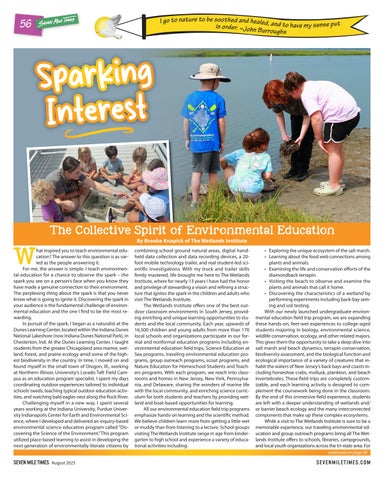
By Brooke Knapick of The Wetlands Institute combining school ground natural areas, digital handheld data collection and data recording devices, a 20foot mobile technology trailer, and real student-led scientific investigations. With my truck and trailer skills firmly mastered, life brought me here to The Wetlands Institute, where for nearly 13 years I have had the honor and privilege of stewarding a vision and refining a structure that ignites the spark in the children and adults who visit The Wetlands Institute. The Wetlands Institute offers one of the best outdoor classroom environments in South Jersey, providing enriching and unique learning opportunities to students and the local community. Each year, upwards of 16,500 children and young adults from more than 170 local schools and organizations participate in our formal and nonformal education programs including environmental education field trips, Science Education at Sea programs, traveling environmental education programs, group outreach programs, scout programs, and Nature Education for Homeschool Students and Teachers programs. With each program, we reach into classrooms and homes in New Jersey, New York, Pennsylvania, and Delaware, sharing the wonders of marine life with the local community, and enriching science curriculum for both students and teachers by providing wetland and boat-based opportunities for learning. All our environmental education field trip programs emphasize hands-on learning and the scientific method. We believe children learn more from getting a little wet or muddy than from listening to a lecture. School groups visiting The Wetlands Institute range in age from kindergarten to high school and experience a variety of educational activities including:
• Exploring the unique ecosystem of the salt marsh. • Learning about the food web connections among plants and animals. • Examining the life and conservation efforts of the diamondback terrapin. • Visiting the beach to observe and examine the plants and animals that call it home. • Discovering the characteristics of a wetland by performing experiments including back-bay seining and soil testing. With our newly launched undergraduate environmental education field trip program, we are expanding these hands-on, feet-wet experiences to college-aged students majoring in biology, environmental science, wildlife conservation, ecology, and other related majors. This gives them the opportunity to take a deep dive into salt marsh and beach dynamics, terrapin conservation, biodiversity assessment, and the biological function and ecological importance of a variety of creatures that inhabit the waters of New Jersey’s back bays and coasts including horseshoe crabs, mollusk, plankton, and beach invertebrates. These field trips are completely customizable, and each learning activity is designed to complement the coursework being done in the classroom. By the end of this immersive field experience, students are left with a deeper understanding of wetlands and/ or barrier beach ecology and the many interconnected components that make up these complex ecosystems. While a visit to The Wetlands Institute is sure to be a memorable experience, our traveling environmental education and group outreach programs bring all The Wetlands Institute offers to schools, libraries, campgrounds, and local youth organizations across the tri-state area. For continued on page 58
Seven Mile Times August 2025
s e ve nm ile t im e s .c o m