Those who find beauty in all of nature w at one with the secrets of life itsel ill find themselves f. ~L. Wolfe Gilbert
58
THE SECRET LIVES OF
MARSH-NESTING OYSTERCATCHERS
By Samantha Collins of The Wetlands Institute
F
or more than 50 years, The Wetlands Institute has dedicated its efforts to promote appreciation, understanding, and stewardship of wetlands and coastal ecosystems through research, conservation, and education. As part of that mission, Wetlands Institute Research and Conservation staff have long monitored coastal birds in local salt marshes, helping document how these species use marsh habitats and how changing coastal conditions affect their survival. With increasing concerns for salt marsh loss associated with sea level rise, coastal storms, and flooding, this work has become increasingly urgent.
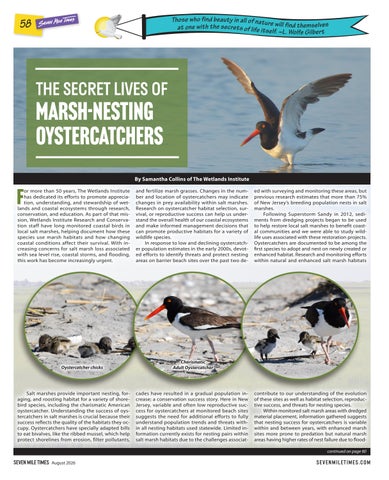
Oystercatcher chicks
Salt marshes provide important nesting, foraging, and roosting habitat for a variety of shorebird species, including the charismatic American oystercatcher. Understanding the success of oystercatchers in salt marshes is crucial because their success reflects the quality of the habitats they occupy. Oystercatchers have specially adapted bills to eat bivalves, like the ribbed mussel, which help protect shorelines from erosion, filter pollutants,
and fertilize marsh grasses. Changes in the number and location of oystercatchers may indicate changes in prey availability within salt marshes. Research on oystercatcher habitat selection, survival, or reproductive success can help us understand the overall health of our coastal ecosystems and make informed management decisions that can promote productive habitats for a variety of wildlife species. In response to low and declining oystercatcher population estimates in the early 2000s, devoted efforts to identify threats and protect nesting areas on barrier beach sites over the past two de-
ed with surveying and monitoring these areas, but previous research estimates that more than 75% of New Jersey’s breeding population nests in salt marshes. Following Superstorm Sandy in 2012, sediments from dredging projects began to be used to help restore local salt marshes to benefit coastal communities and we were able to study wildlife uses associated with these restoration projects. Oystercatchers are documented to be among the first species to adopt and nest on newly created or enhanced habitat. Research and monitoring efforts within natural and enhanced salt marsh habitats
Charismatic Adult Oystercatcher
cades have resulted in a gradual population increase; a conservation success story. Here in New Jersey, variable and often low reproductive success for oystercatchers at monitored beach sites suggests the need for additional efforts to fully understand population trends and threats within all nesting habitats used statewide. Limited information currently exists for nesting pairs within salt marsh habitats due to the challenges associat-
contribute to our understanding of the evolution of these sites as well as habitat selection, reproductive success, and threats for nesting species. Within monitored salt marsh areas with dredged material placement, information gathered suggests that nesting success for oystercatchers is variable within and between years, with enhanced marsh sites more prone to predation but natural marsh areas having higher rates of nest failure due to floodcontinued on page 60
Seven Mile Times August 2026
s e ve nm ile t im e s .c o m
There is no question that the b eac grandchildren will play on will be diff hes that our e re n t f ro m o u r s . . . .
60 continued from page 58
Newly hatched chick and eggs in salt marsh nest
Banded Adult Oystercatcher
ing, which appears to be increasing in recent years. Without support to comprehensively survey and monitor breeding pairs throughout these salt marsh systems, there is limited information to evaluate reproductive success for breeding pairs that would help inform population trends statewide. Fortunately, with funding from the Atlantic Flyway Shorebird Initiative through the National Fish and Wildlife Foundation, The Wetlands Institute and partner organizations Conserve Wildlife
Foundation of New Jersey and Stockton University are now able to conduct the necessary work to give oystercatcher populations nesting in the salt marshes of New Jersey the attention they deserve. Last fall, researchers from these organizations, as well as a suite of volunteers (including students from the Cape May Technical High School Marine Science program), conducted comprehensive surveys of both marsh and beach habitats throughout two study areas: Seven Mile Beach and an area in Ocean County
Banded Juvenile Oystercatcher
surrounding the Rutgers University Marine Field Station. Prior to migration, shorebirds congregate in large flocks to forage and roost to prepare for the migration south. This provided researchers with an opportunity to document habitat preferences for oystercatchers and other shorebird species throughout these areas. With the start of the nesting season in 2026, researchers began their work to study the distribution of breeding oystercatchers within salt marsh habitats. They will survey the entire marsh study area three
Coming Soon: The Preserve at Stone Harbor 40 Luxury Resort Townhomes Cape May Court House, NJ
38 37 36
3
4
35A 35B
6A
34 33 32
5 6B 7
8
9
31 30 29 28
27 26 25 24 23 22 21
10A 10B
11
12
13
14A 14B
15 16 17 18 19 20
484-445-4300 • RockwellCoastal.com Seven Mile Times August 2026
s e ve nm ile t im e s .c o m
ion is whether they ... The important quest ~Orrin H. Pilkey . will be better or worse
times throughout the nesting season to estimate the breeding population. The first two census surveys have been completed, and it’s estimated that more than 40 breeding pairs are nesting in salt marsh habitats throughout the Seven Mile Beach area. Monitoring efforts will also help identify threats and understand habitat requirements for oystercatchers nesting in marsh habitats. Researchers have already identified areas where nests may be more at risk of loss to mammalian nest predators and flooding events. Efforts to capture and band adults or chicks at marsh nest sites provide information on survival, habitat selection, and movement patterns. You can play a role in this effort. If you see a banded oystercatcher and can read its unique
61
code with a spotting scope or camera, please report it to the American Oystercatcher Working Group at amoywg.org. Your observations of banded oystercatchers can help with the ongoing research and conservation efforts for these special birds that need our help. Disclaimers: The views and conclusions contained in this document are those of the authors and should not be interpreted as representing the opinions or policies of the U.S. Government or the National Fish and Wildlife Foundation and its funding sources. Mention of trade names or commercial products does not constitute their endorsement by the U.S. Government, or the National Fish and Wildlife Foundation or its funding sources. This (report, publication, or video, etc.) was funded with support from the U.S. Fish and Wildlife Service grant F24AP01455.
Times Change 2007
People Change 2010
~
2026 Summer Activities
Towns Change
Tuesday Totally Turtle 2014
Feeding Aquarium
Crabbing Dock at the
What doesn’t change is 2024
Salt
Safari Marsh
my commitment to my clients
(609) 796-7170 office | (609) 519-3710 cell
Open daily 9:30 - 4:30
2021 Dune Drive, Avalon, NJ 08202
For details on these and all their programs, visit wetlandsinstitute.org/events or call 609-368-1211
marilynodonoghue.com
s e v e n m i le t im e s . com
August 2026 Seven Mile times