Views from theTower
~ NEWSLETTER
SUMMER 2026 | VOLUME 57 | NO. 2
The Wildlife That Call the Tidal Marsh Home By Dr. Lenore Tedesco, Executive Director
Driving down the causeway onto Seven Mile Island, the lush expanse of green meadows is a welcome sight. Salt marshes are among Earth’s most productive and diverse habitats, with productivity comparable to rainforests. The salt marsh is a watery world that forms between the mainland upland habitat, and the intertidal and underwater zones of the bays. Think of it as zero elevation. Each day, the salt marsh experiences two high tides and two low tides. Plants and animals that live in this habitat must be able to withstand constant environmental change or move with the tides. The animals that are fixed in their habitats are adapted to survive the changing water levels. Bivalves, a type of mollusk that has two shells, take advantage of the flooding tides by filter feeding. At each high tide, bivalves are flooded with food and nutrients that sustain them. Some of the most commonly seen bivalves in our marsh are ribbed mussels, eastern oysters, and hard clams. Ribbed mussels (Geukensia demissa) are found firmly attached to the base of salt marsh grass, where they
use strong byssal threads to anchor themselves in place, where they will live out the rest of their lives. In contrast, hard clams (Mercenaria mercenaria) prefer to call mud flats home. In the soft mud, hard clams use their foot to orient themselves and move when submerged in water. Eastern oysters (Crassostrea virginica) float as plankton until they land on a hard substrate and begin to grow into their adult form. Despite their differences, all three of these bivalves help maintain this ecosystem by filtering water and creating habitat for numerous other organisms. Another inhabitant of the salt marsh is the fiddler crab. They live in large groups and are quite social. They tunnel deep into the mud, creating a network of holes in the marsh that protect them from predators and keep them moist. The males have a large claw that they use for display or defense, and a small claw that they use to feed. The females have two small claws. They are a favorite food of diamondback terrapins. The Atlantic Needlefish (Strongylura marina) lives in the safety of the
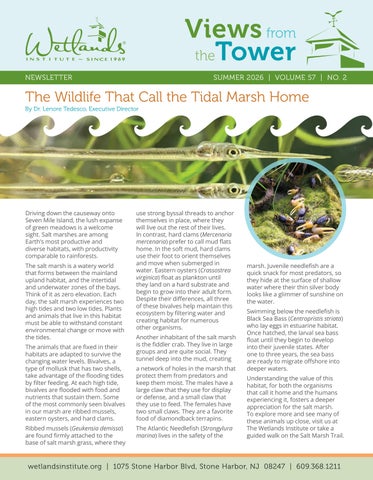
marsh. Juvenile needlefish are a quick snack for most predators, so they hide at the surface of shallow water where their thin silver body looks like a glimmer of sunshine on the water. Swimming below the needlefish is Black Sea Bass (Centropristis striata) who lay eggs in estuarine habitat. Once hatched, the larval sea bass float until they begin to develop into their juvenile states. After one to three years, the sea bass are ready to migrate offshore into deeper waters. Understanding the value of this habitat, for both the organisms that call it home and the humans experiencing it, fosters a deeper appreciation for the salt marsh. To explore more and see many of these animals up close, visit us at The Wetlands Institute or take a guided walk on the Salt Marsh Trail.
wetlandsinstitute.org | 1075 Stone Harbor Blvd, Stone Harbor, NJ 08247 | 609.368.1211 A321734_NJ_KM1_19x25_Wetlands-Summer-2026_Newsletter-NoIndicia_17x11.indd 1
6/9/26 10:45 AM