Library Newsletter

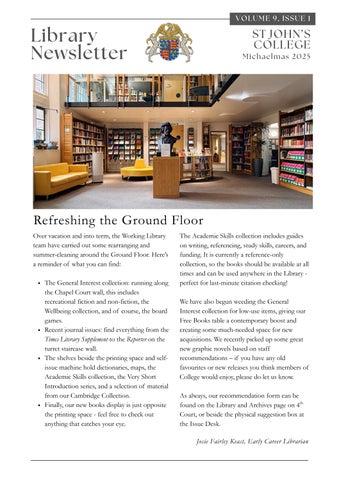
Over vacation and into term, the Working Library team have carried out some rearranging and summer-cleaning around the Ground Floor Here’s a reminder of what you can find:
The General Interest collection: running along the Chapel Court wall, this includes recreational fiction and non-fiction, the Wellbeing collection, and of course, the board games
Recent journal issues: find everything from the Times Literary Supplement to the Reporter on the turret staircase wall
The shelves beside the printing space and selfissue machine hold dictionaries, maps, the Academic Skills collection, the Very Short Introduction series, and a selection of material from our Cambridge Collection
Finally, our new books display is just opposite the printing space - feel free to check out anything that catches your eye.
The Academic Skills collection includes guides on writing, referencing, study skills, careers, and funding It is currently a reference-only collection, so the books should be available at all times and can be used anywhere in the Libraryperfect for last-minute citation checking!
We have also begun weeding the General Interest collection for low-use items, giving our Free Books table a contemporary boost and creating some much-needed space for new acquisitions. We recently picked up some great new graphic novels based on staff recommendations – if you have any old favourites or new releases you think members of College would enjoy, please do let us know.
As always, our recommendation form can be found on the Library and Archives page on 4 Court, or beside the physical suggestion box at the Issue Desk. th
Josie Fairley Keast, Early Career Librarian
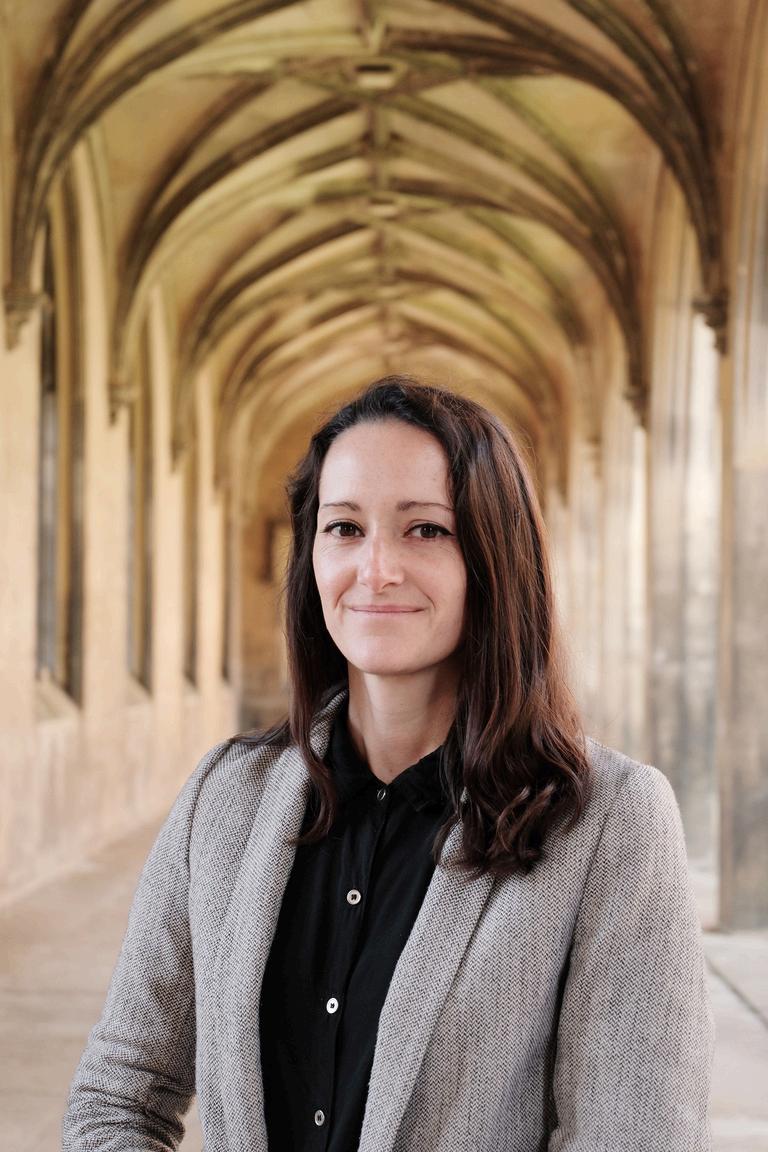
Regular readers of this newsletter may be wondering where this year’s Graduate Trainee has got to. The short answer is that there isn’t one, you ’ ve got me instead, and I’m having a lovely time so far.
amazing opportunity, and I’m thrilled to be working towards professional qualification in such a supportive and varied environment.
I joined the team in August for three years as the Early Career Librarian, a new position which means that the College is generously supporting me in pursuing an MA in Information & Library Studies alongside my day-to-day work. It’s an
Before coming to St John’s, I completed a graduate traineeship with the Bodleian Libraries, based in the Law and Business faculty libraries I then spent two years working for Cambridge University Libraries in a split role with Inter-Library Loans and the Libraries Accessibility Service. This was a great job which took me all over the wider Cambridge library network, and I’m enjoying bringing that experience into the College setting.
Outside of work I currently do a lot of studying, lest the MA begins pursuing me. In what’s left of my free time, I knit socks and play with the largest saxophone choir in the Fens. During the week you can usually find me at the Issue Desk in the Working Library – I like putting names to faces, so please do say hello
Josie Fairley Keast, Early Career Librarian

A new book on architectural history draws on a number of Cambridge archive collections, including St John’s, to explore the ‘what-ifs’ of the Cambridge cityscape.
Unbuilt Cambridge by Timothy Mowl and Julian Orbach (pub Stephen Morris, 2025) looks at an amazing variety of design proposals which in some cases would have made areas of Cambridge that are not only familiar today, bu even iconic, radically different. As the book is arranged chronologically, allowing schemes to understood in relation to each other and in the context of other trends and developments in Europe, St John’s features in, or is the focus of four different chapters. Illustrations include reproductions of original items from the College’s archive collections
Many of us know that the Chapel at St John’s was designed by George Gilbert Scott, but probably fewer are aware that his original design featured a spire rather than a tower. A selection of beautifully executed elevations survive in the archives, allowing us to imagine how different the skyline of central Cambridge might have been
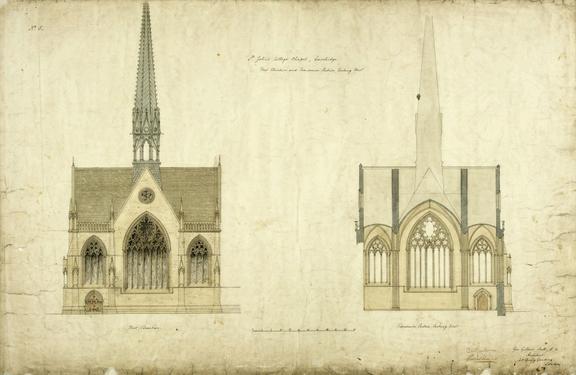
Architect's drawing of proposed west elevation, Office of George Gilbert Scott, 1862 (SJES/5/2/1/1/2)
The archives also contain design proposals for other buildings that were submitted to the College by rival firms but not commissioned. We are particularly fortunate to have designs for New Court submitted by three different firms – those by Thomas Rickman and Henry Hutchinson which were chosen, and unsuccessful competing designs by John Clement Mead and Arthur Browne
The same is true of more modern material, including items still to be assessed and catalogued; and despite the challenges of preserving borndigital items created using Computer Assisted
Design software and simulated drone footage, hopefully there will be more to come. Of Course, plenty of material we now long to see wasn’t retained, leaving questions that will never be answered, so sadly we’ll never know what the plans for First Court looked like
This new book is a really interesting read, with plenty to stimulate the imagination, and incidentally demonstrates how useful careful retention of certain types of record can be Thanks to Professor Mowl’s kind donation of a copy to the library, it is available for members to borrow from the Working Library
Lynsey Darby, Archivist
I joined the amazing Library & Archives team earlier this year in June My role is to manage the Old Library with its wonderful Special Collections and its busy reading room with the help of Adam, the Special Collections Assistant. I’m not new to Cambridge and its collegiate university: I spent nine years at Queens’ College, primarily cataloguing and curating its collection of early printed books Before that, I worked at Lambeth Palace Library as a Project Cataloguer.
As it’s only been a few months, I am still discovering the incredible collections held at St John’s, from beautifully illuminated medieval manuscripts (the Irish Psalter is truly one of St John’s treasures) to early printed books (the 1474 edition of Ovid’s work formerly owned by Lorenzo de' Medici is one of my favourites), without forgetting the eclectic collection of personal papers (I’ve recently come across the correspondence of the astronomer and mathematician Nevil Maskelyne with Continental colleagues such as Laplace or Lalande).
We have a lot of exciting projects at the Special Collections going forward, such as the launch of the new archives catalogue which will for the first time include our collection of manuscripts, a new
exhibition for the Cambridge Festival 2026, and the expansion of our outreach offering designed for St John’s students (keep your eyes on Fourth Court and the College bulletin for announcements).
It’s a privilege to work with such a knowledgeable and friendly team and such f t ti ll ti d I l k f d t
Sir Thomas Lawrence’s portrait of William Wilberforce (matric. 1776) – wherein a charcoal drawing of the Johnian anti-slavery campaigner blossoms into an oil portrait around his shoulders and head – remained unfinished in 1830, the year of the artist’s death, and hangs in the National Portrait Gallery. George Richmond would later copy and complete Lawrence’s effort, and that version of the portrait is owned by St John’s, and hangs in Hall
Richmond also painted Wilberforce from life in 1832, and the watercolour resulting from that session hangs, similarly, in the NPG Before painting that portrait, Richmond of course conducted some preliminaries; one such sketch, in black chalk on cream paper, survived, and was offered to the NPG in 1974 by R.G. Thornton. They weren’t, apparently, interested Fifty years later, in the summer of 2024, the Library bought that sketch from the Nonesuch Gallery.
One account of the picture, provided by Anna Stirling, has that Wilberforce, seventy-four years old and frail, was lifted onto the dining-room table, still in his chair, so that Richmond could view his features from the best possible angle Wilberforce’s sons offer a different version: the Rev’d C. Forster, provoking him with ‘is it true [ ] that you have much altered your views as to slavery?’, drew Wilberforce into an animated conversation that lasted long enough for Richmond, observing, to capture something of the vitality the ageing statesman still could summon
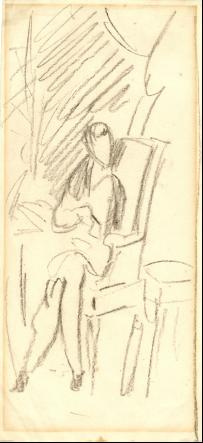
The Cambridge Colleges Conservation Consortium have done a typically fine job with this picture: in order for it to be removed from its frame and its stained mount, several press cuttings pasted to the reverse of the frame had to be removed carefully and re-mounted.
This effort adds another layer to the story of the sketch, an acquisition that enhances the Library’s already significant resources on the abolitionist movement.
While the sketch that now forms part of the Library’s collections offers nothing of Wilberforce’s facial expression, it is nonetheless an energetic piece of work: the quick strokes for the furnishings, the careful shading around the sitter’s body, and the overlapping squiggles standing for the block of shadow on the wall combined with the curves of Wilberforce’s crossed legs and active hands (busy with his duo of pocket watches) speak of movement Adam Crothers, Special Collections Assistant