VOLUME 9, I SSUE 2
LIBRARY NEWSLETTER
LENT 2026
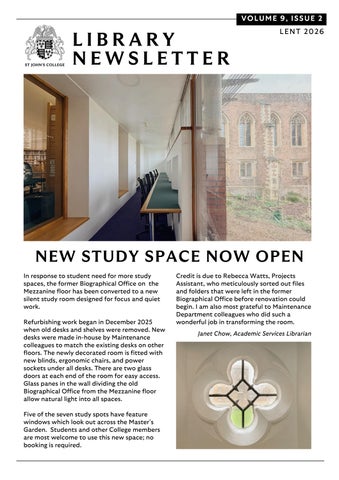
NEW STUDY SPACE NOW OPEN In response to student need for more study spaces, the former Biographical Office on the Mezzanine floor has been converted to a new silent study room designed for focus and quiet work. Refurbishing work began in December 2025 when old desks and shelves were removed. New desks were made in-house by Maintenance colleagues to match the existing desks on other floors. The newly decorated room is fitted with new blinds, ergonomic chairs, and power sockets under all desks. There are two glass doors at each end of the room for easy access. Glass panes in the wall dividing the old Biographical Office from the Mezzanine floor allow natural light into all spaces. Five of the seven study spots have feature windows which look out across the Master’s Garden. Students and other College members are most welcome to use this new space; no booking is required.
Credit is due to Rebecca Watts, Projects Assistant, who meticulously sorted out files and folders that were left in the former Biographical Office before renovation could begin. I am also most grateful to Maintenance Department colleagues who did such a wonderful job in transforming the room. Janet Chow, Academic Services Librarian
ERASMUS AND THE YALE OF BEAUFORT When is a donation not a donation? Is it when a book is intended for the Library’s collections but goes astray, and has to be purchased from a bookseller when it emerges nearly half a millennium later? Such was the case with Erasmus’s Paraphrases of the New Testament: a twovolume, 1532 edition of the work was given to the College in 1553, according to its inscription, but only permanently added to the Old Library’s shelves in 2025. The work was the gift of John Marshe, a London merchant and political campaigner who exerted some influence over a significant early Johnian, William Cecil, 1st Lord Burghley. Records suggest that the volumes disappeared from the College’s collections prior to the Old Library’s construction in the 1620s, presumably having been borrowed and not returned by a Fellow. The College Library was the grateful recipient of a grant from the Friends of the Nations’ Libraries that fully covered the purchase of these two volumes; so, even if the acquisition wasn’t quite the donation it should have been, it still feels like one. The FNL has been supporting British libraries and archives for nearly a century, helping to ensure that written and printed cultural heritage remains accessible to the public rather than disappearing into private collections; their support is a welcome reminder that the Special Collections at St John’s are of national, indeed global, significance.
The 2019 Yale of Beaufort coin Another recent donation, one that took significantly less time to conclude, demonstrates how even recently produced material can chime with the College’s history and find a place in the Special Collections. The Royal Mint’s series of Queen’s Beast coins, released between 2016 and 2021, is a tribute to the ten heraldic statues present at the coronation of Elizabeth II. Nigel Turner (matric. 1973) has generously given the Library a 2019 Yale of Beaufort coin. The yale, a goatlike mythical beast associated with Margaret Beaufort’s family and represented around St John’s (and on the College crest), is the size of a horse, has an elephant’s tail and can, most excitingly, swivel its horns; the coin is without moving parts, sadly, but when the Royal Mint produces such a version somebody will, we hope, send it our way. Adam Crothers, Special Collections Assistant
Inscription in the first volume of Erasmus's Biblical paraphrases (15.57.29-30), acknowledging John Marshe's donation
MEET THE NEW LIBRARY ASSISTANT It’s been just over a month since I joined the Library team, and time has certainly flown by quickly. Since starting in January, I have already had so many opportunities to learn and grow in my new role, and I’m excited to see what the future holds. Before coming to Cambridge, I completed an MA in Library and Information Management at Manchester Metropolitan University which led to my previous role in the Legal Deposit & Periodicals team based at Cambridge University Library. In this new chapter of my career, I’m looking forward to expanding my skills and making a positive contribution to St John’s College Library. In case you are unfamiliar with my role, I am responsible, alongside my wonderful colleagues, for the day-to-day running of the Working Library. As a Library Assistant, my job is highly varied as I support reader services, collection management, administrative tasks and outreach activities. The AV room is also my new domain, so if you have any recommendations (particularly for items we could add to the collection) I’d love to hear them! When I’m not working, I like to find time to be active (whether playing squash or going to the gym) as well as wind down with a jigsaw, a film and maybe some crocheting.
If you spot me around the library (usually near the Issue Desk or roaming amongst the shelves) please feel free to say hello! Emily Blanchard, Library Assistant
WELLBEING COLLECTION The Working Library has a Wellbeing Collection, which provides students with access to resources on all aspects of wellbeing, including but not limited to mental and physical health, disability, and hobbies. The collection is located on the Ground Floor in the Library. Many of these books were recommended by students, the College Nurse and staff. A list of titles can be found under our Wellbeing Collection tag on iDiscover. If you have any suggestions of books on wellbeing, we’d love to hear from you.
Recently acquired titles include: Disability and the University: A Disabled Students’ Manifesto Unmasked: The Ultimate Guide to ADHD, Autism and Neurodivergence Academic Writing and Dyslexia: A Visual Guide to Writing at University Glimmers: Tiny Moments to Transform Your Life and many more. Janet Chow, Academic Services Librarian
THE SECRET DAIRY OF MERTON HALL, AGED 139 YEARS Although it’s reasonably well known to those with an interest in the history of St John’s that the College once had a kitchen garden, with orchards, and that during post-war rationing a Pig Club was established to provide the College Kitchen with pork, it’s less well known that in the nineteenth century there was a short-lived attempt to run a dairy farm. In 1887, the Steward took the lease of the Merton Hall farm on Madingley Road and of pastures at Cottenham. The College thus became a tenant farmer, although it was more used to the role of owner of tenanted farms. In an effort to improve the finances of the Kitchen, the Steward had been authorised to spend up to £500 on a herd of cows, £300 on buildings and £400 on a dairy and cottage. He purchased a herd of pedigree Jersey cows, but by 1891 substantial financial losses had been sustained and the decision was taken to abandon the experiment. Occupation of Merton Hall farm was given up at Michaelmas 1893 and the Jersey herd sold. A small number of documents concerning the farm (although, sadly, no photographs) survive in the College Archives. Minutes and papers of the Kitchen and Farm Committee include stock lists and sales of produce, as well, unfortunately, as letters of complaint from local residents about the smells emanating from the dairy. Auction catalogues from the sale of the contents of the farm include an array of equipment, some of which is bamboozling to the non-specialist, and descriptions of each cow and bull, giving their names (including Mirabel, Sweetheart, and Nelson) and pedigree – in some cases, going back eight generations.
Auction catalogue for sale of Jersey cows These items are on display in the Archive Centre Reading Room on Thursdays during Lent and Easter terms, 9am-12 and 1-4pm, for any College members who would like to drop in. Lynsey Darby, Archivist
For comments on this issue, and contributions to future issues, please contact Janet Chow (jc614@cam.ac.uk)