
March 2026 Western Teacher

Page 1


In this edition

Correspondence:

The Editor, PO Box 212, West Perth WA 6872

editor@sstuwa.org.au | Ph: 9210 6000

Member Assist: Ph: 9210 6060 memberassist@sstuwa.org.au

Print post publication 100004470 | $4.95 ABN: 544 780 946 35

Authorised by Sally Dennis, General Secretary, The State School Teachers’ Union of W.A., 1 West Street, West Perth WA. Printed by Vanguard Press, 26 John Street, Northbridge WA. March 2026.

Cover: Former SSTUWA General Secretary Mary Franklyn has been conferred life membership of the AEU. Read more on page 8.

Getting Organised

Building the branch

The Getting Organised pack is designed to help you establish and strengthen the SSTUWA branch at your worksite.

Inside, you’ll find practical guidance on branch roles, the support available for elected delegates, and how to find your district and connect with your organiser.

Explore opportunities to join union committees, learn about health and safety representative elections and much more.

Access nomination forms, election notices and other essential resources in the eNews sent to all members at the start of the year, or visit sstuwa.org.au/GO

In line with the union’s commitment to sustainability, Getting Organised is a predominantly online publication. One printed copy has been sent to each worksite, to the attention of the SSTUWA representative.

The hidden reality of staff shortages

I want to thank all our members who responded to our start of term survey on teacher shortages.

We had nearly 400 responses, which given the incredible workload members are facing was most welcome.

I think it is important to note that it gives a margin of error of around five per cent, so the findings of what might seem a small percentage gives a pretty accurate representation of the real situation in schools.

It has become the department’s mantra in replying to concerns about teaching numbers by stating there will be a teacher in front of every class.

This is a clever tactic because it does not say how qualified that teacher is or how many classes were collapsed or oversized.

That means our respondents told us over 90 per cent of classes had a teacher. At the same time nearly 10 per cent advised us that classes had to be merged to get to that figure.

Nearly a third of classes did not fit within the class size guidelines. Class sizes in WA are already much larger than other states.

One in five of the teaching staff on 2 February were not fully qualified. A small percentage had no teacher qualifications at all.

Over a third of respondents said their school would not be fully staffed in 2026.

Many shared the impact this will have, which ranges from no Duties other Than Teaching (DOTT) time for staff (which breaches the General Agreement) principals stepping in to teach, classes being merged and a huge impact on specialist classes.

One member said: “Our school is

bursting at the seams with nearly 1,000 students. All staff are on a full load, and most classes have 32 students in them, including the [Year] 2/3 foundation classes, Years 7-10, which are not only low literacy, but behavioural classes as well. Some staff are already at breaking point, and I have one staff member in my department already leaving at the end of Semester 1, and possibly another. We are overwhelmed at the moment, and as I said, feeling stressed already.”

Another commented: “If we were ‘fully staffed’, we would not have started the year with multiple classes that are over the numbers stated in the Class Sizes Table GA23 Clause 12.2. This was planned since the end of 2025. Students face having less teacher attention, and less room to move and do hands-on activities due to extra furniture in the room for higher student numbers.”

Other impacts were described:

• “We have no relief staff - so when a staff member is out, we will often have collapsed classes. We also lose our EA time regularly.”

• “We have already had numerous class changes within our department, including things like three-way swaps and deleting classes to merge with others because we cannot staff them.”

• “Bigger class sizes, more challenging and violent behaviour for teachers to manage without help, collapsed specialist subjects, upset families.”

• “Merged and loss of specialist classes due to sickness and lack of relief. We will also have teachers leave during the year due to unreported stress leave. It is too hard to go through official stress leave channels, so they often just take sick leave.”

• “While ‘fully staffed’, relief staff is impossible to get. Relief is secured then they cancel at 8am for a ‘better’ option. We also have a number of staff taking LSL (long service leave) this year. This will cause a lack of staff and specialist/support programs to collapse.”

• “We won’t be staffed for relief coverage. We will need to merge classes, lose specialist and teacher DOTT. Deputies will cover classes.”

Misleading claims about staffing levels are not just hurting teachers and driving more and more out of the profession. They are having a direct effect on education outcomes and behaviours.

We need real solutions, not clever evasion of reality.

From commitment to action

Building power in 2026

In the last issue of Western Teacher, I spoke about leadership, service and collective strength. In this issue, I want to focus on what that means in practice.

As members of the State School Teachers’ Union of Western Australia, we are entering a critical organising phase. Enterprise bargaining does not begin at the negotiating table. It begins in workplaces. It begins in staff rooms. It begins in conversations between colleagues about what must change and what we are prepared to stand together to win. If we are serious about securing improvements to workload, pay, permanency, class sizes and professional respect, then the preparation must start now.

Bargaining is about power, not paper

A Log of Claims is important. Drafting precise claims matters. Industrial strategy matters. But none of it succeeds without visible, organised member backing.

Governments and departments assess risk. They calculate whether members are engaged, whether branches are active and whether the union can mobilise. When membership is passive, bargaining outcomes are modest. When membership is organised and prepared to act collectively, outcomes improve.

The lesson is simple: participation determines leverage. Over the coming months, members will be asked to contribute to the development of claims. I strongly encourage every member to engage in that process. Attend meetings. Complete surveys. Put forward motions through your branch. Bargaining priorities must reflect the lived realities of educators across schools and TAFE.

Workload must be central

Across the system, workload remains the dominant issue. Administrative creep, data demands, compliance tasks, staff shortages and behavioural complexity are eroding the sustainability of the profession.

If we do not address workload structurally, recruitment and retention will continue to suffer. Bargaining must deliver enforceable protections not vague commitments or aspirational language. Clear limits. Clear processes. Clear accountability. This requires members to articulate specific pressure points in their workplaces. Evidence strengthens claims. Collective reporting strengthens evidence.

Branches: the engine room

Strong branches are not optional; they are essential infrastructure. An active branch ensures:

• New staff are recruited promptly.

• Members understand their rights.

• Workplace issues are escalated early.

• Union communication flows both ways.

If your branch is quiet, now is the time to rebuild it. Nominate for a role. Rotate responsibilities. Share the workload. No one should carry branch leadership alone. Where branches are strong, members feel supported. Where members feel supported, confidence grows. Where confidence grows, collective action becomes possible.

Training and industrial confidence

Industrial confidence does not appear overnight. It is developed through

knowledge and preparation. Members are entitled to five days of union training each year. Use it. Whether you are a new teacher, an experienced TAFE lecturer, or a long-standing branch representative, there is always more to learn about industrial law, bargaining processes, dispute resolution and organising strategy. A well-trained membership shifts the power dynamic in any workplace.

Solidarity beyond the workplace

Unionism is not limited to enterprise agreements. It is a broader commitment to fairness, equity and justice. That includes advancing women’s leadership, supporting secure employment in TAFE and maintaining international solidarity with educators facing repression or conflict. When we act in solidarity, we reinforce the values that underpin public education: dignity, equity and collective responsibility.

The months ahead

Over the next issue and beyond, I will provide regular updates on bargaining preparation, branch development and industrial strategy. Transparency matters. Members deserve clarity about process and direction. But clarity alone is insufficient. Engagement is what transforms information into power.

The coming year will test our organisation. It will require discipline, unity and resilience. However, if we are organised at branch level, informed at member level and united across sectors, we will enter bargaining from a position of strength.

Collective outcomes are not accidental. They are built. Now is the time to build.

Respect for our profession

*Disclaimer: in this article the term teacher is used intermittently in reference to teachers and school leaders.

How often do we hear that the need to fix the teacher shortage is to show teachers more respect?

But what does that actually mean? And even more so, what does it look like?

In SSTUWA’s State of our Schools survey 2025, our members reported that they had experienced harassment from parental expectations and communications, social media comments, and inappropriate posts created by students about teachers, just to name a few examples. The survey also highlighted that approximately 70 per cent of teachers were considering leaving the profession due to a lack of respect, with a further 30 per cent due to safety concerns.

So, no wonder we find ourselves in a teacher shortage.

We know the landscape of teaching has changed and workload has increased exponentially. Our members reported that key to this was parental demands and also compliance requirements. The SSTUWA has been working with the Ministerial Workload Intensification Taskforce to alleviate workload pressures.

As we go back into bargaining this year, we know that key to our members’ concerns will be their working conditions. If we don’t have a place where teachers are respected and trusted, then we will continue to see an increase in teacher and school leader resignations. We know that on a day-to-day basis, teachers already experience work pressures and a high level of stress. The union is also aware that the continuous

barraging of teachers in all aspects of their lives can impact their psychological health.

WorkSafe outlines this as a psychosocial hazard: Psychosocial hazards at work are aspects of work and work situations which can lead to psychological or physical harm. These stem from:

• The way the tasks or job are designed, organised, managed and supervised.

• Tasks or jobs where there are inherent psychosocial hazards and risks.

• The equipment, working environment or requirements to undertake duties in physically hazardous environments.

• Social factors at work, workplace relationships and social interactions.

At the June 2025 State Council Conference, Minister Winton said “As a system, we need to look at how else we can support principals and schools to deal with the barrage of complaints and destructive criticism coming their way.”

SSTUWA President Matt Jarman also spoke about respect at the June 2025 State Council Conference, calling on people to:

• Respect the fact that teachers are not available outside working hours.

• Respect teachers on Facebook, WhatsApp groups and other social media channels.

• Respect teachers in front of your children.

• Respect the fact that it just might be that your children’s behaviour is the issue, not the teacher’s.

As your union I also encourage you to download our respect poster from sstuwa.org.au/RESPECT

In late 2024, the union raised concerns with the Department of Education (DoE) on disrespectful behaviours towards school staff.

The DoE agreed to review and strengthen the Connect and Respect resources for schools to use. The work of the SSTUWA has recently resulted in providing feedback for what can be improved in these resources.

The importance of these resources is support all in the school community and really encourage our parents and caregivers to respect the work of our teachers.

Every student, staff member, parent or carer has the right to feel safe and be safe in school and appropriate action will be taken to ensure all staff are safe.

The resources also include a document on what parents and carers can expect from schools and, more importantly, what they should not expect.

This document clearly outlines how communication can interfere with teaching and learning and also when to contact your child’s school. Other resources include helping a principal escalate serious concerns and several letter templates that can be used by school leaders to address a range of issues.

While this is not the only solution to mitigate disrespectful behaviour, the SSTUWA believes that it is a step in the right direction.

Decades of unwavering service and advocacy

Mary Franklyn (pictured right) has been made a life member of the Australian Education Union (AEU) in recognition of her outstanding service to the union movement and to public education. Below is an excerpt of the nomination speech given by SSTUWA President Matt Jarman.

Mary’s contribution to the SSTUWA began on 24 July 1978. During her early teaching career Mary held multiple positions representing her branch and the members and she rapidly became known as a fearless advocate for her colleagues, for what was right and for the needs of the students in the school she was teaching in at the time.

This quickly expanded beyond her own school gate, Mary was sought out by comrades and school leaders to help resolve matters.

An extra consequence was that this also built a deep respect across most school leaders. She was feared but equally respected.

At the core of all of these matters was what was best for the teacher, the student, the school and public education, a genuine apprenticeship was underway.

Naturally then when Mary did arrive to work in the union office she came in as an industrial organiser; she was now being paid for what she already spent many, many years already doing.

From here Mary became the coordinator of what we refer to in WA as the Education Training Centre. It’s a critically important part of our organisation and it was in need of attention when Mary took this

responsibility on.

It is now a full team, delivering online and faceto-face, industrial and professional training and is regarded by our members as a professional experience and a high-quality service delivery model that helps to reinforce to our members the value of their membership.

It is also worth noting that Mary’s time as general secretary began just after horrendous state budget cuts were inflicted on public education by the Liberal Barnett government. Both schools and TAFEs were left reeling from those devastating decisions. But luckily, along with a handful of others, we had the right person for the job.

As general secretary, Mary set the SSTUWA on the road to financial stability. She and then-union President Pat Byrne doubled the value of our investments. We own our building and this delivers much needed security to our membership.

Whenever major decisions have been required Mary is always the one to ask, “how will this help our members?”.

The work she begun on recruitment and retention is another example of a lasting legacy. Our branch membership is at a record high. When Mary commenced as Gen Sec the membership of the SSTUWA

was just over 15,200 paying members, it is now just short of 20,000, an incredible increase of almost 25 per cent. We must remember Mary’s period as Gen Sec included a [once in] 100-year pandemic, a real threat to every member-based organisation.

Mary Franklyn’s leadership was intelligent, principled and deeply grounded in her love of the profession and her respect for the members she represented. Mary’s presence was influential during bargaining; and there are countless stories of how she won for members at the bargaining table.

Her legacy is visible not only in our pay scales and structures, but in the very strength and identity of the SSTUWA and the AEU today.

For her decades of unwavering service, courage and advocacy, it is both my honour and my responsibility to seek your endorsement for the conferral of life membership of the AEU to Mary Franklyn.

Big infrastructure gap between WA public and private schools

Private schools in WA have outspent public schools on capital works by $3.2 billion over the past decade, including $515 million in 2023 alone, exposing a widening infrastructure divide driven by the absence of ongoing Commonwealth capital funding for public schools since 2017.

The building divide in Australian schools: How capital funding fuels educational inequity report shows that students in the most advantaged private schools in WA receive more than three times the perstudent capital investment of students in the most disadvantaged public schools — a gap of $2,112 per student.

This inequity is fuelled by the lack of federal funding for capital investment in public schools.

Nationally, the report reveals private schools have outspent public schools on capital works by $38 billion over the past decade, including $5.4 billion in 2023 alone. Capital investment averaged $2,746 per student

Key report findings

• Capital investment by private schools in WA has outpaced investment in public schools by $3.2 billion over the last decade and by $515 million in 2023 alone.

• Students in the most advantaged private schools get more than three times the investment per student of students in the most disadvantaged public schools, a gap of $2,112 per student.

• The top five highest spending private schools in WA spent $90,483,770 total on capital works in 2023 – more than 2,418 public schools nationally combined ($90,476,056). This means that five schools alone spent more than 37.7 per cent of all public schools in Australia.

• The top 10 highest spending private schools in WA spent $146,265,215 in total capital expenditure in 2023

per year in private schools, compared with $1,237 per student in public schools.

Between 2017 and 2025, the Commonwealth’s Non-Government School Capital Grants Program has delivered more than $1.6 billion to private schools, with a further almost $3 billion scheduled between 2025 and 2034. By contrast, public schools receive no permanent federal capital stream.

AEU Federal President Correna Haythorpe said the divide is being driven by Commonwealth policy settings that has funded capital works in private schools, while leaving public schools without an ongoing capital stream since 2017.

“That is not an accident, it is the result of policy choices that keep directing public funding towards already wealthy private schools,” she said.

SSTUWA President Matt Jarman said the funding imbalance is having real consequences in WA classrooms.

– more than 2,859 public schools nationally ($146,153,218). That means that 10 private schools alone spend more than 44.6 per cent of all public schools in WA.

In the AEU’s State of Our Schools Survey WA public school principals said:

• 24 per cent per cent of public schools in WA do not have adequate classrooms to meet enrolment demand and need an average of 7.8 additional classrooms each.

• 35 per cent per cent will run out of classroom space in the next three to five years.

• 50 per cent per cent say the external maintenance of their school buildings is inadequate and 47 per cent per cent say internal maintenance is inadequate.

• 44 per cent per cent say that the science facilities at their school are

“Western Australian public schools are educating the overwhelming majority of children, yet they are doing so without the benefit of a guaranteed Commonwealth capital funding stream,” he said.

“When private schools are receiving more than three times the per-student capital investment of some public schools, it entrenches inequality across our communities.

“Western Australia needs long-term, predictable capital funding from the Commonwealth so public schools can plan, build and deliver the modern learning environments our students deserve.”

The AEU is calling on the Commonwealth to provide an immediate injection of capital funding to public schools, establish a permanent capital works fund, and negotiate a joint partnership with state and territory governments to ensure all public schools have access to adequate and safe 21st century learning environments.

inadequate and 54 per cent per cent say their technology and design facilities are inadequate.

• 67 per cent per cent say that their school has temporary/demountable classrooms in use with an average of 6.3 per school.

• 71 per cent say their school lacks purpose-built structures to support the needs of students with disability

• Only 41 per cent per cent of WA public school principals are able to offer the full curriculum with their current infrastructure.

Figures provided by the WA Department of Education show there were 3,935 demountable and transportable buildings (3,096 classrooms) located on public school sites and in other locations in March 2025.

Meet the 2026 Growth Team

If you are in your first five years of teaching, or are a pre-service teacher, you are eligible to be a new educator member of the SSTUWA and be supported by the union’s Growth Team with targeted visits, information, advice and training.

The 2026 Growth Team is made up of team coordinator Chloe Hosking and interns James Youd (seen below, left) and Ainsley Poon (seen below, right). You might have already bumped into us at a graduate module, during university orientation, or on one of our school visits.

The Growth Team exists to ensure that new educators feel connected, confident and supported as they begin their careers. We understand that the early years of teaching can be challenging and, at times, overwhelming. Our role is to assist you during this period, helping you to navigate the profession and access the support you need to thrive.

Through school visits, professional learning opportunities and one-onone conversations, the Growth Team provides practical advice on topics such

as graduate entitlements, workload management, registration requirements and professional development. We also help new educators understand how the union advocates on their behalf and how SSTUWA membership can support you throughout your career.

In addition to in-person visits, the Growth Team works closely with universities and schools to engage pre-service teachers and early career teachers, ensuring they are aware of the resources available to them. Whether it’s answering a quick question, providing guidance during a challenging situation, or helping you build confidence as a professional, the Growth Team is here to help.

If you see us out and about, don’t hesitate to say hello. We’re always happy to chat, answer questions and support you on your teaching journey. If you’d like to arrange a Growth Team visit to your school, get in touch at neweducator@sstuwa.org.au

We can visit before school or during break times, bringing info, resources and even some merch.

Facing the Facts on child poverty

Recommendation 22

The loadings in the Student-Centred Funding Model for disadvantage and concentrations of disadvantage should be increased to better reflect the additional work required of teachers in these schools and to improve student outcomes.

Recommendation 28

Federal and State governments should develop coherent policies to reduce family and child poverty and reduce educational disadvantage.

Facing the Facts; A Review of Public Education in Western Australia (Lawrence et al, Commissioned by the SSTUWA, 2023)

Late last year the Bankwest Curtin Economics Centre (BCEC) told us that the number of children experiencing poverty in Western Australia had doubled over the past decade.

Their Child Poverty in Australia report revealed that one in six WA children experience food insecurity, poor housing conditions and limited access to healthcare.

BCEC director Alan Duncan said that 103,900 WA children were living in poverty and 30,000 of those children were living in extreme poverty. He said that without meaningful intervention, Australia risked having one million children in poverty within months.

“The rise in child poverty is not a statistical anomaly. It’s the predictable result of housing stress, inadequate income support and policy drift,” he added. On top of this, WA Commissioner for Children and Young People Jacqueline McGowan-Jones reported that 7,005 children received support from specialist

homelessness services in 2023-2024, with most under 10 and the majority fleeing domestic violence.

These children are suffering. If they get to school, they arrive hungry, poorly dressed and lacking the most basic materials for learning. Most of them are enrolled in public schools, often in concentrations that compound disadvantage even further. If they have a disability, a health problem or a mental health problem, these children are unlikely to be diagnosed and supported or treated.

The high cost of living, inadequate income support payments, inadequate funding and support for public schools, compounded by crises in housing, domestic violence, health and mental health care don’t offer us much hope that things will improve soon.

This plays out in our schools. What chance have these kids got? When staff in schools step up – as they do every day – to redress this horrific inequity, it comes at a further cost. It makes a massive contribution to the workload intensity and emotional labour of teaching and school leadership. It often leaves these noble folk burnt out – and lost to the profession and the very kids who most need them.

It is hardly surprising that the AEU’s 2025 State of Our Schools survey found over 86 per cent of teachers use their own money to purchase stationery and classroom equipment, items to support individual students and library resources – at an average of about $1,000 a year.

Worse, this is a modest price to pay when compared with the impact on public educators’ wellbeing.

As public education advocate Jane Caro has pointed out, the pursuit of school choice for some, and the taxpayer funding that subsidises it, has come at

a huge cost to public schools, children’s education and society as a whole.

It is a cruel joke to point to “failing schools” when the kids and staff in those schools just don’t get a fair go.

Breakfast clubs in schools have gone from a need, supported by charitable donations, to recognition that it is an essential service funded by government. This is welcome – but it should be remembered the effort undertaken in schools to deliver breakfast clubs is not fully recognised. Breakfast is important – but it is only one piece of an ominous puzzle.

Facing the Facts told us that immediate action is needed to increase funding in schools to address disadvantage. Longer term, coherent government policies need to truly address child and family poverty. The reviewers told us, “The profession is at breaking point.”

Consistent with Facing the Facts, Hamilton and Robinson told us that “The guiding principle for resolving the (workload) problem must be relentless pursuit of the proper purposes of schools, by enabling teachers and leaders to focus on the core work that they are uniquely trained to do” and that their “analysis indicates that the problem goes to the more fundamental question of whether the job of teaching as currently performed and organised is doable and sustainable.”

The Agency Capability Review of the Department of Education (DoE) told us that the DoE must step up to “respond to escalating complex student needs at a system and cross government level.”

The facts need to be faced: Child poverty is impacting children’s learning and schools just can’t be left to carry the burden alone.

TAFE Know Your Rights: Advanced Skills Lecturer classifications

Matters pertaining to Advanced Skills Lecturer (ASL) classifications are dealt with in several parts of the Western Australian TAFE Lecturers’ General Agreement 2023 and also in two SSTUWATAFE Employee Relations Committee (STERC) policies.

Relevant parts of the Agreement

• Clause 30 – Salaries and Classifications, particularly subclauses 30.1 (d) and 30.2 (a).

• Clause 31 – Progression, particularly sub-clause 31.9.

While the relevant excerpts from the above clauses are printed below, if you wish to know more about these particular provisions it is best to read the entire clause.

Other parts of the Agreement and related policies

• Schedule G – Salaries

• Schedule H – Salaries – Flexible Hours Arrangements

• Appendix B – Job Descriptions

• STERC – Memorandum of Understanding – Advanced Skills Lecturer Progression Policy and Guidelines to Address the Selection Criteria (found on SSTUWA website or by contacting Member Assist).

• STERC – Memorandum of Understanding – Approved Qualification for Progression Policy and Approved Qualifications List (found on SSTUWA website or by contacting Member Assist).

Know your rights

• Members wishing to obtain ASL classifications should read the relevant information before applying.

• A member may apply to be assessed against the ASL 1 or ASL 2 criteria at any time. Members are not required to wait for a college to advertise for applications.

• Colleges will undertake assessment at least two times a year and it should not be more than six months between a member making an application and it being assessed.

• If a member is successful, pay is backdated to the date of application.

• A member assessed as not meeting the criteria for ASL 1 may reapply

and address only the criteria that was previously deemed to have not been demonstrated provided that re-application is made within 12 months of being notified of being unsuccessful.

• If a member is unsuccessful at any stage of the process, they should seek written feedback as to which criteria were not deemed to have been met and the reasons why. If the member does not agree with the assessment, advice should be sought from Member Assist.

• An ASL classification is maintained even if a member moves to another TAFE college so long as they are not absent from TAFE for more than two years.

Clause 30 – Salaries and Classifications

30.1 Lecturer

(d) Salary levels (including ASL 1 and ASL 2, but not Principal Lecturers) will be maintained between the renewal of lecturing contracts, providing that appropriate knowledge and skills are sustained and kept up to date during periods of absence of not more than two (2) years, as assessed by the employer.

30.2 Merit/Criteria Progression and Promotional Positions

(a) Merit/Criteria Progression Positions

(i) Advanced Skills Lecturer 120 per cent of permanent and contract Full-Time Equivalent (FTE) lecturers in each College will be classified ASL 1, save that no lecturer will be classified as ASL 1 who does not meet all the necessary selection criteria as prescribed in Appendix B – Job Descriptions of this Agreement.

(ii) Advanced Skills Lecturer 2 – an ASL 1 lecturer, who has completed 12 months service at the top ASL 1 salary point, is eligible to be classified ASL 2 on their next salary increment anniversary date. No lecturer will be classified as ASL 2, who does not meet all the necessary selection criteria as prescribed in Appendix B – Job Descriptions of this Agreement.

(iii) A lecturer can apply to the College to be assessed against the ASL 2 criteria. Subject to being assessed as meeting the criteria prescribed in Appendix B – Job Description of this Agreement- for ASL 2 the College will classify the lecturer as ASL 2.

(iv) A lecturer can apply to the College to be assessed against the ASL 1 criteria. Subject to being assessed as meeting the criteria prescribed in Appendix B – Job Description of this

Agreement– for ASL 1, the College will classify the lecturer as ASL 1, provided that not more than 20 per cent of a college’s lecturing FTE are classified as ASL 1.

(v) Colleges shall also advertise annually in March of each year for applications from suitably qualified employees for ASL 1 classification. This process will only occur if less than 20 per cent of the college’s lecturing FTE are classified as ASL 1. The figures used to determine the above shall be based on the college’s lecturing FTE at the beginning of March.

Clause 31 – Progression

31.9 A higher education/training qualification (for example Bachelor’s degree, Graduate Diploma, Masters) is required for eligibility for appointment to Advanced Skills Lecturer 1, Advanced Skills Lecturer 2 and Principal Lecturer (other criteria also apply).

School principals say violence is normal in their jobs

Principals’ jobs have always been stressful, involving a constant juggle to meet the needs of students, staff and the community. But research suggests their roles are becoming more difficult and increasingly unsustainable.

In a 2024 survey of Australian school leaders from all types of schools, 50 per cent reported they had been subjected to physical violence. The same survey reported physical violence incidents had increased by 81.6 per cent since 2011.

In our new report we investigate violence in Australian schools and the impact on school principals and the emotional demands of their jobs. This is part of a broader four year-project into how to prepare and support principals for their complex roles. Editor’s note: The report can be accessed at bit.ly/4qPIGxR

Our research

Between July 2023 and October 2024, we asked Australian public school principals to contribute short, anonymous testimonies about a critical incident (a sudden, emotional and often traumatic event) at their schools.

Principals were recruited via principal association newsletters, teacher union newsletters and social media. A key aim was to provide the opportunity for principals to speak about the emotional management aspects of their work in their own words.

We received 298 testimonies (both written and verbal) from 256 principals across primary and high schools.

Another normal day

The testimonies showed violence – both generally in school communities and

specifically directed at principals – is disturbingly routine. As one principal recounted, “that’s just another normal day at school for me”. A male teacher in a rural school told us: “I was assaulted [several] times on one day by a [new] student who was violent.”

Others described being hit and bitten by students. More than half of respondents in our research (65 per cent) described a critical incident involving physical violence, threats of violence and/or gendered violence, sexual harassment or sexual abuse towards principals or others within the school.

Principals faced threats from students, parents and community members. Almost a third (29 per cent) described a

critical incident involving inappropriate behaviour from a parent.

For example, a female teacher at a rural primary school described how a parent harassed her after their child had been suspended for hitting another child.

“A parent verbally abused me, [damaged] my car, took photos of my number plate and posted it on social media,” she said.

Do what I say

This level of violence inevitably harms school principals’ mental health and their ability to stay on in their demanding jobs. The principal who had her number plate posted online told us

she became extremely frightened and stopped sleeping:

“I was anxious about being out in the community, fearing that someone was going to attack me.”

Another principal “had a recurring dream that I was shot in the head” after dealing with aggressive parents, who made threats. Principals also described checking when driving they are not being followed by certain parents.

Our testimonies also echo other research which finds women principals are far more likely to be the victims of attacks from students or parents. This included being stalked and intimidated, both verbally and physically.

One female principal recounted how a male community member said to her: “Do what I say bitch. I own you; this town owns you.”

Not enough support

A major theme across the testimonies was a lack of support for principals handling violent or traumatic incidents in the school community. While they were supporting staff, students and parents, there was no one to support them.

More than one third of principals (34 per cent) were critical of their state or territory education system’s response in the aftermath of a critical incident.

One female principal in our study noted, “I had to fake how I was truly feeling so as not to look weak”.

community.

“This was the most complex and hardest work I have ever done […] people need to realise that principals are humans too […],” he said.

How can we help?

Our report found despite the stresses and violence they are facing, principals are helped by peer support, which enables them to share expertise and feel less isolated.

This support includes clinical programs where groups of principals meet with a social worker to talk through incidents and issues. Or social workers do one-onone debriefing after difficult incidents.

However, our findings also suggest we also need to look beyond individual, psychological supports.

Our report recommends states and territories explicitly acknowledge the psychosocial risks (elements that can cause psychological harm) in principals’ job descriptions. This is to make these issues visible and ensure employers’ responsibilities to principals are clearly understood.

Our report also recommends an expert review of occupational health and

safety in schools and a national summit on violence in schools. Using these, we could develop a national plan to reduce violence against school leaders and other school staff.

Violence in schools is neither inevitable nor acceptable. Without systemic change, the sustainability of public education –and the wellbeing of those who lead it – is at risk.

Read more: Emotional burden carried by principals uncovered, page 24.

Lucas Walsh is Professor of Education Policy and Practice, Youth Studies at Monash University. Christine Grice is Associate Professor Educational Leadership at the University of Sydney. Jane Wilkinson is Professor Educational Leadership at Monash University. Tim Delany is research fellow Educational Leadership at Deakin University. Fiona Longmuir, Amanda Keddie and Philippa Chandler were also researchers on the report discussed in this article. The opinions expressed in this article are that of the authors and do not necessarily reflect any official policies or positions of the AEU or SSTUWA. This article was first published on The Conversation website and has been reproduced here with permission.

One male principal from a rural high school described how he struggled after supporting his school through deaths in their

It’s never too late to help students learn to read

Learning to read is a complex process. It requires children to master and integrate multiple skills, from mapping abstract symbols to the right speech sounds to understanding what all the words mean. This is why reading is one of the first and most important things children are taught in the early years of school.

Still, many children have reading difficulties that persist into high school. According to the most recent Organisation for Economic Co-operation and Development (OECD) data, one in five (21 per cent) of Australian 15-year-olds had reading scores below the baseline proficiency.

The national curriculum expects children to achieve the necessary reading foundations in their first few years of school. By upper primary, children are required to make the leap from learning to read to reading to learn, and classroom teaching shifts accordingly.

Due to this shift in focus, children who do not master the core components of reading in early primary school may never have another opportunity to learn these skills.

When reading difficulties go unidentified and unaddressed, students experience immense barriers to learning, as well as in life beyond school. So, it is crucial we know what works to put these students back on the path to reading easily and well.

Our new research puts this to the test.

A complex situation

Reading difficulties in older students can often go unnoticed. Sometimes they show up as anxious or disruptive behaviour.

Sometimes school staff assume it is too difficult to improve an older student’s reading skills. They may think a student’s difficulties are the result of not being exposed to written and spoken language in the home, having a learning disability, or speaking English as a second language – and assume there is nothing school can usefully do.

Our study

My colleagues and I conducted a systematic review and meta-analysis of 106 interventions aimed at improving the reading skills of older students. Together they involved more than 156,000 students in Years 4 to 12. Most studies were conducted in the United States.

We wanted to look at all the available relevant research on what approaches were used to boost reading skills with the aim of determining the most effective.

The interventions we examined ranged in hours of duration and targeted skills (for example, comprehension, fluency, vocabulary) either on their own or in combination. Interventions were delivered to a variety of group sizes (whole classroom, small groups, one-on-one), generally by teachers or researchers.

What we found

Overall, we found reading interventions for older students improved students’ skills on a range of reading outcomes.

We found gains, regardless of which school year students were in. This shows even for older students, it’s not too late to provide support for reading difficulties.

The more effective interventions focused on reading comprehension skills or vocabulary knowledge, suggesting these skills might be easier to build for older students.

Somewhat surprisingly, shorter interventions, of between six-15 hours, were more effective than those extending beyond 15 hours. And there were no overall differences in effectiveness between teacher-led or researcher-led interventions, or whether the interventions were delivered to the whole class, small groups, or individually.

Our research shows teacher-delivered interventions are just as effective as those delivered by researchers and led to some of the strongest improvements in vocabulary.

What seems most important, then, is not that interventions are lengthy, or who conducts them, or the group size. Our findings indicate what works is targeting the right reading skills.

We also uncovered some important gaps, showing where more research is needed. Most interventions were for students in Years 6 to 8. Beyond those years, the number of interventions targeting the upper years of school tapered off dramatically, with only one intervention found for Year 11 students and none for Year 12.

What does this mean for schools?

Schools should screen all students’ reading skills at school entry and then at least once a year, to identify which students need more help and in which skills.

Supports should then be delivered in increasing levels of intensity, so students receive intervention at the appropriate amount. These should target the specific components of reading students have not yet mastered.

We also found group size may be less important than previously thought, and interventions may not need to be delivered one-to-one. When interventions are evidence-based and aligned to relevant reading skills, small groups can be just as effective.

However, our findings also suggest we need to equip all teachers, including teachers of other subjects (such as science), to support ongoing development of core reading skills. This is especially so in high school, given the significant increase in literacy requirements and specialist vocabulary.

What can parents do?

Parents play a key role in supporting their children’s reading development. From reading street signs and cereal boxes in everyday activities and bedtime stories at night, parents provide valuable support for reading and model the importance of reading for life.

They can also sound the alarm when children might not be progressing as well as might be expected. If children cannot sound out basic unfamiliar words by

the end of Year 1, or are demonstrating reluctance to engage in reading activities, it is time to start asking questions.

Raising concerns with their child’s teacher is one place to start. As time goes on, if those difficulties are at risk of becoming entrenched, parents should question what interventions are being employed and ensure they are evidence-based.

They can also seek assessment by a certified speech-pathologist to help determine which component skills need support and provide that report to their child’s school, with a request for additional support.

The most important thing to remember from this research is that it’s never too late to support students’ reading development.

Callula Killingly is a postdoctoral research fellow at the Centre for Inclusive Education at Queensland University of Technology. Sandra Matheson, Laura Bentley and Elizabeth Swanson were co-authors of the research explained in this article. The opinions expressed in this article are that of the author and do not necessarily reflect any official policies or positions of the AEU or SSTUWA. This article was first published on The Conversation website and has been reproduced here with permission.

Teaching students with special education needs: TALIS 2024

Classrooms are becoming more diverse and more students around the world have identified special education needs (SEN). But it is relatively common for schools to be affected by a shortage of teachers with competences to teach students with SEN. Across the Organisation for Economic Co-operation and Development (OECD), one in three teachers works in a school where such shortages are an issue.

The Teaching and Learning International Survey (TALIS) 2024 collects data on how teachers are trained and what teachers are doing to adapt their teaching for students with SEN, providing insights on where teachers could be further supported to provide inclusive learning.

More teachers are working with students with formally identified SEN

In most education systems, teachers are more likely to work in schools where at least 10 per cent of students have formally identified SEN than in 2018. On average, there was a 15-percentage-point increase in the share of teachers working in such schools. Increases exceeded 25 percentage points in Australia*, the French Community of Belgium, Estonia, France, Italy, the Netherlands*, New Zealand* and the Slovak Republic (* estimates should be interpreted with caution due to higher risk of nonresponse bias).

Teachers often lack confidence in their capacity to implement inclusive practices for students with SEN

Rising formal recognition of SEN in the classroom may entail changes to the

demands on teachers, for example to comply with related school policies and act upon students’ individual education plans. TALIS asks teachers about the extent to which they feel confident implementing six specific inclusive practices to support students with SEN, namely:

• Working jointly with other professionals and staff (like aides) to teach students with SEN in the classroom (reported as a practice they could do “quite a bit” or “a lot” by 72 per cent of teachers on average).

• Designing learning tasks to accommodate students with SEN (reported by 62 per cent of teachers).

• Collaborating with other professionals in designing educational plans for students with SEN (reported by 60 per cent of teachers).

• Getting parents/guardians involved in school activities of their children with SEN (reported by 46 per cent of teachers).

• Adapting standardised assessments so that all students with SEN can be assessed (reported by 43 per cent of teachers).

• Informing others about laws and policies relating to the inclusion of students with SEN (reported by 40 per cent of teachers).

However, these figures should give pause for thought for policymakers in most education systems. For starters, why are so few teachers confident in their capacity to inform others about laws and policies related to SEN and inclusion? How impactful can these laws and policies be on inclusive practices if teachers do not feel sufficiently informed about them? How can teachers know if their practices to support students with SEN are having an impact if they are not confident in their capacity to adapt assessments for these students?

Access to professional learning in SEN is increasing –but important gaps remain

Professional learning is an important lever to support teachers in developing inclusive practices for students with SEN. Given that more teachers are working with students with SEN, it is reassuring to see that participation in related professional learning has significantly increased in recent years in threequarters of education systems. For the most part, the professional development on offer seems to be meeting the needs of teachers in working with SEN.

However, nearly a quarter of teachers feel that they are highly in need of more professional learning in teaching students with SEN. In a few countries, access to such support is a concern. In Brazil, Colombia, Costa Rica, Morocco, Romania and South Africa, more than 20 per cent of teachers have high needs for professional learning in SEN but did not recently participate in related activities. For these countries, it is a priority to review what barriers exist for teachers in reaching this kind of support.

In some education systems, there are many teachers who feel that they have a high level of need for professional learning in teaching students with SEN although they have recently participated in related training. More than a quarter of teachers are in this situation in Brazil, Costa Rica, Japan, Kazakhstan, Lithuania, Shanghai (China) and Vietnam. In these cases, we can ask whether opportunities for development are matched to teachers’ needs.

It may be that teachers are accessing appropriate support but require more of this (as well as time and practice) to become more confident in their capacity to implement inclusive practices. However, it is also possible that the content, format, or quality of professional learning is not sufficiently

tailored to teachers’ needs. For many education systems, the data on teachers’ self-efficacy in inclusive practices for students with SEN suggests that there is room for improvement in professional development regarding communication about laws and policies regarding the inclusion of students with SEN and the adaptation of assessments.

Although the majority of teachers’ needs seem to be largely met by the offering of professional development in SEN, TALIS data highlights the need to keep a close eye on the availability and impact of support for teachers. From an equity perspective, meeting the needs of most teachers is not enough. Education systems need to ensure that every teacher is fully prepared to support all of their students, including those with SEN.

Are teachers using digital resources and tools—including AI—to provide tailored support?

Digital resources and tools can provide teachers with interesting options for adaptive teaching. The advent of AI, in particular, could mean that teachers find it easier and faster to create inclusive learning environments, although it may also pose challenges from an equity perspective, for example by reinforcing existing biases or creating new barriers. For now, the share of teachers saying that they have used AI to support students with SEN is quite small (35 per cent on average, of the 36 per cent who report using AI at all).

In over a third of education systems, teachers are more likely to turn to digital resources and tools to provide

individualised instruction and assessment when over 30 per cent of their class have SEN. For the majority of participating education systems, however, there is no significant relationship between teachers’ use of these digital resources and the share of students who have SEN in their class.

The bottom line

In general, TALIS 2024 shows that more teachers are being trained in SEN, which is reassuring given that more teachers are faced with formally identified SEN in the classroom. However, many teachers lack confidence in a range of inclusive practices to support students with SEN. Education systems still need to work on making professional development in this area both more available and more impactful. These investments will be essential to ensure that all students’ needs can be accommodated, using a variety of tools.

Note: statistics in this article refer to lower secondary teachers.

Heewoon Bae is an analyst working on the Teaching and Learning International Survey (TALIS) at the OECD, where she is currently focusing on the Teacher Knowledge Survey. Heewoon previously trained as a history teacher through the Teach First programme in the U.K. and taught for several years in secondary schools in England and France. The opinions expressed in this article are that of the author and do not necessarily reflect any official policies or positions of the AEU or SSTUWA. This article was first published on the Education International website and has been reproduced here with permission.

Fixing Australia’s school absentee problem

On a typical school day in Australia last year, about 11 per cent of students were absent. In 2014, the figure was seven per cent.

Two in five students now miss about a day of school each fortnight on average. This makes improving school attendance an urgent, national priority.

In a new policy brief, the Grattan Institute details how student absences are changing post-pandemic. It also shows how Australia can look to England for ideas on what to do.

Every day counts

The more days of school a student attends, the better off they are academically, socially and emotionally.

Every day counts. Even a single day of absence is connected to a decline in achievement. The more days of school a student misses, the greater this decline. For example, a study of NAPLAN results in Western Australia found every day of school missed was associated with lower test scores in numeracy, reading and writing.

Poor attendance doesn’t just harm absent students. It puts more pressure on teachers to help them catch up, it disrupts the learning of their classmates and can increase the burden on parents trying to juggle work and caring responsibilities.

This is not just a small group

New Grattan analysis gives the first post-pandemic insight into how student absences are changing. We used records for almost one third of Australian government-school students from the first year of school to Year 12, from 2017

to 2024. This data reveals how and why students are missing school.

There is a small but growing group of students who miss months, terms or even entire years of school. That group attracts significant attention, as it should. These students face huge challenges to complete school and often need intensive, tailored support if they are to return to the classroom.

But Australian students across the board are also attending school less than they used to.

In fact, it’s the highest-attending group whose numbers have fallen the most. In 2019, 71 per cent of students attended school regularly (defined as at least 90 per cent of the time). In 2024, this was only 59 per cent.

UK research suggests there is a tipping point: students who attend at least 85–90 per cent of school tend to sustain or improve their attendance in the following year. But the attendance of those who don’t meet this threshold rarely recovers. This suggests a large cohort of Australian students are at significant risk of further disengaging from school.

Students are having more sick days

The biggest factor driving increased school absences across the community has been increased sick days.

In 2024, students on average missed about 11.6 days of school due to illness or medical appointments, up from 6.6 days in 2017. That’s an additional week of school missed per student.

At the same time, school absences for family reasons, including holidays during term time, have more than doubled since 2017, averaging about four days a year in 2024. By contrast, disciplinary absences such as suspensions have remained, on average, low and fairly stable.

The rise in illness-related absences is understandable. No parent wants to send their child to school when they are seriously unwell. And limiting the spread of nasty bugs is important. But we have to get the balance right between minimising the impacts of missing school and preventing the spread of illness.

Lessons from England

Australia is not alone – many countries have struggled with school attendance, especially post-pandemic. Since 2021, England has made school attendance a system-wide priority. As of last year, their attendance rate was 94 per cent. This compares to Australia’s 89 per cent.

Before the pandemic, English schools reported attendance data to the [UK] Department for Education term by term. Now, they report data daily and the department publishes this data fortnightly. In contrast, Australia has a patchwork system of reporting, which differs by school sector and state. Only high-level data is published nationally after a two-term delay.

In England, the department has given schools access to new data dashboards so school leaders can make better decisions about which groups of students to prioritise for intervention and the department can more easily identify strengths and areas for improvement.

The UK government has also gathered leaders in education, health, policing and children’s services for regular meetings to tackle underlying barriers to attendance.

UK Education Secretary Bridget Phillipson has emphasised how responsibility for boosting attendance rests with parents as well as schools. As she noted earlier last year: “It’s not OK just to say, ‘It’s only a Friday, you don’t need to go to school today’.”

Health professionals are also involved. The chief medical officer wrote to schools to emphasise the importance of attending school, even with mild illness. The UK’s National Health System has also developed guidance to help families decide when children should stay home. The peak bodies for general practice and

paediatrics have issued guidance on scheduling and delivering appointments around school hours.

What now?

Federal and state education ministers have committed to an ambitious goal of getting Australia’s school attendance rate back to 91 per cent – the 2019 rate – by the end of the decade. Our analysis suggests Australia will not achieve this by tinkering around the edges.

But with better data, clear health guidance for families and coordinated

action, Australia can also ensure every child has the chance to learn, every day.

Jordana Hunter is the School Education Program director at the Grattan Institute. Amy Haywood is deputy director of the Education Program at the Grattan Institute. Molly Chapman is an associate in the Education Program at the Grattan Institute. The opinions expressed in this article are that of the authors and do not necessarily reflect any official policies or positions of the AEU or SSTUWA. This article was first published on The Conversation website and has been reproduced here with permission.

Teachers spending own money to keep classrooms running

Australian public school teachers are spending more than $175 million of their own money each year on basic classroom supplies, exposing the personal impact of chronic underfunding of public schools, according to new data from the Australian Education Union (AEU).

The AEU’s 2025 State of Our Schools survey of more than 10,000 public school teachers found that more than 86 per cent of teachers are using their own money to purchase supplies for their classrooms, spending an average of almost $1,000 each year.

Nationally, this amounts to nearly $177 million annually, with teachers in primary, special and very remote schools spending even more.

In WA, 85 per cent of survey respondents said they spent their own money for their classrooms, with average spend amounting to $1,108.17, the secondhighest average in the nation behind NSW. This amounted to an estimated total spend of $23.5 million annually.

AEU Federal President Correna Haythorpe said the findings revealed an unacceptable reality for the teaching profession.

“Teachers are spending significant amounts of their own money on the basic necessities needed to run a classroom,” she said.

“We’re not talking about nice-to-haves or personal touches. Teachers are paying for basic items like stationery, books, classroom equipment, and materials to support individual students. These are critical items necessary for teachers to do their jobs properly, but they have been forced to pay for them out of their own pockets.”

The survey shows teachers are most commonly paying for stationery and classroom equipment, as well as items to support individual students and library

resources. Teachers in remote areas face the highest average out-of-pocket costs.

Ms Haythorpe said teachers’ commitment to their students was being taken for granted by governments.

“Teachers do this because they care deeply about their students, but their goodwill is being exploited. When more than 85 per cent of public school teachers are spending nearly $1,000 a year of their own money, that’s not generosity, that’s a system failure,” she said.

“This is especially unfair when teachers in under-resourced and remote schools are spending even more. The teachers who are already working in the toughest conditions are being asked to carry the greatest financial burden.”

With the new bilateral funding agreements that have been struck between the commonwealth and state and territory governments, the responsibility sits firmly with governments to get this funding into schools as soon as possible.

“Governments must prioritise the delivery of this much needed resource to public schools so that teachers aren’t forced to choose between their own household budgets and their students’ learning,” Ms Haythorpe said.

Survey results

The AEU 2025 State of Our Schools survey was conducted in late 2025 and surveyed 10,384 public school teachers across Australia.

Teachers were asked: “Do you use your own money to purchase supplies/ equipment for your school or students, and if yes how much money do you spend per year?”

National results

• 86.4 per cent of teachers said that they spend their own money on classroom supplies at an average of $988.18 each.

• Averaged across the country this equals $176,976,760 in total per year.

• Primary school teachers spend the most on average ($1,047 each) followed by Special School teachers ($1,013 each).

• Teachers in very remote schools spend an average of $1,197 each.

• Teachers whose schools are in the middle band of socio-economic status spend more ($1,212 each) than teachers in whose schools are in low SES ($949 each) or high SES areas ($768 each).

• Teachers in self-described “under resourced” schools spend an average of $1,119 each, compared to $660 for teachers in “adequately resourced” schools.

What do teachers spend their money on?

• Stationery: bought by 85.2 per cent of teachers.

• Classroom equipment: bought by 84.2 per cent.

• Items to support individual students: 51.5 per cent.

• Library textbooks or library resources: 37.9 per cent.

• Sports or play equipment: 16.3 per cent.

• Study trips or excursions: 5.7 per cent.

New research uncovers the emotional burden carried by public school principals

The Australian Education Union (AEU) has welcomed new research from Monash University that exposes the extreme and often invisible emotional demands placed on Australia’s public school principals, and is calling for urgent government action to address the escalating risks to their health, safety and wellbeing.

The national study, Invisible Labour: Principals’ Emotional Labour in Volatile Times, paints a stark picture of a profession under immense and unsustainable pressure, with principals reporting significant negative impacts including insomnia, nightmares, physical illness, trauma and symptoms consistent with post-traumatic stress disorder.

AEU Federal President Correna Haythorpe said the research confirms what principals, teachers and unions have been warning governments about for years – that principals are facing growing

psychosocial hazards including violence, burnout and emotional exhaustion that are not being adequately acknowledged or addressed.

“This research shows that Australia’s public school principals are serving as first responders, crisis managers, counsellors, community leaders and administrators, often all at the same time and often without the support, resourcing or recognition they need,” she said.

“The emotional toll described in these testimonies is devastating. No principal should be left ‘juggling 10 chainsaws’, as one Queensland principal put it, while supporting their entire school community through trauma.”

The Monash reports identify intensifying emotional labour, much of it unacknowledged in policy frameworks, as a core and escalating risk in the principalship.

Ms Haythorpe said the findings should act as a catalyst for immediate government action.

“Principals are carrying the emotional load of a deeply underfunded system. They are supporting children with increasingly complex needs, while navigating rising levels of violence, distress and social volatility. It is morally indefensible for governments to ignore the human cost of this crisis,” she said.

“If we want strong, stable and thriving school communities, we must protect the people who lead them.

“We urge all governments to work with principal associations and unions to ensure principal wellbeing is embedded in legislation, policy and funding, including through the Better and Fairer Schools Agreement.”

AEU addresses the undervaluation of cultural skills

The UTS Centre for Indigenous People and Work (CIPW) and the Australian Education Union (AEU) have joined forces to address the historical and contemporary challenges faced by “Indigenous employment”.

This groundbreaking partnership, supported by Maurice Blackburn Lawyers, aims to develop a Leading Practice Bargaining Framework to support the AEU’s anti-racism campaign. The collaboration builds on these organisations’ long-standing leadership in Indigenous employment reform.

The framework will embed antiracism measures within industrial and professional conditions, recognising that safe, respectful and inclusive workplaces are fundamental employment rights.

This collaboration builds on the AEU and the UTS Jumbunna Institute’s earlier joint work Making our words and actions meet: Understanding the experiences of Aboriginal and Torres Strait Islander educators in the workforce. That report benchmarked the experiences of Aboriginal member and Torres Strait Islander member experience within education facilities and identified practical industrial and organisational reforms, including proposed enterprise bargaining clauses.

The partnership comes at a critical moment following the Fair Work Commission Expert Panel’s provisional decision in early 2025, which recognised gender-based undervaluation across several priority awards, including the

Aboriginal and Torres Strait Islander Health Workers and Practitioners and Aboriginal Community Controlled Health Services Award 2020.

AEU Federal President Correna Haythorpe said: “Aboriginal teachers and education staff and Torres Strait Islander teachers and education staff bring essential cultural knowledge, leadership and care to our schools, early childhood services and TAFE institutes, yet this work has long been undervalued and overlooked in industrial systems.”

“By placing anti-racism and cultural recognition squarely within bargaining frameworks, we are asserting that respect, safety and equity are core employment conditions, not optional extras.”

National education and union news

TAFE workforce stretched to breaking point

The TAFE teaching workforce and its facilities are under extreme pressure, with complexity of students, increased enrolments and ageing facilities impacting on teaching and learning.

The AEU has released its 2026 State of Our TAFE report, which shows that despite a recent injection in funding, the sector is still crying out for help.

Responses from 1,696 TAFE teachers across the country, the report shows widespread workload intensification, staff shortages and declining retention, even as enrolments surge under a reinvigorated TAFE system. Nearly twothirds of respondents said they had considered leaving their job in the past year and almost half do not expect to still be working in TAFE within five years.

AEU Federal President Correna Haythorpe said the findings were a warning that despite recent investment in TAFE under the Albanese Government, urgent action to support TAFE teachers and campuses were needed.

“Decades of underfunding have stretched TAFE teachers to breaking point and these survey results are a wakeup call for governments,” she said.

“Free TAFE has been transformative for students and communities, but its implementation has presented some additional challenges for TAFE teachers.”

Teachers also reported significant increases in students presenting with mental health, literacy, numeracy and digital skills needs, without additional learning or support services to meet that demand.

“Students enrolling in Free TAFE have significantly higher levels of additional needs than the TAFE student cohort overall and TAFE teachers have reported on the fact that TAFE institutes are

generally not resourced well enough to cater for their needs,” Ms Haythorpe said.

“Free TAFE has opened the door to education for people who were previously locked out, but governments have failed to fund the wraparound supports students need to succeed.

“Teachers are increasingly expected to fill the gaps by providing pastoral care, wellbeing support and foundation skills without the time, training or resources to do so.”

The report shows 88 per cent of teachers knew a colleague who had left TAFE in the past 12 months, while more than half reported reduced student contact hours despite rising administrative and compliance demands.

“TAFE teachers are committed to their students, but excessive workloads, insecure and casualised employment and uncompetitive pay are pushing skilled teachers out of the sector at the very moment Australia needs them most,” Ms Haythorpe said.

“Almost two-thirds of TAFE staff surveyed have considered leaving their jobs in the past year, and nearly half do not expect to be working in TAFE in five years’ time. Without a teaching workforce, TAFE cannot succeed.”

The report also highlights chronic underinvestment in TAFE infrastructure, with outdated equipment and overcrowded campuses impacting on the system’s ability to meet local skills needs.

“Rebuilding TAFE means more than funding courses,” Ms Haythorpe said.

“It requires serious, long-term investment in secure jobs for teachers, manageable

State of Our

workloads, modern campuses and properly funded student support services.”

The AEU is calling on Commonwealth, state and territory governments to urgently commit to a national TAFE workforce renewal and retention strategy, a significant capital works and equipment program, and guaranteed funding for ongoing student support.

“TAFE is a public institution and a public good,” Ms Haythorpe said.

“If governments are serious about skills, productivity and equity, they must invest in the people and places that make TAFE work.”

To read the 2026 State of Our TAFE report visit bit.ly/4kMwMCO

Unions call for national rules on extreme heat to save lives

Australian Unions are calling for new national safety rules that require employers to stop work or modify duties when temperatures reach dangerous levels, warning that increasingly frequent heatwaves driven by climate change now pose a major workplace health and safety threat.

Countries like Japan already enforce mandatory occupational health and safety heat requirements, but there are currently no national heat standards in Australia. State and territory workplace health and safety laws do not clearly set out employer obligations to safely manage the risks of working in heat.

Unions are urging Safe Work Australia to introduce a heat regulation that requires employers to provide controls such as rest breaks, work scheduling and work stoppages at defined temperature thresholds, and to ensure workers’ compensation coverage for heat-related illnesses.

The push came on Extreme Heat Awareness Day last month (4 February), with the ACTU joining the Australian Medical Association (AMA), Australian Red Cross, the Australian Local Government Association (ALGA), the Australian Nursing and Midwifery Federation (ANMF) and Sweltering Cities to call for coordinated national action to protect workers and communities from

escalating heat hazards driven by climate change.

Australia’s housing standards are also forcing millions of workers, particularly renters, to endure unsafe temperatures at home.

Unions are urging the Federal Government to update the National Construction Code to include climate-resilience measures so new homes maintain safe indoor temperatures, and to work with states and territories to introduce minimum energy-efficiency standards for rental properties.

“When it’s dangerously hot, your boss should either change your work or stop your work,” she said.

The Commonwealth’s 2025 National Climate Risk Assessment projects heatrelated deaths in major cities will more than quadruple without change – rising 444 per cent in Sydney, 423 per cent in Darwin, 312 per cent in Perth and 259 per cent in Melbourne.

Safe Work Australia data shows workers currently carry 74 per cent of the financial burden of heat-related injuries and illnesses, while employers bear just five per cent.

ACTU President, Michele O’Neil said no worker should be told to push through the brutal heat and risk their own life.

“A rest break or work stoppage in extreme heat can be the difference between a worker going home safe or not going home at all.

“We regulate asbestos and silica because they kill people and devastate families. It’s time we treat climate hazards like extreme heat in the same way. There is no excuse for Australia to leave workers exposed without clear, enforceable rules, especially when the government’s own reports project heatrelated deaths to more than quadruple in our major cities.”

Sweeping changes to cleaning in NSW schools

Cleaners in NSW public schools are transitioning to permanent employment with the Department of Education, marking a significant step away from more than three decades of outsourced cleaning contracts.

Restoring cleaners to permanent public employment will strengthen school operations and support safe teaching and learning environments and highlights the benefits of a stable, supported workforce for schools and the communities they serve.

The New South Wales Teachers Federation (NSWTF) has been a strong advocate for the United Workers Union campaign to bring school and TAFE

cleaners into direct employment — our policy recognises that a stable, publicly employed cleaning workforce is essential to supporting safe, well-maintained learning environments, particularly in growing and high-traffic schools.

Under outsourcing arrangements, many school communities raised questions about the sustainability of cleaning services and the pressures places on staff.

A Federation-supported P&C survey from 2022 captured feedback from parents, students and staff about the realities of maintaining school environment, including cleaning of high traffic areas and supporting staff to manage busy school sites.

This system level change follows earlier de-privatisation of school cleaning roles in the Hunter and Central Coast and signals a broader shift away from contracting service delivery in public education.

Education & Training Centre

Join us online for some outstanding short, sharp learning opportunities

Online Professional Learning Events

Difficult Conversations with Students, Staff and Parents

Kristy Elliot (BEd, MAPP) - Restorative Practitioner, Educator & Strategist; Director Restorative Pathways

Primary, Secondary and TAFE Thursday 19 March 2-3pm

Reframing Behaviour, a Social/Emotional Approach

Belinda Hassarati - ECE Teacher and Early Intervention Special Educator Primary Thursday 19 March 3.30-4.30pm

Explicit Instruction: Modelling and Guided Practice

Coby Beatson - Education Consultant

Primary, Secondary and TAFE

Applying VIA Character Strengths in the Classroom

Kristy Elliot (BEd, MAPP) - Restorative Practitioner, Educator & Strategist; Director Restorative Pathways

Thursday 9 April 11am-12pm

Primary, Secondary and TAFE Thursday 16 April 11am-12pm

Middle Leadership: What I Wish I Knew

Erin Bonavia - Deputy Principal Primary and Secondary Thursday 30 April 3-4pm

Explicit Instruction: Effective Questioning

Lori Pereira -Deputy Principal Primary and Secondary Thursday 30 April 4.30-5.30pm

Truth Telling in Schools

Al Fricker - Senior Lecturer, Deakin University Primary and Secondary Thursday 14 May 3-4.30pm

Supporting Learners with ADHD

Dr Jane Wenlock - Passionate Teacher

Primary, Secondary and TAFE Thursday 14 May 4.30-5.30pm

Psychological Safety in Schools

Kristy Elliot - Restorative Practitioner, Educator & Strategist; Director Restorative Pathways

Primary, Secondary and TAFE Thursday 28 May 3-4pm

Work Smarter Not Harder: An Introduction to Using Online Tools to Teach EAL

Lisa Bahr - Middle School Teacher

Secondary and TAFE Thursday 28 May 4.30-5.30pm

Wellbeing Leadership: Planning Around Your Strengths

Kristy Elliot - Restorative Practitioner, Educator & Strategist; Director Restorative Pathways

Primary, Secondary and TAFE Thursday 4 June 3-4pm

Treaty: Leading Meaningful Change

Al Fricker - Senior Lecturer, Deakin University Primary and Secondary Thursday 11 June 3-4.30pm

Special Projects in 2026 -TUT

Lead with Intention in the Early Years Project with Dr Amie Fabry (TUT)

• Day One: Monday 23 March

• Day Two: Tuesday 24 March

• Day Three: Monday 29 June

The SSTUWA is proud to host Dr Amie Fabry for this outstanding three-day special learning project. During the three-day course you will embark on a shared journey that equips you with insights, confidence and the desire needed to thrive as a leader in the crucial and ever evolving early childhood landscape. This program is suitable for any aspiring, emerging and experienced leaders of K-2, who are supporting contemporary pedagogy, programs and/or practice.

Amie will support you to delve deeply into the Lead with Intention Framework that is grounded in research and practice. The framework will offer a practical and empowering pathway to explore and expand your understanding and confidence as a successful early childhood leader in your school. You will be engaged in interactive workshops, collegiate discussions, practical experiences and actionable strategies that can be seamlessly integrated into everyday practice.

During the three days you will grow alongside and with the support of others as you explore the following:

• Getting started as a leader.

• Identifying areas for improvement.

• Inspiring and motivating others.

• Building culture and community.

• Reciprocity and the critical role of communication.

• Collaboration and collective decision making.

The Ethical School Leader Program (TUT)

Understanding Ethics, The Law and Industrial Instruments to Drive Effective Leadership

After the huge success of the 2025 program, the SSTUWA is proud to re-offer The Ethical School Leader Program again in 2026. Join David Price and Ben Calleja from CC Solutions for a scenario-based, hands-on learning event. You will take a deep dive into what is ethical leadership and unravel qualities, actions and attributes of ethical leaders. This year the program will consist of four cohorts and will involve two days of learning, spaced over time.

Day One: Leading for Good - Practical pathways for morally informed leadership.

Day Two: Leading from Strength - Understanding and harnessing the powers and protection of legislation, policy, Agreements and the law.

Cohort One - Principals

Day One: 22 April Day Two: 1 July

Cohort Two - Deputies and Associate Principals

Cohort Three - Heads of Departments, Head of Learning Areas, Program Coordinators - Secondary

Day One: 23 April Day Two: 2 July Day One: 29 April Day Two: 30 July

Cohort Four - Year Level Coordinators, Curriculum Leaders Level 3 CRT, Senior Teachers - Primary

Day One: 30 April Day Two: 31 July

Member benefits

Accountants and Financial Advisers

Aston Accountants

10% discount on personal income tax returns for members.

sstuwa.org.au/aston

Industry Fund Services

Specialist financial products for union members.

sstuwa.org.au/ifs

LIFE Financial Planners

$1,200 off your statement of advice fee plus a free financial health check for members.

sstuwa.org.au/lifefinancial

TIPS Financial Services

$1,100 discount on your TIPS Transition to Retirement strategy or Retirement plan. Exclusive to members. sstuwa.org.au/tipsfs

Banking

ME Bank

Special offers throughout the year for members. A bank built by, and for, union members.

sstuwa.org.au/mebank

Mortgages, Money and Me

Complimentary advice, property reports, finance tools and more for SSTUWA members.

sstuwa.org.au/mmme

OFX Money Transfers

When it matters, OFX it. Save with the experts in international money transfers.

sstuwa.org.au/ofx

Teachers Mutual Bank

Banking exclusively for the education community.

sstuwa.org.au/tmbank

Massive discounts on products and services for SSTUWA members

Cars

AutoBahn

Mechanical and electrical services. Members receive 10% off any AutoBahn service or repair, capped at $100. sstuwa.org.au/autobahn

Bayswater Mazda

Exclusive offer including fuel card, servicing and more. sstuwa.org.au/bayswatermazda

Bob Jane T-Marts

National fleet pricing on a range of products and services. sstuwa.org.au/bobjane

easifleet

$250 Magic Hand Carwash voucher with any easifleet procured novated lease.

sstuwa.org.au/easifleet

Europcar

10% discount on vehicle hire in Australia. sstuwa.org.au/europcar

Paywise

Fleet Network is now Paywise. Package your next car and save on tax. Bonus gift with vehicle delivery. sstuwa.org.au/paywise

Western Motor Vehicle Consultants

We’ll find a car you’ll love. Save time and money when sourcing your next vehicle. sstuwa.org.au/westernmotors

Computers

Altronics

Build it yourself electronics centre. VIP trade discount in store and online. sstuwa.org.au/altronics

Apple on Campus

For details visit: sstuwa.org.au/apple

Dell

Save up to 5% off selected items. sstuwa.org.au/dell

HP Computers

Huge savings for members on laptops, accessories, printers and more. sstuwa.org.au/hp

PLE Computers

Save on your IT with access to the PLE Computers academic portal. sstuwa.org.au/ple

Educational Resources

Effective Group Work

Beyond Cooperative Learning. By Barrie Bennett. sstuwa.org.au/effectivegroupwork

Graphic Intelligence

Possibilities for Assessment and Instruction. By Barrie Bennett. sstuwa.org.au/graphicintelligence

Instructional Intelligence

Building Instructional Expertise for the Classroom. An SSTUWA project in collaboration with Barrie Bennett. sstuwa.org.au/instructionalintelligence

Teacher Superstore

5-10% discount, in store and online. sstuwa.org.au/teachersuperstore

Entertainment

Movie tickets

Pre-order your movie tickets and save. sstuwa.org.au/movietickets

Outback Splash

Featuring both water and year-round attractions. Discounted tickets for members. sstuwa.org.au/outbacksplash

Rockface

Indoor rock climbing in Balcatta. $15 all day climbing pass with harness hire. sstuwa.org.au/rockface

For more information visit sstuwa.org.au/benefits and the benefits tab of the SSTUWA App

Food and Wine

Campbells

Access wholesale prices with a complimentary day pass. sstuwa.org.au/campbells

Cellar d’Or

Best value winery tour in the Margaret River Region. 10% discount for members. sstuwa.org.au/cellardor

Taste Bud Tours

Swan Valley “Speed Grazing” – 20% discount. Good Food, Wine & Cider (am) or Good Food, Wine & Beer (pm). sstuwa.org.au/tastebudtours

Health and Wellbeing

Teachers Health Fund

Join the thousands of teachers who have already made the switch. sstuwa.org.au/teachershealth

WA Opticians

20% discount on spectacle frames and lenses. Perth and East Perth. sstuwa.org.au/waopticians

Housing

Houspect

Buy, build and invest with confidence. $50 discount on prepurchase building inspections. sstuwa.org.au/houspect

Johns Building Supplies

Trade prices on paint and painters’ hardware. Builders prices on all other hardware lines. sstuwa.org.au/jbs

SkylightsWA

Specialising in skylights and roof ventilation, servicing all regions of WA. 7% discount off selected products. sstuwa.org.au/skylightswa

Wattyl

15% off Wattyl paints, stains and accessories at Wattyl Paint Centres in WA.

sstuwa.org.au/wattyl

Insurance and Legal

Journey Cover insurance

For details visit: sstuwa.org.au/journeycover

SSTUWA Legal Services

Access to quality legal services for both work-related and personal matters. sstuwa.org.au/legal

Teachers Health Fund

Join the thousands of teachers who have already made the switch. sstuwa.org.au/teachershealth

Teachers Health – Travel

For Teachers Health members who are planning a trip away, Teachers Health travel insurance offers comprehensive cover at competitive rates. sstuwa.org.au/travelinsurance

Wills for members

Members can access a complimentary simple will, where appropriate. For more information or details about a complex will, visit: sstuwa.org.au/wills

Shopping

isubscribe

Up to an extra 10% off any print and digital magazine subscription; over 4,000 titles. sstuwa.org.au/isubscribe

Jackson’s Drawing Supplies

10% discount in Jackson’s 12 shops and online. sstuwa.org.au/jacksons

Petals Flowers & Gifts

20% off flowers and gifts. World-wide delivery available. sstuwa.org.au/petals

Teacher Superstore

5-10% discount, in store and online. sstuwa.org.au/teachersuperstore

Union Shopper

Save on cost-of-living expenses with some of Australia’s biggest brands. Free access with your SSTUWA membership. sstuwa.org.au/unionshopper

Travel and Accommodation

Accor Hotels

Great savings for teachers at Accor Hotels in the Asia Pacific region. sstuwa.org.au/accorhotels

Choice Hotels

Choice Hotels welcomes SSTUWA members with exclusive rates at locations in Australia and NZ. sstuwa.org.au/choicehotels

Experience Oz

Save 10% on over 3,000 experiences across Oz + NZ. sstuwa.org.au/experienceoz

Inn the Tuarts Guest Lodge

Forest retreat, 4-star, with indoor pool, Jacuzzi, sauna and BBQ. Adults (12 years+) only. Five minutes to Busselton. Studios and rooms. 22.5% off rack rate or best available rate. sstuwa.org.au/innthetuarts

Jarrah Grove Forest Retreat

Luxurious, self-contained accommodation in Margaret River. Discounted rates for members. sstuwa.org.au/jarrahgrove

Mandurah Houseboats

10% discount on houseboat holidays. sstuwa.org.au/houseboats

Metro Hotel Perth City

15% discount on the best available rate. Located in East Perth near the WACA and Gloucester Park. sstuwa.org.au/metroperth

Rottnest ferry tickets

Save up to $15 on Rottnest ferry tickets with WestClub. sstuwa.org.au/rottnest

Classifieds

Dunsborough (Quindalup)

Large 4x2 holiday home on Geographe Bay Rd. Swimming beach 30m away. Free use of private boat mooring. Room to park boats with boat ramp a minute away. Slow combustion wood heater and reverse-cycle air-con. Available all year except for leavers’ vacation. No pets. 0419 943 203 a_r_moore@bigpond.com

Dwellingup

Après Huit and Dwell Cottage provide luxury self-contained accommodation set in beautifully landscaped gardens. Can be rented separately or together. Après Huit: 2x2, main house. Dwell Cottage: 1x1, furnished in a French theme. Robert: 0419 954 079 dwellcottage.com.au

Dwellingup

In need of a tree change? Time out to reconnect with nature? Time for a vacation in Dwellingup’s Jarrah forest, 90 minutes from Perth. Chuditch Holiday Home is perfect for couples, groups and families. It’s centrally located and sleeps up to eight people.

Shani: 0402 615 235 shanivore@hotmail.com

Frankland River

Private secluded retreat. Choose from three different types of separate accommodation. Three bedroom homestead: two king beds, two single beds – sleeps six (no pets). Two adults $195/night, children under 13 $25/night, extra adult guests $50/night. One bedroom chalet: one queen bed – sleeps two. $139/night, adults only. One bedroom cabin: one queen bed – sleeps two. $169/night, adults only. franklandriver.com.au

Jade: 0430 450 093 | Sam: 0413 160 093

Fremantle

Short term accommodation in central Fremantle. Recently refurbished with all conveniences for modern living. Townhouse has three queen-sized bedrooms plus provision for two singles. Enjoy time in the rear garden, complete with BBQ. Secure parking for two cars, access controlled by electric gates. 9430 4458 | 0407 083 174 info@westerley.com.au

Fremantle

Staycation? Attending a function? Cosmopolitan getaway? Fremantle is the place. Cafes, restaurants and breweries. Markets, beach, art galleries, museums, theatre, events, shopping, skate park, Ferris wheel, whale watching... What more could you want? Eco-Gallery Apartment is stylish, centrally located, sleeps three and has secure parking. (08) 6323 2339 admin@smartstaywa.com.au

Kallaroo

Serenity Escape is a 2x1 apartment with full kitchen, offering comfort and convenience. 20 min walk to beach, 5 min drive to train station, walking distance to Whitfords Brewing Co, cinema and shops. Toiletries, slippers and coffee machine provided. Min two nights. Sleeps four, or five with mattress. No pets. $125/night for 3 people; $10/night per extra person. Molly: 0428 166 559 mollysletters@gmail.com

Kalbarri

Clean, tidy, self-contained family-friendly 3x1 brick house at the top end of a quiet cul-de-sac. Sleeps eight: two x queen beds and two x bunk beds. Close to Blue Holes Beach, 15 min walk to town. kalbarriwa.net.au | 0435 845 504

Margaret River

Two bedrooms, private, comfortable, fully equipped stone cottage with fireplace, located amongst the forest opposite Boranup National Park, 17km south of Margaret River on Caves Road. Close to beaches, wineries, caves and galleries. $150 per night for two people, or provide own linen and towels for $120 per night. Russell: 0418 933 270

Nannup

Seraphim Retreat is a pet friendly 3x1 character farm cottage, five minutes from friendly Nannup. Set in acreage, with established gardens and stunning valley views. Air conditioned and wood

heater. Horse riders can bring their horses to access our arena and trails. Teacher discount: $159 weekends, $149 midweek. See website for details. seraphimretreatnannup.com SMS 0420 832 510

Safety Bay

Very clean and tidy, traditional style 3x1 duplex in Safety Bay. Fully furnished and equipped. One street from beach. Presently a minimum stay requirement (this may change).

cnjn@aapt.net.au

Trigg

Self contained accommodation. Kitchen, laundry, queen sized bed plus fold out double couch in lounge. Free WiFi and Netflix. Own entrance. Find us on Facebook.

Kerry: 0409 884 330 | FB: @justriggin 67justriggin@gmail.com

Yallingup

Rammed earth cottage, 2x1, nestled amongst bushland. Well located, short walk to Studio Gallery Bistro, two-minute drive to Caves House. Beaches, galleries, wineries and restaurants close by. Sleeps six. No dogs. stayz.com.au (property 136151)

Kirsty: 0419 927 660

Tranquillity Counselling, Psychotherapy and Career Development

I provide holistic, confidential practical counselling to help you deal with an array of issues, some being: general relationship, mental health, anger issues/management, anxiety, depression, self-harm, grief and trauma, addiction, abuse, palliative care. Milica Robinson, MCnsig&Psychthpy, GradCertCareerDev, BEd. 0422 358 187

Retirement coach

Are you recently retired or retiring soon? You probably have a financial plan in place but developing a plan for the non-financial side of retirement can be as important as preparing financially. I offer support and guidance for the transition from work to

Email 50 words or fewer to editor@sstuwa.org.au along with your union membership number. Free for members.

Classifieds

retirement, helping you to find purpose and meaning in retirement. Contact me to arrange an obligation free chat. retirementcoaching01@gmail.com

Marriage celebrant

Marriage celebrant with 12 years of experience, working in the Peel, South West and Perth areas. Specialising in creating personalised ceremonies for couples at their chosen wedding location. I’d love to help you plan your special day!

Meridith: 0400 312 535 meri.lake4@gmail.com

Marriage celebrant

Heart Centered Ceremonies for couples wanting a personalised wedding. Lee will help you design your dream wedding – a memorable occasion. Mention this ad to receive a discount.

Lee: 0404 655 567 leehalligancelebrant.com.au

Marriage celebrant

Experienced professional celebrant available, all areas. Formal or informal, large or small weddings. A Beautiful Ceremony will help you design an unforgettable and uniquely personal ceremony.

Mary: 0418 906 391 maryburke40@hotmail.com

Funeral celebrant

I am an experienced funeral celebrant. It will be my honour to assist you in the cocreation and presentation of a ceremony that serves to honour your loved one, by revealing their essence through a uniquely constructed and presented combination of spoken word, rituals, symbols, audio and visual displays.

0449 075 001

Kc.fcelebrant@gmail.com

First aid training for students

St John Ambulance WA offers free first aid training to all school aged students, ranging from Triple 000 Hero for Kindergarten students to Road Trauma

First Aid for secondary school students. Courses are curriculum mapped. (08) 9334 1259 youth@stjohnambulance.com.au

Learn to social dance

Learn jive, waltz, rumba, samba, tango and other dances for social events (ball, wedding, cruise, etc). A fun and easy course with quality instruction. Join with or without a partner. Melville (LeisureFit) Recreation Centre. Mondays 7.30-9pm. $118/8 weeks. Beginners’ course held every term. Term 2 2026 starts Monday 11 May. Stan: 9330 6737 | stan@stansdancing.com

Messines Bee Farm Incursions

Four bee/sustainability themed incursions for primary, K - 6. Play based, engaging, hands on, live bees, honey tasting. messines.com.au workshops@messines.com.au

Road safety education for schools

RAC offers free curriculum aligned road safety workshops and online resources for primary schools (pre-primary to Year 6) and secondary schools (Years 10 to 12), covering a range of road safety topics designed to keep young people safe on and around the roads. (08) 9436 4471 | rac.com.au/education communityeducation@rac.com.au

Jump Rope for Heart

Looking for a ready-to-use program for your health and physical education plan? The Heart Foundation’s five-week Jump Rope for Heart program is just what you need! This easy-to-run primary school program, supported by an online teacher portal full of helpful resources, makes incorporating skipping into your school’s activities a breeze. It inspires kids to move more, have fun and develop heart-healthy habits, all while raising funds to save Aussie hearts. Discover how you can support your students in becoming Heart Heroes at jumprope.org.au

MAWA

The Mathematical Association of Western Australia offers professional learning opportunities, conferences and consultancy services to teachers and schools and networks. MAWA members receive 10 per cent discount on MAWA shop resources. For more information: mawainc.org.au 9345 0388 | eo@mawainc.org.au

Macramé is the new yoga

I'm a teacher running small group macramé classes in a cosy home studio. Join me and discover the power of mindfulness as you learn to engage your mind and your hands in a fun supportive environment. It's a powerful way to calm a busy mind.

marcia@knotinlove.com.au

Rainbow Reading (New Heights)

Rainbow Reading supports struggling readers, including neurodiverse, delayed, or new English learners, without changing school programs, instead, adding to support. The Reading pen motivates, while activities help students catch up on missed reading and comprehension. Need support with group work or extra reading mileage? Rainbow Reading has effective solutions.

rainbowreading.com.au | Di: 0407 490 253

Teaching resources

From a retired teacher, the following resources are available: English, media, literature (Years 7 -12); ESL: primary and secondary; Aboriginal education: DHS; First Steps presenter books; science upper primary and lower secondary. Dave: 0438 579 689

Calling all retired teachers!

Are you a retired teacher with a spirit of adventure and time to spare? Would you like to assist families in remote areas of WA? You may like to join REVISE WA as a tutor. For more info, visit www.revisewa.com.au

Noticeboard

Retired teachers

The next meeting of the Retired Teachers’ Association of the SSTUWA will be at 10am Wednesday 1 April at the SSTUWA premises. All retired members are welcome.

Stay in touch: Join the RTA Facebook Group – search “Retired Teachers’ Association of the SSTUWA”.

Have you moved or changed workplaces this year?

Ensure your SSTUWA membership details are up-to-date, including your contact information and workplace details.

Update your details online at sstuwa.org.au/UpdateMyDetails, via the SSTUWA app, or contact the Membership Team at membership@sstuwa.org.au or (08) 9210 6000.

National Close the Gap Day 2026

On 16 March, National Close the Gap Day, we have an opportunity to send our governments a clear message that Australians value health equality as a fundamental right for all. The aim is to bring people together to share information, and most importantly, to take meaningful action in support of achieving health equality for First Nations Peoples by 2032. Host an activity in your workplace, home, community or school. For activity ideas and more information visit closingthegap.gov.au

International Day of Elimination of Racial Discrimination

Observed annually on 21 March, which is the day in 1960 that the police in Sharpeville, South Africa, opened fire and killed 69 people at a peaceful demonstration against apartheid. It begins a week of solidarity with people struggling against racism and racial discrimination worldwide. All human beings are born free and equal in dignity and rights. For more information visit: bit.ly/3D9SbRK

State Council Conference

June 2026 State Council Conference will be held on 12-13 June 2026. Items must be received by 24 April 2026.

Visit sstuwa.org.au/ statecouncilconference for further information.

Harmony Week 2025

Harmony Week runs in WA 15-21 March 2025 and is the state’s weeklong celebration and recognition of our cultural, religious, linguistic and ethnic diversity. A kit is available to give ideas on celebrations for communities, organisations and schools. Webbased educational resources are also available to enable school students and their teachers to do practical classroom activities that explore and raise awareness of issues related to multiculturalism, human rights, racism and discrimination. To access visit harmony.gov.au and bit.ly/2ObzYwq

Trans Day of Visibility 31 March

Trans Day of Visibility is an annual international celebration of trans pride and awareness, recognising trans and gender diverse experiences and achievements. On 31 March celebrate with gender diverse people all around Australia by sharing stories, starting conversations and attending events. For more information visit tdov.org.au

SSTUWA committee meeting dates: Venue: SSTUWA office | Contact: (08) 9210 6000 or contact@sstuwa.org.au Videoconference facilities are available

New Educators Committee

Time: 4pm

Dates TBC

Women’s Committee

Time: 4pm

Dates: 23 Jun, 1 Sept, 24 Nov.

Early Childhood Educators Committee Time: 4pm

Dates TBC

LGBTIQ+ Committee

Time: 3.45pm

Dates TBC

Aboriginal and Torres Strait Islander Committee Time: 4pm

Dates TBC

School Leaders Committee

Dates TBC

TAFE Committee

Dates TBC

Turn static files into dynamic content formats.
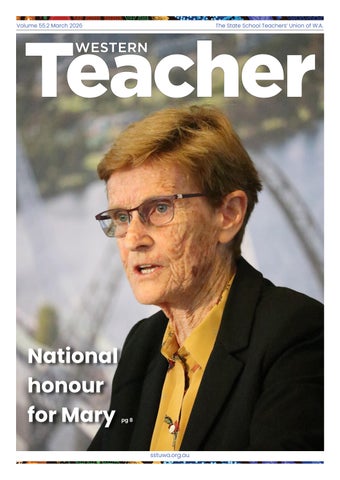
Create a flipbook