Costs and savings shown are based on salary packaging a vehicle under a novated lease over five years, driving 15,000km per year, and an annual income of $75,000. Weekly costs shown represent estimated net impact on after tax salary. Savings shown represent estimated tax savings over the lease term. Images are for illustrative purposes only. Before making a decision, you should consult your independent legal, taxation and financial advisor for advice relating to your personal circumstances. Finance is available to approved applicants only. Terms, conditions, eligibility criteria and fees and charges apply.
*Offer available for a limited time and only to new members singing up to a Novated Lease with Paywise.
Correspondence:
The Editor, PO Box 212, West Perth WA 6872 editor@sstuwa.org.au | Ph: 9210 6000
Member Assist: Ph: 9210 6060 memberassist@sstuwa.org.au
Authorised by Sally Dennis, General Secretary, The State School Teachers’ Union of W.A., 1 West Street, West Perth WA. Printed by Vanguard Press, 26 John Street, Northbridge WA. April 2026.
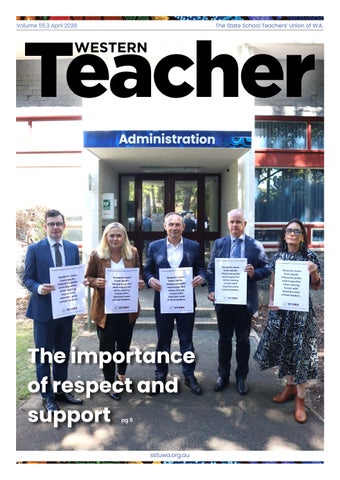
Cover: Premier of WA Roger Cook, Education Minister Sabine Winton, Director General Jay Peckitt and WACSSO President Pania Turner supporting our Teacher Respect campaign. Read more on page 5.
To access the digital copy of Western Teacher, visit: sstuwa.org.au/westernteacher
YOUR UNION BENEFITS KEEP COMING
Your union benefits keep coming. As a SSTUWA member you and your family can join Teachers Health - the only health fund in Australia dedicated to supporting the education community.
Just some of the ways we go the extra mile for our members:
• We’ve given more back to members as benefits than the industry average (for over 10 years!)
• Private patients can choose their doctor and schedule elective hospital treatment
• Eligible members can access support for health conditions, including mental health
• Your dependant adult kids can stay on your family cover - until they turn 32*
Spencer, Union and Teachers Health member
The importance of respect and support
By Matt Jarman President
Last year I spoke about respect for public educators and the teaching profession. We called for parental and community support to assist in restoring respect in schools.
This followed results from our 2025 State of Our Schools survey, which showed that 84 per cent of our members had considered quitting in the past four years. Over 5,000 had already left the teaching profession in the three years to 2023, and over 60 per cent of those were young teachers. The ones that were contemplating quitting said a lack of respect for the profession was a key reason, along with workload and burnout. As reported by the DoE, resignation remains at alarming levels.
Recent events at a southern public school serve as a reminder restoring respect is ongoing – but remains more critical than ever. It needs full parental engagement and support, as well as that from the government, to ensure that our public educators are protected and respected. We know the vast majority of parents support teachers and school leaders. But there are a growing number who don’t choose to interact with teachers politely or rationally and even resort to abuse or violence.
The 2025 Australian principal wellbeing survey revealed 47.8 per cent of school leaders reported acts of physical violence against them, while 53.7 per cent also reported threats of violence, which came mostly from parents. More than half (54.4 per cent) stated they were seriously considering resigning from their roles.
No level of frustration justifies verbally or physically attacking a teacher or a school leader. Our young people are influenced by the behaviour that they see in adults, so adults must strive to uphold greater
levels of respect for their children’s teachers and school leaders. We need a united community effort to bring respect back into schools. We have already started the process ourselves through our Respect posters, which can be downloaded from sstuwa.org.au/RESPECT
Members, please print the Respect posters at work and post them in every public area of your school. Let’s spread the message that respect is vital in starting to improve behaviour in schools.
The Premier of WA, Roger Cook has now joined the Education Minister Sabine Winton and Department of Education Director General Jay Peckitt in endorsing SSTUWA posters and our ongoing campaign (please see our social media channels for more).
Parents, you can play your role by engaging with teachers respectfully and:
• Respect the fact that teachers are not available outside working hours.
• Respect teachers on social media channels.
• Respect teachers in front of your children.
• Respect the fact that it just might be that your children’s behaviour is the issue, not the teacher’s.
• Use the correct school and regional channels to discuss your concerns or feedback.
If you see others who are not showing respect, please quietly call it out. Doing so can make a big impact to a teacher’s day and can have a long-term impact on public education for all our students, not just your own.
Simply modelling acts of kindness to others in front of students and children is very powerful.
Respect is one simple and effective way to help boost teacher morale and retain experienced staff. If we can foster respect then it will, over time, improve behaviour. It will reduce violence and will lead to better outcomes for students, parents and teachers alike. Respect is only one part of the solution and goes hand-inhand with the importance of parental engagement and support for teachers and the school.
No matter what changes there may be in education, there is no substitute for the relationship between the teacher and the student. Teachers and school leaders make a critical contribution to a community and for this, they should never be disrespected.
AEU Schools For Our Future
At time of print, the Australian Education Union brought its Australia-first national inquiry into public school infrastructure to Perth, focusing on how targeted investment could deliver world-class learning environments for every Western Australian student.
The AEU met with public educators, school leaders, families, government and community organisations through meetings and school visits. The inquiry team saw brand new schools and examples of the 50 per cent of our public schools which are more than 50 years or older. You can still have your say by making a submission to the inquiry at schoolsforourfuture.org.au
The closing date for submissions is 30 June. Read more about the inquiry on page 11 of this issue of Western Teacher
Free TAFE needs infrastructure and lecturer investment
By Jonelle Rafols Senior Vice President
As governments promote Free TAFE as a response to Australia’s growing skills shortages, WA must also ensure its public TAFE system, and the lecturers who deliver vocational education, are properly supported to meet the state’s workforce needs.
The renewed national focus on Free TAFE has brought welcome attention to the vital role vocational education plays in Australia’s economic and social future. Expanding access to training is an important step, but it also raises an important question: will the Cook government invest strongly enough in the public TAFE system to deliver on this promise?
These issues were also highlighted recently at the AEU’s National Conference, which National TAFE Council Executive Member Gary Hedger and I attended. At the meeting, Federal Skills and Training Minister Andrew Giles spoke about the importance of rebuilding the public vocational education system and ensuring Free TAFE delivers genuine opportunities for students and workers. His remarks reinforced the need for governments to ensure that expanding access to training is matched with sustained investment in TAFE infrastructure and the lecturers who deliver it.
In WA, the answer matters greatly. The state’s economy relies on a skilled workforce across industries such as construction, resources, energy, manufacturing and community services. Yet unlike schools and universities, the value of a strong public TAFE system has often been undermined by policies that treat vocational education as a competitive training market. Over the past two decades, governments encouraged the expansion of private training providers, frequently diverting funding away from the public TAFE
system that has traditionally delivered the majority of high-quality vocational education.
The consequences of these policies have placed significant pressure on public TAFE campuses. Funding instability, fragmented training delivery and growing administrative demands have made the work of delivering vocational education increasingly complex. Despite this, WA’s TAFE lecturers continue to provide the high-quality training that industry and communities depend on.
The introduction of Free TAFE signals a welcome shift in thinking. It recognises that vocational education is not simply a commodity to be bought and sold in a training market, but a public good that supports economic productivity, strengthens communities and provides pathways to secure employment. WA’s public TAFE network is well placed to deliver on this opportunity. Across the state’s five public TAFE colleges, lecturers work closely with local industries and communities to deliver practical, jobfocused training across a wide range of sectors.
TAFE also plays a critical role across regional WA, ensuring people outside metropolitan areas can access highquality vocational education close to where they live and work. At the centre of this system are TAFE lecturers. Their work extends well beyond delivering lessons. Lecturers design and maintain training programs, engage with industry, manage complex assessment and compliance requirements, and support students from increasingly diverse backgrounds. Their industry expertise ensures graduates enter the workforce with the skills and professional standards required by employers.
However, many lecturers know that the reality of working in the sector has become increasingly challenging. Rising
enrolments, ageing facilities and growing administrative demands are placing pressure on teaching and learning environments. At the same time, many students are arriving at TAFE with more complex learning, financial and wellbeing needs, requiring additional support that lecturers are often expected to provide without adequate resources.
From the SSTUWA’s perspective, strengthening TAFE must include strengthening the workforce that delivers it. Expanding Free TAFE places must be matched by investment in modern facilities, updated equipment, student support services and secure employment for lecturers. Without this investment, the pressure on staff and campuses will only grow.
WA is already experiencing shortages in a number of critical occupations, including skilled trades, health and community services and aged care. A strong public TAFE system will be essential if the state is to train the workforce needed to meet these growing demands. Free TAFE has the potential to expand opportunity and address skills shortages. But for that potential to be realised, governments must commit to sustained investment in the public TAFE system.
For the SSTUWA, the message is clear: if WA is serious about building the skilled workforce our economy needs, the Cook government must back that ambition with real investment in public TAFE and the lecturers who deliver it. Strengthening TAFE means strengthening secure jobs for lecturers, improving campus infrastructure and ensuring West Australians continue to have access to a strong, publicly delivered vocational education system.
TAFE lecturers, visit bit.ly/40p8eXf to enrol in Know Your Rights – TAFE training on Friday 22 May at the SSTUWA
Workload reduction a priority
By Sharmila Nagar Vice President
It would be no surprise to our members that Australian teachers have one of the largest workloads as reported by the Organisation for Economic Co-operation and Development (OECD).
The OECD report was released at the end of last year from its Teaching and Learning International Survey 2024 (TALIS). The report shows that Australian teachers teach less than the OECD average but spend an additional 26 hours a week on non-teaching tasks. In his analysis of this report, Trevor Cobbald states: “A major component is planning, marking, and collaborative tasks. Australian teachers spend 18.1 hours per week on these activities - the fourth highest in the OECD. Half of all Australian teachers report that excessive marking is a significant source of stress, among the highest proportions internationally.”
“One likely factor is the time spent preparing students for NAPLAN tests,” he continues. “Australian schools often devote weeks of class time to NAPLAN preparation, and teacher union surveys confirm that most teachers believe NAPLAN substantially increases their workload. While other OECD nations also use standardised tests, it is unclear whether they require similar volumes of classroom practice.
“Administrative burden is another defining feature of Australian teachers’ workload. TALIS 2024 shows that Australian lower secondary teachers spend 4.7 hours per week on administrative tasks, the fourth highest in the OECD. The OECD average is three hours; teachers in Finland and France spend only 1.5 hours. Administrative work is a major source of stress for 69 per cent of Australian teachers — the third-highest rate internationally.”
The SSTUWA’s State of our Schools survey 2026 show that the key contributors to workload include: Behaviour data collection; class sizes; dealing with student behaviour; lack of classroom support; meetings; mental health challenges of students; parental communication; preparation, planning and resource creation; reporting and assessment and staff shortages.
The SSTUWA is a party to the Workload Intensification Taskforce, which was set up after the last round of bargaining to alleviate workload pressures for teachers and school leaders. Clause 29 of the current General Agreement (Schools) explains that the taskforce is independent of the Department of Education’s (DoE) EREC and will identify compliance tasks that can increase in workload, alongside complex behaviour management, professional learning, small group tuition and documented plans.
The union is aware that reporting to parents has been linked to workload pressures for our members. It has taken several years to finally reach a consensus on comment requirements for reporting to parents in pre-primary (PP) to Year 10.
Our member feedback indicated that writing comments was onerous and time consuming. New reporting changes will see comments reduced to a general comment of up 1,000 characters in PPYear 6 (including a progress on English and Mathematics), and up to 600 characters in Years 7-10.
The work of the taskforce on reporting requirements will see a further focus on senior secondary, education support and English as Additional Language/Dialect.
Other workload reduction strategies from the taskforce will include a streamlined documented plan template
for mainstream students which will be communicated to schools at the end of Term 1.
While this template is not mandated, we strongly encourage our members to use this template from Term 2 onwards when creating new documented plans. By using this template, members can rest assure that they will be adhering to Clause 68 (student documented plans) and Schedule J (Framework for Documented Plans).
This template will remove the need to over report, while keeping to its key focus of being student centred and for teachers to be able to use their professional judgement. As stated in Schedule J, 8: “The Document Plan needs to be kept as simple as possible. While addressing the needs of the student(s), due consideration is given to Teacher workload.”
For school leaders, and administration, a significant amount of work has been done on compliance requirements on the go with this. This will be tabled once completed. Like the work done by the unions with the DoE on streamlining consistent process for water and power outages, the SSTUWA is pleased that another administerial task for school leaders has been done.
The SSTUWA’s next workload priority for the taskforce will be the need for clarity around graduate portfolio requirements. At the time of writing this article, the SSTUWA is compiling a formal report to table at the next taskforce meeting.
As we prepare to go back into bargaining this year, we know our members will be expecting the SSTUWA to continue advocating for the alleviation of workload pressures for all.
Building a more responsive and effective union
By Sally Dennis General Secretary
Stronger together
Over recent months, my focus as SSTUWA General Secretary has been on ensuring our union is more responsive, transparent and firmly grounded in the needs of our members. The changes we are implementing are deliberate and directly informed by what members have told us matters most.
One of the clearest messages I have heard is the need for stronger, more accessible support. In response, we have increased our industrial staffing in the Member Assist Team to ensure members can access timely and expert assistance when they need it.
This is fundamental to who we are as a union. We are also employing an additional dedicated advocate to provide an additional level of professional support for members facing complex matters.
Recognising the importance of the TAFE sector, we have appointed an additional TAFE organiser. This strengthens our engagement and ensures sector-specific issues are better represented and addressed.
We have also renamed our Legal Services division to Industrial Services to better reflect its purpose.
This change responds directly to member feedback that previous arrangements were not always well understood and supports our move to reduce outsourcing by managing more member matters in-house under the leadership of our Industrial Services Coordinator and Advocate, Liz Carbone.
At a national level, I was pleased to
attend the 2026 AEU Federal Conference as a guest.
This provided an important opportunity to connect with colleagues across the country, share perspectives and ensure our union remains engaged and informed within the broader movement.
Good governance is critical to a strong organisation. Our Executive is currently undertaking governance training to strengthen capability, accountability and best-practice decision-making.
I have been encouraged by the approach of the new Executive. We have already held several meetings, and members have been diligent, thoughtful and genuinely committed to driving positive change.
I am very aware of the financial pressures facing members. That is why we are reviewing union fees with a focus on fairness and sustainability.
Alongside this, we are updating our policies and procedures to ensure they are contemporary, clear and support consistent decision-making across the organisation.
We are also examining how we invest members’ money, with a focus on strengthening transparency, accountability and alignment with our values. Members deserve confidence that their contributions are being managed responsibly.
Supporting members to build their knowledge and confidence in the workplace is another priority.
We have expanded industry training
opportunities and increased the delivery of “Know Your Rights” sessions, particularly in regional areas, to ensure equitable access to support and information.
Strengthening industrial knowledge across the membership is central to building a confident and empowered union.
A key part of strengthening our union is ensuring members have a direct and meaningful voice in shaping our industrial priorities.
Members are encouraged and supported to submit motions for the upcoming Log of Claims, so their workplace issues and priorities are formally considered.
We are also inviting members to participate in the Log of Claims Committee, providing a valuable opportunity to contribute directly to the development of claims and help shape the direction of negotiations.
Engagement remains at the heart of everything we do. Senior officers and I have attended District Council meetings across the state to listen directly to members and ensure their voices inform our direction.
These initiatives reflect a clear and purposeful direction, one focused on practical improvements, strong governance and genuine engagement.
I remain committed to this work so that our union continues to be strong, relevant and firmly focused on delivering for members.
In solidarity.
Facing the Facts on improving teacher and school leader wellbeing
By Lindsay Hale School leaders’ consultant
For more than a decade, teachers and school leaders in WA have carried a growing burden of expectations, complexity and intensification. Facing the Facts: A Review of Public Education in Western Australia made this reality impossible to ignore, finding that educators increasingly feel undervalued, disrespected and exhausted as workload and student complexity surge. The core message was blunt: the profession is at breaking point and system level reform - not individual resilience - is the only sustainable path forward.
This message is echoed powerfully in Understanding and Reducing the Workload of Teachers and Leaders in Western Australian Public Schools by Viviane Robinson and Peter Hamilton. Their analysis shows that workload intensification is not the product of a single cause but the cumulative impact and relentless nature of proliferating tasks, expectations and compliance requirements.
They emphasise that the expansion of teachers’ and leaders’ core workcoupled with increasing behavioural, wellbeing and mental health demandsis now so significant that the fundamental viability of the job must be questioned. The report warns: “whether the job of teaching as currently performed and organised is doable and sustainable” is no longer a rhetorical question.
The Public Sector Commission’s Agency Capability Review of the Department of Education reinforces this diagnosis from a system governance perspective. It notes that central and regional supports have not kept pace with rising student
complexity and disadvantage, and that organisational structures remain too centralised and remote for many schools’ needs.
The review highlights the lack of clarity around system priorities, accountability and how leadership across levels works together to deliver them - creating ambiguity and pressure that ultimately flows directly into schools.
It stresses the need for a coherent vision, stronger capability and an organisational structure fit for purpose in a significantly more demanding environment.
Taken together, these three bodies of evidence - Facing the Facts, the PSC review, and Robinson and Hamilton - present a clear, convergent thesis: educator wellbeing is a system responsibility, not an individual failing. Efforts that focus solely on personal resilience will continue to fall short if the system itself remains misaligned, under resourced and operationally fragmented.
So what must the public education system actually do?
First, it must dramatically strengthen localised staff, behavioural support and specialist services so schools are no longer expected to compensate for gaps in mental health, disability, youth services and family support. Second, workload reduction must become an explicit system priority: unnecessary compliance, documentation and processes must be systematically identified and eliminated, not merely acknowledged. Third, strategic coherence must be restored. Fewer, clearer priorities - supported by aligned resourcing, implementation support and
transparent monitoring - would reduce the churn and policy volatility that erode morale.
Finally, school leaders and teachers must be meaningfully involved in shaping system culture, strategy and expectations; their voices cannot remain peripheral to the design of the very system they are expected to lead and sustain.
Improving teacher and leader wellbeing is not a matter of asking or helping educators to be more resilient. It is about designing a system that no longer depends on heroic individual effort to function. The evidence is clear - and the responsibility sits squarely with the system to respond.
Recently principals have been offered the band-aid of a dedicated wellbeing budget. Fair enough, but that doesn’t address the systemic and cultural drivers that impact on their wellbeing and that of their staff. A recent report from Monash, Deakin and the University of Sydney - Invisible Labour: Principals’ Emotional Labour in Volatile Times – had one principal use the telling metaphor of “juggling 10 chainsaws”. Is there anyone in the frontline in schools not feeling this burden?
It’s time to face the fact that reactive responses to wellbeing concerns do not stem the tide or address the causes – that would require seriously addressing workload intensity, job design, Department culture, school and performance review, and human support for school leaders and teachers as an inherent part of the public education system.
Graduate teacher entitlements: what you need to know
By Chloe Hosking Growth Team coordintor
Starting your teaching career is both exciting and challenging. The SSTUWA has consistently advocated for stronger support for graduate teachers and, as a result of generations of union members’ efforts, a range of entitlements are available to help you succeed in the early years of your career.
It’s important to check that you’re receiving everything you’re entitled to, as allocations can sometimes be missed. If you’re unsure, support is available to help you follow things up.
If you’re employed on a contract of six months or longer, you are entitled to the following:
Start-Up Allowance
A $2,000 (pro-rata) Start-Up Allowance at the beginning of both your first and second years of teaching. This payment is made through payroll, so check your initial payslips. If it doesn’t appear, your first step is to speak with your manager of corporate services (MCS).
Additional Non-Contact Time
In your first year, you receive eight additional days of non-contact time. This may be scheduled as approximately one hour per week or as two full days each term. The timing is flexible and should be negotiated with your principal or line manager. This time can be used for planning, reporting, behaviour management and other essential duties other than teaching tasks.
Graduate Module Relief Funding
Schools receive funding for eight days of relief to allow you to attend Graduate Modules. If modules are completed
online outside of school hours, on a day you would not normally work or during school holidays, you are entitled to paid time off in lieu. Confirm arrangements with your principal or line manager before enrolling in a module via the Professional Learning Information System.
Curriculum Materials Allowance
You can access a $150 allowance for classroom resources such as textbooks, teaching materials or useful teaching equipment like a Bluetooth speaker. These items belong to you. Check with your MCS before purchasing to confirm approval and reimbursement processes.
Contingency Allowance
This allowance supports travel and accommodation costs for Graduate Modules 1 and 2, particularly for regional teachers. Amounts vary, starting at approximately $130 for metropolitan teachers.
Graduate teachers are also eligible for the In-Class Coaching Program and, under the 2021 General Agreement, should only be required to undertake internal relief by agreement.
For more information, visit sstuwa.org.au/kyr and review the New Educator Rights and Entitlements sheet, or contact Member Assist on 9210 6060 or 1800 106 683
AEU inquiry into public school infrastructure
The AEU has launched Australia’s first national inquiry into public school infrastructure, marking the beginning of a nationwide consultation process to ensure every child learns in a safe, modern and inclusive public school.
The inquiry, chaired by former AEU and ACTU President Sharan Burrow AC, will examine the current state of public school infrastructure across Australia, assess future needs and recommend long-term funding and policy reforms to deliver future-ready schools in every community.
Launching the inquiry in Adelaide, AEU Federal President Correna Haythorpe said public schools are essential national infrastructure and must be treated as such.
“Public schools are at the heart of every community. They shape our nation’s future and they deserve long-term, coordinated investment that matches their importance,” she said.
“This inquiry will gather the evidence of unmet needs across Australia. We want to ensure every child, no matter their postcode, has access to high-quality learning environments that support their success.”
The inquiry will consult widely with principals, teachers, education support staff, families, governments and community organisations through roundtable meetings and visits to schools in every state (at time of print the inquiry would have held its WA events). It will also engage with groups representing Aboriginal communities and Torres Strait Islander communities, students with disability and rural and remote Australians.
Submissions can also be made to the inquiry until 30 June by visiting schoolsforourfuture.org.au
Chair Sharan Burrow AC will lead the national consultation process, bringing decades of experience in advocating for equity, strong public institutions and
long-term nation-building reform. She will be joined by Deputy Chair Maurie Mulheron.
The AEU has released an issues paper to guide the consultation process. The paper can be accessed at bit.ly/4l6MV60
Ms Haythorpe said the inquiry came at a critical moment.
“While we have a national framework for recurrent school funding, there is no equivalent national strategy for public school infrastructure and no permanent Commonwealth capital funding stream,” she said.
“With the Commonwealth abandoning capital works funding in 2017, states and territories are going it alone. Investing in public school infrastructure is one of the most effective ways to lift outcomes and strengthen equity across the system.”
More than 2.6 million students attend Australia’s public schools. Enrolments have grown significantly over the past decade and population projections point to continued growth in school-age children. Student needs are becoming more complex, with rising numbers of students requiring additional learning, wellbeing and disability supports.
Ms Haythorpe said infrastructure must keep pace with these realities.
“Teachers are delivering extraordinary work with increasingly diverse and complex student needs. They deserve state of the art facilities that complement the high-quality teaching they provide,” she said.
“Improved capital works are not just about buildings. It’s about
inclusion, wellbeing and opportunity. If governments are serious about improving student educational outcomes, then investing in infrastructure must be on their agenda.”
Ms Haythorpe said the launch in Adelaide signalled the start of a constructive national conversation.
“This is a nation-building project. It’s about planning not just for the next budget cycle, but for the next generation,” she said.
“Investing in public school infrastructure is one of the most effective ways to lift outcomes and strengthen equity across the system.
“Every child deserves to learn in a school designed for the future, not the past. Through this inquiry, we are inviting governments and communities to work with us to make that vision a reality.”
A national inquiry into Australia’s public school infrastructure needs
TAFE Know Your Rights: Right to Disconnect
Main clauses and documents
• Clause 41 – Right to disconnect is the clause in the Western Australian TAFE Lecturers’ General Agreement 2023 that contains the right to disconnect provisions.
• See also the Western Australian TAFE Lecturers’ General Agreement 2023 – Implementation Guidelines –2023, specifically Clause 41 – Right to disconnect.
Key issues and guidance
• Lecturers are not required to monitor or respond to work related communication outside of the hours a lecturer is scheduled to work each week.
• If a lecturer feels they are being pressured, coerced, or forced to monitor and respond to work related communication they should seek advice from the union via Member Assist.
Clause 41 – Right to Disconnect
41.1. The Employers recognise that Employees have periods of leave and non-work days.
41.2. Employees are not required to access work related information or respond to communications such as text messages and emails outside their ordinary hours.
41.3. Employers may send communications in the case of an emergency situation, genuine health and welfare concerns or for relief lecturing.
Information taken from the Western Australian TAFE Lecturers’ General Agreement 2023 – Implementation Guidelines – 024, Clause 41 – Right to disconnect
Clause 41 recognises that lecturers are not obliged to access work related
information or reply to communications outside of their ordinary hours. “Ordinary hours” will be different for each individual lecturer. These are the hours a lecturer is scheduled to work each week.
An employer may communicate with a lecturer outside of their ordinary hours in the case of emergency, for relief lecturing and health and wellbeing concerns, however lecturers are not required to monitor or respond to these communications.
Current STERC polices and protocols can be accessed through the union website or via Member Assist. As an SSTUWA member, you can contact Member Assist for industrial advice at any time on (08) 9210 6060 or 1800 106 683 or at memberassist@sstuwa.org.au
A powerful opportunity for SSTUWA women
By Jonelle Rafols Senior Vice President
The Anna Stewart Memorial Project continues to be one of the most respected leadership development opportunities for women across the Australian union movement. In 2026, UnionsWA will again run the one-week program and the SSTUWA is seeking two members to participate.
This program offers union women the chance to deepen their understanding of how unions operate, build leadership and organising skills, and strengthen their voice within their workplaces and the broader labour movement.
Over the years, the program has played an important role in developing women leaders across Australia. Within SSTUWA itself, several senior leaders have participated, including our current leaders General Secretary Sally Dennis, Senior Vice President Jonelle Rafols, and Executive members Renee Chapple, Sarah Dinan and Jill Pether (pictured above right). Their involvement highlights the value of the program and the leadership pathways it can open.
Honouring a union pioneer
The program honours Anna Stewart, a pioneering union official and advocate for working women. Anna was a journalist who became deeply involved in the trade union movement during the 1970s and early 1980s, working tirelessly to advance equality and improve conditions for women in the workplace.
At a time when many women were employed in low-paid, insecure jobs with little recognition or workplace protection, Anna pushed unions and employers to address issues affecting women workers. She played a key role in campaigning for maternity leave provisions in industrial awards, led efforts to address sexual harassment as an industrial issue, and advocated for childcare support and better recognition of women’s work.
Tragically, Anna Stewart died in 1983 at just 35 years of age. In recognition of
her extraordinary contribution, union colleagues established the Anna Stewart Memorial Project in 1984 to encourage more women to become active in their unions and to develop the next generation of union leaders.
Building confidence, skills and networks
The Anna Stewart Memorial Project is typically a short intensive training program that combines workshops, mentoring and practical union experience. Participants gain insights into how unions organise and campaign, how workplace issues are addressed and how members can build collective power.
Participants often spend time shadowing union officials, attending meetings, learning about industrial campaigns and developing advocacy skills. The program also brings together women from different unions and industries, creating strong networks and a shared commitment to improving workplaces for women.
For many participants across Australia, the experience has been transformative - building confidence, expanding knowledge of the union movement and inspiring greater involvement in workplace representation and union leadership.
A chance for SSTUWA members
The SSTUWA is proud to support the development of women within our union and the broader labour movement. The fact that our general secretary, senior vice president and several current Executive members have completed the Anna Stewart program shows how influential the experience can be.
We are now seeking two SSTUWA members who would like to take part in the 2026 Anna Stewart Memorial Project with UnionsWA.
If you are passionate about workplace rights, interested in developing leadership skills and keen to become more active within the union movement, this program could be an incredible opportunity.
Encouraging SSTUWA members to apply
We strongly encourage female SSTUWA members who want to grow their skills, confidence and networks to consider applying.
The Anna Stewart Memorial Project is more than just a training program, it is an opportunity to join a proud tradition of union women who have stepped forward to advocate for fairness, equality and better workplaces for all.
Further information about how to express interest can be found by visiting bit.ly/47tzQhF
Government funding growth still stacked against public education
The Productivity Commission’s Report on Government Services (ROGS) 2025 exposes again a deeply unfair school funding system, with government funding growth continuing to favour private schools over public schools despite rising student need.
The report shows that private schools are now publicly subsided to a greater extent than ever before. In 2013-14 private schools received 67.7 per cent of the combined government funding per student. In 2023-24 this had increased to 70.8 per cent.
Private schools have received significantly stronger growth in real government
funding than public schools over the past decade, both in total funding and on a per-student basis. Combined Commonwealth and state government funding to private schools has grown 30.6 per cent faster than funding to public schools over the last 10 years
“This is yet another year where the data shows that private schools continue to receive the lion’s share of government funding growth while public schools are being short-changed,” said AEU Federal President Correna Haythorpe.
“Despite educating the vast majority of students with the highest needs, public schools are falling further behind because
governments continue to prioritise funding growth for private schools.”
Alarmingly, the report also shows that per-student government funding for public schools went backwards in the last year, driven by a decline in primary school funding.
Funding per primary student fell from $18,942 in 2022–23 to $18,853 in 2023–24, while overall recurrent funding per public school student declined for the first time in a decade.
“When funding per student goes backwards, schools feel it immediately in larger classes, fewer teachers and
support staff and less capacity to meet student needs,” Ms Haythorpe said.
“This is happening at a time when public schools are educating more than twice the proportion of students from low socioeducational backgrounds, and when the number of students requiring disability adjustments has increased by more than a third in just four years.”
The report confirms that public schools now educate 31.5 per cent of students from low socioeducational backgrounds, compared to just 13.7 per cent in private schools, and that 27.2 per cent of public school students required an adjustment for disability in 2024
“Public schools are doing the heaviest lifting in education and it is the teaching profession whose expertise and commitment are the primary reason an underfunded public education system works as effectively as it does,” Ms Haythorpe said.
“The latest data from ROGS shows the inequality between sectors clearly and is a wakeup call to all governments that funding for public education must be urgently prioritised.
“The lack of funding is putting the teaching profession in crisis with unmanageable workloads, leading to high levels of stress, burnout and teacher shortages. These issues can all be addressed with proper resourcing.
“With seven state and territory governments having signed new funding agreements with the Albanese government, we have a unique opportunity to invest in recruitment and retention of teachers, specialists and education support staff and help schools better meet the needs of every child.”
In a positive development, ROGS shows that government investment in vocational education and training has increased since 2020, with around 75 per cent of funding directed to TAFE. However, several states have increased the share of funding flowing to non-TAFE providers
and total funding paid to non-TAFE providers rose to $1.6 billion in 2024
“TAFE has rightly regained a central role in VET, but governments must resist shifting public funding back towards private providers and ensure TAFE is properly funded as the public provider,” Ms Haythorpe said.
In early childhood education and care (ECEC), total government expenditure reached $20.3 billion in 2024–25, with per-child spending increasing nationally but unevenly across states. Workforce pressures remain acute, with nearly one in five paid contact staff lacking a relevant ECEC qualification and higher reliance on staffing waivers in remote areas.
“ECEC funding growth is welcome, but it won’t deliver quality outcomes unless it is matched by workforce investment and a stronger public role,” Ms Haythorpe said.
“Across schools, TAFE and early childhood, the message from this report is clear that equity, workforce capacity and public provision must be at the centre of government policy.”
Key Facts:
Total recurrent funding
• Commonwealth funding to private schools in 2023-24 is now $6.23 billion
per year higher in real terms than a decade ago in 2014-15.
• Total combined government funding to public schools is $11.1 billion in 202324. This is a nominal increase of only 0.2 per cent from 2022-23.
• Total combined government funding to private schools is now $22.78 billion in 2023-24 and has increased by 44.4 per cent in real terms over the last decade.
• Governments provided 60.1 per cent of nongovernment school funding in 2024.
Recurrent funding per FTE student
• Private schools have received 1.306 times the growth in total recurrent government funding per student that government schools received over the last decade.
• Each private school student received $15,262 in combined government funding on average in 2023-24.
• Total recurrent income per student to public schools has declined from last year, total recurrent funding per FTE student in government schools was $21,550 in 2023-24 – this is less than received in 2022-23.
(continues on page 16)
(continued from page 15)
• Per student funding for primary school students has declined from $18,942 per student in 2022-23 to $18,853 in 2023-24.
• Private schools are now publicly subsided to a greater extent than ever before. In 2013-14 private schools received 67.7 per cent of the combined government funding per student than public schools did. By 2023-24 this had increased to 70.8 per cent.
• Over the last decade from 2014-15, total per student funding to public schools has increased by 18.6 per cent, from $17,540 to $21,550 at an average of 1.9 per cent per year.
• Commonwealth funding to private schools has increased by 43.2 per cent in real terms on a per student basis over the decade from 2014-15 to 2023-24.
• Private school per student combined government funding has increased by 24.3 per cent over the last decade at an average of 2.4 per cent per year –a rate 1.3 times the rate of the public school increase.
• This means that combined State/ Territory and Commonwealth government funding to private schools has grown 30.6 per cent faster than it has for public schools.
Public schools educate students with greater need in 2023
• Public schools educate more than twice the proportion of students from low socio-educational background households – 31.5 per cent of students compared to 13.7 per cent in private schools. The percentage of students from low SEA in public schools has steadily increased from 30.1 per cent a decade ago in 2015.
• The highest level of disadvantage is in the NT (49.1 per cent of public school enrolments) followed by Tasmania (43.3 per cent) then by QLD (34.3 per cent) and NSW (31.6 per cent).
• 27.2 per cent of public school students required an adjustment due to disability in 2024 (an increase more than a third (34 per cent) from 20.3 per cent in 2020), compared to 23.0 per cent of Catholic school students and 23.4 per cent of independent school students.
• Among all public school students Year 12 retention is at 74.3 per cent nationally. It lowest in the NT at 61.6 per cent and New South Wales at 67.3 per cent.
• Year 12 certification for students from low SES backgrounds has declined to 69.7 per cent, down from a peak of 76 per cent in 2016.
• Teacher/student ratios continue to be higher at public schools – 13.1 at public schools compared to 12.5 at private schools.
• In secondary schools the gap in student/teacher ratio is highest, at 12.2 in public schools compared to 11.2 in private schools.
Total government real recurrent expenditure on VET
• Total government real recurrent expenditure (excluding the user cost of capital) in 2024 was $8.85 billion, reflecting a 12 per cent increase from the 2020 figure of $7.74 billion.
• Total government expenditure per annual hour of VET delivery, when weighting for the cost of course delivery, has increased 18 per cent since 2020.
Government VET Delivery funding paid to non-TAFE providers
• Total VET delivery funding paid to non-TAFE providers has increased somewhat to $1.6 billion.
• The Commonwealth proportion of total government VET delivery funding paid to non-TAFE providers was at 19.4 per cent in 2024. This is consistent with previous figures since the Albanese government was elected. In the previous Coalition government, the proportion paid to Non-TAFE providers sat at 32.4 per cent.
• At the state level, Queensland (33 per cent) and South Australia (33.5 per cent) delivered the highest proportion of total VET funding to non-TAFE providers.
• Four states have increased their real VET delivery funding paid to non-TAFE providers in 2024: New South Wales (+1 per cent), Victoria (+5.9 per cent), Queensland (+4.8 per cent), and Western Australia (+21.7 per cent).
ECEC
• Total government real recurrent expenditure on ECEC was $20.3 billion in 2024-25, a 79 per cent increase since 2015. The commonwealth accounted for 79.6 per cent of funding, with 20.4 per cent coming from state and territory governments.
• Nearly one in five paid contact staff across ECEC lacked an ECEC related qualification in 2024, with 9.2 per cent of NQF (National Quality Framework) services utilising staffing waivers. Remote and very remote providers are significantly more likely to be utilising staffing waivers.
Early career teachers considering leaving the profession
Early career teachers are reporting overwhelming workloads, insufficient support and inadequate preparation through initial teacher education (ITE), causing many to consider leaving the profession, according to a new AEU survey.
The AEU has released new educator data from the State of Our Schools 2025 survey, a national report revealing a deeply concerning picture for Australia’s teacher workforce pipeline.
The survey of 800 early career teachers with zero to three years’ experience shows that only 18 per cent are certain they will stay in teaching for their entire career and 30 per cent expect to leave within 10 years, with excessive workload, student behaviour and insecure employment driving many to consider leaving.
AEU Federal President Correna Haythorpe said the findings highlight an urgent national challenge.
“Fixing teacher shortages starts with keeping the new teachers we already have,” she said.
“These early career teachers are the future of our profession, yet too many are already burning out. They are working extraordinary hours, facing increasingly complex student needs and far too many are doing so without the mentoring and support they were promised.
“If we are serious about addressing the teacher shortage crisis, governments must invest in proper induction, mentoring and secure jobs for new educators, not just leave them to simply sink or swim.”
The report shows new educators work an average of 47.2 hours per week, with 74 per cent working more than 40 hours and nearly one-third working more than 50 hours. Only 59 per cent are employed permanently, compared to 87 per cent of all teachers.
ITE remains a key pressure point: new educators rated their ITE experience just
5.9 out of 10, a decline from 6.8 in 2018.
Nationally, 43 per cent said their training did not prepare them well for the classroom, and only five per cent felt “very well” prepared.
Critical gaps were identified in managing difficult behaviour, teaching students with disability, supporting student wellbeing and working with students from diverse linguistic and cultural backgrounds.
Only five per cent of new educators received any follow-up from their ITE provider after graduating.
Support in schools is inconsistent. While 61 per cent had a designated mentor, one in four new educators had no access to a mentor, and only 45 per cent said their mentor was readily available. Meaningful induction and structured support remain the exception rather than the norm.
To address these issues, the AEU is calling for the establishment of a national early career guarantee that includes reduced teaching hours, classroom release time for mentors, an orientation program and structured networking opportunities for teachers in their first three years.
“New educators have told us exactly what they need: secure jobs, reduced workloads in their first years, highquality mentoring and ITE that genuinely prepares them for today’s classrooms,” Ms Haythorpe said.
“Australia cannot afford to lose another generation of teachers. Governments
must act now, with national workforce planning and guaranteed workload relief for early career teachers.”
The AEU is calling on the federal government to:
• Introduce a national early career guarantee with reduced teaching hours, mentoring and networking for teachers in their first three years.
• Reduce primary classes from an average of 23 students to the OECD average of 21.
• Allocate an additional two hours a week for teachers to plan lessons and collaborate with their colleagues.
• Increase the number of trained education support staff in the classroom.
• Increase the numbers of administration and support staff in schools to reduce teacher and principal workloads.
• Improve systemic support for teachers educating students with complex needs.
How to build preschools suitable for neurodivergent kids
By Fatemeh Aminpour
An estimated 15–20 per cent of children are neurodivergent, with diagnoses rising each year. They may have a neurodevelopmental condition such as autism or attention-deficit/hyperactivity disorder.
We know many neurodivergent children experience sensory information differently from their peers. So, the spaces they learn in can strongly influence their comfort, participation and inclusion in education.
Most research on inclusive educational settings has focused on primary or high schools. Our new research examines how preschools can be designed to better support neurodivergent children. What features help or hinder inclusion in the early years?
Our research
We conducted a “Delphi study”. This is a method designed to gain consensus among a diverse range of experts.
We brought together experts from both education and built-environment design. We did a focus group with five Australian experts and five individual interviews with both Australian and international experts.
Sensory overload hotspots
Experts consistently emphasised how sensory overload is the biggest challenge neurodivergent children face in preschools. Previous research on school environments has noted noise in classrooms is the major issue. Our study found preschool playrooms filled with materials and walls and ceilings covered in displays are visually distracting.
Also, kitchens, dining areas and circulation zones (including corridors, hallways and open-plan spaces) can
often be overwhelming. These areas are noisy, busy and filled with unpredictable activity. And because kitchens and dining areas are often integrated into learning spaces, the effects extend beyond mealtimes.
We also found smell is an underexamined sensory stressor. Strong kitchen and food smells can trigger distress for children who experience multi-sensory processing challenges. If possible, preschools should consider how they can separate kitchen and dining spaces from learning spaces.
Overcrowding intensifies sensory stress
Some neurodivergent children require greater interpersonal distance than
their neurotypical peers. But high adult to child ratios in preschools can lead to overcrowding, with adults dominating the space. This is particularly the case if there are assistants for children with extra needs.
While safety regulations mean a certain number of adults per child is required, experts said preschools should consider the room sizes in use. As one noted: “we’ve got just nine children in a space, but still with three adults, that’s a lot of bodies in a room […] those adult bodies can dominate the smaller spaces.”
Open-plan spaces are tricky
While previous research criticises openplan classrooms for poor acoustics, our experts identified a different issue. Open
plans without any visual structure can feel confusing and overwhelming for children.
Our experts said design features can help. This includes storing materials in cabinetry to reduce visual clutter, sight lines to allow children to see what’s ahead and colour cues. For example, the reading zone has a blue mat, the blocks zone has a green mat. Age-appropriate signs (for example, with pictures or symbols) can also help children understand what a space is for.
The need for micro-retreats
Neurodivergent children vary widely. Some are hypersensitive, some are hyposensitive and some have a mixed sensory profile. This means preschools need a range of spaces to choose from.
This could include active areas for running, jumping and climbing and quiet zones for reading, drawing or daydreaming. This allows children to choose settings that match their current sensory needs and gradually expand their comfort zones.
As an architect told us: “you create a whole [range] of classrooms, some that have […] more control for those with more needs; and then other classrooms that are more typical. And you move through that gradient, and the hope is that we all want our students to be able to generalise the skills that they learn in the classroom outside in the real world.”
Experts in our study cautioned against creating rooms exclusively allocated to neurodivergent children. They can create “bubble” environments that risk fostering over-attachment to specific supports or spaces. They can also unintentionally reinforce stigma.
They noted “micro-retreats” (small, accessible places where any child can withdraw briefly from the main group) support self-regulation for all children, to normalising their use and promote inclusion.
These retreat spaces (such as small terraces or courtyards) could incorporate elements of nature and spaces that encourage movement to calm children down. If this kind of landscaping isn’t available, a simple nook, an open cubby, bean-type chairs and window seats can also be helpful.
Transitions need careful planning
Research suggests preschoolers spend 20–35 per cent of their day transitioning between activities.
Our study found unnecessary transitions between high- and low-stimulation zones, with a change in light or temperature (such as when moving from inside to outside), can create distress.
Locating similar-sensory activities together and providing clear visual cues can help smooth these movements. When children move between indoors and outdoors, a veranda or sheltered transition space can provide a pause point where they can regulate their senses before entering a new environment.
Co-design is essential
Finally, our experts told us designing for neurodiversity must involve educators, children and families, who have vital knowledge about what works. As one of the participating architects put it: “architects are an egotistical lot. And there’s this idea that we know it all – and we don’t at all.”
Many inclusive features identified in our study are considered “good practice” but not mandated in design codes or licensing guidelines. Embedding minimum spatial and sensory standards into policy would help ensure these
practices are not sidelined by budget or time pressures.
Inclusive preschool and daycare environments are crucial for supporting children’s engagement in learning and for ensuring a smooth transition into mainstream schooling. And when we design preschools to be neuroinclusive, we’re not designing for a minority, but we are creating calmer, clearer and more supportive spaces that benefit every child.
Fatemeh Aminpour is a research fellow at the City Futures Research Centre, UNSW Sydney. She has a background in architecture and is experienced in environment-behaviour research and inclusive design. Her research investigates the diverse needs of underserved and marginalised populations including children, people with disabilities, seniors and homeless people to address the knowledge gap in the design of suitable environments and services. The opinions expressed in this article are that of the author and do not necessarily reflect any official policies or positions of the AEU or SSTUWA. This article was first published on The Conversation website and has been reproduced here with permission.
Support and resources key to helping Indigenous high school students
By Maryanne Macdonald, Eyal Gringart, Renae Isaacs-Guthridge and Terry (Ngarritjan) Kessaris
Statistics showing Indigenous school students in a negative light are regularly reported in the Australian media and policy debates. We often hear how Indigenous students “trail” their nonIndigenous peers in NAPLAN results and how there are persistent “gaps” when it comes to finishing high school.
These messages unfortunately reflect a common bias against Indigenous Australians in the community. These stereotypes – such as “Indigenous people aren’t interested in education” – often seep into schools, creating obstacles for Indigenous students.
Until now we have not had a lot of quantitative evidence on Indigenous students’ actual attitudes towards education.
Our new research, based on a survey of more than 500 WA secondary students, shows Indigenous students care about their school education and want to complete Year 12.
But they continue to face obstacles to completing education, including equal access to computers, varied support for their Indigenous culture and needing to complete high school away from home.
Why teachers’ expectations matter
We know there are many systemic barriers which can affect Indigenous students’ school completion. Indigenous students are more likely to go to a rural school, where education is less accessible and schools are less well resourced.
Racism also remains widespread in Australian schools.
Research shows it is common for Australian teachers to believe Indigenous students are not interested in education or are unlikely to achieve academically. When students face these attitudes from their teachers, it can lower their motivation.
This harms students’ wellbeing, engagement with school and academic outcomes.
Our research
Our study surveyed 536 students from 14 secondary schools in Western Australia. Most participants came from remote or regional WA, although many attended boarding schools in Perth or regional towns.
Students were in Years 8 to 12 and went to Catholic or independent schools. We weren’t granted access to the public school system for these interviews. This means the results were skewed towards families who had opted out of the public school system. Some families had done this for religious reasons or to access boarding opportunities.
students across Australia typically attend schools that are less well resourced, which means that the problems faced by Indigenous students may be larger than what our study found.
Although the schools were private, they were not all “leafy-green” or privileged. Some were in remote communities and others served working-class families.
Indigenous students and non-Indigenous students in our study attended schools of equal socioeconomic status. Indigenous
The study compared students’ experiences at school with their beliefs about education. It aimed to understand how Indigenous and non-Indigenous students’ experiences shape their education aspirations. We used statistics software to analyse the data.
Indigenous students think school is important
Indigenous students and non-Indigenous students reported similar, positive responses when asked whether it was important to complete Year 12.
They also reported similar, positive responses to questions about their family’s support for school, future aspirations to study and belief about their ability to make something of their life.
Our results showed Indigenous students have strong self-belief and motivation.
Indigenous students were more likely to value school attendance and completion than non-Indigenous students. This is an important finding, as it shows “disinterest” is not the cause of differences in school completion.
What was students’ experience of school?
Less access to resources
Despite attending equivalent types of schools, Indigenous students in our study still faced more barriers than nonIndigenous students when it came to their education.
They reported less frequent access to computers and internet to do their homework. On average, Indigenous students said they could access these tools only “some of the time”, while nonIndigenous students said they could access them “most of the time”.
Indigenous students were also less likely to have family members who had completed secondary or tertiary education. Our school system often assumes students can access academic support at home, but this is not equally the case for all students.
Indigenous students were more likely to have had to leave home to complete high school, including going to boarding school. This means Indigenous students were more likely to be away from family support networks when they were studying. This can affect students’ ability to focus at school, especially during challenging times such as Sorry Business.
We asked students about the support schools provided around homework and career planning, their sense of belonging at school and whether their school had a positive culture in general and promoted Indigenous culture specifically. We also asked about staff-student relationships.
On these measures, we found there were actually greater differences between schools than between Indigenous and non-Indigenous students. This suggests school quality is an important factor in outcomes for Indigenous students.
When students feel respected and supported by their teachers, they’re more likely to stay engaged – and that’s especially true for Indigenous students.
Indigenous students in our study were three times more likely than other students to say the quality of relationships with teachers influenced their school attendance.
Indigenous students also reported that when teachers were culturally responsive (connecting students’ culture with what and how they were learning), it had a positive impact on their motivation and school resilience.
Beyond our study, Indigenous students are more likely to attend public schools and rural schools, which typically have less funds. Rural schools often have high turnover of staff, which makes it harder to build good staff-student relationships.
Yet we found some schools in our study, despite funding issues or remote location, had strong school cultures. They had developed culturally responsive approaches which improved Indigenous students’ sense of belonging.
The gap is access, not aspiration
Our research supports other studies that argue Indigenous students do not need assistance to develop aspirations around their education.
Instead, they need adequate schooling resources such as internet and computers, and responsive educators who enable their current aspirations to be achieved successfully. The education “gap” is in access, not aspiration.
Maryanne Macdonald is a lecturer in indigenous education at Edith Cowan University. Eyal Gringart is an associate professor at the School of Arts and Humanities at Edith Cowan University. Renae Isaacs-Guthridge is a lecturer in aboriginal education at Edith Cowan University. Terry (Ngarritjan) Kessaris is a lecturer in indigenous studies and cultural competency (casual) at Edith Cowan University. The opinions expressed in this article are that of the author and do not necessarily reflect any official policies or positions of the AEU or SSTUWA. This article was first published on The Conversation website and has been reproduced here with permission.
Defending the value of education: leadership, solidarity and collective power
By Tsogtgerel Zambal
Education is the backbone of social progress and national development, yet in Mongolia, those who dedicate their lives to teaching have long been undervalued. From classrooms to the frontlines of protests, through courage, resilience and collective action, teachers have secured historic victories. The Federation of Mongolian Education and Science Trade Unions (FMESU) has transformed struggle into solidarity, proving that when educators unite, they can reshape the future.
Campaigning to restore the dignity of the teaching profession
My own journey from a secondary school history teacher to president of the FMESU has been shaped by a deep belief that educators deserve dignity, fair compensation and a strong collective voice. This conviction has guided every step of our struggle to restore respect to the teaching profession and to secure the rights of those who sustain the education system.
The FMESU’s mission is clear: to contribute to quality education for all, to create conditions for a dynamic increase in living standards and to defend the labour rights and interests of our members. These goals are not abstract, they are rooted in the lived realities of education personnel who face mounting workloads, declining mental health, illness and the consequences of the shortages of qualified personnel. The crisis in education is not only about teachers, but it also directly affects the quality of learning and the future of our children.
In 2023, the FMESU joined the Go Public! Fund Education campaign. The
campaign provided a platform for advocacy, exchange of experiences and best practices with colleagues across the world, particularly in the North Asia sub-region, as well as valuable training in strategy development, planning, messaging and public engagement. It also provided capacity development and tools for effective communication with the public and decision-makers as well as campaign planning.
The campaign reminded us of a fundamental truth: when educators are organised, informed and united, real change is possible.
Our advocacy efforts centred on the implementation of the bilateral collective agreement signed with the [Mongolian] Ministry of Education, effective from January 2025. Throughout the year, we submitted proposals and formal requests, participated actively in national budget discussions and held several press conferences to highlight the urgent needs of educators.
In September [last year], we organised a nationwide protest involving 10,000 teachers and education support personnel. In October, to mark World Teachers’ Day, the FMESU organised a peaceful sit-in at the main square in front of the Parliament building. Over five days, 5,000 educators participated, braving the cold and fatigue to demonstrate their unwavering commitment to defending teachers’ rights and strengthening the public education system. This was not a symbolic gesture; it was a declaration that educators would no longer remain silent in the face of neglect and mounting depression of their purchasing power and professional value.
When these demands remained unresolved, members made the difficult decision to take industrial action. For 13 days, 40,000 teachers and education support personnel stood united across the country from urban to rural schools. This historic action demonstrated the true power of collective solidarity.
Photo: Education International
The strike was not easy. It required courage to withstand pressure, resilience to endure hardship and unity to maintain strength. Families of students and teachers provided food, encouragement and moral support. The public stood with education personnel, recognising that our struggle was not only for teachers but for the future of Mongolia’s children.
Through solidarity to victory
As a result of this collective action, the basic salaries of teachers and education support personnel [will] have increased by 50 percent from January 2026 and by an additional 26 percent from November 2026. This victory was monumental. It proved that when educators unite, they can reshape the future.
On 12 November 2025, another milestone was achieved with the successful conclusion of the Collective Agreement for 2026–2028, between the Ministry of Economy and Development and the FMESU. Upon registration with the Ministry of Family, Labor and Social Protection, the agreement entered into force, providing a stronger legal framework for protecting educators’ rights.
These achievements were not the result of individual effort, but of unity. It was the culmination of lengthy negotiation, dialogue and collective struggle. It showed that persistence, resilience and solidarity can overcome even the most entrenched obstacles.
Throughout this journey, the FMESU and our members were not alone. Education International and our brothers and sisters around the world watched closely, sending solidarity and encouragement as the strikes unfolded. Their support reminded us that the struggle for education is global and that every victory
in Mongolia contributes to a broader movement for justice and dignity in education worldwide.
Unity, solidarity and collective power revealed their true force. Despite the cold, the pressure and the workload, we emerged stronger, more resilient and more determined. We proved that courage is not the absence of hardship, but the ability to confront it together.
As president, my responsibility is to ensure that all agreements are implemented fully and without delay, that the rights of teachers and education support personnel are protected and that our union continues to grow. We remain committed to empowering our members through training, awareness-raising and education on their rights. Most importantly, we are strengthening and empowering our core foundation, the trade union committees at the school level.
Fair pay, safe working conditions and respect for educational labour are not
luxuries; they are essential investments in the future of our society. The power of our movement lies in solidarity and together, we will continue to defend the value of education.
The story of the FMESU’s struggle is one of courage, resilience and unity. It is a testament to the power of collective action and the strength of educators who refuse to be silenced. Our victories in salary increase, stronger legal protections and renewed respect for teachers are milestones on a longer journey toward justice and dignity in education.
The Go Public! Fund Education campaign has shown us that when educators stand together, they can change the course of history. We are proud as teachers, as union members and as a collective force. Stronger, united and determined, we will continue to fight for decent working conditions, for the empowerment of our members and for the recognition of education as a national priority.
Go Public! Fund education – We are stronger together!
Tsogtgerel Zambal is the president of the FMESU/Mongolia. He began his career as a history teacher and later served as an organising officer for a secondary school trade union committee before being elected FMESU President in 2019. He is dedicated to promoting education and labour rights, championing solidarity, collective action and protecting of the value of education in Mongolia. The opinions expressed in this article are that of the author and do not necessarily reflect any official policies or positions of EI, the AEU or SSTUWA. This article was first published on the Education International website and has been reproduced here with permission.
Photo: Education International
AEU statement on the conflict in Iran and the Middle East
The Australian Education Union (AEU) asserts that as teachers, school leaders and education support workers and advocates for public education, we hold a deep responsibility to speak out when global events threaten peace, human rights, and the future of the students, families and members we represent.
AEU members teach the next generation to value critical thinking, international understanding and the dignity of all people. We therefore will not remain silent when rising tensions and military escalation places innocent civilians, children and working people at risk.
The AEU notes with grave concern the dangerous escalation of armed conflict in Iran and across the region, including further conflict involving Lebanon and the ongoing humanitarian catastrophe in Palestine. Working people and their families everywhere bear the cost of these conflicts, which are the result of geopolitical competition, resource interests and entrenched power, not the aspirations of ordinary families who want safety, stability and opportunity.
The AEU strongly condemns the irresponsible and illegal bombing carried out by Israel and the United States against Iran and calls for an immediate end to these operations. Such actions violate international law, undermine diplomacy and are predictably plunging the region into a wider, devastating war.
The subsequent retaliation by Iran across the region, including attacks on Bahrain, Cyprus, Israel, Jordan, Kuwait, Qatar, Saudi Arabia and the United Arab Emirates, further endangers civilian lives and deepens instability. Escalation by any side will not bring security, peace or democracy.
The AEU affirms:
• That every child has the right to learn in peace. Classrooms cannot flourish in a world where communities
live under the threat of violence, displacement or economic blockade.
• People across the Middle Eastern region are bearing the human cost of this conflict. Like AEU members, they want secure jobs, quality education, safe homes and a future free from fear for their children.
• That aggression and military intervention worsen instability, deepen humanitarian crises and divert public funds away from education, health, housing and essential services.
• That we reject the use of military force which fuels cycles of violence and undermines the foundations of peace, justice and multilateral cooperation.
• That public education is a foundation for peace. Our classrooms teach cooperation, democracy, respect and the skills that build resilient, inclusive societies, not division or militarisation.
• That Australia’s foreign and defence policy must prioritise diplomacy, human rights and long-term peace, not the interests of arms manufacturers or external powers seeking strategic advantage.
The AEU resolves to:
• Call on the Australian Government to pursue immediate ceasefire and deescalation strategies to;
o Reject any steps that would draw Australia into further military conflict.
o Make appropriate diplomatic approaches to ensure that critical public infrastructure such as all education settings, hospitals and community centres are safeguarded during conflict.
o Uphold human rights, international law, labour rights and democratic freedom of association across the region.
o Strengthen the role of the United Nations in the region.
• Support international efforts for a permanent, just peace in Palestine grounded in human rights, humanitarian law and the protection of civilians.
• Advocate for transparent, peaceful diplomacy with Iran and oppose military threats or actions that endanger regional and global stability.
• Stand against the misuse of public money for aggressive military expansion.
• Defend the right of all who work in education and their students to teach and learn free from fear, here and around the world.
The AEU reaffirms its long-held commitment to peace, justice and international solidarity. We stand with workers, families and children everywhere whose futures depend on the world choosing social dialogue over destruction and investment in people and communities over investment in war.
Save thousands in tax on a new or used car from top brands like Ford, Toyota and Kia. Let us handle the paperwork and you simply enjoy the drive.
National education and union news
Push for extra week of annual leave for workers
Australian Unions have launched a major new bid to secure an extra week of annual leave for working Australians.
Unions will pursue an increase in annual leave entitlements from four to five weeks per year and from five to six weeks for regular shift workers, in what would be the first increase in the minimum standard since the mid-1970s.
Unions will argue that annual leave should be increased to counter rising work pressures and the long hours of unpaid work that Australians regularly perform.
Australian workers carry out an extra 4.5 weeks’ work every year on average, for free as unpaid overtime. Younger workers aged 18-24 perform the most unpaid overtime at 6.4 weeks per year, on average, according to the Centre for Future Work.
By increasing annual leave by a week, Australians would get back at least one week of their unpaid work through annual leave to reclaim time away from work.
While Australians work longer hours, the gap between productivity and real wages has widened. Real wages would need to increase by an additional 10 per cent to catch up to increases in productivity since 2000 and close the gap that has opened up over the last two and a half decades, based on analysis by the Centre for Future Work. Allowing workers an extra week of leave would help with closing that gap.
Increasing annual leave by one week would add an extra two per cent to employment costs that would be offset by a reduction in employee turnover and time lost to injury and stress.
Most European countries now provide more annual leave for their citizens than Australia does, including Austria,
Germany, France, Spain and Portugal, as well as Denmark, Iceland, Norway and Sweden.
Unions will press for changes to the National Employment Standards (NES) to bring in the extra week’s annual leave, as part of a House of Representatives Inquiry into the NES that is about to get underway.
ACTU Secretary Sally McManus said Australians worked relatively long hours, which had only increased over time, but yet the four-week annual leave standard was set 50 years ago.
“Extra leave will decrease stress and burnout,” she said.
“Australian workers already do an extra four and a half weeks of unpaid work on average every year. Getting back one of these weeks is fair and reasonable. It will mean a better rested and happier workforce.
“Countries like Austria, France and Spain have already recognised the importance of rested, healthier employees and have higher rates of annual leave than Australia does. They are some of the most productive and competitive economies in the OECD.
“It’s time Australia caught up, our annual leave has been frozen at four weeks since the mid-1970s, half a century ago. Most workers weren’t alive when annual leave last went up in Australia.”
Teachers need time to plan and collaborate: survey
A comprehensive survey of almost 20,000 NSW teachers shows the overwhelming majority lack sufficient time to meet the growing needs of today’s students.
The New South Wales Teachers Federation (NSWTF) has commenced a statewide awareness push, meeting with members, parents and politicians across NSW to present evidence from 18,613 teachers who say they are being stretched beyond capacity and hear the concerns of local communities.
Key findings from its survey include:
• Only 15 per cent of teachers have enough time for lesson planning.
• Fewer than one in 10 teachers have time to collaborate with colleagues.
• Just seven per cent of teachers have adequate time for curriculum programming.
“Fewer than one in 20 teachers say they have enough time to do the work required to meet the needs of today’s students,” NSWTF President Henry Rajendra said.
“It’s not just teachers sounding the alarm. Parents know this is a serious problem and want it fixed so that their kids get a
teacher who has had the time to plan for the needs of their students.
“This is about having the time to do the professional work that today’s students need – planning quality lessons, collaborating with colleagues, and addressing student wellbeing.”
The survey found more than 93 per cent report not having enough time to address student wellbeing matters, 95 per cent cite “emotional/physical fatigue” as the main consequence of insufficient time and more than 91 per cent say they don’t have time to collaborate with colleagues.
Despite increasing classroom complexity, teacher preparation time has not changed for primary teachers since the 1980s and the 1950s for secondary teachers.
In 2021, the expert Gallop Inquiry recommended providing teachers an additional two hours of preparation time. Yet since then, the number of students with disability in NSW public schools has risen to more than 220,000 – a 75 per cent increase. With 86 per cent of students with disability learning in mainstream
settings, classrooms have never been more complex.
“The NSW Government has made meaningful progress such as delivering historic pay increases driving teacher shortages to their lowest levels in more than a decade,” Mr Rajendra said.
“We’ve shown we can work together. Now it’s time to finish the job and commit to the additional preparation time teachers desperately need.”
Unions put corporate Australia on notice about AI
Australian Unions are warning employers they will be ramping up their campaign insisting employers are transparent and follow their legal obligations to consult the minute they choose to adopt artificial intelligence (AI).
Employers who do not abide by their legal obligation to consult workers when a decision is made to introduce AI will face an ACTU-led coordinated response.
The ACTU has written to employer peak bodies reminding them of their obligations under the law and to consult with workers when they decide to adopt AI, where it is likely to change employees’ jobs or how they do them.
Many union-negotiated enterprise agreements contain stronger clauses that require consultation before a decision is made, or with more specific requirements around AI. However, these basic legal
obligations to immediately consult apply to all employers.
Artificial intelligence, automated decision-making systems and algorithmic management tools are being rapidly introduced across Australian workplaces, with the potential to significantly alter how work is performed, how workers and monitored and assessed, and the skills required to perform work.
Australian creative workers, journalists and academics have already endured massive disruptions to their industries and multi-national AI companies have engaged in the wholesale theft of workers’ output.
ACTU Assistant Secretary Joseph Mitchell said: “Australia is not America. Australian workers have strong rights that require employers to immediately and
transparently engage with their workforce and work out how they will avoid job losses and retrain their workforce.”
“Employers have an obligation in law to meaningfully consult with workers and their representatives as soon as a decision is made to introduce AI and before its implementation,” he continued.
“Consultation is a clear requirement of Australian employers, and the ACTU will coordinate a response to any employer who does not abide by their legal obligation, placing themselves at risk of disputation proceedings and reputation damage.
“Workers do not want to see mass sackings as a result of AI being brought in, workers have a right to a say in how technology is introduced into the workplace.”
Education & Training Centre
Term 2 training events
Industrial Training Events (TUT) WHS Training Events for HSRs
Union Representative Training Level One: Schools
Monday-Tuesday 4-5 May
Know Your Rights - Schools 2023 General Agreement for General Membership – Metro Thursday 21 May
Know Your Rights - TAFE 2023 General Agreement for General Membership - Metro Friday 22 May
Know Your Rights - Schools 2023 General Agreement for General Membership - Geraldton Tuesday 26 May
Women’s Contact Officer Training: Schools and TAFE (TUT)
Monday-Tuesday 8-9 June
Union Representative Training Level One: Schools Thursday-Friday 18-19 May
Schools 2023 General Agreement Online Series Thursday 14 May, Thursday 28 May and Thursday 11 June
TAFE 2023 General Agreement Online Series
Monday 18 May, Thursday 4 June and Wednesday 17 June
Special Projects (TUT)
The Ethical School Leader - Cohort One
Tuesday 22 April
The Ethical School Leader - Cohort Two
Wednesday 23 April
The Ethical School Leader - Cohort Three
Wednesday 29 April
The Ethical School Leader - Cohort Four
Thursday 30 April
Lead with Intention with Dr Amie Fabry - Day Three Monday 29 June
WHS Education Specific Five-Day Introductory Course for HSRs
Monday-Friday 11-15 May
WHS Education Specific One-Day Refresher CourseLevel One for HSRs Wednesday 20 May
WHS Education Specific One-Day Refresher CourseLevel Two for HSRs Monday 15 June
WHS Education Specific One-Day Refresher CourseLevel Two for HSRs Monday 22 June
Education Specific WHS Course for School Leaders Monday 25 May
Live Online Professional Events
Middle Leadership: What I Wish I Knew Thursday 30 April
Explicit Instruction: Effective Questioning Thursday 30 April
Supporting Learners with ADHD Thursday 14 May
Truth Telling in Schools Thursday 14 May
Psychological Safety in Schools Thursday 28 May
Treaty: Leading Meaningful Change Thursday 11 June
Women in Leadership: Pathways to Leadership One Thursday 11 June
People,
About the Conference
Children’s behaviour is communication but the messages behind it are becoming increasingly complex. Early childhood educators are navigating heightened emotions, anxiety, dysregulation and challenging behaviours in classrooms that are already demanding and fast-paced.
Little People, Big Feelings is a practical and reflective conference designed for early childhood educators who want to better understand why children behave the way they do and how to respond with confidence, consistency and compassion.
Join our conference and be inspired by a range of incredible speakers and workshop presenters. The one-day event will provide you with the opportunity to learn, listen, collaborate and explore how big feelings show up as behaviour and what it means for teaching, learning and wellbeing. Most importantly, learn how to respond to challenging behaviour without burning out.
Guest speakers
Sabine Winton, Minister for Education of Western Australia.
You will choose from one of three workshops to attend.
Closing hospitality - Drinks and nibbles.
Member benefits
Accountants and Financial Advisers
Aston Accountants
10% discount on personal income tax returns for members.
sstuwa.org.au/aston
Industry Fund Services
Specialist financial products for union members.
sstuwa.org.au/ifs
LIFE Financial Planners
$1,200 off your statement of advice fee plus a free financial health check for members.
sstuwa.org.au/lifefinancial
TIPS Financial Services
$1,100 discount on your TIPS Transition to Retirement strategy or Retirement plan. Exclusive to members. sstuwa.org.au/tipsfs
Banking
ME Bank
Special offers throughout the year for members. A bank built by, and for, union members.
sstuwa.org.au/mebank
Mortgages, Money and Me
Complimentary advice, property reports, finance tools and more for SSTUWA members.
sstuwa.org.au/mmme
OFX Money Transfers
When it matters, OFX it. Save with the experts in international money transfers.
sstuwa.org.au/ofx
Teachers Mutual Bank
Banking exclusively for the education community.
sstuwa.org.au/tmbank
Massive discounts on products and services for SSTUWA members
Cars
AutoBahn
Mechanical and electrical services. Members receive 10% off any AutoBahn service or repair, capped at $100. sstuwa.org.au/autobahn
Bayswater Mazda
Exclusive offer including fuel card, servicing and more. sstuwa.org.au/bayswatermazda
Bob Jane T-Marts
National fleet pricing on a range of products and services. sstuwa.org.au/bobjane
easifleet
$250 Magic Hand Carwash voucher with any easifleet procured novated lease.
sstuwa.org.au/easifleet
Europcar
10% discount on vehicle hire in Australia. sstuwa.org.au/europcar
Paywise
Fleet Network is now Paywise. Package your next car and save on tax. Bonus gift with vehicle delivery. sstuwa.org.au/paywise
Western Motor Vehicle Consultants
We’ll find a car you’ll love. Save time and money when sourcing your next vehicle. sstuwa.org.au/westernmotors
Computers
Altronics
Build it yourself electronics centre. VIP trade discount in store and online. sstuwa.org.au/altronics
Apple on Campus
For details visit: sstuwa.org.au/apple
Dell
Save up to 5% off selected items. sstuwa.org.au/dell
HP Computers
Huge savings for members on laptops, accessories, printers and more. sstuwa.org.au/hp
PLE Computers
Save on your IT with access to the PLE Computers academic portal. sstuwa.org.au/ple
Educational Resources
Effective Group Work
Beyond Cooperative Learning. By Barrie Bennett. sstuwa.org.au/effectivegroupwork
Graphic Intelligence
Possibilities for Assessment and Instruction. By Barrie Bennett. sstuwa.org.au/graphicintelligence
Instructional Intelligence
Building Instructional Expertise for the Classroom. An SSTUWA project in collaboration with Barrie Bennett. sstuwa.org.au/instructionalintelligence
Teacher Superstore
5-10% discount, in store and online. sstuwa.org.au/teachersuperstore
Entertainment
Movie tickets
Pre-order your movie tickets and save. sstuwa.org.au/movietickets
Outback Splash
Featuring both water and year-round attractions. Discounted tickets for members. sstuwa.org.au/outbacksplash
Rockface
Indoor rock climbing in Balcatta. $15 all day climbing pass with harness hire. sstuwa.org.au/rockface
For more information visit sstuwa.org.au/benefits and the benefits tab of the SSTUWA App
Food and Wine
Campbells
Access wholesale prices with a complimentary day pass. sstuwa.org.au/campbells
Cellar d’Or
Best value winery tour in the Margaret River Region. 10% discount for members. sstuwa.org.au/cellardor
Taste Bud Tours
Swan Valley “Speed Grazing” – 20% discount. Good Food, Wine & Cider (am) or Good Food, Wine & Beer (pm). sstuwa.org.au/tastebudtours
Health and Wellbeing
Teachers Health Fund
Join the thousands of teachers who have already made the switch. sstuwa.org.au/teachershealth
WA Opticians
20% discount on spectacle frames and lenses. Perth and East Perth. sstuwa.org.au/waopticians
Housing
Houspect
Buy, build and invest with confidence. $50 discount on prepurchase building inspections. sstuwa.org.au/houspect
Johns Building Supplies
Trade prices on paint and painters’ hardware. Builders prices on all other hardware lines. sstuwa.org.au/jbs
SkylightsWA
Specialising in skylights and roof ventilation, servicing all regions of WA. 7% discount off selected products. sstuwa.org.au/skylightswa
Wattyl
15% off Wattyl paints, stains and accessories at Wattyl Paint Centres in WA.
sstuwa.org.au/wattyl
Insurance and Legal
Journey Cover insurance
For details visit: sstuwa.org.au/journeycover
SSTUWA Legal Services
Access to quality legal services for both work-related and personal matters. sstuwa.org.au/legal
Teachers Health Fund
Join the thousands of teachers who have already made the switch. sstuwa.org.au/teachershealth
Teachers Health – Travel
For Teachers Health members who are planning a trip away, Teachers Health travel insurance offers comprehensive cover at competitive rates. sstuwa.org.au/travelinsurance
Wills for members
Members can access a complimentary simple will, where appropriate. For more information or details about a complex will, visit: sstuwa.org.au/wills
Shopping
isubscribe
Up to an extra 10% off any print and digital magazine subscription; over 4,000 titles. sstuwa.org.au/isubscribe
Jackson’s Drawing Supplies
10% discount in Jackson’s 12 shops and online. sstuwa.org.au/jacksons
Petals Flowers & Gifts
20% off flowers and gifts. World-wide delivery available. sstuwa.org.au/petals
Teacher Superstore
5-10% discount, in store and online. sstuwa.org.au/teachersuperstore
Union Shopper
Save on cost-of-living expenses with some of Australia’s biggest brands. Free access with your SSTUWA membership. sstuwa.org.au/unionshopper
Travel and Accommodation
Accor Hotels
Great savings for teachers at Accor Hotels in the Asia Pacific region. sstuwa.org.au/accorhotels
Choice Hotels
Choice Hotels welcomes SSTUWA members with exclusive rates at locations in Australia and NZ. sstuwa.org.au/choicehotels
Experience Oz
Save 10% on over 3,000 experiences across Oz + NZ. sstuwa.org.au/experienceoz
Inn the Tuarts Guest Lodge
Forest retreat, 4-star, with indoor pool, Jacuzzi, sauna and BBQ. Adults (12 years+) only. Five minutes to Busselton. Studios and rooms. 22.5% off rack rate or best available rate. sstuwa.org.au/innthetuarts
Jarrah Grove Forest Retreat
Luxurious, self-contained accommodation in Margaret River. Discounted rates for members. sstuwa.org.au/jarrahgrove
Mandurah Houseboats
10% discount on houseboat holidays. sstuwa.org.au/houseboats
Metro Hotel Perth City
15% discount on the best available rate. Located in East Perth near the WACA and Gloucester Park. sstuwa.org.au/metroperth
Rottnest ferry tickets
Save up to $15 on Rottnest ferry tickets with WestClub. sstuwa.org.au/rottnest
Classifieds
Dunsborough (Quindalup)
Large 4x2 holiday home on Geographe Bay Rd. Swimming beach 30m away. Free use of private boat mooring. Room to park boats with boat ramp a minute away. Slow combustion wood heater and reverse-cycle air-con. Available all year except for leavers’ vacation. No pets. 0419 943 203 a_r_moore@bigpond.com
Dwellingup
Après Huit and Dwell Cottage provide luxury self-contained accommodation set in beautifully landscaped gardens. Can be rented separately or together. Après Huit: 2x2, main house. Dwell Cottage: 1x1, furnished in a French theme. Robert: 0419 954 079 dwellcottage.com.au
Dwellingup
In need of a tree change? Time out to reconnect with nature? Time for a vacation in Dwellingup’s Jarrah forest, 90 minutes from Perth. Chuditch Holiday Home is perfect for couples, groups and families. It’s centrally located and sleeps up to eight people.
Shani: 0402 615 235 shanivore@hotmail.com
Frankland River
Private secluded retreat. Choose from three different types of separate accommodation. Three bedroom homestead: two king beds, two single beds – sleeps six (no pets). Two adults $195/night, children under 13 $25/night, extra adult guests $50/night. One bedroom chalet: one queen bed – sleeps two. $139/night, adults only. One bedroom cabin: one queen bed – sleeps two. $169/night, adults only. franklandriver.com.au
Jade: 0430 450 093 | Sam: 0413 160 093
Fremantle
Short term accommodation in central Fremantle. Recently refurbished with all conveniences for modern living. Townhouse has three queen-sized bedrooms plus provision for two singles. Enjoy time in the rear garden, complete with BBQ. Secure parking for two cars, access controlled by electric gates. 9430 4458 | 0407 083 174 info@westerley.com.au
Fremantle
Staycation? Attending a function? Cosmopolitan getaway? Fremantle is the place. Cafes, restaurants and breweries. Markets, beach, art galleries, museums, theatre, events, shopping, skate park, Ferris wheel, whale watching... What more could you want? Eco-Gallery Apartment is stylish, centrally located, sleeps three and has secure parking. (08) 6323 2339 admin@smartstaywa.com.au
Kallaroo
Serenity Escape is a 2x1 apartment with full kitchen, offering comfort and convenience. 20 min walk to beach, 5 min drive to train station, walking distance to Whitfords Brewing Co, cinema and shops. Toiletries, slippers and coffee machine provided. Min two nights. Sleeps four, or five with mattress. No pets. $125/night for 3 people; $10/night per extra person. Molly: 0428 166 559 mollysletters@gmail.com
Kalbarri
Clean, tidy, self-contained family-friendly 3x1 brick house at the top end of a quiet cul-de-sac. Sleeps eight: two x queen beds and two x bunk beds. Close to Blue Holes Beach, 15 min walk to town. kalbarriwa.net.au | 0435 845 504
Margaret River
Two bedrooms, private, comfortable, fully equipped stone cottage with fireplace, located amongst the forest opposite Boranup National Park, 17km south of Margaret River on Caves Road. Close to beaches, wineries, caves and galleries. $150 per night for two people, or provide own linen and towels for $120 per night. Russell: 0418 933 270
Nannup
Seraphim Retreat is a pet friendly 3x1 character farm cottage, five minutes from friendly Nannup. Set in acreage, with established gardens and stunning valley views. Air conditioned and wood
heater. Horse riders can bring their horses to access our arena and trails. Teacher discount: $159 weekends, $149 midweek. See website for details. seraphimretreatnannup.com SMS 0420 832 510
Safety Bay
Very clean and tidy, traditional style 3x1 duplex in Safety Bay. Fully furnished and equipped. One street from beach. Presently a minimum stay requirement (this may change).
cnjn@aapt.net.au
Trigg
Self contained accommodation. Kitchen, laundry, queen sized bed plus fold out double couch in lounge. Free WiFi and Netflix. Own entrance. Find us on Facebook.
Rammed earth cottage, 2x1, nestled amongst bushland. Well located, short walk to Studio Gallery Bistro, two-minute drive to Caves House. Beaches, galleries, wineries and restaurants close by. Sleeps six. No dogs. stayz.com.au (property 136151)
Kirsty: 0419 927 660
Tranquillity Counselling, Psychotherapy and Career Development
I provide holistic, confidential practical counselling to help you deal with an array of issues, some being: general relationship, mental health, anger issues/management, anxiety, depression, self-harm, grief and trauma, addiction, abuse, palliative care. Milica Robinson, MCnsig&Psychthpy, GradCertCareerDev, BEd. 0422 358 187
Retirement coach
Are you recently retired or retiring soon? You probably have a financial plan in place but developing a plan for the non-financial side of retirement can be as important as preparing financially. I offer support and guidance for the transition from work to
Email 50 words or fewer to editor@sstuwa.org.au along with your union membership number. Free for members.
Classifieds
retirement, helping you to find purpose and meaning in retirement. Contact me to arrange an obligation free chat. retirementcoaching01@gmail.com
Marriage celebrant
Marriage celebrant with 12 years of experience, working in the Peel, South West and Perth areas. Specialising in creating personalised ceremonies for couples at their chosen wedding location. I’d love to help you plan your special day!
Meridith: 0400 312 535 meri.lake4@gmail.com
Marriage celebrant
Heart Centered Ceremonies for couples wanting a personalised wedding. Lee will help you design your dream wedding – a memorable occasion. Mention this ad to receive a discount.
Lee: 0404 655 567 leehalligancelebrant.com.au
Marriage celebrant
Experienced professional celebrant available, all areas. Formal or informal, large or small weddings. A Beautiful Ceremony will help you design an unforgettable and uniquely personal ceremony.
Mary: 0418 906 391 maryburke40@hotmail.com
Funeral celebrant
I am an experienced funeral celebrant. It will be my honour to assist you in the cocreation and presentation of a ceremony that serves to honour your loved one, by revealing their essence through a uniquely constructed and presented combination of spoken word, rituals, symbols, audio and visual displays.
0449 075 001
Kc.fcelebrant@gmail.com
First aid training for students
St John Ambulance WA offers free first aid training to all school aged students, ranging from Triple 000 Hero for Kindergarten students to Road Trauma
First Aid for secondary school students. Courses are curriculum mapped. (08) 9334 1259 youth@stjohnambulance.com.au
Learn to social dance
Learn jive, waltz, rumba, samba, tango and other dances for social events (ball, wedding, cruise, etc). A fun and easy course with quality instruction. Join with or without a partner. Melville (LeisureFit) Recreation Centre. Mondays 7.30-9pm. $118/8 weeks. Beginners’ course held every term. Term 2 2026 starts Monday 11 May. Stan: 9330 6737 | stan@stansdancing.com
Messines Bee Farm Incursions
Four bee/sustainability themed incursions for primary, K - 6. Play based, engaging, hands on, live bees, honey tasting. messines.com.au workshops@messines.com.au
Road safety education for schools
RAC offers free curriculum aligned road safety workshops and online resources for primary schools (pre-primary to Year 6) and secondary schools (Years 10 to 12), covering a range of road safety topics designed to keep young people safe on and around the roads. (08) 9436 4471 | rac.com.au/education communityeducation@rac.com.au
Jump Rope for Heart
Looking for a ready-to-use program for your health and physical education plan? The Heart Foundation’s five-week Jump Rope for Heart program is just what you need! This easy-to-run primary school program, supported by an online teacher portal full of helpful resources, makes incorporating skipping into your school’s activities a breeze. It inspires kids to move more, have fun and develop heart-healthy habits, all while raising funds to save Aussie hearts. Discover how you can support your students in becoming Heart Heroes at jumprope.org.au
Mathematical Association of WA
MAWA offers professional learning opportunities, conferences and consultancy services to teachers and schools and networks. MAWA members receive 10 per cent discount on MAWA shop resources. For more information: mawainc.org.au 9345 0388 | eo@mawainc.org.au
Macramé is the new yoga
I'm a teacher running small group macramé classes in a cosy home studio. Join me and discover the power of mindfulness in a fun supportive environment. A powerful way to calm a busy mind.
marcia@knotinlove.com.au
Rainbow Reading (New Heights)
Rainbow Reading supports struggling readers, including neurodiverse, delayed, or new English learners. Need support with group work or extra reading mileage? Rainbow Reading has effective solutions. rainbowreading.com.au | Di: 0407 490 253
Teaching resources
From a retired teacher, the following resources are available: English, media, literature (Years 7 -12); ESL: primary and secondary; Aboriginal education: DHS; First Steps presenter books; science upper primary and lower secondary. Dave: 0438 579 689
Primary school resources
Retired teacher with valuable primary school resources for most year levels. Phone Susanne and leave a voice message please. 0417904043
Calling all retired teachers!
Are you a retired teacher with a spirit of adventure and time to spare? Would you like to assist families in remote areas of WA? You may like to join REVISE WA as a tutor. For more info, visit www.revisewa.com.au
Noticeboard
Retired teachers
The next meeting of the Retired Teachers’ Association of the SSTUWA will be at 10am Wednesday 3 June at the SSTUWA premises. All retired members are welcome.
Stay in touch: Join the RTA Facebook Group – search “Retired Teachers’ Association of the SSTUWA”.
Earth Day 2026
Globally Earth Day is marked on 22 April and commemorates the birth of the modern environmental movement in 1970. The day is used to promote environmental protection, clean living and a healthy sustainable habitat for humans and the natural forms of life we share the planet with. For more information visit earthday.org
World Day for Safety and Health at Work and Workers Memorial Day
Tuesday 28 April is World Day for Safety and Health at Work and Workers’ Memorial Day. The day provides an opportunity to reflect on how to prevent occupational deaths, injuries, diseases and illnesses. It is also a day to remember those who have died from a work-related injury or illness. For more information visit bit.ly/4rn1swg
State Council Conference
June 2026 State Council Conference will be held on 12-13 June 2026. Items must be received by 24 April 2026.
Visit sstuwa.org.au/ statecouncilconference for further information.
Research and studies
Did you know we have an extensive collection of research and studies on our website?
To view these, visit sstuwa.org.au/research
Global Action Week for Education
Global Action Week is one of the major focal points for the education movement. This year it is scheduled to be held from 18-24 April. It provides every national and regional education campaign with an opportunity to highlight one area of the education agenda and make targeted efforts to achieve change on the ground, with the added support of education campaigners and millions of members of the public worldwide joining together for the same cause. For more information visit: bit.ly/3ieN1bn
May Day 2026
Join UnionsWA this May Day, 10am Sunday 3 May, for a family-friendly celebration of working people and our achievements and help mark the 80th Anniversary of the Pilbara Strikes, a historic stand for dignity, equality and justice. Enjoy a fun-filled day with free ice cream, coffee, a sausage sizzle and kids’ entertainment, alongside inspiring speeches, live music and the traditional march at noon. More details at bit.ly/4laPfZN
SSTUWA committee meeting dates: Venue: SSTUWA office | Contact: (08) 9210 6000 or contact@sstuwa.org.au Videoconference facilities are available
New Educators Committee
Time: 4.30pm
Dates 4 May, 27 Jul, 19 Oct.
Women’s Committee Time: 4pm
Dates: 23 Jun, 1 Sept, 24 Nov.
Early Childhood Educators Committee Time: 4pm
Dates TBC
LGBTIQ+ Committee Time: 3.45pm
Dates 12 May, 4 Aug, 21 Nov
Aboriginal and Torres Strait Islander Committee Time: 4pm