The Saints Life
ST. STEPHEN'S AND ST. AGNES SCHOOL MAGAZINE
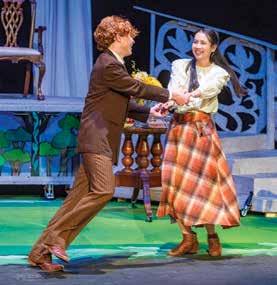
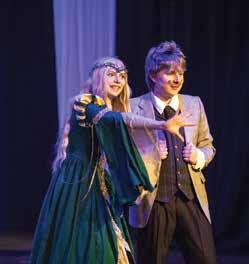
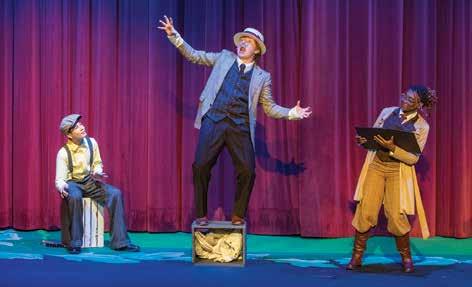
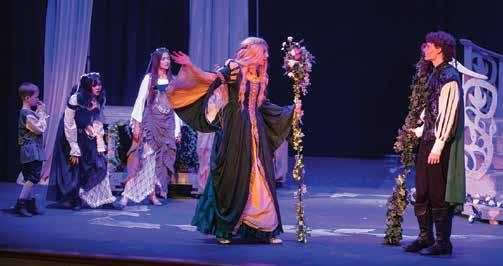
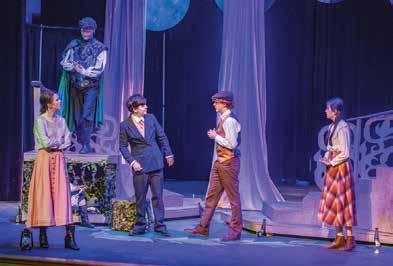
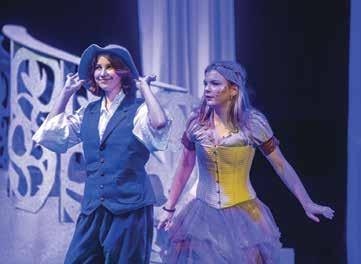
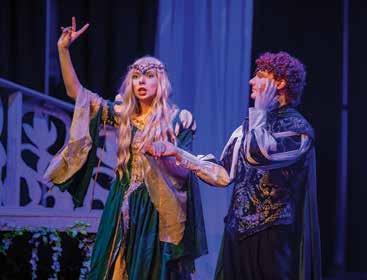
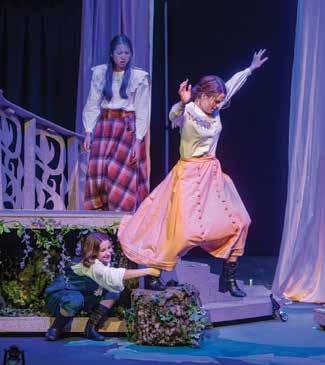
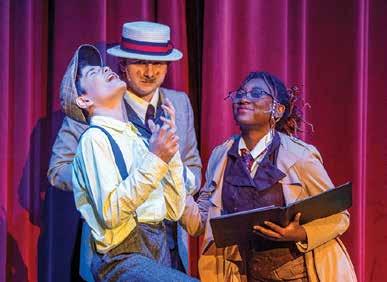
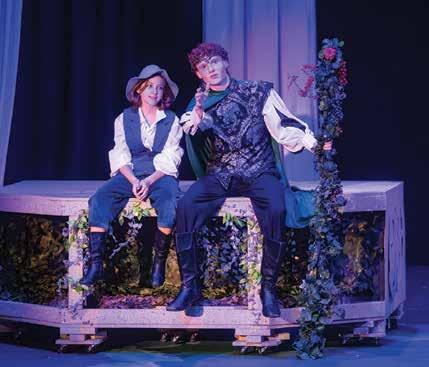
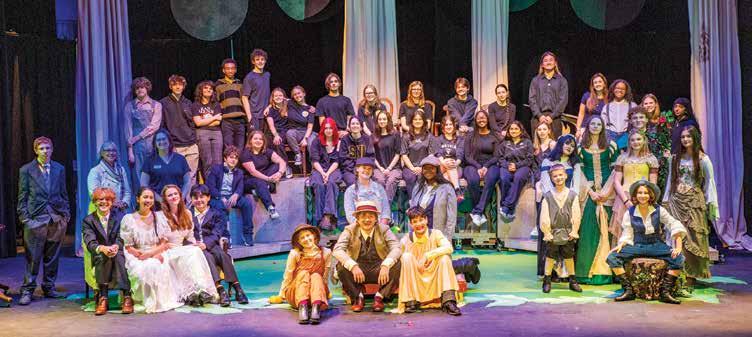
“A Midsummer Night's Dream”
In early November, Stage One presented three performances of William Shakespeare's “A Midsummer Night's Dream” with original music by Stage One composers. The audiences laughed and gasped at the antics of kings, queens, elves, and mortals, as played by the cast of 17 actors, and oohed and aahed over the gorgeous world of the show created by the production team of 30 designers and crew!
WHAT'S INSIDE
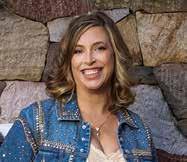

John Taylor Chapman '99: Alexandria's storyteller, public servant, and community builder
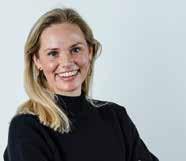
Erin Jacob '16 is translating
MISSION
To help our students succeed in a complex and changing world, we seek to inspire a passion for learning, an enthusiasm for athletic and artistic endeavor, a striving for excellence, a celebration of diversity, and a commitment to service.
Our mission is to pursue goodness as well as knowledge and to honor the unique value of each of our members as a child of God in a caring community.
Tyler Troy '25 has been recognized among the top AP Art students nationwide
Adrienne Lai '21
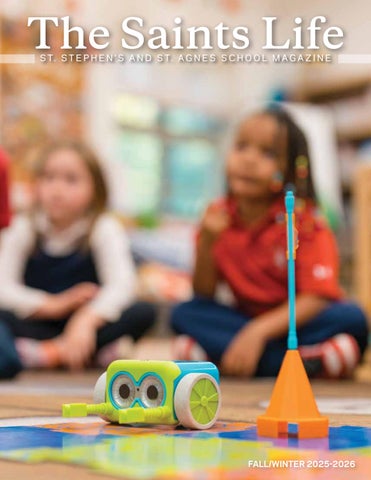
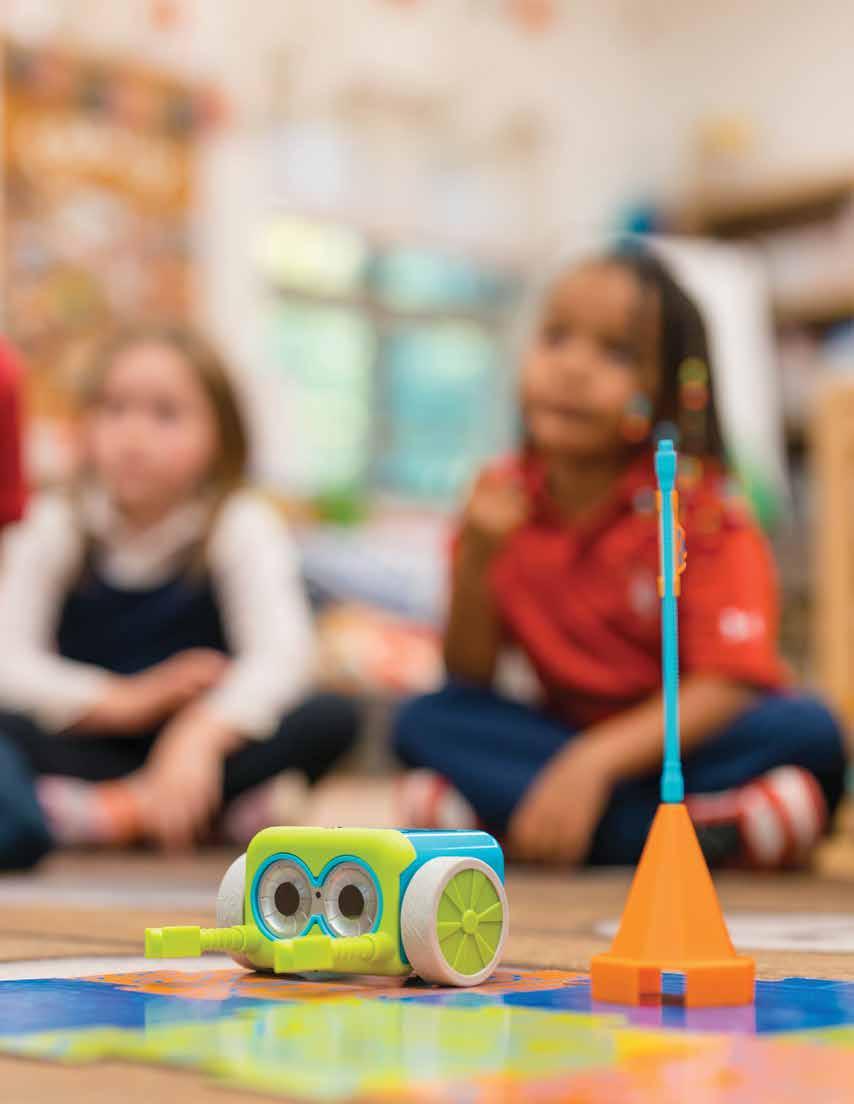
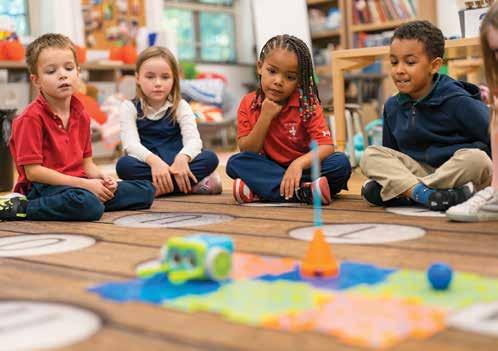
Kindergartners learn to use the Botley Coding Robot


Photo by Johnny Shryock
COURSE HIGHLIGHT
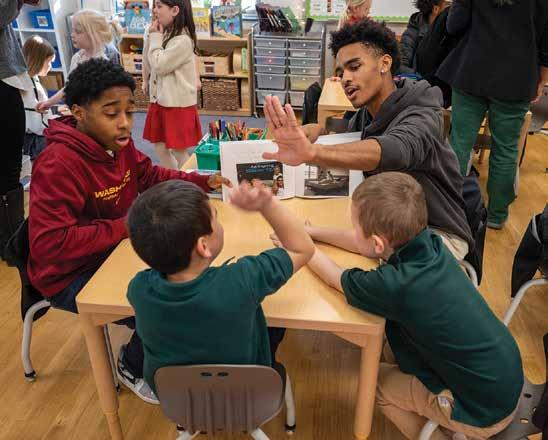
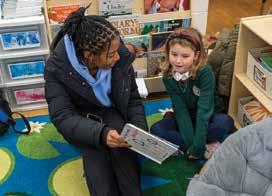
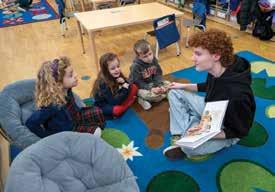
What makes a book for children a book for children? And, paradoxically, why does so much of the best children's literature delight adult readers, too? The senior seminar Children's Literature invited students to explore these questions through close reading and discussion of beloved chapter books, picture books, and fairy tales from diverse authors and cultures. Along the way, students also introduced one another to the childhood favorites that first sparked their love of reading. Throughout the course, seniors dug into the defining features of children's literature— examining how illustrations worked alongside text to tell a story, how familiar literary devices were adapted for younger audiences, and how authorial intent shaped content, form, and style. The semester ended on a high note, with students writing and illustrating their own children's books and sharing those stories with kindergartners in January.

THE SAINTS LIFE
St. Stephen's and St. Agnes Magazine
FALL/WINTER 2025-2026
sssasmagazine.org
Head of School
KIRSTEN PRETTYMAN ADAMS
Director of Communications
JEN DESAUTELS
Magazine Editor & Designer
Director of Design & Production
MELISSA ULSAKER MAAS '76
Director of Digital Strategy and Communications
MANDI SAPP
Director of Brand Management and Marketing
MARCIA MALLETT
Alumni News
ADVANCEMENT OFFICE
Photographers
JAMESON BLOOM '13
MELISSA ULSAKER MAAS '76
MARCIA MALLETT
MANDI SAPP
JOHNNY SHRYOCK
OUR EXTRAORDINARY FACULTY
Contributing Writers
JESSICA HALSTEAD
MELISSA ULSAKER MAAS '76
SARAH MOSES
DAVID YEE
SUSIE ZIMMERMANN
Questions/Comments
MELISSA ULSAKER MAAS '76
mmaas@sssas.org
To Update Your Contact Information or Mailing Preferences
Please email atoman@sssas.org or call 703-212-2720.
Published by SSSAS for alumni, current parents, friends, and other regularly supportive members of the school community. © 2025-2026
SSSAS admits students of any race, color, religion, sexual orientation, national and ethnic origin to all the rights, privileges, programs, and activities generally accorded or made available to students at the school. It does not discriminate on the basis of race, color, religion, sexual orientation, national and ethnic origin in administration of its educational policies, admissions policies, scholarship and loan programs, and athletic and other school-administered programs. As a related organization of the Episcopal Church, SSSAS respects the applicable policies and governing principles of the Episcopal Church pertaining to nondiscrimination.
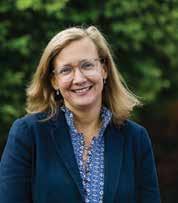
Dear Saints,
Happy New Year! It is amazing to me how quickly one year gives way to the next! As we head into 2026, I find myself reflecting with deep gratitude on all that we have accomplished so far this school year, while also looking forward to the important work that lies ahead for this school community.
In the fall we launched our new Strategic Plan which calls us to ask bold questions, to remain curious and courageous, and to build—together—a school that prepares students not only for what comes next, but for lives of meaning, purpose, and goodness. Shaped by the voices and perspectives of students, faculty, staff, parents, alumni, and trustees, the plan reflects both who we are as a community and who we aspire to be. I am energized by the opportunities before us and confident in our community's ability to bring this vision to life.
Thank you for the many ways you contribute to the life of this school. It is a joy to share this journey with you, and I look forward to all that 2026 will bring to the Saints community.
Warmly,

Kirsten Adams Head of School
IGNITING IMAGINATION
Innovation Takes Center Stage at the Lower School
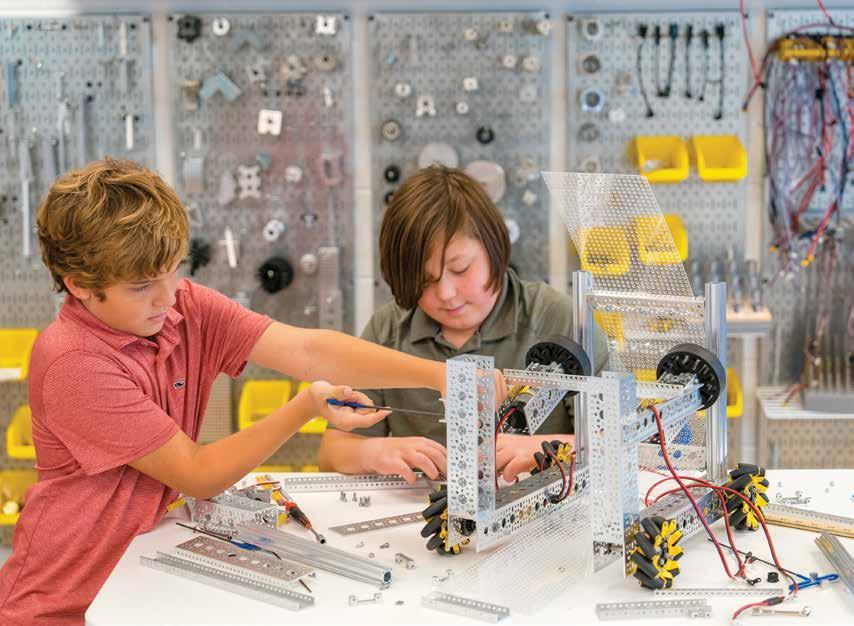
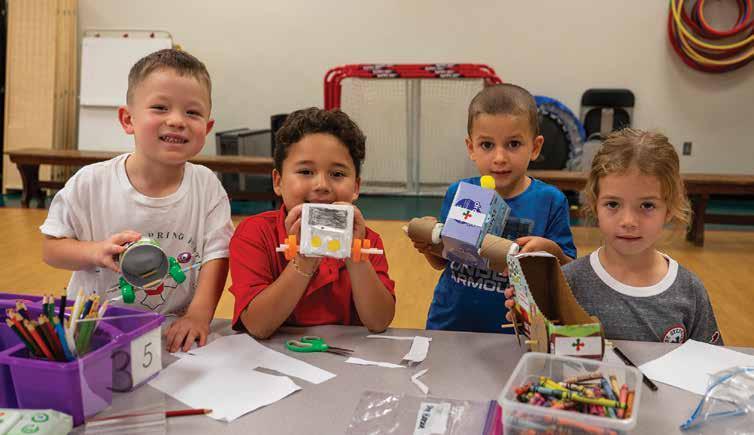
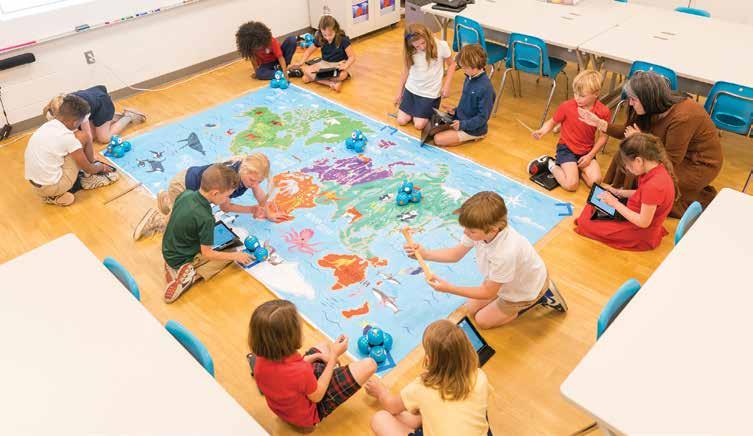
Robots whirred, students cheered, and creative energy filled the air as the Lower School launched its first-ever STEAM Day—an event that offers a vivid snapshot of the innovation, collaboration, and resilience that anchor the technology curriculum for our youngest Saints. What began as a spark of inspiration in a Kansas City, Mo., conference room has now grown into an exciting new tradition. When Technology Teacher Kay Ossio, Science Teacher Michelle Bruch, and Spanish Teacher Larissa Giacomán attended a National Science Teachers Association workshop on using makerspaces to boost creativity and collaboration, they returned to Alexandria brimming with ideas—and a vision.
“The workshop focused on strategies and ways to use a makerspace to promote student voices and choices in concept development, empathy-driven problem solving, and assessment,” Kay recalls. “We explored the key elements of a makerspace and examined ways to use makerspace challenges to support sensemaking. The discussion also focused on how makerspace activities can nudge all students to consider multiple ways of solving problems and strengthening their 'out-of-the-box' thinking. In the case study, students spent short sessions in a makerspace building themed creations.”
Over the next two years, Kay, Michelle, and Larissa developed, planned, and ultimately transformed that spark into
an extraordinary new day of learning at the Lower School. With eight different grade levels to consider, it wasn't feasible to have a makerspace—but they were determined to find a way to give Lower School students an opportunity to create, build, design, and collaborate outside of their classroom technology lessons.
STEAM Day debuted on September 26, providing a full day focused around the challenges of innovation, engineering, and construction. A special assembly kicked off the day. Fourth and fifth grade members of the robotics team proudly put on their robotics t-shirts and gave a presentation, including information about the FIRST LEGO League and two videos of them in action during last year's competition, a demonstration of
their robot, and, of course, a shout out to their amazing coaches, Kay Ossio and Associate Director of Lower School Jeremy Hark. They were followed by a group of Upper School roboticists who took the stage to present one of their very large robots and demonstrate what
it could do!
Afterwards, our Lower School Saints spent the day employing their teambuilding, design-thinking, and problemsolving skills to create a working car made out of recycled materials. Other projects included working together to
make the longest possible paper chain and to build the tallest possible structure using paper of varying thicknesses, cups, or STEM construction toys, like Straws & Connectors. Towards the end of the day, they were excited to share their amazing vehicles in a car museum.
TECHNOLOGY CURRICULUM
Lower School technology is a carefully sequenced program that blends stand-alone instruction with meaningful integration across language arts, math, science, and social studies. Beginning in junior kindergarten, students build foundational skills in coding, robotics, and digital tools through hands-on, age-appropriate exploration. Each year builds deliberately on the last, as students revisit core concepts—such as sequencing, loops, conditionals, and problem-solving—through increasingly complex applications that emphasize creativity, design thinking, and real-world connections.
JR. KINDERGARTEN
Playful Exploration & Early Logic
• iPad fundamentals
• Early coding concepts
• Scanning and sequencing
• Simple programming
• KIBO and VEX 123 robots
KINDERGARTEN
Foundations of Coding & Robotics
• Sequencing and debugging
• Block-based coding & loops
• ScratchJr programming
• Dash and VEX 123 robotics
• Botley Coding Robot
• Maze-based algorithmic thinking
GRADE 1
Patterns, Communication & Early AI
• Loops and pattern recognition
• Sprite broadcasting in ScratchJr
• Robot attachments and design challenges
• Algorithm and debugging practice
• Introduction to artificial intelligence
GRADE 2
Design Meets Global Learning
• 3D printing and spatial reasoning
• Measurement and workplanes
• Dash robotics integrated with social studies
• Coding through geography and exploration
GRADE 3
Decision-Making & Engineering Thinking
• Conditionals and events in Scratch
• Science-fiction game design
• Spike Prime robotics (motors and navigation)
• Circuits and constellation viewer
• 3D modeling with Tinkercad
GRADE 4
Design, Systems & Digital Literacy
• Typing, formatting and email etiquette
• Game design in Minecraft
• Conditionals, loops and reusable code
• 3D-printed explorer ships
• Stop-motion storytelling and publishing
• Generative vs. analytic AI
GRADE 5
Transition to Advanced Tools & Precision Control
• Laptop-based workflows
• Spike Prime robotics
• Gyro, force, color and ultrasonic sensors
• Programming robots to respond to realworld inputs
VIRTUAL REALITY: A NEW LENS ON LEARNING
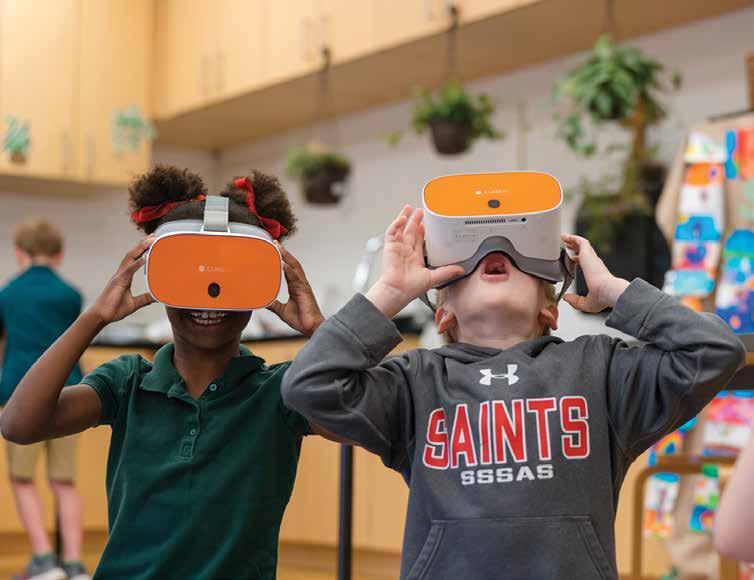
Across all grade levels, the virtual reality (VR) headsets purchased last year with a generous gift from the Beck Foundation continue to stimulate and deepen learning, particularly in science and social studies. In preparation for STEAM Day, Michelle Bruch, who teaches students age 3 through second grade, took her students on a virtual tour of Tesla and Toyota factories, where they could watch cars being assembled in real time. “The experience grounded their hands-on project in an authentic, real-world context,” Michelle notes. She has found that with the younger students, VR experiences work best when kept short and intentional—typically three to five minutes per student. These focused sessions allow young learners to stay
engaged and maximize their sense of wonder, without being overwhelmed by the technology.
Michelle used a VR “explodable” model to teach her first grade class about the Sun and shadows. “My students pulled apart the Sun layer by layer—from the core to the corona—to learn the names and functions of each part,” she says. “Afterward, they reassembled the Sun, reinforcing their understanding in a highly interactive way.” Students ready for an extra challenge even took a short quiz within the VR environment to test their knowledge.
VR helps the second graders learn about landforms as part of their social studies curriculum. To extend their understanding into science, Michelle invited them to explore landforms across the solar system. Each class was assigned
“While VR is only one element of our curriculum— complementing books, handson experiments, and outdoor investigations—it plays a crucial role in making learning come alive.”
MICHELLE BRUCH Age 3-2nd Grade Science Teacher


a different celestial body—Mars, Mercury, Venus, or the Moon—and used the VR headsets to virtually travel across its terrain. “This experience fueled a rich discussion and inspired them to create three-dimensional models of planetary landforms,” Michelle notes.
Because science is highly visual by nature, VR helps students use their imagination and observation skills to make sense of new concepts. These immersive explorations also strengthen vocabulary and language development as students describe what they see and experience. Through the use of VR technology students are transformed from passive observers into active participants, enhancing engagement and enabling experiential learning. Students are able to learn at their own pace, revisit concepts as needed, and make abstract concepts tangible.
“While VR is only one element of our curriculum—complementing books, hands-on experiments, and outdoor investigations—it plays a crucial role in making learning come alive,” Michelle explains. “I feel very fortunate to teach science in a setting where students can use these innovative tools to explore, imagine,
and discover the world around them.”
The third grade uses VR to visit the ancient civilizations they are studying, bringing them to life in a way that photos can't rival. During their social studies unit on the American Revolution and the 13 colonies, fourth graders step back in time to view the Declaration of Independence and explore homes and businesses in a colonial village to understand why colonies had different reasons for wanting independence.
USING AI WISELY
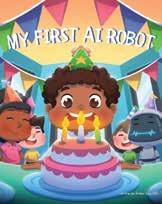
This year, Kay will introduce AI to our junior kindergartners and kindergartners during their last semester through Amber Ivey's books “AI… Meets… AI: An Exciting Tale of Connection and Adventure: and “My First AI Robot.” Teaching the basic concepts begins in the first and second grade, where they learn what AI is and how to build a simple AI robot. Third grade students learn about data privacy and using AI responsibly. They are also introduced to training data,
AI is introduced early, in junior kindergarten. At every step, teachers emphasize how to use AI responsibly and ethically— helping students understand both the power of these tools and the importance of using them thoughtfully.
bias, and the ways AI can be used to address real-world problems. In fourth grade, they learn more about how AI works and begin to actively use both generative and analytical AI.
“In the Age of Exploration unit, each fourth grader chooses an explorer to study and then spends a couple of months researching them. Ultimately, they actually chat with their explorer, texting them through the Flint K12 AI platform, which is inconceivable,” Kay marvels. “And the great thing is that the students also learn that AI is not reliable by comparing their research to what AI is providing.”
Fifth graders are using Flint K12 in a variety of classes. “Our robotics team is using it to enhance their archaeologythemed projects, even generating images for their proposed solutions,” Kay says. “In math, students upload their fraction-problem answers and Flint responds with helpful insights. And in language arts, they use Flint during their debate unit, arguing both
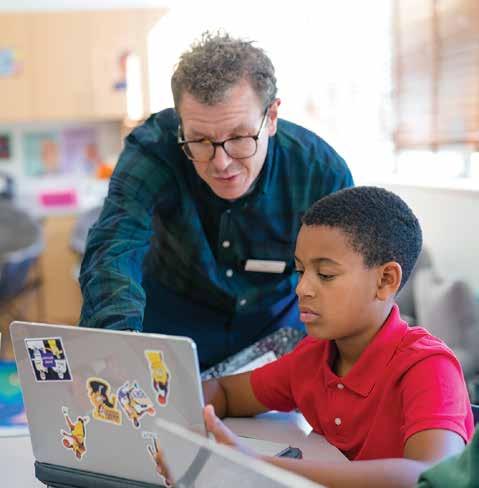
sides of a topic with guidance from their teachers.”
At every step, teachers emphasize how to use AI responsibly and ethically—helping students understand both the power of these tools and the importance of using them thoughtfully.
Enlightenment in Failure
A critical part of learning and growing is failing. “Confidence blooms the moment students realize mistakes are part of the process,” Kay explains. “When students see that a 'bug' isn't failure but feedback, they learn to persevere and even celebrate problem-solving. Over time, they go from saying 'I can't do this' to 'Let's try one more way.' That mindset shift, believing they can figure things out, is one of the most powerful outcomes of coding and robotics.” Through technology, our Saints learn to collaborate, think creatively, and show tenacity as they design,
code, or document their learning. Whether they are programming a robot or writing reflections, they use technology to express curiosity, imagination, and integrity, which are at the heart of our school community. Our teachers encourage students to dream it and build it!
Kay's innovative spirit mirrors the curiosity she nurtures in her students every day. “I'd love to have a giant interactive coding mat that covers the floor of my classroom,” she exclaims with a glint in her eye. “It would transform into different challenging paths, with areas in which students can attach model missions, like a real-life version of our robotics tables. Students could step safely on it, test their code, and solve new challenges each time it changes.” On a more practical note, she would love to invent the ultimate organizer for LEGOs that magically sorts every piece by category. According to her, that would be a dream come true!
SAINTS ROBOTICS GOES TO STATE CHAMPIONSHIP
On December 13, 2025, the Lower School Saints Robotics Team competed in the FIRST LEGO League Challenge Regional Qualifying Tournament and not only received the Robot Design Award, but also earned a spot at the State Championship in January—where they were very successful! Against 53 teams from Virginia and D.C., our Saints Robotics team achieved a personal best of 250 points in robot performance (ranking 16th overall) and 3rd Place in Robot Design. There was also a special honor for Technology Coordinator Kay Ossio, who was named Coach/Mentor of the Year!
Saints Robotics is made up of 10 dedicated and enthusiastic fourth and fifth graders. The FIRST LEGO League is an international program that challenges students to think like engineers through a four-part
competition: robot performance, robot design, an innovation project, and core values. This year's archaeological theme, “Unearthed,” requires students to build and code a LEGO robot capable of completing mission-based tasks such as pushing levers, picking up objects, or triggering mechanisms.
In addition to coding and building their robot, the team must explain their design decisions—from why they use inches or centimeters to the logic behind specific turns, timing, or attachments. Their thoughtful engineering has already earned them multiple robot design awards in past years.
For the Innovation Project, students follow the engineering design process to identify a real problem in the field of archaeology, research it, propose a solution, and build a prototype. They even received expert feedback from a professional
archaeologist at the Field Museum in Chicago—thanks to a personal connection from their coach.
The final scoring component, Core Values, evaluates how well the team collaborates, includes others, and embodies the joy and creativity central to the FIRST philosophy. The team meets twice a week—and even on weekends as competitions approach—demonstrating remarkable commitment, curiosity, and teamwork.
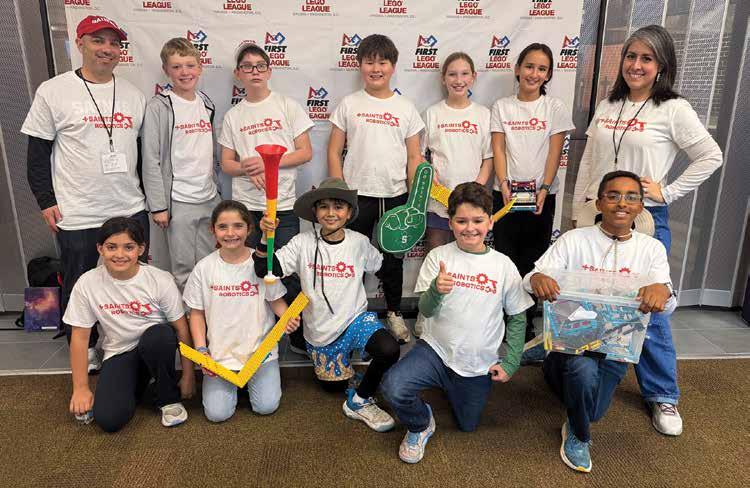
Robotics coaches Lower School Associate Director Jeremy Hark (far left) and Technology Coordinator Kay Ossio (far right) with the Lower School Saints Robotics Team at the FIRST LEGO States Championship.
Quiet Stories of EXTRAORDINARY SERVICE
By David Yee Director of Service Learning and Community Engagement
At the beginning of this school year, I had the opportunity to educate our Upper School faculty on how to view all the work that students were doing in our community through our service logging app. I told them that this app was not only about tracking student compliance, but also being able to see the extraordinary things that our students do as they embody our mission to pursue goodness as well
as knowledge, and moreover, as they make the world a better place.
After the presentation, many faculty members remarked that they had been unaware of the depth and impact of individual students' contributions to the community. I think that this is not just an accident or oversight as we cross paths on a daily basis; so many people in our community let their actions speak for themselves and don't broadcast
what they do. They do these things because they are the right thing to do, and they are drawn to act within those communities. As a result, we pass by extraordinary stories on a daily basis without knowing.
Below are two such stories that wouldn't be heard, or at least would be quieter than the hum of everyday school life, if we weren't listening for them.
It is hard to pin down where Mehon Akilu's involvement in this project begins. On one hand, since he began his journey as a Boy Scout, he had designs on earning its highest honor: Eagle Scout. On the other hand, this honor was about more than just the accomplishment and recognition for him. The “stereotypical Eagle project,” he explained, often involves building—and he knew he could have followed that path—but he didn't want a project that simply “begins and ends.” He wanted one in which
he wouldn't remain personally involved. “I wanted mine to be a little more sentimental,” he told me. That's why he didn't start with what the project should be, but instead began with who he wanted to involve. Though Mehon has been a member of the school since kindergarten, there's another place where he's spent a lot of his childhood: Ethiopia. “Probably six or eight months in my life,” he stated. It's a place where he still has family, and so, in the early stages of the project, the person who he called to give him advice for his project
was his aunt who lives there. His aunt was the person who suggested working with Harmony Hills Academy, an early childhood through grade 12 school in Addis Ababa, the capital city of Ethiopia.
While there are a variety of philosophical reasons why students get involved in projects involving education, the suggestion resonated personally with Mehon because his little cousin actually goes to the school. His cousin has been a presence in his life, even from afar, in videos
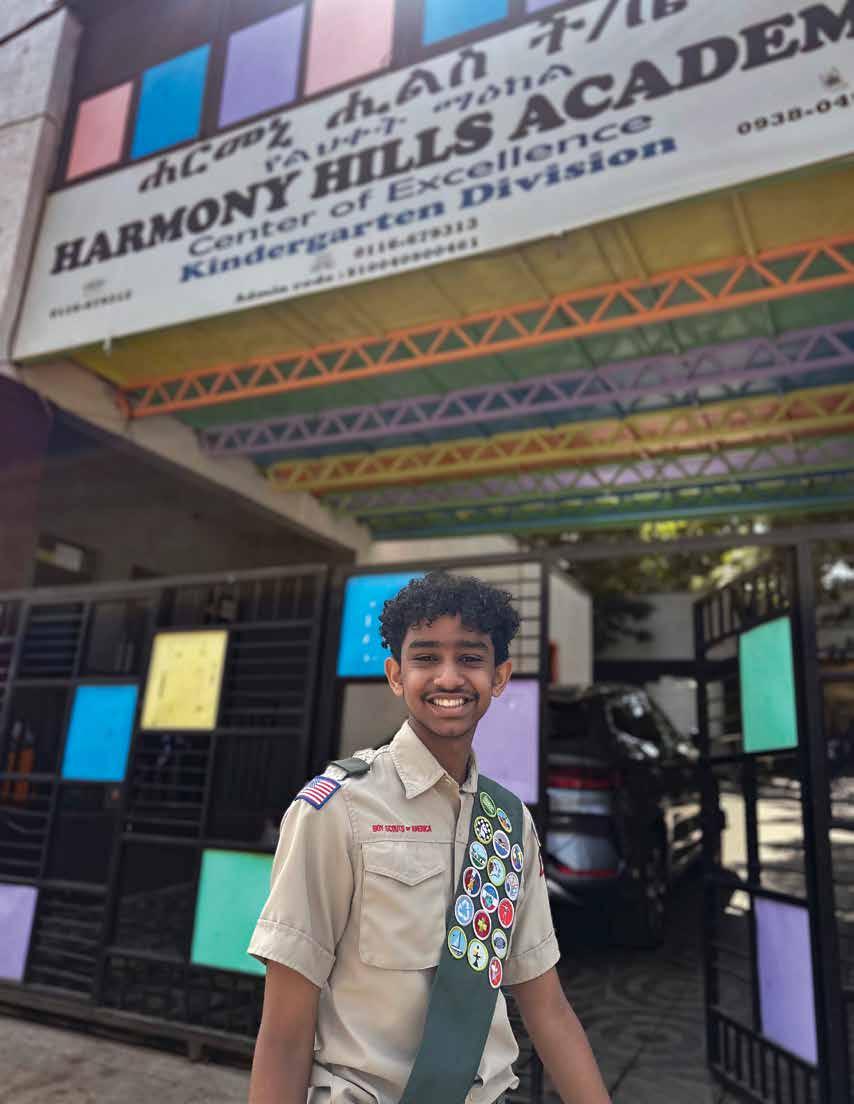
Mehon Aklilu '28 outside the Harmony Hills Academy in Addis Ababa, Ethiopia.
and conversations that would bridge time in between visits to Ethiopia when they would come together. He also remembered the special needs program that his cousin is a part of, and this reflection revealed his goal: to collect sensory toys to benefit students like his cousin who are neurodivergent, especially those with autism, in environments like Harmony Hills without the means for support.
According to the organization Autism Speaks, sensory toys provide sensory feedback and regulation to children who are on the autism spectrum. It is an easy and accessible way for the child to begin to engage with their surroundings and community. Mehon was cognizant of the fact that there are some instances of well-meaning
support that can actually do harm, that “good things can have bad outcomes.” Because of this, he was in touch with the staff of Harmony Hills to ensure he was filling a niche that couldn't otherwise be filled. The staff confirmed that sensory toys are “rare, specialized, and difficult to find in Ethiopia.”
Mehon gathered these toys at his home in Alexandria. He distributed flyers around his neighborhood explaining who he is, what he was doing, and why he was doing it, then included a “how to help” section with a QR code where people could purchase sensory toys off an Amazon Wish List.
While people from his neighborhood were responsive, it's the support of the people he knew in the St. Stephen's and St. Agnes School community that multiplied his impact. He gave fliers to a dozen or so people he knew from the school. In the end, through his own efforts and the support of others in our community, he raised approximately $2,000 worth of sensory toys— filling nearly four large suitcases.
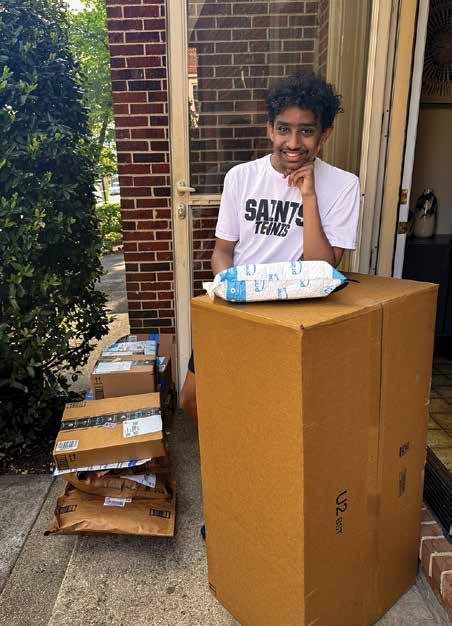
Mehon at the Upper School with sensory toy donations from the Saints community.
It
On June 7, 2025, Mehon traveled with his mother to Addis Ababa with the toys in tow. Three days later, he delivered the toys to Harmony Hills Academy with great fanfare. The school's managing director, head of the Special Needs department, and community members gathered for a formal ceremony, including a traditional coffee ceremony in which the eldest person typically cuts the cake. Mehon was proud to be invited to do so as the guest of honor.
wasn't the ceremony that was most meaningful to him—it was returning to the school as a volunteer about a week later. He was able to see the students use and enjoy the sensory toys, connecting and engaging in a way that they hadn't been able to before. It was “both rewarding and humbling” and it reminded him “how much impact small, intentional efforts can have.”
Senior Declan Griffey's online service log is actually one of the entries that started many of the conversations after my presentation to the faculty. As of January, his log reflected that he has served 1088.17 hours in his community since the beginning of ninth grade, all with one organization: the Bethesda Chevy Chase Rescue Squad. Not many faculty members knew about his story. When I sat down with Declan, I asked about the hours. Impressive as that number may be, he was quick to say it was never about the hours. “People are core,” he told me.
His journey began with a friend's friend and a curiosity. “I'd always enjoyed medicine, but I didn't know if I would truly want to do it as a career,” he told me. This connection, not even a direct one, to Bethesda Chevy Chase Rescue Squad (BCCRS) appeared to be the perfect way to answer his questions. In fact, the BCCRS website seems
In the end, Mehon's project allowed him not only to have an impact on a place that he cares about, but it also allowed him to grow. It wasn't just about the toys, but about achieving something better, and so it pushed him to do things like work on his language skills enough to deliver a speech in Amharic, the language his relatives speak, but one that he admits he is not that confident in using. Now that he's finished the project, he sees supporting other people's Eagle Scout projects as essential. He wants to continue being part of something larger than himself, just as he was in his own project.
He no longer sees Ethiopia as just a place he visits. He sees it as one where his heritage and connections make him feel rooted in the community. “Rather than a vacation spot, it's simply more home,” he said.
Mehon realizes that his journey is not complete. By choosing a project that doesn't begin and end, one that he said had an “infinite scope” in some ways, he has discovered something that continues to drive him: “I can do something so much better.”
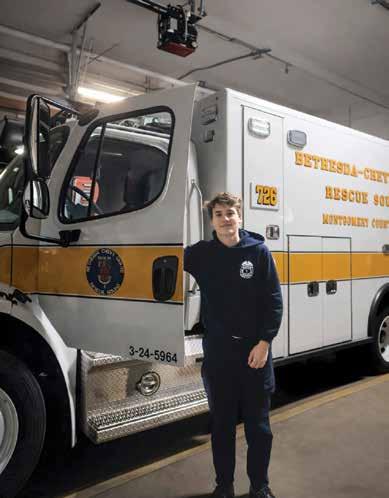
Declan Griffey '26 at the Bethesda Chevy Chase Rescue Squad.
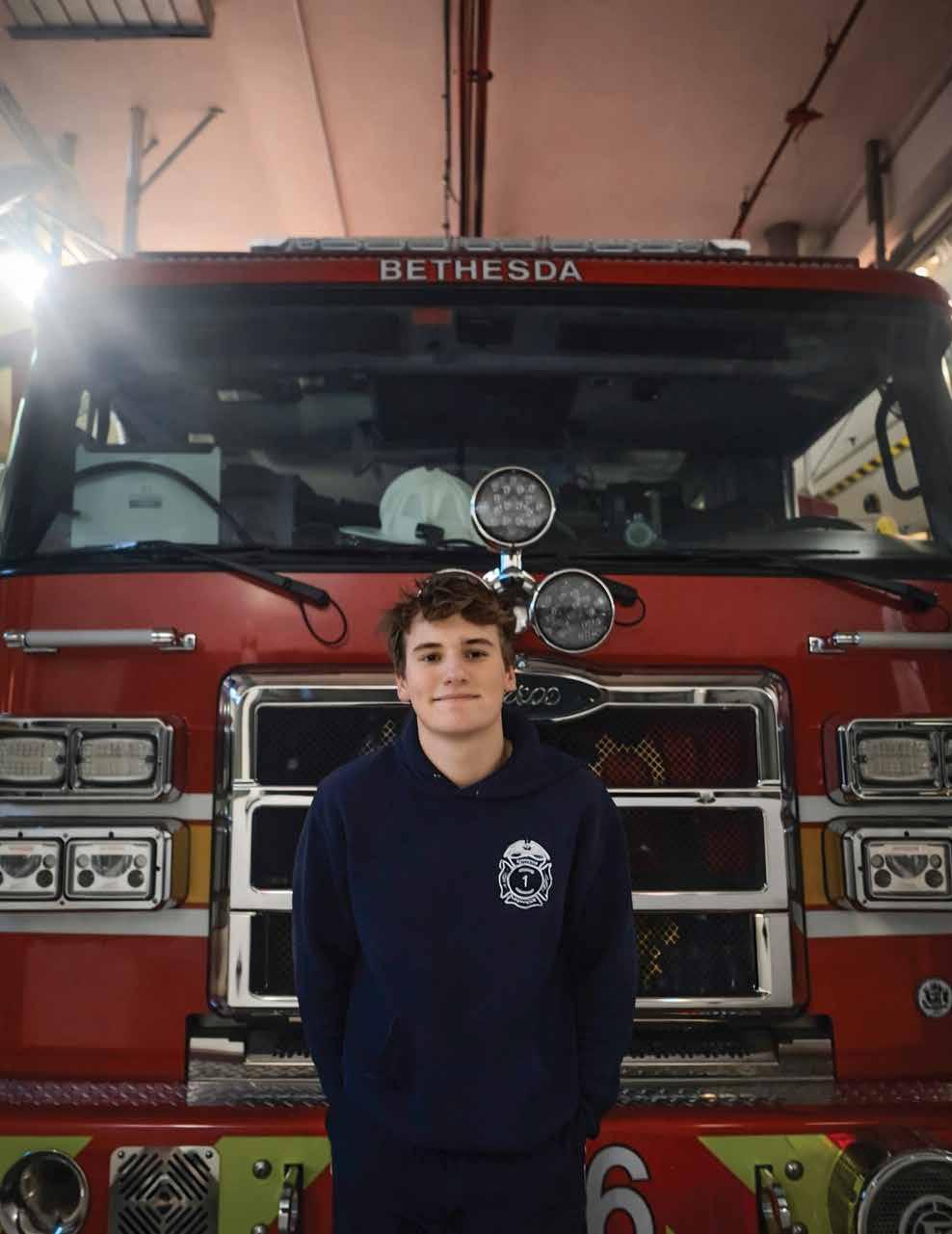
Declan Griffey '26
particularly welcoming to people wanting to assuage their curiosities. On the front page, they display an article from The Washington Post showing the story of a 76-year-old man who at 65 “thought he was too old” to be an EMT, but who has now answered over 3,000 emergency calls. There is a prominent recruitment banner calling for “dedicated and passionate” volunteers, underscoring the scale of need: in 2025, the department responded to almost 9,000 calls.
However, according to Declan, the “dedicated and passionate” part of that recruitment banner is not to be understated.
In order to
get the process started, he recounted,
“You're going to have to take hundreds of hours of classes and training.” It's not something you can only do short term.
“I knew that it was something I really had to enjoy doing and I have enjoyed it more and more as I've been able to learn and help out.”
Part of this enjoyment comes from how many people he's met and helped through this role. It starts with everyone who is in the room with him on BCCRS: “Everybody comes from different walks of life. There are teachers, there are lawyers. There are people who are fully retired, there are athletes. So you see these different people from different walks of life, then you hear a ton of different stories and you get [insight] from a lot of different people because everybody brings you to the table.” This diverse group of people coming all together, around an all volunteer activity, inspires him and spurs on his own dedication.
Part of this comes from the glimpses of life he gets from answering calls. Declan does not like to get into the details very much because there are calls that “don't end well.” It's clear from talking to him that he's witnessed some hard situations. He meets the most difficult calls with compassion, which opens him to the full range of people behind them—including “some super cool people,” from the FBI and military to politics and even individuals he's seen
on the news. Working with BCCRS gives him a different perspective on their lives than he would encounter otherwise.
His commitment to BCCRS has deepened his connection to his own community. “I've lived in my house, my same community, my same neighborhood my whole life,” he said, and he remembers all the people who have helped him along the way. “Having this opportunity, it's kind of like my way to give back.”
And that opportunity to give back has given him a sense of how special Montgomery County is: “Montgomery County as a whole is one of the most diverse counties in America,” Declan said. “Because of how close it is to D.C. and how big it is, there's a lot of different people and a lot of different stories that you won't be able to see. I've realized more about my community doing this than I have just living here.”
Working with the Bethesda Chevy Chase Rescue Squad has also answered Declan's initial question about his future. “I definitely want to work somewhere in the medical field,” he concluded, “It's changed the way I've seen things in life. I am more compassionate towards people, I want to listen more to people. I feel like I've gotten more mature, inside myself, with the way I've seen things.” That compassion will extend to the way he approaches his continued journey into medicine.
But regardless of where he ends up in the field of medicine, his time with BCCRS has given him more than hours in a service log and more than an answer to his questions about the medical field. When asked whether other people should consider getting involved in the work, he said,
“I think it's all about enjoying what you're doing. I love, love doing it, and I think if you love doing something, there's no need to cross the finish line to get a certain number of hours.”
It's a lot of work and it takes dedication and compassion, but in the end, if you love helping your community with compassion and are willing to dedicate the time, he said, “It's not a hard choice.”
Growing Global Citizens
Larissa Giacomán's Cuida la Tierra Program Receives National Recognition
By Melissa Maas '76
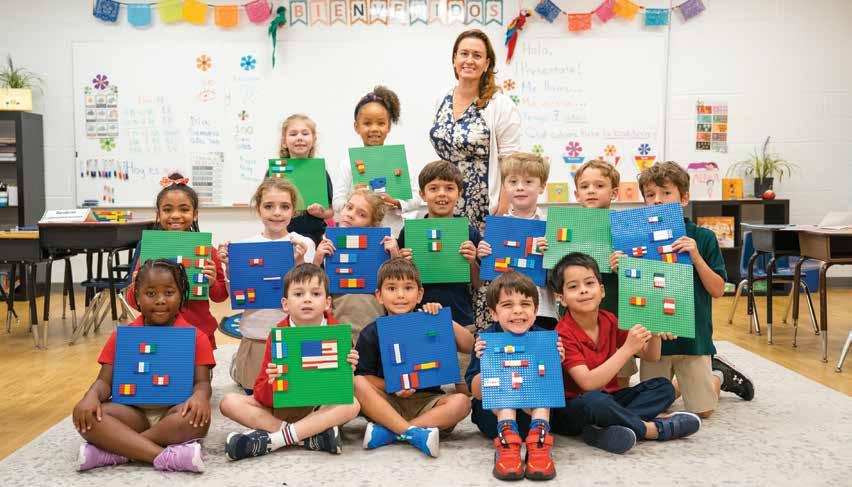
When the American Council on the Teaching of Foreign Languages announced the 2025 recipients of its prestigious Professional Awards, St. Stephen's and St. Agnes School was proudly represented among them. Lower School Spanish teacher Larissa Giacomán was honored with the Klett Award for Sustainable Development Education in the World Language Classroom, a national recognition celebrating her visionary program, Cuida la Tierra (Take Care of the Earth). Through immersive experiences, interdisciplinary partnerships, and an approach that blends language proficiency with environmental stewardship, Larissa has redefined what early language education can be—inviting the youngest Saints to see themselves as global citizens and caretakers of
our shared world. In this Q&A, Larissa reflects on the inspiration, favorite program projects, and the impact behind her award-winning work.
Inspiration and Philosophy
What inspired you to connect Spanish language learning with environmental stewardship and the United Nations Sustainable Development Goals?
The inspiration for the Cuida la Tierra Program began with a unique collaboration between our Science and Technology Departments at SSSAS, led by Lower School Science Teacher Michelle Bruch and Lower School Technology Teacher Kay Ossio, and our partnership with the Smithsonian Migratory Bird Center. Together, we created a learning experience that
connected our Saints with students in Ometepe Island, Nicaragua, through a shared study of Neotropical migratory birds. A master naturalist visited our school to introduce our students to birdwatching and the differences between migratory and resident birds found on our campus. When they discovered that the birds migrate thousands of miles overnight to spend the winter on Ometepe, the world suddenly felt real, personal, and shared. Our students realized these birds do not belong to just one place or one country; they belong to all of us, and with that comes the shared responsibility to protect them. This understanding deepened when our students exchanged artwork, research notes, and reflections with their partner school in Ometepe. Spanish was no longer just a subject to
My goal is to help students experience the delight of discovering a new culture, the confidence of communicating with others, and the understanding that language opens doors to people, to ideas, and to the world.
study. It became a bridge to our shared roles as stewards of the Earth.
You've taught Spanish to early learners for more than 20 years—how has your philosophy of language education evolved over that time?
My philosophy of language education has grown out of something deeply personal. I first began teaching Spanish so our son could stay connected to family in Mexico—so he could understand his grandparents' stories, laugh and play with his cousins, enjoy music in the language of his heritage, and feel a true sense of belonging in both of his worlds. I also wanted to empower him with the cognitive advantages of being bilingual— stronger neural pathways, quicker information processing, mental flexibility, problem-solving skills, and long-term cognitive resilience. What began as a gift to my child became the foundation of my teaching practice.
As I taught more students, I realized that language learning in the early years is fundamentally about human connection, nurturing empathy, curiosity, and the ability to understand diverse perspectives. My approach has since evolved into a joyful, interdisciplinary, inquiry-based model in which Spanish serves as a bridge to science, art, music, nature, and global cultures. My goal is to help students experience the delight of discovering a new culture, the confidence of communicating with others, and the
understanding that language opens doors to people, to ideas, and to the world.
What do you hope your students carry with them from Cuida la Tierra beyond the classroom?
In Cuida la Tierra, I integrate language proficiency goals with sustainability themes so that students use Spanish with real purpose. At the novice level, I design activities guided by the American Council on the Teaching of Foreign Languages (ACTFL). Can-Do Statements such as “I can say what people can do to care for the Earth.” Through hands-on projects like sorting classroom recycling, designing sustainable cities, or creating posters that say “Cuidemos el agua” (Let's take care of the water), students practice meaningful communication while building environmental awareness. Sustainability provides the context; language is the tool.
What are some of your favorite classroom moments or student projects from Cuida la Tierra?
I love the spark in their eyes when they discover the tiny Ruby-throated Hummingbird they saw in the playground migrates across the Gulf of Mexico, flying nonstop for up to 18 hours over open water to reach Mexico and Central America. When students make that connection, they understand that the world is interconnected.
One of my favorite Cuida la Tierra projects involved 3D biodiversity animal trading cards. Students used Tinkercad to design their own animals—many inspired by endangered or keystone species—and then created 3D cards showcasing each creature's unique characteristics. They wrote simple descriptions in Spanish, highlighting habitat, colors, diet, and special features. The combination of creativity, design thinking, and language production made this project truly special. They were so proud to hold a physical model of something they researched, designed, and described entirely on their own.
Your students use VR headsets to explore the Peruvian rainforest—how do immersive experiences like that
enhance both language learning and environmental awareness?
When students “step into” the VR Peruvian rainforest, they aren't just hearing about biodiversity, they're experiencing it. They turn their heads to see towering Ceiba trees and Quechuan people living side by side with nature. They notice layers of color, sound, and life. In that moment, Spanish becomes a tool to describe what they see and feel. They use their language skills naturally— “¡Mira! Un tucán!”(Look! A Toucan!)— because they are emotionally and physically engaged. VR makes distant places personal, and students protect what they feel connected to.
How do students react when they connect with classrooms in Nicaragua or meet guest speakers from Costa Rica? Those moments are unforgettable. When our students connect with students in Nicaragua or speak with conservationists in Costa Rica, Spanish becomes real, human, and alive. There is often a quiet pause at first, then smiles, waves, laughter, and the universal language of curiosity. Students ask questions, compare experiences, and discover what they have in common. They learn that even across oceans and cultures, children share hopes and dreams for the future. These exchanges help students understand that they are part of a global community and that caring for our Earth is something we do together.
Global Citizenship and Impact
You often describe your students as “emerging global citizens.” What does that phrase mean to you in the context of Lower School education?
Global citizenship at this stage is forming the habits of heart and mind that will guide them as they grow: listening with curiosity, showing respect for different perspectives, understanding that our choices have impact, and recognizing that caring for the Earth is a shared responsibility. When children use Spanish to connect with peers in other countries, learn about migratory animals, or celebrate diverse cultural traditions,
they begin to see themselves not only as language learners but also as participants in a global community. These early experiences lay the foundation for the identity, empathy, and agency they will carry into the future.
How do you introduce young learners to complex ideas like biodiversity, climate change, and sustainability in a hopeful and empowering way?
Introducing young learners to complex ideas like biodiversity and sustainability begins with nurturing a sense of wonder. Once students feel that connection, we introduce the systems that support life and the challenges those systems face. We use storytelling, hands-on investigations, and interdisciplinary learning to help students understand. We emphasize helpers, solutions, and collective care, showing them that many people around the world are working to protect our environment and that they, too, can make meaningful choices. When students see themselves as part of nature, they gain
both the knowledge and the hope needed to grow into responsible caretakers of our planet.
Looking ahead
What does winning the 2025 Klett Award from ACTFL mean to you?
It affirms the importance of teaching language as a vehicle for connection, empathy, and global awareness. This award honors the work we do at SSSAS, as well as that of partner communities who share the belief that young learners can make a difference. It reinforces that early language education is powerful: when children use another language to understand, appreciate, and protect the world around them, they are developing proficiency and agency.
What's next for Cuida la Tierra?
Looking ahead, Cuida la Tierra will continue to grow through thoughtful collaboration and interdisciplinary exploration. I am especially excited
about our STEAM collaborations, where students integrate science, art, engineering, and language to design meaningful solutions. This includes building and coding small AI-supported robots that respond to Spanish commands, reinforcing language through real-world problem-solving.
If you could see one long-term outcome from this work what would it be?
I want students to grow into adults who can navigate cultures with empathy, collaborate thoughtfully, and understand that stewardship is both local and global. In a broader educational context, I hope that Cuida la Tierra inspires others to see language learning as a pathway to purpose: one that cultivates curiosity and action. If this work helps shape a generation of young people who speak with kindness, solve problems creatively, and care deeply for our shared planet, then its impact will ripple far beyond our school walls.
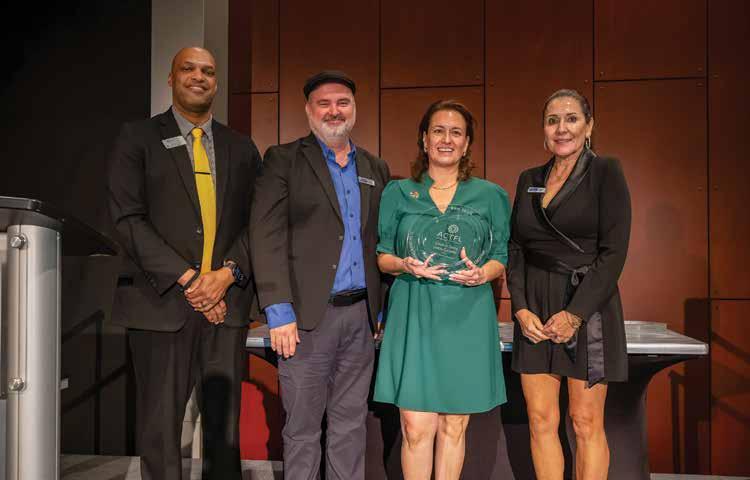
American Council on the Teaching of Foreign Languages past president, L.J. Randolph, Jr. (ACTFL Past President), Klett World Languages Strategic Relation Specialist Patrick Wallace, Larissa Giacomán, and Klett World Languages Adoption Manager Maggie Connell at the awards ceremony in New Orleans on November 21, 2025.
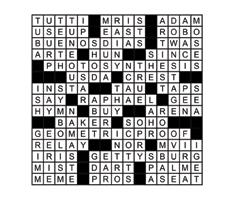
CROSSED PATHS .......... Puzzles by cruciverbalist Emma Oxford '09
Get our your pencil—or pen if you dare—and see where the clues lead!
CLASSROOM LEARNING
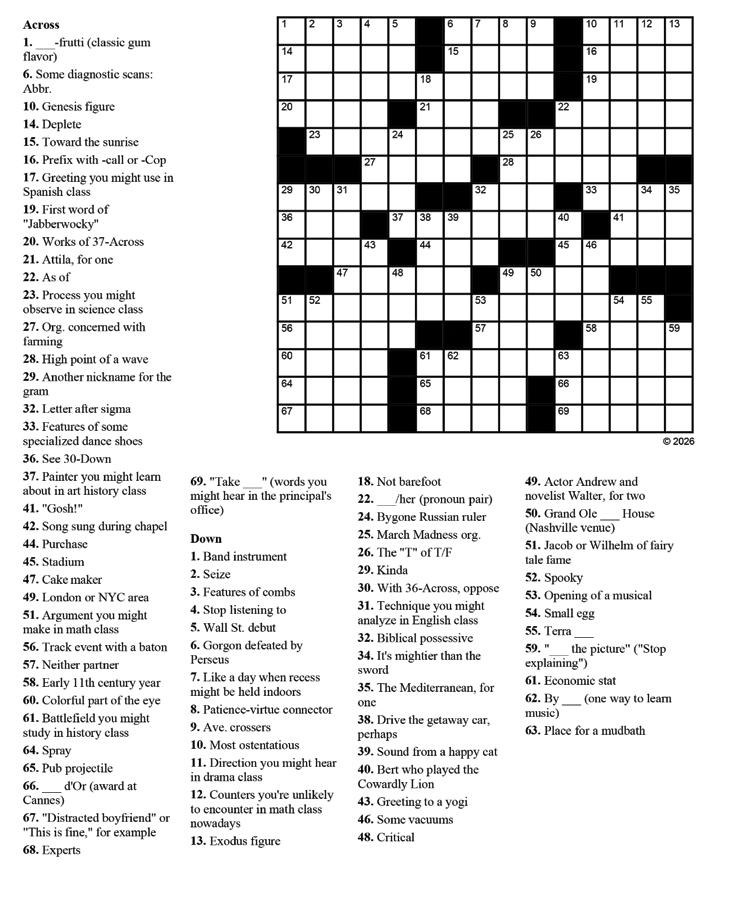
No peeking!
But if you're a bit stuck, you can find the solution on p. 30.
Anchored in Faith, Engaged with the World Lessons from Anglican schools in South Africa
By The Rev. Sarah Moses Middle School Chaplain
The sun had not yet risen on a cold August morning as I drove across Cape Town to St. George's Grammar School (it was winter in the Southern Hemisphere!). Thanks to an APT Holden Summer Study Fellowship, I was in South Africa to explore how schools embody religious identity while honoring diversity, facilitating civic engagement, and striving to make quality education more widely accessible. One thing I value about serving in an Episcopal school is being part of a national network connected through the National Association of Episcopal Schools (NAES), which offers conferences and retreats for staff and faculty to learn from
one another and celebrate a shared mission. But that rich network of school communities also extends to the global fellowship of the Anglican Communion, to which the Episcopal Church belongs, and to the schools founded all over the world as part of the church's mission. The Anglican Communion Schools Network, a new initiative launched in 2023, aims to create opportunities for school leaders to collaborate around shared mission and identity. Thanks to this global network, together with the support of SSSAS, I had the amazing opportunity to engage with faculty, staff, and students at three Anglican schools in the Cape Town area.
My host, Rev. Jaques Pretorius, executive director of the Anglican Board of Education Southern Africa,
The Anglican Communion and The Episcopal Church
The Anglican Communion, led by Archbishop of Canterbury Sarah Mullally, is a worldwide fellowship comprising more than 80 million members across 46 churches or provinces in over 165 countries. The Episcopal Church is a member of the global Anglican Communion with dioceses in the United States and beyond. Established shortly after the American Revolution, the Episcopal Church shares historical roots, theology, and worship traditions with the Church of England and other Anglicans worldwide, but, like all member churches, is autonomous. The churches and schools of the country of South Africa are part of the Anglican Church of Southern Africa, also a member of the Anglican Communion.
helped arrange an itinerary that allowed me to see different models of Anglican schools and how they live out their identity. I was particularly interested in visiting schools in South Africa because of common realities and challenges we share, including religiously plural societies and legacies of historic racial discrimination and economic inequality that impact access to quality education. I traveled to South Africa with a simple question: what could I learn from Anglican schools about what it means for us to embody our Episcopal identity and values at St. Stephen's and St. Agnes?
I visited three schools in the Cape Town area that represent the racial, cultural, and socio-economic diversity of Anglican education in South Africa, and was able to visit classes and talk with administrators, faculty, and students. My first stop was St. George's Grammar School. Originally attached to St. George's Anglican Cathedral, the school was founded in 1948 by the first Anglican Bishop of Cape Town, Robert Gray, and is the oldest independent school in Southern Africa. Now on an
expanded campus independent from the cathedral, St. George's is a coed institution serving about 400 students from pre-kindergarten through 12th grade, with a highly-regarded academic support program for neurodiverse students. Reflecting the demographics of Cape Town's middle-class families, I also learned that one-third of St. George's students identify as Muslim. Historically St. George's Cathedral provided school chaplains from its staff, but no longer does so. As the school budget cannot support a chaplain, religious studies courses were discontinued.
The second school I visited was Zonnebloem, where students from kindergarten through seventh grade attend the Boys' Primary and Girls' Primary Schools on the same campus with separate classes and faculty. Zonnebloem is designated “a government school on church grounds,” and receives state funding while operating on property leased from the Anglican Church. Founded by Bishop Gray in the 1850s, the
school has long been located on church property that also housed a teachers' college and diocesan offices. Originally established to educate the sons of African chiefs, the school later drew students from local middle class families of the “District Six” neighborhood in which it is located, an area known for its racial and cultural diversity. As that neighborhood gentrified in the post-apartheid era, Zonnebloem now primarily serves Black South African, Xhosa-speaking students drawn from socio-economically vulnerable areas on the outskirts of Cape Town. Because students must arrange their own transportation from distant areas and leave home very early, the school provides breakfast. Yet the school's prime location in Cape Town places it in the government's wealthiest funding tier, resulting in the lowest level of government support, so the school relies on outside non-profit organizations such as the Otto Foundation to provide resources like the library and Community Keepers, which provides school counselors. Similar to St. George's, chaplains are no longer provided by the parish church and the school lacks the resources to hire one.
The third school I visited was Herschel Girls School (preschool–grade 12), founded in 1922 with the support of the English Church Schools Association. Located in an upscale Cape Town suburb, Herschel is a well-resourced Anglican school serving primarily students from high socio-economic backgrounds and ranks among the city's elite independent schools for academic performance and college placement. Herschel is financially able to employ two chaplains, who also teach religion courses. Though financially independent, there remains a direct relationship between the school and the Anglican Church: the head of school is licensed by the Archbishop of Cape Town, and the head chaplain must be an ordained Anglican priest licensed by the Bishop of Table Bay and approved by the Archbishop of Cape Town. Like St. George's, the largest group of nonChristian students is Muslim, and the school's website identifies Herschel's
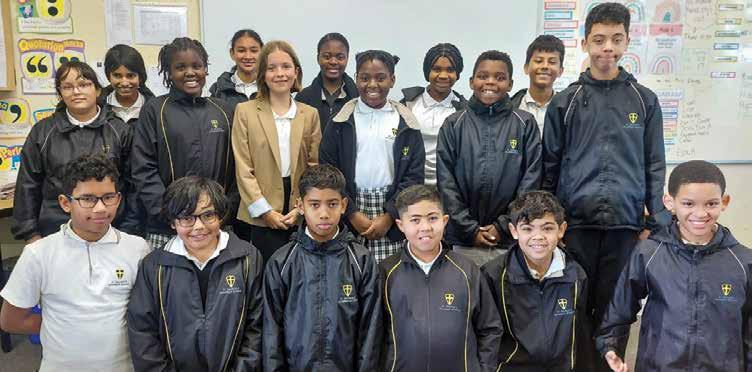
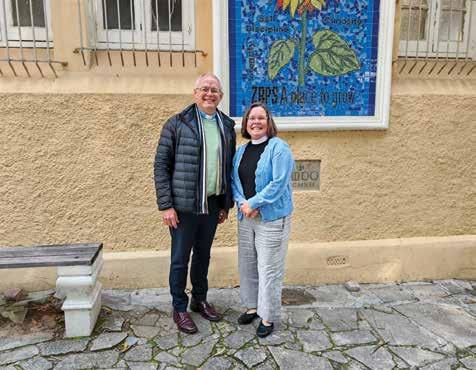
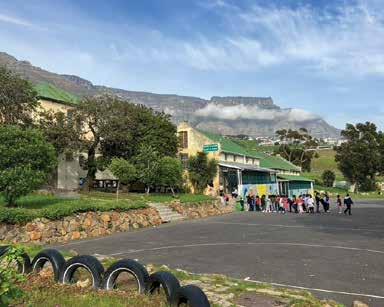
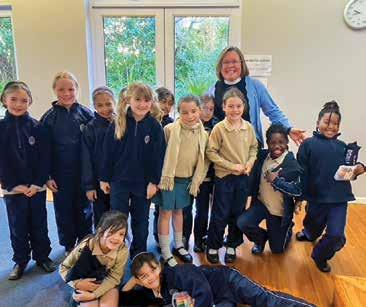
Above photo: Rev. Moses with Rev. Jaques Pretorius, executive director of Anglican Board of Education Southern Africa. Photo on p. 26: Elizabeth Schenck '31, daughter of Rev. Moses, welcomed by a sixth grade class at St. George's.
“explicit commitment to a culture of mutual respect and inclusion.”
My experience underscored that worship and spirituality can be embodied in multiple ways, and that broad participation in the spiritual life of a school helps cultivate inclusion and belonging. At St. George's, for instance, both the primary and high schools hold weekly chapel services despite having no chaplain. Instead, through the high school's leadership program, seniors take responsibility for various aspects of school life, including chapel. With the division director and other faculty, they plan services that include student and faculty speakers. The head of school shared that Muslim student leaders participate in the planning. I spoke with two of them who expressed their appreciation for the Anglican identity.
They emphasized feeling fully welcomed and respected for their own religious identity and noted that the school offers space for Muslim families to host a community meal to break the fast at the end of the day during Ramadan.
Herschel also maintains an identity rooted in its Anglican heritage while supporting the spiritual paths of all its students. There is a Student Muslim Association at the high school shepherded by a Muslim teacher. The school also allocates a small classroom as a Muslim prayer room, even making sure it is next to a bathroom for performing water ablutions prior to prayer. While the weekly chapel services at Herschel are based upon the Anglican tradition, the chaplain was planning a special chapel service focused on prayers for healing so that non-Christian
students could offer prayers for the sick from their own traditions. Although Zonnebloem no longer has a chapel service, the girls’ school incorporates prayer into the daily morning assembly, led by teachers, including a Muslim prayer.
I was reminded by this cross-cultural experience that in the task of educating young people in a world experiencing rapid transitions and uncertainty, there are enduring values in Anglican/ Episcopal education that can anchor us and our students. One of those values is community, grounded in the shared work of building genuine relationships. When I asked students at St. George's what they valued most about their school, they immediately spoke about their appreciation for the relationships they have with their teachers. One Christian student added that she liked being part of a diverse school where students genuinely get to know and learn from one another.
At Herschel, I attended a special chapel tradition at the primary school, where graduating seniors return to worship alongside the younger students.
Top left photo: Zonnebloem Primary School under the shadow of Table Mountain, Cape Town.
Top right photo: Rev. Moses with second grade religion class at Herschel Girls School.
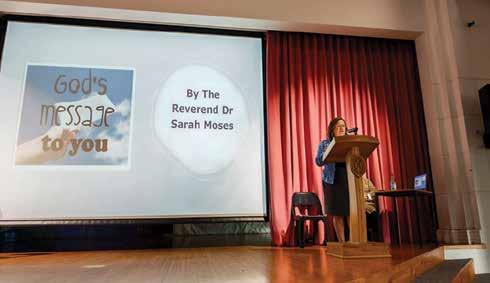
Left photo: Rev. Moses speaks at Senior School chapel at Herschel Girls School.
“My time in South Africa reminded me that throughout history and around the world, the church has supported education because, as Christians, we believe God has given us all incredible gifts—to learn, to create, to play sports—and that schools provide a place to develop those talents.”
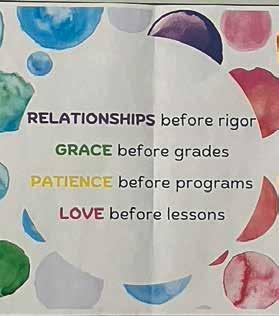
During the service, the seniors' former elementary teachers addressed them personally with stories from their past school years. At the conclusion, the younger students gave the seniors personal letters they had written to them. This celebration of community and relationships was captured in the words of a poster hanging in Herschel's faculty lounge: “Relationships before rigor. Grace before grades. Patience before programs. Love before lessons.” Likewise, the director of the boys' school at Zonnebloem shared that many students come from challenging home situations, taking on adult responsibilities without consistent adult models to guide them. He saw positive adult mentoring as a key responsibility of teachers at his school.
A second anchor of Anglican/ Episcopal education is the cultivation of character, and there were clear signs of a commitment to foster student growth morally as well as intellectually at all three schools. For instance, St. George's is part of the international Round Square school network. Guided by six ideals—internationalism, democracy, environmentalism, adventure, leadership, and service—member schools offer activities that lead students to develop related personal virtues and attributes, including appreciation of diversity, courage, commitment to sustainability, communication, compassion, inquisitiveness, inventiveness, problem-
solving, self-awareness, sense of responsibility, teamwork, and tenacity. In St. George's primary school, each month they focus on ethical values in chapel and the classrooms, such as tolerance and humility. At Zonnebloem Girls' School, character education is also incorporated into the curriculum, designating a specific value for each month and recognizing students as “value champions” at month's end.
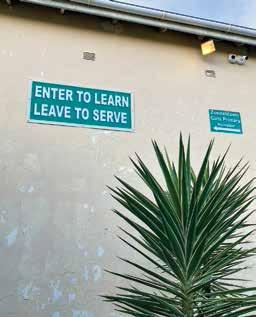
A third anchor I will refer to as hopeful engagement with the wider world was encapsulated in a sign at Zonnebloem's entrance: “Enter to learn. Leave to serve.” At Herschel, community engagement is a core aspect of school life and opportunities are organized by the chaplain and a senior student leader. Herschel students engage in off- and oncampus community-based projects and after-school tutoring programs hosted at the school. In addition, eighth and ninth graders complete special service projects during winter break and present their work in religion class. At St. George's high school students described being involved in community service programs at an elder care home and an eco-village. When I asked how they felt about their country's future in light of real societal challenges—such as an extremely high youth unemployment rate—they spoke with pride about the many good things that have happened since the end of apartheid, and with hopeful commitment
to making their own contributions to the future of their country.
As a chaplain at St. Stephen's and St. Agnes, this trip gave me insight and inspiration about ways our school can continue to creatively embody our Episcopal identity and values in our own context, including strengthening our commitment to inclusion and belonging and solidarity with the wider community. As I shared at a Lower School chapel in September: “My time in South Africa reminded me that throughout history and around the world, the church has supported education because, as Christians, we believe God has given us all incredible gifts—to learn, to create, to play sports—and that schools provide a place to develop those talents. Just as we believe at SSSAS, I saw how these schools also want students to grow compassionate hearts and strong character, and I witnessed expressions of goodness throughout the communities I visited. This is what our world needs— young people who care about those around them and want to make their communities better. Young people who come to school not only to build a good life for themselves, but to go out into the world and serve others. I hope you leave chapel today knowing you are part of a global family of schools where students grow not only in mind, but also in heart, so that you may be a blessing to the world around you.”
Saints Elected to Top Classical League Leadership Roles
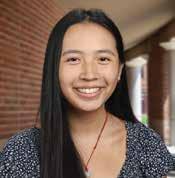
Last July, Reesey Lai '26 was elected president of the National Junior Classical League at the organization's annual National Convention— an honor determined entirely by students from across the country. National officers are selected through a delegate-based election, with student representatives from state chapters casting ballots following a formal nomination process that includes candidate forums and preparatory meetings. Officers assume their roles immediately at the convention's close, stepping into national leadership positions shaped by the trust and confidence of their peers nationwide.
the Executive Board, presiding over meetings of the Board of Directors and the National Convention's General Assemblies, and ensuring that all NJCL activities and officer duties are fulfilled.
The NJCL president's role centers on leadership and coordination: chairing
“I have the incredible opportunity to represent over 45,000 passionate student members that comprise the NJCL,” Reesey says. “I am in charge of helping to plan the convention and get to pick the theme for the year!” She chose a theme she feels is the “main driving force” behind her presidency and the JCL—Concordia parvae res crescunt (In harmony, small things grow), a phrase attributed to Sallust, the earliest known Roman historian to write in Latin.
In addition to her extensive
constitutional duties, Reesey has expanded her leadership through Epistulae, a Latin pen pal program that pairs JCL members from different states to write to one another in Latin. She has created an officer guide to aid future officers, as well as a fundraising guide to encourage schools and states to help out other chapters and keep in touch with the state presidents.
It can be challenging to manage all these responsibilities while being a senior, applying to college, and taking academically rigorous classes, but Reesey equates leadership with meaningful service—and she began serving on the board in her freshman year. “I wanted to be able to give back to the community that has done so much for me,” she says. “When I went to my first NJCL convention, I was amazed by the incredible JCL community. I was inspired
to see a Virginian on the NJCL board, and began thinking about making an even bigger impact on the national scale.”
Through her work with the NJCL, Reesey has come to see leadership as something built through relationships. “My NJCL experience has helped me understand how leading is about building communities,” Reesey explains. “Some of my greatest memories are running activities where we bond with one another, and I think it's very important to create those kinds of connections with the people you lead. I've also learned the impact of guiding and mentoring others so they feel confident in their roles as well as focusing on supporting and cheering on all of their successes to continue to build our community and show how much I care and appreciate their hard work.”
Reesey's election reflects her sustained commitment to classical studies as well as her leadership within a national, student-governed organization—one in which students actively shape the league's direction and voice.
Julia Stimson '28 presented roll call, with Khanna also introducing the school's candidate for office.
Khanna also led two standingroom-only sessions of Jeopardy Mythologica, drawing more than 60 students per session with new questions spanning dramatic myths, eternal punishments, and Zodiac symbolism.
Cecil Gregg '27 concluded his term as VJCL communications coordinator, supporting board meetings and building excitement for the convention through social media, while raising funds for Joy for Hospice during Coin Wars.
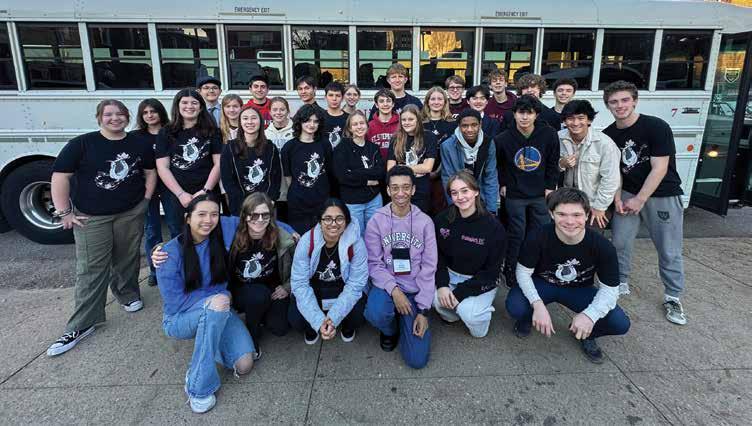
That leadership momentum was on full display at the Virginia Junior Classical League Convention, held November 23–24 in Richmond, Va. A delegation of 32 Saints took on visible leadership roles throughout the weekend—as voting delegates, presenters, workshop leaders, and candidates—and contributed to competitions, creative arts, and service initiatives.
Saints students stepped into leadership roles throughout the convention. Reesey and Sabrina Khanna '26 led the spirit competition; Natalie Newton '27 and Ella Jakupovic '26 served as voting delegates; and Chloe Lehman '28 and
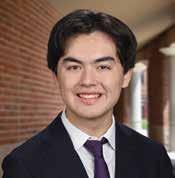
Arleigh Womack '26 wrapped up his service as VJCL parliamentarian by recruiting candidates and overseeing elections—and memorably capped the fundraiser with a spirited performance at the Valete assembly. Most notably, Jackson Sipple-Asher '27 won election as VJCL president, marking the third time in four years that a Saint has served on the state board. He will lead officer meetings throughout the year and represent Virginia at the national convention this summer. During the convention, Reesey—fresh off her election as National Junior Classical League president—also extended an official invitation to Virginia students to attend the 2026 national convention, where she will preside.
Across academics, creative arts, and Certamen, Saints earned numerous individual awards, placed second overall in the spirit competition, and narrowly missed finals in Street Certamen— finishing just five points short. Together, the weekend reflected not only strong performances, but a depth of engagement and leadership that now spans both the state and national levels.
Top Awards Highlights
Saints earned multiple top finishes across academic, graphic arts, and creative arts competitions, with standout performances at every level of Latin and across grade divisions.
First-Place Finishes
• Sarah Eisenberg '28: Mixed Media, Grade 10
• Maddie Haines '30: Mottoes, Abbreviations & Quotations (Novice Plus)
• Ella Jakupovic '26: Poster, Grade 12
• Jackson Sipple-Asher '27: Mythology (Advanced)
Second-Place Finishes
• Dava Boyce '26: Classical Art (Intermediate Plus)
• Cecil Gregg '27: Mosaic, Grade 11
• Reesey Lai '26: Dramatic Interpretation: Pliny
• Riley Whitt '29: Games, Grade 9
• Hayes Wilson '30: Reading Comprehension (Novice Plus)
• Rory Zielenbach '30: Mixed Media, Grade 8
Depth Across Disciplines
Students placed across a wide range of categories, including:
• Advanced academic events such as mythology, literature, reading comprehension, derivatives, grammar, and Latin oratory
• Visual and creative arts, including classical art, mixed media, mosaic, sculpture, illustrated quotes, modern myth, and children's book design
• Team and applied events, including games, pentathlon, and sweepstakes
Together, these results reflect not only individual excellence, but the depth and range of the Saints' engagement with classical studies, spanning scholarship, creativity, and performance across grade levels and experience tiers.
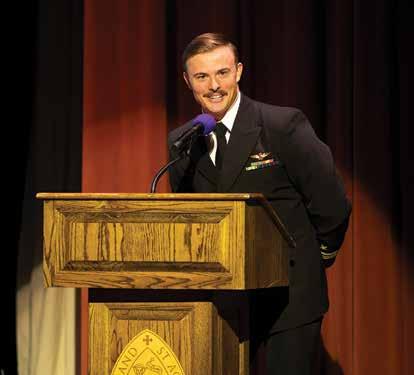
HONORING VETERANS DAY
On November 11, the Middle and Upper School campuses were honored to welcome Lieutenant Junior Grade Jacob Foster '18 as the Veterans Day assembly speaker. Jacob graduated with distinction from the United States Naval Academy in 2022 with a bachelor's degree in aerospace engineering. At the Naval Academy, he served as Brigade Executive Officer, second in command of the Brigade of Midshipmen. After commissioning as an Ensign in the U.S. Navy, Jacob reported to Naval Air Station, Pensacola, Fla., to begin Flight Training. He received follow-on orders to Corpus Christi, Texas, and Meridian, Miss., where he would complete Primary, Advanced Multi-Engine, and Advanced Jet Training. Jacob received his Wings in March 2025, after being qualified for carrier operations aboard the USS George H.W. Bush. Jacob is currently serving in Norfolk, Va., where he flies the E-2D Advanced Hawkeye.
After the Upper School assembly, students interested in attending a service academy or exploring military career opportunities joined Jacob for an insightful lunch to learn more about his journey.
On November 13, our Lower School welcomed Saints community service members—including current parents, grandparents, alumni, colleagues, and relatives of colleagues— for a special chapel honoring Veterans Day. The service included a homily delivered by SSSAS parent Bill McCrone (Veteran, U.S. Navy), participation from Girl and Boy Scouts, and music. After the chapel, the entire Lower School and guests proceeded outside for a flag-raising ceremony and recitation of a Veterans Day poem.
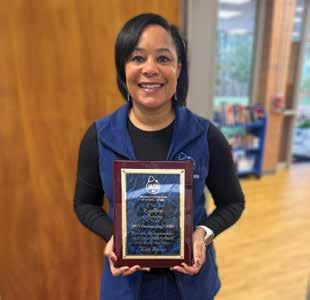
IN GOOD HANDS
At the annual Virginia Association of School Nurses (VASN) conference on November 9, SSSAS Lower School Nurse Kim Brown was named the 2025 “School Nurse of the Year” for private, independent, and parochial schools. The purpose of the award is to recognize outstanding school nurses in Virginia who demonstrate excellence in school nursing practice, as well as leadership in school health. Since joining SSSAS in 2020, Nurse Brown has cared for our Lower School community— nearly 500 students plus faculty and staff— each year. She has led our COVID health protocols, mentored other school nurses statewide, developed our fifth-grade health curriculum, and created a calm, welcoming health office that inspires wellness across our community.
Solution
Here are the answers to Emma Oxford's puzzle, Classroom Learning, on p. 23.
Lieutenant Junior Grade Jacob Foster '18
Kim Brown
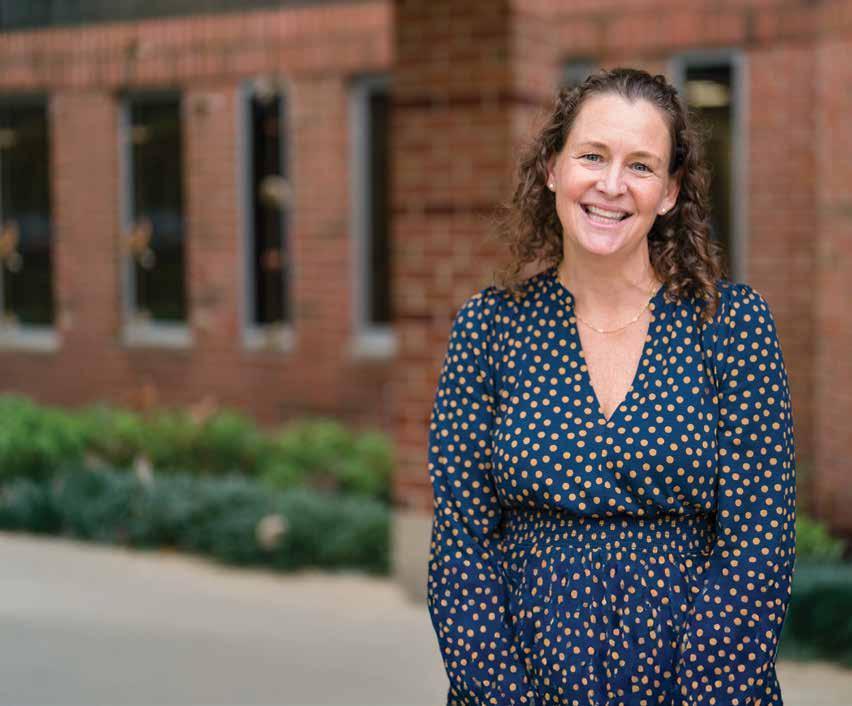
Our director of counseling, Karen Kunz, is the kind of person who makes Middle School feel a little less overwhelming—for students and their grownups. With her thoughtful care, kindness, and deeply human understanding of what kids need, she has become a quiet anchor in a time of life that can feel like a roller coaster on fast-forward. Her work is rooted in connection: helping students grow into themselves and supporting families with compassion.
Karen grew up on the East Coast in Portsmouth, N.H., where her family had a special summer tradition of going to the classic play offered by the local theater company. Years later, she returned to that ritual as a parent when her oldest daughter was two, creating a new generation of memories tied to a beloved part of her own childhood.
As a child, Karen dreamed about training dolphins at SeaWorld, but life nudged her toward a different kind of caretaking. With a pediatrician dad and a mom who worked in maternity and pediatrics, she grew up hearing stories about the families they encountered, but she was more interested in the emotional world behind medical charts. She found her way into internships that deepened that fascination: studying the attachment between mothers and babies and working with teens in a psychiatric hospital. Somewhere along the way, psychology became less of an interest and more of a calling.
In 2004, Karen found her perfect fit at SSSAS as the Middle School counselor. She loves watching students hit their eighth-grade stride and seeing just how far they've come since their wide-eyed sixth-grade selves. The hardest part of the job? Knowing she can't fix everything. The best part? Watching kids discover they're stronger than they realized.
Karen's own middle school years were spirited. In fact, her seventh-grade English teacher described her as a “chattering squirrel.” Karen laughs about it now, noting she was probably too social for her own good and not putting enough energy into studying!
Karen and her husband, Jon, are a true Saints story: they met on campus, married a year later, and now have two daughters who've grown up roaming the halls of SSSAS. Outside school, life is full—and fun. Karen loves sleeping in on weekends, a great breakfast sandwich, playing tennis (enthusiasm over skill, by her own admission), going to concerts with her family, and escaping on an annual trip with the same college friends she's had for more than 30 years.
She likes all kinds of music, and loves the show “Shrinking,” although she doesn't think the majority of therapy techniques used by the main character are within the bounds of ethical treatment! She's incredibly proud of the three marathons she ran, including the Marine Corps Marathon, but says three was enough. She also considers studying during naptimes, dragging a baby to supervision hours, and pushing through months of prep to earn her Licensed Professional Counselor credential a major personal victory.
The most adventurous thing she's ever done? Quitting a job after grad school to spend eight weeks wandering through Italy with a friend—an experience she still considers one of the best decisions she's ever made. Travel has been a thread throughout her life. Last year Karen and her brother took their families and her 77-year-old dad on an adventure to Costa Rica, including ziplining for everyone! Greece is next on her wish list.
In the Middle School world, Karen is the calm in the chaos, the reassuring voice in moments of uncertainty, and the warm presence who helps students navigate everything from friendship blips to growing pains. She lives in the whirlwind of adolescence at school and at home, and brings real empathy to every conversation—proof that even “chattering squirrels” grow up to make a meaningful difference.
Karen Kunz
If you could wake up tomorrow with a super power, what would it be and what would you do with it?
It would be a tie between reading people's minds and flying. Obviously, reading people's minds would give me a leg up as a counselor, and I'm often running late, so flying would get me to where I needed to be on time!
What is your most favorite thing in the world and why?
As cliche as it sounds, I would start with my kids. I know I'm biased, but I think they are pretty great. Next it would be my husband and my family. And finally, it would be my friends.
What are you obsessed with?
Diet Coke and Mexican food.
What's the best gift you've ever received?
Jon set up a scavenger hunt that required me to visit each place we had gone on a date. One of my favorite people was waiting in each location. The second to last stop included my brother, who came to visit from NY, and a phone call from my dad who was traveling overseas. At the last stop, Jon was waiting with an engagement ring. We celebrated the rest of the night with all of my best friends from across the East Coast. It was one of the best nights of my life.
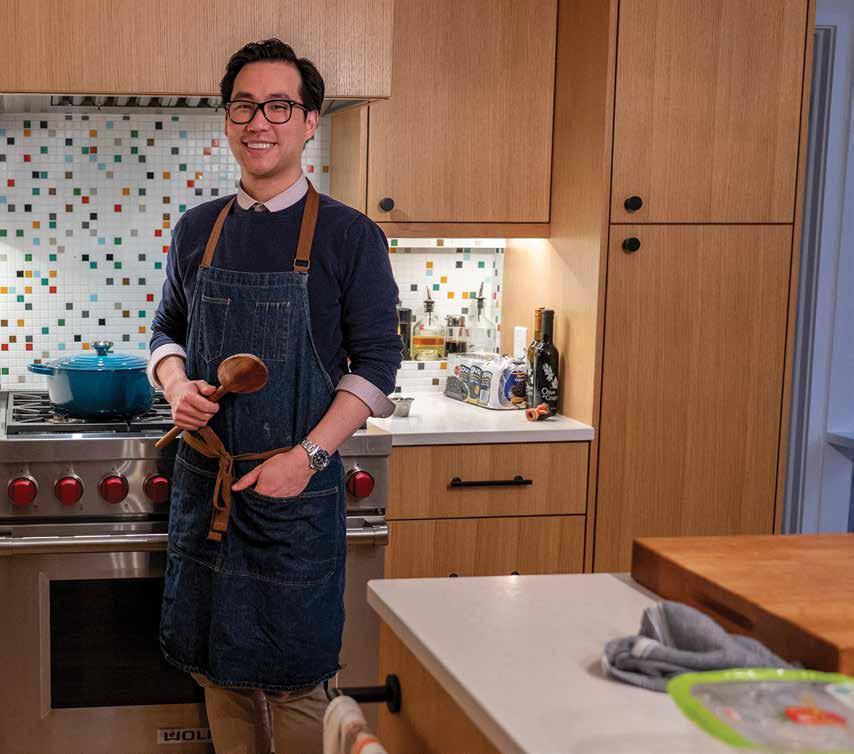
Doug Wong
If you could switch lives with anyone for a day, with whom would it be and why?
My dog. Eating, sleeping, and lounging all day sounds wonderful.
What one piece of advice would you offer anyone who asks?
Don't take yourself too seriously. I certainly don't.
What are you obsessed with?
Popeye's fried chicken. It is the platonic ideal of fried chicken.
Best advice ever received?
Follow the 3 P's: practice, patience, and perseverance. Thanks, Mom.
If you had a million dollars, what would you be doing?
Probably nothing different—though I might have a better grill setup.
What is your most treasured object?
My great-uncle's watch, which we found after he passed away. Restoring it and wearing it now keeps me connected to him and that side of the family.
What is one thing you'd fix with a magic wand?
Traffic. Especially in Old Town.
Associate Director of Upper School Doug Wong describes himself as thoughtful, approachable, easy-going, inquisitive, and open-minded. He's also a spreadsheet wizard, dinosaur enthusiast, and the rare adult who can read ancient inscriptions while managing six lunch lines and a horde of hungry students with a smile.
Doug was raised in the Boston area, and his grandfather's American Chinese restaurants, Tiki Port and Tiki Island, were at the heart of his childhood. He has fond memories of spending time with him, sampling tasty dishes in the warming area, and working the take-out counter in the summers. The restaurants are a big reason Doug loves to cook today. He and his wife Debbie (who spends her days repatriating and returning stolen art to the country of origin—how cool is that?), take their one-year-old daughter, Chloe, to the Old Town farmers market every Saturday to have Hog Haven breakfast sandwiches and to do a little shopping for the week. Augie, their three-year-old Corgi, supervises all activities with mild jealousy over the attention Chloe receives.
Growing up, Doug loved ancient history and mythology and decided to pursue Classical Studies and archaeology, attending Colby College for his bachelor's and Columbia University for his master's. Ancient languages, Greek tragedy, Latin inscriptions—he loved it all. As an undergrad, he was a research assistant on an archaeological project in Greece that provided his first excavation experience, where he was able to handle artifacts thousands of years old. He's been to many ancient sites, but if he could time-travel he'd wing his way to the Hanging Gardens of Babylon and the Library of Alexandria to see all the literature that was lost!
Doug's passions flow into his Latin classroom. He loves the logic behind the language and the moment when students suddenly “see” the systems beneath it. He tries to anchor the ancient world in today's issues—debates about governance, wealth, and society that echo across centuries—and brings in architecture, coins, and sculpture to keep the past tangible.
As associate director, Doug jokes that his ability to read Latin inscriptions is the key to reading all types of student handwriting. As a lover of language, he enjoys keeping up with slang but holds a couple of Greek phrases as personal mottos: μηδὲν ἄγαν (nothing in excess) and Γνῶθι σεαυτόν (know thyself). When it comes to relating to mythology, he says he sometimes fully understands Sisyphus rolling the giant boulder up the hill, only for it to roll back down right before he gets to the top.
He thinks our Upper School students might be most surprised to learn that he secretly enjoys managing the lunch lines, because he gets to see everyone, every day. But he says the most meaningful moments come during quiet conversations with students who are seeking help academically. Supporting them to find their footing and seeing their grades and skills improve is the most rewarding part of his job.
When he's not teaching, leading, cooking, or parenting a toddler and dreaming of sleep, Doug is a fan of Moneyball (“how can you not be romantic about baseball?”), the HBO series “Rome,” and, historical accuracy aside, “Gladiator,” as it really solidified his love of Rome. Sesame Street music currently dominates his Spotify account. He's rereading the Dune series and finished “Dune Messiah” in one sitting. His hidden talent? En garde! His high school fencing team won first place at the state championship!
Spend a little time around Doug and it becomes clear why students gravitate toward him. He listens, he laughs easily, and he truly enjoys learning about their interests, weekends, and how their day is going through authentic conversations. For someone who loves the ancient world, he has a remarkable talent for making the present, and future, feel brighter.
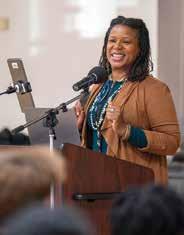
CREATING STRONGER COMMUNITIES
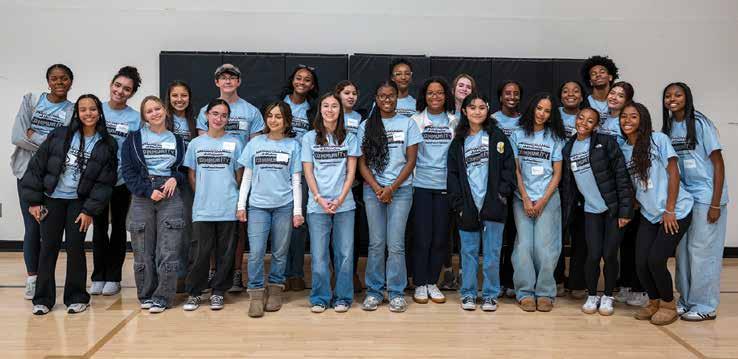
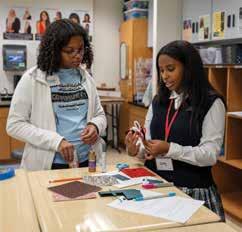
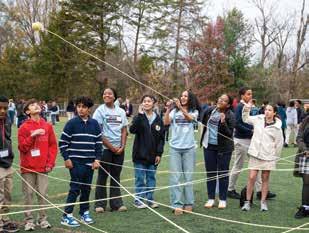
On November 14, SSSAS hosted the 10th Annual Middle School Diversity Conference, “Stitching Together a Stronger Community: Tied by Many Threads.” Approximately 150 students from Baltimore to Richmond gathered together to explore diversity, inclusion, and belonging from a middle school perspective.
The event opened with a keynote address from Amber Robles-Gordon—an accomplished mixed-media visual artist of Puerto Rican and Caribbean descent—who
shared how her art is a reflection of her community, and therefore a reflection of herself. Her creations are visual representations of her hybridism: a fusion of her gender, ethnicity, cultural, political and social experiences and concerns. She received a Bachelor of Science in Business Administration in 2005 at Trinity University, and subsequently a Master's in Fine Arts (Painting) in 2011 from Howard University. She has more than 20 years of experience in exhibiting, art education, and coordinating exhibitions. Ms. Robles-
Gordon has exhibited extensively throughout the United States and internationally, including in Germany, Italy, Malaysia, Canada, London, and Spain. SSSAS Upper School student facilitators guided participants through interactive workshops and meaningful discussions focused on identifying the many “fibers” of differences that exist within us and all around us and how we can leverage them to make stronger, better and safer school communities.
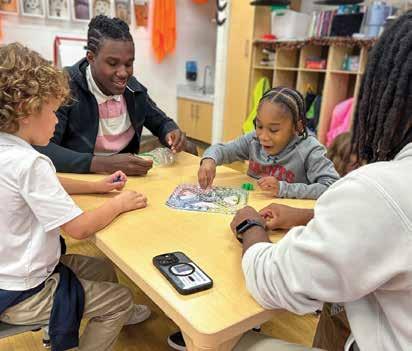
MATH + FUN = LEARNING!
The Lower School was buzzing with math fun in October. Families gathered in the Lower School Daniel Gym for an evening of hands-on math games and activities designed to build and extend mathematical thinking. Students and parents played the same engaging games used in class, and our fifth graders did an amazing job helping to lead many of them!
Upper School Math Squad students joined a kindergarten class for some more hands-on math fun. From counting to playing games, it was a great chance for our oldest and youngest Saints to learn (and laugh) together. The Math Squad is an Upper School club that visits kindergarten and fourth grade classrooms to play math games, help younger students practice foundational skills, and spark enthusiasm for the subject.
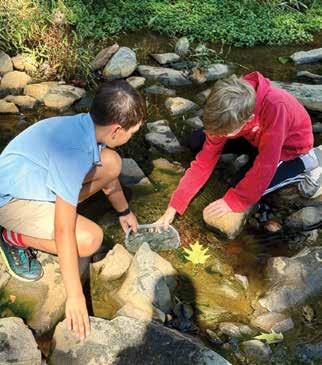
LIFE IN THE FIELD
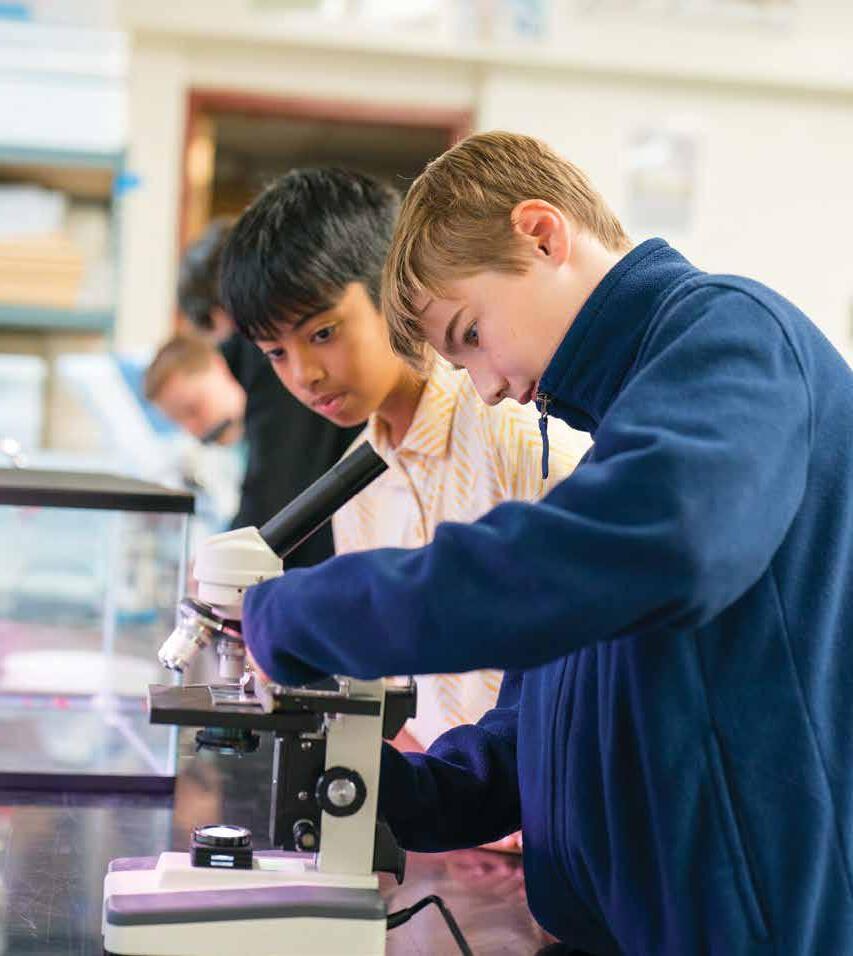
Middle School science students took their learning outdoors. To wrap up their unit on the characteristics of life and biodiversity in ecosystems, students visited Lucky Run Stream to record evidence of species diversity, searching for different types of plants as well as evidence of the five categories of vertebrates in the area. Back in the classroom, they used their microscopes to see if they could spot evidence of life in water samples collected from various parts of the stream. Hands-on discovery at its best!
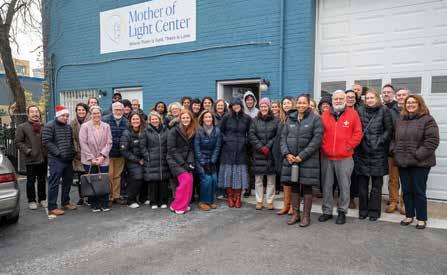
A SHARED COMMITMENT
Our Administrative Team's December meeting was spent volunteering at the Mother of Light Center, continuing our long-standing partnership and supporting the vital work they do for families across Alexandria. Students, faculty, and staff serve with Mother of Light throughout the year, and it was a meaningful opportunity for our administrators to join in that shared commitment to community care. We're grateful for their mission, their impact, and the chance to serve together.
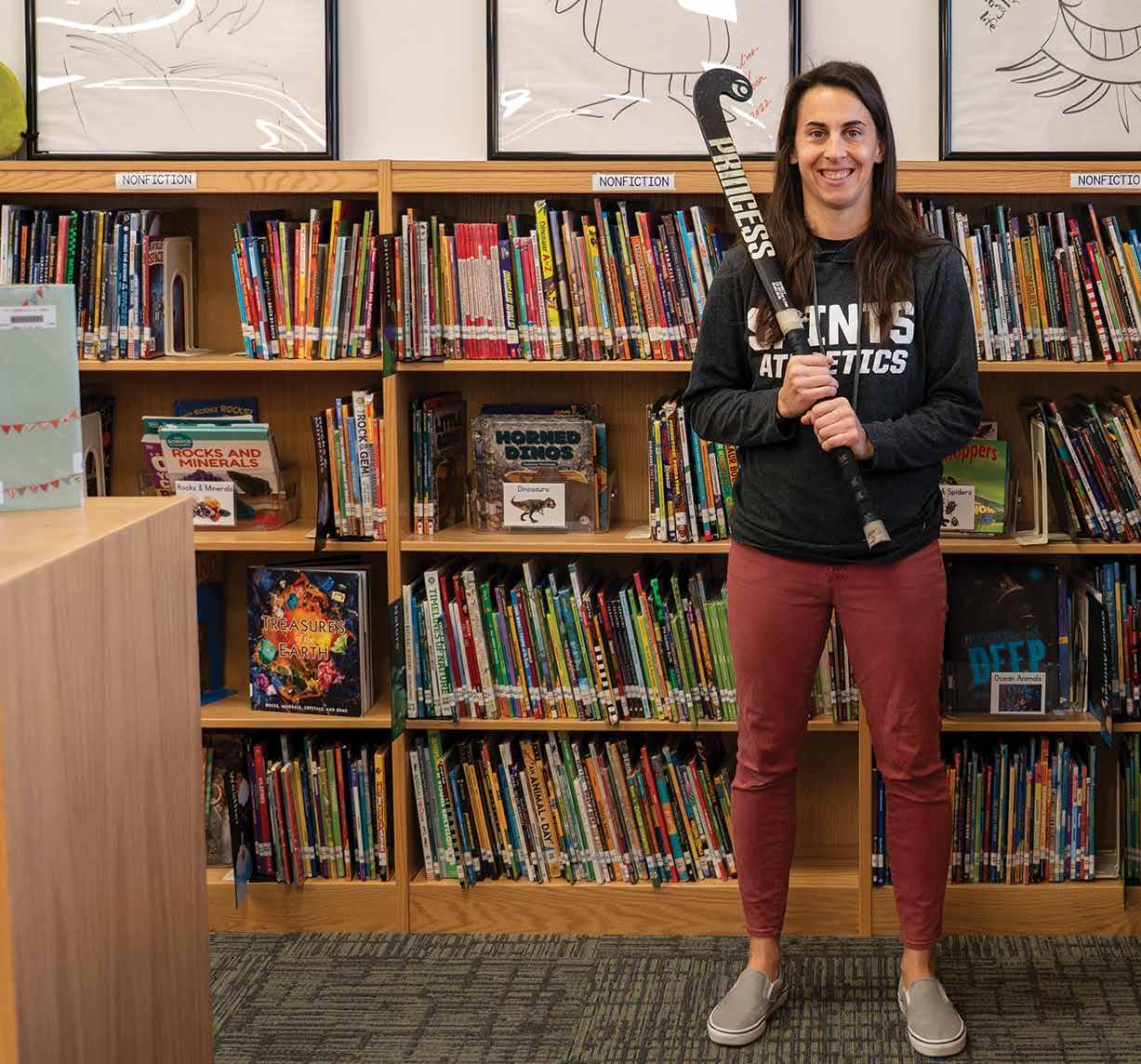
Play, steadiness, and a deep sense of community define Erin Hartman. Those traits have been part of her from the beginning—growing up on a Pennsylvania mountainside where kids lived outside, riding bikes, playing football in every season, and launching massive capture-the-flag games that swept up the whole neighborhood. Thirty years later, her elementary school besties remain her closest friends, a testament to the effort, intention, and commitment she pours into her relationships—and the spirit that guides how she shows up for the Saints community today.
Since signing on as a substitute PE teacher in 2015, Erin has held a variety of coaching, teaching, and administrative positions, succeeding at each with her secret weapon. Organizing is her jam—from busstop games as a kid to the teams, events, and family life she manages so effortlessly today. She says it's just the way her brain works, compartmentalizing and naturally ordering things!
A four-sport athlete growing up, Erin's home is on the sidelines. She stepped into coaching basketball, field hockey, and lacrosse easily—but still needed a job to fill her day. When she applied to be the Lower School assistant librarian—she had no idea how life-changing it would be. Working with Librarian Julie Esanu changed her approach to students and teaching, shaping the way she now coaches and collaborates in all her roles. Erin loves how genuine the youngest Saints are—funny, curious, thoughtful, empathetic, and smart—and treasures watching them grow through the years.
In 2019, Erin added assistant to the director of teaching and learning to her growing list of roles. As someone who thrives working with students, she hesitated to take a job focused on adult interaction. Ironically, it's pushed her to be creative, take on new challenges, and grow in ways she never expected. That same year, she took on coordinating every detail of the Upper School's 2020 year-end events—Prize Day, Baccalaureate, and Commencement—never imagining her meticulous plans would have to pivot overnight from in-person celebrations to full Zoom productions. Thankfully, Erin is wired for calm when chaos strikes. She steps back, sorts through the noise, and focuses on what she can control—and uses that perspective to motivate and help others move forward.
Before coming to SSSAS, Erin lived a life packed with adventure. Though recruited to play field hockey, she decided not to play and leaned into her love of history and political science at the University of Pittsburgh. She's especially fascinated by the cultural tension and transformation of the turbulent 1960s. Her dream dinner guests would include Janis Joplin, John Steinbeck, and Billie Jean King—who capture the blend of artistry, humanity, and grit she admires—and she'd time-travel straight to the 1963 March on Washington to witness its collective courage firsthand. She studied abroad in London, traveled through most of Western Europe, hopped to Canada, Mexico, Costa Rica, and Ecuador, and spent a full year exploring Australia and New Zealand. Her boldest moment came in Queenstown, where she jumped from the 440-foot Nevis Highwire bungee—one of the tallest in the world!
Her days look different now—revolving around playgrounds, dog walking, naptimes, and cheering on the Saints—but Erin approaches it all with the same energy. She enjoys any physical activity, baking and grilling, and quiet time curled up on the couch with her dogs, Jackson and Marley. She's a big kid at heart who turns ordinary moments into something joyful for her partner, fellow Saint Dionna, and their toddlers, Kaia and Callan. For all the places she's been and all the experiences she's had, Erin's greatest adventure might be this one: building a life rooted in love and belonging.
Erin Hartman
What are you obsessed with?
My dogs. They greet me like I've been gone for years, even if I just took out the trash. That kind of love and enthusiasm is contagious.
If you could wake up tomorrow with a superpower, what would it be? Teleportation. I could travel anywhere instantly, visit friends around the country, and actually sleep more because I'd never sit in traffic again. Win-win-win.
What is the one place in the world you would like to escape to and why?
New Zealand. It's the size of Colorado but has everything—glaciers, mountains, and snowboarding in the south, then volcanoes, snorkeling, and bird sanctuaries in the north. It's got everything.
If you had a million dollars in the bank, what would you be doing?
Pay off our house, take one great vacation, invest the rest, and keep doing what I'm doing. I'm a realist, remember?
What is the biggest risk you have ever taken in your life?
Not entering the workforce after college. I traveled and worked odd jobs through my twenties instead of building a resume. It was a risk that was entirely worth it.
What one piece of advice would you offer anyone who asks?
Life isn't linear. If the traditional path works for you, great. But if you need to wander, travel, or try on different lives first, that's great too. Don't be afraid to take detours. There's no single right way.
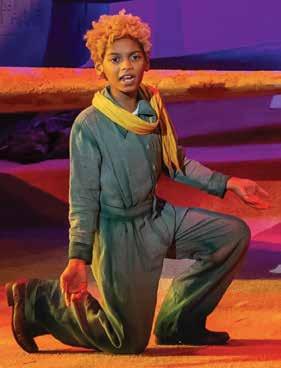
ACTING, SINGING, SHINING
Fifth grader Clarence Payne, who played both Mamillius and Time in Shakespeare's “The Winter's Tale” at the Folger Theatre in 2023, landed the lead role in the Washington National Opera's “The Little Prince” at the Kennedy Center! Clarence performed in three of the five performances in December. When asked how he liked being in an opera compared to an acting role, Clarence replied, “I love both! They're just very different.” He noted that it's a bit harder to add emotion when you are singing, compared to a speaking role. As far as which role was more difficult for him, he says, “I think preparation for the opera was harder. The hardest part was learning the songs and the vocal training because not only do you have to learn the lines, but you also have to learn the rhythm of the lines and the resonance and also the melody, which, I think, is the hardest out of all three. And during 'The Winter's Tale,' you're just learning what words to say. Although, it was a little hard to learn the words because it was Shakespearean English (he giggles).” Whether singing or acting, Clarence loves performing and is totally up for the next challenge.
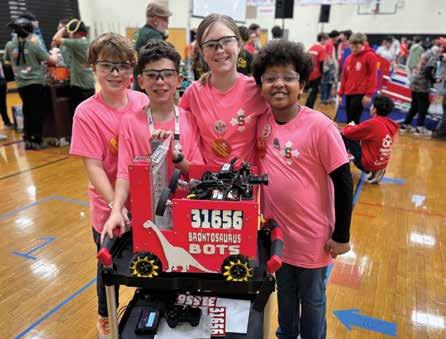
MIDDLE SCHOOL ROBOTICS ON A ROLL
Our three Middle School robotics teams performed exceptionally well in the First Tech Challenge (FTC) Qualifier Tournaments.
All three teams experienced successes at the Powhatan I Qualifier on January 10.
Terabyte Triceratops (8th grade team 16862) received a 2nd Place FTC Control Award, which recognizes teams for innovative use of sensors and software to create an “intelligent” robot that reliably solves game challenges, enhancing autonomous operation and performance.
Brontosaurus Bots (6th grade team 31656) received a 2nd Place FTC Innovate Award, which recognizes teams for truly creative, unique, and well-documented robotic designs that solve specific game challenges. This award focuses on the ingenuity of a mechanism or control system rather than just top performance, requiring a strong Engineering Notebook to explain the innovative process, and a design that consistently works.
Techno Rexs (7th grade team 24227) took 5th Place overall out of 36 mostly high school teams. They moved on to the championship round winning one game before being eliminated.
At the Alexandria I Qualifier on January 17, Terabyte Triceratops took 6th Place overall and advanced to the championship rounds before being eliminated in the early rounds. They were also awarded a 2nd Place Innovate Award.
Brontosaurus Bots took center stage at the Alexandria II Qualifier on January 18, taking 6th Place overall and advancing to the championship rounds. They won three games in the semifinals before being eliminated, but placed high enough to move forward to the Chesapeake Regional Championships on February 7-8 at the Meadow Event Park Farm Bureau Center in Doswell, Va.! Stay tuned...
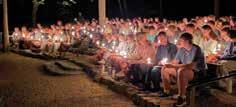


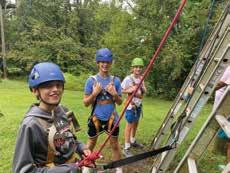


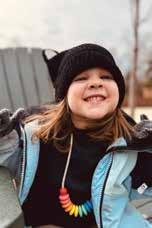


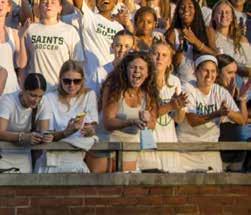
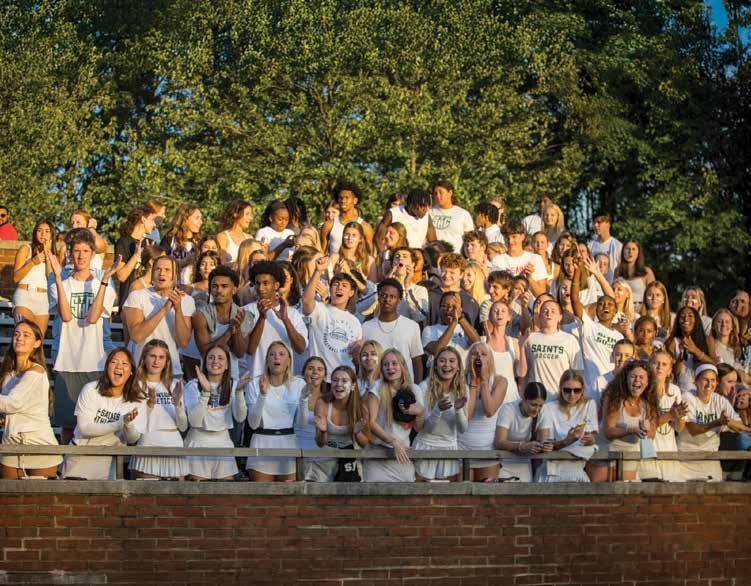
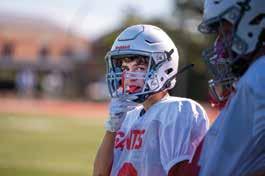
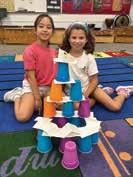




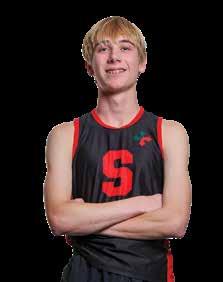
HENRY KREBS '28
CROSS COUNTRY

ALL-IAC
ALL-STATE

SYDNEY WANAMAKER '27
CROSS COUNTRY
SEMINARY HILL CUP CHAMPION
ALL-STATE
CHARLIE DESAUTELS '26
BOYS SOCCER
ALL-IAC
ALL-STATE SECOND TEAM
WASHINGTON POST ALL-MET HONORABLE MENTION
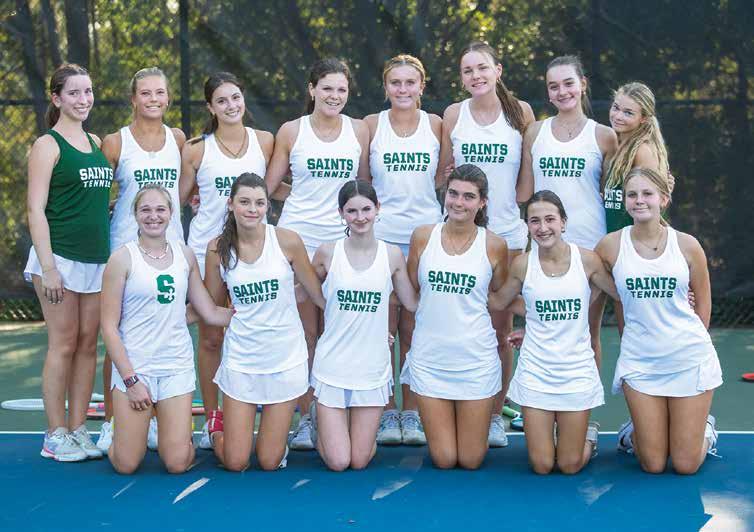
GIRLS TENNIS: ISL A DIVISION REGULAR SEASON CO-CHAMPIONS
CAROLINE SCHUYLER '27 | ALL-ISL
CAROLINE SCHUYLER '27
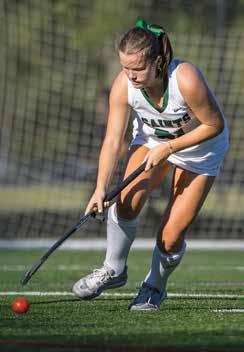
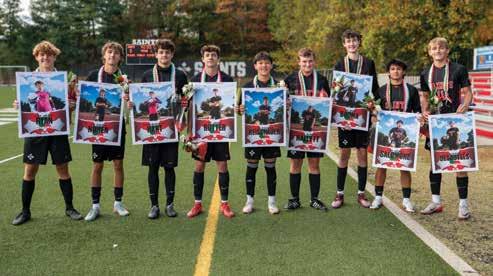
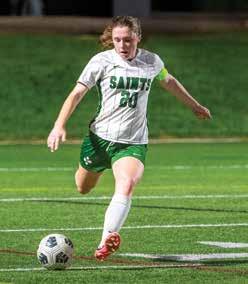
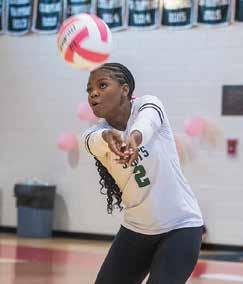
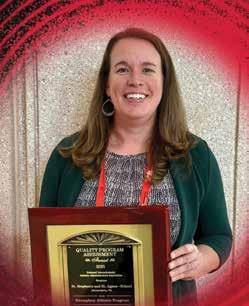
SSSAS RECOGNIZED BY THE NIAA
The National Interscholastic Athletic Administrators Association (NIAAA) recognized St. Stephen's and St. Agnes as a 2025 NIAAA Quality Program Award recipient at the Exemplary Level. SSSAS was one of only 65 schools nationwide honored this year. This recognition reflects our commitment to best practices and to continuous improvement and growth in our athletic program.
Athletics Director Stephanie Koroma accepted the award on behalf of the school at the 56th National Athletic Directors Conference in Tampa, Fla.
GABE MURPHY '26 | ALL-IAC
NIGEL ARTHUR '27 | ALL IAC
MAIRIN ALMY '27 | ALL-ISL
RENEE JENKINS '26 | ALL-ISL
MEG ADAMS '26 | ALL-ISL
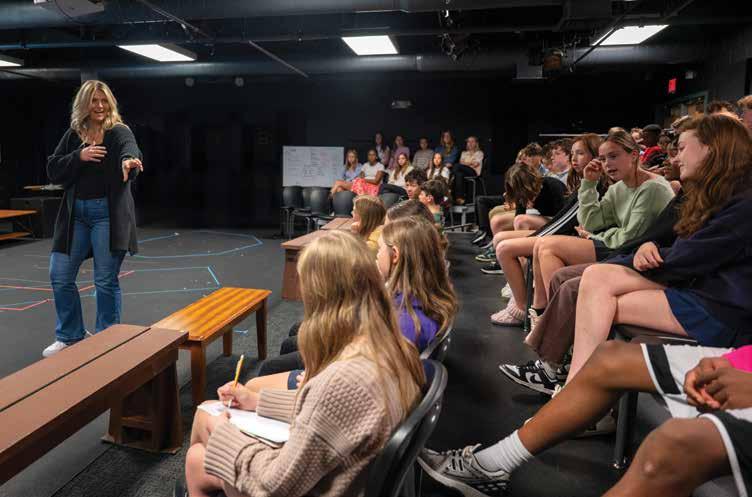
A Winning Mindset
BY SUSIE ZIMMERMANN
Mental wellness and student support has long been a focus at SSSAS. Establishing a wellness initiative in the Athletics Office was, therefore, a natural addition, and when Chief Advancement Officer Jennie Wills recognized an alignment between donor and alumni interest and departmental need, it proved to be a perfect match.
“Sports are so high-pressure these days,” explains Trae Humphreys, associate director of athletics for student development and leadership. “Between recruitment, comparison culture, and the constant pursuit for perfection—especially with social media—student-athletes are not just comparing themselves within their communities but also with people
around the world.” He knew that helping athletes to manage this stress would benefit them both on and off the field.
While SSSAS coaches have long supported the mental health of their athletes, the Athletics Office sought to more systematically integrate mental wellness and competitive readiness into the athletic program. The goal was to equip student-athletes with the tools to succeed now, into college, and beyond.
Meanwhile, Summer Crabtree '99 discussed similar observations with Head Lacrosse Coach Kathy Jenkins. Summer and her sister, Shana Crabtree '96, were three-sport athletes all four years at SSSAS, and both went on to play Division I lacrosse in college. The sisters pursued
careers working with children; Shana as a pediatric pulmonologist and Summer as a teacher and coach. They both now serve as officers of The Phyllis P. and Scott A. Crabtree Family Foundation. They fondly remember their father's positive motivation, pep talks, and game-day engagement and wondered how they could support today's Saints, who face an entirely new level of pressure. They envisioned a wellness program that could extend beyond recruited student-athletes to support all students, parents, and coaches. “If you address a problem from all angles, it's more likely to succeed,” says Shana.
The Foundation and the Athletics Office worked together to develop
Person Before Player session with Middle School students
“ “
The Washington Post published an article in 2024 about how the gold medal-winning Women's U.S. Soccer Team and coach Emma Hayes combined high standards and strong support to create a winning combination. SSSAS coaches like Kathy Jenkins and Marsha Way never lowered their standards and provided exceptional support for their student-athletes. This growth mindset reflects Stanford University psychologist Carol Dweck's finding that intelligence and ability can be developed to welcome challenges rather than see them as threats. Our goal with this program is to provide teachers, coaches, students, and parents with opportunities to learn how to navigate high standards and provide high support.
Scott
A. Crabtree
the program with two organizations.
Z-Winning Mindset focuses on athletic performance by mentally preparing students for competition and providing tools and techniques to maximize opportunities for success. Trae, who also coaches wrestling, explains that “the program helps students identify what they can control—preparation, effort, attitude— and surrender the outcome, which they cannot control.”
The second partnering organization, Person Before Player, offers a data-driven and holistic approach to responding to unfavorable results and developing balance and resilience. It provides mental wellness toolkits for communication among coaches, athletes, and parents. “Sports are great, but they can also be detrimental to mental health,” says Trae. “They demand a lot of time, generate positive and negative feedback from many directions, and involve relationships that can become pressurized by exterior forces.”
The program provides the vocabulary,
THE SCOTT A. & PHYLLIS P. CRABTREE FAMILY FOUNDATION
Founded in 2019 in Alexandria, Va., the Scott A. & Phyllis P. Crabtree Family Foundation’s mission is to use the resources developed by the Crabtree Family to make a positive, sustainable difference for the people, schools and organizations in our communities, our country, and the world. In accordance with their mission, the foundation tends to support projects and organizations that focus on supporting education and health. Investing in health and education delivers lasting sustainability, with a ripple effect that amplifies the impact of a gift across the broader community, long after the initial investment. The foundation is the embodiment of the Crabtree family values—always do the right thing, be kind, be smart, be important to each other.
tools, and context students and coaches can use to gain a fresh perspective within a research- and data-driven framework.
After several events with individual teams, parent groups, and classes, the wellness initiative evolved from a speaker series into a comprehensive program that now works regularly with all these groups. “Students don't always have the foundation or tools to take what a onetime speaker offers and immediately apply it to their lives,” explains Trae. “Instead, we want to establish a foundation and provide ongoing activities that help students build skills and integrate them into their daily routines.”
The Foundation and the Athletics Office intentionally designed the program to create a long-lasting impact without placing additional burdens on the coaching staff. “We didn't want it to be a check-the-box activity,” says Trae. Instead, they emphasized a thoughtful, phased rollout that would not be rushed and would allow participants to “go deep enough to be truly helpful.”
Z-Winning Mindset is working with four teams each year, integrating mindset training into practices through worksheets, reflections, and other activities, and helping coaches and players apply workshop concepts during competition. The goal is to rotate through all the sports over the course of four years so that every team has at least one engagement with the program.
A Person Before Player presentation last spring for the entire high school was followed by preseason work with all fall athletes, and then continued with specific teams. Additional sessions with Middle School students and parents have also taken place, with more planned.
This longer-term commitment aligns closely with the Crabtree Foundation's interest in supporting sustainable community-improvement efforts that generate impact well beyond the project itself. “I wish I had learned these topics and life lessons earlier,” says Summer. “It's great to be providing that knowledge to the next generation.”
“Success is no longer something I achieve, but a journey every day.”
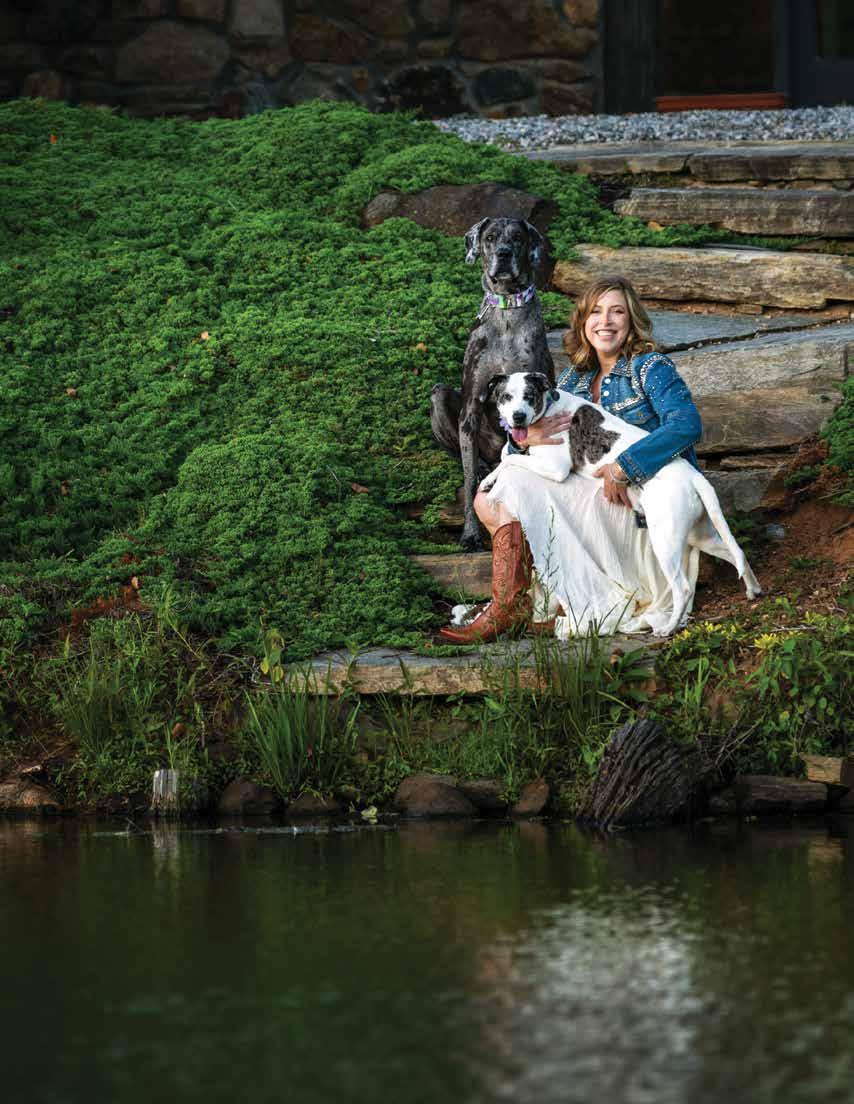
What Really Matters
Shana
Crabtree '96 on Happiness, Healing, and Purpose
BY SUSIE ZIMMERMANN
PHOTO BY DESILU PHOTOGRAPHY
ST. STEPHEN'S AND ST. AGNES
Many people start their day with a to-do list—work assignments, errands, appointments, and other deadline- and task-oriented items. Shana Crabtree '96 has a different list.
She focuses on happiness and the elements critical to achieving it: sleep, exercise, breathing, meditation, creativity, connection, kindness, and gratitude. Each day, she aims to check off three to five.
“I think of it like a bicycle tire that needs air,” Shana explains. “What are the things I need to do each day to feel happy and balanced? It's my personal mission statement.” She believes that before pursuing any other goals, we must make a conscious effort to care for ourselves. “Never sacrifice happiness to succeed in your job. Happiness should be part of your job. It's not either/or. It's both/and.”
Shana encourages others to develop their own personal mission statements. “Figure out your values, prioritize what's important to you, and then find a way to align that with your career. When you do that and act intentionally, you can gain control in environments where much is not.”
She reminds herself and others that happiness requires daily attention and action. She breaks it into three parts: being happy in your present life; working toward your future goals and purpose, and taking control in systems that feel uncontrollable.
For Shana, arriving at this clarity and understanding required dramatic changes in her life and career as a physician. It was anything but a straight path.
THE PREDICTABLE PATH
At SSSAS, Shana learned early how to balance her time, juggling academics with athletics. She appreciated the school's academic rigor and credits it with preparing her for success in college and medical school. She also began developing what she now recognizes as a growth mindset, although her understanding of the concept has evolved.
Growth mindset is the journe and the outcome becomes the application of what is learned. “
“
“I always thought a growth mindset meant learning, and I was always learning knowledge—in school and in my medical career,” she says. “But it's really about how you approach life when the going gets tough. It's a shift in reframing from fear of failure to learning opportunities. Growth mindset is the journey and the outcome becomes the application of what is learned.
Lacrosse was both a passion and a priority for Shana, and she continued playing in college at Vanderbilt. “It shaped who I am today,” she says. “It taught me about teamwork, time management, and the importance of exercise. Exercise builds discipline and relieves stress, two critical life skills. I didn't realize that at the time, but now I appreciate the emphasis on it in high school.”
Shana also values the spirit of helping the school instilled in her. Rather than a specific volunteer program, Shana remembers how helping others in the
classroom or on the field was simply part of everyday life. “It wasn't something for a college application, but part of who I was then, who I am, and who I aspire to be.”
While majoring in math and preparing for medical school, Shana also made time to enjoy college life and Nashville's country music scene. After graduation, she worked in medical research, studying smallpox antibodies and genetic screening for Alzheimer's and multiple sclerosis. She found the work to be fascinating and it confirmed her decision to pursue medicine.
She specialized in pediatrics at the University of Louisville because she “loved the resilience of kids and how quickly they recover.” After completing a residency in general pediatrics, she decided to pursue further training in pulmonology. “I had asthma growing up and spring lacrosse season was always a challenge,” she explains. “I didn't want any kid to be held back from sports.”
Shana with her mother Phyllis, her sister Summer, and Summer's children, River '38 and Parker Rose Pomeroy '37.
THE TURNING POINT
For years, Shana's life followed a clear, structured, and predictable progression— high school, college, research, medical school, residency.
There was always another step and a new goal. “I worked hard for each one, but I forgot to enjoy the present,” she reflects.
Once she entered private practice, she expected a sense of fulfillment. Instead, she was working long hours with little time to enjoy her accomplishments, or even the simpler pleasures of eating, sleeping, and making friends. She had a hard time saying no to any work request. So, after three years, she decided to switch to academia in search of a better balance. Three years later, she found herself burned out again.
The pattern became apparent: the first year felt exciting and new; the second was spent trying to fix broken systems; and by the third year, she realized many things could not be changed. She had achieved the goals she had set long ago but was unsure where to go from there.
Then, in 2020, the COVID-19 pandemic hit, along with a series of personal challenges: the end of a relationship, the death of a beloved dog, and worsening asthma. Feeling lost, Shana made the decision to step away from medicine for a year.
“I was a people-pleaser, always trying to do the 'right thing,'” she says. “All the loss forced me to question what actually made me happy, beyond titles and achievements. Medicine had been my entire identity, and I had no idea what else to do.”
Taking time off was very scary, she admits. “It took courage I didn't know I had, but sometimes you have to hit rock bottom and feel you have nowhere else to go.” That time off became not just rewarding, but essential.
LEANING INTO HAPPINESS
Shana began with coaching and studied the teachings of Dr. Laurie Santos, a cognitive scientist and professor of psychology at Yale. Her popular classes and “Happiness Lab” podcast address the science of well-being. The material resonated deeply with Shana.
“I realized that I needed boundaries and to discover how I can take control in situations where so much feels uncontrollable,” she says.
Before her year away from medicine ended, new opportunities began to emerge. She started working with her sister in her family's charitable foundation, the Phyllis P. and Scott A. Crabtree Family Foundation. She also began leadership coaching at her father's business, the Pohanka Automotive Group, and established her own coaching business.
“Life became full, really happy, and fulfilling,” Shana says.
Medical work returned in a new structure when a pediatric pulmonologist at her former hospital, Atrium Health Wake Forest Baptist, took maternity leave and Shana was asked to step in.
“Practicing medicine in smaller and shorter stints made those three months so much fun,” she says. “I was a different person and had better tools to manage stressors that used to overwhelm me.”
Shana continues to provide part-time
Left photo: Shana and her father, Scott Crabtree, in Monte Carlo. Right photo: Shana met Jasmine Walker '16 by chance at a Truist event in Naples, Fla.
support to the Wake Forest Hospital Pediatric Pulmonology Department, taking six weeks of on-call duty throughout the year as well as caring for cystic fibrosis out-patients two to three days each month. “I'm helping patients as well as the team, and that's given me a whole new perspective on medicine.”
MORE FROM MORE AND LESS
Shana has learned what she needs for her daily happiness. “I like being in control of my schedule,” she explains. “Having multiple jobs works better for me. It forces boundaries and time management, instead of letting one job take over everything.”
Shana also learned that fulfillment matters more than salary. Today, she gives half of her paycheck from her work at the hospital back to the pediatric pulmonology department to support patients and the medical team, including funding the department's first pediatric
pulmonary retreat. “I'm able to help drive change and make a greater impact, even while working fewer hours,” she says. Most importantly, Shana has gained flexibility—the freedom to travel, speak, volunteer, and engage deeply with her community in Winston-Salem.
“Being intentional means learning to say no,” she says.
“Saying yes means possibly giving up something, and the benefits must outweigh the risks.” Time, space, and rest—especially sleep, which she now prioritizes—have allowed Shana to make thoughtful choices about her direction. She's also gained time to put down new roots. While searching for property with enough land for her dogs—“watching them run really makes me happy”—she discovered and purchased the Lasater-Mill House, part of a historic estate in Winston-Salem. During renovations, she has lived next door, envisioning a future that includes chickens and bees, just the right amount
of acreage to manage, and a home for everything she wants to do.
She's already imagining shag dance parties and has hosted an office retreat. The Mill House will become a place for gatherings, retreats, and community— another way to give back while nurturing her own happiness.
Looking back on her journey, Shana now sees clarity and contentment as part of her daily life.
“Success is reaching my mission statement daily,” she reflects.
“Organizations use mission statements to define values and measure success. It's the same for people. It's an ongoing process, something we must revisit constantly.”
For Shana, that ongoing work has become its own form of success—a steady, purposeful path shaped by the elements that matter most.
Photo by Desilu Photography
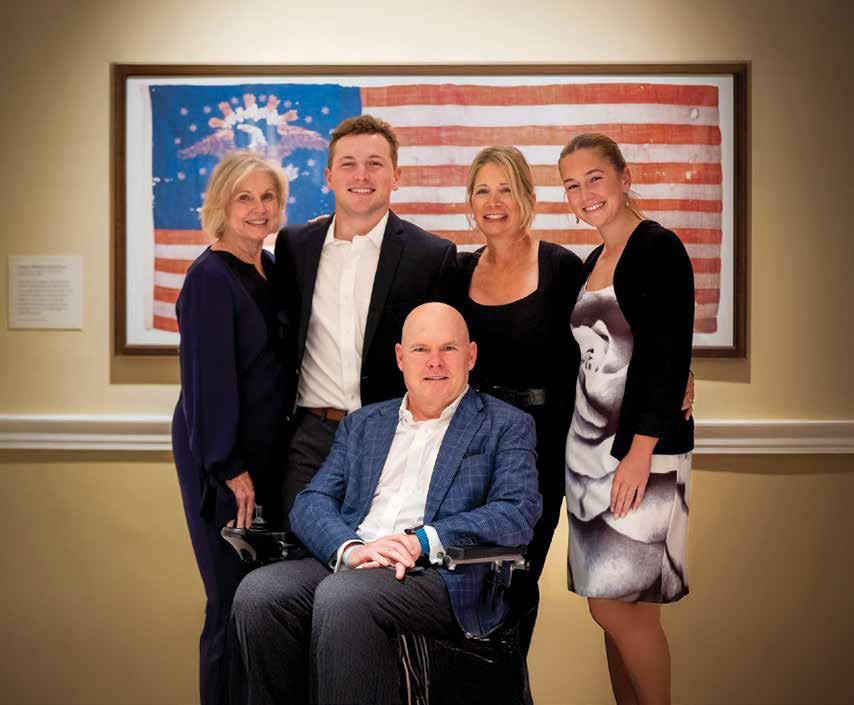
When the Game CHANGES
Dan Tate '84 built a life on leadership—and now he's using it to challenge one of medicine's most confounding and relentless diseases
BY AMY ARGETSINGER
'86
Dan Tate '84 with his mother, Tina, son Carter, wife Jacqueline, and daughter Samantha.
[David Poznic Photography]
Dan Tate was the Class of 1984 superstar: president of Student Council, chairman of the Honor Council, captain of the football team, a varsity athlete in lacrosse, basketball and track.
And yet his dazzling-on-paper credentials don't even begin to convey his legendary status. Ask around, and you get the sense that a substantial segment of the St. Stephen's and St. Agnes population, circa the mid-1980s, was either a little in love with him or just plain in awe.
“The most handsome, smart, athletic and kind guy at SSS!” recalls a St. Agnes '85 graduate.
“The absolute best,” says a St.
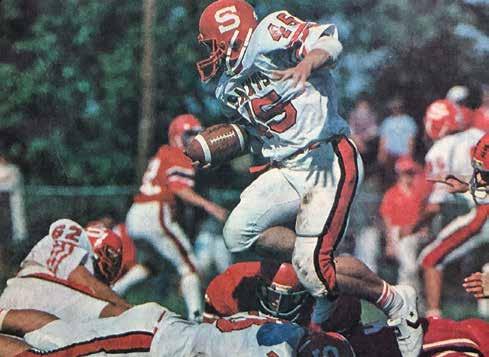
Stephen's football teammate who graduated in 1986. “A real idol of mine.”
Dan was named to the All-IAC roster three times—twice for football and once for lacrosse—and won the Outstanding Athlete Award at SSS Prize Day in June 1984. One story has it that when the rest of the team collapsed after doing wind sprints, the star running back kept going —and did the extra sprints while carrying teammate John Freeman '84 piggyback.
True?
“I can neither confirm nor deny
those allegations,” Dan replies in an email, adding a winking emoji. (We'll take that as a yes.)
Not surprisingly, Dan was named the St. Stephen's Class of 1984's Most Likely to Succeed, and by any measure, he has succeeded —a happy family life, a career in politics that took him to the highest levels of government and a long-running perch on all the “top lobbyist” lists in Washington.
Yet Dan Tate's most consequential success could be the one he has achieved on a path that no one would ever have wished for him.
Senior Portrait
President of the Student Council Association
Captain of the Lacrosse Team
Captain of the Football Team
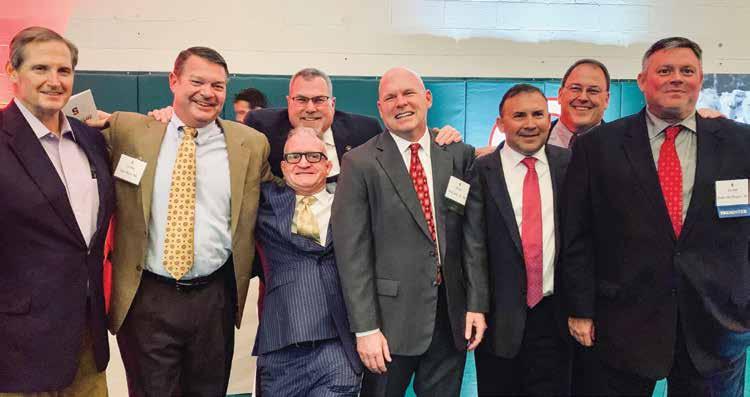
Dan was inducted into the St. Stephen's and St. Agnes 2019 Hall of Fame for excellence in football, basketball, lacrosse, and track.
Honors & Awards
• Football Team Captain
• Lacrosse Team Captain
• 1982 & 1983 All- IAC (football)
• 1983 All-Met (football)
• 1983 Alexandria Journal Player of the Week (football)
• 1983 Alexandria Gazette AllNorthern Virginia Team (football)
• 1983 John Morrow Stanton Athletic Award
• 1984 Outstanding Athlete Award
• 1984 All-IAC (lacrosse)
• 1982 Undefeated Football Season (9-0)
• 1983 IAC Football Champions (8-1)
Dan grew up in politics. Born in Georgia, he moved with his parents to Washington, D.C, when his father joined the Capitol Hill staff of Sen. Herman Talmadge; Dan Sr. eventually took a key role in the White House as Jimmy Carter's liaison to the U.S. Senate. His mother, Tina, took a job on the Hill as well, at the House Radio-TV Gallery, where she became its first female director. Their long work hours in the city required them to find after-school activities for their only child. So they were drawn to St. Stephen's, just blocks from their home in a cul-de-sac off Colonel Ellis Avenue, which allowed Dan to thrive in football and other afternoon sports starting in fifth grade.
He quickly emerged as a leader.
“He is as true to himself as anyone I've ever known,” says his classmate John, a lifelong friend who played both football and lacrosse with Dan. “People sense that about him. And so they trust him. And they should.”
Even amid his gilded high school career, though, he got his first taste of professional politics when he volunteered on Walter Mondale's 1984 presidential campaign in the summer before his senior year, during the early run-up to Maine's Democratic caucus. At Amherst College in Massachusetts, Dan continued to play football and lacrosse and served as a residential counselor before taking his new political science and English degree home to the Beltway. At 21, he joined the staff of Louisiana's Rep. Billy Tauzin as a legislative aide, specializing in energy policy; later, he notched agency experience as a deputy assistant secretary for legislative affairs at the Department of Energy. By 30, he was working in Bill Clinton's White House—in the same office his father held two decades earlier, lobbying Congress on behalf of the president. Though Dan Jr. focused on the moderate members who control the fate of most hard-fought legislation, he dealt with lawmakers across the political spectrum to gain approval for a balanced budget, FDA reforms and a bailout of Mexico, among other issues
Before Bill Clinton left office, Dan
2019 Hall of Fame group photo of Dan and some of his football teammates who attended to honor him: Chris Dyson '84, Ted Hart '84, John Freeman '84, Scott Ohnegian (college teammate), Dan, Scott Nelson '85, Bear Geschickter '85, and John Delnegro '85.
made the leap into the private sector, joining the same lobbying firm as his father. In 2012, he and a former White House colleague, Jeff Forbes, launched their own shop. Forbes Tate became one of the city's most lucrative lobbying practices.
Two years later, Dan was reading to his young daughter before bedtime when he found himself struggling with the words. He liked to take on different voices for the different characters, and suddenly he could not.
“My tongue felt fat and clumsy,” he recalls in an interview at his office midway between the White House and the Capitol. “I knew something was off.”
For several years, his symptoms were primarily limited to voice weakness and fatigue. His doctors were baffled. It wasn't until 2017 that he finally got a solid diagnosis at Minnesota's Mayo Clinic: amyotrophic lateral sclerosis.
ALS is the terminal neurodegenerative disease that first gained public attention when it struck Lou Gehrig in 1939. The Yankee slugger died just two years later, a speedy but not atypical trajectory. In recent decades, the disease has perhaps become better associated with groundbreaking physicist Stephen Hawking, who beat the odds by living with the condition for more than 50 years, most of that time largely immobile and speaking through a computersynthesized voice.
“No one ever wants to hear ALS,” Dan says, recalling the diagnosis. “But I had been dealing with this for several years,” and he understood that something was seriously wrong.
“It sucks. But almost better to know than to not know. Almost.”
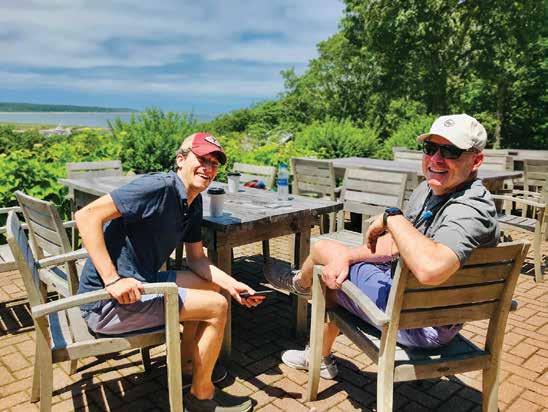
ALS remains extremely rare, striking fewer than two people in 100,000 every year. Yet it is ultimately more common than you may think: Over the course of a lifetime, roughly one in 300 people will develop it. Which is why you probably know at least one person who had it, or who will.
It is invariably fatal, generally taking its victims after muscular control degrades to the point where they can no longer breathe – even as they remain mentally alert and engaged.
While genetics may play a role in who gets it, there is no definitive cause. Still, a recent study indicated that professional football players are four times as likely as the general public to develop and die from ALS. Veterans are twice as likely to get ALS.
Dan suspects that he may have been inherently vulnerable to ALS but that the repeated blows he took in high-contact sports probably triggered the nerve-cell damage that brought on the disease. “The way I played football from the time I was in the third grade all the way through college was probably a contributor. And I played running back, so every play I had a
big collision.”
Still, he was not immediately interested when he started getting phone calls from two other Washington insiders, married couple Brian Wallach and Sandra Abrevaya, who were eager to get him involved in the ALS cause. Brian, a former federal prosecutor and Obama White House staffer, was also diagnosed in 2017, on the same day their second child came home from the hospital. He and Sandra, a former press secretary for Sen. Richard Durbin of Illinois and later the Department of Education, could not believe that there was no solution, no protocol to follow. So they resolved to use his remaining time – doctors initially advised him he would be dead in six months -- tackling ALS like a political campaign.
ALS had recently enjoyed a moment in the spotlight, thanks to the improbably viral “Ice Bucket Challenge” of 2014. Launched on social media by a pair of patients in their early 30s, the stunt challenged friends to drench themselves on camera with a vat of ice water or donate to ALS causes, such as the
I Am ALS Founder Brian Wallach with Dan enjoying the outdoors before a board meeting.
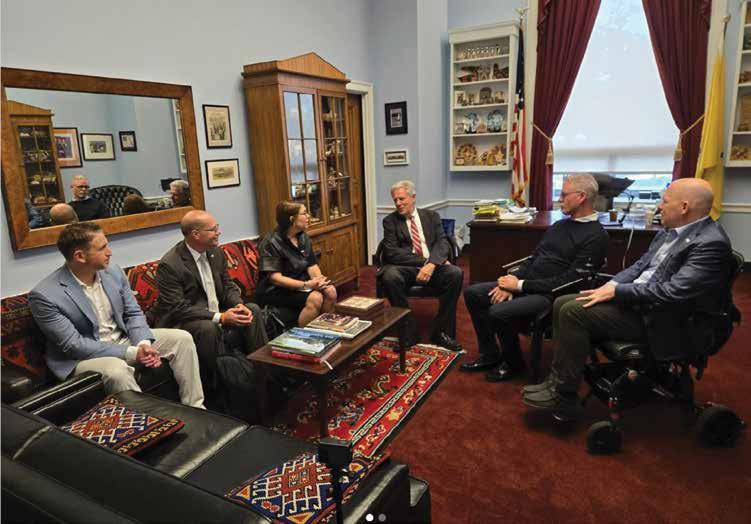
now 40-year-old ALS Association. The challenge raised more than $200 million, of which about $115 million went to research, allowing the ALS Association to nearly triple the amount it could hand out in grants to scientists. Some promising breakthroughs followed, including the identification of five new genes connected to the disease. (Ironically, Dan had participated in the Challenge.)
Yet half a decade later, the fad had burned out, and polls found that most Americans couldn't even remember what cause the Ice Bucket Challenge had benefited. Brian and Sandra realized that to find a cure, the ALS community needed to find a way to build a more sustained movement. More so than cancer and other diseases, ALS burns through its most
ardent activists at a horrific rate. “We die quickly,” Brian told a congressional committee in 2019. “We don't have time to advocate.”
Brian and Sandra had met on the 2008 Obama campaign, where they also got to know Jeff Forbes. The lobbyist told them about his business partner Dan—“this incredible government strategist,” as Sandra puts it—who was grappling with the same condition.
“We pursued him,” she says. “We emailed him, we texted him, we had friends nudge him and say, 'Brian and Sandra are trying to get in touch with you.'”
Dan was hesitant to reply. “This disease turns people inward,” he explained in “For Life and Love: No Ordinary Campaign,” a 2024 documentary about Brian and Sandra.
ALS can affect anyone, at any age, anywhere.
ALS is always fatal and patients typically live for 2 to 5 years after diagnosis.
More than 90% of people with ALS have no family history of the disease.
1 in 300 people will receive an ALS diagnosis in their lifetime.
U.S. military veterans are more than two times as likely to be diagnosed with ALS.
[Information from iamals.org]
I Am ALS Legislative Affairs Team Co-Chair Jack Silva, Vice President Dustin Watson, Chief Executive Officer Andrea Goodman, and Board Member Dan Tate (far right) joined actor Eric Dane (left of Dan) in a meeting with ALS champion Congressman. Frank Pallone (center). [Photo courtesy of I Am ALS]
Finally, he agreed to take the call with Brian. “He just made such a compelling pitch, after 5 minutes, I knew I had to get involved,” Dan recalls. From that point on, he was all in. His years in athletics had instilled in him the importance of teamwork—that your only choice is whether to lead or to follow the leader. And he wanted his family—wife Jacqueline, daughter Samantha and son Carter—to see him fight.
Dan joined the board of Brian and Sandra's fledgling organization, I Am ALS, and got to work. As much as they appreciated the Ice Bucket research boost, they wanted to open the federal spigot for more continuous funding. They wrote a bill, dubbed the Accelerating Access to Critical Therapies for ALS Act authorizing $100 million a year for research over five years. ACT for ALS, as it became known, also established new FDA guidelines making it easier for ALS patients who had timed out of clinical trials to continue getting access to the drugs being tested.
The three made a formidable team for the task at hand: Brian had spent much of his career in community organizing and knew how to create online and offline networks that could bring more advocates to the fight, while Sandra's work in communications prepped her to tell the story of how policies affect people.
“But neither Brian nor I had experience running a legislative campaign,” she says. Dan had been doing just that for nearly 30 years. “Dan is a very strategic and sophisticated thinker. He understands all the relationships on the Hill, the interplay between different members, the dynamics of different committees and even the staff members on these committees.”
Dan speaks in terms of a “virtuous circle” that propels a successful lobbying effort—engaging constituents in a cause, so that they will reach out to elected officials with their requests; lawmakers taking action, which then empowers the community to continue to engage with the issue.
It worked. In December 2021, the House passed ACT for ALS on a vote of 423 to 3. The following week, the Senate passed it unanimously, and by the end of the month, then-President Joe Biden signed it into law.
“I
think Brian and I were put together to change the course of the disease,” Dan says. “When anyone comes into my situation, we do what we can, while we can, and I think Brian and Sandra have given me the ability to help many more people than I ever could have imagined. I often think they gave me my voice for ALS. Because before them, there was really no cohesive strategy.”
The lobbying push to get ACT for ALS reauthorized for another five years before it expires in September is already underway. Early last fall, Dan escorted their newest VIP ally to congressional offices: Eric Dane, the former “Gray's Anatomy” heartthrob who was diagnosed with ALS last year at 52.
While the actor was still walking at the time, his speech and movements had already become halting, and he said one of his arms was nearly paralyzed -- a striking contrast for those who had seen him on shows such as HBO's “Euphoria” just months earlier.
But part of I Am ALS's goal is to make ALS patients more visible to the public—both in their physical deterioration and in their determination.
“The personal stories are tough to ignore,” Dan says, “for even the most jaundiced elected officials.”
increasingly hard to make out. He uses a wheelchair now and grows more quickly fatigued. He says he will likely retire soon.
But, the captain of the football team remains his confident, charismatic self.
He looks back at those chaotic months when doctors couldn't figure out what was going on with him; one physician initially suggested in 2016 that Dan had ALS, only to reverse his diagnosis when an electroencephalogram test seemed to rule it out. Of course, doctors dread having to issue a diagnosis of ALS.
“Back then, it was considered a death sentence,” Dan says. “There was nothing even remotely available to treat it.”
He is using the past tense. Is it no longer a death sentence, then, in his view?
Indeed, Dan feels his symptoms have been partially mitigated by a new generation of treatments. One, Radicava, was only just approved by the FDA in 2017, the same year he was diagnosed. He credits another drug, CNM-Au8, which is still under development, with restoring some of his vocal strength.
“I feel hope,” he says, “and we didn't four years ago.”
Unlike his friend Brian, Dan is still able to talk, though his words are
Amy Artgetsinger '86 has been a staff writer with The Washington Post since 1995.
Dan taking his first dose of CNM-Au8, an amazing therapy he credits for giving him back his voice. Prior to going on it in early December, his voice was very weak, requiring him to use an amp and microphone. Since starting CNM-Au8, he hasn't needed them.
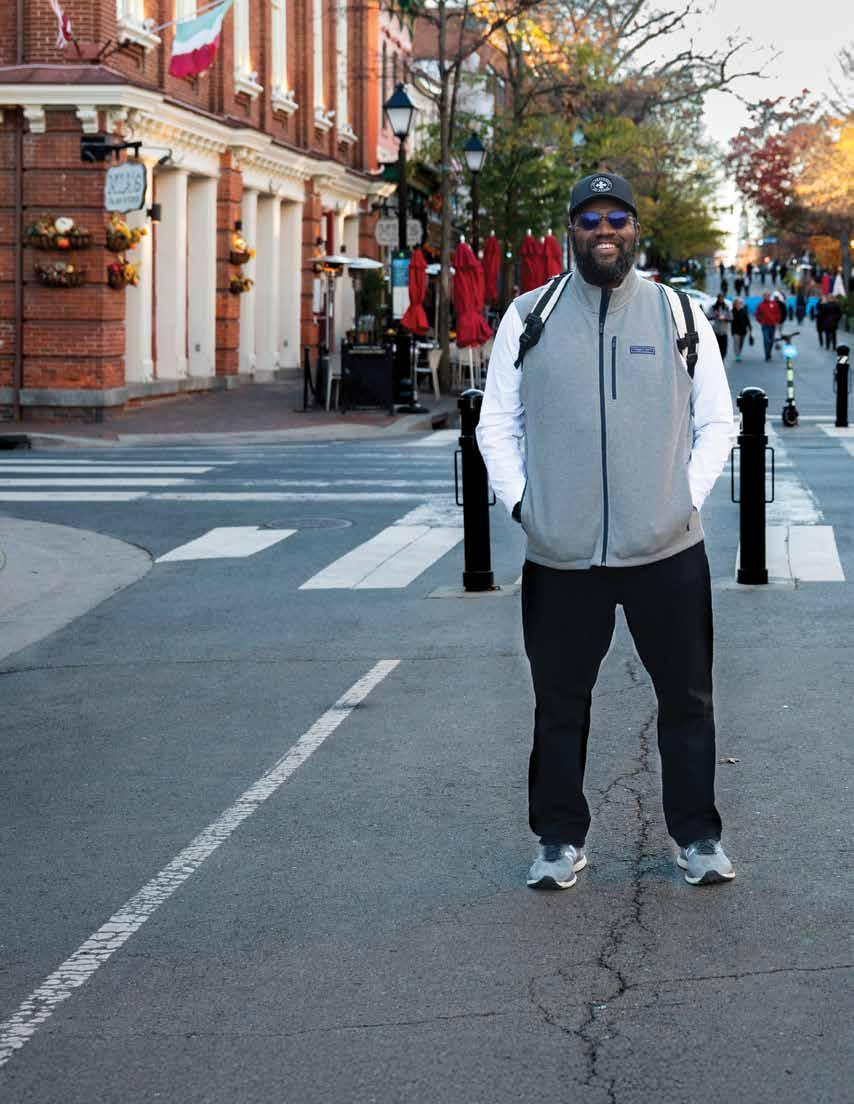
Alexandria's storyteller, public servant, and community builder
John Taylor Chapman '99 is
SHOWING UP
Walking the brick-lined streets of Old Town Alexandria with John Taylor Chapman '99 feels like stepping into a living history lesson—one filled not only with dates and landmarks, but with humanity. As the founder of Manumission Tour Company, John leads visitors through the city's past, telling the often-overlooked stories of Africans and African Americans who shaped early Alexandria. His tours—part history, part reflection— invite people to consider how the struggles and triumphs of the past still echo in the present. “When people hear these stories, they start to see Alexandria differently— and see each other differently, too,” John says.
BY MELISSA MAAS '76
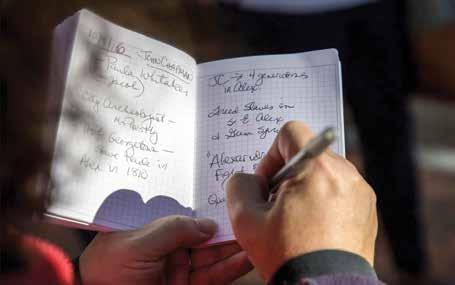
A fourth-generation Alexandrian, John's dedication to community began long before his first tour group. As a student at St. Stephen's and St. Agnes, he learned the power of dialogue through the National Coalition Building Institute and the Black Student Union, experiences that sparked his lifelong belief in storytelling as a bridge across differences. That same belief carried into his two-decade career in public education and his four terms on the Alexandria City Council, where he has championed affordable housing, equitable education, and small business growth. Whether in a council chamber, discussing community use, or leading a tour, his goal remains the same: to create spaces where every voice is heard.
John believes history is not something to be observed—it's something to be lived forward. “The stories of Alexandria's Black history aren't just about the past,” he says. “They're about the kind of community we want to be.” As he raises his young son in the city his family has called home for generations, John continues to weave the stories of struggle and resilience into Alexandria's evolving narrative—one conversation, one tour, and one act of connection at a time.
“In the first U.S. census in 1790, Alexandria had about 2,500 people. And of that 2,500, 531 were Africans or African Americans who were enslaved. But another 59 were Africans and African Americans who were free. So there is genuinely a story to tell but not a lot of information at hand.”
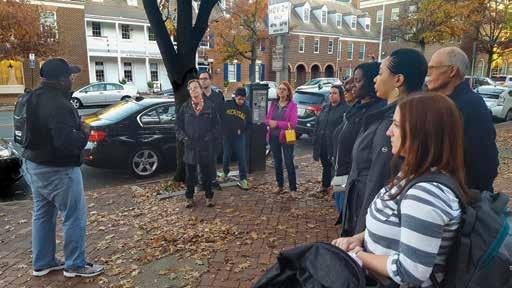
“Far too many of us grew up with fantasies of history. We didn't talk about the 99%, we talked about the 1%. ”
John's approach to history is rooted in people, not places. “People love to say, 'We're going to this site or that site,'” he explains. “I say we're going to a place to talk about somebody's story.” That distinction—between location and lived experience—shapes every Manumission Tour Company walk. Rather than presenting Alexandria as a static collection of historic buildings, John invites participants into the choices, risks, and relationships that shaped the city.
The idea for Manumission Tours emerged from a moment of reckoning.
During a conversation with Alexandria's tourism leadership, John was asked what a Black traveler might come to the city to experience. “As we got more into those questions,” he recalls, “I really saw that we, as a city, had not thought about that.” At the time, Alexandria had a Black history museum but offered no regularly scheduled tours focused on African American history. “We had the knowledge, we had the sites,” John says. “But we just didn't have the people that wanted to carry this on.”
Initially, John hoped someone else might take on that work. Between
My tour with John fittingly began at the childhood home of Richard Henry Lloyd, who later built Lloyd House on the Lower School campus.
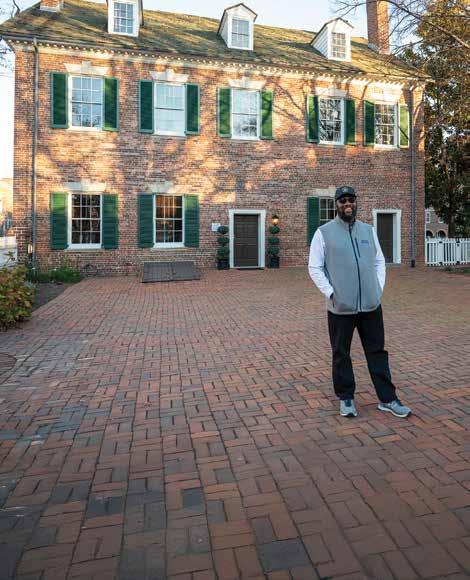
“If we don't look to save places like these and elevate them to what they need to be in terms of places of conversation, places of learning, and places for telling tough truths, we do ourselves a disservice.”
his job with Fairfax County Public Schools and serving as an Alexandria City Councilman, he didn't have much free time. But when no one stepped up, he jumped in—spending weeks reading firsthand narratives, piecing together fragments of history, and following connections that had never been formally drawn together. “I spent several weeks at the library…seeing what was there, what the history bore out,” he says. The first tours were informal, tested with friends.
“They liked it,” he adds. “And we just kind of went from there.”
What followed was not simply a new tour offering, but a shift in how Alexandria tells its own story. John began expanding existing narratives, adding depth where the city's official walking guides offered only brief mentions. “We took some of what already existed,” he explains, “but there was more to that story.”
Over time, Manumission Tours became a place where community members shared oral histories,
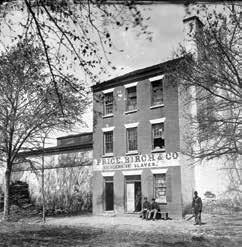
Freedom House, Alexandria (c. Civil War era). The former slave pen at 1315 Duke Street, shown here bearing the name Price, Birch & Co., was one of several firms that operated from this building before it later served as a Union military prison. The facade of Freedom House was recently restored to its 19th century appearance by preservation experts. John was in attendance for the ribbon-cutting ceremony on November 8, 2025.
Did you know...
The Franklin & Armfield operation was once the largest slave-trading firm in the country. Enslaved people were imprisoned there before being shipped south. The building is now part of the Freedom House site, a rare surviving structure directly tied to the slave trade.
The Underground Railroad came through Alexandria.
Much of Old Town's historic architecture—brick row houses, wharves, warehouses, and public buildings—was constructed by enslaved African Americans. Their skilled labor as masons, carpenters, and blacksmiths shaped the city's physical character, even though their contributions went largely uncredited for generations.
Alfred Street Baptist Church (founded in 1803) and Beulah Baptist Church (1863) were more than places of worship. They served as organizing centers, schools, and safe havens—especially during Reconstruction—supporting education, political engagement, and mutual aid in a hostile post-war environment.
Free and enslaved African Americans were kidnapped off the streets onto ships and were resold or sold into slavery elsewhere. Slaves were restricted from walking on the main streets, making them easy targets for kidnappers in alleys.
The apothecary in Old Town was established by devout Quaker Edward Stabler in 1792, who focused his life on freeing slaves—a rare stance in Alexandria at the time.
Moses Hepburn (1809–1882) was the son of William Hepburn, a white Alexandria city councilman, and an enslaved mother, Esther. His father supported his education in Pennsylvania and left him a large portion of his estate. Moses became a prominent Black developer, landlord, and businessman, building the North Pitt Street townhouses that still stand in Old Town.
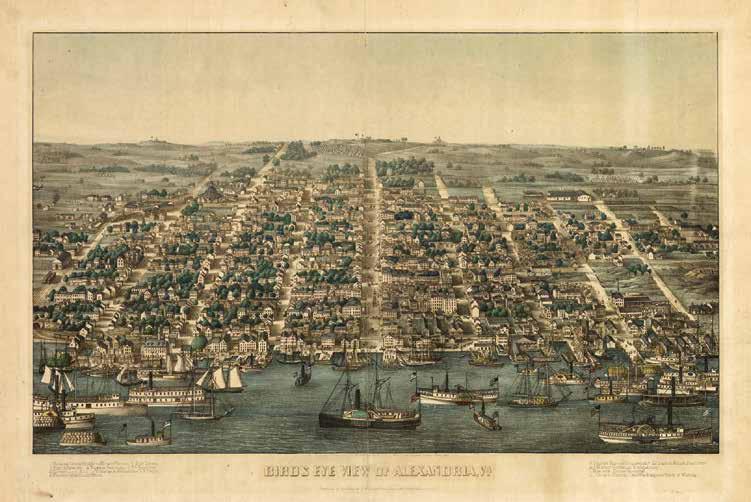
asked questions they had never had a place to ask, and pointed John toward stories that had yet to be explored. “It ended up being a lightning rod for people searching for a fuller understanding of where they live,” he says.
John is careful not to romanticize the past. “We could easily put on the pretty face and say, 'John Carlisle and George Washington did everything,'” he says. “But we know that's not true.” Instead, his tours explore the uncomfortable realities of slavery, kidnapping, and resistance in a city once central to the domestic slave trade. At the same time, he highlights resilience and generosity—stories like those of brothers Oscar and George Ball, separated by slavery and later reunited, and Moses Hepburn, a free Black man who used his wealth to support education and the broader
Black community. Hepburn's legacy, John notes, reflects something deeply Alexandrian. “He wanted to see his kids educated,” John says. “That's what most Alexandrians want—to give back to the community and see the next generation prosper.”
The emotional impact of those stories is often visible. John describes watching participants' reactions as they learn that Alexandria's original shoreline lies hundreds of feet inland from where they stand today. “That's always a priceless moment,” he says, especially for longtime residents. Just as powerful are moments when painful histories reach some form of resolution. “Some of this history is tough,” John says. “But being able to find some relief and joy within some of those stories is important.”
John sees storytelling as inseparable from empathy. Again
and again, he frames history around choice. “There are different sets of choices that people get to make,” he explains—whether it is an enslaved person choosing to run toward freedom, an abolitionist deciding to defy the law, or a business owner choosing profit over humanity. “And similar to us today,” he adds, “how are the choices we make going to support somebody or challenge systems we think might be wrong?”
That same lens shapes John's impact on Alexandria as a public servant. He has served on the City Council for more than a decade. During that time, he has learned that much of the work happens outside formal meetings. “It takes more energy to seek out those voices that are not heard,” he says, “but the value of doing that is so much more meaningful.” Those voices—residents working
Bird's eye view of Alexandria published in 1863 [Courtesy of the Library of Congress, Geography and Map Division]
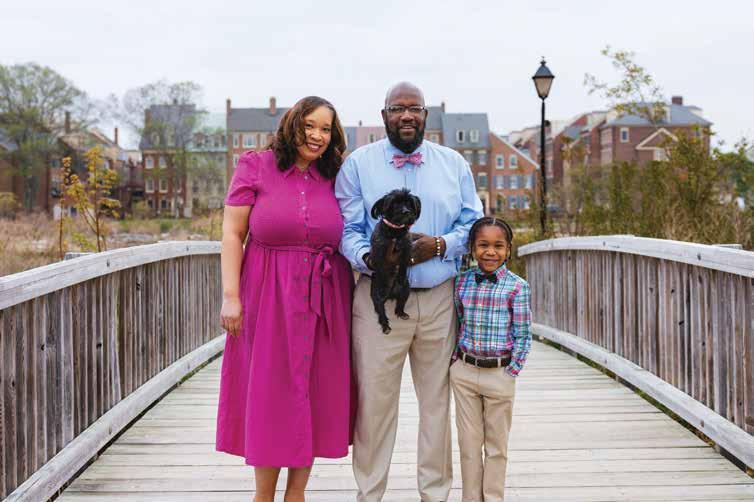
multiple jobs, families navigating language barriers, neighbors disconnected from traditional civic processes—often bring nuance that strengthens policy and builds trust. One of the moments that most clearly defined John's role came during a contentious council debate over whether a small nonprofit, Mother of Light, should be allowed to operate a resource center serving unhoused residents. Opposition was fueled by fear and stereotypes. In response, John shared his own experience. “When I was in ninth or tenth grade, we were homeless for maybe six to eight months,” he said. “By discounting people who are homeless—particularly families— you are not giving young people the opportunity to change the trajectory of their lives.” The center was approved. Years later, John still sees that
moment as a reminder of why presence and perspective matter. “I'm glad I'm here,” he says, “to be able to tell that story.”
As Alexandria continues to evolve, John often finds himself navigating the tension between preservation and progress. He resists the idea that honoring history means freezing the city in place. “You don't shackle people from progressing forward at the cost of history,” he explains. Instead, he advocates for telling stories fully—preserving memory even as neighborhoods change, housing expands, and infrastructure modernizes. History, for John, is not an obstacle to growth but a guide for it. That responsibility feels especially personal as a fourth-generation Alexandrian raising a fifth. “It's not my job to make people feel comfortable with what they're
hearing,” he says of his work as a historian. “It's my job to be blunt and truthful.” He does not claim to tell the whole story of Alexandria's Black history—only to uncover pieces of it and encourage others to keep looking. “There's more out there,” he says. “And we're challenging ourselves now to preserve it.”
Through Manumission Tour Company, public service, and countless conversations on Alexandria's streets, John continues to show up and shape how the city understands itself. The impact is not just in what people learn, but in how they listen—to history, to one another, and to the voices that have too often gone unheard.
Learn more about Manumission Tour Company at manumissiontours.com.
John with his wife, Monica, and son, John Chapman II '38. [Photo: Stephen Reasonover Photography]
NEXT GENERATION INNOVATION
BY JESSICA HALSTEAD
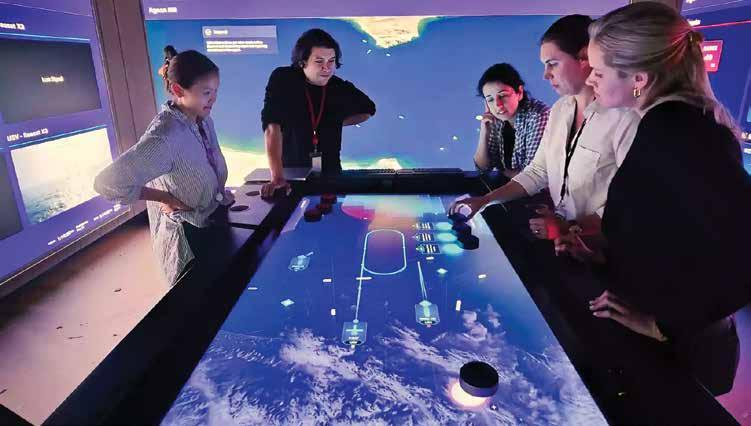
DESIGNING FOR HUMANS
RIN JACOB '16 IS TRANSLATING NEEDS INTO SOLUTIONS
WHEN
I HEARD ERIN JACOB '16 WORKED IN HUMAN FACTORS ENGINEERING, I TOOK A WILD GUESS AT WHAT THAT MEANT.
Could it be as simple as “building things that make people's lives easier?” That sounded way too elementary, but it turns out I wasn't far off. Despite its highly technical name and the complexity that comes with the industry (more on that later), the core of Erin's work is refreshingly simple—she identifies problems that people have, and builds things that solve those problems.
While a civil engineer might design underground pipes and an environmental engineer might tinker with the exact placement of a wind
turbine, human factors engineers build solutions for humans doing things. If you're a kid with cerebral palsy looking for a typing tool, a human factors engineer can help. If you're a surgeon at a veterans hospital, bogged down with antiquated paperwork systems, a human factors engineer can help. If you're a TSA agent spending hours watching the same types of images go by and are worried you might miss something…well, you get the picture.
Technically, Erin works as a design experience specialist at Accenture Federal Services, where she consults on projects for half a year at a time. But beyond “consultant,” Erin thinks of her role as more of a “translator.” “People
and organizations we work with don't have that much of an understanding of their user base before we come in,” she explains. So she does a deep dive into the user's needs and experiences, and helps her clients—in this role, federal agencies—get really clear on just who they're serving, and how best to serve them. Then, she builds tech-centered solutions to do just that.
For a recent project, Erin helped healthcare professionals who work with veterans. Veterans can be especially vulnerable to mental health concerns, and the providers' goal was to reduce veteran suicide rates. But doctors and staff were being weighed down with hours of paperwork at the end of each day.
Erin Jacobs and her team testing newly designed experiential learning game on an interactive table.
PHOTOS COURTESY OF ACCENTURE
With the user—the doctor—at the center, Erin began the work with a boatload of questions. “I'm trying to understand the doctor, understand everything they do in a day, everything they touch, the patients they see, when they take a lunch break…can they take a lunch break?” she explains. “And what makes them stay at the office longer hours than they need to?”
Once she's clear on just what the user needs and what problems they're facing, Erin can build solutions that nip those problems in the bud. In this case, she helped brainstorm design solutions that use AI to automate data reporting for these healthcare providers. With hours saved each day, doctors could see more patients—improving patient outcomes— and then go home at a reasonable time and spend time with their families and friends. For each project, Erin takes on a massive, complicated landscape, like federal healthcare, and meticulously scans for even the tiniest pockets where innovation can occur. Then, she sets the innovation in motion.
Health care is one of Erin's favorite industries in which to innovate because of its high stakes and big payoff. “You have the potential to transform lives, or save someone from dying because of inefficient technology,” she explains. But being a consultant has allowed Erin to work in various other environments, like when she helped the Department of Education design a website experience for students who were trying to understand different types of financial aid. She's also worked with TSA to help gamify the mundane task of watching images scroll by on a screen for hours. (And by gamify, I mean considering the use of Xbox controllers to engage with the images and alert colleagues to suspicious items— how's that for innovation?!)
She spends her days looking for new ways to innovate in a variety of fields, so it's not a surprise that Erin had a range of academic interests at St. Stephen's and St. Agnes, and then at Tufts. “I probably had 10 favorite classes and 10 favorite teachers,” she explains, laughing. When her advisor asked her what she liked to learn about to help her narrow
down a major, her answer ranged from architecture to being outside to niche world history and math topics. “I was all over the place,” she says. “But at the end of the day, building something has always been a big part of it.” Her advisor suggested human factors engineering, promising Erin that her work wouldn't be limited to one industry. She could lean on her love of history and psychology that she'd honed at SSSAS, and put what she'd learned in one of her favorite classes— Mrs. Geiger's math class—to use poring over massive data sets. Actually, that math has come in handy lately: “A lot of what I'm doing now is helping various government workers save for retirement, and we have this ginormous AI model and we have to think about probability and all these things,” Erin says. “I'm constantly getting thrown back to that math class.”
The growth of AI has driven innovation in the broader field of tech. But despite its explosive popularity in the private sector, AI tools can still be tricky for federal agencies to use, because of data privacy regulations and the like. “It's a challenge for many reasons to implement AI in the government landscape,” Erin explains. But over the past five years, she says, the government has become far more innovative when it comes to AI. That's important when you think about the scale agencies must achieve to have an impact.
An example: in occupational therapy classes in college, Erin designed for niche populations, like three kids with cerebral palsy. She focused on improving those three lives specifically. But when she moved to the government space, the scale skyrocketed, and the question became, “How can I design something that genuinely meets the needs of every American citizen?” It seemed like an impossible task. But innovations in AI have helped Erin rise to the challenge. Instead of designing one government webpage for every user, Erin can use AI to customize pages to millions of
different users' needs. “I think it's really cool to see the new technology coming into a space,” Erin says, “especially when my role is to make technology accessible to everyone and meet everyone's needs.”
In a field where the term “innovation” is thrown around so freely its meaning can feel blurry, Erin brings it back into focus. Given she's spent years threading together meaning and enjoyment from a wide array of academic pursuits, it makes sense that her definition of innovation has a similar eclectic quality: “Bringing together the learnings and technology of different industries and implementing it in a new and unique way,” she says.
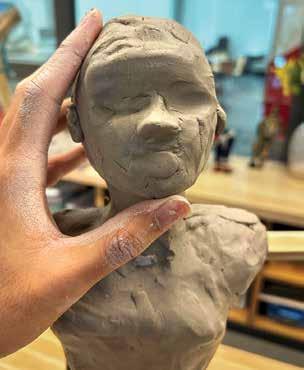
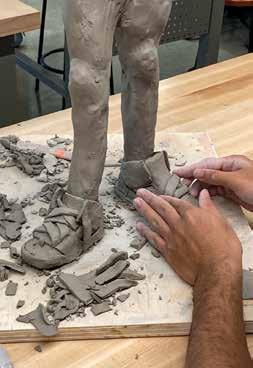
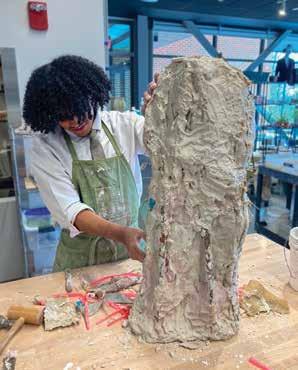
REPRESENTING THE
Recognized among the top AP Art and Design students nationwide, Tyler Troy '25 discusses the investigation that fueled his reimagined classics.
Q&A
hen Tyler Troy '25 submitted his Advanced Placement 3D Design portfolio to the College Board last spring, he never imagined it would be one of only 51 selected—out of more than 82,000 entries—for the 2025 AP Art and Design Exhibit. Each portfolio undergoes a rigorous evaluation that looks for the thoughtful interplay of materials, processes, and ideas, as well as clear evidence of sustained investigation—research, experimentation, reflection, and revision. Tyler's work distinguished itself not only through technical mastery but through its compelling concept: reimagining wellknown historical artworks through a contemporary and culturally diverse lens. By transforming pieces like Degas' famous dancer, “Petite danseuse de quatorze ans,” to reflect new narratives and broader standards of beauty, he invites viewers to see art history—and representation itself—in a new light.
How did you find out that a sculpture from your portfolio, “Little Dancer of Fourteen Years,” was selected for the 2025 AP Art and Design Exhibit and what was your first reaction? Really funny actually—originally, I did not get the email telling me about my recognition, so I only found out when my 3D art teacher, Mr. Sean Riley, sent me a congratulations email. I was very surprised. Since AP scores and awards came out months ago, I assumed the period for hearing news like this had well passed. After my initial surprise subsided, it felt like the Kamala Harris “We did it, Joe” meme, which I sent to Mr. Riley. I thought it truly captured the moment because it really was a team effort and I wouldn't have done as well as I did without him.
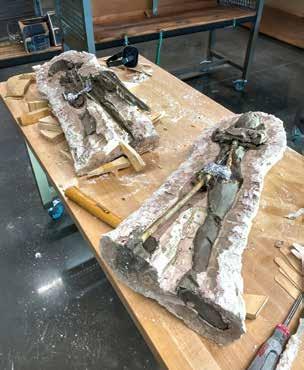
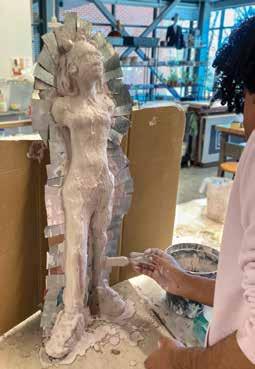
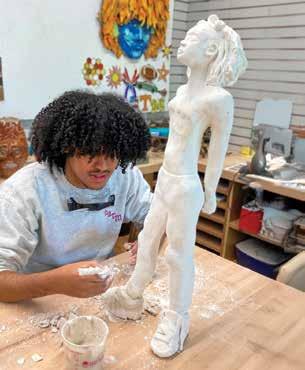
UNREPRESENTED
What does this recognition mean to you after all the work you put into that sculpture and your portfolio? I was inspired by the idea that my work could be recognized, so I worked very hard toward that goal. Achieving that recognition means even more to me because I put so much time and effort into it during an especially stressful time with college admissions, participating in the spring musical, and trying to finish senior year academically strong. There were countless times I stayed after school and dedicated my free periods and lunches to working on it, so to see the time I put into the piece come to fruition in a recognition is very fulfilling and reassuring.
EXPLORING IDEAS AND INTENTION
Your portfolio explores themes of representation and reimagining art through a contemporary lens. What first inspired that idea? The original idea was “Reimaging art through a contemporary lens,” and that was it. Mr. Riley encouraged me to further
develop that investigation— to find a “why?” or a deeper meaning. As I progressed through the pieces in my portfolio, I began to develop a theme of “representing the underrepresented.” The first piece I made in the portfolio did not explore that idea much at all, but with every subsequent piece I made the theme became more and more apparent and developed.
How did you decide which historical pieces to reinterpret, and your winning piece in particular? That sculpture, “Little Dancer of Fourteen Years,” was probably my most meaningful and difficult reinterpretation. The idea clicked for me because the original sculpture, “Petite danseuse de quatorze ans” by Degas, was revolutionary as one of the first large-scale sculptures to depict someone who society widely viewed as not deserving of representation. Back then the subject was a young, French peasant ballerina, and bringing that into a contemporary context I depicted my version as a young, African American hip-hop dancer.
You wrote about wanting to “represent the underrepresented.” What does that mean to you personally, and how did you bring that to life through your work? Since preschool I have attended primarily white institutions. I didn't often see myself portrayed in the media we'd go over in class or among my classmates. I think as a young child that lack of representation can be damaging to their sense of selfworth and belonging. I strive for a future where no child feels unseen or that their experiences don't matter, and I want to do my part in achieving that future through my art. In my sculpture I chose to depict a young African American woman because they are a group that is too often marginalized and unfairly criticized by society. I gave the figure afrocentric facial features and an afrocentric hairstyle as well as hoop earrings, which hold deep cultural significance within Black female identity. Since the figure is meant to be a dancer, I dressed her as a hip-hop performer. Since hip-hop is a significant part of Black culture, I gave her Jordans because the shoe is commonly associated with the genre.
“I
began working with Tyler in his freshman year, and even then, it was clear that he was a deep thinker who instinctively found meaning and nuance within even the simplest assignments. In his AP course, he built on this foundation—eagerly challenging himself with new and complex mediums while clarifying
what he wanted his work to say.”
Sean Riley, 3D Art Teacher
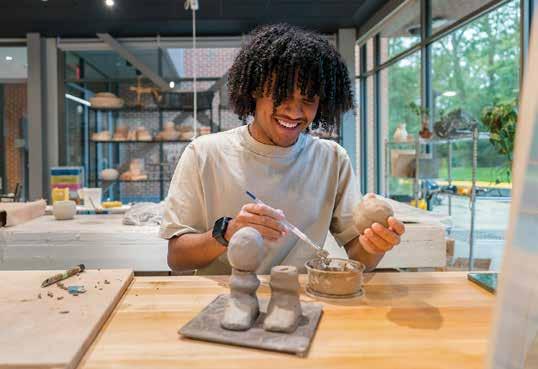
How do you balance honoring the original works while still making them your own? The way I tried to stay true to the original work was by keeping some of the key aspects. For example, I adopted the original pose. I actually put a lot of time into making sure the pose and proportions were as accurate as possible to the original. I also made my figure a young female dancer like the original.
PROCESS AND GROWTH
You described becoming “bolder and more dynamic” as your work evolved. What helped you gain that confidence? A big thing that kind of forced me to progress was my time restraints. I typically work very methodically and precisely, but since time was not on my side I was forced to work and make artistic choices faster while still maintaining my craftsmanship.
What did you discover about your own artistic voice as you experimented and refined your techniques? Before starting this investigation the most important part of my art to me was how nice it looked. While creating my portfolio, I discovered that sending a message with my art is equally if not more important to me.
Moving from clay to plaster casting sounds like a big leap—what did that transition teach you? Learning a whole new medium for my portfolio's main piece was definitely a huge risk. I had never worked with plaster before and for parts of the process I wasn't sure if I was going to be able to make it. That transition taught me that taking risks is a very important part in growing as an artist.
You've mentioned craftsmanship and detail being priorities for you. How do you approach that level of precision and care in your pieces? I am very passionate about my art and I enjoy making it, so putting the utmost effort and consideration into what I make has always come naturally. When I'm working on a project I usually start off with a clear image in my head of what I want, and even when it doesn't turn out exactly how I planned, I try not to let that stop me from making something I'm still happy with.
How do you decide when a piece is finished? I make my pieces in chunks and segments. Kind of like a paper you'd write in English, I start with an outline and fill in the details as I go. So, I usually have the “conclusion” in my mind from the start, but sometimes I do get spur of the moment ideas to add on at the end.
REFLECTION AND MEANING
What have you learned about art's ability to challenge beauty standards and cultural narratives? I think art is such a powerful tool for making social commentaries and expressing my views on subjects, such as societal beauty standards and cultural narratives. I hope that people who share that culture feel represented. In some ways I think art can be more efficient than writing or speaking because instead of telling you I'm showing you.
SSSAS EXPERIENCE
How did your teachers and the SSSAS art program influence your artistic growth? During my time at SSSAS I was involved in both visual and performing art. I believe that all of the art teachers and directors at the Upper School do an amazing job of enabling their students to pursue their artistic endeavors and promote artistic growth. Mr. Riley would always tell me about student exhibits and galleries and encourage me to enter my art. I really appreciate all he did for me, and I appreciate that he continues to email me about artistic opportunities that are applicable for me.
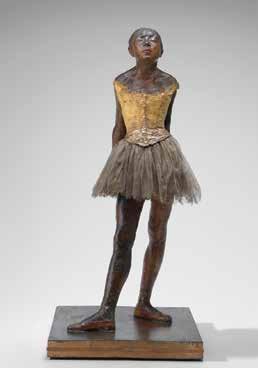
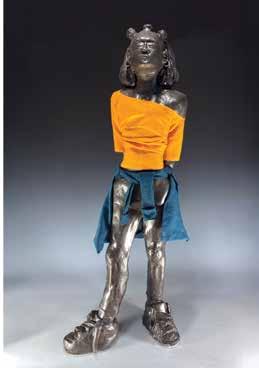
Did the new Upper School art studios impact your work and process? Yes, I loved the new art rooms! I am sad that I only got to experience them for a year, but I feel like it was a year well spent. I appreciated the amount of space in the rooms. There was always enough table space for me to work freely.
If you could give one piece of advice to students starting their AP Art portfolios, what would it be? My advice to any seniors starting their AP journey is to trust the process and make sure you are enjoying what you are making!
LOOKING FORWARD
You were also heavily involved in Stage One and performing. How do you see art and or performing fitting into your future—college, career, or beyond? I hope to continue performing in some capacity for the rest of my life. Currently, I am on the executive board for one of the theater organizations at George Washington University. So far, I've done one cabaret and I am looking forward to auditioning for more productions in the future. I think my days of playing the double bass are over, but who knows I may pick it back up again!
“I was deeply impressed when Tyler sculpted the face of the 'Little Dancer Aged Fourteen' entirely from memory, without any reference materials. Near the end of the process, I suggested a minor adjustment, but Tyler politely pushed back and defended his vision. He was absolutely right. That moment highlighted not only his extraordinary technical skill, but also his courage to trust his own artistic instincts.”
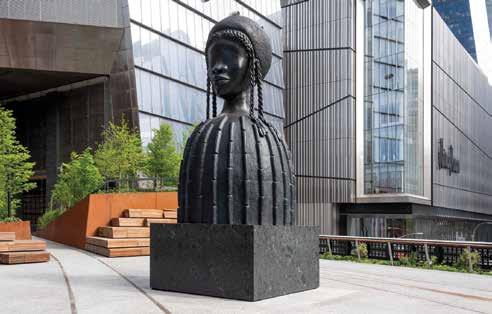
If you could collaborate with any artist, living or dead, who would it be—and what would you make together? Among artists who have passed, I would love to paint a portrait with Jean-Michel Basquiat or Keith Haring. I admire both of them as artists and I believe I could learn a lot— especially because 2D art is not my forte. Among living artists, I would love to work with Simone Leigh. She explores themes of African American identity and feminism which are themes I would love to explore more. We both work in sculpture making, and I know I could learn a lot from her. I would like to work on a public display sculpture, like her
piece “Brick House” which stood along a New York City skyline.
Who or what inspires you creatively—inside or outside of the art world? My life and experiences definitely play a big role in what inspires me creatively. I love to express myself and share that with others. I also love seeing other people express themselves and showcase their creativity. I believe sharing art promotes growth in both the artist and the viewer.
You may visit the 2025 AP Art and Design Exhibit at apartanddesign.collegeboard.org
Sean Riley, 3D Art Teacher
Simone Leigh's “Brick House” Photo by Timothy Schenck
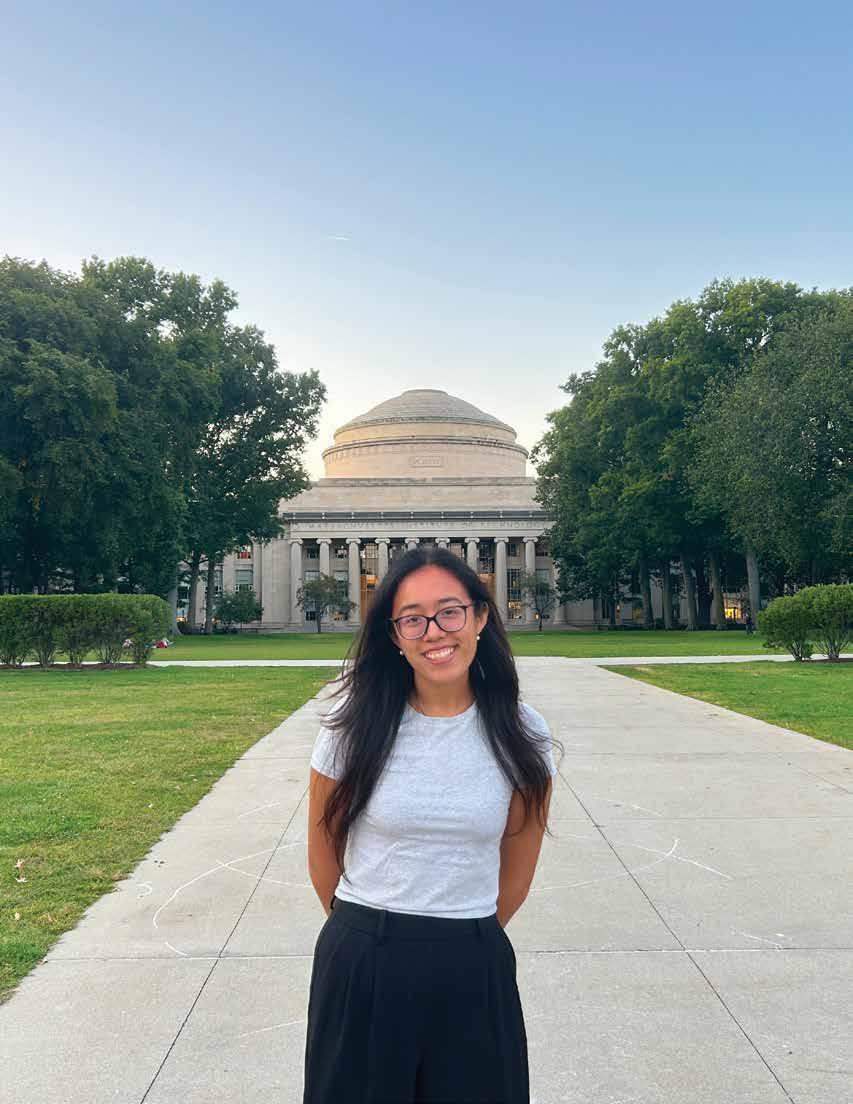
Driven to Discover
Adrienne Lai '21 earned top undergraduate research honors at the Massachusetts Intitute of Technology by following what excited her most.
By Melissa Maas '76
When Adrienne Lai '21 started college at MIT, she didn't imagine she'd be working on solar powered cars, modeling seal whiskers, or presenting her research on international stages. What she did know was that engineering was her passion—and she was eager to see where it might lead. Adrienne is intellectually fearless and endlessly curious, drawn to challenging problems not because they're required, but because they're interesting. She has a natural instinct for leadership, navigating complex, high-pressure roles with confidence and humility. She is also articulate and able to make highly technical ideas understandable. A rare mix of precision and playfulness, Adrienne is disciplined, warm, reflective, and open-minded—qualities that have shaped both her research and her journey.
Adrienne's readiness to explore new fields eventually led her somewhere unexpected: the ocean. “When I was a freshman, I was really excited about the undergraduate research program since it presented the opportunity to explore uncharted areas of knowledge,” she recalls. One of those opportunities was the Sea Grant, a research program supported through a partnership with NOAA Sea Grant. Its mission centers on advancing the conservation and sustainable use of marine resources through research, education, and outreach. The work spans coastal ecosystems, environmental literacy, workforce development, resilient communities, and sustainable fisheries and aquaculture.
Adrienne quickly found herself immersed in a world where biology, physics, robotics, and mechanical engineering converge. Her first project, “Space to Sea,” involved processing data and images from a satellite monitoring algae levels along New England's coast. In the summer before her sophomore year, she learned about another project that captivated her: refining an underwater flow sensor inspired by the distinctive whiskers of a harbor seal.
Having been the captain and programmer for her FIRST Tech Challenge robotics team at St. Stephen's
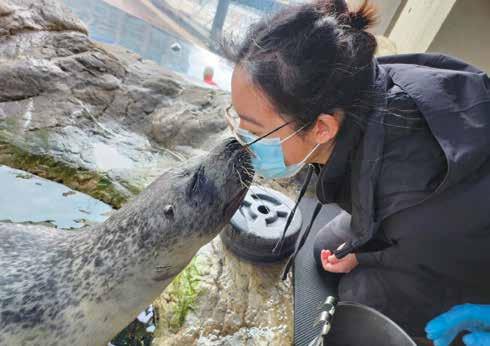
and St. Agnes, Adrienne was drawn to the potential a harbor seal whisker sensor has to improve underwater sensing for robotic missions. “I was inspired by the biomimicry element—how the natural evolution in animals can teach us new ways to improve mechanical things,” she says. Adrienne was able to tailor the projects to her interests, from sensor design and fabrication to hydrodynamic analysis, gaining a diverse skill set in the process that will be essential to her career.
What began as an intriguing research task lasted through the rest of her undergraduate experience and became a defining part of her academic identity.
The Whisker That Doesn't Wiggle
The scientific insight behind the project is rooted in geometry: harbor seals have unusually shaped whiskers that allow them to detect faint water disturbances. “Most animals have smooth,
I was inspired by the biomimicry element— how the natural evolution in animals can teach us new ways to improve mechanical things.
cylindrical whiskers,” Adrienne explains. “Harbor seals do not. The thing that makes harbor seal whiskers special is that they're wavy.”
That waviness dramatically changes how the whisker behaves underwater. “Normally, when you pull a cylinder through water—like a straw in your sink—it vibrates,” she elaborates. “But when you pull a wavy shape through water, it doesn't.”
This stability allows the seal's whisker to function like a silent antenna, responding only when something disturbs the water ahead of it. As a result, a seal can detect and follow a target even in complete darkness. As Adrienne notes, “You can blindfold and ear-muff a harbor seal, and it can still follow a fish.”
It is an extraordinary biological mechanism
that when harnessed technologically in a sensor would have far-reaching applications…think autonomous underwater vehicles and drones navigating without cameras or sonar, detecting wakes left by objects, terrain, or other vehicles.
Turning Biology into Technology
Although a predecessor had figured out how the whiskers worked and created the first large-scale sensor prototype, it was not viable for practical use. Adrienne's team was tasked with making it more compact and refining its performance. The sensor her team developed consists of a flexible base containing a circuit, with a synthetic whisker extending upward. When the whisker bends or vibrates, the circuit detects the motion.
What makes the project especially compelling is the potential practical impact. Underwater vehicles today rely heavily on sonar and acoustic systems, which Adrienne notes “tend to be really expensive and have high power requirements.” For many applications— ecological monitoring, pipeline inspection, autonomous submersibles— power and cost severely limit what is possible.
A passive whisker-inspired sensor, by contrast, offers a silent, low-power, and potentially low-cost alternative.
Adrienne's later work produced one especially meaningful finding—she proved that the sensor does not need to be made from materials that mimic a real seal whisker. “Your whisker does not necessarily need to have the material properties of a harbor seal whisker to work,” she says. “That allows more freedom with whisker design…you can use material as a design parameter to achieve a certain result you want to see.”
Presenting on the World Stage
If the whisker project marked the heart of Adrienne's undergraduate research, the conferences where she presented her findings marked the moments that shaped her as a communicator and scientific thinker.
She has written multiple papers and presented at three OCEANS Conferences
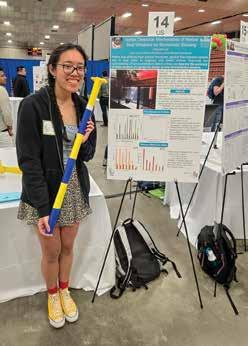
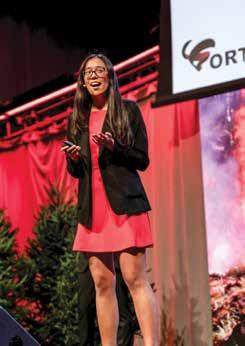
Left photo: Adrienne explaining the whisker mechanism to judges and visitors at the year-end research showcase, where she won first place. Right photo: The 2.009 (Vortex) Product Engineering Process course concludes with team product pitches at Kresge Auditorium, presented live and online. Adrienne presented the technical component on behalf of her team.
in Hampton Roads, Virginia, Limerick, Ireland, and Brest, France—each one attended by an international group of researchers across robotics, marine biology, acoustics, sensor design, and coastal engineering. “I was very satisfied with my presentation,” she says. “I explained the research well. The scientists in the audience asked lots of questions and I received tons of good feedback.”
Questions indicate an engaged audience—a sign that she had not only done excellent work, but also communicated it clearly. And communication, she believes, is as crucial as discovery. “Nothing happens with your research if no one else can understand it,” she says, smiling.
Her work did more than produce a promising prototype—it earned Adrienne three major distinctions at MIT. Each one recognized a different dimension of her contribution to the field. The Dean A. Horn Award honored her “excellence in marine and ocean engineering,” a nomination that came directly from her supervisor, a gesture she remembers with genuine surprise and pride. The Martin A. Abkowitz International Fellowship, typically awarded to
Nothing happens with your research if no one else can understand it.
graduate students, funded her travel to present in France after she applied at her advisor's encouragement. And her favorite recognition, the MIT Mechanical Engineering de Florez Award in the Undergraduate Science category, came after an intense end-of-year research showcase where she stood beside her poster explaining the whisker mechanism to judges and visitors. She won first place. These honors punctuated four years of steady, imaginative work—driven by the sheer fun of uncovering how something works.
Solar Cars and the Art of Leading Through Uncertainty
In her freshman year, Adrienne searched
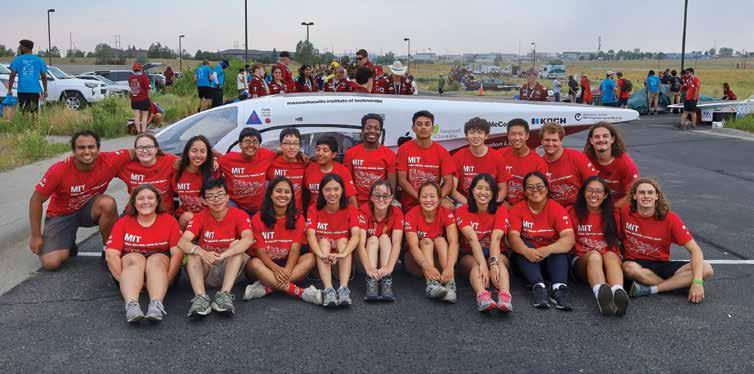
for a dynamic team to join and learn from, like her SSSAS robotics team experience. She landed on the MIT Solar Electric Vehicle team, which not only challenged her, but also expanded her understanding of leadership. She later became the mechanical lead (sophomore year) and captain (junior year) of the 60-member organization, a role that demanded both technical insight and logistical mastery.
“Solar Car was probably the most formative thing I did as an MIT undergrad, because everything else kind of had safety nets,” she says. “But we were building a car and that's a very real-world task. It really built my confidence.”
The team operated like a start-up, responsible for everything from selecting
suppliers to raising funds, manufacturing components, organizing travel, and managing risk. “It's kind of like running a company,” she reflects. She notes that her robotics background at SSSAS also shaped her teamwork mindset; she arrived at MIT already comfortable working in a team and aware that engineering requires communication across sub-teams and shared problem-solving.
Leading the team through a national race—in which the student-built car traveled across the country over nine days—was a turning point. “That was probably the hardest thing I've ever done,” she says. And yet, when it was over, she realized how much she had grown. “If I can do that, I can do anything.”
Solar Car was probably the most formative thing I did as an MIT undergrad...that's a very real-world task.
Top photo: Adrienne (front row second from left) with her Solar Car team [courtesy of MIT Solar Electric Vehicle Team]. Bottom left photo: Adrienne, captain, and Tessa Uvideo, vice captain [photo by Andre Greene]. Bottom right photo: Array and Lead Driver Deepta Gupta with Adrienne in the solar car [photo by Cora Kennedy].
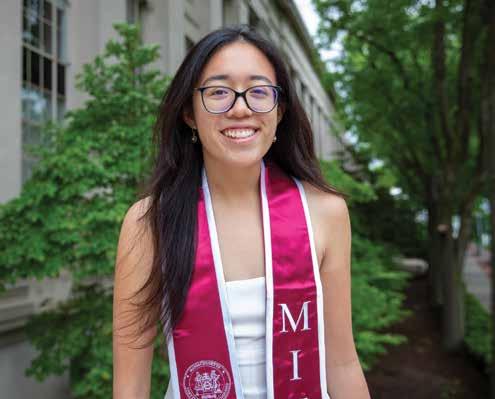
Workplaces That Teach How Engineering Really Works
Adrienne never sits still and never stops learning. She has filled her summers with internships that form another layer of her education and help crystallize the kind of work environment she wants someday.
At Boeing in 2023, she learned the rhythms of a large, established company. “Boeing was the largest and the first company I worked for, and where. I learned how a job works,” she says simply. Adrienne worked on the Boeing 787 airplane in Charleston, S.C. and marveled at the happy and open work atmosphere. “I could just walk up to the technician and ask, 'what are you doing?'” she says. “They never hesitated to stop and chat. I think I learned to take initiative and take every opportunity to learn there.”
In 2024 when Adrienne interned at SpaceX, she worked on Starlink semiconductors and encountered a very different culture. “SpaceX was much faster, more startup energy, younger and cool” she notes. “Compared to Boeing, their innovation happened much quicker, but with higher risk and more growing pains due to the growing state of the company. I learned how there can be multiple different ways to develop
something, but one that fits your timeline, goal, or work environment more.”
Last summer she interned at Skytree, a 100-person carbon-capture startup in Amsterdam, which offered an intimate look at how an idea becomes an actual product. “It was very different from working at Boeing and SpaceX, where you worked on established ideas and products. It was fascinating to see how many potential directions and strategies one project has when in the earlier development stages.” she says.
It is easy to imagine why the experience thrilled her, because Adrienne seems to gravitate toward the edges — where ideas are raw, where solutions are not yet clear, where creativity and technical precision must coexist.
Where It All Began
As Adrienne reflects on her SSSAS foundation, she says the academics prepared her well, but the distinguishing factor at MIT came from somewhere else, “I was totally prepared technically, but the humanities were where I really felt different.”
At a highly technical institution, clarity of writing and confidence in presenting turned out to be significant advantages.
“I am very comfortable writing a paper and presenting,” she says. “Some of my MIT classmates had never even written a five-paragraph paper. I'm totally at ease with grammar, collaborating, and communicating.” These skills distinguished her at conferences and in cross-disciplinary collaborations.
Adrienne also doesn't hesitate to talk to her teachers, ask for help when needed, and go after what she finds interesting. Her message to high school seniors is simple, “If you want something, go for it. Look for opportunities and apply for them. It never hurts to ask to do something.”
A New Lab, A New Set of Challenges
Adrienne is now working on her master's degree in the MIT Varanasi Lab, which explores interfacial thermal fluids engineering —how heat and fluids behave where different phases of matter meet. She often describes the work as early-stage science with real-world promise.
Her portfolio of projects is unusually broad: “I'm working on three projects,” she says. “One's related to ovarian cancer early detection… one's related to increasing electrochemical cell performance… and then the last one is working on more efficient carbon capture.”
In many labs, students focus on one project with laser-like precision. Adrienne laughs when acknowledging that her situation is not typical: “It's very rare to get assigned to multiple projects,” she says, “but that's just the nature of my lab. It's very interdisciplinary.”
The variety suits her perfectly.
She is candid about the setbacks inherent in research. “Research can be very frustrating. It doesn't work a lot of the time.” But she knows how breakthroughs happen: “You just need to be persistent and keep going.” And when the path changes? “Be flexible and ready to pivot. If one thing doesn't work, try the next thing.”
Adrienne's future remains wide open— and that is precisely how she prefers it. Her long-term goal is to lead something technical, whether a lab, a startup, or an R&D group within industry. But for now, she is exactly where she thrives: at the intersection of ideas, fields, and possibilities.
Weddings
(Listings received prior to November 7, 2025)
Alumni
Rachel Manson '04 and BJ Grill
October 24, 2024
Maddy Devine '05 and Michael Mooney
April 26, 2025
Becca Devine '07 and Chris Duffy
November 1, 2025
Connor McGuiness '08 and Alyssa Noel
January 25, 2025
Becca Devine '07 and Chris Duffy
Mya Reid '10 and Andreas Haggerty
September 12, 2025
Meredith Bentsen '11 and Grant Loftesnes
May 31, 2025
Alex Bloom '11 and Ankita Singh
October 18, 2025
Emma Dyson '12 and Tommy Kaminsky
June 28, 2025
Raven Bolding '13 and Christopher
Shields '11
March 15, 2025
Olivia Massie '13 and Max Brown
October 25, 2025
Darby Philbrick '14 and Nicholas Cargas '14
September 27, 2025
Carter Tyree '15 and Ada Tessmer
August 2, 2025
Mattern Burnett '16 and George Harwell
May 10, 2025
Emerson Solms '16 and William Hess
August 9, 2025
Caroline Sweet '17 and Ben Holman
April 5, 2025
Domenick Bailey '18 and Mihret Niguse
July 26, 2025
Zion Lee '18 and Karen Pineda
October 12, 2025

Alyssa Noel and Connor McGuiness '08
Alex Bloom '11 and Ankita Singh
Christopher Shields '11 and Raven Bolding '13

Nicolas Cargas '14 and Darby Philbrick '14
Mya Reid '10 and Andreas Haggerty
Grant Loftesnes and Meredith Bentsen '11
Tommy Kaminsky and Emma Dyson '12
Ada Tessmer and Carter Tyree '15
Mattern Burnett '16 and George Harwell
Ben Holman and Caroline Sweet '17
Zion Lee '18 and Karen Pineda
New Additions
(Listings received prior to November 7, 2025)
Alumni
Caitlin Anne Griffin Penny '01 and Carlos
William Griffin and Charlotte Rose Penny
October 13, 2025
Rachel Manson Grill '04 and BJ Auggie Grill
July 27, 2025
Kristen Smith Fredericks '04 and Derek
Sienna Elizabeth Fredericks
September 26, 2025
Robbie Lunt '04 and Amanda
Louis James Lunt
October 29, 2025
Maudie Braswell Vaughn '05 and Mike
Sadie Vaughn
September 29, 2025
Robert Edsall '06 and Caitlin
Poppy Rose Edsall
May 8, 2025
Hayley Deavel Gregory '07 and John
Austin Gregory
August 18, 2025
Abigail Ryan '07 and Daniel
Oliver Allen Ryan
July 7, 2025
Julia Ciavarella Lund '08 and Jack
Charles Frank Lund
August 22, 2025
Sarah Walinsky Peritz '08 and Seth
Torivelle “Tori” Quint Peritz
April 21, 2025
Camey Pelliconi Sieger '08 and Matt
Austin Andrew Sieger
June 3, 2025
Paula Trahos Gazikas '09 and Alex
Michelle Catherine Gazikas
August 3, 2025
Courtney Galloway Wallis '09 and Jack
Charlie Wallis
August 15, 2025
Sienna Elizabeth Fredericks
Louis James Lunt
Austin Gregory
William Griffin and Charlotte Rose Penny
Michelle Catherine Gazikas
Ziggy Allin Cole
Austin Andrew Sieger
Oliver Allen Ryan
Charles Frank Lund
Emily “Alli” Herget Cole '10 and Drew
Ziggy Allin Cole
July 31, 2025
Reilly Woodman Whitney '10 and John Keegan Whitney
October 4, 2025
David “Chip” Phillips III '10 and Molly
David “Milne” Phillips IV
August 11, 2025
Gabrielle Richichi Gower '11 and Joseph Luca Gower
March 2025
Sam Teague IV '11 and Hayley
Reilly Bennett Teague
April 16, 2025
Laurel Quinn '12 and Alex Perryman
Liam John Perryman
April 5, 2025
Besser Dyson Hooper '13 and Scott
George Edward Hooper
September 7, 2025
Tori Van Horne Motter '14 and Taylor
Hadley Motter
October 8, 2025
Virginia Fergusson '14 and Blake Calcei
Arthur Bailey Calcei
October 25, 2025
Gabriel Rudasill '17 and Maggie
Xavier Rudasill
August 2025
Faculty and Staff
Ali Beach (Lower School Kindergarten Assistant) and Evan Bennett Beach
March 2025
Trae Humphreys (Associate Director of Athletics) and Lauren
Olivia Patton Humphreys
March 13, 2025
Brionna Auslander (Athletic Trainer) and Kent
Cameron Brian Auslander
April 8, 2025
Ricky Drummond (Middle School Teacher) and Emily Stern
Mia Joy Drummond
August 25, 2025
Luca Gower
Reilly Bennett Teague
George Edward Hooper
David “Milne” Phillips IV
Cameron Brian Auslander Mia Joy Drummond
Olivia Patton Humphreys
Arthur Bailey Calcei
Bennett Beach
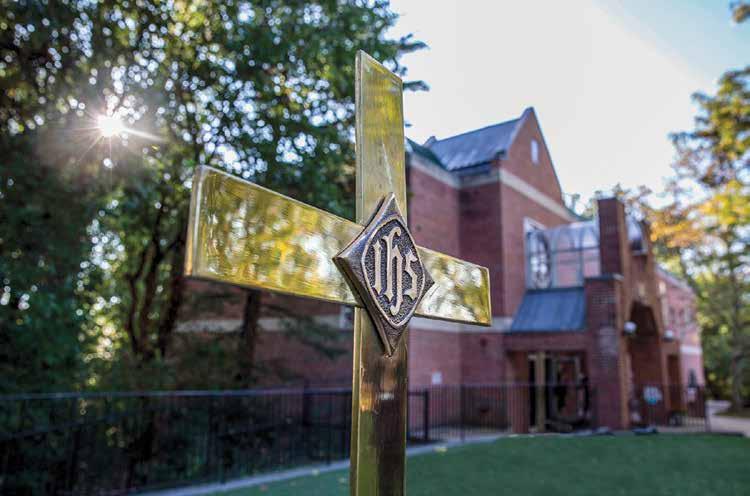
In Memoriam
(Listings received prior to November 7, 2025)
Alumni
Patricia Wood Clarke '46
May 5, 2025
Frances Lorraine “Rainie” Naquin
Tyler '48
March 25, 2025
Richard “Dick” Schaffer '52
May 24, 2025
Carolyn McCamment Anderson '55
June 21, 2025
Heriot “Rhett” Clarkson '57
June 20, 2025
Jaquelin “Jackie” Lamond Turbidy '60 sister of Cary Lamond Courier '58 and Lucy Lamond '66
July 16, 2025
Braxton Tabb III '61 brother of Ellen Tabb '60
August 29, 2025
Katherine Stoney Toepfer '63 sister of Edward Toepfer, Jr. '56 (deceased) and Norman Toepfer '58 (deceased)
April 18, 2025
Lincoln Fairchild '63 brother of Martha Fairchild Shepler '57 (deceased) and Margaret Fairchild Arms '60
August 7, 2025
Alice “Melinda” Pickett Harmon '64 sister of Helen Pickett Larsh '60
August 14, 2025
Louise Ball '69 mother of Matthew Solomond '03 and Phillip Solomond '02
March 6, 2025
Maurice “Maury” Robert Palmer '70 brother of Rick Palmer '64 and Mary Palmer '73
October 8, 2024
Keith Martin '73 brother of Jane Martin '70
April 10, 2025
Ralph Bogle III '75 brother of Susan Bogle Bingham '82 and Jen Bogle Witowski '84, uncle of Maggie Sutherland '12
February 15, 2025
Lisa DelNegro '82
sister of John DelNegro '85
September 24, 2025
Julien Gantling Randolph, Jr. '88
June 28, 2025
Alexis von Schoening-Henry '00
August 31, 2025
Elise Emmons Ciampitti '00
October 17, 2025
Solomon Banjo '08 September 27, 2025
Alexandra Blair Van den Berg '11 sister of Caroline Van den Berg '05 February 18, 2023
Faculty, Staff, and Family
Barbara Joy Lovelace mother of Todd Lovelace '85
October 9, 2023
William Ford husband to Patricia Delashmutt Ford '56 (deceased), brother-in-law to Betty Mock '54 (deceased), and grandfather to Joshua Friend '29
December 22, 2024
Yvonne Duvall mother of Ashley Duvall Hayes '87 December 29, 2024
Alfred E.T. Rusch father of Ted Rusch, Jr. '87 March 14, 2025
George Orlando “Lanny” Griffith, Jr. (former board member) father of Sally Griffith '04 March 25, 2025
G. Revell Michael father of Mary Michael '81
April 7, 2025
Dorothy “Dot” Rogers mother of David Rogers '81 and Ann Rogers '84
April 10, 2025
Nellie Elizabeth Reese grandmother to Kendall Smith '10 and Kamal Smith '14
April 28, 2025
David Allen Evans father of Sarah Evans '92 and David Evans, Jr. '95
May 13, 2025
Annabelle Haney mother of Daniel Haney '87
May 21, 2025
Harrison Ruffin Tyler father-in-law of Cathly Tyler '80, grandfather of Harrison Tyler III '13, Rice Tyler '15, and Chris Tyler '21
May 25, 2025
James “Jace” Hassett
father of Quinn Hassett '26 and Christina Hassett '26
June 29, 2025
Helen Morris
mother of Lewis Morris, Jr. '72
June 29, 2025
Jayant Lele and Uma Lele
father and mother of Abhijeet Lele '83
July 25, 2025 and July 28, 2025
Glen “Gig” Ortman
father of Sarah Ortman Sams '09 and Connor Ortman '14
August 3, 2025
Darnell Clement, Sr. father of Darnell Clement, Jr. '17
August 4, 2025
Carla Crawford
mother of Trice Crawford '18, Grace Crawford '19, and Witt Crawford '22
August 4, 2025
The Rev. Thomas Blair (former SSS faculty member)
August 7, 2025
Kathryn Louisa Garrett daughter of Lucie Morton Garrett '68
August 20, 2025
Anthony “Tony” Collins husband of Belinda Lowenhaupt Collins '64
September 3, 2025
JoAnn Herr
mother of Susan Herr Mills '83, Austin Herr '84 (deceased), Douglas Herr '86, Alicia Herr Jensen '88, Alison Herr Christmas '88, and Valerie Herr McWhorter '92
October 15, 2025
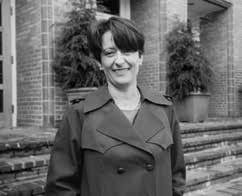
Former Saints French Teacher Denise Van Swearingen passed away on March 15. Denise, mother to Annick Van Swearingen-Rossini SAS '88, was married to Bill VanSwearingen, a former French and Spanish teacher at both St. Stephen's and SSSAS. Bill died in 2022.
Denise began teaching French at St. Agnes in 1976, and remained with the school until 1993. Denise served as the sponsor of the French Club and may be best remembered as the coordinator of the French Exchange program which began during her tenure in the summer of 1980. Many St. Agnes graduates from the 1980s have fond memories of traveling to France with Denise who chaperoned the exchange for many years.
Denise Van Swearingen
400 Fontaine Street
Alexandria, Virginia 22302
If the addressee no longer lives at this address, please contact the school: 703-212-2720 or atoman@sssas.org