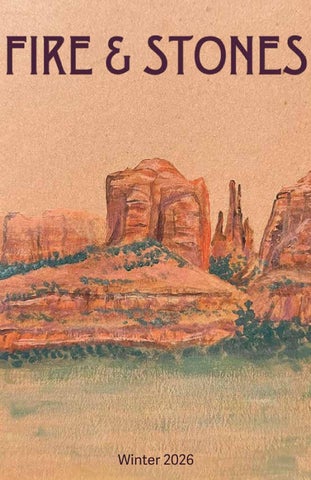
Cover: Out West
Painting by Kaia Corens ’27
I decided to paint a scene from New Mexico, where my mom’s family is from. I have always loved the vibrant colors and interesting carved out shapes of the mountains in the region, and I wanted to explore what it would be like to paint a landscape like this.
Printer
Vomela Commercial Group, Springfield Virginia © 2026 by Fire and Stones. We are committed to minimizing our environmental footprint while delivering high-quality print publications.
Printing: 4-color process
Paper: 100# Silk Text
Cover 80# Silk Cover
Ink: 4/c process
Authors and artists hold rights to their individual works.
Fire & Stones literary and art magazine is published bi-annually in the winter and spring and is distributed free of charge.
Submissions
Submissions for Fire & Stones are open to all St. Stephen’s and St. Agnes Upper School students. Submissions must be emailed to fireandstones@sssas.org. We only consider material offered for first time publication. Artists and writers may submit 1-3 pieces per issue. Literary entries accepted: short fiction, essays, poetry, plays, and excerpts. We do not have length limits; however, try to keep submissions under 1000 words. Include names on the files: firstinitial_lastname .doc .txt or .pdf permitted. Visual art accepted: photography, illustration, painting, collage, mixed media, cartoon, graphic design, and photographed sculpture. Please submit visual art as high-resolution, jpeg files. For this issue, Art and literature had to be submitted to our faculty advisors by December 3, 2025. We have a blind judging process for art and literature. This format ensures that the staff members’ votes cannot be swayed by the votes of other staff members.
Advertising
Students interested in learning about marketing lead the charge in promoting the issue. They write the call for entries and create posters and social media content to spread the word. It’s a hands-on learning experience that lets them gain practical marketing skills.
Distribution
The submission window and distribution are bookended by our Fall and Winter Coffeehouses. Like our magazine, Coffeehouse is a bi-annual event with one in the fall and one in the winter. Coffeehouse is a Fire & Stones-run event where the students gather to share poetry, dramatic readings, and music with their peers. Additionally, select copies will be made available to the Lower and Middle School campuses and the Archivist, extending the reach of our publication beyond the upper school.
Permissions
By submitting their work to Fire & Stones, contributors grant us permission to publish their work in both print and digital formats. We respect the rights of our contributors and will ensure proper attribution for all works included in the magazine. Any inquiries regarding permissions or usage rights should be directed to the editorial team.
Digital versions are posted to our website: fireandstones.org For additional information or how to obtain hard copies please email faculty advisors Kate Elkins (kelkins@sssas.org) or Jill McElroy (jmcelroy@sssas.org)
We extend our heartfelt thanks to everyone who contributed to the creation of Fire & Stones whether as writers, artists, editors, or supporters. Your passion and creativity have made this publication possible, and we are grateful for your contributions.
For inquiries, feedback, or to get involved in future editions, please email faculty advisors, Kate Elkins (kelkins@sssas.org) or Jill McElroy (jmcelroy@sssas.org)
SSSAS, 1000 St. Stephen’s Rd, Alexandria, VA 22304, www.fireandstones.org @fireandstoneslitmag|
© 2026 St. Stephen’s and St. Agnes School. All rights reserved.
Senior Editors
Vera Barker ’26
Dava Boyce ’26
Lilly Purtill ’26
Junior Editors
Caeli Boris ’27
Grace Laha ’27
Willa Johnson ’27
Jackson Sipple-Asher ’27
Editing Team
M.E. Call ’28
Janney Cooper ’26
Thomas Gondor ’29
Cleo Ingerick ’29
Ramtulai Jalloh ’26
Raine Patterson ’27
Jackson Sipple-Asher ’27
Layout Team
Kaia Corens ’27
Ailsa Greene ’27
Ariya Harrington ’26
Katie Pilcher ’29
Linden York-Simmons ’27
Communications Team
Mika Aquino ’28
Sarah Eisenberg ’28
Tatum Spencer ’26
Faculty Advisors
Kate Elkins
Jill McElroy
Dear Reader,
Nature or Humanity? Which do you connect with more?
We may see humanity as distinct from nature, but in reality the two are eternally intertwined. When we showcase both, we can better see the ways nature and humanity reflect one another. In this issue of Fire and Stones, we hope you consider your own humanity and your own ties to nature through each piece featured. We hope you find a nice spot in nature, sit in silence, and enjoy reading this issue.
Wishing you the best,
Senior Editors, Vera Barker, Dava Boyce, and Lilly Purtill
Literature
7- A Warm Tundra - Poem by Mark Driver ’27
9 - Phocae - Poem by Jackson Sipple-Asher ’27
15 - The Desert - Poem by Ariya Harrington ’26
16 - A Flower Can’t Spell Its Name - Poem by Freya Greene ’29
20 - Mother Gothel - Poem by Janney Cooper ’26
2
5 - Thoughts for a Boating Party - Poem by Ariya Harrington ’26
27 - Late Autumn Reflections - Short Story by Ella Schneider ’27
29 - How it’s Supposed to Be - Short Story by Cleo Ingerick ’29
33 - cold coffee on a sunday morning - Poem by Tatum Spencer ’26
35 - Back Words - Poem by Lilly Purtill ’26
38 - Untitled - Poem by Janney Cooper ’26
42 - The Weight of School - Poem by Caeli Boris ’27
46 - I Would. - Poem by Raine Patterson ’27
Artwork
4 - Sedona - Painting by Nyla Zindler ’26
8 - Glacier - Photograph by Cooper Spies ’28
10 - Lotus Blossoms - Illustration by Willa Johnson ’27
12 - Retired - Sculpture by Colin Adams ’26
19 - Passageway - Illustration by Caeli Boris ’27
22 - Vase Trio - Sculpture by Georgia Neaderland ’26
24 - Floating - Painting by Charlotte Barnes ’27
28 - Panoramic Portrait - Painting by Dava Boyce ’26
30 - Lulu - Etching by Vera Barker ’26
31 - Remi - Painting by Charlotte Barnes ’27
34 - Charles Bridge Street Performers - Photograph by Luke Wazorko ’28
36 - A Burning Past - Illustration by Grace Laha ’27
37 - Begging, Prague - Photograph by Luke Wazorko ’28
41 - Existentialism - Comic by Lucas Aronson ’26
43 - The Wuzz Vase - Sculpture by Grace Laha ’27
45 - Branded - Sculpture by Marley Rose Gonzalves ’27
48 - Portrait of Bernice Bing - Digital Illustration by Ariya Harrington ’26
Front Cover - Out West - Painting by Kaia Corens ’27
Back Cover - Portrait of Martin Wong - Digital Illustration by Ariya Harrington ’26
Inspired by a hike through Sedona, Arizona, this piece explores humanity’s smallness within the vast universe. It suggests that our beauty and strength come from the forces around us, inviting viewers to reflect on how we mirror our environment.
— Nyla Zindler ’26
Sedona
As autumn nears its end, The chilling frost consumes all, The nights grow unnaturally long, And life turns to death.
But amidst winter’s radical changes, There are bright beams of hope, Families, once separated, Reunite in loving embraces.
That chill that some find unbearable, Brings upon a snowy wonderland, Filled with the greatest of seasonal pleasures, That all can rejoice in.
The pleasure of getting the greatest gifts, The ones you had desired, The ones you begged for, Now in your frostbitten hands.
And after the chilling grasp of the frost, The world is born anew, The animals return to their old homes, The plants reach once more to the sun.
Winter, That unbearable and freezing, But passionate and warm season –What a perfect paradox.
— Mark Driver ’27
This photo was taken at the end of an out-and-back hike in Glacier National Park.
— Cooper Spies ’28
Glacier
Phōcae caeruleō cum nymphā lūdere mārī
Gaudunt ut caperent cancrōs quōs volant in aquā.
Nympha amāvit corpora eōrum sunt qua velut orbes
Quod hae phōcae tam bellās laetāsque videntur.
Phocae optimae nostrīs rēs quās vīvunt in vitīs!
Cui carmen alicui dēvovētur amat eas.
Seals:
The seals in the skyblue sea rejoice with nymphs to play And catch the crabs which fly inside the water every day. A nymph does smile at their forms so shapèd like a sphere Since they do beneath the waves so beautifully appear. Thus, seals are the greatest things that, with us, live and feel! And this poem is devoted to one who loves the seal.
— Jackson Sipple-Asher ’27
Lotus Blossoms
— Willa Johnson ’27
Retired
I made Retired to show growth and decay. I sculpted the car from clay and made it rust with an iron-rich paint. By planting grass in the car’s dirt mound, I created a living structure that swallows the car with time, contrasting the car’s rusting decay.
— Colin Adams ’26
The sand is as good a place as any to die. Father never said so, though in the end he didn’t need to. Clear skies, clear sets of eyes, before you came and the planes followed. Two years, and our irises made puddles at our feet. Goddamned metal birds,
he’d call them, eyes tracking where their wings rended the air, fists clenched iron-stiff. The ramrod of his spine had melted easily into slag, as though evolving backward. But you didn’t know that. Birds don’t know that they are birds, and anyways, that isn’t why they
fly. The day you cast the splinters of your ribcage to the neon-bright dunes I caught them, arms spread wide like an open wound, and wondered how a person could bear to let go of anything without leaving behind at least their fingernails. But by now I’ve outgrown
some proximity, some disillusionment. And every so often my pride remembers a mind of its own. When it goes searching for you in the night, gaze beetle-bright, acid-tears dragging grooves through my cheeks, I am still inclined to follow. It seems we
relinquished our hearts just moments too soon. Even now—I could have sworn you’d forgotten that afternoon, the one we spent together in a decaying airport, watching dusk. The window, guillotining the sunlight neatly into squares, their edges disappearing into yours. For you it was the desert, I think, or maybe something past it. A murmur, silent, stitching slowly through my brow like a promise. The distant sands boiled, livewire against the sky. The heat, an angel with its jaw unhinged. I can still see it. You were wondering, as you sometimes did, if birds ever flew themselves into the sun just thinking they could.
— Ariya Harrington ’26
The crepe myrtle in my mother’s flower bed was watching as I stood in front of its skinny trunks. Above my head, flowering clumps were already starting to shrivel in the pre-fall air. That year I started high school, growing closer to being a proper person of the world; a contributing human— yet instead, I felt more akin to the grass beneath my feet and to the crops of my father’s garden, which by now were being weeded out, in time for a Virginia winter.
As the school year began, I adjusted to my new surroundings. My sister repotted many of her succulents, at the urge of our mother, who was always trying to distract her from her thoughts. Everything was new and dying.
Day by day I grew more envious of the foliage strewn in the streets, no longer subjected to the burden of being alive, and while they were, they only had to bask in the sunlight till their time came.
I hadn’t been to a new school in years and had to relearn how to introduce myself. Slowly, past observations came back to me; you leave a lot behind to describe something living in only a few words. Well, I do like the sun but I need partial shade to flourish. I was deliberate with even my thoughts, as if all the world could know what I was thinking.
One morning I sat down on my front stoop and heard the red maples rustling in the breeze that carried a sweet petal from off of our old rose bush and into the pale sky. A moment before I had been worrying about a physics test, or an essay for English, or how to pronounce marchito, but as I spotted a dainty flash of pink ascending to the heavens, I realized suddenly that roses aren’t capable of writing essays, or speaking languages, never have and never will take a physics class, and therefore will never know why the wind carries them upward so, then abandons them there, to float gently down amongst the collecting brown leaves, met by the same fate yet grow anew again by spring.
How lucky am I, to be privileged to the knowledge of my situation, to have my mind grow alongside my body, to be able to introduce myself as all the things I’ve done, and been able to do, and wanted to do, and to one day be privilege to the shared experience of being alive as I join the decaying debris that will grow another rose bush— all because I am human.
— Freya Greene ’29
Passageway
— Caeli Boris ’27
Mother Nature
Hates my guts.
Once a month I fight an internal battle, bloody and brutal, Futile because I will always lose,
My strength of will no match for the willingness of my insides to Tear
Me Apart…
What part am I missing?
What valiant knight or galloping horse do I lack to successfully attack And defeat this evil?
Nary a soul is listening to my queries, All knowing her militia is unmatched.
As pain claws its way into my body and bares its greedy tusks, Threatening to devour me alive,
Tying my intestines into barbaric bows and grinding my stomach into putty, She cackles in my face with unrestrained glee
Mercilessly murmuring This is what you get
In my ear, no pity to be found,
But I can barely hear her over the sound Of swords clanking against each other
As they synchronously stab my abdomen as if in a symphony.
You see, every month she punishes me
For failing to carry out my duty, My sacred promise to produce Because what else am I of use for?
My body was built especially
To be a vessel for cells of the future, Each fiber of me meticulously crafted
To incubate, accommodate, and gestate.
In me I carry the seed of life that I may not live to see; I am the roots from which will sprout a magnificent tree But how shall I grow? With what remaining strength will I create a forest, If I’m first felled by a demanding dowager Who cares only for my ability to populate?
And even if I determine populating is what I choose, I will not lose her for long— For 40 odd weeks she will leave me alone, But then there she’ll be again, flying in on her broomstick To admonish me for my shortcomings.
Mother Nature
Wants me to be a matriarch like her, A fact of which she relentlessly Continues to remind me.
That is all she expects me to be.
Mother Nature Can go to Hell.
— Janney Cooper ’26
I was inspired to make this piece after seeing an ancient Korean vase with a similar form. I found the silhouette elegant and knew that throwing this shape on the wheel would be a challenge. After some early struggles, I became more comfortable creating a wide shoulder that tapers into a narrow neck. I chose to modernize the piece with nail chrome powder to reference the Japanese art of kintsugi, combining a medium I am learning with a form that inspires me. I made three versions because I like the balance of slightly different sizes and shapes united by the same color and use of kintsugi. I chose a celadon-like color to connect back to Korean and Japanese ceramic traditions.
— Georgia Neaderland ’26
Vase Trio
Floating
This portrait of Olivia Smoliga, an Olympic swimmer, explores the movement of water and how light interacts with waves.
— Charlotte Barnes
’27
, painting by Pierre-Auguste Renoir)
the woman with the glass rasps like a wallflower / like a mouth unused to unhinging around itself / i see it in the clench of her fingers / glass bending to her will as the curvature fits itself to propriety’s asymptote / see it in the stale brushstrokes of her eyes / sweeping crescent-like up toward the moon / misplaced amidst the idle chatter of the party: oh, the birds! a day without sun / surely, a day without sun! her spine unspooling / desolate / a needle threading through the ocean. perhaps her eyes look too much like mine. i do remember surrounded by strangers / always excessive in their comfort / their words / i remember seven years old / the ducklings in the grate of the pond & silent / the mother, eyes like blinds / her children sinking through the sewer’s open mouth / salt caught in my irises & the knowing—the next current & them all gone / the mother alone. just wings writhing in the sand. the scream crawling through her throat / the sunspot catching in her eyes & in her teeth / on the words she might have said / had the seconds lingered. often i am still subject to conspiracy. when the museum closes i am only too happy to leave the party behind / to their brushstrokes, to the papered edges of the woman’s eyes / creasing once more, sticking dry & cracked behind the screen / smiles dried to thei r faces / paint simmered over an open sun—& there / a moment more in the heat & they would have melted / spilled over their cheek s into my open palms—there / in the moments we forget to be human / all their expressions like saltwater on my tongue.
— Ariya Harrington ’26
Summer comes in with the tide, sun sinking into each vertebrae as the ocean’s many hands wash a small conch shell to shore. To press your ear against the hollow of a shell is to hear the rush of your own blood: “ocean” we call it, but the vastness lies within ourselves. To press your ear against the hollow of a shell is to hold your life to your skull, listen to it sing, feel its weight in your hands that are all at once too small and too large to hold the palm-sized object echoing back the pump of your own heart. This is the season I was born into, cradled in the arms of its heat. Though I always carry something of summer within me, something of its sticky humidity and treacled rot, the season does not last, slipping from my grasp to slowly bleed into the first chills of autumn, the promise of winter.
The late autumn-air filling my lungs—almost painful in its frigidity— always evokes the memory of a quiet walk down some trail whose finer details now wander off into recesses of my mind I can no longer recover. Though it rambles on like a woodland path, all cervine footsteps and arbitrary underbrush, the trail is paved in highway asphalt. Several fissures have begun to break open the ground, filled with dirt and pebbles and whatever else has stumbled into their grasp, and my own careless steps kick shards of fallen leaf into the small chasms. I remember a sudden chill pinching at my cheeks, the whispers of a coming winter cursing the autumn hangover, those leaves so desperately trying to hold onto the fire of sunset as if night does not always come. Under a grey sky fractured by pale clouds like cracks across a frozen lake, the spindly skeletons of summer’s trees hunch in on themselves, all fragile bone and swiftly receding warmth.
There is nothing left here but memory. A battle has been fought earlier in the season, between a warm sun that is forever dusk-bound and a frigid air that fights on anyway. The remaining leaves still clinging to bare branches are all bent in the same direction, perpendicular to the ground and permanently windblown despite the stillness of the air. Before me unfolds a single snapshot of the bellicose winds the season is sure to bring, an apricity transient as the spirit of warmer months. Winter is shaped by hands swollen and pinked by frostbite, early morning snow flowering like baby’s-breath from ice-numbed soil. Winter is both an ending and a beginning, whispers of the past year carried over like a cold draft sneaking under a crack in the door. Winter will be an eternity dancing at my fingertips, a bone-chill that seeps under the skin and never truly leaves the marrow. Yet still, there is a brightness to the season, days compressed tighter until the sun seems to burst from the sky. In the silence of the day, I breath out and watch the pale apparition of my lifeforce haunt the space in front of me before disappearing back into the air it came from, a ghost of my own making.
— Ella Schneider ’27
Panoramic Portrait Davaception. I regret this.
— Dava Boyce ’26
We walk together, all four of us, the way we always do. There is The Girl of Seven Years Before. A young girl with hair as innocent as herself. As blonde as a golden retriever’s coat, and as voluminous as a sheep’s curls. Then, there is The Girl of Five Years Before. Her hair has stained brown bits the way trauma has stained her brain. She likes to learn, though, likes to do things. When The Girl of After lets her. Then, There is The Girl of Ten Minutes Before. The deer. We do not like her. Lastly, there is The Girl of After. Her hair is a lion’s mane as she claws at herself, roaring at the people who would let this happen to her.
We spend our days alone, even when we are around people. The feeling of loss lingers like the mascara on our eyelashes. We wake up together, eat together, and fight together.
This morning, like every other morning, The Girl of After does not want to wake up. We have to, says a voice that belongs to none of us. The Girl of Ten Minutes Before hums to herself as we get up. The Girl of After calls her stupid.
We do not brush our teeth but it crosses The Girl of Seven Years Before’s mind. Yet, she does not say anything. She knows she has no power to speak up. She is only a sheep.
We get into the car to go to our seven-hour therapy program. Not school. The Girl of Five Years Before likes school; The Girl of After does not. In the car, The Girl of After plays her favorite songs. They are loud, so loud they drown out her own thoughts. We all know she hates them, as she hates everything. In the space between passing songs, The Girl of Ten Minutes Before asks to play her favorite song: “Shake it off” by Taylor Swift. The Girl of After says yes. The music is flowing through our veins and, for once, we are a collective. We are more than a we, we are one. Like we’re supposed to be. Just one person.
But the song has an end, as does every feeling. As does every sunset, every rainbow, every childhood. We are back to where it’s been. And so far away from how it’s supposed to be.
— Cleo Ingerick ’29
The terrifying 7-lb doggie.
Lulu
— Vera Barker ’26
Remi
Remi, age four, is happiest on his sofa perch, watching the world go by.
— Charlotte Barnes ’27
cold coffee on a sunday morning a bitter sting with solitude sitting in silence while sipping on the chill clinging on your tongue from yesterdays that never fulfilled dreams that never departed confessions that were kept secret with lips meeting on mugs and wet, fragile cups the smell of defeat seeping through the cracks seeping through the stillness of faces and the realization of regrets.
— Tatum Spencer ’26
Charles Bridge Street Performers
Looking down on street performers on Charles Bridge in Prague, Czechia.
— Luke Wazorko ’28
.time first the for seeing was I ,hand my of back the like knew I thought I place a because ,myself surprised I .dizzying was It .up of instead down flowing door my on wood the of grain the even with ,odd looked Everything .way that dresser my at looked never have I .way that closet my at looked never have I .longer bit a just staying from myself help couldn’t I but ,soon up back flip should I that knew I ,head my to rushing started blood the As .down upside room my saw I as paused I .her at face a making ,bed my of side the off head my laid I ,sister my with Laughing
(P.S. read backwards and from the bottom: start with “Laughing”)
— Lilly Purtill ’26
A Burning Past
This piece represents the loss of my past self and my motivation to read. The books and symbols of childhood are being destroyed by fire, in particular because I was scared of fire as a kid. Additionally, the fire separates the current me from the imaginative me of the past, who was seemingly much more free than the current me.
— Grace Laha ’27
Begging, Prague
A woman stares down at someone begging outside of her hotel lobby; Prague, Czechia
— Luke Wazorko ’28
Silence
Speaks volumes.
A voluminous silence Is louder than a fickle sound, So I sound out the sorrows Surfacing in my mind, Break them down into tiny pieces And analyze their animosity, Aimlessly carving away at my sanity. I speak because any words are better than none With one word I surmise the size of my burdens, Yearning shamelessly for solemnity
Because any feeling is better than nothing, Because to speak is to feel And to keep lips sealed is to succumb To the numbness of abyss.
“Listen,” they say, “shut your mouth and hear” But in the here and now, how do I tune out the sounds Of destruction, despair; how do I care about the suffering Of others while trying and failing in my efforts of curtailing My own wanting and wailing, wishing for something That silent observing couldn’t hope to achieve? Leave me to my thoughts and tape my mouth shut And watch as my ears begin to bleed with the effort Of listening passively without a release— A release of speech which leeches the blood and bile From my brain; otherwise, the pain that wells up will swell To bursting.
I thirst for sound like a fish for water
To drown out the voices in my head
Until the bubbles cease to reach the surface And words, any words, bubble up in my mouth— The softer the better to counteract the yells Of silence.
Letter by letter I dissect the brain matter That mattes my hair and tangles my troubles. Sound, though it travels slower than light, Lights up the the darkness of my mind.
And yet it would be so easy, so simple and clear To keep my mouth shut and only hear, To let my tongue’s plights go unsung My thoughts unwrung, my wishes unspoken And yet, despite it all, I speak.
I speak, therefore I am. I speak because I can. I speak because I live And I speak because I’ll die And I want to leave knowing I’ve spoken, Left a token of my thoughts so they don’t all Perish with me.
Hear that?
Me neither. It’s deafening.
— Janney Cooper ’26
Existentialism
Schlupy and Bathroom Gremlin are captured by pirates, which prompts them to consider the mystery of choice and the anxiety of freedom.
— Lucas Aronson ’26
I am a swaying tree in the wind. I lean and lean on the verge of tipping, swaying back and forth, never quite falling. When I think I am about to break underneath my load, when I think I could not bend a millimeter more, the weight vanishes, and I careen in the other direction, nearly touching the ground. Then the weight is released, and I shoot back to my true height. Near the sky I reach, a bird in the vast expanse of blue, flying higher, soaring (up and up), free.
Then, on the horizon, I see another cloud come to be dark, with flashes that can be seen. A storm approaches me.
Through the darkness and turning winds I see a patch of blue. Then another.
The storm fades away, leaving me in gray. I sway side to side, back and forth as the wind gently rocks me.
— Caeli Boris ’27
The Wuzz Vase
Modeled after a friend, this face jug is a human head but upside down, so that the mouth of the face could be the opening of the vase.
— Grace Laha ’27
Branded
I remodeled an ancient stone bas-relief of the imperial family of Emperor Augustus, focusing on Augustus himself, specifically his torso. When I saw the original artwork, his striking pose immediately caught my attention, and inspired the piece. To connect this ancient work to contemporary culture, I added a Nike swoosh across his chest. Today, people, especially models and athletes, are often defined by the brands they represent. By placing a recognizable logo on Augustus at a large scale, viewers are encouraged to notice and think about the branding. The hip mantle and the broken pieces also make it visually clear that this is an older sculpture, creating a strong contrast between the iconic ancient figure and the modern logo.
—
Marley Rose Gonzalves ’27
I would sell my soul
For 100 golden bars
If it meant that I could make you
1000 golden rings
I would sell my happy thoughts
As I’d shed so many tears
If my tears turned to diamonds
A crown of jewels fit for a king
I would cut off my limbs
If the color of my blood
Was your favorite shade of red
I’d dye your clothes over stains of mud
I would snip my vocal cords
If my voice became too loud
The silence you can enjoy
I swear love, I won’t make a single sound
I would rip out my own heart
Straight from my aching chest
Yours to keep as just trophy
So I’m yours, not for the rest
I would hold a knife to my throat
If no more use you could find
But when I turn my head
I feel your grip ready to slice
Was it me you truly wanted?
Did I make you happy?
Or I just didn’t matter
It only mattered what I could give
My soul, my tears, my voice
You wanted all of them gone
My limbs, my heart, and my head
All my losses you could string
As I lay on the floor
Tattered and Bloody
There is but one thought I can’t be forced to detest
My Soul, My Tears, My Voice
My Limbs, My Heart, My Head
I’m finally all yours my dear
I can finally be laid to rest.
— Raine Patterson ’27
Opposite and back cover:
Portrait of Bernice Bing, Portrait of Martin Wong
Digital Illustrations by Ariya Harrington ’26
Part of an Asian American Pacific Islander (AAPI) Month educational poster series, the piece on the opposite page is inspired by Bernice Bing’s abstract impressionist style of rendering. The portrait on the back cover references Martin Wong’s unique cool-toned highlights and rendering style.