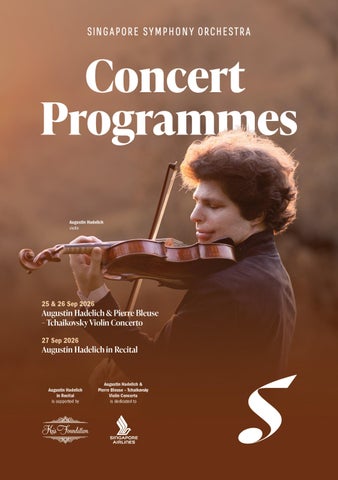
Concert Programmes Augustin Hadelich violin
25 & 26 Sep 2026
Augustin Hadelich & Pierre Bleuse – Tchaikovsky Violin Concerto 27 Sep 2026
Augustin Hadelich in Recital
Augustin Hadelich in Recital is supported by
Augustin Hadelich & Pierre Bleuse – Tchaikovsky Violin Concerto is dedicated to
A Gi Gift that Lasts Forever
Music holds a special place in our lives – whether through memories of making music or enjoying concerts with loved ones. Share the joy of music with future generations by pledging a legacy gift to the Singapore Symphony. Your gift will continue to impact the causes closest to your heart and honour your vision beyond your lifetime.
Learn More Scan the QR code or write to sarah.wee@sso.org.sg for more information.
Sep
2026 Hadelich & Pierre Bleuse 10 Augustin – Tchaikovsky Violin Concerto Fri & Sat, 25 & 26 Sep 2026 Esplanade Concert Hall
18 Augustin Hadelich in Recital Sun, 27 Sep 2026 Victoria Concert Hall
For the enjoyment of all patrons during the concert: Please switch off or silence all electronic devices.
No photography, video or audio recording is allowed when artists are performing.
Please minimise noises during performance. If unavoidable, wait for a loud section in the music.
Non-flash photography is allowed only during bows and applause when no performance is taking place.
Go green. Digital programme books are available on www.sso.org.sg. Photographs and videos will be taken at these events, in which you may appear. These may be published on the SSO’s publicity channels and materials. By attending the event, you consent to the use of these photographs and videos for the foregoing purposes.
Cover photo: Augustin Hadelich © Suxiao Yang
1
© JACK YAM
Singapore Symphony Orchestra 2
Since its founding in 1979, the Singapore Symphony Orchestra (SSO) has been Singapore’s flagship orchestra, touching lives through classical music and providing the heartbeat of the cultural scene with its calendar of events. In addition to its subscription series concerts, the orchestra is well-loved for its outdoor and community appearances, and its significant role educating the young people of Singapore through its school programmes. The SSO has also earned an international reputation for its orchestral virtuosity, having garnered sterling reviews for its overseas tours and many successful recordings. In 2021, the SSO clinched third place in the prestigious Orchestra of the Year Award by Gramophone. In 2022, BBC Music Magazine named the SSO as one of the 23 best orchestras in the world. The SSO is led by Finnish conductor Hannu Lintu, the fourth Music Director in the orchestra’s history after Choo Hoey (1979–1996), Lan Shui (1997–2019) and Hans Graf (2020–2026). The orchestra performs over 60 concerts a year, and its versatile repertoire spans all-time favourites and orchestral masterpieces to exciting cutting-edge premieres. Bridging the musical traditions of East and West, Singaporean and Asian musicians and composers are regularly showcased in the concert season. The SSO makes its performing home at the 1,800-seat state-ofthe-art Esplanade Concert Hall. More intimate works, as well as community performances take place at the 673-seat Victoria Concert Hall, the Home of the SSO. Beyond Singapore, the SSO has performed in Europe, Asia, Australia and the United States. In the 2024/25 season, the SSO performed to full houses at Asia Orchestra Week in Kyoto, Japan, and made its “dazzling – and true-blue – Down Under debut” (Limelight) in Sydney, Melbourne and Brisbane. In May 2016, the SSO was invited
to perform at the Dresden Music Festival and the Prague Spring International Music Festival. This successful five-city tour of Germany and Prague also included the SSO’s second performance at the Berlin Philharmonie. In 2014, the SSO’s debut at the 120th BBC Proms in London received praise in major UK newspapers The Guardian and The Telegraph. The SSO has also performed in China on multiple occasions. The SSO has released more than 50 recordings, with over 30 on the BIS label. Recent critically acclaimed albums include A Hero’s Life (OUR Recordings), Symbiosis – Tribute to Bill Evans (Pentatone) and a complete Mozart Violin Concerto cycle with Singaporean violinist Chloe Chua conducted by Hans Graf (Pentatone). The SSO also leads the revival and recording of significant works such as Kozłowski’s Requiem and violin concertos by Robert Russell Bennett and Vernon Duke. The SSO has collaborated with such great artists as Vladimir Ashkenazy, Gustavo Dudamel, Charles Dutoit, Joe Hisaishi, Neeme Järvi, Lorin Maazel, Martha Argerich, Diana Damrau, Janine Jansen, Leonidas Kavakos, Lang Lang, Yo-Yo Ma, Mischa Maisky, Gil Shaham, Daniil Trifonov and Krystian Zimerman. The SSO is part of the Singapore Symphony Group, which also manages the Singapore Symphony Choruses, the Singapore National Youth Orchestra, the Singapore International Piano Festival and the biennial National Piano & Violin Competition. The Group’s vision is to be a leading arts organisation that engages, inspires and reflects Singapore through musical excellence. Our mission is to create memorable shared experiences with music. Through the SSO and its affiliated performing groups, we spread the love for music, nurture talent and enrich our diverse communities.
3
The Orchestra Hannu Lintu
Quantedge Music Director
Nathanaël Iselin Associate Conductor
Lan Shui
Conductor Laureate
Hans Graf
Conductor Laureate
Eudenice Palaruan Choral Director
Wong Lai Foon Choirmaster
Ellissa Sayampanathan Assistant Choral Conductor
First Violin
Andrew Beer1 Concertmaster, GK Goh Chair Chan Yoong-Han2 Acting Associate Concertmaster Cao Can* Duan Yu Ling Foo Say Ming Jin Li Kong Xianlong Cindy Lee Renyu Martin Peh Karen Tan William Tan Wei Zhe Ye Lin* Zhang Si Jing 4
Second Violin
Markus Gundermann Co-Principal (Guest) Qing Li Co-Principal (Guest) Sayuri Kuru Associate Principal Bobur Eshpulatov Nikolai Koval* Hai-Won Kwok Margit Saur Shao Tao Tao Reina Teo Wu Man Yun* Xu Jueyi* Yin Shu Zhan* Zhao Tian
Viola
Manchin Zhang Principal, Tan Jiew Cheng Chair Guan Qi Associate Principal Gu Bing Jie* Assistant Principal Chen Li Marietta Ku Luo Biao Julia Park Shui Bing Janice Tsai Dandan Wang Yang Shi Li
Cello
Ng Pei-Sian Principal, The HEAD Foundation Chair Yu Jing Associate Principal Guo Hao Assistant Principal Chan Wei Shing Christopher Mui Jamshid Saydikarimov Song Woon Teng Wang Yan Wu Dai Dai Zhao Yu Er
Double Bass
Joan Perarnau Garriga Principal (Visiting) Yang Zheng Yi Associate Principal Karen Yeo Assistant Principal Po-Yu Fang Victor Lee Jacek Mirucki Wang Xu
Flute
Jin Ta Principal, Stephen Riady Chair Evgueni Brokmiller Associate Principal Roberto Alvarez Miao Shanshan
Piccolo
Roberto Alvarez Assistant Principal
Oboe
Rachel Walker Principal Simon Emes^ Acting Principal Pan Yun Associate Principal Carolyn Hollier Elaine Yeo
Cor Anglais
Elaine Yeo Associate Principal
Clarinet
Chiang Yung-Yuan Principal Li Xin Associate Principal Liu Yoko Tang Xiao Ping
Bass Clarinet
Tang Xiao Ping Assistant Principal
Bassoon
Horn
Austin Larson Principal Marc-Antoine Robillard Associate Principal Thossaporn Sombat^ Associate Principal Bryan Chong Gao Jian Hoang Van Hoc
Trumpet
Jon Paul Dante Principal David Smith Associate Principal Lau Wen Rong Nuttakamon Supattranont
Trombone
Allen Meek Principal Damian Patti Associate Principal Samuel Armstrong
Bass Trombone
Wang Wei Assistant Principal
Tuba
Tomoki Natsume Principal
Timpani
Christian Schiøler Principal Mario Choo
Percussion
Guo Siping Principal Liu Chang Associate Principal Christoph Wichert Zhao Ying Xue
Jonathan Fox Principal Mark Suter Associate Principal Mario Choo
Contrabassoon
Harp
Zhao Ying Xue Assistant Principal
Gulnara Mashurova Principal
* With deep appreciation to the Rin Collection for their generous loan of string instruments. ^ Musician on annual contract. 1
2
Andrew Beer performs on a J.B. Guadagnini of Milan, c. 1750, donated by the National Arts Council, Singapore, with the support of Far East Organization and Lee Foundation. Chan Yoong-Han performs on a David Tecchler, Fecit Roma An. D. 1700, courtesy of Mr G K Goh. Musicians listed alphabetically by family name rotate their seats on a per programme basis. Details correct at the time of printing and subject to change. 5
Guest Musicians Augustin Hadelich & Pierre Bleuse – Tchaikovsky Violin Concerto 25 & 26 Sep 2026 First Violin Chen Da Wei Seow Jin Chong
Second Violin Jeongyeon Im Guest Principal Liu-Yi Retallick Guest Associate Principal Lee Shi Mei Yvonne Lee Yew Shan
Viola Yeo Jan Wea
Double Bass Guennadi Mouzyka
Oboe Peter Facer Guest Principal
Percussion Cheong Kah Yiong Lim Meng Keh Sng Yiang Shan Tan Pei Jie
Harp Nigel Foo
Piano Nicholas Loh
Celesta Beatrice Lin
6
Augustin Hadelich & Pierre Bleuse – Tchaikovsky Violin Concerto | 25 & 26 Sep 2026
Music Director of the prestigious Ensemble intercontemporain and the Odense Symphony Orchestra, where he has held the position since 2021, Pierre Bleuse also serves as Artistic Director of the Pablo Casals Festival in Prades.
Pierre Bleuse conductor
Pierre Bleuse opened his 2025/26 season with the Ensemble intercontemporain at the prestigious BBC Proms in the summer of 2025, followed by the Ravel Festival in Saint-Jean-deLuz and the season opening at the Philharmonie de Paris. This season also marks his debuts with several leading orchestras, including the Swedish Radio Symphony, the Finnish Radio Symphony, Hamburg’s NDR Elbphilharmonie Orchester, Stuttgart’s SWR Symphonieorchester alongside his long-time collaborator Sol Gabetta, and the Auckland Philharmonia in New Zealand. He will also return to the São Paulo Symphony Orchestra for two subscription weeks, and returns to the City of Birmingham Symphony Orchestra, Singapore Symphony, and Amsterdam’s legendary Concertgebouw for his debut with the Netherlands Philharmonic Orchestra. A key figure in contemporary creation, he conducted Hèctor Parra’s opera Orgia at Barcelona’s Gran Teatre del Liceu in 2024, followed by the Ensemble intercontemporain at Festival d’Aix-en-Provence. In 2025, Bleuse launched the centenary celebrations of Pierre Boulez at the Philharmonie de Paris with a landmark performance of his masterpiece, Répons.
© JULIA SEVERINSEN
A highly sought-after French conductor, Bleuse collaborates regularly with major international ensembles. He also works regularly with leading international soloists including Joyce DiDonato, Karita Mattila, Patricia Kopatchinskaja, Pierre-Laurent Aimard, Sol Gabetta, Bertrand Chamayou, Emmanuel Pahud, and Renaud and Gautier Capuçon. Pierre Bleuse studied conducting with Jorma Panula in Finland and Laurent Gay at the Haute École de Musique in Geneva.
8
Augustin Hadelich & Pierre Bleuse – Tchaikovsky Violin Concerto, 25 & 26 Sep 2026 | Augustin Hadelich in Recital, 27 Sep 2026
Augustin Hadelich is recognised as one of the foremost violinists of our time. Renowned for his ravishing tone, dazzling technique and deeply compelling interpretations, he captivates audiences and critics alike. He tours extensively across the globe and is a frequent guest with major orchestras, prestigious concert series and international festivals. In summer 2026, Hadelich appears at some of North America’s most prominent festivals, including Tanglewood, Aspen, the Ravinia Festival, Bravo! Vail and the Hollywood Bowl in Los Angeles. He then takes centre stage as “artiste étoile” of the Lucerne Festival, with a residency spanning several concerts in different formats. A tour with the Berlin Philharmonic under Kirill Petrenko takes him to Lucerne, Edinburgh and the BBC Proms in London, followed by a European tour with the Pittsburgh Symphony Orchestra under Manfred Honeck.
Augustin Hadelich
violin
Since February 2026, Augustin Hadelich has been Artistic Partner of the Mahler Chamber Orchestra. In January 2027, at the Salzburg Mozart Week, he and the orchestra will embark on a multi-year cycle of Mozart’s violin concertos, comprising both concerts and live recordings. In June 2027, Hadelich will also appear with the Berlin Philharmonic under Daniel Harding at the Berlin Waldbühne.
© SUXIAO YANG
Augustin Hadelich, now a dual American-German citizen, was born in Italy to German parents. He studied with Joel Smirnoff at the Juilliard School in New York, and won the International Violin Competition of Indianapolis in 2006. He has been a member of the faculty at the Yale School of Music since 2021. He plays the 1744 Guarneri del Gesù “Leduc, ex Szeryng”, on loan from the Tarisio Trust.
9
Fri & Sat, 25 & 26 Sep 2026 Esplanade Concert Hall
Augustin Hadelich & Pierre Bleuse – Tchaikovsky Violin Concerto Singapore Symphony Orchestra Pierre Bleuse conductor Augustin Hadelich violin* Andrew Beer concertmaster
SSO COMMISSION
WORLD PREMIERE
Zechariah Goh Dream(e)scapes With support from Kae Fujii & Laurent Proutiere
12 mins Check-in to tonight’s concert Scan this QR code with the Singapore Symphony Mobile App.
Tchaikovsky Violin Concerto in D major, Op. 35* 33 mins
Intermission 20 mins
Bartók The Miraculous Mandarin – Suite 20 mins
Ravel Daphnis et Chloé – Suite No. 2 18 mins Concert Duration: approximately 2 hrs (including 20 mins intermission) Dedicated to
Post-concert Survey (26 Sep only) To help us improve your concert experience, we invite you to participate in our survey. After the concert, be the first 120 to show proof of survey completion at the foyer, level 1, to receive a gift. 10
Augustin Hadelich & Pierre Bleuse – Tchaikovsky Violin Concerto | 25 & 26 Sep 2026
SSO COMMISSION
WORLD PREMIERE
Zechariah Goh b. 1970
Dream(e)scapes (2026) With support from Kae Fujii & Laurent Proutiere
Dream(e)scapes is made up of three ideas: “Dream,” “Dreamscapes,” and “Escapes.” The fictional story centres on an old Peranakan lady who dreams of the mansion where she grew up in the early 1930s. In her dream, she recalls many childhood memories surrounded by folk songs. Dondang Sayang (a Peranakan love ballad), along with other famous folk songs such as Rasa Sayang, Katak Lompat, and Air Pasang Pagi (set in the style of a Peranakan joget), are featured in this work. The second part of Dream(e)scapes is entitled If Trains Could Fly. Locomotives from the late nineteenth and early twentieth centuries were introduced to Southeast Asia, and these fastmoving machines cut through the forests, frightening birds and wildlife. In this dream, however, the trains begin to float, leaving the railway tracks and taking to the sky. They fly high above the forest canopy and ascend beyond the clouds.
Instrumentation 3 flutes (1 doubling on piccolo), 2 oboes, cor anglais, 2 clarinets, bass clarinet, 2 bassoons, contrabassoon, 4 horns, 3 trumpets, 3 trombones, tuba, timpani, percussion (chimes, suspended cymbal, tam-tam, side drum, bass drum, train-bell, marimba, tambourine, vibraphone), harp, piano/celesta, strings
Notes by the composer, Zechariah Goh.
11
Augustin Hadelich & Pierre Bleuse – Tchaikovsky Violin Concerto | 25 & 26 Sep 2026
Zechariah Goh composer Zechariah Goh Toh Chai is a distinguished Singaporean composer, conductor, educator, and arts leader whose distinctive voice fuses Southeast Asian and Chinese musical elements with Western traditions across choral, orchestral, wind ensemble, chamber, and piano repertoire. A NAFA alumnus (Diploma in Music, 1989), he earned his Master of Music in Piano Performance and Doctor of Musical Arts in Composition from the University of Kansas, where he received the David and Gunda Hiebert Scholarship and Anthony Cius Prize for outstanding student composer (2000–2002). Since joining NAFA’s faculty in 2002 as Head of Composition and Principal Lecturer, he has shaped generations of musicians while serving as Vice Chairman of COMPASS and Artistic Director of the Singapore Saxophone Symposium (2011–present). His landmark commissions include Blossoms for Large Orchestra (Singapore Symphony Orchestra, 2017), Songs of the Dragon Kiln (Ding Yi Music Company, 2017), 心映松柏 / Heart of Pines (ONE Chamber Choir, SG50, 2015), 鱼之乐 / Happiness of Fish (SYC Ensemble Singers, 2012), and recent works like Tea / 茶 (Taichung Chamber Choir, 2024). The SSO has commissioned him repeatedly (2017, 2020, 2023, 2026) and appointed him mentor for its 2024 young composers’ workshop. Recipient of the National Arts Council Young Artist Award (2003), COMPASS Artistic Excellence Award (2013), and 28th COMPASS Top Local Classical Music Award (2025), Goh is an internationally recognized adjudicator for events like the Tokyo International Choral Composition Competition and Bali International Choral Competition. Through mentorship programmes and workshops across Asia-Pacific, he continues elevating Singapore’s music ecosystem.
12
Augustin Hadelich & Pierre Bleuse – Tchaikovsky Violin Concerto | 25 & 26 Sep 2026
Pyotr Ilyich Tchaikovsky 1840 – 1893
Violin Concerto in D major, Op. 35 (1878) Allegro moderato Canzonetta: Andante III Finale: Allegro vivacissimo I
II
The path to the premiere of Tchaikovsky’s Violin Concerto was fraught with problems: the famous violinist Leopold Auer, the concerto’s initial dedicatee, had cast it aside, deeming it almost impossible to play. Tchaikovsky had then asked his friend the Russian violinist Iosif Kotek to premiere the work, but with Kotek also reluctant to learn it, the dedication eventually went to virtuoso violinist Adolf Brodsky, who managed to persuade Hans Richter and the Vienna Philharmonic to give the concerto its first performance on 4 December 1881, three years after it was written.
Tchaikovsky (right) with violinist Iosif Kotek in 1877
Brodsky practiced hard, but the orchestra was under-rehearsed and thus played the score pianissimo out of uncertainty. While there were mixed reactions to the work at the premiere, most damning of all was none other than Eduard Hanslick’s review in Vienna’s Neue freie Presse, which affected Tchaikovsky so much that he was said to be able to recite the review in the original German until his dying day. Hanslick remarked that the concerto “moves soberly, musically, and not without spirit. But soon vulgarity gains the upper hand and asserts itself to the end of the first movement. The violin is no longer played; it is pulled, torn, drubbed. The Adagio is again on its best behaviour, to pacify and to win us over. But it soon breaks off to make way for a finale that transfers us to a brutal and wretched jollity of a Russian holiday. We see plainly the savage, vulgar faces, we hear curses, we smell vodka… Tchaikovsky’s Violin Concerto gives us for the first time the hideous notion that there can be music that stinks to the ear.” Hanslick’s very remarks, especially those berating the ‘Russianness’ of the concerto, were exactly what made it so popular later on. The sweet opening theme by the violins, much like the brusque horn call opening in his Piano Concerto No. 1, is never heard again after the first few bars. The orchestra builds up the anticipation and, after a few brief flourishes, the soloist enters with a tentative, gentle and almost wistful main theme, supported by simple accompaniment in the strings. It is repeated, elaborated, and later on transformed, as if like music for a grand Russian ball, with many opportunities for pyrotechnics 13
Augustin Hadelich & Pierre Bleuse – Tchaikovsky Violin Concerto | 25 & 26 Sep 2026
involving fast running passages, huge leaps and multiple stops. In between, the second theme, on the warm and lower registers of the violin, retains its wistful nature. The cadenza beautifully links to the recapitulation, with the flute singing the main theme while the violin embellishes with trills above. The violin then takes over after a while, and pulls the whole orchestra to an exhilarating coda. The Canzonetta (“little song”) is a simple, rustic tune which provides a brief moment of peace between the two exuberant outer movements. Here Tchaikovsky blends the timbres of the woodwinds into a chorale while the violin floats above in a soulful melody. Without a break, this bursts into the lively finale. As if long-tethered and finally released to fly, the solo violin propels forward with a dizzying display of agility and speed. A slower, nostalgic peasant dance is included, but that, too, is soon overtaken, and the movement accelerates to a breathless finish.
Instrumentation solo violin, 2 flutes, 2 oboes, 2 clarinets, 2 bassoons, 4 horns, 2 trumpets, timpani, strings World Premiere 4 Dec 1881, Vienna First performed by SSO 23 May 1980 (Igor Politovsky, violin)
Notes by Natalie Ng | Natalie Ng is a music history geek who plays music, dances to music, and tells stories about composers and their music in her writing. 14
Augustin Hadelich & Pierre Bleuse – Tchaikovsky Violin Concerto | 25 & 26 Sep 2026
Béla Bartók 1881 – 1945
The Miraculous Mandarin – Suite (1927) The Miraculous Mandarin draws upon Menyhért Lengyel’s eponymous story, with the Naturalist school’s frank depiction of sex, lust and violence. Lengyel’s sordid pantomime bore the immediacy of a contemporary silent film; he was also a film scriptwriter who later worked in Hollywood. The Cologne Opera premiere on 27 November 1926 sparked the audience’s moral outrage with catcalls, stamping and booing, and church officials made such strong objections that Cologne’s mayor banned the work. To give it a chance at further performances, Bartók rearranged two-thirds of the music into a concert suite. The devilish Mandarin music echoes Stravinsky’s Le sacre du printemps (“The Rite of Spring”), with one evoking a primitive world and the other contemporary civilisation. Yet, perhaps, the distance between these two worlds is not so great after all. Its grinding dissonance and relentless energy are among Bartók’s most extreme, reflecting the turmoil of a disintegrating Hungary. Propulsive rhythms and swirling strings evoke traffic rushing through a crowded city. The curtain rises on a shabby apartment occupied by three thugs and a girl, whom the thugs force to stand at the window and dance to lure clients. The thugs are personified by a six-quaver motif. Three seduction sequences follow, each beginning with solo clarinet, then unfolding over strings, piano and horns. A shabby old man, represented by trombone glissandi, is swiftly rejected for being penniless. A shy young student, introduced by oboe and cor anglais, becomes more involved with the girl through a slow dance, but is likewise penniless and shown the door. Then comes the wealthy Mandarin, his ‘exotic’ appearance evoked by a simple pentatonic theme, then trombone glissandi and tuba
above a tremolo. Their encounter becomes an increasingly urgent waltz as his interest grows and her revulsion dissolves. The music erupts into a frantic chase (fugato in strings, then woodwind and brass), then the thugs pounce. Here the suite ends abruptly, omitting the disturbing finale of the pantomime: the Mandarin survives strangling, stabbing and hanging, finally dying only when the girl reciprocates his embrace. Bartók and Lengyel found beauty and humanity in this tale of crime, violence, and the exploitative conditions of the modern metropolis. As Lengyel wrote, its “true message […] is not the excessive eroticism but the apotheosis of pure, almost unearthly desire and love.”
Instrumentation 3 flutes (2 doubling on piccolos), 3 oboes (1 doubling on cor anglais), 3 clarinets (1 doubling on E-flat clarinet, 1 doubling on bass clarinet), 3 bassoons (1 doubling on contrabassoon), 4 horns, 3 trumpets, 3 trombones, tuba, timpani, percussion (triangle, cymbals, suspended cymbal, tam-tam, snare drum, tenor drum, bass drum, xylophone), harp, piano, celesta, strings World Premiere (Suite) 15 Oct 1928, Budapest First performed by SSO 22 Sep 1989
15
Augustin Hadelich & Pierre Bleuse – Tchaikovsky Violin Concerto | 25 & 26 Sep 2026
Maurice Ravel 1875 – 1937
Daphnis et Chloé – Suite No. 2 (1912) Lever du jour Pantomime III Danse générale I
II
In 1909, the Ballets Russes arrived in Paris. Among its ambitious projects was Daphnis et Chloé, conceived by choreographer Michel Fokine from the pastoral tale by the Greek writer Longus. The legend tells of the abduction of the shepherdess Chloé by pirates and her eventual rescue by her lover Daphnis. Diaghilev commissioned Ravel to compose the score, but Ravel and Fokine faced creative differences over representations of classical antiquity. Ravel envisioned “a vast musical fresco in which I was anxious less about archaicism than fidelity to the Greece of my dreams, which is that which the French artists at the end of the eighteenth century imagined and painted.” Lever du jour (“Daybreak”) opens with the enchanting shimmer of a forest brook. Woodwind figures ripple beneath delicate harp glissandos and melodic gestures unfold in the low strings. The piccolo and violin suggest birdsong, while the flute evokes the pastoral. Ravel’s use of harmonics and the pentatonic scale lends these familiar images an otherworldly quality. As Daphnis searches for Chloé, the music gathers momentum and intensity, before expanding into a radiant climax. Moved by their plight, Pan recalls his own unfulfilled love for the nymph Syrinx, whom he once pursued until she escaped by transforming herself into reeds. From these reeds, Pan fashioned his flute. His sympathy leads him to intervene and reunite Daphnis and Chloé. Over the languorous flute solo of the central Pantomime, the lovers mime the story of Pan and Syrinx, while the myth mirrors their own awakening desire. The Danse générale erupts into
a frenzied mass exultation of Daphnis and Chloé’s reunion. Set in an irregular 5/4 metre, its whirling rhythms and repeated figures drive the music forward with an almost ritualistic energy. Initial reception was lukewarm: Ravel’s unconventional rhythms challenged the dancers, while Fokine, given little time to rehearse, was forced to improvise. Yet Stravinsky called it “not only one of Ravel’s best works but also one of the finest works of French music.” In time, Stravinsky’s judgement proved right: new choreographers created ballets to the score, while Ravel’s two orchestral suites entered the concert repertoire. Its expansive, symphonic conception helped redefine the possibilities of ballet music.
Instrumentation 2 flutes (1 doubling on 2nd piccolo), piccolo, alto flute, 2 oboes, cor anglais, 2 clarinets, E-flat clarinet, bass clarinet, 3 bassoons, contrabassoon, 4 horns, 4 trumpets, 3 trombones, tuba, timpani, percussion (triangle, cymbals, suspended cymbal, snare drum, field drum, bass drum, castanets, glockenspiel, tambourine), 2 harps, celesta, strings World Premiere (Ballet) 8 Jun 1912, Paris First performed by SSO 2 Sep 1988
Notes (BartÓk, Ravel) by See Ning Hui | See Ning Hui is a pianist, researcher, and lecturer passionate about integrating music by lesser-known composers. www.ninghuisee.com 16
Sun, 27 Sep 2026 Victoria Concert Hall
Augustin Hadelich in Recital Augustin Hadelich violin
Telemann Fantasia No. 8 in E major 5 mins
Check-in to tonight’s concert Scan this QR code with the Singapore Symphony Mobile App.
Coleridge-Taylor Perkinson Louisiana Blues Strut: A Cakewalk 3 mins
Coleridge-Taylor Perkinson Blue/s Forms 8 mins
Ysaÿe Sonata No. 5 in G major, from Op. 27 10 mins
Mark O’Connor Menuhin Caprice 6 mins
Paganini Caprices Nos. 19 and 16 5 mins
Intermission 20 mins
J.S. Bach Supported by
Partita No. 2 in D minor, BWV 1004 28 mins Concert Duration: approximately 1 hr 35 mins (including 20 mins intermission)
18
Augustin Hadelich in Recital | 27 Sep 2026
Georg Philipp Telemann 1681 – 1767
Fantasia No. 8 in E major (1735) Piacevolmente Spirituoso III Allegro I
II
German composer Georg Philipp Telemann is not nearly as well known today and his music is not played anywhere as much as those of Bach, Vivaldi, or Handel, in his own time he was a superstar, and was Leipzig’s first choice for the post of Thomaskantor in 1722—it was his refusal that led the city to settle for Bach (their third choice). Telemann was perhaps the ultimate self-taught multi-instrumentalist of the Baroque era, playing the flute, recorder, violin, viola da gamba, oboe, trombone, double bass, as well as the harpsichord and organ. By far the most prolific composer of his age, with over 3,000 compositions (unfortunately half of which have been lost), most of which have neither been performed nor recorded in the present day, his music spanned the late Baroque and early Classical styles, in that in-between style called the Galant.
Telemann c. 1745, engraving by Georg Lichtensteger
His 12 Fantasias for Solo Violin were published in Hamburg in 1735, while he was Kantor of the Johanneum and Kapellmeister of the five largest churches of the city, but considered lost until a single surviving print was discovered in 2015 in the hands of a private collector. The collection is a masterful blend of the Italian style displaying lyrical melody and the German style emphasizing polyphony. Fantasia No. 8 in E major, TWV 40:21 begins Piacevolmente (pleasantly), at first tentatively, like an improvised prelude, developing restfully. Our spirits are aroused in the Spirituoso (spirited), a spinning melody that nevertheless allows us brief moments to catch our breath before the flight continues. The Allegro continues on a spiralling journey, but the work is over before we know it, leaving us wanting more.
19
Augustin Hadelich in Recital | 27 Sep 2026
Coleridge-Taylor Perkinson 1932 – 2004
Louisiana Blues Strut: A Cakewalk (2001) The American composer Coleridge-Taylor Perkinson was difficult to pigeonhole—his output and interests spanned the genres of classical, jazz, pop, film, television, and dance music. Trained in America and Europe, he was in great demand through the 1960s and 1970s, even writing music for Marvin Gaye and Harry Belafonte. His style was Classical counterpoint but incorporating influences from the world of blues, jazz, spirituals, and black folk music of the milieu in which he lived. Louisiana Blues Strut: A Cakewalk exemplifies his output: a piece for solo violin, on a passacaglia-like repeated harmonic structure, but in the blues scale, and with distinctly American syncopations. A cakewalk was a 19th century processional partner dance from the Southern United States, usually danced as part of a contest at social get-togethers of black slaves on plantations, and a cake was awarded as the prize to the winners, whence the name ‘cakewalk’. Usually danced with humour and mock-formality, the cakewalk took the European couples dance as a starting point, but incorporated twists, shuffling movements, leaps, and kicks from traditional African dance forms, eventually being the inspiration for ragtime music. Louisiana Blues Strut: A Cakewalk was originally composed to be the final movement of Blue/s Forms in 1972, but Perkinson felt it deserved to stand alone, and he eventually published it as an independent work in 2001.
20
Blue/s Forms (1972) I II III
Plain Blue/s Just Blue/s Jettin’ Blue/s
Published in 1972, Blue/s Forms is based on traditional Blues schemes and in the key of G, the lowest open string of the violin, to exploit its resonance fully. Perkinson’s movements inhabit the ambiguous space created by the ‘blue notes’, the lowered third and seventh degrees of the scale, a space that feels neither quite major nor minor and which can be unsettling for ears accustomed to modes being either major or minor. Dvořák and Gershwin used New World elements heavily to colour and spice up their essentially Western Classical tradition music, but Perkinson’s music is in many ways a reverse of that, using vintage jazz and blues as a starting point and injecting large doses of Classical forms. Essentially a relaxed reflection, Blue/s Form has a feel of an expert fiddler extemporising, akin to what Middle-Eastern music calls a taqsim, where snatches of melodies alternate with dancelike passages and flowing scales, to create a miniature collage of black music.
Augustin Hadelich in Recital | 27 Sep 2026
Eugène Ysaÿe 1858 – 1931
Sonata No. 5 in G major, from Op. 27 (1923) I II
L’Aurore Danse rustique and eventually studying under Wieniawski and Vieuxtemps in Paris. He held a professorship at the Brussels Conservatoire for over a decade, and the list of his pupils reads like a who’s-who of the Franco-Belgian violin school. During his life, which included a four-year stint with the Cincinnati Symphony Orchestra, he had works dedicated to him by Saint-Saëns, Debussy, Frank, and Chausson. Later in life, physical ailments made playing extremely difficult for him, and he focused more on conducting, teaching, and composing. It was during this time, in July 1923, that he composed the Six Sonatas for Violin Solo, Op. 27, with each sonata dedicated to a different violinist. Sonata No. 5 in G major was dedicated to his compatriot and principal disciple, the Belgian violinist Mathieu Crickboom, who had played second violin in the Ysaÿe Quartet next to the composer himself, and had held professorships at both the Liège and Brussels conservatoires.
Eugène Ysaÿe in Russia, 1883
Despite dying in 1931, the music of Belgian violinist and composer Eugène Ysaÿe, often has a distinctly modern feel about it. While firmly rooted in the warm expressiveness of the late Romantic period, his willingness to explore chromaticism and tonality, as well as his almost whimsical ignoring of accepted forms and structures, make his compositions distinct from those of his contemporaries. The young Ysaÿe began violin lessons at the age of five under his father, before enrolling at the Royal Conservatory of Liège,
The first of the two movements is titled L’Aurore (The Dawn), and begins with long drone-like passages reminiscent of folk fiddle music, evoking a gentle lazy morning, before dissonant strummed chords interrupt us, rather like rays of sunlight piercing our sleepy eyes. Ysaÿe paints a picture of warmth and remarkable space, leading into dazzlingly brilliant arpeggios—the sun is definitely up! Danse rustique continues the folksy fiddling in a merry stamping romp, but with a languidly lyrical middle section in which we sit under a tree taking a breather from the dancing, before rejoining the frenzied celebration.
21
Augustin Hadelich in Recital | 27 Sep 2026
Mark O'Connor b. 1961
Menuhin Caprice (2020) Mark O’Connor is an American fiddle player, guitarist, and mandolin player whose music combines bluegrass, country, jazz, and classical styles. A student of American fiddler Benny Thomasson and iconic French jazz violinist Stéphane Grappelli, O’Connor has won three Grammys and seven CMA awards, recorded with Yo-Yo Ma, and his Fiddle Concerto has become the most-performed violin concerto composed in the last 50 years. The Menuhin Caprice was a 2020 commission for the Menuhin Competition held in Richmond, Virginia, in 2021, and is intended to reflect the musical culture of that US state.
Niccolò Paganini 1782 – 1840
Caprices Nos. 19 and 16 (1817) I II
Caprice No. 19 in E-flat major Caprice No. 16 in G minor
The virtuoso violinist and composer Niccolò Paganini needs no introduction to lovers of violin music, and his flashy, often fiendishly difficult compositions have become synonymous with showing off. His 24 Caprices, Op. 1, published in 1820 by Ricordi, were written in batches between 1802 and 1817 and, despite their brevity, are notable for the technical demands placed on the player. No. 19 in E-flat major begins like a Rossini opera aria, with a clear lyrical melody and accompaniment, then a frenzied middle section entirely played on the G string, before we return to the opera stage. No. 16 in G minor is even shorter, but the endless stream of semiquavers makes for a breathtaking ride, and challenges the player’s musicality in shaping them to make a coherent whole. 22
O’Connor has stated that the caprices of Paganini and Locatelli were his inspiration, but has firmly set his Menuhin Caprice in a Virginia hoedown, that is to say, an informal social gathering featuring traditional folk music and lively folk dancing. The music evokes a dizzying range of images, from square dances to vocal blues, competing fiddles and country barbecues, to the mirrored halls of stately homes.
Augustin Hadelich in Recital | 27 Sep 2026
Johann Sebastian Bach 1685 – 1750
Partita No. 2 in D minor, BWV 1004 (1720) Allemande Courante III Sarabande I
IV
II
V
Gigue Chaconne
In 1720, Bach published The Six Solo Works for Unaccompanied Violin, an event that made no real impact at the time. He was conductor of the court orchestra at Anhalt-Cöthen, and his patron Prince Leopold played the violin. If they were composed for him to play, the young prince must have been a very accomplished musician indeed.
Dance notation of a chaconne, in Kellom Tomlinson’s The Art of Dancing Explained (1735)
The Partita No. 2 in D minor, BWV 1004, is a typical set of dances of diverse origins, and begins with the usual leisurely Allemande, a German dance in 4/4 time, followed by a Courante, a relatively quick Italian folk dance in triple time. Next comes the airy and meditative Sarabande, a slow triple time French dance of Central American origin, then the Gigue, a fast triple-time English dance. While remarkable on their own, all these movements are but a prelude to the final Chaconne, a set of dance variations based on a four-bar harmonic progression. Originally the xacona, a suggestive and fast Latin American dance of African slaves, it tamed and
slowed as it reached Europe, becoming the Italian ciacona, still considered vulgar and inappropriate and hence all the more desirable to the fashionable younger crowd. Then it reached France and became the respectable chaconne, a favourite slow dance of high society. Bach’s Chaconne is a set of over 60 variations of increasing complexity like an arabesque, going through 33 minor-mode statements, 19 major-mode statements, and finally 12 minormode statements, giving an infinite variation of feeling over the unvaried harmonic ground. Pushing the violin to its limits, Bach makes use of implied polyphony to give the impression of multiple independent voices, far more in this movement than in the rest of his solo violin works. Why did Bach give so much attention and effort to this particular movement, which is longer than the rest of the Partita added together? Analysis has revealed motifs embedded throughout the various variations – dozens of tunes from hymns and sacred works meditating on death, such as the Easter hymn ‘Christ Lag in Todesbanden’ (“Christ Lay in the Bonds of Death”), ‘Den Tod niemand zwingen kunnt’ (“The Death none could subdue”), ‘Jesu meine Freunde’ (“Jesus, my joy”), and ‘Auf meinen lieben Gott’ (“In my dear God I trust”). A musical meditation on death, but whose? The most likely candidate is Bach’s first wife, Maria Barbara, mother of his first seven children, who died suddenly while Bach was away. He returned to find her not only dead, but 23
Augustin Hadelich in Recital | 27 Sep 2026
buried a week before his return. She had been in perfect health when he left. The Six Solo Works for Unaccompanied Violin, of which the Chaconne was part, appeared later that year in 1720. The Chaconne stands revealed as a tombeau, a musical tombstone. In this light, looking past the hardworking composer, the dutiful widower raising four small children alone, we see Bach the man, grieving privately, expressing his faith in the resurrection of the dead and life everlasting, and the relentless tortured intensity of the Chaconne makes sense.
Notes by Edward C. Yong | A writer, editor, and teacher of dead languages, Edward plays lute and early guitars, sings bass, and runs an early music group. Like his dog, he is very much food-motivated. 24
Our Heartfelt Thanks
To Our
Donors We would like to express our deepest appreciation to the following individuals and organisations who support our mission to create memorable shared experiences with music in the past year. Without your support, it would be impossible for the SSO to continue to strive for artistic excellence and touch the hearts of audiences.
Patron Sponsor
Tote Board Group (Tote Board, Singapore Pools & Singapore Turf Club)
Maestro Circle
Mr & Mrs Goh Yew Lin Stephen Riady Foundation Temasek Foundation The HEAD Foundation Anonymous
Concertmaster Circle
Bowen Enterprises Pte Ltd Dr & Mrs Antoine & Christina Firmenich Elaine and Eduardo Saverin Foundation Ltd Kris Foundation Mr Christopher & Mrs Rosy Ho Anonymous (2)
Symphony Circle
DBS Bank Ltd De Miguel Solaguren Family Andreas & Doris Sohmen-Pao Dr Thomas & Mrs Mary Zuellig Hao Glory Family Foundation Indosuez Wealth Management Madeleine Cheok & Wong Hong Ching Ms Paige Parker & Mr Jim Rogers Anonymous (2)
26
Concerto Circle
Andrew & Stephanie Vigar Andy, Raymond, Bubble & Breton Tan Cara & Tamara Chang Colin Lee Dr Geh Min Far East Organization Farhana Sharmeen Geoffrey & Ai Ai Wong Geraldine Choong & Dennis Au Mavis Lim Geck Chin Miriam & Merle Hinrich Neo Group Limited Patek Philippe Southeast Asia Paul & Lena Ng Priscylla Shaw Prof Chan Heng Chee UOB Yao Hsiao Tung Yong Ying-I Anonymous
Overture Donors
Adsec Singapore Pte Ltd Ayesha Aziz Khan Azeeza Aziz Khan Bernard Ryan & Michael Rowe Bernhard Michael Steiner BinjaiTree Blossom Hing C & L Fund Cavazos Tinajero Family Chen Xiaoyan Chloe Lee En Yi & Family Chuin Wei Yap Colin & Janet Leong Daniel Choo & Family Devika & Sanjiv Misra Dorian Goh & Rathi Ho Dr & Mrs Adrian Koh Dr & Mrs Choy Khai Meng Dr June & Peter Sheren Dr Karen Soh Dr Kevin T Yap Dr Kieron Lim Eva & Nilay Patel Frans & Marie-Pierre Mol Geraldine Lim & Lim Him Chuan Goh Swee Chen Guy Hentsch & Geoffrey Yu Hemal & Paritosh Thakore Hong Leong Foundation JCCI Singapore Foundation Jonathan Stona
Joy & Han Li Toh Julien Willeme Kae Fujii & Laurent Proutiere Kenneth Kwok Kris Foundation - Lim Kang Ning Krishnan Family Lee Hsien Loong Leong Wai Leng Liew Wei Li Lito & Kim Camacho Marina Bay Sands Matthew L & Kenneth K Mr & Mrs Choo Chiau Beng Mr Tony & Mrs Melanie Chew Pavilion Capital PCS Pte Ltd Prima Limited Prof Gralf & Silvia Sieghold Robert & Vivian Chandran Sameer Sain Shanghai Tunnel Engineering (Singapore) Pte Ltd Sing Lun Group Tan Chin Tuan Foundation Tan Meng Cheng Ivan Tiffany Lim Timothy & Selena Hia Tower Capital Asia Vanessa & Darren Iloste Wendy Yap Anonymous (7)
27
Serenade Donors
Aadarsh Baijal Adrian Chua Ang Jian Zhong Anthony & Chloe Tan from ACE Team Foundation Anthony Tay Bloomberg Singapore Pte Ltd Brown-Forman Chloé & Romain de Laubier Clarissa Chow Claudia & Henning Figge Cubeassociate Pte Ltd Dr Victor Lim D-Y Lin Embassy of France in Singapore Francoise Mei G L Wee Grace Fu Hartley & Hong Lynn Clay Isaiah & Suwei K Jesher Loi John & Eliza Bittleston John & Pauline Foo Kenneth Kan Kim Hae Hyun & Heo Soomin
Rhapsody Donors
Adeline Ang Aileen Tang Amy Lin Belinda Koh Benedict Teo Benito Ting Benjamin Ma Bettina Lieske Chan Ah Khim Charles Robertson Charmaine Lim Cheng Eng Aun Choo Lim Clara Lim-Tan Craig McTurk David Chan & Sarah Chan David Leung Dr June Goh Dr Peter Chew Evelyn Chin Faith Chia Hwang Chih Ming In memory of Timothy Kok Tse En Jazz Chong & Edmund Ng Jeanne Lee Jennifer & Alexander Chan Jennifer Lee 28
Lai Siu Chiu Lau Leok Yee Lee Yeow Wee David Lilian Loke Liwen & Steven Holmes Lorinne Kon Madeleine Lee Maisy Koh Marcelo V Achoa & Silvia Bordoni Meng Michael Brenninkmeijer Mr & Mrs Ong Kong Hong Nicole & Edoardo Prina Patricia Lim Prof Arnoud De Meyer Prof Cham Tao Soon Ruyters Audrey Suzanne Lim Tan Wan Chi Tantallon Capital Advisors Pte Ltd The Linh Tinh Family Wayne & Kim Giap Khoo Xinyi Ong Anonymous (3)
Jerry Gwee Jinny Wong Julian & Jane Tan Julian & Sandra Chang Julien Brousseau Kasch Kimmy Kimberly Kirk Tay Kok Leong Lim Kris Wiluan Lawrence & Celeste Basapa Martin Siah & Wendy Long Michael & Katherin Puhaindran Mr & Mrs Tan Soo Nan Naserah Tyebally Pierre Colignon Ren QiMei Ronald & Janet Stride Sam & Claire Loh Soh Leng Wan Tang See Chim Wang Pei Zhong Warburg Pincus Singapore Pte Ltd Winston Hauw Wong Yan Lei Grace Zheng HongBo Anonymous (12)
Prelude Donors
A T Teo A.R. Adi F & Hui Shi Ahn Sehwan Aileen Teo Akihiro Nemoto Alexey Filimonov Alvin Lim Cheng Hin Alwyn Loy Suan Mao Andre Francis Maniam Andrew & Jacqueline Tan Andrew Cheong Ang Hui Tiong Eugene Ang Quek Kaifeng Ang Seow Long April Mak Aw Jia Yu Bella Gan Brenda Ang Bryan Carmichael Casey Tan Khai Hee Cham Gee Len Chang Chee Pey Chen H W Cheng Sok Theng Chong David Chong Mi-Li Pamela Chong Sien Thye Albert Chong, Wai Ying Ruby Christopher Chen Li Hsian Chua Saw Lan Cindy Claire & Ian Jones Colin Lang Cynthia Chee D Cheong Daniel Yong DCP Deborah Chee Denis Tenchurin Denise Wong Derek Lim HK Doris Song Dr & Mrs Winson Lay Dr Anne-Marie Schleich Dr Chong Shin Min Dr Lien Boon Hua Dr Norman Lee Dr Tan Lay Kok Dr Tashiya Mirando Dr Teo Kien Boon Dr Wong Hin Yan Dr Yap Zhu Li Edith & Sean Lim
Emma Lexi Ng Ernest Khoo Esther Fang Gallery NaWei Pte Ltd Gan Chee Yen Ghislain Olagne Giles Tan Ming Yee Goh Chiu Gak Goh Jun Yi Hans Michael Brandes Heinrich Grafe Henry & Tiffany Herman Felani MY Ho Jun Yi & Family In loving memory of Jasper Irina Piano James Tan Teng Chuan JAR Wealth Management Pte Ltd Jason & Jennifer Chew Jay Ganapathy Jeanie Cheah Jean-Pierre Felenbok Jessica Tan Jiang Wenzhu Jiyeon Kang Joanne Lim Johannes Yap & Family Joseph Wolpin Joseph Yoong K Goh & Family Keith Goh Kelvin Ho Kelvin Wong Khoo Ken Hui Khor Cheng Kian Kianyew Koh Ruizhi Kyra Teo Laurent Ye Lee Sian Ching Leonard Augustine Choo Li Danqi & Liu Yi Lily Low Lim Boon Kong Andrew Lim Shue Churn Lim Yin Yin, Jaime Lim Yuin Wen Low Boon Hon Low Eng Huat Peter Maggie Dong Manski-Nankervis Jo-Anne Elizabeth Marcel Smit & Hanneke Verbeek Marian Goh Mark Cranfield 29
Mark Wang & Gloria Guo Maxim Yanchenko Michelle & Eric Anziani Michelle Loh Michelle Tan & Soo Yixin Michelle Tay Min Tan Minwei Mr & Mrs Jeremy Ee Mr & Mrs Kevin Mr & Mrs Pont Mr Gareth Tan & Dr Roweena Yip msm-productions Ng Shien Ngiam Shih Chun Nguyen Quoc Khanh & Vu Phuong Nhi Nicolas Pascale Rouveyre Nikki Padilla & Sebastian L. Sohn Nishioka Hiroyuki Nomura Singapore Limited Nurture With Love Suzuki Music School Ong Chee Siong Ong Wee Shiang Parthesh Gulawani Patricia Ho Pauline Ang Prof Goh Suat Hong Prof Gungwu Wang Robert Khan & Co Pte Ltd Ryan Tan Sangeeta Razu See Chai Geok Seo Miju & Lee Sung Uk Serene Yeo Shermin Teh Siveraman K Pillai
Stephanie Hsiao Yu Lee SY Lee Tan Kok Huan Tan Yi Bin Teo Eng Chai Terence Wu and Cheryl Lim The McCann Family Tiffany Choong & Shang Thong Kai Timothy Leong Tom Szetu Trina Liang TseTsean Tsou Lei Shirley Victor Huang Kuan Kai Victor Ow Viktor & Sonja Leendertz Virna Machado-Ashish Goyal Vivien Goh Voon S Leong Wang Lei & Gao Bo Wendy Leong Marnyi Wennie Wong Wicky Wong Wong Lai Foon Xiao Li Xu Yixin Yang Tian YC Chen Yee Deng Tan Yong Chuk Kwin Yong Ning & Candice Foo Yong Seow Kin Zhai, Yuxiang Zhihong Chen Zhu Yulin Anonymous (37)
This list reflects donations that were made from 1 Jul 2025 to 30 Jun 2026. We would like to express our sincere thanks to donors whose names were inadvertently left out at print time. The Singapore Symphony Group is a charity and a not-for-profit organisation. Singapore tax-payers may qualify for 250% tax deduction for donations made. You can support us by donating at www.sso.org.sg/donate or www.giving.sg/sso.
30
THIS AD IS USING AN AI-GENERATED BACKGROUND.
SUPPORT THE SSO
12 tickets
16 tickets
20 tickets
Gala /Christmas/Pops
–
–
2 tickets
4 tickets
6 tickets
SSO Special Gala Concerts
–
–
–
–
2 tickets
–
–
–
$2,500 - $4,999
Serenade
Rhapsody
Prelude
$25,000 - $49,999
Concerto Circle
10 tickets
$10,000 - $24,999
6 tickets
$5,000 - $9,999
Subscription /Chamber and Organ / Family /SIPF
$1,000 - $2,499
Overture
With you, we can build the future of music.
COMPLIMENTARY TICKETS1 TO THE FOLLOWING CONCERT TYPES
Alternative corporate packages are available for discussion
DONOR RECOGNITION & PUBLIC ACKNOWLEDGEMENT Concert booklets and website
Patron of the Arts Nomination
–
–
–
Donors’ Wall at Victoria Concert Hall
–
–
–
–
OTHER BENEFITS Invitation to special events
Donations of $250 and above will entitle you to priority bookings, and discounts2 on SSG Concerts. For tax residents of Singapore, donations may be entitled to a tax deduction of 2.5 times the value of your donation. Donations are non-refundable. Complimentary ticket benefits do not apply to fundraising seats, Esplanade Box seats, Premier Box seats, or to supporters who gave through a fundraising event. Discounts are not applicable for the purchase of fundraising seats, Esplanade Box seats or Premier Box seats.
1 2
Through the SSO and its affiliated performing groups, we spread the love for music, nurture talent and enrich our diverse communities. The Singapore Symphony Orchestra is a charity and not-for-profit organisation. Scan to find out more, or write to Nikki Chuang at nikki@sso.org.sg.
32
4 tickets to every concert upon request
4 tickets
4 tickets to every concert upon request
$500,000 & above
Maestro Circle
20 tickets
$100,000 & above
Concertmaster Circle
4 tickets to every concert upon request
$50,000 & above
Symphony Circle
40 tickets
How can you help? While SSO is supported partially by funding from the Singapore government, a significant part can only be unlocked as matching grants when we receive donations from the public. If you are in a position to do so, please consider making a donation to support your orchestra – Build the future by giving in the present. As a valued donor of the SSO, you will receive many benefits.
Corporate Giving
We provide our Corporate Donors with impressive entertainment and significant branding opportunities. Through our tailored packages, corporates may benefit from: • Publicity and hospitality opportunities at an SSO concert or your private event, • Acknowledgement and mentions in SSO’s key publicity channels, • National Arts Council (NAC) Patron of the Arts nominations, • Tax benefits. Packages start at $10,000 and can be tailored to your company’s branding needs.
Partnership
We partner with various corporates through tailored in-kind sponsorship and exchange of services. Current and recent partnerships include Official Hotel, Official Airline, and we offer other exciting titles. For more details, please write to Sarah Wee at sarah.wee@sso.org.sg.
Scan for more information of our alternative corporate packages
33
SPECIAL RECOGNITION
A Standing Ovation
We recognise major gifts that help sustain the future of the Singapore Symphony Group. The recognition includes naming of a position in the SSO or in our affiliated performing groups such as the Singapore National Youth Orchestra and the Singapore Symphony Choruses. For more information, please write to Chelsea Zhao at chelsea.zhao@sso.org.sg.
Quantedge Music Director In January 2025, the SSO Quantedge Music Director position was named in recognition of a major donation by an anonymous donor. The position is held SPECIAL RECOGNITION HLby Maestro Hannu Lintu.
SSO Concertmaster
GK Goh Chair Established in July 2017, the SSO Concertmaster, GK Goh Chair honours Mr Goh Geok Khim, and celebrates his enduring contribution to Singapore’s cultural landscape. We extend our gratitude to the Family and Friends of Mr Goh, and especially to Mr and Mrs Goh Yew Lin, for their generosity. The position is held by Andrew Beer.
34
SSO Principal Cello The HEAD Foundation Chair In recognition of a generous gift from The HEAD Foundation, we announced the naming of our Principal Cello, The HEAD Foundation Chair in November 2019. The position is currently held by Principal Cellist Ng Pei-Sian.
SSO Principal Flute Stephen Riady Chair In recognition of a generous gift from Dr Stephen Riady, we announced in May 2022 the naming of our Principal Flute, Stephen Riady Chair. The position is currently held by our Principal Flutist Jin Ta.
SSO Principal Viola Tan Jiew Cheng Chair In recognition of a generous gift from the Estate of Tan Jiew Cheng, we announced in February 2024 the naming of our Principal Viola, Tan Jiew Cheng Chair. The position is currently held by our Principal Violist Manchin Zhang.
35
Board of Directors & Committees Chair Goh Yew Lin
Board of Directors Chang Chee Pey Chng Kai Fong Andress Goh Kenneth Kwok Clara Lim-Tan Jesher Loi Lynette Pang Prof Qin Li-Wei Jovi Seet Farhana Sharmeen Doris Sohmen-Pao Prof Peter Tornquist Geoffrey Wong Andrew Yeo Khirn Hin
Human Resources Committee
Audit & Risk Committee
Doris Sohmen-Pao (Chair) Jesher Loi Prof Qin Li-Wei Heinrich Grafe* Carmen Wee*
Jovi Seet (Chair) Prof Peter Tornquist Andrew Yeo Khirn Hin Ryan Siek*
Finance & Investment Committee Geoffrey Wong (Chair) Andress Goh Chua Keng Hong* Alex Lee*
Executive & Nominating Committee
Community & Youth Engagement Committee Clara Lim-Tan (Chair) Chang Chee Pey Farhana Sharmeen Asst Prof Kat Agres* Cecilia Pang*
*co-opted member
Goh Yew Lin (Chair) Chng Kai Fong Lynette Pang Geoffrey Wong
Symphony Ball Committee
SSO Council Alan Chan (Chair) Odile Benjamin Prof Chan Heng Chee Prof Arnoud De Meyer Dr Geh Min Heinrich Grafe Khoo Boon Hui Liew Wei Li Lim Mei Sanjiv Misra Paige Parker Dr Stephen Riady Priscylla Shaw Prof Gralf Sieghold Prof Bernard Tan Dr Tan Chin Nam Wee Ee Cheong Yong Ying-I
36
Development Committee Prof Chan Heng Chee (Chair) Odile Benjamin Dr Geh Min Heinrich Grafe Khoo Boon Hui Lim Mei Leonard Ong Paige Parker Priscylla Shaw Dr Tan Chin Nam
Paige Parker (Chair) Celeste Basapa Geoffrey Wong Kris Tan Joy Tan Dr Karen Soh Kim Camacho Lim Kang Ning Farhana Sharmeen
SSO Musicians’ Committee Hoang Van Hoc Austin Larson Li Xin Christopher Mui David Smith Elaine Yeo Zhao Tian
Singapore Symphony Group Administration Chief Executive Officer Kenneth Kwok
Deputy CEO
Deputy CEO
Programmes & Production Kok Tse Wei
Patrons & Corporate Services Jenny Ang
CEO Office
Community Impact Community Engagement
Patrons Development
Kua Li Leng (Head) Whitney Tan Lynnette Chng Chua Xu Yang Darren Siah
Chelsea Zhao (Head) Nikki Chuang Sarah Wee Samantha Lim Eunice Salanga Kevin Yeoh
Shirin Foo Musriah Bte Md Salleh
Organisation Development Lillian Yin
Artistic Planning Christopher Cheong (Head)
Artistic Administration Jodie Chiang Terrence Wong Jocelyn Cheng Michelle Yeo
Operations Ernest Khoo (Head)
Library Wong Yi Wen Cheng Yee Ki Ng Yi Xiu
Orchestra Management Chia Jit Min (Head) Kelvin Chua Charlotte Tan
Production Management Noraihan Bte Nordin Nazem Redzuan Leong Shan Yi Asyiq Iqmal Khairi Edzhairee Benjamin Chiau Syed Muhammad Idris Bin Ramli
Choral Programmes Kua Li Leng (Head) Lu Heng Chang Hai Wen Mimi Syaahira Jasmine Khaliesah Bte Yuraimi
Singapore National Youth Orchestra Ramu Thiruyanam (Head) Tang Ya Yun Tan Sing Yee Ridha Ridza
ABRSM Patricia Yee Lai Li-Yng Joong Siow Chong Freddie Loh
Corporate Services Finance, IT & Facilities Rick Ong (Head) Alan Ong Goh Hoey Fen Loh Chin Huat Md Zailani Bin Md Said
Human Resources & Administration
Audience & Communications Cindy Lim (Head) COMMUNICATIONS
Ong Shu Chen Elizabeth Low Tan Li Ying SOCIAL MEDIA & CONTENT
Nikki Loke Jana Loh Iylia Jamaludin Hong Shu Hui Kashmira Kasmuri MARKETING
Myrtle Lee Carrie Woo DATA & DIGITAL PROJECTS
Calista Lee CUSTOMER EXPERIENCE
Randy Teo Dacia Cheang Joy Tagore
Valeria Tan (Head) Janice Yeo Fionn Tan Netty Diyanah Bte Osman 37
UPCOMING CONCERTS
19 Nov 2026 Victoria Concert Hall SSO Chamber Series:
Schubert’s Octet with Paul Huang Musicians of the Singapore Symphony are joined by acclaimed violinist Paul Huang in Schubert’s serene Octet in F major, written for an ensemble of clarinet, horn, bassoon, violins, viola, cello and double bass. Schubert’s Octet came about as a commission by Count Ferdinand Troyer, an amateur clarinettist in the court of the Archduke Rudolf of Austria, whose tender and beautiful handling of the instrument is reflected in the piece.
Tickets from $20
20 & 21 Nov 2026 Victoria Concert Hall
© TEY TAT KENG
Lio Kuokman & Paul Huang – Dvořák and Beethoven 7 Unsuk Chin subito con forza Dvořák Violin Concerto in A minor, Op. 53 Beethoven Symphony No. 7 in A major, Op. 92
Tickets from $15
www.sso.org.sg/whats-on
© OTTO VAN DEN TOORN
© CRISPIAN LEE
27 & 28 Nov 2026 Victoria Concert Hall
Hannu Lintu & Simone Lamsma – John Adams Violin Concerto Copland Appalachian Spring – Suite for Full Orchestra John Adams Violin Concerto Schumann Symphony No. 4 in D minor, Op. 120
Tickets from $15
Hannu Lintu & Steven Isserlis – Schubert and Schumann Schubert Symphony No. 8 in B minor, D. 759 “Unfinished” Schumann Cello Concerto in A minor, Op. 129 Schubert/Berio Rendering
Tickets from $15
UPCOMING CONCERTS
© SATOSHI AOYAGI
© CRISPIAN LEE
4 & 5 Dec 2026 Victoria Concert Hall
A WORLD OF ELEGANCE & enchanted GLAMOUR
RAFFLES.COM/SINGAPORE
Experience the Singapore Symphony’s concerts Anytime, anywhere.
Tchaikovsky’s Violin Concerto with Chloe Chua
Berlioz’s Symphonie fantastique with Pierre Bleuse
Four Seasons with Chloe Chua
Hans Graf Farewell Series: Scheherazade
Scan the QR code to join singaporesymphony
Join us as a Singapore Symphony YouTube channel member and get early access today.