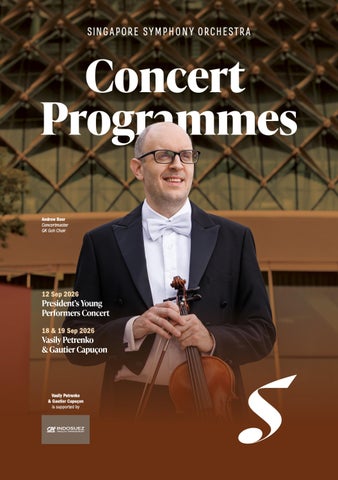
Concert Programmes Andrew Beer Concertmaster GK Goh Chair
12 Sep 2026
President’s Young Performers Concert 18 & 19 Sep 2026
Vasily Petrenko & Gautier Capuçon
Vasily Petrenko & Gautier Capuçon is supported by
UPCOMING CONCERTS
1 Nov 2026 Victoria Concert Hall SSO Organ Series:
Phantoms and Organs Mendelssohn Chorale-Andante sostenuto from Organ Sonata No. 6 Vierne Fantômes from 24 Pièces de fantaisie, Suite No. 3, Op. 54 Phoon Yu A Transi for the Common Man Vierne Requiem Aeternam, from 24 Pièces de fantaisie, Suite No. 1, Op. 51 J.S. Bach Prelude and Fugue in F minor, BWV 534 Phoon Yu What the Next-door Neighbour Saw Mendelssohn Allegro molto from Sonata No. 6, Op. 65 Tickets from $20
6 Nov 2026 Esplanade Concert Hall
© JUANMOLEY FOTOLOGUE
© JUANMOLEY FOTOLOGUE
© KAUPO KIKKAS
Sibelius and Wagner
www.sso.org.sg/whats-on
Sibelius Finlandia (with chorus) Sibelius Selection of songs for soprano and orchestra Sibelius Lemminkäinen’s Return Wagner (arr. Inkinen) Scenes from Götterdämmerung including Siegfried's Rhine Journey, Funeral March and Immolation Scene.
Tickets from $15
Sep
2026 19 President’s Young Performers Concert Sat, 12 Sep 2026 Victoria Concert Hall
30 Vasily Petrenko & Gautier Capuçon Fri & Sat, 18 & 19 Sep 2026 Esplanade Concert Hall
For the enjoyment of all patrons during the concert: Please switch off or silence all electronic devices.
No photography, video or audio recording is allowed when artists are performing.
Please minimise noises during performance. If unavoidable, wait for a loud section in the music.
Non-flash photography is allowed only during bows and applause when no performance is taking place.
Go green. Digital programme books are available on www.sso.org.sg. Photographs and videos will be taken at these events, in which you may appear. These may be published on the SSO’s publicity channels and materials. By attending the event, you consent to the use of these photographs and videos for the foregoing purposes.
Cover photo: Andrew Beer © Chris P Lim
1
© JACK YAM
Singapore Symphony Orchestra 2
Since its founding in 1979, the Singapore Symphony Orchestra (SSO) has been Singapore’s flagship orchestra, touching lives through classical music and providing the heartbeat of the cultural scene with its calendar of events. In addition to its subscription series concerts, the orchestra is well-loved for its outdoor and community appearances, and its significant role educating the young people of Singapore through its school programmes. The SSO has also earned an international reputation for its orchestral virtuosity, having garnered sterling reviews for its overseas tours and many successful recordings. In 2021, the SSO clinched third place in the prestigious Orchestra of the Year Award by Gramophone. In 2022, BBC Music Magazine named the SSO as one of the 23 best orchestras in the world. The SSO is led by Finnish conductor Hannu Lintu, the fourth Music Director in the orchestra’s history after Choo Hoey (1979–1996), Lan Shui (1997–2019) and Hans Graf (2020–2026). The orchestra performs over 60 concerts a year, and its versatile repertoire spans all-time favourites and orchestral masterpieces to exciting cutting-edge premieres. Bridging the musical traditions of East and West, Singaporean and Asian musicians and composers are regularly showcased in the concert season. The SSO makes its performing home at the 1,800-seat state-ofthe-art Esplanade Concert Hall. More intimate works, as well as community performances take place at the 673-seat Victoria Concert Hall, the Home of the SSO. Beyond Singapore, the SSO has performed in Europe, Asia, Australia and the United States. In the 2024/25 season, the SSO performed to full houses at Asia Orchestra Week in Kyoto, Japan, and made its “dazzling – and true-blue – Down Under debut” (Limelight) in Sydney, Melbourne and Brisbane. In May 2016, the SSO was invited
to perform at the Dresden Music Festival and the Prague Spring International Music Festival. This successful five-city tour of Germany and Prague also included the SSO’s second performance at the Berlin Philharmonie. In 2014, the SSO’s debut at the 120th BBC Proms in London received praise in major UK newspapers The Guardian and The Telegraph. The SSO has also performed in China on multiple occasions. The SSO has released more than 50 recordings, with over 30 on the BIS label. Recent critically acclaimed albums include A Hero’s Life (OUR Recordings), Symbiosis – Tribute to Bill Evans (Pentatone) and a complete Mozart Violin Concerto cycle with Singaporean violinist Chloe Chua conducted by Hans Graf (Pentatone). The SSO also leads the revival and recording of significant works such as Kozłowski’s Requiem and violin concertos by Robert Russell Bennett and Vernon Duke. The SSO has collaborated with such great artists as Vladimir Ashkenazy, Gustavo Dudamel, Charles Dutoit, Joe Hisaishi, Neeme Järvi, Lorin Maazel, Martha Argerich, Diana Damrau, Janine Jansen, Leonidas Kavakos, Lang Lang, Yo-Yo Ma, Mischa Maisky, Gil Shaham, Daniil Trifonov and Krystian Zimerman. The SSO is part of the Singapore Symphony Group, which also manages the Singapore Symphony Choruses, the Singapore National Youth Orchestra, the Singapore International Piano Festival and the biennial National Piano & Violin Competition. The Group’s vision is to be a leading arts organisation that engages, inspires and reflects Singapore through musical excellence. Our mission is to create memorable shared experiences with music. Through the SSO and its affiliated performing groups, we spread the love for music, nurture talent and enrich our diverse communities.
3
The Orchestra Hannu Lintu
Quantedge Music Director
Nathanaël Iselin Associate Conductor
Lan Shui
Conductor Laureate
Hans Graf
Conductor Laureate
Eudenice Palaruan Choral Director
Wong Lai Foon Choirmaster
Ellissa Sayampanathan Assistant Choral Conductor
First Violin
Andrew Beer1 Concertmaster, GK Goh Chair Chan Yoong-Han2 Acting Associate Concertmaster Cao Can* Duan Yu Ling Foo Say Ming Jin Li Kong Xianlong Cindy Lee Renyu Martin Peh Karen Tan William Tan Wei Zhe Ye Lin* Zhang Si Jing 4
Second Violin
Markus Gundermann Co-Principal (Guest) Qing Li Co-Principal (Guest) Sayuri Kuru Associate Principal Bobur Eshpulatov Nikolai Koval* Hai-Won Kwok Margit Saur Shao Tao Tao Reina Teo Wu Man Yun* Xu Jueyi* Yin Shu Zhan* Zhao Tian
Viola
Manchin Zhang Principal, Tan Jiew Cheng Chair Guan Qi Associate Principal Gu Bing Jie* Assistant Principal Chen Li Marietta Ku Luo Biao Julia Park Shui Bing Janice Tsai Dandan Wang Yang Shi Li
Cello
Ng Pei-Sian Principal, The HEAD Foundation Chair Yu Jing Associate Principal Guo Hao Assistant Principal Chan Wei Shing Christopher Mui Jamshid Saydikarimov Song Woon Teng Wang Yan Wu Dai Dai Zhao Yu Er
Double Bass
Joan Perarnau Garriga Principal (Visiting) Yang Zheng Yi Associate Principal Karen Yeo Assistant Principal Po-Yu Fang Victor Lee Jacek Mirucki Wang Xu
Flute
Jin Ta Principal, Stephen Riady Chair Evgueni Brokmiller Associate Principal Roberto Alvarez Miao Shanshan
Piccolo
Roberto Alvarez Assistant Principal
Oboe
Rachel Walker Principal Simon Emes^ Acting Principal Pan Yun Associate Principal Carolyn Hollier Elaine Yeo
Cor Anglais
Elaine Yeo Associate Principal
Clarinet
Chiang Yung-Yuan Principal Li Xin Associate Principal Liu Yoko Tang Xiao Ping
Bass Clarinet
Tang Xiao Ping Assistant Principal
Bassoon
Horn
Austin Larson Principal Marc-Antoine Robillard Associate Principal Thossaporn Sombat^ Associate Principal Bryan Chong Gao Jian Hoang Van Hoc
Trumpet
Jon Paul Dante Principal David Smith Associate Principal Lau Wen Rong Nuttakamon Supattranont
Trombone
Allen Meek Principal Damian Patti Associate Principal Samuel Armstrong
Bass Trombone
Wang Wei Assistant Principal
Tuba
Tomoki Natsume Principal
Timpani
Christian Schiøler Principal Mario Choo
Percussion
Guo Siping Principal Liu Chang Associate Principal Christoph Wichert Zhao Ying Xue
Jonathan Fox Principal Mark Suter Associate Principal Mario Choo
Contrabassoon
Harp
Zhao Ying Xue Assistant Principal
Gulnara Mashurova Principal
* With deep appreciation to the Rin Collection for their generous loan of string instruments. ^ Musician on annual contract. 1
2
Andrew Beer performs on a J.B. Guadagnini of Milan, c. 1750, donated by the National Arts Council, Singapore, with the support of Far East Organization and Lee Foundation. Chan Yoong-Han performs on a David Tecchler, Fecit Roma An. D. 1700, courtesy of Mr G K Goh. Musicians listed alphabetically by family name rotate their seats on a per programme basis. Details correct at the time of printing and subject to change. 5
Guest Musicians President’s Young Performers Concert 12 Sep 2026
Second Violin
Percussion
Seow Jin Chong
Tan Pei Jie
Harp
Celesta
Karen Tay
Aya Sakou
Vasily Petrenko & Gautier Capuçon 18 & 19 Sep 2026 First Violin
Oboe
Percussion
Seow Jin Chong Yew Shan
Peter Facer Guest Principal
Second Violin
Jeremy Chua Ma Yue
Thaddeus Chung Lee Yu Ru Lim Meng Keh Sng Yiang Shan Tan Pei Jie
Horn
Harp
Luke Chong Grzegorz Curyla Alexander Oon
Charmaine Teo
Liu-Yi Retallick Guest Associate Principal
Lee Shi Mei Yvonne Lee Lim Shue Churn
Viola Yeo Jan Wea Ho Qian Hui
Double Bass Guennadi Mouzyka
Flute Cheryl Lim Wang Tong
6
Clarinet
Tuba Chloe Higgins
Celesta Beatrice Lin
A WORLD OF ELEGANCE & enchanted GLAMOUR
RAFFLES.COM/SINGAPORE
President’s Young Performers Concert | 12 Sep 2026
Jason Lai is Principal Conductor at the Yong Siew Toh Conservatory and former Associate Conductor of the Singapore Symphony Orchestra and Hong Kong Sinfonietta. Since arriving in Singapore in 2010, he has been a prominent figure in the local music scene while maintaining an international presence, giving masterclasses in Europe and China and guest-conducting orchestras including the BBC Symphony Orchestra, London Symphony Orchestra, Hong Kong Philharmonic, Adelaide Symphony Orchestra, and Osaka Symphony.
Jason Lai conductor
Passionate about broadening classical music’s appeal, Jason has become a renowned communicator through television. His BBC appearances include judging BBC Young Musician of the Year and Classical Star, mentoring celebrities in Maestro, and featuring in How a Choir Works, The Culture Show, and CBBC’s Clash. In Singapore, he has presented and conducted for Mediacorp’s Project Symphony, Sing to Remember, and Nudge, as well as BBC’s Heart of Asia and Tales from Modern China. Born in the UK and raised in Hong Kong, Jason studied cello at Chetham’s School of Music, then cello and composition at Oxford University, and conducting at Guildhall School of Music and Drama, where he received a Fellowship in Conducting. He toured as a cellist with the Allegri String Quartet and won the BBC Young Conductors Workshop in 2002, later serving as Assistant Conductor to the BBC Philharmonic and Associate Conductor of the Hong Kong Sinfonietta. In Singapore, Jason champions education and outreach, training the next generation of conductors at Yong Siew Toh Conservatory and leading SSO programmes that introduce classical music to new audiences through children’s concerts, school collaborations, and community initiatives.
8
President’s Young Performers Concert | 12 Sep 2026
Born in 2000, bassoonist Shi Jia Ao began his musical training in 2018 at the Yong Siew Toh Conservatory of Music, where he studied with Professor Zhang Jin Min and completed a Bachelor of Music degree with a second major in Computer Science. He is currently pursuing his Master of Music at the Staatliche Hochschule für Musik und Darstellende Kunst Mannheim in the class of Professor Ole Kristian Dahl. As a soloist, Shi has appeared with the Yong Siew Toh Conservatory Orchestra performing Mozart’s Sinfonia Concertante for Four Winds in March 2024. His recent solo performances include C.P.E. Bach’s Flute Sonata in A minor at the 2025 Hong Kong Bassoon Week and Kalliwoda’s Morceau de Salon, Op. 230 at the 2024 Qingdao Bassoon Festival. He is most fond of his chamber music experience during his time in the conservatory, playing major wind and piano chamber works by Mozart, Beethoven, Glinka, and others.
Shi Jia Ao
bassoon
Shi has participated in masterclasses with numerous renowned bassoonists and pedagogues, including Dag Jensen, Stefan Schweigert, Carlo Colombo, Akio Koyama and Christian Kunert. Through these programmes, he has worked on a diverse range of repertoire from baroque to contemporary. Shi has performed in various ensembles across Asia and Germany, including the Kammerphilharmonie Mannheim, the Orchestra of the Music Makers, the Jakarta Simfonia Orchestra, and the Taipei Music Academy & Festival Orchestra.
© MICHAEL HUANG
In his free time, Shi likes to explore a variety of brewing styles to craft the best coffee he possibly can.
9
President’s Young Performers Concert | 12 Sep 2026
Natasha Da Costa soprano
Singaporean soprano Natasha Michella Da Costa is a recent graduate of the University of Oxford, where she completed a Master of Studies (MSt) reading Musicology at Oriel College. She previously earned a First-Class Bachelor of Music (Honours) in Vocal Studies from the Royal Academy of Music, London, under the tutelage of Marie Vassiliou and Christopher Glynn. Her studies were generously supported by the Trailblazer General Fund, the Royal Academy of Music Scholarship associated with the Molly Bridge Award, and a Choral Scholarship at Pusey House, Oxford. At the Academy, Natasha was awarded First Prize in the 2024 Joan Chissell/Rex Stephens Schumann Lieder Prize, a finalist in the Kathleen Ferrier Competition for Young Singers (2020), and received the MIRO Gallerié Award at the 23rd Mikuláš Schneider-Trnavský International Vocal Competition, Slovakia. She has made operatic role debuts as Susanna, Mélisande, and Nella, and appeared as a featured guest soloist at the Royal Albert Hall for Prom Praise 2024. Her performances include singing at 10 Downing Street and other numerous song recitals in London and Oxford in collaboration with other distinguished musicians.
© CHNG WAYNE
With more than twenty years of singing experience, Natasha has performed across Europe, Asia, and the United States in recital, operatic, and orchestral repertoire. Now based in Singapore, she continues to expand her artistic practice while teaching in the Music Faculty at the School of the Arts (SOTA), maintaining an active international artistic career as both educator and performer.
10
President’s Young Performers Concert | 12 Sep 2026
Born in 2006, Kaelyn is a Singaporean violinist currently studying at the Royal College of Music (RCM) and Imperial College London, where she is pursuing an MSci in Chemistry with Molecular Physics. Her violin studies with Professor Mathilde Milwidsky at the RCM are supported by the Ash Music Scholarship and the Coldstream Guards’ Scholarship. She is a prize-winner at competitions including the Arthur Grumiaux International Violin Competition (1st prize, 2017), the Eastbourne Symphony Orchestra’s 38th Young Soloist Competition (2nd prize, 2026), the Amadeus Young Talent Prize at Symphony 924’s Young Talents Project and prizes at Singapore’s National Piano and Violin Competition. She was also one of twelve quarter finalists in BBC Young Musician (2024) and the 5th Hengqin International Mozart Violin Competition (2025).
Kaelyn Soh
violin
Kaelyn has performed at prestigious venues across the world, such as Carnegie Hall’s Weill Recital Hall, Cadogan Hall, Windsor Castle, and the Victoria Concert Hall, where she made her solo concerto debut aged 10. Televised engagements include broadcasts by the BBC and BBC Radio 3, and Mediacorp for the President’s Star Charity, Singapore. An avid orchestral and chamber musician, she currently leads the Imperial College Symphony Orchestra and performs with the Blyth Trio. Kaelyn’s musical education began at the Nanyang Academy of Fine Arts, Singapore and the Guildhall School of Music and Drama, London.
© BAMBINI PHOTOGRAPHY
Kaelyn plays on a violin generously loaned from the Rin Collection.
11
Vasily Petrenko & Gautier Capuçon | 18 & 19 Sep 2026
Vasily Petrenko conductor
Vasily Petrenko is Music Director of the Royal Philharmonic Orchestra, a role he began in 2021, and Conductor Laureate of the Royal Liverpool Philharmonic Orchestra after a celebrated fifteenyear tenure as Chief Conductor (2006–2021). He is Associate Conductor of the Orquesta Sinfónica de Castilla y León, and has served as Chief Conductor of the European Union Youth Orchestra (2015–2024), Oslo Philharmonic (2013–2020), and Principal Conductor of the National Youth Orchestra of Great Britain (2009–2013). He stood down as Artistic Director of the State Academic Symphony Orchestra of Russia ‘Evgeny Svetlanov’ in 2022 having been their Principal Guest Conductor from 2016 and Artistic Director from 2020. Petrenko has worked with many of the world’s leading orchestras and is equally at home in opera, with over thirty operas in his repertoire. He has appeared at the Edinburgh Festival, Grafenegg Festival, and the BBC Proms. Highlights of the 2025/26 season included tours with the Royal Philharmonic in Spain and the United States. He made his debut with the Warsaw Philharmonic, and returned to conduct the Gewandhausorchester Leipzig, Oslo Philharmonic, Orchestre National de Lyon, Orchestre Philharmonique de Strasbourg, Dresden Philharmonic and the Houston Symphony, among others. His discography is widely acclaimed, including Shostakovich, Rachmaninov, and Elgar cycles with the Royal Liverpool Philharmonic, and releases of Scriabin, Strauss, Prokofiev, and Myaskovsky with the Oslo Philharmonic. Petrenko was Gramophone Artist of the Year (2017), Classical BRIT Male Artist of the Year (2010), and holds honorary degrees from Liverpool’s three universities. In 2024, he cofounded a young conductors’ academy in Armenia.
12
Vasily Petrenko & Gautier Capuçon | 18 & 19 Sep 2026
Gautier Capuçon is one of the foremost cello ambassadors in the 21st century. Performing worldwide with leading conductors and instrumentalists, he also created the “Fondation Gautier Capuçon” in January 2022, dedicated to supporting outstanding young musicians between the ages of 18 and 25 as they launch their careers, extending his strong commitment to education and mentorship. As of now, the Foundation is counting 36 laureates. Winner of numerous awards, Capuçon is celebrated for the depth and intensity, his dazzling virtuosity, and the rich, resonant sound. In the 2025/26 season, Capuçon tours with the Berliner Philharmoniker and Kirill Petrenko – starting with the Europakonzert at Esterházy Palace. As Artist-in-Residence with the Sächsische Staatskapelle Dresden, he performs under Finnegan Downie Dear, Andrés Orozco-Estrada and Daniele Gatti, including the New Year’s Eve concert and a European tour. Further highlights include appearances with the hr-Sinfonieorchester, the Orchestre de Paris, San Francisco Symphony, and Tonhalle-Orchester Zürich, as well as a trio tour with Jean-Yves Thibaudet and Lisa Batiashvili and a recital tour with Nikolai Lugansky.
Gautier Capuçon cello
© ANOUSH ABRAR
An exclusive Erato (Warner Music) artist, Capuçon’s discography includes award-winning recordings such as “Following Émotions”, “Sensations” and “Destination Paris”. His latest album “Gaïa” (November 2025) features works by Max Richter, Bryce Dessner, Ludovico Einaudi, Gabriela Montero, Joe Hisaishi, and Nico Muhly, giving voice to the Earth through his cello.
13
Vasily Petrenko & Gautier Capuçon | 18 & 19 Sep 2026
Armed with a passion and mission to nurture young voices and inspire choral excellence, Wong Lai Foon has been instrumental in developing and growing the Singapore Symphony Children’s Choir (SSCC) and the Singapore Symphony Youth Choir (SSYC) to the ensembles that they are today. As founding conductor of both ensembles, this season marks her 20th year with the SSCC and her 10th with the SSYC, during which time she has inspired generations of singers through the study of the choral art. With musical styles ranging from Baroque to opera to contemporary and popular music, as well as repertoire that spans diverse cultures and languages, she has directed the SSCC and SSYC in a wide array of concerts, often receiving praise for the choirs’ beautiful tone and sensitivity. She has prepared the choirs for overseas tours, recordings and collaborations with renowned conductors and performers such as Stephen Layton, The King’s Singers, and Sofi Jeanin. The SSCC has also had the distinction of being invited to perform at various state functions.
Wong Lai Foon
choirmaster
© JUANMOLEY FOTOLOGUE
Wong has commissioned and premiered treble choir works by local composers and has also arranged for the SSCC and SSYC. Her efforts to educate and inspire singers extend into the community through workshops, talks, as well as adjudicator, chorus-master and guest-conductor roles. Some ensembles that she has worked with include The Philharmonic Chamber Choir, Singapore Symphony Chorus, Singapore Lyric Opera, Hallelujah Singers, and Methodist Festival Choir. She holds a master’s degree in choral conducting from Westminster Choir College, USA.
15
Vasily Petrenko & Gautier Capuçon | 18 & 19 Sep 2026
Singapore Symphony Children’s Choir
Nurturing Choral Brilliance
Wong Lai Foon Choirmaster Ellissa Sayampanathan Assistant Choral Conductor Low Jinhong rehearsal pianist
The Singapore Symphony Children’s Choir (SSCC) offers young voices a thrilling gateway into the world of professional music-making. Singing alongside the Singapore Symphony Orchestra and renowned conductors, children discover not only the joy of performance but the discipline, confidence, and creativity that come with it. Marking two decades of nurturing young musicians, the SSCC has shaped generations of children through a warm, supportive environment. It’s a space where artistry, friendship, and deep love for music come to life in every rehearsal and performance. Based at the Victoria Concert Hall, the choir has performed under the direction of esteemed conductors like Lim Yau, Sofi Jeannin, François-Xavier Roth, and Stephen Layton, and has shared the stage with The King’s Singers. The SSCC’s impact extends beyond the concert hall, with appearances at national events and international collaborations in Paris and Kuala Lumpur, championing local music by commissioning works from Singaporean composers including Darius Lim, Zechariah Goh and Kelly Tang. Passionate, polished, and proudly Singaporean, the SSCC is shaping the next generation of choral excellence.
16
Vasily Petrenko & Gautier Capuçon | 18 & 19 Sep 2026
The Chorus Vasily Petrenko & Gautier Capuçon 18 & 19 Sep 2026
Singapore Symphony Children’s Choir Kayla Antanuri Eliza Bhutia Adele Chan Jerica Chan Lisa Chang Samuel Chen Charlize Cheong Elizabeth Chern Christian Chew Choo Yu En Chua Jia Le Deng Handing Graciella Gunawan Nadia Hajadi Callie Heng Cloris Ho Hou Fangwen Manya John Joshika Kandasamy Ropheka Khoo Giselle Koh Kok Xiu Yin Athena Kong Lucas Lee Leong Zee Yen Celeste Leong Liew Ying En Stephanie Lim Hebe Lim Lin Tze Ran Ruth Ling
Lu Yiche May Ma Emma Mok Lei Nakayasu Claire Neu Ng Le Xi Megan Ng Danielle Ng Joel Ng Ng Alyssa Shannette Ng Zita Nyan Ong Sze Ying Isabella Ong Pan Yueling Marie Phua Ayantika Sen Genevieve Seow Siew Lok Yan Allysa Tan Ashley Tan Brandon Tan Caitlin Tan Michael Tan Tan Cay Tan Rui Lin Sophie Tan Alena Tan Gwynever Tanan Tang Yueyi Yuna Tano
Natalie Tay Chloe Tay Germaine Teo Kailyn Teo Camellia Thng Natalie Tju Xavier Tng Mika Tobita Rosie Tu Trisha Vishnuprasad Wang Luoxin Julian Werstuik Caresse Wisantoso Joylene Wongso Joyce Wu Gracie Xie Jessica Xu Yan Yichen Cammi Yeo Yu Rahee Zhang Kangni Zhang Jenney
17
THIS AD IS USING AN AI-GENERATED BACKGROUND.
18
Sat, 12 Sep 2026 Victoria Concert Hall
President’s Young Performers Concert Singapore Symphony Orchestra Jason Lai conductor Shi Jia Ao bassoon1 Natasha Da Costa soprano2 Kaelyn Soh violin3 Andrew Beer concertmaster
Ralph Vaughan Williams Overture to The Wasps 9 mins SSO PREMIERE
Berwald Konzertstück for Bassoon and Orchestra, Op. 21 12 mins
Debussy Clair de lune (orch. Caplet) 5 mins SSO PREMIERE
Ravel Shéhérazade2 17 mins
Intermission 20 mins
Butterworth The Banks of Green Willow 7 mins
Korngold Violin Concerto in D major, Op. 353 24 mins Check-in to tonight’s concert Scan this QR code with the Singapore Symphony Mobile App.
Concert Duration: approximately 1 hr 50 mins (including 20 mins intermission) 19
President’s Young Performers Concert | 12 Sep 2026
Ralph Vaughan Williams 1872 – 1958
Overture to The Wasps (1909) Vaughan Williams is a composer who suffers from success somewhat: it’s easy to pigeonhole him as a “pastoral” composer thanks to the runaway fame of early works like The Lark Ascending or the Songs of Travel, or even the Tallis Fantasia for string orchestra, a staple of student ensembles worldwide. He did write a lot of much more serious concert music, some of which is even surprisingly modern, and considered his symphonies the highlights of his long career. The music to The Wasps, an ancient Greek play by Aristophanes, was written for a Cambridge University production in 1909 and was one of only three times Vaughan Williams tried his hand at incidental music. He produced so much music for this occasion that it took until 2005 for a full recording to be published, such was the lack of interest in it. Vaughan Williams himself extracted some of the better music and turned it into an orchestral suite, under half an hour long, though it is the Overture here that has remained the most frequently played of anything from that project. Vaughan Williams’s largely cheery early style matches the humour of the play perfectly, as heard in the boisterous outer sections of the overture, with pumping wind and brass chords and a very diatonic, almost pentatonic melody. The much calmer middle section, with shimmering string tremolos and a number of beautiful solo lines, betrays the influence of Ravel, with whom he had studied the year before writing The Wasps.
Vaughan Williams c. 1920
Instrumentation 2 flutes (1 doubling on piccolo), 2 oboes, 2 clarinets, 2 bassoons, 4 horns, 2 trumpets, timpani, percussion (triangle, cymbals, suspended cymbal, bass drum), harp, strings World Premiere 26 Nov 1909, Cambridge First performed by SSO 13 Jan 1995
20
President’s Young Performers Concert | 12 Sep 2026
SSO PREMIERE
Franz Berwald 1796 – 1868
Konzertstück for Bassoon and Orchestra, Op. 2 (1827) Allegro non troppo Theme & Variations: Andante III Tempo I (Allegro non troppo) I
II
Franz Berwald, despite coming from a long lineage of musicians and travelling from his native Stockholm to Berlin to study music, struggled enough with his early musical career that he started an orthopaedic practice instead, and stopped composing completely for years. He was more successful with his clinical practice, but after getting married and moving to Vienna, decided to return to music in his mid-30s. This second tilt at a musical life was far more successful, and it is because of that that we know at all of his early works, much of which were either lost or destroyed. Musically, he was a bit of an outsider in his mature music, with critics quite divided on whether he was pushing boundaries or simply “prone to bizarrerie”, as the influential Eduard Hanslick once quipped. His music, despite his German and Austrian reputation, was not wellreceived in Sweden throughout his life. However, the Konzertstück dates from his early musical period, and was written the same year Beethoven died, explaining its largely Classical character and smaller forces. In about a dozen minutes Berwald manages to pack a flexible sonata form with a miniature set of variations on Henry Bishop’s Home, Sweet Home, as well as a remarkably operatic finale, with some really virtuosic playing demanded of the principal bassoonist.
Franz Berwald, c. 1860. Photo: National Library of Sweden
Instrumentation solo bassoon, flute, 2 oboes, 2 bassoons, 2 horns, 2 trumpets, timpani, strings World Premiere 18 Nov 1828, Stockholm
21
President’s Young Performers Concert | 12 Sep 2026
Claude Debussy 1862 – 1918
Clair de lune (1905 / orch. André Caplet, 1911) The Clair de lune is possibly Debussy’s most famous piece of music, and, in this orchestration by André Caplet, is cast in a very different light from the piano piece it originally is. Clair de lune, meaning “light of the moon” is based on the poem of the same name by the celebrated French poet, Paul Verlaine. Debussy’s use of colour, light, and shadow, only hinted at in the delicate piano figurations, is given full weight by Caplet’s lush orchestration. Imaginative touches in the instrumentation (especially the use of pizzicato viola and the solo violin in the reprise) betray a master’s hand, and indeed Caplet was well-known as a composer in his own right in the early 20th century, though he is today largely forgotten. Debussy and Ravel are often lumped together in music history classes as being “Impressionists”. Debussy’s association with the term stemmed from the period after his initial Wagner obsession, when he disavowed “Germanic” chromatic harmony (along with its eschatological and philosophical concerns) to break away with his own ideas. But even that is an oversimplification, because it is possible to trace much of Debussy’s inspiration to Erik Satie and what he saw as a rivalry with Ravel.
Instrumentation 2 flutes, 2 oboes, 2 clarinets, 2 bassoons, 2 horns, harp, strings World Premiere Unknown First performed by SSO 18 Apr 1987
22
President’s Young Performers Concert | 12 Sep 2026
SSO PREMIERE
Maurice Ravel 1875 – 1937
Shéhérazade (1903) Asie (Asia) La flûte enchantée (The Enchanted Flute) III L'indifférent (The Indifferent One) I
II
In the artistic ferment that was the Parisian cultural milieu at the end of the Belle Époque, many loosely knit groups formed and dissipated, consisting of poets, painters, sculptors, political upstarts, musicians, and all sorts of itinerant fortune-seekers coming to the French capital for a shot at artistic fame. Tristan Klingsor, probably the best-known of the school of “fantaisistes”, who rejected the romanticism and symbolism of the previous generation (particularly Mallarmé) while at the same time being drawn towards the “exotic” Orient, became friends with Ravel as members of “Les Apaches”, a modernist group that did not have a single unifying creed but which was a hotbed of discourse and artistic appreciation. Klingsor’s poetry caught Ravel’s attention, as both had looked to Persia for inspiration at the end of the 19th century.
Perse, et l’Inde, et puis la Chine – “I would like to see Persia, and India, and then China” – Ravel’s music shifts constantly under the text, fluttering in and out of focus, before sweeping into a grand climax as the text turns to death. The second song, about a girl listening to the sounds of an enchanted flute, is soft and reticent until the relative cheer of the middle section as the dawn breaks. It is ultimately a love song, however, and the music calms for the flute to take its place once again. A different kind of love, an unreachable and unattainable one, motivates the last song. Filled with sighing fragments in the strings, the yearning is so intense, so inexpressible, that the orchestra falls silent at one point, leaving the voice hanging.
The idea of the Middle East being inextricably linked with eroticism was not new, with the One Thousand and One Nights being known in Europe as early as 1704, if not earlier via Islamic influence in the Iberian Peninsula. As in RimskyKorsakov’s symphonic suite, Ravel’s Shéhérazade indulges in the ecstatic and the decadent. Even though it was his first major orchestral work, Ravel’s mastery of colour is evident here: the isolated oboe murmur of the opening, coupled with the singer’s “Asie, Asie, Asie”, draws the curtain up on a perfume-filled score, full of seduction and fantasy. The first song, a sprawling sonic landscape, invites the listener to come on a journey into the tales of mystery and danger: Je voudrais voir la
Princess Scheherazade. Illustration by Edmund Dulac (1907) 23
President’s Young Performers Concert | 12 Sep 2026
Asie
Asia
Asie, Asie, Asie, Vieux pays merveilleux des contes de nourrice Où dort la fantaisie comme une impératrice, En sa forêt tout emplie de mystère. Asie, je voudrais m'en aller avec la goélette Qui se berce ce soir dans le port Mystérieuse et solitaire, Et qui déploie enfin ses voiles violettes Comme un immense oiseau de nuit dans le ciel d'or. Je voudrais m'en aller vers des îles de fleurs, En écoutant chanter la mer perverse Sur un vieux rythme ensorceleur. Je voudrais voir Damas et les villes de Perse Avec les minarets légers dans l'air. Je voudrais voir de beaux turbans de soie Sur des visages noirs aux dents claires; Je voudrais voir des yeux sombres d'amour Et des prunelles brillantes de joie En des peaux jaunes comme des oranges; Je voudrais voir des vêtements de velours Et des habits à longues franges. Je voudrais voir des calumets entre des bouches Tout entourées de barbe blanche; Je voudrais voir d'âpres marchands aux regards louches, Et des cadis, et des vizirs Qui du seul mouvement de leur doigt qui se penche Accordent vie ou mort au gré de leur désir. Je voudrais voir la Perse, et l'Inde, et puis la Chine, Les mandarins ventrus sous les ombrelles, Et les princesses aux mains fines, Et les lettrés qui se querellent Sur la poésie et sur la beauté; Je voudrais m'attarder au palais enchanté Et comme un voyageur étranger Contempler à loisir des paysages peints Sur des étoffes en des cadres de sapin, Avec un personnage au milieu d'un verger; Je voudrais voir des assassins souriants Du bourreau qui coupe un cou d'innocent Avec son grand sabre courbé d'Orient. Je voudrais voir des pauvres et des reines; Je voudrais voir des roses et du sang; Je voudrais voir mourir d'amour ou bien de haine. Et puis m'en revenir plus tard Narrer mon aventure aux curieux de rêves En élevant comme Sindbad ma vieille tasse arabe De temps en temps jusqu'à mes lèvres Pour interrompre le conte avec art…
Asia, Asia, Asia! Ancient, wonderful land of nursery stories Where fantasy sleeps like an empress, In her forest filled with mystery. Asia, I want to sail away on the schooner That rocks gently in the harbour this evening Mysterious and solitary, And finally unfurls purple sails Like a great night bird in the golden sky. I want to sail away to the islands of flowers, Listening to the sinister sea singing To an old bewitching rhythm. I want to see Damascus and the cities of Persia With their slender minarets in the air. I want to see beautiful turbans of silk Over dark faces with gleaming teeth; I want to see dark amorous eyes And pupils sparkling with joy In skins as yellow as oranges; I want to see velvet cloaks And robes with long fringes. I want to see calumet pipes between lips Fringed by white beards; I want to see crafty merchants with shifty glances, And cadis and viziers Who with one gesture of their finger Decree life or death, by their whim. I want to see Persia, and India, and then China, Pot-bellied mandarins under their umbrellas, Princesses with delicate hands, And scholars arguing About poetry and beauty; I want to linger in the enchanted palace And like a foreign traveller Contemplate at leisure landscapes painted On cloth in pinewood frames, With a figure in the middle of an orchard; I want to see murderers smiling While the executioner cuts off an innocent head With his great curved Oriental sabre. I want to see paupers and queens; I want to see roses and blood; I want to see those who die for love or, better, for hatred. And then to return later To recount my adventures to those intrigued by dreams Like Sinbad, I raise my old Arabian cup From time to time to my lips To interrupt my tale in artful suspense.
24
President’s Young Performers Concert | 12 Sep 2026
La flûte enchantée
The Enchanted Flute
L'ombre est douce et mon maître dort Coiffé d'un bonnet conique de soie Et son long nez jaune en sa barbe blanche. Mais moi, je suis éveillée encore Et j'écoute au dehors Une chanson de flûte où s'épanche Tour à tour la tristesse ou la joie. Un air tour à tour langoureux ou frivole Que mon amoureux chéri joue, Et quand je m'approche de la croisée Il me semble que chaque note s'envole De la flûte vers ma joue Comme un mystérieux baiser.
The shade is pleasant and my master sleeps In his conical silk hat With his long, yellow nose in his white beard. But I am still awake And from outside I listen to A flute song, pouring out By turns, sadness and joy. A tune by turns languorous and carefree Which my dear lover is playing, And when I approach the lattice window It seems to me that each note flies From the flute to my cheek Like a mysterious kiss.
L'indifférent
The Indifferent One
Tes yeux sont doux comme ceux d’une fille, Jeune étranger, Et la courbe fine De ton beau visage de duvet ombragé Est plus séduisante encor de ligne. Ta lèvre chante sur le pas de ma porte Une langue inconnue et charmante Comme une musique fausse… Entre! Et que mon vin te réconforte… Mais non, tu passes Et de mon seuil je te vois t’éloigner Me faisant un dernier geste avec grâce, Et la hanche légèrement ployée Par ta démarche féminine et lasse…
Your eyes are soft as those of any girl, Young stranger, And the delicate curve Of your fine features, shadowed with down Is still more seductive in profile. On my doorstep your lips sing A language unknown and charming Like music out of tune... Enter! And let my wine comfort you... But no, you pass by And from my doorway I watch you go on your way Giving me a graceful farewell wave, And your hips gently sway Languid and feminine.
Instrumentation solo soprano, 2 flutes, piccolo, 2 oboes, cor anglais, 2 clarinets, 2 bassoons, 4 horns, 2 trumpets, 3 trombones, tuba, timpani, percussion (triangle, cymbals, tam-tam, snare drum, bass drum, glockenspiel, tambourine), 2 harps, celesta, strings World Premiere 17 May 1904, Paris
25
President’s Young Performers Concert | 12 Sep 2026
George Butterworth 1885 – 1916
The Banks of Green Willow (1913) George Butterworth is best known for his music based on Housman’s The Shropshire Lad. Together with Vaughan Williams, he did important musicological work by collecting hundreds of folk songs over the British Isles; Butterworth himself was also an expert Morris dancer and was wellversed in several other folk dances. It is a lasting pity to English music that Butterworth was an extremely harsh critic of his own music, even though he was hugely encouraging to Vaughan Williams and the other musicians and composers around him. Before the Great War started, Butterworth had already begun destroying works that he was not satisfied with, and this intensified as hostilities escalated, in case he did not survive to revise them. As such, only a handful of works remain, but the quality of his music is such that he is still counted as one of the finest English composers of that period. The Banks of Green Willow is an idyll scored for a small orchestra, based on two folk songs that he had collected in 1907 in Sussex. In its short length, Butterworth covers a lot of musical ground, starting in a pastoral mood but subsequently bringing in a martial theme in an almost disproportionately passionate manner. The instrumentation thins out, with the rousing orchestral tutti giving way to a solo flute and harp, and the energy dissipating into disparate solos on violin, horn, and oboe. The London premiere of The Banks of Green Willow came in March 1914 and might have been the last time Butterworth heard his own music. Butterworth was to be killed at the Battle of the Somme, only 31 years old, and his body was never recovered.
George Butterworth, c. 1914
Instrumentation 2 flutes, 2 oboes, 2 clarinets, 2 bassoons, 2 horns, trumpet, harp, strings World Premiere 27 Feb 1914, West Kirby (England) First performed by SSO 31 Aug 2016
Notes (Vaughan Williams, Berwald, Debussy, Ravel, Butterworth) by Thomas Ang | Thomas Ang is a pianist at the Royal Opera House, where he rehearses and plays for operas and ballets. He also specialises in the music of Medtner and Kapustin. www.thomasang.com 26
President’s Young Performers Concert | 12 Sep 2026
Erich Wolfgang Korngold 1897 – 1957
Violin Concerto in D major, Op. 35 (1947) Moderato nobile Romance: Andante III Finale: Allegro assai vivace I
II
project was a landmark success in the early history of cinema. Warner Brothers soon hired him to score Captain Blood, which earned Korngold his first Academy Award nomination. An exclusive contract followed, leading to a prolific Hollywood career composing 23 film scores and winning two Oscars. Together with Max Steiner and Bernard Herrmann, Korngold helped define the symphonic film score tradition which we continue to hear today. The Polish virtuoso violinist Bronislaw Huberman, a family friend of the Korngolds, frequently asked, “So, Erich, where’s my violin concerto?” In 1945, Korngold played a theme at the piano, prompting Huberman to exclaim, “That will be my concerto— promise me you’ll write it!” This theme was subsequently used for the opening of the Violin Concerto.
Erich Korngold
Korngold was hailed as a prodigy by Mahler at the age of ten, and by 23, his opera Die tote Stadt (“The Dead City”) had brought him international acclaim. He also arranged and conducted operettas by Johann Strauss II and developed a close working relationship with the visionary director Max Reinhardt. A Jewish composer, Korngold fled the advancing Nazi regime for America at the onset of the Second World War. Reinhardt, then directing A Midsummer Night’s Dream for Warner Brothers, invited Korngold to adapt and expand Mendelssohn’s classic score for the film. The
Tragically, when the concerto was completed in 1947, Huberman was unable to fit it into his schedule before his untimely death that same year. Korngold turned to Jascha Heifetz, who not only learned the piece within weeks but also encouraged Korngold to make it more technically demanding. Heifetz premiered the work on 15 February 1947. In the concerto, Korngold fused the lush, emotionally charged style inherited from Mahler and Strauss with the technical precision he had refined in Hollywood. This proved to be a hit with audiences. Korngold wrote, “The reception of the Violin Concerto in St. Louis was triumphal… a success just as in my best times in Vienna.” When a reviewer predicted it would remain in the repertoire as long as Mendelssohn’s concerto, Korngold replied, “I do not need more than that!” 27
President’s Young Performers Concert | 12 Sep 2026
Moderato nobile. The first movement draws on themes from Another Dawn and Juarez, blending soaring lyricism with more spirited, dynamic episodes. Romance. The beautiful second movement transforms a theme from Anthony Adverse into a tender, introspective Romance. Allegro assai vivace. The overtly virtuosic finale opens with a lively jig, developed into a set of dazzling variations that showcase the soloist’s virtuosity. A sweeping second theme from The Prince and the Pauper leads to a triumphant conclusion.
Instrumentation solo violin, 2 flutes (1 doubling on piccolo), 2 oboes (1 doubling on cor anglais), 2 clarinets, bass clarinet, 2 bassoons (1 doubling on contrabassoon), 4 horns, 2 trumpets, trombone, timpani, percussion (chimes, cymbals, suspended cymbal, gong, bass drum, glockenspiel, vibraphone, xylophone), harp, celesta, strings World Premiere 15 Feb 1947, St. Louis First performed by SSO 17 May 1996 (Jin Li, violin)
Notes by Christopher Cheong | Christopher heads the SSO’s artistic planning and administration team.
28
Fri & Sat, 18 & 19 Sep 2026 Esplanade Concert Hall
Vasily Petrenko & Gautier Capuçon Singapore Symphony Orchestra Singapore Symphony Children’s Choir Vasily Petrenko conductor Gautier Capuçon cello* Wong Lai Foon choirmaster Kädy Plaas-Kala language coach Andrew Beer concertmaster
SSO PREMIERE
Pärt Our Garden – Cantata for Children’s Chorus and Orchestra 13 mins
Saint-Saëns Cello Concerto No. 1 in A minor, Op. 33* 19 mins
Intermission 20 mins SSO PREMIERE
Shostakovich Symphony No. 4 in C minor, Op. 43 60 mins
Concert Duration: approximately 2 hrs 10 mins (including 20 mins intermission)
Supported by
Check-in to tonight’s concert Scan this QR code with the Singapore Symphony Mobile App.
30
Vasily Petrenko & Gautier Capuçon | 18 & 19 Sep 2026
SSO PREMIERE
Arvo Pärt b. 1935
Our Garden – Cantata for Children’s Chorus and Orchestra (1959) Allegro Andantino cantabile III Allegro IV Moderato I
II
Born on 11 September 1935, Arvo Pärt is one of the most renowned composers of Estonia. He began studying music at the age of seven and started composing in his teenage years. After attending the Tallinn Music Middle School in the country’s capital, Pärt was enlisted into military service where he played the oboe and percussion in the military band. Our Garden (Meie Aed) was composed in 1959 when Pärt was only 19 and a second-year student at the Tallinn Conservatory. As the composer’s first vocal-symphonic work, it was dedicated to the choral conductor Heino Kaljuste, with whom Pärt studied composition, and the choir Kaljuste directed, Ellerhein. The lyrics of Meie Aed were written by the children’s book author Eno Raud, who was a good friend of Pärt’s. The first movement opens with an energetic melody in both the orchestra and the choir. Singing about sweet berries in the school garden, the choir urges the audience to help out with the gardening work. Bee-buzzing sound effects also add to the humour and lightness of this movement. The second movement is more lyrical and calm, with gentle strings backing the choir. This movement depicts a flowerbed, with small seeds growing into large flowers with the help of the rain and abundant sunshine.
The third movement is triumphant and energetic, and in the lyrics, the birds come for the cherries that have been picked. The scarecrow in the garden helps keep away strangers, but the birds ignore it. The final movement opens with drumbeats. Noticeably slower, it resembles a fugue with overlapping voices at the beginning. The crops in the garden have been successful, with plum cherries and ripe apples, and the children are proud of their work in the garden.
Instrumentation children’s choir, 2 flutes (1 doubling on piccolo), 2 clarinets (1 doubling on E-flat clarinet), bass clarinet, 2 bassoons, 4 horns, 2 trumpets, 3 trombones, tuba, timpani, percussion (triangle, cymbals, suspended cymbal, snare drum, bass drum, glockenspiel, xylophone), 2 harps, strings World Premiere 25 Dec 1959, Estonia
Notes by Spencer Werstuik | In his spare time, Spencer Werstuik plays the piano, tennis and is also an avid skier.
31
Vasily Petrenko & Gautier Capuçon | 18 & 19 Sep 2026
Camille Saint-Saëns 1835 – 1921
Cello Concerto No. 1 in A minor, Op. 33 (1872) Allegro non troppo Allegretto con moto III Allegro non troppo I
II
Saint-Saëns took many years to become fully part of the French musical establishment, and this work, written when he was 37, was a big step for him, being premiered at the Paris Conservatoire in 1873. He broke new musical ground with this concerto, choosing to avoid the usual three-movement form in favour of a Lisztian single-movement of just under 20 minutes in length. Right from the outset, the cello solo bursts to the forefront, with hurried triplets demanding the full attention of the audience. The orchestra only gets its turn after the soloist is done with a series of flashy runs and arpeggios, and though the solo returns again soon, both parts calm down into a lovely lyrical moment where Saint-Saëns introduces a singing second theme. But as the music develops, it becomes clear that the expected sonata form is nowhere to be seen: the music segues into an elegant minuet, and the concerto wanders happily into its “second movement”. The muted tutti strings set the stage for the cello solo, and Saint-Saëns, in a nostalgic mood, recalls the 18th century with a sincere dance, almost like a set piece in a ballet. The orchestra turns back to the very first tune in a headlong rush, but this is further varied with a broad cello expansion of one of the melodic fragments from that theme. After this last moment of respite, Saint-Saëns allows both the orchestra and soloist off their leashes, and the real finale begins. The composer, showing true mastery of his materials, mixes all the themes together in various combinations and ties it all up with an incredibly fast and virtuosic coda.
Rachmaninoff and Shostakovich adored this concerto, both of them considering it one of the best ever written. Throughout, Saint-Saëns gives enough aural space around the soloist, and the accompaniment does not get in the way of the fireworks that the soloist has to produce; every note of the cello cuts through the orchestration clearly. Its effectiveness and lyricism ensured its immediate success, and it has become a firm favourite of great cellists throughout the ages.
Instrumentation solo cello, 2 flutes, 2 oboes, 2 clarinets, 2 bassoons, 2 horns, 2 trumpets, timpani, strings World Premiere 19 Jan 1873, Paris First performed by SSO 31 Oct 1981 (Emanuel Gruber, cello)
Notes by Thomas Ang | Thomas Ang is a pianist at the Royal Opera House, where he rehearses and plays for operas and ballets. He also specialises in the music of Medtner and Kapustin. www.thomasang.com 32
Vasily Petrenko & Gautier Capuçon | 18 & 19 Sep 2026
SSO PREMIERE
Dmitri Shostakovich 1906 – 1975
Symphony No. 4 in C minor, Op. 43 (1936) Allegretto poco moderato – Presto Moderato con moto III Largo – Allegro I
II
“You ask if I would have been different without ‘Party Guidance’? Yes, almost certainly. No doubt the line that I was pursuing when I wrote the Fourth Symphony would have been stronger and sharper in my work. I would have displayed more brilliance, used more sarcasm, I could have revealed my ideas openly instead of having to resort to camouflage; I would have written more pure music.” The question of what could have been emerged in Shostakovich’s conversation with his friend and neighbour Flora Litvinova in 1970. Completed and rehearsed in 1936 even as his standing with the authorities soured, the Fourth was withdrawn before its scheduled premiere. To continue his path of ‘pure music’ was to court disaster, and the work would remain shelved for the next twenty-five years. ‘Gigantomania’ was the term to describe the young USSR: behemoth monuments and projects built at huge human and economic cost in the bid to shed its rural past and become an industrialised rival of the West. Bigger was better, and the Fourth depicts this obsession. Scored for 125 musicians with expanded wind, brass and percussion forces (the largest among his fifteen symphonies), its sonic scale matches its sprawling, unruly form. Opening with the menace of a horror film score, the first movement launches into a strident march, with every note accented for two minutes. All conventional signposts
of sonata form are obscured. In Mahlerian fashion, the music shifts abruptly between the lyrical and the grotesque, the banal and the monumental. In the development, a bizarre fugato for strings swirls into a canon for brass over percussion. Quiet exhaustion follows with suspended flutes, but the music gathers itself for one last gasp as timpani rolls lead to a fffff 12-note chord for muted brass. In the truncated recapitulation, the themes of the exposition return in reverse order, dynamics and instrumentation. The second movement offers some respite with its stable metre and clear ABAB structure. The first theme recalls a ländler, while the second, an expressive descending line, anticipates the Fifth Symphony (1937). The clockwork ticking of castanets, wood block and triangle provide a strange conclusion. The finale begins with a funeral march with the bassoon as the lonely soloist. Strings and brass pile on to form a C major apotheosis seemingly headed towards a traditional finale, but Shostakovich veers off course into a whimsical divertimento: waltzes for strings and flutes, a sardonic polka for bassoon, and a gallop for strings. As befits a piece of such outsize proportions, there are two codas. The first arises from a moment of C major calm. Over tonic-dominant timpani, an outwardly festive brass chorale alludes to the ‘Gloria’ from Stravinsky’s Oedipus Rex (1927). The reference is charged with irony: 33
Vasily Petrenko & Gautier Capuçon | 18 & 19 Sep 2026
in Oedipus Rex, the chorus praises Oedipus as the saviour of Thebes, not knowing that he is responsible for the tragedy. To deepen this irony, the second coda recalls the bass ending of Tchaikovsky’s Pathetique (1893) and the isolated celesta of Mahler’s Das Lied von der Erde (1909). Eventually, the funeral march fragments and dissolves into a C minor triad in the strings, leaving the listener in bewildering darkness.
Instrumentation 4 flutes, 2 piccolos, 4 oboes (1 doubling on cor anglais), 4 clarinets, E-flat clarinet, bass clarinet, 3 bassoons, contrabassoon, 8 horns, 4 trumpets, 3 trombones, 2 tubas, timpani, percussion (triangle, cymbals, suspended cymbal, tam-tam, snare drum, bass drum, castanets, glockenspiel, wood block, xylophone), 2 harps, celesta, strings World Premiere 30 Dec 1961, Moscow
Notes by See Ning Hui | See Ning Hui is a pianist, researcher, and lecturer passionate about integrating music by lesser-known composers. www.ninghuisee.com 34
Our Heartfelt Thanks
To Our
Donors We would like to express our deepest appreciation to the following individuals and organisations who support our mission to create memorable shared experiences with music in the past year. Without your support, it would be impossible for the SSO to continue to strive for artistic excellence and touch the hearts of audiences.
Patron Sponsor
Tote Board Group (Tote Board, Singapore Pools & Singapore Turf Club)
Maestro Circle
Mr & Mrs Goh Yew Lin Stephen Riady Foundation Temasek Foundation The HEAD Foundation Anonymous
Concertmaster Circle
Bowen Enterprises Pte Ltd Dr & Mrs Antoine & Christina Firmenich Elaine and Eduardo Saverin Foundation Ltd Kris Foundation Mr Christopher & Mrs Rosy Ho Anonymous (2)
Symphony Circle
DBS Bank Ltd De Miguel Solaguren Family Doris Sohmen-Pao Dr Thomas & Mrs Mary Zuellig Hao Glory Family Foundation Indosuez Wealth Management Madeleine Cheok & Wong Hong Ching Ms Paige Parker & Mr Jim Rogers Anonymous (2)
36
Concerto Circle
Andrew & Stephanie Vigar Andy, Raymond, Bubble & Breton Tan Cara & Tamara Chang Colin Lee Dr Geh Min Far East Organization Farhana Sharmeen Geoffrey & Ai Ai Wong Geraldine Choong & Dennis Au Mavis Lim Geck Chin Miriam & Merle Hinrich Neo Group Limited Patek Philippe Southeast Asia Paul & Lena Ng Priscylla Shaw Prof Chan Heng Chee UOB Yao Hsiao Tung Yong Ying-I Anonymous
Overture Donors
Adsec Singapore Pte Ltd Ayesha Aziz Khan Azeeza Aziz Khan Bernard Ryan & Michael Rowe Bernhard Michael Steiner BinjaiTree Blossom Hing C & L Fund Cavazos Tinajero Family Chen Xiaoyan Chloe Lee En Yi & Family Chuin Wei Yap Colin & Janet Leong Daniel Choo & Family Devika & Sanjiv Misra Dorian Goh & Rathi Ho Dr & Mrs Adrian Koh Dr & Mrs Choy Khai Meng Dr June & Peter Sheren Dr Karen Soh Dr Kevin T Yap Dr Kieron Lim Eva & Nilay Patel Frans & Marie-Pierre Mol Geraldine Lim & Lim Him Chuan Goh Swee Chen Guy Hentsch & Geoffrey Yu Hemal & Paritosh Thakore Hong Leong Foundation JCCI Singapore Foundation Jonathan Stona
Joy & Han Li Toh Julien Willeme Kae Fujii & Laurent Proutiere Kenneth Kwok Kris Foundation - Lim Kang Ning Krishnan Family Lee Hsien Loong Leong Wai Leng Liew Wei Li Lito & Kim Camacho Marina Bay Sands Matthew L & Kenneth K Mr & Mrs Choo Chiau Beng Mr Tony & Mrs Melanie Chew Pavilion Capital PCS Pte Ltd Prima Limited Prof Gralf & Silvia Sieghold Robert & Vivian Chandran Sameer Sain Shanghai Tunnel Engineering (Singapore) Pte Ltd Sing Lun Group Tan Chin Tuan Foundation Tan Meng Cheng Ivan Tiffany Lim Timothy & Selena Hia Tower Capital Asia Vanessa & Darren Iloste Wendy Yap Anonymous (7)
37
Serenade Donors
Aadarsh Baijal Adrian Chua Ang Jian Zhong Anthony & Chloe Tan from ACE Team Foundation Anthony Tay Bloomberg Singapore Pte Ltd Brown-Forman Chloé & Romain de Laubier Clarissa Chow Claudia & Henning Figge Cubeassociate Pte Ltd Dr Victor Lim D-Y Lin Embassy of France in Singapore Francoise Mei G L Wee Grace Fu Hartley & Hong Lynn Clay Isaiah & Suwei K Jesher Loi John & Eliza Bittleston John & Pauline Foo Kenneth Kan Kim Hae Hyun & Heo Soomin
Rhapsody Donors
Adeline Ang Aileen Tang Amy Lin Belinda Koh Benedict Teo Benito Ting Benjamin Ma Bettina Lieske Chan Ah Khim Charles Robertson Charmaine Lim Cheng Eng Aun Choo Lim Clara Lim-Tan Craig McTurk David Chan & Sarah Chan David Leung Dr June Goh Dr Peter Chew Evelyn Chin Faith Chia Hwang Chih Ming In memory of Timothy Kok Tse En Jazz Chong & Edmund Ng Jeanne Lee Jennifer & Alexander Chan Jennifer Lee 38
Lai Siu Chiu Lau Leok Yee Lee Yeow Wee David Lilian Loke Liwen & Steven Holmes Lorinne Kon Madeleine Lee Maisy Koh Marcelo V Achoa & Silvia Bordoni Meng Michael Brenninkmeijer Mr & Mrs Ong Kong Hong Nicole & Edoardo Prina Patricia Lim Prof Arnoud De Meyer Prof Cham Tao Soon Ruyters Audrey Suzanne Lim Tan Wan Chi Tantallon Capital Advisors Pte Ltd The Linh Tinh Family Wayne & Kim Giap Khoo Xinyi Ong Anonymous (3)
Jerry Gwee Jinny Wong Julian & Jane Tan Julian & Sandra Chang Julien Brousseau Kasch Kimmy Kimberly Kirk Tay Kok Leong Lim Kris Wiluan Lawrence & Celeste Basapa Martin Siah & Wendy Long Michael & Katherin Puhaindran Mr & Mrs Tan Soo Nan Naserah Tyebally Pierre Colignon Ren QiMei Ronald & Janet Stride Sam & Claire Loh Soh Leng Wan Tang See Chim Wang Pei Zhong Warburg Pincus Singapore Pte Ltd Winston Hauw Wong Yan Lei Grace Zheng HongBo Anonymous (12)
Prelude Donors
A T Teo A.R. Adi F & Hui Shi Ahn Sehwan Aileen Teo Akihiro Nemoto Alexey Filimonov Alvin Lim Cheng Hin Alwyn Loy Suan Mao Andre Francis Maniam Andrew & Jacqueline Tan Andrew Cheong Ang Hui Tiong Eugene Ang Quek Kaifeng Ang Seow Long April Mak Aw Jia Yu Bella Gan Brenda Ang Bryan Carmichael Casey Tan Khai Hee Cham Gee Len Chang Chee Pey Chen H W Cheng Sok Theng Chong David Chong Mi-Li Pamela Chong Sien Thye Albert Chong, Wai Ying Ruby Christopher Chen Li Hsian Chua Saw Lan Cindy Claire & Ian Jones Colin Lang Cynthia Chee D Cheong Daniel Yong DCP Deborah Chee Denis Tenchurin Denise Wong Derek Lim HK Doris Song Dr & Mrs Winson Lay Dr Anne-Marie Schleich Dr Chong Shin Min Dr Lien Boon Hua Dr Norman Lee Dr Tan Lay Kok Dr Tashiya Mirando Dr Teo Kien Boon Dr Wong Hin Yan Dr Yap Zhu Li Edith & Sean Lim
Emma Lexi Ng Ernest Khoo Esther Fang Gallery NaWei Pte Ltd Gan Chee Yen Ghislain Olagne Giles Tan Ming Yee Goh Chiu Gak Goh Jun Yi Hans Michael Brandes Heinrich Grafe Henry & Tiffany Herman Felani MY Ho Jun Yi & Family In loving memory of Jasper Irina Piano James Tan Teng Chuan JAR Wealth Management Pte Ltd Jason & Jennifer Chew Jay Ganapathy Jeanie Cheah Jean-Pierre Felenbok Jessica Tan Jiang Wenzhu Jiyeon Kang Joanne Lim Johannes Yap & Family Joseph Wolpin Joseph Yoong K Goh & Family Keith Goh Kelvin Ho Kelvin Wong Khoo Ken Hui Khor Cheng Kian Kianyew Koh Ruizhi Kyra Teo Laurent Ye Lee Sian Ching Leonard Augustine Choo Li Danqi & Liu Yi Lily Low Lim Boon Kong Andrew Lim Shue Churn Lim Yin Yin, Jaime Lim Yuin Wen Low Boon Hon Low Eng Huat Peter Maggie Dong Manski-Nankervis Jo-Anne Elizabeth Marcel Smit & Hanneke Verbeek Marian Goh Mark Cranfield 39
Mark Wang & Gloria Guo Maxim Yanchenko Michelle & Eric Anziani Michelle Loh Michelle Tan & Soo Yixin Michelle Tay Min Tan Minwei Mr & Mrs Jeremy Ee Mr & Mrs Kevin Mr & Mrs Pont Mr Gareth Tan & Dr Roweena Yip msm-productions Ng Shien Ngiam Shih Chun Nguyen Quoc Khanh & Vu Phuong Nhi Nicolas Pascale Rouveyre Nikki Padilla & Sebastian L. Sohn Nishioka Hiroyuki Nomura Singapore Limited Nurture With Love Suzuki Music School Ong Chee Siong Ong Wee Shiang Parthesh Gulawani Patricia Ho Pauline Ang Prof Goh Suat Hong Prof Gungwu Wang Robert Khan & Co Pte Ltd Ryan Tan Sangeeta Razu See Chai Geok Seo Miju & Lee Sung Uk Serene Yeo Shermin Teh Siveraman K Pillai
Stephanie Hsiao Yu Lee SY Lee Tan Kok Huan Tan Yi Bin Teo Eng Chai Terence Wu and Cheryl Lim The McCann Family Tiffany Choong & Shang Thong Kai Timothy Leong Tom Szetu Trina Liang TseTsean Tsou Lei Shirley Victor Huang Kuan Kai Victor Ow Viktor & Sonja Leendertz Virna Machado-Ashish Goyal Vivien Goh Voon S Leong Wang Lei & Gao Bo Wendy Leong Marnyi Wennie Wong Wicky Wong Wong Lai Foon Xiao Li Xu Yixin Yang Tian YC Chen Yee Deng Tan Yong Chuk Kwin Yong Ning & Candice Foo Yong Seow Kin Zhai, Yuxiang Zhihong Chen Zhu Yulin Anonymous (37)
This list reflects donations that were made from 1 Jul 2025 to 30 Jun 2026. We would like to express our sincere thanks to donors whose names were inadvertently left out at print time. The Singapore Symphony Group is a charity and a not-for-profit organisation. Singapore tax-payers may qualify for 250% tax deduction for donations made. You can support us by donating at www.sso.org.sg/donate or www.giving.sg/sso.
40
SUPPORT THE SSO
12 tickets
16 tickets
20 tickets
Gala /Christmas/Pops
–
–
2 tickets
4 tickets
6 tickets
SSO Special Gala Concerts
–
–
–
–
2 tickets
–
–
–
$2,500 - $4,999
Serenade
Rhapsody
Prelude
$25,000 - $49,999
Concerto Circle
10 tickets
$10,000 - $24,999
6 tickets
$5,000 - $9,999
Subscription /Chamber and Organ / Family /SIPF
$1,000 - $2,499
Overture
With you, we can build the future of music.
COMPLIMENTARY TICKETS1 TO THE FOLLOWING CONCERT TYPES
Alternative corporate packages are available for discussion
DONOR RECOGNITION & PUBLIC ACKNOWLEDGEMENT Concert booklets and website
Patron of the Arts Nomination
–
–
–
Donors’ Wall at Victoria Concert Hall
–
–
–
–
OTHER BENEFITS Invitation to special events
Donations of $250 and above will entitle you to priority bookings, and discounts2 on SSG Concerts. For tax residents of Singapore, donations may be entitled to a tax deduction of 2.5 times the value of your donation. Donations are non-refundable. Complimentary ticket benefits do not apply to fundraising seats, Esplanade Box seats, Premier Box seats, or to supporters who gave through a fundraising event. Discounts are not applicable for the purchase of fundraising seats, Esplanade Box seats or Premier Box seats.
1 2
Through the SSO and its affiliated performing groups, we spread the love for music, nurture talent and enrich our diverse communities. The Singapore Symphony Orchestra is a charity and not-for-profit organisation. Scan to find out more, or write to Nikki Chuang at nikki@sso.org.sg.
42
4 tickets to every concert upon request
4 tickets
4 tickets to every concert upon request
$500,000 & above
Maestro Circle
20 tickets
$100,000 & above
Concertmaster Circle
4 tickets to every concert upon request
$50,000 & above
Symphony Circle
40 tickets
How can you help? While SSO is supported partially by funding from the Singapore government, a significant part can only be unlocked as matching grants when we receive donations from the public. If you are in a position to do so, please consider making a donation to support your orchestra – Build the future by giving in the present. As a valued donor of the SSO, you will receive many benefits.
Corporate Giving
We provide our Corporate Donors with impressive entertainment and significant branding opportunities. Through our tailored packages, corporates may benefit from: • Publicity and hospitality opportunities at an SSO concert or your private event, • Acknowledgement and mentions in SSO’s key publicity channels, • National Arts Council (NAC) Patron of the Arts nominations, • Tax benefits. Packages start at $10,000 and can be tailored to your company’s branding needs.
Partnership
We partner with various corporates through tailored in-kind sponsorship and exchange of services. Current and recent partnerships include Official Hotel, Official Airline, and we offer other exciting titles. For more details, please write to Sarah Wee at sarah.wee@sso.org.sg.
Scan for more information of our alternative corporate packages
43
SPECIAL RECOGNITION
A Standing Ovation
We recognise major gifts that help sustain the future of the Singapore Symphony Group. The recognition includes naming of a position in the SSO or in our affiliated performing groups such as the Singapore National Youth Orchestra and the Singapore Symphony Choruses. For more information, please write to Chelsea Zhao at chelsea.zhao@sso.org.sg.
Quantedge Music Director In January 2025, the SSO Quantedge Music Director position was named in recognition of a major donation by an anonymous donor. The position is held SPECIAL RECOGNITION HLby Maestro Hannu Lintu.
SSO Concertmaster
GK Goh Chair Established in July 2017, the SSO Concertmaster, GK Goh Chair honours Mr Goh Geok Khim, and celebrates his enduring contribution to Singapore’s cultural landscape. We extend our gratitude to the Family and Friends of Mr Goh, and especially to Mr and Mrs Goh Yew Lin, for their generosity. The position is held by Andrew Beer.
44
SSO Principal Cello The HEAD Foundation Chair In recognition of a generous gift from The HEAD Foundation, we announced the naming of our Principal Cello, The HEAD Foundation Chair in November 2019. The position is currently held by Principal Cellist Ng Pei-Sian.
SSO Principal Flute Stephen Riady Chair In recognition of a generous gift from Dr Stephen Riady, we announced in May 2022 the naming of our Principal Flute, Stephen Riady Chair. The position is currently held by our Principal Flutist Jin Ta.
SSO Principal Viola Tan Jiew Cheng Chair In recognition of a generous gift from the Estate of Tan Jiew Cheng, we announced in February 2024 the naming of our Principal Viola, Tan Jiew Cheng Chair. The position is currently held by our Principal Violist Manchin Zhang.
45
Board of Directors & Committees Chair Goh Yew Lin
Board of Directors Chang Chee Pey Chng Kai Fong Andress Goh Kenneth Kwok Clara Lim-Tan Jesher Loi Lynette Pang Prof Qin Li-Wei Jovi Seet Farhana Sharmeen Doris Sohmen-Pao Prof Peter Tornquist Geoffrey Wong Andrew Yeo Khirn Hin
Human Resources Committee
Audit & Risk Committee
Doris Sohmen-Pao (Chair) Jesher Loi Prof Qin Li-Wei Heinrich Grafe* Carmen Wee*
Jovi Seet (Chair) Prof Peter Tornquist Andrew Yeo Khirn Hin Ryan Siek*
Finance & Investment Committee Geoffrey Wong (Chair) Andress Goh Chua Keng Hong* Alex Lee*
Executive & Nominating Committee
Community & Youth Engagement Committee Clara Lim-Tan (Chair) Chang Chee Pey Farhana Sharmeen Asst Prof Kat Agres* Cecilia Pang*
*co-opted member
Goh Yew Lin (Chair) Chng Kai Fong Lynette Pang Geoffrey Wong
Symphony Ball Committee
SSO Council Alan Chan (Chair) Odile Benjamin Prof Chan Heng Chee Prof Arnoud De Meyer Dr Geh Min Heinrich Grafe Khoo Boon Hui Liew Wei Li Lim Mei Sanjiv Misra Paige Parker Dr Stephen Riady Priscylla Shaw Prof Gralf Sieghold Prof Bernard Tan Dr Tan Chin Nam Wee Ee Cheong Yong Ying-I
46
Development Committee Prof Chan Heng Chee (Chair) Odile Benjamin Dr Geh Min Heinrich Grafe Khoo Boon Hui Lim Mei Leonard Ong Paige Parker Priscylla Shaw Dr Tan Chin Nam
Paige Parker (Chair) Celeste Basapa Geoffrey Wong Kris Tan Joy Tan Dr Karen Soh Kim Camacho Lim Kang Ning Farhana Sharmeen
SSO Musicians’ Committee Hoang Van Hoc Austin Larson Li Xin Christopher Mui David Smith Elaine Yeo Zhao Tian
Singapore Symphony Group Administration Chief Executive Officer Kenneth Kwok
Deputy CEO
Deputy CEO
Programmes & Production Kok Tse Wei
Patrons & Corporate Services Jenny Ang
CEO Office
Community Impact Community Engagement
Patrons Development
Kua Li Leng (Head) Whitney Tan Lynnette Chng Chua Xu Yang Darren Siah
Chelsea Zhao (Head) Nikki Chuang Sarah Wee Samantha Lim Eunice Salanga Kevin Yeoh
Shirin Foo Musriah Bte Md Salleh
Organisation Development Lillian Yin
Artistic Planning Christopher Cheong (Head)
Artistic Administration Jodie Chiang Terrence Wong Jocelyn Cheng Michelle Yeo
Operations Ernest Khoo (Head)
Library Wong Yi Wen Cheng Yee Ki Ng Yi Xiu
Orchestra Management Chia Jit Min (Head) Kelvin Chua Charlotte Tan
Production Management Noraihan Bte Nordin Nazem Redzuan Leong Shan Yi Asyiq Iqmal Khairi Edzhairee Benjamin Chiau Syed Muhammad Idris Bin Ramli
Choral Programmes Kua Li Leng (Head) Lu Heng Chang Hai Wen Mimi Syaahira Jasmine Khaliesah Bte Yuraimi
Singapore National Youth Orchestra Ramu Thiruyanam (Head) Tang Ya Yun Tan Sing Yee Ridha Ridza
ABRSM Patricia Yee Lai Li-Yng Joong Siow Chong Freddie Loh
Corporate Services Finance, IT & Facilities Rick Ong (Head) Alan Ong Goh Hoey Fen Loh Chin Huat Md Zailani Bin Md Said
Human Resources & Administration
Audience & Communications Cindy Lim (Head) COMMUNICATIONS
Ong Shu Chen Elizabeth Low Tan Li Ying SOCIAL MEDIA & CONTENT
Nikki Loke Jana Loh Iylia Jamaludin Hong Shu Hui Kashmira Kasmuri MARKETING
Myrtle Lee Carrie Woo DATA & DIGITAL PROJECTS
Calista Lee CUSTOMER EXPERIENCE
Randy Teo Dacia Cheang Joy Tagore
Valeria Tan (Head) Janice Yeo Fionn Tan Netty Diyanah Bte Osman 47
A Gi Gift that Lasts Forever
Music holds a special place in our lives – whether through memories of making music or enjoying concerts with loved ones. Share the joy of music with future generations by pledging a legacy gift to the Singapore Symphony. Your gift will continue to impact the causes closest to your heart and honour your vision beyond your lifetime.
Learn More Scan the QR code or write to sarah.wee@sso.org.sg for more information.
SUPPORTED BY
PATRON SPONSOR
MATCHED BY
MAJ OR DON ORS AND PARTNERS
Anonymous
SEASON PARTNERS Official Hotel
Official Media Network Partner
Official Radio Station
Official Community Partner
Official Outdoor Media Partner
Official Airline
SEASON PATRONS
The vision of the Singapore Symphony Group is to be a leading arts organisation that engages, inspires and reflects Singapore through musical excellence. Our mission is to create memorable shared experiences with music. Through the SSO and its affiliated performing groups, we spread the love for music, nurture talent and enrich our diverse communities. The Singapore Symphony Orchestra is a charity and not-for-profit organisation. You can support us by donating at www.sso.org.sg/donate.