Singapore Symphony Orchestra Mar-Apr 2026

Page 1


27 & 28 Mar 2026

Simon Trpčeski & Eliahu Inbal / Rachmaninoff and Shostakovich

3 & 4 Apr 2026

Yeol Eum Son & Thomas Rösner / Shostakovich and Mendelssohn

9 & 10 Apr 2026

SSO Gala: Shostakovich with Leonidas Kavakos & Hannu Lintu

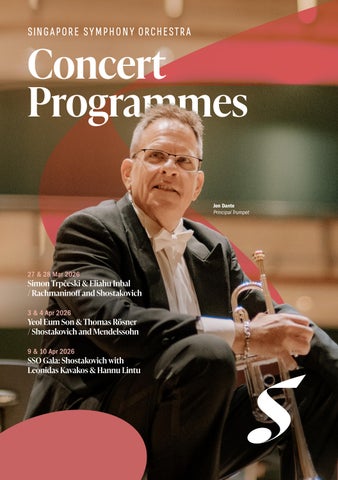
Jon Dante Principal Trumpet

Mar – Apr 2026

Simon Trpčeski & Eliahu Inbal / Rachmaninoff and Shostakovich

Fri & Sat, 27 & 28 Mar 2026

Esplanade Concert Hall

Yeol Eum Son & Thomas Rösner / Shostakovich and Mendelssohn

Fri & Sat, 3 & 4 Apr 2026

Victoria Concert Hall

SSO Gala: Shostakovich with Leonidas Kavakos & Hannu Lintu

Thu & Fri, 9 & 10 Apr 2026

Esplanade Concert Hall

For the enjoyment of all patrons during the concert:

Please switch off or silence all electronic devices.

Photographs and videos will be taken at these events, in which you may appear. These may be published on the SSO’s publicity channels and materials. By attending the event, you consent to the use of these photographs and videos for the foregoing purposes. 28

Please minimise noises during performance. If unavoidable, wait for a loud section in the music.

No photography, video or audio recording is allowed when artists are performing.

Non-flash photography is allowed only during bows and applause when no performance is taking place.

Go green. Digital programme books are available on www.sso.org.sg.

Cover photo: Jon Dante © ILUMINEN

Singapore Symphony Orchestra

The orchestra performs over 60 concerts a year, and its versatile repertoire spans alltime favourites and orchestral masterpieces to exciting cutting-edge premieres. Bridging the musical traditions of East and West, Singaporean and Asian musicians and composers are regularly showcased in the concert season. The SSO makes its performing home at the 1,800-seat state-ofthe-art Esplanade Concert Hall. More intimate works, as well as community performances take place at the 673-seat Victoria Concert Hall, the Home of the SSO.

Since its founding in 1979, the Singapore Symphony Orchestra (SSO) has been Singapore’s flagship orchestra, touching lives through classical music and providing the heartbeat of the cultural scene with its 44week calendar of events.

In addition to its subscription series concerts, the orchestra is well-loved for its outdoor and community appearances, and its significant role educating the young people of Singapore through its school programmes. The SSO has also earned an international reputation for its orchestral virtuosity, having garnered sterling reviews for its overseas tours and many successful recordings. In 2021, the SSO clinched third place in the prestigious Orchestra of the Year Award by Gramophone. In 2022, BBC Music Magazine named the SSO as one of the 23 best orchestras in the world.

From the 2026/27 season, the SSO will be led by Finnish conductor Hannu Lintu, the fourth Music Director in the orchestra’s history after Choo Hoey (1979–1996), Lan Shui (1997–2019) and Hans Graf (2020–2026).

Beyond Singapore, the SSO has performed in Europe, Asia, Australia and the United States. In the 2024/25 season, the SSO performed to full houses at Asia Orchestra Week in Kyoto, Japan, and made its “dazzling – and true-blue – Down Under debut” (Limelight) in Sydney, Melbourne and Brisbane. In May 2016, the SSO was invited to perform at the Dresden Music Festival and the Prague Spring International Music Festival. This successful five-city tour of Germany and Prague also included the SSO’s second performance at the Berlin Philharmonie. In 2014, the SSO’s debut at the 120th BBC Proms in London received praise in major UK newspapers The Guardian and The Telegraph. The SSO has also performed in China on multiple occasions.

The SSO has released more than 50 recordings, with over 30 on the BIS label. Recent critically acclaimed albums include A Hero’s Life (OUR Recordings), Symbiosis - Tribute to Bill Evans (Pentatone) and a complete Mozart Violin Concerto cycle with Singaporean violinist Chloe Chua conducted by Hans Graf (Pentatone). The SSO also leads the revival and recording of significant works such as Kozłowski’s Requiem and violin concertos by Robert Russell Bennett and Vernon Duke.

The SSO has collaborated with such great artists as Vladimir Ashkenazy, Gustavo Dudamel, Charles Dutoit, Joe Hisaishi, Neeme Järvi, Lorin Maazel, Martha Argerich, Diana Damrau, Janine Jansen, Leonidas Kavakos, Lang Lang, Yo-Yo Ma, Mischa Maisky, Gil Shaham, Daniil Trifonov and Krystian Zimerman.

The SSO is part of the Singapore Symphony Group, which also manages the Singapore Symphony Choruses, the Singapore National Youth Orchestra, the Singapore International Piano Festival and the biennial National Piano & Violin Competition.

The Group’s vision is to be a leading arts organization that engages, inspires and reflects Singapore through musical excellence. Our mission is to create memorable shared experiences with music. Through the SSO and its affiliated performing groups, we spread the love for music, nurture talent and enrich our diverse communities.

© JACK YAM

The Orchestra

Second Violin

Sayuri Kuru Associate Principal

Nikolai Koval*

Hai-Won Kwok

Renyu Martin Peh^

Margit Saur

Shao Tao Tao

Wu Man Yun*

Xu Jueyi*

Yin Shu Zhan*

Zhao Tian

Hans Graf

Quantedge Music Director

Rodolfo Barráez

Associate Conductor

Lan Shui

Conductor Laureate

Eudenice Palaruan Choral Director

Wong Lai Foon Choirmaster

Ellissa Sayampanathan Assistant Choral Conductor

First Violin

(Position vacant) Concertmaster, GK Goh Chair

David Coucheron Co-Principal Guest Concertmaster

Kevin Lin Co-Principal Guest Concertmaster

Chan Yoong-Han1 Acting Associate Concertmaster

Cao Can*

Duan Yu Ling

Foo Say Ming

Jin Li

Kong Xianlong

Cindy Lee

Karen Tan

William Tan

Wei Zhe

Ye Lin*

Zhang Si Jing

Viola

Manchin Zhang Principal, Tan Jiew Cheng Chair

Guan Qi Associate Principal

Gu Bing Jie* Assistant Principal

Chen Li

Marietta Ku

Luo Biao

Julia Park

Shui Bing

Janice Tsai

Dandan Wang

Yang Shi Li

Cello

Ng Pei-Sian Principal, The HEAD Foundation Chair

Yu Jing Associate Principal

Guo Hao Assistant Principal

Chan Wei Shing

Christopher Mui

Jamshid Saydikarimov

Song Woon Teng

Wang Yan

Wu Dai Dai

Zhao Yu Er

Double Bass

Yang Zheng Yi Acting Principal

Karen Yeo Assistant Principal

Po-Yu Fang

Victor Lee

Jacek Mirucki

Wang Xu

Flute

Jin Ta Principal, Stephen Riady Chair

Evgueni Brokmiller Associate Principal

Roberto Alvarez

Miao Shanshan

Piccolo

Roberto Alvarez Assistant Principal

Oboe

Rachel Walker Principal

Pan Yun Associate Principal

Simon Emes^

Carolyn Hollier

Elaine Yeo

Cor Anglais

Elaine Yeo Associate Principal

Clarinet

Ma Yue Principal

Li Xin Associate Principal

Liu Yoko

Tang Xiao Ping

Bass Clarinet

Tang Xiao Ping Assistant Principal

Bassoon

Guo Siping Principal

Liu Chang Associate Principal

Christoph Wichert

Zhao Ying Xue

Contrabassoon

Zhao Ying Xue Assistant Principal

Horn

Austin Larson Principal

Gao Jian Associate Principal

Jamie Hersch Associate Principal

Marc-Antoine Robillard Associate Principal

Bryan Chong

Hoang Van Hoc

Trumpet

Jon Paul Dante Principal

David Smith Associate Principal

Lau Wen Rong

Nuttakamon Supattranont

Trombone

Allen Meek Principal

Damian Patti Associate Principal

Samuel Armstrong

Bass Trombone

Wang Wei Assistant Principal

Tuba

Tomoki Natsume Principal

Timpani

Christian Schiøler Principal

Mario Choo

Percussion

Jonathan Fox Principal

Mark Suter Associate Principal

Mario Choo

Lim Meng Keh

Harp

Gulnara Mashurova Principal

With deep appreciation to the Rin Collection for their generous loan of string instruments. Musician on annual contract.

Chan Yoong-Han performs on a David Tecchler, Fecit Roma An. D. 1700, courtesy of Mr G K Goh. Musicians listed alphabetically by family name rotate their seats on a per programme basis.

Guest Musicians

Simon Trpčeski & Eliahu Inbal / Rachmaninoff and Shostakovich

27 & 28 Mar 2026

First Violin

Chen Dawei

Lim Shue Churn

Seow Jin Chong

Tian Ye

Second Violin

Zhao Yingna Guest Principal

Bobur Eshpulatov

Yvonne Lee

Ikuko Takahashi

Viola

Ho Qian Hui

Yeo Jan Wea

Double Bass

Andrew Sinclair Guest Principal

Guennadi Mouzyka

Horn

Alexander Oon

Trumpet

Chen Guang Guest Principal

Percussion

Mark De Souza

Tan Pei Jie

Celesta

Aya Sakou

Harp

Nigel Foo

Yeol Eum Son & Thomas Rösner / Shostakovich and Mendelssohn

3 & 4 Apr 2026

First Violin

Lim Shue Churn

Second Violin

Li Qing Guest Principal

Double Bass

Hans Olov Davidsson Guest Principal

SSO Gala: Shostakovich with Leonidas Kavakos & Hannu Lintu

9 & 10 Apr 2026

First Violin

Yvonne Lee

Lim Shue Churn

Yew Shan

Second Violin

Markus Gundermann Guest Principal

Bobur Eshpulatov

Wilford Goh

Edward Tan

Viola

Ho Qian Hui

Erlene Koh

Double Bass

Hans Olov Davidsson Guest Principal

Guennadi Mouzyka

Horn

Luke Chong

Nicolas Fleury

Vadim Shvedchikov

Trumpet

Huang Shan

Sergey Tyuteykin

Trombone

Kelvin Zhu Jianyu

Bass Trombone

Jasper Tan

Percussion

Thaddeus Chung

Derek Koh

Lee Yuru

Harp

Charmaine Teo

Piano/Celesta

Nicholas Loh

Eliahu Inbal conductor

Since winning first prize in the Cantelli Conducting Competition at the age of 26, Eliahu Inbal has enjoyed a career of international renown, conducting leading orchestras around the world. Over the years, he has been appointed principal conductor of the Frankfurt Radio Symphony (hrSinfonieorchester), Teatro La Fenice in Venice, RAI National Symphony, Konzerthausorchester Berlin, Czech Philharmonic, and the Tokyo Metropolitan Symphony, who named him conductor laureate in 2014. From 2019 until 2022, Eliahu Inbal served as principal conductor of the Taipei Symphony Orchestra and also became its conductor laureate in 2023.

During his tenure with the hr-Sinfonieorchester (1974–1990), where he is still honorary conductor, Eliahu Inbal distinguished himself with his outstanding musicianship. The charismatic Israeli conductor has garnered international acclaim for his interpretations of Mahler and Bruckner on a number of award-winning recordings (Deutscher Schallplattenpreis, Grand Prix du Disque), and was the first to record the original versions of Bruckner’s symphonies. He has received special recognition particularly for his interpretations of Dmitri Shostakovich’s symphonies. His extensive discography includes the complete symphonic works of Berlioz, Brahms, Bruckner, Mahler, Ravel, Schumann, Shostakovich, Scriabin, Stravinsky, Richard Strauss, and the Second Viennese School.

In 2026, Eliahu Inbal will celebrate his 90th birthday with performances with the Tokyo Metropolitan Orchestra and the KBS Symphony Orchestra. He will also return to the Taipei Symphony Orchestra, the Singapore Symphony Orchestra and the Antwerp Symphony Orchestra. In recent years, orchestra tours and guest conducting engagements have taken him repeatedly to Japan and Europe, including La Scala in Milan, the Orchestra del Maggio Musicale Fiorentino, Orchestre National de Lyon, Brucknerfest Linz, the SWR Symphony Orchestra, and the Gürzenich Orchestra Cologne.

Praised as much for his powerful virtuosity and deeply expressive approach as for his charismatic stage presence, Simon Trpčeski has captivated audiences worldwide for over two decades.

Launched onto the international scene as a BBC New Generation Artist, he has collaborated with more than a hundred orchestras across four continents. A much sought-after soloist, he has worked with many of today’s most prominent conductors, earning a reputation as one of the most distinctive and compelling pianists of his generation.

Highlights of the 2025/26 season include season-opening concerts with the Prague Philharmonia under Emmanuel Villaume and the Seattle Symphony under Xian Zhang, and returns to the San Francisco Symphony with Cristian Măcelaru, the Vancouver Symphony Orchestra with Peter Oundjian, and the Utah Symphony with Andrew Manze. In Europe, he appears at the Enescu Festival with the Romanian National Youth Symphony under Christian Reif, performs with the Royal Philharmonic Orchestra on tour in Spain with Vasily Petrenko, the Tonhalle Orchestra under Philippe Jordan, and the Orchestre Philharmonique de Monte-Carlo under Stanislav Kochanovsky.

Beyond the concert stage, Trpčeski is passionately committed to celebrating and sharing the rich musical traditions of his native Macedonia. His chamber music project MAKEDONISSIMO, created with composer Pande Shahov, blends traditional Macedonian folk music with virtuosic, jazzinflected textures. Since its 2018 premiere, it has toured extensively across Europe, North America, and Asia.

With the support of KulturOp, Macedonia’s cultural and arts organisation, Trpčeski works closely with young musicians, nurturing the next generation and promoting Macedonian culture internationally.

Born in 1979 in Macedonia, Simon Trpčeski studied with Boris Romanov at the Faculty of Music, University of St. Cyril and St. Methodius in Skopje.

Simon Trpčeski piano

© CAMILLE BLAKE

Thomas Rösner conductor

Amongst many other orchestras, Viennese born Thomas Rösner has conducted the Wiener Symphoniker, Deutsches Sinfonieorchester Berlin, Salzburg Mozarteum, City of Birmingham Symphony Orchestra, Scottish Chamber Orchestra, Philharmonia Prague, Warsaw Philharmonic, Sinfonia Varsovia, the Symphony Orchestras of Basel, Bern, Houston, Quebec and Daejeon, Beethoven Orchester Bonn, Toscanini Filarmonica and Les Violons du Roy in Montreal.

He was Chief Conductor of the Bienne Symphony in Switzerland, chef associé of the Orchestre National de Bordeaux and holds currently the position of Artistic Director of the Beethoven Philharmonie in Vienna.

He has also conducted at the Bavarian State Opera in Munich, the Semperoper Dresden, Zurich Opera, Théâtre de la Monnaie in Brussels, the Grand Théâtre in Geneva, Théâtre du Châtelet in Paris, Latvian National Opera Riga, the Welsh National Opera, Houston Grand Opera, New National Theatre Tokyo, the NCPA in Beijing, the Korean National Opera as well as at the festivals of Glyndebourne, Edinburgh, Quebec Opera, Wiesbaden and Austria’s Grafenegg and Bregenz Festivals.

Recent and future engagements include concerts with the Beethoven Philharmonie at the Great Hall of the Musikverein in Vienna and the Festspielhaus Salzburg, and invitations to the Orchestre Philharmonique de Nice, Orchestre National de Montpellier, Sofia Philharmonic, Suzhou Symphony, Istanbul State Symphony Orchestra, Orchestra Sinfonica Siciliana Palermo, the Konzerthaus Berlin, the NCPA Beijing, the Opéra National du Rhin in Strasbourg and Lausanne Opera.

Thomas Rösner’s discography includes recordings with the Wiener Symphoniker, the Bamberg Symphony, the Polish National Radio Symphony Orchestra, the Janáček Philharmonic, Borusan Istanbul Philharmonic Orchestra, Mannheim Chamber Orchestra, Orchestre Symphonique de Bienne and the Beethoven Philharmonie.

Yeol Eum Son is known for her refined artistry and breathtaking technical control as well as her strikingly wide-ranging repertoire, from Bach and Mozart to Ligeti and Kapustin. She is in high demand around the world as a recitalist, concerto soloist, and chamber musician, and continues to deepen her artistry through frequent collaborations with many of today’s leading conductors.

Recent and current season include debuts with the orchestras of the Swedish, Finnish Radio, Danish National Symphony, Oslo, Helsinki, London, Liverpool, Dresden, Brussels Philharmonic, Galicia Symphony, Orquestra Sinfónica do Porto Casa da Música, São Paulo State Symphony, Los Angeles Philharmonic, Baltimore, Detroit, St. Louis Symphony, and return collaborations with the Scottish Chamber, NSO Ireland, Residentie Orchestra in the Hague, Sydney, Singapore Symphony and NAC Ottawa in Canada.

As a recitalist and chamber musician, among recent highlights are appearances at the Edinburgh International Festival, International Chopin Festival at Duszniki-Zdrój and at the Wigmore Hall with violinist Ning Feng. Yeol Eum’s latest recording in collaboration with the Residentie Orchestra, featuring Ravel Concertos and solo pieces by Bach/ Wittgenstein, was released on Naïve Records.

Yeol Eum Son piano

Jon Paul Dante

trumpet

Currently one of Asia’s most sought-after trumpet artists and brass clinicians, native Bostonian Jon Paul Dante was appointed as Principal Trumpet of the Singapore Symphony Orchestra in 2013. He is also a member of the Artist Faculty at the Yong Siew Toh Conservatory of Music, Singapore.

Jon has served as Principal Trumpet for many of Asia’s premiere symphony orchestras, including the Shanghai Symphony Orchestra, Hong Kong Philharmonic, Bangkok Symphony Orchestra, the National Taiwan Symphony Orchestra, and the Malaysian Philharmonic where he was hailed by the American Record Guide as being “one of the stars of the MPO”. Jon also served as Principal Trumpet of the New Zealand Symphony Orchestra, as well as in the trumpet faculty of the New Zealand School of Music.

Throughout his career, Jon has performed with distinguished artists such as Pavarotti, Van Cliburn, Joshua Bell, Victor Borge, Yanni, James Morrison and Nestor Torrez. Jon has also performed at the Colorado Music Festival, the Bellingham Music Festival, the Santa Fe Opera, and with the Colorado Symphony Orchestra.

Fluent in virtually every musical genre, Jon has performed and recorded with the acclaimed Albuquerque-based ska band Danny Winn and the Earthlings, and can be heard on the soundtrack for the awardwinning film “Sicko” by Michael Moore. For the decade previous to his pursuit of a symphonic career, Jon was touring extensively throughout the United States and Japan with the Paramount Brass Quintet, an awardwinning chamber ensemble of which he is both the founder and solo trumpet.

Jon is proud to be a Yamaha Performing Artist.

Yeol Eum Son & Thomas Rösner / Shostakovich and Mendelssohn

Hannu Lintu

Music Director-designate

Hannu Lintu continues to maintain his reputation as one of the world’s finest conductors. This season, Lintu continues his tenures as Music Director of Orquestra Gulbenkian and Chief Conductor of Finnish National Opera and Ballet, as well as beginning his tenures as Artistic Partner of the Lahti Symphony Orchestra and Artistic Director of the International Sibelius Festival.

Last season also saw Lintu’s appointment as Music Director of Singapore Symphony Orchestra from 2026/27, where he will appear this season for several performances. Other highlights include returns to the BBC, St Louis, Toronto, Baltimore and Detroit Symphonies, as well as productions of Strauss’ Elektra and a world premiere of Sebastian Fagerlund’s The Morning Star at Finnish National Opera.

Symphonic highlights of recent years have seen Lintu conduct the Chicago Symphony, New York Philharmonic, Berliner Philharmoniker, Cleveland Orchestra, Bavarian Radio Symphony Orchestra, Orchestre National de Radio France, Boston Symphony Orchestra, Swedish Radio Symphony Orchestra, BBC Symphony, Deutsches Symphonie-Orchester Berlin, and London Philharmonic.

As an expert in both operatic as well as symphonic repertoire, Lintu’s recent opera highlights have included Enescu’s Oedipe at Bregenz Festspiele, Wagner’s Der fliegende Holländer at Opera de Paris and Debussy’s Pelléas et Mélisande at Bayerische Staatsoper, as well as multiple productions at Finnish National Opera and Ballet, including a multi-season Ring Cycle, Poulenc’s Dialogues des Carmélites, and Mozart’s Don Giovanni

Lintu studied cello and piano at the Sibelius Academy, where he also later studied conducting with Jorma Panula. He participated in masterclasses with Myung-Whun Chung at L’Accademia Musicale Chigiana in Siena, Italy, and took first prize at the Nordic Conducting Competition in Bergen in 1994.

Leonidas Kavakos is recognised across the world as a violinist and artist of rare quality. Acclaimed for his captivating artistry, superb musicianship, matchless technique and the integrity of his playing, Kavakos performs with the world’s leading orchestras as both soloist and conductor, and in recital at the world’s premier venues. In 2022 Kavakos founded the ApollΩn Ensemble, a chamber group of elite Greek musicians who are in increasing demand internationally, and in 2025 he takes over as the Artistic Director of the “Classic Revolution” Festival at Lotte Concert Hall, Seoul.

Kavakos's extensive and award-winning discography includes the Brahms Violin Concerto with the Gewandhausorchester Leipzig and Riccardo Chailly (Decca), and the Beethoven Violin Concerto which he also conducted with the Symphonieorchester des Bayerischen Rundfunks (Sony Classical). He was named ECHO Klassik Instrumentalist of the Year for his recording of the complete Beethoven Sonatas with Enrico Pace. With Emanuel Ax and Yo-Yo Ma, Kavakos has released a series of trio recordings to the highest critical acclaim. With the ApollΩn Ensemble, he has recorded Bach’s Violin Concertos.

Kavakos curates an annual violin and chamber music masterclass in Athens, where he was born and brought up in a musical family. In 2022, he was elected by the Academy of Athens as a member of the Chair of Music in the Second Class of Letters and Fine Arts for his services to music. In 2024, he was appointed professor of violin at the Basel Academy of Music. Kavakos plays the ‘Willemotte’ Stradivari violin of 1734.

Leonidas Kavakos violin

Simon Trpčeski & Eliahu Inbal / Rachmaninoff and Shostakovich

Fri & Sat, 27 & 28 Mar 2026

Esplanade Concert Hall

Singapore Symphony Orchestra

Rachmaninoff

Eliahu Inbal conductor

Simon Trpčeski piano*

David Coucheron Guest Concertmaster

Piano Concerto No. 2 in C minor, Op. 18*

33 mins

Intermission

20 mins

Shostakovich

Symphony No. 11 in G minor, Op. 103 “The Year 1905”

55 mins

Concert Duration: approximately 2 hrs (including 20 mins intermission)

Check-in to tonight’s concert

Scan this QR code with the Singapore Symphony Mobile App.

Sergei Rachmaninoff

Piano Concerto No. 2 in C minor, Op. 18 (1901)

Moderato Adagio sostenuto

Allegro scherzando I II III

Rachmaninoff needs no introduction as one of the greatest pianists who ever lived, and his compositions will always guarantee that his reputation as a composer is never forgotten. Yet at one point in his life all might have gone to waste: his First Symphony, composed after many years of struggle, was destroyed by critics after a disastrous premiere, which included a drunk Alexander Glazunov conducting an under-rehearsed orchestra.

Therapy helped Rachmaninoff regain his confidence again, and the resulting C minor Piano Concerto firmly established the pianist-composer as one of the leading figures of the late Romantic. Its relative lack of substance has not impacted its popularity at all; Rachmaninoff had found an audience-winning formula and would stick to it for the great “Rach 3”.

Piano concertos by the time of Rachmaninoff had long ceased to begin with the Classical orchestral tutti, but such a slow and mysterious opening was new — let alone one not in the key of the theme! Brooding chords in F minor set up a big crescendo before the violins enter with their big tune — only one of many throughout this work. Piano filigree is immediately on display for the audience, and the glittering fingerwork cedes to a gorgeous relative-major theme. With very little development, these two themes

alternate for the rest of the movement in increasingly frenetic guise, but their energy almost peters out completely before a final surge.

A string chorale modulates from C minor to E major at the start of the second movement, introducing the piano with its poly-rhythmic accompaniment to the flute melody. The soaring, irregularly phrased woodwind melody would later become a firm Rachmaninoff trope, as evidenced in the Second Symphony — more on that later — and the Symphonic Dances. The piano does not tarry long before introducing more fistfuls of notes, moving the music into darker territory and churning the orchestra into a momentous climax. After a piano cadenza, during which the solo piano looks over the preceding material with an improvisatory eye, the opening calmness returns.

The peace in which the second movement ends is quickly broken by the creeping movement of the orchestra as it re-enters, using fragments of melody from the first movement to prod the pianist into another cadenza. The technical wizardry on display in this third movement helps disguise the rather repetitive nature of the melodic material, and Rachmaninoff deftly segues into the final big tune. A fugal section right in the middle of this movement helps stretch the opening theme a little further,

Simon Trpčeski & Eliahu Inbal / Rachmaninoff and Shostakovich | 27 & 28 Mar 2026

and several minutes pass before the glorious final turn to C major arrives like sunlight breaking through stormy clouds. Listen out for Rachmaninoff signing his name on the final cadence: the rhythm of the orchestra sounds like “Rach-mani-noff”!

Instrumentation

2 flutes, 2 oboes, 2 clarinets, 2 bassoons, 4 horns, 2 trumpets, 3 trombones, tuba, timpani, bass drum, cymbals, strings

World Premiere

9 Nov 1901, Moscow

First performed by SSO

23 Aug 1979 (Seow Yit Kin, piano)

Notes by Thomas Ang | Thomas Ang is a pianist at the Royal Opera House, where he rehearses and plays for operas and ballets. He also specialises in the music of Medtner and Kapustin. www.thomasang.com

Dmitri Shostakovich

Symphony No. 11 in G minor, Op. 103 “The Year 1905” (1957)

Adagio (The Palace Square)

Allegro (The Ninth of January)

Adagio (Eternal Memory)

Allegro non troppo (The Tocsin)

In January 1905, Cossack guards at the Winter Palace in St Petersburg fired upon a peaceful procession of workers in what is known as “Bloody Sunday”. Among these protesters, according to Shostakovich’s son Maxim, was the composer’s own father. As is typical of his symphonies, the intended meaning is contested. By 1957 (the 40th anniversary of

Yet Shostakovich allegedly said that it “refers to the present, the year 1957, although it is entitled ‘The Year 1905’. It is about the people who lost their faith because the 1906 – 1975

the Bolshevik Revolution), Shostakovich had learned to comply with authorities, and the 11th is supposedly a celebratory piece.

Simon Trpčeski & Eliahu Inbal / Rachmaninoff and Shostakovich |
“Bloody Sunday in St. Petersburg, January 9, 1905.” by Wojciech Kossak

Simon Trpčeski & Eliahu Inbal / Rachmaninoff and Shostakovich | 27 & 28 Mar 2026

goblet of misdeeds and evildoing had run over.” If Volkov’s memoirs are precise, ‘the present’ refers to the suppression of the 1956 Hungarian Revolution. Much of the music’s intrigue lies in its quotation of revolutionary songs with lyrics such as “The autumn night is as black as treason, black as the tyrant’s conscience.” Since Shostakovich was awarded the Lenin Prize in 1958, any subtext was either overlooked or deemed acceptable by the authorities. Nevertheless, the wheel of time turns, and these lyrics might find universal resonance in today’s audiences.

Shostakovich wrote his cinematic Symphony No. 11 by reworking seven revolutionary folk songs and two songs from his Ten Poems, Op. 88 (1951). All are related to the opening rhythmic ‘motto’ on timpani, which haunts the entire work. The Palace Square casts a spell of autocracy, icy winters, and grey stones with hollow open fifths for muted strings. The flute introduces the prison song ‘Listen’, while double basses quote another bleak prison song ‘The Convict’. A contrapuntal discourse bolsters the main climax, in which all the motivic elements assemble.

The Ninth of January begins with the workmen peacefully petitioning: “Oh, Tsar, our little father! Look around you. Life is impossible for us because of the Tsar’s servants, against whom we are helpless...” The climax, with punctuating brass and winds, a martial percussion and anxious fugato strings, is a graphic description of the Cossacks’ assault. In a bloody aftermath, The Ninth of January ends abruptly with a muted reference to the opening of the first movement.

A requiem to fallen heroes and a challenge to survivors, Eternal Memory unfolds as variations over a slow ostinato. A noble melody (‘You’ve fallen victim’) proceeds with violas

over pizzicato strings. A solemn new theme, first carried by woodwind and brass then transformed on violins, begins an ascent. At the summit, the climactic motif from the previous movement returns in a full orchestra lament, with pounding timpani persisting underneath. The viola melody, receding into the distance, is heard again before pizzicato strings arrive at a questioning pause.

Marching tunes assemble in The Tocsin in a rousing finale, including ‘Rage, Tyrants!’, ‘Whirlwind of Danger’, and ‘Bare Your Heads’. Launched by a strident brass motif, the finale transforms the first movement’s icy theme into full-orchestra aggression. In the climax, a confrontation between unison strings and brass erupts into the return of the Palace’s icy theme, now the backdrop for a cor anglais melody that shines new light on the refrain. Finally, the ‘motto’ from the opening timpani sounds out an ‘alarm’ of bell strokes in a tonally ambivalent yet emotionally victorious message.

Instrumentation

3 flutes (1 doubling on piccolo), 3 oboes (1 doubling on cor anglais), 3 clarinets (1 doubling on bass clarinet), 3 bassoons (1 doubling on contrabassoon), 4 horns, 3 trumpets, 3 trombones, tuba, timpani, percussion (triangle, chimes, cymbals, suspended cymbal, tam-tam, snare drum, bass drum, xylophone), 2 harps, celesta, strings

World Premiere 30 Oct 1957, Moscow

First performed by SSO 23 Oct 1998

Notes by See Ning Hui | See Ning Hui is a pianist, researcher, and educator passionate about integrating underrepresented composers’ music. She is an adjunct lecturer at UAS-NAFA. Upcoming engagements can be found on www.ninghuisee.com.

Simon

Yeol Eum Son & Thomas Rösner / Shostakovich and Mendelssohn

Fri & Sat, 3 & 4 Apr 2026

Victoria Concert Hall

Singapore Symphony Orchestra

Thomas Rösner conductor

Yeol Eum Son piano*

Jon Paul Dante trumpet*

David Coucheron Guest Concertmaster

Mozart

Masonic Funeral Music, K. 477

6 mins

Shostakovich

Concerto No. 1 for Piano, Trumpet and Strings, Op. 35*

21 mins

Intermission

20 mins

Mendelssohn

Symphony No. 5, Op. 107 “Reformation” 27 mins

Concert Duration: approximately 1 hr 30 mins (including 20 mins intermission)

Check-in to tonight’s concert

Scan this QR code with the Singapore Symphony Mobile App.

Wolfgang Amadeus Mozart

1756 – 1791

Masonic Funeral Music, K. 477 (1785)

The Freemasons in Europe arose from entirely secular origins, evolving out of mediaeval stonemasons’ guilds and, as alternate places of gathering to the stronghold of various forms of the Church, were tightly bound with Enlightenment thought across Europe, especially in the promise of universal brotherhood. As liberal musicians with friends and colleagues across philosophy and the arts, it is no wonder that the Mozart family would become Freemasons themselves. However, religious and political institutions were not always happy with these strands of thought coming out of the Masonic lodges, and successive Austrian rulers either banned Freemasonry completely or kept it on a tight leash (as Emperor Joseph did in Mozart’s time).

Mozart’s most unabashedly Masonic work is the opera The Magic Flute, which illustrates the ritualistic thought of the Freemasons, but the little-known Masonic Funeral Music was written for the memorial service of two aristocratic friends in the Viennese Masonic lodge. Written as a stately funeral march, the sizable orchestra contains a large wind section, lending the music a Romantic, almost Beethovenian weight.

Instrumentation

2 oboes, clarinet, 2 basset horns, bass clarinet, contrabassoon, 2 horns, strings

World Premiere 17 Nov 1785

First performed by SSO 11 Mar 2007

Yeol

Dmitri Shostakovich

Allegro con brio I II III IV 1906 – 1975

Concerto No. 1 for Piano, Trumpet and Strings, Op. 35 (1933)

Allegro moderato

Lento

Moderato

Shostakovich burst onto the Soviet music scene in the early 1920s as a young pianist of great skill and a composer to be reckoned with. After the premiere of his First Symphony in 1926 he gained international fame as a composer, and being part of the Soviet contingent to the first Warsaw Chopin Competition in 1927 established his worldclass performing credentials, especially as he was good enough to make it as a finalist. Despite not winning, he continued an intense performing career for decades, though as the years progressed, he would end up playing only his own music.

His sardonic musical personality shines through in the First Piano Concerto, written for himself to play. It began life as a concertante work for trumpet, to which Shostakovich decided he was going to add a piano part to form a double concerto; as composition progressed, the piano part grew in size and importance and eventually eclipsed the trumpet solo, resulting in the title we know today. Eclipsed by the sunny Second Concerto, written for his son over two decades later, this earlier essay in the genre is much more biting and explores darker moods, drawing upon some real virtuosity to make its stand.

Shostakovich performs his First Piano Concerto with conductor Alexander Gauk in 1940. Photo © DSCH Publishers

With the sparing final orchestration of piano, trumpet, and strings, Shostakovich was distancing himself from the huge symphonic concerti of Tchaikovsky, Rachmaninoff, and Prokofiev. Its spare, lean texture in fact takes inspiration from Shostakovich’s youthful years spent accompanying silent film, and as such, draws from popular tunes and quotes bits of famous classical compositions. One of the first things the piano plays is a reference to Beethoven’s Appassionata sonata, and the crazy whirlwind of the big cadenza near the end sounds like the Rage Over a Lost Penny rondo.

Despite the overall parodic tone, the first movement is in an almost academic sonata form, disguised by the wildly varying moods and wrenching key changes Shostakovich was so fond of. There is plenty of virtuosic writing that is not immediately obvious –the left hand is doing a lot of work – but between the headlong rush of the middle section and the pretend-Baroque style of the C minor opening and ending, this movement lays a good foundation for what is to come.

The second movement, a smoky waltz, eventually twists and contorts itself into a climactic outburst in piano octaves, soothed by the return of the beautiful main theme in the muted solo trumpet. The tiny third movement, only 19 bars long, is essentially a piano interlude before the crazy polka of the finale. There are two piano cadenzas that provide convenient waypoints: the first, in D major, is a sort of rustic country dance that has been sped up in comedic fashion, but the second, beginning with a joke reference to Classical concerti (a trill on the dominant) goes completely haywire, eventually speeding up and crashing into a brash C major with a massive trumpet fanfare.

World Premiere 15 Oct 1933, St. Petersburg

First performed by SSO 31 Oct 1981

Felix Mendelssohn

– 1847

Symphony No. 5, Op. 107 “Reformation” (1830)

Andante – Allegro con fuoco

Allegro vivace

Andante

Andante con moto – Allegro vivace

Mendelssohn began work on this symphony when he was only 20 years old, making it his second full symphony in chronological order. However, it had to wait two years before it received its performance, and the score would not be published as No. 5 until nearly fifty years later, well after he had passed away.

The title comes from its explicitly Protestant origins: Mendelssohn had written this symphony in anticipation of the 300th anniversary of the Augsburg Confession, which was the formal profession of faith from the followers of Martin Luther that happened in June 1530. The Mendelssohns were a Christian family, even though Moses Mendelssohn, grandfather of Felix, was the most renowned Jewish scholar in Germany and a fierce champion of Jewish rights in a time period when Jews were not treated as equal citizens. Felix’s father, Abraham, had converted, and Felix was baptised as a young child and remained a practising Lutheran all his life.

This devoutness comes across in the explicitly religious opening: the chorale expands out into the famous “Dresden Amen”, which was a musical signpost that originated at the turn of the 19th century. Bruckner and Wagner also used this cadence in their religious works, with the latter sprinkling it throughout Parsifal as his own profession of faith. The young Mendelssohn started working on this symphony

in 1829, writing of his plans from England to his family; finishing off the last bars in Germany the following year, he settled on the title it is known by today.

The first movement takes disparate historical references and ties them together into a satisfying sonata form, suitable for a serious symphony. The young Mendelssohn had plenty of practice before: he wrote a dozen or so string symphonies at the outset of his teens, and already had a number of significant piano works under his belt. By casting looks backward at Mozart and Haydn, his musical forebears, before emerging into the fresh air that is the scherzo of the second movement, Mendelssohn was almost staking his place out in musical history.

Italian scherzo contrasts with Germanic waltz in this second movement, but both have the frothy charm of Mendelssohn’s best music. Beside this is the beautiful slow aria of the third movement, where Mendelssohn writes a violin solo for the entire section. Prayerful and introverted, it is disarming in its simplicity, with the woodwind interjections seeming like a calland-response situation from church.

The final movement quotes the famous Lutheran hymn “Ein feste Burg”, known in English as “A Mighty Fortress Is Our God”. This 500-year-old hymn tune was a staple

of the Protestant faith, and was repeatedly harmonised by Bach throughout his religious works. Mendelssohn creates his own version here, with the instrumentation sounding like a grand church organ. After this tune, the second half of the finale is a cheerful return to the opening D major, interspersed with fugal passages and Luther’s famous chorale.

Instrumentation

2 flutes, 2 oboes, 2 clarinets, 2 bassoons, contrabassoon, 2 horns, 2 trumpets, 3 trombones, tuba, timpani, strings

World Premiere 15 Nov 1832, Berlin

First performed by SSO 28 Mar 1979

Notes by Thomas Ang | Thomas Ang is a pianist at the Royal Opera House, where he rehearses and plays for operas and ballets. He also specialises in the music of Medtner and Kapustin. www.thomasang.com

Yeol

SSO Gala: Shostakovich with Leonidas Kavakos & Hannu Lintu

Thu & Fri, 9 & 10 Apr 2026

Esplanade Concert Hall

Singapore Symphony Orchestra

Shostakovich

Hannu Lintu Music Director-designate

Leonidas Kavakos violin*

David Coucheron Guest Concertmaster

Violin Concerto No. 1 in A minor, Op. 77* 39 mins

Intermission

20 mins

Shostakovich

Symphony No. 7 in C major, Op. 60 “Leningrad” 69 mins

Concert Duration: approximately 2 hrs 20 mins (including 20 mins intermission)

Check-in to tonight’s concert Scan this QR code with the Singapore Symphony Mobile App.

Dmitri Shostakovich

1906 – 1975

Violin Concerto No. 1 in A minor, Op. 77 (1948)

Nocturne Scherzo Passacaglia Burlesca I II III IV

Album cover of 1973 recording of Shostakovich’s Violin Concerto No. 1 conducted by his son, Maxim. Violin legend David Oistrakh is seated on the right with composer, with Maxim overlooking.

Written during the cultural famine of postwar Soviet Russia, Shostakovich’s First Violin Concerto took shape in March 1948, just as culture secretary Zhdanov issued his notorious decree against Western-style “formalistic distortions and anti-democratic tendencies”. Shostakovich, Prokofiev, and other eminent composers were hauled before a tribunal and forced to ‘repent’. Shostakovich dedicated the work to David Oistrakh but said: “It’s not a good idea to play this now!” Along with his Fourth Quartet and the songs From Jewish Folk Poetry, the concerto was quietly shelved. Seven years later, after Stalin’s death, Oistrakh gave the long-awaited premiere to a rapturous ovation.

Distinctive instrumentation and formal originality define the concerto from the outset. It includes triple woodwind, four horns, tuba, two harps, celesta and a modest percussion section, but omits trumpets and trombones. Unusually, or perhaps in the Liszt-BrahmsBusoni tradition, there are four movements, reflecting the concerto’s symphonic intensity.

The first movement is a spellbinding Nocturne, a labyrinth between sweetness and shadow which Oistrakh described as a “suppression of feelings”. The soloist’s soliloquy lasts for 70 unbroken bars, responding at times to the undulating lower strings. In the second half, the soloist climbs to more dizzying heights with triplet figurations and restrained utterings from harp, celesta, and tam-tam. These instruments appear only in the first movement. After an eerie restatement of the main idea on celesta and harp, the music intensifies into a tormented passage of double-stops for the soloist. Ghostly harp harmonics, celesta, and a muted tap on tam-tam bring the movement to a close.

Savage mockery bursts forth in the Scherzo with a dance tune introduced on flute and bass clarinet. The soloist’s sharp, angular interjections spiral around the winds, alternating between circular and vertical figures in a state of both exuberance and insanity. Later, the woodwinds declare a four-note figure: the first incarnation of Shostakovich’s DSCH motif (D – E flat –C – B natural), anticipating its use in the Tenth Symphony (1953) and Eighth String Quartet (1960). The ‘violence theme’ from Shostakovich’s opera Lady Macbeth of Mtsensk makes an appearance here and in the next two movements.

In the sombre Passacaglia — a set of variations above an unchanging bass line — horns, drums, basses and winds begin a funereal procession. A broad 17-bar theme in the cellos and double basses is assisted by a horn fanfare and timpani strokes. Eight variations unfold, the first of which gives the theme to tuba and contrabassoon while a chorale-like idea on cor anglais, clarinets and bassoons accompany. The shadows persist, as flutes and piccolos remain silent throughout this movement. Virtually a movement of its own, the cadenza in the eighth variation rivals the finale movement in its duration and symphonic weight. Beginning with innocent arpeggios, the soloist takes on the DSCH motif, the Jewish dance from the Scherzo, and the Passacaglia’s fanfares in a relentless, fatalistic ascent.

In the original score, Shostakovich expected the soloist to dive from the cadenza into the demonic Burlesque, but even Oistrakh demanded a break. Sixteen bars of tutti were thus inserted, and the principal melody entrusted to woodwinds and xylophone.

Proceeding with inexhaustible vigour, the Burlesque recalls the Scherzo’s dance-like elements and is considered the most Russiansounding of the four movements. With its abrupt conclusion, the concerto just about avoids pessimism, but does not achieve victory.

Instrumentation

solo violin, 3 flutes (1 doubling on piccolo), 3 oboes (1 doubling on cor anglais), 3 clarinets (1 doubling on bass clarinet), 3 bassoons (1 doubling on contrabassoon), 4 horns, tuba, timpani, percussion (tam-tam, tambourine, xylophone), 2 harps, celesta, strings

World Premiere 29 Oct 1955, St. Petersburg

First performed by SSO 5 May 2018 (Leonidas Kavakos, violin)

SSO Gala: Shostakovich with Leonidas Kavakos & Hannu

Dmitri Shostakovich

1906 – 1975

Symphony No. 7 in C major, Op. 60 “Leningrad” (1941)

Allegretto

Allegro non troppo I II III IV

Moderato (Poco allegretto)

Adagio

Few symphonies have been written during the very catastrophe they depict. Shostakovich began his Seventh during the onset of the Nazi invasion, completing three movements between July and September 1941 before being evacuated to Kuibyshev, where he finished the finale. Shostakovich publicly framed the work as a response to the war. It received the Stalin Prize, and Soviet authorities recognised its propaganda value.

Before its premiere, Shostakovich titled the four movements “War”, “Reminiscence”, “Russia’s Vastness” and “Victory”, though he later removed the titles. Later commentators would question the music’s political meaning. In Volkov’s Testimony, the composer reportedly claimed that the symphony had been conceived before the war, that it concerned “the Leningrad that Stalin destroyed and that Hitler merely finished off.”

American media of the day tells of an espionage-worthy journey: the score was microfilmed and smuggled by plane from Kuibyshev to Tehran, by car to Cairo, by plane once again through Africa to London and then across the Atlantic to New York. Henry Wood and Arturo Toscanini gave the British and American premieres in quick succession. The Symphony became an emblem of the newfound, fragile Allied solidarity against the Nazis. In besieged Leningrad on 9 August

1942, conductor Karl Eliasberg assembled the remaining members of the Radio Orchestra and recalled military musicians from the front. The concert was broadcast over loudspeakers aimed at German lines as psychological warfare.

“Music is the most ambiguous medium of art, and Shostakovich harnessed this fact for his survival.”

Opening with confidently striding strings, the first movement depicts “the happy lives of our people”. Serene flute, piccolo, and violin solos conjure up an idyllic landscape as the second subject. This is soon shattered by the side-drum, marching with an unbearable menace. In a stark reminiscence of Ravel’s Bolero (1928), the walls close in with repetitions of a banal, brusque motif — a quotation of “Da geh’ ich zu Maxim” from Franz Lehár’s 1905 operetta The Merry Widow (one of Hitler’s favourites). Shostakovich

described this section as the ‘invasion’. The music builds to an impassioned climax, with the extra brass forces now joining the fray. When this gives way, a grieving bassoon solo evokes the aftermath of battle and the search for bodies. But the side-drum, now accompanying a trumpet echo of the ‘invasion’ theme, robs the music of any repose.

A lyrical intermezzo, the outer sections of the second movement offer brief respite. The

central episode, in the style of a scherzo, is less playful and more of a grotesque dance with its shrill melody from the E-flat clarinet. A reprisal of the opening material turns increasingly bleak as the bass clarinet is left to sing alone.

“Ecstasy in life and admiration of nature” was Shostakovich’s outlook for the third movement

A series of piercing, liturgical-sounding chords alternate with a recitative-like declamation by

Shostakovich volunteered and served as a fire warden during the Siege of Leningrad. This photo was posed for Time Magazine in July 1942, where he also appeared on the cover.

the violins. In a poetic vision of Leningrad at twilight, the solo flute breathes a sweet, consolatory theme, which the viola section takes over in a warm statement of unison. By contrast, the central section sinks into Mahlerian turbulence, with a confrontation between strings and brass set atop a martial percussion. The movement closes with an uneasy stillness, from which the finale emerges without a pause.

Rising into a determined march, the tempo appears to gain steady footing. This is soon disturbed by a series of snapped pizzicatos (a percussive effect where strings are plucked so aggressively that they rebound off the fingerboard). The slow central section is a requiem for the dead, but the remainder of the symphony stands as a defiant gesture of affirmation. In a shift from C minor to C major, the first movement’s theme transforms into a radiant hymn, but the side drum also returns. Was it Hitler, or Stalin? Music is the most ambiguous medium of art, and Shostakovich harnessed this fact for his survival. Evil may persist in all its forms, but so does the human spirit.

Instrumentation

3 flutes (1 doubling on alto flute, 1 doubling on piccolo), 2 oboes, cor anglais, 3 clarinets (1 doubling on E-flat clarinet), bass clarinet, 2 bassoons, contrabassoon, 8 horns, 6 trumpets, 6 trombones, tuba, timpani, percussion (triangle, cymbals, suspended cymbal, tam-tam, snare drums, bass drum, tambourine, xylophone), 2 harps, piano, strings

World Premiere

5 Mar 1942, Samara of St. Petersburg (formerly Kuibyshev of Leningrad)

First performed by SSO 29 Nov 2008

Notes by See Ning Hui | See Ning Hui is a pianist, researcher, and educator passionate about integrating underrepresented composers’ music. She is an adjunct lecturer at UAS-NAFA. Upcoming engagements can be found on www.ninghuisee.com.

To Our Donors

We would like to express our deepest appreciation to the following individuals and organisations who support our mission to create memorable shared experiences with music in the past year. Without your support, it would be impossible for the SSO to continue to strive for artistic excellence and touch the hearts of audiences.

PATRON SPONSOR

Tote Board Group

(Tote Board, Singapore Pools & Singapore Turf Club)

MAESTRO CIRCLE

Mr & Mrs Goh Yew Lin

Stephen Riady Foundation

Temasek Foundation

The HEAD Foundation

Anonymous

CONCERTMASTER CIRCLE

Andreas & Doris Sohmen-Pao

Bowen Enterprises Pte Ltd

Christopher & Rosy Ho

DBS Bank Ltd

Dr & Mrs Antoine & Christina Firmenich

Mind the Gap 200 Fund

Anonymous (2)

S YMPHONY CIRCLE

Christopher Fussner

De Miguel Solaguren Family

Dr Thomas & Mrs Mary Zuellig

Jacqueline Yeh

Kris Foundation

Madeleine Cheok & Wong Hong Ching

Ms Paige Parker & Mr Jim Rogers

Anonymous (2)

CONCERTO CIRCLE

Andy, Raymond, Bubble & Breton Tan

Bernard Ryan & Michael Rowe

Cara & Tamara Chang

Colin Lee

Dr Geh Min

Elaine and Eduardo Saverin Foundation Ltd

Eva & Nilay Patel

Far East Organization

Frans & Marie-Pierre Mol

Geoffrey & Ai Ai Wong

Geraldine Choong & Dennis Au

Holywell Foundation Limited

Kenneth Kwok

Mavis Lim Geck Chin

Miriam & Merle Hinrich

Neo Group Limited

Patek Philippe Southeast Asia

Prof Chan Heng Chee

Robert & Vivian Chandran

UOB

Yong Ying-I

OVERTURE DONORS

Alan Chan

Anthony & Chloe Tan from ACE Team Foundation

Azeeza Aziz Khan

BinjaiTree

Blossom Hing

Cavazos Tinajero Family

Chloe Lee En Yi & Family

Colin & Janet Leong

Devika & Sanjiv Misra

Dorian Goh & Rathi Ho

Dr Karen Soh

Dr Kevin T Yap

Dr Kieron Lim

Embassy of France in Singapore

Farhana Sharmeen

Geraldine Lim & Lim Him Chuan

Guy Hentsch & Geoffrey Yu

Hastens

Hong Leong Foundation

Indosuez Wealth Management

JCCI Singapore Foundation

John & Eliza Bittleston

Jonathan Stona

Joy & Han Li Toh

Kevin & Carrie Burke

Krishnan Family

Kris Foundation - Ms Lim Kang Ning

Leong Wai Leng

LGT Bank (Singapore) Ltd

Lito & Kim Camacho

LOY Contemporary Art Gallery

Marina Bay Sands

Martin Siah & Wendy Long

Mr & Mrs Choo Chiau Beng

Mr & Mrs Mak Hoe Kit

Mr Xu & Mrs Cairong Ren

Mrs Hemal & Mr Paritosh Thakore

MTM Skincare Pte Ltd

NSL LTD

Paul & Lena Ng

PCS Pte Ltd

Poh Khim Hong

Prima Limited

Priscylla Shaw

Prof Gralf & Silvia Sieghold

Sameer Sain

Tan Meng Cheng Ivan

The Anjuman & Aziz Charitable Trust

Tony & Melanie Chew

Tower Capital Asia

V3 Wellness Pte Ltd

Vanessa & Darren Iloste

Watson Farley & Williams LLP

ZDR Investments

Anonymous (5)

SERENADE DONORS

Aadarsh Baijal

Anthony Tay

Bloomberg Singapore Pte Ltd

Chuin Wei Yap

Dr & Mrs Choy Khai Meng

Dr June & Peter Sheren

D-Y Lin

Francoise Mei

G L Wee

Goh Swee Chen

Grace Fu

Hartley & Hong Lynn Clay

Isaiah & Suwei

Jesher Loi

Jocelyn Kum

RHAPSODY DONORS

Adrian TL Chua

Aileen Tang

Ang Jian Zhong

Belinda Koh

Benedict Teo

Benito Ting

Benjamin Ma

Bettina Lieske

Chan Ah Khim

Charles Robertson

Charmaine Lim

Cheng Eng Aun

Choo Lim

Clara Lim-Tan

Claudia & Henning Figge

David Chan & Sarah Chan

David Leung

Dr Jade Kua

John & Pauline Foo

Kenneth Kan

Keppel

Kim Hae Hyun & Heo Soomin

Kris Wiluan

Lai Siu Chiu

Lau Leok Yee

Lee Ming San

Lee Yeow Wee David

Liwen & Steven Holmes

Lorinne Kon

Madeleine Lee

Maisy Koh

Marcelo V Achoa & Silvia Bordoni Meng

Michael Brenninkmeijer

Mr & Mrs Ong Kong Hong

Nicole & Edoardo Prina

Paterson Lau & Pauline Tan

Pierre Colignon

Prof Arnoud De Meyer

Prof Cham Tao Soon

Tan Wan Chi

Tantallon Capital Advisors

Pte Ltd

The Linh Tinh Family

Wayne & Kim Giap Khoo

Anonymous (4)

Dr Peter Chew

Dr Victor Lim

Evelyn Chin

Faith Chia

Gin & Doug

Hwang Chih Ming

Ian & Freda Rickword

In memory of Timothy Kok Tse En

Jeanne Lee

Jennifer & Alexander Chan

Jennifer Lee

Jenny Zhu Huimin

Jerry Gwee

Jinny Wong

Julian & Jane Tan

Julien Brousseau

Kasch Kimmy Kimberly

Kirk Tay

Kok Leong Lim

Lee Hyunsun

Natalia & Alex Galinovskii

Patricia Lim

Sam & Claire Loh

SC & WY Leong

Singapore Pools (Private) Limited

Suzanne Lim

Tang See Chim

Valerie Thean

Warburg Pincus Singapore Pte Ltd

Winston & Valerie Kwek

Winston Hauw

Wong Yan Lei Grace

Xinyi Ong

Anonymous (7)

PRELUDE DONORS

A T Teo

A.R.

Adeline Ang

Adi F & Hui Shi

Akihiro Nemoto

Alexey Filimonov

Alwyn Loy Suan Mao

Andrew Cheong

Ang Seow Long

April Mak

Aw Jia Yu

Brenda Ang

Bryan Carmichael

Casey Tan Khai Hee

Chang Chee Pey

Chen H W

Chong David

Chong Mi-Li Pamela

Chong Sien Thye Albert

Chong, Wai Ying Ruby

Christopher Chen Li Hsian

Cindy

Claire & Ian Jones

Clarissa Chow

Colin Lang

Cynthia Chee

D Cheong

D.N.C.H

Daniel Yong

DCP

Debby Lim

Deborah Chee

Deepa Chatrath

Denis Tenchurin

Derek Lim HK

Dr & Mrs Winson Lay

Dr Anne-Marie Schleich

Dr Chong Shin Min

Dr Kong Tze Yean & Cristina Prado

Dr Lien Boon Hua

Dr Norman Lee

Dr Rebecca Dent & Dr Greg Jakubowski

Dr Tan Lay Kok

Dr Teo Kien Boon

Dr Wong Hin Yan

Dr Yap Zhu Li

Edith & Sean Lim

Emma Lexi Ng

Ernest Khoo

Esther Fang

Gan Chee Yen

Ghislain Olagne

Giles Tan Ming Yee

Goh Chiu Gak

Goh Jun Yi

Heinrich Grafe

Henry & Tiffany

Herman Felani MY

Ho Jun Yi & Family

In loving memory of Jasper Irina Piano

Janek Schergen

Jason & Jennifer Chew

Jay Ganapathy

Jeanie Cheah

Jean-Pierre Felenbok

Jessica Cheam

Jiang Wenzhu

Joanne Lim

Johannes Yap & Family

Joseph Wolpin

Joseph Yoong

K Goh & Family

Kadir Satar

Kelvin Ho

Kelvin Wong

Khoo Ken Hui

Khor Cheng Kian

Kianyew

Koh Ruizhi

Lele Chen & Hans Yeh

Leonard Augustine Choo

Li Danqi & Liu Yi

Lily Low

Lim Boon Kong Andrew

Lim Shue Churn

Lim Yin Yin, Jaime

Lim Yuin Wen

Lisa Lee

Low Boon Hon

Maggie Dong

Manski-Nankervis Jo-Anne Elizabeth

Marcel & Melissa Xu

Marcel Smit & Hanneke Verbeek

Marian Goh

Mark Cranfield

Maxim Yanchenko

Michael & Katherin Puhaindran

Michelle & Eric Anziani

Michelle Loh

Michelle Tan & Soo Yixin

Min Tan

Minwei

Mr & Mrs Jeremy Ee

Mr & Mrs Kevin

msm-productions

Naserah Tyebally

Ng Shien

Ngiam Shih Chun

Nguyen Quoc Khanh & Vu Phuong Nhi

Nicolas Pascale Rouveyre

Nicole Ng

Nicole Padilla & Sebastian Sohn

Nishioka Hiroyuki

Nurture With Love Suzuki Music School

Ong Chee Siong

Ong Wee Shiang

Parthesh Gulawani

Patrick Lee

Pauline Ang

Prof Goh Suat Hong

Prof Gungwu Wang

Richard Hartung

Robert Khan & Co Pte Ltd

Ronald & Janet Stride

Sandra Tsao

Sangeeta Razu

See Chai Geok

Serene Yeo

Shamim Chowdhury

Shermin Teh

Siveraman K Pillai

Soh Leng Wan

SY Lee

Sylvie Gleises

Tan Kok Huan

Tan Yi Bin

Teo Eng Chai

Teo Wee Poh

The McCann Family

Tiffany Choong & Shang Thong Kai

Timothy Leong

Ting Tay

Tom Szetu

TseTsean

Tsou Lei Shirley

Victor Huang Kuan Kai

Viktor & Sonja Leendertz

Virna Machado-Ashish Goyal

Vivien Goh

Voon S Leong

Wang Lei & Gao Bo

Wang Pei Zhong

Wendy Leong Marnyi

Wennie Wong

Wicky Wong

Wong Lai Foon

Xiao Li

Xu Yixin

Yang Tian

YC Chen

Yee Deng Tan

Yong Chuk Kwin

Yong Ning & Candice Foo

Yong Seow Kin

Zeng Qiao Jia

Zhai, Yuxiang

Zhu Yulin

Anonymous (40)

DONOR RECOGNITION & PUBLIC ACKNOWLEDGEMENT

Concert booklets and website

Patron of the Arts Nomination

Donors’ Wall at Victoria Concert Hall Subscription/Chamber and

OTHER BENEFITS

Invitation to special events

Donations of $250 and above will entitle you to priority bookings, and discounts2 on SSG Concerts.  For tax residents of Singapore, donations may be entitled to a tax deduction of 2.5 times the value of your donation. Donations are non-refundable.

1Complimentary

To find out more, please visit www.sso.org.sg/support-us, or write to Nikki Chuang at nikki@sso.org.sg

4

As a valued donor of the SSO, you will receive many benefits. How can you help?

While SSO is supported partially by funding from the Singapore government, a significant part can only be unlocked as matching grants when we receive donations from the public. If you are in a position to do so, please consider making a donation to support your orchestra – build the future by giving in the present.

Corporate Giving

We provide our Corporate Donors with impressive entertainment and significant branding opportunities. Through our tailored packages, corporates may benefit from:

• Publicity and hospitality opportunities at an SSO concert or your private event,

• Acknowledgement and mentions in SSO’s key publicity channels,

• National Arts Council (NAC) Patron of the Arts nominations,

• Tax benefits.

Packages start at $10,000 and can be tailored to your company’s branding needs.

Partnership

We partner with various corporates through tailored in-kind sponsorship and exchange of services. Current and recent partnerships include Official Hotel, Official Airline, and we offer other exciting titles.

For more details, please write to Sarah Wee at sarah.wee@sso.org.sg

A Standing Ovation

We recognise major gifts that help sustain the future of the Singapore Symphony Group. The recognition includes naming of a position in the SSO or in our affiliated performing groups such as the Singapore

Quantedge Music Director

In January 2025, the SSO Quantedge Music Director position was named in recognition of a major donation by an anonymous donor.

The position is currently held by Maestro Hans Graf, who has inspired the SSO and its audiences since helming our 2020/21 season as Chief Conductor. As he bids farewell this season and passes the title to Hannu Lintu, we thank him for his leadership and artistry.

SSO Concertmaster

GK Goh Chair

Established in July 2017, the SSO Concertmaster, GK Goh Chair honours Mr Goh Geok Khim, and celebrates his enduring contribution to Singapore’s cultural landscape. We extend our gratitude to the Family and Friends of Mr Goh, and especially to Mr and Mrs Goh Yew Lin, for their generosity.

The position will be held by Andrew Beer from the 2026/27 season.

SSO Principal Cello

The Head Foundation Chair

In recognition of a generous gift from The HEAD Foundation, we announced the naming of our Principal Cello, The HEAD Foundation Chair in November 2019. The position is currently held by Principal Cellist Ng Pei-Sian.

SSO Principal Flute Stephen Riady Chair

In recognition of a generous gift from Dr Stephen Riady, we announced in May 2022 the naming of our Principal Flute, Stephen Riady Chair. The position is currently held by our Principal Flutist Jin Ta.

SSO Principal Viola Tan Jiew Cheng Chair

In recognition of a generous gift from the Estate of Tan Jiew Cheng, we announced in February 2024 the naming of our Principal Viola, Tan Jiew Cheng Chair. The position is currently held by our Principal Violist Manchin Zhang.

Board of Directors and Committees

Chair

Goh Yew Lin

Board of Directors

Chang Chee Pey

Chng Kai Fong

Andress Goh

Kenneth Kwok

Clara Lim-Tan

Jesher Loi

Lynette Pang

Prof Qin Li-Wei

Jovi Seet

Farhana Sharmeen

Doris Sohmen-Pao

Prof Peter Tornquist

Geoffrey Wong

Andrew Yeo Khirn Hin

EXECUTIVE & NOMINATING COMMITTEE

Goh Yew Lin (Chair)

Chng Kai Fong

Lynette Pang

Geoffrey Wong

SSO Council

Alan Chan (Chair)

Odile Benjamin

Prof Chan Heng Chee

Prof Arnoud De Meyer

Dr Geh Min

Heinrich Grafe

Khoo Boon Hui

Liew Wei Li

Lim Mei

Sanjiv Misra

Paige Parker

Dr Stephen Riady

Priscylla Shaw

Prof Gralf Sieghold

Prof Bernard Tan

Dr Tan Chin Nam

Wee Ee Cheong

Yong Ying-I

HUMAN RESOURCES COMMITTEE

Doris Sohmen-Pao (Chair)

Jesher Loi

Prof Qin Li-Wei

Heinrich Grafe*

Carmen Wee*

FINANCE & INVESTMENT COMMITTEE

Geoffrey Wong (Chair)

Andress Goh

Chua Keng Hong*

Alex Lee*

DEVELOPMENT COMMITTEE

Prof Chan Heng Chee (Chair)

Odile Benjamin

Dr Geh Min

Heinrich Grafe

Khoo Boon Hui

Lim Mei

Leonard Ong

Paige Parker

Priscylla Shaw

Dr Tan Chin Nam

AUDIT & RISK COMMITTEE

Jovi Seet (Chair)

Prof Peter Tornquist

Andrew Yeo Khirn Hin

Ryan Siek*

COMMUNITY & YOUTH ENGAGEMENT COMMITTEE

Clara Lim-Tan (Chair)

Chang Chee Pey

Farhana Sharmeen

Asst Prof Kat Agres*

Cecilia Pang*

*co-opted member

Symphony Ball Committee

Paige Parker (Chair)

Celeste Basapa

Geoffrey Wong

Kris Tan

Joy Tan

Dr Karen Soh

Kim Camacho

Lim Kang Ning

Farhana Sharmeen

SSO Musicians’ Committee

Hoang Van Hoc

Austin Larson

Li Xin

Christopher Mui

David Smith

Elaine Yeo

Zhao Tian

Singapore Symphony Group Administration

Chief Executive Officer

Kenneth Kwok

Deputy CEO

Programmes & Production

Kok Tse Wei

CEO OFFICE

Shirin Foo

Musriah Bte Md Salleh

ORGANISATION DEVELOPMENT

Lillian Yin

A rtistic Planning

Christopher Cheong (Head)

A RTISTIC ADMINISTRATION

Jodie Chiang

Terrence Wong

Jocelyn Cheng

Michelle Yeo

Operations

Ernest Khoo (Head)

L IBRARY

Wong Yi Wen

Cheng Yee Ki

Ng Yi Xiu

ORCHESTRA MANAGEMENT

Chia Jit Min (Head)

Kelvin Chua

P RODUCTION MANAGEMENT

Noraihan Bte Nordin

Nazem Redzuan

Leong Shan Yi

Asyiq Iqmal

Khairi Edzhairee

Benjamin Chiau

Syed Muhammad Idris Bin Ramli

DIGITAL PRODUCTION

Avik Chari

Deputy CEO

Patrons & Corporate Services

Jenny Ang

Community Impact

COMMUNITY ENGAGEMENT

Kua Li Leng (Head)

Whitney Tan

Lynnette Chng

Chua Xu Yang

Darren Siah

C HORAL PROGRAMMES

Kua Li Leng (Head)

Lu Heng

Chang Hai Wen

Mimi Syaahira

SINGAPORE NATIONAL

YOUTH ORCHESTRA

Ramu Thiruyanam (Head)

Tang Ya Yun

Tan Sing Yee

Ridha Ridza

ABRSM

Patricia Yee

Lai Li-Yng

Joong Siow Chong

Freddie Loh

Corporate Services

F INANCE, IT & FACILITIES

Rick Ong (Head)

Alan Ong

Goh Hoey Fen

Loh Chin Huat

Md Zailani Bin Md Said

HUMAN RESOURCES & ADMINISTRATION

Valeria Tan (Head)

Janice Yeo

Fionn Tan

Netty Diyanah Bte Osman

Patrons

D EVELOPMENT

Chelsea Zhao (Head)

Nikki Chuang

Sarah Wee

Samantha Lim

Eunice Salanga

Kevin Yeoh

C OMMUNICATIONS, DIGITAL & MARKETING

Cindy Lim (Head)

Communications

Ong Shu Chen

Nikki Loke

Elizabeth Low

Tan Li Ying

Data & Digital Projects

Calista Lee

Lim Wen Jie

Marketing & Content

Chia Han-Leon

Hong Shu Hui

Myrtle Lee

Jana Loh

Kashmira Kasmuri

Carrie Woo

CUSTOMER EXPERIENCE

Randy Teo

Dacia Cheang

Joy Tagore

24 Apr 2026

Esplanade Concert Hall

Kahchun Wong’s

Pictures at an Exhibition

Chinary Ung

Water Rings: Overture

Debussy

La Mer

Mussorgsky

Pictures at an Exhibition (orch. Kahchun Wong)

Tickets from $15.

www.sso.org.sg/whats-on

7 & 8 May 2026

Esplanade Concert Hall

Hans Graf Farewell Series: Scheherazade

Rachmaninoff

The Rock, Op. 7

Szymanowski

Violin Concerto No. 2, Op. 61

Rimsky-Korsakov

Scheherazade, Op. 35

Tickets from $15.

HAVE A SEAT IN THE HOME OF THE SSO

The Victoria Concert Hall has been a home for music, memories, and meaningful moments for generations.

Adopt a seat and be part of history by donating to the SSO Endowment Fund.

Your gift helps secure the future of our nation’s orchestra, so we can continue creating memorable shared musical experiences for years to come.

Seats are available for adoption in donation tiers of $8,000, $15,000 and $25,000, with various patron benefits.

Turn static files into dynamic content formats.

Create a flipbook
Singapore Symphony Orchestra Mar-Apr 2026 by Singapore Symphony - Issuu