
SCOF 58 final pages

Page 1


Issue 58 • Winter 2026

click here HEAR the mag

click here to HEAR the mag

click here HEAR the mag

click here to HEAR the mag

click here to HEAR the mag

click here to HEAR the mag

click here to HEAR the mag

click here to HEAR the mag

click here to HEAR the mag

click here to HEAR the mag

click here to HEAR the mag

click here to HEAR the mag

THE

click here to HEAR the mag

SCOF CAST

selected articles from back issues inaudiomagformat

click here to HEAR the mag

click here to HEAR the mag

click here to HEAR the mag

click here to HEAR the mag

click here to HEAR the mag

click here to HEAR the mag

click here to HEAR the mag

click here to HEAR the mag

click here to HEAR the mag

click here to HEAR the mag

click here to HEAR the mag

click here to the mag

click here to the mag

click here HEAR the mag

click here to HEAR the mag

click here to HEAR the mag

click here to HEAR the mag

CAST

issues now available format

click here to HEAR the mag

click here HEAR the mag

click here to HEAR the mag

click here to HEAR the mag click here to HEAR the mag

click here to HEAR the mag

click here to HEAR the mag

click here to HEAR the mag

click here to HEAR the mag

click here to HEAR the mag

click here to HEAR the mag

click here HEAR the mag click here HEAR the mag click here HEAR the

click here to HEAR the mag

click here HEAR the

click here to HEAR the mag

click here HEAR the

click here to HEAR the mag

click here HEAR the

click here to HEAR the mag

click here HEAR the mag

click here to the mag

click here to the mag

Photo Essay by Brother Swagler

80 Bits Of

The

Press

Brothers Cardamom Breaded Catfish & Greens 108 The Back Page by scott stevenson

Illo by Alexandra Mcneal
Tortuga Madre-Chapter 1 by hank Illo by Eric Thrice
The Bronze Miner by Jd Miller Illo by Blaine Bass
Bench
by dave Hise of Casters Fly Shop
Digital Collage by Brother Swagler
photo by Brother Swagler

SCOF

Winter 2026 issue no. 58

SEE ROCK CITY

Interim editor

Hank

Editor at large

Michael Steinberg

Creative Director & Design Chief

Hank

Director of Advertising

Samuel Bailey

Merchandiser

Scott Stevenson

Media Director Alan Broyhill

Guest Magazine Designer Brother Swagler

contributors: Jay Thaw

John Patrick Morris Matt Smythe

Frank Draper

Brother Swagler

Garrison Forrester

Wilson Greene IV

Alan Broyhill

Clint McNeal

Alexandra McNeal

Eric Thrice

JD Miller

Blaine Bass

Dave Hise

Scott Stevenson

Managing editor emeritus: David Grossman

Creative Director emeritus: Steven Seinberg

copy editor: Lindsey Grossman

ombudsman: Shad Maclean

general inquiries: info@southerncultureonthefly.com

advertising information: sam@southerncultureonthefly.com

cover image: Digital Collage by Brother Swagler

photo by Brother Swagler

Focus groups don’t fish.

We don’t chase trends. We chase hatches, tides, moon phases, weather windows, and risers. High-performance apparel designed for better days on the water.

Built To Fish

A Letter From the Creative Director

Dear Readers,

We at SCOF have grown tired of reality. It feels like the whole world is driving past the signs and not once stopping to read what they say. Some of them have blurred.

“Brain Freezes before Road Surface”

“Get Injured! We’ll pay!”

“Now Entering Nvidia National Park, Free Lobotomies at the Visitor Center!”

In some ways, writing has helped us escape reality. In other ways, it has constructed new, far more dangerous realities that threaten the fabric of our lives.

I want to express to you, on a grave note, that no matter how tired of reality we become, we will never EVER leave this magazine in the hands of any non-human entity. No matter how unintelligent we are, how uninspired, how beaten down, this magazine will always represent our best effort at hewing a natural, imperfect beauty with our own stinger-pricked, bass-rasped fingers. That is, we refuse to be “assisted” by artificial intelligence.

In pursuit of that goal, we made this issue of SCOF, the first of its kind, for you. It is loaded with stories that migrate between the mainstem of reality and all its murky tributaries. It dances in the penumbra of twilit boat ramp outhouses, between ghosts and angels, mangrove mysteries and resurrection.

Inside this issue, our authors introduce characters that save us, haunt us, and rub us the wrong way. One of them, according to The Great Pumpkin John Morris, might have rubbed someone the right way if their spanish was good.

Frank Draper returns with an electrified vision of rock bottom. Wilson Greene IV delivers a frightfully honest review of the fly fishing equivalent of black light minigolf. Brother Swagler, the guest-designer of this issue, includes a look through a different kind of viewfinder. In the hoofed creature department: JD Miller offers a cure for mule kicks, and Clint McNeal takes us to a Montana box canyon with no ride home.

You will be thrilled by the contents of this issue, not just because they’re well written and curated, but because they are told by human people with their own brands of natural genius. You might think these are just cheap imitations of genius, a black bear chainsawed into an old-growth chestnut stump, or poorly tied patterns mimicking divine engineering. But no. They are the real thing. At least close enough, we hope, to get you to bite.

Keep up the great work, Dr. Hank

Haiku

From the hearth at Bennie’s Red Barn, St Simon’s Island

Breakfast beer pre dawn

Coffee and Zyn take effect

A push in grey light

Turquoise fins in range

A rumble from deepest gut

Squat, grip, splash, spook, sigh.

dispatches

The Urban Creek

With heavy heart or burdensome load, I make my way to the city’s oasis. Unlike others, it is not to drown sorrows in liquid concoctions of barley and hops.

No, the refuge I seek is yet another quiet place surrounded by life, of others living placed behind the city center car parked and rod assembled.

The refuge shared by many seeking release by means of solitude or chemical induced escape, we share this space, seeking relief.

Past encampments and down the slope the cool flowing waters greet me. Mere steps into the journey, troubles drift away carried by the current over stone and sand.

Angled towards the first pool line stripped, adorned with a mimic line tugs against the water’s resistance making arcs in the sky for the envisioned target.

Aimed just beyond the shopping buggy the mimic lands with a gentle plop. Ripples dance across the pool and settle

A ghost emerges from the shallow depths. Hungry and excited it charges toward the surface with a reckless abandon. Mimic inhaled. The rod tip lifts and hook finds purchase

With pierced flesh and revelation the quarry dives and darts between the rocks and cart a battle of will between life and tippet is underway strips and surges, each fighting for dominance

Quarry bested, slips into palm glistening in the light as it leaves its home. Behold the rainbow in your hand.

Her breast, with mix of rose and oranges followed by blues and purples as you gaze at her side is like an Autumn sunset in your hand. Nature repeats its beauty in mysterious ways.

Mimic removed and lowered closer to home she swims off defiantly, perturbed but unbothered headed for the head of the pool once more reclaiming her position in the pecking order.

The motions continue, repeated and focused. More fish come to hand with each ensign series of casts.

Each one studied and admired.

Line is reeled back to the spool, rod broken down, back to four pieces slipping out of the water and back up the slope gear stowed for another day to come.

Sorrows and worries are left behind, carried in time to the sea from this little urban creek. Others arrive and leave seeking their release through smoke or needle or fish.

I hope they find their release Gifted by this creek. Look at all that she has lent.

JUNGLE STUDS

Jungle Studs

A Marine, a Surgeon, a Rancher and a Fly Shop Bro walk into the jungle. The bartender says, ‘not today Muchachos!’.

In San José, Costa Rica, the Marine scoped out a place for supper in a part of town that any C.O. would have told him to stay out of. Craving spice and a good cut of meat, the foursome got a risky ride to La Esquina De Buenos Aires. The small restaurant was abuzz at 7 p.m. that Saturday night. Full of colorful locals.

Fortunately the four had a reservation and were quickly seated at a white linen cloaked table equally in view of the door and the bar. They ordered Bife de Chorizo, Estofado de Cordero and Punta de Cuadril and as they ate, they enjoyed the lively scene, watching intently as one red leather clad young lady commanded, well, whatever she wanted. The Marine insists he got a wink.

The next morning they began a five hour drive over the Continental Divide through some of the most beautiful countryside anywhere. The route took them right along the continental divide, and then over it, nearly into Nicaragua. They stopped once for snacks (beer, rum, chips and cookies), and once for a lunch break in El Parque at Rancho Donde Huevo, an open air restaurant/bar. The food was delicious and the cervezas cold.

The coolest thing was the restaurant was open to the local soccer field. Families poured in to watch the two teams square off. You couldn’t ask for better entertainment. Even though the Yellow Jackets (so named by the foursome) quickly went up 2-0, everyone was happy and having a great time.

Soon after lunch their destination was in sight. The Rio Frio River. While crossing the Caiman Bridge they got their first glimpse. Then, two miles of bad road. Possibly the worst, if not a close tie with the road from Tulum to Punta Allen. Bet. Their driver dropped them at Hacienda Cano Negro where they met their host for the week, Tom Enderlin, a super knowledgeable and nice guy. He gave the safety lecture, had them drop their bags, grab their rods and head to the dock. Fishing waits for no man!!

Hacienda Cano Negro is a very nice, two story house with 4 bedrooms and 3 bathrooms. The guests were allowed to pick their rooms at random. The Fly Shop Bro and The Surgeon grabbed the two on the first floor. The Rancher picked door number one on the second floor. He chose well. The Marine ended up with the red-headed stepchild room but he could sleep in dirt and like it.

Actually, there was no such thing as a bad room. The views were terrific from every angle. The showers were terrific, too. The Rancher’s giant jacuzzi tub was probably adequate.

It was a quick 60 second walk to the dock where the guides were waiting with pangas rigged out with new Suzuki motors. Kaylor, Nepo, and Copa were slated for the week, with Tom filling out the team. Nepo’s wife fed everyone lunch everyday but more on that later.

With the bug dope safe and secure back at the hacienda the pangas slid out into the dark dark waters of the Rio Frio. As with every first day, the guides had to check out what they were working with. The foursome easily passed inspection. The Surgeon was a FFI Certified Casting Instructor with decades of teaching under

his belt. The Fly Shop Bro, albeit young, was a competent and concentrated caster. The Rancher probably had more days on the water than most groups combined and could cast with the best of them. The Marine, self taught at a young age, never would take instruction. But somehow, he had managed to cast to and catch fish everywhere he’d ever been. From sea to shining sea. (That might be a spoiler).

That first half day ended with the guides learning what they needed to and with The Marine getting about a thousand bug bites. Those were the only bites that day. Everyone was well informed and prepared for fishing in the jungle. Fishing for tarpon, in the jungle. No tide charts to worry about. Sun, no sun, no problem. The Rio Frio is a muddy, jungle river. Period. They all had the 11 and 12 weight rigs required. Heavy sinking, intermediate and floating lines. Blind casting into a muddy river with full sinking lines was the order. All were prepared.

After showers and a few rum and cokes the fellas walked across the gravel drive to The Tocu Wetland Retreat which was their host facility for the week. A very new and posh facility. All suppers were taken there and they were all spectacular. The staff were all incredible. Ana and Ramoń made sure everything needed was taken care of. The food was as good as or better than any high dollar NYC restaurant. And the bar, a jungle retreat bar, was the coolest anywhere. Moody and open. So many plants, fire pits, swinging chairs and rum, very very good rum.

Roll call came early every morning. 5:30 am sharp, on the dock, ready to fish. Breakfast was taken on the boats. Prepared by the chefs at Tocu. Typically the boats would head different directions. Plenty of options. There are no other fishing lodges

in the area. If they happened to see another fisherman it would be a local fish for supper, but they might have seen two all week. The first few days The Surgeon and The Rancher teamed up leaving The Fly Shop Bro and The Marine to suffer in each other’s company in the other boat.

Comedy gold often came from The Fly Shop Bro. No one was sure if he was delusional or a comedic genius but his frequent comments about the ‘river getting clearer’ or ‘the river is going down’ gave everyone the occasionally needed chuckle. The first day and a half provided zero fish. It seemed a cold front had blown through a couple of weeks earlier and when it disappeared so had the baitfish and tarpon. Fortunately there was plenty of wildlife to see and that kept everyone in good spirits. Then, in the waning hours of the second full day, The Marine made a long, quarter down stream cast with a full sinking line. Slow, short strips and he felt it. BAM!! Tarpon. Perfect strip set and bow to the King. Juvenile King, but King all the same. No such thing as silver princes. He quickly got to see his backing then got the 30 plus pounder in fast. Once beside the boat, Kaylor got the hook out and set the beast free. The skunk was gone.

Rain showers drifted in and out everyday, but nothing too extreme. The group fished the lagoons adjacent to the river and fished the river from the border with Nicaragua to an area they called the narrows, because that’s where the river got narrow. The Rio Frio flows north into Nicaragua which kept The Marine confused most of the time. Down river being up and up river being down. You can see how this would confuse the most intelligent of men. Early on the third full day The Rancher was pounding the bank with an intermediate line and lightning struck for the second time

on the trip. Everything fell into place and after an epic battle, a tarpon was quickly photographed and released.

Lunch was had that day as everyday at Nepo’s place on the river. It was perfect. A tile staircase up the hill led to yet another open air kitchen with yet another terrific view. A fresh, hot lunch was always a welcome predecessor to the foursome’s daily afternoon siesta. That particular lunch, The Rancher and The Marine noted that only the lefties had the skunk off. That evening the serious rain started.

The next couple of days it rained more than it didn’t. Gore-Tex was put to the test! Spirits stayed high and fishing continued, although to no avail, and that’s why they call it fishing. Two was the total for the week. Strong efforts were put in by everyone on the team and our last supper in the jungle was bittersweet. The next day the foursome began their five-hour journey

back over the Continental Divide to San José.

They stopped in San Carlos on the way back for a delicious lunch at Matiz Restaurante & Café. Finally to cap off the week they got to watch the Volunteers beat Florida while dining on delicious buffalo wings and drinking Imperial Cerveza at Hooligans, the local sports bar.

If you get a chance to go, take it. Costa Rica is a beautiful country and the Jungle Tarpon Reserve is a fun, unique fishery. If you want more information contact tom@flyfishingcostarica.com or Fly South Outfitters in Nashville, Tennessee.

Author’s Note: I’d like to thank David Lee Roth. I stole the name of this article from his 1980’s adventure group. I always wished I could have been a part of it. And one last thing from The Rancher and The Marine: Lefties rule, righties drool.

THE SKY ABOVE THE SEA BELOW

Bodies

The moon was a translucent threequarters whisper hanging high and quiet to the west, not enough for even a reflection on the outgoing glass.

Anthony Lupton stood on the bow and let go. Closed his eyes and gave himself to the unknowable vastness of the water, its slight lap against the skiff, and insistent birds. The breeze and rising sun at his back. For the first time he could ever remember, the grip of anxiety had loosened its hold, and he felt a pang of remorse he wouldn’t get to experience life without that burden.

Earlier that morning, minutes before the orange sun began its humid climb from the ocean and gulf-side shadows began their slow slip toward its glow, Anthony parked his Audi rental in an empty spot next to a classic Toyota Land Cruiser in front of a two-story concrete bungalow nestled in Upper Matecumbe Key on the western shore of Islamorada.

According to his business partner, Cal, the modest estate was Ted Williams’ home after retiring from an illustrious baseball career. A perfect location for access to his beloved tarpon, the slugger’s fishing prowess was only rivaled by his indomitable .406 batting average. Cal had some I-know-a-guy-who-knows-aguy connection with a tarpon fishing guide who now owned Williams’ place. He decreed fly fishing in the Florida sun as a perfect remedy for Anthony’s insomnia, shortening fuse, and frequent bouts of paranoia.

“You need some time off, bud. That shit is gonna kill you.” Having never fly fished in salt water,

sticking almost exclusively to his Rapidan River brook trout. The quiet hours of fly fishing in the Blue Ridge wilds proved an effective, albeit temporary, respite from the decreasingly controlled chaos of his life. Anthony grudgingly admitted to himself the Florida Keys might serve the same purpose.

Anthony was a nervous man by nature and suspicious of everyone and everything around him by extension. These traits did nothing to help his high blood pressure but suited him quite well as a partner in a large, privately held forensic accounting firm headquartered in Falls Church, Virginia, that earned a tightly managed reputation in certain tightly managed circles after helping a billionaire oil exec successfully avoid the prying eyes of the IRS and SEC by making hundreds of millions in profits non-existent.

While Anthony considered therapy voluntary brainwashing, the one selfhelp book he bought at a bookstore on a layover in LAX, Healing the Child in the Man, did open a door to self-reflection he had never realized existed and, as a result, he owed his ragged psychology to the never-ending series of aggressive dogs his mother brought home as a hedge against the never-ending series of aggressive men she brought home.

A lanky man with a loose-fitting longsleeved button-down and permanent tan lines where his sunglasses spent years over his eyes stood in the front doorway with a cup of coffee as Anthony walked up.

“Morning. Looks like you found the place ok.”

“Yeah. I’m at the retro hotel just down the highway and had dinner at the Lorelei last night,” Anthony gestured in the

direction of the bar that sat just down the street.

“Took two seconds.”

“Jim,” the man said, extending his hand.

“Anthony.”

Anthony was not ready for the caliber of handshake Jim delivered. Midshake, he tried to grip with more effort, but his awkwardness was already noted. Jim stepped out of the way,

“Skiff’s out front. Come on in.”

Inside the house, the whitewashed concrete walls, sparsely decorated with paintings of various gamefish suspended in sun-streaked tropical water, and minimally furnished gray slate floors, seemed to absorb sound. Aside from its somewhat secluded location, Anthony tried to imagine the baseball icon and his larger-than-life personality being comfortable in such an austere setting. The word bunker came to mind.

“Bet this place is hurricane proof, huh?”

“It’s survived its share,” Jim said absently and turned a corner into the kitchen.

Trying to get more than a couple words from the man, Anthony asked,

“So, how do you know Cal?”

“Who?’

“Cal Jordan? He recommended you to me.”

“I don’t know a Cal Jordan.”

“Oh, I thought he’d fished with you before.”

“Nope. I remember every person who steps into my boat. Even the ones who don’t come back.”

Anthony sensed menace in the man’s voice, and the hair on his neck

stood on end. Even the ones who don’t come back? An anxious cold flooded his stomach. Jim picked up a cooler from the kitchen floor.

“Get that door?”

Anthony followed Jim down a set of stone steps, past the infinity pool, and then down another set to the dock where a sleek black center console skiff with a gleaming white interior floated motionless. Anthony suddenly saw the appeal of the place. Jim stepped out of his flip-flops onto the gunwale and down into the shallow belly of the boat.

Soft rings emanated slowly out into the lagoon. He stowed the cooler behind his bench seat at the helm and looked up at Anthony.

“Gotta get in if you want to fish. Leave your shoes on the dock.”

Anthony was sure he did something to piss Jim off, but he’d only met him fifteen or twenty minutes earlier, only arrived the afternoon before, and had only grabbed dinner and a few drinks at the Lorelei.

He remembered Cal telling him stories of salty guides that really didn’t give a shit about clients’ feelings. The Keys were where serious anglers went to test their mettle against prized species like bonefish, permit, and tarpon, and Keys guides hated sports that weren’t serious or couldn’t make an accurate cast into a stiff wind.

Still, Anthony couldn’t shake the feeling Jim had some sort of beef with him. Maybe Jim was involved with the sun kissed and curvy bartender who wouldn’t give him her number last night. Anthony rationalized that she would’ve had his name from his credit card and might’ve asked Jim the name of his next client.

I mean, it’s not impossible, he thought quietly. Maybe he did know Cal Jordan and there was bad blood and now Jim was going to take it out on Anthony. His mind knotted itself tighter. Did I take my blood pressure meds?! Yes, I took them. Anthony knew he was being irrational, but he didn’t know Jim from Adam and here he was voluntarily heading into the Florida Keys backcountry with the man.

Jim idled from the lagoon, past two moored single-masts and an old powderblue cabin cruiser, and put the boat in neutral. The boat heeled like a welltrained bird dog, quietly holding its nose in an unwavering southern point while Jim double checked stowed rods, fly boxes, a soft-sided bag with an assortment of leader material and tools, and a handgun in a console compartment, ejecting and reinserting the magazine and sliding the action open to ensure it was not without rounds.

At the sight of the handgun, Anthony laughed nervously,

“Pretty dangerous out here, is it?”

“No more than any other place I’ve been.”

Anthony spoke before he could stop himself, “What, were you a cop?”

“Nope, military. Retired.”

“Iraq? Afghanistan?”

“Among others.”

“What did you do? I mean, what was your job?”

Jim paused, smiled, looked out at the blood-orange backlit mangroves, “Let’s just call it mortalities and acquisitions.”

Anthony was calculating his chances of making it back to the lagoon if he jumped from the skiff when Jim sat

and put his hand on the throttle.

“I’ve got a target-rich spot very few people know about, and nobody bothers with because it’s remote and they don’t know how to fish it.”

He looked directly at Anthony.

“Put your phone on airplane mode. GPS is a no-go on this boat. I don’t need weekend warriors finding where I’ve got the bodies buried.”

Anthony sat, frozen in the languid morning. The sun suddenly breached the low-slung mangroves, and the air swelled with soft heat that clung to every square inch of exposed skin.

“Get comfortable,” Jim said, pulling up his buff, pointing to the seat next to him, and turning to the wheel.

“It’s a long run.”

The skiff launched forward, was immediately on plane, and ran wide open toward a group of small islands. Fifty yards from the closest mangrovetangled shore, Jim banked hard to the right, picking up a skinny channel in the turtle grass that, with the incoming tide, opened an otherwise invisible lane, and chased their shadow west.

Anthony hunched forward into the wind and his increasingly darkening thoughts.

Is Jim a hit man? Am I his target? Fuck, probably. He’s a professional killer, has a gun, and is heading to a remote spot where bodies are buried. But why me? Who would hire him? Cal? Is he making a play for the whole company? This trip was his idea. This fucking guide. We’ve got plenty of shady clients who pay us obscene money to stash even more obscene money in accounts that only Cal and I know about.

I never trusted that son of a bitch. I knew he was greedy when we started the company. Maybe it’s one of our clients? Any one of them knows the fewer who know, the better. DiChristina’s construction, Santos’ trucking, Jablonski and his funeral home franchise, Harford real estate, Fordice global security. Christ, Fordice. Is Jim a contractor for them? Wait, why is he a fucking tarpon guide?

Actually, I guess it’s kind of a perfect cover. Did Cal get Jim’s name from them? Is it from higher up? These guys fly their politician buddies to play golf at PGA courses or hunt trophy big game on private ranches or fish for black marlin in Peru. Have they been monitoring my phone? My emails? Shit, I haven’t said anything incriminating, have I? Cal’s the only one I talk to about work. I mean, I went home with that brunette bank VP from the bar a couple weeks ago. I didn’t think I had that much to drink, but I woke up at my place and don’t remember how I got there. Did I say something to her? Could she be in on it? What about the redhead pharma rep from the week before, or the brunette in real estate the week before that? Do I have a type? Am I being played?

Anthony’s mind pinballed for forty minutes until Jim throttled the boat into neutral, cut the engine, and trimmed the motor. The skiff settled into the slack tide to within a few inches of the gunwale, and the immediate silence and halted motion snapped Anthony from his glazed daze.

“Catfish Key.”

Jim stood, freed a fly rod from its stowing, and stepped to the bow. “Sandy is just behind it.”

He un-looped the leader from around the reel, unhooked a small black fly from its snake guide, and stripped fifty feet of line from the reel onto the casting platform. Two false casts pulled all the line from his feet

and sent it rocketing gracefully away from the boat.

“You’re up.”

He stepped down into the boat and handed the rod to Anthony, who had never held a tarpon rod in his life, despite Cal’s insistence that he practice with his. Advice that he now wished he followed.

Jim unlashed the push pole and took his spot on the poling platform over the motor.

“I’ll tell you where to cast and how far,” he said, scanning the water between them and the island.

“I count eight in there. Tide will be starting to move out soon and they’re gonna get grabby. Just get the fly there and you’ll be alright.”

Anthony stood on the bow silently. The rookery was alive with the cacophony of tropical birds, their songs exploding from the dense body of mangrove, palm, seagrape, and manchineel along the island’s shore.

“So, why do you do this?” Anthony looked back at Jim.

“What, guiding?”

“Yeah.”

“Tarpon are the finest fish on the planet,” Jim kept his eyes on the water.

“I grew up fly fishing for them and guided when I was just a pup. I knew tarpon so well, could put people on fish like no one else. When I made it back from my final deployment, I figured there are worse ways to enjoy retirement.”

Jim paused and then added, “I want people to experience what it’s like to be connected to something prehistoric. The raw power of millennia in a single silver body. It’s about as pure a feeling as you can get. Even if they never come back to try it again.”

Anthony’s mind translated Jim’s response as a fishing kink where his targets

experienced happiness one last time before they were snuffed.

Suddenly, Jim spoke just above a whisper, “12 o’clock, 40 feet.”

“What?”

“Tarpon straight ahead at 40 feet. Three of them coming toward us. See them?”

“No,” Anthony started to panic.

“Now they’re 30 feet. Shit, they’re gonna spook in about two seconds.”

“Yes! I see them!” Anthony whispered.

“Cast to the second in line. Put it on the lead one’s back.”

Anthony had no idea what Jim meant, so he focused on just making the best cast he could in the direction of the three approaching shadows. Miraculously, the fly landed exactly where it needed to and the second tarpon in line slid to the fly, opened its gigantic mouth, and turned with the hook finding its place in the fish’s upper jaw.

Jim no longer whispered, “Strip set! Strip set! Keep the rod low and pull hard!”

The tarpon exploded from the turquoise water less than 20 feet from the skiff, falling from the air in a massive, thrashing cannonball, and Anthony’s jaw and arms dropped. The remaining line on the platform shot through the guides, and the tarpon almost yanked the rod from Anthony’s hand.

“Pull on her!”

Jim was down from his perch and stood at Anthony’s elbow. He patted him on the back.

“Fuck, yeah! Great job, pal!”

Anthony stood, arms already burning, with sixty or seventy feet of line between him and the surging fish.

A smile flooded his face as his destiny breached again, throwing diamonds of sunlight into the air.

The Premier Fly Shop in Blue Ridge, GA

LEADING THROUGH INNOVATION.

SA Pro Ben Paschal

For over 80 years, we have been at the forefront of innovation. Sharpened by experience. Pushing the boundaries of material science to make our lines stronger and more durable. Then testing in the most demanding environments with the world’s best anglers. Those who demand the best choose Scientific Anglers.

The Nikonos V: A 35mm Camera

Ready for Your Worst Day of Boat Ownership

The Nikonos V: A 35mm Camera Ready for Your Worst

Day of Boat Ownership

I’ve never wanted to be known as a “gear guy.” You know, those video bros, astral photographers, and bird enthusiasts who ask, “How many megapixels? What focal length lens was this taken with? Does it shoot 6k Opengate? What is the crop factor?” At times, it seems that the “gear guy” is only interested in the specifications and limitations of their gear and not what is in the frame.

In fact, I vowed never to be a gear guy. It didn’t matter what I was shooting on, just that my photos captured what I was feeling in that specific moment. That changed when I borrowed my friend Wes Frazer’s Nikonos for my first summer in Alaska. I fell in love with this camera. So much so, that as soon as I returned his, I dropped $250 at a photo shop in the Florida Panhandle on my own Nikonos. I am a Nikonos evangelist, and I can’t shut up about it.

Photographing fishing, watersports, and adventure travel comes with a big, obvious risk: water damage. Once it’s dunked there is no going back. In the past I would buy thrift store cameras, facebook marketplace lenses, and pre-loved gear with major defects for my boat cameras. I couldn’t bring myself to risk breaking my professional equipment to get a grip n’ grin of my buddies 17” trout. Enter the Nikonos V, a camera built to be rode hard and put away wet.

Debuted by Nikon in 1963, the Nikonos line was marketed as a camera for underwater photographers and divers. Documentarians during the Vietnam War loved them for their rugged design and resistance to the humid, jungle conditions. Some photographers even claim that the Nikonos glass is among the sharpest vintage lenses Nikon ever produced. Over the past few decades these cameras garnered a cult following within the surfing community, and now they are well loved by all kinds of photographers who regularly abuse their gear.

My undying devotion to the Nikonos V is owed to a lifetime of fishing from canoes. Despite the recent burst in popularity of inflatable rafts, western-style driftboats, and composite hull jetboats, the humble canoe is still the best vessel for fishing the widely inaccessible Deep South. Big boats require ramps in most situations and even compact, two-man rafts can be a pain to walk long distances. At the end of the day, you simply cannot portage a Hog Island Jet Sled past an 8 foot waterfall.

Canoes can be carried by one person over their shoulders. A competent canoeist can navigate dangerous whitewater. With the right paddlestrokes, a canoe can be effectively maneuvered to get the angler at the bow on the right drift. Canoes, however, are not perfect. Anyone that has ever fished from the bow of a canoe knows that every approaching shoal could bear major consequences. All it takes is bumping one rock and you’ve got an estate sale floating down the river. Fly rods sinking in an eddy, open boat box 300 yards downstream in a logjam, empty beer cans circling your former best friend, and your brand new Sony is now a $4,000 brick.

That’s where the Nikonos shines. I have peace of mind that even in the face of certain disaster I won’t be financially ruined, or worse, lose the memories stored electronically on the aforementioned brick.

Like canoeing, the Nikonos V has a steep learning curve. Once you run a few rolls through it you begin to get a feel for how to use it best. For starters,

these are scale focus cameras, you focus the lens based on your estimated distance to the subject. All you have to guide your composition is a little window at the top of the camera, much like a disposable point and shoot. Changing the aperture and focusing is done with two sealed knobs on the side of the lens. It is common to mount the lens upside down in order to read the numbers more easily. The Nikonos V has a through-the-lens exposure metering system that is weighted for the center of the scene, however there is also an Auto mode. These cameras perform best with high ISO filmstocks like Portra 800, Cinestill 800T, and Ilford Delta 3200. These films allow you to narrow the aperture, which gives you more breathing room to nail down your focus.

If you are obsessed with consistency, needle sharp images, and fawn over features and instant results, this is not the camera for you. This camera shines in the dirty hands of someone who is willing to embrace imperfections, inconsistencies, and enjoys the delayed gratification of shooting 35mm. Most of the time I have already forgotten what was shot on my Nikonos by the time I develop the film. My rolls consist of a few pictures from each outing, sometimes spanning over several months.

"Like canoeing, the Nikonos V has a steep learning curve. Once you run a few rolls through it you begin to get a feel for how to use it best."

Despite loving this camera so much I don't shoot it all that often. With the current price of film at an all time high, I rarely press the shutter unless I think it’s something worth remembering.

Looking through the film scans I’m reminded of trips that I may have pushed out of my mind and memories and lessons I learned from them come flooding back.

I bring my Nikonos V along on all my fishing adventures, lazy rivers in Virginia, frigid mornings in Slovenia, Alabama backwoods explorations, sweltering afternoons under the Mexican sun, and unrelenting rainy days in the Alaskan tundra. It’s always over my shoulder, exposed to the elements, waiting for the right moment.

Brother Swagler is a freelance multimedia artist, chef, and fishing guide. He drifts between Alabama, Virginia, and Alaska.

Conservation with Garrison Forrester

Conservation Corner Forrester

THE LAZARUS BASS

industry, and generate millions in revenue for rural areas across the region. These homogenous ecosystems can support levels of angling pressure that are orders of magnitude greater than could be supported by their free-flowing forebears, but lack the complexity and diversity of the rivers that were dammed to create them. Reservoirs have made certain that largemouth and spotted bass will always have a home on earth, but they nearly wiped the Shoal Bass off the map.

Shoal Bass are native to free flowing streams in the ApalachicolaChattahoochee-Flint (ACF) River Basin in Florida, Georgia, and part of Alabama. The species currently faces two threats: loss of habitat, and genetic introgression from non-native congeners (i.e., hybridization), both either caused or exacerbated by the damming of streams to make reservoirs.

Underneath the long trailing wakes of glitter boats and jetskis lie entombed the stair-stepping shoals that Shoal Bass used to spawn. Furthermore, the reservoirs allowed for the establishment and infiltration of non-native bass species that have hybridized Shoalies out of some of their safehouses. I hope I’m wrong, but I may have caught the last Shoal Bass ever documented in Alabama.

Catching an Alabama Shoal Bass shouldn’t seem outlandish. Shoal Bass are native to the Chattahoochee River basin, which drains a sizable portion of east Alabama, and forms its border with Georgia from Westpoint to Lake Seminole. Even though shoalies live in the flowing sections of the mainstem along the border, for me these don’t count as “true” Alabama Shoal Bass. That’s because the Georgia state line is not the middle of the river, but rather the high-water mark on the Alabama side. This means that anything with or without fur, fins, scales, or feathers in the mainstem Chattahoochee is technically in Georgia.

A “true” Alabama Shoal Bass would have to be a fish caught in one of the tributaries that drains into the west side of the river. They were once plentiful in these creeks, with fish nearly 7 pounds having been caught into the late 1990s. Unfortunately, the damming of the middle Chattahoochee River from West Point to

Columbus means that nearly all these tributaries now drain directly into a reservoir rather than the river.

Habitat degradation and the invasion of nonnative bass had largely extirpated Shoal Bass from Alabama by the late 2000s, leaving one known population on Little Uchee Creek below Moffitt’s Mill. This population held on until a series of droughts decimated the remaining fish. By the mid-2010s, the population had been extirpated, and 2015 marked the last confirmed Shoal Bass caught in Alabama. The first trip I made to target Alabama Shoal Bass was on the same creek the state record had been caught in nearly 30 years prior. I enlisted the help of Colby Lee, another fish nerd and angler from Auburn, to maximize our coverage and effort in each stream.

After a full day of hellish wading, I think we had seen every fish that was present in the creek besides Shoal Bass. Largemouth, Spotted Bass, Stripers, Redbreast, Shellcracker, Yellow Perch, and White Bass, but not a single Shoal Bass. Our chances of catching an Alabama Shoal Bass were dwindling, but my confidence hinged on one fish that I had hooked and lost that day in the shoals. It dug like a Shoalie and shook its head like a Shoalie, could it have been one? I made one more solo trip to this creek to no avail. Creek number one was marked off the list.

Access on these streams is virtually nonexistent. The first stream we had fished was a combination of blatant trespassing and road right-of-way access at a former bridge. After hours of perusing on satellite maps and boots-onthe-ground reconnaissance work, I was at a loss.

Out of the three streams I had started with, the first was a bust and the second was completely off the table as it ran through a hunting lease with no access on either end. The third stream also lacked any sort of legitimate access, but another fisheries biologist tipped me off about an access that he had used (and caught a single Shoal Bass from) 15 years prior. With this new-found information, we planned one final float final trip. The “access” we used to put in was nothing more than a muddy hill behind a grocery store. What would’ve once been the riparian zone was covered in trash and enough poison ivy to send someone to the ER.

Nevertheless, we slid our kayaks in and parked my truck in front of the grocery

store. About a half-mile into the float, Colby caught a small Spotted Bass, not a good start. As we neared the beginning of the actual Shoal Habitat, Colby hooked and broke off something bigger. Could that have been a Shoal Bass?

We floated on. As we maneuvered through the steepest part of the shoal, Colby broke his paddle and I caught one Largemouth. The day was looking to be another fruitless endeavor. Frustrated, I took a few minutes to re-tie and calm my nerves in a flat section of the creek.

As we began paddling through the next shoal complex, I started throwing a bladed jig, a confidence bait for me at the time. In a small pool in the middle of the shoal, something clobbered my bait. While I fought the fish, all the confidence I had lost earlier in the day began to return.

As I swung it into the net, I saw an unmistakable pattern: tiger stripes. The fish appeared to be a Shoalie, but the real test would be feeling for a tooth patch. Some black bass, including Spotted and Alabama Bass, have a small patch of teeth on the tongue. Shoal Bass lack this tooth patch, and aside from genetics, the presence or absence of the tooth patch is the most definitive way to tell a pure Shoalie from a hybrid. I felt the tongue. Smooth. I yelled to Colby, “I got one!”.

We nosed our kayaks on a rock and stared in awe at what may have been one of the last Shoal Bass in Alabama.

After weighing, measuring, collecting a tissue sample for genetics, and taking pictures of the fish, I released it into the same pool where I had caught it. We returned to Auburn feeling like we had just accomplished an unachievable goal. I

took the tissue sample and the pictures to the stream biologists that I worked for, and after seeing the pictures they concurred that I had likely caught the first Shoal Bass that had been officially recorded in Alabama in nearly 10 years. Though the tissue samples have not yet been analyzed, they will be.

This single fish, whether it’s 100% genetically bona fide or not, has become the Lazarus Bass. It has shocked us with its impossibility, and motivated an urgency to save what we previously thought had been gone for good: the Alabama Shoal Bass.

Stop Guessing. Start Catching.

• Find access along 50,000 trout streams

• Stay in the right water with onX Maps public land boundaries

• Go offline with your maps – download and leave cell service behind

Scan for 3 months of PRO for FREE

I Want to See the Dock Lights Tonight

I Want to See the Dock Lights

A broker is blocking the boat ramp, but, in fairness, he’s entertaining customers who can presumably afford the six-figure leviathan that floats in the way, as my buddy rapidly backs down his skiff that is totally

beautiful and totally shitty and totally perfect for tonight’s escapade, as debauched as it might be. I hear discussions of upholstery selections while unfolding my rusted beach chair in our ride’s cockpit. We’re gone before the deal is sealed.

It’s one of those summer nights when the twilight lingers long enough for you to ask what time it is twice. The channel markers

and backyard floodlights illuminate the waterway like a slope during a night ski. Enough light reflects off the water to run the skiff as God intended but we’d run it the same if it were darker. Our speed feels twice as fast. The first dock is a few miles away.

There’s decorum in flyfishing until there isn’t. Yes, I love fishing a dry on a western freestone, a long swing in big water, a picky eater roaming a flood tide. But occasionally, subbing in the redneck for the refinement is necessary to keep it all interesting. Dredging mops through private water stocked with impossibly large, Purina–fed rainbows comes to mind. As does trespass-bass-fishing a golf course pond.

Dock-light fishing, I argue, deserves a seat at the table of irreverence. Casting flies in the night to fish hypnotically entranced by overhead LED isn’t exactly dignified recreation. No, it’s the kind of practice you might sheepishly assure your friends you only do “once or twice a year.” Even so, less-than-sporting ventures have the potential to remind us it’s all just stick-whipping, whether simple or difficult, sacred or profane.

We cut the motor 30 yards short of a glowing dock. The water under the gazebo is a shade of green like a Holiday Inn pool in the evening hours. And in the light are dark shapes. Everywhere. Fish of all sizes. Cycle-feeding. Loud, violent eats. Water thrashing in irregular but steady intervals. There’s an honest-toGod aquarium at the end of a millionaire’s dock. And it’s ours.

With three chirps, the trolling motor kicks on and we begin an ambush: “Ride of the Valkyries,” but in slow motion. I brought a seven-weight with a cheap

die-cast reel that has been slowly dissolving from years of salt baths. The black paint flakes off the spool in a stiff breeze. Dress for the occasion! With no spot-lock, my buddy makes microadjustments against the quick, falling tide and keeps us just within striking distance.

Casting in the dark is a practice of feel. Think Luke Skywalker with the blinders on in A New Hope. You’re forced to anticipate the loading of the rod with no visual feedback from the front or rear. It makes for poor casting. But nothing about this is supposed to be elegant. The first three casts splash behind me before landing in heaps of line and leader, well short of the gap between dock deck and water. The fourth overcorrects and the hook embeds in a railing—the first (technical) trespass of the evening. We abandon the fly and, with a few more chirps of the trolling motor, move closer.

The skiff’s rub rails scrape barnacles from pylons before settling on the other side of the dock’s walkway. I imagine sheepshead scrambling under us for a free meal. Because of the tide’s direction, we’re forced parallel so that the boat’s starboard is stationary against the old telephone poles supporting the whole structure. “Don’t worry about the skiff” is whispered as I think about our second (technical) trespass. I have a clear backcast line to the The Glow. With a new fly and a decent cast, we watch as half a dozen fish—trout—surround the small splash at the end of my leader, like ducks on Wonder Bread. My stripping is too fast; eats are considered but nothing more. I throw again, a little further this time, into darkness on the

edge of the green light, and everything immediately comes undone.

I don’t see the take. I don’t see anything. I only hear a “damn!” or some other appropriate cuss from behind me just as the line goes static. I give a tug and something tugs back. The rat’s nest of line resting on my feet begins to levitate. By pure luck, just before reaching the first guide, the tangle frees itself and line cleanly shoots out of the rod following a Big Fish. Sand and salt crunch in the reel’s disks as the leader cuts water with a whooshing sound. In a single breath, I have most of the line recovered to the reel just as the fish reverses course and rushes the skiff. The rod tip straightens for a moment before arcing into black water toward the keel. The fish under the boat, I dump the stick, praying it’ll force the fight to open water on the port side. Instead, the fish goes starboard. “There is no God… It is all a dream, a grotesque and foolish dream.”

The fish, seemingly purposefully, spins a web under the dock, each pylon acting as a fulcrum for fly line to wrap around. The force of the fight pulls the rod against the nearest pole, and four inches of tip section instantly snap with a familiar pop. Then, silence. I drop the rod and slowly pull the twisted mess back into the cockpit feeling every nick of the the cheese-grated line before reaching a weightless leader. As feared but expected, frayed 12lb reveals the cause of unseen evasion. My back of the envelope math: no more than 15 seconds of fight, no less than $120.00 of damage, and, of course, zero fish. I turn to face my pal for his

thoughts. He offers, “Well. That was a big red.”

The punishment fits the crime. Ultimately, it’s dock-light fishing— disappointment isn’t justified. “There’s no crying in baseball” type of shit. But I’m only human. I wanted it. After a few more missed shots, we discuss the possibility of returning tomorrow night. My night is free. My following night is too. I’m certain the fish will still be here. Maybe even that fish. There’ll be a good tide and the wind doesn’t look bad. We could take my skiff. What time should we meet?

But I only do this once or twice a year.

Wilson Greene IV is a conservation attorney and the founder of the Leisurely Fishing Club, a fake, but very real, social club dedicated to, you guessed it, fishing and living leisurely. He lives in Carolina Beach, NC with his wife and two chocolate labs.

Fishing With Pickle

George

Waiting in the parking lot as the storm approaches, I cannot pass up on my last chance to cast for the 20-inch trout with Pickle George. The forecast on my phone shows there is a chance, marginal at best, of torrential downpours moving through the area. Summer storms are notoriously fickle. Rain overloads one valley and ignores another.

I dismiss the alerts of flash floods. No emergency warnings have my phone shaking or squawking. The red dots on my phone’s radar screen appear to be staying south of me. The anglers leaving the river lament the bugs are done for the day. Dry fly aficionados, they have no interest in nymphing after a nice midafternoon hatch of sulphurs. I rig up my old graphite nymphing rod and hope that swinging wet flies will result in the triumph of one last trout before the four-hour drive home.

Droplets invade the river’s surface with a snare drum fanfare that drowns the noise of the eighteen wheelers crossing the nearby bridge. A quick check of the radar now shows only one red dot, still well south. Wading from the bank, I move to a position mid river where I can target a few eddies behind rocks. On the third swing, a hefty brown takes the classic pheasant tail soft hackle, the first of two flies presented, and the brown begrudgingly enters the net sixteen inches in length.

The rain continues. I reposition to a new spot looking for that 20-inch trout and raise my graphite rod when a flash appears. My knuckles gripping the rod

glow showing bone. An x-ray of my hand, wrist, and forearm stare back at me. My ears ring with the lightning’s timpani, sulphur aromas fill my nostrils. Knocked to my knees, my until-recently-lucky ball cap is gone, and what hair remains stands on edge.

The line suddenly goes taut; the rod pulls me forward into a face plant. I grip the rod with one hand and the reel with the other, not wanting to lose the gifted set from my prematurely departed friend, Pickle George. Pick your recreational substances carefully.

My body is moving involuntarily; the line is into the backing. With a jolt, the knot holds and my face starts to plane in the water. Moving to a deeper darkness of the river, the fish pinballs me through rocks, sanding layers of flesh from my forehead and cheeks. Water fills my mouth, then my lungs, and memory stops.

Six hours later I awaken in the emergency room. The pulsing florescent lighting matches the rhythm of the bass drum throbbing in my temples.

My waders lay crumpled in a corner of the hospital bay. Damnit, they cut them off. My hands are frozen like the feet of an Osprey gripping a trout. The graphite rod lays next to me in my hospital bed. Pickle George laughs from the shadows.

A friend shows me a picture on her cellphone; my brown hair is now white. Somewhere in the river swims a beast howling.

Warning: Don’t be a dumbass like Frank. Always heed National Weather Service warnings. There are more trout out there for another day.

PhotoEssaybyAlanBroyhill

AUSTIN IS COOL. AUSTIN WEARS

WEARS

SCOF MERCH. BE LIKE AUSTIN.

Bits of Hope

A coliseum of golden aspens welcomed Everett Pembroke with their customary waving leaves as his horse descended the box canyon toward a spring creek. He hadn’t been to this part of the ranch since he was a boy. Since before his father died. Just as he came here with his father all those years ago, Everett now came to this spot on horseback. The air was crisp and alive even though the scent of dying leaves drifted all around.

The saddle creaked and groaned as the well-worn leather strained against the animal’s musculature. Everett was comforted to see that not much had changed since he’d visited all those years ago. He had been thinking about this place and this day for a long time – years, in fact.

The other times he had ridden to this place with his father, their saddle bags were loaded with supplies. They had come to camp for one night and brought enough food to survive a week—a trip to try their hand at trout fishing. Everett could still taste the chocolate that had melted in foil against the warmth of the horse. With messy fingers, he and his father licked the foil clean and laughed at each other’s chocolate-stained faces.

Sitting by the fire with his father that first night was the happiest Everett could ever remember feeling. The next morning, with hook, line, worm, and bobber, they caught three trout each. They butchered the butchering and had the best, worst-tasting scraps of burnt, bony trout before calling the trip a success and riding home.

That father–son trip only happened one other time before Everett came down with a case of puberty and his interests

shifted. From then on, things happened as they tend to happen. He grew up, went to college, got married, came home to help on the ranch, and then his father died.

This ride to the creek featured no saddle bags. He didn’t need any supplies for where he intended to go. Everett had been planning on coming to this specific place to do it for years. For a while, it had been easy to rationalize his feelings. The cattle market had fallen apart, and he was stressed about the finances.

Eventually, the market bounced back like it always did, but he still felt the same. Nancy was diagnosed with breast cancer, and he hadn’t thought either of them would make it through that, but she beat it. She had been in remission for two and a half years. His daughter came out as gay, and he hadn’t handled it the way he wished he had. Their relationship was strained for some time, but she had moved back home with her fiancée, and they had never been closer than they were now.

The truth was that it had been easier to feel the way Everett had felt for years when there was somewhere to lay the blame. Over the last six months, Everett’s life had been as good as it could possibly be. So why was this day all that he could think about?

He’d left a note. It wasn’t in the most obvious place, but he knew they would find it eventually. Everett wasn’t nervous. In fact, he was steadier than even he thought he would be. Yet he found himself searching— for what, he wasn’t sure. The perfect spot by the creek? Should he be in the creek? A flashing neon sign that said “do it here,” or don’t do it at all? The Appaloosa strode on as commanded.

He had chosen this horse because it had a habit of leaving a rider and running

back to the barn once dismounted. Maybe the behavior was attributable to a force stronger than habit, because it happened every single time, without fail. It was a horrible nuisance. In fact, Everett had considered selling this horse a dozen different times, but that day he was comforted to know the horse would make it back on its own.

The aspens began to thin out as he made his way up the creek. Something caught Everett’s eye at the same time the Appaloosa halted his gait and his ears shot straight forward. There was a man in the creek. Was he trespassing? Everett wasn’t sure. He could never remember all of the rules —highwater mark, navigable streams, whatever. He was much less concerned about whether or not the man was trespassing than the fact that he was right in the place Everett had planned to do it.

Well, he hadn’t been one hundred percent sure where he wanted to do it before, but now that he had seen this place, he knew that it was without a doubt the perfect place—and this interloper was hogging his spot.

Panicked now, his pulse quickened. Everett wasn’t sure what to do next. Although the man hadn’t even seen him yet, he felt like the man would know what he had come there to do. Should I leave? Should I go find another place? No, this is THE place. Hell, this is my land! This is where it has to be done.

He got off the horse and crept up to a copse of cottonwoods. Everett surveyed the man in the creek. The man was splayed out on top of a boulder with his arm dangling to the other side. Everett was far enough away that he didn’t have a clear view, but it looked like the man might be having a seizure. Finally, the dangling arm shot upward and

the man was on his knees instantly. Okay, we can rule out seizure, I think? Then he saw it. The man had a thin green fly rod. The rod was doubled over and bouncing as the man scrambled off the boulder and around to a gravel bar where the current was much slower. After a few failed attempts, the man landed the fish and held it up to the light. Even from a considerable distance, Everett could see that it was a monstrous trout, as big as he had ever seen.

Instinctively wanting to show off his catch, the fisherman looked around as if there were an audience. Obviously, there was none, but just then the branches Everett was leaning against gave way with a loud crack and he tumbled into view. Seeing Everett now, the man waved him over. This was the last thing Everett needed — a conversation with a stranger. Reluctantly, he ambled toward the fisherman across the cobbles, while silently wishing he had picked a different spot that day.

“Hey there, friend! Name’s Gabe!” announced the fisherman as Everett approached.

Everett remained silent. He was still afraid that his intentions were somehow tattooed on his forehead.

“What’s your name, brother?” Brother? What kind of hippie is this guy?

“Everett. Everett Pembroke.”

“Pembroke? As in Pembroke Ranch?”

“That’s right.”

“Oh wow! Your family has a beautiful place here, Mr. Pembroke.”

Before Everett could say anything about trespassing or ask how the hell he had gotten there, Gabe spoke again.

“Do you fly fish?”

Looking at the long, narrow rod with the small feathery lure tied onto the line,

Everett responded, “Oh… no… I used to fish with worms with my dad some as a kid, but I haven’t held a fishing rod in probably thirty years. Never got into the fly stuff.”

Grinning ear to ear in a fashion that quite honestly made Everett a bit uncomfortable, Gabe proclaimed, “Well, today, Everett, you are going to become a fly fisherman.”

As somebody who, up until a few minutes ago, had been actively trying to become not even himself anymore, Everett tried to get himself out of the situation. “Oh, I don’t want to be a bother to you. I was just out riding. I’ll let you get back to it.”

“Nonsense! Nonsense! You aren’t a bother at all. It would be a gift to me if you let me teach you,” Gabe insisted.

After putting up an earnest yet unsuccessful attempt to get away from Gabe, Everett found himself standing side by side with the cheesy hippie, a fishing rod in his hand.

What the hell have I gotten myself into? Everett thought as he flailed his right arm around.

Gabe began with a simple casting instruction. “Try to keep it ten to two… just like that! Great job! You’re one of the best beginners I’ve ever seen!”

Everett ascertained that Gabe was laying it on a little too thickly with the compliments, but it did feel good to get the casting motion correct.

“What do I do with my left hand? The one holding the line?”

“Let’s not worry about that just yet, but if you catch a fish, you can use that hand to strip the line in… I think you’re

ready,” Gabe announced.

Leading Everett to a pool where several fish were rising, Gabe showed him where to cast, and Everett made his first attempt. He brought the rod too far past ten o’clock, and the fly snagged on an alder behind them. Gabe untangled the fly, and Everett tried again. This time the fly landed in the perfect place, and a trout rose to eat, but completely missed. On the third cast, Everett made another mistake, and the line piled up five feet in front of him in the water.

He was laser-focused now. He delivered another perfect cast, but the fish didn’t rise. His heart pounded in his ears. Another perfect cast, another rise, another miss. Sweat beaded on his upper lip. He had never wanted anything more in his life than to catch one of these fish.

Noticing another rising fish a bit farther away, he measured out five or six more feet of line. Using all the skill he could muster from his novice cast, he willed the fly to the desired landing spot and, almost immediately, it was taken by a trout.

“Rod tip high!” Gabe shouted as a hearty rainbow trout began jumping on the end of the line. Everett was still hyperfocused. He had to land this trout.

The fish was quickly on the reel, so he didn’t even have to worry about all that lefthand line-stripping nonsense. He had done this before. He was transported back to this very creek when he had caught this very trout with his father. Gabe landed the fish, and Everett was overcome with emotion. He broke down into tears, happy tears, mingled with laughter as he and Gabe celebrated together on the gravel bar.

At that moment, Everett felt something shift. Hope. He had felt it in the space between casts. In the uncertainty of success.

This trout had unlocked something new in him, or perhaps something that had simply been lost. He realized he still had fight in him. He wasn’t cured, but he was no longer on his last leg. He knew this day would not end the way he had planned.

“I’d like you to have this.” Gabe handed Everett his 6 wt, freshly stowed in its rod tube.

“Oh no, I couldn’t.” Everett protested.

“I have a deal on them, don’t worry. This one’s yours. I won’t take no for an answer.”

As Everett accepted the proffered rod, and with it the possibility of a “next time”, he remembered his note with a jolt of anxiety. Frantically, he told Gabe that he had to go, thanked him for the fishing lesson and the rod, and scurried back up the bank to where he had left his horse. He found the old Appaloosa right where he had left it, untethered to anything. In his haste, he had forgotten to tie him. The horse had groundtied for the first time in its life.

Feeling guilty about the way he’d run off from Gabe and realizing he’d forgotten to ask for his contact information, Everett circled back on the horse. However, Gabe was nowhere to be found—almost as though he had vanished into thin air. Not finding him up or downstream, Everett decided to make his way back to the house to destroy the note.

Later that night, as he cuddled up next to his wife in bed, with plans to continue seeking bits of hope like the one he’d found on the creek that day, he found himself thinking about topography. There isn’t any other way into or out of that box canyon other than the way I came. Where the hell did he come from? And where did he go?

Tortuga MadreChapter 1

Boat Nichols was headed into fourth grade the summer he caught his first musky. It was jet black. His mother was speechless. Tish thought the guides from Three Loon Lodge were playing a prank, but they were just as incredulous as the mother and son from south Florida. When Tish realized it was no farce, she felt a pang in her chest.

Her first thought was, “God, wait til Sam sees this.”

But her husband was fishing at a different lodge, one with air conditioning and no mosquitos, where the guests could stay as long as they wanted, and the lake was always placid on account of the absence of

jetskiers. The jetskiers were in the other place, Tish was sure.

Although the divorce was brutal, her heart had softened for Sam while he suffered. Cancer took him when Boat was just two years old. Boat wondered if the musky had cancer, too.

“Yuck!” cried the fourth graders in unison on the first day of school.

“Why is it like that?”

Boat tried to explain that the fish in his photo was a rare catch, that it had a genetic mutation called melanism.

“My mom takes melanism to sleep at night,” volunteered one of the other boys.

Boat shrugged off their lack of enthusiasm and put the photo back in his pocket. The teacher reached out a hand, gesturing to give it over. He placed it in her hand and she looked closely, wondering how a boy everyone

in the school thought to be incapable of happiness could be stricken with such a big smile. The fish looked disgusting.

Nevertheless, she pinned the photo to the corkboard with the other summer snapshots, each with a little orange date printed at the bottom. When the children left for lunch hour, Boat lingered behind and moved his picture to another spot on the board, so the edges wouldn’t touch the ones with jetskis in them.

On graduation day, Tish yanked the boy’s head down from its perch on manly shoulders and kissed it roughly. Tousling Boat’s hair, she said, “I’m so proud of you. I know Sam would be, too.”

“And so am I”, chirped Bill, Boat’s step dad of seven years.

Boat liked Bill. He had a Hewes redfisher that the family spent a lot of weekends in, and some weekdays when the kid’s grades were good. Boat made the friendly Texan promise not to sell it when he went off to Eckerd College in August. Bill had no intention of selling it, so the promise was made easy. The skiff’s hull was still painted banana yellow, the color of the flesh, not the peel.

“What you got going on later?” Bill asked the kid.

“Mary’s family is in town from Pennsylvania. They’re gonna smoke a brisket.”

“Pennsylvania, huh? Might as well eat a cushion off the davenport.”

“Nice one.” Boat smiled. “What are you thinking?”

“Boca Chita?”

“Bet.”

They hitched the banana redfisher to Boat’s trailblazer and made it to Black Point before Mary could even wonder if her boyfriend was coming to lunch. Tish

insisted on poling the first few hours.

As she strained against the warm easterly breeze, feeling the carbon fiber flex against her prominent hip, she poked her quiet son with a question.

“You sure you don’t want to go to the U? You can study sea turtles anywhere, you know. Lots of ocean here, too.”

“Gopher tortoises, mom. The professor I want to work with studies gopher tortoises.”

“Right.”

“Besides, I hate it here.”

“No, you don’t.”

He really didn’t. Tish smiled.

“You know your dad loved it here.”

“I know.”

Tish changed the subject. “Bill, how come whenever you’re in the boat all we see is pelicans and ‘cudas?”

Without turning his head Bill licked his leader knot and replied,

“How come whenever you’re in the boat, my hair falls out in clumps?”

Boat turned around on the casting platform and smiled at his step dad, who had been bald since they met. Bill winked.

“What’s that?” Tish pointed to some nervous water.

“Mullet. It’s always mullet.” Bill was rummaging through a fly box looking for something shrimpy.

Boat said, “That ain’t no mullet.”

Tish heaved again on the pole and pointed the bow for a good shot. The school of bonefish jumped a little but didn’t spook. One group was feeding while another tried to squeeze by between the hungry and the shore.

“Shit, they’re going in the mangroves.” Boat snarled. The bigger fish, the cruisers, were moving away,

obviously spooked.

“Nevermind them. Focus on the tailers. Make a good one.” Tish said quickly and quietly.

Bill stopped rummaging to watch.

Boat let the mantis pattern fall from his hauling hand and swung the line behind him. With two long bends in the inherited Meridian, he had enough line out to launch a dart at the center of the group.

“What are you doing? Don’t put it in the middle of ‘em, pick one!” Tish chided.

“I know!” Boat whispered harshly. His mother was always trying to remind him of what he already knew. He would hear the same exact words at Mary’s family dove hunt in September, if he was even invited. His mother would be there regardless. Mary loved his mother.

With one more false cast than Tish approved of, Boat let the line down and dropped the fly on the periphery of the nibbling school. The biggest little bonefish turned on it and pounced, like a dog on a hushpuppy crumb just dusted off the picnic table.

Boat played the runt and let it run, pretending it was bigger, giving it more line than it asked for, just to have something to do. He dragged it boatside, and remained on the casting platform while Bill silently reached over the gunwale and jerked the fly out of its puny, puckered mouth. Bill flicked the water off his fingers in a careless salute as the little doggie skittered back to its school a hundred yards farther down the bank. Tish broke the silence.

“I’m gonna get you closer to the bank. Hang on.”

Boat watched the turtle grass undulate in the shade of the skiff as it eased closer to shore under his mother’s power. He thought

about Mary’s long brown hair, how she’d had it cropped short right before the graduation ceremony and surprised him. He regretted it, but he had reacted badly. He laughed when she took off the vintage Marlins cap. They would have fought about it, but were interrupted by the beginning of the procession. He felt bad about skipping the barbecue.

His attention shifted to the edge of the mangroves where a tiny bull shark appeared and promptly disappeared among the arched roots. Then, he saw the unmistakable shape of a bonefish in motion. It looked enormous, the size that made him think twice about casting at it. If he lost this fish to a shark, it could be catastrophic for the local population. He remembered a lecture at the marine institute where a young scientist who looked way cuter than he imagined a scientist could presented some data which showed that the biggest female bonefish contribute a disproportionate amount of eggs to the population. Maybe fighting this fish and losing it wouldn’t make a difference, but he wrestled with such things. Tish loved that about him.

“I dunno, mom. I don’t see ‘em.” He lied.

“Well, I’m having a good time. I’ll just keep pushing. Be patient.”

Boat rolled his eyes.

"I am being patient."

Then, Bill dropped the aluminum cooler lid with a loud thud, and made a horrible monkey smile that let everyone know he knew what he did. The clear water in front of the skiff was gone. Everybody under the sea had heard the sound and thrashed themselves away to deeper water, milking up the entire flat.

Time for a break.

Boat climbed down off the platform and patted Bill on the back.

“You owe me one.”

“Sorry, Booter.” Bill said. He offered his step son the clear glass bottle in his hand. Boat looked up at his mother, who nodded with her eyes closed.

“Just a sip,” she said.

Bill reached into the cooler and cheekily grabbed another two beers as Tish climbed down to sit on the pleated leather bench seat, with banana yellow piping. Tish shook her head as he opened the other two bottles. She resigned and let her son enjoy the whole beer. It was his graduation day after all.

The straw hat on Boat’s head was from a gas station on the Tamiami trail. It had a unique shape, not Asian, or cowboy, and only sort of Indian, without any colored beads or patterned fabric added on. He tipped it forward and leaned back against the casting platform. He nursed his beer to quell his mother’s worry. Then, his cellphone buzzed in his pocket. An automated text from Eckerd College reminding him to put in for the roommate lottery. And another older

text he had missed, from much earlier. From Mary. We need to talk. He chugged the rest of his beer and whipped the bottle into the mangroves. Smashed glass would have offset the guilt of littering, but it landed softly, and bobbed in the water.

“Really, Dundee?” Tish scoffed. She reserved the nickname for when her reptile loving son had done something stupid.

“Can we go now?” Boat whined.

“Not before you pick that shit up.”

Bill shrugged. He never chimed in when Boat was getting scolded. Even after seven years, he felt uncomfortable with discipline.

The graduate jumped in the knee deep water and felt the jolt of it in his groin. He bit his tongue as he waded through the settling mud towards the mangrove snag where the bottle was still floating on its side. Is it still a buzz kill if it hasn’t kicked in yet? Buzz abortion, maybe. He thought.

As he reached for the bottle, something deeper in the mangrove caught his attention.

A blue plastic shopping bag hanging by the handles from a knob with something heavy inside, stretching the material thin. He stepped closer, over and around the arching roots, ducking under the leafed branches. He weighed the bag in his palm by raising it slowly from the bottom. It was full of water. Probably rainwater. Funny how litter can find such clever ways to clutter the landscape.

Boat felt sorry for throwing the bottle. He unhitched the bag and opened it up to reach inside and taste the water and judge its salinity. Before he could reach, he gasped. Inside the bag, swimming in circles was the tiniest sea turtle he had ever seen, and it was blacker than a badly burnt brisket.

The Bronze Miner

Illustration by Blaine Bass

Disclaimer: This story contains elements that may or may not be true. However, paraphrasing the wise words of Jebediah Nightlinger from the 1972 John Wayne classic The Cowboys: “If it isn’t true, it oughta be.”

“There’s bronze in that thar crik.”

The old man turned and motioned towards the river with a nod of his head and a frantic wave of his arm. He spit a steady stream of tobacco juice down onto the river rocks, spattering his boots. He turned his gaze back around to me.

He had startled my friend and me as we unstrapped the River Rat raft from its trailer, appearing out of nowhere in the weak light of early dawn. He was a peculiar-looking man, even for an early morning boat ramp encounter, which if you fish rivers long enough, you’re sure to experience a time or two.

“I know,” I replied, mildly annoyed that I was having to deal with put-in riffraff so early in the morning.

“That’s why we’re here.”

“Ah, a smartass, I see!”

He came with a quick reply in his strange, old-timey accent.

“No sir,” I said, immediately recognizing and feeling guilty about how I had come across.

“ It’s just, yeah, we’re after smallmouth… do you like to fish?”

I quickly regretted the question. “Sonny, I’ve been mining bronze out of this here crik, and every other in these here hills since ‘fore you was born! Hell, since ‘fore your daddy’s daddy was born!” His diction confused me, but I chalked it up to drug addiction or just plain insanity.

I looked up at the old curmudgeon with a smile that communicated my appreciation of the hyperbole in reference to his long-tenured fishing prowess, expecting a sly smirk in return. The look on his wrinkly and weathered face was as serious as a heart attack.

“Shiiiiitttt, sonny, I’ve pulled more 20’s out of here than you could shake yer pickaxe at!” More confusion. With each passing second, the rising sun brightened the sky and allowed me to further notice the oddities about this mystery man’s appearance that the darkness had kept veiled. He had the skin

of old leather saddlebags, permanently tanned to a shade of dark walnut, mottled with a few dozen liver spots on his upper cheeks and on the back of his dry-cracked hands — the tell-tale sign of a man who’s spent years out in the elements. His hair was mostly gray with faint remnants of a brown coloration from some time ago. It grew long and wily out the back and sides of an old felt hat with the brim shaped up in the front in the style of a prospector or miner you’d see in an old western. A turkey feather was tucked in behind his hat band, which looked to be made out of several old fly lines artfully braided together. His dirty locks seemed to form a continuous connection with his lengthy unkempt beard — reaching its maximum length at the old man’s sternum.

He donned an off-white long-sleeve lace-up cloth shirt stained with river mud and tobacco juice. The sleeves were rolled up to his mid forearms. His brown and tan striped wool pants — equally stained and tucked inside the top of his well-worn boots — were held up by black suspenders that had big golden letters running vertically down each strap. “FISH” on one side, “ON” on the other. They hooked to buttons at the waistline of the pants where belt loops should have been. He bared a striking resemblance to Gus Chiggins — Will Ferrell’s old prospector character from the annals of SNL lore — sounded just like him too. I couldn’t be sure, but I swore I saw an olive slumpbuster tangled in his beard a few inches below the left side of his chin.

“Really? Lots of 20’s, huh?”

I said with a slight air of disbelief that the mystery miner took notice of.

“Yer damn right! Damnit! Here, I’ll show ya.” He reached inside his dingy pocket and pulled out a half-gone pouch of Red Man, a spool of 12lb maxima, and a meticulously tied deer-hair frog before producing, much to my surprise, a brand-new iPhone 17 Pro with a Smalljaw Syndicate sticker on the back of it. He tapped in the code 1849, which I know because he told me it was the best year of his life as he unlocked the screen.

“All them fools headed out west lookin’ fer gold… gonna strike it rich... but me ‘n my ole mule Galloup there”— he motioned over his shoulder to a non-existent mule — “we knew the true gold was right chere.”

Then he leaned towards me as if sharing a well-guarded secret. “And true gold ain’t gold at all, is it sonny?” He leaned in even closer; I could smell the Red Man chaw in his cheek.

“It’s bronze.”

He refocused his attention back on his iPhone, stretching the arm holding the phone away from his face and back again a couple times and blinking hard as if to squeeze the farsightedness out of his eyes. He eventually found the way to his photos. His stubby, dirt-covered index finger hit the screen hard with two long swipes before he flipped the phone around. What I saw next I will never forget. The gallery displayed on the screen of the iPhone 17 was filled with one unbelievable image after another, bronze behemoth after bronze behemoth — he shared a quick anecdote about each one:

“This one blew up a popper like ye threw some dy-ne-mite in the crik.”

“Sight-fished this old beaut. Saw her chasing minners up on a flat and laid a

gummy two feet in front of her nose. 22 inches of old river bronze.”

“Pulled this one out of the deep hole just below Dead Man’s Bluff… ate the changer.”

I stood there dumbfounded, processing the photographic evidence and struggling to comprehend how this man, clearly fixated on a different century, was actually the angler he claimed to be… and how he owned a brand-new iPhone.

“Th-that’s incredible,” I stammered.

“Well sonny, like I said... been at it for a minute.”

The sly smile I was expecting earlier appeared, revealing a few rotting teeth, as a twinkle lit up his dark eyes. Questions flooded my mind as I turned away to continue the prep of the raft. My counterpart, who had successfully ignored the old prospector by pretending to be busy and using me as a human shield, had hopped in the truck and pulled up the boat ramp towards the parking lot to meet our shuttle.

“Don’t forget to poke round them isolated boulders in the middle. Big bronze to be mined there this time of year.”

His voice seemed to trail off as he finished imparting his wisdom.

I turned from my half-hearted rejiggering in the raft to thank him for the advice but faced an empty riverbank. I looked around wildly in disbelief. In the same fashion that he appeared, the man had vanished. The bronze miner was gone. What just happened? Was the

old man real? A ghost? A caffeineinduced hallucination? Did it all happen in my head? Did he really have an iPhone 17? Maybe I really met a 19th-century prospector who time-travelled in search of giant smallmouth… or maybe it was just an exceptionally strange early morning boat ramp encounter exacerbated by lack of sleep. I don’t know.

What I do know is this. I boated a certified trophy that day, off an isolated boulder mid-river… on a size 2 olive slumpbuster.

And as I let the bronze slip through my fingers and return to the river, I thought I heard an odd sound, very faint, carried on a light breeze from somewhere upstream. Sounded like the braying of a mule.

Winged Caddis Emerger

Material List:

Hook- Core 1167 (sz. 12)

Eyes- 15lb. Maxima

Thread- FlySmith 50D (copper)

Underbody- Uni Underdody Thread

Abdomen- Kiley's Nymph Skin (caddis green)

Rib- Semperfli 30D Nano Silk (white)

Thorax- Hareline Squirrel Dub (gold)

Wing Pads & Head- Kiley's Nymph Skin (caddis green)

Wings- GVS Realistic Wing Film

Wing Burner- GVS Caddis Wing Burner

Antennae- Wigeon Flank

Marker- Copic Sketch Marker (mid green, brown)

Overcoat- Solarez Bone Dry

Step 1

Step 2

Create a thread base. Cut a section of Maxima and burn both ends to create the eyes.

Step 3

Advance the 1st bobbin around the bend of the hook.

Step 4

Add a second bobbin and advance it to the rear.

Using Underbody thread create a tapered Underbody (more bulbous at the rear 1/3rd).

Step 5

Step 6

Cut away the excess Underbody thread.

Step 7

Cut an angle point at the end of a section of Kiley's Nymph Skin.

Step 8

Secure in place and advance the colored bobbin to just ahead of the halfway point of the hook.

Make 9 or 10 overlapping wraps with the Nymph Skin ending up at the first bobbin. Secure and cut away the excess.

Step 9

Step 10

Whip finish and remove the first bobbin. Palmer wrap the second bobbin forward placing each wrap in the segments.

Step 11

Mark the sides and top of the Abdomen with a mid-green marker.

Step 12

Mark a fine line on the sides and top using a brown marker.

Trim the end of a section of Nymph Skin to a point.

Step 13

Step 14

Secure the Nymph Skin in place.

Step 15

Create a fine dubbing noodle using squirrel dub and dub a small ball.

Secure 2 barbs from a golden pheasant tail in place. Create another dubbing ball and dub ahead of the first set of legs.

Step 16

Fold over Nymph Skin and secure to create the rear wing pad.

Step 17

Step 18

Create a Dubbing Noodle and dub to behind the Eyes.

Step 19

Tie 4 more golden pheasant barbs in place just behind the eyes.

Step 20

Fold the Nymph Skin forward to behind the eyes and secure to create another wing pad.

Fold the Nymph Skin over the eyes and make a few thread wraps behind the hook eye.

Step 21

Step 22

Fold the Nymph Skin back over the eyes and secure behind the eyes. Cut away the excess.

Step 23

Mark the wing pads and head with a burnt orange marker.

Create the wings. I'm using a wing film and wing burner, or you can use medallion sheeting or similar and cut it to shape.

Step 24

Secure the wing in place just behind the eyes.

Step 25

Step 26

Secure the second wing in place and cut away any excess waste.

Step 27

For the antennae I use 2 heavily barred wigeon flank feather barbs.

Secure the barbs in place. A dollop of Ultrathin UV resin will help them lay back proper.

Step 28

Cut away the excess wigeon. Whip finish and cure the UV resin.

GAMGAM'S RECIPE BOX

Cardamom Breaded Fried Catfish by Brother Swagler

Camp Chef at Bristol Bay Lodge, Alaska

Former Jack Browns Burger Flipper

There was a time in my early 20s when I lived in a house with three other women. My girlfriend Anastasia, who was recently promoted to Wife, Claire a med-student, and Zoe, one of the most talented professional bakers I have ever met. It was a fun and lively house, we called the Crestwood Cantina. We would host lavish dinner parties despite our meager salaries. The four of us would contribute dishes, usually drawing inspiration from books by Alison Roman, Molly Bas, and local legend Frank Stitt. A good number of these meals were vegan friendly, since a lot of our friends at the time were transplanted southerners who were not accustomed to our meatheavy diet. This was fine with me until it wasn’t. One night the menu was slated to feature cardamom crusted fried tofu squares. I put my foot down. I figured a catfish fillet would be a worthy substitute. Catfish, like tofu, is a blank canvas. It's mild fishiness

and firm yet flakey texture makes it a palatable protien to even the pickiest of eaters. This recipe was adapted from a cardamom tofu and chili-lime greens recipe by Yotam Ottolenghi. His book, Flavor, is a great starting point for learning new techniques for vegetable forward meals. This dish - whether its with tofu or catfish - pairs well with a dry white wine or a tall Sapporo. I believe the first time I made this meal we included Jalepeno cornbread as a side. Anyway, let's get frying.

Ingredients:

4-6 Catfish Fillets

6 Cups Vegetable Oil

2 Cup Buttermilk

1 Cup All Purpose Flour

1/2 Cup Cornstarch

1/2 Cup Cornmeal

5 tsp Fresh Ground Cardamom

1 tbsp Chinese 5 Spice Mix

Directions:

6 Garlic Cloves, thinly sliced

2-4 Thai Chilis

1.5 lbs Collard Greens, cut into 2 inch chunks

2 tbsp Siracha Sauce

3 tbsp Soy Sauce

1 tbsp Quality Sesame Oil

1 tbsp Water

3 Limes

1. Place the catfish fillets in a shallow dish and filled with the buttermilk. Let rest for at least an hour.

2. Combine flour, cornstarch, cornmeal, cardamom, chinese 5 spice, tablesalt, and black pepper in a large bowl.

3. Put your oil in the pot and crank up the heat, an oil thermometer should read 350º, any hotter and you'll scorch the fish. Remove the fillets from the buttermilk and gently dredge in the breading. Fry the fillets three minutes on each side. Making sure you achieve an even, golden brown crust. Remove the fish from the oil and transfer immediatly to a paper towel lined sheetpan and rest them in a 200º oven until you are ready to serve.

4. Add several tablespoons of the frying oil to cover the bottom of a large sautee pan on high heat. Add garlic and chilis. Cook the aromatics for 2-3 minutes and then add the greens. Stir fry until the greens begin to wilt and add soy sauce, siracha, water and the juice of half a lime to the pan. Stir until it reaches an even simmer and then kill the heat. Finally, stir in the sesame oil.

5. Serve the catfish fillet over the greens with lime wedges.

The Back Page

SCOTT STEVENSON

It’s 1984 and I am downstairs in my family’s basement/playroom. We are right in the middle of the Cold War with the Soviet Union. Red Dawn or Rocky IV is probably playing on the “big” television, a 27” beast. I have the Atari 2600 up and running on the 13” Sharp television that even has its own remote control. So bodacious! And I am probably playing an Activision game on said Atari. They really made the best stuff. Pitfall. River Raid. H.E.R.O. Grand Prix. Activision would send you achievement patches for that game if you scored high enough to earn one. You had to get your picture made beside the tv showing your shiteatin’ grin and that high score or level on the Game Over screen. My folks have been cleaning up the house I grew up in, preparing to downsize and move. In the attic, they found the old windbreaker with the patches still sewed on, each earned by my badass nine year old self.

Activision made a fishing game called Fishing Derby where you had to line up your bait/ lure just right in the water column to basically snag the fish and then finesse it to the surface. There was a shark who erratically patrolled those waters, and I learned at a very young age about the “Taxman”. I hadn’t thought of any of this in decades until I was watching a fisherman participating in the Elite Series for Bassmaster a few weeks ago, right up the road from me on Lake Martin. Forward Facing Sonar (FFS) was allowed, and he was basically watching his screen where a big, pixelated blob was ignoring the bait he was jigging right in front of his face. You could actually see the lure moving up and down, just like on the Atari. Except he wasn’t sitting in a basement, he was on one of the most beautiful, clean impoundments you will find anywhere in the country, and there he was, locked in on this screen.

Don’t get me wrong, I am not a tackle hater. Far from it. And in fact I have thought about replacing the gear that I gave away twenty years ago in a declaration to be ‘Fly or Die”. My neighbor goes two to three times a week and I have thought about joining him from time to time. He does a Sunday fish fry that is not to be missed. I asked my neighbor if he owned this latest tech and he looked at me and answered just like Lawrence did to Peter Man when asked about the ‘Case of the Mondays’ in the movie Office Space. “No man. Shit no man.”

I know FFS is highly effective and that’s why I hate it. Reaping for turkeys is also highly effective. Hell, dynamite is also effective if you want to eat some fish. But that is kind of the point in all of this. Why do we continue to seek the low road? In twenty years, kids may not know how to fish without some gadget telling them where to cast. They’ll miss out on the main attraction of why we fish, the mystery of what lies beneath. In a couple years they’ll have AI enabled FFS telling you where to cast and what it sees all piped to your Virtual Reality Headset. You bet your ass that is coming. It may be already here. I really feel we are at an inflection point on all this. Do we keep building data centers so your boomer auntie can have another AI generated caricature of herself (without the wrinkles and coffee-stained teeth), or do we start connecting back to the land and return to some sort of normalcy? Turn off your screen, now that you’ve finished this issue, and go play fishing derby for real. Bring some Wendell Berry in case they aren’t biting.

S.C.O.F.

Turn static files into dynamic content formats.
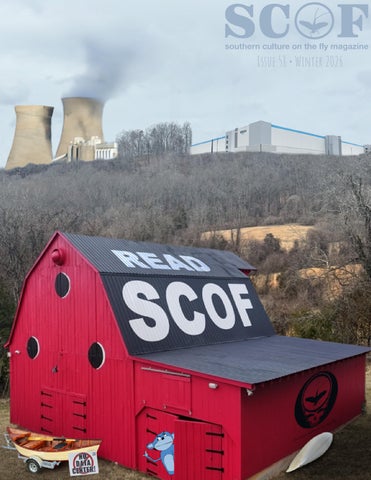
Create a flipbook
SCOF 58 final pages by Southern Culture on the Fly - Issuu