SAC Consulting: Perspectives (Spring 2026 | Issue 11)

Page 1


Perspectives

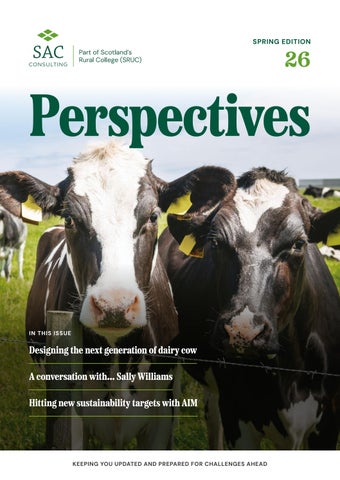
IN THIS ISSUE

Designing the next generation of dairy cow

A conversation with... Sally Williams

Hitting new sustainability targets with AIM

3 Introduction

CHLOE MCCULLOCH

6 Designing the next generation of dairy cow

PROFESSOR MIKE COFFEY

10 A conversation with Sally Williams

14 Sustainable dairy cow nutrition using home-grown forages

DR CARA CAMPBELL

18 Detecting and preventing disease in livestock

PAMELA JOHNSTON & HEATHER STEVENSON

22 Staff Spotlight

SARAH BALFOUR

4 Hitting new sustainability targets with AIM

SEAMUS MURPHY

8 Power from the herd: Turning livestock waste into energy

CRAIG BOTHWELL

12 New opportunities for nature restoration

BRADY STEVENS

16 Partnerships for sustainability on Skye

JANETTE SUTHERLAND

20 Taking Scotland’s renowned potato expertise across the globe

KYRAN MALONEY

23 Staff Spotlight QUIANNE REIJNEN

Introduction

Not a day goes past that I don’t hear regenerative agriculture being discussed, yet often it’s presented as something ‘other’ –an alternative to so-called conventional farming, and positioned as a different path that farmers might choose to take. However, framing it in this way actually misses the point, and undervalues what is already being delivered in Scotland across the agricultural sector.

Whilst relatively few farmers might choose to describe themselves as regenerative, in practice it has become the new normal. The motivations vary from business to business and tend to reflect a blend of factors, but regardless of the starting point or underlying drivers, regenerative practices are not fringe activities – they are becoming part of core business management, embedded in the day-to-day decisions that underpin resilient, productive and sustainable farming systems.

This reality is reflected in this edition of Perspectives, where we cover genetics, land management, livestock health, crofting practice, biodiversity restoration, energy from livestock waste and the practical challenge of meeting new sustainability targets. If read as separate pieces, these are technical subjects in their own right. Though when read together, they show us what regenerative agriculture looks like in practice.

Across the breadth of work reflected in this edition –from tools such as the Agricultural Intervention Model (AIM) which is supporting supply chains to assess impact and prioritise action, to practical advice on livestock nutrition – our emphasis continues to be on combining science, data and on-farm expertise to support informed decisions that deliver for farm businesses, supply chains and the environment.

At the time of writing, the sector is coming to terms with the potential implications of the conflict in Iran, with rising energy prices, fertiliser costs and disruption to global logistics already feeding through into farm businesses. Resource efficiency continues at the fore, and the articles in this edition reflect how that is being delivered in practice across a range of systems. The focus on maximising home-grown forages in dairy systems is a clear example - reducing reliance on volatile global feed markets while improving margins and lowering emissions intensity.

I am proud to work in a sector which is steadily embedding sustainability and regenerative practices into ‘business as usual’, for whom this is not a new direction but just ‘how good farming is done’. Thanks to the adaptability, openness and engagement of farmers and crofters, regenerative practice is becoming the conventional practice.

Hitting new sustainability targets with AIM

SEAMUS MURPHY, SENIOR CARBON AND SUSTAINABILITY CONSULTANT, SAC CONSULTING

At the end of January 2026, the Greenhouse Gas Protocol published its Land Sector and Removals Standard, with guidance to follow later in the spring. This is unlikely to be covered heavily in the farming press, but it should not be underestimated how significant an impact the publication will have on how farmers engage with the wider supply chains.

This standard forms the backbone of how companies with large land-based agri supply chains account for the climate impact of their supply and, crucially, how they act to reduce that impact.

This guidance is the basis for the Science-Based Targets initiative (SBTi) Forestry Land and Agriculture (FLAG) voluntary standard that, despite political shifts away from climate concern, has grown from just 4,000 companies in 2023 to more than 10,000 companies in 2026. These companies account for around 41% of global market capitalisation

Many of these sustainability targets have been justifiably viewed with cynicism in the past, with an unfortunate pattern that emerged post-2020 – corporate sets an ambitious target, heavily promotes their target and then does little in the way of achieving it.

However, this is now no longer acceptable without consequence. The SBTi publicly remove targets from companies who fail to submit plans.

PERSPECTIVES | SPRING 2026

This new standard and the guidance to follow will offer clarity on how a company should effectively report, monitor, and act across their land-based supply chains to increase the volume of companies engaging with their supply chains in order to achieve their targets. So, how will they do it?

A critical element of the new standard is the monitoring of emissions and removals associated with land-based supply chains. For example, if I am a global fast-food chain which purchases UK beef for burgers, I will be heavily encouraged to shift from a model-based emissions accounting system to using primary or hybrid approaches which obtain data from a representative sample of suppliers. If I want to include removals, such as measures which effectively lock up CO2 from the atmosphere (for example, in trees or farm soils), I must physically monitor the removal across my sample - whether that’s through remote sensing for new trees and hedges, or soil sampling for soil carbon.

This is the best practice approach simply for ensuring accurate reporting and monitoring. However, these companies must also achieve their targets. This may, for example, mean a percentage reduction in emissions across their UK beef supply chain.

Companies will need to increase their engagement with suppliers to do this; incentivising or mandating actions to bring down emissions, or increasing removals associated with the productive areas or those areas adjacent to production, such as buffer strips, hedges, etc. To do this, companies will need to understand their supply chain emissions in full, with clarity on what actions will be most cost effective and have the greatest impact in reaching their targets.

This is where SAC Consulting’s Agricultural Intervention Model (AIM) comes in. It can support decision making for companies and propose effective actions for farms that will result in reduced emissions or increased removals.

AIM’s ambition is to help companies with significant emissions associated with their agri supply chains - also known as scope 3 emissions - to set realistic land use targets and meet them within their own budget whilst engaging ethically with their value chain.

The AIM platform uses the most up-to date regional level research to identify the most effective interventions and then applies a cost and possible mitigation impacts (reduction or removal) across a given period. It allows the user to forecast different scenarios with a combination of interventions across their suppliers to achieve their given target within the budget they provide. This allows sustainability professionals to engage with different interventions, budgets and see what effect it may have on their value chain emissions over time - all in one easily accessible user-friendly platform.

The AIM platform can now help businesses to solve a critical problem and missing link in trying to adhere to the new standards and meet their SBTi FLAG targets. This helps them build science-based plans which outline the most effective ways to reduce emissions and increase removals through engagement with suppliers.

Designing the next generation of dairy cow

Dairy cows being milked in the UK today are the result of decisions farmers may have made up to seven years earlier. They will have been bred according to market signals, as well as the farmer’s own desires and breeding goals, and they are increasingly likely to have been genotyped.

Cows being milked now would typically have been bred some three to seven years ago, with genomic selection now widely used in the UK dairy industry. Over 1 million cows are now genotyped and more than 70% of all dairy semen used is sourced from genomically tested bulls.

The process involves taking a tissue sample (such as an ear punch, saliva, hair) and sending it to a genotyping company. The DNA is then extracted and the resulting genotypes, or data, sent to Edinburgh Genetic Evaluation Services (EGENES), where it is analysed along with all other animals’ DNA to predict how good the animal is for each trait.

Essentially, the process compares the young animals’ DNA (which has no performance records) to the existing reference population of animals that have genotypes and production records.

Over time, the young animals that have been genotyped get their own performance records and then become members of the reference population to help improve predictions for future generations. Many organisations provide this service of collecting the tissue sample and feeding results back to the farmer from EGENES. All results are available to see on the AHDB Dairy Breeding website.

The upsurge in genotyping dairy cows has coincided with the more widespread availability of sexed semen for all top bulls. The UK has the highest usage of sexed semen of any country in the world.

This has resulted in a greater proportion of the herd being mated to beef bulls and only around the top 25% of cows being bred to dairy using sexed semen. This has effectively doubled the selection intensity at herd level from the top 50% to the top 25% of cows, enabling more rapid genetic improvement.

So,

the question then becomes,

how to identify the top 25% of cows even before they have produced any milk?

That is where genomic selection comes in – the young heifers can be selected for breeding herd replacements based solely on their DNA. This accelerates on-farm improvement rates on the female side, allowing for increased emphasis on farm-specific traits of interest, for example, in grazing herds. Historically, farmers had to mostly rely on bulls provided by breeding companies to improve their herds because that is where most selection pressure was being applied. Genomics allows farmers to apply similarly high pressure within their herd to obtain benefits from both the bulls’ side and the cow’s side.

The recent price spike in energy costs and uncertainty about future prices has led to an immediate and large surge in interest for traits that were already being considered for inclusion in selection decisions. The UK index offering has included Feed Saved based on feed intake records from the SRUC Langhill lines of dairy cows and maintenance based on predicted mature cow size from linear type measures on bulls’ offspring. Genomics has allowed the rapid dissemination of superior genes for these traits, despite limited phenotype recording. Cows with higher Feed Advantage indices have reduced feed requirements and combined within the overall selection index, Profitable Lifetime Index (PLI), allows farmers to select animals that have higher production but lower feed requirements.

The role of cow size in efficiency

This high demand for efficiency has led to questions on the role of cow size in a modern dairy industry that is, and will continue to be, constrained by energy costs. Predictions of cow size from sire breeding values based on current inseminations shows that the national herd continues to rise in size at around 4000 tonnes per year. The average cow mature weight is around 700 kg. Again, genomics is useful to select young animals that are predicted to have lower mature size well in advance of having to feed them to find out!

Selection for improved feed efficiency

Previous selection using genomics has been shown to work because the traits under selection have well recorded phenotypes and we can monitor progress in the phenotype over time (e.g., yield has risen, somatic cell counts have reduced etc.). Future selection for improved

feed efficiency will be a leap of faith by farmers because it will be difficult for them to observe the improvements over time. If all things on the farm remain the same but selection for feed efficiency takes place, it is possible that the amount of silage left over each year will increase. This provides farmers with options – reduce the amount of silage made, reduce purchased fertiliser, reduce rented land, or rent out some land as an income source.

Improved feed efficiency automatically enhances environmental impact because less feed means less methane production. This indirect selection is a particularly useful way of reducing methane emissions in the short term until better methods of measuring methane are developed.

The cow of the future will be the same or better than the cow of the current and she will be smaller and therefore more efficient in utilising feed. She will be selected for reduced feed intake, resulting in lower greenhouse gas emissions intensity. The emphasis will move from profit at mostly market costs to profit at farm, planet, and society costs. Genomic selection allows rapid and effective genetic improvement for traits that contribute to these competing demands.

A pertinent question remains, however: how are farmers going to be paid, and by whom, to alter their selection directions for non-market costs?

mike.coffey@sruc.ac.uk

from the

Turning livestock waste into energy

Cattle

are all too often seen as a major contributor to the climate crisis – when the truth is that they can be part of the solution.

SRUC’s GreenShed, based at Easter Howgate Farm and nestled in the Pentland hills to the south of Edinburgh, brings together technology, researchers, policymakers and livestock – with the aim of sharing the positive stories of livestock production in Scotland.

It has been built on the idea that cattle can help in the fight against climate change, rather than being seen as solely as a contributor to greenhouse gas emissions. GreenShed is home to a circular farming system and has been running for several years - welcoming visitors and hosting numerous open days. The shed itself is powered by cattle waste. The system is based on capturing methane from livestock

manure and from the enteric fermentation of cattle - turning this into electricity whilst also producing valuable fertiliser.

A small-scale anaerobic digester near the shed processes the dung, which, when mixed with water, becomes a liquid slurry. Methane is then captured from this mixture and fed into an internal combustion engine, which drives a generator to produce electricity.

From the anaerobic digester, liquid digestate can be processed through a water treatment plant with a highly concentrated nutrient liquid, providing nutrition to help grow indoor crops in a hydroponic greenhouse. The combustion engine needs air to carry out combustion, so air from the shed is extracted and fed into the engine’s intake. This air contains very low quantities of methane from the housed cattle and bedding, which is burned up in the engine as part of the combustion.

None of the technologies in the shed are new but bringing them all together in this novel approach to produce beef, electricity, and salad crops is not exactly common practice.

This circular concept was built with the idea of demonstrating the sustainability of livestock. The energy that is lost through enteric fermentation can be utilised to produce food, either for human consumption or to be fed back to the animals. Plus, this can happen while having a productive finishing livestock enterprise, which contributes beef to the rural economy, as well as electricity and fresh produce.

None of the technologies in the shed are new but bringing them all together in this novel approach to produce beef, electricity and salad crops is not exactly common practice. The dairy industry has been utilising climate-controlled sheds for many years, and it is true that anaerobic digesters are also not recent technologies.

However, being able to demonstrate the circular approach which can also include fresh produce is one of a kind.

Sensors are placed within and outside the shed to measure wind speed, temperature, and humidity, meaning it can be automatically climate controlled. This, combined with automatic galebreakers and positive pressure tube ventilation systems, allows a computer to adjust the shed’s ventilation accordingly.

On a cold day, the shed can be fully closed, keeping heat in, and, if humidity rises, fresh air can be allowed in. On a warm day, the shed can be fully open, maximising fresh air and reducing the temperature.

This technology can be fitted to any shed, but it will be at a significant cost. However, utilising some of these options in isolation can help improve shed ventilation, which in turn improves the air quality and the health of housed livestock.

The ability to retrofit this technology to sheds represents clear opportunities for improvements in both livestock health and profitability.

Few farms will fully replicate this system and begin growing fresh produce, but what the shed does demonstrate is the potential to capture and utilise livestock energy more effectively. This supports a circular economy approach, as well as fully utilising grass and cereals grown on the farm.

Realising that potential can be seen as a key step towards net zero.

A conversation with

Sally Williams

A dairy farmer, innovator, agriculture advocate, and mum, Sally Williams does not see agriculture as something inherited, more a deliberate career choice shaped by learning, taking opportunities as they come and a willingness to question how things have always been done.

Sally farms at Clackmae Farm in the Scottish Borders;  a mixed family farm with roots stretching back almost 200 years. Sally originally grew up on her family’s farm in Fife before moving to Clackmae as a family in 1996. Today, the business is run by Sally, her parents and a wider team of nine.

At the heart of Clackmae is dairy, Sally’s real passion.  The farm milks a Holstein herd of around 400 cows,  with an additional 600 followers, but as a mixed farm, works to balance dairy, sheep, beef, and agritourism. It is a complex system that relies on strong teamwork and confident decision-making.  Each generation gone before embraced change, trying new ideas and taking the business in different directions. Rather than feeling constrained, she sees it as an invitation.

“For some, it can feel like a weight, having such a huge heritage behind you,” she says. “But actually, for us, in some ways it’s very freeing. We know every generation has done something new, challenging us to ask, ‘What mark are we going to put on it?’ Everyone wants to leave their own legacy.”

That focus on evolution underpins everything Sally does at Clackmae. For Sally, innovation is not about chasing trends but making thoughtful choices that move the business forward.

Yet farming was not always on the cards. She went to university and took on roles with the NHS and the tourist board, before becoming more involved with the farm. Determined to ground her farming experience in learning, she enrolled at SRUC in Edinburgh, studying Agriculture with Animal Science and graduating in 2009. Exposure to different enterprises, sharing knowledge with peers and academic qualifications gave her the confidence to return home and take on more at the farm.

Soon after, Clackmae became an early adopter of robotic milking. Sally led the installation of Lely robots from 2009, transitioning gradually towards greater automation.

“With dairy, I’m very focused on the numbers – breeding, genetics, performance. But since we put the robots in, I know far more about the cows as individuals than I ever did before.”

We know every generation has done something new,  challenging us to ask, ‘What mark are we going to put on it?’  Everyone wants to leave their own legacy.

Recent investments, including a slurry separator, have been game-changing for Clackmae, shifting slurry from a disposal problem to a valuable nutrient resource. Yet her approach to innovation is generally more measured than impulsive.

“For me, learning from others’ mistakes and experience is so important. As a result, I’m also very open with people about what worked for us and what didn’t.”

Diversification at Clackmae has grown from that same openness. The farm’s pick-your-own pumpkin patch began during COVID as an experimental project for Sally and her mum. Evolving each year so as not to affect the running of the farm, it has become a much-loved seasonal event in the community, bringing lots of families directly onto the farm.

“That first year, we were blown away by the response. One of my proudest moments was recently, during our local festival week. There was a float with kids dressed up as farmers. They had a banner with ‘Clarkson’s Farm’ on it, but Clarkson was crossed out and replaced with ‘Clackmae’. For them to be proud of us and want to showcase that, it was lovely.”

Through RHET visits, farm tours and open conversations with visitors, Sally is also passionate about educating people on where their food comes from.

“Has it changed how I tell my story? Undoubtedly,” she says. “It makes you reflect on why you do things and explain them more clearly, and has made me braver in addressing more difficult topics rather than shying away from them.”

Whilst those connections are deeply rewarding, Sally remains clear-eyed about the wider challenges shaping today’s dairy industry. Pressure, she believes, can lead to different, sometimes unexpected, outcomes.

“There will be those who capitalise on the challenges being faced right now. Some may take it as an opportunity to leave the industry and do something else, and that might be positive for their mental health. But there will also be those who diversify, innovate, and do different things within the farm, using that as part of their story.”

Beyond the farm gate, Sally has become a respected voice within the industry. From National Chair of SAYFC to Chair of the Oxford Farming Conference, she has been involved in the wider UK industry, yet her leadership journey was not planned. Instead, it grew from a willingness to step forward as opportunities arose.

“Farm life is wonderful, but it can also be repetitive,  day in, day out,” she says. “Chair roles and meeting people outside of my own world gets me out of the  echo chamber – it reminds me that there’s a much bigger picture.”

Looking ahead, Sally is thoughtful about future plans and change in the next few years. With her parents beginning to step back and her eldest daughter already showing enthusiasm for farm life, the next chapter at Clackmae is quietly taking shape.

New opportunities for nature restoration

Biodiversity is no longer seen as a ‘nice to have’ for Scottish agriculture, it is recognised as being central to the resilience, profitability, and future viability of the sector.

With biodiversity and healthy, functioning ecosystems remaining critical to the Scottish agricultural sector, the extent of the global biodiversity crisis and its implications are vital for us to consider. A new report from Defra, ‘National Security Assessment on Global Ecosystems’, warns that significant disruption to international markets (because of ecosystem degradation or collapse) will put UK food security at risk. This is not only due to direct impacts on UK food production, but also on international production and trade, which we rely on to meet the food security needs of the UK population.

Benefits provided by healthy ecosystems include clean air and water, soil formation and quality, crop pollination, nutrient cycling, and the provision of critical resources. Threats to ecosystems could result in a cascading series of risks such as pest outbreaks, crop failures, and increasing competition as well as the potential for conflict over scarce resources. As the most important land managers in the UK, farmers sit at the crux of biodiversity, both exposed to these risks but uniquely able to act and make a difference.

The Scottish Government is pursuing multiple channels to address the biodiversity crisis and reward farmers for making a positive impact. There has been a flurry of relevant policies introduced over the past few years, including the Scottish Biodiversity Strategy and Delivery Plan, the Natural Environment Bill, and the Biodiversity Investment Plan. Through these strategies, plans and policies, Scottish Government is seeking to put the necessary infrastructure in place to channel both public and private investment into nature recovery at scale.

The major new development to be aware of, is the rollout of the Ecosystem Restoration Code (ERC). For most farmers in Scotland, access to private finance to restore natural resources has so far been limited to the Woodland Carbon Code and the Peatland Code. These have rigorous criteria for the actions and habitats that can be funded, which is restrictive for many farms in Scotland (for example, if your farm does not have peatlands, or is too small for a woodland project to be viable). While the new ERC will also be rigorous, the intention is to unlock a finance mechanism for a much broader range of actions and habitat types, such as restoring species-rich grasslands, re-meandering waterways, or managing moors and heaths for habitat provision.

As the most important land managers in the UK, farmers sit at the crux of biodiversity, both exposed to these risks but uniquely able to act and make a difference.

The ERC is still in development, and Scottish Government teams are reviewing and integrating feedback from a consultation on the draft code. A lot of details are yet to be nailed down; however, the core of the offer will be for a land manager - or groups such as farm clusters or catchment partnerships - to create a land management plan. The land management activities under said plan will enable the restoration of ecosystem condition in the qualifying area for a minimum project durationcurrently proposed to be ten years. Projects will then be audited or verified at regular intervals to quantify the ‘uplift’ or improvement in ecosystem condition, thereby creating biodiversity credits and tradeable assets.

A key decision being considered within the development of the ERC is whether to include regulatory or compliance demand within the market for these biodiversity credits. Regulatory demand drives the Biodiversity Net Gain (BNG) market in England. As developers need to offset or compensate for any unavoidable negative impacts on biodiversity (i.e., due to regulation), this creates a demand for projects which result in biodiversity uplift. This regulatory demand could be critical given the uncertainty around the level of private sector appetite for purchasing biodiversity credits (i.e., ‘voluntary’ demand). While some corporations and financial institutions have indicated interest in purchasing credits to meet self-imposed sustainability goals, a regulatory mechanism would be a significant market driver for ERC credits.

Crucially, the ERC is intended to add to the existing landscape of support and finance available to farmers and land managers rather than replacing it. It is being designed to be compatible with established mechanisms such as the Woodland Carbon Code and Peatland Code, as well as future agricultural support, Peatland ACTION, the Forestry Grant Scheme, and the Nature Restoration Fund. In practice. This means farmers should be able to layer and align funding streams where appropriate, creating coherent, long-term land management plans, rather than being forced to choose between narrow or mutually exclusive options.

With the right options in place, the ERC could become an important string to farmers’ bows - a funding stream which supports the sector’s objectives of contributing to biodiversity recovery, ecosystem resilience, and national food security.

By unlocking a new route to market for a wider range of nature restoration activities, biodiversity finance could soon be a core component of thriving, diversified rural businesses, embedded in integrated Scottish landscapes.

At SAC Consulting, we work closely with farmers and land managers to help them anticipate, adapt to, and make the most of emerging opportunities like this. If you would like to explore what the ERC could mean for your business or land, get in touch.

Sustainable dairy cow nutrition using home-grown forages

Nutrition is a fundamental part of any successful dairy business, from that first intake of colostrum in a newly born calf all the way through to a balanced ration for milking and dry cows.

By January 2026, milk prices had dropped significantly causing margins to be tighter. Therefore, producer focus must be on maximising returns from the winter ration. There will be temptation to remove ingredients, particularly the more expensive ones, to reduce cost. However, a cow’s nutritional requirements do not fluctuate with the drop in milk price, therefore short-term changes can have long-term performance impacts.

Across the globe, the drop in milk prices is due to the over production of milk compared to the demand. Yet as the global population is predicted to increase to over 9 billion in 2050, will current production levels meet those demands, or will production needs increase?

The answer is most likely the latter, therefore a key part of the solution will involve sustainable nutrition which meets production demands whilst adapting to environmental changes and targets for lower emissions. Between now and 2050, farmers will need to find ways to adapt to shifting growing seasons - whether due to droughts or increased rainfall - which affects global crop supplies depending on crop resilience.

What does sustainable nutrition look like for Scottish dairy producers? The greatest asset any dairy farmer has is grass, and utilising home-grown forage to produce milk. The use of home-grown forages can improve the sustainability of dairy farms, both financially and environmentally. Milk from forage is a key performance metric, measuring how many litres of milk are produced directly from the forage portion of the diet. The UK average currently sits at around 3,000 litres per cow, yet the top 25% of farms are achieving closer to 4,000 litres, with the top 10% pushing beyond 4,500 litres. It is important to note that farms achieving the highest milk from forage and milk yields will also be feeding other forages alongside the grass silage. For producers operating at the national average, this highlights a clear opportunity to improve performance.

Grass remains the cheapest feed available to dairy farms and should be maximised as a core component of the ration. The challenge lies in striking the right balance

DR CARA CAMPBELL, SENIOR DAIRY NUTRITIONIST, SAC CONSULTING

between forage and concentrate intake, ensuring cows utilise feed efficiently without compromising yield. Ideally, cows will consume high levels of forage while delivering strong milk outputs from the lowest cost ingredients in the diet. Grazed grass typically costs around 3.3 pence per litre, compared with 7.5 pence per litre for high quality first cut silage. In contrast, parlour concentrates cost approximately 14.8 pence per litre and are heavily influenced by volatile global commodity market prices.

The inclusion of forage legumes within the system has many benefits including a high nutritional value to dairy cows; assisting in soil health and fertility and reducing the reliance on purchased protein. Typically, forage legume silage has a crude protein content of between 17%–22% which is higher than the average grass silage. Research has shown that the inclusion of forage legumes in diets can increase dry matter intake and milk yield of dairy cows, yet the cropped area of legumes has not increased significantly over the years. Forage legume-based silages in the diet of dairy cows has shown a reduction in soya bean meal by approximately 0.4 kg per cow per daywhich over the course of a winter can have significant savings for the business. Alongside the reduced reliance on purchased protein, forage legumes offer a reduction in greenhouse gas emissions (GHG) with these legumes releasing five to seven times less GHG per unit area than other crops like wheat and oilseed rape. Similarly, legumes increase the carbon sequestration in soil as well as reducing the reliance on nitrogen fertiliser. Together, these practices lower a dairy farm’s carbon footprint without compromising cow productivity.

Sustainable nutrition of the future must reduce the reliance on feeds impacted by global commodity prices and focus on sources of quality nutrients which can be home grown on farm. Improving milk from forage will be fundamental in achieving milk production and lowering carbon footprint whilst adapting to environmental changes across the globe.

“Yield has increased by around 100 kg per cow per year, but this has nearly all come from concentrates and makes the UK dairy industry much more vulnerable to world commodity prices.”

- Prof Liam Sinclair, Harper Adams University

cara.campbell@sac.co.uk

Partnerships for sustainability on Skye

Sometimes sustainability is presented as ‘new’. However, my experience on Skye has convinced me that it is found in supporting traditional crofting practices, alongside adapting to new technologies and legislation.

Crofting is uniquely Scottish and an integral part of life in rural and island communities; a core feature of crofting is common grazing, where the management of large areas of moorland, grassland or machair areas are managed collectively by the crofters who share grazing rights. The practice, therefore, is far from a ‘new invention’. According to the European Forum on Nature Conservation and Pastoralism, common grazing can be a vital bulwark against the potential damage from climate change and biodiversity loss.

Common Grazing = Nature Positive:

Grazing on moorland areas maintains habitats which can support both grazing animals and wildlife.

Over the last twenty years working with SAC Consulting on my home island of Skye, I have discovered that listening and learning from traditional practices as well as monitoring the latest research on environmental impacts of newer techniques can ignite powerful partnerships that allow both crofting communities and the environment to thrive.

A particularly good example is the success of the Skye Crofting Corncrake Partnership, which has seen the numbers of an endangered bird species rise. Corncrake numbers fell dramatically in the 20th Century, leaving the species on the brink of extinction.

Power of Partnerships: RSPB played a vital role in providing insights to support the success of the Corncrake Partnership

These small birds rely on tall vegetation for cover, and we learned it would help them enormously if mowing of silage or hay was delayed until later in the summer. In addition, cutting outwards from the middle of fields would help the elusive birds move out to the edges for safety.

The initiative was a success, with a welcome (and muchneeded) rise in the number of corncrakes on Skye in recent years. This is an achievement for the crofting community, and we all benefit from helping to preserve our ecosystem.

We have also worked with crofters on another collaborative conservation initiative, ‘Species on the Edge’, which raises awareness of the influence bats have on biodiversity.

Maximising the Midge: Bats eat 30,000 midges a night – a great statistic to encourage a warm welcome for bats on crofts

Having bats on your croft is a sign of a healthy ecosystem and it is also important for crofters to hear positive things about the way they are managing their land.

Another major part of my role is to help my fellow crofters be aware of new legislation and ways of working (with support to adapt where necessary), which consider the unique needs they may have compared with their mainland counterparts. It is very much about working in partnership to advance crofting and farming practices in our part of the world – and, as has been proved, this can be done in a very sustainable way.

Sustainability in farming is crucial for ensuring food security and helping protect the environment. Our challenge now is continuing to find ways of doing both of those things while also safeguarding the future of rural communities. Our experience on Skye has shown what is possible and we must keep working together to create these win-win situations.

Janette Sutherland is Senior Consultant on the Isle of Skye and was awarded the 2026 Elrick Award for her work supporting sustainable crofting.

Get in touch

janette.sutherland@sac.co.uk

Detecting and preventing disease in livestock

Effective animal health surveillance is fundamental to a resilient, productive, and sustainable livestock sector. Through Scottish Government funding, SRUC Veterinary Services delivers the national VAS Programme, providing disease surveillance, animal health planning and welfare support to vets and farmers across Scotland.

Surveillance is more than a statutory function; it is a system designed to detect change early. Diagnostic submissions to SRUC Disease Surveillance Centres (DSCs), combined with intelligence gathered through strong professional networks, allow emerging issues to be identified quickly. This early warning capacity supports farmers and vets to prevent disease rather than simply respond to it - helping strengthen business resilience, welfare outcomes, and the drive toward lower emissions.

Knowledge exchange remains central to enabling change on the ground. Through a blend of online and in person meetings, and supported by SRUC’s network of Veterinary Surveillance Hubs, we ensure critical information reaches vets and farmers when it matters. These hubs, deeply embedded within local communities, strengthen relationships and enable rapid, accurate communication.

Surveillance insights are shared widely through websites, newsletters, scientific reports, social media updates, and regional briefings. This diversity of channels ensures information is accessible and actionable.

When our vets make a diagnosis, they assess its wider significance by asking key questions:

• Is this a new or unusual disease occurrence?

• Is it notifiable?

• Does it require further investigation?

• Could it affect public health or food safety?

Scottish surveillance findings contribute to the broader Great Britain disease picture alongside the Animal and Plant Health Agency and other laboratories, ensuring Scotland’s livestock sector remains firmly connected to UK-wide intelligence.

Surveillance is ultimately a communication system built on trust. Farmers share concerns with their vets; vets consult SRUC specialists and advisers and research teams provide evidence-based guidance. Peer-to-peer conversations among farmers and vets often identify challenges early, and SAC Consulting advisers contribute vital insights when weather, feed or market pressures start to influence animal health.

Publications such as Unearthed, Sheep and Beef News, the Vet Record surveillance summaries and updates all play a role in keeping that information flowing.

For individual cases, honest communication is equally vital. Detailed histories, images, and video clips help us to interpret lab results accurately.

Above all, strong working relationships between vets, farmers, advisers and researchers, ensure that surveillance continues to evolve and support Scotland’s ambition for a sustainable, resilient agricultural sector.

A quick conversation with SRUC vets before a farm visit can help practitioners choose the right samples and tests, improving outcomes and saving time.

Scotland’s surveillance system works because it integrates early field intelligence, diagnostic evidence, and research-driven expertise. Whether knowledge emerges from trials, on farm records or national datasets, its value lies in translating it back into meaningful guidance for farmers.

Above all, strong working relationships between vets, farmers, advisers and researchers, ensure that surveillance continues to evolve and support Scotland’s ambition for a sustainable, resilient agricultural sector.

Lymph node aplasia is a novel condition affecting Scottish blackface sheep. It was first detected by SRUC Veterinary Services following post-mortem examination of lambs submitted to investigate severe orf infection. This revealed that lambs were being born without lymph nodes which are a vital part of the immune system. Affected lambs are unable to control the orf virus resulting in severe clinical signs. They do not respond to treatment, and without euthanasia continue to lose weight and die.

This condition has become of increasing concern to keepers of Scottish blackface sheep and has significant welfare and financial impacts at both the individual animal and flock level. The true losses associated with it have not been defined and will be greater than currently realised.

SRUC Veterinary Services have been working with individual farmers and the breed association to identify affected flocks and facilitate knowledge transfer. A genetic cause is suspected; however, initial investigations have so far failed to pinpoint the source. Ongoing collaboration with the Roslin Institute and the University of Glasgow (as well as with researchers within SRUC) is planned, with an ultimate goal of eliminating lymph node aplasia from the breed.

Taking Scotland’s renowned potato expertise across the globe

KYRAN MALONEY, SENIOR POTATO CONSULTANT, SAC CONSULTING

Potatoes are a vital food source valued around the world for their versatility, nutritional benefits, and the significant role they play in both helping boost economies and providing food security. They are the third most important food crop in the world after rice and wheat, and Egypt remains the largest potato buyer of Scottish seed potatoes.

Just as the potato itself has global reach, so does SAC Consulting’s potatoes team. Working with clients in different parts of the world allows us to showcase the international expertise we offer, and the innovation grounded in research and practical solutions.

A notable example is our relationship with Japan’s Calbee Potato. The partnership was first developed in 2002 by Dr Stuart Wale, whose research and consulting work helped forge a network of like-minded growers and technical potato specialists. Calbee Potato is a wholly owned subsidiary of Japan’s largest snack manufacturer, Calbee, which has approximately 70% of the market share of the Japanese crisp market.

One of the biggest challenges Calbee faces is the changing climate. Hokkaido, the second largest and most northern of Japan’s four main islands, faces much colder winters and warmer summers than Scotland.

Meanwhile, here in Scotland, warmer summers and milder winters are bringing rising pest and disease pressures. These shared challenges create opportunities for collaboration and knowledge exchange across borders.

Over the past year, we have been proud to welcome two of Calbee Potato’s fields men, Ren Okamura and Hiroto Sugiura, to Scotland as part of a mentorship programme.

During their visit, one of the biggest advantages for Ren and Hiroto has been getting to see first-hand how we interact and cultivate strong working relationships with farmers, something they are keen to learn from and develop back in Japan. They have also facilitated discussion groups and helped research those emerging pest and disease challenges affecting the potato industry worldwide.

Their Scottish experience culminated in a presentation at our annual SAC Association of Potato Producers (SACAPP) conference in Dundee, where they shared the value of what they have learnt in Scotland and how it will help them back in Japan.

Meanwhile, here in Scotland, warmer summers and milder winters are bringing rising pest and disease pressures. These shared challenges create opportunities for collaboration and knowledge exchange across borders.

Our international work extends beyond Japan, however. Another partner we work with is Grimme, a large agricultural machinery manufacturer headquartered in Germany and with operations and customers around the world.

SAC Consulting has worked with Grimme over several years, conducting field trials under commercial Scottish growing conditions to test and develop machinery solutions suited to the high-quality seed potato sector. Our specialist expertise in potatoes, our strong reputation for delivering independent field trials, and our ability to provide robust trial environments allow clients to refine and adapt prototypes in real-world conditions.

We were able to provide Grimme with a flexible and responsive trial environment, allowing our client to test, refine and adapt machinery prototypes as development progressed. Trial results from Scotland were then compared with equivalent trials in Germany, helping inform machinery development across different environments and markets. The partnership has highlighted our role and ability to support global agricultural manufacturers and contribute to innovation within the potato sector.

Closer to home, we have been able to support CAFRE (College of Agriculture, Food and Rural Enterprise) through knowledge exchange, training, and technical expertise. CAFRE is an agricultural education and knowledge transfer organisation in Northern Ireland.

Again, the relationship is based on shared goals – supporting growers, improving crop quality, and strengthening the sustainability and productivity of the potato sector.

CAFRE valued our scientifically robust independent information generated through field trials and our reputation for delivering evidence-led practical insights that can be directly applied to commercial growing conditions. Together, our organisations are like-minded partners with aligned goals of supporting growers, improving crop quality, and advancing the industry through research and innovation.

The potato shows no sign of losing its global popularity, and our ongoing partnerships with clients from around the world will continue to enable us to find different solutions to meet the diverse industry needs.

kyran.maloney@sac.co.uk

Sarah Balfour

BEEF CONSULTANT

Specialist expertise

• Beef production systems

• Suckler herd fertility

• Herd health and health planning

• Beef markets

What was your career journey into this role?

I studied agriculture at SRUC Craibstone and graduated in 2011 with an honour’s degree. After graduating, I spent several years working at home on an upland suckler beef and sheep farm. In April 2015, I started with SAC Consulting as a Technical Administrator before moving into a Trainee Consultant position within the Elgin office. My passion and real interest is with suckler cows and beef production systems so when the opportunity arose to join the livestock team, I seized it - becoming a Beef Consultant in 2018. I am now based within the Thainstone office.

Why did you come to work at SAC Consulting?

A consultancy role always appealed to me as a way to help and advise farmers, and to make a real difference to farming businesses. I always aspired to join the livestock team, as it is renowned for its expertise and independent advice. I have been fortunate enough to work closely alongside industry experts like Basil Lowman, retired Senior Beef Specialist, and I am thankful for the opportunities that have come my way as a result.

If you could do anyone else’s job here, who would it be, what is their role and why?

I also have a real interest in livestock health - particularly infectious disease and herd health planning. I feel extremely fortunate that my role allows me to work closely with our Veterinary Investigation Officers (VIOs). Through this collaboration, I have developed a strong interest in the veterinary services team. They do an incredible job at contributing significantly to improving herd and flock health across the UK.

What

work (in your current role) are you most proud of and why?

I find the one-to-one advisory work most rewarding, and it is a huge motivation that farmers come to me for advice and support. I’m also proud to be Editor of Unearthed - SAC Consulting’s subscriber newsletter. I work hard on curating its content - ensuring that articles are technical and timely enough to best support our farmer and crofter clients.

If you had one wish, to be used to better the industry, what would you wish for?

My one wish would be for price stability which would bring confidence to the industry. As suckler cow numbers continue to decline, there is increasing strain on the critical mass required to sustain the wider industry. A viable scale of production is essential to support key sectors such as hauliers, abattoirs, veterinary services, livestock marts, and consultancy, among others. Confidence is key for making long-term investments, and for the future of our beef industry.

Staff Spotlight Quianne Reijnen

AGRICULTURAL CONSULTANT

Specialist expertise

• Carbon auditing and emissions mitigation

• Ruminant livestock systems

• Cost of production and financial analysis

What was your career journey into this role?

Following a lifelong love of animals, I studied at the University of Glasgow to obtain my BSc (Hons) in Veterinary Biosciences. From there, I was accepted into Genus’ graduate programme, which involved time spent in all aspects of its genetics business, as well as working at its sister company, Promar, for several years. I am now enjoying my role as Agricultural Consultant for SAC Consulting, based in Stirling.

Why did you come to work at SAC Consulting?

Working for SAC Consulting has allowed me to offer clients a wider range of services - like Scottish subsidy and grant applications. The number of specialists across Scotland that SAC Consulting employs means that even if I cannot help the client on this specific matter, I have a colleague who will be able to, so they are never left without a solution.

If you could do anyone else’s job here, who would it be, what is their role and why?

I would consider going back to the role of a sustainability consultant, which would mean more corporate client management. Although challenging at times, relaying to retailers and processors how best to support sustainable practices can be extremely rewarding.

What work (in your current role) are you most proud of and why?

Carbon audits can sometimes be seen as something which is just a ‘tick box exercise’ for farmers. I take joy in making it more than this, by providing value and insight using the data needed and results produced. It is a fantastic way to benchmark your farm against others, without going into the financials. I pride myself in using the time on farm and the results from the carbon audit to provide meaningful advice and support.

If you had one wish, to be used to better the industry, what would you wish for?

I would love for farming and agriculture to be better recognised by the public for the benefits it brings. Our farmers work hard to maintain food security in Scotland, in unpredictable weather conditions at times. Many consumers do not appreciate just how much work goes into farming, or how much of a positive impact farmers have on our day-to-day lives.

Stonehaven
Forfar
Turriff
Thainstone
Inverness Ayr Elgin
Portree SRUC
Cupar
Stranraer Campbeltown
Oban
Stornoway
Balivanich
Kirkwall

Turn static files into dynamic content formats.

Create a flipbook