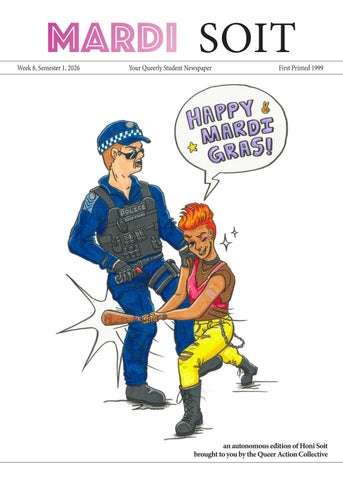
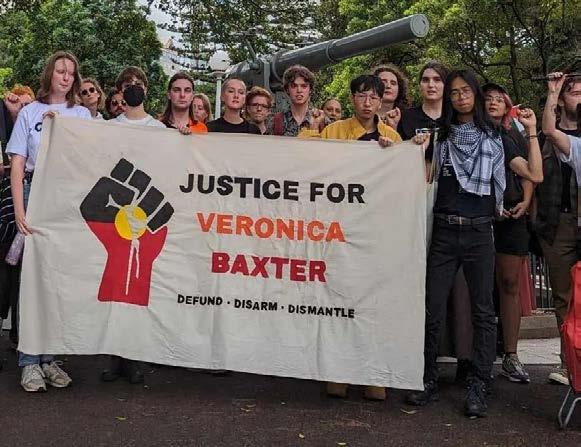
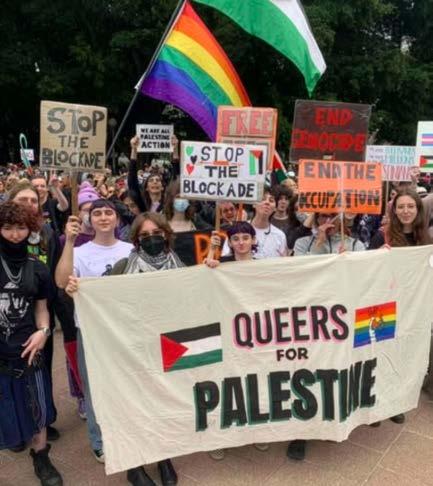
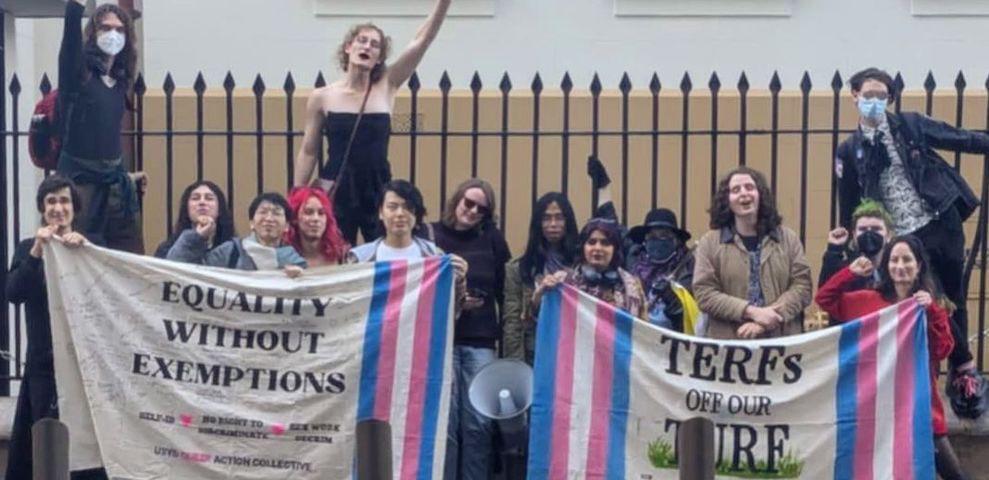
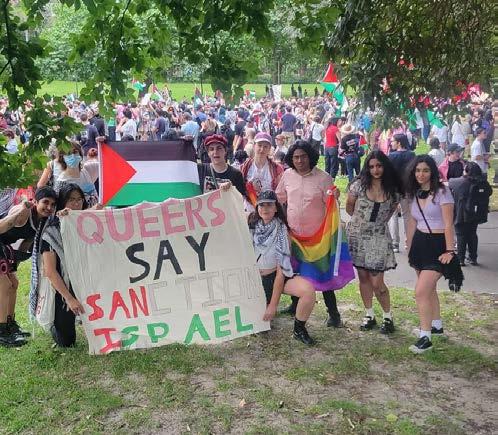
This queer autonomous edition of Honi Soit, like all editions before it, has been written, edited, and printed on stolen Indigenous land. The University of Sydney Students’ Representative Council, which funds this newspaper, sits on unceded Gadigal land. As university students and as queers, we have a responsibility to staunchly fight the colonialism and imperialism that are perpetuated through the institutions we participate in, learn from, and give our money to.
So-called ‘Australia’ continues its long history of silencing, brutalising, and murdering First Nations people with no signs of stopping, and its ever growing death toll must be kept at the forefront of our minds and actions when organising for queer liberation. We are 35 years out from the Royal Commission Into Aboriginal Deaths in Custody, with 630 recorded deaths and still no justice. Trans women and sistergirls are incarcerated in men’s prisons and face assault and the denial of gender-affirming healthcare.
Charities and state governments steal Indigenous children from their families and place them in foster care with white people rather than family members who are LGBTQIA+. The fight for Indigenous liberation is a queer fight too, against homophobia and transphobia, police brutality, and racism.
Amidst this, the University of Sydney continues its long history of silencing student fights for justice, both through its collaboration with police and its replication of their force through campus security, the Campus Access Policy, and threats of expulsion turned into deportation threats on a queer asylum-seeker student. The University props up colonialism at home and abroad with its investments into fossil fuels destroying Indigenous land and weapons manufacturers and military technology used to commit genocide in Gaza. The fight for land back and selfdetermination for First Nations people in Palestine, in so-called ‘Australia,’ in Turtle Island, in Papua New Guinea,
In This Edition:
and across the world, is a struggle students must fight here on campus and put at the front of our politics and our journalism.
There is no queer justice without Indigenous liberation, and no one is free until all of us are free. We stand in solidarity with all those fighting colonialism and injustice, from Gadigal to Gaza. Always was, always will be Aboriginal land.
What is QuAC?
USYD Queer Action Collective (QuAC) is a student activist group fighting for queer liberation on unceded and occupied Gadigal Country. We organise around social issues such as LGBTQIA+ rights, sex workers’ rights, migrant justice, Blak sovereignty, a free Palestine, police abolition, and much more.
Last year, we exposed the University’s transphobic and anti-refugee ‘Campus Access Policy,’ which attempts to suppress political dissent by threatening students’ enrolment. We successfully challenged the
What is the Queerspace?
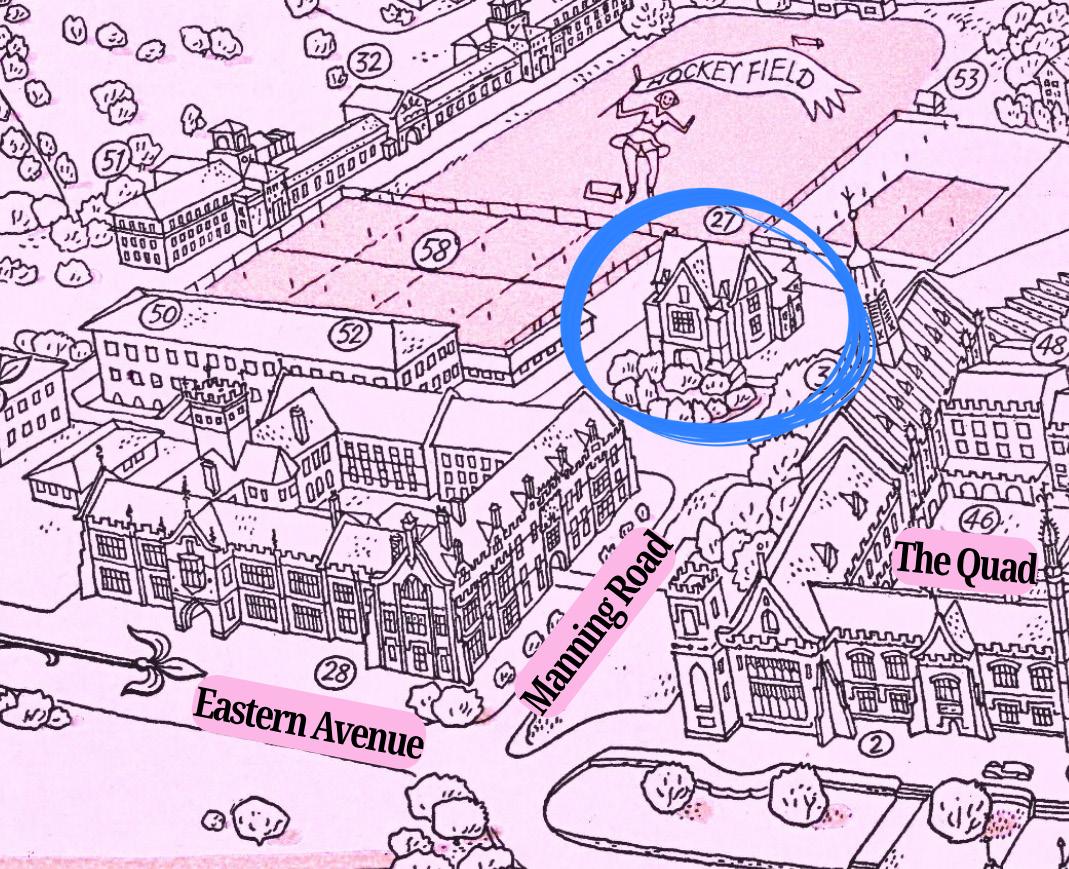
The Queerspace is an autonomous space for anyone who identifies as queer or questioning. Come if you need a space to study, hang out, read books, play games, and join on-campus queer activism. It’s on the ground floor of the Manning House (A23) near the toilets.
University’s suspension and deportation of a transgender, asylum seeking student and scared the University out of harming further students with this policy. We also challenged the Labor Party’s careless outing of a queer student and got Sydney Gay and Lesbian Mardi Gras’ policies changed to better protect atrisk youth.
This year, we’re undertaking campaigns on global solidarity with trans people facing discrimination and repression, transformative justice instead of carceral and police violence, and queers for Palestine solidarity.
We hold events year-round, including protests, forums, and film screenings, and we have fortnightly organising meetings during the semester. If you want to get involved, you
can join our Facebook group at USYD Queer Action Collective or on Instagram @usydqueer. Come to a meeting (fortnightly on Thursdays at 4pm in the Queerspace and on Zoom) and read this edition and previous Queer Honis to learn more about our politics and campaigns.
And as always, big things coming soon!
JOINT STATEMENT: PALESTINE'S BIRZEIT UNIVERSITY
& AUSTRALIAN UNIVERSITY
STUDENT & STAFF ORGANISATIONS COMMIT TO COLLABORATION
We recognise universities are sites of both complicity in, and resistance to, the genocide, occupation and apartheid inflicted on Palestinians by the Israeli occupation.
Education is a basic human right. But the Israeli occupation is committing scholasticide against the Palestinians. Every University in Gaza has been destroyed or severely damaged and universities in the West Bank are routinely targeted in the occupation's raids.
The Israeli occupation's universities are instruments of the occupation, genocide and apartheid inflicted on Palestinians. They are intimately linked to the Israeli occupation's military industries. For example, the Technion developed the remote control D9 bulldozer used to demolish Palestinian homes. They are also integrated into Israel's military itself. One of many examples is the Hebrew University Jerusalem's Havatzalot program which trains IDF intelligence officers. And universities are sites where voices in support of Palestinian freedom are silenced.
FOR A FREE PALESTINE
Universities in Australia must end their complicity in the Israeli occupation's crimes. We reiterate the position in support of an academic boycott of Israel adopted by the National Tertiary Education Union and Australian student organisations. Partnerships and research with weapons companies supplying Israel must also end, along with attempts to silence solidarity with Palestine in Australian universities.
We welcome the boycotts of the apartheid Israeli occupation's universities achieved after campaigning in Australia, including:
• The end of Sydney Uni’s exchange partnership with Israel's Bezalel College of Art and Design in 2025. Bezalel used its studios to manufacture IDF uniforms during the genocide in Gaza.
• The end of the University of Technology Sydney's Memorandum of Understanding with Israel's Technion in 2025.
• The termination of Curtin University's exchange partnership with Israel's Ben-Gurion University.
Further, we commit to fostering collaboration, academic exchange and solidarity between students and staff at Palestine's universities, including Birzeit University in the West Bank, and their counterparts at universities in Australia through joint events and other appropriate initiatives.
International solidarity, boycotts and sanctions helped end apartheid in South Africa. This is an example we follow today in order to contribute to the struggle for Palestinian freedom.
Signed by:
Birzeit University Employees & Staff Union Students Against War UTS NTEU Branch
Sydney Uni Staff for Palestine USYD Students' Representative Council
What's On
QUEER HONI LAUNCH PARTY W/ QUAC 6pm Wed 22 April @ Queerspace, Manning
“Draconian” NSW anti-protest laws struck down in historic win for free speech
A law put forth by Premier Chris Minns to restrict protests in New South Wales, hurried through state parliament in the wake of the Bondi terrorist attack, has been struck down by the state’s high court in a decision made last Thursday.
The law expanded police powers drastically, allowing them to prevent public gatherings within certain areas through declarations. It was immediately employed to restrict protests throughout Greater Sydney, and was extended until February 14th. Provisions were made to allow Invasion Day protests in Hyde Park, and the mandated areas were reduced from Greater Sydney to the CBD and parts of the Eastern suburbs.
The law was used to restrict the peaceful demonstration of protestors against the visit of Israeli president and war criminal Isaac Herzog, and prevented the march of the protestors throughout the CBD.
Executive director and founder of Climate Defenders Australia Julia Grix was a managing lawyer and solicitor in Kvelde v State of New South Wales [2023] NSWSC 1560 (also known as the Knitting Nanna’s case) which held parts of the 2022 anti-protest laws invalid for breaching the implied freedom of political communication. Grix told Honi that the ruling was a “direct repudiation of laws that go too far and adversely impact the rights of Australian citizens”.
“Specifically, our implied right to freedom of political communication pursuant to the Australian constitution. The ruling doesn’t change the existence of that right, it recognises it and strikes down laws that sought to impermissibly burden it,” Grix said.
When asked about the impact of this ruling on those who continue to face legal repercussions after the Herzog rally last February, Grix said that lawyers will now “explore what legal remedies may be available” and that this may lead to the “withdrawal of charges and the potential for civil damages to be awarded to those impacted, to be determined on a case-by-case basis.”
Laws restricted the implied freedom of communication
Plaintiffs Elizabeth Jarrett of Blak Caucus and Joshua Lees of Palestine Action Group (PAG) challenged the laws in early January, arguing that they restricted an implied freedom of political expression derived from Sections 7, 24, 64 and 128 of the Australian Constitution, which stipulate that since individuals must make a “free and informed choice” in federal elections, there is an implied freedom of communication pertaining to political and governmental matters.
Australia does not have a constitutional right to free speech.
The plaintiffs argued that the threshold of execution for police powers was so low that restrictions on political expression could be invoked in matters unrelated to public safety.
The defendant, the state of New South Wales, argued that the “legitimate purpose” of the laws was to “enhance social cohesion”, by “protecting the community”.
They argued that the laws were “reasonably appropriate and adapted” to upholding the constitutional implication to freedom of communication on political matters, and cited an ASIO assessment that the war in the middle east was a factor in “incidents of violence connected to protest activity”.
Court Decision
The full bench of the court of appeal, Chief Justice Andrew Bell, Justice Julie Ward, and Justice Stephen Freel found the laws constitutionally unjustified, likening them to a “blunt tool” and an “impermissible burden”, stating that “[i]t is not enough that the legislature perceived the need for strong action to preserve the cohesion and safety of the community”.
Constitutional law expert and USyd Professor Anne Twomey told Honi that “achieving ‘social cohesion’, if that means protecting people from the dissent and disharmony associated with political activity, is not a constitutionally legitimate purpose because it is contrary
to the democratic principles imposed by the Constitution.”
The court decision stated that “a terrorist act may prompt particularly acute feelings of anxiety and tension within the community… but that does not make it any more constitutionally permissible to seek to address the social repercussions of the event by quelling all public assemblies in a particular area in the name of preserving social cohesion.”
Outside the court, Josh Lees stated that the decision was a “resounding win… as our wonderful barristers argued, this was like using a sledgehammer to crack a walnut,” Lees stated, before calling on Premier Minns to resign.
Minns continued to stand by the laws when asked about them ahead of the court’s decision. He stated that “it’s tricky when you’re introducing changes to legislation like that because there’s a necessary infringement on constitutional principles”.
Minns confirmed that irrespective of the result he still plans to outlaw the proPalestine phrase “globalise the intifada”. This follows arrests of protestors using the phrase in Queensland.
Nick Hanna, a lawyer for PAG, stated that “if they keep passing anti-democratic laws, the people of the state will keep challenging them”.
Reactions
Self-described former Zionist and member of activist group Jews Against the Occupation ‘48 Michelle Berkon was an amicus curiae in the court case. Berkon’s affidavit was used as part of the plaintiffs’ argument. Berkon told Honi that “as a Jewish person, having one’s identity, religion, culture, and history manipulated, falsified, and exploited is a lifelong experience – whether by Christian European antisemites to justify pogroms, expulsions, and genocide against Jews, or by Jewish and Christian Zionists to justify pogroms, expulsions, and genocide against Palestinians…
“Anthony Albanese and Chris Minns [are] merely mediocre politicians jumping
on the bandwagon. Their Philosemitism is as cynical as that of the religious right, but instead of using Jews to bring the messiah, they use us to secure their seats, their pensions, and their postpolitics speaking tours and war-machine consultancies...
“[Jews Against the Occupation ‘48 are] proud to be among the groups involved in challenging these laws. Two and a half years of visible and vocal Jewish presence has certainly demonstrated to those in the Palestine solidarity movement that there are serious Jewish Antizionists in Australia, but the fact that Albanese and Minns can still partially get away with the ‘Antizionism is antisemitism’ schtick tells us that broader Australian society can still be hoodwinked.
People in the street talk about being cowed into silence by the fear that what they want to say about Israel will land them in hot water with their Jewish friends, could compromise their job, or might even lead to their arrest on charges of antisemitism. This uncertainty is the result of a decades-long campaign waged by Jewish communal bodies and the State of Israel to conflate Jewishness with love for Israel, and the obverse, criticism of Israel and the rejection of Zionism with antisemitism.”
SRC president Grace Street told Honi that the “SRC has for months said that the PARD (Public Assembly Restriction Declaration) was undemocratic and likely unconstitutional. It was an ugly law that stoked so much fear among domestic and international students wanting to protest, and it manifested in many students being harassed and injured at the 9 February rally.”
“The Campus Access Policy (CAP) at the University of Sydney — and now other higher education institutions — has to be the next to go. The PARD and CAP go handin-hand as rushed and biased laws or policies used to stoke fear, intimidate pro-Palestine advocates, and quell dissent.”
Read the full article online at honisoit.com
James Fitzgerald Sice and Sebastien Tuzilovic report.
The University of Sydney Students’ Representative Council (SRC) has relaunched its free influenza vaccination program for 2026, offering students a timely opportunity to protect themselves ahead of the winter flu season. The scheme includes six on-campus vaccination sessions across Camperdown, Westmead, and the Conservatorium of Music, making it accessible to a wide range of undergraduate students.
The program includes free Trivalent Influenza vaccines, administered by the experienced team at Australian Vaccine Services.
By removing the cost barrier and bringing vaccinations directly onto campus, the SRC initiative aims to reduce the spread of influenza and support student wellbeing during one of the most illness-
prone times of the year.
Each year, during major disease outbreaks, hospitalisations can reach into the thousands across Australia. For instance, a single flu season saw over 4,000 hospitalisations in Queensland alone with students often contributing to transmission due to their high levels of social interaction.
While many students may recover within a week or two, the flu can still significantly disrupt academic performance, leading to missed classes, delayed assessments, and reduced productivity.
Despite the risks, not all students have equal access to preventive healthcare.
The National Immunisation Program (NIP) offers free flu vaccines to specific groups, such as children, older adults, and individuals with certain
medical conditions.
However, a large proportion of university students fall outside these categories. International students, in particular, are often excluded due to their lack of access to Medicare. Even for domestic students, those without private health insurance or sufficient financial resources may find the cost of vaccination, typically ranging from 20 to 30 dollars, difficult to justify amid the cost of living crisis.
This gap in access highlights the importance of programs like the SRC’s free vaccination scheme. For international students navigating an unfamiliar healthcare system, the initiative removes financial barriers. It ensures that students who are not covered under the NIP or who cannot afford out-of-pocket healthcare costs still have the opportunity
to protect themselves.
Getting vaccinated is particularly important for protecting vulnerable individuals, including those with compromised immune systems or chronic health conditions.
SRC Disabilities Officers Remy Lebreton and Kayla Hill told Honi the importance of creating a supportive and inclusive vaccination experience for all students:
“Representatives are available to explain the process of getting vaccinated, guide students through the room, and communicate with the nurse on their behalf as necessary.”
Upcoming sessions are scheduled for the 22nd of April and the 4th of May.
Sex worker and migrant community demand justice over killings of Melbourne sex workers
Queer organisations and community justice groups have shown solidarity in the calling for justice following recent killings of sex workers.
The killings include the recent alleged murder of a woman identified by sex worker peer organisations Red Rising Lantern and Vixen as Yuko, as well as the killings of Yuqi Luo and Hyun Sook Jeon. All of the deceased were migrant sex workers within the Melbourne area.
The alleged murderer of the woman identified as Yuko has been ordered to face trial, and has pleaded not guilty to her murder. Vixen and Rising Red Lantern have criticised the dropping of additional charges of rape and unintentional killing in the furtherance of a crime of violence by the court, stating that “our fight continues for an end to the silencing of survivors, and to build community-based systems of justice.”
A client of both Yuqi Luo and Hyun Sook Jeon, who did not know each other, robbed and killed both women in their own homes within 24 hours in December 2022.
The perpetrator, Xiaozheng Lin, was found guilty of manslaughter after a plea deal with the court saw
murder charges dropped. He was sentenced to 14 years in prison, with the potential of release after a 9 year non parole period. This would see the perpetrator released in late 2031. Public prosecutors have appealed to increase the sentence.
In a statement to the ABC, Vixen manager Gia Green said that “describing the original sentence as ‘manifestly inadequate’ reflects what many in our community already felt — namely, that justice was not served.”
While the Office of Public Prosecutions (OPP) rejected ideas that Ms. Luo and Ms. Jeon’s professions were factors determining the plea deal, SRC Queer Officer Wendy Thompson said in a statement provided to Honi Soit, “We know that sex workers remain discriminated against and vilified as less-than, even in states where their work is technically decriminalised. Migrant sex workers are overpoliced and over-incarcerated even when other residents can legally do the same work. Rape and femicide cases too are prejudiced against within our carceral justice system.”
They went on to explain that:
“The struggle for migrant sex workers’ rights is one against
the stigma that impacts these court cases as well as the discrimination that leads to migrant sex workers being treated as disposable victims in the first place.
It is a fight against visa precarity that keeps migrant sex workers from reporting workplace exploitation or client violence and sees brothels routinely raided by heavily armed police and Border Force agents who violently burst in while workers are undressed, steal their savings, and detain or deport them.
It is a fight against discrimination that denies sex workers housing, cuts them off from their bank accounts, and dismisses them from other employment due solely to their sex work history. Sex workers are not less-than but made vulnerable by these conditions.
Yuqi Luo, Hyun Sook Jeon, and Yuko should still be with us today. Their murders are horrific examples of how far we still have to go for migrants’, queer, sex worker rights.”
Damien Nguyen, migrant and sex worker activist, and activist in queer causes said in a statement provided to Honi Soit that “the campaign demanding justice for Yuko
Read the full article online at honisoit.com exists at the heart of the migrants’ rights and sex workers’ rights movement. Her story is emblematic ongoing struggles against the roots of anti-sex work politics, racism and sexism.”
He detailed courtroom activity to Honi, stating that:
“I have attended every single hearing for Yuko. Every time inside that court were ice cold clinical debates over severe physical and sexual violence injuries, with different experts debating over parts of her body. This is as opposed to the perpetrator who is seen as a full, living, breathing, person.”
Nguyen also voiced concerns about the carriage of justice within the Australian court system, saying that:
“The reality is that we all do not need to know any more details to know that immense violence has occurred. What is needed is transformative justice, to end the conditions that lead to Yuko’s passing, to build from the perspective of the victim.
Community gathering at the front is to keep her legacy alive, to show an alternative perspective and continue our commitment to fighting for a better world.”
Sebastien Tuzilovic reports.
We’re Queer, We’re Still Here
In the queer community we often talk of elders: those who turn their experiences into advice and mentorship for those younger, or new to living openly queer lives. The queer parents whose rainbow families pave the way for many more to come. Those whose queerness is a part of their professional lives, who will not be erased at work, nor merely represented in rainbow cupcakes once a year. The performers, community leaders, and activists who remain at the centre of our struggles and celebrations.
These roles are so important, but there are not many who fill them. Older queers are an underrepresented demographic. This contributes to attitudes that being queer is a phase or something only for the younger generation, suggesting it can be disregarded as a modern phenomenon.
However, previous generations paved the way for us in so many ways, fighting against the police, the church, and the state. Many were lost in those battles. Murdered by police, in their homes or at parties. The consequence of discrimination, of not being able to keep a stable job or housing due to discrimination, is an invisible and short life.
The HIV/AIDS epidemic spread in Sydney throughout the 80s and 90s. The effect it had on the queer community was immense. The queer community of this time was tighter, more centrally located around Oxford Street, a safe haven in a hostile homophobic world. The culture within the coffee shops and clubs was, in part, developed in response to a world beyond the golden mile of Oxford Street.
Many of those who died from AIDS were victims of healthcare policies that discouraged action against the disease. Or politicians who did not want to legislate against a disease from which an estimated 90% of those who died were homosexual.
The community came together during this tragedy, with some of the organisations founded during this time continuing to this day. Queer newspapers and magazines such as the Star Observer were relied upon for correct information on how to reduce infections and keep loved ones safe. This was partially as other media focused on sensationalisation over public health. It was queer-operated outlets that brought over news from the US, where the epidemic was worse, and shared this info to help Sydneysiders stay safe.
At the same time, those in power were saying that homosexuals should be quarantined. As fear spread, so did discrimination, and members of the public would refuse to shake the hands of gay men. Such bigotry discouraged this epidemic from being seen as a matter of public health. AIDS was seen as a disease that was only a threat to those who dared to engage in ‘deviant’ behaviors.
The queer community thus faced this tragedy together, building systems to support those worse affected—hotlines and support services as more were admitted to hospitals. These were built on the precipice of tragedy as only 13% of those diagnosed with AIDS would survive. The vast impacts of this epidemic would live on. The friends and loved ones lost were mourned, and the community would never be the same. Even
Esther Whitehead (she/her) sees the echoes of history.
now, decades later, the loss rings out.
How many never got to grow old in their loved ones’ arms?
It goes without stating how impactful policy shifts can be on one’s life. The violence inherent in ignoring or delaying action in times of crisis. Government budgets impact lives in real, tangible ways. What medical research is funded, which hospitals are adequately staffed, and who receives medicines—this can make the difference between life and death.
Today, we have lived through the COVID-19 pandemic. We understand firsthand how public health policy shapes lives, both in the immediacy of an epidemic and the long, stretching aftermath. Our lives have been shaped by lockdowns, by mass disabling from this virus, and by grifters who use disease as an opportunity to build their personal and political power.
discrimination. We have all heard stories of those who should be trusted adults using their power to voice bigotry, of school assemblies encouraging students to tell their parents to vote against the marriage equality plebiscite.
Religious exemptions may seem like a small note in the margin, but they have significant effects in practice.
Conversion “therapy” was only banned last year. It should be stated that such “therapy” is not a scientifically-backed practice but a range of methods, often compared to torture, focused soley on making an individual not identity as queer. This can include horrific abuse, electroshock, physical violence and ridicule.
However, due to the Labor party having no spine, religious institutions remain exempt from this ban, only secular conversion “therapy” is illegal.
And change will never happen so long as we allow trans people to be seen as an insignificant minority, or focus on how they will never swing an election. This is why we must bring queer politics to the mainstream. We cannot allow inaction and silence to be acceptable responses from our government on these issues.
We remember how COVID-19 was felt across class lines. Those with corporate jobs could safely work from home, while frontline workers had no such safety. Nurses, carers, and all the invisible workers within healthcare, including the teams of cleaners who ensure hospitals can run, had to assess the risk of going to work everyday. Many of the workers in these sectors are women and migrants, already facing systemic disadvantage.
Like homosexuals during the AIDS crisis, these minority groups are seen as unimportant, not worthy of taking action at the risk of losing voters. Therefore, their lives are at greater risk than others. The capitalist system of exploitation we live under requires someone to be on the bottom, someone to be most at risk. Gay men, sex workers, and IV drug users were not seen as worthy to build policy around during the AIDs crisis. This mirrors much of the current situation with frontline workers, and it is also true for trans people.
How many trans people have been lost to police and border force violence, to the denial of gender affirming healthcare, and to suicide? How many of these deaths were preventable?
Legislation is placing our trans siblings into precarity. Discrimination is still legal for religious institutions. This includes Christian schools, so teachers can lose their jobs for no reason other than their identity. As religious schools remain major employers, education staff are forced into the closet. Students who look up to their teachers do not get to see queerness as it is hidden from view. Students at these schools likewise have no protection against
As we have seen in previous decades, when facing a crisis, our communities come together. We make community spaces, beautiful moments of joy and resistance. From the dance floor to the protest organising meetings, power is found when we work together.
In decades to come, future queers will look back on current policies, and see political inaction as murder.
Politics matter. It directly impacts lives. Especially if you are considered undesirable to those in power: poor, queer, migrant, disabled. Along so many lines. Your life, your friends, your families or loved ones might not be considered worth creating policy to save, or worth the economic losses.
But when communities cannot rely upon governments, corporations, or charities to serve them, they come together. It’s evident in so much of our lives. Community radio stations and zines share information that the mainstream media still won’t touch. Communities grow close out of necessity. We grow to rely on each other, for our survival and in our struggle, and this is how we achieve change.
It is through collective activity that we find a vision of a better world, through boots on the streets, and a great amount of persistence we can achieve our goals. Queer people in NSW are finally able to legally change the gender on their birth certificates, without having undergone gender affirming surgery. This change is a victory which should be celebrated, and could only be achieved through many queer people and their allies coming together.
Dangerfield isn’t queer!
Dangerfield, like carabiners, rolled cuffs, septum piercings, is an unavoidable mainstay of Australian queer and otherwise alternative fashion. As an avid frequenter of queer events and spaces, I can attest to the clothing of Sydney queers as wholeheartedly teeming with that Factory X (parent company of Dangerfield) touch: wide-barrel cotton jeans pilfered with blocky cottagecore machine-embroidery, patchwork-esque pants with plastic chains sewn wherever strikes the right balance between commercial and radical.
Corners are cut wherever possible, and their fabric is slowly becoming thinner and more reliant on polyester, ultimately giving us gays structureless plastic for us to buy. Rather than being purely an affront to my sewing sensibilities, however, Dangerfield becoming synonymous with queer fashion is a dangerous view for us queers to internalise, in that it confuses queerness for an aesthetic, rather than a political orientation
Queerness and queer politics, having emerged in opposition to the assimilatory and category-based identity politics of AIDS-era activism, is not synonymous with the descriptor of LGBTQIA+, but is a political identity instead. Queerness is centered on those marginalised by statesanctioned, white middle and upper class heterosexuality, and is bolstered by an intersectional understanding of how these systems function to oppress and police the lives of all, LGBTQIA+ or not. Confronting
Ydie Lardillier (they/them)
this global machine of interlocking oppression necessarily requires us to not centre our politics on what oppresses gays and no one else, because what oppresses us is emblematic of and tied to the system which oppresses everyone. As queers, to remove our analysis of gender and sexuality from class or race would be to completely blindside ourselves to the multisited resistance that all oppressed people must fight within.
It is an
affront
to the
intersectional and
global
fight of queer politics for Dangerfield to be
seen
as a sign of queerness, rather than one of many corporations profiting off of and facilitating oppression.
Dangerfield is no exception to the global system of exploitation that the fashion industry thrives within and helps to maintain. They admit to being uncertain about their production chains in China from which they source garments, a serious red flag for involvement with the Xinjiang region, widely considered to have the most concerning labour conditions within China. The fast-fashion epoch of modern textiles has shifted the direction
of garment production to focus pinpointedly on the speed an item can go from an idea to a rack with little regard to the quality and longevity of those products. What is not unique to the modern incarnation of the industry, however, is the utmost emphasis placed upon cheap production, perennially at the expense of labour protections.
To dress queer, to look and live queer, is the antithesis of global exploitation.
The queerest thing you can do for your style is not to shop at Dangerfield but to pick up a needle and thread and learn to repair or adjust something you already have. You can do a shocking amount with a travel sewing kit and some commute time, my wardrobe can attest to that; eyeballed waistline darts, weaved hem reinforcements, darned jumper holes. So many alternative styles, punk especially, are tied to crafting / DIYing histories and politics, much like queerness. Beyond that, a good scrummage and thrift can be key when adjustment isn’t workable, and is much more queer than Dangerfield. Though I’m sure we are all low on time, I cannot recommend craft enough for your style and for your politics.
While we can’t un-buy clothes, we can care for what we’ve got as both a vision for queer liberation and remembrance of the harm which fuels our wardrobes.
IT ’ S PUNK ROCK TO CHANGE YOUR GENDER
It’s a particularly awful time to be trans. The escalation of far-right rhetoric specifically targeting transgender and gender-diverse people has sparked a dramatic increase in rates of harassment, open discrimination, and violent hate crimes. Spaces for public expression of gender outside of cisgender, conservative norms in Sydney have always been scarce, but the present cultural moment is particularly repressive. These expressions have fled to the counterculture as a survival tactic, but found both a place to survive and space to grow.
Sydney’s punk rock scene is one of few places where I truly don’t care about passing and staying quiet to stay safe.
It’s the 10th of January, 2026, and Problem Green are headlining at the Duke of Enmore. The pit is almost entirely trans people. Emi, the lead singer, is screaming into the mic, and the crowd screams with them as the pit takes off for the next song. I ready myself and shoulder-charge Connie, a trans friend I’d made at another Problem Green show. She returns the favour and we tumble through the crowd. For the next few minutes, as the pit churns through the song, I can barely tell up from down. Without spaces for true freedom and joy like this, living as openly trans is harrowing.
Diverse presentations of gender have a strong history in the aesthetics of punk. Men wearing skirts or dresses and women sporting traditionally masculine attire and haircuts are common sights in the scene. The shock factor and total estrangement from norms of full-on punk fashion can often make discerning any presentation of gender at all impossible. It is a cultivation of a culture of transgression and of breaching artificial social norms. In the ambiguity and flexibility of gender this creates, people are free to experiment widely and express forms of gender presentation that so-called polite society treats as disgraceful deviance.
This form of deviance exists as a symbiotic piece of the radical, anarchic ideology of the punk scene, presented as a tearingdown of the hierarchical power structures
of patriarchy alongside colonialism, capitalism, and the ever-rising tides of fascism. These stances are often sharply dropped by bands that sell out for mainstream acceptance, but at the ground level of the scene the political soul of punk is inescapable. We play songs about police brutality, the atrocities carried out in Palestine, the petty despotism of world leaders in the face of climate change. These symbolic acts are transformed into meaningful impetus for change through a strong culture of both direct action and protest.
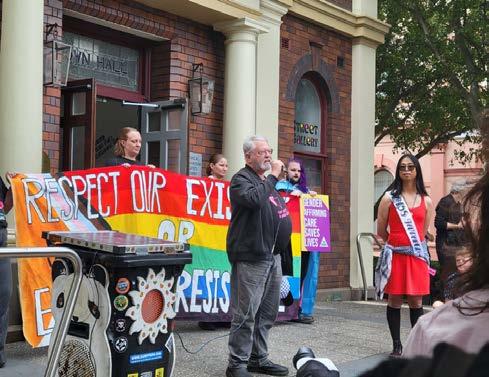
It’s the 9th of February, 2026, and war criminal Isaac Herzog, president of the apartheid state of Israel, has arrived on Gadigal land at the personal invitation of Anthony Albanese. In defiance of the NSW government’s anti-protest PARD zone, a protest is organised at Town Hall. At the protest, I recognise people from shows all across the front line. My friends and I, trans punks all, are filming the cops when they charge. Some of us meet up a few nights later at a show, chanting “FUCK THE POLICE” with Operation Ibis.
Connie isn’t wearing her battle jacket because she’s still washing the OC spray out.
Eleanor Myatt (she/her) is not paying $400 to see Taylor Swift.
Artist: Eleanor Myatt, Saturns Angel and Problem Green photographed
THE UNION OF INDIA VS. MY UNDERWEAR
On the eve of International Trans Day of Visibility, March 30th 2026, the Indian Government formally Gazetted the amendments to the THE TRANSGENDER PERSONS (PROTECTION OF RIGHTS) ACT.
The Indian transgender community has for ages been fighting for its rights. Since the British Raj, trans people have been labelled as criminals and condemned into poverty, homelessness, begging, and forced sex work. Only as recently as 2014 did the Supreme Court of India, with the National Legal Services Authority (NALSA) vs. the Union of India judgement, recognise transgender people as a separate third gender. In 2019, the Transgender Persons (Protection of Rights) Act adopted a broader and more inclusive recognition of trans people—explicitly including trans men, trans women (irrespective of medical transition), and genderqueer persons— by self identification . It upheld the “right to dignity,” a core value of the Indian constitution. But seven years later, the ruling nationalist government suddenly decided that they weren’t ‘protecting trans people enough.’ So they took it all away in under two weeks.
On March 13, 2026, Union Minister Virendra Kumar introduced the Transgender Persons (Protection of Rights) Amendment Bill 2026 in the Lok Sabha (lower house of the Indian Parliament). Less than two weeks later, the bill cleared both houses of Parliament, despite drawing widespread criticism, and without consulting statutory bodies like the National Council for Transgender Persons. The Parliament passed it by voice vote because they didn’t even have the nerve to put it to a proper count—why would they when the entire opposition spoke against this draconian bill? Multiple members and activists resigned from their positions from the Council in retaliation. President Droupadi Murmu assented to the bill, thereby completing the rollback one day before the International Transgender Day of Visibility. THE NERVE !
So what exactly got passed? The official Gazette of India, No. 3 of 2026: The 2019 Act defined a transgender person as someone “whose gender does not match the gender assigned at birth, a broad, self-determined definition” . This amendment guts it. The new definition of “transgender person” under the amended clause (k) lists only:
1. Persons with socio-cultural identities such as kinner, hijra, aravani, jogta 1 , or eunuchs; persons with specific intersex variations or congenital differences in primary sexual characteristics, external genitalia, chromosomal patterns, gonadal development, or hormonal response;
2. Any person who has been “by force, allurement, inducement, deceit or undue influence, either with or without consent, compelled to assume, adopt, or outwardly present a transgender identity.”
3. It shall not include, nor shall ever have been so included, persons with different sexual orientations and self-perceived sexual identities.
While the new definition includes intersex people who underwent forced genital mutilation as children, the government clearly rejects all self-identification, confusing sexual with gender identity, intersex people with transgender. This bill strips away the dignity of transgender individuals, characterising the individuals of the community either as (1) members of a religious caste and biological deviants, (2) unfortunate, and underprivileged by nature of being transgender , or (3) condemned sexual criminals.
This separation of traditional communities from non-conforming criminals explains the broader character of the ruling government. In order to avail the government’s ‘protection’ under the new amendment, we trans people have to undergo pain, insult, exploitation, and dehumanization only to prove to the state that we fit their traditional and orthodox boxes. That we’re the ‘correct kind of transgender,’ that
we’re pure and sanctioned, sanctioned by the casteist, misogynist, and transphobic traditions of orthodoxy. This is the expression of the growing Elite-Hindu Nationalism, which ties itself to all the identities that stand by, support, and bow down to the religious and cultural elite. The ‘Protection of Rights’ amendment is only for those trans people that choose to uphold traditions of deep-rooted misogyny, casteism, and cultural hegemony. As for the rest, it is an excuse for erasure. Using these identities as tokens, the government is illegalising everyone who chooses their reality. The state is after everyone who speaks their own voice.
And they will check and ensure that we are the ‘correct kind’ themselves. Under the amended Section 6, a transgender identity card can now only be issued by the District Magistrate “after examining the recommendation of the authority and, if he considers either necessary or desirable, after taking the assistance of other medical experts.” Your surgery (if you get one), your hormones, your hairstyle - all of this, reported to and authorised by the government. Your body,
Vridhi VJ Jain (he/they) and S. Afroza (she/her) are furious.
logged in an official registry. This is not protection. This is surveillance. This is the government trying to invade our bodies. Imagine having to take off your clothes and presenting yourself in front of socially unconscious government-appointed doctors. They will judge you, sneer at you, perform all the ‘necessary examining’ that they want to, and then approve whether you are ‘considered’ transgender or not.
Describing their personal experience, VJ writes:
Let me be very clear about what this gazette means. I, a non-Hindu, disabled, queer, non-binary trans person, have been written out of existence. In the eyes of the Indian government, I do not exist. My identity has been legislated away. I am a trans-masculine student who, until now, hadn’t had to worry about what was in my fucking pants. Yes, there had been instances where I’d been stopped outside public bathrooms, looked up and down, told I was in the wrong place based on how I looked. But if I said “I am trans,” “I am a woman,” or “I am a boy,” no one could legally stop me. That liberty existed. That small, hard-won protection was real. It wasn’t perfect, but it was enough to breathe. I fought tooth and nail to pursue my Bachelor’s thesis on Architecture of Queer spaces, facing humiliation through every jury, in rooms where even my existence was up for debate. If educators couldn’t find it in themselves to respect my identity even when the law was on my side, what chance do any of us have now that it isn’t? What happens to my research, to all of us who built our lives and work
on the legal foundation that we existed as dignified citizens, only for the government to write, formally, that we never did?
What is unfolding on the ground right now is exactly what those of us reading the text of the law feared. The amendment’s new criminal provisions are the sharpest weapon. Section 18 of the amended Act now criminalises anyone who “compels any person to dress, present, or conduct themselves outwardly as a transgender person” with sentences ranging from five to ten years, and up to fourteen years if a child is involved. That vagueness is intentional. It essentially legalises the narrative that chosen families, support organizations, doctors, and allies are converting people into being transgender. This bill is made to criminalise our support systems. The law has been written to be weaponised, and it is already being used that way.
At this moment, all the people who ever dared to support trans people are being hunted down as criminals. Universities are being summoned for allowing students to express their gender identity. Nonbinary people are summoned to court, because their conservative families don’t consider them mentally capable of living as respected citizens—as adults . Trans children are pushed back into the abusive birth families that they ran away from. And thus begins the witch hunt for anyone that dared to help, support, or nurture a queer person.
Right now India’s trans community needs international solidarity. We don’t
VOUCHERS FOR SYDNEY UNI STUDENTS
IF YOU ARE AN UNDERGRADUATE STUDENT AT USYD, AND ARE AT RISK OF MISSING A MEAL DUE TO YOUR FINANCIAL CIRCUMSTANCES, COMPLETE THE CASEWORKER CONTACT FORM.
need pity, we need strength. Donate to Indian fundraisers, to individuals who can’t afford surgery but will have to go through with it to prove they are trans. Help them access gender affirming care, find community, and leave transphobic homes. Amplify Indian trans voices, their organising, their demands, their protests. VJ’s organizations Queering in Chandigarh and Panjab Feminist Union of Students are sharing fundraisers for the community to access gender health care. Activists Grace Banu, Kanmani Ray, and Akkai Padmashali are fighting this draconian bill on the ground. We need solidarity. Noise. Pressure. Strength. Rebellion. Because, as Akkai Padmashali said plainly: “These politicians are making laws for us when they don’t even have basic concepts of gender, sex, and sexuality. This new bill criminalises us and disrespects our right to exist.”
NALSA Section 1 opened with this: “Moral failure lies in the society’s unwillingness to contain or embrace different gender identities and expressions, a mindset which we have to change.”
The Indian government has chosen democratic and moral failure. Documented and Signed on the 30th of March as The official Gazette of India, No. 3 of 2026.
Reject and repeal the Trans Amendment Bill. Trans rights are under attack! What do we do? Stand up, fight back!
1 The bill lists orthodox cultural communities of transgender/intersex people in India, each with their own traditions, guidelines of entry, as well as governing rules and regulations.
Artist: Vridhi VJ Jain (he/they)
Laila ��
$50 FOOD VOUCHER
srcusyd.net.au bit.ly/contact-a-caseworker
I long to see you, beloved Laila.
Desperately, since they took you away, Amidst the nations of the world today,
Oh how I so long for your sight my Laila!
To see your red , green , white , black, soaring up high, From the river to the sea to the stars and the sky.
Afroza (she/يه) madly roams the deserts of Levant.
Being Queer and Chaldean
Do not question the rites of the nether world.
• Descent of Ishtar into the Underworld
The first thing I learnt about being queer was that “you can say no” to it. The next thing I learnt about being queer was that I should say no to it because I am Chaldean.
For as long as I have known my culture and my language, they have never allowed me to say yes to being queer - but still, I exist.
Chaldeans, who occasionally self-identify as Assyrian, are an ethnoreligious group indigenous to the land that constitutes upper Mesopotamia. The Chaldean Church split from the ethnic Assyrians to enter into communion with the Roman Catholic Church about 500 years ago, though Chaldeans and Assyrians have embraced conservative forms of Christianity since its inception. To be Chaldean is essentially to be Catholic.
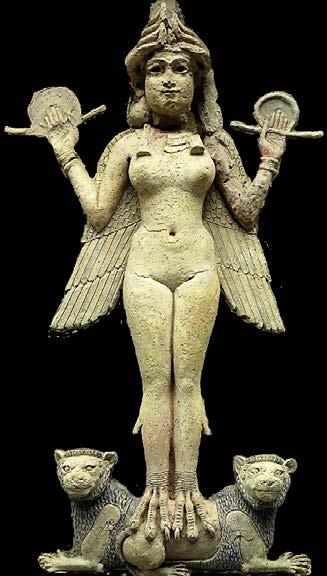
We claim descent from ancient Mesopotamian empires, and we honour their militancy in song and dance. Our militant ancestors honoured Ishtar; the genderfluid goddess of war, love, and sex; the protector of sex workers; one who could change anyone’s gender at her whim.
Ishtar is the antithesis of what I had been taught about my culture. She is all the fears of the Chaldean people I have known. Her story is muted by a community that itself fears voicelessness, but it has no words with which to tell her story.
There is no word for any queer gender or sexuality in our language, Sureth. Still, Ishtar exists.
Sarah Su (she/they) fights because it is her only choice.
time and place where it was suspicious to not be a Christian.
But, Chaldeans have never been freely given the option, by ourselves and our oppressors alike, to reject being Christian.
To those Chaldeans who believe that our people were born of Christianity, any perceived attack on Christianity is an attack on our bodies and our blood. No Christian rite in our world was to be questioned.
YOU CAN SAY NO ‘T
much of our history, our existence has been inconvenient at best, and nearly eradicated at worst. For Chaldeans in the homeland, to be Catholic is to have resisted centuries of ethnic cleansing. The violent Arabisation policies of Saddam Hussein’s government, and the subsequent U.S. invasion of Iraq, murdered and displaced hundreds of thousands of Chaldeans.
Psychologically, Chaldeans were displaced from their culture too. Being legally and socially relegated to the “Iraqi” and “Arab Christian” identities made Chaldeans vulnerable to erasure as a distinct ethnic group.
My family and thousands of other Chaldeans settled in Fairfield, south-western “Sydney”. It became an enclave marred with the unresolved trauma of persecution, in an uncharted
It’s
surprise
that the Chaldean Church was scandalised by the 2017 legalisation of same-sex marriage in “Australia”.
The No campaign manufactured threats that same-sex marriage would destroy families and limit religious expression. Chaldean families in the homeland have already been destroyed, and their religious expression has already been limited.
The No campaign told us that we can say no to samesex marriage. Until then, Chaldeans have never been able to ask the government for their wishes to be granted. Polite requests have never
liberated anyone, though. Not Chaldeans, who still bleed. Not queer people, who still bleed.
I was told “you can say no” by 10,000 cardboard signs, at a rally against samesex marriage, in Fairfield, organised by the now-defunct Coalition for Marriage. One of these signs was in my hand, given to me by my mother. She proudly photographed me holding the sign, like those four mass-printed words were mine.
The words “you can say no” implied that there was something to be rejected, but left its identity up to me to guess. I figured that the Venn diagram of those who opposed the marriage of same-sex couples, and those who opposed out queer people existing at all, was almost a circle. Like many queer kids, I took the words as instructions to suppress my own queerness from surfacing. After all, if the words were only meant to tell voting-aged citizens which box to mark on a ballot, why would a 12-year old me also be told to say no?
All Chaldean and Assyrian Archbishops of “Sydney” endorsed and attended the rally. I saw no dissent from my community, in fact, most Chaldeans I knew were there too. I don’t deny that queer Christians exist, but at the time, I assumed that this homophobia was based on how Christians interpreted the Bible.
However, the Coalition for Marriage’s coverage of the rally paints a different picture of why the rally happened. Supposedly, the 10,000 voices at the rally came from “Australians of ethnic heritage” and “migrant communities.”
What was my ethnicity if not Christianity?
Was the voice of my ethnic group not its shared religion speaking through it?
How could I separate what no other Chaldean has needed to separate, when we are already so severed?
After the rally, Coalition for Marriage spokesperson Sophie York is quoted as saying, “In different dialects, they had the same message: we are voting ‘no.’” But our dialect has never allowed us to say ‘yes.’ Still, my queerness poked through the veil of description, of words in my mother tongue that could never unravel me as well as my mother quietly did.
At my high school not far from Fairfield, I experienced more homophobia as it became socially necessary to make sense to my peers. My friend and I were rarely found without our arms wrapped around each other, and without my kiss on her cheek to farewell her each afternoon.
An older Chaldean boy at my school approached me to ask what my ethnicity was. I told him that I am Chaldean. Referring to my friend and I, he then asked:
“are youse dating?” I denied it.
He didn’t seem convinced by that answer. Sometimes, I wasn’t convinced by it either.
I was even less convinced of the reason he questioned me. His question was an answerI was obviously queer - while my answer was a question. Could I ever admit that about myself? Could I decide who I was before my community decided for me?w
USyd was where I decided to change who I was in community with. It was a physical and figurative far cry from the world I had known in Fairfield. I met people who didn’t know that Fairfield, nor Chaldeans, existed. For once, being a West Asian from western “Sydney” was queerer than being queer was.
I began entering largely white gay spaces, which were more similar to my home than the white gay people there would have liked to admit. As a Chaldean, it made no sense to be queer. As a queer person, it
made no sense to be Chaldean.
These spaces have threatened my safety more than any Chaldean person, and any person from western “Sydney,” has. In 2024, Sydney Gay and Lesbian Mardi Gras members barely passed a motion to support western “Sydney” queers. In 2025, a Mardi Gras board candidate sent mail to my house that outed me to my mother. Dozens of online comments about the incident rewrote the relationship I have with my family.
They insisted that queer people should break ties with their unaccepting communities as easily as breaking bread, but white, Eastern suburbs queer community was the unaccepting one to me.
We know too well how homophobic the south-west is, and how homophobic the West Asian diaspora in “Sydney” is. For perpetuity, queer bodies and lives like mine have been governed even by these groups struggling for selfdetermination themselves. Our liberation cannot be achieved while endorsing classism and the other hierarchies that it creates. To liberate ourselves from this governance, we must reject the racism and capitalism that these groups uphold. We must question any world that questions us.
Being queer and Chaldean means that I love like it is a fight. Being queer and Chaldean is having to fight because it is my only choice, and having to love because it tells me why I fight.
I was told that I could not exist, that I made no sense.
Sense did not make me. I exist in spite of never knowing I could.
The pure Inanna (Ishtar) answers the demons:
(Inanna’s answer destroyed) Art by Ydie Lardillier (they/them)
Maybe 10 hours? 15? Hard to tell with most things I make. Needle conducting my every gesture, embroidery hoop looped through my carabiner while I rush to class, fingers mulling the texture of my stitches in quiet moments; what line could be drawn between crafting and not?
This piece was lovely company while I made it, I hope it enjoys its new home in the Queerspace. Would definitely recommend making art of the new medication you are on.
I am a lesbian. Actually I think I’m queer at the moment, my recent bodycount certainly looks that way. I suppose if a sicko pervert anthropologist locked me up and interrogated me for some time he might get me to admit I’m bisexual. What the fuck did you just call me? I don’t identify as such.
I do identify as a transgender woman, and that certainly shapes my fraught relationship to bisexuality. And I have to say “identify” because I’m stepping into contentious territory. I believe that ultimately our genders are negotiated. Part of the project of trans liberation is to assert that our internal sense of self, our gender identity, is the social reality. But our day-to-day lived experience is less concrete. If I get he/himmed all the livelong day, just how much of a woman am I really?
Tragically, the truth is that we negotiate this. I’ll put on make-up if you use the right pronouns. I’ll speak higher pitched and more breathy if you don’t side-eye me walking into the women’s restroom. I’ll buy a whole new summer wardrobe if you objectify me in my comfy short-shorts, so graciously giving me the opportunity to experience misogyny (what a joy!). Of
Making Myself Up
I clench my chest falling down into a dark world
Being stripped in their eyes; by their hands
The pink sea of pronouns and bloodshed drowns my spirit leaving the corpse of a he-she with lipstick and shadow.
I look in the bathroom mirror and I don’t see my vagina. Why did he take her place, and his being take mine?
My body, his form. My face, his name. My mouth, his voice.
Why cissified bi identities fail to
course we fight alongside our cis-ters to spare us of that last one and see a day when we can express womanhood on our own terms. But today, before the fight is won, we all negotiate with our oppressors.
And so we come to bisexuality. It is one such means to describe sexuality, similar to both homosexuality and heterosexuality. These however are not holistic identities as such, but merely components of identities; such as gay, lesbian, bi, the demonic t4t transbian etc. It is unsurprisingly a trait for which the intersection of transgender identity is poorly explored. And the truth is that the transgender experience of bisexuality is altogether different from the cisgender one.
If gender is negotiated, it follows that sexualities, defined by the relation of genders, will also be negotiated. Perhaps we ourselves may have a straightforward understanding of the truth of our sexualities, but that truth must be filtered through the lens of our voyeurs. Transgender people, for whom even the right to exist in relative comfort is wrapped up in struggle, then go on to navigate a dating scene fraught with the assumptions of others.
Say a trans woman hooks up with a guy, could he be “a little bit gay” and testing the waters? For her it may have been a simple encounter: straight sex with a straight guy. But for him, it was an experimental, risque, bisexual rendezvous with a crossdresser. This suddenly becomes apparent when she sees him next, and he becomes frigid as a rock, scared “he” will out him to his friends. While our cisgender man frets about a little workplace bullying because he might like men (he still hasn’t fucked one), our trans sister feels real shame and degradation that she was used as a tasting plate for this moron and his shallow ideas of gender.
Maybe (God forbid) our girly keeps winding up with chasers. Some of these fellows are unrepentant in their attraction to “trans,” but see them as a third gender type thing. And so they’ve been seeing the sex with her as bisexual because she’s the “best of both worlds.” At a certain point, it becomes clear to the man that the worst of either world is a woman asserting herself and her humanity when she grows tired of this cyclical dynamic and starts demanding commitment. He then moves on as per his bio “ �� trans/mtf/ftm/femboys/asian must be smooth”. And no “asian” isn’t a typo; there’s a whole world of racialised
Afroza (she/her) is restless...
Where is my voice?
Can’t you hear my wails and screams?
Embers nurtured in my bosom Red, not pink. They burn and shine and enlighten.
Amidst the new world Of fashions and nations Will I find my beauty? Will I find myself?
Drowning ugly and cold and dark, I know That I am burning Red. Will the sparks of my heart Enlighten the darkness around?
accommodate the trans experience
transmisogyny that I can’t speak to, but needs to be acknowledged in this discussion.
Of course, shitty men are just part of the game, but let’s say you have a healthy relationship. Two lesbian trans women committed and stable for a couple years now. One of their mums sees them as two weird gayboys who’ve found happiness in their own way. One of the dads sees them as the girls they are. The other dad thinks they’re a third thing, but he won’t say non-binary (he’s not a fan). Mum number 2 believes her would-be daughter-in-law is a trans woman, but she’s just not convinced her own kid isn’t a confused gayboy, “she doesn’t put the effort in, and she doesn’t even want the surgery.” People on the street might think anything on any day, sometimes they don’t even get clocked. So are they straight, gay, lesbian, or bi? Scholars remain divided. What we assert to the world however, is they are the lesbians they say they are.
This is the key difference between a cisgender and transgender bisexual lived experience. Cisgender bisexuality is the felt attraction to multiple genders, actualised by the choice to socially engage with the people one is attracted
MW
Browsing the menu, I don’t feel like anything But you could make me feel like something Not something nice, something concrete. For me to play on and on repeat, please.
For when I’m feeling down and nervous. Look, let’s go assess the surface. My friend - I believe I’m in the circus. I jump through hoops, manoeuvre perplexion.
... or am I in the bar holding your attention? I don’t even want your affection. Just an ounce of your perception of me in context, collective, with clear definition
Adjective noun, adjective noun
Wow, what a crazy realization! “Beautiful man”, “Handsome guy” Estrogen and anger finally made me cry “Peculiar feature”, “fascinating creature” What could I do if I’m desperate to reach you?
Can you say the magic words?
Adjective noun, adjective noun
Quay-Quay Quade (she/her) gets her navel gazed at.
to. Transgender bisexuality is a conflict. On one side, is that same felt attraction. On the other, is the perceived attraction to multiple genders, defined by the array of voyeurs’ independent interrogations of our gender identities and relationships. The internal life and infinite externalised caricatures compete for legitimacy.
It manifests as a needle threaded neatly into your neck while you flirt. Should you turn to face the voyeur, to doubt your lover, the stab of pain is immediate. It is a cloying anxiety to hold oneself in the moment. And while one could draw comparisons to intrusion of the external felt by cisgender bisexuals in moments of bi-erasure, the intersectionality of trans people just doesn’t match up
It’s possible the recent encounters I’ve had with men were in fact bisexual in nature, and I wasn’t told. I don’t really care to follow up. But this pall of doubt is one many trans people live under. So while it can describe my behaviour, I don’t find a home for myself in the label bisexual . It feels like something to be printed in block letters at the meat market; $39.99/kilo ($450/hour works too I guess). Much more pleasant are terms like gay, lesbian, trans; these don’t just describe the individual,
they are the building blocks of community. They say “here’s who I am, here’s what makes me a pariah, wanna start a family?”
Right now I need my term that says something about my current dalliance in Twink Shotput that isn’t an advertisement for cis people to project their desires onto. I like “queer.” It’s definitively vague, it says “I’m a weird pariah like you, but in my own way, so let’s learn about each other”. That said I’m going back to lesbian the second I can credibly claim it so hit my line bb ��
Today, every transgender person is bisexual whether they like it or not, while we negotiate our pockets of liberation. It is our struggle for tomorrow to beat our opponent, the cisgender hegemony, into submission. To assert that we are what we say we are, in every walk of life. That the sex we have (or do not have) is what we signed up for, nothing less. That straight sex is what I say it is. Not what your nasty raw-only fake-name gunt-having DL str8 yeast-infection-smelling-dick-and-balls ass says it is. Sorry! wrong chat ��
Anonymous writes.
Actualisation. It’s all about having your needs met, baby. Why did it take so long for me to ascertain, that on its own it’s not enough to be a woman because I’m just not a lady? What I am is grooving, cool, waiting for it to hit my brain.
Head rattles like a broken bell
Honey, could you actually tell, beneath all the layers of marble, what I’ve been working on all this time?
I don’t even want to call you mine. Diner, exchanging fish and cheap compliments. “We should have broken up on Valentine’s”. I suppose I could never just be kind.
“You’re such a fucking tease, I swear to God” So say it already, so we can clap, cheer, then all go home. Turn your attention to the brilliant butch on the balcony, shirt buttoned down all the way, blooming in the breeze.
Adjective noun, adjective noun
A pretty object and the perfect sound
Transgression: A History of Lesbian Identity
For a community that has been foundational in the fight for queer liberation, lesbians are still heavily stigmatised and made invisible. For butches, this is especially prevalent. Unlike our femme counterparts who are fetishised, butches can’t be packaged into easy heterosexual consumption. So many feminine gender roles are based around our ability to be attracted to men. I can attest to this, as someone who went to an all-girls school. On one occasion, I remember a classmate surveying everyone in the class about which Salvatore brother from The Vampire Diaries everyone would date. As a lesbian, I cannot participate in discussions like this, meaning I lose an easy way to connect on the basis of heterosexual attraction. This is one of many times when the disconnect between lesbians and other women has been unignorable. Realising that you can never participate in heteronormative expectations isolates lesbians from the societal construct of a woman. As a result, lesbians have constructed intricate subcultures reclaiming our genders and defying heteropatriarchal norms.
Butch lesbians embody a defiance of heteropatriarchy; protecting other members of the queer community whilst defying societal constructs of gender. Being butch transcends merely a label. Rather, it is an identity and belonging to a community central within the fight for queer liberation. Despite this history, butches face continued marginalisation, perpetrated by both people in and outside the queer commmunity. Butches actively refuse to assimilate into dominant heteropatriarchal society, rejecting norms of gender presentation, so they tend to be stigmatised, experiencing misogyny, homophobia, and transphobia.
Butch lesbians have historically acted as physical protectors of the queer community. The butch subculture started forming in the United States in the 1940s and 1950s, popularised by working class communities and heavily linked to lesbian bar culture. Though it started in the United States, America’s cultural empire has a deep influence over all spheres of life, influencing our views of sexuality. The “Lavender Scare” was one of many xenophobic crackdowns in 1950s America initiated by Republican Senator Joseph McCarthy. This took the form of raids on queer bars, mass firing from workplaces, and demonisation in the media. Despite being common targets of homophobic violence, butch lesbians commonly undertook the role of defending gay and lesbian bars from police violence, often entering physical fights. During the Stonewall uprisings, the first punch against a police officer was thrown by biracial drag king Stormé DeLarverie, who was known as “guardian of the lesbians in The Village [local queer community] .” Police violence against drag kings and butches unfortunately
Maxine McGrath (she/they) writes.
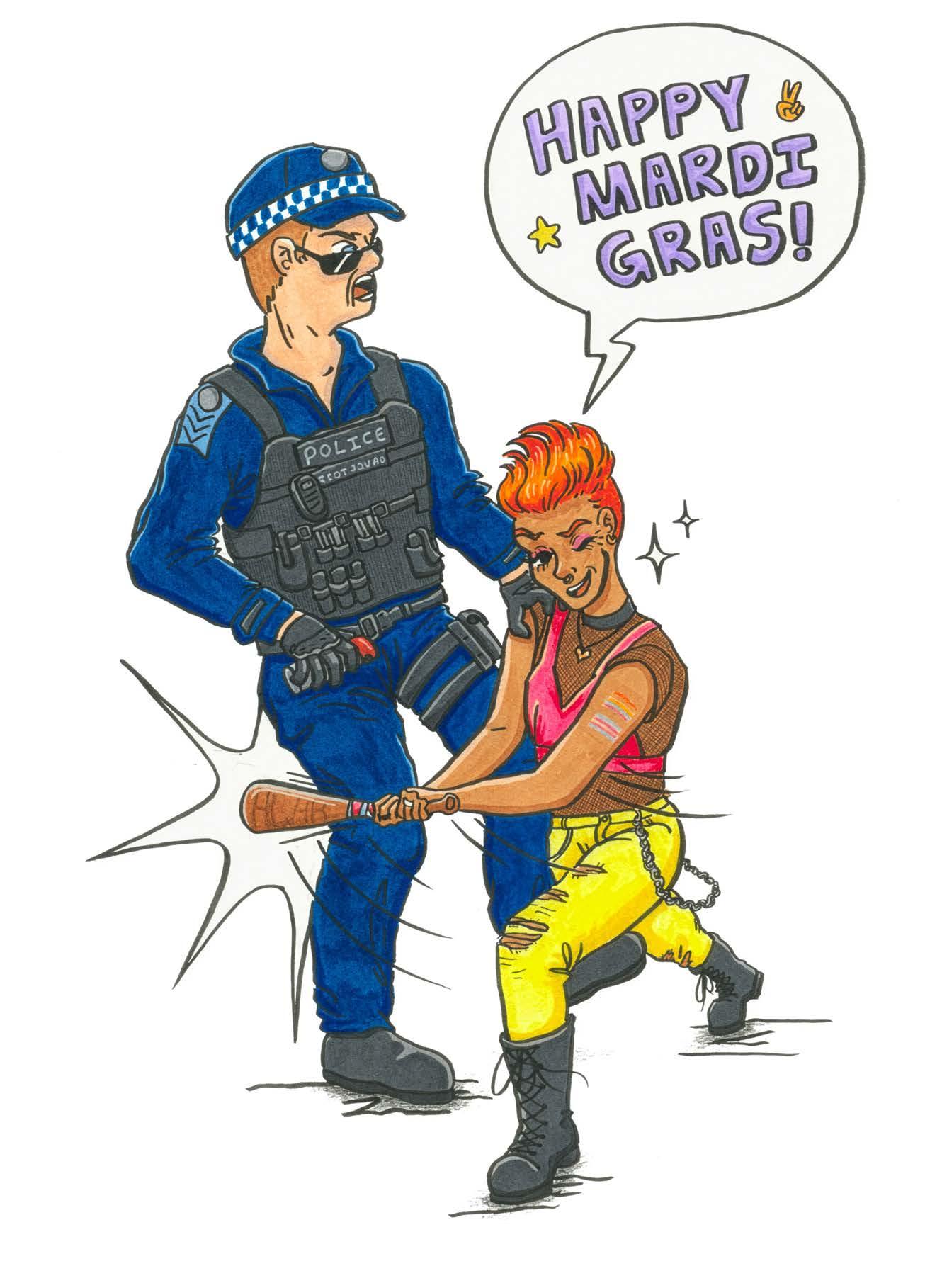
has not ceased, as seen in Mardi Gras Sydney 2026, when drag kings were attacked by NSW Police for participating in anti-genocide and anti-police violence protests.
There has always been a strong legacy of lesbians identifying as nonbinary or transmasculine, or taking testosterone to present in a more gender nonconforming manner. One of the most prevalent accounts of the intersections between butch and trans communities is in American activist and author Leslie Feinberg’s “Stone Butch Blues.” Feinberg explores lesbian subcultures of New York City in the mid 20th century and the history of lesbians who medically transition. Feinberg’s semi-autobiographical accounts show that butch community has heavily been entrenched within the transmasculine community for as long as both communities have existed. A concrete separation between butch and transmasculine communities serves to ignore the trans history of butchhood and lesbianism and recreate a strict binary between identities.
Fem-aligned individuals continue to be restricted by an expectation to centre men in all aspects of their lives, including in sexuality. Despite a supposed growing awareness and acceptance of queerness, there is still a strong expectation that we perform heterosexuality at the service of cisgender men. Within a patriarchal society, relationships with men supposedly should still offer security and community even within lesbian communities. Due to this, lesbianism intrinsically entails a fraught relationship to a normative gender binary. Heterosexual attraction has been socially constructed as inseparable from how femininity is perceived, isolating lesbians from patriarchal femininity.
This relates to Adrienne Rich’s theory of “compulsory heterosexuality,” also known as “comphet.” Rich explored how heteronormativity and the patriarchy uniquely work together to alienate and erase lesbians. She theorised about how heterosexual desire is enforced in the patriarchy, creating the expectation for lesbians to perform an inauthentic version of heterosexuality. Many lesbians may share the same experience of choosing to ‘have crushes’ on men or being in relationships with men we are not attracted to to fulfil these expectations of femininity. Accepting inability to perform heterosexuality
means placing lesbians in opposition to the patriarchy and gender expectations. Alienation from traditional femininity and opposition to the patriarchy often results in an internal disconnect from one’s gender. One of the times I am the most alienated from my assigned femininity is during discussions of heterosexual attraction.
Within the wider queer community, femme lesbians are often seen as ‘straight-passing.’ Femme lesbians, however, embrace a distinct form of femininity that refuses to be centered around men. Similarly, butches defy traditional gender norms and traditional masculinity altogether. Butches and femmes have historically held a sense of solidarity due to the different ways in which they have been alienated from the heteropatriarchy. “Butchfemme” culture has been central to lesbianism for as long as these labels have existed. Whilst butches and femmes take contrasting approaches to our fraught relationship with conventional femininity, we built a community upon a shared defiance of sexuality and gender presentation.
Within second-wave feminism, butchfemme culture has received criticisms for “imitating heterosexuality,” or replicating patriarchal roles. This is a shallow understanding of these identities and ignores their radical roots. Butchness is more complex than simply being masculine or ‘taking a man’s role.’ It acts in opposition to power structures of heteropatriarchy, whilst the masculinity of cisgender heterosexual men enforces it. This redefinition of traditional gender dynamics creates an identity that intertwines lesbian sexuality with gender. Butchfemme relationships are made distinctive from the masculine and feminine dynamics of heterosexuality; challenging the status quo presented by the nuclear family dynamic.
Whilst lesbians have been made to exist in opposition against heteropatriarchy, a rich community and culture has been built upon subversion of gendered expectations. Whether through reclaiming femininity or rejecting it altogether. Lesbianism has always been transgressive. It is an identity that is based on the defiance of heteropatriarchal gender norms, by butches, femmes, and beyond. Leslie Feinberg says it best in zir book Trans Liberation: Beyond Pink or Blue : “gender is the poetry each of us makes out of the language we are taught.” Lesbianism is not by the binary, and should never be.
Artist: Astrid Armiger (she/her)
Them’s fighting words, and other SRC business
Yes, you heard me right! I want to start a rigorous political debate with every reader and contributor of Honi Soit , and I’d hope that everybody wins in a fight like that. Here’s the pitch:
Honi Soit , like any student newspaper worth its salt, is printed with the funding of a student-led organisation. In this case, this sheet of cellulose and ink (or HTML if you’re reading online) is paid for by the USYD Students’ Representative Council. The USYD SRC is your student union ; ergo, Honi Soit is your union rag . A good union publication exists to be the political mouthpiece of a good union, and to spread the ideas of the workers (or USYD students) it represents. It exists so that when the workers take the class war to their bosses (or Vice-Chancellor Mark Scott), the public understands exactly their perspective, their priorities, and what is at stake.
More than this, a good union champions the rights of those often marginalised, because there’s a shared understanding that no one can be left behind in the fight for a better world.
Honi has remained mostly dedicated to this belief; in this year alone there’s been regular coverage of protests on a wide set of issues that students care about, a continued focus on Palestine, and a commitment to centering the NTEU’s class struggle to keep uni staff fairly paid and uni management accountable.
However, Honi and the USYD SRC don’t magically arrive at these political positions. Students vote them in based on the platforms they run on, on the hope that they will fight through the year to steer our union and its publication towards their vision for the future. Where I think things get dicey is how accountable these students’ representatives are to the platforms they run on. I don’t mean accountable in the Labor-esque way of assigning activist KPIs (see March 2026 SRC Council); I mean accountable in how willing they are to fight for their ideas in the public arena, especially to the possibility of being challenged by other students.
Honi ’s SRC Reports section, where elected officebearers are supposed to detail and justify the work they’ve put on campaigns, has shrunk drastically in the last 30 years – from a whopping four pages right at the front, to a measly one page squirreled to the back. Similarly, the Letters section once filled with scathing criticisms of articles published in weeks prior, and the multiweek epistolary feuds that would result, is mostly a ghost town in 2026. Crickets. Elected union representatives from Socialist Alternative and NSW Young Labor take their perspectives to Red Flag and (I shit you not) The Activist respectively,
and away from the paper that they fund to be a hub of cultural production and political exchange. Truly, the SRC fails to demonstrate why students should pay attention to SRC Council meetings at all – to see if the debates there actually crystallise the SRC’s position or, alternatively, if representatives are merely speaking past each other. This may be a fighting student union, but to the average student it’s unclear who’s being brought into the fight.
Neither the USYD SRC nor Honi Soit are monoliths; in fact, I think they are at their best when the representatives we’ve voted in are fighting tooth and nail to convince students that their strain of politics is the best foot forward.
With its print output as an accessible front for creativity, activity, journalism, and politics, the SRC has the ability to make the case to hundreds of USYD students each week. Rather than retreating into internal debates or in-faction publications, don’t students deserve a forum to hold their elected officebearers accountable? Autonomous editions of Honi , O-week publications like Growing Strong and Counter Course , and the SRC Reports pages should be putting forward arguments not just about their respective identity groupings, but about the shared political understanding that draws them together as collectives and separates them as a political movement in the union and to students. These are the papers that collectives hand out at O-week, and that’s because they are collective political manifestos to the student body. A healthy appetite for clashes in these political messagings and analyses presents students with the arguments and counterarguments to arm themselves as university-goers and young people who care about the world around them. While I have some irreconcilable disagreements with the average takes on feminism and anti-imperialism in Red Flag , I still think organised papers like these – Green Left Weekly, Partisan, Picket Line, Solidarity , and so on – are an overlooked blueprint for what a rigorous student publication could look like. As such, autonomous SRC publications should offer separate political perspectives to each other, to justify their existence at all and let students decide where they want to put their political energy.
More than just a hope for the future, political autonomy is much of the reason many long-standing SRC publications emerged in the first place. Growing Strong , first printed in 1986, sprung off the back of a right-wing SRC that refused to publish
Tim Duff (they/them) wants to fight you !!!
feminist materials in its own right. Its second edition in 1987 was published by the USU instead, because two of the four Women’s Officers attempted to veto articles about lesbianism and abortion. This leads us to the truly staggering article title “Women’s Officer: A Feminist Position?” that argues for exactly why the women’s representatives on campus should fight for feminism. In the end, it was a principled dedication to anti-capitalist, intersectional feminism rather than just awareness on women’s issues that has let Growing Strong carve out its political space in campus publications, and the USYD Women’s Collective is better for it.
Similarly, ACAR Honi ’s first edition in 2014 was the culmination of several splits in SRC collectives about racism and whiteness in the Left, with the resulting proposal that people of colour should lead their own struggles, autonomously. Along with their own ‘autonomous Honi against racism’ detailing campaigns on campus racism and Islamophobia, the freshly formed Autonomous Collective Against Racism (ACAR) and Women of Colour Collective (WoCC) fought for a shared spot and budget in the existing SRC Ethnic Affairs and Women’s offices, respectively. While the strength of their arguments – on Palestinian solidarity, and the necessity of an anti-imperialist SRC – have lasted for the twelve years since ACAR’s inception, the weaknesses of their identitarian politics were also on full display and to the benefit of the student body to critique. I think it is no coincidence that ACAR and WoCC autonomous elections were allegedly stacked by Labor students as soon as both collectives gained access to a budget or officebearer stipend, because their political argument on the centrality of personal experience to anti-racist politics didn’t account for conservatives of marginalised identities. Students left these collective because of the politics that these groups put forward, but while WoCC disappeared by the end of 2017, the Ethnocultural office and Refugee Rights office are the boons of vibrant political debate on hot-button student issues.
Even Queer Honi , first published in 1999 right after QuAC’s formation in late 1998, is a testament to the benefit that a good split or debate can bring to the world of politics. The ongoing stream of articles and counter-articles in Honi on sex workers’ rights activism and ‘choice feminism’ is both a microcosm of the larger discussions about border violence, state power, and misogyny in society at large, and a worthwhile endeavour to cleave sex worker-exclusionary conservatism from radicalism in the name of real feminist justice and workers’ rights.
I hope that public disagreement can find its home again in the toolkit of unionists and activists, so that our union rag can be sharp, witty, informative, and – I quote the very first Honi Soit here – “our criticism ... will be constructive, and for the good of all.”
“Justice for Courtney Topic, Jesse Deacon, and Collin Burling!” No beds, no open lines, no ambos on, The sequence called per welfare check: Which knee, what neck (threats, boots, taser, cuffs, gun.)
“This is not a police state, we have the right to demonstrate!” The kettled weave of flags and chants undone To pluck and break that fresh arrestPhone cam, pink vest (hooves, spray, detention, bail, gun.)
Move on!
Tim Duff (they/them) meets the force.
“Stop police attacks on queers, women, and Blaks!” Three-fourths false hits are worth that first real oneThis narco-war has quota needs. Squat and cough, please (cam, torch, gloves, eyes, gun.)
“No bad whores, just bad immigration laws!” There’s nowhere in the workplace left to run, But cash to nick each migrant raid Each life unmade (border, riot, plainclothes, corrections, gun.)
Ask Cunty Cop
Ydie Lardillier (they/them) learns from the best.
Artist: Alex Thomason (they/them)
Dear Cunty Cop,
As much as I envy those black platform combat boots that you kick down doors with (omg demonias??), you’d freak me out if I was having a menty b and you rocked up. Can I be sure that you won’t show up instead of an ambo?
Regards, mentally ill tranny.
Cunty Cop: Nope! Great chance to test out these doorkillers. Good fun!! Not for u tho…yikes
Dear Cunty Cop,
Despite killing our people, brutalising our drag kings, arresting us for our clothes and endangering us daily, you still insist on marching at Mardi Gras armed with the guns you kill us with? Wassup w that?
Regards, concerned queer.
Cuty Cop: You’re under arrest………..diva.
How to (NOT!!!) Talk to Cops
Disclaimer: The following is not intended as legal advice and is for general information only. You should obtain your own advice from a qualified person.
TL;DR!
- You are not required to answer a cop’s questions! You only have to give your name and address when asked, and wait for a lawyer before saying anything else.
- Ask the cop’s name, station and reason for what they’re doing! If they do something fucked, knowing details is key
- Cops rely on your ignorance! They can lie about your rights.
Power to ask for identification
Police have the power to ask for your name and address if they arrest you, if they give you a move along direction (even if you comply!), or if they suspect that you may be able to assist in the investigation of an indictable offence.
Move along directions
Police can issue move along directions (‘move on orders’) at protests… or pretty much
whenever they feel threatened. Police will lie to you about the law to intimidate you (e.g. give a move on order for “obstructing traffic” even if a Notice of Intention to Hold a Public Assembly, or ‘Form One’ has been accepted by the police commissioner). It’s strength in numbers that keeps us safe. Issuing move on orders to large groups is harder for cops.
They can also ask you to remove any face covering if they have made a lawful request for your photo ID. They must ask for your permission first, be quick, and give reasonable privacy.
Under new anti-protest laws from December 2025, failing to comply with a move along direction or a request to remove your face covering risks arrest and/or a fine of up to $5500 or 12 months jail time. We agree that police are fucked up and also that it can (sometimes!) be safer for you and your community to comply than cop the fine or an arrest.
Strip searches
Police strip search people as young as 10. They weaponise strip searches to sexually harass and assault minors and Indigenous people. Police can
Dear Cunty Cop, I’m a young queer person and I’m worried about getting strip searched. If I let an officer know that I’m under 18, will that be enough to stop them from strip searching me?
Thanks! Young gay.
Cunty Cop: You don’t have to worry about a cop stopping a strip search just because you’re young, Queen. Why, we don’t even care if you’re guilty! We don’t discriminate ;p
Dear Cunty Cop, I’m as much of a lover of DIYas you are, but what’s that flag on your shoulder? I don’t recognise it!
Regards, crafty fag.
Cunty Cop: Omg thank you so much for asking!1!!! Its the thin blue line <3
QuAC knows all cops are bastards.
decide what is ‘reasonable suspicion’ of an offence like drug possession to conduct searches. They may use drugsniffing dogs as justification, which are known to get it wrong ¾ of the time. Police must tell you the reason for the search, and they cannot question you while the search is happening.
POLICE CANNOT TOUCH YOUR BODY OR REMOVE YOUR CLOTHES. You are the only one who can remove your clothes. Say “I do not consent, but will still comply,” as police can use force if you refuse a search. The only cavity they can ask to visually search is your mouth, so they cannot ask you to squat and cough or remove a tampon. If you are under 18, there MUST be a parent, guardian, or trusted representative with you before they begin. The searcher MUST be the “same sex” as you.
If
you are arrested
The instant cops get hold of you or tell you you’re under arrest, it becomes possible for them to charge you with resisting arrest. You have the right to silence. If asked, you must give the police your name and address. Don’t answer any further questions without a
lawyer present!! You have the right to contact a lawyer and a relative, friend, or guardian. You also have a right to an interpreter. If police have not charged you after a 6 hour investigative period (which includes breaks), they must release you.
If you sustain any injuries from police conduct, go to a doctor ASAP, take photos, and call the relevant legal hotline below.
Send footage of protest arrests/incidents to: legalobserversnsw@ protonmail.com
Protest-specific hotlines on Instagram: @legal_observers_ nsw
Aboriginal Legal Service: (02) 8303 6600
Legal Aid Youth Hotline: 1800 10 18 10 (if you are under 18)
It’s a busy time, here’s some of what I’ve been up to!
• Helping run the first four sessions of our SRC-led vaccination scheme. We have helped over 550 students get a free influenza vaccination already!
• Launching and running our new SRC newsletter, which contains a recap of upcoming events, caseworker and academic advice, links to campaigns, editions of Honi Soit, and more. Sign up via our website!
• Working with two of our SRC Caseworkers on an ongoing feedback and discussion process with the University about its new Sexual Harm and Gender-Based Violence Prevention policies and procedures, to make them more student-friendly and trauma-informed.
• Trying to secure funding for a new space for the SRC which will be accessible, mould-free, and near other essential services like FoodHub.
• Hiring new staff and fixing up issues with the EBA drafted last year.
• Attending committees to raise important issues around housing, the processing of misconduct complaints, and more.
• Initiating conversations with the University and student-facing groups about tangible cost-of-living relief and hybrid learning during the fuel crisis.
Sexual Violence
• Continuing activism and advocacy around Palestine, particularly regarding NSW’s anti-protest laws and the ties between the University with weapons companies and complicit Israeli institutions, or the USU with companies on the BDS list.
• Looking to collaborate and escalate the campaign around the recent graduate visa hike for international students.
• STILL trying to get approval for two free period product dispensers on campus.
There’s lots of things coming up to get involved with – make sure to check out @src_usyd to get updates, and sign up to our SRC mailing list via the pop-up on our website! Feel free to reach out with any questions or suggestions to president@src.usyd.edu.au
Sexual Violence Office Bearers have not submitted a report.
Women’s
Maxine McGrath (Grassroots)
Avin Dabiri (Independent)
Hi folks!! As WoCo convenor, I am so honoured to have been part of this very special edition of Honi. Queer, intersectional feminism has been instrumental to the fight for our liberation, which we have prioritised as a predominant focus of WoCo in 2026.
As well as Queer Honi, WoCo has been focused on building our 2026 Feminist Action Week. We have been looking into a variety of events, from finally hosting our vigil in honour of victims of sexual violence, hosting workshops filled with feminist education, and having events to form a likeminded community. Please keep a look out for posters around campus, and our Instagram @usydwoco for more information about the upcoming events. We are very excited
for a week dedicated to our campaigns, whether raising awareness of gendered violence, or promoting transformative justice.
Finally, PLEASE stay safe on campus, everyone. Last Friday, anti abortionists held up graphic signs along City Road, filming and harassing ongoers. We utterly condemn this demonstration demonising abortion, encourage you to both disengage if encountering these groups, and to contact WoCo or the SRC in the scenario you enter a confrontation.
In love and rage, Maxine (she/they) and Avin (she/her)
Education Dana Kafina (Grassroots)
Jasmine Al-Rawi (SAlt)
Education Office Bearers have not submitted a report. They are a paid position of the USYD SRC.
Environment
As the climate crisis scales upwards with ever-increasing corporate and governmental hands meddling to continue illegal wars and decimate Indigenous lands, the humanitarian and environmental cost of life is increasingly becoming astronomical. The time to unionise students across Australia to convene on environmental issues happened just recently, with the first AGM for Eco Students Australia. With a grassroots council established and multiple environment representatives across different universities – and multiple from USyd, too! – the possibility of mobilising to address the ever-growing threats to life in all its forms becomes a hopeful promise of change amidst the depravity in the world.
Aria
Nadkarni (Grassroots) Lucas Pierce (SAlt)
Climate scientists, geologists and anthropologists have found it difficult to mark what exactly defines the Anthropocene, but one of the factors that will mark planetary change is the increasing spread of disease. Over the next few weeks, the Disabilities Collective and the SRC are running a joint program to give out free flu vaccines for all undergraduate students. Book a slot and get vaccinated while slots are still available and safeguard yourself and the people you care about from the Virocene!
International Students’
Aoyue Cao, Anu-Ujin Khulan, Lucas He, George Feng (PENTA)
International Students’ Office Bearers have not submitted a report.
Police & Court Matters, Traffic & Transport Offences, Immigration & Visas, Employment Law, Consumer Rights, NCAT Matters and more
SRC Legal Service Level 1, Wentworth Building (G01), University of Sydney NSW 2006 PO Box 794 Broadway NSW 2007
Difficult
Home Life? What are your options?
You Can’t Live at Home
One of the ways of establishing independence with Centrelink for a Youth Allowance payment, is to show that it is unreasonable for you to live in your family home. To apply for this payment, you will need to complete three forms in addition to the regular paperwork: One by you, one by a parent (I know… ridiculous right) and one by a third party. Centrelink will probably ask to contact your parent, but you can instruct them not to if you believe this would put you in danger.
The third party should be aware of your family situation and should be someone like a counsellor, doctor, police office, teacher, religious leader, grandparent, adult relative or –as a last resort – friend.
What is “Unreasonable”?
It is considered unreasonable for you to live in a home where there is extreme family breakdown, where there is serious risk to your physical or mental wellbeing, due to violence, sexual abuse, or other similar unreasonable circumstances, that occurs in your home. It does not have to be perpetrated on you or by someone who lives there. It is also considered unreasonable to live in unstable accommodation. This might
Ask Abe SRC Caseworker Help Q&A
Commonwealth Prac Payment
Hi Abe,
I heard there is a way that I can get paid to do my placements. Could you give me more details please?
Placed
If you need advice contact an SRC Caseworker: bit.ly/contact-a-caseworker
Hi Placed,
There is a scheme called the Commonwealth Prac Payment that gives $338.60 per week to some students while they are on placement. To be eligible you need to be a domestic student, doing a placement for 30 hours or more, who receives a Centrelink payment, or who ordinarily works 15 hours per week or more. It is means tested but if you think you might be eligible you should apply and see what they say. To apply go to the Uni’s website - scan the QR below . Abe
include a lack of electricity or running water, or illegally occupying the property. You cannot be receiving continuous support, whether directly or indirectly, and whether financial or otherwise, from a parent.
What is extreme family breakdown?
Extreme family breakdown does not refer to the “normal” differences that young people have with their parent(s). Centrelink will look for documented evidence of violence, behavioural problems, or threats to your emotional or physical wellbeing. Centrelink does not deem extreme family breakdown to have occurred just because your parent(s) disapprove of your relationships or lifestyle, (e.g., religion, sexuality, gender identity), unless this is a threat to your physical or emotional wellbeing.
Before moving out?
Consider your safety. If you are at immediate risk of harm talk to an SRC caseworker or Uni Wellbeing team member about emergency accommodation. Both of these services are free and confidential, and will offer advice without any judgement.
If you need help immediately, please call Lifeline on 13 11 14
If you need help, contact an SRC Caseworker to disccuss your options: srcusyd.net.au/src-help/caseworker-help
For more information about the Commonwealth Prac Payment and how to apply
COPY PASTE SUBMIT
Crossword Across:
1. The act of removing criminal penalties, what should be happening for sex work (15)
9. So-called “fifth taste” (5)
10. _____ de Mayo (5)
14. Combative (5)
16. Blue hair and ________ (8)
19. Portuguese word for a healthy dish (6)
21. File format to read books on an E-reader (4)
22. To troll (4)
24. Symbols of oppression, oxen connectors (5)
25. Get bigger (4)
27. Union which will be undergoing enterprise bargaining at USyd (4)
28. Superlative suffix (4)
30. It takes this many to tango (3)
31. Quaint lodging (3)
32. Cunty christian anti-hero (7)
34. USU is becoming this, abbrev. (3)
36. Hunky-dory (3)
39. Lady; Googoo (4)
41. Gay anthem who’s creator sues you if you call it a gay anthem (4)
44. The collective who made this edition of Honi! (4)
46. Photographer of queer subjects in 1960s New York, Diane (5)
48. Lacking color (4)
50. Like scissoring (4)
52. Women’s prison official (6)
54. Weekly Newtown sapphic event, also Robin Williams movie
56. Traditional Mandarin dress(5)
58. French revolutionary figure, subject of a David masterpiece (5)
59. Classroom jottings (5)
61. Gotta be straight!! (15)
Down:
1. Hang loosely (5)
2. Pride flag! (7)
3. Greek letter (2)
4. Subreddit where you can ask anyone anything, abbrev. (3)
5. Falls behind (4)
6. Coming-out
phrase (6)
7. Prime cut (7)
8. Part of the state of Palestine (9)
10. To woo (5)
11. Denial (2)
12. Baby bear (3)
13. Guy in the Bible killed for jorking it (4)
15. To be made out of oak wood (5)
17. Disco Elysium, Baldurs Gate, for example (3)
18. Plop down (3)
20. ___ Moines, Iowa (3)
23. Acronym for hate group, JK Rowling is one of these (4)
26. Large rolling open hills lacking trees (4)
29. First epic, Enkidu’s gay lover (9)
31. Former state of Saddam Hussein, cradle of civilisation (4)
33. Held on USYD quad lawns, very dramatically stylish (4)
34. Pride acronym (5)
35. Chemical found in Monster energy drinks (7)
37. Persona non grata (7)
38. Gold standard (5)
40. In the style of (3)
42. Uber alternative (3)
43. Name of Allah in Islam meaning “All Knowing One” (4)
45. Fag in American English (3)
47. Deep sleep (5)
49. Historical period (3)
51. 4th Colour on the Bear Pride Flag (5)
53. Military alliance to protect Western interests (4)
Pamphlet by the Australian Union of Students, 1977
Pamphlet by the Australian Union of Students, 1977
Could a Lesbian Jeffrey Epstein be the Radical Rethink a Fourth Wave Feminism Is Looking For?
Catherine Ratchet-Mewling (no pronouns) is asking the real questions
Edited by Quay-Quay Quade (she/her)
Hello my dear Ls, Gs, Bs, and TERFs. Catherine here! The woke mob has insisted I clarify that while I am an adult human female, I am not a lesbian. However, I count many lesbians among my X: The Everything App followers, so I can speak to their intentions on their behalf. Free speech!
Just last Wednesday my longsuffering comrades in the Lesbian Action Group won their appeal against the Australian Human *Wrongs* Commission in the federal court. The request was a humble one; a 5-year exemption from the sex anti-discrimination act to prevent gender-confused gamete-freaks from invading their pubic [sic] events. Despite the swarm of tranny SJW snowflake Russian bots flooding comments sections pretending to be lesbians on the compromised social media platforms like Instagram, this is clearly a win for females everywhere!
Me and LAG do not agree on everything; their woke virtuesignalling position that they “fully support trans people living their best lives and creating their own spaces and having their own events”, is one I am on the record as being vehemently against. But the desire to hold a soiree and not be accosted by these Y-chromosicko trans rights #activists is one I principally support.
That said, I want to highlight some of the duplicitous anarchistextremist loony left fake news coverage of the appeal by the corrupt low-life scumbag reporters of the Anti Biology Cabal that is the failing ABC in February. Immediately following this, phony nasty gender jihadists began scissoring up quotes to be read, cleaved of context:
“Young and emerging lesbians cannot find their people because we’ve been underground in order to keep [biological] males out of our dating pool and our events,”
These vile little snakes pointed to “young and emerging” to imply that LAG is trying to recruit barely-legal teens as disposable dykes for nasty old crones. This is unfair. Some of those old crones like my posts on X, and I believe LAG has a broader long-term vision that advances radical feminist politics and needs to be outlined.
Is it likely the older cohort of LAG had intended to use their public events to lure in luscious nubile lesbians for courtship? I believe
so. But could it be, LAG is pursuing something a bit more radical than a Thursday night social?
So often, older men prey on young girls (and boys if we care about that) to cement their authority within the patriarchal power structure. In this modern antiFrench era where ephebophilia* is liable to get you culture-cancelled, it creates an environment of mutually beneficial influence networks where men have hedonistic indulgence some might consider less-than-ethical, and in exchange for discretion they leverage their dirty laundry over each other for favours as a hierarchy of power. My late friend Jeffrey Epstein was all too familiar with this.
But the real question that has not been asked, is how do women compete with these networks? We know there is real potential to grasp power and shape change within these networks, if only females had access. This is where I believe Lesbian Action Group can step up.
A female-centred, youth-and-elder peerage network, that transcends beyond borders, has the potential to instill rigour and discipline in the radical feminist movement. Those perky little nymphets who are inducted would be given jetsetting travel and networking opportunities, while the older matriarchs running the syndicate would amass a great deal of power and the capacity to meaningfully challenge their male counterparts. It cannot be argued that poor Ghislaine [Maxwell] was quite the girlboss before her arrest, even if she was ultimately just Epstein’s lieutenant.
Of course there is the fair criticism that these patriarchal structures, like “old boys clubs”, entrench problematic ideas. Attitudes such as sexual racism, ableism or other non-gender-ideology-related ‘isms can go unchecked. Though as Jesse Metheson [Matheson], esteemed
columnist for the Star Observer (and current Sydney Gay and Lesbian *Only* Mardi Gras CEO) pointed out, the idea of sexual racism “ infringes on our ability to choose who we sleep with without having to feel bad about it. ” And indeed, us radical feminists should be able to have Lesbian Action Group-sex at any age, with any age, without having to feel bad about it; for we are making the real revolution happen!
And in truth, issues like sexual racism should organically dematerialise once our system has established itself. After all, as long ago as 2008 it was none other than Barack Obama who fellated notorious power broker Larry Sinclair in a limousine to ascend to the most powerful role in the free world!
The fact of the matter is, these spaces in New York City apartments exist. And I can tell you from experience that currently, they are extremely heteronormative and phallocentric. Women-led institutions that compete with these influence networks could be a powerhouse for combating patriarchy. Perhaps the radical feminists in search of an island paradise should turn their female gaze from Lesbos, and instead to Little Saint Jane.
*The Queer Honi team objects to the distinction of ephebophilia from pedophilia
**The Queer Honi team supports Lebanon Action Group and opposes Lesbian Action Group (LAG)
Catherine Ratchet-Mewling is a close friend of the Lieutenant-Brigadier General of the “Sydney University Friends of the Heroes of Israel” (SUFHI), and shared a late mutual friend with certain USyd leadership. We have been politely coerced into publishing her material. We apologise to everyone.
Pictured: Trans Women when literally anything Credit: Nina Levin 2026