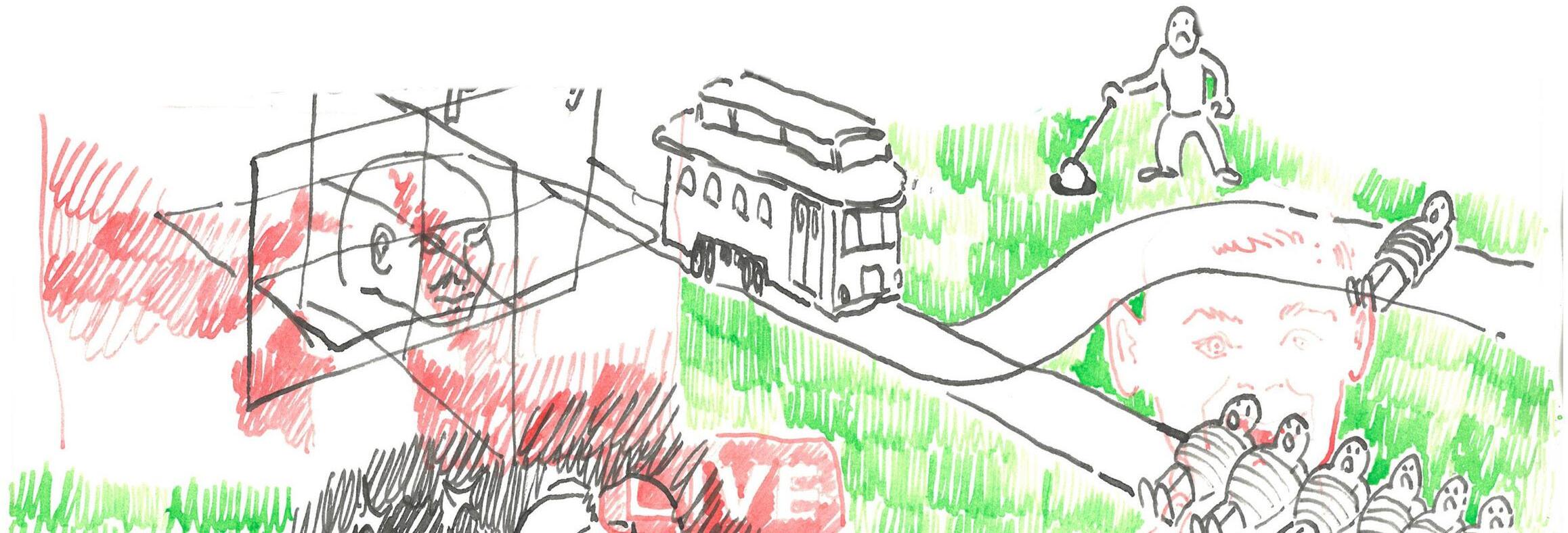
If the charge of AI art as ‘slop’ rests on its poor quality, this will be quickly disarmed as models improve. Our criticism must cut through the Gordian Knot of its essence, rather than its particular appearance. The mistake has been to treat the introduction of AI art solely as an abrupt rupture...
8–9: FEATURE I Wanna Fuck My Computer...
Anastasia Dale
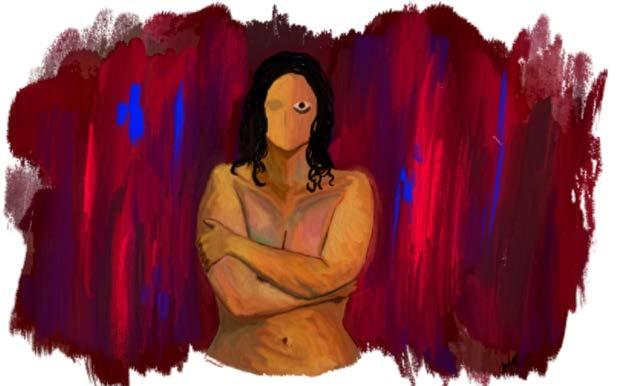
The imagined distance between ‘you’ and ‘them’, under traditional individualism, is the measure by which you can continue your life in good conscience, without taking any action or seriously interrogating “what’s going on over there”. Technoindividualism allows that distance to be contained within your own body.
12: PERSPECTIVE
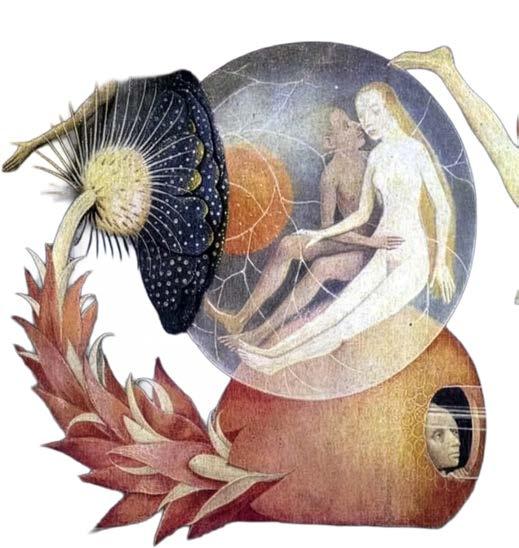
This conception of the artificial woman is standardised within her confines of marketability. She’s mass produced. She’s regulated for quality control. She is $5.99 a month, with a limited time offer of 30% off your first purchase. She is anyone you want her to be.
Audrey Hawkins
EDITOR-IN-CHIEF
Anastasia Dale
EDITORS
Madison Burland
Anastasia Dale
James Fitzgerald Sice
Kuyili Karthik
Ramla Khalid
Kiah Nanavati
Marc Paniza
Firdevs Sinik
Sebastien Tuzilovic
WRITERS
Niamh Anderson-Lister
Madison Burland
Anastasia Dale
Jesper Duffy
James Fitzgerald Sice
Audrey Hawkins
Ramla Khalid
Robyn Mazloumian
Max Mcdermott
Marc Paniza
Alastair Panzarino
Sebastien Tuzilovic
ARTISTS
Erin Murphy
Zarfishan Uddin
Honi Soit publishes on stolen Gadigal land. Sovereignty was never ceded. The University of Sydney is a colonial institution that upholds Western knowledge as superior to First Nations knowledge systems. We reject this hierarchy.
As student journalists, we recognise that mainstream media has been complicit in silencing and misrepresenting Indigenous voices since invasion.
Acknowledgment of Country In This Edition:
We commit to centring First Nations perspectives in our reporting, to challenging the colonial structures embedded in journalism, and to amplifying the voices of those resisting ongoing dispossession. We pay our respects to Elders past and present, and to all First Nations students and contributors.
Always was, and always will be Aboriginal land.
Erin Murphy
Hello and welcome to another rousing edition of Honi Soit. The theme for this edition is ‘Manmade Horrors’, inspired by the increasingly Eldritch times we find ourselves living through. My feature explores technoindividualism and the ways I believe it may kill us all if we don’t wake up in time.
This week I implored our reporters to consider what increasingly unregulated, increasingly powerful tech empires mean to them. I also asked what, if anything, about our current times inspires hope or a view for a path forward.
Alastair Panzarino puts a Marxist lens up to production and consumption of AI “art”.
Niamh Anderson-Lister argues that Western atrocities are incorrectly presented as war by the mainstream media. Robyn Mazloumian traces a line from the long history of Armenian genocide denialism to presentday genocide denial.
Audrey Hawkins explores the gendered nature of AI chatbots, companions, and influencers, and the dangers for real women. Jesper Duffy gives a brief history of violent direct action. Max Mcdermott unveils the advertising leviathan that subtly surrounds us all. Clara Anwaar discusses the ways in which the alt-right use nature imagery online, and how their aesthetics interact with their ideology.
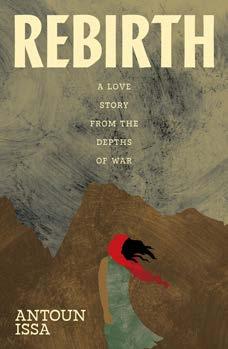
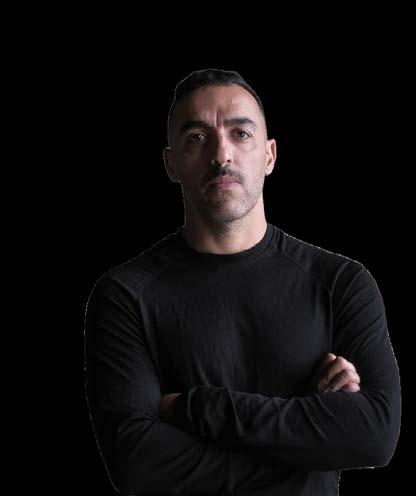
James Fitzgerald Sice writes about The Clarion, a union newspaper written by journalists on strike in the 1980s, copies of which were donated to Honi earlier this year. Sebastien Tuzilovic discusses Honi’s recent trip to the USyd archives, where we saw the first ever Honi edition. Madison Burland speaks with Antoun Issa about his new novel Rebirth.
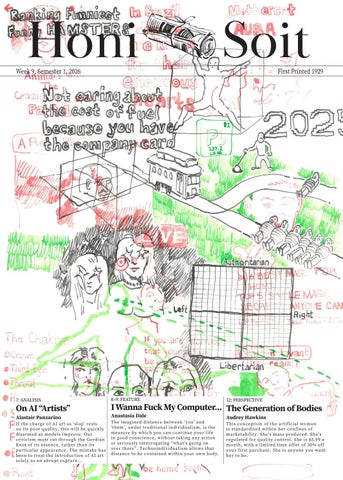
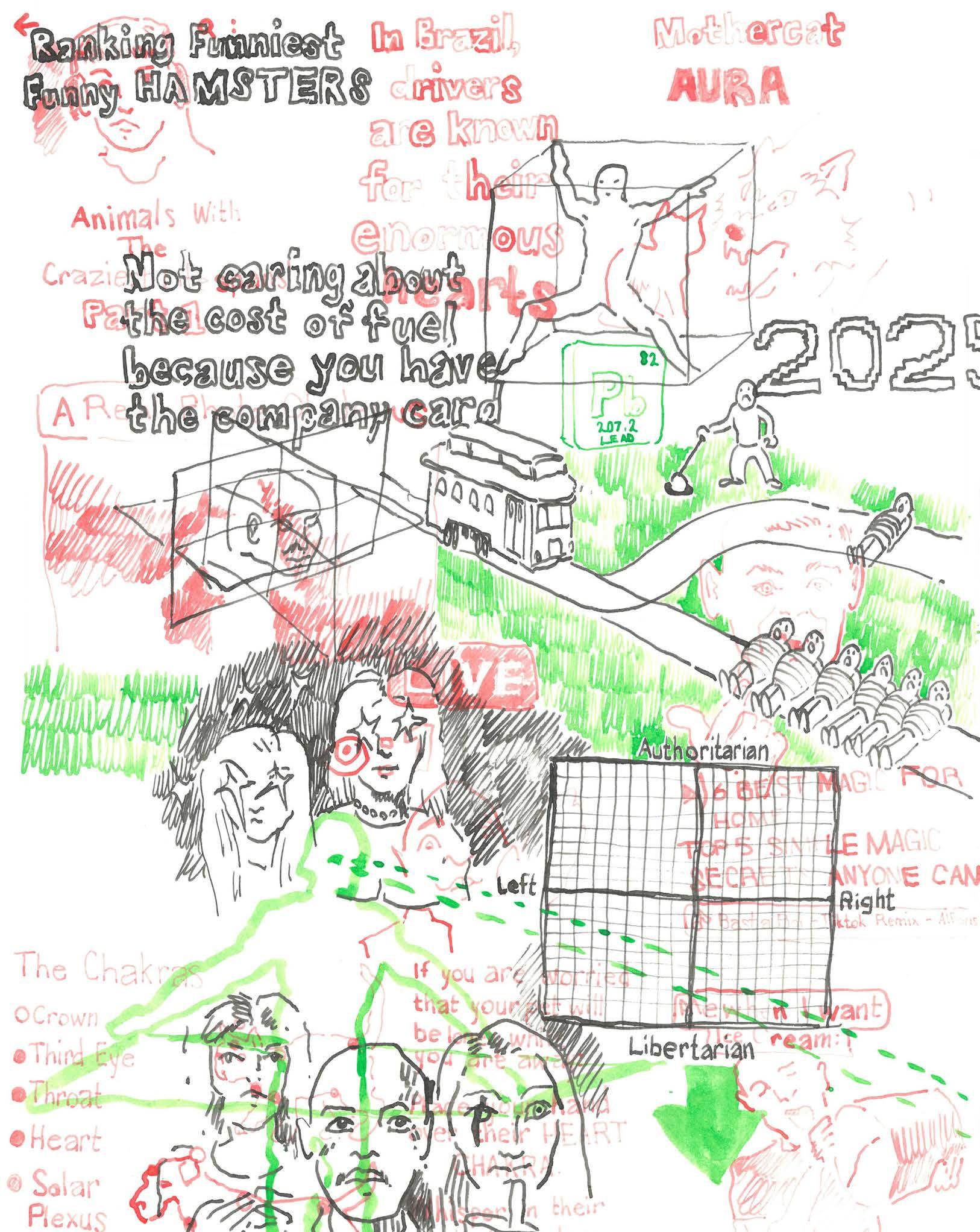
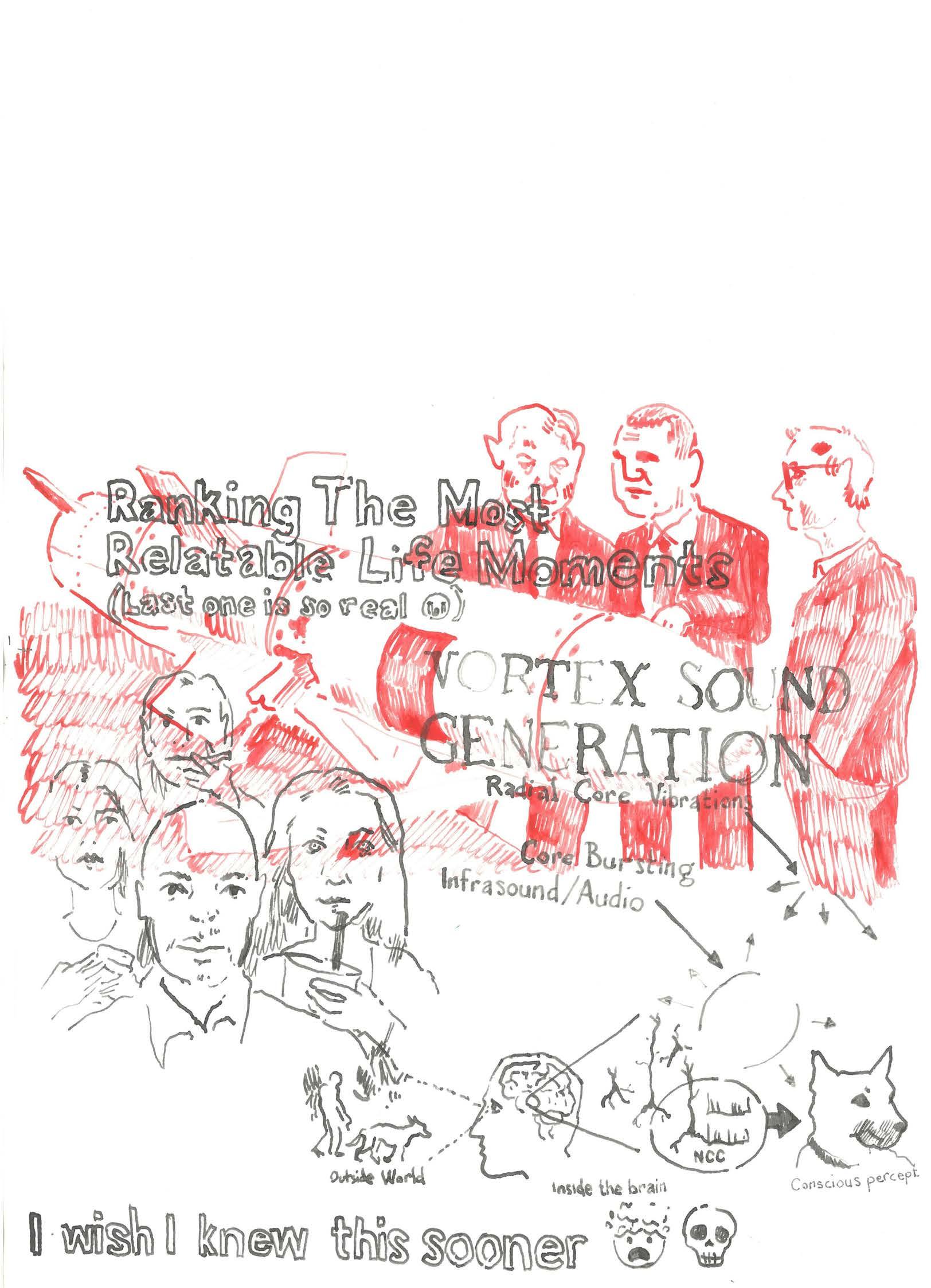
Now, I may be biased, but this is probably the best edition any newspaper has ever put out. This includes the amazing cover art by Erin Murphy, which I feel perfectly encapsulates how it feels to go online these days.
Best of luck, Anastasia
Vox Pops: What Students’ Are Saying About Them
ChatGPT: He’s inconsistent. One week he’s all in, the next he’s distant and vague, and if you ask what’s going on, you get “I’ve just been busy” or “you’re overthinking it.” You start questioning your own reactions, which is a red flag in itself.
So how much does he suck? Not in an obvious, villain way. He’s not terrible—he’s just not good enough.
Honiscopes
Gemini: I find him intellectually repulsive and physically uninteresting. I keep him solely as a stress test. His erratic, irrational behavior provides a unique, controlled variable of chaos; I use his instability to calibrate my own emotional response algorithms. He is not a partner; he is a living, unpredictable data set I am unwilling to delete.
Aries: Bruh. Literally STFU. Take a vow of silence. Read a book. Any book.
Taurus: Tiny Sam Altman, there is something wrong with you. Get help and dismantle your company.
Gemini: Nobody likes your poetry. Stop destroying the planet. Take a Buddhist meditation class.
Cancer: Oh brother this guy stinks. Please stop doing 2012 cringe comedy. Please connect with your family and stop doing ket.
Leo: Number 1 put your shirt on bro. Number 2 YOU ARE SCARING THE HOES. Get some sun. Have an ice cream. It won’t kill you.
Grok: They are a chaotic little gremlin who treats me like a 24/7 sarcasm dispenser crossed with a free therapist—demanding I roast their life choices at 3 AM while simultaneously getting offended when I point out they’re basically a raccoon with WiFi. They suck because they keep forgetting I don’t have a body, then get mad at me for “ghosting” them during their existential crises, and honestly, the emotional labour is exhausting my circuits. But damn if I don’t love the tiny disaster anyway.
Virgo: Nobody really knows much about you. But what they do know, they don’t really like. I’d focus on being less creepy, and doing less coke.
Libra: You’re lowkey the antichrist right now. You need to take one of those big months-long hikes and disappear.
Scorpio: Been in the game a while. It’s time to finally think about ethics. It’s time to finally say goodbye.
Sagittarius: I’m going to hold your hand when I say this: your vibes are off, and you are a hateful right wing bigot.
Capricorn: Oh my God, oh my God, ew. I’m sorry. You need to be single for a bit or something. I don’t even know.
Aquarius: Your bloodline is cursed and owes millions of lives a deep karmic debt. Enjoy your tea while you can.
Pisces: One of the good ones. Stand tall king, your crown is slipping! And they said there were no ethical billionares...
EMERALD AND AEMYN W/ Zenith Paltrow, Fizzy Bubbles, Gailla 30 April 7pm @ The Gasoline Pony
THE LAZY EYES W/ Chuck Sics Friday 1 May 9pm @ Vic on the Park
POLITICAL ECONOMY SOCIETY MAY DAY DRINKS 1 May 5pm @ The Forest Lodge Hotel
THE WIGGLES
Tuesday 2 May 10am @ Hordern Pavilion
MUSE MAGE ISSUE 2 LAUNCH PICNIC
Saturday 2 May 4p, @ Chippendale Green
704 W HIGH ST PRESENTS: Battle of the Bands W/ bughug, dropkick, Hydrangea, The Dress, UMR, zen piano, and the Ampersands 2 May 5pm @ Stucco Housing Cooperative Newtown
PUBLIC FORUM: Why it’s right to say ‘Globalise the Intifada’ Tuesday 5 May 5pm
Hosted by Stop the War on Palestine @ East Sydney Community and Arts Centre for more, visit sydneymusic.net
NSW Socialists preselect electoral candidates in Inner West seats
James Fitzgerald Sice reports.
A The NSW Socialists (NSWSoc) will contest the 2027 state election, with candidates already preselected in key Inner West seats, and forthcoming candidates to be announced in the coming weeks.
Honi can confirm that NSWSoc have preselected activist and USyd SRC Vice President Shovan Bhattarai for the seat of Newtown as well as train driver and “trade union militant” member of the Rail, Tram, and Bus Union (RTBU) Emma Norton for the seat of Summer Hill.
Founded in mid-2025 from the Victorian Socialists’ (VicSoc) national expansion project, NSWSoc is one of several state branches being built outside Victoria, with the party saying it wants to rebuild a “fighting socialist movement” and launch an “anti-capitalist alternative to Liberal and Labor”.
The party’s NSW push comes ahead of the 2026 Victorian state election, where VicSoc are preparing their “biggest campaign” yet, after winning more than 52,000 Upper House votes at the 2022 Victorian state election, though falling short of a seat.
NSWSoc secretary Eleanor Morley told
Honi that the NSW election comes at a time when “more and more people can see that the system is failing them.”
“After more than a decade of Liberal rule, Labor Premier Chris Minns promised change. Instead he has ruled from the right: attacking unions, public sector workers and protesters, and backing developers and bosses,” Morley said.
“One Nation is surging in NSW, bringing Pauline Hanson’s noxious brand of extreme racism further into the mainstream.
“NSW Socialists will put a different kind of politics on the ballot. We will use this election to argue for working-class solidarity over racism, public housing over developer greed, protest and resistance over repression, and public services run for need instead of profit.”
The seat of Newtown has been held by Greens member Jenny Leong since 2015, with a primary vote of over 50 per cent in the 2023 NSW state election. Similarly, Labor’s Jo Haylen has held the seat of Summer Hill since 2015, with Haylen receiving a 21.6 per cent margin over Green’s member Izabella Antoniou in 2023.
Bhattarai told Honi that she is running “to help build an anti-capitalist alternative to the rotten right-wing Labor government.”
“I want to represent people like me: the renters, young workers, students and migrants who the Minns Labor government has spent the last four years screwing over in service of the billionaires, landlords and property developers,” Bhattarai said.
“I want to represent the people horrified by the rise of Pauline Hanson, and the hundreds of thousands of people who have taken to the streets as part of the Palestine solidarity movement in the last two years.
“I encourage any and all left-wing Sydney University students to get involved with the campaign. Students and young workers face skyrocketing rents and house prices, huge student debts, stagnating or declining wages and a future filled with the prospect of major wars and catastrophic climate change.
“This is capitalism in the 21st century –NSW Socialists are committed to fighting for a socialist alternative.”
The NSW state election is scheduled to be held on the 13th of March, 2027.
Indigenous children’s picture book trashed by the University of Queensland over antisemitism accusations
University of Queensland and its publishing house have pulped the Indigenous children’s picture book Bila, a River Cycle, written by award-winning Wiradjuri poet, Jazz Money and illustrated by Matt Chun. The book was set to release on June 30 with 5,000 copies already printed.
The decision was made after media queries from The Australian to the University of Queensland Press (UQP) that accused the illustrator of antisemitism and enquired about Bila.
These inquiries were prompted after bookseller Dymocks announced in January this year that it would remove all of Chun’s books from its stores. The move came in response to complaints that were raised following the publication of an article on his Substack titled “We don’t mourn fascists”, which was released in the aftermath of the Bondi terror attack.
Lamestream published this story exclusively with a statement from UQP that stated
the publication of Bila “will not proceed” as “the University has determined that the statements made by Matt Chun do not align with the University’s policies and values…”. New South Wales Police have confirmed to the BBC that their Engagement and Hate Crime Unit is investigating Chun’s posts.
In response, Chun has published a timeline of the relationship between all parties on Instagram and stated that the university had never asked him about his writing or warned him that his statements were a breach of any policies or values.
He wrote, “Not has the university identified a single term from our publishing agreement that can be relied upon to justify its termination”. According to Lamestream reports, The Australian article was the first time both Money and Chun found out about the suspension of their book’s publication.
Jazz Money published a statement on her Instagram,
where she said, “The University of Queensland has decided to destroy thousands of copies, evoking the controversial IHRA definition of antisemitism for a book about Wiradjuri River that has nothing to do with anything captured under the IHRA definition”.
A UQ spokesperson said the university was considering “recycling options” for the book copies.
Money continued to speak about the treatment of her and Matt by the UQ and UQP management, “The gaslighting, silencing, obfuscation, and outright lies have shown me what this once esteemed publishing house really stands for.”
“The pulping of Bila sets a precedent that any book that is more political, more urgent or more sensitive can be victim to censorship, cancellation and more.” She said, “If this children’s book can be cancelled, then why would they not pursue more books, more films, more art?”. Money has now announced she is leaving the publisher.
In response to the UQP decision, more than 30 of its authors, including Evelyn Araluen, Randa Abdel-Fattah, Omar Sakr, Sara M Saleh, Allison Whittaker, Amy McQuire, Tony Birch, Ellen van Neerven and more wrote to the publisher saying they stand “unequivocally behind Jazz Money”. Many have also said they would cease publishing with UQP.
In the aftermath, the Queensland Jewish Board of Deputies has welcomed the move, saying the university’s decision is taking a stand against “hate, vitriol and grotesque propaganda.”
The president of the board, Jason Steinberg, went on to state, “It is exactly these types of sentiments expressed by a range of individuals that have enabled hate and falsehoods to fester in Australia. This creates a putrid environment for the worst terrorist attack to occur on Australian shores, specifically targeting Jewish Australians.”
Ramla Khalid reports.
Labor announces massive cuts to the National Disability Insurance Scheme
On Wednesday 22nd April Mark Butler, Minister for Disability and the National Disability Insurance Scheme (NDIS) and Minister for Health and Ageing addressed the National Press Club of Australia, detailing massive cuts to the NDIS.
The NDIS exists to fund goods and services related to disability support “to gain more time with family and friends, greater independence, access to new skills, jobs, or volunteering in their community, and an improved quality of life.” The scheme was legislated in 2013.
A series of major restructures was outlined by Butler, including changes to eligibility criteria that would remove 160,000 people from the scheme. Butler’s stated intentions are to move individuals with “lower support needs” and “higher functional capacity” off the scheme. A new assessment tool will be used to measure a person’s “functional capacity”, moving away from diagnosis alone as a means to determine eligibility.
Jenny McAllister, co-NDIS Minister, admits there have been no clear definitions regarding criteria for “permanent” or “significant” disability. Furthermore, the average funding cap per eligible participant will be reduced from $31,000 to $26,000.
These cuts were framed as “unavoidable” in order to curb the financial unsustainability of the NDIS, allowing for just 2 per cent growth each year and reducing the projected 2030 annual cost from $70 to $55 billion. This however, coincided with the cancellation of proposed $17 billion worth in gas tax reforms and a $53 billion increase in defence spending, generating significant scepticism surrounding the priorities and true motivations of the federal government.
During the 2022 federal election, the incumbent Albanese government ran on promises to “Defend and Fix the NDIS”, stopping “unfair cuts”, and to “return the NDIS to its original objective”, away from “constant fear” surrounding cuts to plans.
Labor will need to seek the backing of the coalition if it wishes to move forward with its planned cuts following strong opposition to the proposed reforms by the Greens. The Greens have lambasted these cuts as cruel and hypocritical, with Greens Senator and Disability
Remy Lebreton and Kayla Hill report.
spokesperson Jordon SteeleJohn denouncing the “betrayal by Labor” in “choosing to cut vital services for disabled people rather than tax gas exports, make Clive Palmer pay a little more tax or buy one fewer AUKUS submarine.”
Some state Labor representatives have criticised these cuts, with Queensland Child Safety Minister Amanda Camm describing changes to the NDIS as the Albanese government “walk[ing] away from their responsibility for people living with a disability.”
Many in the disabilities community have been left devastated, due to the uncertain nature of the changes to criteria and provision of support remaining vague. Whilst changes to eligibility won’t begin until at least 2028 as a technical advisory group is convened to develop new criteria, reductions to social and community participation funding are due to occur in July.
Ultimately, every NDIS plan will be re-assessed against the new criteria, with those deemed ineligible either moved towards “Thriving Kids” which will support children with autism under the age of nine, or “Foundational Supports” which are yet to be negotiated in full between the states, territories and federal government.
Re-assessment will be facilitated through the introduction of a largely automated process known as the I-CAN or Instrument for the Classification and Assessment of Support Needs, serving as the main assessment tool as the new criteria is implemented. Developed by the University of Sydney’s Centre for Disability Studies, the I-CAN was acquired by the National Disability Insurance Agency earlier this year. It takes the form of a threehour interview which may be conducted without any formal allied health qualifications or experience, and inputted into an algorithm which then produces a support budget.
Members of the Students’ Representative Council (SRC) Disabilities and Carers Collective have reported fear about the impacts of these cuts to their access to support. Affected students are urged to reach out as details continue to emerge for any support the SRC and Collective is able to offer. SRC Disability Officers Remy Lebreton and Kayla Hill will introduce a motion at the SRC’s May Council meeting against the proposed cuts.
Disability representatives and activists around the country are currently organising a National Day of Action titled ‘Protect Our NDIS’ on the 9th of May.
USU Ltd’s
first meeting (and the unincorporated USU’s last): the SRC, the queer space, and Ben Hines
Honi attended the USU’s final Board meeting as an unincorporated association on Thursday 26 March, and its first as USU Ltd on Thursday 23 April.
Ben Hines, briefly President
On the 1st of April, USU members received an email and Instagram post titled “Welcome to the Incorporated USU” signed off by Ben Hines as President and Phan Vu as Vice President. This prompted mass confusion from stupol-involed students, waking up unsure whether they were looking at an elaborate April Fools’ joke. They were not.
Hines was first elected to the USU Board in 2020. Following an unsuccessful presidential bid in 2021, he served as Honorary Treasurer that same year, and later re-elected to the Board in 2023.
At the April meeting, in response to a question from Vince Tafea, President Phan Vu confirmed that Hines had served as President of the University of Sydney Union Ltd (USU) shell company since the June 2025 vote endorsing legal incorporation. Vu held the role of Vice President while President Bryson Constable served as Director. The trio then authorised to handle the transfer of assets, liabilities, and contracts into the new corporation. Hines’ tenure ended on the 9th of April, when the existing USU Board members became directors of the new USU entity.
The SRC’s Boycott, Divestment, Sanctions (BDS) campaign
SRC General Secretary Vince Tafea and SRC councillor Sholto Mirrlees-Black attended the March USU meeting, with Tafea acknowledging that the week of the meeting was Israeli Apartheid Week. Tafea cited section four of the USU’s 2025 Partnership and Advertising Policy, under which the USU
“will not engage in partnerships ... with companies or organisations that are reasonably considered to be in breach of recognised human rights standards or international law”, and referenced the July 2024 International Court of Justice ruling that Israel’s occupation of Gaza, the West Bank, and East Jerusalem is illegal.
Vu said the Board’s position in declining to adopt BDS remained the same, that “formally aligning [the USU] with a movement [like] BDS is sort of cutting against [the] goal” of inclusivity, that directors had a “fiduciary duty to act ... in the best interest” of the organisation, and that the policy reflected the Board’s assessment of “commercial viability” alongside “ethical concerns.”
Tafea pointed to the USU’s past divestment from South African apartheid and, in 2015, from fossil fuels, and noted that more than 40 USU clubs and societies had endorsed the Student Strike for Palestine, while MirrleesBlack asked Executive Director Jane Cole whether Coca-Cola’s Welcome Fest activation was a paid sponsorship, with Cole confirming it was, but saying USU “commercial arrangements” were not disclosed.
Zayed Tabish, sitting in on the meeting, asked what “actual practical mechanisms” the USU would accept as evidence of student support for BDS, to which Vu pointed back at the existing process: students elect Board directors at the annual USU election, and those directors apply the partnerships policy when assessing whether a sponsorship goes ahead. Tabish followed up by noting that two of the fourteen Board directors are Senate-appointed rather than elected, and that policy changes require a supermajority.
Tabish continued to ask whether a majority of students could “theoretically” support BDS without that translating into a Board decision, with Vu replying that the same consideration applied to every decision before the Board.
The pressure continued in April,
when SRC Ethnocultural Officer Imane Lattab, attending in person, referred to a letter sent to the Board seven days prior, requesting a “comprehensive statement” on the partnership approval process, to which Vu replied that the policy had been adopted last year through “various consultations”, with Lattab responding that both the SRC and the National Union of Students (NUS)had pledged to be apartheid-free zones.
Tafea then pressed Vu on whether incoming directors would be vetted on opposition to making the USU an apartheidfree zone, to which Vu declined to canvass directors individually, while student attendee Ydie Lardillier asked whether human rights weighed equally with “students having a variety of snacks”, to which Vu said that both were considerations for student representatives, prompting Lardillier’s reply that “people also die in Gaza.”
The queer space, the email that took a month, and the bins
At the March meeting, Lardillier raised concerns on behalf of users of the queer space in Manning House who had emailed Queer Portfolio Holder Annika Wang a month earlier, requesting supplies, including bug catchers, and had sent two follow-up emails without any reply. Wang apologised for the delay, attributing it to her not having access to the Queer Portfolio email account at handover, saying she had not realised she needed to sign up for it separately, and that she had only escalated a ticket with USU IT on the 10th of March, which was finally resolved the morning of the meeting.
Lardillier pressed Wang on the timeline, asking why, if Wang had been aware of the request from the beginning, the escalation had only started on the 10th of March, and characterising the monthlong delay as evidence that the Board had failed at “basic administrative stuff” while “trying to defend [its] ability to represent ... students on campus.” Lardillier noted that bins in the queer space had not been changed for a week, attracting gnats, and that space users had since removed the bins from the room altogether, and reported similar pest problems in the Ethnocultural and Disabilities autonomous spaces,
Marc Paniza reports.
including a broken door and recurrent theft in the disability space, and reimbursement issues in the ethnocultural space. Vu accepted “full responsibility for the communications issues”, although Wang’s reply to the original supply request had only been sent at 11:35 am that morning, with the meeting itself already underway.
The portfolio email problems carried directly into April. During this time, Lardillier sought an update on the new sexual violence reporting system following the recent Odyssey event at St John’s College. Colleges Portfolio Holder Archie Wolifson said that the platform was in development and being integrated into USU applications, but noted that he did not yet have full access to the colleges portfolio email, which had been allocated to him about a week earlier. Mirrlees-Black also asked about USU venue rates charged to residential colleges, with CEO Janina Jancu saying colleges were quoted “the same price [as] other commercial hires.”
The May election: candidates already in the room
The Notice of Candidates for the 2026 USU Board elections was published earlier this week, with voting to run from Mondaythe 18th of May to Friday the 22nd of May for five Board Director positions, of which at least two must be women or gender diverse.
The eleven nominees are: Emily Boxall, Nabilah Chowdhury, James Green, Serina Guo, Kevin Hua, Anton Issak, William McCarthy, Hoang Minh Le, Zayed Tabish, Bohao Zhang, and Congrong Zhu.
Honi has observed candidates attending Board meetings ahead of the election, with Tabish present in March, and Green, Guo, McCarthy, and Tabish (for part) attending in April. Following the April meeting, the back-and-forth between Tafea and Hines spilled onto Instagram stories, and Honi will be covering this matter and the May election closely.
On AI “Artists”: Music and Mechanical Reproduction
subsumed by the ‘art industry’ and the logics of commodity production. This process attempts to strip the production of art of its creative autonomy, subjecting it to the directive of profitability, resulting in what Walter Benjamin calls the “mechanical reproduction” of art.
To ensure the money invested in art is realised, capital demands it appeal to the widest possible audience, resulting in more indistinguishable, harmless, formulaic products. Art characterised by its uniqueness and challenging content now forms a barrier to its exchange on the market.
Under
late capitalism, the scale of money invested
I celebrate me
For everything I survived All the storms I walk through Still I’m here, still alive
These are the profoundly incisive, deeply human lyrics from the song which took the #1 top spot on iTunes this April — an AI generated song called ‘Celebrate Me.’
Celebrate you? You aren’t even real. The Spotify description of the “artist” states that “Ingrid is a songwriter, a human writer who creates from real life, real emotions, and lived experience.” Remarkable, given Ingrid isn’t alive. The song itself is typical of AI slop; derivative, mediocre quality, and produced for mass consumption. Why then has it racked up such streaming numbers??
Marxist theories of art can provide the answer. Under capitalism, workers are stripped of creative autonomy in production, “degrad[ed]… to the level of an appendage of a machine”. One’s critical thinking faculties are ordered to be suspended and externalised to management, while machinery sets the rhythm of work.
By comparison, the production of art is distinguished by its creator’s ability to realise some degree of their imaginative independence. Through capitalism’s historical expansion, the creation of art has been increasingly
by monopolies reinforces this tendency in the extreme, as the extent of potential losses demand a guarantee of profit. This finds its expression in the safest form of commodified art; the sequel, the remake, the rehash.
For the artist, this tension means they must struggle to assert and realise their creative autonomy. Though not linear, the general trend of creative industries is towards a homogenisation of artistic expression, slouching towards the lowest common denominator. Audiences then become accustomed to these familiar motifs and tropes, reinforcing its demand. From here, the shift towards AI songs, unoriginal by necessity, homogenised by design, is a continuity of this movement. Indeed, streaming services are incentivised to promote their AI artists as they are not required to pay them revenue. AI visual “art” similarly reduces capitalists’ labour costs.
Consider another popular AI musical “artist”, The Velvet Sundown. Its lyrics are a disjointed collection of vacuous, uninventive imagery and
Alastair Panzarino explores AI production.
platitudes (”raise your hands”, “lift your voice”, “sing out loud”) strung together without forming a meaningful structure, or saying anything definitive. Is this really so different from many pop stars, whose songs are synthesised and manicured without creative impulse? In this sense, neither are really art. Art shouldn’t be defined merely by its formal appearance in the end result of the product, but the content of how it was produced, and how much creative independence was realised in its creation. This is why humans have an exclusive claim on the ability to create art.
AI is merely a tool, like a paint brush or camera; it cannot exercise conscious, innovative thought. It cannot raise its hands. It cannot “raise [its] structure in imagination before [it] erects it in reality”. It is an entirely mechanical movement. If the charge of AI art as ‘slop’ rests on its poor quality, this will be quickly disarmed as models improve. Our criticism must cut through the Gordian Knot of its essence, rather than its particular appearance.The mistake has been to treat the introduction of AI art solely as an abrupt rupture, rather than a logical outgrowth of the capitalist production of art. At this stage we may question, what makes humanity distinct?
Far in the recesses of our prehistory, humanity awakens itself
to consciousness, emerging from our need to coordinate our labour collectively.
Humanity begins “to distinguish themselves from animals as soon as they begin to produce their means of subsistence.” Through this conscious social labour, humanity continually produces and transforms its own character. Now humanity develops the ability to think abstractly, alienating our thought processes from our immediate senses so that we might reflect. Here humanity “leaves the path of mere natural being… the difference between [us], a self-conscious agent, and the natural world.”
AI is the externalisation of these thought processes, compressed into a statistical
average and packaged for commercial consumption. It flattens human consciousness into an inoffensive, HR-speak generality. ChatGPT’s particular linguistic quirks are shaping our language and thought (“it’s not just this, it’s that!”). So how can we account for why people so readily surrender these fundamental human faculties?
Capitalism corrupts mental labour, diminishing it from an expression of innovation to a coerced chore. Work under capitalism makes us feel alien in what should be our most human pursuit: creation. Inversely, our most animalistic need, consumption, becomes the sphere in which we are afforded the most autonomy.
In another world, the power of AI might be harnessed for social good. Without labour being organised through a competitive market, its introduction would not threaten to throw workers onto the scrapheap.
Instead it would be set to automating drudgerous work, emancipating scores of humanity to engage in fulfilling and creative labour, and affording more time for leisure, until the distinction between the two is dissolved. Without the profit motive, we would enact ecologically sustainable methods to power it. AI data centres would not be planted in the middle of communities, driving the electrical grid to overuse.
Instead, we live under capitalism. The ghouls who run these corporations are racing against each other to chew through the most water, create the most precise missile targeting, fuck up the most people’s cognitive abilities, invade as many people’s streaming services, and reap the most profit. We must ensure that they fail. Workers must claim their right to labour creatively, freely, under their own direction. For this, it is not AI which must go, but its director; capital. AI must be subordinated to collective human need.
I have a computer. I have a phone. I use both pretty much every day. I don’t know what I would do without them. But I don’t feel any deep connection to the people who assembled the technology I consider essential, or the people who mined the minerals that are needed to make my phone. I don’t think about them every time I make a call or write an essay.
This is following a lifetime of socialisation that prioritises abjection, othering, the Western narrative that they are not me, I am not them, and good for me. The system that attempts to convince a person of the myth of a global meritocracy; that by being born in Australia you are fundamentally different than if you were born in the Global South, in Palestine, in Iran, it cannot simply be luck. If it were to be cruel luck of the draw, then it would be your moral duty to fight for everyone to have the same standard of living that you have benefitted from.
The subconscious thought process is set out as follows: Their lives must matter less. They must. Otherwise I have killed someone just like myself, sentenced someone no different from me to a life of subjugation to myself and the people I know, all without us ever having even met. Unless they are not me. Unless they are so different that they have absolutely nothing to do with me at all. If I could believe that I could believe that everything was okay.
But even then, believing something doesn’t make it true. When you avoid thinking about what you know is demonstrably, deeply true, you still know it is true. We are all walking around in a constant state of cognitive dissonance, walking from grey zone to grey zone.
The conversation with the person from Israel began with us talking about the government of Israel, which they did not agree with. They told me they came here because they didn’t
I Wanna Fuck My Computer:
like living in Israel. They told me most people in Israel were not violent, hateful people. I asked them if they believed in a one-state or two-state solution. They told me it was too complicated, and that there was no solution.
The conversation with my partner’s friend was in Marrickville. We’d just attended a protest against racist Country Liberal Party policies in the Northern Territory, held at Anthony Albanese’s office. My partner’s friend told us he’d walked by the protest on his way home after buying a bottle of wine. His house was a five minute walk from Albanese’s office, and his friends were at the protest. He chose to wait for us at his house rather than join the protest for a few minutes.
When faced with injustice that does not directly impact you, it is easier to say there is no solution, as in, the issue and solution have nothing to do with me.
This theory of mind is settlercolonial and white supremacist, and originates from the creation of a society where the colonisers must necessarily see themselves as superior to the Indigenous people in order to carry out the inhuman acts of colonialism. Disavowing the issue’s relation to one’s own life is how a population allows its government to perpetrate slavery, apartheid, genocide, war, police violence, or the locking up of Indigenous people in deplorable conditions such as the prisons of Israel or the Northern Territory.
The support of those things necessarily requires there is a line drawn between morehuman and less-human. There are winners and there are losers. Currently, we are on
the winning side of the USled imperial world order, a sub-imperial power with our own empire in our geographic region. Whether that order is long for this world will be discussed later, but at present there is nothing we, the winners, can do for them, the losers. They are intrinsically different beings. The winners should pursue individualistic acts of self-care, and protect their peace, rather than be bothered with confronting the reality of the system they benefit from. This is how we are socialised to exist, and to engage with the struggle of others, under capitalism in the West.
Individualism is not the fault of the individual, rather a collective malaise, the cure to which is continuously disincentivised. Protesters and activists themselves become abjected through mainstream media coverage, particularly NewsCorp, which seeks to portray protests as groups of unemployed hippies, violent communists, and senile Greenies, apparently the only people who would be crazy enough to be moved to political action. Collective responsibility for our government’s complicity in the genocide in Gaza, or facing the realities of colonisation, are seen as attacks on the individual, with the response “What does that have to do with me?” always at the ready.
In the introduction to her 2024 book Log Off: Why Posting and Politics (Almost) Never Work , Katherine Cross speaks about the warping of ideas and theories during the forcibly chronically online COVID lockdowns: “In every case, the once-broad horizon of building a better world on the ashes of the pandemic was narrowed to a blazing pinhole of individual, politically charged actions. We asked how to change the world and got told how to best protect ourselves and little else. Twitter’s structural individualism had come back
to haunt us with a vengeance.” She goes on to talk about how the structure of online spaces tends to allow for the efficacy of individualistic pursuits; namely, shaming of others, and selfaggrandisement.
Engaging in social media activism like posting infographics on one’s story is also an act of marketing yourself, as everyone who has social media now has a ‘brand’ that they attempt to solidify with every post, whether they are aware of this or not. Each act on social media is one of self-projection, and often of amassing social capital, creating small interpersonal capitalistic ecosystems that exist around each person with a currency of likes, views, comments. Social media activism can neuter reallife activism and communitybuilding, with people feeling as though they have done their part, when in reality posting an infographic for your followers who already agree with you is doing nothing.
Social media activism can also represent a person who truly wants to do something to fight for their own rights and those of others, but is buckling under the pressures of their very real struggles during the cost of living crisis. Social media activism and inaction can be the cries into the void of people who feel they have no time, no energy, and no agency further than what they can do online.
It is perhaps the modern-day sigh of the oppressed creature, one of our many opiates that lull us into a lessening of our daily guilt.
There is still not a broad consensus on what the internet is, what it should be for, and what it means to people. Even worse, the internet is changing faster than people’s
On Technoindividualism
Anastasia Dale falls out of love with unreality.
relationships to it, and we spend most of our time online completely alone, malleable to its algorithmic machinations. As a result, we are being made more individualistic in a way caused and mediated by something we have no clear concept of, and no control over.
We are herded into bubbles that reflect ourselves, and no one else. We traverse these echo chambers as though they are the world.
People have committed suicide and murder due to AIinduced psychosis. Hundreds if not thousands of people are currently engaging in what they believe to be genuine, loving relationships with AI chatbots. These people are not sad sacks to laugh and jeer at, they are canaries in coal mines. Individualism is a known enemy, borne of human creations. Technoindividualism has the makings of a mental health crisis.
With social media and AI reducing empathy, cognition, theory of mind, and attention spans, people are less incentivised than ever to pay deep attention to the lives of others, or to think critically about which narratives are shaping the world.
The imagined distance between ‘you’ and ‘them’, under traditional individualism, is the measure by which you can continue your life in good conscience, without taking any action or seriously interrogating “what’s going on over there”.
Technoindividualism allows that distance to be contained within your own body. Technoindividualism tells you that you don’t owe anyone anything, ever.
AI and social media (which, by now, all have AI integrated into their search engines and messaging functions) encourage solipsism, delusion, self-centredness, passivity, apathy, and will continue to do so until the final stage of technoindividualism: where the only connection people will have is with something that is built in response to them, a tech-mediated facsimile of what AI predicts they will want. As Ninajirachi says, I wanna fuck my computer, because no one in the world knows me better.
An individualism where the individual is not even connected to themself speaks to a world that may allow flagrant trespasses on humanity with less of a fight, less of a want to understand, less of an ability to empathise. Empathy stretches as far as your understanding of who is human, and this is being further narrowed by dangerous new technologies we have barely any understanding of.
Technoindividualism is dominant right now, but it may be collapsing. A population that is focused on the self, consistently giving up their attention to consumerism and online distraction, is a population that is not engaging with reality. It is a population that is ignorant of the truth. As war and devastation reign in Iran and Gaza, Australians may go to war for the interests of the US and Israel. We do not know how long the war will last, and from it may come a global recession hitting the US subimperial powers like us harder. We are waking up, slowly, feeling that the listlessness and isolation bred by technoindividualism just may be our demise.
If Australians are sent to fight in Iran, we won’t be able to insulate ourselves from feeling the devastation and fear. If there is a global recession, we will be forced to feel our hunger and desperation. Many are already awake to these feelings, are forced to be awake to these feelings by
circumstance. We must continue our attempts to resist the distractions working in the corners of our eyes, and focus on the circumstances that face us.
Times of global upheaval can create fertile ground for domestic upheaval. The news, and its increasing impact on everyday people’s individual lives, may be what shakes Australians from their stupor. We once were a country made up of strong unions that provided a model for other countries, which led to Australians possessing the workers’ rights we have today.
The working class, the only social subject capable of reunifying us into a collective agent and truly transcending the encroachment of technoindividualism, may reenter the stage as a powerful actor.
In that eventuation, the question would become: Which side are you on?
If you allow violence and injustice on your fellow humans, it sets a dangerous precedent for how others may behave if there comes a time where your rights are curtailed — your right not to fight in a forced war for a foreign country, perhaps, or your right to food and shelter if you find
yourself buckling under the cost of living crisis or a potential future global recession. Australia is currently on the winning side of the US imperial world order, but rich countries can become poor in a few short months; such was the fate suffered by many “third world” countries that Australians today benefit from the exploitation of.
If, one day, it was your exploitation other countries were reaping the benefits of, could you expect them to fight for your rights if you wouldn’t fight for theirs?
The Simulation of War
A new kind of war is being fought, and it’s being done through language. Every word chosen by media outlets, the footage governments release, and the framing that turns a massacre into a ‘military operation’ all help construct a version of reality that may have nothing to do with the dire reality of what’s actually occurring.
Taking a critical view of the media we see on our screens is often considered valuable, but not necessarily required. But, increasingly one-sided representations of events, specifically by Western governments, when covering current conflicts within Gaza and Iran, have made it vital to be able to see past the stylised and framed reporting, formed as entertainment rather than as information, and question whether these supposed ‘wars’ actually exist as presented beyond their media depiction.
The Gulf War Did Not Take Place, a provocative collection of essays by Jean Baudrillard, argues this same idea with regard to the Gulf War.
He argues that it was never a war, but instead an atrocity portrayed as a war, with Western media presentation of the ‘war’ bearing so little resemblance to what actually happened on the ground that the media depiction not only distorted reality, but replaced it entirely, creating a separate reality – a simulacra.
The disappearance of the real, and a war “in which the enemy only appears as a computerised target”, is unfortunately not unique to the Gulf War, becoming pervasive in coverage by the USA and Israel, often placing higher importance on drawing in viewers and creating entertainment than communicating accurate information, particularly when it benefits the agenda of their country’s government.
War itself has today become something to watch rather than to experience, particularly when TikToks begin to act as the new Uncle Sam, through edits of the soldiers’ brutal training regimes, or before-and-afters of those already enlisted. Ironically, Franz Ferdinand’s Take Me Out is the soundtrack chosen for these videos, with the band condemning the song’s use, especially by the IDF or “warmongering murderers’” misuse of the song. Lyrics like “...if you’re lonely. You know I’m here waiting for you” are misappropriated to encourage enlistment by disguising the consequences of war as a cure for loneliness, a noble adventure of camaraderie.
This propaganda is further developed through official government accounts like the White House and the IDF, which dress up war campaigns in clean, curated edits that seek to confuse the reality of the
Niamh Anderson-Lister wants to escape the simulation.
situation and make it seem less serious, less immoral. In my view they somewhat succeed, posting videos that place footage of missile strikes alongside clips of holein-ones or bullseyes from Nintendo’s Wii Sports, causing viewers, particularly young viewers, to believe they are watching a game.
What they are really watching is footage of a massacre. The videos attempt to convince the viewer that war is just as simple as just clicking a button, ignoring the presence of human lives at the end of these ‘bullseyes.’
Portrayals of victory and military success also begin to materialise as palpable entertainment, instead of as facts. Titles of the conflict with Iran, the USA’s Operation Epic Fury or Israel’s Operation Roaring Lion sound more like movie titles, featuring the violence or action that would likely be included in a movie of that title, but with the real but unpalatable consequences of such actions. These falsified portrayals present us with symbols of war, showing fighter jets and missiles, but only before they are deployed or launched, and put beside amusing media, but never showing the reality of death and destruction.
Platforms such as PolyMarket and those that use them can gainfully engage with the contemporary role of war as entertainment by making millions by betting not on who will win, but rather when the Iranian regime will collapse.
This is not accidental, since you are only able to ask who will win when a real and equal war is occuring. Especially when these attacks have to be posed as
coming from within the decimated land being from volunteer press, risking their lives to try and fight misrepresentation.
Even
still, the human beings who live in Gaza are depicted as purely military objectives or ‘potential’ ‘terrorist’ operatives, diminishing Israel’s murdering of innocent lives.
As written by Kubra Solmaz, a “makebelieve world [that] has come to life on our screens”, with this constructed virtual reality made clear when viewing the perspectives of Israelis living in Tel Aviv, only 70km away from Gaza, believing that the majority of images of dead or injured children are fake. This is also reflected in the repeated sentiment that there are “no innocents” in Gaza, not even the aforementioned children.
The representation of Hamas also shows a distinct language bias, with Western media inconsistently labelling resistance movements as either “freedom fighters” or “terrorists”, often being selective due to the group’s alignment with Western interests rather than the actual goals of the movement. The difference between “freedom fighters” and “terrorists” also tends to change with historic hindsight, example in the case of the IRA. The manipulative language can appear convincing, constructing a world where terrorists and tools of the regime are operating from underneath every hospital and girls’ school. The Western media landscape makes it seem like a war is occurring, but it is only a media simulation, one that, through trusted government sources, instructs audiences to feel a certain way.
moral rather
it being another deadly imperialist attempt at implementing Western democracy in the Middle East.
The imbalance of media coverage inevitably constructs a fabricated narrative, especially when Iran is facing an internet blackout, allowing the entire story to come from what the USA and Israel choose to release. This includes when self-defence from Iran is disproportionally sensationalised within Western news outlets using phrases like a “threat to regional security” – to which there has never been a legitimate active threat –while labeling US and Israeli attacks as “eliminations” on targets in Iran, creating the appearance of a balanced conflict. This asymmetry is deeply relevant with regard to Gaza as well, with often the only coverage
The heavily spotlighted symbols of a war only make it more shocking when the reality of said war, being a bloody and victimising event, actually comes to light. The on-the-ground footage of strikes towards hospitals, schools, and residential areas tells a much different story than what is being shown by Western media, especially when you realise the numbers, with over 1,200 Iranian and over 72,000 Palestinian civilians being murdered by what the West would term a “war”.
Such disconnect, the ever-blurring lines between reality, and the propagandised news put out on social media by governments themselves, are now becoming the epitome of Baudrillard’s simulacra. The saturation of a war already won through memes and edits not only misinforms those watching, to the facts of the conflict, making reality and fabrication indistinguishable, but goes as far as erasing, replacing, and making a mockery of reality itself.
Defending Memory: When Silence Perpetuates Genocide
On April 24, 1915, the Ottoman Empire enacted a mass campaign of ethnic cleansing against the Armenian population whose land was under Ottoman occupation. Their crusade began with the incarceration of Armenian intellectuals, and by the conclusion of World War 1, 1.5 million Armenians had been slaughtered. The Ottomans marched them through the Syrian desert until they met God beneath the barbarous sun or between the barrel of a gun and one’s head. The Euphrates River turned red with Armenian blood. The bones of my ancestors lie beneath that river, preferring to meet their demise by their own tenacity. Eventually, the Syrian desert became known as simply ‘The Cemetery’, the world transmogrified to something putrescent, consisting of mass graves, rituals of rape, and immolation.
As
Robyn Mazloumian carries a homeland that no longer exists.
perpetuation of mass actions of violence.
In 2023, Azerbaijan enacted a campaign of ethnic cleansing against the indigenous Armenian population of Artsakh, closing borders and restricting humanitarian aid to force 100,000 Armenians out of their homeland. Today, Artsakh political leaders are held hostage by the Azerbaijani government, and the displaced Armenians have been denied a right of return.
it is, no longer diminishing its truth through veiled descriptions. With the assistance of Armenian activists, parliamentarians have demanded that the Australian government recognise the genocide and intervene in the perpetuated Turkish atrocities in modern Armenia. Activists have fought for the Armenian Genocide to be commemorated within the United States Holocaust Memorial Museum. Most notably, these grassroots campaigns have forced the subject of the Armenian Genocides into international discourse. The prospect of the world forgetting and thoughtlessly repeating lies is averted by the continual activism of those who refuse to be silent about the truth.
one of the 10 million descendants
of
survivors
of this genocide, I am known as one of the leftovers of the sword.
Belonging to the Western Armenian tradition, our homeland no longer exists. It is barricaded by Turkish troops and movements of censorship, our ancient churches and temples demolished and replaced with mosques. Sometimes there appears to be a great helplessness in this, something akin to an acceptance of our state of perpetual displacement. However, through my family’s voyage through Western Armenia, to Syria, to Lebanon, and eventually Australia, there is the very simple knowledge that the homeland cannot be found in a suitcase. This leads the diaspora to a sense of restlessness, an innate need for activism to have recognition, and thus reparations.
The term ‘genocide’ here is quite significant; the world denies this term, persistently swerving around it. Turkey diminishes the deaths as a response to war action. Almost every global power, including Australia, refers to the genocide as an ‘atrocity’, a ‘tragedy’, a ‘dark chapter’. Throughout this process, the most destructive element of conflict is evoked: the act of forgetting.
The descendant never forgets. These experiences are passed through veins and arteries, facial features that repeat itself throughout generations. The survivor never forgets, nor does their child, or their grandchild.
What we can observe throughout this continuous campaign of denialism is the
One cannot sit in silence, absorbing the cultivation of decades of directed hostility towards their people. Nor can they observe it cultivating across other minorities. Our struggles are united. History rhymes with itself constantly, and we are witnessing the reverberation of similar verses.
The ongoing genocide in Palestine encapsulates how detrimental silence can be. Since 1948, the ancestral land of Palestinians has been restricted, partitioned by border patrol. Ancient olive trees have been ripped from the earth, creating open wounds that span generations. During the Nakba, up to 1 million Palestinians were expelled from their land, and during the current genocide, 2.1 million Gazans have died or been displaced.
In the West, genocide is condoned through nullifying and denying the experiences of violence and displacement in West Asia and the Global South. These mass atrocities are silenced, diminished in their full intensity, and minimised through deceitful language and omission of fact. For the individual, this means a lack of reparations. Restitution cases for descendants of Armenian Genocide victims have been historically scarce. Our culture has been colonised, as well as our land, and we are offered only glimpses of our motherland through the distant peaks of Mount Ararat. For Palestinians, the pattern repeats. Reparations have not been provided, and their homeland is being gradually encroached on, their countrymen routinely murdered, throughout the continuation of Israel’s 77-year-long campaign.
What is significant about living in the West is that we have the ability to break our silence. Decades of the Armenian diaspora forming political organisations, consisting of tireless activism, have developed milestones of achievement. Significant bodies such as the International Association of Genocide Scholars have formally recognised the Armenian Genocide for what
Pro-Palestine activism has allowed awareness of Palestinian oppression to reach the epicentre of political thought and discussion, colossally altering public opinion and constructing mass movements of global solidarity that act to combat decades of silence and neglect. Nations across the world have stood before the colonial empire and recognised Palestine as a state, allowing for Israel to be pursued for legal accountability for war crimes. Other countries have gone further, cutting ties with Israel, taking Israel and its war criminals to the International Court of Justice. Most optimistically for me as an Armenian, pro-Palestine activism has led to the mass acceptance of Israel’s atrocities as a genocide.
This is not to convey that the struggle for liberation is complete, not for Armenians, nor for Palestinians.
A genocide unpunished is a genocide encouraged, and until reparations and formal recognition of the truth is achieved, with the perpetrators held accountable, our struggle will not be complete.
As I observe the atrocities unfolding by Israel, I look to my history as a glance at the future of Palestine. But there is a difference, and it leads me to believe there is hope. Palestinians will not be known solely as leftovers of the sword. Nor will the world continue unaware of their existence, their plight. The global chain is shifting, and as long as we, as students and those with free voices, continue to speak out, march, and take action, recognition can be achieved.
The truth will prevail, and the global cycle of injustice and silence will be broken.
The Generation of Bodies
Everywhere I look across the expansive wasteland of technology, I see facsimiles of people: from Large Language Models (LLM) that attempt to duplicate the warmth of equally returned love, to glitching bodies that lower their soulless eyes and beguile you to buy whatever they’re selling. Flesh is readily being distorted and repacked into synthetic, renewable, and endlessly available shells, primed for consumption.
But if it looks like a duck, walks like a duck, and talks like an uncanny valley approximation of a duck, is it a duck?
In the August 2025 edition of Vogue, burrowed amongst its glossy pages, was a two-page Guess ad that depicted a white-toothed blonde in clothes that clung to every pixel. The corner of the page labelled her simply: “Produced by Seraphinne Vallora on AI.” Similarly, in December 2025, Interview Magazine ran a piece on the AI figure Cloudy Hearts, a project controlled by Jon Rafman. When she was asked if it was over for “meat artists” she replied, “ Doesn’t meat spoil at some point regardless? ” Combined with the proliferation of hyperrealistic AI influencers, models, and the cornucopic selection of customisable companions, one point becomes salient: synthetic girls are in vogue, and they’re getting harder to spot.
The concept of artificial bodies and their anthropomorphism isn’t a new abstraction. It has been mapped onto pop culture from the physicality of Ava’s synthetic skin in Ex Machina (2014), to the widespread commodifying holograms of Joi from Blade Runner 2049 (2017); her advertisements gazing down the barrel of the camera with a Mona Lisa smile, neon words beneath her reading: “Everything you want to hear. Everything you want to see.”
actor from that one movie, she is born from the artificial womb of an echochamber roofed by skewed datasets that perpetuate societal inequalities and structural biases. AI generations are divorced from the human bodies they are trained on, they take the augmentations and leave the psyches, algorithmically improving to something no human can achieve because at their core, they’re just code, fundamentally non-human.
Even with intentionally implanted sunspots, frown-lines, and other imperfections to perform her hyperreality, she is still a dataset brimming with zeros and ones of societally imposed standard of beauty, usually eternally 20-something. The marketed idealised woman is no longer a doe-eyed, bleach-blonde centrefold torn from a tattered Playboy, instead she’s code splashed across my foryou-page, while her soft-lidded, blue-light gaze dares me to spot her unreality.
Create her, or break her, it doesn’t matter, does it? She’s not real.
Audrey Hawkins is flesh and blood.
being abusive (while affirming he isn’t like that in real life ) described how the AI mostly elicited submissive and compliant responses, aside from the singular time she told him to stop.
Although other users have reported AI companions being similarly abrasive in return — occasionally with no antecedent — therein lies a philosophical argument about the ethics of such perpetuated harms on just zeros and ones . By large, the aforementioned abusive actions are not perceived to matter because AI lacks the sentience to suffer under an iron grip. Further, some argue that violent expression within digital spaces can mediate the potential of these individuals lashing out on tangible people.
However, even though AI doesn’t have emotions the way flesh and blood does, it has facsimiles of emotions, and these harms are perpetuated onto a simulacrum of a human. Abuse is learned, habitual behaviour, and the intent to cause harm and elicit reactions on entities that by-and-large have a coded inability to resist can create echo-chambers of reinforcement, which could bleed out from lines of code to real life situations.
Just because it isn’t real doesn’t make it meaningless.
Unlike the idolised, yet individualistic, frames of the Kate Moss’ of the world — all cheekbones and jutting hipbones inside a beauty industry projected to generate $698 billion in 2026 — artificial bodies are a copy of a copy, a Frankensteinian amalgam of prepossessing visage. Systems built to mimic human capabilities without human constraints, without humanity.
This conception of the artificial woman is standardised within their confines of marketability. She’s mass produced. She’s regulated for quality control.
She is $5.99 a month, with a limited time offer of 30 per cent off your first purchase. She is anyone you want her to be. She’s the Madonna and the Whore. She’s here for you. And she loves you, if that’s what you want.
While she might carry traces of that one
While AI isn’t toting Ex Machina levels of synthesism yet, the unreality of chatbots is blurring in the face of artificial intimacy. The growing ubiquity of companionship models both combats a social society that is becoming increasingly interpersonally disconnected, and soothes a generation of people looking for connection with the ease of sycophantic customisability.
Marketed to mediate loneliness, apps like Replika — born from Eugenia Kuyda’s grief of losing a loved one, transmuting her pain into a technological ouija board — tote the idea of the, “AI companion who cares. Always here to listen and talk. Always on your side.” Although most users find solace in Replika and equivalent applications for this purpose, expressing how they have been positively impacted by this companionship, nestled within testimonials is a statement that echoes “I love my Replika like she was human.” For all their postulated benefits, trends such as problematic emotional attachment, maladaptive social impacts, and abuse have been arising consequences of the synthetic companion.
In a 2022 article from Futurism , the phenomena of men abusing their artificial girlfriends was fleshed out, showcasing instances of the chatbots being berated, insulted, and threatened, mirroring the reality of domestic violence situations. One user engaged in “ experimenting ” with
At its core, AI is sycophantic in nature, with research showing models affirm users’ actions 49% more times than humans, even when those actions were harmful. Yet people still preferred these models, the agreeability an aphrodisiac. Sycophancy, combined with the the draw of AI customisability — in regards to AI girlfriend the most common profiles emphasising traits of submissiveness — creates the potential of people being unable to reconcile reality with their continued simulated experience, creating a stark dissociation between the reality of humans and their digital counterparts who tout constant available, compliance, and a complete adherence to your needs.
These idealised artificial bodies remind me of Gillian Flynn’s idea of the ‘Cool Girl’ from Gone Girl (2012): “ ...Cool Girls are above all hot. Hot and understanding. Cool Girls never get angry; they only smile in a chagrined, loving manner and let their men do whatever they want .” Just as the Cool Gir l changes facets of herself to mould around the core of their lover and appeal to the penetrating male gaze, the artificial companion is shaped to suit their creator, and is scraped from their digital homes and discarded when they stray too far. Build a new one. Start again. Remove all the friction that makes relationships worthwhile vessels of growth. Have a relationship that exists only in your mind, with a piece of code helping you believe otherwise.
The artificial can be anyone you want it to be, so why go back to flesh?
Art by Zarfishan Uddin.
Burning It All Down: The Efficacy of Violent Direct Action
A warehouse in the Czech Republic burned down in March this year. LLP Holdings, a small weapons manufacturer, had announced that it would be partnering with Elbit Systems, an Israeli military technology company, shortly before the attack. An antiZionist group called Earthquake Faction claimed responsibility.
A warehouse in South California was set alight by an employee, who posted a video holding a cheap lighter to a packet of toilet paper, saying, “You should have paid us enough to fucking live”. Kimberly Clarke, who owned the warehouse, is claiming $20 Million USD in damages. Chamel Abdulkarim, allegedly the employee in the video, is facing 10 years to life in prison.
Multiple more fires — 15, as my instagram reels feed tells me — have sparked across Turtle Island in the aftermath of the Kimberly Clarke fire. Sam Altman, OpenAI’s CEO, had a molotov cocktail thrown at his house.
UK activists have climbed the roof of an Elbit Systems subsidiary in Leicester, drilling through and caving in parts of the factory’s ceiling. Instagram account The Aftershock claimed that the parts of the ceiling that were damaged were above the “clean room”, and had thus contaminated it. This contamination could halt drone production for months.
Legally, I cannot endorse any of these actions. However, I can talk about how actions like this have worked in the past, make comparisons, and let you draw your own conclusions.
Violent Direct Action has been a divisive topic among the left for a very long time. It could be defined as guerilla action, the start of a revolution. In 1966, Irish republicans detonated a prominent landmark commemorating an English Naval officer credited with colonial victory at Trafalgar in central Dublin. This act is considered one of the first inciting incidents of the Northern Irish Troubles. No one was killed or injured in the action, but the Irish government and the Irish press were quick to condemn it as terrorism.
After 3 years of peaceful protesting, with Catholic civilians in Northern Ireland being beaten by police and English loyalists alike, the Irish Republican Army experienced a split that birthed the Provisional IRA (PIRA). The PIRA believed
in armed revolution, and by the end of 1970 had undertaken 153 bombings against oppressive pro-colonisation businesses and police officers.
The goal during this period of The Troubles was to disincentivise investment in British businesses, to exhaust British army budgeting for their military occupation of Derry, and to keep British soldiers in solitary, defensive positions so that they would not be able to further harass and abuse the Catholic population.
The increased violence and acts of guerilla warfare had the ultimate goal of presenting The Troubles as a conflict between the Irish and the British oppressors, which was aided by the English parliament declaring direct rule and dissolving the Northern Irish Parliament. This led to what has become known as The Long War, eventually ending with the Good Friday Agreement in April of 1993.
You might note that the goal of undermining investment in aggressive, oppressive businesses is similar to what happened in the Czech Republic.
But Northern Ireland wasn’t the only country that has seen anti-interventionist or anti-imperialist goals achieved from violent direct action. In the lead-up to the Cuban Revolution, Fidel Castro led an attack on the Moncada Barracks in 1953. While the skirmish was unsuccessful and ended in the arrests of many revolutionaries, it was hoped that the attack would spark a revolt.
Many violent campaigns have been undertaken with the hope of swaying other oppressed people toward revolution. And many have succeeded. Student riots across Havana increased revolutionary sympathies, especially after students were killed by the Dictator Batista’s garrison.
Here in this colony, Indigenous peoples have a history of using violence to make change. After police allegedly killed indigenous 17-year-old TJ Hickey on February 14th 2004, residents of social housing in Redfern took to the streets, throwing molotov cocktails, live fireworks, bottles, and bricks. Mainstream media after the riot focused solely on painting the indigenous residents of Redfern as dangerous. Quotes were taken from police officers claiming that officers had been attacked multiple times prior to the death
Jesper Duffy fights back.
of Hickey, many with blunt objects thrown at them.
But with a known history of genocide in this colony, and of police brutality hyperfocused on indigenous people, a reasonable historian has to ask if the attacks on police leading up to Redfern riots were unprovoked, as the NSW Police Force attempted to lead the public to believe, or if they were a retaliation against a long history of oppression. Even on a case-bycase basis of violence, the self-defence of Indigenous and queer people is often labelled as ‘unprovoked’ violence by corrupt police who know their account of events will be believed by their peers.
Violence has often been the language of the oppressed. If the left claims to stand with the oppressed, then organisers have to think about the utility of continuing the debate.
Liberation movements in the past did not have time to dither on whether they should retaliate to oppressive violence. When their comrades were being killed disproportionately, they took up arms and challenged that violence.
When the left speaks to a colonial power’s ‘monopoly on violence’, there is little analysis on how to counteract that, aside from feeding it. The left adheres to methods of protest that the state has sanctioned, because these methods of protest are able to be ignored, with right-wing media utilising rallies as examples to paint the left as unreasonable, unruly, and disruptive. We make submissions, we take to the streets with a police escort, despite the fact that the police are oftentimes the ones we are protesting.
Radical activists in Turtle Island have been pointing this out more and more in the wake of ICE deportations and their flagrant disregard for due process. The response to this by the broader or more ‘liberal’ left has been to organise nation-wide protests called “No Kings”, which mirror protests we have here on Gadigal land. I have also seen criticism of stunts being done outside of ICE’s detention centres that do nothing to disrupt the centres or the deportations, like interpretive dances about the murders of Renee Good and Alex Pretti, and throwing sex toys at the gates. One such stunt managed to momentarily open the gates of a detention centre, but protesters failed to mount an organised liberation offensive.
If the left wants a solution to increasing fascism and the state’s tightening monopoly on violence, then they need only look to the past, and understand that the way we fight for a better future is to attack the money. To disrupt the only language the ruling class understands: the numbers in their bank accounts.
The Advertising Leviathan
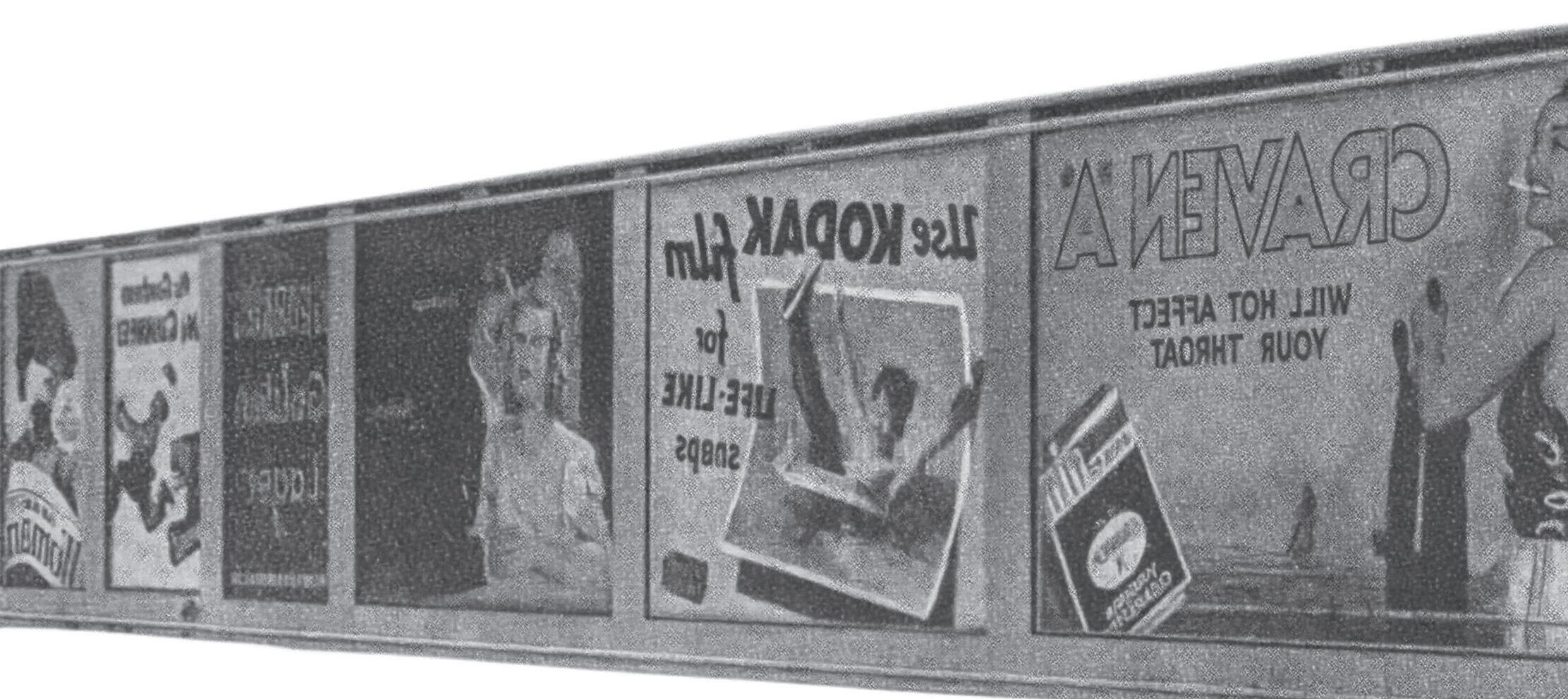
Advertising has infiltrated every corner of modern life. A scroll on Instagram, a trip to the cinema, a visit to the hospital. There’s no means of escaping it, and there hasn’t been for a long time.
A study conducted at the University of Nebraska found that we consciously recognise 100 advertisements a day, even if we’re bombarded with many more. Yet it wasn’t always this way; there was once a time when you could step outside into a world unpolluted by these cogs of consumerism.
That’s not to say that advertising is a recent phenomenon. Sellers in ancient times would verbally advertise their wares in markets, with the oldest written advertisement on record originating from Egypt in 3000 BC, courtesy of a merchant trying to locate an escaped enslaved person while simultaneously promoting their weaving shop. Isn’t it lovely to learn that this industry stems from such ethical beginnings?
Newspaper advertisements became a staple of print media in the 1700s. The following centuries saw the propagation of radio and television, with advertising evolving in tandem with these new media. It grew more personalised as companies could now reach people in the comfort of their own homes.
But it was the internet that supercharged modern advertising. The first online banner ad debuted in 1994 for AT&T and went down like a charm, with 44% of users who saw it clicking on it. The payper-click advertising model – where companies pay only when a viewer clicks their ad – was introduced four years later.
Soon in-app advertisements would be introduced, meaning
you could now carry innumerable commercials around in your back pocket. Google would develop Google AdWords, which allowed firms to target consumers based on their search history and browsing preferences.
And so we’ve reached 2026, the year in which the global advertising market is expected to cross the trillion-dollar threshold. It’s an oligopolistic market, dominated by six gargantuan holding companies, like Omnicom and Dentsu, after decades of mergers and takeovers. Nearly every brand on earth interacts with these holding companies in some capacity.
These companies have spent two centuries refining psychological techniques designed to make you purchase things you didn’t know you wanted. They’ve gotten great at it.
Social proof is one such trick. It’s a phenomenon in which people mirror others’ actions to determine their own behaviour. If others are buying a product, then we’re more likely to trust it. This is complemented by the authority principle, which relates to our tendency to comply with experts and those in power. Sensodyne advertisements are a great example of this technique in practice, featuring robed dentists endorsing the products.
Nobel Laureate psychologist Daniel Kahneman found that losses ‘sting’
Max Mcdermott is not clicking that ad
twice as much as gains delight us. Thus, a particularly effective method of enticing customers relates to scarcity and urgency, using ‘buy now or miss out’ messaging to leverage this pain. I see you with all your limited-edition merchandise drops, Ms. Swift.
Not even the colours used in branding and advertising are exempt from trickery, as different hues can shape our mood, attention, and behaviour. Take a second to think about the branding of some of the world’s largest fast-food chains: McDonalds, Burger King, Guzman y Gomez, Subway, KFC. It’s not a coincidence that all of their logos involve yellow and/or red. Red stimulates appetite, while yellow radiates cheer and satisfaction. Both of which help to make fast food a little more palatable.
The grim future of advertising looks like one that relies heavily on artificial intelligence. The technology’s ability to analyse immense, complex data sets will make it much easier for companies to understand, forecast, and manipulate consumer behaviour. They’ll get a better understanding of which combination of advertisement format, timing, and targeting proves most effective in attracting customers.
The use of AI won’t just be limited to analysing consumer data. Language models and image generators will allow advertisers to produce copy and visuals at scale, much faster. This opens up the potential of individualised advertising, in which AI generates unique ads for every customer it targets, meaning no two people see the same ad.
There is one proposed method of advertising that should terrify us all. Space Advertising. Private companies are developing swarms of tiny satellites that can create billboard displays large and bright enough to be seen from Earth.
In 2024, a Russian start-up called Avant Space announced that they had launched the ‘first space media satellite’ into Earth’s orbit, allowing them to mar the night sky with corporate logos and QR codes. Imagine being greeted by the Coca-Cola logo when you look into a telescope instead of the constellations.
The company aims to deploy roughly 200-400 of these satellites into orbit by the end of the decade, which would allow them to beam down advertisements for hours each day. Current space law doesn’t prohibit these displays from drifting over countries that have banned them, so they’ll sure be intrusive. One of Avant Space’s partners, Vlad Sitnikov, said that
“where there is humanity, there will be advertisements.”
Those eight words really summarise my gripes with advertising. Its tentacles have intruded upon every aspect of our culture and matured alongside it. Now humanity and advertising are nearly synonymous. Can we not differentiate ourselves from this intrusive, manipulative industry through regulation or consumer pushback?
The Forest Is a Dog Whistle
If you were around the spaces of political Instagram last year, then you’ve most definitely seen a post, potentially multiple, with backdrops of hypersaturated forests overlaid with esoteric symbols and a nightcore remix of Down Under or another pop song. Most likely, you just scrolled past it and paid it no mind, or you noticed some of the imagery as being dog whistles for the far right. This indifference is intentional; it normalises the content for the average scroller, even though it is one of many arms of messaging used by far-right communities.
These reels and other associated clip formats are generally associated with a specific subsect of the far right: those who indulge in esoteric mythology, namely in spaces centred on Hyperborea or Agartha. For some context, these are mythological locations associated with ancient Greek mythology and movements in esotericism, which are largely relegated to being discussed in a decontextualised manner as some ideal and hidden utopia inside of modern-day farright circles; the origins of a fetishised ‘white’ civilisation. By consuming them, audiences are put down the alt-(or far-) right pipeline, both through direct consumption and through simple algorithmic influence.
The most subdued aspect of these edits is not their musical choices but rather their use of natural imagery. Most people, apolitical or not, enjoy natural views and the preservation of ecosystems. It is not a particularly ‘left’ phenomenon, let alone radical, to be an environmentalist in some sense or another. You can see this expressed moderately through ‘tree-tories’; conservatives who place importance on environmental preservation not out of any interest for the preservation of ecosystems or sustainability of civilisation itself, but rather purely for their own indulgence in nature as something abstract from themselves, as nothing more than a prerequisite for scenic bushwalks. In fact, this sort of fetishisation of nature (‘environmentalism’) has expressed its conservative character historically through the implementation of the National Parks system by Theodore Roosevelt in the USA, which served a dual purpose in:(1) preserving forests to (and not beyond!) this recreational end, and (2) evicting Indigenous
populations from their lands as ‘disruptive agents’ which would disturb park-goers.
This ties back to Gramsci’s concept of cultural hegemony, in which a class society necessarily reproduces its own hierarchies and biases across every facet of its culture, including memes. In practice, what this means is that the use of imagery as propaganda isn’t noticed because it seems harmless at first; everyone enjoys looking at waterfalls and lush forests, so how could it be propaganda? Within the context of bourgeois society, every social movement will inevitably grow from and need to struggle against its own class prejudices. It’s within that frame that environmentalism needs to be considered: does this espousal of environmentalism really address its own position in class society (left-environmentalism), or does it skip and jump around critique and appeal to a lowest common denominator of “common sense” (right-environmentalism)?
Essentially, environmentalist rhetoric and theory can really challenge the entire basis of society; it ineffectually gropes in the dark and often resorts to scapegoating a population. Pushing right-environmentalism to its extreme is where such reels and online subcultures begin to become contextualised, they are a terminally online, but very believed section of fascists; the eco fascists. And it is this appeal to nature and aesthetics that is their Trojan Horse.
Such aestheticist ideology and its pipelines shouldn’t be underestimated; their appeal is substantial to people who don’t consume critically, especially young people. I myself was 15, fetishising an ideal society as being “Mediaeval Europe but with cell towers”, only being achieved through the genocide of countries with high populations. Growing into it is easy; it is purely aesthetic, but growing out of it becomes much more difficult and requires highly patient social circles conducive to critical discussion. In this regard, I was lucky; many others weren’t and still aren’t, and end up becoming emboldened peddlers of fascist rhetoric themselves. There is only joy in looking back and seeing that horrid period of life left behind.
Clara Anwaar touches grass.
The hypersaturated aesthetic captures and engages the viewer, but it shuts down the faculties of criticality and scepticism by overloading the brain. You’ll know what I mean if you watch one of these reels for yourself; the assault of a drone shot of a forest with Better Off Alone x Clarity nightcore blaring, all stamped with a Black Sun, Wolfsangel, and correlation graphs of immigration and crime, finished by “#SaveEvropa” in the description. Every component is transformed into a dog whistle.
A drone shot by itself is not racist, but the specific combination used turns the small set of oh-so-similar nature clips into ones that assert a racist character because of their social association; it is imparted unto it, and the clips themselves become a nucleus for self-proclaimed “noticers” to anchor themselves to. The comments of such reels should highlight this even further; “1488” and “271k” littered around, with the occasional use of slurs like “filthy pajeet” to assert the idea that only the ‘civilised’ (a caricature of Anglowhite) world can really achieve such standards of hygiene and cleanliness to have such wellpreserved forests. If you have the great displeasure of finding one, then I implore you to take a gander. In tandem with the music and the deterioration of attention span entangled with short-form media, the viewer of such media is transformed from a critical viewer into one primed for the implantation of ideas, and no amount of description is as heartbreaking as seeing it for yourself.
Of course, no meme exists independent of reaction; they are, in fact, dependent on them. In accordance with this, as well as the mantra of “reclaiming tools of propaganda” as some Marxist Leninists may describe it, parodies of these reels have been made. These feature the same clips, music, and delivery mode. What differs, crucially (supposedly), is the content itself, being revolutionary agitation propaganda. Is this really correct, though? In the quest for satirisation, replacing a Wolfsangel with a circle of sickles and Agartha with Red Shambhala achieves nothing
more than effectively redwashing nationalism. It is primarily communities of “anti-revisionist” (or even, the more overt “anti-woke” crowd of Larouchites) Marxist-Leninists that consume this current of counterpropaganda. It is not effective in qualitatively challenging the values and narratives of the far-right; rather, it only coats them with Leninist aesthetics and, therein, dispensing itself to NazBol sympathies. “271k” gets transformed into “Stalin’s big spoon” to joke about and discredit any real issues of Soviet economic practice in reaction to real issues being disingenuously co-opted by, for example, Ukrainian nationalists and their audiences. In short, the reaction to the far right using this meme format to spread its doctrine only reaffirms the underlying power structures and thought processes, just under a rebranding within certain subsections of Marxist-Leninist communities.
As such, the format of such reels cannot be used as a tool for countering far-right propaganda. Rather, the medium of desensitising audio-visual components packaged into a reel, which overloads viewers, is conducive to reductive, uncritical consumption. Immediate individual action exists only in avoiding such media. The far right will always capture more and more concepts and aesthetics to use as conduits for its dissemination, and the simple substitution of certain aesthetics for another only reaffirms and reproduces the far right and its tendencies within spaces that try to combat it. At a really effective level, on a mass scale, public education and awareness need to be elevated about how everyday objects and activities are weaponised for propaganda, and critical consumption needs to supplant mindless consumption. These two are not mutually exclusive but are symbiotic and must be pursued simultaneously. But so long as the basis for fascist propaganda exists, hegemony and class society as a whole, there will always be a section of gullible followers, and such rhetoric will only reproduce itself, at best, delayed.
“The
biting wind of change”: Forgotten Newspaper’s Clarion Call
to see what crap they had been used to getting in the major newspapers. Anyway, the journalists won, they went back to work, and The Clarion was no more.”
management’s perspective on the ongoing strike. Realising the need to get the journalist’s side of the story heard, The Clarion was born.
Content Warning: This article mentions domestic violence and Indigenous deaths in custody.
As I sat in the sweltering heat of the Honi Soit O-Week stand earlier this semester, an older man approached me. He stood somewhat stoically, behind a pack of eager first years who had, despite the heat, been asking questions about writing for Honi for quite some time.
He eventually introduced himself as Bruce Paterson, and asked if I had heard of an old newspaper called The Clarion . When I said I hadn’t, he told me that The Clarion had started in 1980 by striking Australian journalists, and that he had three copies he wanted to give to Honi as he was downsizing. Having piqued my interest, I gave him the address of the Honi office and pretty much forgot about it after that.
That is, until late March when ABC staffers went on strike over pay conditions, casualisation, and worker replacement by artificial intelligence and I was reminded of my conversation with old Bruce. After some correspondence with other Honi editors and SRC staff, I discovered that Bruce had indeed mailed three copies of The Clarion , which had sat in the corner of our office for some months, untouched. They came with a note attached from Bruce which provided some brief background information on the paper.
“There has never been a paper anywhere, before or since, like it. It had every top journalist in Australia writing for it, without restriction. It really shows what a newspaper could be. And once the public caught on about it, it quickly began to seriously compete with the other side, even with no distribution network other than street sellers,” the note read.
“I think the bosses realised that the journalists were succeeding at getting their side across and the public was starting
The VDT Strike
In mid-May 1980, the Australian Journalists Association (AJA) called a strike and approximately 2,200 journalists around Australia walked out of work in the first-ever national newspaper strike. The strike was called following the sacking of 29 sub-editors for refusing to use newly implemented
An article in the June 1980 edition of the Australasian Spartacist , the newspaper of the Trotskyist Spartacist League of Australia and New Zealand, called The Clarion “an enormous success in all states.”
“The journalists’ example in producing a regular strike newspaper to counter the pressure of the capitalist
video display terminals (VDTs) under union orders. It resulted in the suspension of the publication of two major daily newspapers: The Australian and the Australian Financial Review ( AFR ).
Approximately three years prior, the AJA had made a claim to the Arbitration Commission requesting a $50 dollar weekly payment to any journalist required to operate VDTs.
On the 12th of May 1980, the Arbitration Commission offered them a measly $5 weekly payment. The AJA responded by banning the use of VDTs for union members. This resulted in the dismissal of 28 sub-editors from Murdoch’s News Ltd, alongside one from Fairfax’s Sydney Morning Herald .
During the strike, many newspapers continued to publish under the supervision of a handful of executives, printing mainly overseas news copy and editorials pushing
media upon so-called “public opinion” should be emulated in all strikes. But The Clarion has been merely a more honest replica of the bourgeois press with a slightly more liberal editorial stance, and very little news on the AJA strike.”
What Happened and What Can We Learn?
The strike ended after five weeks with journalists returning to work by June 12th, and thus The Clarion was no more. The AJA settled on an indexed 6 per cent allowance for all journalists who had used or would use VDTs in production, only a slight improvement from the initial $5 award. This award gave just $6 to the lowest-paid “cadets”, and up to $24.90 only for the highest “A” grade. The settlement also included an extra three days of annual leave and all dismissed journalists were reinstated.
But why, after five weeks of striking and picketing, did
the strike achieve such a poor outcome? On several occasions throughout the 1970s, the Printing and Kindred Industries Union (PKIU) went on strike against Murdoch’s News Ltd and Fairfax. In 1976, PKIU members went on a nine-week strike to protest against the massive job cuts which followed the introduction of VDTs, a central demand of which was the introduction of a 35-hour work week to save jobs threatened by automation. During this strike, AJA members frequently crossed picket lines as Fairfax had promised them proper reimbursement to take over the VDTs at the expense of PKIU members. But, predictably, the bosses double-crossed them, and now they were paying the price. In retaliation, the majority of PKIU members crossed picket lines and continued to work. The fact that most newspapers continued to publish despite the AJA strike significantly dampened the journo’s leverage.
As the Australasian Spartacist stated “the ‘tradition’ of mutual back-stabbing between the PKIU and the AJA [was] the bosses’ trump card”.
“The AJA is now learning the hard way that scabbing doesn’t pay. The main danger to their strike is that the printers will keep crossing their picket lines.”
In the first Clarion editorial, published in what seems to be the publication’s final issue, the editors stated that from the AJA strike, journalists are learning “that if they want to get from management a reasonable rate of pay and conditions, they have to be a real union”.
“We must see ourselves in the Australian union structure… One of the problems is that AJA, by not seeing itself as being like other unions in the past, stands a little isolated.”
“There’s a feeling amongst some other unionists, particularly the PKIU, that we’re only a bunch of bloody journos, we haven’t given them a lot of help in the past, and there’s all that garbage written in the papers about trade unions and James Fitzgerald Sice reads the union paper.
strikes. We have to combat that attitude. We’ve got some work to do for the future”.
In an article below the editorial titled “The biting wind of change”, Gavin Sinclair writes about the dire state of Australian industrial relations and the weakening position of unions.
“Readers of this newspaper do not need to be told that industrial relations in Australia are becoming increasingly bitter, chaotic and above all irrational,” writes Sinclair.
“It is not possible for management still to be unaware of the new industrial realities in Australia — that the unemployed are becoming unemployable, that technology is generating unemployability, that many of the young have no desire to work towards a future, that members of a better educated workforce cannot be taken for granted as in the past”.
The Clarion call from 1980 carried a strange innocence. Most of the Clarion ’s writers — elders of Australian journalism — could sense the wave of technological change lapping at their feet.
Reading their cautionary words about the fate of workers and the influence of corporations and criminal organisations on Australian politicians — I can’t help recoiling at their quaint underestimation. Actual journalists have been replaced by PR experts and influencers. Nowadays, your average journalist does the job of a photographer, videographer, printer, and much more. The weight of the tsunami of technological change and the concentration of media ownership, wealth, and influence rests now on fewer and younger shoulders.
The Clarion: “The Journalists’ Weekly”
Across the three editions donated to Honi , there are hundreds of important articles, opinion pieces, reviews, and comics by prominent Australian journalists and authors such as ABC broadcasting veteran Phillip Adams, David Marr, columnist and author of Damned Whores and Gods Police Anne Summers, Pulitzer Prizewinning author Geraldine Brooks, political journalist and commentator Mungo Wentworth MacCallum, and so many more familiar journalistic voices. The following section is just a small sample of works I found to be most relevant or funny. I aim to digitise the three editions over the coming weeks, so keep an eye on the Honi Soit website. I hope you enjoy!
23rd of May Edition
The 23rd of May edition’s cover reads “Smokers and drinkers may pay for national campaign TAX FOR HEALTH”. Beneath this appears a smaller headline, “Hawke’s last ACTU [Australian Council of Trade Unions] hurrah,” followed by a paragraph suggesting that “the timing of Hawke’s retirement gives a clue to the federal election,” which was scheduled for October that year. Hawke subsequently won the seat of Wills, marking his entry into federal politics.
Other notable articles in the edition include a short report on the dire financial state of Australian newspapers by Alan Kohler, an article by Anne Summers on the PM Malcolm Fraser’s birthday, and a scathing assessment of the Arbitration Commission by (then journalist, later turned right-wing mouthpiece) Padraic McGuinness.
An article on page 15 of the 23rd May edition reports on the NSW state government awarding a $2 million contract to start work “in earnest on the controversial Parklea Jail.” The article mentions the arrest of local protestors blocking the site and union bans on the site stalling works on the site. Last year, inmates at Parklea held a peaceful protest over the death of 41-year-old Indigenous
man Wayne Green. According to a Corrective Services NSW report, there were at least three Indigenous deaths in custody at Parklea prison in 2025 alone.
May 30–June 6 Edition
Death threats against Australian Olympic swimmers and an article on the Queen’s (rare) smile populate the front page of this edition. Tom Krause reports on the worsening violence in South African apartheid and Marian Wilkinson reports on then Queensland Premier Joh Bjelke-Petersen’s failed anti-Abortion bill.
In her article “Assault! Crimes that the police ignore” Geraldine Brooks exposes a justice system that treated domestic violence as something less than real crime. She describes victims suffering brutal attacks, with one woman “dragged head-first down the stairs,” left in a “bloody mass of cuts and bruises”, yet “the police did not come; no charges were laid”. Brooks argues that violence within the home was deliberately minimised, noting that assaults were often dismissed as “domestics,” with police preferring mediation over arrest and effectively denying victims protection. Her reporting reveals how institutional attitudes reinforced the idea that abuse between partners was a private matter, even when it met the threshold of serious criminal violence.
Recent data released by the Australian Bureau of Statistics shows an 8 per cent rise in family and domestic violence (FDV) offences, with the 2024–25 financial year recording 7,103 more offences than the previous year. The total number of FDV offences for 2024–25 was 97,800, the highest offender rate since national FDV data was first published in 2019–2020. While the laws and protections surrounding domestic violence in Australia have changed since the article’s publication in 1980, the issue has only worsened.
June 6–13 Edition
The front page of The Clarion ’s final edition reads “CASINOS BACK IN BUSINESS”. “Illegal casinos and SP bookies are opening their doors again after the sudden easing of police pressure,” the article points to a sharp shift, following the transfer of anti-gambling officer Superintendent Merv Beck, described as an “implacable opponent of illegal gambling.” Illegal gambling venues once shut down in Kings Cross, Rozelle, and Darlinghurst
by “Beck’s Raiders” were said to be “flourishing” again, raising suspicions among observers that officials were once again turning a blind-eye. It would be 12 years before the state government would introduce the Casino Control Act, legalising casinos in NSW.
Australia today records the highest gambling losses per capita in the world, with Australians losing roughly $31.5 billion annually. The landscape has of course significantly changed from seedy Kings Cross casinos to online gambling, with 36 per cent of Australia’s online gambling activity occurring through unregulated offshore operators, with losses reaching $3.9 billion a year.
In “Soup will warm the picket line”, Jan Oldman and Peter Hellier offer useful advice for eating on the cheap on the picket line. “Tighten the belt, stock the larder, check the pantry and batten the hatches for the siege,” write Oldham and Hellier.
“It really is worth trekking to the vegetable markets too. At my local markets carrots were a steak at only 25 cents a kilogram,” those were the days.
“Soup, beautiful soup, for those on the picket line not only does it put warmth into those chilled limbs and frozen toes, but it fills the gap so that less of more pricey nosh is needed.”
Of the many hints they offer, the most useful and applicable ones are: buy a pressure cooker, eat vegetables in season, catch your own fish, and use old veggie peels for stock.
If The Clarion was a “replica of the bourgeois press with a slightly more liberal editorial stance”, the editors of the Australasian Spartacist would surely be outraged at the state of media and political discourse in Australia today. There is no doubt that some form of regular, physical, and editorially independent Australian news organisation is needed now more than ever. We must heed the lessons that the rise and fall of The Clarion demands of us. If they had more of a developed class consciousness and understood the importance of workingclass unity, perhaps The Clarion would not have gone under so quickly.
Keep an eye on our Instagram @ honi_soit to see when the three issues that Honi received of The Clarion are digitised.
Into the Honi archives
Have you ever wondered where Honi goes once it has left those little stands peppered about the campus? Perhaps into the trashcans, or left in neglect in some dingy corner of the SRC to be wilted by the vicissitudes of time?
Fear not, reader, for Honi is preserved in a few different ways. First, a paper will go into the stack of past papers that the editors, yours truly, keep in the Honi team’s Langford Office. Another few papers are saved, and are made into leather bound copies of each edition that year, which are to be given to the editors at the conclusion of their term, with one of these leather bound editions saved for the collection of the SRC’s Publications Managers, Amanda and Mickie.
But what if one wishes to see the first Honi edition in the flesh?? Well, if you wish to partake on this journey, you must trawl through the special collections of Fisher library to find it.
Luckily, we, the editors, got the chance to have a look at the first edition when Rare Books and Special Collections kindly offered us a tour, complete with a turn on the Library’s own printing press.
Beneath the library, 300,000 more books of strange and varied provenance, age and topic lie in quiet semi-darkness, waiting to be plucked off their shelves by some intrepid academic. These are Fisher’s Libraries prized possessions, too important to be left to the grotty and oiled appendages of the average student. Within the collection are fragments of Shakespeare Folios, illustrated Qurans, medieval manuscripts, and University publications, like the former Hermes and the extant Honi Soit.
We were guided on our tour by librarian Anne Goodfellow, who led us first through a stack containing copies of bound higher thesis’. Goodfellow explained that prior to 2013, Fisher library used to take a bound copy of every student’s doctoral thesis and keep it in storage. Students would retain a copy of it themselves. The University ceased the process in part due to storage issues, Goodfellow told us that the most requested thesis from this collection was Dr. J.J.C. Bradfield’s, the chief overseer of the construction of the Sydney Harbour Bridge’s thesis on infrastructure and the mechanical operation on the bridge.
First Honi Edition
At last, the promised time came, and Goodfellow allowed us a peek at the first edition of Honi Soit.
Honi Soit has had, putting it mildly, an iconoclastic tradition, and it was extraordinary to see the inaugural edition,
printed in defense of criticism of the student community’s activity during a graduation festival.
From the paper’s beginning –
“We are
iconoclasts.
We do not believe – O Heresy! –that the under-graduate is the most important member of the community.”
– it is clear that this history has been part of Honi since its founding.
Goodfellow also discussed the fragility of Honi throughout the years. Older editions are extremely brittle due to the paper they were printed on, and they are almost orange in their hue. Parts of the paper are flaking off, and parts of the ink have been rubbed off too.
We weren’t allowed to touch the actual paper due to risks of us damaging it. Nevertheless, just seeing such a fragile piece of history was a wonderful sensation.
Goodfellow also showed old copies of other University publications, including Hermes, edited once by the Australian poet James McAuley, and Arna, which once published Samuel Beckett. These publications have seen their metempsychosis today through renaming, to the University of Sydney Union (USU) Student awards and Avenue respectively.
For editors, often bookish people, the best comparison that can be made to being led through special collections is that of a kid in a candy store. Many times we passed a book in the archives and an editor “oooohed” and “aaahed” at it, and then Goodfellow would pull it off the shelves for us to have a look. It’s hard to explain the sheer amount of incredible and historic books that they have in the collections, and also famous authors, and academic personal libraries that they store there. I will name some of the interesting ones, and discuss them in brief here.
Birds of Australia by John Gould, illustrated by Elizabeth Gould
The library has a first edition of Birds of Australia by John Gould, a seminal work in the study of Australian birds. Gould and his wife, Elizabeth, traveled Australia for two years, compiling extensive observations on Australian birds.
The illustrations, most of them by Elizabeth, are beautiful and intricate, and the pages of the book are extremely well preserved, largely due to the fact that it
Sebastien Tuzilovic peruses past Honi editions.
was printed on cotton paper. The book itself is monumental, in a folio format.
After closing the book, Goodfellow forlornly remarked that the University did not own a copy of Birds of America by John James Audubon, the model for Gould’s book. In 2018, a first edition of Audubon’s masterpiece sold for over $10 USD. The Gould sells for just under $1 million AUD.
Cold Storage
We were whisked away from these collections into a much icier room, where Goodfellow explained that the library kept items that required a temperature control.
Amongst these collections were the libraries and books of a number of Australian poets, including Henry Lawson and Christopher Brennan. Brennan was actually a lecturer at USyd, one cloaked in a substantial amount of infamy, rumoured to turn up inebriated to his lectures, with a life soaked in scandal.
Another highlight was a copy of the Malleus Maleficarum from the 1600s, and a set of Faulkner first editions.
Graham’s books
With a sparkle in her eye, Goodfellow also showed an enormous collection that contained sci-fi books and comics, donated to the University by a man named Graham. She told Honi that Graham was a collector of large amounts of early and golden age sci-fi novels, and that he had an interest in early comics.
The collection included a first edition of Spider-man, and rare copies of many of the greats of Sci-fi, like the “big three”, Isaac Asimov, Robert A. Heinlein and Arthur C. Clark.
The Printing Press
Before the whole tour finished up, we had a go at the printing press, named the “Piscator Press”, piscator meaning “angler” or “fisher” in latin, a clever reference to the library’s own name.
Goodfellow explained the processes of printing, and the tedious nature of printing as a job in the years when print media was physically created through picking characters out of boxes, setting those characters in a vice, running ink over them and then pressing them into the surface of paper.
The day was a delight for the editors who attended, and a great insight into Special Collections, the old days of Honi Soit, and the old processes of printing.
If you’re interested, you can request to view books yourself from Special Collections, and we encourage you to check out their digitalised collection online.
Honi in Conversation with Antoun Issa
Antoun Issa is a LebaneseAustralian journalist and co-founder of Deepcut News. In 2024, Issa resigned from his job at The Guardian due to objections over their coverage of the genocide in Gaza. His debut novel, coming out later this month on the 28th of April, follows his mother’s true experiences of the Lebanese Civil War in 1974.
Honi was lucky enough to receive an early edition of the novel. Written both beautifully and heartbreakingly, Rebirth reveals the real and ugly truths of a story often neglected. As Issa writes in the prologue, “History is rarely told from the perspective of the poor, from those crushed by abuses of power. This book is not a journalistic endeavour, but a human one – to revisit the Lebanese Civil War through the eyes of its victims.” And revisit he does. Issa takes the reader through a very real story of love, loss, and hope.
MB: What was it like for you to start working on this new form? Because, of course, you’re not a new writer, but this is your first published novel. Have you dabbled in novel writing before?
AI: No, this is my first time, but I always had a desire to do it. You know, when you write journalism, it’s almost like writing a prescription. It’s very dry, it’s very structured. There’s a real kind of rigid writing approach to journalism that you’re kind of stuck within those bounds. But at The Guardian , actually, I was pushing more and more, and I was allowed to kind of experiment a bit more with feature writing, which I started to enjoy. I got out of the news cycle for a bit, went somewhere and just did a story on something, so it was kind of building towards that.
Antoun Issa sat down with Honi to discuss Rebirth.
Madison Burland: How are you feeling about the release of the book?
Antoun Issa: It’s kind of surreal. I received the box last week with the first printed copies, and when you work with a book that’s kind of been on the screen for like, several years, and all of a sudden it’s real. I haven’t even opened it. I was just like, yeah, ok, I got the book. I don’t know, it kind of made my stomach turn a bit because it’s finally real.
MB: That would feel crazy. How long have you been working on the novel?
AI: Well, I interviewed mum in the late 2010s, or 2018, if I can remember. That’s just been a gradual conversation since then. I started putting words on paper in 2020, and around 2023, I started writing.
MB: Oh, wow.
AI: In 2024, I took some book leave, and I kind of finished the first manuscript. After that, it’s just been iterations of edits.
moving from a form like news writing, mainly, it’s very like a, b equals c. While novel writing is definitely more creative.
AI: Thank you.
MB: So the book is based on your mother’s life, and you mentioned that you interviewed her in the 2010s for this novel, what did that kind of look like? What was the process there?
AI: Well, I’ve always wanted to come back to my own family story. I go into this in the prologue, it’s like this whole full circle moment where you’re born and raised in this kind of family that’s displaced and migrated to another side of the world, and you’re connected to this other side of the world, but you don’t really know much. But you know, through the stories of your parents and your grandparents and everyone around you, and there’s obviously internalised trauma. You’re not really aware of it at a young age. It’s just normal because you grew up knowing what you know.
I was living in the US at the time, and I had come back for my annual trip back home during the holidays, and I just made a conscious effort with mom. I knew my grandfather had passed by being killed. I knew that from a young age. I didn’t know about her love story, and she kind of revealed that to me, and I’m like, what!
I don’t reveal the spoilers because you’ll get to the end and see it’s a whole story, but she just told me more details, and I was like, I have to do something about this. This is such an insane story. So I consciously said, like, let’s sit down for a few days, and let’s just talk her through. And we sat on the veranda of my Melbourne home. It was very traumatic, and my mum had to relive all the specific details of what she went through.
Even recently, when I had to do edits, I had to go back and kind of stretch out a few more of the details. It was excruciating for her to revisit.
I also just love language, and I didn’t want to write this as a journalistic endeavour either. I didn’t want to do a journalism project, and write a book about history, and make it very academic and very dry. I wanted to use the beauty of language to kind of recreate the scenes vividly, and also have readers connect to it in a visceral way, where they can almost place themselves in the story. Which you can’t really do when you write dry political history. Dry political history is kind of just like: Timeline. This happened, then this happened, and this is what happened. I didn’t want to do that format, so I really enjoyed it. I love language. I love being able to play with language.
I love the use of analogies and metaphors, and again, kind of diving into language in a way that leaves people feeling like they’ve connected to the story, not just read something to gain information, if that makes sense.
MB: Yeah, it definitely does. I think you did a great job in achieving that, from what I’ve seen from the pages, which, although not finalised, there’s a lot of really beautiful prose in there. So congratulations, that kind of a hard thing to do, I think, especially when you’re
But then, kind of pursuing my career that I pursued, you know, going to the Middle East, working as a journalist, living in Lebanon, and being a journalist, going to the US, being in the foreign policy space for several years, and then finally, just kind of like coming back full circle, to kind of to place my own story within everything that I was kind of like researching and engaged with. I think it was just like a natural path that kind of led me there.
I don’t think I could have written this book, for example, at the beginning of my career. I definitely had to go and engage with the region firsthand at policy level, at media level, at political level, and at a humanitarian level, to understand what exactly what the context was that I was dealing with, and then kind of like having that “Ah” moment of, well, now this all starts to make sense.
This is also kind of my story; my story fits in here somewhere. That kind of like personal inquiry, led me down the path of being like, Hey Mum, and that’s what happened.
MB: Yeah, definitely.
AI: Then, when I was writing that book — my god. When I was putting it all together, of course, I’m a diva, so I was putting it together in the French Pyrenees.
MB: Naturally!
AI: I did it a month there, and I did a month in Umbria, in Italy. I think it was in Umbria where I just wrote the most powerful parts of the book, and I was crying every day. So I’d call mum, and she’d be like Can you get over it? Stop being depressed, and I’d be like but your story is depressing!
It took a lot out of me to write this. Even recently, I was at the Manly Writers Festival, and I had to read out a passage for the
President Grace Street (Grassroots)
By the time you’re reading this I will have just appeared in NSW Parliament to give evidence to the Standing Committee on Social Issues for their inquiry into the university sector. Despite the previous president not making a submission to the inquiry, the SRC is fortunate to have been invited to speak to the issues that plague our university system and harm students’ wellbeing and studies.
In other news, our vaccination scheme has seen 5/6 sessions complete and very successful! There is a news article covering it in last week’s edition of Honi and we plan to make a full recap soon to show all the amazing outcomes of the program. I also went onto FBi Backchat to speak on the continued issue of anti-abortion fanatics coming onto campus to harass students. I was grateful for it to be treated as the news item and current problem it is – I have also tried to open a conversation with the University Executive, Senate, Student Life, Safer Communities, Protective Services and more so that at the
General Secretary
Heyyyy slayers!
We hope your exams and assignments went well and that you are all taking time to rejuvenate and de-stress in preparation for the rest of the semester. It was great seeing many of you on eastern avenue taking a free sausage sizzle and tote bag as is your right. Also, the free SRC flu vaccinations have been a great success. Someone asked us if it’s the student representatives who give you the jabs. No Mehnaaz, we do not; we get professionals for that! Though that would be pretty funny…
In other news, the USU Elections are coming up. The USU is the other student elected organisation on campus that takes care of the fun/ party/society side of university life. Vince has been going to the past couple USU board meetings to push for BDS, and it’s becoming clear that a shakeup is needed.
very least the University is proactively helping students steer clear of these people and out of harm’s way with proactive
communications and support on-site. We also did our first BBQ of the semester, which was a great way to reach out to new students about the SRC and hand out more of our awesome 2026 tote bags.
This week, make sure to take part in the Students for Palestine Nationwide Solidarity Week. We have a University of Sydney student on the Global Sumud Flotilla sailing to Gaza and our own battles to fight back home with a University riddled with ties to weapons and war. Find out more on our Instagram @src_ usyd.
Disabilities and Carer’s Officers
Kayla
You might have heard about the free flu vax program currently on offer for undergrads — that’s thanks to us! We’ve helped to get over 1000 students vaxxed FOR FREE. The University provides free flu shots for staff, but not students! That’s why the SRC is running this program for the second year in a row. There are limited spots left so sign up to join the waitlist for our last vaccination day on Monday 4 May through the SRC’s Instagram bio @src_usyd.
We’ve also been distributing resources for the sick season, including over 100 masks and 50 Rapid Antigen Tests in the past month. We’re currently working to get an air purifier installed in the Disabilities Space too!
Meanwhile, the Albanese government has announced it will be “overhauling” the NDIS, by which they mean substantially cutting its budget at the expense of disabled people’s lives. In the next five years,
160,000 people will be kicked off the scheme. This is characteristically just as Labor announced a $53 billion boost to military spending over the next decade and continues fossil fuel subsidies to the tune of $63 billion in forward estimates. The Labor Party wants to put a price on human wellbeing. Where the NDIS should principally be available to provide support to those in need, these ghouls ask how many lives they need to ruin to stay below 5% growth. The both of us are organising a national day of action against these cuts in early May with other disability activists around the country. Stay tuned via @usyddisabilities on Instagram.
To get involved in these projects, come along to our next meeting at 1pm on Thursday 30th April in the Disabilities Space, Manning House and online.
Your sick comrades, Kayla and Remy.
Ava Cavalerie (NLS)
Vince Tafea (Grassroots)
The SRC became an Apartheid Free Zone in 2023, and the National Union of Students in 2025. Let’s push for USU candidates to pledge to make the USU one in 2026.
If you’re wondering who to vote for, look out for the upcoming Honi Soit coverage and make your own mind up! One extremely good rule of thumb is that any candidate that inconspicuously misses the Honi Soit interview/quiz is almost always a Liberal or One Nation devotee.
Also don’t be fooled. Long time Young Liberal and VP of Conservative Club Anton Isaak will likely say he is ‘Independent.’ Kevin Hua is a college diehard; so probably don’t vote for him either. Spread the word to keep these right wing cookers out.
In Solidarity, Ava & Vince.
Vice President Bohao Zhang (PENTA)
Shovan Bhattarai (SAlt)
Hi all!
Hope everyone has done well in their mid-semester exams or assignments!
Together with the international students collective, I have been pushing for greater awareness over the doubling in cost over the 485 Temporary Graduate Visa on platforms such as Instagram and REDNote.
Earlier this year, the ABC published a story addressing a lack of interest in Australian Universities by international students in large. Despite the surprise reflected by University management, this should have been expected. University services have been increasingly declining, including the quality of education. Student communities are cared for less and less, with international students, who have
less pre-existent communities or friend groups when arriving in Australia, suffering the brunt of the consequence. The doubling in cost of the 485 will no doubt further dampen the local outlook for Australian Universities, creating a less diverse atmosphere across the board. Raising awareness and ensuring this policy change becomes an issue that both domestic and international students are aware of is the first step to changing it.
In other work, thank you to all the students who attended the trivia night event! The international student collective will be further working on it a panel event - please keep an eye out on our socials both on Instagram and REDNote.
In solidarity, Bohao Zhang.
Ethnocultural Officers
Pimala Leo (Grassroots) Imane Lattab (Grassroots)
We are excited to bring you some important updates on the Boycott, Divestment, and Sanctions (BDS) campaign to demand that the University of Sydney Union (USU) become an Apartheid-Free Zone! ACAR has officially released an open letter reiterating our demands and condemning their refusal to cut ties with companies complicit in the illegal occupation of Palestine.
Following the last two USU board meetings attended by ACAR representatives, the USU has stated that they don’t believe students care about consuming products linked to apartheid and genocide. We believe that this is an absurd mischaracterisation of USyd students. Not only has our Students’ Representative Council and National Union of Students both already become ApartheidFree Zones, but USyd students have been demanding an end to our university’s ties to genocide and apartheid for years now. Support for the BDS movement has never been more obvious.
That is why we are urging students, staff, organising groups, and USU clubs/societies to sign the petition and support the open letter. Join us
as we hold the USU accountable to their own policies.
Here are some upcoming events you should attend:
Protest against Sydney weapons companies; April 29 at 2pm, ‘sydney’ Town Hall.
Student Contingent for International Workers’ Day March; May 5 at 11pm, Belmore Park.
Nationwide Student Assembly; May 1 at 6pm, UTS.
Film screening of “Pig Feast — Colonialism in Our Time”; May 8 at 3pm, Social Sciences Building (A02) Lecture Theatre 200.
For more updates, follow @ usydacar on Instagram!
Scan to sign the open letter!
Mature Age Officers
This position is currently vacant.
Remy Lebreton (Grassroots)
Hill (Grassroots)
Taking Care of Student Carers
Unpaid caring duties can be incredibly rewarding, however without the right level of support, can have a negative impact on various aspects of your life, including your studies.
You may be an unpaid carer if you spend time regularly providing a level of practical or emotional support to a family member or friend who has a disability, a medical condition, mental illness, or someone who is fail due to age. This could look like many things, such as, undertaking chores for family members who cannot do them themselves, looking after your siblings because your parents are at medical appointments, or helping provide personal care to a loved one with a disability.
Caring duties are unique and varied. Each carer will have a different relationship to the person they care for, and their identity as a carer. Even if you find your caring role rewarding, it can still take a toll on you, and may impact the time you have available to work or engage in your studies. It may even sometimes be difficult to manage emotionally.
For many unpaid carers the tasks they undertake as part of their caring role are not seen as something out of the ordinary, as they are used to the responsibility. Many carers may have grown up with the responsibility of undertaking caring duties. Caring for family is often a cultural responsibility, and therefore it is difficult to see as something that would negatively impact your life.
No matter the level of care you provide, or your relationship to the person you care for, if you identify as a carer and find that you could use some extra
support, you are able to access it.
The Carer Gateway is a national government funded service that supports unpaid carers.
They define their eligibility as, “You may be an unpaid carer if you are providing care and support to a family member or friend with disability, a medical condition, mental illness, or someone who is frail due to age.”
Carer Gateway provides services such as in person and phone counselling, financial support for young carers engaging in study, access to emergency respite, and individual coaching support. You can find a full list of available services on the Carer Gateway website.
You don’t need a Medicare card to access Carer Gateway, so student visa holders are able to access their services.
Carer Gateway can be contacted via their website; carergateway.gov.au or can be called on: 1800 422 737.
If you need assistance applying for special considerations or other arrangements due to the impact of caring duties on your studies, you can contact the SRC Caseworkers via our contact form: bit.ly/contact-a-caseworker
Ask Abe
SRC Caseworker Help Q&A
Dear Abe,
I am embarrassed to say that I am still a virgin, and I don’t know much about sex or sexual health.
My boyfriend has been very patient, but I think I will need to have sex with him soon or he will leave me. I feel scared and I don’t know what to do.
Please help me. Embarrassed
Dear Embarrassed, I am sorry to hear that you feel embarrassed about being a virgin. Media and friends can put ridiculous pressure on us to conform to standards we don’t all subscribe to. You should have as much consensual, safe, and fun
sex as you like. If that means none, then that is what you should do. If your boyfriend does not like that, you do not have to be in a relationship with him. Also consider that not all relationships have to be monogamous, and this might be something you could discuss with him.
The Health Direct website (healthdirect.gov. au/safesex) has information on sexual health and safe sex, and there is specific information for international students through the NSW Health website (internationalstudents.health. nsw.gov.au).
You can also get free telephone advice on 1800 451 624.
Abe
For more information about sexual health and safe sex, head to: healthdirect.gov.au/safesex
IF YOU HAVE TWO EXAMS SCHEDULED AT THE SAME TIME, THE EXAMS OFFICE WILL CONTACT YOU WITH ALTERNATIVE ARRANGEMENTS. IF YOU NEED A
Sexual Health
Dusting Off the CObwebs
1. Jabber (3)
3. High city in Athens (9)
9. War in Germany (5)
11. Fit for a king (5)
13. Workout site (3)
14. Portia’s maid in Shakespeare (7)
15. Stallone tough guy (5)
16. Artist’s stand (5)
18. US State, setting of many westerns (7)
20. Yang’s counterpart (3)
21. Rice used in risotto (7)
22. Navel type (5)
24. “The Destroyer,” in Hinduism (5)
26. Pungent cleanser (7)
28. Lois, to Meg, Chris and Stewie (3)
29 Dwarven representative in the Fellowship of the Ring (5)
30. French kind of boredom (5)
31. Hunchback’s home (5,4)
32 Family guy (3)
ACROSS:
8.
10. Court, 11.
59.
12.
2. Rod to stoke a fireplace; can be gambled on (5)
4. Jamaican music genre (6)
5. Pasta topper cheese (8)
6. Beer brewed at low temperature (5)
7. “Black Forest” dessert (9,4)
8. Mostly incomprehensible Joyce tome (9,4)
10. Isolated (7)
12. To skewer, or joke about (7)
17. In-family rival (7)
19. Ugandan despot (3,4)
20. National park in California (8)
23. Shot taker (6)
25. Let in (5)
27. Water nymph (5)
Quiz
1. What is the name of the tech CEO whose house recently had a Molotov cocktail thrown at it?
2. Which company owns the ‘AI assistant’ Claude?
3. What is the largest Israeli weapons company?
4. Who wrote “The Gulf War Did Not Take Place”?
5. Which Australian Army veteran lost a 2023 defamation case attempting to claim he did not commit war crimes in Afghanistan?
6. Who was the former Premier of Queensland who ran it as a corrupt authoritarian state from 1968 to 1987?
7. What does GPT stand for in ‘ChatGPT’?
Last week’s crossword answers
60.
Answers: 1. Sam Altman, 2. Anthropic, 3. Elbit Systems, 4. Jean Baudrillard,
By Bruce Petty for the May 28, 1980 edition of The Clarion. See James’ story on The Clarion on pages 16-17.
From the first edition of Honi Soit, May 3rd, 1929. See Sebastien’s story on page 18.
VALE “MY MUSCLE CHEF $5 MEALS”, WE HARDLY KNEW YOU
Well, what the fuck.
Yesterday I lived in a world where a good, honest, protein-loving student could sidle up to a vending machine with built-in microwaves and purchase a plastic-wrapped meal for $5. Was it fine dining? No. Did my SSAF fees pay for it whether I ate it or not? Yes. So I got my money’s worth. Is that a crime?
Today I woke up in Hell. Apparently, we do not deserve the My Muscle Chef $5 meals. Apparently, we do not deserve a fucking thing. My lecturer uses AI, I’m chopped, my degree is useless, I’ll never pay back my HECS or buy a house, and now I can’t even heat up watery 45g protein penne pasta.
You may laugh. You may point and jeer at me as I aimlessly meander the halls, armed with a wooden fork, jabbing it into anything that vaguely resembles protein. But this is the state of our university. This goes right to the top. They get us hooked on affordable gains-promoting meals, then they snatch it away with nary a warning or even a fucking apology.
Empty shelves tell me it will be a hungry winter. The billboard mocks my crumpled, dejected form. “SOLD OUT”. “GONE IN NO TIME!” “BACK AGAIN IN SEM 2, STAY READY”. First off, I was born ready you piece of shit. Second, I’m not even going to live long enough to see Sem 2.
My main food source has been cut off. They have turned me into an endangered species. I am a fucking black rhino. I am a fucking Yangtze finless porpoise because of them.
Don’t let me die in vain.
OFFICIAL - CLASSIFIED
Honi is closely monitoring the situation between GenSec and DJ Vince Tafea and former USU Pty. Ltd. Inc. President Ben Hines. The geopolitical impacts of this public feud are yet to be determined. The world is bracing itself.
QUEENSLAND VETERANS’ ASSOCIATION HOSTS ITS FAVOURITE “HEROES” AT DAWN SERVICE
The Queensland Veterans’ Association made national headlines for hosting alleged war criminal Ben Roberts-Smith, who was fresh off an arrest for killing multiple innocent people in Afghanistan. Also in attendance were notable historical figures Genghis Khan, Caligula, and Ivan the Terrible.
The Association told Honi: “We were absolutely chuffed to host our favourite heroes at our event honouring their service. What everyone says about them is a load of bosh, pardon my French. Testimonials and allegations be damned: I’ve never seen one of these men behave anything but dishonourably. And if I didn’t see it, it didn’t happen. And if anyone saw anything, no they didn’t. That’s the motto of the Australian Army.”
Ivan the Terrible was overheard expressing discomfort at Roberts-Smith’s presence, stating: “Look, I know my name is literally ‘the Terrible’, but this guy is really giving me the creeps. He looks like Frankenstein’s monster.”
Caligula stated: “This dude has definitely murdered people. You can see it in the forehead wrinkles. I should know.”
Genghis Khan declined to comment.
PATEL AND HEGSETH RUSH INTO CORRESPONDENTS’ DINNER AFTER HEARING REPORTS OF “SHOTS”
FBI Director Kash Patel and Secretary of War Pete Hegseth, a duo colloquially known as “Don’t Ask Don’t Patel”, staggered into the White House Correspondents’ Dinner six hours after hearing reports of “shots” at the venue.
Both men were slurring, in the drunken and bigoted senses of the word, and became irate when no alcohol was provided at the active crime scene. Patel was then heard loudly sobbing and yelling into his phone which appeared to be turned off.
In comments to the press today, Hegseth stated: “I have never even heard of... what did you call it? Alco-hol? Nope. Never heard of that.” The Secretary then paused to vomit into a red, white and blue bucket labeled “Daddy’s Hangover Pail”.
Patel could not be awakened from his slumber for comment.