Week 3, Semester 2, 2026
Your Weekly Student Newspaper
First Printed 1929
5: NEWS
8–9: FEATURE
14–15: ANALYSIS
UNION TO STRIKE ON 2ND OF SEPTEMBER
‘Which Side Are You On?’: How You Can Help Striking Staff
How Labor Betrayed Labour
University of Sydney (USyd) staff are set to strike for 24 hours on Wednesday 2nd September. This protected industrial action received overwhelming support from members of the USyd branch of the National Tertiary Education Union (NTEU). What does this mean for students?
Trade union density in Australia sits at an abysmal 13.1 per cent as of 2024, cascading from 51 per cent in 1976. Strikes, once a major feature of Australian society which crippled the engines of capital, are now infrequent and peripheral. How did the trade union movement practically collapse into the hollowed-out institution it is today?
Alastair Panzarino and Sebastien Tuzilovic The USyd branch of the National Tertiary Education Union (NTEU) has called a 24 hour strike for Wednesday 2nd September.
Alastair Panzarino and Victor Zhang
Acknowledgment of Country EDITOR-IN-CHIEF Sebastien Tuzilovic EDITORS Madison Burland Anastasia Dale James Fitzgerald Sice Kuyili Karthik
Honi Soit publishes on stolen Gadigal land. Sovereignty was never ceded. The University of Sydney is a colonial institution that upholds Western knowledge as superior to First Nations knowledge systems. We reject this hierarchy. As student journalists, we recognise that mainstream media has been complicit in silencing and misrepresenting
Indigenous voices since invasion. We commit to centring First Nations perspectives in our reporting, to challenging the colonial structures embedded in journalism, and to amplifying the voices of those resisting ongoing dispossession. We pay our respects to Elders past and present, and to all First Nations students and contributors. Always was, and always will be Aboriginal land.
Alastair Panzarino Firdevs Sinik Sebastien Tuzilovic Sophie Wishart Victor Zhang
WRITERS Feaim Alkozai Kuyili Karthik Anastasia Dale Angus Dermody James Fitzgerald Sice Alastair Panzarino Roman Plumb Timothy Pudun Sebastien Tuzilovic Victor Zhang
ARTISTS Zoe Chung
In This Edition: 4 ‘Pauline Hanson Please Explain’: Students Strike Against Fascism 5 ‘Devastating’ NDIS Overhaul Set to Pass Senate 6–7 ‘Disappointing’: USyd Sexual Misconduct Report Slammed by Staff and Students 8–9 Staff on Strike! 10
Five Years Under the Taliban
11 Surveillance and Stalls: Policing Palestine at USyd 12–13 Cold War Kid: Interview with Rowan Cahill 14–15 How Labor Betrayed Labour
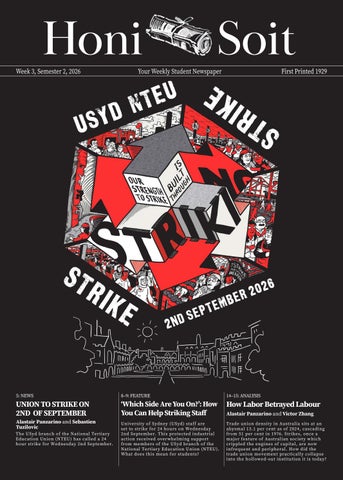
FRONT COVER Sam Wallman
16–17 Shutdowns in Newtown 18 Short-Form Content and its Threat to Discourse 19 Art Under Surveillance 20–23 SRC Reports/Puzzles/Comedy
Contribute
Do you have a deep-rooted longing to be a contributor but have no idea how to get involved? Apply to be a reporter or artist via the link in our Instagram bio: @honi.soit Or if you have a one-off pitch, tip for a story, complaint, letter to the editors, or more, email us at editors@honisoit.com. Scan the QR code if you'd rather send an anonymous tip. Send mail to Honi Soit at PO Box 974 Broadway NSW 2007. ISSN: 2207-5593. This edition was published on Tuesday 18 August 2026. Disclaimer: Honi Soit is published by the Students’ Representative Council, University of Sydney, Level 1 Wentworth Building, City Road, University of Sydney NSW 2006. The SRC’s operation costs, space and administrative support are financed by the University of Sydney. Honi Soit is printed under the auspices of the SRC’s Directors of Student Publications (DSP): Dongchen Yue, Sholto Mirrlees-Black, Lucy Sullivan, Ying Huang, Damien Lee, Hamish Evans. All expressions are published on the basis that they are not to be regarded as the opinions of the SRC unless specifically stated. The Council accepts no responsibility for the accuracy of any of the opinions or information contained within this newspaper, nor does it endorse any of the advertisements and insertions. Please direct all advertising inquiries to publications.manager@src.usyd.edu.au. Email the editors at editors@honisoit.com.
2
Editorial The theme for this edition is “On the Knife’s Edge”. As the political systems of the 20th Century atrophy in the face of a technologically equipped modern monstrosity of Capital metamorphosed into the forms of demagogic politicans and brazenly fascistic technocrats, it seems as if more is at stake. This edition coincides with the announcement of the National Tertiary Education Union (NTEU) USyd branch strikes over their Enterprise Agreement. They will strike on the 2nd September. Once again the university is looking to fuck over the academics and staff who are the greatest part about it. This edition also reflects on past and future radicalism. I interviewed former
Honi director of publications and concientious objector of the Menzies era Rowan Cahill about his memoir Cold War Kid. Some of my co-editors, Alastair, Victor, James and I, Sebastien, have written a helpful feature explaining the strike action which the NTEU have set, describing what you as a student can do to aid the struggle of the strikers. We have a culture section where James and Anastasia discuss the shutdowns of classic music venues and their destruction at the hands of profiteering which seeks endless accumulation rather than any altrustic satisfaction of the human need for entertainment and community. Similar themes are explored
in my article on O3’s takeover of Gould’s book arcade, a former radical Sydney hotspot. Victor and Alastair have a treat of an article examining how Labor fucked organised Labour in the late 1900s. Timothy has a fantastic article looking at the decline of readership and the loss of a coherent literary Canon in the 21st Century. Angus examines the proliferation of surveliance on campus. You’re probably being recorded by a camera as you read this right now. Feaim has a fascinating piece examining Afghani feminism that is well worth a read or three. Enjoy week 3 of Honi Soit Sebastien Tuzilovic
Vox Pops: What are students saying about strike action P. Griffin: It’s alright, pretty good maybe. I don’t know. I’ve stepped away from the turmultuous highs and lows of university striking. I spent some time gazing out at the striking Sydney beaches and the rest is history. What was the question? M. Scott: Strike action is vital to the fight of the Union. Protest, strike, and show solidarity to your comrades whenever you can. Barry B. Benson: I bee-lieve in Strike action. It makes my comrades lives so much bee-tter.
Chuddy Chuckleson: I love having days off class dude! Thats what that is right? The only thing I love more is free beer, do you guys have any Moore Beer? Mark Cyst: It is a vital school of war for the working class. Strikes help all workers get better working conditions. Cent Tris Scabby: Look, I’m sooo for the proletariat getting their stuff. It’s awesome, super cool, you know. I just wish sometimes we wouldn’t have to strike. I wish we could all be friends. Have you heard of Friendpol?
Honiscopes Aries: Swiss army knife. You’re in for a topsy turvy next few months. Luckily you’ll be well equipped for whatever comes your way. Remember not to overextend too much. Taurus: Butter Knife. It’s not all sunshine and rainbows from here on out. Sometimes life is like a big mound of really cold butter straight out of the fridge and what can a mere butter knife do against such density. Gemini: Cleaver. Consider a career as a cheesemonger or a butcher. People don’t really do that any more and it’s a great loss to the world.
Cancer: Blade from Blade. Chill ass dude. Life will work out all sunshine and rainbows for you as long as you stay alert and watch out for guys with large and sharp canine teeth. Leo: Katana. Sometimes you need to leave your mothers basement and seek gainful employment. Make that happen as soon as possible.
S.W: I want workers to get what they deserved. When workers are paid well, have good working conditions, there are so many benefits for our society and us as people. I still have two years left of my degree, if my teachers are treated well, my learning is better. It’s simple. Pauly Handy II: Honestly, how dare you even ask me that. What a ridiculous question. What outlet are you from? The fake news? I am going to strike against YOU how about that. Try make a shitty “newspaper” with no funding. All this talk about “rights” and “liveable conditions” what a joke.
Virgo: Bubble sword. What the fuck dude thats a sick ass bubble sword how did you make that. Can you teach me? Libra: Shaving Razor. You’ve got a very abrasive personality but at your core you are a lovely and caring person. Change nothing about yourself, but seek different friends. Scorpio: Medieval Sword. Tone down the hateful rhetoric. Reflect on your personality and the harm it has caused to the people around you. Seek a monastery. Become a monk. Embrace beekeeping. Sagittarius: Bread Knife. I think that there is little point in me writing any recommendations or predictions here because you are just going to ignore it and do your own thing anyway.
What's On USU Wellness Week: Consent Lab Workshop Wednesday 19 August 1:30–5:30pm @ USU Hub, Level 4 of Wentworth Building Umbra Moon Thursday 20th August 7pm @ Lazybones Lounge Hound W/ Dorian Gray Fridy 21th August 7:30pm @ The Lady Hampshire Exhibition & Poetry: Symphony of Resistance – Palestine Art Exhibition Saturday 22nd August 1–8pm @ Resistance Centre & Bookshop Wishlist W/ 198archie, riki twinkle wells Saturday 22nd August 7pm @ The Vanguard Sveta Saturday 23rd August 10pm @ Club 77 for more, visit sydneymusic.net
Capricorn: Painting knife. You need to find what you are good at and stick with it, because right now things are getting really messy. Consider a career change. Aquarius: Scapel. Overanalysis is your enemy. Perhaps the things that happen to you are coincidences and don’t need to be forensically examined in such depth. Enrol in a medsci degree ASAP. Pisces: Toy Sword. Ignore everyone who tells you that you need to be more serious or less silly. They are haters who hate you because you have a cool toy sword.
3
| NEWS
‘Pauline Hanson please explain, why you’re such a racist pain’: Students strike against fascism James Fitzgerald Sice and Victor Zhang report. Students from dozens of schools and universities across metropolitan Sydney gathered at Town Hall as part of a ‘National Day of Action’ (NDA) organised by the National Union of Students against Pauline Hanson and the far right. A recent Roy Morgan poll surveying an “Australia-wide cross-section of 1,647 electors” shows Pauline Hanson’s One Nation leading the primary vote at 26 per cent, with the Australian Labor Party at 25.5 per cent. Students took to the streets in cities and regional centres across the country, with rallies held in Sydney, Melbourne, Perth, Brisbane, Newcastle, Adelaide, and Wollongong alongside other locations, showing growing dissent among young people to Pauline Hanson’s far right politics. High school students made up a large portion of the crowd at the Anti-Hanson NDA in Town Hall, despite being told by Federal politicians of different political leanings to stay in school. “We’re skipping class to teach you [Hanson] one,” a protest sign made by a student read. For most students, this was their first experience attending a protest, yet they brought with them a fiery intensity which energised the protest as a whole. The USyd contingent of the rally began on Eastern Avenue at 12pm and was chaired by SRC Social Justice Officer and
Socialist Alternative member Emma Searle. Among the speakers were Indigenous Socialist activist Jill Mcinnes, SRC Ethnocultural Officer and Grassroots member Imane Lattab, and SRC General Secretary and Labor Left member Ava Cavalerie. After several speeches, the USyd contingent marched to Redfern Station to join the main rally at Town Hall at 1pm. Jenny Leong, Greens MP for Newtown blasted the mainstream political parties in Australia and around the world for creating the conditions for the far-right to rise. “What you will see is the failure of the mainstream political parties in this country and around the world to cap rents, to deal with the rising cost of everything, to fail to fund our public schools, and our public healthcare [adequately],” Leong told the rally, adding that far-right
parties scapegoat immigrants and minorities in response to the failures of mainstream political parties. “We know that the real problem are the billionaires, we know that the real problem are the people that are profiting from the level of inequality in our society. “It’s the arms dealers that are profiting from the genocide in Gaza. It’s the billionaires fucking with our environment in the interests of AI. It is the multi-billion-dollar investors and technocrats that seek to control every aspect of our lives so that they can profit.” Theodore, a Year 12 student and member of the newly founded High School Anticapitalists, spoke to the rally highlighting the role of students in past protest movements. “Pauline Hanson and One Nation are the next in a long line of far-right actors… One Nation is afraid of us. “Students have always been at the forefront of the fight against fascism, but they call us indoctrinated and naive,” Theodore said. “They say all we want is a day off of school, but would you say that to the students of the past?” Shovan Bhattarai, NSW Socialists Newtown
4
Photography by James Fitzgerald Sice
candidate standing for election in 2027 against Jenny Leong, also spoke to the failure of mainstream political parties in combating the rise of One Nation. “Look at the role of the Labor Party over the last few years in normalising racist and fascist politics,” Bhattarai said. “When One Nation says we want to now deport Muslims and we want to ban Palestinian refugees from coming to this country, Labor says we are going to send in the police to bash peaceful protesters. We cannot trust the Labor Party to fight Pauline Hanson. We can’t trust them because they [Labor] have an interest in capitalism.” Last to speak was Jewish proPalestine student activist Yasmine Johnson who spoke in July at the Royal Commission on Antisemitism and Social Cohesion. “I’ve been asked a few times by the media what my message to Pauline Hanson would be… we are here because we want a new system,” Johnson said. “We want a system that smashes racism. We want a system that smashes homophobia. We want a system that smashes sexism. “The far right over the past few days have been spitting the dummy to the mainstream media. We say ‘if you are afraid, you should be’”.
NEWS |
UNION TO STRIKE ON 2ND OF SEPTEMBER AGAINST UNI MANAGEMENT
‘Devastating’ NDIS overhaul to pass after Senate inquiry tables report
Alastair Panzarino and Sebastien Tuzilovic report.
Victor Zhang reports.
The USyd branch of the National Tertiary Education Union (NTEU) has called a 24 hour strike for Wednesday 2nd September. The strike motion was passed with overwhelming support from the branch at a member’s meeting held on 10th August at Hermann’s Bar. The planned industrial action follows four months of enterprise bargaining. NTEU Branch President Peter Chen said in the motion that “management have refused the vast majority of members’ claims on AI, disability, and freedom of expression”, and are proposing “new change management clauses which would significantly degrade job-security”, alongside “new exploitative teachingonly positions involving unsustainable hours of face-toface teaching per week”. Discussions surrounding the motion to strike were heavily in favour. Speakers emphasised the need for consistent striking over a shorter period of time in order to win their claims. Speaking in favour of the motion, Alma Torlakovic, who is running as the NSW Socialists candidate for Granville in the 2027 NSW state elections, told Honi that “staff need a pay rise urgently. Negotiations have not led to any significant gains at the table, as anticipated, so I hope this is the start of a reorientation by our NTEU branch towards serious strike action. We will need multiple days of strike if we are serious about winning.” The bargaining so far has been marked by stalling from the University administration over many points of the log of claims, with each bargaining update posted by the branch showing a continual lack of commitment from the University on most claims put forward by the Union to the Enterprise Agreement. A central point of dispute between staff and management is the latter’s attempt to introduce a number of new teaching-focused categories of employment. The union has argued that such positions would “weaken the research– teaching nexus and existing
academic career structures”. Affirming this position, the meeting also passed a motion confirming that the union’s Bargaining Team would not negotiate new categories of employment. Former Branch President and seconder of the motion to strike Nick Riemer told Honi “the strike will shut the campus down as strikes here always have. As a result of a robust industrial campaign we will shift management as we also always have. “Union members need to be realistic about the fact that that will take effort, because the people who run the University are determined to degrade conditions for students and staff to the best of their ability, and that’s gonna take a significant amount of pushback.” Branch President Peter Chen also told Honi that “I don’t think that the branch treats the strike flippantly. There is this recognition that we had to do the hard yards at the front end, to demonstrate that we were bargaining in [good] faith, to advance as many of our claims as possible. It wasn’t until relatively recently that all of our items have gotten to the table, and we’ve got a sense of management’s areas of opposition over our claims. While there is obviously a mixture of views over industrial action, you saw there a unified branch.” Speaking on behalf of management, a University of Sydney spokesperson told Honi, “The University respects the right of staff and their union representatives to take part in protected industrial action in accordance with the Fair Work Act. “The University disagrees with the characterisation that we “have refused the vast majority of members’ claims on AI, disability, and freedom of expression”. We will continue to engage with bargaining teams on several matters, including AI, freedom of speech, and our proposal on workplace change, which aims to improve the impact of these processes on staff wellbeing.”
The Federal Labor Government’s controversial NDIS overhaul is set to pass the Senate after the upper house committee examining the Bill tabled their report on 14th August recommending the Bill be passed. The Federal Government’s overhaul — the National Disability Insurance Scheme Amendment (Securing the NDIS for Future Generations) Bill 2026 — intends to remove 240,000 people from the scheme by 2031, with an additional 110,000 to be diverted from accessing the scheme in the same time frame, to achieve savings of over $37 billion. The inquiry received over 4,000 submissions. Over six days of public hearings, the disabled community, human rights experts, health professionals, lawyers, and academics slammed the most contentious aspects of the Bill. These measures of which the committee report “acknowledges concern” include standardised functional capacity assessments and definitions of permanence and appropriate treatment that would tighten access to the scheme. Other measures include broad ministerial powers to reduce funding for categories of support, and introducing automation in decision-making. The Community Affairs Legislation Committee made one recommendation: “[T] hat the National Disability Insurance Scheme Amendment (Securing the NDIS for Future Generations) Bill 2026 be passed.”
Advocates slam the report People with Disabilities Australia (PWDA) slammed the committee’s recommendation. PWDA CEO Megan SpindlerSmith said that the disabled community made clear the consequences of the Bill passing. “We showed what happens when the supports that make our participation possible are taken away. The harm laid bare through the Disability Royal
Commission is not a distant memory,” Spindler-Smith said. “This Bill will see us working less hours or stopping work, being unable to engage in our community, seeing friends less, relying more on family, losing independence or simply not being able to do the ordinary things other Australians take for granted. Isolation does not support safety. “To have that evidence heard and then disregarded through one recommendation is irresponsible and disrespectful.” PWDA Interim President Jarrod Sandell-Hay said the committee ignoring the evidence given throughout the hearing is “another blow to the consultation and promise of ‘nothing about us, without us’.”
Dissenting reports tabled by the crossbench The Greens tabled a dissenting report to the inquiry recommending that the Bill not be passed, that the Government should model the impact of the effects on the workforce, and for community services such as the NDIS to be fully funded through a 25 per cent tax on gas exports. “If this Bill passes the parliament, it will be devastating to the lives of disabled people and their families,” Greens Senator for WA Jordon Steele-John wrote in the dissenting report. “The Greens will be strongly opposing this Bill when it comes to the Senate, and we implore the crossbench and the opposition to also oppose this dangerous Bill.” Independent Senator for the ACT David Pocock also tabled a dissenting report noting his concerns on the drastic cuts to Social, Civic, and Community Participation supports and the use of automated systems for decision making in the scheme. The Bill was introduced to the Senate on 12th August. The Bill is expected to pass with the Labor Government and the Coalition in opposition supporting the Bill.
5
| NEWS
‘Disappointing’: USyd Sexual Misconduct Report slammed by students and staff.
Kuyili Karthik reports.
Content warning: Sexual violence. Support services are linked below. The University of Sydney released its Annual Report on Sexual Misconduct for 2025 on 31st July, 2026. The report is USyd’s fourth annual report and covers the “progress” made by the university, publishes data gathered over the year, states priorities for 2026, and discusses changes made in compliance with the National Code to Prevent and Respond to Gender-Based Violence. 2026 sees the expansion of initiatives in colleges and student accommodation. The NTEU criticised the report’s framing of the ‘longer timeframe’ taken to resolve staff complaints in 2025, calling it “disappointing”.
Overview In 2025, the university received 247 reports of misconduct from students and staff. Of these, 205 of the victim-survivors and bystanders sought support from the Safer Communities Office, which provided case management services. 116 reports were classified as university-related, 105 were non-university related, and 26 were categorised as occurring in an “unknown” context due to insufficient information being provided by the reporter. Reports fall into two categories: complaints and disclosures. The Annual Report defines a complaint as “a report of Universityrelated sexual misconduct by a person who wants the University to investigate or to take specific action” while a disclosure is made by a person seeking “traumainformed support” but not wanting the university to investigate or take action. “Caution should be exercised in drawing wider conclusions from these figures,” the report warned, citing that the small data set within subcategories and the generally unique nature of each incident complicate inferences. Reports of sexual misconduct have increased since 2024, from 231 (83 per cent disclosures and 17 per cent complaints) to 247 (79 per cent disclosures and 21 per cent complaints). Of the 2025 reports, 44 of the victimsurvivors reported the incident to police. Police reporting of the University-disclosed incidents doubled compared to 2024. 18 of the 44 cases brought to the police were university-related. Of 2025’s “comparatively higher proportion of disclosures”, the report said the increase could be attributed to 49 per cent involving non-university-related conduct, which cannot form the basis of a complaint.
6
Of the 195 disclosures received, 37 per cent were university related, 50 per cent were non-university related, and 13 per cent were categorised as unknown. The majority of university related incidents were categorised as sexual harassment, while the majority of non-university related incidents were categorised as sexual assault. Complaints, which must be about university related conduct, overwhelmingly (83 per cent) involved sexual harassment as opposed to sexual assault (9 per cent).
Framing of university “failures” is “disappointing” Student-related complaints were handled by the Student Affairs Unit (SAU). If they met the threshold for misconduct, the University of Sydney (Student Discipline) Rule was considered in the complaint’s progression. However, staff complaints are handled by Workplace Relations under the Human Resources department, a body that deals with “bullying, harassment, discrimination, or sexual misconduct” disclosures. Sexual misconduct disclosures were assessed according to the Staff Sexual Misconduct Policy, Staff Sexual Misconduct Response Procedures and, where appropriate, the University’s Enterprise Agreement.
While the time taken to resolve student-related complaints in 2025 was 52 business days, complaints led by Workplace Relations took 75 business days. 12 complaint processes involved both the staff and student units, which could have affected the averages, says the report. USyd said in the report that “the longer timeframe for resolving staff complaints is due in part to the additional complexity associated with processes under the University of Sydney’s Enterprise Agreement, as well as staff absences and limited availability of witnesses.” Peter Chen, a Senior Lecturer in Politics at USyd and National Tertiary Education Union (NTEU) Branch President at USyd, takes issue with the report’s framing of the longer timeframe staff complaints face.
“It is extremely disappointing, disheartening, dissatisfying, and underwhelming that the University management would attempt to frame their failures to respond to this key issue in this way.
“The NTEU is a strong and persistent advocate for safety and the rights of all people to be free from violence and abuse in any form. The new laws around Gender Based Violence are, in part, due to the work of our national leadership advocating on this issue. “At the Branch level, the NTEU maintains an extremely active and professional cases support team, and that team of hardworking volunteers — in line with our principles of natural justice and procedural fairness — works with complainants, the accused, and witnesses to assist them through these processes. As such, the Union has developed considerable expertise in supporting our members through complaints processes.”
“Considerable delays in dealing with cases, lack of information provided to people in the system, and the variable quality of external investigators engaged by the University.” Chen informed Honi Soit that in early 2025, USyd’s NTEU Branch wrote to university management regarding their concerns about complaints processing, citing “considerable delays in dealing with cases, lack of information provided to people in the system, and the variable quality of external investigators engaged by the University.” Chen said the Union “met with the Provost and other senior members of the institution to discuss this matter, and proposed — in good faith — that the Union would be willing to engage in a co-design process with management to assist in improving their systems and approaches.” In preparation for their cooperative codesign process, the NTEU “independently assembled a group of social researchers who interviewed case handlers and members who had been through the complaints process.”
“...a large amount of time and opportunity has been wasted”.
NEWS |
“That suggestion was rejected by university management,” Chen says, “and they have only begun re-engaging with us on this matter in the last month — a large amount of time and opportunity has been wasted as a result.”
Measures to Combat Sexual Misconduct taken in 2025 When it comes to the services, programs, and educational tools provided by the university, the Annual Report attests to the existence of measures designed to educate students about consent and sexual violence. The Respect@Sydney 2025 module was completed by nearly 27,000 students. Students are automatically enrolled in the Respect@Sydney Consent Education module on Canvas, and are barred from accessing their unit of study results if they do not complete it by the end of the semester with a score of 100 per cent. 3,425 students did not complete the module before the results date and were accordingly met with a ‘suppression’ that restricted results access until they completed the module or an exemption was granted. Measures facilitated by the implementation of the university’s Respect@Work Action Plan involved bystander training sessions, HR capability sessions, first responder training, and other workshops and resources.
The National Code and Prevention of Sexual Misconduct and work done in Residential Colleges A change foreseen by the report is that the University will pivot to complying with the National Higher Education Code to Prevent and Respond to Gender-Based Violence (National Code), a legally enforceable reform effective 1st January, 2026. The National Code sets seven “clear, legally enforceable standards that higher education providers must meet to effectively prevent and respond to genderbased violence, including in student accommodation.”
While prevention and response to sexual misconduct in student accommodation is formally enforceable under the National Code, a spokesperson for USyd told Honi Soit the university has “worked collaboratively with residential colleges for many years through joint prevention and education initiatives.” “Since 2018, the Safer Communities Office has delivered peer-led consent education and bystander intervention workshops at the start of each semester, with the program continually expanded and refined based on student feedback. “In University-owned accommodation, we partner with providers to ensure new residents receive comprehensive safety training and onboarding. We’ll continue to work closely with accommodation providers and colleges,” said the spokesperson. “Student accommodation providers, including Scape and Sydney University Village, are required to provide the University with their prevention and response plans. They must also report disclosures of sexual harm and genderbased violence to the University where appropriate, including for referrals to support services, University management of complaints, or to meet reporting obligations under the National Code.” The spokesperson said some of the initiatives implemented or expanded upon by the university in 2026 included mandatory Respect@Sydney training for residents in all university-owned and thirdparty-operated student accommodations before they receive their keys. Further, students “residing in Colleges are required to complete bespoke Respect@ Sydney College workshops prior to Orientation Week.” The National Code has already been considered in the creation of the Sexual Harm and Gender-Based Violence Prevention and Response Policy implemented by the university in 2025.
2026 marks the commencement of the university’s 2026-2028 institutional strategy, which centres on “trauma-informed, person-centred, and evidencebased principles.”
The report identifies the Student Representative Council, University of Sydney Union, and Sydney University Postgraduate Representative Association (SUPRA), as some of the members of the Safer Communities Advisory Group (SCAG), a group that reports to the university. In 2025, SCAG met four times to provide “stakeholder input” on the university’s response, prevention, and handling of sexual misconduct. “There is still a long way to go with involving student voices,” SRC President Grace Street told Honi. Street stated that the SRC’s involvement in the university’s initiatives was largely done through “feedback being volunteered and pursued independently by myself and the SRC Casework team.” This communication happened “largely outside of SCAG, which is infrequent and mostly focused updates on the National Code’s implementatino and programs.” “There remain some tensions between sometimes clunky, impersonal or unadjusted parts of the National Code, USyd’s policies, and what our community needs, but we have actually had some small but significant changes taken up by the team delivering these policies.”
Support services If you ever feel unsafe on campus, give campus security a call on 9351 3487. Useful contacts: RPA Sexual Assault Service – 9515 9040 National Sexual Violence and Domestic Family Violence Counselling – 1800 RESPECT University support: The university offers Sexual harm and gender-based violence support including counselling, medical support, finding a safe place, reporting harm, and casework and legal advice. Free, confidential, immediate services and support are available here.
Further, 2026 marks the commencement of the university’s 2026-2028 institutional strategy, which centres on “traumainformed, person-centred, and evidencebased principles.”
Prevention and response to Collaboration with student groups sexual misconduct in student accommodation and residential of the priority actions the university is colleges is formally enforceable One taking in 2026 is consultation with students under the National Code. and staff for aims including to “reduce barriers to access support.”
7
| OPINION
The Feminist Fight: Five Years Under the Taliban Feaim Alkozai watches women disrupt. 15th August, 2026 marks five years since the Islamic fundamentalist group known as the Taliban regained power in Afghanistan after they were ousted in 2001. Symptomatic of the broader oppression committed against them, Afghan women and girls are recognised worldwide by the blue burka they are forced to wear.
They are reduced to a body, or a still image of one, deprived of the sensations we attribute to the human experience. Their field of vision is restricted by a fine fabric mesh screen placed directly over the eyes. Their footprints are always accompanied by another set, that of a male relative, who has dominion over if and where a woman is permitted to go outside. Their voices are not to be heard in public. Their laughter and free speech are symbols of promiscuity to be regulated and punished. And yet, their forced silence is taken for consent, leading to the sexual assault and forced marriage of young girls. But concealed under their loose cloth is a courage that is too often overlooked. After 2001, Afghanistan took great steps to overcome the Taliban’s gender apartheid, a regime of “practices which condemn girls and women to a separate and subordinate sub-existence” . The equal status of men and women was entrenched in the 2004 Constitution and the 2009 Elimination of Violence Against Women law criminalised domestic abuse, rape, forced prostitution, and forced marriage, while setting the age of consent at 15. Following these measures, female literacy rates tripled to roughly 30 percent and saw a rapid rate of women attending higher education and work. Women began holding significant positions in public office. Adela Raz was appointed Permanent Representative of Afghanistan to the United Nations before serving as the Ambassador of Afghanistan to the United States. The House of the People, the lower house of Afghanistan’s national parliament, guaranteed roughly twenty eighth percent of its two hundred and forty nine seats to women under the constitution, including to female activist Mursal Nabizada. However, these efforts were once again dismantled by the Taliban’s re-emergence in 2021. A systematic purging of journalists, politicians and activists commenced, Nabizada among the murdered.
Women and girls had the education, careers and lifestyle they worked so hard to build crushed by morality codes punishing their very existence.
10
Mohaddesa Hatif from the University of Sydney’s Afghan Society remembers the turbulence well:
“I remember calling my family that day and in the following days, speaking to those who lived there. It was eerily quiet.” “The world seemed to be on hold, and there was nothing that we could actually do to help.” She recalls her aunt detailing her daughter’s dismay after her school closed, refusing to leave her room, eat, or speak to anyone. These habits “worsened” after the bombing of the Kaaj Educational Centre in 2022, where there were “over 50 casualties targeting the young female Hazara students taking [an] exam.” Hatif said: “It’s honestly so terrifying for women to live there. They don’t have anyone or anything backing them in their own country. They only have each other.” Her last point proves true.
Women and girls, the first to be targeted, were also the first to protest. In 2021 they marched under banners calling for Azadi, meaning freedom, objecting to their forced expulsion from public life. They were met with arbitrary detention and violence. Despite these grave risks, rare protests have continued to occur, and they are seldom acknowledged in global media narrative about Afghanistan. In June of this year, around 100 to 150 protestors marched in Herat, protesting the increasing police crackdown on women violating the extreme dress codes. The UN Human Rights Council reports that two people were killed, including a young boy who was shot, with dozens of others injured.
Herat police command spokesperson Sayed Masoud Hosseini defended the brutal response, stating that the “rioters” had “acted to disrupt public order”. Another interviewee I spoke with who had visited the country in 2023, Afghan student Delta Mohsseni, reflected on the odd way these repressive rules became ingrained within Afghan society, “It just felt like people were so used to living like that it felt kinda unreal”. She described seeing guns for the first time as a “cultural shock”, solidified by the resigned attitudes of the locals towards this atmosphere of fear and control. Women have kept disrupting the status quo regardless. Thousands of women defy the education ban by studying in secret, either in person or using online devices. The University of the People reports that around six thousand women are enrolled in their Afghan Women’s Scholarship, gaining access to American-accredited, tuitionfree online degree programs. The School of Leadership Afghanistan (SOLA), once a boarding school, was forced to close down and burn its records after the takeover. It has since moved digital, delivering lessons in English, Pashto, and Dari over Whatsapp. Many other underground schools operate all over the country, allowing for girls to rekindle a hope in their future. However, at the current hesitancy of international responses, hope seems scarce. Hatif reflects: “every new crisis, every new war, every new issue that arises from a non-Western country gets its 15 minutes of fame, then everyone forgets about it.” She goes on to criticise the rhetorical, largely non-interventionist approach of the UN, claiming it “genuinely has no power when it comes to actually helping Afghanistan. There needs to be a whole system overhaul to actually allow for the years of progress to be restored.”
OPINION |
Surveillance and Stalls: Policing Palestine at USyd Angus Dermody is being watched. Almost three years into Israel’s genocidal assault on Gaza, University of Sydney (USyd) management continues to find new ways to repress students protesting against their complicity in this genocide. USyd Vice Chancellor Mark Scott used his recent appearance at the Royal Commission into Antisemitism and Social Cohesion (RCASC) as an opportunity to highlight the work the University has done to enforce its draconian policies targeting pro-Palestine activism, including the expansion of an AIcapable surveillance system on campus. Students must continue to defy these policies if we want to defend our right to protest and build a movement which can cut USyd’s ties to genocide and apartheid.
A New AI Surveillance System? During his appearance at the RCASC, Scott noted that, as part of its response to proPalestine protests, the University installed additional CCTV cameras on campus. The first mention of an expansion of USyd’s CCTV system came in 2024’s Hodgkinson Review, the external review commissioned by the University into its protest policies following the Gaza Solidarity Encampment. Hodgkinson mentions that the upgrade to the University’s CCTV capacity is in both “the technology and coverage”. Hodgkinson notes that the CCTV system previously had “limitations in its coverage of the outdoor areas of the campus” which made it difficult to successfully prosecute complaints against students. While not providing any more detail about what the upgrades to the system entailed, Hodgkinson and Scott were likely referring to the proliferation of new models of Avigilon-branded security cameras on campus. A number of the newer Avigilon models that can be found across campus, including the 360-degree vision H5A Multisensor, are compatible with Avigilon’s ‘Alta Aware’ AI surveillance technology. On Avigilon’s YouTube channel, you can find tutorials about creating and using face watchlists as well as dystopian advertisements for the technology’s crowd analysis capabilities. There are 15 of these cameras on Eastern Avenue alone, an area that is explicitly mentioned by Scott in his RCASC appearance as somewhere that has protests “every week”. The obvious concern is that this technology is being used to identify students involved in pro-Palestine protests for disciplinary action. Specific mention is made of these cameras being placed at the entrances to the graffiti tunnel, once celebrated as a place of free expression. Pro-Palestine graffiti has been targeted for removal from the tunnel on several occasions, including in 2024, the covering of a mural honouring murdered children in Gaza with grey paint.
Mark Scott also suggested during his appearance at the RCASC that the University’s SafeZone app, advertised as “part of keeping our community safe” and providing a number of important services including emergency assistance and safety escorts for students late at night, is also being used to identify posters and graffiti for removal.
All of this is done to cover the University’s complicity in genocide. The University maintains exchange programs with Israeli universities and partnerships with weapons companies that are deeply involved in apartheid and genocide while Israel continues its genocide in Gaza and its annexation of the West Bank. The CAP Problem Under the Campus Access Policy (CAP), introduced in 2024 in the wake of the Gaza Solidarity Encampment, setting up a stall requires an approved booking in one of the University’s “bookable spaces”. If you want to set up a stall along Eastern Avenue, as students have always done, you are restricted to one of seven designated spaces. The problem arises when, if attempting to follow the CAP, you use the University’s Resource Booker system to book a stall in one of these spaces. Under this system, there are very few opportunities to actually do so, given the number of official University bookings that claim all of the bookable spaces for days or weeks at a time. The earliest day a student organisation could make a booking on Eastern Avenue this semester was Thursday, 13th August, because the University had booked out every bookable space on Eastern Avenue for Welcome Week activities. Another official booking claimed the same spaces from 20th August until 6th September. Throughout August, there were only five weekdays where University events had not booked out every one of these “bookable spaces” on Eastern Avenue. It is more difficult than ever for student organisations, even those attempting to abide by the CAP, to set up a stall on campus without being shut down by University management.
Students have two choices here: accept having our right to stall limited to a handful of days a month, or build a movement that can make the policy a dead letter.
This is not the only problem with the CAP. The provision that organisers must submit notice of their protest “no later than when it is first communicated to people other than the organisers”, originally introduced as a relaxation of a stricter provision after student resistance to the policy, has also been used this year to try and intimidate activists. A rally called by Students Against War (SAW) following the bombing of Iran, including the killing of 156 students and teachers at an elementary school in Minab, was labelled “unacceptable activity” by the University because posters went up on campus before the University had received formal notice. When questioned about the CAP, Scott told the RCASC, “there was a pretty strong reaction to this when it started. I think it’s settled down effectively and well.” What he really means is that the University is satisfied, for now, that their repressive policies have had the effect of reducing the pressure on them to cut ties with Israel.
Fighting Back Mark Scott must not have the last word on these policies. This repression has had an impact on the Palestine movement on campus, but the University is not allpowerful, and defiance works. Last semester, two members of SAW were threatened (under strict confidentiality conditions) with potential disciplinary proceedings over a poster opposing the exchange programs which featured the Handala, a symbol of Palestinian liberation. After an open letter opposing these intimidation tactics was signed by over 800 students, staff and community members, the University dropped the proceedings. In their response, they conceded that opposition to the University’s apartheid exchange programs “can be viewed as part of lawful BDS-style political protest and may be protected under the University’s Charter of Freedom of Speech and Academic Freedom.” While USyd leads the charge in repressing student activism for Palestine, we should also remember that this was the first university in Australia that ended one of its exchange programs with an Israeli university, after a targeted campaign forced them to drop the exchange with Israel’s Bezalel Academy of Arts and Design in early 2025. This was not just a win for the campaign but also a failure for the repressive policies that the University had already brought in at that point, all of which had to be defied in order to force the University to cut that tie. These latest attempts at repression must fail too, and all the ties must be cut. Get involved with SAW to build the type of movement that can do that.
11
| INTERVIEW
Cold War Kid: Interview with Rowan Cahill Sebastien Tuzilovic chats to a legend. extended engagement with radical politics? You talk a lot about hope and work in your epilogue, and I wanted to get an insight on that from someone whose whole life has been involved in radical politics.
Cold War Kid, Rowan Cahill’s new autobiography, is mandatory reading for anyone who wants to understand Australian radicalism, political student movements and in passing, our beleaguered university rag, Honi Soit. Cahill was a “winner” of the Australian government’s lottery on conscription; a lottery which saw young men hurried into early and shallow graves in Vietnam, in a conflict which reverberates through the wars and causes of our time. Cahill contested the draft, fighting to become a conscientious objector in a time of deep conservative entrenchment within Australian politics. It was this course which led Rowan to political agitation, a course which saw him involved in the early days of Honi’s turn into the radical paper it aims to be today. Cold War Kid is Cahill’s reminiscence on this time of the emergence of a radical Australian culture, one which continually fought for a better life, and his account is peppered with stories of radicalism at USyd and Sydney at large. It is Cahill’s vantage point from which he reminisces about his life which makes the book such a rewarding read. Mixing personal anecdote with historical illumination and a perceptive mind for literature, philosophy, and history, Cahill’s yarns are endlessly entertaining and are a genuinely fascinating read for anyone with a modicum of interest in the creation of modern Australia. Cahill’s mirthful and rebellious tone in the book shone through in the following interview. Sebastien Tuzilovic: I wanted to begin by asking; what was the most valuable lesson you learnt in your
12
Rowan Cahill: The first thing is if you’re focused on and expect immediate results, thinking I’ll protest today and there’ll be a result tomorrow, you’re on the losing end of history. History works slow. Big change often takes a lot of organising, a long time to bear fruit. If you give up hope, what you are saying is that nothing’s worthwhile. If you give up hope, what’s the meaning of your life? You are saying I’m just here now. I’ll consume. I will live and I’ll die, and that’s it. Is that all there is? People swallow these ideas about great big forces and whatever, you know? Old-time journalist Claude Cockburn once said that the idea that the Big Battalions are too powerful to topple is nonsense, something they propagate to spread despondency and senses of hopelessness. Well, that’s not the case. Big forces have been toppled time and time and time again in history. And if you also swallow the idea that the future is already written and the world’s going to end, that’s basically bullshit too. History surprises and it surprises time and time again. Back in the days when we were conscripted, the Menzies government had no idea it was signing its own death warrant. Australia’s involvement in the Vietnam War and the introduction of the conscription scheme were the nails in its coffin, and would eventually see out 23 years of the Conservative government that everybody thought was pretty bloody safe and secure. Another example, the Berlin Wall! Impregnable, it was never coming down. Well, yes, it did. Time and time again, history surprises. If you take these sorts of things on board, then shit yeah, there’s hope, and hope is a faith, it’s a belief, but it’s something that’s borne out by history. ST: It’s a little like that analogy of the mole that Marx uses in the 18th Brumaire which you discuss. The mole has to lay in wait and prepare. You have to be prepared for historical moments, and there’s no use getting complacent thinking they won’t happen.
RC: Yeah, and I mean I’ve examined security files from the FBI, from British intelligence, from the Australian intelligence services. The last 50 odd years, I’ve mixed in those sorts of things as a scholar, and when you get in those files, the spooks … they understand that every little event counts. They regard every little event as subversive, dangerous, and for the person engaging in action, it might not feel big, or it might not feel significant. But by golly, those spooks think it’s significant. ST: I was really struck by that. Actually, there was a passage where you write that you finally had a look at your ASIO file, and it was about the extent of the information which they’d gathered on you. It was newspaper clippings, the list of protests you’ve attended, this sort of stuff. Actions which, to a lot of people, are just seen as their everyday life, but are obviously of intense political and historical scrutiny for the spooks. RC: Yeah, and I mean writing a memoir 60 years later, memory plays tricks on you. That was one of the bloody good things about the ASIO file. You don’t like the spooks’ interpretations, and they get some stuff wrong. But by golly, their chronologies are good. Like you come across an article in the file, you say, “Oh shit, did I write that? Oh fuck, yeah, yeah! Great article!” It’s really amusing reading that and thinking “Oh shit, this is my life”. You don’t take umbrage or get upset that the spooks are doing this. I mean, every state apparatus will have spooks. They’ve got to have their intelligence, they’ve got to monitor the forces of opposition and so you’ve got to take it. You need to accept that you’re being monitored, and so you don’t get angry about that. That’s their bloody job. Your job is to oppose. If you’re good at opposing, they will be a bit more intense about you. Simple. But you don’t make it easy for them. Don’t do anything stupid. If you’re blowing up a metaphorical pipeline for example, don’t take selfies. Don’t make it easy. Don’t spoon feed spooks. SC: You talk about this in your relationship with Detective Sergeant Fred Longbottom of the NSW Police Special Branch as well, and how you knew that you were doing something right when he started to get mad. I wanted to discuss this with you
too, especially in the face of the modern day protest movement in Australia and its focus on Palestine. Especially the recent protests earlier this year, which saw a large increase in police brutality and police militancy. I wanted to ask if you saw parallels. RC: Well, let’s be clear: stuff that I got away with back in the day, stuff my colleagues got away with, probably can’t be repeated today. So, for example, that siege of Sydney University I described, where we shut down the uni and the cops came in. Well, they didn’t have tasers. They didn’t have paramilitary training. They didn’t have special paramilitary squads like the blokes with the gloves and the bloody shields that they bring in today. They didn’t have the extraordinary powers that they now have. You’ve got to be clear, stuff we did back then is not repeatable. And equally, as the times change, so too do the technologies. We never had the technologies that we’ve got now, the phones, social media, and for smart ones amongst us, the ability to hack. Shit, there’s a rich array of tactics and technologies available now for the forces of dissidence and opposition. Another thing is, when you look back on the radical past, there is often a desire to emulate it like with the anti-Vietnam War movement. But that’s not something that can be recreated; it was of its time and place. Sure, there are lessons that can be learned. But the radical past is an inspiration, a testament that people stood up against certain difficult conditions in their times, organised, mobilised, and it gives you inspiration and hope. But it’s not a blueprint. SC: I thought that was pretty interesting about the siege of Sydney University that you talked about. You know, I was reading that almost in disbelief that something of this magnitude happened at Sydney Uni, and I think it’s illuminating in the context of the University’s history, and how USyd presents its own history as something almost to be more ignored than to be discussed. I thought that was really interesting as your own work as this kind of excavation of the history of USyd. RC: Well, my colleague Terry Irving and I have been advocating for and writing, since we put out our book
INTERVIEW |
Radical Sydney in 2010, what we call radical history. Radical history is about excavating from the past the histories which have been swept under the carpet or hidden, because they are dissident histories, they are accounts of opposition. If you want to run a tight and conservative society, you’ve got to get rid of the idea that people have agency; you’ve got to squash the idea that no matter how bad the shit is that is going down, you can always fight back, organise and mobilise. And so, yeah, I deliberately wrote about the hidden histories, so to speak, of my times. I was also challenging the myth that the 1960s was a time when it was, like Wordsworth said, before he became a fucking Tory, he said “Bliss was it in that dawn to be alive, but to be young was very heaven!” But then the Terror in the French Revolution came, and the Revolution got a bit more complex. And Wordsworth said, “Oh shit, no,” and he became a bloody Tory. A lot of 60s histories, by friends and by foes, portray the ‘60s as easy. You’d step out and breathe in the answers blowing in the wind and hey presto, the next thing you know, you’re fucking radicalised and out in the streets. Well, it might have been easy in the late 60s and 70s to be radical and protesting, but 1964 through to 1967, no, you’re more like a leper in the streets and given a wide berth. ST: I wanted to ask about your radicalisation, so to speak. About your dad and how his own conservative politics came to form your own radical politics, and the difficulty of that coexisting at home. I wondered why you didn’t take to the proto-fascistic new guard ideology of your father. RC: In our schooling and in our culture of the 50s and 60s, up there on Sydney’s North Shore and in the state school system and in society generally, if you didn’t come from a Labour Party or a communist background you were trained to be a bloody conservative. Note that prominent in the early anti-war and anticonscription movements in the early 60s were the Red Diaper kids. That’s the kids of the communist, ex-communist families, and the kids of the Labour leftists. The bulk of young Australian society at that time was being groomed to fit into a conservative martial ethos. The type that glorifies war, sees military service as noble and which glorified blood sacrifice on battlefields. We were groomed into that in a
militarised way. The nation’s been at that for a long time. We had ‘boy’ conscription in the early 20th century. The ANZAC myth that we sent off virgin soldiers, soldiers who had never fought, to World War I, that’s total bullshit. We’d been compulsorily training males for martial service from the age of 12 onwards since 1911. We’re a very warlike society. ST: Even that idea that this was the first war that Australia had been in was a myth. The Australian frontier wars, from the beginning of Britain’s invasion onwards really show that as something that is just not true. Australia had been committing genocide and engaging in warfare for years. RC: Yeah. It was pushed in the culture, totally through everything. And how did that break for me? Well, it broke down because a youth culture was developing. There was music, there was surfing; there were things that were attractive to us that the older society was trying to break because they didn’t fit in. In late adolescence, for example, there was the satirical magazine Oz. There we got a dose of satire and understanding that things could be challenged, ridiculed. And as I point out in the book, the education system allowed a new type of teacher to come through. I was on the receiving end of some bloody brilliant young teachers. You know, one of our teachers was the bloke that later introduced Marxism as a part of the philosophy course of Sydney University. I got some gifted teachers, and they helped make the break. ST: I think it’s really also entertaining, quite endearing, seeing your own character develop throughout the book and your own confidence grow as you are supported by these teachers, especially in regards to the challenging of authority, the challenging of what you are told is ‘right’. I found that scene with the principal where you deliver the anti-imperialist talk on Commonwealth Day to be just fantastic. RC: When the school authorities are punishing students for having their hair down to their bloody collars, right, you get fed up with it. When you’re reading Shakespeare, that’s been bowdlerised, you get sick of it. We used to enjoy Shakespeare classes because some of us who had siblings at university had the uncensored university editions of Shakespeare with all the ‘dirty’ parts in it, so we’d have a copy of that in class, and we’d volunteer to
read the roles which we knew had the parts not present in the school text versions, and you know we could talk about humping people and the like. You can’t get punished for reading Shakespeare out aloud in class, right? So you’ve got a society that is grooming you for conservatism. In my case this sort of grooming and my clashes with it leads to reading more widely than the prescribed texts. One of my adolescent readings was Colin Wilson’s The Outsider, and there you read all these existentialists dealing with angst and doing all this amazing shit, and you say, “Oh, Jesus, is this a human possibility? Is this the course of a writer? Is this how you become a writer? Is this what you do?” You know, once you get to those alternative models of a cranky, dissident, critical kind, it’s quite invigorating. SC: I was also struck by the courage it must have taken to actually make the decision to be an Objector. You also mentioned the alienation you felt with your friends who weren’t conscripted. What was that like? RC: I’d left school and it was like I was a rebel without a cause. I’d read mind expanding books, and already had runs on the board in conflicts with the bloody school and its culture, and I was envisaging after university being a glorified beach comber up in the Whitsunday’s passage and sailing a small yacht and trying to write poetry and become a writer. But in 1965 Prime Minister Menzies reached out and said, “Ah, sorry, mate, we’ve got you earmarked for the Army and War”, and I just thought, fuck that. There were 803,000 of us eligible, but only one in 15 of us got conscripted via a lottery system. And God, yeah, I remember. I remember my schoolmates. Most of them never got conscripted. I remember they’d clap me on the shoulder, give me an awkward bit of an embrace. And then they’d say something like “Oh, stiff shit Cahilly, want
to come across to the Forest Lodge?” But no, I didn’t feel like partying. I was mightily pissed off. Menzies and his warlords’ mistake was to allow conscripted university students to defer until they finished their first degree without bloody failures. Because you can’t sit around on campus for four or five years and not say, “Well, fuck, what’s this War about? What’s this Conscription business about?” That’s why universities became hot houses of opposition and dissent. Because you can’t sit around and not address these questions if they’re waiting for you at the end of your studies. Some of us, eventually a lot of us, reckoned it was all on the nose and took rebel stands. The rest is history. Just think of it like this. If that hadn’t happened to me, I wouldn’t be talking to you now. Nor would I have met the people that I met, and had the experiences I’ve had. I’d be a different person. I might have ended washed up sucking on a bong, somewhere on a bloody beach, or dried out and turning into a fucking skeleton. You know, I mightn’t have written anything. Simply Menzies and his warlords made a mistake. If they didn’t want a bloody lifelong enemy of the state on their hands, they should have just fucking left me alone.
Cahill in the 60s. (above)
Anti-Vietnam War protests. (below)
13
| ANALYSIS
How Labor Betrayed Labour Alastair Panzarino and Victor Zhang have a world to win. Trade union density in Australia sits at an abysmal 13.1 per cent as of 2024, cascading from 51 per cent in 1976. Strikes, once a major feature of Australian society which crippled the engines of capital, are now infrequent and peripheral. How did the trade union movement practically collapse into the hollowed-out institution it is today? The state of political analysis from our trade union leadership is Pre-Copernican. It incuriously externalises almost all fault, raising lazy tropes such as the Murdoch Media, big business, and “neoliberalism” in particular rather than capitalism in general. It talks about the need to offer better services to its members, rather than fight for better wages. This is because reversing the downturn would require ruthlessly, selfcritically turning the lens inwards and interrogating its own mistakes. Yet its total commitment to mediating between capital and labour means that the Australian trade union bureaucracy lacks not merely the politics to counteract its movement’s decline. It lacks the politics to intellectually grasp its own historical position.
The Accords The most consequential agreement in Australian labour history is undoubtedly the Prices and Incomes Accords (or simply the Accords), a series of agreements between the Australian Labor Party (ALP) and the Australian Council of Trade Unions (ACTU), enforced by the Bob Hawke and Paul Keating-led Federal Labor Governments.
The Accords were a set of agreements where trade unions agreed to restrain demands for increased wages, particularly through the exercise of industrial action, to curb inflation. In exchange, the Government would provide the “social wage” — eventuated in the form of compulsory universal superannuation and reinstating Medicare — while also giving unions a proverbial “seat at the table” that carved up the economic architecture of the country. The Accords were the Labor Party and ACTU’s answer to the impasse produced by the class struggle which rocked Australian society throughout the 1970s. Elizabeth Humphrys, a noted scholar of neoliberalism in Australia wrote of the period in her seminal work How Labour Built Neoliberalism that “neither side had won a decisive victory. The ‘exhaustion’ of industrial struggle, plus the search for an alternative, brought a new political project to centre stage as part of an effort to resolve the crisis.” Without a revolutionary perspective of ultimately culminating the crescendo of class struggle in a revolutionary overcoming of capitalism, the ‘70s resolved in the opposite direction of this industrial compromise.
“The Accord and neoliberalism were not distinct policy frameworks, pulling in opposite directions, but intertwined components of the same agenda.” The long period of industrial militancy, alongside the economic shocks of the oil crises of the ‘70s and ‘80s,
caused the rate of profit to plummet, forcing the Labor Party — ostensibly the electoral arm of the workers’ movement — to adopt harsh measures to quash union activity. Enter, the Accords: a social contract where unions voluntarily neutered themselves. Humphrys writes that the Accords were negotiated from above “promoted by politicians and their advisors inside the ALP and in the highest levels of leadership of the trade union movement.” Indeed, the lone delegate who voted against the Accord at the 1982 ACTU Special Congress said the only consultation she knew of “occurred within and between the right and left factions of the Labor Party.” Everyone’s favourite American asset Bob Hawke was suggested to by the US State Department as early as 1974 to establish a corporatist committee between unions, employers, and government to establish a consensus on wages and other industrial matters. Contrary to the views of Labor luminaries, Humphrys argues that “the Accord and neoliberalism were not distinct policy frameworks, pulling in opposite directions, but intertwined components of the same agenda.” Compared to other nations where neoliberalism took root in the same time period, Humphrys observes the suppression of industrial activity and wages was voluntary. While in Britain under Thatcher and the U.S. under Reagan, where the assault against organised labour was orchestrated by the political right, in Australia the strength of the trade union movement meant that a frontal attack by the Liberal Party was untenable. It required the velvet glove of the Labor Party. “This process allowed wages policy to be directed by the ALP Government and saw the ACTU offer up organised labour — and its ability to accede to increased exploitation — as part of a macroeconomic policy framework that also sat at the heart of the advance of neo-liberalism,” Humphrys argues.
14
To succeed, the Accords required the consent of industrially militant “left” unions aligned with the CPA. In particular the Australian Manufacturing Workers Union (AMWU), the then largest and leading union in Australia, played the function of providing legitimacy and left-cover for the introduction of neoliberalism. Indeed, some officials bullshitted the rank-and-file by claiming that the Accord was a step towards workers’ control and socialism. In return for the faustian compact, the trade union bureaucracy was quasiintegrated into the Australian state as the official arbiters of controlled industrial policy. A minority of unions, most notably the Builders Labourers Federation (BLF), refused to accept the restrictions imposed by the Accord framework. They pursued an alternative model of unionism, known for its radical militancy, embrace of progressive social issues outside the bounds of exclusively economistic demands, and experiments with rank-and-file union democracy. For fighting for this alternative approach, the BLF was forcibly deregistered in 1986 by the Hawke government, while its members were funnelled into the pro-Accords Building Workers’ Industrial Union of Australia (BWIU). That same year, nurses in Victoria went on strike in defiance of directives to observe Accordimposed wage restraint by both the leadership of the ACTU and the state Labor government. In another instance of Accordera militancy, the Australian Federation of Air Pilots (AFAP) went on strike in 1989, demanding a 30 per cent wage increase. In response, the Hawke government declared a state of emergency and crushed the strike. While heroic acts of industrial resistance like these indicated that opposition to the Accord process was possible, they were regrettably isolated by the refusal of the rest of the trade union leadership to extend their solidarity. In 1993, when the Keating Government legislated
ANALYSIS |
“A century ago, Karl Marx reproached unions for restricting their demands to questions of money, hours of work, etc., while they ignored the issue of the abolition of waged labour, the key to the destruction of capitalism. Today, Marx would be treated as a petty-bourgeois egalitarian by the men of Moscow and as a crazy ultra-leftist by those who believe they can reform unions.” Grandizo Munis, Unions Against Revolution struggle, from outside the sphere of relations between workers and employers”.
the ‘right to strike’, it paradoxically created conditions that stifled the possibility for industrial action. “Legal” strikes gave workers a semblance of protection, but said strikes could only occur during bargaining periods and subject to onerous conditions. Today, Australia has a restrictive industrial relations regime, where strikes may only be called after a majority of members vote in favour of industrial action in a protected action ballot, only after the union has attended a compulsory conciliation conference with the employer facilitated by the Fair Work Commission. Strangling the primary means by which workers may exert their power within the capitalist framework has paved the way for the collapse of genuine union power.
What Is There In Common Between Economism and Terrorism? After the rubble and dust has settled, we must now provide an answer — what is the purpose of the workers’ movement? Put simply, the workers’ movement is for the abolition of capitalist social relations, and the complete emancipation of the working class. Simple demands for higher wages and better conditions will not achieve this goal, and integrating trade unions into the capitalist system will certainly not achieve this goal. Paul Mattick, GermanAmerican council communist and
Marxist theoretician, observes in Authority and Democracy in the United States the impotence of trade unions in the US as a consequence of its political passivity and integration in the capitalist system. “The mass of the American workers does not object to the capitalist system, but merely to its pressure upon wages, caused, in their view, by the greediness of their employers rather than by the system as such,” Mattick writes. “The wage struggles are carried on, often with great militancy, in the belief that the capitalist system is capable of doing justice to both labor and capital.” Grandizo Munis, a Mexicanborn Spanish Trotskyist turned left-communist, presciently identifies the flaw of unions being integrated into the capitalist legal structures. “It is useless to go to unions to get something outside the limits of capitalist “law” because unions are a part of that law. “Consequently, we see, in many cases, a decline in the number of union members and a general desertion from union meetings by the majority of workers. Unions, having a bureaucratic and legal life of their own, merely use the working class as a docile mass to manipulate in order to increase their own power as a legal institution in our society. Unions and working people have completely different daily lives and motivations.” Lenin’s call in What Is To Be Done remains as relevant now, writing on the need for revolutionary intervention beyond the narrow limits of economistic trade unionism. Class consciousness can only be awakened from “outside the economic
[Marxists] “should not be the trade union secretary, but the tribune of the people, who is able to react to every manifestation of tyranny and oppression, no matter where it appears, no matter what stratum or class of the people it affects; who is able to generalise all these manifestations and produce a single picture of police violence and capitalist exploitation; who is able to take advantage of every event, however small, in order to set forth before all his socialist convictions and his democratic demands, in order to clarify for all and everyone the worldhistoric significance of the struggle for the emancipation of the proletariat.”
A World to Win There have been recent rankand-file insurgencies within trade unions, demonstrating an appetite for change from the union rank-and-file against the stagnant union bureaucracy. In 2025, the rank-and-file group A Voice for Members won the Victorian public sector union elections in a surprise upset, winning all five executive positions, and 23 out of 34 branch council positions. The insurgents won the election on a platform of rank-and-file power, rebuilding delegate networks and member-led forums, and transparency and accountability. The recent national United Workers Union (UWU) elections in 2026 also saw an insurgent rank-and-file ticket Members First that sought to dislodge the Albanese-loyal leadership. UWU is one of the largest unions in the country, 150,000 members strong, and covering 45 industries.
considerable appetite for genuine change against a stagnant union bureaucracy. Members First did manage to unseat the former UWU national president Jo Schofield and NSW state secretary Mel Gatfield in NSW. (While Members First did include figures aligned with the old National Union of Workers, it would be disingenuous to characterise the UWU elections as a purely factional fight.) These insurgencies represent an embryonic form of the revitalisation of the workers’ movement. These are insurgencies against the stagnant union bureaucracy where the ACTU acts as the police of the union movement, enforcing strict adherence to industrial activity within the bounds of the restrictive Fair Work Act. It is on workers to seize the reins of the union movement, and tear down the bureaucracies that hinder the complete emancipation of the working class. As Marx writes in a pamphlet produced ahead of the first congress of the First International, unions “must now learn to act deliberately as organising centres of the working class in the broad interest of its complete emancipation. They must aid every social and political movement tending in that direction.
“They must convince the world at large that their efforts, far from being narrow and selfish, aim at the emancipation of the downtrodden millions.”
While the insurgent ticket did not ultimately win — certainly they were not aided by the electoral structures of the union designed to prevent rank-andfile insurgencies — it demonstrates a
15
| CULTURE
Better to dance on your feet than live on your knees
James Fitzgerald Sice and Anastasia Dale face the music.
Mary’s Underground, Zen Studios, Moshpit, Lazy Thinking, Hurley Park Community Hall, Monster Mouse Studios, 185 Bar, Divine Playhouse, and Bar Freda’s. These are just some of the alarming number of small/independent Sydney venues that have or will shut down in 2026. A recent City of Sydney council motion stated that in the decade following the 2014 lockout laws, half of Sydney’s music venues shut their doors. The motion places much of the blame on “onerous and restrictive police measures” and outlines the “devastating” financial impacts, estimated to be $16 billion in forgone revenue per year. That Sydney is a ghost town when it comes to nightlife is not new information. For many, having a fun weekend consists of cobbling together house parties, underground raves, and DIY gigs. Despite the final restrictions of these lockout laws being removed this year, just 12 short years later, its impacts still (obviously) reverberate around the city. Pair overpolicing with lockout laws. Add skyrocketing rental and general cost of living prices. Reduce real wages. Tax beer more than gas exports. Marinate for 12-14 years. Congratulations, your nightlife now sucks.
The latest epidemic of venue shutdowns have hit venues that typically cater to emerging musicians and artists, usually hosting community-focused events or more intimate gigs. These range from institutions in the Sydney music scene such as Mary’s Underground, Moshpit, and Lazy Thinking, to venues that barely had their day in the sun like Bar Freda’s or Divine Playhouse. All had at the centre of their ethos the importance of platforming indie and DIY events and artists. Many in Sydney are aware of the corporate monopolisation of our nightlife spaces. Merivale and Swillhouse are wellknown for their money-making chains of clubs and bars, as well as their often illegal treatment of workers. However, we are now seeing smaller venues being crushed at an alarming rate, and it raises the question of if it is viable for nightlife spaces to survive in Sydney without the backing of million-dollar corporations. Normally, one has the choice to patronise chain venues or independent ones. The rapid closure of some of Sydney’s favourite indie venues leaves people with less options for a night which belongs to their community; less options for a night that feels safe, inclusive, and affordable. Many venues in the constellation of corporate chains have prices that are unaffordable for the average Sydneysider in the cost of living crisis, especially for
young people and students. Independent venues were known for their affordability, cheap or free events, and the fact that they made putting on events accessible to ordinary people — often charging no venue fee or taking a cut of ticket sales. This meant community and DIY events could flourish, and Sydney could have a semblance of an underground, indie scene. While venue-less events can and do still occur, such as raves under bridges, bush doofs, house gigs, and backyard poetry readings, the former are under constant threat of being shut down, and the latter often don’t involve too many people who don’t already know each other. The decrease in indie venues has made Sydney’s scene more tenuous, a precarious collection of cliques and friend groups, rather than a vibrant fixture that shapes the city’s identity. So long as the people of Sydney and how they spend their free time is treated as a commodity, particularly in a Sydney where people are increasingly working more and spending more money just to afford the basics, the laws of the market will reign. Corporations and big money will be able to bail itself out, and smaller, communityfocused spaces will die. The government needs to prioritise changing the culture of Sydney’s nightlife, so that the people of Sydney can have a culture that belongs to them, not some company that charges $35 for a cocktail and treats its workers like shit. We refuse to lose any more friends to the allure of Melbourne’s superior nightlife.
CULTURE |
Capital in the Corpse of Gould’s Bookshop Sebastien Tuzilovic eulogises. You talk to any old lefty about Gould’s Book Arcade and a crazed aspect will come over their demeanor — they will talk of the old firebrand and his Communist bookstore.
He was a mainstay in the protests from the 60s till the early 2000s, a foulmouthed Trotskyist who had as many enemies in the left for his denunciations of Stalin as in the right. ASIO had a file on Gould that ran for 8,000 pages. His seat of power, the premier Sydney secondhand bookstore, Gould’s Book Arcade, was a haphazard mess, a book collectors dream, where Lenin and Lovecraft sat on the same shelf, any categorisation neglected, where the young, the left and the lost could wander seemingly endlessly through a maze of pages the likes of which only Borges could dream of. My sole memory of the store was Gould scowling at me
for deigning to leaf through a dilapidated comic. He died from a fall in 2011 while sorting through books at the age of 74, and the building which once housed his store lay dormant for the next 15 years.
Enter O3 into the bookstore’s corpse to fuck it back to life. O3 claims to be “a study cafe like a gym, except everyone’s there to study”. Like a gym, it runs off a paid subscription model, which will set you back $50 a week at its top subscription. The 3 in O3 refers to “third spaces”, a term coined by Ray Oldenberg, an urban sociologist who described communal social spaces which formed the hearts of communities. Ray lists bookstores, cafes, coffee stores and community centres as epicentres of social activity. O3 is a particularly insidious third space, the kind of which only Sydney or LA in their spiritual and cultural desolation could shit out, one which, unlike the libraries, bookstores and cafes of Oldenberg, charges entry if you dwindle for over three hours a week, with fees
for food and drink on top of that. Walking back into Gould’s after such a long closure is a strange experience. Gone is the relative clutter of the past, sanitised is the store of old, torn down is the sales desk from which Gould watched, owl-like, over his little empire. In the entrance is an automated turnstile, which demands the download of an app to access the store. The inside of O3 itself is the principle of books as decoration in its epitome. Gould’s radical library, much of which is actually valuable and rare sources on radical left politics and industrial relations in Australia, is relegated to the shelves of the capitalist cafe. The books are unavailable for purchase, and are stuffed behind seating designed for the study space. Walking up the stairs to the second level, you pass over an enormous pile of books which more resembles trash than a library. The glossy cover of Industrial Labor and Politics, The Dynamics of the Labour Movement in Eastern
Australia by Ian Turner, gleams on top of the pile. This incredulity is compounded by the facade of cutesy “ghibli-style” design. Fake books float across the beams. Plastic decor clutters the floors. O3 appears completely harmless, but it is a further encroachment of capital into a sphere it has not previously accessed to such a malicious degree, especially when what it replaces was a space central to the struggle of the Australian working class, a place that distributed literature, both radical and literary in nature and oftentimes both, that was difficult to otherwise access to the poets, revolutionaries, unionists and novelists of the past. The loss of Gould’s bookstore was a loss to Australian radicalism, and what has replaced it is a cruel affront its legacy.
The Class Divide on King St: NSW Socialists Launch Alastair Panzarino hits the campaign trail. Newtown Campaign Last Sunday, I joined more than one hundred and thirty others to pack out the loft of the Botany View Hotel for the launch of the NSW Socialists campaign for Newtown. The candidate contesting the 2027 NSW state election is Shovan Bhattarai, a USyd student, migrant, and renter. Speaking to the room before the doorknock, she tells the crowd that
“there’s a divide that runs through Newtown, and it’s not just North and South King Street.” “I stand with the workers, renters, poor students and migrants against the for-profit interests of dodgy bosses, landlords and developers in Newtown.” Newtown is a unique seat; its median age is 34, four years younger than the national average. The seat famously has a socially progressive bent, reflected in its sitting member being Greens MP Jenny Leong. Yet beneath the characterisation of Newtown as a “community” woven harmoniously together by its shared values is a bitter
bifurcation along class lines. Almost two-thirds of people here are renters, roughly double the national average, and roughly 5 per cent are nurses. The NSW Socialists was launched a little over a year ago following the successful growth of its sibling party in Victoria, which is slated to run in every single seat in their state election later this year. This political enterprise is now the largest anti-capitalist electoral project in Australia since the mid-century, and intends to stake out a claim for socialism on the map as a vibrant, systematic alternative. At around 2pm we started hitting the doors. We speak to uni students who explain how they’re struggling with rent — the median here is $550, almost double the national average. After years of rents rapidly outpacing real wages, the Socialists’ call for a general reduction gets a consistently enthusiastic reception. An older trade unionist from Scotland eagerly talks at length to us about Palestine, alienated by Labor’s tepid position; Shovan herself a lead organiser
of the 2025 “March for Humanity” across the Harbour Bridge. We speak to a recent migrant concerned by the rise of One Nation, now polling at 26 per cent. Rather than combatting the threat of the far right, the federal Labor government had recently planned to send Tony Burke up to announce sweeping migration cuts, only to vacillate and scrap the announcement at the last minute. Conversely, the doorknockers confidently make the argument that the bosses, not impoverished migrants, are responsible for the cost of living crisis. The conversations we have over the course of the day begin to reveal the depth of frustration in this electorate. Far from a cozy suburb, there’s a palpable sense that the status quo is not just untenable, but intolerable. Returning from the doorknock, we’re told after tallying up that we managed to have “over 400 conversations with people across the electorate. It’s the beginning of a serious peoplepowered movement — the only thing that can challenge the billionaire-backed politics of
Photography by Macka Baran
the status quo.” A few days later at the National Day of Action against Pauline Hanson, Shovan mentions to me that she spoke to a highschooler skipping class who said that “Your people came to my door the other day and spoke to my mum and dad, they keep talking about you!” “I was totally shocked!” She continued, but said it reflects “how much there must be all of these people out there who must be so enthused when they finally get to see a genuine socialist political option out there at last. I’m so excited to see how much further we can spread that message.” Editor’s Note: Alastair Panzarino is a member of the NSW Socialists
17
| CULTURE
Canon Fodder: Short-Form Content and Its Threat to Discourse Tim Pudun questions our modern literacy. In my experience, teaching early high school English is difficult for three main reasons. Students face extensive workloads, leading to rushed or ignored work. Two, English as a discipline is deeply interconnected, meaning that to comprehensively understand a text, you would need to understand the context of its inception, its influences and its criticisms. As Kamala Harris says, “You think you just fell out of a coconut tree?”. The third and most recent wound is the spread of shortform algorithmically dispensed content, a Hydra with its serpentine heads christened Instagram / Snapchat Reels, TikToks, and Youtube Shorts. Whatever app you delete, two more will take its place. While other difficulties with learning have remained consistent across centuries, the mentioned short-form content has been around for a little under 20 years. Social media has become a ubiquitous medium for younger generations in Australia to communicate, and its popularity correlates with a broader decline in in-person socialisation and readership. In their 2025 Transparency Report, the national eSafety Commissioner found that “almost all (95 per cent) 13-15 year-olds surveyed had used social media between January and September 2024”, with Snapchat, Tiktok and Instagram used by 63 per cent, 62 per cent, and 56 per cent respectively.
Where reading and inperson interaction once educated and entertained formative youth, digital environments now expose young people to a significantly different epistemology on social, political, romantic and psychological issues. By replacing the comprehensive cultural references and parables found in canonical written texts with algorithmically curated clips, generations lose that old framework that allowed them to exhaust the medium of language. Its replacement obscures the power structures that perpetuate it, and without legitimate critique and action, I believe it strips users of the essentially human skills of discernment, contemplation and sympathy. For those unfamiliar, a “canon” refers to a collection of works within a classification that is considered an epitomisation of that group. For example, one could not really discuss English Drama without Shakespeare, Spanish Literature without Cervantes, or bobs without Anna Wintour. The merit of a Canon is that everyone invested in that group can reference the canonical texts when introducing new ideas to others. While more niche references may pass like undigested corn husks, any link to the Canon is thoughtfully chewed, pondered, and savoured.
18
I don’t want to suggest some sort of readerly supremacy, and so it’s important to note that words and art overall are fickle corpses for thought and experience, and are also not the only modes of communication. Oration, dance, food, song, sex, all also create meaningful referential frameworks. But when spatial and temporal barriers interrupt these practices (emboldened by capitalism, political oppression, imperialism or patriarchy), written language is often the closest likeness to experience, a fossil which extends sympathy and knowledge through the years. The wound of my non-existence in 20thcentury America, or Greece in 500BC, is therefore bandaged by those same careful hands that blackened pages and scraped wax, Baldwin and Morrison at their typewriters or Simplicius scrawling down Parmenides. And while the audience may agree that our language’s canon is one great web of decisions and revisions, these fossils of thought that are translating themselves to the digital are taking with them a new level of algorithmic bias and absurdity. People interact with social media platforms in an entirely different way than books, and here I parrot Marshall McLuhan’s old phrase that “the Medium is the Message”. Before any exposure to content, the user of a social media platform must craft their own digital identity, with markers like gender and location influencing the content they are first exposed to. Baked into the platform are finite options for interaction, which, like the structure of the platform itself, obscures any other forms of meaningful engagement. Videos are created by anyone and shared anywhere, which is democratic in theory but is ultimately a confronting, paralysing bricolage of memes, sexually implicit cooking tutorials, hate speech, WHOA an awesome Redbull stunt, haha Tung Tung Tung Sahur, oh no a bombing, a car crash that killed five, oh new tour dates for Jane Remover. While the Canon is a qualitative process, with a text’s “value” argued as human history undulates, Short Form Content functions on the quantitative. Vapid engagement, quantified in screen time, views, likes and comments, contributes to a method of determining value that ultimately devalues long discourse and slow contemplation. Like Chigurh and his lucky coin, the structure of a “scrolling” experience forces you into a paralysing choice: to continue watching, or to swipe next. And with those finite actions, one distances from their own reactions. On Social Media Platforms, all videos are interchangeable, and so that which demands of us legitimate action, anger or contemplation, is seen by the same mind craving simple, shameless entertainment. As such, empty signifiers (phrases or characters that mean nothing), crawl to virality as a symptom of this ideological vacuum. It’s difficult to imagine my students collectively
understanding a reference outside flatly absurdist brainrot. While it can be easy to look down on these younger generations, it’s important to recognise our role as educated university students in critiquing and resisting these hostile architectures. As the cost of living increases and physical barriers of displacement and global conflict scatterbrain us, we must recognise the value of the art, knowledge and solidarity hidden in language.
The artist is a powerful tool against the organised power structures of the world. In his 1967 multimodal project The Medium is the Massage, McLuhan argues that “the groundrules, pervasive structure, and over-all patterns of environments elude easy perception” (p 69). In response to this invisibility, the artist creates antienvironments, ennobling us to discern and critique the world around us through their respective mediums. The success of this anti-environment relies on the attention of the audience, which as mentioned, is brutalised by the strobing light and sound of social media, and nurtured by the sort of focus you, dear reader, are doing right now. While it is good to champion readership, we must be aware of the effects of an antireading generation. What has endured as a collective pool of consciousness will be killed, hacked apart and restitched algorithmically. When this happens, a society once made of cohesive and vivid language will instead be populated by linguistic Frankensteins, unable to communicate complex thoughts to each other, and unable to call me out. I meant Frankenstein’s monster.
CULTURE |
Why Not Sneeze, Ai Weiwei? In late June, when Instagram informed me that artist and dissident Ai Weiwei was set to re-enact his 81-day imprisonment by Chinese officials, at Aviva Studios in Manchester on 4th July, I was intrigued. After following a couple of links, reading some more information (Content Warning: Nudity) and confirming it was going to be livestreamed, I was sold. Sewing a Button, designed in partnersh?ip with Factory International’s creative director, Low Kee Hong, was featured as part of a larger exhibition at Aviva Studios, featuring some of Ai Weiwei’s famously excessive installations. Button Up!, which concludes on 6th September, comes amid renewed interest in the persecution and censorship of ethnic minorities and political dissidents in China, particularly after the introduction of the Law on Ethnic Unity and Progress three days prior to the performance. Ai Weiwei would no doubt have been aware of this recent development.
officers, flanking him while he sat silently, ate slowly, or relieved himself. At times the atmosphere of the performance was meditative, with the elderly Ai going through the motions with a monastic serenity. None of this is to say the performance was void of tension — it was not a comfortable watch, even from behind a screen. The questions posed by Ai’s interrogators (portrayed by broadcaster Nihal Arthanayake, writers Emma Dabiri and Lemn Sissay, and journalist Zing Tsjeng) were of varying intrusiveness, at times characterising Ai as a corrupt swindler, and absurdly bringing up themes of love and joy. Such accusations were responded to by Ai himself, claiming that he felt guilt for anyone who had to pay money to access his art. A very explicit sentiment there. Fittingly, the livestream of Sewing a Button was free to view. However, the suspension of disbelief was easily broken, as the audience became more comfortable in laughing at dialogue or technical difficulties. At times the question of whether the performance was designed with a live audience in mind seems warranted. Maybe it wasn’t a documentary at all, but rather Ai’s first foray into the theatre of the absurd, treading lightly into the depths of Dadaist nonsense. Either way, an audience in search of release will turn anything into a punchline. Clearly we need a different approach.
Ai Weiwei pretends to exercise in Sewing a Button (2026). Ai Weiwei, beyond his sculptures, is also known as a prolific documentarian. From 1983 to 1993, Ai produced around ten thousand photographs of his surroundings in New York City, and continues to document his life with dizzying consistency through his presence on social media. His most notable documentary work, in which he launched a ‘citizen’s investigation’ into the endemic corruption revealed in the wake of the preventable student casualties of the 2008 Sichuan earthquake, involved him compiling and publishing extensive lists of victims’ names. During his investigation, Ai faced censorship and physical brutality from Chinese police, which left him with cerebral hemorrhaging and in need of emergency brain surgery. This was all before he, along with his family members and associates, was spontaneously arrested in April 2011, and detained in a secret location near Beijing Capital International Airport for ‘economic crimes’. Given Ai’s history, it could be concluded that Sewing a Button was to represent a concerted effort on his part to faithfully preserve his experience as a political prisoner. The performance was disarmingly simple. At times it was reminiscent of a painful kitchen sink realism, being no more than an extended domestic scene within a longer saga. Ai’s movements were constantly monitored by a pair of actors playing handsome Chinese prison
Ai Weiwei, Han Dynasty Urn with Coca-Cola Logo (1993). When viewed through the lens of contemporary Chinese politics, Ai’s work is deeply provocative and is fundamentally oppositional to the political and cultural establishment. Whether he’s smashing Han dynasty urns on the ground, or defacing them with corporate logos, one may assume that his overt and covert criticisms are exclusively sinocentric. However, as visualised by his Study of Perspective photograph series, in which he documents a variety of international landmarks, partially obscured by his raised middle finger, even the Sydney Opera House is not immune to Ai’s criticism. Ai’s art isn’t limited to a Chinese agenda, and principally transcends all notions of taste, the so-called ‘enemy of art’, according to Marcel Duchamp. This rejection of taste, which led Duchamp to develop his series of ‘readymades’, was taken up by Ai, who makes art out of ‘basic structures’ which are then left ‘open to possibilities’, through interaction with the audience
Roman Plumb reflects on Weiwei. (or to use Duchamp’s language, the ‘spectator’). Ai’s Sunflower Seeds installation, probably his most excessive readymade, was the product of over two and a half years of work completed by around 1,600 residents in Jingdezhen, a city in China known historically for its superior quality porcelain. The residents, many of whom were women, were employed by Ai specifically to handcraft 100 million individual porcelain sunflower seeds, to be shaped, painted, blasted, and eventually installed at the Tate Modern gallery in London, and in many other spaces globally. In documenting this process too, Ai elevates the work of thousands of craftspeople to a certain ‘dignity’, who, representing the diversity of China’s labour force, are usually otherwise obscured by the product. In a world where produce marketed as ‘Australian grown’ has been found to originate from the Xinjiang region, Ai’s attempts to mend this metabolic rift become increasingly urgent. While the readymades of Marcel Duchamp made open comments on the ills of commercialisation and mass-production in relation to art, Ai’s specific focus on the readymade as a vehicle to humanise himself and his employees by surmounting the great wall of Chinese censorship is a far more dauntless endeavour. Does it follow that Ai’s performance can be viewed as a variation on a wellestablished theme of readymades, in which a faithfully-reproduced personal experience or memory can be interpreted as a material? As a matter of fact, answers the Chinese government, it can. Recent crackdowns in Hong Kong which saw the confiscation of ‘seditious’ materials from two independent bookstores, and the arrests of five different employees shows that the Chinese government is well ahead of the cultural and artistic theorists. Anything can be a material, just as anything can be subversive, even the sewing of a button. It is in this way that Ai Weiwei’s performance fits the bill perfectly. Fidelity to traditional notions of genre and form are entirely irrelevant when the artist’s spectator is also the artist’s censor. In reenacting his imprisonment and refusing to be complicit in his own censorship, Ai creates a material which is at once vindicating and open to all audiences to do whatever they want with it.
Ai Weiwei with his Sunflower Seeds (2008).
19
| SRC OFFICEBEARERS’ REPORTS
President
Grace Street (Grassroots)
Last week was the national day of “Students Say NO to Hanson” which was a big success - I’m so optimistic about our future with the amount of high school and university students who came out. Keep up to date with more via @src_usyd Importantly, in two weeks time our USyd staff will be going on strike. The SRC and students have always played an important role in supporting staff as they bargain with the University for better conditions. Staff working conditions are student learning conditions, and we have got work underway to make sure that the SRC is closed in solidarity on that day, and have a “pledge & contact” form up for students to get in touch and find other people in their faculty to link up with. Stay tuned
for more information about the 2 SEPTEMBER 24-HOUR STRIKE, what a picket looks like, how you can help, and more. Scan this QR code!
Additionally, I’ve been continuing working with the SRC caseworkers, Safer Communities and Uni GBV Code team to consistently improve their new GBV prevention codes, which is huge for students and our broader community. This week I will also be celebrating the opening of the new $5 meal canteen, which is another big win for cost-ofliving relief and bringing life (and students) back to our campuses.
Education Officers Jasmine Al-Rawi (SAlt)
Dana Kafina (Grassroots)
This Friday, the EAG attended (and helped organise!) a massive rally against Pauline Hanson and the farright fascists. Thousands of students rallied and marched protesting One Nation and demonstrated our collective power, striking from school and university classes. See you at the next one on September 17th. The EAG also is organising in support of staff bargaining for better conditions. The NTEU called for a 24 hour strike on September 2nd.
Staff working conditions are student learning conditions. It’s our duty to stand in solidarity with our staff fighting against job cuts, fighting for better pay, and more security and safety that matches inflation and the cost of living crisis! Check out the pledge link in our bio at insta @usyd. education.action to get involved and pledge your support. Check out our page for upcoming actions and meetings, too.
Women’s Officers Maxine McGrath (Grassroots) and Avin Dabiri (Independent) WoCo is about to host its first formal meeting of the semester this Friday, so please attend if you’re interested in feminist organising on campus!! We have already hosted the inaugaral session of Liberation Library, an SRC initiative to discuss intersectional theory. Students met up at Victoria Park to discuss “Complaint!” by Sara Ahmed. Follow the SRC page to see when the other collectives are hosting their sessions!! Last Thursday, we witnessed the historic student strikes against Pauline Hanson and One Nation. Members of WoCo helped build and amplify this rally as the One Nation Party is one of the largest threats to feminist organising in the country. From Hanson’s disgusting comments about domestic abuse survivors, to Barnaby Joyce’s work to systemically strip away reproductive rights, it’s never been more clear that feminists need to organise around combatting the rise of One Nation.
demonstrations on this campus. As a collective, we are working towards more definitive action to show that this campus says no to anti-choice rhetoric, but as of now, we have compiled a list of protocol on how individual students can stay safe. • These groups typically film students and try to rile them up for content farming, so do not engage. • Please be extra careful if you are visibly queer or a member of another marginalised community as they are known to target individuals of these groups • Please also be aware that their signs have graphic imagery, so please stay safe and take care • Make sure to have some kind of buddy system until they leave Make sure to take care of yourself, do something kind for yourself, and stay staunch!! Remember to follow @usydwoco on Instagram to stay tuned!!
Furthermore, week one saw the shameful return of anti abortion
See you at the picket line!
International Students’ Officers Aoyue Cao, Anu-Ujin Khulan, Lucas He, George Feng (PENTA) Recently, we have been actively responding to student emails and assisting with a range of student enquiries and concerns, ensuring that students are directed to appropriate support and resources where needed. At the same time, we have been working on the NAATI Translation Company Project, focusing on
improving access to multilingual information and support for international students. Moving forward, we will continue engaging with students, following up on ongoing enquiries, and progressing the translation project to better support the international student community.
Environment Officers Aria Nadkarni (Grassroots) Lucas Pierce (SAlt) No report was submitted to Honi Soit by the Enviroment Officers.
Sexual Violence Officers Zetao Zhao (PENTA), Ananya Thirumalai (Independent), Leyla Bensan (NSWLS), Saskia Morgan (Unity) No report was submitted to Honi Soit by the Sexual Violence Officers.
20
ELECTION WORK AVAILABLE Do you like elections? Have you worked on recent state and federal elections? The University of Sydney SRC is hiring casual polling booth attendants to administer its Annual Elections and count the votes. The elections run 22–24 September 2026 and counting continues for up to two weeks afterwards.
$44.62/hour apply here: bit.ly/electionpba Authorised by K.Latty, 2026 Electoral Officer, Students’ Representative Council, University of Sydney
SRC RESOURCES |
Difficult Homelife? What are your options?
Ask Abe SRC Caseworker Help Q&A
Recreational Drug Use
Hi Abe, I’m struggling a lot lately. I feel very lonely because all my friends and family are overseas. I’ve also been using N2O bulbs by myself, because they help me to disconnect and forget that I’m so sad. I know I need help, but I don’t even know where to start. Nangs.
You Can’t Live at Home One of the ways of establishing independence for Youth Allowance with Centrelink is to show that it is unreasonable for you to live in your family home. To apply for this payment, you will need to complete three forms in addition to the regular paperwork: One by you, one by a parent (I know… ridiculous right) and one by a third party. Centrelink will probably ask to contact your parent, but you can instruct them not to if you believe this would put you in danger. The third party should be aware of your family situation and should be someone like a counsellor, doctor, police office, teacher, religious leader, grandparent, adult relative or – as a last resort – friend.
Extreme family breakdown does not refer to the “normal” differences that young people have with their parent(s). Centrelink will look for documented evidence of violence, behavioural problems, or threats to your emotional or physical wellbeing. What is “Unreasonable”? It is considered unreasonable for you to live in a home where there is extreme family breakdown,
where there is serious risk to your physical or mental wellbeing, due to violence, sexual abuse, or other similar unreasonable circumstances, that occur in your home. It does not have to be perpetrated on you or by someone who lives there. It is also considered unreasonable to live in unstable accommodation. This might include a lack of electricity or running water, or illegally occupying the property. You cannot be receiving continuous support, whether directly or indirectly, and whether financial or otherwise, from a parent.
Hi Nangs, I am sorry to hear that you’ve been having such a hard time lately. It might be helpful for you to speak with a mental health professional, so that you can develop some healthy coping strategies.
The University’s wellbeing team can provide free confidential advice, or Headspace.org.au have an online or telephone service. There are a lot of myths and misinformation around recreational drugs, so get your information from reliable sources, like: health.nsw.gov.au/aod. They will tell you about science behind the drugs and the risks that you are taking. If you would like to talk about how your studies are going, contact an SRC caseworker through our online contact form. Abe.
health.gov.au/our-work/drug-help
What is extreme family breakdown? Extreme family breakdown does not refer to the “normal” differences that young people have with their parent(s). Centrelink will look for documented evidence of violence, behavioural problems, or threats to your emotional or physical wellbeing. Centrelink does not deem extreme family breakdown to have occurred just because your parent(s) disapprove of your relationships or lifestyle, (e.g., religion, sexuality, (transgender), unless this is a threat to your physical or emotional wellbeing. Before moving out? Consider your safety. If you are at immediate risk of harm talk to an SRC caseworker or Uni Wellbeing team member about emergency accommodation. Also consider your accommodation choices if you move out before making any decisions. Talk to an SRC caseworker about what options you have.
If you need help and advice from an SRC Caseworker, start an enquiry here. bit.ly/contact-a-caseworker
Find out about your options. Ask an SRC Caseworker
‘UNREASONABLE TO LIVE AT HOME’ CENTRELINK PAYMENT FOR STUDENTS IF IT IS UNREASONABLE TO LIVE AT HOME DUE TO PHYSICAL, EMOTIONAL, OR SEXUAL VIOLENCE, YOU MIGHT BE ELIGIBLE FOR A CENTRELINK (UNREASONABLE TO LIVE AT HOME) PAYMENT. FOR MORE DETAILS CONTACT AN SRC CASEWORKER
srcusyd.net.au bit.ly/contact-a-caseworker
21
| PUZZLES
Quick Crossword
Across:
Down:
1. Modern-day location of the Himyarite Kingdom (5) 2. Mystical washing creature from the Night Garden (5,5) 4. Centre of consciousness according to Jung (3) 3. Hospital worker (5) 9. Portal to the Gods (6) 5. Auctioneers third last set of words (5,4) 11. Acorn producer (3) 6. Mordor menaces (3) 12. Cold (3) 7. Britpop boyband (4) 13. Khrushchev successor (7) 8. Hang (3) 14. Large Aus salt lake (4) 10. Affirmative vote (3) 17. Room for the dead (5) 15. Boston’s liberty tree (3) 20. Occupied Syria (5) 16. Pain or yearn (4) 21. Type of boot (3) 18. Distribute (5) 22. Plunk preceder (3) 19. Satirical show based on the Murdoch 23. Public health agency (3) family (10) 25. Biblical boat (3) 20. Large timid dog breed (9) 26. To marry secretly (5) 24. Carry bag (4) 28. Common eukaryotic fungus (5) 27. Loud dancing form (3) 30. Commoner (4) 29. Thing of the past (5) 33. Husband of Eurydice (7) 31 Revolutionary Trotsky (4) 35. ___ Dhabi (3) 32. Chinese bun (3) 37. Abbreviation of Eisenhower (3) 34. Predetermined golf target (3) 38. Pupal protector (6) 36. Constrictor (3) 39 “Much ___ About Nothing” (3) 40. Means of authority in Golding novel (5)
Dusting Off The Cobwebs
Puzzle by Iris Brown
Quiz 1. Which drag queen created the hit song “I Don’t Like It”? 2. How many people are expected to be removed or diverted from the NDIS by 2031? 3. Should you cross the picket line during the upcoming NTEU strikes? 4. What is the pay rise being pushed for by the NTEU? 5. When was the Fair Work Act passed?
Answers: 1. Pauline Pantsdown, 2. Over 300,000, 3. No fucking way scabbie 4. 20%, 5. 2009
The People Want Answers!
Honi Soit apologises sincerely for forgetting to place answers to the Semester 2 Week 1 crossword in the previous edition of Honi. We are not sadists (I think). We’ve revived the Puzzles Answers page of on our website where we will publish previous puzzles and answers to them.
Here are the answers for the crosswords from Week 1 and Week 2: Semester 2 Week 1 Quick Crossword ACROSS: 1A. Big Cheese, 5A. Team, 9A. Vanilla, 10A. Austria, 13A. Kept, 14A. Cern, 16A. DC, 17A. Aka, 18A. Bin, 19A. Baobab, 21A. Howl, 22A. To, 23A. Ram, 24A. Orca, 27A. Onyx, 30A. DNA, 32A. Wu, 34A. Avon, 36A. Acumen, 37A. DNC, 39A. Rot, 40A. Em, 42A. Darn, 45A. Uber, 47A. Liqueur, 48A. Nostril, 49A. Dash, 50A. Ombudsman DOWN: 1D. BNOC, 2D. Gear, 3D. Eats, 4D. Evac, 5D. Tikki, 6D. Eleanor, 7D. ALP, 8D. Matt Damon, 11D. Uniqlo, 12D. Idiot, 15D. Echo, 17D. Abbey, 19D. BCC, 20D. Boo, 21D. Hedge Fund, 25D. React, 26D. AWU, 28D. Nun, 29D. Xanadu, 31D. Address, 33D. Umami, 35D. Odor, 38D. North, 40D. Ello, 41D. Tutu, 43D. Arum, 44D. Nein, 46D. Boa.
22
From an August 1998 Edition of Honi... how times haven’t changed. Semester 2 Week 2 Quick Crossword ACROSS: 1A. News Media, 6A. Lap, 8A. Fermi, 9A. Gin, 10A. Neato, 12A. Aztec, 13A. Leftcom, 14A. TNT, 15A. ENIAC, 17A. THAAD, 20A. Rap, 23A. Guevara, 25A. Arena, 26A. Crumb, 27A. ICE, 28A. Onion, 29A. Eat, 30A. Rare Earth. DOWN: 1D. No Fear, 2D. Warp Ten, 3D. Main Character, 4D. Dewalt, 5D All Of The Above, 6D. Logic, 7D. Panama, 11D. Tent, 16D. Carr, 18D. Atelier, 19D. Ignite, 21D. Pauper, 22D. Hannah, 24D. Eject. Semester 2 Week 2 Cryptic Crossword ACROSS: 2A. Shortage, 7A. Stop, 9A. Canvas, 10A. Odessa, 11A. SRC, 12A. Offers, 15A. ATP, 19A. Smith, 20A. Fisherman, 21A+34A. Manning Bar, 23A. Redfern, 24A+31A. Eastern Avenue, 25A. Undebated, 27A. Probe, 29A. USA, 35A. Marked, 37A. Engels, 39A. Okta, 40A. Broadway. DOWN: 1D. Arts, 2D. Subski, 3D. Graduate, 4D. Quad, 5D. USU, 6D. USSR, 8D. Possum, 13D. Footbridge, 14D. Flodge, 16D. Tributary, 17D. Camperdown, 18D. St Andrews, 22D. Senate, 26D. Bachelor, 28D. Brando, 30D. Survey, 32D. Marx, 33D. UNSW, 36D. Lab, 38D. Made.
UNETHICAL SATIRE SINCE 1929
Libel
Slander
Defamation
Proudly hateful
ALBO ATTEMPTS TO COVER UP ‘MELONGATE’ WITH ‘AUKUSGATE’
After coming under fire for comments labelled inappropriate regarding a gift of melons (wink wink) from the female Japanese Prime Minister Sanae Takaichi, Anthony Albanese has attempted to minimise the negative press by making similarly blue remarks regarding the AUKUS submarine deal. “Well, you know, they’re big old subs... submarines... full of seamen.” Albo said on the radio. “And the US is gonna give them to us like that, as you do.” Albo then gestured to the crotch region of his suit pants. Some commentators are speculating that Albo is doing this to attempt to show that he is just a rude boy in general, and not a sexist. Our resident Curb Your Enthusiasm expert has likened this to the ‘Premature Honey’, when Larry’s friend calls his girlfriend ‘Honey’ too early in the relationship, and then has to cover it up by pretending he calls everyone ‘Honey’ as a casual, non-romantic, non-serious thing. Albo is here doing a classic ‘Premature Submarine’ gambit. Of course, Albo’s attempt at taking the focus off Melongate has only resulted in renewed attention to the AUKUS deal itself, wherein Australia will pay over $200 billion for three submarines from the US. The UK is included for reasons related to fun, friendship, and Western hegemony. Albo now finds himself in the awkward position of being lambasted for making innuendos about a female politician, and being lambasted for wasting hundreds of billions of taxpayer dollars on submarines no one asked for. When pressed for comment, Albo said: “Heh, awkward position you say? Reminds me of when I was bending over for the US.”
Dividing the USyd student community
2014 OFFICIALLY DECLARED “BACK”, FROYO COMPANIES RUSH TO KING STREET
In a move that has shocked the nation, it seems that Newtown’s King Street has officially decreed that the year of 2014 is back. The suburb of Newtown stated in a press release: “We look forward to what 2014 will bring, and we greatly look forward to what 2015 and 2016 will subsequently see our lovely suburb become. Our plans at present are to reset at 2016 and go back once again to 2014, reliving the few good years in recent memory.” People have been seen walking down King Street wearing galaxy leggings, chokers, crushed velvet crop tops, and even moustache earrings as the era comes back in full swing in the sleepy town of New. Residents, when interviewed, have said their favourite ways to pass time are doing BuzzFeed quizzes and going on Tumblr. When we asked for opinions on AI, Honi received puzzled looks. Following Newtown’s declaration, dozens of froyo places have begun to open, each with more pretentious decor than the last. Business is booming, prices are low, and everyone has a bit of extra money to spend. Overhearing the Honi editors’ conversation, a woman with dip-dyed hair and a large black hat said, “Alt right? Data centres? Palantir? What are you talking about? Come on, let’s go get some froyo. I heard they have this thing called mochi.”
SOME SPORT THING HAPPENING It seems some sport thing is happening, as per one of the Honi editor’s boyfriends. We hope everyone had and/or is having fun on the field/pitch/court.
It seems Australia is not really one of the best teams in this sport at the moment, which is sad, but ultimately really doesn’t matter or mean anything. Regardless of if Australia wins or loses at any given sport competition, it won’t change the Australian state maintaining its partnerships with Israeli military companies or charging exorbitant fees for degrees that used to be free, so it’s not really making ripples in the USyd community.
Acts of solidari ty will be rewarde d.
SYDNEY UNI STAFF STRIKE DEMANDS: 1. 2. 3. 4.
A single Agreement will apply to all University employees. A salary increase for all staff of 20% (flat). 17% superannuation for casual workers. Severance payments for professional staff increased to match that of academic staff. 5. Aboriginal and Torres Strait islander claims to reach population parity in employment and protect cultural rights. 6. Improved protections for academic and professional staff freedom of expression. 7. Provisions to protect staff against any adverse effects of artificial intelligence systems in the workplace. 8. Enforceable Workload Protections and Review Processes for Academic Staff and Professional Staff 9. University to recognise disability and lived experience as both a source of structural disadvantage and legitimate expertise, requiring formal acknowledgment in workload, promotion, recruitment, remuneration, and career pathways, alongside enforceable rights to flexible work, adjustments, and equitable leave. 10. No Forced Redundancies. 11. The Agreement will strengthen limitations on fixed-term employment and insecure work for professional and academic staff. 12. Improvements in clauses governing precarious (casual, fixed-term, fundingcontingent continuing) staff conversion rights. 13. Substantive professional staff positions will not be allowed to remain vacant for more than two weeks. 14. Improved protections for, and limitations on the total EFR staff. 15. Improvements to reproductive health provisions, including health, parental, and carers leave. 16. Improved gender affirmation provisions for all staff, including access to 30 days per annum of leave, including casual staff. 17. Enforceable access to Flexible Working Arrangements, including Remote Working (Working from Home) with rights to make collective arrangements. 18. Contingent upon reaching agreement within 9 months of expiry of the current agreement, an expiry date of 1 September 2029. 19. Improved union and delegates rights via increased time release for union representatives, access to staff email lists, access to staff inductions, and access to at least 10 days trade union leave per member each year. 20. The Agreement will provide for minor changes to drafting, including compliance purposes such as BOOT, FW Act and incorporation of undertakings.
DONATE TO THE USYD STAFF STRIKE FUND HERE: