Armed police monitoring passionate demonstrators have become familiar at Town Hall and its proximities, and yet the mood before protests is not often so tense that it feels like the sheen of humanity will, at any moment, fall from the police, and violence will flood through the streets. The night of February 9th was not like this. A line of riot police encase crowd of chatting and idle...
Bucky Barnes: Trauma Healer
The hearing regarding the constitutional validity of NSW’s new public assemblies restriction regime occurred on Thursday the 26th before three judges at the Court of Appeal, the state’s apex court. On the 14th of December, two shooters, one of which was known to ASIO in 2019 in relation to an investigation into an Islamic State cell, killed 15 people at Bondi Beach. The NSW Minns government tabled...
Iris Brown & Sebastien Tuzilovic
Dana Kafina Analysis, page 14
Madison Burland Feature, page 8–9
Anastasia Dale Interview, page 12
Dongchen Yue
EDITOR-IN-CHIEF
Madison
EDITORS
Madison
Anastasia
Kuyili
Acknowledgment of Country
Honi Soit publishes on stolen Gadigal land. Sovereignty was never ceded.
The University of Sydney is a colonial institution that upholds Western knowledge as superior to First Nations knowledge systems. We reject this hierarchy.
As student journalists, we recognise that mainstream media has been complicit in silencing and misrepresenting Indigenous voices since invasion.
In This Edition:
We commit to centring First Nations perspectives in our reporting, to challenging the colonial structures embedded in journalism, and to amplifying the voices of those resisting ongoing dispossession. We pay our respects to Elders past and present, and to all First Nations students and contributors.
Always was, and always will be Aboriginal land.
Firdevs
Sebastien
Anastasia
Kuyili
Max
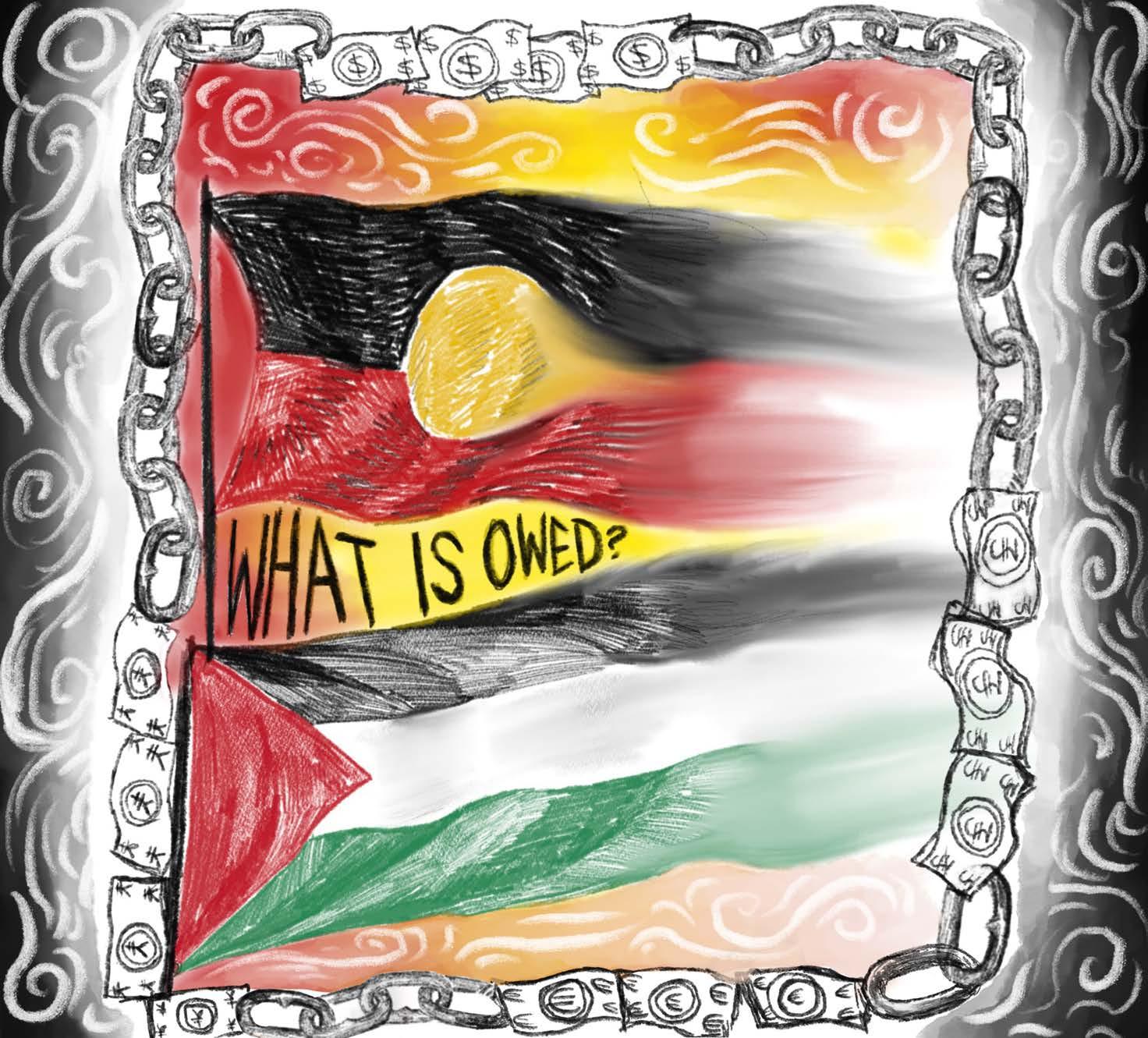
This week’s theme — What we owe — was quite a personal choice for me. I have often found myself ruminating on this concept. What we owe to our friends, our family, and to people on the street. But most recently, what we owe to the people in countries affected by despicable acts of violence. In Gaza, in Lebanon, in Iran — and unfortunately, it doesn’t stop there. Globally, there is so much horror, and I think now more than ever, what we owe to each other is such an important question to ask ourselves. How can we support our neighbours both here and across the seas?
This week, our reporters explore what we owe each other. I discuss feminised smear campaigns and the perpetuation of misogynist narratives by AI and bots. Timothy educates us on the history of combat spots and their role in resistance. Max is sceptical of who the tax
system actually benefits. Anastasia interviews Charlotte, a queer woman who witnessed police violence and intimidation at Mardi Gras. Feaim considers the pressures journalists face. Dana explores the history of police powers. Sebastien and Iris share their experience at the Town Hall protest against Herzog. Oscar worries about the future of art criticism. Siena yearns for the Oxford comma, and Aron thinks enrolment is too difficult.
On a lighter note, Anastasia is still having a brat summer while she bumps that at The Moment, and Kuyili thinks the Opera is not dead.
What we owe is a loaded question, and it means different things to everyone. As the editor-in-chief, I think it’s vital that we remain as critical as ever and look out for each other.
Keep showing up at protests if you can, donate wherever possible, and talk to each other. One of the easiest ways to resist fascism is to communicate. Fascism relies on silence and complicity. When you talk to each other, you engage critically; propaganda doesn’t stand a chance. Criticise your news outlets, criticise us. Honi is meant to be for students, and by students. If you think we aren’t doing something right, tell us. Criticism keeps everyone accountable.
I hope this edition makes you reconsider what it means to owe others; perhaps, instead of viewing it as a burden, you can see it as a way to exercise solidarity.
— In Solidarity
Madison Burland
Vox Pops: What Students Are Saying About Debt
A says: “I fucking hate John Howard.”
H says: “I am lowkey in thousands of dollars of UberEats and Afterpay debt. My life is fucked now.”
K says: “I don’t get HECS, I just have to pay upfront because I’m an international student. It costs my family about $60,000 per year.”
Honiscopes
J says: “Students shouldn’t have to go into years of debt just to afford a tertiary education. It hasn’t always been this way. Albo went to uni for free. Why doesn’t he afford that privilege to the students of today?”
K.K. says: “I’m not going to have a child. How messed up is the world, that no one wants to have a child, in part because of HECS debt?”
Aries: Peach. You’re a little freak and we all know it. Stay away from queer movies. You always find away to survive.
Taurus: Grape. You’re fun sometimes, other times, you’re just there. At least you’re reliable.
Gemini: Apple. You’re a classic, some may argue bland. You know what they say, an apple a day. Put the chicken tenders down.
Cancer: Strawberry. You’re a bit peformative. You stick to what you know, branch out. You’ll be ok.
Leo: Watermelon. You pair great with Margaritas, but perhaps it’s time for a change. Stay home this Saturday for once, do some self care.
F says: “Debt? I’m drowning in it!”
M says: “Bro the HECS system is chopped beyond repair.”
MP says: “I love my UberOne subscription.”
Virgo: Pineapple. You deserve more. People expect a lot from you, and judge you pretty unfairly. I think you make pizza, and honestly everything, better.
Libra: Passionfruit. You’re divisive, but that’s ok. You’re either a divine experience or a bit strange. You go great with Mango.
Scorpio: Orange.. both a fruit and a colour. You have multiple layers. Like an onion, but not really because you’re an orange.
Sagittarius: Mango. You’re beloved by all with good taste, but you’re blinded by ambition. Be kinder. It’s not that hard.
Capricorn: Kiwi. You’re a fun little time. You bring joy and comedic relief to all. You’re a lovely surprise. Why you fluffy? Thats strange.
Aquarius: Bananan(ahhh!!!) One day your evils will catch up to you.
Pisces: Pear. You are so kind. You’re soft-skinned and sweet. Be meaner, the world deserves it.
& SPACES 12th March 8pm W/ Nai Palm, Setwun & INQ Soundsystem, Eddy Diamond, Casey @ Club 77
Massive
Pro-Palestine chants banned by Queensland government
Protestors in Queensland now face jail sentences for chanting common ProPalestine slogans at rallies.
The phrases have been classified by the Queensland state government as “proscribed phrases”, which, if spoken in a manner that is “threatening, menacing or offensive” could see those who chant receive a prison sentence of up to two years.
Palestine throughout the 1980s until now.
Included in the law are new offences for impeding or
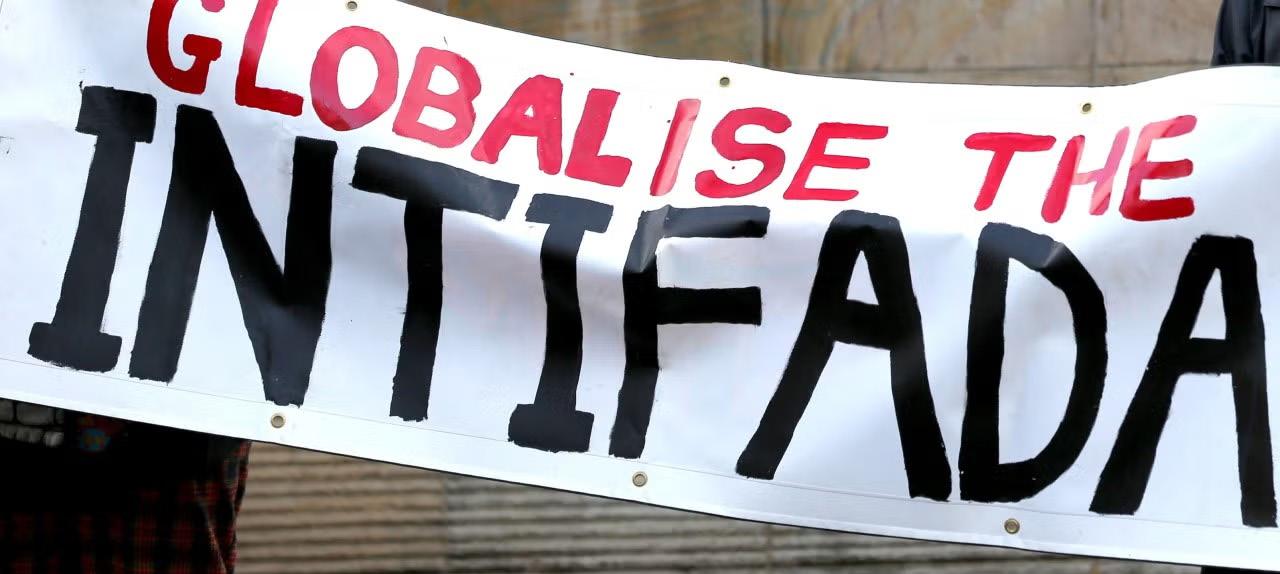
The effect could be felt in New South Wales, where a parliamentary inquiry last month similarly recommended banning “globalise the intifada” when used with malicious intent.
The exact conditions in which this could be applied are vague, and in the face of increased police activity against proPalestine protestors, it is unclear if the laws will apply to general demonstrators.
The phrase “intifada” in the context of the pro-Palestine movement initially referred to the “shaking off” of unlawful and often violent Israeli settler colonialism in the West Bank of
the Intifada” as a phrase became popular within protest movements following Israel’s invasions and occupation of Gaza throughout the early 2020s.
The banning of the phrases comes in the wake of Federal and State Government responses to both the terrorist attack in Bondi late last year and police attacks on protestors in early February.
attending religious services, and a ban on Hamas, Islamic State flags and the Hezbollah emblem.
The premier, David Crisafuli, stated that the ban was not and would not be a “knee-jerk reaction”.
Crisafuli has come under fire recently for his comments against Palestinian-Australian author Dr Randa Abdel-Fattah, where he recommended writers’ conferences ban her following her expulsion from the now cancelled Adelaide writers week.
Sebastien Tuzilovic
reports.
The Australian state and federal crackdowns follow other international governments’ similar restrictions on and bans of pro-Palestine protestor groups.
USyd student activists carry out snap speakout against the ongoing war on Iran
Students gathered at the University of Sydney’s New Law Lawns on Thursday, the 5th of March to protest the Albanese government’s support of USIsraeli military action in Iran and the US government’s funding ties to USyd’s US Studies Centre (USSC). The snap rally was organised and hosted by various student activist groups including USyd Women’s Collective, ACAR, and Students Against War.
Management at USyd warned organisers to cancel the rally, stating it was “unacceptable behaviour”, and threatened activist groups with disciplinary action on Wednesday night.
Signs read “cut ties with Israeli and US warmongers” while protesters were gathering student petitions and handing out pamphlets for the upcoming rally against Minn’s protest slogan bans.
Around 40 protesters attended. While attempts by security to shut down the protest failed, security guards surveilled the rally for its duration.
Introductory speaker and Students Against War (SAW) activist Vieve Carnsew opened with a chant condemning Israel as a “terrorist state”.
Carnsew began their speech, stating: “Last week Israel and the US launched a massive bombing campaign against Iran and one of the first places bombed was an elementary girls school in Minab, in Southern Iran.
At least 165 school children and staff were killed and over 500 people have now been killed across Iran.”
They continued by criticising Donald Trump’s press claims that the U.S was actively working towards “peace in the Middle East”, stating, “Bombs won’t secure freedom for Iranian people.
We have seen the catastrophic effects of US intervention in Iraq and Afghanistan. They killed hundreds of thousands. They did not bring freedom to anyone.
The future of Iran belongs to the Iranian people, not for the US, who will kill as many people as they need to fulfil their interest in the region.”
Grace Street, SRC President, spoke next, stating that the framing of this protest as “unacceptable” by USyd’s
In late 2025, the United Kingdom’s government banned Palestine Action as a terror group, an activity retrospectively deemed unlawful in February this year.
The NSW parliament is sitting again from March 17, when it will debate passing legislation banning “Globalise the intifada”.
Pro-Palestine campaigning group Stop the War on Palestine will hold a protest on March 17 at 6 pm outside NSW parliament to oppose the banning of the phrase.
management “hasn’t happened before” and “it’s funny that it happens for a rally calling for the support of the Iranian people against the illegal strike by US and Israel. [One] that our government was the first to support, and our university has ties to”.
She went on to condemn the university’s attempted justification for shutting down the protest via the Campus Access Policy.
The policy was introduced following the student encampment for Palestine in 2024, which she stated “shows the consequences of student organising and just generally, being on the right side of history.”
Read the full article online
Aiman Zuhaina reports.
Lawyers challenging December antiprotest laws hopeful after final hearing
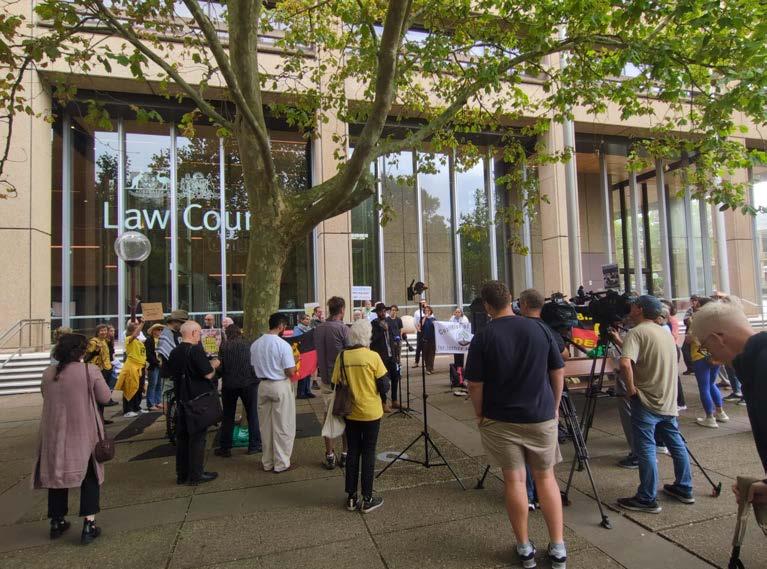
The hearing regarding the constitutional validity of NSW’s new public assemblies restriction regime occurred on Thursday the 26th before three judges at the Court of Appeal, the state’s apex court.
On the 14th of December, two shooters, one of which was known to ASIO in 2019 in relation to an investigation into an Islamic State cell, killed 15 people at Bondi Beach. The NSW Minns government tabled the Terrorism and Other Legislation Amendment Bill on 22 December, framed as a response to the attack.
With bipartisan support and the suspension of Standing Orders, the bill was expeditiously passed by both houses of Parliament within two days and became law on the 24th of December.
The constitutional challenge concerns the new power to suspend legal protections for public assemblies available under the Summary Offences Act (1988).
Ordinarily, if organisers notify police at least 7 days prior to a planned assembly, and police do not successfully apply to the Supreme Court for prohibition, the power of police officers to disperse the assembly is limited and participants have immunity from offences such as obstructing traffic.
Dongchen Yue reports.
“Appropriate level of analysis”
Hume said the pre-existing laws provided a basis for negotiation between protestors and police, gave protestors comfort, and allowed police sufficient time and information to either prepare resources or oppose an assembly in court. And should they lose in court, Hume said, protestors can see that “individualised justice is being dispensed”.
He said that the PARD regime “gave police a broad and uncontrollable power to require protestors to cease”.
“Community safety” definition broad and amorphous
The provisions state that to issue a PARD, the commissioner must be satisfied that public assemblies in the declared areas would “be likely to cause a reasonable person […] to fear for the person’s safety”.
Hume said that causing a person to fear harm is “one step removed” from causing harm.
The provisions introduced in December let the police commissioner issue PARDs (“Public Assembly Restriction Declarations”) within 14 days of invoking the Terrorism (Police Powers) Act 2002.
PARDs may specify any geographical area in NSW, within which no assembly will be protected for the duration of the declaration.
A declaration can be extended every 14 days to a maximum duration of 90 days.
The government activated Terrorism Act powers after the Bondi shooting. A PARD covering most areas of Sydney was issued on 24 December.
It was amended several times and extended until expiring on 17 February, when the police commissioner said he “opted to not renew it”.
In opening remarks for the plaintiffs, David Hume SC characterised peaceful assembly as the “oldest and most orthodox form of expression in a representative democracy” and that inconvenience is often a feature of protest for the purpose of conveying the protestors’ message. He said that the protections legislated in 1979 are a “recognition that if you ban protest, it just happens in an unregulated way”, andmentioned police violence at the first Mardi Gras march in 1978 as an example.
The parties debated whether the court should assess the constitutional validity of the PARD regime as a whole based on its potential invocations, or only the validity of individual invocations.
Citing a High Court decision in favour of Western Australia’s invocation of the Emergency Management Act 2005 during the COVID pandemic, Brendan Lim SC (government) said that the underlying legislation cannot be challenged on the basis that some potential invocations may be invalid.
Hume rejected the approach, saying that constraints on the police’s discretion are neither sufficiently termed nor adequately controllable by courts.
Lim said the new regime still allows decisions to be challenged on a case-by-case basis, referring to the judicial review of the Major Events Act (2009) invocation for Isaac Herzog’s visit to Sydney as an instance of courts adjudicating swiftly to deliver a ruling before a protest occurs.
He said that as the PARD is no longer in force and the prospect for future PARDs is “insufficiently concrete”, the plaintiffs do not have standing to challenge anything. Hume said that a future PARD is foreseeable, referring to the explicit lack of territorial limitation on Terrorism Act invocations and the frequency of incidents across the world that could warrant invocations.
Aside from causing fear, the provisions provide “community safety” as another available justification. According to Hume, it “need not be a risk arising from the terrorist incident” and the risk may “arise from the commissioner himself”.
Justice Free asked Lim to justify “a discouragement of public assemblies as they’re conventionally held”. Lim responded: “Because everything changes after a terrorist attack.”
Citing ongoing ASIO assessments, Lim said that “social cohesion is strained”, “spikes in communual violence” are expected, and there is a growth in “normalisation of violent protest and intimidating behaviour” and “uncivil debate and uncivil protest”.
Justice Free asked Lim how the assessments are a justification for banning assemblies, saying that concerns from the Director-General of ASIO are “independent of any terrorist attack”.
Nicholas Hanna, whose firm represented the plaintiffs, wrote on social media that he was “really happy with how we went but it’s impossible to know what the outcome will be”.
The justices have reserved their judgement for a future date.
Photo by Dongchen Yue
“The
budget is not your destiny”: March SRC Council
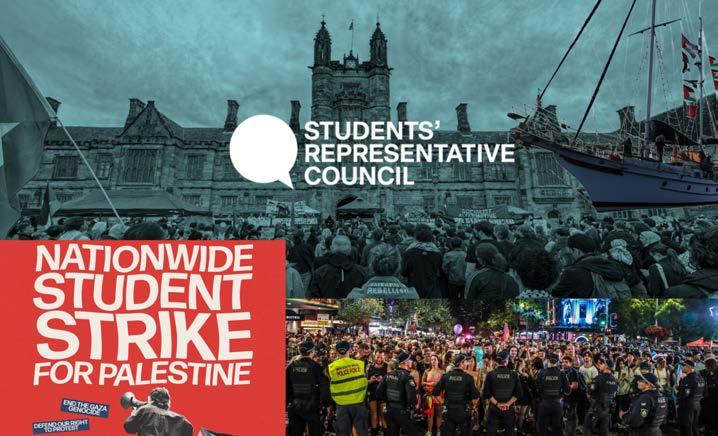
The 98th Students’ Representative Council held its second regular meeting on Wednesday the 4th of March. The meeting lasted until midnight. Substantive motions included the SRC supporting pro-Palestine initiatives such as the student strike on March 11, condemning Australia’s complicity in the Iran War, condemning queerbashing & state surveillance at Mardi Gras, and supporting the Global Sumud Flotilla, which USyd student Ethan Floyd is participating in.
Much of the council’s time was taken up by Unity motions which did not pass, and a spirited back and forth between Socialist Alternative and Grassroots regarding Grassroots’ motion on the SRC not using generative AI. The meeting was held in a lecture hall where the air conditioning was broken, and the smell of body odour (and later, pizza) became somewhat unbearable as the night went on.
The meeting opened at 6:20 pm after a brief scuffle over seating arrangements, with the following factions present: Grassroots, Penta, Socialist Alternative (SAlt), Solidarity, Queer Agenda (QA), NSWLS, and Unity. President Grace Street (Grassroots) opened proceedings, with Bohao Zhang (Penta) elected Deputy Chair.
Resignation & Budget
Question Time
Gerard Buttigieg (NSWLS) resigned his council seat to Ava Cavalerie (NSWLS).
Shovan Bhattarai (SAlt) asked about the Global Solidarity budget and why it was hard to get an increase. On balancing the budget, Vince Tafea (Grassroots) stated that “We have given the Education Action Group the most money it’s had in many years because it’s an enterprise bargaining year.” General Secretaries Tafea (Grassroots) and Cavalerie (NSWLS) stated there was never a plan to reduce the Global Solidarity budget, that it was increased, and any confusion was due to the Global Solidarity Officers not responding promptly to their requests for a meeting about the budget.
Deaglan of SAlt asked a few questions. One of his questions was regarding the Honi Soit training budget, which President Street informed him
came out of the Publications budget, therefore not impacting any collectives or office bearers. President Street informed him that the answer to another of his questions was contained in her President’s report.
Jesper Duffy (Queer Action) asked why the Queer Officers’ budget was not increased as much as they wanted. Tafea replied that they did not use all of their budget last year, and reminded everyone that “the budget is not your destiny” but a framework for expected expenses.
Student Strike on March 11
Starla Bilby (SAlt) spoke to the motion, saying: “USyd management must know we won’t be cowed by their attempts at repression of proPalestine activism.” Remy Lebreton (Grassroots) stated: “I am of course in favour of this motion as we all should be. The genocide in Gaza continues… we cannot stand by, especially in the context of our PM being the first to endorse Israel & US strikes on Iran for the bloodsoaked project of Greater Israel.”
Lucas Pierce (SAlt) brought the idea of an SRC stall on Monday to promote the strike, saying that “everyone who says they support the strike should be there. Let’s make this as big as possible.” President Street affirmed her support for an SRC stall to build the strike.
Leyla Bensan (NSWLS) stated she was “excited to help out on Monday” and that “USyd is a really important place for activism”, pointing to the Freedom Rides and Vietnam War protests. Aron Khuc (Grassroots) asked: “So you’re not going to criticise Albanese for being the first to support the attacks on Iran?” Leyla replied: “I’m not a member of the Labor Party”.
None of the Honi editorial team are members of the Labor Party either, however we are happy to announce we condemn Albanese’s support of the US & Israeli strikes on Iran.
James Fitzgerald Sice and Anastasia Dale report.
Iran War
Two motions on the Iran War were heard en bloc: a Solidarity motion, for the SRC to endorse their snap speakout against the war and USyd’s ties to US imperialism, and a SAlt motion to condemn the war.
Vieve Carnsew (Solidarity) spoke to the motion: “We stand against the dictator Khameini and against imperialism… the future of Iran belongs to the Iranian people”. Kat (Solidarity): “[USyd’s] United States Studies Centre exists to bolster the US-Aus alliance and bolstering support for AUKUS. Its main goal is to provide justification for US imperialism. We must stand against any attempts to drum up support for foreign interventionism.”
Jasmine Al-Rawi (SAlt) said “The US has not just bombed Iran but is sending troops to Lebanon. It was nice the Labor students spoke on the last motion, but I’d love to know what you think about the war in Iran. We are driving toward a much more militarised world right now.” Raphael Carrasco (Unity) stated: “We strongly condemn the actions of Israel and the US. They will likely do nothing to liberate the oppressed people of Iran. We must focus ourselves and stand with the people of Iran.” The bloc motions passed.
President Street (Grassroots) and Shovan (SAlt) called on the two main Labor factions Unity and NSWLS to put out a joint statement condemning Albanese. Leo Moore (Unity) asked Shovan to repeat herself because he was “multitasking”, but then responded by saying they will work with Labor Left to put out said statement. Honi is excited to see this statement
when it comes out.
Queerbashing & State Surveillance
Jesper (QA) brought a motion from the floor for the SRC to condemn police violence and the censorship of Pride in Protest at the recently-passed Mardi Gras parade.
Jesper spoke to the motion, saying: “Mardi Gras has once again silenced left wing voices and stood by as police brutalised community members. Drag kings unaffiliated with PiP and trans women holding a Palestine flag were the main victims of these senseless attacks… This is more state sponsored terror on pro Palestine protesters, on queer protesters. We have spent months fighting the organisation [of Mardi Gras] to taking a stance on Palestine”.
Some amendments to the motion were passed. Multiple Unity members laughed. They were asked why this is funny, and did not reply.
Grassroots members Remy, Maxine, and Leya all mentioned in their speeches that they were meant to march in the cancelled PiP float. Remy stated: “Mardi Gras was a protest, a riot, and it’s become a corporatesponsored party. If we care about queer resistance we must push for a return to protest”. Jaehyun said: “Pride should always be about liberation of all. Police cannot be agents of liberation. Mardi Gras must not welcome police to its parade or participate in pinkwashing.”
The motion passed.
Read the full coverage online.
The motion passed.
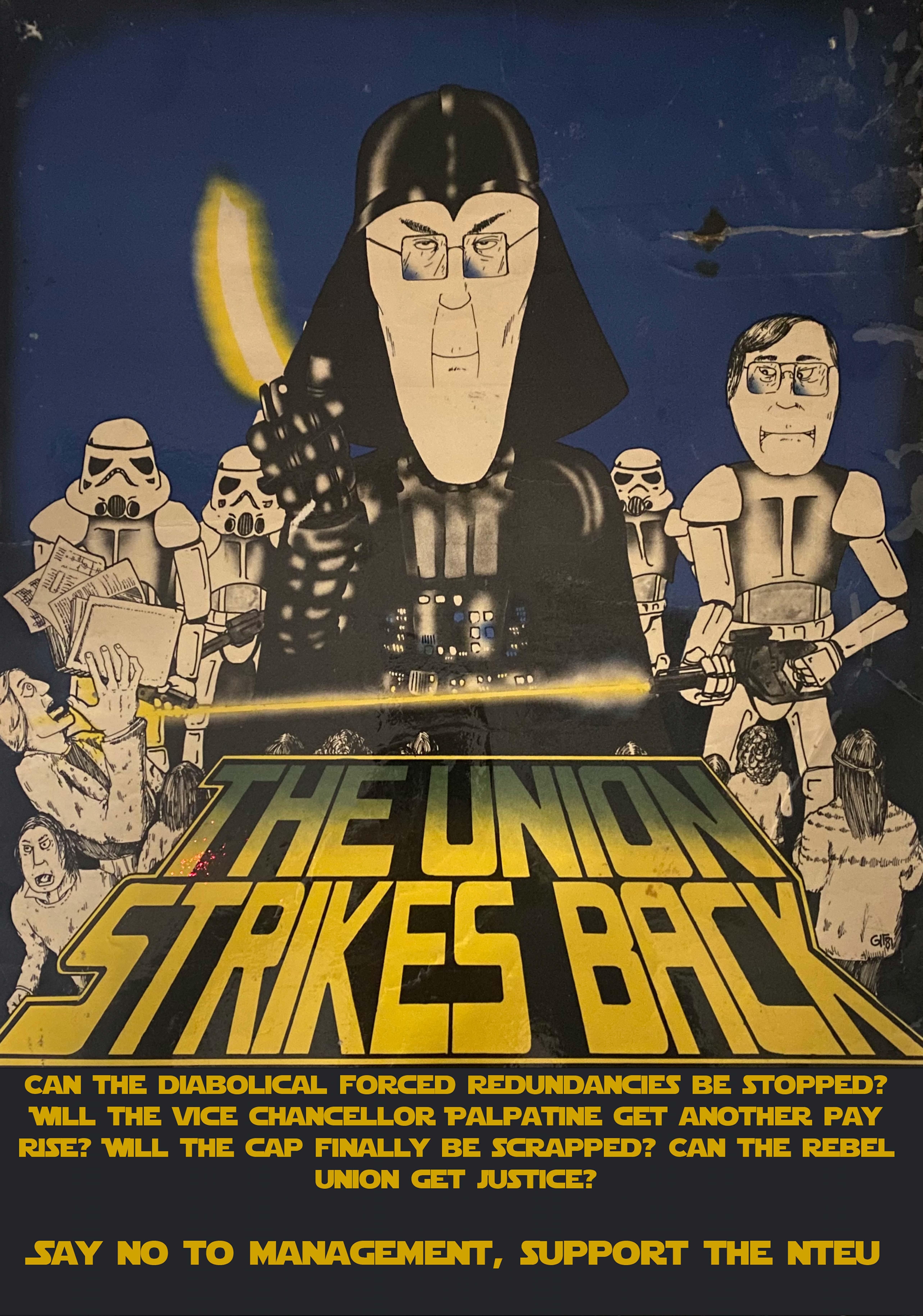
USyd NTEU members vote on list of demands ahead of negotiations with management
On 5th March 2026, the University of Sydney (USyd) branch of the National Tertiary Education Union (NTEU) held a members’ meeting in preparation for enterprise bargaining agreement (EBA) negotiations which will begin later this month.
Members voted on a log of claims (LoC) and bargaining team for the upcoming negotiations as well as a motion to increase their pay claim moved by Fight Back ’s Alma Torlakovic.
The EBA will determine University employment conditions for the next three years, and will be developed through negotiations between university management and the NTEU.
The NTEU has a long history of striking at USyd. Between 2022 and 2023, the NTEU undertook the longest running period of industrial action at an Australian University, taking 9 whole days of strikes over multiple 24-hour and 48-hour periods. The strike won key demands made by the unions, with a commitment for casual staff to receive five days of sick leave, and an increase from a 14.6 per cent pay rise to a 16.1 per cent pay rise over the course of the agreement. Also won was working from home protections, and a guarantee that casual staff would be paid for all hours worked.
Motion 1: Log of Claims
A LoC is a document outlining the list of demands submitted by the NTEU which will act as the agenda for negotiating a new EBA.
The draft LoC presented at the meeting listed 20 demands. These include a 20 per cent salary increase for all staff, a 17 per cent superannuation increase for casual workers, greater provisions to protect staff from the adverse effects of AI in the workplace, enforceable workload protections and review processes for staff, strengthening limitations on fixedterm employment and insecure work, and improving reproductive health provisions (including health, parental, and carers leave) among other demands.
A notable demand is for improved protections for professional and academic staff freedom of expression. This demand has implications on the bargaining of the NTEU with the university on issues which staff have come under fire from the university over, such as advocacy for Palestinian self-determination and criticising the university’s Campus Access
Policy, which many view as a method of stamping out free speech on campus for both students and staff.
The LoC also included a demand for no forced redundancies. A discussion paper sent to USyd staff in late 2025 raised concern that USyd staff would be subject to the types of staff and services cuts seen at universities like UTS, Western Sydney, Macquarie, Newcastle, and Wollongong. According to the report, professional staff at USyd had grown by approximately 30 per cent between 2019 and 2024, exceeding the increase in both students and academic staff over the same timeframe. However, this increase, it said, did not translate into improved student or staff satisfaction with professional service experiences.
USyd NTEU Branch President Peter Chen told Honi that “USyd NTEU members have worked hard to develop a focused Log of Claims…that addresses core concerns about cost of living, job security, and workloads. It’s great to see union democracy in action.”
The motion comes in light of two major reports, one on racism in the tertiary education sector, and the other on psychosocial concerns for staff. The racism report found that of more than 76,000 students and staff from 42 universities across the country, 70 per cent of respondents reported hearing or seeing racist behavior directed at their community.
The first motion passed with 94.7 per cent of members voting in favour.
Motion 2: Bargaining Team
The second motion proposed a team of USyd NTEU members to engage in EBA negotiations with university management. The proposed team consisted of two factional members, Rank and File Action ’s ( RAFA ) David Brophy, and Renewal ’s Jennifer Dowling, and four independent members including USyd branch president Peter Chen, Jean Luc Barbara, Laura Shephard, and Daan Van Schijndel.
Important to the members of the meeting was a discussion on the representation of issues of the university’s suppression of staff advocacy for Palestinian selfdetermination and concerns over the university’s application of the Campus Access policy.
The second motion passed with approximately 65.3 per cent of members voting in favour, 4.5 per cent against, and 30.2 per cent abstaining.
Motion 3: Increased Pay Claim
The final motion called on the NTEU National Council and executive to overturn their restriction on branches making pay claims above 20 per cent. Specifically, it advocates for a 10 per cent cost of living adjustment in the first and second year and either a 5 per cent or CPI pay rise in the third and final year, depending on which is
James Fitzgerald Sice and Sebastien Tuzilovic report.
higher. This amounts to a pay rise of 25 per cent over the life of the agreement.
The claim noted ongoing cost of living pressures and the inadequacy of university wages to meet these challenges, with a clause that rents increased 2.5 times more than wages over the last 5 years, and states that USyd wages are 4.8 per cent behind inflation.
The final motion passed with 61.1 per cent of members voting in favour, 28.8 per cent against, and 10 per cent abstaining.
A RAFA spokesperson told Honi :
“Today’s was an excellent meeting, showing that our membership wants ambitious bargaining claims and a bargaining team that will advance those claims in an open and democratic way. We look forward to building our collective strength through strike action and reclaiming the campus as a place of political contestation.”
The University of Sydney was approached for comment.
The Internet Loves to Hate Women
Madison Burland is paranoid, but not really.
Content warning: Discussions of sexual assault, smear campaigns, online harrassment and explicit text messages depicting sexual violence
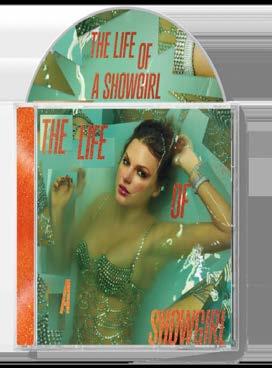
From objectively terrible takes to serious debates over whether water is wet, discourse on the internet has always been insufferable. It wasn’t surprising that Taylor Swift’s The Life of a Showgirl album was a huge point of online discussion after its release in 2025. What was surprising, was the slew of extreme criticism that followed. I’m not talking about the rightful criticism of her lyrics, but rather a trend I began noticing online. As a lifelong listener who does not idolise celebrities, this criticism surprised me.
Not because Taylor Swift criticism is new to me — but because of how much there was. During the album rollout, it seemed inescapable. There were daily claims that a merch necklace featuring a lightning bolt was a dog whistle, with people arguing she was trying to signal support to Nazis. Her horrifically Millennial lyrics, notably, “I’m not a bad bitch, and this isn’t savage” were claimed to be referencing the fact that Travis Kelce had publicly dated black women before her.
Taylor Swift is deserving of criticism. Swift is first in the list of celebrities with the highest CO2 emissions from flying, and recently faced backlash for the inclusion of fans travelling from Israel to see her shows. She has also notably stayed silent on the genocide in Gaza.
Instead of criticism based on Swift’s moral failures, she is criticised for apparently “looking like the Hamburglar” The reduction of her actions into simplified critiques of her personality or looks, that do nothing to hold her accountable for any real issues, allow groups (who already hate her for being an objectively successful woman) to push mass hate campaigns rooted in misogyny.
Rolling Stone released an article going through the findings of GUDEA, a tech startup that analysed the activity of those social media accounts, which were dominating voices in the conversation.
Georgia Paul, GUDEA’s head of customer success, suggested that their colleagues explore her suspicion of these accounts and their analysis soon confirmed two major spikes in misleading online activity related to Taylor Swift.
As reported on by Rolling Stone, GUDEA’s data set identified the first spike on October 6th and 7th, where they found that about 35 percent of the posts generated by
accounts had behaved “more like bots than human users”. The second spike fell on October 13th and 14th, after Swift released a lightning bolt necklace as a part of her The Life of a Showgirl merchandise drop, referencing Swift’s song Opalite . GUDEA found that 40 percent of posts were shared by inauthentic accounts and conspiracist content, which accounted for 73.9 percent of the total volume of conversation.
Now, this is not to say that the claims creators made, calling out Swift for her alleged dog whistles, are unjustified, but rather to question their source. Of course, multiple creators made their own videos sharing their opinions on the album, but the majority of work done peddling and encouraging these narratives is done in the comment sections, and, according to GUDEA’s research, most likely fake accounts.
But what are fake accounts and bots? These are not people’s alternative, spam, or troll accounts, but genuine fake accounts that are automated programs used to engage on social media. These bots mimic human behaviour by liking, sharing, reposting, or even commenting on social media posts. They are different to a chatbot, as these bots cannot converse with a genuine user back and forth, but they can interact with posts.
How many bots are actually out there? While Twitter executives previously testified before the U.S. Congress that less than 5% of accounts were run by bots, Ex-Twitter executive Peiter “Mudge” Zatko, who was previously the company’s head of security, claimed that “Twitter executives don’t have the resources to fully understand the true number of bots on the platform, and were not motivated to.”
Why is this alarming? Online bots, as major perpetrators of online discourse, often operate with little regulation or awareness of their presence on the platforms they inhabit, which is alarming for numerous reasons. For example, their potential influence on elections. First Monday published a study in 2016 that found that roughly 400,000 social media bots generated approximately 20% of the political conversation on Twitter in the days leading up to the 2016 U.S. presidential election. These bots accounted for about 3.8 million tweets. In a contemporary moment when social media allows fake accounts, operated by AI and bots, to become the major voices in social media discourse, the spread of serious misinformation has become easier than ever.
In recent years, it is undeniable that people often use social media as a replacement for the news. This is not inherently all bad, as censorship and bias plague mainstream media, independent news sources often rely on private funding and can be harder to catch. Many people feel they are too time-poor to deeply engage with the news, and they are often on social media anyway, finding out
about the goingson of the world sometimes by chance. Unfortunately, relying purely on social media for daily news is problematic for multiple reasons: It has become increasingly hard to differentiate sponsored content from genuine updates; accounts often do not identify sources and can therefore completely fabricate stories; and there is one new consequence not commonly discussed.
TikTok comment sections have become a breeding ground for borderline unethical marketing schemes. American brands such as Cracker Barrel and American Eagle have recently come under scrutiny online for being found to have significant percentages of online conversations about their marketing being driven by bot accounts. While there is no definitive link or claim that brands have influenced this bot activity, it is cause for concern for the future of online discourse and the digital landscape when so much of it is being shaped by fake accounts.
The rise in online bot activity, alongside conservatism and reactionary rhetoric, is making it even more difficult for women to exist online. Two high-profile court cases involving celebrities have dominated the online sphere in just five years.
In 2022, Amber Heard was sued by her ex-husband Johnny Depp for defamation after her statements in a 2018 Washington Post article titled “I spoke up against sexual violence — and faced our culture’s wrath. That has to change.” in which she did not name Depp. While the case ended with both parties being paid damages, the internet seemed to fixate on this defamation case, but this was not the first time Heard and Depp were in a courtroom.
In a 2020 UK High Court ruling, Johnny Depp lost his libel case against The Sun over accusations that he was a “wife beater.”
The judge found 12 of 14 alleged incidents of domestic abuse against Amber Heard were “substantially true”. The judge was also quoted saying, “I have found that the great majority of alleged assaults of Ms Heard by Mr Depp have been proved to the civil standard.”
Despite this, the Internet seemed to fixate on Heard’s tearful soundbites from the trial, ridiculing small sentences or actions, as well as her physical appearance and makeup. But no one mentioned the previous ruling from 2020, or the fact that Depp had written of Heard in text messages: “I will fuck her burnt corpse afterwards to make sure she’s dead”.
At the time, I couldn’t quite comprehend the frenzied mass posting and commenting surrounding Heard’s conduct at the trial, whilst social media simultaneously praised Depp for his behaviour. How was it that she could be so constantly ridiculed, despite having already “proven herself” in a courtroom two years prior?
The answer is smear campaigns. The BBC ’s Alexi Mostrous found that many of the “pro-Depp” accounts contributing to the furore were actually inauthentic. In a six-part podcast, Mostrous’ team looked into the claim that someone had hired automated accounts, or bots, to attack Heard. Mostrous’ team obtained a cache of almost one million tweets posted about Heard in the lead-up to the trial. A data expert they hired to look at the cache told their team that “50 percent of these tweets were inauthentic.”
Fans online had noticed that cast members seemed to avoid mentioning Baldoni by name when asked by interviewers. Notably, Jenny Slate, when asked about her experience working with Baldoni, did not mention Baldoni in her response
Given the context surrounding the film’s PR rollout, the seriousness of the situation between Baldoni and Lively should not have been a surprise to the internet. Yet, Lively bore the brunt of online criticism. Despite the claims that Baldoni had shown Lively and her employees “nude videos or images of women, including [a] producer’s wife”, or mentions of Baldoni’s “previous pornography addiction”, the internet began cycling through theories that this complaint was part of a long-winded scheme to “steal the movie” or that Blake Lively was “a mean girl who planned this from the start.”
But the allegations didn’t just come from Lively. Lively’s driver alleged in a deposition that during production of the film he overheard the following from Baldoni during a conversation with Lively and another person: “he kept talking about his sexual relations… he would force himself on women. If they said no, this, that, he would revert back.”
From recent unsealed documents from the Baldoni v Lively case, the Internet had seen Jenny Slate texts in which she had said “Justin is truly a false ally and I’m unwilling to do anything that promotes the image that he’s crafting as a ‘male feminist”. Slate also texted her team: “I don’t want to do anything with Justin, I don’t want to talk about him, like ... nothing.”
Isabela Ferrer, the actress who played the younger version of Lily — Blake Lively’s character – in It Ends With Us, alleged that after filming the scene of her character losing her virginity, Baldoni approached her and said “I know I’m not supposed to say this, but that was hot.”
The Hollywood Smear Machine has historically targeted women, and it relies on the social hatred of women.
The internet, and society more broadly, often does not care what happens to a woman if she is deemed unlikeable. A woman does not need to be a good person in order for her to be a victim. Victimhood is not inextricably linked with purity, and reactionary rhetoric has made it seem that if a woman does not fit inside their idea of a victim, particularly if some level of criticism of a woman may be valid, their abuse does not matter, and they do not deserve respect.
This is the same repackaged debate of purity politics. The same rhetoric which condemns sex workers who are assaulted, and the same rhetoric which asks “what was she wearing”. The perfect victim does not, and will not ever exist, but that will never make their stories untrue.
With the notable rise of bot activity online, especially in spaces which propel conversations around women like Taylor Swift and Amber Heard, it is important now, more than ever, to question your sources.
Do not blindly follow social media commentary. Smear campaigns are often gendered, and becoming more dangerous. We owe it to each other to be critical.
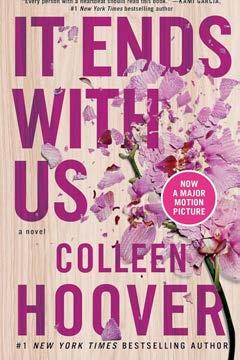
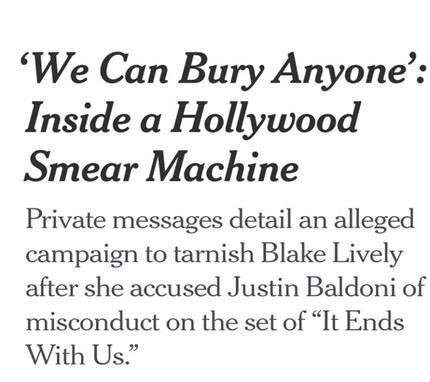
In December of 2024, Blake Lively lodged a complaint against Justin Baldoni. A major component of the complaint was centred around the sexual harassment she allegedly faced during her time filming It Ends With Us (2024).
The formal notice of a ‘feud’ between the pair wasn’t a complete surprise to the Internet. In August of 2025, months before the confirmed complaint, Forbes released an article titled “ It Ends With Us’ Actor Brandon Sklenar Addresses Alleged Cast Drama—Here’s Why Fans Think Blake Lively, Justin Baldoni Are Feuding”. The article discussed the following:
Both Colleen Hoover, the author of the novel It Ends With Us , and Blake Lively do not follow Baldoni on social media
The It Ends With Us cast appeared in a video for Vanity Fair where Justin Baldoni was notably absent
In early August 2024, before the complaint was made public, and as the Internet was starting to discuss a potential feud between Baldoni and Lively,
Baldoni hired a PR crisis expert, Melissa Nathan. One of Nathan’s notable previous clients was Johnny Depp. Both Blake Lively and Amber Heard are alleged victims of smear campaigns.
But what is a smear campaign? According to the Civil Liberties Union for Europe, “Smear campaigns are an attempt by powerful figures to undermine someone’s credibility and reputation — with the goal of distracting public attention from something they are trying to keep quiet.”
The modern smear campaign relies on misinformation, and the use of online algorithms to educate us, and women are disproportionately affected by this. Who stands to gain from our hatred? Why is it so easy to fall into a cycle of hatred? A reactionary conservative society is most at a loss when its members are able to think critically.
Comrades in Combat Sports
and 21st centuries, tracking how globalism, capitalism and imperialism have historically altered the conditions under which we fight.
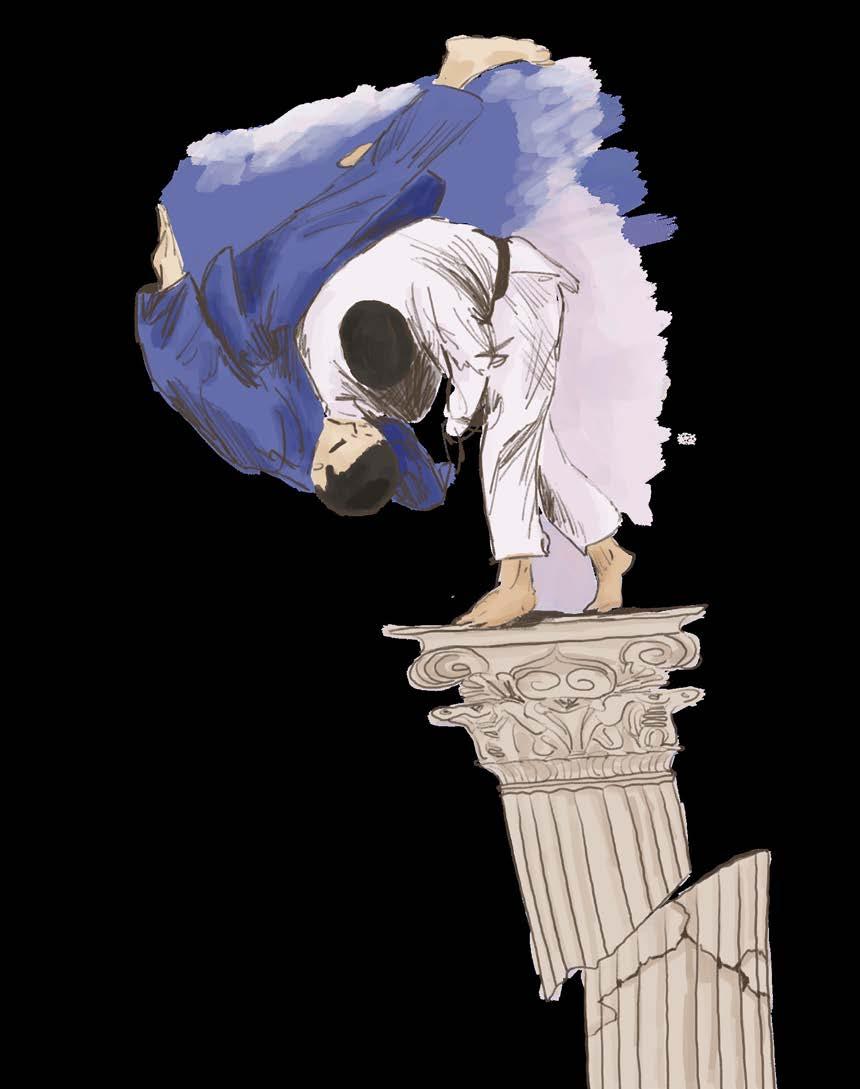
Tribal conflict and war first created martial arts, systems of combat developed by cultures to equip its practitioners with the tools to lethally overpower another human being.
In developing these military tactics, ancient peoples simultaneously developed combat sports; sanctioned oneon-one bouts with rulesets prohibiting certain techniques.
These archaic rulesets encouraged the brutalisation and death of the opponent, to the cheering of riotous onlookers. With records of spectated bouts being found in the populated societies of ancient Egypt,
This is not to say that ALL combat sports athletes compete for material gain. People in the fighting industry have full-time jobs, or are studying, or 15 years old, or 50.
I trade blows with graphic designers and warehouse workers, I wrestle with truck drivers and legal receptionists, and there is not the slightest aspiration from these people to choose fighting over their current source of income. Not all combatants believe in the exploitative myth that fighting equals riches.
Distinct from material gain, there is a psychological implication. The fear of being subjected to violence, particularly sexual violence, is an enormous psychological component of the fighting mind.
Many people I know began training to defend ourselves from violent men. Other motivations exist, the desire to lose weight or the need for routine. Inseparable from this are the flashes of fear and pain when you are sparring, getting hit or held down by another person, the frustration and the charming out of blood like a snake to the sound of warbling woodwinds.
These
Artist: Zoe Chung
The massive investment in professional stadiums and sports in the Western world in the 20th century funnelled a new motive into the throwing of limbs: money. Professional fighting was now a viable fantasy for lower income men to socially mobilise.
These conditions of economic struggle, in which men with nothing were given the opportunity to become rich and famous through their combative prowess, continues to draw people into fighting gyms to this day.
sports are now on the Western stage, which means they reinforce Western hegemony.
A Western fighter being beaten by someone from an oppressed country spits in the face of colonial myths of power and superiority. The ring becomes a litmus for the superiority of the individual. As Orwell says in A Sporting Spirit, “...the most violently combative sports…have spread the widest.
There cannot be much doubt that the whole thing is bound up with the rise of nationalismthat is, with the lunatic modern habit of identifying oneself with larger power units and seeing everything in terms of competitive prestige.” MMA is the obvious end of this imperialist evolution, a sport from which all cultures’ fighting is passed through the metric of efficiency.
While oppressed people may not be interested in the spectacle of violence, it demands the spectacle of the oppressed. In July last year I was cornering fights in Bonnyrigg, where the main card had 6 South-East Asian fighters against a gym in Rockdale.
For each of these fights I cheered for my fellow Indonesians, who stared up at their heavier looking opponents. The Indonesian fighters were beaten and choked out one after the other, only one making it into the second round. The crowd stopped clapping.
To beat traffic and disappointment, I left before the last bout, wherein another body like mine dropped to the canvas in the first minute. The record of these flown in fighters before the night combined to 5 wins, 14 losses, to the Sydney Gym’s record of 15-2.
I cannot argue that combat sports and martial arts are, at their core, bad. I have learnt invaluable skills, developed discipline and autonomy, attached faces and smells to those in my community.
But like the capitalism that separated the sports from their respective cultures, these competitions reward the strongest, most violent, most malicious individuals, with the most access to capital, the ones who can pay for the best coaches, the best nutrition.
Toppling the Goliath of the ruling class, the one who is daily massaged, freshly steroided, worked and stretched and fed by capital, is impossible in the ring, under the false fairness of oneon-one combat.
Like in the ring, the machinery of the world’s empires exist to condemn and desecrate the bodies of the oppressed.
The real battle is fought in the streets, in the trucking and back breaking labour of my sparring partners, in the union strikes and student rallies, in the hearts and minds of those who cannot ignore the conditions of their exploitation. In the ring it is me and the body I need to step over. In reality, we outnumber our oppressors ten thousand to one.
Timothy Pudun strikes back.
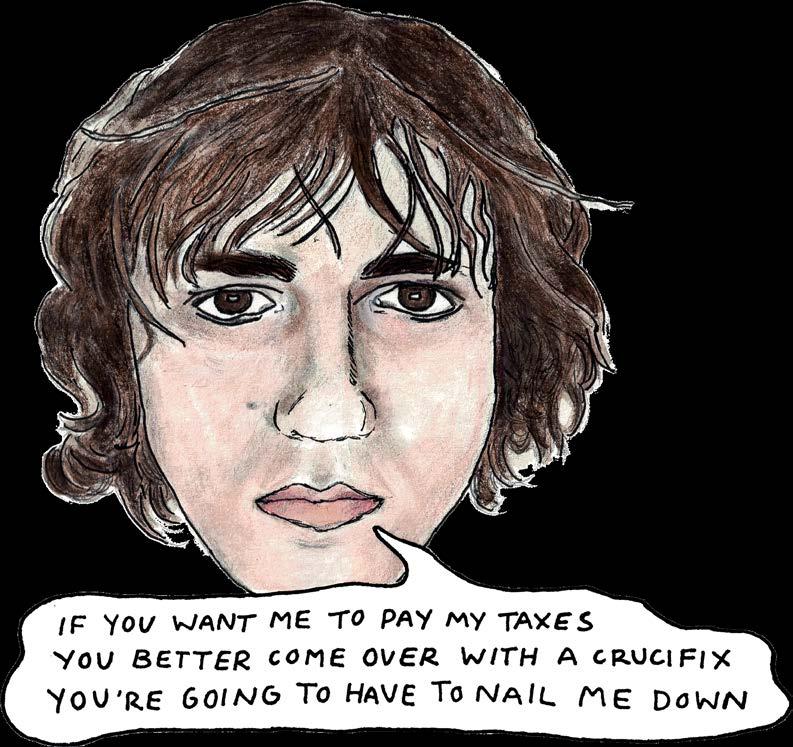
A Layman’s Guide to Tax Evasion (for the rich)
Max Mcdermott is evasive. If you listened to adages, you’d believe that only two things in life are certain: death and taxes. For the privilege of walking this earth, these are the two obligations we must fulfil.
Both Jeff Bezos and I will eventually die, but only one of us will actually pay the taxes we owe (hint: it’s me). This is thanks to a range of neat little tricks that fall under a term you’re probably familiar with: tax evasion.
It is estimated that approximately US$20 trillion – a staggering 10% of the world’s GDP – is currently hidden in offshore tax havens.
Like most Western economies, Australia utilises a progressive personal income tax system, which is paid by individuals and sole traders. Imagine that you’ve just landed your dream role as a corporate lawyer, with a salary of $220,000. Congratulations. Now it’s time to pay taxes.
As you fall in the highest tax bracket, you’re paying $51,638 plus 45 cents on every dollar above $190,000. That’s a significant portion of your hard earned income going to the government. If you’re a company, it’s simpler - 30% of your net profits, flat.
But if you’re feeling particularly avaricious and can’t stomach the government taking a portion of your earnings, then it’s time to get tax evading.
The first major framework that enables tax evasion is that of the shell company. A shell company exists on paper but doesn’t actually do anything – no employees, no operations, no office space – which the parent company owns 100% of. If the shell company is registered in a country with no corporate tax, then it doesn’t have to pay any tax. Most shell companies end up in the Caribbean, where corporate tax is minimal, financial security laws are rigid, and setting one up requires less effort than opening a bank account.
Ugland House in the Cayman Islands demonstrates the absurdity of this system, as it houses over 18,500 shell companies. This is because the system works best with multiple layers – i.e. shell companies owned by shell companies owned by shell companies which are eventually owned by the parent company.
Because a shell company doesn’t actually undertake any real operations, multiple of them can exist within one property.
The second framework is profitpushing, which relies on Base Erosion and Profit Shifting (BEPS) methods. These allow you to shift profits into shell companies, eroding your tax
Ireland too – where the corporate tax rate is much lower.
Because it’s nearly impossible to prove which patents generated which profits, no one can easily challenge it.
In 2015, Ireland shocked world economists by reporting a 26.3% GDP growth rate, meaning the country became ¼ richer in a single year.
This was almost solely due to Apple shifting roughly €270 billion into Ireland through a BEPS tool. Transfers like this have ruined the statistical viability of Ireland’s GDP, so its leaders no longer use it to inform policy decisions.
Once you’ve successfully evaded paying taxes on your income, you need somewhere to store the money. This is where offshore banking comes into play, with Switzerland, Singapore, and Hong Kong being the best options.
In the phrase ‘tax havens’, these three countries act as the havens.
While Singapore and Hong Kong rose to prominence from the 1970s onwards, Switzerland is the original tax haven. One of the reasons is their strict banking secrecy laws, which make it a criminal offence to divulge information about clients. This led to them storing Nazi gold, which illustrates the strict ethical code these financial hubs adhere to.
Artist: Hannah Rose
The Australian Taxation Office (ATO) uses the term ‘shadow economy’ to refer to economic activity that isn’t reported or taxed. A 2016 government task force estimated that the economic losses inflicted by the shadow economy might be as large as 3% of Australia’s GDP – over $80 billion in 2025. That’s money that never reaches hospitals, schools, nature, or the power grid.
This is money that could be put towards a variety of things that would benefit society, such as healthcare, infrastructure, education,
and green energy programs. Instead, greedy corporations and individuals use it to line their pockets.
Thankfully, the ATO is quite efficient at catching tax cheats – as was the case for Michael Issakidis and Anthony Dickinson in 2018. The pair deliberately absorbed $450 million of assessable income through the creation of false losses to evade $135 million in corporate tax. They were both sentenced to over a decade in prison, while the AFP seized $54 million in assets like real estate, luxury cars, and yachts. Here’s to hoping they enjoy the spartan comforts of prison life.
World governments lose US$492 billion annually to tax evasion. To use my old economics teacher’s favourite framework for explaining large sums of money: it would let you buy approximately 85 billion American Big Macs. I’m sure the effects on your health would be disastrous.
On the theme of food, the United Nations estimates that it would cost US$93 billion a year to end world hunger by 2030. This is only 19% of what the world loses yearly to tax evasion.
While it’s admittedly naïve to assume that governments would allocate a portion of these lost earnings to such an altruistic cause, it goes to show just how much good could be done with this money.
When I think about tax evasion, it brings to mind one image, split down the middle by a thick golden line. On the right are the wealthy, with dollar signs in their eyes, as they earn, hoard, spend, consume, and think only of themselves. On the left is the everyday man, subjected to cost-of-living increases, growing wealth inequality and a diminishing quality of life.
For the good of our society, the elite cannot be allowed to get away with tax evasion. It’s time we band together and put a stop to it.
Watching the Cops at Mardi Gras
Charlotte Mac Sweeney is a queer woman and member of Ireland-Palestine Solidarity Australia . She was present at the Pride in Protest rally on the 28th of February and witnessed targeted police violence and intimidation at the Mardi Gras parade later that night.
Anastasia: So tell me about the day of Mardi Gras, the rally, the parade.
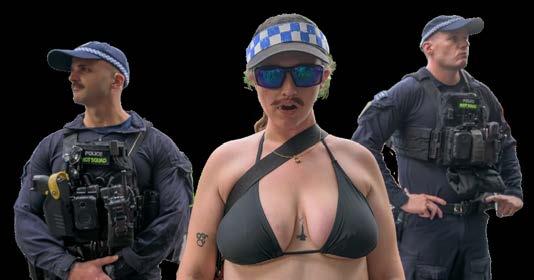
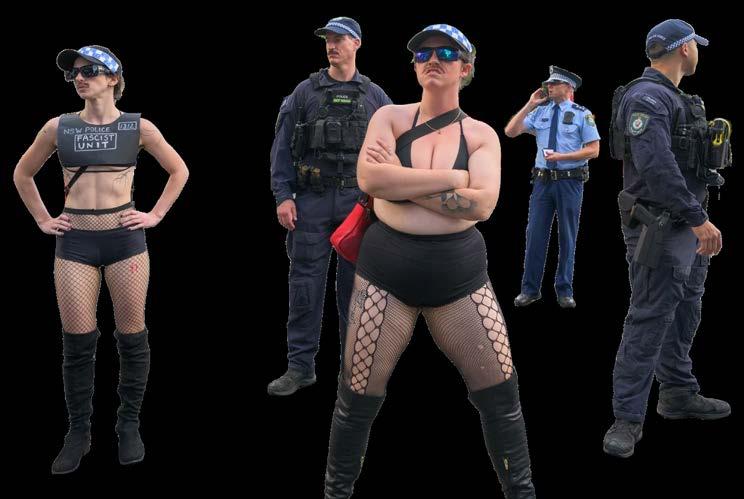
Charlotte: My friend and I were dressed as sexy riot cops at the rally, and we were just lampooning the cops the whole time.
The rally was big and defiant. It was very much people who were pushed out of Mardi Gras, insisting on enjoying it. People were dressed up as though they were still allowed in the parade. The speeches were very rousing. They always brought it back to the systems at hand, beyond Mardi Gras as a weekend. There was a focus on the expanded police powers, cops with rifles, how we need to defy all of that.
When the protest marched on the footpath to Hyde Park, they were boxing in people very close and very much trying to elicit the threat that what happened at the Herzog rally could happen again, forming in circles around people. People got mostly safely to Hyde Park. Once they got there, a few people were pushed and shoved to the ground. Apparently, people nearby who weren’t in the rally were getting shoved just for looking queer and being near it. We were there for a while. People were chanting, let us in. There were impromptu speeches.
Me and my friend got invited into the parade by the drag kings because they were like, You guys look so cool, you need to be in the parade. Neither of us are Pride in Protest members. We left the rally behind, and I remember feeling really worried, because the rally was starting to get smaller, that the police were going to become violent towards the rally. But I was wrong. I should have been worried about us.
We went in, and we were given wristbands. Mardi Gras security checked our bags. They checked everything and let us in. We spent about an hour and a half just on the grounds. People were leafleting for Trans Day of Visibility. People were making funny videos and taking photos. There was no active protesting in the holding ground. We felt so excited. We felt so chuffed with the solidarity shown to us to be let in. We were so excited to actually get our message out during the march, and the message was just the same signs that other floats had, which said: I oppose genocide, I support protest.
Anastasia: And a fun little cop costume, like the Village People.
Charlotte: Yes, well, we were covered in fake blood. But it was like a sexy cop, black lingerie, and just a badly made police hat, and we had moustaches. It’s politically valuable because I think our costume is why we didn’t get touched. We were kicked out, but we were not bashed. They were also targeting the more obviously gender diverse people, before they were targeting anybody else, which was so evil.
We were told we would march at 8:20. The person leading the float used a mobility scooter, but when we got to our entrance at 8:20 to get into the procession, there was no access for the scooter user. So that held up the float. While the float was held up, I saw three Mardi Gras security absolutely bolting ahead of us. It was guards I had seen at the rally.
We might have been on the actual road for about five minutes, trying to get into place. We were getting so much support from the other floats, even my controversial costume. People were shaking my hand for it. People were saying, Thank you for bringing attention to this. The overwhelming response to us walking through was support and joy and solidarity.
Then about 10 riot cops just stormed in in a line, splitting the group in half. I heard them say, “Go for anything Palestine”.
And then they immediately targeted a trans woman who was not in the drag kings group, but is in Pride in Protest. At least five cops were reaching through other people to get to her and steal her Palestine flag, and they roughed her up quite a bit. She was very distressed. Then they turned their violence a bit more outwards, but they did not touch the two of us in the police costume. They went mostly for drag kings and PiP members. But even some PiP members weren’t handled as roughly as the drag kings, which makes me feel like they wanted to spread distrust and make people regret having solidarity with Palestine.
It was like they knew they couldn’t attack the proper rally on the street on Mardi Gras. They were sick of being made fun of, so they decided to bash some queers in an alley, it was like a gang attack.
Anastasia: I’ve marched in the parade before, and the holding area you’re describing, it’s a bit of a dead zone. There’s a lot of sectioned off areas
Anastasia Dale interviews.
with no people. It did really seem like the police were able to get these people to where they wouldn’t be seen and where people couldn’t get videos like they got at the Herzog protest, and just do things under the cover of night, isolate them, take them away from their community.
Charlotte: That’s how I feel, I honestly feel really traumatised by it. I’ve seen the police break people’s bones, but they are always proud enough to do it in front of a crowd. But this felt seedy, it really highlighted the impunity of police.
Are these riot cops going to be investigated or named? Are they ever going to be named for their gay bashing?
Two people I saw were detained. There were other detainees, and they were given move on orders. One person was given a move on order that was so far away from where any of their supportive friends might have been in the city, they made them go so many streets down. We were all able to convene at another part of Hyde Park and take care of each other and sort out people getting home. There was so much to deal with, but we were taking care of each other and just making sure that nobody was going home alone. The police had split the float in two, so while we were there, people’s friends were marching in the parade.
Anastasia: That’s such a terrible thing to happen when you’re about to go out and march in Mardi Gras, to see your friends being ripped away from you with no explanation, with no cause. That’s so antithetical to what Mardi Gras should be.
Charlotte: Unfortunately, that’s exactly what Mardi Gras is.
Chris Minns is cracking down on solidarity with criminalisation and violence. The Minns government is clearly in divide and conquer mode, where people within the movement are being asked not to trust each other. That’s what it is when a float in Mardi Gras extends solidarity, and then the cops bash everybody for it.
That’s part of why we dressed up as sexy riot cops, because we were like, if you’re gonna step on my rights, I’m gonna laugh at you.
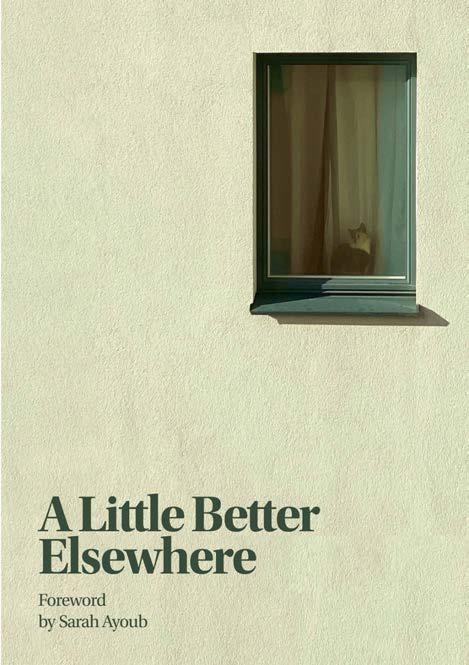
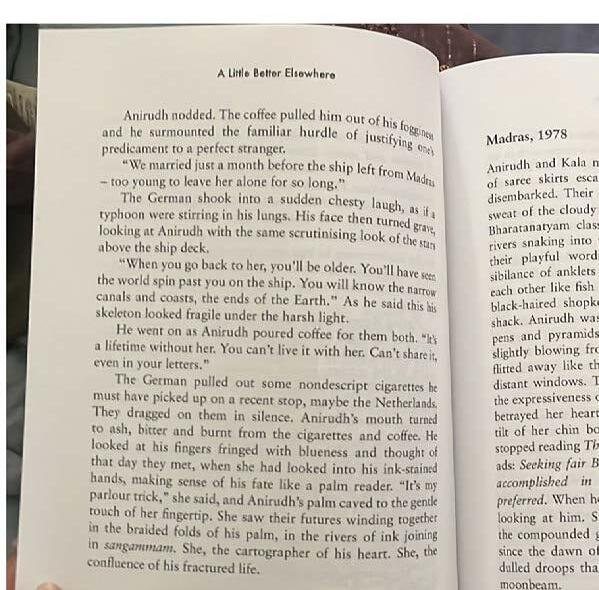
‘A Little Better Elsewhere’: USyd’s 2026 anthology
A Little Better Elsewhere is an anthology of stories, poetry, and non-fiction written by University of Sydney (USyd) students and staff on the theme of ‘Nostalgia’. The anthology is a yearly publication of Sydney University Press, lovingly edited by the University of Sydney Masters of Publishing students. Led by Dr Agata Mrva-Montoya, Senior Lecturer in Media and Communications, the team of editors changes annually, and seeks original works from both emerging and established writers.
The Anthology’s 2025 edition “grapples with the complexities of nostalgia,” furnished with a foreword by Sydney-based author Sarah Ayoub, who writes: “We always think it’s going to be a little better elsewhere. Thankfully, in the pages of this book, which traverses continents and time zones, elsewhere can be anywhere.”
The title was drawn from one of the pieces in the collection, A Little Better Elsewhere by Raghad Hilles, who writes:
“Laughter rolls through the room like the Gazan waves they describe to me, the ones that smell and taste and sound different to the waves of any other sea in the world.”
In every work, there is an inexpressible longing for something estranged and yet intrinsic to the characters’ identities.
Belinda Castles, author of Walking Sydney (2025), gave the opening address at the launch: “What came through in each work was tenderness.”
The title ‘A Little Better Elsewhere’ challenges the idea of nostalgia, and doesn’t limit the feeling to the past. It becomes more abstract, a longing for
another atemporal spacetime or alternate possibility. The editors write in the acknowledgements: “Against the backdrop of genocide and political unrest, we were gifted with stories that spoke of a deep pain for places and people who no longer existed.”
A distinct feature of the anthology is its diversity of writers, overwhelmingly from immigrant backgrounds. The title resounds with the persistent feeling of being haunted by the alternative universe of their pasts in their ancestral homelands In ‘Everything and Nothing’. Aishmita Kumar writes about her father:
“You grew up in poverty, I learned later, surviving on cheap fish from the markets in Fiji’.”
There are also deeply lived-in experiences of Sydney in the collection. In ‘Where To?’, Joseph Parker Lucas traces an Ubertraced map of Sydney from Marrickville, Newtown, Darlinghurst, Erskineville, Redfern, Haymarket, Waterloo, Dulwich Hill, and finally Tamarama. In every story, readers find their experiences mirrored regardless of context, setting, and time.
At Fisher Library, there were readings by Kuyili Karthik, Shania Daphne Andrea OBrien, Angela Fossi, and Cherie Baird.
Before the launch, I sat down with editors of the anthology Michelle Agnelli, Zara Ishka Stewart, and Komal Gupta.
Kuyili Karthik: Why edit the Anthology?
Zara Ishka Stewart: The editors are people who want to go into publishing. A lot of the editors are doing Masters of publishing, but there’s a few of us that have just done undergraduate degrees like a Bachelor of English.
Editing the anthology is quite practical, you follow the entire process of how a book gets assembled. It’s also only one book, so it’s not too overwhelming for first-time editors.
KK: Who submits and how many submissions do you get?
ZIS: Mostly students, but some professors as well. We aim to get a hundred to two hundred submissions; I think we usually get over hundred. It is hard to pick! We have twenty-one editors though, which makes it easy to get through. It’s hard to pick between pieces when people really disagree on whether or not they relate to the theme, because there’s a different theme each year.
KK: What was your favourite piece?
ZIS: There’s a piece called ‘Lotus Bloom’ by Arani Ahmed. The actual visual layout of the poem is quite unusual. It’s almost like… It moves, like, the poem is moving through wind. It reads: “Laughter rustles, flies to where I can’t follow…” Annis
Kuyili Karthik interviews.
Chan’s ‘Tree Rings’ is also similar, the indented lines can actually be read on their own as a separate poem.
KK: What is it like working with Sydney University Publishing?
Michelle Agnelli : I think it’s a huge advantage. At the moment, I’m working in publishing, which is awesome. I’ve just graduated, as of last semester, and anded a publishing job at New South Publishing which is attached to the University of New South Wales. So I understand what university funding means. It kind of creates a structural advantage, I guess, and structural support to help out when the arts are always underfunded.
I think the awesome thing about the USyd anthology is that it actually hits the shelves. We also have an audiobook coming out soon! When I worked at Berkelouw Books, I was shelving the previous anthology, and I had a customer ask about it. More private, independent work is really important to, to, fund.
It’s essential to have an ongoing, university publication. I think the fact that we get funding every single year to publish what’s a relatively small print run is a testament to the fact that it’s just really important. It’s important that it’s student-led, rather than having a corporate structure, because it’s a product of student minds and student interests.
Komal Gupta: Whoever’s submitting to our anthology every year are not necessarily from English backgrounds, they’re also from different backgrounds. We’ve had science students, engineering students, and it’s very much a passion project for them.
Dr Agata Mrva-Montoya announced the theme of next year’s anthology as ‘Hope’. If you’d like to get involved editing or writing, consult the USyd anthology’s Instagram and website for submission callouts coming out soon.
NSW Police Powers: A History of Brutality
Dana Kafina protests
The February 7th rally against Israeli Prime Minister Isaac Herzog’s visit saw a significant shift in the public’s perception of police powers. Thousands attended the rally, where the New South Wales Police Force enacted mass punishment with glee.
They kettled rally-goers, blocked streets, arrested and assaulted protesters including the elderly and the vulnerable, and liberally sprayed pepper spray upon the crowds in an event that traumatised many.
It sparked a mass realisation: when did police get this powerful?
Police fascism is nothing new. The New South Wales Police Force’s origins trace back to monitoring and oppressing First Nations peoples. In 1789, the first organised police force in Australia, the Night Watch, was formed from the ‘best behaved of convicts’. Historian Mark Finnane argues in Police and Government: Histories of Policing in Australia that the very foundations of the police force is response to Aboriginal resistance. This rings true to this day, with the overpolicing of communities like Redfern which are hubs of Blak resistance, the rise of Blak deaths in custody, and the overrepresentation of First Nations people in the prison system. Police powers have grown extensively over the past few years, especially when it comes to protest.
These increasing powers arguably trace back to the COVID-19 lockdown, where special police powers due to the pandemic were, once again, weaponised against Aboriginal communities. If you lived in an ‘Area of Concern’, police could order you to return to your home, especially if they thought you were not complying with a ‘reasonable excuse’ to leave your residence. Police could also give you an on-the-spot fine for breaching the Public
Health Order. Walgett, a town with a large First Nations population, was issued a high amount of fines during COVID-19, financial penalties issued under the Public Health Act 2010 (NSW) which significantly punished the people of Walgett.
The Dharriwwa Elders Group released a statement on this issue addressing the “big mistake” in “tasking police to lead the local emergency response to this public health crisis”, a choice which caused severe harm to the community owing to the “heavy use of Public Health Order fines”. Similarly, special pandemic policing powers were weaponised against Blak rally organisers during the Black Lives Matter movement. NSW Police took organisers to the Supreme Court and won, forbidding them from protesting during the pandemic. When organisers still protested on the 14th of June, demanding justice for Blak deaths in custody, police violence and the arrests of six people ensued. Accounts from the day state the police presence and police dogs were disproportionate to the amount of rally-goers.
Police powers were also increased in accordance with severe anti-protest
laws introduced in 2022.
These laws targeted climate protestors especially. Violet Coco’s case makes this clear: during a protest on the Sydney Harbour Bridge, Coco was sentenced to 15 months jail time, with 8 months nonparole. Coco spent 13 days in prison, with her sentence overturned after an appeal, and stated she would pursue compensation from the police for including false information in their report claiming that protest prevented an ambulance from crossing the bridge and reaching an emergency. Similarly, during the 2023 Rising Tide blockade, over 100 people ranging from as young as 97 and as young as 15 were arrested. New laws were introduced in 2022 preventing “illegal protesting” on “all main roads” and protesting in infrastructure and major facilities. These laws were introduced in response to a series of effective and disruptive climate protests and blockades at Port Botany.
Though many aspects of these new protest laws were struck down, the powers they provided police seem persistent.
The laws contributed to a culture where the police felt enabled and encouraged to escalate brutality and suppression with regard to protests.
This can be linked back to the weaponisation of the Form 1 system by the Police Force.
The Notice of Intention to Hold a Public Assembly, or a Form 1 as it’s more colloquially known, is a document given to police at least seven days in advance to notify police of a protest or march. It is not a document to seek permission from police to protest. It provides legal protections for participants and prevents them from being arrested or prosecuted for blocking roads during a protest. If police wanted to ‘deny’ a protest from happening, they are required to go to the Supreme Court and get an order against the rally.
In recent years, however, police have liberally attempted to adjust march route plans or suggest alternate locations for rallies, saying protests will not be approved if they don’t meet certain requirements.
In communications to School Strike 4 Climate Sydney 2023, police attempted to call a student repeatedly during school hours in order to ‘chat’ about march routes and events, saying the location of the rally was not desirable to police and that it wasn’t approved. In 2026, this is becoming more and more common.
The Form 1 was meant to replace the need to apply for a police permit to protest, as permits could be given and revoked at any time, allowing police to brutalise protesters, who often consisted of the most vulnerable of our community. Today, police have bastardised a system that is meant to protect protesters and have used it to enforce authority and suffocate
protest rights which Blak, queer, trans organisers have tirelessly fought for.
In the massive rise of the movement for Palestine, police have attempted to stop Australians from protesting genocide at every turn. Police responses to protests have escalated more than ever over the past three years, thanks to Chris Minns’ eagerness to enable the police. At Port Botany protests in 2023 and 2024 advocating against ZIM, a shipping line complacent in the genocide in Palestine, protesters experienced severe police brutality. There were over 20 arrests, with police kettling, pushing, and assaulting protestors, slamming them to the ground.
The Weapons out of the West SEC plating picket on 27 June 2025 also saw severe police brutality, including a police officer who punched a protester in the head hard enough to “rip open her right eyeball”.
The ICC protest on 4 November 2025 against the Indo-Pacific Weapons Expo saw the arrests of 12 people and mass police violence, including multiple rounds of pepper spraying.
The February 7 protest against Isaac Herzog’s state visit was a major target of NSW Police warfare. Further, police brutality and intimidation has been reported at this year’s Mardi Gras parade.
NSW Police are growing unapologetically far-right, perpetrating violence reminiscent of ICE brutality in the US. The cops have gotten braver than ever and have abandoned any attempt at keeping up appearances.
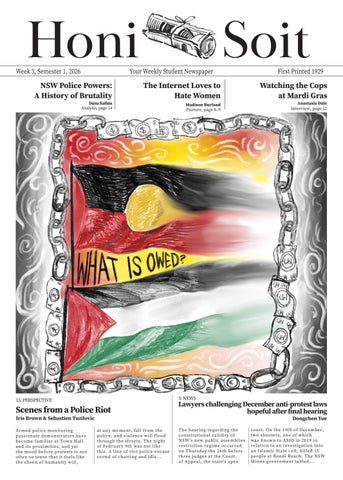
Scenes from a police riot
Sebastien Tuzilovic & Iris Brown protests
and journalists form around the discussion. We capture most of their conversation on voice recording. Packed in close we feel the hot breath of others on us.
Armed police monitoring passionate demonstrators have become familiar at Town Hall and its proximities, and yet the mood before protests is not often so tense that it feels like the sheen of humanity will, at any moment, fall from the police, and violence will flood through the streets. The night of February 9th was not like this.
A line of riot police encases a crowd of chatting and idle protestors. We slip through a gap in the line at different points, and then meet up in the crowd.
Speakers shout of injustice and Palestinian flags unfurl in the wind. A small black dot on a building behind the protestors is seen, the figures of several dark clad men made out, stark against the sky. Snipers perhaps, or drones –we wouldn’t find out. Speaker after speaker thunders on, and chants grow strong.
To the right of us, parting the crowd like wild dogs, two officers stride towards the steps leading up to the speakers and organisers. We wade through the crowd towards them. They speak to protest organisers, informing them that the planned march from Town Hall will not proceed. A cluster of onlookers
organiser addresses the crowd to disperse but it is too late and no one can hear him. The police march forward.
People cannot turn, trapped by the officers with nowhere to move to. Protestors are shoved into one another. Those who cannot walk back are pulled forward by the police and detained. We see a woman thrown to the ground, head knocked hard against the pavement and three policemen hold her down.
our friends we have lost in the approaching night, we have to move underneath Town Hall Station, reemerging onto the light rail stop. There we face another barrier of police officers. Quickly the crowd is enclosed, with no way in or out.
“This is not a dangerous crowd,” says Leong. “It’s not about danger. It’s about respecting the legislation, which you should be leading” retorts Superintendent Paul Dunstan, a slight smirk forming on his face, arms folded before him in a pose of affected and boyish supremacy. Cries of “Let us march” break out from the crowd. Rumours of the police orders began to spread. Confusion festers.
The police insist Leong orders the crowd to disperse. Dunstan threatens to call in five hundred more officers. “I don’t want a police riot on this street” Leong pleads. Dunstan responds “This is going to be horrible, Jenny.
“This will be horrible”. The conversation stalls, and the officers walk back to the comfort of their lines.
We push through the thick crowd of protestors to the front of the lines on George Street where the people are beginning to surge on. Familiar faces disappear in the mass as quickly as we spot them.
In front of the hall, Dunstan argues now with protestors. No decisive messaging comes from the police. “You can leave that way, that way, and that way” Dunstan gestures straight towards the police line. An
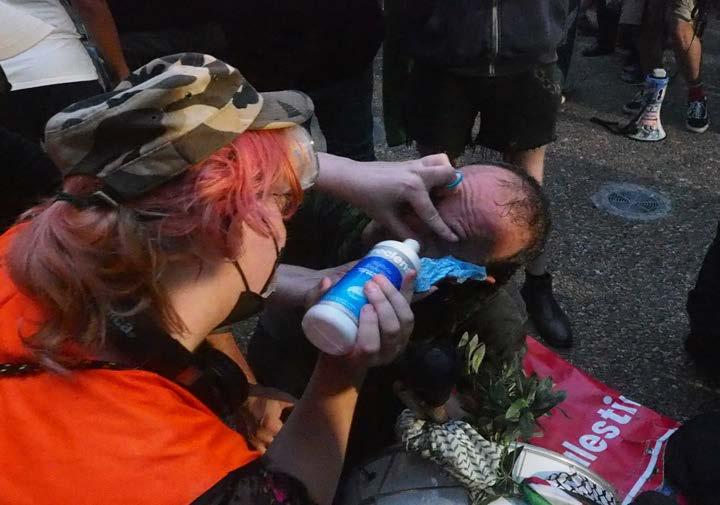
You taste the capsicum spray before you feel it, and it is bitter, and then your nose begins to run and finally the eyes sting and you will not be able to see, and it all happens in just a second but it will feel much longer to you when it does happen.
All around people pour water in their eyes, desperate to subdue the burning. Demonstrators are forced to stand on benches, us included, as there is not enough room. We hold each other close. The police push us forcefully off, into the crowd and onto the crowd. The spay makes it hard to breathe. People cling to one another, trying to help but having no way of doing so. The line converges on the protestors and the officers push almost lazily forward, the mass of their line several men thick marching upon the protestors.
They surge forward and we are pulled out, tossed beyond the line and into no-mans-land and around us police are pulling demonstrators down and arresting them and the cause for such arrests is unclear. An officer mistakes a little person for a child and tells us to look after him but the little person tells the officer to fuck off and the officer, suprised, walks away. We film arrest after arrest, and other officers approach us, demanding us to “move on”, pushing us away.
Darkness begins to fall and the dark uniforms of the police unify with it. To get back into the crowd and relocate with
They are crazed and their faces are tense and you can see like a wolf before carnage that they relish the violence of the night and that they love the power that their uniform affords them.
They charge at protestors, pushing them indiscriminately into trees and bollards. A family unrelated to the protest, dining at a restaurant on George Street, is lifted up by the officers, made conspirators of the crowd. We turn to the side streets to escape but officers are there already.
A pattern ensues, all the way to Central Station, of police forcing protestors down the street, holding them in place and then, without warning, charging again. The atmosphere is weary, and protestors are crying and begging to be let out, and some sit on the side of the road washing spray from their eyes before they are pushed on again by the officers.
Police try their luck one more time, scuffling with a crowd moving in the designated direction. As we enter the station, one of us feels a thump on their head, propelling them to the ground. Others fall around them. Fear and anxiety sweep over about getting crushed under the feet of the encroaching police. They stand quickly, and run away before the police approach.
Chants of “Free Palestine” and “Arrest Herzog” erupt before the station, and police begin to finally disperse. Inside Central and finally free, protestors walk dazed in the open spaces, in shock, not knowing where to move to or what to do.
It’s Actually OK To Dislike Things
Without Making It Woke
Oscar Masters thinks it isn’t always that deep.
In an age dominated by social media, platforms such as Letterboxd and Album Of The Year have made art criticism more accessible. These platforms, alongside platforms with a broader user base such as X (formerly Twitter), place intrinsic value on a post’s level of engagement, regardless of its intellectual merit.
Consequently, these social media users — many of whom are young, approvaldriven students like ourselves — construct their criticisms with engagement in mind, sacrificing nuance for definitive expressions of outrage.
Immensely viral tweets accusing Oscarnominated films Marty Supreme of being “zionist propaganda,” One Battle After Another of being racist, and Hamnet of being ‘artistically irresponsible’ are short and blunt criticisms that have one thing in common: their capacity to incite constructive conversation is dwarfed in comparison to the emotional weight they carry.
The mere implication that one may be committing a moral failure by defending or engaging in art is devastating and something many wish to avoid entirely, leaving people prone to regurgitating these claims without too much thought.
The
desire to be included in groups bound by ideology can imbue the most vapid of opinions with high stakes and depth; every word, every action, and every post is made as if it has to be deeply
convincing of some sort of internal value.
It’s exciting and rewarding — due to both social media algorithms and political culture as a whole — to apply complex political thought and logic to every simple expression of distaste.
It’s obvious that politics and art are inextricably linked, but these socio-political frameworks are deep and intellectual, and often very hard to articulate effectively, given the ever-shifting algorithms we communicate through.
This makes shallow instances of virtue signalling even more dangerous: genuine political issues are misrepresented to please engagement algorithms, subsequently alienating people from more pressing, uncomfortable conversations about the role of art in an increasingly anti-
intellectual and authoritarian society.
Engaging with the knee-jerk detestation of art is anti-intellectual in and of itself. When nuance is removed from discussions about the convergence of politics and art, as intentionally deceptive and outrageinducing algorithms encourage, the very foundations of these two important aspects of intellectual society are eroded and delegitimised.
It’s entirely in the favour of fascism to have moral critiques of art diminished to their most elementary states and applied erroneously — it transfers power from intellect to demagoguery, enabling censorship and limiting artistic expression based on the easily manipulated emotional impulses of the masses.
For instance, the previously mentioned “Zionist propaganda” criticism of Marty Supreme garnered over 21,000 likes on X and drew thousands of comments and quotes engaging with it.
The basis for the accusation? The fact that the film’s protagonist is a Jewish man who, at some point, talks about Jewish identity in an America set less than 15 years after the Holocaust. Or maybe, it’s about leading actor Timothee Chalamet’s distasteful ‘Hamas band’ joke on Saturday Night Live 2 years prior. But there is nothing in the film itself that is blatantly “Zionist propaganda.”
The virality of the tweet can be attributed to people’s immediate disgust towards Zionism, a reaction deservedly so instinctive to many that it can occasionally supersede critical thought.
Throwing out loaded accusations like these for engagement can cause people to dismiss art in its entirety, compressing their own analysis into simple and agreeable moral judgements, which additionally undermines the significance of the accusations themselves.
A more contentious example can be found in Emerald Fennel’s Wuthering Heights adaptation. The movie was panned by film critics for its insincere and ignorant portrayal of the intricate class and race dynamics present in the source material, with it being described as “cynical,” as if Fennel “did not understand the book herself.”
Meanwhile, the film was less thoughtfully lambasted on X for being “fucking evil and racist,” and a “racist woman’s whitewashed sex fantasy,” judgements that were developed in some cases months before the movie was released. Fennel’s Wuthering
Heights may be distasteful, and there is a legitimate argument to be made, due to the whitewashing of Heathcliff.
But to call it “fucking evil” is drastic and contemptuous, especially in a time when art is already facing existential threats beyond running the risk of being accused of being politically incorrect.
Watering down artistic and political critiques to emotionally charged value judgements plays directly into the hands of right-wing demagogues who benefit from anti-intellectualism and the fracturing of liberal and leftist ideology to amass control over artistic and academic institutions.
At the end of the day, we need to get over the urge to prove our self-righteousness and learn to separate personal distaste from important and genuine socio-political discussions.
Keep the shallow attempts at complex political discourse away from 280-character X posts, and don’t make your Letterboxd review a one-line, exploitative laden moral accusation.
Artistic expression is already under immense risk of censorship, and antiintellectualism is continuously damaging the ways we engage with art and politics as a whole.
It’s time we move on from exploiting the intersection of politics and arts for likes and acknowledge that not every criticism needs to be a moral judgment to be heard — it’s perfectly fine to dislike something just because.
Comma me, coward!
My dearest, Oxford Comma,
Siena Fagan
pledges her devotion.
How can I put into words the injustice you face?
For years, you have been dismissed as fussy, unnecessary, and elitist. You have been unfairly exiled from style guides and side-eyed in tutorials. The layman cries that you are inconsequential, but a stroke of ink used to stroke the egos of snooty writers.
How they fail to understand your value!
I have been waiting in the wings, indulging in you as my guilty pleasure and quiet rebellion for years. I have ignored grammar guides, and persisted against your opponents.
At the forefront is your clarity in listmaking. A famous argument for your protection is a made-up book dedication that reads, ‘This book is dedicated to my parents, Ayn Rand and God.’ Who is Ayn Rand? A Russian-American writer and philosopher. How did she meet God? Might have to flick through the Bible to get the gist, but an angel is involved. How did they become this author’s parents? Ask your mother.
One stroke difference and the Father is no longer the father. A dedication to one set of parents? Or a dedication to one’s parents, Ayn Rand, and also God?
The people yearn for minimalism, but at a curious cost. In an attempt not to look elitist, as the Oxford Comma allegedly implies, we have lost clarity and context that should drive our conversations.
A quick Google search indicates that the initial ostracisation of the Oxford Comma was to reduce ink costs in printing presses. It was expensive to have an extra comma. Thus, the symbol of status and elitism was born.
Language should not be economised. Not in an era of misinformation. Not in an era of artificial generation.
It is no longer costly to type an extra comma, yet the stigma prevails.
Words are a writer’s medium. They should be patchworked, woven, and stitched together with intention. A curator of language should seek clarity in organisation. They should seek to challenge norms and bend their craft.
So challenge it. Add an Oxford comma, or subvert an archetype. Jumble clauses and chop up sentence structures. Strive for your words to be art, in whatever abstract envelope sends your message.
History tells the stories of many rebels. My favourites are the ones armed with pens. Perhaps I will find myself in that book one day, but for now, I shall revel in my quiet rebellion.
You have my unending devotion, my Oxford comma, and my deepest apologies for humanity’s sins against you.
Siena
PS- I dedicate this letter to the Honi editors, Lord Byron, and Galileo.
Why is it so hard to enroll into a diploma?
Studying diplomas is almost unheard of in official university settings and in published university guidebooks. Not even the trusty USyd Reddit thread had any information. Diplomas are courses that many, including myself, thought were only available at TAFE, and are less culturally valued than a bachelor’s thanks to good-old neoliberalism and late-stage capitalism.
Last semester, I was internally debating whether to continue staying in the Arts component of my combined degree in Social Work and Arts.
I heard horror stories of the infamous FASS3999, which many of my friends described as “the most mind-numbing unit in existence” and “a complete waste of my time”.
OLEs were also a degree requirement that I dreaded simply because there were other elective units I wanted to pursue.
I was left with an ultimatum: overload this semester and enrol in FASS399 and OLE units to satisfy my Arts degree requirements, or drop the Arts component entirely.
Then I realised that I could do a concurrent enrollment with a Diploma of Arts that did not require me to do either FASS3999 or
any OLE units. What I didn’t realise is that enrolling into a Diploma of Arts would be the most extensive bureaucratic hurdle I would have dealt with in my three years at this university.
The usual process for concurrent enrollment is to complete the course management form and note that you want permission from the Arts and Social Sciences Associate Dean. What I did not realise was that those doing a combined degree with an Arts component will need to transfer into a singular degree first before completing the form.
Yet there is absolutely no information detailing this on the university website. It was only after weeks of waiting for a response that I decided to go to the student services to find out what was taking so long, only to find out that they sent an email to the wrong email address about needing to transfer to a singular degree.
At this point, it was the 14th of January, and the cut-off date for enrolling for the diploma was the 29th of January.
I was getting worried that I wouldn’t have enough time to transfer to a single degree, complete the form again, wait for the Associate Dean to approve my enrollment, and then apply for admission.
But the very thought of having to show up to FASS3999 classes each week and listen to surface-level lectures and mind-numbing group work and random OLEs is what drove
Aron Khuc is enrolled.
me to continue this annoying process.
Finally, after another round of meeting up with the Student Centre, this time for a technical issue of not being able to enrol for units in Sydney Student, I was presented with a vast number of units that I actually was interested in, and I physically jumped for joy at the thought of actually choosing electives that I wouldn’t have the opportunity to take if I stayed in my combined degree.
Students should not have to make the choice to switch into a diploma just to have more freedom with units they actually want to take, instead of being bound to FASS3999 and OLEs.
The implementation of FASS and OLE units is justified by USyd to develop students’ interdisciplinary knowledge and skills for ‘real-life situations’, that is, in the workplace.
Corporations and industry investors’ interests increasingly hold more weight over students’ quality of education. It’s clear how neoliberalism has entrenched itself into universities, degrading students’ learning experiences.
This is exacerbated by USyd’s lack of information about diplomas, which are not as profitable to them as an Arts Degree, as they are not required to complete either to pass the course requirements. But at least I have not shared the same fates as the other poor souls doing Arts Degrees.
Turandot at the Sydney Opera House (2026): A Contradiction, a Depth
Everything is dulled, grey, in a vision of a bleak Peking oppressed by the tyrant princess Turandot’s executions. The only glimmering things are moonlight, the glint of blood, and surgically sterile metal bowls that collect it from the heads of the executed. The ‘Popolo di Pekino’ (people of Peking) moan in terror, scream in agony, and whisper reverently in collective psychosis.
The executed are Turandot’s suitors who present themselves before her, accepting her challenge: answer her three riddles correctly and her, or die. Part of Turandot’s allure is her inaccessibility. Her suitors tremble with the agitation of the masculinist impulse to conquer and possess a woman.
The eponymous heroine is morally challenging, motivated by the memory of her ancestor Lou Ling’s rape to fiercely guard herself and deny any man the ability to deprive her of autonomy.
Directed by Ann Yee, this Sydney Opera House production of Giacomo Puccini’s Turandot teases out moral complexities in a rendition that eschews the historically Chinoiserie-obsessed and Orientalist productions of Puccini’s opera.
As recently as 2022, a Sydney Opera House production of Turandot was criticised for its glaring yellowface. Moreover, Yee brings into focus the criminally overlooked aspect of Turandot’s story — the intergenerational trauma of rape embedded in the character’s psychology. Playing Lou Ling, Hoyori Maruo writhes in an agonising depiction of her defilement, spewing black blood over her blue kimono. Turandot (soprano Anna-Louise Cole) sings to Calaf (tenor Diego Torre), the stranger guarding the secret of his princehood who dares declare himself a suitor: “my ancestress, dragged away by a man like you, like you a stranger, in that cruel night”.
Unlike the rest of Puccini’s verismo oeuvres, Turandot demands a Wagnerian
mythological dramatism. This brutalist production unfolds an expressionist, dissonant Peking ravaged by Turandot’s god-like rage.
set design and David Fleischer’s costuming grants Turandot the grandeur and severity afforded to Wagnerian oeuvres— her Imperial Palace and town are not adorned with the Orientalist trappings vases, tapestries, gold lanterns, sweeping fans, and teeming robes. Turandot’s palace is a prison. Yee said: “[It’s] a claustrophobic space that is mostly white, greyish, with this black materiality on the floor that oozes up the sides of the wall and there’s an ombre to the costumes, this black also coming up the costumes…”
The comic relief trio Ping, Pang, and Pong (Simon Meadows, Iain Henderson, and Virgilio Marino) who work in Peking’s Ministry add much needed levity. Dressed like postmen, they are wage-slaves trapped in a lovelessly modernised government bureaucracy.
In a quaint, delicately nostalgic number ‘Ho una casa nell’Honan’, the trio pines for home and nature, aptly reflecting our late-stage capitalist corporatised world: “I have a house in Honan with a blue pond, surrounded by bamboo…and I could back there!” They pray for an end to Turandot’s terror, an end that will only come with ‘love’: “you lie powerless in your husband’s arms…you lie vanquished and languorous!”
Yee is disillusioned with the onedimensional portrayal of Turandot as a demonic man-eater who is tamed by Calaf’s kisses. Rather, Turandot’s inner psychology and desires take centre stage. In fact, Yee draws a separation between the brutal illusion that Turandot projects and her actual vulnerable presence. Yee says: “I began to connect Turandot’s isolation to how we insulate ourselves today, through our screens…on social media, through our protected and projected selves.”
Artist and filmmaker Andrew Thomas Huang, who has made video art for Björk and directed FKA twigs’ cellophane music video, creates a visual representation of the brutal mask that Turandot affects. A gigantic moving visage, the mask is rendered in metal and jade stone, recalling the libretto’s words: “pale as jade, cold as that blade, is the fair Turandot.” The libretto by Giuseppe Adami and Renato Simoni specified for Turandot’s costume an “icy veil” which Calaf removes to
Kuyili Karthik is moved. Content Warning: Rape
forcibly kiss her. Creating a split between the heroine’s façade of impenetrable cruelty and her hidden humanity early on in the opera, Yee makes Turandot’s eventual choice to love Calaf seem less contradictory and forced.
The outward manifestation of Turandot’s inner psychology is the ancestor Lou Ling who revisits the stage in key moments, expressing crucial shifts in her character development. We come to understand why Turandot declares Calaf her husband at the end of the opera; she wasn’t simply clubbed into submission or wooed by his kisses, but she has traversed a moral gradient: “His name is Love!”
The libretto treads a murky binary epitomised by Turandot and Liù, which reads as femme fatale meets good-girl. While Turandot’s epitomisation of strength is her refusal to be defiled by men and self-elevation to heavenly sacred status, she comes to realise that in order to truly carry on the spirit of her ancestor, she must sacrifice herself in the name of love. The story implies strength and sexual purity are, in their truest form, submission to ‘love’ and possession by a man.
In relinquishing oneself to the allconsuming force of a man’s love, there, one finds true strength, as does Liù, beautifully sung by soprano Jennifer Black. Slave of Calaf and his elderly father Timur (bass Richard Anderson), Liù’s strength is in her devotion, submission, and unrequited love for Calaf. “I am nothing…a slave, my lord,” she says. In a sacrificial gesture paralleling Lou Ling’s death, Liù kills herself so as to not betray her master when she is tortured by Turandot’s guards. Calaf, though begging Turandot to have pity on Liù, chooses not to betray himself, allowing the torture happen on his behalf.
Ann Yee’s production sees Turandot brought to audiences who will not be alienated by the usual treatments of Puccini’s masterpiece as a flippant Orientalist day-dream.
Despite having never set foot in East Asia himself, Puccini drew inspiration for Madama Butterfly (1904), set in Japan, and Turandot (1924), which he never finished, from a Chinese music box of folk melodies including ‘Mo Li Hua’ (jasmine flower) which acts as a leitmotif. Like a jasmine flower, Turandot is described in the libretto as a perfume of the night and dawn, “lily-white”. Turandot is a contradiction, a depth, and is granted a previously unseen dignity and empathy this season.
The Moment: Substance and Spectacle
People file in, their faces saturated in the green glow emanating from the silver screen. It is a combined fan and press screening, two roles I (sort of) inhabit, an interesting duality of audience. On one side of me is a girl with hennared hair and Julia Fox eyeliner, on the other, a fifty-year-old man in business casual, typing into his notes app. I serve as a bridge between the two energies, something of a medium between two spiritual realms. Coloured strobe lights begin flashing, dancing across our eyes. The Moment was beginning.
The film is a mockumentary, but fans of mockumentary club classics like Best in Show may be disappointed. It is less a satire and more a campy, escalatingly stressful ‘based on true events’ film, like Marty Supreme or Uncut Gems , but starring the real person it’s based on. Directed by Aidan Zamiri, it stars Charli xcx as a fictionalised version of herself, existing in an alternate timeline in which she is coerced and convinced to sell out following the release of brat in 2024.
The film looks absolutely amazing, from the moment of the opening credits, a mix between Enter the Void and Possession , then revealed to be a music video shoot as an inane voice asks, “Can we take that again?”. The strobing credits continue across the film, filling in gaps and introducing events in a way that works much better than a typical location tag, often sneaking in quick jokes or emotional scene-setting.
The Moment explores the moments after “the moment”, the things after the “it” that made an it girl, satirising the repetition and bureaucracy of fame and self-promotion. Throughout the runtime, Charli xcx must contend with dozens of people buzzing around her ears, making decisions to facilitate their idea of perfection for her image, her brand, and her creative output — from the bullshit obligations that have nothing to do with
music or performing, like recording radio sizzles and attending promotional events for credit card companies, to her album tour.
The film is an effective send-up of wellness culture, celebrity worship, and the bureaucracy of communicating creativity within business institutions. Charli’s portrayal is one of nonchalance concealing neurotic, primal, bodily tension. She crashes a bank, slices her hand open, is told she looks old. Fans riot as their “brat” credit cards are cancelled. The whole audience was laughing for much of the film, understanding the hundreds of miniature pitfalls and annoyances that happen when a woman wants control over her life — countless repeats of being told: be yourself, but don’t offend or exclude anyone. It is very much a piece of ‘the now’, of social mediainduced meltdowns and manufactured moments, something somewhat missed by mainstream media reviewers.
The
Moment provides something much more interesting than an alternate timeline of what would happen if Charli simply sold out; it shows us a Charli who is experiencing a drastic fall from grace in the process of selling out. It’s an interesting and engaging look at
power, control, and public image.
The Moment is shot on film with evocative cinematography, and this is part of why it feels more at home in the family of narrative films than mockumentaries, though it is full of clandestine shots through exteriors or ajar doors, which clearly borrow from the genre. The supporting cast gives excellent, often unnerving performances, playing their part perfectly in the final quarter of the film when it becomes deeply unclear what the truth is, when the film becomes a motion blur.
Kylie Jenner plays a fictionalised version of herself in one superbly memorable short scene, making you wish she were in more of the film as a perfect Californian wellness family-money foil to Charli’s British self-made neurosis.
In parts, it is much like the non-stop psychedelic distress of Enter the Void director Gaspar Noe’s lesser-known Climax . The film is also reminiscent of Substance , sharing a bile-green motif, an atmosphere of encroaching tension and secrecy, exploring fame, aging, control, and the self from the perspective of a high-profile woman. It may surprise some
Anastasia Dale is fascinated.
that it also shares with The Substance some slight body horror aspects, certainly bodily anxiety and a bit of blood, if not all the way into horror.
Charli has an understandable tendency toward inhabiting the persona of a dancepop-star rather than being an actor, ensuring she maintains a glamorous, nonchalant veneer for pretty much every scene. She is obviously not angling for an Oscar, and a large point of the film is clearly to consolidate her brand and provide a fun moviegoing experience for her fans. Far be it for me to be overly critical of a person portraying themselves, but even for the role of world-weary star, her face is notably still for most of the film.
It’s hard to work out if the intensely emotional monologue at the end, where Charli meditates on ‘what it all means’, ending with Bittersweet Symphony blasting from the movie theatre speakers, is genuine or not. If it’s satire, it’s the subtlest and most admirable aspect of the film.
Fans of Charli will not be disappointed. The Moment is a film with decent substance behind its already impressive spectacle. One identifies with the woman they see on screen. Many of our lives feel equally beyond our own control on a smaller scale, a different modality, but with the same level of ever-approaching dread.
President Grace Street (Grassroots)
Welcome to Week 3! Last week saw the SUPRA x SRC x Student Life ‘Welcome Fair’ in the Great Hall which was a great success and offered a model of orientation activities that are student-led, more intimate, and less corporatised. We will work to bring this back in Semester 2 for you! We also had our March SRC meeting for councillors and officebearers. The coverage of this by Honi Soit will be out soon and the minutes on our website ASAP.
This week, importantly, is the NATIONWIDE STUDENT STRIKE FOR PALESTINE! Join us on Eastern Avenue at 1pm on Wednesday 11 March before we march to Town Hall to meet up with other university student contingents. Our peers in Gaza have no universities left, and it is our duty to fight for them and to fight against the complicity of our own university.
A current challenge I am navigating with the SRC is political freedoms on campus and restrictive university policies. We have long decried the Campus Access Policy 2024 and ‘five key policies’ implemented in 2025. We now see how they are being enforced to stifle and restrict student organising. An important protest against the war on Iran
General Secretary
Hey divas, the University semester is underway! I’m sure you’re all excited for your 2026 academic journey. It can be tempting to stay in the comfort of your bed and watch your lectures at 2x speed, but you should probs wait until at least week 5 before you fall into this habit.
We submitted and passed the annual SRC budget at the March council with relatively little controversy. Our boosting of the Education Action Group (EAG) reflects our stance that the SRC needs to be right beside the NTEU in this year’s enterprise bargaining. Teacher working conditions are student learning conditions. We are now working on SSAF Acquittal. Also, there are still a lot of tote bags, come down to the SRC office to grab one.
Welfare
was told it was ‘unacceptable’ because they notified the University half a day late about it, despite the University admitting they were aware due to online and physical posters. A planned stall for this past Monday to hand out SRC tote bags and build the student strike was automatically rejected since it was not submitted for approval a week in advance. The University should not be deeming – arbitrarily, at that – what is ‘acceptable’ or ‘approved’ based on policies brought in after the 2024 Gaza Solidarity Encampment to quell dissent.
Vice President
Welcome to Week 3!
I have been working hard with the International Student Collective in outlining our events for this semester. With the University fixing its venue booking system, we look forward to an induction/welcome to the Collective event very soon!
In addition to working with the Collective, I have attended various meetings in my capacity as VicePresident. This has included SRC Council and Academic Board in the past week. Both meetings mentioned the increasing in cost of the Subclass 485 Temporary Graduate Visa. I believe it is also prudent to make space in this report to address this decision.
representatives. It was done quietly, overnight, and came as a shock to many international students. In a political climate where immigrants are often wrongly taken as scapegoats for various issues, the increase in the cost of the 485 sends a stark and clear message to international students that they are simply not welcome. Additionally, given the cost of living crisis, it adds an unnecessary burden to international students who are looking to remain in Australia and contribute their skills from their degrees to this country. I think I speak for all Councillors and Officebearers of the SRC when I say this decision by the Labor government should be strongly condemned, and indeed, reversed.
You can, and should, get involved with the campaigns to fight these injustices through our student-run SRC collectives. Check out our website and social media for more details about how to get involved and updates on these existential issues threatening all that the SRC does and stands for.
In Solidarity, Grace
Vince Tafea (Grassroots)
Ava Cavalerie (NSWLS)
Importantly, there is a Student Strike for Palestine on this Wednesday at 1pm on Eastern Avenue. Not only is this an opportunity to show your solidarity, it is also a chance to express your rejection of the university’s use of our money in funding research for weapons companies.
In the latest USU board meeting, President Phan Vu didn’t know “if the wider student body has objections to [it]” with respect to the USU’s partnerships with BDS targets complicit in genocide. She must’ve not been on this campus the last 2 years. In any case, Israeli Apartheid Week has been slated for Week 5 and Vince will be out then on Eastern Avenue to see if this is the case.
In Solidarity, Ava & Vince
Deaglan Godwin (SAlt)
Connie Wong (Penta)
There is a lot happening in the world right now. The US and Israel have bombed Iran for the past week in an act of imperialist aggression. Our Prime Minister, Anthony Albanese, disgracefully lent his support to this. Australian sailors were on a US submarine that sank an Iranian ship off the coast of Sri Lanka, killing 80 people. Our governments find endless money for war, yet there is never any money for welfare, education or healthcare.
Over the past few weeks, I have been active getting the word out about the Student Strike for Palestine, which is happening this week (on Wednesday March 11). Join us to oppose our university’s complicity in the genocide in Gaza!
Deaglan, Welfare Officer
On campus, the Welfare Collective is looking forward to collaborating with USYD societies this year and bringing useful SRC resources across areas like safety and wellbeing, academic support, and student welfare to the broader student community - we want to understand what you’re going through, and work together to find solutions, but in a way that feels relaxed and genuinely fun. We’re planning to reach out to some of your favourite societies on campus, so keep an eye out!
And don’t be shy to come join us in the near future for secret merch, good food and some good advice, and if you’d like to get involved with the Welfare Collective, we would love to have you. We can’t wait to do something great together.
Connie, Welfare Officer
The doubling in cost of the 485 from $2300 to $4600 was done with no prior consultation with the tertiary education sector or student
Ethnocultural
It’s only Week 3, and ACAR is in full swing! We hosted our welcome dinner and held our first organising meeting of the semester. Special thanks to all our new members who attended and provided fresh, exciting ideas for the year to come.
As you may know, we are demanding the USU to cease all partnerships with companies on the BDS list and complicit in the occupation of Palestine. Unfortunately, the USU has doubled down on their partnerships, with their President saying that they “don’t know if the wider student body has objections to” these sponsorships. ACAR condemns the USU’s flippant refusal to rule out relationships with companies supporting human rights violations and breaking international law. For more info, see @bds. movement on Instagram.
In recent weeks, Iran has faced an illegal invasion by ‘Israel’ and Amerikkka. We condemn this attack which has been used to compromise the autonomy of Iran. We reiterate
Refugee Rights
In solidarity, Bohao
that we do not support the Islamic Republic nor a return of the Shah ruling over Iran. The just way forward is for the people of Iran to have democratic control and full freedom in the runnings of their nation.
If you are reading this on Wednesday, don’t forget about the Nationwide Student Strike for Palestine at 1pm today on Eastern Avenue! Then spend your evening at our Iftar & Film Screening at 5pm, where we’ll be watching “No Other Land” followed by FREE dinner! Find us on Instagram @ usydacar for more details.
There is also the International Day for Elimination of Racial Discrimination rally, on Saturday March 21 at 12pm, Hyde Park.
Israeli Apartheid Week has been called for March 21-28, which will be in Week 5. ACAR Honi will also be launched in Week 5.
From Gadigal to Gaza,
Pimala Leo (Grassroots), Jiahui Chen (Penta), Tiana Moore (SAlt), Laura Alivio (SAlt)
WEDNESDAY 11TH MARCH. NATIONAL STUDENT STRIKE FOR PALESTINE. 1PM, AT EASTERN AVENUE.
FUCK THE BORDER FORCE.
FUCK ICE.
WE DEMAND GUARANTEED ASYLUM FOR ALL REFUGEES.
Bohao Zhang (Penta)
Shovan Bhattarai (SAlt)
Imane Lattab (Grassroots)
Pimala Leo (Grassroots)
Staying on Track: Time Management Tips
What is Contract Cheating?
Time is precious!
Managing your time effectively reduces stress and allows you to enjoy, not only your studies, but your leisure time. At University this might mean balancing all your readings and assessments, with work, a social life and home responsibilities. It’s like a budget for your time. So, here’s some tips to help you make the most of your time.
Get the SRC’s free year planner that allows you to see all your commitments in one glance. You can use this to write down the due dates of your assessments, so you can plan your preparation for tasks well ahead.
The University’s Learning Hub has a Time Management module which has weekly and daily planners that you can fill in to structure each week. It’s free and easy to find if you do a search for “Learning Hub Module 10”. This resource enables you to allocate time for a study, work and fun!
Think about where and when your concentration is best. Do you study most effectively in the morning, or in the evening? Is it helpful to study in a quiet environment, away from distractions? For instance, many students find they focus better when they study at the library, and then their home time is free for other activities.
Some students think that having a smaller study load will mean they will graduate later, but the reality is that you will progress more quickly, and at less cost, if you do three subjects and pass them all, than if you attempt four subjects and fail some. Completing your university studies is a marathon, not a sprint! Pace yourself.
Avoid dangerous short cuts! When completing any assignment, take the time to check that you have correctly referenced, and be mindful
to paraphrase as you go. No matter how busy you are it is not worth risking a Fail grade, because you have plagiarised, either deliberately or accidentally. Buying an assignment from someone or using AI is likely to be discovered by the Uni and may lead to a suspension from Uni or other penalties.
Ongoing Problems with Time Management? Sometimes poor time management can be caused by other factors, such as perfectionism and procrastination. The University’s Student Counselling Service has some online resources, and you can also talk to a counsellor to get some strategies.
ADHD is also a major cause of time management difficulties. If you have a diagnosis, you can register with the University’s Inclusion and Disability Services to get adjustments, like extra time for your assessments. There are lots of support groups that share information on techniques that help to start tasks, remain focused, and manage the anxiety around ADHD. There are plenty of online and app resources some of which are free, so take your time to find whatever works best for you. If you have not got a diagnosis but think you might have ADHD or a similar condition, talk to your GP or psychologist about getting an ADHD assessment.
Talk to your lecturers and tutors to let them know what you find difficult, and what they might do to help you to succeed. Sometimes you cannot get things done, because there are too many demands on you. If you need to work, or have other responsibilities, consider taking a reduced study load. Before dropping any subjects, check with a Faculty Academic Advisor about a plan for the structure of your degree. International students will need to have compassionate or compelling circumstances.
If you concerned and not sure what you to do, please talk to an SRC Caseworker. We offer a free, confidential, nonjudgmental service, that is independent of the Uni. We are happy to help!
Ask
Hi Abe,
I keep getting sick because of long covid. I always feel tired and find it really hard to get things done. Is there any supporting that the uni can give me?
Covided.
Hi Covided,
I am sorry to hear you are dealing with this. Anyone who suffers from a long term medical condition, has a disability, or is the primary
carer for someone with a long term medical condition or disability, can register with the Uni’s Inclusion and Disability Unit. Talk to them about what adjustments you need to enable you to pass your units. If you experience an exacerbation (worsening) of your condition, and this makes it difficult for you to complete an assessment, you can apply for special consideration. For information about the supporting documents you will need talk to an SRC caseworker.
Abe
For more information about SRC Casework Services: srcusyd.net.au/src-help/caseworker-help/
Our much loved planner is an A1 printed poster with USyd teaching weeks, exam dates and all important USyd dates and deadlines. Collect a free copy from USyd libraries, Honi Soit stands, or the SRC Office, open Tues–Thurs, 9am–5pm, Level 1, Wentworth Bldg, City Rd. Or download a print-at-home version: bit.ly/SRCwallplanner
FREE while stocks last!
1. Medieval philosopher, author of Summa Theologica
3. Unidentified woman
5. Simpson’s mum
7. Horse and cart people
9. President who was famously “not a crook”
11. Obama’s last name
13. Meat market
15. Betrayer of Dido, founder of Rome
17. We’re still waiting for him
19. Friend of Frog
22. Classical composer, teacher of Mozart
24. Suburb near USyd
27. University specialisation
28. Eve’s favourite fruit
29. When the imposter is sussy
30. Absence of gender
Dusting Off the CObwebs
1. Regency novelist
2. Looksmaxxer drug
3. Snoopy when he is wearing shades
4. Computer internet connector cable
5. Engel’s sugar baby
6. Drought stopper
7. Swedish Eurovision band
8. Furniture store, good meatballs
10. American immigration agents
12. Large
14. German Fuhrer’s wife
15. Ivory tower, you are in it right now
16. Learnt about in PDHPE; abbr.
18. I be pondering this
20. Jackie Kennedy’s 2nd hubby
21. Elementary school project
22. Pilgrimage to Mecca
23. Once around the sun
24. Gwenyth Paltrow bullshit
25. Brontë heroine, Jane ____
26. Person that creates this newspaper
Quiz
1. What is the term for a media personality who expresses deliberately provocative or offensive opinions?
2. What does NTEU stand for?
3. Who was the first sitting Australian PM to visit Israel?
4. When was the NSW Police Mounted Unit created?
5. What is friendlyjordies’ real name?
6. Of whom did Donald Trump say “I wish her well” while she was facing criminal prosecution?
7. Which of these films did the White House NOT use unauthorised clips of in a recent propaganda video on X: Braveheart, John Wick, District 13, Transformers
an
Answers: 1. Shock jock, 2. National Tertiary Education Union, 3. Bob Hawke, 4.
After
1825 ‘conflict’ with the Wiradjuri people, 5. Jordan Shanks,
6. Ghislaine Maxwell, 7. District 13
Last week’s crossword answers
ACROSS: 1. Peanuts, 5. Avacado (apologies, the person who wrote this is incapable of basic spelling. Rest assured this will not happen again), 8. Alpha, 10. Ached, 12. Elmo, 13. Deli, 14. Fool, 15, Rent, 16. Adish, 20. Ushanka, 21. Lebanon, 22. In, 23. On, 24. S inatra, 26. Frosty, 28. Aisha, 29. Bang, 30. Lion, 31. Uber, 34. Acid, 36. Geese 38. Tenor, 40. Eargasm, 41. Othello DOWN: 2. Amp, 3. Ural, 4. Solo, 5. ADHD, 6. Anal, 7. Ash, 9. Hella, 11. Circa, 16. Akira, 17. Danai, 18. Slosh, 19. Henna, 25. Angus, 27. Wilde, 32. Beta, 33. Roo m, 34. Afro, 35. Itch, 37. Ear, 39. Nil
Sophie Wishart Comic by
ISRAEL BOMBED
Israel recently apppeared at an standup comedy event labelled “the Eurovision of standup comedy”. Israel was apparently set to be one of the frontrunners, according to a poll put out by The New York Times which put Israel’s chances of winning at 300%.
However, by all accounts, the settler-colonial project younger than most people’s grandparents completely bombed its set.
The tight five was reportedly “viscerally uncomfortable” to watch, with some even saying it was “worse than Joe Rogan”.
The set opened with “Hello I am a comedian from Tel Aviv and this is my comedy” and was allegedly only downhill from there.
A country which would like to remain anonymous stated to Honi: “Before the open mic, Israel was talking such a big game, saying that people’s laughs were promised to them 3,000 years ago. Well, I guess people don’t always keep their promises.”
The crowd was apparently so silent you could “hear an AirPod drop”.
Even Australia and the US couldn’t manage a few pity laughs, however they later put out a joint statement saying they were “simply silent due to awe at the mastery of comedy displayed”.
#WhatsTheDealWithIsrael is now trending.
PALANTIR ANNOUNCES NEW INCEL FELLOWSHIP
Following the success of their Neurodivergent Fellowship, Palantir has created a new Incel Fellowship. All those who are involuntarily celibate are encouraged to apply. The Fellowship was announced at a recent conference in Tel Aviv.
Peter Thiel stated: “Incels will play a disproportionate role in shaping the future of America and the West. This program is designed for those who think differently, and that’s the point. Whether you’re self-taught, formally educated, or somewhere in between, we’re looking for people who can see patterns others miss and solutions others overlook.”
Alex Karp, known to many as ‘the other Palantir guy’ or ‘that guy who’s always on coke’ interruped Thiel’s address, yelling “This is a recruitment pathway for exceptional incel talent. This is not a diversity initiative. Incels are special. They are the future.”
Karp’s statement on diversity spurred questions regarding femcel inclusion. Neither Thiel nor Karp replied as they began descending through the floor into somewhere that looked very warm, stating they had an “important meeting with their biggest investor”.
The terms of the fellowship include the incels being given free access to the biometric data of any woman in their life, and the opportunity to receive physiognomy-restructuring surgery in lieu of pay after five years of service to the company.
IMPENDING GLOBAL RECESSION SEES ADVENT OF INTERNATIONAL UNEMPLOYED WOMENS’ DAY
What once began as International Working Womens’ Day under the Soviets has now had to capitulate to the multiple recession indicators, labeling itself International Unemployed Womens’ Day.
This comes after increasing prevalence of “unemployed girlie” and “bedrotting” content on TikTok and Instagram, showing women in droves spending their days either walking around aimlessly, buying cheap consumable goods, or lying in their beds and doomscrolling. An alternative is tradwife content, where unemployed women engage in domestic labour and go on similarly aimless walks.
The fight for women to work and vote now seems fruitless in a time of mass unemployment and the rolling back of democracy. Honi wonders what has historically happened under these conditions?