WHAT IS THE USU BOARD, AND WHAT DOES IT ACTUALLY DO?
The University of Sydney Union is the body that runs most of what students actually touch on campus. The clubs and societies you signed up for during Welcome Fest, the cafes you queue at between classes, the autonomous spaces in Manning, the Food Hub at Wentworth, the live music nights, the debating program, and the $5 laneway meals that have become the most genuinely popular thing the union has done in years are all USU operations. Behind all of that sits a Board of Directors, currently fourteen people, of whom eleven are elected by students, two are appointed by the University Senate, and one is the Immediate Past President carried over from the previous cycle. The board sets the strategic direction of the union, signs off on the budget, hires and oversees the CEO, and makes the harder decisions about what the union does and does not put its name to.
Incorporation only got across the line last month, after multiple previous boards had tried and failed to push it through. The USU is now a registered company limited by guarantee. Directors have proper fiduciary duties under the Corporations Act, the union can sign contracts and take on loans in its own name, and the personal liability that used to attach to individual directors if the union got sued or went under has been substantially reduced. The candidates contesting this election will be the first cohort of directors elected entirely under the new structure, which makes the next two years a genuine test of how the post-incorporation USU actually operates in practice. Day to day, very little has changed for the average student. Structurally, almost everything has.
This year there are five board seats up for election, with a requirement that at least two of those five go to women or gender diverse candidates. Eleven candidates are contesting. Of those, seven are studying Law in some form, which is an unusually concentrated field and one that nearly every candidate Honi interviewed acknowledged was not particularly representative of the broader student body. The cohort skews heavily towards second and third years, with one first year and two postgraduates rounding out the field.
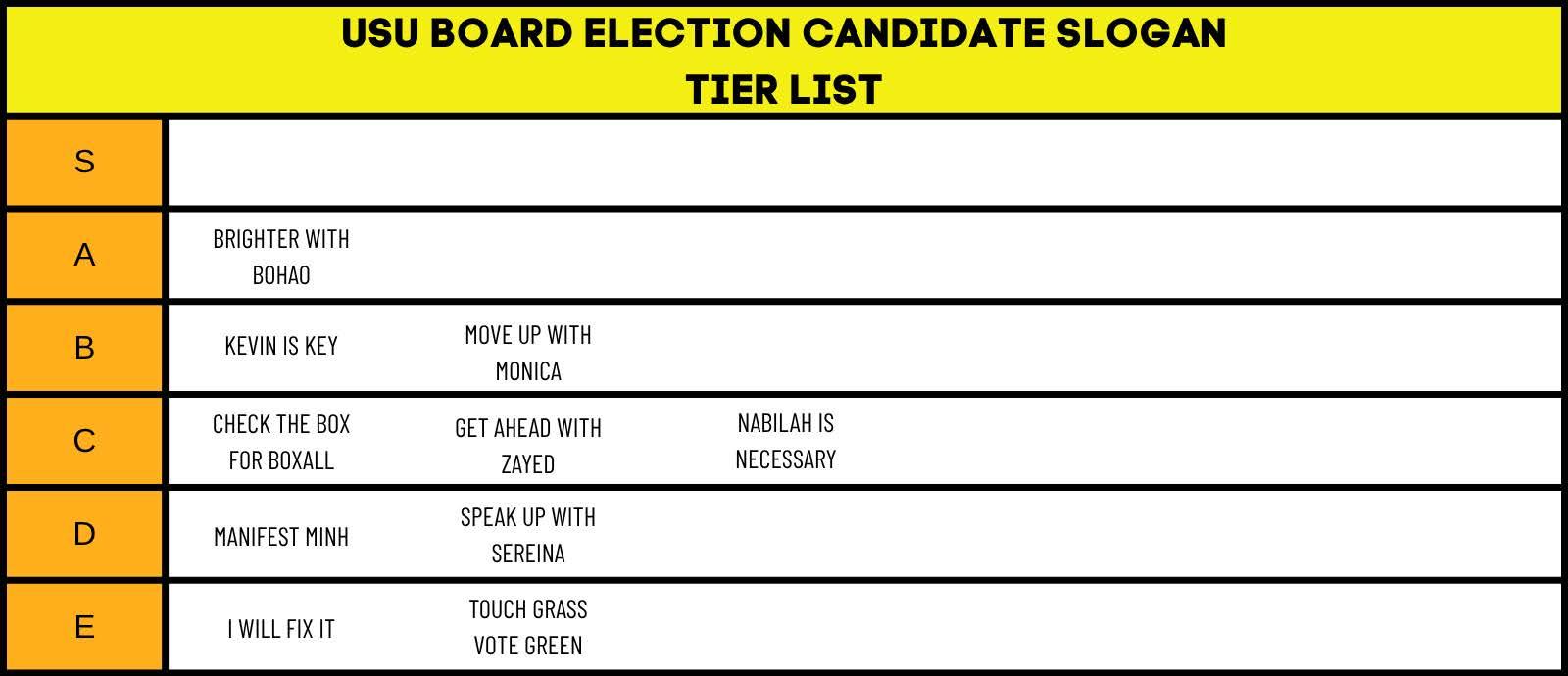
In person campaigning starts on 11 May, and from that day onwards Eastern Avenue will be impossible to miss. It will be carpeted in coloured t-shirts, every candidate will have a slogan printed on their shirt, their campaigners mingling around the surrounding areas, and the queue between Fisher and Carslaw will become a slow-moving gauntlet of polite-but-insistent pitches. If you are politically disengaged and have no interest in any of this, you have Honi’s partial sympathy. The campaigners will still find you.
What makes this election genuinely interesting to watch is that the voting blocs are unusually fragmented. There is no single dominant ticket. Penta is running its international student campaign through Bohao Zhang, Unity is putting James Green forward after topping the Honi quiz two cycles in a row without converting that performance into a board seat last year, and NSW Labor Students has Zayed Tabish. There is also a Liberal candidate in the field, although that candidate did not sit the Honi interview and so does not appear in the profiles that follow. The remaining seven candidates are running as independents, which is broadly the same proportion of independents that contested last year’s race, although as the individual profiles make clear, the independent label covers a wide spectrum from candidates with no factional history at all to candidates whose campaign teams suggest closer ties than the branding admits.
That fragmentation is what makes the preference flows interesting. With five seats, eleven candidates, and no clear bloc capable of running a full ticket, where each campaign sends its preferences once their primary candidate is either elected or eliminated will likely decide who fills the last two or three seats. Pref deal negotiations between campaigns will happen over the next two weeks, and the dramas that come out of them, when they come out of them, are usually the part of the election that gets remembered long after anyone can name who actually won. Voting opens 18 May and closes 22 May. Read the profiles. Make a plan. Show up.
Disclosure: Marc Paniza was not involved in the writing of the profile for Zayed Tabish, with whom he is close friends. That profile was written and edited by other members of the Honi team.
JAMES GREEN
QUIZ: 84.8%
SLOGAN: Touch grass, Vote Green
COLOUR: Green
FACTION: Unity
CAMPAIGN MANAGER: Leo Moore
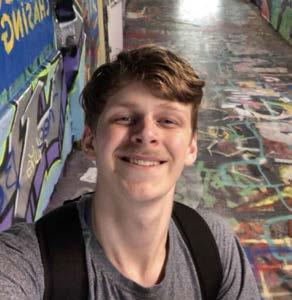
James Green is contesting this year’s election as a third year Economics and Law student running on the Unity ticket, with Leo Moore as his campaign manager. Many students will know him as the person behind the SydneyLawJames satire Instagram account, which has been a fixture of the law school online community for a while now, and James was upfront with Honi that the journey from a satire account to a serious USU board candidate is not necessarily a linear one but is one he is fully committed to. His slogan, “touch grass, vote Green,” works in two directions, both as a play on his surname and as a deliberate framing device to position himself as the candidate who is most focused on practical, deliverable governance reform rather than the more aspirational policy positions other candidates have built their campaigns around.
His quiz score of 84.8% is the highest in the field, narrowly edging out Zayed Tabish at 84.3%, and it continues a pattern that Honi has now observed across three consecutive election cycles. James Dwyer topped the Honi quiz in 2024 and went on to be elected and serve as USU Treasurer, where he is widely credited with strong financial stewardship. Leo Moore topped the quiz in 2025, although Leo did not get elected to board. James Green topping the quiz in 2026 fits squarely within Unity’s strategy of running candidates who are visibly across the operational and constitutional detail, and the campaign will be hoping that the quiz performance translates this time into the numbers needed to actually get over the line. He scored full marks on more than half of the twenty-five questions and answered every section with notable depth. The one acronym that defeated him was the ACNC, which he asked Honi to skip and then repeatedly chose not to come back to, even when offered the chance, before eventually defining it correctly off the record after the quiz had ended. He was openly competitive about the quiz result throughout, asking Honi during the marking how he compared to other candidates and pushing for confirmation that he was in the top one or two.
The interview was substantive across the board. When asked to describe his politics without using the standard left-right vocabulary, James gave a genuinely articulate answer about equality of access being empowered rather than tempered by practical delivery within institutional constraints, which is essentially the Unity worldview written out in long form. Asked to differentiate Unity from the other Labor factions on campus, he gave one of the cleanest factional explainers Honi has heard from any candidate, drawing the social democrats versus democratic socialists distinction and arguing that NLS and NSW LS lean towards substantial change that may not be deliverable while Unity focuses on continually delivering reforms within institutions.
On BDS he was carefully qualified. He told Honi he supports the principle and would not renew partnerships with BDSlisted companies including Coca Cola and McDonald’s, and confirmed he would not have signed off on the Welcome Fest sponsorship as a director. He pushed back, however, on the petition that was given to the board calling for the union to cut all current ties with BDS-listed companies, including replacing every Dell monitor in USU buildings, on the basis that the financial cost of doing so would be impractical. The position is internally consistent and one of the more developed BDS answers in the field, although it does mean voters should weigh how the principle might survive contact with the practicality argument once the cost of any specific decision comes into play.
His three headline policies are a USU-owned discount grocery store in Wentworth modelled on the existing one at the University of Wollongong, a new Campus Life Committee designed as a governance reform that brings campus activity coordinators and society presidents from groups like SUDS, SURG and Film Soc into a regular structured forum with board directors and staff, and reform of the USU complaints process to provide proper anonymity for victim-survivors, who he says can currently have their identities revealed to the person being complained about. The third policy in particular has clear personal weight behind it.
A moment that connects directly to another candidate in the field came when Honi asked which other four directors James would most want to work with on the board. The first and only name he volunteered was Hoang Minh Le, citing alignment on cost of living and community inclusion. Honi has previously observed Minh having drinks with Leo Moore, who is James’s campaign manager and who himself ran on Unity last year. Minh has separately told Honi that the one candidate he most wanted to work with on the board was James, citing the SydneyLawJames account. Two candidates each naming each other as their first preference for collaboration, with one of their campaign teams already crossing over socially in advance of the campaign, is not a configuration that survives much scrutiny as coincidence, and voters can decide for themselves how they read it against Minh’s own positioning as a politically unaffiliated independent.
On the law student question James said the over-representation was unfortunate and that he would have liked to see candidates from engineering, arts and commerce in the field. He picked the courtyard apple cider as his favourite drink on campus, and said his red flag was that he might “touch so much grass” he ends up logging all the other candidates.
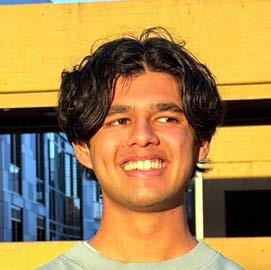
ZAYED TABISH
QUIZ: 84.3%
SLOGAN: Get Ahead with Zayed
COLOUR: Hot Pink FACTION: NSWLS
CAMPAIGN MANAGER: Ava Cavalerie, Lucy Sullivan, Jessica Heap, Sargun Saluja
Tabish’s quiz score of 84.3% was the second-highest in the field, narrowly trailing James Green’s 84.8% and placing him among the most prepared candidates Honi interviewed this cycle. He scored full marks on board composition, conflict of interest, the AGM versus SGM distinction, and was strong on BDS, the partnerships and advertising policy, and director liability before and after incorporation. Where he stumbled was on the strategic plan content, the Disability Inclusion Action Plan framework pillars, and the supporting strategies, which is the same gap that has caught out most of the field.
When asked about his three major policies, Tabish listed the following as most important to him: He wanted USU to respond to all business communications within 5 business days, although did not elaborate on how this would be executed. Tabish expressed concern for accessibility, and emphasised the importance of reinstating Recite Me, the assistive technology toolbar that previously sat on the USU website and provided screen reading, text-to-speech, translation, and visual customisation tools for students with disabilities, but which the USU has since removed. His final policy, and self-identified favourite, was to enact the plan for Chester the Biodigester. Tabish explained that Chester the Biodigester is “a large machine that can turn organic waste into compost within 24 hours, and it would be really useful for managing a lot of the waste on campus.” When pressed on what “the plan” actually consisted of, Tabish was not able to articulate a specific implementation pathway, leaving Honi unclear on his future plans.
Tabish did not take credit for the idea, claiming that “this has been a policy that’s been floated around for many years.” and stating that he “did know it existed,” but whether Tabish knows if Chester does currently exist remains unknown to Honi. During the International Compost Awareness Week, a news article on the University’s website, encouraged students to visit Chester on Campus, with Tabishs’ plans remaining unclear considering the initiative is currently active.
Without using defining terms like left-wing or right-wing, Tabish described his politics through specific positions he supports, including a strong social welfare system and well-funded public institutions. He spoke to his sense of social justice, telling Honi that “as a child of immigrants, and as someone coming from a Muslim background,” this manifests in a belief in equal opportunities. He joined the ALP through his advocacy work for the 2023 Voice Referendum and chose NSWLS over Switch and Grassroots because his politics most aligned with that faction.
When asked to differentiate between NSWLS, NLS, and Unity, the three Labor factions active on campus, Tabish framed the distinction primarily in terms of pragmatism, with NSWLS positioned to the left of both other factions. He told Honi that Unity’s politics tend to be what they themselves define as pragmatic and more centrist, while NLS sits closer to NSWLS but parts ways on similar questions of pragmatism, and that NSWLS is in his view the most left-wing of the three Labor factions on campus. He did not go further into what those specific pragmatismrelated differences look like in practice, though the framing broadly aligns with how the three factions tend to position themselves nationally.
When asked to name one of the negative aspects of the USU, Tabish again referred back to the lack of active correspondence from the USU, stating, “respond to those damn emails.” Tabish expressed he was aware of multiple student’s experiences, having to wait for weeks or sometimes months, in receiving vital correspondence from USU staff that he felt was often “day-of” correspondence. When Tabish was asked about one positive aspect of the USU, he said the incorporation process was consistent with students’ wishes and concerns. He spoke to the fact that USU Incorporation failed in the first round due to student concerns, stating that “The USU took these [concerns] on board and then provided a much more compelling argument to give to the students”
Tabish gave one of the most substantive answers on BDS that Honi heard from any candidate this cycle, and the depth of his preparation on the issue was clear throughout. He told Honi he had raised BDS at a USU board meeting in March and had also spoken on the issue at NUS, demonstrating an existing track record on the policy rather than just a campaign-season position. He addressed the standard fiduciary duty objection head-on by pointing to the USU constitution, which he argued obliges the union to represent the views and best interests of the student community, and was confident that the financial-interest framing typically used to block BDS motions does not survive proper constitutional analysis. When Honi pointed out that previous candidates had run on similar BDS-integration platforms without managing to deliver once on the board, Tabish acknowledged that “policies that any candidate makes are not a guarantee” and that resolutions require negotiation and majority support, before laying out a clear three-step plan: lean on the constitutional argument, bring the issue to a Special General Meeting if necessary, and work with directors who disagree to find a workable path through. The clarity and the implementation pathway both stood out in a field where most candidates either hedged on BDS or supported it without explaining how they would actually get it through.
WILLIAM McCARTHY
SLOGAN: I Will fix it
COLOUR: Tumeric Yellow QUIZ: 81%
FACTION: Independent
CAMPAIGN MANAGER: Archie Wolifson
Will McCarthy is contesting this year’s election as a second year Arts/Law student majoring in international relations, running as an independent on the slogan “I Will Fix It,” in yellow with a Bob the Builder visual concept that ties the campaign together. He is openly queer and has framed mental health as the central policy commitment of his campaign, drawing on what he described to Honi as deeply personal experiences in his own communities. He is also a debater, which is worth flagging because it means that of the seven Law students contesting this year’s election, an unusually high proportion of them have come up through debating circuits, with Bohao Zhang attributing part of the law cohort’s mobilisation to Archie Wilson’s targeting of the debating community in his successful 2025 campaign. Will fits squarely within that pipeline, and Honi has now interviewed enough debatercandidates this cycle to wonder whether the quietly confident, well-rehearsed answer is becoming the default house style of the race.
His campaign manager is Archie Wolifson, who is a current sitting USU board director. There is no rule preventing a sitting director from running another candidate’s campaign, but it is a notable arrangement and one voters should be aware of when reading what is genuinely a polished campaign operation. Archie clearly put serious work into preparing Will for both the quiz and the interview. Will’s quiz score of 81% is the third-highest in the field, behind only James Green and Zayed Tabish, and the structure of how he answered showed a candidate who had been drilled on the specific numbers Honi was likely to ask about. He cited the exact 2026 USU SSAF allocation of $8,870,999, knew that base funding sat at $19.7 million of the $24.978 million total pool, and could explain how the SSAF share of USU revenue had moved from 31% a few years ago down to roughly a quarter of the current $34.5 million revenue. He scored full marks on VSU, BDS, SSAF, casual versus part-time, board composition, the AGM versus SGM distinction, and the question on becoming sustainable beyond SSAF. The quiz gaps that did show up were mostly on acronym recall, including the ACNC, where he correctly identified the body’s function but could not get the words behind the letters until well after the quiz had ended.
The interview was where Will was at his most confident, and he gave one of the more substantive answers Honi heard on BDS. He told Honi the USU should be an apartheid free zone, would not have signed off on the Coca Cola Welcome Fest sponsorship as a director, and laid out a three-part BDS platform that includes extending the union’s existing partnership and advertising policy beyond just commercial deals into things like the music played at venues. He claimed that the USU had told organisers of the Easters national debating competition, which the union hosted this year, that they could not run set topics on sensitive geopolitical issues including Palestine, and argued that this would amount to the union using the language of being apolitical to actively silence student discussion on issues that matter. Honi has not independently verified the claim. He also wants the USU to publish a public list of all companies it works with, which he framed as a transparency reform that even the more conservative directors on the current board should be able to support.
His three headline policies are introducing a dedicated mental health portfolio at the board level, expanding food affordability through extended Food Hub hours and cross-subsidisation from new revenue streams, and pushing the union to be more openly politically active. The mental health policy is genuinely substantive and grounded in the 2016 university review of mental health at universities, the recommendations of which Will told Honi the USU has largely failed to implement. He has personally pledged that twenty percent of his board director salary will be redirected to Food Hub if elected, and would scale that share if he takes on executive positions, which is a commitment of the kind that genuinely separates a campaign line from a deliverable. His secondary policy ideas are more atmospheric, including bringing back the Sunday Music Festival that Manning used to host pre-Covid, bringing branded outlets like Guzman y Gomez to campus, and reinstating Pride Fest as a full week of programming for queer students.
Asked to describe his politics without the standard vocabulary, Will took a couple of attempts before landing on a clearer position than most of the field has offered, identifying as left-wing and progressive, with strong beliefs in redistribution of wealth and in protecting minority communities. He said he is running as an independent specifically because he did not want a faction telling him what he could and could not run on, and named queer representation as the diversity question he is most concerned about given that the current board has no queer officer. Asked which other candidates he would want to work with on the board, Will singled out Serina Guo as both the candidate he most wants to see elected and his strongest competition in the same breath. The only candidates he said he would refuse to work with were any from the Liberal Party.
BOHAO ZHANG
QUIZ: 76%
SLOGAN: Brighter with Bohao
COLOUR: Bright Orange
FACTION: Penta
CAMPAIGN MANAGER: Xenia Lee
Bohao Zhang is contesting this year’s election as a second year Law and Economics student majoring in econometrics, an international student originally from China who is a permanent resident of New Zealand, and one of the more institutionally embedded candidates in the field. He is currently the Vice President of the SRC, the Vice President of the United Nations Society, the Treasurer of the Australian China Youth Association, and a former executive of the Chinese Student Society. He is also a member of the Australian Labor Party and is contesting this year on the Penta ticket, which is the only international student faction currently active on campus. His campaign colour is bright orange, which is hard to read as a coincidence given that the Burn ticket ran in last year’s Honi Soit editorial election in a near identical shade and won, and Bohao is hoping to channel some of that ground-game energy into his own campaign.
His quiz score of 76% sits comfortably in the upper third of the field, and the master scoreboard shows him scoring the maximum four points on the operational and procedural questions where it counts, including board composition, conflict of interest, AGM versus SGM, fiduciary duties, President versus CEO, and the venues question. He was also one of the few candidates to give an accurate ballpark for the total SSAF pool, citing roughly $25 million across the university with around $8 million flowing to the USU. Where he stumbled was on the strategic plan material, which is a recurring weak spot across the field. He could only name one of the four guiding strategies and one of the seven supporting strategies. He could not name four of the twelve constitutional objects, asking Honi if he could come back to the question and ultimately not getting much further when he did. He did not know what casual loading was, and he could not name the New South Wales counterpart to the Federal Education Minister. To his credit, he was openly self-deprecating about the gaps when they appeared, telling Honi at one point that he had read the strategic plan but just could not recall the specifics in the moment, and at another point describing his inability to come up with a fourth constitutional object as “embarrassing.”
The interview was where Bohao was clearly most comfortable, and his response to the politics question stood out as one of the more developed answers Honi heard. After initially asking if he could just use the standard left-right vocabulary and being told to find another way, he framed politics at its best as a unifying force capable of mobilising the masses behind beneficial policy, before locating himself on the left of the spectrum on international relations and other contested issues. He confirmed his ALP membership and explained that he had joined primarily to push the state Labor government towards endorsing the Free Fares campaign, which he successfully helped pass through the party platform even if the government has not acted on it.
On BDS he was unambiguous, telling Honi that he supports the USU integrating it whether it is called BDS or framed as an anti-apartheid principle, that he believes Israel is committing a genocide, and that the USU’s failure to take that step is in his words shameful for a student union. The Coca Cola sponsorship question produced one of the more interesting moments of the interview. Bohao gave a long answer about how the existing sponsorship and advertising policy is the underlying problem and would have been his first target as a director, before then saying that, given the current rules, he would have signed off on the sponsorship to avoid putting himself in legal jeopardy with the board. He immediately added that this was a problem in itself. The honesty is genuine, but it does sit awkwardly with the principled BDS position he had articulated only minutes earlier, and voters can decide for themselves whether the candour outweighs the substance of what was conceded.
Bohao’s standout policy is the campaign to reopen International House, which he has been working on with SUIHAA, the alumni association of the now closed building, since his time as SRC VP. He was sharp on the detail, including the university’s stated plan to delay reopening until the entire street precinct is rebuilt, which he called outrageous. He also wants the $5 laneway meals expanded to breakfast and dinner, Food Hub funding increased through joint SSAF applications between the SRC and USU, and clubs and societies grants raised so that smaller societies are not forced into sponsorship deals with contract cheating companies, a problem he said he has personally observed in Chinese student societies.
Honi pressed him hard on holding three senior roles at once, including the potential conflict of interest of being SRC VP while sitting on a USU board the SRC has been pressuring on BDS. Bohao said he would step back from the SRC VP role first if the workload became unmanageable, which he had already done once before in semester two of last year, and argued that there is correlation rather than causation between SRC positions and his own views because he helped formulate many of them. On the law student question he agreed the field is unrepresentative and credited Annika Wang and Archie Wilson’s successful campaigns last year for mobilising the cohort. When asked which other candidates he would most want to work with on the board, Bohao framed his answer around what he called the “AA rules,” which he used to mean the affirmative action requirement that at least two of the five elected directors be women or gender diverse, and on that basis he named Nabilah Chowdhury and Serina Guo as the two “AA candidates” he would want elected before going on to name Zayed Tabish and James Green as the men he would prefer to work with. The framing was a slightly awkward way to talk about the gender diversity quota, treating two of the candidates primarily as quota slots rather than as candidates in their own right, although the substance of the four names he chose is consistent with the politics he had articulated earlier in the interview. He identified Kevin Hua and Monica Zhu as his strongest competition, the latter particularly within the Chinese student voter base he is hoping to reach.
SERINA GUO
QUIZ: 68.3%
SLOGAN: Speak up with Serina
COLOUR: Royal Blue
FACTION: Independent
CAMPAIGN MANAGER: Caspar Nicholson
Serina Guo is contesting this year’s election as one of the seven Law students in the field, but her pitch leans heavily on the parts of her identity that sit outside the law school bubble. She is an interstate student from Canberra, a former Wesley College resident, an active debater, and a woman of colour running without any factional ties. Of all the independents Honi spoke to this year, Serina was probably the most polished and articulate in the interview portion, and the conversation flowed in the way you would expect from someone who lists debating among her core extracurriculars.
Her quiz score of 68.3% sits in the middle of the pack, which is a fair reflection of how the conversation actually went. Serina was strong on the operational and procedural material, scoring well on VSU, casual loading, board composition, the President versus CEO distinction, and the AGM versus SGM differences. She also gave one of the more accurate answers on SSAF, citing the roughly $370 annual fee and correctly placing the USU’s allocation at around $8 million, which is the figure that some other candidates struggled to land on. Where she stumbled was on a couple of fronts that are worth flagging given she is a Law student. She scored a zero on identifying both the Federal and NSW Education Ministers, and told Honi afterwards that she had been “researching Julia Bishop” in the lead-up. Bishop was the Foreign Affairs Minister and is now the Chancellor of ANU, so the prep had been pointed in the wrong direction. She also drew a half-point on the Disability Inclusion Action Plan, which is a notable gap considering how much weight autonomous space stewardship is going to carry in any portfolio she takes on if elected, and she was unable to give the exact quorum number for a board meeting.
The interview was where Serina was clearly more comfortable. When Honi asked her to describe her politics without using the words right wing, left wing, progressive or independent, she paused, called it a good way of asking the question, and then framed her values around empathy, a desire to see institutions provide the support people need, and incremental progress towards equity. It was a thoughtful answer that communicated a clearly progressive instinct without leaning on any of the usual labels, although it did leave open the question of how that empathy translates into the harder, more contested decisions that come up in a typical board year.
On BDS she was direct, telling Honi that she personally engages with the boycott in as many areas of her life as she can and that she would support the USU integrating it where reasonable alternatives exist. She acknowledged the current board’s fiduciary concerns but argued that the membership has a clear investment in the issue, and that representative bodies should reflect the values of the people they represent. When Honi followed up on the Coca Cola Welcome Fest sponsorship and Jane Cole’s confirmation that commercial arrangements are not ordinarily disclosed, Serina said she would have advocated for an alternative beverage partner and would push for greater transparency around commercial deals more broadly, on the grounds that it is ultimately student money funding those operations. Of all the candidates Honi has interviewed, Serina gave one of the cleanest and most willing answers on BDS, neither hedging nor hiding behind missing information.
Asked to name one critical thing about how the USU currently operates, she went after the cash surplus, arguing that the union has been running a more conservative financial position than the cost of living crisis warrants, and that bandwidth exists to expand Food Hub, expand health services, and fund advocacy on issues like the international student concession card. She framed sustainability as something the strategic plan treats too cautiously when Honi asked her to identify something in the document she disagreed with, and conceded she had only skimmed the plan rather than read it in full.
On the question of why seven of the eleven candidates this year are Law students, Serina gave one of the more developed responses Honi heard. She argued that the Law degree at Sydney is structurally a double degree, that most candidates spend the first three years doing the bulk of their coursework in their second degree, and that SULS being the largest society on campus naturally funnels more students into political engagement. As for what differentiates her from the other six Law students, she landed on her perspective as a woman of colour and as an interstate student, and on the fact that she has come to the race without prior factional involvement, which she presented honestly as both a strength and a perspective gap.
A few smaller things stood out. Serina lived at Wesley College for two years and has used that to inform her interest in the SASH reporting reforms and broader college accountability, including pushing for mandatory reporting policies in residential colleges. She knows Will McCarthy through debating rather than through law, would happily work with Bohao Zhang on international student policy, was quietly enthusiastic about Nabilah Chowdhury’s environmental work from last year’s campaign, and would also welcome Zayed Tabish or James Green at the table. And in true keeping with the slogan, she promised that she would personally walk down King Street and bargain with food vendors herself if that is what it takes to get students a discount.
Emily Boxall is contesting this year’s election as a second year Master of Philosophy student, which is a research degree, and she is one of two returning candidates from the 2025 race who failed to win a seat last time. She is running her own campaign without a campaign manager and she has more board experience than any other candidate in the field, having previously sat on the national board of Scouts Australia, where she helped govern roughly 2,000 local groups, and she currently sits on the board of Hills Community Aid, a charity that runs homelessness, domestic violence, emergency relief and financial inclusion programs.
Her quiz score of 62.5% sits in the middle of the pack, but the distribution of the score is the more interesting story. Emily scored full marks on director liability before and after incorporation, the ACNC question, board composition, the difference between the President and the CEO, the AGM versus SGM distinction, and the question on becoming sustainable beyond SSAF. These are the corporate governance and structural questions, and on every one of them she gave answers that were noticeably more developed than what other candidates produced, drawing on her actual experience reading financial reports and sitting on charity boards. Where she came up short was on the more politically and culturally specific material. She scored a zero on VSU, BDS, the Federal and NSW Education Ministers, and the seven supporting strategies in the strategic plan, and she scored only half a point on the Disability Inclusion Action Plan. She told Honi candidly that she had not yet read the new constitution in full, and she pushed back on the structure of the strategic plan itself during the quiz, arguing that organisations should only have one strategy rather than four guiding strategies and seven supporting ones, as multiple strategies create conflict and contradict each other.
Her three headline policies are introducing no-interest loans for students through the USU, modelled on the Good Shepherd Microfinance program that her own charity work has exposed her to; increasing the financial transparency in how funding is allocated to clubs and societies, on the basis that the current financial reports do not let members see how much money flows where. She also wants to give postgraduate students more representation on the board, which she argued is a structurally underweight area, as most postgraduate degrees are too short to easily build a board candidacy. The no-interest loan policy is substantive and Emily told Honi she had already emailed the current president and CEO, offering to help see it through whether or not she is elected, which is the kind of follow-through that separates a thought-out proposal from a campaign line.
Asked to describe her politics without using the standard left-right vocabulary, Emily redirected the question towards values rather than politics, and spoke at length about approaching everyone with an open mind, learning from listening rather than talking, and not pre-supposing how people will respond. The answer was warm and thoughtful but it did not actually describe a political position. Asked whether the USU should be more or less political, she gave an extended answer about how apolitical organisations like Scouts Australia still engage with political issues affecting their members, and ultimately concluded that the framing of ‘more or less political’ did not map well onto a single body. Asked whether she would support the USU integrating BDS if elected, Emily zoomed out to other global conflicts including Russia and Ukraine, talked about her personal practice of avoiding venues with poker machines, and circled back to the importance of modern slavery policies and supply chain transparency, without ever actually saying yes or no to the question that was put to her. The pattern was consistent across all three of these questions, dissimilar to her thorough and pointed answers to questions on governance.
On the Coca Cola Welcome Fest sponsorship she was similarly equivocal, framing the issue as a practical question of which partnerships make sense for the USU’s stated values and pointing to the precedent of paid sponsorship disclosures on social media. On disagreeing publicly with fellow board directors, however, her answer was unusually clean for the field. She told Honi that as a board director, the only two options once a collective decision is made are to publicly support it or to resign, on the grounds that anything else would breach the fiduciary duty to act in the best interest of the entity. It is a textbook governance answer and one that none of the other candidates articulated quite so directly.
Emily ran last year and was unsuccessful. She told Honi that she broke her finger during election week, which made the campaign genuinely difficult to mount, and she also raised that no one from Honi contacted her for an interview last year, which she felt contributed to an unfavourable writeup. She declined to name candidates she would want to work with on the board, declined to identify a strongest competitor, and framed both refusals around the practical reality that whoever wins will need to work with everyone elected.
HOANG MINH LE
QUIZ: 60.1%
SLOGAN: Manifest Minh
COLOUR: Black
FACTION: Independent
CAMPAIGN MANAGER: Harrison Le & Tristan Ting
Hoang Minh Le is the dark horse of this year’s field, running as the only first year in a contest otherwise dominated by third year Law students, and he is pitching that newcomer status as a strength rather than something to apologise for. He is a Bachelor of Commerce and Law student majoring in finance, an international student from Singapore who completed two years of compulsory military service before arriving in Australia, and someone who has watched the USU machine from the outside for half a decade through his older brother Harrison Le, a fifth year Arts/Law student who has now taken the lead in managing Minh’s campaign alongside professional photographer and former Photo Society president Tristan Ting.
His quiz score of 60.1% is genuinely impressive given the field he is running in. The other Law students contesting this election have had two or three additional years to absorb the kind of governance trivia the booklet quiz tests for, and Minh held his own on operational questions in ways the master scoreboard reflects, scoring the maximum four on the VSU, FoodHub, conflict of interest, AGM versus SGM, and venues questions. Where he stumbled was predictably on the more obscure constitutional and regulatory material, drawing a zero on the ACNC question and managing only a half point on quorum, where he correctly hesitated between “two thirds or a third” before plumping for six. He also initially passed on the Disability Inclusion Action Plan before circling back later to identify it correctly. For somebody who has been on campus for less than a full year, making it most of the way through a quiz built for incumbents is a respectable showing.
The interview itself is where the cracks in the pitch started to show, and the most striking moment came when Honi asked him about BDS. Minh’s response was that he could not comment because, as a candidate, he did not have “perfect information” about the union’s contracts and funding arrangements. When Honi pressed him on whether he would have signed off on the Coca Cola Welcome Fest sponsorship as a board director, he gave essentially the same answer, telling Honi “given the information I have now, no comment.” This is a strange position to land on for somebody actively asking students to elect him to the very board that makes those decisions, and it is even stranger given that information asymmetry has not stopped any other candidate in this race from articulating a clear position. Every other candidate Honi has interviewed so far on BDS has managed to express either support, opposition, or a qualified version of either, even without access to the union’s financial records. Minh’s “no comment” reads less like principled epistemic humility and more like a candidate who has decided that the safest play is to say nothing at all on the most contested governance question facing the current board.
The pattern continued when Honi asked Minh to describe his politics without the usual labels. After requesting a redo on his first attempt, Minh settled on calling himself “a centrist,” “a pragmatist,” and “a realist” who treats policy as a question of whether something works rather than which side proposed it. Calling oneself a centrist is itself a political position, and the framing that some policies sit outside politics altogether is one that tends to land most comfortably with people whose interests the status quo already serves. Cost of living, which Minh repeatedly invoked as the apolitical issue everyone can agree on, is in fact one of the most politically contested questions in Australian public life right now.
The independent branding also warrants a closer look. Minh told Honi that he had not been approached by any faction because he was “not popular enough” for one to bother, but Honi has separately observed Minh having drinks at Courtyard with Leo Moore, who is the campaign manager for fellow Law candidate James Green and ran himself last year as a Unity candidate for board. When asked which other candidates he would want to work with on the board, the only name Minh mentioned was, perhaps not coincidentally, James Green, on the stated grounds not of any shared policy platform but of finding the SydneyLawJames Instagram account funny. Voters can draw their own conclusions about how independent the independent branding is in practice.
The substantive policy pitch is built around cost of living. The headline is an expansion of the $5 laneway meals, with proposed dinner hours from 5pm to 7pm as a pilot, a second outlet to spread demand across campus, and a digital menu and prepay system to reduce queue times. Stacked alongside that are two further priorities, including the international student Opal concession card campaign that the SRC has been running, where Minh was knowledgeable enough to cite the petition’s signature target and the December response from the NSW Transport Minister. He also wants to streamline the clubs and societies administrative process, drawing on his current roles as marketing director of Singapore Society and international relations director at SUBS. His slogan was chosen by his team for the alliteration, and his unofficial campaign mascot is a small sugar-shelled chocolate candy that, as he carefully put it on tape, “will not be named for copyright reasons.”
NABILAH CHOWDHURY
QUIZ: 55.5%
SLOGAN: Nabilah is necessary
COLOUR: Matcha Green FACTION: Independent
CAMPAIGN MANAGER: Jenna Ritchie
Nabilah Chowdhury is contesting this year’s election as a third year Bachelor of Advanced Science student majoring in wildlife conservation and international relations, with a research stream at Taronga Zoo. She is the only science student in the field, a fact she returned to multiple times in the interview as both a point of difference and a critique of the rest of the slate. She is also one of only two returning candidates from last year, having placed seventh in the 2025 election and missed out on a board seat by being narrowly beaten by Noah Rancan. She is a member of the Greens, having been involved with the party since her high school days organising school strikes for climate, and she ran for council under that ticket. On the campus side, she was previously aligned with Grassroots, although she ran as an independent in last year’s USU election as well, and she is contesting this year as an independent once again.
Her quiz score of 55.5% sits in the lower half of the field, which is broadly consistent with where she landed last year on a quiz score of around 50%. The improvement is real but modest, and the gaps that were there last year have largely persisted. She scored the maximum four points on the casual versus part-time employment question, board composition, and the AGM versus SGM distinction, and she was strong on BDS, which was unsurprising given how central it is to her platform. She knew the SSAF allocation figure of around $8.8 million and was solid on the Disability Inclusion Action Plan and conflict of interest material. Where she stumbled was on the strategic plan content, the constitutional objects, the ACNC, quorum numbers, and the meaning of fiduciary duty. For a returning candidate who has now had a full year to study the document she will be governed by if elected, the strategic plan gaps in particular are worth noting.
The interview was where Nabilah was most clearly in her element. When Honi asked her to describe her politics without using the standard left-right vocabulary, she rooted the answer in her upbringing, telling Honi she grew up in government housing in the UK with a mother who was a staunch activist for many causes, and that this had shaped how she sees the relationship between institutions, organisations, and ordinary people’s day to day lives. On BDS she was direct, saying she would absolutely support the USU integrating it, naming it as one of her three core policies, and adding that she has not personally drunk Coca Cola in three or four years and would not have signed off on the Welcome Fest sponsorship as a board director. On the question of commercial transparency more broadly, she said unprompted that USU sponsorship arrangements should be fully disclosed to members, framing it as a baseline question of accountability to the people whose fees fund the union.
Her three headline policies are reorienting USU investments away from companies named in BDS campaigns and replacing them with alternatives that align with student values, expanding Food Hub and broader affordability work, and pushing harder on racial equity and decolonisation in how the union operates. She wants the women’s or disability portfolio if elected and grounded both choices in personal experience, citing the Red Zone report and her own time on campus for the former and her own experience accessing university support for the latter.
The most scrutinised moment of the interview came when Honi raised the Sydney Arts Students Society Instagram account, which is run by Nabilah’s campaign manager, Jenna Ritchie, in her capacity as president of SASS, and which has been doing collaboration posts with Nabilah’s personal photography account in the lead up to campaigning. Honi put to her that under USU bylaws an executive of an affiliated body must not use the title, powers, or resources of their role to create the appearance of endorsing a candidate, and asked how she would respond to students raising the question. Nabilah’s defence was to point to her photography work for the university fencing society as a comparable precedent, telling Honi that those collaborations had nothing to do with her running. The problem with that defence, on a quick check of the photography account, is that the fencing society posts are not actually collaboration posts at all. They are reposts and tagged photographs rather than shared collab posts that surface on both accounts. The SASS posts are structured differently. Whether the returning officer ultimately takes a view on the bylaw question is one matter, but the precedent Nabilah offered to deflect the concern does not hold up to even a cursory look at the account she invoked. To her credit, she did add that she would stop the SASS collaborations if it became a concern.
On the question of returning to the race after losing last year, Nabilah was open with Honi that personal challenges had affected her campaigning in 2025, which she acknowledged had limited her ability to campaign. She framed this year’s run as a chance to do it properly, with the same campaign manager, with deepened policies on investments, and with the experience of having been through the soapbox and the Honi interview before. She named Bohao Zhang as the candidate she would most like to work with on the board, and would not single out a strongest competitor, arguing instead that the rest of the field is fighting over the same demographic of voters that she sits outside of.
KEVIN HUA
QUIZ: 49.5%
SLOGAN: Kevin is Key
COLOUR: Hazel Blue
FACTION: Independent
CAMPAIGN MANAGER: Alec Ellston
Kevin Hua is running as an independent in his second year of an Arts/Law degree at the University of Sydney, having moved from regional South Australia last year on the Sydney Scholars program and now living at St. Andrew’s College. His pitch to Honi was unmistakably personal, drawing on his Catholic faith, his lower socioeconomic background, and what he repeatedly calls the egalitarian Australian belief of “a fair go,” a phrase that came up at least twice in the interview portion and shaped much of how he positioned his story. Of all the candidates Honi spoke to, Kevin was probably the most openly heart-on-sleeve about why he is running, and it gave the conversation a tone that was genuine and easy to engage with even when the substance got rocky.
The substance did get rocky. Kevin’s quiz score of 49.5% sits at the lower end of the pack, and there were a handful of moments that any voter paying attention will want to weigh. He did not know what VSU stood for and chose to skip the question on first attempt, then guessed when it came back around at the end that it might refer to “V Team USU,” which he speculated was a volunteering arm of the university. He did not know what BDS stood for either, and when the question came back to him later, he could not give an answer. He was unable to name any of the autonomous spaces located in Manning House, asking Honi whether they “would be the different rooms in Manning house” before conceding he could not name them. The most concerning answer came on the question of how much SSAF funding the USU receives from the university each year. Kevin answered $8,000 to $9,000, and then repeated the figure when Honi asked him to clarify whether he meant the total amount. The actual figure, which other candidates cited directly, is roughly $8 million. Being off by a factor of one thousand on the size of the budget you are running to help oversee is the kind of error that is hard to ignore, and it sits awkwardly alongside Kevin’s later comment that he had “prepped all the wrong stuff,” focusing on legislative history rather than the operational figures the quiz actually tested.
To his credit, Kevin knew his way around several procedural questions, including casual loading, the difference between an AGM and an SGM, and post-incorporation liability changes for directors. He was also one of the few candidates to speak fluently about the strategic plan’s incorporation provisions when asked which part of the plan he agreed with. The pattern that emerged was less a candidate who has not done any reading and more a candidate who has read in the wrong places and not yet caught up on the issues currently dominating the board.
That gap was most visible on BDS. Honi noted that the topic has been the dominant agenda item at recent board meetings and asked whether Kevin would support the USU adopting it if elected. His response was that he did not have much knowledge of what BDS is and would need to go back and do more research before he could speak on it. Most of the candidates Honi has interviewed so far, regardless of where they have landed on the issue, has been able to articulate at least a working understanding of what the acronym means, so this was a striking admission for a candidate asking students to elect him to the very board where the question is live. When Honi followed up on whether he would have signed off on the Coca-Cola Welcome Fest sponsorship as a board director, given that Coca-Cola is named in BDS campaigns, Kevin asked to see the contract first and declined to give a hypothetical view, which is at least a coherent position even if it leaves voters guessing.
When asked to describe his politics without using the words right wing, left wing, progressive or independent, Kevin said his politics work on an “issue by issue basis” and that he could not put a label on himself. He is running as an independent because he wants to be a mediator between factions, and told Honi that some of his closest friends hold completely different views from him on many issues. His policy platform sits squarely on cost of living and inclusion. He wants the Food Hub hours expanded beyond the current 10am to 3pm window, the five item limit reviewed, and additional pickup venues added across campus to take pressure off Wentworth. He wants smaller clubs and societies given a more level playing field with the larger faculty bodies. And drawing on his interstate experience, he wants the union to keep pushing on transport affordability, particularly the international student Opal concession campaign that the SRC has been running.
On the question of why seven of the eleven candidates this year are Law students, Kevin agreed with the premise that the field is not particularly representative of the broader student body, but pivoted to his personal story as the thing that sets him apart from the other six. He spoke about growing up below the poverty line on a farm, being a second generation Australian whose parents fled Vietnam after the war, and being on campus only because of his scholarship. He told Honi that whether he was studying archaeology or aerospace engineering, he would still be running, because the issues he cares about would not change. It was genuinely one of the more affecting moments in any of the interviews, and it gave shape to what would otherwise have been a fairly abstract diversity argument. Whether voters find that compelling enough to outweigh the gaps in his policy knowledge is the question Kevin’s campaign will live or die on.
CONGRONG (MONICA) ZHU
QUIZ: 47.3%
SLOGAN: Move up with Monica
COLOUR: Pale Pink
FACTION: Independent
CAMPAIGN MANAGER: Peixuan Yang
Congrong Zhu, who goes by Monica, is contesting this year’s election as a second year Master of Commerce student. Monica is an international student from China who is currently an executive of the Chinese Student Association. She is running as an independent with no factional affiliation, and her main pitch to voters is that she would be the only postgraduate student on the board if elected, which she argued in the interview would bring a perspective the current board does not have. Her campaign came together after she got involved with the campaign of Michelle, a previous candidate, and decided this year to run herself.
Her quiz score of 47.3% is the lowest among candidates who completed the assessment, and the gaps were across both definitional and operational material. She was not able to say what VSU stood for, telling Honi she had forgotten the full name. She was not able to define BDS either, telling Honi only that it was a “very good question” before conceding she could not figure it out. She was not familiar with SSAF beyond a vague sense that it might be a type of role, and could not explain where the funding goes. She could not name the autonomous spaces in Manning House, the Federal or NSW Education Ministers, or any of the four guiding strategies or seven supporting strategies in the strategic plan. She managed full marks on board composition, knowing there are 14 directors with 11 elected, and she correctly identified the gender diversity quota as two of five for this election cycle. She also gave a coherent explanation of the practical effects of incorporation on director liability, and was solid on the difference between AGMs and SGMs.
The interview produced what was easily the most striking exchange Honi had with any candidate this year. When asked to describe her politics without using the standard left-right vocabulary, Monica’s first answer was that she could not describe them because she is independent. When Honi pressed and asked what she believes in or supports, she answered “I have no comment on this.” When Honi gently followed up by asking why, Monica explained that she does not have any politics because she is an international student. The framing was unprompted and offered as a complete explanation, and it raises a serious question about whether someone who considers themselves outside of politics on the basis of their visa status is in a position to sit on the governing board of a representative student union. Plenty of international students on this very ballot, including Bohao Zhang who is also unable to vote in Australian elections, have managed to articulate detailed political positions, and the connection Monica drew between international student status and an absence of political views does not survive contact with the rest of the field she is running in.
The pattern continued through the rest of the substantive questions. When Honi asked whether the USU should be more or less political, Monica again answered “I have no comment.” Asked directly whether she would support the USU integrating BDS, even after Honi explained what the acronym stood for in the interview itself, she said she would keep her opinion to herself because she was not familiar with the issue. On the Coca Cola Welcome Fest sponsorship, she called it a really hard question and said her position would depend on the USU’s overall attitude towards BDS rather than offering one of her own. Across four separate opportunities to articulate a view on a contested issue facing the current board, Monica chose not to.
The contrast was sharp once the conversation turned to her actual policy platform, which she spoke about with much more confidence and detail. Her three headline policies are improving the communication between clubs and societies, the USU and the university; expanding exchange and engagement events between international and domestic students; and pushing for transport concession fares for international students. Her flagship idea is built from her own experience as a Chinese Student Association executive, where she said she found it difficult to navigate the differences between USU and university processes for venue bookings and event approvals, and where new society executives often came out of their AGMs without a clear sense of how to engage with the union at all. She wants to introduce a feedback panel on the USU website and a physical mailbox at Manning to give students a clearer channel for raising concerns directly with the board.
Asked to name a critical thing about how the USU currently operates, Monica pointed back to the same communication gap between the union and clubs that her policy platform is designed to address. Asked the opposite question about what she most positively associates with the USU, she singled out the $5 meals, telling Honi that several of her friends who had not previously engaged much with the union had started talking about it more frequently because of the affordability of the program. When asked which other candidates she would want to work with on the board, Monica said she could not single anyone out, telling Honi that everyone she had met seemed friendly and easy to work with and that she would be fine with any of them.
ANTON ISSAK
QUIZ: 0%
SLOGAN: ???
COLOUR: ???
FACTION: Liberal?
CAMPAIGN MANAGER: ???
Anton Issak ghosted Honi Soit.
Curious about the quiz
questions?
Test yourself and see how you go !!
Q1: What is VSU? What effect did it have on student unions? Which government legislated it and when?
Q2: What is BDS? Define each three components
Q3: What is SSAF? Roughly how much does the USU receive? Who decides on the allocation? and what can it be spent on?
Q4: What is FoodHub? Who runs it, and what is it for?
Q5: Name the autonomous spaces in Manning House. What does ‘autonomous’ mean in this context?
Q6: Differentiate casual, part-time, and full-time employment. Why does knowing the distinction matter to a USU Board Director?
Q7: Who is the current Federal Minister for
Education? And the NSW Minister for Education?
Q8: Name 4 of the USU’s stated objects in its Constitution?
Q9: What is the 2025-2028 Strategic plan? Name one of its guiding strategies
Q10: Name 4 of the supporting strategies under the Strategic plan
Q11: What is DIAP? What is its purpose? Name one of the framework’s pillars?
Q12: What is a Board Director’s liability before incorporation? What has changed after incorporation?
Q13: What is the 2025-2027 Sustainability Plan? What is ESG? and what ESG principles underpin the plan?
Q14: Why did the USU incorporate? What has changed for the USU and what has remained the same?
Q15: What is the ACNC? What does it matter to USU Ltd?
Q16: Quorum needed for a board meeting? USU GM? threshold needed for a special resolution to pass at a Board Meeting?
Q17: Name some core duties of a director under the Board Charter? What does fiduciary duty mean?
Q18: What is a conflict of interest? How should a director handle one?
Q19: How many directors sit on the board? How many are student elected? Whats the gender diversity requirement?
Q20: Responsibility of the CEO & President? What is the difference?
Q21: Was there change in student voting power postincorporation?
Q22: What is an AGM? an SGM? Why does the USU hold SGM’s?
Q23: Name four USU managed venues? four USU managed programs?
Q24: One of the guiding strategies in the strateigc plan is to ‘become more sustainable beyond SSAF’ What does that mean and why is it a priority?
Q25: Whats one priority you’d push for and how would you operationalise it within the current strategic plan and governance structure?