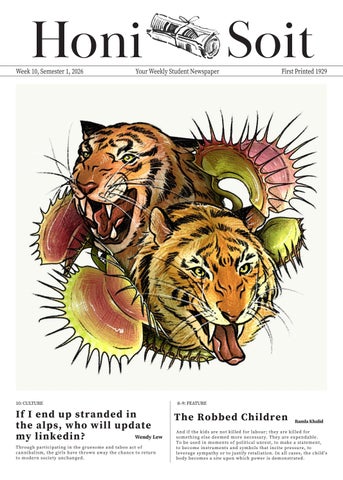
If I end up stranded in the alps, who will update my linkedin?
Wendy Lew
Through participating in the gruesome and taboo act of cannibalism, the girls have thrown away the chance to return to modern society unchanged.
The Robbed Children
And if the kids are not killed for labour; they are killed for something else deemed more necessary. They are expendable. To be used in moments of political unrest, to make a statement, to become instruments and symbols that incite pressure, to leverage sympathy or to justify retaliation. In all cases, the child’s body becomes a site upon which power is demonstrated.
Ramla Khalid
Anastasia
Acknowledgment of Country
Honi Soit publishes on stolen Gadigal land. Sovereignty was never ceded. The University of Sydney is a colonial institution that upholds Western knowledge as superior to First Nations knowledge systems. We reject this hierarchy.
As student journalists, we recognise that mainstream media has been complicit in silencing and misrepresenting Indigenous voices since invasion.
We commit to centring First Nations perspectives in our reporting, to challenging the colonial structures embedded in journalism, and to amplifying the voices of those resisting ongoing dispossession. We pay our respects to Elders past and present, and to all First Nations students and contributors.
Always was, and always will be Aboriginal land.
Eat or be eaten.
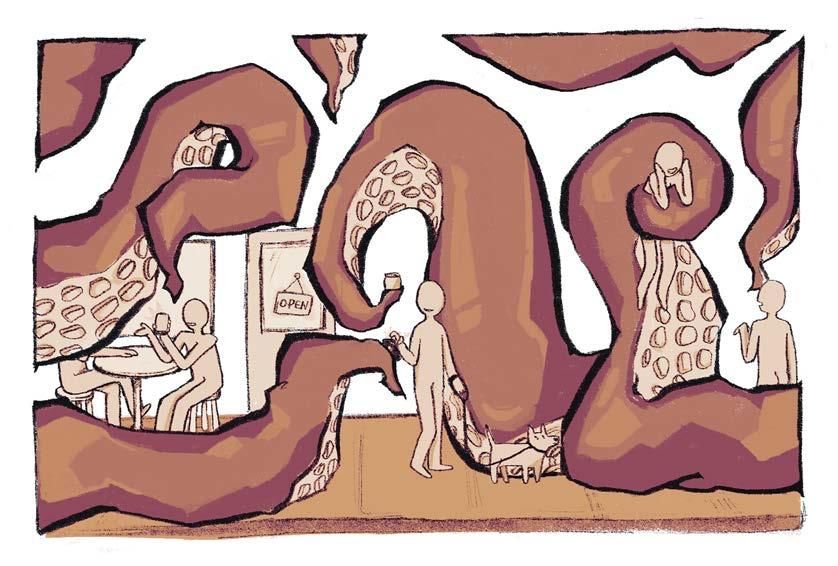
We are taught to be hungry. Not just for food, but for more — more success, more beauty, more attention, more everything. Hunger is reframed as ambition, as drive, as something admirable. To want endlessly is to be alive. But there is a difference between hunger and gluttony. Hunger sustains. Gluttony devours. And this world is not organised around need, but around excess, the taking of more than what is required, more than what can be replenished, more than what can be survived.
We consume media until it collapses
into noise, into something we scroll through without feeling. We consume ourselves, turning our lives into something measurable and productive, something that can be optimised and improved and displayed. We are always eating, always taking in, and yet we are never full.
Because this hunger is not natural. A system that depends on endless growth cannot tolerate satisfaction. To be satisfied is to stop, and to stop is to interrupt the cycle. We are taught to gorge, to scroll endlessly, to buy endlessly, to produce endlessly, to desire endlessly, because anything less would
threaten the structure itself.
This edition sits in that instability. It traces how consumption moves through everyday life — how it exists in the systems around us, how it exists in what we want and in how we come to understand ourselves. It asks what it means to live in a system where everything is available to be consumed. I hope you can implore your eating habits.
“The corruption begins with the mouth, the tongue, — the wanting. The first poem in the world is ‘I want to eat.’” - Erica Jong.
All the love, Ramla Khalid
Vox Pops: What Is Your Student Addiction?
F.S: Ignoring my 30 lectures and doing unrequired readings instead.
M.P: Pepsi from flying turtle
S.T: The $7 meat pies from the cafe across fisher.
S.W: Getting food poisoning from manning food court.
M.B: Skipping tutorials...where is my class? Where am I?
Honiscopes
L.A: Stinky sardines.
R.K: The fake subway meat.
R.O: Coke.
A.D: Jacob Elordi and his elordi-ness.
J.K: A british mustache.
P.L: The stench of USyd bathroom.
E.R: These nuts.
Aries: You should stop eating gymbro chicken breast blanch spinach and rice. live a little.
Taurus: Classic s’more. The graham cracker offers perfect architectural integrity for this treat.
Gemini: You are FUN and Malaysian. Let your guard down. Let someone peel you away...strip poker...
Cancer: You are an injeolmi. Pillowy, like a savoury marshmallow, dusted with soybean. masisseoyo.
Leo: This is a meal, I guess... you need to stop being performative. You’re not Irish. Paddy’s Day has passed.
Libra: men who eat cereal theory
S.S: Paying $10 small order fees on my $10 yochi on ubereats.
R.S: The taste of the mold growing in my unwashed stanley.
J.F: Merly streep and her fuckass bob.
F.L: Turning on the fan in winter and then shivering to sleep.
Virgo: Behind your germaphobe pretences, you’re disgusting. You’re casu martzu a Sardinian sheep milk cheese containing live fly maggots for extra oomph.
Scorpio: You’re transgressive, regulated... surströmming. The smelliest (swe)dish dish ever. Rotten eggs and vinegar, pungent.
Sagittarius: You’re a bagel with cream cheese, whitefish, smoked sable, red onion, and capers. If you’re not a fish guy that’s too bad.
Capricorn: You’re probably really anaemic you need some Blodplättar. Swedish pancakes made of whipped reindeer blood.
Aquarius: Kind of brave for a breakfast sandwich. You probably swallowed it down with a raw egg yolk.
Pisces: Slimy salty herring with white onion. You’re crazy but free. Amsterdam is calling.
“Corporatisation and lack of oversight”: University of Sydney at the Parliamentary Inquiry
Anastasia Dale and Marc Paniza report.
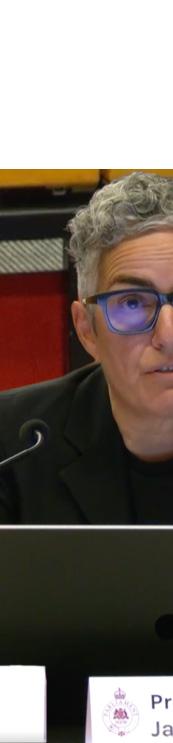
The University of Sydney appeared before the NSW Legislative Council Standing Committee on Social Issues on 29 April for the inquiry’s sixth public hearing for the Parliamentary Inquiry on the tertiary education sector.
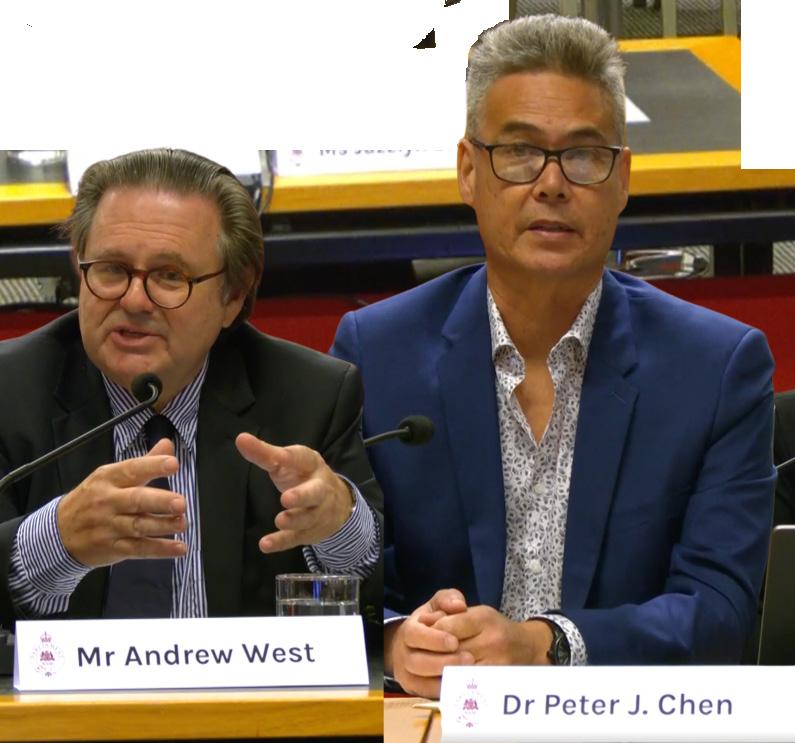
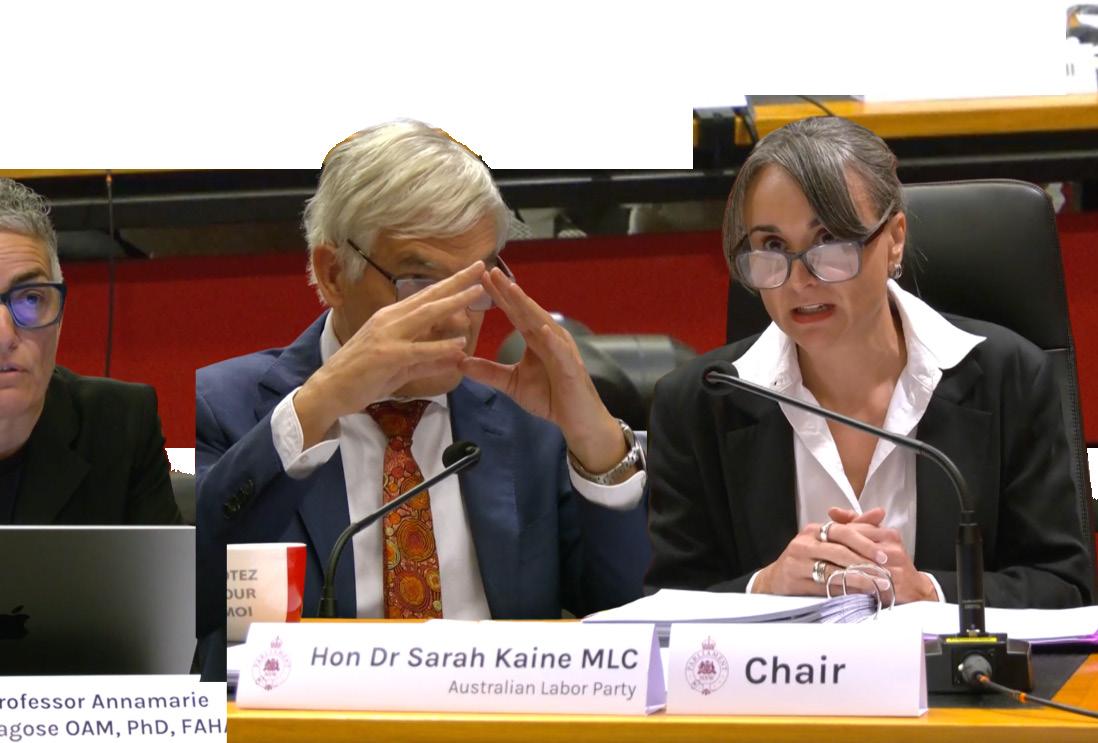
Senior Deputy Vice-Chancellor and Provost Professor Annamarie Jagose gave evidence in the first session, followed by a panel comprising NTEU Branch President Dr Peter Chen, Professor Laura Shepherd, and Professor John Buchanan. Following this, former alumni-elected University Senate Fellows Dr Robin Fitzsimons and Andrew West spoke about the Senate.
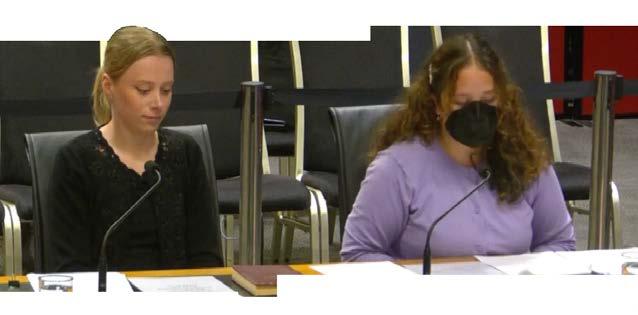
The final section of the hearing saw SRC President Grace Street, SRC Caseworker Jazzlyn Breen, and SRC Disability Officer Kayla Hill give testimony on the university’s relationship with students with regard to governance, representation, support, and accessibility.
Chair Dr Sarah Kaine opened the hearing by noting the Committee had heard “from a number of inquiry participants that they fear reprisals from senior leaders of universities because of their evidence.”
Provost Annamarie Jagose
Jagose used her opening statement to say the university “does not shy away from increased scrutiny and transparency of our governance structure,” and that USyd was “carefully considering” the recommendations of the Committee’s interim report and the federal Senate Inquiry into university governance.
Asked directly by Kaine whether USyd considers itself to have transparent and accountable governance, Jagose pointed to the Senate as the governing body and the University Executive as the management body, both run under “very sort of strict policies and procedures.” She said the university had begun running all-staff communications from the Chancellor following Senate meetings, and that three elected staff Senate fellows were holding an all-staff town hall on the afternoon of the hearing about their experience as fellows.
Kaine raised the Senate Fellows role statement, which advises fellows to regard committees of Senate and the Vice-Chancellor as their “principal sources of information and advice” and to seek additional information from the Vice-Chancellor “in the first instance.” Kaine said the directive struck her as a “very clear cultural suggestion” given the Senate’s role in holding management to account. Jagose said the guidance was a “clarification point” and that materials could be sourced from elsewhere. She took on notice who had drafted the role statement.
On consultant disclosure, Kaine noted USyd is one of only two NSW universities that explicitly relies on the NSW
Treasurer’s directive not to disclose the scope of consultant use, and pointed to the University of Newcastle’s recent commitment to voluntary disclosure. Jagose said USyd “already exceeds the reporting standards” by voluntarily publishing total consultant spend in its annual report, and that the university would shift its position if the requirement changed. A University of Sydney spokesperson told Honi that USyd applies the NSW Government definition of a consultant, “an organisation engaged to provide recommendations or professional advice to assist decision-making by management,” and that USyd “don’t rely on consultants to deliver our core work of teaching and research.”
Committee member Rachel Merton put it to Jagose that USyd had declined to treat a Government Information Public Access Act (GIPA Act) request for more information about external consultants, benchmarking and workforce planning as valid on clarity grounds, while Macquarie, CSU, UTS and UNSW had been able to identify responsive material to the same request. Jagose said the request as framed was too broad and insufficiently specific under section 41(1)(e) of the GIPA Act, and that USyd had provided guidance on how to revise the scope of the request.
A university spokesperson told Honi that no revised scope has been received to date, and that the applicant “remains welcome to progress the application by providing a clarified scope.”
Kaine then turned to senior leadership bonuses. Jagose confirmed that some senior leaders receive bonuses, that Deans have “bonus potential” assessed against a mix of objective and subjective measures, and that the Dean of the Business School received a bonus in the last review cycle. She said there is no literal KPI for Sydney Listens results in Dean bonus assessments, but that the survey results are “part of the broad environment” considered. Jagose took on notice the KPIs and weighting attached to senior leadership bonuses.
A university spokesperson told Honi it could not comment on individual staff but confirmed leaders have “a key performance indicator that focuses on leadership and culture with Sydney Listens results, overall or on specific questions, being one factor that is considered in performance.”
On Senate composition, Merton asked why the alumni-elected Senate positions had been abolished, and whether Jagose would support their return. Jagose said her “personal views are not at issue here” and noted that the majority of current Senate fellows are alumni of the university. On the Senate’s skills and experience framework, Jagose said the framework was needed
because “through election, we can’t necessarily get a balance of skills and experience and diversity.”
Chen, Shepherd, and Buchanan NTEU USyd Branch President Peter Chen opened by telling the Committee that “the system of governance in universities in New South Wales is no longer fit for purpose,” and that the USyd Senate “resides in an information bubble created and maintained by university management.” He said that on his election as Branch President, he had reached out to Senate fellows for meetings, and “very few took up this invitation.” After what Chen described as ongoing agitation, he was invited to present to the Senate’s People and Culture Committee in November on the Sydney Listens results, including the finding that only 50% of staff feel they can voice a contrary opinion without fear of negative consequences. Chen told the Committee he received “no questions” and “stony silence” from the assembled fellows.
In response to Honi ’s follow-up questions, Chen said he had not had any other formal interactions with Senate members since that presentation, but had met informally with one staff-elected fellow.
Professor Laura Shepherd told the Committee that staff in the Faculty of Arts and Social Sciences (FASS) “appear to be enduring a culture of impunity, where senior leadership across the university are not held to account for poor management practices.” She cited the 2025 Sydney Listens results, in which FASS scored lowest across the University in 50 of 67 fields. Shepherd read several specific scores into the record: confidence in the University Executive (USyd average 40, FASS 17); trust between people at USyd (average 48, FASS 30); senior leaders rolemodel trust and accountability (average 50, FASS 39); and consultation between staff (average 69, FASS 49). Shepherd said the data had been collected, analysed and released year on year “with no meaningful change or even commentary on specific areas for improvement.” The figures Shepherd quoted do not align with the Faculty data available in the University’s survey platform.
Shepherd also referred to an external psychosocial risk review commissioned by FASS, which she said found that “senior leadership practices were a central source of injustice,” and that staff who raised challenges “were seen as problematic and were more likely to be denied development opportunities.” She told the Committee the review found “a lack of accountability for senior leaders and key decision makers was a key theme.”
Former Elected Fellows
Dr Robin Fitzsimons and Andrew West appeared at the inquiry in their capacities as former elected Fellows of the University of Sydney Senate.
Fitzsimons stated she benefitted greatly from the education and opportunities afforded to her when she was a student at USyd, something she hopes can be passed on “to future generations” of students.
Fitzsimons noted that “until 2016… alumni were the dominant membership and provided the largest number of elected representatives in the University of Sydney Senate”. Alumni-elected positions on the University Senate were abolished in 2016. She stated “the effective diminution of elections was an effective diminution of transparency”, with agendas and minutes of non-confidential sections of University Senate meetings having “mysteriously disappeared” for a period of time.
Fitzsimons said that while she was on the Senate, they “consulted the whole of the university community, meaning alumni, staff, and students” for recommendations as to who should be appointed University of Sydney Chancellor. This led to Dame Marie Bashir being appointed Chancellor. Fitzsimons stated the convention
it should be mandated.”
West stated “the university system is in crisis, and it is largely due to the ‘light touch’ management approach… [the approach] that has failed so grievously in the corporate sector… is applied now to universities.” West said this has led to “very minimal oversight, insufficient scrutiny of the executives” and that management abolished alumnielected representatives on the University Senate due to their “persistent questioning about executive decisions, certainly to do with salaries… other controversies, one involving Scots College.” He stated that “Vice Chancellors are seen as Chief Executive Officers, able to appoint their teams… able to, nowadays, effectively choose the members of their governing councils… so we effectively have capture, by Vice Chancellors, of their governing bodies.”
The SRC Perspective
SRC President Grace Street began her address with an acknowledgment of country, going on to say “it’s not surprising… that there are a lot of submissions independently from [USyd] students and staff, since the university sector is in crisis.” Street stated that while the University of Sydney did not “suffer” from the specific problems of “consultants and recent course cuts” like other universities such as the University of Technology Sydney or the University of Wollongong, she said USyd “suffer[s] from the same systemic issues of corporatisation and lack of oversight” as other universities examined by the inquiry.
She outlined the main issues as “tokenistic student representation and consultation, rather than meaningful collaboration”, “the need for legislation and regulation of
and “the need for enforcement of the stated public missions and the duty of care for students across universities”.
As key examples, Street brought up the “implementation and lack of a genuine feedback process for” the ‘Campus Access Policy’ and the ‘Five Key Policies’, the launch of a Professional Services Review “without actually consulting students”, and the University Senate “being comprised of a majority of unelected members with corporate backgrounds” who are “out of touch” and “left unchecked.” As a result, she stated, the university community is left to deal with “long, onerous processes, a fear about speaking up, cuts to courses” among other issues.
SRC Caseworker Jazzlyn Breen stated that students are “required to navigate very complex, under-resourced, and poorly designed administrative processes” receiving “inconsistent advice” and facing “long delays”, leading to “stress” and “avoidable academic failure, particularly for students already experiencing disadvantage and marginalisation.”
Breen also detailed the way the SRC is funded, through SSAF with both its base and contestable funding determined by university management. Breen said “the demand for casework support has increased significantly… despite this, we’ve been unable to secure an increase in base funding to employ additional permanent caseworkers.” Breen raised concerns that the funding model may not “enable universities to meet their obligations to provide adequate independent advocacy services” as they are obligated to do by the Higher Education Support Act.
SRC Disability Officer Kayla Hill highlighted that USyd is “failing to support the accessibility of university education for disabled students.” She said that Inclusion and Disability Services (IDS), a USyd service that aims to provide disabled students with adjustments to their studies and of which Hill is a recipient, is an “ineffectual, poorly regulated system.” Hill said that IDS “lacks breadth in the accommodations it can offer, dismissing many as ‘out of its scope.’” Hill stated that often students are forced to choose between being academically “penalised or worsen[ing] their health”, and that IDS adjustments are “routinely ignored, dismissed, or forgotten by teaching staff.”
Hill stated that the only centralised forum in which
to raise accessibility issues is the Disability Inclusion Action Plan (DIAP) Committee, whose meetings are held quarterly and “leave very little time for in-depth discussions.” Hill stated she is a member of the Committee due to her role as SRC Disability Officer, and that meetings are not open to students who are not part of the SRC.
Sarah Mitchell asked Street to provide examples of tokenistic student representation. Street stated that there were only two students on the University Senate, with those students not being communicative “with the SRC or SUPRA” and at times missing multiple consecutive meetings. Street stated there should be more oversight and communication from management, but that “the requirement of two students is enough for [management].” Street brought up the Academic Board, which students have expressed “feels very tokenistic” with a “process of approving things through a lack of dissent” instead of “an affirmative vote and calling for discussion.”
Street stated while USyd students are invited to be part of committees like the Senate and Academic Board, she did not believe students’ feedback was “taken meaningfully, I don’t think we’re given enough time or input to impact… policies that do affect us.” Street said that student representation on boards like these were “box ticking” for the university rather than true representation.
Street pointed to the Campus Access Policy as an example of poor university governance, a policy which was passed through the Senate “without any consultancy with student representative or union groups,” referencing her Honi article titled ‘USyd Doesn’t Listen’ written after the university ignored the “thorough feedback process” set up by the SRC and union groups.
The hearing, as Street alluded to, mirrored many of the other hearings across the inquiry into the tertiary education sector, with light being shed on the University of Sydney’s increasingly corporatised governance structure, at times surprising lack of student or staff consultation, and a need for more rigorous oversight and accountability for those in positions of power.
This article has been edited for print. Read the full article online.
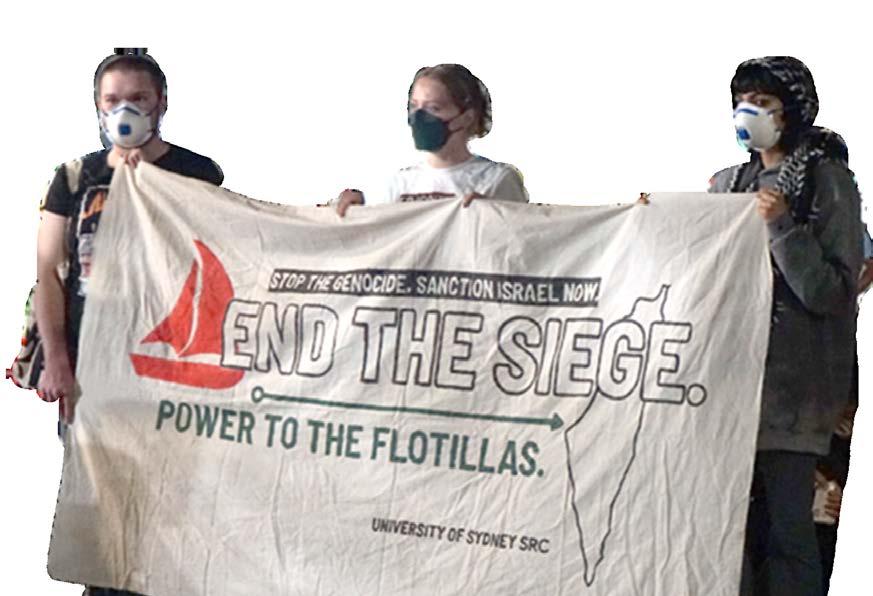
USyd student detained as hundreds rally at Town Hall for Gaza flotilla activists
At 5:30pm on the 30th of April, hundreds gathered at Town Hall in Sydney in a snap action to support participants of the global Sumud Flotilla who were illegally intercepted and held captive by Israeli forces. Among those held captive is Wiradjrui, Ngiyampaa and Wailwaan activist and USyd student Ethan Floyd.
Protesters urged the Department of Foreign Affairs and Trade (DFAT) to secure the safe return of flotilla participants and guarantee the delivery of humanitarian aid to Palestinians in Gaza. After the speeches, protestors marched through the streets to the Sydney DFAT office on Elizabeth Street.
First to speak was Peter Schofield, father of Rising Tide organiser and flotilla captive Zack Schofield. “We are all aware of what Israeli forces are capable of. We are aware of previous similar flotillas where people were injured, and all the participants had to reckon with this as they made the decision to participate.”
“As a father, I am very well aware of the stresses and the anxieties and the fearfulness that goes with having one’s only son participate in this act, and I acknowledge that I’m not alone in this. There are many, many people, friends and family, who are fearful for their loved ones. But as we stand here feeling fearful, I think we all recognise that this negative feeling is but a token, when compared with the suffering of the people in Gaza.
“Why was the flotilla created? Why has it been happening? Because governments have not been responding to the desperate need… Courage is vital in this day and age. We all need to become international citizens and be aware of what’s happening outside our country, as is very evident by the terrible events in the Middle East going on currently between Iran, Israel, and America.”
A statement was then read out from the father of a Naarm-based student, support worker, and flotilla participant Neve O’Connor: “My daughter, Neve O’Connor, has been taken hostage by the Israeli government whilst on the global similar plotilla. Nieve and all other GSF participants
are living the strong protest history in Australia, where decent people have become activists because of the moral failure of Australian governments.”
“Think of the protests in relation to the Vietnam War. South African apartheid, land rights for First Nations people, and the damming of the Franklin River. These activists were vilified, arrested, and told they were on the wrong side of history. In fact, they are now rightly considered heroes. In time, all of us will be shown to be on the right side of history.
“Neve is a support worker for the NDIS, as she’s completed her studies in criminology and psychology. She’s 6ft 1 and a strong personality.
“She’s a social person who loves people and people love her. She hates bullies, inequality, apartheid, and genocide. While peace in the Middle East is complex, you either believe that apartheid and genocide are evil or not.
“Anyone who supported the South African government, by default, supported apartheid. It’s the same today. If you support the state of Israel and their actions in Palestine, you are supporting apartheid and genocide.”
“All of you here are decent people who see a moral wrong in the treatment of the
Palestinians and the lack of action from all levels of the Australian governments. We have all contributed to joining the protests, contacting MPs and commentators, donating money, and implementing our sanctions of Israeli products and services. Neve wanted to be involved in direct action.She felt the nonviolent, unarmed civilian GSF trying to deliver humanitarian aid to the Gazans, who are being deliberately starved, was a journey she wished to be on.
“It was one of the best days of her life when she was accepted and joined the GSF at Barcelona. While she knew the risks, and will be disappointed that she has been taken hostage, I would tell her that this is still an important part of the journey to raise awareness of the genocide and apartheid system that Palestinians live under to the world. I would also tell her how proud I am of her and her comrades.”
NSW Greens Senator Mehreen Faruqi expressed her solidarity with the families of the flotilla participants and spoke about the complicity of the Albanese government. “[Israel] is completely ignoring international law yet again, is attacking humanitarians trying to deliver aid to the people of Gaza, who have been suffering a blockade for 19 years.”
“They have been taken hostage. Guilty of what? Guilty of… trying to provide medical aid, food, and solidarity to the people of Gaza. That is their crime.
“Being humane is their crime. These humanitarians have witnessed Israel’s
James Fitzgerald Sice reports.
genocide, Israel’s war atrocities. They have also seen our government, the Albanese government, being completely indifferent to this reality, and they have decided they will not stand by.”
“The people aboard these boats represent the best in humanity, the very best in humanity, and they have been stopped, abducted by the worst in humanity, the Israeli government and their defense forces, who have been inflicting a genocide, who have massmurdered Palestinians, who have mass-starved Palestinians, and who are ethnically cleansing Palestine,and now South Lebanon as well. That is the worst of humanity.
“The Albanese government, let’s be crystal clear, is complicit in this genocide. They cannot get away, they cannot get away from that… Please bombard DFAT with calls and emails, please contact your local MP, and please demand that the media give this coverage, because the media is complicit as well…And tell Penny Wong and Anthony Albanese to get on that fucking phone and call their pal Isaac Herzog. They were very quick to invite him here and lay out the red carpet for him. Now the least they can do is pick up the phone and give him a call.”
Emily and Alexa, friends of Zack Schofield and Rising Tide activists aboard the detained flotilla, were next to speak:
“The funeral for every child killed in Gaza since 2023 would take every day for 50 years. Over 21,000 children have been brutally killed by this evil regime and it is impossible to rest with this knowledge.”
“You don’t have to be a mother to imagine how it would feel to lose the person who matters most to you. But as it happens, I am a mother and the pain and grief haunts my every waking moment and follows me to sleep.”
Read the full coverage at honisoit.com.
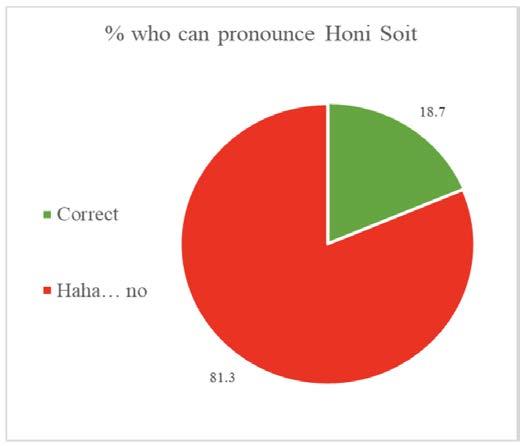
Poll finds that 82 per cent of USyd Students can’t pronounce “Honi Soit”
Honey Soy. Own-ee Sew-it. Kh-oni Swa.
These are but three ways people incorrectly pronounce the name of this publication. How hard is it to pronounce these two fourletter words? How many students actually know how to say the name of their own newspaper? This author polled 75 ordinary University of Sydney students, found on campus at random, on this question. In addition, students were polled on their engagement with this paper and the SRC, letting us finally discover whether a stupol bubble really exists.
The name of our leftwing rag is notoriously cumbersome to say out loud. For those readers who need to be reminded, Honi Soit is a shortening of the Old Norman French motto Honi Soit Qui Mal y Pense , meaning something along the lines of “he who thinks evil of it should be shamed.”
Delightfully, Honi Soit on its own means “should be shamed.” Indeed we should be shamed! To be cringe is to be free! It is for the reader to decide whether Honi Soit is a needlessly pompous title or a clever subversion of that pomposity. Nevertheless, given these origins, the correct pronunciation is “onny swa” and when students were polled only this pronunciation was accepted as correct.
likely biased towards those engaged in Honi Soit, as only students on campus at time of polling were considered, the actual number may be even lower. Additionally, some who correctly pronounced Honi Soit admitted to being French speakers (unfair advantage) who hadn’t once seen the newspaper. There was however a cohort who struggled with the pronunciation despite a professed love for Honi articles, suggesting pronunciation wasn’t the best metric to measure people’s engagement with the paper.
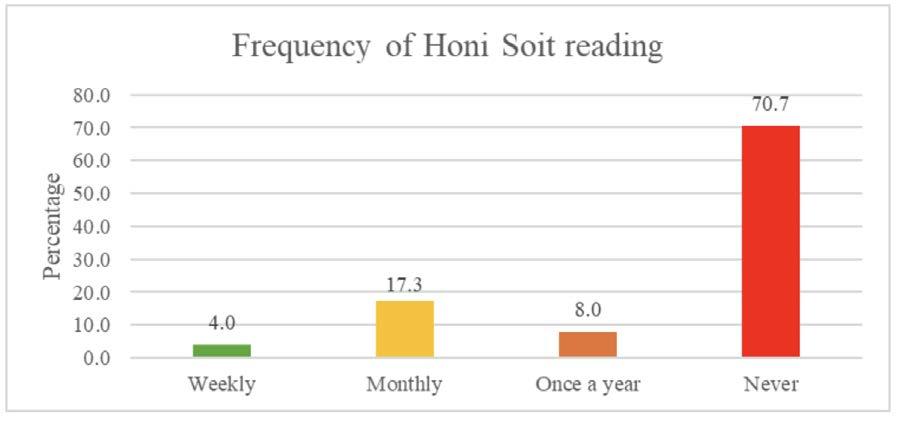
A more serious metric was how often students read this paper. Most who had never heard of the paper had never read the paper. Some who knew Honi Soit admitted they didn’t touch the stuff. That totalled to 70 ± 9 per cent who didn’t read it. Remarkably, 21 ± 8 per cent of students claimed to read Honi more than once per month.
Sholto Mirrlees-Black quizzes.
guessed that answer.
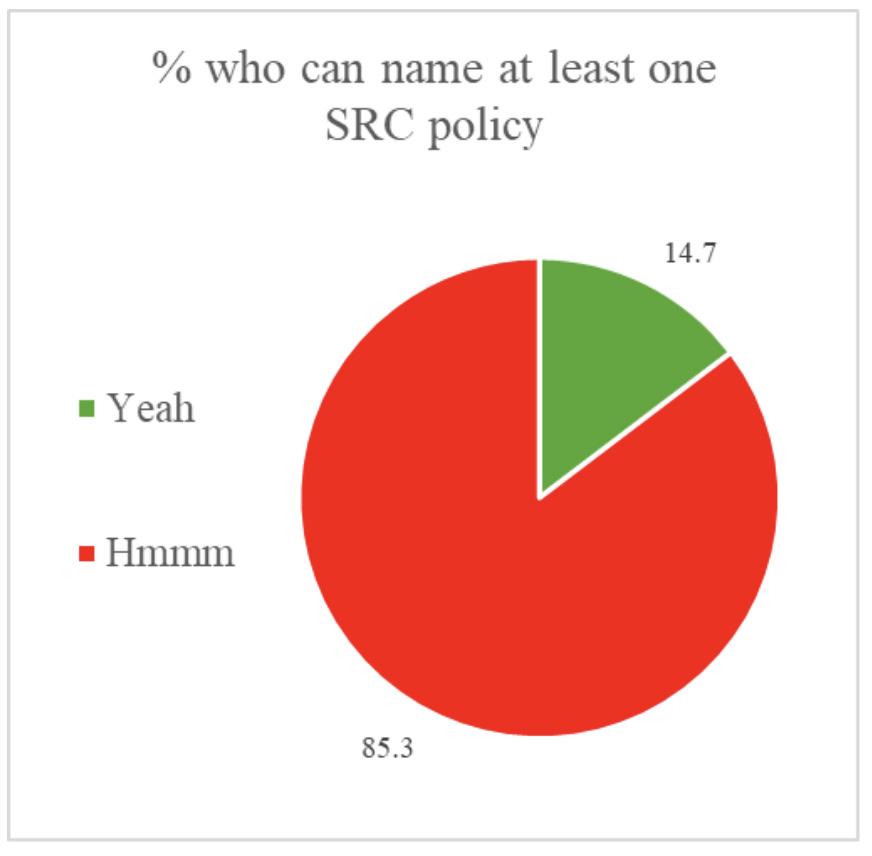
When asked to name an SRC policy (interpreted very broadly), 85 ± 7 per cent couldn’t, many confusing them with the USU.
Next, the students’stupol basics were tested. The pollees were given a multiple choice quiz question: who or what is Grace Street? A marvellous 33 ± 6 per cent of
When asked about their satisfaction with the 2026 SRC administration, 25 ± 5 per cent were satisfied, 1 ± 5 per cent were unsatisfied, and 73 ± 5 per cent were predictably unsure, putting Street’s net approval rating at +24 per cent.
So, this data does confirm the existence of a stupol bubble. But that bubble might be as large as 15 per cent of students, those who can name something about the SRC. This is higher than the turnout for all the SRC elections of living memory. It seems there are many on the periphery of this world, who don’t quite need the SRC or Honi just yet.
Although all pronunciation is ultimately subjective, the students in this way will gauge how many people have interacted with Honi Soit : the populace’s inability to pronounce the name is really another indicium of their waning engagement with our university’s rich culture.
According to the polling, which occurred over two consecutive weekdays, only 18 ± 7 per cent can accurately pronounce Honi Soit . Considering the sample is
students thought it was most plausible that Grace Street was the location of the Honi Soit offices. 9 ± 3 per cent guessed she was the USU president, 25 ± 5 per cent the student senate representative. Only 32 ± 5 per cent correctly identified her involvement with the SRC, though many
However, if something bad happens, a caseworker will be there for them, they can access legal advice, or Honi Soit can write an exposé about the campus scandal they’ve got themselves embroiled in, even if they can’t pronounce this newspaper’s name.
Post Scriptum: during one particular interaction, this author was forced by university security to show student identification. Even humble surveying is regulated by the CAP!
The Robbed Children
We robbed the children. We robbed them of life, of music, of the seas. We robbed them of their lineage, from their future, from being able to see trees.
We robbed the children of experiencing life at all. They were born addicts, they were born sacrificed, they were born dead; some weren’t born at all.
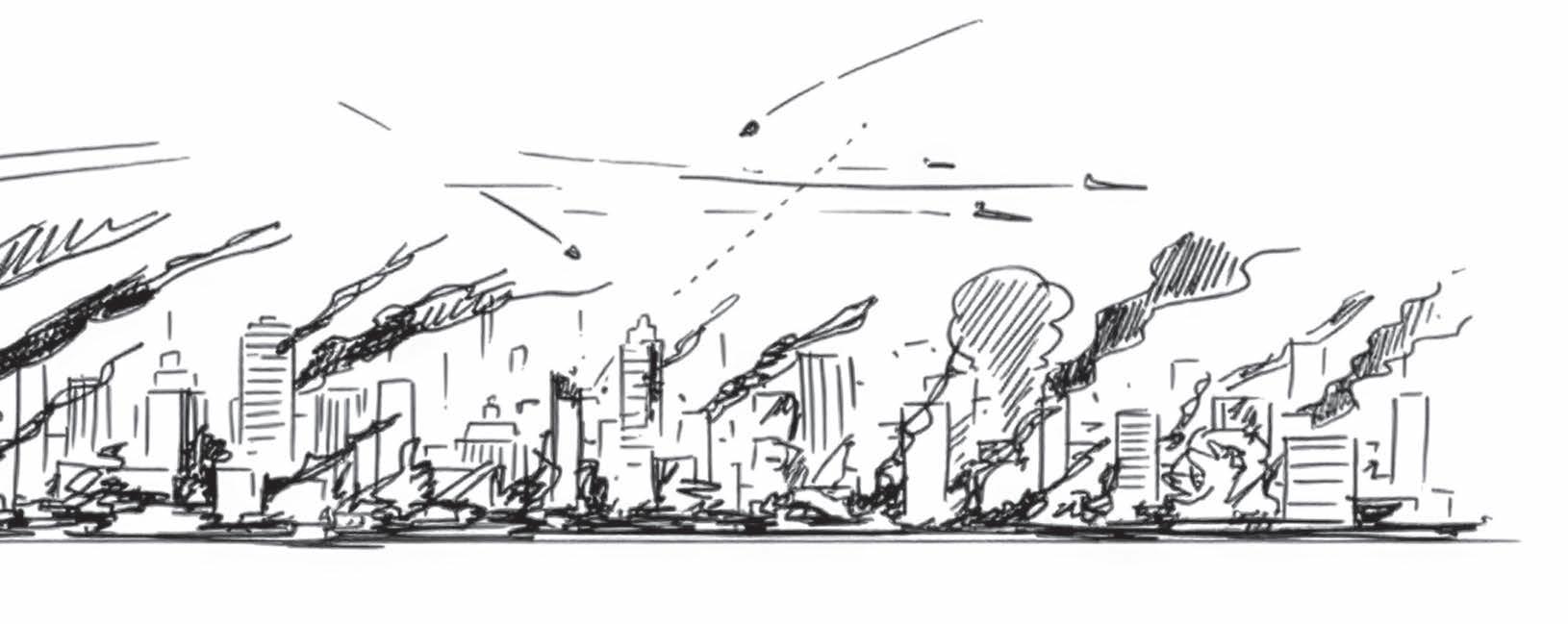
The kids are collateral; at least that’s how the politicians see it. They bomb a girl’s primary school or poison babies with fo rmula. They sacrifice the kids in war, whether as a martyr or as a soldier. They feast on the lives of the kids, just to fill their appetit e for power.
They are gluttonous and hungry, inconsiderate in their manners. All they do is eat. Their stomachs are too big, they are full t o the brim, but their greed is still not satisfied. Their appetites won’t diminish, their hunger won’t falter; not until they’ve eaten ever ything from the land. The animals, the trees, the people. Not until they’ve eaten the children, they’ve consumed the air, they’ve depleted ever y mineral in the world. Not until they’ve swallowed the skies.
They have decided the fate of the kids in Gaza and Lebanon and Iran and Sudan and Pakistan. They are a sacrifice; born to die s o the fashion stays booming, the oil keeps spilling, the factories keep producing. So, the soldiers and the generals and the politici ans and the investors – all the suited men can keep working. So the labour costs stay cheap and the outfit choices on Shein stays massive. So, the west can live its white picket dreams and consume and consume and consume. The suffering of some children secures the comfort of oth ers. Their labour is cheap because their lives are.
And if the kids are not killed for labour; they are killed for something else deemed more necessary. They are expendable. To be used in moments of political unrest, to make a statement, to become instruments and symbols that incite pressure, to leverage sympathy or to justify retaliation.
In
all cases, the child’s body becomes a site upon which power is demonstrated.
When they are not being sacrificed literally, they are sacrificed for consumption. YouTuber family vlogs, Instagram mom account s, kids first periods, first time trying a popsicle – “come on cry for the camera.” They are pimped out for the lurkers and the watcher s, saved by millions and rewatched over and over.
For people to exercise their last bit of power, to see what violent and sick things they can do. For the politicians and the cr iminals like Epstein to abuse or the traffickers to take. At the very least the stalkers and the creeps fantasise. But as long as peopl e can get a cheap thrill or the moms can hit 100k, it’s all okay to play with someone who doesn’t know they’re playing, right?
Even when the child is not present, the idea of the child is extracted, repurposed, stolen. Cultural trends will fetishize yout h with “baby” aesthetics, infantilised fashion, the stylisation of childishness and blur the boundaries between admiration and appropriation. Childhood becomes a look, a performance, something to be adopted and consumed by adults.
But even the safe ones can’t be safe. Their first breath leads up to their addiction. Addicted to the iPad, they are extracted and shaped and moulded. Made to be dependent on a stimulus, unable to be bored or to be themselves. Neglected and forgotten, unable to dream or imagine. They can’t dream of a future or have hope, but how can they when the ground is degrading and the water is rising, and the tech bros have ensured that they will consume the skies if only for a place in Silicon Valley.
We have robbed them of a future, we have robbed them of a childhood. We have robbed them to an extent that they’ve forgotten what they’ve been robbed of.
Maybe to say the kids are being robbed is insufficient. Theft implies a discrete act, but they are being stripped and shaken of their lives in front of their eyes. The people have decided the children are not human, that they are playgrounds for our experiments . To mould and abuse with ideologies, ideas, narratives.
To play out their fantasies, their violence, their power. To be a source of their hunger and their greed.
They have pushed the kids until there is nothing to be consumed; no scraps to spare. The kids in Gaza are re-enacting funerals as they play. Their life and innocence have been manipulated to an extent that their dreams and fun now is limited to death. They are hungry for food, for safety, for a future – for a dream. We have robbed them and starved them to malnutrition.
They cannot ask a child to dream in a world where you prey on their dreams. They cannot expect them to be hopeful when you have extracted that from them. They have sold their lives for a cheap buck.
Their hunger is greed; it is gluttonous. They live in sin; they’re kings of it.
Ramla Khalid mourns the kids..
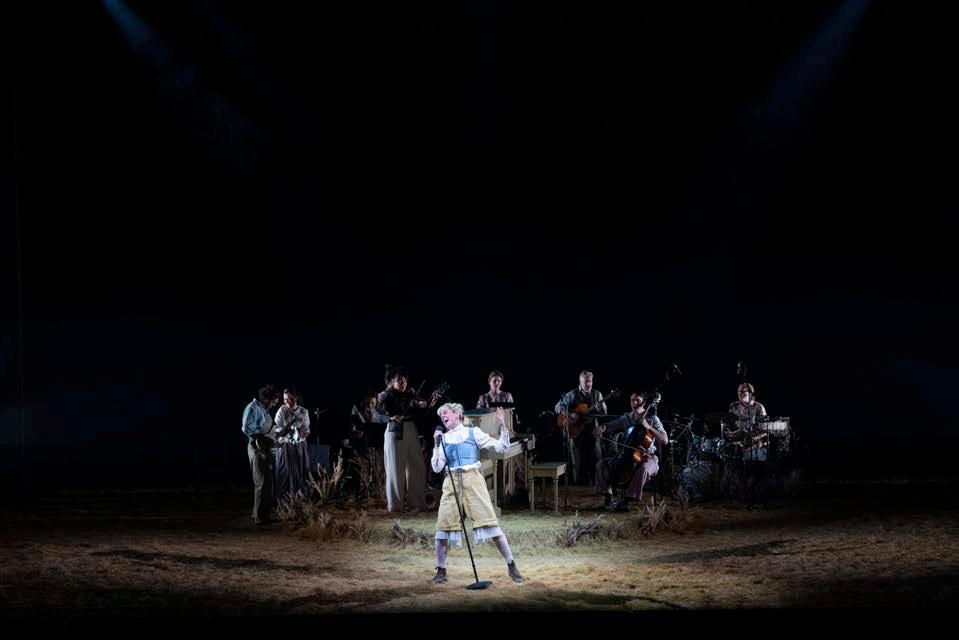
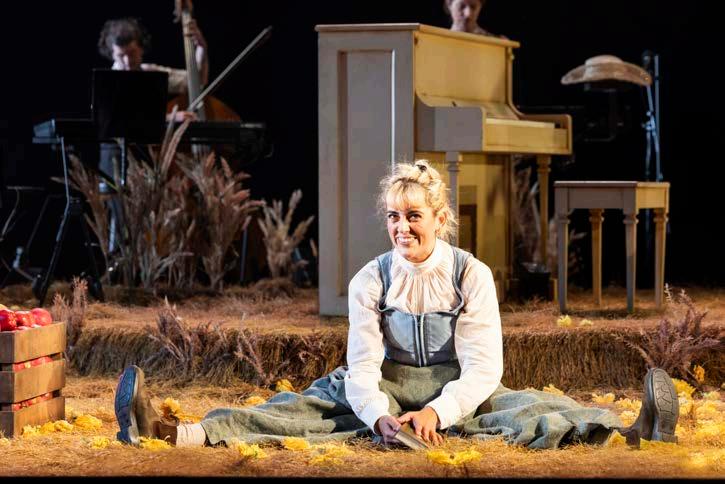
If I end up stranded in the alps, who will update my linkedin?
Every time I step foot onto a plane, the thought creeps its way into my brain: what if we crash? It sticks with me, as Mitski’s Last Words of a Shooting Star loops on my headphones while I try to fall asleep in my cramped economy seat. There is a morbid entertainment that comes from the idea of being stranded that pervades our media landscape.
There is a never-ending cycle of TV shows that follow the familiar concept: when the plane goes down, your old life ends, and you are reborn in the crash .
The strings are cut, and you are free to start a new society where you aren’t a puppet for those with wealth and status. In today’s capitalist landscape, especially when looking at the looming job market as a student, the idea is almost appealing.
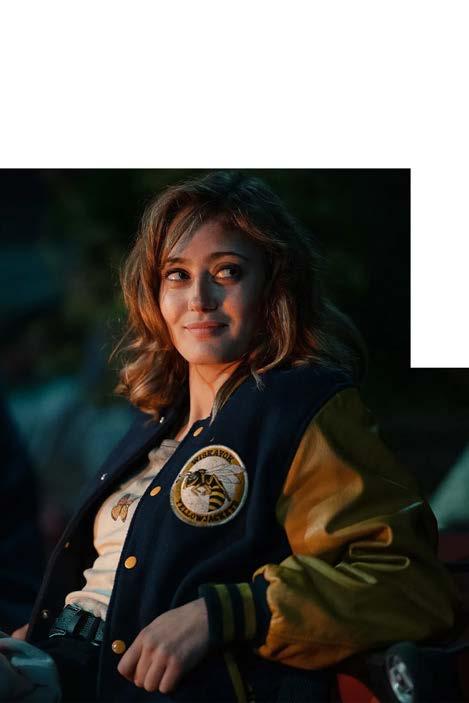
The TV series Yellowjackets depicts the drastic restructuring in the social hierarchies of a girls’ soccer team when they crash in the Canadian wilderness. Once popular and well-liked, Jackie Taylor experiences a fall from grace as her environment changes around her and she is unable to adapt to meet the new expectations of her society. At home, her money, looks, and arbitrary position as captain of the team meant that she had a purpose in the high school ecosystem. As a microcosm of the larger capitalist society we live under, her high school status was an indicator of the success she could find in the future. Jackie cultivated social capital and equipped herself with all the tools she needed to be useful to society and attain the success that capitalism tells us we should be working towards. However, under the pressures of a life and death situation, she fails to live up to her position as captain. Her success was always propped up by the structures of capitalism that rewarded her. When those structures fall away in the wilderness, she is left with nothing.
As the girls settle into their post-crash lives, they each fall into their own roles, contributing to their new society. Where Natalie Scatorccio struggled in her high school environment as a result of her difficult family life and trauma, her resilience learned in these struggles allowed her to become a leader in a society which
prioritises adaptability, strength, and capability. Jackie, once useful, demonstrates how reputation becomes pointless outside of the narrow context which we exist in. Viewers can watch how she emotionally crumbles as she loses value in the eyes of girls who once worshipped her. When Jackie finally dies after being cast out for her perceived uselessness, the girls make her useful once again in death by consuming her body for sustenance.
Natalie, as mentioned earlier, experiences the inverse of Jackie’s situation. Her ability to thrive in the high pressure survival situation of the wilderness, leaves her floundering upon her return to modern society. As an adult, she is a struggling addict who holds no value in society according to the prescriptions of a capitalist structure. In both the cases of Jackie and Natalie, their failure to prove their worth was their downfall, as society repurposed their bodies into something ‘useful’ in death. Despite the differences in their lives and outcome, one message perseveres: Whether it’s the job market or a hunter-gatherer society, according to capitalism, the worst thing you can be is worthless.
Survival shows are not a new sub-genre on television. Consider Lost and The Wilds both of which feature a plane crash. It is not by chance these shows do well with audiences in capitalistic society.
We live in a world where people are taught they must be useful. Success is quantified through acceptance emails in an oversaturated job market, and as much as capitalism’s meritocracy myth pushes us to work harder, this work is often not enough for those without preestablished connections or wealth.
The wilderness is a new environment where those who are disillusioned with meritocracy and hierarchy see their labour guaranteeing survival.
Societies in survival situations prioritise usefulness, fulfill our ingrained need to have worth. However, in the wilderness, success is stripped down to the basic needs of food, water, and shelter. There’s a catharsis in seeing a societal structure where people are evaluated on tangible skills that contribute to the survival of the community, not
by an arbitrary, powerful elite. Audiences are free to fantasise about a society where worth is something that is wholly earned.
Yellowjackets , Jackie’s unwillingness to leave behind civilisation and perform a new role in the wilderness leaves her as the only physical representation of capitalism remaining. As a result, when the girls attempt to burn her body, then eat her, they are essentially excising the rot of capitalism in their society. This is their final step away from civilization. In particular, it is their method of bodily disposal that truly separates them from the rest of humanity.
Through participating in the gruesome and taboo act of cannibalism, the girls have thrown away the chance to return to modern society unchanged.
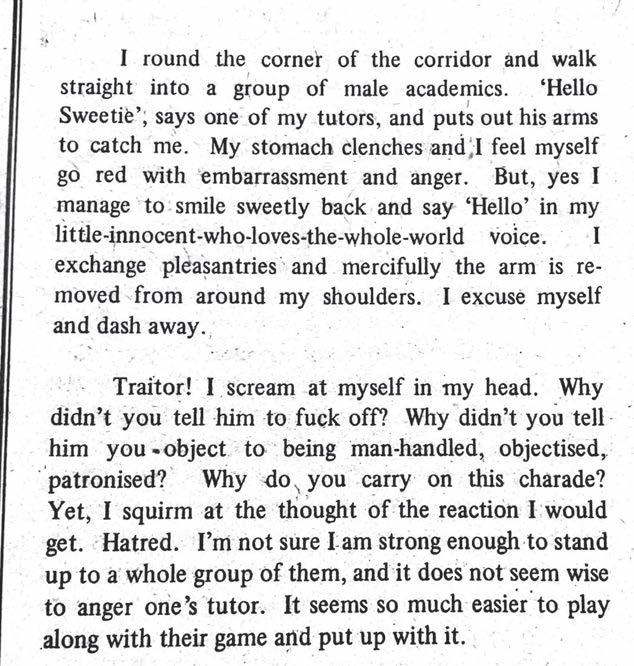
Instead, they free themselves, reconstructing a new society without Jackie and her materialistic and consumerist values holding them back. Sometimes, I consider what my own role would be in a survival situation like this. I revise my wilderness resume in my head, match myself up to characters like Jackie and Natalie. I can cook, I can sew, I am adequately fit. Maybe if pushed, I could learn to hunt and butcher.
As I quantify my value in these new terms, I realise that I am still playing the same game — still trying to prove that I deserve a place, just in a different system. I am applying for a seat at the table, just not through a Linkedin job posting. The metrics have changed, but I still find myself striving to prove my usefulness. Maybe that’s the real fantasy these shows offer: not freedom from capitalism, but a simplified version of it — one where the rules are clearer, the stakes are visible, and worth feels easier to measure. I don’t know if it would be enough to keep me out of the fire pit. But I’m not sure that’s the point. Even in imagining escape, I’m still trying to earn my survival.
Wendy Lew considers her skills
Art by Liset Campos Manriq ue
Uncivil War
Under Uganda’s molten sun, a brutal civil war is waged, not between humans but between chimpanzees of the Ngogo tribe – a close-knit community that existed in harmony for seventy years. Now, 24 chimpanzee casualties have been recorded since 2018, including 17 infants.
A civil war is a conflict between a state and one or more organised non-state actors operating within the state’s territory. Since the end of World War 2, they’ve become more prevalent than interstate war as a form of organised military conflict, with an average of 2.2 new civil wars breaking out yearly. Sudan, Somalia, and Syria are just a few of the countries currently embroiled in civil wars. By now, they’re a tragic – if relatively common – feature of human society. Less so for the animal kingdom.
While chimpanzees are traditionally territorial animals, extensive infighting between members of the same tribe is rare. For a long time, this was the case for the Ngogo tribe. They were divided into two separate factions, known as Central and Western, but existed as a cohesive group until 2015. What happened next demonstrates how societal tensions can evolve into violence, offering insights into the relational dynamics that contribute to civil wars among humans.
The first signs of polarisation between the two factions was identified in June 2015, when the Central set chased away the Western. Interactions between the two factions became infrequent following this dispute, with the few that occurred being noticeably more aggressive than usual. The situation degenerated into all-out war during 2018 when the Western set suddenly attacked the Central set.
prime minister.
By 2020 ethnic tensions had severely deteriorated. Two of the main points of contention related to repeated delays of long-promised national elections and the extension of Abiy’s first term. It descended into a civil war later that year after Abiy ordered defence forces to march on Tigray after alleging Tigrayan forces had attacked a federal military camp.
After two years the Tigrayan Peoples Liberation Force signed a cessation of hostilities with the Ethiopian central government. Millions were displaced and over 800,000 Ethiopians died during this conflict, demonstrating how a lack of social cohesion between a country’s subgroups can engender civil war.
The second proposed catalyst for the Ngogo chimpanzee conflict was a change in the
Max Mcdermott is trying to a break a fight
supporters of the GNC rejected the results and took over the Libyan capital, Tripoli.
The House of Representatives relocated to Tobruk, leading to a civil war emerging between armed supporters of the two governments. ISIS took control of the port city Sirte in 2015, marking the addition of another faction to the conflict. After seven years of civil war – leading to the deaths of tens of thousands of people – a unity government was established in 2021. Ultimately, the second Libyan civil war demonstrates how the ousting of a country’s long-term leader, their alpha, can create political upheaval and civil war.
While it’s an insightful framework, the Ngogo chimpanzee conflict overlooks one of the most frequent catalysts of civil war: self-determination. These primates haven’t been subordinated by a hegemonic colonial power; nor are they fighting for control over land they’ve dwelt on for millennia. This is where it differs from so many of the civil wars that broke out after 1945.
pack’s alpha male during 2015. Within the social hierarchy of a chimpanzee tribe, the alpha male performs various functions, such as conflict resolution, providing protection, and managing social interactions.
The conclusion of World War 2 led to a restructuring of global power, encouraging ethnic groups across the world to seek independence from their colonial rulers. Algeria is one such example. They were under French rule for 132 years after the European power invaded the capital of Algiers in 1830. Their fertile land was exploited, and discriminatory laws were implemented that led to widespread impoverishment for native Algerians. By 1954, the National Liberation Front had begun a guerilla war against France – seeking diplomatic recognition at the United Nations and a sovereign Algerian state.
One of the proposed catalysts for this stems from the non-conflict related deaths of multiple chimpanzees, which disrupted social networks and weakened connections between the tribe’s subgroups. A respiratory illness claimed the lives of twenty-five Ngogo chimpanzees in 2017, with one of the adult males who died being among the last individuals connecting both Western and Central factions. This death can be viewed as a last straw commencing a breakdown in social cohesion between the two groups.
Social cohesion – or the lack of it – is a common catalyst for human civil wars, as seen in Ethiopia between 2020-22. Politicians from the northernmost Tigray region held vast swathes of power over Ethiopia for nearly 30 years, overseeing rapid economic development while marginalising other ethnic groups like the Oromo and Amhara. However, in 2018 Abiy Ahmed Ali – a member of the Oromo ethnic group – was elected as Ethiopia’s next
If we were to align the concept of a chimpanzee alpha male with a human paradigm, they’d serve a similar role to presidents, prime-ministers, and monarchs.
Thus, a change in the group’s alpha can be viewed as a change in leadership. This has acted as a catalyst for a multitude of human civil wars, with the second Libyan civil war being no exception. Muammar al-Gaddafi ruled the country from 1961 up until he was deposed in the first Libyan civil war in 2011. A transitional General National Congress (GNC) was created following al-Gaddafi’s death to guide the country forward. Elections were held in 2014 to elect a new House of Representatives, but Islamist
French forces carried out systematic torture in an attempt to quell the uprising, with up to 1.5 million Algerians dying before the civil war concluded in 1962 when the Evian Accords were signed. This is where the animal kingdom differs from humanity.
We’re the only species on earth with a history of oppressing those we view as
‘below’ us.
The lesson we can learn from the Ngogo chimpanzee conflict is one of relational dynamics. While civil wars have a multitude of political and economic causes, they can simply just stem from societal tension. War is just a shot away once the basis for human connection becomes unstable.
Now, please excuse me as I attempt to broker a ceasefire between the Central and Western factions of Ngogo chimpanzees. Nobody wants to see a primate arms race.
Art by Suhani Panchal
Criminal You, Criminal Me
As a young girl I was an avid spreader of the gospel of what I liked to call “leaving your heavy ass school bag wherever you damn please”. I loved to go shopping after school and my bag was an unwelcome weight on my adolescent consumerist shoulders, so I would leave it in some unsuspecting corner of the public thoroughfare. As a Hong Kong resident it was never a question that I would come back to find it in the same spot. Hong Kong is just so safe.
By the end of 2025, around 5,000 AIequipped cameras had been rolled out by the Hong Kong Police Force under its SmartView program, and the city intends to grow that figure to roughly 60,000 within three years. The new generation of cameras can size up crowds, scan number plates automatically, and will soon be able to identify faces in real time. The city’s security chief stated that AI technology “will naturally be applied to people, such as tracking a criminal suspect.” This is the same city where, after the protests of 2019, an expansive national security law was used to imprison organisers, reporters and political opponents, and to gut civil society groups and independent newsrooms. Those provisions criminalised four broad categories of conduct — secession, subversion, terrorism, and collusion with foreign organisations — and made it a crime simply to speak out about, or in favour of, Hong Kong separating from the mainland. “A human rights report released last month shows that 80% of Hongkongers targeted under the law since 2020 should not have been charged, and in 90% of cases, bail was denied.” Recently there has even been a new law that requires people to hand over passwords for their personal devices if it was believed to hold evidence or if they were suspected of endangering national security.
Sophie Wishart should work on her shoulder strength
is moving to make ASIO’s compulsory questioning powers permanent. The laws have always been controversial, but after the Bondi attacks support for their implementation has grown (despite the fact that ASIO was reportedly notified about one of the attackers in 2019, and despite already holding the expanded powers in question, did nothing until it was too late). Among the powers about to be locked in is the ability to issue a questioning warrant on the basis of someone ’promoting communal violence’.
The wording is loose by design. Similar to the legislation introduced at the beginning of this year/after the attacks which both critically expands the definition of what is considered a hate crime or hate speech and heavily restricts protest activity. It has had devastating impacts on student activism, with prohibition affecting all manners of advocacy, including BDS campaigns, campus rallies, characterising what is happening in Gaza as a genocide, anything deemed as invoking ‘fear or
no insignia. Although, the unmarked vehicles were temporary as they dealt with contractors change. The university’s negligence in informing students of the measures, only heightened the fear in the student body and made them aware of being watched.
Their only real effect is to make covert monitoring easier and to leave the community feeling targeted by the people who are meant to be looking out for them.
USyd and NSW state surveillance echoes the trajectory of Hong Kong’s “smart lampposts”, the same ones that were pulled down by the 2019 protestors accompanied by cheers. Infrastructure that is sold as protection is quietly turned outward against dissent. The SUVs are just the most recent iteration of a security presence engineered to be unrecognisable.
Surveillance becomes about punishment instead of safety when definitions of what is ’wrong’ or ’dangerous’ become elastic enough to mean whatever the state needs them to mean today.
Categories like ’subversion’ and ’collusion’ are certainly wide enough to swallow students, librarians, and journalists alike. The same network of cameras that once let me drop my bag in a corner without a second thought is now the network that turned political disagreement into something the state can prosecute.
This pattern is not as distant as it seems. Closer to home, the Australian government
intimidation’. The legislation does not even exclusively apply to upcoming offenses, any past occurrence can be penalised as well, so ‘student groups’ previous campaigns, social media posts, or protests could be cited as grounds for prohibition.’ They are using the truly horrific anitsemitic attacks as a sweeping excuse to punish the people that they’ve been waiting for any opportunity to push down, any conflation, even a fabricated one, is extrapolated on and exploited.
The University’s Campus Access Policy (CAP) and subsequent protest-related restrictions have been criticised heavily by student organisations and civil liberties advocates as censoring and punishing political expression on campus. The CAP itself trades in the same kind of vague language. What counts as “disruption”, what counts as “unacceptable”, and who decides? The pattern of surveillance is even visible (or should I say invisible) on Eastern Avenue. On campus earlier this year, the old marked security vehicles were swapped with a fleet of unmarked dark grey SUVs with tinted windows and
Cameras can see us; we cannot see them back, and we certainly cannot see what is done with the data they collect. Few would object in principle to authorities observing genuine criminals or dangerous conspirators. But defining these is not a simple matter, intentionally made more complex by politicians and legislators with opaque motivations. New surveillance laws are written so that the definitions don’t need to be settled. The category of ’enemies of the state’ can extend to nearly anyone, at the discretion of whoever holds power. The vagueness of subversion, of communal violence, of disruption is not a drafting failure. It is the feature that makes mass surveillance politically useful and gives extraordinary latitude to those who are watching.
The cameras provide the evidence; the elastic law decides what the evidence proves.
The statement ’if you’re doing nothing wrong, you have nothing to fear’ rings hollow today. The argument has always rested on the idea of a stable, communal definition of right and wrong. But this has never been a stable category, particularly with regard to freedom of political expression. The difference between right and wrong has always been political, and now the definitions are deliberately and constantly moving. Hong Kong’s 2019 protesters were not criminals when the cameras were installed. Then they were. The system does not require your ignorance, only your continued participation in daily life. That is what makes it work. That is what makes all of us, here too, easier to consume.
Art by Sophie Wishart
In the Surveillance State We Are All Cam Girls
The Ortolan Bunting is a tiny songbird that is subjected to a cruel and grotesque French culinary ritual. The birds spend their lives in dark cages until they are drowned and simultaneously marinated in Amagnac brandy, plucked and roasted, and then served whole. Diners (only the exorbitantly wealthy) eat the bird whole, holding it by the head. They do so covering the act, and their faces, with a towel. The towel shields the eater from the eyes of the public as they engage in an act of shameful indulgence.
The right to privacy has long been one reserved for society’s upper echelons. In medieval times royalty had authority over the public commons while they remained protected in high-walled palaces.
Today wealthy NIMBYs retreat from the noisy hoi polloi into gated communities. With the exception of a small but loutish few, billionaires with immense power often remain out of the public eye. I would wager that few people could name each CEO of the top 15 companies in the S&P500.
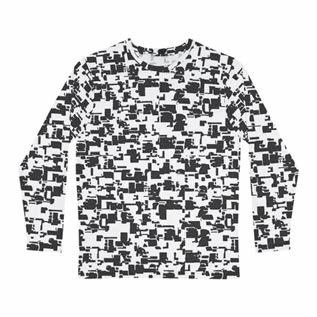
However unlike medieval times, by the powers vested in us through the Internet we now have more access to the names and images of billionaires. As cost of living pressures and public anger rises, billionaires fear the 21st century guillotine (aka pissed off members of the public causing them a fate slightly more severe than grievous bodily harm). For instance United Health CEO Brian Thompson’s general ability to draw breath was severely curtailed last year on his morning walk to work last year. Recently a man threw a Molotov cocktail at OpenAI co-founder Sam Altman’s house and threatened to burn down the company’s headquarters after writing about AI’s risk to humanity and “our impending extinction.” This time no one was hurt. In fairness, these examples are the exception to a general norm; billionaires by and large evade accountability for the human suffering they engender, they walk with impunity. Nonetheless, the ultra wealthy still have to walk among us. They still have to engage with the masses to extort our labour power – without drawing the eyes and ire of the public.This has given rise to the phenomenon of Silicon Valley bros and business executives like reptilian-fratboy Mark Zuckerberg wearing unassuming t-shirts with $1000 price tags and designer labels – that look like they could have been bought from Target.
At the same time, the ultra-wealthy surveil us. Our social media posts and browsing habits are scraped by databrokers and sold off to the highest bidder (which includes friendly companies like Oracle and Palantir). CCTV and private security cameras are equipped with facial recognition, tracking our daily movements. They are also quite porous with regards to the hackability of their databases, as shown by the recent controversy surrounding Flock security cameras.
Our health and financial status, our political beliefs and protesting habits, our sexual lives, and our private most intimate secrets are not private.
Sorry if hearing about the loss of a supposedly inalienable right is getting you down. But fear not, because when times get hard, creative designers work harder, bringing anti-surveillance fashion to our online shopping carts.
Chiara Prinsloo is wearing big shades and hiding behind a newspaper.
iMessage? Tell her to download Signal. OPSEC comes first, obviously.
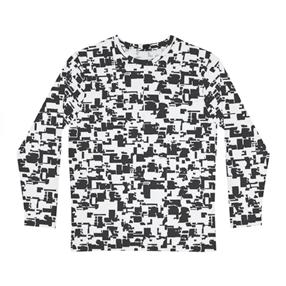
By interfering with AI facial recognition algorithms in various ways, the idea is that these clothes can prevent your face being recognised by unknown third parties.
Such pieces include bulky, asymmetrical sweatshirts and dresses with patterns designed to trick AI facial recognition. Or jackets with reflective infrared surfaces that make you look like a faceless orb of light on camera. Some of them even look cool.
No Chrome, No Gmail. There are security-focused browsers and email servers like Librewolf and ProtonMail. Need Chrome for uni? Need Gmail for work? Tough luck.
4. Cash only.
Fashion is arguably all about surveillance and being seen. Clothing is worn with consideration of what it looks like in the eyes of the other. These pieces still allow you to still be seen by your fellow peers – just not by the Big Other.
In this sense, anti-surveillance fashion could be seen as a means of regaining the right of blending in, wresting privacy back from the wealthy and democratising it for the masses.
That is, if you can afford a $200 hoodie of questionable quality and efficacy, or a $1000 dress with a hideous print on it. And if you can be bothered to keep updating your wardrobe with new pieces as facial recognition algorithms improve.
Anti-surveillance fashion could be seen as a form of protest. But it is also, in some ways, a capitulation. A capitulation to a life in Bentham’s tower, and to the notion that mass surveillance is here to stay.
So, dear reader, let’s say that you hypothetically want to avoid mass government/corporate surveillance as you go about your day, without paying $200 + in shipping.
Let’s say that you hypothetically wanted to distribute some leaflets in a private manner whilst maintaining the highest standard of OPSEC (operational security, a term increasingly dominating subreddits for the paranoid), because these leaflets had a controversial statement on it, like “ **** *** ***** ** *** *** ”
Well here is a manual. I hope you find it useful. The steps are easily implementable and not hard to follow
Tech
1. If you want to browse current events, or use a computer at all, do so with a custom-built PC running Linux. Keep that in a faraday cage. The same goes for phones.
2. No social media. No direct messages either. Grandma only knows how to use
5. Don’t buy groceries at Coles. They recently hired Palantir.
6. USB flash drives are traceable. Say goodbye to your budding DJ career.
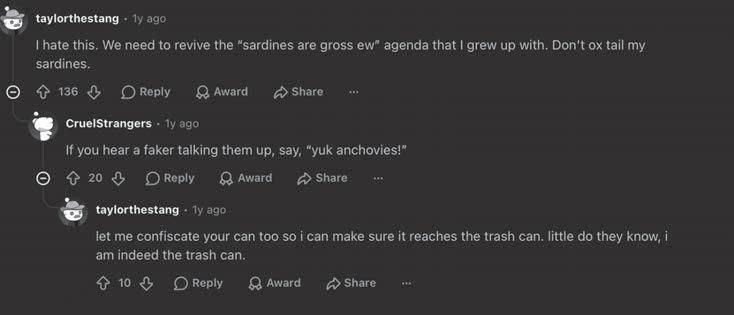
7. To answer a certain reddit user’s question, “is it bad opsec to sext my girlfriend on snapchat?” Yes.
Leaflets
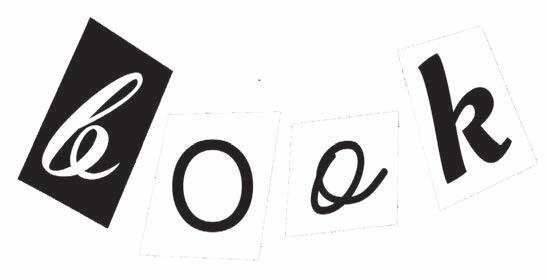
1. Cut up thrifted magazines and paste the letters down one by one on unprinted paper.
2. No printing. Laser and colour printers leave tiny yellow ‘microdots’ invisible to the naked eye form a pattern called a Machine Identification Code (MIC). These can be used to trace the exact time something was printed, alongside the model and serial number of the printer.
3. No handwriting either, this is also traceable.
Commuting
1. Don’t drive…
2. No public transport. If you need to commute by metro or train well forget about it. Same goes for buses.
3. If you are lucky enough to be within walking distance of campus, say along King Street or Parramatta Road, do not take any main roads, as storefronts and road cameras would be in operation. Take backstreets. Though if people’s homes are equipped with Ring doorbells or Flock security cameras then that’s a vulnerability as well.
4. Cover your face with a mask or a balaclava. Wear a hat. Wear sunglasses to cover your eyes. Might as well wear a tinfoil hat while you’re at it, because you look weird enough as it is.
5. Some software can identify you even with a mask, by your gait and body. So put a stone in your shoe or wear a pair that is a few sizes too big. Wear a few layers of clothing a few sizes too big. Make sure not to outfit repeat.
Of course, if you do find yourself on Eastern Avenue in a balaclava and wide brimmed hat distributing leaflets made with letters cut out of a magazine, people are going to ask you some questions. Which kinda defeats the point.
The ugliest calls are coming from within the crowd
This past Anzac Day, on Saturday the 25th of April, 11,000 people gathered in the pre-dawn darkness at Martin Place to commemorate the Australians and New Zealanders who served and died during World War I. The atmosphere was solemn and silent as strangers from around the city and state filed in, perched on steps and benches, necks craning, eyes locked on the cenotaph. The service began at 4:20am with a Welcome to Country from Uncle Ray Minniecon, a veteran, pastor, and KabiKabi and Gurang-Gurang man who has dedicated his life to serving the Stolen Generation and campaigning for the recognition of Indigenous veterans.
Not more than 10 seconds into the delivery of his address, the booing began. It was sparse and isolated at first, but quickly morphed into something else, something collective.
Boos were heard from all over the crowd and went on for almost the duration of Uncle Ray’s address. To hear the booing on video replay is jarring enough. Hearing it in person was shocking, and despite everything I knew about the pervasiveness of racism in this country, it was still surprising to me. I could not understand how such blatant racism could be so loud, so unstoppable, at such a sombre occasion which supposedly demanded respect.
In the crowd of 11,000, the hecklers could be heard but not seen, and were therefore unable to be stopped. All there was to do was stand in disgust, in open-mouthed shock, and listen. At the end of Uncle Ray’s address, the crowd applauded loudly, and for longer than they did for any other speaker. Whatever symbol of collective apology that applause represented did a poor job of plastering over the blatant racism that Uncle Ray had been subjected to.
While this appears to be the first incident of this kind in Sydney, it was not isolated. Readers may remember Bunurong and Gunditjmara man Uncle Mark Brown shamefully being booed during the 2025 dawn service in Melbourne. This year, the booing occurred again, but
louder. Booing also occurred in Adelaide and Perth, where 10 people were reportedly issued with move-on notices for their connection to the ‘March for Australia’. Unsurprisingly, the booing was not spontaneous. In the weeks leading up to Anzac Day 2026, so-called ‘Australian nationalists’ encouraged their supporters to “fight for Australia” against “woke political rituals”, posting videos of the 2025 booing of Uncle Mark Brown along with the comment: ‘How loud will you be this year?’. The racist accusation that Indigenous elders’ Welcome to Country detracts from Anzac Day is painfully ironic, considering many who give the Welcome to Country are veterans themselves.
Whilst Indigenous Veterans were being booed on April 25th for the high crime of existing, the darling of the far right — the tall, white, alleged war criminal Ben Roberts Smith himself — was welcomed with open arms at a dawn service on the Gold Coast. Roberts-Smiths’ fall from grace has been weaponised by far right figures such as Pauline Hanson, taken as a sign of society’s attempt to discredit the ‘Australian identity’. Ironically, the sacrosanctity of the Anzac Day commemorations which hecklers interrupted reflects a long-held view that the Anzac legend is critical to our identity as a nation. If the far right are willing to defend an alleged war criminal whilst simultaneously disrespecting one of the most revered aspects of our shared history, what are they really fighting for? What notion of ‘Australian identity’ do they supposedly defend? It is critical that the public remain vigilant to the co-opting of the ‘Australian identity’ by the far right, and is conscious not to allow the very concept of a shared national identity to become synonymous with exclusionary, belligerent nationalism. What occurred on April 25th had nothing to do with respect to the fallen, or “woke rituals,” but rather the sickening pervasiveness of pure, unadulterated racism towards First Nations people, the custodians of this land.
The past months have seen a concerning rise in racism in the political arena — the resurgence of One Nation, the anti-immigration ‘March for Australia’ rallies occurring around the country. Far right political rhetoric has attempted to legitimise racism by conflating it with concerns about the cost of living, housing, the economy, and ‘heritage’, but it does not take a trained eye to recognise that it stems purely from xenophobic sentiment. Protesting against “woke political rituals” by booing First Nations elders and veterans is not political debate at all — it is purely, clearly, racist.
rather condemns its timing. We cannot accept the version of the story which paints what happened on April 25th as valid political expression. There is nothing valid about politicising the Welcome to Country, because at its heart, criticism of the Welcome comes from a place of anti-Indigenous sentiment. It comes from a place of racism.
The tolerance in this country for such disgusting public discourse is alarming. This tolerance is implicit in the response of Opposition leader Angus Taylor, who described the booing as “un-Australian” but took the opportunity to sympathise with “the frustration Australians feel about overuse” of Welcome to Country ceremonies, suggesting that this has led them to being “devalued.” Taylor’s response leverages the notion of ‘un-Australian’ that has been weaponised by anti-immigration discourse in recent months, and uses the opportunity to embolden hecklers by suggesting that their rationale is in some way justified. The willingness of Taylor to entertain racism by suggesting people have a right to be “frustrated” spits in the face of the ongoing fight for the recognition of First Nations sovereignty and human rights. It also minimises the point of hatred from which the booing stemmed by implying that hecklers were motivated by nothing more than an understandable, everyday irritation rather than bigotry.
We cannot be willing to entertain the narrative that what happened on April 25th was in poor taste solely because it disrespected the soldiers we were there to commemorate. Of course, it did that too. But to concede, as RSL President Peter Tinley has, that “there’s 364 other days they can make that statement’ suggests that there is a better time to boo. Tinley does not condemn the disrespect towards First Nations veterans and peoples in general, but
Uncle Ray Minniecoon said it best himself: “We have experienced this type of racism for over 230-odd years”, and asking “What crime did we commit? What are we doing to incite that kind of rage and that kind of hatred? I can’t fathom that.” Whadjuk Noongar Elder Di Ryder is a veteran of 21 years, and was booed during her Welcome to Country address at Kings Park in Perth on Saturday. Ryder stated that she “had a right to be standing up there as a veteran and also as a Noongar Elder”. Ryder also noted that “as an Aboriginal person, you just accept that this is the way things will go until we make a stand”. Crucially, Ryder should not have had to justify her presence on the stage at Kings Park, and should not be in a position where all there is to do is “just accept” racism and disrespect. However, so long as politicians such as Taylor play down racism as valid political expression, and so long as politicians such as Chris Minns are only willing to call themselves “disappointed” by what was a “small number” of hecklers, it is unlikely that anything will change. We cannot expect to overcome racism if we cannot find it in ourselves to call it what it is.
We must do more as individuals, and as members of the crowd, to call out and drown out racism disguised as political discourse. One man was arrested at the Sydney dawn service. Just over a dozen were turned away from the service in Perth. Other than that, those in the predawn crowd responsible for the ugliness of the 25th of April remain unnamed, unseen, and unpunished. But they are heard, and it is the responsibility of all antiracists to ensure they are not the dominant voice in this conversation.
Tara Seymour attends the dawn service.
The Politics of Boycotting a System That Persists
Aya K persists.
We are told that what we buy reflects what we believe. But what happens when belief is reduced to consumption, especially when ethical alternatives are not equally accessible to everyone?
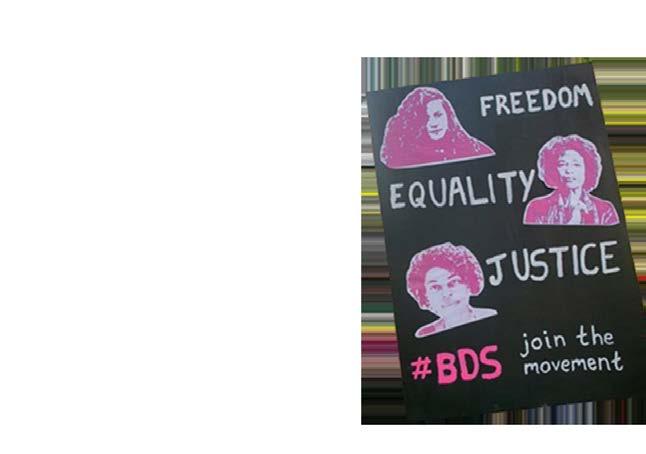
For many students, the answer has become ethical consumption. We stay up to date with the Boycott, Divestment, Sanctions (BDS) movement, and switch products, all in an attempt to align our politics with our consumption. These choices are not meaningless. They are often deep-seated in genuine care and a desire to refuse complicity. But what happens when these actions become the central action of our resistance?
The
idea that
we can “shop ethically” our way out of systemic violence
is comforting.
It offers a sense of agency in a situation that otherwise feels completely out of our hands. It tells us that our individual choices are crucial; that if we are disciplined enough, informed enough, and careful enough, we can opt out of injustice. But unfortunately, global capitalism does not operate on the level of individual morality.
Supply chains are vast and deeply entangled with systems of exploitation. A single product can pass through multiple countries and political contexts before it reaches us. Even when we try to disengage, we remain embedded in structures that are nearly impossible to fully escape. The system is not designed to be navigated ethically at an individual level — it is designed to function regardless of individual ethics.
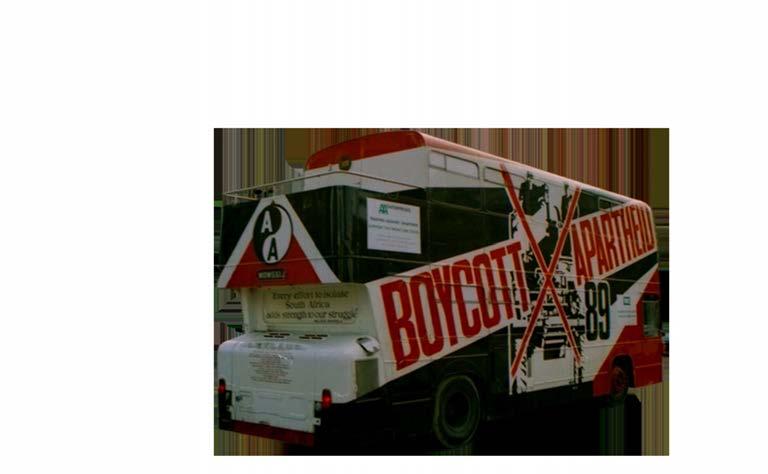
We have seen this dynamic before. Consumer boycotts have long been used as tools of resistance, from the antiapartheid movement in South Africa to more recent campaigns targeting companies over labour practices or environmental harm. These efforts have, at times, contributed to real pressure and are often successful, but they were never the sole driver of change.
Research suggests that boycotts can be effective, particularly in damaging reputation and generating public pressure, even when they do not always directly reduce company revenue. They work best when they exist alongside protests, international sanctions, media attention, and sustained institutional pressure. Careful consumption was one tactic among many, not the solution itself.
In the present moment, many of the companies being boycotted are part of vast global systems that extend far beyond any single product. Technology companies provide infrastructure, governments maintain diplomatic and military relationships, and universities hold investments that are largely invisible to students. In Australia, universities have faced growing pressure from student groups to disclose and divest from companies linked to defence and surveillance industries.
These boycott campaigns reflect a larger imbalance: while individuals are encouraged to make ethical choices, institutions with systematic power remain intact.
This becomes even clearer when we look at how different forms of political action are treated. In recent months, debates in New South Wales around protest laws and policing have raised concerns about the limits of public dissent, particularly in response to proPalestine demonstrations. While governments continue to affirm
action becomes more restricted, individual action is often elevated as the most acceptable form of political expression.
This shift is crucial. It subtly redefines what counts as “doing something.” Instead of challenging institutions, we are encouraged to modify our behaviour: to buy differently, and withdraw from certain brands. These actions are visible and relatively contained. They do not disrupt power in the same way organised political pressure does.
At the same time, this framing resonates because it meets people where they are. Studies have consistently shown that younger generations, particularly Gen Z, are more likely to make purchasing decisions based on ethical or political concerns than previous generations. This reflects a genuine desire to align values with action, but it also reveals how easily political engagement can be channelled into consumption while leaving larger systems intact.
Additionally, this is where nuance matters. For some people, boycotting is not a substitute for protest; it may be one of the only accessible forms of resistance available. Disabled people, immunocompromised people, and those facing financial, work, or safety constraints may not be able to attend protests or participate in sustained public demonstrations. For them, refusing to buy from certain companies can be a meaningful way to participate in collective pressure. The problem is not boycotting itself, but the way institutions can rely on individual consumption to replace broader political responsibility.
In this context, ethical consumption risks becoming less about dismantling injustice and more about managing our proximity to it.
Boycotts can reduce harm and signal dissent, but they can also function as a way to ease the discomfort of knowing.
This is not an argument against boycotts, nor is it a dismissal of student activism.
Boycotts are undeniably powerful, particularly when they are collective and sustained, but when they are treated as the primary or sufficient response, they risk narrowing our understanding of what resistance can look like. Responsibility is redirected onto individuals, while governments, corporations, and universities remain largely unchallenged.
If the structures enabling violence remain unaffected, then individual consumption alone cannot meaningfully confront them. The danger lies in mistaking participation in ethical consumption for meaningful political change, rather than one aspect of a much larger struggle.
It is easier to change what we buy than to confront the systems that shape those choices. Consumption offers the illusion of control in a system designed to limit it. But if our politics remain at the level of personal restraint, nothing will fully change. The question evolves from what we are willing to give up, to what we are willing to demand. What would solidarity look like if it extended beyond our shopping habits, into our universities, our institutions, and our politics? What would it mean to move from personal discomfort to collective pressure? Because if ethical consumption is where our response begins and ends, then the system continues as it always has, and we remain, however unwillingly, part of it.
Our Futures, Our Fees, Our Degrees
I am nearing the final stage of my university degree. I have been studying for almost three years in a costly arts degree, and at this moment, the question that plagues me is: what have I done? This is not a unique question and nearing such a milestone, fears of the future bubble to the surface, but in the enshittified and corporatised university system of now, the answers to these anxieties feel less certain. Course cuts, resource scarcity, underfunding of infrastructure, and the ever-increasing inability to break into fields dominated by gerontocracy, connections, and insider knowledge amplify these fears. Job-readiness appears non-existent. Seldomdo we hear the voices of students who are navigating their way in real time. I spoke to students from universities across Sydney who study or studied a range of degrees, seeking unspoken truths and ascertaining the importance of our studies in spite of increasing pressures.
COURSE CUTS
Andrea is a second-year law student at the University of Technology Sydney (UTS). Recently, the institution has been under fire following a Four Corners ‘Campus Chaos’ special which revealed the university spent $7 million on consultants from KPMG to identify unsustainable sources of revenue, which led to cuts from everywhere, from international studies to public health. This is only one expenditure among the total of $1.8 billion spent on consultants across Australian universities. Andrea said that she has already noticed these effects: “I have friends who are interested in studying certain subjects [which are] gonna be cut, and they’re the sort of niche areas of law.” She also expressed a concern for cuts which go beyond universities and stretch into the workplace. She said that for graduate level jobs like paralegals, Artificial Intelligence is being introduced,, and despite this being a slow process due to the problematic nature of AI, a reliance on the technology will inevitably harm new graduates, especially women. When money is prioritised over the success of students, the university begins to move away from their initial goal, which is the pursuit of gaining and sharing knowledge.
INTERNATIONAL STUDENTS
When considering international
students, concerns become intensified. Charlotte, an international engineering student said: “If you are an international student, I can imagine the burden and stress of finding a job that can sponsor your visa to be extremely frustrating and draining, since there aren’t as many jobs that apply to you.” She expressed a sense of luck in having English as her native language, but of course, for students who may have difficulties with the language, there are even more barriers. Taking into consideration that many I spoke with expressed worries about the lack of instructors, and administration staff who work face-to-face with students, this certainly does not quell the barriers. Further, international students are a lifeline for Australian universities, contributing a significant monetary base. With higher costs for student visas, cost of living in Australia, demonisation and distrust stoked by the Liberal party in the 2025 election cycle, and major course cuts, it seems inevitable that a vital student population will decrease.
UNIVERSITY STAFF
Last year, USyd reported that they were considering staff cuts to save money. That same year Western Sydney University and UTS both announced they were to cut staff which combined, placed over 500 jobs at risk. UTS staff have struck a number of times this semester, facing salary cuts and pressure from university management, who are ignoring their calls for improving working conditions and pay in the face of rising interest rates and widespread unaffordability. Staffing issues are not the fault of the staff themselves, who are either cut from faculties due to funding or feel forced out of positions due to the impossibility of earning a livelihood. Teaching staff face casualisation, allowing the university to not only pay less but leave these members of staff in precarious position of employment, which may be terminated more easily.
Dr. Kathryn Schumaker of the United States Studies Centre at USyd said on staff cutsthat “it is a recipe for burnout,” especially in the humanities departments. “Since the Global Financial Crisis, universities have cut continuing staff and increasingly relied on casual labour. This means that continuing people
Callista Burrowes is graduating
are scrambling to offer students a high-quality experience whilst casual staff are overworked and underpaid.”
This was corroborated by a casual administration support worker at another Sydneybased institution who said the casualisation of her workplace makes her‘feel insecure and undervalued.’
“Even though I’ve been successfully doing my job for over a year I have no job security, and that’s scary,” She told Honi . As long as you are not a higher up in the tertiary system – student or staff – your position is always precarious, with the rug being pulled out from under you, a looming threat.
BULLSHIT JOBS AND CAREER READINESS
Sabine is a journalism student at UTS and the host of Up For It on fbi radio. In our discussion, she told me that most people in her course are looking to be lifestyle and sports journalists out of passion, because they don’t see opportunities in traditionally trustworthy institutions: “Unfortunately we’re realising in Australia that the journalistic cycle is unnecessary.” In 2018, anthropologist David Graeber introduced the term “bullshit jobs” to our growing lexicon to describe our unsatisfactory and late capitalist world. A bullshit job is practically useless and demoralises the worker, who is aware of its futile and inconsequential nature. Students I spoke to expressed apprehension towards working a bullshit job, not wanting to see their years of study lead to a lacklustre working life. This fear is valid. An arts degree costs approximately $55,000 when only decades ago, study was free. The Coalition’s ‘Job Ready Graduates’ scheme has left many students at a crossroads, as they see their courses divested from, and their studies portrayed as something that does not contribute to the workforce. ”Every opportunity in media has been through my own inquiries,” Sabine said. For students pursuing industries deemed by the government as not a “national priority,” they are left behind.
OUR STUDIES STILL MATTER
But if this is the case, if it seems that in every factor and sector of tertiary education there is
an epidemic wiping out hope of professional survival, then why do we continue to study? Why do rates of degree and diploma holders rise? I spoke to Jennet, who is a third-year engineering and arts student, who still feels fulfilled in her decision to embark on higher education. “I think there is value in gaining any form of knowledge,” she said, “but I think the rise of anti-intellectualism and the movement away from higher research is truly harmful for wider society.” Similar to Dr. Schumaker, who previously reinforced the value of education: “The world has always needed smart people who can look at a complex body of evidence and make sense of it.”
Despite the odds that are in place, passion for the pursuit of knowing more overcomes these barriers. At 2SER, a radio station risking shutdown due to funding being withdrawn by UTS and Macquarie University, most employees are students and volunteers. Despite the struggle that comes with it, passion overcomes a monetary incentive for these professionals. “2SER has been the launching pad for journalist careers for 46 years, and it provides a vital diversity of voice, of culture of discussion to this city that no one else does,” Cassie Derrick of the Media, Entertainment and Arts Alliance said at the recent UTS staff strike. The humanities, and these public institutions of education provide a place like no other for students. A university education is not only in the academic world; it is in all the opportunities to build community and exercise what has been learnt out in the world. Universities have an obligation to remain a place that not only creates career-ready graduates through classes, but a place that supports the enrichment of students stepping out into the adult world.
However, not everyone can always ignore the real cost of universities and what gaining a degree can do to change someone’s life, which is why our universities need to become more equitable places where economic pressures can be dismantled in order to allow anyone, regardless of their background, to pursue knowledge for the sake of it. We must listen to the students and staff affected by decisions out of their reach, and work towards undoing the consequences of the business model imposed on learning.
Is Music Journalism Dead?
Music critics have always been the big bad wolf for musicians and fans alike. For decades, they’ve always seemingly been ready to chomp at the bit, to rip an artist’s painstaking labour to shreds. When a musician delivers what appears to be a bad album, it’s a field day for critics, and it’s easy to be mean. After all, everyone loves a scapegoat.
That’s not to say that musicians don’t bite back: in 2022, Charli XCX wore a shirt that read, “they don’t build statues of critics.” It seems to be the 21st century equivalent of the saying “writing about music is like dancing about architecture,” oft-misattributed to Frank Zappa or Elvis Costello — though we don’t actually know who said it. Some slighted musician, probably. The point is, music criticism can easily be chalked up to being pointless, a bunch of nobodies writing about art they would never be capable of making themselves. Everybody remembers the musicians. Nobody remembers the music journalists.
But that’s not really true. Those among us who grew up reading print music press will be familiar with its staff and contributing writers, since they were consuming their work every week. Music critics used to have critics of their own. You could read a review by one journalist and take it with a grain of salt, because you knew from experience that they were inherently biased for or against something. When I was growing up, I despised Robert Christgau of The Village Voice because he couldn’t stand prog rock, a genre I loved wholeheartedly.
So, what actually is the point of music journalism, anyway? Like most forms of art criticism, it reflects the zeitgeist of the time — what we love and what we hate, depending on where our values are at. What once may have been considered B-grade slop now may be considered underrated kitschy campiness. But back in the 1970s, right up to the 21st century, popular music criticism actually served another purpose. At the time, if a new album dropped, you couldn’t just listen to it online and form your own thoughts — you had to take a risk and purchase it. Music journalists were almost like a weather vane of sorts, pointing towards a general consensus: if music critics universally panned a record, you could save your money and decide it wasn’t worth the gamble, and vice versa. Not that anybody was taking everything NME or Melody Maker had to say at face value, but reviews were certainly playing a part.
Now, with the rise of streaming, music journalists have lost one of their primary functions. Throw in social media, stans, and the price of print issues of magazines (I’m sorry, I will NOT be spending nearly 30 Australian dollars on an issue of Classic Pop ), and music journalism seems to have its death warrant co-signed. Journalists seem to be unable to publish negative reviews anymore, lest they want their personal details doxxed. In 2020, a Pitchfork reviewer was harassed by Swifties after
Mia Rankin writes a review.
they gave Taylor Swift’s album Folklore an 8 out of 10, deemed too “low” in the eyes of some fans. Another was sent death threats and verbally abused after criticising the Eras tour in 2023. How are critics supposed to function if they cannot engage in respectful, rational discourse?
When middling reviews of Harry Styles’ latest record Kiss All The Time, Disco Occasionally dropped last month, comment sections were flooded with upset fans accusing music journalists of being bitter or biased, despite the fact that reviews are, well, inherently biased. Back in the golden age of print magazine press, a lot of issues had a ‘Letters’ section where they would publish opinions and responses from readers concerning previous critiques. Of course, such a section is moderated by the magazine, carefully curated and released weekly. Compare that to social media, where rather than taking the time to construct a thought out reply (as required when writing a letter and posting it), people crave the instant gratification of a “gotcha!” moment.
If internet discourse feels like a never-ending echo chamber of people shouting at each other, that’s because it is. Digital music criticism is only a button press away.
The widespread accessibility of social media is a double edged sword. On one hand, everyone can be a music critic! Everyone is entitled to post their thoughts, ranging from a humorous tweet about a song or an in-depth Substack post. On the other, you can get deeply misinformed people posting questionable takes. Some aren’t so serious, like the Swiftologist lamenting the lack of Swedish influences on Zara Larsson’s latest album, literally titled Midnight Sun. Others more so, like when self-proclaimed “busiest music nerd” Anthony Fantano said Halsey appeared to be suffering from “main character syndrome” singing about her debilitating health conditions. It’s moments like these when you understand why music critics are often looked down upon. Moments where commentary feels more a personal jab than measured criticism.
But it’s not just the music stan to critic pipeline at fault. Many music critics and publications become so selfparodying that it seems like they have nothing of value to say anymore, either. Pitchfork is everyone’s favourite magazine to hate, accused of hating female artists and churning out the same r/topster opinions year after year. It didn’t help matters when they recently did a “Best Albums” bracket and the final two opinions were both Radiohead albums. All that musical diversity and you ended up with two albums by the same artist? Similarly,
when Taylor Swift released The Life of a Showgirl last year, Rolling Stone revamped the look of their entire website to match the album’s aesthetics, going hand in hand with awarding the album a perfect score. Is it bias, honest opinion, or a paid one?
Of course, nobody likes having their fave criticised by some journalist typing away at their desk, churning out a review in barely a fraction of the time it takes to make an album. It’s natural to get defensive. What isn’t natural is getting so defensive you start throwing out personal jabs or slurs or doxxing somebody on the Internet. I do believe that a lot of people have a very fragile sense of self nowadays, in conjunction with Gen Z’s moral crusade, the Tiktok-ification of aesthetics, and parasocial relationships: is it okay to like The 1975? What aesthetic is Mazzy Star? Is Björk my friend? The moment somebody criticises something we’ve assured ourselves is morally sound or part of a currently acceptable aesthetic, it fractures our own self belief. Something that we thought was “okay” to like suddenly isn’t. Rather than curating our own opinions and holding steadfast to our own values, we often let the internet decide what is good or right, so we lack the vocabulary to articulate ourselves without getting upset. “Let people enjoy things!” or “It’s not that deep” are the fail-safes we fall back on because we’re too scared to engage in deeper discourse for ourselves.
Music criticism is not going to be true criticism if we keep throwing around playground insults and backing ourselves into a “it’s not that deep” corner. Music journalism as we once knew it has gone defunct; anybody can be a critic these days, but with the ability to critique art also comes certain responsibilities. If you’re going to be a music journalist, act like one: do your research. Interrogate your biases. You don’t need to conceal them — hell, wear them proudly if you like — but have the self-awareness to know how they will affect your viewpoint. Are you saying what you really believe, or what the internet thinks you should believe? Despite what people say, music journalism — and art criticism in general — is important, even if nobody is going to agree on anything. I’d rather see a variety of opinions than one stance spoon-fed to the masses.
What Would it Mean to Consent to your Algorithm?
At the start of 2026, the internet blew up with nostalgic throwbacks to 2016. Images of Snapchat filters, mannequin challenges, and Pokémon Go flooded my feed. While many relished in the memory of ‘simpler times’, I was caught off guard by a fact: 2026 marks one decade since Instagram adopted the algorithm.
It has been a decade since we could open the Instagram app and chronologically see content from people we followed.
In 2016, the algorithm was an attractive feature built on a fairly inoffensive premise: that content you enjoy should be easy to find. The algorithm was born with the potential to democratise information and encourage the exchange of ideas.
A decade on, glaring cracks have formed in this idealistic image. Platform’s value proposition as a company lies in prolonging user engagement to capitalise on data and advertising revenue. Thus, the more evocative content pumped onto our feeds via the algorithm, the longer we stay on the app.
As Hannah Fergusson, CEO of Cheek Media, said in a recent Oxford Union debate, “the algorithm reflects back to us the same old problems we were claiming to rail against.”
Now, divisive, inflammatory, emotional posts are valued by the algorithm to the point where Teach Us Consent, a youthbased not-for-profit, believes “hate doesn’t just exist online – it thrives there.”
Research out of Teach
Us Consent revealed it only takes 23 minutes for misogynistic content to be pushed to a social media account imitating a 16–18-year-old boy.
A similar test out of Reset Australia found that within 90 minutes of creating a fake YouTube account of a young man, the algorithm recommended violent, profascist and manosphere content.
Bringing these findings to a head, a landmark trial in March found design features like feed ranking algorithms and endless scroll are addictive and capable of causing significant harm.
While Australia has recently made significant moves to hold big tech to
account with the under-16 social media ban, there are limits to these sweeping reforms. Revealed in the first ESafety compliance update since the ban took effect around 7/10, under-16-year-olds remain on the platforms.
Between maintaining freedom of expression and mitigating harm, platform governance remains an incredibly fine line to walk .
And for university students, who, according to Deloitte’s Media and Entertainment insights, spend on average nearly 9 hours on social media per week, we are left to self-navigate the explicit and divisive consent fed to us via the algorithm.
But Teach Us Consent wants to change this with their campaign #fixourfeeds.
#fixourfeeds is a youth-led campaign, calling on the Australian government “to require social media platforms to offer an option to ‘opt-in’ to algorithms, giving us the autonomy to turn our algorithms on and off.”
They realised that yes, being on social media is harmful, but it’s the design features like algorithms that cause the most damage.
Fix our feeds imagines what it would look like to apply the lens of informed consent to the media we consume. What if we regained some semblance of agency over our feeds, learning how to confidently say yes or no to algorithmically determined content?
In a comment to Honi Soit, University of Sydney platform governance researcher Joanne Gray, a supporter of Fix our Feeds, said sweeping bans don’t “actually take into account the nuances of people’s relationships to social media.”
For some, consuming social media without an algorithm might slow business growth or stunt inspiration. For others, opening Instagram to a chronological order of content from people you have chosen to follow is the reason they got social media in the first place.
Fix our Feeds believes the ability to opt in or out of the algorithm would prevent the normalisation of radicalised misogyny, gender-based violence and exposure to racist, homophobic or misinformed content.
Beyond this, it’s a feature that encourages firmer boundaries with social media, rather than the current algorithm encouraging the opposite.
Gray says, of course, broader sweeping bans and fines are important, but more nuanced interventions create stronger platform governance.
She said, “A lot of the fundamental problems will never be fixed if the platforms are still designed in the way that they are now.”
Much of the 2016 nostalgia was accompanied by memes declaring 2016 as the last good year of the internet. But maybe the internet could return to its more wholesome form if we could turn off the constant stream of dangerous content and finally see what our friends are posting again.
Ella Ruddle looks back to 2016.
My Brilliant Career - A formidable fiasco
My Brilliant Career is a book saturated in the egotism of its author, driven by a deeply compelling individualism which proudly defies capture by the nets of genre convention and the attitudes of its time. Miles Franklin writes with a tenacity and a strength in both prose and observation which contain within it the extremes of emotion so favoured in the temerity of youth. Her ability to play confidently with registers both tragic and humorous endows the novel with its reputation as probably one of Australia’s only truly great books. The Sydney Theatre Company’s rendition is an ambitious attempt to transform her standout novel to one of contemporary humour and insight, but in doing so, it loses the charm of what makes Franklin’s narrative so astounding, and risks becoming kitsch.
The show and the book have the same narrative. The young Sybylla, overwhelmingly depressed by the realities of rural Australian life, reads the works of the bush poets, and sees herself as a writer. She is swept into a world of romance when her family sends her to live with a wealthy aunt, where she encounters the audacious Harry Beecham. It is there that she must decide between a life of marriage and the struggles of writing. The book, written in the first person, presents the young girl as both delusional to an almost ridiculous extent and yet also incisively perceptive, and it is this tension between these traits that creates Syb as such a compelling character.
The production itself is unquestionably brilliant, and director Anne-Louise Sarks’ use of the scope stage is impressive. Sarks plays with perspective and scale to create the central drama of the stage as one of intense concentration. In order to stand out within the space, Marg Howells’ costume design shows much care, a comprehensive revolution of the fashion of the early 1900s combined with the freedom of contemporary clothing. The set design is also commendable, moving about the revolving piano often placed in the center of the stage.
The actors, too, are remarkable in both their dramatic and musical performances,
performing, singing and playing instruments throughout the show. This works wonderfully, and makes the performance tight and enjoyable.
At the helm of this cast is Kala Gare’s Sybylla, who excels at the comedic register, bouncing around the stage with a verve right out of Franklin’s novel. Her delivery of the songs is also great, watching her strut about the stage as she belts out a power ballad genuinely feels as if the show had for a moment stopped being an adaptation of a novel from the early 1900s, and instead transformed into a concert one might find themselves at in the UNSW Roundhouse, replete with the headbanging and theatricality so often found there. Raj Labade’s audacious Harold Beecham is a perfect foil to the nervous projected certainty of Sybylla, and his almost ridiculous bravado is fantastically executed. Another particular standout, a surprising one, was Drew Livingstone’s duet performance of the roles of Father and Uncle . He excelled at the loudmouths and the buffoons that he played.
This is a show with everything primed to work in its favour, and the performances are certainly world class, but work narratively, it does not. The show is laboured by a struggle with the tone of its source material. At times, this struggle is lost so badly that it appears as if one is watching a parody of Franklin’s book. The characters are there in their
fundamental forms, Harold Beecham still remains charming and suave, and Syb is outspoken and awkward, but the weakness of the dialogue is demonstrated clearly in the more melodramatic parts of the musical. These sections are clunky as the modernised language contains little of the sharpness and almost none of the pathos of Franklin’s work. The work is straining to be a comedy and held back at all turns by the unavoidable source material. This is clearly due to constraints of the form. The language of the novel is often one of heavy implication, at least in dialogue, and undercutting the idealistic tone of Franklin’s book is the continual denial of Syb’s artistic transcendence, and a struggle with the material conditions of her existence. The staged nature of the musical means that this essential tragic dimension of the novel must be explicit to the audience, rather than suggested, which works poorly when delivered as a monologue on stage, rather than a narrative contained within its narrator’s almost solipsistic and oftentimes delusional perception.
The music is also fairly unmemorable, the songs functioning more as a display of the character or as a means to convey plot than really anything compositionally or musically interesting.
In spite of this, the musical works, largely due to the strength of its production and the strength of Franklin’s plot, and the comedy is genuinely hilarious in the finer moments. While this is a musical that struggles to capture its source materials’ finer points, it still excels in entertainment when considered independently. One of the best things this show will do is reintroduce people to Franklin’s wonderful and supremely strange book, a genuine high point in the pit we often know of as “Australian literature”.
Sebastien Tuzilovic reviews.
President Grace Street (Grassroots)
Last week was spent preparing for and speaking at a hearing for the NSW Parliament Inquiry into the University Sector, where I represented the SRC and students with SRC Disabilities Officer Kayla and SRC Casework and Policy Officer Jazzlyn. We discussed important issues with the Committee on Social Issues about meaningful student representation and consultation, the crisis of free speech, the role of the University Senate, the experiences of disabled students being let down, the importance of the SRC, and much more.
I went out to support the activists of the Global Sumud Flotilla at a snap rally when they were kidnapped in international waters and tortured. Our University and government must stand up against these flagrant injustices and violations of international law and human rights.
This week is Feminist Action Week – an annual week put on by our SRC Wom*n’s Collective, an autonomous feminist action group for students. We have one cool event for each day
Education
of the week which you should check out, even if it’s just coming to the social event + mutual aid fundraiser this Friday at 6pm at the Forest Lodge Hotel to meet like-minded people and find out more about our feminist organising.
Events like these are the kind of information included in the fortnightly newsletter I started and have been running this semester, of which I am quite proud! Make sure to sign up via the pop-up on our website to get a regular (but not spam-level) email with collated information about SRC services, events, advice, and more.
Keep up the fight, Grace
Dana Kafina (Grassroots) Jasmine Al-Rawi (SAlt)
This week, the Israeli government shamefully kidnapped 180+ activists from the Gaza Freedom Flotilla, including our student activist, Ethan Floyd. We stand in full solidarity with the flotilla and all those who were seized by Israeli forces. This brazen act of kidnapping by a state acting with Western impunity is shameful. We call on the Australian Labor government to condemn it in the strongest possible terms and use this to take action and sanction Israel!
It was a privilege to join hundreds of workers, unionists, and activists at
Women’s
the May Day rally on Friday. We had a student contingent and attended the rally, and a banner paint earlier in the week to spread the message: touch one, touch all, students stand in solidarity with staff.
We also held and attended a successful national week of action, reiterating calls for Weapons Off Campus and for our university to divest from weapons manufacturers such as Thales.
WoCo are so excited for Feminist Action Week!! Formally known as Radical Pride and Consent Week or Reclaim and Resist Week, this week is dedicated to feminist activism on campus. Keep an eye out for the incredible events which USyd WoCo has planned with so many incredible groups and individuals. Join us in celebrating feminist activism on Gadigal land, and raise awareness to our corporate university’s lack of action when it comes to feminist justice. Whether inaction in the face of femicide and gendered violence, or allowing anti abortion “activists” to harass vulnerable students on campus, USyd management remains complacent. We must continue to place pressure on them - we will not let gendered violence to continue to be perpetuated on our
International Students
The international student officers has recently been actively involved in a range of activities at the University of Sydney, contributing to both student engagement and community development. The department organized and participated in the Trivia Night hosted by the International Students Collective, held on 22 April at 6 PM in the Susan Wakil Building 402. This event provided a relaxed and interactive environment during the mid semester period, allowing international students to connect with peers, relieve academic stress, and strengthen their sense of belonging through team based activities. In addition, the department organized an Easter themed campus activity, which attracted approximately 50 participants. During the event, students searched for hidden golden eggs(chocolate) in public areas, and those who found them were able to redeem prizes. The activity was completed smoothly with strong engagement, contributing to a vibrant and festive campus atmosphere.
Queer
campus. However, if you’re new to feminist organising, come along to meet staunch members of WoCo and become part of our activist community.
However, in this past fortnight, our Labor government proved that they show a true disregard for the lives of their people. The cuts to NDIS, preventing 160,000 people from accessing these services is utterly abhorrent. Furthermore, Labor and USyd and USyd remain silent in the face of the interception of the Global Sumud Flotilla. We must continue organising on both our campus and the broader community. Feminist Action Week is just one of the many strands of organised activism and protest.
In love and rage, Maxine and Avin
Furthermore, the department has closely followed the recent increase in the Temporary Graduate Visa subclass 485 application fee and responded by creating and publishing related video content to raise awareness and advocate on behalf of international students, aiming to amplify student voices and encourage discussion within the community. In terms of digital outreach, the department initiated the development of a TikTok account and has continuously contributed to content creation and promotion on both Instagram and TikTok platforms. These efforts have enhanced the visibility of international student activities, improved communication with the student body, and strengthened the department’s online presence.
Overall, through involvement in event organization, policy awareness, and digital media promotion, the department has effectively supported the international student community while further developing its capabilities in communication, coordination, and content creation.
Jesper Duffy (Independent) Wendy Thompson (QuAC)
QuAC is back after the mid-sem break!
Right before the break we held a movie night where we watched Paris is Burning, a classic queer film about the Ballroom scene in New York in the 1980s. We had pizza and good political discussions about the film afterward!
After the break we held a launch party for Queer Honi where we brought the student queer community together to gather over food, hang out, play games, discuss queer goings-on, and then went to Birdcage together.
QuAC has been appalled to hear that the Global Sumud Flotilla was attacked by the IDF over 1000km from Gaza and that many organisers sailing to break the siege and deliver aid have been kidnapped. Among them is Blak, queer organiser and
Global Solidarity
USYD student Ethan Floyd. We call on the Australian government to ensure the safe release of all flotilla members and to act so that Israel lifts its blockade on Gaza.
Coming up this week, QuAC will be holding a transformative justice workshop as part of Feminist Action Week. Join us Thursday, May 7th at 3:30pm in the Madsen building conference room 449 to discuss how to respond as communities to interpersonal violence beyond the carceral police and prison systems!
We’ll also be attending and running a mask bloc at the upcoming Stop the NDIS Cuts rally on Saturday, May 9th at 2pm at Sydney Town Hall along with the Disabilities Collective! Queer justice and disability justice are intrinsically linked, and the proposed cuts to the NDIS will hurt all of us. We hope to see you there!
Imane Lattab (Grassroots), Evan Costa (NLS), Starla Bilby (SAlt), William Ursu (????)
Global Solidarity Office Bearers have not submitted a report.
Aoyue Cao, Anu-Ujin Khulan, Lucas He, George Feng (PENTA)
Late Discontinuation Under Special Circumstances
What is a DC Grade?
A DC (discontinuation not to count as failure) grade indicates that you were enrolled in a Unit of Study, but sometime after the census date, were unable to complete the unit because of illness, injury, or misadventure, that was unexpected, and outside of your control. DCs do not count towards your WAM or academic progression and the HECs/fees you paid will be refunded.
What supporting documentation do you need?
Both your written statement and your supporting documentation should specify the affected unit/s of study and set out the reasons why your circumstances:
1. were beyond your reasonable control;
2. did not make their full impact until on or after census date;
3. made it impracticable for you to complete the affected unit/s;
4. could not be addressed by special consideration or disability adjustments; and
5. if you successfully completed other unit/s explain why only the affected unit/s were impacted. If you did not complete an assessment, you either need to have applied for special consideration or your supporting document needs to explain why you did not apply for special consideration.
Your documentation does not need to be a report, it can simply
Abe SRC Caseworker Help Q&A
Dear Abe,
I am very worried about my friend, who seems to be having a really hard time with her dad. I don’t think he hits her, or anything like that, but she always has to tell him where she is, who she’s with, and how long she’ll be there, and if she is a bit late or if she is with someone he doesn’t like, he gets very angry at her. I’ve tried to talk to her about it, but she gets very scared and says she doesn’t want to talk about. What should I do?
Worried
be a professional practitioner’s certificate, provided it contains all those necessary details.
The most important part of your DC application is the supporting documentation. If you are unsure about what you need to provide, or if you just want to check that you have the correct document/s talk to an SRC Caseworker before submitting your application or review.
Who can provide this documentation?
Your documentation needs to be “verifiable”, which usually means it is from a doctor, psychologist, or psychiatrist, who is registered in Australia. If you have documents from overseas talk to an SRC Caseworker about what you can use.
What happens if you are not successful when you apply?
If you are missing some documentation, sometimes you will be given 10 days to provide the necessary documents. Check with the SRC what documents you will need to get for your application. You can appeal the decision if you are not successful, but you only get one opportunity for appeal.
When are DCs not available?
If you have completed all the assessments in a subject, you will not be able to get a DC. If the subjects are more than a year old, you will need compelling evidence showing why you couldn’t apply earlier.
Read the article with links to resources: Scan the QR code
Dear Worried,
I am sorry to hear about your friend. It sounds like a really difficult situation to be in. It’s totally understandable that you are concerned. The University has a wellbeing team that you can talk to. Their service is free and confidential. You can explain your concerns to them and see what advice they have for you and for your friend. Remember that providing support for someone who is having a difficult time, can also be difficult for you. Be kind to yourself as well as your friends.
If you need help from an SRC Caseworker, start an enquiry on our Caseworker Contact Form: bit.ly/3YxvDUf
Off the bwebs
ACROSS: 1. Yap, 3. Acropolis, 9. Krieg, 11.
24.
1. Self-satisfied (4)
5. Enthusiastic (4)
9. Norse story (4)
13. Singer Del Rey (4)
14. Prepare to surf (5)
16. Open learning environment (4)
17. A long time (4)
18. “Aunt Julia and the Scriptwriter” novelist Mario Vargas ___ (5)
19. Refer to, academically (4)
20. City with a White House (12)
23. Brewed beverage (3)
24. Start of a counting rhyme (5)
28. Beginning of laugh (2)
30. Introduced to (3)
31. Wannabe (8)
34. ___ salts (5)
37. Exists (2)
38. ___-ray Disc (3)
39. Frolic (4)
40. Tower-building game (5)
41. Warty hopper (4)
42. Rep. hired to sit in a higher assembly, abbrev. (3)
43. Article (2)
44. Pilotless plane, used in warfare (5)
45. Metal in kitchen foil, Yank spelling (8)
48. French friend (3)
49. Nintendo __ (2)
50. It’s off the table (5)
51. English news network (3)
52. Greek dip of pureed roe, olive oil and lemon juice
60. Smoothie berry (4)
63. Wonderland girl (5)
64. Suffix with symptom (4)
65. String tie (4)
66. Long-legged wader (5)
67. State, Ont. neighbour, abbrev. (4)
68. Before long (4)
69. Small price to pay (4)
70. French beast (4)
Down:
1. Shredded side dish (4)
2. Trump slogan acronym (4)
3. French articles (4)
4. Deep cut (4)
5. Like a swished basketball shot (6)
6. Europe’s longest river (5)
7. Gershwin’s “___ Rhythm” (4)
8. Perform as expected (4)
9. World Cup sport (6)
10. ___ Baba (3)
11. Understand (3)
12. Enzyme suffix (3)
15. Informal term for grandmother (3)
21. Thing (4)
22. Workplace initialism, has become a political dogwhistle (3)
25. Queen Amidala’s “Star Wars” home (6)
26. Gerald Murnane novel, interior of a continent (5)
27. Practice pieces (6)
28. Author Melville (6)
29. God of the sun in Greece (5)
30. Serious ticket last year for Honi Soit editorship (3)
32. Sound of relief (4)
33. Free TV spot (3)
35. Bilbo steals from his hoard of treasure (5)
36. List of food options (4)
40. Painter Vermeer (3)
41. Prefix meaning “three” (3)
44. 1998 law protecting intellectual property online, for short (4)
University management have today made public a punishment for violating the Campus Access Policy that “has been going on for about six months now”. The punishment entails a student being forced to defer their studies, and have their soul put into the body of a Lime Bike for up to a year, depending on the “severity of the offence”.
Students have reported hearing strained screams from the handlebars and pleas for help when the bikes are activated. Others have reported seeing concerning pop-ups from the Lime Bike app such as “HELP ME PLEASE OH GOD” and “People keep riding me. If you can read this just kill me”.
The university has defended its “unorthodox” methods, stating that “these Commie students have to learn somehow”.
Students are offered the “opportunity” to serve in the Australian Army in exchange for a reduced sentence.
Have you ever seen a Lime Bike thrown over a fence, or in a body of water? That is a human’s eternal soul attempting to escape.
STINKY SARDINE CORE
FASHION ALERT. The new micro-trend is here: sardines. Get your sardine bag, your sardine hat, your sardine dress? Sardines are kicking up a storm. The newest edition to your “cool girl must haves” or your “cool girl amazon finds”.
You thought having a $70 hand cream was cool? Did you think the vintage digi cam made you unique. Forget about that! The newest edition to your hot girl bag essentials: a retro box of sardines! The fun colours and the funky styles; there’s no one doing sardines quite like you.
Still not convinced? The $40 USD price tag will excite you. Now you know that one of those poor tinned fish eaters will NOT be rocking your style.
WORLD’S WORST POLYCULE DEBUTS IN WASHINGTON
King Charles, Queen Consort Camilla Parker-Bowles-MountbattenWindsor, US President Donald Trump, and First Lady Melania Trump made a bombshell joint announcement during the Royals’ visit to the White House: the four are now “embarking” on an “exciting new journey” that “totally shakes up everything we knew about love, sensual connection, and getting our freak on”.
Charles told the press crowd: “I never knew that when I cheated on Diana, I actually wasn’t doing anything wrong, I was just a smol polyamorous bean who couldn’t fully inhabit my truth yet. Thank you to my amazing new partners Donny and Mel for helping me see that, finally.”
Camilla stated that “sex with the Trumps is the freakiest we’ve ever been. And that includes me and Charles’ tampon roleplay.”
Reporters and White House aides were seen throwing up in White House bins and their handbags.
Despite a dwindling crowd, Donald took the stage to say that “sinking into this deep connection” has been “so inspiring and synergistic” and that he was extremely keen to attend lots of festivals with his new “love fam”.
Now to hear from our poor haters
Buy a starter pack for $88 today to start your stinky sardine girl journey. Make sure to forget that toothbrush -- you wanna keep the musk of these expensives sardines on you for as long as possible! That way the passer-bys will know of your cool-girl-sardine-core ways. #sardines #stinkygirl #stinkysardinecore #sardinecorecore #coolgirlmusthaves