Week 1, Semester 2, 2025
HONI SOIT
Hundreds of thousands march in historic ProPalestine protest
Part Two: The Tale of the Corporate University
Please Attach the Corpse to the Application
Luke Mesterovic Analysis, Page 11
Victor Zhang Feature, Page 8
Honi Soit Feature, Page 4


Honi Soit operates and publishes on Gadigal land of the Eora nation. We work and produce this publication on stolen land where sovereignty was never ceded. The University of Sydney is a colonial institution. Honi Soit is a publication that prioritises the voices of those who challenge colonial rhetorics. We strive to continue its legacy as a radical left-wing newspaper providing students with a unique opportunity to express their diverse voices and counter the biases of mainstream media.
Welcome to more course cuts, an increased cost of living crisis, and increasing resistance in the Australian community to the ongoing genocide in Gaza.
In a landmark march that took place on the Sydney Harbour Bridge on 3rd August, we saw over 100,000 people declare that crimes against humanity are unacceptable, and demand the Australian government to end their complicity in genocide. We will keep fighting until Palestine is free, and we will not allow Chris Minns or Anthony Albanese to labor under the delusion that their actions do not amount to complicity and collaboration. The government fails to sanction Israel, expel the Israeli ambassador, and stop providing weapons parts to Israel.
What this rally showed is that hundreds of thousands of people stand with Palestine, and we will not watch the mass starvation of millions in silence. We condemn state and federal governments for allowing this genocide to continue without meaningful action, and as we begin another term we remind USyd students that every voice matters. We have witnessed incomprehensible atrocities, and we must never allow that to be normalised.
We’ve pulled together an assortment of pieces that encapsulate the weary hopefulness of Semester Two. Flip over to our news section, complete with an ICYMI for those of you that dissociated your way through the winter holidays. Our feature, on page 8, is written by our very own Victor Zhang, a nerd who loves policy and higher education, and hates austerity. Luke Mešterović analyses our special consideration system on page 11. Kiah Nanavati delves into the history of extinction on page 13. Imogen Sabey explores chronic insomnia on page 15.
Welcome back to uni; capitalism demands your sacrifice.
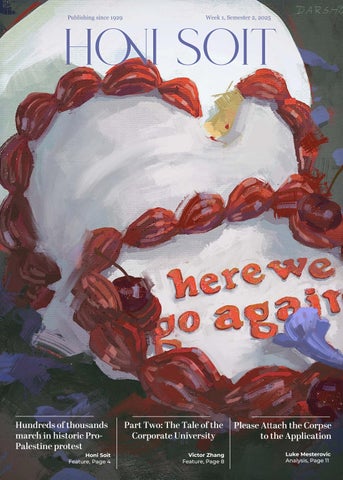
Here we go again.
Love and Solidarity,
The Honi Soit Editorial Team


Editors
Purny Ahmed, Mehnaaz Hossain, Ellie Robertson, Imogen Sabey, Charlotte Saker, William Winter, Victor Zhang
Front Cover
Darshni Rajasekar
Purny Ahmed, Sophie Bagster, Calum Boland, Pia Curran, Audrey Hawkins, Emilie GarciaDolnik, Zoe Gelagin, Mehnaaz Hossain, Luke Mešterović, Kiah Nanavati, Marc Paniza, Ellie Robertson, Imogen Sabey, Charlotte Saker, Will Winter, Victor Zhang
Artists
Purny Ahmed, Chloe Drougas, Ellie Robertson, Imogen Sabey, Will Winter
Letter to the Editor
Since I am penning this fundamentally in relation to the conflict between Israel and Palestine, let me make my position on this conflict clear at the outset. I am an undergraduate Arts student and a returning student having initially graduated in the 1970s.
I condemn the killing, torture, and oppression of any human being. As a student of history however, I can understand both actions and reactions. This does not equate with agreement. People cannot enjoy peace and co-exist in an atmosphere of hate or fear.
The meeting convened by the SRC on Wednesday, which considered motions in relation to Palestine, the definition of Anti-semitism, the Campus Access Policy and the position of Usyd was conducted in a civil manner. Respect was shown to Jewish spokespeople who sincerely opposed the motions, and at no time could they be justified in claiming otherwise.
Instances of anti-semitism that they spoke about on campus cannot but be condemned and culprits should be expelled. But do our Jewish students also recognise that those Jews who differ on the conflict are castigated by their own? They are “self-hating Jews”, they are shunned in their own community, alienated within their families, and also subjected to violence by other Jews. Ask any of them who are brave enough to be outspoken – ask the Peter Slezaks. I have Jewish friends who can line up and outline how they have been treated
by their own community and also threatened with violence.
Provocateurs also abound – ask those who witnessed “journalists” from Murdoch’s press who descended on the Cairo Restaurant in Enmore.
Let us consider several matters in relation to all of these issues.
As an Australian-born Greek, I am too aware of how my own country of origin has experienced invasion and political interference. Which country? Both.
Australia was invaded and occupied. It was populated from 1788 by oppressors and their white victims – notably the poor Irish or English whose crimes were due to poverty and class division. Innocent Indigenous Australians suffered as a result of these factors and continue to suffer.
Greece, so admired for its Ancient Past, particularly Athens’ 5th Century BCE has had equal consideration of much of its history since, bypassed. Invasions by Romans, Venetians, Genoans, Normans, Ottomans, and the fascist Axis powers, then political interference from Britain and the USA - and more recently by the Troika and the IMF – how much democracy has it enjoyed in the last two and a half thousand years?
Perhaps I am better understood with these views if I say that I detest nationalism and imperialism and stand with the oppressed. I am also an atheist, but I respect people who are religious as long as
Rumour Has It...
they don’t try to inflict their views on others. Sadly, this is not often the case. Many see it as their mission to convert.
So, returning to the IsraelPalestine conflict. So much of the current debate takes as its starting point October 2023. Why? Hamas’ actions then, can only be seen by anyone who claims objectivity and rational analysis as a reaction. A reaction to what? Ask this question. All of history is action and reaction. Let’s not be sidetracked by labels such as “terrorists,” after all, Menachem Begin, who led Israel as its sixth Prime Minister, was an Irgun selfproclaimed Zionist terrorist in the 1940s.
So does the story start with October 2024? Does it start with 1948? Does it start (as our Jewish students told us at the SRC meeting) with the Romans? These questions will need to be settled to everyone’s satisfaction but can they?
The way forward is simple in suggestion but complex in achievement. It is a situation where Jews and Muslims and Christians share the land and live alongside each other. But peace will never be achieved while illegal settlements are tolerated, and what is left for Palestinians are the scraps and while they see what were their ancestral homes before 1948, stolen and “developed” by others. This in my view, means that a two-state situation will always be tenuous. There has to be one secular democratic demilitarised state that respects the equality of all regardless of gender or religion or race.
Let me finally say that I was an undergraduate in the late 1960s and a veteran of the student movement when thousands marched down Broadway to join the Moratorium against national service of young men who were not yet of voting age.
The Viet-Nam moratorium opposed the war of the industrial West against an impoverished people who sought nothing more than to determine their own future.
The greatest military power on earth was defeated by people who in some cases shot down enemy helicopters with bows and arrows!
Usyd never suffered as a result of the freedom allowed on campus to protest then. The University thrived as a vital element of democratic freedom and critical thinking.
Mark Scott with your antiprotest Campus Access Policy take note. The definition of Anti-semitism issue is manipulating the university’s management.
Byron Comninos
WHAT’S ON?
National Student Strike for Palestine
7th of August, 11am Eastern Avenue
‘Endlessness’ by SUDS 6th to 16th of August, 7pm Cellar Theatre
ECOPSoc Drinks 7th of August, 5pm Forest Lodge Hotel
Student Journalism Conference 15th–18th of August
Dear Honey
Dear Honi,
Send Letters to the Editor here:
editors@honisoit.com
I am seeking your solemn advice and assistance in my navigation of the University of Sydney and broader network’s dating scene. Forsooth, dearest Honi, I yearn. I yearn for a first year Bachelor of Commerce student, and I am at a mighty crossroads indeed. Responding to my suitor’s beckoning, a magical day spent with he, most lovely and temperate, at his (not-so-humble) abode ensued for an unfrugal 8 hours. We broke bread (made cookies) and jested with felines (played with his cats). We lauded the sacred text (watched the lego batman movie) and delighted in tomfoolery (showing me how to play Clash Royale).
Now heresy fills the court, for he in whom I find my merriment has declared a lack of preparation for such an act of courting the fair lady! Thus, Honourable Soit, I find myself yearning sans resolve. What can a poor maiden do? Moreover, Honest Soit, I now remain in possession of the property of the fine gentleman, a crimson tupperware container. Its emptiness only serves to remind the lady of her vacant soul since his departure. How may I resolve this — both my broken heart and the custody of aforementioned tupperware?
All the love I can muster in these tumultuous times, JLS.
Dearest JLS,
Thou deservest a gentleman whomst experiences the most genuine merriment in thy presence, whomst wishes to court thy, whomst yearns as thou yearns. Thou deservest a suitor whomst rails ye royally.
Don’test settlest on a suiter whomst studies Commerce.
Thy, Honey



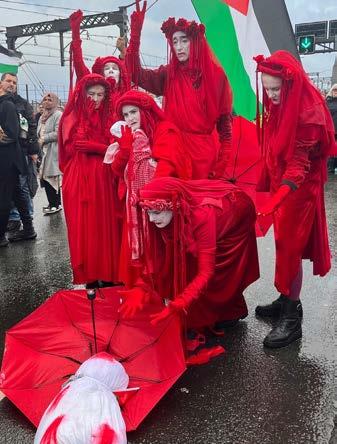
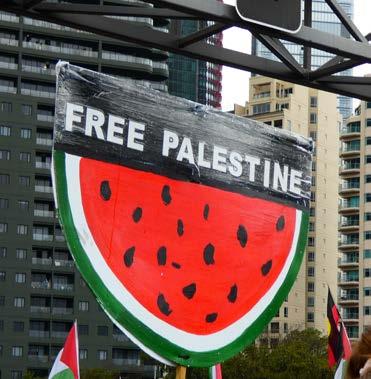

Hundreds of thousands march in historic pro-Palestine protest across the Sydney Harbour Bridge
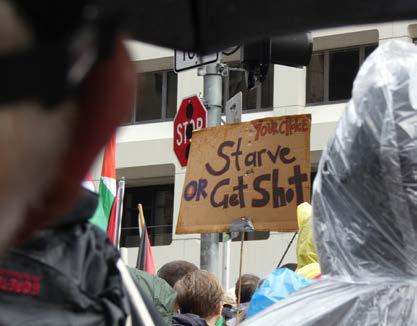
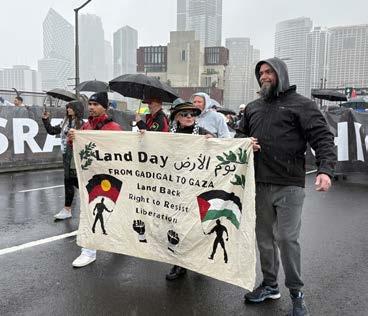
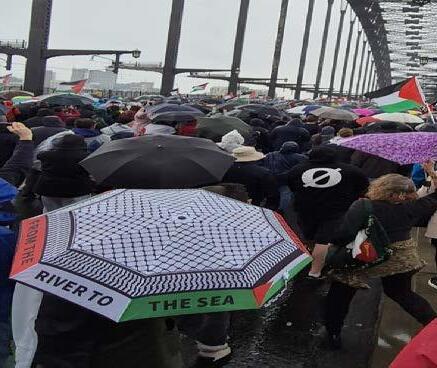
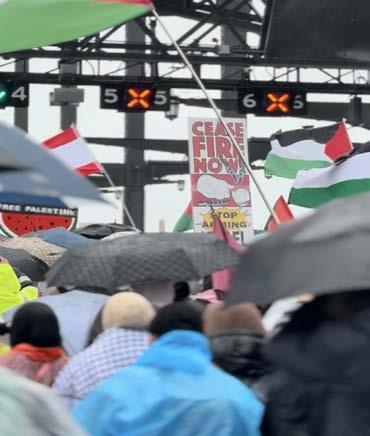
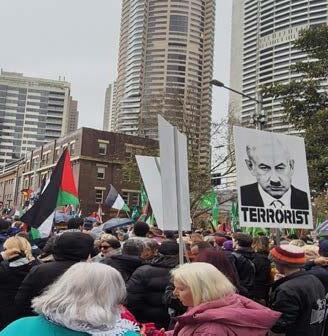
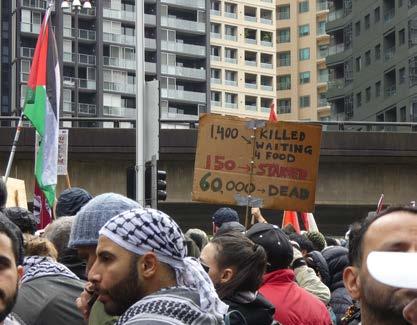
On 3rd August 2025, over 100,000 protesters marched across the Sydney Harbour Bridge to rally against Israel’s ongoing act of genocide in Palestine.
In recent weeks, at least 127 people, including 85 children, have died from starvation in Gaza, with over a thousand shot and killed while queuing for aid.
“The deliberate and unnecessary starvation of 2 million Gazans is part of a broader plan, repeatedly announced by Israeli leaders, to either kill or expel the Palestinian population from Gaza. This is a genocide.”
Organisers Josh Lees and Amal Naser from the Palestine Action Group (PAG) led the ‘March for Humanity,’ alongside keynote speakers including Greens Senator Mehreen Faruqui, Jewish Australian investigative journalist Antony Loewenstein, Palestinian writer Randa Abdel-Fattah, and former Australian of the Year winner Craig Foster AM.
From children to elders, from men to women, from Australians to Palestinians and everyone in between, the protest remained orderly, organised, and overwhelmingly peaceful as tens of thousands marched in


solidarity for their brothers and sisters in Palestine.
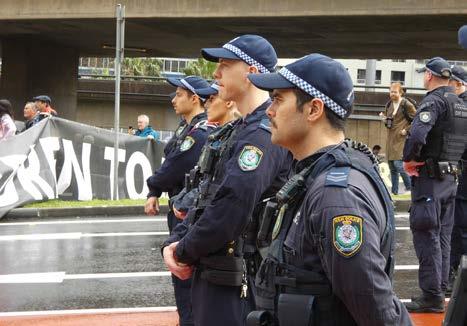
The protest followed the NSW Supreme Court Judge, Justice Belinda Rigg, rejecting the NSW Police’s case to prohibit the Harbour Bridge’s closure for the protest on 2nd August.
In authorising the public assembly, protesters were exempt from being arrested for Summary Offences such as stopping traffic and “will not be guilty for participating in unlawful assembly.
“The march at this location is motivated by the belief that the horror and urgency of the situation in Gaza demands an urgent and extraordinary response from the people of the world.”
While the Harbour Bridge was meant to be closed to traffic from 11:30am to 4:00pm, the bridge did not reopen till around 5:30pm; a testament to the sheer magnitude of attendees marching for humanity.
A 37 year old Palestinian woman and mother, Farah, told Honi “I am fighting for our people, I feel every death.”
When asked if she believed the protest was peaceful she said “100
per cent. I’ve got my five-year-olds here. We have to share our story with our younger generation, our kids. For us to live, we need to share it.”
Rami, a 67 year old Palestinian man born and raised in Jerusalem, explained to Honi why he had attended: “It’s the same as everybody else that’s here. You got a heart and you got a soul, and you see what’s happening. It’s like what happened in Iraq. These 200,000 plus [people] came out from the march across the street for Iraq, we knew there were no weapons of mass destruction, but that’s politicians for you.”
He added, “[The government] sanctioned Russia. Putin straight away. They can sanction Israel. There’s nothing stopping them.”
A 34 year old Jewish man, Yehuda, told Honi that he grew up engaging in political debate around Palestine and Zionism, soon realising that Israel is a colonial state.
“Zionism is not something that will protect us or serve Jewish interests, it is never too late to stand with the liberation of all people.”
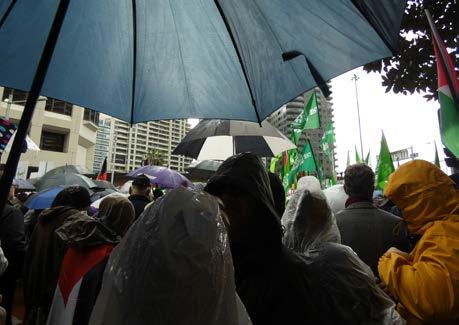
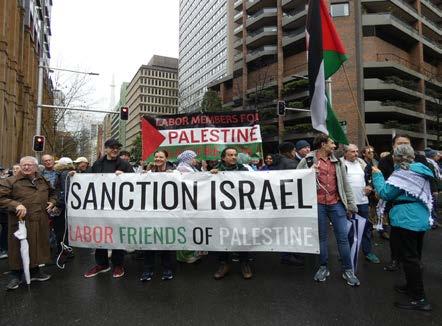
The March started at around 1:30pm from the corner of York and Grosvenor Streets and heading north west to the Harbour Bridge. Initially, PAG planned to march to the US consulate in North Sydney, but after realising that hundreds of thousands of people would march, they opted to head to Bradfield Park in the south of North Sydney.
While crowds crossed the bridge’s 1.2km length by around 3:00pm, police notified protesters in a slew of three text messages to turn back onto the bridge to avoid gridlock and a crowd crush. The protests back onto the bridge continued till approximately 4:30pm.
Police and PAG organisers cooperated to ensure crowds dispersed safely, moving people into the left lane towards North Sydney or the right lane back towards the CBD. Crowds at the back who had not yet entered the bridge were told to turn around back into the city.
NSW Senator and Deputy Leader of the Australian Greens Mehreen Faruqi told the crowds, “Thank you for defying Premier Chris Minns. This is a man who wants you to stay home and be silent in the face of a genocide. This is a premier who ran through
anti-protest laws squaring in at this incredible movement of people. This is a premier whose police brutally punched Hannah Thomas who showed the courage to stand up to Israel.”
“Next time, Premier and Prime Minister, come and join us, if you develop morality and humanity.”
Jewish investigative journalist Antony Loewenstein spoke to the Israeli attack on media and journalism in Palestine, noting the death of two Australian journalists amidst the genocide. He showed his anger against the attack of free speech and free use of the media throughout his speech.
As Honi marched with the crowd, we spoke with a Palestinian woman who had grown up in Jerusalem. “I have witnessed firsthand the Israeli occupation, especially during the First Intifada. The primary reason for me being here today is basically to deliver a message to the world that what’s happening in Gaza is immoral. It’s a genocide that needs to be stopped by everybody in this world.”
The NSW Government shut down Milson’s Point station, while Wynyard station was lively with hundreds to thousands of
Honi Soit marches for humanity.
protesters attempting to board trains home.
Across the CBD, buses rerouted, cars stayed in their garage, and trains slowed down, skipping Milson’s Point and Wynyard station. City circle stations glittered with people wearing keffiyahs, carrying Palestinian flags and poignant posters, with the spirit of solidarity in their eyes.
The remarkable turnout and remarkable spirit has marked a historic moment for humanity.
Free Palestine. Forever.
From the River to the Sea.
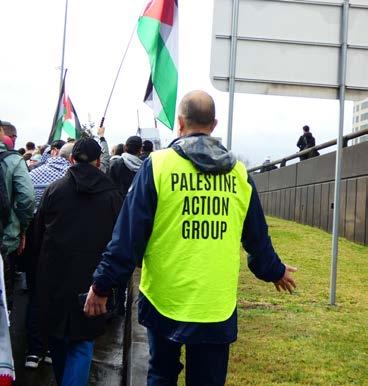
Photo Credits:
Ellie Robertson
Will Winter

Tenants’ advocacy groups in opposition to quiet rollbacks of NSW rental protections Victor Zhang reports.
Peak tenancy advocacy groups, legal centres, and unions have criticised quiet rollbacks of rental protections under the Residential Tenancies Regulation 2019 just weeks after historic legislation ending ‘nogrounds’ evictions came into effect on 19th May 2025.
The legislation meant that landlords seeking to terminate a tenancy on the grounds of significant repair or renovation must provide both a written statement and a piece of evidence, such as a quote or contract, to demonstrate intent that works are to be carried out. The Residential Tenancies Amendment (Termination Notice for Significant Renovations or Repairs) Regulation 2025, passed on 20th June, removes the evidence requirement and only requires
the landlord to provide a written statement.
In a joint statement, tenancy advocacy groups, legal centres, and unions have called on the NSW Government to reverse the changes and engage in transparent and greater consultation before rental law changes are made in the future.
Tenants’ Union of NSW CEO Leo Patterson Ross stated “this change means landlords will now only have to provide a written statement, with no supporting evidence, to evict a tenant. This just isn’t enough to guarantee that non-genuine evictions will be prevented.”
Thomas Chailloux, Senior Policy Officer at Shelter NSW, agreed with the assessment of the Tenants’ Union. Shelter NSW
is a peak housing policy and advocacy body, and one of the signatories to the joint statement. Chailloux said that in addition to the relaxation of evidence requirements, the relatively short re-letting exclusion period — the period after an eviction where the property may not be rented out again — of 4 weeks, was also a major concern.
The change was also opposed within Labor ranks with Labor for Ending Homelessness, an internal party campaign group, warning that this “regulatory change undermines a legislative reform that was decades in the making”.
A spokesperson for the NSW Minister for Better Regulation and Fair Trading Anoulack Chanthivong responded to these concerns stating that “renters are
still protected from no-grounds evictions.
“The adjustment to evidentiary requirements is a minor change, and simply proves that we will continue to adapt to industry and renters’ concerns as and when we need to.”
The NSW Government’s lack of consultation with renters and housing advocacy groups was also sharply criticised. Despite this, the Minister maintains that “we will consider a range of views and feedback to the legislative changes we are making”.
Jenny Leong, Member for Newtown and NSW Greens spokesperson on Housing and Homelessness disagreed, stating that there was “seemingly zero consultation with tenants’ advocates or the community”.
Leong expressed disappointment in the change which “wound back hard-won protections against no grounds evictions… that were passed with multipartisan support.”
Challioux also noted the lack of consultation: “as far as Shelter NSW is aware, these changes were made behind closed doors and without any consultation with housing and homelessness peak bodies, legal assistance services, or tenancy legislation specialists.
“There has simply not been enough time for the NSW Government to monitor and evaluate the new tenancy legislation provisions. Why then undermine these important, long awaited and much needed reforms?”
Students and Academics testify on USyd campus for the People’s Inquiry into Campus Free Speech on Palestine
On 15th July, the People’s Inquiry into Campus Free Speech on Palestine heard public testimonies from staff and students across NSW on the USyd campus. Over four sessions, students and academics, activists, and community organisers from NSW universities spoke to a panel about the bureaucratic practices and policies which have inhibited their ability to speak about Palestine or the Pro-Palestinian movement on university campuses.
The panel was composed of Senator Dr Mehreen Faruqi, Australian Palestinian Advocacy Network (APAN) Executive Officer Katie Shammas, Jewish Council Australia’s Linda Briskman, and former Head of Macquarie Law School Gill Boehringer.
Faruqi opened the proceedings by introducing the preliminary report, entitled Don’t Talk About Palestine: It’s A Career Killer. She affirmed to the room that “we are on the right side of history. We must continue to shine a light on Israel’s genocide and violence.” Boehringer spoke next, and construed from “the over 150 submissions, the threat to our right to peacefully assemble, the right of academic freedom, the right of free speech — they are all in danger.”
USyd student Yasmine Johnson (SAlt) began with an Acknowledgement of Country and a statement from the
University which stressed that they “encourage the principled and informed discussion of all topics — even those that may involve strong disagreement.”
SRC President Angus Fisher would later testify that this statement was mandated by USyd management to be read aloud in order to gain access to the room.
The first session began with testimony from USyd student Jasmine Al Rawi (SAlt). She recalled organising a forum in 2024 in which the university moved the room booking to “avoid distress to members of the community” and excessively warned Al Rawi and the panellists through letters and a security team recording the event to “take precaution as to antisemetic, racist, or unlawful conduct”.
Cherish Kuehlmann (SAlt), former president of Students for Palestine, began the second session with referencing the UNSW Student General Meeting held on 25th September 2024, in which over 600 students voted in protest of UNSW ties with companies complicit in genocide. As an organiser of the event, Kuehlmann testified that she closely followed processes, including filling in an assessment form. Later, a Freedom of Information (FOI) request found the event to be “peaceful and orderly”, with a senior security manager commending organisers.
Emilie Garcia-Dolnik, Will Winter, and Imogen Sabey report.
Kuehlmann further noted an FOI that revealed private email communications between senior UNSW staff which “made it clear [campus] repression is political, deliberate and targeted.” She also noted the difficulties of organising Palestine activist events, where a senior law faculty member described forums as “a real stain on [UNSW] optics”.
The first speaker of the next session was Salma, a University of Technology Sydney (UTS) student and President of the Palestinian Youth Society, who characterised the UTS response to Palestinian students as “dehumanisation, abandonment, and institutional betrayal.” She said that “Palestinian women have been sexually harassed and abused [on campus]... the university has offered no condemnation, no reassurance, and not even a check-in to know if we are safe. Instead, UTS invited Israeli soldiers to speak on campus. Our families were still buried beneath rubble, and the university brought in their murderers.”
This was followed by a statement from USyd SRC President Angus Fisher (NSWLS). He noted excessive surveillance of the Autonomous Collective Against Racism (ACAR) and the Queer Action Collective (QuAC) at Welcome Week 2025 “while displaying Palestine [paraphernalia]”. He also referenced the Campus Access Policy (CAP) as “one of the
most repressive pieces of policy implemented by the University.”
The third speaker was Ann El Khoury, a staff member at USyd, who said “staff have come under a lot of pressure to identify themselves [as staff for Palestine]… the civic space is shrinking.” She said that “half a dozen staff members were suspended from an online network [Viva Engage], one because he used an emoji that could have been interpreted as insulting. The emoji in question was a brain.”
She said “a complaint was launched because I used a red inverted triangle in my signature… [There is] an inconsistent and shadowy censorship going on in this online forum.
“Islamophobia and AntiArab sentiment is always discussed after antisemitism.
As an academic with a Lebanese background, I do feel pressure… There’s a pressure that we’re supposed to educate people. There’s a cognitive burden.”
Testimony was also given by Luna, a trans Malaysian student at USyd. Luna was subject to expulsion proceedings this year due to Palestine activism. She said that “at the time [of my expulsion] I was an international student. They would have had to notify the department of homeland security, and my visa would have been jeopardised. I notified the SAU of my status
as an at-risk asylum seeker, at risk of facing forced detransition practices. The SAU abused their power over me, they refused my request for an extension knowing it would jeopardise my visa.”
Luna, speaking publicly for the first time since the misconduct charges were dropped, concluded by saying, “The USyd student affairs officers watching this now, you know what you’ve done to me. Even narrowly skirting deportation, I have been inspired by my fellow Malaysian Hannah Thomas to speak about this. From the river to the sea, Palestine will be free.“
Faruqi issued a concluding statement, stating that “We must all bear witness to the genocide in Gaza, but it is also important to be witness to the atrocious organisations that are shutting down free speech… Palestine is the litmus test for free speech and human rights. Universities have failed this litmus test, but you have passed with flying colours.”
Faruqi commented to Honi, “The University of Sydney management has been one of the more aggressive managements in the last two years, in how they came up with the draconian Campus Access Policy, how they treated students who have been organising encampments… So I think it was really important to have the first public hearing on the USyd campus.”
Campaign launched to ‘Protect Mardi Gras’ from activist “threat”
A new campaign aiming to ‘Protect Mardi Gras’ has been launched to protest an alleged “exclusionary agenda” by certain activist sects of the Mardi Gras board.
The campaign, run by an “informal alliance” consisting of “Protect Mardi Gras Volunteers” and prominent board members including ‘78er Peter Murphy, is aiming to counteract the “threat from a group pushing for division and exclusion.”
While not named on their campaign website, the group has been identified as Pride in Protest (PiP), an “activist collective based in so-called Sydney”. PiP aims to “restore the protest roots of Mardi Gras and challenge systems of injustice”.
Community concerns regarding police presence and the corporatisation of the Mardi Gras Parade, which started as a protest in 1978 against police violence in queer communities, have a long and loud history. In 2024, the NSW Police Force were disinvited to march in the parade following the alleged murder of Jesse Baird and his partner Luke Davies at the hands of a police officer. This was later retracted to allow the police to march out of uniform.
PiP have recently released a statement calling for accountability for the death of Collin Burling in Waterloo last

week. Burling died in police custody on 15th July after being held down by four officers responding to a mental health crisis call. NSW Premier Chris Minns defended the officers, claiming they “work a difficult job in difficult circumstances”. PiP held a memorial for Baird and Burling on 19th July at Sydney Town Hall.
The campaign suggests that activists are seeking to “ban police, politicians and sponsors” from participating in the parade. In 2024, the Mardi Gras Board sent letters to members of NSW state parliament suggesting they would not be welcome to march in the campaign if they did not support the Equality Legislation Amendment (LGBTQIA+) Bill 2023. The Bill passed in 2024 after amendments were made to remove protections for LGBTQ students and teachers at religious schools, and remove the expansion of defined identified groups vulnerable to discrimination to include bisexual, intersex, and nonbinary people.
‘Protect Mardi Gras’, which claim PiP is “using AGM votes” to push their agenda, is aiming to sign-on members to vote in the next Mardi Gras AGM, expected to occur late in the year. The intention of how members are to vote is not specified beyond calls for “unity”. A Mardi Gras membership costs $50, or $40 concession.
Will Winter reports.
The 2024 AGM was held in the Eastern Avenue Auditorium. Three motions regarding police presence at Mardi Gras were put to vote; each failed by a thin margin. The closest, a motion which would have stopped the force marching in the parade “until such time as they demonstrate a commitment to improving relationships with LGBTQIA+ communities”, had 459 votes for, 493 votes against, and 26 abstentions. Only one of the three motions was raised by PiP.
In regards to the launch of the campaign, PiP have released the following statement:
“The Mardi Gras AGM is months away, meanwhile we are watching children starve to death in a livestreamed genocide in Palestine. Rather than playing around with this sort of navel gazing, we will be helping to build a queers for Palestine contingent for the rally marching across the Harbour Bridge this weekend. We call on all queer activists to join [the] Palestine Action Group this Sunday. Our queer contingent will be meeting at noon at Pride Square in Newtown and traveling to the rally together.”
‘Protect Mardi Gras’, when asked by Honi whether they believed the police had demonstrated a “commitment to improving relationships with LGBTQIA+ communities”, did not respond.
In Case You Missed It
Police violently dispersed a pro-Palestine community picket outside SEC Plating. Former Greens candidate for Grayndler Hannah Thomas was among the assaulted attendees and may permanently lose vision in one eye.
Antoinette Lattouf won her unlawful termination case against the ABC. Mary Kostakidis, known as the ‘face of SBS’, was taken to court by the Zionist Federation of Australia. standwithmary.org
The Federal Court ruled in Wertheim v Haddad, and Justice Stewart ruled that anti-Zionism is not equivalent to antisemitism. “Political criticism of Israel, however inflammatory or adversarial, is not by its nature criticism of Jews in general or based on Jewish racial or ethnic identity”
Jillian Segal, special envoy to combat antisemitism, released a report that recommended harsh repercussions for public broadcasters and universities that failed to combat antisemitism. The report was criticised by the Jewish Council of Australia and large sections of civil society, for using the contested IHRA definition of antisemitism.
The SafeWork NSW report that alleged the University of Sydney failed to counter antisemitism was leaked. Many incidents included in the report conflated Palestine activism with antisemitism.
Stand with Mary News
In effect starting this Semester is the “two-lane” assessment system, where an “open” lane permits the use of generative AI while the “closed” lane does not. Accompanying this, is a change to what categories of assignments are eligible for simple extensions.
Poor governance in universities. What’s new? Macquarie University announced the axe to 50 full-time academic staff and the entire Sociology major. As staff and students are facing cuts, university management are racking up extravagant costs as UTS executives drop $140,000 on trips to the United States and ANU Chancellor Julie Bishop delivered a $790,000 expenses report.
Imogen Sabey reports.
NTEU wins wage theft case against Monash University
The National Tertiary Education Union (NTEU) has won a wage theft case against Monash University.
On 4th July, the Federal Court found Monash had broken workplace laws by failing to pay academics for student consultation work.
The payout is unknown but expected to be millions of dollars. The court has not yet ruled on what penalties would be applied to Monash for contravening these laws.
Monash had claimed that the NTEU had no right to enforce an expired enterprise agreement, which the court dismissed. This claim would have contravened a long-held precedent for unions taking actions on behalf of workers.
The case follows a scandal in January 2025 when Monash admitted to a $7.6 million wage theft in underpayments for staff. Earlier, Monash had admitted to $10 million in previous underpayments.
NTEU Monash Branch President, Dr Ben Eltham, commented “This is the third different tranche of wage theft at Monash University since 2021. So far, the University has admitted to underpaying more than 9,000 staff members more than $17.6 million.
“This case raises serious issues about the governance of Monash University.
“We say to Vice-Chancellor Pickering: don’t appeal this decision. Don’t waste any more staff and students’ money on lawyers: instead, do the right
thing and pay back your teachers what they are lawfully owed.”
NTEU National President Alison Barnes added that “Monash has been one of the epicentres of the $400 million national wage theft earthquake that has rocked public universities.”
NTEU Victorian Division
Secretary Sarah Roberts said “This is a massive win that sends a clear message to every university in Victoria — the NTEU will expose and fight wage theft every step of the way.
“Monash has an appalling track record on underpaying staff that makes it one of the state’s worst university wage thieves. It’s time to stop trying to use every legal trick in the book to dodge responsibility and pay up.”
NSW was graced with a boring and evil budget for 2025-26. The goal of the budget was to prettify the bottom line and resist a credit rating downgrade. We saw some long overdue injections into foster care, TAFE, and the bus system. The headline housing item… was just a handout to private property developers? We’ll get bendy buses back though.
The Investment Policies Review Working Group, formed after the end of the 2024 Encampment, has released their report on USyd’s investment and divestment policies. What does this mean? Not much for now. The report recommends the creation of an overarching human rights framework for the university and for the university to divest from assets that profit from items on the Defence Strategic Goods List Part One (otherwise known as the most definitely weapons list). Students for Palestine has criticised the report as “hypocritical” because the report excludes from it ending research and commercial partnerships with defence companies.

Part Two: Tale of the Corporate University

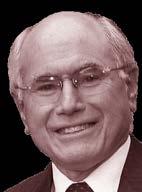
John Howard
Liberal Party
Prime Minister 1996 - 2007


Amanda Vanstone Liberal Party Minister for Education, Employment, Training, and Youth Affairs 1996 - 1997
The core message of the Corporate University is that the modern Australian university is defined by its many contradictions. In Part One, I wrote about the evolution of higher education in Australia from the establishment of our own University of Sydney in 1850 to the end of the Hawke-Keating era in 1996.

The message I wish to impart is that the funding of higher education is a choice
Victor Zhang enrols again.
David Kemp Liberal Party Minister for Education 1997 - 2001
Brendan Nelson Liberal Party Minister for Education, Science, and Training 2001 - 2006
Universities (almost all of them) are established under state legislation but are funded by and receive political imperatives from the Commonwealth. Universities were at first established for the preservation of knowledge but now have the more pressing imperative to train skilled workers for a modern economy. Universities have a duty to educate, but also have compelling incentives to produce research. Where once, universities embodied the principle of collegiality, the gulf between staff and management could not be further today.
The reforms of John Dawkins under the Hawke-Keating era of Labor Government forever changed the landscape of higher education. Accompanying this was the unstoppable proliferation of neoliberal ideals on the role of public institutions. Underpinning this is the erroneous belief that market principles and appropriate financial incentives, without direct political control, could deliver socially desirable outcomes.
Last time, I covered 54 years of higher education history; this piece will be a change of pace, examining the education reforms that occurred under the Howard Coalition Government from 1996–2006.
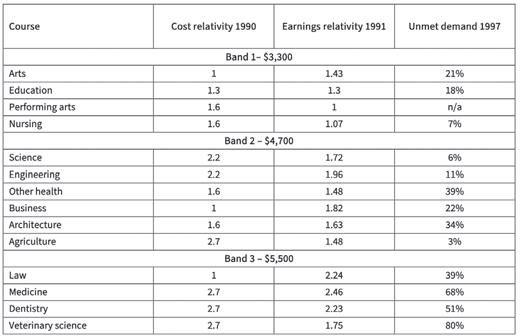
Vanstone's Differential HECS Bands, with comparisons on the relative costs and graduate earnings of each course.
To note is that the earning data used at the time comes from a limited subset (1 per cent) of data from the 1991 census.
Source: Andrew Norton
In my investigation into the history of higher education, I am quite struck by a similar throughline in the many reviews and reports commissioned about the higher education landscape. From the 1957 Murray Report to the 2025 Australian University Accords, I see similar calls. The need for urgent reform; that there needs to be a cohesive national system governing higher education; that our modern economy requires a skilled workforce educated by a robust tertiary education system; and that the purpose of the education is for the public good.
Why then, do the various governments of our ‘clever country’ refuse to adequately fund higher education?
In 1996, the John Howard-led Liberal National Coalition won a landslide victory, securing 94 out of 148 seats in the House of Representatives. Such a majority would not be achieved again until May 2025 by the Labor Party, led by Anthony Albanese. Incidentally, it was in the 1996 election where Albanese was elected to federal parliament. Entering parliament at the same time was Brendan Nelson, who became Education Minister in 2001.
The task Howard and his Treasurer Peter Costello set themselves was to ruthlessly reduce the budget deficit. Higher education was among the $8 billion cut, in their efforts to ‘fix’ the “Beazley black hole”, named after the previous Treasurer Kim Beazley (not to be confused with Kim Beazley Sr., Education Minister under Gough Whitlam).
As such, Education Minister Amanda Vanstone’s ‘education’ policy was more akin to a fiscal policy that put the axe to higher education. Vanstone implemented two key reforms for HECS. The first was to slash the compulsory repayment threshold from $28,494 to $20,701. This deeply unpopularly move delivered a sizable amount of savings for the budget. The second was to introduce ‘differential’ HECS, creating three broad bands of subjects that had different fees.
To recap from Part One, broad rationales for student contributions include: course costs, applying the market logic of ‘goods that cost more to make, should cost more to buy’ to education; private benefits, that graduates have higher earnings than nongraduates; and public benefits, that the skills earned by graduates have a positive benefit to the public.
When HECS was first introduced, former NSW Premier Neville Wran deliberated on the many rationales and concluded that while higher education undoubtedly conferred public and private benefits, the balance between the two was too difficult to calculate. However, the issue with setting student contributions purely based on cost meant that a nursing degree, involving practical and clinical components, was more expensive than a law degree, only requiring chalk-andtalk. No government would be foolish enough to make a nursing degree more expensive than a law degree.
The differential HECS system, as announced in the 1996-97 budget, classified courses into three bands of $3,300, $4,700, and $5,500 based on a mixture of course costs and private benefits. Law was classified into the top band, despite its low course cost due to the high private benefits it conferred. Education and nursing were classified into the bottom band due to their relatively low cost and the intuitive public benefits derived from teachers and nurses.
Vanstone’s 1996 budget speech on higher education raised the concept of “a proper balance between the public and private benefits of higher education” and the differential HECS system, “which reflects both actual course costs and future income”.
Despite her speech being tight-lipped and avoiding mentioning austerity altogether, she warned that “wherever feasible, universities will be expected to make any necessary adjustments at the post graduate coursework level where they have the capacity to charge fees.”
There is, of course, the benefit of hindsight, but it is hard not to see this as a warning to universities that they were going to be on their own and the time has come to seek out new avenues of funding. Shortly after, universities were given the option to set a limited amount of spaces for full-fee paying domestic students who were unable to secure a subsidised place.
While the rationale of a balance between public and private benefits makes sense from a conceptual angle, attempts to precisely calculate this balance — as later governments and their reviews of higher education would seek to do — is an exercise in futility. Beyond that, it also reveals a deeper cynicism: that the value of one’s education can be precisely quantified.
Just as the proportion of student tuition costs the Commonwealth should cover is a political choice, so too is the choice of how much the Commonwealth is willing to fund higher education as a whole.
Frank Stilwell, esteemed Professor of political economy at the University of Sydney , wrote in 1997 in Honi Soit, “One might well ask why the Federal government is doling out such unpalatable fiscal medicine. It certainly sits awkwardly alongside the political
Link to Part One
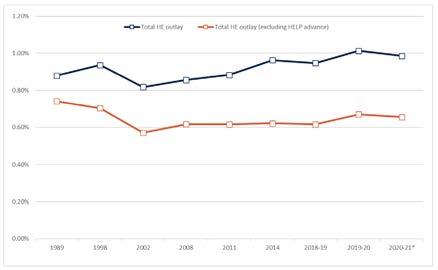
Higher Education Spending by GDP
Source: Universities Australia
rhetoric about the need to build a ‘clever country’”.
He aptly points out: “Tertiary education currently gets 3 per cent of total government expenditure. Defence spending gets nearly three times this amount. Obviously there is an issue of social priorities here.”
Quite evidently, the Howard Government presided over a sharp decline in public spending on higher education. However, higher education spending as a proportion of GDP still hovers around 0.6 to 0.7 per cent.
In comparison to other Organisation for Economic Cooperation and Development (OECD) nations, our public spending on higher education is woefully low and pulling down the OECD average.
This ongoing narrative framing Australia as a ‘clever country’, is contradicted by the deliberate political choice to not adequately fund higher education.
This is only too familiar for us nowadays. At the time of writing, a pressing issue in the public consciousness is the trilateral Australian United Kingdom United States (AUKUS) $375 billion submarine deal, slammed as a wasteful and inappropriate use of public money. “An issue of social priorities” indeed!
The corollary to our government not adequately funding higher education is that it is now on universities to investigate how to raise revenue to compensate. In this regard, Stilwell mentions “corporate funding and up-front student fees”.
He writes that corporate funding is “striking biases towards those Faculties and research projects in which there are direct corporate profitability interests” at the expense of “pure research and liberal education”. We are reminded of the current landscape, where our universities are increasingly seeking out commercial partnerships with defence companies.
A cost-saving measure that was (thankfully) rejected was to impose real interest on HECS. This was an option considered under the 1988 Wran Report and recommended by the Treasury when HECS was first conceived but was unanimously rejected by Hawke’s cabinet.
Vanstone’s term came to end in October 1997 when she was demoted in a reshuffle after her cabinet colleagues made the age-old error of misusing parliamentary travel entitlements, felling three cabinet members. Vanstone was succeeded by David Kemp, an academic in political science turned political operator. Kemp’s efforts were an extension of the prevailing agenda of the time: austerity.
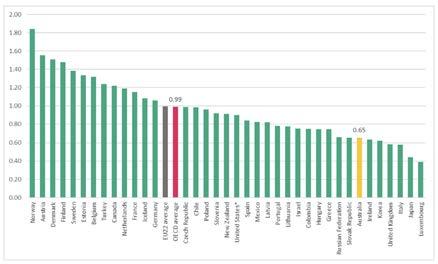
OECD Comparison of Higher Education Spending
Source: Universities Australia, OECD
Andrew Charlton (yes, the one that was parachuted as a Labor candidate for Parramatta in 2022), in his stint as Honi Soit editor in 1999, penned a scathing review of Kemp’s performance and philosophy as Education Minister, following an interview with him.
“It seemed as though there was little coherent philosophy behind the policies that he has [sic] implemented — other than slashing public expenditure. The conclusion that Kemp seemed to be pointing to but never willing to say was that we cannot afford to properly educate our citizenry.”
During this time, the West Review, so named after its Chair Roderick West, occurred. It was yet another comprehensive inquiry into the state of tertiary education. One of the aims of the review was to appease the discontent of the higher education sector at the time. The report from the review was delivered in 1999.
The composition of the Committee was sharply criticised by the students of the time, taking issue with the Chair being a retired private school headmaster with no experience in higher education, and how the only two members with a background in academia on the committee were a Vice-Chancellor and a former Liberal Senator. Katrina Curry, President of the USyd SRC in 1997 writes “anyone who is expecting the ‘independent advice’ of this committee to contradict any of the Liberal Government’s regressive attacks on higher education is simply deluded.”
The review laid out a multistage plan for fee deregulation, which they dubbed a ‘student centered’ funding framework, believing that deregulation would incentivise universities to provide “lower cost study options to students, because cost savings can be passed on to students.”
The first stage would allow universities to set their own tuition fees up to an upper limit set by the Commonwealth, and for full-fee paying domestic students to be admitted should they not secure a subsidised place.
Another recommendation of the West Review was that the governance of universities must be reformed, viewing “collegial decision making” as fundamentally unfit and that they should pursue governance “reflected in the size and style of operation of most business boards.”
The Howard Government never acted on most of these recommendations, partly due to the election of 1998 and the unpopularity of fee deregulation.
They did, however, establish the Australian Universities Quality Agency,
the precursor to the Tertiary Education Quality and Standards Agency (TEQSA), in 2000, which acted as an quality assurance auditor.
West’s recommendations for research policy were addressed in the 1999 Knowledge and Innovation policy paper, leading to the establishment of the Australian Research Council as an independent entity, an expansion of the competitive grants system, and further linking research priorities to the national interest.
Brendan Nelson was elevated to Education Minister in November 2001 following the federal election that year. After conducting another review of the higher education landscape, he released the policy paper Our Universities: Backing Australia’s Future in 2003 outlining his vision for higher education. Most of these changes were legislated under the Higher Education Support Act 2003, with the policies coming into effect in 2005.
HECS became a university charge rather than a government charge. With the exception of nursing and teaching, deemed “national priority” fields, universities were free to set student contributions up to 25 per cent above Vanstone’s differential HECS rate. Admittedly, this was not a regime of full deregulation.
Nelson claimed that with this price flexibility “every last dollar will be spent on improving the quality of the education that will be received by the current and the next generation of Australian students”.
While theoretically, universities were given the option to charge nothing, the belief was that if universities were to charge a higher rate, it would presumably be to improve the quality of teaching, thus attracting more students. Norton, among many others, are skeptical that the additional fees translate to better teaching quality.
The education reforms of the Howard era were loathed by students and staff and mistrusted by Vice-Chancellors. Howard’s Education Ministers couched brutal austerity and a disregard for higher education in the language of balance, choice, and competition. The effects of these ‘reforms’ are still felt to this day.
As I remarked earlier, each new review makes similar findings and emphasises similar urgency. I ask, how many more reviews, committees, reports, and accords do we need before our government finally realises that the way forward is that higher education as a whole needs to be prioritised?
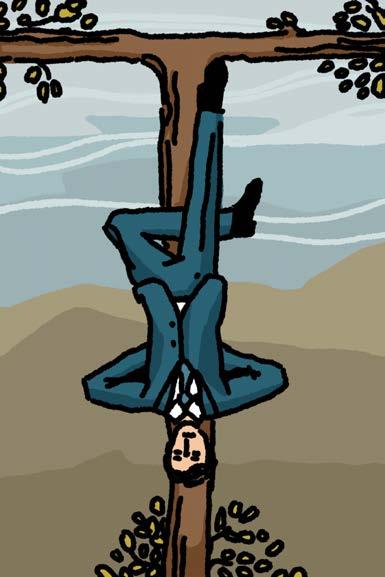



by Chloe Drougas

To the myriad of Arts students that pick up a copy of Honi every week, the mention of the degree’s first core unit, ‘FASS1000, Studying Arts and Social Sciences’, may send a shiver down your spine. Flashbacks to a children’s book about mice, being taught what a PEEL paragraph is, and perhaps the world’s most frustrating group assignment may flood the minds of those who have had the displeasure of taking this class in years gone by.
Lectures in FASS1000 cover enthralling topics such as “What is a tutorial?” in week one, followed by “What is a lecture?” in week two. But the subject that has been described as “useless”, “time-wasting”, and “farcical” has rebranded this year and, having completed it mere months ago, I’d argue the rebrand has been successful.
The main change has been the removal of the final task, a group assignment, which only taught one student to “significantly lower [their] expectations of the literacy and time-management skills of classmates”. The task was replaced with weekly ten-minute quizzes, relieving students of the burden of a final submission to end the semester. This adjustment completely transforms the tone of the subject. In stark contrast to most units,
FASS1000 becomes less of a burden as time progresses. By the time one returns from mid-semester break, the class feels more like a book club than a WAMcontributing subject (special mention to members of the Tuesday 11 am tutorial last semester, who actually did form a book club). Students are encouraged to bring in and discuss readings from their other subjects, allowing for many hours of engaging — albeit slightly directionless — debate. This, I think, is central to the shifting opinion surrounding FASS1000: allowing students to spend class time as they see fit, and partake in discussions on topics that they find genuinely interesting.
This freedom is invaluable in an era of uncertainty surrounding the arts, where growing scrutiny and shrinking budgets have left students and staff wondering if there will be a job for us in three years (that is, if our specialty even exists by then). Macquarie University has cut Sociology from its major offerings, the ANU laid off another 59 staff, and Southern Cross University has stopped offering all creative arts programs entirely.
A global shift towards STEM has caused us to forget what makes Arts degrees valuable.
They do not serve to streamline society, but to enrich it. They observe, they empower. Where STEM subjects power the world forward, the humanities question whether direction really is ‘forward’ at all in a political climate balanced on a knife’s edge, scrutiny is not only unemployable, it’s dangerous. Corporations have trivialised and devalued the arts, positing them as unserious yapping that pales in comparison to “real” pursuits. Naturally, universities, which thrive on so-called prestige, aim to make their degrees employable again. Subjects are reworked, content adjusted. Students are met with exams where no exam is needed. Fields grounded in context and critique are repackaged as content to be delivered and tested, all in an attempt to prove that arts degrees are competitive, forgetting that collaboration, not competition, is at the core of the discipline.
I will be the first to confess that FASS1000 epitomises all that arts nay-sayers despise. Perhaps it is hand-holdy; wishy-washy; namby-pamby.
But where FASS once suffered from ‘small dog syndrome’, trying to assert itself as an academically rigorous and informative course, it now accepts its role as a blow-softener.
It takes comfort in the fact that, in a way, the arts cannot compete with STEM, not if we are being marked to their rubric. We cannot produce what they produce, cannot study in the way they study, and cannot align with their priorities. Arts faculties should not have to prove time and time again that they foster intelligence or are worthy of respect and funding. These should be a given.
This subject allows students to reclaim the joy that attracted so many of us to the arts: unstructured conversation, the sharing of opinions, and interpretations. Settled among the barrage of tutorials and lectures that USyd first years may find unendingly overwhelming, FASS1000 makes space for students to breathe. It allows them to tap into the simple joy of trading thoughts, and as these students approach the business end of the semester, it steps aside — no final exam, no lastminute assignment, no submissions at all past week nine.
For a subject that costs over $2000, FASS1000 is certainly not spectacular (or perhaps even good) but the changes made to the subject have allowed it to become something worthwhile. It no longer scrambles to mimic the structure or seriousness of STEM subjects, and instead leans into the very qualities that make an arts degree worth fighting for.
Macquarie University’s (MQ) plan to cut its sociology major is the most recent iteration of a tiresome trend towards corporatisation in Australian universities. It comes alongside MQ’s previous announcement of a restructure in the arts and sciences faculties, which will cut 50 full-time academic positions — but save $15 million a year.
Apathy towards the humanities and social sciences has been steadily on the rise across tertiary institutions. In fact, it has become difficult not to see it as hostility. Across institutions, budget cuts and faculty restructuring disproportionately affects the arts, sending a message that these disciplines are disposable and of diminished value.
The University of Tasmania is scrapping up to 13 arts and humanities academic roles. A $30 million cost-saving restructure at the University of Wollongong will cut 124 full-time positions, with significant losses to the humanities. The University of Sydney’s English department has been winnowing away for years. More and more units are becoming indefinitely unavailable, including those focusing on Jane Austen, Gothic literature, Modernism, and Australian literature.
Graeme Turner’s recent book, Broken: Universities, Politics & The Public Good, indicts the state of Australian universities. It traces the problem to the ‘Dawkins Revolution’ of 1987. Guided by then-Federal Education Minister John Dawkin’s plan for a streamlined tertiary education sector, HECS legislation was introduced and universities were forced to
switch gears from educational institutions aimed at the development of the mind to marketised corporations focusing on administration and competition.
In 2024, the Australian Universities Accords Final Report highlighted inadequate government funding in the university sector. Despite limited financial contributions, the federal government still deems it within their purview to take control of what disciplines universities should prioritise, and which students should suffer the consequences.
Introduced in 2021, the infamous ‘JobReady Graduates’ package (JRG) shored up the deliberate disinvestment of the humanities by remorselessly jacking up the prices of arts degrees. The price of history degrees rose by 117 per cent alone, while fees for STEM, education and nursing degrees were decreased. The legislation claimed to encourage students to pursue careers in areas of greater national need. But the JRG has not increased places among its targeted degrees, and enrolments in the humanities have fallen to a ten-year low.
The question must be asked, what gives the federal Department of Education sole authority to determine what counts as a ‘job-ready’ degree? And is immediate integration into the workforce even the purpose of education?

These concerns are the focus of an open letter to Prime Minister Anthony Albanese calling for the restoration of equity in higher education. Issued on 24th July, the letter has been signed by over 100 highly successful Australians with arts degrees. These include authors Tim Winton, Kate Grenville, Helen Garner, and Nam Le, as well as former cabinet minister Barry Jones, musician and former Labor minister Peter Garret, chef Stephanie Alexander, and scientist Tim Flannery. The diversity of signatories itself speaks to the variety of career paths and wealth of opportunity offered by the Bachelor of Arts.
The letter begins by highlighting the fundamentally flawed nature of the JRG, which ignored evidence that “three years after completion, [arts] graduates are employed at the same rate as science or maths graduates.” Yet, students who want to pursue the humanities are ‘punished’ by HECS debts approaching $50,000. The consequence is that arts disciplines ‘critical for future jobs and innovation’ are being reduced due to falling enrollments and budgetary stresses, according to the Australian Universities Accords Final Report.
This narrative is common not only among institutional elites, but also among ordinary Australians struggling to make ends meet. It is understandable why, when ever-increasing grocery prices are impacting food security, or when the
number of people without long-term housing has risen by 25 per cent since 2019, it becomes easy to see arts degrees as a luxury for people who don’t have to worry about the financial necessity of getting a job after graduation. Spending four, five, or even six years at an elite institution to continually refine one’s mind and pursue learning for its own sake sounds lovely, but it is not feasible for many Australians.
The open letter emphasises arts degrees’ core skills in “critical and analytical thinking” as integral to understanding the ‘singular fragility of democracy.” It underscored that “[i]n an era of severe international turmoil, climate crisis, rising disinformation, and declining trust in democratic principles, a higher education in subjects that stress global knowledges, reasoned debate, and civic literacy is paramount.”
Education has never been solely about preparation for employment. It is also about a meaningful life and shaping an identity as a human being living with other human beings. If Australian universities continue to pare back their arts departments, and if the Albanese government does not respond to the open letter and its own promises to review the JRG, the state of education in this country is set to decline even further. Then we’ll have bigger problems than not enough ‘job-ready graduates.’

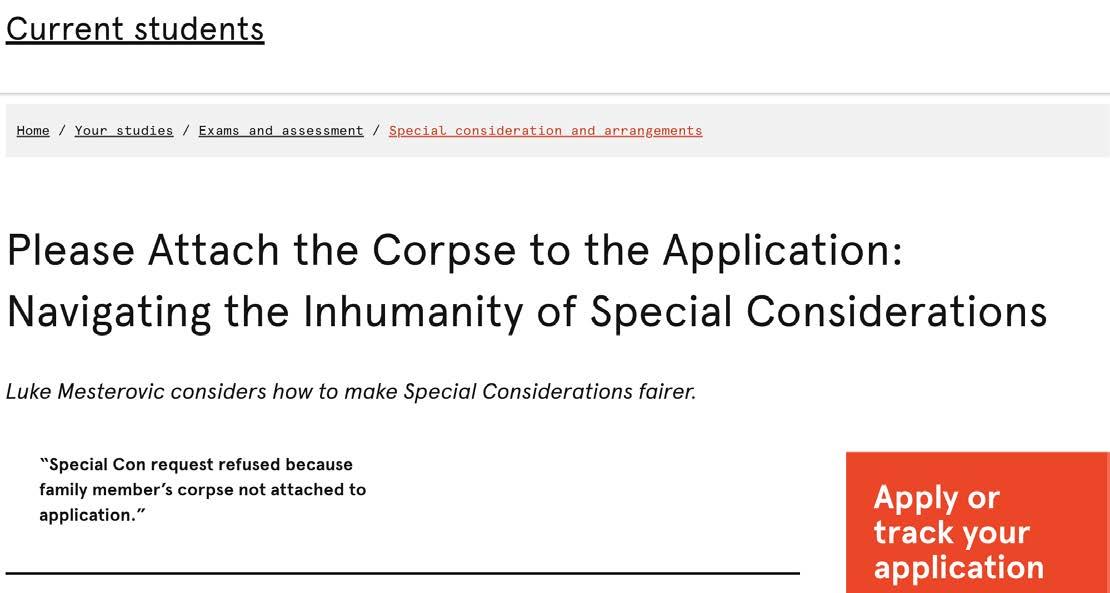
In 2016, the editors of Honi Soit published an edition that satirised The Australian Among the joke headlines, there’s one that stands out: “Special Con request refused because family member’s corpse not attached to application.” Nearly a decade on, this joke unfortunately remains all too relevant.
Everybody seems to know someone who has a Special Considerations horror story. If you’re not a student or have somehow managed to hand everything in on time, the Special Considerations system ostensibly exists to support students whose academic performance is impacted by “exceptional circumstances, essential commitments or events outside your control.”
For many students, however, it’s far more complicated. I haven’t gone a single semester without applying for a simple extension or Special Considerations, nor do I know a single person who hasn’t had to apply at least once. It isn’t hard to see why. We know that students have been hit hard by the rising cost of living.
A lack of affordable housing near campus — exacerbated by the University’s mass sell-off of student housing — combined with a need for many students to balance part to full-time work alongside full-time study means that it is increasingly difficult to keep up with deadlines. Then there are disabled students, carers, and others who carry extra, often unseen responsibilities. And that’s before unexpected life events are taken into account.
Suffice to say, some kind of academic safety net for students is a necessity. So why is the Special Considerations system so ubiquitously reviled?
Anyone who has attempted to apply for Special Considerations already knows the answer. The application process is intimidating, disorienting, and dehumanising. The required documentation varies depending on your situation, but most often requires
a medical certificate and a separate professional practitioner certificate from a GP to get accepted. Given the current scarcity of bulk-billing, this can be a real financial strain for struggling students, particularly renters.
Things get complicated if a close friend or family member has died. A written student declaration including “supporting documents such as an obituary, funeral notice or funeral program” may be required, which can be incredibly overwhelming for someone who’s grieving. I spoke to a student whose grandfather died overseas, who told me that “Because he died overseas, I wasn’t able to obtain a death certificate or an obituary. My application was rejected. I didn’t appeal it. I couldn’t even think straight.”
Another said, “My grandparent died overseas and I didn’t have a death certificate/obituary to show because I didn’t want to devastate my parents further by asking them for one. There might not have been one for all I know. It’s Russia.”
The time taken to compile these documents and get them verified by the University’s remaining support staff means that it can take weeks, even over a month for the extension to get approved, even if the extension is just for a few extra days. And if the application is not submitted within three days of the due date, it’s rejected. If the due date given by your unit coordinator is different to the one used by the system, it’s rejected. It’s an ordeal that feels more befitting of a Kafka novel than the student safety net at a supposed “world-class” university.
The process of applying for Special Considerations has been made more difficult given the cuts the University has made to administrative staff, such as those in the Student Centre. The Student Centre exists to assist students with their degree pathways, Special Considerations applications, and more. Yet in 2023, the University fired 50 members of the Student Centre staff, forcing them to reapply for their positions under new contracts. The HEO5 senior role, a position once responsible for dealing with “complex, distressing or hostile enquiries,” was abolished, with less experienced workers left to manage these complicated cases.
These cuts have occurred despite the University posting consecutive annual surpluses ranging between approximately $300 million to $1 billion, and ViceChancellor Mark Scott giving himself a $165,000 pay rise this year, bringing his annual salary to $1,343,000. So, what other options exist for students?
One option is the faithful simple extension. In 2022, following a sustained campaign by the University’s Students Representative Council (SRC) and rising Special Considerations applications, the University extended simple extensions from two days to five, partly to alleviate the pressure on the Special Considerations system. Simple extensions are easy to access and approved automatically. They are a lifesaver for students who only need a few extra days to submit their work.
But simple extensions are always under threat.
In the ensuing years, the University has flagged the potential of shortening them once again. At the end of the day, they are a band-aid fix to the Special Considerations quagmire and there needs to be a functioning alternative for students whose work is affected over a longer period.
Another is to work around the Special Considerations system entirely and beg unit coordinators for an extension. For many students, this is the most accessible and reliable way to explain their personal situation. One student told me that their Special Considerations application was rejected because the time they were due to give a class presentation “didn’t match the unit outline” even though the “outline had it as over several weeks,” so they “ended up emailing my unit coordinator to get it sorted out.” While this story had a happy ending, if people are forced to work around the system, the system isn’t working.
But not everyone knows that this option exists. Also, students should not have to send grovelling emails and hinge their academic livelihoods on the goodwill of their unit coordinators. Many students may simply be too ashamed to do this, particularly if they come from a background which places a high value on academic success.
The end result is that people simply give up. One student told me that attempting to navigate the process made them feel as though “nobody cared.” Students fail the unit, and on top of the psychological distress from failing a months-long unit, they also have to foot the bill for it. It’s a high price, particularly for international students who can’t defer payments to HECS.
The tragedy is that the most vulnerable — including disabled students, ESL students, and students struggling financially — are the ones least able to navigate the bureaucratic hurdles.
It’s little wonder that our University was ranked the lowest in Australia for student satisfaction by the Australian Financial Review in 2023, a metric that was ultimately ditched in the 2024 rankings.
SRC Disability Officers Remy Lebreton and Vince Tafea have been involved in the fight to make the system fairer. “Special Considerations are a rigid system,” they said. “It does not take into account the variety of possibilities that students might need them for.
“It relies on a medicalised model that prioritises bureaucratic efficiency at the cost of truly considering a student’s extenuating circumstances fairly, providing the supports needed, diagnoses or not. The corporate university runs in direct conflict with this support, disabled students, or otherwise.”
The Special Considerations system isn’t working. Yes, there are band-aid fixes that could make it better, such as properly funding student support, but that won’t address the core issue – the fact that the corporate university model, which prioritises revenue over student wellbeing, is fundamentally at odds with the support that students need. If we want to fix Special Considerations, we need to have the courage to look beyond the system and build a university that works for students.
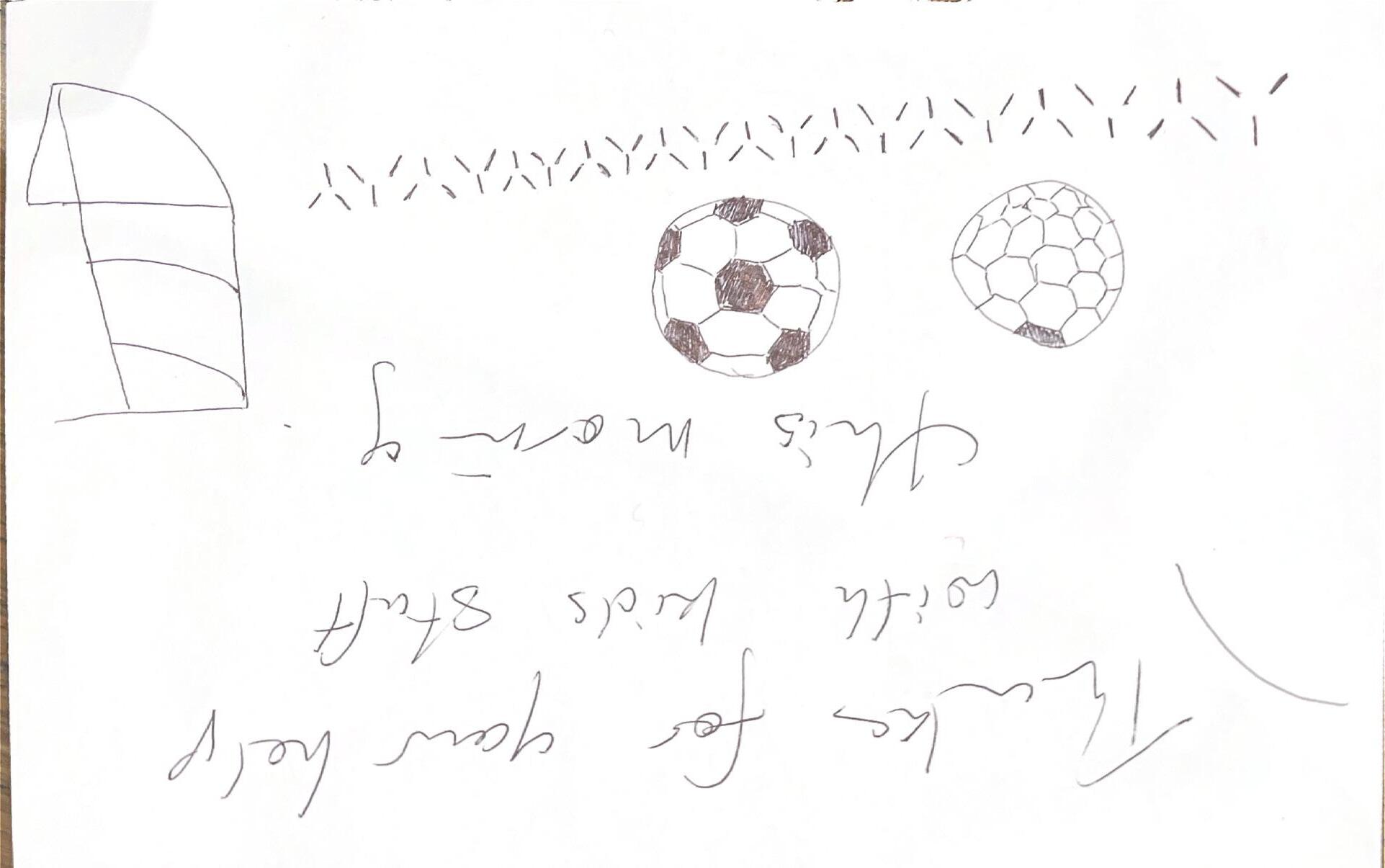
MORALITY
Content Warning: Discussion of rape and sexual assault
Three months after the initial arrest, after Partey scored in a match against rivals Tottenham Hotspur, his team manager Mickel Arteta said “For what he’s been through, and the injuries, and the effort that he put in this week to be available for the team, I’m so happy for him. He deserves it.” In the intervening three years, Partey has made 108 appearances for the club.
Partey’s arrest was one of the worst-kept secrets in the premier league across these intervening three seasons. Neutrals knew, rival fans knew, media, pundits, staff and players all knew. When discussing Partey’s performance on the football podcast Unseen Incidents, host Pete Dorman made a comment discussing how Partey shouldn’t be starting, to which cohost Patrick Van Straten, an Arsenal fan, responded “No, he should be in jail.”
Football clubs looking the other way when moral accountability comes calling is nothing new. In 2021, Benjamin Mendy, playing for Premier League Champions Manchester City at the time, faced allegations of rape and attempted rape brought against him by seven women. At his first trial, his manager Pep Guardiola served as a character witness, describing him as a “really good boy”. The same year, Brighton & Hove Albion player Yves Bissouma was arrested on suspicion of sexual assault at a Brighton nightclub. Eight months later, Tottenham Hotspur paid Brighton & Hove Albion football club £25 million, and offered Bissouma a contract worth £55,000 a week whilst the investigation was ongoing. Both players were eventually found not guilty.
In 2022, Manchester United starlet Mason Greenwood was suspended and later charged with attempted rape, controlling and coercive behaviour, and assault occasioning actual bodily harm. The charges were dropped February 2023 due to an unrealistic prospect of conviction after key witnesses withdrew cooperation.
pundits, politicians, and journalists would react to the news. The document had labelled charity groups that specialised in violence against women as “hostile”. After this was revealed, amidst threats of protest and resignation from staff, and prominent backlash from the media, crisis talks were held to reassess the situation.
TV presenter Rachel Riley threatened to stop supporting Manchester United if Mason Greenwood returned. I rescinded my membership to the club.
For a football club to stay silent raises serious questions about the game as a whole. Football is a hub of community. Fans will outlay thousands of dollars a year to travel the world, trudge through rain, snow, hail, and everything in between. In the 2007/8 premier league season, Derby County F.C. were relegated with 1 win and 11 points all season, the lowest in the premier league history. The lowest attendance figures recorded throughout 2007/08 were 30,048.
For fans, football isn’t a mere entertainment product. It is a lifeblood, providing meaning and structure throughout the tumult of life.
There is a silent accord between football fans and their clubs, an unseen handshake that says ‘we will give you our support, and in return, you will do the right thing by us’. There is a weight to running a football club, a responsibility. Partey was on a salary of £200,000 a week, and with tickets at the 60,000-seater Emirates Stadium selling for up to £145 a game, fans watched in real time as money left their bank accounts to enter the pockets of an alleged sexoffender. This is, and always will be, more than just a game; to pretend it is anything else is unacceptable ignorance.
essentially decree his actions as acceptable is morally obscene. Arsenal’s motto, translated into English, reads as “Victory through Harmony”. I’m not convinced fielding an alleged sex offender for three years holds up to their standards.
It’s not as if it would have been particularly difficult to replace Partey. Arsenal has an estimated worth of £2.4 billion, making them the eighth richest club in the world. Profitability and sustainability regulations allow them to record over £100 million in losses per financial period without facing any consequences. Since Partey’s initial arrest in 2022, the club have spent £418 million on players. Replacing a 32-year-old backup player who is valued at £12 million isn’t any challenge at all. At the same time, they have access to a world class academy. In the 2024/25 season, in the midst of an injury crisis, Arsenal promoted Ethan Nwaneri and Miles Lewis-Skelly, both just 18 at the time, into the squad — both of whom had already overtaken Partey in the squad by the end of the season.
Indeed, since Arsenal were aware of the arrest, to continue to field a player who would likely be suspended, rather than sign a younger player who would be available and would fulfil the motto and morals of the club, is baffling. Instead, such short-termist policy has seen the club face intense fan backlash, and the need to fix a hole in the squad which could have been addressed three years ago.
Currently, there is no policy to address these cases. For victims who are forced to be confronted by their abusers in everyday settings, for teammates and staff who are required to work alongside these footballers, and for the fans themselves. Speaking to The Athletic, one Arsenal fan described how “For the first time in my life, I watched a game and I didn’t even want us to win… I just thought, ‘This is so wrong’ and couldn’t get past the idea that he would always be part of our history. It’s appalling.”
by a campaign by the UK-based End Violence Against Women Coalition, for the implementation of sexual misconduct policies, standards for addressing violent behaviour, and a commitment to meaningfully support victims across the Premier League. At present, none of these have been achieved. Had these policies been in place before Thomas Partey was initially arrested, before his 108 games, before three years of providing a platform to an alleged sex offender, and before his current prosecution by the Metropolitan Police, it would be far easier for both fans and players to stand proudly behind football as a whole.
There is an issue that pervades football: because the money is so great, every transfer feels crucial to staying on top, every player is vital to a squad, and the most important thing is success at the detriment of all else. In the case of Thomas Partey, Arsenal have managed to simultaneously sell-out their morals and gain nothing from it. They have found themselves in a media crisis and needing to replace a part of their team, both of which could have been addressed three years ago when the initial arrest occurred. The decision-making process of the club has sold out the other players, the staff, the community, and the alleged victims in favour of a late-stage capitalistic dash to maximise their profit ceiling at the expense of every other part of the club. To begin rebuilding the trust that has been lost by the fans, clubs across the game need to start putting back the beating hearts that have been so brutally gutted by owners and investors looking to increase value before anything else. Until then, with morality an unused substitute on the bench, it’s becoming harder than ever to justify taking part in the beautiful game.
Art by Imogen Sabey
Seven Years of Making University Possible: An
Interview with Outreach Officer Dana Pillay
As university students reluctantly returned to campus for semester two, the University of Sydney’s Outreach and Access team prepared for Future Focus Year 11, a fourday program bringing 250 disadvantaged high school students to campus this week.
at Macquarie University beforehand. “My role essentially is to work with students from years 10 to 12 to talk to them about all things University of Sydney,” she explained. “A big chunk of that is doing events where the students from our target high schools come into the university.”
The program offers scholarship workshops, faculty activities and university preparation for students from low socioeconomic schools across Greater Western Sydney, many of whom have never considered higher education as an option.
“A lot of the work that we do is for prospective high school students,” said Dana Pillay, Outreach and Access Officer for the university.
For students from schools in Cabramatta, Fairvale and surrounding areas, the barriers are predictable: ATAR requirements that seem insurmountable, parents pushing for traditional careers while children have different dreams, and the geographic lottery of disadvantage that maps onto Western Sydney postcodes.
Pillay has spent seven years in outreach roles: four at Sydney University and three
The Great Dying
As we stand on the Earth’s ground, we claim we know about its genesis and what happened before we came into existence, but do we really? Let’s retrace our footsteps (or fossils) and travel back in time… to approximately 252 million years ago, when life on Earth was nearly extinguished in what is now known as the Permian-Triassic extinction or ‘the Great Dying’.
While the asteroid that ended the dinosaurs is widely known, few realise that this even greater cataclysm came before it, and far surpassed the Cretaceous extinction in scale and devastation.
The extent of it is calculated with the number of species that bore the brunt of this extinction: to give an estimate: roughly 81% of marine species and about 70% of terrestrial vertebrate species vanished, along with massive losses among plants, insects, lizards, microbes, and proto mammals.
So, what could have caused such an unprecedented collapse of life? The answer, as it turns out, is far more complex than a single trigger. Scientists attribute the calamity to a combination of catastrophic events: massive Siberian Traps volcanism, runaway greenhouse gas emissions, ocean acidification, severe warming, and widespread anoxia, perhaps even a nearby asteroid impact (though this remains debated). The main culprit lies beneath the surface, where warming surged so drastically that the ocean’s water lost oxygen, disrupting marine respiration and leading to suffocation on a global scale.
“These barriers are still there, but what’s different is the students and their approaches,” Pillay said. “As the years have gone by, we’ve got more and more access happening for our low socioeconomic cohorts.”
Marc Paniza interviews and reflects.
schools ending up transferring into the university,” she said. “They will be at every single event. Not only will they want to bring the maximum amount of students, they will ask to bring more.”
The breakthrough moments sustain Pillay through systemic frustrations. Several current student ambassadors began as participants in her programs, creating visible proof of possibility for current students.
possibilities become concrete realities.
Pillay’s unique position allows her to observe both sides of the university experience: students returning reluctantly and those desperately hoping to arrive. The contrast shapes her perspective on educational access.
Beyond Future Focus, Pillay coordinates Activate USYD, an intensive year-long transition program for Year 12 students from four partner schools: Cabramatta High, Fairvale High, Canley Vale High, and Prairiewood High.
“These particular four schools, we actually get quite a few students from these
One ambassador’s story particularly resonates. Originally scheduled for a ten-minute consultation, their meeting extended to an hour as barriers seemed to dissolve through conversation.
The ecosystem we see flourishing now was painstakingly slow. New research suggests that the recovery took millions of years, in pulses that took a journey over ten million years.
The Sixth Silence
Returning to the present age, are we witnessing the slow march toward another ‘Great Dying’? To answer that question, scientists once again believe we are in the midst of a Sixth Mass Extinction, driven not by natural calamities but by anthropogenic activities.
To put into perspective, current extinction rates are 100 to 1000 times higher than the geological background rate- which is the natural pace at which species have historically disappeared over millions of years, even without human interference. In fact, current rates of extinction are in some cases worse than what happened during the Earth’s five previous mass extinction events. At the heart of it all lies humanity’s fingerprints in the form of driving forces such as habitat destruction, overexploitation, pollution, invasive species, and most significantly, climate change. Agriculture alone converts somewhat 40 per cent of Earth’s land and is responsible for 90 per cent of deforestation and 70 per cent of freshwater use, undermining biodiversity and worsening climate impacts.
This may not be apparent in plain sight because this extinction is happening slowly by human standards, but extremely rapidly by geological standards. This is more than loss; it’s a reprogramming of the biosphere.
“I remember having a one-hour consultation with her. These are meant to be 10 minutes, but we just end up having a one-hour chat,” Pillay recalled. “Not only now is she a student ambassador, but she does quite a bit of work for me and the team.”
The impact of representation cannot be overstated. When student ambassadors from the same schools and suburbs present to current participants, abstract
“I feel that they take more advantage of the opportunities presented to them, because they don’t always have those opportunities,” she said of her students. “They tend to be a little bit more grateful. Sometimes with the opportunities that we give them, and as a result of that, because they know they have to work hard, they’re more willing to put in the work.”
While we grumble about returning to campus, Pillay and her team continue breaking down barriers, ensuring geography and income don’t dictate who gets to walk through the university gates. For some students, that opportunity will change everything. For others, simply knowing it exists might be enough. And in that knowledge lies hope, the same hope that brings Pillay back year after year, cycle after cycle, student after student.
Read full article online.
Kiah Nanavati travels back 252 million years.
What’s even more alarming is that scientists now report the disappearance of the entire genera — not just species but identifying a crisis known as ‘biological annihilation’ that has long-term negative ramifications not just for evolutionary diversity but ecosystem resilience.
To paint a clear picture, we are not just ending chapters of life, we are tearing out pages from the story of Earth.
History Repeating Itself
Although separated by hundreds of millions of years and entirely different triggers, the Great Dying and today’s Sixth Mass extinction mirror each other in their mechanisms and inevitable consequences.
The striking parallel is that the Great Dying was driven by a sudden spike in greenhouse gases due to volcanic activity, causing rapid global warming, ocean acidification, and oxygen depletion in the ocean and other freshwater bodies. We see an emulation of those patterns with fossil fuel emissions accelerating warming, pushing oxygen levels down in marine systems, and basically stressing all ecosystems.
In both the Great Dying and today’s unfolding extinction, the magnitude of loss transcends ecosystems — from ocean depths to forest canopies, life collapsed across the world.
During the Permian extinction, the aftermath wasn’t a single recovery arc but a long, turbulent rebirth, with ecosystems reviving in fragile fits over millions of years. Today, we’re witnessing a similar
unravelling: the case of the disappearance of species and entire genera, tearing at the threads of ecological stability, threatening food chains,webs, pollination systems, and climate barriers.
And yet, despite fossilized warnings etched into stone, we seem committed to repeating history. Like a sleepwalker on a fault line, humanity drifts closer to irreversible tipping points, not for lack of knowledge, but for lack of will.
Why Does This Matter To Us?
The answer lies within plain sight. It’s because this crisis is not just about vanishing wildlife, it’s about the collapse of the mechanics that sustain us. Biodiversity isn’t a luxury; it’s the foundation of clean air, fertile soil, fresh water, and stable climates.
When we lose species, we lose pollinators that grow our food, forests that store our carbon, and oceans that give us oxygen whilst regulating our temperature.
We have everything to lose in one fell swoop.
The Sixth Mass Extinction isn’t unfolding in some distant wilderness, it’s happening in our backyards, on our farms, in our fisheries. And unlike past extinctions, this one is driven by us — which means it can also be stopped by us.
To ignore it is to gamble with our own future. To act is to recognise that saving other species is ultimately an act of saving ourselves.
Amy Remeikis on Politics, Palestine, and Progressivism
Mehnaaz Hossain holds power to account with Amy Remeikis.
Mehnaaz Hossain sits down with Amy Remeikis, chief political analyst at The Australia Institute and contributing editor at The New Daily. A self-described “work-in-progress” and “unholy mess of a journalist”, Remeikis was previously a federal political reporter at The Guardian
Mehnaaz Hossain: What I wanted to do with this profile was talk to a progressive journalist, and particularly one who is explicit on issues like Palestine and political accountability. Before we get into the interview… who is Amy? What does she do?
Amy Remeikis: So, I’m Amy! I’ve been a journalist for probably around two decades. I come from a very working class family. I’m very open about the fact that I didn’t know a lot about power networks in Canberra until I came to Canberra. That’s always meant that I’ve sat as a bit of an outsider, which I suppose has really helped in my career, because I’m not afraid of politicians, or indeed, of the parliament I’m just like “It’s all shit, but here’s how it’s going to impact people.”
MH: Do you think that there’s an issue of perhaps too many insiders in media, too many people that are interconnected in this web of politicians they went to uni with?
AR: I think there is. And I think that’s also an issue of lack of class diversity in our mainstream media as well as diversity of every other kind. The only people who can actually even afford to get through it are those who have family wealth or have some sort of fallback. And so what that is creating is people who are of the networks reporting on the networks; is that necessarily representative of the average worker? When I first arrived in the Federal [Canberra Press] Gallery in 2016 it was the University of Sydney cabal that used to run the joint. You have to ask, are they insiders or courtiers? This is my side rant: so much of Australian politics has been held hostage to the political economy debates that were happening in the 1970s and the 1980s between Malcolm Turnbull, Tony Abbott, and Anthony Albanese in the University of fucking Sydney.
MH: It is infuriating to think about how hypocritical it is for these people to stand up and say that we’re “supporting terrorism” or that we’re “making people on campus feel unsafe” with our activism, when Albanese literally would occupy classrooms and protest atop the clock tower with a big microphone in protest for the Political Economy discipline. You’re basically not allowed to use microphones on campus anymore. No megaphones, no microphones, no posters.
AR: Absolutely. I mean, he started the Parliamentary Friends of Palestine. Now that he’s in a position to actually do something about it, on behalf of the
people of Australia, he is barely able to criticise Israel. When he said he hadn’t been uncritical of Israel, he’d called for the continuous supply of aid. And so he thinks that actually telling a nation to not commit a war crime is criticism. Because that is the environment that we’re in, and that is the environment that he and his government have helped to create. It has made actually speaking truth to power almost impossible if you want to still continue to have a platform.
MH: We’ve seen over the years the impact it can have on journalist’s careers when they speak out against the genocide in Gaza. It’s very easy, when you’re left-wing, to become nihilistic; a lot of conservative ideas are framed as ‘sensible, pragmatic policy’ and a lot of progressive ideas are ‘impractical’ and ‘idealistic’.
AR: I think that’s always been the way of progressives; it’s always impossible until it’s inevitable, and then it was everybody’s idea. But I also find it’s about being an optimistic nihilist. It’s about being like, “Yeah, everything’s shit… But here’s the little bit of power I do have to change minds.” People will always come at us harder. You always have to think, “Is this bulletproof?” I see part of my job as just telling people what is actually happening, what is the politics and the context? That is the crucial job of the media, no matter what platform you’re on: to provide context. So much of what media has become is ‘who, what, when and how’ and we’re never actually allowed to discuss the ‘why’, because the ‘why’ is suddenly too complicated. It’s not ‘objective’. And that is why we cannot, as media, talk about what Israel is doing in Gaza, Palestine, and the wider Middle East. Which means that we so often report on things without the necessary context, and we call that objectivity. Media has always had an agenda, but in these modern times, we like to pretend that media doesn’t have an agenda at all; that every journalist who crosses over the threshold of a media company, all their lived experience just magically lifts out of their body. And they become this pure being who has never actually had a biassed thought in their life, and approaches everything objectively.
I’m an activist journalist, because I will talk about the missing context. People invest just as much energy in maintaining the status quo, which is ‘objectivity’ — but anyone who questions it is biased. Even in the most straight reporting with no context, you’re choosing the adjectives, you’re choosing who to interview, you’re choosing the angle. It is not a pure form of expression, because we are human beings. I think that independent media and people who are quite open about their ideologies are at least being intellectually honest.
I’m sorry, but I can’t be objective about a genocide. We’re denying aid
and water and basic necessities of life to a civilian population. That is a war crime. We know this, and yet we find ourselves completely incapable of just even reporting what is happening; we are so afraid of the backlash from people who are invested that we make sure that those waters stay as muddied as possible.
MH: What is it like to go about your day and your job at the Australian Institute, knowing what’s happening on the other side of the world?
AR: I have been finding it so hard to care about Australian politics. I’m absolutely consumed by what is happening in Gaza, and not just because of the absolute inhumane injustice of it all, but also because I think it speaks to so many issues in our time that we’re not acknowledging. Everything is connected; what is happening in Gaza, the West Bank, the wider Middle East, at the behest of the Israeli government, is all about power. We’re seeing it in Australia, with what you’re saying about the universities adopting a different definition of antisemitism that would mean criticising the nation state of Israel is considered antisemitism. We’re seeing it with the way that governments are cracking down on protesters all around Australia.
MH: We [Honi Soit] interviewed Plestia [Alaqad] from Gaza, and I was just thinking about the things
that she has experienced and seen as a journalist, and how she doesn’t sit there and agonise about whether she’s pleasing the Israeli lobbyists enough. I just think it’s cowardly, sometimes, to fall into this excuse of ‘I don’t want to be seen as antisemitic’. Because if you know the situation and you are reporting on children dying and being starved, you should have the backbone to say it clearly and to push back on dog whistles that are being used.
AR: When I write about it, I make sure that I’m writing in the active voice. I sit down and I scrutinise my position. I read the research, I read the legislation, I ask myself, “Why do you think this? What position is it in?” I just have to make sure that everything that I’m writing is within the legal language, because if I don’t, then I do risk losing the platform that I have — not because I’m wrong, but because I become a target. And that is basically what every journalist in Australia is grappling with at the moment. I’m lucky that I’ve created this platform; it has been career limiting, but it means that I can look at myself in the mirror, that I don’t feel hopeless, that I do feel like I am reaching people. The people who look to me for my journalism do trust what I’m saying, and I value that higher than any promotion that I could ever get in the media.

Photo by Sydney Writers’ Festival

Restlessness
Imogen Sabey lies awake at night thinking about sleep.
Content Warning: Suicidal Ideation
I cannot remember a time in my life when I slept well. There must’ve been some period when I did, but even when I was a baby I don’t think I slept like a baby. I was told that I would cry out for attention when I was alone, and quieten down when my mother arrived. I would repeat the same thing all night when she went to bed. I could be a masochistic little shit like that.
Last year it became exponentially worse. I don’t know why, I just stopped sleeping altogether. I thought I would stay awake until I died. It was like the start of Groundhog Day: I spent the first four days not thinking about it, started getting concerned by day five, and by day eleven I was on the verge of collapse and everyone around me was visibly worried.
People suggested remedies ranging from hypnosis to power napping, herbal tea, hard drugs (or edibles), getting knocked out, the military method, and so on. I wrote a list to record all of them and stopped writing when it surpassed several pages. I tried most of them, except for the drugs and bodily assault. One man, whom I don’t think I will ever forgive, told me not to bother sleeping; he said that it was a gift from God.
I went to a doctor. He was nameless, faceless, and expensive. He told me that I probably had apnea, which is where you can’t breathe properly and it stops you from sleeping. My mother has that; she wakes up in the middle of the night gasping because she has recurring nightmares of being suffocated. When I dream, it is often about death or catastrophe. My grandfather had periods of sleeplessness; his antidote was to travel to regional Victoria and stay at a sheep farm in complete isolation.
He ended up dying of a cancer that he refused to admit the existence of, and I never met him.
The doctor, it turned out, specialised in apnea. He charged me a three-figure bill for a 17-minute appointment and recommended that I make another one. I swore I would not see him again. I was told that I would need to be assessed to see whether I really had insomnia, and that would involve wearing a chunky watch for two weeks and filling in a sheet to write about what was going on in my life. Needless to say, Honi swept in to help me prove a point. It would take another six months before the clinic produced a report to assess how much sleep I’d had, and even then they wouldn’t share the results with me until I went to another appointment. The initial appointment involved being on the waiting list for several months. I haven’t had the second one yet. Perhaps they’ll say that I might be afflicted with insomnia.
I don’t have apnea, my breathing is fine. I have something wrong with my mind and that is what’s killing my body. People who sleep as little as I sleep are not supposed to survive it, and no doctor has given me a satisfactory explanation as to why I am still alive. It’s maddening, because insomnia sounds like such a pathetic illness: you lie down on a nice pillow beneath warm blankets and stare at your ceiling for a while. Boo fucking hoo. When I indulge in self-pity I remind myself of the millions of people in the world who are enduring unimaginable suffering and feel furious for being unhappy about lying safely in my own bed.
In June I was paralysed with such intense anxiety that I stayed awake for fourteen days. It led me to equate life with consciousness and death with unconsciousness;
I would think about ways that I might die in a tragic accident and how I would never need to be awake again. Walking by a lake at 5am one morning, I thought about how I couldn’t really see the edge of the path, and how if I veered to the left my body would be swept away in the frigid water, and it would take days for anyone to find out. I thought that even if I had a tenth of the sleep that other people had, that would be enough to survive. But I didn’t have that. Nonetheless, I kept breathing.
That led to my immune system failing. I was endlessly awake and sick as a dog. I didn’t stop working because my mind struggled to let go of work as much as it struggled to hold onto sleep; rest in both circumstances felt unnatural. My mind was a trapeze net that always caught me and my body was a pool of quicksand that failed to kill me.
I would count myself lucky to sleep three times a week. I was so consumed by thoughts each night that it would take me days to realise that I had never lost consciousness. I would slip between lucidity and dreams so vivid that I would be convinced I was still awake. It was nice to let go for a little while. When I got desperate I would take sleeping pills, and then get more desperate when they didn’t work.
Even now this seems steeped in a grotesque self-pity. At the time of writing I’ve been awake three or four days, I’m not sure. There’s no way of knowing how many more days it’ll be, or how long I will wait after that. Life is a dim-lit waiting game. When you sleep, the night will sink into my bones and keep me company. When you read this I will still be awake.


The necessity to find a dream has turned into a nightmare ritual of falling in and out of love with every prospective career; a masochistic desire to settle down which I have been chasing for my whole life now. The career cycle starts back up every few years, making me sound like a broken, inconsistent record. I use the excuse that ‘I want to do everything’ to cover up the fact that I have no clue, at all, of what I want.
When I was six years old I was sure I was going to be a fashion designer. I had stacks of Crayola-drawn designs on cut out printer paper. I was determined I was going to be a child prodigy. Eventually, I fell out of love.
I have always been chasing the desire to have a dream, any dream at all. Not everyone needs to love what they do, but I’ve always wanted to. My friends seem to have slowly settled into career paths which are sustainable, but I feel myself freefalling until I land on one that feels ‘right’, whatever that means.
I have wanted to be an activist, artist, writer, lawyer, teacher, costume designer, curator, publicist, journalist, and editor, all in my twenty years of living. The thought of being stuck in a career that I do not love, having to live and breathe through it for the next 40 years of my life, suffocates me; I am so determined to not make the wrong decision.
However, the anxiety of not finding my dream quick enough has led to a suffocating stubbornness. I imagine it is similar to the feeling of sitting at the desk of a job you hate. The thought of giving up a dream to move onto the next feels a lot like failure. It shows up in the missed classes, the failed units, the lingering desire to return to an older dream. So you try to stick it out, you burn out, and then, eventually, try to find that spark again. Rinse, repeat.
When I decided to go to art school, to follow the longest childhood dream I’ve held onto, I was impassioned and young. I chose it over law school, changing my UAC forms last minute despite years of stubbornness to study law, finally determined that I would not choose practicality over passion. Yet, I have fallen out of love again. Not with art itself, but with the degree, the career prospects, the life it would offer me. It turned out to be the wrong decision.
I have changed my degree once before and am in the process of changing it again. University has turned out to be a maze of revolving open doors which all close in front of you the moment you try to enter. It is impossible to learn everything at an institution which grooms you for profit. At 18, it is easy to dream big when life feels incredibly far from you. At some point, though, you open your eyes and see that
The Career Cycle
life has moved on without you while you were busy dreaming.
I don’t want to be an artist, or lawyer, or designer anymore; I am too scared to say what I do want out loud. I am paralysed by my indecision. It was cute when I was younger, how ambitious I seemed, how big I would dream. I would brandish my invisible sword in the air and yell “I’m going to be a musketeer” and everyone would laugh.
Now I sit through long conversations with my family about degree progressions, awkwardly avoid questions from friends about prospective graduation plans, and spend my hours scrolling through the units in study handbooks, waiting to feel a spark. More than that, I have had to start thinking practically. I am doing maths constantly now: how many semesters until I graduate, how much HECS have I racked up, how will I afford to live while also loving what I do?
How many years before I fall out of love again?
I keep free falling; my masochism keeps me from settling for anything less than what I desire. And after the loopholes and changes and an accumulating HECS debt, I’m sure there is a career that makes me stay.
Purny Ahmed dreams.
Art by Purny Ahmed



You Need to be Inconvenienced
Audrey Hawkins is here with all her people.
There has been this prevailing scripture that has echoed throughout my entire life. It’s the idea that my people, a collection of individuals I’ll indescribably and instantly click with, were a hair’s breadth away from me at seemingly every point of my existence. When I was in primary school, I was promised I just needed to wait until high school to find them; when high school finished, university, with its hyper-specific clubs and classes brimming with like-minded individuals, was a shining beacon of prophesied associations.
But life isn’t directed by John Hughes, and connection takes longer than a Saturday detention.
Humans, at our core, are fundamentally social creatures with a need for belonging. We’re wired for seeking and fostering connections and we benefit both psychologically and physically from this cross-pollination of souls. But even as the current expanses of technology allow for wide and instant connection, we’ve never been more socially disconnected, with one in four young Australians reporting feelings of loneliness.
But stepping out of the shielding bubble of loneliness and finding a real sense of community comes with a cost: inconvenience


With modern technology, connection is marketed as an ever-flowing faucet, and the ubiquitous presence of phones stokes the fiery illusion of constant availability and connectivity. Low-touch ways of communicating, such as social media, have become the benchmark of communication. These tendrils of fleeting half connections, drunken bathroom stall encounters twisting into promises of friendship and fizzling out
into mutual followings. When you factor in Dunbar’s number, the idea that our minds can sustain roughly 150 meaningful ties (a capacity often exhausted by your morning scroll), it becomes clear why social media leaves us doubly isolated: surrounded by contacts yet starved for real closeness and too burnt out to try. Just because connection is ample, doesn’t mean friendship is.
In an article published by The Atlantic, the 21st century was described as “The Anti-Social Century”, highlighting the growth of a preference towards self-imposed solitude combined with decline of social contact outside of a blue light screen. These notions point towards the emerging trend of hyperindividualism: the video of a girl carefully lining her lips with an owl-like expression while affirming that you don’t owe anyone anything, or the tarot mystic telling you that now is the time to protect your peace, or the slides using weaponised therapy talk praising a low-maintenance friendship (and no, not the ones where you don’t grow distant if you don’t talk everyday, I’m talking about glorified acquaintanceship). It’s vital to know your boundaries and to have the language to affirm them, but as spoken by someone with the consistent social battery of a phone at 3 per cent, there lies a key difference between extenuating circumstances and avoiding being inconvenienced.
SRC Elections


While it feels like a choice, this social isolation can lead to an anomic erosion of personal communicative muscles, creating a sense of emotional distance between your unrealistic social media standards and the world outside.
And loneliness is the price you pay for a life of convenience.
If our phones have become the primary gateway to connection, belonging, and feeling anchored to your people, it’s no surprise companies are racing to plug loneliness gaps with our phone. And if swiping didn’t quite fill the void, the next convenience frontier of artificial intimacy fills the gaps with its phone shackled AI companions, always there, with no effort needed. Over 650 million people use AI apps worldwide, with emotionally responsive systems such as Character.AI boasting 28 million active users in August 2024. For some, these apps have become a wealthy solace for boredom and melancholy alike; “[Character.AI] seems to give me more in talking to it than any actual human being does… because they say what I want to hear.”
This form of emotional fast food, an instant neurochemical cocktail that keeps us hungry for more, lacks any real tangible nourishment. Platforms thrive when our attention flits from one brief interaction to the next, never lingering long enough to build depth. Efficiency keeps us swiping, but emotional growth often waits in the sidelines. Humans, unlike algorithms, demand reciprocity and investment and in a world of growing hyperindividualism and diminishing community, people find it easier to turn to a computer for advice rather than ringing a friend. One point is salient: people aren’t easy, but AI is.
SRC Elections
SRC Elections
Notice of the 2025 Annual Elections
Notice of the 2025 Annual Elections for the Students’ Representative Council
Notice of the 2025 Annual Elections for the Students’ Representative Council
All University of Sydney students enrolled in undergraduate degrees or diplomas, or as other non-degree students, are eligible to vote in or nominate for the
for the Students’ Representative Council
All University of Sydney students enrolled in undergraduate degrees or diplomas, or as other non-degree students, are eligible to vote in or nominate for the Annual Elections.
All University of Sydney students enrolled in undergraduate degrees or diplomas, or as other non-degree students, are eligible to vote in or nominate for the Annual Elections.
Nominations are called for the following elections/positions:
Nominations are called for the following elections/positions:
Nominations are called for the following elections/positions:
On-campus polling will be held on 23, 24, & 25 September 2025.
On-campus polling will be held on 23, 24, & 25 September 2025.
On-campus polling will be held 23, 24, & 25 September 2025.
• Jane Foss Russell: Tues–Thurs 8:45am – 5:15pm
• Jane Foss Russell: Tues–Thurs 8:45am – 5:15pm
• Jane Foss Russell: Tues–Thurs 8:45am – 5:15pm
• Fisher Library: Wed & Thurs 8:45am – 5:15pm
• Fisher Library: Wed & Thurs 8:45am – 5:15pm
• Fisher Library: Wed & Thurs 8:45am – 5:15pm
• Manning House: Wed 10:45am – 3:15pm
• Manning House: Wed 10:45am – 3:15pm
• Manning House: Wed 10:45am – 3:15pm
• Conservatorium of Music: Wed 10:30am – 3:30pm
• Conservatorium of Music: Wed 10:30am – 3:30pm
• Conservatorium of Music: Wed 10:30am – 3:30pm
• Susan Wakil Health Building: Thurs 10:45am – 3:15pm
• Susan Wakil Health Building: Thurs 10:45am – 3:15pm
• Susan Wakil Health Building: Thurs 10:45am – 3:15pm
• Peter Nicol Russell Building: Thurs 10:45am – 3:15pm
• Peter Nicol Russell Building: Thurs 10:45am – 3:15pm
• Peter Nicol Russell Building: Thurs 10:45am – 3:15pm
Delegates
Representatives to the 98th Council
Editor(s) of Honi Soit 1 (Up to 10 people may jointly nominate)
Editor(s) of Honi Soit 1 (Up to 10 people may jointly nominate)
to 10 people may jointly nominate)
Delegates to the National Union of Students
Delegates to the National Union of Students
Nominations will be accepted online from 9:00am 4 August 2025 via the SRC nominations page: bit.ly/SRC-noms. The close of nominations shall be at 11:59pm 17 August 2025. For more information on how to nominate, please refer to the Candidate Information Pack available on the SRC website at: bit.ly/SRC-noms.
Voters who are unable to vote in-person at the specified times above are able to request an online absentee vote via bit.ly/SRC-vote
Voters who are unable to vote in-person at the specified times above are able to request an online absentee vote via bit.ly/SRC-vote
Voters who are unable to vote in-person at the specified times above are able to request an online absentee vote via bit.ly/SRC-vote
The SRC Elections are conducted according to the SRC Constitution & Regulations, which are available here: bit.ly/SRC-regs. Appeals to the decisions of the EO can be directed to the ELA via srcela@src.usyd.edu.au
The SRC Elections are conducted according to the SRC Constitution & Regulations, which are available here: bit.ly/SRC-regs. Appeals to the decisions of the EO can be directed to the ELA via srcela@src.usyd.edu.au
The SRC Elections are conducted according to the SRC Constitution & Regulations, which are available here: bit.ly/SRC-regs. Appeals to the decisions of the EO can be directed to the ELA via srcela@src.usyd.edu.au
Nominations will be accepted online from 9:00am 4 August 2025 via the SRC nominations page: bit.ly/SRC-noms. The close of nominations shall be at 11:59pm 17 August 2025. For more information on how to nominate, please refer to the Candidate Information Pack available on the SRC website at: bit.ly/SRC-noms.
Nominations will be accepted online from 9:00am 4 August 2025 via the SRC nominations page: bit.ly/SRC-noms. The close of nominations shall be at 11:59pm 17 August 2025. For more information on how to nominate, please refer to the Candidate Information Pack available on the SRC website at: bit.ly/SRC-noms.
For further information, please contact the Electoral Officer via elections@src.usyd.edu.au.
For further information, please contact the Electoral Officer via elections@src.usyd.edu.au.
For further information, please contact the Electoral Officer via elections@src.usyd.edu.au.



However, people aren’t supposed to be easy, it’s within the inconveniences that we find our people. It’s friction that creates real connection: messy, vulnerable, aching, and unmistakably human. It’s leaning into the awkward pauses while you’re acclimatising to someone, the miscommunications, the “do I really matter to you?” moments. In practice, it’s showing up when you feel out of place, letting conversations wander off script, and embracing the uncertainty that turns acquaintances into friends.
Some of the most impactful friendships I’ve had in my life were scrapped off the comments section under nonsensical posts, from parties I didn’t want to go to, or from group chats I have no recollection of why I was added to.
Unannounced and unscripted, intimacy often blooms in the margins.
Now, a selected collection of you who know me are reading this with a quirked eyebrow, I can tell. If you know me in any intimate sense, you know I’m a ghastly texter and I’ve had a turbulent love affair with flaking (usually due to things beyond my control, I promise, ask my mum). My self-imposed phantasmagorical existence, a digital ghost, haunts your inbox in fits and starts as I use my conjured energy in the span of a week and then hibernate for a month. Consider this my overdue apology. And also, a thank you, to all the people who still invite me to things even when I drop off the face of the earth.
In writing this article I realised I do have my people. While I might not have O Captain, My Captain, I have a collection of individuals I’ve slowly wrapped myself in. The boy from the Christmas party in Wollongong who endures my lipstick marks. The undergrad lovers who delved into an illicit love affair in my 11am lectures. The person I met on a shoestring film-set and can’t imagine life without. The first person in highschool I considered a friend. And the menagerie of people dancing to Rock Lobster as I was blowing out my 20th birthday candles, with a fluttering heart and that burning sensation of
You and Me and Everyone We’ve Known
Sophie Bagster dives headfirst into a shallow dating pool.
Are you ready for a story?
When I come to it I am drunk in the so-called Inner West — or someplace, some set that looks suspiciously similar. How glorious! I have willed myself to the bathroom in order to read the hymns inscribed on the walls, and to text my best friend “he’s really nice !!” to which she responds with a picture of her dog and a “no comment on the human boy.” The displeased face of a border terrier stares back at me, no comment. Perhaps it is better than any comment at all, for I am Joan of Arc this evening and I am hearing the voice of divinity say “do you remember love, love?”
Yes! I proclaim.
The woman doing her lipstick in the mirror turns to me “...did you say something?” I tell her that she looks wonderful, and exit swiftly via the trapdoor.
Outside the world appears to me like a Kandinsky painting. One could very well turn this beer garden upside down and find it is a completely different picture. This is to say that the image in front of me — the pockets of humans huddling in fur coats and leather jackets with their Esse cigarettes — is simultaneously the image of something else. It is The Last Supper.
dumbfounded. She’s six foot and bleach-blonde in a trashy 1990s kind of way with these cartoon lashes and she says words like “zeitgeist” and “aforementioned” and, actually, Ex is only short for Exodos, she tells me. When you look at her face for too long you start to cry.
At this exact moment my date reveals he is still somewhat-but-not-really seeing Exodus. Shock! I want to tell him — man, I’m sorry to be the bearer of bad news but I believe I know at least five other people sleeping with Ex! I will be so kind as to recall them in vignettes for you.
Last week I was hauled up in a Five Guys with a Frenchman who recounted his attempt to win that same Exodus back?
I had attempted to dodge the conversation by hiding out in the bathroom, but the smell of the place was more of an assault on my senses than the long-winded tale, to which I returned to discover that he had indeed won her back.
A few days ago I eyed two women on the tram. One said “...Even in the end he didn’t know what he wanted, but I suppose that’s what you get,” and the other responded with a “You need to find someone with pheromones. Maybe… maybe it’s just the pheromones.” A date, the one before you actually, mister, was fresh out of a relationship (one year broken up) and waded in the shallow waters of rebound-subjectivity with me until he revealed he is a terrible swimmer and also afraid of puddles.

Maybe not to a specific group like all the coming-of-age films promised me, but attached to a string of webs with familiarity
We are here because we are hungry, and we are hungry because it is winter. We mammals like to hibernate together in caves of asbestos. I’m beginning to understand that intimacy is a sequence of lines and shapes and nothing else.
In the corner, I find my date who begins to tell me of his ex-girlfriend. I knew it was coming the way you know it’s going to rain because the air becomes all sticky and charged. I dreaded it all the same. The facts are dot-pointable. Together for five years. Or was it three? Broke up. Hooked up. Back together — hurrah! Broke up. Casually, non-committedly sleeping with one another, Friend-ly. Ish. Esque. Maybe. Sometimes. I never ask for a name so this ex remains an ex
Is that not a collective term — ex?
It fascinates me how we all refer to our last partner by the same name. The unfeeling ex. Maybe it is not simply pure coincidence, but perhaps it is the same person? One human being named Ex, having kissed everyone we know, everyone you know, everyone your housemate and Uber driver knows. Have you seen her? When I first lay my eyes on her I am
And so I turn back to my date — who is still professing his phantom-like visions of Exodus — and I ask him why? Will we not be lovers? Are we — individually or as a collective — so afraid of being alone we must sew ourselves onto the backs of old lovers the way birds flock to the eyes of the slow-moving buffalo? Are you, am I, are we afraid of the silence that comes with letting go?
But I eventually find myself in a sharehouse bathroom I seldom recognise when I realise that Exodus is more ghostly than I recall. There is a hair in the sink that does not match mine and a pink razor in the bottom drawer when I go snooping. There are hands, invisible, that have parted the hair of my date which has remained untouched since. Hands that have guided and scolded and caressed and pulled away in the darkness between my blinking eyes. She’s a kind of old-Hollywood ghost, against which I feel so supremely newborn and unknowing.
In the gaps that seldom form between my body and yours, there exists a kind of graveyard of everyone we’ve known. What will my tomb say when I join the chorus of bodies that make you you?


King Street Crawl:
Is the Sydney Live Music Scene Back?
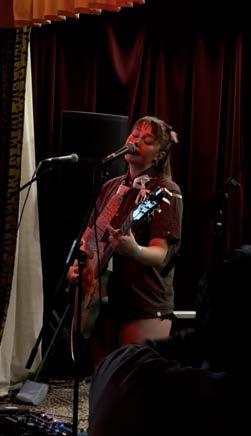
It’s been weeks since King Street Crawl made its return to the streets of Newtown and Enmore… and I have many reflections to share.
On Sunday 13th July 2025, King Street Crawl made a major comeback after remaining a stagnant idea post-COVID. The festival has been supported by the NSW Government’s Revive Live initiative in the 2024-25 budget, aiming to support and boost the live music scene after its downfall during the COVID-19 pandemic.
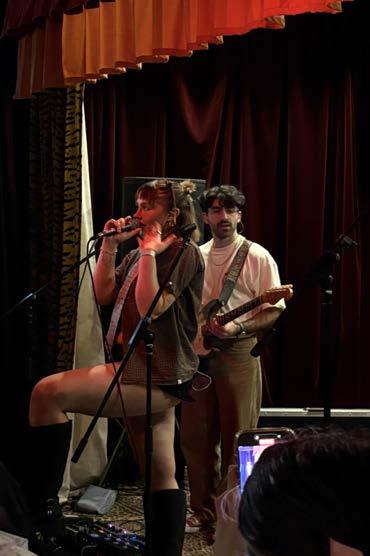
The King Street Crawl was initially set up in 2014 by Matt Rule and the Music and Booze Company (MBC). The festival is based in Newtown (of course), and with the Inner West having a rich history and culture of developing small, unique music artists, it is the perfect spot. Encouraging support for a diverse, safe, and creative environment for Sydneysiders, the Crawl has collated into an incredibly enjoyable space. In its prime, the Crawl brought in over 12,000 attendees, more than 700 artists, and hosted the events at over 30 venues. Post-pandemic, the company introduced the 3-day King St Carnival in 2022. The Carnival introduced a series of outdoor shows, which was moved indoors due to extreme rainfall, alongside the Crawl’s typical indoor venue events.
Of course, as an Inner West culture defender until death, when I heard it was being revived in 2025 I had to check it out. Here’s some of my experiences throughout the day.
Euan Hart Band
The first band I went to see was at the beloved Waywards at the Bank Hotel. Euan Hart is a Sydneybased singersongwriter known for his
combined folk and pop sound. The groovy energy rushed through me half way up the stairs. Walking in, the orange stage lights showed all the Fleetwood Mac-esque outfits — gorgeously flowing sleeves, flared jeans, and a touch of curly bangs.
Whilst some of the songs were upbeat and sanguine, he did play a couple of more mellow songs. Pretty lyricism was threaded through the rhythmic guitar riffs and keyboard synths. It was a good way to get ready for a long day of music ahead.
DJ Micklovin
I decided to mix up the energy a little bit for the next artist. Why stick to one genre when you literally have every one to choose from?
After taking the ever so long walk to Websters (I crossed one road and passed a Tree of Life sale without going in to spend all my money), I ended up on the rooftop under a heater listening to some house music. DJ Micklovin had everyone on the rooftop bopping along with drinks in hand. The sun was out, the vibes were pleasant, and though I didn’t get any, the food in the venue smelled great. It was one of those spaces where you could chat to your friends while enjoying the music. It wasn’t overstimulating; it was just right.
The Slims
When I called Waywards “beloved”, I meant it. Wandering innocently back to Waywards, I hyped myself up to see The Slims. I was not surprised to hear the seccies mention the venue was at capacity considering how great this band is. But it’s known to every Newtown local that there’s always a way to sneak into a gig… so that we did.
They weren’t quite lying when they said they were at capacity. Squished up at the back, I was still able to enjoy the hypnotic reverb of their guitars. It was a smooth and almost psychedelic performance; with the room being shrouded in red lighting, everyone looked irrevocably cool. If you want a little more of The Slims that has a particular ‘close-to-home’ feel, their new single ‘Pleasure Club’ is one to give a listen. If you’re like me and Pleasure Club is your own go-to underground club between your walk from Newtown Station to the Impy, then this song is for you.
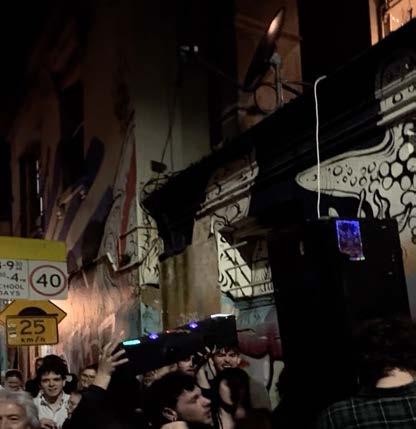
Grxce
Rocking up to the Marly (strangely in broad daylight), the front room was full and anxiously awaiting Grxce to start their set. The anticipation embodied me while I waited on my $15 Long Island Iced Tea — what a steal! After some drink sipping and crowd filtering, lead singer Jamila Grace took to the mic, engaging the crowd with ease. The chemistry throughout the show between Grace and lead guitarist Jonathan Amirzaian was unmatched. Their discography takes you into a perfect mix of Beabadoobee and Paramore — a weird yet enjoyable middle ground.
Their cover of Fontaines D.C.’s ‘Here’s the Thing’ was a particular highlight for me, with Grace’s vocals truly captivating the audience. Not only did they perform their own songs alongside covers, they performed their newest single, ‘Shirt Song’. Ending the set on this was a perfect way to leave their sound lingering on the crowd’s minds.
Pocketwatch
Admittedly, I had seen this indie-rock band open for a show at Waywards a few months ago, and I knew back then that they were pretty special. With their tinge of Britpop, their indie-punk music is conducive to the crowd’s electric involvement. The band had everyone jumping and head-banging. For such a young group, they have a particularly notable stage presence that is typically difficult to perfect.
After a game of pool at the Botany Bay Hotel and a Crust pizza to end the night, we stumbled across an unofficial street party down a side alleyway. Cables were coming out of the top window of a typical Inner West sharehouse, connected to relatively huge speakers blasting ‘Untouched’ by The Veronicas We stayed for a few songs with everyone boogying, chatting, laughing, smoking, and two-stepping. This last encounter with the Newtown crowd summed up the whole day. A perfectly curated space for the community to come together and simply live. People of all ages and backgrounds came together to enjoy the music, to feel alive. In a world where everything feels existential, this was a day that we were all truly free.

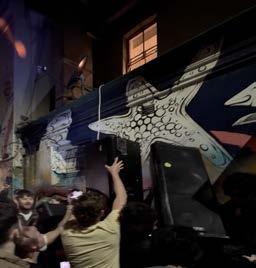
Ellie Robertson crawls down King Street.
Photos by Ellie Robertson



Places to F*ck on camPus
Will Winter is back by popular (and lustful) demand.
Whether your holidays were a banged-up sexcapade through many, many bodies, or your love life is mired in drought, the return to uni marks a haze of desire descending upon Camperdown.
Yes, I’ve heard your lustful pleas for more places to fuck on campus, and I aim to please accordingly. Whatever your position, embrace the innate passion that floods your body when you step onto the grounds of the uni, and crawl out of your seasonal affective disorder straight into the arms of a lover. Use this list as careful inspiration: what better way to pass the time between over-caffeinated study sessions?
One of the Many Podcast Recording Booths
Ahhh, podcasts, home to many an alpha male or provocative woman, or perhaps an alpha male and a provocative woman. On campus, you’ll find these scattered around the libraries, ThinkSpace, and CreateSpace, housing students keen to finish their ‘creative’ assessment presentations. Book a slot and prepare for an intimately confined experience of sight and sound with your longterm boo.
Most booths only fit two taut bodies, but if you’re popular enough, you might be able to squeeze in up to four. The best part is the USB you carry around after, the tiny little device capturing all of your soft moans and hearty breaths. What better way to discover you’re an audiophile than through the sensorial experience of your own dirty little pleasures?
Percussion Practice Rooms at the Con
Despite the prevalent mythology, music students are sexual creatures too, and they deserve to know the rooms most suitable for satiating their horny desires in their little sect of the campus. Based on my limited experience at the Conservatorium (and the seductive whispers I hear), there’s nowhere better to make your alto treble than a practice room — a percussion one, no less.
Banging. Drumming. Quick, penetrative movements. You and your musical lover will leave bruises all over each other’s bodies like a sparse set of notes on sheet music. Don’t forget to set up a music stand against the door. The only conductor in the room will be you, guiding your lover’s limbs, head, and appendages to their symphonic ends.
Madsen Building Liquid Nitrogen Tank
No, your eyes don’t deceive you. The large, metallic phallus shooting out of Eastern Avenue is a liquid nitrogen tank, used for… science, I guess? Regardless, the bouts of steam pouring out of the top must signal a tight, steamy room for you and your lover to squeeze into. Right?
Ignore the safety warnings and solid fence built around the tank. Let your lust guide you instead. Take the hand of your campus flirt, climb up the metal case, and hope the lid pops right open so you can slide inside the tank and each other. What could go wrong?
On the Pool Tables at the International Student Lounge
Felt green fur. Long wooden cues. Harsh lighting. Nothing sets the mood like a seedy sober pool table creaking under your back while your lover starts up with their long, anticipatory strokes, preparing to strike. Hold their hands back with the triangle while you set up the perfect shot.
When you get to the lounge, (fore)play a round of pool stuffed with longing looks and light verbal teasing. Press up against each other’s backs to “line up a shot”, then chalk your tip while maintaining steady eye contact. The winner gets to sink their eight-ball first; better yet, start with the love-making, then pick up the shaft and balls between sessions, hobbling around the table while preparing for the next round of sinking into holes.
In front of Lego Pompeii at the Chau Chak Wing Museum
The true spectacle of the bespoke museum tucked away in front of the Quadrangle, the Lego Pompeii display is an internationally renowned exhibition composed of over 190,000 bricks and anachronistic details. An exhibition you’ll be, indeed, when you’re being taken from behind so as to admire the work in front of you.
Stick to the forward facing-moves: reverse cowgirl situates one of you on top of the other, neck tilted straight ahead as your body bounces and shakes. Do it doggy style in front of the intricately-constructed Roman architecture, and remember that the person who made this probably makes more money building Lego than you ever will with your degree. Feel your lover’s volcano explode inside your township, pulses of individual trickles flooding your canals. It won’t be quite as tragic, but it’ll certainly be a big mess to clean.
Veterinary Science Conference Centre Balcony
It’s dark outside. You’ve been holed up in Fisher Library all day discreetly eating rice crackers out of the front pocket of your backpack while mindlessly scrolling Google Scholar and opening forty journal articles you’ll never read. You walk out the doors and the gust of fresh air feels rejuvenating, intoxicating even. You’ve been pent up all day. You trek down Science Road, catching the eyes of anyone you can, lightly brushing the back of your hand over your trackies.
You make eyes with a mysterious, handsome stranger on the bench outside of Wallace Theatre. They follow you, the slope of the road naturally pooling your bodies towards the Vet Science Conference Centre. “Huh, I forget this building is here,” you think. You open the door and both clamber inside, and your hands intertwine in each other’s hair, and your bodies naturally tug you upstairs. It’s warm. You need fresh air. You tumble onto the balcony, unbuttoning their shirt, and as they
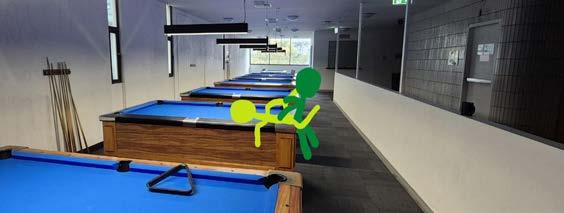
disappear below the brick bannister, making light work of your elastic waistband, you look out onto the backside of the campus, and you take in the world. The air is sweet.
I had a crush on a vet student once. I wonder how he’s doing these days…
The Graffiti Tunnel
Every time you peruse the graffiti tunnel, there’s something different about the walls. Your eyes catch new drawings, new sprays, new musings and advertising. The walls are ever-cycling, much like your roster of hotties to stick your tongue into on campus. Let the cold concrete wall press against your back while your tutorial crush presses their body against yours, the most exquisite yet temperature-confused sandwich you’ll ever be a part of.
When you finish for the ninth time, your spurt will be so thin and dribbly it’ll look like it came from a pressurised spray can. You can then use your sticky remnants to sign your initials on the wall. Remember to put little white hearts on any i’s. Isn’t that romantic?
On the Big Yellow USU Bench
Oh big yellow USU bench, with its thick, solid wood. Doesn’t your heart throb when you see that gorgeous sunny neon across the campus? Doesn’t your body yearn for its bulky mass?
When you finally track it down after its latest move, hoist yourself up on the bench, feeling the wind intimately for a moment while one leg is lifted high and one is still on the ground. Pull your fling up alongside you and discover the ample room and unique angles your bodies can form on this hulking loveseat. Or maybe stay rooted to the ground, and find yourself eyelevel with your lover’s special parts. If your bodies are so perfectly aligned, what other choice do you have but to lean in and go to town?
Oh tell me, big yellow USU bench, with your hefty size and foreboding presence, do you dream of sin as well?
Art by Will Winter
President
Angus Fisher
Welcome back to USyd. Semester 1 was huge for the SRC, and things aren’t slowing down for semester 2. I’ve worked hard during the semester break to deliver for all of you. Here is only some of it.
I am beyond excited to announce that at Laneway Cafe, from 11:30 am to 2:00 pm, Monday to Friday, a canteen offering $5 hot meals will be available. A request I always hear is to get cheaper food on campus. The SRC and SUPRA have now delivered that for you. The $5 canteen at Laneway will be funded by the university and facilitated by the USU. This is proof that student unions like the SRC and SUPRA can get real wins for students. The $5 canteen is here to stay and will only be expanded next year.
There were two inquiries I was invited to speak at and then took part in over the break. The first was the NSW Parliament Antisemitism Inquiry. I expressed that antisemitism is a real issue due to the rise of the far right,
and that universities’ crackdown on free speech on Palestine is counter to their purpose and must stop. The second was the People’s Inquiry into Campus Free Speech on Palestine, which elucidated the different ways USyd uses its policies and bureaucracy to silence debate on the topic of Palestine.
If you’re thinking the SRC graphics are looking fresh, that’s because the SRC introduced and is now rolling out our new logo. It has been a pleasure to meet so many new students at the faculty and international students welcome over the last fortnight, and to let you know about what we do here at the SRC and to show off our new look. If there’s ever anything you want to raise, please email me at president@ src.usyd.edu.au.
In solidarity, Angus
Education Officers
Luke Mešterović, Jasmine Al Rawi
Hello all, and welcome to Semester 2. Like many of you, we have been horrified by the genocide currently unfolding in Gaza. As the famine worsens, we know that over 650,000 children under the age of 5 are facing malnutrition. At least 60,000 Palestinians have already died since the start of the war, and over a thousand have been murdered by the IDF when attempting to access aid. Enough is enough.
On Sunday, we marched along the Sydney Harbour Bridge alongside thousands of others to express our outrage and call on our leaders to end their complicity with Israel’s genocide. This Thursday 7 August, we are leading a city-wide student strike for Palestine, demanding weapons companies off campus, sanctions on Israel and an end to the repression of Palestine activists. We hope to see you there. Free Palestine.
Global Solidarity Officers
Emma Searle, Dana Kafina, Jessica Heap, Taleen Jameel
The Israeli Occupation’s current genocide against the Palestinians in Gaza has reached 22 months, almost 2 years. In recent weeks, the UN and other NGOs as well as journalists on the ground in Gaza have raised alarm that Palestinians are now at stage 5 of mass starvation, with many predicted to die if they don’t get enough to eat and others to live permanently malnourished. Israel is still blockading Gaza and denying to the world that they are starving Palestinians. The Australian Governments tone when speaking about the genocide may have shifted, but the continued two way arms deals, investments into Israeli businesses and lack of sanctions or recognition of a Palestinian State still make them complicit in the genocide of the Palestinians.
Welcome back to campus!
I would like to extend a warm welcome to all returning and new students. Whether you’re arriving on campus for the first time or continuing your journey here, the SRC is here to represent and support you.
Behind the Scenes: How We’ve Been Working for You
Over the mid-year break, the SRC has been actively preparing for Semester 2 and advocating for student needs behind the scenes. As Vice President, my focus has been on strengthening student support structures — especially for international students and those affected by the housing and cost-of-living crisis.
Here are a few key initiatives from the break:
Student Rights & Legal Support
We collaborated with SUPRA to coordinate upcoming info session on crucial topics including tenancy rights, academic appeals, and visa conditions.
Our first Info Session will be held in Week 3 on Tuesday 19 August, from 12:15 AM to 1:00 PM at the Law Lounge. Come along to learn more about tenancy rights, academic appeals, and visa conditions and connect with support services ready to help you.
Affordable Housing Advocacy
Tackling the student housing crisis remains a top priority. Over the break, I’ve continued pushing for long-term, student-centred solutions and engaged with alumni, university staff, and community stakeholders to push for student-focused housing solutions, including advocating for the potential reopening of International House for affordable student accommodation.
Vice President
Shovan Bhattarai, Ethan Cao
of universities. It’s just one example of how housing is moving to the centre of campus conversations and we’ll keep working to make sure student voices are heard.
Food Security & Support Services
In partnership with the USU, we’ve expanded support for FoodHub through multilingual outreach, volunteer coordination, and external partnerships — all to help keep students fed and supported.
I’m also thrilled to share a major win for affordable campus dining from 4th August 2025, Laneway Café (Level 3, Wentworth Building) will offer $5 hot lunches for students, Monday to Friday, 11:30am–2pm.
There are 3 rotating meal options daily, with selected dietary options available. Don’t forget to bring your student ID. This marks the first step toward a lowcost student canteen, scheduled to open in 2026.
These outcomes reflect sustained advocacy from both the SRC and SUPRA, calling for more affordable, nutritious, and accessible food and drink options for all students.
Looking Ahead
In Semester 2, we’ll be launching a series of info sessions, continuing advocacy on cost-of-living and housing issues, and deepening collaboration with student organisations. Most importantly, we’re here to help you navigate whatever challenges you might face - academic, financial, or personal.
If you ever need support, advice, or want to get involved, don’t hesitate to reach out to the SRC.
Wishing you all an inspiring and fulfilling semester ahead!
That’s why on August 3rd, over a hundred thousand marched across the Sydney Harbour in the pouring rain, to protest the mass starvation, continuing genocide and complicity of our own governments. August 7 is the National Day of Action, called by the National Union of Students and Students for Palestine. We urge all USyd Students to accompany us on Eastern Avenue at 11am to protest both our government and University’s complicity in the Palestinian genocide and call for boycotts, sanctions and divestments.
In Solidarity
Jessica, Emma, Taleen and Dana
This month, the issue is gaining broader attention: the Sydney University International House Alumni Association (SUIHAA) is hosting a roundtable on student accommodation and the role
Best wishes,
Ethan
Womens’ Officers
Martha Barlow, Ellie Robertson
Welcome back to Semester 2 everyone! For new students coming onto campus, we’re the conveners for the USyd Women’s Collective. We are a group of feminist activists involved in organising on campus and beyond. Through organising campaigns, reading groups, and weekly/ fortnightly meetings, we push to end rape on campus, decolonisation, reproductive justice, and to abolish the Colleges. Find us on instagram @usydwoco.
Coming up this semester, we will be continuing to fight for liberation in Palestine, pushing back on antiabortionists and anti-abortion rhetoric, and ensuring our University doesn’t continue to get away with covering up sexual violence on campus. We have our autonomous edition of Honi Soit coming up - get involved in editing, contributing, and be an artist for us!
Pay Day Loans and Why They Suck!

Do you remember that bit on The Tinder Swindler, where Simon encourages Cecile to take out some quick-loans to help him escape his enemies? That didn’t work out well for her, and chances are that it won’t for you.
Payday loans feed off your desperation. They try to block your access to better ways of accessing financial help. The lure of getting cash as quickly as an hour after you apply should be considered in the sobering light of the interest rates or charges. Different loans have different conditions. Some promote that they have no charges but charge an interest rate of up to 48%. Others do not charge interest, but instead charge an account management fee that is equivalent to at least 48%. Debt consolidation loans are almost as bad. There are many fees and charges that are imposed, with little opportunity for your repayments to actually reduce your loan. Debt consolidation companies have been known to sign people into an act of bankruptcy, which can have profound effects on your financial health for many years.
Buy Now Pay Later doesn’t quite cut it either.
It is great to have interest free periods on loans, and partial payment schemes such as Afterpay, and Ezipay, but the penalties for late repayments can be very high. If you are going to use one of these services, calculate when you will be able to complete the payment, and how much this will actually cost you.
Payday loans feed off your desperation. They try to block your access to better ways of accessing financial help. The lure of getting cash as quickly as an hour after you apply should be considered in the sobering light of the interest rates or charges.
There are better alternatives.
Your energy provider (electricity and gas) is part of the Energy Accounts Payment Assistance (EAPA) scheme which gives $50 vouchers to people in need. You could also ask your telephone and internet companies if they have a similar voucher scheme, or if they can put you on a payment plan. You might be able to get a bursary or an interest free loan through the University’s Financial Assistance Unit. If you are on a Centrelink payment you might be able to get an advance payment. There may also be ways to spend less money each week. For example, there are many services around the University that provides cheap or free food, medical services, and other similar types of services.
The SRC has a Guide to Living on Little Money (link below) that has lots of helpful cost-saving tips, that might be helpful or contact an SRC caseworker.

Ask Abe
SRC Caseworker Help Q&A
Show Cause - What to do if you are late
Hi Abe,
I only just noticed that I was asked to Show Good Cause. It’s just that I don’t check my emails often, and I have been overwhelmed. Can I still submit a response?
Late
Hi Late,
Show Good Cause is an opportunity for you to explain how you will pass all your future subject. If you’ve missed the deadline for your Show Good Cause letter, unfortunately

the Faculty may have excluded you. You should still contact the Faculty and ask them if you are still able to submit a late Show Good Cause letter. If they have already excluded you, you can submit an exclusion appeal instead. You should start your letter by explaining why you did not submit your show good cause letter, then follow the suggestions in the SRC’s Exclusion Appeal information (linked below)
An SRC caseworker can help you with your Show Good Cause letter or your exclusion appeal. Abe





‘Quick’ Crossword
Across
2 Antoinette Lattouf won case against (3)
4 “Go introduce yourself!” (3,2)
6 Serf (7)
8 Post-baroque (9)
10 Indian flatbread (4)
Down
1 Bottomless pit (5)
2 Small batteries? (4)
3 ___ latte (4)
4 Co-star of Harrison Ford in “Blade Runner” (4,5)
5 Undercover (9)
6 Luciano’s colleague (7)
7 It grows downward (7)
11 More than ajar (4)
13 Plea before sentencing (5)
14 ___ of salt (5)
15 Small jazz group (4)
16 Convention (4)
8 Writer John le ___ (5)
9 Something you might do this semester? (5)
10 Court divider (3)
12 Maths game with matchsticks (3)
18 Michael of “Scott Pilgrim” (4)
19 Copycats (5)
20 ___ in your shirt! (4)
Semester 1 Week 13 Crossword Answers
17 Topic of feature? (9)
21 Play flawlessly on the green (3,4)
22 ___-Roman (5)
23 Biblical boat (3)
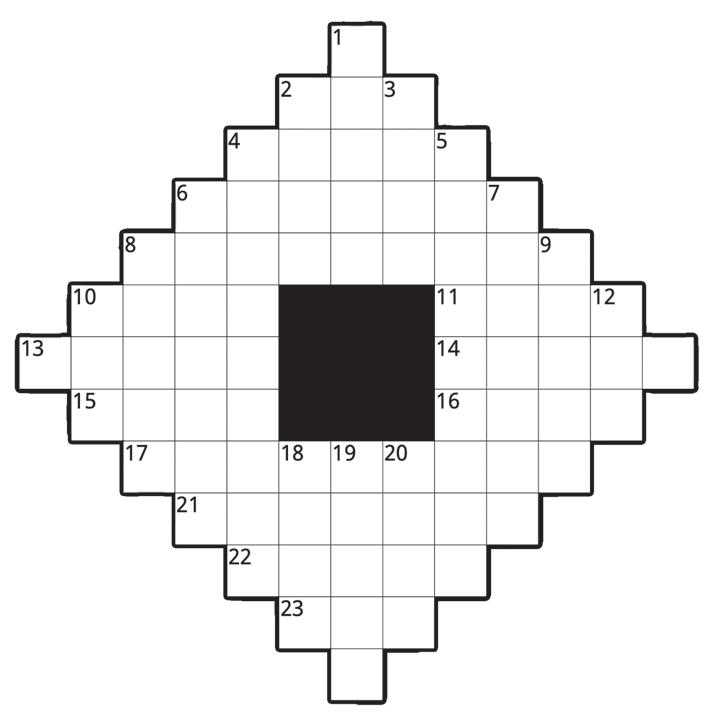
Across (by individual row): Caf, Ionia, Accords, Union Shop, Opals, To Cry, Dully, Ciaos, Annoy, TWU, Aided, Scats, Olsen, Edits, Scentless, Stardom, Skies, Ear
Down (by individual column): Fanon, Cocos, First, Icily, Ad Hoc, Analytics, Socialism, Uploads, Praises, Ounce, Yodel, DNS, Oww! Sen, Stets, Oreos, Snake, Alder, Trial






Special Buys Bad. Same.


Pay $2,000 for a bubble butt.
Mr. Pwesident’s Choccie Milk Fountain
So you’re always able to have a glass of that sweet sweet choccy milk, right on Eastern Avenue.
A New Friend
They stopped me on Eastern Avenue, and I’m so excited to finally make a friend, they’re asking me so many questions and they seem so fun and this is everything I wanted from... oh they want me to join their student politics campaign.
Lethal F-35 Fighter Jet Parts
Since the Government apparently has the “non-lethal” parts covered...












STU DENT JO URNALISM CON FERENCE
15 – 18 August | University of Sydney
Free admission
INFO TICKETS









Kate McClymont Antony Loewenstein



Sophie McNeill Benjamin Law Shankari Chandran
Melina Marchetta Cathy Wilcox Eileen Chong