Honi Soit
FREE USU INSERT INSIDE
Volume 91, Welcome Week 2020 / First printed 1929
Coronavirus: Life on pause / p. 12 Why you shouldn’t study a language at uni / p. 11
The mythic origins of Welcome Week / p. 18
Bettina Arndt’s dating advice / p. 23
Acknowledgement of Country Honi Soit is published on the stolen land of the Gadigal People of the Eora Nation. For over 230 years, First Nations people in this country have suffered from the destructive effects of invasion. The editors of this paper recognise that, as a team of settlers occupying the lands of the Bidjigal, Darug, Gadigal, Wangal and Wallumedegal people, we are beneficiaries of these reverberations that followed European settlement. As we strive throughout the year to offer a platform to the voices mainstream media ignores, we cannot meet this goal without providing a space for First Nations people to share their experiences and perspectives. A student paper which does not acknowledge historical and ongoing colonisation and the white supremacy embedded within Australian society can never adequately represent the students of the institution in which it operates. We seek to resist colonial violence and the racist power structures that serve to oppress those who are Indigenous to this land. Sovereignty was never ceded. Always was and always will be Aboriginal land.
Contents What’s on / 2 Gossip / 3 News / 4 Analysis / 6 Opinion / 11 Feature / 12 Multi-lingual / 14 Culture / 16 Creative / 18 SRC reports/ 21 SRC support / 22 The Rodent Review / 23
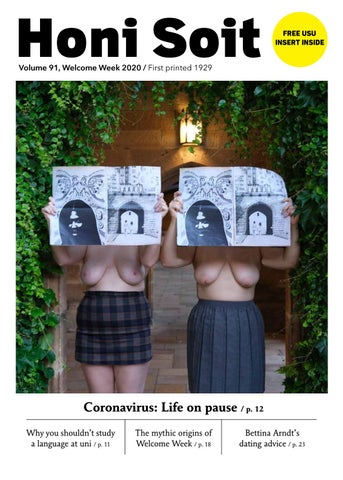
Editorial Editors: Nina Dillon Britton, Matthew Forbes, Zhiquan Gan, Robbie Mason, Angad Roy, Lara Sonnenschein, Ranuka Tandan, Chuyi Wang, Madeline Ward, Lei Yao. Contributors: Becky Barlow, Emily Elvish, Vivienne Guo, Baopu He, Miranda Ilchef, Marlow Hurst, Layla Mkh, Rhian Mordaunt, Claire Ollivain, Shania O’Brien, Lindsay Rui, Luyi Yang. Artists: Altay Han, Ben Lopes, Claire Ollivain, Lindsay Rui. Cover artist: Lara Sonnenschein. Cover tits: Your mums.
As we begin a new decade of Honi Soit, the world around us, in many ways, seems more uncertain than ever. From the climate crisis to rising right wing nationalism, it is easy at times to feel small. As editors, it is our commitment to critically interrogate this fragile world around us, to not settle for false balance and to take stances on issues that matter to students. Not reliant on profit margins or subservient to the views of NewsCorp or Fairfax, we aim to create a paper that is independent in thought, radical in outlook, and hopefully, sometimes just a bit outrageous. Our cover this week is a modern twist on a 1969 Honi cover, as we aim to pay tribute to the playfulness of this paper’s past, whilst also carving out a new path. As Australia’s oldest and only remaining weekly student
newspaper, Honi not only plays a role in shaping discourse on campus, but in significantly contributing to the student voice on a national level. If you would like to contribute to Honi Soit in 2020, send us a message on our Facebook page, or email us at editors@honisoit. com. We’d love to hear from you. To those picking up this paper for the first time, we hope you find something that interests you, challenges you or something that makes you laugh. To those returning, it’s nice to see you again. Honi soit qui mal y pense. Shame upon those who think evil of it. - Honi Soit 2020
Disclaimer: Honi Soit is published by the Students’ Representative Council, University of Sydney, Level 1 Wentworth Building, City Road, University of Sydney NSW 2006. The SRC’s operation costs, space and administrative support are financed by the University of Sydney. Honi Soit is printed under the auspices of the SRC’s directors of student publications: Maia Edge, Peiqing Fan, Nina Mountford, Roisin Murphy, Mikaela Pappou and Maxim Vishney. All expressions are published on the basis that they are not to be regarded as the opinions of the SRC unless specifically stated. The Council accepts no responsibility for the accuracy of any of the opinions or information contained within this newspaper, nor does it endorse any of the advertisements and insertions. Please direct all advertising inquiries to publications.manager@src.usyd.edu.au.
What’s on this week For those who love parties, protests, porn and posing with peace signs! USU Welcome to Sydney Party 2020 When: 18th February, 7pm Where: Manning Bar Price: Free Come one, come all (except a major part of our International Chinese student population); the USU’s wild, life-changing O-Week party is here! Test your blurry vision and your capacity to endure loud, uninspired conversation with people you will probably forget the next morning. Dance the night away with dude bros spilling alcohol everywhere, make friends with earplugs and don’t tell anyone you’re vegan because as soon as the free food comes out, you’ll be indulging in all those lukewarm chicken finger-foods!
2
SUDS Presents: Porn.Cake When: 18th - 20th February, 7pm Where: The Cellar Theatre Price: $3 - $10 Porn and cake! Sounds like a hugely popular fetish thread on Reddit. Put on by SUDS, the show explores couples, Bill and Bella and Ant and Annie, who are frighteningly close to middle-age, the age you might need to wait till if you ever want an appointment at the Student Centre or for a lecturer to respond to your course questions. If you don’t fall in love at the Welcome party come and learn about what you have avoided: tiny orgasms, leprechauns, clicking beetles and Jamie Oliver!
USyd Student Media Welcome Party: Honi x SURG x Pulp x MECOSoc When: 20th February, 4 pm Where: Hermann’s Bar Price: $5 (includes 1 drink upon entry) DJs, pizza and an opportunity to meet fellow budding journos and radio presenters. Anything associated with Honi Soit is extremely cool and has high social capital so you should definitely come if you want to be cool and have social capital.
LETTERS
Weekly Welcome to Who? Weekly! We’re bringing the scandal back to campus. Taking our name from an iconic celebrity podcast, we’re here to sorts the whos from the thems. What’s a who we hear you ask? Well, dear reader, let us explain. Your average campus hack would have you believe they’re a them, when they’re more likely to be a who. A who is someone who upon hearing their name, you’re like, who? A them is someone who upon hearing their name, you’re like, ah, them. A first year factional foot-soldier with only one election under their belt is a who. A failed board candidate stripped of her membership for allegedly embezzling 12K from the USU is a them. It’s that simple!
last year’s successful USU candidate Nick Forbutt is one to, there may be something written in the stars. From Grassroots, we hear SRC Environment Officer, USU Student Activities Coordinator and last year’s Law Revue assistant director, Prudence Wilkins Wheat is considering throwing her hat in the ring. Of course, Grassroots is known for its internal should we/shouldn’t we run for board debates. With this in mind, expect Plotter Prudence to run under Switch branding with an activist campaign. Of course, it’s hardly ever a USU Board election without the SASS President (this year it’s Nick Rigby) running. Nauseating
for allegedly bankrolling our f*cking l*s*r competitors’ campaign to edit this student rag last year.Whilst not a member of any campus faction, he has ties to the Mod Libs whose campaign he managed in 2018 #shakeup! Following, we have Joker Julie. Julie is involved with SUDS and produced Science Revue in 2018. She also co-produced The Good, The Band and The Ugly with rival Naive Nina. Perhaps most interestingly however, we’ve heard she approached former them and current who Cameron Caccamo himself for campaign advice. Turns! Finally, we’ve heard that current board director, Benny Shen is looking
Whos who wanna be thems Although it’s only week zero, some losers are already planning their USU Board campaigns. We’ve done a bit of snooping and here’s who we think is tipped to run. First up, we have Belinda Thomas from Unity (Labor Right for the newcomers). Beware Belinda was implicated in the Unity-Lib SASS stack at the end of last year, which saw her rewarded with becoming Secretary of the biggest student society on campus. It’s probably wise of Unity to run a woman after their 2019 made-to-run-for-USU candidate Tom Manousaridis missed out because of AA requirements, despite receiving enough votes to get on Board otherwise. Next up, we have Nina Mountford from NLS (National Labor Students/ Labor Left). Naive Nina is the Campus Activity Coordinator at the USU, the director of Queer Revue this year and is involved with SUDS. She also made some astrology society? She is a Virgo though, and considering
Can’t blame the travel ban for this one! Zimeng Ye recently resigned from her position as USU board director, citing concerns over obtaining a visa as a result of the recent travel ban. We’ve heard unconfirmed reports that this is not quite the truth, and that Zimeng was never going to return to Australia anyway (coronavirus who?) as she has received an offer to begin a JD at a university in Hong Kong. Look who’s a big boy now Former Moderate Liberal big-noter and current Man With Rapidly Fading Relevancy Jacob Masina has got himself a shiny new job as an Assistant Adviser to the bloody Prime Minister himself, Scott Morrison. The only thing more embarrassing than publicly supporting Scott Morrison is all the so-called progressives that love-reacted the status announcing it. #RIP :( Naughty SULS!
Nick is a Liberal who gained his position in the aforementioned LibUnity stack. We imagine he’ll now turn friend (Belinda) into foe as they compete over the same greasy first year arts camp students to bully into campaigning for them. Dodgy Dane was one of the Vice Presidents at the SRC last year, and is one of the 2020 Welcome Week coordinators. He is perhaps best known for scheming a stipend for the previously unpaid VP position (read more about this later in the paper lol). However, he is perhaps less known
to run a friend of his, who is likely someone who also lives at Queen Mary. Communist soft power in the SRC Those with a keen eye for interfactional relations would note that tensions between Grassroots and Panda have eased, with the two voting together on all motions at last Thursday’s council. It’s a far cry from their relationship in 2019, spelling interesting things for upcoming board negotiations.
SULS have invoked the ire of one USU President Connor Wherrett, who in his personal capacity as a “normal student” called out their sponsorship by Ashurst, a law firm known to underpay junior staff. SULS responded by saying that they wouldn’t be cutting ties with Ashurst due to funding, and Connor angry reacted. Riveting stuff. Where are they now? Remember Is Dom, Is Good -- the ill fated campaign of Liberal Dom Bondar? He’s now managing the Facebook page of Quadrant, which once called for the bombing of our beloved public broadcaster, the ABC!
USyd Queer Action Collective’s “Queerbeers” When: 21st February, 3 - 4:30pm Where: Hermann’s Bar Price: Free
USyd Enviro Collective Welcome Week Drinks When: 21st February, 6pm Where: The Royal Price: Free
Climate Crisis National Day of Action Sydney When: 22nd February, 2pm Where: Sydney Town Hall Price: Free
Hermann’s Bar is the slightly edgier cousin of Manning (rip) but with edginess comes chaos so it would be best to watch out for the traditionally toilet-paper soaked floors. You should still come and meet members of a collective that empower and prioritise the interests of queer-identifying students. Get free drinks, cheese boards AND milk tea! Go easy on the milk tea though, for aforementioned reasons.
Align mind, body and spirit and bask in your appreciation for our Scomo-soaked environment by joining the USYD enviro collective - a collective who endeavour to protect and celebrate the natural environment - for free drinks and food at the Royal. The pizza is better at the neighbouring Buon Gusto, but the Royal’s Happy Hour is pretty hard to top and should become a priority when you come to the saddening conclusion that the USU’s Welcome Party wasn’t all that it was hyped up to be.
Bring your most sexually charged and Engadine Maccas signs to the Climate Crisis National Day of Action at Sydney Town Hall. Join thousands of other passionate protestors and enjoy the dehumanising process of being underreported by NewsCorp media. Also, make sure to bring a disposable camera and take grainy photos of you and your friends so that later generations can know how inspiring and rebellious you were. If you feel like you need a companion, come find me. I’ll be wearing Dr. Martens and have a cream Tote bag with bunches of kale inside it.
3
NEWS
“The Stolen Generations never ended”: Rally outside Parliament calls for end to child removals Claire Ollivain reports. Marking 12 years since former Prime Minister Kevin Rudd’s apology to the Stolen Generations, Grandmothers Against Removals (GMAR) held a rally on Thursday against continued child removals under the guise of protection. Around 50 people met at Hyde Park Fountain at midday and marched to NSW Parliament, on unceded Gadigal Land. The protest sent a strong message to end the abduction of Aboriginal children from their homes, communities and culture. The rally comes four months after the ground-breaking Family is Culture Review into Aboriginal outof-home care, which revealed the system to be a complete failure that perpetuates intergenerational trauma in First Nations communities. The three year independent study led by Professor Megan Davis highlighted that Aboriginal children are increasingly and disproportionately targeted by the out-of-home care system. She called for alternatives to removal including Indigenous-led services and community healing. NSW Greens MLC David Shoebridge condemned the government for making “no effort to implement those key recommendations”. Aboriginal children are ten times more likely to be placed in out-of-home care than non-Indigenous children and the rates are now higher
than that of the Stolen Generations. Shoebridge drew attention to how child authorities displace First Nations children from their culture “largely for the crime of their families being poor.” In response to the news that Rudd and other politicians were at a breakfast at Parliament House on the morning commemorating the anniversary of the apology, Hazel Collins, GMAR’s founder, questioned the tokenism of Rudd’s famous apology. “If Kev really meant sorry, then why isn’t he down here? …The only reason that man said sorry is because it was a political move.” A focal point of the rally was challenging the myth that the Stolen Generations had ended. Bruce Shillingsworth, a Muruwari and Budjiti artist and water for rivers activist, who gave the Acknowledgement of Country, read Rudd’s apology statement outside Parliament House and encouraged the crowd to yell ‘shame’ at the end of each sentence. “For the breaking up of the families and communities we say sorry, but I say shame!” “Things have not changed since the apology. We are still suffering from those policies that affected us in the past. Those traumas have now been passed on to our next generation.” All speakers condemned the Government for claiming to provide a
safe place through out-of-home care where there are reports of children being physically, sexually and mentally abused. Hazel Collins questioned why children have died in out-of-home care and compared it to the crisis of black deaths in custody, stating that, “I feel anger at a government that continues to legalise genocide.” “The government takes our children, supposedly to protect them, but what they do is they take them from us all, the whole family and whole community.” Collins spoke about her own experience growing up without knowledge of the traditional language spoken by her grandparents, decrying this loss of culture as a crime that the government owns the responsibility of. Peter Moore also spoke to his experience as an adoptee and the trauma of discovering he had been lied to. Moore urged prospective adoptive parents to consider the destructive impacts separation from culture has on children, particularly First Nations children. Collins also highlighted how whitesettler Australians would never be subjected to the same government policies. “I wonder how [Scott Morrison] would like it if someone went in and stole his kids? …One day he could be in our position, but he won’t because his ass is white.” “Many people
flock here because they think it’s a lucky country. Well it is for some; it is for the privileged few. But what Australia needs to understand, it’s not if you’re First Nations.” Helen Eason closed the rally off with a powerful speech, echoing Shillingsworth and Collin’s calls for First Nations people to rise up and make the government accountable for the crimes it continues to commit. “We come from strong ancestry, we are warriors and we are survivors,” she said. “Why aren’t our services and Aboriginal organisations good enough? We don’t want to use your services; we’re continually falling through your service gaps.” As of February 2020, there are 17,979 Aboriginal and Torres Strait Islander children living in out-of-home care (an increase of 39% from last year’s Review on Government Services report).
Photo by Chuyi Wang.
Activists call for justice for TJ Hickey Vivienne Guo and Layla Mkh report. 16 years after the murder of Kamilaroi teenager Thomas “TJ” Hickey, activists and community members gathered in Redfern on Friday to mourn and call for justice. Despite being met with heavy police presence that outnumbered protestors, the family demanded an independent inquiry into the tragic murder after over a decade of systematic apathy. On 14 February 2004, 17-year-old TJ Hickey was killed in an unwarranted police pursuit. Hickey was riding his bike through Waterloo when a police car began to pursue him, hitting the bike when he was then catapulted and impaled on a spiked iron fence. The tragedy of his death has left a hole in his community, and Hickey’s family are left wondering when they will get justice for their boy. The protest and subsequent community barbeque were organised by the Indigenous Social Justice Association (ISJA). Protesters observed one minute of silence, in recognition of the brief time in which Hickey tragically lost his life, before speeches began. Prominent Indigenous activist and Gumbaynggirr Dunghutti Bundjalung woman Elizabeth Jarrett opened up the protest by acknowledging that in previous years, the Hickey family had added an extra minute of silence for
4
every year of injustice. Jarrett, who is known for her work with ISJA around deaths in custody said, “...we do not have 16 minutes of silence to give because in that 16 minutes another black boy could die.” In her speech, Jarrett drew attention to the 2019 petition that was started to reopen the coronial inquest into Hickey’s death. The petition received 12,000 physical signatures when the NSW Government only asked for 10,000 signatures. Yet, no reopening of the inquest has been announced. Amongst those remembering Hickey’s life was NSW Greens MLC David Shoebridge, who paid his respects to the Hickey family and the community who have fought behind them for 16 years. “No mum should have their boy taken like Gail had her boy taken. Gail should be standing next to TJ in his mid-thirties today, looking at TJ’s kids, being the grandma of TJ’s kids,” said Shoebridge. A representative from Justice Action reminded protestors that many steps could have been taken to ensure that Hickey would have survived despite his injuries, pointing to the police’s negligence. Instead, Hickey died at Royal Prince Alfred Hospital the next day. Justice Action, who are
a community-based organisation, by the police. As of 2019, the Deaths Inside Project targetted the ongoing abuse of authority in the criminal justice system, and made released by the Guardian Australia reference to the failings of the coronial found that since the Royal Commission into Aboriginal Deaths in Custody in inquest that took place in 2004. The findings from the rushed 1991, there have been 424 deaths in coronial inquest have remained custody. Currently in the Northern controversial, with claims of serious Territory, every child in juvenile omissions that not only suggest police detention is Aboriginal. The Indigenous Social Justice Ascorruption, but inadequacies within the legal system. These findings included sociation (ISJA Sydney) holds weekly the coroner declaring TJ’s death to have meetings on Wednesdays, 6:30pm at the been a “freak accident” which cleared Redfern Community Centre. all police involved of any wrongdoing. During the rally, ISJA organiser Raul Bassi expressed outrage at the double standards regarding police crimes. “We cannot accept any more accidents as a cause of death. Someone killed someone! It’s a criminal offense! They have to go to jail. Anyone - police officers, correctional service officers, even health officers - they have to go to jail. It would happen to us if we killed someone.” Aboriginal deaths through various forms of systematic injustice and police violence are often underreported in mainstream media outlets. In 2018, Wakka Wakka man Patrick Fisher was murdered in the same park, just across from where Hickey was impaled on a metal fence. He died after falling from a 13th floor balcony after being pursued Photo by Layla Mkh.
NEWS
Chinese international students still barred from returning to Australia Lara Sonnenschein and Nina Dillon Britton report. The China travel ban has been extended for at least another week following Scott Morrison’s initial ban on people travelling from China, with the exception of Australian citizens, permanent residents and their immediate family. This decision effectively bars thousands of Chinese international students who are home for the holidays and Lunar New Year from returning to university, likely threatening the financial stability of the higher education sector. The ban results from the Australian Health Protection Principal Committee’s assessment of the “increased risk posed from travellers from all of mainland China” in spreading the coronavirus. Universities Australia Chief Executive Catriona Jackson has announced that universities would seek to extend the offers of flexibility they have recently made to international students, including online study and deferred study options. As of 2019, there were 153,000 Chinese higher education students in Australia, accounting for 38% of all higher education overseas enrolments. Approximately 24% of Sydney
University’s total student population comes from China, contributing more than half a billion dollars to the University’s revenue. “I’m disappointed that the current government is just following exactly what the US government is doing,” SRC General Secretary and Chinese international student Abbey Shi told Honi. “Most students that have been trapped in China understand the virus and are taking preventative methods way more carefully than the institutional instructions.” SRC President Liam Donohoe condemned the ban as “Sinophobic”, noting that many University of Sydney students and SRC student Office Bearers would be affected by the ban. “We are in the process of reaching out to the University to clarify what this means for international students from mainland China, urging them to treat affected students fairly and in a way that ensures they are not disadvantaged.” Thousands have signed a petition opposing the ban that has been circulated amongst Chinese international students at the University.
In response to the developing coronavirus outbreak, the University of Sydney has responded by extending enrolment to two weeks after the normal start of semester until 9 March and is offering online learning options to students in China. Additionally, since the ban, ViceChancellor Michael Spence has announced delays of two weeks to the commencement of the Master of Commerce and Master of Professional Accounting degrees, given they have large Chinese international student enrolments. Students living in on campus accommodation have also been impacted. A number of students recently returned from China have been placed in isolation accomodation in two repurposed University residences. These students self isolating for 14 days include those who have recently returned from the Hubei Province, the epicentre of the virus, and those that have left China after February 1, in line with the Australian Government guidelines. However, the University has also included students with flu symptoms,
including those that have been cleared by a medical professional as not having the coronavirus. The USyd SRC has also played an active role in dealing with the impacts of the ban. In a rally called by the student union, and supported by the National Tertiary Education Union (NTEU), approximately 40 people protested outside the Department of Immigration on 7 February to oppose the travel ban and growing anti-Chinese sentiment. The higher education sector worth $39 billion a year is looking at a minimum $8 billion budget hit if Chinese international students are not allowed to return this semester. 14,000 USyd students remain in China, unable to start semester on campus.
Photo by Chuyi Wang.
Zimeng Ye resigns from USU Board Lara Sonnenschein and Chuyi Wang report. Second year Board Director Zimeng Ye has written to USU CEO Alexis Roitman to announce her resignation from the USU Board. Whilst past Student Directors have been replaced by the person who received the next highest vote share in the last Board election, Zimeng’s resignation was submitted with less than six months remaining of her term. Under the provisions of the USU Constitution, her vacancy will not be filled and the Board will continue with only ten Student Directors until 30 June this year. “In her time at the USU, Zimeng Ye was a strong board director, with a passion for the needs of fellow international students. She pushed for
initiatives and events such as her beloved Twice Loved Market,” commented USU President Connor Wherrett. Zimeng’s resignation letter noted that she had finished her degree at the University of Sydney and that the recently instated travel ban meant it would be incredibly difficult for her to attend in person Board meetings in Australia. She also cited concerns about obtaining a visa in this period. Zimeng is just one of thousands of Chinese international students in Australian universities barred from entering the country by the travel ban. Board Directors Benny Shen and Irene Ma are self isolating in Thailand and Australia. Meanwhile Eve Wang and Oscar Bai are to the Board’s
knowledge stuck in China. All are first year Board Directors. Wherrett has condemned the ban as “Sinophobic, restrictive and reactive”. “We’re urging the University and Federal Government to either lift the ban, or make extreme accommodations to reduce any disadvantages faced by international students over the coming months.” In response to the developing coronavirus outbreak, the University of Sydney has extended enrolment for two weeks after the start of semester. Moreover, Melbourne’s Monash University has delayed the start of semester one classes by one week. The higher education sector worth $39 billion a year is looking
at a minimum $8billion budget hit if Chinese international students are not allowed to return this semester.
Source: Facebook
USU shutters Manning Bar Nina Dillon Britton reports. Campus icon Manning Bar will end day trade this semester, only operating for events that live entertainment events requiring use of the bar. During the day, clubs will be able to book the space for rehearsals and events. The University of Sydney Union (USU) Board voted in favour of the closure in an in camera meeting on 30 October 2019. USU President Connor Wherrett told Honi that the decision was as a response to clubs’ calls for more event spaces and
the significant drop in student use of the bar over the past year. The change in trading hours raises questions for the job security of USU bar staff. In an email from management, staff were told that due to the closure “there will be less Monday - Friday shifts”, though management also noted that Manning’s “gig calendar is looking quite promising...which should help ease that pressure for those of you wanting 1-2 shifts a week”. Wherrett declined to comment on how the closure
would effect USU employees. Many have noted Manning’s decline from the centre of student life at USyd to a ghost-town. In 2016, Honi wrote that “far from the hub it once was, these days Manning hardly approaches capacity for even its most popular events. Lunchtimes aren’t nearly as packed as they used to be, and party organisers scramble to attract students.” Rumours that the USU Board was considering refurbishments to the bar have circulated for at least the past
decade, to no effect. Despite several half-hearted attempts by the University of Sydney Union (USU) to revive the venue, including the introduction of new grill “Clucky’s” and “Manning Social” in the Manning foodcourt (which has also now closed), Manning Bar has waned in popularity over the years. Last year, the USU reported that Manning Bar and Hermanns operated at a combined loss of $245,000 in 2018.
5
ANALYSIS
How the University turned an OLE into free labour Emily Elvish dives into the ethical implications of one of USyd’s most infamous units of study. Compulsory Open Learning Environment units are well known to most students completing degrees at USyd. Those enrolled in designated courses are required to undertake a mandatory 12-credit points of Open Learning Environment units throughout the course of their degree, most of these being worth 2 credit points each. At the program’s genesis, the University’s 2018 Annual Report states that over 6000 students undertook Open Learning Environment units throughout the year. These figures are set to dramatically rise in 2019. As one of the only two 6 credit point units which doesn’t involve an overseas exchange, the Digital Influence through Social Media unit (OLES2107) attracts handsome enrolments each year. Structured as an introduction to social media marketing, the University advertises that the unit serves to “highlight developments within this communication space, while also providing a wide range of new and exciting employment contexts that include specific social media communication skills.” The unit itself consists of a major group project, in which members must collate a social media marketing campaign for the University’s future Welcome Week, complete with historical data, theoretical justifications, layout pitches and a detailed calendar of events and media content. Students receive the pitch for the project from
the University’s own marketing team, who assure participants that the Unit will give them ‘real-world’ experience and increase their likelihood of future employability. OLES2107 has been notorious for epitomising the pitfalls of group-work projects, with students left to their own bearings to coordinate major projects with very little guidance offered by lecturers or assigned ‘mentors’. With four compulsory in-person lectures throughout the semester, which attempt to shed a light on contemporary marketing theory, the Unit essentially revolves around the detail applied to students’ Welcome Week marketing campaigns. University staff have long heralded Open Learning Environment units as a contemporary progression from traditional tertiary academia towards more ‘hands on’ skill development, justified as a necessity for all entering into today’s workforce. However, the supposed ‘real-world’ experience offered by the OLES2107 unit appears to benefit the University by imposing these units on fee-paying students. With each of the enrolled students having to pitch a hypothetical Welcome Week marketing campaign before the commencement of group work, the University’s marketing department, who organise the unit, are left with thousands of detailed resources at their fingertips. Throughout the course, students are offered no information
regarding the rights or claims they have over their own work. The unit is also exclusively offered in Semester 2, which flows on nicely to coincide with the upcoming Welcome Week of the following year. Whilst all these facets can be justified under the guise of ‘work experience’, the context which the unit emerges from raises some particular ethical concerns. As the quickest means to complete the compulsory OLE units, the University has created the perfect storm by funnelling students through both the OLES2107 unit and its sister course Writing for the Digital World (OLES2129). The latter unit requires students to write, design and publish an entire Wikipedia page on an undocumented topic, marketed to be providing skills in academic referencing and encyclopaedic writing. Both these units consequently involve undertaking ‘real-world’ projects, which benefit corporations despite being marketed through the benefits they possess for paying students. The University’s 2018 Annual Report reveals that the University spent over $10 million on marketing in 2017 and 2018, an act which has been deemed ‘inappropriate’ by the National Tertiary Education Union (NTEU). As Australian universities increasingly utilise Orientation Week as a competitive marketing scheme it would be well within the interests of USyd to utilise as much labour in their
• •
• •
OLE Highlights One OLE class made students build “marshmallow towers” out of spaghetti. Some OLEs prohibit further, face-to-face study in the same area (e.g. OLET1307 prohibits students from taking DATA1002, a faceto-face course teaching data analysis). The existence of “OLET1137 Australian Perspectives: Rugby League”. OLEs setting TedTalks as “readings”.
campaign as possible, paid or unpaid. The lack of transparency provided to students, and the convenience for plagiarism within this context is counterintuitive to the ‘real world’ experience that the unit advertises. Rather than increasing employability, the University is generating its own internal labour through a compulsory system of carefully marketed units. The extent to which plagiarism has occurred in the past is unknown, as is whether the unit’s 2020 coursework will be more transparent. However, it’s safe to say that the University has truly created the perfect ploy to exploit the tertiary system to their benefit through the OLE system.
The future of our history: the migration of the Nicholson Museum Becky Barlow considers the past and the changing future of the Nicholson Museum. On 28 February, the University of Sydney’s 160-year-old Nicholson Museum will close its cobwebbed doors. The museum, tucked away inside the walls of the Quadrangle, is home to the largest collection of antiquities in the Southern Hemisphere. It will be integrated into the Chau Chak Wing Museum and united with its siblings, the Macleay and University art collections, both of which migrated from their original sites last year. The relocation of the Nicholson Museum reflects our collective reevaluation of the character of the University of Sydney (USyd). Once a jewel in the colonial crown, it is now a learning resource for aspiring archeologists and historians, a popular school excursion site, and a place to pay homage to cultures both living and lost. The move will see our aging Nicholson Museum reborn phoenixstyle. When reopened in late August, it will include an Indigenous Australian history and culture collection alongside the current Egyptian, Greek, Middle Eastern, Cypriot and Italian collections. This in turn represents the University’s shift from ancient history and culture toward global history and culture,
6
recognising the importance of foreign cultures, whilst also educating visitors about those that define our history. To find out more about the change in location and focus of the museum, I spoke with Mr. James Fraser, who has been the Senior Curator of the Nicholson Museum for three years calling it a “dream job” as it allows him the breadth to “flex his curatorial muscles.” According to Fraser, the museum enjoys a high level of public engagement hosting between 80,000 and 100,000 visitors each year, 10,000 of those being school age. He believes it to be a pivotal learning resource not only to USyd, but to the City of Sydney and to the country. Fraser’s most rewarding experience as a curator occurred three years ago when he and his colleagues discovered that a cedarwood coffin from the 26th Egyptian dynasty, which was purchased in the 1850s by Nicholson and thought to be empty, contained mummified human remains. This discovery triggered months of deliberation, which culminated in the decision to excavate the remains, reorganise them inside the coffin and display them in a more respectful manner. Hieroglyphs
indicated that the body is that of an Egyptian high priestess, Mer-Neithit-es. The mummy will be moved to the Chau Chak Wing Museum to be displayed there when the Nicholson Museum reopens. Before the creation of the Chau Chak Wing Museum, if you wanted to see Aboriginal, Torres Strait and Pacific Islanders’ cultural material, you had to visit the Macleay Museum, located at the top of the Edgeworth David building, down a little alley, past some bins, and up a staircase. Now, USyd is able to contextualise ancient cultures with global cultures in a single, accessible location The Nicholson Museum last underwent change when it was refurbished by Alexander Cambitoglou in the 1960s, transforming it from a Victorian-era style museum to a modern university museum. Despite its connection to us as USyd students, its significance as the largest, most diverse antiquities collection extends beyond the University campus and its evolution reflects the progression of ethics and education in Australia. When the Museum was founded in 1860 by Charles Nicholson, it was
intended to bring a sense of enlightened learning to the colony of New South Wales by exposing British people to cultures starkly different from their own. The University has adapted to its contemporary context since then, but stirring a desire for knowledge in those who visit and study its collections remains critical to the Museum’s ethos. The Nicholson Museum is open from 10am to 4:30pm Monday - Friday until the 28th of February. Mr. Fraser is leaving us in April to become curator of the Levant and Anatolia at the British Museum. Image by Rowan Conroy.
ANALYSIS
What your SRC Office Bearers haven’t been up to over the summer break Madeline Ward and Matthew Forbes look forward to reading your Facebook comments. Two weeks of SRC elections take place in September every year. The result? 35 student councillors, and an assortment of office bearers that are voted in at RepsElect shortly afterward. The most coveted roles are those with stipends: Women’s, Education, General Secretary and most recently, Vice President. These positions are awarded two thirds of the President’s salary, which amounts to $27,820, usually split between two office bearers. In other words, a select number of students are paid to complete various administrative and activist roles. The productivity and output of these offices varies year to year, and incompetent or absent office bearers are by no means unusual. We took a closer look at this year’s cohort summer activity. General Secretaries Abbey Shi (Advance) and Liam Thomas (Unity) Total Annual Salary: $27,820* As second in command of the SRC, General Secretary is a prized position for factions. Gen Secs manage the SRC budget and funding negotiations with the University, organise the SRC’s presence at Welcome Week and hold positions on the SRC’s Legal Service board. Over the holidays Thomas and Shi tell Honi they’ve interviewed candidates for a new SRC lawyer and have been putting together the SRC’s merchandise and Welcome Week bags. One key test of the General Secretaries’ competence and dedication is putting together the SRC’s Orientation Guide, a guide for first years with insights into courses, University management and the struggles of university life. How many General Secretaries does it take to make such a guide? This year, two GenSecs, one President, one current Honi Soit editor and one retired Honi Soit editor (Bob He, who was unjustly returned to the SRC offices to help in a last minute scramble to finish the guide on request of Abbey Shi). Disorganisation delayed printing past the SRC’s publication deadline, meaning the General Secretaries overstayed their welcome in the Honi Soit office. Not that we’re bitter. It also meant that one article was recycled from the SRC’s 2018 CounterCourse, including an embarrassingly outdated reference to then General Secretary Nina Dillon Britton. This lateness is perhaps understandable considering Shi’s significant work in leading the USyd Chinese international students’ response to the recent travel ban. Over several weeks, Shi founded and circulated a petition (now with 4000+ signatures) opposing the ban, lobbied against the ban to media, spoke at a rally against Sinophobia related to the coronavirus and appeared in a University video.
Vice Presidents Felix Faber (NLS) and Charlotte Bullock (Unity) Annual Salary: $27,820* The role of Vice President has historically been symbolic: an unpaid position with CV appeal, but a hazy role in the SRC. In 2018, as part of a deal to entice swing councillors to join a right-wing majority, the role became paid. Due to similar factional dealings (this time, a left-wing coalition) the VPs will be paid again this year. It’s unclear whether that’s money well spent. The role is in effect the same as General Secretary, paying four people for work traditionally done by two. But the VP’s have done very little over the break. No one that Honi spoke to had seen Felix Faber in the SRC offices since his term began in December, but he has found time to write a play. Charlotte Bullock has been slightly more involved, assisting with some of the SRC’s Welcome Week organising. Perhaps a stipend could be justified if they could articulate a vision for the role. When asked about their plans however, the response was vague. The VPs said they were creating “working relationships with external organisations,” “liaising with faculty societies” (about what?) and “attending University committee meetings,” something VPs have done previously without a stipend. Education Officers: Jazz Breen (Grassroots) and Jack Mansell (SAlt) Total Annual Salary: $27,820* Climate activism is well and truly at the forefront of our 2020 Education Officers’ minds. During Welcome Week, the Education Action Group (EAG), convened by the two EO’s, will be, as Breen describes “using its resources to promote various campaigns and events as well as recruit interested people to help organise throughout the year.” It’s not difficult to pinpoint what specific campaigns will be focused on, especially as Mansell promises to participate in “an occupation of a yet-to-be-unveiled climate criminal’s headquarters” during Welcome Week. Mansell says this will be in his “capacity as Education Officer.” While Mansell and Breen’s personal activist work is admirable and undeniably significant, one can’t help but feel that the conditions met by students that directly relate to their education are a footnote in the work the two have done thus far. 40% of articles included in CounterCourse have been published in other SRC publications, and little by way of other meaningful action has taken place over the holidays. Credit where it’s due, the pair’s justification for this is at least partially persuasive. They argue the climate
movement has provided student activism with the opportunity to not only rebuild itself, but soar to new heights of influence. With greater student involvement in the activist community, the EOs are confident that major threats to higher education, specifically funding cuts, will be met with more resistance once they rear their ugly head again. Mansell made a point of highlighting that currently, there is “no explicit attack on higher education.” Therefore, his and Breen’s ‘obligation’ is to help build student activism in areas in particular need of mobilisation. This begs the question whether Morrison’s travel ban on Chinese international students can be considered an “explicit attack on higher education.” Breen did mention the pair’s involvement in the response to this but once again, this seemed more of an aside given Shi’s mammoth workload in dealing with this crisis. Breen and Mansell submitted separate responses to our questions. Is there trouble in paradise? Women’s Officers Ellie Wilson (Grassroots) and Vivienne Guo (Grassroots) Total Annual Salary: $27,820* The most important duty involved in this role is convening the Women’s Collective which, as per the SRC website, “is the most active, left-wing and activist Women’s Collective in the country”. After last year’s inactivity, you’d think that the 2020 Women’s Officers would be working harder to vindicate this statement. Their time spent in office over the summer break appears to have mostly been spent on Growing Strong, the Collective’s autonomously-produced annual publication. Beyond this, there’s not been much else. Aside from a Welcome Week ‘stunt’ to protest campus sexual violence there’s little WoCo-spearheaded demonstrative action on the horizon. Though the officers have promised ‘public action’ as well as a press release following Universities Australia’s 2020 survey into sexual assault, they haven’t made concrete plans to continue the anti-sexual assualt campaign that ran from 2016 until the end of 2018. When asked who they had met with over the summer, Vivienne and Ellie name dropped the Indigenous Social Justice Association (ISJA) and a number of other campus based collectives. There was no mention of meeting with any members of University management, aside from members of the Safer Communities Working Group. It would seem that what was once one of the SRC’s most active departments is now no more prolific than any of those run by unpaid OBS — a sorry start to what should have been a big year for
WoCo. President: Liam Donohoe (Grassroots) Annual Salary: $38, 521* Liam Donohoe is certainly a hands on President. If there were a critique to be made, it would be that he is a little too involved. Faced with a paid OB team that lacks initiative, Donohoe is taking a direct approach. Liam was heavily involved in producing the Countercourse handbook, the SRC anti-Sinophobia rally and upcoming Welcome Week protest. He also seems to have organised the majority of Welcome Week from coordinating stalls to pushing the broader OB team to organise themselves. His response to the coronavirus, alongside Abbey Shi is commendable. The SRC is currently leading the student response to the issue, and their work negotiating with University management, advocacy and activism have been substantial. Liam’s heavy involvement is due to the underperformance of his paid OB team, particularly the Vice Presidents and General Secretaries. With four people paid handsome stipends to do the work of two, Liam should be free to focus on managerial issues. In picking up the slack of his paid OBs in tandem with his already significant duties in management and advocacy (the man sits on 35 committees) we wonder, does Liam sleep? *** The success of the firebrand “save our union” campaign promised big things for the 92nd SRC. Thus far, it hasn’t delivered. Though by no means as messy as last year, the 2020 paid OBs are falling behind on activism and administration. The most concerning are the Vice Presidents, who have arguably done nothing to justify the substantial amount of student money that they have received. Grassroots have also proved to be underwhelming. For a faction that publicly prides themselves on getting things done, their OBs are doing little. Despite this, and despite the initial overreaction in closing the SRC for several days, the response to the coronavirus has been one of the high points of the administration thus far. Where similar organisations have dawdled on the issue, Donohoe and Shi’s action has been decisive and swift. Ultimately, the first few months of the new administration have been lacklustre. With the rest of the year to redeem themselves, we can only wait and see how it all plays out. *Per the 2019 SRC budget.
7
Need Help? Ask the SRC. Our caseworkers provide FREE, independent, confidential advice and advocacy for Sydney University undergraduates Academic Rights & Appeals • Special Consideration • Plagiarism / Misconduct Allegations • Centrelink, Debt & Finance advice • HECS Refunds • Tenancy & Accomodation advice • Harrassment & Discrimination support and more...
Students’ Representative Council, University of Sydney Level 1, Wentworth Building (G01), University of Sydney NSW 2006 PO Box 794 Broadway NSW 2007
p: 02 9660 5222 e: help@src.usyd.edu.au w: srcusyd.net.au
/usydsrc @src_usyd
ANALYSIS
All quiet on the greyhound track Miranda Ilchef questions the media silence around dog racing. Every Saturday night at Wentworth park, just around the corner from the University of Sydney’s main campus, greyhounds run as fast as their long legs can carry them. Much like racehorses, the dogs are trained to run as fast as possible at detriment to their own health. They collide, endure concussions, fall over, break bones and are put to death; Crikey reported that 31 dogs in NSW have died on the racetrack in January of this year alone. When ABC brought the live-baiting scandal to light in 2015, in which it was exposed that live animals such as rabbits and possums were being attached to machinery and hurled around a racing track to lure training dogs, a flurry of stories and investigations followed. Mass graves containing the bodies of rejected racing dogs were uncovered all over NSW, most notably in the Hunter Valley. Years later these discoveries were still ongoing: in mid-2018, mass graves of greyhounds and alive but severely emaciated dogs were found on a property in Western Sydney. In the same month, and two years after former Premier Mike Baird’s failed attempt to ban greyhound racing, our government contributed $500,000 in taxpayer money to help fund the ‘Million Dollar Chase’ race, which takes place at our local Wentworth Park.
Since then, as the political value of the story decreases, reporting and investigation on the issue has been sparse and ineffectual at raising awareness or exposing the ongoing abuse that dogs suffer. News about greyhounds is mostly limited to local newspapers like the Wingham Chronicle and the Cowra Guardian, which proudly report racing results and club happenings.
animal abuse against dogs, creatures we usually hold so dearly as loyal companions, did not make the front pages of newspapers. Perhaps the media has grown numb. We seem to care about the issue (82% of Australians wanted an industry-wide shutdown during the premiership of Mike Baird) but not enough to warrant ongoing media investigation.
A very recent death at Wentworth Park was covered by almost no mainstream media, except for The Daily Telegraph, who referred to Australia’s greyhound racing industry as ‘historic’. It is difficult to understand how legalised and government-sanctioned
Small efforts have been made to change greyhound racing but these are symbolic and have no tangible reductions in animal suffering. This includes measures like jailing trainers previously found guilty of animal abuse, companies such as Schweppes
and Hyundai withdrawing support, and the entire board of Greyhound Racing NSW was being sacked. However these measures are reactive rather than proactive and do little to prevent future abuse. The industry is fundamentally incapable of reform: there is no feasible way to continue producing incredibly fast animals and not have the thousands of by-product dogs that are bred every year, many of whom never actually make it to the track. It is not just the animals that suffer. An industry that is inextricably linked with gambling is not worth our continued support when it poses the risk of addiction and financial loss. There are so few who benefit and so many who suffer due to the existence of greyhound racing. The government cannot even cite the morally weak argument of huge economic importance that is used to defend the abominable business of horse-racing, as this is not an enormous industry that creates large sums of money in revenue. It’s time we stopped using animals for entertainment at the cost of their health and lives and it’s time for the mainstream media to resume their reporting on this issue.
Art by Claire Ollivain.
How long is your shower? Angad Roy writes about the cognitive dissonance asssociated with environmental (in)action. With the upcoming Climate Crisis National Day of Action, pessimists, couch-dwellers and pseudo-intellectuals will seek to undermine the value of protests and their pledge to stir solidarity and incite change. Unprecedented crowds of people of all ages, professions and ethnicities are encouraging, but are barely acknowledged by the government. Given that fact, the question must be, what can we do?” Not, “how can we incite the government to do something?” The issue at hand then becomes what ecocritic Richard Kerridge describes as ‘splitting,’ which is a process of “intellectualisation that separates abstract awareness of the crisis from real emotional engagement.” That is, we understand that the climate is changing and we protest because of this awareness but what happens when we go home, when we aren’t surrounded and inspired by a plethora of other like-minded people? Climate change itself is such an abstract and complex issue that it can become mind-boggling and overwhelming to assess the links between our everyday lives and our footprint on the world. Therefore, just as we are inspired by others, others can also become the reason for helplessness in the face of such an omnipresent issue. Writer and environmental activist George Monbiot terms our visual relationship with the world as “selective
blindness,” which occurs “when your brain quickly identifies what it considers to be the most significant aspects of your surroundings, and focuses almost all of its attention on these elements.” Stark images of cracked earth, ghoulish animals floundering on stiltlike legs and dust storms sprinting through bare lands have been cycling
mornings but why should I shorten my shower if the guy across the road cleans out his truck every day with a hose? In my life, water wastage is the most obvious manifestation of Kerridge’s ‘split.’ Our next-door neighbour once told my mum, “your boys have such long showers. I would have thought the younger generation would be
on news feeds and media outlets for years. Frequent water restrictions and reportage on rapidly falling dam levels are distressing and engaging. I hate seeing the wilting of my plants and burnt grass, which used to be a haven for walking through barefoot on dewy
more aware of these things.” My mum is also a stickler for short showers and consistently condemns me for their length. She correlates my age to the degree of my environmental responsibility. She gushes at the shortness of her showers (always
below three minutes) and has enforced a rule where buckets must be placed under the showerhead to gather water for the garden while it reaches the desirable water temperature. Yet, on hot days and on occasions when we can’t be bothered to walk my dog, she turns on the hose and drenches Leuca for close to ten minutes as he frolics under the liquid umbrella. I try to ignore this wastage by marvelling at the minuscule rainbows that appear between droplets. When I attempt to reveal her hypocrisy, she scoffs and tells me that it is in the best interests of Leuca, that we love him and that it is our responsibility to make sure he is active. We have also been discussing digging a hole in the back of the garden for compost but mum can’t do this because of a crippling tennis elbow; dad prefers lawn-mowing and smoothie-shopping for his weekend chores. The conflict between this desire to affect a change and it actually happening arises not from our own passivity. It arises from the inability of others to understand and relate to them. We seek attachments (dogs, long showers, smoothies) in order to stabilise ourselves but is it these attachments that are destabilising the world around us?
Photo by Georgia Mantle.
9
PERSPECTIVE
My worlds are clashing Rhian Mordaunt explores the compatibility of queer and Muslim identities. “Are you religious?” “Nah, I was a Muslim up until I was like 13 though.” “Why did you stop?” “I realised I was gay.” They laugh and I join in until I realise that my trauma was the punchline. But there’s a grain of truth in every joke. One of the main reasons I left Islam was because I couldn’t handle the internal battle between faith and desire. Did I even have a choice? My relationship with Islam is complex. I don’t eat pork, I fasted during Ramadan up until last year, I pray when things get tough and I majored in Arabic in order to read the Qur’an. Yet, I definitely drink, I don’t pray five times a day, I have premarital sex (sorry mum) and I can’t remember the last time I opened, let alone read, the Qur’an. I didn’t have a choice, right?
indiscretions alike. This calls into question the ambiguous terminology used in the narrative such as “those not producing” or “men who have no wiles with women”, which can be interpreted as referring to eunuchs or impotent men. Islamic studies scholar Scott Kugle argues that the main focus of this narrative is therefore not about defining a “correct gender” for a man’s sexual orientation, but rather, preaching that both men and women deserve protection from rape and humiliation. My Jihad In a study on British Muslim gay men, one participant stated that his queerness was his jihad (struggle). Another stated that, “if I could choose, I wouldn’t be gay. I know I’m going to hell for this. I feel really ashamed, not
and face homophobia and Islamaphobia in broader Australian society as well. In 2007 in Camden, pigs’ heads adorned with the Australian flag were placed at a site proposed for an Islamic school. In 2014 in Bendigo, a protester shouted outside a mosque, “if you’re Muslim and you want a mosque, go back to the Middle East. This is Australia.” In 2017 at a Q Society fundraising dinner, Larry Pickering said that if Muslims “are on the same street as me, I start shaking....they are not all bad, they do chuck ‘pillow biters’ [a homophobic slur] off of buildings”. Increasingly, far-right politicians use disingenuous concern for the queer community as a justification for antiMuslim and anti-immigration policies. During the 2016 US Presidential race, for example, Donald Trump argued that “Hillary Clinton can never claim
So Let It Be Written, So Let It Be Done When the question of whether queerness is compatible with Islam arises, conversations inevitably turn to the attacks committed against gender and sexual minorities in Muslim majority countries. A 2013 Pew Research Centre poll revealed the percentage of people in Muslim majority countries who oppose the social acceptance of homosexuality: Jordan (97%), Egypt (95%), Indonesia (93%) and Pakistan (87%). Numerous Islamic leaders have publicly condemned homosexuality, the Chairman of the International Union of Muslim Scholars, Yusuf al-Qaradawi, once stating that, “the spread of this depraved practice in a society disrupts the natural life pattern and makes those who practice it slaves to their lusts, depriving them of decent taste, decent morals and a decent manner of living.” During Australia’s recent marriage equality debates, President of the Australian National Imams Council Sheikh Shady Alsuleiman stated that, “we oppose same-sex marriage and consider it a sin and religiously illegal... Islam promotes equality; however equality itself has limits.” While there are systemic problems within the Islamic community regarding the acceptance of queerness, it is also important to interrogate what Islamic scripture actually says about homosexuality. Discourse surrounding homosexuality and its prohibition in Islam is based on the story of Prophet Lut, which condemns violent sexuality and criticises men for leaving their wives in order to rape men. However, contemporary scholars such as Amreen Jamal are calling for a critical rethink of the standard interpretation of Lut. Jamal argues that the story does not render a judgement against same-sex sexuality, as the objections towards same sex-attractions are on par with the objections towards opposite sex and non-sexual
10
labels that only exist in a Western context, such as “lesbian” or “gay.” This may prevent them from constructing an identity that feels authentic and aligns with their cultural background. After all, most identities within the LGBTQ+ community wereconceived in the West under the influence of postmodernism and queer theory. Commenting on this Western construction of identities, Madjid Bencheikh argues “homosexuality is universal, what is not, are the forms it takes.” Homosexuality was indeed openly practiced in many Muslim societies from the seventh to the twentieth century. Activist and scholar Houria Bouteldja highlights that, “in the Maghreb, homoeroticism has long been tolerated until colonisation imposed the norms of the rigid binary of homo/ hetero.” This binary has made many queer Muslims feel threatened by members of the LGBTQ+ community, a phenomenon which LudovichMohamed Zahed, an openly-gay Imam, terms as “sexual imperialism” attacking people they deem to be queer where it is not claimed by them as an identity. In one study on queer South Asian women a participant quipped, “white queers all emphasise coming out so much...next time a white person tells me to come out to my parents I’m going to tell them to make sure that cause of death reads: ‘coming out because a white person told her to’ is included in my obituary.” Power in Resistance?
comfortable or happy in my life....like my worlds are clashing.” These statements encapsulate the internal battles encountered by many queer Muslims who are afraid of being ostracised from their own religious communities. Psychologist Rusi Jaspal explains this dilemma, arguing that “the social representations of homosexuality within these communities may be stigmatising, potentially resulting in a decreased willingness to come out and a perceived conflict between their sexual and ethno-religious identities.” For many queer Muslims, giving into religious or cultural pressures, such as heterosexual marriage, appears to be the only method open to them to avoid otherisation. The Muslim Closet Queer Muslims attacked within their own communities for their queerness,
to be a friend of the gay community as long as she continues to support immigration policies that bring Islamic extremists to our country who suppress women, gays and anyone who doesn’t share their views”. For queer Muslims, their identities become weapons against their communities. Queer Muslims struggle with Islamophobia within the LGBTQ+ community as well. Within largely white queer spaces, anthropologist Niels Teunis argues, many queer Muslims feel trapped within the “Muslim Closet” and are too afraid to tell people about their Muslim identity because of its associations homophobic cultural values. Authenticity One of the primary conflicts queer Muslims face is feeling as though they are forced to adopt gender and sexuality
Being a queer Muslim is inherently complex as we have to overcome both homophobia and Islamophobia in order to be our authentic selves. However, sociology professor Momin Raman argues that “the ‘impossibility’ of gay Muslims is exactly their power in resistance. The disruption of their identity comes in challenging the ontological coherence of these dominant identity narratives which exclude gay Muslims as being impossible.” Whilst I sympathise with sentiment of Raman’s message and I understand the liberation that one can feel by challenging social norms I personally never felt this power when I was coming to terms with my identity. I always felt weak. I always felt afraid. I always felt alone. I am grateful to see organisations such as Sydney Queer Muslims and Al-Fitrah passionately supporting and advocating for Muslims of diverse sexualities and genders. I would have loved to have seen these organisations around when I was struggling with my sexuality and religious identity. I hope to see a day when my worlds are no longer clashing. A day when they finally align.
Art by Ben Lopes.
OPINION
Why you shouldn’t study a language at university Baopu He doesn’t want you to make the same mistakes he did. Watashi wa ringo ga suki desu. I like apples. That was the first sentence I ever wrote in Japanese. Grammatically simple, but to be able to express a thought in another language remained deeply satisfying for my 12 year old self, as if I had unlocked a new region of my brain. Six years and many linguistic eureka moments later, I was able to hold a sustained, semirealistic conversation in Japanese, and write essays about topics ranging from the benefits of being an onlychild to the dangers of social media. Of course, I still couldn’t read the newspaper or watch a Japanese movie without subtitles, but overall, I was happy with where I was in terms of my language ability after the HSC, and cautiously optimistic about where I was heading. Then I got to university. The eureka moments dried up and I stopped speaking or writing in Japanese for two years. And it was my major. Towards the end of second year, as I took Japanese exchange students around Sydney, I realised I couldn’t even ask how long they would be in Australia for. While many prospective university students will be excited at the opportunity to learn a language after school, the sad reality is that, save for superhuman motivation or an immersive exchange experience, you will not become fluent. Far from it. The problems with language learning at university relate to both the inherent difficulty of learning languages, and also to the way they’re currently taught. While humans have an innate capacity for language, to relearn as an adult the basics of grammar, vocabulary and pronunciation, things we take for granted in our native tongue, is not easy. It requires patience, intelligence, and most importantly, discipline. While children supposedly have the luxury of a more receptive brain, their biggest advantage is not neurological, but educational. If a student has completed the HSC Continuers level course for a language, they would have done at least 600 hours of classroom time by the end of it, with 120 of those hours happening in year 12. In contrast, at university, where the semester time is shorter and the
Total class time in USyd language major Basic fluency in French, Italian or Spanish*
course load smaller, a language student will normally complete only 78 hours (3 hours a week for two semesters) of dedicated classroom study. From the outset, university students have much less to work with than they would have in high school. Of course, it can be argued that an important part of tertiary education is the ability to self study and be selfdisciplined. While this is undoubtedly true, the lax, self-directed nature of tertiary education is not at all conducive to language learning, which requires a level of consistent discipline and rote learning perhaps only a high school student can handle. While in theory someone who puts in a lot of study in their own time in addition to their tutorials and lectures could probably develop the level of fluency their course description prescribes, that same
not how to actually use it. Most infuriatingly, classes revolving around speaking, deceptively named “communication class,” involved no actual speaking but the filling out of pointless worksheets and acting out unrealistic scenarios to a pre-written script. By the senior units, it seemed that no one in the class could hold a conversation in Japanese anymore, so we just sat sheepishly and chatted in English, with the tutor doing nothing to stop it. The focus on speaking that high school language study places such a huge emphasis on very much disappears at university. But while my problem was that classes didn’t have enough Japanese, some students have found the complete opposite. Horror stories quickly circle in first year about introductory Spanish being taught entirely in Spanish despite
The lax, self-directed nature of tertiary education is not at all conducive to language learning, which requires a level of consistent discipline and rote learning perhaps only a highschool student can handle. student could just download Duolingo and do an hour of exercises everyday. The result would be the same. People choose to study languages at university because they’re expecting a degree of structure and guidance that a phone application just doesn’t provide. My first year “reading” tutorials for Japanese involved the tutor going around the class and making everyone each read a sentence from the weekly passage in the textbook. You would spend the majority of the 50 minutes in silence, and when your turn came, you would read your sentence aloud for maybe 10 seconds — if you were lucky. Then class would finish, and you wouldn’t speak any Japanese until the next reading class. There was no discussion in Japanese about the content of the piece, nor any emphasis on actually understanding what you just read. Vocabulary building was relegated to a weekly online quiz which only tested whether you knew what a word meant and how it was pronounced, and
many incoming students having no knowledge of the language. In Chinese, many students have spoken of native speakers managing to bypass prohibitions to get into beginner level units, diminishing the experience for beginners. And it’s well known that first year French requires its students to read a novel in French after only one semester. While I don’t want to generalise my experience to all languages taught at university, I still believe the biggest problem with language learning at university isn’t that it’s too hard, but that the expectations on students are too low, such that it’s entirely possible to graduate majoring in a language without having anything close to fluency. Personally, the best thing about my Japanese major was that I could go on exchange and study the language not in Australia. Had I not gone, like so many of my friends, I would have left university with a piece of paper but nothing to show for it.
Perhaps the problem of language learning at university is the whole idea of fluency itself. While students of modern languages languish in their studies, students of ancient languages seem to be relishing in them.Latin and Ancient Greek students seem to be enamoured with both the languages and the people that teach them, with a friend describing the latter as “ridiculously overqualified.” The academic nature of studying ancient languages, which involves copious amounts of translation and almost mathematical grammar exercises, seems to be much better suited to the self-directed nature of university. Without the need to ever have to hold a conversation or write a business email in Latin, Classics students seem to be spared some of the biggest shortcomings of modern language learning — the difficulty of transferring classroom learning to practical results. Once the dream of fluency is taken out of the equation, it’s easy to see the benefits of trying to learn a language. It’s intellectually stimulating, whether you’re working out verb conjugation in Japanese or trying to decipher a long, winding sentence in French. It’s culturally enriching, and many students, though unhappy with their language units, have praised how interesting many of the cultural units are. And sometimes, when the stars align for the right student, who has the right amount of determination and linguistic ability, it could very well lead to fluency. In a time where Sydney University is relentlessly pushing forward the idea that its degrees are practical and “graduate quality” enhancing, it’s strange how a language education at the University is nothing of the sort. Of course, if your motivation to study a language is to be able to have a basic conversation with someone, or because you’ll be travelling to a country which speaks it, or because you just want to give yourself a challenge, by all means go for it. However if you go in expecting to leave with “full working proficiency”, maybe it’s better to temper your expectations. To any language learner, fluency will always be more a possible bonus than a concrete end result.
78 hours 600 hours
Basic fluency in Japanese, Mandarin or Arabic*
2200 hours
*For a native English speaker. Source: American Foreign Service Institute. 11
FEATURE
THE PAUSE
WORDS AND PHOTOS BY LINDSAY RUI
On 1 February, I woke up with an email notification telling me that my flight from China to Sydney was cancelled. That afternoon, Scott Morrison announced a 14-day travel ban restricting almost all people in mainland China from entering. Within a day, the plans I had for the upcoming semester had all been put on pause. This was the first time I felt that the novel Coronavirus, now officially named COVID-19, was so close that I was no longer an outsider. Instead, I was in the middle of it. The consequences had gone beyond small things like needing to put on masks or remembering to wash my hands. I first heard about the COVID-19 in mid-January, when it was only present in a few isolated cases. It was almost time for the Spring Festival in China — a time meant for communal gathering, celebration and lots of red packets. Nobody could have predicted the extent of the viral outbreak, or expected the holiday to be marked by fear, panic and anxiety. Everything happened so fast. COVID-19’s human-to-human transmissibility was confirmed on 20 January. Wuhan, the center of the infected area, was locked down on the 24th, British Airways stopped all its direct flights between UK and China on the 29th, the World Health Organization (WHO) declared a Global Health Emergency on the 30th, and one by one Singapore, the United States and Australia issued travel bans. Not just China, but the whole world sensed the threat.
In light of all these sudden changes, many Chinese international students like myself didn’t know what we were meant to do when so many things became immediately and frighteningly uncertain. Coco is a friend of mine. She had booked her flight from Qingdao to Sydney exactly on the 1st of February, the same day as the travel ban was announced. When Morrison was making his travel ban speech, she had just finished checking in her luggage and was making her way to the boarding gate. “I remember suddenly panicking,” she said. “I hadn’t yet boarded the plane, so I’m thinking maybe I should just stay instead.” The rollout of Australia’s travel ban was as confusing as it was harsh. If someone had a flight from China to Australia right on that day, or even right at that time, what should they do? Like Coco, the ban was announced, but her flight was still there. “So many people were talking about it in the waiting area, and many of my friends were messaging me,” she said. “I had a connecting flight in Seoul, so at the end, I decided to fly there first and see how it would play out.” When Coco arrived at the airport in Seoul, she asked the staff there to contact Sydney Airport about whether she would be able to enter Australia later. After receiving positive confirmation, she felt relieved and boarded the second half of her journey without worrying. She landed in Sydney on 2 February. She got off the plane, took an E-Passport ticket, passed customs, took her luggage and got out of the airport. There was nothing special. She then went back to her apartment in Sydney and we talked about all her experiences over a phone call. Her feelings were complicated; it was hard to use a single word like “lucky” or “unlucky” to describe the trip. At the time, I felt a bit jealous because at least she had been able to get back to campus and continue her studies. I was instead totally stuck, worrying but not being able to do much of anything.
Questions like “why me?”, “why now?” and “why my country?” keep flooding my mind. Overthinking takes up lots of my time. I am currently staying in Guangzhou, a city in Southern China about 1000 kilometres away from Wuhan. That seems like a fair distance from the epicentre of the outbreak, but Guangzhou already has 300 confirmed cases of COVID-19 as of 13 February. The city is overwhelmed by a sense of anxiety and people are unsettled. Guangdong, the province where Guangzhou is located, used to be ground zero of the Severe Acute Respiratory Syndrome (SARS) outbreak in 2003. It was another contagious coronavirus similar to COVID-19, which infected more than 8000 people and resulted in 800 deaths. I was five years old back then, so I didn’t have a clear memory about what had happened. I could only recall that there was a day when my mum stopped taking me to the kindergarten on the bus as usual, and she would get angry with me if I randomly picked up things on the street. Optimistically, I initially thought that Guangzhou’s past experience with SARS would have made the city more cautious, but calm when facing the COVID-19 in 2020. This could not be further from the truth. By late January, we were asked to stay at home as much as possible. The seven-day Spring Festival vacation for companies has been extended a further 14 days until 10 February. The education sector has seen an equally lengthy delay. From primary schools to universities, the starting date of the new semester was pushed back from February to March.
12
To further prevent people from having physical contact with others, most restaurants are indefinitely closed; even McDonalds has become take-away only. We have started ordering grocery deliveries more than we have ever before. Masks and hand sanitisers have become so crucial in our everyday lives, but have been sold out for weeks. Clinics, pharmacies, supermarkets all have bold signs on their doors warning about the lack of stock. Each time I receive a parcel, I have to open it outside and throw away the packaging before I enter the house. “The COVID-19 looks much worse,” my dad tells us. “In 2003, we didn’t wear masks and we still went to work every day.” One night my dad woke up with a sore throat and our whole family became paranoid. We were afraid of having COVID-19 in the family, which would mean that we all needed to be quarantined. Yet, we didn’t want to send our dad off to the hospital either, due to the high possibility of contracting the disease there. Fortunately however, it was only a sore throat and it cleared very quickly. Questions like “why me?”, “why now?” and “why my country?” keep flooding my mind. Overthinking takes up lots of my time. However, comparing myself to people who are right in the middle of the outbreak, who are surrounded by death, panic and broken families, I still feel like I’m a lucky one.
“If my family falls ill and needs me to look after them, I wouldn’t care. I would definitely go back,” she said. “I’m very worried,” Amy told me. She stayed in Sydney during the summer break, but her family is back in Shiyan, Hubei. The city is in the same province as Wuhan, which has around 480 infected cases as of 13 February. Amy was supposed to fly back to China on 23 January, one day before Chinese New Year. She booked her flight from Sydney to Wuhan and a train from Wuhan to Shiyan the week prior. “My dad messaged the morning of my flight and told me that there are already 17 deaths in Shiyan because of COVID-19. He advised me that it would be better to stay in Sydney,” she said. “I’m struggling, I don’t know if I should go back or not.” Amy’s flight was at 9:30 that evening. Throughout the day, she spoke with her family, friends and colleagues to make up her mind. Eventually, she decided to cancel her travel plans three hours before her flight, and so became the only ‘lucky’ member of her family outside of the infection zone. Staying in Sydney, however, did not equal relief. Over the past three weeks, she has been trawling news websites as the first thing she does in the morning to read updated statistics on the number of infected, the fatality rate and the possibility of improvement back home. “I can only message them,” she said. “I forward them like… more than ten articles a day, especially after the city was locked down. News, information, how to recognise signs of the virus, how to protect themselves, how to eat well, how to properly put on a mask… I send everything.” However, she understands that her choice to stay was the right decision. Even if she risks the journey, she may catch the COVID-19 on the way and bring the virus back home. The last thing she wants is to pass the virus to her unsuspecting family. It would also get in the way of her new job in Sydney — if she had returned to Wuhan, who knows when she’d be able to return and get to work? “If my family falls ill and needs me to look after them, I wouldn’t care. I would definitely go back,” she said. Watching her hometown severely impacted by the disease is not an easy thing to deal with; the distance has made her feel powerless. Amy works at Urbanest, a student accommodation building near the University of Sydney. It is almost the start of a new semester, so there are supposed to be many Chinese international students checking in. However, as a result of the COVID-19 and travel ban, the entire area has become much quieter than it used to be.
“It’s quiet, but there are times when I feel very depressed.” Lucy is another friend of mine who is currently in Sydney. She departed from Beijing to Sydney at the end of January, and is now under a 14-day quarantine in her accommodation. She has been asked to stay in her room and can’t go outside or have any physical contact with other people. All her food and groceries need to be ordered online. To pick up her packages, she can only use the back or side door of her accommodation, because there are always people walking through the front. “I can only do some reading or video chat with my friends,” she said. “It’s quiet, but there are times when I feel very depressed.” Another issue she finds is that, during the quarantine period, it would be hard for her to ask for help if there is anything broken, or for any accident that might occur in her room. She still misses her family from time to time, since she is totally isolated under quarantine, but she told me, “I know there is no such place which is perfect — neither China nor here. I would have the support of my family if I was in China, but since I’m here, I need to be careful and independent.” By the time you read this, Lucy will have just finished her quarantine period, but I will still be stuck in Guangzhou and Amy will still be separated from her family. There are people in Wuhan still suffering and there are students still on pause. As long as COVID-19 continues to spread, the situation will be a struggle for all.
13
MULTILINGUAL
为什么学生需要多元化的校园餐饮? 饮食文化通过宗教,社会关系以及世 界与个体之间的交互来塑造我们的生 活。Honi Soit 最近的一项问卷调查显 示,大多数学生认为他们的饮食需求 或多或少被大学忽略了。这的确成为 了一个棘手的问题,当超过90%的学 生几乎从来没有将午餐带到校园,同 时他们在校园里也很难找到符合他们 饮食需求的食堂。本次 Honi 问卷的调 查对象包括97位学生,其中涵盖了55 位国际学生和42位当地学生。 值得一提的是,Broadway 购物中 心与 Wentworth Building Cafe 一样, 成为了学生吃午餐的首选。由于舒适 的环境,多元的食品供应商以及距校 园较近的地理位置,他们满足了国内 学生和国际学生共同的饮食的需求。 Courtyard Cafe 在受学生喜爱的餐厅 调查问卷中位列第三。一个学生告 诉 Honi ,尽管 Courtyard Cafe 的食 堂价格在所有食堂中都相对较高,但 Courtyard Cafe 为其顾客提供了舒适的 环境。 因此在大多数情况下,Courtyard Cafe 都是他最喜欢的吃午餐的地 方。 平衡部分顾客的餐饮需求和实现 盈利是大多数食堂解决的问题。毋庸 置疑的是,较低的时间成本和合理的 价格是顾客选择餐厅的主要原因。但 是个性化的菜单似乎更加重要。根据 Honi 的调查,超过70%的学生更喜欢 正宗的亚洲菜单或混合风味菜单。但 是,悉尼大学校内的大多数咖啡馆仅 提供欧美风味的菜单。一位攻读商学 和法学学士学位的国际学生 告诉Honi Soit,他认为位于Wentworth Building 的 Little Asia 提供的食物十分有问题。 “Little Asia 烹制的食物价格较为昂 贵,但味道一般。而且,我觉得那里 的食物非常油腻。我强烈建议下学期 学校能够提供更多的餐饮选择。悉尼 大学值得拥有更好的亚洲餐厅,以取 代 Little Asia。” 然而,其他学生对于Little Asia会 有不同的看法,他们觉得很幸运有这 样一个为他们提供亚洲食物的廉价餐
Lei Yao 和Zhiquan Gan 共同研究饮食背后的文化现象
厅。对于大多数国际学生来说,Little Asia 是他们经常享用午餐的唯一地 方。换句话说,目前,提供亚洲食物 或多元食物的校内食堂数量仍然非常 有限。当 Coco Kong 在 USU 中成为第 一位国际学生董事会成员,Abercrombie 商学院咖啡馆的菜单得到了极大的 改善。现在,作为午餐选择之一,生 姜鱼片配米饭以及其他类型的西餐已 成为学生中比较受欢迎的食物之一, 这可以认作是一种成功的商业模式。 中国学生在校园政治中的崛起也使 Café的菜单发生了变化,这表明可以
一个极为重要的行为指标,对辨别快 餐食用者的心理和身份群体提供了支 持。这可能与悉尼大学极大的同龄人 竞争压力和学习生活的快节奏有关。 有充分的证据显示,全世界范围内许 多人正被迫接受不健康食物的选择, 甚至包括那些有能力获得和购买健康 食物的人。原因在于,人类在本能上 会被感官特性所支配。因为这些食物 中有明显的甜味,咸味和高卡路里。 这可能导致不健康的食物选择。显 然,只有一部分学生有足够强大的信 心克服本能上对食物的冲动。
大利亚的美食。我开始为这个多元文 化国家提供多样化的饮食选择感到高 兴。我很乐意去探索多元文化的美 食。我想其他国际学生或国内学生在 校园里看到新餐厅或新菜单也一样。 当每天不停地吃西餐这单一化的饮食 时,那种特殊的 “故乡的味道” 和与朋 友分享其他食物的快乐可能就不复存 在了。更严重的是,会与家人之间产 生理解上的鸿沟。从某种意义上说, 原生家庭与个人之间的亲情纽带可能 因此被削弱。” 同时,她还强调,多 元饮食不会削弱她对澳大利亚的认同 感。调查结果表明,对于我们的大学 食堂来说,多元文化和多样化的菜单 是必需的。 因此,在多元文化的校园时代,提 供多样化的食品成为了大学帮助学生 增进了解文化差异的明智选择。对于 餐厅经营者来说,采用多元文化菜单 来满足其顾客的饮食需求并获得相对 可观的利润也是一个不错的决定。 此 外,食物所呈现的独特消费形式应该 由社会建构和人与人之间的沟通交流 共同决定,这其中也理应包括大学中 所有消费者的饮食态度和观念。 *该文章为翻译版,原文为英语。
Photograph: Courtyard Resturant and Bar
特定群体的饮食文化可以通过学生政 治来传播。 令人惊讶的是,调查结果显示,快 餐饮食被90%的学生接受。很大一部 分学生支持在校园内引进麦当劳或肯 德基。尽管许多学生因为缺乏足够的 用餐时间会考虑快餐,但出于对体重 和健康的考虑,他们中的许多人还是 倾向于将快餐作为第二选择。学生们 对垃圾食品的态度表明,食物的功能 不仅仅是营养。尤其是,该结果作为
与此同时,研究发现,食物的选 择与学生的文化背景息息相关。超过 70%的受访者表示偏爱自己家乡的食 物风味。在某些特定的情况下对国际 学生或有色人种而言,食物在异国他 乡扮演着特殊的社会角色 - 通过保持 原有的饮食习惯来维持原有的民族身 份。其中,一位获得澳大利亚永久居 民权的学生为我们提供了一个新的观 察视角:“我12岁时第一次来到澳大 利亚。随着时间的流逝,我习惯了澳
中国学生要求2020第一学期开学日期顺延 数千名中国学生因为旅行禁令没办法按时返校读书 Zhiquan Gan 报道 / Lei Yao 翻译 由于最近的旅行禁令,上万名中国学 生将没有办法在学期开始之前返回澳 大利亚。 为了延迟2020第一学期的开学日 期,中国国际学生于本周在大学里组 织了一场签名请愿活动,这个被看作 是对旅行禁令做出相应的反应措施。 悉尼大学本科学生代表委员会 (SRC) 和 悉尼大学研究生代表委员会 (SUPRA) 共同呼吁受影响的学生签 名。到目前为止,已经有超过4000名 国际学生参加了签名请愿活动。 这场签名请愿要求悉尼大学把即将 到来的开学日期延迟2周,从原来的3 月24号改到3月9号。目前,已经有至 少超过五个中国学生社团表达了他们
14
对请愿活动的支持,包括悉尼大学中 国学联,中国法律学生社团(CLSS) 和 中国发展社团(CDS)。 但是大学已经宣布课程将会在2月24 号如期开始。这意味着当中国学生回 来之后,会面临更大的学术压力,因 为缺席了2周的课程。这还是在中国学 生可以返回的前提下。 SRC国际学生部负责人Kigen Mera 说,“对于国际学生来说,错过一个学 期学习的后果会非常严重。对于身处 中国大陆的学生来说,他们不得不延 期学生签证来弥补。而且他们中的一 部分人已经为了下学期支付了高昂的 租金和其他花销,这些都会被浪费。”
除此之外,旅行禁令也对校园社团 和俱乐部造成了进一步的负面影响。 国际学生 Michaela Cai 告诉 HONI,“ 作为桌游社的主席,我很担心O-Week 的活动,因为我们社团的大多数管理 层无法按时返回澳大利亚 ”。 SRC主席 Liam Donohoe 将于2月7日 举行组织一场抗议活动。支持由于受 新型冠状病毒影响而无法按时返回澳 大利亚的国际学生,同时反对校园里 的反华情绪。 签名人数还在持续上升,但是目前 为止没有收到来自学校的官方回复。 Honi 持续报道。
MULTILINGUAL
激流十四天 Luyi Yang 与我们分享中国留学生这半个月跌宕起伏的心路历程 2月1日早上,传来美国停飞的消息。 大年初八,顺星散灯花。 如果说朝鲜和斯里兰卡的禁令未能 令学子们紧张起来,那么美国的禁令 做到了。首席医疗官Dan Murphy对“禁 飞不值得采纳”的谏言尚未在学生中减 热,几个小时后Qantas宣布停飞。那 是中午12点,所有在移动终端守候实 时信息的学生们都感到了不安。未过 多久,澳大利亚宣布全线禁飞,立刻 执行。 退票潮开始了。航空公司的电话开 始无人接听。无论是保守的2月7日航 班,还是对居家充满眷恋的2月23日 航班。学生们缓缓消化起这一事件对 他们意味着什么,他们想起了自己应 当学习的课程在下学期不会有排课, 想起了工作签证要求他们必须三月份 前亲身抵达,想起自己实习机会将无 法兑现,想起寄养的宠物,持续半年 的、已签合同的公寓,他们计算出了 上万澳元的损失,也计算出了这对于 自己中产阶级家庭多久是多久的劳 动、多少的压力。谁会看见这些隐藏 的损失呢?谁会为这些负责呢?“14天 后将复核禁令”,希望与迷茫并存。 政策使他们孤立无援,微信群组与朋 友圈子却将他们联系到一起,抱结成 团,每日分享信息,观测动向,暴露 在巨大信息流中。除却大量通过恐吓 吸引人眼球的自媒体新闻外,他们阅 读移民局文件的每个字眼,把卫生部
和总理的发言视频一遍遍来回观看, 每个模糊的字眼下可能是机会,也可 能是陷阱。 了解得越多,学生们越看清14天 禁令的解除背后无非是一厢情愿的期 待,也越看清,他们这次被政策彻 底地抛弃了。一刀切的阻挠下,他
康的条件下会被允许进入澳大利亚。 尽管卫生部发言在海关处的有效性存 疑,这些信息仍然明显地指出一条去 路:留守大陆,归学实在渺茫;冒险 离开,风险尚存,但是,或许能成功 呢。 2月6日,教育部文件发声确认“
Lei Yao, 因为疫情被迫离开中国。 在韩国济州岛时,被
要求不能说中文,不然可能会惊吓到其他顾客。
们本是孤立无援的。2月4日,禁令文 件上“these measure are temporary and will be reviewed in 14 days”中的后七个 字蒸发了。Dan Murphy,之前倡议不 禁飞的老朋友在发布会中表示,在中 国大陆的非澳大利亚籍人员在他们离 开或者中转中国大陆14天后在身体健
第三国14天可以入境”;DailyMail发 表了“Chinese students are flocking to cheap holiday resorts in Thailand and then travelling to Australia to get around the coronavirus lockdown”的文章。随 着国家一个个对中国关闭签证大门, 泰国成为首选。启程以前,绝大多数
学生已在家经过了漫长的两周以上的 禁足,落地后又需多日自我隔离以确 认自己健康,如期飞澳后再在当地自 我隔离两周。三个两周,这就是病毒 的悖论,你永远只会知道“曾经”的自 己未被感染,而不知道下了飞机的自 己是否“干净”。但尽管如此,健康的 留学生有相当一部分愿意付出这种代 价,且也愿意承担此过程中政策变动 的风险。极易变动的政策像是不知何 时会突然出现拦下他们的大山,而他 们只有凭借着自己的力量漂流。其中 或被质疑“对第三国国民不负责”,可 是具有暗示性的政策和力图止损的留 学生个体,究竟是谁在“转移风险”? 2月13日,14天禁令不出所料地延 迟了。悉尼大学官网确认”第三国14天 可以入境,但仍需留意政策动向“。因 电联移民局而被私下取消签证的信息 流出,学生开始意识到公文中“if you attempt to travel to Australia either directly or indirectly...your visa will be cancelled”一句隐藏的空间———不要逼 问在矛盾信息中无法给出有力结论的 官方。中国、泰国、越南、阿联酋、 马来西亚…在未知的峡谷中漂流的学 生们,嘴巴终于被隐形的手捂上了。 他们抬头望这布满迷雾的政策的双 峡……最终,他们将漂往何方?
因为新型冠状病毒,中国留学生将被禁止返回澳洲 Nina Dillon Britton 和 Lara Sonnenschein 报道 / Zhiquan Gan 翻译 STUDENTS’ REPRESENTATIVE COUNCIL LEGAL SERVICE
Scott Morrison 在今天晚间时分发布了一项 针对中国旅客入境澳洲的禁令,只有澳洲 公民、永久居民以及其直系亲属可以获得 旅行禁令的豁免。 正在中国庆祝农历新年以及家在中国 的国际学生将直接受到此禁令影响,同时 也会对澳洲大学的财政收入造成潜在的损 失。 这一旅行禁令来自于澳大利亚健康保护 委员会对冠状病毒持续增长风险的评估, “越来越多来自中国大陆的旅行者将不可避 免的增大冠状病毒传播的可能性”。 澳大利亚大学首席执行官 Catriona Jackson 已经表态,“澳大利亚大学应该扩大国 际学生教育的灵活性,包括线上教学以及 推迟入学 ”。 在2019年,有大约15万3000名中国留学 生在澳洲接受高等教育,这占据了澳大利 亚所有高等教育入学比例的38%。 在悉尼大学,中国留学生的比例大约占 据学生总比例的24%,总共贡献了超过5亿 澳元的财政总收入。 悉尼大学本科生学生代表委员会秘书长 以及同样作为中国留学生的 Abbey Shi 告 诉 Honi, “我对现澳洲政府无脑跟随美国政 府(发布旅行禁令)的做法表示非常失望” 。 “那些滞留在中国的国际学生明白此次 冠状病毒肆虐的严重程度,已经采取了比 官方机构所评估的还要严格的保护措施”。 悉尼大学本科生学生代表委员会主席 Liam Donohoe 谴责此次旅行禁令,并将其 描述为一种 “中国恐惧症” 的侧面延伸。同 时,他也强调,很多悉尼大学学生和悉尼 大学本科生学生代表委员会成员将受到此 次禁令的影响。 “我们正在加紧与学校的沟通,寻求解 决国际学生入学(特别是来自中国大陆的 学生)的办法。同时,督促学校提供一种 公正的解决途径以避免歧视”。
几千名在悉尼大学的中国留学生已经签 署了针对此次旅行禁令的抗议请愿书。 为了应对不断恶化的冠状病毒疫情,悉 尼大学已将入学时间延长至正常学期开始 后的两周 (3月9日),并为中国学生提供在 线课程。 此外,自旅行禁令生效以来,悉尼大学 校长 Michael Spence 宣布将商业硕士和专 业会计学硕士学位的开学时间推迟了两个 星期,原因在于这两个专业有大量的中国 留学生。 同时,选择住在学校住宿的学生也受到 了影响。最近从中国返回的许多学生被隔 离安置在两所经过改建的校园宿舍中。 为了响应澳洲政府的要求,这些学生被 要求自我隔离14天,其中包括了最近从湖 北省返回澳洲以及2月1号之后离开中国大 陆的学生。但是,在被隔离的学生中同样 涵盖了有感冒症状的学生,尽管这些学生 被医生证实并没有感染上新型冠状病毒。 悉尼大学学生代表委员会 (USyd SRC) 在应对旅行禁令的影响方面也发挥了积 极作用。2月7日,在全国高等教育联盟 (NTEU)的支持下,澳大利亚全国学联 举行的一场抗议活动上。大约40名学生代 表委员会成员在新南威尔士州移民局外面 举行抗议,反对旅行禁令和日益严重的反 华情绪。 澳大利亚高等教育产值大约是每年390 亿澳元。如果中国学生不能够按时返回学 校上课,那么至少会损失80亿澳元。 到目前为止,悉尼大学有14,000名学生 滞留在中国大陆,无法在学期开始之前返 回学校上课。
Did you know Sydney Uni undergraduate students* can get FREE advice from our registered Migration Agent? Ask the SRC Legal Service! *USyd undergraduates only. SUPRA offers assistance to USyd postgraduate students *SUPRA offers assistance to USyd postgraduate students
SRC Legal Service Level 1, Wentworth Building (G01), University of Sydney NSW 2006 PO Box 794 Broadway NSW 2007
p: 02 9660 5222 int: 12871 e: solicitor@src.usyd.edu.au w: srcusyd.net.au
/usydsrc @src_usyd
15
CULTURE
Review: Malang (2020) Shania O’Brien explores the complications of feminism in Malang. Stories about women falling victim to the male ego are tales as old as time. It goes like this: boy meets girl, boy falls in love with girl, girl dies, boy goes through an intense transformation and seeks revenge. Mohit Suri’s action-packed, crime-thriller Malang employs a similar storyline, following protagonist Advait on his epic journey seeking retribution against a band of corrupt cops; though the movie is not as predictable as it seems. Malang takes advantage of crimethriller stereotypes that are tried and tested: the nomad, the junkie, the prostitute, the good cop, the bad cop. For most of the movie, I associated the characters with their designated conventions, not expecting them to outgrow the roles they were given. Due to the nonlinear narrative structure, the murders are shown before an explanation is provided. In those scenes, the men are portrayed as sympathetic victims of a coldblooded murderer, establishing uncertainty around who
the characters really are, and what their intentions might be under layers of false pretenses. It is a story about men in positions of power who wield it for personal gain while still reaping the rewards of the moral high ground. Flashbacks are used to explain why Advait decides to embark on a murderspree, days after he is released for serving
together the pieces of Advait’s heart; I knew she was going to die. But what does this say about how Indian cinema represents women? The big twist is that Sara is the mastermind behind the murders. Bollywood movies are so accustomed to feeding the public the same story about helpless women over and over
It is a story about men in positions of power who wield it for personal gain while still reaping the rewards of the moral high ground. five years in prison under fabricated charges. The general storyline was not unlike that of movies Ek Villain and Kaabil; all three of them following male protagonists on their journey to defend the honor of their dead (and pregnant) lovers. As soon as I saw Disha Patani’s character, Sara, the walking definition of a manic pixie dream girl, full of love, full of hope, full of potential to piece
only to be revealed as the real perpetrator in a supercut toward the end. It is hard to tell if the storyline was wellintentioned or written in for shock value. For a movie exploring female agency, Malang is unsurprisingly male-focused, catering to male audiences until the very end. Ultimately, I didn’t find the real revelation to be that the ‘good cop’ was an abuser and a murderer, or that the police force would cover up violent crimes against women but that it was not only possible for a woman to survive the wrath of such injustices; it was possible for her to fight back and win.
again that I was genuinely surprised. Why is the woman scorned a trope that hasn’t been explored as extensively? Vengeful women deviate from the norm, especially ones that spend five years plotting foolproof murder against seemingly honorable, family-oriented men. But does this plot point work as a feminist narrative? Patani sacrifices screentime surrounding the murders,
CUT HERE
CARAMELIZED PEACHES WITH VANILLA ICE CREAM
One time when I was hanging out with some friends, we had a whole box of peaches on our hands and an entire bucket of time. We discussed making a dessert and I became very excited. My mom had recently made the most delicious peaches, so I told everyone I would call her to get the amazing recipe. Everyone was thrilled. I called my mom and she told me the recipe. It was sliced peaches with sugar. I told my friends and they laughed at me. It was then that I realized that not only could you make a really delicious dessert with just a couple ingredients, but also that these were not my real friends. They were simply people using me to get my mom’s delicious, and easy, peaches recipe (which I won’t share here, on account of it being a family secret). No matter how many times my so-called friends tried to convince me that they just found it funny, and didn’t mean any harm by it, I’ve stuck to my guns and have been without friends ever since. That’s what self-respect looks like.
SERVES 2 1 tablespoon unsalted butter 2 peaches, diced 2 teaspoons brown sugar 2 scoops vanilla ice cream
1 • In a small nonstick skillet, melt the butter over medium heat. Add the peaches and stir to coat. Sprinkle the brown sugar evenly on the peaches, and cook for 5 minutes, or until the peaches start to brown. 2 • Divide the ice cream between two bowls and spoon the hot peaches over the ice cream, then serve. Enjoy the delicious contrast of hot things and cold things getting along for once. Also enjoy the friendship of whoever you’re sharing it with who won’t make fun of this recipe. EXTRACT FROM
YOU SUCK AT COOKING AVAILABLE AT ALL GOOD BOOKSTORES
16
STICK TO FREEZER HERE
CULTURE
Independent cinema in the age of piracy Chuyi Wang sat down with local film collective Static Vision to chat about their upcoming festival. All things considered, being a music fan isn’t all that difficult in the 21st century. Every time a new record comes out, you can almost guarantee it’ll be streamable next-to-free on a service like Spotify or Apple Music. Better yet, the artist might have self-released their music on Bandcamp, cutting out the middleman of distribution entirely. Even if you just wanted to revisit obscure albums from the past, you’d be hard pressed to find anything that hasn’t already been compiled as a playlist on YouTube. While music is one medium of art and entertainment that has seen an unparalleled degree of accessibility with the advent of hyper-connected cloud technology, film has not had such a fortunate fate. Contrastingly, the increasing power of individuals to search and discover has only triggered a harsh digital rights management clampdown from the film industry, segmenting releases both new and old behind more individual paywalls than one could ever afford on a student’s budget. One consequence of the seemingly endless, yet always growing, array of subscription services is that less commercially viable films have fallen through the cracks in the programming of Netflix, Stan, or Disney Plus - all of which need big name franchises to land your ten dollars a month. Moreover, Australians are especially unlucky - with very few powerhouse distributors in the country, entire libraries of independent and arthouse cinema are forever barred behind region restrictions and countrylocked discs. Boutique cinemas are somewhat of a disappointment too: ‘retrospective’ screenings at art deco theatres seem to be on an endless annual loop of Reservoir Dogs, 2001 and The Breakfast Club. Dig any deeper into any given director’s filmography, or even attempt to explore foreign cinema
beyond the IMDB Top 250, and you’re sure to stumble into a dead end. Over the past decade, a small but passionate network of underground forums dedicated to the archival and sharing of obscure films has formed across the internet. Some - such as the infamously elitist Karagarga - are invite-only and enforce a strict set of membership rules that demand constant contribution to their library. Others are simply a Discord link away.
communities. “I remember when the mumblecore scene arose in the mid-2000s, I was exposed to hundreds of films I wouldn’t have been able to see otherwise. It really is unfortunate that there’s not any options out there.” Static Vision is one of several recently established groups in Sydney responsible for pulpy retrospectives and one-off special screenings of overlooked international features. They
These websites operate in a morally ambiguous space; they provide access to hidden and forgotten works which are unobtainable through any current legal means. Perhaps physical distribution ended decades ago, digital transfers were never commissioned, or subtitles were never produced for one’s preferred language. Regardless of the reason, the illegality is clear: if you want to watch the works of Wang Bing, Agnes Varda or Jacques Rivette, you’re more than likely going to have to turn to piracy. Felix Hubble, co-founder of Sydney film collective Static Vision, agrees that it’s extraordinarily difficult to receive a rigorous education in film without needing to access aforementioned
bring obscure films to local theatres, sometimes breaking even and not turning a profit just to have it play. It is the work of such organisations that gives Sydney audiences their only alternative to finding a dodgy link online. Most notably, Felix and his team were responsible for premiering Bi Gan’s 2018 surreal romance Long Day’s Journey into Night to New South Wales for two sold out screenings last year. “Distribution rights for films are complicated. Often, the rights-owners will want you to purchase them outright and screen the film several times across a couple of weeks. That gets expensive though, and is probably why [Long Day’s Journey] never made it to the Sydney
Film Festival. There’s definitely big gaps in the programming - if something wasn’t released by Paramount or Universal, you’re probably never going to see it again.” The impact of the internet on film spectatorship, however, not only informs Static Vision’s philosophy but also its programming. After a string of successful events in 2019, as well as a expansion to Melbourne early this year, the young collective is getting prepped to enter the festival game with their upcoming multi-day project Hyperlinks, which they’ve described as an ‘exploration of digital pasts, presents and futures’. “I think the interaction between the internet and filmmaking is super interesting. It’s this thing responsible for connecting people, but it can also be super alienating and scary at the same time. Hyperlinks is really about showcasing how filmmakers have explored that relationship in recent times.” “Even though so many classics are inaccessible, the best thing to do is still to try to get out to screenings and obtain things legally when it’s possible - that’s the only way these arthouse and retrospective screenings can survive going into the future.” The festival, which is happening at Marrickville’s Pink Flamingo cinema from 21 to 23 February, is as diverse in its film lineup as it is refreshing. Featured works include Oliver Assayas’ bizarre neo-thriller Demonnlover (2002), as well as lengthy experimental feature AIDOL (2019) by UK artist Lawrence Lek. Tickets are still available on their incredibly bizarre Geocities nightmare of a website - naturally.
Art by Claire Ollivain.
Rest in peace Cafe Azzuri Madeline Ward pays tribute to an icon. A crepe sized hole has been left in the heart of the Jane Foss Russell Plaza, with Azzuri shutting up and moving out over the summer break. After a history spanning two campus locations and over 20 years, Azzuri faithfuls have been left bereft. Azzuri was more than your average campus crepe place. The no man’s land between the SRC and the the offices of the Student Affairs Unit, Azzurri was a place where student activists and university management could mingle as they waited for their crepes and coffee. As the primary source of coffee for SRC staff and office bearers, it seemed as much a part of the organisation as we were. At all times up to date with the latest gossip and scandal, its staff provided de-facto emotional support through the most turbulent times of the year. It was also the only cafe open on weekends on the SRC side of City road.
Azzuri spent its later years embroiled in various controversies. In 2014, the Sydney Local Health District found that a batch of chicken liver pâté from Bun Me, the pork roll section of the business, had caused 21 confirmed cases of salmonella. In a comment to Honi at the time of the controversy, Azzuri’s owner Nick Ana said “I offer my heartfelt apology to the people that fell ill. My overwhelming priority is to ensure this does not occur in my operation again.” The USU ordered the closure of Bun Me until the resolution of the health district investigation, but it never reopened. Azzuri was named and shamed on the NSW Food Authority website, and it went on as a simple crepe cafe. In 2015 the USU threatened the cafe with eviction. Though the reasons for this were never made public, we can only assume they had something to do
with the salmonella outbreak in the year prior. Azzuri took the USU to the NSW Civil and Administrative Tribunal, and accused the union of “rough tactics.” After an urgent NCAT hearing, Azzuri was safe once more. The USU closed and locked the side door of the cafe in that same year, sparking an extended battle that was eventually resolved by the NSW Civil and Administrative Tribunal in 2017. The USU alleged that smells coming from the cooking operations of the cafe were “noxious,” and Azzuri complained that the locked door had resulted in a lack of business. Eventually, the doors were unlocked and Azzuri fought on. There were other fights, too. A disagreement over whether a burger could, for the purposes of complying with a lease agreement, technically be considered a sandwich. Complaints over the opening of a competing cafe
in the Wentworth building. Azzuri and the USU had a tumultuous relationship, one where the USU described its crepes as “must try!” on their website, whilst simultaneously claiming that said crepes were the cause of noxious smells. In the end, it wasn’t the salmonella or the noxious smells that dealt the fatal blow to the University of Sydney’s most popular crepe cafe. It was a simple case of human error. After more than 20 years of faithful service, Azzuri forgot to renew their lease by the USU deadline. Vale.
17
CREATIVE
The mystifying and mysterious origins of O-Week Marlow Hurst investiagtes the origins of our most sacred festival. Disclaimer: the author of this article is one of Ancient One’s most treasured acolytes and has been promised a place amongst their pantheon when he passes through the veil of mortality and transcends to the ocean of a trillion stars. This association will not impair his ability to discuss the topic of elder gods impartially and accurately. O-week is a long and hallowed University tradition. But where does it come from? What master does it serve? And most importantly of all, what does it want with the mortal realm? It is widely agreed upon that the O-Week we know today began sometime in the early 20th century. Exact dates are shaky, owing to the Great USYD Records Fire of 1917. But one thing we are certain of is that this sanitised version of O-Week that we know today is not at all how it began. In less well respected academic circles, scholars across the country debate the origins of this hallowed week. One theory suggests that O-Week was made to appease the ancient ones. Before planet Earth was even on the cosmos’ to-do-list, the elder gods dwelled in the far reaches of the galaxy. And the elder gods hungered, but not for the traditional fare of cosmic beings (widely considered to be forbidden knowledge, solar systems, or maybe a black hole or two). The soul eater Kalathoon, a being of indescribable horror but easily described tentacles, lusted after the quickly unravelled desire of students to join in excess of 10 clubs and societies. The world devourer Halasense desired above all else the indecision and confusion found in a student’s choice between a USU membership and a USU rewards membership. And worst of all: Sharthenar, the faceless one. It is said that if you listen closely you can hear the cries of a thousand club and society executives, all of them begging for you to join. Of course there are many others, all of whom have equally specific cravings, but I dare not speak their name, lest I incur their cosmic wrath. To appease these deities, O-Week (or to its victims: OHHHHHHH! week) was founded. Empires across the universe held festivals on university grounds to mark the occasion every year: the collective energy of billions of students satisfying the insatiable hunger of those darker creatures better left unmentioned. This galactic tradition was introduced to Earth and more importantly, the University of Sydney when we were colonised by the Fluxan Republic following the close of the Great Moon Wars. But others dispute this notion. One such person by the name of Dr Keith Ülu, who appeared to me in a spectral apparition claiming to know how my lover came to meet their death at sea, claims to have lit the Great USYD Records Fire of 1917 himself, and further claims that he happened to closely study many of the documents stored there, before he soaked them in lamp oil and set them ablaze. I met with him earlier this week
18
in his offices, conveniently located in an abandoned clock tower, and have provided a heavily edited and inaccurate transcript of our interview. Interviewer: Thank you for joining me today. Dr.Ülu: It’s a pleasure to be here and a pleasure to have the opportunity to set the record straight. Interviewer: The record in question presumably being the one you set alight. Dr.Ülu: (silence through gritted teeth) Interviewer: Now Keith, you’ve taken a controversial and frankly maddening position against the popular elder gods explanation for what I can only describe as the absurdity of O-Week. What’s your alternative theory? Dr.Ülu: Well the crux of the issue is that people are so eager to think O-Week is done in homage to some off world, other-universe, unknown, do nothing deities. What ever happened to Earthly deities? All I’m saying is that whenever an unknown phenomenon crops up all the conspiracy nuts go straight to the Ancient Ones. Underemprayment and even at times unemprayment has risen sharply among terrestrial deities. And the only way we can stop the outsourcing of our mythology to say… some cult in the Andromeda galaxy is to support locally produced, Earth based, or at the very least Milkyway based, deities. People forget that planet Earth has a fair few monstrosities beyond human conception as well. Dr.Ülu has a point, both in terms of his argument noted earlier and in terms of the pointy sacrificial dagger he held to my throat throughout the interview. 90% of fantastical explanations utilise elder gods or, as Dr.Ülu puts it in his book Supporting Local Abstract Entities: How to Theorise Responsibly, “super-universal beings”. But is it so horrible of us Earth dwellers to dabble in a bit of cosmic horror? For all accounts, they’re the perfect scapegoat: imperceivable, indescribable, and most likely residing billions of light years away. Is it time we start thinking of O-Week as a harvest festival for the spring goddess Ostara, or perhaps as a sacrifice to appease the water monster Taniwha, or are we satisfied to allow our planet’s culture to be supplanted by some universal beings who haven’t even visited Earth, let alone know the kind of fear inducing mythology we require. In this reporter’s opinion: why not both? The Elder Gods were contacted for comment but at the time of this article’s publication they have not responded. Art by Altay Han.
CREATIVE
Views from the club dancefloor Robbie Mason on the meeting of lads, weirdos, ex-ravers and metalheads. The warm up sets at Gabber Central are like a museum exhibition, documenting the best in 90s Dutch gabber, millennium hardcore and industrial hardcore. Fast cuts and sharp beats stab at the entangled mass before the decks. The event’s name, Gabber Central Presents: The Resurrection II, speaks to the revival of local interest in early hardcore. With line-ups heavy on vinyl sets, Gabber Central events seek to recreate the golden era of hardcore. Nods to Australia’s thriving hardcore scene from the 90s – Jawcep plays Geoff Da Chef ’s Noise, for example – are well received. A few middle-aged punters linger on the outskirts of the dancefloor, marvelling at the spectacle but lacking the energy of their E-fuelled heyday. Nike logos, chain necklaces, sports bras and urban polo shirts dominate but there is no unifying uniform. Interspersed among the traditional gabber heads are what look like a few doofers and punk rockers. The headliner is DJ Mark N. Mark Newlands. Founder of Bloody Fist Records in 1994. General shit stirrer. Turntablist. Wizard of Oz. Harbinger of beats guaranteed to wake up your dead nan in her grave and piss of your neighbours. Globally-respected producer and underground icon – both at the same time. Probably the best DJ Australia has ever produced, in other words. Mark N is one of the artists who rumours and legends seem to cling to. One mate of mine claims he once set the speakers on fire at a gig in Melbourne. When I try to reach out to him for an interview, I first try the email listed under media contact on his Facebook page. It’s astounding the dinosaur even has a Facebook page but I guess everyone has to get with the times eventually. The email to spamfolder@ bloodyfist.com.au however, does not
work. “Address not found” the screen reads. I recognise with admiration that I am being trolled. When I try to reach him via other avenues, my interview request is declined. Some stories, fanciful for their sheer level of ambition, are true. In an interview for the ABC series Not Quite Art, Mark explained the production process for one track, Steelworks Requiem: “I went to the [BHP] steelworks [in Newcastle] with a bunch of friends and we recorded all of the noise and the racket… It made sense to put a kick drum under that and make a 180 BPM industrial hardcore piece.” I don’t think there is anyone in Australia who gives less of a fuck about what the public thinks of them than Mark Newlands.
steelworks in late 1999 were met with an appropriate mix of disdain and confusion.” Mark N starts off his set with sounds that barely rate as hardcore. Hard techno is probably a more accurate label. We hear the first hints of acid for the night. The crowd seems to bob rather than bounce. As a punter who does not confine himself to genre boundaries, the change is welcome. While Mark N is a breakcore pioneer, this set focuses more on heavy four to the floor madness. He quickly ramps up the intensity. Many current hardcore and hardstyle prodcucers, in an effort to appeal to the mainstream, have traded the relentless drive of hardcore for radio-friendly drops, cheesy samples and nursery-
It’s an aural assault, and sheer spectacle. Some people are simply immobilised, mesmerised. Those in the inner sanctum of the dancefloor flail, unsure how to dance to this. More detail about Steelworks Requiem are revealed on Bloody Fist’s bandcamp: “A portable DAT machine accompanied us on an ‘open to the public’ tour of the steelworks, much to the bewilderment and universe-halting shock of the other tourists and steelworks staff.” The highlights from the DAT recording were then sampled from the DAT and massaged into a cohesive sound collage. Every sound heard on this track is sourced from the steelworks, save and except for the kickdrum. Hi-hats in the track are actually samples of valves letting off steam at various places in the steelworks. Several attempts to try and convince BHP to help fund a Bloody Fist 12” release of the track to commemorate the closure of the
rhyme treble. DJ Mark N is an entirely different beast. When there is a drop – in Attack, for instance – Mark uses his turntablist skills to snatch up the crowd in his fist. He spins the record back. Again and again and again and again. “I will attack”, goes Turbo B in the hip hop sample. “I will attack and –.” “I will attack.” “I will attack and –.” There is incoherent shouting – hopefully someone abusing DJ Mark N for being a deadset unhinged cunt. Finally, with his iron fist, he tosses the ragdoll crowd into a stampede of merciless kick drums. “I will attack and you don’t want that.” A friend puts his hands on the wall
of the Oxford Underground, searching for a heartbeat. The world vibrates. People around me hakk faster than seems humanly possible. Arms and legs – waves crashing into each other – blur. The room melts. I look at my friend. Wide eyes stare back at me. The set transcends into speedcore. With the frenetic pace of scratching, it’s pretty much noise. At this point, it’s less about the music and more about the experience. It’s an aural assault, and sheer spectacle. Some people are simply immobilised, mesmerised. Those in the inner sanctum of the dancefloor flail, unsure how to dance to this. As soon as the set finishes, we rush for the exit, buoyed, relieved, shaken and energised. A friend, who does not usually listen to hardcore, asks me what I thought of the set. He says that there is something fascinating occuring psychologically within the heads of hardcore listeners, who look “harder” than your usual PLUR raver. I try to explain to him – not very well – that in chaos there is serenity. Fast, abrasive music brings people together. With the relentlessness and speed of hardcore, the shared experience on the dancefloor – something to be endured as well as embraced – becomes an avenue for releasing anger and pain. For someone who rarely frequents a club – I much prefer illegal raves – it is disappointing that the music in Sydney’s DIY rave scene, while leftfield and challenging, rarely elevates me to an altered state of consciousness in the way DJ Mark N did at Gabber Central. Sometimes, when there is a true master behind the decks like DJ Mark N, it is possible for a crowd to reach a point of collective catharsis. It helps when you know you may just have witnessed the best set of your life. Photo courtesy: Chris McClymont.
19
19
SRC REPORTS
President
Note: These pages belong to the Office Bearers of the SRC. They are not altered, edited or changed in any way by the editors of Honi Soit.
Liam Donohoe
The Students’ Representative Council will be a useful resource throughout your time at the University of Sydney, offering, in equal measures, a safety net in case life or Uni causes you trouble, opportunities to form strong communities, and the resources to organise for a better world. Beyond publishing this newspaper, Honi Soit, every week, we also offer free Casework and Legal Services to all undergraduate students and engage in activism (we organise most of the protests you’ll see). We also facilitate a number of collectives, which function as both communities and political organising spaces, and sit on University committees where we advocate on your behalf. As President, I oversee the organisation’s operations and guide its direction for the year. I believe the SRC has to embrace activism and radical methods of change if it wants to remain
a relevant and potent force for students. Given this, in recent weeks I have worked with a number of groups to help organise two separate rallies in light of the recent Coronavirus outbreak and the Morrison government’s racist decision to restrict entry from China to citizens and permanent residents. The first of these was at the Department of Home Affairs (Immigration) in Haymarket on Friday the 7th of February, and enjoyed a good attendance given the rain. I implore all readers to come along to the second, which will be on Wednesday the 19th of February outside Fisher Library at 1pm. In addition to organising rallies, the USyd SRC has led the student response to the Coronavirus nationally. We have made public statements criticising the government’s racist actions in the SMH, Guardian Australia, Al-Jazeera, BBC, and countless other outlets at home and abroad.
Moreover, we have pushed USyd to act swiftly and thoroughly to minimise the disruption to and suffering of International Students through public statements, committees, and direct lines. Many of the things we recommended have since been implemented by the University (search USYD SRC on Facebook for a more comprehensive overview of our response). Aside from the anti-Sinophobia rallies, I’ve been supporting and keeping an eye on the emerging Sydney Climate Justice Alliance. I am incredibly supportive of their National Day of Action on February 22nd, and believe the Alliance is one of the most exciting and paradigm-shifting developments in the Sydney Left for some time. I urge all readers to attend the NDA on the 22nd of February (this Saturday), and to join members of the SRC at their regular open organising meetings.
In addition to my usual committee attendance (I’m notionally on 35 different ones), I also helped finalise our Student Support and Amenity Fee application (we did well and got enough money for most of our big projects this year!), and have begun planning our big projects for the year. I’ve also been to two National Union of Students’ conferences. Finally, I have had direct and hands-on involvement in our Welcome Week preparations. As part of that I’ve helped confirm and finalise our stalls locations, assisted with the competition of our annual Countercourse / Orientation Handbook publication, and whipped our Office Bearers to make sure they meet deadlines and promote themselves well, among other things.
the year ahead. We’re excited to work together going forward. Meetings and Events We have held WoCo meetings and banner paints over the break to start to organise for the year ahead. We also ran a Consent 101 workshop at ASEN’s Students of Sustainability conference this year with workshop co-creator Holly Brooke and Sexual Harassment Officer Kimberly Dibben. WoCo will be running more of these Consent 101 workshops, along with other educational workshops around sexual violence, throughout the year as a part of our campaign against sexual assault and harassment on campus.
International Women’s Day Join WoCo in our student contingent for the annual International Women’s Day march! We will be working with the University to hold a number of educational workshops during the week on topics such as Indigenous justice and sexual violence. Get in touch with us! Facebook Page: fb/usydwoco/ Facebook Group: bit.ly/usydwoco Instagram: @usydwoco Email: usydwomenscollective@gmail.com
and colleges and to educate participants on a range of topics through healthy discussion with invited guest speakers. Anticipated topics include religious freedom, queerphobia, structures of whiteness and intimate partner violence (and other issues associated with consent). Although this event will initially just involve St Andrew’s College members and invited participants from the University, it is hoped that this will expand to the Intercollegiate community in the near future. Upcoming Charitable Initiatives St Andrew’s College is organising a food drive for the Asylum Seeker Centre, with the assistance
of the Residential College OBs. This supplements current charitable work with Newtown Mission. The Residential College Office Bearers would like to extend an open invitation to the Intercollegiate community to join in on the food drive for a very important cause. Suggestions The Residential College Office Bearers welcome suggestions as to their potential involvement in serving the University and Intercollegiate community in line with our elected goal of bridging the gap between the university and colleges. Please send these suggestions to residential.college@src.usyd.edu.au.
Wom*n’s Officers
Vivienne Guo and Ellie Wilson
Growing Strong Over the summer break, the Women’s Collective has put together this year’s edition of Growing Strong, which is the annual handbook that we publish for Welcome Week. It gives insight into what the Women’s Collective is about and the sorts of issues important to us. It covers a variety of topics from the residential colleges, to Indigenous justice, and prison abolitionism, among others. Keep an eye on our social media for the Growing Strong launch party later on in the semester, which will feature performances, poetry and speakers.A huge thank you to everyone involved in the creation of this edition. Pick up a copy from the SRC or our stall at Welcome Week!
Merch We have merch! Swing by our Welcome Week stall to pick up a tote bag and some fun stickers, and keep an eye out for shirts later on in the year. Indigenous Justice In the year ahead, WoCo will be working to further the collective’s work around Indigenous justice by getting more involved with community groups who directly support First Nations families like the Indigenous Social Justice Association (ISJA) and Grandmothers Against Removals (GMAR). We have attended organising meetings and organised a number of contingents to events so far, and plan to fundraise for these groups and organise educational events and contingents in
Residential College Officers
Kiran Gupta, Charlotte Ainsworth, Joseph Yang and Winny Li Attempts to Move Forward We have sent multiple emails to the previous Office Bearers to facilitate an amicable handover of required documents. To date, we have not received a response. We hope for an amicable resolution as soon as possible. Allocation of Budget The previous Residential College Office Bearers in their report declared a budget of $650. Despite repeated attempts to contact them regarding these finances, we regret that we have not received a response with regard to these funds and any previous expenditure. If/when we
receive them, we will take suggestions as to the allocation of these funds for thirty (30) days after receipt of funds. If no suggestions are provided, the budget will be allocated to a nearby charitable organisation (subject to SRC regulations). Please email suggestions to residential.college@src.usyd. edu.au. Creation of a Radical Discussion Forum Kiran Gupta and Claire O’Connor (St Andrew’s College) have created a discussion forum, with the backing of the SRC and St Andrew’s College. The aim of the forum is to promote healthy discourse between the university
Environment Officers
Shani Patel, Prudence Wilkins-Wheat, Lily Campbell and Sofie Nicholson The Enviro Collective has been busy over the break, both on and off campus. We’ve attended a number of rallies, events, and meetings, including the Global Day for Climate Justice Rally, March on Morrison Bridge Walk for Climate Justice, Students of Sustainability conference, Indigenous Social Justice Association meetings, Apology 12th Anniversary Rally: Stop Stolen Generations, and meetings leading up to the formation of the
NSW Climate Justice Alliance. Beyond this, we have held our own meeting and picnic to begin planning for the year ahead. Over the summer, we’ve designed a new logo, made a new Facebook Group, and have printed merchandise! Stickers, tote bags, t-shirts from ASEN, along with our new zine ‘Combust’ will all be available at Welcome Week, as well as throughout the year. ‘Combust’ is a 28 page
long publication that aims to be a beginner’s guide to prominent left-wing ideology within the environmental movement – even though you don’t need any pre-existing knowledge to join the collective, we hope that this will serve as a starting point, and be produced by Enviro Officers yearly for many years to come. With climate change and Indigenous justice finally entering the forefront of public attention,
we look forward to building both momentum and community over the coming year. You can get in contact and join us through out Facebook Page at /USydEnviro/, Facebook Group at /groups/usydenviro2020/, Instagram at @usyd_enviro, or email us at environment. officers@usyd.src.edu.au. Join us on Feb 21st after Welcome Week to get to know the collective at Enviro Drinks – 6pm at The Royal on Abercrombie Street.
have fought against increases to university fees, the universities investments in weapons manufacturing, the closure of Sydney collage of the arts and the implementation of a Ramsay centre degree of western civilisation. Currently our major campaigns include fighting for climate justice, fighting against the travel ban affecting International students, and
fighting against unpaid placements. We are also engaged in campaigns for Indigenous sovereignty, decolonisation, anti racism, pro queer and anti sexist campaigns and movements. If you would like to get involved in any of these movements, or simply just keep up to date, find us on Facebook; Sydney University Education Action Group.
Education Officers Jazzlyn Breen and Jack Mansell
Before we get into a report back, here is a list of events that are coming up, just in case you were interested! Feb 19th - stop the travel ban - health care not racism! Fisher library, 1pm. Feb 22nd – Climate Crisis National Day of Action, Sydney Town Hall, 2pm. March 13th - Uni students climate strike,
20
Henry Deane Plaza, 1pm May 15th - national #climatestrike, 12pm, location TBA. Welcome to a new year of university! For those who are new, or don’t know - the Education Action Group is an on campus organisation which takes action on issues affecting students, through the university SRC. In the past we
SRC CASEWORK HELP
Welcome to Uni
Ask Abe SRC caseworker help Q&A
The Ask Abe column runs in every edition of Honi Soit. It allows you to ask whatever question you might have that affects you as a student, gaining the best advice that a very worldly mutt can give. Abe has been a columnist for Honi Soit since 2000, and the best piece of advice he can give you is this: Whatever your problem is, whatever your question, ask as soon as you can. It is much more likely that we can help you, if you give yourself enough time to process the solutions. As much as we’d like it, things don’t just go away if you ignore them.
*Abe is an undefined breed of terrier. He moved in with his forever family at the age of three after spending many cold nights living on the streets. Since then he has been a truck driver, retail assistant, barrister, and social worker. All of his life experiences allow him to give you excellent advice on a broad range of issues. To ask him your question email help@src.usyd.edu.au.
ION R&SE T A T ORIENNTERCOU COU DBOOK HAN
2020
Welcome to Ask Abe
COU COU NTER RSE
THE F SRC OLLOW FOL ’S 202 ING SE COL LOWIN 0 EDUC CTION KEE LECTIV G PIEC ATION OF TH ES P IN IS E O TOU WHICH ARE M FFICE PUBLIC R CH THE YOU ORGA EMBER S, JAZ ATION FO H CAN NISES S OF ZLYN NOT LLOWIN B AS B FIN T NEC D U AROUN HE ED REEN EEN C GA SO R O ESS N FA D A NU UCATIO AND JA LLATE ARIL TICLES C DA CEB MBE N A YT A R ND CT K MA E HE OOK R EDU REPR : SY OF PO ION G NSELL PUT CAT ESE . TH TOG DNE LITIC ROU NTA ION E P, E YU OFF TIVE NIV AL ISS AN O AUTH THER B N ICER ERS O U O ITY ES. TO CAMP RS OF Y THE S, T F THE U EDU HE T EDU INDIVID CAT GET IN S ACTIV HE ION V CAT ION UAL AU ACT OLVED IST T ION ACT O ION HORS’ GRO R O G U R P P. STU OUP IN DEN OR IONS O TS THE N AGA SRC LY, 201 INS . 9: A TU SAN NPA FIG YEA DST ID H RO ONE TIN PLA FG GT DOE CEM LOB HE SN’T ENT MO SRRIS AL REB BU R USY PAG WEL ELL ON N: B ES DT ION COM GOV U 34IE T - PA E ERN DT COL 35 BOOKTO Y O GE D M L N E A E A OUR H GE NT 36 RMS C E URSE –50 U N TH CO P IN L E R D AGE TUR WN TE DUS 33 SM AN VI E S COUN pages E 3 T TI T O 7 SHO CE RY LIB ENT AC LDI ERENUDENT - PA U E FF UD IV L R ST DCOL E TO AL GES RAD EING A ING IN UNIV PAG 40ICA L GUIDOURNEOF MAKNROL THE ES ERS OK 41 LIN RADICA ITIO D SH 38CLIM LISM ITY G IN NDBO YOUR TING TRAD IELD 39 N HA PAG - PA ATE THEY EXCI S: R TATIO E4 32 GES CRIS NE U FEET ACIS 4 YD ORIEN pages 2– PPE UR 4 F S IS K YO O 2 M IN -43 R-C TY - PA FIND USTERFUC RSI TO L IVE D N A G C CL U EE OM E4 IL, NC MUN SS - PA YOU N RIDICULOUS 5 G OU C IN H E GES IS ITIE TIV N TA EVERYT INTO TH SO ESE EPR F CO 46-47 TTLE S’ R NT AND SE LOU DE STU RPAG ES 4849
CON
TEN
TS
Pick up a copy of the SRC’s Orientation and Counter Course Handbook at the SRC Welcome Week Stall or read it online srcusyd.net.au/publications For tips and tricks on how to get by on little money, check out: srcusyd.net.au/src-help/money/guide-toliving-on-little-money/
Do you have a legal problem? We can help you for FREE!* Police, Courts Traffic offences Immigration & Visa Fines Employment law Consumer rights ...and more
* This service is available to USYD undergraduate students.
Appointments: Call us to make a booking. p: 02 9660 5222 Drop-in sessions: No appointment required. Tuesdays & Thursdays, 1pm–3pm
Level 1, Wentworth Building (G01), University of Sydney NSW 2006 PO Box 794 Broadway NSW 2007
We have a solicitor who speaks Mandarin
法律諮詢
法律アドバイス p: 02 9660 5222 int: 12871 w: srcusyd.net.au
It doesn’t matter how big your Either way, it is important to balance school was, it was not as big as this each of these aspects in your life. place. Even the satellite campuses The Learning Centre and the are many times bigger than most Counselling and Psychology Service high schools. So whilst adjusting (CAPS) have information on time to this change can be exciting and management, while the SRC has a challenging, it can also be down wall planner that will help you to get organised. Do it now before you get right horrifying. overwhelmed with It is your r e s p o n s i b i l i t y Remember that most people the workload. Remember that to know how to negotiate the feel just as nervous and out most people feel just as nervous a d m i n i s t r a t ive of place as you do – even and out of place side of your degree. You must the students that have come as you do – even here with their high school the students that check your uni email at least friends. The best thing that have come here with their high once a week, friends. even during non- you can do is to be yourself, school The best thing that semester time. be open to meeting new you can do is to be You can have people and having new yourself, be open it redirected to your personal experiences, and know that to meeting new people and having email account if if you ever need to talk to new experiences, you prefer. Get to know how to someone, the SRC can refer and know that if you ever need to apply for special you to a free counsellor. talk to someone, consideration the SRC can refer (sickness or misadventure), just in case you need you to a free counsellor. You are free to make your it in the future. The workload here is significantly own decisions about alcohol and higher than for most high schools. other drugs, and sexual activity. There is less individual direction SRC caseworkers can refer you to and larger class sizes. The onus is information that is accurate, up-toon you to stay focused, complete date, and non-judgmental. Email all of the compulsory and non- help@src.usyd.edu.au with your compulsory work, and ask for help specific question. Living in Sydney is increasingly when you need it. You are the only person responsible for your success difficult for anyone on a limited or failure. Get to know the resources budget. Where you live needs to available through the uni (e.g., be affordable, stable, and safe. Learning Centre), and through your Talk to us about any housing or accommodation problems. We faculty. Studies have shown that if you might be able to help you. Always remember that you are don’t make some sort of attachment to the uni by about week six you’ll not alone here. There are lots of find it very difficult to be successful people willing to help you settle in. in your degree. Your attachment The trick is to ask. may be that you’ve met some people with similar interests, or your interest in the subject material. Contact an SRC Caseworker on 02 9660 5222 or email help@src.usyd.edu.au
21
PUZZLES
Cryptic ACROSS 9
10 11 12 13 15 16 19 20 21 25 26 28 29
Troop’s backhanded slap catches prime archer (7) Suitor is unfortunately married (7) Pasta can right an unfinished instrument? (7) Studied Shakespearean king with Westward lair (7) Attacks to come after eyedrop crime (5,4) Slow trick (5) Humiliating militarist beheaded by protege (7) Beasts of burden hold odd ends and items (7) Went out for an old-fashioned (5) Developed facade transformation is respected (9) Assemblyman lacks nays, creating stores? (7) The routine clay pit grind (7) Swap custom X-factors with drug ensemble (7) Fancy job you hear provided? (7)
DOWN
1 2 3 4 5 6 7 8
14 16 17 28 22 23 24 27
Wasp irritation suppresses vigour (6) Samurai virtue: hold back useless facts (6) Assess ring rejection (4) Entrust fool with second-rate gin (6) Mop covers entire auditorium (8) Representative samba starting late, down love run (10) Fare-free quarterfinal might be peaceful (8) Fruit in early drinks before you 20-across? (8) Casual nods can be disgraceful (10) Nudie juice consumed by top crowd (8) Spooner’s decoy weed for musician (4,4) Stripped at dodgy pub before first sculling Tooheys Extra Dry (8) One time revolutionary possessed by midday inclination (6) Charge to see bloodsucker alien (6) Lower altitude at flight catastrophe (6) Swallow a round cork? (4)
Quick ACROSS
9/18 Our message for new students! (7,2,6) 10 Careless mistake (7) 11 Nip in the bud (7) 12 Capable of arousing intense reactions (7) 13 13 Organised information collections (9) 15 Prelude (5) 15 Keep going! (7) 16 Gradually reduce (7) 20 Change position (5) 21 Magnificence (9) 25 Mumbled (7) 26 Opening (7) 28 Homage (7) 29 Sideways (7)
Target
Q U D A E I L I T
DOWN 1 2 3 4 5 6 7 8 14 16 17 18 22 23 24 27
Thieved (6) Well-versed (6) A secret language (4) What lies beneath (6) Captivated (8) Annual song contest begun in 1956 (10) Unable to stop (8) Spine-chilling (8) Exuberant (10) 2020 Best Picture Oscar winner (8) Lover of the Russian Queen! (8) See 9 Across Delightful (6) Keepers (6) Members of a monarchical dynasty (6) Maligned musical adaptation of 2019 (4)
10 words: Punch Drunk Love 20 words: Uncut Gems 50 words: Jack and Jill
This Way That Way 1
2
3
2 3 4
22
4
1 2 3 4
Enthusiasm (4) Go back and forth? (4) Bogus (4) A hefty book (4)
Sudoku
If you enjoyed these puzzles, visit the Crossword Society stall at Welcome Week!
Puzzles by Ms Eel Kink. Solutions next week.
THE
RODENT REVIEW Fierce, independent journalists controlled by the rats on our heads!
“Bong Joon-Ho is a fucking sellout.” Film buff quickly lowers Letterboxd score for Parasite after Oscar win
Three in five students prefer committing harikiri to participating in “get-to know-you” tutorial games Miranda Ilchef and Chuyi Wang
Nina Dillon Britton and Matthew Forbes
In this issue: Jameela Jamil comes out as wolfkin following criticism for wearing fur / p. 2 Sneezed in the past four years? You almost definitely have coronavirus / p. 4
Ladies’ Corner! For women who are ladies
Insufferable film nerd Wuyi Chang has rushed to change his Letterboxd review for Parasite from five stars to one after it won the Academy Award for Best Picture. The once glowing review, which commended the movie for its sharp direction and enjoyable performances, now begins with the zinger “Parasite? More like Para-shite.” “I only enjoy kinos, or cinema,” Chang told The Rodent, “and Parasite is most definitely a movie”. The film took home three other awards at last week’s ceremony, making director Bong Joon-ho the first ever to win four Academy Awards for a single movie, and another addition to the long list of directors Chang thinks is “just ok”. “Even Endgame would have been a more deft choice,” his review reads. “Thanos’ ball sack chin had more interesting things to say about class than this shlock.” Chang’s review further describes the film, which has been lauded by critics and audiences alike for its unflinching depiction of class oppression in late capitalist society, as a “shallower attempt at social commentary than that Kylie Jenner Pepsi commercial. At least that had some balls.” When asked for his top pick for Best Picture, Change responded: “I don’t know, Yesterday? Yeah, that was good.”
With the start of the academic year fast approaching, university students nationwide are preparing for an onslaught of new classes. Rather than the strenuous academic requirements or new social situations, it would appear the thing that incites the most fear about starting or resuming uni is the “get-to-know-you” games often played in the first tutorials of the semester. “I would literally rather lick a bin chicken than think of three fun facts to tell a room of strangers,” 3rd-year engineering student Jason Elias was overheard telling his friends. “Like I would really get my tongue in there, right amongst all those bin-juice soaked feathers, were it a permitted alternative.” Other approaches are being tested across campus. Enthusiastic and bright-eyed Japanese Studies tutor Jess Bosman reported being “slightly perturbed to see more than two-thirds of the class kneel, withdraw ceremonial knives and disembowel themselves in the style of the Samurai ritual of harakiri,” when asked to tell a fun fact about themselves in her first JPNS3002 tutorial. “However, I was glad that it was performed so authentically. It is more honourable to die by one’s own tanto blade than fall to the hands of an enemy,” she added. The Autonomous Collective Against Racism quickly condemned the practice as cultural appropriation, and rallied outside Fisher Library in protest last Thursday morning.
Young Labor celebrates Year of the Rat
Alleged “woman” Bettina Arndt.
Bettina’s Dating Tips This week, top Australian psychologist pest Bettina Arndt was outraged to find out that Griffith University had released a list of dating tips including “you have the right to say no to a date”. The Rodent invited Arndt to share her own dating tips for students. 1. Too many students are chasing skinny Timothée Chalamet looking twinks these days! Little wonder they’re unlucky in love. Ladies, find yourself a man you know could easily physically overpower and kill you, then bask in his mercy of choosing not to. 2. Sydney Uni hipsters are obsessed with their incestuous “polycules”. Shame! Young people need to get back to traditional marriage: a loving bond between a wife, husband and his secret sexy secretary. 3. This one’s for the Women’s skankz, yo! If you want to nab yourself a Paul’s boy try what they’ve been doing for years: roofies! He’ll be falling (and vomiting) over you in no time. 4. Always remember to clean the sand out of your crusty pussy. I learnt too late :’(. 5. Unimpressive person? Are you Not in Education, Employment, or Training? Don’t be afraid to make shit up and lie to your root.
23
Horny Soit Volume 91, Welcome Week 2020 / First spanked 1929
FREE USU PULL OUT
How to perform coronalingus / p. 12 The sluttiest languages, ranked / p. 8
How to spot a 17 year old at O-Week / p. 18
SEX TAPE: Bettina and Jordan Peterson / p. 23