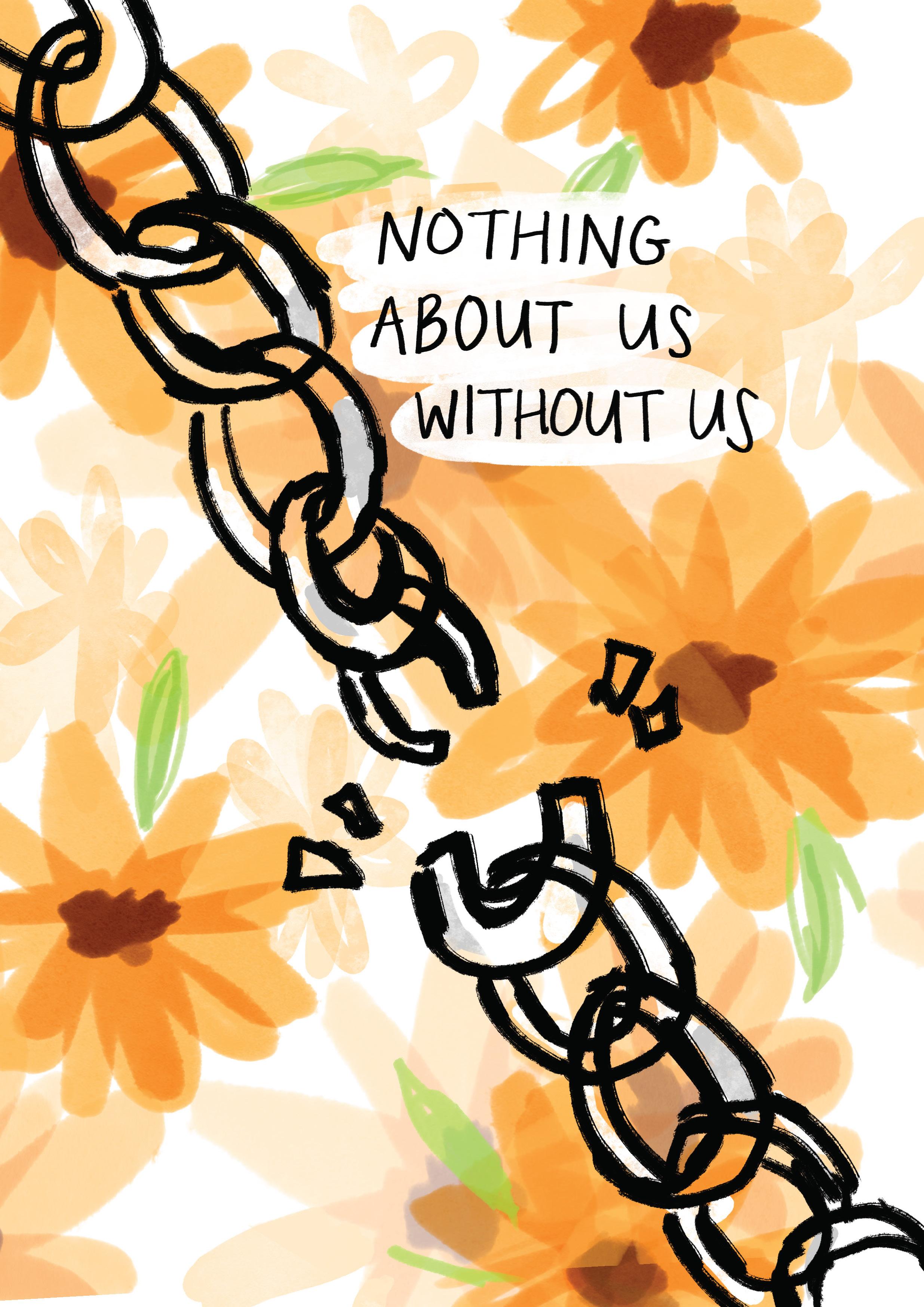
The SRC Disabilities and Carers Collective and SUPRA Disability and Inclusion Network recognise that our activism, advocacy and work happens on stolen, unceded Gadigal Land, whos First Nations peoples have for countless generations been its custodians. Indigenous peoples have had to endure significant injustices, despite being one of the oldest living cultures in the world. We are particularly indebted to disabled First Nations activists who fought and continue to fight against ableism, colonialism and discrimination of all forms.
In our activism and work, we will uplift the perspectives, voices and experiences of First Nations peoples in order to dismantle the colonial and ableist systems of oppression that plague every aspect of this colonial state, for these systems of oppressions are intertwined.
This land always was and always will be Aboriginal Land.
This publication is brought to you by the Sydney University Postgraduate Representative Association (SUPRA) and the University of Sydney Students’ Representative Council (SRC).
Vale Khan Tran
1996-2025
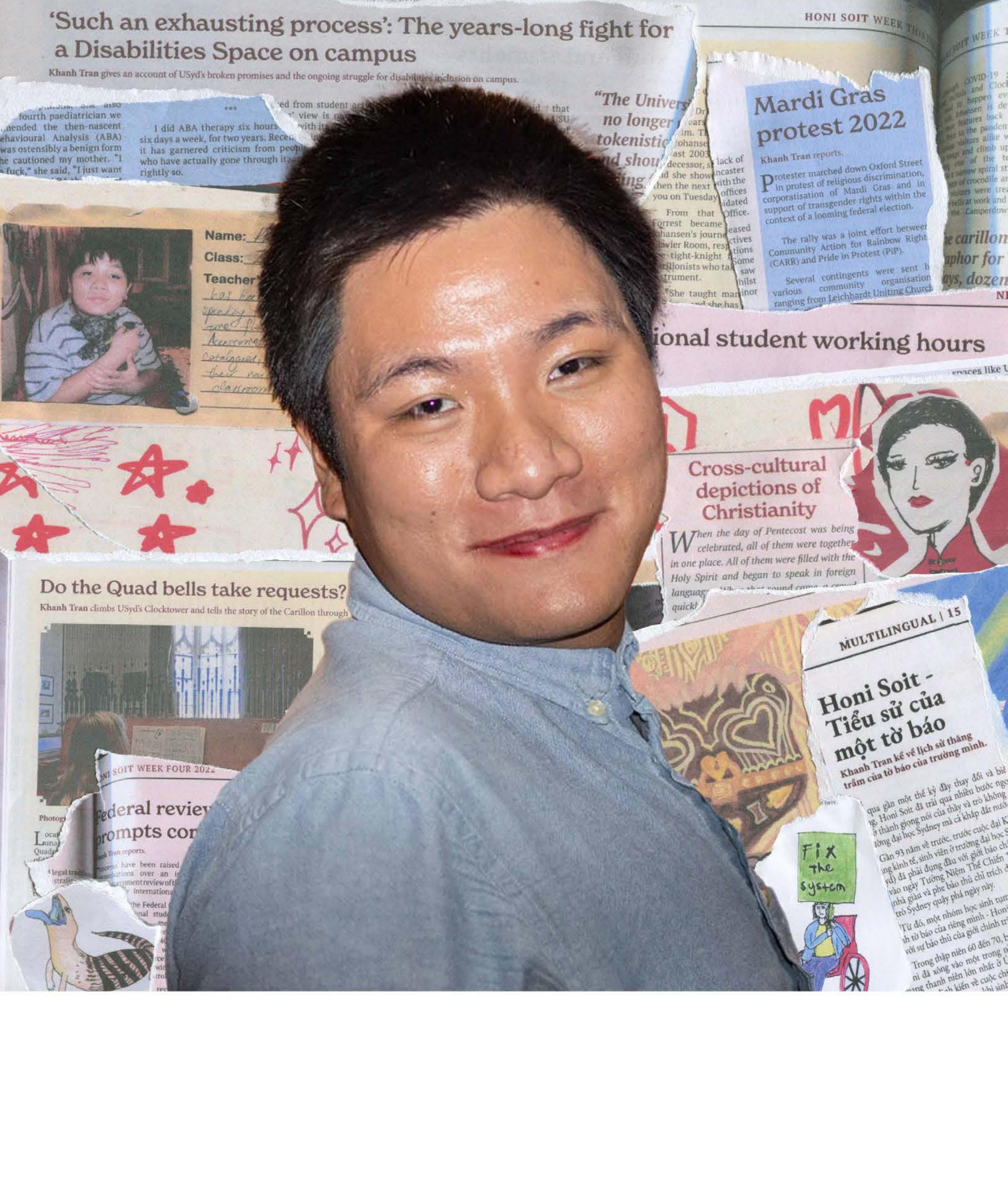
The 2026 edition of the disabilites handbook is dedicated to beloved friend and activist, Khanh Tran, who is sorely missed.
Khanh Tran was SRC disabilities officer from the beginning of 2023 to the end of 2024. Khanh’s profound impact on this community lives on well beyond this period, to which many of us owe our present perspective and commitment towards disability justice.
Getting
Involved
Unlike other student societies, SUPRA’s Disability and Inclusion Network and DisCo (the Disabilities Collective) are actively political. We wage campaigns and organise action within a space within which everyone can grow both politically and personally. We encourage that you join one of our organisations so that we can campaign and collectively raise the voices of disabled students.
Khanh Tran Room
The Khanh Tran Room (Previously Disabilities Community Room (DCR or the Room) is open to all students at the University of Sydney, undergraduate and postgraduate, who are disabled, have a chronic illness, or mental health condition. The Room is split into 2 zones: a hangout zone and a quiet zone with acoustic panels. It is a safe environment where you can relax, administer medications, have a chat, read books and access information of interest.
It is a joint space between Sydney University Postgraduate Representative Association (SUPRA), the Students’ Representative Council (SRC) and the University of Sydney Union (USU). The Room is located on Level 1 of Manning House (A23), on the corner next to the lockers near the atrium. The nearest accessible lift is on the ground level of Manning House next to Oakberry.
Request access to the Room via this form: https://forms.gle/hnxpygtwwiWuYMDm7
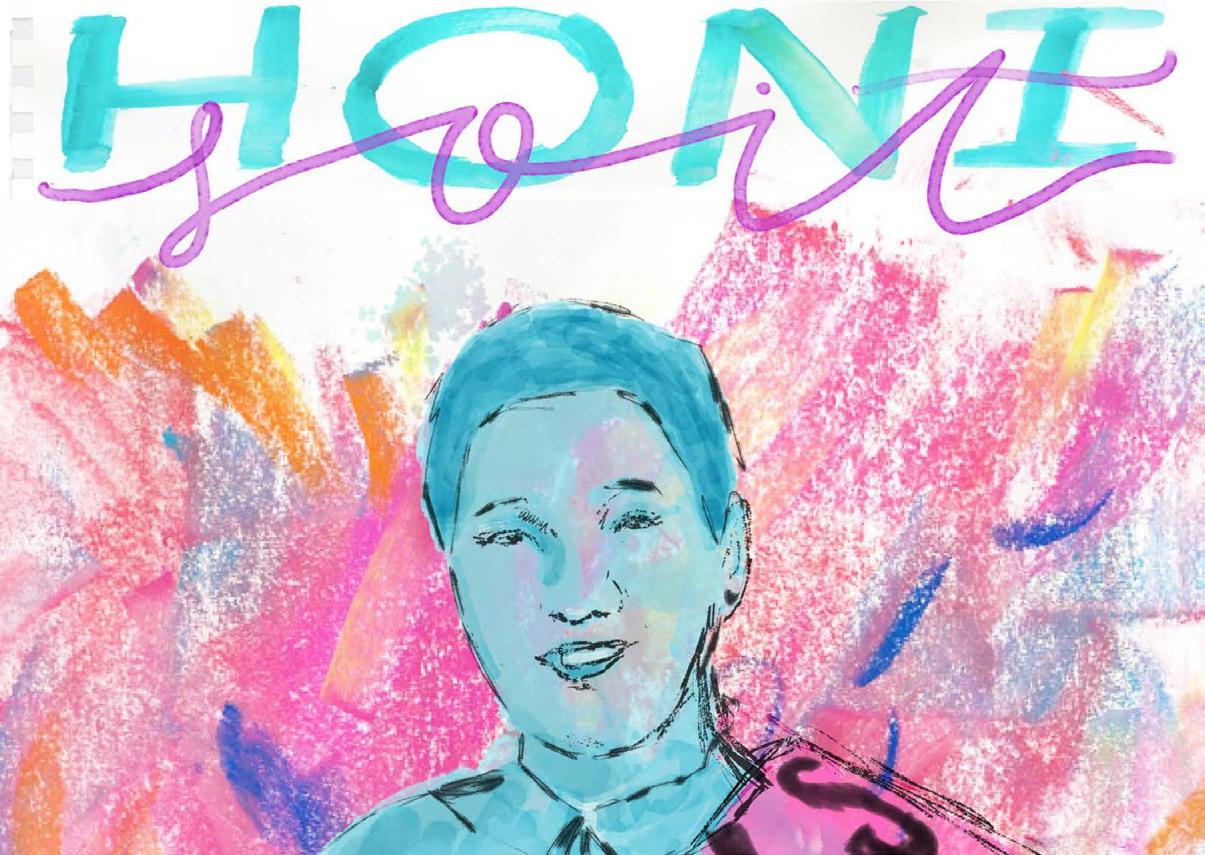
Honi Soit: Disabled Honi
Disabled Honi is a special autonomous edition of Honi Soit, dedicated to amplifying disabled voices and perspectives within the university community. Published in Week 4 of Semester 2, this issue is created by and for disabled students, focusing on disability experiences, advocacy, and justice.
We welcome contributions from members of the SRC Disabilities and Carers Network and the SUPRA Disability and Inclusion Network. Whether you want to share personal experiences, discuss disability justice, explore accessibility on campus, or highlight disability-related issues, your voice matters to our community.
This autonomous edition provides a dedicated platform for disabled students to share their stories, raise awareness about disability rights, and contribute to meaningful dialogue about creating a more inclusive campus environment.
More information can be found here: https://honisoit.com/
Image: cover of the 2023 Disabled Honi with diverse figures in muted colours and the word ‘Justice. Art by Bipasha Chakraborty.
Mask Bloc
Covid is still very much around, and disables people profoundly. DisCo has been working to counter the apathy around Covid and resist the idea that ‘the pandemic is over’. We have published an article in the disabilities edition of Honi Soit, launched a mask bloc, put up posters around campus, helped to facilitate the first ever SRC-run flu vaccination drive, spoken at the National Union of Students’ Diversity Conference about our initiatives, and created informative resources for SRC Office-bearers and Honi Soit editors.
A mask bloc is a mutual aid group distributing free masks to their community. Through this mask bloc, anybody in the USyd community, whether they are disabled or not, can easily access high quality masks. Masks are available in 3-5 days via the google form. Mask supplies are also regularly refilled at the autonomous spaces in Manning House. This year, we intend on expanding the scope of our current bloc, looking at distribution spots on different campuses, rapid antigen tests, and air purifiers.
COVID is over, right?
If you’d like to be involved in the strategy behind, or execution of, our Covid Conscious campaign, come along to one of our fortnightly meetings!
The best way to protect yourself (and others) from COVID and its complications is to not get COVID at all. Handwashing alone will not save you — it is time to start masking up again.
You should reintroduce masking practices in healthcare facilities, on public transport, at the supermarket, at concerts, and at protests.
University of Sydney Union
Consider even your lectures — how many times a week are you sitting in a packed room with hundreds of others for two hours?
For the full Honi article see: https://honisoit.com/2025/04/covid-is-over-right/
The University of Sydney Union (USU) is the oldest student-led organisation in Australia, and one of the largest, comprising 43,500+ members! It is responsible for much of your university experience, from hosting gigs at Manning Bar to funding over 200 clubs and societies. The USU is governed by a student board, which is elected each year in May, and includes portfolios to represent marginalised groups oncampus, and special interests.
DISABILITY PORTFOLIO HOLDER: ANNIKA WANG
Hi! I’m Annika, your 2025 USU Disability Officer. I study Law and Maths, and I’m passionate about making campus more accessible, less alienating, and genuinely inclusive.
I love debating, community organising, and overly ambitious Excel spreadsheets.
Contact email: disabilitiesportfolio@usu.edu.au
Art Credit: Cas Marotta
SRC Disabilities and Carers Collective (DiSCo)
We are a group of student activists, meaning that we plan our work around holding institutions such as Sydney University accountable.
We work at all levels of politics to enact policies that further the welfare and interests of disabled students, including with other student unions.
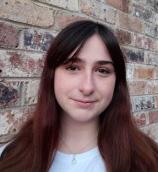
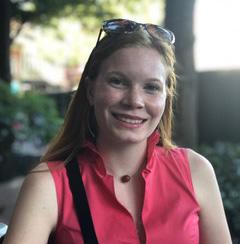
DISABILITIES AND CARERS OFFICERS: REMY LEBRETON & KAYLA HILL
Hey! I’m Remy Lebreton! I’m a second year Social Work and Arts student, majoring in Sociology and minoring in Anthropology!
I’ve been involved in DisCo, and other student activist spaces for most of my time at Usyd, and have been an activist for many years now! Disability Justice has been a part of my life since I was very young, as a lot of my family has direct or indirect experience with disability, myself included. I would like to continue to grow, and learn from the community surrounding exactly what this means, and work together in creating a better community and world with you!
Hello, I’m Kayla! I am very excited to be one of your SRC Disabilities Officers. I’m studying Philosophy and Gender Studies.
I have been passionate about disability justice and accessibility for many years, but its urgency
has felt ever more pronounced in recent years as fascism is emboldened.
Together we are your 2026 SRC Disabilities Officers for The Disabilities Collective and Caregivers network (aka DisCo)!
DisCo is an activist space where we as disabled students come together to organise around and fight for disability justice! Beyond this, we also collaborate with other campaigns and collectives because all of our liberation is intertwined. One Struggle.
We also organise the yearly Disabled Honi, so be sure to find us on Instagram and pitch an article! @usyddisabilities
National Union of Students
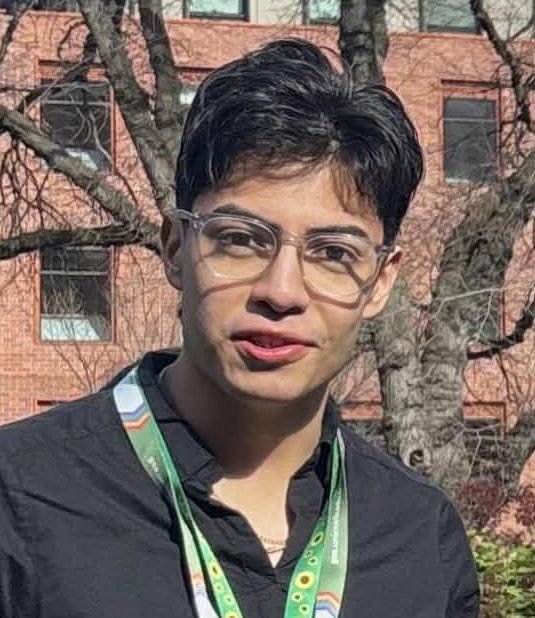
NATIONAL DISABILITIES OFFICER: MIA WILLILAMS
Kia Ora, My name is Mia (she/they) and I am your 2026 NUS Disabilities Officer! At this point you’re probably wondering what the NUS is and why you should even care - to sum up the NUS stands for National Union of Students, which every student at an affiliated university (like Usyd!) is a member of, and my job is to represent the national demands of d/Disabled students to the government
and educational decision makers. The NUS exists to advocate for reform in the hands of students, confronting issues from the NDIS to campus accessibility. I look forward to meeting and hearing from incoming and current students alike about the change you want to see on your campus! As a USyd student myself (Bachelor of Arts III) you can usually find me in Courtyard Cafe pretending to study, please don’t hesitate to come say hi!
See you all soon,
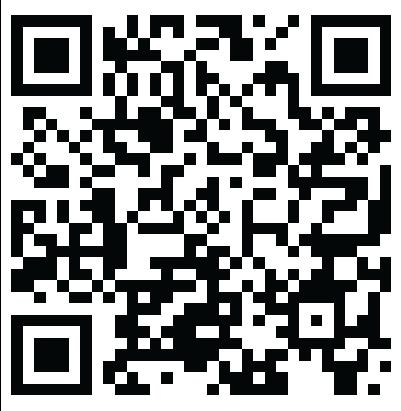
Join DisCo via the QR code below
Join
SUPRA Disability and Inclusion Network (SDIN)
SUPRA is the postgraduate student association at the University, run by postgrads for postgrads. SUPRA represents all postgraduates at the University of Sydney, and all
DISABILITY
postgraduates can look to SUPRA for assistance with any issues that may confront them, academically and personally, during the course of their candidature.
OFFICER: SARAH HUFFMAN
I’m Sarah Huffman, your SUPRA Disability Equity Officer. I’m also your HDR representative on the Disability Inclusion Action Plan Implementation Committee, a Juris Doctor Student and previously the 2024 Sydney Uni Law Society Disabilities Officer. I am incredibly passionate about raising awareness and reducing stigma around psychosocial disability and neurodivergence, informing disabled students about their rights, promoting disability pride, and fostering community-building for disabled students at USYD.
I look forward to continuing the work around support and accessibility for disabled HDR and coursework students as well as future work on promoting accessibility and disability support for professional post-graduate degrees. I plan to engage with the student community to identify structural ableism and barriers to accessibility for postgraduate disabled students at USYD and advocate for improvement, remedy, and change.
Contact email: disability@ supra.usyd.edu.au
CAPA DISABILITIES OFFICER: ALEX TOFLER
Hello! I’m Alexander, the Disabilities Officer at the Council of Australian Postgraduate Associations (CAPA) Disabilities Officer. I am a postgraduate law student at the University of Melbourne and am passionate about Disability Human Rights Law. If you are passionate about advocacy or a student representative, please join the CAPA Disability Advocacy Network, a dedicated space for postgrad student representatives and advocates working on disability matters in Australian
Other campus office-holders
higher education. I am excited to continue systemic advocacy, utilising the CAPA submissions to the Disability Discrimination Act review and the Disability Standards for Education review, which Gemma Lucy-Smart (previous officer) and Sarah Huffman had tirelessly worked on.
I hope to foster strong collaboration between student representatives to promote systemic change to ableism and structural violence; a strong focus on intersectionality is imperative to achieve this. Please reach out to my email for any questions or queries: disabilities@capa.edu.au
A handful of other disabilities student representatives can be contacted at the following clubs and societies:
Sydney University Law Society (SULS) Disabilities Officer: disabilities@suls.org.au
(KI)NDS, Kindred Individuals and Neurodiverse Students society: usu.edu.au/clubs/ kinds/
University of Sydney Sign Language Society (USyd SignSoc) President: hello@signsoc. com.au
Sydney Arts Students’ Society (SASS) Disabilities Officer: disability@usydarts.com
SDIN via the QR code below
Disability basics
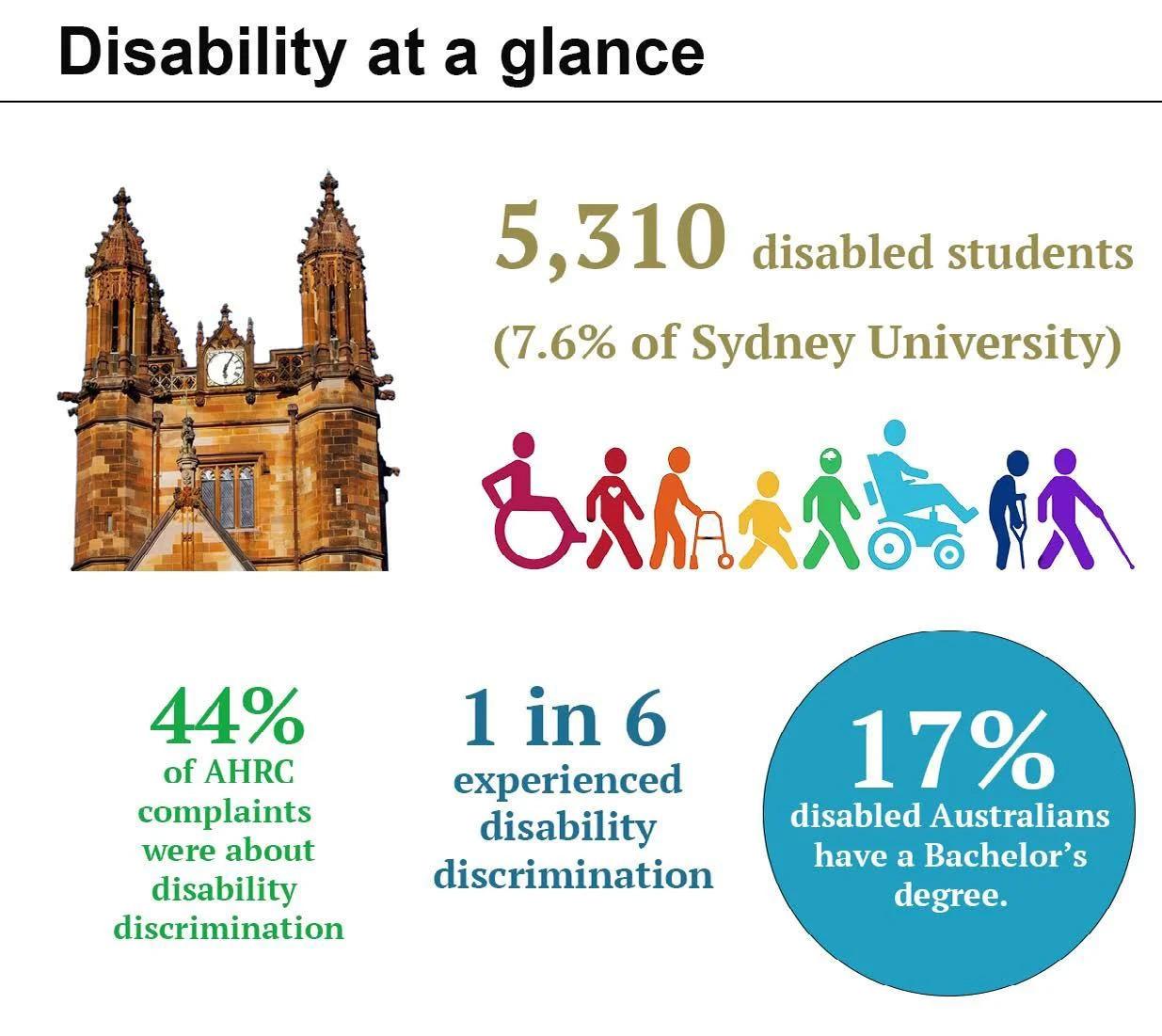
Data obtained from the University of Sydney Annual Report 2023, Australian Institute of Health and Welfare’s People with Disability Australia (2022).
Disability is: permanent, temporary, visible or invisible.
The Hidden Disabilities Sunflower
The University, SRC, USU and SUPRA have partnered with the Hidden Disability Sunflower initiative, introducing distinctive green lanyards adorned with yellow sunflowers across campus from 2023. These lanyards serve as a voluntary identifier for individuals living with hidden, invisible, or non-visible disabilities.
For those who encounter someone wearing a Sunflower Lanyard, the appropriate response is to offer assistance by respectfully asking, ‘Hello, I noticed you’re wearing a sunflower lanyard. Is there anything I can do to assist you today?’ It’s important to focus on solutions rather than questioning their specific disability or making assumptions. Students and staff can access these lanyards free of charge:
students: the University’s Inclusion and Disability Services team, the SRC, or SUPRA.
staff: email diversity.inclusion@sydney.edu.au
Image: Hidden Disabilities Sunflower official logo. Yellow sunflower on green background.
The social model of disability
Adapted from Khanh Tran and Sarah Korte, Disabled Honi 2022
To those unfamiliar with the way that student disabilities organisations understand disability, the social model of disability provides a good starting point.
The United Nations’ Convention On The Rights Of Persons With Disabilities (CRPD) explains that ‘disability results from the interactions between persons with impairments and attitudinal and environmental barriers that hinders their full and effective participation in society on an equal basis with others’.
The social model of disability stands in contrast to other models of disability such as the medical model which views disability as a medical problem that needs to be ‘cured’, the charity model that views disabled people as helpless objects deserving of pity or the eugenics model of disability that views disability as something that should be removed or eradicated from a population.
The social model of disability shifts the focus away from the disabled individual as the ‘problem’ that needs to be ‘solved’, and towards the barriers that society puts in front of disabled people. Some examples of this for disabled university students and staff include a lack of accessible access to buildings, lack of captioning and audio description during lectures and tutorials, and a lack of flexible work or study arrangements. It can also include other barriers such as social perceptions and ostracism, with people often perceiving those who are neurodivergent or with mental health conditions as ‘strange’ or ‘anti-social’, or the prevalent perception that providing accommodations are inconvenient or unnecessary and disabled people should simply ‘try harder’.
People With Disability Australia (PWDA) explains that the social model does not mean that disabled people do not face impairments, its primary function is to provide the lens through which we understand disability and by extension, the experience of disabled people.
In Professor Mark Pimm’s (Birkbeck University) words, disabilities are the result of ‘the choices society makes’. This includes government policies that hinder and impede on people with disability such as cuts by stealth to the NDIS (National Disability Insurance Scheme) and dysfunctional healthcare systems.
We recommend that all those interested in the social model of disability read, carefully, Oliver’s observations. It is a clarion call for critical examination of our politics and consideration of the collective. The social model, properly understood, demands that we assess the harm to the collective of our society rather than atomising our own existence.
To quote Oliver’s words: ‘We all have personal troubles, but we must see that they are public issues that we must confront by attacking the disabling barriers we face if we are to make our own way in this wicked world. What disability history teaches us is that we cannot rely on the bleeding hearts brigade and parasite people to do it for us.’
For the full Honi article: https://honisoit.com/2022/10/what-is-the-socialmodel-of-disability/
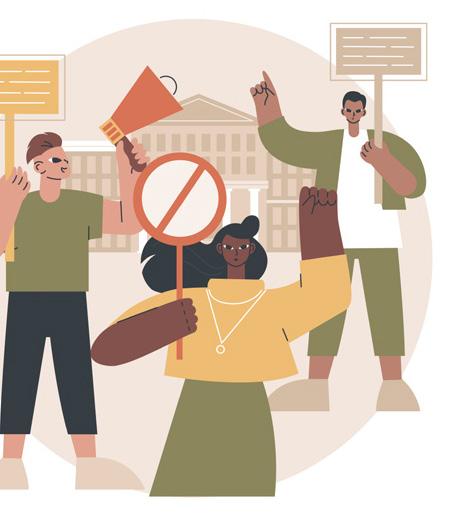
Image: abstract image in neutral tones of activists holding plackards in front of a formal looking building.
Navigating support
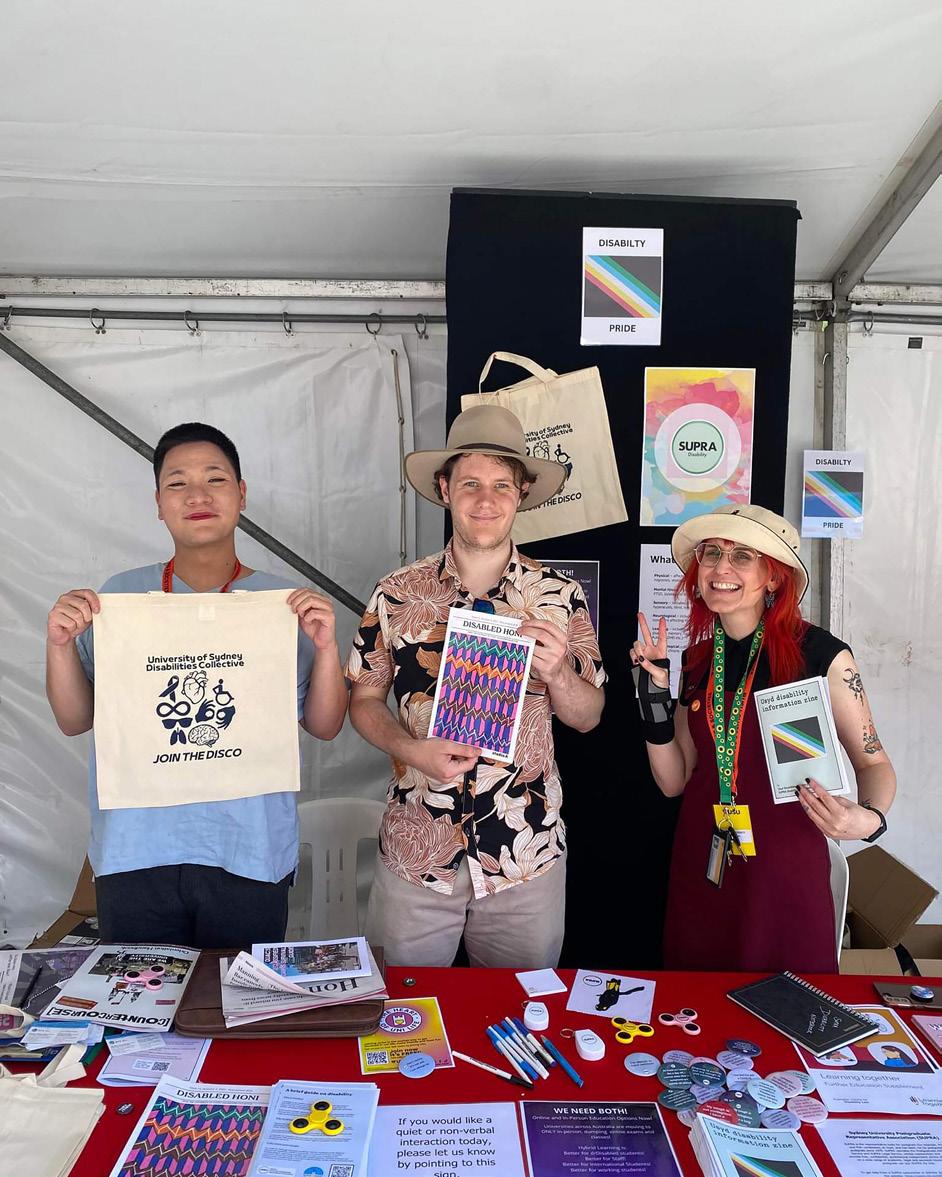
Image: former SRC Dsiabilties and Carers officers Khanh Tran and J Scanlan stand with SUPRA Disability Officer Gemma Lucy Smart at the Disability Hub Stall at WelcomeFest in 2023. They hold the first edition of this Accessibility Guide, along with Disabled Honi.
SRC and SUPRA casework
Both the Students’ Representative Council (SRC) and Sydney University Postgraduate Representative Association (SUPRA) operate free casework and legal services to assist with your degree and issues that may overlap with disability needs and accommodations.
Caseworkers assists students on academic and welfare issues. They provide free and confidential advice on a range of matters such as: academic rights and appeals; special considerations and special arrangements; HECs and fee refunds; academic misconduct and dishonesty allegations; show cause and expulsion; Centrelink; financial issues; tenancy and accommodation; harassment and discrimination.
University of Sydney SRC Casework Service: 02 9660 5222
Wentworth Building, Level 1/G01 City Rd, Darlington, NSW 2006
Contact the SRC caseworkers through the Caseworker Contact Form here: http://bit.ly/3JVav4D
SUPRA Postgraduate Advocacy Service: bit.ly/SUPRACaseworker 02 9351 3715
Level 2, Holme Building (A09), Science Rd Camperdown Campus, The University of Sydney, NSW 2006
Contact the SUPRA Postgraduate Advocacy Service through the contact form here: supra.net.au/contact/
Attach any documents about your enquiry when you email. Depending on the time of the year, it may take between one (1) to five (5) business days for a caseworker to respond to your email.
Level 5, Jane Foss Russell Building (next to City Road, on the Camperdown/ Darlington Campus). disability.services@sydney.edu.au
Sydney University runs an Inclusion and Disability Services (IDS) office in accordance with its obligation to students with disabilities under the Disability Discrimination Act 1992 and the University’s own Disability Inclusion Action Plan (DIAP).
We strongly recommend that you, where possible, register with the Inclusion and Disability Services at the earliest available opportunity as the service will provide you with support, access to academic adjustments, and an academic plan to mitigate the barriers that you face in your university studies.
Disability Services provides a number of services. Most importantly, they work with you to develop an individualised academic plan and arrange academic adjustments for your studies, including extra time, specialist equipment, colour-coded materials, and more as determined by your Disability Officer.
FOLLOW THE FOLLOWING STEPS TO REGISTER WITH DISABILITY SERVICES:
1. Obtain the necessary supporting documentation prior to applying. You will need to provide a supporting documentation form. This form is accessible via this link: https://www.sydney.edu.au/content/dam/students/documents/supportresources/disability-support/support-documentation-disability-services.pdf The form must be completed in English and officially translated medical documents are also accepted. In some cases, specific supporting documentation is required instead of the general form. These include specific learning disabilities, handwriting difficulties and where you wish to study abroad as a few examples.
2. Complete an online ‘Apply to Register’ form with Inclusion and Disability. You need to be a current student with a UniKey in order to register.
3. Inclusion and Disability Services will then book a registration consultation with you. This meeting lasts for approximately one hour.
Level 3,Wentworth Building (G01), 2 Butlin Avenue, Darlington, NSW 2008
The University of Sydney operates a dedicated general practitioner (GP) service on campus located on Level 3 of the Wentworth Building. The surgery is open Monday to Friday, 8.30am to 5pm during term time. The service offers bulk billing and is familar with major health insurance providers for international students.
You can book an appointment at the University Medical Centre online or by phone. Online: book an appointment online via the link below. You can choose either a telehealth or in-person appointment: sydney edu au/students/health-wellbeing/health-ser vices.html
COUNSELLING
02 8627 8433
Level 5, Jane Foss Russell Building (G02), 160 City Road, Darlington NSW 2008
Sydney University offers individual counselling sessions for students to confidentially discuss issues that affect your mental wellbeing and academic performance. These are short-term therapy sessions where counsellors provide recommendations on treatments and resources according to your needs.
There is a limit of up to 6 sessions per student. Telehealth is also available via phone or Zoom. Where you require long-term support, the service will help you to find an external provider, and where necessary, interlinked with University support services such as Inclusion and Disability Services, University Health Services and more.
Contact Student Wellbeing through their website, where a University clinician will contact you and discuss your needs: sydney edu au/students/health-wellbeing/counselling html
FINANCIAL BURSARIES
The University provides financial assistance to students facing hardship by offering bursaries, interest-free loans, and support vouchers. These can cover essential study-related expenses including textbooks, IT equipment, rent, utilities, and medical costs. Notably, bursary funding can be used to obtain medical diagnoses relevant to studies and help with childcare during peak academic periods.
While not intended as regular income, this support offers valuable assistance during difficult times, with special consideration given to students affected by natural disasters.
Students experiencing ongoing financial challenges are encouraged to seek advice from the Financial Rights Legal Centre or MoneySmart. All support is subject to eligibility criteria and available funding. For more information or to apply, contact Student Financial Support: https://www.sydney edu au/students/financial-support.html
External support
AUSTRALIAN CENTRE FOR DISABILITY LAW
The Australian Centre for Disability Law provides a free toolkit for students with disability in all levels of university, TAFE, vocational education, certificate courses and other types of training: disabilitylaw org au/projects/education/#furtheredu
If you are within New South Wales and want advice outside of University services, you can get free legal advice on disability discrimination by calling the Australian Centre for Disability Law on 02 9370 3135 or 1800 800 708 between 9.30am and 12.30pm on Mondays and Wednesdays, and between 1.30pm and 4.30pm on Thursdays. You can also contact their referral service via their website: disabilitylaw.org.au/resources/referrals/
NATIONAL DISABILITY INSURANCE SCHEME
The National Disability Insurance Scheme, otherwise referred to as the NDIS, is a federal and state government program that provides support for people with disabilities who ‘have a permanent and significant disability’ that affects one’s ‘ability to take part in everyday activities’. Its scope is wide and funding is provided directly to individuals. There are a variety of funded supports offered through the NDIS such as:
• daily personal activities
• transport to enable participation in community, social and economic activities
• workplace support to successfully gain or maintain employment
• home modifications
• vehicle modifications.
This list of NDIS-funded supports is not exhaustive and further information on the range of NDIS supports are available here through NDIS plans and budgets: ndis.gov.au/ participants/creating-your-plan/plan-budget-and-rules
Find out more about the NDIS’ Access Request Form in order to register to the program here: ndis.gov.au/applying-access-ndis/how-apply
ADCET
The Australian Disability Clearinghouse on Education and Training (ADCET) is funded by the Australian Government Department of Education, under the Higher Education Disability Support Program, and is hosted by the University of Tasmania.
ADCET is Australia’s leading resource on disability in tertiary education for disability practitioners, educators, and students. They provide a number of resources and workbooks for students and staff, which you can find via their website: https://www.adcet. edu.au/