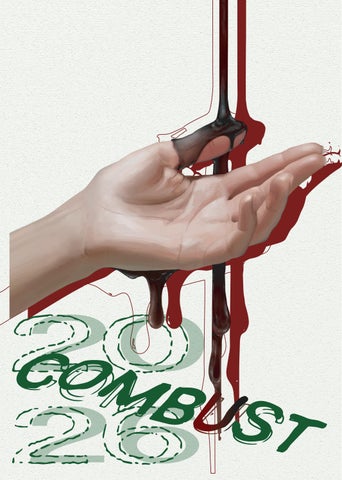
COMBUST 2026 - Sydney Uni Environment Activist's Handbook
The 2026 edition of Combust was created and distributed on the stolen land of the Gadigal People of the Eora Nation. We pay our respects to elders past, present and future, never forgetting the crimes of the Australian settler-colonial state in committing genocide against Indigenous people of this land. The same state responsible for ending the sustainable custodianship practised by Aboriginal people for over 65,000 years now gives away stolen to megacorporations. Environmental justice is interwoven with First Nation’s justice. Sovereignty was never ceded.
2025 was a record year for anti-First Nations crimes. 33 Aboriginal and Torres-Strait Islander people died in custody, the highest number since monitoring began in 1980. The Western Australian Burrup gas hub, considered a ‘carbon bomb’, was given the go ahead, despite dissent from local First Nations communities that its pollution could erode some of the oldest rock art in the world. Native title claims have been rejected, or remain in limbo, like that of the Wunna Nyiyaparli people.
We stand unwaveringly with First Nations peoples here and elsewhere. An environmental movement which considers their oppression a separate issue only plays into the hands of the government and the fossil fuel industry.
Always was, always will be, Aboriginal land.
ACKNOWLEDGEMENT OF COUNTRY editorial
This edition of Combust comes at a tipping point. Bleak statistics flood the news decrying missed global warming targets – a promise that irreversible ecological destruction is now inevitable. Meanwhile, multinational corporations, unchecked, continue their warpath of extractive capitalism. Pillaging Indigenous land for raw earth; fracking oceanbeds; illegal chemical waste dumping; deforestation and habitat loss; and the callous expansion of fossil fuel projects describe the scope of what is a worsening crisis of unsustainable greed. Where we once stood on the precipice of catastrophe, we have fallen headlong into it. A real existential threat reveals itself, disproportionately targeting disabled, working class and Indigenous people.
All the while, our institutions remain complicit. The Labor government opens its warm arms for war criminals, welcoming them onto stolen land. They cross the floor, going to bed with the Liberal party to approve more and more fossil fuel projects, despite purportedly trying to “end the climate wars”. The University is no less culpable, making shady investments in fossil fuel and weapons manufacturers while the Campus Access Policy continues its reign of terror. Where political repression was once on the rise, it has risen. Draconian anti-protest laws forcibly silence and threaten anyone brave enough to call out this amoral hypocrisy.
The sheer onslaught of terrible news can become overwhelming and depressing, but the time to fight back is now. Join us to take up arms in the intersectional fight against fascism: against the expansion of coal mines, against the genocide in Gaza, and against the destruction of the stolen land we live on. It is a matter of survival.
Report from Rising Tide
Ben Walden
Reap What We Sow: The Ethics of Lawns in an Age of Extinction
James Fitzgerald Sice
Tangelo
M. van de Graa
Against Anti-Natalism in the Anthropocene
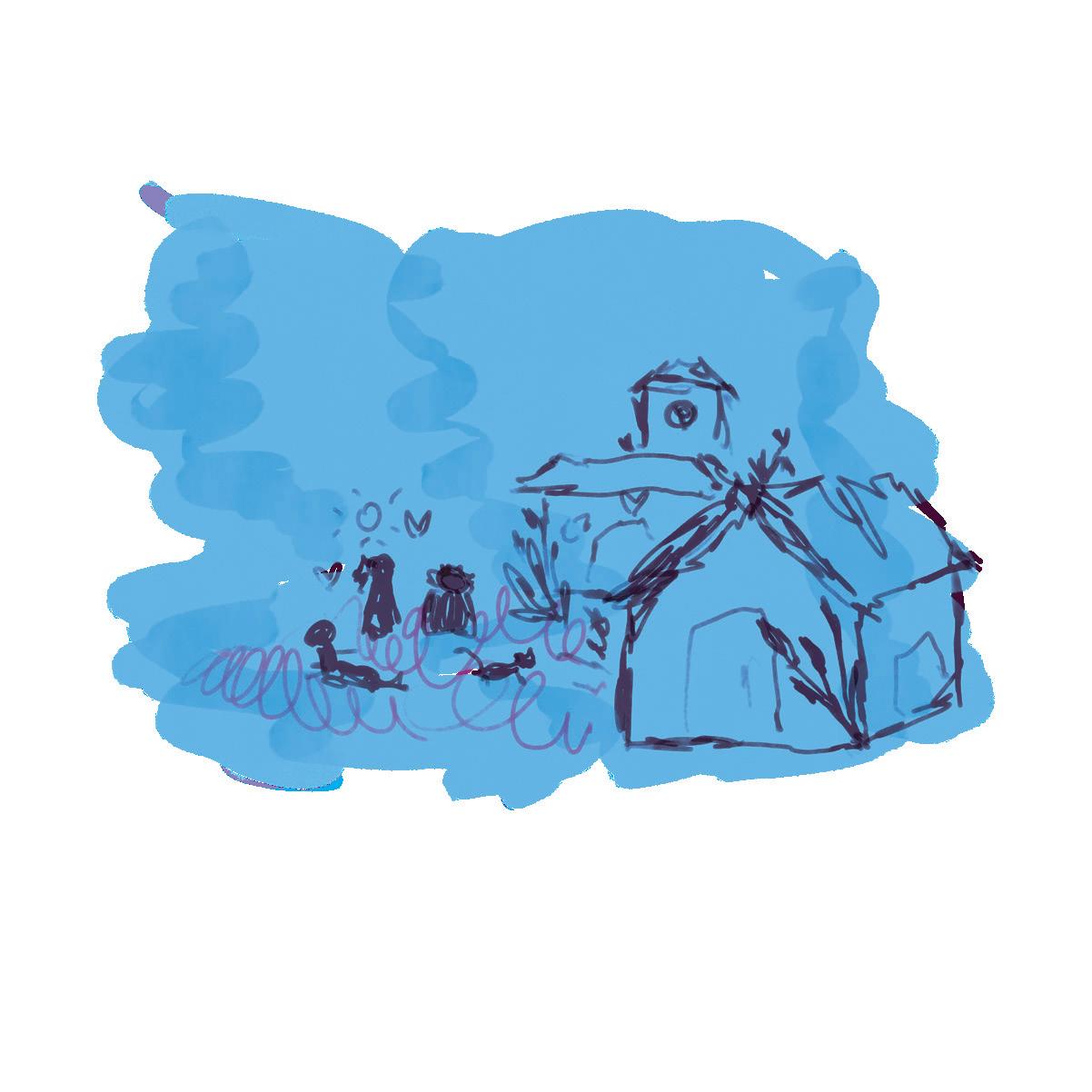
Kayla Hill with artwork by Dana Ka na
The Great Dying
Kiah Nanavati
Feeling Thirsty? Too bad, the data centres are too
Lucas Pierce
Lady is Asleep
Alyssa Damara
Eco-Facism Will Not Save Us
Maxine McGrath
Human Creativity is not E cient
Grace Amarante
Moolarben: Creatures not Coal
Aria Nadkarni
Woodside
Grace Street
Credits
RISING TIDE REPORT FROM
Ben Walden
Thousands of people travelled from across Australia to again take part in The People’s Blockade of the World’s Largest Coal Port in Newcastle. Held in December last year, the event was a disruptive ‘protestival’, as the organisers call it, against the Australian Government's expansion of the fossil fuel industry, with over 32 new oil and gas projects. Over the past few years, the People’s Blockade has increasingly become a focal point of the climate movement nationally. Rising Tide, the event organiser, argues that we need to step up our defence of the climate by taking mass direct action to halt the expansion of the fossil fuel industry.
People power prevailed over repeated government attempts to shut down the protest. Thousands of protestors entered the shipping channel in kayaks and small yachts, alongside some brave swimmers, to block ships carrying coal from entering the port. Over the four days, sustained action successfully forced three coal ships to turn around and led the port authority to suspend all arrivals to the port.
The government attempted to stop protestors from disrupting coal ships by making it an arrestable o ense to enter a ‘marine exclusion zone’, an area which was conveniently designated to cover most of the harbour. This led to 181 arrests, including 18 young people charged under the Young O enders Act.
As is typical, there was a heavy police presence at the blockade, with hundreds of cops and several police boats patrolling the harbour. Police, dressed in specialised tactical gear, quickly found out that arresting protestors in kayaks and in the water was more di cult than expected. Chaotic scenes unfolded where police boats whizzed around, largely unsuccessfully attempting to stop the hundreds of people in the water from blockading the port.
Back on land in the blockade camp, dozens of activist groups set up information stalls and hosted panels discussing strategies for solving the climate crisis. One of the most popular sessions was with social media influencer and housing rights advocate Jordan van den Lamb aka. PurplePingers, who had almost 500 people fill the main marquee to hear him talk about why climate change is a class war.
The People’s Blockade points in the direction of what we need to build a renewed climate movement. The world is reaching an environmental tipping point; areas like the Amazon rainforest, due to, deforestation and pollution, are now releasing more CO2 than they absorb. Another COP conference, which Greta Thunberg describes as an “annual greenwashing conference that legitimises countries' failures to ensure a habitable world and future”, will not solve the climate crisis. If governments wanted to start transitioning to renewable energy, they could do so today, without having pointless meetings, treaties and agreements.
Those who profit from destroying the planet will not willingly give up their billions so the economy can be run in the interests of people rather than profit. Real action will come from ordinary people holding governments accountable and fighting the system that is driving climate collapse. The People’s Blockade is significant fo just this reason; it rejects relying on governments or NGOs to drive change, instead mobilising thousands of ordinary people to take action collectively.
The Ethics of Lawns in an Age of Extinction
While seemingly unremarkable, the enduring appeal of the lawn lies in a deeper human desire for control in the face of nature's inherent unpredictability and our own mortality. This control of a patch of the evergreen, ever-young, ever-healthy feeds a subconscious attempt to deny the inevitable cycles of decay nipping quietly at a balding pate, aching back, crinkling face.
Understanding the insidiousness of lawns requires an examination of their history and lasting social and ecological consequences. The modern lawn has long symbolised status and excess, originating as an aesthetic ideal in the 18th century among a uent European elites who could a ord to maintain expansive, unproductive spaces. Cultivating large areas of short, uniform grass required a legion of grazing animals and workers armed with scythes that only the wealthy could a ord. In his 1899 book The Theory of the Leisure Class, Thorstein Veblen argues that the lawn or "close-cropped yard or park, which appeals so una ectedly to the taste of the Western peoples", functions as an "unremitting demonstration of ability to pay" because it represents a wasteful use of valuable land and requires significant expenditure for its upkeep. The very fact that lawns are expensive and unnecessary is what makes them powerful symbols of wealth and status. Nowadays, you do not need servants to have a lawn, thanks to Edwin ‘Beard’ Budding, the inventor of the first lawn mower in 1830. The lawn as a visual marker of a uence and status spread over time, becoming linked to burgeoning suburban developments and the desire for a particular vision of domesticity. While no longer exclusive to the estates of the aristocracy, the lawn endures as a symbol
of nature’s ornamental relation to modern humanity. Australian lawns are dominated by non-native grass species, cultivated atop land taken through colonisation. These imported monocultures impose a European aesthetic by erasing First Nations ecologies, reproducing colonial power in everyday landscapes.
In his book ‘The Lawn: A Social History’, Peter Maccinis states that a “mere patch of grass is not a lawn, because it has not been su ciently cultivated, cultured and venerated.”
The supposed ‘natural tranquillity’ o ered by lawns is manufactured through the domination of the wild. Lawns are not natural refuges but carefully fortified arenas in which we attempt to impose order on nature’s capriciousness. The well-kept lawn has come to be interpreted as a sign of care and responsibility. An unkempt lawn is a sign of indi erence, inability or neglect. The modern lawn is subliminal; it exists at the boundary between nature and culture, domesticity and wilderness. Its evergreen “perfection” is a historically contingent ideal. The lawn is performative and socially construct; it is continually enacted and re-enacted through mowing, watering, and fertilising. As a normative standard, it creates social obligations and expectations, which in turn enforces humanity’s supposed divide from nature.
The performativity of lawns is ecologically destructive. Lawns consume enormous quantities of water, rely on pesticides and fertilisers that poison soils and waterways, and reduce complex ecosystems to sterile monocultures. In the United States lawn care and irrigation accounts for nearly one-third of residential water use, approximately 9 billion gallons per day. A report published in December 2024 estimates that 1 to 3 native Australian insects and other invertebrates go extinct every week. Between 2000 and 2017, Australia cleared 7.7 million hectares of threatened species habitat for agricultural expansion, urban development, mining and infrastructure, 93 per cent of which occurred without federal environmental approval. The climate crisis is, of course, not attributable to individuals having lawns. However, the ideal of the lawn is particularly destructive and incompatible with the Australian landscape. So the question must be asked: what do we do with these patches of earth encircling our houses? Some Australian gardeners are ripping up turf in favour of biodiverse native wetlands, edible front gardens and pollinator-rich plantings, while an international ‘meadowscaping’ movement is turning lawns into wildflower meadows that restore habitat, cut water and maintenance needs, and quietly rebel against the English-park ideal.
What is good for grass is nutrient-rich soil. Good soil is made from the breakdown of living things: from death. We can rationalise the belief that we are in control until the moment this planet becomes unliveable. On a planet gripped by a climate emergency, those neat, uniform blades of grass o er a comforting salve. A perverted illusion that all is well mocking the unsettling truth of nature’s cycles of decay. We cling to our evergreen lawns, resistant to the natural cycles, uninhabitable for local wildlife, and through an impeccable regime of weeding, watering, mowing and feeding, we make that starving soil work its magic. We strive to expand our lifespan beyond natural limits just as we keep our grass green. But this perceived control over nature doesn’t save us from the inevitability of death.
James Fitzgerald Sice
TANGELO
Head airbrushed with soft sweet orange
And green rosacea curl upon the cheeks,
The tangelo bears a face that Cézanne would crave, so brazenly
Sitting and wearing it with pride.
The creases by its eyes aren’t shallow— They are deep canyons where lovers
Watch their footing carefully, perhaps Lining the path with string-wrapped stones.
The Mother Tree gave life through that eye, She gave it the orange and the rosacea and the pride.
How greatly you want to cut it into wedges and Slurp deeply at its insides,
To feel its nectar dripping down your chin and onto your abdomen
To taste the upward curvature of its sour
And the mellow valleys of its sweet.
But the tangelo is marred And rotten inside.
Its flesh is only sour, and will Cling to the uvula for days on end, Bile and bruise combined
To form this rancid concoction; Shame.
What a horrid, horrid fruit.
What a waste of water and soil.
M. van de Graa
Against Anti-Natalism in the
As tipping points are reached and emissions agreements are aban doned, the climate apocalypse nears. Tuvalu is literally sinking away, unprecedented heatwaves are killing thousands each summer, and species are dying out into extinction.
Consequently, people en masse are refusing to have children. Climate change imposes a crisis so existentially threatening, and full of su ering so horrific that we must concede our collective death and stop repro ducing henceforth.
The West has long advocated for anti-natalism, but historically only against Black and Brown people. Billionaires will throw money into Africa and South Asia for contraception programs, including through sterilisation (this is eugenics), invoking arguments about the outrageous su ering such babies would endure under poverty — su ering so profound that it would be too cruel to have them at all. These same billionaires, of course, represent the very systems of neocolonialism and capitalism that subjugates the Third World.
Artwork by Dana Ka na
Anthropocene
Anti-natalist philosophy has expanded its reach to the liberal West itself, where the destructive impacts of climate change are closing in on us. This emerging climate anti-natalism has rendered a red line against su ering.
Mary Annaïse Heglar coined the concept ‘existential exceptionalism’, which refers to the phenomenon of climate change being exceptionalised as a uniquely profound threat to existence, neglecting the centuries of Black and Brown people being existentially threatened. Heglar points out the disproportionate moralising over climate change (and specifically the su ering it creates) compared to white supremacy and colonialism, despite climate change being a direct product of the two. Despite the theoretical universality of climate change, the anti-natalist response comes from the abstraction of a very particular su ering against a very particular group of people — those who will live in relative comfort compared to the global majority.
Not only is the selective outrage towards climate change racist, but the philosophy itself that underpins climate anti-natalism is reductive. Central to this anti-natalism is a grim orientation towards the future — a future that also accepts defeat; that is embedded in a ruthless pursuit of money, and the White Man exerting mastery over the land.
In believing that other worlds are possible, we can see that it is not life that is unfit for the future, but the future that is unfit for life.
Childbirth and childrearing are undoubtedly charged with political meaning. To live inherently demands being confronted with the struggle of hardship, deprivation, and violence, as much as the pursuit of love, meaning, and joy. Climate change creates new challenges and questions about how we ought to live and flourish.
A moral high ground cannot be reached on the basis of having prevented unimaginable su ering for a five-year-old that does not exist. But your morality does come into question elsewhere. What will you say to the children of 2050 about what you did to reduce the burden of climate change? What will you have done to stop the genocides? How will you be fostering life, even if not through reproduction?
Tomorrow, and next week, and next decade, we will wake up to the same horrific conditions as yesterday. Unless you do something about it.
Kayla Hill
THE GREAT DYING
A History Lesson: e Permian Extinction
As we stand on the Earth’s ground, we claim we know about its genesis and what happened before we came into existence, but do we really? Let’s retrace our footsteps (or fossils) and travel back in time… to approximately 252 million years ago, when life on Earth was nearly extinguished in what is now known as the Permian-Triassic extinction or ‘the Great Dying’. While the asteroid that ended the dinosaurs is widely known, few realise that this even greater cataclysm came before it, and far surpassed the Cretaceous extinction (the event that wiped out dinosaurs 66 million years ago) in scale and devastation.
The extent of it is calculated with the number of species that bore the brunt of this extinction. To give an estimate, roughly 81 per cent of marine species and about 70 per cent of terrestrial vertebrate species vanished, along with massive losses among plants, insects, lizards, microbes, and proto-mammals.
So, what could have caused such an unprecedented collapse of life? The answer, as it turns out, is far more complex than a single trigger. Scientists attribute the calamity to a combination of catastrophic events: massive Siberian Traps volcanism, runaway greenhouse gas emissions,
ocean acidification, severe warming, and widespread anoxia, perhaps even a nearby asteroid impact (though this remains debated). The main culprit lies beneath the surface, where warming surged so drastically that the ocean’s water lost oxygen, disrupting marine respiration and leading to su ocation on a global scale.
The ecosystem we see flourishing now was painstakingly slow. New research suggests that the recovery took millions of years, in pulses that took a journey over ten million years.
e Sixth Silence
Returning to the present age, are we witnessing the slow march toward another ‘Great Dying’? To answer that question, scientists once again believe we are in the midst of a Sixth Mass Extinction, driven not by natural calamities but by anthropogenic activities.
To put into perspective, current extinction rates are 100 to 1000 times higher than the geological background rate- which is the natural pace at which species have historically disappeared over millions of years, even without human interference. In fact, current rates of extinction are in some cases worse than what happened during the Earth’s five previous mass extinction events. At the heart of it all lies humanity’s fingerprints in the form of driving forces such as habitat destruction, overexploitation, pollution, invasive species, and most significantly, climate change. Agriculture alone converts somewhat 40 per cent of Earth’s land and is responsible for 90 per cent of deforestation and 70 per cent of freshwater use, undermining biodiversity and worsening climate impacts.
This may not be apparent in plain sight because this extinction is happening slowly by human standards, but extremely rapidly by geological standards.
This is more than loss; it’s a reprogramming of the biosphere.
What’s even more alarming is that scientists now report the disappearance of the entire lineages — not just species but identifying a crisis known as ‘biological annihilation’– the widespread, rapid loss of species and entire animal groups that has long-term negative ramifications not just for evolutionary diversity but ecosystem resilience.
To paint a clear picture, we are not just ending chapters of life, we are tearing out pages from the story of Earth.
History Repeating Itself
Although separated by hundreds of millions of years and entirely di erent triggers, the Great Dying and today’s Sixth Mass extinction mirror each other in their mechanisms and inevitable consequences.
The striking parallel is that the Great Dying was driven by a sudden spike in greenhouse gases due to volcanic activity, causing rapid global warming, ocean acidification, and oxygen depletion in the ocean and other freshwater bodies. We see an emulation of those patterns with fossil fuel emissions accelerating warming, pushing oxygen levels down in marine systems, and basically stressing all ecosystems.
In both the Great Dying and today’s unfolding extinction, the magnitude of loss transcends ecosystems — from ocean depths to forest canopies, life collapsed across the world. During the Permian extinction, the aftermath wasn’t a single recovery arc but a long, turbulent rebirth, with ecosystems reviving in fragile fits over millions of years. Today, we’re witnessing a similar unravelling: the disappearance of species and entire genera, tearing at the threads of ecological stability, threatening food chains,webs, pollination systems, and climate barriers.
And yet, despite fossilised warnings etched into stone, we seem committed to repeating history. Like a sleepwalker on a fault line, humanity drifts closer to irreversible tipping points, not for lack of knowledge, but for lack of will.
Why does this matter to us?
The answer lies within plain sight. It’s because this crisis is not just about vanishing wildlife, it’s about the collapse of the mechanics that sustain us. Biodiversity isn’t a luxury; it’s the foundation of clean air, fertile soil, fresh water, and stable climates. When we lose species, we lose pollinators that grow our food, forests that store our carbon, and oceans that give us oxygen whilst regulating our temperature.
We have everything to lose in one fell swoop.
The Sixth Mass Extinction isn’t unfolding in some distant wilderness, it’s happening in our backyards, on our farms, in our fisheries. And unlike past extinctions, this one is driven by us — which means it can also be stopped by us. To ignore it is to gamble with our own future. To act is to recognise that saving other species is ultimately an act of saving ourselves.
lady is asleep
digital artwork by Alyssa Damara (@inmymind_)
lady is asleep (digital artwork)
My practice centres on translating sound into image. Each work begins with a single song, repeatedly listened to until it dissolves into emotion, rhythm, and instinct. While I do not experience synaesthesia in its traditional sense, I am deeply fascinated by how sound can overwhelm the body and mind, becoming something visual. Through sketching in moments of obsessive listening, I attempt to capture music as it feels rather than how it sounds.
lady is asleep is derived from Aurora’s song The Seed. Through continuous listening, I sought to visualise the haunting melody and emotional weight of the track. The composition grows outward from a central figure, the “seed,” represented by the sleeping lady. From her form, circular movements branch and spiral, shifting through green tones before gradually darkening. These expanding swirls echo the song’s cyclical structure and its balance of delicacy and hope, alongside the quiet desperation in Aurora’s voice.
The circular motion reflects growth, decay, and repetition, natural processes that feel increasingly fragile. As the colours deepen and darken, the work embodies the urgency embedded within The Seed, a song Aurora described as a “cry for Mother Earth.” The piece becomes not only an emotional response to the music, but a visual call to attention, a meditation on environmental collapse, human responsibility, and the vulnerability of nature itself.
Sound is deeply personal, and this work represents my own translation of The Seed, drawn instinctively, shaped by repetition, and guided by feeling rather than logic. Through lady is asleep, I aim to communicate the same emotional pull I experienced while listening, a quiet unease, a sense of mourning, and an underlying hope that awareness can still lead to action.
Alyssa Damara, 2026
FEELING THIRSTY?TOO DATA CENTRES ARE TOO
Lucas Pierce
Mansfield, Georgia. A small, quiet town in the South-Eastern US state, where Beverley Morris, a retiree, can no longer drink the water that runs out of her tap. Sediment has been building up in her well, toxifying the water. To make matters worse, her electricity bill doubled within 12 months, despite intermittent power outages. Why? Well, in looking distance from her house, there’s a monolithic, windowless, white box the size of 37 football fields with an insatiable appetite for energy and water, churning out algorithmically-generated Grok slop you never asked for - that’s right, a data centre.
The Meta data centre near Morris’ house is among over 3,000 in the US, with many more slated to meet the ballooning demand for AI services. To give a sense of the energy required to power these vampiric server jails, in 2023, US data centres used as much electricity as Ireland’s total consumption. A single data centre, Meta’s Hyperion in Louisiana, will consume as much energy as the city of New Orleans. On an individual level, according to the Environment and Energy Study Institute, large data centres can consume as much water as a town of 10,000-50,000 people, not accounting for the water used down the production chain. And then there’s when you simply prompt ChatGPT, or receive an AI summary from Google Gemini; the computational and processing power for a single AI-assisted search is estimated to be 30 times that of a regular web search, according to a 2025 report by Nature, and 10-50 ChatGPT responses reportedly guzzle roughly 500ml of water.
By virtue of its energy needs and rapid expansion, the US data centre sector is exacerbating ecological collapse and deepening existing inequalities. For one, their energy inputs usually derive from fossil fuels - Amazon is even building its own 2,600 megawatt gas-fired power station in Indiana, which will be the third worst emitter in the state, to power one of its data centres. And research by SourceMaterial found that big tech intends to expand construction of data centres in areas facing water scarcity by 68%. For instance, in Meza, Arizona - a city experiencing severe drought - Meta is planning to build a second data centre, on top of the first, which already consumes as much water as 23,000 Arizonans.
But this is just in the US, right? The land of Trump, The Big Beautiful Bill and Stargate, where tech CEOs do Sieg Heils and always have a private ear with POTUS to rely upon whenever they want tax breaks or deregulation. Surely a similar unmitigated expansion of these energy-intensive water thieves feeding on millions of people’s personal data couldn’t occur in Australia?
If you thought so, I regret to inform you you’re mistaken. Australia already has 260 data centres, and the Labor government is looking to exponentially increase their stock. In December last year, Tim Ayers, the federal minister for industry, passed the ‘National AI plan’, a veritable Stargate-lite. Despite previous commitments to include ‘guardrails’ i.e. regulations purpose-built to deal with the unique issues posed by AI, in the plan, the government caved to the demands of the business lobby and productivity commission, eager to reap the benefits of the AI boom, and canned them.
BAD
Who cares about the overwhelming evidence Australians are concerned about the environmental and employment-related impacts of AI? We are now 2nd in the world for data centre investment, behind the US. State and federal governments are using fast-track processes to approve data centre projects, like the $3.1 billion CDC data centre under construction in Marsden park, NSW, reportedly the largest of its kind in the Southern Hemisphere, projected to release 464,000 tonnes of carbon-dioxide equivalent in 2029.
Ayer’s Stargate-lite means data centres, just like in the US, will be among the primary consumers of national energy and water resources in the next five years. The Australian Energy Market Operator estimates they will go from consuming the current 2% of Australian electricity to 6% by 2030, surpassing the proportion used by the healthcare industry. Perhaps even more ba ing, Sydney Water now estimates data centres could use 25% of Sydney’s drinking water supply within a decade.
This all spells bad news for Australian climate policy, an inconvenience the Labor party are eager to keep under wraps. Data centre expansion is expected to strain the energy grid to such a degree that the Australian Climate Council cited it as a reason for reducing their recommended emissions-reduction target from 65% to 62%. Relatedly, the government's emissions projections in the power sector have increased due to expected data centre demand, according to Department of Climate modelling. needs.
Makes you wonder why the government has recently approved Australia’s largest coal-fired power station at Eraring to extend its life till 2029?
Meanwhile, Victoria and South Australia have just experienced their hottest day on record. Looming water shortages imperil towns like Bendigo in the next decade. Fossil-fuel induced climate change threatens many more communities with a similar fate. Droughts and bushfires will increase in frequency and severity. The promised ‘green transition’, seemingly always on the horizon, appears more and more to be a mirage.
But don’t worry! Someone, big, white and windowless, will always need water more than you or Mainsfield’s Beverley Morrisby the name of Grok, Gemini or GPT - and the government won’t think twice about who to give it to.
ECO-FASCISM WILL NOT SAVE US
Maxine McGrath
The global rise of the far right has made right wing ideology unavoidable. Despite the leftist roots of environmentalism, there has always been a presence of the right wing variation, known as eco-fascism. The underlying belief of eco-fascism is that human life cannot co-exist with the natural environment by contrasting the sublimity of nature to the depravity of modernity. This ideology ultimately places blame upon individuals, instead of examining broader societal factors contributing to large levels of destruction. While forms of eco-fascism have always existed, the 2010s saw the rise of self described eco-fascists and the growing normalisation of their rhetoric.
Eco-fascist rhetoric has become commonplace within climate discourse: whether through environmentalist media implying that the best thing to happen to nature would be for humans to perish, or phrases such as “we are the virus”. While not explicitly fascistic, these trains of thought often act as a pipeline to more openly right wing ideas. Recognising and combatting eco-fascist rhetoric holds utmost importance in protecting marginalised groups and finding concrete solutions to the climate crisis.
During an undeniable climate crisis, it is natural to want simple answers. The belief in the innate destructive greed of humanity is easier to comprehend than examining the specifics of how the earth has been systemically destroyed. Historian Daniele Conversi ascribes the rise of this ideology in his article ‘Eco-fascism: an oxymoron?’: “fascism has historically proven to be able to exploit [environmental] calamities by embracing nationalism, denial and a totalitarian vision of the future.” Rather than providing any viable solutions, eco-fascism takes the easy way out and suggests that the problem of ecological collapse is unfixable – or worse – a result of minorities.
Many of the problems typically ascribed to humanity’s natural destructiveness can be attributed to the exploitative nature of capitalism and global imperialism. Capitalism has systematically stripped the global south of its resources in order to facilitate cycles of mass production. Furthermore, recent Silicon Valley trends such as NFTs and AI use gallons of water to operate power centres. Whilst the individual has some influence over their environment, it is undeniable that the greed of corporations and imperialist powers result in mass levels of destruction and exploitation.
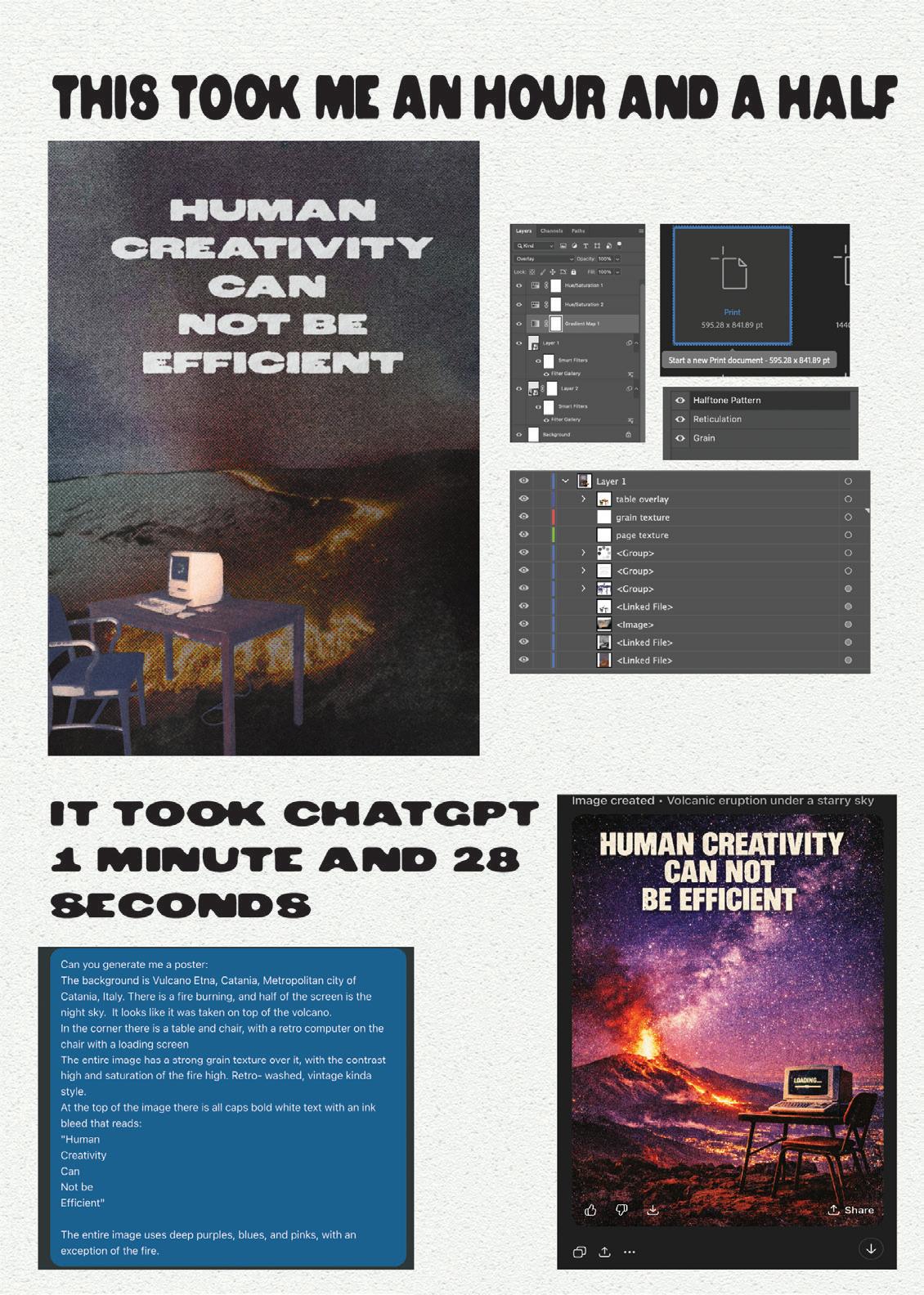
HUMAN CREATIVITY...
There is no e ciency in creativity.
A year and a half ago, I started my degree in the Bachelor of Design (Interaction Design) at the University of Sydney. A year and a half ago, I became a middleman between Generative AI and a finished design. Within design culture, e ciency has become an unquestioned virtue – one which is prioritised over all others. An otherwise silent studio hears the clicks of keyboards begging ChatGPT, Gemini, and Figma Make for the answers to simple questions:
“How do I finish this faster?”, “How can this idea be better?”
“What fonts pair well with Helvetica?”
“What colour pairs well with a deep orange?”
“Follow this design brief to create 10 ideas for a poster.”
The price of outsourcing the most fundamentally-human trait – our ability to imagine – in favour of productivity isn’t a moral quandary. It is a duel between ethics and e ciency, and there can only be one survivor.
This obsession with e ciency reveals a creative industry willing to outsource its own humanity, wilfully turning its eyes away from the insidious ecological destruction that a singular AI prompt generates. Ecological and ethical collapse are embedded in the endless pursuit of e ciency, even in the most creative disciplines.
There is a distinct power in the ability to imagine in the capacity to actualise. I, as a designer, am not a passive stylist. I am shaping attention, influencing behaviours and determining what people desire, what they notice, and what they come to accept as normal. In the era of the attention economy, designers hold the keys to moulding the direction of consumerism, and in doing so, make an active ethical decision. We are not simply bearing witness to sprawling, capitalist consumerism. We’re signing on to shape its future.
Do we contribute to harm reduction in designing for ethical consumerism to counteract unsustainable production practices, or do we switch our brains o and ask Chatty to help us tick a box? But what boxes are we really ticking if we forget the purpose of design itself? Outsourcing creativity also outsources decision making. Human designers fundamentally design for other humans. We have the capacity to acknowledge social, cultural, and environmental consequences. We can make decisions, where Generative AI compresses experiences into abstract statistics with no way of assessing the immense ripples of environmental and ethical destruction a single prompt makes.
Generative AI operates according to the same logic as any other form of consumerism: I want this, and I want it now. The environmental consequences –very real, and life and death – of that desire are rendered invisible. Fast fashion is a familiar and resonant example. Justified by emphasising a ordability and accessibility, consumers ignore the clear exploitation of labour and the price of mass-producing single use products on entire ecosystems. AI data centres, too, rely on the exploitation of what is e ectively slave labour to train its models and deplete gallons upon gallons of freshwater while poisoning water systems. The parallel justifications between these two kinds of consumerism are obvious. Thus, e cient, low-cost and low-e ort choices – fast fashion and the use of Generative AI, respectively – are made to seem like the only available options that must be submitted to.
So why then, as designers, are we not holding AI to the same accountability? Why are we not holding the companies that are using AI to design their advertisements, logos, and branding to
...IS NOT EFFICIENT
the same accountability as we do the companies that exploit cheap labour for subpar clothing? Ethical design isn’t just a method of consumerist harm reduction: it is also the resistance of the very systems of capitalism which demonise anything but outright productivity and sideline the most vulnerable members of our community in favour of e ciency.
Last year, I undertook a design project aiming to create a solution for the disproportionately long wait times in Australia for the diagnosis of Endometriosis. During this process, I interviewed 8 participants with endometriosis or suspected endometriosis about their experiences. One interviewee, who had recently undergone surgery, was a then-new friend, Kadi. They described everything from their very first doctor’s consultation to recovery, sparing no emotional detail about the excruciating horror of living with a chronic, underreported disability.
Using qualitative research methodology, I designed around the problems they identified in the bureaucratic process of symptom reporting, medical misogyny and transphobia. Once the project’s mockup was finalised, I sent it back to Kadi to review.
Kadi cried. They cried tears of joy; cried from being recognised; and from finally being listened to. Doing this cost me nothing but time, yet it meaningfully impacted their life, with absolutely no negative cost to myself or the environment. The positive outcome of representation could not have been fulfilled by an insentient machine punching out models, because at the heart of this design mission was the betterment of community.
AI design is defended through e ciency. What AI o ers is not a ordability but speed. E ciency is prized under capitalism because it enables more production in less time, regardless of the long-term consequences. It’s time to start thinking about the consequences.
Creativity has never once been e cient, and that is something that used to be held with pride. Following the industrial revolution, skilled craftspeople were replaced by mechanised systems, forcing artists and creatives alike into low-paid factory labour, and preventing artisans from envisioning a world in which their contributions were meaningful. Creative work was devalued in favour of output and scalability. Thus romanticism emerged, rea rming emotion, nature, and human experience, recognising that e ciently alone cannot sustain culture, meaning, or ecological balance.
Design and art have always drawn from nature and lived experiences. Whilst we may be designing digitally, the process has always been grounded in human perception and environmental context. Involving AI in the creative process represents a rupture in this relationship. It does not merely assist creation, but fully automates it. As artists, if we outsource the act of thought, interpretation, and response, we are surrendering the very skills we claim as our value, and submit to a fatalistic world in which ethics are compromised for production. When we outsource the very skill we are marketed for, we are damning ourselves to obsolescence. We, as humans, are by nature ine cient, which is an essential condition for ethical and meaningful design. AI is not precise in any human sense; it produces averages and simulations, and has no bearings of consequence. Dematerialised digital production is a myth, AI is destroying our planets energy, water, and material resources. This abstraction of the creative process is mirroring the broader environmental harm. When every single natural resource is diminished, and mega corporations slop-ify what once could have envisioned a better future, what are we even designing for?
This is a call to designers, and those who commission design, to resist the seduction of e ciency. To put in the work is not an indulgence, but instead an ethical obligation. Creativity is a human act, one that connects us to places, values, and each other. By automating our art, we are not liberating ourselves but rather become subordinate to the very systems eroding natural resources, polluting entire ecosystems and sidelining cultures from which art has always emerged. Our planet cannot a ord another industry that mistakes speed for progress.
The cost of e ciency is a broken planet. It takes away our individual creative liberty. There is no creativity in e ciency.
Creatures not Coal
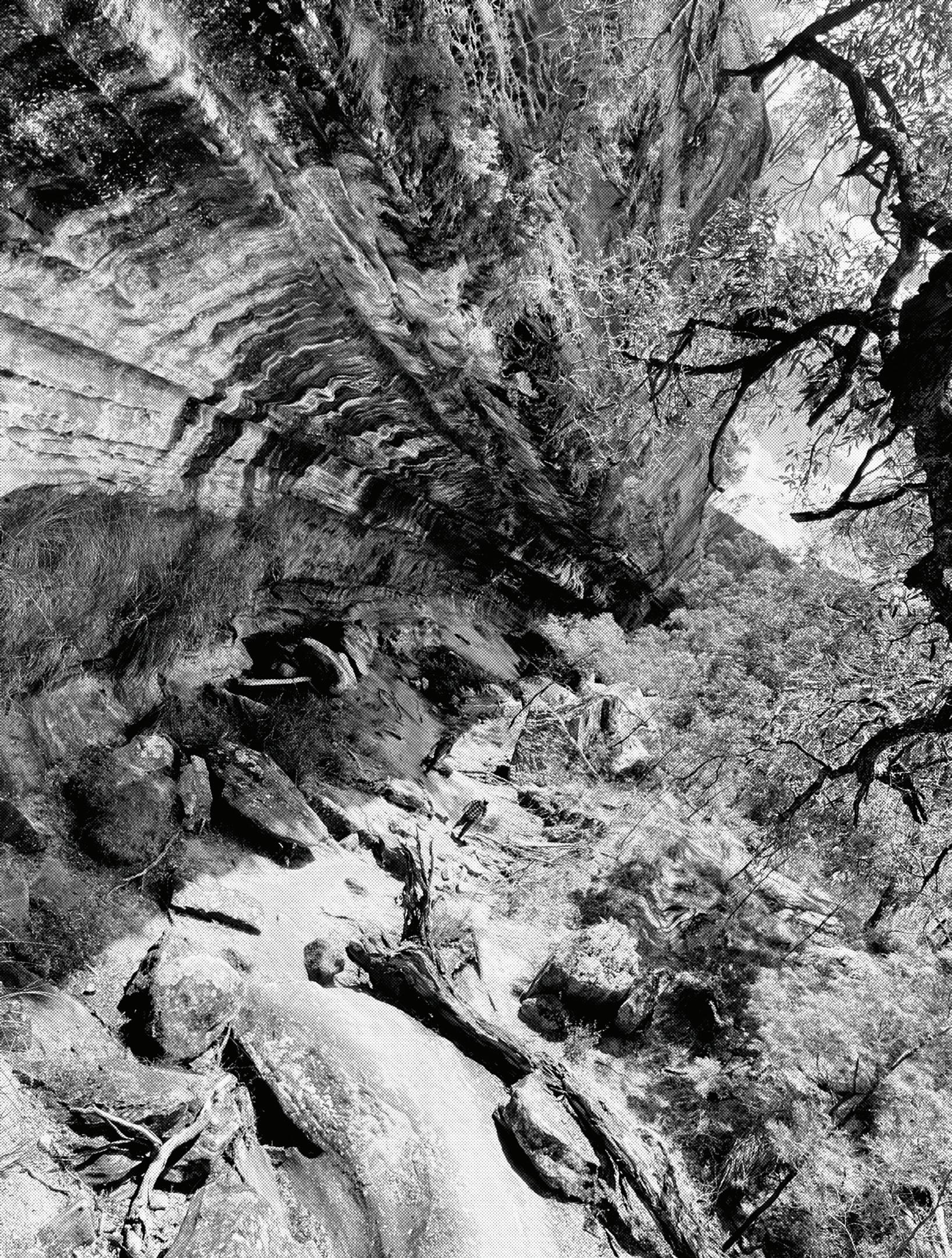
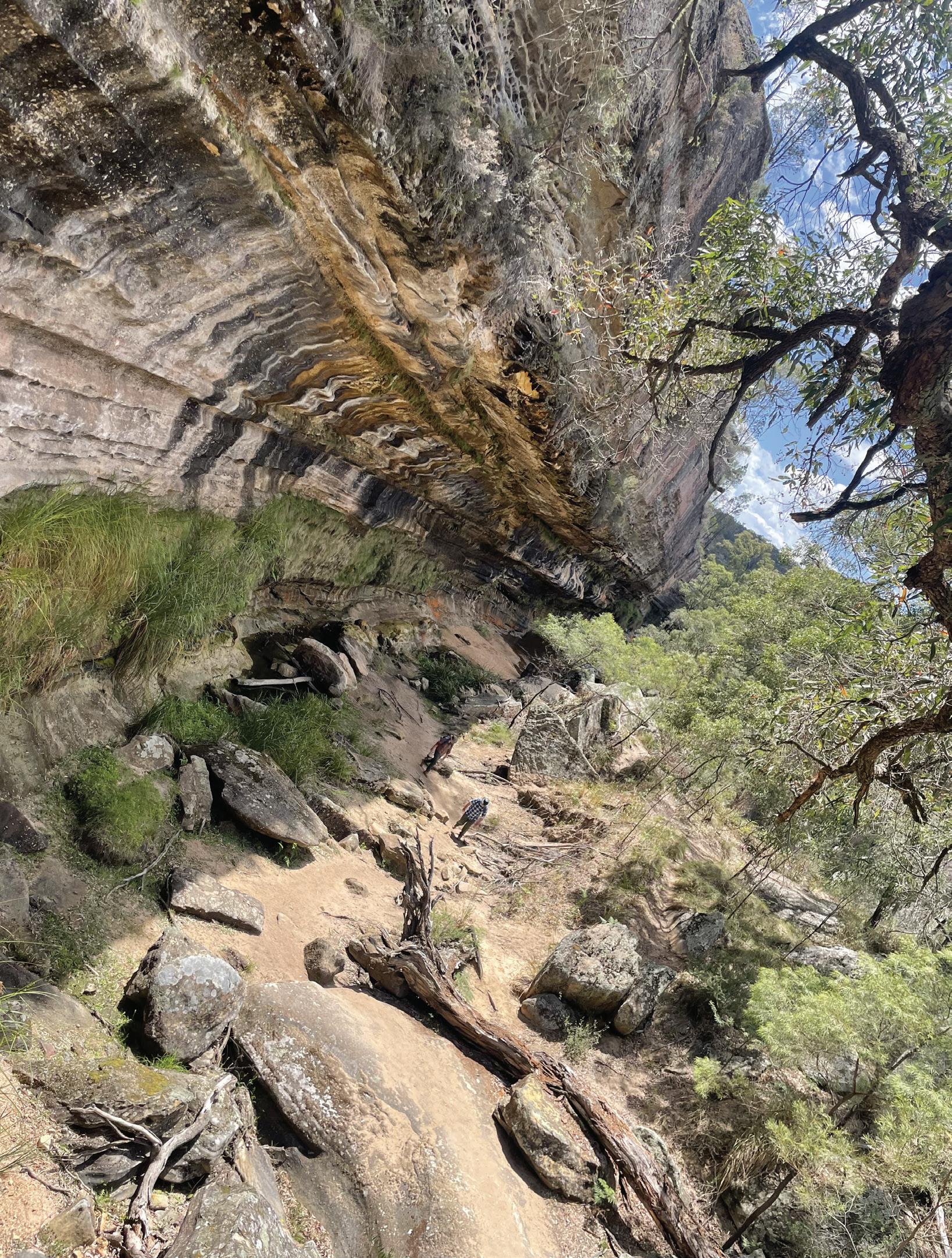
The largest coal mine in New South Wales is fifty kilometres away from Mudgee. Shrouded from scrutiny, the expansive, desolate reach of Moolarben is a far cry from city life. Somewhere in between Mudgee and Moolarben is a completely di erent reality, one I was lucky enough to experience on a Youth Trip to Wiradjuri Country. When we first arrived, Bev – a Wollar local, who had for years been involved in leading the fight against coal mining in her home – warmly welcomed us into the Town Hall, which would become base camp for the next few days. The wind whistled as it brushed past old trees and local migrating birds tittered in as we gathered in a circle in the lawn. A low, methodical whirring punctuated Aunty Aleshia’s welcome to Wiradjuri country, a reminder of the coal mine ever encroaching on Aboriginal land. Bev and Aunty Aleshia described how Moolarben had devastated the local community, forcing elders out with the sickness it brought; causing animals to flee from habitat loss; and poisoning entire water systems. Equally, they reminded us of a recent victory: that they had, alongside many other staunch community members, managed to block the expansion of Moolarben in what was a precedent.
One of the planned events of the Youth Tour was to see Moolarben: to bear witness to the monstrosity devastating human and animal life alike. Driving out, in a matter of minutes, the scenes from Wollar morphed from green to black. Going through Wiradjuri country in the summer –open plains against azure sky – the vision of asphalt-coloured rubble lining deep, sunken craters stuck out sorely. Forklifts lumbered around carrying masses of coal and an electronic signboard proudly displayed blasting information. Even more uncanny was the complete and absolute absence of natural life: not a single rustle from a tree or a chirp from a bird could be heard over the grating sound of machinery.
Aria Nadkarni
Christmas beetle exoskeletons littered the ground, reminding us that there was once life here. On either side of the crater, soil and grass had hastily been patched over identical rubble basins. Nothing called this illusion home. This is the nature of a coal mine: sprawling, brutal, and altogether unnatural.
The damage didn’t stop with the gaping rupture in the Earth as machinery tore more and more coal out of the ground. It spread to the Drip, a beautiful, ancient walking path housing prehistoric sandstone escarpments. Vividly, Dr Julia Imrie pointed at a gauge attached to one of the many layers of stone. She described how the gauge monitored a growing instability in the stone which would one day collapse, shutting o the entire enclosure and damaging the Indigenous land it stood on. Entire water systems had been a ected by the three coal mines encircling the Drip: salinated water a ected local groundwater, which in turn destabilised soil and threatened entire species.
What I took away from these scenes from Wollar were not only the long-term commitments to land and community by all the people in this small town, but the rippling e ects of environmental destruction. What was once shaken takes centuries to right itself. Patched mines release destructive levels of greenhouse gases. Replanted trees take years to mature. Extractive capitalism will stop at nothing: it is the newest tool in the settler colonial handbook, and fills the pockets of greedy corporate conglomerates while exploiting land, labour and life.
The Wollar community and the multiple groups working towards freedom from mining exploitation are a lesson in community resistance.
WOODSIDE
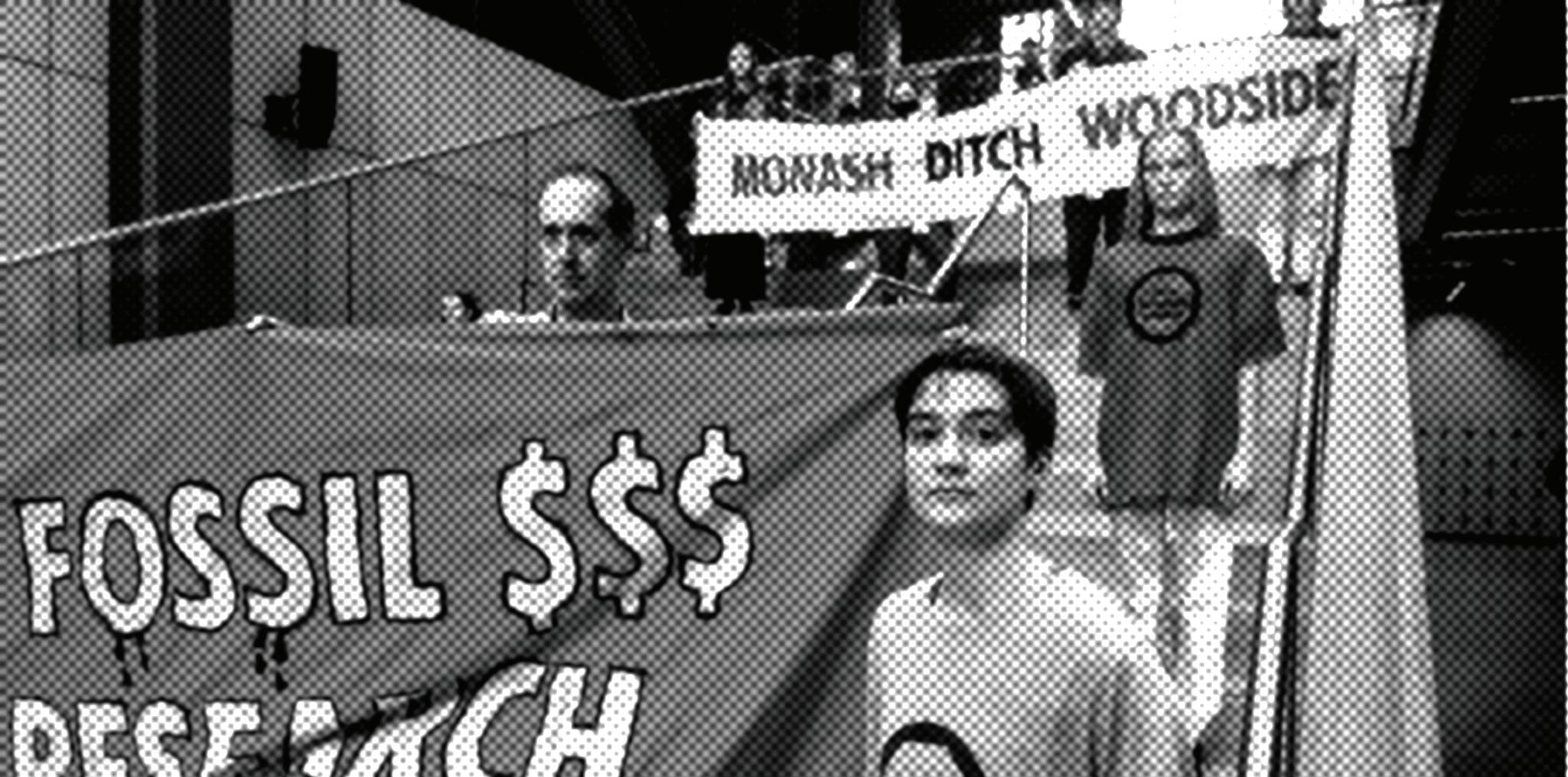
Just last year, I wrote an article with a dear friend for this very publication –Combust 2025 – to reveal the University of Sydney’s (USyd) “dirty little secrets”: specifically, their fossil fuel investments that complement other investments into weapons, mineral and mining, and gambling companies. As expected, none of these dirty investments have substantially changed at USyd since February 2025. However, I return to Combust this year with some good news and inspiration to share from a recent win down at Monash University – the successful campaign of Stop Woodside Monash.
On the 12th of November 2025, Stop Woodside Monash announced that after years of community pressure, Monash University is ending its partnership with Woodside Energy, so-called Australia’s largest natural gas producer. This is a great win for the movement and sets a strong precedent for other universities investing in or partnering with other morally dubious – or straight-up harmful –companies.
The Woodside-Monash Energy Partnership (WMEP) launched in 2019 was Australia’s largest corporate-university partnership. Monash sold naming rights to a new teaching building which became the ‘Woodside Building for Technology and Design’, co-hosted a “shadowy” Woodside-backed climate change conference in 2023 with biased sessions and slanted questions, and welcomed Woodside recruiters onto campus.
Stop Woodside Monash was started by climate science student Carina Gri n in 2023, who said that she “couldn’t stand to see the greenwashing of Woodside go unopposed on [her] campus.” The community-led grassroots Stop Woodside Monash campaign came to life the year after Woodside merged with BHP Petroleum, turning it into a top-10 global independent oil and gas company. Woodside is infamous for the polluting mega-project, Burrup Hub, at Murujuga on the Burrup Peninsula in Western Australia. Burrup Hub has been targeted by activists and local groups for years due to its ongoing threat to the climate, First Nations rock art and cultural heritage, endangered marine species near Scott Reef, and further air pollution in the region.
“I’m glad Monash has decided to finally listen to sta and students, because it’s grassroots e orts that have ended this partnership today. I hope that today that the fossil fuel lobby sees they are not welcome at our public institutions, and that if they show up, communities will stand together just like the sta and students of Monash to fight their pervasive influence every step of the way.”
Carina Gri n, SWM Organiser and Founder – SWM Press Release, 12 November 2025
One of the 35 fossil fuel, mining or relevant contracting companies that we found that USyd still significantly invested in in 2024 was Woodside. While USyd may not have its own building named after the oil and gas company, it certainly has strong ties to and investments in it.
To capture and follow on in the success of the Stop Woodside Campaign, I asked 2024 Environment and Social Justice (ESJ) O ce-Bearer at the Monash Student Association (MSA) and SWM Organiser, Thomas (Toyo) White, some key questions:
What was the organisation and structure of the movement like?
Toyo: SWM was a grassroots, and rather horizontal organisation. [...] While Carina Gri n was the key founder of the collective, everyone understood each other to be equal in deciding the direction going forward. [...] Smaller working groups existed for things like finances, socials, and media, but these were largely fluid groups. [...] What did emerge is the role of Liaison taken on by the two key endorsing organisations behind the movement, namely the Monash Student Association and the NTEU. One key part of the collective’s structure that was rather ironclad was its commitment to non-partisanship. The organisation would mention explicitly, loudly, and often that we were a grassroots collective with no formal ties to any specific political grouping. Our members contained a variety of political backgrounds, but while we knew bias could never be entirely removed, we all did what we could to leave our factionalism at the door, and when political connections became directly relevant, always ensured to flag our comments.
What kind of tactics and strategies did you pursue?
Toyo: We would post about their fossil-fuel-friendly conference with Woodside, and then the page would be taken down. We would find our website blocked, create a fuss, and then have it miraculously accessible again the next morning. Therefore, we found it to be our guiding principle to make the social and reputational cost of maintaining the partnership exceed the monetary value provided. Tactics wise, in-person presence was a big part of building our image and movement into something Monash would find troubling. From rallies to our Forum Fest, being in students, sta , and especially managements’ faces would always be the way to deal maximum damage to Monash’s reputation. However, our socials were incredibly important in connecting us with like-minded members that could become the kinds or organisers to make the in-person activations possible.
photo from stopwoodsidemonash
How did you get to have a strong base of students, sta and community?
Toyo: Getting people on board and building a strong base required two tones, both serious and fun. A fair amount of our communication targeted challenges very directly and seriously. We would release press statements, deliver pieces to the camera focused on getting information out. However, we also engaged in TikTok trends, poked a bit of fun at Monash along the way. This helped create an easy and accessible vibe at our events motivating people to stay involved.
Another key strategy was keeping people informed about what we were up to. Ensuring that even seemingly mundane procedural challenges with things like FOI requests were being consistently communicated to our community allowed us to have a sense of momentum. Additionally, the partnership but separateness of the campaign from student and sta unionism meant that we could present a legitimate face but not come across as party-political or a project just for StuPol (student politics) kids.
What would you recommend for similar campaigns at other universities?
Toyo: Make sure you’re engaged in a variety of activities and have a base of volunteers with a variety of skills. Successful campaigns are not won by only the ultra-political, but by having artists, musicians, social media creatives, graphic designers, deep-dive researchers, law-inclined people, activists, AND political organisers.
Additionally, a campaign has to be constant. Every small slip up or miscommunication from the university deserves to be publicised, ridiculed, and pushed. Don’t wait till you have something big to announce to push something on social media, but exert a constant building pressure that irks uni management. Do everything you can to make the reputational and social cost of maintaining partnerships greater than their monetary value. And find your allies! Contact new people who follow you, find favourable journalists (BlueSky is a great place to start), TALK TO US! We want to help support similar campaigns to pull o similar wins across the country.
Make sure to keep up with the USyd
SRC’s Enviro Collective and Education Action Group for continued and future divestment campaigns! See @src_usyd on Instagram for more.
Make sure to keep up with the USyd SRC’s Enviro Collective and Education Action Group for continued and future divestment campaigns! See @src_usyd on Instagram for more.
Make sure to keep up with the USyd SRC’s Enviro Collective and Education Action Group for continued and future divestment campaigns! See @src_usyd on Instagram for more.
divestment campaigns! See @src_usyd on Instagram for more. Make sure to keep up with the USyd SRC’s Enviro Collective and Education Action Group for continued and future divestment campaigns! See @src_usyd on Instagram for more. Make sure to keep up with the USyd SRC’s Enviro Collective and Education Action Group for continued and future divestment campaigns! See @src_usyd on Instagram for more.Make sure to keep up with the USyd SRC’s Enviro Collective and Education Action Group for continued and future
CREDITS
2026 enviro o cers
Aria Nadkarni & Lucas Pierce
cover art
Emma Ferguson
@artbyfergolicious on Instagram
combust designer
Grace Amarante
@gracescaaale on Instagram
editors
Aria Nadkarni & Lucas Pierce
Alyssa Damara, Dana Ka na, Emma Ferguson, Grace Amarante
writers artists
Aria Nadkarni, Ben Walden, Grace Amarante, Grace Street, James Fitzgerald Sice, Kayla Hill, Kiah Nanavati, Lucas Piece, M. van de graa , Maxine McGrath