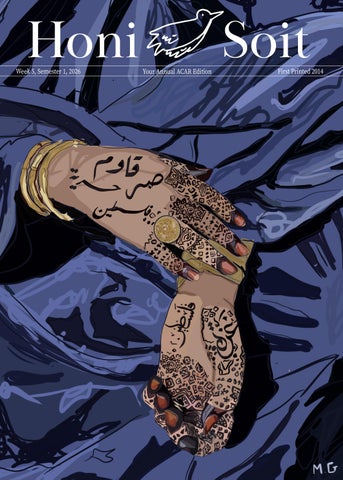
Week 5, Semester 1, 2026


Week 5, Semester 1, 2026
ACAR Honi is produced, published, and distributed on the stolen land of the Gadigal people. As people of colour and editors of this paper — whether immigrants, refugees, or born on this continent — we benefit from ongoing colonial dispossession as settlers in so-called ‘australia’.
Colonisation is not a thing of the past; it is deeply ingrained in the structures of our society. The existence of so-called ‘australia’ is at odds with the survival of First Nations people, it will do anything to repress the lives and voices of Indigenous peoples for the continuance of systemic white supremacy.
Shayla

As students, we acknowledge that we are complicit in the University of Sydney and its role in maintaining colonialism as dominant thought, as well as its origins as the first university in
so-called ‘australia’, established to expand Eurocentric, white supremacist ideologies in the colony. USyd’s role in colonial violence is exemplified by its destruction of a “sorry site”, including a sacred burial ground and a forest, to make way for the Great Hall, as Gai-mariagal man and academic Dennis Foley shared with Honi in 2024.
Despite writing this, we recognise that land acknowledgements are a completely inadequate form of acknowledging the wrongs and standing with our Indigenous siblings. It is an empty gesture, often done by organisations and individuals who are complicit in racist structures, to tick off a box that virtue signals that they are against the suffering perpetuated towards First Nations people. Solidarity can only be meaningful when it genuinely uplifts and centres Indigenous
causes and voices, and even then, allyship is not something that you can label yourself as. We must all continually show up for the community with respect and a willingness to unlearn and learn.
Land back and reparations now! Liberation from all imperialism now!
Dear reader,
Thank you for picking up a copy of ACAR Honi! ACAR Honi is the annual edition of the student newspaper made by the Autonomous Collective Against Racism (ACAR). We aim to showcase the wonderful and varied Black, Indigenous, and People of Colour (BIPOC) voices and creatives that we have at USyd and beyond, serving as a mouthpiece for anticolonial, anti-Zionist thought and activism. ACAR Honi is the genesis of the creation of ACAR as an organising collective and we are so grateful for its existence and contribution to the student journalism canon at this university.
Our deepest thanks to everyone who has contributed in any way to this newspaper, including but not limited to the editors, writers, artists, and cheerleaders who have supported us
in the last few months preparing this 12th edition of ACAR Honi. We hope you have enjoyed the production process as much as we have, despite the hiccups and hard work involved.
We hope this publication will provoke you, challenge you, make you question your worldview, make a connection, or otherwise enrich your day meaningful in any way.
If you are intrigued by the articles shared in this publication, then you should definitely come to some ACAR events and join the collective! This week we are running a bunch of events for Israeli Apartheid Week, which is an annual campaign that’s organised by the Boycott, Sanctions, and Divestment (BDS) Movement. Getting involved in any way, either with us or any other organising groups, is awesome if you have the means to!
Right now we are working on a grassroots campaign to demand the USU finally adopts BDS principles and become an apartheid-free zone. Currently, they are doubling down working with companies complicit in the genocide such as Coca Cola and McDonald’s. The fight doesn’t end here!
In solidarity, Imane and Pimala
Join Students 4 BDS (See Page 22 for more info)

Mutual aid is a great way you can meaningfully support the community. It is a system of voluntary exchanges of resources, like money or food, working under the understanding that everyone participating is here to help each other in times of need, with whatever one needs, in contrast to a hierarchical charity
organisation. One mutual aid fund we highly encourage everyone to contribute to is the Mob Strong Fund. Run by Ethan Lyons, a local First Nations organiser, it is a general fund that redistributes money donated to existing requests for mutual aid for Indigenous peoples all over this continent.
The Autonomous Collective Against Racism (ACAR) is an activist organising space at the University of Sydney open to students who identify as Aboriginal and/or Torres Strait Islander, who come from a minority ethnocultural background, who are marked/ marginalised by white supremacy, or who identify as a ‘person of colour’.
This doesn’t preclude white people from getting involved with our work! We actively encourage those who benefit from white supremacy to attend and help out with the various campaigns or events that we run throughout the year. In the spirit of intersectionality, many of these will be run collaboratively with other collectives of the University of Sydney or other universities.
ACAR’s core values are anti-racism, anticolonialism, and anti-capitalism. These principles are the focus of our campaigns and initiatives, guiding our practices as anti-racist people of colour. Thus, we recognise the need to dismantle the unjust, interwoven systems of imperialism and capitalism. ACAR actively works with and alongside other activist organisations on and off campus, understanding the importance of solidarity in the fight for the liberation of all oppressed peoples.
We acknowledge that colonisation is still an ongoing violent process occurring in many parts of the world including here
in so-called ‘Australia’, we reject the belief that colonialism is a thing of the past, as this only serves to invalidate the brutality that First Nations people continue to face. We actively work to centre First Nations voices and struggles in our activism, especially as we continue to organise on stolen, unceded Gadigal Land. This involves supporting campaigns like “Land Back” and “Stop Black Deaths in Custody”. ACAR has always and continues to advocate for the selfdetermination and freedom of all Indigenous and/or marginalised ethnic groups across the world, including but not limited to the people of Palestine, Sudan, the Congo, and West Papua.
Check us out via the QR Code!


Aleksandar Sekulovski reports.
Members of the National Tertiary Education Union (NTEU) coordinated a 24 hour work stoppage from 8am on the 19th of March on behalf of staff at the University of Technology Sydney (UTS).
The NTEU made a number of demands from university management, including requests for a fair pay rise, reproductive health leave, safer workloads, and reassurances of job security following the forced redundancies of 121 staff members, some of whom gathered in the strike despite facing the loss of their jobs next week.
After seven months of negotiations, UTS’ Chief Operating Officer Glen Babington has responded to only one of the demands of the NTEU with a 1.5 per cent administrative pay increase.
This response came during the strike when a UTS staff member shared the email from Glen with their fellow strikers,
who booed upon hearing the percentage.
Leading the strike from 8am to 2pm, the President of UTS’ NTEU Branch, Dr Sarah Attfield, shared the union’s difficulty in negotiating with management and how dismissive they have been of concerns made by staff at the university.
“They suggested that we don’t represent staff, that we’re talking of our own personal opinion,” Dr Attfield said.
“At times [UTS management] look like they’re really bored and fed up with the whole process [of negotiating].”
At the end of last year, the NTEU released the results of a survey which was open to all staff at UTS, asking
them to share if they had any confidence in Vice-Chancellor and President Andrew Parfitt’s management of the university. 95% of respondents voted no.
A member of UTS’ Parental Leave Working Group, Grace Dulawan, shared her experience going to a bargaining meeting with management with the goal of improving reproductive health leave conditions that would meet the needs of staff.
“I was met with absolute disdain, I have never felt so hated in my life,” Dulawan said.
“UTS and Andrew Parfitt love to talk a big game about social justice, about equity.
“At the International Women’s Day event the other week, one of the speakers called Andrew Parfitt out and talked about the fact that UTS has, in some of their parental leave conditions – specifically around miscarriage, one of the worst conditions in the sector.”
The working group informed management of how to improve reproductive health leave by covering endometriosis, chronic illnesses to do with reproductive health, screenings, and miscarriages.
“When I was at the bargaining meeting, I said: ‘You guys last year endorsed a gender equity action plan endorsed by the [UTS] council, number 5 on that priority list is support for parents and carers. What are you doing in this space? We’re offering you a way to actually come good on your word’,” said Dulawan.
“They said: ‘Well we can’t really afford to, we’re not in the position, we’re not in a position to take action on that’. Well then don’t put it everywhere, don’t talk a big talk, don’t pretend like you actually care about social justice.”
Read more online.
Content Warning: This article contains brief mentions of sexual abuse.
At 12pm on the 21st March 2026, hundreds marched against racism to the Sydney Opera House to mark the International Day for the Elimination of Racial Discrimination (IDERD), or “Harmony Day” as it is known in Australia.
The march was organised by Blak Caucus and began in Hyde Park with speeches from various activists and community members.
On 21st March 1960 police opened fire at thousands of unarmed anti-apartheid protestors outside a police station in the township of Sharpeville in South Africa. 69 protestors were killed. In 1966 the United Nations established the International Day for the Elimination of Racial Discrimination in remembrance of the Sharpeville massacre. However, in 1999 the Howard government renamed IDERD to “Harmony Day”, turning the
focus of the day from a protest against racial discrimination to a day of multicultural ‘harmony’.
As many pointed out at the March Against Racism, this semantic difference carries heavy political weight.
The first to speak was Bundjalung Gumbaynggirr
Dunghutti woman and Blak Caucus organiser Lizzie Jarrett who spoke about the history of the IDERD and criticised its renaming to Harmony Day in Australia.
“Make sure you understand the Sharpeville massacre, it shook the world, it exposed the brutality of racism… from that moment this day was recognised globally as a call to end racial discrimination. That is what today is. That is today’s origin and that is the truth,” Jarrett said.
“Here in this colony, that truth has been softened, diluted, renamed. Turned into orange shirts, shared lunches, and polite conversations that never go deep enough. They call
it Harmony Day. But what is harmony if justice is silence? What is harmony if truth is denied?
“Harmony without accountability is just another way to make the system feel comfortable while others are still hurting. How do we talk about harmony on stolen land? How do you talk about unity when First Nations people are still fighting to be heard, to be safe, and to be treated with dignity on our own sovereign lands?
“Sharpeville was not about harmony. Gadigal is not about harmony. It’s about resistance… the real work, the uncomfortable work, is still waiting. The truth is still here. The injustice is still here, and guess what? We are still here.
“There is no harmony without justice, there is no unity without truth, and there is no future in pretending the past and this present doesn’t exist.”
Samoan fa’afafine performance artist and activist Amao Leota Lu spoke to the crowd about
James Fitzgerald Sice reports.
the importance of recognising the intersections between racism and queerphobia.
“My thoughts and reflections on this day sit on the everyday occurrence of racial violence, both systemic and political… there is no celebration in this. There is no harmony in this. There is a lot of shame in this. The scales are constantly tipped against our black brothers and sisters, people of colour, and queer and rainbow communities alike. Our colonial history speaks volumes to this,” she said.
“We are not an afterthought, we are the people, the human energy that drives, supplies, and provides for our people, our communities, our families, and chosen families… a reminder that racial violence is not accidental, it’s systemic and deliberate.
Read more online.

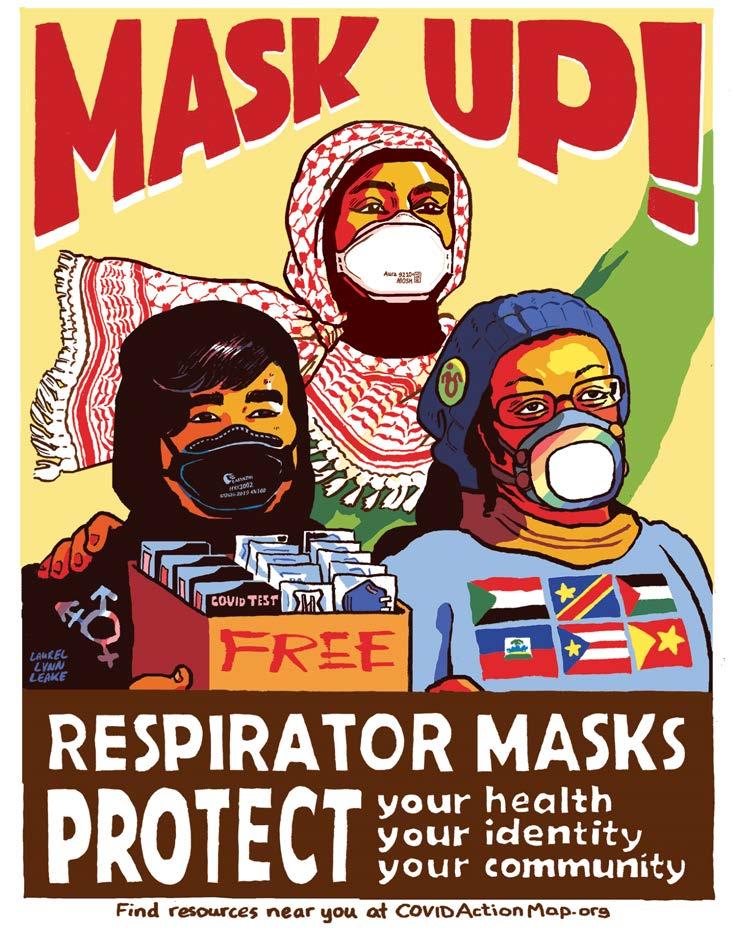
The Students’ Representative Council’s (SRC) Disabilities Collective has introduced a new initiative to provide free Rapid Antigen Tests (RATs) to undergraduate students, expanding on its existing mask bloc program, which distributes respirator masks to undergraduate students.
Disabilities Officer Kayla Hill said the initiative responds to growing barriers in accessing COVID-related healthcare.
“We are well aware of the seriousness of COVID and the detrimental impact it can have on students’ health, studies, and finances. As bulkbilled healthcare and COVID testing grow further out of reach, it is important that
students have access to resources to support the well-being of both themselves and their communities.”
SRC President Grace Street also commented on the initiative: “RAT tests should not be a luxury — they are integral healthcare tools required to save lives and to keep both individuals and our broader community safe.”
The SRC has a history of mobilising around COVIDrelated student welfare. At the onset of the pandemic in March 2020, the SRC formed a COVID-19 response group, established mutual aid networks across Sydney, and distributed masks and other essential items to students in campus accommodation.
Students wishing to access free RATs can visit the SRC office at Level 1, Wentworth Building, on Tuesday through Thursday, between 9 am and 5 pm.
The University of Sydney Union held a Special General Meeting on Friday, 20 March, at Manning House, where members voted overwhelmingly to approve the final resolutions required to complete the USU’s incorporation.
Out of 103 votes cast, 89 were in favour and 14 against — an 86 per cent approval rate.
All five motions were voted on together as a single package. The resolutions authorise the transfer of all assets and liabilities from the unincorporated USU to the new entity, USyd Student Union Ltd, and provide for the eventual winding up of the old association upon completion of the transfer.
Members also approved a name change for the unincorporated entity – from “University of
Sydney Union” to “Holme Annexe” – to free up the USU name for the incorporated body.
The Board was authorised to determine the effective date of the change and to take all necessary steps needed to implement the resolutions.
Members had first voted in favour of incorporation at a Special General Meeting in June 2025.
The University Senate approved the proposal and constitution in December 2025, and the March SGM was the final procedural step to give legal effect to the transition.
Anonymous tip alleges “CEO oversight”
Ahead of the SGM, Honi received an anonymous tip: “USU is calling a Special
General Meeting because they incorporated and now have to legally dissolve all the memberships; they will need to get all 50k members to sign up again to their new corporation. CEO oversight because they were trying to rush incorporation through.”
In response, President Phan Vu rejected the characterisation, stating the March SGM “was always part of the proposed process” and had been communicated to members from the outset.
She said the need for a further member meeting to complete the transition “was expressly contemplated as part of the incorporation process” and pointed to the June 2025 timeline as evidence.
Vu said the membership transition is “a standard and unavoidable consequence of moving from one legal entity to another” and is “not a device to ‘wipe’ memberships or force students to start again from scratch.”
She added that the process had taken longer than originally projected, not shorter, noting that Senate approval was only obtained in December 2025, later than the June 2025 timeline had anticipated. “That does not suggest haste,” Vu said.
On the question of CEO responsibility, Vu said incorporation had been “a long-term governance reform, developed over many years, approved by members, overseen by the Board, and implemented through an extended period of legal and operational preparation.”
Following the vote, Vu said the result “gives effect to the mandate members first provided at the June 2025 Special General Meeting” and that the USU is “now ready to complete the transition to the incorporated USU and continue delivering for students on a stronger and more stable legal footing.”













Part 1
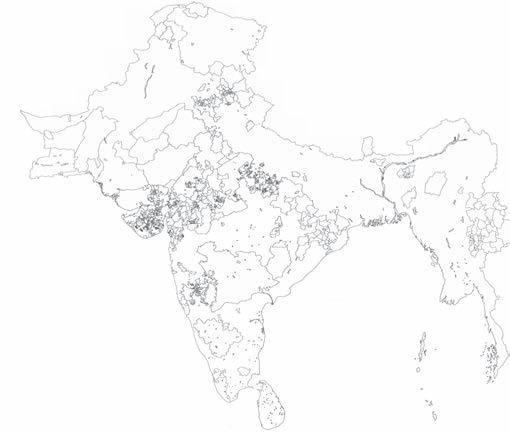
In the summer of 1947 the American photojournalist Margaret Bourke-White stood on a dusty road somewhere in Punjab and took photographs that would become one of the most enduring images of the twentieth century. The pictures show refugees walking slowly across the plains toward the newly created state of Pakistan. The line of people stretches so far that it dissolves into the horizon. Behind them lies the land they had been forced to leave. Ahead of them lies a country that had existed for less than a week.
The photographs capture a moment within what would become the largest migration in modern history. In the months following the end of British rule in the Indian subcontinent, roughly fifteen million people crossed the new borders between India and Pakistan. Hindus and Sikhs moved east while Muslims moved west. Villages emptied and trains filled with refugees. By the time the violence subsided, between 200,000 to 2,000,000 were dead.
The official story of this catastrophe is often told as a tragedy of communal hatred. Hindus and Muslims, the story goes, turned against one another as the British Empire departed and the subcontinent fractured into two nations. What disappears in that version of events is the empire itself. For nearly two centuries the British Empire governed the subcontinent through systems that divided populations along religious lines. When the empire finally decided to leave, it did so quickly. A border had to be drawn across one of the most densely populated regions in the world. The task was given to a British lawyer named Cyril Radcliffe, who had never visited India before he was asked to divide it.
He was given five weeks.
The line he drew would cut through villages, canals, railway lines, and families. Within days millions of people were on the move.
The photograph Bourke-White took on that road in Punjab captured only one small part of that upheaval. Yet it reveals something that the official narratives of independence often try to forget. The birth of India and Pakistan was the beginning of a violent reordering of the subcontinent whose consequences are still unfolding across South Asia today.
The British Empire governed the Indian subcontinent through a bureaucratic obsession with classification. Beginning in the late nineteenth century colonial administrators undertook a series of censuses that attempted to catalogue every inhabitant of the empire according to religion, caste, tribe, and occupation. The census of 1881 was the first to impose a rigid administrative logic on identities that had previously been fluid and overlapping. By the time the census of 1901 was conducted under the direction of Herbert Risley, colonial officials had begun openly arguing that India was composed of distinct and competing social groups that required separate political management. Religion became one of the most important of these categories.
In 1909 the British introduced separate electorates for Muslims under the Morley-Minto reforms, allowing Muslims to elect their own representatives to legislative councils. British officials saw it differently. By organising political representation along religious lines, the colonial state created a framework that encouraged leaders to speak
as representatives of religious communities.
The logic deepened over the following decades as further constitutional reforms expanded the system of communal representation. By the 1930s the idea that Hindus and Muslims constituted separate political communities had become embedded in the machinery of colonial governance.
Some leaders recognised the danger early. In the 1940s the jurist B. R. Ambedkar wrote bluntly about the consequences of this political architecture. In his book Pakistan or the Partition of India, Ambedkar argued that decades of constitutional engineering had transformed religious identity into the primary language of political power. “The British,” he wrote, “created the conditions which made the problem of Hindu–Muslim unity so acute.”
Meanwhile the demand for independence was accelerating. The Indian National Congress, led by figures such as Jawaharlal Nehru and Mahatma Gandhi, continued to argue for a unified postcolonial state. Muhammad Ali Jinnah and the Muslim League had reached a different conclusion. By the early 1940s Jinnah had begun insisting that Muslims of the subcontinent constituted a separate nation whose political future could not safely be left to a Hindu-majority democracy.
When the Second World War ended, Britain’s capacity to maintain imperial rule collapsed rapidly. The war had drained the British economy and weakened its global authority. In February 1947 the British prime minister Clement Attlee announced that power in India would be transferred no later than June 1948. Within months the timetable would become even
more compressed.
The man sent to manage the end of the empire was Louis Mountbatten.
Mountbatten arrived in India in March 1947 with instructions to oversee the transition. Within weeks he concluded that the situation was deteriorating too quickly to wait another year. Communal violence had already erupted in parts of Bengal and Punjab. The British administration was losing control of the countryside. Mountbatten decided that independence would take place in August of that same year.
The collapse of the timetable created an extraordinary problem. If India was to be divided into two states, someone had to decide where the border would run.
The task fell to Cyril Radcliffe.
Radcliffe was a barrister from London who had never visited the subcontinent before he was asked to partition it. He arrived in Delhi in July 1947 and was given roughly five weeks to draw the boundaries that would divide Punjab in the west and Bengal in the east between India and Pakistan.
He drew the boundary that would later be known as the Radcliffe line. It cut directly through districts whose communities had lived side by side for generations. In Punjab alone the border divided millions of people who had lived alongside one another for centuries.
Independence was declared on 15 August 1947.
The boundary itself was not announced until two days later.
By the time people understood where the border lay, the vio-

























lence had already begun.
Before 1947 Punjab was home to deeply mixed religious communities. Muslims, Sikhs, and Hindus lived in shared villages and towns across the region, their lives closely intertwined through trade, agriculture, and everyday social life. The categories that later came to define the violence of Partition were present, but they were not yet the borders around which everyday life was organised.
The Radcliffe Line cut directly through this landscape.
Punjab was divided almost overnight between India and the newly created Pakistan. Lahore became part of Pakistan while Amritsar fell on the Indian side. The border sliced through districts whose populations were deeply mixed and interdependent. Villages that had existed for centuries suddenly found themselves positioned on opposite sides of an international frontier.
The violence that followed was among the most intense episodes of mass killing in the twentieth century. Armed groups moved through the countryside attacking villages and refugee caravans, burning settlements and killing men in large numbers. Women were assaulted and forced into marriage or conversion.
The Punjab that emerged after 1947 was no longer the shared world that had existed before the line was drawn. Cities that had once been religiously mixed became almost entirely homogenised in a matter of weeks.
But the story of violence in Punjab did not end with Partition.
In the decades that followed, the relationship between the Indian state and Sikh political movements became increasingly tense. Many Sikh leaders had supported the creation of an independent India but later argued that the federal structure of the new republic failed





to recognise Punjab’s linguistic and political demands. The demand for greater autonomy grew through the 1970s and early 1980s, eventually intersecting with a militant movement that called for an independent Sikh homeland known as Khalistan.
In June 1984 the Indian government, led by Prime Minister Indira Gandhi, ordered the army to enter the Golden Temple in Amritsar, the holiest shrine in Sikhism, to remove armed militants who had taken refuge there. The operation caused heavy damage to the complex and left hundreds dead, including pilgrims who had been present during a religious observance.
For many Sikhs the sight of the Indian army inside the Golden Temple was a profound rupture.
Four months later Indira Gandhi was assassinated by two of her Sikh bodyguards.
What followed in Delhi and several other cities was not simply spontaneous rioting. In November 1984 thousands of Sikhs were killed in organised pogroms, with more than three thousand deaths in the capital alone. Punjab had already experienced the catastrophe of Partition. Nearly four decades later the region once again found itself at the centre of a violent confrontation between state power, nationalism, and identity.
When the British left the subcontinent in 1947 they also left behind more than five hundred princely states whose rulers had to decide whether to join India or Pakistan. In most cases the decision was straightforward. In Kashmir it became the beginning of a conflict that still lives with no resolution.
Jammu and Kashmir was ruled by Maharaja Hari Singh, a Hindu monarch governing a largely Muslim Population. While the Dogra state faced





growing political unrest among Muslim peasants and reform movements demanding greater representation, the region’s politics were shaped as much by questions of autonomy as by religion alone.
When armed fighters from Pakistan’s northwest frontier entered the region in October 1947, Hari Singh appealed to India for military assistance and agreed to accede to the Indian Union. The decision triggered the first war between India and Pakistan. A United Nations-brokered ceasefire in 1949 divided the territory along what later became known as the Line of Control.
Early United Nations resolutions proposed a plebiscite that would allow Kashmiris to determine whether they wished to join India or Pakistan. The vote was tied to conditions requiring demilitarisation by both sides, but those conditions were never fulfilled. Over time, the promise of self-determination faded as the dispute hardened into a territorial rivalry between two states.
In 1989 a mass insurgency erupted in the Kashmir Valley and was met by a large-scale Indian counterinsurgency campaign that left the region heavily militarised. The violence reshaped the valley’s social fabric, including the displacement of many Kashmiri Pandits in the early 1990s. Human rights organisations have documented widespread allegations against Indian security forces during the conflict, including torture, enforced disappearances, extrajudicial killings, and sexual violence. Incidents such as the mass rape in the villages of Kunan and Poshpora in 1991 have become emblematic of the accusations of impunity surrounding the military presence.
In August 2019 the Indian government revoked Article 370 of the constitution, removing the limited autonomy Jammu and Kashmir had retained





since 1947 and placing the region under direct federal control.
More than seventy years after partition, Kashmir remains one of the most contested territories in the world. For India and Pakistan it is a symbol of strategic rivalry. For many Kashmiris it remains an unresolved question of self-determination.
Pakistan emerged from Partition with fragile institutions and deep insecurity. Much of the industrial infrastructure of the British Raj remained in India, and the new country was divided into two wings separated by more than a thousand miles of Indian territory. The rivalry with India quickly became the central organising principle of the state, and within a decade the military had become the most cohesive and powerful institution in Pakistan.
In 1958 General Ayub Khan overthrew the civilian government and imposed martial law, arguing that Pakistan needed discipline and stability to survive in a hostile region. Ayub Khan was followed by General Yahya Khan in 1969, and after Pakistan’s defeat in the 1971 war and the secession of East Pakistan, another coup in 1977 brought General Zia ul Haq to power. Each intervention further strengthened the authority of the army over civilian politics and deepened the role of the security establishment in national life.
The trauma of 1971 hardened Pakistan’s rivalry with India. Having lost half of its population and territory with the creation of Bangladesh, Pakistan’s strategic leadership increasingly turned toward indirect forms of conflict. One strategist later described the doctrine bluntly: Pakistan would make India “bleed with a thousand cuts,” relying on insurgency and militant networks rather than conventional warfare.






These policies developed within the conditions Pakistan faced after Partition and its wars with India. Seeking strategic support against a larger rival, Pakistan aligned closely with the United States during the Cold War. When the Soviet Union invaded Afghanistan in 1979, American funding and weapons flowed through Pakistan’s intelligence services to Afghan resistance fighters under General Zia ul Haq’s regime. The war created militant networks across the Afghanistan-Pakistan borderlands that persisted after Soviet withdrawal in 1989, later intersecting with the insurgency in Kashmir and contributing to the rise of the Taliban in Afghanistan.
For ordinary Pakistanis, these developments shaped everyday political life. The state’s institutions became increasingly defined by security concerns, military influence remained strong, and militant networks that had emerged in regional conflicts sometimes turned inward, contributing to cycles of internal violence. Large portions of national resources were directed toward defence while democratic institutions struggled to consolidate.
Today Pakistan is often labelled a “terror state”, but that reputation cannot be disentangled from the legacies of Partition, colonial rule, and American imperialism during the Cold War that shaped the militarised security state.
When Pakistan was created in 1947 it existed in two wings. West Pakistan held the military leadership and most political power, while East Pakistan, located in the Bengal delta, held the majority of the population. The two regions were joined less by geography than by the claim that Muslims of the subcontinent constituted a single political nation.
That claim quickly came under strain. The people of East



Pakistan spoke Bengali, and when the central government attempted to establish Urdu as the sole national language, protests erupted in Dhaka. On 21 February 1952 police fired on students demonstrating for the recognition of Bengali, killing several protesters. The Language Movement became an early symbol of resistance to the political dominance of West Pakistan.
Over the following decades the imbalance between the two wings became increasingly visible. Political authority remained concentrated in West Pakistan while the eastern region experienced economic neglect and marginalisation. The crisis came to a head in the general election in 1970, when the Awami League led by Sheikh Mujibur Rahman won a majority in Pakistan’s national assembly and a democratic mandate to govern.
The military leadership in West Pakistan refused to accept the result. In March 1971 the Pakistani government launched Operation Searchlight, a campaign to suppress the autonomy movement in East Pakistan. Hundreds of thousands of civilians were killed, millions fled to India, and widespread sexual violence was reported. India eventually intervened in support of Bengali independence forces, and in December 1971 Pakistani troops surrendered in Dhaka.
Bangladesh emerged as an independent state.
The creation of Bangladesh exposed the limits of the political logic that had produced Pakistan in 1947. Religion alone proved insufficient to sustain the state created by Partition. The country founded as a homeland for Muslims of the subcontinent fractured along the lines of language, political representation, and regional inequality.
The war of 1971 therefore became another lasting consequence of Partition. Just as the division of the subcontinent reshaped the politics of India and Pakistan, it also produced a conflict that transformed the eastern wing of Pakistan into the independent state of Bangladesh.
Part 7: Hindutva
The trauma of Partition in 1947 left behind competing visions of what the Indian nation should become. One imagined

India as a secular democracy built across religions and languages. The other argued that the violence and division of Partition proved the nation could only be secure if it recognised itself primarily as a Hindu civilisation.
The first vision shaped the constitution drafted under B. R. Ambedkar and Jawaharlal Nehru. In his final speech to the Constituent Assembly in 1949, Ambedkar warned that democracy would remain fragile if political majorities began to dominate minorities, reflecting fears that the religious divisions hardened by colonial rule and partition could reappear in the politics of the new nation.
Yet for many critics of the post-1947 settlement, Partition itself became evidence that secular nationalism had failed. The ideology of Hindutva, articulated by V. D. Savarkar in the early twentieth century, argued that India should be understood primarily as a Hindu civilisation. Supporters increasingly framed the creation of Pakistan as proof that India should assert itself unapologetically as a Hindu nation.
For decades these ideas remained outside the centre of electoral politics. That began to change with the rise of Hindu nationalist organisations and the Bharatiya Janata Party.
One
turning point came in 1992, when Hindutva activists demolished the Babri Masjid in Ayodhya, triggering communal riots and marking a shift in the relationship between religion and national politics.
Narendra Modi’s political rise emerged from this transformation. Since becoming Prime Minister in 2014, Modi has frequently framed contemporary politics through debates rooted in the legacy of Partition and the early decisions of India’s post-independence leadership. Critics of Nehru’s secular vision argue that it underestimated the enduring power of religious identity revealed during partition.



Policies such as the Citizenship Amendment Act and the revocation of Article 370 in Kashmir have intensified these debates. Critics see them as a departure from the secular framework established in 1947. More than seventy years after independence, the argument over Hindutva remains inseparable from the legacy of Partition. As Arundhati Roy writes in Azadi, “the idea of India as a plural, secular democracy is being hollowed out from within,” as nationalism increasingly becomes a language through which dissent is marginalised.
Yet the consequences of Partition do not end with the conflicts already discussed. The division of the subcontinent reshaped politics across South Asia in ways that continue to reverberate today. Movements for regional autonomy — from the Dravidian movement in southern India to the Punjabi Suba agitation — emerged within states struggling to reconcile cultural identities. Insurgencies such as Naxalism and separatist movements in India’s northeast unfurled within political systems formed in the aftermath of the empire. The new borders also hardened geopolitical rivalries, contributing to conflicts such as the Sino-Indian war of 1962 and the militarisation of the Himalayan frontier. Across the region, refugee politics, nuclear tensions, insurgencies, and contested identities all trace part of their origins to the upheaval of 1974. The line drawn across the subcontinent was meant to mark the end of the empire. Instead, it opened a history whose consequences are still unfolding across South Asia today.













Sahar Tejani will never forget.
Introduction
Pakistan has a forgotten history of suppressing their own people, whether it be Bengalis, Sindhis, Hindus, or Shias. But recent events have brought to light the atrocities committed against the Baloch minority, an ethnic group residing in Afghanistan, Iran, and the Balochistan province of Pakistan. This essay will focus on Pakistan’s oppression of Balochistan and its people. Due to the media suppression regarding the topic, many people, including Pakistanis themselves, do not know the oppression that Baloch people are experiencing. So I present to you, a quick yet deep dive into the silencing and oppression of Balochistan.
British Raj and partition (1883–1948)
During the British colonial rule of the Indian subcontinent, Kalat (a district in Balochistan) was granted the title of a princely state, allowing the Khanate of Kalat to make its own political decisions regarding the state’s governance. During Partition, the princely states were given the option to either join Pakistan, India, or become independent. Three-quarters of the provinces of Balochistan chose to join Pakistan, whilst the khanate of Kalat (Mir Ahmed Yar Khan) chose to be independent. Kalat was declared an independent state on the 4th of August, 1947, but in October of that year, Jinnah, a prominent figure in the formation of Pakistan, urged the Khanate to merge with Pakistan, with the armed forces of the Baloch being under-equipped and unable to fight back, a weakness during partition.
One unit scheme and the Baloch Uprisings (1950–1969)
Mir Ahmed Khan’s brother, Agha Abdul Karim, led a revolt against the Pakistani military, demanding that Kalat be established as a sovereign state. Karim’s revolt failed, and he and a hundred supporters were captured and charged with conspiracy to wage war against Pakistan, resulting in ten-year sentences.
In the 1950s, Pakistan initiated the One Unit Scheme, unifying the four provinces of West Pakistan (Punjab, Sindh, Khyber Pakhtunkhwa, Balochistan), in order to counterbalance in the face of rising powers in East Pakistan. The policy meant that the centralised government could control political and military processes, and as a result, Sindh and Balochistan, too, would lose their autonomy.
In October of 1958, Pakistani president, Iskander Mirza, imposed martial law. During the first year of martial law, new armed forces were set up in Kalat. When Mir Ahmed Yar Khan raised concerns about the One-Unit Scheme, he was ambushed and arrested by the Pakistani deputy commissioner. A guerrilla war ensued, led by a 90 year old Tribal man, Nauroz Khan. They ambushed convoys and military installations, but avoided harming civilians. This ended with the detainment of 250 men, including himself.
Under the One Unit Scheme, Baloch lands were exploited for their gas and oil reserves, with no profits being distributed back to the Baloch people. Baloch Members of Parliament were kicked out for speaking out against discrimination. Multiple tribes united to form the Parari resistance (which gave birth to the Balochistan People’s Liberation Front (BPLF)), who would perform raids on military camps and ambushing convoys. This was met with repeated air raids and bombings of tribal areas.
Independence of Bangladesh and political turmoil (1971–1977)
Following the independence of Bangladesh, a military coup was staged, and Bhutto became the fourth president of Pakistan. During his reign, he endorsed an accord with the NAP (National Awami Party) that all forms of military rule would be terminated and that a Baloch person could serve as governor of their own land. But, at a London meeting, the culmination of alleged conspiracy against Pakistan between the NAP and Bangladeshi political parties, alongside a rise in tribal disputes, led to the eventual dismissal of the NAP in 1973. Following this, a fouryear revolt led by the Baloch
people was met with strong military action. In 1977, the military was withdrawn from Balochistan, and thousands of activists captured throughout the revolt were released.
Formation of the Balochistan Liberation Army (2000)
At the turn of a new millennium, the Balochistan Liberation Army (BLA), a guerrilla-style resistance organisation that targeted Pakistani armed forces and independence, was formed. The BLA has been designated as a terrorist organisation by Pakistan, the UK, and US governments due to the scale of their attacks.
Sparking the Baloch long march (2021–2023)
In 2021, a series of protests along the borders of Balochistan and Iran broke out due to the murder of a 17-yearold Balochistan youth, and the murders of 10 trade workers of Baloch descent by Iranian border officers. Outrage sparked at both the Iranian and Pakistani governments for their lack of regard for Baloch. During this year, 442 cases of missing persons were reported, with half of them still missing to this day.
Similar events occurred in 2023 when a 24-year-old Baloch man was arrested and later murdered in jail (before court proceedings) for being suspected of possessing explosives, a claim not backed by evidence and denied by family members. As well, a female-led march from Turbat to Islamabad was met with baton beatings, tear gas, and water cannons. Throughout this year, 601 people were abducted, and 218 people were found dead, some with their eyes gouged out under mysterious circumstances. Near the end of the year, journalists started to experience extreme censorship when writing about the protest, required to hand in material to authorities before being given the chance to be published.
In August 2024, internet access in Balochistan was cut for 21 days, preventing any information from coming in or out. The 501 cases of missing persons during this year sparked the Raji March
protests, with multiple sitins held demanding the release of missing sons and fathers. Seven journalists were murdered this year.
2025 saw the most chaotic year to date between the BLA and the Pakistani government. In March, the BLA hijacked a train carrying Pakistani military personnel to demand the release of political prisoners. After 48 hours, 64 people were killed. A week after the hijacking, multiple Baloch families protested outside hospitals demanding to identify bodies they believed to be their family members — they ended up being beaten by police officers and turned away.
The following night, Baloch bodies were buried in secret and without identification. This sparked demonstrations in front of universities,crowds marching into hospitals to take back their families’ bodies. Peaceful protestors were then tear-gassed, and three people were shot at one demonstration. September saw two air raids on locals, students targeted and labelled as terrorists. October and December welcomed more internet shutdowns. Media continued to be suppressed, with officials stationed outside news stations and newspaper firms, and activists being threatened with civil death. In total, 785 missing persons were reported, and 225 bodies were discovered to be dumped in 2025.
The oppression continues to this very second. Media suppression means that people must gather information from activists’ X and Instagram accounts. Providing a voice to oppression is a crucial tool of resistance, especially when your voice can resound globally. By educating people on the continued oppression of the Baloch people, it only draws more people in and extends awareness.






Pimala Leo demystifies the glory of the so-called saviour.
In January, Trump reiterated threats to take over Greenland (Kalaallit Nunaat), as well as annex Canada. In response, we saw Greenlandic Inuit (Kalaallit) and Danish people alike protest to demonstrate against Trump’s plans. Except Danish protestors’ opposition to Trump’s occupation was underpinned by paternalism towards the Kalaallit, undermining their sovereignty from both Amerikkka and Denmark alike. They used colonial language emphasising the necessity for Denmark to keep its subordinate country under its much-needed care. The cognitive dissonance between some Danish citizens’ outrage over Trump’s proposed vassal state simultaneous to their failure to recognise the egregious colonial violence perpetuated by their own state was staggering.
While some ignorantly and defensively undermined the extent of Denmark’s violent colonisation, others have more openly recognised and acknowledged the realities of colonial violence. Danish Prime Minister, Mette Frederiksen, for example, apologised to the Kalaallit for the nonconsensual implantation of birth control devices during Danish rule. Some Greenlanders, on the other hand, possess a bizarre rationale that oppose Danish colonisation, but welcome US interventionism. One such case is Jorgen Boassen, the “Greenlandic son” of Trump.
would allow Kalaallit Nunaat to become independent under a ‘free association’ agreement if Kalaallit Nunaat gives Amerikkka authority over defence and foreign affairs. Boassen also thinks that the military invasion proposed by the Trump administration would only occur in the case of a Russian or Chinese invasion. It is clear that he does not seek liberation, but to be on par or an ally of the most powerful country in the world. What Boassen does not realise is that dominant powers like Amerikkka only want absolute power from Kalaallit Nunaat and other nations to maximise resources, labour, and profit. Boassen has fallen for Trump’s insistence that occupying Kalaallit Nunaat is critical to the national security of the ‘United States’. In actuality, Trump means that Kalaallit Nunaat is a place that can be exploited for capitalist, colonial greed.
Boassen has the same mind as Arab ‘Israelis’ or First Nations persons on this continent who think the empire will save them or respect them if compromises are made. In the case of the Zionist entity of ‘Israel’, the organisation Adalah found “over 65 ‘Israeli’ laws that discriminate directly or indirectly against Palestinian citizens in Israel and/or Palestinian residents of the Occupied Palestinian Territory (OPT) on the basis of their national belonging,” as of 2017. These discriminatory laws disappropriately restrict all factors of Palestinians’ lives,
territory and won’t spare a thought for the suffering they will perpetuate. After all, anyone that an imperialist can exploit is merely a serf population in their racist, white supremacist minds. It is the god given right for imperialists to bring their enlightened, civil concepts to subordinates, right?
People who have faith in imperialism could likewise learn from the pages of the history of so-called ‘Australia’. The 1992 High Court case, Mabo v. Queensland, established in law that this continent was not terra nullius (land belonging to no one), despite what Captain Cook declared in 1770. As a result, native title was introduced to the federal law of ‘Australia’. However, ownership has not been properly returned to all the traditional owners of land on this continent. Yes, native title was inserted into ‘Australian’ colonial law alongside Westphalian sovereignty, but they will never be compatible or help us all reach liberation in any fruitful way.
There is no colonial project, and no proximity to colonialism, that will save you.
Progress and liberation is entirely contradictory to Western racist structures. The only answer is killing the colonialist
Meijie Ureta
tells stories nearly forgotten to conquest.
As moral as Christianity poses itself to be, its role in endorsing colonial endeavours pushed, and still pushes, for the erasure of Indigenous culture. Christian settlements and their acquisition of political power led to the demonisation of native religions
to the near extinction of their languages and cultural practices.
Africa, on the other hand, was one of the first targets of Christian missionary work amid European colonial endeavours to
Christianity, as well as how it was utilised to fulfil colonial missions. Although these conquests are often framed as distant history, and despite official apologies from Christian churches, their consequences remain deeply seared into the identities of
by Wen Bao
Warning: this article contains discussions of suicide.
Arundhati Roy says, “nonviolence is a piece of theatre. You need an audience. What can you do when you have no audience?” Violence, then, attracts said audience. You can turn this violence outwards through resistance. Alternatively, many have chosen to turn this violence inwards.
Suicide and suicidality is taboo, especially in cultures of the Global South (and cultures from oppressed nations). Studies on suicide, attempted or otherwise, are lacking, with suicides covered up due to the large stigma, leading to underreporting and disregard for investigation into this topic. The reasons for suicidality are largely intertwined with oppressive conditions, yet discussions of suicide focus on the statistic, rather than the why , the many reasons someone could be drawn towards an action this drastic. This article is not attempting to glorify suicide, or to encourage suicide by any means. Rather, I am hoping to provide an account of suicide and discuss the biopolitics surrounding it.
Imagine you are a teenager in Gaza. You have lost countless family members and might have witnessed their deaths. You are parentified and forced to grow up, caring for your younger siblings. You have been made disabled, perhaps you have lost a limb. In brief moments of respite, a pause from the bombing, you help look for bodies to retrieve from beneath the rubble and bury. Your brain, by default, tries to search for ways to end the suffering.
Zachary Gan in his article ‘ On The Biopoliticisation of Suicide ’ argues “suicide must be confronted as... intentional and born out of a careful consideration of one’s conditions… [it] must be considered as an ‘act of man.’” To be suicidal, then, is to be both a perpetrator of violence against yourself, and a victim of said violence. Under occupation, this becomes layered and highly politicised. Suicide as a political act is highly linked to the concept of “necroresistance”, a term coined by Banu Bargu in her book Starve and Immolate . Necroresistance involves sustained politics (or politicisation) of a body after a death, one that is sovereign through its act of self-destruction.
I reject the notion that suicide is a selfish act — what I mean by this is suicide is an act of agency while under siege, and should not be considered a phenomenon when it is a reasonable reaction to horror and injustice. If nonviolence is a form of political theatre, violence is a call for an audience. If that violence is turned onto oneself, it lays in a grey area: it is both violent and nonviolent by calling for witness yet not physically damaging another. Suicide can be considered (explicitly or implicity) as protest even if it does not necessarily come out of entirely ‘selfless’ reasons. Take self-immolation, undoubtedly one of the most confronting, extreme acts of suicide. It is inherently a public form of protest.
In 1963, a Vietnamese monk, Thich Quang Duc, set himself on fire. It was covered by foreign journalists during the Vietnam War and was conducted as a very public act of protest against the South Vietnamese government’s treatment of Buddhists. In 2010, a Tunisian man, Mohamed Bouazizi, set himself on fire after his work was shut down by local police and his appeals rejected by the government. In 2016, Omar Masoumali, an Iranian refugee held in detention in Nauru also self-immolated, with Hodan Yasin, a detainee from Somalia, following suit less than a week later. In 2024, American serviceman Aaron Bushnell livestreamed his self-immolation outside the Israeli embassy, saying “I will no longer be complicit in genocide… this is what our ruling class has decided will be normal.”
These self-immolations all came about at different contexts, and not all explicitly to protest, yet share one commonality: being witness or victim to a deep oppression, and engaging in an act that demands an audience. Oftentimes, these suicides are framed as external , something happening to the person, or perhaps played off as a result of madness.
But you do not commit suicide by accident, you do not do these things without deliberation and intention. Diminishing these acts as just tragedies (and of course they are tragic) and just phenomena erases the gravity behind them.
In a specifically Palestinian sense, martyrdom is highly sanctified and venerated. In many acts of Palestinian resistance, the fedayeen (resistors against Israeli colonialism and occupation) engage in acts of self-sacrifice. Yet martyrdom does not just apply to people who have engaged actively in anti-occupation resistance such as the fedayeen, but also those who have been killed in the onslaught and genocide in Gaza, including those who may have never touched a gun or weapon in their lives. They are all martyrs, and you will hear many chant ‘glory be to our martyrs’, honouring their lives. A Palestinian mother said “I’m a mother of Martyrs. I swear by Allah that I’m content, praise Allah.” Other videos circulating have women ululating and praising God at funerals, saying ‘alhamdullah, my family are martyrs, alhamdullah, I wish I was among them’. If martyrdom is sanctified and revered, should this sanctity apply to martyrs of suicide? They are also casualties of war. To be a freedom fighter includes agency on your own body, a body that can be killed by your oppressor or killed by yourself. In settler-colonial contexts of dispossession, your body is your only
Anonymous mourns the dead.
constant home, and so it can be an act of sovereignty to decide what happens to your home.
Every suicide under the occupation is a murder. Every suicide under occupation is a martyrdom.
Again, I am not saying suicide should be praised or idolised. The framework of suicide in these contexts is highly political and has to be thought of beyond its externality. We have to hear the protest demanded by the soul that resided within the body. Many reasons behind suicide follow a deep despair that comes from something that feels like an impossibility, a deep despair for change.
Is it not possible that suicide could be understood as a protest that lasts beyond its death?
We should take suicides as martyrdoms and reframe how we think about ways people respond to oppression and take all states of the body as political and sovereign. These things do not happen by accident. We must understand and honour the gravity of these autonomous acts of agency. That is the least we owe to each other.
Judith Butler in Violence, Mourning, Politics asks about a way to “struggle for autonomy, but also consider the demands that are upon us by living in a world of beings who are… dependent on one another.” They say this struggle is “another way of imagining community”, a way that asks us to consider the ways which we use “violence.. as an exploitation of that primary tie, that primary way in which we are, as bodies, outside ourselves, for one another”. Suicide, public, protest, or otherwise, in oppressive contexts breaks these ties finally to ask for an audience. It causes shockwaves. If every suicide is a martyr, and every martyr is a universe, it is imperative we honour those reasons to make sure those martyrs are still heard beyond death, and the asks they made are witnessed. It is imperative to create a world where no one feels so compelled to this anymore, where the sacredness of each life is felt.
We do not want to lose our siblings and our comrades to suicide, and we are actively working towards a world where that is not the case. However, for those that have done so, we will honour their memories.
May we all live to witness our liberation. May we all remain steadfast in our survival. May we have a moment to aptly mourn the extent of the losses we have witnessed and feel the grief of all these martyrdoms. Within our lifetimes.
Kayla Hill is sick of this.
Throughout history, disease and disability have long been imposed on people to advance empires’ projects.
From Jim Crow practices to World War II, and from coal mines to prisons, people are violently made sick, insidiously violated of bodily function, and brutalised to death.
Colonisation has led to the decimation of First Nations populations around the world. This led to the vicious spread of diseases, including smallpox, chicken pox, influenza, measles, and tuberculosis. Approximately 90% of the Native American population was wiped out as a result of the diseases brought in through colonisation. It is alleged that the British gave blankets contaminated with smallpox to Native Americans in 1762.
Eugenics has long been conducted throughout history in malicious and methodical ways. In 1907, Indiana passed an involuntary sterilisation law — the first in the world — and, over the next 32 years, tens of other states enacted similar laws that allowed for the sterilisation of people with mental illness and intellectual disabilities. This practice extended to Black women in Southern states who, particularly between the 1920s and 1980s, were commonly subject to involuntary hysterectomies and tubal ligations without their knowledge or consent when going to the hospital for an unrelated procedure. This phenomenon was called the ‘Mississippi Appendectomy’. Similarly, coercive sterilisation and contraception measures have been used against Aboriginal women as a means of population control. Under the Nazi Aktion T4 program, disabled people were systematically murdered via starvation, overdoses, or gassing.
Biological warfare has been used particularly in wars against large populations. In 1940, Japan’s sinister Unit 731 developed biological weapons. One notable usage was in the Kaimingjie germ weapon attack, where ceramic bombs full of fleas carrying the bubonic plague were dropped on Ningbo, China. During the 1948 Nakba, Operation Cast Thy Bread involved the Zionist paramilitary group, Haganah and later, the Israeli Occupational Forces, contaminating water wells with typhoid bacteria, which led to epidemics across many Palestinian villages.
Israel has consistently targeted healthcare, further harming an already largely sick, disabled, and traumatised population. In December 2025, Gaza’s Ministry of Health reported critical medical supply and drug shortages amid the years-long Israeli blockade exacerbated by the genocide, including a scarce supply of oncology

medication, dialysis equipment, and intravenous antibiotics. As of February 2026, there are currently zero functioning Magnetic Resonance Imaging machines (MRI) in Gaza. In February 2025, the World Health Organization recorded 670 attacks on patients, healthcare workers, medical facilities, and ambulances in Gaza. In March 2026, Israel killed at least 31 healthcare workers in Lebanon via an airstrike.
The organisation of populations does not solely occur via active violence. Modern biopower facilitates death and suffering in more insidious ways.
Through the mismanagement and exploitation of natural resources, Black and Brown people slowly face the dire fate of capitalist greed. In the US, 78% of African Americans live less than 50 kilometres from a coal-fired plant. Such proximity often leads to health problems such as premature birth, ischaemic heart disease, cognitive dysfunction, and lung disease. Rio Tinto’s Panguna mine in Bougainville, which operated from 1972 to 1989, continues to severely harm Bougainvilleans. The Human Rights Law Centre’s 2020 report on the mine highlighted widespread pregnancy complications, moderate malnutrition, and higher rates of malaria due to the environmental impact of the mine. For over 10 years, Flint, Michigan, a city where over 55% of the population is African American, suffered from drinking water contaminated with extremely high levels of lead.
Similarly, government negligence and apathy by medical institutions have made way for the unchecked spread of disease, thereby leading to countless preventable deaths and disabilities. The Acquired Immune Deficiency Syndrome (AIDS) crisis was met with excruciating years of silence from the Reagan administration. This silence was death: tens of thousands of people in the US died of AIDS in the meantime. The moralisation of homosexuality and thus, AIDS, murdered one too many queer and trans people, sex workers, and people who inject drugs. Governments have put people at severe risk both at the beginning and the “end” of the COVID pandemic. Many countries saw vaccination delays (if not active hostility), an already overburdened healthcare system pushed further into crisis, and problematic government messaging (such as the promotion of chloroquine). In a bid to restart the economy, essentially all measures have been axed, as the government pushes for a “back-to-normal”, post-COVID world. Nonetheless, COVID continues to profoundly disable people. Affected people are left to the sidelines
with minimal medical research, social support, or financial resources available.
Through what Estelle Ellison describes as “eugenicist normalcy”, such excessive and severe sickness is normalised, offering little resistance to the disabling and murderous violence of empires.
Incarceration is a key feature of empires that imposes significant sickness and disability (if not death). Systemic political violence pervades the experience of incarceration, nevermind the very journey into incarceration itself. Many First Nations deaths in custody — which currently sit at 626 — are a result of already inadequate prison healthcare being blatantly denied to people in medical crisis. Amid mass kidnappings nationwide, an Immigration and Customs Enforcement (ICE) detention centre in Texas had to close due to a measles outbreak. Palestinian prisoners in Israeli custody commonly contract fungal infections, scabies, and other diseases as a result of overcrowding, denied showers, no ventilation, zero sunlight, and the intentional exposure by guards to sick prisoners.
Our bodies are where the empire does its work.
Whether directly or indirectly, in our fraught survival or violent death, our bodies bear the brunt of empires’ offensive attacks, eugenicist projects, and “incidental” violence. No empire has existed without the mass disablement of a people.
So what do we do when empires are literally sickening?
There is no easy cure to the apathy — and hostility — that makes our bodies expendable. As such, we must turn to one another for support. In the wake of rampant disease spread, disabling violence, and destruction of our agency, it is up to us to support one another. We must be comrades to each other by not only fighting against this violence, but also treating each other’s wounds that come from such violence. The fraught path to a better world is less perilous to travel amid grassroots education, community lawyers, street medics, widespread masking, blood drives, and healing circles.
Until death, we will remain steadfast in our commitment to liberation, no matter how sick and weak they make us. We will hold out, and we will fight, because a better world is ours.
Shayla Zreika asks for your postcode.
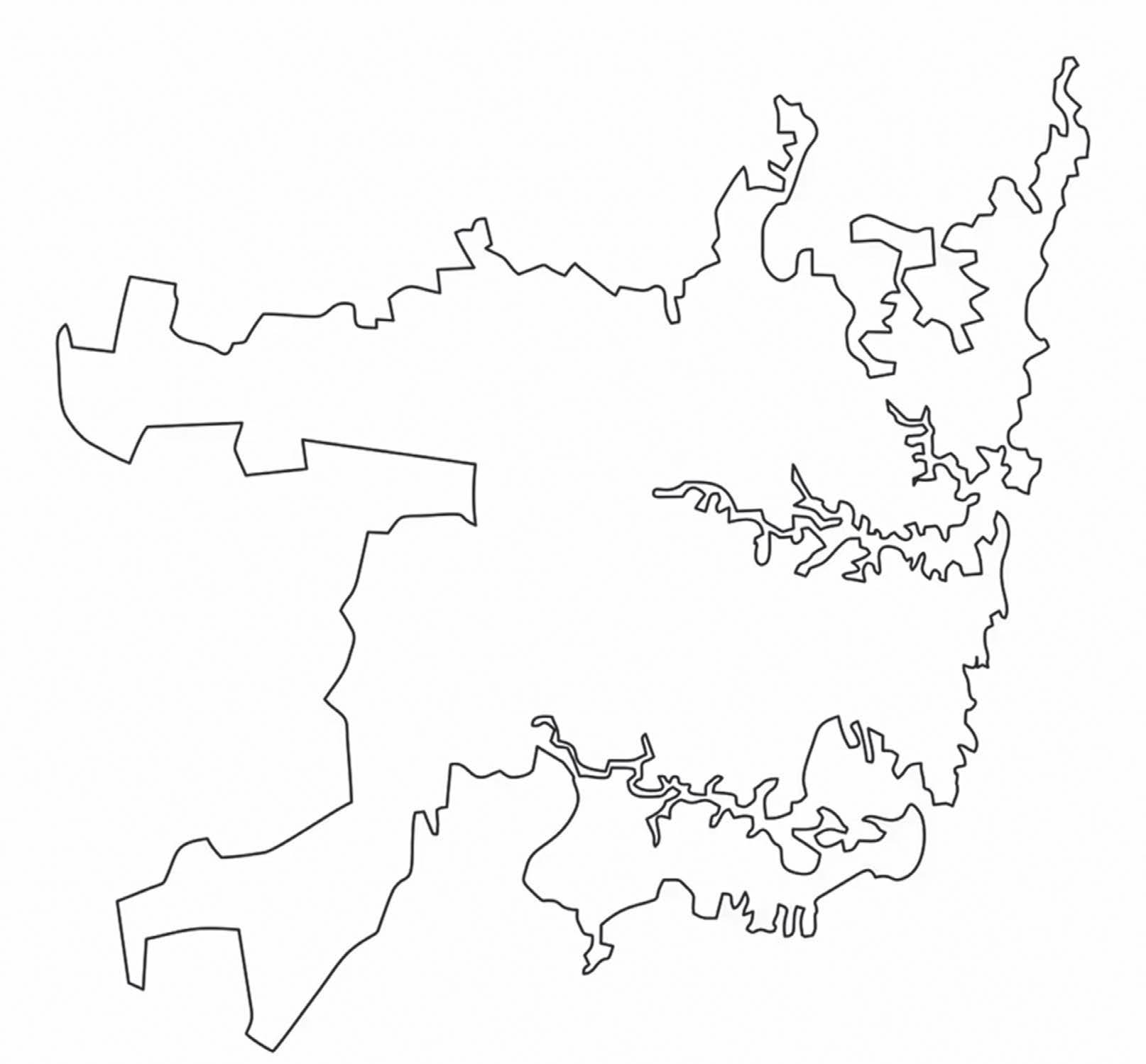
Postcode prejudice runs rampant in the culture wars of Sydney’s suburbia, where one’s proximity to Whiteness — an entity of societal privilege — is manifested by our neighbourhood narratives.
Beyond geopolitical proximity, the alienation of the ‘destined-to-be disadvantaged’ Western suburbs is further perpetuated through a universally composed medium: education. Or rather, miseducation.
There’s a certain repellence that naturally erupts at the mention of Western Sydney. Suburbs such as Bankstown, Lakemba, Cabramatta, Blacktown and Parramatta are always accompanied with fear-mongering headlines in the media.
In exacerbating suburban prejudice and dismissing the nuance of densely multicultural populations, the model Western Sydney resident is sensationalised to stereotypes of corruption, incivility and most powerfully, being uneducated.
Language is recycled throughout the media which constructs this identity of miseducation in the Western suburbs. In recent data, stories on the decline of attendance rates in NSW schools, the bifurcation of the North/ East and West of Sydney is made strikingly apparent.
The often ‘impressive’ outcomes of Northern and Eastern school attendance rates and performance are attributed to the “more affluent backgrounds” of students. Contrastingly, the ‘disappointing’ statistics in the Southwest and Western suburbs are faulted for lacking “the same educational support”.
In reality, 85 per cent of Western Sydney residents are linguistically proficient either singularly, or at exceptional standards.
Paradox is method for polarising the proximity of the Western suburbs at the furthest distance possible from Sydney’s ‘greater’ suburbs. It frustrates the reality of students in the Western suburbs and frames their alienation from underrepresentative curriculums as delinquency rather than ostracism.
Subject to a patriotic identity of the token White Australian, the foundations of our education system is built to endure a colonial narrative that upholds the exclusivity of the ‘true-blue’ Aussie. We cannot expect students to be engaged with their learning if they do not see themselves within the content and manner to which they are being taught. Our educational system is funded by our taxes, championed through our teachers and regulated by our parents.
diverse comprehension, single-parent households and parentified youths, Indigenous and Torres Strait Islander heritage, children with physical and non-physical disabilities or varied socioeconomic incomes? The unfortunate truth lies in the fact that an annual Harmony Day is not nearly sufficient enough to represent the true diversity of Australian students.
Alternative backgrounds and real-life circumstances are not disadvantages of the youth but areas in which our schooling systems must cater towards. Diversity is not an issue. The issue lies in sustained colonial attitudes of the ‘true-blue’ Aussie which continues to govern our education system. Instead we must focus on fostering the education and wellbeing of our children in tune with who they are, not who they ought to be.

unshakeable
The image of Western Sydney students is shrouded in the misconception of mischief and deficiency — another means of painting ‘the Other’ as subordinate to the grand narrative of White Australian prestige and excellence.
responsibility of our education systems and governments to manufacture a curriculum that
best sustains the right to learn
for all children in our communities no matter their locality.
The so-called miseducated West is a primal crisis of educational inequity: are our current school environments inclusive for students of all socio-economic, cultural, religious or domestic backgrounds? Do our curricula reflect the nuances of the real Australian experience — that of migrant and refugee backgrounds, linguistically
Imane Lattab philosophises about sci-fi

Around the time Avatar: Fire and Ash was released in December of last year, I was finally persuaded by my social media algorithm to join the masses and experience the brilliance of the Avatar saga firsthand. Naturally, I streamed (allegedly via piracy) the first two movies and sat diligently through six hours of content. With my homework completed, I stormed right into Bankstown Hoyts just in time for the final screening. Though I had zero expectations, I never would have expected a sci-fi fantasy about blue aliens to awaken my inner thought daughter and get me hyperfixating on indigenous philosophy for months.
For context, the Avatar films are set in a world where humans have definitively cooked Earth’s ecosystems into oblivion in the endless pursuit of capital. With our planet reduced to a cyberpunk hellscape, the only way to ensure the survival of humans — nay, our economies — is to violently colonise and terraform a distant planet called Pandora, known for its incredibly biodiverse terrain and valuable natural resources. It also happens to be inhabited by a highly intelligent, humanoid species called the Na’vi, who are indigenous to Pandora.
Mother deity Eywa. Eywa can be understood like a universal consciousness or an intangible life force that flows through all.

Eywa is more than a divine goddess or a metaphor for nature; she represents the interconnectivity that exists between everything on Pandora, spanning across space and time.

In the first film, we quickly learn that humans have been subjecting Pandora to a decades-long colonising mission led by a corporate-backed organisation known as the Resources Development Administration (RDA) — which somehow sounds less comical than Amerikkka’s “Department of War”.

Beyond the brutal colonial violence of the humans against the Na’vis, Avatar also explores a subtler conflict between the scientists and military personnel within the RDA. These researchers are often portrayed as pacifist, anti-war figures whose sole interest lies in studying the ecosystems, cultures, religions, and biology on Pandora in the “innocent” and “noble” pursuit of knowledge. The problem with this notion is that all their super fun alien research relies on corporate funding and is driven by military interests. Their groundbreaking discoveries and innovations inevitably become tools for securing a future for human settlers. It also eventually helps the RDA locate massive deposits of a fictional, rare superconductor unobtanium.

Driven by the pursuit of unobtanium (great name, a little on the nose though), the RDA soon advances their occupation to the next stage and begins extraction with a full-scale aerial assault, despite the repeated warnings from the scientists. Explosives rain down on the Tree of Souls, unleashing ecological catastrophe among not just the Na’vi but among the creatures, forests, atmosphere, and land itself. While this moment marks one of the clearest instances of colonial violence in the films, it also exposes the deeper philosophical divide between the humans and the Na’vi.
The destruction of the Tree of Souls transcends the physical realm; while the severance to Eywa is directly observable by the tree collapsing, this event also presents itself as a metaphysical violation to the Na’vi.
Constructs such as land possession or material exploitation hold no significance in Na’vi ontology, so destroying the environment for material gain isn’t just immoral but fundamentally irrational and self-destructive. Rather, the environments are extensions of the Na’vi themselves; they are continuations of their souls, bodies, and minds. To watch the ecosystem they have nurtured, coexisted with, and honoured for generations suddenly reduced to flames will undoubtedly cause irreparable ruptures within their world.


These unobtanium deposits were discovered beneath a site known as the Tree of Souls, which holds profound cultural and spiritual significance to the rainforest Na’vi of the Omatikaya clan. It is the spiritual centre of all living organisms, the root of spirit itself, and a direct connection to the Great-
Animism — the belief that everything in the natural world is imbued with life, spirit, or agency — also appears in Indigenous cultures globally; from First Nations conceptions of Country as a sentient entity, to Amazonian cosmologies describing natural elements as possessing their own perspectives and intentions.
Within an animist framework, something like environmentalism, which might seem top-down or inferred from direct consequences, is actually just a natural continuation of kinship and community. In Avatar, faith in Eywa logically flows from beliefs in spiritual interconnectivity, which informs the reciprocal structure of Na’vi culture, knowledge, and governance.
Even their resistance to colonialism is not derived from superficial territorial claims, but rather an intrinsic obligation emerging from their ontological commitment to defending life.
Although the films portray both the Na’vi and the dissenting scientists as resisting forces, this equivalence raises an important problem. As much as the researchers condemn or oppose Pandora’s colonisation, they still remain deeply embedded within that very colonial apparatus. The RDA funds their work, permits their access to Pandora in spite of Na’vi sovereignty, and ultimately feeds the knowledge they create back into the violent system.

We can imagine a future for the settler colony where the scientists operate within it, producing climate mitigation technologies or advocating for environmental policy, while doing nothing to dismantle the broader system of exploitation built on colonialism and fuelled by capitalism.
Although Avatar is far from a perfect depiction of anti-capitalist or decolonial politics, I find that fiction helps me expand my political imagination. Even imperfect, speculative worlds can invite us to step outside of familiar assumptions and consider new ways of thinking. The movies offered me an accessible entry point for understanding why indigenous worldviews across the globe often converge around ideas of balance, reciprocity, and interconnected existence.
TLDR? Came from the cool edits, stayed for the philosophical rollercoaster. Avatar is a must-watch!
Lucy Yang reflects on dating preferences.
It’s often cited that straight men’s preferences for Asian women are almost as high as their preferences for white women on dating apps. Lucky us?
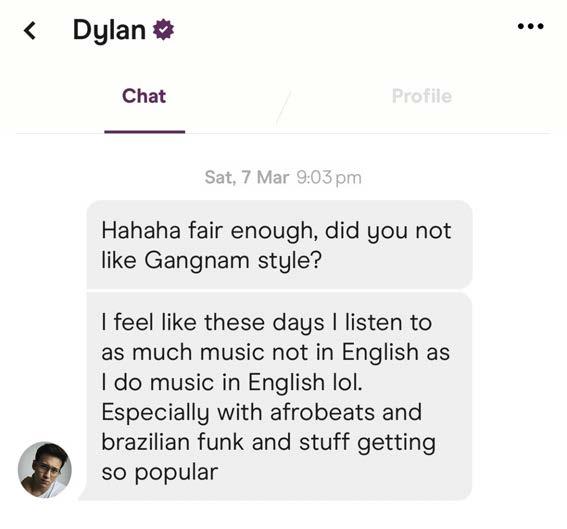
Being on the apps is an unsettling experience for most. For me, visibly Asian, there’s always a question lurking at the back of my mind as I pore over likes from non-Asian guys: innocuous or fetishising ?
It surfaces whenever I scroll past declared interests in anime, kimchi, or trips to Japan. The alarm bells get louder if he’s into martial arts or asks me if I liked Gangnam Style. And sometimes I am not expecting it — like the guy who sent me a voice note in Mandarin asking how my evening was.
Like most people of colour who have gone through Western schooling, the awareness of being different starts early. Many children of immigrants grow up speaking another language at home. Then, from a young age, we learn to scrub any trace of an accent from our voices, and eventually often lose the first languages we were taught.
We also start to adopt the things that our white peers enjoy: their music, movies, and sports. After all, even though we cannot look like them, we can at least sound like them.
And the closer we sound, the more doors open for us — inside jokes, friendships, parties, acknowledgements that we belong.
So, when a guy on a dating app hints that he likes me because I’m Asian, it’s not just a reminder that he doesn’t see me as an individual, but also that my difference is still the only thing some people see.
None of this will be shocking to any person of colour who has grown up in this country. What I have found more insidious and disturbing is how I have come to value whiteness.
Assimilation has created lasting damage in the way that I see race, and who I see as desirable.
When you grow up surrounded by images where white people are not only the default standard of attractiveness, but also the overwhelming examples of success and authority, you develop a hierarchy of desire that is highly racialised.
White guys are not necessarily at the top, but proximity to whiteness often is.
Most people are aware of the following pattern: the same media culture in the West that hypersexualises Asian women has desexualised Asian men. But Asian women (and often even non-Asian women) do desire Asian men, particularly those with certain markers of social status: a well-paying job in a traditionally white-coded
industry, an ease in white social spaces, the right height, the right accent, the right interests.
These dynamics are not helped by the long histories of racism and colourism within Asian communities themselves. In most Asian cultures, lighter skin has always been valued over darker skin — a preference that predates Western influence and carries its own complex histories of class and status.
These values are pervasive and have been brought to their diaspora communities by immigrants. When they collide with racial hierarchies in the West, you can see how it might be natural for Asians to place a preference for white partners at the top.
For me, there is also a deep irony in all of this. Western anti - racist and feminist scholarship has given me concepts that help me recognise the hierarchies produced by Asian cultures. At the same time, consuming these ideas through a Western lens has reinforced for me that real authority, even on my own experiences, still lives in white voices and white spaces.

It has produced a fair amount of hatred and shame of my otherness — and a tendency to recoil from men who remind me of the most unpalatable parts of my culture. Which is why, when I am asked what my type is, I find myself wondering how much of my type has been shaped by a rejection of otherness — and how much by a genuine revulsion of conservative values?
A 2020 study of dating patterns found that the specific traits people list as essential in an ideal partner have little predictive power for who they’re actually attracted to. People are drawn to positive and worth wanting. So, if it can be learned, it can also be unlearned.
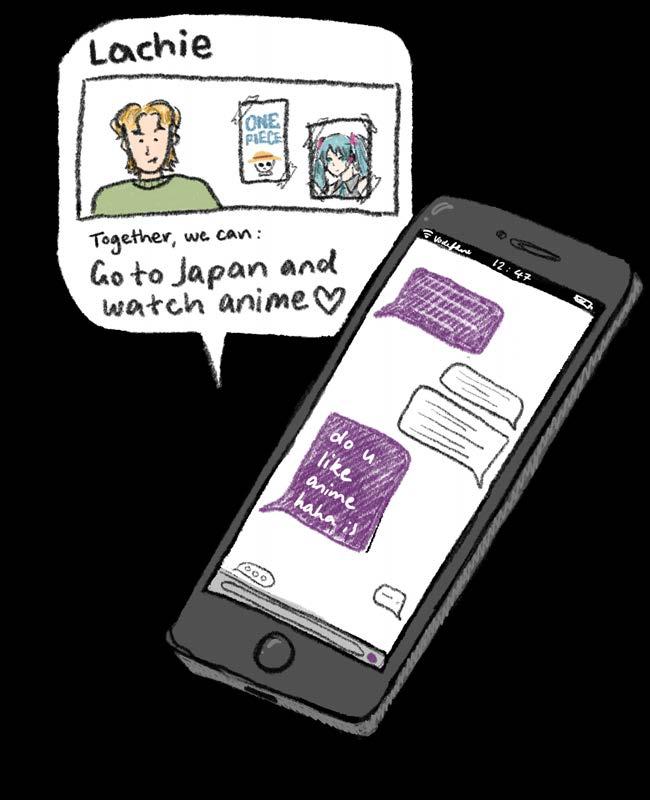
Marc Paniza smiled and nodded.
Last Christmas, the table was covered in the usual spread: lechon, pancit, lumpia, and enough rice to feed a second family. Everyone was talking, the way everyone always talks at these things - half in English, half in Tagalogvolume steadily rising. Then, mid-conversation, a family friend turned to me and asked whether I’d assimilated into Australian culture. Before I could answer, he answered for me. Filipinos, he said, are the “good ones.” We don’t cause trouble. We respect the culture. We assimilate.
A white man telling me, over my family’s food, which immigrants deserve to be here. He meant it as a compliment. I smiled and nodded, the way you do when someone says something so loaded you’d need a whole essay to unpack it, and you’re three plates deep into a noche buena spread.
I’ve been thinking about that comment ever since, not because it was shocking, but because it felt so unremarkable. I’d heard versions of it my entire life. Filipinos are hardworking. Filipinos are polite. Filipinos are grateful to be here.
It’s the model minority myth dressed up as dinner-table pleasantries, and it comes with a condition that nobody states outright: you are welcome here so long as you make yourself digestible. Palatable. Easy to swallow.
So long as you perform proximity to whiteness convincingly enough that the people around you can forget, even briefly, that you’re not white.
A few weeks later, a reel came across my feed. A Filipina woman, posting a video with the caption: “When dating a foreigner makes people think you’re after his money, but I’m really after his… GENES.” The reveal: blue eyes, a sharper nose. The post caption: “Blue eyes, nose….” The comments
were full of heart emojis and “goals.” Nobody flinched.
I didn’t flinch at first either because I grew up in a household where this was completely normal. My own mother used to talk about wanting to “give” me a sibling with blue eyes. She wasn’t joking. It wasn’t ironic.
It was aspirational, said with the same tone you’d use when talking about a dream holiday or a promotion. Lighter skin, a taller nose, coloured eyes: these were things you could want for your children in the same way you’d want them to go to a good school. An upgrade.
This isn’t a quirk of my family.
In the Philippines, proximity to whiteness has been a political category for centuries.
Under Spanish colonialism, the racial caste system didn’t just rank people by skin colour for aesthetics. It determined your tax obligations, your property rights, and your access to education and institutional power. Mestizos and mestizas, those of mixed European and Filipino descent, were elevated into a distinct social class, structurally above indios in the colonial hierarchy. To be mestizo meant access. To be mestizo was to matter.
Lightness wasn’t beautiful. It was useful. It gave you things that darker-skinned Filipinos were locked out of, and it was written into the architecture of governance itself.
Three hundred years of Spanish rule, followed by decades of American colonial “benevolent assimilation,” and this mestizo logic didn’t disappear when the Philippines gained independence.
It just migrated. It moved into beauty standards, into skinwhitening industries worth billions across Southeast Asia, into the way Filipino families talk about desirable partners and desirable children. The mestiza is still the aspirational figure: lighter, mixed, closer to whiteness. And this logic followed the diaspora.
It sat at my Christmas dinner table.
It showed up on my TikTok feed.
What strikes me is how the family friend’s compliment and the reel creator’s celebration are doing the same thing from different directions. One is granted from the outside: a white man deciding that Filipinos have earned their place because they behave well enough; the other comes from within: a Filipina celebrating the opportunity to breed whiteness into her children.
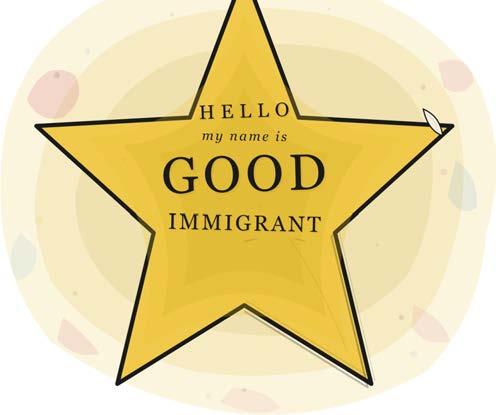
One is the cultural bargain, the other is the biological version. Both rest on the same unspoken premise: that whiteness is the default you’re supposed to be working toward, whether through your conduct or your bloodline.
As Goenpul scholar Aileen Moreton-Robinson argues in The White Possessive, Australia’s sovereignty is constituted through whiteness. The settler-colonial state evaluates everyone, Indigenous peoples and migrants alike, based on their proximity to it. The White Australia Policy didn’t vanish in 1973. It softened into something more palatable: pointsbased immigration systems, “cultural fit” rhetoric, and a tiered hierarchy of desirable and undesirable migrants. My family friend reproduced this hierarchy at the dinner table, sorting us into the category of migrants who cooperate with the project of white possession rather than threatening it. That being Filipino was being one of the “good ones”.
And then, every so often, the quiet part slips out. Whether it’s carelessness or calculation is almost beside the point. American Eagle runs a campaign starring Sydney Sweeney with the tagline “great genes,” leaning on the jeans/ genes pun just enough to maintain plausible deniability while selling white phenotype as an aspirational brand value. Did someone in a boardroom not think about it, or did they think about it and decide it would sell? Either way, the logic does its work. And then there are the moments where there’s no ambiguity at all: neo-Nazi movements surging across the country and across stating openly what the reel implies and the ad winks at.
I don’t think the reel creator or my mother are white supremacists. That would be a lazy and dishonest argument.
But I do think they are participating - willingly and in some cases joyfully - in a system that was designed to serve white supremacist ends. And the family friend who told me Filipinos are the “good ones”? He probably isn’t one either. But he didn’t need to be. He was just doing what the system asks of white people: deciding which of us deserve to be here based on how well we perform proximity to him. The genius of it is that the system doesn’t need everyone to be ideologically committed. It just needs people to keep wanting lighter children, keep praising assimilation, and keep buying the jeans. The work gets done without anyone having to say what they actually mean.
I think about my mum’s blueeyed baby fantasy sometimes and wonder what she was really asking for. Not beauty, I don’t think.
Mobility.
A child who wouldn’t have to perform the “good immigrant” routine as hard as she did. A child whose proximity to whiteness would be written on their face so they wouldn’t have to earn it through behaviour every single day.
That’s the cruellest part of the bargain. It makes complete sense. And it was never supposed to.
The Ethnocultural Space, also known as Ethnospace or simply ‘Ethno’, is a small room on the ground floor of Manning House.
Dedicated to people who identify as Black, Indigenous, or a “person of colour”, it is one of the four autonomous spaces on campus, also including the Women’s Space, Queer Space, and Khanh Tran Room (formerly known as the Disabilities Community Room).
It acts as a third place for students to hang out, take a quick nap, have a study session, and meet new people between classes. Ethnospace has also been used for various events, including Iftaars and crafternoons by ethnocultural societies.
Ethno provides a unique comfort of community like no other place on campus. There is nowhere else quite like it, where you can grieve over the horrors of the world with others with whom you have such an intense affinity. I interviewed three such people.
E is a Bachelor of Social Work graduate. I met them when they would pop in for no more than two minutes a day to drop off their volleyball, and both of us would walk around the fact that we forgot each other’s names.
Sahar is a science student who also went to the same school as my best friend. We now work together in a Western Sydney community organisation.
Pim is studying a Bachelor of Arts. We originally met in the Great Hall when I was their Peer Mentor. We lost contact after a while, until, to my surprise, they
got involved in the Autonomous Collective Against Racism (ACAR).
They are now one of the convenors.
K: How did you find out about Ethnospace?
E: I got to Ethno the year that it popped up next to Queerspace. I only found out about it because it was right next door, so it was fairly easy to find, and I just poked my head in.
S: I visited Ethno in my first year, in my first week of uni. My friend introduced me to it, and it just became my default hangout space and a place to feel safe from potential racism and microaggressions.
P: I found out through the ACAR Welcome Dinner last year. I met heaps of members and awkwardly tried to socialise with strangers over pizza and cold curry.
K: What brings you back to Ethnospace?
E: I have met so many fun people at Ethno, and I learn more about ACAR and QOCO there, too! In a degree with a lot of white students, it’s a really great break from it all.
S: Ethno is quiet and peaceful. It’s a safe space to pray and just be. Plus, I love that I can sit on the floor without judgment lol.
P: I discovered it wasn’t just a meeting space for ACAR; it’s for all people of colour to relax, try to get work done (emphasis on try), procrastinate work, and sleep in between classes.
K: Tell me about some of the friendships and communities you’ve forged through Ethno.
S: I met all of ACAR in Ethno! Also QOCO. I’ve shared food with random people there (they had some awesome chicken). Overall, everyone, there is a sweetie.
P: Whenever you’re in Ethno, you end up seeing the same people at the same time every week. I love connecting with people over random stuff, like the collective heartbreak over the mirror that everyone really loved. That goes to show the kind of bonding that occurs in that space. It’s nice to have a comforting space. That’s why it’s really special.
K: Do you have any sweet moments from Ethnospace?
E: One time, I was napping in Ethno with other people there, and I was asleep when they left, but they turned the light off for me, and that was really nice!
S: One time, a bunch of us were blowing bubbles and popping them! It was a good break from the hectic world of uni assignments and the world crumbling before me.
P: It’s just all the little moments! The comfort you get from the community of
Kayla Hill discovers a gem within Manning.
the people that visit, getting offered food and drinks, chatting about your lives and the bad classes you have. It’s a safe haven from the sterile lecture and tutorial rooms. I can’t think of one particular moment — thinking of Ethno inherently brings a warm feeling to me!
K: Any final comments?
E: Ethno is just a really nice place to be in. It’s got good vibes, comfy spots and is just an overall good hangout spot to meet new and old friends!
S: BRING BACK THE MIRROR!!!! Also, some floor cushions. I know that’s not really a comment, but JUST BRING IT BACK!
P: Unfortunately, the mirror was smashed. Not by me, though, promise!
K: Do you have anything to say about my book that got stolen from Ethno?
S: Whoever stole that book is homophobic, misogynistic, and racist.
P: I’m very sorry for your loss.
by Kayla Hill
1st Prize (Fiction & Non-Fiction) $2000
2nd Prize (Fiction & Non-Fiction) $700
3rd Prize (Fiction & Non-Fiction) $250
Editors Choice(Fiction & Non-Fiction) $50
All Sydney Uni students are invited to enter a fiction or non-fiction piece (or both) on the 2025 theme ‘CRISIS /CATHARSIS’
Entries close Monday April 13!

President Grace Street (Grassroots)
Welcome to Week 5!
This is the fourth year in a row that the Autonomous Collective Against Racism and SRC have hosted Israeli Apartheid Week on campus, which I am very proud to have been a part of since 2024. From 21–30 March 2026 there will be events and stalls focused on the global theme of “Palestine Frees Us All,” looking more specifically at our local USyd context about boycotts and divestments at universities, and also coinciding with the launch of ACAR Honi Soit this Wednesday! Check out the full program on our Instagram.
particularly emphasising that students need safe and affordable student housing provided by the University. After a few months of me bringing this up at every possible meeting with the University Executive, they have indicated that an announcement about the future of International House will be out soon.
Last week, I spent a lot of time doing the back end side of the President role – going to the bank, going through the audit of our 2025 expenditure, brainstorming with staff in the March committee meeting, tying up some loose ends of our SRC Enterprise Agreement, and working on our 2025 SSAF Acquittal. It’s not so glamorous, but very important.
I also went to the March Senate meeting with student leaders from the USU, SUPRA and Sydney Uni Sport to answer questions from the Senate fellows about our organisations, our achievements, and improving the student experience. I made the case for increasing support of our SRC Legal department and
The past few weeks have been ramping up, with your two fav General Secretaries, Vince and Ava, keeping incredibly busy. We’ve been hard at work on the acquittal (a kind of analysis and explanation for our funding across the year so we can continue being funded) and are now in the final stages.
We both attended the Student Strike for Palestine on Wednesday the 11th of March. The turnout was fantastic, with many high school students and high-school-aged speakers standing up against genocide. It was inspiring to hear young students emphasise their stance against imperialism and speak out for peace and humanity.
By the time this reaches you in Week 5, Israeli Apartheid Week will be in full swing.
Week 5! I have been working with the International Student Collective to draw more attention to the doubling in price of the Subclass 485 Temporary Graduate Visa.
There has yet been a government response further explaining the rationale behind this increase, which has very much blindsided both undergraduate and postgraduate students planning to stay in Australia.
This disgraceful government move further exacerbates the cost of living for international students while also sending
The SRC and students must be part of these conversations to make sure that the housing the University provides is both the right quality and quantity and provides safety and community for students, not solely a bed to sleep on and a roof over their head. I also gave some input into the University’s AI Strategic Direction and its ethical responsibilities, which I will speak more about soon.
Our vaccination dates and sign-ups will hopefully be out by the time you are reading this. Make sure to register soon and keep an eye out for a human-sized syringe costume floating around campus in coming weeks…
Also, be sure to check out and submit your expression of interest for Students 4 BDS on page 22. Students are mobilising around apartheid divestment campaigns against the USU, and it’s an opportunity for new and experienced activists alike to get involved.
In solidarity, Grace
Vince Tafea (Grassroots)
Ava Cavalerie (NSWLS)
Radical Education Week is being planned for Semester 2. If you’d like to see anything specific or get involved, don’t hesitate to reach out at: general.secretary@src.usyd.edu.au.
RadEd Week will likely coincide with the staff strikes. Together, we’ll work to raise awareness of how the quality of our education is directly tied to the working conditions of our lecturers and teachers.
You and your teachers deserve fair pay and a real chance to thrive!
Get excited for all the events coming up this year. Stand with your tutors and lecturers. And good luck with your studies!
In solidarity, Vince & Ava xxx
Bohao Zhang (Penta)
Shovan Bhattarai (SAlt)
a message that international students are simply not welcome to stay.
Just last week, the International Student Collective released a video on RedNote explaining and raising awareness about this price increase.
Last week, I also worked with the Collective to host a Welcome to the Collective event through RedNote. We plan to do one soon on Instagram @usyd_ international -- please stay tuned!
In solidarity, Bohao
Hello everyone,
We’re your Disabilities Officers! DisCo has been BUSY this semester.
You might have seen us in February at the Conservatorium Welcome or USU Welcome Fest, where we gave out SRC tote bags, Accessibility Handbooks, and DisCo t-shirts with artwork made in an ode to disability activist Alice Wong.
During Welcome Week, Kayla also attended NSW Parliament for the Clean Indoor Air Inquiry hearing. Long story short, the air at USyd is fucked. Between mold, abysmal ventilation, and chemicals, there are serious risks wherever you are on campus.
Sickness should not be inevitable by virtue of literally just breathing at university. We’re currently working to get air-conditioning and air-purifiers installed in more rooms on campus.
Many people in the university community are currently sick. To protect yourself and others, you can access DisCo’s mask bloc, which distributes respirator masks to anyone in the university community.
Hi there! Thank you so much for reading ACAR Honi, especially the reports! If you haven’t yet read the Editorial, please go back to page 2, which covers a lot of what we usually talk about here. In addition to that, please attend any of our Israeli Apartheid Week events if you have the time! On Tuesday the 24th, we had our BDS 101 talk where Dr Nick Reimer, a staunch activist for academic boycott and the Vice-President (Academic) of the USyd branch of the National Tertiary Education Union (NTEU), as well as a stall raising awareness about the genocide in Gaza and the USU’s complicity in apartheid through their partnerships with friends of the ‘israeli’ state.
If you are reading this on the 25th (Wednesday), please come by to our launch celebrating this edition of
Kayla
You can request some via our Instagram (@usyddisabilities).
We also stock some masks in the autonomous spaces in Manning. Additionally, DisCo has recently introduced Rapid Antigen Tests (RATs) to its resource distribution. RATs can be collected at the SRC Office Tuesdays to Thursdays from 9am to 5pm.
Get vaxxed before flu season hits! We’re currently organising a flu vaccination scheme available for the entire undergraduate student body. Keep watch of the SRC Instagram, posters around campus, and some interesting stunts on Eastern Avenue…
For access to the Khanh Tran Room — the Disabilities Community Room — fill out the form in our Instagram bio @usyddisabilities.
If you’re disabled and interested in organising around disability justice, come along to our meetings which run fortnightly on Thursdays at 1pm. Details are available on our Instagram.
Your sick comrades, Kayla and Remy
Imane Lattab (Grassroots)
Pimala Leo (Grassroots)
the newspaper you are holding right now! It will start at 5pm, and there will be a bar tab and free food, while raising money for mutual aid (check out page 2 if you don’t know what that is). The following day, there will be a speakout on the Quad Lawns at 1pm against USyd’s refusal to cut ties with ‘israeli’ universities, which are embedded in the the colonial violence and illegal occupation perpetuated by the ‘Israeli’ Occupation Forces against Palestinians.
Lastly, please keep your eyes out for more updates and events regarding our divestment campaigns. We can only organise so many things, but if everyone comes together to fight for anti-racist causes, we can prompt good change so much more quickly.
Jaseena Al-Helo, April Howison, Emma Searle, Eva Sutherland
Social Justice Office Bearers have not submitted a report.
I’m back for another year as AKAR convenor and unfortunately, I remain the only autonomous Kayla against racism.
Everybody get more kaylacore NOW! Up the whimsy, start pink-maxxing, and shoutout to the pandan hot cross buns at Miss Sina. For enquiries, please don’t stop me to chat on Eastern Avenue. I’m overheating.

The University defines contract cheating as getting someone to complete part or all of your
• assessment (hand in or exam). This includes:
• buying an assignment from a tutoring company;
• having a friend complete some of your assessment;
• having someone coach you through an assessment;
• using a model answer from a tutoring website or social media (e.g., facebook or wechat);
• uploading or downloading lecture notes, assignments or exams to an information sharing site, e.g., CourseHero, Github, CHEGG;
• getting someone to do your exam; or
• •submitting an assessment which has been generated in whole or part by artificial intelligence, including ChatGPT.
Is it serious?
The University considers contract cheating very seriously. It puts your integrity and the integrity of your course at risk. It could lead to you being suspended or excluded from your degree. It also leaves you vulnerable to blackmail in the future, where we have seen some students being threatened with being exposed to the University, family, or future employers, if they did not pay an ongoing “fee”.
How can you get help for your assessments?
If you need help with your
assessments the best place to start is with your uni tutor or lecturer. Ask them to clarify information you do not fully understand. Tell them if you are using external the websites or tutoring supports to check if they are allowed. If you are in any facebook or wechat groups for your subjects, do not use any answers to assessment questions that are published, nor should you share any answers or course notes. Be aware that most of those groups have members who pretend to be students but are contract cheaters. If you are using a site like Github, make sure your settings are not public. It is extremely likely that anytime you use sites like CHEGG or CourseHero, that you will be accused of contract cheating, so it is best to completely avoid these sites. If you are working with another student on an assignment only talk generally about the concepts, rather than specifically discussing the structure or content of your assignment. Do not make notes while you talk. Do not give them a copy of your assignment or take a copy of theirs. Do not leave your laptop unattended in the library or learning hub. What if you are accused of academic dishonesty or student misconduct?
SRC Caseworkers offer a free and confidential service that is independent of the University and can help you to respond to allegations of academic dishonesty or student misconduct. Contact an SRC caseworker (bit.ly/ SRCcaseworker) and send them a copy of the allegation letter.
Dear Abe, I get Youth Allowance. I’m currently doing 4 subjects but I want to drop to 3. Do I need to tell Centrelink? Will they cut me off?
Thanks, YA Cut Off.

Dear YA Cut Off,
Yes, it is always a good idea to tell Centrelink whenever your circumstances have changed. For example, if you drop a subject, move house, or get a new job. You will still be full time so it will not change your payment. If you were dropping to part time you would no longer be eligible for that payment and you would need to talk to a caseworker to see what your options were.
Thanks, Abe
For more information about dealing with Centrelink, read our “Navigating Centrelink” Article. Scan the QR code:

If you need help from an SRC Caseworker start an enquiry on our Caseworker Contact Form: bit.ly/contact-a-caseworker

To discontinue a subject and avoid a fail grade the Semester 1 CENSUS DATE is March 31
Make sure you know the rules for discontinuing a subject. Contact an SRC Caseworker if you need help


2. Coalition who decides things you go ‘girl, the boycott’ to; acronym (3)
4. Phrase for pig hatred (4)
6. The Battle of __ (7)
7. Arabic word Chris Minns hates; shaking off (8)
8. Egypt, Morocco, Palestine, Syria, etc. region acronym (5)
10. I’m not ____, I’m Phoenician (4)
11. Original model for Medicare; acronym (3)
12. Many of them create a plague (6)
14. White people are oddly obsessed with this (8)
18. Decolonial identity term coined by Destiny Deacon; __ Lik Mi (4)
19. Green area for 24/7 university protest (4)
20. Chocolate bar (4)
22. Agamben’s man (5)
24. A feeling drawn out by incompetence; frustration (3)
25. Muslim dowry (4)
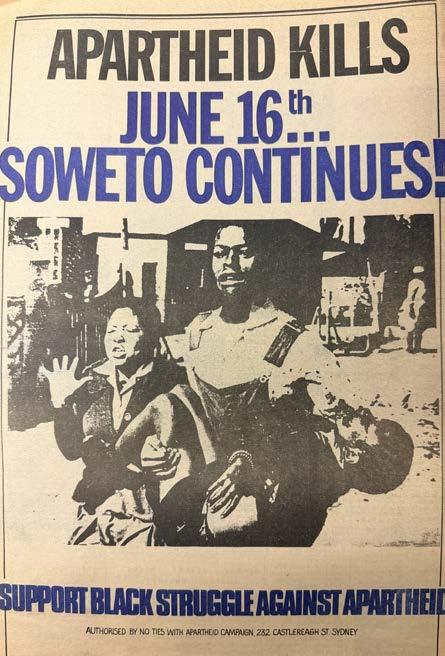
1. Document negotiated by unions; acronym (3)
3. One of the world’s most militarised zones. Free her (7)
5. Paper tigers (13)
9. A chronically late person gets asked info about this often; acronym (3)
11. The collective behind this edition (4)
12. Symptom for “actual”; shortened (5)
13. Up the ___ (3)
15. Poor man’s aircon (3)
16. Salt-water body (3)
17. Not actually woke public broadcaster (3)
18. Movement for Black rights (3)
21. South-East Asian democratic republic (4)
23. Some cultures actually see this passing concept as circular (4)
26. “Revolt” in Arabic (6)
27. What you do to get sense into somebody (5)
28. Mahmoud Darwish says it has what makes life worth living (5)
29. Decolonial psychiatrist (5)
30. Daft Punk’s ‘Around the World’; associated with 8 across when in verb form (6)
Who are Students 4 BDS?
We are a burgeoning grassroots movement of students in Sydney who see BDS as an important campaign to mobilise around. Like many grassroots BDS movements across the world, we have identified a role we can play to pressure our university institutions into adopting BDS as policy.
What is our current focus? (USyd)
The University of Sydney Union (USU) is a student run organisation with democratically elected candidates. We need to do our part in holding them accountable to their election promises, and that includes BDS.
With BDS target Coca Cola getting a DJ set and beach chairs in front of the quad during 2026 Welcome Week, it appears that Israeli apartheid isn’t high on the list of the USU board’s concerns. McDonalds has also been seen across campus in advertisements
Who can join?
All students from universities across Sydney! However, the nucleus of us are at the University of Sydney (USyd) and our USU focused campaign reflects this. We hope to plant seeds of skill sharing and foster cross campus collaboration soon (We have established contact with UNSW students and organisations).
I’ve never done something like this...
It can feel like a big step, but all of us are regular people just like you that got involved by a desire to make a change



In a completely expected turn of events, an Israeli Settler has forcefully colonised ACAR Honi. For legal and social cohesion reasons, we are obliged to wait 78+ editions to respond or risk being arrested. @vincetafeamemes reports.
Izzy Rae Lee occupies your thoughts.
Izzy: Images of this child is bad for my psycho-social health.
Vince: It’s a symbol of the exiled Palestinian people who were forcefully expelled during the many Nakbas since 1948.
Izzy: It’s war. Bad things happen all the time.
Vince: Okay... that doesn’t give a blank check for war crimes.
Izzy: What do you propose?
Vince: Justice. Allow them to return to their ancestral homes.

Izzy: No, I’m quite comfortable. It’s some nice oriental architecture.
1) Do you condemn khamas?
a) Yes, especially khamas babies
b) Isn’t that the nice sauce from el jannah?
c) Unsure what utility there is in condemning dispossessed orphans that grew up in a concentration camp. All they have ever seen is colonial violence and brutality through Israel “mowing the lawn,” terroristic IDF incursions, and now an actively perpetrated genocide.
2) Do you love Israel?
a) Am Apartheid Chai
b) I’ve never been
c) I don’t tend to love ethnosupremacist apartheid settler colonies. So, no.
3) Aussie, Aussie, Aussie, ____________
a) Thank you Bibi! Thank you Bibi!
b) oi oi oi?
c) I wouldn’t say that. Cringe bruh.
C. Minns is racist
Look, bullshit ‘social cohesion’ aside, there have been calls from within my racist pinhead skull that this is something we might need. Students have been saying Islamic words like ‘mashallah’ ‘inshallah’ and ‘intifada’ and they are unleashing forces they cannot control. That is, the forces of Allah and the arc of history that bends towards justice and the liberation of all those oppressed. I commend the NSW Police in helping fight this.

4) What is Boycotts, Divestments, Sanctions (BDS) to you?
a) khamas propaganda
b) Unsure. That’s like economics?
c) A grassroots movement to pressure ‘Israel’ into complying with international law which includes but is not exclusive to ending it’s illegal occupation, and enabling the Palestinian Right of Return.
If you selected (a) the most, then you are the prototypical Tel Aviv DJ. You enjoy shitty techno music and won’t let being in the zone of interest with a genocide being carried out 40 miles away worry you. In fact, you lamenting that “it’s so sad when civilians die” whilst simultaneously believing that there are “no innocents in Gaza” perfectly synchronise.
If you selected (b) the most, then you are a sheltered white dude from the north shore with no musical talent. You don’t get “into politics” and you’ve tried your hand at DJ like many of your ilk to zero effect.
If you selected (c) the most, then you are an extremely sexy, beautiful, talented musician with a keen awareness of both the political & economic state of the world and music. When you do DJ sets, you control the dancefloor. However, the NSW Police is simultaneously trying to control you and your free speech. Free DJ Haram
FARNHAM GETS BANNED Queens Land disappoints all fans of 80s easy listening.
The ban on the John Farnham song, “Two Strong Hearts,” featuring the line, “We’ve got two strong hearts / Reaching out forever like a river to the sea / Running free” has put his fans in distress, disproportionately affecting music people over the age of 60. A legion of grandmas have started a campaign to revoke the ban.

First and foremost, I would like to acknowledge that I have been on an extended hiatus. This was for personal reasons, which I will not be elaborating on, though I will say that the past several months have been a period of significant reflection, and that ketamine is not a substitute for genuine work-life balance, no matter what the Barangaroo crowd tells you.
As the SRC’s first-ever Palantir Officer — a portfolio I proposed, designed, and was unanimously elected to uncontested — I am proud to report a highly productive semester. I have onboarded two (2) government clients, optimised the metadata pipeline for NSW Police’s predictive policing algorithm, and attended several very informative lunches. Expenses forthcoming.
I would like to remind students that the datasharing agreement with Palantir is entirely routine and that any concerns about surveillance of pro-Palestine activists on campus are being managed through appropriate channels, which I cannot disclose for legal and social cohesion reasons.
I have also established a working group to determine whether BDS constitutes a compliance risk. The working group has found that it does.
Running as an independent was the right call. No further questions.
— Harry the Consultant, SRC Palantir Officer