

The Squirrel Hill Urban Coalition gives voice to the hopes and concerns of our residents, institutions, businesses and visitors and works to preserve, improve, and celebrate the quality of life in our vibrant urban Squirrel Hill neighborhood.
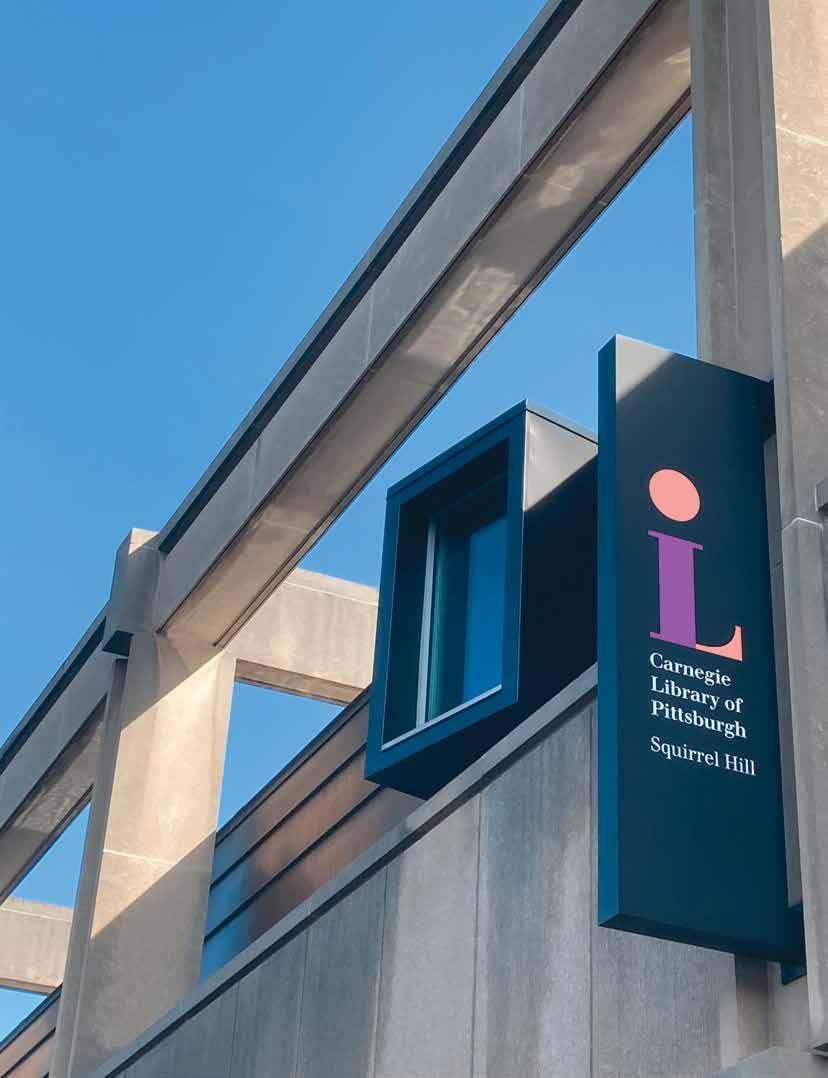
ON THE COVER: The Carnegie Library –Squirrel Hill is a nexus for readers and writers in Squirrel Hill. Photo by Melissa Eppihimer.
FOR ADVERTISING INQUIRIES
Contact marketing@shuc.org.
FOR ALL OTHER MAGAZINE COMMUNICATIONS Contact editor@shuc.org or (412) 422-7666.
Is it too self-serving to choose the theme “Writers and Their Worlds” for a magazine? I sure hope not!
In this issue we direct your attention to people whose words present the news, history, and cultures of Squirrel Hill, as well as the places that make their work possible (both practically, like the library, and habitually, like coffee shops).
Our coverage can only scratch the surface of the writers in the neighborhood, and that itself proves how vital writing is to our community. But if there’s a Squirrel Hill podcaster we should know about, I’m all ears!
MELISSA EPPIHIMER
Editor, Squirrel Hill Magazine
SQUIRREL HILL URBAN COALITION OFFICERS
PRESIDENT Dalia Belinkoff
VICE PRESIDENT Lisa Murphy
VICE PRESIDENT Erik Wagner
SECRETARY Raymond N. Baum
TREASURER Justin Berk
IMMEDIATE PAST PRESIDENT Mardi Isler
BOARD OF DIRECTORS
Guy Costa, Jacquelyn Cynkar, Lori Fitzgerald, Natalie Hall, Marshall Hershberg, Melissa Hiller, Martha Isler, Jeremy Kazzaz, Rachel Lecrone, Karen Ooserhouse, Vida Passero, Rivkee Rudolph, Mary Shaw, Lisa Steindel, David Vatz
The Squirrel Hill Magazine is a publication produced by the Squirrel Hill Urban Coalition (SHUC), a nonprofit organization. As a non-profit 501(c)(3) organization, donations to SHUC are tax-exempt, and SHUC complies with all 501(c)(3) rules and regulations.
CONTRIBUTORS
Dalia Belinkoff, Scott Bluman, Maria Cohen, Melissa Eppihimer, Lawrence Gerson, Linda Gruskiewicz, Mardi Isler, Kimberly Kweder, Helen Wilson
EDITOR Melissa Eppihimer
DESIGNER Karen A. DeTurck
EXECUTIVE DIRECTOR Maria H. Cohen
Squirrel Hill Magazine, Vol. 24, Issue 1, is provided by the Squirrel Hill Urban Coalition as a free publication for the residents and businesses in the 15217 zip code. Subscriptions are available for $25/year. No portion of this magazine may be reproduced without permission.




By Dalia Belinkoff, SHUC Board President
HELLO SQUIRREL HILL,
AS I WRITE THIS, I’M APPRECIATING THE SUNLIGHT AND THE SNOW ON THE TREES—but I am less enchanted with the temperature outside and the lack of parking spaces on the street. How about you? How did you manage this winter?
The SHUC Board of Directors recently held elections for officers of the Board. The 2026 officers are: Ray Baum, Secretary; Erik Wagner, Vice President; Lisa Murphy, Vice President; and me, Dalia Belinkoff, President. Each of us continues in our position from 2025. Justin Berk is newly serving as Treasurer.
As I step into this new year of executive responsibilities, I thought I would take a moment to review what SHUC has been doing over the past year, both to give you a clearer picture of our work and to remind myself just how much happens behind the scenes.
The Board meets once a month, except for July and December. The Executive Committee meets one week beforehand. As President, I chair both—setting the agenda with our Executive Director, guiding discussion, and, when needed, acting as a cheerleader.
Are Board meetings interesting? Yes! The thoughtfulness and expertise of the Board are always evident. New ideas surface, discussion is thorough, and, yes, there is sometimes drama. Our meetings are open to the public, and community members can be passionate and, shall we say, outspoken.

We also host visitors from the City and from outside organizations who bring new ideas and information. Recently, we learned about the City’s plans for EV charging stations, which sparked a thoughtful discussion about where those chargers could and should be located in Squirrel Hill. At another meeting, AARP introduced us to “walk audits,” which could help us secure a $2,500 grant to improve walkability in our neighborhood.
A great deal of SHUC’s work involves weighing in— thoughtfully and publicly—on issues that affect Squirrel Hill. Over the past year, we’ve written letters on transportation changes, development projects, public safety, and
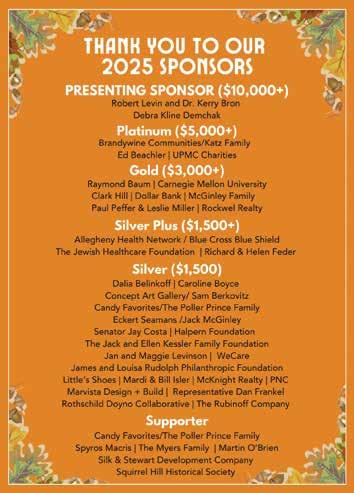
SHUC would like to thank the following sponsors
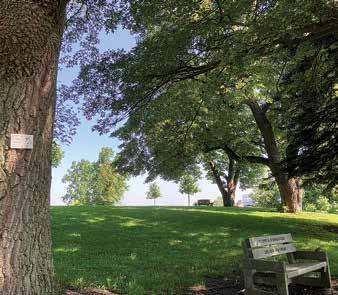
preservation, including proposed PRT bus route changes, outdoor lighting at Congregation Poale Zedeck, permanent tree tags in Mellon Park, and infrastructure decisions affecting CMU’s new R.K. Mellon Building on Forbes Avenue. Each letter needs—and receives—careful discussion and a considered point of view.
Money matters, as they say. SHUC exists entirely on donations. That’s why you receive a fundraising letter from me twice a year, and why the Treasure Dinner Committee works so hard to secure sponsorships. We also seek grants to support projects that strengthen our neighborhood.
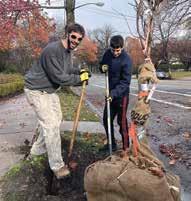
One of the grants I’m most excited about involves planting trees along Beechwood Boulevard. It may sound modest at first, but in fact, it’s transformational. Over the years, and especially after last year’s windstorm, Beechwood’s tree canopy has been badly damaged. These new trees will help restore that canopy and revive Beechwood Boulevard’s original vision as a Gilded Age carriageway connecting Schenley Park to Frick Park and Highland Park. Thanks to this grant—and in collaboration with the City Forestry department and other partners—we’ve already planted some 50 trees. And yes, you can apply for a new tree on your street. Read more about this project elsewhere in this issue.
So, here’s my ask: get involved.
What I’ve described so far is only a snapshot of SHUC’s activities. Last year we also considered a sidewalk mosaic; supported historic register status for Schenley Park, Anathan House, and Robin Road; hosted development activities meetings about a project on Beeler Street; pushed back on proposed changes to Registered Community Organization legislation; and advocated for the continued value of parent and community voices as the School Board considers significant changes.
I could go on. The Community Garden is moving forward. Day of the Dead and Night Markets are coming.
So, here’s my ask: get involved.
Come to a meeting. Volunteer for a project. Join a committee—or simply show up to something that interests you. SHUC’s work is strongest when it reflects the ideas, energy, and voices of the people who live here.
Working together, we can make Squirrel Hill not just better, but more vibrant, welcoming, and beautiful. I hope you’ll be part of it.
of this issue of Squirrel Hill Magazine.
November 6, 2025
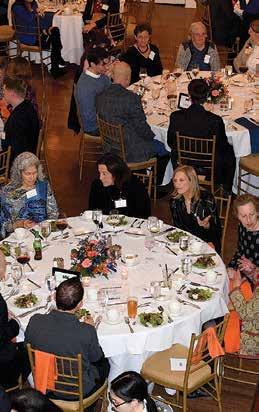
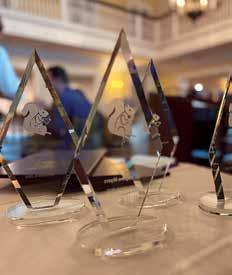
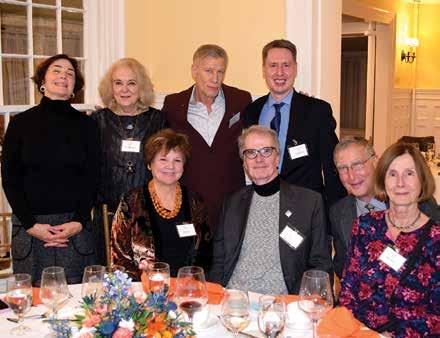
The Pittsburgh Golf Club
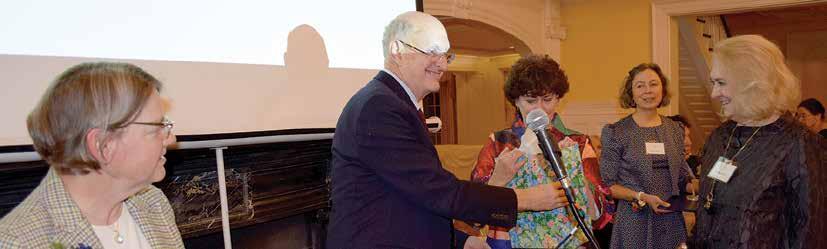
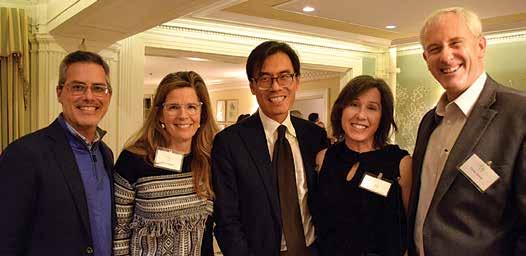
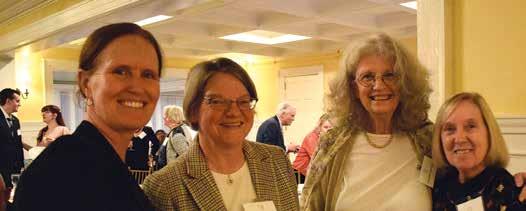
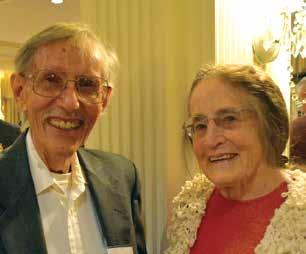
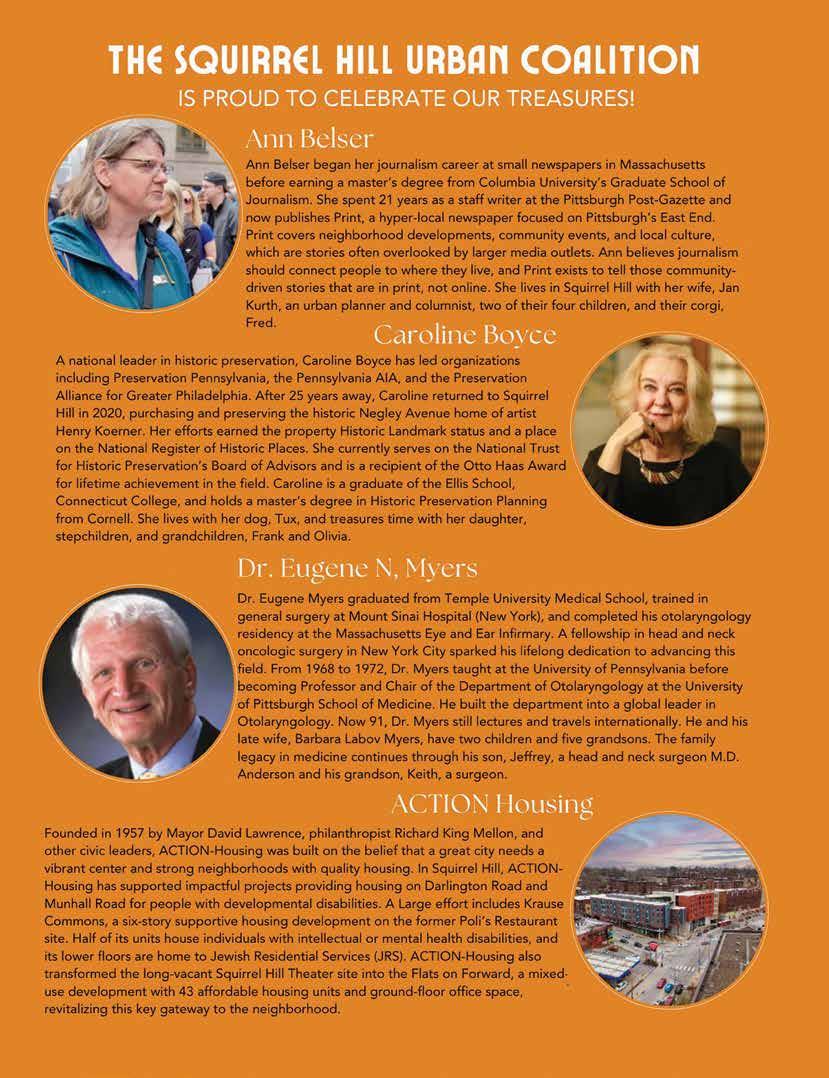
Stay tuned for the announcement of the 2026 Treasures!




By Linda Gruskiewicz
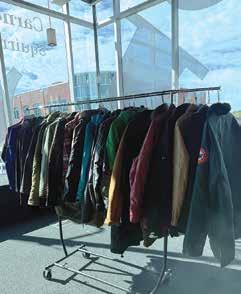
LAST FALL, THE CARNEGIE LIBRARY IN SQUIRREL HILL HOSTED A PROGRAM OFFERING INFORMATION, SERVICES, AND ESSENTIALS TO UNHOUSED INDIVIDUALS AND OTHERS IN NEED. Approximately 10 groups took part, including BigBurgh, Steel City Helping Hands, and SHUC. Hosting this type of community event is what Taylor Lee, Library Services Manager, Carnegie Library of Pittsburgh – Squirrel Hill, envisions for the future.
“I see the Library as host and facilitator of programs serving our patrons. We should be providing resources and removing barriers in areas of our expertise and in partnership with other community groups,” she explained.
It is the Library’s patrons who are her focus. Patrons are those who have used, are using, or will use the Library. There is no greater aspiration for Lee in her work life than to serve us patrons. She bases that service on experience—and data.
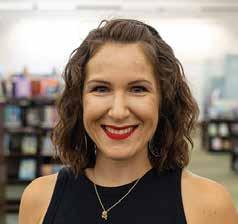
“We librarians love data,” Lee chuckles, although she is definitely serious. She wants to know what is working and where the gaps are. She knows that almost every single book in Squirrel Hill gets checked out at least once a year. She knows the history of the Library and likes that it came into being because of the community’s hard work. Her own history also is that of hard work.
Lee holds a BA in English Literature and a Master of Library and Information Science degree from the University of Pittsburgh. She began working while still in school, serving as Children and Youth Services Coordinator in Castle Shannon. Based on her experiences working with children in library systems, she was chosen to speak at the Pennsylvania Library Association’s 2018 conference on the topic “Poverty and Youth in Public Libraries.” She is currently on the Allegheny County EDI (Equity Diversity Inclusion) Committee. Other areas of accomplishment include marketing, labor relations, and supporting Freedom to Read, which ensures all individuals have access to information, while parents guide their children’s choices.
Lee is a parent herself. She and her husband, Chris, have three children: Atticus (10), Amira (5), and Aeris (1 ½). She is adamant about setting boundaries between her work life and her personal life. One of the most challenging times in her quest for balance came in 2020.
She had just returned from maternity leave. COVID-19 had taken hold. She describes the downtown at that time, where she was then working, as “a wasteland.” The libraries were not signing out books but were accepting returns. This involved bagging the returned books, leaving them for days, and then wiping them off. It also involved an increase in the unhoused population and the need for more referrals. She used her experience from past positions like that in the Wilkinsburg Public Library to make referrals. Her aptitude in this area continues to grow by “knowing organizations
where patrons can be referred for help or information.” That involves collaboration.
Internal as well as external collaborations are needed to be successful, according to Lee. She works with her colleagues throughout the Carnegie Library system to realize interconnected goals. They can be as simple as identifying
gaps in book topics. They can be more complex, and Lee is capable of offering her expertise on several of these projects. One is data analysis. (Remember “librarians love data.”) Another is the nontraditional use of libraries by young people.
She explains, “There is often a disconnect between youth, particularly youth from disadvantaged backgrounds, and libraries.” Although Lee and her staff team are in the process of developing their goals for 2026, outreach to local schools and other youth organizations will be included. Current programs offer a solid foundation on which to build. Storytime, STEM & Creativity, Reading Support, and Teen Time are just some of activities happening at the Squirrel Hill Library.
When asked about AI, Lee says she would love to have more computer training at the Library. Also on her wish list is a housing officer. The problem, she says, is money, and additional funding or major sponsors would be needed.
For now, Lee says her role will be that of a community connector. That is the same role as Paul Revere in Malcolm Gladwell’s The Tipping Point. She may not ride a horse through Squirrel Hill, but don’t be surprised if you hear by phone, email, or text from Taylor Lee.



$5.3M





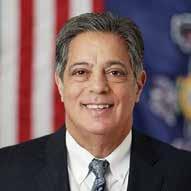
State and City Council Corner shares reports submitted by the elected members of Pittsburgh City Council and the Pennsylvania Legislature that represent Squirrel Hill.
Senator Costa’s office is proud to put money back in the pockets of Pennsylvanians by helping constituents apply for the Property Tax and Rent Rebate Program.
The Property Tax/Rent Rebate Program (PTRR) supports homeowners and renters across Pennsylvania. This program provides a rebate ranging from $380 to $1,000. The PTRR program benefits eligible Pennsylvanians age 65 and older; widows and widowers age 50 and older; and people with disabilities age 18 and older.
Eligible Pennsylvanians can now apply for this year’s rebate. Last year alone, the PTRR program delivered more than 512,000 rebates totaling $314 million to seniors, widows and widowers, and Pennsylvanians with disabilities who applied for a rebate on property taxes or rent paid in 2024.
For more information on how to apply for your PTRR, or for support submitting your application, you can make an appointment with Senator Costa’s office by calling 412-241-6690. You can also visit www.revenue. pa.gov or call 888-222-9190.
From Top to Bottom:
As your representative, Representative Frankel stands with immigrant communities and recognizes the urgent need for policies that protect public safety and uphold human dignity. Some law enforcement agencies across Pennsylvania – though none in the city of Pittsburgh – currently use state and local resources to enforce federal immigration laws through 287(g) agreements, partnerships that have repeatedly been shown to undermine, rather than enhance, community safety. Even the Pennsylvania State Police recognized this, limiting cooperation with federal immigration authorities in 2019. Representative Frankel supports legislation that would restrict law enforcement agencies from using state-appropriated funds to enforce federal immigration and formally enshrine the State Police’s policy of limited cooperation. This bill ensures that law enforcement can focus on their communities’ needs first, and that your tax dollars are not spent on federal efforts that have wrought far more disruption and fear than order or safety. Representative Frankel is committed to ensuring that our immigrant and other marginalized communities are safe, respected, and treated with dignity.
At the start of the year, Councilperson Erika Strassburger was sworn in for her third term on Pittsburgh City Council. She thanks the voters of District 8 and across the city for their continued trust and takes seriously the responsibility of serving another term.
She also congratulates Mayor Corey O’Connor on his election and welcomes Councilwoman Kim Salinetro to City Council. Councilperson Strassburger looks forward to working with the new administration and her Council colleagues in a collaborative way to address the city’s needs.
Since first taking office in 2018, Pittsburgh has faced rising costs, aging infrastructure, and difficult budget decisions. Over the past year in particular, those challenges required careful choices. Throughout this time, Councilperson Strassburger has remained focused on providing responsive constituent services and making decisions informed by community input.
Her office continues to work closely with residents, neighborhood groups, and city departments to address day-to-day concerns and improve quality of life across District 8 and the City of Pittsburgh. The work is ongoing, and she remains committed to showing up, listening, and doing the job residents expect.
On January 13, Councilmember Warwick introduced legislation to create a $20 million annual Fleet Vehicle Trust Fund dedicated to purchasing fleet vehicles to support core City services. The fund would go into effect for the 2027 budget.
Many residents have felt the need for this funding recently, when more than one-third of our snowplow fleet has been unavailable due to maintenance issues. There have also been reports of ambulances breaking down on the way to calls.
The creation of a dedicated fund followed the passage in December of Councilmember Warwick’s budget amendment to adequately fund the City’s aging vehicle fleet for the first time in decades, bringing the 2026 total for City vehicles to $20 million.
The annual investment required by the Fleet Vehicle Trust Fund will allow the City to begin the multi-year process of bringing our fleet back to 100%. The City’s 2026 property tax increase was intended to address the dire vehicle situation, and this Fleet Vehicle Trust Fund will ensure that we are honoring that commitment now and going forward, securing enough snowplows, ambulances, and other vehicles to provide the safe, reliable public safety and public works services residents deserve.


Beauty is personal. Your salon should be too.
At Shear Visions Beauty Salon, beauty is never rushed and never routine. For over thirty-five years, Squirrel Hill clients have trusted us for natural-looking color, precision haircuts, and personalized care in a warm, welcoming atmosphere.
European technique | Individual approach | Experienced professionals
By Melissa Eppihimer
HERE ARE MANY WAYS TO BE A WRITER— PICK UP A PEN AND PAPER; TRACK A PLOT IN A DIGITAL APP; RESHAPE LINES ENDLESSLY ON A COMPUTER.
Likewise, there are many spaces to write in—at home; at the office; in the glass-fronted reading room of the Carnegie Library–Squirrel Hill.
And then there are the infinite things we can write.
With so many possible permutations, is there such a thing as a “Squirrel Hill writer”?
On behalf of Squirrel Hill Magazine, I recently spoke with four writers from Squirrel Hill about their craft and their perceptions of Squirrel Hill as a community of writers. Despite working in different genres, each author conveyed that writing is not a solitary endeavor. The stereotypical image of a writer alone at a desk is an imperfect reflection of their work.
Rather, these writers spoke about how personal interactions with sources, readers, students, and other authors shape their writing and, in some cases, bring it to fruition.
So, yes, there is a “Squirrel Hill writer.” That label is earned by anyone who writes in Squirrel Hill and lets the neighborhood leave its mark on their work.
The interviews below have been edited for length and clarity.
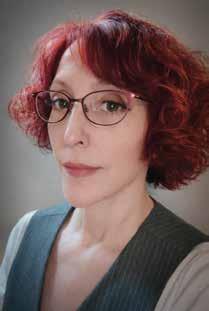
Author of Baby Teeth (2018), Dear Hanna (2024), and other novels
Squirrell Hill Magazine: In one sentence, what do you write?
Zoje Stage: I write psychological thrillers and psychological horror.
SQHM: What drew you to that genre?
ZS: Way back when I was interested in pursuing a career in film, I had an idea of the kinds of stories I wanted to make, and somehow that very much translated when I switched over to writing novels. I wanted to create stories that had well-developed characters going through strange or unusual situations, and I wanted to approach them

realistically, asking, “how would a real person go through these strange situations?” I’m very interested in human behavior, what makes people click, so that definitely is part of why I write and what I create. It is a reflection of the real world in a lot of ways, even though it’s genre fiction.
SQHM: What do you think readers appreciate most about your writing?
ZS: One of the things they appreciate is I really try to make the sort of ‘oddball’ people very sympathetic and relatable. I think all of us have some scars in our psyche and some things that are difficult for us, and I really try to deal with those sorts of situations, whether it’s physical illness like in Baby Teeth or a mental health problem like in Mothered (2023) or Getaway (2022). I really like to show that everyone contains these good and bad elements, and we shouldn’t be super judgmental.
SQHM: Where should readers who are unfamiliar with your work start?
ZS: I would send them to either Dear Hanna or Baby Teeth. Technically, Dear Hanna is a follow-up novel to Baby Teeth, but I very intentionally wrote it so that the two books could be read in either order. Dear Hanna is also a completely standalone story, and readers who wonder what the character was like as a child can go back and read Baby Teeth. People who read Baby Teeth first and wonder what happens next can go and find Dear Hanna.
SQHM: Squirrel Hill and other parts of Pittsburgh are often featured in your books. How much of that is your desire for realism and how much of it is something else?
ZS: Interestingly, when I wrote Baby Teeth I was actually living in Rochester, NY, but I still had it take place in
It felt like my books built a bridge between me and people I don’t know and will not meet.
Pittsburgh. I think that a desire for realism is part of it, that I like to have a sense in my head of what the geography or culture of an area is, to name some real places when it’s appropriate. I want my stories to feel real to readers, and for the best way to do that is to put them in an area that feels real to me.
Squirrel Hill ruined me for life because I tried to live in other places and it just didn’t work! I was used to living in a neighborhood where I could walk to the library, to the movie theater, to grocery stores, parks, restaurants. I thought every city had neighborhoods like this and very quickly discovered that’s not the case. So now I’m like, okay, I’ll just live here forever.
SQHM: What’s the writing community like in Squirrel Hill?
ZS: My sense is that there are a lot of writers in Squirrel Hill, and I judge this by things I pick up on Littsburgh and at the Pittsburgh Book Festival. Part of the problem with writers, like I know for myself, is being a hermit. I’m home all
the time, so socializing with other writers is a little bit tricky, but my sense is that there are definitely other writers and potentially a lot of serious authors in this area too.
The bookstores are very good about having sections for local writers, and several years ago I held some workshops at the Squirrel Hill library, mostly for writers at the beginning of their career. I know this is a very literary, very educated community, so I suspect there are a lot of people at home working on books, memoirs, and various things.
SQHM: What’s next for your writing?
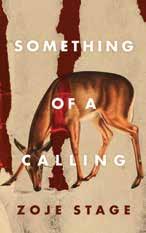
ZS: I have a book coming out in September called Something of a Calling. It’s a little bit different than what I usually write. It’s sort of a police detective situation, but also an eco-horror novel. The detective comes across something quite grizzly, and she thinks it’s not going to be her problem because she’s on the verge of retiring, but then other things happen and she realizes she has to investigate. What she finds could really be the undoing of the world as she knows it.
SQHM: What is your purpose as a writer?
ZS: Definitely some of it is for myself; writing is simply how I process the world. I mean that very literally, like sometimes I don’t know what I think about things until I’m writing them, so writing gives me clarity about what I experience.
In terms of writing and sharing it with other people, I have had experiences where it felt like my books built a bridge between me and people I don’t know and will not meet, but they reach out and tell me the ways they felt seen reading my books. This is probably the single most powerful element of being a writer and sharing my work. I like that aspect of making other people feel a little more seen and less alone, and then, in the exact same manner, it makes me feel seen and less alone.
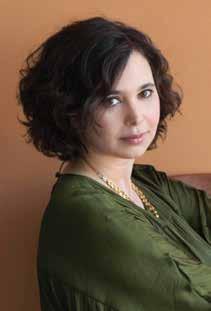
Becky Thurner Photography
Author of All the Names They Used for God (2018), a short story collection; Assistant Professor, College of Arts and Sciences, Chatham University
SQHM: In one sentence, what do you write?
Anjali Sachdeva: I write short stories set in mostly realistic worlds that all have a slight surreal or fantastical edge to them.
SQHM: What drew you to that genre?
AS: I grew up reading a lot of fantasy, but also short stories from the 19th and early 20th centuries. Those short stories have a very classic structure to them, but I also love the very open possibilities of fantasy worlds where literally anything can happen. I enjoy imagining what happens when you bring those two things together. From that, I ended up with a style that I really love.
SQHM: Where should readers who are unfamiliar with your work start?
AS: For people who like science fiction, “The Incorruptible World” is easy to access online at Lightspeed Magazine, without a paywall.
If people want something with a little bit of a Pittsburgh angle, the first story in my book collection [All the Names They Used for God ] called “Glass-Lung” has an opening section set in Pittsburgh in the early 1900s.
SQHM: How did you get your start as a writer?
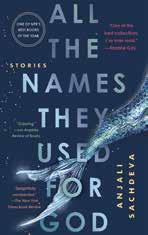
AS: I was always just a big reader. When I was younger, I benefited from just being in a city [Pittsburgh] that had great libraries and had a lot of visiting writers, but also from having really, really good English teachers for most of my life.
SQHM: How does teaching at Chatham University impact your own writing?
AS: Teaching requires me to really think about how I do what I do and be able to explain this to someone else, so partly it just makes me more aware of my own writing process. Beyond that, it requires me to constantly recontextualize things based on contemporary interests. Among undergraduates, there’s a constant turnover of people who are usually 18 to 22, and they’re always bringing in the most recent perspective, the most recent interests, and that is exciting and useful to me when I’m writing. And in the graduate program, we have students who are older than me, and similarly I’m getting a different perspective from them.
SQHM: Describe the relationship between the writing programs at Chatham and Squirrel Hill.
AS: We do a lot of literary events during the year, and we really welcome anyone from the community to come. We have visiting speakers from all over the country and locally who read their work. These events are open to the public, and people are welcome to come. Because you have to go through a residential street to get to campus, I think some people think they are not allowed, but they absolutely are, and we are happy to have you.
One of the requirements I have in most classes is that students attend literary events off campus. I often direct

My purpose as a writer is to encourage people to look more closely at the world they live in.
them to the Squirrel Hill library or to Riverstone Books. For the undergrads, it’s great because they often don’t have a car, and within walking distance there’s this vibrant literary community.
We’ve also just started a new low-residency MFA program in Creative Writing that will bring online graduate students to campus for writing residencies, so we’ll hopefully have a chance to show writers from all over the country what a great community Squirrel Hill is.
SQHM: What’s the writing community like in Squirrel Hill?
AS: I am part of a writing group that I have been in for at least 15 years at this point, maybe longer, and various people have come and gone through the years. Some of them have been from Squirrel Hill, and some have been from other neighborhoods. Between the library and the bookstores, there’s a great literary community around here.
SQHM: What’s next for your writing?
AS: I’m working on a short story collection. I’ve published a number of stories that are going to be in it already, and a few more are coming out in the next few months.
SQHM: What is your purpose as a writer?
AS: In the big picture, I think my purpose as a writer is to encourage people to look more closely at the world they live in and to question why things are done the way they’re done. One of the things I love about speculative fiction and why I write that kind of fiction is that it is based on that idea of thinking about what it would be like if the world were just a bit different. How would that change us as people? How would that change the way we interact with each other?
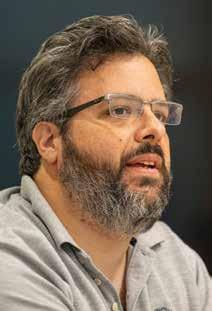
Author of non-fiction books about Pittsburgh and cultural history; Editor-in-Chief, Pittsburgh Review of Books; Public Humanities Lecturer, Department of English, Carnegie Mellon University
SQHM: In one sentence, what do you write?
Ed Simon: I write a lot of narrative non-fiction, and I have two broad beats: one is Pittsburgh and the other is the Devil.
SQHM: What’s Squirrel Hill like as a community for writers?
ES: As a community, it has its share of canonical writings like Michael Chabon’s Mysteries of Pittsburgh and Wonder Boys, both of which are set in Squirrel Hill, and his Werewolves in Their Youth, which has a story that takes place in The Squirrel Cage. There’s also Ellen Litman’s The Last Chicken in America, a fantastic book about Lower Murray Avenue’s Russian community circa mid-1990s. It captures that community so perfectly.
And then it’s just a very literate neighborhood. You’ve got two independent bookstores, plus Pinsker’s and the library, and it’s always been like that since I was growing up. Pittsburgh’s always been a company town, and in Squirrel Hill the companies are the universities. I come across Pittsburgh writers all the time in the wider world, and most of them seem to have come through Squirrel Hill in some way.
SQHM: As faculty at Carnegie Mellon, you work in Squirrel Hill according to the City of Pittsburgh’s neighborhood map. What’s the view of Squirrel Hill from campus?
ES: The neighborhoods of Pittsburgh get blurry at the edges, but it always felt to me spiritually that once you get to CMU you are in Oakland. But when you are on campus, parts of it feel more like Squirrel Hill than others, and I think it has to do with whether you can see Oakland or not. If you can’t, it feels more Squirrel Hill. In a way, CMU is oriented towards Squirrel Hill in that the locus of energy goes towards Squirrel Hill; the undergrads go straight down Forbes.
SQHM: Do Squirrel Hill stories sneak into your writing?
ES: Definitely in the Pittsburgh books. I wrote a book called The Soul of Pittsburgh with essays about Pittsburgh
identity, and the last portion of that is like an ode to Squirrel Hill. I talk about my memories of going upstreet in high school. I conclude my book on relics by talking about the Tree of Life murders and the ritualized gathering of people’s remains.
I would love to write something that gives a real sense of Squirrel Hill because I think the urban texture of the neighborhood is so interesting. It’s a place that rewards an existence of just sitting around or aimlessly wandering up and down Forbes and Murray. I’ve done it for 40 years now.
SQHM: What’s the origin story of your new venture, the Pittsburgh Review of Books (PRoB)?
ES: It’s something I’ve wanted to do for a while, but it required the institutional support that CMU can give to make it a possibility. Before joining CMU, I was Editor of Belt Magazine, a pan-Rust Belt publication focused on hyper-local stories. It’s called Rust Belt Magazine now, and we use it as an aggregate for regional-focused articles within the PRoB. Before I ever worked there, though, I had this idea that there should be something called the Pittsburgh Review of Books, like the New York Review of Books or the Los Angeles Review of Books.
I really want it to have an intrinsic “Pittsburgh” feel. In some cases that means content, and every week we try to have something that is local in some way. But more than that, I want it to have a “Pittsburgh” attitude, grittier and interested in materiality and work and labor. What I like about it is that it offers content that might not get national attention even though it’s national-attention quality.
SQHM: How do you manage to write when you have so many demands on your time?
ES: I have to make time every day for my own writing or things get in the way of it. I love when an editor gives me a

It’s just a very literate neighborhood.
hard deadline. It’s very helpful for me. If not, I try to make my own deadlines and keep to them.
I love writing, and there is something very inspired about it, but I also think it’s very much work. It’s like punching a timecard in the best possible way.
SQHM: What led you to become a writer?
ES: When I was in high school, I wanted to be a physicist, and then I learned that I have no proficiency for math in any shape or form, so I pivoted to philosophy, which felt like physics without math. In college I pivoted to English, because what I was really interested in were the narratives. For example, in physics, I was really interested in the people that did it more than the physics itself.
SQHM: What is your purpose as a writer?
ES: I am in some ways a very selfish writer. I write because I want to write—not that I don’t want other people to look at it. I think everyone who writes, especially anyone who publishes, wants people to read their work. I want to see what people think—but for me writing is how I figure out what I know about things.
SQHM: Where should readers who are unfamiliar with your work start?
ES: If they’re going to start with my Pittsburgh work, start with An Alternative History of Pittsburgh. That’s my first Pittsburgh one, and it gets everything in one place. If they’re going to start with my non-Pittsburgh work, I would do Devil’s Contract, the book about the Faustian legend.
Senior Staff Writer at the Pittsburgh Jewish Chronicle
SQHM: In one sentence, what do you write?
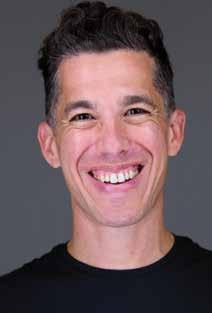
Adam Reinherz: I write about the greater Pittsburgh Jewish Community, which according to the most recent estimate is about 46,000 people. This reaches beyond Squirrel Hill, but when it comes to working on stories that involve Squirrel Hill, I absolutely love it.
I am privileged to live in Squirrel Hill. I’ve been very lucky to marry someone from Squirrel Hill. We’ve raised our family here and have lots of family here. I am just so delighted and honored to call it home.
SQHM: What’s it like to write about your community?
AR: There’s no greater privilege and responsibility than knowing the people that you write about, knowing full well that you will see them at the JCC or walking on
Forbes shortly after you interview them. Of course you have a tremendous responsibility to get things right, but this is not an abstract process. It’s very much rooted in community. I’m not foolish enough to believe I’m the only one who gets to do it. There are people who did it for generations before me and hopefully long after I’m gone. But what greater honor do you have than to be the one who gets to tell your community’s story?
Squirrel Hill is a magical place, but it doesn’t happen by accident. There were generations of people who helped ensure it would be like what it is today. Unless we keep that going in all the different manifestations—and it’s not just journalism, it’s volunteering, it’s working in different professions—we’re not going to have it. So, this is one small way that I help keep this place going.
SQHM: What is the role of writing within journalism?
AR: Writing is not the entirety of our jobs, but it’s an important part of the experience. I remember one of the first pieces I worked on for the Pittsburgh Jewish Chronicle. I had spent a lot of time working on it, thought pretty seriously about the structure of it, about where the quotes would go. When I turned it in, the editor said to me, “At this point you think that the whole process is over, but really this is when the story begins. It essentially goes out to the people. They make sense of it regardless of what you intended or what you thought the story was about.”
That’s a really important reminder that my writing is a very small piece of this puzzle. I am incredibly privileged to be trusted with people’s stories, and it’s my responsibility to offer whatever ability I have and then return the story to the community itself. It ultimately belongs to them, and they’re the ones who make sense of it.
SQHM: How will AI impact the future of journalism?
AR: I think that there are people that are much more knowledgeable about what the impact of AI on journalism

It ultimately belongs to them, and they’re the ones who make sense of it.
will be, but the one thing that AI cannot replace, at least I hope it can’t replace, is interpersonal connection, a thing I hold sacred. Just people to people relationships. What helps me do my job the most is walking the streets and living in this community, which I don’t see AI replacing.
There’s a perception of writers sitting at a desk, feverishly slaving over a typewriter. Of course I like to write in a quiet room without distraction, but there’s something that is so far from solitary about this process that’s truly informed by the community, and it’s truly for the community.
SQHM: Do you enjoy other forms of writing?
AR: I do enjoy other writing; I just don’t spend as much time on it. It’s not “I’m a journalist but I wish I could be a novelist.” I get to do something that is unbelievably cool. I get to share people’s stories and be trusted with that.
SQHM: What’s your biggest challenge in your work?
AR: It’s really hard to know when a story’s done because of the fact that we [local journalists] live in the community that is constantly evolving and living and continuing and growing. In some sense, you report on an event, you explain what occurred, how many people were there, what the takeaway was—but when you are living in community and you have this desire to see the community continue to grow, it’s never done. You want to just keep building, keep contributing.
At UPMC Senior Communities, you’ll have fewer burdens and more activities, fun, and friendships.
Visit one of the UPMC Senior Communities near you and see how true independence can mean less of the things you have to do, and more of the things you want to do.
Call 1-800-324-5523 or srcare.org/upmc.
Communities located in: Allison Park • Hampton Monroeville • Washington, PA







By Kimberly Kweder
From vinyl-scored mornings to ancient Yemeni coffee traditions and latenight, living-room warmth, a new wave of coffee shops is reshaping how Squirrel Hill gathers. These spaces are designed to serve drinks as well as opportunities for artists to linger, students to sprawl across tables, and conversations to stretch past sunset. In these spots, culture is poured as carefully as espresso.
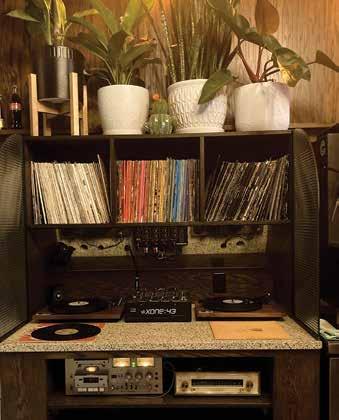

“We’re [owners] inspired by Japanese record cafes. Pre Amp comes from preamplifier, and with the coffee you get an amped up feeling, so it’s a play on the two words. And we’re focused on really good coffee,” said Ryan.
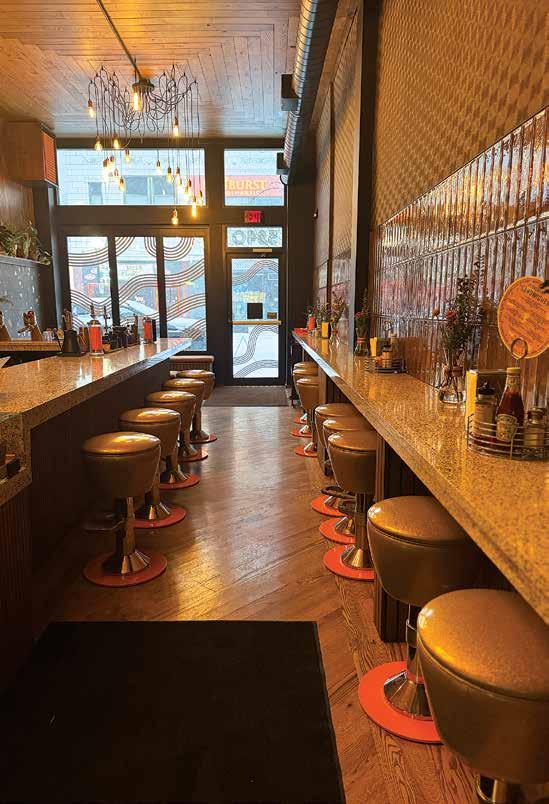
With its vinyl records, warm lighting, and polished interior, the shop carries a retro-futuristic elegance that feels both timeless and modern. Beautiful Japanese wood paneling fills the wall behind the bar, and a Kyoto cold brew, a traditional Japanese brewing method, stands upright. The Kyoto-style coffee slow drips for 18-20 hours according to Ryan.
Pre Amp offers craftmanship and detail with three different seating areas: a front area by the window followed by retro stools along the bar, and finally a back room with booth
VINYL, COFFEE, AND CREATIVITY SPIN
In a dimly lit coffee shop on a Thursday evening, a group of young people cluster in conversation in a small frontwindow seating area while the aroma of brewed coffee fills the air and vinyl records spin tunes behind the coffee bar at Pre Amp Coffee Studio.
A range of punk rock, 70s rock, and 50s posters from Elvis to Led Zeppelin adorn the walls in the back room.
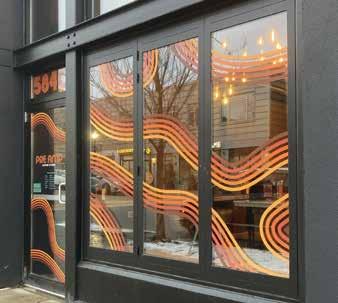
“Music is a great way to inspire and a great way to get the mood to creatively think,” said Danny Ryan, one of the three owners of Pre Amp. The coffee shop opened at 5840 Forbes Ave, next to BikeTek, in November 2025 and is open from 7 am to 6 pm, Tuesday through Saturday.

seating. Ryan said there’s plenty of space for conversations and to put down TikTok.
“I think of how back in the day, old cafes would bring minds together to creatively think,” he said. Danny and his wife are also artists—they were actors in New York City for 10 years before moving to Pittsburgh in 2020 to help launch their artistic vision.
Beyond coffee, Pre Amp also hosts rotating food concepts and plans to launch a ticketed chef’s series to showcase local culinary talent.
Customers beam with excitement and smiles while visiting Pre Amp.

“It is so well designed. Everything is so thoughtfully placed. I like the music, and the coffee is great! I come here at least once a week,” said Simon Wu, a Squirrel Hill resident.
“I love all the coffee shops here, and I was excited to learn of this one. I love the records playing music, the combo of music and coffee, the ambience, and also, it’s a good day and night spot . . . the setup is pretty unique,” said MaryGrace King, a resident of Squirrel Hill. King is a hybrid worker, and she said she comes here to work on occasion and usually finds seating, unlike some other coffee shops.
“I like creative writing, and it’s a nice spot, a good setting for it,” she added.
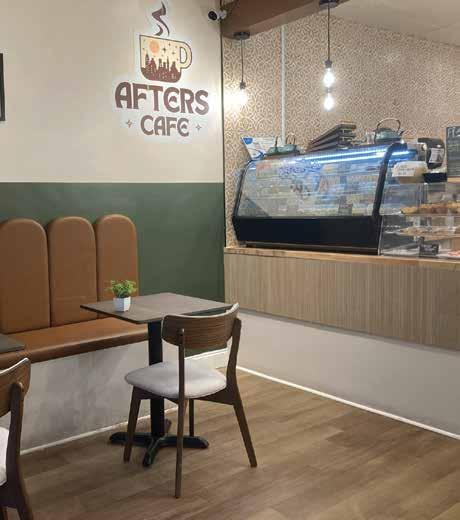
As a homey oasis for studying, socializing, and enjoying a sweet treat, the new Afters Cafe offers a comfortable, chill vibe for everyone who wants to stay out late in Squirrel Hill and feel cozy.
“I wanted it to feel like a touch of home,” said co-owner Ryan Leonard. “[And] I want it to be like Central Perk from the Friends TV show,” he added.
The name Afters is a play on British slang for an afterparty—the place people go once the main event ends. It’s where the night keeps going, Leonard explained, carrying conversations into the early morning hours.
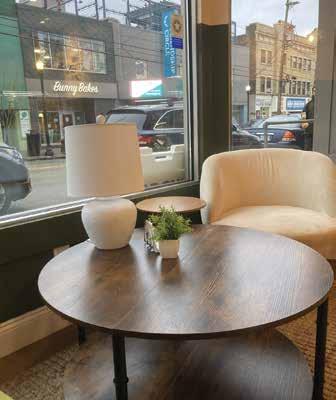
That spirit shows in the space itself. A plush couch, face-to-face booths, and


single tables create a room that invites people to settle in. On a Friday night, young customers camped out with laptops while others talked quietly without their phones.
“I think creativity stems from a feeling of relaxation—that’s when I feel the most creative,” Leonard said.
Everett Regan, a city resident who works in Squirrel Hill, was visiting Afters for the first time. He bought a flaky, crispy Palmier and a honey vanilla oat-milk latte and sat with a book and his tablet. As a real estate agent, he said he enjoys the cafe experience: seeing real people in real time and being able to multitask and decompress.

“I’m looking for local coffee shops to support rather than wellknown chain places. It’s cool to support smaller brands. And sometimes I bring a book, too,” he said. “It’s a cute little spot.”
Afters Cafe opened last November and stays open from 8 am to 11 pm daily with a small team of 4 to 5 people.
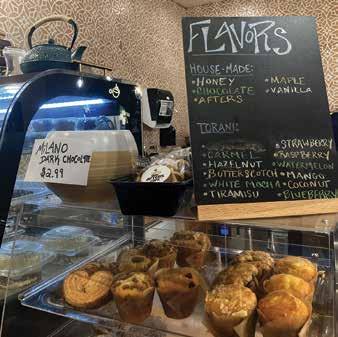
Leonard said a popular item is their in-house syrups. The best seller is the syrup with cardamon, clove, cinnamon, and brown sugar, and the drink of choice is the Afters latte.
The menu blends Middle Eastern flavors with a nod to Leonard’s British roots. Alongside classic British tea, customers can find Lebanese tea, Turkish coffee, and chai karak, a spiced milk tea.
Leonard said his team is working on more in-house syrups and expanding food options.
“We’ve got a lot more to come,” he said.
Afters Cafe is located at 1931 Murray Avenue near Giant Eagle.
Back in the day, old cafes would bring minds together to creatively think.

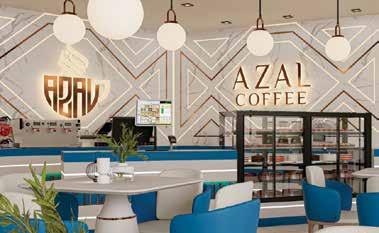
A slice of Yemeni culture is coming soon to Squirrel Hill.
Azal Coffee is a growing brand that, according to its management team, focuses on authentic Yemeni and Middle Eastern-inspired coffee culture combined with modern specialty drinks and a community atmosphere.
Azal started in 2023 and currently has three locations in New York, Michigan, and Wisconsin, with plans to expand to Florida, New Jersey, and a soon-to-open location on Lower Murray Avenue in Squirrel Hill (in the former Crazy Mocha space). In each setting, Azal is positioning itself as a space designed to inspire creativity, community, and culture.
“We are from Yemen,” said Amr Alraidi, owner of the Dearborn, Michigan, location.
“Our coffee grade is more than 86, and we bring coffee from Yemen and make it fresh, always,” said Alraidi. He stressed they offer specialty beans rather than commercial beans. A coffee grade of more than 86 means the beans are considered specialty-grade—a level only a small percentage of the world’s beans ever reach.
The creative atmosphere extends beyond the cup at Azal.
“We have a nice decor for our locations. We make it luxury,” said Alraidi. He added that customers can expect
Middle Eastern music and drawings of ancient buildings from the Yemeni capital of Sana’a.
“It’s a place for families to gather and students to study, and we offer a nighttime place here,” said Ramzi Mohammed of Azal Coffee.
Management is considering keeping the Squirrel Hill location open until 11 pm on weekdays and midnight on weekends, allowing artists, students, and creatives more time to meet, work, or unwind.
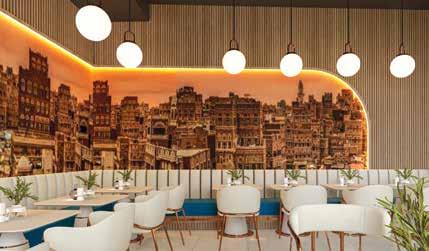
The cafe’s name itself reflects its roots. Azal used to be the name of Sana’a in ancient times. According to Alraidi, the best coffee beans come from just outside of the capital. Yemen produces coffee in a large number of its provinces, but especially in the mountainous west, with key areas including Sana’a, Bani Mattar, Haraz, and Bani Ismail.

FURBES AVE PET SUPPLY
5868 FORBES AVE.
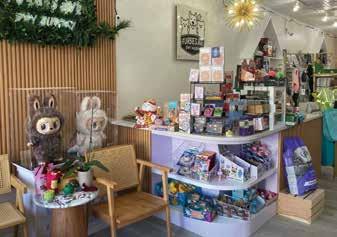
They’re beloved family members and familiar faces throughout the neighborhood—and now they have a shop catering to their distinct needs. Who are they? Squirrel Hill’s dogs and cats, who are celebrating the opening of Furbes Ave Pet Supply.
“We’re all pet owners,” said co-owner Vicky Zheng of herself and her business partners Selina Zheng and Zak Szulc, who leads the enterprise, “and we saw a need for a pet supply shop in the neighborhood.”
Zheng’s two dogs, a Pomeranian and an American Eskimo, are reminders of what’s at stake for customers. To help pet owners care for their beloved animal friends, the store seeks out top-quality products from similarly small and independent suppliers. As a result, Furbes Ave Pet Supply’s selection of necessities (feeding and grooming supplies) and novelties (clothing, costumes, and exotic treats) is not what you would normally find at a big box store.
“Customers love the quality of the dog and cat treats we offer,” said Zheng.
Specialty items include food suitable for pets on restricted diets and food designed to reduce the animal allergens that bother humans.
The store also thrills animal lovers with its dog- and catthemed magnets, greeting cards, and tabletop games.
There is also a section for kids’ toys, although little ones may be equally drawn to the adorable pet toys. Gift-givers will appreciate the personalized Furbes Boxes assembled according to a pet’s specific profile; these can be ordered individually or by subscription.
The store is open 6 days a week (all but Monday) and plans extended hours in the spring as the weather warms up. It also offers the convenience of online ordering with in-store pickup or delivery.
PENN FIXTURE & SUPPLY 5850 FORWARD AVE.
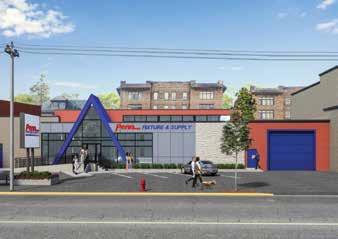
After 75 years in the Strip District, Penn Fixture & Supply has found a new home in Squirrel Hill.
The larger space allows the company to make most of its inventory available for customers to browse. Previously, only about 30% was on display in the Strip District location. Now, shoppers can take a closer look at kitchen and dining items ranging from frying pans to commercial fryers, bakeware to stemware.
“We wanted to put in a more shoppable showroom for people that own restaurants or do-it-yourselfers who are looking for tools of the trade that are a little bit better or different than what you can get in a typical retail store,” said co-owner Ken Zeff. Customers can also take advantage of the on-site parking.
Beyond the extensive retail selection, the store’s arrival also brings an architectural icon back to life. Penn Fixture has preserved the A-frame entrance of the former Lord Duncan Cleaners, refurbishing it as part of a major renovation of the building on Forward Ave.
Zeff has many memories of the site from when he attended Allderdice and worked at the nearby Squirrel Hill Theatre, changing the names of the movies on the marquee by climbing up a ladder.
“I hope that people in the neighborhood will come and enjoy a stroll, looking at all these things in the store, and hopefully we can attract some new people to the Squirrel Hill community,” he said.
What will they find once they step inside the iconic entrance?
“It’s an eclectic mix of things that you just would never see anywhere else,” said Zeff.
Book-lovers will be able to eat and drink their way through biographies, poetry, and more at the upcoming Edible Book Festival at Chatham University. This event is part of the International Edible Book Festival, which has been sharing literary food and drinks around the world since 2000. Chatham’s edition takes place on Monday, March 30, from 4:00 to 5:00 pm at the Jennie King Mellon (JKM) Library on campus.
Festival participants prepare culinary delights based on foods mentioned in or inspired by books, characters, and the love of reading. These might include cookies for the modern children’s classic “If You Give a Mouse a Cookie” or book-shaped cakes with text piped in icing. Savory food and drinks are valid options, too. After all, most beloved characters consume more than just dessert! The submitted “books” are then taste-tested by the curious “readers” attending the festival.
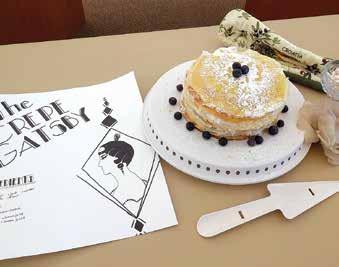
As is typical of an Edible Book Festival, Chatham awards small prizes based on taste and/or creativity. A previous Grand Prize winner (illustrated here) was “The Crepe Gatsby,” submitted by Kate Emory. A distinctly local prize, “The Rachel Carson Award,” is given to the entrant “that honors sustainability and/or nature.” Carson graduated from Chatham when it was known as the Pennsylvania College for Women. Her environmental legacy is felt in Chatham’s food studies program, which co-sponsors the event together with the JKM Library.
“The International Edible Book Festival fits in very well with the values and history of Chatham,” said Jocelyn Codner, Head of Library Instruction & Outreach at the JKM library. “We’ve been so lucky to have such a perfect vehicle for celebrating literature, food, sustainability, and cultural exchange.”
The festival is open to the public, but guests are asked to pre-register, especially if planning to submit an “edible book.”
Codner notes that there has yet to be a Pittsburgh-themed submission. “I invite a community member to join us with something to celebrate the great city we live in!” she said. For questions, contact Jocelyn Codner at J.Codner@ chatham.edu.
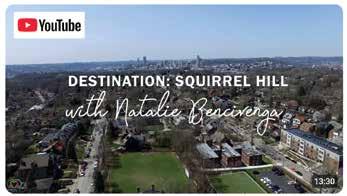
In December, Squirrel Hill was featured in an episode of WQED-TV’s Destination with Natalie Bencivenga. The video series, which has previously highlighted Carnegie, Beechview, and Bloomfield, brings attention to the changing neighborhoods of Pittsburgh and the impact immigrants have made to our region.
In the Squirrel Hill episode, Bencivenga talks with residents and business owners in the neighborhood about its character, history, and future. The conversations look at changes in the commercial landscape on Murray and Forbes avenues as well as the connections and mutual support between ethnic communities in the neighborhood. Among the featured interviewees are SHUC’s Executive Director, Maria Cohen.
“Squirrel Hill’s mix of cultures, faiths, and shared histories weaves together to make a fascinating tapestry,” said
Bencivenga. “Exploring it inspired me to celebrate community, resilience, and the stories that connect us all. I hope everyone walks away from this series feeling seen, heard and a little more connected than before.”
The 13-minute video can be viewed on YouTube.
By Mardi Isler and Scott Bluman

SOME OF YOU MAY REMEMBER THAT THE COALITION’S TREE COMMITTEE WAS ORIGINALLY KNOWN AS THE URBAN FOREST Committee, quickly organized in January 2008 when there was significant controversy over the removal of street trees in Squirrel Hill.
After a City of Pittsburgh street tree inventory was completed in 2005, the city created a seven-year plan to remove dead trees and other trees deemed dangerous to pedestrians and motorists. The plan was not acted upon until late 2007, when the city began the recommended removals, but the surprise removal of 12 enormous London Planes on Douglas devastated that residential street, removing much of an entire block’s canopy. Neighbors were angry and upset. Community pressure caused the city to pause removals, and SHUC was asked to hold a series of meetings with residents and city officials to work out policies and procedures regarding neighborhood tree removal.
In response, SHUC continued to learn about the issues, considered the entire 14th Ward, and worked with city officials to develop policies that would stagger removals, more fairly notify residents as to upcoming removals, and also give property owners the right to appeal when
a “Gentle Giant is Retiring” notice was posted. Eventually, the Pittsburgh City Code’s “Hazardous Trees in Public Areas” section was amended to define the rights of residents and responsibilities of the City. At the time, tree loss in Squirrel Hill was noted as occurring faster than in many other neighborhoods because our trees were old and coming to the end of their natural lives. This faster canopy loss is still true to this day, and our London Planes in particular aren’t getting any younger!
By May of 2008 SHUC had the “Tree Committee”—now not only working to resolve the issues associated with tree removal, but also finally getting the City to remove dead trees from Forbes. (All were Bradford Pears and had blight; they were dead or dying.) SHUC learned there was no city budget for tree replacements except for business districts.
next several years.
Luckily for Squirrel Hill and all other city neighborhoods, the Western Pennsylvania Conservancy in 2008 became sponsor for the state-funded TreeVitalize, an application-based, community tree-planting program. SHUC submitted an application for Spring 2009 and was funded for the first of more than 250 trees planted to date.
Shortly thereafter, tree serendipity brought us Lisa Ceoffe as City Forester, a professional who cares deeply about growing Pittsburgh’s Urban Forest. She works with incredible energy, partnering mainly with Western Pennsylvania Conservancy and Tree Pittsburgh, but also with any organization, authority, or developer who has even a small part to play in this goal. Picture a whirling dervish—that’s how Lisa works!
If you are a long-term reader of Squirrel Hill Magazine, you have been updated periodically as to tree planting and tree care efforts by the SHUC Tree Committee. Now, with an infusion of tech-savvy new members, exciting things are happening. With data provided by Tree Pittsburgh, we were able to analyze the Squirrel Hill tree canopy to identify and prioritize the areas suffering the most severe tree loss.
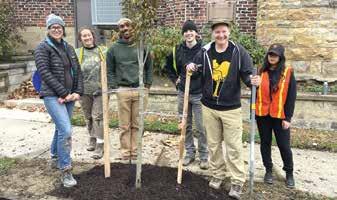
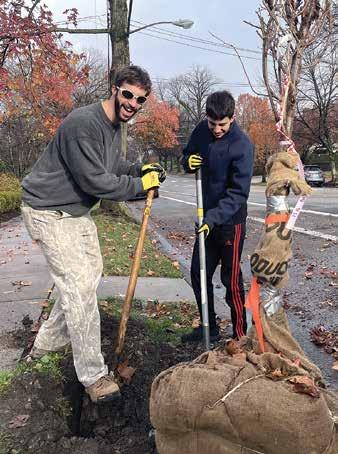
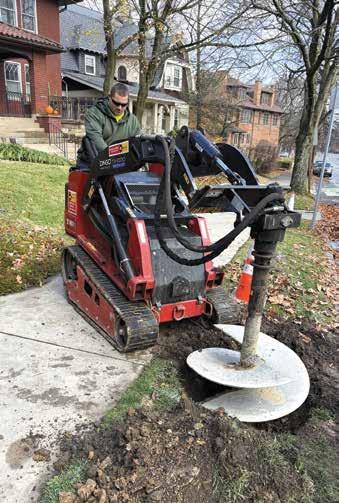
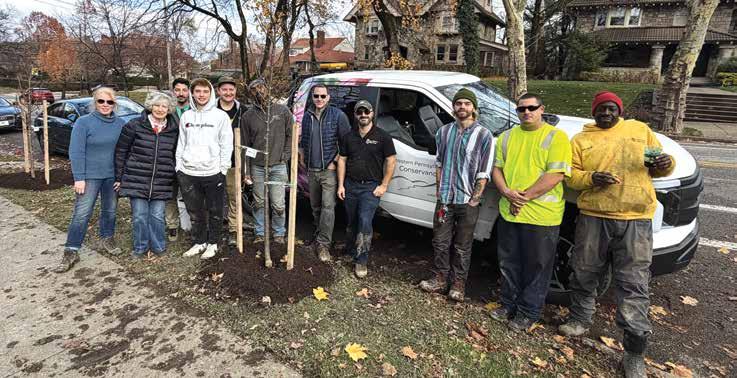
This analysis directly supported our recent “ReGreen Beechwood Boulevard” application for replacing the lost canopy on the entire street from Greenfield through Squirrel Hill to Point Breeze. Our submission was approved by the City Shade Tree Commission, whose mission is to restore and maintain the City’s street tree population. This assistance allowed us to join a collaboration led by Lisa Ceoffe and her team at the City of Pittsburgh Forestry Department to plant 50 new trees along Beechwood Boulevard from just past Monitor Street to Wilkins Avenue this past November with the support of SHUC volunteers, Tree Pittsburgh, and Western Pennsylvania Conservancy. Hundreds more plantings along Beechwood are planned over the next several years.
In addition to the trees on Beechwood Boulevard, our November plantings included several trees on Bellerock Street. These arrived via a different process, one where individual owners can request street trees be planted on their properties. SHUC’s Tree Committee consolidates these requests and submits an application to Western Pennsylvania Conservancy TreeVitalize.
Next, the proposed planting locations are assessed by the City Forestry Department for suitability and species selection. For suitability, they consider things like underground and overhead utilities and sidewalk
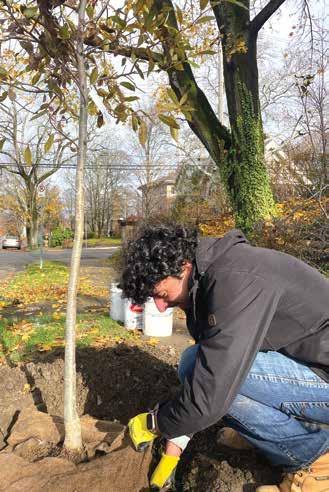
width for ADA compliance. Species selection is based on factors like height of overhead utilities, nursery availability, and ensuring species diversity to help make the canopy less susceptible to pests and disease. Frequently planted species include London Plane, Dogwood, Swamp White Oak, and Redbud.
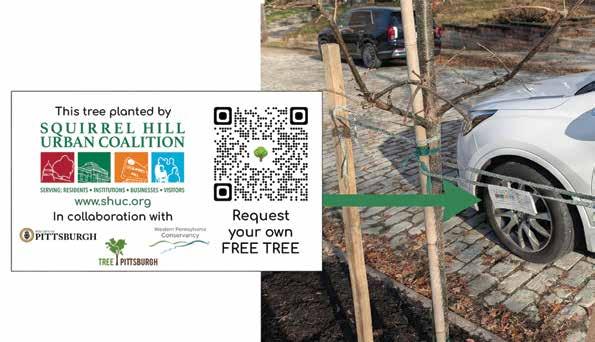
You can recognize our efforts around Squirrel Hill by the tree tags we attach at each planting location. We greatly appreciate the resulting thank-you emails and new tree request forms this has generated.
The Tree Committee is also actively accepting applications for “Squirrel Hill Tree Captains” to advocate for canopy health on their specific streets. If you are interested, please connect with us at parks@shuc.org.
Chair: Scott Bluman
Members: Gary Crouth (Chair Emeritus), Anna Holmquist, Mardi Isler (Chair Emeritus), Jeremy Kazzaz, David Knoll, and Eddie Shaw


Coming out of a winter with record snowfalls and extreme colds, we are looking forward to spring and preparing our city to welcome thousands for the NFL draft, developing more opportunities to inspire a healthy community, standing by our immigrant population, and getting back to fun events where we can all come together. 2026 is the year of the Fire Horse, which represents a rare, 60-year cycle combining intense, volatile energy with rapid change, passion, and ambition. It symbolizes a period of high-speed movement, independence, and potential for major social or personal breakthroughs.
The Squirrel Hill Urban Coalition and I were honored to be asked to participate in Natalie Bencivenga’s WQED program Destination: Squirrel Hill. This segment was focused on Squirrel Hill’s diversity and immigrant population. It showcased Squirrel Hill’s unique embrace of different cultures living together in our neighborhood and enjoying each other’s traditions. Walking through Squirrel Hill, you can hear many languages, see many types of people, and enjoy cuisines and shops representing many cultures. We are proud of our Jewish heritage, that we are home to the largest Asian population in the city with many restaurants, bubble tea shops, and stores to enjoy in our business district, and are home to neighbors representing cultures from all over the world.
This will be a year where, more than ever, there will be a greater need for us to support our immigrant and diverse group of neighbors. There are questions about safety and
challenges that we will face in community that ask us to embrace each other and protect our neighbors. There have been questions about whether or not it is safe to host events like Lunar New Year and Day of the Dead. We are focused on creating safe spaces to celebrate and opportunities to come together with as community, keeping the safety of our neighbors at the forefront of everything we do.
We really need our neighbors and volunteers to support us and each other. Please come out to volunteer for our NFL Redd Up in April, get involved in our community garden, volunteer at one of our events or with one of our local organizations supporting our underserved community members, come to our events, do something a little extra kind for a neighbor, or do whatever you can to spread love and deescalate volatile situations. Squirrel Hill, we again need you to be who we know you to be: a resilient, caring collective who always steps up when you are needed.
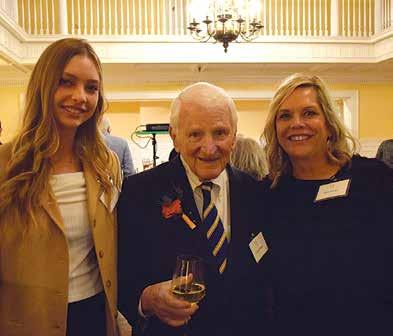
Finally, our annual Treasure Awards Dinner is planned for Thursday, November 5th at The Pittsburgh Golf Club. This event is a fun way to connect with many of your neighbors while honoring three community members and a place that has done significant work to support Squirrel Hill and beyond. Please join us if you are able!
As always, please reach out to get involved or share your thoughts for improvements and for what we should continue. You can connect with me at mcohen@ shuc.org.
On January 5, 2026, Corey O’Connor was inaugurated as the 62nd mayor of the City of Pittsburgh. O’Connor is well known in Squirrel Hill, having previously represented
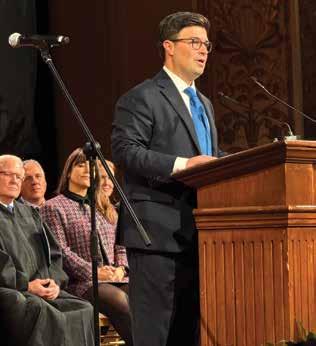
the southern part of the neighborhood as the City Council representative for District 5. He also grew up in Squirrel Hill.
Addressing the audience at his swearing-in ceremony at the Carnegie Music Hall in Oakland, Mayor O’Connor emphasized his desire to turn the City of Pittsburgh into a City of “YES,” where the seemingly impossible becomes possible through creativity and collaboration.
“It is time to become a city of hope and optimism, where your dreams can come true. A Pittsburgh where each and every time we can get to ‘YES,’” he said.
SHUC is ready to work with Mayor O’Connor and his administration as they pursue this goal.
We also thank the former mayor, Ed Gainey, for his efforts on behalf of the city during his four years in
office. Gainey’s passion for moving Pittsburgh in a positive direction was clear when SHUC’s Executive Director Maria Cohen sat down with him for an interview about the future of Squirrel Hill. (See the Spring 2024 issue of this magazine.) His effort to create a “safe, welcoming, and thriving city” is an important reminder of what is shared between the city’s many neighborhoods.
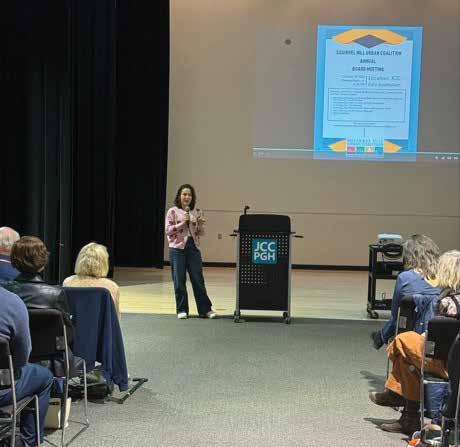
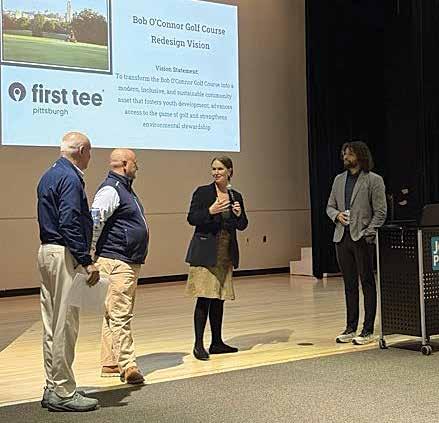
On Tuesday, October 28, SHUC held its Annual Meeting at the JCC. This public event featured presentations from various sectors of the neighborhood and city. Thanks very much to our speakers, including City Controller Rachael Heisler, City Councilmembers Barb Warwick and Erika Strassburger, our City Planner AJ Herzog, Carnegie Library–Squirrel Hill Head Librarian Taylor Lee, First Tee of Pittsburgh, SHUC Built Committee Chair Lori Fitzgerald, SHUC Litter Patrol Chair Rachel Lecrone, SHUC Tree Committee Chair and Tech Committee Chair Scott Bluman, SHUC Bike Ped Committee Chair Marshall Hershberg, and SHUC Board President Dalia Belinkoff.
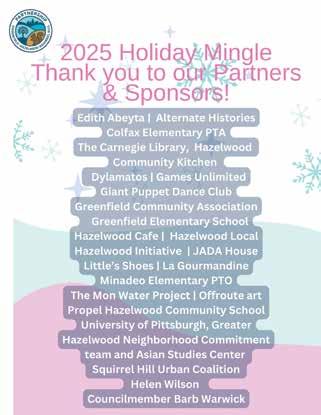
The third annual Holiday Mingle on November 19 was another success, bringing together folks from Squirrel Hill, Greenfield, and Hazelwood to share games, treats, and holiday traditions. Propel Hazelwood Community School again served as the host venue, and many sponsors contributed activities, entertainment, and more. Among the activities, guests enjoyed seeing members of the Giant Puppet Dance Club and making seasonal ornaments at the SHUC table.
Many more seasonal events took place as the days got shorter and the weather turned colder. On November 25, the annual Holiday Shopping Event at Ten Thousand Villages helped raise funds for SHUC. A few weeks later, the business district was abuzz with participants enjoying Uncover Squirrel Hill’s Winter Wine Walk on December 13. On three Sundays in December, the Farmers Market was combined with a Holiday Market featuring seasonal crafts and vendors. The Farmers Market will be starting back up before you know it on Sunday May 10!
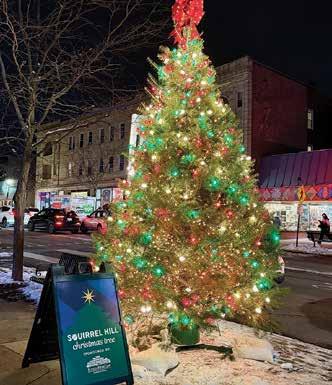
The winter holiday season was brightened by a Christmas tree set up on Forbes thanks to the sponsorship of Brandywine Communities. Sestili’s Nursery sourced a beautiful tree, and Joshua Juda-Combs made sure that every light was shining bright.
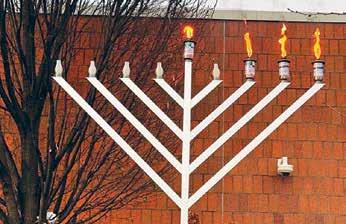
The 2025 Chanukah Menorah Lighting Festival on December 16 also brought joy and light to Squirrel Hill. Chabad of Squirrel Hill, Brandywine Communities, Friendship Circle, and Our Giving Kitchen convened this celebration, with special contributions from the Allderdice Band and Giant Eagle.
Squirrel Hill Magazine wouldn’t appear in your mailbox if we didn’t have a small but dedicated team of volunteer writers to share Squirrel Hill’s stories. Sadly, we’ve got to say goodbye and, more importantly, “thank you” to two of them.
This is the first issue since Winter 2021 that Jim Rogal’s name does not appear in the byline of our “Community Champion” feature. His profiles captured the spirit and character of their subjects using his easygoing prose and insights gathered through his talents as a conversationalist. Jim agreed to write for us despite having already retired from a career in communications and media, and we wish him all the best in this “second” retirement.
This is also the last issue you’ll be reading the work of Kim Kweder. When Kim stopped by the SHUC tent at a night market several years ago and volunteered her skills as a journalist, little did we know what an important contributor she would become. Whether going behind the scenes at the Phipps or capturing the vibes of Squirrel Hill’s latest shops, Kim found the most fascinating details to share. We wish her luck and hope that she’ll come back and visit Squirrel Hill often!
If you would like to follow in Jim and Kim’s footsteps and become a volunteer contributor to the magazine, reach out to the Editor (Melissa Eppihimer) at editor@shuc.org.
On October 22, 2025, St. Edmund’s Academy celebrated their annual Hispanic Heritage Month Community Celebration, welcoming community partners who shared aspects of the cultures of Colombia, Puerto Rico, and Miami, Florida.
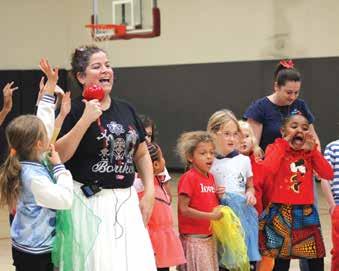
Students in Preschool through 4th Grade learned about plantains and the role they play in Colombian cooking, while students in 5th to 8th Grade learned about the specialized coffee and chocolate of Colombia. Additionally, each grade took on a special art project after learning about the Wynwood Walls street art in Miami.
The highlight of the day was learning about and practicing Bomba dancing with Pittsburgh artist and performer Geña Nieves who was accompanied on the drums by Pittsburgh percussionist and SEA friend Hugo Cruz and SEA’s own PreKindergarten teacher, Mr. Matt Gibson. Bomba dancing is a dance of the African diaspora and is considered the rhythm of Puerto Rico.
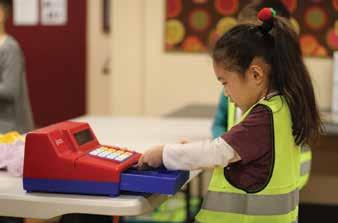
On December 8, 2025, students in St. Edmund’s Academy’s preschool through kindergarten classes presented the Holiday pUPcycle, an upcycling event named after the youngest learners’ mascot, the Wolfpup. Leading up to the event, families donated gently-used toys, books, and clothes, and at the event, students took turns sorting donations, running the store, and shopping.
St. Edmund’s Academy was the first school in Pittsburgh to sign on as a United Nations Global School, serving as a hub of education and leadership on the UN’s 17 Sustainable Development Goals, and ultimately empowering students to prioritize sustainable development in their lifestyles, behaviors, education, and professional careers.
This project makes a connection for students between their study of SDG 12—Responsible Consumption—and their own lives, giving them an understanding of reducing and reusing.
Pittsburgh Allderdice High School students continue to earn recognition for excellence in athletics, the arts, and leadership, highlighting an exciting period of achievement for the school community.
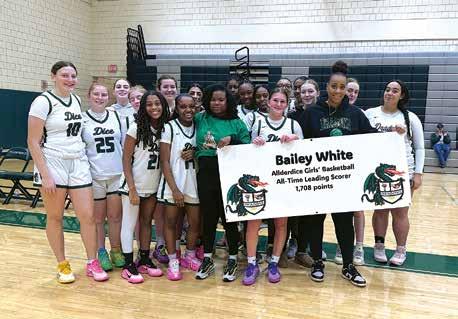
On Friday, December 19, 2025, senior guard Bailey White made school history by becoming the girls’ basketball All-Time Leading Scorer. White surpassed the long-standing record of 1,707 points, previously held by Mary Meyers, during a standout 40-point performance against Pittsburgh Perry. She now holds 1,730 career points and continues to build on an exceptional high school career.
Allderdice is also celebrating a major accomplishment in music. Francesca Viator was selected as the winner of the GBU Life Sing-Off Competition as part of Highmark First Night Pittsburgh 2026. She joins a distinguished group of past winners, many of whom have gone on to pursue music studies and professional careers. In addition to earning a cash prize, Viator performed live on the Highmark First Night Main Stage. Her achievement also brought a $1,000 scholarship award to Allderdice High School’s music department—the first time the school has received this honor from the GBU Life Sing-Off.
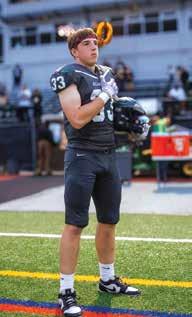
Senior football player Lukas Stead was honored with the Jerome Bettis Leadership Award, presented by the Pittsburgh Steelers, The Mentoring Partnership, Giant Eagle, and the Pittsburgh Post-Gazette. The award recognizes student-athletes who go above and beyond to lead, mentor, and support their peers on and off the field. As part of this recognition, Stead was honored at a Steelers game.
Families interested in learning more about Allderdice are encouraged to attend the final Rising Dragon event of the year on April 15. The event provides an overview of extracurricular opportunities, course options, graduation requirements and student supports. Families can contact the school at 412-529-4800 to RSVP.
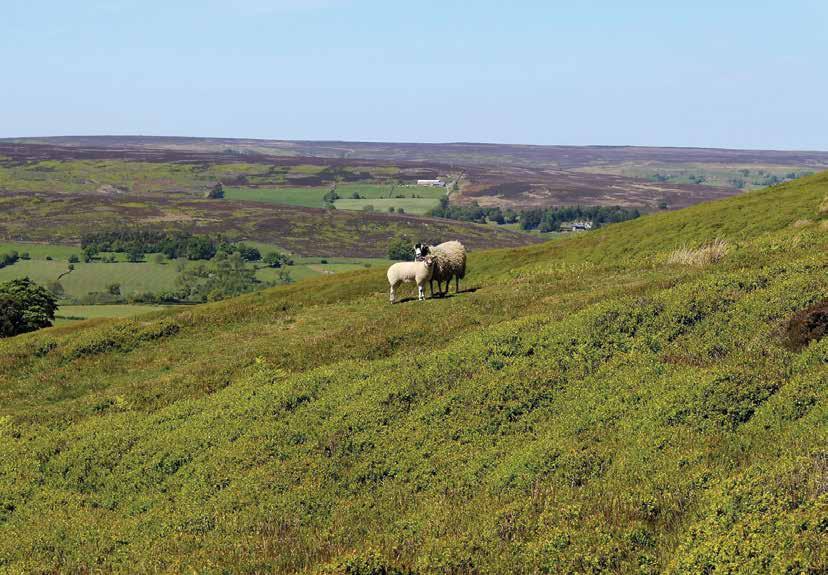
Herriot’s stories take place in rural Yorkshire, but their lessons can be applied just about anywhere.
By Lawrence Gerson, VMD
FIFTY YEARS AGO, I WAS FINISHING MY FORMAL EDUCATION AND STARTING MY CAREER IN VETERINARY MEDICINE. Around the same time, James Herriot was publishing All Creatures Great and Small about his adventures working as a veterinarian in the English countryside in the 1930s.
I found my old copy, and although the pages are discolored from age, the stories are timeless. Yet this book, which should be required reading for every veterinary student, will too often draw blank stares when students are asked if they’ve read it.
Each of the tales Herriot tells not only gives a textbook review of the common diseases of animals of the time but also reveals the personalities of the human characters. These characters, which are so vividly portrayed, are the same types of people a veterinarian
encounters every day in a modern practice. The “know it all” client. The difficult farm hand. The overindulging owner. In this sense, not much has changed.
There are also lessons to be learned from the book about the business side of things. The one line in the book that I would remember for a lifetime is “It’s a funny profession, ours, you know. It offers unparalleled opportunities for making a chump of yourself.” Not only do veterinarians need to be understanding and clinically competent, we need to be good businesspeople. I chuckled when Siegfried, the owner of the veterinary practice, hired a new office manager (Mrs. Harbottle) to run the financial part of the practice. Their cash accounting and management of a practice was a nightmare then, as it would be today. It is also very difficult to be both compassionate and profitable.
Every veterinarian today would sympathize with the plight of Siegfried’s brother Tristan as he struggles with his
Although the pages are discolored from age, the stories are timeless.
veterinary education. Learning everything about animal care and medical problems in four short years has been described as “drinking knowledge from a fire hose.” (As an aside, I’ll share that the real-life inspiration for Tristan was once scheduled to speak at a veterinary conference I attended, but he failed to tell immigration officials about the payment for the talk, which had him sent back home immediately with a visitor visa and not a work permit.)
Every veterinarian today can relate to the wealthy Mrs. Pumphrey and her little overindulged Tricki and her frequent issue with the dog’s anal glands that needed constant attention. This one very unpleasant medical problem keeps many prospective veterinarians from living their dream.
I have to admit that I became teary-eyed when reading the story in the book about a poor gentleman who had lost his wife and only had his dog. When the dog became ill, James Herriot visited the home and found a large cancerous mass in the abdomen. At that point, humane euthanasia became the only option. The end-oflife discussion for animals with deep attachments to their owners and extreme emotions are often part of modern day veterinary practice. For clients, it is like losing a piece of their heart, and veterinarians try to help them through the ordeal.
The loss of a pet is distinctly difficult for children. To guide them through the experience, Fred Rogers wrote the book When a Pet Dies (1988). The book’s delicate discussion helps kids handle the loss, which is often the first experience children have with the concept of death.
There is a heart-warming Facebook post about a child who writes a letter to God after her pet passes away. Shortly after mailing the letter, she receives a package containing a letter from God (saying that all is well in Heaven) and a copy of the book that Mr. Rogers wrote. Clearly, this book has left its mark on many children and the adults that they become.
I’m grateful to have played a small part in it. Photos inside the book show me in my office as the clinician. My grandkids have asked me if I am famous, and during my career as a veterinarian I have met some incredible and distinguished people. But when I show my grandchildren the book When a Pet Dies, they have some understanding of what life as a veterinarian is really like—the emotions, the people, and, of course, the beloved pets.
And what if they decide that they too want to become veterinarians? I’ll suggest that they read All Creatures Great and Small for even more insight into our profession.

By Helen Wilson, Vice-President, Squirrel Hill Historical Society
Squirrel Hill has long been home to writers. Some used the neighborhood as a setting for fictional stories, but others wrote about its history. The Squirrel Hill Historical Society’s archives contain over 200 books and articles concerning Squirrel Hill’s development, written at different times and for different purposes. They illuminate specific facets of Squirrel Hill’s development. There is no way to list all the books and articles in this short amount of space. Instead, here are excerpts from a few of the books to give readers a taste of their flavor.
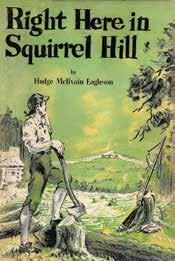
An unusual book is Right Here in Squirrel Hill (Jackson Press) by Hodge McIlvain Eagleson (1875-1973), written
in 1953 when Eagleson was pastor of Mary S. Brown Church at 3424 Beechwood Boulevard. The book is a laugh-out-loud account of the early years of Squirrel Hill from the late 1700s to the mid 1800s. It is not considered factual because Eagleson embellished his tales and omitted details he felt were extraneous. However, the important thing is that Eagleson collected stories his parishioners had heard from their parents and grandparents— descendants of the very people who populate his book, many of whom are buried in Turner Cemetery next to where the church stood. (The church was demolished in 2020.)
To get an idea of Eagleson’s prose, here is how he describes the 1830s in Squirrel Hill, when wealthy folk from Downtown were buying up farms in the area for country estates, to the dismay of the farmers living there:
Like all wars the Squirrel Hill Rebellion against the commuters was graced by evil names. Each side spoke of the enemy in villainous terms. The city slickers called the Squirrel Hill nobility “Simple Simons” and the natives yelled back “Feather Duster.” This opprobrium rose naturally when a choice rooster was winged on Jake Bell’s farm. The bird came squawking home and Bell rushed out in time to see the city culprit flee. “Them darn
Pittsburghers would shoot a feather duster,” irate Bell declared, giving the invaders the name they bore until all local battlers marched away together to Bull Run. . . . More disturbing than popping a favored rooster or finding a cow’s hide full of shot was the devilish skill of the Feather Dusters at stealing the hearts of local maidens. A Squirrel Hill lass cut her romance with a mule team native when a swain came down the Salt Works Road with a team of grays, buggy, whip and lap robe.
Right Here in Squirrel Hill is now out of print and not online, so the SHHS plans to annotate and reissue it with the help of a Carnegie Mellon intern in summer 2026.
A more straightforward account of how Squirrel Hill developed is The Early History of the Fifteenth Ward of the City of Pittsburgh, written in 1925 by historian Sarepta C. Kussart (1871-1950), president of the Women’s Historical Society of Western Pennsylvania. Although today the Fifteenth Ward comprises Greenfield, Hazelwood, and Glen Hazel and not the City neighborhood of Squirrel Hill, in its early days, “Squirrel Hill” referred to the whole hill. The following passage from Kussart’s book refers to the fact that Second Avenue once ran all the way from Downtown to Braddock through


Squirrel Hill while referencing the ancient Native American history in the area.
At the head of Mansion Street, Glenwood, was an ancient burying ground of that aboriginal tribe known as the Mound Builders. It included several mounds, the largest being about fifteen feet in height. Their tops were rounded, and the mounds, originally, were heaped with stones, it being the Indian custom to add more stones at each visit. In the seventies, when Second Avenue was paved through the Fifteenth Ward for the first time, James McKibben, who had the contract for grading this street, hauled stones for an entire winter from these old mounds, and used them for ballast. The enveloping cover of stones being removed, persons began exploring the mounds, searching for relics, and they were soon destroyed. No trace of them now remains.
Both Eagleson and Kussart’s books find an echo in architectural historian Dr. Franklin Toker’s more recent Pittsburgh, An Urban Portrait (Penn State, 1986). Toker (1944-2021), who lived in Squirrel Hill and taught at Pitt, writes,
Squirrel Hill has a feature that is unique among Pittsburgh neighborhoods and a rare
phenomenon anywhere. It was born as a pioneer farming community in the 1760s, with an admixture of Indian traders. The original village fronted south on the Monongahela River toward Homestead, and the center of its activity was the presentday intersection of Browns Hill Road and Beechwood Boulevard. . . .
Because of its inaccessibility (only three minor lanes entered Squirrel Hill—from Shadyside, Hazelwood, and the Monongahela shore), it remained for another century as a district of a few dozen large estates. It finally changed character and became both fashionable and populous with two milestones: the introduction of the electric trolley along Forbes and Murray avenues in 1893, and the rebuilding of Beechwood Boulevard by Frederick Law Olmsted, Jr., in 1903.
An anonymously written real-estate booklet from around 1900, Squirrel Hill Homes, touts the advantages the electric trolleys offered:
Squirrel Hill is one of the new suburbs. Until within the last few years it did not enjoy street railway privileges, and the largest portion of the district was simply farmland and forest. But the last five years have wrought wonderful changes. The building of the trolley line out Forbes street to Homestead, the
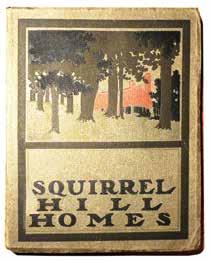
opening of [Beechwood] boulevard and the paving of a few of the most prominent streets turned the thoughts of home seekers that way. The Homestead, Braddock and Duquesne lines of the Monongahela Traction Co. run out Fifth avenue to Oakland, thence out Forbes street to·Murray avenue and down to the river. . . But some of the finest property in the Squirrel Hill district lies beyond Murray avenue, and to reach this a new line has been planned by the Wilkinsburg and East Pittsburg Railway Co. The road will run out Forbes street over the Monongahela Traction Co.’s tracks to. . . Wilkinsburg and Swissvale. From there it will be extended to East Pittsburg and Wilmerding, making the shortest route from the city to the outlying towns.

Anyone interested in learning more about Squirrel Hill history is invited to attend the programs of the Squirrel Hill Historical Society, held on the second Tuesday of each month at 7:30 p.m. Programs are live at the JCC, 5738 Forbes Ave., and are also on Zoom. Go to www.squirrelhillhistory.org to request a link to the Zoom program and for updates and announcements of upcoming lectures and events. Please consider joining the SHHS. Membership is only $15 per year ($25 for families). There is no charge for attending the meetings.
TUESDAY, APRIL 14
“History of Carrie Furnaces and the Purpose of the Rivers of Steel Organization”
MARY MURRIN, Executive Director, Rivers of Steel, will talk about the history of Carrie Furnaces and the purpose of the Rivers of Steel organization.
TUESDAY, MAY 12
“The Swisshelm Park Solar Array”
LILLY FRIEDMAN, Senior Manager of Development Projects at Urban Redevelopment Authority of Pittsburgh will describe the purpose and progress of the Swisshelm Park solar array planned for the brownfield above Nine Mile Run.
TUESDAY, JUNE 9
“Squirrel Hill’s Fourth of July Celebrations Through the Years”
HELEN WILSON, SHHS Vice President, will talk about Squirrel Hill’s extravagant Fourth of July celebrations, mainly held in Schenley Park in its early years.
TUESDAY, JULY 14
“The Histories of Congregation Rodef Shalom & Temple Sinai”
ERIC S. LIDJI, Director of the Rauh Jewish History Program & Archives at the Senator John Heinz History Center, will discuss the histories of Congregation Rodef Shalom and Temple Sinai.
A few years later automobiles followed the trolleys, and in the book City at the Point: Essays on the Social History of Pittsburgh (edited by Samuel P. Hays; University of Pittsburgh Press, 1989), CMU history professor Dr. Joel A. Tarr writes in his chapter, “Infrastructure and City-Building in the Nineteenth and Twentieth Centuries,” that “The Squirrel Hill district, an affluent area which had the highest amount of automobile ownership and use in the city, had its fastest rate of development in the 1920s, especially after direct roadway connections with the downtown were made in 1922.” Dr. Tarr is talking about the Boulevard of the Allies.
Tied in closely with Squirrel Hill’s development was its Jewish character. Well-known Squirrel Hill professor and author Dr. Barbara Burstin wrote a number of books about Pittsburgh’s Jewish history, including Steel City Jews: A History of the Pittsburgh Jewish Community 1840-1915; Steel City Jews in Prosperity, Depression, and War: A History of the Pittsburgh Jewish Community 1915-1950 ; and Jewish Pittsburgh (Arcadia Images of America). Dr. Burstin specifically addresses the subject of Squirrel Hill’s Jewish development in her chapter in the Squirrel Hill Historical Society’s book Squirrel Hill: A Neighborhood History (The History Press, 2017). Her opening paragraph says,
Squirrel Hill and Pittsburgh Jewry have been linked for more than one hundred years, with the area being the demographic and institutional core of Jewish Pittsburgh for over half of those years. The trickle of Jewish migrants who discovered Squirrel Hill in the first decade of the twentieth century became a torrent by the 1920s. The district by then had become a destination for those seeking a more attractive neighborhood removed from the grime of downtown, the congestion and poverty of the Hill District and the increasing industrialization of the North Side (Allegheny City until 1907). . . . By the beginning of the twentieth century, transportation improvements and public services had made Squirrel Hill accessible and appealing, and it soon became the
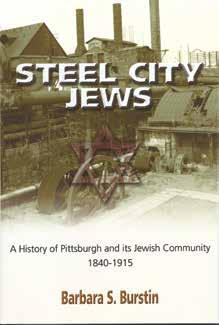
home of a wealthy class of business and professional people.
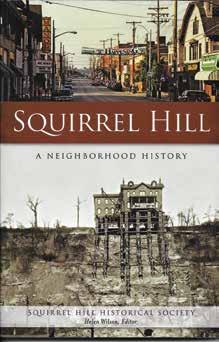
Other chapters in Squirrel Hill: A Neighborhood History written by Helen Wilson, Michael Ehrmann, Betty Connelly, and Wayne Bossinger examine different eras of Squirrel Hill’s development. Prior to this book’s publication, the SHHS published Squirrel Hil l (Arcadia Images of America, 2005).
Many other books and articles have been published about Squirrel Hill. Without them, we would not remember the past or understand the present. In the words of A. Whitney Brown, “The past actually happened, but history is only what someone wrote down.”