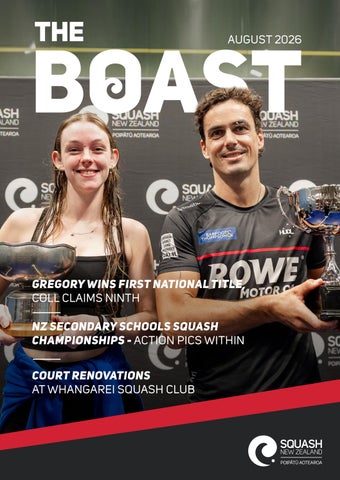
AUGUST 2026
GREGORY WINS FIRST NATIONAL TITLE, COLL CLAIMS NINTH NZ SECONDARY SCHOOLS SQUASH CHAMPIONSHIPS - ACTION PICS WITHIN COURT RENOVATIONS AT WHANGAREI SQUASH CLUB
CONTENTS 6. In memory of Jim O’Grady 7. Tickets On Sale now for 2027 NZ Squash Open 8. HEAD 2026 New Zealand Squash Championships 12. HEAD NZ Pro Tour Season Wrap-Up 14. National Graded Championships 16. North Island Junior Age Groups 18. South Island Junior Age Groups 20. World Junior Squash Championships 22. NZ Secondary Schools Squash Championships 27. Lottery Funding Campaign for 2028 World Championships 30. Peak Performance with Kemp 34. Club of the Month - North Shore Squash Club 36. Court Renovations at Whangarei Squash Club 38. NZ Racketball Open 40. Referee / Match Management - A Referee Guide 42. Volunteer of the Month - Neil Rossin
Stay updated with our other channels
16
8
34
11 38
36
Chief Executive Update Tēnā koutou Kia ora everyone, I hope you are all enjoying another fantastic squash season. Like many of you, my season has been a gradual build-up, with my sights firmly set on the Masters Club Championships and the G.J. Gardner Homes New Zealand Masters Championships in Whanganui. It remains one of my favourite events on the calendar, combining competitive squash, great camaraderie, and plenty of laughs along the way. I would like to acknowledge the team at Devoy Squash & Fitness Club for hosting the HEAD New Zealand Championships and National Graded Championships. In my view, it was one of the best national events I have witnessed during my time as Chief Executive. The club created an outstanding environment, supported by a remarkable volunteer team that made everyone feel welcome.
The decision to combine the two championships proved a masterstroke. Seeing National Graded players of all ages proudly representing their districts alongside the country’s best athletes, including World No.2 Paul Coll, created a unique atmosphere. From Friday morning through to Sunday evening, the club was packed with players, supporters, and squash enthusiasts, generating a fantastic buzz. Paul also deserves special recognition. Despite the demands that come with being one of the world’s best players, he generously gave his time to fans throughout the weekend. His engagement, humility, and willingness to connect with everyone makes him an exceptional ambassador for our sport. Looking ahead, excitement is already building for the New Zealand Open in Palmerston North next February.
Having attended the launch, I am confident this event will capture the imagination of the entire region. It promises to be much more than a squash tournament and I encourage everyone to attend and bring along family and friends. Finally, much of my focus remains on securing the 2028 World Championships in Auckland. Beyond hosting a world class event, our ambition is to use this opportunity to grow participation, strengthen club membership, and leave a lasting legacy for squash across New Zealand. Exciting times lie ahead for our sport. Ngā mihi Martin Dowson
Upcoming events 14-15 August | NZ Senior Teams | Hawkes Bay Squash Rackets Club 14-15 August | Southland Junior Open | SquashCity Invercargill 14-15 August | Southland Masters | SquashCity Invercargill 21-23 August | Masters Club Team Champs | Whangarei Squash Club 4-5 September | BOP Masters | Putaruru Squash Club 4-5 September | Midlands Masters | Oamaru Squash & Badminton Club 11-12 September | Midlands Junior Open | TBC 11-12 September | Northland Masters | Kamo Squash Club 16-19 September | National Superchamps 24-26 September | Otago Junior Open | Pirates Squash Club 24-26 September | Otago Masters | Pirates Squash Club
4
Don’t miss any upcoming events. Click HERE to access the full tournament calendar
rd
The notice boa in What’s happening
our community
September is Prostate Cancer Awareness Month. It provides a timely opportunity to promote greater awareness of prostate cancer and to encourage all our male members in their 40s, 50s and 60s to have regular prostate health checks with their doctor. Click HERE for more info
Olympic Opportunity: LA28 Services Lead, Squash Become a LA28 Volunteer We are excited to share news from the LA28 Volunteer Program presented by Delta Air Lines: Games-time volunteer applications are now open! Click HERE to view. Games-time volunteering through the LA28 Volunteer Program will see a crew of 60,000 set the stage and keep it running smoothly for the biggest Olympic and Paralympic Games in history.
LA28 is seeking a Services Lead, Squash to help deliver squash’s historic Olympic debut at the Los Angeles 2028 Olympic and Paralympic Games. Based in Los Angeles, the role will coordinate key operational areas including accreditation, transport, accommodation, hospitality, volunteer management, and liaison with World Squash, athletes, and technical officials. This is an exciting opportunity for an experienced sports event professional to play a leading role in the sport’s biggest stage. More information and applications CLICK HERE
We’re happy to share an exclusive code to use in the Games-time volunteer application. This code will help LA28 identify a member of the Squash community. It is intended for personal use only and should be entered in the indicated field on the application. Please note, codes do not guarantee receiving a role, nor are they required to apply. VOLUNTEER CODE: ZTI48UGZ People of all abilities who meet the following requirements are encouraged to apply: •
Be 18 years or older at the time of your application
•
Be proficient in English (reading and writing)
•
Be available for a minimum of 10 nonconsecutive shifts (of approximately eight hours each) during the 2028 Olympic or Paralympic Games periods
For more information about Games-time volunteering with LA28 and to start your application, visit the LA28 volunteer portal.
5
IN MEMORY OF
Jim O’Grady: A LIFETIME OF SERVICE TO SQUASH The New Zealand squash community is mourning the loss of one of its most respected and influential leaders, Jim O’Grady. For more than five decades, Jim dedicated his time, energy and expertise to the sport he loved, leaving an enduring legacy in Canterbury, New Zealand and throughout Oceania. His journey in squash began as a player in Christchurch during the 1960s, but it was his passion for serving the sport that would define his remarkable contribution. Jim’s administrative career started at Marist Squash Club, where he stepped forward as Club Secretary when no one else volunteered. From there, he progressed to Canterbury Squash, serving as Coaching Coordinator and later as Chair, before joining the Squash New Zealand Executive Council in 1998. He became Chair of Squash New Zealand from 2007 to 2009 and then served as Chief Executive from 2009 to 2018, guiding the organisation through a period of significant change and development. Among the highlights of his tenure were the rebranding of Squash New Zealand and the implementation of the iSquash system that continues to underpin the sport today.
His influence extended well beyond New Zealand. As Vice President and later President of Oceania Squash, a role he held until 2023, Jim was a tireless advocate for the growth of the game throughout the Pacific region. He attended World Squash Federation meetings, supported developing nations and played a key role in major international events. Those who knew Jim will remember far more than the positions he held. He was admired for his integrity, wisdom, humility and unwavering commitment to helping others. He earned the respect of players, volunteers, administrators and international colleagues alike. Squash New Zealand Poipātū Aotearoa extends its deepest sympathies to Jim’s family and friends. His leadership helped shape the sport we know today, and his contribution will be remembered with gratitude for generations to come.
Thank you, Jim. Your legacy will live on throughout the squash community.
Activate your free 14 days HERE
For more information, visit squashnz.co.nz
read squashskills latest blog Common Amateur Fault: Playing Without Variation
6
READ THE BLOG HERE
Tickets On Sale now! FOR 2027 NZ Squash Open PALMERSTON NORTH’S REGENT ON BROADWAY
FEBRUARY 16 - 21
Tickets for the 2027 New Zealand Squash Open are on sale now, with the world’s best squash players set to compete on a glass court on the stage of Palmerston North’s Regent on Broadway Theatre. The tournament, part of the PSA World Tour, will run from 16 to 21 February 2027 and will see New Zealand’s squash stars take on some of the best players in the world. A glass court installed on the Regent on Broadway stage will transform the theatre into a worldclass squash arena, with 1,360 seats per session and views of the action from every angle. Palmerston North Mayor Grant Smith urged the city to get in behind the event and pack the theatre. “Watching the world’s best players compete on a glass court in a venue like this will be something truly special, with sport meeting the arts” said Mayor Smith. “I know we’re huge sporting fans in this city and region, and I’m challenging the community to sell out the theatre and set a new national record for the biggest squash crowd this country has ever seen,” said Mayor Smith. “There are 1,360 seats per match, and we expect all of the finals sessions to sell out, so my message is get in quick to avoid missing out.” Mayor Smith said hosting the Open was a significant opportunity for the city and a real coup. “The event will bring international athletes, visitors and significant economic benefits to Palmerston North, while showcasing the city as a vibrant and capable destination for major events.
“Palmerston North hosted the Men’s World Team Squash Championship in 1971, the Women’s World Team Squash Championship in 2010 and the Junior Men’s World Championship in 2006. It’s exciting to welcome international squash back to our city.” A New Zealand Junior Invitational will run alongside the event, providing the opportunity to talented locals like Maximus Mathews (Whanganui) and Brodie Bennett (Tararua) to play their own tournament with the opportunity to play on the same stage as some of the worlds best if they reach the finals. Squash New Zealand Chief Executive Martin Dowson said the competition will be one to remember. “This is an outstanding event, not just for squash fans but for anyone who enjoys high-quality sport and live events. With finals sessions expected to sell out, as they have at previous venues in Christchurch and Tauranga. I’d encourage the community to grab tickets early and be part of it.” The 2027 Open forms a key pillar of the Road to the LA Olympics, a national initiative supporting New Zealand athletes in their pursuit of Olympic qualification for LA 2028. Tickets for the 2027 New Zealand Squash Open are on sale now through Ticketek. Further details on Festival events will be announced later this year.
CLICK HERE TO BUY YOUR TICKETS 7
Gregory Wins First National Title, Coll Claims Ninth The Hawke’s Bay’s Jena Gregory has claimed her first national title while Paull Coll has secured his ninth, following three days of impressive competition at the HEAD 2026 New Zealand Squash Championships in Tauranga. Competing at the Devoy Squash and Fitness Centre, Gregory took on No. 1 seed Ella Lash in the women’s final. Lash was solid from the outset, taking the ball early and fast to build her lead before hitting a beautiful boast to take the first game 8-11. Gregory then found her length and accuracy, working the angles and staying composed to get the better of Lash in the second 11-8. It was more of the same in the next two games, Lash hitting a few unforced errors while Gregory remained composed to secure the win 8-11, 11-8, 11-9, 11-7. “This means so much to me, I’ve had a pretty rough year this year so to be able to get this title is incredible and so special to me. I’ve come third twice so it’s pretty amazing,” said Gregory.
8
World No. 2 Coll then took on up and comer Ollie Dunbar in the men’s final. Dunbar didn’t shy away, taking the game on and hitting some great shots to stay with Coll. The West Coaster then pulled away before Dunbar hit some beautiful winners, with Coll eventually taking the opener 11-7. Coll pushed up in the second, taking the fight to Dunbar to force a few errors and claim a comfortable 11-4 win. The third was a cut copy of the previous game with Coll staying on the attack to win 11-4 and secure his ninth national title. Freddie Jameson placed third in the men’s division, while Shelley Kitchen took third place in the women’s.
Results of
HEAD 2026 NZ SQUASH CHAMPIONSHIPS MEN
WOMEN Winner:
Jena Gregory
Winner:
Paul Coll
Runner up: Ella Lash
Runner up: Oliver Dunbar
Third:
Shelley Kitchen
Third:
Freddie Jameson
Fourth:
Emma Merson
Fourth:
Maximus Mathews
HEAD 2026 New Zealand Squash Championships
10
FIT
FOR LIFE Every new policy arranged gives back to Squash New Zealand and your local squash club. Long Burroughs is proud to introduce Fit for Life, a Life & Health insurance initiative supported by Squash New Zealand Poipātū Aotearoa. Whether you're not yet covered, already have insurance, or haven't reviewed it in years, Fit for Life gives every Squash NZ member access to a free insurance review to help make sure your cover fits your life today.
HOW IT WORKS: 1. Book a no-obligation Life & Health insurance review, with Bryce. 2. Receive expert advice tailored to your circumstances.
SCAN TO BOOK
YOUR FREE
REVIEW
3. If a new Life & Health policy is arranged through Fit for Life, Long Burroughs will contribute one month's premium to both Squash New Zealand Poipātū Aotearoa and your local squash club.
CONTACT Bryce Wilson | 021 211 4957 | Bryce@longburroughs.co.nz 11
HEAD NZ Pro Tour SEASON WRAP-UP
12
The inaugural HEAD Pro Tour has been a resounding success, creating a season that gave players more opportunities to compete, develop and showcase their talent on a national stage. From the opening event to the final championships, the series brought together New Zealand’s best players and rising stars, creating a competitive and connected pathway that players embraced throughout the year. What made the series special was not just the quality of the squash on display, but the stories that emerged along the way. Players travelled the country chasing valuable points, competing in front of growing audiences, and becoming part of a season-long narrative that kept momentum building from event to event. The tour created a platform where achievements could be recognised and celebrated, while helping players feel part of something bigger than a single tournament. The season reached its peak at the HEAD New Zealand Championships and National Graded Championships, where players across all levels came together to compete in an outstanding championship environment. The combination of elite competition, strong participation and a fantastic atmosphere highlighted just how much the series has added to the New Zealand squash calendar. A huge thank you must go to all of our host clubs, whose commitment, hard work and willingness to embrace a new concept were instrumental in bringing the tour to life. Their efforts created welcoming, professional events that players consistently praised and enjoyed throughout the season.
Most importantly, thank you to HEAD. As the first partner to jump on board this new initiative, they took a genuine leap of faith in the vision for the tour. Their support helped transform an idea into reality, elevate the player experience, and establish a strong foundation for the future. The success of the inaugural season is a credit to their belief in the sport and their commitment to growing squash in New Zealand. Together, the players, clubs, volunteers, officials and HEAD have created something worth building on. The first year of the HEAD Pro Tour has set a new benchmark and leaves the sport well positioned for an even bigger future
National Graded Championships For many players, the National Graded Championships are about much more than chasing a title. They are about representing their district, reconnecting with friends from around the country, testing themselves against new opponents and being part of something bigger than their own draw. That spirit was on full display at the 2026 HEAD New Zealand Graded Championships in Tauranga, where nearly 100 players came together for a weekend that celebrated everything that makes the squash community special. Throughout the event, Devoy Squash & Fitness buzzed with activity. Courts were filled from morning until night and supporters lined the viewing areas. Whether players were competing in their first national event or were seasoned championship regulars, there was a shared sense of excitement and belonging that carried throughout the weekend. One of the unique features of the event was the opportunity for graded players to experience the national championships atmosphere firsthand. Between their own matches, competitors could step into the crowd and watch New Zealand’s top players battle it out on the show court. It created an environment where grassroots and elite squash came together, inspiring
14
players while strengthening connections across the game. Many participants later described this as one of the most memorable aspects of the tournament. Feedback from participants reflected that experience, with players praising the organisation, communication and overall atmosphere of the event. Above all, the sense of community stood out. Bringing players from all corners of New Zealand together in a single championship environment showcased not only the depth of talent within the grades, but also the passion and camaraderie that continue to drive the sport forward. By the end of the weekend, trophies had been won and champions crowned, but the lasting memories were just as much about the experience itself. The 2026 New Zealand Graded Championships delivered a weekend of fierce competition, connection and celebration, reinforcing its place as one of the most anticipated and enjoyable events on the domestic squash calendar.
B c d e f
MEN’S CHAMPIONS
WOMEN’S CHAMPIONS
Surya Sathish (Auckland) def. Jacob Brown (Otago) 11/7, 11/5, 12/10
Yusra Rashid (Auckland) def. Skye Loach (BOP) 5/11, 11/9, 11/7, 11/7
Daniel Stewart (Auckland) def. Regan Miller (Otago) 10/15, 18/16, 15/12, 13/15, 15/6
Ana Moselen (Northland) def. Ksenia Kruchkina (Waikato)15/9, 15/9, 16/14
Jamie Crashley (Otago) def. Mitchell Murphy (Waikato)15/10, 15/13, 15/9
Mia Jamieson (Auckland) def. Nicole Cameron 15/10, 15/12, 15/12
Joel Welch (Wellington) def. Luke Garrett (Central) 15/10, 13/15, 15/4, 8/15, 15/13
Maia Lenihan (Wellington) def. Jaynie Ovenden (Eastern) 11/15, 15/10, 15/6, 4/15, 16/14
Ari Martin (Auckland) def. Luke Dugmore (BOP) 15/8, 6/15, 15/12, 15/17, 15/7
Kelly Anderson (BOP) def. Tessa Burgess (Otago) 15/6, 9/15, 15/8, 15/6
15
North Island Junior Age Groups The North Island Junior Age Groups delivered a memorable weekend of squash, bringing together young players from across New Zealand in an event that celebrated competition, sportsmanship and the strength of the squash community. Hosted by Hawke’s Bay Squash Rackets Club, the tournament provided valuable opportunities for emerging athletes to test themselves against players they would not usually face, creating new experiences and challenges on court. Organisers noted that it was especially rewarding to see local players perform strongly while also welcoming competitors who had travelled from across the North Island and beyond. One of the highlights of the weekend was the atmosphere surrounding the finals, with a packed grandstand watching high-quality matches between the tournament’s leading players. The spectacle provided inspiration for younger and up-and-coming competitors, giving them the chance to see firsthand what can be achieved through hard work and dedication to the sport.
16
RESULTS U11 GIRLS Winner: Miranda Fu 2: Remi Collier
3: Blanche Drummond U11 BOYS Winner: Nikos Michalakis 2: Caeden McMurchy 3: Ari Shuja U13 GIRLS Winner: Addison Rouse 2: Isabel Bergman 3: Shelby Duncan U13 BOYS Winner: Jayden Zhang 2: Lachlan McMurchy 3: Louis Mathis U15 GIRLS Winner: Yusra Rashid 2: Alisa Zhang
3: Olivia Michalakis U15 BOYS Winner: Hugo Phillips 2: Hemi Gregory
3: Jasper Christie U17 GIRLS Winner: Sabine Veitch 2: Maebh Manning 3: Millie Christie U17 BOYS Winner: Eamon Gannon 2: Ryan Linton
3: Karlin Snowden U19 GIRLS Winner: Jaime Tipu 2: Sophia Unwin
3: Chloe Chipperfield U19 BOYS Winner: Brodie Bennett 2: Sam Watson
3: Campbell Dunwoodie
17
SOUTH Island Junior
Age Groups The South Island Junior Age Groups, hosted by Waimea Squash Club, may have featured a smaller field than some of the country’s larger junior events, but the passion, determination and quality of squash on display proved that this was a tournament that certainly packed a punch. Competitive matches throughout the weekend saw a dedicated group of young players battle it out for age group honours, creating plenty of memorable moments along the way. For some players, the South Island Junior Age Groups offered the chance to continue an impressive run of form following the North Island Junior Age Groups, while for others it opened the door to a breakthrough performance and age group success. The tournament delivered plenty of competitive squash and valuable learning opportunities, with players relishing the chance to measure themselves against the region’s best. Although the event was smaller in scale, the passion and support surrounding the tournament created a lively and welcoming atmosphere from start to finish. As the tournament progressed, spectators were treated to a number of hard-fought contests, with players showing skill, resilience and sportsmanship in pursuit of their age group titles. The event also served as an inspiration for younger competitors, who had the chance to watch some of the countries leading juniors in action and see what can be achieved through dedication and hard work.
18
RESULTS UNDER 11 GIRLS Winner: Abigail van Niekerk 2: Holly van Niekerk 3: Ameika Graham UNDER 11 BOYS Winner: Chase Dowling 2: Xander Green 3: Sebastian Johnston UNDER 13 GIRLS Winner: Addison Rouse 2: Mia Mennell 3: Mila Gregory UNDER 13 BOYS Winner: Liam Hogg 2: Caleb Smith 3: Terynn Dowling UNDER 15 GIRLS Winner: Yusra Rashid 2: Ivana Preston 3: Lakisha Mennell UNDER 15 BOYS Winner: Hemi Gregory 2: Zavier Hansen 3: Seb Reeves UNDER 17 GIRLS Unfortunately, there were no entries in this grade. UNDER 17 BOYS Winner: George Reynolds 2: Caleb Alexander 3: Mason Hansen UNDER 19 GIRLS Winner: Victoria Moran 2: Carly Craig UNDER 19 BOYS Winner: Taylor Vette
19
Valuable Experience for Young New Zealand Squash Teams at World Juniors New Zealand’s men and women returned from the World Junior Squash Championships in Niagara-on-the-Lake with valuable experience and plenty of lessons for the future after finishing 18th and 12th respectively in the team events. Both results were largely in line with pre-tournament expectations, reflecting the current standing of New Zealand’s emerging talent against the world’s strongest junior nations. However, the championships provided far more than a final placing, offering a crucial development opportunity for a young squad with an eye on future campaigns. The women’s team produced one of the standout results of the tournament during pool play, defeating Ireland, a side that later went on to secure ninth place overall. The victory demonstrated
20
RESULTS Teams: Sunday 26th July
Australia VS New Zealand
3-0
Girls
Loss
Sunday 26th July
Egypt VS New Zealand
3-0
Boys
Loss
Monday 27th July
Ireland VS New Zealand
1-2
Girls
Win
Monday 27th July
New Zealand VS Germany
0-3
Boys
Loss
Tuesday 28th July
Hong Kong, China VS New Zealand
3-0
Girls
Loss
Tuesday 28th July
New Zealand VS Macau, China
2-1
Boys
Win
Wednesday 29th July
New Zealand VS Mexico
2-1
Boys
Win
Thursday 30th July
South Africa VS New Zealand
2-0
Girls
Loss
Thursday 30th July
New Zealand VS Scotland
0-2
Boys
Loss
Friday 31st July
Japan VS New Zealand
2-1
Girls
Loss
Boys Team finished: 18th
Girls Team finished: 12th
Individuals: Max Mathews
73rd
Amalia Ricketts
48th
Vihan Chathury
75th
Brooke Valois
42nd
Ciaran Manning
55th
Liberty Jones
51st
Jack Lord
97th
Charlee Neilson
84th
the potential within the group and highlighted their ability to compete with higher-ranked opposition when performing at their best. For many of the New Zealand players, the event was their first exposure to the intensity, depth and consistency required at the highest junior level. Competing against the world’s best gave the squad a clear understanding of the pace, physicality and quality of squash needed to succeed on the international stage. Encouragingly, almost all members of the touring team remain eligible for next year’s championships, while many will also be available for the 2028 event. With that experience now banked, New Zealand’s young players have a strong platform from which to continue their development and pursue improved results in the years ahead.
21
The NZ Secondary Schools Squash Championships The NZ Secondary Schools Squash Championships saw 54 teams from around New Zealand descend on Christchurch for a fantastic weekend of competition. Matches were played across four venues, Burnside, Christchurch Football, Richmond, and Hoon Hay Squash Clubs, with some outstanding squash on display throughout the event. The girls’ final between Tauranga Girls and Ruapehu A provided one of the most exciting contests of the weekend. Locked at 2-2 after four matches, the championship came down to the fifth and deciding match, with Tauranga Girls holding their nerve to claim the title for the second year in a row. In the boys’ final, Tauranga Boys faced Auckland Grammar. Despite some excellent squash from both teams, Tauranga Boys proved too strong, securing a comprehensive 5-0 victory to win their third consecutive national secondary schools title. Congratulations to all players, coaches, officials, and volunteers who helped make the event a memorable celebration of secondary school squash.
22
Photos by Kelsi Carrick Photography
23
2026 NZ SECONDARY SCHOOLS SQUASH CHAMPIONSHIPS
2026 NZ Secondary Schools Squash Championships winners: Tauranga Girls
2026 NZ Secondary Schools Squash Championships winners: Tauranga Boys
24
Secondary Schools
Trans-Tasman Test SYDNEY 24-28 AUGUST Excitement is building for the upcoming Secondary Schools Trans-Tasman Test, set to take place in Sydney from 24-28 August. The event will see New Zealand’s top secondary school athletes compete against their Australian counterparts in a highly anticipated international contest.
Congratulations to all players selected in the Junior and Senior teams, who were officially announced at the NZSS Prizegiving on Sunday. Selection is a testament to the players’ hard work, dedication, and outstanding performances throughout the season.
We wish all team members the very best as they prepare to represent New Zealand on the Trans-Tasman stage. Go well and make us proud! 25
NZ Masters Championships WHANGANUI SQUASH CLUB INDIVIDUALS: 16-18 OCT | TEAMS: 19-20 OCT
Theme: A little bit Country
Entry for individuals includes dinner and party on the Saturday night
Individuals
Entry Fee - $50.00 - Enter via MySquash Teams
Teams will be submitted by District Administrators Key Contact
Anneka Weterman, wgisquashevents@gmail.com Phone - 021 113 9651 26
It is a once in a lifetime opportunity. We need your help. “It would be a dream come true.” – Paul Coll That’s how our world number one describes the opportunity to host the 2028 World Championships in New Zealand.
It’s a vision shared across our past and present players. For Joelle King, our most decorated Commonwealth Games athlete, the 2028 World Champs would represent a potential swansong on home soil. A chance to finish an extraordinary career in front of a New Zealand crowd would be incredibly special — not just for Joelle, but for everyone who has followed her journey. This is what is at stake. We have a genuine opportunity to secure the 2028 World Championships — the biggest squash event ever held on our shores. But to make it happen, we need to show something powerful: that our community stands firmly behind it.
That’s why we’ve launched the 2028 Lottery Funding Campaign.
We have a genuine opportunity to secure the 2028 World Championships. But to make it happen, we need your help.
For $50, you’re not only going into the draw for some incredible experiences — you’re helping create history. Prizes include exclusive behind-the-scenes access, premium match tickets, and experiences that won’t be available anywhere else. The first people in the world to hold tickets to the 2028 World Champs will come from this group — and that’s something truly special. While you’re at it why not tell your friends or even by multiple tickets to increase your chances to win!
CLICK HERE OR SCAN THE QR CODE TO BUY YOUR TICKET
The final Phase 2 lottery winners will be drawn on 1 September 2026. This is our opportunity — for Paul, for Joelle, and the opportunity to showcase our sport to the whole of New Zealand and grow the game of squash.
Let’s make this dream a reality, together.
27
2026
NZ JUNIOR AGE GROUP
CHAMPIONSHIPS / INDIVIDUALS
2-4 OCTOBER / HENDERSON SQUASH CLUB
Age Groups U19, U17, U15, U13, U11 (as at 4th Oct) Entry Entry fee $40
Enter via MySquash Entries close 18th September Players must be available from 9am Friday
Key Contact Anneka Weterman, anneka@squashnz.co.nz Payment Entry Fee is to be paid by Bank Transfer by the 18 September 2026 to guarantee entry. Account Name: Squash New Zealand Account Number: 12-3107-0075196-00 Reference: NZJAG Description: Childs Full Name 28
Promote Your Brand in
Want to reach thousands of squash fans across New Zealand? The Boast is Squash NZ’s digital magazine, shared with over 22,000 subscribers and across 11 Districts and International followers. Connect with players, coaches, and fans who live and breathe squash. With clickable ads, sponsored content, and multi-issue discounts, it’s a smart way to get noticed.
Interested? Email admin@squashnz.co.nz or visit www.squashnz.co.nz to learn more.
Order our cool
Squash tops Choose between hoodie, mid-layer top and a standard T-shirt. Check out the colour options and place your order by clicking the link below. CLICK HERE TO ORDER 29
HIGH PERFORMANCE Peak Performance with Kemp JONATHAN KEMP National Performance Coach
WHY PRESSURE EXPOSES, RATHER THAN CREATES, WEAKNESS Pressure is often blamed for mistakes in squash. A tin at 9-9, a poor decision on match ball, or a rally that unravels when the score tightens can all feel like examples of pressure causing failure. In reality, pressure rarely creates new problems. It reveals existing ones. The skills, habits, and decision making patterns that exist in training are usually the same ones that appear in competition. Pressure simply removes the comfort, time, and certainty that can hide weaknesses when the stakes are low.
Why Players “Tighten Up”
Many players describe themselves as tightening up under pressure. Their movement feels slower. Their swing feels restricted. Decisions become rushed or hesitant. This is a normal response. Pressure increases attention and emotional intensity. Players become more aware of consequences, mistakes, and outcomes. The problem is not the presence of pressure. The problem is that pressure exposes behaviours that have not been sufficiently prepared. If a player’s decision making is inconsistent, pressure will reveal it. If their routines are weak, pressure will expose that too. The higher the stakes, the harder it becomes to hide gaps that may have gone unnoticed in practice. Pressure acts like a spotlight. It does not create the weakness. It simply makes it easier to see.
Emotional Regulation Is a Trainable Skill
One of the biggest misconceptions in sport is that some people are naturally good under pressure while others are not. While individual personalities differ, emotional regulation is a skill that can be developed. The best competitors are not those who never experience nerves, frustration, or doubt. They are the ones who recognise those emotions without allowing them to dictate their behaviour.
30
This might involve: • Using a consistent reset routine between rallies • Resetting quickly after a mistake • Focusing on the next rally rather than the previous one These behaviours help stabilise performance when emotions begin to fluctuate. Like any skill, regulation improves through practice. The more often players experience challenging situations and learn to manage them, the more reliable they become when competition creates genuine pressure.
Why Pressure Must Be Part of Training
Many training environments are too comfortable. Rallies restart immediately after errors. Scores are forgotten. Consequences are removed. While this can be useful for learning new skills, it does not prepare players for the realities of competition. If pressure only appears on match day, then match day becomes the first real test of important performance skills. Training should occasionally include situations where outcomes matter. Games with consequences, pressure scoring, targets that must be achieved, or scenarios where players are forced to perform while fatigued all help bridge the gap between practice and competition. These environments do more than test players. They teach players. They expose weaknesses early enough for them to be improved.
Pressure as Information
Perhaps the most valuable shift players can make is changing how they view pressure. Instead of seeing pressure as something that damages performance, it can be treated as information.
Pressure reveals where routines break down. It highlights decision-making weaknesses. It shows which skills remain reliable and which still need attention. This makes pressure incredibly valuable. Rather than fearing it, players can use it as feedback. The moments that feel uncomfortable are often the moments that teach us the most.
Looking Forward
Once players understand that pressure is exposing weaknesses rather than creating them, setbacks become easier to interpret. A poor performance is no longer proof of a limitation. It is information about what needs further development. This shifts the focus away from immediate results and towards long-term growth. And that leads to the next challenge for players: developing the patience to prioritise improvement over short-term success.
The best competitors are not those who never experience nerves, frustration, or doubt. They are the ones who recognise those emotions without allowing them to dictate their behaviour.
31
P46
THE MAN WHO DREAMED IN GLASS
The Man Who Dreamed In Glass
Ibrahim Hegazy and the Creation of Modern Egyptian Squash BY FRAMBOISE GOMMENDY
There are photographs that alter the course of a sport.
requires spectacle. Not simply competition, but imagination.
The glass court glowing beneath the Pyramids of Giza in 1996 is one of them. Ahmed Barada and Jansher Khan silhoue!ed against ancient stone. Thousands of Egyptians packed into the desert night, clapping in rhythm beneath floodlights and stars.
“If my father were with us today, he would be overjoyed to see the dominance of Egyptians in the world of squash,” says his daughter, Rasha. “My father challenged the world with this championship [the 1996 Al-Ahram], and together they proved that the impossible could be achieved.”
Those images helped change squash forever.
Hegazy was born in 1944 and carried himself, according to his daughter, with the mentality of a soldier long after fighting in the October War. “The word ‘impossible’ simply didn’t exist in his dictionary,” she says. “Whatever he set his mind to, he would accomplish.”
But behind every iconic sporting image lies somebody stubborn enough to imagine it before anyone else could see it. In Egypt, that man was Ibrahim Hassan Hegazi. Long before Egypt became squash’s modern empire, before the world No 1s and junior dynasties and all-Egyptian finals, Hegazy saw possibility where others saw absurdity. A sports editor, war veteran and relentless dreamer, he understood something fundamental about sport: greatness
That refusal to accept limits would eventually reshape squash. By the late 1980s Hegazy had become one of the most influential figures in Egyptian sports media, rising to become the youngest editor-in-chief
“At the time, the proposal sounded ludicrous. A full squash arena in the desert? On protected historic ground? Exposed to wind and sand and impossible logistics? Officials told him so directly”
32
EXCTRACT FROM PLAYER MAGAZINE
All MySquash members gets free access
THE MAN WHO DREAMED IN GLASS
P47
of Al-Ahram Al-Riyadi at just 40 years old. The publication became his obsession. He referred to it a#ectionately as his “fourth daughter”. But Hegazy’s ambitions stretched beyond magazines and headlines. He wanted Egypt to stage something the sporting world had never seen before. “He had an old dream he spoke about often,” Rasha recalls. “Hosting a championship at the Pyramids.” At the time, the proposal sounded ludicrous. A full squash arena in the desert? On protected historic ground? Exposed to wind and sand and impossible logistics? O#icials told him so directly. “The response was disappointing,” Rasha says. “They told him the idea was almost impossible.” For Hegazy, that was merely the beginning. He prepared feasibility studies, lobbied authorities, used his influence within Al-Ahram and leaned on political relationships inside the Mubarak government. This was crucial. Hosni Mubarak, Egypt’s president at the time, was himself a squash enthusiast. Through that alignment of media influence and political support, Hegazy managed to unlock permissions that few others could have secured. Even then, disaster nearly intervened. After the court was purchased, engineers warned the installation could not safely happen because of the terrain and powerful desert winds. Hegazy had intentionally selected elevated ground so the Pyramids would rise dramatically behind the court. It looked magnificent in theory. In practice, they were told it could not work. “Still, he did not give up,” Rasha says. “He consulted Egyptian engineers to find a solution, and they managed to overcome the challenge.” The impossible dream became real in May 1996. What emerged was more than a tournament. It was an act of national staging. Hegazy collaborated with engineer Mohamed Hady to transform the spectator entrance into something resembling an ancient temple gateway. Photographer Samir AlGhazouli created exhibitions of historical Egyptian imagery around the site. “The entire atmosphere felt as if we had travelled back to a beautiful ancient era,” Rasha says. This was not simply squash placed in front of the Pyramids. It was squash woven into Egyptian identity itself. And then came Ahmed Barada. Barada, handsome, charismatic and thrillingly aggressive on court, surged unexpectedly to the final of that first Al-Ahram International. Overnight he became a national celebrity. Television embraced him. Newspapers splashed him across front pages. Crowds treated him like a football icon rather than a squash player. “My father considered Ahmed Barada as a son,” Rasha says. “Ahmed, in return, treated my father as a true father figure.” Together, they formed the perfect sporting partnership: the visionary promoter and the magnetic athlete. Barada gave the tournament a heartbeat. Hegazy gave it scale. The timing proved transformative. Egypt already possessed strong squash foundations through clubs such as Heliopolis, Gezira and Al Shams, and through historic champions stretching back to the
“In that sense, Hegazy’s greatest legacy was not merely a tournament. It was belief” 1930s. But the sport remained largely confined within elite circles. The Pyramids changed that. Suddenly squash was no longer hidden inside private clubs. It was national. Televised. Aspirational. Children could see themselves in it. Among those children were future world champions such as Ali Farag, Tarek Momen and Karim Darwish, all of whom would later describe Barada and the Pyramids tournament as foundational to their ambitions. But Hegazy’s influence extended beyond the men’s game too. His eldest daughter, May Hegazy, was herself part of the first generation of Egyptian girls to compete internationally in squash. Alongside Salma Shabana and Maha Zein, she represented Egypt during the fragile early years of the women’s programme developed by Dr Samiha El Magd. It is di#icult now, amid Egypt’s overwhelming dominance of women’s squash, to appreciate how embryonic the female game once was. Yet the same ecosystem Hegazy helped elevate through AlAhram would eventually produce Nour El Sherbini, Nouran Gohar, El Welily and countless others. In that sense, Hegazy’s greatest legacy was not merely a tournament. It was belief. The belief that squash could ma!er globally. That Egypt could own the sport culturally rather than merely participate in it. That an Egyptian player could become a superstar. That a court in the desert could capture the imagination of the world. “The feeling I had when the championship succeeded was indescribable,” Rasha says. “I was witnessing my father’s dream come to life.” Today, three decades later, the photographs from the Pyramids remain among the most iconic images in squash history. Most people remember the players inside the glass walls. But perhaps the true architect stood just outside them all along.
EXCTRACT FROM PLAYER MAGAZINE
All MySquash members gets free access
33
North Shore Squash Club / AUCKLAND
North Shore Squash Club has had a huge year, with growth, change and energy around the club at levels we probably have not seen since the 80s. Of course, the difference is that many of the stories from those days would not be suitable for print! Based in Takapuna, NSSC is a seven-court, nationalgrade facility and the anchor club for squash in North Auckland. More importantly, it is a community hub, training ground, social space and, for many, a second home. At the heart of NSSC is the community of the club and the community in the club: the people who contribute, coach, play and support, and the sense of belonging that keeps them coming back. Today’s North Shore is built on generations of contribution, but it is the current energy around the club that makes this chapter so exciting. Having Lisa Ashton as Club Manager has brought deep knowledge of the squash world and the New Zealand squash scene. After more than 40 years playing squash, and with a genuine love for the game and the people in it, her aim is simple: make everyone feel welcome.
Happy club members flanked by Lisa Ashton (left) and Tyler Duberly (right)
34
The lovely deck with a view at the North Shore Squash Club
We are fortunate to have coaches who have made lasting contributions. Paul Hornsby has been ingrained within NSSC for around 15 years, helping develop future squash stars. Suk Hee Kim has built a thriving Korean squash community, with around 80 Korean members enjoying her sessions and Saturday night Korean Club Nights. Since October 2025, the club has employed Tyler Duberly as our in-house Coach and Development Officer, making a visible difference in junior and beginner squash.
Gareth O’Brien - Club & School coach of the year
Tyler has brought more structure, more session options and a fresh culture within the kids’ space. Our school holiday programme has been a particular success, offering full days at the club to help local families manage a working day, at an affordable cost. The most recent programme recorded 150 attendances over two weeks, which was fantastic, although Tyler may be approaching the next holidays with slightly less enthusiasm than the children.
Ryan Linton - Most improved junior boy
Championships. North Shore Squash Club is proud of where we have come from, excited about where we are heading, and grateful to everyone who makes the club what it is.
After several years where our homegrown junior pipeline had become thinner than we would have liked, rebuilding competitive squash is a major focus. We are proud to see Ryan Linton and Yusra Rashid as our emerging rising stars, with hopefully more to follow. We also continue to welcome developing juniors from neighbouring clubs. We promise we are not trying to steal them, but sometimes it seems to be a natural progression! We do our best to support those clubs too, including through the Junior Quad Series. The club calendar has been buzzing, with Friday Social Smash, Ladies and Men’s Mish-Mash sessions, Racketball tasters, Business House, club nights, interclub, box leagues, tournaments, Superchamps and community hireage all contributing to NSSC’s energy. Off court, quiz nights, bingo, music bingo and the Balcony Bar help make the club welcoming even for those not holding a racquet. Under President David Resoli, or El Presidente, the committee has strengthened governance, refreshed the membership structure, completed reincorporation and driven fresh momentum. David has also revealed hidden talents as a quizmaster and DJ, while maintaining a suspiciously endless supply of new ideas. Looking ahead, there is plenty to be excited about, including plans for a permanent all-glass Court 8 and the opportunities created by the 2028 World Squash
35
Court Renovations at Whangarei Squash Club, Te Tai Tokerau By Neil Rossin (‘Mr Kitchen’ – coined by club President Ben Sweeny).
Over the past few years, the club has been working hard to upgrade its facilities. Whangarei is one of the larger clubs in Northland. Club President, Ben Sweeny, Shelley Kitchen (club manager and coach) and the current committee are committed and passionate about making the club a hub for the squash players and the local community in Whangarei. The facilities are one of the main aspects of the club to look after and maintain. Over the last 4 years the club has held successful Northland Senior and Junior tournaments and 2 successful National events; B-grade National Super Championships in 2024 and the North Island Juniors in 2025. For both tournaments we tried to upgrade the facilities. Some of the upgrades were a projector, replacing the old whiteboard, new TV’s for courts linking to iPads for live scoring and a mini glass squash court for the kids in the club’s lounge area.
This year we have the AD Long Cup (National Masters Club Team Championships) in August. Over a few beers in the club room on a Wednesday after Squash Max discussions took place about what we could do this year to upgrade our club in preparation for the tournament and to showcase our club. It was decided that we really should do something about one of the main aspects of the Squash Club – the 4 courts! It turned out that that 4 courts had not been properly cleaned for 15 years plus. Once this was pointed out by a few older members of the club and then looking at some of the pictures from recent tournaments something really needed to be done. The well-tried method of moping with sugar soap and warm water was really not going to cut it with 15 years of rubber, plastic and body soiling! After many hours of discussions and researching, contemplating painting, sanding and plastering it was decided that we would use a technique called ‘honing’. Ross Vickers, a ‘life member’ of the club was the brains behind this approach and conducted all the research, talked to local plasterers and builders about the technique that could be used on plastered squash walls. The club got 36
a range of quotes and Shelley worked hard to secure 2 grants in order to help upgrade the club before the AD Long Cup. After much discussion and thrashing out plans, it was decided that we would get a plasterer in (Karl Sayer) to plaster the front walls on all 4 courts and myself (a Science teacher, but a wanna- be-builder in my spare time and Northland squash player) and Josh Laing (Northland Junior squash player) would ‘hone’ the 2 side walls of all 4 courts, thus saving the club some money. As you can see from the pictures the outcome’s and the results were outstandingly good. We used a Hilti 130 grinding tool and a mixture of diamond grinding pads (50 and 100 grit) to hone and clean the walls. In the really bad area’s we used a more ‘grunty’ universal disc to take off the 15 years of ingrained muck. We also used a vacuum attached to the tool, as well as a 4/5m high tower. Apart from that nothing else was required apart from a good work ethic, a small amount of hand sanding and plenty of moping and brushing!
“We now have courts that we are proud of again”.
The club’s courts have never looked so good. The front walls are now future proofed for another 15 years thanks to the plasterer. There are no visible patches or cracks anymore, just a nice front wall, with no blemishes. The side walls are now clean so that we can now keep on top of this with our normal regular working bees with the tried and tested method of warm water and sugar soap as the year’s of grim have now well and truly been banished! We now have courts that we are proud of again. It was amazing looking back and seeing how ‘desensitized’ we all can become looking at all the black patches and thinking that it is normal. If you are reading this and think that this is something that you might want to try at your club please feel free to contact myself, Neil Rossin – rossinioni@hotmail.com or Shelley Kitchen – Manager@whangareisquash.co.nz. Our members are now really happy, apart from having to wear sunglasses the first few times of playing. We are all now really proud of the courts and this has added immensely to the other upgrades that we have put in to the club to future proof it for years to come for the families and future people that will use our facilities here up in the land of the Taniwha. 37
NZ Racketball Open Delivers Another Outstanding Weekend The New Zealand Racketball Open returned to Herne Bay Rackets Club for the second consecutive year, bringing together 36 players from across the upper North Island for a weekend of exciting social competition.
DIVISION WINNERS AND RUNNERS-UP Open: Matt Taylor (Winner), Hamish Macdonald (Runner-Up) Division 1: Richard Harris (Winner), Bruce “Snappa” Doig (Runner-Up) Division 2: Jamie Chappell (Winner), Cherie Fletcher (Runner-Up) Division 3: Dan Pollard (Winner), Michael May (Runner-Up) Division 4: Vaughan Murray (Winner), Piper Peart (Runner-Up)
38
The tournament featured a fantastic mix of experienced competitors and newcomers to Racketball (Squash57), with players enjoying two days of highenergy matches and competitive action. The growing enthusiasm for the sport was evident throughout the event, highlighting the continued development and growth of the Racketball community in New Zealand. A special thank you goes to tournament organiser Cherie Fletcher, whose hard work behind the scenes ensured the event ran smoothly, and to Herne Bay Rackets Club for their outstanding hospitality and hosting. On court, local favourite Matt Taylor successfully defended his title, winning the Open Division for the second year in a row. Taylor showcased outstanding consistency and control throughout the event, defeating clubmate Hamish Macdonald in the final. Jo Shanks was the standout performer of the women’s competitors, winning two of her three matches in the Open Division. Congratulations to all participants and winners for helping make the event such a success. With participation continuing to grow, the future of Racketball in New Zealand looks bright, and organisers are already looking forward to an even bigger and better NZ Racketball Open in 2027.
39
referee MATCH MANAGEMENT – A REFEREE GUIDE Squash is a fast, intense game. Tensions run high on a small court and when a close decision goes against a player, things can boil over quickly. A good referee needs to set clear rules early to keep control of the court, the players, and the crowd. The following steps should help assist you to manage player behaviour, the crowd, and how to report incidents at the local & district level.
Manage On-Court Player Behaviour Early Catch small issues before they turn into major arguments. 1. Spot early warning signs: Watch for head shakes, muttered complaints, or hard swipes at the ball after a lost rally. 2. Keep communication short and firm: • Make your call and immediately announce the score to keep the match moving. • Avoid debating over decisions. Use simple phrases like, “Thank you, that’s my call. Let’s play on.” • Lower your voice tone as a player’s volume rises to help de-escalate tension. 3. Apply the Code of Conduct ladder when and if required (s14 Squash Rules): • Informal Warning: Can be a simple; “Hey – Be careful” for errant swing paths or slight lateness back on court as an example. • Conduct Warning: Announce it loudly so both players and spectators hear it clearly (e.g., “Conduct Warning to Player A for dissent”). • Conduct Stroke: Award a point to the opponent if bad behaviour continues after a warning. • Conduct Game or Match: Reserve these for severe infractions, such as direct verbal abuse or deliberate racket throwing. • Note: You can go straight to a Conduct Stroke or higher for immediate, dangerous, or aggressive behaviour without issuing a warning first. • The formal wording for conduct stroke/game and match are shown in the rule appendix 2.2
40
Handling Disruptive Sidelines (Parents, Coaches, & Teammates) Outside-the-court noise from over-enthusiastic spectators, team-mates, friends and parents, can also quickly disrupt a match. 1. Address the gallery directly: • Pause play between points. • Turn toward the gallery or corner, make direct eye contact, and politely ask for their cooperation so players can focus. • Speak to those responsible directly, but in a professional, non-threatening manner. e.g. “You can’t give advice (coaching) to xyz – it’s a breach of the rules” 2. Escalate to tournament management if disruptions persist: • Pause the match. • Consult with the Tournament Referee (or the Tournament Manager) to handle the sideline issue.
Avoid debating over decisions. Use simple phrases like, “Thank you, that’s my call. Let’s play on.”
Hey Ref!
Q A
My opponent was late back on court again but was given another warning. Shouldn’t this be a Conduct stroke?
Not necessarily. The application of code of conduct is covered in Rule 14. In the instance you ask about, Rules 14.7 & 14.8 are applicable.
Rule 14. Conduct Handle Local Sanctions & Disciplinary Reporting Documenting incidents ensures fair play carries over beyond a single match day. 1. Document conduct penalties immediately post-match: • Write down the player names, match details, and the specific behaviour that led to any Conduct Warnings, Strokes, Games, or Matches. • Squash NZ have a Code of Conduct Report Sheet available online that can be printed out and submitted for these infractions. Click HERE for the conduct form 2. Consult tournament leadership: • Report any incident or issues to the Tournament Referee or Tournament Controller. • Local discussions with Club Captains/Presidents are encouraged – and they may address the issues directly and advise of interventions to the relevant District committee.
14.7 A player guilty of an offence may be given a Conduct Warning or penalised with a Conduct Stroke, a Conduct Game, or a Conduct Match, depending on the severity of the offence. 14.8 The Referee may impose more than one warning, stroke or game to a player for a subsequent similar offence, providing any such penalty may not be less severe than the previous penalty for the same offence.
Do you have a refereeing question or a situation you are not sure about? Chances are others may have the same query. Send your query to Brett Simôn: brett.squash@outlook.co.nz and we will share the answers with the squash community each month.
3. Submit official reports for Club/District sanctions: • If matter is a low-level issue, a short-written summary of what has occurred, who was involved, any witnesses, and the time, date and place can be submitted to the host tournament controller, Club Captain or President for their actioning. • Fill out the standard Code of Conduct / Disciplinary Report available from Squash NZ. Click HERE for the conduct form • Submitting these reports allows Club & District committees to review and, if appropriate, apply district-level sanctions, track repeat offenders, and protect future players & referees.
Please note – every situation is different and without seeing the exact context (player skill, direction of movement etc) we are giving our responses based on the rules and some guidance on how to apply them.
41
Neil Rossin
August When it comes to dedication, passion, and giving back to the sport, Neil Rossin is a standout member of the Whangarei Squash Club. Neil’s commitment extends far beyond the squash court, with countless hours devoted to supporting the club, its members, and the wider squash community. As a player, he proudly represents Whangarei Squash Club at tournaments throughout Northland and Auckland and has played and managed the club’s Cousins Shield and Mitchell Cup teams. He has also represented Northland at the New Zealand Senior Team Nationals as both a player and manager, as well as competing at the New Zealand Masters Team Nationals. Behind the scenes, Neil is equally invaluable. He manages the club’s weekly Squash Max results and tournament results for every event hosted by the club, helping competitions run smoothly. He has also strengthened the club’s sponsorship, maintaining valued relationships with existing sponsors while securing new partnerships that benefit the club’s future. Whether it’s helping with maintenance and improvement projects around the club or assisting with Tournament Control at
42
major events such as the Whangarei Open, Northland Open, and national events, Neil is always willing to step up wherever he is needed. One of Neil’s greatest strengths is his commitment to developing others. He is actively involved in organising and managing the Cousins Shield and Mitchell Cup campaigns, overseeing players, events, and sponsorship, while also mentoring young players as they make the transition into senior competition. His support of Josh and Zac Laing is just one example of the encouragement and guidance he generously gives to the next generation. Neil’s willingness to contribute, his leadership, and his genuine passion for the game make a noticeable difference to the Whangarei Squash Club. His tireless efforts, both on and off the court, embody the true spirit of volunteering, making him a thoroughly deserving recipient of the Volunteer of the Month award. Congratulations, Neil, and thank you for everything you do
THE DAYS OF HANDICAP SQUASH Before gradings, handicap tournaments were popular. At the New Zealand championships, most competitors entered both events, although some chose only one. The handicap often attracted more entries than the open, and before the war it was sometimes divided into two grades. The system was based on hands in and points, meaning strong players could be placed off -10 while also giving an inferior player two hands in. Ann Stephens recalls giving away three hands and -25 in a club event. “It took ages to get to level terms, even though most of the rallies were very short,” she recalled. Bryden Clarke won the Vogel Rosebowl, awarded to the handicap winner, three times. “The handicap tournament was fun, but people played it seriously. People wanted to win it.” In the 1960s, Charlie Waugh was the baseline for men’s handicaps nationwide, in some tournaments handicapped at -50. Handicapping was challenging, with allocations sometimes failing to reflect players’ improvement or decline. The Vogel Rosebowl was last contested at the national championship in 1961. It was revived in 1970 and awarded to the most improved male player, recognising many of New Zealand’s leading champions over the years.
Source: Long or Short? the Story of New Zealand Squash, written by Joseph Romanos. View full copy in MySquash (Free Features). Anyone can register free as a Digital subscriber
43
MOST IMPROVED / JULY 2026
MOST IMPROVED FEMALE
congratulations
RUBY THOMPSON / Mount Maunganui
40.3%
MOST IMPROVED MALE
congratulations JIMI HIGSON / Squashgym
44
51.2%
2026
SQUASH NEW ZEALAND POIPĀTŪ AOTEAROA
National tournament calendar
Month
Date
Event
District
Club
March
3rd - 8th
New Zealand Open
Canterbury Isaac Theatre Royal, Christchurch
4th - 7th
Oceania Masters
Canterbury Christchurch SC & Richmond SC
5th - 8th
New Zealand Junior Open
Canterbury Burnside SC / Christchurch Football
April
24th - 25th New Zealand Doubles Championships
Central
May
29th - 31st Mitchell Cup & Cousins Shield
Canterbury Christchurch Squash Club
July
3rd - 5th
BOP
Devoy Squash & Fitness Centre
10th - 12th North Island Junior Age Groups
Eastern
Hawkes Bay Squash Rackets Club
17th - 18th South Island Junior Age Groups
Canterbury Waimea Squash Club
7th - 9th
Canterbury Christchurch Football Squash Club
August
HEAD New Zealand Championships + National Graded Champs
NZ Secondary Schools Squash Nationals
SquashGym Palmerston North
14th - 15th NZ Inter-District Team Championships
Eastern
Hawkes Bay Squash Rackets Club
21st - 23rd Masters Club Team Championships
Northland
Whangarei Squash Club
B Grade Superchamps
Waikato
Hamilton Squash and Tennis Club
C Grade Superchamps
BOP
Devoy Squash & Fitness Centre
D Grade Superchamps
Wellington
Tawa Squash Club
E Grade Superchamps
Southland
Squash City Invercargill
F/J Grade Superchamps
Northland
Kerikeri Squash Club
1st - 4th
G.J. Gardner Homes NZ Junior Age Group Championships
Auckland
Henderson Squash Club
5th - 6th
G.J. Gardner Homes NZ Inter-District Junior Team Championships
Auckland
Henderson Squash Club
16th - 18th G.J. Gardner Homes NZ Masters Individual Championships
Central
Whanganui Squash Club
19th - 20th G.J. Gardner Homes NZ Inter-District Masters Team Championships
Central
Whanganui Squash Club
September 16th - 19th G.J. Gardner Homes National Superchamps Finals
October
45
Want to be featured in The Boast?
Email admin@squashnz.co.nz with stories from your club or district to be featured in the next edition of The Boast.
MAJOR PARTNERS
STRATEGIC FUNDERS
FUNDERS
SUPPORTING PARTNERS
Subscribe to The Boast here