POOCH SCOOP – SPRING 2017
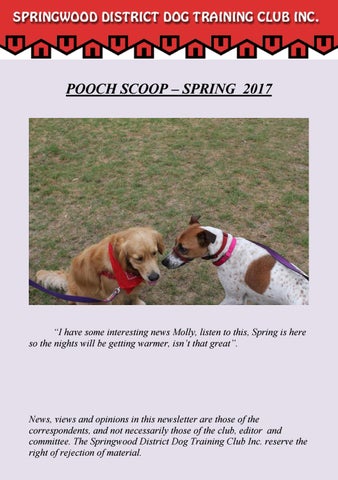
“I have some interesting news Molly, listen to this, Spring is here so the nights will be getting warmer, isn’t that great”.
News, views and opinions in this newsletter are those of the correspondents, and not necessarily those of the club, editor and committee. The Springwood District Dog Training Club Inc. reserve the right of rejection of material.
COMMITTEE President Vice President Secretary Treasurer Chief Instructor Obedience Newsletter/Website Table Manager Obedience Procurement Officer Sporting Representative General Committee
Lynn Olson Maryjka Kelly Leanne Brown Paul Kelly Ron Amann Noeleen Horswell Wally Campbell Francoise Matter Paul Kelly Trevor Mawer/Cath Moran Chris Lambert/Vicki Cooper, Cicely Dixon
Remember you are always welcome to attend our Club’s General Meetings at the Red Cross Hall in Macquarie Road, Springwood on the 3rd Tuesday of each month at 7.30 p.m. (There is no meeting in December). Life Members: Dot Luker, Ann Moy, Sue Fell, Ron Amann, Wally Campbell, Pam Waters, Lesley Piggott, Lynn Olson, Leanne Brown Annual General Meeting: will be held on the last Thursday in August, 2018 at Lomatia Park. (There will be no training on that night). Web Site: www.sddtc.org Email: info@sddtc.org Training Days: Agility Monday evening 7.00 – 8.00 p.m. Obedience Tuesday l0.00 a.m. - Thursday evening 7.30 – 8.45 p.m. Wet Weather: If it has been raining for a few days check the Blue Mountains Oval Closure Hotline 47805617 after 3.00 p.m. on Thursday afternoon. Also check our Facebook Page for training updates.
J. Trevillion
Spencer
September
Warwick
Rusty
4th September
M.Levin
Jake
12th September
D.Griffin
Buddy
14th September
S.Kublak
Martee
14th September
R.Lawlor
Bella
16th September
L.Wade
Coco
17th September
Stuart
Mojo
23rd September
Ciro
Honey
27th September
Carol
Sasha
27th September
Max
Thea
27th September
V. Sead
Pippa
29th September
Deb
Monty
29th September
T. Blake
Jasper
30th September
K. White
Calah
September
Happy Birthday to All
Snake Bite and Dogs in Australia The following information is a guide only. Please talk to your vet about their preferred treatment and prevention for snake bites. Myths, Statistics and Facts There are about 3000 snakebites to humans in Australia each year. The snake bite rate for dogs is much higher, given that they spend a lot of time in the garden, bush, farm and areas where snakes reside. Actual figures are not available as many dogs die before they can be taken to a vet and their bites are not recorded. The survival chances of a dog bitten by an Australian snake is dependent on the type of snake and how much venom has entered the system of the dog. Around 80 % of pets survive snake bite if treatment is administered quickly. The survival rate is much lower howevfer for pets that are left untreated and death often occurs. Care should be taken when dealing with snakes. They are a protected species and should not be disturbed. However, if there is immediate danger, you should try to remove the dogs from the danger or call for professional help. It is not recommended under most circumstances that you try to kill the snake yourself. Many people are bitten because they have attempted to interfere with the snake or kill it. Their defense mechanism in protecting territory and their own safety is biting and injecting venom. In Australia we accept that living with
snakes is a way of life, even in the outer suburbs of the city and around our parks and gardens. Prevention is always better than cure. Reducing the bushes and gardens in and around your home will help reduce the likelihood of snakes in your area. Walking the dogs in areas where you can see clear ground and checking banks of waterways and the water carefully before letting your dog swim. Be aware that some dogs will display the symptoms of a snake bite and then stage a brief recovery prior to suffering a total collapse. If in doubt, always attend the vet to have your dog checked. Attending medical attention promptly is a factor in successfully treating snake bites. Previous snakebites in dogs does not create an immunity against future snakebites, every snakebite must be treated as serious and lifethreatening. Do not bleed the dog; this is a misguided tale. Australian snake venom travels through the lymphatic system, so bleeding will not assist the dog and will simply weaken, hurt and stress the dog more. Be very wary of the ‘Vitamin C’remedy, it may or may not buy time for a dog but it will not prevent death – it is not a treatment. Eastern Brown Snake – Found throughout eastern half of mainland Australia. Tiger Snake – Found along the south eastern coast of Australia including Victoria, eastern NSW, part of South Australia and Tasmania. Red Bellied Black Snake – Found east coast of Australia, not including Tasmania and slightly South Australia. Australian Copperhead Snake – Found above the snowline, being adaptable with cooler climates.
What to do in the event of a snake bite Try to identify the type of snake (colour of the snake, approximate size, and distinctive markings) in order to match the anti-venom. If the bite area can be found, the vet can take a swab of the bite site using a snake detection kit to identify the snake venom. However, identifying the type of snake can expedite treatment if your identification matches the dog’s symptoms. Seek immediate medical attention and ring ahead to alert the vet clinic that you will be arriving. It assists the vet in planning your dog’s treatment. Travelling to the vet clinic can take time and the more venom that has been injected into your dog, the worse your dog’s chances become of surviving. You can assist your dog’s chances of survival by applying a pressure bandage to a limb bite. This is a firm bandage not a tourniquet. Blood flow must remain to the area. Remember that bite areas may be very difficult to identify because of your dog’s hair. There is often no localized swelling and bitge sites don’t always bleed. Carry your dog if possible. Movement will spread the venom. If the dog has been bitten on the face, apply hand pressure rather than a bandage. Keep talking to your dog and try to remain calm and have the dog relax as much as possible. Don’t wash the bite area or cut the wound in anyway.
Once you arrive at the vet, they will examine the dog and determine the stage of envenomation. Treatment will be determined by a number of factors, among them are the type of snake bite and the dog’s symptoms. Treatment is usually via intravenous fluids and administration of antivenom. Other drugs may also be administered to assist your dog’s recovery. Dogs that recover will show positive signs within twenty four to forty eight hours. If the dog survives, recdovery will take about two days. Dogs that suffer from snake bites often need some time to fully recover their former health. Discussions with your vet regarding ongoing treatment for your dog’s health regime will be necessary. Information on snake bites obtained from Australian Venom Research Institute.
Club Members Shop – For all your shop requirements, please see Maryjka Kelly at the sign-on table. Halti’s all sizes Halti’s extensions Treat Bags (large) Treat Bags (small) Pigs Ears Bacon treats Liver treats One Meter Leads Small Water Bowls
$22.00 $8.00 $24.00 $12.00 $1.50 $2.50 $2.50 $14.00 $4.00
Club shirts, vests and jackets are available for purchase from the club.
Happy Training.