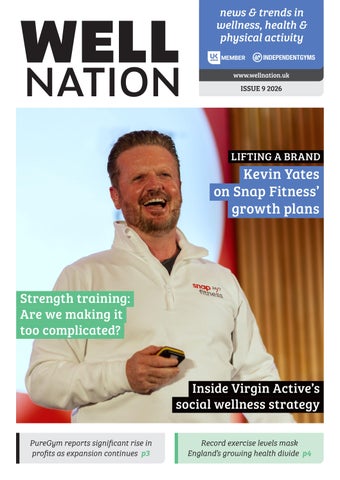
news & trends in wellness, health & physical activity www.wellnation.uk
ISSUE 9 2026
LIFTING A BRAND
Kevin Yates on Snap Fitness’ growth plans
Strength training: Are we making it too complicated?
Inside Virgin Active’s social wellness strategy PureGym reports significant rise in profits as expansion continues p3
Record exercise levels mask England’s growing health divide p4
B i oAg e Keep members motivated with progress they can see, feel and repeat.
BioAge 29 years
Real age
49 years
news & trends PHOTO: PUREGYM
John Challinor Publisher john@nationmedia.uk Tel: +44 (0) 7971 043396
The group is on course to open 60 new gyms in 2026
PureGym reports significant rise in profits as expansion continues PureGym has reported a significant increase in profitability during the first half of 2026, supported by membership growth, new openings and improved performances across its international markets. The gym operator generated revenue of £393 million during the six months to 30 June, an increase of six per cent on the £370.8 million recorded in the same period last year. Adjusted EBITDA rose by 23 per cent, from £100.4 million to £123.6 million, following revenue growth, improved margins and tight control of operating costs. PureGym ended the period with 2.44 million members across its global business, compared with 2.38 million at the end of the first half of 2025. Average revenue per member increased by 2.1 per cent to £26.78. The group opened 17 gyms during the period, including 15 in
www.wellnation.uk
the UK and one each in Switzerland and the US. This took its total estate to 728 gyms, comprising 705 corporate-owned sites and 23 franchised gyms in the Middle East. PureGym said its new sites were performing ahead of expectations, with demand supported by the growing importance consumers place on health and wellbeing and the availability of convenient, affordable fitness facilities. All of the group’s markets contributed to the improvement in profitability. The US business delivered particularly strong growth following continued progress with the integration of Blink Fitness. Adjusted EBITDA in the US increased by 35 per cent, from £6.5 million to £8.8 million. The company also confirmed that it remains on track to enter the Republic of Ireland. Its first Irish gym is expected to open in Dublin in early 2027.
Tom Walker Editor tom@nationmedia.uk Tel: +44 (0) 7796 512769
Get your free subscription at
www.wellnation.uk WellNation is published by Glencroft Ltd. This publication is protected by copyright and no part may be reproduced, transmitted or stored in any print or electronic format without the written permission of the publisher. Every effort has been made to ensure the accuracy of the contents of this publication and WellNation accepts no responsibility for any error or misrepresentation. Opinions expressed by the contributors and advertisers are not necessarily those of the publisher and we do not accept responsibility of losses or damages arising from them. Printed by BCP Media Group Ltd.
ISSUE 9 2026
3
news & trends PHOTO: PEXELS.COM
The day is set to build pathways
RCGP event to link between healthcare and physical activity A new national event is aiming to strengthen links between healthcare and the physical activity sector, helping turn growing interest in collaboration into practical projects across England. The Royal College of General Practitioners (RCGP) and Active Partnerships National Organisation (APNO) will bring professionals from both sectors together at RCGP headquarters in Euston Square, London, on Wednesday 11 November 2026. For fitness and physical activity professionals, the initiative signals another step towards closer alignment between healthcare, exercise and preventative health. Dr Hussain Al-Zubaidi, who has been involved in developing the event, said professionals on both sides frequently express an appetite to work together but can struggle to identify the right contacts, opportunities and routes into collaboration. “We want to bring Active Partnerships and primary care staff together to move beyond simply talking about the benefits of physical activity and start working out what we can do together,” explains Dr Hussain, RCGP lifestyle and physical activity champion. “There is huge enthusiasm on both sides, but people often struggle to know who to connect with or how to turn shared ambitions into practical projects.”
4
ISSUE 9 2026
Physical activity inequality is more than a challenge of motivation alone
Record exercise levels mask England’s growing health divide England is more active than at any point in the past decade, but reflecting on figures reveals a stark divide in who is benefiting from the nation’s growing appetite for physical activity. Sport England’s Active Lives Adult Survey, published this year and covering November 2024 to November 2025, shows 64.6% of adults (equivalent to 30.9 million people) achieved at least 150 minutes of moderate-intensity activity a week. That represents a record high and an increase of 859,000 active adults in just one year. Behind the positive national headline, however, significant physical activity inequality remains. Just 53.8% of adults from the least affluent backgrounds are active, compared with 73.2% among the most affluent. Activity levels are also considerably lower among disabled people and those with long-term health conditions, older adults and some ethnic groups. The divide affecting people living with
disability is particularly striking. Activity Alliance’s analysis of the same Active Lives data found that 39.3% of disabled adults are inactive, compared with just 19.7% of nondisabled adults. In other words, disabled people remain almost twice as likely to be physically inactive. Perhaps more concerning is that the disparity has not narrowed alongside England’s overall improvement. Activity Alliance says the inactivity gap between disabled and nondisabled adults has actually widened slightly, from 19.3 percentage points in the previous year to 19.6 percentage points in the latest figures. The proportion of disabled adults classed as inactive has remained broadly unchanged. That means England can simultaneously be celebrating record participation while one of the groups that could potentially benefit most from greater physical activity remains disproportionately excluded.
www.wellnation.uk
Britain’s gym motivations “are changing”
PHOTO: LEISURE UNITED
PHOTO: PEXELS.COM
For decades, weight loss has dominated the way fitness has been marketed. The reasons for industry professionals to promote services to people looking to exercise, however, appear to be becoming broader. With GLP-1 medications taking the attention of “weight loss” seekers, it creates a significant opportunity for gyms and marketing departments in particular to share more services and facilities at scale. Sport England’s Activity Check-in regularly tracks attitudes, motivations and barriers around physical activity, providing the sector with a more frequent view of how consumer behaviour is changing. Alongside participation data, it explores why people want to be active and the pressures influencing those decisions. Increasingly, the conversation around exercise encompasses mental wellbeing, strength, mobility, confidence and social connection. These are benefits that extend well beyond appearance. Sport England’s research also
People now exercise for both physical and mental wellbeing
consistently associates greater physical activity with higher mental wellbeing. For operators and trainers, that changing conversation matters because members themselves can help shape the next generation of fitness services. Listening to why people train and what they want to remain capable
of doing will influence programming, coaching, and especially marketing. This cultural nudge gives the fitness industry a powerful proposition. If medication increasingly helps people lose weight, gyms can help them become stronger, fitter, more mobile and healthier for longer.
£16.7m Wealden Community Sports Hub opens A new £16.7 million community sports hub has opened in East Sussex, creating more opportunities for Wealden residents to get active, improve their wellbeing, and connect with their local community. The Wealden Community Sports Hub, at Lower Dicker near Hailsham, has been developed to meet growing demand for accessible sport, recreation and community facilities across the district. The new hub includes two full-size floodlit 3G football pitches, four floodlit netball and tennis courts and two floodlit padel courts. Residents can also use a children’s play area, skate park and perimeter trail for running, walking and cycling. “This isn’t just a place to play sport, it’s a community space where people can come together, keep active, socialise and relax,” says Councillor Kelvin Williams.
www.wellnation.uk
The venue is managed by Leisure United
ISSUE 9 2026
5
news & trends PHOTO: PRECOR
Building “a place for everyone”
Inclusive Movement CIC making “fitness accessible for all” Inclusive Movement CIC is a Lincolnbased not-for-profit organisation founded by Rob Wilkins, owner of CR Fitness, with a mission to make fitness accessible for people with disabilities, neurological conditions and additional needs. Since launching, the organisation has begun delivering specialist coached sessions for adults with learning disabilities, people living with neurological conditions, and children and young people with additional needs. More programmes are planned over the coming months, alongside partnerships with organisations such as CP Sport to expand opportunities for people who have traditionally had limited access to exercise. To support its work, Inclusive Movement has also organised community fundraising events, helping to purchase specialist equipment and subsidise sessions so that cost is never a barrier to participation. The aim is to build a community where everyone, regardless of ability, has the opportunity to improve their health, confidence and independence through movement. The project was created in response to a challenge faced by many people with disabilities and additional needs, who are often excluded from mainstream fitness or simply don’t have access to the right support.
6
ISSUE 9 2026
The cardio floor features equipment paired with touch screen consoles
BH Live and Precor transform Mountbatten Leisure Centre gym BH Live, the registered charity and social enterprise operating sport and leisure facilities across southern England, has completed a major refurbishment of the gym at Mountbatten Leisure Centre in Portsmouth as a part of a £750,000 investment to modernise leisure facilities across the city. The redesigned facility was developed in close collaboration with Precor, combining expert design consultancy with a full equipment fit-out. The result is a spacious, clearly zoned gym environment with dedicated areas for strength, cardio, functional fitness, recovery, physio and wellness, designed to serve exercisers of all ages and abilities. To meet growing demand for strength training, the gym features an extensive selection of Precor selectorised and plate-loaded machines, alongside an eight-stack Resolute Multi-Station for total-body workouts. The facility also includes the Glutebuilder range which is engineered with precision biomechanics and
optimised motion paths to effectively target the glutes, hips and legs. The cardio floor features Precor Treadmills, Ellipticals, Upright and Recumbent Bikes, StairClimbers and Adaptive Motion Trainers (AMTs). The AMT’s Open Stride technology allows exercisers to continuously adjust their stride length and height, engaging multiple muscle groups within a single workout. Precor treadmills feature Integrated Footplant Technology, automatically adapting belt speed to each user’s natural gait for a more comfortable, effective run. Cardio equipment is paired with touchscreen consoles featuring PrecorCast, allowing members to connect their phones and stream their preferred apps directly onto 16- or 22-inch HD screens. A dedicated Peloton area houses three Peloton Bike+ Pros, giving gym members access to Peloton’s worldclass library of exclusive content and a comprehensive suite of performance metrics to track and drive their progress.
www.wellnation.uk
People news
PHOTO: LES MILLS
Les Mills appoints Jason Paris as its new CEO Les Mills International has appointed experienced transformation leader Jason Paris as its new CEO, with founder Phillip Mills moving into a Founder / Director role. Jason will take charge of the global fitness company from 6 October 2026, following a planned leadership succession after Phillip completed a three-year stint as Managing Director. “I’ve always admired New Zealand brands that have a real impact globally,
and Les Mills International has done exactly that,” says Jason. “It has an outstanding team, an iconic brand and an incredible opportunity ahead. Before joining as Les Mills new CEO, Jason has led major customer-focused businesses across telecommunications, digital services and media in New Zealand and Europe. His previous roles include leading the transformation of Vodafone New Zealand into One NZ and helping develop digital platforms.
Pure Energy Music has appointed industry educator and coach Sarah Morelli as its new Indoor Cycling Ambassador, strengthening its focus on music-led fitness experiences. Morelli brings more than 30 years of coaching experience to the role and is a recognised figure across the indoor cycling and group fitness sectors. As Founder and Director of Athleticum, Morelli has supported the education and development of indoor cycling instructors and fitness professionals throughout the industry. She is also Co-Founder of the PROS Spinning & Fitness Conference and The Studio Summit. In her new ambassadorial role, Morelli will work with Pure Energy Music to help shape curated playlists, expert music selections and specialist content for the indoor cycling community. “I’m thrilled to be joining the Pure Energy Music team as Indoor Cycling Ambassador,” says Sarah. “Great music is one of the biggest drivers of energy in indoor cycling — whether it’s a performance-focused
8
ISSUE 9 2026
ride or a rhythm-based class, the right track at the right moment can completely transform the experience. “After more than 30 years of coaching, I’ve seen first-hand how music can motivate people, create connection and help riders get more from every session. I’m excited to work with Pure Energy Music to bring instructors and riders access to music that has been created with a genuine understanding of how it supports movement and the fitness experience.” The collaboration will combine her experience in coaching, instructor education and member engagement with Pure Energy Music’s expertise.
PHOTO: JORDAN FITNESS
Pure Energy Music appoints Sarah Morelli as cycling ambassador
Liz Morgan joins Jordan Fitness as Head of Marketing Jordan Fitness has appointed experienced fitness industry marketer Liz Morgan as its new Head of Marketing. Liz brings more than 25 years of marketing experience to the commercial fitness equipment specialist, including senior roles with multiple fitness businesses. “I’m so happy to start my new chapter at Jordan,” Liz explains. “It’s an exciting opportunity to be part of a business with a reputation for quality, innovation and customer focus.”
www.wellnation.uk
Making public leisure sustainable and building healthier communities.
£520m+ investment in local authority leisure
Chard Leisure Centre Value: £15.6m
310+
completed projects Abbey Leisure Centre Value: £3.5m
81%
of clients choose us for further projects
SC2 Value: £17m
development partner
Alliance Leisure are a trusted and experienced leisure development partner, with over 25 years’ experience transforming leisure facilities for local authorities.
allianceleisure.co.uk #TransformingLeisure
Discover our portfolio.
news & trends Work begins on £20m move Partington project PHOTO: TRAFFORD COUNCIL
Construction work has started on an ambitious rebuild of Partington Leisure Centre in Trafford, Greater Manchester. The project has been awarded £18.3m Levelling Up funding from Ministry of Housing, Communities and Local Government, alongside a £2m grant from Sport England. The transformation of the building, which dates back to 1970 and forms part of Partington Sports Village, is the latest development in a wider programme to upgrade sports and leisure facilities across Trafford. Set to open to the public in 2028, the venue will have a focus on health and wellbeing, with facilities including a swimming pool, a health club with a 40-station gym floor, exercise studios, sports hall and café. The wider sports village features two 3G football pitches, sports courts and an open-air gym, which will remain available for use during the work. To be renamed “move Partington”, the centre will follow the £20m move Altrincham development
The centre will house a swimming pool and a gym
opened last year and the £7m move Urmston in 2020, which is soon to be warmed with waste heat from a data centre next door. The centre is owned by Trafford Council and is operated by Trafford Leisure. Jo Cherrett, CEO of Trafford Leisure, said: “We know local
people have been eager to see the centre brought back to life and we’re excited to create a modern community facility that will serve Partington for generations to come. “This is much more than a building refurbishment. It is an investment in people, providing a welcoming space.”
Workforce management platform Qualified Trainers has partnered with fitness education provider, Archon Academy, to add a new qualification and learning layer to its service. The move has been designed to enable fitness and physical activity operators to use the platform to recruit, manage, develop and upskill their workforce through a single ecosystem. Through the collaboration, operators will also have access to nationally recognised qualifications, accredited CPD programmes, and bespoke learning pathways from Archon Academy. Qualified Trainers has been purpose-built for the group fitness industry and helps operators simplify instructor scheduling, compliance and payroll. Archon Academy works alongside the likes of Gymshark and Everyone Active.
10 ISSUE 9 2026
PHOTO: PEXELS.COM
Qualified Trainers adds training and qualification to its platform
The platform has been built for the group fitness industry
www.wellnation.uk
Leaders summit - 3 nov 2026 expo - 4-5 nov 2026
Scan here and apply code for 50% off your ticket
Code = DS1ZJ0
jimmy chin • Allyson Felix
celine del genes • ben aidan • hap klopp bridgedale • fabletics • rab • grangers karrimor • padel village • ispo awards
hosted buyer programme • brandnew village
BRIEFING
Sport, adventure & wellbeing come together in Amsterdam
T
This November, Amsterdam will become a meeting point for the international sports and outdoor community as ISPO 2026 moves to RAI Amsterdam for the first time aking place from 3–5 November, this year’s ISPO – one of the world’s leading sports and outdoor trade exhibition events – will bring together leading brands, athletes, innovators and industry experts to explore the ideas, products and experiences shaping the future of active lifestyles. With 900 exhibitors confirmed, more than 500 key buyers registered and more than 40 industry and media partnerships in place, ISPO 2026 will showcase everything from sports, movement and wellbeing, with a strong focus on innovation and the changing ways people experience activity and the outdoors.
BRINGING INTERACTIVE ACTION TO THE CITY
From hands-on activations and live demonstrations to networking events and community-driven experiences, every part of the show is designed to showcase emerging trends, create valuable opportunities, and help drive business.
New for 2026; ISPO interACTIVE brings the action off the stands and onto the show floor. This high-energy, open-format zone is built for getting involved, with a packed programme of yoga and fitness sessions, live brand showcases, product try-outs and challenges designed to get you moving, testing and competing. Stretch it out at sunrise yoga. Put the latest kit to the test. Take on a skills challenge. Then check the leaderboard and see if you’ve got what it takes to make the top spot. THE FUTURE OF ACTIVE LIFESTYLES
Away from the live action, ISPO will provide an insight into the products and technologies that are changing the way people move and spend time outdoors. From fitness and functional movement to outdoor adventure and everyday exercise, the show floor will feature new equipment, technology and ideas designed to support healthier, more active lifestyles. Brands including Fabletics, Gymstick, Suunto and COROS will be represented at ISPO 2026, showcasing everything from activewear and fitness equipment to wearable technology and performance tracking.
SPORT, WELLBEING AND A CHANGING PLANET
The conversation will extend beyond products and performance through the ISPO Leaders Summit, bringing together influential figures from sport, business, technology and culture to explore some of the issues shaping the future of active lifestyles. Among the speakers is Allyson Felix, one of the most decorated track and field athletes of all time and now a businesswoman and founder of Always Alpha. Her work spans elite performance, entrepreneurship and creating greater opportunities for women in sport. Also speaking is Jimmy Chin, the Academy Award-winning filmmaker, mountaineer and athlete, whose work explores the physical and psychological challenges of adventure and the powerful connection between people, movement and the outdoors. Laura McAllister, Vice President of UEFA, will also bring her experience in sport, leadership and participation to the conversation, exploring how sport can become more inclusive and accessible and encourage more people to become active. Together, the speakers reflect a wider shift in how we think about wellbeing: not simply as fitness or performance, but as a combination of movement, mental resilience, connection and inclusion. RUNNING, RECOVERY AND WELLBEING
Also taking place at RAI Amsterdam on 4–5 November, The International Running Expo (IRX) will bring more than 200 international brands together
www.wellnation.uk
to showcase the latest developments in running, including footwear, apparel, technology, nutrition and recovery. Alongside the exhibition, IRX will offer a programme of experiences focused on movement and wellbeing, including yoga and stretching sessions, ice baths, breathwork, a dedicated wellbeing lounge and Urban Shake Out Runs. Co-located with ISPO, IRX adds a strong running and active wellbeing dimension to the wider event, bringing together innovation, community, movement and recovery under one roof. A NEW CHAPTER FOR ISPO
The move from Munich to Amsterdam marks a significant new chapter for ISPO. RAI Amsterdam provides an international setting for the event, with Schiphol Airport close by and easy connections for visitors travelling from across Europe and further afield. For the sports and outdoor community, ISPO 2026 offers a chance to discover what is next, from new technology and products to changing attitudes towards movement, adventure and our relationship with the outdoors. And when the show floor closes, the experience continues. The ISPO After Party will bring the community together across four floors of a central Amsterdam nightclub, rounding off three days of sport, ideas, inspiration and connection. ISPO 2026 takes place at RAI Amsterdam from 3–5 November 2026. Tickets for ISPO 2026 are on sale now, secure your place now. Visit www.ISPO.com for more information ISSUE 9 2026 13
news & trends Plans submitted for Carlton Active leisure centre
PHOTO: GEDLING BOROUGH COUNCIL
Gedling Borough Council has submitted detailed designs for a new leisure centre in Carlton, Nottinghamshire. To be located on the site of the current Richard Herrod Centre, the centre will bring together modern swimming facilities, fitness spaces and community services under one roof. Facilities will include an eight-lane main swimming pool, a dedicated teaching pool to support learn-toswim programmes, a health club with a large gym floor and dedicated group exercise studios. The fitness facility will also feature an assisted exercise suite designed for rehabilitation and active ageing. In addition, there will be a sauna and steam room, adventure soft play facilities for younger visitors, café and social hub and flexible community spaces for events, youth services and health and wellbeing activities. The facility will offer programmes supporting people with mobility issues, disabilities, and long-term conditions, along with targeted health referral initiatives such as cardiac rehabilitation
The centre will bring together modern swimming facilities and fitness spaces
and physical activity programmes. The council will work alongside Alliance Leisure, NHS and Sport England on the project, as well as specialist consultants and other partners. Cllr Henry Wheeler, portfolio holder for Health and Wellbeing at Gedling Borough Council, said:
“Carlton Active represents one of the most ambitious investments in health and wellbeing our borough has seen in decades. This project is about much more than replacing an ageing building. It is about creating a modern, accessible space where people of all ages can improve their health and stay active.” PHOTO: VEYR
VEYR launches £1 million funding round AI-powered fitness platform VEYR has launched a £1 million funding round to accelerate the development and growth of its personalised digital coaching technology. The UK company is inviting consumers to invest through a Crowdcube campaign, which opened publicly on 10 August 2026. The round values VEYR at £4.5 million before investment and includes £400,000 being raised through Crowdcube. “We’ve all used fitness apps that haven’t gone the distance or only served a fixed purpose,” says Adam King, CEO and co-founder of VEYR. “The future of fitness is adaptive, user aware, environment aware intelligence that takes your signals, tells you what to do with them and delivers workouts personalised to you in that moment. No more guessing, no more trying to follow rigid plans, no more pushing when you’re on empty.”
14 ISSUE 9 2026
VEYR co-founders Adam King and Liam Hogan
www.wellnation.uk
BLU Leisure Retail Ranges
Boost. Secondary. Spend.
BLU BRANDED SPORTS BRA + LEGGINGS
w: bluleisure.co.uk m:info@bluleisure.co.uk “Stronger Together”
t: +44(0)1908 582525
news & trends PHOTO: PLACES LEISURE
Dr Sam Decombel, FitnessGenes CEO
FitnessGenes and Better partner for longevity insights FitnessGenes has announced a new partnership with Better, the consumer brand of GLL, giving Better members access to the FitnessGenes at-home saliva DNA test, providing tailored longevity insights to over 750,000 members nationwide. Better members can now access an exclusive offer on the FitnessGenes DNA test, receiving a personalised longevity plan built around their unique biology, with science-backed recommendations across nutrition, training, recovery and supplementation. Founded in 2013, FitnessGenes has helped tens of thousands of people worldwide use their genetics to make more informed decisions around their health and wellness, and move beyond generic lifestyle advice. “Our mission at FitnessGenes is to give back 1 billion more years of healthy life by better understanding each person’s unique biology. That’s a billion more opportunities for people to spend time with the people they love, and do the things they’ve always wanted to do. “Partnerships like this one with Better, a leading national leisure operator, are central to that mission,” said Dr Sam Decombel, founder and CEO at FitnessGenes. “Better members now have more ways to take control of their longterm health and wellbeing.”
16 ISSUE 9 2026
Wandle Recreation Centre is set to work more closely with NHS partners
Wandle Recreation Centre opens inclusive gym and wellbeing suite Wandle Recreation Centre has unveiled a new gym and specialist wellbeing suite designed to support the wider community, including people recovering from injury or living with long-term health conditions. Following a £1.2 million investment by Wandsworth Council and Places Leisure, the project forms part of a wider £24 million improvement programme covering leisure facilities across Wandsworth, agreed after Places Leisure received a 10-year extension to operate the borough’s centres in June 2025. “The opening of the gym and wellbeing suite at Wandle Recreation Centre marks an important milestone in our vision for creating a healthfocused facility that supports people at every stage of their health journey,” says Ed Lane, Contract Manager at Places Leisure. “Parts of the gym have been designed specifically for individuals who are recovering from injury, living with long-term conditions or
looking for a safe and supportive environment to improve their fitness. “Looking ahead, we are excited about the opportunities this new facility will provide, including the ability to work more closely with NHS partners to deliver programme that can make a real difference to the community’s lives.” The transformed gym includes 20 strength and cardiovascular stations, a free weights area and EGYM smart fitness technology. Members can use the EGYM Hub to assess their health and fitness data before receiving a personalised exercise programme. Six smart strength machines automatically adapt to each user’s body and ability while providing guided exercises and measurable performance data. The wellbeing suite also features 10 Innerva power-assisted machines. Their smooth, controlled movements offer a low-impact exercise option for beginners, older adults and people rebuilding strength or mobility after illness or injury.
www.wellnation.uk
WE
SIGN
225 AN AVERAGE OF
NEW MEMBERS
IN 6 WEEKS A simple, results-driven marketing system built for health clubs.
01
02
ATTRACT
CONVERT
Multi-Faceted Marketing
On-site Sales Team
More Members
Brand Awareness
Tours & Follow-Up
Higher Revenue
Local Exposure
Lead Conversion
Long-Term Momentum
03
GROW
NO UPFRONT COST. WE WORK ON A PROFIT SHARE MODEL
SCAN FOR YOUR INFO PACK
CFM.NET
CFM
0115 777 3333
Average results based on previous campaigns. Individual results may vary depending on factors such as facility. market conditions and execution.
news & trends Wrightcare embeds active living into care homes PHOTO: INNERVA
Wrightcare’s first development, Castlewood in Clitheroe, features a dedicated wellness suite equipped with Innerva’s specialist powerassisted exercise equipment, providing residents with safe, accessible opportunities to improve their strength, mobility and overall wellbeing. The 68 en-suite bedroom development represents a new era of care homes, designed around the principle of enabling people to live fulfilling, independent lives while receiving the support they need, says Robert Blackburn, Head of Operations at Wrightcare. “Promoting physical wellbeing and active lifestyles is a key part of the Wrightcare philosophy. We want to support residents’ overall wellbeing, not just their care needs. While a cinema room would have been enjoyable, we ultimately felt that a wellness suite would deliver far greater long-term benefits for residents,” he says. The wellness suite forms part of Castlewood’s wider activities
Users in the Castlewood Wellbeing Suite
and wellbeing programme. Featuring an Innerva circuit, the space enables residents of all ages and abilities to be active in a safe and supported environment. Residents are supported by the care team to become familiar with the equipment and follow gentle exercise
programmes tailored to their abilities and goals. This is delivered alongside wider multidisciplinary team input where appropriate. Available for both guided sessions and independent use, the suite has been well received by residents, including those with reduced mobility and living with dementia.
Invest in Wellbeing has launched to help independent and boutique hotels generate recurring membership income from underused spa and wellness facilities. The specialist consultancy has been founded by former David Lloyd Clubs senior director Andrew Davill and leisure innovator Andy Baker. It will support hotels seeking to turn pools, saunas and steam rooms into commercially sustainable, membership-led wellness destinations. “Hotels that continue to rely solely on old facilities and occasional treatments are missing a significant commercial opportunity.,” Baker said. “A well-designed swim and spa proposition can attract substantial local membership. A model with 1200 members paying £110 per month can generate more than £1.5 million in annual recurring revenue.”
18 ISSUE 9 2026
PHOTO: INVEST IN WELLBEING
New venture aims to help hotels unlock spa membership revenues
Demand for wellbeing experiences continues to grow
www.wellnation.uk
news & trends PHOTO: RLSS UK
Alliance Leisure completes £300k transformation at Burscough Wellbeing and Leisure Hub Alliance Leisure has completed a £300,000 studio transformation at Burscough Wellbeing and Leisure Hub, delivering a new group exercise space designed to meet growing demand for fitness and wellbeing activities. Delivered for West Lancashire Borough Council, the project represents the next phase of investment at the leisure centre following the successful wider refurbishment programme previously completed at the site. The scheme saw an underused squash court converted into a significantly larger and more flexible fitness studio. By removing the dividing wall between the existing wellbeing suite and squash court, the project has created a modern exercise environment featuring sprung flooring, mirrored walls, specialist lighting, upgraded ventilation, new audiovisual systems and improved acoustics. “By intelligently repurposing existing space rather than expanding the building footprint, this scheme demonstrates how leisure facilities can adapt to changing participation trends while protecting existing provision, improving customer experience and maximising value from existing assets,” explains Seb Rowe, Delivery Manager at Alliance Leisure.
20 ISSUE 9 2026
The guidance is for pools where a lifeguard can’t be present
Updated RLSS guidance strengthens safety at non-lifeguarded pools Royal Life Saving Society UK (RLSS UK) and leading industry partners have updated national guidance to help operators improve safety at non-lifeguarded swimming pools. Developed with CIMSPA, Swim England and ukactive, the refreshed Guidance for Managing Safety in NonLifeguarded Swimming Pools provides a practical framework for identifying risks and introducing appropriate safety measures. More than 1200 UK swimming pools are estimated to operate without a lifeguard for at least some sessions. Around a third are located in hotels, gyms, health clubs, spas, resorts and residential developments. “Non-lifeguarded pools make up a sizeable portion of the swimming pool estate, offering vital access for many people to enjoy the water,” says Helen Marney, Director of Community Participation and Health, Swim England. “This guidance will help operators of these pools to ensure they have the appropriate measures and
controls in place to keep safety at the heart of their operations.” The guidance aims to help these facilities remain accessible while ensuring safety is central to operational decisions. It supplements established standards, including HSG179 and BS EN 15288-2:2023. “Non-lifeguarded pools offer valuable opportunities for people to swim, relax and improve their wellbeing,” says Jo Talbot, Commercial Services Director, RLSS UK. “But they must be supported by effective risk management and appropriate safety measures. Working with industry partners, we have updated this valuable guidance to help operators make informed decisions that put safety at the heart of every swimming experience.” Recommended controls include safer pool design, access restrictions, rescue equipment, clear signage, regular physical and remote checks, emergency procedures and staff competency assessments
www.wellnation.uk
TA L K T O A N A N A LY S T
Map your market: who, where, what
How can we help? Our insight is built around you. From member behaviour to market demand, EVOLVEʼs Strategic Insight Services adapt to your business needs, helping you make data led decisions, with confidence.
Our insight explore:
Our insights powered by real industry intelligence
Members Understand who your members are and how they behave.
30+ years of insight 850 million data points
Population Know your local market and true catchment. Competition See your landscape clearly and identify gaps. Demand Uncover opportunity and growth potential.
7,000+ UK fitness sites tracked
Why it matters Reduce risk Identify real opportunity Make confident decisions
To find out more, email hello@weareevolve.io
EVOLVE weareevolve.io
news & trends Horizon Leisure invests £500,000 in Waterlooville gym Horizon Leisure is investing £500,000 in a major refurbishment of the gym at Waterlooville Leisure Centre. Funded entirely by the charitable leisure trust, the project will deliver new cardio, strength and functional training equipment across the facility’s three floors. “We are so excited about this investment in Waterlooville Leisure Centre,” says Mike Lyons, CEO, Horizon Leisure. “The upgrade is really comprehensive, and beyond the fantastic new equipment we will also be installing new atmospheric lighting, fresh décor and modern flooring, which will deliver a renewed feel and positive outlook that is both on trend and aligned with what our customers tell us they would like. “As a charitable organisation, our aim is to support local residents to find opportunities for better wellbeing and to help achieve this we need inspiring and welcoming facilities. The latest investment at Waterlooville Leisure Centre means we have high
The top floor features a 10m sprint track
quality equipment that’s easy to use, whilst creating a safe space where our customers can enjoy spending time, now and into the future.” The mid floor will receive a complete cardio equipment upgrade, while the ground floor will feature new strength machines and a refreshed free weights
area. A dedicated glute training zone will also be introduced, alongside plate-loaded equipment. Equipment supplied by Horizon Leisure’s wellness partner, Pulse Fitness, will include lowimpact elevation treadmills, curved slat treadmills, stepmills, air bikes and pin-selected strength machines.
CoverMe, the fitness workforce management and recruitment platform, has partnered with specialist recruitment and consulting agency Jobs In. Fitness. Working together, the two companies will look to bridge the gap between operational workforce management and executive recruitment. “We believe this partnership is an important step towards creating a more connected workforce ecosystem for the fitness industry,” says Lou Crossland, Chief Commercial Officer of CoverMe. “Successful fitness and wellbeing businesses need exceptional people at every level. This partnership allows us to offer them a complete talent solution, connecting them with specialist expertise for senior leadership recruitment while continuing to support the recruitment of other professionals across their business.”
22 ISSUE 9 2026
PHOTO: ENVATO
CoverMe and Jobs In. Fitness create end-to-end talent solution
The move helps operators attract high-performing teams
www.wellnation.uk
Good systems feel simple Bookings, payments, staff, scheduling and memberships - joined up so your business runs smoother. Less admin. More Control. Better days.
See the platform at fibodo.com/goodsystems
PEOPLE
WE NEED TO RETHINK ONE OF OUR MOST VALUABLE ASSETS Few things shape the atmosphere and experience of a gym quite like its soundtrack. But, asks Andy Pickles, CEO of Pure Energy Music, as the fitness market has evolved, have operators’ assumptions about what members actually want to hear kept pace?
24 ISSUE 7 2026
www.wellnation.uk
or decades, the fitness industry has transformed almost every aspect of the member experience. We’ve embraced advances in exercise science, programming, technology, recovery and wellbeing because operators understand that competitive advantage comes from continually challenging old assumptions. Yet when it comes to music, I believe we’re still making decisions based on assumptions that no longer reflect today’s market. Music is one of the most influential elements of the fitness experience. We know it shapes motivation, energy, perception and emotion, yet many businesses still view it primarily as a licensing requirement rather than a strategic asset. I believe that’s a missed opportunity. I’ve spent more than forty years working in the music industry and have watched vinyl become cassette, cassette become CD, CDs become downloads, downloads become streaming and now AI begin to reshape the creative process. Every shift changed how music was created, distributed and discovered - and where value was created. The music industry has always understood that music creates commercial value. That is why copyright
www.wellnation.uk
exists and why commercially released music is licensed for use in fitness clubs, hotels, restaurants and retail. That principle remains absolutely right. Artists and songwriters deserve to be rewarded. What has changed is the world around that principle. When I started producing music, there was no shortage of great records. What was scarce was the ability to create them. Professional studios, equipment and distribution required significant investment. Today those barriers have largely disappeared. Professional production tools are available to independent creators across the world, digital distribution is open to everyone and AI is accelerating creative workflows. More than 106,000 new tracks are uploaded every day. There are now more than 250 million tracks available on streaming services. The challenge is no longer creating music. It is discovering it. Much of the fitness industry’s thinking about music still reflects another era. Whenever I speak with operators, I hear the same comment: “Our instructors want commercial music”. I understand why. For years, commercial music represented the benchmark for quality, while production music often struggled creatively. That perception became deeply embedded. The industry changed. The perception didn’t.
ISSUE 9 2026 25
PEOPLE
Every commercially successful record was unknown at one point. Every anthem started life with zero streams. Commercial music isn’t better because it’s commercial. It’s commercial because enough people discovered it. This is why I believe we need to move beyond thinking about music simply as a licensing decision. It is an investment decision. The question isn’t whether commercial music is worth paying for. The question is whether every part of your business requires the same music investment. Commercial music will always have an important place in fitness. Equally, today’s music landscape offers operators more choice than ever before. Different environments demand different musical outcomes. That’s strategy. Research by Dr Costas Karageorghis has consistently demonstrated the influence music has on motivation, enjoyment, perceived exertion and exercise performance. We know music changes behaviour. We know it shapes experience. So why do so few operators have a music strategy? Every fitness business has a growth strategy, a digital strategy and a retention strategy. So why not pay music the same attention? After all, every operator already invests in music. So, are they really extracting its full value? The next competitive advantage may not come from another playlist or another piece of equipment. It may come from recognising music for what it really is - not simply a cost to be managed, but a strategic asset capable of shaping member experience, strengthening brand identity and creating measurable commercial value.
26 ISSUE 7 2026
ANDY PICKLES Andy has spent more than four decades working across the global music industry as a producer, songwriter, DJ, record label founder and entrepreneur. His work now focuses on the intersection of music, technology and fitness, helping operators rethink the strategic role music can play in shaping member experience, strengthening brands and improving commercial outcomes.
www.wellnation.uk
Exceptional Print Solutions for Maximum Impact.
OUR SERVICES: PRINT & SIGNAGE DIRECT MAIL SOLUTIONS LARGE FORMAT VEHICLE GRAPHICS PRINTED PACKAGING BRANDED WORKWEAR BRANDED MERCHANDISE
DISCOVER MORE ONLINE
Your Local Print & Signage Experts - Contact Us Now! 01202 717535
hello@bcp.co.uk
bcp.co.uk
BRIEFING
Power Plate partners with Screen My Bones Power Plate is looking to transform bone health pathways and accessibility across the UK through a partnership with bone density specialist Screen My Bones
P
erformance Health Systems, manufacturer of Power Plate vibration technology and bioDensity – a specialised strength training system – has completed a strategic investment in Screen My Bones, the UK-based bone health screening platform. The partnership is Performance Health Systems’ first move into bone health assessment, pairing Screen My Bones’ platform with Performance Health Systems’ base of consumers, clinicians and commercial partners across the UK, US and international markets. According to Performance Health Systems, bone health remains one of the most under-diagnosed drivers of physical decline. It says an estimated 44 million people in the US and 3.5 million in the UK live with osteoporosis or osteopenia, and falls among
28 ISSUE 7 2026
adults 65 and older cause over 14 million injuries a year. Yet traditional bone density scans remain slow to access, often requiring a physician referral and a six-to-eight-week wait for results. Screen My Bones’ screening platform delivers results in about 20 minutes, with no referral and no wait, making repeatable, proactive screening realistic for far more people. “Bone health is one of the biggest gaps in how people take care of themselves, and it’s been almost impossible to address at scale because assessment has always been slow, clinical and hard to access,” said Will Febbo, CEO of Performance Health Systems. “The journey to better bone health starts with knowing how strong your bones are. Our partnership with Screen My Bones starts to solve for that unmet need. This investment is our first step into bone health assessment, and it’s a natural complement to Power Plate and bioDensity, which are both essential to functional health and mobility. We’ve gotten to know Gary and his team well, and we believe in what they are building.” Founded in the UK by Gary Andrew Rhodes, Screen My Bones has supported the screening of more than 5,000 people and is building a growing network of healthcare professionals, clinics, gyms, corporate partners and community screening providers. The company aims to screen more than 50,000 people across the UK over the next 18 months, helping to put proactive bone health screening at the forefront of people’s health and wellbeing. Screen My Bones combines fast, accessible and radiation-free REMS (Radiofrequency Echographic Multi-Spectrometry) bone density scanning and health assessments – that are FDA cleared, MHRA approved and TGA registered – with education, digital support and clear pathways towards appropriate, evidence-informed action. Its “screening to solution” model is designed to help people understand their baseline bone-health markers, make informed
www.wellnation.uk
decisions and take meaningful action to improve their long-term bone strength, mobility and resilience. “Too many people only discover that their bones are weakening after they suffer a fracture,” said Gary Andrew Rhodes, Founder and CEO of Screen My Bones. “We created Screen My Bones to change that. The journey to better bone health starts with knowing how strong your bones are, but screening is only the beginning. When paired with Power Plate and bioDensity, our screening-to-solution model combines accessible assessment with education, digital support and clear pathways towards meaningful action. Our goal is not simply to provide people with a result; it is to help them understand what that result means and empower them to achieve measurable improvements in their long-term bone health, strength and mobility.” Unlike traditional DEXA scans, REMS uses sound waves instead of radiation, meaning it is safer, does not require a GP referral, is non-invasive and painless and suitable for repeat assessments. Touting accuracy of 98%, results are available in minutes. Used by over one million people worldwide, REMS is backed by 50+ studies and is shown to have strong clinical sensitivity for identifying osteopenia and osteoporosis. The partnership will roll out initially across Performance Health Systems’ UK commercial channels – including gyms, physical therapy practices, longevity clinics and corporate wellness programs – before expanding to the USA and across the broader international distributor networks of both Power Plate and bioDensity. Currently, the partnership has a facility in Leeds, UK, where clients can experience the full screening-to-solution model in person.
www.wellnation.uk
When paired with Power Plate and bioDensity, our screening-to-solution model combines accessible assessment with education, digital support and clear pathways towards meaningful action David Lloyd Clubs is among the health club operators to pilot the system, organising bone screening days across select clubs. Michelle Dand, Head of Product & Programming at David Lloyd Clubs, says: “We share the same vision as Power Plate. To improve bone health care and accessibility where too often issues are not picked up through traditional routes.” https://powerplate.co.uk ISSUE 9 2026 29
people Navigating the new single-sex spaces guidance Timothy Mathias Strategic Lead for Equality, Diversity and Inclusion ukactive
M
any of you will have heard or read about the recent updates to equality law, but understanding what they mean for the health and fitness sector can be complex and nuanced. That’s why ukactive has made extensive guidance and tailored support available, to ensure everyone has an opportunity to be physically active. On 5 August, a new Equality and Human Rights Commission (EHRC) Code of Practice came into force, which stipulated that single-sex services should be operated and accessed on the basis of biological sex. Given the prevalence of changing rooms, toilets, activity classes, programmes and workout spaces within fitness and leisure facilities, these updates impact our sector more than most. For the purposes of privacy and dignity as well as efficiency in some cases, spaces often need to be segregated according to sex. The Code of Practice provides clarity to operators of gyms, leisure centres, swimming pools and other activity spaces on how these single-sex spaces should be managed to ensure the services we proudly deliver are up to date, lawful and fair.
30 ISSUE 9 2026
For the purposes of privacy and dignity as well as efficiency in some cases, spaces often need to be segregated according to sex So, what do we need to do? Despite the clarity in definition, we appreciate fitness and leisure facilities face unique challenges when implementing the new Code of Practice – particularly around: l What constitutes a single-sex or segregated space? l How can we ensure all users are welcomed and participation encouraged? l Are we expected to police facilities and check people’s birth sex? l What does a good access policy look like? ukactive’s new guidance, Single-sex Services and Provision and Transgender Access: A Guide for the Physical Activity Sector, is designed to support operators with developing and implementing policies that are appropriate to their specific organisations, services and legal obligations The guidance was developed with a group of industry leaders and legal counsel, and includes background information on the context behind the updates, FAQs and sector-specific examples. On top of this, we’re offering bespoke support to any organisation looking to negotiate the updates and ensure that their facilities are safe, welcoming and comfortable for all. You can access the guidance at: https:// ukactive.com/resources/single-sex-servicesand-provision-and-transgender-access-aguide-for-the-physical-activity-sector/ If you’d like further support, get in touch by emailing: info@ukactive.org.uk
www.wellnation.uk
One Vision. One Voice. 24-26 September 2026 | London Stadium in Queen Elizabeth Olympic Park
Be Where the Industry Joins as One The HFA European Congress isn’t just an event—it’s a movement. It’s a gathering of top industry leaders who believe fitness is healthcare, prevention is power, and our industry is stronger when we speak as one. Join the conversations that shift perspectives, the collaborations that spark change, and the community shaping the next era of fitness across Europe.
Scan to Learn More
healthandfitness.org/congress
If you’re thinking about the future of our industry, London is where you need to be.
Brought to you by the Health & Fitness Association in partnership with ukactive
PEOPLE
Lifting a brand When Lift Brands appointed Kevin Yates as CEO of Snap Fitness EMEA in September 2023, the sector was still emerging from the pandemic. Three years on, Yates speaks to WellNation about how Snap, a franchised gym operator, has benefited from the increased demand for fitness services and is now accelerating its expansion plans How has your first three years as CEO of Snap Fitness EMEA been? When I joined Lift Brands, my role wasn’t to reinvent Snap Fitness, but to bring greater focus, investment, and momentum to unlock the brand’s full potential. The three years have been an incredibly rewarding journey. While there have certainly been challenges along the way, what we’ve accomplished together has surpassed my expectations. We’ve grown significantly across every key metric. We’ve accelerated club openings, strengthened the brand, substantially increased franchise sales, improved EBITDA, strengthened our operational structure and, perhaps most importantly, built an exceptional leadership team that shares one vision. I’m incredibly proud, but it hasn’t been about one individual. It’s the result of a culture where talented people are empowered to make decisions, innovate and continually improve the business. We’ve developed stronger relationships and are more connected with our franchise network, modernised the estate, invested heavily in training and leadership and become much more data-driven in how we operate. We’ve evolved beyond thinking of ourselves simply as a gym operator. Today, we’re focused on creating complete health and wellness destinations that meet the changing needs of today’s consumers. That means continually investing in innovation, from expanded strength and functional training spaces to recovery services, Reformer Pilates, digital coaching, and technology – via Fitness On Demand, Lift Brands’ digital fitness platform – that enhances every stage of the member journey.
32 ISSUE 9 2026
At the same time, we’ve evolved as a franchise organisation. We’ve strengthened the support we provide our franchise partners, introduced clearer long-term strategic planning, invested significantly in our people, and built closer, more collaborative relationships across our network. How important are the UK and Ireland markets for the company? The UK and Ireland continue to be one of the strongestperforming regions within Lift Brands globally, and we’re seeing real momentum across the business. Membership continues to grow, franchise sales remain strong, and we’re seeing high levels of engagement and reinvestment from our existing franchise partners, which is one of the strongest indicators of confidence in the brand and indeed the wider team. As one of the first fitness franchise brands to enter Ireland, it is increasingly becoming a particularly exciting market for us. We’ve built an outstanding partnership with several of our major franchise groups, and together we’ve established a pipeline of 35 new clubs, representing a significant opportunity for growth
www.wellnation.uk
over the coming years. It’s a market where demand for accessible, premium fitness continues to accelerate, and we’re well positioned to meet that demand. Across both the UK and Ireland, our focus isn’t simply on opening more clubs; it’s on opening the right clubs in the right locations. Every new site should strengthen our network, create longterm value for our franchise partners, and deliver an exceptional experience for members. How many new sites have you opened in the past 12 months? We’ve opened six new clubs in the UK and Ireland over the past 12 months. These include a central London location and our biggest club, a 15,500sq ft site in Redditch. We now have more than 105 clubs open in the UK and Ireland. Globally, we’ve opened 63 and now have more than 1,000 clubs in 20+ countries. More importantly than the number of openings is the quality of those clubs. The clubs we’re opening today are very different to those built a few years ago and many of our newest locations showcase the direction we’re taking the brand; with improved design, enhanced strength areas, better recovery facilities and
www.wellnation.uk
increasingly integrated technology. As a result, we’ve consistently been achieving some of the highest preopening membership sales; both regionally and globally. What does the Snap pipeline look like at the moment? One of the most encouraging indicators of future growth is the momentum we’re seeing in franchise development. Although we’re only halfway through the year, we’ve already completed more than 52 franchise sales across EMEA. Those agreements represent far more than a number; they’re the foundation of our future network. Every franchise sale is the beginning of a new partnership and, ultimately, another Snap Fitness club serving its local community. It’s a clear sign that we’re continuing to build sustainable, long-term growth across the region. For us, expanding our footprint is about opening the right clubs, with the right franchise partners. By taking that disciplined approach, we’re building a strong pipeline not just for 2027, but well into 2028 and beyond, ensuring we continue to grow at pace while maintaining the quality of both our network and the member experience. ISSUE 9 2026 33
PEOPLE
What is Snap’s franchise strategy for the UK? Are you focusing on master franchisees/multi-site operators, or do you have space for single-site owners? We welcome both experienced multi-site operators and ambitious first-time franchisees. What matters most isn’t how many businesses someone has owned; it’s whether they share our values and our vision for the future of fitness. We’re looking for people who are passionate about creating great member experiences, committed to building strong community connections, and focused on developing sustainable businesses for the long term. In fact, many of our most successful multi-site franchise partners began with a single club. Through the strength of our franchise model and the support we provide at every stage of the journey, they’ve been able to grow their businesses with confidence over time. For example, we have one franchise partner that only launched at the end of last year and has already signed up for a second club due to the success. We continue to see exciting opportunities across the UK and Ireland, particularly in towns and communities where demand for accessible, premium fitness continues to grow.
How do you assess whether an area or region has space for growth? What do you look for in market conditions? Today, it’s far more sophisticated than simply looking at population numbers. We analyse demographics, disposable income, commuter patterns, competing facilities, health trends, membership penetration, retail movements and increasingly AI-driven data analysis. We also look at how communities are evolving and we look to the future. We ask a number of questions – is the population growing? Are employers moving into the area? What’s the age profile? What’s the demand for wellness rather than simply fitness? Ultimately, we’re looking for locations where we believe we can genuinely improve people’s health whilst creating a successful long-term business for our franchisees. How is Lift Brands utilising AI and other new technologies? AI is already transforming almost every part of our business, and I believe we’re only beginning to see what’s possible. Internally, it helps us work smarter by analysing data, surfacing insights more quickly, improving decision-making, streamlining operations, supporting marketing, and accelerating content creation. It’s also helping us better understand member behaviour, identify growth opportunities, and provide more targeted support to our franchise partners. But technology is only ever as powerful as the people using it. The real advantage comes from combining AI with experienced, creative minds who know how to ask the right questions, challenge assumptions, and turn insights into action. AI is still developing and we are mindful how we use it. We are very purposeful in the way we use it across marketing and communications, for example, and provide guidance and education to clubs to ensure it’s used in the right way.
34 ISSUE 9 2026
www.wellnation.uk
We continue to see exciting opportunities across the UK and Ireland, particularly in towns and communities where demand for accessible, premium fitness continues to grow That’s why I don’t see AI replacing people but instead amplifying their capabilities. It frees our teams to spend more time on what humans do best: building relationships, creating exceptional member experiences, supporting franchisees, and thinking strategically about the future. Over the next decade, I believe AI will unlock significant productivity gains across the fitness industry. The organisations that will benefit most won’t simply be those with access to the latest technology, but those that combine it with talented people, strong leadership, and a clear vision for how it can create real value. What would you see as the biggest opportunities for the UK and Ireland fitness sector? I believe we’re witnessing a fundamental generational shift in how people think about health and fitness. For many years, fitness was often associated with aesthetics or short-term goals. Today, people of all ages understand that exercise is one of the most powerful investments they can make in their long-term health. The conversation has moved from looking better to living better. Longevity is becoming one of the biggest opportunities for our industry. People want to stay stronger, healthier and more independent for longer. Whether it’s someone in their twenties
www.wellnation.uk
building healthy habits early, or someone in their sixties wanting to remain active enough to enjoy life with their children and grandchildren, the demand for lifelong fitness has never been greater. We’re also seeing fitness become far more holistic. Members are looking beyond traditional gym equipment and embracing strength training, recovery, mobility, nutrition and mental wellbeing as part of one complete health journey. That’s creating exciting opportunities for operators to evolve their offering and deliver greater value. The opportunity for our sector is enormous because we’re no longer just operating gyms, we’re helping people improve both the quality and length of their lives. As awareness around preventative health and longevity continues to grow, I believe the fitness industry will become an even more important part of everyday healthcare over the next decade. What about the biggest threats? One of the biggest challenges facing the industry is the increasing cost and complexity of expansion as well as the changing face and demands of our consumer. Finding the right locations has become much more difficult. Premium retail and leisure space is in high demand, rents continue to rise, construction costs remain significantly higher than they were a ISSUE 9 2026 35
PEOPLE
few years ago, and securing planning approval can often be a lengthy process. If we’re serious about improving the nation’s health, we need planning systems and local authorities to recognise the positive role that fitness facilities play within communities. Faster, more supportive planning would encourage greater investment and allow operators to bring high-quality facilities to market more quickly. At the same time, operators are having to invest more than ever before. Members expect outstanding design, the latest equipment, recovery spaces, technology and a premium experience. All of that requires significant capital, which naturally raises the barriers to entry.
I also think we’ll see considerable consolidation across the boutique fitness sector over the next few years. In a buoyant economy single modalities can work well, but if the market softens or consumer spending comes under pressure, many of those businesses will find it difficult to generate the cash flow needed to continue investing and growing. We’ve been integrating Reformer Pilates studios into our new club designs and it’s proving to drive demand, so much so that we believe it’s an important part of the future of fitness. But it’s within the context and landscape of our broader fitness and wellness offer. Businesses with a more diversified offering, multiple revenue streams and stronger balance sheets are likely to be in a much better position over the long term. Ultimately, the winners will be those that continue to innovate, invest in the member experience and build sustainable businesses rather than simply following short-term trends. Gen-Z is often hailed as a “fitness generation”. Have you seen an increase in Gen-Z members at Snap? Are you looking to cater for the generation in a specific way? Absolutely. Gen Z has become one of the fastest-growing segments of our membership, and I believe that’s one of the most positive trends our industry has seen in many years. For previous generations, going to the gym was often associated with weight loss or changing your appearance. Today’s younger generation has a very different mindset. They’re much more educated about health, strength, longevity and the importance of looking after both their physical and mental wellbeing. Social media has certainly played a role. While it has its negative impacts too (and information
36 ISSUE 9 2026
www.wellnation.uk
The future of Team management Join the movement. Power your people. Scale with CoverMe
Thousands of clubs have already made the shift. Don’t get left behind. visit www.covermeapp.co and book your demo today.
WE KEEP YOUR MEMBERS MOVING PRODUCT UK BUILT CORE GYM STRENGTH EQUIPMENT, REMANUFACTURED KIT AND CUSTOMISATION OPTIONS.
LOGISTICS RELOCATION AND REMOVAL OF PART OR FULL FACILITY.
SERVICE NATIONWIDE COVERAGE, FULL SERVICE CONTRACTS TO ONE OFF VISITS. FROM ELECTRICAL, UPHOLSTERY, REPAIRS AND GENERAL ASSET MANAGEMENT.
TRADE TRADE IN ANY FITNESS KIT. Sales@pslt.co.uk www.pslt.co.uk 01282 969616
Exercise remains one of the most powerful forms of preventative medicine available
PEOPLE
I
Kevin Yates on GLP-1s
on social media is not always accurate), it has helped create a generation that understands the benefits of resistance training, recovery, nutrition and healthy habits far earlier than many of us did. Young people today are increasingly viewing the gym as part of their lifestyle rather than something they do for a few weeks before a holiday. At Snap Fitness, we don’t believe Gen Z wants to be treated differently, they simply expect a better experience. They want modern, well-designed clubs, excellent strength and functional training areas, seamless technology, flexible access and a genuine sense of community. They also expect authenticity from the brands they engage with. One of the biggest shifts we’re seeing is that people are joining gyms younger than ever before, and importantly, they’re staying for different reasons. They’re not just chasing aesthetics, they’re investing in mental wellbeing, resilience, long-term health and performance. I believe that’s incredibly encouraging for our industry because it suggests we’re creating lifelong fitness habits rather than short-term gym memberships. If we can keep this generation engaged, they’ll still be training with us 30 or 40 years from now, and that’s good for individuals, communities and the long-term health of society.
38 ISSUE 9 2026
believe GLP-1 medications represent one of the biggest shifts in healthcare we’ve seen in decades, and overall, I see them as a positive development for both public health and the fitness industry. For many people who have struggled with obesity or weight management, these medications are providing the catalyst to improve their health and show them what it looks and feels like to be healthier. As they feel better physically, their goals naturally evolve. They don’t just want to be lighter, they want to become stronger, healthier, more mobile and ultimately live longer. That creates a significant opportunity for our industry, because there’s a lot GLP-1s don’t do. They don’t build muscle, improve cardiovascular fitness, increase bone density or enhance mobility. In fact, maintaining and building lean muscle through resistance training, alongside good nutrition and adequate protein intake, becomes even more important whilst taking these medications. That’s where health clubs become essential. We’ve already seen how disruptive this shift has been across the weight-loss industry. WeightWatchers entered Chapter 11 bankruptcy protection following years of declining demand for its traditional weight-management model, combined with significant debt and the rapid rise of GLP-1 medications. In response, the business has fundamentally repositioned itself, investing heavily in telemedicine and integrating access to GLP-1 treatments as part of its future strategy. Other weight-management businesses are also pivoting in a similar direction, moving away from purely behavioural programmes towards combining medical treatment with coaching and lifestyle support. The market is no longer simply about helping people lose weight, it’s becoming about improving overall health. For the sector I believe that’s a positive. As more people begin their health journey through medical intervention, there will be an even greater need for gyms that can help them build strength, preserve muscle, improve fitness and create lifelong healthy habits. Exercise remains one of the most powerful forms of preventative medicine available.
www.wellnation.uk
Nutrition support
Physio
Instant GP
Cancer support
Therapy
Elevate your member offering Help your members feel better, live better, and stay longer with health and wellbeing perks built into your memberships Find out more at
healthkey.health
WellNation is the only news magazine and online platform dedicated to the health, wellness & physical activity sector. Published monthly and supported by a weekly email newsletter, WellNation will keep you up to date with the latest news, trends and analysis.
gital Free di ption subscri
To start receiving your free copies scan the QR or visit: wellnation.uk
Also available in print – An annual subscription to the print edition is just £60 email info@nationmedia.uk to get your copy delivered
PLACES
Inside Virgin Active’s social wellness strategy Virgin Active’s relaunched Mayfair club in London is more than a flagship refurbishment. By combining training, recovery, longevity, nutrition, co-working and community under one roof, the operator is making a significant bet on a broader definition of its health club offer – backed by a substantial programme of investment across its estate
V
irgin Active has become the latest health club operator to add more layers to its traditional gym proposition. The move reflects the direction of travel of the wider sector – recovery has moved closer to the mainstream, Pilates has boomed, wellness services have expanded and operators have increasingly thought about how members might use their clubs for more than an hour-long workout. At Virgin Active Mayfair, those strands have deliberately been pulled together. When the central London club reopened in May this year, following an extensive redevelopment, it was billed as Virgin Active’s first UK “Social Wellness Club” – a concept designed around training, recovery, nutrition, work and social connection rather than exercise alone. It represents what Virgin Active describes as its most complete club concept yet in London and follows versions already developed in Milan, Cape Town, Sydney and Doha. The group currently operates 224 clubs across nine countries, serving more than one million members. For the UK fitness market, however, Mayfair is perhaps most interesting for what sits behind the facilities themselves. Rather than treating wellness services as additions to the gym, Virgin Active is making them part of one interconnected experience – increasing the number of reasons why someone might visit and the amount of their day the club can potentially support.
40 ISSUE 9 2026
www.wellnation.uk
PEOPLE NO LONGER WANT WELLNESS TO SIT AROUND THEIR LIVES – THEY WANT IT TO SUPPORT HOW THEY ACTUALLY LIVE. THAT’S EXACTLY WHAT THIS SPACE HAS BEEN DESIGNED TO DO Elena Chambers, country director at Virgin Active UK Elena Chambers, country director at Virgin Active UK, explains: “The new look Mayfair Club is a complete reimagining of what wellness can look like and a clear statement of where Virgin Active is heading. People no longer want wellness to sit around their lives – they want it to support how they actually live. That’s exactly what this space has been designed to do.” TRAINING REMAINS AT THE CENTRE
While the marketing efforts and messaging have focused on social wellness, Mayfair remains fundamentally a place to exercise. Its training offer includes five dedicated studios covering Combat, Lift Club, Mind & Body, Reformer Pilates and Tower Pilates, alongside a separate one-to-one Pilates suite, personal training and a fully equipped gym floor. What has changed is the infrastructure surrounding that core fitness product. Recovery provision includes a contrast spa with Finnish and infrared saunas, cold plunge and vitality pool, together with a 20m indoor swimming pool. A dedicated recovery zone provides heated hydromassage beds and Hyperice technology, while longevity treatment rooms house physiotherapists, osteopaths and performance specialists.
www.wellnation.uk
ISSUE 9 2026 41
PLACES
42 ISSUE 7 2026
www.wellnation.uk
Food and work are part of the proposition too. The club includes the Kauai Café, with a focus on protein-rich nutrition, alongside co-working lounges, private meeting rooms and call booths. A concierge service has also been introduced to assist members with bookings and other needs. Taken individually, few of these components are revolutionary. In principle, what Virgin is doing is not a new concept – premium clubs have long offered pools and spas, recovery technology, physiotherapy and allied health services. Co-working areas have appeared in clubs for some time too. The significance, then, is in bringing all of these aspects together deliberately. The idea of a Social Wellness Club is less a gym with additional amenities, but a place that increases the number of “needs” that a single membership can fulfil. A member at Mayfair can come and train before work, take a call or hold a meeting from the club, eat there, use recovery facilities and return for a class later in the day. For Virgin Active, it represents a shift from asking how often somebody exercises to asking how frequently – and in how many different ways – they interact with the club. Rob Lewis, experience director at Virgin Active, says: “This is a fundamental shift in what a Club can offer. Virgin Active Mayfair has been built around how our members actually live – bringing together training, recovery, work and community in one place. It’s about removing friction and creating a space people can rely on every day.”
www.wellnation.uk
ISSUE 9 2026 43
PLACES
IT’S ABOUT REMOVING FRICTION AND CREATING A SPACE PEOPLE CAN RELY ON EVERY DAY Rob Lewis, experience director at Virgin Active MORE THAN A MAYFAIR EXPERIMENT
Virgin Active is not positioning the redevelopment as an isolated showcase in London. The company says Mayfair signals the next stage of investment in its UK portfolio, which currently features 31 clubs. Having invested £12.2m during 2024 and 2025, Virgin Active plans a further £55.6m of investment during 2026 and 2027. Refurbishments have become an important part of the strategy – also from an financial point of view. Figures reported by Virgin Active majority shareholder, Brait, show UK revenue increased by 9 per cent in the year to March 2026, with growth attributed to higher membership yields, strong sales at refurbished clubs and lower churn. Brait also said further capital expenditure was needed to upgrade the remaining UK estate, supporting both retention and membership yield. Virgin Active had around 144,000 active UK members at March 2026. The figures place Mayfair within a much larger investment story. Earlier this year, Virgin Active secured a £175m capital injection from existing shareholders through a rights issue. Brait is contributing £108m of that amount, with the financing intended both to strengthen Virgin
44 ISSUE 9 2026
www.wellnation.uk
Active’s balance sheet and provide capacity for its refurbishment programme and pipeline of new clubs. The transactions are expected to reduce group net debt relative to EBITDA from 3.7 times to 2.0 times. Together with refinancing and changes to convertible preference shares, Brait expects them to reduce Virgin Active’s annual interest costs by £21.5m, creating further capacity to invest in growth. The investment case is being supported by stronger trading, too. Virgin Active’s EBITDA increased by 37 per cent to £110m during 2025, while Brait has pointed to high returns on capital from both new clubs and refurbishments. While the £175m is a group-wide
www.wellnation.uk
capital raise, rather than a UK refurbishment fund, Mayfair provides a tangible example of the sort of premiumisation that sits at the heart of that strategy. The test for Virgin Active will be whether the Social Wellness Club proposition produces deeper engagement: members visiting more frequently, using more services, building stronger relationships with the club and ultimately remaining members for longer. In the meantime, Virgin Active’s strategy suggests that, at the premium end of the market at least, the definition of what constitutes a health club is continuing to expand. While fitness is still central to the proposition, it’s no longer the sole selling point. ISSUE 9 2026 45
INSIGHT
Have we made strength training too complicated? Seventeen years after its last major guidance on resistance training, the American College of Sports Medicine has reviewed evidence involving more than 30,000 people. Its findings do not do away with intelligent programming – but they might prompt gyms and fitness professionals to reconsider where the complexity begins
W
alk into almost any gym and there is no shortage of information about how to lift weights. Members can debate rep ranges, tempo, exercise order, training splits, machines versus free weights, training to failure, periodisation and optimal rest periods before they have even picked up a dumbbell. For committed lifters, much of that detail has its place. For the considerably larger population that either does little resistance training or none at all, however, it raises an interesting question: have we made strength training more complicated than it needs to be? UPDATING GUIDANCE
That is one of the themes emerging from the American College of Sports Medicine’s (ACSM) first major update to its resistance training guidance since 2009. Published in Medicine & Science in Sports & Exercise, the new ACSM Position Stand is an umbrella review: rather than analysing one new experiment, researchers brought together 137 systematic reviews encompassing more than 30,000 participants. The underlying interventions lasted from six to 52 weeks and examined healthy adults aged 18 and over. Much of the evidence involved people with relatively little previous resistance-training experience.
46 ISSUE 9 2026
Its central finding is hardly revolutionary: resistance training works. Compared with no exercise, it improves strength, muscle size, power and muscular endurance, as well as measures including gait speed, balance and other aspects of physical function. What is potentially more disruptive is how many different routes appear capable of producing those benefits. EFFECTIVE AND OPTIMAL – TWO DIFFERENT THINGS
The ACSM paper makes a distinction that could be particularly relevant to the sector: achieving a worthwhile improvement is not the same thing as optimising that improvement. Its authors found that many different forms of resistance training produced meaningful benefits. Conventional weight training worked, but so did circuit training, resistance bands and home-based programmes. The researchers’ primary recommendation is for healthy adults to perform resistance training with a high level of effort at least twice a week, involving all major muscle groups. For people seeking to maximise strength, the evidence favoured heavier loads of 80% of onerepetition maximum (1RM) or above, training at least twice weekly, using a full range of motion and around two to three sets, with the exercises being prioritised towards the beginning of a workout.
www.wellnation.uk
For hypertrophy, greater weekly volume mattered, with the review identifying at least 10 sets per muscle group per week as enhancing muscle growth. For developing power, the evidence favoured moderate loads of around 30–70% of 1RM, relatively low-to-moderate training volume and power-focused resistance training in which the concentric, or lifting, phase is performed as quickly as possible. In other words, programming still matters when a particular outcome matters. But for a member whose starting position is no strength training whatsoever, the difference between a theoretically optimal programme and a merely very effective one may be considerably less important than whether they actually do either. ACSM author Stuart Phillips, professor of kinesiology at McMaster University, summarised it simply: “The best resistance training programme is the one you’ll actually stick with.”
www.wellnation.uk
RETHINKING THE FIRST PROGRAMME
A traditional gym induction can sometimes behave as though every new member is beginning a training career. They are shown numerous exercises, given sets and repetitions, introduced to different pieces of equipment and perhaps provided with a programme requiring several weekly sessions. The new guidance does not say that approach is wrong. It does, however, provide evidence for a much wider range of starting points. The authors explicitly suggest that individualising programmes to increase participation may be more important for many people than conforming rigidly to specific prescription criteria. They also point to evidence that relatively small doses of resistance training can produce substantial gains. That might encourage operators to think about onboarding in terms of building a resistance-training habit first and refining it later. ISSUE 9 2026 47
INSIGHT
Strength training has moved rapidly towards the centre of conversations around healthy ageing, physical function and long-term health. Yet it remains one of the parts of a fitness facility most capable of intimidating an inexperienced member For some members, two relatively simple full-body sessions each week could be enough of a starting framework. Someone nervous about a free-weights area could begin with selectorised machines. Another member might prefer a small-group strength circuit. Bands, bodyweight movements and guided exercises could provide another entry route. None needs to be presented as the inferior version of “proper” strength training. Once someone is comfortable, attending consistently and developing clearer objectives, programming can become more specific. For PTs, this does not necessarily reduce the importance of expertise. It might instead change where that expertise is most valuable. Knowing the technically “best” programme remains useful; knowing when a client actually needs it may be equally important.
The authors instead suggest that sufficient effort can be achieved by training close to failure, including leaving around two to three repetitions in reserve. They also note that repeatedly training to failure may be inappropriate for some populations, including some older exercisers. Again, this is not evidence that nobody should ever train to failure. Nor does it mean effort is unimportant. It suggests something subtly different: failure is a tool rather than a prerequisite. For members who already associate strength training with discomfort, grunting, maximal effort and intimidating gym environments, that distinction could be valuable. MACHINES VERSUS FREE WEIGHTS?
NOT EVERYTHING NEEDS TO GO TO FAILURE
One finding likely to generate discussion on gym floors concerns muscular failure. Training until another repetition cannot be completed has become a prominent feature of strength-training culture, particularly around hypertrophy. ACSM’s review found that completing sets to momentary muscular failure did not enhance gains in strength, hypertrophy or power consistently enough to make it necessary.
48 ISSUE 9 2026
The equipment finding may be equally interesting for operators. Across the evidence reviewed by ACSM, equipment type – including machines versus free weights – did not consistently affect the main training outcomes. Exercise complexity, set structure and time under tension also failed to show consistent superiority. There are obvious qualifications. Training remains specific. Someone wanting to become proficient at a barbell squat needs to practise squatting with a
www.wellnation.uk
barbell. Athletes, powerlifters and advanced trainees will have requirements very different from those of a general-health member. But for an operator buying equipment for a broad membership base, the findings could support a slightly different question. Rather than asking which type of resistance equipment is inherently “best”, it might be more useful to ask which equipment enables the greatest number of members to train effectively and repeatedly. That could strengthen the case for variety: free-weight areas for those who want them; easily understood resistance machines; cable stations; functional equipment; approachable beginner areas and circuits. The evidence does not appear to require members to graduate from machines to free weights for their training to become legitimate.
www.wellnation.uk
WHAT ABOUT PERIODISATION?
There is similar nuance around periodisation. ACSM found that periodised programmes were not consistently superior to non-periodised training for healthy adults when appropriate progressive overload was present. That does not make periodisation redundant. The paper itself notes its usefulness for managing fatigue, preparing for specific goals and peaking performance, while acknowledging that these applications may be underrepresented in the evidence reviewed. For an athlete preparing for competition, structured variation could therefore remain fundamental. For a previously inactive 48-year-old trying to become stronger and remain physically capable as they age, a meticulously periodised 16-week programme might not be the first issue that needs solving. ISSUE 9 2026 49
INSIGHT
SIMPLE DOES NOT MEAN STATIC
None of this means resistance training should never progress. Progressive overload remains an important principle, particularly for someone wishing to continue improving over the long term. As strength increases, the stimulus can increase through load, volume, frequency or other variables. But the ACSM authors make another useful distinction: progression may not be essential simply to gain a benefit from resistance training; increasing the stimulus becomes increasingly relevant when continued progress is the objective. Volume also appears to produce diminishing returns. The review found that additional sets generally produced greater strength and hypertrophy, but the benefit of each additional set became progressively smaller. The authors identify diminishing returns beyond roughly two to three sets per exercise for strength and around 18–20 weekly sets for hypertrophy. There is, therefore, still considerable science behind designing a programme well. The new guidance is not an argument for random workouts. It is perhaps an argument against making the perfect the enemy of the useful.
The new guidance is not an argument for random workouts. It is perhaps an argument against making the perfect the enemy of the useful 50 ISSUE 9 2026
MAKING STRENGTH FEEL ACCESSIBLE
That could be the most important industry implication. Strength training has moved rapidly towards the centre of conversations around healthy ageing, physical function and long-term health. Yet it remains one of the parts of a fitness facility most capable of intimidating an inexperienced member. The ACSM evidence gives operators permission to think broadly about how that first experience might look. It could mean simpler programmes. More visible introductory strength offers. Small-group sessions teaching basic movements. Better signposting around resistance machines. Strength inductions built around confidence rather than information overload. Or programming that initially measures success by whether somebody returns next week rather than whether every variable has been optimised. None of those conclusions is prescribed by ACSM, but one finding running throughout its Position Stand is difficult to ignore – many forms of resistance training work, while the difference between doing some and doing none is substantial. For fitness professionals who spend considerable time discussing how to optimise strength training, the next opportunity might therefore lie somewhere slightly different. It may be in making strength training feel simple enough for millions more people to start. Primary sources: the full ACSM Position Stand was published in the April 2026 edition of Medicine & Science in Sports & Exercise. Read the full Position Stand here: https://bit.ly/46PTiEz
www.wellnation.uk
COMMERCIAL FITNESS AND WELLNESS
Build your movement
Commercial Fitness and Wellness Equipment Visit Precor.com
Performance Fabrics
Branded Logo
Leisure Essentials
The gym uniform your team needs.
FOR ALL YOUR LEISURE & FITNESS UNIFORM NEEDS.
t: + 44 (0) 1202 47331 e: hello@taylormadedesigns.co.uk w: taylormadedesigns.co.uk