news & trends in wellness, health & physical activity www.wellnation.uk
ISSUE 8 2026
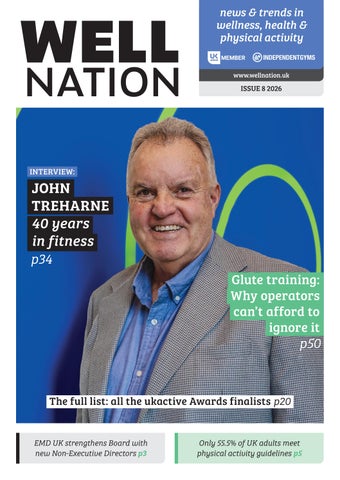
INTERVIEW:
JOHN TREHARNE 40 years in fitness
p34
Glute training: Why operators can’t afford to ignore it p50
The full list: all the ukactive Awards finalists p20
EMD UK strengthens Board with new Non-Executive Directors p3
Only 55.5% of UK adults meet physical activity guidelines p5
METRICS THAT DELIVER OUTCOMES THAT COUNT Discover how EGYM powers growth you can see, prove, and repeat with a fully connected, data-driven ecosystem, tailored to you.
LEARN MORE
www.egym.com/uk | sales@egym.com
news & trends PHOTO: EMD UK
John Challinor Publisher john@nationmedia.uk Tel: +44 (0) 7971 043396
Dan Rees, CEO of EMD UK
EMD UK strengthens Board with new Non-Executive Directors As EMD UK – the national governing body for group exercise – prepares to launch an ambitious new five-year strategy designed to strengthen the role of group exercise in improving the nation’s health, the body has appointed seven new NonExecutive Directors to its Board. Joining the Board with immediate effect are well-known leisure industry leaders Jenny Patrickson and Debra Stuart, alongside Christina Hennessey, Rob Lander, Alison Crowe, Melissa Wright and Aimee Henderson. Each has been appointed for an initial four-year term. The appointments come as EMD UK enters the final year of its current five-year strategy and begins shaping its strategic direction for 2027-2031. The new appointments will help guide EMD UK’s next phase of
www.wellnation.uk
development, with a particular focus on strengthening the integration of group exercise within health, supporting workforce development and ensuring the sector continues to play an increasingly important role in tackling physical inactivity, health inequalities and social isolation. Among the new appointments is Jenny Patrickson. With more than 30 years working the sector, Jenny brings extensive experience advising operators, suppliers and governing bodies, considerable commercial and strategic expertise together with a deep understanding of the challenges and opportunities facing the leisure sector. “The quality and diversity of applicants was exceptional and reflects the progress EMD UK has made over recent years,’ says Samantha Cullum, Chair, EMD UK.
Tom Walker Editor tom@nationmedia.uk Tel: +44 (0) 7796 512769
Get your free subscription at
www.wellnation.uk WellNation is published by Glencroft Ltd. This publication is protected by copyright and no part may be reproduced, transmitted or stored in any print or electronic format without the written permission of the publisher. Every effort has been made to ensure the accuracy of the contents of this publication and WellNation accepts no responsibility for any error or misrepresentation. Opinions expressed by the contributors and advertisers are not necessarily those of the publisher and we do not accept responsibility of losses or damages arising from them. Printed by BCP Media Group Ltd.
ISSUE 8 2026
3
news & trends PHOTO: ANYTIME FITNESS
PHOTO: MYZONE
Anytime members will get access to a Fitness+ subscription for the lifetime of their active membership
Now anyone can earn MEPs
Myzone Go expands operator reach with Garmin integration Myzone has expanded its Motivation Technology platform by launching Myzone Go integration with Garmin, enabling millions of additional fitness users to connect with the Myzone ecosystem. The development follows existing access for Apple and Android users and gives operators a new way to engage Garmin owners without investing in additional hardware or increasing administrative workloads. Until now, Garmin users could not use their devices to join Myzone challenges, earn MEPs or participate in facility leaderboards.
South Downs Leisure begins £2m Worthing centre redevelopment South Downs Leisure has started a major £2 million redevelopment of Worthing Leisure Centre, with the first phase of works now underway. The investment will deliver a larger and modernised gym, an upgraded reception area, new fitness studios and a new active play space for families and younger visitors. Designed to futureproof one of South Downs Leisure’s flagship sites, the project aims to improve access to health, fitness and wellbeing opportunities for the local community.
4
ISSUE 8 2026
Anytime Fitness UK & Ireland teams up with Apple Fitness+ Anytime Fitness has partnered with Apple Fitness+ to make the platform available to its members across the UK and Ireland. The move will see members given complimentary access to Apple’s fitness and wellness service. Starting from August 2026, Anytime Fitness UK & Ireland members will get access to a Fitness+ subscription for the lifetime of their active membership at no additional cost, delivering a connected fitness experience that bridges the gap between in-club and on-demand wellness. Existing Fitness+ users also benefit when they sign up for a 13-month Anytime Fitness membership, receiving their first 30 days free. Sarah Mather, Head of Marketing at Anytime Fitness UK & Ireland, said: “Today’s members don’t think about fitness in one location. They move between the gym, home and travel, and they expect their membership to move with them. Adding Apple Fitness+ to membership combines
the motivation and guidance of Fitness+ with the support of our clubs, giving members even more ways to stay active and consistent.” Members will have access to thousands of Fitness+ workouts and meditations across 12 workout types – including Strength, HIIT, Yoga, Pilates and more – led by a diverse and welcoming team of trainers. Rich Peil, Director and Co-Founder, Anytime Fitness UK & Ireland and Australia, added: “We’re investing in a model that combines outstanding physical clubs with digital experiences members value to deliver the best member experience in the market. Providing our members with access to the expansive library of Apple Fitness+ content helps them pursue their goals wherever they choose to work out while complementing the experience they already enjoy in our clubs.” The announcement coincides with another milestone, with Anytime opening its 6,000th club globally.
www.wellnation.uk
Only 55.5% of UK adults meet activity guidelines PHOTO: PEXELS.COM
Just over half of UK adults meet recommended physical activity guidelines, according to new analysis of health and lifestyle data from almost two million Our Future Health participants. The study found that 55.5% of participants achieved recommended activity levels, with men more likely to meet the guidance than women at 57.5% compared with 53.4%. Adults aged 60 to 69 recorded the highest compliance rate at 58.9%, slightly ahead of 18 to 29-year-olds at 57.6%. Activity levels were lowest among people aged 80 and over, at 48.4%. The findings also revealed a “midlife exercise gap,” with activity falling among adults aged between 30 and 49. However, women became more likely than men to meet the guidelines around retirement age. Younger adults completed the most walking and vigorous activity. Those aged 18 to 29 walked for an average of 391 minutes each week and
The data is based on a study of almost two million participants
completed 116 minutes of vigorous exercise. Meanwhile, 70 to 79-yearolds recorded the most moderate exercise, averaging 278 minutes weekly. South West England was the most active region, with 57.3% of participants meeting the guidelines, followed by London at 57.1%. The West Midlands
recorded the lowest result at 52.4%. People in rural areas were generally more active than those living in urban locations. Income also had a clear relationship with exercise levels: 59.6% of people earning more than £100,000 met the guidelines, compared with 48.7% of those earning below £18,000. PHOTO: EVOLVE
Report reveals financial impact of poor equipment servicing PSLT Fitness Solutions, in partnership with Evolve, has released a new industry report exploring the often-overlooked financial and operational consequences of poor equipment servicing within the UK fitness industry. Titled The Hidden Cost of Poor Equipment Servicing in the UK Fitness Industry, the report examines how reactive maintenance strategies are contributing to increased operating costs, accelerated asset depreciation, member dissatisfaction and avoidable revenue loss across fitness facilities nationwide. The report reveals that reactive servicing can cost operators between 25–30% more per machine annually compared to structured preventative maintenance programmes. It also highlights the direct relationship between equipment condition, member experience and retention.
www.wellnation.uk
Stuart Martin, Commercial Director of PSLT
ISSUE 8 2026
5
news & trends PHOTO: SNAP FITNESS
PHOTO: GYMVOICE
The reformer equipment will be supported by a blend of live instructor-led and on-demand sessions
The app will guide members
New voice-guided app for fitness facilities launches A fitness app is taking a different approach to the gym dropout problem — not by tracking data or generating workout plans, but by guiding members through the gym, station by station, in real time. GymVoice is a voice-guided workout app that maps the equipment and layout of a gym, then walks members through their session using that knowledge. When a machine is busy, it suggests an alternative. When a member is tired, it adapts the programme on the spot. The session plays through headphones — no screen-watching.
SoC secures funding to expand wheelchair activity in Essex Sport for Confidence CIC has secured funding to improve access to basic health monitoring for wheelchair users across Essex, with 12 specialist weighing scales now available in community leisure settings. The funding has been awarded through the Southend, Essex and Thurrock Learning Disability and Autism Health Equalities Programme. Delivered in partnership with Essex Carers Network CIC, the investment will help tackle a long-standing barrier for wheelchair users.
6
ISSUE 8 2026
Snap Fitness expands reformer Pilates offering across its clubs Franchised gym operator, Snap Fitness, is strengthening its reformer Pilates offering across its clubs. Delivered in partnership with Your Reformer and Merrithew, the rollout combines premium reformer equipment, instructor education and digital studio solutions. The move will see larger Snap Fitness clubs introduce dedicated Reformer Pilates studio environments, while smaller ones will utilise flexible gym floor integration options. The equipment will be supplied by Your Reformer and Merrithew. In both formats, the reformer Pilates equipment will be supported by a blend of live instructor-led and on-demand sessions. Members will have 24/7 access to on-demand Reformer workouts through kiosks integrated directly onto the reformer beds, allowing clubs to extend programming availability beyond scheduled class times. The rollout is a global one and includes Snap’s UK portfolio of franchised clubs.
Andy Peat, Chief Product and Brand Officer for Snap Fitness said: “This is a significant moment for Snap Fitness. As we continue to grow globally, we’re focused on evolving our offering in ways that add real value for our members and franchisees whilst we maintain our 24/7 model. “Reformer Pilates allows us to bring a premium, boutique experience into our clubs at scale, and we’re proud to be partnering with bestin-class operators to deliver it. “Reformer Pilates is no longer a trend; it’s a core expectation in premium fitness. The launch reflects wider shifts in consumer behaviour, with members increasingly seeking fitness experiences that combine strength, mobility, recovery and wellbeing in a single destination. As demand for lower-impact training continues to grow, Reformer Pilates has emerged as a natural extension of Snap Fitness’ commitment to delivering a more holistic member experience.”
www.wellnation.uk
Making public leisure sustainable and building healthier communities.
£520m+ investment in local authority leisure
Chard Leisure Centre Value: £15.6m
310+
completed projects Abbey Leisure Centre Value: £3.5m
81%
of clients choose us for further projects
SC2 Value: £17m
development partner
Alliance Leisure are a trusted and experienced leisure development partner, with over 25 years’ experience transforming leisure facilities for local authorities.
allianceleisure.co.uk #TransformingLeisure
Discover our portfolio.
People news PHOTO: FIBODO
Jenny Patrickson joins fibodo as independent advisor
Jenny Patrickson
Jenny Patrickson has joined fibodo as an independent advisor to help shape and strengthen the company’s ambition to work with education partners as it sets out to assist more trainers, coaches and instructors in building sustainable, lifelong careers. Patrickson will support fibodo as it works with education providers, training organisations and industry partners to create stronger pathways from learning to earning. She will also support fibodo’s
forthcoming sector report, examining the gap between qualification, sustainable income and the wider community value created by coaches. “Every qualified coach represents an opportunity far bigger than a job,” said Anthony Franklin, CEO of fibodo. “We aim to work with education partners to help 10,000 coaches, trainers and instructors create lifelong careers, improving the lives of more than one million people.”
8
ISSUE 8 2026
PHOTO: SWIM ENGLAND
Rebecca Cox has been named interim CEO of Swim England. Cox will take up the role with immediate effect and replaces Andy Salmon, who resigned as CEO earlier this month. Cox, currently the Business Engagement Director at Swim England and Managing Director of the Institute of Swimming, was chosen following an internal recruitment process. She has spent almost 15 years at Swim England and has served as acting CEO for the past three months. Swim England Chair, Richard Hookway, said: “Rebecca has done an outstanding job leading the organisation as Acting Chief Executive and has demonstrated the leadership, commitment and strategic focus needed to continue driving Swim England forward. Rebecca is a highly respected figure across the industry, with more than 30 years of experience. Her knowledge of our organisation, our people and our stakeholders will be invaluable as we continue the important work already underway.” Speaking about her appointment,
PHOTO: QUALIFIED TRAINERS
Rebecca Cox appointed Swim England interim CEO
Cox added: “I’m proud to be taking on the role of Interim Chief Executive at such an important time for Swim England. “The last few months have reinforced my belief in the strength and passion of our people and the wider aquatics community. “Our ambitions remain high and our commitment to delivering our One Swim England strategy and transformation programme is unwavering. Progress has been made, and there is much to be proud of as we continue to build a modern, sustainable and inclusive organisation that supports everyone involved in our community.”
Qualified Trainers set for expansion with new strategic advisor Qualified Trainers has appointed Michelle Furniss as Strategic Advisor as the group fitness operations platform prepares for further international expansion. Supporting the company’s growth in the UK, Michelle brings 25 years of fitness industry experience spanning instruction, club management, business ownership, software, payments and senior leadership. Most recently, Michelle held the role of General Manager at Xplor Technologies.
www.wellnation.uk
225 MEMBERS IN 6 WEEKS NO UPFRONT COSTS. NO RISK We run the marketing and sales.... You run the club.
6 week on site member acquisition campaigns for gyms, hotel gyms and leisure centres Average result: 225 new members. Built for clubs ready to grow
5.0
Google reviews WWW.CFM.NET | 0115 777 3333
CFM
news & trends Doncaster Dome’s £15m Lagoons project completed PHOTO: ALLIANCE LEISURE
Work has been completed on the £15m transformation of the Lagoons at Doncaster Dome. Work on the Lagoons – a multi-pool water complex featuring seven interconnected pools, flumes and an outdoor rapid river – represent a significant milestone in the regeneration vision for the historic leisure destination. The redevelopment modernises one of the Dome’s most popular attractions and included the addition of two new racer slides and a new indoor splash play area with a variety of interactive water features. Major works have also been undertaken to replace the glazing, redesign the main entrance area and install new heating and ventilation systems responsible for heating and maintaining water and air quality within the swimming pool environment. The project has aimed to modernise the pool complex, while preserving the character of the Grade II listed building, which opened in 1989 and was listed in 2023 becoming one of the
The redevelopment has modernised one of the Dome’s most popular attractions
youngest listed buildings in the country. The work was led by Alliance Leisure on behalf of the facility’s owner, Doncaster Culture and Leisure Trust, and funded by City of Doncaster Council. The project was delivered in partnership with project managers Abacus, principal
contractor Universal, architects Saunders Boston and specialist pool partner Myrtha Pools, plus CGP and Hensall delivering M&E services. Sean Nolan, Regional Director at Alliance Leisure, said: “This has been an ambitious and technically complex project delivered in a live environment.”
The Ella Dawson Foundation (EDF) has partnered with ReferAll to help more young adults diagnosed with cancer access specialist health and wellbeing support. The national charity supports young adults aged 18 to 30, as well as their families and carers, through tailored psychological, emotional, physical, nutritional and wellbeing programmes. Its work helps young people rebuild confidence, return to education or work, and rediscover life beyond diagnosis. The Foundation was created by Ella Dawson’s family after Ella died aged 24 from Acute Lymphoblastic Leukaemia. During her illness, Ella identified a clear need for more specialised mental and physical health support for young people with cancer.
10 ISSUE 8 2026
PHOTO:REFERALL
EDF partners with ReferAll to boost cancer support
The partnership will streamline referrals
www.wellnation.uk
The future of Team management Join the movement. Power your people. Scale with CoverMe
Thousands of clubs have already made the shift. Don’t get left behind. visit www.covermeapp.co and book your demo today.
WE KEEP YOUR MEMBERS MOVING PRODUCT UK BUILT CORE GYM STRENGTH EQUIPMENT, REMANUFACTURED KIT AND CUSTOMISATION OPTIONS.
LOGISTICS RELOCATION AND REMOVAL OF PART OR FULL FACILITY.
SERVICE NATIONWIDE COVERAGE, FULL SERVICE CONTRACTS TO ONE OFF VISITS. FROM ELECTRICAL, UPHOLSTERY, REPAIRS AND GENERAL ASSET MANAGEMENT.
TRADE TRADE IN ANY FITNESS KIT. Sales@pslt.co.uk www.pslt.co.uk 01282 969616
BRIEFING
N O I T A R E N E G W E N E TH S S E N T I F F O
Why TBKFiT is changing the way the world trains
T
he fitness industry is evolving faster than ever before. Traditional gym workouts are no longer enough for people looking for engaging, measurable and results-driven training experiences. Today’s fitness enthusiasts want movement that feels purposeful, technology that tracks progress, and workouts that keep them motivated. This is exactly where TBKFiT is leading the way. More than just a piece of equipment, TBKFiT is a connected fitness platform that combines martial arts-inspired movement with innovative technology to create a unique, interactive training experience. Built around the philosophy of Train. Track. Compete., TBKFiT is redefining what modern fitness looks like. CREATED THROUGH EXPERIENCE
Behind TBKFiT is founder Clive Payne, a lifelong kickboxer and innovator with a passion for transforming the way people train. After years of training, Clive wanted a better way to replicate the speed, movement and reactions of a real opponent from home. Traditional punch bags and static fitness
12 ISSUE 8 2026
equipment simply couldn’t recreate the dynamic, multi-directional training needed to develop timing, coordination, agility and reaction speed. Instead of accepting those limitations, Clive designed his own solution. That solution became The TBK. Originally created to enhance his own training, The TBK quickly attracted the attention of fellow martial artists and fitness enthusiasts, who recognised its ability to deliver a more reactive, enjoyable and effective workout. It soon became clear that its benefits extended far beyond combat sports. Inspired by its success, Clive expanded the concept far beyond a single piece of equipment. What began as a personal training solution evolved into TBKFiT—a connected fitness ecosystem that combines innovative equipment, wearable technology, performance tracking and interactive software to create a completely new way to train. At the heart of TBKFiT is a simple belief: fitness should be enjoyable, motivating and measurable. Too often, traditional workouts become repetitive, progress is difficult to track and motivation fades. TBKFiT addresses these challenges by making every session dynamic, purposeful and measurable. Today, Clive continues to lead the innovation behind TBKFiT, driving the development of new products
www.wellnation.uk
and technologies that combine martial arts-inspired movement with cutting-edge fitness technology. His vision remains unchanged: Fitness should be accessible, exciting and suitable for everyone, regardless of age, ability or fitness level. WHERE FITNESS MEETS MARTIAL ARTS
At the heart of the TBKFiT system is The TBK, an innovative three-ball training system designed to encourage movement in every direction. Unlike traditional boxing bags or static gym equipment, The TBK develops real athletic performance by improving: ● Coordination ● Speed ● Timing ● Agility ● Reaction time ● Balance ● Core strength ● Cardiovascular fitness Every workout is unpredictable, encouraging users to react instinctively while developing real-world athletic skills in a fun and challenging environment. This reactive approach keeps training fresh and
www.wellnation.uk
rewarding, making it suitable for everyone—from beginners starting their fitness journey to elite athletes looking to sharpen performance. TECHNOLOGY THAT MAKES EVERY SESSION COUNT
TBKFiT is far more than training equipment. It is a fully connected fitness platform built around intelligent technology that allows users to monitor their performance in real time. The TBKFiT ecosystem combines: ● The TBK training system ● The TBKFiT App ● BOKi4 wearable technology ● The TBK Reactor commercial training station Together, these innovations measure punch speed, kick speed, heart rate, workout intensity and overall performance, providing users with instant feedback after every session. Every workout produces real-time performance data, allowing users to monitor progress, set new goals and continually improve. By turning every session into measurable achievements, TBKFiT helps users stay motivated while pushing their performance further. ISSUE 8 2026 13
BRIEFING
MORE THAN EXERCISE—AN EXPERIENCE
Modern fitness is no longer just about burning calories. People want challenge, interaction and a community. TBKFiT delivers all threet hrough structured workouts, guided programmes, live leaderboards and gamified challenges. Every session becomes immersive and rewarding. Whether training at home or inside a commercial facility, users become active participants in their own progress, challenging themselves while enjoying every workout. It’s this combination of movement, technology and motivation that sets TBKFiT apart from conventional fitness equipment. DESIGNED FOR EVERYONE
THE FUTURE OF COMMERCIAL FITNESS
Accessibility has been central to TBKFiT from the very beginning. The system has been designed so people of all ages, abilities and fitness levels can enjoy the benefits of reactive training, including: ● Beginners ● Weight-loss programmes ● Home fitness users ● Martial artists ● Personal trainers ● Schools and community groups ● Gyms and health clubs ● Elite athletes
For gym operators and fitness facilities, TBKFiT represents far more than another piece of equipment. The commercial ecosystem introduces dedicated TBKFiT Training Zones, featuring The Reactor, integrated performance screens, wearable technology, structured programming and interactive challenges. These experiences help increase member engagement, improve retention and create exciting new revenue opportunities through premium training sessions and classes. As the fitness industry continues to embrace connected technology, data-driven training and immersive experiences, TBKFiT is helping shape the future of commercial fitness. TBK is on sale now and the other products are due to released in November 2026.
Every workout can be adapted to suit different goals and abilities, making TBKFiT a truly universal training solution.
A VISION THAT CONTINUES TO GROW
For Clive Payne, TBKFiT has never been about creating another fitness product. It is about changing the way people experience exercise. His vision is to build a global fitness community where movement is enjoyable, progress is measurable and technology inspires people to become healthier, stronger and more confident. By combining his lifelong passion for kickboxing with innovative equipment, wearable technology and intelligent performance tracking, Clive continues to push the boundaries of connected fitness. As the world of fitness continues to evolve, TBKFiT is perfectly positioned at the forefront of the next generation of training. The future of fitness isn’t defined by lifting heavier or running further. It’s about moving with purpose, measuring progress and enjoying every workout. That’s the TBKFiT difference – “Train. Track. Compete”. ● https://www.tbkfit.com
14 ISSUE 8 2026
www.wellnation.uk
PLACES
GET INVOLVED!
National Fitness Day 2026
T
he National Fitness Day takes place on Wednesday 16 September 2026. Led by ukactive and held annually, the day celebrates the role physical activity plays across the UK, raising awareness of its importance in helping people lead healthier lifestyles. Since launching in 2011, National Fitness Day has inspired millions of people to get involved each year. While bringing people together through physical activity remains at the heart of the campaign, it has evolved to encourage everyone to see the day as the start of a much bigger journey towards improved health and wellbeing. This year’s tagline, “Powered by You,” highlights that everyone has a role to play and opportunity to be active – from individuals and communities to businesses, schools and hospitals. For operators, National Fitness Day isn’t just about one day of activity; it’s about helping people take small, sustainable steps towards a healthier, stronger future.
● ukactive has made it easy for gyms, facility operators and activity groups to get involved.
There is a dedicated website for those wanting to host an event during the day: https://ukactive.com/national-fitness-day/get-involved/ ● For ukactive members, there is a free digital toolkit that can be downloaded
here: https://ukactive.com/ukactive-resource/25956/NFD-Toolkit-V1.zip/
www.wellnation.uk
ISSUE 8 2026 15
news & trends PHOTO: PEXELS.COM
(L-R) Wave Active’s Duncan Kerr and Victoria Smith with Tom Gozna & Laurence Hawkins from Bigwave
Wave Active extends Bigwave Marketing partnership Wave Active has extended its strategic partnership with Bigwave Marketing for a further three years, reinforcing a collaboration focused on community engagement, digital growth and innovation across the leisure and wellbeing sector. The renewed agreement builds on a partnership that began in November 2023, with Bigwave Marketing working alongside Wave Active as an extension of its in-house team. During that time, the fullservice agency has supported Wave Active across strategic planning, branding and design, website development, social media content, paid media and print campaigns. “We’re delighted to be extending our working relationship with Bigwave Marketing,” explains Duncan Kerr, Chief Executive of Wave Active. “It’s an agency that closely shares our values, mission and vision to place health and wellbeing at the heart of the communities we serve. I am incredibly proud of what we have achieved together so far and excited about what lies ahead. With a new Soft Play centre in Peacehaven and a Health Hub at Newhaven opening soon, there is plenty more to come.” The new three-year extension signals continued investment in marketing-led growth as Wave Active expands its role within the UK leisure and wellbeing landscape.
16 ISSUE 8 2026
The platform aims to help organisations make more informed decisions
Sport England and 4Global launch new Moving Communities Place Sport England has launched the next generation of its Moving Communities Place platform, strengthening the way the physical activity sector uses data to support participation, reduce inequalities and evidence impact. Powered by 4GLOBAL’s new InsightOS infrastructure, the enhanced platform has been designed to help local authorities, leisure operators, Active Partnerships, delivery organisations and national bodies make more informed decisions about the communities they serve. “The future of sport and physical activity will be shaped by the quality of the decisions we make today,” says Jack Shakespeare, Managing Director at 4GLOBAL. “InsightOS represents a significant advancement in the sector’s ability to turn data into intelligence and intelligence into action. By bringing together participation, place, social value and performance insight in a single ecosystem, we’re helping
create a more connected, evidenceled sector capable of delivering greater impact for communities.” The upgrade marks a major step forward for Moving Communities Place. It brings together participation data, demographic insight, social value analysis and place-based intelligence in one integrated platform. As a result, organisations can gain a clearer understanding of what is happening in local communities, why it is happening and where support can have the greatest effect. “We can now transform vast volumes of data into actionable intelligence that can shape investment decisions, influence policy, and help reduce inequalities in participation,” explains Emma Bernstein, Strategic Projects Lead at Sport England. This gives users the ability to identify underserved communities with greater precision, understand barriers to participation at a local level, evaluate the effectiveness of programmes and quantify social value.”
www.wellnation.uk
BLU Leisure Retail Ranges
Boost. Secondary. Spend.
BLU BRANDED SPORTS BRA + LEGGINGS
w: bluleisure.co.uk m:info@bluleisure.co.uk “Stronger Together”
t: +44(0)1908 582525
news & trends Dementia Hub service expanded for five years PHOTO: ABBEYCROFT LEISURE
The Abbeycroft Leisure Dementia Hub in Haverhill is expanding its support for local people after securing a five-year commitment at Haverhill Leisure Centre. Run by Memories Are Golden, the community hub supports people living with dementia, those experiencing social isolation, and others in need of regular connection, activities and care. The expansion increases weekly capacity from 60 to 90 people, giving more families access to vital support while also offering respite for family carers. The hub is based at Haverhill Leisure Centre, which is managed by Abbeycroft on behalf of West Suffolk Council. Its long-term future at the site gives the programme a stable base at the heart of the community. The Memories Are Golden Community Hub moved to Haverhill Leisure Centre in 2024 after facing possible closure when its previous premises were sold. Local councillors and Abbeycroft stepped in to help secure a new home for the service.
The initiative has been running since 2024
Additional space has now been made available through council locality funding, support from funding partners, and fundraising by the charity itself. This includes funding towards the extension of the day care meeting room and dining area, helping more people take part in the activities provided. As
capacity rises to 90 people per week, more families will be able to benefit. “The additional room will enable us to welcome more people living with dementia and provide much-needed respite for their carers,” says Kelly Kennedy-Smith from Memories Are Golden.
Crook Log Leisure Centre has more than doubled the membership target for its new Innerva-equipped power-assisted exercise suite in less than six months. Operated by Lex Leisure, the centre in Bexley, London, launched the suite in November 2025 to support active ageing, rehabilitation and inclusive access to exercise. The facility has already attracted 422 members, far exceeding its original target of 200 members over two years. Demand for the power-assisted exercise suite has grown so quickly that the centre has extended its opening hours to support increased attendance. The suite features a 10-piece Innerva circuit, alongside a treadmill and upper body ergometer. The space was created by repurposing four underused consultation rooms and includes its own reception area.
18 ISSUE 8 2026
PHOTO: INNERVA
Innerva’s active ageing suite exceeds target at Crook Log centre
Innerva supplies power-assisted exercise technology
www.wellnation.uk
PEOPLE
ukactive awards 2026 THE SHORTLIST The finalists for the 2026 ukactive Awards have been revealed. Organised by industry body ukactive, the awards are now in their eighth year and celebrate the people, organisations and initiatives driving positive change within the fitness and physical activity industry
T
his year’s ukactive Awards received a record-breaking 190 entries for the 14 awards categories. The number is partly down to the introduction of new categories, which include the inaugural Workplace Culture & Initiative Award. The new award will recognise organisations that have delivered impactful workforce initiatives designed to improve the wellbeing and activity levels of their employees. The judging process for the awards – which are supported by headline sponsor, the Swimming Teachers’ Association (STA) – has been led by independent business intelligence and mystery shopper specialist, Proinsight. David Stalker, Chair of ukactive, said: “The ukactive Awards is an opportunity to recognise the outstanding people behind the growing success of the UK physical activity sector. “With a record number of entries this year, the competition is stronger than ever so huge congratulations to all our finalists.” The winners will be revealed at an awards ceremony on Thursday 8 October at the International Convention Centre (ICC) in Birmingham. Tickets for the awards ceremony will go on sale shortly on the ukactive website.
20 ISSUE 8 2026
THE FULL LIST OF FINALISTS Private Club/Centre of the Year – Sponsored by Technogym ● 1Life Management Solutions Limited ● NRG GYM Manchester ● Snap Fitness Christchurch ● Snap Fitness Pontyclun Independent Club/Centre of the Year Sponsored by Technogym ● Branston Golf & Country Club ● CitySport – City St George’s University of London ● Hilton Glasgow Health & Fitness with Serenity ● Kallima Health Club & Spa Hilton Syon Park ● The Health Club at Ribby Hall Village ● The Thames Club Regional Public Club/Centre of the Year Sponsored by Technogym NORTHERN IRELAND & WALES ● Antrim and Newtownabbey Borough
Council – Crumlin Leisure Centre ● Antrim and Newtownabbey Borough
Council – The Valley Leisure Centre ● GLL – Andersonstown Leisure Centre ● GLL – Olympia Leisure Centre & Spa ● Legacy Leisure Limited – Barry Leisure Centre ● Serco Leisure – Bangor Aurora Aquatic & Leisure Complex
SCOTLAND ● Inverclyde Leisure – The Waterfront Leisure Complex ● KA Leisure ● Moray Leisure Centre ● Xcite Linlithgow
www.wellnation.uk
With a record number of entries this year, the competition is stronger than ever, so huge congratulations to all our finalists
NORTH OF ENGLAND ● Brio Ellesmere Port ● Durham County Council – Spennymoor Leisure Centre ● Everybody Health & Leisure – Holmes
Chapel Community Centre ● Everyone Active – English Institute of Sport Sheffield ● Everyone Active – Eston Leisure Centre ● Parkwood Leisure – Crosby Leisure Centre
MIDLANDS & EAST ANGLIA
Supplier of the Year ● EZ Loyalty ● Keepme ● Myzone ● PSLT ● Pure Energy Music ● The Fitness Group ● YMCA Awards ● YOUR Personal Training
● Alive West Norfolk – Council of King’s Lynn & West Norfolk ● Everyone Active – Moulton Leisure Centre ● Everyone Active – Whitwick & Coalville Leisure Centre ● Halo Leisure – Meon Vale Leisure Centre ● Serco Leisure – Northfield Leisure Centre ● Serco Leisure – Warsop Health Hub
LONDON ● Everyone Active – Flitwick Leisure Centre ● Everyone Active – William Penn Leisure Centre
Build, Design or Refurbishment of the Year ● Alliance Leisure ● Brio ● Nuneaton and Bedworth Borough Council (NBBC) ● ReCreation Group ● Snap Fitness ● Tees Active ● Xcite Bathgate
● GLL – Charlton Lido & Lifestyle Club ● GLL – Waltham Forest Feel Good Centre ● High Town Gym & Wellbeing Centre – Active Luton ● Lampton Leisure – Hanworth Air Park
SOUTH OF ENGLAND ● Everyone Active – Westminster Lodge Leisure Centre ● Freedom Leisure – Bexhill Leisure Centre ● GLL – Leatherhead Leisure Centre ● GLL – Rivermead Leisure Centre ● Parkwood Leisure – Penzance Leisure Centre ● Plymouth Life Centre – Plymouth Active Leisure
www.wellnation.uk
Equality, Diversity & Inclusion Award ● Durham County Council ● Everyone Active – St Albans Parkinson’s Community Programme ● Halo Leisure ● Leisure Focus Trust ● Plymouth Active Leisure Ltd ● The Fitness Group ● West Lothian Leisure (Xcite) ● Y Awards ISSUE 8 2026 21
PEOPLE
Healthy Communities Award ● 1Life Management Solutions Limited ● BH Live ● Edinburgh Leisure ● Everyone Active – Dacorum Community Programme ● Everyone Active – Water Safety for Everyone Project ● Freedom Leisure ● Mid Devon District Council / Active Mid Devon ● Serco Leisure PSA Wellbeing Initiative Transformational Innovation Award ● Alive West Norfolk – Council of King’s Lynn & West Norfolk ● Durham County Council ● Everyone Active YOU+ ● Kallima Health Club & Spa ● Leisure Focus ● Serco Leisure – Leys Pools & Leisure Centre ● Serco Leisure – Maidstone Leisure Centre ● The University of Edinburgh Marketing Campaign Award ● Brio ● Durham County Council ● Edinburgh Leisure ● Everyone Active YOU+ ● GLL ● Inverclyde Leisure ● Kore ● Swim England
Workplace Culture & Initiative Award ● Alliance Leisure ● Durham County Council ● Everybody Health & Leisure ● Kore ● Serco Leisure ● Sodexo ● Sport and Leisure – City St George’s, University of London Education Programme of the Year ● Achieve More Training ● Fitness Education Online ● Magna Vitae ● OriGym ● PT Academy ● Swim England ● The Fitness Group ● Y Awards Physical Activity Hero Award ● Adam Roberts – Healthy Communities Manager, 1Life Management Solutions Limited ● Alex Corney – Active Health Coordinator, Plymouth Life Centre ● Christine Percival – Volunteer ● Dora Smith – Falls Prevention Instructor, Brio ● Gillian Lister – Exercise to Music Instructor, The Louisa Centre, Durham County Council ● Kirsty Jones – Regional Contract Health, Activity and Wellbeing Manager, Everyone Active ● Matt Clarke – Swim Manager, Everyone Active ● Paula Watson – Healthy Communities Manager (Gloucester & The Cotswolds), Freedom Leisure ● Outstanding Individual Leadership Award ● David Bibby – Managing Director, Everyone Active ● Deaglan O’Hagan – Head of Leisure Operations, Antrim and Newtownabbey Borough Council ● Lindsey Perry – Head of Fitness, The Thames Club ● Oliver Deen – Operations Director, Jubilee Hall Trust Outstanding Leadership Team Award ● Alliance Leisure Development Board ● Durham County Council’s Wellbeing, Sport & Leisure Management Team ● GLL National Aquatics Team ● Move Southwark Leadership Team ● Sport and Leisure – City St George’s, University of London ● The Leisure Focus Leadership Team ● The My Healthy Way Leadership Team (Parkwood Leisure) ● Y Awards Senior Leadership Team and Y Awards Management Team
22 ISSUE 8 2026
www.wellnation.uk
Good systems feel simple Bookings, payments, staff, scheduling and memberships - joined up so your business runs smoother. Less admin. More Control. Better days.
See the platform at fibodo.com/goodsystems
news & trends PHOTO: COVERME
The new spa suit at Woburn Forest
New Forest Serenity Suite for Aqua Sana Forest Spa Sparcstudio has completed the interior design for the new Forest Serenity Suite at Aqua Sana Forest Spa, Woburn Forest. The creative design studio, which specialises in spa and wellness design, has created a dedicated treatment space that introduces touchless therapy at the property for the first time. Led by Sparcstudio Director Neil Fairplay, the project responds to growing demand for advanced wellbeing experiences that support both emotional and physical wellbeing. It also gives guests an alternative route to relaxation, particularly those who prefer not to have hands-on treatments.
Gladstone integrates with HealthKey Gladstone Software, a leading leisure management software provider for the UK and Ireland, has announced a new integration partnership with HealthKey, the health platform enabling gyms and leisure operators to offer members access to high-quality health and wellbeing services. The partnership will enable Gladstone customers to integrate HealthKey’s white-label platform into their existing member experience, giving operators a simple and frictionless way to offer holistic health services to their members and support them across their wider health journey.
24 ISSUE 8 2026
The app connects clients to the right personal trainer in under 10 seconds
CoverMe launches new personal trainer platform CoverMe, the fitness workforce management app, has launched CoverMe PT, an on-demand personal training platform that connects personal trainers to clients “in under 10 seconds”. At the centre of the launch is CoverMe’s AI matching engine, which learns from every booking, cancellation and session and “gets smarter each time”. CoverMe PT is the second product on the platform, marking the company’s evolution into a multiproduct operating system for the fitness industry. CoverMe works with fitness brands across four continents and will initially roll out CoverMe PT across the UK, US and Europe. Rosanna Tucker, co-founder and CEO of CoverMe, said: “Personal training is the most commercially valuable line in any club, and the most operationally overlooked. “The way most facilities sell PT hasn’t changed since the 1980s: trainers walking the gym floor, touting for
business at reception and hoping to catch a member at the right moment. But members don’t want to be interrupted mid-workout to be sold to. They want to discover, choose and book PTs on their own terms, with the immediacy and energy of a social media platform.” CoverMe PT is white-labelled and integrates into existing member apps. The platform’s AI matching engine analyses each member’s goals, availability and confidence level against personal trainer specialisms in real time. Beverlee Browne, co-founder and CPO of CoverMe says: “Most member churn happens in the first 90 days when those who don’t feel immediate value leave. But members who book a PT session in their first 14 days are up to 60% more likely to stay beyond 90 days. “However, 60% of members abandon PT when the booking process isn’t instant. CoverMe PT changes that. It’s engineered to make PT bookings happen automatically.”
www.wellnation.uk
TA L K T O A N A N A LY S T
Map your market: who, where, what
How can we help? Our insight is built around you. From member behaviour to market demand, EVOLVEʼs Strategic Insight Services adapt to your business needs, helping you make data led decisions, with confidence.
Our insight explore:
Our insights powered by real industry intelligence
Members Understand who your members are and how they behave.
30+ years of insight 850 million data points
Population Know your local market and true catchment. Competition See your landscape clearly and identify gaps. Demand Uncover opportunity and growth potential.
7,000+ UK fitness sites tracked
Why it matters Reduce risk Identify real opportunity Make confident decisions
To find out more, email hello@weareevolve.io
EVOLVE weareevolve.io
news & trends ukactive names most active MPs after record turnout ukactive has named Westminster’s most physically active MPs and parliamentary offices following a record year for its Fit for Office challenge. A total of 268 MPs, peers, and Parliamentary staff participated in the month-long competition during June 2026, marking the highest turnout since the initiative launched in 2023. Delivered by ukactive in partnership with Technogym, Fit for Office encourages Parliamentarians to increase their daily physical activity and recognise its role in supporting health, wellbeing and economic growth. Participants tracked their activity through the Technogym app, earning MOVE points based on the duration and intensity of their exercise. Caroline Nokes MP for Romsey and Southampton North topped the individual rankings with 51,357 MOVEs. “Physical activity is a great way to support mental wellbeing, help manage stress, and create opportunities to enjoy the outdoors, spend time with others, and feel more energised,”
Caroline Nokes MP topped the individual rankings
she explained, following her win. “Fit for Office has been a great way to add some competitive motivation to my everyday fitness regimen.” Llinos Medi MP finished second with 48,237, followed by Andy MacNae MP with 43,485. Daisy Cooper MP’s office led the team competition
after recording 116,307 MOVEs. The offices of Jonathan Hinder MP, Steve Witherden MP, Kirsteen Sullivan MP and Blake Stephenson MP completed the top five. The winners were congratulated at Westminster by representatives from ukactive and Technogym. PHOTO: FITNESSGENES
FitnessGenes announces partnership with Qured FitnessGenes has partnered with Qured, integrating genomic and blood diagnostics into a single experience. The collaboration provides members with one app and a unified view of their health. Through the partnership, FitnessGenes members will be able to monitor personal health risks identified through their DNA results using periodic blood testing. By combining genetic predispositions with real-time biomarker data, members will receive more personalised recommendations that adapt as their biology changes over time. Qured members will also benefit from access to FitnessGenes’ genomic insights, helping them understand the genetic factors that sit behind key blood markers. The personalisation aims to provide deeper insight and support more targeted interventions.
26 ISSUE 8 2026
Users will be able to monitor personal health risks
www.wellnation.uk
INSIGHT
Reformer Pilates has momentum – but is it mainstream? Reformer Pilates is one of the fitness sector’s most visible growth categories. New EVOLVE analysis reveals a market with genuine national reach, but also considerable room to grow. Jamie Buck, Head of Research at EVOLVE, explains
R
eformer Pilates has become difficult to ignore. New studios are opening, established operators are introducing dedicated spaces and equipment suppliers are developing solutions designed to take the format to a wider audience. That visibility can create the impression that Reformer Pilates is already a mainstream feature of the UK fitness market. The data presents a more nuanced and arguably more interesting picture. EVOLVE’s latest analysis covers 7,507 operational UK gyms, health clubs and public leisure facilities. Of these, 257 locations are recorded as offering Reformer Pilates equipment, giving current market penetration of 3.4%. This confirms that Reformer has established a national presence. It also means that 7,250 operational sites, 96.6% of the market, do not currently offer the equipment.
28 ISSUE 8 2026
PRIVATE OPERATORS ARE LEADING ADOPTION
Provision is considerably more developed within the private sector. Private operators account for 227 of the UK’s 257 equipped locations. This represents penetration of 4.5% across a private estate of 5,026 sites. By comparison, Reformer equipment is recorded at 30 of the UK’s 2,481 public leisure locations, producing public-sector penetration of 1.2%. The operator rankings reveal several different adoption strategies. David Lloyd Clubs has the largest current portfolio, with equipment recorded at 29 locations. Virgin Active follows with 28 equipped sites from an operational estate of 31, representing penetration of 90.3%. Village Health & Wellness Clubs has provision at 16 of its 34 locations, while Nuffield Health has 15 equipped sites across a much larger estate of 111. These figures demonstrate that scale and adoption intensity are not the same thing.
www.wellnation.uk
Some operators are positioning Reformer as a core component of their offer, while others are trialling it selectively within particular locations. A CONCENTRATED MARKET WITH A LONG TAIL
The ten largest providers account for 132 locations, or 51.4% of all identified provision. At the same time, the market remains highly fragmented. EVOLVE identified 91 provider groups operating Reformer equipment at just one location each. Collectively, these single-site providers represent 35.4% of the market. This combination of recognised multi-site brands and independent operators suggests there is no single route into the category. Reformer can operate as a premium club service, a specialist studio proposition, an addition to a mainstream gym or a component of a broader public leisure offer. Geographically, provision is recorded across all 12 UK regions, although it remains heavily concentrated
www.wellnation.uk
REFORMER PILATES IN FOUR NUMBERS
7,507
257
3.4%
7,250
Operational UK gyms, health clubs and public leisure facilities analysed
UK market penetration — 257 of 7,507 operational locations
Locations with confirmed Reformer Pilates equipment provision
Locations without Reformer Pilates equipment — 96.6% of the operational market
Source: EVOLVE Reformer Pilates in UK Gyms & Leisure Centres (Aug 26)
ISSUE 8 2026 29
Some of the greatest numerical opportunity sits within operators that have already adopted Reformer but have not extended it across their estates
INSIGHT
PRIVATE AND PUBLIC-SECTOR ADOPTION PRIVATE SECTOR
PUBLIC SECTOR
5,026
2,481
in London and the South East. London contains 88 equipped locations and the South East a further 44. Together, the two regions account for 51.4% of national provision. London also has the UK’s highest regional penetration rate at 9.8%.
30
THE NEXT PHASE WILL DEPEND ON REPEATABILITY
Operational locations
227
Reformer-equipped locations
4.5%
Private-sector market penetration
88.3%
Share of all identified UK Reformer provision
Operational public leisure locations Reformer-equipped locations
1.2%
Public-sector market penetration
11.7%
Share of all identified UK Reformer provision
3.7x
Private-sector penetration compared with the public-sector rate Source: EVOLVE Reformer Pilates in UK Gyms & Leisure Centres (Aug 26)
LONDON AND SOUTH EAST CONCENTRATION LONDON
88 Reformer-equipped locations 9.8% regional market penetration 34.2% share of all identified UK Reformer provision SOUTH EAST
44 Reformer-equipped locations 4.4% regional market penetration
Some of the greatest numerical opportunity sits within operators that have already adopted Reformer but have not extended it across their estates. Across 18 selective and early-stage operator groups analysed by EVOLVE, only 67 of 1,542 operational locations currently have recorded provision. That leaves 1,475 sites without Reformer equipment. This does not mean those locations are destined to receive it. Space, capital investment, instructor availability, programming and local demand will all influence individual decisions. It does, however, demonstrate the scale of the potential headroom within existing operator estates. Moving national penetration from 3.4% to 5% would require approximately 118 additional equipped locations. In the context of a 7,507-site market, that is a relatively modest shift, but one that would represent significant growth for the category. The next chapter of Reformer Pilates is therefore unlikely to be defined simply by more equipment being installed. It will depend on whether operators and suppliers can develop repeatable models covering site selection, space, instructors, programming, pricing and long-term support. Reformer Pilates has momentum. The question now is how effectively that momentum can be converted into sustainable, scalable provision.
17.1% share of all identified UK Reformer provision COMBINED
132 Reformer-equipped locations across London and the South East
51.4% share of all identified UK Reformer provision 125 equipped locations across all other
UK regions — 48.6% of provision
WANT THE FULL PICTURE? The full EVOLVE Reformer Pilates in UK Gyms & Leisure Centres Report is now available at https://weareevolve.io/market-intelligence-reports
For a £50 discount on the full price, use the code: WELLNATION50 at checkout
Source: EVOLVE Reformer Pilates in UK Gyms & Leisure Centres (Aug 26)
30 ISSUE 8 2026
www.wellnation.uk
One Vision. One Voice. 24-26 September 2026 | London Stadium in Queen Elizabeth Olympic Park
Be Where the Industry Joins as One The HFA European Congress isn’t just an event—it’s a movement. It’s a gathering of top industry leaders who believe fitness is healthcare, prevention is power, and our industry is stronger when we speak as one. Join the conversations that shift perspectives, the collaborations that spark change, and the community shaping the next era of fitness across Europe.
Scan to Learn More
healthandfitness.org/congress
If you’re thinking about the future of our industry, London is where you need to be.
Brought to you by the Health & Fitness Association in partnership with ukactive
PEOPLE
Britain’s inactivity crisis starts at the desk New research from Hussle suggests physical inactivity isn’t simply a lack of motivation. For many people, it’s the modern working day. Pauline Alonso, a wellness expert and director at Hussle, talks to WellNation about the company’s recent Work is Health research
T
he latest data on Britain’s inactivity levels makes for concerning reading, but it also raises an important question. Are people really choosing not to exercise, or are their working lives making it increasingly difficult to stay active? At Hussle, our latest ‘Work is Health’ Workplace Wellness Report suggests it’s the latter; while 77% of UK employees say they exercise at least once a week, only 50% manage to be active three or more times, meaning less than half are meeting NHS guidelines. At the same time, 70% say their work routine actively reinforces sedentary habits. This is the “active but sedentary” paradox, in which people are motivated and actively trying to prioritise their health, yet they’re spending most of their day sitting at desks, in meetings or commuting. Unfortunately, an evening workout cannot completely rectify the impact of eight or more hours of inactivity. The effects are clear to see: more than six in ten (61%) employees say long hours at a desk
32 ISSUE 8 2026
negatively affect their health, while 55% believe being indoors all day harms their wellbeing. More than half (52%) don’t move enough during the working day, and 51% say workload and time pressures prevent them from being more active. These findings show that inactivity is no longer simply a personal responsibility, it is increasingly shaped by workplace culture and the way the working day is designed. Employers have a significant opportunity to change this; encouraging walking meetings, promoting regular movement breaks, offering flexible working patterns and providing fitness benefits that fit around busy schedules can all help employees build healthier habits without adding more pressure to their day. If we want to tackle Britain’s inactivity crisis, we need to stop thinking about exercise as something that only happens before or after work. Movement should be built into the working day itself. If we make it easier for people to move, healthier lifestyles become more achievable, benefiting not only employees but businesses too.
www.wellnation.uk
Nutrition support
Physio
Instant GP
Cancer support
Therapy
Elevate your member offering Help your members feel better, live better, and stay longer with health and wellbeing perks built into your memberships Find out more at
healthkey.health
WellNation is the only news magazine and online platform dedicated to the health, wellness & physical activity sector. Published monthly and supported by a weekly email newsletter, WellNation will keep you up to date with the latest news, trends and analysis.
gital Free di ption subscri
To start receiving your free copies scan the QR or visit: wellnation.uk
Also available in print – An annual subscription to the print edition is just £60 email info@nationmedia.uk to get your copy delivered
PEOPLE
CHANGING LANDSCAPES John Treharne is one of the fitness industry’s true pioneers. From his front-row seat – as founder of The Gym Group and Dragons Health Clubs – he has not only witnessed, but played a huge role in the sector’s transformation over the past 40 years
W
ith more than a million members and around 70 million visits each year, The Gym Group is one of the defining success stories of the UK’s fitness industry. As founder and chair, John Treharne has spent two decades helping reshape the market through the group’s high-value, low-cost model that has made gym membership accessible to millions. His influence stretches far beyond the foundation of The Gym Group, though. He started his first gym business, Dragons Health Clubs in 1991. The company listed on the London Stock Exchange in 1997 with 22 clubs, before being sold in 2000. He then lent his expertise to premium gym chain Esporta, before launching The Gym Group in 2007. Today, alongside his continuing role at The Gym Group and board positions with ukactive and EuropeActive, Treharne is also chair of The Padel Club, one of the UK’s fastest-growing padel operators. While the two businesses operate in different sectors, he sees striking similarities between the evolution of budget gyms in the late 2000s and the rapid emergence of padel today. Speaking to WellNation, Treharne discusses why
34 ISSUE 8 2026
Gen Z is changing the fitness landscape, how AI and GLP-1 medications could influence participation, why activity-based leisure has a brighter future than entertainment-led attractions and the lessons he believes the padel sector can learn from the development of the UK’s gym market. The Gym Group surpassed one million members this year. How would you describe the business today? Reaching one million members is obviously a significant achievement, but, for me, the more important statistic is that around 60 million visits are made to our gyms every year. Those visits represent people choosing to be active, whether they’re members or using day passes, and that’s what ultimately matters. The more people exercising regularly, the stronger the long-term health of both our business and the wider sector. We’re continuing to expand and planning to open c.75 sites over three years, but growth for us has
www.wellnation.uk
never simply been about opening more sites. Every new location has to meet strict return-on-capital criteria and has to be the right site in the right place. The research being produced by organisations such as ukactive continues to show that participation is increasing. Around one in five adults in the UK now use gyms, health clubs or leisure centres. When we launched The Gym Group in 2007, penetration was below 10%. There’s still an enormous opportunity. If 80% of adults aren’t currently using these facilities, then our industry still has a huge job to do. Much of that growth has come from younger generations. How significant has Gen Z been? Gen Z has probably been one of the biggest drivers of change. Not only are younger people joining gyms in greater numbers, they’re also using them much more frequently than previous generations.
www.wellnation.uk
They’re typically visiting around twice as often as older members, and that’s important because regular exercise creates habit. Someone who visits every week is far more likely to continue exercising than someone who goes once every few months. What’s also different is the social aspect. Twenty years ago, people largely came to the gym, completed their workout and went home. Today’s younger members still value the exercise, but they also see the gym as somewhere to meet friends and spend time together. People often talk about gyms replacing pubs for younger generations. Whether that’s entirely true or not, there has undoubtedly been a cultural shift. They’re drinking less than previous generations, but they still want places where they can be active and social at the same time. I don’t see any reason why those habits shouldn’t continue as they get older.
ISSUE 8 2026 35
PEOPLE
Treharne says the biggest drivers of gym membership are value for money and convenience
Any other factors that will continue driving participation? There are several. Working patterns have changed dramatically since COVID. Residential gyms that perhaps weren’t performing as strongly before the pandemic have benefited because more people now work from home for at least part of the week. We’re also seeing increasing demand for multi-site memberships, allowing people to use one gym close to home and another near their workplace. That’s become an important advantage for larger operators with extensive networks. Another interesting development is the growth of GLP-1 weight-loss medications. If these treatments become more widely prescribed, particularly through the NHS, they’ll almost certainly encourage more people to use gyms because resistance training is such an important part of maintaining muscle mass while losing weight. We’re already beginning to see that influence. None of these factors, on their own, will suddenly transform the market overnight, but together they all contribute to sustained growth.
36 ISSUE 8 2026
You describe The Gym Group as “high value, low cost” rather than simply “budget”. Why is that distinction important? Because customers don’t choose us simply because we’re cheap. The biggest drivers of gym membership are value for money and convenience. People want quality equipment, clean facilities and locations that fit around their daily lives. If you provide those things at an affordable price, you’re delivering value rather than simply discounting. That philosophy has underpinned The Gym Group since the beginning and continues to guide the business today. You’re also chair of The Padel Club. Have you been surprised by the pace of padel’s growth in the UK? In some ways, yes. Padel has existed internationally for around 60 years, so you could argue that it’s taken a remarkably long time to establish itself here. At the same time, when I compare it with what happened in the gym sector, the similarities are striking.
www.wellnation.uk
THE BIGGEST DRIVERS OF GYM MEMBERSHIP ARE VALUE FOR MONEY AND CONVENIENCE When we launched The Gym Group, low-cost gyms were already well established in countries such as Germany and the United States. We learnt from those markets before adapting the model for the UK. Padel feels very similar today. The UK still has only around 1,500 courts, whereas Spain has tens of thousands. If you simply compare the two populations, it’s difficult to argue that the UK couldn’t ultimately support many times more courts than it has today. Of course, there are still lots of questions that nobody genuinely knows the answer to. What’s the ideal club size? How many courts should a venue have? What’s the right mix of indoor and outdoor facilities? Those answers will only emerge as the market matures. What I do know is that the opportunity remains very significant.
www.wellnation.uk
What role has technology played in The Gym Group’s model and how do you see AI influencing it (and the wider sector in general)? Technology has always been one of our biggest competitive advantages. Back in 2007, people thought we were slightly mad because we allowed customers to join online, rather than filling in paper forms in reception. Today, around 97% of our members join remotely – and increasingly that’s through our app, rather than a website. AI is simply the next stage of that evolution. We’re currently upgrading our tech platforms and AI is already beginning to transform areas such as customer service. One obvious example is our contact centre. AI will allow us to provide support 24 hours a day in a way that simply wouldn’t be practical using people
ISSUE 8 2026 37
PEOPLE
John Treharne: My five lessons from building up The Gym Group Value beats low prices The Gym Group isn’t a “budget” operator. It delivers high value at an affordable price – quality equipment, clean facilities and locations that fit around their daily lives. The biggest drivers of gym membership are value for money and convenience. Participation is the future of leisure Many leisure attractions rely on novelty, but longterm growth lies in activities that become part of people’s weekly routines. Encouraging regular participation creates habits that can last for decades.
alone. The technology is still learning, so there always has to be human oversight, but it’s already improving the customer experience and I think that will continue. Technology has also changed customer behaviour dramatically. Back in 2007 we actively discouraged mobile phones in our gyms because we wanted people to concentrate on their workouts rather than being distracted. Today, we’d struggle to operate without them. Members expect excellent Wi-Fi because they’re listening to music, tracking workouts, filming content or sharing their progress on social media. It’s a completely different environment, and operators have to evolve alongside those changes. Accessibility has clearly been central to The Gym Group’s success. Do you think that principle applies equally to other participation sports? Absolutely. One of the biggest reasons The Gym Group succeeded was because we removed many of the barriers that prevented people from joining. We focused on affordability, convenience and value rather than exclusivity. I think every participation-based activity has to think carefully about those same principles. People often assume price is the deciding factor, but it isn’t. Value for money and proximity are usually much more important. If facilities are accessible, offer a quality experience and fit into people’s everyday lives, participation will continue to grow. That’s ultimately what matters – getting more people active.
38 ISSUE 8 2026
Never stop learning Never assume you’ve found the perfect formula, no matter how successful you are. The product that works today won’t necessarily be the product customers want in five years’ time. Technology should improve the customer experience Introducing technologies, including AI, should be about making life easier for customers – technology should enhance the experience, not complicate it. Remove barriers to participation Affordability, convenience and flexibility are far more important than exclusivity. With younger generations embracing exercise as part of their lifestyles, the industry’s biggest opportunity still lies ahead.
You draw a number of parallels between the fitness industry and padel. What are the biggest similarities? For me, the biggest similarity is that both are participation-led markets. I actually think participation is becoming a bigger driver than entertainment across the wider leisure sector. If you look at attractions that are primarily entertainment-based, lots of people might try them once for a birthday party, corporate event or family day out, but they don’t necessarily become part of someone’s weekly routine. Gyms are different because people build habits. I think padel has exactly the same potential. People enjoy playing because it’s active, it’s social and they want to improve. That encourages them to come back again and again. It’s also why I don’t particularly agree when people describe padel as “simply a game”, rather than a sport. Padel is being considered for inclusion in the Olympic Games, so clearly it has sporting credibility. I think over time you’ll see county leagues, club competitions and stronger competitive pathways developing in exactly the same way they did in squash and other racket sports. The social side will remain incredibly important for padel, but I don’t see that being at odds with becoming a recognised competitive sport.
www.wellnation.uk
After building The Gym Group into one of the UK’s largest gym operators, what lessons are you taking into expanding The Padel Club? The biggest lesson is that you never stop learning. When we launched The Gym Group, I spent months visiting operators in Germany and the United States to understand what worked well and, just as importantly, what could be improved. We didn’t simply copy what they were doing – we adapted it for the UK and introduced ideas that weren’t common elsewhere, such as online joining and a fully 24-hour operating model. We’re approaching padel in exactly the same way, visiting clubs across Europe, looking at different construction methods, operating models and customer experiences. The market is still so young that anyone claiming to have all the answers probably hasn’t asked enough questions. We’ll continue testing and refining what we do because the product that works today almost certainly won’t be identical to the one customers expect five years from now. Looking ahead, how optimistic are you about the future of the fitness industry? Very optimistic. The participation numbers continue to move in the right direction, and I don’t see any reason why that should suddenly stop.
www.wellnation.uk
IF FACILITIES ARE ACCESSIBLE, OFFER A QUALITY EXPERIENCE AND FIT INTO PEOPLE’S EVERYDAY LIVES, PARTICIPATION WILL CONTINUE TO GROW There will always be new influences – whether that’s changing working patterns, advances in technology, new healthcare interventions such as GLP-1 medications or trends we simply can’t predict yet, but the overall direction of travel feels very positive. The industry also benefits from a growing public understanding of the importance of exercise, not just for physical health but for mental wellbeing too. That’s creating a much broader customer base than existed 20 years ago. There’s still enormous potential. If around one in five adults currently use gyms or health clubs, then there’s a much larger proportion of the population that we haven’t yet reached. For me, that’s the real opportunity. The challenge isn’t simply opening more gyms—it’s continuing to remove barriers, improve value and encourage more people to make physical activity part of their everyday lives.
ISSUE 8 2026 39
PEOPLE
The fitness effect A new PwC study has shown that a quarter of GLP-1 users increase their fitness spend. The report is further proof of the important role the physical activity sector can play in ensuring that the benefits experienced by those on the medications
A
new report has revealed that more than a quarter (27%) of people on GLP-1 medications increase their spending on physical activity and fitness, as they look to make the benefit of “fat jabs” permanent. Of those who increased spend on fitness during GLP-1 use, nearly half (41%) joined a gym or started fitness classes, 20% upgraded to a more premium club and 16% started using a personal trainer.
+8%
The figures come from a fitness “snapshot” report, collected from PwC’s first-ever UK consumer survey on GLP-1s, called Appetite for Disruption: What GLP-1 means for consumer markets. The study surveyed more than 2,300 UK adults using GLP-1s and how the drugs were changing their consumer behaviours. According to the report, GLP-1 drugs are creating a higher spend opportunity for fitness. “For fitness, GLP-1s are reshaping demand from weight loss and calorie burn towards building confidence, strength and fitness,” the report states. “Users are not just exercising more; they are building fitness into a broader wellness track that supports weight loss, protects muscle, improves energy and helps sustain progress after treatment. “For fitness providers, the winners will move beyond offering gym access to tailoring propositions for GLP-1 users’ fitness levels, life stage and support needs – encouraging fitness routines to stick and users to maintain healthier lifestyles.”
18%
BUILDING CONFIDENCE
Fitness spend increases during GLP-1 use; and Fitness demand appears sticky beyond treatment Changes in Fitness spend intentions, compared to before GLP-1 usage % of respondents +22%
Net intent²
27%
71%
68%
5%
10%
During GLP-1 use¹
After stopping GLP-1
increase
no change
decrease
Notes: 1) Current GLP-1 users and previous GLP-1 users who have not taken GLP-1s in the past 12 months. 2) Delta between proportion of respondents indicating positive and negative change in spend intention. Source: Strategy& UK Consumer Survey June 2026: GLP-1 Adoption and Cross-Sector Spending Impact (PwC).
40 ISSUE 8 2026
CRUNCHING THE DATA
The report also outlines how GLP-1s are increasing the confidence and motivation that bring consumers into fitness. Among those increasing exercise activity, 57% said they were more confident about their body, 47% felt they had more energy to exercise and 39% said they were advised to exercise alongside GLP-1 treatment. During GLP-1 use, 27% of users increased fitness spend, versus 5% decreasing, giving a +22ppt net spend intent across current and past users. “For fitness providers, the opportunity is to help people who are on a weight-loss journey to build strength, confidence and routines,” the report states. “As growth is moving towards structured and guided formats, fitness providers should prioritise onboarding, classes, premium support and coaching environments where customers are more willing and able to change behaviour.”
www.wellnation.uk
According to the report, the move into fitness takes different routes depending on starting point and goals. Men are more likely to convert through gym access and structured settings, with 48% having joined a gym or started fitness classes versus 33% of women while on GLP-1s. Women are more likely to focus on discovery and variety, with 49% starting new types of exercise or classes versus 30% of men. “Baseline BMI adds another layer: users with BMI above 25 are significantly more likely to join a gym or start classes than those below 25, at 44% versus 33%, suggesting that overweight users will seek structured environments,” the report states. The implication is that fitness formats could be a key conversion lever where initial experience, levels of guidance and progression models drive routines.
Fitness providers can elevate their role for GLP-1 users – converting short term motivation into lasting wellness routines Commenting on the findings, Eleanor Scott, Consumer Markets Partner at Strategy& – the consulting arm of the PwC network – said: “GLP-1s are reshaping fitness participation. Users are gaining confidence and energy, but risk losing muscle and certainty about how to exercise effectively. “Fitness providers can elevate their role for GLP-1 users – converting short-term motivation into lasting wellness routines.”
Access the full report here: https://www.pwc.co.uk/industries/retail-consumer/appetite-for-disruption-glp-1-fitness.pdf
www.wellnation.uk
ISSUE 8 2026 41
PLACES
Behind the cubicle Changing rooms are seldom the top focus when the initial designs are drawn for gyms, studios, health clubs and leisure centres. Yet, they are undoubtedly one of the spaces in which customers can be won or lost
A
re changing rooms the forgotten part of the customer experience? Data from Sport England’s Quest for Facilities mystery visits suggests they are, with more than half (57%) of leisure centres that undertook the new assessment scoring either a “no” or a “partial” mark against whether their changing rooms were clean and well maintained. Compare that to just less than a third (30%) of swimming pool areas and general housekeeping areas failing the “visibly clean” test. This means that while 70% of facilities achieve the required standards in general, only 43% of changing rooms do so. Caroline Constantine, Managing Director of Quest, says: “It’s really disappointing that the standards in changing rooms and toilets are so often an area that pull Quest results down. If you have to go through a dirty changing room to get to
42 ISSUE 8 2026
the immaculately clean swimming pool area, that’s going to have a big impact on your experience. It could be the missing link in member retention. “Changing rooms are the one area of a centre that isn’t actively staffed, so who actually owns the problem? Operators can become so focused on their gym or swimming lesson offering that they simply forget about the impact the changing rooms have on their customers.” WHEN THE CURTAIN FALLS
Common issues noted during mystery visits include blocked toilets, drains full of hair, slow flowing water or showers that only stay on for 10 seconds, missing or wobbly toilet seats and toilet rolls not in dispensers. Add to that litter, smelly, overflowing nappy bins, dirty vents, stained taps and shower curtains, broken lockers and grime around changing cubicle feet. “Customers often block cubicles with belongings, rather than using the lockers, check sheets are not completed and there’s signage everywhere telling you
www.wellnation.uk
what you cannot do,” continues Constantine. “The list could go on – slippery floors, ugly blue matting, open plan single sex changing rooms without cubicles.” Any one of these can bring a score down from yes to partial. For example, one leisure centre scored partially because, whilst the toilets were well stocked and clean, there was an unpleasant sewage smell in the male changing rooms. It’s a problem mystery visitor Nathan Matley sees regularly. He’s been visiting leisure centres on behalf of Quest for around 18 years and says: “After the first encounter with staff at reception I look in the changing areas and toilets; it’s where you truly get your first impression of the centre’s built infrastructure and hygiene standards. “Firstly I look for cleanliness and smell. Air fresheners and urinal scent mats are an easy quick win and we could certainly take best practice from other hospitality industries, where scent is a vital element of the customer experience. Then I look at the quality of fixtures and fittings and the provisions provided.
www.wellnation.uk
This tells you whether a facility takes its standards seriously. I’ve had the most amazing workouts in fantastic, state-of-the-art gyms, but if the changing rooms are dirty and the showers are cold, that’s the lasting impression you leave with. And don’t get caught out, the standard of the dry change or small toilet on the second floor is just as important.” According to Matley, who leads on leisure for Rochdale Council, marks are most commonly lost on cleanliness, followed by maintenance issues. Repeated issues include cleaning equipment and chemicals left out, lockers out of order or lockers that are too slim, so customers have to squeeze bags in. Changing room temperatures also play a big part. “There’s nothing worse than trying to change in very hot, humid areas,” he says. “Whilst pool changing areas naturally tend to be warmer, I’ve visited fitness changing rooms where it’s so hot it’s difficult to cool down. “Family changing provision, including large cubicles, baby changing facilities, lowered toilets and hair dryers, is important. But excellent changing rooms also have
ISSUE 8 2026 43
PLACES
little extras to make a visit easier, such as buggy locks and storage or the ability to dry costumes. Good lighting improves the area’s appearance and gentle background music is always an added bonus, as long as the basic provision and cleanliness is in place.” Additional winners for Matley include digital solutions, such as PIR sensors to ensure lights are switched off in empty cubicles and toilets, lockers that don’t require tokens or padlocks and technology that records and monitors staff checks, alerting managers to missed or overdue inspections, as you see in motorway services. ACCESS ALL AREAS
Robert Ghahremani is the Director of Mind Over Matter Fitness, specialising in disability and injury rehab personal training, and a mystery visitor for Quest. He says accessible facilities tell a slightly different story. “Despite only being 35, I still remember a time when some centres genuinely didn’t have accessible facilities,” says Ghahremani, a full time wheelchair user who is paralysed from his chest down. “I can go to a leisure centre now and at the very least find an accessible toilet with grab rails, emergency red cords and sufficient space for a wheelchair.” Ghahremani’s main issue is facilities that have been designed for disabled people rather than by them. Common gripes include grab rails being in the wrong place, emergency red cords tied up out of reach, changing rooms not having a bench, bed or plinth and cubicles where the door opens inwards and cannot be closed once the wheelchair is in. “While things have drastically improved, there are still many basics that need putting right, which can
44 ISSUE 8 2026
www.wellnation.uk
Accessibility challenges
Some of the most common shortcomings that create unnecessary barriers for disabled facility users. ● Grab rails – either not enough or in the wrong place ● Emergency red cords tied up out of reach ● Changing rooms without a bench, bed or plinth ● Cubicles where the door opens inwards and
cannot be closed once the wheelchair is in ● Mirrors too high ● Broken shower chairs ● Sinks too small ● Shower controls or shower head too high ● Bins or other items positioned under hand dryers.
only be done with input from those with genuine lived experience,” he says. “During one visit the accessible changing room was small with a very limited turning circle. A grab rail was fixed from the back wall to the floor in front of the sink, blocking access to wash my hands, and a large sanitary bin was in front of the hand dryer. All the key elements were inaccessible, not through malice, but through ignorance. “I often have to educate staff on my needs and have no problem doing this; my favourite staff members are those who aren’t afraid to ask questions. Too often they don’t have the confidence in case it comes across as offensive, but in reality, being asked about our disability enhances the experience.” On the plus side, only one of the centres Ghahremani has visited had used the accessible changing room for storage; something he sees regularly in bars, restaurants and entertainment venues. And, he says, one centre even had additional grab rails in the toilet cubicles of standard male changing rooms. “There were grab rails at the side of the urinals too, which will help people with minor disabilities who still need a little support. It really was heartwarming; it doesn’t take a lot to give everyone true access.” CHANGING PLACES
There has also been an increase in the number of Changing Places facilities equipped with rise and fall beds, ceiling hoists, toilets with grab rails, rise and fall sinks, and other amenities, with many situated in local leisure centres. Ghahremani champions these: “Changing Places spaces are vital for those with complex toileting needs and I can count on less than one hand how
www.wellnation.uk
While things have drastically improved, there are still many basics that need putting right, which can only be done with input from those with genuine lived experience
ISSUE 8 2026 45
PLACES
many times a Changing Places facility I’ve visited has been locked, unstaffed or poorly maintained. For someone like me, the bed/changing plinth allows me to independently get dressed after going for a swim. Without it, some people simply couldn’t participate. “However, almost 25% of the population currently has a disability – a number that’s likely to rise over the next decade – so only having one accessible changing room will never be enough, especially as trans customers may be asked to use accessible facilities.” ROOM FOR EVERYONE
Ensuring everyone feels comfortable and safe in your spaces can be challenging, says Constantine, but until the guidance on single-sex spaces is finalised, she says leisure centres shouldn’t simply direct transgender people into toilets signposted as disabled. “While the spaces can work for both groups as we wait for the final guidance, clear signage, such as accessible changing, all inclusive or all access changing space, offers transgender people a more workable, respectful and dignified option.” It’s a debate that’s likely to rage on, as Ghahremani argues that, whilst a solution needs to happen, it shouldn’t come at the detriment of disabled people. He says: “Why take from one underprivileged minority group to give to another? If a disabled customer soils themselves due to the only accessible changing space being used by a trans customer who physically
46 ISSUE 8 2026
could use another changing space, we risk creating a system that further devalues disabled people.” ARE YOUR FACILITIES ACCESSABLE-REGISTERED?
Constantine suggests all centres could consider registering with AccessAble, a website designed to help people find wheelchair friendly venues, which also offers guidance for operators when describing the accessibility of their sites. However, Ghahremani says: “AccessAble is great if the information is regularly updated but, for me, there is no substitute for an accurate virtual tour on the facility’s own website. I always make several phone calls and online enquiries before visiting to try to identify potential access issues, but no two people have exactly the same experience of a disability and a virtual tour allows the user to navigate the facility for specific issues that might personally affect them.” Ghahremani’s advice to all operators: “Offer a bench or changing bed in every accessible changing room, not just Changing Places spaces, and be mindful not to obstruct sinks and hand dryers with bins and other items.” The overarching advice from Quest’s mystery visitors is that, as the most emotive part of the experience in terms of body confidence, safety, hygiene and overall dignity, the standards of changing rooms, lockers and toilets should ideally always match the facility’s investment elsewhere.
www.wellnation.uk
CUSTOM UNIFORM UNIQUE TO YOUR BRAND
Pantone-dyed fabrics
Multiple bespoke uniform styles
Precise Branding
t: +44 (0) 1202 473 311 e: hello@taylormadedesigns.co.uk w: taylormadedesigns.co.uk
PLACES
A new £33.9m, multi-generational community hub with a focus on fitness and wellbeing has opened in Leighton Buzzard. WellNation takes a closer look
Activating a community
T
he Leighton Leisure and Community Centre opened its doors to the public in Leighton Buzzard, Bedfordshire. The new, £33.9m facility replaces Tiddenfoot Leisure Centre and is operated by Everyone Active on behalf of its owner, Central Bedfordshire Council. Described as a multi-generational community hub the aim of the project was to create a “place for a first swimming lesson, a lunchtime workout or a physiotherapy recovery session alike”. The new facility has increased capacity to cater for a range of swimming options for all age groups. It features an eight-lane, 25-metre swimming pool complete with spectator seating, a 17 metre by 10-metre learner pool with a movable floor to adjust depth for swimming lessons and a separate, shallow ‘confidence water’ pool for very young children. There is also a 150-station gym, a dedicated group cycle studio, two multi-use exercise studios, a reformer pilates studio and two squash courts, as well as a café and other community areas and spaces. BUILT FOR COMMUNITY
The increased pool options are part of the council’s aims to establish the centre as a community hub for people of all ages and abilities. In addition to the substantial physical activity and fitness areas, the venue offers a wide range of community and
48 ISSUE 8 2026
support spaces. These include a spacious foyer and reception area; a large café, open to both centre users and the public; flexible community spaces; two Changing Places facilities for disabled visitors; and a serving hatch from the café to the exterior. There are also additional changing facilities for people using the adjacent outdoor pitches, which are being provided by the developer of the Clipstone Park residential project. The centre’s large car park features 219 spaces and 22 electric vehicle charging points, as well as motorcycle parking and 36 cycle parking spaces. To encourage visitors with disabilities and mobility issues, there are accessible parking bays, drop-off areas and easy access to buses and public transport. SUSTAINABLE DESIGN
Designed by DB3 Group, the building was constructed by Willmott Dixon, with Saunders Boston Architects supporting delivery. The building incorporates a range of sustainability-led design and construction measures aligned with the council’s wider environmental ambitions. Sustainability was built in rather than bolted on. Although the scheme was not set a formal BREEAM or Net Zero Carbon target, its design incorporates high-performance building fabric, low-carbon heating and ventilation, SuDS-compliant landscaping and material selections guided by whole-life performance.
www.wellnation.uk
THE FACILITIES HERE ARE OUTSTANDING,WITH SOMETHING FOR EVERYONE
The project was digitally delivered using BIM Level 2 to coordinate design and MEP integration, reduce waste on site and improve construction efficiency, whole-life thinking that supports Willmott Dixon’s ambition to be a net zero carbon company by 2030 and gives the community a building that costs less to run and treads more lightly. Simon Ramage, managing director at Willmott Dixon, said: “Leighton Linslade Leisure Centre represents the delivery of a modern, future-focused community asset designed to support both operational performance and long-term community wellbeing. “By combining sustainable design principles with high-quality leisure provision, the project demonstrates how local authority developments can create lasting value for communities while also supporting wider environmental ambitions.” OPENING DOORS
The centre was officially opened on Saturday 27 June 2026 by Olympic and Paralympic champions Colin Jackson, Maisie Summers-Newton and Olivia Newman-Baronius, alongside the council’s Steven Watkins. For Newman-Baronius, a Paralympic
www.wellnation.uk
swimming champion who grew up in Leighton Buzzard, it was a genuine homecoming: she described the centre as her new local training spot, singling out the gym’s reformer and hydro beds for recovery. Leighton Linslade is Central Bedfordshire Council’s fifth new leisure centre, and the latest chapter in a long-term partnership that has now seen Willmott Dixon and the council deliver 10 projects together since 2011. Procured through the Central Bedfordshire Framework and delivered under a JCT 2016 Design & Build contract, the scheme was designed and built alongside the actively developing Clipstone Park residential neighbourhood, calling for careful coordination with a growing community around the site. Steven Watkins, Central Bedfordshire Council’s Executive Member for Assets, Business and Housing, said: “We are proud to officially open our fifth new leisure centre. The facilities here are outstanding, with something for everyone, whether you’re getting active, trying something new or simply coming along to enjoy the space. We hope it will become a real hub for local people and be enjoyed for many years to come.”
ISSUE 8 2026 49
PLACES
GLUTE
TRAINING Why operators can’t afford to ignore it
Glute training isn’t a trend anymore. It’s become an important (and expected) part of a modern strength-training offer
G
lute training may have captured the public’s attention through social media, but its staying power has been driven by something far more substantial. As research continues to highlight the role of the gluteal muscles across elite performance, injury prevention and healthy ageing, exercises once associated primarily with physique development have become a cornerstone of mainstream strength training. For gym, health club and leisure centre operators, that shift represents a significant commercial opportunity. Members are increasingly seeking facilities that enable effective lowerbody strength training, while personal trainers, physiotherapists and exercise professionals are placing greater emphasis on the glutes as one of the body’s most important muscle groups. The wider fitness industry reflects this change. According to the American College of Sports Medicine’s (ACSM) 2025 Worldwide Fitness Trends survey – based on responses from around 2,000 fitness professionals worldwide – traditional strength training ranks as the fifth biggest global fitness trend, highlighting the growing demand for resistance training across all demographics.
50 ISSUE 8 2026
www.wellnation.uk
MORE THAN AESTHETICS
Although the pursuit of stronger, more defined glutes continues to drive participation – particularly among younger gym users – the conversation has evolved considerably. The gluteal muscles (gluteus maximus, medius and minimus) are fundamental to almost every lower-body movement. They generate power when walking, running and climbing stairs, stabilise the pelvis, support the lower back and help control movement through the hips and knees. As a result, strengthening the glutes has become central to improving athletic performance, reducing injury risk and maintaining mobility throughout life. That aligns closely with broader health trends. ACSM notes that traditional strength training is now recognised as a key contributor to maintaining bone density, metabolic health, balance and functional independence as people age. Yet, despite those benefits, fewer than 30% of adults meet recommended muscle-strengthening guidelines, suggesting there remains considerable opportunity for operators to engage new participants.
www.wellnation.uk
It’s easy to see why glute training has the potential to become part of mainstream preventative health. THE EVIDENCE BEHIND THE EXERCISES
The growing popularity of glute-focused training is supported by an expanding body of research. A 2025 systematic review and meta-analysis published in Frontiers in Physiology analysed 12 studies examining gluteus maximus hypertrophy following resistance training. The researchers concluded that resistance training produces moderate improvements in glute development and identified several exercises that consistently deliver positive results. Where muscle growth is the primary objective, the review recommends prioritising the barbell hip thrust, while also highlighting back squats, leg press, kneeling hip extensions and programmes combining multiple hip-extension exercises as highly effective approaches. Importantly, the findings reinforce that there is no single “magic” exercise. Instead, combining compound movements with targeted glute isolation exercises is likely to produce the best outcomes.
ISSUE 8 2026 51
PLACES
EQUIPMENT FOCUS DHZ DHZ’s dedicated glute machines across its Evost III, Fusion Pro, Booty and Titan Extreme ranges offer solutions for every facility and budget. Fully customisable, each machine combines advanced biomechanics with comfort to improve performance. Built for demanding commercial environments, DHZ helps operators deliver premium training experiences that keep members progressing and returning.
WHAT THIS MEANS FOR OPERATORS
As member expectations evolve, operators should consider whether their strength-training offer adequately reflects current demand. Many premium clubs have responded by creating dedicated lower-body or “glute zones”, grouping together equipment that allows members to train the posterior chain efficiently in one area. Besides creating a more appealing training environment, dedicated zones also help improve gym-floor flow by reducing competition for benches and barbells. Purpose-built hip thrust or glute drive machines are increasingly becoming centrepieces of these spaces. Unlike traditional barbell hip thrusts, which can occupy a bench, Olympic bar and multiple weight plates, dedicated machines require minimal set-up, are more approachable for beginners and increase equipment throughput during busy periods. Alongside specialist glute equipment, operators are increasingly investing in: ● cable functional trainers ● Smith machines ● adjustable benches ● belt squat machines ● hack squat machines ● pendulum squat machines ● reverse hyperextension benches ● 45-degree back extension benches ● standing hip abduction machines
52 ISSUE 8 2026
PURPOSE-BUILT HIP THRUST OR GLUTE DRIVE MACHINES ARE INCREASINGLY BECOMING GYM FLOOR CENTREPIECES Resistance bands, kettlebells and dumbbells also provide cost-effective options for expanding glute-focused programming without major capital expenditure. Programming, however, can matter too – as installing new equipment alone might not maximise return on investment. A growing number of operators are supporting glute zones with targeted programming, including glute-focused strength classes, small-group training, introductory workshops and personal training packages centred on lower-body strength and movement quality. This not only improves confidence among less experienced members but also encourages better utilisation of specialist equipment throughout the day.
www.wellnation.uk
EQUIPMENT FOCUS
GLUTEBUILDER The Glutebuilder Selectorised Hip Thrust Elite delivers stable, controlled glute training with a setup that supports proper positioning and consistent performance. An oversized angled bench with integrated shoulder pads provides secure back support, while an angled footplate encourages optimal hip mechanics and glute
www.wellnation.uk
activation. Adjustable bench height accommodates a wide range of exercisers, allowing for proper positioning and customised range of motion. Developed in partnership with Glutebuilder and exclusively available from Precor, the Glutebuilder Selectorised line delivers targeted glute, leg and hip training equipment in a space
efficient design. The precision biomechanics guide exercisers through a controlled, consistent motion path designed to maximise muscle engagement and support proper joint alignment. The multiple adjustment points and integrated weight stack allow exercisers to personalise fit and resistance, creating an approachable experience focused on lower body training.
ISSUE 8 2026 53
PLACES
THE QUESTION IS NO LONGER WHETHER TO CATER FOR GLUTEFOCUSED TRAINING, BUT HOW WELL TO DO IT Effective ectiveglute gluteexercises exercises Eff Whether using free weights or machines, several exercises consistently feature in both research and coaching practice: ● Barbell or machine hip thrusts ● Romanian deadlifts ● Back squats
● Bulgarian split squats ● Walking lunges ● Step-ups
● Cable kickbacks ● Glute bridges ● Leg press
● Kettlebell swings
Collectively, these movements train the glutes through hip extension, stabilisation and abduction, helping develop strength, power and muscle growth while supporting functional movement.
NO LONGER A TREND
Perhaps the clearest indication that glute training is here to stay is that its appeal now extends far beyond aesthetics. The continued shift towards strength training and the growing focus on preventative health and longevity means that members are increasingly expecting facilities to provide opportunities to develop lower-body strength – and strength training in general – safely and effectively. For operators, the question is no longer whether to cater for glute-focused training, but how well they do it. As strength training continues to move to the heart of preventative health, the facilities that combine evidence-based programming with well-designed strength spaces will be best placed to attract—and retain—a new generation of members who increasingly view powerful glutes not simply as a cosmetic goal, but as a foundation for lifelong health and physical capability.
54 ISSUE 8 2026
EQUIPMENT FOCUS BOOTY BUILDER Few brands have shaped a category in the way Booty Builder has. Long before dedicated glute training areas became commonplace, the company helped establish the concept of the “glute zone”, transforming glute-focused training from a niche offering into a must-have feature in commercial gyms worldwide. At the heart of its success are the first commercial original hip thrust machines – the Booty Builder Platinum V4 and Booty Builder V8 machine. By removing the need for cumbersome barbells and plates, it streamlined one of the most effective glute exercises, improving accessibility, reducing setup time and helping operators increase equipment utilisation across a wider range of members. Today, Booty Builder has evolved into a global brand with millions of followers across its social media channels, building a passionate community around glute training while helping to drive one of the fitness industry’s fastest-growing equipment categories. Recent product development has focused on selectorised equipment, enabling operators to bring glute-specific training to a broader demographic by reducing the perceived technical barriers associated with free-weight exercises. The portfolio now enables operators to create complete glute-focused training zones, with more than 20 different pin and plate loaded machines including, the Core Hip Thrust Range, Standing Hip Thrust and Lower Body & Glute Development, as well as several selectorised machines. Beyond equipment, Booty Builder supports operators with facility planning, branding, programming, trainer education, marketing assets and social media expertise. This approach enables clubs to create distinctive training spaces that improve member engagement while capitalising on the sustained growth in demand for glute-focused training.
www.wellnation.uk
COMMERCIAL FITNESS AND WELLNESS
Build your movement
Commercial Fitness and Wellness Equipment Visit Precor.com
EQUIPMENT FOCUS
PLACES
NAUTILUS The Nautilus Plate Loaded Glute Drive has been designed around the proven hip thrust movement. It delivers superior biomechanics, greater comfort and a safer, more efficient alternative to traditional barbell hip thrusts, helping users maximise glute activation with every repetition. Supported by the Nautilus selectorised Glute Press and Glute Ham, operators can create a complete posterior chain training solution that caters to everyone, from beginners to experienced strength athletes, while meeting the growing demand for dedicated glute training.
EQUIPMENT FOCUS MATRIX FITNESS The Matrix Magnum Glute Trainer delivers a comfortable way to perform one of the gym’s most effective lower-body exercises. Designed to replicate the benefits of the barbell hip thrust without the setup time or discomfort of free weights, it uses advanced
56 ISSUE 8 2026
biomechanics to maximise glute and hamstring activation while enhancing hip and core stability. A self-adjusting floating hip pad accommodates users of all sizes, while the large angled, non-slip foot platform provides secure positioning for optimal performance. Dual-sided band hooks and a
high resistance capacity allow progressive training for everyone from beginners to elite athletes. Built to withstand the demands of busy commercial facilities, the Magnum Glute Trainer combines durability, comfort and performance, making it an outstanding addition to any strength training space.
www.wellnation.uk
Exceptional Print Solutions for Maximum Impact.
OUR SERVICES: PRINT & SIGNAGE DIRECT MAIL SOLUTIONS LARGE FORMAT VEHICLE GRAPHICS PRINTED PACKAGING BRANDED WORKWEAR BRANDED MERCHANDISE
DISCOVER MORE ONLINE
Your Local Print & Signage Experts - Contact Us Now! 01202 717535
hello@bcp.co.uk
bcp.co.uk