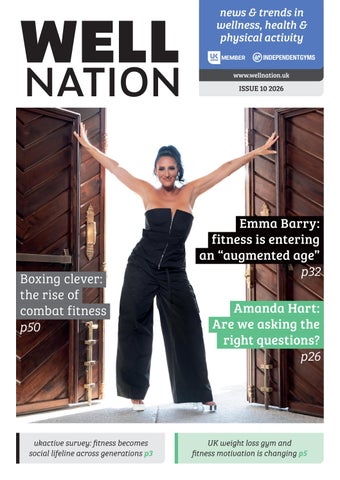
news & trends in wellness, health & physical activity www.wellnation.uk
ISSUE 10 2026
Boxing clever: the rise of combat fitness p50
ukactive survey: fitness becomes social lifeline across generations p3
Emma Barry: fitness is entering an “augmented age” p32 Amanda Hart: Are we asking the right questions? p26
UK weight loss gym and fitness motivation is changing p5
Training that thinks ahead With the EGYM Ecosystem, progress becomes visible, with guided training that develops alongside your members.
news & trends PHOTO: UKACTIVE
John Challinor Publisher john@nationmedia.uk Tel: +44 (0) 7971 043396
The new ukactive research comes as thousands celebrate National Fitness Day
Fitness becomes social lifeline across generations, ukactive survey finds New research from ukactive suggests gyms and leisure centres are becoming important social spaces for people of all ages, with friendship emerging as a major motivation for joining. Published to mark National Fitness Day 2026, the survey of 6395 UK adults found that 53% of Millennials and 51% of Gen Z said making new friends was an important reason for joining a gym. “Trying something new can sometimes feel daunting but our research shows many of us are in the same boat, looking for peer support and a community which can really help us stay active,” explains Cameron Saunders, CEO of ukactive. “For Gen Z, gyms and leisure centres have replaced pubs and youth clubs as social hubs but they’re also important socially for Gen X, Baby Boomers and older generations.
www.wellnation.uk
“Whether it’s trying yoga, playing padel, HYROX, or a swim class, National Fitness Day is about helping people take the first step to a more active life, whatever your motivation.” The trend also extends across older generations, with 37% of Gen X and 35% of Baby Boomers citing friendship as a factor. Among women, 47% said making new friends was important. The Savanta research also highlights a broader shift in why people choose to exercise. Improving confidence was important to 74% of respondents overall, while mental health and wellbeing was cited by 84% of Millennials, 76% of Gen X, 75% of Gen Z and 59% of Baby Boomers. Managing a health condition was another significant motivation, particularly among Millennials at 64% and Gen Z at 60%.
Tom Walker Editor tom@nationmedia.uk Tel: +44 (0) 7796 512769
Get your free subscription at
www.wellnation.uk WellNation is published by Glencroft Ltd. This publication is protected by copyright and no part may be reproduced, transmitted or stored in any print or electronic format without the written permission of the publisher. Every effort has been made to ensure the accuracy of the contents of this publication and WellNation accepts no responsibility for any error or misrepresentation. Opinions expressed by the contributors and advertisers are not necessarily those of the publisher and we do not accept responsibility of losses or damages arising from them. Printed by BCP Media Group Ltd.
ISSUE 10 2026
3
news & trends PHOTO:UNSPLASH.COM/@SIORA18
AECOM and Faulkner Browns to oversee Brentford centre Hounslow Council has appointed AECOM, working with FaulknerBrowns Architects, to take forward plans for a new Brentford Fountain Leisure Centre. Current proposals for the new centre include modern swimming pools with moveable floors, interactive water-play facilities, a large gym, sports hall, fitness studios, improved changing facilities and new family and community spaces. AECOM and FaulknerBrowns Architects will now develop the design and carry out the technical and planning work needed for the proposed redevelopment of the site. The new centre will be developed in consultation with residents, schools and community groups to ensure the facilities consider local needs. The project is part of the Hounslow Council’s wider approach to regeneration, which aims to ensure investment in Brentford delivers visible benefits for local people and creates a place the community can be proud of. According to councillor Tom Bruce, Cabinet Member for Regeneration and Economic Development at Hounslow Council, the appointment marks “an important step” in plans to replace the existing centre, which has served the local community since 1987.
4
ISSUE 10 2026
GLP-1s bring the opportunity for gyms to shed the weight loss stereotype
UK weight loss gym and fitness motivation is changing For decades, weight loss has dominated the way fitness has been marketed. But, at last, the reasons industry professionals promote services to people looking to exercise appear to be becoming broader. With GLP-1 medications taking the attention of “weight loss” seekers, it creates a significant opportunity for gyms and marketing departments in particular to share more services and facilities at scale. Sport England’s Activity Check-in regularly tracks attitudes, motivations and barriers around physical activity, providing the sector with a more frequent view of how consumer behaviour is changing. Alongside participation data, it explores why people want to be active and the pressures influencing those decisions. Increasingly, the conversation around exercise encompasses mental wellbeing, strength, mobility, confidence, and social connection. These are benefits that extend
well beyond appearance. Sport England’s research also consistently associates greater physical activity with higher mental wellbeing. For operators and trainers, that changing conversation matters because members themselves can help shape the next generation of fitness services. Listening to why people train and what they want to remain capable of doing will influence programming, coaching, and especially marketing. The rapid growth of GLP-1 weightmanagement medications is likely to accelerate that shift further. Updated UK Chief Medical Officers’ guidance, published in July 2026, specifically highlights the importance of maintaining strength while using GLP-1 drugs because weight reduction can include loss of muscle as well as fat. NHS England guidance similarly recommends resistance and strength-focused activity as a cornerstone of health rather than focusing on weight loss alone.
www.wellnation.uk
£17m MyActive Leek opens in Staffordshire PHOTO: ALLIANCE LEISURE
Alliance Leisure has completed the £17 million redevelopment of MyActive Leek, transforming the former Brough Park Leisure Centre into a modern health, wellbeing and leisure hub. Delivered on behalf of Staffordshire Moorlands District Council, the project forms part of the wider regeneration of Leek town centre and has been designed to support healthier lifestyles, improve accessibility and broaden the centre’s appeal. “The opening of MyActive Leek is a hugely significant moment for the local community and a fantastic example of what can be achieved through strong collaboration and long-term investment in public leisure infrastructure,” explains Will Gardner, Assistant Regional Director at Alliance Leisure. “This development has completely transformed the former facility into a modern, inclusive and highly sustainable community wellbeing hub that will support residents of all ages and abilities.
The project facility completion offers significant investment for the area
“From the expanded swimming and fitness offer to the innovative golf simulator and wellness facilities, every aspect of the centre has been carefully considered to encourage more people to be active, improve wellbeing and create lasting community impact.” The redevelopment includes a
60-station gym, group cycling studio, second fitness studio and a Future Studio immersive fitness installation by Flareform. A new Community Wellness Suite featuring an EGYM Strength Series circuit will support exercise referral programmes and people living with long-term health conditions. PHOTO: SEA LANES
after plans approved by Winchester City Council Winchester City Council has approved plans to turn a disused leisure centre into a lido. The plans, submitted by Sea Lanes, will turn the former River Park Leisure Centre into a health, wellbeing and recreation destination in the heart of Winchester city centre. Sea Lanes have previously developed – and currently manage – open water swimming attractions in Brighton and Canary Wharf. Following an evaluation process, the council’s cabinet agreed that Sea Lanes’ proposal offered the “best overall outcome for residents” and will transform the site into a “vibrant community asset”. The proposals will also seek to protect surrounding green spaces and complement the existing and established recreation and sports facilities at River Park.
www.wellnation.uk
Sea Lanes have previously developed a lido in Canary Wharf
ISSUE 10 2026
5
news & trends PHOTO: UNSPLASH/@AGEING_BETTER
The campaign launched last month
Winners of ukactive Awards 2026 announced The winners of the ukactive Awards 2026 have been revealed during an awards ceremony at the International Convention Centre (ICC) in Birmingham. The industry’s most prestigious awards were sponsored by the Swimming Teachers’ Association and hosted by fitness coach, author and presenter Laura Hoggins alongside former professional rugby player and fitness entrepreneur Ben Gotting. For an in-depth article on all the winners, look out for WellNation Issue 11/2026.
Active Blackpool gym project strengthens referral offer Active Blackpool has completed a £482,000 refurbishment of Moor Park Health and Leisure Centre, with the investment set to strengthen exercise referral support for residents living with long-term and moderate health conditions. The 12-week project has expanded the gym floor by 52sqm and introduced 20 new machines, including six EGYM stations and 14 pieces of Matrix equipment. New consultation spaces have also been created for members to discuss their health and fitness goals with instructors.
6
ISSUE 10 2026
Over 75s are living better years, rather than simply living more years
Over 75s a “major opportunity” for gyms and leisure centres One of the most encouraging trends in British physical activity is happening among its oldest adults. Sport England’s latest Active Lives Adult Survey shows 44.3% of people aged 75 and over are now active, up from 42.8% a year earlier. Among 55 to 74-year-olds, the proportion meeting recommended activity levels has also climbed, reaching 64.3%. On a general observation, how many older adults do you see taking part in Park Run events, marathons and even the likes of Spartan Races? Loads. For gyms and leisure centres, that should look less like an ageing-population challenge and more like a major opportunity. “We know now, that keeping moving is a crucial contributor to healthy ageing,” says Dr Carole Easton OBE, Chief Executive of the Centre for Ageing Better. “I say ‘now’ because the research and the associated messaging have not always been this way. People over 60 now will have grown up in a society where the importance of ‘rest’ was the
prescription for many ailments. I can still recall that someone with osteoarthritis or back pain would have been told to stop moving – not keep moving!” The Health and Social Care Committee’s Healthy Ageing report, published earlier this year, called for better use of leisure and physical activity facilities and their workforces to help older people remain active. It also highlighted exercise programmes targeting strength, frailty, falls, and independence. That potentially broadens what an older person’s gym membership represents. It can provide strength and balance training, mobility, social connection and the confidence to remain independent. And yet many people see over 75s activity as exercise for exercise’s sake. Operators able to create welcoming environments for people entering a gym for the first time at 60, 70 or 80 could therefore be serving one of fitness’s most important future markets.
www.wellnation.uk
Making public leisure sustainable and building healthier communities.
£550m+ investment in local authority leisure
Clay Cross Active Value: £26.3m
315+
completed projects Abbey Leisure Centre Value: £3.5m
81%
of clients choose us for further projects
Northcroft Lido Value: £9.1m
development partner
Alliance Leisure are a trusted development partner, with over 25 years’ experience transforming leisure, culture and sports facilities for local authorities.
allianceleisure.co.uk #TransformingLeisure
Discover our portfolio.
People news
PHOTO: MYTIME ACTIVE
Annie Holden joins Mytime Active board
Annie Holden
Mytime Active has appointed public health and physical activity specialist Annie Holden as a trustee, strengthening its board as the leisure trust develops its new strategy. The appointment marks a return to an organisation Holden helped shape earlier in her career. After leaving higher education, where she worked as a senior lecturer specialising in physical activity and exercise, she joined the London Borough of Bromley’s Sports
Development Unit. There, Annie helped establish health programmes that later evolved into Mytime Active’s Active Lifestyles sessions. Her subsequent career has included senior roles across community health, preventative healthcare and physical activity. She has served as Health Division Manager at Mytime Active, Head of Public Health at SLM Everyone Health and Executive Director of Ireland’s National Institute for Preventative Cardiology.
8
ISSUE 10 2026
PHOTO: FUTURE FIT GROUP
Future Fit Group has appointed Lewis Thompson as Managing Director of Future Fit for Business, with a focus on accelerating growth, developing strategic partnerships and expanding the organisation’s workforce development offer internationally. Lewis joined Future Fit for Business in 2022 and most recently served as Head of Business Development. He brings 20 years’ experience across the health, fitness and wellness sector, including roles with public and private operators after starting his career on GLL’s Graduate Trainee Management Scheme. During his time with Future Fit for Business, Lewis has helped expand the team and develop new learning programmes addressing emerging industry needs. “I am incredibly excited to be appointed Managing Director of Future Fit for Business,” says Lewis. “Having spent my career supporting organisations, teams and individuals to achieve their full potential, I am passionate about the role Future Fit plays in developing the next generation of professionals.
PHOTO: BLU
Lewis Thompson named MD of Future Fit for Business
“The sector continues to evolve, creating exciting opportunities for education, skills development, wellbeing and innovation. Over the past few years, we’ve expanded our team, developed new learning solutions and strengthened our relationships across the industry. I look forward to building on that momentum, growing our presence in new markets and continuing to support employers and professionals with industry-leading education and development opportunities.” In his new role, Lewis will lead on international growth strategy while continuing to strengthen relationships with industry partners.
BLU appoints Kate Fearon to drive retail growth Branded uniform and retail specialist, BLU, has appointed Kate Fearon as Business Development Manager, tasked with driving BLU’s retail offer as the brand continues to expand its scope across the fitness, leisure and wellbeing sectors. Fearon brings more than 30 years of sector experience spanning B2B sales, account management, product launches, gym design, procurement, sponsorship models and strategic market entry.
www.wellnation.uk
BRIEFING
A new way to boost your wellbeing Introducing Boost Oxygen – portable supplemental oxygen, now available in the UK through SunVit-D3 Ltd
W
hether you’re training hard, recovering after exercise, heading outdoors, travelling or simply looking for a convenient way to refresh and reset, Boost Oxygen is designed to fit around an active lifestyle. Containing concentrated supplemental oxygen in a lightweight, portable and easy-to-use canister, Boost Oxygen gives you oxygen on the go — whenever and wherever you need it. The range includes convenient 3L, 5L and 10L canisters, with different aromas designed around different lifestyles and needs. WHY BOOST OXYGEN?
● Exercise & Active Lifestyles A convenient addition to your gym bag, training kit or sports equipment for use before, during or after physical activity.
NOW AVAILABLE FROM SUNVIT-D3
SunVit-D3 Ltd is the exclusive UK distributor of the Boost Oxygen range, supplying consumers, retailers and business customers throughout the UK. From athletes and gym-goers to outdoor enthusiasts and anyone looking for a convenient wellness product, Boost Oxygen offers a fresh approach to portable wellbeing. Breathe. Recover. Refocus. Boost. Explore the full Boost Oxygen range at www.sunvitd3.co.uk
● Everyday Wellbeing
Oxygen plays an essential role in the body’s energy producing processes. Boost Oxygen provides a convenient source of concentrated supplemental oxygen without caffeine, sugar or stimulants. ● Outdoor Adventure
Ideal for hiking, climbing, skiing, travelling and other outdoor pursuits, particularly when altitude or demanding activity can make you appreciate every breath. ● Portable & Convenient
Lightweight and easy to use, Boost Oxygen can be taken with you wherever your day takes you. ● Recyclable
The aluminium canisters are recyclable, making them a convenient addition to an increasingly conscious approach to wellbeing.
www.wellnation.uk
Available in 3L, 5L and 10L canisters with a choice of aromas to suit different lifestyles.. Boost Oxygen is a recreational supplemental oxygen product and is not intended to diagnose, treat, cure or prevent any disease. Individuals with medical conditions should seek advice from a healthcare professional.
ISSUE 10 2026
9
news & trends Wandsworth centres to benefit from £24m project PHOTO: WANDSWORTH BOROUGH COUNCIL
Two leisure centres owned by Wandsworth Borough Council have been upgraded with newly refurbished fitness suites. The improvements at Wandle Recreation Centre and Roehampton Sports and Fitness Centre are part of a wider redevelopment project which will see eight of Wandsworth’s leisure, swimming and sports centres benefit from £24m worth of investment. At Wandle Recreation Centre, a range of new equipment and technology has been installed to make fitness more accessible and remove barriers to physical activity. Upgrades include the installation of air-powered resistance equipment to support beginners, older residents and those managing injury or long-term health conditions to enjoy low-impact exercise. Improvements will also include incorporating social prescribing and the co-location of services to create a wellbeing hub. Meanwhile, Roehampton Sports and Fitness Centre has benefited from a complete fitness suite
Improvements at Wandle Recreation Centre include a range of new equipment
refurbishment, with a range of new machines, as well as redecorated spaces and improvements to air-handling systems, creating a brighter, more modern environment for members. The move to enhance and modernise facilities – which are owned by Wandsworth Borough Council – is
part of Places Leisure being reappointed to operate the eight venues on behalf of the council in 2025. The works are being funded jointly by the council and Places Leisure. Councillor Ethan Brooks, said: “We want every resident to have access to high-quality places.”
Places Leisure and Dartford Borough Council have officially opened a new gym at Fairfield Leisure following a £1 million investment in the centre’s health and fitness facilities. The upgraded gym was unveiled at a ribboncutting ceremony, led by Dartford Borough Council leader Jeremy Kite MBE and retired British sprinter and Olympian Adam Gemili. Designed to support residents of all ages and fitness levels, the new facility combines connected fitness technology with expanded strength, cardio and functional training areas. New equipment includes EGYM Smart Strength machines and the EGYM Fitness Hub, offering users a more personalised training experience. The cardio area has also been upgraded with equipment featuring 16-inch touchscreen consoles.
10 ISSUE 10 2026
PHOTO: PLACES LEISURE
£1m Fairfield Leisure upgrade brings new gym to Dartford
Council leader Jeremy Kite MBE and Olympian Adam Gemili opened the facility
www.wellnation.uk
he
t re re o ea a a e e t
oin t e movement. Power your people. Scale with CoverMe
Thousands of clubs have already made the shift. o t et le t ehi visit www.covermeapp.co and book your demo today.
news & trends Sector remains positive despite “expansion pressures” PHOTO: UNSPLASH.COM/@WEAREAMBITIOUS
New global research from Xplor Fitness & Leisure suggests the fitness industry is continuing to expand, with 74% of gym operators and leisure centres reporting strong or moderate growth over the past three years. The Fitness Industry Growth Report 2027 surveyed more than 180 operators across 19 countries. Just 2% reported a decline, while 68% had opened a new location during the same period. Of those expanding their estate, 87% built a completely new club. “I believe that the fitness and leisure industry has massive growth potential, in the UK, Europe, and around the world,” explains said Mehdi Benjelloun, President, Enterprise Fitness at Xplor Technologies. “We see it across all our customers – they are growing very fast. Our mission is to continue to support that growth in any way we can. It’s good for our customers, it’s good for their customers, and better health and fitness is good for all of the world collectively.”
The Fitness Industry Growth Report: huge potential for the sector
However, growth is bringing fresh challenges. Finding suitable locations was cited as a barrier by 59% of operators, while 56% highlighted difficulties recruiting qualified staff. Among operators with UK locations, that figure climbed to 67%. Member acquisition costs are also increasing.
Globally, 60% of respondents said it is becoming more expensive to attract new members, rising to 70% in the UK. That puts greater emphasis on retention, referrals and the overall member experience, with existing customers identified as operators’ most dependable source of new business.
Total Wellbeing Luton is highlighting its integrated approach to health and wellbeing, bringing emotional and physical health support together through a single service for local residents. Delivered by Turning Point and funded by NHS Bedfordshire, Luton and Milton Keynes Integrated Care Board, the service combines its Healthy Mind and Healthy Body pathways to provide more personalised, whole-person support. “Healthy mind and body is about helping people build confidence, create sustainable habits and improve their overall wellbeing,” explains Sarah Simmonds, Director of Wellbeing at Total Wellbeing Luton. Residents can access help for stress, anxiety, depression and low mood alongside services designed to increase physical activity.
12 ISSUE 10 2026
PHOTO: TOTAL WELLBEING
Total Wellbeing Luton highlights joined-up mind and body support
Services include talking therapies, CBT, and exercise referral
www.wellnation.uk
WE
SIGN
225 AN AVERAGE OF
NEW MEMBERS
IN 6 WEEKS A simple, results-driven marketing system built for health clubs.
01
02
ATTRACT
CONVERT
Multi-Faceted Marketing
On-site Sales Team
More Members
Brand Awareness
Tours & Follow-Up
Higher Revenue
Local Exposure
Lead Conversion
Long-Term Momentum
03
GROW
NO UPFRONT COST. WE WORK ON A PROFIT SHARE MODEL
SCAN FOR YOUR INFO PACK
CFM.NET
CFM
0115 777 3333
Average results based on previous campaigns. Individual results may vary depending on factors such as facility. market conditions and execution.
news & trends PHOTO: SWIM!
The programme are personalised
Parkwood Leisure MSK hubs achieve flagship status Seven community musculoskeletal (MSK) hubs operated by Parkwood Leisure and its partners have been awarded Good Boost Flagship status, recognising them as benchmarks for community-based health and rehabilitation support. The recognised facilities are Tarka Leisure Centre, Crook Log Leisure Centre, Hengrove Park Leisure Centre, Bingham Arena, Barry Leisure Centre, Penarth Leisure Centre and Erith Leisure Centre. Good Boost programmes combine evidence-based exercise with technologysupported personalisation.
£175,000 revamp for Stratford Leisure Centre gym Work has been completed on a £175,000 redevelopment of the fitness facilities at Stratford Leisure Centre. The refurbishment has seen a 100-station gym fitted with Life Fitness equipment, featuring dedicated areas for functional training, resistance and cardio. Among the pieces of kit being installed are treadmills, crosstrainers, Watt Bikes and SkiErg machines, as well as free weights. The centre is operated by Everyone Active in partnership with Stratford-on-Avon District Council.
14 ISSUE 10 2026
Becky Adlington is calling for councils to ensure more children can learn to swim
Becky Adlington urges councils to help close children’s swimming gap New figures showing significant gaps in children’s swimming ability have strengthened calls for local authorities, schools and leisure providers to work together to ensure more young people gain essential water safety skills. Department for Education data highlighted by a recent BBC investigation found that 72% of Year 6 pupils in England could swim the recommended 25 metres. Among schools serving the most disadvantaged communities, that figure fell to 55%. The findings also showed inequalities in self-rescue skills, with around seven in 10 pupils nationally able to perform a safe self-rescue, compared with approximately half in the most disadvantaged schools. With the cost and availability of lessons remaining potential barriers for families, the figures underline the role councils and their leisure partners can play in providing affordable and accessible swimming opportunities. Olympic champion Becky Adlington
has responded through her Swim! swim school network, making thousands of free lessons available to new customers at more than 30 locations during the summer. The initiative aims to give more children the confidence and practical skills needed to stay safe in and around water. Speaking on Radio West Midlands, Becky called for councils to open dialogue for the benefit of anyone learning to swim. “We are a private company and councils do not have £1025 million for new swimming pools,” she explained. “We would love for councils to contact us directly to come to their cities and towns. We should be working together, not against each other.” For councils, operators and schools, the challenge is broader than simply increasing participation. Stronger partnerships, targeted support and affordable community provision could be critical to ensuring swimming and water safety skills are accessible to every child, regardless of their background.
www.wellnation.uk
Instant GP
Nutrition support
Physio
Cancer support
Therapy
Elevate your member offering Help your members feel better, live better, and stay longer with health and wellbeing perks built into your memberships Find out more at
powered by
CO M E US! IN JO
THE GYM OPERATOR CONFERENCE
healthkey.health
THE FUTURE OF FITNESS OPERATIONS STARTS HERE
Expect no-nonsense insights, bold ideas, and a room full of people who get what it takes to operate in today’s fitness landscape 18TH - 19TH NOVEMBER 2026 CRANMORE PARK, CRANMORE AVE SHIRLEY, SOLIHULL, B90 4LF WWW.INDEPENDENTGYMS.CO.UK
news & trends Study Active and fibodo partner for fitness careers PHOTO: STUDY ACTIVE
Study Active has partnered with CORE by fibodo to give newly qualified personal trainers, coaches and wellness professionals greater support as they move from education into employment and self-employment. The partnership will provide Study Active learners and graduates with access to CORE, fibodo’s all-in-one business management platform for independent fitness professionals. CORE brings together tools including calendar scheduling, online payments, client management and a personalised booking website, helping coaches manage the commercial side of their work from one platform. For Study Active, the collaboration is designed to address an important challenge facing new fitness professionals: turning a qualification into a sustainable career. “By partnering with fibodo and integrating their CORE platform into our ecosystem, we are giving our students and graduates immediate access to world-class business infrastructure,”
The partnership helps remove tech and admin barriers to professional growth
explains James Luscombe, Study Active Managing Director. “This removes the daunting technological and administrative barriers that so often slow down new professionals. It allows our graduates to focus entirely on what they do best: transforming lives, activating community
spaces, and making a lasting difference to physical and mental wellbeing.” Anthony Franklin, fibodo Chief Executive, added: “This partnership connects Study Active’s strength in education with the business operating system professionals need to put those skills to work.”
Nuffield Health has installed nine Wattbike AirPro bikes across two of its Glasgow clubs. The investment sees five bikes installed at Nuffield Health Glasgow Central and four at Nuffield Health Glasgow Giffnock, giving members access to Wattbike’s Healthspan Check, which can be completed in as little as six minutes. The Healthspan Check assesses and converts an estimated VO₂ Max and Cardiorespiratory Fitness score into a single, easy-to-understand score, enabling members to benchmark their fitness against others of the same age and gender. Designed for accessibility, the Healthspan Check requires participants to work at approximately 7/10 RPE (Rate of Perceived Exertion), making it suitable for a broad range of members while still delivering highly accurate fitness data.
16 ISSUE 10 2026
PHOTO: WATTBIKE
Nuffield Health Glasgow introduces Wattbike Healthspan Check
Healthspan Check provides insights into cardiovascular health
www.wellnation.uk
news & trends PHOTO: ACTIVE IQ
The service is the result of practical partnerships for user benefit
New wellbeing service launched for Westminster A new community service is helping Westminster residents overcome barriers to physical activity, social connection and everyday participation. SfC Connect is an occupational therapy-led assessment service for people living with long-term health conditions, disabilities, poor mental health, loneliness or significant life changes. Delivered by Sport for Confidence CIC in partnership with Everyone Active, the initiative is supported by Active Westminster and Westminster City Council.
Innerva sets up trust and transitions to employee ownership Innerva, designer and manufacturer of power-assisted exercise equipment, has transitioned to employee ownership through the creation of an Employee Ownership Trust. The trust will have a controlling interest in a company on behalf of all employees, enabling businesses to remain independent while ensuring employees share in the success they help create.. The trust will own the company for the benefit of all employees, who benefit collectively, rather than owning individual shares in the business.
18 ISSUE 10 2026
Active IQ has seen a growing need for instructors with these specialist skills
Active IQ launches six specialist fitness qualifications Active IQ has launched six specialist fitness qualifications designed to help instructors broaden their skills and respond to growing demand across the physical activity sector. The Ofqual-recognised awarding organisation has introduced new and redeveloped Level 2 and Level 3 qualifications covering reformer Pilates, Pilates matwork, circuit training, kettlebells, studio cycling and water-based exercise. “With the continued growth of Pilates and reformer Pilates, there is a growing need for instructors with the specialist knowledge and practical skills to deliver these sessions safely and effectively,” explains Lee Buck, Head of Employer Product Strategy at Active IQ. “These new qualifications provide a flexible route for fitness professionals to build specialist expertise, while giving employers confidence that instructors have developed the practical skills and knowledge needed to deliver safe, engaging and high-quality sessions.”
A key addition is the Level 3 Certificate in Instructing Pilates Studio Reformer Sessions, developed in response to the rapid growth of reformer Pilates in the UK and internationally. A recent Active IQ survey found that 76% of its training providers were interested in delivering a regulated reformer qualification. The qualification covers biomechanics, reformer-specific health and safety, programme design and the practical skills required to deliver both one-to-one and group sessions safely and effectively. Active IQ has also launched a Level 3 Diploma in Instructing Pilates Matwork, alongside Level 2 Awards in Circuit Training, Kettlebell Training, Studio Cycling and Water-based Exercise. Developed in line with the latest professional standards, the qualifications aim to provide fitness professionals with flexible development pathways while helping employers create a more versatile workforce.
www.wellnation.uk
TA L K T O A N A N A LY S T
Map your market: who, where, what
How can we help? Our insight is built around you. From member behaviour to market demand, EVOLVEʼs Strategic Insight Services adapt to your business needs, helping you make data led decisions, with confidence.
Our insight explore:
Our insights powered by real industry intelligence
Members Understand who your members are and how they behave.
30+ years of insight 850 million data points
Population Know your local market and true catchment. Competition See your landscape clearly and identify gaps. Demand Uncover opportunity and growth potential.
7,000+ UK fitness sites tracked
Why it matters Reduce risk Identify real opportunity Make confident decisions
To find out more, email hello@weareevolve.io
EVOLVE weareevolve.io
news & trends EMD UK recognition for Places Leisure instructors PHOTO: PLACES LEISURE
Places Leisure has partnered with EMD UK to provide professional recognition for all of its group exercise instructors, becoming the first UK public leisure operator to adopt the status across its entire instructor workforce. “We are extremely proud of the group exercise programmes that we deliver across Places Leisure,” explains Sam Bryant, Head of Fitness at Places Leisure. “We see the value in consistently providing opportunities for our colleagues to increase their knowledge and be able to provide better allround customer experience.” Under the partnership, every Places Leisure group exercise instructor will work towards EMD UK Professional Recognition status, formally recognising their qualifications while giving them access to training, resources and ongoing professional support. Places Leisure delivers around 20,000 group exercise classes each month, supported by more than 1200 instructors across its leisure centres.
The partnership is an ongoing commitment to improve group exercise
By the end of 2026, all instructors are expected to hold EMD UK membership. While professional recognition and membership remain optional across much of the group exercise sector, Places Leisure said its decision embeds a consistent professional standard across the organisation.
According to EMD UK’s Group Fitness Participant Survey, more than 5.4 million adults in England participate in classes each month. The research found that a positive personality, good coaching and instructor knowledge were among the most important qualities participants look for.
Why Sports has launched a national conference aimed at turning investment in sport and physical activity into measurable benefits for health, communities, and the economy. Under the theme “From Investment to Impact,” the unique conference will take place at Manchester Conference Centre on 12 November 2026. The event will bring together leaders from sport, health, local government, community development, facilities, workforce, social value and investment. The conference will examine whether the sport and physical activity sector is genuinely ready to attract and sustain investment. Delegates will explore where future funding and partnership opportunities could come from, how organisations can reduce their reliance on short-term grants and how the sector can demonstrate its wider value more effectively.
20 ISSUE 10 2026
PHOTO: UNSPLASH/@M_ACCELERATOR
Physical activity investment conference to take place in November
The event will encourage collaboration across the industry
www.wellnation.uk
COMMERCIAL FITNESS AND WELLNESS
Build your movement
Commercial Fitness and Wellness Equipment Visit Precor.com
PEOPLE
y National Fitness Da e first helped people take th life step to a more active
NATIONAL FITNESS DAY
Activating millions across the UK National Fitness Day took place on Wednesday 16 September, providing free exercise and fitness activities to everyone – activating millions across the UK
M
embers of the public were invited to celebrate the fun of fitness, with thousands of free and reducedprice activities and classes across the UK. Led by ukactive and powered by its members, the National Fitness Day saw around 10 million people take part in free activities hosted by gyms, pools and leisure centres across England, Scotland, Wales and Northern Ireland. The theme of this year’s campaign was ‘Powered by you!’, highlighting that everyone can get involved – no matter what their age, background or ability. One of the biggest national initiatives was the 20/20 Challenge, delivered by ukactive and Total Active Hub. Employees formed teams of four and aim to complete 20 minutes of movement every day for 20 days, with walking,
cycling, swimming, yoga and gym sessions among the activities that count. Participation is free for organisations. Better / GLL offered free gym sessions, fitness classes and swimming opportunities at participating centres nationwide. Non-members could register for a free account to book National Fitness Day activities. Cameron Saunders, CEO of ukactive, said: “The physical and mental benefits of being active are well known but our findings show people of all ages are also looking for friendship and community in the gym. Trying something new can sometimes feel daunting but our research shows many of us are in the same boat, looking for peer support and a community which can really help us stay active. “Whether it was trying yoga, playing padel, Hyrox, or a swim class, National Fitness Day helped people take the first step to a more active life.”
Several MPs took part in National Fitness Day, visiting leisure facilities and taking part in activation programmes
22 ISSUE 10 2026
LEX LEISURE CIC SIDCUP LEISURE CENTRE
BETTER MANCHESTER AQUATICS CENTRE
Shadow Sports Minister Louie French MP took part in a spin class at his local leisure centre.
Afzal Khan MP tried yoga for the first time at Manchester Aquatics Centre.
www.wellnation.uk
1
2
UKACTIVE MEMBERS GETTING PEOPLE ACTIVE
3
4
1 GLL
Over 250 additional people took part in free activities, including aqua aerobics, pickleball and yoga, at Better leisure centres across the current European City of Sport, Belfast.
5
2 ANYTIME FITNESS
4 THE THAMES CLUB
Anytime Fitness hosted a “Powered by You” event at Battersea Power Station, which included a HIIT workout class inside the iconic London landmark, to celebrate the fitness operator’s expanded partnership with Apple Fitness+.
The independent health club in Staines partnered with Technogym, EGYM and Les Mills to run an inviting, inclusive and fun day of activities, which was attended by over 600 people.
3 CIVIL SERVICE SPORTS COUNCIL
5 EVERYONE ACTIVE ESTON LEISURE CENTRE
Over 200 colleagues from across the public sector took part in the Active Wellbeing London Run around Hyde Park, hosted by the Civil Service Sports Council.
Eston Leisure Centre in Teeside ran a staff challenge where 10 team members covered a total distance of over 100km across a range of activities.
PLACES LEISURE GOSPORT LEISURE CENTRE
Dame Caroline Dinenage MP learned about how her local leisure centre is helping to improve the health and wellbeing of her constituents.
www.wellnation.uk
XCITE LINLITHGOW
VILLAGE HOTEL DUDLEY
Kirsteen Sullivan MP got a free health check and met primary school pupils who had cycled all the way from their school to the facility as part of their Bikeability course.
Sonia Kumar MP dropped into the gym at Village Hotel to hear how the facility is helping to get people moving.
ISSUE 10 2026 23
news & trends Can gyms become part of preventative healthcare? PHOTO: PEXELS.COM
Gyms and leisure centres are attracting record numbers of people, but their future role could extend far beyond fitness. But is this viable and achievable in practice? The UK recorded 679 million visits to health and fitness clubs during 2025, up 10% in a year, according to the UK Health & Fitness Market Report 2026. Around 12.2 million people over 16 are now members, equivalent to 18% of the population. Those figures raise an important question: could Britain’s gyms and leisure centres become a more formal part of preventative healthcare? The direction of NHS policy certainly creates an opportunity. The Government’s 10 Year Health Plan for England is built around three major shifts, including moving care from hospital to community and from sickness to prevention. New neighbourhood health services are intended to bring more healthcare closer to where people live. Meanwhile, NHS England describes physical activity
The links between healthcare, fitness, and wellbeing still need to be stronger
as essential for helping people live better with long-term conditions and says the greatest health and economic gains can be achieved by helping inactive people become more active. It also highlights physical activity’s role in delaying the onset and progression of disease and improving overall health.
The argument becomes particularly compelling when the reach of the sector is considered. ukactive says the UK now has 5842 health and fitness clubs. For a health service trying to intervene earlier and closer to home, that existing network could be difficult to ignore. PHOTO: STREET TAG
Street Tag: turning everyday movement into a habit Life Leisure is backing the launch of Street Tag in Stockport, turning everyday journeys across the borough into a digital game designed to get families moving. Launched on 28 September, the free app creates virtual tags around parks, libraries, and active travel routes. Users collect points by walking, running, cycling or wheeling close to them, with their activity contributing towards school leaderboards. The concept is simple. But the thinking behind it tackles one of the physical activity sector’s hardest questions: how do you engage people who do not identify as exercisers? Gamification has long been embedded in connected fitness, wearables, and workout apps. Street Tag takes similar behavioural mechanics – those points, progress steps, competition goals, and rewards – and applies them to the community itself.
24 ISSUE 10 2026
The app turns everyday journeys and activities into points
www.wellnation.uk
OXYGEN ON THE GO
MEET BOOST OXYGEN – PORTABLE SUPPLEMENTAL OXYGEN FOR ACTIVE LIFESTYLES
Boost Oxygen brings portable supplemental oxygen to the active wellbeing market. Containing 95% supplemental oxygen, the lightweight, easy-to-use canisters are available in three sizes and a variety of aromas, offering a distinctive addition to fitness, leisure and outdoor lifestyle ranges
EXPLORE THE FULL BOOST OXYGEN RANGE AT WWW.SUNVITD3.CO.UK
PEOPLE
BEYOND THE NUMBERS
Are we asking the right questions? The physical activity sector is embracing technology, data and AI like never before. But, asks Amanda Hart, is it being utilised to make better decisions?
I
t’s an honour to put my thoughts down on paper following such a meaningful career so far, with the advantage of having worked at the forefront of sales, as a GM and across regional, national and global roles, all of which have relied on traditional leadership skills that AI simply cannot replicate. However, I am not naïve about the impact that the rapidly evolving technology has on our industry (like so many others) – nor the vast amounts of data we now have access to that simply weren’t available before. These should, and must, enhance our sector, but certainly not at the detriment of attracting and retaining the best people to work with and for us. Our sector has never had access to more information than it presently has, but the real competitive advantage lies in knowing which questions to ask, interpreting the answers and, crucially, turning insight into meaningful action. It shouldn’t replace the leadership judgement required to decide what matters, what action to take and how that action affects all our people, who are at our core. As a seasoned operator, I have experienced the evolution from traditional, largely retrospective reporting to today’s increasingly sophisticated, real-time data environments. It is important to me to lead with honesty and integrity in driving successful operations and businesses. And, as someone whose background is in sport, it took me a while to navigate the world of technology – there is a lot to understand! But for me, there are some key principles in making the best use of the data now available, which I share here.
26 ISSUE 10 2026
BEFORE: REPORTING WHAT HAPPENED
Membership numbers, joining figures, cancellations, revenue and basic financial reports. Much of the decision-making was reactive; we reviewed results and tried to understand what had already happened. THE TRANSITION: UNDERSTANDING WHY
CRM systems, member segmentation, digital marketing, customer feedback and more sophisticated performance dashboards enabled us/operators to understand behaviours, identify trends and target activity more effectively. TODAY: ANTICIPATING WHAT HAPPENS NEXT
Predictive analytics, automation and AI offer opportunities to identify potential churn, personalise engagement, optimise campaigns and support more informed operational decisions. Used effectively, these tools can help us move from simply responding to customer behaviour to anticipating needs and creating more relevant experiences. But the quality of the insight will always depend on the quality of the information feeding it, and the judgement applied to its interpretation. The key point is that technology has evolved considerably, but the fundamental purpose of information hasn’t changed: to help us make better decisions. Having a dashboard full of information doesn’t automatically make a business data driven. The real value comes from what leaders do with it. The “R word” is a good example. Rather than looking at retention as an isolated KPI, are we exploring the entire member/customer lifecycle?
www.wellnation.uk
Are we ensuring our data capture covers: • Acquisition – Are we measuring the number of new members, or understanding which acquisition channels deliver the highest long-term value? • Engagement – Are we measuring visits, or understanding whether members are forming habits and building connections? • Retention – Are we reacting to cancellation requests, or identifying disengagement early enough to make a difference? • Yield – Are we simply pushing additional products, or identifying services that genuinely enhance the member experience and lifetime value? I’m certain we can come up with an acronym; we’re experts at that! But in the absence of one for now, the connecting thread is INSIGHT. Information should inform every stage, not simply report the outcome. I have consistently championed the relationship between investment in teams, member experience and commercial performance. Data can tell us what is happening, but our teams and members are often the key to understanding why. It is just as important to ask the right questions of our teams as it is of our systems. Our technology may identify the opportunity, but the quality of the response determines the outcome.
www.wellnation.uk
ABOUT THE AUTHOR Amanda is a senior health, fitness and leisure leader with more than 30 years’ experience across both operator and supplier environments, following a national track and field career. Her journey has focused on commercial performance, operational excellence, people development and building cultures that deliver sustainable growth. Having led transformational strategies that have improved both member retention and revenue, Amanda is currently undertaking consultancy work and exploring full-time senior leadership opportunities across the sector. www.linkedin.com/in/amanda-jane-hart
If we have more information than ever before, are we making decisions based on evidence, combined with experience and an understanding of people? Are we knowingly challenging the status quo rather than simply repeating what we have always done? After all, if we always do what we always did, we’ll always get what we always got! My final thought: Are we creating cultures where managers are encouraged to challenge the numbers, share observations and combine their understanding of members and customers with the information available to them? And are they equipped to interpret insight and turn it into action? Because ultimately, the future of our sector won’t be determined by how much data we collect or how sophisticated our technology becomes, but by how intelligently we use both to make better decisions for our businesses, our teams and the communities we serve.
ISSUE 10 2026 27
PEOPLE
RETHINKING EXERCISE REFERRAL SCHEMES With funding becoming increasingly limited, it’s time to treat exercise referral schemes as a commercial service that can boost membership, retention and financial performance, says Stuart Stokes, Managing Director of ReferAll
E
xercise referral schemes have been a feature of public leisure provision for more than 30 years. Historically funded by local authorities and the NHS, these schemes have seen health and fitness operators work in partnership with health professionals to play an important role in increasing activity levels, reducing obesity and tackling chronic disease. But with funding for exercise referral programmes dwindling, some believe these schemes are at risk of being cut back or lost altogether. I disagree. Indeed, now is the time for operators to position these valuable programmes as a commercial service and reap the returns they can offer for both their customers and their bottom line. DELIVERING VALUABLE RETURNS
Across the sector, there are examples of operators who continue to run successful programmes after funding has come to an end, because they recognise the social and commercial value the schemes offer and how they can support organisational aims. Ultimately, they know they make business sense.
28 ISSUE 10 2026
www.wellnation.uk
This is supported by our own analysis, which shows that people who join a facility through a long-term condition or exercise referral programme and go on to become mainstream gym members stay for around seven months longer than other members. That translates into significant financial return. This can be explained by the unique nature of these schemes. When someone is referred to a physical activity programme, they have typically already had a meaningful conversation with a healthcare professional. This often increases their motivation to become more active. And when that motivation is met with a high quality, supportive service by the operator, it can help overcome some of the most common barriers to activity and convert participants into long-term members. A FINANCIALLY SUSTAINABLE MODEL
Following the recent withdrawal of funding for its Fresh Start Exercise Referral Programme, Debra Weekes, Partnerships Manager at Mytime Active, developed a business case for the Senior Leadership Team to demonstrate the value of continuing the programme.
www.wellnation.uk
To ensure the scheme remained financially sustainable, she recommended: ● Introducing a subsidised attendance fee of £7.20 for each Fresh Start session, from January 2026, while continuing to offer the initial assessment free of charge. ● Taking a more proactive approach to promoting the Health Membership to participants of Fresh Start, a subsidised membership for people with a medical condition. By adopting these recommendations and standardising session times and staff hours, Weekes calculated the referral programme could be delivered without ongoing subsidy from Mytime Active or external partners. Although it’s still too early to fully assess the financial impact – some clients were still accessing Fresh Start for free until April 2026 – early indications are encouraging, says Weekes. “I recently attended a Fresh Start session and all four participants told me they would never have entered a gym if it hadn’t been for Fresh Start. They were all also going to buy a Health Membership when they’d completed Fresh Start.”
ISSUE 10 2026 29
PEOPLE
Paying for a service can encourage attendance and adherence Mytime Active is already enjoying success with the self-funded ESCAPE-Pain scheme. The 12-session programme delivered over six weeks combines physical activity with education to help people manage pain. A high number of clients convert to Health Memberships following the programme, which Weekes believes is thanks to the peer to peer support the scheme offers. THE CASE FOR COMMERCIALISATION
So, why aren’t more operators running these schemes commercially? Some boards may feel that treating exercise referral and long-term condition programmes as commercial services goes against their objectives, especially if the organisation is charitable. But if their focus is on improving health outcomes, and revenue is merely a by-product of that, perhaps more operators would feel confident about combining positive health outcomes with commercial benefit. After all, these programmes can help more people become active while also strengthening the long-term sustainability of the facilities that host them.
30 ISSUE 10 2026
Charging for exercise referral programmes can increase their perceived value. We know that when schemes are free or very low-cost, participants find it easier to drop out. Paying for a service can encourage attendance and adherence. Exercise referral programmes usually involve highly qualified staff, closer supervision and additional resources. In many cases, the relationship between staff and participants resembles the personal training model, so it’s entirely reasonable to charge a higher fee for the service. That doesn’t mean programmes must always be full price; operators can still make concessions for people on low incomes or those who need subsidised access. There are other benefits to commercialising these programmes: exercise referral schemes allow operators to differentiate themselves from their private and low-cost competitors. Whilst some private operators offer dedicated health conditions programmes, exercise referral schemes are still primarily delivered by public leisure providers, which can provide the community, support and connection that participants need. It makes sense for operators to embrace the opportunity to support people with long-term health conditions or those who need greater guidance and reassurance.
www.wellnation.uk
It’s worth noting that funded programmes often come with strict delivery requirements for operators to adhere to. These guidelines can dictate how a scheme is delivered, the setting in which it takes place and the data that must be collected. Completion criteria are often prescribed and can vary considerably. For example, a participant may be classed as a ‘completer’ after attending nine of 12 sessions rather than all 12, or someone who has attended nine of 12 sessions and completed an exit questionnaire. Over the years, we’ve seen almost every variation of these requirements. While they don’t necessarily stifle innovation, they can restrict the flexibility needed to introduce new software, technology or staffing models that could help address challenges such as growing waiting lists, increasing service demand or operational inefficiencies. SUPPORTING MORE LOYAL MEMBERS
I believe it’s time for operators to take a different approach to exercise referral programmes. As funding becomes more constrained, there is an opportunity to assess existing services and ensure they are designed around the needs of participants rather than simply being used to fill spare capacity during quieter periods. This will ensure programmes
www.wellnation.uk
These programmes can help more people become active while also strengthening the long-term sustainability of the facilities that host them are more engaging, effective and sustainable. For many people, a long-term health condition creates fear or uncertainty about physical activity. When operators give them the right support, build their confidence and, crucially, help them understand that doing some physical activity is far better than doing none, participants are more likely to stay engaged for longer. Exercise referral and long-term condition programmes would not exist without the commitment of operators, instructors and participants. Even where direct funding has been reduced, I believe operators should continue to deliver these schemes to boost membership, retention and financial performance, while improving the health and wellbeing of individuals with most need of support.
ISSUE 10 2026 31
PEOPLE
MIND
THE
GAPS
32 ISSUE 10 2026
www.wellnation.uk
After 30 years in fitness, Emma Barry knows genuine change when she sees it. She tells WellNation why fitness is entering an “augmented age” – and why its biggest opportunities lie in the gaps between technology, people, services and changing consumer behaviour
E
mma Barry has never been much good at standing still. Across three decades in fitness, her career has spanned group exercise, personal training, boutique fitness, major operators and brands, with personal development running through it all. Her momentum has been literal, too: working across the UK, Europe, the US, Australia and beyond has given her a wide-angle view of an industry being reshaped from several directions at once. From that viewpoint, her assessment of the current state of industry is clear. “There’s never been so much change,” she says. “Technology, generations, AI, pharma, health, wellness, recovery, biohacking, behavioural change. All of it, all at once. And now the sectors are colliding.” Much of that thinking sits under Trouble Global, through which Barry works with businesses ready to challenge established models. A significant part of her year involves “evangelising events”: keynoting, moderating and facilitating conversations that turn ideas into action. These range from the Connected Health & Wellness Summit (CHW) in LA and Evolve in London to Beyond Activ and the Fitness Technology Summit, alongside brand events for World Gym and Anytime Fitness. The aim is to build communities, challenge thinking and accelerate meaningful change. She also advises a deliberately select group of companies on innovation, international expansion and category creation. “I work with groups that need to move fast,” she says. “That might mean innovating, scaling into the US or taking a US brand into the UK. Some are digital products, like CoverMe Fitness, CoverMe PT, Zing Coach and Rolla; others are service-based. I adore brands with a healthy disregard for the status quo.” There are projects Barry would love to discuss but cannot yet name. One takes fitness racing beyond conventional event arenas and into mountains, beaches and destinations, blending competition with travel and wellness tourism. Suffice to say, she has found fresh trouble to get into. “The chaos is where I spend a lot of time,” she says. Increasingly, though, she believes the opportunity lies less in inventing another category than in fixing the gaps between what we already have.
www.wellnation.uk
THE INFRASTRUCTURE GAP
Barry uses two familiar areas – group fitness and personal training – to illustrate the problem. An instructor wanting to return to teaching must find clubs offering their programme, identify vacancies, renew qualifications, approach operators individually and navigate a patchwork of emails, messaging groups and spreadsheets to arrange cover. “There’s nothing wrong with the training, the instructor or the market,” she says. “The infrastructure just doesn’t join up. There’s far too much work between wanting to help and actually helping.” Barry adds that members face similar friction: “Someone asks for personal training. The club finds an available trainer. Diaries are compared. The trainer’s specialism may not match the member’s needs. A week passes before the first appointment.” “The motivation was there at the first enquiry. The service wasn’t.” Why, Barry asks, can’t fitness offer the immediate matching consumers expect elsewhere? Search for trainers available now, filter by specialism and connect. It may feel more transactional, but it meets the moment. Think “the Uber of personal training”. “If we’re near a club in LA and want to train at 3pm today, why can’t we see the four trainers who would be available?”, she asks. “If we’re preparing for HYROX, let us choose the one from those four who can get us race-ready.” ISSUE 10 2026 33
PEOPLE
Traditional trainer-client relationships have another vulnerability: what happens when they end. If the relationship stops working, switching trainers can feel so awkward that members abandon PT – or the club – altogether. If a valued trainer leaves, the client may follow. Neither outcome serves the community or builds a robust business. These are the gaps Barry means: onboarding, staffing, matching, support and communication built in isolation rather than around one coherent member journey. Technology should connect them. That does not mean putting more technology in front of the member. For Barry, wearables offer another example: “Consumers already arrive with Apple Watches, Garmin devices, WHOOP, Oura, Ultrahuman and other technologies generating reams of information.” The opportunity, however, is not necessarily another dashboard. “Bring the information together,” Barry says. “Some people love data and want to go deeper. Others don’t want their lives narrated by beeps and buzzes. They want quiet monitoring: tell me when something needs my attention, and I’ll tell you when I have a goal to work on.”
We’ve got to bring back the humanness. What should technology quietly take care of, and where do we need a human to show up? She predicts that the ideal technology may become increasingly invisible, interpreting existing information and offering a useful nudge without requiring members to become their own data scientists. Systems could recognise when someone usually trains, when their energy dips or when another intervention might help. “If you were being nudged towards your perfect day, what would that look like?” she asks. “I’m pretty sure no two people would have an identical one.” For operators, the challenge is to automate friction while protecting what makes fitness powerful. “Community. Accountability. Belonging. Recognition. Human interaction,” Barry says. “We’ve got to bring back the humanness. What should technology quietly take care of, and where do we need a human to show up?” WELCOME TO THE AUGMENTED AGE
The fitness customer is changing, too. GLP medications are perhaps the clearest example. For decades, weight loss was central to fitness marketing. Pharmacology has dramatically changed that proposition, particularly in the US. “We always joked that if there was a pill for it, we wouldn’t own the weight-loss market,” Barry says. “Well, look what happened. We don’t.” She sees a new role for the sector: supporting people before, during and after medically supported weight loss. That means introducing movement, building strength and routines, supporting nutrient-dense, protein-rich food choices and long-term behaviour and providing the social connections that help healthier lifestyles stick. There is also an “opportunity within an opportunity”: some of these customers may arrive with almost no exercise history. “This might be someone who never imagined going to a gym and has never picked up a weight,” she says. “It’s a new floor, as well as a new ceiling.”
34 ISSUE 10 2026
www.wellnation.uk
GLPs are one part of a wider shift. Other peptides, wearables, blood panels, supplementation, personalised health information and increasingly sophisticated diagnostics are entering what Barry calls the “augmented age”. “We have a lot more tools at our fingertips now,” she says and adds that some will prove useful. Others, she readily acknowledges, will prove nonsense. But she expects the direction of travel to continue as technologies once reserved for wealthy consumers and elite performers become more accessible. “Fitness cannot afford to operate in isolation,” Barry says. “Healthcare, wellness, technology, recovery, diagnostics and exercise are converging. The opportunity belongs to those who can connect the pieces and make life simpler for the consumer. “People already have too many tabs open in their heads. Clearer behavioural nudges and better environmental cues should help close a few.” PURPOSE CHANGES THE PROPOSITION
Another shift is happening at the simpler end of the spectrum. Running requires little infrastructure; walking requires even less. Yet running clubs, walking communities and fitness racing offer something the industry has struggled to create consistently: purpose. Barry points to HYROX. “Hats off to them,” she says. “They’ve been particularly skilful at wrapping a purpose around what they do.”
www.wellnation.uk
The success of such concepts, according to Barry, is the way participants have an event, an identity, a target and an achievement to chase. Exercise becomes preparation for something, rather than something they vaguely know they should do. “Fitness racing layers community on top,” she says. “Friends train together. Families turn up. People collect medals and share experiences.” Running clubs do something similar while lowering the threshold further. “Take away the pressure to run fast and you can have walking groups,” she says. “Lower the barrier. Just turn up.” They are also becoming places to find relationships – the new Tinder, if you like. For Barry, these models address one of fitness’s biggest unresolved challenges: moving people from needing exercise to wanting it. She describes this as her current obsession. “How do we shorten the gap between ‘I need to’ and ‘I want to’?” she asks. “The hardest part of behaviour change is getting to the point where exercise becomes its own reward.” The goal echoes Les Mills Sr.’s call to help people “fall in love with fitness”. When someone is unfit, tired, intimidated or short on confidence, training demands effort and willpower. Environmental cues and accountability matter. But finding an activity, community or experience they love changes the dynamic.
ISSUE 10 2026 35
PEOPLE
We have gaps in our infrastructure and gaps in how we support people The question is simple: how do we close them? “There’s a magnetism,” Barry says. “Until you find something that pulls you in, something you actually enjoy, it’s hard work.” THE MARKET HAS MOVED
Operators are already realising that tomorrow’s customers may discover brands very differently. Corporate authority carries less weight. Big advertising budgets do not automatically buy trust, and scale does not guarantee influence. Here, Barry sees Gen Z as particularly significant. “They really don’t care about corporate,” she says. “They’re likely to approach you with suspicion. You may be the last voice they listen to. Trust is being built among friends, in online communities, on Discord and through micro-influencers closer to the consumer. That gives thoughtful challenger brands an opening.” Across sectors, Barry sees businesses building engaged communities without following the corporate brand-building rulebook. “Sometimes 50 years of history isn’t to your advantage,” she says. “Sometimes it’s a blank sheet, a clear view of what’s missing and the tools to build it today.” That may unsettle established operators. But Barry is not suggesting the industry abandon its foundations. Strength, movement, coaching, community, accountability and human connection remain powerful.
36 ISSUE 10 2026
What is changing is the infrastructure around them – and the culture into which they are delivered. Thirty years into her career, she is less interested in predicting the next all-conquering trend than in examining the spaces between things. “Between data and useful action,” she explains, describing those spaces. “Between wanting a trainer and meeting one. Between weight loss and lasting behaviour. “Between knowing exercise is good for you and finding something you love. Between sophisticated technology and simple human connection.” Fitness and wellbeing already have many of the ingredients. The next opportunity is making them work together. “We have gaps in our infrastructure and gaps in how we support people,” Barry says. “The question is simple: how do we close them?”.
www.wellnation.uk
Performance Fabrics
Branded Logo
Leisure Essentials
The gym uniform your team needs.
FOR ALL YOUR LEISURE & FITNESS UNIFORM NEEDS.
t: + 44 (0) 1202 47331 e: hello@taylormadedesigns.co.uk w: taylormadedesigns.co.uk
PLACES
Shifting from referral destination to health system partner Held in September, EGYM’s Public Sector Summit showcased how data, technology and collaboration are transforming leisure centres into frontline hubs for community health and wellbeing
P
ublic sector leisure has spent years establishing its role as a route into physical activity and better health. The next step, aligned with Sport England’s Uniting the Movement strategy and the Government’s 10 Year Health Plan, is to build stronger connections with the wider health and prevention system. This means leisure, healthcare and community services working together as part of a joined-up pathway, rather than operating as disconnected interventions. That means moving beyond the traditional model in which a healthcare professional identifies a need, makes a referral and hopes the individual successfully makes the transition into leisure. If public sector leisure is to play a bigger role in population health, it needs to be connected to the systems, data, professionals and pathways that support prevention from the outset.
That was the central theme at EGYM’s Public Sector Summit 2026, held at the company’s UK headquarters in Paternoster Square, London, on 17 September. Bringing together public sector operators, industry stakeholders, exercise referral partners and health providers and hosted by Glen Thurgood, Chief Strategic Officer, Evolve, the Summit explored what needs to change if leisure services are to become a more integral part of the prevention pathway. WHO SHOULD PUBLIC SECTOR LEISURE BE TARGETING FOR MAXIMUM IMPACT
Opening the event, Cameron Saunders, CEO of ukactive, challenged delegates to look beyond the demographic groups public leisure has traditionally targeted. While Gen Z attracts significant attention, ukactive’s collated market data suggests the strongest growth is coming from older age groups, with every cohort aged 35 and over growing faster, in relative terms, than 25–34-year-olds. The three oldest cohorts, aged 55+, are growing fastest of all. That presents an opportunity to engage people traditionally less likely to use gyms and leisure facilities. Saunders cited consumer research showing 34% of people have never been a gym member with lower socioeconomic communities
38 ISSUE 10 2026
www.wellnation.uk
The most important thing for public sector leisure is getting a wider cohort into gyms, starting that fitness journey Cameron Saunders, CEO, ukactive
www.wellnation.uk
ISSUE 10 2026 39
PLACES
disproportionately represented. Lack of confidence and discomfort in gym environments, rather than cost, were quoted as major barriers. The answer is not simply to push more people into existing provision, but to create more accessible and relevant routes into activity. Saunders highlighted walking groups, physical activity hubs and rehabilitation programmes as examples of entry points that can build confidence and encourage longer-term engagement. REFERRAL IS NOT THE PROBLEM – THE SYSTEM IS
But getting people through the door is only part of the challenge. Tanya Hall, UK Strategic Partnership Manager at EGYM, highlighted the gap between healthcare’s growing recognition of exercise and the infrastructure available to turn that recognition into referrals at scale. Exercise is already a significant part of primary care conversations. NHS England data shows that exercise and physical-activity advice was recorded around 3.5 million times in GP patient records in England in 2024–25, using SNOMED CT codes including “Patient advised about exercise”, “Health education – exercise” and “Recommendation to exercise”. The data provides a clear indication of the scale at which exercise is already being incorporated into primary care, underlining the opportunity to make those conversations more actionable by connecting patients with appropriate activity pathways.
Hall highlighted a practical barrier to exercise referrals: with GP appointments often lasting just 10 minutes, completing the necessary paperwork can take up much of the consultation. Add disconnected systems and poor data flows, and exercise can become a more complex option than prescribing medication. Technology has a critical enabling role to play. APIs and connected platforms need to move information seamlessly between health and leisure then vice versa, creating one seamless flow rather than a series of handovers. That infrastructure also needs to support tailored programming, simplified referral forms, data-led equipment, less intimidating environments and suitably trained professionals. TAKING THE COMPLEXITY OUT OF THE SCIENCE
Crucially, the data behind those systems needs to be scientifically credible while remaining accessible to consumers, fitness professionals and healthcare practitioners. EGYM’s BioAge was presented as one example, providing a science-based benchmarking and progress-tracking metric designed to be understood by all across the ecosystem. Christian Hasler, CEO of SKILLSCOURT, extended the discussion by arguing for cognitive responses to be measured alongside physical markers, introducing “chaos” into testing protocols through SKILLSCOURT’s EGYM app integration. The principle was clear: prevention systems need to be rooted in science, but the outputs must be simple enough to understand and trust.
40 ISSUE 10 2026
www.wellnation.uk
Our job is to stop as many people as possible ending up in a GP surgery or hospital. Should they end up there our job is to support them in repair and rehab Tanya Hall, UK strategic partnership manager, EGYM THE HUMAN EXPERIENCE STILL MATTERS
A panel chaired by Julie Allen, MD, Active Insight, brought those principles back to the practical experience of the individual. Neil Pimlott (Blackpool Council), Will Hickey (Plymouth Active), Suzanne Gabb (Good Boost) and Jerry Saddington (ReferAll) demonstrated that removing barriers requires more than connected technology. Environment, programming, people and relationships all influence whether a referral becomes a meaningful engagement. Pimlott described Blackpool’s ten redesigned referral pathways, each supported by bespoke digital journeys and adapted environments that help people become familiar with equipment as they progress. Hickey outlined Plymouth’s focus on relationships with local health professionals, including bringing an osteoporosis team into the leisure environment. Gabb stressed the importance of trust, accreditation, communication and staff capability. Together, the examples reinforced an important point: technology is an enabler, not a standalone solution. GLP-1S ADD URGENCY TO THE PREVENTION CONVERSATION
The Summit also addressed one of the most immediate changes facing health and leisure: the growing use of GLP-1 medicines. Dr Hussain Al-Zubaidi, GP, highlighted the need for exercise prescription to support people beyond initial weight loss, including maintaining muscle mass, strength, confidence and long-term behaviour change. Objective
www.wellnation.uk
feedback and psychologically safe environments were identified as important components. EGYM is collaborating with the Technical University of Munich on a clinical study to examine whether a 15-minute, structured strength program can support muscle preservation during GLP-1 treatment. The study will measure muscle mass, strength, body composition and functional outcomes. FROM USEFUL ADD-ON TO EMBEDDED PROVIDER
The message for senior operators was clear: the foundations for public sector leisure to become part of the health prevention system are already in place. Facilities, workforce, community reach and increasingly sophisticated technology exist. The next step is connecting those assets to the wider health system. That means looking beyond referral numbers or memberships and asking a broader question: how effectively is the leisure service helping to solve the health challenges of its local population? Connect the systems, root data in science, create more inclusive environments and build purposeful relationships with healthcare, and public sector leisure can move from useful add-on to essential component of a preventative, community-based approach to health. For more information about EGYM visit: https://engage.egym.com/A614f2O
ISSUE 10 2026 41
INSIGHT
IS ACCESS THE BIGGEST BARRIER TO BEING ACTIVE? New insight from Active Insight suggests the leisure sector has an opportunity to rethink what really encourages people to be active
F
or years, increasing Mental wellbeing also featured People aren’t physical activity has often strongly, selected by 22.2% of necessarily asking focused on provision, respondents. Just as significantly, with more opportunities, people wanted to participate without for more exercise, more programmes and greater feeling judged or intimidated, they’re asking for awareness. But new data from while 19.4% wanted greater activity to feel easier Active Insight suggests the answer confidence about being active. may lie somewhere different…in The picture becomes even more to fit into their lives, how being active actually feels. interesting when we look at existing more enjoyable and From Active Insight’s Consumer activity levels. For people already Insight Panel, generating 510 active daily or several times a week, more supportive of respondents, the strongest factor enjoyment, time and wellbeing how they want to feel (34.7%) that would help people be appear particularly important more active was “having activities to sustaining and increasing that feel enjoyable, rather than participation. Among those who like exercise”. That puts enjoyment comfortably are active weekly, or a few times a month, confidence ahead of practical considerations such as having and belonging become more prominent. For people more time (24.3%) or activities that fit around who don’t currently exercise, enjoyment, motivation work, family and other commitments (22.6%). and avoiding judgement could be critical to changing There’s an important message here for the leisure perceptions and reducing psychological barriers. sector. People aren’t necessarily asking for more The opportunity for our sector, therefore, isn’t exercise, they’re asking for activity to feel easier to fit simply to persuade people to exercise more, it’s to into their lives, more enjoyable and more supportive design experiences people genuinely want to return of how they want to feel. This could be a shift for the to, providing a sense of enjoyment, motivation and sector from selling ‘exercise’ to selling the ‘experience’. welcoming enough to become part of everyday life.
42 ISSUE 10 2026
www.wellnation.uk
EVENT REVIEW
TURNING MINDSET INTO MOMENTUM WellNation attended the annual active-net Scotland 2026 in September, alongside more than 100 other delegates
T
he picturesque Crieff Hydro hotel in Perthshire once again welcomed the active leisure sector for active-net Scotland, bringing together more than 100 delegates for a packed day of education, networking and meaningful business conversations on 23rd September 2026. Combining thought-provoking discussion with active-net’s distinctive programme of curated one-toone meetings, the event provided delegates with an opportunity to share ideas, explore new opportunities and build relationships in an environment designed specifically to encourage meaningful connections. Supplier partners including HireBOB, RLSS, STA, ukactive, Xplor, Taylor Made Designs, BigWave and more, engaged in 20 minute focused meetings with operators South Lanarkshire Council, Strathclyde Sport, Glasgow Life, ANGUSalive and others.
Alan Cunningham, Robert Handy, Julie Allen, Mike Hill and Mark Mansfield
44 ISSUE 10 2026
www.wellnation.uk
The event provided delegates with an opportunity to share ideas, explore new opportunities build relationships
www.wellnation.uk
ISSUE 10 2026 45
EVENT REVIEW
The day was followed by a networking dinner in the evening
FROM PLAN TO ACTION
The day began with the keynote panel, “Mindset to Momentum”, setting the tone for the conversations and connections that followed. Chaired by Mike Hill, the panel brought together Julie Allen, Mark Mansfield, Robert Handy and Alan Cunningham to explore how the sector can move from ideas and ambition towards meaningful action. Following the keynote, delegates moved into two panel sessions exploring some of the key opportunities facing the sector. The first, “Data and insight to inform wellbeing for the community”, was chaired by Julie Allen and featured Tamara Bailey of HireBOB, Neil Tandy of 4Global and Andrew Bain of Integratis. Exploring the increasingly important role that data and insight can play in understanding communities, informing decision-making and ensuring that services are shaped around the people they are designed to support.
46 ISSUE 10 2026
Running alongside this was “Where does padel fit into the wellbeing journey?”, hosted by Mike Hill and featuring Jonny Curley of Alliance Leisure, Gemma Wood of Glasgow Life and Neil Adebowale of Risk HQ. With Padel continuing to attract considerable interest across the sector, the panel considered where the sport fits within the wider wellbeing landscape and the opportunities it presents for operators looking to broaden their offer and engage communities in new ways. Together, the sessions provided delegates with a combination of strategic insight and practical discussion, creating plenty of talking points to carry into the rest of the day. 422 MEETINGS, COUNTLESS CONVERSATIONS
Following the morning’s education programme, attention turned to the format that sits at the heart of active-net: curated one-to-one meetings between operators and supplier partners. Across the day, an impressive 422 individual meetings took place, giving delegates dedicated time to discuss challenges, explore solutions and identify opportunities to work together. The carefully matched meetings provide a focused alternative to traditional networking, connecting suppliers directly with operators who have a genuine interest in their products, services and expertise. For operators, they offer an efficient way to discover new ideas and solutions from across the industry. Alongside the formal meeting programme, delegates had plenty of opportunities to continue conversations more informally throughout the day, including over lunch, which was sponsored by Reid Smart Solutions.
www.wellnation.uk
active-net Scotland once again demonstrated the value of bringing operators and supplier partners together in a focused but relaxed environment After a full programme of panels, meetings and networking, active-net Scotland remained true to its active roots, giving delegates the opportunity to take part in a Spin class led by Doyle Armstrong from MOWL, providing an energetic end to the daytime programme before the evening celebrations sponsored by Gladstone and BRP Systems. Following the evening meal, entertainment came courtesy of comedian Chris Forbes, who delighted the audience with his popular “Third Murray Brother” routine. The performance was made even more memorable by the presence of special guest Judy Murray, who joined delegates for the evening celebrations and added another memorable moment to a packed day at Crieff Hydro. BUILDING MOMENTUM FOR 2027
With more than 100 delegates, 422 individual meetings and a programme spanning community wellbeing, data, and the future direction of the sector, active-net Scotland once again demonstrated the value of bringing operators and supplier partners together in a focused but relaxed environment. More than simply a networking event, the day created
www.wellnation.uk
opportunities for delegates to exchange knowledge, discover new ideas and develop relationships that can continue long after leaving Crieff Hydro. Following this year’s event, registration is now open for active-net Scotland 2027, which will return to Crieff Hydro on 22nd September next year, but with a larger format. David Monkhouse, Director at Active Insight said: “We always deliver a session that shares the data, insight and the actions that make a difference, which is always incredibly popular. Based on feedback from our wonderful guests, we will be delivering, with partners, an additional half-day session at Crieff on 21.09.27 to go into far greater detail, expanding on the data and insight that is available to operators and suppliers and exploring case studies of how this insight has been used to make a difference.” “Crieff has also built 3 indoor padel courts so we will be adding a padel networking session on the 21st as well.” Before then, the next event in the active-net calendar takes place in Nottingham on 11th November, with active-net Open Water bringing the sector together once again for another day of insight, networking and meaningful connections.
ISSUE 10 2026 47
EVENT REVIEW
Bringing the UK swimming sector together Operators, governing bodies, researchers and industry partners gathered at the London Aquatics Centre for the Freeflow event. The day included evidence-led discussions about the challenges, opportunities and changing shape of UK swimming
E
VOLVE FreeFlow returned to London in September, bringing together the people responsible for operating, supporting and shaping swimming across the UK. The opening State of the UK Swimming Industry panel set the tone for an open and wide-ranging afternoon. Hosted by Olympic medallist Steve Parry, the panel featured Rebecca Cox of Swim England, Dave Candler of the Swimming Teachers’ Association, Simmy Akhtar of the Royal Life Saving Society UK and Andrew Clark of GLL and the Swimming Alliance. The discussion explored the pressures facing the sector, including the ageing pool estate, workforce capacity, water safety, operating costs and unequal access to facilities. It also highlighted swimming’s enduring popularity and the shared determination to protect and improve provision.
EVOLVE Head of Research Jamie Buck used three decades of facility data to examine how the UK pool estate has changed and what may come next.
48 ISSUE 10 2026
FreeFlow provided an early preview of EVOLVE’s State of the UK Swimming Industry Report 2026. Dan Harrison and Head of Research Jamie Buck introduced findings drawn from EVOLVE’s long-term facility records, including how the current pool estate developed, regional differences in public provision, changing swimming prices and the development pipeline. The presentation also demonstrated the pace at which the market continues to move. Although the report’s evidence closed at midnight on 31 July 2026, EVOLVE recorded 112 further significant developments across 79 local authority areas during August. The programme then moved from national evidence into the everyday decisions facing operators. An energy session examined procurement, investment and the continuing effect of utility costs. The Measuring and Making Pools Productive panel brought together Ian Cotton of Everyone Active, Chloe Efford of Horizon Leisure, David Springthorpe of Lynxight and Chris Stanton of Third Space to discuss pool occupancy, programming and how better operational intelligence can help make more effective use of available water space. The final panel, Swimming: Connecting the Data Dots, considered who currently swims, how customers behave and where future growth could come from.
www.wellnation.uk
The opening State of the UK Swimming Industry panel brought together leading voices from Swim England, STA, RLSS UK, GLL and the Swimming Alliance, hosted by Steve Parry
Alexa Passingham of EVOLVE demonstrated how demographic profiling can reveal which household groups are reaching swimming facilities and which remain under-represented. The discussion showed how local customer profiles can add valuable context to headline participation numbers and help operators make better-informed programming, marketing and investment decisions. Alex Scott-Bayfield of Fitmedia brought a distinct legal, policy and project-management perspective. As a qualified sports lawyer with experience spanning the Olympic sphere, international federations, national governing bodies and central and local government, she offered a particularly broad view of the structural issues facing sport and swimming. Andy Kidd of Swimathon examined customer motivation and behaviour, while Andy Farr of Parkwood Leisure brought the different strands back to operational reality. Together, the panel asked whether the greatest opportunity lies in attracting new swimmers, increasing frequency among existing customers, improving retention or making better use of current pool capacity. Attendee Chloe Efford described the FreeFlow event as providing “a realistic yet productive view of the UK aquatic industry”, combining honest discussion of the barriers facing
www.wellnation.uk
Operators, suppliers and sector organisations continued the day’s conversations during FreeFlow’s informal networking session
swimming with opportunities for innovation and improvement within the aquatics sector. FreeFlow was supported by social-networking sponsors Everyone Active and ReCreation. EVOLVE also thanks the event’s goodybag partners: KitBrix, Swimathon, Grenade, Recotherm, Triton Training, Scentered, AREA, RLSS UK, STA and SPATEX. ● The State of the UK Swimming Industry Report 2026 is available at www.weareevolve.io/market-intelligence-reports SwimNation readers can receive 25% off the downloadable PDF using the code SOTSIR25P. ISSUE 10 2026 49
PLACES
R E V E L C G N I X O B
The rise of combat fitness From boutique studios to local leisure centres, boxing has moved beyond the traditional ring to become an established part of mainstream fitness. With its combination of cardiovascular conditioning, strength, coordination and mental wellbeing, non-contact boxing is attracting a broader audience – and creating new opportunities for operators
O
nce associated with fighters training in nofrills clubs, halls and gymnasiums, boxing has undergone something of a transformation. Today, you are as likely to see people doing boxing training in a traditional boxing club as you are in a premium boutique studio, a big box health club or a public leisure centre or a community hall. Central to this evolution is a simple proposition: “get fit without getting hit”. By removing the competitive and physical-contact elements, boxing-inspired workouts have opened the sport to people who want the benefits of boxing training without the prospect of stepping into the ring. The appeal is reflected in international fitness trends. According to ClassPass’s 2025 Look Back Report, boxing was the seventh most-booked workout globally on its platform. Its continued presence among the 10 most popular activities demonstrates that boxing has established itself as a mainstream fitness option.
Unlike conventional gym routines, however, boxing adds an element of skill acquisition. Learning combinations, improving technique and developing coordination provide participants with tangible measures of progress beyond the amount of weight lifted or calories burned. GOOD FOR THE MIND
There is also a mental dimension to its appeal. A 2023 scoping review published in the American Journal of Lifestyle Medicine identified 16 publications examining noncontact boxing as a mental health intervention. The findings suggested potential benefits for anxiety, depression, mood, confidence and stress reduction, although the researchers emphasised the need for more rigorous studies. For participants, the combination of physical exertion, concentration and skill development can offer a particularly engaging alternative to conventional exercise. BREAKING DOWN BARRIERS
A DIFFERENT KIND OF WORKOUT
One of boxing’s principal attractions is its ability to combine several aspects of physical fitness within a single session. Punching combinations engage the shoulders, arms, chest and back, while the rotational movements involved in throwing punches recruit the core. Meanwhile, footwork, defensive movements and changes of direction challenge the lower body, balance and coordination. When delivered through intervals, with periods of intense activity interspersed with recovery, boxing also provides an effective cardiovascular workout.
50 ISSUE 10 2026
Perhaps the most significant development has been the diversification of boxing formats. Traditional boxing clubs remain an important part of the sport, but the growth of non-contact classes means participants no longer need to have competitive ambitions, or even an interest in fighting, to enjoy boxing. Boutique operators have helped reimagine the experience, replacing the traditional boxing-gym environment with carefully designed studios, music-led sessions and structured workouts combining bag work, boxing techniques and functional strength exercises.
www.wellnation.uk
At the other end of the market, community providers can deliver accessible sessions using relatively modest amounts of equipment. Boxercise-style classes, pad work and shadowboxing can be adapted to suit different spaces, budgets and levels of fitness. Established group exercise programmes have also contributed to boxing’s wider appeal. Les Mills’ BODYCOMBAT, which made its debut more than a quarter of a century ago in 1999, combines movements from boxing and other martial arts in a non-contact format, is available in 12,000 clubs worldwide, according to the company. The flexibility of these formats also makes boxing suitable for mixed-ability groups. Instructors can adjust the intensity, complexity and duration of exercises, allowing beginners to participate alongside more experienced members. This inclusivity is not necessarily automatic, however. Effective coaching, appropriate exercise modifications and a welcoming environment are essential to ensuring that people of different ages, abilities and fitness levels feel comfortable participating. AN OPPORTUNITY FOR OPERATORS
For gym and leisure operators, boxing offers several commercial advantages, not least the opportunity to differentiate their group exercise programmes and attract members who may find traditional gym training repetitive or intimidating. It can also be introduced at different levels of investment.
www.wellnation.uk
Operators with limited space can begin with instructorled shadowboxing, pad work and conditioning circuits. Those looking to develop a more comprehensive offer can invest in freestanding or suspended punchbags, boxing gloves, focus mitts and dedicated training areas. Larger facilities may consider creating boxing studios, combining punchbag stations with functional training equipment and audiovisual systems to deliver immersive group experiences. Programming is equally important. Beginner courses can introduce participants to the fundamentals, while boxing-based HIIT, circuit training and small-group coaching can provide progression for established members. MORE THAN A PASSING TREND
Boxing’s appeal lies partly in its versatility. It can be a demanding athletic discipline, a high-energy group workout, an introduction to strength and conditioning or simply an enjoyable way to become more active. For operators, the opportunity is not necessarily to replicate a traditional boxing gym, but to incorporate the elements that make boxing effective and engaging into an accessible fitness offer. As the industry continues to look for ways to attract new audiences, encourage participation and improve member retention, boxing provides something that conventional training formats do not always deliver: a workout that combines physical challenge with the satisfaction of learning a new skill. ISSUE 10 2026 51
PLACES
K IT T ING IT OU T
JORDAN: BRINGING BOXING TO THE GYM FLOOR The Jordan Freestanding Punch Bag has been designed as a practical addition to gyms, studios and leisure facilities looking to broaden their training offer. Created for commercial use and tested up to 960,000 hits, it is built to meet the demands of busy training environments. Its freestanding design removes the need for wall fixings, giving members more ways to train and making it suitable for most facilities, whether they are looking to create a dedicated boxing zone or refreshing a functional training space. From personal training sessions to group circuits, the bag provides a focal point for workouts centred on punching technique, combinations, and conditioning. “With an understated black finish, our Freestanding Punch Bag combines commercial durability with a clean look that sits comfortably alongside the rest of your equipment,” Jordan said.
PUNCH TRUNK: BOXING TRAINING WITHOUT THE GYM PUNCH TRUNK is a UK-patented portable punch bag that straps securely to trees, posts and pillars in around 20 seconds, transforming almost any outdoor space into a boxing training area. Designed to remove the barriers of traditional boxing equipment, PUNCH TRUNK requires no ceiling mounts, heavy frames or permanent fixings. It packs flat, weighs just over 3kg (medium) and is easy to carry to parks, gardens or outdoor gyms. Built using premium impact sports materials, it delivers the feel of a heavy bag while remaining lightweight, weatherproof and quick to set up. Every bag also includes free online coaching sessions to help users get started immediately. Founded by London teacher Max Rushton, Training Kit Outside aims to make boxing more accessible by taking training beyond the gym and into everyday outdoor spaces.
52 ISSUE 10 2026
www.wellnation.uk
FITBENCH: FITBAG LAUNCHED FOR QUICKER, MORE FLEXIBLE BOXING TRAINING
TBKFIT: MORE THAN A TRAINING STATION The TBK Reactor has been designed as providing exercises more than just a training station. Integrated with BOKi4 wearable technology and the TBKFiT App, it’s a fully connected fitness environment that users can use to track punches, kicks, speed, power, heart rate and overall performance in real time. A built-in screen brings the experience to life, displaying workouts, performance data, challenges and rankings. Members can access AI-powered coaching, progress through gamified belt levels and compete against other users. Connected Reactors & the React, can also form part of inter-gym leagues, transforming individual workouts into shared competition and creating a new, engaging technology-driven experience for the modern gym floor.
www.wellnation.uk
Commercial fitness equipment company Fitbench has launched FITBAG, a gloveless boxing bag created to replace traditional boxing bags on the gym floor and in group training environments. Traditional heavy bag setups often work against high-performance programming. Gloves must be distributed, wraps adjusted and velcro fastened. Members often take time to get them on, leading to instructors/coaches having to wait, transition stalling and heart rates dropping. In busy commercial gyms, gloves are frequently reused before they fully dry. Sweat absorbs into the lining. Moisture becomes trapped and odours linger. Even with sprays and wipe-down protocols, gloves are rarely sanitised thoroughly between users. Members know dozens of hands have been inside them and that awareness can quietly create hesitation. Gloves can also become an operational burden for gyms, as they must be stocked in multiple sizes, rotated, deodorised, dried, stored and regularly replaced. Designed for high-traffic commercial use and available in two sizes, FITBAG features a durable gloveless striking surface with multi-density foam construction and a washable cover that can be easily replaced. There are no shared gloves, no sanitation stations and no transition delays. Members can move seamlessly from strength to conditioning to striking in seconds. In a properly programmed circuit, a user can flow from dumbbell push presses to rotational slams to boxing intervals without interruption. ISSUE 10 2026 53
PLACES
STRONGER: TURNING AN UNDERUSED SPACE INTO A “CLUB WITHIN A CLUB” Village Hotels Warrington wanted to transform an underused squash court at its health club into a vibrant space and offer members something entirely different. The decision was made to transform the court into The Boxing Club, a boutique boxing experience that would sit naturally within the wider Village fitness offer, while capturing the atmosphere and identity of an authentic, “old school” boxing club.
54 ISSUE 10 2026
Village Hotels appointed fitness and wellness facility specialist, Stronger Wellness, to create the experience. Stronger took the view that creating something authentic isn’t as simple as adding a few vintage references to a moodboard. “We went looking for the real thing,” says Stronger co-founder, Elena Lapetra. “The team revisited traditional boxing gyms to understand what gives those environments their character: the materials, equipment and details.” Those references then helped inform a space that captures the essence of an old-school boxing environment while still delivering the quality and functionality expected within a modern Village Club. The result is a space where classes combine different styles of boxing stations with fitness stations, inspired by the physical demands and movements of the sport. Members move through a bootcamp-style workout, following exercises on screens positioned throughout the studio. Stronger developed bespoke equipment for the space, including a custom leather range across the different boxing bags. Andy Logan, Group Leisure Operations Manager, Village Hotels, said: “We wanted to create something genuinely different within the club - an experience that made boxing accessible and enjoyable for all. The collaboration across the project has allowed us to combine coaching, technology, fitness and a really distinctive environment into one concept.”
www.wellnation.uk
e de - nov 2026 e o - 4-5 nov 2026
S
e e d o 0 o o
ode e
Code = DS1ZJ0
e e de e e d ed e o
o ed
e
de o
e
e
d e e
o e o d e
o
e
d
e
EVENT PREVIEW
Independent thinking The Independent Gyms Conference returns this November, and everything points towards 2026 being its biggest event yet
56 ISSUE 10 2026
N
ow in its sixth year and marking the eleventh Independent Gyms event, the annual Independent Gyms Conference has continued to grow alongside the independent fitness sector. What started as an opportunity to bring independent gym owners together has developed into two days of education, networking, conversation and connection, built specifically around the people running gyms across the UK. This year, on 18th and 19th November at Cranmore Park in Solihull, the Independent Gyms team are aiming to welcome their biggest audience to date, with around 500 independent gym owners and operators expected across the two days. Ticket registrations are already well ahead of where they were at the same point last year, giving a real indication of the appetite within the sector for gym owners to come together, share ideas and spend time with people facing many of the same opportunities and challenges.
www.wellnation.uk
Sessions will focus on everything from growing membership and improving retention through to technology, staffing, strength training, new revenue opportunities and the wider direction of the fitness industry
www.wellnation.uk
ISSUE 10 2026 57
EVENT PREVIEW
“We’re creating a space where gym owners can listen to conversations on the podcast stage, then get involved with the equipment and concepts around them” LEARNING OPPORTUNITIES
Education will once again sit at the heart of the event. Across three speaker stages, the conference will bring together gym owners, industry experts, entrepreneurs and specialists to cover the areas that matter most to independent operators. Sessions will focus on everything from growing membership and improving retention through to technology, staffing, strength training, new revenue opportunities and the wider direction of the fitness industry. Alongside the speaker programme, a dedicated podcast stage will host live conversations with gym owners and industry guests. Surrounding the stage, exhibiting brands will create a demonstration gym, bringing equipment and training concepts to life through interactive sessions and practical demonstrations.
58 ISSUE 10 2026
“We’re creating a space where gym owners can listen to conversations on the podcast stage, then get involved with the equipment and concepts around them,” says Independent Gyms founder Robert Handy. “Our exhibiting brands will help build that experience, running interactive sessions that give owners the chance to try things for themselves and take fresh ideas back to their gyms.” NETWORKING
The conference has never just been about what happens on stage. One of the most valuable parts of bringing hundreds of independent gym owners into one building is the networking that naturally happens around it. Independent operators can sometimes be isolated within their own businesses.
www.wellnation.uk
The conference gives them an opportunity to meet other owners, compare experiences, share what is working, discuss what is not and build relationships with people who genuinely understand what running an independent gym involves. There will also be a strong collection of suppliers and partners exhibiting across the event, giving gym owners the opportunity to explore new equipment, services and ideas, while having meaningful conversations with the businesses supporting the independent sector. And when the first day finishes, the networking will continue. This year will see the return of the evening event under a new name: Independent Gyms: After Hours. Taking place on the evening of 18th November, After Hours will bring the community together away from the exhibition floor for an informal evening of networking, entertainment and fundraising in support of Movember. It is designed to be the place where conversations from the day continue, new relationships are built and the industry gets the chance to relax together after a busy first day. There will also be a new face on the Independent Gyms side of the event this year, with Jemma Wright joining the team for her first conference as an Independent Gyms staff member. Having previously experienced the event from the exhibitor side, she will now be helping to deliver it from behind the scenes,
www.wellnation.uk
The aim is for people to leave with new ideas they can implement, new relationships they can build on and renewed enthusiasm for their businesses bringing a valuable perspective from both sides of the conference floor and marking an exciting next step for the growing Independent Gyms team. AUTHENTIC OCCASIONS
As Independent Gyms has grown, the conference has grown with it, but the purpose behind it has remained the same: to create an event genuinely built around independent gym owners. The aim is for people to leave with new ideas they can implement, new relationships they can build on and renewed enthusiasm for their businesses. With registrations already ahead of last year, the biggest speaker programme yet, a new show gym and demonstration area, hundreds of operators coming together and Independent Gyms: After Hours rounding off day one, November is shaping up to be a very special couple of days. The Independent Gyms team cannot wait to welcome everyone to Solihull.
ISSUE 10 2026 59
BLU Leisure Retail Ranges
Boost. Secondary. Spend.
BLU BRANDED SPORTS BRA + LEGGINGS
w: bluleisure.co.uk m:info@bluleisure.co.uk “Stronger Together”
t: +44(0)1908 582525