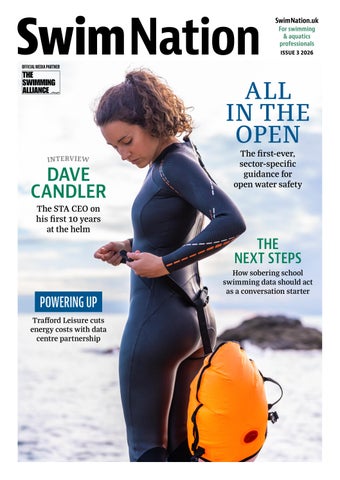
Swim Nation
Swim Nation.uk For swimming & aquatics professionals ISSUE 3 2026
OFFICIAL MEDIA PARTNER
ALL IN THE OPEN I N T E RV I E W
DAVE CANDLER
The first-ever, sector-specific guidance for open water safety
The STA CEO on his first 10 years at the helm
THE NEXT STEPS
How sobering school swimming data should act as a conversation starter Trafford Leisure cuts energy costs with data centre partnership
Introducing the NEW SEQ Level 2 in Teaching Swimming to Early Years. Supporting the workforce to develop specialist skills for early years swimming.
As demand for early years swimming continues to grow, so does the need for a more consistent and professional approach to delivery. Early years teaching isn’t just an extension of learn to swim, it’s a specialist discipline. The new SEQ Level 2 in Teaching Swimming to Early Years establishes a clear standard that supports safety, quality, and workforce development across the sector. With two defined pathways for new and qualified swimming teachers, they offer a more streamlined way to
Courses are now available to book. Visit Swim England Qualifications to learn more.
develop early years expertise, reducing duplication while supporting progression at every level. Built with the industry and grounded in real-world delivery, the qualifications combine practical learning with specialist knowledge to equip instructors with the skills and confidence to deliver from day one. For operators and training providers, this is an opportunity to strengthen early years programmes, build workforce capability, and meet growing demand with confidence.
From the editor
Innovating, developing people and changing lives
S
wimming is a life skill.
to deal with in recent years are the
That makes the latest
chronic shortage of swimming
figures on school
teachers and rising energy prices. From page 22, you can read
swimming particularly
how one leisure centre and pool
difficult to ignore.
operator has found an innovative
A BBC investigation found that
way to tackle the latter. At its
28% of Year 6 children in England
move Urmston site, Trafford Leisure
left primary school in 2024-25 unable to swim 25 metres. The aquatics sector has
has partnered with Deep Green and
rightly described the findings as sobering and
Zendo Energy on a data centre whose waste
from page 50 you can read how, for the Swimming
heat is captured to warm the swimming pool
Alliance, the figures should be the beginning of
– turning the demands of AI computing into
the conversation, not the end. As the alliance
lower energy costs and carbon emissions.
points out, the task now is to understand why
Meanwhile, the Institute of Swimming’s
so many children are missing out – and build a
Recruitment Academy is making inroads into
system capable of ensuring every child leaves
cracking the teacher shortage problem. The
primary school with the swimming and water
Academy offers an alternative ‘train-to-employ’
safety skills they need. After all, our sector is full
model for operators struggling to recruit
of people who know how to find solutions.
enough teachers to cope with the demand
Aquatics is also an extraordinary industry in which to build a career. Look around today’s
for lessons (you can read more on page 72). Meanwhile, open water swimming continues to
leadership teams and you will find many
attract new participants. That growth is hugely
people whose first professional step was onto
positive, but it brings new responsibilities around
poolside as a lifeguard. Few sectors offer such
safety and consistent operating standards. From
a visible pathway from frontline responsibility
page 68 you can read how RLSS UK is working on
to senior leadership – and you can read about
dedicated guidance for commercial inland open-
some great examples on this from page 28.
water operators to help meet that challenge.
While the swimming industry faces some serious
The common thread? Aquatics changes lives. Our
problems, it also develops people, innovates
job is to make sure everyone has the opportunity to
and responds to new challenges remarkably
experience it – safely, sustainably and confidently.
well. Among the biggest challenges it has had
Tom Walker, Editor
Swim Nation Tom Walker
John Challinor
Editor
Publisher
T: +44 (0)7796 512769
T: +44 (0)7971 043396
E: tom@nationmedia.uk
E: john@nationmedia.uk
Register for your free subscription at www.swimnation.uk
SWIMNATION.UK ISSUE 3 2026
3
Our NEW Recruitment Academy 2.0 Let our team support you to find your next wave of Swim Teaching talent with our ready-made recruitment solution. What's included?
The benefits
• Recruitment Campaigns
• Simplify recruitment
• Screening & Interviews
• Employ with confidence
• High quality training courses
• Free up your time
• Flexible pathways
• Increase sector accessibility
Contact us to find out more:
recruitmentacademy@swimming.org
Issue 3 2026
Swim Nation Dedicated to the aquatics sector SwimNation is at the heart of the UK’s swimming and aquatics sector. Published in partnership with the Swimming Alliance, it is the go-to publication and news website for anyone involved in swimming and aquatic provision across the UK. From facility development and operations, research and technology though to sustainability, training and programming, SwimNation covers it all. SwimNation is published three times a year as a standalone title, with each issue also included within SportsNation.
68
22
50
The Swimming Alliance advocates for equity, sustainability, and strategic investment in swimming as a lifesaving skill, public health priority and as a national development asset. You can find out more about the Swimming Alliance at www.theswimmingalliance.org
in this issue 07 News
42 Improving safety
Subscribe today to receive your complimentary copy
10 Mapping out growth
46 Keeping talent afloat
https://swimnation.uk/subscribe
Swim England launches new Learn to Swim Growth Plan
https://www.linkedin.com/ company/swimnation
20 Column: Andrew Clark, Swimming Alliance
50 The next steps
Advertising opportunities Contact John E: john@nationmedia.uk OFFICIAL MEDIA PARTNER
The latest news from the UK’s aquatics sector
The importance of working together to drive change
22 Interview: Jo Cherrett
CEO of Trafford Leisure tells how partnering with a data centre operator is cutting energy costs
28 I started as a lifeguard SwimNation is published by SportsNation Ltd. This publication is protected by copyright and no part may be reproduced, transmitted or stored in any print or electronic format without the written permission of the publisher. Every effort has been made to ensure the accuracy of the contents of this publication and PadelNation accepts no responsibility for any error or misrepresentation. Opinions expressed by the contributors and advertisers are not necessarily those of the publisher and we do not accept responsibility of losses or damages arising from them. Printed by BCP Media Group Ltd.
People at all levels of aquatics often have one thing common – their first job in the sector
34 The next wave
Dave Candler on his 10-year journey as STA’s CEO
40 More than a job
Swimming Alliance’s Workforce Survey provides valuable insight into the aquatics workforce
How GLL’s partnership with RLSS UK is keeping children safe
Is the aquatics industry catering for neurodivergent teachers?
The sector reacts to sobering new school swimming data
58 Modernising the journey Why Swim England’s new Level 2 qualifications is a big deal
62 Data crunching
EVOLVE’s State of the UK Swimming Industry Report 2026
64 Inclusion in practice How Elevate turned intent into action
68 All in the open
Developing sector-specific guidance for open water safety
72 Train to employ
Could a new initiative solve the shortage of swimming teachers?
SWIMNATION.UK ISSUE 3 2026
5
TA L K T O A N A N A LY S T
Map your market: who, where, what
How can we help? Our insight is built around you. From member behaviour to market demand, EVOLVEʼs Strategic Insight Services adapt to your business needs, helping you make data led decisions, with confidence.
Our insight explore:
Our insights powered by real industry intelligence
Members Understand who your members are and how they behave.
30+ years of insight 850 million data points
Population Know your local market and true catchment. Competition See your landscape clearly and identify gaps. Demand Uncover opportunity and growth potential.
7,000+ UK fitness sites tracked
Why it matters Reduce risk Identify real opportunity Make confident decisions
To find out more, email hello@weareevolve.io
EVOLVE weareevolve.io
News
Swim Nation NEWS Rebecca Cox appointed Swim England interim CEO PHOTO: SWIM ENGLAND
Rebecca Cox has been named interim CEO of Swim England. Cox will take up the role with immediate effect and replaces Andy Salmon, who resigned as CEO in July. Cox, currently the Business Engagement Director at Swim England and Managing Director of the Institute of Swimming, was chosen following an internal recruitment process. She has spent almost 15 years at Swim England and has served as acting CEO for the past three months. Swim England Chair, Richard Hookway, said: “Rebecca has done an outstanding job leading
Cox was chosen following an internal recruitment process
the organisation as Acting Chief Executive and has demonstrated
Her knowledge will be invaluable
few months have reinforced my
the leadership, commitment and
as we continue the important
belief in the strength and passion of
strategic focus needed to continue
work already underway.”
our people and the wider aquatics
driving Swim England forward.
Speaking about her appointment,
community. Our commitment to
“Rebecca is a highly respected
Cox said: “I’m proud to be taking
delivering our One Swim England
figure across the industry, with
on the role at such an important
strategy and transformation
more than 30 years of experience.
time for Swim England. The last
programme is unwavering.”
PHOTO: SIWMMING ALLIANCE
Swimming Alliance urges action on pools, activity and water safety The Swimming Alliance has met
recognition of swimming within
with the Minister for Sport,
future physical activity policy.
Stephanie Peacock MP, to call for
Alliance representatives said
greater investment in swimming
swimming pools and leisure centres
pools, aquatic facilities and
are essential community assets
water safety education.
that support public health, physical
The group, which represents more
activity and water safety. They called
than 25 national organisations,
for previously announced grassroots
Stephanie Peacock MP with
also pressed the case for cleaner
sports funding to include targeted
Andrew Clark, vice chair of the Alliance
recreational water and stronger
investment for aquatic facilities.
SWIMNATION.UK ISSUE 3 2026
7
News PHOTO: ALLIANCE LEISURE
STA launches multilingual water safety resources The Swimming Teachers’ Association (STA) has launched multilingual versions of its Water Safety Code and Float to Live resources to help more The transformation is a significant investment for the community
£17m MyActive Leek opens with new 25m swimming pool
families access potentially lifesaving advice this summer. The free resources are available in Welsh, Polish, Romanian, Punjabi (Gurmukhi), Urdu, Bengali and Gujarati, alongside English. STA said the initiative aims to
A new 25-metre swimming pool
pool, supported by a separate
remove language barriers and
and dedicated teaching pool
teaching pool. The new aquatic
improve access to clear water
have opened at MyActive Leek
provision is intended to create
safety guidance as more people
following the completion of a
more opportunities for swimming
visit beaches, rivers and lakes.
£17 million redevelopment of the
lessons, recreational swimming
The launch follows at least 35
former Brough Park Leisure Centre.
and structured activity for people
drowning deaths in the UK since
of different ages and abilities.
May, with August historically
Delivered by Alliance Leisure on behalf of Staffordshire Moorlands
Sustainability has been a major
one of the busiest periods
District Council, the transformed
focus of the project. MyActive Leek
for accidental drownings.
facility forms part of the wider
is now an all-electric facility, with
regeneration of Leek town centre
air source heat pumps replacing
said Dave Candler, CEO of
and is designed to expand access
gas boilers. Further measures
STA. “It doesn’t matter what
to swimming, physical activity
include rooftop solar panels, LED
language you speak – the risks
and wellbeing opportunities
lighting and improvements to the
are the same for everyone.
for the local community. At the
building fabric, helping to reduce
That’s why it’s so important
heart of the redevelopment is
long-term energy consumption
that these life-saving messages
a six-lane, 25-metre swimming
and carbon emissions.
are available in languages more
“Water doesn’t discriminate,”
families can understand.”
PHOTO: STA
Swimwell swim school opens £1m purpose-built pool in Stafford Independent swim school, Swimwell,
marks a major milestone for the
has opened a £1m, purpose-built
swim school, which has been
swimming pool in Stafford. Located
helping children develop confidence
at the town’s Kingsmead Retail
and essential water safety skills
Park, the 20m x 8m pool will enable
for more than a decade.
Swimwell to expand its provision
Opened by Olympic medallist and
significantly, increasing capacity
Commonwealth champion, James
The pool was officially opened
from around 600 swimmers to
Guy, the pool has been designed
by Olympic medallist James Guy
approximately 2,000. The facility
specifically for swimming lessons.
8
SWIMNATION.UK ISSUE 3 2026
Exceptional Print Solutions for Maximum Impact.
OUR SERVICES: PRINT & SIGNAGE DIRECT MAIL SOLUTIONS LARGE FORMAT VEHICLE GRAPHICS PRINTED PACKAGING BRANDED WORKWEAR BRANDED MERCHANDISE
DISCOVER MORE ONLINE
Your Local Print & Signage Experts - Contact Us Now! 01202 717535
hello@bcp.co.uk
bcp.co.uk
People Policy
Mapping out growth Swim England launches new Learn to Swim Growth Plan to support aquatic programme expansion
S
wim England has launched its Learn to Swim Growth Plan, designed to help aquatic providers unlock sustainable programme growth. Responding to a national slowdown
in learn to swim growth, the national governing body has developed the new offer to help its partners deliver swimming lessons to ‘turn the tide’ on declining learn to swim participation. The Learn to Swim Growth Plan builds on the Aquatic Latent Demand product, bringing together data, insight and practical guidance
through three stages for growth: audit, insight
We’re enabling operators to move beyond understanding their position and take confident, targeted action
and action. Going beyond traditional diagnostics,
Alex Hains
into a single, integrated growth offer. It offers a more comprehensive offer that supports partners
it links insights directly to realistic, actionable recommendations – connecting latent demand and local opportunity with practical guidance
Each Learn to Swim Growth Plan provides
on pool programming, workforce planning,
partners with an audit of current performance
customer journey and learn to swim delivery. It
alongside market opportunity and actionable
supports providers who own, operate, or have
insight supported by programming and
access to a facility with a swimming pool, to
workforce considerations. It also creates
help them move beyond understanding their
data-driven growth targets and delivery
current position and take measurable steps
pathways, while providing Swim England’s
to grow their learn to swim programmes.
expert-led support every step of the way.
Growth targets are tailored to each facility, using penetration rates alongside facility-specific capacity analysis to define what success looks like and how
What is the Learn to Swim Growth Plan?
it can be achieved over time. The aim is to create a
The plan provides a complete, structured review of:
structured, evidence-based roadmap that supports
l A provider’s current programme performance
confident decision-making and sustainable growth.
l Local market demand and opportunity
Alex Hains, Head of Business Engagement at
l Facility capacity and utilisation potential
Swim England, said: “The Learn to Swim Growth
Through an audit, insight and action approach,
Plan represents a step change in how we support
it connects this insight directly to practical
our partners growth. By combining audit, insight
recommendations – helping providers move
and action into one comprehensive approach, we’re
beyond analysis to implementation.
enabling operators to move beyond understanding
To find out more about the Learn to Swim
their position and take confident, targeted action.
Growth Plan and other Business Solutions products,
Ultimately, this is about helping providers maximise
contact your Business Engagement Manager or
their facilities, reach more children and ensure more
email us via business.solutions@swimming.org
people develop a lifelong love of swimming.”
110
SWIMNATION.UK ISSUE 3 2026
YO U R O LYM P IAN LE D, E X P E RT LE I S U R E D E LIVE RY PARTN E R
www.therecreationgroup.co.uk
Turnkey Development From
Over 90 Swimming Pool
Feasibility to Delivery
Facilities Delivered
Revolutionising Swimming
Cost Saving Modern &
& Changing Lives
Modular Methods
START TH E C O NVE R SATI O N 0161 764 2224
info@therecreationgroup.co.uk
News
Safeguarding officer qualification launched Safety Training Awards (STA) has launched a new regulated Level 3 Designated Safeguarding Officer qualification, providing sport, physical activity and leisure organisations with a specialist training programme
Lex Leisure, Legacy Leisure and RLSS partner for programme
for individuals responsible for leading safeguarding within their organisation. Believed to be the first regulated Designated
Lex Leisure and Legacy Leisure
self-rescue and rescue techniques
Safeguarding Officer (DSO)
have joined forces with the Royal
in a supportive environment, while
qualification developed
Life Saving Society UK (RLSS
games will help participants build
specifically for the sport,
UK) to deliver an inclusive water
confidence and improve swimming
aquatics and wider leisure and
safety programme for children
ability. RLSS UK developed Rookie
physical activity sector, the
with disabilities across England.
Rescue Skills in 2025 alongside
new qualification has been
strategic partner Level Water,
created by STA in collaboration
the operators have become
with the aim of making essential
with safeguarding industry
RLSS UK Water Safety Education
lifesaving and self-rescue skills
experts to equip learners with
Partners and will use a donation
accessible to all children.
the knowledge, understanding
Working with Parkwood Leisure,
“Our partnership with Lex
and practical skills needed to
staff to deliver its Rookie Rescue
and Legacy Leisure will expand
fulfil this vital leadership role.
Skills programme to 50 children.
participation in aquatic activities
The initial pilot is running for 10
and will deliver water safety
who currently work with children
weeks across five leisure centres
education to all communities,”
or adults at risk and who have,
in England. Hour-long sessions
said Ashley Jones, Head of Water
or are preparing to take on,
will teach water safety awareness,
Safety and Education at RLSS UK.
responsibility for safeguarding
made to the charity to train
It is designed for individuals
within their organisation.
PHOTO: SWIM ENGLAND
Swim England launches Learn to Swim Growth Plan Swim England has launched a new
in learn to swim growth and
Learn to Swim Growth Plan to
aims to help operators increase
help aquatic providers grow their
participation through practical,
swimming lesson programmes in a
evidence-based support.
sustainable and measurable way.
The Learn to Swim Growth Plan
The new offer forms part of
builds on Swim England’s Aquatic
Swim England’s Business Solutions
Latent Demand product. It brings
The plan aims to help more people
service. It has been developed in
together data, insight, and guidance
develop a lifelong love of swimming
response to a national slowdown
into one integrated offer.
12
SWIMNATION.UK ISSUE 3 2026
STA's new Level 2 Swimming Teacher Qualification is reshaping how courses are delivered to meet the needs of today's workforce, tutors and learners.
NEW FOR 2026 • Modernised Delivery Model • Flexible Study Options • Workforce Ready Teachers • Support Beyond Certification
n. o i t a c fi i l a u Q One . s e r u t u F g n Shapi
TR
A I N IN G A
W
T
TR
W
FE
Y
AR
SA
DS
DS
SAF
Y
AR
ET
d out n fi o t s u t c a t Con o.uk .c a t .s w w w ia more v
AI NI NG
A
People Briefing
SPATEX 2027
Water leisure’s main event! If there’s one unmissable show for all water leisure professionals, it’s SPATEX 2027. Free to attend and open to all, save the date: from Tuesday 2nd to Thursday 4th February 2027 at the Coventry Building Society Arena NOWHERE ELSE LIKE IT IN THE UK! SPATEX is unique. With well over one hundred exhibitors, drawn from around the world, it’s an international shop window showcasing the latest trends, innovations and services, many offering exclusive show discounts. Swimming pools, wellness suites, spas, ice baths, saunas, steam rooms, water features, hot tubs, including several water-filled and working models for both the commercial and domestic markets, will all be on display under one roof. Plus, all the ancillary equipment, such as heating, ventilation, tiles, chemicals and lighting. Head of Operations, Kayleigh Biggs: The show’s cornerstone is energy saving, and a New Product Zone (sponsored by Swimming Pool News) will highlight the products and trends that will be making waves in the pool season ahead.
UPSKILL
The interests of leisure centre managers will receive special focus in Arena 2 and feature the specialist knowledge of ISPE, STA (Swimming Teachers’ Association),
Keep abreast of professional qualifications and best
IoS (Institute of Swimming), RLSS UK (Royal Life Saving
practice. There is no better source of free water
Society UK) and CBA (Chemical Business Association). A
leisure education in the UK, thanks to the gravitas
new programme offers the most up to date thinking on
and support of all the industry’s key bodies.
pool operator training, water testing and health and safety.
A double seminar programme is as broad in its diversity
The Industry Hub - a highly successful initiative
as it is steeped in expertise. Across the two seminar
introduced this year will also be returning in 2027 with
arenas over the three days of the show, there are 40
five of the industry’s leading associations all conveniently
plus sessions given by esteemed leaders of industry
grouped on one stand to offer free advice. You ask
including CPD accredited technical workshops.
the questions and they will provide the solutions.
EASY TO GET TO The centrally located Coventry Building Society Arena has over 2,000 car parking spaces and SPATEX is committed to providing free parking for its visitors. We look forward to welcoming you.
REGISTER HERE www.spatex.co.uk info@Spatex.co.uk +44 (0)1264 358 558
114
SWIMNATION.UK ISSUE 3 2026
News PHOTO: ALLIANCE LEISURE
Awards successes for pool specialist ReCreation Development company ReCreation, which specialises in leisure centres and swimming pools featuring above-ground design, has been declared winner The refurb is set to lower costs and increase participation
of the In-tend Procurement Standards Award for Social Value
Community-backed project secures Shropshire pool’s future
Contribution of the Year 2026.
A major £1.15 million
fitted with a durable waterproof
project development, creating
refurbishment has secured the
liner. Its filtration system has
facilities and programmes that
long-term future of the swimming
also been replaced, including
deliver measurable benefits
pool at Bishops Castle Leisure
new plant equipment, pipework,
for communities long after
and Arts Centre in Shropshire.
skimmers, sumps and water inlets.
construction is complete.
The award recognises ReCreation’s commitment to embedding social value throughout every stage of
Better known as Sports
New easy-access steps,
and Arts in the Community
handrails and guardrails will
has also been shortlisted for
(SpArC), the rural facility has
make the pool more accessible.
Build, Design and Refurbishment
reopened following investment
The existing pool hoist has
Project of the Year at the
from Shropshire Council and
also been reinstated.
ukactive Awards 2026.
a substantial community
“This project shows what
The win comes as the company
ReCreation was founded by
fundraising campaign. The project
can be achieved when
three former Olympians, Becky
was delivered by Alliance Leisure
communities, local authorities
Adlington, Steve Parry and Adrian
after the ageing pool tank and
and partners work together
Turner, who set up the company
filtration system reached a critical
towards a shared goal,” said Greg
with a vision to transform
stage. The 20-metre, four-lane
Walker, Business Development
the way swimming pools and
pool has now been reprofiled and
Manager, Alliance Leisure.
leisure centres are designed and developed in the UK.
PHOTO: ALLIANCE LEISURE
Doncaster Dome’s £15m Lagoons transformation project completed Work has been completed on
historic leisure destination. The
the £15m transformation of the
redevelopment included the addition
Lagoons at Doncaster Dome. Work
of two new racer slides and a new
on the Lagoons – a multi-pool
indoor splash play area with a variety
water complex featuring seven
of interactive water features. The
interconnected pools, flumes
work was led by Alliance Leisure
and an outdoor rapid river –
on behalf of the owner, Doncaster
The project has modernised one of
represent a significant milestone
Culture and Leisure Trust and funded
the Dome’s most popular attractions
in the regeneration vision for the
by City of Doncaster Council.
SWIMNATION.UK ISSUE 3 2026
15
News PHOTO: SWIM!
Updated RLSS guidance for non-guarded pools Royal Life Saving Society UK (RLSS UK) and leading industry partners have updated national guidance to help operators
Becky Adlington is calling for councils to get in touch, so more children can learn to swim
improve safety at nonlifeguarded swimming pools. Developed with CIMSPA,
Becky Adlington urges councils to close swimming gap
Swim England and ukactive, the refreshed Guidance for Managing Safety in Non-Lifeguarded Swimming Pools provides a practical framework for
New figures showing significant
providing affordable and accessible
identifying risks and introducing
gaps in children’s swimming ability
swimming opportunities.
appropriate safety measures.
have strengthened calls for local
Olympic champion Becky
More than 1200 UK swimming
authorities, schools and leisure
Adlington has responded through
pools are estimated to operate
providers to work together to
her Swim! swim school network,
without a lifeguard for at least
ensure more young people gain
making thousands of free lessons
some sessions. Around a third
essential water safety skills.
available to new customers.
are located in hotels, gyms,
Speaking on Radio West Midlands,
health clubs, spas, resorts and
data highlighted by a recent BBC
she called on councils to open
residential developments.
investigation found that 72% of
dialogue for the benefit of anyone
Year 6 pupils in England could
learning to swim. “We are a private
up a sizeable portion of the
swim the recommended 25 metres.
Department for Education
“Non-lifeguarded pools make
company and councils do not have
swimming pool estate, offering
With the cost and availability
£10m-£25m for new pools,” she
vital access for people to enjoy
of lessons remaining potential
explained. “We would love for
the water,” says Helen Marney,
barriers for families, the figures
councils to contact us directly to
Director of Health at Swim
underline the role councils and
come to their cities and towns.
England. “This guidance will
their leisure partners can play in
We should be working together.”
help operators of these pools.”
Swim England launches early years swimming qualifications Swim England Qualifications has
demand for lessons. Teaching very
launched two new qualifications
young children requires specialist
designed to strengthen teaching
knowledge of child development,
standards for babies, toddlers
safeguarding and age-appropriate
and pre-school children.
water confidence activities.
The new pathways aim to develop
“Early years swimming plays a
specialist early years swimming skills,
vital role in helping children build
The qualifications offer more
improve consistency across providers
confidence in the water,” says
consistency for early years swimming
and help the sector meet growing
Swim England’s Sarah Green.
16
SWIMNATION.UK ISSUE 3 2026
More than 5000 swimming lessons
and develop essential swimming
have been delivered to children
skills. “We’re blown away by the
with disabilities and additional
uptake of our specialist swimming
needs across Bristol, thanks to
lesson scheme which began with
a growing partnership between
a positive partnership with Level
Level Water and Everyone Active.
Water in 2022 with a small number
The initiative has supported
of students, and has continued to
108 children since launching in
develop,” explains Cameron Bate,
2022. It provides access to one-
Everyone Active contract manager.
to-one swimming lessons and
“We firmly believe in the
group sessions, helping young
charity’s mission to kickstart
people build confidence in the
a love of swimming in
water, improve physical wellbeing
children with disabilities”
PHOTO: EVERYONE ACTIVE
Level Water partnership delivers 5000 lessons for Bristol children
The Level Water lessons keep children feeling safe and supported
PHOTO: ZOGGS
Only 55.5% of UK adults meet activity guidelines Just over half of UK adults meet recommended physical activity guidelines, according to new analysis of health and lifestyle data from almost two million Our Future Health participants. The study found that 55.5% of participants achieved recommended activity levels, with men more likely to meet the guidance than women at 57.5% compared with 53.4%.
The swimsuit features a discreet 5-layer gusset system
Zoggs launches ‘Freedom’ Period Swimwear Swim brand Zoggs is making the
making the Freedom range available
pool more accessible for everyone
in community pools, Zoggs is ensuring
the highest compliance rate at
with the launch of its Freedom
that a period never has to be a barrier
58.9%, slightly ahead of 18 to
Period Swimwear collection. By
to exercise, fun, or competitive sport.
29-year-olds at 57.6%. Activity
combining its Aquaflow technology
levels were lowest among people
with a nationwide rollout in leisure
designed to support both adults
aged 80 and over, at 48.4%. The
centres, Zoggs is tackling one of the
and juniors aged from 10 to 14. This
findings also revealed a “midlife
primary reasons women and girls
focus on younger swimmers is vital
exercise gap,” with activity falling
drop out of swimming: the lack of
for keeping girls in the water during
among adults aged between 30
accessible, reliable period protection.
their formative years, providing
and 49. However, women became
Previously, period-proof swimwear
them with a swimsuit that looks and
more likely than men to meet the
was largely absent from local leisure
feels just like their usual swimwear
guidelines around retirement age.
centres, leaving many swimmers
while giving them the confidence
without an immediate solution. By
to swim without interruption.
Adults aged 60 to 69 recorded
The Freedom range is specifically
SWIMNATION.UK ISSUE 3 2026
17
People
Swimming Alliance thanks Andy Salmon
F
ollowing his decision to step down as Chief Executive of Swim England,
The Swimming Alliance would like to thank
Andy Salmon has also stepped
Andy for his leadership, enthusiasm and support,
down from his role as Chair of the
and wish him every success for the future.
Swimming Alliance. Andy was elected
In the meantime, Vice-Chair Andrew Clark
Chair earlier this year and, although his tenure
will take on the role of Interim Chair, providing
has been shorter than anticipated, he has
continuity for the Alliance and its current
made a valuable contribution to the Alliance
programme of work until the next Chair
at an important stage in its development.
elections take place at the end of the year.
His collaborative approach and commitment to
18
maintain momentum around its key priorities.
Salmon joined Swim England in February
bringing the sector together have been greatly
2024, following a six-year stint as CEO of British
appreciated by members of the Steering Group,
Triathlon. He started his sports administration
and he has played an important role in helping
career in golf, working for the PGA and also
to strengthen the Alliance’s collective voice and
held the role of deputy CEO of Scottish Golf.
SWIMNATION.UK ISSUE 3 2026
REGISTER FOR FREE ENTRY www.spatex.co.uk | info@spatex.co.uk | +44 (0)1264 358558
People
Working Together to Drive Change
I
Andrew Clark Interim Chair, Swimming Alliance t is a privilege to take on the role of Interim Chair of the Swimming Alliance at what feels like a particularly important time for aquatics. Bringing together 25 leading national organisations, the Alliance exists to
We have a real opportunity to influence policy, challenge inequalities and create meaningful, long-term change for aquatics
provide a collective voice for our sector and, through our three sub groups - Workforce,
Rising utility and operational costs and ageing facilities
Inclusion and Lobbying – and our School Swimming
could lead to further pool closures, and are placing
Taskforce, turn that collaboration into practical action.
increasing pressure on provision and threatening access
School swimming is a good example of why this
within communities. At the same time, the recent
matters. Recent BBC analysis found that, on average,
heatwaves have provided a welcome boost for many of our
only 72% of Year 6 pupils could swim 25 metres, falling
outdoor pools, lidos and pools in general, demonstrating
to just 55% in schools with the highest proportion of
once again the public appetite for swimming and the
pupils receiving free school meals. These inequalities
value these facilities bring to their communities.
reinforce the need for change and the work already being
That is why we are calling for investment in public
progressed through our School Swimming Taskforce,
leisure facilities and the development of a comprehensive
as discussed in the previous issue of SwimNation.
National Facilities Strategy - providing a long-term plan
But school swimming cannot be considered in isolation.
for the provision, renewal and development of the pools
Children need access to appropriate pool space; pools need
and leisure facilities our communities need. This would also
a skilled and sustainable workforce; and opportunities need
underpin the planned National Physical Activity Strategy.
to be inclusive and accessible to everyone. This is why the
Local authority devolution could be a catalyst for
work of our sub groups and Taskforce is interconnected.
change in the swimming sector. Greater local control
Our collective voice is equally important at Government
over funding and investment decisions would allow
level. Following our recent meeting with the then Minister
communities to shape facilities around local needs,
for Sport, the political landscape has changed significantly.
unlock new partnerships and support the development
On behalf of the Alliance, I have written to Prime Minister
of modern, sustainable pools. As swimming remains
Andy Burnham, setting out the contribution aquatics can
essential for public health, water safety and community
make to his ambition for a more preventative approach
wellbeing, devolution offers an opportunity to secure the
to health and tackling inequalities. Given his previous
long-term future of aquatic facilities across England.
support for swimming, physical activity and the role
There is much to do, but we have an extraordinary breadth
of leisure in improving public health, we hope there is
of expertise within the Swimming Alliance. By bringing
a real opportunity to build on this shared agenda.
those voices together around shared priorities, we have a
This all comes at an incredibly challenging time
real opportunity to influence policy, challenge inequalities
for swimming pools and leisure facilities.
20
SWIMNATION.UK ISSUE 3 2026
and create meaningful, long-term change for aquatics.
Designed for poolside environments
Add your branding
M R O F I N U D R A U LIFEG Colour-fast textiles
Quick-drying performance fabric
t: +44 (0) 1202 473 311 e: hello@taylormadedesigns.co.uk w: taylormadedesigns.co.uk
People
Data heating the deep end SwimNation speaks to Jo Cherrett CEO of Trafford Leisure, which has partnered with a data centre operator to reduce energy costs
s there is no end in sight to high energy prices, facility operators are finding increasingly innovative ways to both cut energy use and to generate power which can be utilised in pool operations. Trafford Leisure is among them, having partnered with Deep Green, a UK data centre operator, as part of plans to move away from carbon-intensive fossil fuel boilers. The initiative has resulted in Trafford Leisure’s move Urmston leisure centre in Greater Manchester becoming the first public leisure centre in the UK to benefit from data centre heat. Named DG01, the centre will capture between 75% and 95% of the heat produced by its servers and equipment to warm move Urmston. The process will cut the leisure centre’s carbon dioxide emissions by approximately 150 tonnes annually and save up to £80,000 a year in energy costs. Deep Green’s High density AI-ready technology works for both the data centre and the pool – the heat from the computers warms the water and the transfer of heat into the pool cools the computers. The project builds on Deep Green’s initial trial at its small data centre in Exmouth Leisure Centre. SwimNation dives in deeper in an exclusive interview with Trafford Leisure’s pioneering CEO, Jo Cherrett.
Trafford Leisure has a history of being an early adopter of sustainable initiatives. What was the specific tipping point that made you look at data furnaces as the next logical step? Sustainability has been part of Trafford Leisure’s DNA for some considerable time. Our executive team lead a culture of ensuring sustainability is in all our thinking, from supplier costs to day-to-day and longterm initiatives – it’s never just an afterthought.
22
SWIMNATION.UK ISSUE 3 2026
Swimming pools need heat every hour of every day
Green’s concept of capturing waste heat for social good
and are some of the most carbon-intensive buildings
aligned perfectly with that ethos. On introduction to
to operate. Think about running a bath at home. Now
the Deep Green team we quickly recognised its offer
imagine heating one thousand baths to thirty degrees
to combat rising costs and carbon impact was both
and keeping them warm twenty-four hours a day, seven
practical and scalable rather than just theoretical.
days a week. That’s roughly the amount of energy needed to run a single 25-metre swimming pool. And
How did you build the business case to convince your
in Trafford we don’t have one pool, we have eight.
local authority that this relatively new technology
Across our sites, our gas bill alone is around £400,000 a
was a secure and reliable bet for public infrastructure?
year. So the £80,000 saving will be significant for us.
Our approach was grounded in four things: evidence,
It’s why sustainability makes complete business
collaboration, risk management and alignment to
sense. And, because Trafford Leisure is known in Greater
Trafford Council priorities. From the outset, Trafford
Manchester for leading in this space, it has brought
Leisure and Trafford Council worked closely together to
many green opportunities to us. This included an
explore the opportunity, assess the risks and ensure the
introduction to Deep Green through Richard Lamburn,
solution supported shared environmental and financial
Swim England’s Director of Facilities, with the promise
objectives. We focused on the clear carbon reduction
they had something we would be interested in.
benefits, the projected reduction in long-term energy
My Head of Asset and IT, Kevin Henderson and I
costs, and the fact that the infrastructure is backed
have long thought we could turn our utility cost into a
by a credible commercial partner, Octopus Energy
revenue line, we just didn’t know how. But our ability
Generation. By combining robust due diligence with a
to think differently allows us to continuously innovate.
collaborative local authority and operator approach, we
We’ve always positioned Trafford Leisure as an early
were able to demonstrate this was an innovative but
adopter where it benefits our communities and so Deep
secure and reliable investment in public infrastructure.
SWIMNATION.UK ISSUE 3 2026
23
People
Importantly, this isn’t replacing resilience, it’s enhancing it. We demonstrated how it would complement existing systems while reducing longterm reliance on gas. Trafford Council is open to innovation and was supportive. Ultimately, the Council could see that one sector is paying to create heat, while another is paying to get rid of it. Deep Green resolves that contradiction and asks what if heat isn’t waste? What if it was a resource? What if digital infrastructure could also support local communities?
Were you able to house the data centre technology within the existing footprint of the facility? Yes, but not as initially planned. At first, we considered the data centre sitting within the actual leisure centre footprint. But, as we worked through the feasibility
Does the Deep Green technology offer any secondary
and design, to provide the total heating demand for
benefits compared to traditional boilers?
the entire centre, the size of this modular data centre
Beyond carbon and cost savings, there are operational
meant it had to be housed externally, but crucially, still
benefits. The system is highly efficient and, because
within our own boundary. We sacrificed eight car park
it doesn’t rely on combustion in the same way as
spaces to ensure the advantages of this solution would
gas boilers, it supports a cleaner, more modern plant
be integrated into the existing facility footprint. That
environment. It’s also part of a broader shift away
was critical for us in avoiding major structural changes.
from fossil-fuel-based infrastructure. Also, compared to other data centres that consume vast, unsustainable quantities of water for cooling, Deep Green’s modular design technology is a ‘closed loop’ system, so it requires only a few cubic meters of water a year.
How does the system ensure a consistent water temperature if the data processing demand drops during off-peak computing hours? DG01 is one of the most efficient data centres in the UK and is helping us to remove volatility from a cost line, particularly in the world we live in today. We want the data centre to be at full capacity, ensuring heat is available at all times. Not just for the pool but for our whole leisure centre. However, initially the system is set-up in a hybrid model, designed to work alongside supplementary heating systems rather than in isolation. The legacy gas system will remain for a short period but will be replaced with an electric system. This means we can balance supply and demand, ensuring a consistent pool temperature even if computing demand fluctuates. Our goal is to transition quickly to a single source solution, just using the Deep Green energy.
24
SWIMNATION.UK ISSUE 3 2026
Cherrett says the initiative marks a broader shift away from fossil-fuel-based infrastructure
This is a long-term partnership and as computing technology improves, should there be a surplus, we could look at raising the temperature of the pool or studios to accommodate the needs of different users
The technology is important, but it’s the collaboration between leisure providers, local authorities & innovators that makes it viable
and activities at specific times. For example, to better support users with disabilities, install a hot yoga studio or even supply heat to our neighbouring school.
How have your customers reacted to the news? Will other local businesses access the heat, and is
Members have been really positive. There’s a
there a cost benefit for Trafford Leisure to this?
genuine interest in how the technology works. Our
This is where the model becomes really interesting. The
customers appreciate that an everyday activity, like
key is looking at where the most energy demanding
swimming, is being provided in a more sustainable
public buildings are; ones that need a consistent
way. It also allows us to have an open dialogue
demand for heat, like a hospital, social housing and
with our customers about all our sustainable goals
other leisure centres, so we can optimise Deep Green’s
and inspires them to think differently too.
model. The potential to share heat locally creates opportunities beyond our one site, contributing to a
Beyond the environmental, how does your partnership
more connected and sustainable local energy ecosystem.
with Deep Green help you meet your social targets?
It’s early days, but the opportunity for local authorities
We’ve wanted to address a deep-rooted challenge for
to think differently is truly exciting and aligns strongly
a long time and because Deep Green has taken the
with our role as a community anchor organisation.
time to get to know us and understand how they could truly help beyond the data centre heating system,
What is the first piece of advice you would give to other leisure operators when exploring non-
they created the Swimming Hours programme. This fully-funded initiative will support twelve
traditional energy partnerships like this?
women to learn to swim over the next twelve months.
Start with partnerships. The technology is important,
They’ve all been identified and supported through
but it’s the collaboration between leisure providers,
our partnership with Women’s Empowerment through
local authorities and innovators that makes it
Arts (WETA’s) Active Communities Initiative, a local
viable. Be open to new models and focus on long-
organisation working with communities who experience
term impact rather than short-term familiarity.
cultural, social and financial barriers to participation.
SWIMNATION.UK ISSUE 3 2026
25
People
DG01 is not simply a story about a data centre or a swimming pool. It’s about what happens when invention is rooted in place, purpose and people
Whilst twelve places might not sound significant at first glance, it’s what those places can become that excites me. Learning to swim builds confidence, which can become volunteering. Volunteering can become qualifications. Qualifications can become employment. Employment can become representation. And representation can inspire the next generation. As Deep Green so rightly put it to us: ‘We don’t do these initiatives because we have to. We do them because they’re right.’ It means when companies choose to house their data in our data centre, they are creating something for social good.
How excited are you for the leisure industry The heat from the data centre computers is used to warm the water in the pool
that the technology is being recognised and invested in by a big company like Octopus Energy. What do you think this means to the sector? It’s a strong signal that this type of innovation is moving into the mainstream. For the leisure sector and for local authorities, it shows we can be at the forefront of the energy transition, not just reacting to it. That’s hugely encouraging.
26
SWIMNATION.UK ISSUE 3 2026
The partnership could become a blueprint to be rolled across Trafford Leisure’s portfolio
Based on your experience, do you see this as a
Trafford Council, to behavioural change, it’s about
‘one-off’ for move Urmston or a blueprint you intend
taking a whole-system approach. Did you know we
to roll out across the Trafford Leisure portfolio?
don’t get our chlorine from Russia, China or the United
It’s absolutely being viewed as a potential blueprint
States? We source local salt (the same as you pop
but I think the learning and scaling really needs to
on your chips) from down the road in Cheshire and,
be considered wider than a leisure centre. The data
through an electrolysis machine built in Lancashire,
centre capabilities for AI are not going anywhere, and
convert the salt on site into chlorine for our pools.
our journey with AI is really only just starting. Imagine
More than 10 years ago, we were one of the first
what’s going to be needed in the future, and unless
leisure operators to convert our sports hall lighting to
we want to continue to damage the planet we live on
LED, which kick-started a continuous journey toward
it’s an absolute no brainer for me. I don’t think any
sustainability that included installing our first pool
data centre should be built unless it can bring benefit
micro-filtration unit in 2019, a technology we now
to carbon reduction or cost for a local authority or
operate across six of our sites. We have expanded our
private provider. While each site, neighbourhood, town
environmental focus by measuring the carbon footprint
or city has its own context, the principle of integrating
of our entire business, prioritising Biodiversity Net Gain
innovative, lower-carbon energy solutions is one we’re
(BNG) through our first baseline survey last year and
keen to explore across our portfolio and Trafford.
in 2026 when we supported the reopened new-look move Altrincham with Trafford Council, the gas heating
Is this part of any wider environmental measures
system was replaced with Air Source Heat Pumps and
you’re putting in at Trafford Leisure sites?
Solar Panels, which are significantly more sustainable.
Yes, this sits within a broader programme of work
Ultimately, DG01 is not simply a story about a data
across Trafford Leisure focused on reducing carbon,
centre or a swimming pool. It’s about what happens when
improving efficiency and embedding sustainability
invention is rooted in place, purpose and people. And as
into how we operate. From facility investment with
we like to say here in Manchester, we do things differently.
SWIMNATION.UK ISSUE 3 2026
27
People
I started as a lifeguard A huge number of aquatics professionals started their careers as lifeguards. SwimNation spoke to a wide range of people from all levels of the sector, who reflected on their experiences as National Pool Lifeguard Qualifications (NPLQs) lifeguards – and how the skills and confidence they gained in the formative role have paved the way for successful, diverse careers ASHLEY GILES
GENERAL MANAGER LINK CENTRE
I
became a lifeguard at 18, almost 19 years ago, while studying at college. The flexibility of the shifts around my course was ideal, whether it
was evenings, weekends, or half terms. Having a background in sport and playing football throughout my teenage years, the teamwork and opportunity to develop within a leisure environment felt like the perfect fit for me. What I loved most was knowing that every day I was making a difference to someone’s health and wellbeing by lifeguarding the pool. Building relationships with regular swimmers gave me real joy and made coming to work rewarding, especially seeing people improve their fitness over time. Being a lifeguard taught me important life skills that we refreshed through ongoing monthly training sessions. This included the importance of water safety, educating swimmers and understanding the value of teamwork, particularly in emergencies, where working closely with colleagues is essential. I’m still a lifeguard after 19 years and continue to renew my qualification every two years. Throughout my career progression, from duty manager to operations manager and assistant manager, being
a lifeguard has always been the bedrock of my development. I’m now the general manager at Link
It’s an amazing job and a fantastic way to develop skills in communication, leadership, teamwork, and time management 28
SWIMNATION.UK ISSUE 3 2026
Centre in Swindon, and my lifeguarding experience still pays dividends in risk assessments, staff training, and supporting operational safety. I would 100% recommend lifeguarding to anyone starting out in their career. It’s an amazing job and a fantastic way to develop skills in communication, leadership, teamwork, and time management. It also opens the door to further qualifications and career opportunities.
CHRIS HEBBLEWHITE DIRECTOR OF NATIONAL STANDARDS AND COMPLIANCE GLL
I
owe my career, in the most unlikely and circuitous way, to the Royal Life Saving Society UK (RLSS UK). I gained my first Bronze
Medallion in 1982, when we were still practising Holger Neilson resuscitation (look it up). I didn’t strictly start as a lifeguard. My entry into the industry began in the basket room at Lincoln’s Yarborough Leisure Centre. For younger readers, the basket room involved handing over all your worldly possessions (clothes, wallet, car keys, dignity) and stuffing them into a brightly coloured wire basket. In exchange, you received a coloured elastic band, an item that doubled as a catapult for firing at schoolmates. How public leisure centres ever functioned without being classified as danger zones remains one of life’s great mysteries, and probably why the HSE invented Risk Assessments. Among my other vital duties was tending to the foot baths. This meant filling them to the brim and tipping in a hearty slosh of Wescodyne, an iodinebased sanitiser apparently designed for the food industry and, somewhat alarmingly, rabbit cages. Still, no one ever got foot rot under my watch. By 1985, I extricated myself from the baskets
I’ve watched the renaissance of lidos, the birth of trampoline parks and the demise of the squash court
and became a pool attendant. Over the years, the title has shifted from lifeguard to leisure
business, whether they be the price of gas or
attendant to recreation assistant, and so on.
the creation of a new regulatory authority.
From there, I moved into the plant room and began
GLL has been a remarkable organisation to grow
a 10-year apprenticeship. In those days, boilers were
up with. I’ve watched the renaissance of lidos, the
vast, lumps of iron tended by tattooed men who all
birth of trampoline parks and the demise of the
seemed to have served in the Navy and consumed
squash court and worked on both the London 2012
tea in industrial quantities. Being young and keen,
and Rio 2016 Olympic Games. I had the privilege
I mucked in with everything: digging out filters,
of influencing industry standards with RLSS UK,
knocking out gaskets, repacking pump glands.
ukactive and the British Standards Institution.
Forty years on, I’m the national standards and
And every one of those foundation jobs -
compliance director at GLL, the UK’s largest operator
lifeguard, trainer assessor, swimming teacher,
of swimming pools. I’ve travelled the well-worn
basket room custodian, and accidental rabbit-cage
path: duty manager, general manager, partnership
sanitiser - has proved useful. They’re the small
manager, head of operations. I worked across four
stepping stones that stay with you forever.
local authorities before spending the last 27 years
Fast forward to 2026, and I’m back with RLSS
with GLL, which is roughly the same amount of time
UK, this time developing the latest industry
it takes to fully understand breakpoint chlorination.
standards on Assisted Lifeguard Technology and
My role now ranges far beyond pools. This year, for example, I’m helping implement the
blow-up inflatables, amongst other things. I’m immensely proud to be back at Yarborough
Terrorism (Protection of Premises) Act across 300
Leisure Centre, where it all began, one of the 65+
or so leisure and library facilities and fending off
partners that GLL work with across the UK.
the seemingly ever-increasing pressures on our
Regrettably, the foot baths have gone.
SWIMNATION.UK ISSUE 3 2026
29
People
ALEX GLEESON
of a team, and respond calmly in high-
ADVISOR AND PARAMEDIC RLSS UK
pressure situations. The role also gave
started working as a casual
first aid, building the foundations for
lifeguard in 2006 at a busy
my future career in emergency care.
I
me practical experience in CPR and
my RLSS UK NPLQ training. At the
opportunities available through
time, I expected lifeguarding to
lifeguarding also enabled me
be a temporary role, but I quickly
to progress into a variety of
discovered how much I enjoyed
management positions in leisure,
the job and interacting with the
including duty manager, performance
public. What began as a short-term
manager, and systems manager.
opportunity turned into a 12-year
Each role helped further develop
career in the leisure industry.
my leadership, communication,
leisure centre, where I completed
As my first real employed role,
The training and development
What began as a short-term opportunity turned into a 12-year career in the leisure industry
and decision-making skills.
lifeguarding gave me a wealth of skills
Initially, I chose lifeguarding
and experience that later helped me
because it was a well-paid role
transition into a career as a paramedic.
and allowed me to do something
I learned how to communicate
meaningful by helping to keep people
confidently with the public,
safe in and around water. However,
manage enquiries and complaints
it ultimately shaped my future
professionally, work effectively as part
far more than I ever expected.
You’re trusted to keep people safe, make quick decisions and always stay focused HANNAH SMITH
skills and decision-making under pressure,
NATIONAL AQUATIC BUSINESS MANAGER FREEDOM LEISURE
while also instilling a strong sense of
I
accountability and professionalism. I was a lifeguard for around
became a lifeguard at 16
five years, throughout sixth
because I loved being in
form and university, before
and around the water and
progressing through a variety
wanted a role that was active,
of roles in the leisure industry.
social and meaningful. Having
Today, I’m the aquatic
always been a swimmer and having
business manager at Freedom
completed my Bronze Medallion,
Leisure, where I lead our aquatic
progressing onto the NPLQ felt like a natural next step. It was also the perfect job to fit around school and later university. What I enjoyed most about lifeguarding was the variety and responsibility. No two days were
offer, including Learn to Swim and casual swimming programmes. I also support customer experience design and wider commercial activities across the organisation. Lifeguarding is a fantastic starting point for any
ever the same, and it was rewarding knowing you
career. It gives you a level of responsibility that
were there to help keep people safe. I also built
most people don’t experience so early in their
strong friendships and became part of a close-knit
careers. You’re trusted to keep people safe, make
team, which made the job even more enjoyable.
quick decisions and always stay focused. Those are
Lifeguarding taught me a huge amount from a young age. It developed my confidence, communication
30
SWIMNATION.UK ISSUE 3 2026
skills that stay with you for life, and for me, it was the foundation of everything that came after.
www.rlss.org.uk/swimming-pools-consultancy-service
People
MIKE PRICE
It builds friendships you will keep for life and memories you will never forget
HEALTH, SAFETY AND COMPLIANCE MANAGER PARKWOOD LEISURE
A
s a competitive swimmer in my early teens, I thought lifeguarding would suit me. I
struggled to learn through books and was much more of a physical learner. The lifeguard course was a good blend of these and suited my learning style. In
confidence early on. I worked as a full-time
2001, aged 16, I became a lifeguard at what
lifeguard for five years before moving into
is now the Crystal Palace National Sports Centre. Although lifeguarding can feel like a solitary
management, while maintaining my qualifications and becoming an RLSS UK trainer assessor.
position on poolside, there was a real sense of
My career progressed after I approached senior
camaraderie among the team. We supported each
management about development opportunities, which
other, socialised together and I’m still in touch with
led to a trainee duty manager position. From there, I
people I met in that first role. I also enjoyed working
progressed through to duty manager, centre manager,
with the public, building relationships with regular
regional manager and into health and safety roles. I’ve
swimmers and helping people enjoy the water safely.
now worked in the leisure industry for 25 years, with
The role taught me responsibility at a very young
21 of those spent progressing in Parkwood Leisure.
age. While still in school, I was suddenly responsible
Lifeguarding teaches you so much. It builds friendships
for others’ safety, which shaped my maturity and
you will keep for life and memories you will never forget.
It’s a role that demands a higher level of professionalism than many other jobs typically available to 16 to 18-year-olds
32
SWIMNATION.UK ISSUE 3 2026
ALEX GODFREY
genuinely improves staff experience.
OPERATIONS DIRECTOR PARKWOOD LEISURE
I
before becoming an area manager.
I held my NPLQ for over 10 years
completed my NPLQ in 2004
My career progressed from assistant
at the age of 20, as part of my
regional director to regional director,
degree in Sports Development
and I’m now operations director,
and Management. I was passionate
where I line-manage 10 senior
about sport and wanted to gain
leaders across a diverse portfolio
real industry experience.
that includes leisure centres,
Working across wet and dry
theatres, golf courses, outdoor
facilities meant no two days were
activity centres, and even a zoo.
ever the same. One moment you
I have plenty of amusing stories
could be supervising a busy inflatable
from my time as a lifeguard, but one
session in the pool, aware you were
of the most unusual was supervising
likely to end up getting wet, and
an empty swimming pool from a
the next you might be setting up
treehouse during an A-list celebrity’s
an international table tennis event.
birthday party. I won’t say who.
I also valued learning practical skills
I think lifeguarding is a fantastic
such as first aid and CPR, which I
route into employment, and
knew would stay with me for life.
not just in the leisure industry.
As I progressed into more senior
It’s a role that demands a
positions, my lifeguarding experience
higher level of professionalism
gave me a real understanding of the
than many other jobs typically
pressures, the shortcuts and what
available to 16 to 18-year-olds.
DESIGN * SUPPLY * INSTALLATION * AFTERCARE * OVER 150 UK INSTALLATIONS
T: 01322 424445 E: enquiries@ustigate.co.uk W: www.ustigatewaterplay.co.uk
SPLASHPAD® * ELEVATIONS™ * WATERSLIDES * INCLUSIVE PLAY FOR EVERYONE
The future of Team management Join the movement. Power your people. Scale with CoverMe
Thousands of clubs have already made the shift. Don’t get left behind. visit www.covermeapp.co and book your demo today.
People
E V A W T X E N E H T This year marks the 10-year anniversary of Dave Candler being named CEO of the Swimming Teachers Association. SwimNation editor, Tom Walker, sat down with Candler to learn why he thinks the future of aquatics depends on the sector rethinking its role
D
Swimming Teachers Association (STA)
How would you describe your first 10 years as CEO?
on 1 April 2016. He stepped into the
Reaching the milestone has given me an opportunity
role having already spent 20 years in
to reflect on how far our sector has come over the
the aquatics sector – a career which
past decade. We’ve seen significant advances in
ave Candler became CEO of the
included a 10-year stint as operations, swimming
qualifications, technology and facilities, but I believe
and training manager at Inspire Leisure.
the biggest change has been in our understanding
During his 10-year tenure as CEO, the STA has
of where aquatics fits within modern society.
gone through unprecedented change – as has
As I reflect on the past decade, I believe
the wider aquatics industry. The pandemic hit
our sector is now approaching its next wave
the sector hard and dealing with the aftermath
of development – one defined not simply by
has been made harder due to global events,
technological innovation, but by a broader
which have pushed energy prices up and placed
understanding of the role aquatics plays in society.
immense pressures on consumer spending.
If you’d asked me ten years ago what would change
Yet, the future for the industry is bright. The formation of The Swimming Alliance is an example
most, I would probably have said technology. Looking back, I think the biggest transformation
of how the aquatics sector is now working together
has actually been the way we’ve come to
to face the challenges and find solutions together.
understand the true value of aquatics. While
The sector is also embracing technology like never
technology has undoubtedly reshaped the sector,
before and the emergence of Gen Z as a cohort
our greatest progress has been recognising
more interested in physical activity than the pub
that swimming and aquatic activity contribute
offers a real opportunity to engage new audiences.
far more than many people realise.
34
SWIMNATION.UK ISSUE 3 2026
If you look at the challenges faced by the sector when you first became CEO, how do they compare to today? When I first took on the role, many of the
where people of different ages, backgrounds and abilities can participate in an activity they can enjoy throughout their lives. I still don’t believe we fully recognise the
conversations centred on participation, standards
contribution aquatics makes. Too often, it continues
and workforce development. Those priorities remain
to be viewed simply as part of the leisure sector,
just as important today. But increasingly, we’re
rather than as an essential contributor to healthier
recognising that aquatics contributes far more to
communities, safer lives and improved wellbeing.
society than simply teaching people to swim.
That broader understanding should fundamentally
Aquatics occupies a unique position in society
influence how we shape the future of our sector
because it contributes simultaneously to public
and, ultimately, how it is valued and supported.
safety, education, preventative health, rehabilitation
That shift in thinking has shaped much of STA’s
and community wellbeing. Swimming teaches one
direction over the past decade and continues to
of the most important lifesaving skills a person
influence the way we support the sector today.
can learn, helps children develop confidence from illness or injury, enables older adults to remain
How has the sector changed in the past decade?
active and independent, and creates opportunities
One of the biggest changes I’ve witnessed is the
for people of all ages and abilities to improve
growing recognition that developing people is
both their physical and mental wellbeing.
every bit as important as developing qualifications.
an early age, supports people recovering from
It also has the power to bring communities together, creating welcoming environments
Creating a high-quality qualification is only part of the solution. We also need to make sure talented
SWIMNATION.UK ISSUE 3 2026
35
People
people have the opportunity to access it, receive the support they need throughout their learning journey, and continue developing throughout their careers. Qualifications themselves have evolved significantly. Today’s programmes are more flexible, increasingly supported by digital technology and designed to maximise practical learning, giving teachers and aquatic professionals the confidence and competence they need for modern teaching environments. Attracting, developing and retaining talented
We’re now entering another period of technological change. Much of the discussion around artificial intelligence focuses on replacing people. I believe its greatest value lies in supporting them. Whether it’s
people remains one of the greatest opportunities
streamlining assessment, reducing administration,
facing our sector. If we’re to meet future
enhancing digital portfolios or helping learners access
demand, we need to continue investing not
resources more effectively, technology should free
only in qualifications, but also in mentoring,
professionals to spend more time doing what they
continuing professional development and
do best: teaching, mentoring and inspiring people.
clear career pathways that encourage people to build long-term careers in aquatics. Technology has also transformed our
The same principle applies across learn to swim programmes, where digital systems increasingly help teachers monitor progress, provide
sector, although perhaps not always
parents with greater visibility of their child’s
in the way people expected.
development and create a more engaging learning experience. Used well, technology strengthens
How do you view technology – how has it changed and how will it change the sector?
relationships rather than replacing them.
Digital innovation was already gathering pace, but
that many participants never see.
the COVID-19 pandemic accelerated that change
36
Innovation is also transforming areas Advances in water treatment, filtration and pool
dramatically. Almost overnight, organisations had to
plant management are helping operators improve
rethink how they trained learners, supported tutors,
water quality, reduce chemical use and enhance
communicated with members and delivered services
operational efficiency. As operators balance rising
remotely. Many of the digital solutions developed
costs, sustainability objectives and the need to
during that period have since become an integral part
maintain the highest safety standards, innovation
of the way our sector operates, demonstrating just
has become increasingly important. Emerging
how adaptable and resilient the industry can be.
technologies are helping operators create safer, more
SWIMNATION.UK ISSUE 3 2026
People sustainable pool environments while meeting the evolving demands placed upon aquatic facilities. Similarly, advances in AI-assisted drowning detection and intelligent camera systems are demonstrating how technology can strengthen safety within aquatic environments. These systems are not there to replace lifeguards. They provide another layer of protection, helping identify potential incidents more quickly and enabling trained professionals to respond even faster when every second matters.
There is a feeling of unity to aquatics now, not least through the work of The Swimming Alliance. How important is that for the future of the sector? One belief that has only strengthened over the past decade is that no single organisation can deliver meaningful change on its own. Some of the greatest progress we’ve made as a sector has
As I reflect on the past ten years, I’m incredibly proud of what our sector has achieved
been achieved through collaboration. Whether working with employers, education providers, organisations, charities or partners through
If you look ahead at your next 10 years in the role, what do you see?
initiatives such as the Swimming Alliance, progress
I believe the next decade presents an exciting
is achieved when expertise is shared and common
opportunity. We have the chance to build a
goals take priority over individual interests.
workforce that is more skilled, confident and
The challenges facing aquatics today are
diverse than ever before. We have technology
interconnected. Workforce shortages affect
that can enhance learning, improve safety and
participation. Accessibility influences health
support better decision-making. We are developing
outcomes. Water safety education improves
stronger partnerships across education, health and
public safety. Inclusion enables more people
community sectors. Perhaps most importantly,
to benefit from aquatic activity. Addressing
there is growing recognition that the value of
these challenges requires organisations to work
aquatics extends far beyond the pool itself.
local authorities, governing bodies, public health
together, recognising that the success of one part of the sector ultimately benefits us all.
For me, that’s what the next wave is really about. The future of aquatics doesn’t simply depend on better technology, stronger qualifications or more innovative facilities. It depends on how successfully we reposition our sector within society. If we recognise aquatics not simply as a leisure activity, but as an essential contributor to public safety, preventative health, education and community wellbeing, we will create stronger foundations for investment, build a more resilient workforce and ensure even more people can enjoy the lifelong benefits of being safe, active and confident in the water. As I reflect on the past ten years, I’m incredibly proud of what our sector has achieved. But I’m even more excited about what comes next. I believe the greatest opportunities for aquatics still lie ahead, and I look forward to continuing to work with colleagues across the sector to help shape that future.
38
SWIMNATION.UK ISSUE 3 2026
Making public leisure sustainable and building healthier communities.
£520m+ investment in local authority leisure
Chard Leisure Centre Value: £15.6m
310+
completed projects Abbey Leisure Centre Value: £3.5m
81%
of clients choose us for further projects
SC2 Value: £17m
development partner
Alliance Leisure are a trusted and experienced leisure development partner, with over 25 years’ experience transforming leisure facilities for local authorities.
allianceleisure.co.uk #TransformingLeisure
Discover our portfolio.
People
MORE THAN A JOB Building a career in aquatics
A
s featured in the last issue of SwimNation, the Swimming Alliance’s Workforce Survey provided valuable insight into the experiences, motivations and challenges facing the aquatics workforce across the UK. The findings highlighted many of the positives people associate with working in aquatics - from making a difference to people’s lives and contributing to local communities, to flexibility and being part of a team. They also identified some of the challenges around recruitment and retention, including pay, limited career progression and not feeling valued.
One of the priorities for the Swimming Alliance Workforce Task Force is therefore to better showcase
the opportunities available within aquatics - and demonstrate that a first job poolside can be the beginning of a varied and rewarding career. SwimNation sat down with three people and asked them to share their experiences of working in the sector and the lessons they have learned along the way.
A CAREER THAT CHANGES LIVES For Sola Alegbe, Lead Swimming Teacher,
Making learning to swim fun and safe for people is very rewarding to me
one of the most important lessons she has learned is that everyone learns differently. For Sola, patience, empathy and encouragement are central to being a great swimming teacher - and the impact of the role goes far beyond teaching someone how to swim. “My advice to anyone thinking about
FROM LIFEGUARD TO BUSINESS OWNER
F
or Chris Bateman, Managing Director and Lead Tutor at CB Training Services, a career in aquatics began
when he became a lifeguard at just 16. Chris progressed from lifeguard to
a career in leisure is to remember
Duty Officer and then Leisure Centre
that you’re not just teaching a skill,
Manager, before qualifying as an STA
you’re helping to change lives.”
tutor and eventually establishing his
Sola would also like to see more adults
own training business and swim school.
encouraged to learn to swim. Having once
More than 20 years after first entering
believed herself that she was too old and
the leisure industry, Chris remains firmly
too afraid to learn, her own experience
rooted in aquatics. Today, he delivers training
has given her a particularly powerful
across swimming teaching, lifesaving,
message for others: “It’s never too late.”
first aid, pool plant and a range of tutor qualifications - helping others to develop their own careers within the sector. His journey has also come full circle. Having once taught young swimmers himself, Chris is now training the next generation of swimming teachers - including former pupil and para-swimmer Meghan Willis, who qualified as a swimming teacher in 2025 and subsequently joined his team. For Chris, one thing has remained constant throughout his career: the reward that comes from helping others.
40
SWIMNATION.UK ISSUE 3 2026
WHERE AQUATICS CAN TAKE YOU
D
avid Springthorpe, UK Customer Engagement Lead for Lynxight, has followed a very
different career path, combining his knowledge of swimming pool operations with technology. Today, his role involves helping customers understand how swimming pool supervision technology works and how they can use it to support safety and
There is never a dull day in leisure! Jump in and enjoy every minute. You’ll be amazed at the skills you learn, people you meet and memories you make
gain greater insight into their operations. For David, one of the biggest lessons from his career has been the importance of a positive workplace
experience on to the next generation. His advice to those considering a career in
culture, alongside the value of good role models and
leisure is also to be authentic, treat others
mentoring. Having benefited from mentors himself,
with respect, be a team player and take pride
he has also been keen to pass his own knowledge and
in the facility and community they serve.
WHAT’S YOUR AQUATICS JOURNEY?
Force wants to hear from more of the people who make
These are just three examples of the many different
aquatics what it is. Whether you started with a part-time
directions a career in aquatics can take.
poolside job and discovered a career, have progressed
From teaching and lifeguarding to management,
into a role you never expected, have spent decades
training, technology and running a business, there are
working within aquatics, or simply love the difference
opportunities to learn, develop and build skills that can
you make every day, share your aquatics journey
shape a career. Now, the Swimming Alliance Workforce Task
here: https://www.surveymonkey.com/r/YBVWJD9
SWIMNATION.UK ISSUE 3 2026
41
People
Keeping children safer around water Andrew Clark, GLL’s Head of Sport and Aquatics, explains how GLL’s partnership with RLSS UK is keeping children engaged in swimming while equipping them with life-saving skills
T
he UK’s long, hot summer has been
have the skills and confidence to keep themselves
overshadowed by a series of tragic
safe. RLSS UK is the UK’s leading and most trusted
accidental drownings, many involving
organisation for water safety, and the partnership
children and teenagers. Against this
aligns perfectly with the mission of our Better Swim
backdrop, charitable social enterprise
School programme – to ensure everyone in the
leisure provider GLL - operator of
communities we serve has the opportunity to learn
Better Leisure Centres - has been
how to swim and stay safe in and around water.”
working to place water safety at the heart of every stage of learning.
Announced as the Royal Life Saving Society UK’s
The partnership with RLSS UK reinforces GLL’s
(RLSS UK’s) first Water Safety Education Partner
long-standing commitment to water safety and
earlier this year, GLL is embedding water safety
represents the latest stage in a wider rethink of
messages, endorsed by RLSS UK, to give all pupils,
swimming education. Running one of the largest
from toddlers and school-age children to adults,
swim school programmes in the UK, GLL offers
essential water safety knowledge and life-saving
200,000 adults and children weekly lessons in
skills. GLL has also integrated RLSS UK’s Rookie
more than 140 pools across the UK. The unique
Lifeguard programme into the final level
programme has been designed to keep
of its Better Swim School pathway. More
youngsters engaged in swimming for longer.
than 7,500 pupils are already benefiting
Clark, whose leisure career spans 25 years,
from the initiative, which gives older
including two decades with GLL, has seen
children the opportunity to learn lifesaving
countless children leave swimming as soon as
skills alongside their swimming lessons.
they reach the minimum standard expected
“Most parents don’t enrol their children
of them. “We asked ourselves why children
in swimming lessons because they want to
stay involved in sports like judo for years, but
develop the next Adam Peaty,” says Andrew
so many stop swimming as soon as they
Clark, GLL’s Head of Sport and
can swim 25 metres,” he says.
Aquatics. “They do it because
The answer, he
they want to know their child
believes, lies in the way
will be safe around water.
lessons were organised.
“They want their children
42
A UNIQUE SWIMMING MODEL
Traditional swimming
to understand the risks,
programmes often
recognise dangers and
see children changing
teachers, classmates and lesson times every few months as they progress through the levels. This can be a logistical headache for families, especially those with more than one child. For children, lessons become less enjoyable when they are repeatedly leaving friendship groups. Following Covid, GLL introduced a completely different model built around three broad stages: Foundation, Development and Academy. Children
If teachers are moving children around or taking registers, that’s time children aren’t learning
still progress according to ability but stay with their classmates and teachers for much longer, creating a greater sense of belonging while making the
together under a lead instructor, making better use
programme easier for parents to navigate. Themed
of pool space while maximising teaching time.
lessons also ensure fun remains central to all sessions.
Clark says that, in a 30-minute lesson,
“The children become part of a team,” Clark says.
every minute counts. “If teachers are moving
“Parents get to know one another because they’re
children around or taking registers, that’s
seeing the same families every week, and we’re
time children aren’t learning,” he adds.
not constantly asking people to change class times because someone has passed another level.” Operationally, the model has transformed how
The result has been better engagement, improved efficiency and stronger retention. “We’ve reduced the number of drop-out
lessons are delivered. Rather than one teacher
points, because children aren’t constantly
managing a single class, multiple teachers work
chopping and changing classes,” Clark explains
SWIMNATION.UK ISSUE 3 2026
43
People
We’re competing with the hundreds of other activities that children can do. If swimming isn’t engaging, they’ll find something that is
ENGAGING CHILDREN FOR LONGER The integration of RLSS UK’s Rookie Lifeguard programme into Academy lessons was the logical next step. Swimmers continue to develop their technique and stamina while also working towards Rookie Lifeguard Bronze, Silver and Gold awards. Rookie Lifeguard teaches young people basic rescue and lifesaving skills, equipping them with the essential knowledge to recognise hazards, respond effectively in emergency situations, and stay safe in, on and around water. The programme also helps children to build their confidence, develop teamwork skills and foster leadership. “This isn’t about replacing swimming with lifesaving,” says Clark. “It’s about enhancing the experience. We’re competing with the hundreds of other activities that children can do. If swimming isn’t engaging, they’ll find something that is.”
44
SWIMNATION.UK ISSUE 3 2026
To fill that gap, GLL is introducing social activities and team challenges alongside Rookie Lifeguard
technology that supports lifeguards – such as using camera systems to support lifeguards.
to create what Clark describes as a social club
“The cameras are brilliant,” he says. “RLSS UK,
for older children who enjoy being in the water
as experts in pool safety, has done really well in
but don’t necessarily want to compete.
supporting the industry to embrace technology.
“Children typically start dropping out of swimming lessons when they move to secondary school, but we’re seeing 14- and 15-year-olds continuing through Academy sessions,” Clark adds
It’s absolutely in line with what the sector needs and enables lifeguards to do a better job.” However, innovation must sit alongside investment. Operating pools is increasingly
The programme also creates a natural pathway
challenging due to ageing infrastructure, rising
into employment. Every year, GLL recruits hundreds
utility costs and growing maintenance pressures.
of lifeguards and swimming teachers. Introducing
“We need a national pool strategy,” Clark says.
young people to lifesaving not only builds
“Swimming pools are unique assets. They support
confidence in the water but also opens their eyes to
school swimming, rehabilitation, health programmes,
potential career opportunities available in the sector.
fitness, community activity, competitive sport and water safety education, but we need targeted
PROTECTING POOLS FOR THE FUTURE
funding to modernise the nation’s pool stock and
According to Clark, swimming sits at the heart
make facilities more efficient to run. Not every pool
of GLL’s business. “Our unique selling point is
needs to host galas and competitions and they don’t
that, in every area where we operate, people
all need the same design or facilities. But swimming
have the opportunity to swim,” he says.
pools need a long-term strategy of their own.
He believes innovation will continue to
“If we want future generations to learn
shape the customer experience, from using
to swim, stay safe around water and enjoy
music and sensory lighting to transform
the benefits of swimming, we have to
pool environments for specific sessions, to
protect these vital community assets.”
SWIMNATION.UK ISSUE 3 2026
45
Policy
KEEPING TALENT AFLOAT
I
n its very first issue, SwimNation explored neurodiversity as “aquatics’ secret superpower”, highlighting how individuals with neurodivergent needs often make incredible teachers. Traits associated with neurodivergency – such as heightened sense of awareness, an amazing ability to spot patterns and a thorough attention to detail –
can help make some of the most passionate and diligent swim teachers you will come across in our industry. Aquatics also attracts a high volume of teachers with
Rebecca Givens, a SEND Swim Teacher and Neurodiversity Advocate, says that the aquatics industry needs to better cater for neurodivergent swimming teachers by creating more neurofriendly work systems
neurodivergent needs because they often fathom on a personal level the direct beneficial impact swimming has on living with a neurodevelopmental disorder. With ADHD, for example, the repetitive motion of swimming can give the brain what it needs – bodily
meet current demand across the UK, but we also
movement, dopamine release, deep pressure, meditative
need more research on retention rates across the
rhythm and a calm underwater environment which
industry, and subsequently how supported our
can soothe feelings of overwhelm and chaos.
neurodivergent workforce feels and qualitative
BRING DOWN BARRIERS
motivations for those who do sadly leave positions. Numerous worldwide reports highlight the unique
With excellent initiatives like the STA’s Ripple Effect,
struggles that neurodivergent individuals face
we’re actively increasing accessible pathways into
across different workplaces. Many neurodivergent
teaching for those who may initially experience learning
groups actually oppose the term ‘superpower’ as
barriers. As an ADHD individual myself, training with
it can often underplay conditions and frame them
the STA and other governing bodies, I have always
as solely positive, when living daily with the real
felt adequately and appropriately supported during
struggles of a neurodevelopmental disorder can
the courses, able to discuss my needs and how they
sometimes be nothing short of debilitating.
can be met. However, with initial training complete,
The truth is that at times, it can feel hard to stay
the next question we need to ask is – are we
afloat. Neurodivergent people are statistically far more
retaining these neurodivergent teachers long-term?
likely to experience mental stress than the general
Those of us working daily within the swimming
population and this is because the world as we know
industry know only too well that retention rates
it – and that includes the structures and systems of the
can feel low, often due to the volume of part-time
workplace – has been designed for a neurotypical brain.
student teachers who work around other studies
Sensory overload and overwhelm, difficulties with
or go on to other higher education pathways.
maintaining routine and consistency, needing visual
We know that there aren’t enough teachers to
communication, heightened emotions, memory
46
SWIMNATION.UK ISSUE 3 2026
retention issues, mental health lows, attention span
masking due to lack of previous support and have
challenges, an inability to ‘switch off’, burnout and
become experts at struggling through challenging
striking healthy work/life balance are just some of the
environments rather than asking for things to
struggles I have experienced myself as a neurodivergent
change. As an industry, we have a responsibility
working individual over the last two decades.
to better understand these incredibly common
The Equality Act 2010 outlaws workplace
and complex conditions and work to support
discrimination based on disabilities and neurodivergency, but what active steps is the industry taking to
them, if we wish to retain diverse workforces. The basis of good SEND practice always puts
adjust our working practices to best fit the needs of
emphasis on the system to change, not the individual.
those who are likely to experience mental stress at
The archaic approach, which expected neurodivergent
work? According to official figures, one in five school
individuals to look at their conditions and adapt, is
children require extra support. Looking at our working
now widely recognised as unrealistic, demoralising and
contracts, patterns, approaches and communications,
discriminatory. It also wouldn’t retain staff long-term.
are we tailoring the workplace for the same ratio?
In all areas of society, it is the responsibility of the
Neurodiversity highlights how every individual’s
surrounding environment to constantly adapt to
brain works differently – but are some aspects of our
meet a range of diverse needs. As swim providers,
businesses still operating on a ‘one size fits all’ approach?
we are primed to achieve this – it’s what we do
CHANGING THE ENVIRONMENT
already! Across every swimming lesson, we change teaching methods, equipment and language to best-
One of the challenges is that a ‘secret superpower’ is
fit the swimmer’s individual ability. Why are we
quite often just that – secret, silent, invisible. Many
not consistently taking this approach even further
neurodivergent individuals have mastered the art of
and using it to best support and retain staff?
SWIMNATION.UK ISSUE 3 2026
47
Policy
MAKING WORKPLACES INCLUSIVE
Many neurodivergent staff may benefit from
Some examples of best practice around supporting
the option of flexible working patterns or zero
the neurodivergent workforce is to consider giving
hours contracts to work alongside hyperfocus
staff a clear opportunity to disclose and discuss
and burnout cycles. This could include mental
needs (if they wish to), regular supportive catch-
health time off if needed and signposts to
ups with their manager and the creation of long-
additional external support systems.
term and non-judgemental working relationships
Encouraging a healthy working set-up and
so staff feel comfortable asking for help. The best
clear boundaries between work and non-work
employers will focus on always having empathy
will ensure breaks are being taken. To assist with
and patience, knowing that (due to underdiagnoses,
this, employers can offer quiet spaces and break-
masking and historical lack of support systems)
rooms, zones for sensory down-time away from
neurodivergent staff may not yet be able to understand
the major hyperstimulation that is a poolside.
their own conditions fully themselves. Checking-
Neurodivergent adults are likely to have
in with staff poolside during their shifts can go a
communication and information processing
long way and create an atmosphere of support.
preferences and barriers. Insisting someone turns their camera on during a training session or call, for example, can be hugely problematic for some. Employers should always be clear, consistent and visual if needed when communicating with staff. Best practice would be to offer options and choice, while also allowing opportunities for visual learning. Some members of staff may need more processing time than neurotypical adults – absorbing information,
48
SWIMNATION.UK ISSUE 3 2026
Children with SEND face a significantly higher risk of drowning compared to their neurotypical peers According to the National Autism Association, children with autism are 160 times more likely to die from accidental drowning. RLSS DATA signing a policy, setting-up for a class, reading the
IT JUST MAKES SENSE
registers, making lesson notes. In school, a child with
So, why invest so much in our neurodivergent
neurodevelopmental needs may have additional
workforce? Well, the children with additional needs that
time and regular breaks in an exam – what is
we teach are not only statistically more likely to drown
our version of this in the adult workplace?
than their peers, but are also more likely to experience
Employers should consider how they can facilitate
negative life outcomes because of their conditions.
positive discussions and awareness around mental
The education system’s current SEND crisis has made
health and neurodiversity. SEND training for all staff
it evident that many children are not able to receive
is vital, especially for those managing and working
the support they need, affecting their lives long-term.
alongside those with needs. Additional professional
Yet, one of the last zones in society where I personally
development opportunities for neurodivergent
witness those children feeling seen and heard is in
staff will go a long way – they invest in future
our swimming pools. I see those positive outcomes
skills and allow those who may have previously
in real time – how the water regulates them, makes
felt marginalised to now feel valued. Encouraging
them feel safe and doesn’t put pressure on them
neurodivergent staff to have a voice and be involved
to be anyone else other than who they truly are.
in decision-making will develop their self-esteem,
That 30 minutes of swimming can regenerate that
confidence and feelings of self-worth for a community
self-esteem, self-belief and self-value that might
that has statistically struggled in those areas.
have been zapped from a conforming school day.
One of the most important aspects of supporting
These children need our pools, need to see evidence
those with needs is knowing that no two neurodivergent
of diverse workplaces and most of all they need their
(or neurotypical!) individuals are the same. While the
neurodivergent teachers. These are the teachers who
above advice can serve as a helpful starting point
see them for who they are and are best-equipped
for managers, support must always be tailored and
to understand their challenges, being able to teach
specific to the person, not the condition label.
them in a way that meets their needs and ensure they have a positive learning experience. Not only is the neurodivergent teacher actively working towards reducing that shocking drowning statistic but, if we best support them, they can consistently act as a person of trust in the life of a child who is likely to be struggling. That swim teacher is not just a swim teacher – they can become an image of hope for that child’s future. There is lots to do to improve inclusion and we need our swim superheroes to lead us through it. For more information, visit: https://swimwithrebecca.com
SWIMNATION.UK ISSUE 3 2026
49
People
SCHOOL SWIMMING What needs to happen next New national data has exposed the scale of the challenge facing school swimming. But for the Swimming Alliance, the figures should be the beginning of the conversation, not the end. The task now is to understand why so many children are missing out – and build a system capable of ensuring every child leaves primary school with the swimming and water safety skills they need
50
SWIMNATION.UK ISSUE 3 2026
M
ore than one in four children are
WHY ARE CHILDREN MISSING OUT?
leaving primary school unable
It is clear that not enough children are learning
to swim 25 metres. That was
to swim. The causes for that are complex – and
the shocking headline finding
the Swimming Alliance is keen that the debate
from a recent BBC investigation
does not become one of blaming schools.
into school swimming, which found that 28% of
Schools face curriculum pressures, constrained
pupils nationally were not achieving one of the
budgets, transport costs and timetable challenges.
basic requirements of the National Curriculum.
Some have convenient access to a local pool;
Behind the national figure, however, sit significant regional and socioeconomic inequalities. Among the examples the investigation highlighted
others must spend significant time and money transporting pupils to facilities several miles away. The facilities themselves are under pressure
were school groups in some areas receiving just
too, with ageing infrastructure, rising operating
six 30-minute swimming sessions, amounting
costs and closures reducing available water space.
to only around three hours in the water.
Responsibility, therefore, has to be shared.
For Andrew Clark, Interim Chair of the Swimming
The government sets curriculum policy and
Alliance and Head of Sports & Aquatics at GLL,
the funding environment. Local authorities and
the findings confirm something many within
operators provide facilities and programmes.
aquatics have recognised for some time.
Schools need sufficient curriculum time to deliver
“When more than a quarter of children are not reaching
swimming, while the wider aquatics sector
the expected standard, it is clear that the current system
provides expertise, teachers and pathways.
is not consistently delivering for every child,” he says.
“The solution is not about assigning blame,” Clark
Yet, Clark believes the 28% figure should be viewed
says. “It is about creating a system that ensures
as “a call to action rather than the complete picture”.
every child has a genuine opportunity to learn.”
SWIMNATION.UK ISSUE 3 2026
51
People
The practical swimming skills forged in the pool go hand in hand with the water safety knowledge learned in the classroom and experienced in the real word That opportunity remains far from equal. Children
She adds that addressing the problem will require a
living close to good-quality facilities and whose
government-led, cross-sector response bringing together
families can afford private swimming lessons
education, health, local government, transport, leisure,
have an obvious advantage over those facing
planning, child protection and the voluntary sector.
limited local provision or financial barriers. Simmy Akhtar, CEO of Royal Life Saving Society
REIMAGINING SCHOOL SWIMMING
UK (RLSS UK), adds that the headline 28% figure
Perhaps the most striking finding in the BBC
does not fully expose the consequences of those
investigation was that some pupils receive as little
inequalities. “The headline figure fails to shine a light
as three hours of actual tuition. For any aquatics
on the real tragedy behind the recent data,” she says.
professional, the answer to whether this is sufficient
“Only half of pupils at schools with the highest
for most non-swimmers is straightforward: “No.”
level of free meal provision could perform safe
Learning to swim involves confidence, floating,
self-rescue, and children from the most deprived
movement, stroke development and water safety,
communities drown at twice the rate of those
with children progressing at very different speeds.
from the least deprived backgrounds.” For Akhtar, the inequalities in swimming attainment
It is one reason the Swimming Alliance-led School Swimming Taskforce is developing a more structured
cannot be separated from wider inequalities in
approach. Its work currently centres on an initial 10-
safety and health. “When opportunities to learn
hour delivery framework, supported by a classroom-
to swim are determined by a child’s postcode,
based “Lesson Zero” before children enter the pool.
family income or access to local facilities, wider
The ambition is to create much greater consistency
inequalities in safety and health outcomes are
around what children learn and the outcomes they work
reinforced,” she says. “Drowning is a preventable
towards, rather than leaving provision dependent on
public health issue, and the Government must act.”
individual schools, providers or local circumstances. Clark says the Taskforce wants the first 10 hours to embed both water safety and enjoyment, with
“Only half of pupils at schools with the highest level of free meal provision could perform safe self-rescue, and children from the most deprived communities drown at twice the rate of those from the least deprived backgrounds.”
defined learning outcomes, exposure to deep water in a safe environment and opportunities to practise responding to situations with relevance beyond simply completing lengths of a pool. The proposed framework includes an early focus on Float to Live and a “lifesaving stroke” – a front paddle designed to allow pupils to remain visible and comfortable while moving through the water.
52
SWIMNATION.UK ISSUE 3 2026
Clark also points to intensive models in which 10 hours
competence, she explains, combines physical
of tuition are delivered as daily 60-minute lessons over
swimming skills with the knowledge and judgement
10 days. This can increase actual teaching time relative
required to anticipate, avoid and survive risky
to time spent travelling and, according to Clark, has
situations that could result in drowning.
improved attainment and reduced transport costs by
With competence comes the ability to recognise
50% in programmes where the approach has been used.
when somebody else needs help and participate safely in activities in, on and around water. Importantly, it
BEYOND 25 METRES
also includes risk and hazard awareness, understanding
For the Swimming Alliance, however, the future of
personal ability, coping with peer pressure and
school swimming cannot be judged solely by whether
applying lifesaving skills in real-world situations.
a child can complete a prescribed distance. Akhtar
This is particularly relevant as greater classroom-
believes the conversation needs to move towards
based water safety education enters the curriculum.
the broader concept of water competence.
For the Swimming Alliance, the principle is crucial:
“We also need to move the conversation
classroom education and practical swimming
to being ‘water competent’,” she says. Water
must complement one another, not compete.
SWIMNATION.UK ISSUE 3 2026
53
People
Even the most committed schools struggle to deliver meaningful swimming provision if there isn’t a suitable pool within a reasonable distance “The practical swimming skills forged in the pool go
Akhtar says that the strategy needs to do more than
hand in hand with the water safety knowledge learned
simply replace facilities as they disappear. “A significant
in the classroom and experienced in the real word,”
part of the school swimming challenge is undoubtedly a
Akhtar says. “Experience is crucial to building water
facilities challenge, but it’s not the whole story,” she says.
competence, so providing students with opportunities
“Even the most committed schools struggle to deliver
to apply their knowledge and skills together is vital.”
meaningful swimming provision if there isn’t a suitable
Her message on the balance between theory
pool within a reasonable distance, if transport costs are
and practice is unequivocal: “In-water learning is
prohibitive, or if available pool time is severely limited.”
a critical part of effective water safety education
The Alliance wants future provision mapped against
and should never be replaced by classroom-based
population growth and school demand, with particular
learning alone. Children must have opportunities
attention paid to communities where access is
to learn both in the classroom and in the water.”
poorest. It also wants investment in energy-efficient
The distinction matters. Knowing what to do when
facilities and long-term capital funding capable of
unexpectedly entering cold or deep water is imperative;
giving operators and communities greater certainty.
having previously experienced floating, deep water
“Swimming is not just a leisure activity,” Akhtar
and self-rescue techniques in a controlled environment
says. “It is a life skill, a public health asset and
makes that knowledge considerably more meaningful.
a statutory educational requirement.”
THE FACILITIES QUESTION
they can meet the required operational, water quality
Even the best curriculum framework cannot succeed
and safety standards, particularly as a stop-gap where
without somewhere to deliver it. For that reason,
access to permanent facilities is currently poor. However,
school swimming is inseparable from the wider
the Alliance would caution against presenting them as
challenge facing Britain’s aquatic infrastructure.
a wholesale solution. They may help address specific
Temporary and mobile pools could have a role, if
The Swimming Alliance is calling for a long-term
gaps in school provision by delivering some elements
National Aquatic Facilities Strategy that identifies where
of the curriculum, but cannot replicate everything
provision is needed, protects viable existing facilities
offered by permanent pools serving schools, clubs,
and supports investment in modern, sustainable pools.
families, health programmes and the wider community.
54
SWIMNATION.UK ISSUE 3 2026
ACCURATE INSIGHTS
is important, but adds it should not yet be treated as
The Swimming Alliance has long called for greater
a definitive measure of school swimming attainment.
transparency around school swimming data
“Who actually assesses whether a child can swim
and welcomes the Department for Education’s
25 metres, for example, against what standard,
move towards national collection, which should
and how consistently is that applied?” he asks.
continue. But the figures raise questions around
“We hear from swimming lesson providers who
the data itself – more specifically, how (and
deliver school swimming but are not asked to provide
what) the aquatics sector should collect.
attainment figures. We also know of instances
What the BBC figure doesn’t show is how inconsistent
where schools ask parents whether their child can
school swimming provision might be between
already swim, rather than their ability being formally
different areas, or how many children receive no
assessed against the National Curriculum outcomes.”
curriculum swimming at all. It also doesn’t provide
Candler also highlights the potential impact
the complete picture of pupils’ practical swimming
of voluntary parental contributions towards the
and water safety competence, or how consistently
associated costs of school swimming. Where
those abilities have been assessed and recorded.
families cannot, or do not wish to, contribute,
Dave Candler, CEO of the Swimming Teachers’
he says, there are instances where parents may
Association (STA), says the existence of national data
simply state that their child can already swim.
SWIMNATION.UK ISSUE 3 2026
55
People
“If that information is then relied upon,
TAKING THE CASE TO GOVERNMENT
it inevitably raises questions about the
The Swimming Alliance has already taken these issues
accuracy of the overall picture,” he says.
to Westminster and has now set out its priorities to
The BBC analysis also excluded 370 special schools,
the new Government. Rebecca Cox, Interim Chief
meaning the figures reported in the investigation
Executive at Swim England, says the immediate need
do not provide a complete national picture.
is for a long-term plan backed by investment.
For Candler, however, that is an argument for
“The challenge facing school swimming is clear, but
improving the system rather than abandoning it.
so too is the opportunity,” she says. “With the right
“The answer isn’t to stop collecting the data
ambition from the government, this parliament could
– quite the opposite,” he says. “We need that
deliver meaningful progress through investment in
national reporting to continue, but alongside more
swimming pools, stronger support for schools and
consistent assessment and reporting so that we can
a renewed focus on water safety education.
have greater confidence in the picture it presents and properly measure progress over time.”
“Through investment and policy focus, we can improve water safety, increase participation in physical activity, reduce inequalities in access to
“Success would mean that every child, regardless of where they live or their family’s circumstances, has an opportunity to learn to swim and develop essential water safety skills and knowledge” 56
SWIMNATION.UK ISSUE 3 2026
swimming, and ensure that far more children leave school with a skill that could one day save their life.” Alongside a National Aquatic Facilities Strategy, the Alliance sees the forthcoming review of the National Curriculum as an opportunity to strengthen expectations around swimming, water safety and self-rescue.
It also wants the new PE and School Sport Partnerships to play a central role in improving provision, including targeted top-up swimming for children who have not reached the required standard and practical support for schools struggling with transport and travel costs. There is an obvious opportunity for Prime Minister Andy Burnham to bring experience from his previous roles into that national debate. His record in Greater Manchester included support for approaches linking physical activity, leisure and health, while earlier in his political career, he championed free swimming initiatives.
Ultimately, success would be measured by children having the confidence, competence and opportunity to enjoy water safely throughout their lives
For the Alliance, however, the central argument extends well beyond sport. Better school swimming
“Ultimately, success would be measured by children
can improve physical activity levels, reduce inequalities
having the confidence, competence and opportunity
and give more children a skill that could ultimately
to enjoy water safely throughout their lives.”
save their life. And that provides a straightforward
The BBC data has provided a clearer indication of
definition of what success should eventually look like.
the scale of the problem. The challenge now is to
“Success would mean that every child, regardless of
turn that evidence into a more consistent system –
where they live or their family’s circumstances, has an
one which treats swimming not simply as another
opportunity to learn to swim and develop essential
curriculum activity, but as an entitlement, a form
water safety skills and knowledge,” Clark says.
of physical activity and a fundamental life skill.
SWIMNATION.UK ISSUE 3 2026
57
People
Modernising the journey to poolside SWIM ENGLAND LAUNCHED ITS NEW LEVEL 2 IN TEACHING SWIMMING THIS YEAR. SWIMNATION SPOKE TO A SWIMMING TUTOR TO GET THEIR VIEW ON THE NEW QUALIFICATION
T
(SEQ) Level 2 in Teaching Swimming has
MEET LIZZIE - AN INSTITUTE OF SWIMMING TUTOR
undergone a landmark transformation.
Institute of Swimming tutor Lizzie, 43, brings three
Designed as a streamlined, single-
decades of swimming teaching experience to her
qualification pathway, it replaces the
tutoring. Her aquatics journey wasn’t straightforward
traditional two-step process to get new
though. She explains: “I didn’t learn to swim until
swimming teachers poolside-ready faster
I was about eight; I was terrified of the water!
and with far more practical confidence.
However, with lessons and time I overcame my fear
his year, the Swim England Qualification
By shifting the emphasis away from pages
and learnt to love it. I joined a swimming club and
of written assignments towards hands-on
played water polo. I was about 13 years old when
learning, the new pathway makes qualifying
I began to help at my club. It’s crazy to think that
much more accessible, inclusive and engaging
was the start of my lifelong career in swimming.”
for trainees from all backgrounds.
For Southampton-based Lizzie, the single greatest win of the new SEQ Level 2 structure is its heavy focus on practical application rather than excessive written paperwork. Lizzie says: “Teaching swimming is a practical job. I’ve always told my learners that I’d much rather they are amazing at the practical aspects, as we can always support them with the paperwork. So the strong push towards the handson side of things in this new qualification has been a brilliant step forward for the sector. “One of the standout successes of the new qualification is the initial face-to-face peer day, which takes place before trainees even begin diving into
Everything is much more vibrant and play based 58
SWIMNATION.UK ISSUE 3 2026
learning or lesson planning. Trainees gather at the pool and get straight into the water, they experience strokes and skills firsthand, watch real lessons and explore the physical teaching environment together.
People
“Every time I get feedback at the end of
INCLUSIVITY AND FUN
the new course, learners say the peer day is
The emphasis on practical learning has also
amazing because it sets them up so well. It
made the qualification far more welcoming for
acts as a great team-building exercise too. The
neurodivergent trainees, particularly those with
courses run best when learners gel together
dyslexia or Special Educational Needs (SEN).
and form a little supportive team.”
Lizzie says: “I’m dyslexic myself, so from my
This practical focus extends directly into lesson
standpoint this is a much better way of learning.
planning and theoretical assessment. Rather than
The written questions on the old courses were an
spending hours writing complex plans that are rarely
awful lot of work for anyone and especially tricky
used once qualified, trainees now work with flexible
for someone with learning difficulties. Now, with
skeleton plans designed for actual poolside use.
the format and extra time adjustments available,
Additionally, replacing dozens of long written essay
my learners are reporting back to me that the
questions with a straightforward, multiple-choice
questions are straightforward and not there to
assessment has drastically reduced student anxiety
trick you. It’s a much more inclusive approach.
while keeping learning outcomes sharp and direct.
“As an organisation, we’ve really embraced that children need fun in their lessons and the new qualification reflects this. Years ago, warm-ups were just ‘kick across front crawl, kick across backstroke’ – it was boring! Now everything is much more vibrant and play based. I always tell my trainees when they finish, you need to spread the word to teachers who may have qualified a long time ago, that lessons need to be much more fun! These new teachers coming through have the fresh training and energy to inject life into lessons and inspire everyone on poolside.”
60
SWIMNATION.UK
These new teachers coming through have the fresh training and energy to inject life into lessons and inspire everyone on poolside
SWIMNATION.UK ISSUE 3 2026
61
Insight
The national total may look stable, but access, age and local provision reveal a swimming estate experiencing very different pressures beneath the surface
SWIMMING IN TRANSITION
WHAT THE DATA TELLS US
O
n 17th September, EVOLVE will launch its
The UK’s swimming pools play a crucial role in supporting public health, aquatics education and physical activity. Yet beneath the picture of lanes, lessons and leisure centres is an industry facing questions about access, ageing and renewal
free State of the UK Swimming Industry Report 2026 at FreeFlow. Based on a data snapshot taken at midnight on 31st July 2026, the report identifies 2,878 qualifying swimming-pool sites containing 4,262 individual pools across the UK. The national total appears relatively
stable, but it tells only part of
the story. Who can use these pools? Where are they located? How old are they - and can they continue meeting their communities’ needs? Of the qualifying sites, 2,125 provide open access: swimming available free of charge or on a payand-swim basis, without requiring membership. Membership-only pools contribute to the wider swimming estate but are not classified as open access. The public swimming estate has a median site age of 38.6 years, while 740 public sites are at least 40 years old. Many remain successful and well used, but ageing facilities bring questions about investment, replacement and renewal.
62
SWIMNATION.UK ISSUE 3 2026
Ageing facilities bring questions about investment, replacement and renewal FREEFLOW: DATA-LED INSIGHT
CRUNCHING THE NUMBERS:
The full report explores local provision, deprivation,
The UK’s aquatics facility stock currently includes:
management models, contract end dates, historical
2,878 4,262 2,125
closures, outdoor swimming and the development pipeline. The report will be free to read digitally from 17th September, the date of the FreeFlow evet held at the London Aquatics Centre. Heidi Blackburn, Dan Harrison, Jamie Buck and Alexa Passingham from EVOLE will share the report’s key findings, with Olympic swimmer and broadcaster Steve Parry hosting. EVOLVE’s swim partners and aquatics organisations will contribute to a day of insight, discussion and connection. Food is sponsored by Recotherm, drinks by Everyone Active and attendee goody bags by KitBrix.
Qualifying swimming-pool sites
Individual pools
Sites offering free or pay-and-swim access
SwimNation has a limited number of giveaway tickets available for club and leisure operators with pools to join the conversation. To enquire: info@nationmedia.uk.
SWIMNATION.UK ISSUE 3 2026
63
People
INCLUSION IN PRACTICE
Turning intent into action Inclusion and accessibility have become a focus point for both aquatics and the wider physical activity sector. In June, The Swimming Alliance led a panel discussion on topic held as part of the Elevate trade show
64
SWIMNATION.UK ISSUE 3 2026
S
ince the last issue of SwimNation, members
Confidence was a recurring theme. Even the most
of the Swimming Alliance’s Inclusion Taskforce
committed teacher can feel uncertain when they have
have taken the conversation around inclusion
not been given the knowledge or practical strategies to
to a wider industry audience at Elevate. The
support a learner with needs they have not encountered
session, ‘Inclusion in Practice: How Specialist
before. Specialist training can help bridge that gap,
Training Transforms Teachers and Learners’,
moving teachers from uncertainty to confidence and
featured Inclusion Taskforce members Ian Thwaites, Founder and CEO of Level Water and Chair of the
giving them practical tools they can apply within lessons. That confidence matters to the learner too. When
Inclusion Taskforce, and Timothy Mathias, Strategic
teachers feel equipped and supported, they are
Lead – Equality, Diversity & Inclusion at ukactive.
better able to adapt their approach, communicate
They were joined on the panel by Melona Headley, Founder and CEO of Bold Waters, with Mike Goody, STA Water Safety Ambassador and Invictus Games
effectively and create positive learning environments in which swimmers can develop and progress.
multi-medal-winning swimmer, hosting the discussion.
UNDERSTANDING THE COMMUNITIES WE SERVE
At the heart of the session was a simple premise:
Melona brought another important dimension
creating truly inclusive aquatic environments
to the discussion: cultural competence across the
starts with a confident, well-trained workforce.
leisure and aquatic workforce. Creating an inclusive
The panel explored how targeted training and
aquatic environment means recognising that people’s
professional development can equip aquatic
experiences of swimming and water can be influenced
professionals with the skills, knowledge and confidence
by their culture, background and lived experience.
they need to support swimmers from diverse
Barriers are not always obvious, and practices that feel
backgrounds and with differing needs – and, importantly,
routine to one person can unintentionally make another
how that investment in the workforce can translate
feel that an aquatic environment isn’t for them.
into better experiences and outcomes for learners.
BUILDING CONFIDENCE THROUGH SPECIALIST TRAINING
The session explored how the new Cultural Competence in Leisure and Aquatics CPD can support professionals to better understand the communities they serve, reflect on their own practice and create
Ian shared Level Water’s latest research into the
environments where everyone feels safe, respected
impact of specialist disability swimming teacher
and supported. The wider message was that cultural
training, demonstrating how investing in teachers can
competence should not sit separately from workforce
help develop stronger, more capable professionals
development. Greater understanding can help
while significantly improving the learning experience
strengthen communication, build trust and ultimately
and progression of disabled swimmers.
support greater participation and belonging.
SWIMNATION.UK ISSUE 3 2026
65
People
MOVING FROM INTENTION TO ACTION Taking the conversation to an organisational and sectorwide level, Timothy explored why inclusion needs to be embedded across workforce development, facilities and organisational culture rather than treated as a standalone initiative. The discussion also considered the role of practical tools such as ukactive’s EDI selfassessment toolkit in helping organisations understand where they are now, identify areas for improvement and
WHAT HAPPENS NEXT?
move from good intentions towards meaningful action.
For the Inclusion Taskforce, the focus now is on
For lasting change to happen, individuals need
continuing to turn conversation, research and
the skills and confidence to make a difference, but
evidence into practical action. The Taskforce
they also need to work within organisations where
will continue to bring together expertise from
inclusive practice is understood, supported and
across the sector to identify the barriers that
prioritised. That means asking practical questions: Do
prevent people from accessing and enjoying
our people feel equipped? Are there barriers we’re
aquatics, share evidence of what works and
not recognising? Do the communities we serve feel
explore practical ways the sector can respond.
welcome and represented? And are we giving our workforce the tools and ongoing support they need?
INCLUSION AS EVERYDAY GOOD PRACTICE
Workforce development will remain an important part of that conversation – from specialist disability training and cultural competence to the wider question of how we ensure aquatic professionals
The Elevate discussion reinforced an important
feel confident, knowledgeable and supported when
principle underpinning the Inclusion Taskforce’s
working with increasingly diverse communities.
work: inclusion should not be viewed as a specialist
There is also an important opportunity to identify
addition to aquatics. Specialist training undoubtedly
and share examples of inclusive practice already
has an important role to play, whether that relates
making a difference. By bringing together charities,
to disability, cultural competence or another area of
training providers, operators, awarding organisations
inclusive practice. But the longer-term aim is for the
and sector bodies, the Swimming Alliance can
knowledge and confidence this creates to become part
help share that learning more widely rather than
of what good aquatic practice looks like every day.
organisations having to find solutions in isolation.
Ultimately, strengthening the workforce and improving
Above all, the ambition is to keep moving
the learner experience are not separate ambitions.
inclusion from intention into everyday practice
Better-equipped, more confident professionals are
– strengthening the workforce, breaking down
better placed to understand and respond to the
barriers and helping create aquatic environments
people in front of them – helping more swimmers
where everyone has the opportunity to feel
feel welcome, supported and able to progress.
welcome, safe, respected and supported.
66
SWIMNATION.UK ISSUE 3 2026
CONNECT LEARN GROW 11th November 2026 active-net Open Water with
Holme Pierrepont, Nottingham
Book Your Place Limited spaces available Operators go FREE
Policy
All in the
open 68
SWIMNATION.UK ISSUE 3 2026
RLSS UK IS WORKING WITH THE INDUSTRY TO DEVELOP THE FIRST SECTOR-SPECIFIC GUIDANCE FOR INLAND OPEN WATER, TO SUPPORT OPERATORS AND ENABLE PEOPLE TO ENJOY THE ENVIRONMENTS SAFELY
he growth of inland open water
IMPROVING SAFETY
activities has transformed the leisure
This growth has brought new challenges for operators
and recreation landscape across the UK
responsible for managing these environments
and beyond. Open water swimming,
safely. In recent years, a number of tragic fatalities
in particular, has become one of the
and serious incidents have occurred at inland open
fastest-growing participation sports, fuelled by an
water venues, and in recent months, a number at
increasing focus on health and wellbeing, a desire
open water sites. Unlike swimming pools, where
to reconnect with nature and a growing appetite
operators can access established guidance such
for endurance and adventure-based experiences.
as the Health and Safety Executive’s Managing
Alongside swimming, a wide range of other water-
Health and Safety in Swimming Pools (HSG179),
based activities, including paddle sports, inflatable
there is limited sector-specific guidance for inland
aqua parks and recreational water play continue to
open water operators. This has created a clear
attract participants of all ages. As a result, millions
need for practical, consistent advice that reflects
of people now regularly visit inland open water
the unique risks and operational considerations
venues that offer these activities commercially.
associated with inland open water environments.
People Policy
Open water swimming is one of the fastest growing activities globally, driven by a surge in wellness culture and a desire for nature-connected endurance challenges
To address this gap, RLSS UK has brought together
BASED ON EVIDENCE
key stakeholders from across the inland open
The development process has been thorough and
water leisure sector to develop comprehensive
evidence-led. The initial draft was prepared by
industry guidance. The working group comprises
a legal professional with significant expertise in
representatives from Paddle UK, the Aqua Park
open water safety, incident management, and
Association, Swim England, Surf Life Saving
investigations following serious incidents and
Great Britain, British Triathlon, venue operators,
fatalities. Over the past 18 months, the working
and recognised water safety experts. Through
group has undertaken a detailed review process,
this collaborative approach, the guidance aims
considering multiple drafts, recommendations and
to reflect the breadth of activities taking place
amendments to ensure the resulting guidance is
across the sector while incorporating a diverse
robust, proportionate, practical, and applicable
range of expertise and operational experience.
across a wide range of inland open water venues.
The guidance seeks to support venues in
The guidance is now under industry consultation,
managing risks effectively while providing safe,
giving operators and other stakeholders the
enjoyable, and accessible opportunities for people
opportunity to review the draft document and
to experience the benefits of being in and around
contribute feedback, comments, questions, and
water. It will offer clear and practical advice on
suggestions. Subject to consultation outcomes,
meeting relevant health and safety responsibilities,
the group is working towards publication
with a focus on protecting both employees and
and launch in 2026, giving operators time
customers in inland open water settings.
to familiarise themselves with the guidance ahead of the 2027 operating season. RLSS UK and its partners look forward to continuing their engagement with the sector and will attend active-net Open Water in November, where representatives will be available to discuss the guidance, answer questions, and gather valuable feedback.
SWIMNATION.UK ISSUE 3 2026
71
People
TRAIN TO EMPLOY The lack of qualified swimming teachers is among the aquatics industry’s most pressing issues. But inroads into tackling the shortage are being made, with the Institute of Swimming’s Recruitment Academy among the programmes that are making a real difference
T 72
he national swimming teacher
individuals away from the sector by offering a safe
shortage has long been a hurdle for
option to career switching. In fact, a swimming
the leisure sector. In 2023 around
teacher trained through the IoS Recruitment
15% of all swimming teacher roles
Academy is two and half times more likely to be
(*12,000) across the UK were vacant.
over the age of 25 and looking for a career change.
While the traditional route of selffunded training remains the primary
CASTING A WIDER NET IN DEEPER WATERS
way to qualify, the Institute of Swimming’s (IoS)
Rebecca Cox, Swim England’s interim Chief Executive
Recruitment Academy offers an alternative ‘train-
and Institute of Swimming Managing Director, says:
to-employ’ model for operators struggling to recruit
“We’ve looked outwards, engaging with people
enough teachers to cope with the demand for lessons.
beyond our own aquatics’ peripheral view. We can’t
Piloted in 2019 and fully launched in 2021, the
just connect with people who love to swim; it’s not
IoS programme has run 187 Academies across 65
where the solution lies. We need to reach people
different leisure partners, training around 1,000 new
who wouldn’t even think it’s a plausible career for
swimming teachers, successfully challenging the
them, dispelling myths like ‘you need to be an expert
financial and cultural barriers that can keep talented
athlete’, as well as cultural myths and stigmas.
SWIMNATION.UK ISSUE 3 2026
“We want our teachers to truly represent the people they live and work alongside. This approach has been a clear success, as swimming teachers trained through our academies are twice as likely to be culturally representative of the areas where they teach.” The IoS’s Recruitment Academy is a one-stopshop for employers to source and recruit swimming teachers of the future. The Institute of Swimming manages the search and recruitment of trainees, supporting them through their training on behalf of employers to ensure leisure operators receive teachers who are pool-side ready and trained to the highest level. The trainee teachers work with their future employers to gain practical experience and valuable advice from mentors.
We need to reach people who wouldn’t even think it’s a plausible career for them, dispelling myths like ‘you need to be an expert athlete’, as well as cultural myths and stigmas SWIMNATION.UK ISSUE 3 2026
73
People The reward of my new career is fantastic. It’s pure joy. I love it. There is no negative in teaching and giving something back to the community
Trainee swimming teachers receive fullyfunded training from their future employer. The only cost to the learner is an administration fee. In addition to their SEQ Level 2 in Teaching Swimming qualification, they receive Institute of Swimming membership, which includes insurance and eLearning opportunities to hone their skills.
CHANGING LANES Hannah Smith, National Aquatic Business Manager
74
Deanne, 55, (pictured above) who became a swimming teacher at South Woodham Ferrers Leisure Centre through a Freedom Leisure funded
for Freedom Leisure said: “The IoS Recruitment
Recruitment Academy says: “Becoming a swimming
Academy has been invaluable for our organisation,
teacher was a complete career change for me, having
enabling us to successfully recruit new teachers in
spent four decades working in retail and hospitality.
areas where we previously struggled. One of the
It was now or never, but without the funding I
biggest advantages is the ability for us to offer
wouldn’t have been able to afford to retrain. It
fully funded training, allowing us to attract the
was a big thing to go back to the classroom at my
right individuals into teaching. The structure of
age, and I was both excited and nervous. However,
the academy is particularly effective, as trainee
the reward of my new career is fantastic. It’s pure
teachers have the opportunity to spend time on site,
joy. I love it. There is no negative in teaching and
meet the team and support sessions as a volunteer
giving something back to the community.”
assistant. We’ve gained some fantastic teachers
l Interested in launching a Recruitment
through the process, which was straightforward
Academy? You can find out more here:
and well-managed from start to finish.”
https://instituteofswimming.org/academy
SWIMNATION.UK ISSUE 3 2026
One Vision. One Voice. 24-26 September 2026 | London Stadium in Queen Elizabeth Olympic Park
Be Where the Industry Joins as One The HFA European Congress isn’t just an event—it’s a movement. It’s a gathering of top industry leaders who believe fitness is healthcare, prevention is power, and our industry is stronger when we speak as one. Join the conversations that shift perspectives, the collaborations that spark change, and the community shaping the next era of fitness across Europe.
Scan to Learn More
healthandfitness.org/congress
If you’re thinking about the future of our industry, London is where you need to be.
Brought to you by the Health & Fitness Association in partnership with ukactive
BLU Goggles. Armbands.Swim Hats. FUN + ENGAGING. ALSO AVAILABLE AS SWIM PACK with BAG, TOWEL & SWIMWEAR.
w: bluleisure.co.uk m:info@bluleisure.co.uk “Stronger Together”
t: +44(0)1908 582525