SAPCA Awards who were the 2026 winners?

SAPCA Awards who were the 2026 winners?
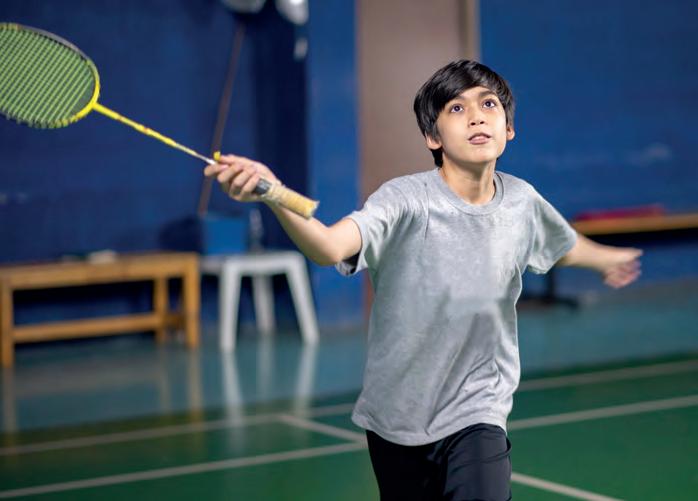
How is Badminton England delivering, two years into its 10-year strategy?
Pickleball finds its footing
The number of clubs nearly doubles in 2025
Dome advantage Could indoor facilities transform grassroots cricket?






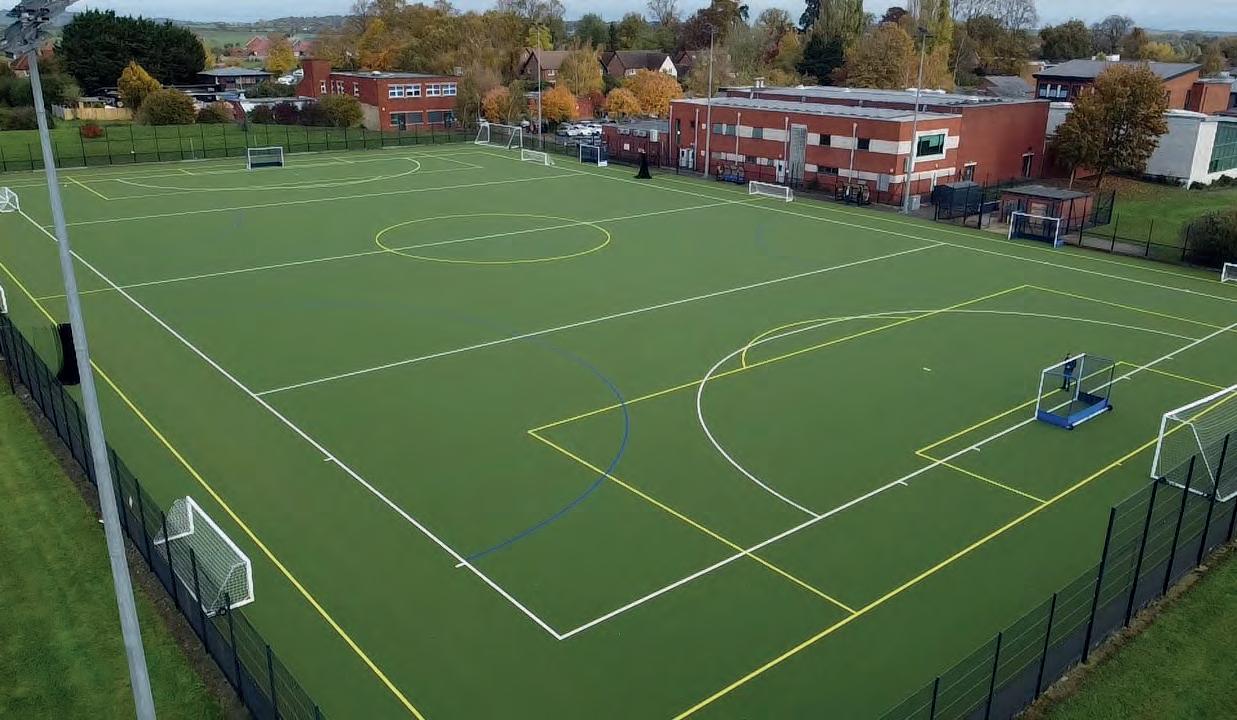

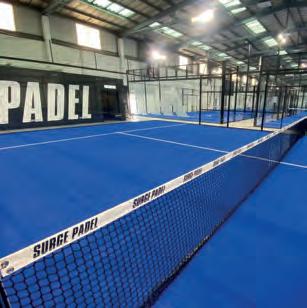





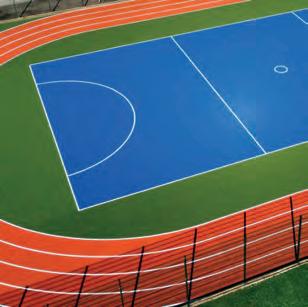







































In March, Prime Minister Keir Starmer hosted a reception to celebrate grassroots sport –and, crucially, to outline fresh investment into the facilities that underpin it. An additional £10 million has been committed this year, including at least £5 million earmarked for cricket and tennis facilities.

The message from the government was clear. Starmer emphasised the need to work more closely with local communities and the sector itself to better understand what facilities are required – and to ensure funding is targeted where it can have the greatest impact, helping more people from all backgrounds to get active.
The Prime Minister also confirmed a further £10 million investment for 2026/27 to develop new delivery models. This includes at least £2.5 million for the Lawn Tennis Association to develop covered courts, and at least £2.5 million for the England and Wales Cricket Board to support the development of all-weather, multi-sport domes. Additional funding will also be made available to
trial innovative approaches to facility delivery. In this issue, we explore what that means in practice. Turn to page 52 for more on the ECB’s ambitions for cricket domes, while from page 58 you can read how the synthetic turf sector is testing the next generation of playing surfaces.
If, however, the government is serious about building a preventative health system with physical activity at its core, it must go further. According to its own Keep Britain Working review last year, the full economic impact of ill health – including sickness absence ad reduced productivity – is £212bn per year.
To tackle that, any investment is welcome – but prioritisation is essential. Without it, as ukactive CEO Huw Edwards argues on page 28, the economic and health consequences will continue to mount. Sport and physical activity isn’t just a nice to have. It is essential to both the nation’s health and its economy.
Tom Walker, Editor
Walker Editor


05 From the Editor
From padel to pitches, our industry is evolving
09 News
The latest industry news from around the sports and physical activity sector
24 Column: Richard Shaw (SAPCA)
The use of AI could be a threat to padel
26 Column: Huw Edwards (ukactive)
The price of not taking physical activity seriously
28 Event review: SAPCA Conference
SAPCA launches its new strategy at annual event
22 Column: Lisa Wainwright (SRA)
The sector stands ready to help


32 SAPCA Awards
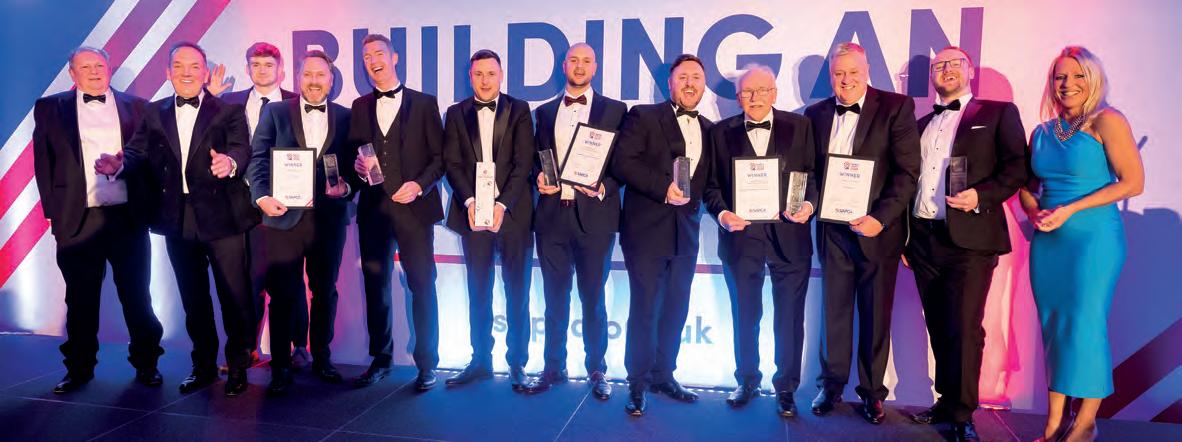
SportsNation takes an in-depth look at this year’s winners of the prestigious SAPCA Awards
38 Sport in focus: Badminton
Badminton England’s 10-year strategy is now a quarter of its way in. SportsNation looks in detail at the plans and the progress made since its launch
46 Interview: Steve May
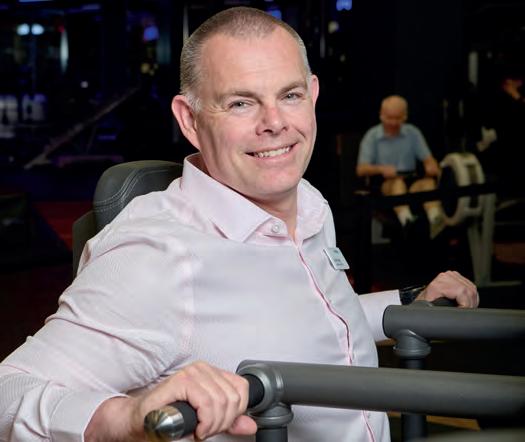
SportsNation speaks to Steven May, CEO of Mytime Active, about how the operator is using fitness tech to drive positive community health outcomes
52 Dome advantage
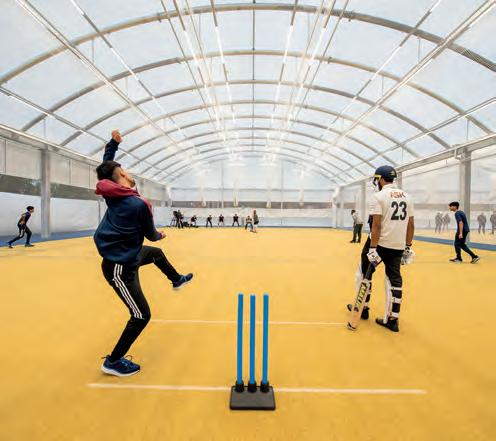
The success of the indoor cricket “domes” has led to the sport’s national governing body, ECB, committing to building 40 more







58 Testing the next generation of surfaces
Work is ongoing to test new artificial turf systems for the UK market. Niall MacPhee, Director at Sports Labs, offers an update on the latest developments
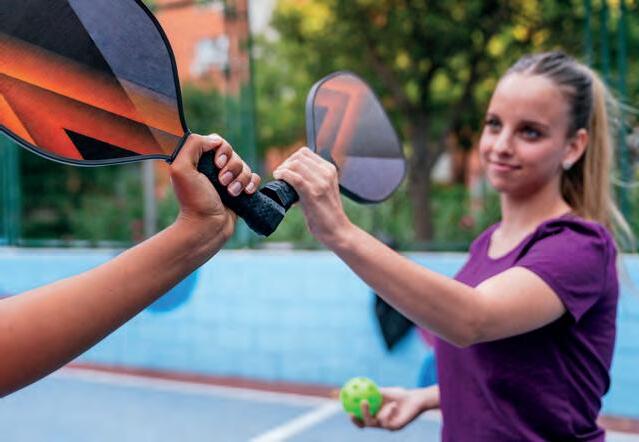
66 Pickleball finds its footing
Pickleball is experiencing a phenomenal boom, with the number of clubs in England nearly doubling in 2025
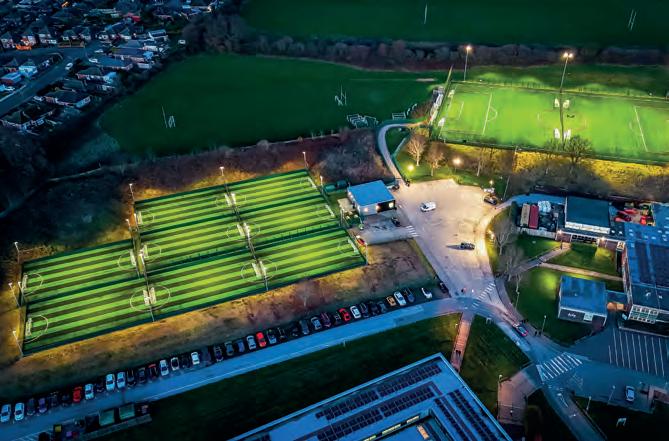
70 Sports lighting special
Designing and installing appropriate lighting solutions is crucial for the success and sustainability of sports facilities
76 SAPCA Showcase
SportsNation directory of selected SAPCA members
News 102 Column: Richard Shaw, SAPCA
The padel market is maturing 104 Interview: Robyn Duda
Founder of RacquetX on her plans for the UK
108 Interview: Jack Binstead
The UK’s leading wheelchair player
114 LTA’s venue registration scheme
How the system can support standalone clubs
118 Competition design
Using competitions to create an engaged network 122 Building communities Guy Griffiths discusses the key for successful venues
Padel and fitness Why



SportsNation is the single, authoritative voice for the provision, delivery, maintenance and management of sports and physical activity facilities. Published bi-monthly, the magazine focuses on the people, places, policies and products that help to build active communities throughout the UK. Subscribe now and we will email you a complimentary copy of the magazine every two months.
As the official magazine of SAPCA (the Sports and Play Construction Association), every issue of the magazine will also include information about technical guidance, funding, standards and product innovations.
SportsNation is published by SportsNation Ltd in association with the Sports And Play Construction Association (SAPCA). www.sapca.org.uk
This publication is protected by copyright and no part may be reproduced, transmitted or stored in any print or electronic format without the written permission of the publisher. Every effort has been made to ensure the accuracy of the contents of this publication and SportsNation accepts no responsibility for any error or misrepresentation. Opinions expressed by the contributors and advertisers are not necessarily those of the publisher and we do not accept responsibility of losses or damages arising from them.
by Bigwave Marketing Ltd. ISSN 2755-0621 (Print) ISSN 2755-063X (Online)
UK sports bodies invested £213.2m worth of broadcast revenues in growing grassroots sports in the past year. The record amount represents an increase of £15.3m, compared to the previous compliance period.
The funding forms part of the Voluntary Code of Conduct on the Broadcasting of Major Sporting Events, which is administered and supported by the Sport and Recreation Alliance.
The Code requires signatories to put a minimum of 30% of net broadcasting revenues back into their respective sports and to make their events available to free-to-air broadcasters in live, recorded or highlights format so they can be viewed by as many people as possible.
Those compliant with the requirements of the code included The Football Association, the
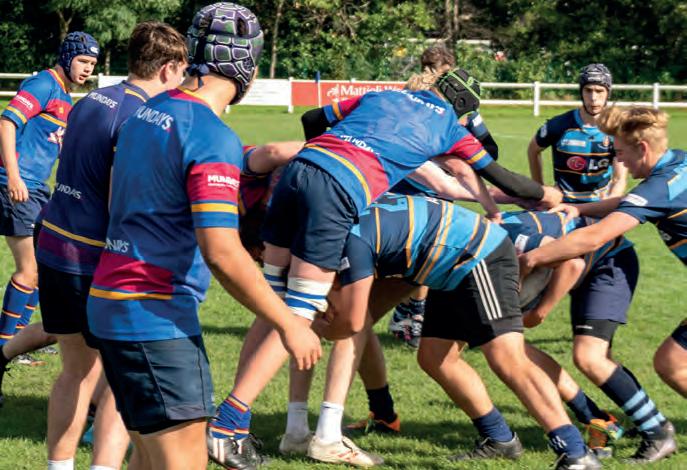
Rugby Football League, Rugby Football Union, The England and Wales Cricket Board, The R&A and the Lawn Tennis Association (jointly with the All England Lawn Tennis Club on behalf of The Championships, Wimbledon).
Chair of the Sports Broadcast Monitoring Committee, Nick Humby, said: “I am pleased to announce that we have seen yet another increase to the record levels of investment into grassroots sports by signatories to the Voluntary Code on Broadcasting.”
Sport England has announced plans to restructure its leadership team as part of plans to “maximise the organisation’s impact and effectiveness” over the coming years.
Two of the organisation’s existing executive directors will be given new roles to “focus on delivering Sport England’s upcoming new operational
plan”. Lisa Dodd-Mayne becomes Executive Director, Partnerships and Place, while Phil Smith becomes Executive Director, Sporting System.
In her new role Dodd-Mayne will be responsible for leading the relationships with all Sport England’s partners at both national and regional level.
The UK government will invest an additional £85m into improving community sport facilities across England, Scotland, Wales and Northern Ireland.
To be distributed in 2026-27, the funding will see nearly 1,000 projects benefit from new multisport pitches, floodlighting, fencing and upgraded changing facilities. Of the funding, £68.4m will be invested into grassroots football facilities through the Football Foundation.
The investment will also seek to deliver priority use time slots for women and girls teams at funded sites.
The announcement was made by Culture Secretary, Lisa Nandy. “Every pound we invest in grassroots facilities is a pound that takes pressure off our NHS, supports mental and physical health and opens doors for new community members to benefit from sport –
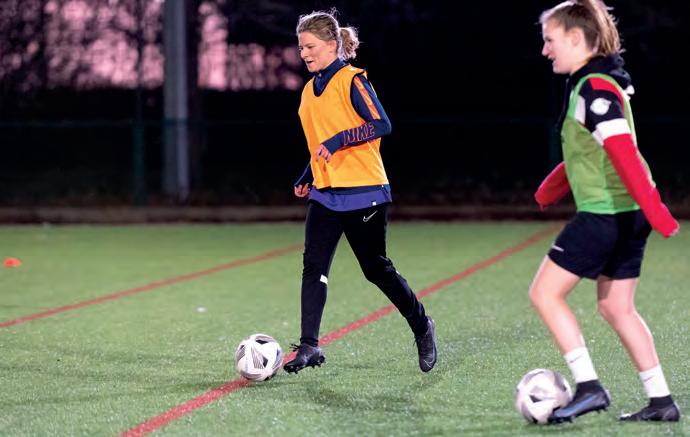
The investment in 3G pitches will also seek to deliver priority use time slots for women and girls
like women and girls who’ve been shut out for too long,” Nandy said.
“We’re supporting communities that have made do with rundown pitches and crumbling changing rooms for years. This government is turning that around – building the facilities that get
people active, bring communities together, and nurture the next generation of sporting talent.”
The announcement is the latest part of the government’s £400m boost for grassroots sport facilities announced by the Government in June 2025.
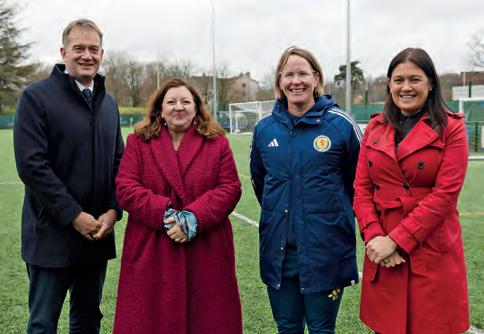
The Scottish FA will invest £8.14m in 36 grassroots football and community sport facilities, after securing the additional funding from the DCMS. The 36 projects include several 3G pitches, floodlighting and changing facilities across the country.
The announcement was made as Culture Secretary Lisa Nandy visited East Kilbride United Community Sports Club, which received £310,000 for a new 3G pitch and changing pavilion at Kirktonholme.
Scottish FA President Mike Mulraney said: “This latest funding announcement will enable us to further invest in the infrastructure of our national sport, which I have made my number one priority as President. “It will allow us to reinforce the Power of Football by increasing participation among all ages and abilities, and improving health and wellbeing as a result.”







In an industry where cost is often the focus, Active IQ stands apart by delivering more - more quality, more support, more value. We know that price matters, but when it comes to qualifications, reliability, and long-term success, quality is non-negotiable. That’s why we offer:
Industry-leading qualifications – Designed with employers to meet workforce demands



Comprehensive support – A dedicated team invested in your success
Added value – Free CPD, FitPro membership with eLearning purchases, and extra resources at no cost
A trusted partner – Transparent pricing, no hidden fees, and a gold-standard reputation.


Why settle for less?
Begin with better. Choose Active IQ. Find out more
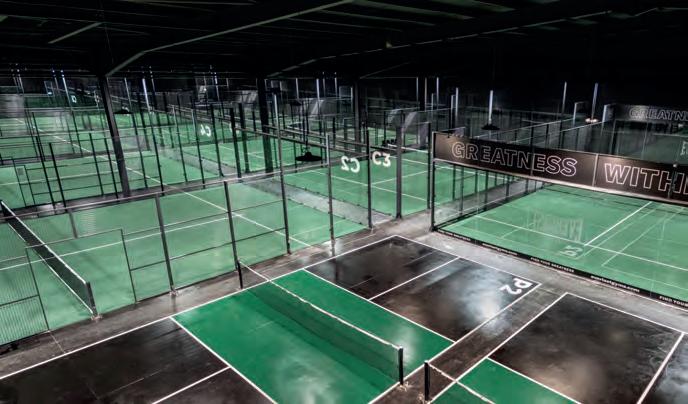
Slazenger has announced ambitious plans to grow its presence and become “the leading name on the UK padel market”, with more than 10 new Padel Clubs set to open in 2026. This would bring the total number of courts in its portfolio of clubs to 150.
Slazenger Padel Clubs opened its third location in Blackburn, a multi-purpose destination in February (2026). The 30,000 sq.ft club features nine panoramic padel courts, expert coaching for all levels, a Members Bar, social spaces, pro shop, equipment hire and, for the first time within the Slazenger Padel portfolio, two dedicated pickleball courts.
In addition, Slazenger operates clubs in Leeds and Swindon. Confirmed future locations include Mansfield, Cardiff, Exeter, Hull, Liverpool, Newport, York, Gillingham and a second site in Leeds.
Slazenger Padel Clubs is owned by Frasers Group, the retail giant which also owns Sports Direct, House of Frasers, Flannels and Game chains of outlets. In addition, Frasers Group also owns the Everlast Gyms chain and a number of branded apparel lines,
including Everlast and Jack Wills. A Slazenger Padel spokesperson told PadelNation that the company’s plan is to be a “leading force shaping the future of padel in the UK”.
“Padel has experienced an incredible trajectory over the past few years,” they said.
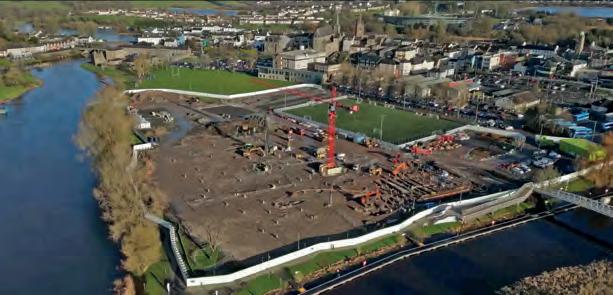
Work on delivering Ireland’s first Passivhaus-certified leisure centre has reached a significant milestone with the completion of early-stage construction.
The £70m Fermanagh Lakeland Forum project in Enniskillen, Ireland, will now move into the important stage of below ground works, which includes drainage and foundation installation. Work is also advancing beyond the main building footprint, with belowground operations ongoing for the new car park and access road infrastructure. When complete in 2028, the new centre will feature swimming pools, a gym and fitness suite, community wellbeing spaces, a sensory room, soft play and café. An extensive range of outdoor facilities including a destination play park, pump track, 3G pitch, active waterfront and walking and cycling trails is also planned.
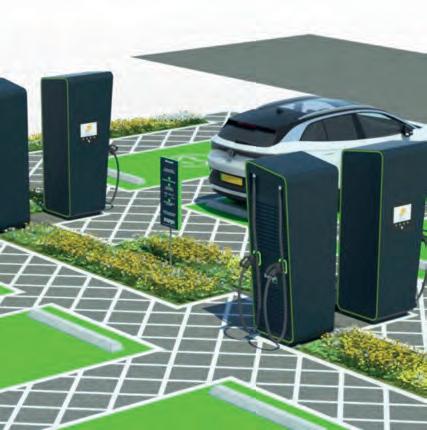




The new fund will support the development of a wide mix of facility types
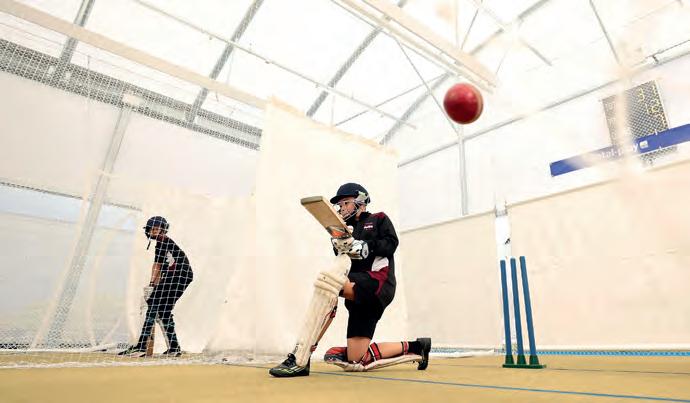
An additional £45m of money from investment into The Hundred teams will fund new and improved grassroots facilities as part of a major cash injection into recreational cricket.
The new Strategic Facilities Fund, announced by the England and Wales Cricket Board (ECB), will be targeted at projects across England and Wales which benefit women and girls, disabled participants, lower socio-economic groups or ethnically diverse communities as part of making cricket the most inclusive team sport.
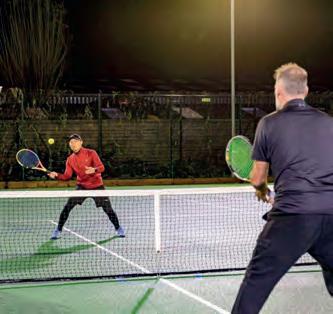
It is expected to support the development and creation of a wide mix of facility types and is aimed at strategic projects such as cricket domes, indoor halls, multi-use games areas, non-turf facilities, upgrades to community cricket venues or hybrid community sport hubs.
The £45m Fund is being established using the recreational game’s 10% share of proceeds from investment into The Hundred teams.
• To read a detailed article on the ECB’s plans to create indoor facilities, turn to page 52.
England Squash has announced SAPCA member, Dynamik Sport, as its new Official Court Provider and Court Maintenance Partner, boosting the support available to squash facilities across the game.
The collaboration marks an important step in enhancing the quality, consistency and longevity of squash courts across England. It reflects a shared commitment to ensuring clubs, leisure centres and facilities can access trusted expertise and reliable longterm support. As part of the partnership, England Squash affiliated clubs will benefit from exclusive discounts on Dynamik products and services – offering valuable support to venues looking to upgrade, refurbish or maintain their courts.
Craig Jack, Managing Director at Dynamik, said: “Supporting members, clubs and leisure facilities with new squash court projects, or by providing reliable, cost-effective aftercare and maintenance services, is key to the growth of squash nationwide.”
Linford Christie outdoor centre gets £1.3m upgrade
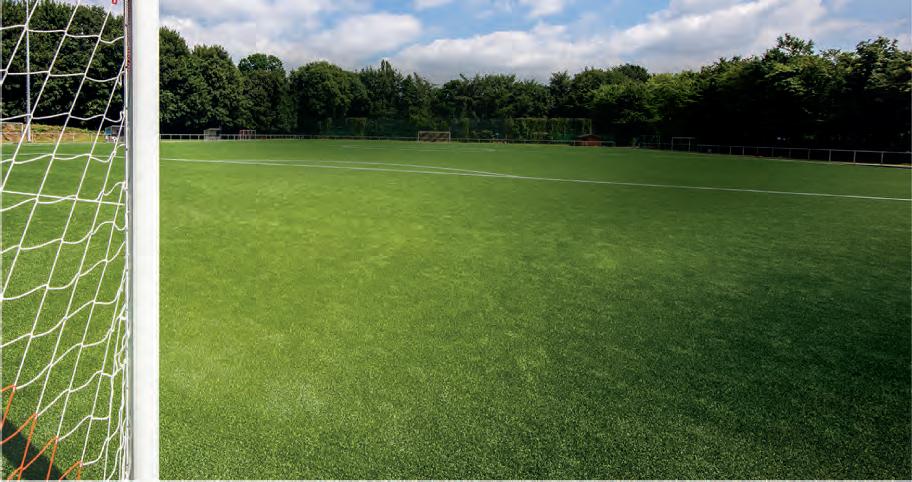
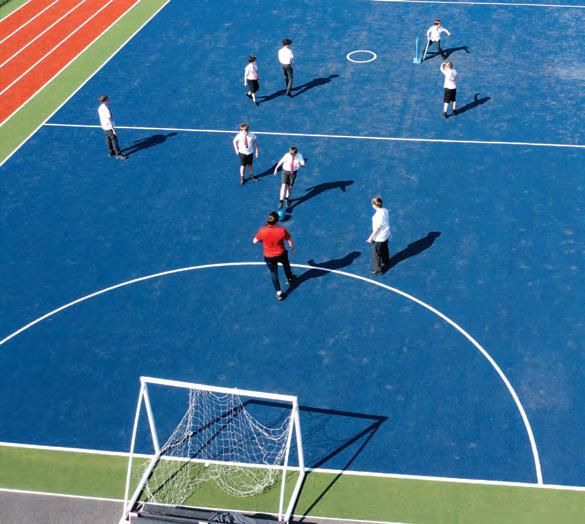
The Linford Christie Outdoor Sports Centre in Wormwood Scrubs, London, has undergone a £1.3m redevelopment project.
The project has resulted in two new seven-a-side pitches, three courts for tennis or netball and improved floodlighting at the site. Hammersmith & Fulham
Council, which owns the facility, worked with Wormwood Scrubs Charitable Trust and Kensington Dragons FC on funding the works. Alex Sanderson, Deputy Leader of Hammersmith & Fulham Council, said: “This is a brilliant upgrade for the Scrubs and for everyone who uses it.

























Ambitious plans have been submitted for a “once-in-ageneration redevelopment” of Crystal Palace National Sports Centre in South London.
The transformative renovation of the historic facility will include a major refurbishment of the 50m swimming and diving pools, improvements to the indoor facilities, new external pitches and the redevelopment of the athletics stadium.
Architects FaulknerBrowns are working in collaboration with Morgan Sindall on the plans, which will see the regeneration of the 15-hectare site. The venue is owned by the Greater London Authority (GLA) and operated by GLL.
Among the key aspects of the proposed work include a full refurbishment of the Grade II*-listed Crystal Palace National Sports Centre building, the creation of a six-court Padel centre, 3x3 basketball courts,
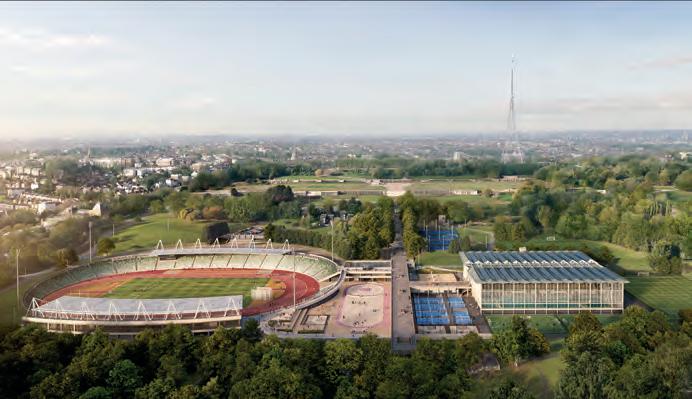
The project will see the regeneration of the historic 15-hectare site
five-a-side football pitches and a full-size artificial multi-sports pitch.
Sustainability is at the heart of the project, with the new design targeting a 97 per cent reduction in carbon emissions through sustainable construction choices, such as adding photovoltaic panels to the centre’s
roof and using air source heat pumps to provide heating and cooling.
Commenting on the plans, Mayor of London, Sadiq Khan, said: “This is an historic and much-loved national sporting and community facility, where many UK sporting stars have started their careers.”
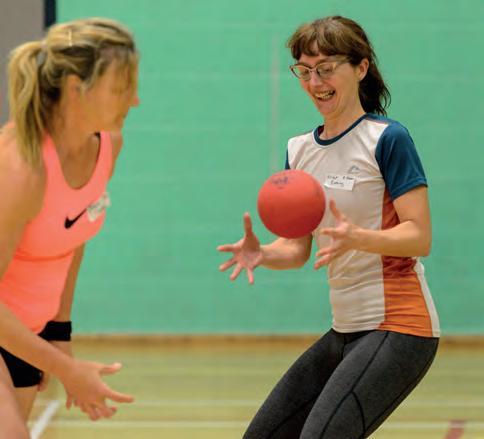
The programme is designed to help local organisations deliver “more of what they know works in their place”
Sport England will continue to roll out its £25m programme of place-based funding to help tackle inequality and inactivity through physical activity. The investment, part of its Place Universal Offer, is designed to help local organisations deliver “more of what they know works in their place”.
Running until 2028, the programme will encourage organisations to work more collaboratively in areas where people face the biggest barriers to being active. The support includes tools, resources, learning and capability for all places in England, but which is scaled and proportionate to the level of local need and disadvantage.
“We’re giving places full trust and autonomy to direct their resources based on local insight, need and readiness,” Sport England said.
Leisure DB’s Monthly Market Tracker lets you quickly identify and respond to new opportunities in the market and on your doorstep.
Each month, we round up key developments in the UK gym market: openings and closures, planning updates, proposed expansions, rebrands, management changes and more. Keep your finger on the pulse and your business one step ahead.
Find out more and download a free sample report: leisuredb.com/market-tracker

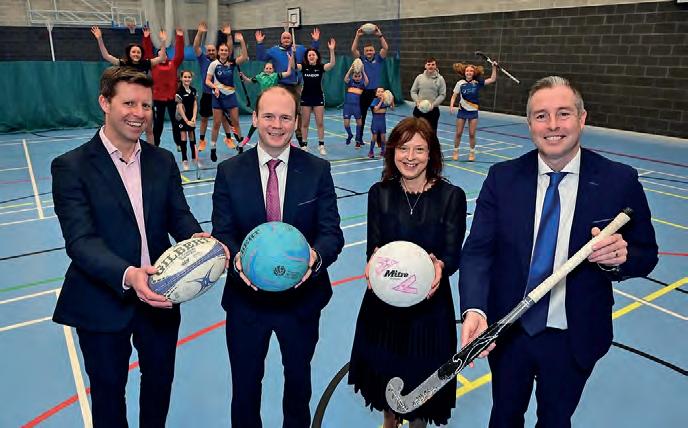
The programme helps schools upgrade or adapt their pitches, halls and other sports spaces
The Northern Ireland government has announced increased investment of £3m in the Your School Your Club (YSYC) programme.
YSYC is a Department for Communities funded initiative, delivered in partnership between Sport NI and the Education Authority, that opens up school sports facilities for use by local communities and sports clubs outside of normal school hours.
The programme helps schools upgrade or adapt their pitches, halls and other sports spaces
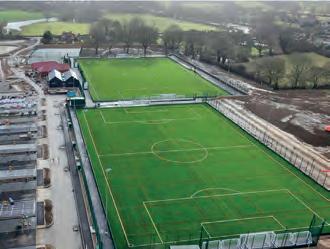

so they can be safely and effectively shared, increasing access to quality facilities and supporting greater participation in sport across Northern Ireland. The investment will enhance facilities at eight local schools, expanding capacity for local clubs and community organisations to access high-quality sports facilities.
This year’s investment will enable installation of either floodlights or artificial grass pitches at the eight participating schools.
Rushcliffe Borough Council (RBC) has agreed to provide a £400,000 funding boost to improve football facilities in the Borough. The grant will support the development and long-term sustainability of new 3G pitches and associated facilities, including changing rooms and pavilion upgrades.
The Football Foundation’s Local Football Facility Plan (LFFP), published in 2025, identifies eight priority projects in the region. The sites associated with the projects will be invited to apply for the new funding from April 1.
The eight areas are Bingham, Cotgrave, East Leake, Keyworth, Radcliffe on Trent, Ruddington and West Bridgford.
RBC’s portfolio holder for Leisure and Wellbeing, Jonathan Wheeler, said: “This funding will help us deliver strategic projects that strengthen local facilities and benefit communities across the Borough. “This grant will help us continue to deliver high-quality sports facilities across Rushcliffe.”
Work on the Wealden Community Sports Hub near Hailsham, East Sussex, has reached a milestone, with the completion of two floodlit, FIFA Quality 3G football pitches. One of the pitches is 106 x 70m in size, featuring a spectator standing area, while the other is 97 x 61m. Both pitches are suitable for 11 aside and smaller sided
games. The pitches were supplied by SAPCA member, Lano Sports. Elsewhere, the main structure of the padel court is also now complete, with the final touches being planned for April.
Owned by Wealden District Council, the site is operated on behalf of the council by Leisure United.
From viral workouts to dramatic diet ‘hacks’, social media has become one of the most powerful influences on how people approach their health and fitness. But as the volume of content grows, so too do concerns about its credibility, accuracy and the potential consequences.
A recent study has found that almost 90% of fitness and nutrition influencers on social media platforms, such as TikTok and Instagram, fail to sufficiently sign post potential risks behind the advice they share. This lack of transparency is fuelling the spread of misleading and potentially harmful information, often presented as quick fixes or life-changing transformations.
The scale of the problem is significant. Recent research into so-called fitspiration videos on TikTok found that most diet and exercise content is either misleading, inaccurate or promotes an unbalanced view of health. In many cases, influencers with no recognised training are presenting complex physiological advice to millions of users, with no accountability, safeguards or evidence base.

In response, leading awarding organisation for the physical activity sector, Active IQ, has launched a new industry-wide initiative called Trust Your Trainer. At the heart of the campaign is a manifesto urging social media companies to take greater responsibility for the role they play in shaping public health behaviours.






Active IQ’s manifesto challenges this status quo by proposing a simple but powerful solution: a digital trust mark. This would allow users to clearly identify whether the person giving fitness advice holds a professional qualification. In an environment where anyone can position themselves as an ‘expert’, the trust mark aims to restore clarity, credibility and consumer confidence.

The initiative has already gained strong momentum across the sector, supported by industry leaders such as Active IQ Consultant and ukactive Chair David Stalker, who brings more than 35 years of experience in the physical activity industry. His backing reflects growing






Trust Your Trainer is a vital step for our industry, helping to ensure anyone seeking guidance can have confidence in the expertise behind it, not just the number of followers
concern among operators, trainers, and educators who see first-hand the impact of misinformation on clients’ physical and mental wellbeing.
Championing the campaign is Robyn Drummond, personal trainer, who has experienced first-hand how much harm misinformation can cause.
Robyn says: “Early in my career I learned just how damaging misleading online fitness advice can be. After following advice from influencers without proper qualifications, I developed a severe eating disorder, and saw first-hand how easily people can be misled. Trust Your Trainer is a vital step for our industry, helping to ensure anyone seeking guidance can have confidence in the expertise behind it, not just the number of followers.”

Robyn Drummond is a PT who has experienced first-hand how much harm misinformation can cause
regulated training pathways and professional standards. It also offers a potential turning point in how digital fitness content is regulated, moving the conversation from popularity to professionalism.
The message is not about silencing social media, but about making it safer and more transparent.
For health club operators and fitness professionals, the campaign strikes at a critical issue. Members increasingly arrive with expectations shaped by social media trends, from extreme training regimes to unproven supplements. This can place professionals in the difficult position of having to unlearn harmful advice before meaningful progress can begin. By championing qualified expertise, the Trust Your Trainer campaign reinforces the value of
In a world where algorithms often reward the loudest voices rather than the most informed, Active IQ’s call for a trust mark represents a practical step towards protecting consumers and strengthening the long-term credibility of the fitness industry.
As public reliance on online health content continues to grow, one thing is becoming clear. When it comes to fitness advice, expertise should matter more than followers. The future of digital wellbeing may well depend on learning to trust the trainer, not the trend.
● https://activeiq.co.uk/trust-your-trainer
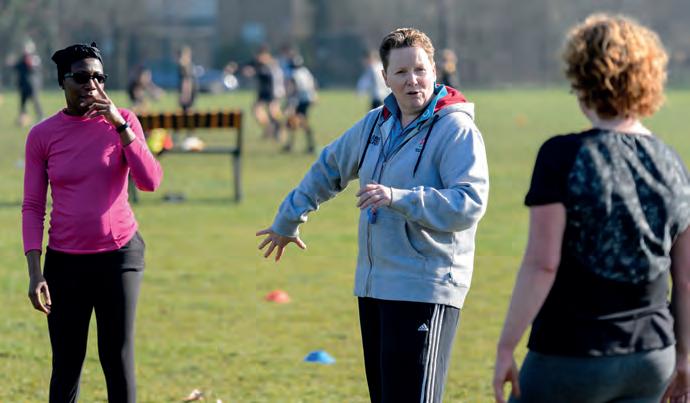
Sports coaching in the UK has been described as a “hostile environment for women”, after research showed that twice as many female coaches have experienced bullying when compared to men.
The report, Reimagining Sport Coaching: Designing a System That Works for Women, is one of the most in–depth studies of its kind into the experiences of coaches in the UK. Conducted in partnership by Women in Sport and Leeds Beckett University, the research surveyed 2,000 coaches, alongside senior leaders in sport.
It showed that, across all coaching roles from grassroots to elite, nearly a third (30%) of women report experiencing bullying, compared with 15% of men. Women also report higher levels of harassment (21% vs 12% of men) and aggression or violence (22% vs 19% of men). Among women coaching at grassroots level, 26% report bullying, compared with
38% in talent pathway roles and 46% in high performance environments.
Men report consistently lower levels across all domains (10% grassroots; 26% talent pathway; 24% high performance). For women, authority brings risk rather than protection, creating conditions
that make long term participation increasingly difficult to sustain.
Worryingly, the perpetrators of harassment of women coaches – which is often sexualised – are mostly fellow coaches, suggesting hierarchical, male dominated environments.
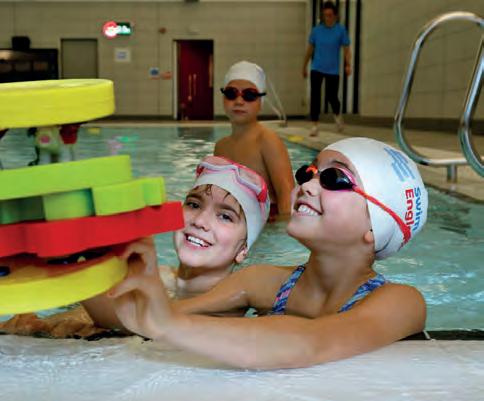
Swim England has signed a strategic partnership with Neurodiverse Sport (NdS), which is designed to strengthen neuro‑inclusive practice across aquatics.
Through a two‑year, test‑and‑learn programme, Swim England and NdS will explore and pilot context‑specific approaches to neuro‑inclusion within aquatic settings. Informed by both lived experience and research, the partnership builds on the NdS and Sport England Blueprint to Neuro‑Inclusion to deepen understanding of what works, for whom and why, across the participation and sport system.
The work recognises that neuro‑inclusive practice must respond to people, places and experiences, with approaches shaped by practitioner insight and the unique sensory, social and environmental contexts of aquatics.





Richard Shaw CEO, SAPCA
Over the past few weeks we have received several enquiries that quote AI as the reason why they have got in touch with SAPCA. These have been, mainly, from people and businesses who are looking to invest in padel, or looking to find details on how to build padel courts. During their research, they’ve asked AI for further information, which in turn has sent them our way for technical guidance and further advice. Maybe this development shouldn’t come as a surprise, given that the padel boom and the rise of AI have emerged roughly at the same time. There are, however, further links between AI and padel – and not all of them positive.
Look on LinkedIn for padel court importers and equipment suppliers and you will likely see plenty of AI-generated imagery. Some facility operators also use pictures created by AI to advertise their venues. We have also seen companies apply for SAPCA membership, using AI images to “showcase” their work. In short, the use of AI-generated visuals is widespread across the padel sector.
There are clear risks in this. Pictures created using AI can give a false expectation to those who see them – whether that is someone looking to invest in a padel court project or a player keen to find somewhere to play. When it comes to padel court installations, AI images can lure customers to trusting the competence of an “approved installer” – and often provide them with a false sense of what is possible.
A recent social media post showed a beautiful, canopied series of padel courts in an idyllic rural setting. Some of the comments below by fellow operators questioned, rightly, how the company had managed to achieve planning permission at such a location. The real answer is

If AI is smart enough to be pointing people in the direction of SAPCA, its members and its Codes of Practice, maybe it is showing real signs of intelligence after all
simple – you don’t need a planning permission for venues that only exist on servers.
At our SAPCA Conference last month, we heard from a range of experts offer their insights on what they think will shape their particular field within the wider sports and play sector. One of the things that true experts are often quick to acknowledge and make clear – and we heard this at the conference – is the limit of their expertise. True thought leaders recognise that any real expertise, however proven, still has its boundaries. True intelligence is knowing the limits of one’s knowledge. It is what has driven scientific breakthroughs for centuries.
Our Codes of Practice are written by experts across different fields within the industry to ensure that expertise across facilities is available to operators, commissioners and interested bodies free of charge and easily accessible. All anyone needs to access them is an email address. This is part of efforts to keep them out of the scope of current AI algorithms and search practices – so the information within them won’t appear in results, which could then be distorted or misinterpreted. The codes are the combination of countless hours given freely by SAPCA members and industry leaders, to help the sector continue to raise quality standards across the design, construction and maintenance of sports and play facilities. So, if AI is smart enough to be pointing people in the direction of SAPCA, its members and its Codes of Practice, maybe it is showing real signs of intelligence after all.











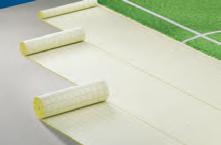



















Huw Edwards CEO, ukactive
Sport captures the nation’s attention like few other things. The Winter Olympics has provided us with escapism during a rather gloomy new year, with Team GB’s success in Milan-Cortina delivering the nation’s record gold medal haul.
Sport was also on the agenda in Davos-Klosters, which hosted the annual meeting of the World Economic Forum (WEF). This meeting focused on the economic value of sport, physical activity and movement and in its report, ‘Sport for People and Planet’, the WEF made the explicit case that sport – in this case including fitness, active travel and movement – must be recognised by governments as crucial economic infrastructure that supports consumer spend, jobs, growth, community health and social resilience. The report also warns that weakening foundations such as rising physical inactivity levels or climate risk, threaten not just sporting outcomes, but economic systems.
In the UK this is sadly no longer a threat, but a living reality and the UK is paying a major economic price for poor national health. Rising obesity, chronic disease and inactivity are not just public health problems but also productivity killers. Sick days, lower workplace performance and long-term workforce incapacity are eroding our economy. Every year, billions are lost while policymakers focus narrowly on healthcare costs instead of the root cause: preventable ill health. Youth unemployment figures are at a devastating 11-year high, while 39% of 16–24-year-olds are defined as economically inactive. Combined with record levels of long-term sickness, the UK has a generational crisis on its hands.
The measures for driving economic growth are, of course, multi-faceted, but not having a key sector on the pitch playing its full role is counterproductive. The Government can no longer afford to pigeonhole sport and physical activity as purely leisure pursuits. They are an economic engine. Gyms, pools, leisure centres, community sports programmes, school PE, and even elite sport pathways generate jobs, drive spend, reduce long-term NHS costs, and

Every year, billions are lost while policymakers focus narrowly on healthcare costs instead of the root cause: preventable ill health
improve workforce performance. Countries that treat physical activity as a system see tangible returns in health and economic resilience. The UK cannot afford to lag behind any longer.
The Government must urgently shift from reactive healthcare spending to a proactive economic strategy that fully leverages movement, placing our members and the industry at its core. For too long Government thinking has been outdated and lags behind where the both the public and the sector currently are. Physical activity should be embedded across departments: treasury, education, health, transport and business.
Our members are already making these connections, building programmes that incentivise activity, working with communities to refine their offer and training staff to provide consistent and sustainable services. Now the Government needs to bring in our sector so it can do even more to support economic growth.
Workplaces should be encouraged to incentivise activity, high street renewal plans must include physical activity as an integral sector, and communities need sustainable sport and leisure infrastructure. Public funding, private investment and tax incentives need to work together to create a virtuous cycle of health and productivity.
Failing to act risks a future where ill health further constrains our workforce, drives up public spending further and continues to weaken Britain’s economic competitiveness. Recognising sport and physical activity as economic systems, not optional extras, is not just smart policy but essential for a healthier, wealthier and more competitive nation.
The choice is stark: prioritise physical activity and movement or watch our economy continue to stumble.



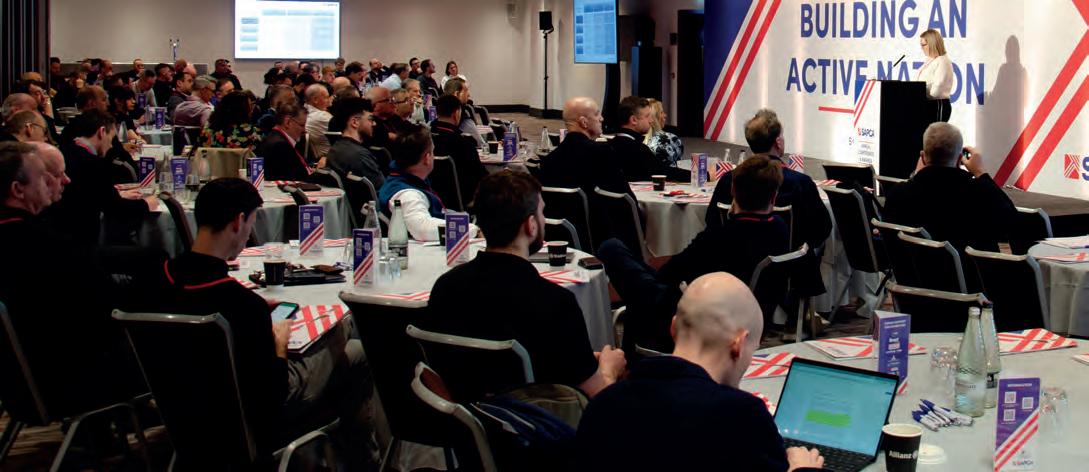
This year’s SAPCA Conference was a landmark one – the first one ever to be held in London
The SAPCA Annual Conference took place on Thursday 26 February 2026 at Allianz Stadium, Twickenham in London. The one-day event featured a range of high-profile speakers and a highly topical educational programme, as well as plenty of networking opportunities.
During the conference, SAPCA revealed its new three-year strategy. The strategy follows on from the previous three-year plan, launched in February 2022, which was built on four pillars (to be business-like, member-focused, to build a strong SAPCA community and to focus on building the SAPCA “brand” as one of quality and trust).
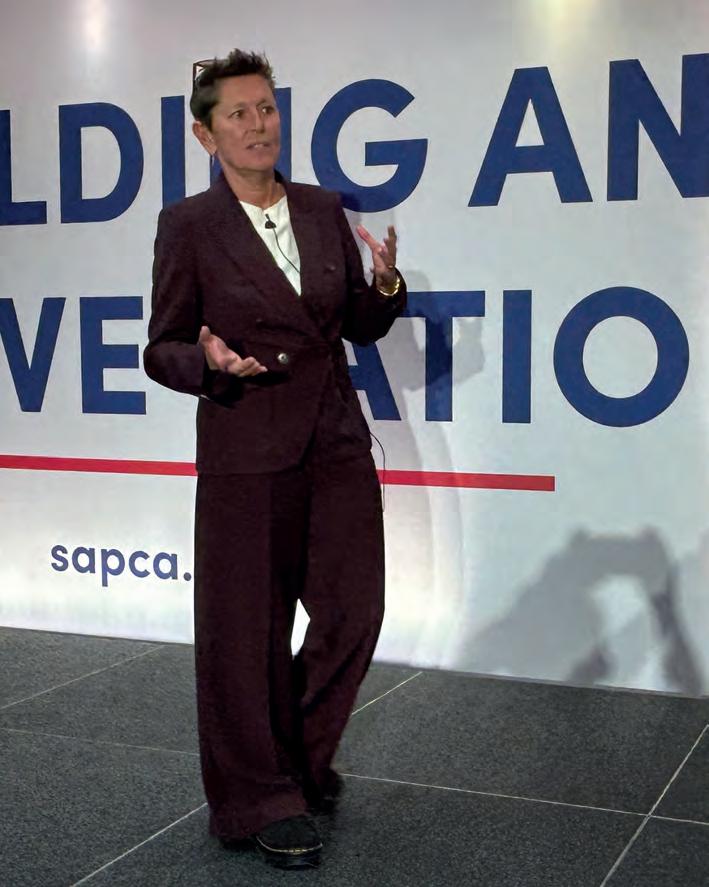
Announcing the new strategy, SAPCA Chair, Dr. Kathryn Severn, said the plan represents the next phase in the organisation’s development and aims to build on the foundations already established by its members. “It’s a strategy that defines how we’ll lead the wider conversation on sport and play, driving the agenda forward while building on what we’ve already done – and what we are doing so well,” Dr. Severn said.
At the heart of the strategy are four guiding principles. The first emphasises the collective strength of the SAPCA membership, recognising the combined expertise and credibility of member companies across the sector. Severn said the association will increasingly use its collective voice to influence decision-makers and deepen partnerships across sport.
“Our strength lies in our collective impact – the knowledge, experience and credibility of our members working together,” she said. “We’ll use that strength to influence the wider agenda of sport and play, engaging more closely with purchasers and showing them the true value of the sector.”
The second principle reinforces SAPCA’s role as a self-regulating professional body, committed to maintaining high industry standards and leading on key issues affecting the sector. “SAPCA will continue to set the benchmark for excellence,” Dr. Severn said. “And just as importantly, we need to be confident in upholding those standards, even when that means some tough conversations.”
A third priority is to shift the organisation’s mindset from custodianship to leadership, ensuring it takes a proactive role as the industry











evolves. “Our industry is changing rapidly,” she added. “We shouldn’t be bound by what has been done in the past – we should be directed by what the future demands.”
Finally, the strategy places members firmly at the centre of SAPCA’s work, with new measures to improve transparency and accountability, including the introduction of an independent annual member survey. “We are owned by –and working for – our members,” Dr. Severn said. “We want to build transparency and accountability into everything we do.”
Together, the four principles will continue to position SAPCA as the trusted, independent voice for the UK sport and play construction sector, while ensuring the association continues to champion quality, innovation and collaboration across the industry.
The impressive speaker line-up during the day included John Mitchell, Head coach of the World Cup-winning England Women’s rugby team; Tom Hewson, Technology Analyst from






the International Tennis Federation (ITF); Ian Redpath, Sport Lead from The Behaviouralist and Tara Dillon, CEO of CIMSPA.
In his keynote session, Mitchell outlined how creating a culture based on courage and selfgovernance – empowering players to become leaders – transformed England’s Red Roses into world champions. Culture was also at the heart of an inspirational talk by Dillon, who advocated for the creation of working environments that reflect those within it.
“Don’t try and copy the success of others – a truly supportive culture is something that people are proud of,” Dillon said. “It should be seen and felt when you step into it.”
There was also a panel session discussing the latest in the plans to develop an End-of-Life Synthetic Turf Treatment Protocol for the sports and play construction sector. The protocol will allow the industry and the UK sports governing bodies to formulate policies for the responsible disposal of synthetic sports surfaces and pitch systems.
The one-day conference was followed by the 2026 SAPCA Awards Dinner (to read more about the winners, turn to page 32).

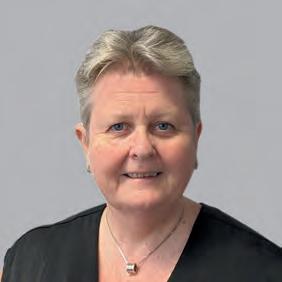
Lisa Wainwright MBE CEO, Sport and Recreation Alliance
It was a pleasure to welcome parliamentarians, national governing bodies and leaders from across the sport and recreation sector to Westminster earlier this month for the first-ever All-Sport All-Party Parliamentary Group (APPG) Reception. Hosted by the APPG for Sport and Physical Activity, for which the Sport and Recreation Alliance provides the secretariat, the event marked the first time multiple sport-related APPGs came together at a single reception to celebrate the vital role sport and physical activity play in communities across the United Kingdom. We were grateful to be joined by the Minister for Sport, the Chair of the Culture, Media and Sport Select Committee and dozens of Parliamentarians.
The Alliance represents a huge breadth of organisations across national governing bodies of sport, outdoor recreation and movement and dance, and many organisations from across the broader sport and recreation sector. Collectively, our members enable millions of people to take part in sport and recreation every week. Behind that participation is a dedicated workforce, alongside volunteers, trustees and community clubs who form the backbone of our sector.
Sport and recreation are also not optional extras. They are fundamental to the health, wellbeing and social fabric of our nation. Participation in sport reduces pressure on the NHS, strengthens community cohesion, builds skills and confidence in young people, and contributes a huge amount to the UK economy.
Events like the All-Sport APPG Reception are an important opportunity to reinforce these messages, the sector’s contribution and strengthen the relationship between Parliament and sport and recreation. I firmly believe that when Government, Parliament and the sector work together, aligning policy, funding and delivery, we can achieve meaningful outcomes for communities across the country.
The Government’s commitment of £400m
Sport
and recreation
are not optional extras. They are fundamental to the health, wellbeing and social fabric of our nation
for grassroots sport is a welcome investment that will help drive participation and support local clubs and facilities. However, it is also important that policymakers understand the challenges currently facing the sector.
One key issue is the potential removal of Sport England’s status as a statutory consultee in the planning system. While we recognise the need to accelerate housing development, we must also protect the places where people get active. Through our Protect Where We Play campaign, the Alliance is calling for Sport England to remain as a statutory consultee and for robust safeguards to ensure playing fields and community sports facilities are not lost to development.
At the same time, the sector is facing increasing financial and regulatory pressures. We continue to engage with decision-makers on issues such as Martyn’s Law, Care Quality Commission regulation, increased business rates and proposed changes to police charges for events, all of which stand to add more complexity and cost for sporting organisations.
It is vital that Government recognises the enormous economic and social value sport provides and ensures policy changes are proportionate and developed in consultation with the sector.
The message from the event was clear: the sport and recreation sector stands ready to work with policymakers to tackle some of the biggest challenges facing our nation. With sustained investment, strong partnerships and a shared ambition, we can ensure that the opportunity to participate in sport and physical activity is accessible to everyone, regardless of postcode or background.











TROCELLEN ProGame Shock Pads
DURABLE
Consistent performance – built to last. EN 15330-4 certified.
SAFE
Optimized impact protection, maximum safety.
ELASTIC
Outstanding resilience for top performance.
WEATHER-RESISTANT
Excellent drainage, temperature stability, water-repellent – no freezing.
SIMPLE
Quick and easy installation.
SUSTAINABLE
Reusable for multiple applications. 24 years warranty.




TROCELLEN GmbH | Mülheimer Straße 26 | 53840 Troisdorf +49 2241 2549 000 | progame@trocellen.com | progame-shockpads.com






The one-day conference will take place on Friday 9 October 2026 at The Slate, University of Warwick. The night before, on Thursday 8 October 2026, the same venue will also host the rst ever National Play Awards.
The conference will provide a unique national forum for everyone involved in creating, enabling and advocating for play, from designers, playworkers, contractors, manufacturers and local authorities to educators, playground operators and policymakers. Through a carefully curated programme of keynote addresses, panel debates and practical learning sessions, the event will explore the most pressing issues shaping play today and into the future.
Delegates will hear from an in uential speaker line-up, which includes policymakers, sector specialists from a range of industries and innovators connected to play.
For anyone working in, or alongside, the UK play sector, the National Play Conference will be an essential date in the diary.


https://sapca.org.uk/events/national-play-conference/



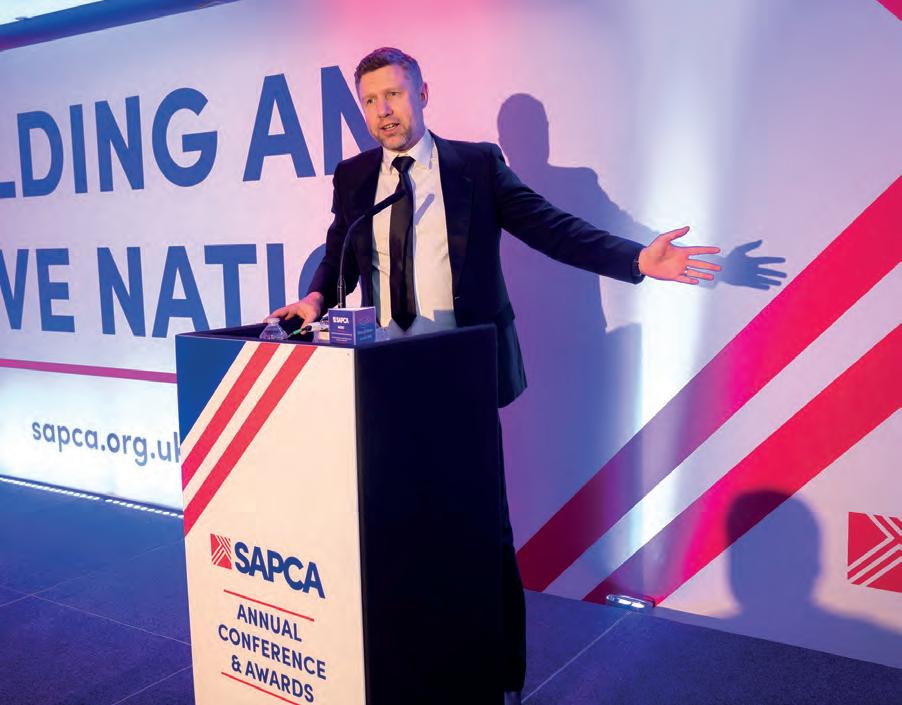
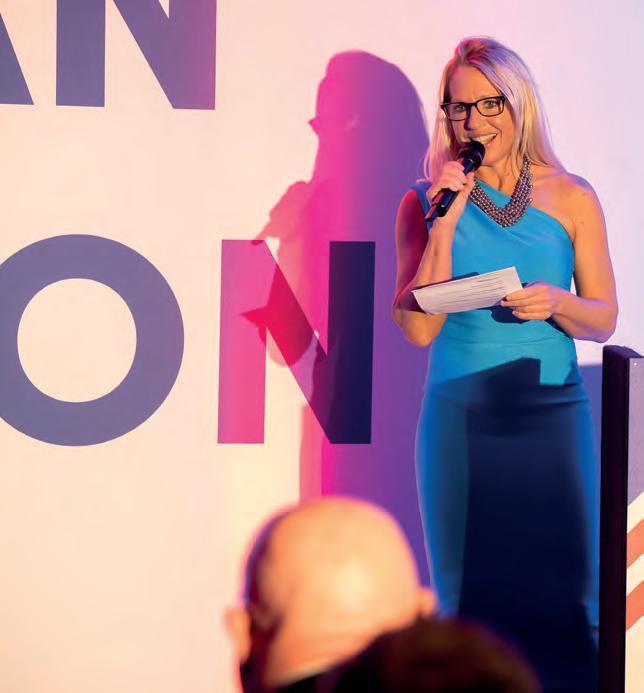

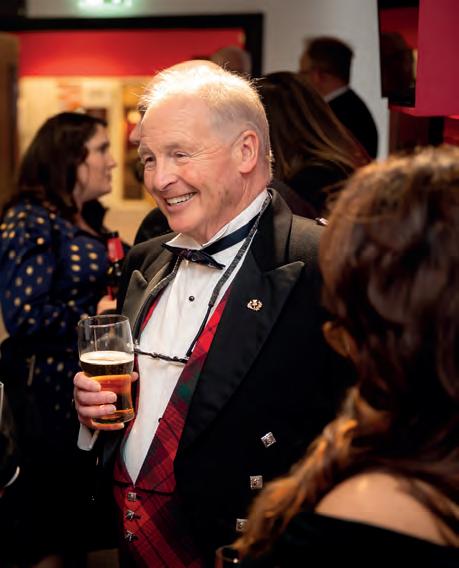

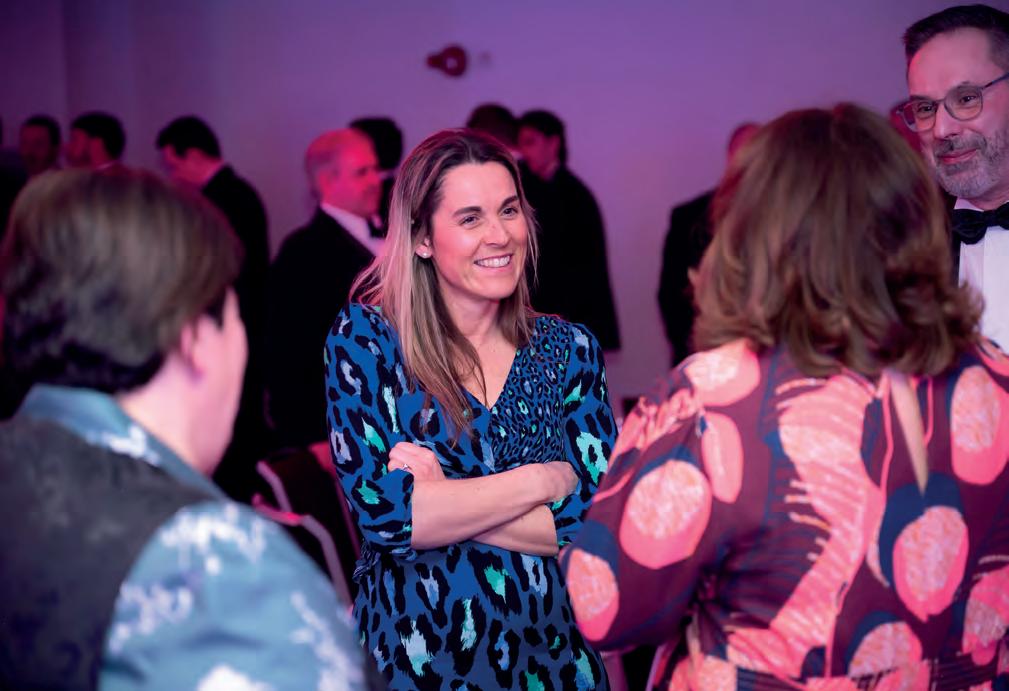
SportsNation takes in in-depth look at this year’s winners of the prestigious SAPCA Awards



The winners of the SAPCA Awards 2026 were announced at a gala dinner held at Allianz Stadium, Twickenham, in London in February. Now in their 11th year, the awards celebrate the achievements of members of the Sports and Play Construction Association (SAPCA).
In all, there were six category winners, picked from a huge number of of entries.
LARGE PROJECT
Winner – Smith Construction: Expansion of Bluecoats Sports at Christ’s Hospital School
Finalist – S&C Slatter (The Arc community sports hub in Burgess Hill, Sussex)
SMALL PROJECT
Winner – Blakedown Sport and Play: The iconic Brighton Beach Basketball Court
Finalist – Play Innovation (Creation of two community MUGAs in Westminster, London)
SUSTAINABILITY AWARD
Winner – Notts Sport: CocoTurf, the world’s first non-plastic artificial grass for play and sport
Finalist – Mapei UK (Mapecoat TNS
Race Track Zero, a resin made entirely from natural, renewable materials)
PRODUCT OF THE YEAR
Winner – EnviroStik: Eco-Fix, the first adhesive of its type to be produced from end-of-life synthetic grass
Finalist – Jupiter Play & Leisure (BoxUp, a modular, solar-powered equipment locker system)
PERSON OF THE YEAR
Winner – Tony Aitchison: Commercial
Director, Replay Maintenance
Finalist – Patrick Daly: Kingfisher Lighting
YOUNG PERSON OF THE YEAR
Winner – Liam Wilson: Operations Director, SurfTech
Finalist – Ewan McMullen: Chemique Adhesives
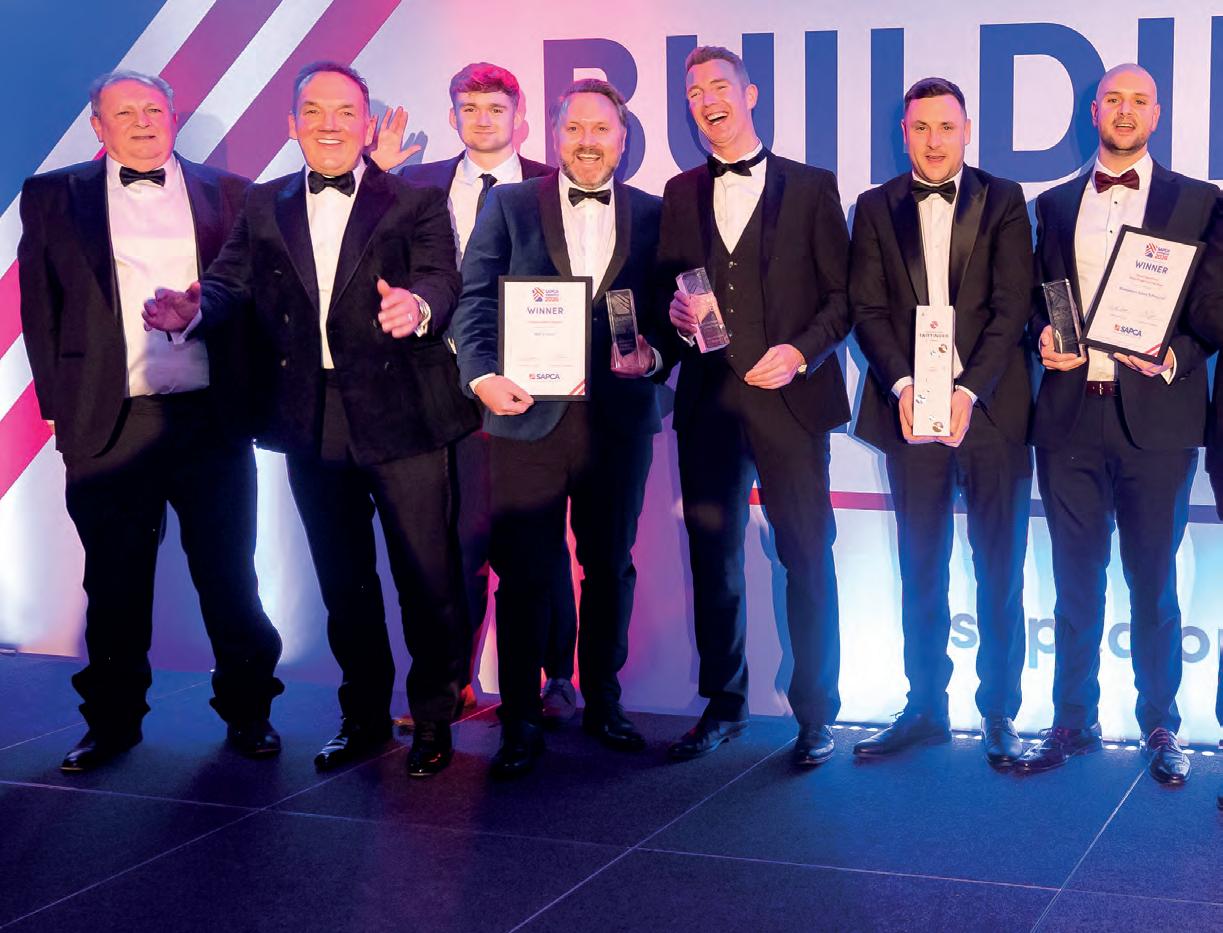
The strong field of entries again highlighted not only the quality and technical excellence of our members’ work, but their innovation too
The winners were chosen by a judging panel which featured a number of industry leaders, alongside SAPCA’s Technical Lead, Colin Corline, and members of the SAPCA board.
Colin Corline, SAPCA Technical Lead, added: “The six winners should be very proud of their achievements, as they have come on top in a very strong field. In both project categories, we received a number of entries which highlighted the amazing impact that the facilities created by SAPCA members make in communities across the UK. I want to thank all member
companies that submitted entries and huge congratulations again to the winners.”
SAPCA Chief Executive, Richard Shaw, added:
“Once again, choosing the winners was a difficult task and I want to thank all those who submitted entries for the SAPCA Awards 2026. The submissions we received showed a wide range of excellent projects and products. The strong field of entries again highlighted not only the quality and technical excellence of our members’ work, but their innovation too. Huge congratulations to all the winners and finalists.”

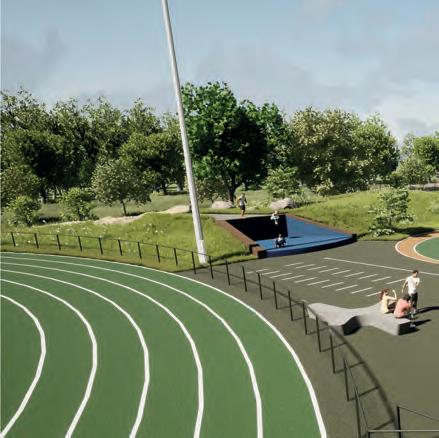
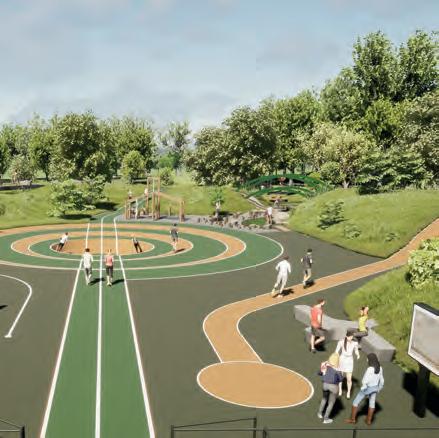

Large Project of the Year
Smith Construction
Expansion of Bluecoats Sports at Christ’s Hospital School
The £8 million project includes four panoramic Padel courts, a 400m six-lane athletics track with full field facilities, and the UK’s first “Get Active” outdoor exercise adventure trail, an imaginative and pioneering concept that promotes participation across all ages and abilities. Every aspect of the design has been delivered to the highest standard, creating
Small project of the Year Blakedown Sport and Play
Brighton Basketball court renovation
Brighton & Hove City Council, in partnership with the Hoopsfix Foundation, appointed Blakedown Sport & Play to refurbish the iconic Brighton Beach Basketball Court –one of the most recognisable outdoor basketball spaces in the UK. The £60,000 project included the expansion of the court footprint by 4m in length and 2m in width, removal of the existing surface, installation of a new highperformance sports surface designed for harsh coastal conditions (UV, salt exposure and wind), full FIBAcompliant setting out, and new competition-standard acrylic backboards, flex rims, posts and safety padding.
The project demonstrates how a relatively smallscale refurbishment can deliver exceptional technical quality, strong partnership working, cultural importance
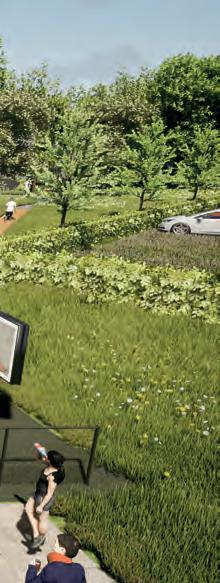
spaces that balance professional performance with accessibility, enjoyment, and social engagement.
The Bluecoats Sports expansion at Christ’s Hospital School is a flagship example of innovation, sustainability, and community impact in modern sports facility design. This transformative development has created a vibrant multi-sport hub that celebrates inclusivity, environmental responsibility, and active living. A genuine benchmark for excellence and a great example of what winning a SAPCA Award requires.
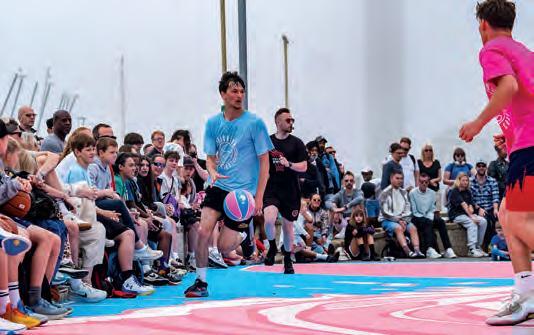
and national impact. The refurbishment of Brighton Beach Basketball Court has delivered strong social value by revitalising a free, highly accessible public sports facility in a prominent coastal location, ensuring long-term benefit for both residents and visitors.
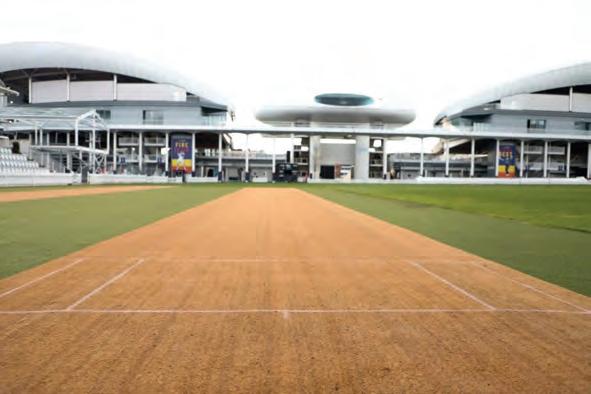
Sustainability award
Notts Sport
CocoTurf
CocoTurf is the world’s first non-plastic artificial grass for play and sport, made entirely from natural, renewable, and recyclable materials. Using fibres derived from coconut husks bonded with natural rubber latex, CocoTurf replaces petrochemical plastics and eliminates microplastic pollution. Every square metre reuses fibres from ten coconuts, transforming agricultural waste into durable play surfacing. Independent laboratory testing verifies its outstanding safety and performance. CocoTurf also has proven resilience, providing a sustainable, child friendly, high-performance alternative to synthetic grass – ideal for schools, playgrounds, and community sports facilities. CocoTurf showcases how performance and sustainability can coexist.
EnviroStik
Eco-Fix
Eco-Fix is the first adhesive of its type on the market to be produced from end-of-life synthetic grass carpets, making it a more environmentallyfriendly choice, but one which also gives a performance benefit. Its innovative recycled content formula meets or exceeds all standards of governing bodies, such as FIFA.


veteran, Tony is an experienced Tony


A respected sports turf sector veteran, Tony is an experienced leader with a wide range of skills across sports construction, contract management and business strategy. He has spent the past nine years at Replay, being a crucial part of the company’s growth. Prior to Replay, Tony became an influential member of the Charles Lawrence Surfaces team, first joining the company in 1994. Tony consistently promotes the benefits of SAPCA and has worked on a number of SAPCA working groups and is a consistent attendee at all SAPCA events.


SAPCA and has worked




The nature of the product is revolutionary, since it converts synthetic grass into a high-performance adhesive that helps reduce waste and meets green targets, while proving that performance and environmental responsibility can go together.
EnviroStik estimates that, based on the average-sized football pitch, Eco-Fix eliminates a minimum of 5 million microplastic particles from polluting ecosystems. It is suitable for all synthetic grass sport surfaces, while EcoFix Leisure is designed for landscaping applications.


Liam joined Surftech in 2019 when it obtained its first manufacturing unit in Stanton, Bury St Edmunds. At the time, Surftech supplied around 200,000sq m of surfacing products into the sport and leisure market. In his six years at Surftech, Liam has overseen the growth in production and operations helping the company to the point where it now supplies more than 1 million sq m of product per year. In 2024, Liam succeeded in creating the systems required for application for ISO 9001 certification – an incredible achievement as he had no previous experience with ISO 9001. In 2024, his hard work and dedication was rewarded when he was made operations director at the age of 27.

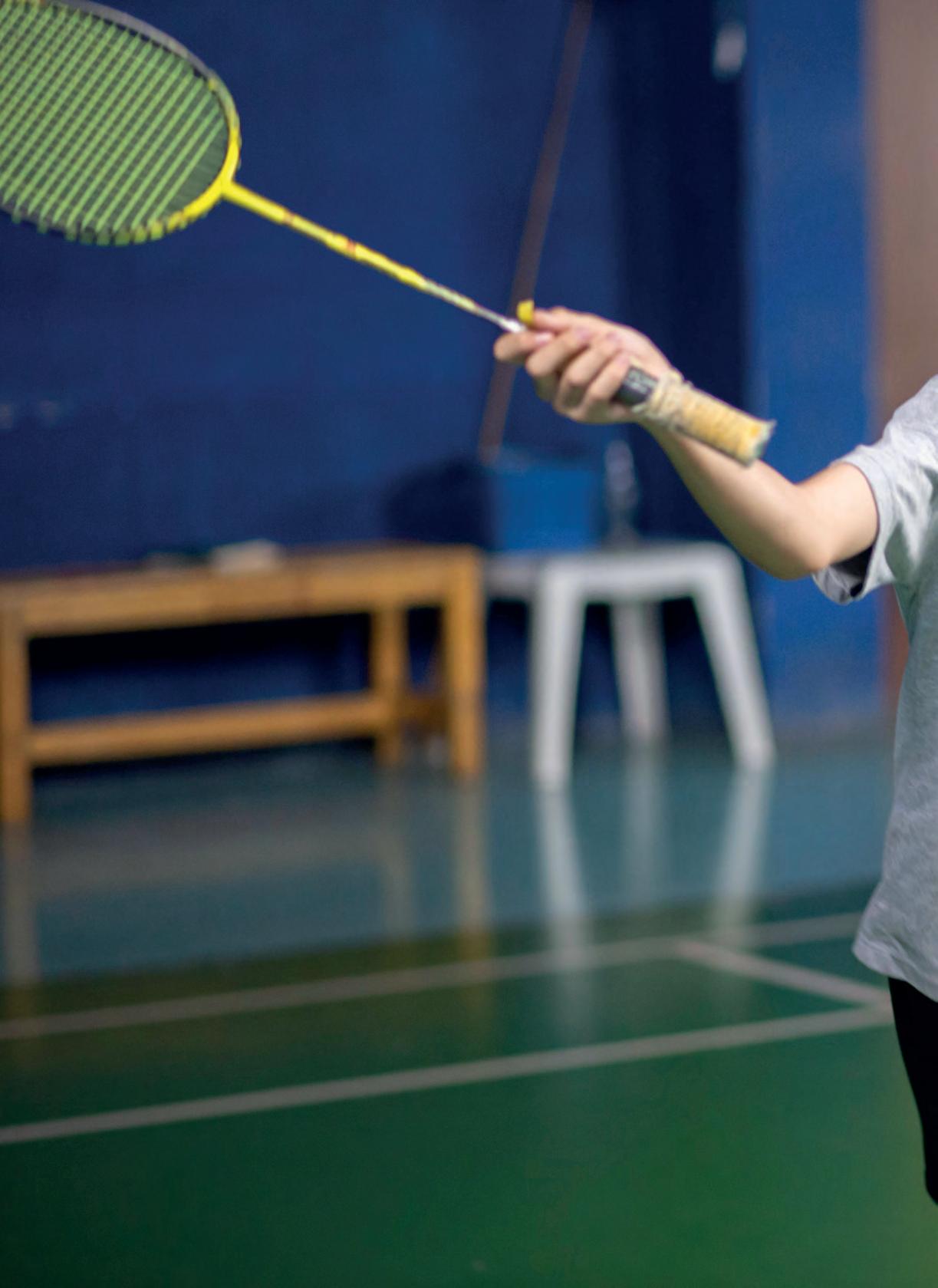
Badminton England’s strategy, launched in September 2023, is now a quarter of its way in.
SportsNation looks in detail at the plans outlined in the 10-year blueprint and the progress made since launch

adminton has long been one of England’s most accessible racket sports.
Played in school sports halls, leisure centres and community venues across the country, most people have experienced the sport at some point of their life.
Yet, accessibility alone does not guarantee long-term growth. Like many governing bodies, Badminton England has spent considerable time and effort on coming up with ways to convert the sport’s large casual player base into an engaged and sustainable community.
The launch of Badminton England’s 10-year strategy in September 2023, titled Badminton – A Sport for Everyone, is aimed at growing
the sport at every level. Now, approaching the mid-point of its early implementation phase, the strategy is beginning to shape how the sport develops across England.
At the heart of Badminton England’s long-term vision is a clear ambition: to make badminton the most inclusive and accessible sport in England. The strategy is built around two overarching priorities – engaging more young people and ensuring the sport is open, welcoming and inclusive to participants from every background.
“The new strategy is unashamedly focused on young people and inclusivity,” says Sue Storey, CEO of Badminton England. “We want everyone to pick up a racket and hit a shuttle,

Sue Storey, CEO of Badminton England

regardless of their gender, ethnicity, disability, sexual orientation, background or circumstances, proud to be part of a thriving community and develop a lifelong passion for our sport.”
The governing body believes the sport is uniquely positioned to deliver on that vision. Badminton can be played competitively or socially, by people of all ages, and in venues that already exist in most communities.
The challenge lies in connecting the national governing body with the large number of players who participate informally. Badminton England estimates that around one million people in the UK play badminton each year, yet only around 150,000 participants are currently connected to the governing body’s systems and programmes. Bridging that gap remains one of the organisation’s most important tasks.
The strategy itself is structured around five pillars:
PLACES – ensuring that courts and facilities remain available and accessible
THRIVE – building strong local badminton communities
DEVELOP – supporting coaches, volunteers and player pathways
PERFORM – strengthening elite and high-performance systems



Together, these pillars form the framework through which Badminton England intends to grow participation and performance simultaneously. The approach recognises that a healthy grassroots system and a successful elite programme are closely linked.
The “places” pillar is all about ensuring the sport has the facilities it needs. The strategy outlines a mission to protect and open places to play the sport. Badminton England says this will be achieved through a combination of creating more courts and redeveloping ageing/underused ones.
The main goal, however, is to ensure that there are more courts available in areas where they are needed through high demand, to ensure that the growing badminton community is catered for.
“In most areas of the country there is a supply/ demand issue with more courts being repurposed or no longer safe for use,” Badminton England says. “This is resulting in our community finding it harder to locate affordable, good quality courts.”


INSPIRE – growing participation and inspiring new players NGB,
marked in the country in a variety of schools,


According to the NGB, there are currently just under 24,000 courts in operation across the country – but not all are open or bookable for badminton. The figure is the number of courts marked in the country in a variety of schools, leisure, public and community buildings.
When it comes to investing in new facilities, however, Badminton England is looking for help. “We do not currently have any funding available and this is something that we would like to work with external funders to change,” the NGB says.
















Recent participation data suggests the sport is growing. According to Sport England’s Active Lives Survey, more than 800,000 adults in England play badminton regularly, with participation levels rising modestly since the early 2020s.
This growth reflects badminton’s position as a sport that is both affordable and easy to access, particularly compared with activities that require specialist venues or expensive equipment.
Badminton England has also reported gradual increases in membership and engagement through its digital platforms and club network.
While still short of the governing body’s long-term ambition of 250,000 active and registered participants by the end of 2026, the upward trend suggests that its engagement strategy is beginning to gain traction.

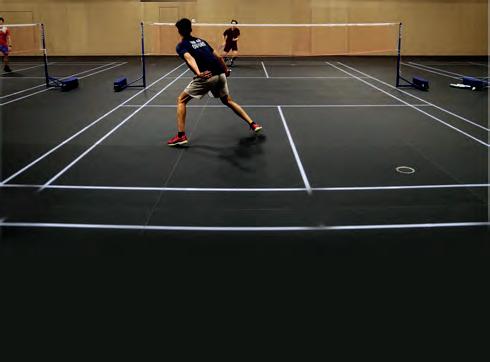
Facilities remain one of the most significant challenges facing badminton. Badminton England estimates that 23,848 badminton courts exist across England in around 7,555 facilities, including schools, leisure centres and community buildings.
However, not all of these courts are available to the public or easily bookable. The governing body has therefore prioritised protecting existing courts while improving access through digital tools and partnerships with leisure operators.
One initiative currently under development is a national database of badminton courts, designed to allow players to quickly find and book available venues. By linking facility data directly to Badminton England’s digital platforms, the governing body hopes to remove one of the most common barriers to participation: simply finding somewhere to play.
At the same time, the organisation continues to advocate for the protection of indoor sports facilities, particularly at a time when leisure centres face financial pressure.
Participation programmes remain central to Badminton England’s growth strategy.
One
Sessions are delivered through leisure centres and community venues, offering a flexible alternative to traditional club membership. The programme has proven particularly successful at attracting adults who want to play badminton recreationally rather than competitively.


One of the most established initiatives is No Strings Badminton, a pay-and-play programme designed to introduce new participants to the sport in a relaxed, social environment.



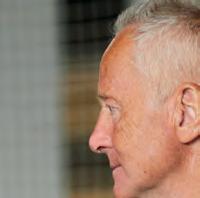
More recently, the governing body has launched Shuttle Stars, a junior participation programme aimed at introducing children, aged seven to 11, to the game. The initiative focuses on fun, skillbased activities designed to introduce young players to the sport before they progress into clubs or school teams. By creating a clear entry point for children, Badminton England hopes to strengthen the pipeline of young players entering the sport.

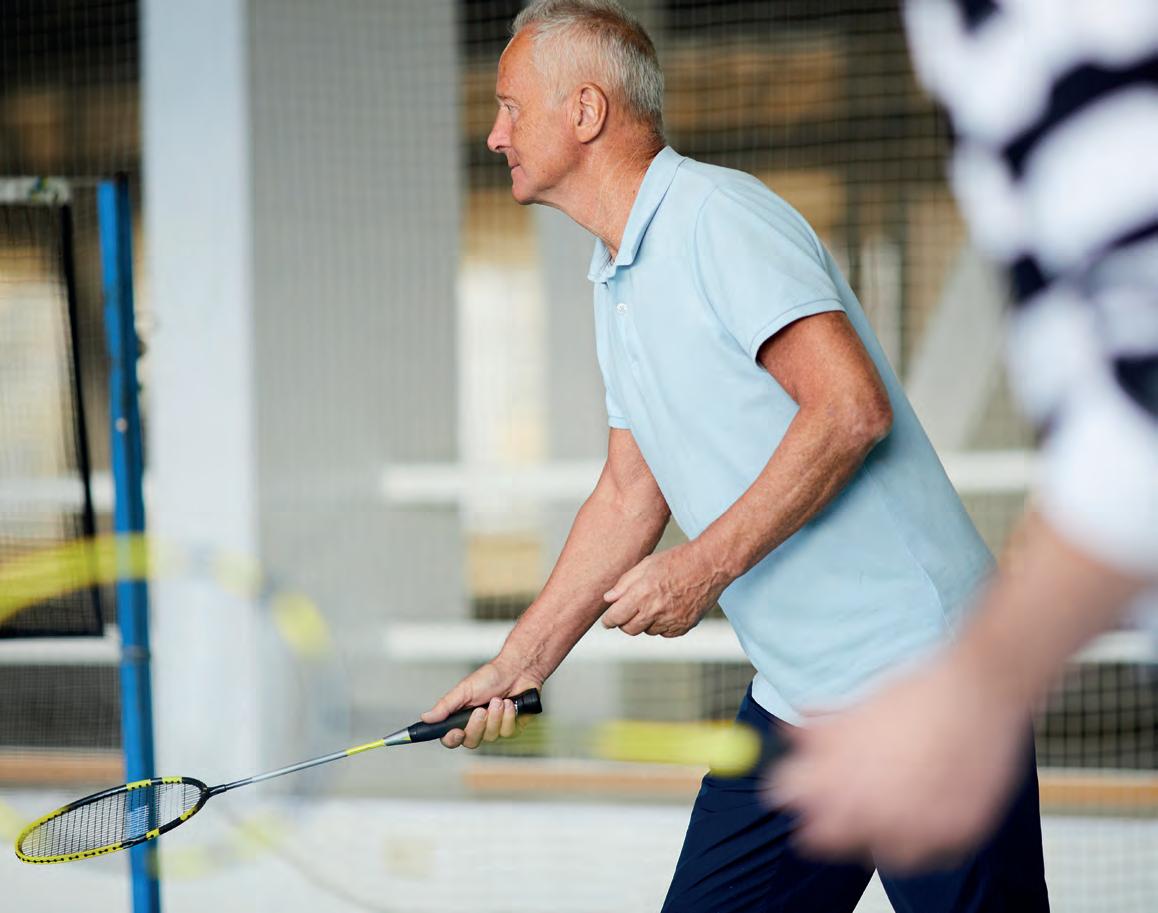







Inclusion remains a key theme running throughout the strategy. Badminton England has continued to expand programmes designed to engage under-represented groups, including people with disabilities, women and girls, and participants from ethnically diverse communities.
Partnerships with organisations such as Sense Active have enabled the development of sensory badminton sessions for people with complex disabilities.
Meanwhile, collaboration with Special Olympics Great Britain is helping to strengthen competitive pathways for athletes with intellectual disabilities. Internally, the governing body has also established an Equality, Diversity and Inclusion Committee, ensuring that lived experiences from across the badminton community help shape decision-making. The initiatives reflect
Badminton England’s belief that the sport’s natural inclusivity must be reinforced through structured programmes and community engagement.
Beyond grassroots participation, the strategy also seeks to strengthen the sport’s performance pathway. Badminton England aims to support players and coaches in achieving success at the highest levels of international competition. Investment in talent development programmes and national competitions forms a key part of the work. By linking grassroots participation with elite performance pathways, the governing body hopes to create a system in which young players can see a clear route from local clubs to international competition. Major events, such as the YONEX All England Open Badminton Championships –which took place in early March 2026 and is one of the sport’s most prestigious tournaments – also play an important role in inspiring new players while raising the sport’s profile internationally.
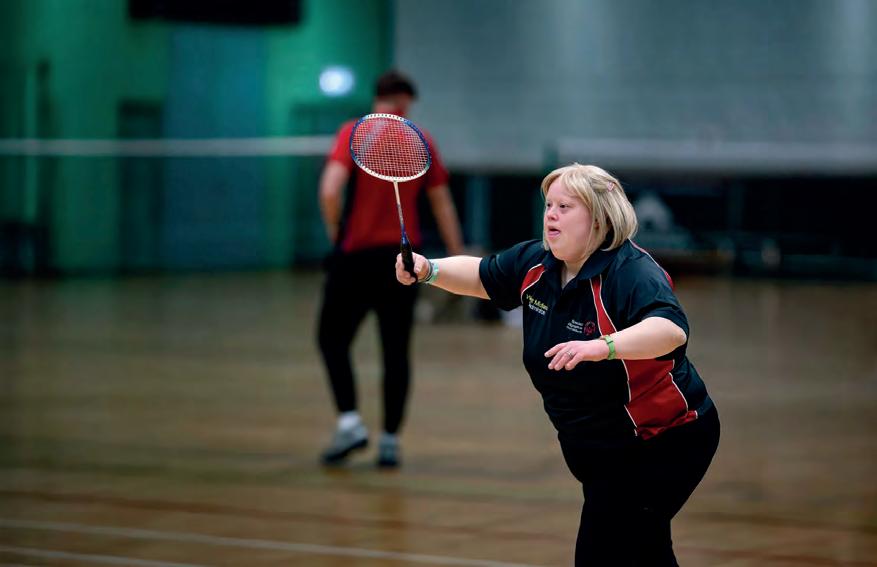
Special Olympics Great Britain has made badminton the third sport to have a tailored development plan produced to help athletes with an intellectual disability thrive in the sport. Backed by Badminton England, the Badminton Development Plan aims to strengthen and grow badminton opportunities for Special Olympics GB athletes, from weekly training at grassroots clubs to international competitions.
The plan builds on a recent strategic partnership developed by Special Olympics International with the Badminton World Federation and has been created with input from coaches and Special Olympics GB’s National Sports Advisors.
Leanne Brown, Equality, Diversity & Inclusion Manager at Badminton England, said: “With inclusion at the heart of our strategy for badminton in England, we want to make the sport
While Badminton England has made progress in delivering on its strategy aims, several challenges remain. Competition from other sports and leisure activities – such as padel and the ever-popular football – means that the sport will continue to fight for attention, particularly among younger audiences. Access to facilities can also pose a challenge in some areas. Many leisure centres now have to balance the needs of multiple sports, meaning badminton sometimes competes for court time with activities that can accommodate larger groups.
For Badminton England, the solution lies in data-driven advocacy and partnership working.
By demonstrating demand and participation levels, the governing body hopes to ensure badminton remains a priority activity within shared sports facilities.
as inclusive as possible for everyone. Initially, this partnership is focused on coach development; we’re looking to increase the number of qualified coaches amongst Special Olympics GB’s network through upskilling their athletes and volunteers to become Foundation Badminton Coaches. We will support the coaches throughout their coaching journey to be confident in delivering welcoming, accessible and inclusive sessions.”
As the strategy moves into its next phase, Badminton England will continue focusing on youth engagement, facility access and inclusive participation. Expanding junior programmes such as Shuttle Stars, strengthening links between schools and clubs, and improving digital access to courts are all expected to play an important role.
Equally important will be maintaining the strong sense of community that exists within badminton.
“Our foundations are strong,” the governing body says. “There are a million people playing badminton regularly in this country, but to ensure our long-term health we must continue to engage, energise and connect this community.”
If that ambition can be realised, badminton may well strengthen its position as one of England’s most accessible and widely played sports.





















WellNation speaks to Steven May, CEO of Mytime Active, about how the operator is using EGYM to engage with health partners and drive positive community health outcomes
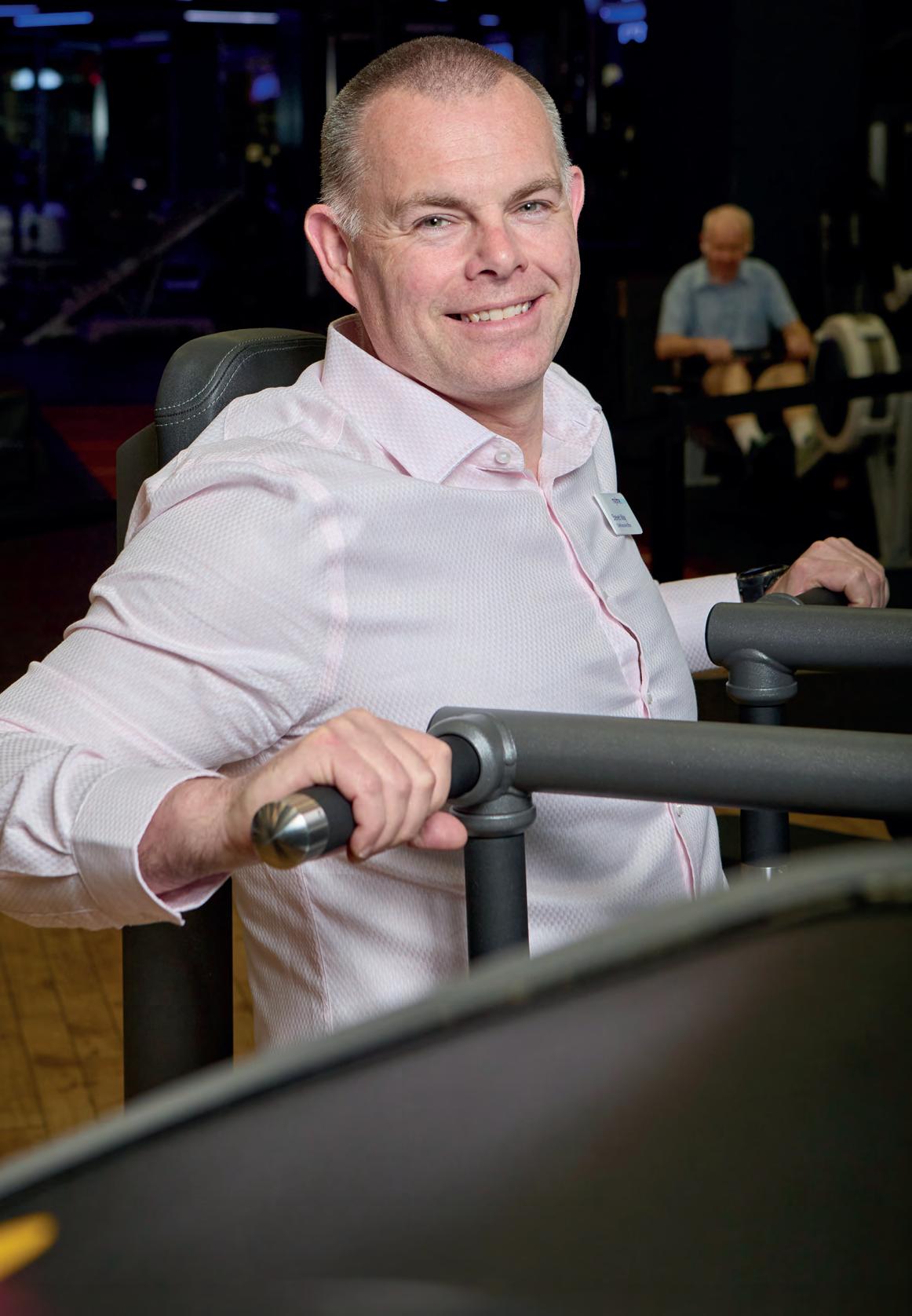
Steven May has a clear ambition. As CEO of Mytime Active, his goal is to reposition public leisure at the heart of Bromley’s health system; not as places people simply go to be active, but as essential community infrastructure for preventing ill health, extending health span, and reducing pressure on primary care services.
At a time when the NHS is under unprecedented strain and local authorities are being asked to do more with less, May believes leisure operators have a critical role to play in the shift from healthcare that repairs problems to whole systems that prevent them.
Here, he explains how Mytime Active is using the EGYM digital fitness ecosystem to evidence realworld health outcomes, strengthen partnerships with health and community stakeholders, and build a data-driven model for public leisure.
What is Mytime Active’s overarching mission?
We’re currently in the process of writing a new five-year health and wellbeing strategy in full consultation with the council, NHS, public health and a wide range of community partners. Our previous strategy was developed on the back of the pandemic and comes to an end in March 2026, with the new one launching from April.
The direction of travel is very clear. We’re moving towards a whole-system approach to health, where leisure, healthcare, local government and
the third sector all work together rather than in silos. If we genuinely understand each other’s ambitions, challenges and capabilities, we can design solutions that not only deliver far better health outcomes for residents but are also commercially more viable. There is a wealth of experience and resources that already exist within the community; we just need to get better at optimising what is available. This can only be achieved through cross-sector, cross-organisation collaboration.
A big part of this process is a shift towards prevention rather than repair. This aligns perfectly with the government’s long-term health strategyFit for the Future: 10 Year Health Plan for England and Sport England’s Uniting the Movement vision. It also reflects what communities need; more support earlier, in non-clinical, neighbourhood settings, before issues become acute.
We’re also focused on reaching those people who are furthest away from physical activity but stand to benefit the most from an active lifestyle. For example, those living with long-term health conditions, people recovering from trauma or injury, and individuals with disabilities.
How do you initiate and maintain strong links with community and health partners?
Working in partnerships is fundamental to everything we do. I chair ProActive Bromley and sit on a borough partnership group chaired by the
London Borough of Bromley Council. These forums bring together public health, healthcare and third sector organisations, including Mytime Active, to look at live priorities and ask a simple question: what can we collectively do to address this?
Our leisure facilities and services have huge potential to support population health, but the key is understanding where the real needs are and designing pathways that genuinely make a difference. Our primary driver is always improved health or social outcomes, rather than income generation.
That’s a really important distinction. Of course, we need to be financially sustainable, but the purpose of Mytime Active is to improve the quality of life
for local people. Leisure centres can and should be part of the health system. We need to be on the field of play rather than watching from the bench.
How does EGYM help you achieve your community health and wellbeing ambitions?
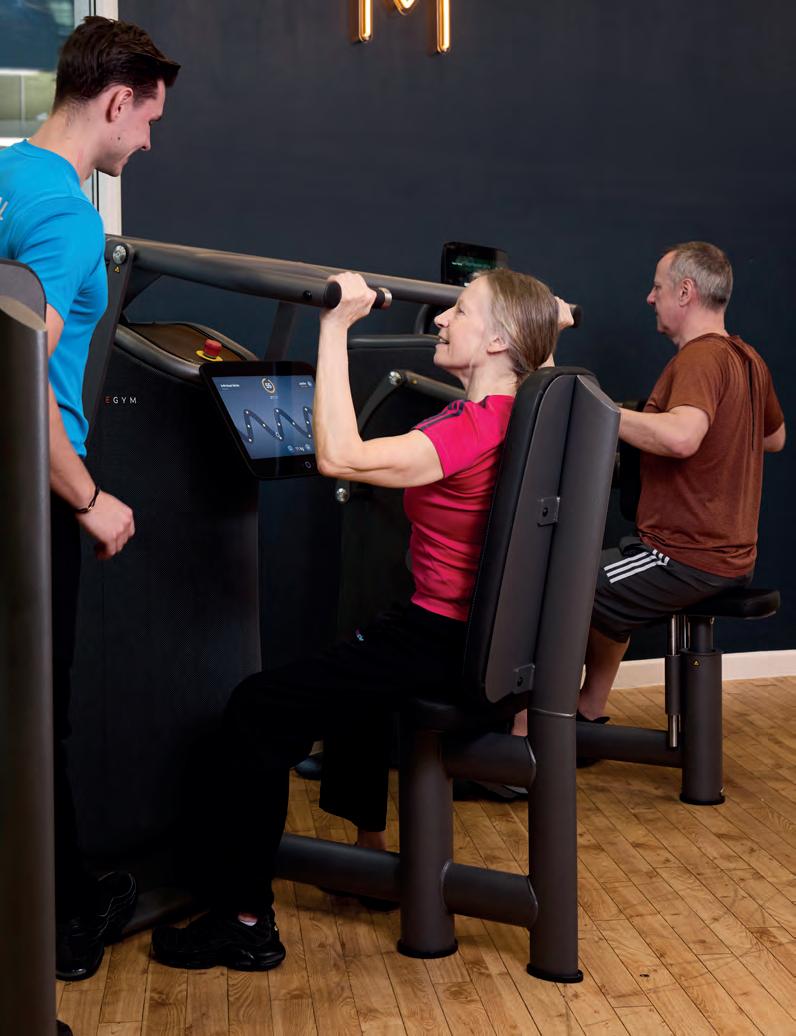
My initial perception of EGYM was completely wrong. I assumed it was designed for older adults. In reality, it’s designed for everyone, and that’s exactly what we’re seeing.
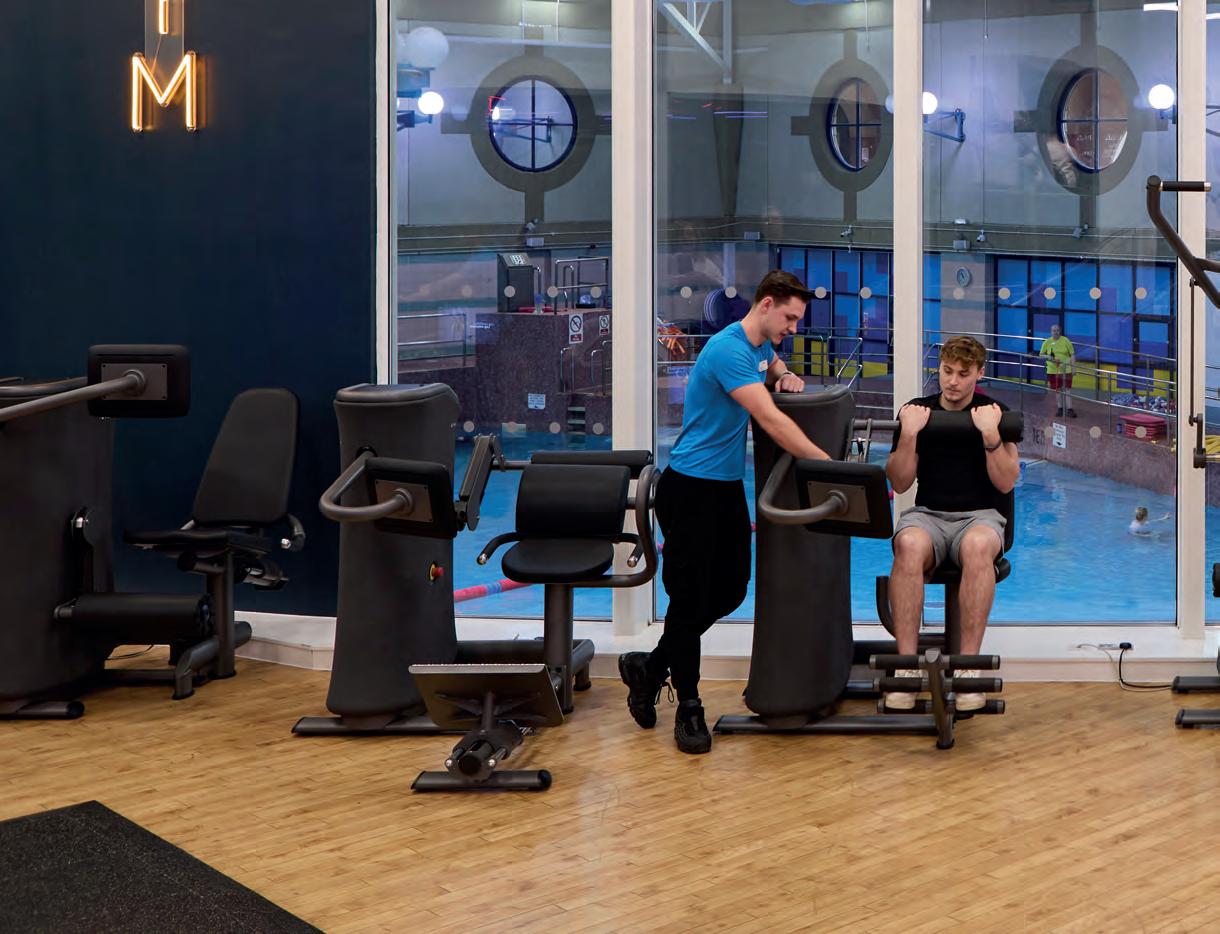
Our gyms welcome users from as young as 11 years old, right through to people in their senior years. At both The Pavilion and The Spa at Beckenham, EGYM is positioned as an integral part of the gym
YOUNG
THEY’RE
floor, not a separate or specialist provision. It’s open, visible and part of the core experience.
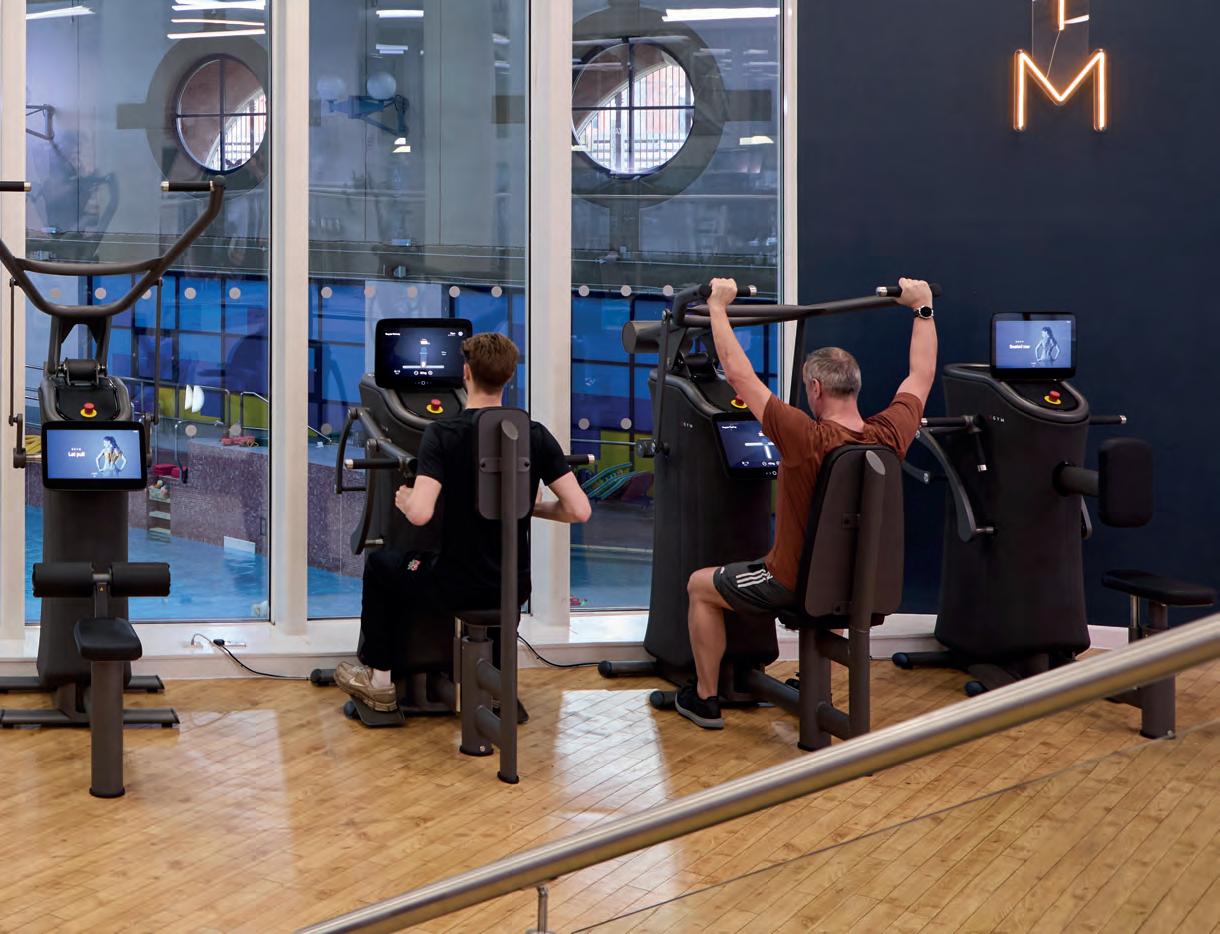
At The Pavilion, we replaced some older modular strength equipment with EGYM Smart Strength and positioned the individual units as standalone pieces. At The Spa, the EGYM equipment is still on the gym floor, but set up in more of a traditional circuit format. Both are supported by the EGYM Fitness Hub, plus the EGYM Member and Trainer Apps. We’ve fully invested in the ecosystem, with third-party providers such as InBody also fully integrated. This creates a fully connected experience for our users where they can access all their data through a single touchpoint.
The onboarding process has been transformational. Everyone is offered an EGYM induction, and the volume we’re now able to process compared to before we installed EGYM is on a completely different scale.
In December alone, we onboarded 1,502 people into the EGYM ecosystem. That put us second on the EGYM UK leaderboard for public sector facilities for the month. Before EGYM, an induction could take an hour, sometimes longer for people with complex needs. Now, the automated setup and digital hand-holding
through each repetition reduces this time to just 20 minutes. Our teams now spend far less time on setup and far more time on what actually matters: mentoring and coaching people towards their goals.
This has huge operational benefits, but it’s also critical for inclusion. The easier it is to onboard people, the easier it is to reach and spend quality time with those who might otherwise feel intimidated, invisible or disengaged.
The data is incredibly powerful. EGYM gives people continuous feedback on their progress based on evidenced improvements to key health markers rather than vanity. We’re seeing users train more consistently, largely because they can see tangible improvements in strength, flexibility and BioAge. These regular check-ins reinforce the value of their effort and keep them engaged. Our EGYM users train, on average, 4.4 times per week. We all know that the more times people turn up to train the more engaged they are and the longer they remain so.
Members who joined in December have seen a collective strength improvement of 9.4% and an average BioAge reduction of 5.8 years in just
two months, demonstrating a physiological shift, not just a cosmetic one. These improvements will drive good health and build resilience.
EGYM is changing mindsets. People are moving away from purely aesthetic goals towards a deeper understanding of health, resilience and longevity. This drives a much healthier relationship with exercise, encouraging long-term behaviour change that supports good health and prevents ill health.
You’re seeing strong uptake from young people. Why do you think that is?
We currently have the highest number of under 21 EGYM users in the public sector in the UK. That’s not by accident; it’s the result of intentional product positioning.
EGYM is visible on the gym floor, everyone gets inducted, and it’s never framed as something just for older adults or rehab. Young people love the gamification, the technology, the performance tracking. They’re motivated by the leaderboards, the challenges, the data.
They can safely compete with friends. Performing a one-rep max with a dumbbell would run a high risk of injury but, using EGYM, youngsters can challenge each other to perform the highest one-rep max with little risk of overload. EGYM taps into the motivations and becomes an engagement driver of this demographic.
One powerful example came out of a partner meeting, where we identified several local firefighters who were off work due to injury or trauma. Together with the fire service, we created a referral pathway hosted in our facilities specifically to support their recovery and return to work.
Each month, the fire service sends us a list of individuals who might benefit and we onboard them through EGYM. It gives participants a safe, structured, measurable way to support their clinical rehabilitation, whilst also creating social opportunities and keeping them moving while they wait for availability of medical support services.
We’re also working closely with local GPs and other integrated care partners to deliver cardiac rehabilitation and a range of GP referral programmes. Many of our activity-led programmes are funded and being able to evidence proven health outcomes helps justify current and future investment. EGYM makes this incredibly simple.
For the first time, EGYM means we can genuinely evidence impact in a language our health partners understand.
The depersonalised data from the EGYM ecosystem allows us to demonstrate, at scale, how engagement in leisure services is improving health outcomes. Metrics like BioAge reduction and strength improvements show real physiological changes that support good health and longevity.
We’ve always known physical activity is beneficial, but now we can prove it with statistical evidence. This is incredibly powerful when talking to public health teams, primary care networks and funders.
Once stakeholders can see how our services are improving resilience, reducing future health risk and potentially lowering demand on clinical services, the value of investment in public leisure becomes obvious and undeniable.
EGYM supports the transition of leisure centres from being perceived as cost centres to being recognised and accepted as a vital solution to the health crisis.
Are there plans to expand EGYM to other venues?
Yes. EGYM will be installed at both Walnuts and West Wickham Leisure Centres. Walnuts reopens in the spring following a multi-million-pound regeneration, with West Wickham following in 2028.
Our vision is to create a connected network of data-driven health and wellbeing hubs across the borough, all operating on EGYM’s digital ecosystem, all contributing to a shared evidence base.
Our focus is on scaling engagement and deepening partnerships. EGYM gives us the infrastructure to deliver truly personalised physical activity pathways at population level. Through EGYM’s connected ecosystem, we can now support individual needs while also demonstrating collective impact. That’s the holy grail for public leisure.
If we want to be taken seriously as prevention partners within the health system, we must speak the language of outcomes, evidence and data. EGYM allows us to do exactly this and it’s changing the conversation around what leisure is, and what it’s capable of delivering.

Discover how EGYM powers growth you can see, prove, and repeat with a fully connected, data-driven ecosystem, tailored to you.

The first ever cricket dome opened in Bradford in 2023. Its success led to the ECB committing to building 40 more around the country. SportsNation spoke to Dr. Iain James, ECB’s Head of Facilities Services, to discover how the innovative and inclusive facilities could transform grassroots and community cricket
When we opened the new dome, no one could have imagined just how successful it would be,”
says Nasa Hussain, Facilities Manager and Head Groundskeeper at Bradford Park Avenue. He is describing the UK’s first ever “all-weather cricket dome”, which opened in late 2023. “It’s a brilliant facility used by both the community and professional teams – and the impact has been massive.”
The facility – the first of its kind in the country – was funded by the England and Wales Cricket Board (ECB) in partnership with City of Bradford Metropolitan District Council. In its first year alone, it welcomed more than 20,000 players. From high-profile players – such as Shan Masood and Adil Rashid – and teams like the Northern Superchargers to over-50s Sunday players and school children, it has accommodated cricketers of all abilities, ages and backgrounds.
“It’s given everyone an opportunity to play cricket all year round, instead of just the traditional April to September timeframe,” Hussain adds.
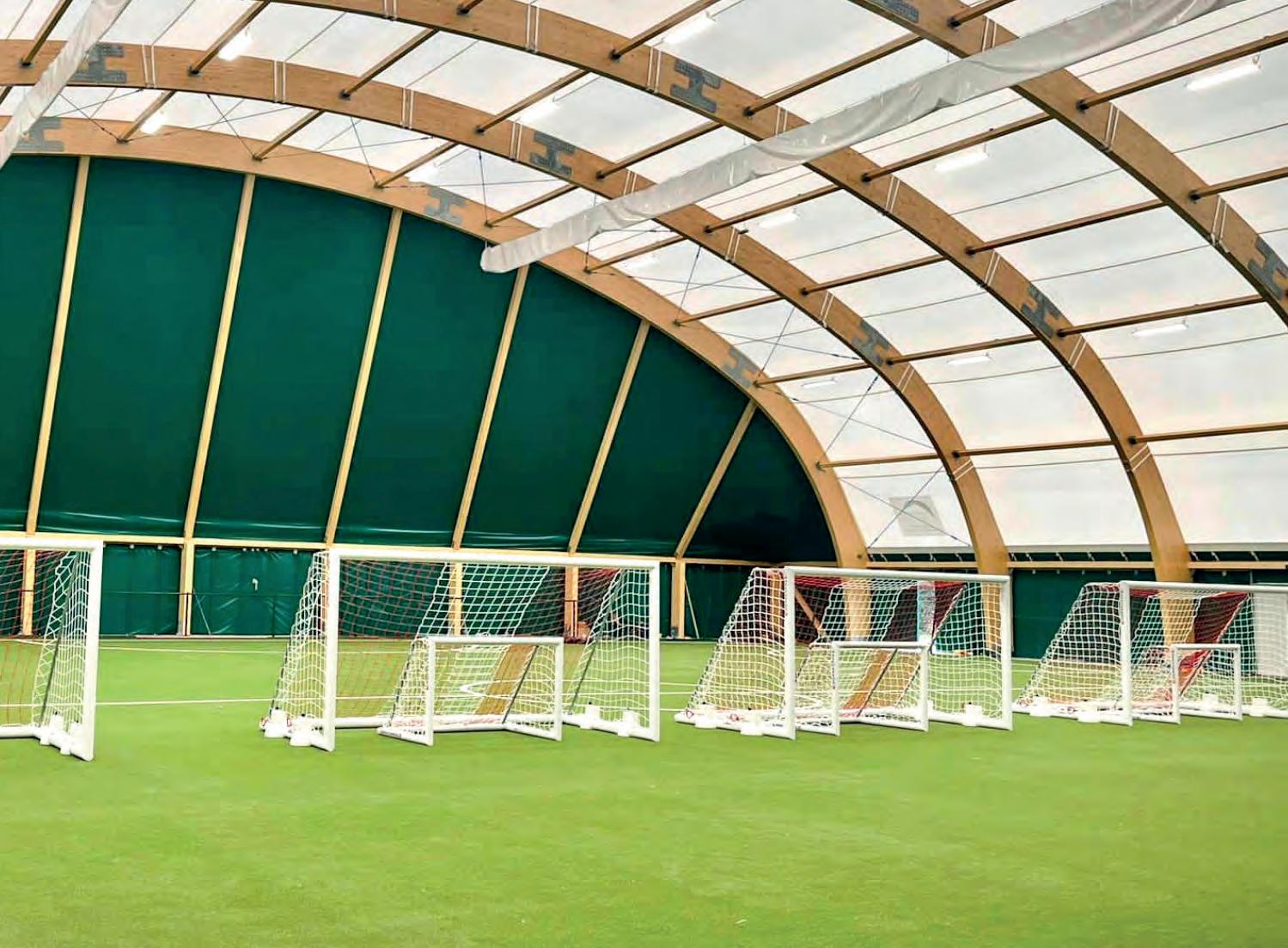
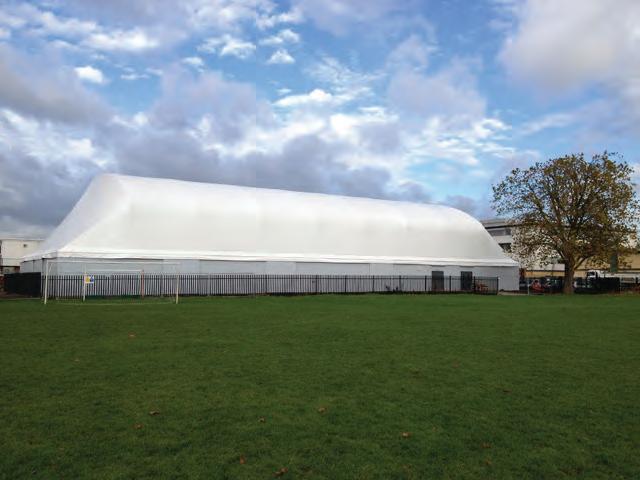
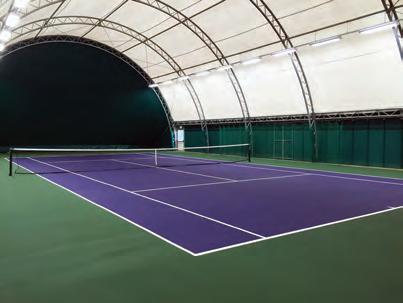
The facility at Bradford Park Avenue Cricket Club features two 40mx20m covered domes with a state-of-the-art lighting system, elite cricket surface and a retractable netting system enabling
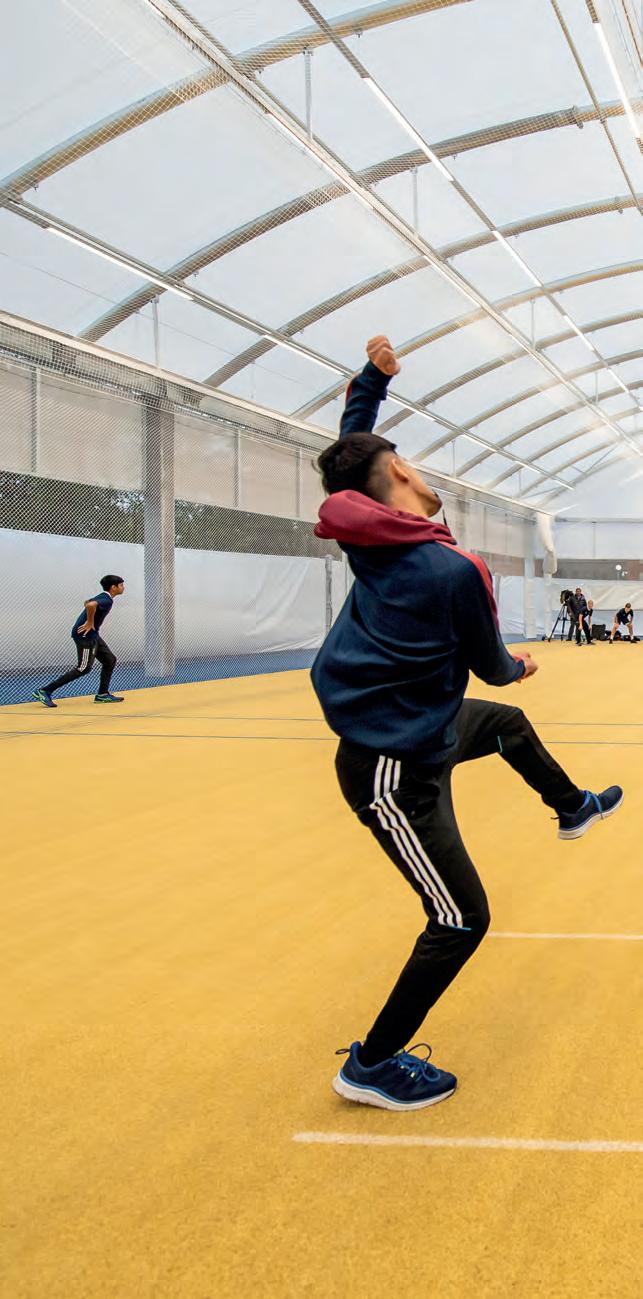
both training and matchplay. The 10-lane set up provides organisations the chance to increase usage levels of a typical outdoor non-turf facility without the prohibitive costs. The facility – a joint project between two SAPCA members, Total-Play and Fordingbridge – has received a prestigious industry accolade, being declared the winner of the SAPCA Award for Large Project of the Year in 2025.
The success of the venue led to the ECB committing to an investment programme which will see similar facilities being built across the country. The second, in Darwen, Lancashire, opened in September 2025. Featuring three
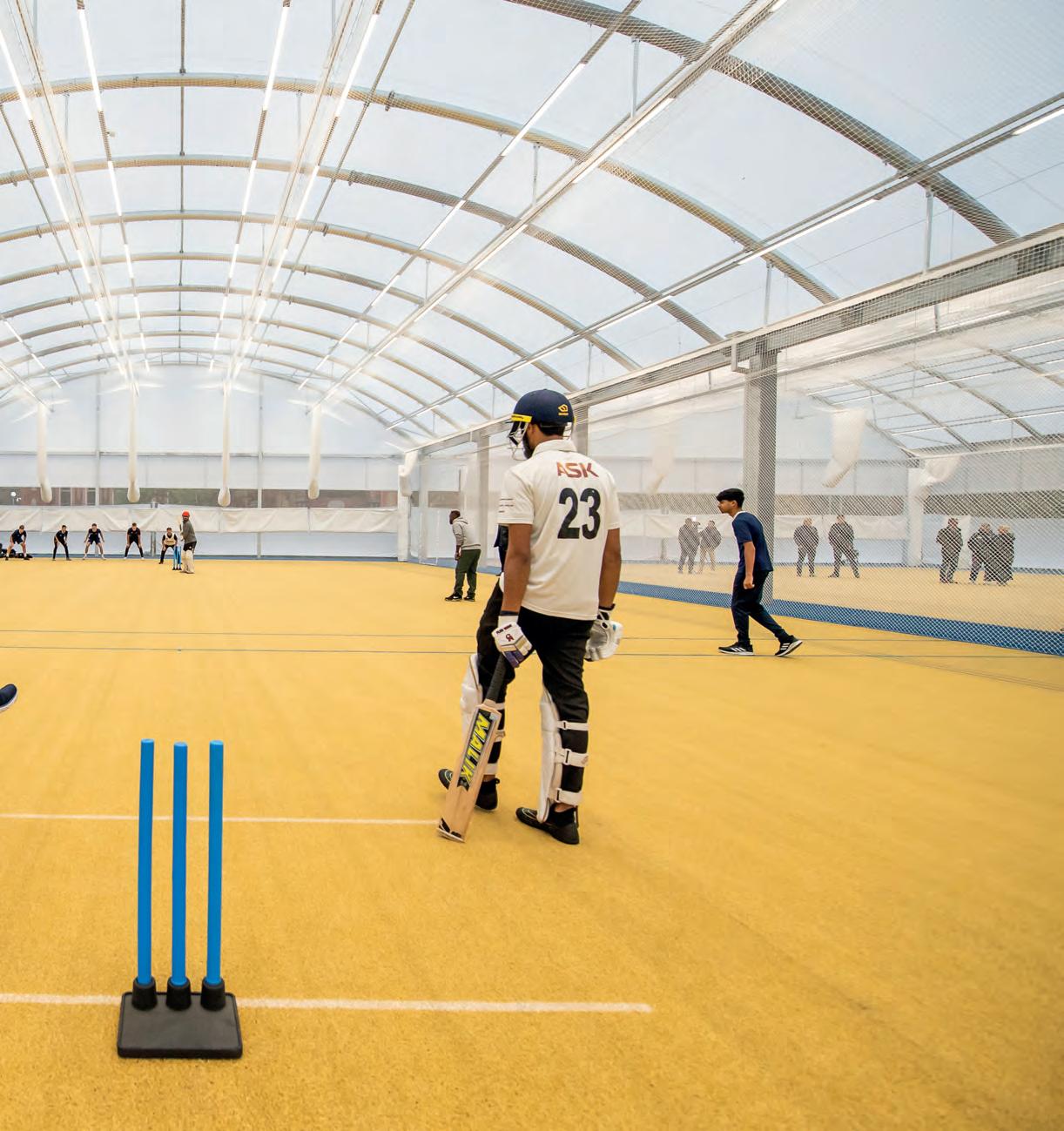
full-length lanes and the ability to be used for match play, the facility was developed by Darwen Cricket Club and Lancashire Cricket Foundation, who will work together to deliver cricket programmes in partnership with more than 13 state schools in the local area.
A further dome in Willenhall, West Midlands, is now also nearing completion. In addition, the Government recently announced £1.5m to contribute towards a further two of the facilities in Luton and Farington, Lancashire which are expected to open later this year (2026).
The domes have been designed to make the
most of cricket’s diverse reach, opening up sport to people of all backgrounds as part of the Government’s Plan for Change. The Luton dome, for example, will give underrepresented groups, such as state schools, much-needed access to cricket, with the potential to offer other sports – such as hockey, tennis and badminton – so that as many local people as possible have the chance to get active. Ultimately, the ECB hopes that the domes will help to smooth the road from grassroots to the top of the game, so that boys and girls of all backgrounds can be inspired and have a clear route to emulating their heroes.

SportsNation spoke to Dr. Iain James, ECB’s Head of Facilities Services, to find out more about the plans for the domes in 2026 and beyond.
Where did the idea for the domes, or covered outdoor cricket facilities, come from?
The ECB’s vision is to make cricket the most inclusive team sport in England and Wales. To do this we want to increase the opportunities to take part in cricket and creating facilities that are accessible to people is critical. Cricket domes can play a key part in that because they create unique opportunities to play cricket into the evening, year-round. Their format allows practice and match play under floodlights, in a safe environment that is affordable to operate, helping to keep the cost of access as low as possible.
The cricket dome concept is something that we have been looking at for more than 20 years, but the combination of modern structures and LED lighting have really unlocked solutions that now mean we have the right facility to increase access to cricket.
What is the latest with the three sites set to open 2026?
We are really excited that the third dome at Willenhall will bring this opportunity to Walsall and the West Midlands and expect that to be opening this spring.
The Luton dome is already in construction with Total-Play already making great progress on site. We are expecting this seven-lane facility, the largest single dome span so far, to be ready at the end of the 2026 cricket season in time for winter training and play.
The Farington dome will be constructed at Lancashire’s amazing new community facility. Funded by the Department for Culture Media and Sport, Sport England and the ECB – this will be the first facility to be constructed following the pilot scheme. The competitive tender is just reaching its conclusion, and we are hoping to break ground this summer.
ECB Chief Executive, Richard Thompson, said that the long-term ambition is to build 40 domes “as soon as we can”. Can we expect more site announcements this year?

That was a long-term ambition and these projects take time to progress, particularly when the collaborative funding model with local authorities is such an important part.
To be the most inclusive team sport in England and Wales we need to be ambitious and we are working with our county network, with government and with the private sector to identify and fund new opportunities.
With the sale of The Hundred teams, we have been able to create a fund for new facilities in the recreational game in cricket – this will enable the game to partner with other funders to deliver new dome projects, and more.
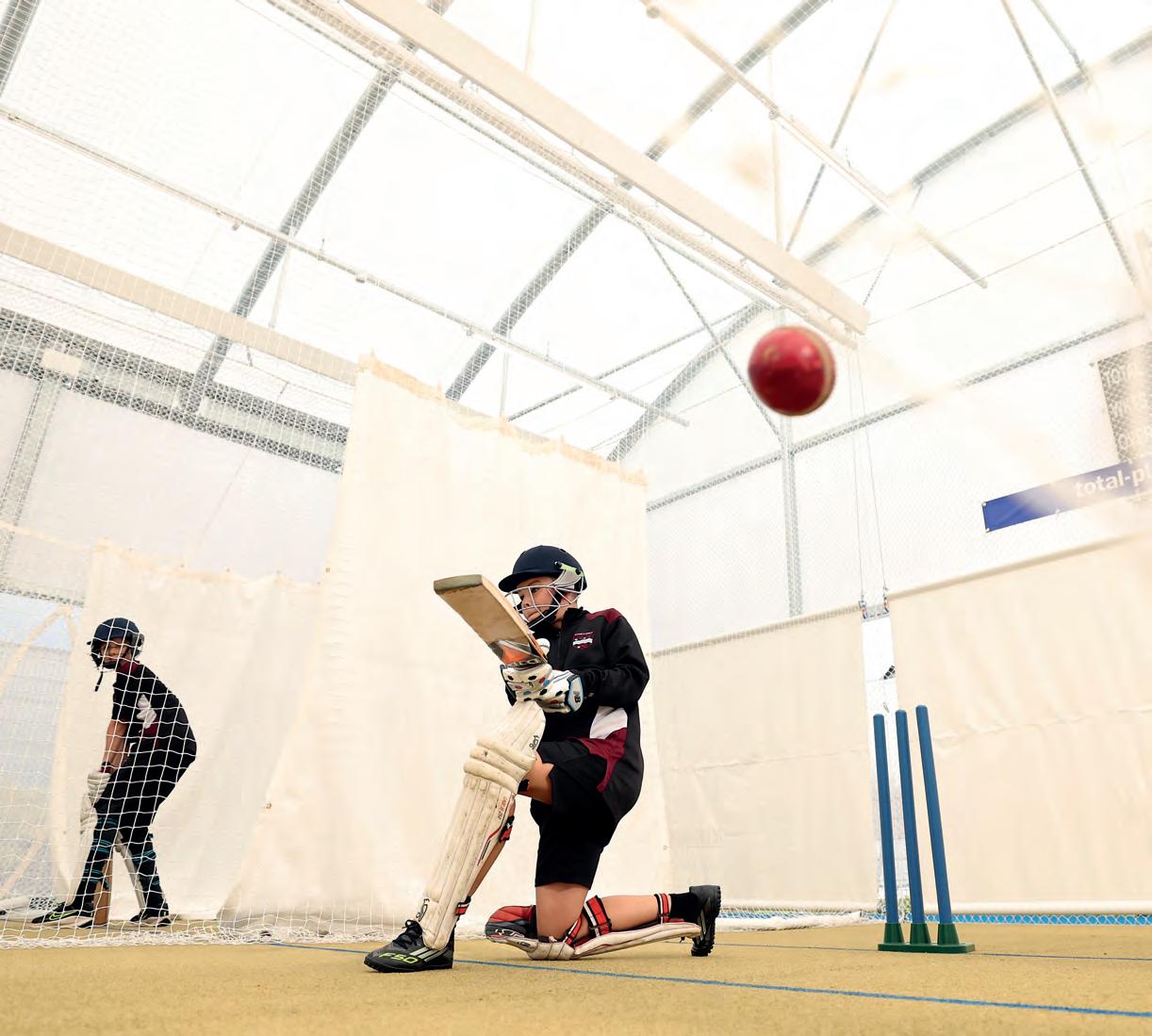
How transformative do you see the domes being for grassroots cricket?
Our pilot cricket domes are already transforming access to cricket in the clubs and communities in which they have been built. We have seen juniors, grass roots and professional players using domes for net-based training and coaching. Domes have been used for junior open coaching sessions where kids can engage with cricket for the first time. There have been tape-ball competitions, ‘indoor-cricket’ leagues, women-only sessions and Walking Cricket in which people can come and meet through sport. Demand is high and we have seen people travelling a long way to use the facilities. We have seen communities from different cultures and faiths come together to celebrate cricket. We have seen cricket played after breaking fast during Ramadan and as the snow is falling outside.
And it is not just for cricket – fundamentally a cricket dome is a well-ventilated, covered, lit sports environment surrounded by a net that keeps balls and other equipment contained – this makes the facility ideal for cricket, but also for other sports that can use that space safely and we are actively exploring the multisport options with other governing bodies.
How much investment have you earmarked for the domes?
The ECB has provided around £5m to deliver the pilot scheme of the initial domes working with partners including local authorities, Sport England, DCMS and individual clubs. We will continue to support investment in the right projects for cricket. We are working hard to bring partners with us to fund, including from professional cricket,
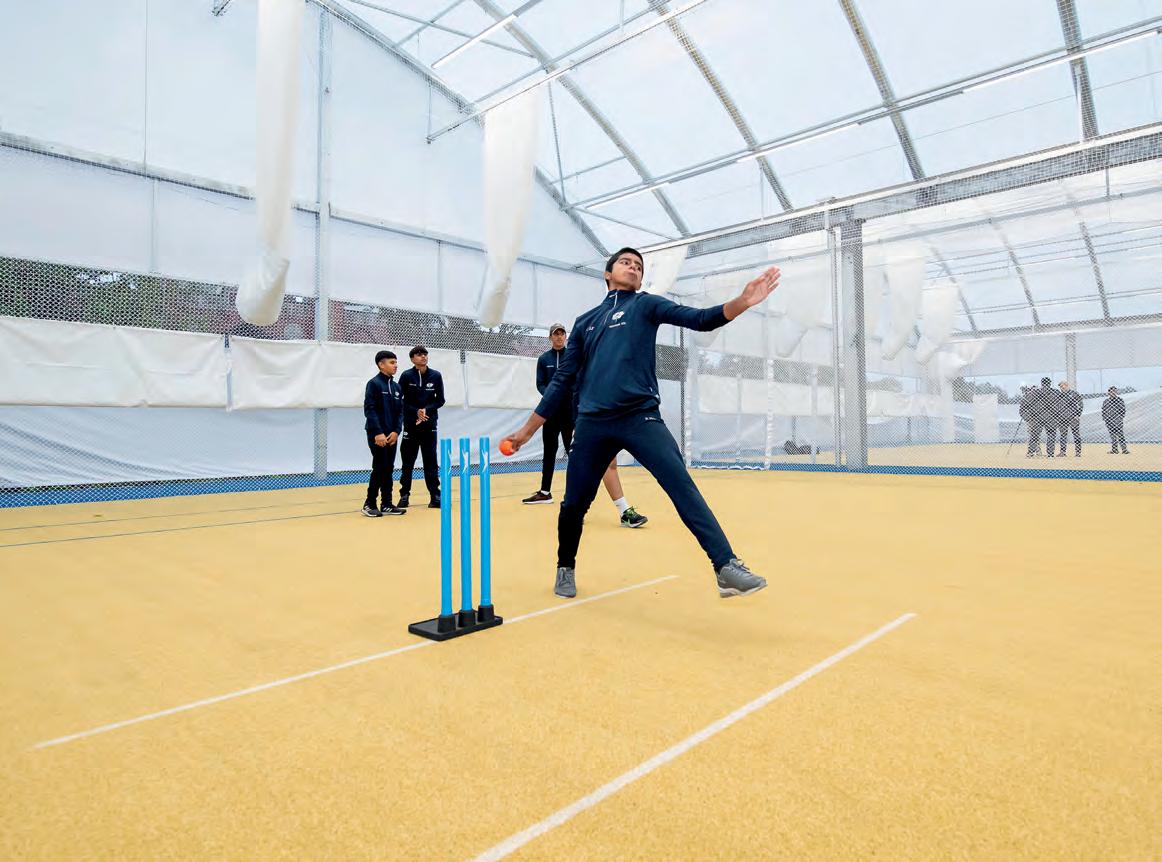
DCMS and Sport England. We were delighted when Lisa Nandy, Secretary for Culture, Media and Sport announced £1.5m of government funding to support the Luton and Farrington dome projects and we are currently working with DCMS and Sport England to see how we can partner to expand this to create new project opportunities.
If a cricket club/facility owner wants to explore the possibility of building a dome, what should they do?
We would love to hear from anyone looking to develop a cricket dome project – we have produced a guide, Covered Outdoor Cricket Facilities – Developing Your Project, for people and organisations considering projects of this type – it is available on our website at www.ecb.co.uk/cocf
This guide provides all the key information, including contact details for our Regional Facility Planning Managers who will work with organisations to identify and support the development of dome projects. For more information visit www. ecb.co.uk/cocf or email facilities@ecb.co.uk.
Each site, layout, size and configuration is different, of course, but what is the rough estimate on the cost of a dome?
Costs do vary with size and location, and the proximity of ancillary facilities such as changing and toilets on site – but we have been working to budget figures of £200,000 – 300,000 per lane.
We want to create safe, durable facilities that make a generational change for cricket in a community
We want to keep the costs of development as low as possible but we also want to create safe, durable facilities that make a generational change for cricket in a community.
To support development of cricket domes we have produced standards and guidance that help designer and developers to create great facilities, and outlines what we expect to see in new projects – Covered Outdoor Cricket Facilities – Design Guide is available on our website at www.ecb.co.uk/cocf
Now that we have successfully completed the pilot phase, procurement processes will depend on each project and who is funding the project. Of course, a competitive tender process is the norm for public sector and ECB funding but we are comfortable with traditional, design and build and turnkey procurement routes as long as the process and outcome deliver the right facility for the client in the right way. As we scale up, we may well explore a ‘pre-approved contractor’ or contractor framework process to improve efficiency.



The rise of hybrid cricket facilities are transforming the sport at every level. Adam Collier, Head of Sales at Fordingbridge – the UK’s leading provider of all-weather sports solutions – explains the benefits of year-round cricket facilities
The sound of willow on leather is as synonymous with English summers as Pimms and Wimbledon. However, for generations, the arrival of rain and frost has signalled an unavoidable pause in the cricketing calendar.
But that assumption is rapidly changing. Across the UK, clubs are embracing hybrid cricket facilities – covered structures that combine the feel of outdoor practice with the weather resilience of indoor centres. The result is a quiet but significant shift: cricket is evolving from seasonal pastime into a four-season sport.
One of the most influential examples of this trend can be seen at Bradford Park Avenue – a hybrid facility designed and built by Fordingbridge in partnership with Total Play, and with funding from the ECB.
Spanning 42m by 42m the venue’s cricket dome is the largest of its kind in the UK and was among the first to support batting and bowling practice year-round.
Its impact has been striking. Today the canopy has doubled capacity at the ground, houses 10 practice bays, and provides cricket sessions for over 10,000 people annually.
Clubs across the country are now looking to replicate the model and it’s easy to see why. Traditional outdoor nets remain unusable for long periods each year, restricting training programmes and opportunities for junior development. Hybrid facilities instantly remove that barrier, enabling coaching and community programmes throughout the year.
Darwen Cricket Club near Blackburn and Willenhall Cricket Club near Birmingham are among the latest clubs to join the year-round movement. Their all-weather cricket canopies – designed, manufactured and installed by Fordingbridge - enable sessions even in driving rain and snow. In warmer months Opal 60 roofing filters harmful UV rays, protecting players as effectively during intense summer sessions as during winter storms.












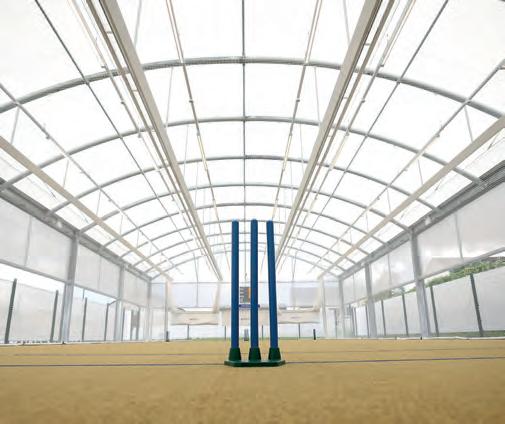

The canopy provides cricket sessions for over 10,000 people annually
As interest grows, the importance of thoughtful design is becoming clear. To be successful, cricket canopies must carefully balance protection with openness, maintaining airflow, visibility and light while shielding players and surfaces from the elements. Durability and longevity are equally critical. Clubs investing in facilities designed to serve their communities for decades must prioritise structural integrity, sustainability and quality materials.
Looking ahead, several trends are emerging. Multi-lane facilities capable of supporting high participation volumes are becoming more common, particularly in urban areas. Flexible structures that can support multiple sports and community uses are also likely to become more prevalent. Hybrid facilities have already had a profound impact by releasing cricket from the confines of summer. But they are doing so much more than extending the cricket season. Increasingly, they are reshaping how clubs think about participation, community engagement, talent development and the future of the game itself.
To find out more about the transformative potential of hybrid cricket facilities contact the Fordingbridge team today. https://www.fordingbridge.co.uk/contact-us/








Work is ongoing to test new artificial turf systems for the UK market. Niall MacPhee, Director at Sports Labs, o ers an update on the latest developments


As the synthetic sports turf industry looks to develop more sustainable products –particularly those that reduce the use of microplastics –attention is increasingly turning to alternatives to SBR (styrene butadiene rubber) infill. Currently, more than 90% of artificial turf pitches in the UK are installed using SBR.
Replacing SBR with non-rubber infills, or even moving towards non-fill turf systems altogether, is now being stress-tested through a series of heavily monitored pilot projects across the UK. SAPCA member, Sports Labs, has been entrusted by several leading governing bodies of sport to oversee this monitoring, ensuring that insights and outcomes are assessed objectively.
The work includes ongoing compliance testing, structured player feedback mechanisms and the monitoring of material degradation over time. One of the key objectives is to determine whether the innovative solutions produced by suppliers and synthetic pitch specialists can meet the expectations of both users and facility owners over the long term.

Several sites are currently contributing to the research. These include:
● Woodbourne Road, the Football Foundation test bed in Sheffield – which is completing its second year of operation.
● Bangor City, the Cymru Football Foundation’s test pitch in Bangor, Wales – a full-size nonfill pitch installed six months ago.
● Glasgow Green, operated by Glasgow Life – mini pitches tested side by side against datums.
● St Cuthbert’s, a Scottish FA project featuring a full-size pitch with organic infill. Together, these sites are providing valuable insight into how alternative turf systems perform under real-world conditions. Each is providing us with data and experiences which could shape the future of sports turf.

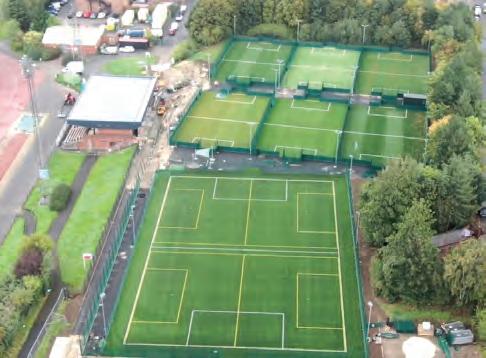
The Football Foundation has made a significant commitment to research through its live test facility at Woodbourne Road in Sheffield, which opened in November 2023. The complex features seven pitches in total. One of these is a nine-a-side pitch installed with traditional SBR infill, which serves as a “datum” for comparison. The remaining six fivea-side pitches feature alternative pitch systems.
The products trialled at Woodbourne Road were selected from suppliers on the Football Foundation framework. These suppliers have remained involved throughout the project, responding to feedback and making adjustments to the pitch systems where necessary.
The Cymru Football Foundation has taken a major step forward by installing a full-size non-fill pitch at Bangor City in North Wales. Completed in the summer of 2025, the pitch was a collaboration involving several SAPCA members – it was installed by Sportex, using the TenCate Pure PT system (from TigerTurf/GreenFields).
After six months in operation, the pitch has already undergone initial rounds of testing and player feedback evaluation. As with the other pilot sites, the surface will continue to be monitored over time to understand how it responds to usage levels and changing climatic conditions.
The key question is not simply how the surface performs immediately after installation, but how it evolves through sustained use.
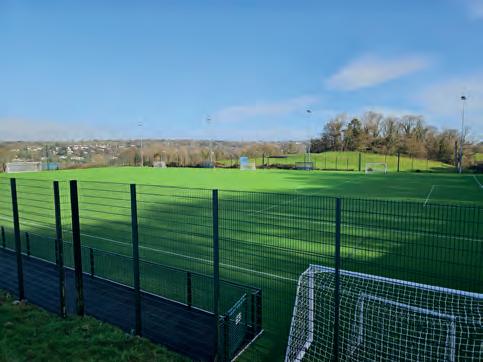
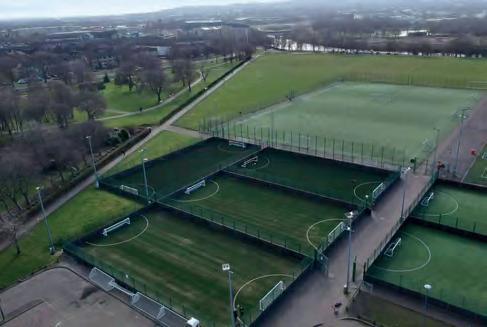
Another important test location is the Glasgow Green five-a-side facility, operated by Glasgow Life. The site contains eight small-sided pitches. Last year, four of these pitches were resurfaced by Allsports Construction & Maintenance (a SAPCA member) as part of a comparative trial.
Two of the pitches were installed using PureGrain infill, while the other two retained traditional SBR infill. All four surfaces use the same FieldTurf carpet and shockpads supplied by SAPCA member Trocellen.
These pitches are now approaching the end of their defects period and are undergoing technical testing. Because the surfaces share the same carpet and shockpad, the comparison between SBR and alternative infill materials is particularly valuable. All surfaces were tested on installation to EN 15330-1, the European standard for artificial turf. Glasgow Life is now planning to install a non-infill court at the site, which will further increase Glasgow Green’s role as a test bed.
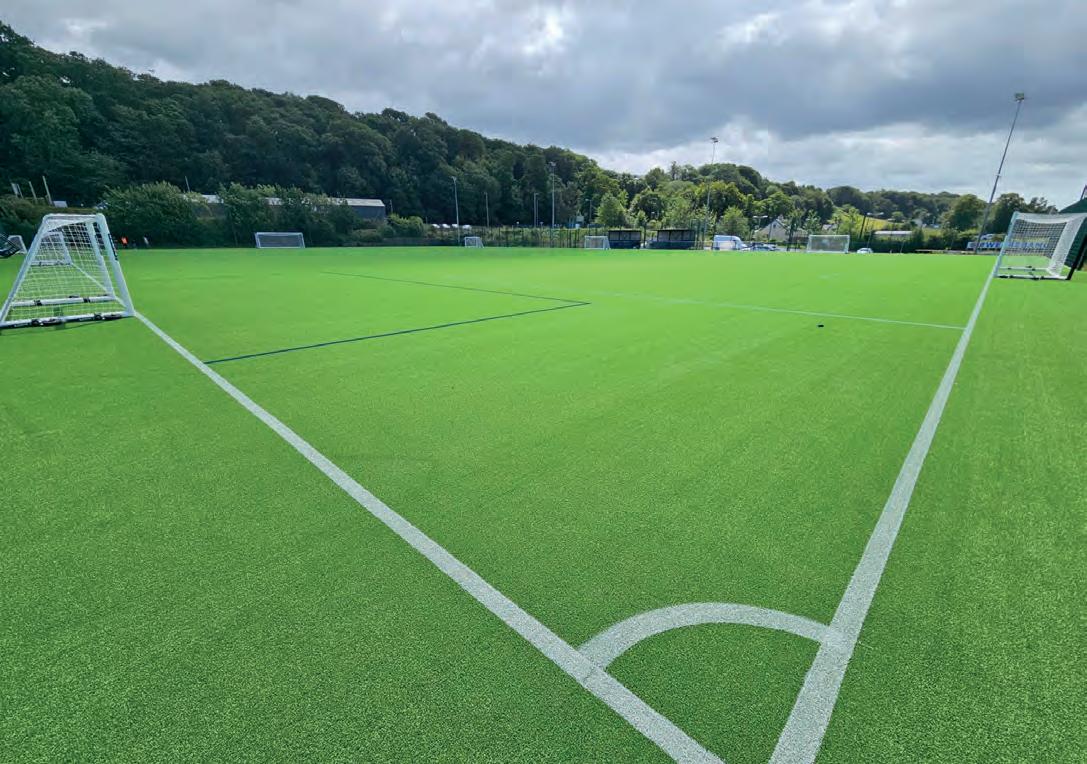
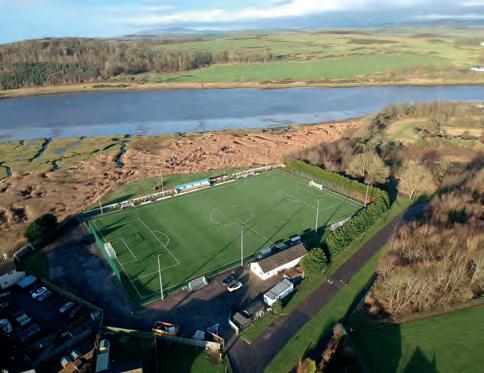
A further project is taking place at St Cuthbert’s in Scotland, where the Scottish FA has partfunded the installation of a full-size pitch using PureGrain infill. The pitch is another one created in collaboration between SAPCA members – it was installed by Tony Patterson Sportsgrounds and it is maintained by FieldTurf. Completed just three months ago, the surface has already been tested and achieved FIFA Quality certification. The site will now begin collecting structured player feedback as part of the wider monitoring programme.
Across all these projects, several factors are being closely examined to understand how they influence the long-term lifespan of alternative turf systems. These include:
Managing usage levels in line with the operations and maintenance manual is critical. Site operators must balance high-wear and low-wear areas, particularly around access points and goalmouths. Effective site management and footfall control are essential to maintaining surface consistency.
Artificial turf surfaces are exposed to a wide range of climatic conditions. High and low temperatures, rainfall levels and recovery following severe weather events can all affect the behaviour of materials over time.
Correct maintenance is fundamental. Equipment must be appropriate for the surface type and set up correctly by trained operators. Maintenance schedules should also be aligned with usage hours and supplier recommendations.

All of the projects are currently live, meaning it is still too early to draw definitive conclusions or share detailed outcomes. However, early indications suggest that the surfaces are capable of meeting player expectations and technical performance requirements at the point of installation.
The more interesting question is how these surfaces evolve over time. Can they realistically deliver the expected seven-, eight- or nine-year lifespan before resurfacing becomes necessary? That question remains open. The use of highstress test beds will help provide an indication of accelerated wear patterns as the projects continue.
The testing programme is demonstrating that it is possible to objectively measure field performance and correlate this with player experience. As expected, materials and surfaces do change over time. Usage intensity, climatic exposure and maintenance regimes all influence how the surface behaves.
The key is to monitor these changes proactively. If adjustments are made early enough, performance levels can be maintained. If issues are addressed too late, the impact can be much harder to reverse.
Player perception has always been a major factor in the acceptance of artificial turf systems. However, with strong response rates and
Usage intensity, climatic exposure and maintenance regimes all influence how the surface behaves
structured feedback, it is increasingly possible to demonstrate a clear correlation between technical testing data and player experience.
Ultimately, those investing in artificial turf want confidence that they are achieving value for money when adopting new technologies. At the same time, players and facility operators require assurance around safety and performance compliance. Pilot test beds help reduce the risk associated with innovation.
Many new materials entering the market have limited performance histories and therefore carry shorter warranties. That is understandable. Test beds help bridge this gap, allowing manufacturers, governing bodies and operators to gather evidence under real-world conditions. By doing so, they provide the industry with the knowledge needed to move towards more environmentally sustainable solutions with greater confidence.



































































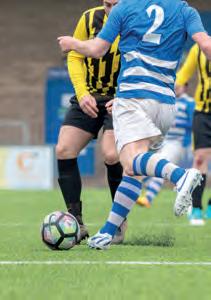















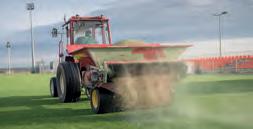




We Transform tired spaces into vibrant, inter generational community hubs.
Activation kits from just £1,999 - Full MUGA options available for all budgets
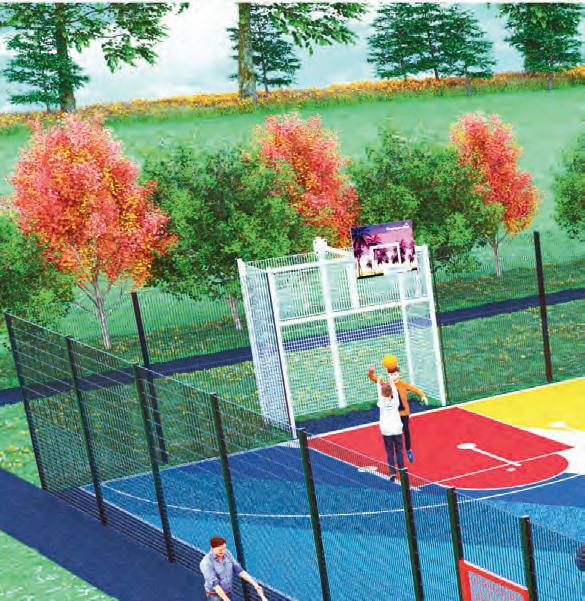
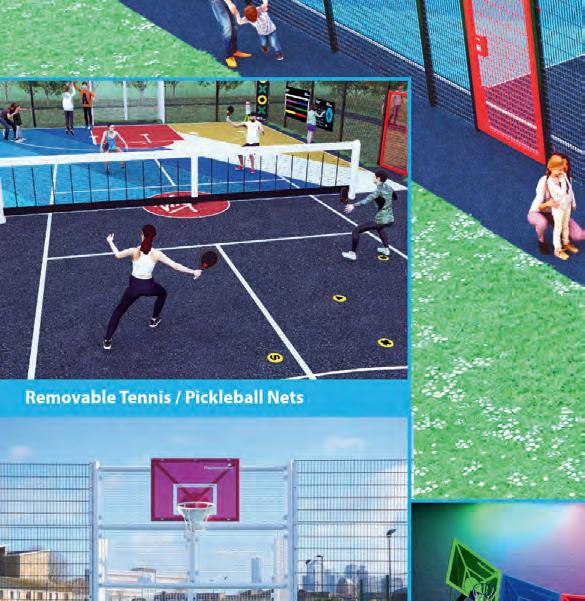
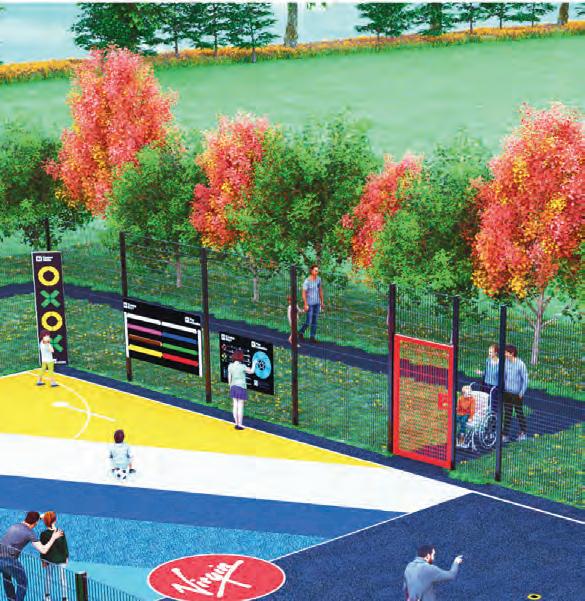

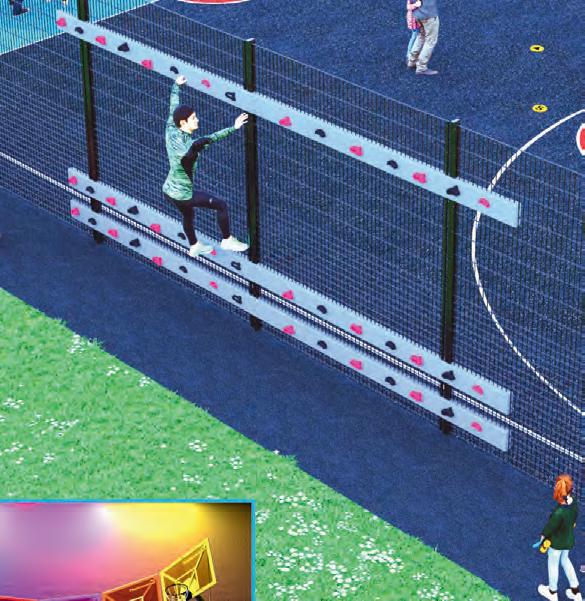

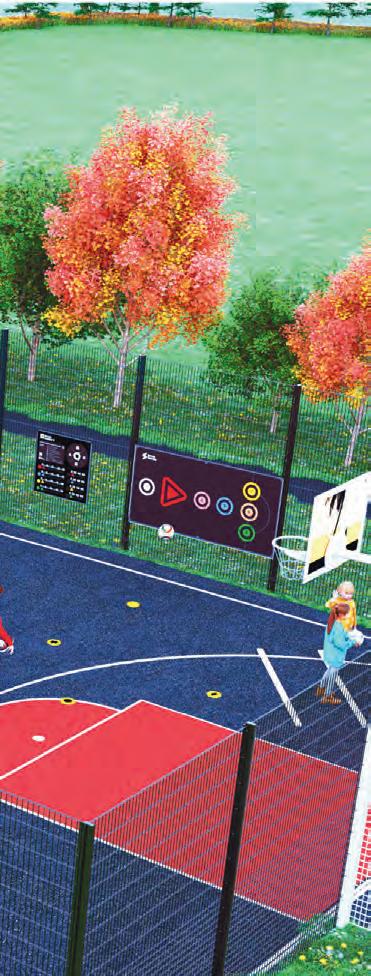


Patented games designed to tackle inactivity and mental health issues.
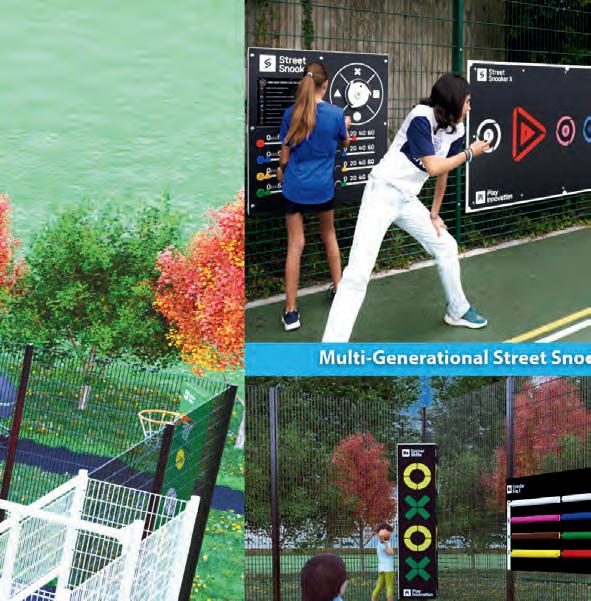
inter-generational, low maintenance games

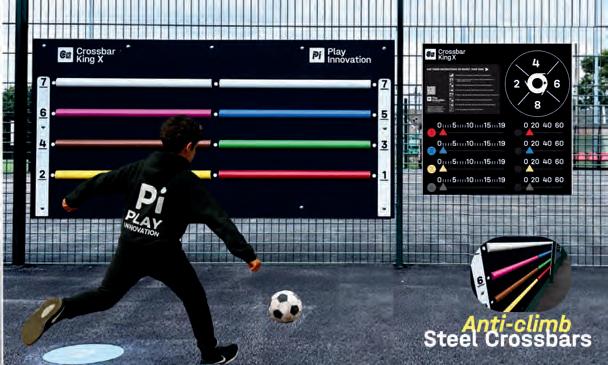
90–95%Inclusivedesignstandardsresultin useracceptanceacrossage&abilitygroups.


90–95%Inclusivedesignstandardsresultin useracceptanceacross
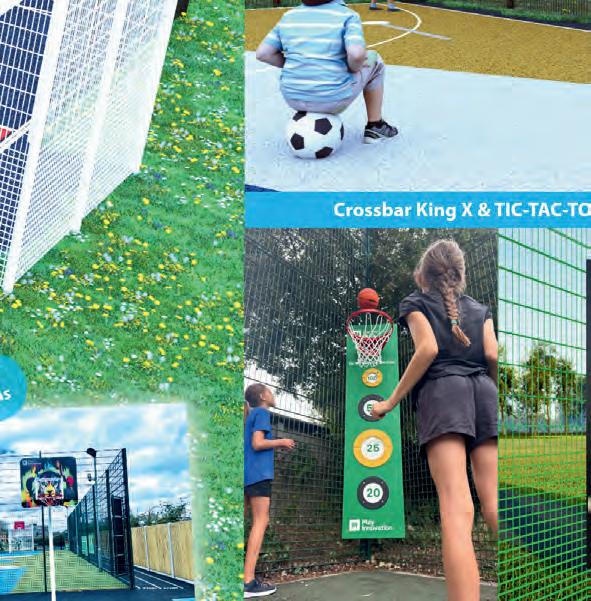

Ask about the Corner Skills range today!



Padel isn’t the only racket sport that is growing rapidly. Pickleball is experiencing a phenomenal boom, with the number of clubs in England nearly doubling in 2025
While padel is grabbing most headlines as the “fastest growing sport in the world”, there is another racket sport quietly making huge inroads across the UK landscape. Pickleball’s rapid ascent means it’s no longer a niche sport – it is firmly establishing itself as part of the furniture on the UK’s leisure and racket sports market.
Once seen as a curiosity imported from the United States, the sport is now making a case for being a scalable, accessible and commercially attractive proposition for operators across the country. The headline growth figures are striking. According to the national governing body, Pickleball England, the number of affiliated clubs nearly doubled during 2025, rising by 98.75% with 396 new clubs
added. The total now stands at more than 800 clubs nationwide – an expansion that underlines both grassroots demand and the increasing capacity of facilities to accommodate the sport.
Participation is following a similarly steep trajectory. Estimates suggest tens of thousands of people are now playing regularly in England, with broader UK participation continuing to climb year-on-year. Earlier data from Sport England indicated more than 27,000 people had played pickleball at least once across 270+ venues, and that base has grown significantly since.

Crucially, the sport’s appeal lies in its accessibility. It attracts players across all age groups, from children to those in their 80s, with its low barriers to entry and inherently social format driving repeat participation. This inclusivity is translating into strong retention rates – an important metric for operators seeking sustainable revenue streams.
From an operational perspective, pickleball’s growth mirrors the trajectory seen in padel, albeit at an earlier stage of maturity. The sport’s compact court size and flexible programming make it well suited to multi-use leisure environments, enabling operators to maximise yield per square metre. Existing tennis and badminton facilities are increasingly being reconfigured to incorporate pickleball courts, reflecting both demand and favourable economics.
Commercial health club operators – as well as public leisure centres – are increasingly capitalising on this shift. The integration of pickleball into programming offers a dual benefit: attracting new demographics while re-engaging lapsed users. Its relatively low physical intensity compared to tennis broadens its appeal, particularly among older adults and beginners, while still offering competitive pathways for more advanced players. The community dimension is equally significant. Much of pickleball’s growth in England has been driven organically through local clubs, schools and community initiatives. This grassroots momentum is fostering strong social networks around facilities – an asset that enhances customer loyalty and supports ancillary spend across
food, beverage and membership products.
Looking ahead, the commercial upside is considerable. Market projections suggest the UK pickleball sector could exceed £100m in value by the end of the decade if current growth trends continue. For operators, this represents not just a participation boom, but an opportunity to embed a high-frequency, community-driven activity within their offer.
The challenge now lies in infrastructure and governance keeping pace with demand. With club numbers accelerating and participation widening, investment in courts, coaching and competition pathways will be critical to sustaining momentum.
For the UK’s leisure sector, however, the direction of travel is clear. Pickleball is no longer an emerging trend – it is fast becoming a core component of the modern racket sports ecosystem.










While the increase in the number of pickleball courts is mainly driven by openings at existing venues with a mix of facilities – from leisure centres, health clubs and tennis clubs to schools – the number of dedicated pickleball venues is steadily growing. Pickleball England says the 13th pickleball venue will open in 2026, with several other projects currently in the pipeline. So far, the dedicated centres have spread fairly evenly across the country.
1. Telford Pickleball Centre
Telford, Shropshire
TF3 3AT
Opened: August 2023
No of courts: 6
Type: Roll-out courts
Padel: No
Café: by arrangement
2. Pickleball Doncaster
South Yorkshire
DN2 5TB
Opened: February 2024
No of courts: 3
Type: Painted
Padel: No
Café: No
3. The PicklePad
Mudeford, Dorset BH23 4HD
Opened: August 2024
No of courts: 4
Type: Acrylic
Padel: 2 courts
Café: Yes






4. Peak Pickleball
Sheffield, South Yorkshire
S8 0NA
Opened: August 2025
No of courts: 3
Type: Roll-out courts
Padel: No
Café: Yes
5. The Pickleball Shed
York, North Yorkshire YO61 1ET
Opened: November 2025
No of courts: 5
Type: Proflex
Padel: No
Café: Yes
6. Courtside Pickleball UK
Stourbridge, West Midlands
DY8 1JN
Opened: December 2025
No of courts: 8
Type: Proflex
Padel: No
Café: Yes










7. Your Padel
Uttoxeter
West Midlands
ST14 5AU
Opened: December 2025
No of courts: 3
Type: tbc
Padel: 7 courts
Café: April 2026
8. We Do Pickleball
Kingston-upon_Hull, East Yorkshire HU7 0YH
Opened: January 2026
No of courts: 6
Type: Proflex
Padel: No
Café: Yes
9. Advantage Padel
Christchurch, Dorset BH23 4FL
Opened: December 2025
No of courts: 5
Type: Acrylic
Padel: 8 courts
Café: April 2025

10. Hurlands
Farnham, Surrey
GU9 9NN
Opened: January 2026
No of courts: 8
Type: Proflex
Padel: 5 courts
Café: Yes
11. Court Yard
Weedon, Northants NN7 4PS
Opened: March 2026
No of courts: 2
Type: Taped
Padel: No
Café: Yes
12. Dinks
Eastleigh, Hampshire
SO53 4SE
Opening: April 2026
No of courts: 7
Type: Proflex
Padel: No
Café: Yes






Designing and installing appropriate lighting solutions is crucial for the success and sustainability of sports facilities. SportsNation looks at recent projects and developments in sports lighting
The visual environment is a key part of the design of all modern sport facilities. Internal and external lighting is especially important when designing and building multi-use games areas (MUGAs) and artificial pitches. In recent years the sports and play construction sector has undergone a significant technological shift. Across the UK and beyond, LED lighting systems have rapidly become the industry standard, replacing older metal halide and halogen installations. The transition has been driven by a combination of factors, including improved energy efficiency, lower maintenance requirements and the ability to deliver more consistent, controllable illumination across a playing surface.
For sports venues, getting the lighting solution right is about far more than visibility alone. High-quality lighting ensures athletes can perform safely and at their best, while helping officials, coaches and spectators clearly follow the action. At the same time, facility operators must carefully balance performance requirements with environmental and community considerations. Modern lighting designs must minimise spill and glare that could affect nearby homes or roads – an increasingly important factor as planning authorities place tighter restrictions on external lighting installations.
In October, SAPCA published its Code of Practice for Contractors Working on the Installation and Retrofitting of Sports Lighting. The code’s guidance ensures compliance with the latest safety, environmental and technical standards. To download the guide (and to see all other SAPCA Codes of Practice), visit: https://sapca.org.uk/guide/codes-of-practice/
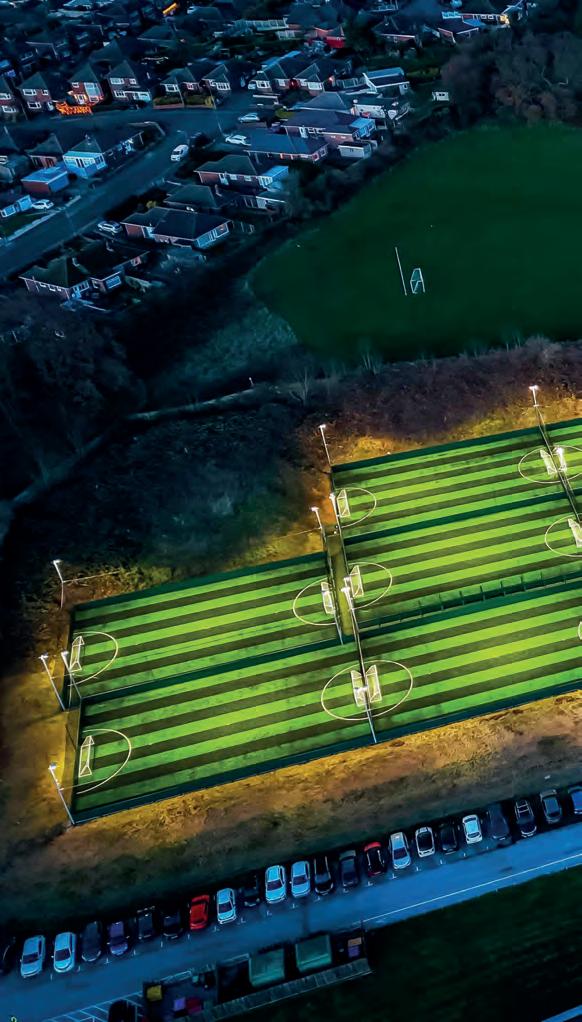
The kit met the lux brief first time, installed cleanly, and let us hand over on schedule with a robust, low maintenance LED solution
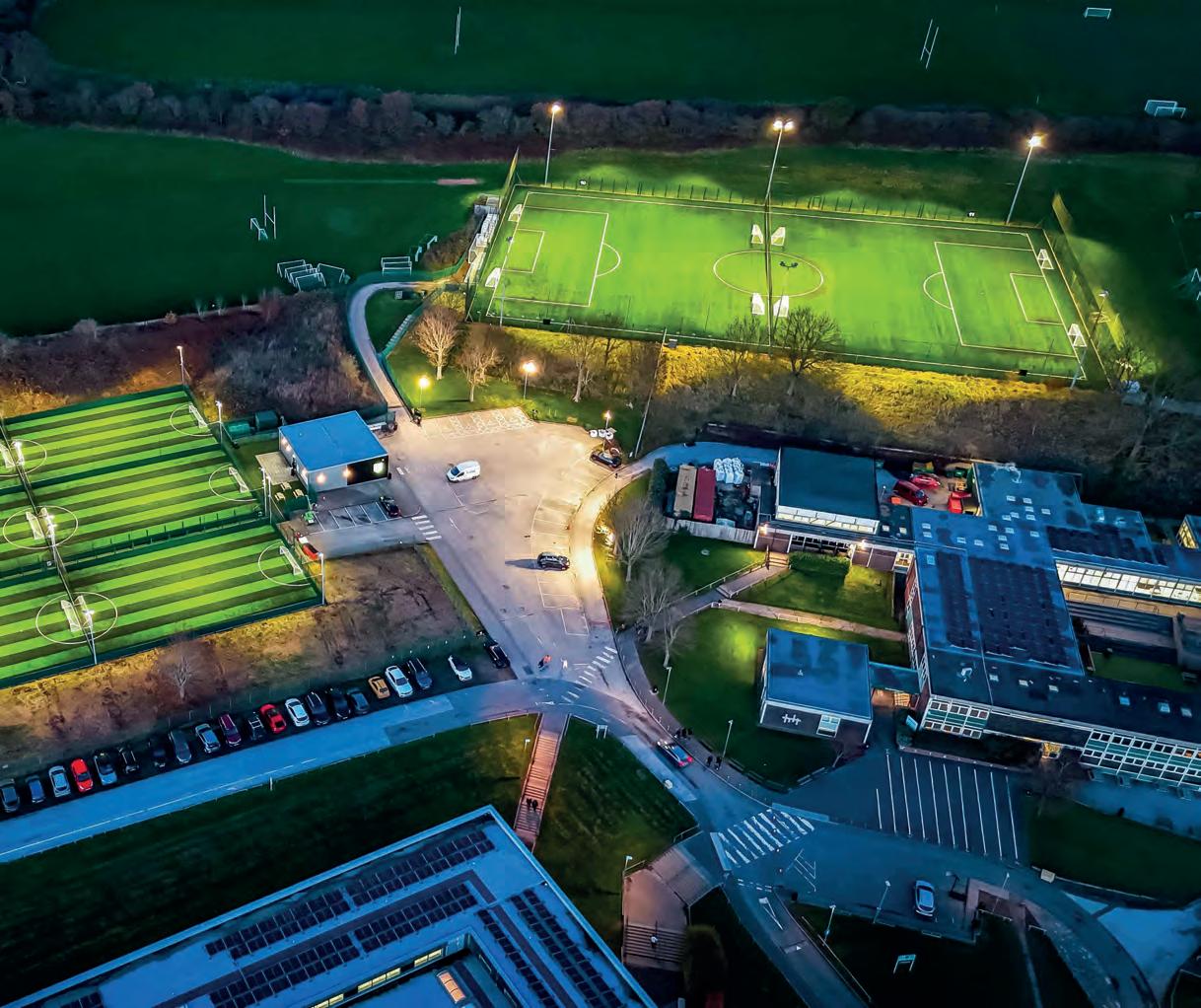
The new Powerleague Nottingham Arnold football hub needed a rapid LED retrofit to open on schedule. The centre features eight five-aside pitches and a full-size football pitch that can convert to four seven-a-side playing area.
Sports lighting specialists SJB Floodlighting selected SAPCA member Thorn Lighting as its lighting partner to deliver a fast, compliant LED replacement for the existing system. Two requirements set the direction: achieve 200 lx average with 0.60 uniformity on the full-size pitch and 120 lx average with 0.60 uniformity on the smaller five-a-side layouts. The project had to be completed within a tight 15-working-day window so installation could complete before the launch.
Thorn Lighting supplied its Altis and Areaflood Pro 2 solution within the required 15 working
days, meeting the required lx targets with a costeffective, low-maintenance option that supports high-quality play across multiple pitch formats. Altis LED’s high output and precision optics support clear visibility for players and officials across all formats. Areaflood Pro 2 extends that consistency around the site, helping routes and spaces feel intuitive and safe. The result is a coherent scheme that complements the new playing surfaces and refurbished clubhouse. Alongside refurbished social spaces, the efficient floodlighting was essential to provide the right experience for league nights, coaching and casual play.
Gareth Eley, SJB Floodlighting, said: “Lead time was the make-or-break factor on this project. Thorn confirmed Altis and Areaflood Pro 2 within 15 working days and kept us updated all the way. The kit met the lux brief first time, installed cleanly, and let us hand over on schedule with a robust, low-maintenance LED solution.”
It’s a great demonstration of how wireless technology can elevate grassroots sports facilities
Calverton Miners Welfare FC gets wireless lighting
Calverton Miners Welfare Football Club in Nottinghamshire has undergone a lighting transformation, replacing outdated metal halide fittings with energy-efficient LED floodlights and wireless lighting controls.
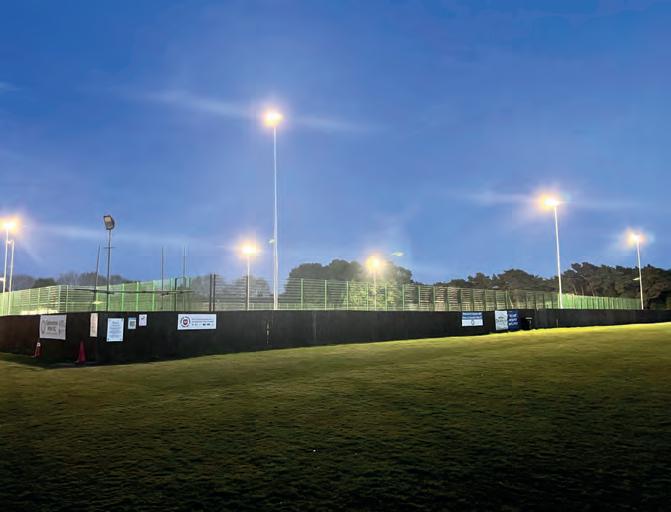
As part of a broader football framework initiative, the club aimed to improve visibility, energy efficiency, and lighting control – all without disrupting the existing infrastructure. The main contractor for the project appointed SAPCA member, Halliday Lighting, to deliver a full electrical installation, which included replacing the entire floodlighting system from the ground up, from underground cables, steel raised masts and equipment cabinet to front-end protection and relocated distribution and control.
A key requirement of the framework was the integration of dimmable controls to suit varied usage patterns and enhance energy savings. To achieve this, lighting specialist Tridonic supplied a tailored package of wireless lighting controls designed for
outdoor sports environments. The upgrade included Tridonic’s basicDIM Wireless OTD modules, basicDIM Wireless G2, and PS3 power supplies – all engineered for outdoor performance and seamless integration.
Matt Caygill, Tridonic’s Business Development Manager, said: “This upgrade provides the club with a dependable and energy-efficient lighting solution that improves both safety and functionality. It’s a great demonstration of how wireless technology can elevate grassroots sports facilities, delivering optimal lighting conditions for players while enabling greater control and energy savings.”
A group of SAPCA members have worked together to deliver a safer and brighter skate park in Tamworth. The park, at Tamworth Castle Pleasure Grounds, has long been a hub for skaters, families and young people, but its ageing floodlighting system was no longer meeting the needs of a modern, high-use recreational space.
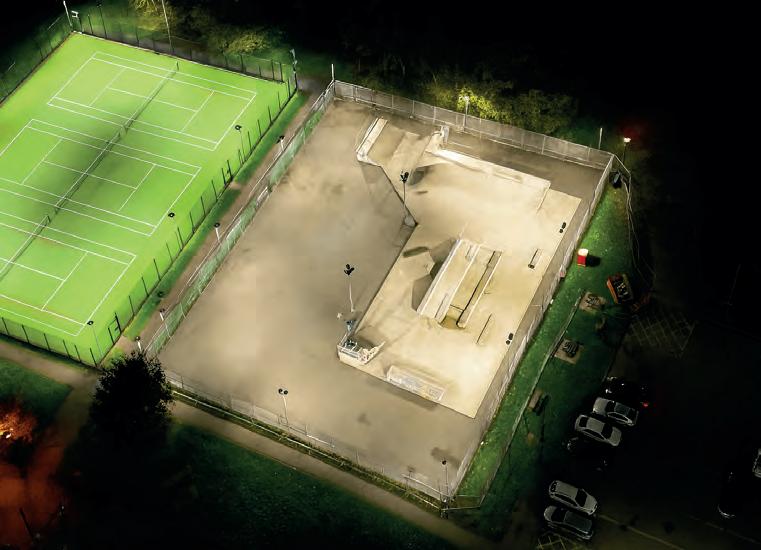
As part of Tamworth Borough Council’s wider improvement programme, the site has now undergone a significant transformation thanks to a full LED lighting upgrade designed and installed by JHP Electrical, working in partnership with fellow SAPCA members, McArdle Sport Tec and lighting manufacturer, Powerlite Fitzgerald.
The upgrade saw the removal of outdated fittings and the installation of 16 high-performance LED floodlights, each precisely aligned to deliver uniform illumination across the park’s varied terrain. Comprehensive lux level testing ensured full compliance with CIBSE guidelines, while the




Musco’s sports lighting systems continue to be the solution of choice at major stadiums and arenas around the world, including Principality Stadium in Cardiff, Wales. They partnered with Musco
Learn more about Principality Stadium at www.musco.com/principality














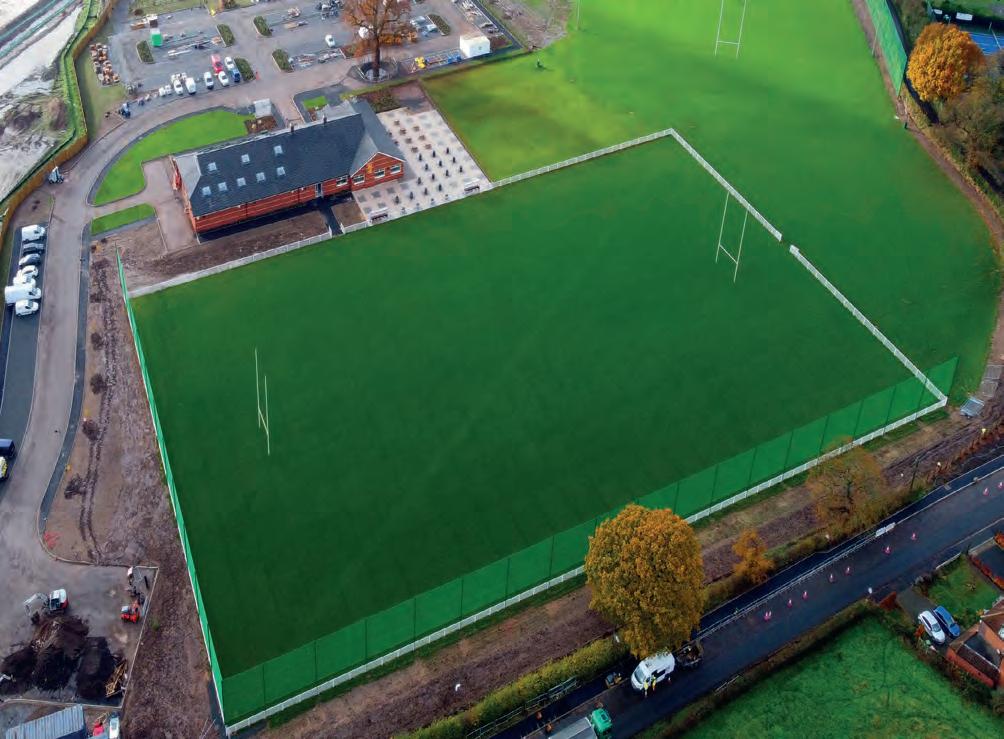


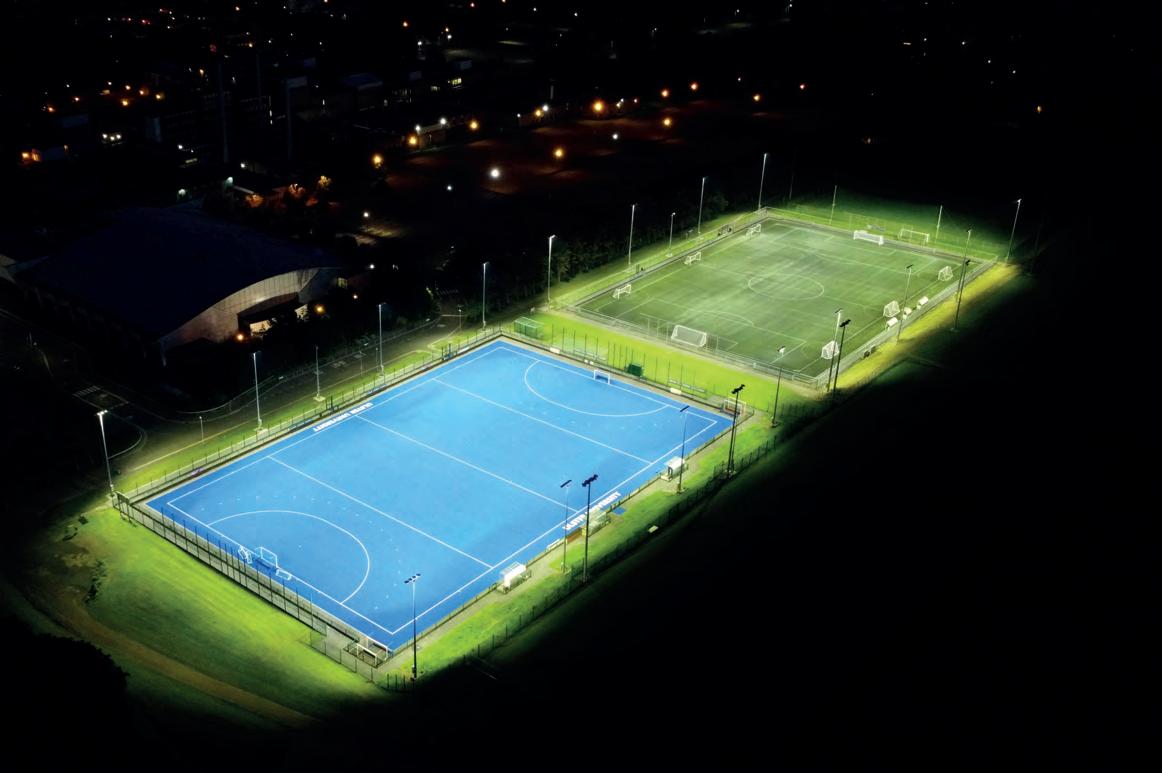
new system offers improved visibility, reduced energy consumption, and long-term reliability.
The result is a safer, brighter and more accessible environment that supports extended use during darker hours. Both McArdle Sport Tec and Tamworth Borough Council praised JHP Electricals’ professionalism and attention to detail, highlighting the project as a strong example of how modern lighting can enhance community sports facilities and promote sustainable recreational spaces.
SAPCA member and sports lighting specialist, Christy Floodlighting, combines in-house manufacturing with luminaire technology from GigaTera – a manufacturer that has achieved FIFA Quality Pro approval alongside verified FIFA Standard A performance. Christy’s recent multi-sport projects include Christ’s Hospital School – a project which won the 2026 SAPCA Award for Large Project.
In partnership with GigaTera, Christy deployed the MAF Gen2 flat glass floodlight to achieve exceptional uniformity, control of spill and glare and high-quality playability across multiple sports areas, even within sensitive environments.
Christy combines in-house manufacturing with luminaire technology from GigaTera

England Hockey has appointed SAPCA member, Kingfisher Lighting, as its Official Lighting Partner in a new three-year agreement to support clubs nationwide. The partnership reflects a shared commitment to strengthening facilities and building a lasting future for the sport.
As part of the partnership, Kingfisher Lighting (a division of Luceco UK Limited) will work alongside England Hockey and its existing facilities partners to provide clubs with expert guidance, practical support and cost-effective solutions. This will include webinars, toolkits and tailored advice to help clubs improve, modernise, and future-proof their lighting facilities.
Head of Sports and High Mast at Kingfisher Lighting, Lee Hayter, said: “We are proud to strengthen our relationship with hockey and look forward to helping clubs develop their facilities with world-class lighting solutions.”









































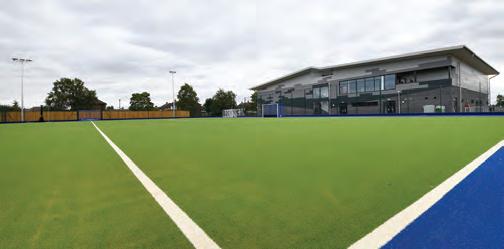









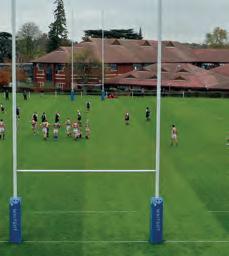







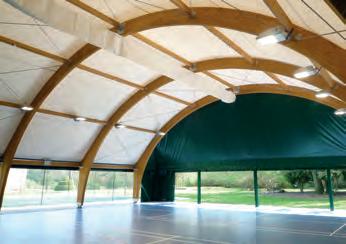



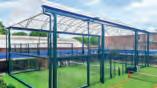

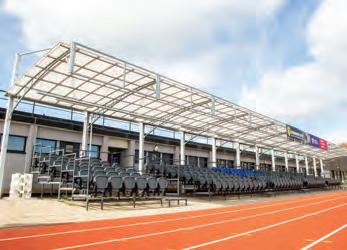











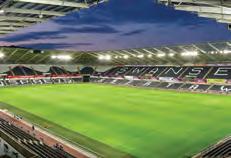






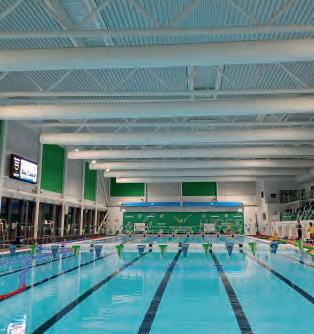











































































































Could the constant search for suitable opposition be over?


How to build engaged networks of players
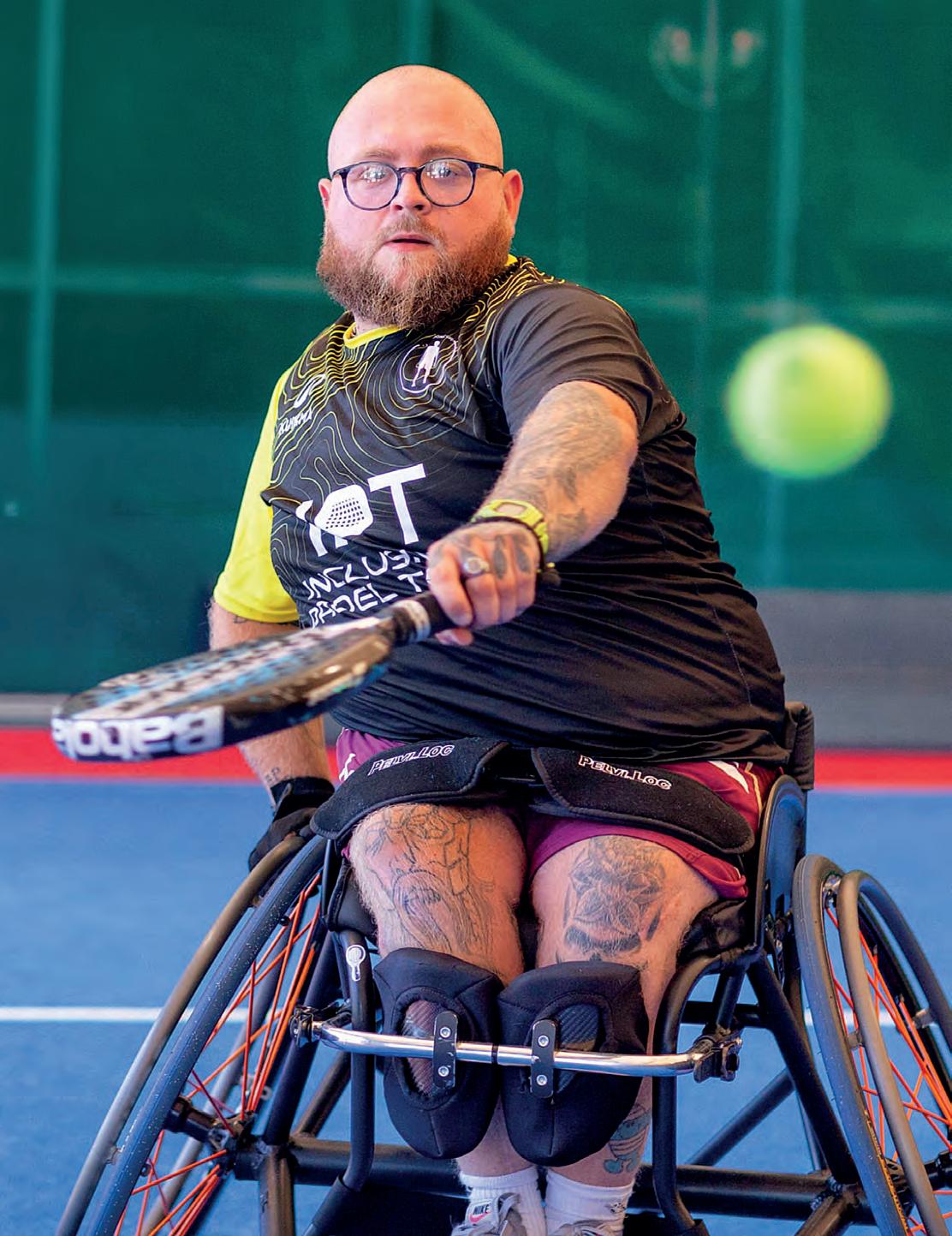
We need to show how wheelchair padel is both viable and sustainable





































Steve Mills, General Manager, Nottingham Tennis Centre


Working with Fordingbridge was a breath of fresh air! One of the most professional, respectful, diligent contractors we’ve ever worked with.”







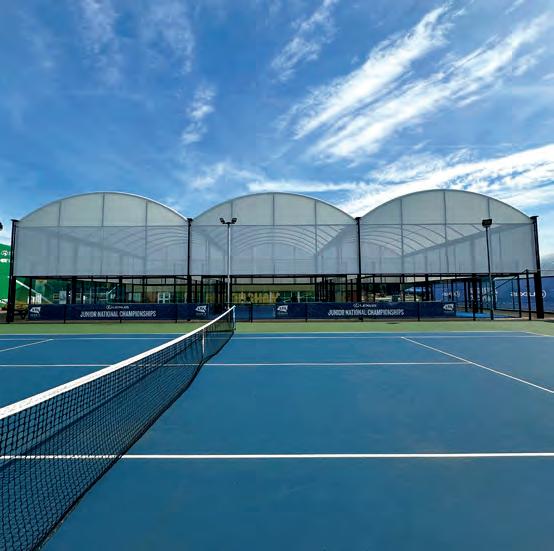
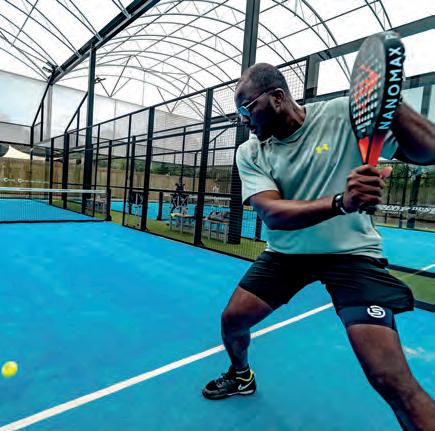





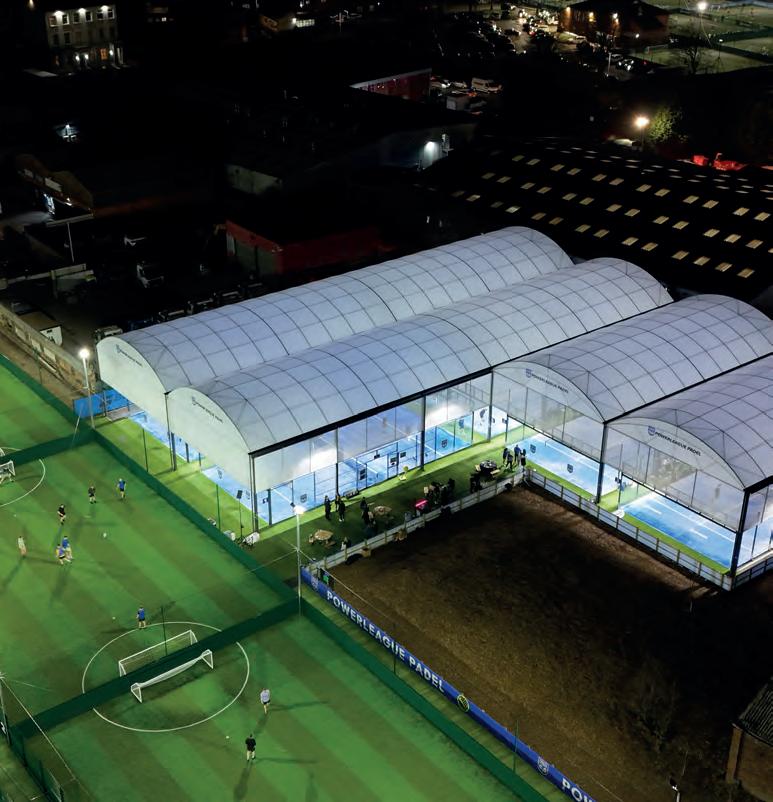



Fordingbridge brings real sector expertise to the table. Their product is strong, their team is comfortable with complex national programmes, and we’ve had complete trust in them every step of the way.”


Sean McNicholas, Director of Estates & Facilities, The Bannatyne Group







The padel court canopies Fordingbridge have designed for us have been beautiful and we’re thrilled with the finished product. The player experience is now excellent, regardless of the weather.
The team’s attention to detail and commitment to meeting our needs was impressive.”
Freya Tringham, Head of Padel, Powerleague


At every step of the development we felt assured that the advice, technical specifications and delivery of Fordingbridge’s product would be to the highest standards. The finished canopies not only look amazing but have received excellent feedback from our players.”

Carole Naunton, Director, West Worthing Tennis Club

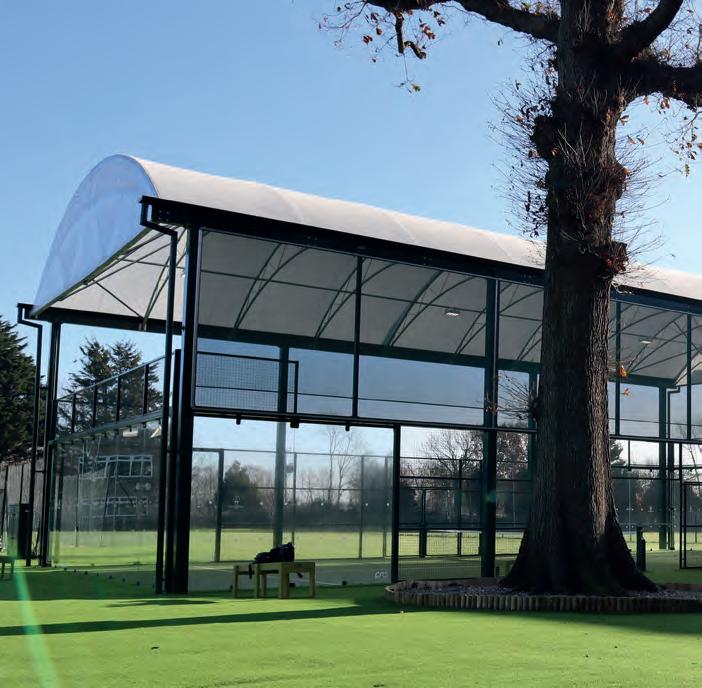









John Challinor
Publisher
PadelNation john@nationmedia.uk

Jethro Binns Co-founder PadelLevels

Robyn Duda Founder RacquetX

Tom Walker Editor
PadelNation tom@nationmedia.uk
Jack Binstead
The UK’s number 1 disabled padel player

Guy Gri ths Founder Padel Partners Networking
PadelNation is at the heart of the UK’s fastest-growing sport. With new courts, clubs and investors entering the market every month, we’ve created the go-to publication and news website for operators, developers, investors and stakeholders looking to succeed in padel. PadelNation is published three times a year as a standalone title, with each issue also included within SportsNation. In addition to this, the annual Padel Book provides the most comprehensive industry guide - covering design & build, management, operations and maintenance - and developed in partnership with SAPCA, the LTA and leading padel specialists.


Slazenger has announced ambitious plans to grow its presence and become “the leading name on the UK padel market”, with more than 10 new Padel Clubs set to open in 2026. This would bring the total number of courts in its portfolio of clubs to 150. Slazenger Padel Clubs opened its third location in Blackburn, a multi-purpose destination, earlier this month. The 30,000 sq.ft club features nine panoramic padel courts, expert coaching for all levels, a Members Bar, social spaces, pro shop, equipment hire and, for the first time within the Slazenger Padel portfolio, two dedicated pickleball courts. In addition, Slazenger operates clubs in Leeds and Swindon. Confirmed future locations include Mansfield, Cardiff, Exeter, Hull, Liverpool, Newport, York, Gillingham and a second site in Leeds. Slazenger Padel Clubs is owned by Frasers Group, the retail giant which also
Regionally, London remains the largest padel market in the UK
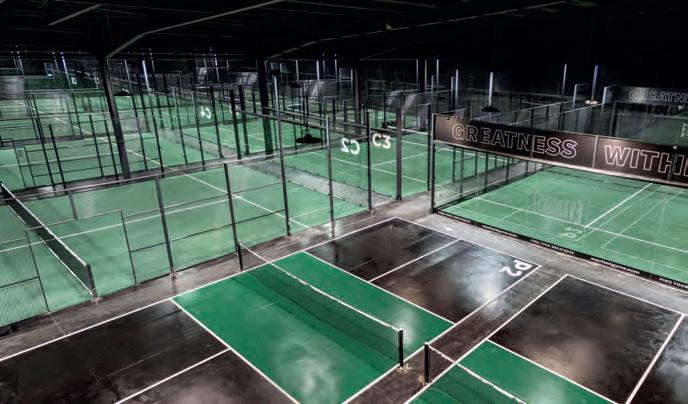
owns Sports Direct, House of Frasers, Flannels and Game chains of outlets. In addition, Frasers Group also owns the Everlast Gyms chain and a number of branded apparel lines, including Everlast and Jack Wills.
“Padel has experienced an incredible trajectory over the past few years,” they said. “It’s a highly
social sport and a relevant younger brother of tennis, appealing to a wide array of demographics making it a natural fit for our audiences.
“Slazenger has long been synonymous with elite racquet sports, and building on its heritage in tennis, padel represents a powerful next chapter for the brand.”
than doubled in 2025”
Participation in padel more than doubled in the UK during 2025, according to data published by Playtomic.
The number of players booking courts through Playtomic’s platform rose from 76,695 in January 2025 to 172,564 in December 2025 – representing growth of approximately 125% across the calendar year.
According to the data, new player acquisition also accelerated sharply during the year. The number of firsttime players booking through the platform rose from 17,196 in January to 37,411 in December, an increase of approximately 117%. Regionally, London remains the largest market, followed by Manchester, Bristol, Leeds and Derby, demonstrating growth in urban centres.

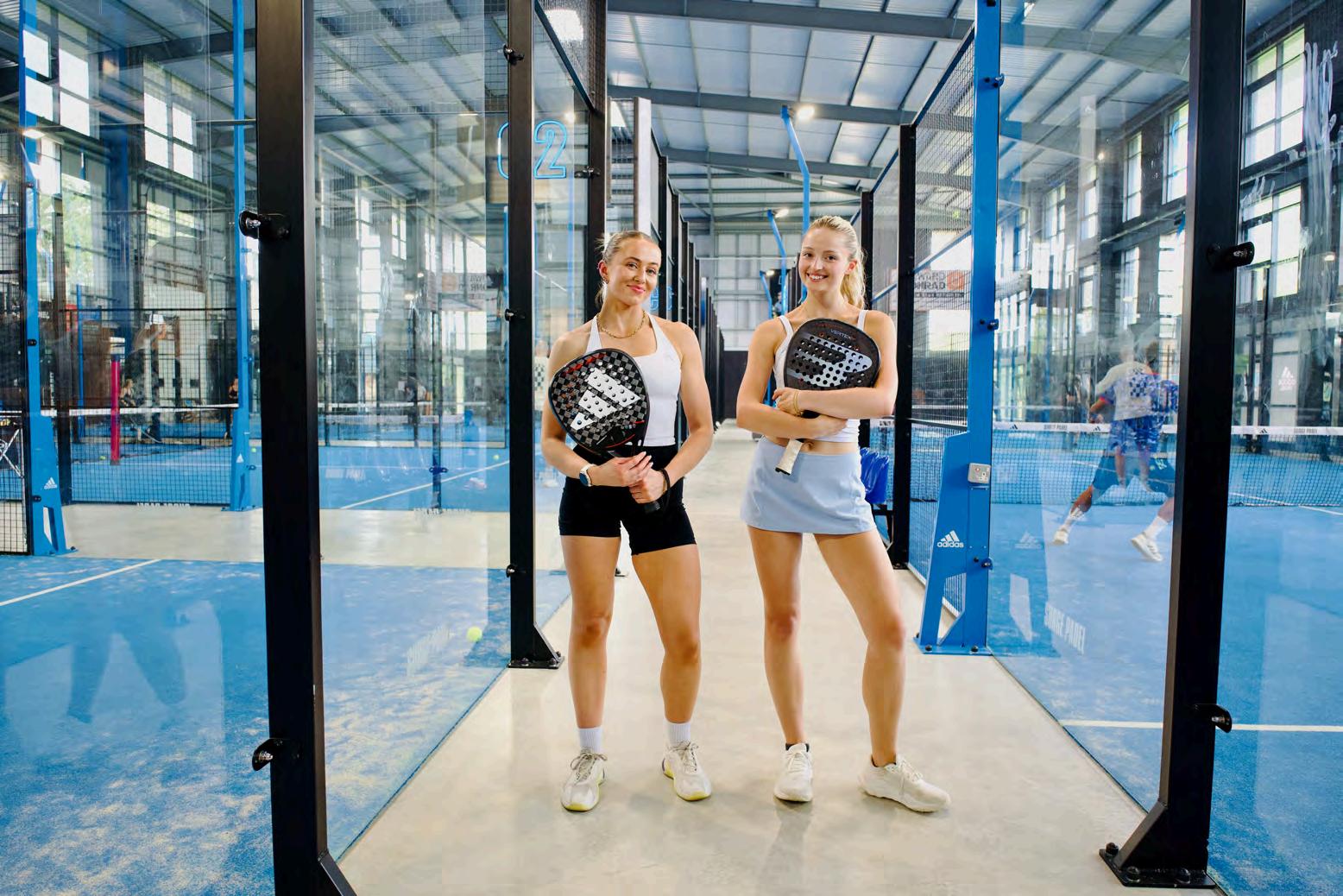

SurgePadelisexpandingacrosstheUK, partnering with golf, leisure, rugby, football and tennis clubs, plus large venues.Knownforpremiumfacilitiesand community-focused coaching, Surge helps venues tap into the booming demandforpadel.
Forpartnershiporpropertyopportunities, contactrich.wingfield@surgepadel.co.uk
Hounslow Council has approved plans to deliver six new padel courts at two of the council’s leisure centres.
At both Hanworth Leisure Centre and Isleworth Leisure Centre, two of the four existing tennis courts will be converted to three padel courts.
The estimated capital cost for the project is £950,000. The council estimates that the courts will generate around £1.4m of additional income across the two leisure centres.
Following the funding approval, the Council will now consult with local people and put the project to the planning team. It is currently estimated that the new courts will be available for spring/summer 2027 and Council partner, Lampton


The council estimates that the courts will generate around £1.4m of additional income
Leisure, will manage the new offer on behalf of the council.
Councillor Salman Shaheen, Cabinet Member for Leisure and Public Spaces, said: “I’m proud we are investing nearly £1m to bring padel to our leisure centres, in Isleworth and Hanworth, for the first time. There can be no greater investment than in the health and wellbeing of our residents.”
The LTA has announced the appointment of Iciar Montes as LTA Padel International Performance Coach. Montes brings a wealth of experience into the role and will be working closely alongside LTA National Performance Pathway Manager and Great Britain coach Libby Fletcher. Montes, a former world number 1, will be joining the LTA Padel performance team, joining forces with Agustin Gomez Silingo who was appointed as LTA Padel International Coach last May ahead of the FIP Euro Padel Cup. Montes will focus on the GB Women’s National Team, with Silingo transitioning to the GB Men’s National Team. In this role, Montes will support the preparation and activities of the Great Britain’s Women National Padel Team, contributing to team selection processes, travelling to FIP-sanctioned international team events, and providing comprehensive on-court support.
Plans have been submitted for a £4m, purpose-built padel centre and social hub in Nottingham. Called Swing, the proposed centre will have 11 courts and could help make Nottingham become a focal point for British padel.
Developed by ALB Group and designed by Leonard Design
Architects, the proposed 30,000sq ft facility on the city’s Electric Avenue would feature eight indoor and three covered outdoor padel courts, a show court with arenastyle seating alongside wellness and leisure spaces including sauna, physiotherapy and sports massage rooms and reformer pilates studios.
Padel’s social aspect and “easyto-learn” nature are among the key drivers of the sport’s rapid growth in the UK.
Research into player motivations, conducted as part of a partnership by Soul Padel and Loughborough University, shows that players appreciate the sport’s “fun” and “addictive” nature, with many saying they improved quickly enough to stay motivated. The research, titled Why Choose to Play Padel? A Study Exploring Motivations and Social Benefits of Tennis Padel Participation in the UK, was undertaken by Vasia Karvouni, an MA Sports Management student and elite Greek tennis player.
When asked about barriers, players frequently mentioned accessibility and cost. Some players had experienced courts priced up to £80 per hour, making padel feel exclusive in certain areas. Participants also
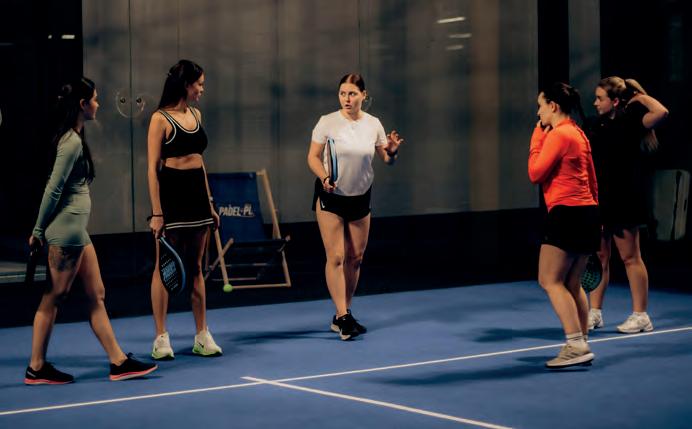
Those surveyed described padel as “more interactive than tennis”
highlighted equipment prices reaching £500 for some rackets.
Weather and limited court availability were also referenced as restricting regular play.
The research is part of the ongoing “Soul Padel on Campus”
partnership between Loughborough University and Soul Padel – one of the UK’s leading padel operators.
Mark Hewlett, CEO and Founder of Soul Padel, said academic collaboration has been a core part of the programme from day one.
Padel tournament operator, UK Padel, has announced HEAD as the official ball sponsor of its UK Padel National Championships.
The three-year agreement ensures that every level of the UK Padel events pathway will be played with the HEAD Pro S+, a padel ball trusted across the game worldwide.
From U13, U15 and U18 National Schools and Universities Championships to the Masters Series and UK Padel County Championships, HEAD is the exclusive and official padel ball supplier for these events.
UK PADEL’s CEO, Nick Baker said: “We are absolutely thrilled to have a global powerhouse like HEAD behind us for the next three years. Their world-class ball elevates our competitions”





Construction work has started on a new five-court padel venue in Southport which is scheduled to open in June 2026.
Site clearance and groundworks are under way at the Birkdale Padel Club development in Victoria Park, which is the first project by Sefton Padel. Planning permission was granted in December by Sefton Council, which said the scheme would be a positive addition to the character of the area.
Alongside the courts, the scheme will feature a grab-and-go coffee kiosk, vending machines for playing equipment, drinks and snacks, changing facilities, outdoor seating, cycle storage and an office for staff.
Sefton Padel founder and chief executive, Paul McComb, has leased the 3,600sq m site on a 15-year agreement with Sefton Council.
Birkdale Padel Club will be open daily from 7am until 10pm and
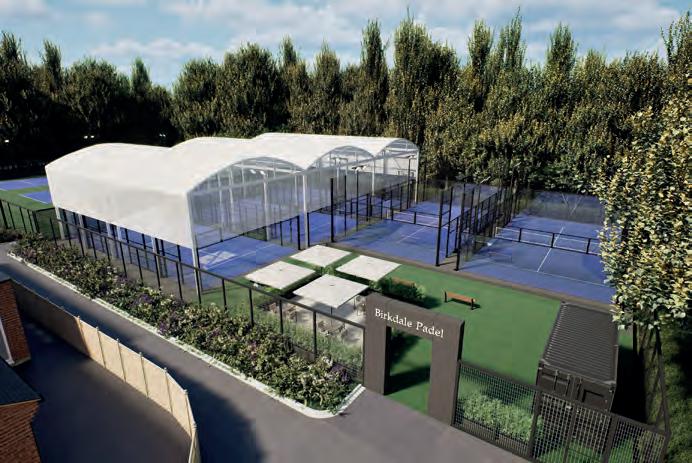
already has a waiting list of 2,500 people ahead of its launch. The site previously housed six tennis courts. Three will be retained and upgraded as part of the development.
The club will offer concessions for blue light workers and under-
18s, and will work closely with local schools by providing free introductory sessions and holiday coaching camps for youngsters.
Sefton Padel has also committed to using local suppliers through the construction project.
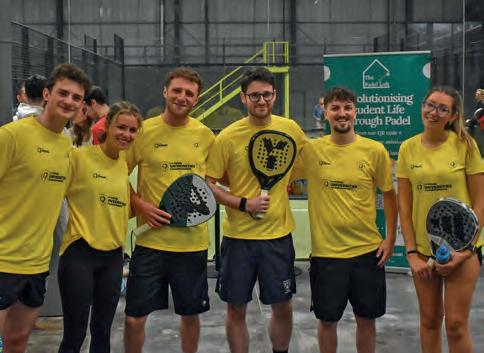
Players from across the country came together in Bristol recently for the UK Padel University Championships, with 67 teams from 23 universities competing across men’s, women’s and mixed events.
The Championships highlighted not only the rapid growth of padel within higher education, but also the unique culture that makes the sport so appealing to students. Many players already knew one another through UK Padel’s NUPL or LTA-sanctioned events, creating a sense of familiarity, rivalry and mutual respect that lifted the weekend to another level.
Mark Ayers, Tournament Director, said: “The atmosphere across the whole weekend was exactly what university padel should be about. There was a real raw energy from the players and a great sense of community between teams.”





















Theratingssolutionforclubs, federations,andbookingplatforms.

fe feder












’




Mismatched players


Accurate player ratings




Fair matches that keep Proven to increase enga s e embers r , and revenue. e
Mismatchedplayerscostyoutime,members,andrevenue.
airmatchesthatkeepplayerscomingback. Proventoincreaseengagementandretention.


cost s you ti t me, m . players coming back. gement and retention.





Pure Padel has announced plans for its first Liverpool club, marking a major North West expansion for the business.
The proposed development would see a new premium padel destination take shape on the Edge Lane site, featuring six covered courts beneath a 9.5m canopy to allow year-round play. Plans also include a clubhouse with a food and beverage café, pro shop and social spaces, designed to make the club as much a place to spend time as it is to play sport. No opening date has yet been confirmed.
Liverpool Innovation Park has benefited from significant recent investment and has established itself as a key business and innovation hub for the city. Located around two miles from Liverpool city centre and positioned on Edge Lane, the main arterial route into the city from the M62, the site offers
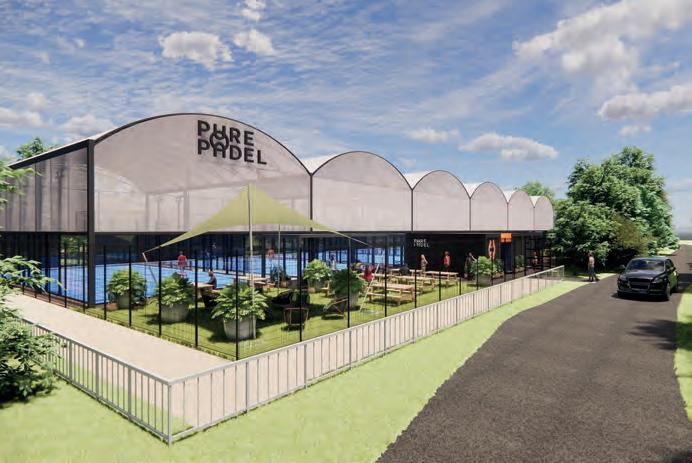
strong visibility and accessibility, placing padel in one of Liverpool’s most prominent urban locations.
The proposed Liverpool club would operate on a pay-to-play basis.
By the end of 2026, the company’s rapid growth is expected to see
The proposed development would feature six covered courts beneath a 9.5m canopy to allow year-round play
Pure Padel become one of the largest padel operators in the UK.
Planning has already been approved or is progressing for further clubs, including Birmingham city centre, Gosforth, York, Royal Wootton Bassett and Coulsdon.
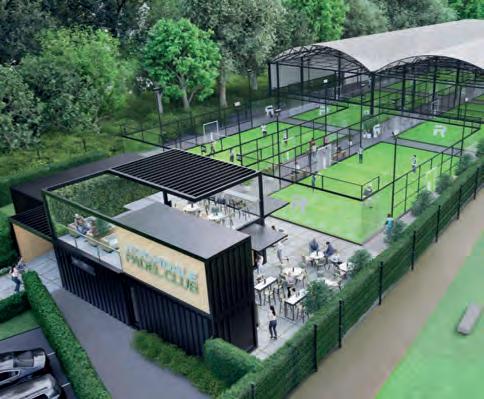
Planning approval has been granted to build six padel courts on the grounds of Rochdale Sports Club.
The project, led by Rochdale Padel Club, includes both covered and uncovered courts, alongside a clubhouse building with changing rooms, café and a terraced socialising area.
Rochdale Padel Club has worked with The Padel Architects on the project.
The padel courts will add to the existing facilities on the 13-acre Rochdale Sports Club, the home ground of Rochdale Cricket Club, located in the North West of Rochdale, Greater Manchester. Current facilities include a cricket ground and large pavilion with three function rooms.
Other sports played at the site include lacrosse and squash.
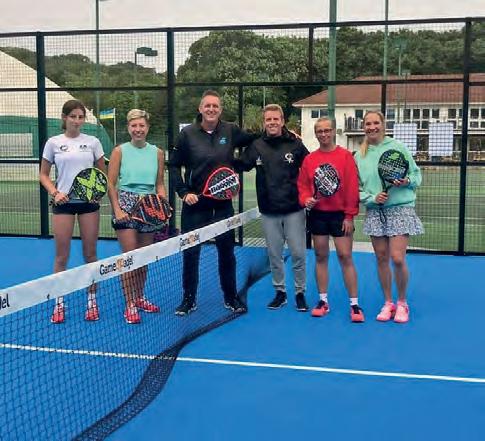
Game4Padel has opened three new padel courts at Withdean Sports Complex in Brighton. Developed in partnership with leisure management company, Freedom Leisure, and Brighton and Hove City Council, they will be the first covered courts in the area and are expected to be hugely popular with the existing Withdean community and beyond. Plans for a new community swimming pool on the site have also been approved.
Game4Padel previously operated a single, temporary court at Withdean, until May 2024, which ran at an average of 90% occupancy. The company also operates the padel and tennis facilities at Hove Beach Park (which were at 97% occupancy throughout the summer). Game4Padel is one of the UK’s leading operators, with 26 venues around the UK.
A duo of Nottingham-based hospitality entrepreneurs have partnered with former England and Nottinghamshire cricketer, James Taylor, to launch a premium padel complex in the city. Called Padelplex, the £1m venture will consist of five covered outdoor padel courts alongside a hospitality pavilion featuring a reception area, snack bar, indoor seating and changing facilities. Located adjacent to the city’s Showcase Cinema, on the land at Dusk Till Dawn’s car park on Redfield Way, Padelplex is the brainchild of Nottingham hotelier Richard Johal and Rob Darby, founder of popular coffee house, 200 Degrees. Plans have now been submitted for the facility, which has been designed by Leonard Architects and will have a focus on a premium padel experience with “customer service at its heart”. The deal for the land was brokered by Box Property.
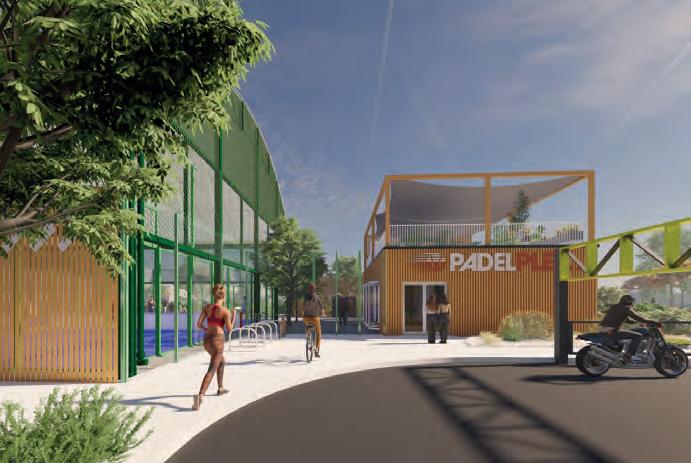
Padelplex co-founder, Richard Johal, said: “We saw an opportunity to develop a high-quality, premium offering with an eye on the ‘added extras’ of a top quality venue, but at the same price point to play. The small things like a consistently
The centre will house five courts and the founders hope to open the facility in 2026
friendly welcome, clean and bright and well maintained facilities will be consistently excellent at Padelplex, combined with the essentials such as plentiful free parking and easy access to great restaurants and other activities, such as the cinema.”

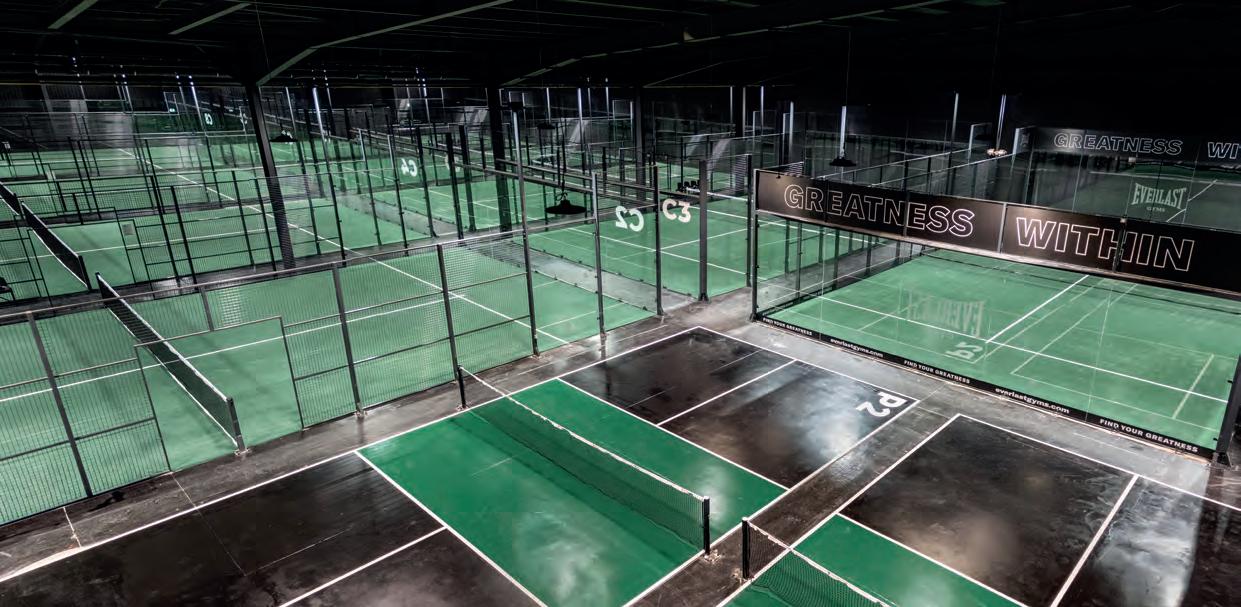
As padel continues its rapid rise across the UK, Slazenger Padel Clubs has firmly established itself as one of the country’s largest and most influential padel operators, delivering what many now recognise as the highest standard of padel facilities, programming, and player experience nationwide.
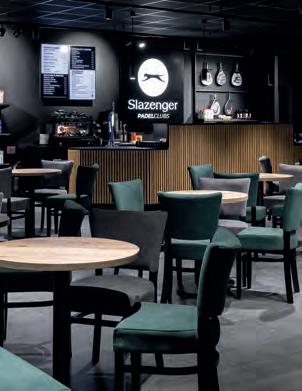
The foundation of Slazenger’s growth is its flagship Leeds North club, which has now been open for over a year and continues to set the benchmark for padel performance in the UK.
With 12 indoor courts, Leeds North operates at an exceptional 90%+ occupancy on a weekly basis, demonstrating both the strength of demand for padel and the effectiveness of Slazenger’s operational model. This success is driven by a comprehensive offering that includes structured coaching programmes for all abilities, daily socials, competitive leagues, and a vibrant club community.
Leeds North has also become a destination venue for the sport, hosting elite tournaments, Pro-Am events, and exhibition matches featuring top UK and international players, alongside appearances from high-profile sporting celebrities. These events have played a key role in elevating padel’s profile while reinforcing Slazenger’s reputation as a leader at both grassroots and elite levels.
Following the success in Leeds, Swindon opened in December 2025 and has already established itself as a major hub for racket sports in the region. The club features 8 indoor padel courts, alongside pickleball, and has seen strong early engagement across coaching, socials, and casual bookings.
Blackburn, which opened in January 2026, continues this momentum in the North West. With 9 indoor padel courts and pickleball facilities, the club strengthens Slazenger’s multi-sport strategy and reinforces its commitment to creating inclusive, high-quality indoor venues that appeal to both new and experienced players.
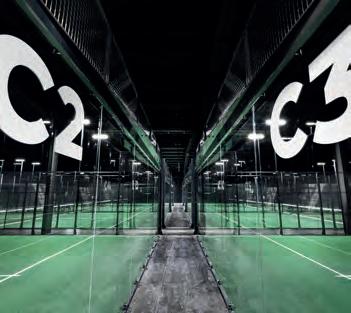
Commenting on the brand’s trajectory, Stuart Perrin, Managing Director, said:
“After securing industry-leading results in the Leeds North club, Frasers Group have confirmed their commitment to being the biggest name in the sector to match the heritage and legacy the Slazenger brand has become synonymous with. Growth plans in 2026 should see the chain operate 150+ courts nationally by the end of the year, with an even bigger 2027 planned.”
This commitment underlines Slazenger’s position not just as an operator, but as a long-term architect of the UK padel landscape.
Slazenger Padel Clubs’ expansion plans are among the most ambitious in the UK.
Two major developments are already confirmed:
MANSFIELD
12 indoor padel courts, designed to replicate the proven Leeds model
LEEDS SOUTH
set to become the largest padel club in the UK, with an industryleading 14 courts
Beyond these flagship locations, Slazenger has outlined further
expansion into key UK cities, including:
• Cardiff
• Exeter
• Hull
• Liverpool (Ellesmere Port)
• Newport
• York
• Gillingham
Each new club will follow the same core principles: premium indoor facilities, elite-level court quality, comprehensive coaching pathways, community-led programming, and the flexibility to incorporate additional racket sports such as pickleball where demand exists.
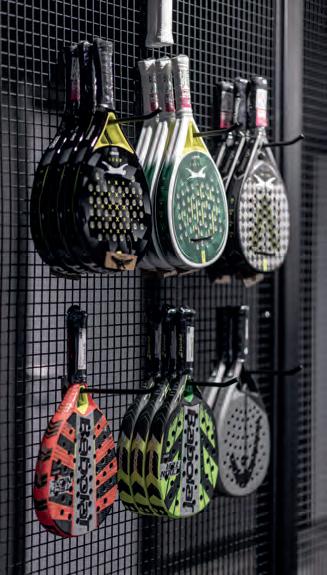
From elite competition and celebrity Pro-Ams to accessible grassroots participation, Slazenger Padel Clubs is not simply growing — it is defining what best-in-class padel looks like in the UK.
With proven performance, rapid expansion, and a clear long-term vision, the brand continues to lead the sport’s evolution nationwide.
Want to get on court? Scan the QR code to book your session.

Richard Shaw CEO, SAPCA
Just like every middle aged bloke, it seems, I’m on my own padel journey. Playing once a week, I’m slowly – very slowly –improving (2.7 for those in the know). When our group first started playing, we searched the internet for anywhere close to us that “did padel”, without much success, or many options. The courts that we could find were booked up quickly by regular players and people like us wanting to try out the new sport. Had you given us an outdoor, instant padel court with plastic click flooring and perspex sides and we’d have happily paid you over the odds! Covered courts with a nice surface were only a dream. Today, it’s a different story. As more centres and courts have been built, we’ve tried and tested several. Like everyone else, we’ve become informed consumers – making decisions about where we play, how much travelling is involved and what the cost is. This week, while driving home and organising the following week’s session, we discussed everything from the price of the court and how cold the centre was to the roof height and even the quality of the drinking water. The site we have settled on is an extra 20 mins drive, but we’re happy to do it, to get what we wanted.
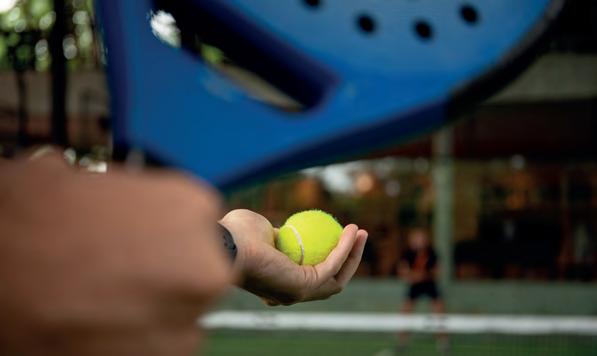
A much greater focus is now being placed on building facilities that people want to be part of, rather than a necessity to play the sport
Conversations with padel operators recently have suggested that consumer choices – and therefore club differentiation – is shifting. The days of “build it and they will come” was only ever partly true and never had much longevity as supply caught up with demand. A much greater focus is now being placed on building facilities that people want to be part of, rather than a necessity to play the sport. Quality of courts, roof height and surfaces all have a significant impact on the playability of the game. As standards increase and players demand more, these are the factors that will have long term consequences for operators.
At SAPCA, in the early days of padel, we spent a lot of time trying to convince operators of the need for having good courts and good installations on the basis of player safety, performance and longevity. All true, all correct, of course – but we didn’t really talk about return on investment based on consumer preferences. Simply put, we don’t really talk that language with any other sport. This is because the growth of padel has been very different to anything we have seen – it has been rapid because of its appeal to private capital. The lexicon of the sport is different, more entrepreneurial and more sensitive to differentiation of clubs.
The choices of consumers and the longer term prospects of padel as a sport, have brought together more operators to focus on quality and consider the longer term implications of their investment. Long may this continue and, hopefully, bring much needed stability to the world of padel, both literally and figuratively!
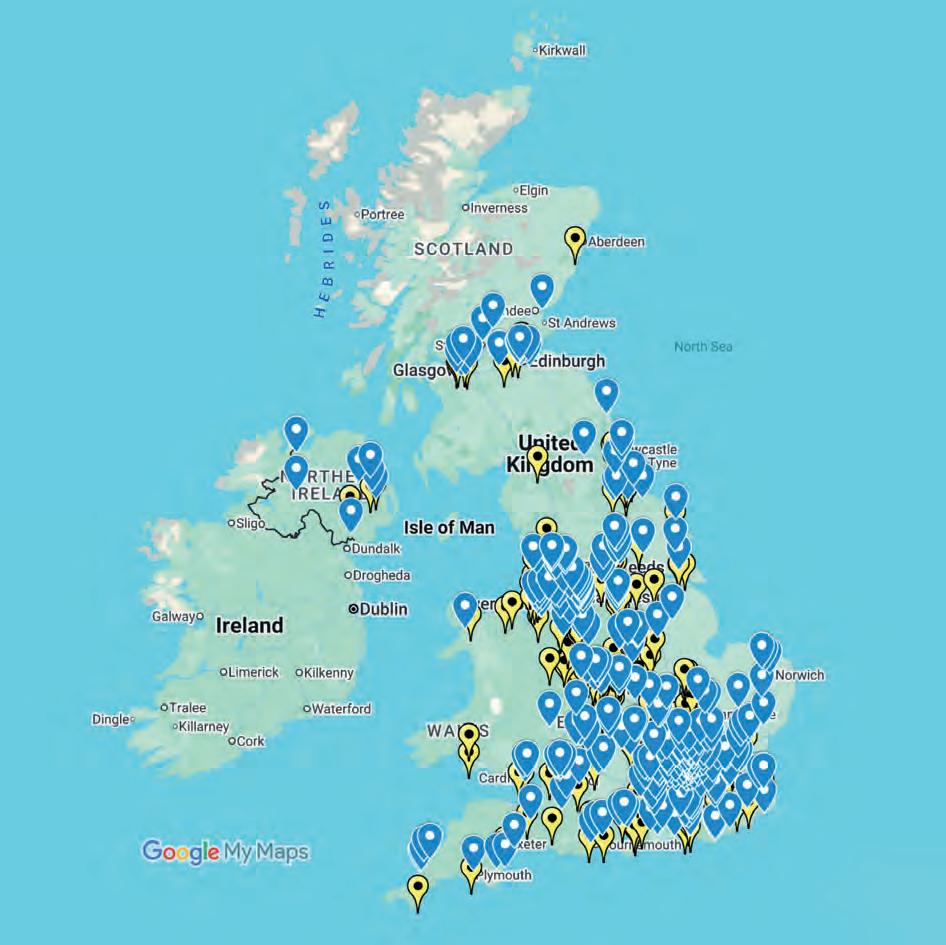
Understand
Target
Robyn Duda, the founder of RacquetX –North America’s biggest racquet sports festival –talks about building the event from nothing, why padel was the spark and why UK readers should mark June 9 in their calendars
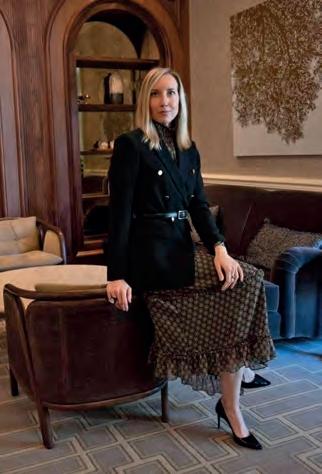
Why did you create RacquetX?
It was clear there was a need in the market and people had validated that. I love building things. There are very few white spaces left where you can genuinely create something new. And mixing sport, connection and events? That’s kind of a dream for me.
The timing was right, too. Racquet sports were on the rise and nobody had claimed the space. We came in at the right time when padel was still early enough to be intriguing, pickleball was established but still finding itself and tennis had been growing steadily, with major brands starting to move into pickleball and padel.
There was this undeniable crossover between the sports. It felt like there had to be a way to make it work. We never wanted to leave out squash, table tennis or any of the other sports represented [at RacquetX] because we want everyone to be part of it. But it started with those three because they have the most players and generate the most revenue.
Padel has had a remarkable few years. What does that growth look like from where you’re sitting?
It’s exciting. When we launched, padel was still early enough that it felt like a genuine discovery moment for a lot of people in the U.S. Now it’s much more established and you’re seeing serious investment and real infrastructure. The fact that



RacquetX is a premier, world-class festival and conference uniting the global racquet sports industry – including tennis, pickleball, padel, squash and badminton. Held annually, it brings together brands, players, coaches, investors and facility owners to explore industry trends, technology, and cross-sport growth.
The latest RacquetX ran March 13–15, 2026 at the Broward County Convention Center, Fort Lauderdale. The RacquetX City Series comes to London on June 9, 2026. For more information visit www.theracquetx.com


we had the National Padel League Finals (NPL) taking place as part of RacquetX this year tells you something about where the sport has come. That wouldn’t have been possible three years ago.
What was new at RacquetX this year?
We had what I’d call a proper centre court district. We partnered with LaBella and Production to bring in stadium seating, so you can actually watch pros play in a true competitive environment. And once we had that, it changed the dynamic for sponsors too as we really encouraged all of them to bring it. Bring your athletes. Put on a show. There’s now this brilliant competition between sponsors to have the biggest crowd at their activations. That energy was incredible to be around.
The National Padel League took place at RacquetX – was that a significant moment for American padel?
It really was. The NPL has had a record-breaking inaugural season and established itself as the


premier amateur padel team competition in the US. The fact that the finals are happening as part of RacquetX, with all finalists getting a three-day pass to the event, created exactly the kind of connection we want between elite amateur competition and the wider industry. It reinforces RacquetX’s role at the centre of the U.S. padel ecosystem.
And RacquetX is now coming to UK shores?
Yes! You are going to see a smaller version of RacquetX, the City Series, coming on 9 June 2026. We’ve wedged it in right before the FIFA World Cup and just ahead of Wimbledon, which felt like the perfect window before the heart of British summer sporting season. We want to see what kind of reception our brand gets over in the UK and whether there’s an opportunity to bring a bigger show eventually.
Is a full UK RacquetX event something you can see happening?
The London City Series will tell us a lot. Our whole approach has been: go in, learn, listen. We did five US cities this year through the City Series — sold out every single one. We take that intelligence and feed it back into the main event. The UK trip is the same philosophy. We want healthy growth, not forced growth. But I’ll say this: the UK racquet sports scene is buzzing right now, and we’re paying very close attention.








The UK’s leading wheelchair padel player has a pragmatic view on improving inclusiveness and accessibility –
“if someone wants to play, they should find a way”
As padel continues its rapid rise across the UK, questions around accessibility, inclusion and opportunity are increasingly shaping the sport’s development. Few voices in this conversation are as direct, or as optimistic, as Jack Binstead, widely regarded as Great Britain’s leading wheelchair padel player and a passionate advocate for growing the adaptive game.
A former actor and lifelong wheelchair user, Binstead discovered padel almost by chance. Today, he is not only competing internationally and coaching full-time, but also helping to build a pathway for future players through the Inclusive Padel Tour and wider UK initiatives. His outlook is refreshingly simple: rather than focusing on barriers, he encourages disabled players to engage with the sport immediately – to “get out there and do it”.
For operators, governing bodies and investors navigating padel’s growth, Binstead’s perspective offers a grounded view of both the sport’s accessibility challenges and its significant opportunities.
Binstead’s sporting journey began long before padel entered the picture. He competed as a wheelchair racer for many years, representing Team GB pathways, before exploring strength training and powerlifting. Alongside sport, he built
a successful career in acting and comedy, starring as Rem Dogg in BBC Three’s Bad Education.
Padel entered Binstead’s life through a personal connection. A friend working as a coach at Rocks Lane Padel in Chiswick encouraged him to try the sport, recognising his strong chair mobility and hand-eye coordination.
The impact was immediate. “I fell in love with the sport straight away,” Binstead explains. “Even if it was just for health, I knew it was something I wanted to keep doing.”
Within weeks of playing regularly, he noticed something striking: there were virtually no wheelchair players participating seriously in the UK. Seeing an opportunity to grow the game, he began training intensively and working with coaches, supported by sponsorship that funded a year of development.
His progress quickly attracted international attention. After sharing videos online, Binstead was invited to compete abroad by the Inclusive Padel Tour, exposing him to a much more developed adaptive scene than existed in Britain at the time.
“That’s when it became a mission,” he says. “To find other wheelchair users in the UK who wanted to give padel a go.”
Through outreach, networking and coaching, a small but committed community has since emerged, with several players continuing to compete domestically and internationally.
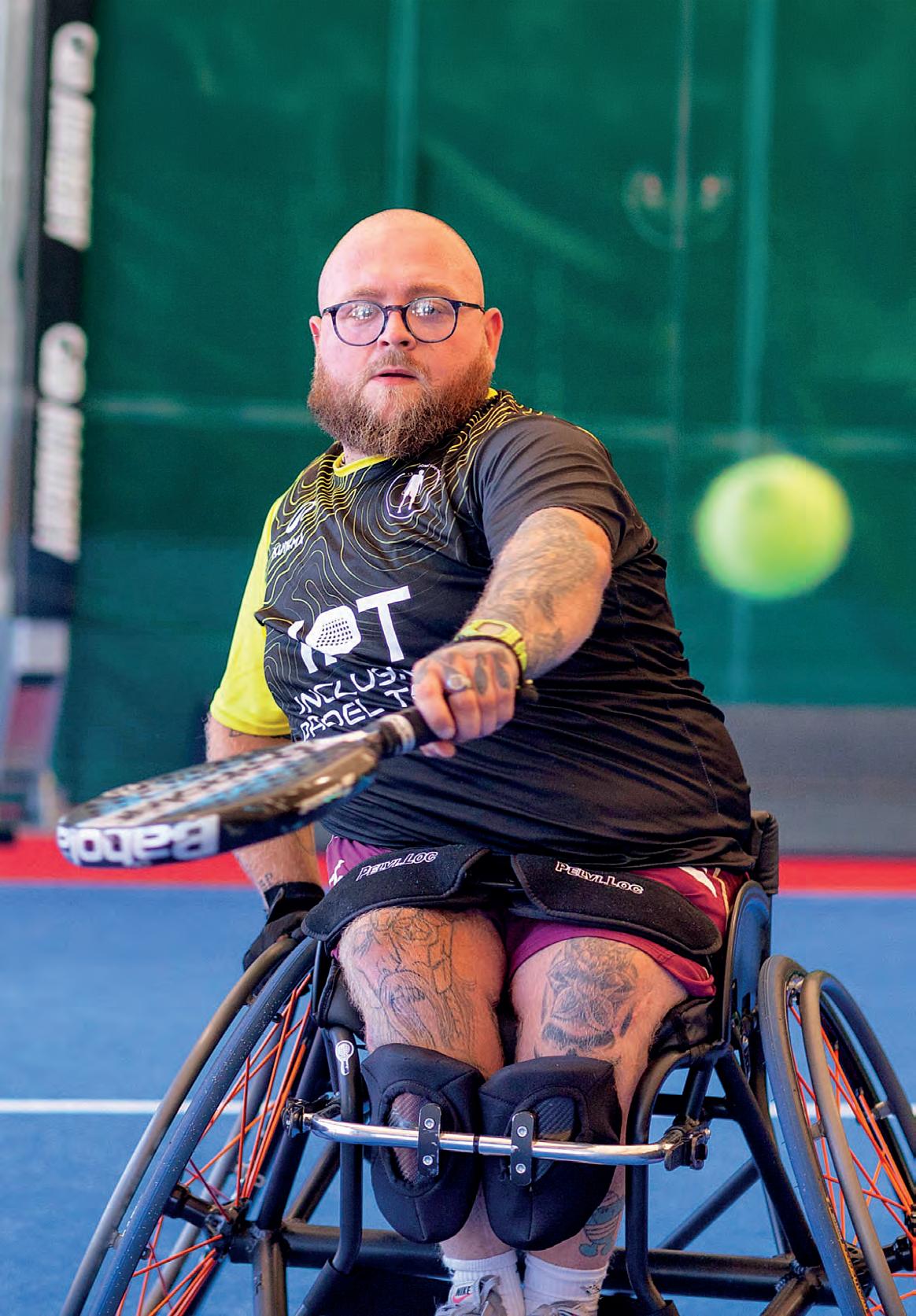
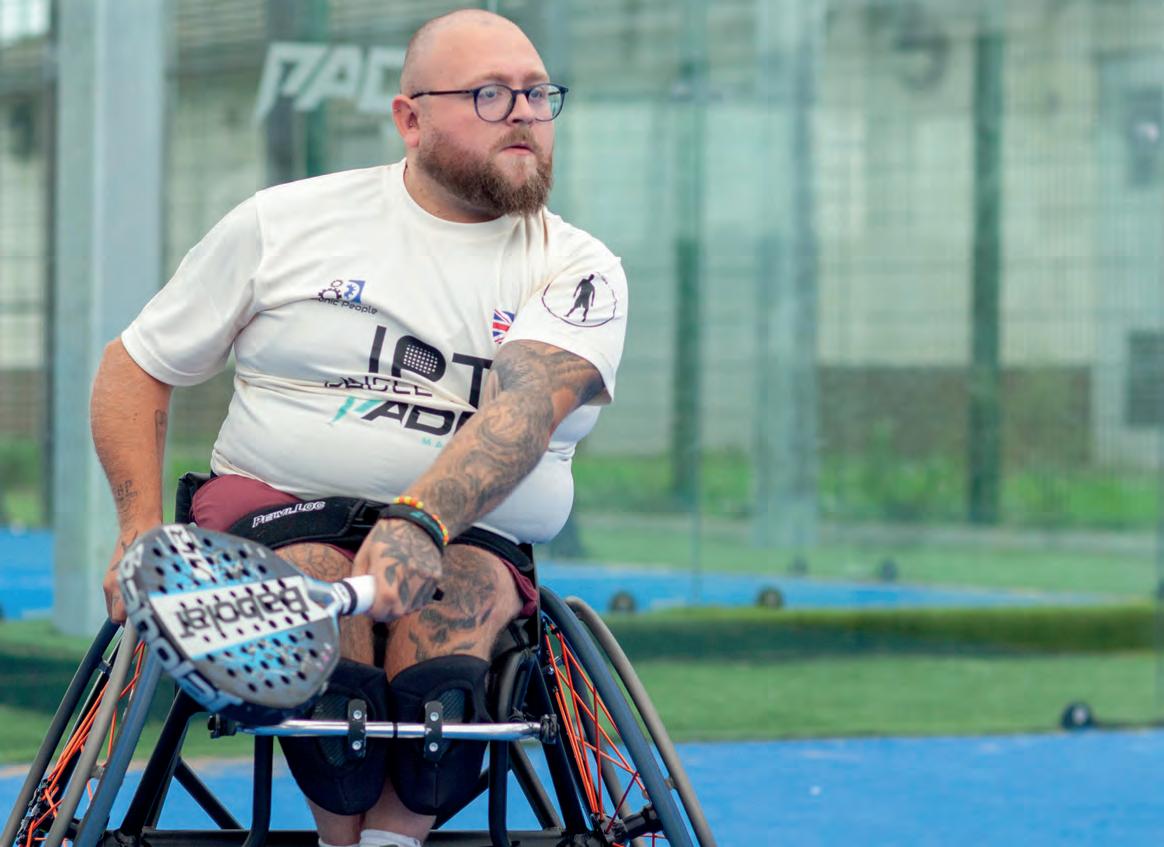
From participant to pioneer
Padel is now central to Binstead’s professional life. He has spent the past two years working as a coach and currently manages padel operations at a London venue, delivering coaching programmes and building participation.
Beyond coaching, his ambitions are farreaching. He wants to see padel recognised as a Paralympic sport and ultimately hopes to help establish a formal Team GB pathway.
His long-term target aligns with wider international ambitions for the sport, though he recognises the structural work required – particularly around funding, governance and participation numbers.
“There’s zero doubt in my mind,” he says. “If a Paralympic team is built, I’ll compete and I’ll get a medal.”
For now, much of the adaptive game remains self-funded, placing significant pressure on players seeking to compete internationally. Binstead argues that earlier investment from sponsors and governing bodies would accelerate development and create stronger long-term returns for stakeholders.
As padel infrastructure expands rapidly across Britain, accessibility in facility design remains a frequent topic of debate. Here, Binstead’s views
There’s zero doubt in my mind. If a Paralympic team is built, I’ll compete and I’ll get a medal
differ from many in the disability sport community.
While he supports improvements, such as wider court entrances and better facilities, he takes a notably pragmatic stance. Padel, he says, was not originally designed with wheelchair players in mind. For him, the focus should be on participation first and structural change second.
“I don’t believe in ‘no access’,” he explains. “I believe in trying a bit harder.”
Binstead says his philosophy is rooted in personal experience. “My view is to go, ‘right, this is my situation’,” he says. “These are my cards and I’m going to get ahead of the game and make my life better by doing something.”
Drawing on personal experience – navigating public transport and everyday environments as a wheelchair user – Binstead emphasises resilience and adaptability. If minor adjustments, such as removing a wheel or adjusting entry angles, enable participation, he believes players should embrace those challenges while the sport evolves.
He is eager to stress that this perspective, however, does not dismiss accessibility improvements. He welcomes innovations in court design and supports discussions around minimum access standards, particularly through national governance frameworks such as The LTA. However, he also highlights commercial realities for operators.


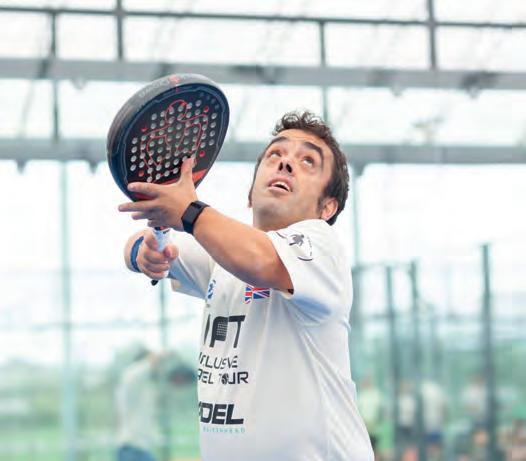








The Inclusive Padel Tour (IPT) provides visibility for players with disabilities
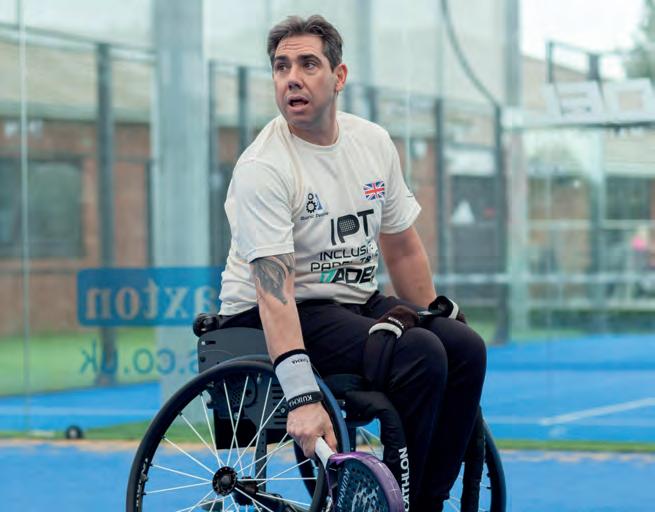



“With relatively few wheelchair players currently active in the UK, large-scale infrastructure investment remains difficult for venues to justify without clear regulatory requirements or growing demand,” he says. “So my message to anyone – disabled or not – is that if you want to play, find a way!”
For operators, his message is straightforward: as the sport grows, improving access where feasible is becoming increasingly valuable. “Participation growth will, ultimately, drive change,” he says. “And the operators who get there first with accessible venues will have a huge advantage.”
Binstead acknowledges that some UK venues are already taking meaningful steps. Clubs built with accessibility in mind – including accessible changing facilities, level access and wider entry points – demonstrate what future design standards could look like.
However, he believes the most effective route to widespread change would be clear regulatory guidance from governing bodies, supported by enforceable standards for new developments.

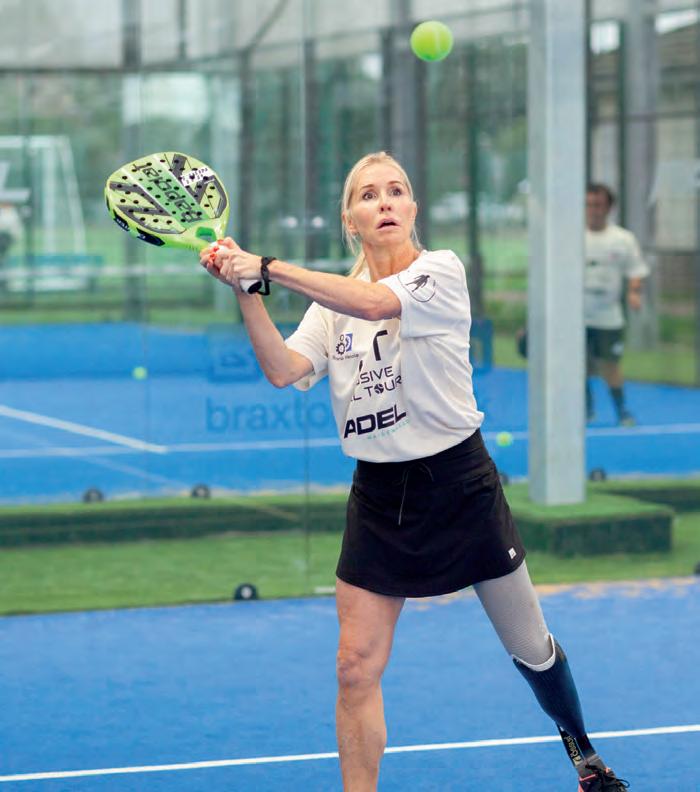

Until such frameworks are consistently applied, progress is likely to remain uneven, shaped by commercial priorities and market demand.
At the same time, Binstead stresses that padel’s appeal itself is not a barrier to wheelchair participation. The sport’s shorter rallies, smaller courts and social format make it highly accessible from a gameplay perspective.
“The excitement and enticement of padel doesn’t exclude wheelchair users,” he says. “It’s as exciting for someone in a chair as it is for anyone else.”
A major driver of adaptive padel’s development is the Inclusive Padel Tour (IPT), which provides competitive opportunities and visibility for players with disabilities. Binstead has been actively involved in the tour, competing internationally and helping to raise awareness of wheelchair padel in the UK.
The tour’s expansion into Britain represents a significant milestone, creating structured competition pathways and encouraging grassroots engagement.
Alongside this, new domestic initiatives –including inclusive events, training sessions and
The objective is clear: build a visible, supportive community that proves wheelchair padel is both viable and sustainable
community outreach – are beginning to strengthen participation. Binstead has supported efforts led by fellow players and organisers to introduce inclusive sessions at UK clubs, helping new participants access coaching and competition.
For him, the objective is clear: build a visible, supportive community that proves wheelchair padel is both viable and sustainable.
Binstead’s insights extend beyond accessibility to the wider economics of the sport. He has witnessed the rapid growth of UK padel participation, fuelled largely by social media exposure and word-of-mouth enthusiasm. He believes the sport’s accessibility for beginners and families has been central to its expansion. However, he also anticipates rising costs could eventually limit participation, potentially shifting padel towards a more premium market position.
“Court hire, equipment costs and coaching fees are all increasing as demand grows and facilities expand,” he says. “It reflects commercial maturity, but also raises questions about longterm affordability and accessibility – both for disabled and non-disabled players.
“I think that, for operators, the challenge will be balancing commercial sustainability with broad participation.”
Throughout the conversation, Binstead’s underlying message remains consistent: participation drives progress. Infrastructure, investment and governance will follow engagement.
“I would encourage any disabled individuals interested in padel to take the first step, reach out to the growing community and experience the sport for themselves,” he says.
At the same time, he calls on sponsors, investors and operators to support adaptive players earlier in their journeys – not only as a social responsibility but as a strategic opportunity within one of the world’s fastest-growing sports.
As the UK padel sector continues to scale, accessibility and inclusivity will remain central to its long-term success. Binstead represents a powerful example of how individual drive, community support and industry collaboration can shape emerging pathways.
His vision is not defined by limitations but by momentum — building participation, strengthening competition and ultimately securing recognition for adaptive padel on the global stage.
For a sport still defining its identity in Britain, that mindset may prove one of its most valuable assets.































assessments to opening day &


















The LTA’s Venue Registration scheme offers support packages designed to assist standalone padel venues across Great Britain
As padel continues to grow across Great Britain, venue operators are encouraged to deliver safe, well-run and sustainable venues. From safeguarding expectations to operational efficiency and insurance requirements, running a venue is about far more than courts and coaching.
LTA Venue Registration is the national governing body’s official scheme designed to support padel and tennis venues across Britain, at every stage of their development. LTA Venue Registration offers a comprehensive package of practical, financial and operational benefits that help venues run smoothly, professionally and safely.
At its core, LTA Venue Registration is also the LTA’s commitment to ensuring that padel and tennis are Safe to Play, supporting venues to implement safeguarding, inclusion and welfare standards that protect players, staff, volunteers and the long-term operation of the sport.
Safe to play: protecting people and protecting your venue
Safeguarding is no longer optional. Players, parents, partners and local authorities increasingly expect venues to demonstrate clear standards around welfare, inclusion and safety. Through LTA Venue Registration, venues receive guidance and support to meet safeguarding requirements and become recognised as a ‘Safe to Play’ venue. This not only helps protect children, adults at risk and participants of all ages, but also reduces operational risk for venue operators. By embedding best practice around safeguarding and inclusion, registered venues demonstrate professionalism, credibility and a commitment to providing an enjoyable and secure environment for everyone involved in the sport.
LTA Venue Registration is designed to make life easier for venue operators by offering tools and services that save time, reduce costs and improve
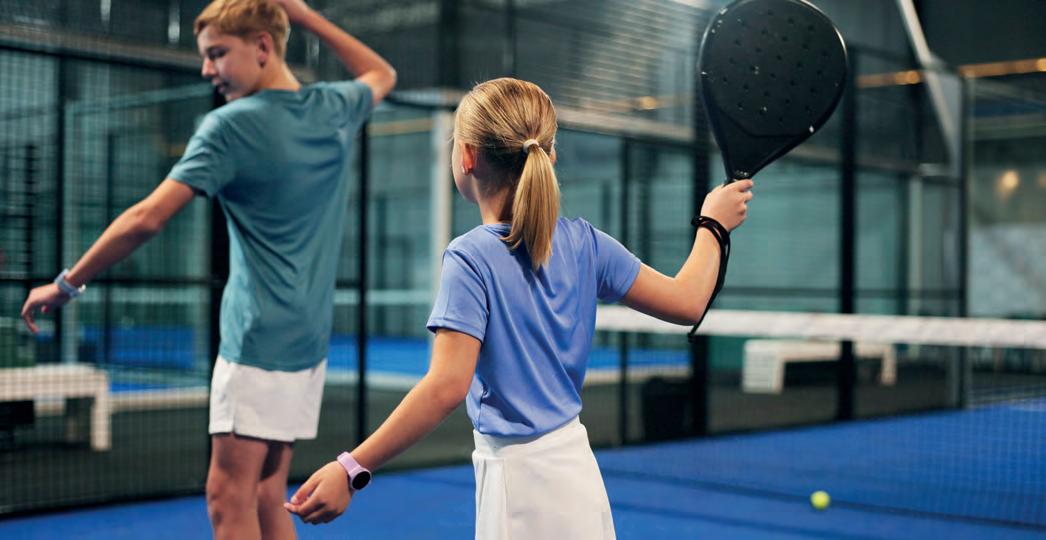
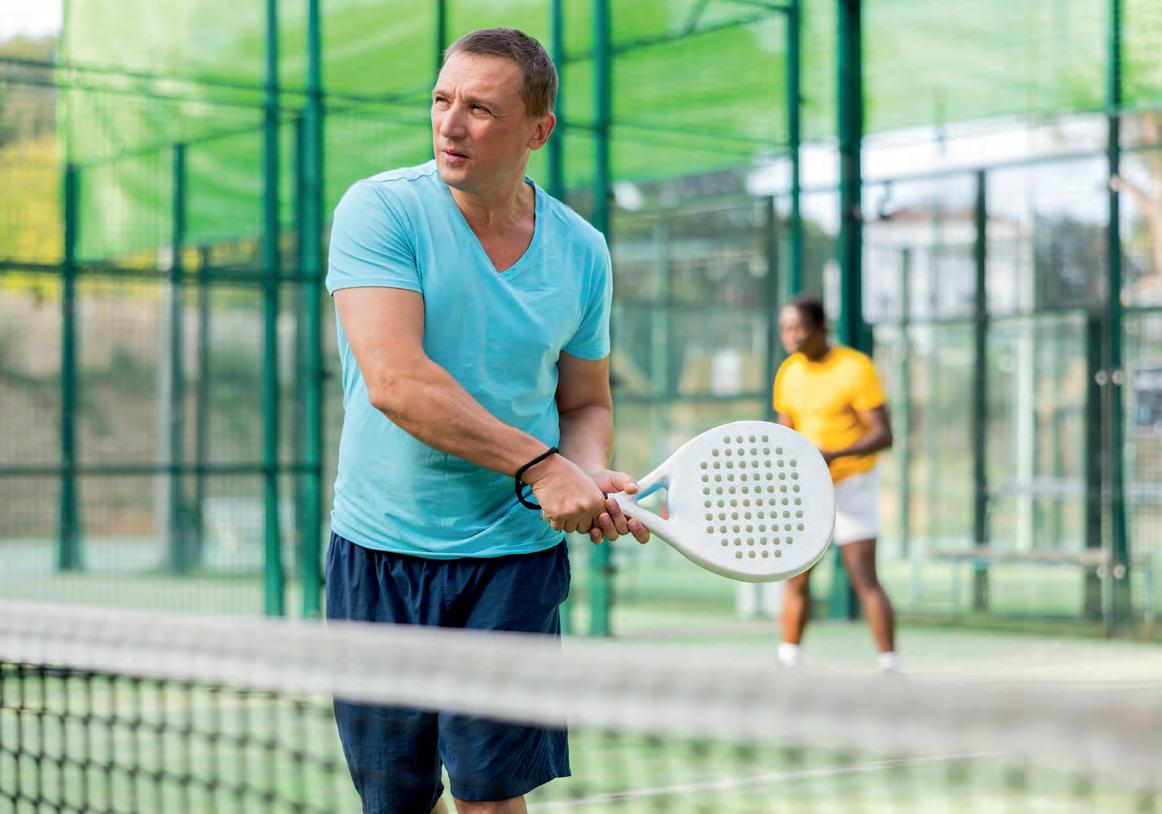
efficiency. One of the most significant benefits is public liability insurance. Registered venues receive a leading public liability insurance package through Howdens, offering essential protection for clubs, volunteers and organised activities. Howden Insurance are one of the largest insurance brokers in the UK and have been providing insurance policies and quotes for over 30 years. For many venues, this alone represents a substantial operational and financial advantage. Venues also gain access to ClubSpark, the LTA’s venue management system. While standalone padel venues may not always use the full functionality, ClubSpark provides powerful tools for court bookings, membership management, coaching administration and payments, helping venues streamline processes and deliver a better customer experience.
Registered venues also benefit from a suite of business and operational support services designed specifically for sports venues. These typically include access to the LTA Buying Group, enabling venues to benefit from collective purchasing power, as well as a tax and legal helpline to support day-to-day business queries.
For venues looking to grow, protect their operations and meet expectations, LTA Venue Registration is fast becoming essential
What
are the benefits of the LTA Padel Venue Registration?
Public Liability Insurance package through LTA partner Howdens
A range of business services that help save time and money
The ability to host and enter LTA padel competitions
Access to the LTA’s Venue Support Toolkit
An individual LTA Membership package for venue members
Access to a suite of LTA products and programmes for members and players
In addition, venues can access template policies and best practice guidance through the Venue Support Toolkit, reducing the burden of creating documents and procedures from scratch.
LTA Venue Registration opens the door to official LTA-sanctioned competitions and programmes, including padel competitions and league opportunities. This enables venues to attract new players, retain existing customers and position themselves as recognised hubs within the sport. Registered venues can also benefit from increased visibility and promotion, with the ability to list their facility through LTA platforms. This helps increase player reach, drive player awareness, grow court bookings and strengthen connections with the wider tennis and padel community. In addition, venue members gain access to LTA Advantage, the LTA’s official membership scheme, adding further value to a venue’s offer.
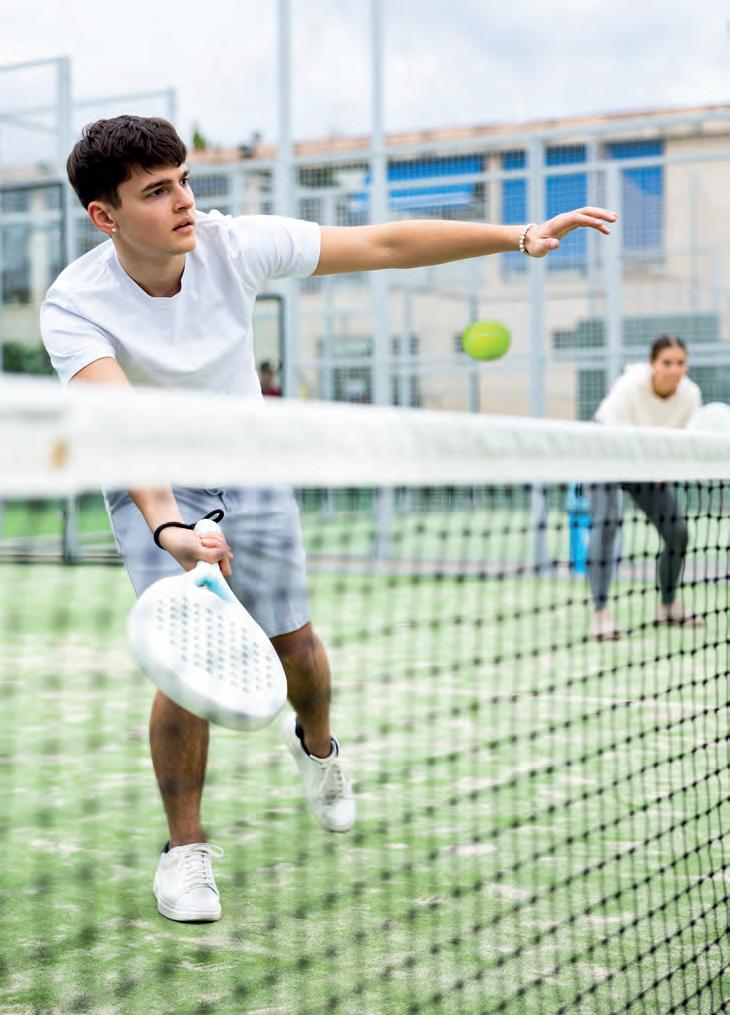
In an increasingly professionalised sports landscape, LTA Venue Registration provides a clear framework for venues to operate safely, efficiently and sustainably. By combining safeguarding support, insurance protection, business tools and promotional opportunities, it helps venue operators
focus on what matters most: delivering great tennis and padel experiences. For venues looking to grow, protect their operations and meet expectations, LTA Venue Registration is fast becoming essential. The LTA are now open for renewals and new registrations for the 2025-2026 registration year. To register your standalone padel venue, you’ll need a personal LTA Advantage account to access LTA Venue Registration. If you’re registering a standalone padel venue and looking for a step-by-step guide on how to become an LTA Registered Venue, then check out the LTA’s handy onboarding guide on the LTA Padel website. Or, if you’re a registered tennis club who have recently added padel courts, you can simply add your padel courts to your existing registration in the LTA Registration portal.
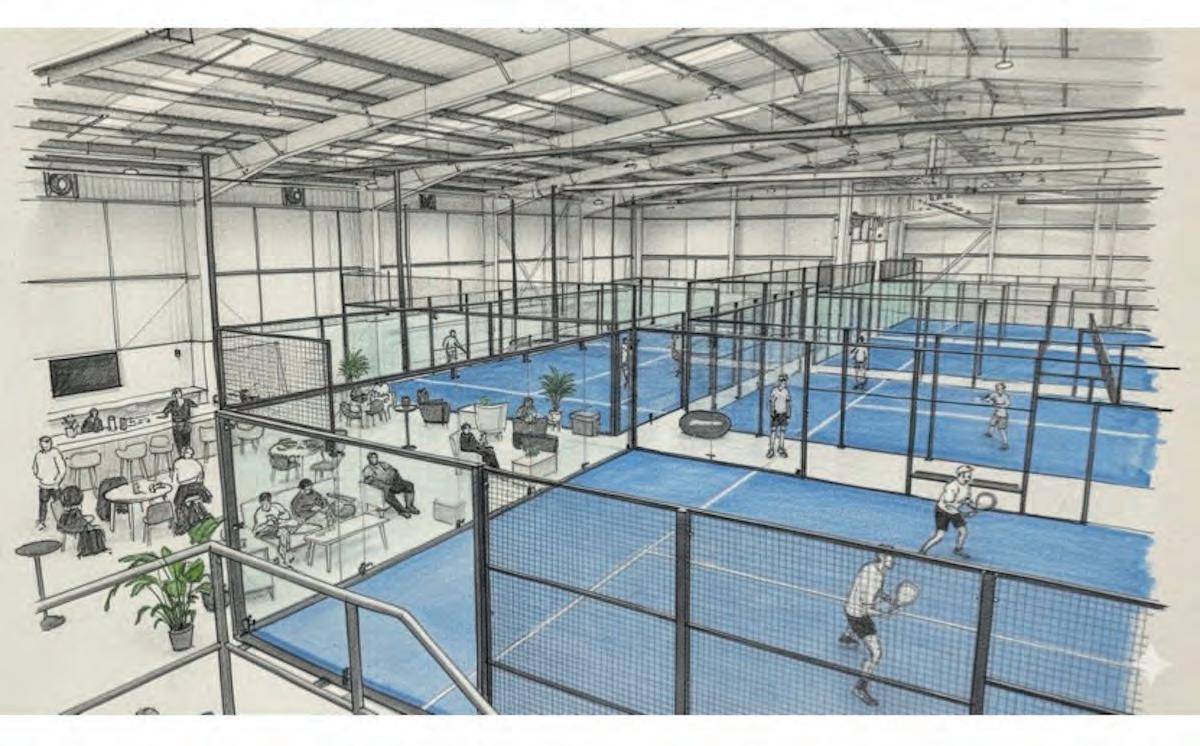
The UK padel market is maturing. The initial “build it, and they will come” phase is ending. As supply increases, players will gravitate toward venues that deliver the best experience and value, rather than simply choosing the nearest available court.
For investors, this means success now depends on professional market positioning and pricing strategy – not just novelty.
Oxygen Consulting researches and publishes the annual UK Padel Report. We leverage this deep market data to help organisations make the right build-and-operate decisions.
We help organisations build the right version of padel for their site before capital is committed:
● Rapid feasibility studies
● Strategic experience design – building a sense of place and belonging that fosters player loyalty
● Investable operating models – market positioning, pricing strategy, financial modelling

Arrange a 30-minute confidential discussion. oxygen-consulting.co.uk ray@ oxygen-consulting.co.uk
Oxygen Consulting – strategic insight that moves people
Competitions that cater for all players – whatever their level, background or individual reason for playing padel – are a great way to develop an engaged network of regular players. Sam Kemp from R3 Sport highlights how, for clubs and court operators, events can be effective community creators

Thanks to padel’s rapid participation growth and courts being built at pace, many operators are now well past the initial challenge of attracting players to their venue. The challenge has now become ensuring that they retain and engage these players and make them part of the padel community.
Competition is core to the sports success and remains one of the most effective and widely used tools available to clubs. However, having worked across multiple venues and events, one of the most common mistakes that clubs are still making is believing that competitions start with a tournament.
In truth, the success of a tournament can sometimes be decided before the entries have even opened. The foundations of competition are less related to match formats and results and more about social connection, community and trust.

For many players, particularly those new to the sport, competition is not intimidating because of standard or ability. It is intimidating because of uncertainty. Internal monologue such as ‘Who will I play with?’, ‘Will I fit in?’, ‘Will I feel out of place?’ ‘Will I enjoy it?’ plays on repeat as their finger hovers over the enter button. I have experience of venues delivering consistently well run weekly competitions but struggling to grow beyond the same familiar group of players. The tournament was full, and from the outside looked very successful, yet new faces rarely appeared and it had limited impact on the atmosphere and feeling at the club. The venues that succeed don’t alter the playing level or structure of the competition, but instead address the environment around it. Crystal clear communication about who the
event is aimed at, a relaxed arrival process and supporting players to connect with others from the club before stepping onto court. This leads to new players trying competition through socialising, new members being introduced to competitive opportunities from the beginning and a club event that truly brings the community together in a safe and welcoming manner.
The lesson is the competition works best when players feel part of the community and trust the environment before they test themselves within it.
The most effective competition programmes treat competition as a journey rather than a single event. Opportunities are varied, entry points are clear, progression is layered and players are not pigeon holed or rushed to move along.

Venues that achieve this best, consistently position socialising and community alongside competition.
New players are bought into competitive opportunities from the beginning - using competition to meet new players where partners are rotated regularly and results are secondary.
From here, they offer a wide range of competition to cater for players of all abilities offering players the opportunity to progress as they become more comfortable not just with the sport, but with each other.
Larger, more structured competitions often follow from player demand and interest in competing in, and spectating, competitions of a higher level. When competitions become more ingrained, the community will better understand (and increasingly ask for) competitive environments.
Competition, when designed properly, doesn’t push players forward. It allows them to move at their own pace.
Truly successful competition comes when events stop feeling like something organised by the venue and starts feeling like something owned by the community.
Non-participants coming to watch, players arriving early and staying late, conversations about competition extend beyond the court. Promotion of events happens organically rather than needing to be driven by staff.
This is when competition becomes more than just a sporting activity. It becomes the social
Competition, when designed properly, doesn’t push players forward. It allows them to move at their own pace
anchor of the venue. The community is built around it and it keeps the community thriving.
This change also impacts the engagement of partners and sponsors. Carefully selected, commercial involvement can feel natural, with brands not just buying into a format but into a community that is engaged and invested.
Competition will always be central to sport. For padel, however, one of its greatest values lies in its ability to bring people together rather than set them apart. When competition is placed at the heart of a venue and treated as a cultural tool, built on trust, understanding and shared ownership, it becomes one of the most effective ways to create a sustainable, engaged community.
The clubs that succeed long-term will not necessarily be those running the biggest tournaments (although of course there is very much a place for this within the community), but those that understand that competition does not start with a tournament and end with a winner. It starts with people.
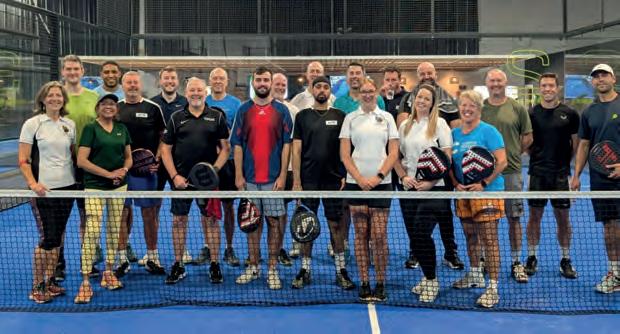
Guy Gri ths, founder of Padel Partners Networking and GGFit, o ers his insights on how creating sustainable communities can ensures successful, healthy clubs


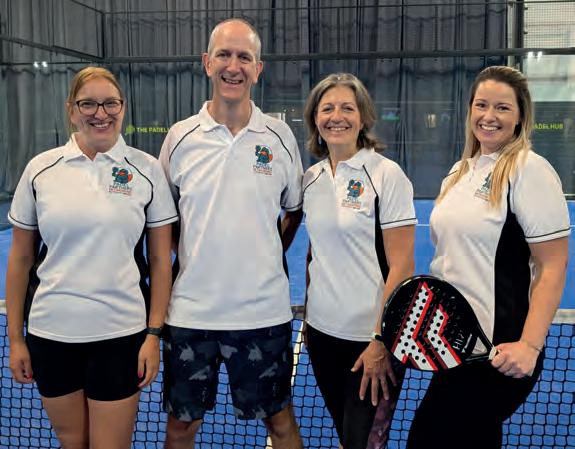
Community” has become a buzzword across sport and leisure, and for good reason. In padel clubs, a strong sense of community is critical to both growth and retention. It drives repeat bookings, fills quieter court times, increases secondary spend, and turns casual players into long-term advocates.

Most padel clubs will proudly say they have a great community. Some genuinely do. However, many are drifting towards a familiar model seen in gyms: catering primarily to the most committed, competitive players and treating them like royalty. While this core group is important, it represents only a small slice of the potential padel audience.
One of padel’s greatest strengths is its accessibility. It is inclusive by design; easy to learn, social, mixed-gender, and suitable for a wide range of ages and abilities. Yet too often, clubs unintentionally build communities around performance, rather than around participation.
A community is simply a group of people who share interests, attitudes, or experiences. Creating a community of highly competitive padel players is relatively easy. The real opportunity lies in serving wider, often underserved groups: beginners, students, over-50s, women, ethnic communities, and the like, who may want to be active but struggle to find welcoming entry points.
Clubs that run simple, fun beginner sessions,
combining light coaching with friendly Americanostyle games, do this particularly well. These formats lower the barrier to entry, remove fear of “not being good enough,” and create shared experiences that naturally lead to conversation and connection. Follow this with informal meet-ups or themed sessions, and you quickly move from attendance to belonging.
A great example is PadelHub Fleet, where General Manager Steve Cutler regularly fills all six courts on a Monday morning with Monday Madness, a pre-booked, all-abilities session. Players rotate courts and partners every 20–30 minutes, creating energy, variety, and plenty of social interaction. Coffee afterwards is part of the routine. Alongside this, the club has built a thriving WhatsApp ecosystem, with sub-groups for open matches, ladies’ sessions, events, and even pre-loved padel kit.
In Bristol, Will and The Padel Team have taken a similarly community-first approach. By actively welcoming local ethnic groups, particularly women, they’ve made padel feel more accessible than many traditional sports. Small touches make a big difference: ice lollies after summer games, warm cookies alongside winter coffees. Without a formal membership model, the club relies on retention and repeat visits, and community has become their strongest asset.
Ultimately, community is not about competition; it’s about cooperation. You need to listen to your members and customers, create space for connection, and make more people feel welcome, on and off the court.
Build courts and they might come. Build community, and they’ll keep coming back.

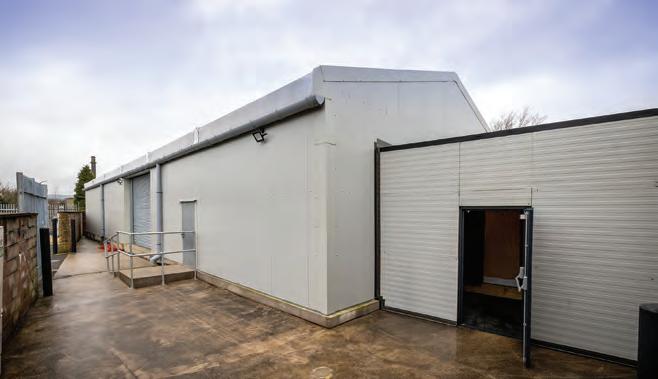
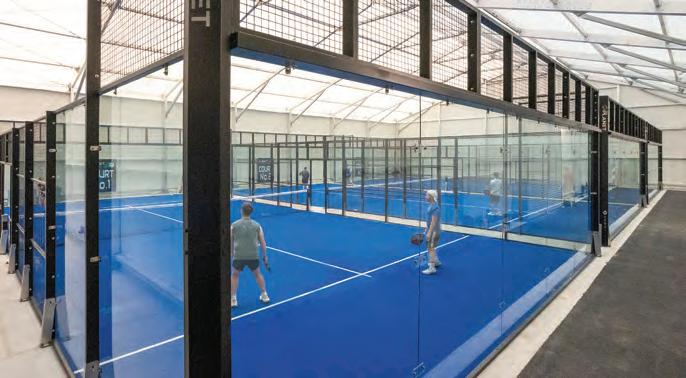
Padel isn’t just one of the fastestgrowing sports in the world — it’s also one of the most enjoyable ways to stay active. At Surge Padel Clubs, we believe sport should be social, inclusive, and energising for everyone, whether you’re a child picking up a racket for the first time or an adult looking for a new way to stay fit. Combining movement, social interaction, and skill-building, padel delivers physical fitness while boosting confidence, supporting mental wellbeing, and creating strong communities on and off the court.
Unlike traditional gym workouts, padel keeps you moving without it feeling like exercise. The game blends quick reactions, short sprints, coordination, and strategy. This creates a full-
Rich Wingfield, MD of Surge Padel, says that, in addition to its social aspect, padel is also the perfect sport for those looking to get (and keep) fit – both physically and mentally
body workout that improves cardiovascular fitness, agility and balance, strength and coordination, and reaction speed and mobility. Because padel is played in doubles on a smaller court, rallies are longer and more engaging. That means more movement, more laughs and more time enjoying the game with others. At Surge, our courts are designed to create an environment where fitness happens naturally through play, competition, and community.
For children, sport is about so much more than exercise. It’s about building confidence, learning teamwork, and developing a love for movement that lasts a lifetime. That’s why Surge Padel Clubs offer dedicated junior coaching programmes, designed to introduce young players to the sport in a fun, supportive environment.
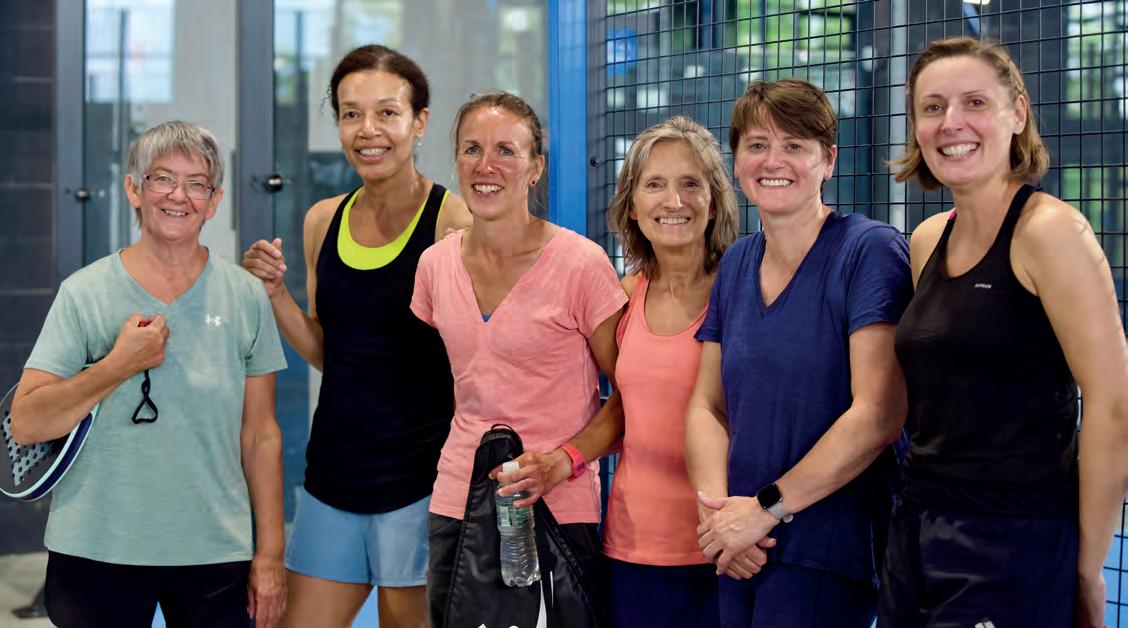
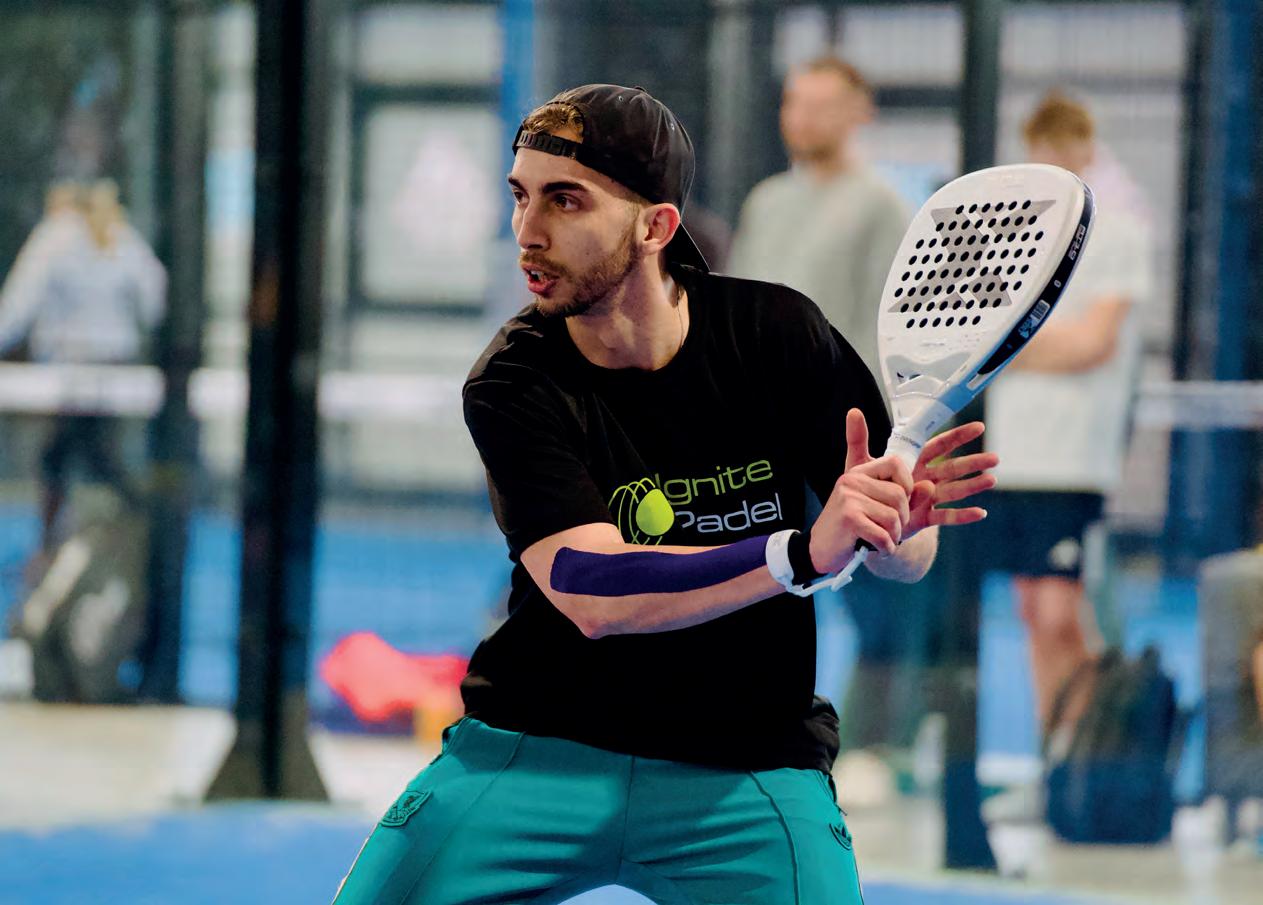
junior sessions focus on:
Developing coordination and agility
Building confidence through skill progression
Encouraging teamwork and social interaction
Creating healthy habits and active lifestyles Padel is particularly great for children because it’s easy to learn and incredibly fun to play. With smaller courts and doubles play, young players quickly get involved in rallies, building confidence from the very first session. Many of our junior players start with beginner coaching and quickly grow into confident young athletes who love being part of the club community.
One of the most exciting things about padel is how accessible it is. You don’t need years of experience or elite fitness to get started – players of all ages and abilities can jump on court and enjoy the game. At Surge Padel Clubs, we welcome everyone from complete beginners to competitive players. All our clubs offer both beginner sessions and coaching, as well as competitive games and tournaments. There are also social match play and club nights and friendly community events. Because padel is played in doubles and on a smaller court, it’s less physically demanding than many racket sports while still providing an excellent workout. That makes it perfect for adults who want to stay active, meet new people, and enjoy a sport that’s both social and competitive.
One of the biggest reasons people fall in love with padel is the community that forms around it. At Surge, the court is more than just a place to play – it’s a place to meet people, make friends, and become part of something bigger. From club nights to tournaments and coaching sessions, our clubs are designed to bring players together. Whether you’re arriving solo or with friends, you’ll always find a welcoming community ready to play. That sense of belonging is what makes padel special – and why so many players quickly turn a single game into a regular part of their week.
Sport has a powerful impact on mental wellbeing, and padel is no exception. Regular physical activity is proven to reduce stress, boost mood, and improve overall mental health. But padel adds something extra: social connection. Playing padel combines exercise with laughter, teamwork, and shared experiences. That combination helps people switch off from daily pressures and focus on the moment — something that’s increasingly important in today’s busy world. At Surge, we see it every day. Players leave the court feeling energised, relaxed, and more connected to the people around them.
Could a partnership between Playtomic and DUPR signal the end to a regular issue for padel players – the difficulty in finding suitable opposition to play when scheduling a game with strangers? Jethro Binns, co-founder of LevelTech and PadelLevels, explores how to build a working ratings system
Here is a question padel hasn’t answered yet: if you play at a club in Bristol, travel to Barcelona for a week, and want to book a game with strangers, how does anyone know what level you are?
Right now, the honest answer is: it depends which platform you’re on. And even then, it only works if the club in Barcelona happens to use the same platform as the one in Bristol. Play somewhere else and the number stays behind. And even when it does travel, ask anyone who’s tried it and the same word comes up: calibration. The number doesn’t quite mean the same thing in both places.
That might sound like a minor inconvenience. It isn’t. It’s one of the most important structural problems the sport needs to solve before it gets much bigger.
A signal appeared recently in racket sports that mostly went unnoticed outside the industry. Playtomic, one of the largest booking platforms around, announced a partnership with DUPR — the dominant ratings system in pickleball. On the surface it looked like a routine business collaboration. What it actually signals is something bigger: the ecosystem is beginning to separate into layers. Booking platforms manage courts and

payments. Competition platforms run leagues and tournaments. And ratings are emerging as their own independent infrastructure — sitting underneath the sport rather than inside any single product.
This has already happened in squash, where SquashLevels provides portable ratings used across federations, clubs and competitions in dozens of countries. For the significant number of padel players in the UK who came from squash, this isn’t a theoretical concept — it’s something they’ve already lived. They know what it feels like to turn up at an unfamiliar club, share a number, and get into a competitive game. They know the difference it makes. Padel deserves the same.
It’s happened in tennis too, with UTR and WTN providing portable ratings across clubs, tournaments and regions. And most recently in pickleball, where DUPR has become the common language of player level – significant enough that Playtomic just announced a formal partnership with them.
In each case, players carry one number with them wherever they go. Padel hasn’t got there yet. But it will. And how it gets there matters enormously.
The problem today is fragmentation. Almost every platform entering padel builds its own rating system. It’s an understandable instinct — if you’re running a booking or competition product, attaching a number to a player profile feels like
A rating system owned by one platform will always be limited to that platform’s network
A
to Barcelona should arrive with a number that still makes sense in the new environment
a natural feature. But ratings are much harder to build properly than most people expect. And when every platform creates its own version, the sport ends up with multiple versions of reality.
One system says you’re a 3.5. Playtomic says you’re a 4. Padel Mates calls you something else entirely. A tournament platform has its own scale altogether. Players quickly ask the obvious question: which one is real?
For a while, inconsistent ratings feel like a minor annoyance. But the effects compound. Padel works because it is open and social. One of the genuine joys of the sport is turning up at a club, booking a match, meeting strangers, and having a competitive game without knowing anyone beforehand. That openness depends on trust. Players trust that the match will be roughly balanced. They trust that the numbers next to names actually mean something. When ratings become unreliable, that trust erodes quietly and quickly.
If players start experiencing more mismatches,

it means court time can get wasted. Matches can also become one-sided or uncomfortable. As a result, behaviour often shifts in a way that’s hard to reverse – people retreat into closed WhatsApp groups, organising games only with people they already know are at a similar level. Open matches become less appealing. New players struggle to break into established networks.
This can all lead to sport becoming less accessible, less social and less “itself”.
The fix isn’t complicated in principle, even if it’s hard in practice. Ratings work best when they are neutral – when they sit underneath the ecosystem rather than inside a single product. Even the largest and best-resourced platforms in the sport have found this hard to solve alone. That’s not a reflection of effort or ambition. It’s a structural problem. A rating system owned by one platform will always be limited to that platform’s network. The moment a player steps outside it, the number stops meaning anything.

The solution isn’t building a better walled garden. Rather, it is an independent infrastructure that any platform can plug into. When that layer works properly, a match played through a booking app, a league fixture and a tournament result can all feed into the same number. Players carry that number between clubs, cities and countries. It still means something when they arrive somewhere new.
That portability is what keeps the sport open. It’s what lets a player book a game with strangers in Barcelona and have a reasonable match, not a mismatch. It’s what lets clubs run open sessions without chaos. It’s what lets new players enter the ecosystem without needing personal introductions to find a game. The open approach means ratings stop being a feature – they become a foundation.
Building a system that works at scale is genuinely hard. A good rating needs to be stable enough not to swing wildly after one result, but responsive enough to reflect real improvement. It needs to recognise the difference between expected and unexpected outcomes – beating someone you were already supposed to beat shouldn’t inflate your rating, but a strong performance in defeat should still count for something.
Context matters too. A national championship match should carry more weight than a local league game. And padel adds extra
complexity because it’s a doubles sport –partner strength changes expectations, and any serious model has to account for that.
Most critically, ratings need to stay calibrated across geography and time. A player moving from Bristol to Barcelona should arrive with a number that still makes sense in the new environment. Without that, the numbers eventually mean nothing at all.
Padel is still early enough in its growth to build an efficient and working rating system properly. Other racket sports have already learned that ratings are infrastructure, not features. The Playtomic-DUPR partnership is one sign that even the largest platforms are starting to accept this. Proprietary rating systems create walled gardens. Independent ones create a sport that can grow while staying connected.
Get this right and padel grows together –players moving freely between clubs, cities and competitions with a level that travels with them. Get it wrong and the sport quietly fragments into disconnected pockets, each with their own language for competitive level, none of them compatible.
Ratings are not just numbers. They shape behaviour. And in a sport built around openness and spontaneity, they may turn out to be the most important piece of infrastructure padel builds.