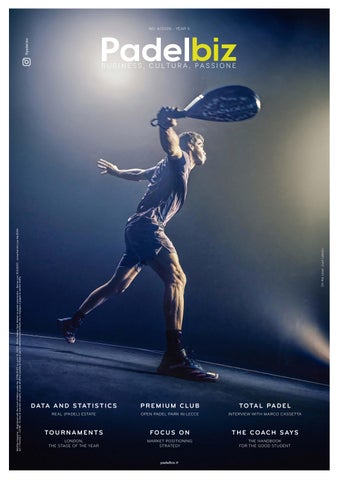
On the cover: Juan Lebrón In the photo: Víctor Ruiz - Padel Mi Amor
Monthly magazine - Registered with the Court of Milan under No. 6796/2023 on June 12, 2023 - Poste Italiane SpA: Mailed via postal subscription service - Decree-Law 353/2003 - converted Monthly into Law magazine 46/2004 - Registered with the Court of Milan under No. 6796/2023 on June 12, 2023 - Poste Italiane SpA: Mailed via postal subscription - Decree-Law 353/2003 - converted into Law 46/2004 Art. Art. 11 Comma Comma 11 -- LO/MI LO/MI -- In In caso caso di di mancato mancato recapito, recapito, inviare inviare all'ufficio all'ufficio postale postale di di Roserio Roserio per per la la restituzione restituzione al al mittente mittente che che si si impegna impegna a a pagare pagare la la relativa relativa tariffa. tariffa.
@padel.biz
N.N. NO. N. 07-08/2023 04/2023 4/2024 4/2026---ANNO ANNO -YEAR ANNO 352 2
D ATA A N D S TAT I S T I C S
PREMIUM CLUB
T O TA L PA D E L
REAL (PADEL) ESTATE
OPEN PADEL PARK IN LECCE
INTERVIEW WITH MARCO CASSETTA
TO U R N A M E N T S
FOCUS ON
T H E C O A C H S AY S
LONDON, THE STAGE OF THE YEAR
MARKET POSITIONING STRATEGY
THE HANDBOOK FOR THE GOOD STUDENT
padelbiz.it
1
2
NO.4/2026 - YEAR 5
D ATA A N D S TAT I S T I C S 1 0 P L AY TO M I C G LO BA L PA D E L R E P O RT ( PA RT I I )
W H E E LC H A I R PA D E L 1 2 M A K I N G YO U R C LU B AC C E S S I B L E TO E V E RYO N E
TO U R N A M E N T S 1 4 THE ISSUES SURROUNDING THE SERIE A AND SERIE B FINALS 2 8 LO N D O N : T H E S TAG E O F T H E Y E A R
TOTA L PA D E l 1 5 I N T E RV I E W W I T H M A RC O C AS S E T TA
UNDER THE MICROSCOPE 1 6 S TAT E- O F-T H E-A RT PA D E L C O U RTS
FO C U S T E C H 1 7 LO O K AT M E
10
P R E M I U M C LU B 1 8 O P E N PA D E L PA R K I N L EC C E
PRODUCTS 20 HEAD EXTREME 2 2 BA B O L AT ' S P R E M U R A 3
12
R E S P O N S I B LY 24 L E S S B U R E AU C R AC Y, M O R E S U B S TA N C E
I think that in the long run, we won't see such a big difference between playing on the left or on the right
FO C U S O N 26 THE RIGHT MARKET POSITIONING
Marco Cassetta, page fifteen
T H E C O A C H S AY S 3 0 T H E E S S E N T I A L H A N D B O O K P E R PA D E L S T U D E N TS
18
THE CORNER OF THE MENTAL COACH 3 1 T H E R E A L G A M E I S I N YO U R H E A D
INTERVIEWS 3 2 Q U E L L I D E L PA D E L
PA D E L E G A L
28
3 4 T H E D I F F I C U LT C O E X I S T E N C E A N D T H E C E M E T E RY B U F F E R ZO N E
BETWEEN
C O U RTS
3
EDITORIAL
GAME, BUSINESS, SPORT? by Daniele Pansardi
I
s there a padel industry? According to the FITP report, there were 2.1 million players in Italy in 2025. “And are these two million people fueling a real industry? Based on this data, sooner or later we’ll need to see evidence of promising young players or amateurs who ‘grow’ within the sport’s structure—perhaps some will become managers, referees, or instructors.” This observation comes from Coach Marco Paialunga, co-host of our Total Padel podcast, who, as a national-level coach, has a unique vantage point on the nature of this sector in Italy. The sport is still seeking its definitive evolution as a sporting product, without being cannibalized by the economic side of things. “Markets thrive on waves, which can rise and fall, while the system always supports you,” Marco continued in his remarks, which offer an ideal snapshot of the current state of the Italian padel movement. Padel was born in the wake of enthusiasm and a sudden surge in popularity, and it quickly secured an unimaginable number of players in a short time, but the risk is that, in the long term, the system may fail to make progress. At Padelbiz, we’ve been addressing this issue for several months now, thanks to the invaluable work carried out by O&B, led by Adelio Rosate, who has repeatedly emphasized the need for the sport to evolve from a mere speculative phenomenon tied to court rentals into a structured movement, focusing on young people and true affordability. This transition cannot happen overnight, nor is it simple or a foregone conclusion. In 2025, the number of Under-18 players in Italy stood at 10% of the total, a figure that remained stable compared to 2024. While we must remember that this is all a relatively recent development, this stagnation should at the very least give us pause for thought. What is being done right now to attract younger players? How much are clubs investing in developing youth programs? A few months ago, in his column, Adelio Rosate summed it up this way: “In some centers, we see a lot of
resources being squandered: too many tournaments—some of them of poor quality—with which organizers understandably seek to fill available slots. Prioritizing short-term tactics over long-term strategy (youth development) risks being detrimental.” Its economic efficiency, after all, has made it far too attractive a product not to be exploited to the fullest. We discuss this on pages 10–11, where—drawing on Playtomic’s Global Padel Report—we analyze the tremendous financial success of our sport, which can generate excellent revenue per square meter. Padel has managed to transform unproductive spaces into high-yield profit centers, and breaking away from this model may not be very appealing. However, a long-term vision is needed, with the Federation taking the lead in guiding and promoting the ideal strategies, perhaps building on its “Racchette in Classe” project. “To date, Italy ranks second in the world in terms of courts and facilities; it’s very well marketed, but we haven’t managed to turn it into a sports product,” said Marco Paialunga during his insightful remarks. But at the end of the day, we’re only at the beginning, and it’s reasonable to remain optimistic. Even when events of theoretically national significance—such as the Serie A and Serie B finals—seem to be somewhat overlooked and not fully appreciated (p. 14). Elsewhere, however, they’re doing things on a grand scale. In London, for example, where one of the most successful Premier Padel tournaments ever took place, thanks especially to the off-court activities and community engagement (p. 28). Or in Paris, where the Roland Garros Major reaffirmed its status as the most prestigious tournament on the calendar, delivering one of the most thrilling men’s finals in recent years—one that could serve as the ideal source of inspiration for all young players.
Publisher: MagNet srl SB - Editor-in-Chief: ANGELO FRIGERIO - Editorial Director: BENEDETTO SIRONI Editors: Daniele Pansardi, Davide L. Bertagna, Andrea Farano, Marcello Ferrarini, Andrea Fierro, Sara Fumagallo, Gabriele Marini, Marco Paialunga, Adelio Rosate Art Director: Simone Comi Editorial Office: Via Tertulliano 68, 20137 Milan Tel: 02.87245180 - Fax: 02.87245182 Corso della Resistenza, 23 - 20821 Meda (MB) Email: redazione@padelbiz.it Website: padelbiz.it Year 5 - Issue 4/2026 - Bimonthly journal Registered with the Court of Milan under No. 6796/2023 on June 12, 2023. Poste Italiane SpA - Mailing via postal subscription under Decree-Law 353/2003—converted into Law 46/2004, Article 1, Paragraph 1—LO/MI. Registration in the ROC No. 16155, dated November 23, 2007 Printed by: Ingraph - Seregno (MB) One copy: 1.00 euro. The publisher guarantees the utmost confidentiality of the data in its possession. This information will be used to manage subscriptions and to send marketing information. Pursuant to Article 13 of Law No. 196/2003, your data may be corrected or deleted at any time by writing to: MagNet srl SB Data Controller: Benedetto Sironi This issue was finalized on October 2, 2026 @padel.biz
4
MagNet srl SB
ULTIMATE PRO LIGHT 2027
OXDOGPADEL.IT 5
NEWS
MARKET
LACOSTE MAKES ITS DEBUT IN PADEL AND UNVEILS ITS COMPLETE LOOK
PLAYTOMIC ACQUIRES THE TIMP PLATFORM: GREATER INTEGRATION FOR MULTISPORT CENTERS
Lacoste officially launches its first collection in the world of padel. After having been a part of tennis throughout its history, the crocodile brand is now looking to break into the padel market as well. To develop the racquet line, Lacoste partnered with Tecnifibre, a highly renowned French brand in racquet sports and owned by Lacoste Holding. This collaboration has resulted in a range designed to offer power, precision, and comfort, built around two models: the L.MAX, for advanced players, and the lighter L.SOFT, geared toward beginners and intermediate players.
Playtomic has completed the acquisition of TIMP, a SaaS platform specializing in the management of gyms, sports facilities, and fitness and wellness centers. Founded in Valencia in 2014, TIMP currently serves over 3,500 centers in Spain and Italy, providing integrated tools for managing customers, reservations, schedules, activities, payments, billing, and communications, as well as automating facility operations. TIMP will continue to operate independently even after the acquisition and will retain its brand and focus on the fitness and wellness sector.
JOMA BECOMES THE OFFICIAL SHOE OF THE SPANISH FEDERATION
CUPRA IS THE NEW OFFICIAL AUTOMOTIVE PARTNER OF LTA PADEL
Joma and the Spanish Padel Federation (FEP) have reached an agreement under which the Spanish brand becomes the Federation’s official shoe sponsor. The partnership calls for Joma’s presence at various events and competitions organized by the Federation and represents a new step in the brand’s commitment to the sport. Referees and members of the technical staff at Federation tournaments will wear official Joma footwear during competitions. The brand will also sponsor the Spanish national teams and their respective technical staff, who will wear the company’s shoes during some of their matches.
CUPRA is strengthening its commitment to padel by becoming the official automotive partner of LTA Padel, the British Federation for tennis and padel. CUPRA will also become the title partner of the CUPRA LTA Padel National League, the most important team competition in the United Kingdom. The partnership also includes support for the LTA Padel British Tour, the LTA Padel National Championships, and the national teams. “We will work closely with LTA Padel to offer more and more people the opportunity to take to the court and experience the energy and excitement that make this sport unique,” said Marcus Gossen, managing director of SEAT and CUPRA UK.
UK: SOUL PADEL RAISES 3.6 MILLION POUNDS TO CONTINUE GROWING
NOX TEAMS UP WITH THE RACQUET SPORTS PROFESSIONALS ASSOCIATION
Soul Padel has raised 3.6 million pounds in a funding round, based on a valuation of 30 million pounds. The investment will fund Soul Padel’s expansion from four to ten operational clubs over the next 12 months. The goal by 2032 is to install 250 courts nationwide. Over the past two years, Soul Padel has tested and refined its business model, making its clubs profitable and achieving a utilization rate consistently above 80%, both in highly competitive areas and in regions where the sport has lower penetration.
The Racquet Sports Professionals Association (RSPA) has announced NOX as its exclusive partner for padel and pickleball racquets and footwear for RSPA-certified professionals. NOX has also announced the signing of Marcos del Pilar as its new brand ambassador. Del Pilar built his career representing NOX in Spain before returning to the United States, where he became the architect of the RSPA’s padel certification program, head coach of Team USA at two world championships, and one of the most influential figures in the growth of padel in North America.
PADEL NUESTRO OPENS ITS FIRST STORE IN THE UNITED KINGDOM
IN AUSTRALIA, AN INITIATIVE TO INCREASE THE PRESENCE OF PADEL IN SPORTS CENTERS
Padel Nuestro continues its international expansion by entering the UK retail market. The company has opened a new store in Manchester, strategically located near some of the city’s leading padel clubs. With this opening, Padel Nuestro becomes the first specialized European retailer to have a physical presence in the UK. The company now operates 68 physical retail locations worldwide, including 29 in Spain, offering a catalog of nearly 8,000 products ranging from rackets to footwear, clothing, and accessories.
Padel Australia, the organization that governs the sport in the country, is launching the Padel Investment Program to facilitate the integration of courts into existing clubs. The program introduces an alternative approach to traditional infrastructure investments. The initial capital required to build the courts is provided through the Investment Program: this means that clubs do not have to cover the initial investment or take on debt to pay for infrastructure costs. In exchange, a revenue-sharing model based on court reservations is established, tailored to the size and conditions of each facility.
6
NEWS
ATHLETES
A RACQUET SPORTS CHAMPIONSHIP: AN ALL-INCLUSIVE TOURNAMENT IN BOLOGNA
CLUB ORDERED TO PAY COMPENSATION TO AN AMATEUR PLAYER FOR A BROKEN WINDOW
From November 26 to 29, Bologna will host the Italian Racquet Sports Championship, a new event that will bring together seven disciplines for the first time under a single umbrella: badminton, beach tennis, padel, pickleball, squash, tennis, and table tennis. The event features an original and cross-disciplinary format: participating pairs, each registered in one of the seven disciplines, will compete in all the other disciplines except the one in which they are registered, earning points based on their results. The final standings will be determined by the total points earned across the various disciplines and will crown the Italian champion pair in racquet sports. Registrations must be submitted by November 15.
In Spain, a judge ordered a sports center to pay 28,700 euros in compensation to a player who was injured when one of the glass walls shattered after an impact. The incident occurred in 2023 during a routine amateur game. The victim’s account describes a fairly typical game situation: while attempting to retrieve a ball near the back wall, the player crashed into the glass, which in theory should have withstood the impact as it usually does. In reality, the sheet of tempered glass shattered into hundreds of pieces, causing a head injury and lacerations to the head. The player filed a complaint against the club, arguing that his action was neither unusual nor excessively forceful.
ISIDORO CASTELTRIONE NAMED HEAD OF TENNIS AND PADEL AT SPORTIT SportIT announces the addition of Isidoro Casteltrione to its team, who will assume the role of technical manager for tennis and padel. Casteltrione brings to SportIT experience gained in equipment analysis and testing, technical outreach, and the management of specialized retail operations. In his new role, he will work to further enhance the quality of advice provided to SportIT customers, both in-store and through online channels. “My main goal will be to raise the bar for technical advice, both in our store and online,” said Casteltrione. His work will not be limited to product selection: special attention will also be given to finding the most suitable setup, stringing, customizing equipment, and testing racquets and shoes.
7
NEWS
COURTS
LET'S PLAY: ANDRE AGASSI'S PROJECT TO DEVELOP AN INTERNATIONAL NETWORK OF CLUBS
NWG ARENA: A NEW FACILITY WITH 12 COURTS AND THE MAXI SANCHEZ ACADEMY
Agassi Sports Entertainment (ASE), Andre Agassi’s company, is launching its global initiative “Let’s Play.” The project aims to develop an international network of clubs dedicated to padel and pickleball through the acquisition of existing facilities, strategic partnerships, commercial collaborations, or franchising models. The concept involves facilities designed as true destinations for sports, leisure, and socializing. The first phase of the project will begin in Germany and Australia: Steffi Graf will lead the initiative’s development in Germany, while Darren Cahill will oversee operations in Australia.
A new sports center with 12 courts has opened in Prato: the NWG Arena. The project was spearheaded by a network of local entrepreneurs and aims to become a landmark in the area. Of the 12 padel courts, two are outdoor and nine are indoor, plus a central indoor arena with over 400 seats, complemented by Maxi Sanchez, three tennis courts and four pickleball the new director of the Academy at the NWG Arena courts. The sports and wellness area also includes swimming pools, wellness facilities, dining options, and social spaces designed for families, young people, and adults. A particular highlight of the NWG Arena’s offerings is the academy led by Maxi Sanchez, who will head the Shark Academy.
VIBORA LIVERPOOL WATERS: A FLOATING FACILITY IS SET TO OPEN IN THE UNITED KINGDOM
FERNANDO BELASTEGUÍN WILL OPEN HIS FOURTH CLUB IN ANDORRA
Padel continues to expand into new territories in the United Kingdom... including the water. Construction has officially begun on Vibora Liverpool Waters, a project set to become the world’s first floating facility dedicated to padel. The new facility blends the sporting experience with entertainment and urban socializing, offering a stunning view of the city of Liverpool. Reservations will include both a pay-and-play option and corporate membership plans, as well as private events. By the end of the year, the facility will be expanded to include a third court.
Fernando Belasteguín has revealed details about his new Bela Padel Center Andorra, the fourth facility under his brand following those already in Alicante and Barcelona, and the one planned for Buenos Aires in 2027. Located in Encamp, the project involves an investment of 5 million euros and a 25-year operating concession. The facility will offer nine indoor courts, an approximately 800 m² gym equipped with Technogym equipment, the “Casa Bela” hospitality area—a restaurant dedicated to the player community and visitors—as well as over 100 parking spaces and spacious common areas designed to foster networking and socializing.
EVENTS BABOLAT AND PLAYTOMIC LAUNCH THE BABOLAT PADEL WORLD CUP
THE CLUSTER SIGNS AN AGREEMENT TO PARTICIPATE IN PADELNESS AND SPORT
Babolat and Playtomic are launching the Babolat Padel World Cup, a new international competition that began on September 21. The tournament features players from eight countries (Spain, Portugal, France, Germany, the United Kingdom, Italy, Belgium, and the Netherlands). The championship is divided into two categories: Viper Soft, for players with a level between 0 and 3, and Viper, for those with a rating higher than 3. At the end of the national phase, the top players in each category will form the team that will represent their country in the international final, scheduled for November 20–22 at the Rafa Nadal Academy in Mallorca.
The International Padel Cluster (CIP), a Spanish association that brings together manufacturers, builders, and industry operators, has officially confirmed its participation in the third edition of Padelness and Sport, scheduled to take place at the Mostra d’Oltremare in Naples from November 20 to 22, 2026. The Cluster will have a dedicated booth to showcase its international network to visitors and exhibitors. The agreement also guarantees direct benefits to the Cluster’s member companies, which will be able to take advantage of VIP passes and a 50% discount on exhibition space rentals to participate in the trade show.
EXCLUSIVE PADEL CUP: THE TOUR OF ITALY RESUMES WITH FOUR STAGES
THE 2027 EUROPEAN PADEL CHAMPIONSHIPS WILL BE HELD IN THE NETHERLANDS AT THREE DIFFERENT VENUES
The 2026 edition of the Exclusive Padel Cup kicked off on Saturday, September 26, and Sunday, September 27, in Rome at the Ponte Milvio Tennis Club, and will continue at the Dorado Padel Center in Trani (October 24–25), at the 27 Padel Club in Bergamo (November 7–8), and at the Pro Green Padel in Parma (November 28–29). The amateur circuit is reserved for players in the “unranked” category Gianluca Basile, one of the ambassadors for the Exclusive Padel Cup or those who have never been ranked higher than third, fourth, or fifth. It is organized by MSP Italia, a sports promotion body recognized by CONI, and sponsored by Exclusive, the premium credit card of the Intesa Sanpaolo Group. To enhance the spirit of the competition in the name of fair play, the pairs will referee their own matches under the supervision of MSP tournament directors.
The Final 8 of the 2027 European Padel Championships (July 7–11) will be hosted by Amsterdam, The Hague, and Arnhem. The road to the finals will begin with Phase 1 (March 7–10) and continue with Phase 2, from March 11 to 13. The first two phases will take place simultaneously in two cities: Zwolle will host the women’s tournament, while Dronten will host the men’s tournament. At the end of these phases, the top national teams will qualify for the Final 8, where they will join the four men’s and women’s teams that have already qualified based on their FIP rankings (Spain, Portugal, Italy, and the Netherlands in the men’s competition; Spain, France, Italy, and Belgium in the women’s competition).
8
NEWS
ATHLETES
PADEL GALIS LAUNCHES GALIS LAB: AN ECOSYSTEM DEDICATED TO INNOVATION
FIP President Luigi Carraro and WADA President Witold Bańka
Padel Galis has launched Galis Lab, a new space designed to bring production processes, innovation, and the product experience closer to the various stakeholders in the padel ecosystem. Located in Silla, near Valencia, the space spans 550 m² and centers around a high-performance Atlas model court. The facility allows customers, partners, players, and industry professionals to test and compare different configurations under real playing conditions. The goal is to offer an experience that goes beyond the concept of a showroom, providing insight into how a court is built and allowing visitors to test the finished court firsthand. Stakeholders can use the facility to test products, discover the latest market innovations, create media content, and host meetings.
THE FIP BECOMES A SIGNATORY TO WADA'S WORLD ANTI-DOPING CODE The FIP announces that it has officially become a signatory to the World Anti-Doping Code of the World Anti-Doping Agency (WADA). Becoming a signatory to the WADA Code confirms that the FIP is fully compliant with the requirements established by the World Anti-Doping Code, and places padel within the same robust anti-doping framework followed by the world’s leading Olympic and international sports. As a signatory, the FIP formally commits to applying the Code and its International Standards, as well as to working closely with WADA and ITA in all FIP-sanctioned competitions. This is an important and necessary step, particularly for the sport’s potential Olympic journey, as it aims to be included in the Olympic program at the 2032 Games in Brisbane.
PADEL PRO + CONTROL THE GAME
PADEL PRO S + SPEED UP THE GAME
THE SPORTING GOODS INDUSTRY IS WORTH $675 BILLION According to a study on the global economic impact of the sports sector, conducted by the World Federation of the Sporting Goods Industry (WFSGI) in collaboration with the consulting firm Oliver Wyman, the global sporting goods industry generates approximately $675 billion in GDP annually and supports 28 million jobs worldwide. When the impact of the supply chain and worker spending are also taken into account, the sector’s overall contribution amounts to approximately 0.6% of the global economy. The industry also generates approximately $120 billion in direct tax revenue each year; when the supply chain and worker spending are factored in, that figure rises to about $230 billion. Innovation also plays an important role: over the past 10 years, sports-related patent applications have grown by an average of 7.6% per year.
TWO SUPERIOR WAYS TO WIN ONE GREAT GAME
9
DATA A N D S TAT I S T I C S
The floating courts at Jumeirah Lake Towers in Dubai
REAL (PADEL) ESTATE The real estate sector and investment funds have been focusing their attention and capital on sports for years. Playtomic’s Global Padel Report offers an overview of this trend by Daniele Pansardi
T
he evolution of the sports sector in recent years has also been marked by an increasingly evident shift: the transition from a purely recreational and fragmented activity to a recognized asset in institutional real estate investment. This paradigm shift reflects a change in global demand for wellness-oriented experiences, where sports are no longer merely a service but a central pillar in value creation strategies. Padel, in particular, has become a key player in this new trend thanks to its ability to serve as a hub connecting various assets, services, and activities—even within complex mixed-use developments. The “financialization” of sports did not begin with padel, but the sport has gained the decisive momentum to enter the market at the right time, effectively accelerating the trajectory we have been witnessing in recent years. The massive influx of investment funds and real estate companies is transforming sports centers into tools for extracting economic value, based on precise metrics. While this may lead to gains in standardization and greater professionalism, there is also a risk that the logic of short-term financial returns—focused on maximizing occupancy per square meter—could erode the sport’s original social and recreational function. Playtomic’s Global Padel Report seeks to explore this tension by analyzing how the activation of spaces, the separation of management from ownership, and the repositioning of assets are redefining the boundaries between sports and real estate finance.
WHY THE REAL ESTATE INDUSTRY IS FOCUSING ON SPORTS The real estate sector’s interest in sports infrastructure is driven by profound changes in how urban spaces are monetized. Playtomic identifies four key pillars that explain the interest in these assets, which are now viewed as tools for improving the resilience and risk-return profile of investment portfolios. • Experiential anchors In a landscape dominated by e-commerce, sports facilities serve as physical "anchors" that extend the time spent in the area. • Stable cash flows and operating intensity Unlike seasonal assets, the sports sector benefits from frequent bookings and membership models that ensure greater revenue continuity. Operational intensity translates into steady cash flows. • Urban renewal Sports facilities are flexible tools for renovating secondary locations without having to undergo full-scale major construction projects, giving underutilized spaces a “new lease on life” with modest capital investments. • Alignment with wellness and well-being trends The public health agenda and ESG (Environmental, Social, and Governance) criteria are driving investment toward projects that promote social interaction and well-being. This alignment facilitates access to subsidized financing and increases interest from pension funds and insurance companies.
10
Playtomic highlights some of the models in which sports infrastructure acts very effectively as a value multiplier. Take Dubai Sports City, for example, where the presence of elite academies and integrated facilities has acted as a catalyst for the development of the entire district’s real estate market, demonstrating that sports can drive real estate demand across an entirely undeveloped area. Finca Cortesín, on Spain’s Costa del Sol, and Mayakoba in Mexico have used major events to increase their international media exposure, which has led to a direct increase in asset valuations and a dramatic acceleration in the rate at which residential units are sold. In Italy, the Verdura Resort in Sciacca is a model of luxury hospitality where integrated golf and wellness offerings generate stable cash flow, mitigating the inherent seasonality of the tourism sector. The consolidated metrics highlight the impact of these investments. THE EFFICIENCY OF PADEL Within the sports sector, padel stands out as the most efficient and scalable asset for investors. Its economic superiority stems from a combination of demographic and technical factors that optimize returns per square meter. One key to its success is the very nature of padel, which does not require large stadiums or massive multipurpose complexes. Padel requires less cumbersome building permits and significantly shorter construction times. This administrative and construction agility is the real driving force behind achieving a payback period of approximately three years. From a management perspective, padel guarantees a very high user density in small spaces (approximately 200 square meters per court). Operational metrics show exceptional performance: an average gross margin of 55% and utilization rates that, in well-managed facilities, exceed 70%. The user demographic—primarily people under 40 with high spending power—makes padel centers powerful traffic magnets, capable of generating cross-selling opportunities with both food & beverage offerings and integrated wellness services. Padel has thus succeeded in transforming often underutilized spaces into high-yield profit centers. INVESTORS AND BUSINESS MODELS The evolution of the sector has led to the development of both speculative and conservative investment models, based on the risk profile of the capital. • Core & Core + Real Estate Investors These investors focus on capital preservation. Their strategy is based on owning physical assets with long-term lease agreements backed by financially sound operators. They seek stable income and protection against inflation. • Value-Add and Private Equity These investors focus on capital preservation. Their strategy is based on own-
DATA A N D S TAT I S T I C S
The Waldorf Astoria in the Maldives
ing physical assets with long-term lease agreements backed by financially sound operators. They seek stable income and protection against inflation. • Value-Add e Private Equity They purchase underutilized assets (e.g., industrial warehouses) to convert them into padel centers, focusing on creating value in the medium term and exiting into other investment funds once cash flows have stabilized. • Developers Sports are used as a catalyst in the initial phase of high-risk, mixed-use development projects. • Platform & portfolio investors Consolidation of clubs through entities with distinct and separate real estate ownership and commercial management structures, with the goal of building scalable platforms. • Family Offices and Private Capital Direct ownership of leisure assets, with optional operational involvement. GEOGRAPHY OF INVESTMENTS The penetration of padel follows different patterns depending on the maturity of the geographic markets. In countries where padel is now well-established (Spain, Argentina, Italy, and Portugal), the market is in a phase of optimization, and real estate penetration is already quite deep, with varying levels depending on the different predefined strategies. Playtomic identifies three
in particular. a) Padel as a driving force for attracting residents within mixed-use developments and greencourts projects. It is used as a complementary feature within larger districts and requires streamlined permitting processes and relatively short construction timelines. Penetration level: 2/5 (low) b) Padel as a means of increasing property values, thanks to efficient use of space, high frequency of play, and strong social appeal. The integration of sports activities allows property owners to utilize underutilized spaces, generate operating income, and significantly increase foot traffic. Penetration level: 4/5 (high) c) Padel and sports clubs as stable income-generating assets within real estate portfolios. This strategy is still not widely adopted, as it requires separating real estate management from operational management (OpCo-PropCo). According to Playtomic, the sector’s growth could lead more and more investors to opt for this solution, allowing them to manage risks and returns more prudently. Penetration level: 1/5 (very low) In the “Sweet Spots” (the Netherlands, Belgium, or France), padel serves as a strategic tool for attracting and retaining customers, with real estate decisions driven by usage intensity and operational efficiency. The real estate sector is still somewhat constrained in “Hotspots” such as the United Kingdom and Germany, where expansion is hampered by a shortage of suitable sites and lengthy permitting processes, leading to the use of repurposed properties primarily as an alternative solution. In “Diamonds in the Rough” markets (the United States, Australia, India, Indonesia, or Brazil), padel supports selective, high-end (premium) development projects, typically within mixed-use developments, those requiring significant capital investment, or those designed as true destinations. Where the market has reached saturation, such as in Sweden and Finland, the focus is on asset repositioning and consolidation, but without new developments. FINDING THE RIGHT BALANCE Playtomic’s data analysis highlights how padel has completed its evolution from a leisure phenomenon to a fundamental component of the real estate sector. The combination of low costs, rapid turnaround times, and high operating margins makes it a unique asset in terms of resilience and appeal. However, the challenge for the future will lie not so much in the continued optimization of investments as in managing this “extreme commercialization” of the sport. If the approach remains exclusively focused on extracting immediate value, there is a real risk of alienating the sport’s social base—or at the very least, restricting it to a small elite. The longevity of padel as an asset depends on investors’ ability to maintain a balance between profitability—to attract capital—and the role of social gathering that has brought this sport so much success. And that has helped bring it to the position of strength it holds today.
The Padel Resort in Como
11
W H E E LC H A I R PA D E L
MAKING YOUR CLUB ACCESSIBLE TO EVERYONE We mustn’t limit ourselves to architectural barriers alone. A padel center truly becomes a shared space when the social power of padel brings together disabled people and non-disabled people, without resorting to labels by Pippo Galliano
First Padel in Pescantina (VR)
F
or the past few years, I’ve been traveling around Italy to promote wheelchair padel in clubs. The Para Padel Project has already attracted several participants, and many more will join in the near future. The difficulties and obstacles to full accessibility at clubs are real and tangible, but through our promotional and educational efforts, we’re working to overcome them. We’re not just talking about physical barriers. Our philosophy is that able-bodied players and wheelchair players should be on the same court—not in two parallel worlds. But I prefer to speak of shared participation and sharing, not inclusion. A club doesn’t grant someone a space out of kindness: it shares the same courts, the same matches, and the same club. Without truly internalizing all of this, focusing solely on architectural barriers isn’t enough. FACILITIES Since most of these centers were built in recent years, they almost always already meet the standards required to host wheelchair padel, both for tournaments and daily play. They need ramps and doors that comply with regulations, accessible parking with reserved spaces, and entrances free of architectural barriers. In most cases, the courts are already accessible. The locker rooms feature a shower with a folding or reclining seat (or, alternatively, a stool designed for this purpose) and a height-adjustable showerhead; lockers and restrooms must be easily accessible. One detail you only notice when it’s missing: there needs to be at least one meter or one and a half meters of space between courts to pass through with a sports wheelchair in use.
A tournament at the Padel Zenter Scalo Farini (Milan)
ANNOUNCEMENT The easiest way to show that there are no issues at a club is to have all kinds of people—able-bodied and people with disabilities—frequenting it every day. When everyone shares the same spaces and facilities, there’s no need to explain anything. At Padel First in Pescantina, for example, there’s no need to make a big announcement or organize much of anything: you meet up, check availability, and head out onto the court—that’s all there is to it. You experience the club,
Pisa Padel Club in Asciano (PI)
make connections and get to know people—just as happens naturally in padel—and once you’re part of the club, you’re part of it, without needing any labels. GAMES AND TOURNAMENTS Here’s a piece of advice I always give to clubs that are getting involved in the project: don’t close the club just for wheelchair padel. Tournaments for able-bodied players must continue in parallel, because people need to see us play. When the two coexist, passersby stop to watch, are impressed by the sport, and discover it. That’s how wheelchair padel stops being an exception and becomes a sport like any other. That said, we also come across clubs that get involved just for the sake of appearances, for political or tax benefits, or for a photo op. You can spot them right away, because their initial enthusiasm isn’t followed by any concrete changes. MASTERS The Federation is working to train coaches in this area. Some are already very attentive, others less so, and often the first introduction to wheelchair padel comes from the athlete themselves, even before formal training. It’s a journey of mutual growth, built on daily discussion of movements, technique, and tactics. The goal, from my perspective, would be to have coaches who play in wheelchairs: each of us has different abilities and characteristics that shape our movements on the court, and this is knowledge that only those who experience it firsthand can fully teach. Seeing a FITP coach in a wheelchair one day would be a natural milestone for the project. EXAMPLES TO FOLLOW The Padel Zenter Scalo Farini was the first to believe in the project: Walter Valloni wanted wheelchair padel to play a meaningful role in his club, and for me, it was like finding a home. The Pisa Padel Club in Asciano hosted its first tournament this year, and the owner was eager from the very beginning to promote this sport. At First Padel in Pescantina (Verona), Luca Antonini embraced the cause wholeheartedly; he adapted the club and makes the court available even to young people with intellectual and relational disabilities supported by FISDIR. Recently, The Padel Resort in Como and Starpadel in Legnano have also joined the ranks—two centers that have chosen to become part of the Para Padel Project. Fortunately, the list continues to grow.
Para Padel Project is a nonprofit organization founded by Pippo Galliano, inspired by his firsthand experience with wheelchair padel. Para Padel Project works to make this sport accessible to everyone who has suffered a spinal cord injury, collaborating with clubs, instructors, and spinal cord centers to create pathways back to sports participation.
12
13
TOURNAMENTS
THESE FINALS DESERVE BETTER The final matches of Serie A and Serie B provided a spectacular show on the courts, thanks to the players and what was at stake. But the organizational and media coverage still leave much to be desired by Gabriele Marini
The Milan Women's Padel team and the Happy Village Men's team celebrate their Scudetto victory at the Corbetta Sport Center
I
n June, the Serie A championship finals and the Serie B promotion finals were held at the Corbetta Sport Center in the Milan suburbs and at Bola Padel Next in Ancona, respectively. These two events, which represent the highest level of Italian team padel (excluding the national level), provided plenty of excitement, thanks to the quality of the athletes involved but also to the nature of the competition, which always adds that extra touch of unpredictability. Unfortunately, the positive news is largely limited to the court itself, as much more needs to be done in terms of visibility, organization, and prominence. CONVOLUTED FORMULAS AND MORE Let’s start with the Serie A Finals, where teams such as Milan, various clubs from Rome and Lazio, as well as rapidly rising teams like Florence and Terni, competed for the men’s and women’s championships. In the women’s bracket, the overwhelming favorite, Milano Padel, lived up to expectations by dominating the competition, while there was much more uncertainty in the men’s bracket, where—thanks in part to a format that was, to say the least, questionable—the outcome of the tournament remained in the balance until the very end. The biggest regrets surely belong to Giulio Graziotti’s Magic Padel, which had match point against Terni only to be defeated, thus paving the way for the Umbrian team to claim first place in the group standings. That advantage ultimately proved decisive, as Milan had to play one more match before the single-elimination playoff that would decide the championship, where Aris Patiniotis and Victor Ruiz prevailed over Juanlu Esbrì and Noa Bonnefoy, securing the final victory for the Granata. While the action on the court was spectacular, unfortunately the same cannot be said for the rest of the event. The convoluted format left everyone dissatisfied, removing any certainty and forcing complicated mathematical calculations to determine who would qualify for the final stages. Furthermore, the timing of this event certainly didn’t help, as playing at impossible hours in sweltering heat and in an indoor venue undoubtedly deterred spectators and limited the athletes’ performance. But it is the total failure to build an event around the pinnacle of Italian team padel that leaves a bitter taste in the mouth, with very limited media impact and coverage left solely to industry insiders—which certainly does not do justice to the beautiful matches witnessed by the few who endured the heat and humidity.
14
But it is the complete failure to create an event centered on the pinnacle of Italian team padel that leaves a bitter taste in the mouth, with very limited media impact and coverage left solely to industry insiders At the Bola Padel Next in Ancona, on the other hand, promotions to Serie A and the Serie B men’s and women’s championship titles were awarded as part of an event brimming with talent and exciting moments. The undisputed star was the Alba Tennis Club, which secured a historic double victory that crowned them the undisputed champions of the competition following a nail-biting final against Perugia’s Padel Arena Fastweb and its formidable young women’s team. The Umbrian club, led by Fabricio Cattaneo, secured promotion to Serie A with a roster studded with under-18 players such as Matilde Minelli, Sophie Caruso, and Emma Speziali—the products of a multi-year program built on planning and long-term vision— who only lost in the final to players already accustomed to the FIP circuit, such as Francesca Ligotti, Camilla Ronchini, and many others. On the men’s side, four promotion spots were up for grabs, all decided on the first day of competition, with Nola, Forlì, Alessandria, and Alba set to compete in next season’s Serie A. Among the talented players who filled the three days at the Bola, it’s impossible not to mention Alessandro Ferraro and Lorenzo Bogarin, as well as Lorenzo Romano, Simone Vaccari, Jorge Ruiz, Joel Ventura, and many others who put on a show in front of a large crowd of fans. The 2026 Serie A and Serie B finals are now in the books, leaving us with many positive impressions regarding the competitive spirit, the entertainment value, and a team competition format that certainly enriches the competition calendar with something different. However, much more needs to be done in terms of promotion and advance planning, creating an event capable of serving as a driving force for the entire Italian padel scene—one that can expand the fan base and attract new investors. Otherwise, these types of events risk becoming just another commitment in an already very packed schedule.
The convoluted Serie A format has left everyone dissatisfied by removing any certainty and forcing people to perform complicated arithmetic to determine which teams qualify for the final stages
TOTA L PA D E L
“LET’S BRING THE MIXED DOUBLES TO THE MAJORS” Total Padel guest Marco Cassetta proposes extending the format to the Premier Padel circuit. The Turin native also reflects on the evolution of the game and potential restrictions on partner changes by Gabriele Marini and Marco Paialunga
M
arco Cassetta was the first Italian to break into the top 100 of the world rankings (excluding players of Argentine descent) in 2024. Over the past two years, he has made consistent performance his hallmark and has become, above all, a specialist in FIP tournaments. As of this writing, he has won 16 of them and is currently the most decorated player ever in his category. The Italian, a regular on the national team, knows how to get his
Interview Marco Cassetta There's always a lot of talk about the constant changes in couples, thanks in part to Gonzalo Rubio's outburst. Jorge Martinez suggests introducing transfer windows like in soccer. What do you think?
On the one hand, if someone just can’t make it work at all, I think it’s right to make a change right away. It’s hard to enforce a rule like that, where you can only make a change in January or June. If something serious happens with your partner, you can’t keep playing with them. Your career is at stake, too. I agree with Gonzalo (Rubio). I, too, would like to see the pair prioritized over the individual. Are there any other ideas for limiting substitutions?
I also think the idea Federico Chingotto mentioned is very good—he suggested removing all the seeded players from the draw. Maybe I wouldn't remove them all, but even just four could work. This would mean you wouldn't have to leave a teammate behind to play against someone who guarantees you more points and a better draw. You switched from tennis to padel in 2017. If you could go back in time, given what
hands dirty: he’s used to battling it out in the mud and in tournaments where players fight just to survive, but at 27, he still has room to improve and aim even higher. Below is an excerpt from the interview with Gabriele Marini and Marco Paialunga on Total Padel, the podcast produced in collaboration with Padelbiz. The full episode is available on Total Padel’s official channels on YouTube, Spotify, and Apple Podcasts.
Marco Cassetta and Giulia Dal Pozzo at the Mediterranean Games
I believe that, in the long run, we won’t see such a big difference between the two sides anymore. One day, in my opinion, it would also be really nice to see more classic formations—not just the Australian style—or to see two left-handers playing together. Getting back to playing positions, it’s clear that there will be a dominant or preferred side, but these days the right-side player is no longer just the setter: everyone defends, everyone spikes, and everyone hits the smash from all over the court. Personally, I feel more comfortable on the left with a left-hander on the right. Which player impressed you the most?
I had the honor of training with Arturo Coello. He puts enormous psychological pressure on you, because you know you can’t make even a centimeter of a mistake. The player who impressed me the most during a tournament was Juan Lebrón in Genoa: you could never tell what he was about to do or what shot he was going to play. And what about as a couple?
Tapia and Di Nenno during the 2022 World Championships in Dubai, alongside Simone Cremona. Di Nenno hit the ball with incredible power from the baseline; Tapia did whatever he wanted.
has happened, would you wish today that your first racket had been a padel racket?
Absolutely. I wouldn't even have played tennis at all, and I would have started even earlier. I arrived in Turin sometime between 2015 and 2016. The definitive switch to padel in an effort to turn pro came in 2018, because at the end of 2017, my tennis club held tryouts for the junior national team training camp. It went well, and I ended up at the Junior World Championships in Málaga, where I even beat Tapia… at ping pong! For a while, you switched sides, moving from the left to the Watch the full interview
right—something that doesn’t happen very often. In your opinion, will this versatility be an important asset in the future of padel, or will the sport move toward extreme specialization?
At the Mediterranean Games, you competed in the mixed doubles tournament with Giulia Dal Pozzo and won the silver medal. What are your thoughts on this format, especially in light of its potential inclusion in the Olympic program?
Giulia and I also mentioned this during an interview with the FITP: we’d like to do it the way tennis does—that is, at least adopt this format for the four Majors—because it’s really great. It’s also much more unpredictable; I’d really love that. At the national level, it could be added to the World Championships or the European Championships, in addition to competitions like the European Games, because it would really boost team spirit. In fact, for these tournaments, we could come up with a format where everyone plays together—men, women, and mixed teams—with five matches per round. That wouldn’t be bad at all.
15
UNDER THE MICROSCOPE
PADEL COURTS BUILT TO THE HIGHEST STANDARDS Thanks to the efforts coordinated by the FITP, UNI has published the first technical document that establishes the criteria for the design, construction, and management of facilities, aimed at ensuring the safety of players and the functionality of the courts. A single reference applicable throughout the country by Daniele Pansardi
T
gi
he Italian padel market has a new standard. UNI, the Italian Standardization air compressors for pressurized balls, parking lots, and internal operations: “Noise Body, has published UNI 12023:2026 “Padel Courts,” effective July 2, 2026: isn’t just the sound of the ball hitting the racket: before building a court, a profesthe first technical document that comprehensively establishes the functionsional noise impact assessment should always be conducted, especially near resial and safety requirements, as well as the criteria for the design, construction, and dential buildings.” Regarding maintenance, the text distinguishes between routine management of facilities, in addition to the test methods for verifying compliance, all maintenance—periodic inspections specified by the manufacturer—and non-routine aimed at ensuring player safety and the functionality of the courts. maintenance, with guidelines for surfaces, metal nets, and equipment exposed to r o r T a n a i i , FI The text was drafted by Working Group 20 “Padel,” which is part of the S il v TP specific environments, such as those near the sea. en UNI/CT 020 Technical Commission on “Sports and Recreational Facilities and Equipment,” in collaboration with the Italian Tennis and Padel From UNI’s perspective, the project addresses a need identified diFederation (FITP), which coordinated the work under the leadership rectly by the market. Elena Mocchio, the organization’s head of innoof engineer Silvia Torrani. At the heart of this standard is a snapshot vation and standardization, explains: “Padel in Italy has experienced of a sector that has grown very rapidly and organically: In just a few an extraordinary boom, often accompanied by spontaneous growth years, padel in Italy has gone from a niche phenomenon to a mass and significant fragmentation in the market. UNI is responding to sport—the country now ranks second in the world in terms of particthe market needs expressed by various stakeholders: the standard ipation, with over 5 million players and enthusiasts—but this growth was created because the market realized—given the uneven and haphas often resulted in courts being built without shared standards. UNI hazard expansion—that it needed technical guidelines that could be 12023:2026 was created to fill this gap, offering for the first time a single applied uniformly across the country. It provides a common language for chio, he c o M technical standard that can be uniformly applied throughout the country. those who design, manufacture, install, and manage the facilities, as well as ad na of Ele i for end users.” A TOOL FOR FOSTERING TECHNICAL LITERACY Silvia Torrani, an engineer and coordinator of the working group, deFrom a legal standpoint, the voluntary nature of the standard does scribes how the document came about: “We felt the need to esnot diminish its practical significance: “Those who have applied the tablish common and uniform design and construction criteria for technical standard demonstrate that they have adopted the best all systems. We decided to involve UNI because it is the Nationpossible practices in the technical courts. Compliance does not al Standards Body—so who better than them to help us with this eliminate operators’ liabilities, but it allows them to demonstrate that task? In agreement with the Federation and the leading manufacturthey have operated within a clearly defined framework, with the proers, we brought in experts and analysts and organized more than 50 fessional diligence necessary to ensure the safety and adequacy of the meetings, dividing the working group into eight thematic subgroups.” The system,” explains Mocchio. She then clarifies the difference between comstandard, explains Torrani, is voluntary like all UNI documents: “It is a tool for pliance and certification: “They are two different approaches. Compliance can market self-regulation and the dissemination of technical guidelines.” It has a very be demonstrated through technical documentation; certification requires the involvebroad scope: classification of courts, functionality and safety requirements, playing ment of a third-party body. UNI 12023 does not impose certification requirements: surfaces, foundations (including those for temporary structures), lighting, acoustics, one does not imply the other, and certification can be pursued at a later stage.” installation and maintenance, harmful emissions and hazardous substances in maLooking beyond national borders, Mocchio points to a trend already underway: “Since terials, all the way to testing methods. “For the first time, we have provided specific June, ISO has been considering the development of an international standard for guidelines, going into detail on playing surfaces and performance tests. padel courts, and the participation of Italian experts is essential, given that Italy is the first country to have adopted a dedicated standard. The framework already exists, Using lighting as an example, Torrani points out that “we have provided guidelines as the working group is engaging with the international community with the goal of on how to measure lighting and at how many points illumination should be meaharmonizing standards.” Finally, for those investing in the sector, the directive is an sured, in accordance with national and international regulations.” On the issue of opportunity rather than a constraint: “It’s an investment rather than a cost: it serves noise—which has raised so many problems and legal disputes in recent years—the to enhance the facility, ensuring safety, reliability, and long-term durability. We need standard addresses not only the noise from the game itself but also that from the to ask ourselves what it means not to apply it, rather than how much it costs to do so.” ne
er
nn
ov
a ti
on
16
FOCUS TECH
AFTER THE MATCH, ANOTHER GAME BEGINS AI and community come together in LookAtMe, an Italian startup that brings analysis technologies—previously available only to professionals—to amateur padel. A platform that connects players, coaches, and clubs and transforms what happens on the court into data, content, and new opportunities for engagement by Davide L. Bertagna
ney built through matches, results, videos, statistics, rankings, and personal goals. Each match thus helps foster a competitive and social dimension that extends beyond the individual game. For the coach, the platform serves as a tool to support the observation and development of the athlete. The data and content collected can, in fact, help define a broader view of the player’s journey, even beyond a single training session. For the club, on the other hand, the technology can become a new engagement tool: rankings, challenges, content, events, and various modes of interaction make it possible to transform the physical facility into an active community even when players aren’t on the courts. This is precisely one of the central elements of the LookAtMe philosophy: not merely digitizing the game, but using the match as a starting point to build a long-term relationship between the player and the club.
W
hile it’s true that a padel match lasts an average of 90 minutes, everything that generates excitement, progress, challenges, and connections can continue for much longer. It is from this vision that LookAtMe was born—an Italian sports-tech startup that is developing a new generation of platforms dedicated to the sports experience. The project, which combines artificial intelligence, computer vision, and video analysis, was developed to transform every match into a digital experience that doesn’t end with the final point. The goal is to make advanced analytical tools accessible even to the amateur sports world, bringing players technology that has until now been associated primarily with professional athletes. FROM THE GAME TO THE DATA Using a system of cameras installed on the courts and a proprietary digital platform, LookAtMe records and analyzes the game, providing users with a new perspective on their own play: highlights, statistics, progress, and useful information to help them understand their technical development. The experience is designed to be simple. The player creates a profile, gains access to the courts via a QR code, and starts the session. From that moment on, the technology works in the background, capturing the most significant moments of the match and transforming them into personalized content that can be shared and reviewed over time. LookAtMe’s technology is the starting point for a broader vision: building a community where players, coaches, and clubs can come together, exchange ideas, and create value even off the courts. THREE KEY PLAYERS, ONE ECOSYSTEM For the player, LookAtMe becomes a true digital athletic identity: a jour-
HOW DOES IT WORKS? 1. Installation The LookAtMe kit can be installed at the club in about 30 minutes. The system includes two cameras and a Wi-Fi station with a data SIM card. 2. Tracking During the match, Computer Vision analyzes the images and identifies the players, tracking their movements and positions using pose estimation models. 3. Analysis Artificial intelligence processes the collected data to generate various types of statistics: shots by type, ball speed, kilometers traveled, heat maps of the courts, player comparisons, and, over time, personalized recommendations. 4. After the game After the game, the data is available on the LookAtMe app. Players can relive key moments, review their performance, compare themselves with other users, climb the club rankings, and share content with the community. FROM RESEARCH TO THE COURTS Founded in November 2023, the LookAtMe project was selected in 2024 by the HAIP incubator in Reggio Emilia and received funding through a regional grant program dedicated to innovative startups. In 2025, the team was strengthened by the addition of Carlos Hernandez as CTO, accelerating the development of the platform, player tracking systems, and artificial intelligence models dedicated to game analysis. The year 2026 marks an important phase of courts validation and commercialization. LookAtMe has been adopted by the first clubs, gathering feedback from players and industry professionals while continuing to develop new features in preparation for international growth. Among the future developments is the AI Coach, a system designed to interpret the collected data and transform it into personalized insights. The goal is not to replace the coach’s expertise, but to complement it with a greater amount of information. BEYOND PADEL LookAtMe’s long-term vision is to develop a cross-platform dedicated to racquet sports, applying its technology to disciplines in which analysis, personal growth, and community are central elements of the experience. Because, after all, the real goal isn’t just to know how you played. It’s about ensuring that every match has a story to tell, something to improve upon, and a reason to get back on the court.
lookatmesport.it
17
PREMIUM CLUB
OPEN PADEL PARK, A SPORTS OASIS In Lecce, a tourist hub on the Salento Peninsula, we discover a club born from the combination of competitive sports and respect for the environment by Andrea Farano
I
t’s strange to think that in our country, padel centers owned by (former) soccer players are much more common than clubs run by competitive padel players—as if, when it comes down to it, greater spending power always trumps expertise— even expertise acquired through years of actual practice and hard work on the courts. And it’s a real shame, because being able to draw on such a specific wealth of knowledge would allow for a far more focused and informed entrepreneurial
path: we’re even more convinced of this after visiting the Open Padel Park in Lecce, a true sports oasis and a cool refuge from the Salento heat. Partner and technical director Francesco Kowoll tells us its story and how it has evolved; drawing on his own experiences, he conceived and built a club where the quality of the playing experience blends with a commitment to environmental stewardship and a dedication to charitable initiatives.
Interview Francesco Kowoll TECHNICAL DIRECTOR
The facility truly catches the visitor's eye with its size and the extreme attention to detail in its spaces and furnishings, elevating the club to a level that
How did this project come about? What led you to
goes beyond that of a mere sports center.
open the center?
Today, we’re talking about a total of 15,000 square meters, following the acquisition of an area adjacent to the original facility. The club thrives on the perfect balance between its sports facilities and complementary services designed for families and visitors who aren’t necessarily padel players—such as the swimming pool and the bistro. It’s no coincidence that today the dining area operates independently of the courts, with requests for private parties and events—thanks in part to the fact that its colors and decor make it feel like an exotic oasis within the urban landscape.
It all started with my personal story: in 2018, I fell in love with padel and—drawing on my background as an athlete—I quickly got into the competitive side of the sport, starting by traveling first throughout Puglia and then all over Italy for tournaments and competitions. A few years later, this journey led to my certification as a national-level coach, but by then I was so immersed in the world of padel that I realized its potential could also be harnessed on an entrepreneurial level. In 2021, together with my partners Vincenzo Rocco, who has experience in the food industry, and Alessandro Greco, we saw the main square in Lecce as the ideal place to launch this venture.
It's actually impossible not to notice how much vegetation is incorporated into the structure.
Another highly distinctive feature is the greenery itself: the word “Park” that completes our name is certainly no coincidence, as it can be understood to refer both to the concept of an amusement and playground park and to the purely botanical aspect of the center. We’ve taken special care of it ever since the club was built, even at the expense of the number of courts originally planned: better to have a few fewer courts but more space dedicated to nature.
"The word 'Park' in our name is certainly no coincidence; it can be understood as referring both to the Why was this specific location chosen? concept of an amusement and playground park and to Undoubtedly, the decision to open the purely botanical aspect of the center." the club in the capital—rather than in a small-town setting—influenced the design of the project, in that the competition already present in the area led us to choose a location that would stand out and be noticed for its unique characteristics. We therefore identified this plot of land—at the time, a true rural area on the outskirts of the city—choosing it first and foremost because it was located within the Lecce ring road. We then focused on providing the highest quality of services, facilities, and equipment, bringing to fruition a project that was entirely the result of our vision. In fact, today the club is exactly as we first dreamed it would be, and then designed and envisioned it.
18
This is a place where two equally significant elements coexist: how does the interaction between the sports and food-wellness are as unfold? So far, it’s undeniable that padel has been the driving force behind the entire OPP ecosystem, but with the arrival of warmer weather, the pool’s appeal has also drawn new players to the facility: spending time in the areas surrounding the courts has proven to be a natural excuse to give in
PREMIUM CLUB
IN SHORT 5 indoor courts with spectacular views Services Clubhouse Bistro Swimming Pool Pro Shop Lockers Multiservice Space Parking Address: Via Vernole 26 - 73100 Lecce Phone: +39 327.7491222
Email: info@openpadellecce.it Facebook: openpadelparklecce Instagram: @openpadelpark Website: openpadellecce.it Hours of Operation Padel courts: Monday–Sunday, 8:00 a.m.–11:30 p.m. Ristobar: Monday–Sunday 8:00 a.m.–12:00 a.m. Pool: Monday–Sunday, 10:00 a.m.– 6:30 p.m
to the irresistible urge to try the game. Not to mention that the bistro area provides the perfect setting year-round for the classic post-match padel “third period,” the inevitable finale to every game. Have you been able to capitalize in any way on the Salento region’s appeal as a tourist destinati on? Thanks to search engines, we’re not only well-known to local patrons but also discoverable and accessible to those who visit this area during the summer: it’s now quite common for large groups of friends on vacation here to make reservations so they can make the most of the combination of padel and the pool. However, the club thrives yearround thanks to a well-established player base. So what motivates players from Lecce to choose Open Padel Park?
In my opinion, the club’s defining feature is undoubtedly the quality of its courts: those who try them for the first time are so pleasantly surprised that they later find it hard to do without them. When we designed the center, we drew on my experience as a competitive player who had played on the courts of the best national facilities. We therefore focused on the comfort and hospitality of the areas adjacent to the courts, the type of support facilities, and, of course, the glass and carpeting.
"The improved cushioning, mentioned, who are your sponsors? combined with the inI must mention the local companies creased sand fill, was that have believed in us and support immediately recognized us: I’m referring to PVK-Your Energy, a provider of photovoltaic systems and as a valuable feature even by amateur players, who clean energy, and the Camer Group, also appreciated the reanother leader in the energy sector. duced joint stress." According to the local press coverage, your In addition to the technical partners you
name is often associated with initiatives that have a significant social and charitable impact.
Open Padel Park has always been committed to these causes: over the past two years, we have supported an organization that helps children with autism—which organizes the “Abbracciata Collettiva”—by donating a portion of the court fees collected during the week of the event to the cause. At the end of August, we also hosted the Vibora Padel Cup to benefit the “Per un sorriso in più” Association of Parents of Children with Pediatric Oncology and Hematology, raising funds through a full day of padel and entertainment. Finally, I’d like to hear your thoughts on the state of the movement and find out
So, which supplier did you end up choosing?
what the future holds for Open Padel Park
The Spanish company Gimpadel was chosen, paired with the textured court surface offered by Mondo, for a combination that matches the quality and standards of Premier Padel, the top professional circuit. The superior cushioning, combined with the deeper sand bed, was immediately recognized as a significant advantage even by amateur players, who also appreciated the reduced stress on their joints. Not to mention that the white surface enhances visibility inside the court, while also reflecting light and thus lowering the temperature under the tent.
The Italian padel scene is clearly going through a period of adjustment, but the loss of players is limited or, at any rate, offset by new recruits. From our perspective, customer feedback has been so positive that we’re considering expanding our services: I envision the club in a few years with three additional courts—in part to support the growth of the Academy and the development of the younger generations, including at the competitive level—and, as the number of players grows, the expansion of the locker rooms and the creation of a fitness area, complete with a fully equipped gym and a small sauna.
19
PRODUCTS
THE CHOICE OF "PAULITA" Head presents the highly anticipated update to its most aggressive line, the Extreme 2026. With a revamped design and modern, eye-catching colors, the new rackets remain the benchmark for power Head is giving its most aggressive line a makeover, but without changing its philosophy. The new Extreme 2026 features a completely revamped, modern, and bold design, crafted to visually express the collection’s offensive character. However, the distinctive features that have helped make the line a benchmark for players seeking power remain: the diamond shape and the string pattern designed to expand the sweet spot. These two elements, combined with the technologies developed by Head, continue to define a racquet designed to constantly drive the game toward the offensive. EXTREME MOTION 2026 This is the version chosen by Paula Josemaría, and it embodies the Extreme philosophy through a balance of power and maneuverability. Designed for advanced players, the Motion weighs less than the Pro and thus emphasizes greater speed of movement, without sacrificing the series’ offensive focus. “The new Extreme Motion is exactly what I need on the court. It’s an incredibly fast and maneuverable racket that lets me attack with complete confidence. Plus, the new 2026 design is spectacular,” said Paula Josemaría (currently ranked No. 4 in the FIP rankings). EXTREME PRO 2026 The Extreme Pro, on the other hand, is the most powerful model in the new collection. It is the heaviest model in the lineup and was developed for advanced players seeking maximum power on attacking shots. Smashes, drop shots, and offensive volleys are the ideal applications for a racket that prioritizes power and a crisp response upon impact. “With the Extreme 2026 series, we wanted to take the design to the next level. At the same time, the combination of Auxetic 2.0 technology with unidirectional carbon fiber offers the same level of responsiveness and power that the most offensive players have always appreciated,” said Israel Luis Lepiz, product manager at Head Padel. TECHNOLOGICAL INNOVATION AT THE CORE The new racquet represent the Austrian brand's most advanced precision engineering. Both models incorporate the brand's most advanced technologies. • Auxetic 2.0: exceptional feel upon impact and increased power. • Unidirectional carbon fiber: The carbon layer on the impact surface increases stiffness and explosive power. • Extreme Spin Technology: a textured surface finish that increases grip on the ball and spin. • Power Foam: maximum responsiveness for excellent ball rebound. • Soft Cap+: interchangeable grip base system for greater customization of the grip.
Head Water Sports spa – 018.52011 – info-head@it.head.com 20
Dentro le storie del padel. Una volta a settimana. con Gabriele Marini e Marco Paialunga
21
PRODUCTS
THE EVOLUTION OF RESPONSIVENESS Now in its third generation, the Babolat Premura 3 in fall/winter colors retains the elements that have shaped its legacy and combines them with new features designed for stability and lightness. From the Matryx Micro upper to the Michelin outsole, everything is designed to support the player in the most intense situations
I
n padel, speed isn’t just about running. It’s the ability to react to an unexpected ball, to come to a stop after a burst of speed, to change direction in an instant, and to get moving again immediately. It’s a seamless sequence of movements that requires the shoe to become a true extension of the foot. Based on this need, Babolat has developed the third generation of the Premura 3 Men, a shoe that updates the model without compromising its DNA. In fact, the characteristic “teeth” in the forefoot area remain—one of the elements that have made the Premura instantly recognizable and that help provide support during movement. Around this structure, however, Babolat has introduced a series of improvements aimed at enhancing the shoe’s responsiveness, while simultaneously optimizing support, comfort, flexibility, and lightness. The goal is to strike the right balance between characteristics that must necessarily coexist in a padel shoe. A shoe that is too stiff can limit freedom of movement, while a structure that is too soft risks compromising precision during changes of direction. The Premura 3 seeks this balance through a construction designed to support the foot throughout the entire movement. MORE SUPPORT, LIGHTER WEIGHT One of the key focuses of the development is responsiveness. Babolat has worked on the forefoot by introducing lateral supports designed to improve stability during movement and has incorporated EVA foam to promote greater energy return. The idea is simple: to make each foot strike more effective, so that the next push-off can be faster and more precise. This work was supported by the Human Fab Padel program, through tests conducted under real-game conditions. According to data provided by Babolat, the Premura 3 offers 7% more support than the previous generation. This figure reflects the model’s evolution and, in practice, translates to greater confidence in lateral movements and during moments when the player must quickly transition from braking to accelerating. Stability, however, must not come at the expense of freedom of movement. For this reason, the shoe (with a 10 mm heel-to-toe drop) incorporates 360° Flex technology, developed to increase flexibility through specific grooves in the outsole. The system supports the foot’s natural movement and promotes greater freedom during movement, especially during the constant changes of direction that characterize the game. THE BEST BALANCE BETWEEN COMFORT AND VENTILATION Another distinctive feature of the Premura 3 is the new Matryx® Micro upper, an exclusive, patented fabric developed by Babolat in collaboration with Chamatex, a company specializing in technical fabrics. The choice of this material addresses the need to combine two fundamental requirements: providing support for the foot while ensuring high breathability. The structure of Matryx® Micro was designed to offer a balance between comfort and ventilation, helping to keep feet dry even during the longest and most intense rallies.
Babolat.com
22
23
RESPONSIBILITY
LESS BUREAUCRACY, MORE SUBSTANCE How are the new European regulations transforming sustainability from an administrative requirement into a driver of growth and corporate competitiveness? Less mandatory compliance, more voluntary responsibility. Here’s what has really changed by Sara Fumagallo
FROM COMPLIANCE TO VALUE
EUROPEAN SIMPLIFICATION
OMNIBUS DIRECTIVE
ESG DATA STILL REQUESTED
Sustainability is shifting from a regulatory requirement to a driver of competitiveness
In 2026, Europe will reduce bureaucracy, deadlines, and ESG requirements
Fewer companies are required to report, resulting in lower administrative costs
Banks, investors, retailers, and businesses continue to seek sustainable information
F
or years, sustainability was portrayed as a race to meet obligations: new
that this claim is well-founded, verifiable, and not misleading. If an investor is
directives, new standards, new deadlines, new reports. A complex, tech-
looking for more transparent ESG (Environmental, Social, and Governance) rat-
nical world, often perceived by companies as a maze of rules to be fol-
ings, they will seek solid, comparable, and credible data. This gives rise to a new
lowed rather than as a driver of growth. Then something changed. Today, in
landscape characterized by greater credibility, improved access to the supply
2026, a true Simplification Revolution is unfolding in Europe, and the question
chain, and reduced exposure to the risk of greenwashing.
is no longer simply “What are we required to do?” but “How ready are we to demonstrate our sustainable value to the market?” The turning point is clear.
GREATER COMPETITIVENESS WITH THE OMNIBUS DIRECTIVE
European regulations have been streamlined; the Omnibus Package has literal-
Until recently, the ESG landscape was viewed primarily through an ethical or
ly rewritten the rules of the game, postponing certain deadlines and reducing
purely environmental lens. Over the past 18 months, we have witnessed a com-
the number of companies directly required to report on ESG by 90%, thereby
plete paradigm shift in which sustainability has also become intertwined with
cutting annual administrative costs by over 6 billion euros. Fewer companies
economic security, European industrial autonomy, and competitive positioning
are formally involved, meaning reduced bureaucracy and lower administrative
vis-à-vis the giants of the U.S. and China. Geopolitical tensions over critical raw
pressure. But this does not mean that sustainability has become less important.
materials and the need to mitigate market volatility have made supply chain
On the contrary, it is becoming more concrete, selective, and closely tied to
traceability and decarbonization crucial elements of risk management and
business. Whereas this issue was once often viewed as mere regulatory compli-
cost efficiency. In the wake of the recommendations set forth in the Draghi Re-
ance, today it is increasingly part of the logic of competitiveness. It is no longer
port on competitiveness and the subsequent Budapest Declaration, European
merely an environmental or reputational issue, but a matter of access to cred-
lawmakers recognized that simplifying bureaucratic requirements was neces-
it, supply chain resilience, investor confidence, brand positioning, and the abil-
sary to prevent European companies from falling behind. This premise led to
ity to stay competitive: Banks, retailers, investors, and supply chain partners
Directive (EU) 2026/470 (Omnibus I), published in the Official Journal of the Eu-
continue to request ESG data. If a large company needs to report its Scope 3
ropean Union (OJEU) on February 26, 2026, and effective as of March 18, 2026.
emissions, it will require data from its suppliers. If a bank incorporates ESG indi-
This new regulation has significantly raised the thresholds of the Corporate
cators into its risk assessment, it will request information from the companies
Sustainability Reporting Directive (CSRD), limiting the reporting obligation to
it finances. If a brand markets a product as sustainable, it must demonstrate
companies with more than 1,000 employees and over 450 million euros in reve-
24
RESPONSIBILITY
CURRENT RULES ESG Ratings become transparent Effective July 2, 2026, Regulation (EU) 2024/3005 requires ESG rating providers to obtain authorization from ESMA, ensure transparency in their methodologies (with separate scores for the E, S, and G pillars), and maintain a clear separation between rating and advisory activities. A strong ESG profile thus allows companies to see their commitment recognized and to lower their cost of capital.
The end of Greenwashing (ECGT Directive) Although the complex Green Claims Directive was suspended by the European Commission in June 2025, the ECGT Directive (Empowering Consumers for the Green Transition—Directive 2024/825) is fully in effect. It strictly prohibits the use of generic claims such as “green,” “eco,” or “climate neutral” based solely on carbon offsets rather than actual emissions reductions. It also prohibits self-assigned labels and imposes severe penalties of up to 4% of revenue. The critical deadline for compliance is September 27, 2026.
The Digital Product Passport (DPP) Introduced by the Ecodesign Regulation (ESPR — EU Reg. 2024/1781), it requires traceability via QR code or NFC of product composition, origin, and recyclability data, with the textile and fashion sectors at the forefront, with delegated acts expected in 2027 and full implementation scheduled for 2028. Without a passport, products may be denied access to the EU market.
Deforestation Regulation (EUDR) It prohibits the placing on the EU market of products linked to deforestation for seven key raw materials (including cattle, cocoa, coffee, palm oil, rubber, soy, and timber), requiring geolocation and supply chain due diligence, with penalties of at least 4% of revenue and compliance deadlines for large and medium-sized enterprises set for December 30, 2026.
SUPPLY CHAIN AND RISK
DIFFERENT GLOBAL MARKETS
RELIABILITY AGAINST GREENWASHING
GREEN MEDIA LAB'S SUPPORT
Traceability, Scope 3, and decarbonization: risk management tools
Europe, USA and China follow different rules and speeds on sustainability
Solid data, verifiable claims, and voluntary reports strengthen trust and reputation
Consulting and communication help companies develop reliable ESG strategies
nue. Consequently, the new simplified ESRS (European Sustainability Reporting
weight; outside Europe, there are more deregulated markets, some very active
Standards) reduces mandatory data points by 61% and makes sector-specif-
governments, and countries—such as China—where ESG requirements are be-
ic standards voluntary, granting SMEs below the threshold the legal right to
coming increasingly institutionalized.
refuse requests for data that exceed these voluntary parameters. Corporate Sustainability Due Diligence Directive has also been significantly streamlined:
RESPONSIBILITY AS A DRIVER OF GROWTH
the requirement has been restricted to companies with more than 5,000 em-
In this maze of looming deadlines and markets moving at different speeds, the
ployees and €1.5 billion in revenue, with its final implementation postponed un-
real challenge for companies is not passive compliance, but the ability to trans-
til July 26, 2029.
form regulatory complexity into a selling point and a strategic positioning asset. What is truly mandatory? What is useful and can generate value? What is urgent?
OUTSIDE EUROPE, THE SITUATION IS DIFFERENT
The most in-demand services are precisely those that address these issues: ESG
While Italy and Europe are operating within an increasingly regulated ESG
assessments, supply chain analysis, double materiality, carbon footprint, Scope
framework—albeit one that is now more “streamlined” than in the past—the
3 emissions measurement, voluntary reporting, certifications, audits of environ-
landscape in the rest of the world is more fragmented. In the United States,
mental and social claims, decarbonization plans, support for gender equality, ESG
there is a retreat at the federal level, though this is offset by activism in certain
communication, sustainability reports, and B Corp certification pathways. And this
states such as California and New York; China, on the other hand, is accelerat-
is exactly where Green Media Lab Srl SB adds value. As a Benefit Corporation and
ing its reporting requirements and using the transition as a lever of industrial
a B Corp-certified company since 2018, it boasts solid credentials and deep expe-
policy, bolstered by its leadership in solar, wind, electric vehicles, and batter-
rience in the field. The agency’s true competitive advantage lies in its “consulting
ies. For companies operating internationally, therefore, the main challenge is
+ communication” formula: the only approach capable of building sustainability
no longer simply “pursuing sustainability,” but understanding the regulatory
based on solid scientific data while, at the same time, communicating it to the
and commercial landscape in which to
market in a powerful and legally defensible
operate: in Europe and Italy, the com-
way, thereby eliminating the risk of pen-
bination of compliance, credit, and
alties associated with the new era of
the supply chain carries significant
the ECGT directive. To find out more and keep up to date, please write to: esg@greenmedialab.com
25
FOCUS ON
THE RIGHT MARKET POSITIONING Amid a confusing and often vague array of options, a few centers stand out for their exemplary and forward-thinking strategies. This is certainly true of O2 Padel in Brembate di Sopra by Adelio Rosate, Team and Marketing Manager at O&B Padel
L
et’s continue our overview of padel centers, convinced of their crucial role in the growth of this sport. There remains widespread confusion regarding the range of offerings and services that complement court time (the core product), without a clear identification of push and pull factors. Efforts seem to be focused on the former—for example, through a constant stream of amateur tournaments, which has led to an oversaturation of them. Here are the three most common mistakes (especially at larger centers): • the food service, where there is a real restaurant instead of a fast-food joint, which requires more effort and is more complex; • Scattered investments in the addition of facilities for other sports, which yield little return but must nonetheless be included in the depreciation schedule; • product positioning, that is, the very high price of the slots. The positioning of a product in relation to the market is a central issue, as two gurus in the courts remind us: Americans Alfred Paul Ries and Jack Trout, authors of an extensive body of work on “Positioning.” They emphasize that consumers must perceive consistency between a product’s price and its value. Padel, given its origins and the context in which it emerged and developed (in the suburbs of Buenos Aires), has an unmistakably working-class charMARKETING STRATEGIES FOR PADEL This article is part of a series of articles by O&B Padel on marketing strategies for padel centers. It covers best practices, key challenges, and examples to follow for building a sustainable long-term business model that goes beyond court rentals to include the development of a padel academy. Download or browse our magazines at padelbiz.it/rivista to read other articles on this topic.
26
acter. It retained this character when it spread to Spain. In Italy, for whatever reason, it is perceived as “premium,” due in part to a provincial mindset and a rough business plan for the potential market. Investments in products and services that are not closely related to the “core” business, combined with the need to balance the books, result in slot prices that are 25% to 30% higher than in Spain (which remains the benchmark). In Lombardy and the North, unit prices per slot are €15–16—even in major cities that should be able to rely on economies of scale. Additional services relevant to the core business and a fair slot price are the key factors. There is a third sector: education (a topic we’ve previously analyzed and will cover in greater detail in the next issue, with an appendix). These are essentially the levers on which to build plans, objectives, and strategies. A clear challenge emerges: that of successfully balancing higher spending with lower revenues in the short term. The focus on price is inevitable. Marketing reminds us of this, as we look at historical market trends: when supply is saturated, price is the factor that has the greatest impact on sustaining demand.
BEST-PRACTICE CENTERS There are indeed forward-thinking entrepreneurs who operate according to the criteria outlined above. This is the case, for example, with Kavallotta in Novara, SmashX3 in Varese, and 7 Padel Village in Syracuse. The management of two centers in Bergamo is also commendable. These are Berga Padel in Albino and the O2 in Brembate di Sopra. It is at the latter that we have observed a particular alignment with what we have long theorized. Gianmarco Muzzarelli, one of the youngest entrepreneurs in the sector in Lombardy, has identified levers and strategies that serve as proof of what we advocate and recommend, demonstrating their added value and effectiveness. We met with him for an interview.
FOCUS ON
Interview Gianmarco Muzzarelli O2 PADEL
Gianmarco, you’re certainly one of the youngest entrepreneurs in the world of padel. How did the idea to invest in this project com e
about? The idea came to me right away, after meeting him in 2021. Almost naturally, I began to envision a project that would stand out, with the goal of creating a place where people could feel at home before, during, and after the match—putting the player at the center, focusing on the quality of the courts as well as the hospitality and all those aspects that make time spent there enjoyable. The search for the right location took about a year. In 2022, we found the ideal solution, and we decided to launch O2 Padel. Since then, we’ve continued to grow and improve the facility, with the goal of offering an increasingly comprehensive experience.
we asked ourselves a very simple question: if we were the customers, where would we want to play? The answer was: “In a comfortable environment, any time of year.” That’s why we installed a heating system capable of maintaining the courts at a constant, pleasant temperature, avoiding the temperature fluctuations often found in other facilities. Together with the air conditioning, this system ensures the right temperature even during the summer months. These are very significant and costly investments, especially considering the impact of energy costs, but we believe that comfort today is not a luxury, but rather an integral part of service quality. We wanted to design a center that prioritizes the well-being of the players. We’re convinced that it’s precisely these details that make all the difference. You have also indirectly defied the trend revealed in a recent survey, which found that the maximum travel time people are willing to accept to reach a location is no more than 20–25 minutes. Here, as we mentioned above, you have
You have already built up four years of experience, with steady revenue growth
customers who come to you from even farther away.
as well.
Yes, that’s something we’ve actually experienced. We often meet new clients who choose us for their courts air conditioning, even though there are other centers closer by. It’s also worth noting that the city of Bergamo is a very important source of business for us. It’s not that far away, and the travel time to get here isn’t much different from what you mentioned. For us, all of this is a source of great satisfaction, because it means that when you truly invest in the quality of service, people notice it and are even willing to travel a few extra kilometers for greater comfort. It confirms that, in the long run, investing in quality and customer well-being is always a winning choice.
I believe this result is also the product of the ongoing investments we have made in our facilities, services, and innovation to consistently provide a high-quality experience. We will continue to invest, and if opportunities arise, we will also consider expanding the project. What are the most significant operating costs, and how many years do you expect it will take to recoup your investment in the facilitie s? The main costs are definitely personnel, energy, and maintenance. Running a padel center means constantly investing, not only in the quality of the facilities but also in the services and the overall experience offered. One aspect that is often underestimated is maintenance. At O2, we devote great care to both daily cleaning—including the court glass—and facility maintenance. Every six months, we perform special maintenance tasks such as sanitizing the mats, brushing the fibers, inspecting and replenishing the sand, and so on. This ensures the best playing conditions and, above all, safety for the players. As for the break-even point, I can say that, from the very beginning, we chose to prioritize steady growth over immediate financial returns. The ongoing investments I mentioned are a reflection of this policy. We were aware that this choice would require a longer time to see a return, but we were convinced it was the best way to build a solid project, one that is built to last and maintains a consistent market position.
"Running a padel center means constantly investing, not only in the quality of the facilities, but also in the services and the experience offered ." It seems to us that you’ve hit on a couple of factors that users care about most (lower prices and optimal temperature) while remaining consistent with the core objectives of your management philosophy. At the moment, as far as air-conditioned courts go, you’re the only one in the area. It’s a highly appreciated service, but also a bold choice, given the rise in energy costs. These are two factors with a significant economic impact. However, it also functions as a “pull” strategy, attracting many padel players even from outside the area.
It was a completely deliberate choice. From the very beginning,
"We have installed a system that, with air conditioning, ensures the right temperature even during the summer months. These are very significant and costly investments, especially given the impact of energy costs, but we believe that comfort today is not a luxury, but rather an integral part of service quality." Have you tried to estimate the economic impact of this decision on energy consumptio n?
As for energy consumption, according to the data we have collected, during periods when the air conditioning is running, energy consumption can triple—or even quadruple—compared to periods when it is not in use. This is therefore a very significant increase, which inevitably affects operating costs. This decision—we don’t know to what extent it was intentional—may indirectly create a significant divide between O2 and its competitors in the catchment area. It presupposes financial resources or a decision to extend the timeframe for legitimate returns on investment. A decision, we reiterate, that is both uncommon and courageous. O2 in Brembate has demonstrated foresight by combining strategy and philosophy, focusing on perceived value-added levers such as court temperatures and time slots with reduced prices. But speaking of pull levers, we’ll return to the topic of O2 in the next issue to discuss their equally interesting strategy regarding schools.
O&B Padel is a research firm specializing in padel-related marketing. It conducts targeted surveys and studies on national and international markets, identifies catchment areas for padel centers and academies, and provides market estimates and customized business plans. Anyone interested in learning more about our work can contact us at the following email address: arosate@yahoo.com
27
TOURNAMENTS
THE STAGE OF THE YEAR The P1 in London was perhaps the most anticipated event of the 2026 Premier Padel. The event did not disappoint, specifically regarding off-courts organization by Gabriele Marini
T
The men's final between Galán/Chingotto and Coello/Tapia
he London tournament was one of the events circled in red on the 2026 Premier Padel calendar, especially because of the visibility it offers within one of the key international markets for the development of this sport. London is undoubtedly the most international city in Europe—a sort of New York where business, fashion, and networking opportunities intertwine, where, of course, padel was an absolute must. The tournament was a success in every respect. First and foremost, the choice of the Olympia Exhibition Center as the venue was a decisive factor, with its majestic arched ceilings and striking stained-glass windows—somewhat reminiscent of Milan Central Station—inside which five all-black courts were set up. Another highlight was undoubtedly the shopping area—one of the best seen recently on the circuit— featuring plenty of activities designed even for the youngest attendees, with nearly all the major brands represented and several dining options. Overall, there was a festive atmosphere that managed to win over even the British audience, who might not be used to the Spanish “fiesta” that usually accompanies this type of event. Speaking of the side events that filled the week: they were a real highlight of an organization that clearly focused on creating an experience for the fans. In addiClaudia Fernández and Martina Calvo tion to the inevitable meet-andgreets featuring Agustin Tapia, Arturo Coello, Aimar Goñi, Edu Alonso, and many others, there were several skill-based games that were a huge hit with both adults and children, a drawing area for the little ones, and a
Overall, there was a festive atmosphere that managed to sweep even the British audience along, who may not be very accustomed to the Spanish “fiesta” that usually accompanies this type of event
28
couple of special treats we had the pleasure of trying out—including the chance to shoot three-pointers on one of the secondary courts against the top British padel players. Another highly successful activity was the mini-court, which could be reserved for free for five minutes; there, participants could play with friends and strangers using foam balls and Nox rackets—a truly fun experience. Public turnout was strong throughout the week, with the weekend nearly sold out, reflecting a growing curiosity about a sport that’s still relatively unknown in the UK but is destined to become a well-established trend over time. On the court, it was a spectacle as always, with the men’s bracket featuring yet another edition of the “superclásico” Tapia/Coello L’Olympia Exhibition Center vs. Chingotto/Galán, while on the women’s side, Claudia Fernández and Martina Calvo took home the first trophy in their careers, showcasing flashes of heavenly padel that thrilled the large crowd in attendance.
The overall assessment of this first edition of P1 in London is therefore largely positive, with the picturesque venue, the retail area, and the overall organization certainly among the highlights of a tournament that has plenty of room for growth BEYOND THE EVENT But Premier Padel wasn’t the only event in a city completely taken over by our favorite sport. Thanks to a collaboration among London’s major clubs, London Padel Week was launched—a coordinated program of events, racket demos, tournaments, and themed parties that allowed thousands of curious visitors to get a taste of what is definitely a rapidly growing trend in the United Kingdom—a trend backed by soaring numbers and an enthusiasm that was clearly evident everywhere we went. The overall assessment of this first edition of the P1 in London is therefore overwhelmingly positive, with the picturesque location, the retail area, and the overall organization certainly among the highlights of a tournament that has plenty of room for growth. The only downside was the limited seating available at the secondary courts, which made it very difficult to watch players like Paquito Navarro, Martin Di Nenno, Aimar Goñi, and Edu Alonso put on a show at one of those events that is sure to become a future classic on the world’s top tour.
29
C OAC H S AY S
THE ESSENTIAL HANDBOOK PER PADEL STUDENTS Some tips for getting off to the right start on your padel training journey by Andrea Fierro
B
eing a coach or instructor doesn’t just mean stepping onto the court with a basket of balls and explaining how to execute a series of shots. Teaching a sport means building a relationship with a person, understanding their motor skills, expectations, strengths, and weaknesses, and guiding them through a comprehensive learning journey. In some ways, the job of a padel coach is very similar to that of a schoolteacher. Both of us are faced with people who have different experiences, personalities, and motivations. And we must find a way to convey our knowledge, correct mistakes, keep students engaged, and, above all, create the conditions that allow students to improve. There is, however, a fundamental difference: at school, at least to a certain extent, the student is required to be there. On the padel court, on the other hand, the student voluntarily chooses to be there. They pay for a lesson and decide to entrust their free time to a professional in order to improve. This is where a great responsibility for the student arises: if you choose to embark on a journey with a coach, you must also be willing to let yourself be guided—and to give the coach the opportunity to actually coach you. So be careful not to make these mistakes, which, over time, can damage your relationship with the coach. 1. Don't take the correction as a personal criticism Your coach isn't judging you; he's analyzing your playing style to figure out how to help you improve. If he corrects you ten times on the same thing during a lesson, it doesn’t mean you’re bad at it. It means that particular situation, shot, or skill still needs work and repetition. Accepting a correction without feeling personally challenged is one of the most important qualities a student can develop.
2. Don't expect immediate results Padel can be a very rewarding sport because it almost always lets you have fun right from the very first few times you play. It also creates the dangerous illusion that you can improve quickly in every aspect. I always remind all my students that learning or changing a technical movement, improving your positioning on the court, and learning to read game situations take a lot of time and experience. A concept that takes five minutes to explain may require hours and hours of practice to master. If, after just a few repetitions, you tell your coach that “it’s not working,” perhaps you haven’t yet given your brain and body the time they need to learn. 3. Don't constantly search for the "guru" Changing instructors is absolutely not a problem—quite the opposite. It can be helpful to learn about different training methods or find someone better suited to your needs. The problem arises when you keep changing coaches because you aren’t seeing the results you hoped for—perhaps without having given them the time needed to achieve them. So be wary of the much-sought-after “guru,” who in most cases will likely tell you the same things your previous coach already told you. 4. Don't always try to work around your weaknesses Improving also means stepping outside your comfort zone. A difficult exercise can be frustrating and even boring, but it’s precisely because it’s challenging you in an area you haven’t yet mastered that it can be beneficial. 5. Training doesn't end when class is over A lesson is the specific time when you acquire new information, correct mistakes, and try out new solutions. However, you should put this information to the test as soon as possible in a match—especially when your coach isn’t there to correct you. Your coach can tell you what to do and how to do it, but true improvement necessarily comes through continuous practice, at every opportunity. 6. Don't turn the guided game into a competition you have to win This type of lesson is essential for players’ improvement, but I’ve found that it isn’t widely practiced everywhere. For those unfamiliar with it, in which the coach and three students play with and against one another, usually switching teams frequently. in various matches, usually switching teams frequently. The coach then checks to make sure the players are making effective tactical choices, are positioned correctly during the game, are able to execute all shots, and so on. The goal, however, is not to win. Let the coach put you in challenging situations and find a way to overcome them so you can take on increasingly stronger opponents.
Seba Nerone with Gemma Triay
7. Avoid constantly comparing yourself to others Your true opponent on your journey of growth is the player you were yesterday, last week, or last month. Comparing yourself to others should be a source of motivation, but it can easily become an obstacle. Each of us has different characteristics, experiences, motor skills, and learning styles. The coach’s job isn’t to make everyone the same, but to help each student develop their own potential. Remember that other players are training too—it’s not just you. A “gap” between your level of play and that of your archrival isn’t necessarily something you can close after a clinic in Madrid. The higher the level of play, the more time, perseverance, and precision it takes to outplay your opponents.
ANDREA FIERRO I was born and raised on the tennis courts in Milan, thanks to my father’s passion for the sport, and it became my profession around 2005. I’ve gained a wealth of experience abroad (in the U.S., the U.K., and Spain), including working at the prestigious Academia Sanchez-Casal in Barcelona. It was right here that I started playing padel for fun, without realizing that a few years later it would become my job once I returned to Italy. I am a FITP National Padel Coach and serve as the technical director of Starpadel, based in Legnano.
30
T H E C O R N E R O F T H E M E N TA L C O A C H
Coki Nieto
Martina Calvo
THE REAL GAME IS IN YOUR HEAD Our inner dialogue is silent, yet constant. And it is with us at every moment. The real difference lies in the quality of our thoughts and in how we phrase our words by Marcello Ferrarini
I
nternal dialogue—that is, the words we whisper to ourselves mentally and that run through our heads during a workout or a game—becomes a tool for performance. In sports psychology, this phenomenon is referred to as “self-talk”—that is, the dialogue a person has with themselves through thoughts or verbalizations directed at their own actions and emotional experiences. Scientific literature and research indicate that internal dialogue cannot be reduced simply to the assumption that “positive thinking = better performance.” It is a much more complex concept, encompassing thoughts and verbalizations with instructional, motivational, cognitive, and emotional functions that help every athlete guide their behavior and maintain focus on the task at hand. A meta-analysis of 32 studies found positive effects of self-talk interventions on athletic performance, thereby underscoring the importance of properly training this skill as well, rather than merely using occasional motivational phrases. This offers a useful perspective for padel players as well: it’s not about always having a positive mindset, but about learning to use internal dialogue that is tailored to what the situation requires. The question to ask isn’t just “What am I thinking?”, but above all: “Does what I’m telling myself help me play this point better?” So it’s not enough to simply eliminate negative thoughts as much as possible; you must also understand whether that internal dialogue is appropriate for the situation. FRIEND OR FOE? In padel, in fact, even before speaking with their partner, each player is constantly talking to themselves, commenting on what just happened. It’s often a silent, almost invisible dialogue that accompanies every phase of the match: before serving, during a rally, after a mistake, in moments of pressure, and when the outcome seems to be heading in a specific direction. In this context, there’s a specific technical and tactical language and way of thinking. “I need to stay lower,” “I shouldn’t open up too much,” “we need to attack more,” “what kind of shot was that?”, “That volley was easy,” and a motivational or anticipatory internal dialogue such as: “Don’t make a mistake,” “Stay calm,” “Be patient before attacking,” “Now we have to come back.” These are disparate thoughts, with very different functions, that can arise within a matter of seconds, if not mere instants. Some are spoken aloud; others remain buried deep within our minds. Often, we don’t even notice them—they’re part of the background noise of the performance. Yet that noise isn’t neutral; it’s an internal dialogue that can become a valuable ally in performance or turn into one of its main obstacles.
It’s important to understand, however, which of these thoughts help performance and which sabotage it. And this leads to a very concrete question: “What do I tell
myself when I play?” In practice, a good exercise is to jot down—especially after a match—some of the phrases each player remembers telling themselves and analyze their effect on performance. In padel, where every point requires quick decision-making, adaptability, and the ability to stay focused, learning to recognize how we talk to ourselves can be almost as important as learning to hit a bandeja or a smash well. One of the most common mistakes when it comes to mental preparation is thinking that the ultimate goal is “not to think.” In reality, it’s not possible to completely clear your mind during a match. Thoughts, images, assessments, and sensations will continue to arise. The analytical goal of mental coaching is therefore not to eliminate internal dialogue, but to make it work in your favor. A player, for example, might make a mistake and think, “How could I have missed a shot like that?” Or, “I made the wrong choice. Next time, I’ll go back to the simple solution.” In this analysis, the underlying technical error is the same. The score is the same. However, the second thought contains useful information for the next point, while the first tends to take the player back to the previous point and fuel self-criticism. The difference, therefore, does not lie in the fact that one player thinks and the other does not. It lies in the quality of the inner voice’s thoughts. Sometimes the player might observe: “My opponent is starting to play deeper.” Or offer guidance: “Let’s hit a high ball and get back to the net.” It can certainly motivate: “Let’s keep pushing.” But it can also judge: “You’re playing terribly.” One can be hard on oneself, or judge oneself in a way that leads to a solution. Telling oneself “I’m playing terribly” doesn’t explain what to do on the next point. In fact, it often shifts the focus from the game situation to one’s identity as a player. It’s a subtle but fundamental difference. Phrases like “I missed three bandeja shots” describe a behavior, while “I’m not capable of hitting a bandeja” defines the person. In the first case, there’s a problem that can be addressed. In the second, a label is created. In padel, this distinction can become decisive, especially when the pressure mounts and the challenge—even the one we face within ourselves—really heats up. CHOOSING THE RIGHT WORDS It is clear that the words we use shape our attention, and every sentence we form directs our focus toward something. In conclusion, the key lies in knowing how to use key phrases that direct our focus toward what we can actually and truly do, instantly becoming real anchors for our attention—without being carried away into the past or the future—precisely at the moment when our only need is to remain focused on the present. That’s why using effective self-talk tools allows us to avoid, every time, stepping onto the courts with an invisible teammate: ourselves!
MARCELLO FERRARINI I am a National Padel Coach and a FITP-certified Pickleball Instructor, and I work with padel clubs in the Modena and Reggio Emilia areas. I serve as the Regional Padel Representative on the Emilia-Romagna Regional Committee. I hold the PCR-Padel Coaches Registry Professional Instructor certification, having earned the International Padel Certification and attended clinics and training courses in competitive coaching, adult and youth coaching, physical-motor skills, and mental training. With a degree in Psychological Sciences and Techniques, I developed the Padel Player Program—ilpadel.org—an educational project focused on multilateral strategic planning and on-court mental coaching, as well as specialized programs for children and adolescents with developmental disorders (DIR).
31
INTERVIEWS
“IT STARTED JUST FOR FUN” And then it turned into a real job. Content creators, tournament organizers, a go-to resource for former soccer players who never put down their rackets. Alessandro Crippa and Francesco Po, known as QuellidelPadel, share their story in this interview by Daniele Pansardi
From left: Alessandro Crippa, Luca Toni, Francesco Totti, and Francesco Po
Francesco Po and Alessandro Crippa
hey’re the ones who organize tournaments, create viral social media content, and put on special events featuring celebrities and former soccer players. They also provide consulting services to companies and clubs. They’re QuellidelPadel, appearing on your screens and at your favorite clubs since 2020. For Alessandro Crippa and Francesco Po, the project’s founders, the Instagram page started as a bit of fun—a classic pastime in the world of entertainment during the COVID era. As we’ll see, this hobby got out of hand rather quickly. “We wanted to poke fun at the situations that arose during a match—for a sport that had just arrived in Italy and was growing rapidly—and bring some lightheartedness to a difficult time for everyone,” the two Monza natives, both born in 1997, tell us. Before stepping inside the glass walls of the tennis courts, they used to play on the same outdoor courts. It’s a typical transition from one racket sport to another, as has happened to hundreds of thousands of people. But with one major difference: Alessandro and Francesco were able, right from the start, to fill a niche that was just emerging in the market—and not just on social media. The QuellidelPadel project soon moved beyond the world of memes to enter the realm of events, and it was during a tournament organized in Veneto that the two realized they could turn their lives around. “It was the first time we realized the potential of our platform,” says Alessandro. “We were sitting at a table with Marco Materazzi and Gianluca Zambrotta, and I personally thought to myself, ‘What am I even doing here?’”
PADEL IS A "LEVEL" Over the years, funny videos on Instagram have become just a small part of Alessandro and Francesco’s work. “Organizing events and tournaments—whether amateur or featuring celebrities—is what takes up most of our time,” the two explain. QuellidelPadel has quickly become the go-to destination for a group that has found a second wind—or perhaps the perfect retirement—in padel: former soccer players. While they may have seemed untouchable and distant from ordinary people during their careers, they’ve now suddenly become people everyone can relate to. Padel is like Totò’s “level”: it erases all social and status differences. “Our secret is to never bother them,” explains Alessandro. “When we work, we’re always professional.” This approach has led them, for example, to oversee the sports organization and social media for the Grand Slam Padel Show, in which 24 former soccer players (including Toni, Totti, Candela, Papu Gomez, and Amoruso) compete in a nine-stop circuit culminating in a final Masters tournament. They’ve also partnered with Gabriele Conrotto on the Gundu Padel Cup in the Maldives (which we’ve covered in previous issues).
T
Drawing on their respective degrees (Francesco in mathematics, Alessandro in management engineering), the two are also working on developing management software that can be used to organize events and tournaments and to manage a facility. The dynamic within the pair is well-established, much like that of Chingotto and Galán. The first official tournament organized by QuellidelPadel took place in 2021 “Francesco is the more imaginative and creative half of the duo; I try to make everything at the Country Club in Paderno Dugnano, with 130 participants; that same feasible,” Alessandro tells us. “We complement each other, and that’s what makes us such a tight-knit team.” In addition to the Grand Slam Padel Show, this partnership year, they were invited by Demetrio Albertini to City Padel Milano (the predecessor of today’s Golden Goose Arena) to play with Juan Lebrón, who was has allowed the duo to organize, among other things, the Web Padel Tour—featuring the world’s number one at the time. “And if that was our ticket in, then it 10 influencers competing in a unique format—as well as collaborate with the Milano really made sense to commit to it and turn it into a full-time endeavor,” says Premier Padel and the Luxury Padel Open, and become the voices of Red Bull TV Francesco. “Starting in 2021, we began collaborating with Juggle Padel in for Premier Padel commentary (alongside Ematoshi). “Red Bull was there during the Somma Lombardo, where Tolito trained. Together with him, we created some Web Padel Tour, and they’d also noticed us because of the padel-related show on spectacular content that allowed us to Bobo TV. They wanted a younger, freshQUELLIDELPADEL really raise the bar.” And to become er commentary style—we’re having a lot recognizable to the public. “At the first of fun.” Fun that can sometimes become Instagram: +30k followers Premier Padel tournament in Milan, a a risk of the job. “Sometimes I forget to Services: social media content, events and tournaments, business consulting guy from Sicily asked us, ‘Are you guys check the time,” Alessandro admits. “But Event Planning: Web Padel Tour, Grand Slam Padel Show QuellidelPadel? We have to take a picwe have to remember that this is our job in Partners: Gundu Padel Cup, Luxury Padel Open, The Juggle Padel, Milano ture together!’ To this person, we were every sense. We need the right balance of Premier Padel, Red Bull, Bobo TV, Tesla, Murat4All someone. Personally, that moment left pragmatism.” Efficiency and management a mark on me,” added Francesco. come first—just like on a padel court. 32
NON LIMITARTI A GIOCARE. RESISTI. Presentiamo Endure. Progettato per i giocatori che richiedono controllo preciso, maneggevolezza e sensibilità per rendere al meglio sotto pressione. PRENDI IL CONTROLLO CON ENDURE V1
33
padeLegal pillole di padel e diritto
THE DIFFICULT COEXISTENCE BETWEEN COURTS AND THE CEMETERY BUFFER ZONE The Piedmont Regional Administrative Court rules on the issue of proximity between sports facilities and cemeteries, including from a noise perspective by Andrea Farano, attorney in Milan
A
ll padel players are aware of how much a club’s location affects the appeal of its courts: in other words, the club’s location is undoubtedly a key factor in determining its success or failure, influencing members’ loyalty to a specific club. Yet, restrictions and regulations often remain factors that the general public is unaware of, and in fact, they can influence the path of a sports entrepreneur, potentially leading to a preference for a specific plot of land on the outskirts of town rather than a warehouse located in an industrial zone. Starting from this (even trivial) dichotomy, the ruling in question has aroused our particular interest, and we therefore present it to our discerning audience: This is, in fact, the first time we have encountered a ruling that addresses the relationship between facilities dedicated to padel and the specific urban planning regulations governing areas designated for cemeteries.
THE BACKGROUND AND GROUNDS FOR THE APPEAL In March 2022, the company leasing the land on which the Chamois Tennis Club is located (an area owned by the Municipality of Bardonecchia) submitted a request to the Municipality to replace one tennis court with two padel courts. After obtaining the required permits and completing the work as approved, the club owner notified the municipality of her intention to renew the lease agreement; however, despite various discussions, the agreement was not renewed and expired the following April 2024. On this point, the municipality justified its denial of the request by arguing, among other reasons, that the leased area fell within the so-called “cemetery buffer zone.” Consequently, the sporting activities—specifically tennis and padel—were deemed incompatible with the area’s designated noise class (I); hence, the subsequent order was issued to return the land previously occupied by the facility. The club’s operator filed an appeal against the aforementioned acts and measures before the competent Administrative Court, citing multiple grounds. Specifically— and with regard to the matter of greatest focus here—the appellant first pointed out that, over the preceding thirty years, the municipal administration had considered that the existence of the sports facilities in question within the 50-meter cemetery buffer zone did not constitute a violation of urban planning regulations, nor of the regulations set forth in Article 27 of Regional Law No. 56/1977 (containing “Provisions regarding planning, programming, protection, conservation, and transformation of the Piedmontese territory for settlement, residential, commercial, and tourism-related purposes”). For the same reason, the petitioner continues, even the Region’s opinion—which focused on protecting the tranquility of burial sites and compliance with noise standards—would not have prevented the renewal of the contract, given that Zone I includes activities such as “areas designated for recreation” and “public parks,” which, according to the appellant, are no different from padel courts specifically with regard to the noise they produce. Finally, in addition to the above, Article 338, paragraph 5, of Royal Decree No. 1265/1934 would allow the Municipality, subject to a favorable opinion from the competent local health authority, to reduce the buffer zone in the case of the construction of sports facilities, whereas the contested measure merely establishes that it is impossible to reduce the buffer zone, pursuant to the provisions of Article 27-ter of the aforementioned Regional Law, without, however, evaluating this option.
34
THE REGIONAL ADMINISTRATIVE COURT'S DECISION The Piedmont Regional Administrative Court, First Section, in its ruling No. 1250 of June 4, 2026, dismissed the appeal filed by the company in question on its merits, thereby confirming the validity of the contested municipal measures. The judge therefore upheld the public administration’s position, citing the precise application of Royal Decree No. 1265/1934. According to the Court, in fact, the cemetery restriction establishes “a legal prohibition on construction and constitutes an absolute legal limitation on property rights, and in no way permits the construction of buildings or the creation of structures incompatible with the restriction itself, and this is in light of the multiple public interests that the buffer zone is intended to protect, such as health and sanitation requirements, the preservation of the unique sacredness that characterizes places designated for burial, and the maintenance of an area for the possible expansion of the cemetery grounds.” The prohibition on construction can therefore be lifted only in exceptional cases and, in any event, only for reasons of public interest (as well as when the conditions specified in paragraph 5 of Article 338 of Royal Decree No. 1265/1934 are met). However—the Judge continues—this is a provision “subject to strict interpretation that does not protect private interests,” such as those of the Tennis Club, “and applies to specific building permit applications, in the sense that any authorization granted is the result of a case-by-case assessment and can never constitute the legal basis for authorization to build in the buffer zone in the future.” Turning to the issue of noise emissions that could theoretically be attributed to sports facilities, in light of the specific characteristics of the adjacent cemetery, the Regional Administrative Court (TAR) found that the case records indicated the current courts, located approximately 5 meters from the cemetery’s perimeter wall, are not “in compliance with either the tranquility and decorum of burial sites or Acoustic Class I, under which the cemetery area falls,” as attested by the regional opinion on the General Amendment to the General Urban Development Plan (P.R.G.C.). Indeed, this assessment was legitimately adopted by the Municipality at the time the contested measure was adopted, as the Administration was fully capable of verifying the compatibility of the sports activity with the sacred nature of the site; Consequently, the exceptions provided for in Article 27 of Regional Law No. 56/77 would not apply. Finally, according to the Court, even the estimates regarding the noise impact of the activity—highlighted by both the Region and the Municipality—appear free from logical criticism “given that the appellants’ assertions, that the administration conducted an erroneous assessment—on the grounds that the noise impact is virtually nil, that is, entirely analogous to that generated by users of children’s playgrounds or public parks in general—are merely assertions and are not supported by any data or measurements.” THE POSITION OF THE COUNCIL OF STATE Faced with the real prospect of having to vacate the property covered by the expired lease, the sports club appealed the aforementioned ruling to the Council of State. However, the appellate court did not find that the ruling contained any defects sufficient to justify suspending its effectiveness as a precautionary measure, and therefore dismissed the appeal. The matter has not yet been definitively resolved, and we plan to keep you updated.
C
M
Y
CM
MY
CY
CMY
K
35
Book now your next padel experence 36
Search...