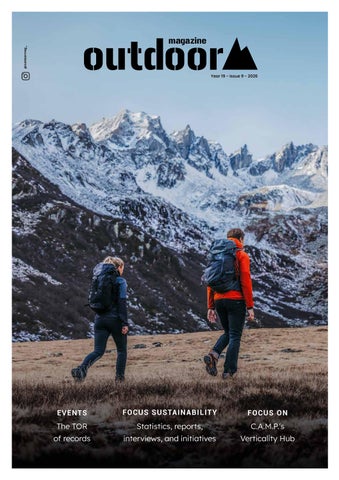
@outdoormag_
Year 19 - Issue 9 - 2026
EVENTS
F O C U S SU STA I N A B I L IT Y
FOC U S ON
The TOR
Statistics, reports,
C.A.M.P.'s
of records
interviews, and initiatives
Verticality Hub
Versante™ Instant Versatility
Versante™ porta l’esperienza della montagna nella vita di ogni giorno. Una collezione essenziale, trasversale e versatile, che trova in Arte Sella un luogo affine per raccontare arte, territorio e identità. Opera monumentale: Infinitum | di Gianandrea Gazzola, 2018
Year 19 - Issue 9 - 2026
THE STATE OF PLAY BY IOG
10 The summer outdoor season #INSIDETHERACE
12 The Italian skyrunning movement EVENTS
14 Tor des Géants 16 On the Fellaria Glacier with The North Face 18 Yunka Festival FOCUS ON
20 C.A.M.P.'s Verticality Hub INTERVIEWS
22 Eleonora Mion, Head of Marketing Italy in COROS COLLECTION HIGHLIGHTS
24 Versante FW 26/27 by Montura #MONTURAPEOPLE
25 Arte Sella: shared roots ACTIVE TRAVEL
26 Action Painting in Norway
25
FOCUS SHOP
28 La Sportiva Store in Arco PRODUCT INSIGHT
30 Kayland, Ternua 32 Nordsen, Trezeta 33 Kong 34 E9, Rock Experience 35 La Sportiva
FOCUS
SUSTAINABILITY
16
18
26
43
44
46
DATA & STATISTICS
38 The report on the end of a shoe's life cycle INDUSTRY NEWS
40 The new EU rules on packaging 41 MagNet becomes an EOCA member 41 Single-Use Plastics Project by EOG FOCUS ON
42 GreenroomVoice's values and goals 45 “Gocce di Montagna” by AKU EVENTS
43 Performance Days 2026 INTERVIEWS
44 How Giovanni Calvi and Cesare Mauri cleaned up the Stelvio 49 Saskia Bloch, Global Sustainability Director of Fjällräven BRAND PROFILE
46 Rematrix's circular challenges REPORT
48 Oberalp's sustainability in 2025 50 New Shapers Run of Salomon
EDITORIAL
The Flow of Things There are two quotes that caught my attention as I was rereading the articles in this issue to make final corrections before going to press and looking for some ideas for the editorial. The first is from Giacomo Bianchi, president of Arte Sella. “For me, as an engineer by training, it’s sometimes difficult not to have control over what happens, since I’d like everything to depend on me. Arte Sella has taught me to accept that often control isn’t possible—and shouldn’t even be sought; it’s a wonderful learning experience not only from a professional standpoint, but also because, in some ways, it teaches you how to approach life: to let go and allow things to flow and unfold. Sometimes we have a plan in mind and would like to put it into action immediately; then, for various reasons, we have to postpone it and wait for the right conditions to arise. It’s a way of being and living: learning to go with the flow, knowing that some things can be controlled while others simply happen.” The second, shorter quote is from Irene Tabanelli, a ski instructor and artist. “Painting ceases to be merely an act of control and becomes a direct confrontation with a real physical force.” Two seemingly unrelated statements. But then, while reading the regular “The State of play by IOG” column, published by the Italian Outdoor Group, I connected the dots in my reasoning, drawing lines between one thought and another—much like the coded puzzles in Settimana Enigmistica—to form a clear picture. “The outdoor world, in Europe as well as in Italy, is simultaneously grappling with several phenomena: a decline in purchasing power, the consolidation of retail outlets, a shift in how people experience the outdoors, and growing demand for certain brands that are particularly appealing to consumers,” reads the Italian Outdoor Group’s analysis.
The dedicated page also addresses other issues, ranging from the international economic situation to the growing trend toward outdoor clothing that is increasingly linked to urban style and everyday life— a phenomenon from which specialty retailers in the sector do not seem to be benefiting in particular. There would be enough here to quickly close the “cahier de doléances” and bury our heads in the sand, like an ostrich. Instead, the answer always comes from The State of play by IOG: “In short, the outdoor world remains a vibrant sector, especially when compared to other industries, but it is a market that is changing rapidly and is now much more fragmented than in the past. The challenge for our sector will therefore be to understand how to transform the growing desire for outdoor activities into value for the entire supply chain, keeping pace with consumer evolution without losing the expertise, specialization, and outdoor culture that still represent one of our market’s strengths.” We can make forecasts, budgets, and financial statements, trying to understand the present and predict the future, but we’ll never have a magic wand—neither as individuals nor as companies. “Things simply happen.” And we can’t stop them—it would be like trying to stop water with our hands. We must accept that it’s impossible to control everything; we must react, change, and adapt. This message isn’t even that new, from Darwinian theory to Taleb’s concept of antifragility. A message that also permeates the pages dedicated to the Sustainability Special, a world where EU Directive 2024/825 on communicating the very concept of sustainability and EU Regulation 2025/40 on packaging introduce new standards that require a rethinking of the entire process, from design to marketing to disposal. With the right approach, these requirements can be transformed into opportunities rather than just red tape and higher costs.
Claudio Primavesi claudio.primavesi@mag-net.it
Publisher: MagNet Srl SB Managing director: ANGELO FRIGERIO Editor-in-Chief: CLAUDIO PRIMAVESI Contributors: PIETRO ASSERETO, MANUELA BARBIERI, CHIARA BERETTA, TATIANA BERTERA, GIACOMO BIANCHI, BENEDETTA BRUNI, SARA CANALI, MATILDE MARELLI, MAURIZIO TORRI Art Director: ROSANGELA BARNI Editorial Staff: Corso della Resistenza, 23 - 20821 Meda (MB) Via Tertulliano, 68 - 20137 Milan Tel. +39 02.87245180 - Fax 02.87245182 redazione@outdoormagazine.it outdoormagazine.it
ON THE COVER: CMP
Printed by: Ingraph - Seregno (MB) - Volume 19 - No. 9 2026 Monthly magazine. Registered with the Court of Milan, No. 186 March 20, 2007. Registered with the ROC under No. 16155 on November 23, 2007 Poste Italiane SpA Postal Subscription Shipping (Decree-Law 353/2003 converted) in Law No. 46/2004, Article 1, Paragraph 1 - LO/MI One copy: 1.00 euro. The publisher guarantees the utmost confidentiality of the data in his possession. This data will be used for managing subscriptions and for sending commercial information. Pursuant to Article 13 of Law No. 196/2003, the data may be corrected or deleted at any time by writing to: MagNet Srl SB Data controller: Benedetto Sironi
This issue went to press on October 5, 2026
Outdoor Magazine
@outdoormag_
–– 4
mag-net-srl
Altitude Marker: 3.670m The New Mountaineering Ortles Collection
Mountains are spaces of possibility. Every step brings new choices, every peak a moment of inspiration.
NEWS
ECONOMY
SPORTS GOODS: A $675 BILLION INDUSTRY According to the report “The Industry that Moves the World,” prepared by the World Federation of the Sporting Goods Industry (WFSGI) and the consulting firm Oliver Wyman, the global sporting goods industry generates approximately $675 billion in GDP annually and supports 28 million jobs—one in every 125 jobs worldwide. The report estimates that this contribution amounts to 0.6% of the global economy, equivalent to Belgium’s GDP. The sector also generates $120 billion in direct tax revenue (230 billion when indirect effects are included), and over the past decade, sports-related patents have grown by 7.6% annually. Among the challenges is an average tariff of 14.1%, nearly three times the average on internationally traded goods.
Aluula Composites, a Canadian materials science company, closed the third quarter of fiscal year 2026 (ended July 31) with sales of 2.47 million Canadian dollars (1.53 million euros), up 16% from the 2.12 million in the same period of 2025, driven by the Performance Outdoor segment (+16%, 2.22 million dollars, 1.38 million euros) and the Commercial Industrial segment (+23%, 247,000 dollars, 153,500 euros, thanks to partnerships with leading brands such as Arc’teryx and Black Diamond). Revenue year-to-date rose 58% to $7.86 million (€4.88 million). The gross margin fell to 32% (from 41%) due to temporary costs related to production expansion. The company is continuing to expand its Vancouver facility, with full access expected in October 2026, and ended the quarter with $12.6 million (€7.83 million) in cash.
© Aluula
ALUULA REPORTS 16% INCREASE IN Q3 SALES
NIKE EXITS THE S&P INDEX AFTER NEARLY 18 YEARS Nike was removed from the S&P 100 index on September 21 as part of the quarterly rebalancing that Standard & Poor’s describes as necessary to ensure that each index remains representative of its market capitalization segment. The company had been added to the index—which tracks the stock performance of the 100 largest U.S. companies by market capitalization—in December 2008 and remained there for nearly 18 years. Nike’s market capitalization has fallen to approximately $60 billion, down from the $280 billion it reached in November 2021: the stock closed at $38.40 on September 4, well below its all-time high of $161.91 reached on November 5, 2021, when the company’s market value was nearly five times its current value.
MAGNET ACQUIRES OUTDOORTEST.IT AND STRENGTHENS ITS B2C STRATEGY MagNet has announced the acquisition of Outdoortest.it, a publication founded and directed by Alfredo Tradati, a leading authority in Italy on field testing of technical mountaineering gear and apparel. The acquisition takes effect in September 2026 and strengthens our publishing house’s multichannel strategy by integrating a publication that has been active since 2010 and is updated daily. Outdoortest.it brings with it over half a million users in the last twelve months, 74% of traffic from organic search, and a network of testers active across twelve product categories, ranging from skiing to ski mountaineering, hiking, trail running, climbing, and mountain biking. Women make up 34% of the audience, 71% of whom access the site via smartphone, and the site has established relationships with 70 outdoor brands and 16 partner trade shows and events. For companies working with MagNet, this partnership represents an additional and powerful channel for reaching the end consumer—a
target audience that is increasingly central to all of our publishing house’s media outlets—while complementing a product validation process based on independent testing. The integration stems from a long-standing collaboration in organizing Skimofestival; the editorial team and network of testers remain unchanged, with upcoming commitments already on the calendar, including winter testing in Cervinia and ISPO Amsterdam as a media partner. “What we bring to MagNet is a testing methodology developed over 16 years, not just an archive of articles,” stated Alfredo Tradati. For Benedetto Sironi, CEO of MagNet, “This move represents an important step for MagNet in the growth and expansion of our offerings, significantly strengthening our presence among consumers. At the same time, the experience, expertise, and credibility built by Outdoortest.it are a valuable asset in which we want to invest, developing new synergies with our media and events.”
–– 6
NEWS
- OPENINGS DECATHLON, THE FRANCHISE MODEL COMES TO ITALY. TARGET: 91 STORES Decathlon Italia is launching a franchise program with the goal of expanding the brand’s reach and entering new urban markets as well as seaside and mountain tourist destinations. The initiative complements the existing network of company-owned stores, creating a hybrid model. In reality, this strategy is not new for the French giant. For about 20 years, Decathlon has been using franchising in various international markets, especially in countries where it is difficult to develop a direct network. What is truly new is the introduction of this model in European markets where the company already has an established presence, such as Italy. To develop the new network—a process that will take place over the next four years—Decathlon has already identified 91 potential locations spread across all regions of Italy.
© Satisfy
© Satisfy
SATISFY OPENS ITS FIRST PERMANENT LOCATIONS IN PARIS The French running and trail apparel brand Satisfy has announced the opening of its first permanent retail spaces in Paris: Satisfy Supply and Satisfy Fuel Station. The former features the brand’s full range of technical apparel and footwear, while the latter is dedicated to hydration and nutrition for runners. More than just a traditional running store, the space is designed as a gateway to the brand’s entire world—encompassing trail running, music, art, and the outdoors. This is an exciting new development for the brand, which until now has operated primarily as an online retailer, with a limited selection of retail partners and occasional seasonal or temporary pop-ups, such as the one in Chamonix. Both permanent locations opened on Friday, September 4, 2026.
CISALFA INVESTS ONE MILLION EUROS IN PARMA Cisalfa Sport has announced the opening of its first store in Parma, located at the Parma Promenade, the result of an investment of over one million euros. The opening marks an important milestone in the company’s growth in Emilia-Romagna, where—with 16 stores in the region, over 200 employees, and projected revenue of 40.5 million euros by 2025—it continues to strengthen its presence in the area. The new store, which is expected to hire 15 new employees, spans over 1,300 square meters of retail space and offers visitors an assortment of more than 2,600 items across over 50 brands, including Nike, adidas, Puma, Salomon, and New Balance, as well as Cisalfa Sport’s own brands such as 8848, Carnielli, Abc, Dack’s, and Best Company.
SPRING/SUMMER 27
COLLECTION
PEONIA maglia in tessuto elasticizzato traspirante, con un tocco morbido al tatto e piacevole da indossare
Oltre l’orizzonte, il mondo si apre, l’avventura prende forma, Nordsen cammina con te
–– 7
www.nordsen.it
NEWS
- PEOPLE STEFAN RAINER NAMED NEW CEO OF OBERALP On October 1, Stefan Rainer assumed the role of CEO of the Oberalp Group, succeeding Christoph Engl, who had led the company since 2018. This transition has ushered in a new phase for the Group, which was founded in Italy and has grown into an international brand house that now manages 17 brands, seven of which it owns. Stefan Rainer has over 20 years of experience within the Group, having held roles in various corporate functions. The leadership transition has been marked by continuity. After eight years at the helm, Christoph Engl will continue to work with Oberalp and, effective January 1, 2027, will assume the role of Senior Advisor, focusing on specific strategic projects, including the development of international licensing for the Group’s brands in Asia.
THE LYCRA COMPANY APPOINTS HUA DU AS CHIEF EXECUTIVE OFFICER The LYCRA Company announced on September 15 the appointment of Hua Du as Chief Executive Officer. With this appointment, the company is entering a new phase following the completion of its financial restructuring. Du succeeds Dean Williams, who will continue to serve as chief financial officer. Du has 30 years of managerial experience in the specialty chemicals and biotechnology sectors, during which he has led growth initiatives at international companies. Most recently, he served as CEO of Grobest Group, where he spearheaded a comprehensive transformation process. Prior to that, he held senior leadership roles and managed Rohm and Haas’s electronic materials business in Asia.
CATHRINE STANGE AT THE HELM OF BERGANS OF NORWAY Bergans of Norway has appointed Cathrine Stange as the company’s new CEO after announcing last August that Silje Garberg Ree would step down by the end of the year to become CEO of Brav, the group that owns the Swix, Lundhags, Helsport, and Toko brands. Stange assumed her new role on October 1 after serving as interim CEO of Brav since August 2026. She has extensive experience in the outdoor industry: from November 2023 to August 2026, she served as CEO of Janus Wool, one of Europe’s oldest manufacturers of woolen underwear, and prior to that, she spent nine years as CEO of Devold of Norway, a company specializing in the production of woolen garments.
- RESPONSIBILITY LUHTA SPORTSWEAR COMPANY WINS THE ESG TRANSPARENCY AWARD The prestigious ESG Transparency Award is the most recent recognition attesting Luhta Sportswear Company’s commitment to transparency and continuous improvement. This international award aligns with the company’s ethos, as it is committed to understanding and managing the impacts of its operations throughout the entire value chain. To this end, product information and traceability have also been enhanced through an innovative Digital Product Passport pilot project. Transparency is not the only milestone achieved by the Finnish company, which, in recent years, has distinguished itself in various areas of what is now referred to as “sustainability.” Luhta Sportswear Company has also championed human rights throughout its value chain by strengthening its due diligence processes in accordance with United Nations and OECD principles, while simultaneously launching an initiative dedicated to promoting living wages throughout its supply chain. In terms of social responsibility, the Nordic company was also honored with Finland’s Most Active Workplace Award 2026, which reflects the belief that a sustainable company is built on engaged, motivated, and healthy employees. The Group has also reaffirmed its science-based climate commitment: its short- and long-term goals have been officially approved by the Science Based Targets initiative (SBTi). To support these ambitious goals, a climate transition plan has been developed, along with a climate scenario analysis in line with the TCFD’s recommendations. Not to mention the protection of biodiversity and natural ecosystems, through the launch of a process to assess the direct impacts of its activities.
Learn more about Luhta Sportswear Company's commitment to sustainability
luhta.com
–– 8
NEWS
- EVENTS FJÄLLRÄVEN POLAR RETURNS IN 2027 Thirty years after the first expedition, Fjällräven Polar returns in 2027 and once again invites people from all over the world to take on one of the most fascinating and challenging environments on the planet: the Scandinavian tundra. From March 31 to April 5, 2027, 20 participants will travel approximately 300 kilometers across the Scandinavian Arctic, each driving their own sled and learning to care for and feed the dogs, set up camp, cook outdoors, and sleep in tents or under the Arctic sky, adapting to an environment where temperatures can drop to 30 °C below zero. Participants will carry out most of the activities themselves, but they can always count on support from the Fjällräven team and professional mushers. Applications are open from September 29 and will remain open until November 3.
THE RAGNI DELLA GRIGNETTA CELEBRATE THEIR 80TH ANNIVERSARY WITH THE LECCO CLIMBING FESTIVAL To celebrate its 80th anniversary, the "Ragni di Lecco" alpinist group has organized the first edition of the Lecco Climbing Festival, an event open to the city and the public that will transform Lecco’s historic center, lakeside promenade, and squares into a vertical stage for three days, from October 16 to 18. The initiative aims to be much more than a self-congratulatory celebration; rather, it is a tribute to Italian and international mountaineering, to its human stories, and to the mountain culture that has made Lecco unique in the world. Over the course of the three days, there will be a series of talks, meetings with leading figures in international mountaineering and climbing, and presentations in the city’s theaters and squares. All events are free of charge.
CHANGE AT THE TOP OF THE OLYMPIC GAMES FRENCH ALPS 2030 After just 18 months in office, Edgar Grospiron, president of Alpes 2030 and a key figure on the organizing committee, has resigned. Effective September 14, Vincent Roberti has been appointed interim president, pending the permanent appointment of a successor. This leadership change raises questions about the governance of the upcoming Winter Olympics. As reported by Reuters, the main stakeholders involved in the Games reportedly informed the International Olympic Committee in late August that the relationship of trust with the president had broken down, while seven months ago, CEO Cyril Linette had already resigned due to disagreements with Grospiron. Other executives had also stepped down from their positions in the preceding months.
MAGNET AND THE POLYTECHNIC UNIVERSITY OF MILAN BRING TOGETHER YOUNG DESIGNERS AND OUTDOOR BRANDS FOR MON*TALENT From October 19 to 21, the School of Design at the Politecnico di Milano, Bovisa campus, will host Mon*Talent, the first international educational and experiential program designed to introduce college students to outdoor brands, under the slogan “Mountain goes to Poli.” The project comes from an idea by Aldo Faleri, professor of Alpine Design at the Polytechnic, and Venanzio Arquilla, chair of the Product Design program, in collaboration with our publishing house, MagNet, and the ALPI+MILANO aps association. The initiative consists of two phases: an interdisciplinary workshop, which took place June 8–12 with 23 students exploring the theme of walking trails, and a Village-Exhibit from October 19–21, where the industry’s best-known brands will meet with young designers. The event is organized around three main themes: an exhibition featuring corporate booths and a showcase of student projects; networking with one-on-one meetings between students and brands; and equipment tests to try out the materials firsthand. The Politecnico di Milano has 49,395 enrolled students, including 7,375 architects, 4,793 designers, and 37,227 engineers; its School of Design ranks first in Italy and seventh in the world in the field. Furthermore, from October 15 to 21, The Bridge area will host the workshop prototypes and the “The Icon” exhibition. “MagNet’s proposal for Italy’s first themed village is the ideal base camp to bring together young design talents with the most renowned international outdoor brands,” stated Faleri. For Bene-
detto Sironi, CEO of MagNet, the event represents “a concrete opportunity for employer branding, networking, and validating ideas with young designers.” Students will be able to book one-on-one meetings starting in early October through the dedicated
–– 9
FOCUS ON
THE STATE OF PLAY BY IOG
THE HOT SUMMER OF OUTDOOR ACTIVITIES Market trends and insights characterized by increasingly discerning consumers, urban influences, and a focus on trendy brands by Günther Acherer, President of the Italian Outdoor Group
Summer is over, even though the weather seems to be proving us wrong. We’ve read in the newspapers and heard on the news that, this year, many Italian families have shifted their vacation plans from the seaside to the mountains. And, in fact, mountain resorts have seen a significant influx of visitors. Mountain huts are also reporting a season the likes of which hasn’t been seen in a long time, fueled by a prolonged stretch of good weather and above-average temperatures—conditions that are extending the season well beyond the traditional months. Some mountain huts are already reporting that they’re fully booked through mid-October. The summer season, therefore, is extending, and the mountains continue to draw visitors.
different way of experiencing outdoor activities. The technical climbing sector, on the other hand, remains strong, supported in part by the continued growth of climbing gyms, which serve as an important gateway for new enthusiasts. Apparel is also undergoing a transformation. We’re seeing a decline in the more technical segment, while interest is growing in outdoor clothing that’s increasingly tied to urban style and everyday life. Brands that are able to interpret these changes and adapt to new consumer needs manage not only to maintain their market positions but, in some cases, to grow as well. All of this is changing consumer behavior at the point of purchase and, inevitably, that of retailers as well. Retailers specializing in outdoor gear may be affected most by this transformation. It may seem counterintuitive: on the one hand, we see more and more people visiting the mountains and participating in outdoor activities; on the other hand, specialty stores do not necessarily benefit from this growth. In reality, we believe this is primarily a snapshot of the current moment, rather than a trend destined to shape the market in the long term. The outdoor market continues to grow, even if it is doing so at a slower pace than in the past and through different channels. However, we cannot underestimate another phenomenon: consumers’ strong focus on certain particularly “trendy” brands, which are capable of generating high sellout rates. Their appeal inevitably leads to a greater concentration of available shelf space within stores, taking it away from other brands and making competition even fiercer. In summary, the outdoor sector remains a vibrant industry, especially when compared to other sectors, but it is a market that is changing rapidly and is now much more fragmented than in the past. Consumers’ strong preference for spending part of their vacations in the mountains does not automatically translate into sales. The decline in purchasing power—which is affecting even traditionally strong countries like Germany—along with changing consumer habits, the consolidation of retailers, and the growing strength of certain brands are creating fiercer competition and an inevitably more volatile market. The challenge for our industry will therefore be to work together, moving beyond the logic of competition, to understand how to transform the growing desire for outdoor activities into a shared benefit for the entire supply chain and to support the evolution of the consumer without losing the expertise, specialization, and outdoor culture that still represent one of our market’s key strengths.
WHAT ABOUT SALES? — Here, the picture changes. One would expect that the growing desire for the mountains and outdoor activities would automatically translate into sales growth. But that’s not the case. Reports coming from the market are mixed, and it’s harder than ever to paint a clear picture of the situation. The outdoor industry, both in Europe and in Italy, is simultaneously grappling with several trends: declining purchasing power, the consolidation of retail outlets, changing attitudes toward outdoor activities, and a growing concentration of consumer demand on certain brands that are particularly appealing to shoppers. In most cases, the problem of excess inventory now appears to have been resolved, both at retail locations and in distribution. Yet, reports of declining—and in some cases significant—sales continue to come in from several European countries. The loss of purchasing power is certainly part of the explanation, but it does not seem to be enough to account for what is happening. Consumer behavior has changed, and this is profoundly affecting product categories. Take, for example, tents and sleeping bags. The classic hiker equipped with a tent who spends the night in the “Alps” has increasingly become a niche figure. This has remained a market for specialists seeking ultralight, technical, and high-performance products. On the other hand, there are entry-level products, intended for those spending a week’s vacation camping, at the beach, or in the mountains, without any particular technical requirements. An equally evident change concerns footwear, one of the most important categories in terms of revenue. The classic hiking boot naturally continues to have its place, especially on longer and more demanding hikes, but sales have dropped significantly in favor of much lighter footwear. A portion of revenue has therefore shifted toward running and fast hiking, which continue to meet growing demand and represent a
italianoutdoorgroup.it
––
10
#INSIDETHERACE
Cristian Minoggio
Luca Del Pero
ITALY NEVER DISAPPOINTS WHEN IT COMES TO SKYRUNNING The national movement is thriving. As for federal events, there is still work to be done to win back the top runners by Maurizio Torri - photo by Davide Ferrari/FISKY of top runners such as Manuel Merillas (Spain), Frédéric Tranchand (France), Nadir Maguet (Italy), Alain Santamaria (Spain), William Boffelli (Italy), Lucien Mermillon (France), Nicolas Molina (Spain), Naiara Irigoyen (Spain), Patricia Pineda (Spain), Denisa Dragomir (Romania), Iris Pessey (France), Natalie Beadle (Great Britain)… Just as was the case last year with the continental championships, the 2026 World Championships also failed to attract the top athletes to the same extent as the major private races. The last World Championships worth noting were those held in 2014 in Chamonix, won by Kilian Jornet, Elisa Desco, Laura Orgué, Luis Alberto Hernando, Emelie Forsberg, and Stevie Kremer. That’s no small feat.
The skyrunning season is now drawing to a close. There are only a few events left before we wrap up a summer packed with races. From World Series races to the most prestigious events, right up to the recent World Champion-
MAURIZIO TORRI Freelance journalist, founder of the website sportdimontagna.com, photojournalist and communications consultant for some of the most iconic events in trail running, skyrunning, and ski mountaineering
ships in La Gomera, which concluded on September 20, the Italian national team has carved out a leading role for itself. However, the World Championships in the Canary Islands offer an opportunity for broader reflection: Mattioli’s national team is performing well, but not all of the sport’s top athletes prioritize wearing the Italian national jersey. And the same problem exists abroad as well. Many of the world’s top names were missing from La Gomera.
WE NEED TO BE MORE APPEALING In trail running, the sport seems to have progressed further: wearing the jersey of one’s national team and aiming for an international title has become a key goal in the plans of many top runners. In skyrunning, on the other hand, athletes are still more drawn to the major classics or international events where they can compete in the colors of the brands that support them throughout the season. To make the Skyrunning World Championships increasingly attractive to top athletes, the first step is to reward them—both financially and in terms of media exposure. On the media front, an important step has already been taken: the spectacular footage from La Gomera has given the event top-tier visibility and a world-class image. Now the focus must shift to the financial aspect, with prize money befitting a true World Championship. The challenge ahead also lies here: making the World Championships an event capable of truly bringing together all the best skyrunners on the planet, further increasing the technical and media value of a rainbow jersey that deserves to represent one of the most coveted achievements of the season.
SO MANY MEDALS FOR ITALY
Three golds, two silvers, and three bronzes. The Italian national team’s performance at the Skyrunning World Championships in La Gomera was certainly impressive. Eight medals over three days of competition, first place in the medal count by total number of podium finishes, and second place in the overall points standings behind Spain. These numbers confirm the strength of a movement capable of competing at the highest level across all disciplines. The spotlight inevitably falls on Cristian Minoggio and Luca Del Pero. In the 63-kilometer SkyUltra with 4,100 meters of elevation gain, the Piedmont native claimed his third consecutive world title in the discipline, following his victories in 2022 and 2024. Del Pero, meanwhile, capped off three days as the undisputed star: bronze in the Vertical, gold in the Skyrace, and another world title in the Vertical + Sky combined event. Further enhancing the Italian team’s performance were Benedetta Broggi’s bronze medal in the Vertical and Cecilia Basso’s bronze in the Skyrace, in addition to the two silver medals (one in the team event and one won by Corinna Ghirardi in the combined event), which helped bring the total medal count to eight. This collective effort confirms the success of the project led by FISky and a technical staff that has been working over the years to build a solid and competitive national team.
A WORLD CUP THAT NEEDS TO WIN BACK THE BIG NAMES However, the Italian team’s positive results should not prevent us from reflecting on the situation. The Skyrunning World Championships, unlike what is happening in trail running, are still struggling to become a must-attend event for all the top athletes in the sport. And this issue isn’t limited to the Italians. A glance at the starting list reveals the absence
Italy's Medalists at the World Championships
––
12
© Stefano Coletta
EVENTS
Franco Collé, winner of the TOR450, greeted at the finish line by Ivan Parasacco
THE TOR OF RECORDS 1,789 finishers out of 2,606 athletes at the starting line and five new records to beat.
Zhao and Hartmuth have made history, but the man of everyone's dreams still is Franco Collé by our correspondent Tatiana Bertera
“There were moments when I had to slap myself really hard in the face to stay awake; I don’t think I’ll ever run such a long race again,” he told a reporter immediately after crossing the finish line. We can imagine that exhaustion might make interviewees a bit foggy upon finishing. The question remains whether we’ll see Zhao at the starting line again—perhaps next year—to defend his record. The German Katharina Hartmuth, on the other hand, was decidedly more coherent. Her performance will be hard to beat: she finished third overall, shaving a full 12 hours off her previous record, sleeping only 15 minutes in total and devouring huge plates of pasta with tomato sauce. Who would have thought, just a few years ago, that a woman could come so close to the men’s times? Zhao’s time was 65h55’22’’, while the German’s was 67h10’09’’. Between them was Jonathan Schindler (Switzerland), who clocked in at 66h55’06’’. It must be said that the level of both men and women, even in ultradistance racing, is rising higher and higher year after year. A simple example is that of the fourth-place finisher, Melissa Paganelli from Bergamo. With a time of 82h55’29’’, Paganelli would have won in all the editions dominated by her Italian counterparts. Times that seemed unattainable at the time were those of Anne-Marie Gross (2010—91h19’13’’ and 2011 —91h28’21’’), Francesca Canepa (2012—85h33’56’’ and 2013—88h12’17’’), and Lisa Borzani (2016—91h09’44’’ and 2017—89h40’24’’).
© Nicola Biagetti
Never before have so many athletes crossed the finish line in the history of the Valle d’Aosta race. The 2026 edition concluded with a celebration—during the traditional Sunday ceremony at Parco Bollino—of 1,789 finishers (across all distances) and five new records. Favorable weather conditions were undoubtedly the key factor that made these top-level performances possible. There were 2,606 athletes at the starting line and 40 more finishers than the 1,749 in 2025. Last year, too, the number of finishers was influenced by sunny weather and the near-total absence of rain; when rain did fall (as it always has, except for the last two editions), it made the race much more challenging and caused a greater number of athletes to drop out. Records not only in numbers but also in performance. Let’s start with the numbers from the flagship race, the TOR330—Tor des Géants—which was also the first of its kind and therefore already holds an unbeatable record: that of longevity. The spotlight was on Kailas’s representative, Jiaju Zhao, from start to finish. In last year’s race, the Chinese runner had dropped out around the 200-kilometer mark due to poor pacing. This year, back to win, he hit the mark. In addition to setting a new race record, Zhao is also the first Chinese runner to stand on the top step of the podium. But it wasn’t an easy victory. Arriving completely exhausted, he later described it as an extreme ordeal.
RACE
starters
finishers
completion rate
200
116
58%
1,118
690
61.7%
409
240
58.7%
417
292
70%
TOR30 Passage au Malatrà
462
451
96.7%
TOTAL
2,606
1,789
68.6%
TOR450
Tor des Glaciers
TOR330 Tor des Géants TOR130 Tot Dret
TOR100 Cervino-Monte Bianco
––
14
© Stefano Coletta
EVENTS
© Nicola Biagetti
Jiaju Zhao, winner of the 2026 Tor des Géants (TOR330), setting a new all-time record for the race
FRANCO COLLÉ, FROM TOR330 TO TOR450 The TOR450—Tor des Glaciers—provided yet another iconic image from this year’s race. Franco Collé, a four-time winner of the TOR330, arrives at Malatrà and covers his face with his hands. It was an emotional moment—a scene we’ve seen before—but this year, the champion from Gressoney was at the starting line for the longest and most extreme distance. Far from the performance of Frenchman Sébastien Raichon—who left everyone speechless in 2023 with a time of 114h29’01’’—Collé savored the wildest side of the TORX with Kailas. In a pre-race phone conversation, he’d told us how he was approaching this experience with the eyes and enthusiasm of a child, eager to discover what lay beyond the 330 kilometers. He certainly found out. “I was well-prepared, I knew the route, and yet I had underestimated the final stretch. Those two extra days are really tough. There was a moment of real crisis—I was completely out of energy. Resting on a course like this is a must.” And when asked if we’ll see him at the starting line again to set a new record, he replied: “It’s hard to say; the years go by, and Raichon did something extraordinary in 2023. Even during training, when I was working on the sections and saw his split times, I realized the magnitude of his achievement. I’m satisfied with what I’ve done; my only regret is not having tackled this distance sooner.” It’s worth noting that this race—which is much more challenging than the others (involving self-navigation and mountaineering sections, as well as aid stations and rest stops that are much farther apart)—also sold out. Among them were “only” 18 women. But here, too, the percentage of female participants is rising, albeit much more slowly than in marked races. A little over 24 hours after Franco Collé’s triumph, American Kaitlin Allen crossed the finish line, completing the 450 kilometers and 32,000 meters of elevation gain in 147h49’29”; she posted the second-fastest time ever in the history of the women’s race, behind only Florence Golay-Geymond’s record (144h27’34” in 2025), though on a course extended by about four kilometers due to the detour between the Chabod Hut and Cogne.
© Stefano Coletta
Franco Collé at Colle del Malatrà
OTHER RECORDS A record was also set at the TOR130 - Tot Dret, where Nicolas Francesco Lemoine etched his name into the race’s record books. The TOR100— Cervino-Mont Blanc, now in its third edition, delivered thrilling moments and two new records: Davide Busuito and Rebecca Hormann set new course records.
Katharina Hartmuth takes third place overall in the TOR330
––
15
© Mattia Rizzi
EVENTS
WHERE THE TRAIL ENDS, THE EXPEDITION BEGINS The North Face and Crusher Running took the Offtrail Ultra to the Fellaria Glacier:
WHAT WE TESTED OFFTRAIL ULTRA SHOES Developed with The North Face team of athletes for performance on rugged terrain. Dual-density Dreambound midsole—stiff on the outside for stability and soft on the inside for comfort; integrated Screeguard gaiter, Surface Ctrl outsole, and Thinweb technology. Extremely lightweight.
two days of testing in real-world conditions with a brand-new format
SUMMIT SUPERIOR FUTURELIGHT JACKET
by our correspondent Pietro Assereto
Waterproof, lightweight jacket for protection in extreme conditions. Adjustable hood, reflective details for visibility in low-light conditions. Ultra-lightweight construction, compliant with mandatory requirements for race kits.
It’s not a race. It’s not a guided hike. It’s something in between, which The North Face and Crusher Running have chosen to call, quite simply, an expedition. On September 12 and 13, the Alpe di Fellaria in Valmalenco became the setting for an unconventional trail running experiment: no marked trail, no timed runs, just a technical and ever-changing alpine terrain to read, interpret, and tackle as a team. The format explicitly evokes the spirit of the 1989–90 Trans-Antarctica Expedition, when six explorers from six different countries crossed 6,000 kilometers of Antarctica, demonstrating that adaptability and collaboration can overcome any boundary. More than 30 years later, that same principle serves as the narrative framework for the Offtrail Expedition.
SUMMIT RUN 10L VEST Optimized for races, with a 10-liter capacity, a chafing-resistant design, and essential pockets. Includes two 500-milliliter soft water bottles. Made with FlashDry fabric for a dry feel, and side compression straps for a stable, non-restrictive fit.
The program was structured like a real-life miniature expedition. Departure from Milan, an approach on foot from Tornadri to Campo Moro, then a hike to the Bignami Refuge—Base Camp 1—and finally an ascent to Base Camp 2, at 2,500 meters, where camp was set up for the night. Temperatures dropped to freezing, with tents and sleeping bags, and a dinner of AKTA freeze-dried food prepared on a portable stove: a deliberately minimalist experience, far removed from any of the comforts of a mountain hut. Sunday was the highlight of the expedition: a team-based mission with a map in hand, involving checkpoints to reach by navigating trails, fast hiking, and technical terrain all the way to the foot of the Fellaria Glacier. There was no set route: each team had to read the terrain, decide on its own strategy, and adapt in real time. A format that shifts the focus from individual performance to navigation skills, decision-making, and collaboration, while also putting the expedition’s key equipment to the test in the most realistic setting possible.
SUMMIT HIGH TRAIL GRAPHIC T-SHIRT FlashDry-Pro technology for moisture wicking. Underarm gussets for greater freedom of movement; lightweight, anatomically designed fabric to reduce weight and increase comfort, even when wearing a backpack.
SUMMIT PACESETTER GRAPHIC SHORTS A blend of FlashDry and Lightrange fabrics for moisture management. Ultra-lightweight and breathable, with an adjustable waist drawcord and stretch fabric for freedom of movement. Pockets for gels and energy bars while running.
thenorthface.com
––
16
10-12/01/2027 Bolzano
International B2B Trade Show for Snow Sports and Outdoor
Il punto d'incontro per negozianti e noleggiatori di articoli sportivi invernali e outdoor
Un intero padiglione dedicato all'outdoor invernale
www.prowinter.it
© Fabrizio Billi
EVENTS
WHEN THE JOURNEY BECOMES A COMMUNITY The Yunka Festival continues to be a gathering place for all-rounder hiking enthusiasts by our correspondent Sara Canali
ally also content creators—and find inspiration at the Festival for their next hike.
The Yunka Festival organizers offered more than 50 activities, including talks, panel discussions, hikes, workshops, and entertainment. And about 400 people gathered from September 11 to 13 for the third edition of the event organized by Cammini d’Italia, which transformed Monte Bibele—a mountain range in the central Bolognese Apennines— into a gathering place for slow tourism enthusiasts. The result? Three days packed with activities ranging from the presentation of hiking trails—such as the Via del Fantini and the ArtTrail route by BOM (Bologna Montana), of which Monte Bibele is one of the stops—to meetings with content creators, a fundamental part of the community, and activities like orienteering, foraging, yoga, forest bathing, and much more. For the first time this year, the Workless Collective climbing wall was also on site, where entertainment sessions and adrenaline-pumping challenges were organized. All hikers arrived equipped with tents or vans; they could take advantage of the Ferrino tents that had already been set up and made available by the organizers, or sleep in the dormitory at Arc.a in Monte Bibele. In short, it was three days in which hiking and hikers took center stage. We spoke with Davide Nanna, founder of Cammini d’Italia, about the event.
How many people have you involved this year?
The festival was conceived as a bit of a niche event. We don’t want to become huge; instead, we want to maintain the authenticity that sets us apart and serve as a gathering place. This year, there were about 400 of us, including registrants, speakers, and volunteers—exactly the number we wanted to reach. How did you choose the venue?
nn
a
We are at an archaeological park, Monte Bibele, a brand-new site designed to recreate a Celtic village. The venue is perfectly suited to hosting the event, and choosing Bologna seemed like the most logical choice to allow all hikers from across Italy to participate. Furthermore, we have the support of the Metropolitan City of Bologna, the Municipality of Monterenzio, and all the municipalities a e N in the Mountain Community. Emilia-Romagna has developed a truly d i D av extensive network of hiking trails. How are hiking trails and hikers changing?
In general, we’re seeing an evolution. On the website, we track the data year by year and have noticed that the target audience is changing. We see that hiking trails are increasingly being viewed as a tourism product with a specific positioning. Hikers are evolving, too: today they’re definitely more experienced and fit. Then there’s the outreach work done by content creators, which is important because it allows hikers to arrive already prepared.
What does "Yunka" mean?
© Greta Boccuzzi
Yunka means “jungle” and “forest” in the Quechua language. It’s a word we liked first and foremost for its sound, but also because the forest is a place that encompasses a community. And we are a community: the festival couldn’t exist without the people who are part of it. There are content creators, hikers, and sponsors, whom we always strive to involve in an interactive way within the festival. We’re not interested in mere advertising; for us, a partnership must add value to the event and the community—otherwise, there’s no point in doing it. How has this festival grown?
At first, we had envisioned it as a gathering of hikers in one place—a mountain hut serving as a base camp—and the idea was to go on lots of hikes and then all get together in the evening. In the second year, however, the festival grew: we’d put on a short presentation, and there was the “Hiker’s Quiz,” which has been running for three years now. Those two things had worked well. So last year we said: why don’t we do more talks and get everyone involved? And here we are. When you say “Yunka Festival,” you’re talking about community and journeys. What aspect of this world do you want to explore?
Hiking is a massive industry. We want to engage everyone who’s passionate about this activity, whether they’re experts or beginners. Over the course of the three days, “yunker” can connect with us and with countless experts—who are usuyunkafestival.it
––
18
kayland.com
kayland_official
© UTMB
FOCUS ON
THE HOME FOR SAFETY CULTURE The C.A.M.P. Verticality Hub simulates nine operational scenarios, ranging from the evacuation of cable car systems to helicopter operations. But to call it a training center would be an understatement by Claudio Primavesi
its value is only fully realized when the user possesses the necessary skills and awareness,” adds Lanfranconi. Through hands-on experience, partic-
on
i
ipants learn how to apply the products, interact with instructors and specialists, and contribute to the development of more effective solutions. The Verticality Hub thus represents the natural evolution of C.A.M.P.’s mission: not only to design and manufacture PPE, but also to promote knowledge, training, and safety in all areas of vertical activities. The goal is to engage the entire corporate ra nf network: branches, agents, distributors, retailers, customers, end La o c Va s users, professionals, organizations, and partners. This includes not only training for firefighters and mountain rescue teams, but also “legal” courses for retailers on liability issues and meetings with the international sales force. The Hub also plays a key role in product development: in addition to serving as a training center, it is a true laboratory where ideas from Research and Development take shape and are tested against real-world operational scenarios. That’s why the Verticality Hub is unique. nc
Plan, practice, save, share. These are the four key takeaways from a visit to the new C.A.M.P. Verticality Hub in Valmadrera (LC). To call it a “training center” is an understatement: the 15-meter-tall facility allows for the planning of exercises related to workplace and mountain safety, regardless of the weather. “For example, a rescue on a cliff face using a real helicopter, an evacuation from a gondola, or a crevasse rescue—all without having to organize rotations or rely on the cable car system,” explains Vasco Lanfranconi, C.A.M.P.’s Training Manager. The drills can also be repeated indefinitely, avoiding costs such as those associated with a helicopter flight—which, moreover, could be called away for an emergency during the drill. The true philosophy of the Hub, however, lies in its very name. Verticality has always been in C.A.M.P.’s DNA—from mountaineering to construction site safety, from mountain rescue to firefighting operations. The facility embodies the concept of sharing a culture of safety, born from the conviction that safety cannot depend solely on the quality of products but requires knowledge and experience. “Effective PPE is essential, but
A LOOK INSIDE THE FACILITY The facility was designed to simulate numerous real-world operational scenarios and houses nine training units dedicated to specialized disciplines: working at heights on sloped roofs and vertical structures; rope access and rope progression; technical rescue and the handling of injured persons; confined spaces; tree climbing and arboriculture; evacuation from cable systems; helicopter operations; activities on ladders, beams, and horizontal traverses; technical workshops and theoretical training. All operations can be observed from three different levels, and there are also classrooms, a product area (a showroom featuring the most significant items from the workplace safety and outdoor catalog), and common areas designed to
facilitate interaction among professionals, instructors, and business partners. One of the Verticality Hub’s distinctive features is the presence of a real helicopter, purchased used and refurbished. Thanks to a dedicated lifting system, it can be raised to a height of approximately 14 meters and is equipped with a winch capable of operating with two people simultaneously. A pylon, a cabin, and two chairlift seats are dedicated to rope access system evacuation drills, while an inclined plane with a trapdoor simulates crevasse rescue operations. Design of the facilities—including the two artificial trees for tree climbing—began in 2022, and construction started in 2023 on the site where the company’s warehouse once stood.
––
20
© Tonywithasony
© Tonywithasony
FOCUS ON
Pre-test della Rocket X Trail
>> THE INTERVIEW EDDY CODEGA, C.A.M.P. PRESIDENT AND CEO
them according to our vision, and sought to build something that didn’t yet exist—not simply a combination of existing models.
When did the idea for a training center first come about?
The idea came about as we observed the supply chain: much of the information about our products, their use, and the value behind them was fragmented, and there were even gaps in basic knowledge of PPE in the workplace. We invest heavily in research, development, and innovation, but if this isn’t fully understood, it risks going unappreciated. We therefore needed a new way to convey more in-depth knowledge to our customers: that’s why we conceived a unique facility capable of concretely representing the contexts in which our products are used—a place where visitors can enjoy an immersive experience in the world of C.A.M.P.. This journey led to the creation of the C.A.M.P. Verticality Hub.
Is this intended for use in testing and developing outdoor products?
Absolutely. The Hub serves as a meeting point between the two markets—outdoor and workplace safety—with training modules dedicated to the outdoor division. Bringing designers, instructors, and users together in one place fosters a valuable exchange between different professional fields, united by a common goal: to advance the market through increasingly safe and functional products capable of keeping pace with the evolution of various practices. This exchange thus leads to innovation.
From conception to completion, how have the design and structure changed?
The goal has remained the same, but the project has evolved through dialogue with instructors, users, and designers. We revisited the theme of verticality—a key element of our rebranding—resulting in a building approximately 15 meters tall with nine training areas, some of which feature such innovative construction solutions that we have filed a patent application. Not just a place to impart knowl-
How important will the Hub be to the R&D department?
edge, but a structure whose very architecture embodies innovation.
It will be a strategic tool: bringing training and R&D closer together bridges the gap between those who design products and those who use them. Ideas tested quickly, prototypes validated under realistic conditions, direct feedback from users: a faster cycle between design, testing, and use, leading to products that are increasingly safe and functional.
What sets it apart from other similar systems?
How much of C.A.M.P.'s revenue does the Work & Safety division
The Verticality Hub was designed from the outset to replicate real-world operational scenarios in a controlled environment: work at height, sloped roofs, rope access, technical rescue, tree climbing, confined spaces, helicopter operations, and cableway systems—all concentrated in a single location. The facility spans multiple levels, allowing for both work and observation to take place simultaneously. Activities normally carried out outdoors become continuous and scheduleable, regardless of the weather. I prefer to let visitors’ curiosity lead them to discover certain details on their own: it’s a facility that must be experienced to be fully understood.
account for today?
The Work division is now nearly as large as the Outdoor division, even though the dynamics of the two markets remain very different. In the Work sector, products are used more intensively and are often replaced more quickly; furthermore, a mountain environment—which is essential for Outdoor activities—is not required. This has helped C.A.M.P. expand its international opportunities, enabling the company to export to more than 90 countries for the first time following the COVID-19 pandemic. What does it mean for a brand associated with Premana to “head
Any figures on the scale of the operation?
down to the valley”?
It is the company’s largest investment of the past decade, but what matters more than the numbers are its features: a facility that is completely energy-independent, with an integrated climbing wall in confined spaces, two artificial trees, a residential building, a real helicopter, a cable car, and much more. The true scale of the project isn’t how big the Hub is, but how much it enables us to do.
Premana remains the heart of C.A.M.P., where we have always designed and manufactured our products: moving down to the valley does not mean straying from our roots. The Verticality Hub in Valmadrera is a natural extension of our identity and provides the space and accessibility needed to welcome customers and partners from around the world. By visiting both locations, customers can get a 360-degree view of C.A.M.P.: in Valmadrera, training, innovation, and our product lineup; in Premana, the heart of our history, our people, and our production environment. Two complementary locations: Valmadrera represents our openness to the world, while Premana embodies who we are and where we come from.
Did you draw inspiration from any existing centers?
No. The starting point wasn’t “let’s build a training center,” but rather “what do we need to truly transfer knowledge across all areas of our products?” We drew inspiration from different fields, reworking
––
21
INTERVIEWS
HELPING ATHLETES ACHIEVE THEIR GOALS COROS' new direction. A word from Eleonora Mion, Head of Marketing for Italy by Claudio Primavesi
It’s not just about growth for its own sake. COROS’s goal is to solidify its position as a premium brand by developing advanced technological tools that are accessible to an ever-wider audience of athletes. From top athletes like Kilian Jornet and Jimmy Chin to those who simply want to improve their performance and experience sports with greater awareness. We spoke about it with Eleonora Mion, Head of Marketing for Italy.
Athletes aren't just brand ambassadors; they also contribute to product development. How important is it to have names like Kilian Jornet and Jimmy Chin?
It is, first and foremost, the product that has made it possible to engage such high-profile athletes. We’re not talking about simple watches, but technologically advanced devices designed to support athletes even in the most extreme conditions. Their contribution goes beyond visibility: the athletes actively participate in the testing and development processes, providing valuable feedback that allows us to continuously improve the hardware, software, and metrics. Of course, having athletes like Kilian Jornet and Jimmy Chin on ra our team helps boost the brand’s visibility, but the true value of the no Ele o collaboration lies above all in the opportunity to develop tools that are increasingly reliable, precise, and functional. In particularly challenging situations, in fact, technology plays a role that goes beyond performance, also supporting navigation and activity management. In Italy, we want to follow the same philosophy by building an ecosystem of local athletes and ambassadors who represent various sports disciplines and contribute to the brand’s growth through authentic experiences and a direct relationship with the community.
You’ve sent an important signal by changing distributors in
M
io n
Italy and establishing a direct marketing presence. How do you position yourselves?
Globally, the goal is to strengthen COROS’s premium positioning by continuing to invest in research and development, software, and building an increasingly strong community. We don’t want to be seen simply as a manufacturer of multisport GPS watches, but as a technology brand that develops tools capable of tangibly supporting athletes on their journey toward improvement. Our philosophy is to offer high-quality products with advanced technologies and a competitive price-to-performance ratio. This approach is also reflected in the development of our software and training metrics: we aim to make data understandable, useful, and accessible, regardless of an athlete’s skill level. COROS was founded in 2014 and entered the GPS sports watch market in 2018. Today, we are undergoing a phase of significant international expansion, and Italy is one of the markets where we want to invest to build an increasingly robust presence.
Is COROS a Chinese or American brand?
COROS is a company with an international history and structure. Founded in 2014, it has Chinese origins, and today COROS Wearables Inc. is headquartered in the United States, in Irvine, California. The company was founded with the goal of developing innovative technologies dedicated to sports. The first products brought to market were smart cycling helmets, introduced in 2016. In 2018, with the launch of PACE, COROS entered the GPS sports watch segment, which has gradually become the core of its business. Since then, the brand has expanded its ecosystem, developing GPS watches, bike computers, sensors, and software platforms dedicated to training and performance analysis.
How is the market responding?
The response has been very positive: we’re seeing growing interest from athletes who want to learn about, try, and purchase our products. In Italy, we’re focused on building a high-quality distribution network, working alongside our distributor to expand the brand’s presence at specialty retailers that can properly showcase the product and guide consumers in their choices. Our goal is to build a solid and lasting presence in the market through a strategy that integrates distribution, marketing, training, and hands-on product experiences. The interest we’re seeing confirms the brand’s potential, thanks to a product lineup that combines advanced technology, high-quality construction, and competitive pricing relative to the features offered. Our approach, however, goes beyond simply selling individual devices. We want to help people train more mindfully, better understand their data, and manage key aspects such as recovery and sleep quality. The product line is designed to meet the needs of different types of athletes. The PACE 4, for example, stands out for its light weight and comfort and is particularly well-suited for running, while the APEX 4 is designed to meet the demands of outdoor sports and trail running, thanks to durable materials, advanced navigation, and features tailored for the most challenging environments.
What is your DTC strategy in relation to retailers?
Our strategy is built on the complementary nature of our directto-consumer channel and physical retail. Our e-commerce platform follows a pricing policy consistent with our retail channel: we do not want to use DTC to create price competition with our business partners. Specialty stores offer value that online retail cannot fully replicate: the opportunity to see, touch, and try out the product, receive expert advice, and understand which device best meets one’s needs. For this reason, retailers play a central role in our strategy for developing the Italian market. Our goal is to work alongside them—through training, dedicated initiatives, product launches, and opportunities for hands-on product experience—so that they become true points of reference for the COROS community in their local areas.
THE LATEST NEWS IS ALL ABOUT COLLABORATIONS The latest news from COROS is its collaboration with Satisfy, which has resulted in a special edition of the APEX 4. Also unveiled in Chamonix during the UTMB, the device combines COROS engineering with Satisfy’s aesthetic identity, drawing inspiration from high-mountain landscapes and conditions. A crystallized titanium bezel and sapphire crystal encase a 1.3-inch always-on Memory-in-Pixel display and dual-frequency GPS. Battery life in GPS mode lasts up to 65 hours. The watch includes two straps: one made of nylon and one of green silicone, designed to adapt to different usage conditions. In May, the COROS PACE 4 Jakob Ingebrigtsen was also launched—a special edition developed in collaboration with the two-time Norwegian Olympic champion. The launch was accompanied by the “Fearless” campaign, which explores the psychological dimension of performance, chronicling the journey of an athlete who continues to push his limits and strive for improvement.
––
22
© Mattia Rizzi
COLLECTION HIGHLIGHTS
COMMON ROOTS Versante’s Fall/Winter 26/27 collection draws on the connection between Montura and Arte Sella to tell a story of adaptability, a deep bond with nature, and a shared identity
Arte Sella - Memorial to the Light That Once Was (Krištof Kintera, 2021)
For Versante’s fall collection, Montura draws inspiration from its two-decade-long relationship with Arte Sella to tell its story through the mountains where it was born, in Val di Sella. This is not merely a collaboration: it is a bridge between product and identity, a true translation that finds in Versante the same essential language—one of freedom, intimacy with nature, adaptability, and exploration—that characterizes the valley’s artistic project. Arte Sella is, in fact, an open-air museum of contemporary art, where works of art, installations, and living architecture interact with and are transformed by the landscape. Together with Montura, it has for years fostered a shared dialogue to explore new ways of connecting people and the environment.
“Versante” thus reflects the same emotions as some of the works in the Arte Sella collection. Such as “Frammenti di Luce” (Carlos Marreiros, 2023), built with wood from the Val di Fiemme spruce trees felled by Storm Vaia. Or “Sabìr” (Velasco Vitali, 2024): a Mediterranean-style dome made of approximately 6,000 larch shingles, 20 of which were carved from the wood of a boat found in Lampedusa, commemorating the nameless victims of the shipwreck on October 3, 2013. And also, “Memoriale della luce che fu / Memorial of Passed Light” (Krištof Kintera, 2021), a metal structure covered with fluorescent tubes—an oxymoron that preserves the memory of a technology nearing obsolescence.
THE VERSANTE FW 26/27 COLLECTION
VERSANTE OCTA JACKET – M/W
VERSANTE OCTA SHIRT – M
The lightest piece in the collection, designed to offer instant versatility and all-day performance. Made from PERTEX Quantum Diamond Fuse with a PFAS-free DWR finish, it is windproof, water-repellent, and highly durable. The Thermo-Adaptive OCTA lining ensures weightless warmth, quick-drying properties, and breathability. Essential, functional, and packable: the very essence of Versante.
Casual style meets technical performance. Made from OCTA polyester fleece (112 g/ m²), it offers Thermo-Adaptive warmth, moisture management, and quick-drying comfort for active or everyday use. Lightweight, breathable, and easy to pack down, it features a button closure and a zippered pocket that can be closed, embodying the Versante spirit: minimalist and naturally versatile.
VERSANTE OCTA MAGLIA – W
VERSANTE PLAIN PANTS – M/W
Made from OCTA polyester fleece (112 g/m²), it features Thermo-Adaptive technology to provide lightweight warmth, moisture management, and quick-drying performance. Breathable, packable, and easy to wear, it features a button closure, elastic cuffs, and a zippered pocket with a closure.
Pants that embody Montura’s minimalist and functional design. Made from stretch nylon twill (88 g/m²) with a PFAS-free DWR finish, they offer abrasion resistance, breathability, and UV protection, with a soft, natural feel. The Weather-Ready WindGuard shell protects against wind and light moisture, while the unlined construction ensures lightness and freedom of movement. Simple and ready for anything, thanks in part to the practical pockets and their ability to fold into themselves.
Montura - +39 0445.318911 - montura@montura.com - montura.com
––
24
#MONTURAPEOPLE
Edoardo Tresoldi - Symbiosis
Alison Stigora - The Seed
THE ART OF LETTING GO Arte Sella teaches us to let go of our need to control everything and allow nature and life to take care of the rest text and photos by Giacomo Bianchi
Before starting my journey at Arte Sella, I was looking for a place that would, on the one hand, allow me to express my creativity and, on the other, let me devote myself entirely to a project. When I arrived here, I realized I had found the place that fully met these needs. Working at Arte Sella means, in fact, immersing yourself in a dynamic and ever-changing rhythm: it’s an organism in constant transformation, and every day—different from the one before—is a discovery. This is how we adapt to transformations and changes: that’s the beauty of this job. My relationship with Arte Sella proved to be very symbiotic right from the start. For those like me who have chosen this place and this work, it has been a life choice rather than just a professional one. You feel deeply connected to the environment, the artworks, the people who pass through, and the artists: Arte Sella is truly one of a kind. It’s a matter of details; we’re fortunate to be able to observe it constantly over time. Perhaps that’s the most interesting perspective: being able to see it even when others don’t. The most beautiful moment is in the evening, after a full and intense day in which this place has been experienced by hundreds of people: everything calms down again, the sun sets and you contemplate what you have done, you understand how privileged you are to work here. It is the moment when even the effort of managing such a complex and multifaceted place finds fulfillment and the work of the day takes on meaning. It's the benefit of the time we spend in this place: not a quick glance, but a constant and continuous one; it means entering the flow of things and nature that is constantly changing, learning to prepare for change. For me, as an engineer by training, it's sometimes difficult not to have control over what happens, as I wish it all depended on me. Arte Sella taught me to accept that control often can't and shouldn't even exist; it's a beautiful school not only from a work perspective, but also for the way it, in some ways, teaches us how to shape life: letting go and allowing things to flow and happen. It happens with works that transform, but also with projects that are realized. Sometimes we have a plan in mind and would like to implement it immediately; then, for various reasons, we have to postpone it and wait for the right conditions to arise. It's a way of being and living: learning to be in the flow of things, knowing that something can be controlled and something else, instead, simply happens. The challenge to Arte Sella is constant. On the one hand, in fact, it is a park, a place that welcomes visitors and which must therefore be cared
BIO | GIACOMO BIANCHI Born in Belluno on January 23, 1979, he earned a high school diploma in classical studies and a bachelor’s degree in biomedical engineering in 2005 from the Polytechnic University of Milan. Passionate about writing since his youth, he has been a finalist in numerous national literary awards. During his university studies, he became interested in photography, and in 2010 he turned professional, working as a freelancer and attending the Master Photoart Workshop at IED Venice. Since 2008, he has been the official photographer for Arte Sella, responsible for documenting the installations and events through photography. He has been president of Arte Sella since 2012.
for, safe and welcoming. On the other hand, everything changes quickly. A balance must be sought and maintained between these two aspects: that of control and verification, which is more technical, and that of the poetic and imaginative component, together with the desire to fit into the cycle of nature. When works degrade, we accept it, as it is part of what we believe to be the value of Arte Sella; however, at the same time, a degraded work can pose both a technical and narrative problem, as we must find a way to convey this change to people. Complexity and beauty lie right here, in an undefined balance, which must be rediscovered every day. That’s why Arte Sella always surprises us—partly because of its constant evolution. In this sense, I believe the real issue lies with the artists and our deep trust in what they can bring here: every time is something new. No matter how much we might imagine what they’ll create, the result is always a discovery and an opportunity to challenge ourselves. It’s wonderful to let go and know that a new work will change this place—and us—forever. And this happens both in terms of the museum’s growth and the skills required of us, because every creation brings new knowledge for all of us. This makes the work stimulating, and the fact that many of us have been here for so many years means that this is a place that fosters growth and continually offers new possibilities. In general, we hope that everyone here finds something that resonates with them. Not everything has to be liked or become part of one’s life. It’s the same for us.
"Montura People" is the brand's column for Outdoor Magazine. It's a space dedicated to people—the Montura community. Anyone who feels, in some way or another, connected to the company's values is part of its community. Their stories are gathered here so that they may inspire others.
––
25
ACTIVE TRAVEL
THE MOUNTAIN THAT SLOWS DOWN The Italian Action Painting expedition brought to Norway, beyond the Arctic Circle, a project that combines ski mountaineering and art in the spirit of slow exploration of the terrain by Chiara Beretta – photos by Giovanni Levi and Alessandro Nicoletti
From Livigno to the Arctic Circle, combining ski mountaineering and contemporary art. Two seemingly distant worlds, held together by a common approach: the desire to engage with the mountains without viewing them merely as a subject to be painted or a silent backdrop to one’s adventures, but rather by making them an integral part of the act itself—whether artistic or athletic. This is the heart of the Action Painting Expedition, a project that took place between April and May, featuring artist and ski instructor Irene Tabanelli and outdoor filmmakers Alessandro Nicoletti and Giovanni Levi, with support from Ferrino and PeakVisor. The group set out from Livigno and reached Norway, covering approximately 4,000 kilometers by road in six days in a yellow Volkswagen. A choice that already says a lot about the rhythm and spirit of the expedition: “There’s a direction in which everything seems to be moving today: shortening distances, speeding things up, making every experience immediate and accessible. This project stems from the opposite desire: the need to slow down, to truly traverse space, to experience time as an integral part of the journey and not as something to be compressed,” explain the participants. In addition to a desire for a different pace of travel (and of life), the project has its roots in a connection to the mountains—understood “not only as a physical place, but as a space of transformation, reflection, and simplicity.” Irene, Alessandro, and Giovanni ventured into Troms County and the Lyngen Alps, amid the snow and rocks beyond the Arctic Circle, not “to reach a destination quickly, but to forge a path in which every kilometer becomes part of the work, every crossing a phase of the exploration, every approach to the mountains a gradual shedding of the superfluous.” With this approach, the journey itself was experienced as a kind of artistic performance. “Our desire was to see the light gradually change color and the days become endless, to feel the climate transform, to observe the landscape becoming increasingly stripped-down as we climbed northward, until we encountered a dimension where the mountain once again becomes the primary, bare, exposed space. To let the body register every step, accumulating fatigue, adaptation, and endurance.” The true artistic heart of the project, however, was the Action Box—a wall-less iron box with a canvas roof—which was laboriously transported up the slopes of Lyngen on skis and skins. The unique feature of this sort of portable art studio is that it forces one to reverse one’s perspective: Irene Tabanelli painted with self-produced organic paints while holding her arms aloft, contending with gravity, wind, and low temperatures. In this way, the creative surface extended beyond the canvas, merging with the surrounding environment. “What remains of the action, of the gesture—what remains
––
26
© Mattia Rizzi
ACTIVE TRAVEL
of the landscape in which we are immersed and of the moment we are experiencing— is transformed into a work of art. Painting ceases to be merely an act of control and becomes a direct confrontation with a real physical force.”
On the left, the artist and ski instructor Irene Tabanelli. Above, together with the outdoor filmmakers, from left Giovanni Levi and Alessandro Nicoletti
From the departure by van from the Alps to the completion of the artwork—and back again—the journey, totaling over 13,000 kilometers, will be chronicled in a documentary film focused on skiing, art, and photography. “This project is an attempt to bring art back to a physical and tangible dimension, where gesture, the body, time, and space once again take on weight, color, and a scent that evokes freedom,” the protagonists conclude.
DISCOVER NORWAY ON SKIS The part of Norway featured in the Action Painting expedition is the northernmost region, nestled among the mountains, glaciers, and fjords of the wild Lyngenfjord: a region that includes the Lyngen Alps—among the world’s best spots for backcountry skiing—as well as the islands around Skjervøy and Reisa National Park. It is precisely the northernmost and westernmost areas of Norway that are home to the most popular and most-visited destinations for ski mountaineering enthusiasts, but in reality, the entire country is a paradise for outdoor activities, which in winter also include plenty of opportunities for downhill and cross-country skiing. According to a survey by Innovation Norway, the state agency for innovation and development, the 2025 winter season saw an increase in spending, length of stay, and satisfaction levels among foreign visitors interested in snow sports, who spent an average of 1,560 Norwegian kroner (about 145 euros) per day on skiing—more than 200 kroner (19 euros) more than the previous year. Foreigners who chose Norway as a ski destination last year were primarily Danish and Swedish, but interest is also growing from Southern Europe, including Italy. With one notable exception: visitors from the southern part of the continent tend to combine skiing trips with nature and cultural experiences more often. There’s no shortage of options: from the spectacle of the Northern Lights to spotting humpback whales and orcas, to visiting the Center for Nordic Peoples, dedicated to indigenous communities, or perhaps the Aurora Spirit Distillery, the world’s northernmost distillery. Troms County, which also includes the Lyngenfjord, was the most popular destination among Italians in the first quarter of 2026; from January through March of this year, Italians accounted for 5.15% more overnight stays in Norway overall compared to the same period in 2025.
––
27
FOCUS SHOP
THE MOUNTAIN HUB Opened on October 2 during Rock Master, the official La Sportiva store in Arco further strengthens the brand’s connection to the Trentino region and its community of enthusiasts by Benedetta Bruni
La Sportiva’s new store in Arco is more than just a retail outlet. The mere fact that it’s located in Trentino is a statement of intent. So, too, is the decision to schedule the official grand opening during one of the region’s most important events, Rock Master—an event that’s as international as it is local. In short, the message is clear: the brand from Ziano di Fiemme aims to strengthen its ties with the region. La Sportiva is therefore opening its doors—literally—to the Trentino community of mountain enthusiasts with a store that promises to be a home and gathering place, where customers can find expert advice, engage in conversation, and share their passions. Bruno Bogliolo, the Store Manager, told us all about it.
These seasons also attract a highly knowledgeable, technically skilled clientele: in the climbing community, Arco has a clientele with extremely high expectations, and the presence of prominent local athletes raises the bar even higher. The same goes for mountaineers, who know the products in great detail and come to the store seeking expert advice, especially regarding footwear. For our team, this is always a welcome challenge. Climbing remains the store’s main focus, while running, hiking, and mountaineering take on varying levels of importance depending on the season. In the summer, however, the technical aspect is complemented by a more diverse clientele: those who experience the mountains on vacation, those trying climbing, canyoning, or mountain running for What's the overall assessment of these first few the first time, those ascending to high altitudes in months since opening? the Dolomites, and even those drawn to La Sportiva The results from these first six months are very for its brand image and what it represents, as well positive. Above all, we’ve sensed the high expectaas for pure performance. And this is precisely where tions people have for an official La Sportiva store. the mountain lifestyle becomes particularly interestThose who come to us are looking for expertise, a wide ing. I don’t think it’s possible today to clearly sepaselection of products, and a level of service that lives rate the technical customer from the urban one: the up to the name on the door. In climbing, this is even two worlds constantly influence each other. There are more evident: in Arco, simply selling climbing shoes those who use La Sportiva for sports and then wear isn’t enough. Customers walk into the store expecting it in their daily lives, but also those who discover the Bruno Bogliolo, Store Manager in Arco to find the specific model they have in mind; they want brand through its lifestyle and subsequently take up to explore alternatives and consult with someone who is deeply knowledgemountain activities. In a place like Arco, this interplay is evident and makes able. But these are expectations we also see—albeit with different needs—in the mountain lifestyle an important gateway to the outdoor world. other outdoor disciplines. Being directly connected to the company puts us in the best position to meet these expectations, thanks to the training we What does the future hold for the store? What strategies or initiatives can be used to bring the community closer to the brand? receive, the breadth of our product range, and the support from La Sportiva’s retail division. And it’s been great to see a certain curiosity about the new store: some people came in almost to “put us to the test.” And the greatest satisfaction is seeing that several of these people have returned. I believe this is the most encouraging sign from our first few months: not just a positive response at the opening, but the beginning of a relationship built on trust.
In these first few months, we’ve worked to build a relationship with the local community and the various organizations that bring it to life, going beyond the purely commercial aspect. Our goal is to become increasingly integrated, make the store available to the community, and, over time, turn it into a true hub for the outdoor scene in Arco and the surrounding area. The town already has a very strong and deeply rooted community: we want to be an active part of it by leveraging our direct connection to the company. In these first six months, we’ve established partnerships with several local organizations that already collaborate with La Sportiva, such as the climbing gyms. In addition, we’ve participated directly in events like the Garda Trentino Trail and the Rock Master. Now we’re working to ensure continuity. Events, evening gatherings, collaborations, and activities with the community can turn the store into more than just a retail location: a place to meet, exchange ideas, and share a passion for the mountains. This is the vision of a hub we’re working toward.
What kind of customers visit the store? Which sports are the most popular? And how significant is the “mountain lifestyle” trend?
It’s hard to pinpoint a single customer profile, and that’s probably one of the most interesting aspects of the job. The customer base is extremely diverse and changes significantly with the seasons. In my experience as a store manager, I’ve rarely seen such diverse groups of people coexist in such harmony. Spring and fall are the times when this variety is most evident. During these seasons, you’ll find climbers, runners, hikers, and mountaineers, while tourists continue to arrive at Lake Garda.
––
28
SAVE THE DATE
8-9-10 ottobre 2027 Fortezza da Basso, Firenze
Nasce la prima fiera italiana dedicata al Cammino in tutte le sue forme Hiking, trekking, fit & nordic walking, cammini spirituali
Sei aree tematiche
Tante iniziative speciali
Sports | Tourism | Vanlife
Experience | Workshop
Sportswear | Tech | Food
Talent & Award
Organizzato da:
In collaborazione con:
Un’unica grande passione walkingexpo.it
Graphic design by:
PRODUCT INSIGHT
STABILITY AND PROTECTION ON HIKES Kayland's products for short- and long-distance hiking guarantee reliability, comfort, and durability—an essential trio for tackling any trail LEGACY W GTX
CUMBRIA EVO GTX
Designed to fit the ergonomics of women’s feet, the Legacy W GTX is a hiking boot that combines tradition and modernity in its design: the classic shape of the hiking boot is enhanced here with contemporary aesthetics and color schemes. The Gore-Tex Extended Comfort lining protects the foot from water, while the Vibram outsole ensures good traction on various terrains. From hikes—even moderately difficult ones—to via ferratas, this technical boot is perfect for outdoor adventures in the fall, spring, and summer. Also available in a men’s version.
Featuring a comfortable mid-cut design that wraps around and supports the ankle, along with a lightweight, cushioned EVA midsole, the Cumbria EVO GTX combines the durability and comfort needed to tackle any type of hike— even the most challenging ones—in a single model. The shoe features a durable Nubuck leather upper, a Gore-Tex Prism XT 3L membrane—which ensures waterproofing and breathability—and a Vibram Duke outsole, which provides excellent traction even on wet and uneven surfaces.
New color options FW 26/27
Shape: Hiking Anatomical Last Construction: Lasting Insole: Medium (Moulded Polypropylene) Upper: WP Nubuck Lining: Gore-Tex Extended Comfort Footwear Footbed: PU Open Foam Moulded + Fabric Midsole: Molded EVA Outsole: Vibram Duke (Traction Lug) + XS Trek EVO compound Weight (half pair): 525 g
• Shape: Ergo Tech Lady • Construction: Lasting • Insole: Medium (Moulded Polypropylene) • Upper: Suede + Textile • Lining: Gore-Tex Extended Comfort Footwear • Footbed: PU Open Foam Moulded + Fabric • Midsole: Microporous Bi-Density • Outsole: Vibram Winkler Evo • Weight (half pair): 450 g W
M PLAYSPORT - +39 0423.489310 - info@kayland.com
TWO SOULS, ONE PHILOSOPHY Ternua Vilman Pro Down and Klimmer: technical jackets to fully experience the mountains From the insulating warmth of a down jacket to the waterproof protection of a hard shell, for the FW 26/27 season, Ternua presents two garments designed for high performance, without losing sight of sustainability. Recycled materials, environmental certifications, and PFC-free water-repellent treatments: every detail reflects an approach that combines performance with respect for the environment.
Vilman W
Vilman M
VILMAN PRO DOWN JKT
KLIMMER JKT
An evolution of the Vilman, it features recycled white goose down insulation (200 g, 800 cuin fill power), to ensure warmth and high thermal performance while keeping the weight low, while the windproof and rainproof Pertex Quantum outer shell and recycled nylon lining provide comfort. The thoughtful design is evident in the flexible, double-brimmed hood—adjustable with one hand—and the elastic drawcord hem that seals in warmth. The two spacious side pockets and the front pocket, all with zippers, provide ample storage and convenience, while the cuffs with Lycra lining protect against cold and wind. Compressible and lightweight, the Vilman Pro Down can be stored in the carry bag included in the package. The DWR water-repellent treatment is PFC-free, and the fabric is bluesign certified.
Made with Shelltec Active Flex technology, the Klimmer is a three-layer shell that is waterproof, breathable, and highly durable, thanks to a water column rating of 20,000 millimeters and an MVP breathability rating of 20,000 g/m² per 24 hours. Every detail is designed for high-altitude use: the adjustable 3D hood, the dual-slider underarm vents, the harness-compatible dual-slider front zipper, and the chin guard to prevent chafing from the zipper. Large zippered chest pockets and a dedicated inner pocket for a cell phone round out the design. This is an Eco-Designed jacket, made with two recycled fabrics that are fully recyclable at the end of their life: the recycled polyester from post-consumer plastic bottles is Oeko-Tex and bluesign certified, while the water-repellent treatment is PFC-free.
Ternua - infor@ternua.com
––
30
Klimmer W
Klimmer M
Explore the off season
The Fjällräven Keb GTX Jacket
PRODUCT INSIGHT
READY FOR ANYTHING Nordsen presents a capsule collection with a contemporary crossover aesthetic, designed for outdoor adventures ranging from low-altitude settings to urban environments MEN'S MID LAYER SODIO
MEN'S T-SHIRTS IRON
This heathered-colored sweater is ideal as a lightweight midlayer thanks to an inner structure with small holes that makes the fabric particularly breathable and helps wick moisture away. The partially elasticized hem and thumbholes on the cuffs make it practical and comfortable. Its quick-drying properties and easy care make it suitable for hiking, running, speed hiking, and, in general, all low-altitude activities.
This crew-neck T-shirt with raglan sleeves offers optimal mobility and breathability, thanks to its perforated fabric and mesh inserts on the back. The honeycomb structure makes the garment lightweight and facilitates airflow in areas that need greater ventilation, keeping the body cool and dry at all times and ensuring excellent comfort during the most intense and dynamic activities. Its quick-drying properties and easy care make functionality one of the key features of this T-shirt.
MEN'S SHORTS CIPRESSO
MEN'S CONVERTIBLE PANTS CANSIGLIO
Made from a single-stretch fabric, these pants provide breathability during your most energetic rides and ensure ample freedom of movement. The mesh lining enhances comfort and provides additional ventilation. The design is rounded out by a convenient zipper and button closure, front pockets, a back pocket, a side pocket with a zipper, and an elastic waistband.
These pants are made of a breathable, bi-elastic fabric that helps wick moisture away from the body. Thanks to the zip-off legs, they’re suitable for a variety of activities. They fasten with a zipper and button, while the front and back pockets feature zippers, and the mesh lining promotes breathability.
Nordsen - +39 045.8299289 - nordsen.it
AT THE FEET OF THE WORLD'S EXPLORERS Trezeta's styles are designed for those looking for a single pair of shoes for every adventure, whether it's a walk in the park near home or a weekend getaway in the great outdoors SEKAI WP
THUNDER LEATHER WP
In Japanese, the term “sekai” means “world,” and it’s no coincidence that
From its design to its technical features, the Thunder Leather WP brings together two worlds: hiking and urban exploration. The low-cut design ensures good ankle mobility without compromising stability, while the elegant suede upper is also suited for outdoor use thanks to the Water Stopper membrane and abrasion-resistant polyurethane reinforcements on the toe and heel. It’s a lightweight, flexible, and responsive shoe—thanks to the combination of an EVA insole and midsole. Also available in a men’s version.
Trezeta chose it as the name for this multifunctional and versatile model, suitable for both nature walks and urban hiking. Comfortable and equipped with TPU reinforcements that protect the foot from impacts, the Sekai WP features a mesh upper, Trezeta’s Water Stopper waterproof technology, and a Vibram City Rocker outsole. No matter which path you choose, the promise remains the same: comfort from the first step to the last.
M • Construction: Strobel • Insole: Strong • Upper: Textile + TPU film • Lining: Mesh + Trezeta Water Stopper • Footbed: Moulded open foam PU + fabric • Midsole: EVA Xs Trekwith Painting Area • Outsole: Vibram City Rocker • Weight (half pair): 400 g
W
New color options 26/27
W • Construction: Lasted • Insole: Die Cut Polypropylene 2 mm • Upper: WP Suede + fabric • Lining: Mesh + Trezeta Water Stopper • Footbed: EVA + Fabric • Midsole: Molded EVA • Outsole: Rubber • Weight (half pair): 450 g
PLAYSPORT - +39 0423.489310 - info@trezeta.com
––
32
PRODUCT INSIGHT
THE EVOLUTION OF AN ICON Kong's Frog family was born from a revolutionary idea and has evolved with solutions designed to meet a variety of needs, from mountaineering to professional applications Developed through a design process carried out in collaboration with the Politecnico di Milano, Frog has introduced a new way of interpreting the connection to an anchor point. The automatic snap-lock system allows the connector to close upon contact with the anchor point, reaching even the most distant ones thanks to its
FROG Patented one-way connector that ensures quick and secure attachment even to distant anchor points that are difficult to reach with conventional connectors. It locks automatically upon contact and includes a 120-millimeter webbing strap.
directional operation. Kong connectors are developed and manufactured at the Monte Marenzo plant in the province of Lecco, where most of the production cycle—from design to packaging—takes place. After nearly 30 years, Frog is now a family of solutions designed to meet a variety of needs.
PROG
FROG 360
Prog combines a tubular sling with a flexible rod inside—to achieve the desired bend—and a Frog connector that automatically locks upon contact with the bolt, preventing accidental opening under load.
Frog 360 combines the Frog connector with a “textile-friendly” swivel for direct attachment to textile elements and the assembly of anti-twist lanyards with an automatic locking mechanism.
Kong - +39 0341.630506 - info@kong.it
––
33
MINI FROG A miniaturized version of the Frog, it retains the lever-opening mechanism with an automatic snap-lock. Ideal for leashes, camera slings, and tool lanyards. It is not PPE, is not certified, and is not suitable for human load-bearing.
PRODUCT INSIGHT
THE VALUE OF A CHOICE Always committed to designing garments that prioritize respect for the environment, E9 kicks off the fall season with certified organic materials that combine comfort and functionality For E9, materials research is an integral part of how the brand designs and presents its outdoor apparel. The selection of fabrics stems from a balance of functionality, comfort, and a focus on raw materials, with the goal of creating garments designed to support movement and the outdoor experience. Certifications play an important role in this process: they serve as a concrete benchmark in material selection and
allow us to highlight characteristics that can be documented. Among E9’s choices are Tencel-branded Lyocell and organic cotton certified to the GOTS standard. It is from this focus that the collection takes shape, featuring designs tailored for outdoor activities and climbing. Among the pieces for the upcoming fall-winter season, two pairs of pants particularly embody this exploration of materials.
MEN N 3ANGOLO 2.2
WOMEN OLLY
This model is made of stretch gabardine in Lyocell and organic cotton, with a regular fit designed to offer comfort and freedom of movement. Printed fabric pockets, dual brush holders, and an adjustable waistband and hem round out its functionality, along with the embroidered logo on the back. Made in Italy.
Organic cotton velvet pants with a textured surface, featuring an original waistband design and a distinctive hem. The embroidered detail and the faux leather patch on the left pocket add character to the design, while the relaxed fit ensures comfort and freedom of movement. Made in Italy.
E9 - +39 0736.391022 - info@enove.it - e9planet.com
A MATTER OF BALANCE The Scrambler is Rock Experience's jacket that performs at all altitudes, from the city to rock climbing and ski mountaineering, thanks to an ideal balance between elasticity and high durability Designed to strike the best possible balance between elasticity and resistance to wind and abrasion, the Scrambler is a crossover jacket, ideal for everything from climbing to ski mountaineering, yet extremely comfortable even during walks or in everyday life. Based on Double Wave technology, which seamlessly combines two different fabrics, the Scrambler perfectly balances elasticity and durability. The result is a garment that follows the body’s natural movements while ensuring durability even in the most extreme conditions.
FEATURES • A balanced, stretchy, windproof, breathable, and abrasion-resistant design thanks to Double Wave technology • A crossover jacket suitable for climbing, ski mountaineering, hiking, and everyday use • An inner lining made of brushed mesh and a four-way stretch outer shell create a synergistic dual-layer structure that allows water vapor to escape during intense activities • Integrated hood compatible with a helmet, featuring dual drawstring adjustment • Adjustable cuffs with a flap and Velcro • Drawstring for adjusting the hem • Windproof and highly breathable protective jacket
TECHNICAL FEATURES • Fabric: Stretch nylon with DWR finish, 88% PA, 12% EA, 95 g/m² • Lining: 100% PL filament mesh, 115 g/m² • Weight: 452 g (size L)
7 TO 7 Srl - +39 031.692161 - info@rockexperience.it
––
34
PRODUCT INSIGHT
MADE TO TAKE ON WINTER With the new Prodigio 2 GTX and Prodigio Max GTX featuring the Gore-Tex Invisible Fit membrane, La Sportiva rounds out its mountain running lineup PRODIGIO 2 GTX
PRODIGIO MAX GTX
The Prodigio 2 GTX is an ultra-lightweight trail running shoe designed to tackle the harshest weather conditions and terrain. From muddy sections to technical and slippery stretches, this model ensures a secure footing and keeps your feet dry at all times.
Designed for ultra runners and long-distance running, the Prodigio Max GTX offers cushioning, protection, and stability even in the harshest weather conditions, performing at its best on technical terrain, muddy trails, and slippery sections.
MIDSOLE AND INSOLE /
MIDSOLE AND INSOLE /
Made of nitrogeninjected XFlow foam, they provide responsive cushioning with every step
UPPER /
Made of 3D mesh, it's super lightweight, well-structured, breathable, and durable
The XFlow Endurance foam, combined with the XFlow insole, ensures balanced cushioning throughout the entire run
WEIGHT / 290 g
UPPER /
Comfort WIRE, lightweight, ultra-soft, and breathable, ensures an optimal fit even on the steepest and most challenging climbs
WEIGHT / 270 g
OUTSOLE /
The FriXion White, with its dual compound and 4 mm tread depth, ensures grip and traction even on the most challenging terrain and the most technical sections
OUTSOLE /
FriXion White's high grip maximizes traction, allowing you to tackle even the most technical and challenging terrain with confidence
M
THE PRODIGIO TECH HUB PROJECT
W
To support the launch of the new GTX models, the Prodigio Tech Hub project continues—a series of events designed to give trail runners the opportunity to test the products firsthand during “Test & Feel” sessions and community runs led by La Sportiva athletes and staff. La Sportiva - +39 0462.57080 - lasportiva.com
––
35
OFF THE GRID
H2O
A fragile bond that is about to break by Marrano
There was a lot of talk about it during the long, hot summer of 2026. Sometimes inappropriately, as is often the case with topics that capture the media’s attention. People felt the consequences, perhaps realizing that H₂O is indeed the most essential resource and, at the same time, one that cannot be taken for granted. Perhaps we had forgotten this amid one barrage after another— whether real or digital—interspersed with the latest news about recreational activities on the small lakes of the Dolomites and the lines to buy an unmissable alpine krapfen. But the water shortage—both in alpine huts and in intensive agricultural crops on the plains—has dominated the August news, reaffirming an obvious and unequivocal fact: we are in the midst of an emergency. Yet another one, if you will, but certainly one of the most serious. We can do without many things: climbing increasingly fragile rock faces and pleasant walks in nature—especially if we’re not very familiar with nature—but we certainly cannot do without water. And yet, that is exactly what is quietly happening. I say “silently” because what is reported in the media is only the most superficial aspect of the problem. There is talk of the hardships faced by mountain hut owners and the damage to agriculture caused by drought, but far too little is said about the reasons why we find ourselves in this situation with increasing frequency. Those who live in the mountains know full well that this problem didn’t just start today. In certain areas of the Alps—not only in Italy—and also in the Apennines, the alternation between water shortages and excess has been well known for quite some time. Put simply, this means landslides and catastrophic floods. This is primarily due to the gradual decrease in snowfall—a trend that has become well-established over the past 20 years—and to the steady increase in water consumption for various purposes: above all, alongside industrial agriculture, the production of hydroelectric power for cooling purposes—both human and digital (read: data centers, the monstrous machines that serve as the headquarters of the technocracy governing planet Earth). Mountain water trapped in reservoirs; rivers that were once rushing waterways and sources of life, now reduced to gravelly trickles due to countless water diversions, from the source almost all the way to the mouth: an in-depth look at the topic, free from the heavy ideological biases that unfortunately characterize the debate on climate and renewable energy, would be truly beneficial
in fostering a serious awareness of a problem that, in the coming decades, will certainly represent an absolute priority for the stability of the entire European ecosystem, which depends largely on water coming precisely from the Alps. One can’t help but wonder why the outdoor industry isn’t addressing this issue more concretely, starting with companies that are so environmentally conscious in their marketing campaigns. It would send a strong signal, moving beyond empty platitudes and a certain caution in statements—a caution that is evident even among those most directly affected, such as mountain hut owners, mountain guides, and, more generally, mountain tourism operators. Not to mention local political representatives, who are completely unprepared to tackle the problem in all its complexity and are extremely reluctant to take initiatives that might be even slightly unwelcome to the lobbies promoting the new business model for the mountains—namely, mass, boorish tourism. I recently read in Outdoor Magazine that someone is taking steps in this direction, with an awareness campaign aimed at informing new mountain visitors that the tap at high altitudes is closing: a bit more than four nice photos and two timid testimonials from mountain hut owners who are fed up with having to call the helicopter to stock up on water as early as mid-July. So, is that good? Yes, but it’s not enough. Awareness campaigns are all well and good, but at this point we need strong stances that produce concrete results—necessarily in collaboration with the scientific community and those working on the technologies that will enable us to respond to this emergency. Because water means life, well-being, and sustenance for the mountain economy. Let’s put it this way, if you prefer, contemporary outdoor industry professionals: low water levels mean less artificial snow for alpine skiing at over 50% of ski resorts, fewer swims in the infinity pools of five-star resorts in the Alps, and the end of mountain huts with gourmet cuisine—which tourism promotion agencies and their influencers love so much for bringing more and more people in hiking gear onto the mountain trails—sometimes accompanied by a mountain guide, but more often than not lost and confused, waiting for an ambulance. We therefore need greater awareness and commitment from everyone—especially the industry and stakeholders in mountain communities—regarding the true value and importance of this essential resource par excellence, whose fragile bond—on which our very lives depend—is now on the verge of breaking.
*Off the grid. One less ad, one more thought-provoking idea. Off the grid isn’t a new outdoor brand founded by two young mountain runners who are passionate about climbing. It isn’t an influencer’s Instagram account. Nor is it the name of a secret crag on an unknown Mediterranean island or a hotspot in Hokkaido where the world’s powderiest snow falls. Off the grid is the title of Outdoor Magazine’s counter-editorial. A free-spirited and disillusioned take on the outdoors, written under a pseudonym.
Would you like to respond to Marrano and share your thoughts? Write to redazione@mag-net.it
––
36
© The Adventure Bakery
FOCUS
SUSTAINABILITY
FO CUS
SUSTAINABILITY
DATA & S TAT I S T IC S
CLOSING THE CIRCLE The report Closing the Footwear Loop by Fashion for Good and Circle Economy analyzes what happens to footwear at the end of its life and what obstacles stand in the way of building a truly circular system by Sara Canali
END-OF-LIFE
Every year, approximately 23.8 billion pairs of shoes are produced worldwide, and a single shoe contains, on average, more than 60 components, including textiles, plastics, foams, rubber, metals, and adhesives. For this reason, recycling footwear is a complicated process, and about 90% of these products end up in landfills, while the recycling rate for the entire textile and footwear sector remains below 1% globally. Even more intriguing is the fact that we know relatively little about what happens to shoes once they’re thrown away; this is because footwear is often grouped together with apparel in trade classifications, making its waste streams virtually invisible. This massive problem gave rise to “Closing the Footwear Loop,” an initiative coordinated by Fashion for Good—an international platform focused on innovation in fashion—to understand how to transform the current footwear model into a truly circular system. The project was launched in 2025, involving brands, innovators, and other stakeholders in the supply chain, and drew on technical expertise from Circle Economy to map post-consumer footwear waste. The report is based on the idea that the main obstacle to circularity is not necessarily a lack of recyclable materials, but rather the complexity with which shoes are designed and assembled, and the absence of adequate infrastructure to separate, identify, and recover those materials. The initial research findings were CLOSING THE FOOTWEAR LOOP published in June 2026.
The first step is to understand what happens to shoes after they’ve been used. Fashion for Good, together with Circle Economy, mapped European post-consumer footwear streams, analyzing quantities, materials, conditions, and—above all—the distinction between products that are still reusable and those that are no longer reusable. The initial findings are particularly interesting:
• 50% of the post-consumer footwear analyzed was found to be non-reusable; • 46% is still usable; • the remaining 4% is contaminated, a condition that hinders its reuse and recycling; • 24% of the shoes classified as non-reusable showed no physical damage; • 90% of reusable footwear is exported, primarily to the United Arab Emirates, China, and Pakistan. This last finding also raises an interesting question: reuse does not automatically mean local or sustainable circularity. A shoe may have a second life, but the system through which it is collected, sorted, and exported remains a determining factor and often precludes this possibility from the outset.
CURRENT MAPPING OF POST-CONSUMER FOOTWEAR STREAMS Figure 1: Current Mapping of Post-consumer Footwear WasteWASTE Flow Collected discarded textiles (through door to door collection, collection points, or collection bins)
Rewearable 46%
EU
second-hand market 5%
Cream: 4%
UAE
(no damage and/or from specific luxury brands)
Export
second-hand market 90%
Grade 2: 42% (minimal signs of wear, still in wearable condition)
China
Pakistan Material loss
Household textiles and clothing 90%
India
Non-rewearable 50% (low quality, damaged shoes that require repairs)
Current End of Use pathways Incineration
Footwear 9% Other 1%
Contaminated 4% (contain foreign objects, moisture content, or odour)
Landfill
Notes: 1. This figure only accounts for municipal level collection systems 2. Dotted arrows are assumptions and small percentage of these quantities are re-exported to UAE based on archetypes Source: Combined desk research and stakeholder consultations
––
38
DATA & S TAT I S T IC S
THE RESEARCH
project within the fashion and footwear ecosystem with a very practical goal: to understand how to build a more circular system.
To conduct this research, it was necessary to select a sample of individual non-reusable shoes collected in Spain during the spring and summer of 2025, in collaboration with the Moda re- project. Out of a total of 7,200 sorted shoes (of which 60.2% were reusable, 34.7% were non-reusable, and 5.1% were contami-
SPORTS AND OUTDOOR FOOTWEAR In sports and outdoor footwear, the issue of complexity becomes even more evident. In the sample analyzed, performance shoes account for 11.2% of non-reusable footwear, while hiking boots account for 10.4%. In the first group, 69% consists of running shoes, followed by trail running, tennis, golf, and padel shoes, which together account for 21%. It is not just a matter of the number of materials, but of the function each one performs.
nated and destined for incineration), 2,500 non-reusable items were sent to the CETIA technology center. From these, a random sample of 1,500 individual shoes (not pairs) was initially drawn; following data cleaning to correct technical or human errors, this was reduced to a clean dataset of 1,200 pairs of shoes.
OUTSOLE MATERIAL COMPOSITION
Performance shoe
• more than 40 different materials; • 65 distinct parts and more than 360 production steps; • 10.5%—the minimum percentage of shoes that share the exact same material between the midsole and outsole; • up to 40%—the proportion of virgin material that can be replaced with recycled rubber and EVA blends without losing mechanical or performance properties.
Figura 19: Composizione dei materiali della suola
4%
3%
2% Materiale unknown
7% 37%
SBS EVA
A high-performance running shoe can contain more than 40 different materials, 65 parts, and over 360 production steps. The outsole also illustrates this complexity well, as EVA is the most commonly used material, while the overall analysis reveals a wide variety of polymers, rubbers, and foams. Only 10.5% of the footwear analyzed shares the same material between the midsole and outsole, while in most cases the different components must be separated before they can be sent for specific recovery processes. Further complicating the picture are what the report calls “disruptors”—elements that interfere with material sorting and recovery operations. Twenty-five percent of performance shoes feature at least one internal element, primarily made of plastic, while the percentage rises to 50% in hiking boots, where metal components predominate. It is precisely in performance shoes and hiking boots that the report identifies the greatest variety of multi-material external elements, ranging from logos to reinforcements and other structural components.
RUB SBR TPU
14%
15% 16%
PVC SBR PU RUB ABS
Characteristics such as damage, materials, color, brand, assembly technique, external components, and shoe type were analyzed for each shoe in the sample. The results showed that while 76% exhibited damage, the remaining 24% of shoes classified as “non-rewearable” showed no visible physical damage. This means that some of those shoes could theoretically still be reused after undergoing cleaning, repair, refurbishment, or component recovery. Even more telling is the analysis showing that many shoes contain potentially recyclable materials, and that the challenge lies in identifying, separating, and recovering them without destroying their value.
INTERNAL DISRUPTORS erformance shoes Pe
Boots
Composition:
• 52% of the uppers consisted of blends of textile fibers; • 37% of the materials in the soles were not identified by NIR scans, primarily due to carbon black, which makes it particularly difficult to identify black soles; • 51.9% of the shoes were assembled using permanent adhesives, posing an obstacle to circularity; • nearly 90% of the shoes featured external elements such as logos, trims, or additional components that further complicate separation and recycling operations.
25%
49%
No disruptor detected Metal Plastic Electric components
50%
Carbon plate
72%
KEY FINDINGS As a result, true closed-loop recycling—that is, transforming an old shoe into raw material for a new shoe—remains rare. Today, recycling is predomi44 applinantly open-loop, with downcycling directing recovered materials toward cations other than new footwear production, such as automotive parts, flooring, or components for other products. The economics of the process also pose an obstacle: the use of recycled materials, particularly TPU, can increase the material costs of a shoe by about 10–20%, equivalent to approximately 1.8 euros per pair, making the model difficult to sustain, especially in the casual segment. To make recycling truly scalable, therefore, we need not only new technologies but also greater demand from brands, investments in infrastructure, and footwear designs conceived from the outset to facilitate disassembly and the circulation of materials. “Closing the Footwear Loop,” therefore, is a collaborative
There is also another paradox. The most complex footwear is also the most heavily used. In the sample, 86% of performance shoes and 73% of hiking boots showed physical damage. Tread wear, stains, and damage to the upper further reduce the product’s value when it enters the end-of-life management system. The result is a paradox that is difficult to resolve: the very features that make a shoe more high-performance can make it less easy to recover. Yet the report shows that the shift toward greater circularity is not merely theoretical. A study conducted by The 8 Impact on over 2,000 pairs led to the production of regenerated materials capable of replacing up to 40% of virgin material, with validated mechanical, aesthetic, and toxicological properties, and subsequent industrial tests confirmed their feasibility.
CONCLUSIONS When it comes to sports and outdoor footwear, circularity cannot simply mean finding a way to recycle a shoe once it has become waste. It must begin much earlier, at the design stage. Closing the footwear loop, therefore, means taking action throughout the entire lifecycle, and a shoe designed to last and perform well must, in the future, also be easier to recover. To achieve this, according to the report, action must be taken simultaneously on multiple levels: designing footwear that facilitates disassembly and material separation; reducing, whenever possible, material blends and components that hinder sorting; developing appropriate collection, sorting, and pre-processing systems; and building a more robust database on materials and end-of-life streams. Traceability can also be part of the solution, making it possible to know what a shoe contains and direct it toward the most appropriate recovery pathway.
––
39
Download the full report
FO CUS
SUSTAINABILITY
I N D US T RY N E WS
THE NEW EU RULES ON ESG PACKAGING AND COMMUNICATION Between August and September, two European regulations were introduced that change the way companies communicate about sustainability and manage packaging. What does this mean in practice for the outdoor market? by Green Media Lab's ESG team
and an EU declaration of conformity. Other requirements will be phased in gradually through 2040, including recyclability requirements, limits on void space, progressive targets for recycled content, and minimum quotas for reusable packaging.
2026 is the year the European Union has decided to tighten its grip on two areas that, until recently, seemed peripheral to the core of business: how companies communicate their sustainability efforts and how they package their products. Two separate regulations, which took effect just a few weeks apart, are collectively redefining the rules of the game for anyone selling products on the European market.
WHAT DOES THIS MEAN FOR THE OUTDOOR INDUSTRY? For an industry that sells technical apparel, gear, and footwear— with a growing share of revenue coming from online sales—these two regulations overlap in several specific areas. Durable water-repellent (DWR) treatments, which have historically been based on PFAS, are already facing regulatory pressure at the product level. Those who have not yet begun reformulating their products risk falling behind. E-commerce packaging (boxes, bags, fillers) will have to comply, in the coming years, with requirements for recyclability and the reduction of empty space—which for many brands will require a redesign, not just a change in suppliers. The claims that have long accompanied outdoor advertising—such as “eco” garments, “zero-impact” jackets, and “carbon-neutral” collections—must now be verified one by one. This does not necessarily mean they should be abandoned. Many remain valid, but only if supported by real data and an actual reduction in emissions throughout the supply chain—not merely through offsetting.
COMMUNICATION: NO MORE GENERIC CLAIMS As of September 27, 2026, Legislative Decree No. 30 of February 20, 2026—which implements EU Directive 2024/825—is fully enforceable in Italy. In practice, any claims made must be verifiable. Generic terms such as “sustainable,” “green,” or “eco-friendly” may no longer be used unless accompanied by verifiable data or recognized certifications. Even a widely used claim such as “carbon neutral” will be subject to new requirements. If the claimed climate neutrality stems exclusively from offsetting via carbon credits, without an actual reduction in emissions, it will no longer be a permissible claim. The same applies to self-referential sustainability labels that are not based on third-party certification systems. The regulation covers all commercial communications, from websites to catalogs, from social media to product descriptions. Companies that communicate in a non-compliant manner will be subject to stricter scrutiny by the Antitrust Authority, with significant legal and reputational consequences.
COMPETITIVE ADVANTAGES OF THE NEW APPROACH PACKAGING: REQUIREMENTS ALREADY IN EFFECT
The most interesting aspect of this two-part regulatory change is that it forces packaging and communications to be designed at the same table, rather than in two separate offices. The companies that are responding best are those that have stopped treating sustainability as a “layer” to be added at the end, and have started building it into the product itself—with verifiable data first and claims second. This shift can offer competitive advantages and opportunities for companies in the outdoor sector that have built their identity on sustainability, investing in transparency and traceability and setting themselves apart from those whose messaging lacked substance.
Less widely discussed, but equally significant, is the PPWR—EU Regulation 2025/40 on packaging and packaging waste. It entered into force in February 2025 and became fully applicable on August 12, 2026. Unlike the Claims Directive, the PPWR is a regulation and applies directly in all Member States, without the need for national transposition. It applies to anyone who places a packaged product on the market, not just packaging manufacturers. Among the obligations that have already taken effect are restrictions on the use of PFAS in food-contact packaging and of heavy metals, as well as technical documentation
––
To learn more and stay up to date, write to: esg@greenmedialab.com 40
I N D US T RY N E WS
MAGNET BECOMES A MEMBER OF EOCA Our publishing house has joined the European Outdoor Conservation Association: another concrete step toward protecting the natural environments where we practice sports Being part of the outdoor industry isn’t enough. Everyone involved— from companies to retailers, including professionals, the media, and enthusiasts—has a responsibility to help protect the natural environments on which the entire sector depends. With this conviction, MagNet Srl SB has joined EOCA—the European Outdoor Conservation Association. Founded in 2006, the organization funds conservation projects around the world, selected through a rigorous evaluation process and with the support of an independent scientific panel. Since its founding, by pooling the resources of nearly 160 organizations in the outdoor sector, EOCA has allocated over 5.6 million euros to 201 projects in 65 countries, with a particular focus on protecting biodiversity and combating the climate crisis.
“The outdoor world is our core sector, and we are well acquainted with the prestigious work carried out by EOCA. We strongly identify with its values, initiatives, and projects. We believe that protecting the natural environments where outdoor activities take place is a shared responsibility, and we want to actively contribute to this mission.”
“The outdoor world is our core sector, and we are well acquainted with the prestigious work carried out by EOCA. We strongly identify with its values, initiatives, and projects. We believe that protecting the natural environments where outdoor activities take place is a shared responsibility, and we want to actively contribute to this mission,” comments Benedetto Sironi, CEO of MagNet Srl SB. Since 2021, the publishing house has been B Corp certified, a choice that entails the measurement and continuous improvement of its social and environmental performance, as well as a corporate vision that considers not only financial results but also the impact on people and the planet.
“For us, becoming an EOCA member represents a natural evolution of this journey. It means strengthening our mission and vision, connecting even more closely with companies and organizations that share the same values, and contributing more actively to the protection and conservation of outdoor environments, which are at the heart of our industry.” Being part of EOCA involves not only providing financial support for selected projects but also participating in the voting process that helps identify which initiatives to fund. Members can also track the progress of projects and take a direct part in conservation activities and initiatives, including by involving employees, partners, and communities.
Benedetto Sironi, CEO of MagNet Srl SB
THE EOG SUCCESSFULLY COMPLETES THE SINGLE-USE PLASTICS PROJECT A method has been developed to reduce the use of virgin plastic in poly bags and eliminate them from specific e-commerce products
“The Single Use Plastics Project has had a measurable impact on our members and the entire industry. It has been a truly rewarding collaborative process, and the collective approach to addressing a shared challenge has proven to be very effective. Together, we designed, tested, and launched a method to reduce the use of virgin plastic and increase the use of recycled LDPE in poly bags. The SUPP has also eliminated poly bags from specific e-commerce products without compromising product quality or consumer perception, and has introduced design guidelines for recyclable and reusable poly bags. There is still room for improvement. At EOG, together with our partners, we will continue to monitor these issues.”
The European Outdoor Group (EOG) has concluded one of its most successful collaborative projects. The Single-Use Plastics Project (SUPP) was launched in 2018 and brought together various companies to develop methods for significantly reducing the impact of singleuse plastic packaging. After eight years, the 31 brands, retailers, and national associations involved in the SUPP initiative have agreed to wind down the project. Led by the EOG, the SUPP devised solutions applicable across the entire value chain, rather than limiting itself to isolated actions within individual organizations. All collected material is public and available on a website dedicated to the project, which will remain online even after the formal closure of SUPP, and includes a final summary report on the progress made in addressing the use of poly bags and their endof-life management in the outdoor sector. In addition to the project’s workstreams, the SUPP managed a recycling network in the United Kingdom, supported joint communication efforts, organized regular meetings (both online and in person), and delivered numerous presentations to the outdoor industry at trade shows and conferences.
Verity Hardy, Sustainability Project Manager at EOG
singleuseplasticsproject.com
––
41
FO CUS
SUSTAINABILITY
FOCUS ON
WHAT TO KNOW BEFORE TALKING ABOUT ‘RESPONSIBILITY’ As new EU rules raise the bar on green claims, GreenroomVoice's Sustainability Hub returns to OUTDOOR & ORBDAYS in 2027 with sessions built for the shop floor, not the boardroom by GreenroomVoice
The message that resonates on the shop floor isn't "sustainable" — it's quality, longevity, and the kind of product integrity that builds lasting brand equity. Customers don't buy a label; they buy a product that lasts. That's always been the stronger sell. From late September 2026, the EmpCo (EU's Empowering Consumers for the Green Transition Directive (2024/825)) raises the bar on what companies can claim: generic environmental terms like "sustainable" or "carbon neutral" can no longer be used. Any more precise environmental claims, as well as claims about durability and longevity, must be backed by reliable, verifiable evidence.
vide information to customers, to make sense, to inspire better consumption. And even if times are difficult, the race to a more sustainable future is on, and the data backs this up. Above the Clouds' Future Series, led by Fredrik Ekström, found that consumers are actually tired of hearing words like 'eco-friendly' and 'green', even as they care more than ever about the issues behind them. That gap is exactly what the Sustainability Hub is built to close: helping retailers speak the language that works, so they can bring the right expertise to their own counter. It will be a key focus of the Sustainability Hub platform to inspire retailers to take their seat at the table, join the community, and maybe find the answers they were looking for in unexpected conversations.
That adjustment period isn't just a compliance exercise for brands; it also applies to retailers, since claims made on shop floors are subject to the same scrutiny. The businesses that adapt fastest won't be the ones that stop talking about sustainability, but the ones that learn to talk about it differently. One way to move forward with this is to come together and exchange insights and expertise: GreenroomVoice, the agency specializing in sustainability communication for the outdoor sector, has provided that opportunity at trade shows for years. Founded by Cira Riedel and Anna Rodewald, the agency holds space for retailers, brands, and service providers to exchange what's actually working, session by session. What surfaces from those conversations tends to land in the same place: how to communicate product quality, durability, fairness, and how to build the kind of longterm trust that wins real customer loyalty.
THE POWER OF BUILDING A COMMUNITY Every retailer is facing the same pressure: tighter margins, new compliance questions, and customers who care but don't say so out loud. GreenroomVoice's workshops exist because that combination is easy to talk about in the abstract and hard to make actionable: retailers need to hear not just what to say, but how to say it in language that actually sells. The Sustainability Hub provides peer conversations where retailers can compare what's working on their own shop floors. Consumers already gravitate toward brands whose values show up consistently in the product itself; the workshops are built to help retailers make that consistency visible, without needing the word 'sustainable' to do it. A long-term, coherent narrative is needed. This is also why workshops and opportunities to come together are so strategic: to put the topics we hear so much about into context.
In May 2026, their Sustainability Hub made a stop in Riva del Garda during OUTDOOR & ORBDAYS to bring together companies, suppliers, and organizations. In 2027, they plan to hold key workshops for retailers exactly on those matters discussed above. Retailers play a key role in making sustainability accessible. They are the most important people at the table because they are the direct link between outdoor enthusiasts and brands with a story to share. They are here to pro-
Thanks to the consistently high caliber of participants, these workshops give retailers something sharper than awareness: they leave with language and evidence they can use immediately on their own shop floor. GreenroomVoice serves as a compass, bringing the community together and helping retailers find the direction that fits their business.
In 2027, the Sustainability Hub becomes part of a central cluster at OUTDOOR & ORBDAYS, positioned alongside the European Outdoor Group and the EOCA — European Outdoor Conservation Association. Retailers looking to future-proof their businesses will find a concentration of like-minded expertise in one place, ready to help them navigate what lies ahead.
greenroomvoice.com
––
42
© Mattia Rizzi
EVENTS
LOOKING BEYOND THE FOSSIL At Performance Days, the focus will be on bio-based materials, from new fibers to technologies for transforming them into performance fabrics and garments by Sara Canali
For the 2026 edition, Performance Days is dedicating its Focus Topic to the evolution of bio-based materials for textiles, with an in-depth look at next-generation fibers and materials titled “Bio-Based Materials – From Fiber to Fabric.” This is outlined in the announcements from the international B2B trade show dedicated to technical and functional fabrics and accessories for sportswear, workwear, and casual wear, which will take place at Messe München from October 13 to 14, 2026. The topic will then be explored in greater depth in March 2027, with a focus on dyes, finishes, additives, and process-
erated fibers, combining performance, large-scale availability, and responsible sourcing. The second is the Garment Tech Forum, where the focus shifts from fabric to the finished garment and the processes involved in its creation. Topics will include garment construction, bonding, wearable technology, accessories, components, and product engineering. The emphasis will be on technologies and processes rather than finished products. The goal will be to highlight the solutions that enable this development. Rounding out the program will be forums dedicated to Wool, Trends, Accessories & Trims, Bodywear, and Footwear, as well as the Fashion Forum, which will delve into the relationship between material innovation, aesthetics, and research in the fashion world.
ing technologies. The goal is to illustrate how the industry can reduce its dependence on fossil-based raw materials through materials derived, in part or entirely, from biomass.
WHY BIO-BASED MATERIALS?
SUSTAINABILITY EXCHANGE
The goal of the trade show is to highlight biobased innovations that maintain high technical performance—a particularly appealing aspect for the outdoor and sportswear industries. The starting point is the textile industry’s ongoing search for alternatives to fossil-based resources. Today, however, talking about bio-based materials does not simply mean replacing one raw material with another, but rather tackling the challenge of developing materials capable of meeting the sector’s performance requirements while reducing dependence on fossil fuels and making the supply chain more transparent. Among the solutions that will be highlighted are materials derived partly or entirely from biomass, with applications ranging from fibers to ingredients used for dyes, finishes, and coatings. In fact, to be considered for the Focus Topic, materials must contain at least 50% bio-based components or combine preferred fibers with innovative ingredients of biological origin. The topic also raises a series of questions related to raw materials, traceability, and certifications—aspects that Performance Days intends to place at the center of the discussion, while avoiding the assumption that a material’s organic origin alone is a sufficient guarantee of sustainability.
Another new feature of this edition will be the creation of a new space dedicated to collaboration on sustainability. It’s called Sustainability Exchange and is the leading sourcing platform dedicated to functional fabrics, yarns, accessories, and textile innovations. For 2026, it is expanding its role beyond the research and selection of materials, offering a dedicated space where expertise, innovation, and practical solutions can come together to support the textile industry’s transition toward greater sustainability. For the first time, the event will span three exhibition halls, in a format that combines expert presentations, interactive training sessions, and practical applications, bringing together brands, suppliers, innovators, certification bodies, NGOs, and legislative experts. The goal is to foster the exchange of ideas, discuss the sector’s new challenges, and jointly develop practical solutions. With the introduction of new regulations, such as the ESPR (Ecodesign for Sustainable Products Regulation), the Digital Product Passport, and the EUDR (EU Deforestation Regulation), sustainability issues are taking on increasing strategic importance for companies and are reshaping global supply chains. The Sustainability Exchange aims to help visitors translate regulatory requirements into concrete solutions by connecting organizations active in the fields of certification, compliance, circularity, traceability, and responsible sourcing. Another practical feature of the Sustainability Exchange will be the Repair Service, organized in collaboration with Second Ascent. Throughout the event, damaged garments will be professionally repaired on-site, demonstrating firsthand how extending a product’s useful life contributes to circularity
FROM FIBER TO FABRIC In addition to the Focus Topic, the October edition also introduces two new sections dedicated to innovation. The first is the Cellulose Forum, which will focus on plant-based and cellulose fibers. The idea is to look beyond cotton and explore new sources of cellulose and regen-
performancedays.com
––
43
FO CUS
SUSTAINABILITY
© Mattia Rizzi
INTERVIEWS
FOR THE LOVE OF GLACIERS Fifteen metric tons of trash removed from the Stelvio thanks to a grassroots initiative that also involved local authorities by Sara Canali
A total of 15 metric tons of historical waste resurfaced due to the glacier’s gradual retreat and melting; the cleanup took two days, involved more than 30 people, and required numerous helicopter flights. These are some of the figures from the Stelvio Glacier cleanup operation, which, over the two days of Thursday, July 16, and Saturday, July 18, mobilized a group of volunteers alongside members of the Bolzano Provincial Forest Service, coordinated by foreman Fabian Stecher and led by Barbara Folie, commander of the Prato allo Stelvio Forest Station, as well as the Alpine Rescue Unit of the Guardia di Finanza. A massive deployment of resources, driven above all by the desire to safeguard a pillar of our mountains—the Stelvio Glacier—and to send a strong sym-
Giovanni, what happened next?
We contacted the owners of the facilities and the South Tyrol Forest Service, whose commander, Barbara Folie, immediately took a keen interest in the project. But it took quite some time before it became a reality. It was October 2024, and an early snowfall covered much of the trash. For this reason, we decided to postpone it until the following year, but 2025 was also unlucky from a weather standpoint and didn’t allow us to take action. So we reached July 2026, when we were finally able to launch the project. What kind of waste are we talking about?
e
M
au
ri
99% of what was found can be traced back to ski resorts. There was a huge amount of plastic from training poles, as well r sa as tracks from snowcats—from the time when they were still made Ce of rubber—along with a lot of metal, brake bands, chains, grease, diesel fuel, and tar. We found artifacts from World War I, such as barbed wire and pieces of wood from structures used to protect soldiers.
bolic message. The goal: to urge institutions and other enthusiasts to actively protect the Alpine glaciers. We spoke with the two creators of the project, the Lecco-based mountaineers Giovanni Calvi and Cesare Mauri. Cesare, how did this project come about?
What resources did you use for help?
Snowcats were deployed, and we relied on several helicopter flights to transport the trash to collection points, where the municipalities took care of disposing of it. The South Tyrol Forest Service was a huge help to us. The manager of the Ortles Mountain Hut, located at the end of the first section of the cable car, also provided n us with snowcats and was extremely helpful. In addition, two days eara v G io lier, there was a joint operation by the Bormio and Solda Financial Police. ni
Ca
l vi
I had been told that the historic Ninotta bivouac Locatelli, located in the Ortles-Cevedale Group at an elevation of about 3,380 meters, had fallen into a state of disrepair, with the danger that it could collapse at any moment toward Prato allo Stelvio or into Val Zebrù. So, together with mountaineer Paolo Vitali, in 2024, we went to see what was happening to that structure. As we climbed up and down, we realized just how dirty the glacier was beneath the ski lifts and the bivouac, and we were ashamed of it. So we immediately reached out to Giovanni Calvi, and together we began to think about what we could do.
How many people contributed?
On Thursday, July 16, the Forest Rangers were on the scene—there were about twenty of them—while on Saturday, July 18, there were 15 volunteers, all equipped with harnesses, crampons, and ice axes, since they were working in a glacial environment. In total, 15 metric tons of trash were removed over the two days. What is the project's next goal?
The next target is the Ninotta-Locatelli bivouac. It must be cleared out and secured with extreme caution—before it collapses—and then removed by helicopter. We have already urged the authorities to act, and we hope to be able to intervene as soon as possible. The great thing about this initiative is that it was started by citizens who decided to take matters into their own hands and who, by involving the institutions, managed to get them to take action. This shows that, if there’s a will, it’s possible to take action without having to create bylaws, associations, or calls for proposals: citizens and institutions can work together.
––
44
© Mattia Rizzi
FOCUS ON
A GESTURE OF AWARENESS Through the “Gocce di Montagna” project, AKU aims to raise awareness among the general public on the use of a resource that is sometimes taken for granted: water by Matilde Marelli
Since 2023, AKU, in collaboration with the Aquile Mountain Guides Group of San Martino di Castrozza, has launched “Gocce di Montagna,” a sustainable project dedicated to the responsible use of water at high altitudes. Rising temperatures, increasingly rare snowfalls, retreating glaciers, and growing consumption of resources to power cooling and snowmaking systems are, in fact, causing increasingly frequent water crises in the mountains—even though this is precisely where water originates and where, therefore, this resource should never be in short supply.
including a lack of awareness among visitors unaccustomed to mountain life. The project’s goal is precisely to raise awareness among this audience about the best practices to follow at high altitudes. To raise awareness of this issue, the five mountain huts along the Palaronda Trek route in the Pale di San Martino offer a brochure written for AKU by Jacopo Gabrieli, a glaciologist at the CNR Institute of Polar Sciences, which compiles data and information on the current state of water at high altitudes. Among the findings is the fact that global warming has reached +1.5°C compared to pre-industrial levels, that Alpine glaciers have lost about 60% of their mass since the second half of the 19th century, and that the freezing level continues to rise. Furthermore, the projections for 2100 are not reassuring: glaciers could shrink even further, losing between 60% and 90% of their current volume. For this reason, staying informed, reflecting on the issue, and learning to take the right actions has become essential not only for those living in high-altitude regions but for everyone, because without water there is no future—neither in the mountains nor anywhere else.
AKU, which has always stood by those who live and work in these areas, has leveraged its partnership with the San Martino di Castrozza tourism agency, Primiero, and Vanoi to draw attention to a problem that risks worsening: if the climate emergency is not addressed, sectors such as agriculture and geomorphological stability will be increasingly affected, with negative repercussions even for the plains and cities. Today, the brand’s efforts are focused primarily on the Dolomites, a region where tourism is becoming a pillar of the local economy but which also presents certain challenges,
has seen a significant number of hikers and mountaineers visiting both the mountain huts and the valley floor of Primiero and San Martino di Castrozza. The awareness campaign was expanded to include over 100 lodging facilities in the valley, broadening the scope of communication, and the response has been encouraging in terms of interest in the topic.
>> THE INTERVIEW VITTORIO FORATO, MARKETING MANAGER AKU
Where did the idea for the project come from? Was there a specific event
How does an initiative like this actually lead to a change in behavior?
that sparked it?
We have noticed a trend among hikers toward using water bottles, leading to a corresponding decrease in demand for the classic single-use plastic bottle. Even so, there is still much to be done regarding water consumption, especially among mountain hut guests, in addition to the broader issue of structural measures needed to address what has now become a full-blown emergency.
The idea for the project originated through a collaboration with the Primiero (TN) Tourism Board and the Aquile Alpine Guides Group of San Martino di Castrozza. Some of them run mountain huts, and, knowing AKU’s commitment to environmental issues, the conversation inevitably turned to this topic, leading to the decision to take action with a dedicated initiative, which launched in the summer of 2025. This coincided with the launch of the partnership for the Palaronda Trek, the hiking route connecting the five mountain huts in the Pale range, for which AKU is now the main technical sponsor.
How important is environmental commitment to AKU, and how does it influence product development?
Environmental issues are deeply ingrained in the AKU brand, which has always been committed to promoting the idea that we should all feel part of a single ecosystem—both social and environmental—and that we are all responsible for maintaining its balance. This inspiration is reflected in the decisions regarding both product design and the management of the company’s industrial operations.
Have you already received any feedback from hikers or mountain hut guests?
It’s a little too early to take stock. These are projects that need to be evaluated over the medium to long term. In the immediate term, however, there has been a positive response, particularly this summer, which
––
45
FO CUS
SUSTAINABILITY
© UTMB
BRAND PROFILE
THE CHALLENGE OF CIRCULARITY What happens to a product when it is no longer used? Rematrix was founded to turn this question into a sustainable supply chain by Sara Canali
When a garment reaches the end of its useful life, it’s not enough to know where to dispose of it. You need to know what it’s made of, whether it can be repaired or reused, how it can be sorted, and—in the case of recycling—whether there is technology capable of transforming it back into raw material. But above all, you need to know if there is a supply chain capable of doing so on an industrial scale. In this context, the entry into force of the Extended Producer Responsibility (EPR) regulations for the textile sector introduces broader responsibilities for manufacturers, who are now required to manage their products even after they have been sold and used by consumers. And this is where Rematrix comes in—an Extended Producer Responsibility (EPR) Organization (PRO) specializing in the end-of-life management of textile products.
BEYOND COMPLIANCE EPR risks being interpreted simply as a new compliance requirement that involves reporting the quantities placed on the market, paying a fee, and ensuring that end-of-life products are managed properly. This is a necessary part, but for Rematrix, the real issue is what can be built on the basis of this system. The EPR fee can, in fact, become a tool for developing infrastructure, technologies, and supply chains capable of returning materials to the production cycle. Italy already has significant capacity for collection, sorting, and reuse, but collection does not automatically mean being circular. Post-consumer material is often heterogeneous, and to be used by an industrial recycler, it must have sufficiently stable characteristics, volumes, and quality. Rematrix’s challenge is to bridge worlds that have historically had little interaction: the brands that design and bring products to market, the operators who collect and sort them at the end of their life cycle, and the recyclers and producers of new raw materials.
THE ISSUE OF TECHNICAL PRODUCTS In the outdoor sector, this complexity is particularly evident. A technical garment may be made up of multiple materials and include membranes, coatings, laminates, adhesives, and various components. These solutions address real performance needs but can make it more difficult to manage the product at the end of its life. For this reason, according to Rematrix, the discussion should not be framed as a choice between performance and sustainability. The question is rather how much a product needs to be complicated to achieve the required function and, where possible, how to avoid making its future management unnecessarily difficult. Durability also factors into this equation. A technical product used correctly for 10 years can have a very different environmental value than one that is easily recyclable but destined to
––
46
be replaced after two years. Circularity, therefore, does not necessarily begin with recycling, but with design, and continues with collection, sorting, and the ability to create a market for the recovered material.
FROM DATA TO DESIGN End-of-life data can provide useful insights for companies. Knowing which products are recovered, which materials are difficult to sort, and which combinations make recycling complex allows for feedback to be provided to the designers of those products. This does not mean that every company must recycle its own products and use the same material in new items. A circular supply chain can also function at the system level: the collected material can be used by companies other than those that originally brought it to market. This is also why Rematrix is focusing on the consortium model. A single company rarely has the volume needed to sustain an efficient industrial supply chain, whereas bringing together multiple manufacturers creates critical mass, continuity, and the conditions for investment in infrastructure and technology. The issue, therefore, is not merely the existence of technologies capable of recycling a specific material. In many cases, the technologies already exist. The challenge lies in building the necessary infrastructure to enable them to operate on an industrial scale—namely, collection, sorting, characterization, logistics, sufficient volumes, and a market for the resulting raw material. To support this process, Rematrix uses iSystem, the proprietary digital platform developed by Innovando srl—a company specializing in industrial waste management and the development of solutions for the circular economy— to manage data and traceability and simplify regulatory compliance. The goal is to ensure that the information collected is not merely a reporting tool, but helps to better understand material flows and guide future decisions. In this sense, the role of a PRO can evolve from merely managing a regulatory obligation on behalf of producers to serving as a connecting element between the various stages of the supply chain.
BRAND PROFILE
>> THE INTERVIEW ENRICO SOFFIATI, CEO REMATRIX
Let's start with the basics: what is Rematrix?
When it comes to outdoor gear, is
Rematrix is a Producer Responsibility Organization through which producers can fulfill their responsibilities regarding the end-of-life of textile products. In Italy, these organizations are typically referred to as EPR Consortia. However, I find it reductive to describe Rematrix solely in these terms. Rematrix was created to bring brands, collection and sorting operators, recyclers, technology companies, and producers of new raw materials to the same table, with a particular focus on textile-to-textile supply chains. The goal is to simplify compliance, but above all to use the data, contributions, and volumes generated by EPR to build supply chains capable of cre-
there a trade-off between perfor-
ating value. It’s the difference between managing an EPR obligation and building an EPR system. What does it actually mean to be a
mance and recyclability that needs to be reevaluated?
The journey begins when we create value
The question should be: what is the minimum level of complexity required to achieve the performance we want? Membranes, coatings, laminates, adhesives, and combinations of materials can make recycling very difficult. In some cases, they are indispensable; in others, we can likely simplify the design. Durability is also a form of circularity. A technical product that is used effectively for 10 years has a very different environmental value than one that is easily recyclable but must be replaced after two years. To what extent should end-of-life issues be considered as early as the design phase?
I don’t think it’s realistic to expect a designer to know today what recycling technology will be available 10 years from now. However, we can ask them not to unnecessarily close doors once the required functionality has been achieved. Understanding the product’s composition, avoiding incompatible combinations when unnecessary, facilitating the separation of components, and using materials for which recycling streams exist or are emerging are choices that increase the chances of a second life. End-of-life data can tell us which products are difficult to sort, which materials have a market, and which combinations make recycling nearly impossible. This creates a feedback loop from the end of life back to the design phase.
Producer Responsibility Organization in the textile industry?
It means taking on a responsibility that, until now, has largely been outside the manufacturer’s business model. The real challenge, however, is to connect three worlds: those who design and sell the product, those who manage it at the end of its life, and those who can transform it into new raw materials. If we look at the Italian market today, where do we stand in terms of managing the end-of-life phase of textile products?
Italy already has significant capacity for collection, sorting, and reuse, so we’re not starting from scratch. But collection alone does not yet mean we’re operating in a circular economy. Reuse is going through a complex phase, while industrial recycling for many materials has yet to develop, and textile-to-textile recycling represents only a limited part of the system. We are therefore facing a shift in perspective—from managing waste to building a true supply chain for secondary raw materials.
What would need to happen over the next three years for you to say that the EPR has truly changed the industry?
As far as I’m concerned, there are three concrete pieces of evidence. The first is having better data: not only on the product placed on the market, but also on what happens after it’s used— how much is reused or recycled, and which materials are recovered. The second is to see the emergence of genuine industrial recycling supply chains—particularly textile-to-textile ones—with sufficient volume, quality, and continuity to move beyond the pilot project phase. This is where Rematrix aims to contribute, leveraging the consortium’s critical mass. The third is to see EPR and Ecodesign tangibly influence companies’ decisions: from design to materials, from repair to reuse, all the way to the use of recycled raw materials. If data, contributions, and critical mass serve to build new supply chains and change the way products are designed and managed, then EPR will have begun to fulfill its true role. This is the model we want to build with Rematrix.
What is the biggest challenge you face today when trying to build these supply chains?
The difficulty isn’t necessarily finding a technology capable of recycling a specific product; rather, the real challenge lies in building the entire infrastructure needed to support it—from collection to sorting, from material characterization to logistics, all the way to creating a market for the resulting raw material. Circularity must also function at the systemic level. Material collected in Europe can feed a European industrial supply chain and be used by companies other than those that originally placed it on the market. This is another reason why I believe in the consortium model.
info@rematrix.it - rematrix.it
––
47
FO CUS
REPORT
© Mattia Rizzi
SUSTAINABILITY
CONTRIBUTING IN SMALL STEPS The Oberalp Group's 2025 report does not only list achieved goals. One of the most significant challenges involves recycling from fabric to fabric by Chiara Beretta
Annual revenue of 300 million euros, 1,144 employees, and a portfolio of some of the most renowned brands in the outdoor market (Salewa, Dynafit, Wild Country, evolv, Pomoca, and LaMunt). With these figures, the Oberalp Group closed out 2025 and took stock of its environmental impact. The results are outlined in a report the group calls the “Contribute Report” rather than a “Sustainability Report.” This choice of terminology stems from the fact that, as the document states, “we are taking small steps in the right direction, but we are far from perfect. Real positive impact is possible only through broad collaboration among all stakehold-
Regarding climate change, the commitment is to cut emissions in half by 2030 and achieve net-zero by 2050—goals for which validation by the Science Based Targets initiative is expected by 2027. The path to this goal resembles, more than a straight line, a network of converging paths that spans the entire supply chain—from material selection to the energy efficiency of the company and its partners, from emissions measurement to factory standards. Regarding this last point, the report highlights that all Oberalp suppliers must adhere to the Responsible Business Conduct (RBC) guidelines. The document combines the code of conduct (living wages, voluntary overtime, the right to join a union, zero tolerance for child labor) with policies on chemicals and the environment. In 2025, the Group collaborated with 109 factories in 21 countries: those at highest risk must undergo audits by external parties at least every three years, including anonymous interviews with workers.
ers in the value chain, including consumers. For this reason, instead of declaring ourselves sustainable, we prefer to say that we contribute.” As of September 27, the EmpCo (Empowering Consumers for the Green Transition) Directive is in effect throughout the European Union, prohibiting generic and unsubstantiated environmental claims. However, the Group has taken a proactive approach: in 2025, it reviewed all environmental messaging across its channels in light of EmpCo and developed guidelines for those communicating on its behalf, including marketing teams, stores, and external creators. The Group has also addressed the issue of the CSRD (Corporate Sustainability Reporting Directive), a European regulation that requires companies to report on their environmental and social impacts in a standardized manner. Although not legally required to do so, Oberalp decided to organize its data and conducted a pilot materiality analysis, asking those connected to the company which issues mattered most. A total of 267 employees participated, and more than 60 external stakeholders—including suppliers, retailers, customers, NGOs, and government agencies—responded.
One interesting aspect concerns materials. The focus is on “fabric-to-fabric” recycling, which means that a garment at the end of its life cycle becomes the raw material for a new one. Until now, recycled polyester has mostly come from plastic bottles, but the Group notes that bottles already have their own closed-loop system—from bottle to bottle—and using them for textiles risks creating new demand for plastic. The main fabric of the fleece created for Salewa’s 90th anniversary is made from 100% recycled polyester: 51% from textile recycling and 49% from bottles. The Group describes this as a starting point, not a definitive solution. Another noteworthy example is a selection of single-material LaMunt fleeces, in which the fabric, labels, and threads are made entirely of polyester. A garment typically combines different fibers, which hinders recycling. This example, however—though not yet perfect—demonstrates what it means to consider recycling right from the design stage.
––
48
Download the full report
© Mattia Rizzi
INTERVIEWS
RESPONSIBLE TRANSPARENCY Saskia Bloch, Global Sustainability Director at Fenix Outdoor, looks back on Fjällräven's sustainability journey over the past five years
oc Bl
of materials and transportation are two of them. A significant portion of our greenhouse gas emissions, however, is generated upstream in the supply chain, and reducing them requires close collaboration with suppliers—particularly regarding energy consumption in production, increasing the use of electricity from renewable sources, improving energy efficiency, and transitioning production processes toward reduced reliance on fossil fuels. Having reliable emissions data and building longterm relationships with suppliers are essential for measuring progress and identifying opportunities for further reductions.
sk
i
a
Using sustainable materials isn’t enough: to reduce a product’s overall impact, how long it remains in use also matters. This is the central theme of Fjällräven’s new Sustainability and CSR Summary 2025, in which the Swedish company takes stock of the results achieved and the challenges still ahead at the end of the 2020–2025 strategic cycle, charting a course toward 2030. In 2025, “preferred fibers”—assessed according to Textile Exchange criteria—accounted for 81% of the materials used. Scope 1 and 2 emissions decreased by 40% compared to 2019, and since 2023, the electricity used in direct operations has come entirely from renewable sources. Additionally, 76% of Tier 1 suppliers received A or B ratings in HREDD (Human Rights and Environmental Due Diligence) audits. Recycled polyamide reached 80%, exceeding the target by ten percentage points, while “preferred wool” reached 100% for the second consecutive year. The report also addresses the targets that were not met and the reasons behind them. Recycled polyester reached only 78%, com-
h
by Matilde Marelli
Sa
A central principle of the 2030 strategy is to keep products in use for as long as possible. How does this approach translate into practice in the design process?
For us, a product’s longevity begins as early as the design phase. The goal is to assess how it can remain functional and be used for a long time, even before considering what will happen at the end of its life cycle. We therefore analyze material performance, construction, and the areas most prone to wear and tear, while also assessing whether components can be repaired or replaced, when technically feasible. We also consider the longevity of the design: a product that continues to perform the function for which it was designed over time is more likely to remain in use. This also means recognizing trade-offs: a material may offer better performance in terms of an environmental indicator but perform differently in terms of durability, functionality, or other parameters. We must therefore evaluate these factors as a whole and ensure that someone will want to—and be able to—continue using that product for many years to come.
pared to a target of 90%, while energy efficiency training involved 45% of Tier 1 suppliers, compared to a target of 80%. Carbon intensity per product decreased by 9%, compared to the projected 50% reduction: among the reasons cited are an increase in transportation-related emissions and a slower-than-expected transition to lower-carbon raw materials. Overall, absolute emissions are 19% lower than in 2019, despite having increased in 2025 compared to the previous year, partly due to greater reliance on air transport. Durability remains a key focus: in 2025, Fjällräven recorded 10,335 products repaired across North America, Europe, and Asia, opened a new Repair Center in Colorado, and introduced a “Spare Parts” category to facilitate certain do-it-yourself repairs. The report discusses both goals that have been achieved and targets that have not been met. What is the most important lesson that Fjällräven is taking with it as it moves into its 2030 strategy?
What role can specialty retailers play in promoting product care,
Ambitious goals require a clear understanding of where we can directly drive change and where, on the other hand, progress depends on collaboration throughout the value chain. Being transparent about the results we’ve achieved and the challenges that remain is a fundamental part of this journey. Looking ahead to 2030, product longevity and efforts to reduce greenhouse gas emissions generated by our operations and throughout the value chain will remain central to our efforts.
repairs, and longer product life?
Specialty stores play an important role because the relationship between the customer and the product often begins right there. Expert advice helps customers choose the right product and understand how to care for it properly. This support can continue even after the sale, with guidance on service and repair options. We have already gained experience in these areas and are exploring ways to share it more systematically with retailers, including through training and information on available services.
One of the most challenging findings concerns the carbon intensity per product. Which factors can be addressed directly, and which ones depend on the supply chain?
There are several areas where we can take direct action. The choice
––
49
Download the full report
FO CUS
SUSTAINABILITY
REPORT
HOW MUCH DOES A RUN WEIGH? Salomon has assessed the environmental and social impact of the New Shapers Run. An exercise in transparency that, going beyond a simple account of the race, identifies strengths and areas for improvement by Chiara Beretta
When we think of a race, we see the frenzy of the organization, the joy of the participants, and the awards ceremonies. However, there is another fundamental aspect that often remains out of the spotlight: the assessment of its environmental and social impact. This is not measurement for its own sake, but a way to understand where improvements can be made. This is exactly what Salomon did with the New Shapers Run, the running event held in Milan on February 21 to celebrate the spirit of the Milan-Cortina 2026 Winter Olympic Games. The report, produced by the French agency AIR coop, combines two approaches: on the one hand, it evaluates the individual initiatives implemented; on the other, it calculates the carbon footprint—that is, the amount of greenhouse gas emissions produced in connection with the event.
The report also indicates the direction Salomon could take to optimize the environmental and social impact of the New Shapers Run. Overall, AIR coop assigns the event a score of 38% and the “Launched” level, which is the second on a scale of five. The main areas for improvement identified relate to water and waste management: in the first case, because there was no free access to tap water; in the second, because the recycling program sorted waste into only two categories and was not very visible. The authors also suggest taking action, among other things, to eliminate single-use plastic and encourage greater use of sustainable transportation—for example, by providing on-site bike parking and promoting the use of electric vehicles among vendors and team members. As for the carbon footprint, it is estimated at 141.5 metric tons of CO₂ equivalent, with an average of 32.9–33 kilograms of CO₂ equivalent per participant. This figure may not mean much to the general public, but for this type of event, it is considered a “small to medium” value.
The report highlights several strengths of the New Shapers Run. The venue was easily accessible on foot, by bike, or by public transportation—all eco-friendly modes of travel that were also promoted on the event’s website. The catering featured local and seasonal foods, including vegetarian options, and leftovers were donated to charities or, when possible, saved for future events. The report also notes that the medals were made from recycled PET and zinc, that materials were generally rented or reused, and that suppliers were primarily local. Special recognition goes to the Diversity & Inclusion initiative: about half of the participants were women, the event was fully accessible to people with disabilities, and a space was set up to raise awareness about harassment.
What makes this type of initiative so commendable is not so much the score achieved as its cyclical nature. The very fact that Salomon has chosen to measure and publicize the impact of its race is already a first step toward transparency, laying the groundwork for a structured commitment. If environmental and social criteria are permanently integrated into organizational processes, an event like the New Shapers Run can evolve from an occasional assessment into a sustained commitment, capable of raising the bar with each new edition.
––
50
BUILT FOR THE WAY YOU MOVE. Montagna, sentieri o nuovi orizzonti: SCRAMBLER HOODIE JACKET è progettata per seguirti ovunque. Grazie alla tecnologia DOUBLE WAVE, unisce leggerezza, resistenza e libertà di movimento in una giacca versatile, pronta ad adattarsi al tuo ritmo e accompagnarti sempre più lontano.
rockexperience.it
THE COMFORT REVOLUTION.
Più tempo in parete. Più spazio per migliorare. HyperEZ rivoluziona l’ingresso nell’arrampicata. L’intersuola SenseGrip™, derivata dalle tecnologie dei modelli performance La Sportiva, unisce supporto e sensibilità fin dalla prima calzata. La costruzione avvolgente e la suola FriXion® completano un sistema pensato per ridurre i punti di pressione senza rinunciare alla precisione. Supporto dove serve, comfort quando conta. Scopri HyperEZ su lasportiva.com