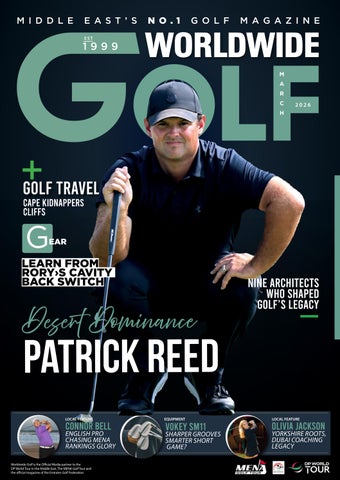
WWG FEBRUARY 2026 DIGITAL DESKTOP

Page 1


LEARN FROM RORY›S CAVITY BACK SWITCH

GET FIT. GET OPTIMISED.

FAIRWAY MAGNET.

THE NEW STANDARD IN STRAIGHT.

In the new G440 K driver, we’re taking forgiveness further than ever. Its combined MOI is our highest ever and makes the G440 K our straightest and most forgiving adjustable driver to date. For you, that means longer, straighter drives — and shorter approach shots from the fairway to the green.

CG SHIFTER

A movable, 32-gram backweight dials in ball flight in three positions (Fade, Draw, Neutral).

DUAL CARBONFLY WRAP

Lightweight carbon sole and crown save mass, helping move the CG lower and deeper for more ball speed and distance.

OUR LOCATIONS

YAS MALL
UMM SUQEIM STREET, DUBAI
MALL OF THE EMIRATES
EMIRATES HILLS

Reed Rules Desert’s Strategic Proving Ground

There are certain players who arrive in the Middle East and look comfortable. Then there is Patrick Reed. Dubai. Bahrain. Qatar. Leaderboards in this region have become increasingly familiar territory for the American, whose competitive snarl seems sharpened by desert air. Victory in Dubai, another statement week in Qatar and a runner up finish in Bahrain have reinforced what many of us have witnessed for years: Reed thrives on strategic layouts, firm greens and pressure moments.

His recent decision to step away from LIV Golf only adds intrigue. In an era where golf’s political landscape has often overshadowed performance, Reed’s return to more traditional pathways feels significant. Not just for him, but for global golf. The Middle East has always been a crossroads for the sport, and players who perform here tend to prove something lasting about their games.

Reed’s success is not built on aesthetics. It is built on precision. On imagination. On a short game that would have impressed the great course architects who shaped the modern test.

The Architects of Strategy

The modern professional is often defined by launch monitor numbers and ball speed, yet the DNA of championship golf still belongs to architects like Alister MacKenzie, A. W. Tillinghast, C. B. Macdonald and, later, Pete Dye.

MacKenzie rewarded bold lines and creative recovery. Tillinghast demanded nerve into tilted greens. Macdonald introduced template strategy that still influences design across the world. Dye forced players to think, not simply swing.

Walk many of the leading venues across the UAE, Qatar and Saudi Arabia and you see echoes of those philosophies. Risk and reward par fives. Run off areas that repel the lazy approach. Greens that punish the wrong quadrant.

It is no coincidence that Reed excels here. He is a player who plots. Who shapes. Who embraces

awkward lies and tight pins. His imagination around the greens feels like a direct conversation with architecture’s golden age.

The Scoring End of the Bag

In recent seasons we have spoken extensively about drivers and distance, yet tournaments in this region are still won inside 120 yards. The latest Vokey SM11 wedges are a reminder of that truth.

Refined centre of gravity positioning. Progressive grooves. A spectrum of grinds that allow elite players to manipulate trajectory and spin from tight desert turf or lush overseeded lies. They are instruments, not accessories.

Watch the best in the Middle East and you will see flighted wedges under the breeze, low checkers into firm surfaces and high soft lobs from shaved run offs. Equipment innovation has amplified creativity, but it has not replaced it.

The short game remains the great separator. Reed understands that. So too do the rising stars closer to home.

The MENA Golf Tour Momentum

While global narratives swirl, the MENA Golf Tour continues to carve its own story across the region.

From Portugal to Egypt and onward through Morocco and to finish in the UAE. The Tour has matured into a genuine pathway. Increased prize funds. World Ranking points. Stronger fields. A finale in the UAE that now feels like a statement rather than a formality.

What stands out most is intent. Players are not simply filling fields. They are building careers.

Chasing HotelPlanner Tour cards. Earning status. Learning to win in conditions that demand resilience.

The Middle East is no longer an emerging chapter in golf. It is a proving ground. Reed’s desert success underscores that.

THE COURSE

Al Ain Equestrian, Shooting and Golf Club. A proper test, a great setting, and two tours heading there in the coming weeks. Worth knowing about.

THE LARSSON BROTHERS

Three Swedish brothers, raised in Dubai, all chasing college golf in the US. They train together, push each other hard and all three are serious about making it happen.

24

SHIV KAPUR - STILL IN THE GAME

Twenty years on tour, still competing. Kapur talks Dubai life, scheduling, mentoring the next generation and why he’s not done yet.

THE MASTER BUILDERS

Nine architects, nine legacies. The holes they designed still get talked about decades later. A look at the people who shaped the courses we love. 28

40

CAPE KIDNAPPERS CLIFFS

Wind and a course that means business. One of the most spectacular settings in world golf and it plays as good as it looks.

Desert Dominance Three events, three top performances. Reed made the Gulf swing his own again and showed exactly why he travels this way every year. The desert brings out the best in him.

PATRICK REED

RORY’S IRON EXPERIMENT

How the ‘too good for cavity backs’ brigade can learn a valuable lesson from one of the world’s best players’ brief dalliance with more forgiving irons.

ALEXA PHUNGA SMALL WONDER

The English prol has made Dubai home and has his sights set on climbing the rankings via the MENA Golf Tour. He talks new life in the UAE, his brother’s influence and why the tour’s best days are ahead. CONNOR BELL

OLIVIA JACKSON

From Yorkshire to Dubai, coaching the women’s game and building something that lasts. The real story behind the highlights.

50 TITLEIST VOKEY SM11

The new Vokeys are sharp, consistent and easy to trust. But do they do enough to justify the upgrade? We find out.

IRON PLAY STATION

Next time you go to the range try this simple iron play station drill. All you require is 4 alignment sticks or clubs as an alternative. 36

Fourteen years old, two national titles, her own product and the Junior Dubai Desert Classic on her schedule. She’s in a hurry.

AL AIN EQUESTRIAN, SHOOTING & GOLF CLUB

HOME OF THE MENA GOLF TOUR’S SEASON ENDING TOURNAMENT

Nestled in the UAE’s ancient Garden City, Al Ain Equestrian, Shooting & Golf Club has quietly built a reputation as one of the region’s most compelling tournament venues. The championship course – a par 70 stretching to 7,117 yards – will host the Abu Dhabi Challenge on the HotelPlanner Tour for the third consecutive time next month and is now also set to welcome the MENA Golf Tour for

the season-ending Al Ain Championship from March 30 to April 1.

Water features on the majority of holes demand precision throughout, while several fairways run alongside Al Ain’s horse racing track, creating one of the more unusual and atmospheric settings in Gulf golf. The standout hole is the par-five 10th – at 678 yards, the longest par five in the Arabian Gulf – a genuine examination of

power and patience in equal measure.

Beyond the ropes, the club lives up to its name, offering world-class facilities across equestrian, shooting, rugby and cricket, all set against the dramatic backdrop of Jebel Hafeet rising from the desert to the south. With the MENA Golf Tour’s Rankings title still to be decided, Al Ain will provide a fitting and atmospheric stage for the season finale.

REED’S STUNNING GULF RUN TWO WINS AND A PLAY-OFF IN THREE STARTS FOR THE LIV GOLF DEFECTOR

Patrick Reed’s remarkable Middle East swing – Dubai, Bahrain, Doha – sent him to the top of the Race to Dubai as he marked his departure from LIV Golf in stunning fashion.

The American won the Qatar Masters at Doha Golf Club by two shots at 16-under, completing a remarkable Gulf swing that brought two wins and a play-off loss from three starts. The victory was his first at the event and made him the first American to win it – all the more satisfying given the play-off defeat at the Bapco Energies Bahrain Championship the previous week which came off the back of his victory at the Hero Dubai Desert Classic.

Reed’s Race to Dubai points stand at 2,259.70, with his world ranking climbing from 25th to 17th. “Today, with how stressful the day was… to flip the switch around the back nine… feels amazing,” he said.

EIGHT GRANTED CONDITIONAL LIV RELEASES

The DP World Tour has granted conditional releases to eight members to play in conflicting LIV Golf events in 2026. The players are Laurie Canter, Thomas Detry, Tyrrell Hatton, Tom McKibbin, Adrian Meronk, Victor Perez, David Puig and Elvis Smylie.

Each must pay all outstanding fines in full, commit to additional DP World Tour events and associated media obligations, and withdraw all pending appeals. The Tour confirmed the releases apply for 2026 only, are not precedent-setting, and do not represent any change to its regulatory framework. Whether all eight fulfil the conditions will be one of the season’s ongoing storylines.

PALETHORPE AND SCHMEISSER TAKE THE MIDDLE EAST REINS

The DP World Tour has appointed Katherine Palethorpe and Freddie Schmeisser as Managing Directors for the Middle East, both taking up their roles on April 6. The appointments follow Tom Phillips’ move to the Ladies European Tour as CEO and split his former brief in two – Palethorpe handling commercial partnerships, Schmeisser taking charge of tournament and operational delivery.

“The region presents significant

opportunity for partnership development and innovation,” said Palethorpe. Schmeisser said his priority would be delivering consistently high standards across every tournament and strengthening collaboration with host partners.

The Tour’s 2026 schedule features 42 tournaments in 25 countries, with the Middle East one of its most important pillars.

ROSE REWRITES TORREY PINES WITH A WIRE-TO-WIRE MASTERCLASS

Justin Rose went wire-to-wire at Torrey Pines to win the Farmers Insurance Open by seven shots at 23-under 265, claiming his 13th PGA Tour title and a second win at the event following his 2019 victory. An opening 62 set the tone and was never seriously threatened. At 45, he became the oldest player in more than 15 years to lead a PGA Tour event from start to finish.

“It’s a lot easier being on the golf course than thinking about it the night before,” he said.

DAVIDSON FINDS FORM IN EGYPT WITH EYES ON AL AIN FINALE

Jack Davidson won the MENA Golf Tour’s Egypt Golf Series event at Address Marassi Golf Club in a play-off, posting rounds of 71, 63 and 68 for a 54-hole total of 14-under 202 to move to third in the MENA Golf Tour rankings. The 29-yearold, now based in Abu Dhabi, is a former Great Britain & Ireland Walker Cup player who turned professional in 2017.

The win follows a tough couple of seasons and a deliberate reset last autumn – a return to his original coach, the Wales National Coach, alongside a psychologist and trainer joining his support team. “The move to Abu Dhabi with my girlfriend is part of a fresh start for my game, career and life,” he said.

The season concludes with the Al Ain Championship from March 30 to April 1.

A NEW CLASS OF DRIVERS

PATRICK Reed has never been the sort of golfer who quietly blends into the wallpaper. Some players arrive, smile politely, sign a few caps, tell everyone how “honoured” they are to be there, then drift through the week like a man browsing for scented candles in Duty Free. Reed is not that golfer. Reed turns up like he has been personally insulted by the concept of finishing second.

This time, Reed’s name has returned to the conversation with an extra layer of intrigue, because the man who has spent the last few years living in golf’s most controversial neighbourhood has decided to move back to a more familiar street.

In a statement posted on his X page, Reed confirmed what many had suspected was coming. “After careful thought and consideration, my family and I have decided that I will no longer compete on the LIV Golf Tour.”

Then came the real headline, the sort that would make the golf world sit up straighter in

its chair. “I am excited to announce that I am returning to the PGA TOUR as a past champion member for the 2027 season and am eligible to begin competing in PGA TOUR events later this year.”

That is Reed in a nutshell. No half measures. No gentle re entry. No quiet soft launch. When he does something, he does it properly, with a statement that reads like a man packing his bags, slamming the door, and leaving the light on just to prove he can.

He also made it clear that the DP World Tour remains a significant part of his future. “I will continue to compete and play as an Honorary Lifetime Member on the DP World Tour, which is something that I am truly honored and excited to do.”

The most revealing line, though, was the one that sounded like it had been written by a golfer who still sees his career through the old school lens of legacy, Majors, and history. “I’m a

traditionalist at heart, and I was born to play on the PGA TOUR, which is where my story began with my wife, Justine.”

Golf is a strange sport, full of modern technology, futuristic training methods, and million dollar swings built in laboratories, yet it is still obsessed with tradition. Reed knows that. He has always known that. Love him or loathe him, he has never been a man short on belief, and he has never been a man who thinks his story should end anywhere other than the biggest stage.

His statement carried another line that felt quietly important, not because it was dramatic, but because it was unmistakably final. “I am moving forward in my career, and I look

I will continue to compete and play as an Honorary Lifetime Member on the DP World Tour, which is something that I am truly honored and excited to do.” “

forward to competing on the PGA TOUR and DP World Tour. I can’t wait to get back out there and revisit some of the best places on earth.”

Dubai, Bahrain and Qatar are certainly among them, even if the wind occasionally tries to relocate your golf ball to the next postcode.

BUILT FOR THE DESERT

Some golfers need familiarity. Soft greens, calm air, predictable bounces and a course that suits their eye like a favourite pair of shoes. Reed is the opposite. He seems to sharpen when conditions get difficult, when the wind gets involved, and when the course demands imagination rather than repetition.

The Middle East does not hand out trophies to tourists. Dubai, Bahrain and Qatar are places where the fairways run firm, the greens roll quick, and the breeze turns simple club selection into a full scale maths exam. Reed thrives on that. He thrives on the grind.

He thrives on the feeling that every shot matters, because for him, it always does.

His record in this part of the world is proof that his skill set travels well. He does not arrive hoping to find form. He arrives expecting to contend.

In his statement, Reed admitted the last chapter had shaped him. “Over the last four years, I have learned a lot about myself, about who I am and who I am not, and for that I am forever grateful.”

That is not the language of a man winding down. That is the language of a man refocusing.

DUBAI: WHERE REAL CHAMPIONS WIN

Winning the Hero Dubai Desert Classic is not like winning a minor tournament on a soft resort course where the only thing you have to fear is sunburn and an overpriced club sandwich. This is a proper championship. It is one of the DP World Tour’s crown jewels, a

tournament steeped in history, and a place where you earn every single shot.

The Majlis Course at Emirates Golf Club has a long and proud habit of exposing anyone who arrives thinking they can simply hit driver, wedge, putt, and collect the trophy. It demands strategy. It demands control. It demands a short game that can bail you out when the desert decides to bite.

Reed’s victory there was not a fluke. It was a performance built on precision, stubbornness, and that unmistakable ability to thrive when other players start to tighten up.

Dubai is also a city that amplifies everything. The crowds are knowledgeable. The field is always stacked. The closing holes have a nasty habit of turning calm Sundays into panic attacks. Reed did not blink. He played like a man who had already written his own ending.

It was vintage Patrick Reed. Calm on the outside, ruthless underneath, and quietly confident in a way that makes the rest of the field feel slightly uncomfortable. Some golfers try to win by playing perfect golf. Reed wins by playing relentless golf.

BAHRAIN: CLOSE, BUT STILL A WARNING

Dubai is glamour – floodlights, skyscrapers, and champagne. Bahrain is different. Bahrain is where the golf gets its sleeves rolled up and starts throwing punches.

The wind is always lurking. The course is exposed. The fairways are firm enough to double as a runway. The greens can be slick enough to make your putter feel like it has betrayed you. It is the sort of place where players spend half the week complaining about conditions like they have been personally attacked by Mother Nature.

Reed never seems to complain. He adjusts. He plots. He grinds. He stays committed to his lines, his shots, and his plan, even when the ball takes a bounce that looks like it was guided by an evil spirit.

This time, he did not leave Bahrain with another trophy, but a T2 finish still felt like a warning shot. Reed was in the mix again, pushing, pressuring, and doing what he always does. Hanging around the top of the leaderboard like a man refusing to be removed.

In Bahrain, he didn’t quite get the win, but he reminded everyone how close he always is.

QATAR: WHEN DISCIPLINE TURNS INTO A TROPHY

If Dubai is theatre, Qatar is tension. It is a venue that asks for discipline, patience and the ability to keep your head when the golf course starts demanding uncomfortable decisions. Reed, unsurprisingly, seems to enjoy exactly that kind of conversation.

He has already proven he can win there, adding

Qatar to his growing list of desert

It was another reminder that when the conditions are firm, the margins are tight and the pressure is real, Reed tends to move in the opposite direction to most of the field.

Others get cautious. Reed gets sharper.

Winning in Qatar reinforced what the Middle East swing has slowly started to reveal. This is not a player who needs everything to go his way. He just needs the course to offer a fight.

THE SHORT GAME THAT BREAKS HEARTS

Ask anyone what makes Patrick Reed dangerous and most will not start with his driving distance. They will not talk about his physique, because Reed has never looked like a man who spends his evenings bench pressing SUVs. They will talk about what happens when he misses a green.

Reed’s short game is one of the sharpest in professional golf. He chips with imagination, pitches with aggression, and putts with the confidence of a man who believes gravity itself is on his payroll.

Desert golf magnifies that advantage. Firm

conquests.
“To Dustin Johnson, The Aces, and LIV Golf, I want to thank you for the memories we shared and created together.” “

greens and shaved run offs turn missed approaches into nightmares. Scrambling becomes everything. Saving par becomes an art form. Reed is an artist. He makes pars when others make bogeys. He makes birdies when others are still trying to work out how their ball ended up ten yards off the green in the first place. Over four rounds, that is how tournaments are won. It is also how opponents slowly lose the will to live.

THE RETURN, AND THE DESERT STILL WAITING

The Middle East swing has become one of the most important stretches of the DP World Tour season. The courses are world class. The fields are deep. The conditions are demanding. These are not tournaments you can coast through while treating it as a warm up.

Some players arrive early in the year still looking for rhythm. Some treat it like pre season football, a bit of fitness, a bit of practice, a nice tan. Reed does not do nice tans. Reed does not do warm ups. Reed arrives ready to compete, and he competes like the tournament owes him money.

His statement hinted at what really sits behind his decision to leave LIV. Reed is not leaving the breakaway tour behind out of bitterness. He is leaving it because he believes his next chapter belongs somewhere else.

He also took a moment to show respect to the people he shared the last four years with.

“To Dustin Johnson, The Aces, and LIV Golf, I want to thank you for the memories we shared and created together.”

Then came the line that felt like the final stamp on the envelope. “I’m a traditionalist at heart.”

That is the truth behind the shift. Reed wants his career measured against the best. He wants to play the biggest tournaments. He wants his story to end where golf history is written, not where it is debated on social media at two in the morning.

It is too early to crown anyone the King of Desert Golf. This region has hosted champions like Tiger Woods, Rory McIlroy, Henrik Stenson, Sergio Garcia and Ernie Els, and the winner’s lists across the Gulf are stacked with Major champions and Ryder Cup icons.

Still, Reed’s growing success in Dubai and Qatar, plus a T2 in Bahrain, makes one thing clear. He does not come here for a holiday. He does not come here to finish 12th and claim it was a “solid week.” He comes here to win.

Golf fans in Dubai, Bahrain and Qatar have seen many stars arrive. Some leave with memories. Some leave with excuses. Patrick Reed leaves with trophies.

The desert suits him. The wind suits him. The grind suits him. Most importantly, the pressure suits him.

For everyone else, that is a slightly terrifying thought.

STILL IN THE GAME

Two decades into a professional career that has taken him from Delhi to Purdue to fairways around the world, Shiv Kapur is entering an exciting new chapter – one being written, in part, from his base in Dubai

AEvery parent, especially Indian parents, is very big on academics,” he recalls. “My sister went to Harvard, and they were keen that I pursued an education. I was insistent that I wanted to give golf a shot.”

sk Shiv Kapur what drives him at this stage of his career and the answer, delivered with characteristic directness, is refreshingly simple. He still wants to compete. He still wants to win. And he’s starting to get a real kick out of helping others do the same.

It has been quite a journey to get to this point. The Delhi-born professional has spent more than two decades competing across Asia, Europe and beyond, racking up titles on the Asian Tour and earning a reputation as one of Indian golf’s most enduring figures. These days, you are as likely to find him honing his game at the Els Club in Dubai –his adopted home – as you are watching him tee it up in a tournament. And with a schedule trimmed back to 15 to 18 events a year, he has found a pace that suits him just fine.

“Having played more than two decades now around the world and on all the top tours, I kind of at this stage in my career want to slow down a little bit,” he smiles. “I’m not playing 30-35 weeks like I used to.”

It is a considered shift – but then Kapur has always been a man who thinks carefully about his next move. That instinct was tested early. When the time came to pursue higher education, his family had Harvard in their sights. His sister had gone there. It was the obvious choice. Kapur had other ideas.

“Every parent, especially Indian parents, is very big on academics,” he recalls. “My sister went to Harvard, and they were keen that I pursued an education. I was insistent that I wanted to give golf a shot.”

He chose Purdue University in West Lafayette, Indiana instead, and the decision proved formative. The training regime, the demanding schedule, and crucially the conditions – cold, windy, nothing like the relatively calm fairways back home in Delhi –gave him a steel that proved the perfect grounding for what was to come. “If I were to turn back the clock and do it all over again, I wouldn’t choose a different place,” he says.

He arrived on tour with the confidence of a strong amateur career behind him, one that included Asian Games gold, and wasted little time in making his mark. Victory in the Volvo Masters of Asia in his rookie year immediately raised the bar.

“The minute you win, you suddenly have higher

expectations of yourself – not just from yourself, but everyone expects you to perform at a higher level,” he says. “Yes, the burden of expectation increased. I was playing at a higher level, started playing in the Majors, the World Golf Championships, moved on to the DP World Tour, so it did get harder. At the same time, I went in with confidence and belief that I could win.”

Not every moment of that journey has been plain sailing. A play-off defeat to Richie Ramsay at the 2009 South African Open remains a vivid memory – one of those near-misses that either define a player or derail them. Kapur is candid about what went wrong.

“In hindsight, I let my mind race ahead to winning rather than staying in the moment,” he says. “It was a great learning curve for me. I promised myself that the next time I’m in that position, I won’t allow my mind to race ahead.”

Twenty-one years on from turning professional, Kapur is still out there, still competing, still learning. He attributes much of his longevity to a decade-long partnership with coach Shane Gillespie, and to an evolving understanding of the physical demands of the modern game. He watched Tiger Woods speak recently about how the advice of his early career –don’t work out, it’ll make you stiff – has since been completely reversed, and nods in recognition.

“Recovery is just as important now,” Kapur says. “I’ve been guilty in the past of trying to keep up, overtraining, and under-recovering.” He points to Justin

Being a dad is almost a full-time job,” he says. “But outside of golf, I love my sports. I love cricket, tennis, and I play paddle with my friends here.”

Rose as a model. Still winning at 45 on the PGA Tour, still contending in Majors, built on a meticulous recovery routine. “There’s a lot to learn from that.”

Growing up in a cricket-mad country inevitably left its mark. Kapur remains a devoted fan of the sport and counts several top cricketers among his close friends. What he has taken from them is something less tangible than technique.

“What you learn from them is that if they can be the best in the world at their sport, there’s no reason why we can’t,” he says. “You learn about excellence, how to train, how to handle yourself under pressure, and what it’s like to perform in front of 1.4 billion people.”

It is a mindset he now hopes to help pass on – and that ambition has taken on a formal shape through his involvement in the Indian Golf Premier League. India’s first franchisebased golf league, the IGPL launched in 2025 in partnership with the Indian Golf Union, with cricket icon Yuvraj Singh as co-founder and brand ambassador. Think IPL, but with fairways instead of pitches. Six city-based teams, mixed men’s and women’s competition, and a genuine desire to drag the sport into the mainstream. Kapur has taken on the dual role of franchise captain and mentor.

“I’ll be playing 8 to 10 events on the IGPL,” he says, “and probably another 6 to 8 events on the Asian tour.” That, he is clear, is plenty. His mentoring role extends well beyond the tournament ropes. “I was very lucky to receive guidance and help from the likes of Jeev Milkha Singh and Gaurav Ghei when I was growing up, and now I want to give back to the next generation,” he says. The IGPL’s broader plans – new golf academies, new courses, a push to take the game beyond elite clubs and into schools across India – clearly light him up.

“Golf in India is now the fastest-growing sport,” he says. “The corporate game is booming. Over the next five to ten years, I think we’ll see a massive uplift in the game. We’ll see some champions coming out of India in the next decade.”

And the MENA Golf Tour, thriving on his doorstep? Kapur is genuinely warm about where it is headed – expanding into new territories, playing quality courses, developing real talent – but pragmatic about his own schedule. “Currently with my commitments, I don’t foresee myself playing much on the MENA Golf Tour,” he says. “But it’s obviously an option for the future. I think it’s great for the growth of the game, not just in the UAE, but the entire Middle East.”

Away from the game, life in Dubai suits him well. He is, above all else, a father to an eight-year-old daughter, and much of his daily rhythm is built around that. Paddle with friends in the evenings, a barbecue, a glass of wine. For a man who spent years logging 30-plus weeks on tour, it sounds genuinely unhurried.

“Being a dad is almost a full-time job,” he says. “But outside of golf, I love my sports. I love cricket, tennis, and I play paddle with my friends here.”

The portrait that emerges is of a man very much at ease with where he is – not winding down, but reorientating. The game still has plenty to offer Shiv Kapur. And by the look of things, he has plenty still to offer it.

The Master Builders

THE 9 GREATEST GOLF ARCHITECTS OF ALL TIME AND WHY THEIR COURSES STILL SHAPE THE GAME

Golf is a simple game played on very complicated ground. You hit a ball, you chase it, you try to put it in a hole. Yet the difference between a course you forget by the time you reach the car park and one you think about for days usually comes down to one thing. The person who decided

Old Tom Morris

(lead with this on the opening spread)

Old Tom Morris was doing golf architecture before the term even existed. In an era when most people were simply knocking a ball across natural land, Morris was shaping the landscape with purpose.

His work at St Andrews and Prestwick helped establish the very foundations of what a golf course should be. Routing mattered. Hazards mattered. Greens mattered. He understood that golf should follow the land rather than fight it, and that the best features were already there if you had the sense not to ruin them.

where the holes should go.

The very best golf architects did not just design layouts. They created decisions. They built temptation into the landscape. They made you stand on a tee and feel confident, then immediately ask yourself why you feel confident, because something must be waiting.

More than anything, Old Tom set the tone for what great design should feel like. Natural, clever, and quietly brutal when it needed to be.

This list is not about who has the flashiest marketing brochure or the most modern renovations. It is about the designers whose work has stood the test of time, shaped the way courses are built, and influenced the way golfers think. These are the men who did not simply build holes. They built the game.

Harry Colt

Harry Colt is the reason inland golf in Britain looks and feels the way it does. His courses are never loud, never showy, and rarely unfair. They simply ask the right questions.

Colt had a gift for making holes sit perfectly in the landscape, as though they were always meant to be there. At Sunningdale, Wentworth and countless others, he produced strategic golf that rewards the player who thinks properly. You can play safely, but it usually leaves you a worse angle. You can take on the heroic line, but it demands execution.

Colt was a master of balance. His courses challenge you, but they do not exhaust you. They stay interesting from the first tee to the last putt.

Alister MacKenzie

Alister MacKenzie designed golf courses that feel like theatre. His holes are visually stunning, but the brilliance is not just in the scenery. It is in the way he makes you want to take risks.

MacKenzie believed golf should be played with imagination. He liked wide fairways, bold bunkering, and greens that demanded a proper approach. Augusta National may be his most famous creation, but Cypress Point and Royal Melbourne might be his finest expressions of what golf can be.

His courses do not just test your swing. They test your nerve. They lure you into playing aggressive shots, then punish you if you get careless.

MacKenzie made golf beautiful, but he also made it feel alive.

4 5

C B Macdonald

C B Macdonald is often called the father of American golf architecture, and it is difficult to argue against it. He brought strategy and sophistication to course design in the United States when much of the country was still learning what great golf could look like.

His masterpiece at National Golf Links of America is one of the most influential courses ever built. Macdonald introduced the idea of studying classic holes from the British Isles and adapting their strategic concepts to new ground.

Some critics call it copying. It was not. It was education. He gave American golf a blueprint, and countless designers followed it.

Macdonald helped teach golfers that design was not just about length or difficulty. It was about decisions. 3

Donald Ross

Donald Ross built a staggering number of courses, but his best work has a very clear signature. It is the greens.

Ross understood that the real test of golf is not how far you hit it. It is what happens when the ball lands. His greens often slope away, shed golf balls into awkward areas, and leave players facing delicate recoveries that look simple until you try them.

Pinehurst No. 2 remains the defining Ross course. It is a place where you can hit what feels like a good shot and still walk away annoyed. That is not cruelty. That is cleverness.

Ross designs are also endlessly playable. They test the professional and still make sense for the everyday golfer. That is a rare gift.

A W Tillinghast

A W Tillinghast designed courses that have hosted some of the most famous championships in history, but his greatness goes beyond tournament pedigree. He understood how golfers think.

His holes build pressure. They make you feel as though you are in control, then suddenly present a shot that demands total commitment. His bunkering is often intimidating without being unfair. His greens reward good approach play and punish anything slightly off line.

Winged Foot, Bethpage Black and Baltusrol are all examples of his ability to create courses that are demanding but still enjoyable, if you accept that you will not be getting away with anything.

Tillinghast did not just test skill. He tested confidence.

Robert Trent Jones Sr

Robert Trent Jones Sr shaped the modern era of championship golf. He was the architect of the television age, the man called upon when clubs wanted a course that looked impressive and played tough.

His designs often featured bold bunkering, strong visual framing, and long demanding holes that required power and precision. Firestone and Hazeltine remain key examples of his style, and his influence through renovations is enormous.

Not everyone loves his approach, because some of his work leaned heavily toward difficulty. Still, his impact is undeniable. He helped redefine what a championship course looked like, and he brought golf architecture into a more global and professional era.

Pete Dye

Pete Dye was not interested in making you comfortable. That is why his courses are so memorable.

Dye understood that golf is played as much in the mind as it is with the swing. He used visual deception, awkward angles, intimidating hazards, and greens that demanded full concentration. Many of his holes look unfair at first glance, until you realise the strategy is there if you are willing to think.

TPC Sawgrass became the symbol of modern tournament golf, and the par three 17th has probably caused more nervous swings than any hole on earth. Harbour Town is another Dye masterpiece, proving he could create strategic brilliance without needing brute length.

Dye made golfers feel uncertain, and then made them play anyway.

Tom Doak

Tom Doak represents the best of modern design. His courses look natural, not manufactured. They feel as though they were discovered rather than built. Doak became one of the leading voices of minimalist architecture, where the land dictates the routing and the strategy is built through angles, width, and clever greens rather than artificial drama.

Pacific Dunes is one of his finest achievements, a course that proves modern golf can still embrace creativity and ground game shotmaking. His designs are not about telling golfers what to do. They are about offering options and letting the player decide.

In an era where many courses feel over designed, Doak’s restraint is refreshing.

THE LEGACY CREATORS

The greatest golf architects share one thing. They understood that golf is not supposed to be predictable.

A great course should make you think. It should tempt you into the risky line and then ask if you really trust yourself. It should punish a lazy shot but reward bravery. It should make you stand on the tee with a plan, and then force you to adjust when

the wind changes or your confidence wobbles. These ten men shaped the way golf is built, played, and enjoyed. Their courses have hosted Majors, shaped champions, and humbled millions of weekend golfers who thought they had it figured out.

That is the true mark of great architecture. Not that it looks pretty in a drone shot, but that it stays in your head long after the round is finished.

ONES WHO JUST MISSED OUT

If this list was expanded, the debate would become even louder. Names like Coore and Crenshaw, Gil Hanse, George Thomas, Herbert Fowler, James Braid, Tom Fazio, Jack Nicklaus and Rees Jones would all have strong arguments.

But the ten above are the pillars. Without them, golf course design would not look like it does today. And the game itself might not feel the same either.

LARSSON BROTHERS The

Adrian, Victor and Gustaf Larsson are three Swedish brothers growing up in Dubai, competing in the same sport, pushing each other every day… and dreaming of America.

Your earliest memories of golf together – and when did it shift from a hobby to something bigger?

Adrian: Our earliest memory together would be back home in Sweden, playing with our grandparents. That’s kind of how we started. When I joined the GEMS First Point Elite programme in 2021, it switched from being a hobby to something I wanted to take seriously.

Adrian: Since we both compete week in and week out, we both want to beat each other as much as possible. But off the course, we try to push each other in practice and help each other out as much as we can.

each other by playing games – chipping games, or a game called 21, which gets very competitive.

Victor: Monday and Wednesday at the academy – an hour on Monday, two hours on Wednesday – plus gym both days and individual sessions with our coaches. Outside of those sessions, we practise quite a bit on our own. On weekends, we usually have tournaments, so we try to prepare as best we can.

Victor: Back home in Sweden, I hit balls with my dad on the range. Here in Dubai too, when we were little, we always used to go to the range with him. Then when I joined the golf programme at school, that’s when I started taking it more seriously – entering more tournaments, playing every week. That’s when I really got the hang of things and began committing to golf.

Victor: It’s affected me positively. When we practise together, it’s a lot easier to stay motivated. If they do well, you obviously want to do better than them. It’s about always trying to get a little bit better – that’s something important with these two.

Even off the course, in everything we do, we push each other, and that’s probably what’s helped me the most.

Gustaf: Coming to golf, playing, and doing two hours of gym a week. It’s pretty much the same schedule for both of us. It’s not about comparing – just seeing what they’re doing, trying to match them, and trying to be just as good.

Every sibling group has its dynamics. Who is the most competitive, who is the calmest under pressure, and who brings the energy?

Adrian: Victor is the most competitive, or at least he shows it the most. I’d say I’m the calmest – I don’t really show how I feel. Gustaf brings the energy; he’s always energised on the golf course.

Victor: Yeah, I’d like to think I’m competitive, but these two are pretty competitive as well. Gustaf definitely brings the energy, though sometimes in the wrong context – he shows a lot of emotion out there. As for the calmest, I’d have to agree: Adrian doesn’t really show much.

Gustaf: I think Victor actually brings the most energy – on the course he gets loud and vocal. Adrian is definitely the calmest. I’m kind of neutral. When I need to bring energy, I will.

How would each of you describe your game right now – your biggest strength and what you’re working hardest to improve?

Gustaf: My earliest moments were probably back in Sweden, just on the range with my brothers. Then in Dubai, when we joined the Elite Golf Programme, we spent a lot of time working together and pushing each other to become better – both as people and as golfers.

As brothers competing in the same sport, how has that shaped you on and off the course?

Gustaf: Being around them on the course, playing against each other – it makes each of us better. Even when I’m not playing, they help push me to be as good as I can in training, scoring, and everything else.

What does a normal training week look like, and how do you push each other to improve?

Adrian: Monday, Wednesday and Friday with the school team. We leave school around 1pm and practise from 2 to 7pm with our teammates and friends. On Tuesdays and Thursdays, we come down on our own and practise independently. We push

Adrian: My game is in a pretty good place. My biggest strength is my driving off the tee – that’s been the case throughout this season. I’m working to improve my putting, though. That’s something I’ve struggled with a little, and I’m focused on it for next season when I head off to college.

Victor: When I’m playing well, my strengths are putting and driving off the tee. Right now I think I’m playing pretty well, but there are always things to manage and keep working on. I’m excited for the next couple of events.

Gustaf: My strengths are my irons and wedges. My weakness is my driver – it can go both ways sometimes. My putting is something I need to work on too. But my iron game is definitely what keeps my round alive.

How has developing your game in Dubai influenced your mindset as young golfers?

Adrian: Growing up in Dubai has developed our mindset quite a lot. We’re given so many opportunities here and we don’t want to waste them. I’ve been lucky enough to work with Red2Blue Mind Performance Center – I don’t think I’d have had that opportunity anywhere else. The mindset we’ve developed here is to work hard and take full advantage of every opportunity.

Victor: Growing up in Dubai, you get access to amazing facilities and incredible coaches who put in so much time and effort. That shapes your work ethic because you don’t feel like you’re just working for yourself, but also for the people who support you every day. My coach Sujjan Singh has helped me a lot mentally, especially through tournaments in the summer. The biggest thing for me is just being grateful for everything we have here.

Gustaf: The weather is great most of the year, so we’re able to practise year-round – we can always come out and play, which helps a lot. The coaches here are great and they all push us to improve.

Outside golf, what are your interests? What does a day off look like?

Adrian: I like to play padel, so when I have off weeks, my friends and I try to play as much as we can. An off day for me would be padel in the morning, gym afterwards, and maybe a movie at night.

Victor: I play tennis in my spare time – that’s usually what I do. I’ll also hang out with friends from school. There’s not much more than that, to be honest.

Gustaf: Victor and I play tennis together as well, and that gets pretty competitive. When I’m not playing golf, I’m also trying to balance my schoolwork, so I spend time on that too.

How do you manage school, travel, training and still enjoy being young?

Adrian: We’re still figuring it out, honestly. Our parents usually take care of the travel and logistics,

so we don’t have to worry too much about that. But school is one of our main responsibilities in the golf programme – if we fall behind, we might have to come off golf for a while. At the same time, a lot of our friends are involved in golf too, so we get the social side while still working hard at what we want to achieve.

Victor: School is very important right now. Balancing golf and studies, catching up and preparing for exams – that’s really where my focus is. I haven’t travelled much for golf yet, but my main priority is making sure I can balance everything.

Gustaf:  When I’m not playing golf, I focus more on schoolwork. I’m not the best at managing my time yet – that’s something I need to work on. Right now it’s mostly school and golf. I haven’t travelled much to other countries for golf yet, but that’s something I want to do in the future.

When you think about the future, what are your individual ambitions – and do you see yourselves continuing this journey side by side?

Adrian: College golf. I’ll be heading to America to play for DePaul in August 2026. After that, hopefully the two of them follow a couple of years later and we go from there.

Victor:  I have two years left here, and then my plan is to go to America for college. I’m really looking forward to that. I just want to become the best I can, work hard every day, and not worry too much about the future – just stay in the present.

Gustaf:  Victor and I graduate at the same time, so we have two more years in Dubai. My ambition is to play college golf in the United States. I’m not focused on results right now –just trying to get 1% better every day and see where that takes me.

IRON

Photography: Provided

delivered

Viya Golf Head International Development Coach

IRON PLAY STATION DRILL

Next time you go to the range try this simple iron play station drill. All you require is 4 alignment sticks or clubs as an alternative.

1 2 1.1

BASIC SETUP

One stick is placed behind the ball as an extension of your ball to target line and another parallel to this as an extension of your feet line (Picture 1). From here place two sticks three to four inches apart diagonally across the target/feet line at approximately 45 degrees (Picture 2)

Download the MENA Golf Tour App for player login and registration. Get instant access to the latest news, upcoming events, live scores, current leaders, Order of Merit and more.

CALIBRATION

Once in your setup position calibrate your primary movement away from the ball by feeling your arm/shoulder pressure stays down as the club moves with width to a midpoint between the target lines. (Picture 3) Once in the primary position the first diagonal stick should be place at 45 degrees directly under the club head (Picture 4) and the second diagonal stick placed two to three inches forward of that (Picture 5)

HOW IT WORKS

The goal of the drill to is create some visual awareness and feels not only as you start your movement but during the pre impact delivery phase of the swing.

• Tracing the midpoint allows you to develop path

• Tracing the leading edge of the club face to the diagonal sticks develops face control

• Tracing the second diagonal stick closer to the target during the downswing develops low point/contact control.

RECOMMENDATIONS

Start the drill by rehearsing slowly and controlled without hitting the ball. Feel the pressure down through the arms and shoulders as you find the midpoint of the target lines and match the face to the diagonal lines.

Once you get comfortable coil to the top of your swing then uncoil down towards the second diagonal line which is 2 to 3 inches further forward. This slight shift forward created by the down-coil ensures your low point control/contact is solid. Path will be your ability to come back to the midpoint of the target lines and face control will be your ability to

match the 45-diagonal line with the leading range of the face.

Sounds like a lot but it’s extremely easy to understand and follow once you get started. After you feel comfortable now start to hit some shots. I like the player to move to the primary position (diagonal stick one) pause and check everything’s where it should be for a second then coil and deliver!!

Please watch the online video if you’d like a closer look at how it works and gain some extra insights on shot shaping. Enjoy and look forward to checking in during next months article.

CAPE KIDNAPPERS

GOLF ON THE EDGE OF THE

WORLD

There are golf courses with nice views, and then there is Cape Kidnappers, a place where the scenery does not sit politely in the background. It leans over your shoulder and demands to be noticed. One moment you are choosing a line off the tee, the next you are staring down a cliff that drops dramatically into the Pacific Ocean, wondering if you have accidentally booked a round at the end of the planet.

Set on the wild and wind sculpted coastline of Hawke’s Bay on New Zealand’s North Island, Cape Kidnappers is the kind of destination golfers talk about with real reverence. Not because it is exclusive in a velvet rope way, but because it feels almost impossible. Fairways are draped across ridgelines, greens are perched on narrow promontories, and the horizon stretches so far that you start questioning your depth perception. It is golf as theatre, except the stage is real, and the drops are not special effects.

THE ARRIVAL: FROM WINE COUNTRY TO CLIFF COUNTRY

The journey is part of the appeal. Hawke’s Bay is known for its sunshine, its vineyards, and that quietly confident New Zealand hospitality. From Napier or Hastings, it is roughly a thirty minute

drive to the property, and the landscape changes in a way you can feel through the steering wheel. Pastoral farmland gives way to raw coastal drama, and suddenly the land begins to fall away.

You pass working fields and pockets of native scrub, then the ocean appears like a curtain being pulled back. Cape Kidnappers does not reveal itself in one cinematic shot. It teases you, offering glimpses of cliff edge and distant greens, as if to ask whether you are ready for what is coming.

TOM DOAK’S MASTERSTROKE

Designed by Tom Doak, Cape Kidnappers opened in 2004 and quickly became a modern benchmark. It proved that contemporary golf architecture could feel both bold and natural, even in a setting this dramatic.

Doak’s genius is restraint. With cliffs this spectacular, it would have been easy to build eighteen holes of postcard moments and call it a day. Instead, he lets the land do the talking and adds strategic questions that linger long after you have signed the card. The routing wanders across ridges and valleys, shifting mood and texture. One hole feels like rugged heathland, the next feels like links golf suspended in the sky, then suddenly you are in a sheltered pocket where the wind drops and you can hear the crisp strike of an iron.

The course has seen thoughtful updates over the years, including a renovation noted in 2022, but the soul remains the same. This is golf that is as playable as it is unforgettable.

PLAYING ON A KNIFE EDGE

The numbers are impressive without being ridiculous. Cape Kidnappers is a par 71 stretching beyond seven thousand yards from the back tees, but it does not bludgeon you with distance. Instead, it toys with you through angles, exposure, and the ever present ocean wind that can turn a confident swing into a lesson in humility.

The par threes are among the headline acts. They demand commitment, not just good technique. You are asked to fly carries over ravines to greens framed by bunkering that looks almost artistic until you visit it. The sixth, often highlighted as one of the signature holes, asks a simple question. Can you hit it pure when everything around you is trying to make you feel small?

There are also holes where the intimidation is quieter but just as effective. Fairways pinch exactly where your driver wants to land. Greens look generous until you realise the slopes are working against you. Approaches appear straightforward until the wind changes direction halfway through your backswing.

The best advice is simple. Pick smart targets, trust your numbers, and accept that you will pause for photos. Everyone does. Anyone who says they did not is either lying or they were too overwhelmed to remember.

THE LODGE: LUXURY WITH A WILD HEART

Cape Kidnappers is not just a course you tick off. It is a place designed for lingering. The lodge, now operating as Rosewood Cape Kidnappers, sits within a working farm landscape that feels both remote and perfectly cared for. It delivers the rare blend of feeling completely away from it all while still offering the comfort and confidence of world class hospitality.

Days here fall into a satisfying rhythm. Breakfast comes with views that make you forget what time zone you are in. Golf follows, leaving you grinning and slightly windburnt. Then the afternoon can be as active or as relaxed as you like. Hawke’s Bay food and wine plays a major role in the experience, with local produce and dining that feels earned after eighteen holes in the coastal breeze.

BEYOND THE SCORECARD: HAWKE’S BAY HIGHLIGHTS

You could fly in, play, and fly out, but you would be missing the point. Hawke’s Bay is one of those regions that makes a golf trip feel like a proper holiday, not just a golf mission.

Napier is a must visit, famous for its Art Deco personality and laid back seafront energy. The vineyards and cellar doors are another highlight,

giving the region a quiet but serious reputation in the world of New Zealand wine. Add coastal walks, farm experiences, and wildlife encounters around the peninsula, and suddenly your short golf trip begins to feel like it deserves a full week.

THE VERDICT

Cape Kidnappers delivers on the promise that many destination courses only flirt with. It feels genuinely different. Not just scenic. Not just challenging. Different in the way it makes you play, in the way it forces you to look up, and in the way it makes the rest of the golfing world feel slightly domesticated.

It is the rare course where you can shoot a score you would rather not print on a souvenir bag tag, and still walk off the eighteenth thinking the same thing.

You need to do that again.

NEED TO KNOW

Where: Hawke’s Bay, North Island, around thirty minutes by car from Napier and Hastings.

Course: Par 71, designed by Tom Doak, opened in 2004, with renovation work noted in 2022.

Stay: Rosewood Cape Kidnappers offers a luxury lodge experience that matches the drama of the golf course itself.

BRING OUT THE PLAYER IN YOU.Ahigh-launching, players-styledesignthatcombinesshot-makingprecisionwith score-savingforgiveness.Engineeredforthebestplayersin theworld.Customfitandcustombuiltforyou.

DISTANCE & CONTROL

LowerCGforincreased ballspeedandhigher launch.

PLAYER PREFERRED

Sizedandshaped fortrajectory control.

Game-improvement forgiveness;softerfeel, pleasingsound.

FORGIVENESS WITH FEEL GET FIT. GET OPTIMISED.

IRON EXPERIMENT PROVES ONE THING: Rory’s

Forgiveness is Not Just for High Handicaps

Rory McIlroy has never been the type of player to change equipment on a whim. Every tweak in his bag is tested, analysed, and measured against one simple standard: does it help him shoot lower scores? That is why his recent cavity back iron dalliance made so much noise across the golf world. When one of the best ball strikers of his generation adjusts something as fundamental as his iron setup, it is not a marketing exercise. It is a performance decision.

Rory has long been associated with a classic “players iron” look. In his TaylorMade era, he regularly gamed the TaylorMade P730 blades, often blending them with P750 or P760 models depending on conditions and course setup. Those irons were as traditional as it gets: compact heads, thin toplines, minimal offset, and the kind of feedback that tells you instantly whether you flushed it or missed it by half a groove. They suited Rory perfectly because his strike quality was consistently elite, and his ability to flight and shape the ball has always been one of his greatest strengths.

But at the start of year he experimented with a more forgiving iron setup.

The move saw him testing and using a combination that leans more towards the TaylorMade P770 and similar modern “players distance” style irons, particularly in the longer end of the set. This is a significant change in philosophy. The P770 still looks like a clean players iron at address, but it offers noticeably more help under the bonnet through hollow body construction, more perimeter weighting, and a faster face designed to protect ball speed on slight mishits.

Rory ultimately reverted back to his trusty blades but the experiment wasn’t about

him abandoning shot making. It was about prioritising consistency. It was also a very loud message to every good amateur golfer who has ever refused to try a more forgiving iron because they thought they were too good for them.

FROM P730 BLADES TO MODERN FORGIVENESS

Rory’s usual setup is built around the TaylorMade P730 – the traditional gold standard of elite ball striking. Those irons are designed for pure control and precision. They reward perfect contact and offer unrivalled feel when hit flush. The problem is that they also punish anything slightly off centre. Even for Rory, who hits it cleaner than almost anyone on the planet, a marginal miss can mean a few yards lost in carry, a little more curve than expected, or a shot that fails to hold a firm green.

The move to try irons like the P770 was not about chasing distance. Rory already has distance in abundance. This was about predictable performance. The P770 style head is designed to launch a touch higher, maintain ball speed across more of the face, and tighten dispersion. The key is that it does all of this while still looking “Tour” enough to satisfy a player who demands confidence at address.

In simple terms, Rory switched from irons that demand perfection to irons that still reward great swings but do not punish the slight imperfections as brutally.

If the best players in the world are making forgiveness part of their strategy, it becomes difficult to justify why so many low handicappers still treat game improvement technology like an insult.

WHY BETTER PLAYERS SHOULD STOP IGNORING GAME IMPROVEMENT IRONS

The term “game improvement” has always been misleading. It sounds like something designed for beginners, for golfers who struggle to break 100, or for players who need maximum help getting the ball airborne. In

MORE SPEED MORE CONTROL

reality, modern game improvement irons are not just about launch and distance. They are about reducing the penalty of imperfect contact.

That matters to every golfer, including the ones who hit it well.

Even a single figure handicap does not strike the centre of the face every time. The difference between a Tour pro and a good amateur is not that the amateur misses the middle and the pro does not. The difference is that the pro misses it by millimetres, while the amateur misses it by centimetres. That gap might not look dramatic, but it has a huge impact on distance and dispersion.

This is exactly where modern forgiving irons earn their keep. They retain ball speed when you catch it slightly thin. They reduce the distance loss on toe strikes.

They keep the face more stable through impact so the ball starts closer to the intended line. They launch higher, which means the ball lands softer and holds greens more reliably.

That last point is critical. Better players do not just want to hit greens. They want to hit it close. A slightly higher peak height and a more consistent descent angle can turn a mid iron approach from a nervy bounce through the back to a shot that stops within ten feet.

That is not game improvement. That is scoring improvement.

Rory’s brief iron switch was proof that the smartest golfers are not choosing clubs based on ego. They are choosing clubs based on outcomes.

THE REAL BENEFIT: MORE GREENS, FEWER BOGEYS

The easiest way to reduce your handicap is to hit more greens in regulation. It sounds obvious,

but most golfers do not build their bag around that principle. They choose irons that look like what they see on television, then wonder why they keep missing greens from 170 yards.

Rory’s shift from the P730 blade style into a more forgiving iron profile was aimed at reducing variance. Over four rounds, the difference between hitting 14 greens and 11 greens is enormous. It changes the entire scoring dynamic. It reduces the reliance on scrambling. It lowers stress. It creates more birdie looks. It also reduces the number of bogeys caused by a slightly heavy strike that comes up short into a bunker.

Golf is not won by your best swings. Golf is won by how good your average swing is. That is the part amateurs often forget. Rory has built his career on elite ball striking, but even he is acknowledging that modern equipment can make the “almost good” shots significantly better.

Many amateurs would see a P770 and call it a compromise. Rory believed it could give him competitive edge.

THE RISE OF PLAYERS DISTANCE IRONS AND COMBO SETS

Rory’s iron tinkering fits perfectly into the biggest equipment trend in modern golf: combo sets. Many elite players no longer use one iron model throughout the bag. They blend forgiveness in the long irons with more traditional shapes in the scoring clubs.

It makes perfect sense. A four iron is not a scoring club for most players. It is a positioning club, a par five attacking club, or a wind club. Forgiveness and launch matter far more there than ultra precise shaping.

The short irons are where control and feel become more important, so players often retain

a more compact design in the eight iron through pitching wedge range.

This is exactly why the “better players only use blades” argument is falling apart. The modern game has changed. Courses are longer. Rough is thicker. Greens are firmer. Launch and carry matter more than ever, even for the best in the world.

The modern players distance iron, like the P770, gives golfers the ability to launch the ball high, carry trouble, and hold greens without sacrificing the look and confidence that better players demand.

It is a clever middle ground, and it is becoming the default choice for golfers who care more about scoring than tradition.

WHAT CAN THE REST OF US LEARN FROM RORY’S APPROACH

Rory’s brief flirtation with a more forgiving iron profile ultimately ended where it began – back in the blade. He returned to his trusted P730 setup, which for a player of his ability and consistency, makes perfect sense.

But that is almost beside the point. What matters is that he went there at all. He tested the technology without ego. He weighed the evidence without sentiment. And then he made his decision based purely on performance.

That is the real lesson for the rest of us. Not which iron Rory ultimately chose, but how he approached the choice. If you are a decent player who wants to reduce your scores, give yourself the same permission he did – set aside the image, test what actually works for your game, and let the numbers make the decision.

The scorecard does not care what your irons look like. It only cares what you shoot.

Rory’s usual clubs
The experiment

Titleist VOKEY SM11 WEDGES REVIEW

Still the Gold Standard?

If you’ve played golf for more than five minutes, you already know the deal with Vokey wedges. They’re the default choice for tour players, serious amateurs, and anyone who’s ever stood over a 60-yard pitch shot and thought: please, just don’t embarrass me.

So when Titleist drops the Vokey SM11, the question isn’t really “Are they good?” Because they will be. The real question is whether they’re noticeably better than the SM10, and whether they justify the upgrade.

After spending time with them, the answer is pretty simple: yes—if you care about feel, control and predictable spin. No—if your wedges are currently

two years old and still doing the job. But if you’re the type of golfer who lives and dies by your scoring clubs, the SM11 is a proper piece of kit.

At first glance, the SM11 looks exactly like what you’d expect. That’s a compliment. There’s nothing flashy here, no weird shaping or gimmicky “game improvement” design cues. It’s a wedge that looks like it belongs in a tour bag— simple, sharp, and confidence-inspiring. The head shape feels fractionally more refined than the SM10, and the leading edge sits beautifully square. The finish options are also typically Vokey: premium, clean, and expensive-looking, which at this price point is exactly what you want.

FEEL AND FEEDBACK: THE SM11’S BIGGEST STRENGTH

The standout feature of the SM11 is feel. Impact has that soft-but-solid sensation you associate with a forged wedge, even though this is still cast. There’s a muted “thud” when you strike it clean, and the feedback is instant without being harsh. On half swings and touch shots it’s even better. You can feel the ball compressing into the face, which is exactly what you want when you’re trying to hit those awkward 40-yard shots that sit in the grey area between chip and full swing. It’s the kind of wedge that makes you feel like you’ve

got more finesse than you actually do—and that’s dangerous in a very good way.

SPIN AND FLIGHT CONTROL: CONSISTENCY OVER GIMMICKS

When it comes to spin, the SM11 delivers what most golfers actually need: consistency. From fairway lies, the spin is aggressive but controlled, producing that one-hop-and-stop behaviour better players love. You can flight it down or launch it higher without feeling like the ball is going to react unpredictably. Out of the rough it performs better than most, but it isn’t magic—heavy

grass will still reduce spin. What the SM11 does provide is a better chance of producing the same result repeatedly, rather than the occasional flyer that races past the flag.

Titleist has also improved trajectory control across the set. The refined centre of gravity design helps lower-loft wedges launch with a more stable, penetrating flight, while the higher-loft options still offer height without feeling floaty or inconsistent. Full shots with a 50° or 52° feel solid and predictable, while the lob wedge delivers controlled launch without that “flippy” sensation some high-loft wedges can create.

GRINDS AND VERSATILITY: WHERE VOKEY STILL LEADS THE PACK

As always, the real reason Vokey continues to lead the wedge market is grind selection. The SM11 range includes the familiar F, S, M, D, K and T grinds, and the sole shaping is where these wedges really earn their reputation.

The turf interaction is superb. The wedge doesn’t dig excessively, doesn’t bounce unpredictably, and it gives you the confidence to hit a variety of shots without feeling like the club is fighting your swing.

In the bunkers, the K grind remains a cheat code. It glides through sand, stays stable through impact, and produces that heavy splash sound you want when you catch it properly. Even from awkward lies, the club doesn’t twist or grab. It’s one of those wedges that makes bunker shots feel simpler, and for many golfers that alone is worth a few shots a round.

The SM11 is ultimately designed for players who care about their short game. If you play twice a month and rarely practise wedge shots, you won’t suddenly become Seve because you bought these. But if you play regularly

and rely on your wedges to save pars and create birdie chances, the SM11 is as good as it gets.

The Vokey SM11 isn’t a reinvention, but it doesn’t need to be. It refines what was already the benchmark in wedge performance. It feels exceptional, spins consistently, offers improved flight control, and still provides the best grind options in the business.

Yes, it’s expensive—but it’s also the type of club that genuinely impacts scoring. In short, it’s exactly what you’d expect from a Vokey release: another gold standard.

Olivia Jackson is the type of golf professional who makes you want to pick up a club, even if you have not swung one in years. Born in Harrogate, Yorkshire, she grew up surrounded by sport and quickly found her competitive edge through golf. By her early teens she was already playing international events, proving she had both the talent and the mindset to go further than most. That drive eventually took her to collegiate golf in the United States, where early mornings, gym sessions, and endless practice shaped her into the disciplined athlete she is today.

Now based in the UAE, Jackson has become one of Dubai’s most influential coaches as an LPGA teaching professional and Head of Instruction at Five Iron Dubai. She is not just building better golfers, she is building a community. She also continues to live like an athlete away from the range, often cycling with a group several times a week, showing that her passion for sport stretches far beyond the fairways.

Jackson has also made history as the first female winer on the UAE PGA Tour, the UAE’s leading professional circuit featuring many of the region’s top club professionals, teaching pros, and competitive tournament players. It is not the DP World Tour, but it is a serious proving ground played on championship venues, where winning means beating experienced professionals who do this for a living.

One thing I really took from playing collegiate golf was learning to manage my time well and prioritize the things that are important in life.

Q: Could you share a little about your early life and upbringing, and how it shaped who you are today?

A: I was born in Harrogate, in Yorkshire. It is a fairly quiet town, very safe, very nice, with some good golf courses around there. My dad got me into golf when I was 11 years old, and I was naturally a very sporty person, so making contact with the ball was not an issue when I first started. I played my first international event when I was 13, played for Yorkshire, and participated in various international events. I went to college in the States, in Oklahoma, and then moved to Dubai when I was 22.

Q: What was a defining moment in your childhood or teenage years that made you realize golf could be more than just a hobby?

A: I was playing quite well. I think I was down to about a seven handicap when I was 12 years old. One of the girls at my golf club had just been to America, her first year in Miami, and I was listening to her life and what she had achieved. She played for England, and I was like, I really want to do that. I really want to have that experience, travel, play sport, and meet lots of interesting people. Once I had gone, right, this is what I want to do, I put my mind to it. The next year I was playing internationally and finished in the top 10 in the English Girls when I was 13. I was playing off scratch when I was 14, so I was on that trajectory. Once I put my mind to it, I knew that is what I was going to do.

Q: Competing in golf from a young age often comes with highs and lows. Can you share a challenge early on that taught you resilience?

A: What a lot of people do not talk about is that county and England golf is hard to get into. Sometimes, even though your golf is good, your face might not particularly fit. That was always a struggle for me, the politics. I just had to keep grafting.

Even when I was not being chosen for county or England golf, I knew I was still going to succeed in what I was doing. It was about overcoming that and realizing it is not personal. You just have to keep in your lane and keep doing what you need to do.

Q: What is a lesson from your time as a collegiate athlete in the U.S. that still impacts how you train or coach today?

A: When I went to the States, I was amazed by the intensity of the training. Your time management skills have to be on point. If you are behind, it is hard work. You are up at 5:30 every morning, training in the gym, then you are at class, then training for another five or six hours. You might be doing classwork or homework in the evening.

One thing I really took from playing collegiate golf was learning to manage my time well and prioritize the things that are important in life.

Q: Winning on the UAE PGA Tour as the first woman must have been memorable. What did that moment teach you about breaking barriers?

A: I did not actually know I had done it until afterwards. I thought I would be miles off. When I came in and they were like, you have won, I thought, no I have not. Then they said, you are the first woman to do it.

After that, it was the aftermath of it, the young girls who came to me and said it was really inspiring. You have played with all of these professional male golfers, and you have beaten them all on that day. I think it just shows that women are as capable as men, and that we do have a place in the industry.

Women are often sidelined, especially if you look at the LPGA versus the PGA. The LPGA is definitely secondary, and there is a lot to be said about the quality of golf on the LPGA Tour that is not highlighted enough. For women to see that it is possible, I think it is very exciting.

Q: How do you approach coaching differently now that you have been a player yourself at such a high level?

A: I see it mostly in the kids, because I teach a lot of children, and they take it so seriously. It feels like life and death when you are in that moment, like your life depends on these results and these tournaments.

At the end of the day, you are going to get to 28, like I am now, and you are going to realise that the round you played at Westlakes Golf Club when you were 15 had absolutely zero impact on your life to this moment. Yes, it was part of the journey, but sometimes the failures teach you more than the wins. The failures teach you resilience, to then push harder and work harder. Stop stressing. It is easier said than done though.

Q: What is one misconception people often have about learning golf, and how do you address it with your students?

A: Most people think that they are going to get it in about five minutes. Sometimes you can get someone hitting the ball better in a short period of time, but it is not going to be instantaneous. Sometimes they are going to have to put the graft in, put the reps in, and do the drills they are given. It

is not going to come overnight. It is like going to the gym. If you want big biceps, you are not going to get them by doing one session a week. You are going to get big biceps by doing it consistently, every single day of the week.

Q: For young women in the UAE or elsewhere wanting to get into golf, what advice would you give about pursuing it seriously?

A: Play as much as you possibly can, and enter as many tournaments as you can. Surround yourself with good people, surround yourself with a good team. Your coach is the most important person in your career, so listen to your coach and take on as much information as you can. Work as hard as you can, because if you are not out there, someone else is.

Q: How has living and working in Dubai shaped your perspective on golf, culture, and personal growth?

A: The UAE, for me, is the epicenter of European golf. Coming here, I had always watched the Desert Classic growing up. Even in the five or six years that I have been here, the tournaments have gotten bigger and better every single time, and that has had a positive impact on the golfing community here. Dubai and the UAE are so forward thinking. They

It is like going to the gym. If you want big biceps, you are not going to get them by doing one session a week. You are going to get big biceps by doing it consistently, every single day of the week. “ “

want to be the best in the world, and I genuinely believe they are. For facilities, golf coaches, tournaments, tourism, it just gets bigger and better every year. It is exciting to be part of something that is on that constant upward growth.

Q: Who are the women in golf, past or present, who inspire you, and why?

A: It has to be Annika Sorenstam. There are parallels between myself and her in the sense that she went and played on the men’s tour, played against the men. That takes a lot of guts. She showed she could go out, compete against the men, and still play very well. Same with Michelle Wie. The fact that she was just one shot off making the cut in that PGA Tour event shows the level of female golf. Currently, Nelly Korda. She is doing some fantastic things for the game, is a fantastic ambassador, very positive, and it helps that she has got such a beautiful golf swing, which I am very envious of.

Q: Looking ahead, what is your vision for women in golf in the UAE and globally, and how do you hope to play a role in it?

A: My vision in the UAE is to keep growing the women’s game here. If you can get the social side right, that naturally brings everyone together. People then want to play, develop, and improve. It is about raising awareness and creating spaces where people can come and enjoy their golf. I genuinely believe 5 Iron can be a huge part of that. It is there for serious golfers, but it is also welcoming for people who are new to the game and can benefit from the technology, learning their swing and understanding the numbers. It is less daunting. More social groups and social events will really help. I get a big kick out of bringing people together and seeing people feel comfortable in an environment where they know they are going to develop and improve.

Photography: Provided

CON

NOR

Photography: Provided

English professional Connor Bell has made Dubai his permanent base as he sets his sights on climbing the ranks of the game. The MENA Golf Tour regular sat down with Worldwide Golf’s Rick Bevan to talk about his new life in the UAE, the influence of his brother, and why he believes the region’s flagship development tour has a very bright future indeed.

YOU’VE RECENTLY MADE THE FULLTIME MOVE TO DUBAI. WHAT PROMPTED THE DECISION AND HOW DO YOU SEE IT BENEFITING YOUR GAME?

I’ve been coming to Dubai for about five years now, for around three months at a time, but moving full-time just made complete sense. The people around you here are incredible – at The Els Club there are always good tour pros. We play games on Tuesday, Wednesday and Friday in the Lions Den, and that’s massive preparation for me. The practice facilities are world-class and obviously the weather is perfect for year-round golf. It gets a bit hot in the summer, but through the winter season, it couldn’t be better.

YOUR BROTHER IS BASED IN DUBAI, AND NOT MANY PEOPLE WILL KNOW HE WAS A FINE PLAYER WHO HAS SINCE BECOME A HIGHLY REGARDED CADDIE. WHAT’S THE BEST ADVICE HE HAS GIVEN YOU – AND WHERE DOES HE THINK YOU NEED TO PULL YOUR SOCKS UP?

My brother was a very good player and now he’s a great caddie – he’s been doing it for about four or five years now. The main piece of advice he’s given me is an old saying, but it holds true: stick to the process and make sure your process is clear. We always talk about game plans

– where you’re hitting the ball in the fairway, whether you’re hitting past a bunker or laying up short of one. That’s the foundation of his advice: commit to your game plan and do not deviate, no matter what the circumstances. As for where he’d pull me up – more discipline in the gym. That’s something my whole family is big on, and I’m getting there, slowly but surely.

YOU’VE BEEN COMPETING ON THE MENA GOLF TOUR. HOW HAVE YOU FOUND IT AND DO YOU BELIEVE IT HAS A STRONG FUTURE?

The MENA Golf Tour is great –probably the best tour I’ve played on. It’s really well run, the player

meetings are excellent and it’s perfectly organised. The future is bright. They’ve started well with 12 events this season, and hopefully that grows to 14 or 16 next year. In three or four years’ time, I’d love to see it become a full-season tour – one of the biggest up-andcoming tours there is, competing just below the HotelPlanner Tour. It has a massive future, I genuinely believe that.

WHAT WOULD YOU DO TO IMPROVE THINGS ON TOUR?

It’s a hard one because they’re still building. Everything has been amazing so far. Getting rules officials and support staff in place will only get better with time – that’s natural

for any developing tour. The main thing is to keep pushing, keep improving. It’s already run really well. If I’m being honest? Maybe get some Titleist Pro V1s on the range – but that’s about it.

THE MENA GOLF TOUR SEASON CONCLUDES IN AL AIN. WHAT ARE YOUR PLANS ONCE IT WRAPS UP?

The MENA Golf Tour is very much a winter tour at this stage, so once the season ends, I head back to the Clutch Pro Tour, which I played last year. The first few events are actually here in the UAE, and then I’ll return to the UK for the rest of the Clutch schedule. So, it’s a fairly seamless transition.

DUBAI IS FULL OF TEMPTATIONS. ARE YOU LIVING THE LIFE OF A DISCIPLINED TOUR PRO, OR HAS BRUNCH CULTURE GOT ITS HOOKS INTO YOU?

I wish I’d gone the brunch route, but you’ve got to be disciplined! Dubai can go one of two ways – it can be brilliant for your career or it can completely derail you. I’ve stuck to a good process: gym in the morning, golf every day, surround yourself with good people, and stay disciplined. That’s what I’ve done and I have no regrets.

BEST DUBAI DISCOVERY SO FAR – FOOD, GYM, BEACH, OR HIDDEN HANGOUT?

My getaway – not so secret, but it’s mine – is Kite Beach. My partner and I go every Sunday without fail. We walk the whole stretch up and down, which takes three or four hours and covers around 15km. It’s peaceful, there’s not much going on, and there are some great breakfast spots along the way. I really love it out there.

IF YOU COULD PICK ONE MENA GOLF TOUR PLAYER TO SHARE A VILLA WITH FOR A MONTH, WHO WOULD IT BE AND WHY?

I already share with Luke Kidd and Silvester Tan, so either of those two would be ideal. Silvester is a really chilled, easy-going guy – just a nice person to be around. Luke is exactly the same. Either one works for me.

BE HONEST. WHAT DOES SUCCESS LOOK LIKE FOR YOU THIS SEASON?

Last year was my first year as a professional, so this year is all about progression. Of course a win is what everyone wants – that’s always the goal – but for me, a top-10 in the Order of Merit, securing some starts, and playing consistently good golf would be a very satisfying place to be heading into the Clutch Pro Tour. I’m building something here, and I can feel it coming together.

ALEXA PHUNG

SMALL WONDER

At just 14, Alexa Phung has won back-to-back major championships, launched her own product, and competed in the Junior Dubai Desert Classic. Here, Worldwide Golf’s Rick Bevan talks with a teenager who is very much in a hurry.

There is a moment during my conversation with Alexa Phung when I realise this is not a typical 14-year-old. It comes somewhere between hearing about her back-to-back national championship wins, the product she invented and is now marketing under a Middle East brand name, and her plans to help establish an LPGA Girls Golf chapter in the UAE. Most teenagers are working out what they want to do with their lives. Alexa, it seems, is already doing it.

The Palm Beach-based golfer – she splits her time between New York City and Florida – comes from a family steeped in the game. Her sister Amelie plays collegiate golf at Rice University, and Alexa is the first to credit that sibling rivalry for sharpening her competitive instincts.

“My sister was already playing because of my dad, and I kind of have a competitive bond with her,” she says, with the matter-offact certainty you come to expect from someone who has already achieved rather more than most players twice her age.

Making History

The achievements are, by any measure, remarkable. Alexa has won the Drive, Chip and Putt National Championship at Augusta National – twice – making her a four-time DCP finalist and tying the all-time record in the process. Last September, she claimed the Pam McCloskey-Brosnihan Championship, becoming the first player to win that title back-to-back. Add world junior titles in Ireland, Portugal and the USA, and competitive appearances in Italy, Scotland, Puerto Rico, Panama and now the UAE, and you have a resume that most seasoned tour professionals would envy.

The Brosnihan win earned her a year’s membership at The Club at Quail Ridge, one of Palm Beach’s finest courses. It also came just as an invitation arrived for the Junior Dubai Desert Classic – 54 holes of World Amateur Golf Rankings competition against the best under-18 talent in the world, held in the week preceding the Hero Dubai Desert Classic on the DP World Tour.

“I was ranked 42 in the world on TUGR and 417 in WAGR, with a plus 5.3 handicap coming into the event,” she says. “My goal is simple: keep climbing while having fun meeting new friends.”

Dubai Makes an Impression

Her father had always spoken highly of the UAE, having professional connections to the region

through his work with Masdar City. When the invitation arrived, it felt like destiny. What she found on arrival exceeded expectations.

“Playing at night on the Faldo Course at Emirates Golf Club was unforgettable,” she says. “I had never experienced golf under the lights like that.” Competing on the Majlis Course – the same stage on which the Hero Dubai Desert Classic was played days later – added another layer to what was clearly a formative week. Watching UAE professional Ahmad Skaik compete in the men’s event and feeling the passion of local fans around the ropes, had a big impact.

Away from the course, she approached the country with the same curiosity she brings to everything else – the Burj Khalifa, Dubai Marina, the Sheikh Zayed Grand Mosque in Abu Dhabi, even a stint on the slopes at the Mall of the Emirates. “The architecture and culture left a big impression on me,” she says. “I know I’m blessed and I’m just overall really happy and grateful that I get these experiences.”

The Entrepreneur on the Tee

As if the golf alone wasn’t enough, Alexa also arrived in Dubai with a business venture in tow. Together with her business partner, she has developed ShadeTee – a lightweight, portable umbrella system designed to provide shade for golfers between shots during practice, which she rebranded as Noor Shade for the UAE market, a name that feels entirely appropriate given the intensity of the Gulf sun.

“The idea came from my own experiences competing in different climates and realising there was a need for something practical and efficient,” she explains. “This project goes beyond golf equipment. It reflects my curiosity and initiative, and shows that even at 14, I can take an idea and build it into something real.” While in the UAE, she gathered feedback from players and coaches to refine the product for local conditions – the kind of diligent market research you might expect from someone twice her age with a business school education behind them.

“The idea came from my own experiences competing in different climates and realising there was a need for something practical and efficient,”

Her plans for the UAE do not stop there. As an ambassador for LPGA Girls Golf, she is keen to collaborate with the Emirates Golf Federation to establish a Girls Golf chapter in the country, with proceeds from Noor Shade earmarked to support the initiative. For someone who also tutors young children in both golf and STEM subjects back home, the philanthropic impulse appears to be as natural as the competitive one.

Only the Beginning

She has already been invited back for the UAE Cup in December, and there is every reason to expect her presence in the region to grow. Her USGA Women’s Four Ball partner Maya Gaudin –who plays for the UAE National Team – will compete alongside her at the USGA Women’s Four Ball Championship in May, a partnership that straddles continents and speaks to the kind of global network Alexa is quietly building around herself.

When asked about her dream foursome, she answers without hesitation: Tiger Woods, Annika Sorenstam, and Michael Jordan. “I’m also trying to get Cristiano Ronaldo into golf,” she adds, with the wry smile and easy confidence of someone who has already done enough to suggest that stranger things have happened. “Maybe Dubai can host us someday.”

At 14, life is coming at Alexa Phung fast. She says she would not want it any other way.

PE R FO R

MANC

E P R OVE N O N T H E WO R L D STAG E

Now here in the Middle East

Turn static files into dynamic content formats.

Create a flipbook