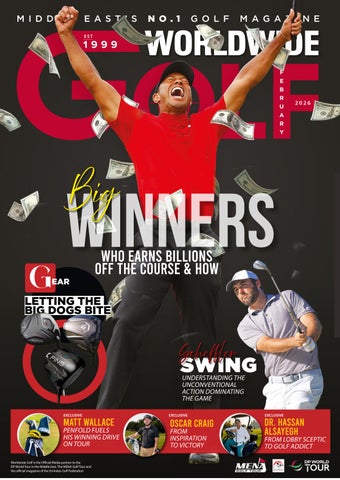
Worldwide Golf February 2026 Desktop Issue

Page 1


WINNERS Big

LETTING THE BIG DOGS BITE

EXCLUSIVE WHO E ARnS BILLIOnS Off THE C OuRSE & HOW

UNDERSTANDING THE UNCONVENTIONAL ACTION DOMINATING THE GAME

LLACE PENFOLD FUELS

HIS WINNING DRIVE ON TOUR

OSCAR CRAIG FROM INSPIRATION TO VICTORY DR. HASSAn ALSAyEGH FROM LOBBY SCEPTIC TO GOLF ADDICT

GET FIT. GET OPTIMISED.

FAIRWAY MAGNET.

THE NEW STANDARD IN STRAIGHT.

In the new G440 K driver, we’re taking forgiveness further than ever. Its combined MOI is our highest ever and makes the G440 K our straightest and most forgiving adjustable driver to date. For you, that means longer, straighter drives — and shorter approach shots from the fairway to the green.

CG SHIFTER

A movable, 32-gram backweight dials in ball flight in three positions (Fade, Draw, Neutral).

DUAL CARBONFLY WRAP

Lightweight carbon sole and crown save mass, helping move the CG lower and deeper for more ball speed and distance.

OUR LOCATIONS

YAS MALL
UMM SUQEIM STREET, DUBAI
MALL OF THE EMIRATES
EMIRATES HILLS

DesertDrivers, Drama & a Game in Full Flight

This issue has everything: innovation, big wins, breakout stars and a game that’s firing on all cylinders.

Ping, Callaway and TaylorMade have dropped their latest drivers, and the tech race is tight. Ping’s G series stays true to form as the easiest club to hit, somehow holding speed even when you don’t catch it clean. Callaway’s all about face speed, pure explosive when you stripe it. TaylorMade keeps pushing carbon and adjustability, letting you dial in launch and spin however you want. Bottom line for most of us these drivers don’t punish bad swings like they used to. Keeping it in play matters more than chasing another 15 yards.

Reed won the Dubai Desert Classic the way he always does with grinding, clutch putting, and

that killer instinct when it counts. Love him or not, the man delivers on Sundays. Meanwhile, Tommy Fleetwood’s stepson Oscar Craig won in Al Ain with beautiful tempo and composure well beyond his years. There were no first-time jitters, no moments of doubt. He looked completely at home under the pressure of closing out a tournament, the sort of performance that suggests this won’t be his last visit to the winner’s circle.

Scheffler’s swing looks weird. His footwork’s odd, the positions are funky, but his impact is flawless. Proof that pretty doesn’t matter, repeatable does.

The MENA Golf Tour rolled through Egypt and showed again why it matters. Strong fields, serious courses, real stakes. Golf right now? It’s thriving.

Download the MENA Golf Tour App for player login and registration. Get instant access to the latest news, upcoming events, live scores, current leaders, Order of Merit and more.

BRING OUT THE PLAYER IN YOU.Ahigh-launching, players-styledesignthatcombinesshot-makingprecisionwith score-savingforgiveness.Engineeredforthebestplayersin theworld.Customfitandcustombuiltforyou.

DISTANCE & CONTROL

LowerCGforincreased ballspeedandhigher launch.

PLAYER PREFERRED

Sizedandshaped fortrajectory control.

Game-improvement forgiveness;softerfeel, pleasingsound.

FORGIVENESS WITH FEEL GET FIT. GET OPTIMISED.

Dreams realised in Dubai: an unlikely Spaniard outlasts Ryder Cup stars, embraces family and claims a fairytale DP World Tour triumph.

Fist pumps, fearless plotting and vintage ball-striking: a polarising champion tames Dubai’s toughest test to reclaim relevance with emphatic Desert Classic glory.

22

MENA GOLF TOUR

Futures launched, belief ignited and careers revived: Egypt’s MENA Golf Tour swing delivers opportunity, drama and momentum for a rising generation.

Heritage, fire and fresh focus: an English star embraces Penfold’s revival, Dubai’s allure and a back-to-basics quest for major glory.

Mind over majors: a rising Scottish star teams up with the Brain and Performance Centre, blending brain training, belief and ambition for

to purpose: an 18-year-old winner reflects on his breakthrough victory, mentorship, mental strength and why real lessons live beyond the practice range.

Why the world number one’s unconventional swing works: lightning hips, bowed wrist, elite athleticism producing astonishingly consistent results on tour

the cut and hold greenside rough shot, taught by Peter Cowen, with variations and execution tips for tricky half buried

PING S259 WEDGE REVIEW

PING quietly delivers one of its most complete wedge line ups yet, combining clean looks, dependable spin, superb feel and a fitting system built for real world golfers.

The driver wars are heating up. PING, Callaway and TaylorMade go head to head with their latest big sticks, chasing more ball speed, forgiveness and bragging rights. We break down the tech, the hype and what each new release promises golfers in 2026.

DOHA GOLF CLUB

DESERT DRAMA, CHAMPIONSHIP THEATRE

If golf courses had passports, Doha Golf Club’s would be bursting with stamps. For nearly three decades, this striking slice of desert golf has been the stage for the Commercial Bank Qatar Masters, welcoming the world’s best to Qatar with equal measures of sunshine, swagger and sneaky difficulty.

Designed by legendary architect Peter Harradine, the man widely credited with pioneering championship desert golf in the Middle East, Doha Golf Club opened in 1996

and instantly became the region’s original tournament showstopper. Long before “destination golf” became a buzz phrase, Harradine was out here shaping fairways through rolling dunes, framing greens with rugged waste areas, and daring players to flirt with disaster in the name of birdies.

From the back tees, Doha Golf Club is no pushover. Wide-looking fairways tighten precisely where you want to open your shoulders. Greens are large, undulating and beautifully exposed to the ever-present Gulf

breeze, which has a nasty habit of turning a gentle wedge into a full-blown guessing game. Add strategically placed bunkers, desert scrub waiting hungrily offline, and you have a layout that rewards bold shot-making but punishes even the slightest lapse in concentration. What really gives Doha its personality, though, is the wind. Some days it whispers. Other days it howls. When it does, even tour pros start rethinking club choices, trajectories and life decisions. It is part links golf, part desert survival test, and fully brilliant theatre.

ELVIRA’S DREAM WEEK ENDS WITH EMOTIONAL VICTORY IN DUBAI

Nacho Elvira described his victory at the 2026 Dubai Invitational as a “dream come true” after holding off a field of Ryder Cup stars to claim his third DP World Tour title at Dubai Creek Resort on Sunday.

The 38-year-old Spaniard, ranked 190th in the world, closed with a two-under 69 to finish at 10-under 274, one shot clear of New Zealand’s Daniel Hillier. It capped a remarkable week for a player who admitted he wouldn’t have believed such an outcome was possible just days earlier.

“If you told me on Tuesday that I’d be winning this tournament I’d have never believed you. It’s a dream come true, especially having the family here.”

Elvira’s voice broke with emotion as his wife and two young daughters embraced him on the 18th green. “I’ve always dreamed to have my kids walking up to me with a win.”

Elvira had led by two overnight and extended that advantage to three with a birdie at the seventh on Sunday. But when he dropped shots at eight and nine, the door swung open for the chasing pack. Rory McIlroy, Shane Lowry, Daniel Hillier and Marcus Armitage all reached nineunder at different points, turning the final round into a five-way battle.

The Spaniard, whose last victory came at the 2023 Soudal Open, showed remarkable composure under pressure. “I knew at some point it was going to be difficult, especially with the great players playing in front of me,” he said. “I somehow managed to make a par on ten, managed somehow to make a par on 11 and I guess I calmed down a little after this and stayed patient.”

COMPOSURE UNDER FIRE

That patience proved decisive. Whilst others around him cracked, Elvira kept finding fairways and greens when it mattered. A birdie at 17 gave him breathing room, and though he admitted feeling genuinely nervous over his final putt—a one-footer for victory— he rolled it in to secure €400,000 and 585 Race to Dubai points.

McIlroy made the day’s most spectacular charge. Six shots back early in the final round, the Masters champion reeled off five consecutive birdies around the turn, including a chip-in at the third. For a few holes, it looked like the Northern Irishman might overhaul Elvira. But he couldn’t find another birdie coming home, and a bogey at 18 left him tied third, two behind.

“I wasn’t really focused on winning the tournament,” McIlroy said afterwards. “I was just trying to piece it together and make some good swings and try to hit a few more fairways.”

Asked what needed improvement ahead of next week’s Hero Dubai Desert Classic: “I need to hit a few more fairways. I don’t think I’m hitting the club that badly, it’s just maybe some strategy off the tee.”

For Lowry, the finish proved devastating. The 2019 Open champion birdied the 15th to reach 10-under and stood on the final tee leading by one. Then his bunker shot on 18 flew across the green and into the water. Double-bogey. He dropped from first to tied third in the space of one hole, handing Elvira the opening he needed.

BIG NAMES STUMBLE

Defending champion Tommy Fleetwood never recovered from a disastrous 78 on Friday—his first

over-par round since September. Though he bounced back Saturday with a 66, the damage was done. He finished tied 25th at level par.

“Golf’s hard, and every now and again it’s very humbling,” Fleetwood said of his second-round struggles.

Tournament host Abdulla Al Naboodah presented Elvira with the trophy, praising the standard of play throughout the week. “Congratulations to Nacho Elvira on an outstanding performance and well-earned victory,” said the chairman of Al-Naboodah Investments. “The caliber of golf from both our professionals and amateurs has been remarkable.”

Al Naboodah thanked partners DP World and Rolex, along with the Dubai Sports Council and Emirates Golf Federation, for their continued support of the tournament and golf in the region.

For Elvira, the victory transcended mere prize money or ranking points. Standing on

the 18th green with his family, the Spaniard struggled to articulate what it meant. “Anything that happens after this, nothing compares to this,” he said.

It was an improbable triumph. Not the highest-ranked player in the field, not the favourite, facing down major champions and world-class talent. But Elvira found something when it mattered most—the ability to hold his nerve whilst others lost theirs.

McIlroy made five birdies in a row but couldn’t sustain it. Lowry had the tournament won and threw it away. Fleetwood shot 78 when anything decent would have kept him in touch. Meanwhile, Elvira simply kept playing his game, trusting his process, waiting for his moment.

That moment arrived on Sunday evening at Dubai Creek Resort, with his daughters running onto the green and his unlikely victory complete. Not bad for a bloke who didn’t believe it was possible on Tuesday.

REED’S REDEMPTION

How Captain America

Conquered the Desert

P

atrick Reed doesn’t do subtle. Never has. So when he rolled in that 15-footer on 18 Sunday afternoon, pumping his fist like he’d just won another major, you knew this one meant something. The three-shot victory margin at the 2026 Hero Dubai Desert Classic tells only part of the story. This was Reed reminding everyone—critics, doubters, himself—that he’s still got plenty left in the tank.

The Majlis Course at Emirates Golf Club doesn’t suffer fools. Redesigned greens, firmer conditions than we’ve seen in years, and the wind? Let’s just say Thursday’s gusts had half the field muttering about equipment checks. Reed opened with a 65 that looked easy on the scorecard but was anything but. His ball-striking on the back nine was surgical—eight fairways, eight greens in

regulation, and that ridiculous six-iron into seven that never left the flag.

Here’s what separated Reed from the pack: he played boring golf. Sounds like an insult, but it’s the highest compliment you can pay someone on a golf course that punishes ambition. Whilst others were short-siding themselves trying to chase pins, Reed plotted his way around like he was reading a GPS. Centre of greens, two-putt

pars, take your birdies when they come. It’s not sexy, but it wins tournaments.

Saturday’s 67 might have been the best round of the week, even with two bogeys. The desert wind was doing that thing where it swirls differently on every hole, making club selection a guessing game. Reed’s caddie Kessler Karain earned his percentage that day. On the par-5 13th, they debated for a solid minute before

I came here to win, not to finish Top-10. ” “

Reed flushed a four-iron from 238 that finished 12 feet away. Eagle. Game over for the chasers.

The leaderboard had teeth all week. This wasn’t some weakfield event where you can coast. Major champions, Race to Dubai contenders, guys who’ve won multiple times on tour—they were all there, and they all came up short. That tells you something about Reed’s performance. When he’s locked in like this, grinding every shot, trusting his process, he’s one of the toughest outs in professional

Dubai has come a long way since this tournament started in 1989. The Majlis Course has hosted everyone from Seve to Rory, and it’s evolved with the times without losing its character. The recent green complexes add genuine bite to approach shots, especially when they firm up like they did this week. The 18th hole remains perfect—a drivable par-5 that tempts you but can easily make a birdie turn into bogey if you get greedy.

What Dubai does better than almost anywhere else is create an atmosphere.

The tournament village felt genuinely buzzing all week, packed with locals and European tourists escaping winter. The corporate hospitality might border on excessive—yes, that was caviar at the 16th hole pavilion—but that’s Dubai’s brand. They commit fully to everything they do, golf included.

The city has transformed itself into a legitimate golf destination. Five years ago, you’d play the tournament venues and not much else. Now there’s a dozen world-class tracks within an hour’s drive, the weather is perfect half the year, and the infrastructure makes getting around easier than most European cities. The European Tour—sorry, DP World Tour—made a smart bet doubling down on the Middle East swing.

Reed’s win pushes him back into conversations he’d slipped out of. At 35, he’s at that age where people start writing you off if you’re not careful. One win doesn’t erase a quiet couple of years, but it’s a hell of a reminder that class is permanent. The ball-striking was vintage Reed—compact, controlled, relentless. He hit 83% of greens for the week. You’re not beating that.

The final round was textbook championship golf. Leading by two, Reed never gave anyone an opening. His only bogey came at the par-3 seventh, and he immediately answered with birdie at eight. No drama, no heroics, just professional golf executed at the highest level. When he stuffed that approach at 18, the outcome was never in doubt.

Walking off that final green with the trophy, Reed looked like a man who’d proven exactly what he set out to prove. Dubai has a knack for producing moments like that— champions rediscovering their best stuff against a backdrop of gleaming skyscrapers and endless desert. The 2026 Desert Classic delivered everything you want from a marquee tournament: world-class golf, a worthy winner, and a reminder that when the Middle East does something, they do it right. Reed’s closing quote summed it up perfectly: “I came here to win, not to finish top-10.” That’s the attitude that makes him polarising, but it’s also what makes him great when he’s on. Dubai got a champion’s performance from a guy who refuses to accept anything less.

EGYPT’S DESERT DREAM

Photography: Alex Gallemore

Chris Wood collecting his second MENA Golf Tour trophy of the season. Taking him top of the ranking.

GHow the MENA Golf Tour Is Elevating Local Stars and Resetting Global Careers EGYPT’S DESERT DREAM

olf has always had a way of bringing people together, from weekday warriors chasing birdies with mates to young talents dreaming of tour cards. But few places capture that inclusive, rising tide lifts all boats feeling quite like the sun-soaked greens of Egypt during the latest MENA Golf Tour swing.

As part of the revitalised 2025 to 26 season, the Tour’s return to North Africa was more than just a string of tournaments stitched into a calendar. It became a proving ground where emerging stars found belief, local players found a platform, and seasoned professionals rediscovered the fire that

once carried them to the top of the game.

From Cairo’s desert outskirts at New Giza to the windswept Mediterranean coastline of Marassi, Egypt delivered drama, quality and meaning in equal measure. The fairways told stories far richer than simple leaderboards. This was about opportunity meeting experience. About futures being launched and past glories finding fresh relevance.

By the time the final putts dropped, one thing was clear. The MENA Golf Tour’s Egyptian swing was not just a success. It was a statement.

A STAGE BUILT FOR OPPORTUNITY

The first act unfolded at New Giza Golf Club, a modern desert layout that demands patience

and precise ball striking. It was here that Finland’s Lauri Ruuska produced a breathtaking final round to surge from seven shots back and claim victory, announcing himself as one of the season’s most exciting young prospects.

Ruuska’s win set the tone. This was a Tour where youth would not just participate. It would contend.

But while international names filled the fields, it was the local and regional voices that brought a unique energy to the Egyptian swing. Players from Egypt and across the Middle East and North Africa walked onto the first tee not just as guests or hopefuls, but as professionals with genuine belief.

For golf fans around the continent, from Cairo to Casablanca, seeing homegrown names competing at this level injected a long needed spark. Egypt’s

“It was a really tough week out there,” Wood said after his dramatic play off win. “The wind, the sand, not being able to see properly off some tees. It felt like proper desert golf. I think my experience counted a bit this week.”

role as a host nation was significant in itself, showcasing venues like New Giza and Marassi to a global audience while nurturing talent that might one day compete on the DP World Tour and beyond.

The ripple effect was immediate. Junior programmes buzzed with excitement. Local federations pointed to new role models. Young players who once felt a world away from elite competition suddenly found themselves sharing practice greens with Ryder Cup veterans.

There was a subtler story too. Players who might otherwise grind away on mini tours or in qualifying school trenches found a genuine platform on the MENA Golf Tour. Here they could earn world ranking points, sharpen competitive instincts and build confidence round by round.

When young players stand shoulder to shoulder with seasoned professionals and perform with conviction, the long road to elite golf stops being an abstract dream and starts feeling like a plan.

YOUTH, BELIEF AND HOMEGROWN MOMENTUM

As the Tour moved north to the Mediterranean coast and Address Marassi Golf Resort, the conditions stiffened and the storylines deepened.

Ireland’s Alex Maguire opened with a scintillating course record 63, burning edges, pouring in birdies and announcing himself as a player ready to win. England’s Charlie Crockett

ranking points. All earned belief.

This is where the MENA Golf Tour’s true value revealed itself. Not just in trophies or rankings, but in creating a genuine bridge between junior dreams and professional reality.

For young players learning how to flight wedges into a stiff Mediterranean breeze, manage nerves on a closing par five, or hole a six foot par save with a pay cheque on the line, every round became a lesson that no practice range could replicate.

It is one thing to hit good shots in isolation. It is quite another to hit them when they matter.

And in Egypt, they mattered.

THE CHRIS WOOD RESET BUTTON

If the Egyptian swing was where new voices were being born, it was also where familiar ones found a second wind. No story captured that dual purpose better than that of Chris Wood.

The Englishman, once a Ryder Cup regular and a multiple winner on the DP World Tour, arrived in Egypt quietly confident but visibly hungry. After topping MENA Tour Q School by six strokes to secure his card, Wood had come looking for more than just form. He had come looking for belief.

At Marassi, he delivered one of the most stirring performances of the fortnight.

“It was a really tough week out there,” Wood said after his dramatic play off win. “The wind,

charged through the field with fearless putting and aggressive play. Local amateurs teed it up alongside seasoned professionals, holding their own and soaking up the moment.

For Egyptian players, this was more than just another tournament week. It was a rare chance to compete at home, in front of friends, family and federation officials, against players they had only ever watched on television or followed online. Some earned cheques. Some earned world

the sand, not being able to see properly off some tees. It felt like proper desert golf. I think my experience counted a bit this week.”

Under pressure, with the rankings lead on the line and a hungry young field snapping at his heels, Wood showed the composure that once made him one of Europe’s most feared match play opponents.

Tied at 13 under par after 72 holes with Charlie Crockett, the pair returned to the par five 18th

Charlie Crockett

MORE SPEED MORE CONTROL

Photography: Alex Gallemore

for a sudden death play off. Crockett’s birdie effort slid agonisingly wide. Wood, having set up a six foot downhill chance with a nerveless long iron from the semi rough, poured in the putt to claim the title.

“It really helped knowing it was between the three of us coming down the stretch,” Wood admitted. “That gave me real clarity. I just thought, I’ve got to beat who’s in front of me here. That’s all I can control.”

It was a simple philosophy. It was also the mindset of a man rediscovering his competitive identity.

For Wood, the win was not about nostalgia or a final flourish. It was about momentum.

“I feel like I’m hitting a lot of good shots again,” he said. “I’m seeing the ball flight I want to see. I’m making birdies. That’s what gives you confidence.”

And confidence, for a player who has lived both the heights of Ryder Cup glory and the quiet grind of rebuilding, is everything.

“I’m not really one for looking at leaderboards or

rankings too much,” Wood added. “I just try to do the same things every day. But wins like this remind you that the game is still there.”

WHY EGYPT MATTERED MORE THAN THE LEADERBOARDS

By the time the final putts dropped and the dust quite literally settled on the Egyptian swing, one thing became abundantly clear. This was not just a successful run of tournaments. It was a statement of intent.

From New Giza to Marassi, Egypt delivered exactly what the Tour’s relaunch had promised. Opportunity for young and local talent. A credible competitive platform for international hopefuls. And a genuine reset space for established names looking to reignite their careers.

For emerging players, Egypt proved that elite level golf no longer feels a world away. Homegrown talents teed it up in front of friends, family and federation officials, shared fairways with Ryder Cup veterans and DP World Tour winners, and showed they belong.

For Chris Wood, the swing felt like something deeper than a return to the winner’s circle. It felt like a reintroduction.

And for the Tour itself, Egypt delivered momentum. Packed fields. Competitive leaderboards. Dramatic finishes. Real storylines. These events did not feel like developmental footnotes. They felt like meaningful chapters in the global golf ecosystem.

In a year when professional golf continues to evolve at speed, the MENA Golf Tour’s Egyptian swing showed how powerful the right platform can be. Give players a stage. Give them belief. Give them competition that matters.

Whether it was a local hopeful walking off the 18th green with his best ever finish, or a Ryder Cup star lifting a trophy under the Mediterranean sky, Egypt offered something rare in modern golf.

A place where futures were launched and past glories found fresh relevance.That is not just a good couple of weeks for a Tour it’s a piece of something much bigger. n

Keith Waters, MENA Golf Tour, Commissioner & Chairman pictured alongside Lauri Ruuska.
Alex Maguire
Marassi Golf Club
MATT WALLACE
Photography: Alex Leyno

Matt Wallace

Reviving a Legend, Chasing Greatness, and Finding Balance in Dubai

THE ENGLISHMAN OPENS UP ABOUT HIS PARTNERSHIP WITH ICONIC BRAND PENFOLD, HIS LOVE AFFAIR WITH DUBAI GOLF, AND WHAT IT TAKES TO COMPETE AT THE HIGHEST LEVEL

There’s a quiet confidence about Matt Wallace these days. The fiery competitor who burst onto the scene with three wins in 2018 is still there that intensity hasn’t dimmed one bit but there’s a maturity now, a sense of someone who’s learned to channel the fire rather than let it consume him.

Sitting down with us, Wallace is refreshingly candid about everything from his new equipment partnership to his culinary skills, and it’s clear that 2026 represents something of a reset for the Englishman. After a 2025 season where he admittedly became too outcome focused on Ryder Cup qualification, Wallace is returning to what made him successful in the first place the fundamentals.

A HERITAGE PARTNERSHIP

One of the most intriguing developments in Wallace’s camp is his new partnership with Penfold, a brand that will celebrate its centenary next year. For younger golf fans, the name might not immediately ring bells, but Wallace is genuinely excited about being part of the brand’s revival.

“It’s one that I’m really excited about,” he explains. “It’s an iconic brand and legends like Seve, Sir Nick Faldo and Gary Player were all Penfold players back in the day. It’s been a quiet few decades really but an English

guy Gavin Perrett is trying to revive it and it’s pretty cool.”

The history resonates with Wallace. Penfold isn’t just another equipment manufacturer trying to break into the market. It’s a brand with genuine heritage in British golf, and that matters to the Englishman. His caddie Jamie Lane was particularly pleased with the Sunday bag debut at the Dubai Invitational, praising its lightweight design, while Wallace himself was delighted to debut the tour bag at The American Express.

THE DUBAI EFFECT

IfIf there’s one place on the global golf calendar where Wallace feels entirely at home, it’s Dubai. His affection for the Emirates is genuine and runs deep, both professionally and personally.

“I love it in Dubai in so many ways,” Wallace enthuses. “I don’t think there’s anywhere better in terms of golf and I love to prepare for my year there.”

The results back up his fondness. Runner up finishes at both the Desert Classic and the DP World Tour Championships are testament to how well his game suits the conditions. These are titles he’s desperate to add to his CV, and you sense that unfinished business in the Middle East drives him as much as any major championship ambition.

“Emirates and the Desert Classic have always been special and the DP World Tour Championship just continues to grow

and grow as an event and spectacle for the fans,” he says. “I’ve had a couple of near misses at both so hopefully I can go one better sooner or later.”

Beyond the competitive element, Dubai offers Wallace the perfect pre season environment. The guarantee of excellent conditions and good weather means he can fine tune his game without the unpredictability that European winters bring. He’s quick to acknowledge the support network he’s built there over the years, name checking Chris May, Stephen Hubner, Mike Bolt, Mike Major, Jamie McConnell, and others who’ve helped him prepare.

The courses themselves suit Wallace’s eye perfectly. Whether at Emirates or Jumeirah, the immaculate conditioning and quality of the greens remind him more of American conditions than European ones, high praise from someone who competes regularly on the PGA Tour.

“Generally at both courses you have to drive the ball well because you can’t expect to score well if you’re not in fairways, but both test every part of your game to the max,” Wallace explains. “I would compare it very much to the US in terms of a challenge.”

BACK TO BASICS

For Wallace, 2026 represents a philosophical shift. After spending much of last season laser focused on Ryder Cup qualification, he admits he became too outcome based in his thinking. The consistency was there, he had a solid spell, but it wasn’t producing the results he wanted.

Wallace lifting the silverware at the 2024 Omega European Masters, a feeling he’s aiming to achieve more than once this season on the DP World Tour.
Photography: Alex Leyno
Photo:: Getty Images

“I’m enjoying getting back to basics a little bit and I want to get some momentum going this year and see where it will take me,” he says.

It’s a more process oriented approach, one that focuses on daily improvement rather than distant goals. That’s not to say the ambitions have diminished, far from it, but Wallace has learned that taking care of the day to day business is what ultimately leads to success.

“That’s one of the big challenges we all face,” he reflects. “We all have ambitions and goals, to a lesser or greater extent, and while it’s easy to keep your feet on the ground when it’s going well, if you miss a green you have to deal with it and try to get it up and down. In an ideal world, it’s just about taking care of business day to day, week to week, and seeing where that takes you.”

comes in handy given the travel heavy lifestyle of a professional golfer.

THE MAN BEHIND THE FIRE

Wallace’s on course intensity is well documented. The passion, the fist pumps, the occasional flash of frustration, it’s all part of what makes him compelling to watch. But Wallace has an interesting perspective on his reputation.

“You don’t get many golfers that don’t play with intensity!” he points out with a laugh. “It’s something I’m associated with and I’m not going to say you’re wrong but maybe others are just better at hiding how they’re feeling.”

It’s a fair point. Golf at the highest level demands intensity. Wallace just happens to wear his heart on his sleeve. Away from the course, though, there’s more to him than the competitor we see inside the ropes. For instance, not many people know that he’s a serious cook.

“It’s no big secret but I am a very good cook!” he reveals, a skill that presumably

Dubai, of course, offers no shortage of culinary options when he doesn’t feel like cooking. “Our lives are travel, hotels and restaurants and Dubai has everything you could want and more, at a great standard,” Wallace says. “There’s nowhere better for it.”

DATA DRIVEN APPROACH

Like most modern professionals, Wallace leans heavily on data to optimise his performance. He’s established benchmarks across his game, numbers that tell him when he’s in form and ready to compete.

“You don’t get many golfers that don’t play with intensity!” he points out with a laugh.
“It’s something I’m associated with and I’m not going to say you’re wrong but maybe others are just better at hiding how they’re feeling.”

“I use data a lot and have benchmarks in my game,” he explains. “I know if I am hitting those numbers I can go out and perform.”

It’s a methodical approach that might surprise those who only see the emotional player on television. The intensity and the analytics aren’t contradictory. They’re complementary aspects of what makes Wallace the competitor he is.

LEGACY & LOOKING FORWARD

When the conversation turns to legacy, Wallace’s competitive fire burns as bright as ever. He wants to maximise every ounce of his potential and be remembered as someone who gave everything inside the ropes.

“As a golfer I want make the most of what I have and be as good as I can be,” he says. “I want to be remembered as a true competitor inside the ropes, one who gave everything and that sometimes spilled over the edge but as the years went by managed to control his emotions and went on to become a major champion!”

That major championship dream remains very much alive, and there’s a touching honesty when he reflects on the person he wants to be beyond golf. “I’d like to think I’m a kind person although I could maybe be kinder to myself.”

It’s perhaps the most revealing comment of our conversation, a glimpse of the self awareness that comes with maturity. Wallace knows he demands a lot of himself, perhaps too much at times. Learning to channel that intensity, to be as kind to himself as he is to others, might be the final piece of the puzzle.

As he embarks on another season, with Penfold’s historic bag and Dubai as his preparation base, Matt Wallace is a player to watch. The fire still burns, but now it’s tempered with wisdom. The goals remain lofty, but the focus is on the process.

One thing’s certain. Whatever happens, Matt Wallace will give it everything. That’s simply who he is. n

Penfold taking the stage on the range at the Dubai Invitational.
A delighted caddie, Jamie Lane, loving the new light weigtht Penfold bag in Dubai.

iger Woods earned approximately $120 million in official PGA Tour prize money, a figure that once seemed untouchable. Yet even that extraordinary total is barely a fraction of his overall financial impact on the sport.

Woods’ career earnings are estimated to exceed $1.7 billion, with more than 90 per cent generated outside competitive golf. At his commercial peak, Tiger was reportedly earning $90–100 million annually in endorsements, driven by a Nike

partnership believed to be worth over $500 million across nearly three decades.

As his playing schedule reduced, Woods pivoted intelligently toward ownership. Through TGR Ventures, he has built a portfolio spanning course design, hospitality, PopStroke and co-founding TGL, businesses designed to scale independently of his playing career.

In Tiger’s case, the takeaway is clear: elite performance created the opportunity, but ownership and equity ensured the wealth endured.

ARNOLD PALMER & JACK NICKLAUS: THE ORIGINAL OFFCOURSE EMPIRES

Arnold Palmer earned around $2 million in career prize money, a respectable sum in his era. By the time of his death in 2016, however, his estimated net worth exceeded $700 million.

Palmer’s genius was relatability. He transcended golf to become a mainstream

commercial figure, building wealth through endorsements, licensing, aviation and hospitality. Leaving behind one of sport’s most enduring personal brands. His financial success proved that personality could be just as valuable as performance.

Jack Nicklaus followed a different, arguably even more lucrative route. Nicklaus earned approximately $5.7 million in PGA Tour prize money, yet his career earnings are

estimated north of $1 billion. The foundation was Nicklaus Design, now responsible for more than 400 courses worldwide, driving revenue through real estate development, consultancy and licensing.

Together, Palmer and Nicklaus demonstrated two early truths: you can monetise who you are, or you can monetise what you build, but either way, golf can be far bigger than golf.

GREG NORMAN: SEED CAPITAL FOR A GLOBAL BUSINESS CAREER

Greg Norman was one of the dominant players of his generation. His official PGA Tour prize money totalled $14.5 million, and when worldwide competitive earnings are included, his on-course total is estimated at $17–18 million, enough to make him the first golfer in history to surpass $10 million in career earnings.

Yet that milestone pales beside his off-course success. Norman’s career wealth is widely estimated between $300–400 million, built through an aggressively diversified portfolio including course design, apparel and licensing, real estate, wine, beef and global brand partnerships under the Great White Shark banner.

Norman understood early that golf was not the product, it was the proof of credibility. His career shows how elite performance can be converted into long-term commercial leverage far beyond tournament purses.

PHIL MICKELSON: WHEN PERSONALITY BECOMES

THE BUSINESS

Phil Mickelson earned over $96 million in PGA Tour prize money, placing him among the most successful on-course earners in history. But his real financial strength has always lived off the leaderboard.

Mickelson’s off-course earnings are estimated to exceed $800 million, driven by endorsements, corporate appearances, media work and long-term sponsor relationships. His value was never confined to trophies alone, it was rooted in visibility, charisma and a reputation for being compelling television.

Mickelson’s career illustrates a simple reality: in golf, sustained relevance can be just as valuable as sustained excellence.

Rory McIlroy has earned approximately $80 million in official PGA Tour prize money, with total competitive earnings climbing significantly when global events and bonuses are included.

His career earnings are estimated to exceed $500 million, fuelled by major endorsement deals, including a long-term Nike agreement believed to be worth around $200 million and increasingly by equity-based ventures. As a co-founder of TGL, McIlroy represents a new generation of golfers shifting from endorsement income toward ownership and long-term upside.

Rory’s financial success reflects a modern strategy: fewer deals, stronger alignment, and a focus on assets that grow beyond a playing career.

platforms that keep paying long after the final putt drops.

In modern golf, the most valuable shot you can play may not be on the course at all.

RORY MCILROY: THE MODERN EQUITY GOLFER
OSCAR CRAIG
Photography: Alex Leyno

The Making of

OSCAR CRAIG

FINDING HIS IDENTITY IN CHAMPIONSHIP GOLF

After winning the Al Ain Open, the 18-year-old opens up about life in golf’s spotlight, learning from elite mentors, and why the hardest lessons can’t be learned on the range.

There’s a moment Oscar Craig keeps coming back to, not from his recent victory at the Al Ain Open, but from a humid afternoon in 2017. He was watching his stepfather, Tommy Fleetwood, navigate the final holes of the French Open, witnessing not just the triumph but something deeper: the weight of pressure transformed into precision, the roar of a crowd validating years of unseen work.

“That was a game changer for me,” Oscar says. “Watching success, but also the build-up to it, hitting amazing shots under pressure, the support he continues to get. That’s when I realized this is what I want to do.”

At 18, Oscar has grown up inside the machinery of elite golf, observing tour-level routines and championship mindsets from an angle most aspiring professionals never access. But rather than shrinking under that shadow, he’s learning to use it as a blueprint.

LESSONS FROM THE INSIDE

The practice range can teach you mechanics. It can groove a swing, dial in distances, build muscle memory. What it can’t teach you is patience, the kind that comes from watching world-class players grind through slumps and stay consistent when doubt creeps in.

“Hard work eventually pays off,” Oscar says. “Not necessarily with trophies, but with good results, getting into majors, earning a tour card. Those things are all earned from working hard at the right things, even when you don’t want to.”

It’s a lesson reinforced daily at the Tommy Fleetwood Academy at Jumeirah Golf Estates in Dubai, where he’s been a member for over three

years. The UAE has become his laboratory. The conditions suit his game, the courses feel familiar, and the Emirates Golf Federation’s commitment to improving amateur events has created a proving ground where young talent can flourish.

But comfort zones only get you so far. Links golf, Oscar admits, remains his greatest challenge. “Long rough, strong winds, difficult bunkers, it’s by far the hardest type of golf,” he says. “It can bring the best and worst out of you, but that’s a positive because you learn so much quicker what you need to work on.”

If you want to understand Oscar’s development, you need to understand one shot: a chip on the final hole of his Challenge Tour debut. Tommy was on the bag, not as stepfather, but as caddie. They walked onto the green together, finding landing zones, calculating roll.

“To hit it where I wanted to, to two feet, while trying to make a cut on my debut, that was a huge confidence boost,” Oscar recalls. “Something I’ll always be proud of.”

It wasn’t just the shot itself. It was the process leading up to it, the collaboration between mentor and student, the trust in preparation when stakes are highest. These are the quiet moments that shape careers.

THE CHIP THAT CHANGED EVERYTHING

FINDING HIS IDENTITY

Ask Oscar to define his golfing identity and he’ll give you an honest answer: he’s still figuring it out. And there’s strategy in that uncertainty.

“I believe it will take time through experiencing different scenarios on the golf course, whether good or bad,” he explains. “I’ll always try to be strategic, but I trust my instinct. If needs be, I’ll be instinctive in some scenarios.”

That balance revealed itself at the Al Ain Open. On Sunday’s back nine, facing a difficult up-and-down on the 10th hole,

THE WEIGHT OF EXPECTATIONS

Growing up adjacent to tour-level success could create impossible standards or breed complacency. Oscar seems to have absorbed something different: a realistic appreciation for the work required and humility about his current place in the journey.

When asked about pushing standards for amateur golf in the UAE, he defers. “The EGF are making events better each year,” he says. “I don’t really think there’s much I can do apart from focusing on my game and doing what I can to be successful.”

It’s not false modesty, it’s focus. With the MENA Golf Tour restarting and providing new opportunities for regional amateurs, Oscar sees his role clearly: keep developing, keep competing, let results speak.

WHAT COMES NEXT

The Al Ain Open trophy is a springboard, not a destination. Oscar knows the difference. He’s seen enough championship golf to understand that one victory doesn’t define a career.

“As great as it was to win again, I still have a lot to work on,” he says. “I’ll continue to push myself every day, doing the right things in practice and tournament preparation, and hopefully bring more success in the rest of the season.”

and more positive. Whatever the case is, I’ll always try my best to work hard and never give up.”

THE TAYLORMADE EDGE

Equipment changes can be subtle turning points in a player’s development. For Oscar, a new partnership with TaylorMade has provided both tangible and psychological benefits.

“They’re the best clubs I’ve hit,” he says. “The new woods are absolutely incredible. They’ve helped me gain so much more confidence off the tee.”

“Hard work eventually pays off,” Oscar says. “Not necessarily with trophies, but with good results, getting into majors, earning a tour card. Those things are all earned from working hard at the right things, even when you don’t want to.”

Oscar salvaged bogey, a moment that proved crucial to his mindset.

“Even though I made bogey, that up-anddown boosted my confidence massively,” he says. “I made sure I was as calm as possible, patient. I didn’t want to get too high or too low. I just kept taking one foot in front of the other.”

The victory marked his first win in some time, validation of the mental work that’s become the cornerstone of his improvement. “The biggest change is my mentality,” Oscar says. “I’ve become stronger

That confidence feeds into tournament preparation, which has evolved beyond technical work. Oscar now maps rounds on Upgame, identifying average approach distances and uncomfortable tee shots, building familiarity with scenarios before they arise in competition. He trains hard early in the week, then maintains flexibility through stretching, eliminating potential excuses before they can take root.

“I want to cut out reasons why I didn’t do well,” he explains.

There’s no bravado in his voice, no premature declarations about tour cards or major championships. Just steady purpose, informed by years of watching greatness up close.

With Tommy Fleetwood as a stepfather, Oscar could easily fall into the trap of imitation. But he understands what many young players miss: golf rewards authenticity, not carbon copies. He’s simply trying to be the first Oscar Craig, and judging by the work he’s putting in, that might be exactly what golf needs to see. n

What makes Scottie Scheffler’s swing so special? The world number one doesn’t have the prettiest moves you’ll ever see, but boy does it work. His secret sauce combines lightning-fast hips, that funky bowed wrist, and pure athletic talent. Let’s break down why this “ugly” swing produces such incredible results.

SCOTTIE SCHEFFLER

Excited to analysis the world number ones pattern. Him and his life long coach Randy Smith have done a fantastic job harnessing Scotties natural movements and allowing him to swing his swing whilst maintaining exceptional fundamentals.

1: Athletic setup and crisp posture. His arms hang naturally under his chest in a stable position.

2: His primary movement is wide with minimal wrist and clubface movement as his body stays strong and centered.

3: You can start to see the push pull in his legs indicating he’s using the ground as his lead arm reaches parallel and the club continues to work up

4: He continues to stretch up as he holds the ground beautifully whilst his upper and lower body coil.

5: Amazing vertical stretch up with a short iron as he reaches the top of his swing. You’ll notice how centered his body has remained and how his tail bone has coiled left towards the target and inside his left heel. Excellent combination of letting the hands arms and shoulder load up and the body coils.

6: In transition he lowers nicely into his lead side whilst keeping his head centered. His arms are working nicely back down and under his body and his feet remain stable.

7: Getting into delivery he remains centered

Stephen is an ambassador for Dubai Golf and coaches at their wonderful array of facilities whilst in Dubai. Stephen also spends a proportion of his time developing professionals, amateurs and VIPs Internationally He has a passion for coach education and sharing knowledge and ideas with his colleagues and students

as his arms continue to work back in towards his body and his lower half naturally starts to unwind.

8: Arms working in club working out as he approaches impact . His body has continued to uncoil and his lead side starts to work up.

9: Beautiful impact, his arms have vertically worked down and in towards his body as he produces a stable face to the ball. His lead side continues to stretch up and his body uncoils and he maintains a centered head position.

10: Post impact he demonstrates his signature move as his right foot slides back. This is a natural balance reaction due to his hands working under and in (left) which pulls his upper body forward and over the ball. The right foot moving back counteracts this force and helps match everything up.

11: He releases his head as his body continues to uncoil and his arms beautifully extend and release

12 Nice body extension as he folds his lead arm up to admire this short iron shot.

CUT AND HOLD!!

CUT AND HOLD!!

This month we’ll look at an effective shot from green side rough called cut and hold!! My longtime mentor Peter Cowen showed me this shot around 15 years ago and it’s been a favorite ever since.

There’s a few variations for this shot dependent on the quality of lie. In this article we’ll discuss how to execute the shot when the ball lies halfway in the rough.

Phase 1: Open the face half to around 22.5 degrees (Picture 1). Most players over open on these shots (Picture 2) and lose pressure on the ball. In terms of club selection, I’d recommend a lofted wedge between 56 and 60 degrees.

(PICTURE 1)
(PICTURE 2)

Stephen is an ambassador for Dubai Golf and coaches at they’re wonderful array of facilities whilst in Dubai. Stephen also spends a proportion of his time developing Professionals, Amateurs and VIPs Internationally. He has a passion for coach education and sharing knowledge and ideas with his colleagues and students.

Phase 2 Let’s stand relatively close and create a vertical shaft angle whereby the toe sits down and can apply more pressure on the ball than the heel (Picture 3). Again, most players make the mistake of having the shaft in a standard position (Picture 4)

Phase 3 Feel you move the toe to the inside of the ball whilst playing the shot. This feels like a “cut” pattern for most players. In your mind try and move the toe so far to the inside of the ball that you’ll miss it! Trust me you wont!

Phase 4 Post impact “hold” the loft on the club (Picture 5) and try not to allow the face to shut down (Picture 6). Dependent on the thickness and strength of the rough it’s useful to do some practice swings to feel this phase prior to executing the shot and gauge how strong the hold needs to be.

I trust you’ll enjoy the green side control you gain from this shot and look forward to catching up again next month.

(PICTURE 3)
(PICTURE 5)
(PICTURE 6)
(PICTURE 4)

Photography: Alex Leyno

Perfect Iron Setup GETTING THE FUNDAMENTALS CORRECT

WITH AMY MILLWARD, PGA PROFESSIONAL, ELS CLUB DUBAI

ost bad irons swings start before you even start the swing, with most amateurs overlooking the most important part of a great iron shot and that’s the setup. These are the key fundamentals you need to hit better iron shots!

Your setup controls your strike, your ball flight, and ultimately your consistency. Here is a simple 6 step guide to building your iron setup.

FUNDAMENTAL 1 – BALL POSITION

The ball should be positioned just forward of centre in your stance. Too far back and this encourages steep, digging strikes. Too far forward more commonly encourages thin or heavy contact.

A ball position just forward of centre allows you to hit the ball and then turf.

FUNDAMENTAL 2 – STANCE WIDTH AND WEIGHT DISTRIBUTION

Your stance width should be approximately shoulder width apart, giving you an athletic stable base.

From there feel around 55% of your weight favouring your lead foot. This should encourage a descending strike and prevents hanging back through impact; one of the biggest causes of thin shots.

Your weight should also be on the balls of your feet, you don’t want the weight bias towards your heels or toes to help you feel grounded.

FUNDAMENTAL 3 – GRIP

Your grip is the only connection to the club so it must be correct more anything else. Hold the club in the fingers, not your palms. I like to hang my lead hand by my side before I start and this naturally lets the club fall into the fingers. You should see two or three knuckles on your lead hand and should be secure but not tight. Your trail hand should then come on and cover the lead hands thumb. Make sure the clubhead is square to help you with clubface alignment.

FUNDAMENTAL 6 – ALIGNMENT

FUNDAMENTAL 4 – HAND POSITION AND SHAFT LEAN

At address, your hands should sit slightly ahead of the ball creating a small amount of shaft lean.

This position mirrors where your hands should be at impact and will help you compress the golf ball, improve distance control and produce a more consistent ball flight.

Avoid having your hands behind the ball as this adds loft and lead to weak, higher shots, losing distance.

4 5 6

FUNDAMENTAL 5 – POSTURE

Great posture allows your body to rotate freely and stay balanced throughout your swing.

You want to hinge forward from the hips, have a soft flex in the knees, with a long neutral straight back with shoulders back and arms hanging naturally.

You should feel strong and athletic.

Always aim the clubface first directly at your target, then build your stance around it so your feet, hips and shoulders are parallel to the target line. Using an alignment stick on the range is a great way to improve your accuracy and build consistency. A great iron shot starts long before the club moves Master these 6 set up fundamentals and you’ll find it much easier to strike your irons cleanly, control your distance and hit more greens.

PING G440 K Driver Review

THE FORGIVENESS MONSTER FINALLY GETS ADJUSTABLE

Right, let’s talk about PING’s latest offering that’s set to dominate fitting studios in early 2026. The G440 K represents the Phoenix firm’s answer to a question we’ve been asking for years: why can’t we have maximum forgiveness andadjustability in the same package?

WHAT’S THE K ALL ABOUT

Simple really. PING looked at their G430 Max 10K—a stick that practically laughed at your mis-hits—and thought, “Right, but what if we made it adjustable?”

The headline act is a 32-gram adjustable backweight that slots into Neutral, Draw, or Fade positions. This is 4 grams heavier than the fixed tungsten lump on the 10K, which means even more mass shoved to the perimeter for that eyewatering MOI number PING won’t officially confirm yet. More importantly, it’s the first time PING’s put movable weight on their ultra-forgiving flagship. For years, you had to choose: maximum MOI with the 10K or adjustability with the Max. Now you get both.

THE TECH DEEP DIVE (WITHOUT THE MARKETING

PING’s been banging on about lowering the centre of gravity across the entire G440 family, and the K is no exception. Free-Hosel Technology shaves 3 grams from the heel section, letting that part of the face flex more freely while

pushing the CG even deeper and lower. The result? More ball speed retention when you inevitably catch one off the toe.

The Dual Carbonfly Wrap is new for the K—carbon on both the crown and sole, saving 5 grams total that gets redistributed to where it matters. Combine that with the beefier backweight, and you’ve got a CG position that’s lower and deeper than the 10K, feeding into PING’s faster T9S+ forged face. Lower CG equals less spin on mis-hits, which translates to fewer balloon cuts into the cabbage.

There’s also the acoustic engineering—composite crown bridge and sole ribs designed to dampen vibrations. PING drivers have always sounded a bit... agricultural, shall we say. The turbulators didn’t help. But the G440 family has made genuine strides here, with most reviewers noting a more muted, solid impact sound. Not quite Titleist territory, but miles better than the tin can acoustics of years past.

WHY CHOOSE THE G440 K?

Independent testing throughout 2025 showed that whilst the standard G440 Max brought lower CG and improved ball speed, the G430 Max 10K’s sheer forgiveness remained formidable. So why go for the K? Three reasons:

Adjustability matters. If your miss pattern changes with the wind or you like to work the ball on certain holes, having Draw/Fade options is massive. The 32-gram weight should make an even more noticeable impact than the 29-gram unit in the standard G440 Max.

Ball speed gains. The lower CG and thinner face generate more speed, particularly on strikes low on the face. If you’re someone who tends to catch it thin, the G440 platform is

Loft flexibility. The K comes in 7.5, 9, 10.5, and 12 degrees. That 7.5-degree option is brand new and aimed squarely at faster swingers

who want ultralow spin with forgiveness insurance. The 10K only went down to 9 degrees.

THE REAL-WORLD VERDICT

If you’ve got a G430 Max 10K and you’re happy with your dispersion, there’s no screaming urgency to upgrade. But if you’re gaming something older and eyeing the 2026 crop of drivers, the G440 K deserves serious consideration.

The testing data on the G440 LST is instructive: that club achieved “max-forgiveness-esque” stability whilst being labelled a low-spin model. PING has cracked the code on combining traditionally opposing characteristics. The G440 K takes this philosophy to its logical extreme—maximum MOI with shot-shaping capability.

Fitters are already reporting that the higher launch from the deeper CG means players can drop down a loft or two without losing height. That’s free ball speed right there. The HL build (28-gram weight, 46-inch shaft) is brilliant for slower swingers—PING’s always been good about not abandoning that segment of the market.

THE NIGGLES

Turbulators. They’re still there. Some of you will hate them. Get over it—the performance speaks for itself. The blue and black colour scheme is a bit retro, but at address with the Carbonfly Wrap crown, it looks genuinely premium. Price will likely be around £649— not cheap, but if it delivers forgiveness and adjustability in one package, it’s arguably

better value than owning two different drivers.

BOTTOM LINE

PING has built the driver for golfers who want tour-level adjustability with gameimprovement forgiveness. The G440 K isn’t revolutionary—it’s evolutionary in the best sense, taking proven technology and making it usable for a wider range of swing types and shot shapes.

Will it add 20 yards? Probably not. Will it keep more drives in play whilst giving you the tools to manage your ball flight? Absolutely. And heading into 2026, that’s arguably more valuable than chasing extra yards into the trees.

Rating: 9/10 - The forgiveness-adjustability combo we’ve been waiting for, turbulators and all.

We’ve all seen “first win” stickers thrown around when a player uses a grip for nine holes. This one is cleaner. Elvira is an equipment free agent, and he put the Callaway Quantum straight into play before the Dubai Invitational. No long bedding-in period, no “we’ll test it next week”. He won with it immediately, on a layout that rewards control as much as power. Dubai Creek exposes drivers that spin too

much, balloon into the breeze, or lose their nerve when you don’t quite catch the middle. The fact Quantum passed that test on debut tells you this isn’t just a range-session hero.

It also tracks with what we saw in the paddock. More than a few players quietly put Quantum into play during tournament week. That’s always a decent tell when the truck doors open and the “new shiny thing” has to earn its spot.

The refined 10g weight system lets you adjust for a neutral or draw set up, helping you finetune shot shape and launch direction.

Callaway’s 360o carbon chassis not only looks cool but frees up weight for improved forgiveness, tighter drives and a precise Centre of Gravity placement.

Why the Dubai Invitational win really matters for Callaway

LOOKS, SHAPE, AND CONFIDENCE AT ADDRESS

Quantum’s shelf appeal is obvious, but what matters is how it sits behind the ball.

The standard Quantum Max is the one most golfers will gravitate towards: a confidence-inspiring footprint, familiar 460cc presence, and the kind of shaping that doesn’t scream “player’s head” or “anti-slice rescue mission.”

If you prefer something more compact, the Triple

Diamond family is Callaway’s nod to the betterplayer eye: a more compact Tour-validated shape, deeper face, and weighting designed to suit players who like to work it and keep spin down.

In Dubai light, where glare can turn some crowns into a mirror, Quantum behaves. It frames the ball nicely and, crucially, doesn’t make you feel like you have to “steer” it. That matters when the wind starts moving your strike around the face.

SOUND AND FEEL: POWERFUL WITHOUT BEING HARSH

Sound is personal, but Quantum lands in the sweet spot: solid, fast, and modern, without the hollow “tin can” note that can creep in when a head is chasing max rebound.

Centre strikes have that pleasing “thwack” that suggests speed, and off-centre hits don’t punish your ears or your confidence. You still get feedback, but it’s not the kind of jarring sting

that makes you instantly reach for the safer three-wood.

PERFORMANCE: THE BIG THREE BALL SPEED

This is where Quantum earns its name. The face feels lively, particularly when you catch it slightly high on the face, where a lot of mid-handicappers live when they’re trying to “launch it”. Callaway’s whole Tri-Force story is about letting the face flex more efficiently, and the sensation matches the marketing. You get that springy, quick rebound that makes you look up early.

SPIN

In Dubai conditions, the biggest enemy isn’t always distance, it’s float.

Quantum does a strong job of keeping spin in a playable window. The Triple Diamond flavour will appeal to better players chasing lower spin, while the Max head delivers more balanced, allround performance without feeling spinny.

It’s not trying to be a low-spin bullet at all costs, but it stays stable when you don’t quite catch the middle.

DISPERSION

This is the sleeper win.

Quantum doesn’t just produce the one hero drive, it produces a pattern you can trust. The combination of face mapping and overall head stability shows up here.

In practical terms: the miss is more often “edge of fairway” than “reload”. When you’re playing in the UAE, where desert waits on both sides, that’s a serious upgrade.

ADJUSTABILITY AND FITTING NOTES

Quantum uses Callaway’s OptiFit hosel, so you can tweak loft and lie to fine-tune launch and start line.

If you fight a right miss, look closely at the draw-biased heads in the family. If you fear the left side, spend time with the Triple Diamond options.

One strong bit of advice: don’t “buy the Tour head” just because Elvira won with one. The

Triple Diamond models are brilliant, but they’re brilliant for a specific type of delivery. Get fit, even if it’s a simple session. Dubai has enough great facilities now that there’s really no excuse.

PRICE AND AVAILABILITY

At the premium end of the market, Quantum sits exactly where you’d expect a flagship driver to sit.

Expect UAE retail pricing to land broadly in line with other top-tier drivers from the major brands, depending on shaft and head configuration.

VERDICT: WHO IS IT FOR?

BUY IT IF:

 You want modern “free ball speed” without your dispersion ballooning.

 You play in wind and need a driver that

doesn’t spin up and float.

 You’re ready to treat the driver as a fitted tool, not a one-size-fits-all purchase.

THINK TWICE IF:

 Your strike pattern is extremely low on the face.

 You’re chasing a specific shape bias without fitting.

Callaway Quantum feels like a proper step, not a cosmetic refresh. The fact its first big win arrived at Dubai Creek, with Nacho Elvira using the latest Quantum driver straight out of the box, tells you everything you need to know about its Tour-level credibility.

If you want a driver that looks good in the bag, sounds fast, and stays composed when the wind or your timing gets slightly messy, Quantum is absolutely worth a hit. n

TaylorMade Qi4D

The Apology Letter Written in

Golf clubs, like cars, come with promises. Faster. Straighter. Longer. Revolutionary.

But every now and then, a manufacturer releases something that doesn’t quite deliver—at least not where it really matters.

For TaylorMade, 2025 was one of those awkward years where the marketing said “trust us” and the tour vans quietly replied “we’re good, thanks.”

Because when Rory McIlroy, a man whose driving talent borders on the supernatural, doesn’t put your new driver in play, people notice. When Scottie Scheffler, the most reliable tee-togreen machine on the planet, politely declines too, the alarm bells don’t just ring. They clang. Loudly. In Dolby Surround Sound.

So Qi4D isn’t just a new driver. It’s TaylorMade clearing its throat, straightening its tie, and saying: “Right. Let’s have another go, shall we?”

LAST YEAR’S PROBLEM: IT WASN’T BAD… WHICH WAS THE PROBLEM

Here’s the thing. The 2025 driver wasn’t awful. In fact, for most golfers, it was perfectly decent. Long enough. Forgiving enough. Looked the part. Did the job.

But elite players don’t want decent. They want obvious.

Tour pros are like Formula 1 drivers. If the new car is half a tenth slower through one corner, they’ll notice. If it doesn’t give them a reason to switch, they’ll stick with what they know, thank you very much.

That’s what happened. The driver didn’t fail spectacularly. It simply failed to seduce.

And in golf equipment, indifference is far more damaging than outrage.

QI4D ARRIVES: LESS SHOUTING, MORE KNOBS TO TURN

Enter Qi4D. And for once, TaylorMade hasn’t turned up shouting about “17 more yards” like a bloke in a pub after his third pint.

Instead, they’ve done something far more sensible. They’ve added adjustability that actually matters.

The headline act is the Trajectory Adjustment System. Four movable weights in the standard Qi4D head. Not gimmicky, not decorative, but genuinely useful. This thing gives fitters more control than a DJ booth in Ibiza.

Want more stability? Done.

Need lower spin without turning it into a banana launcher? Easy.

Trying to fine-tune a launch window without

wrecking dispersion? That’s the whole point.

This is the bit last year’s model was missing. It was fast, but it was fussy. Qi4D is fast and flexible.

WHY TOUR PLAYERS ACTUALLY CARE ABOUT THIS STUFF

From the outside, you might think tour pros want one thing: distance. They don’t. They want predictability. Distance is useless if it comes with a double-cross and a provisional ball.

Qi4D’s weight system lets fitters move the centre of gravity in ways that actually change ball flight without breaking everything else. That’s crucial at the top end, where launch, spin and face angle are measured in decimals, not vibes.

It means one head can be tweaked to suit:

Someone who launches it like a mortar

Someone who hits moon-balls

Someone who swings like a metronome and just wants the left miss to die quietly

That’s how you win back trust in a tour van. Not with slogans. With options.

THE CLARKSON BIT: IT’S BASICALLY A SWISS ARMY KNIFE WITH A HEADCOVER

If last year’s driver was a very fast hammer, Qi4D is more like a Swiss Army knife. Still fast. Still shiny.

But now it can do several jobs without smashing your thumb.

TaylorMade has clearly realised that modern golfers especially good ones, don’t want to be told how to hit it. They want a platform they can tune.

And for amateurs, this is quietly brilliant.

Because while Rory and Scottie grab the headlines, Qi4D’s biggest win might be at your local fitting bay, where:

You don’t swing the same every time

You miss it in creative ways

And you’d quite like your “bad” drive to stay on the planet

Qi4D gives fitters more ways to help real golfers without forcing them into a low-spin head that behaves like a feral cat.

A SUBTLE CHANGE IN TAYLORMADE’S TONE

What’s fascinating is how unTaylorMade this all feels.

There’s still talk of speed, obviously. This is TaylorMade, we’re not suddenly

discussing poetry. But the emphasis has shifted. Speed is now something you manage, not just unleash.

The carbon face is about maintaining spin consistency.

The shaping is about stability through the strike.

The lineup: Max, standard and LS— accepts that not everyone swings like a tour athlete with a personal physio. It’s almost… mature. Which is not a word usually associated with driver launches involving smoke machines and phrases like “game-changer.”

WILL THIS GET MCILROY AND SCHEFFLER BACK ON BOARD?

Maybe. Maybe not.

And here’s the twist: it almost doesn’t matter.

Qi4D doesn’t need universal tour adoption to succeed. What it needs is credibility. And it has that.

It tells golfers that TaylorMade listened. That last year wasn’t brushed under the carpet. That this driver exists because the previous one didn’t

quite nail it where it counted. If Rory puts it in play? Great. If Scottie switches full-time?

If they don’t, but fitters can clearly show tighter dispersion and better launch? That’s

THE BOTTOM LINE: THIS IS HOW YOU SAY SORRY IN

Qi4D is TaylorMade doing the grownup thing. Not pretending last year didn’t happen. Not doubling down on hype. Just quietly building a better, more adaptable driver. It’s not the loudest release they’ve ever done. It’s not the flashiest. But it might be one of the smartest.

In a world where confidence sells clubs just as much as ball speed, Qi4D feels like TaylorMade getting back to what it does best, making drivers people actually trust. Which, when you think about it, is rather the whole point. n

Will McIlroy keep the latest driver in the bag when the Majors roll round? Only time will tell, but for now it’s in play.

PING s259 Wedges Review:

Precision, Spin and Proper Gapping in One Complete Package

PING has never been shy about doing things its own way in the wedge category, and with the new s259 series it feels like the Phoenix brand has quietly produced one of its most complete short-game line-ups to date. After spending time with the clubs and comparing notes with early feedback from golfers and Tour sightings, it is clear the s259 wedges are not just a routine refresh. They are a carefully engineered evolution aimed at real golfers, not just Tour vans.

At first glance, the s259 wedges tick the allimportant “clean look” box. The shaping is compact but confidence-inspiring, with a refined hosel transition and a full-length bottom groove that frames the ball beautifully at address. The Hydropearl 2.0 Chrome finish remains one of the best in the business for repelling moisture, while the darker Midnight option offers a glare-free, Tour-inspired alternative that looks superb behind the ball.

SPIN YOU CAN TRUST IN ALL CONDITIONS

Where the s259 really separates itself is in performance, particularly on partial shots and in less than perfect conditions. PING’s wheel-cut grooves, combined with a machined face and advanced faceblast texture, deliver exactly what most golfers want from a modern wedge: high, consistent spin without a ballooning flight.

On 40 to 80-yard shots, the trajectory stays down, the ball checks quickly, and carry distances are

remarkably predictable. Independent testers have echoed the same theme online. The s259 may not produce the absolute highest raw spin numbers in pristine conditions, but it excels at retaining spin when there is moisture, dew or a hint of grass between club and ball.

That reliability becomes even more obvious in the higher-lofted options from 54 to 62 degrees, which feature tighter MicroMax groove spacing. From fluffy sand, damp rough or tight fairway lies, the clubface seems to grab the ball just enough to create that low-skipping, one-hop-and-stop action better players crave. The lower-lofted wedges from 46 to 52 degrees are milled for improved control on full shots, and the gapping consistency really stands out during testing.

FEEL AND SHAPE THAT APPEAL TO BETTER PLAYERS

Feel is another strong suit. The cast 8620 carbon steel head is paired with a larger elastomer insert behind the face, producing a soft, dense strike that rivals some forged wedges. Centre hits deliver a muted, solid “thud”, while slight mishits lose very little feedback or ball speed.

Several reviewers have noted that the s259 feels marginally softer than the previous generation, and that impression holds up on course. The refined head shape captures the ball nicely at address, while progressive hosel shaping and subtle offset changes by loft give each wedge a purpose-built look. Lowerlofted wedges appear squarer and more iron-like, while higher-lofted models show a touch more offset for confidence when opening the face.

FITTING OPTIONS THAT

ACTUALLY MATTER

Arguably the biggest headline is the fitting story.

PING now offers 25 loft and grind combinations across six distinct sole designs: S, H, B, T, W and E. The refinements to the T and E grinds, plus the addition of 50-degree and 52-degree W options, are particularly smart.

Those wider-soled W grinds in gap-wedge lofts bridge the transition from modern cavity-back

swings and softer turf. The B and T grinds cater to shallow attack angles and firmer conditions. The Eye2-inspired E grind, now reshaped for a more traditional look, might be one of the best bunker and tight-lie soles PING has produced.

The new Dyla-Grip is the final thoughtful touch. It is three-quarters of an inch longer, slightly reduced in taper and subtly marked to encourage choking down, shaft lean and face manipulation. It quietly promotes better hand placement on finesse shots without feeling gimmicky.

VERDICT

The PING s259 wedges deliver Tour-level spin, excellent forgiveness for a players wedge, and one of the smartest fitting in the category. They may not be the flashiest wedges on the rack, but for golfers who care about control, consistency and proper gapping, the s259 is one of the most playable and practical wedge releases of the year. n

GOLFER

How Dr. Hassan AlSayegh Found His Game in the UAE

A chance afternoon at an Abu Dhabi resort turned into an obsession. Now, one of the Emirates’ most passionate advocates for the game is helping shape its future.

Dr. Hassan AlSayegh didn’t set out to become a golfer. In 2017, sitting in the lobby of what was then The Westin Abu Dhabi Golf Resort with his friend Yousuf Al Hashimi, he watched frustrated players hack away at a small white ball and wondered why anyone would willingly subject themselves to such torment.

“We genuinely couldn’t understand why anyone would choose this as a hobby,” AlSayegh recalls with a laugh.

But curiosity got the better of them. One swing led to another, and then another, maybe a hundred attempts in all, until that moment every golfer knows intimately arrived. One shot, struck pure, the sound crisp and true. The ball flew exactly where it was meant to go.

“That was it,” AlSayegh says. “We were hooked instantly, and we’ve been chasing that feeling ever since.”

Nearly a decade later, AlSayegh has become one of the UAE’s most thoughtful voices on golf’s growth in the Emirates, balancing a demanding career across consultancy, startups, and sports advisory with his passion for the game. His journey from skeptical bystander to devoted player mirrors the UAE’s own evolution as a golf destination: rapid, ambitious, and uncompromising in its pursuit of excellence.

A Dangerous Place to Start

Ask AlSayegh about learning golf in the UAE, and he’ll tell you it’s “a dangerous place to start playing golf, in the best possible way.”

“We are completely spoiled for choice,” he

You learn to make decisions with incomplete information, to commit fully, and then to move on quickly if the outcome isn’t what you hoped for.”

explains. “We have world-class courses, high-profile international tournaments, top-tier academies and a federation that genuinely cares about growing the game from the grassroots up.”

That environment shapes expectations. When you’re surrounded by pristine conditions and worldclass facilities, mediocrity doesn’t feel like an option. “It almost forces you to take the sport seriously,” AlSayegh says. “You’re surrounded by excellence, and that naturally raises your own standards.”

He still remembers his first lesson with Grant, a professional at Abu Dhabi Golf Club. At the end of the session, AlSayegh and Al Hashimi asked their instructor to demonstrate what a proper swing looked like. They chose the club: a 5-iron.

“The sound that came off that club is still etched in my memory almost a decade later,” AlSayegh says. “To this day, I’m still trying to recreate it. I haven’t succeeded yet, but I’m optimistic. One day…”

The Business of Golf

AlSayegh’s professional path, spanning consultancy, startups, and an advisory role to the Minister of Sports, has taught him a skill that translates perfectly to golf: adaptability.

“You can spend endless hours on the driving range, but if you can’t adapt to conditions on the course, improvement stops,” he says. “Mud on the ball, wind off the sea, a tree branch blocking your swing, those elements force decision-making under imperfect conditions. That’s as true in business as it is on the golf course.”

Golf also teaches lessons that few boardrooms can match. “It forces accountability, there’s nobody else to blame for a bad shot except yourself,” AlSayegh notes. “You learn to make decisions with incomplete information, to commit fully, and then to move on quickly if the outcome isn’t what you hoped for.”

That mindset of taking your best shot, accepting the result, and focusing on the next decision rather than dwelling on mistakes has become central to his leadership philosophy.

The Long Game

Since AlSayegh started playing, life has changed considerably. He’s now married with two young children, Khaled and Lulwa, making the time-management challenge every golfer faces even more acute.

“Golf demands time, and balancing family, work and the sport is a real challenge,” he admits. “What I’ve learned so far is the importance of intentional scheduling and being fully present. When I’m working, I work. When I’m with my family, that’s sacred time. And when I’m on the golf course, I try, not always successfully, to leave everything else behind.”

To come back from everything he has been through, injuries, setbacks, personal challenges, and still find a way to win the Masters again is extraordinary,”

His approach to patience extends beyond the course. As a devoted Chelsea supporter, AlSayegh has found unexpected parallels between fandom and golf. “When results dip, you’re forced to step back, trust the process and believe that the longterm plan will eventually pay off,” he says. “Golf is exactly the same. You don’t always see immediate results from the work you put in, and improvement rarely comes in a straight line.”

Building the Future

AlSayegh has witnessed remarkable progress in Emirati golf during his relatively short time in the game. The Emirates Golf Federation’s initiatives, from the President’s Cup bringing Emirati golfers together competitively to the Futures Falcons grassroots program, are laying foundations that will pay dividends for years.

New courses like Dubai Hills and Yas Acres have added depth to an already impressive landscape. But AlSayegh sees the real opportunity in something more fundamental: access.

“Emirati golfers today have facilities, coaching and competitive exposure that simply didn’t exist a generation ago,” he observes. “The challenge is sustaining participation, especially through junior to elite levels, and ensuring long-term commitment in a sport that demands patience.”

He’s particularly encouraged by efforts to increase female participation. “By creating pathways, visibility and safe environments for Emirati girls to enter the game, golf becomes a family sport rather than an elite activity,” AlSayegh says. “When young players see people like themselves on the course, golf stops feeling exclusive and starts feeling possible.”

The Responsibility of Representation

AlSayegh believes every Emirati golfer carries a responsibility to act as

an ambassador for the sport. Sometimes that means simple gestures, respecting etiquette, welcoming new players, encouraging juniors on the range. Other times it involves bigger efforts, like helping attract brands, sponsors, and international attention to the UAE golf ecosystem.

“Growth doesn’t come from one superstar,” he insists. “It comes from a community that believes in the sport and represents it well.”

When asked about his golf inspiration, AlSayegh doesn’t hesitate: Tiger Woods. But it’s not just the talent that resonates, it’s the resilience.

“To come back from everything he has been through, injuries, setbacks, personal challenges, and still find a way to win the Masters again is extraordinary,” AlSayegh says. “That kind of comeback goes beyond golf. It’s a reminder that reinvention is possible, that belief matters and that the greatest victories often come after the hardest chapters.”

A Matter of Time

Looking ahead, AlSayegh sees genuine reasons for optimism about Emirati golf’s future on the world stage.

“With continued investment in youth, competition and inclusivity, I genuinely believe that a UAE national or resident winning a Major is not a fantasy,” he says. “It’s a matter of time.”

The foundation is being built through the Emirates Golf Federation’s work. The talent exists. What’s needed now, AlSayegh believes, is something less tangible but equally crucial: belief.

“Once we truly believe it’s possible, everything else follows.”

It’s fitting advice from someone who started this journey as a skeptic watching others struggle with a small white ball. That afternoon in Abu Dhabi, AlSayegh couldn’t understand why anyone would choose golf. Now he can’t imagine life without it, and he’s determined to help ensure that the next generation of Emirati golfers won’t have to. n

peaking to WorldWide Golf around the time of the HERO Dubai Desert Classic, Ferguson explained how his connection to the centre began. “I played golf with Daniel Lobel and he invited me to visit the clinic at JLT with Gwill Poole. I was blown away by how professional and thorough the whole team is. The reception you get there is fantastic. They explained everything brilliantly and the quality of the

The 29-year-old has called Dubai home for three years and is a member at Emirates Golf

strong brand that’s aligned with DP World.” Ferguson finished 47th in the 2025 Race to Dubai and played the Dubai Desert Classic at Emirates Golf Club before heading to Bahrain and then Africa, with visits to the centre scheduled throughout his time at home in Dubai.

“I’ve played the Dubai Desert Classic for the last four years and qualified for the season ending DP World Tour Championship at Jumeirah Golf Estates every year since 2022,” he reflected. “My Race to Dubai finishes show decent consistency: 17th, 37th, 31st and 47th. The goal is to build on that this year.”

“I’ve played the Dubai Desert Classic for the last four years and qualified for the season ending DP World Tour Championship at Jumeirah Golf Estates every year since 2022”

Club, where he bases his training throughout the year. Now he’s adding another dimension to his preparation through a comprehensive programme at the centre that includes hyperbaric oxygen therapy, physiotherapy, neurocognitive

“It covers every aspect of healthcare, including diet,” Ferguson said. “It’s no coincidence that the niggling injuries every golfer picks up seem to be happening far less frequently now. I started in early December, and seeing Tommy Fleetwood and fellow ambassadors Nico Colsaerts and Richard Mansell all doing the programme gives me real confidence in what we’re doing. I’d recommend it to anyone, professional or amateur golfer, even people who don’t play. I’ve noticed a big difference in my mindset and I feel fresher and more positive. I’m excited about that continuing through the year. It’s brilliant to represent such a

With three DP World Tour victories already on his CV – the 2022 Commercial Bank Qatar Masters, the 2022 ISPS Handa World Invitational presented by AVIV Clinics, and the 2024 BMW International Open – Ferguson is hungry for more.

“I’m happy with my game and desperate to get back in the winner’s circle. I wintered well in Dubai and a fast start to the year is crucial these days. I’ve been solid since my last win, I just need some fireworks at the right time to get that fourth victory over the line. There’d be no better place than here in my home city.”

Gwill Poole, Commercial Partnerships Manager at The Brain and Performance Centre, added: “We’re delighted to welcome Ewen as an ambassador. He represents consistency and professionalism at the highest level, and we’re looking forward to supporting his performance, recovery and wellbeing throughout 2026.” n

Turn static files into dynamic content formats.

Create a flipbook
Issuu converts static files into: digital portfolios, online yearbooks, online catalogs, digital photo albums and more. Sign up and create your flipbook.