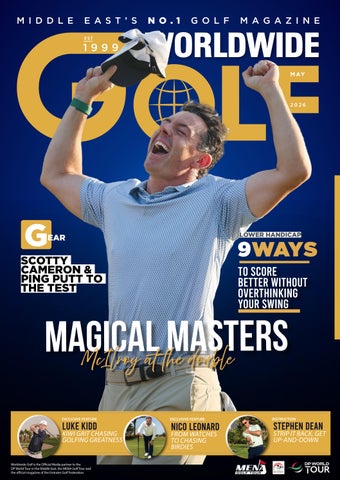
Worldwide Golf 2026 MAY DIGITAL

Page 1


MASTERS

300 issues

Still Swinging

Three hundred issues, wow! It’s a number that gives me pause for reflection – because the game we were writing about in November 1999 bears very little resemblance to the one we cover now.

Tiger Woods was 23 and about to redraw the map. The internet was barely a thing. Phones were bricks. And golf, whether it knew it or not, was on the cusp of its biggest 25 years. If you want a starting point for the modern era, the turn of the millennium does the job. Woods didn’t just win, he overwhelmed. The 2000 season wasn’t dominance, it was demolition. Three Majors, eight wins, and margins that felt almost unfair. Pebble Beach, St Andrews, Hoylake – he made iconic venues look ordinary, which is about as close to golfing blasphemy as it gets. And it didn’t stop there. The 2001 Masters made it four Majors in a row – the Tiger Slam – a benchmark that still feels out of reach, even in today’s power era.

But golf never stands still for long.

The early 2000s gave us rivalries and characters. Phil Mickelson finally getting his Major breakthrough at Augusta in 2004, a moment that felt like a release for a fanbase that had willed it into existence. Ernie Els gliding to wins with that syrupy swing. Vijay Singh quietly putting together one of the most underrated careers in the game.

Ryder Cup Battles

The Ryder Cup turned into something else entirely. No longer a polite exhibition but a full-blown sporting theatre. Brookline in 1999 set the tone, and what followed only raised the stakes. Europe found belief, America found resistance, and suddenly every two years felt like must-watch drama.

The late 2000s reminded us that even giants are human. Woods’ personal and physical struggles changed the narrative. Golf lost its invincible figure and, in doing so, became unpredictable again. The door opened, and through it walked a new generation.

Rory McIlroy arrived like a fresh breeze, then a hurricane. The 2011 US Open at Congressional was a statement. Power, freedom, and a swing that looked drawn rather than coached. He became the standard bearer for an era that blended athleticism with artistry.

Around him came a wave. Jordan Spieth, with the putting magic and the nerveless Major wins. Justin Thomas, bringing intensity and shot-making. Dustin Johnson, redefining power with a casual shrug. Golf had depth again, and unpredictability became the norm rather than the exception.

Then the game shifted again. Equipment evolved. Athletes got stronger, faster, more explosive. Distance debates filled clubhouses and governing bodies alike. Data crept in – not loudly, but persistently. Launch monitors, strokes gained, marginal gains. The margins got smaller. The players got better.

And then came one of the most fascinating chapters of all.

LIV Golf split the sport in a way few saw coming. Big names, big money, big questions. What is tradition worth? What does the future look like? The conversations moved beyond the fairways and into boardrooms. For better or worse, it forced golf to take a long look at itself.

Through all of it, the Majors remained the heartbeat. Augusta

still feels like a cathedral every April. The Open still tests patience and imagination like nothing else. The US Open still asks brutally simple questions. The PGA Championship continues to evolve with the modern game. The four anchors have held firm, even as the landscape around them has shifted.

And then, perhaps the moment that brought it all full circle. Woods again. Augusta. 2019. Older, battered, written off more times than anyone could count. Yet there he was, walking up the 18th with the world holding its breath. It wasn’t just a win. It was a reminder – of resilience, of belief, and of why sport matters in the first place.

The game has only kept evolving since. Young stars arrive earlier, hit it further, and seem unburdened by history. Global tours keep expanding, bringing new audiences and new stories into the fold.

Our backyard

Golf in the GCC in 1999 was a very different proposition. A handful of grass courses, a small but passionate playing community, and plenty of people happy to tell us we were mad for launching a golf magazine in a region with such a tiny audience. We took the punt anyway. More than a quarter of a century on, the GCC has gone from outlier to one of the most important hubs in the global game – Major champions playing here every season, world-class venues, the Rolex Series finale fortnight, a thriving grassroots scene, and a pipeline of homegrown talent that grows year on year.

We’ve been lucky. Lucky to ride that wave, and lucky to have had an inside-the-ropes view of it the entire way. The growth of golf in this region is one of the great sporting stories of the last quarter century, and we’ve been fortunate enough to tell a fair chunk of it.

Which brings us back to this number. Three hundred.

12 THE OFFICIAL PETE COWEN COLUMN

Course knowledge beats raw form at The Masters Tournament, as Rory McIlroy and Scottie Scheffler prove why experience still rules Augusta on Sunday.

14 MCILROY’S GRAND SLAM DREAM

Back to back Masters glory shows Rory McIlroy’s grit, resilience and clutch brilliance, setting up a genuine shot at golf’s most elusive prize, the calendar Grand Slam in 2026.

20 LUKE DONALD

Back to back wins put Luke Donald on the brink of Ryder Cup history, chasing a third title and greatest ever European captain status.

24 NICO LEONARD

From watches to wedges, raw honesty meets real ambition as a bold new voice takes on golf, chasing improvement with serious intent and competitive edge.

28 9 WAYS TO ACTUALLY LOWER YOUR HANDICAP

Simple tweaks, smarter decisions and scoring secrets that actually work, this is how to finally bring your numbers down and start seeing real progress.

52 KIWI ON THE RISE

Luke Kidd brings grit, humour and honesty to the grind, chasing his tour dream with resilience, raw talent and relentless work ethic.

Premium everyday healthcare...

A new standard in primary care

Healthcare should feel simple, seamless and reassuring. The Clinic has been designed to deliver exactly that.

Begin your care

Schedule a consultation

Primary care, elevated Designed around you

• Experienced family physicians

• Longer, unhurried consultations

• In clinic diagnostics

• Seamless multidisciplinary care

Comprehensive primary care

Proactive, personalised care for lifelong health

• Preventive health & screening

• Acute & chronic care

• Women’s, men’s & children’s health

• Lifestyle & metabolic optimisation

• Same-day access when needed

• Continuity with your doctor

• Care tailored to your lifestyle

• Calm, private environment

PING Scottsdale TEC putters blend standout alignment, stability and feel to boost confidence and hole more putts when it matters most.

32

This simple short game drill strips away noise, improves contact, builds confidence and keeps your mind clear around the greens.

adidas raises the bar with Ultimate365+ Short, blending comfort, stretch and innovation for distraction free performance from tee to green.

Alayna Rafique blends talent, resilience and ambition, building a fearless game from Dubai to the US college stage and beyond. 58

Scotty Cameron Phantom 2026 putters deliver softer feel, improved control and refined shaping to help golfers hole more putts with confidence. SOFT TOUCH PRECISION

39 PURE STRIKE SECRETS

Master clean iron contact by controlling low point, rotating through impact and finishing balanced for consistent strike, accuracy and distance gains.

42 GROUND FORCE POWER

adidas brings serious traction with the Adipower 26, delivering power, stability and comfort from the ground up.

62 CAPE TOWN GOLF ESCAPE

Cape Town delivers world class golf, stunning scenery, great food and wine, and courses that make every round feel like something special.

There are certain weeks in golf where form matters, and then there are weeks where knowledge trumps everything. The Masters Tournament sits firmly in that second category. You can arrive at Augusta National Golf Club flushing it on the range, but if you do not understand where to miss it and, more importantly, where not to, you are simply making up the numbers

That is why it was hardly a shock to see both Rory McIlroy and Scottie Scheffler right in the mix come Sunday. Past champions, both of them, and both with the kind of course intelligence that only comes from experience. Augusta is not a place you bluff your way around. It asks questions on every hole, and the answers are rarely obvious.

What did raise a few eyebrows was the way McIlroy went about it early in the week. He was nearly dead last in driving accuracy through the opening rounds and still leading the field. That does not happen often in professional golf. In fact, the only player behind him in that stat was 27 shots worse off. That tells you everything you need to know.

KNOWLEDGE

Now, there is no doubt Rory rode his luck through the trees at times. You do not miss that many fairways at Augusta without a few favourable bounces. But this is where course knowledge comes in. He knew exactly where he could afford to miss it. He understood the angles, the slopes, and the recovery shots. Most importantly, his short game looked as sharp as it ever has.

It actually reminded me of when Bubba Watson won here, spraying it all over the place but somehow always finding a way to get up and down or shape something ridiculous back onto the green. Augusta allows that if you know what you are doing. It rewards imagination, but only if it is backed up by experience.

Once you have that Green Jacket, something changes. The pressure lifts, of course, but more than that, you gain an understanding of the golf course that no practice round can give you. You know where the safe miss is on every hole. You know which pins

Major know-how remains the key to success

to attack and which ones to respect. That is the difference between contending and simply surviving.

It is quite something to think that what started as a garden party hosted by Bobby Jones back in 1934 has become arguably the finest spectator event in golf. The Masters has evolved without ever losing its identity. The patrons are treated like royalty, the facilities are second to none, and no expense is spared.

They have just built a 150 million dollar facility complete with a huge underground car park in less than four months. It is immaculate, yet it looks like it has been part of the property for decades. That is Augusta all over. Everything is done to perfection, but nothing ever feels over the top. The club generates enormous revenue, but they are not afraid to reinvest it to make the tournament even better. That is why it continues to set the standard.

BROOKS IS CLOSE

I was on site working with Brooks Koepka, and there were plenty of positives to take from his week. He is starting to look like his old self again. He finished tied 12th at five under, and that could easily have been better.

He dropped a shot on the 71st hole, which always leaves a sour taste, but the bigger issue was his putting from five to ten feet. He had 19 chances from that range and holed just seven. The PGA Tour average sits around 55 percent, so realistically he should have converted at least ten. Those three extra putts would have taken him to eight under, and who knows what a bit of momentum might have done from there.

Unlike Rory, when Brooks missed it into the trees, there was rarely a way out. That is the fine line at Augusta. One player sees a gap, another sees trouble. It is not just about execution, it is about perception. I am not saying he should have won, far from it. The Masters probably came a little early for him this season. But the signs are there. His ball striking is improving, and once the putter warms up, he will be right back in the mix at the biggest events.

Looking ahead to the US PGA Championship, you would expect the usual suspects to be involved again, including Matt Fitzpatrick. It has been great to see him back in the winner’s circle and pushing towards the top of the world rankings.

I have known Matt since his early days, grafting away on the range in Rotherham, and what stands out now is the belief he has regained, particularly with the putter. That is often the missing piece. At this level, everyone can hit it well enough. The difference is what you do on the greens.

That is what Augusta does. It exposes weaknesses, but it also rewards those who understand the game at its deepest level. This year was another reminder that power might grab the headlines, but knowledge still wins Green Jackets.

GOLF & STAY IN ABU DHABI

Golf with a Luxury Stay

Book two or more rounds and enjoy a complimentary stay at one of Abu Dhabi’s premier hotels.

3 Courses • 5 Hotels

YOUR ROUND

One-night stay for two adults and up to two children when booking two rounds, or two nights when booking three rounds, across Viya courses in Abu Dhabi.

McILROY Rory

Perseverance and resilience. Two characteristics that most of the greats possess. Talent and skill usually grab all the headlines but that underlying grit, the refusal to give up, the never knowing when they’re beaten, the ability to ride the punches and keep coming back. It’s something most of sport’s world-beaters have.

In football, Cristiano Ronaldo and Lionel Messi dazzle with their audacious ability week in, week out. They can score goals most mere mortals can only dream of. But look closer and you’ll find two of the thickest-skinned players in the game. True warriors who brush

off multiple fouls every match and keep going when the chips are down no matter what.

In boxing, Muhammad Ali had his world heavyweight title stripped from him, was banned from the sport for three years in his prime, and came back to reclaim it. Twice. When the world had written him off, he found another gear. The Rumble in the Jungle. The Thrilla in Manila. A man who fed off adversity and relished the challenge.

Rory McIlroy’s back-to-back Masters wins prove he possesses both key champions’ characteristics in abundance. First there was his refusal to let his head go down during 16 unsuccessful and often excruciatingly painful

attempts at winning a green jacket before finally securing one last year as he completed the hallowed career Grand Slam.

Then, as he went back-to-back at Augusta last month, the vaporising of a six-shot halfway lead – the largest 36-hole advantage in Masters history – would have seen many players shrivel and die under the glare of the spotlight and self-doubt. But he dug deep, refocussed and stayed the course to finish the job and become just the fourth player to successfully defend the Masters title, following Jack Nicklaus, Sir Nick Faldo and Tiger Woods.

“I’ve competed against him for a long time, and you don’t win the amount of tournaments

that he’s won out here without being pretty resilient,” Scheffler said of McIlroy. Those words carried extra significance. Because the man saying them was the World No.1. High praise from the highest possible source. Scheffler had endured a difficult start to the week before reeling off two bogeyfree rounds over the weekend. He closed to within one shot.

Saturday told the story of how it almost unravelled. McIlroy bogeyed the first, recovered with a birdie at three

and made the turn still two ahead. Then Amen Corner bit hard. A double bogey at the 11th, a bogey at the 12th – and just like that the record six-shot lead was gone, Cameron Young level at the top. McIlroy fought back with birdies at 14 and 15 to briefly retake control, only to bogey the 17th and finish the day tied with Young at 11-under. He had shot 73. Young had shot 65. Just like that, the tournament was wide open again. Sunday got worse before it got better. A double bogey at the fourth, a bogey at the sixth – two behind, two days of pressure bearing down. Most players

would have cracked. McIlroy didn’t.

After the bogey at six he set himself a target. Get to 14-under and he’d win. Birdies at seven and eight got him back to level for the day. Then came 12 and 13 – the same stretch that had swallowed him on Saturday – and this time he birdied both. Scheffler was coming. So was Justin Rose. So was Young. McIlroy held firm, finished at 13-under and won by one.

“Good things come to those who wait maybe,” he said afterwards. “Just keep going.”

This from the man who took seventeen years to win his first Masters, and who now had a second one on his back before the first had even gathered dust.

The short game won it when the rest of his game wobbled. McIlroy marked his own card afterwards with refreshing bluntness. Driver: B-minus. Irons: B. Short game and putting: A-plus. “That’s what won me the tournament this week,” he said.

The up-and-down on 16. The chip on 17. The tee shot on 12, where he stood on the tee and waited – just as Tom Watson had advised him in a practice round back in 2009 – until he felt where the wind should be coming from. Then he pulled the trigger. A 9-iron to the heart of the green. Birdie.

His parents were there to see it. They’d missed the Grand Slam win last year and Rory had flown straight home to County Down afterwards. This time he had them in the crowd.

“They thought the reason I won last year was because they weren’t here,” McIlroy smiled. “I said on the putting green that I’m

glad we proved that wrong.”

So what now? The question hanging over the rest of 2026 is one of the most compelling in Major Championship history. Can McIlroy complete the calendar-year Grand Slam? All four Majors in a single season?

It has never been done. Not in the modern era. Ben Hogan won three of the four in 1953 but didn’t play the PGA Championship. Tiger Woods held all four at once across 2000 and 2001 – the Tiger Slam – but never in the same calendar year. Nobody has ever won all four in one season.

Three Majors remain. The PGA Championship at Aronimink in May. The US Open at Shinnecock Hills in June – a course McIlroy has already conquered, winning his first Major there in 2011. And The Open at Royal Birkdale in July.

Birkdale is one of the sternest links tests on the rota. When the wind comes off the Irish Sea it separates players quickly and brutally. McIlroy knows links golf. He has the Claret Jug,

claimed just down the coast at Royal Liverpool. He knows how to manage his game across four days when the weather bites and the scoring dries up. Right now, you’d back him at Birkdale.

Two green jackets in a row. Six Majors in total. Level with Sir Nick Faldo on the alltime European list – and firmly in the conversation for the greatest European golfer of all time.

“It took me 10 years to win my fifth Major, and then my sixth one’s come pretty soon after it,” he said. “I’m not putting a number on it, but I certainly don’t want to stop here.”

Good things come to those who wait maybe.
“Just keep going.” “

It’s hard to believe McIlroy is still only 36. He’s playing the best golf of his life, and he’s hungry. The years of near-misses at Augusta, the heartbreaks, the questions about whether he’d ever get over the line there – all of it is behind him now.

With three Majors still up for grabs this year, you wouldn’t bet against him writing another chapter in one of the greatest stories golf has ever told.

It took me 10 years to win my fifth Major, and then my sixth one’s come pretty soon after it.
I’m not putting a number on it, but I certainly don’t want to stop here.”

THE GRAND SLAM RUN

PGA CHAMPIONSHIP  ARONIMINK GOLF CLUB, PENNSYLVANIA | 14–17 MAY

Aronimink hasn’t hosted the men’s PGA Championship since 1962, when Gary Player won the first of his nine Majors. A Donald Ross design, restored to its classic roots, with tight tree-lined fairways and fast, sloping greens. Length off the tee matters but so does precision – Rory has both in abundance. He’s a two-time PGA Champion already (2012, 2014) and arrives as the form player in the world. Scottie Scheffler will defend the title he won at Quail Hollow last year. Justin Thomas and Xander Schauffele will fancy their chances too. But this is a course that suits McIlroy’s game down to

US OPEN SHINNECOCK HILLS, NEW YORK | 18–21 JUNE

Where it all began. Rory won his first Major here in 2011 – an eight-shot demolition of the field that announced him as the real thing.

Shinnecock is a different beast to the course he conquered that week, but the memories and the comfort with the venue will count. The US Open rewards patience, control and short-game touch — three areas where McIlroy has never been sharper. Bryson DeChambeau, JJ Spaun and Scheffler will be front of mind for most punters, but don’t sleep on history repeating itself.

THE OPEN CHAMPIONSHIP ROYAL BIRKDALE, SOUTHPORT | 16–19 JULY

The ultimate test. Birkdale is one of the most demanding links courses on the Open rota – when the wind comes off the Irish Sea, the scoring dries up fast. McIlroy has lifted the Claret Jug before, at Royal Liverpool in 2014, and he knows exactly what it takes to win on British links. But he’ll need to manage the draw, the weather and a field that will include every links specialist on the planet. Tommy Fleetwood, Shane Lowry and defending champion Scottie Scheffler head a long list of threats.

QUIET FORCE The

After back to back wins, Luke Donald is taking the helm for a third time with the chance to cement his legacy as the greatest European Ryder Cup captain of all time.

He wasn’t supposed to be the captain at all. When Henrik Stenson was stripped of the role after joining LIV Golf ahead of the 2023 Ryder Cup, Luke Donald stepped in at short notice with barely six months to prepare. What followed was one of the most emphatic wins in European Ryder Cup history – a 16.5-11.5 thrashing of Zach Johnson’s American side at Marco Simone.

Then, two years later, came Bethpage Black. A hostile New York crowd. No European side had won on American soil since Medinah in 2012. A recordbreaking 11.5-4.5 lead going into Sunday, followed by a nerve-shredding collapse that threatened everything – before Donald’s side held on to win 15-13 and complete one of the great Ryder Cup doubles.

Jon Rahm hit the nail on the head after his singles match in New York. “Luke has set the bar for captaincy so extremely high,” the Spaniard said. “What he’s done these four years of being a part of, is absolutely astonishing. He has been so professional, so dedicated, so incredibly meticulous and well organised. He’s the leader of this ship and he’s definitely led us the right way.”

High praise. But Rahm wasn’t finished. “The only thing left to say from all of us,” he added, “is two more years.”

This isn’t tactical admiration. Players who have been through the mill at the very top of the game are queuing up for another go. That tells you everything.

Donald was never the loudest voice in the room during his playing career. A former World No.1. A precise, immaculate ball-striker. But he played in the shadows of bigger personalities. The irony is that captaincy brought out a side of him that few had seen on tour.

Justin Rose, one of the most experienced European Ryder Cup players of his generation, watched that transformation up close. “I think Luke has always been more on the introverted side throughout his career,” he said. “Very much focused on his own game,

quiet, going about his business. But Luke has really emerged as a leader over the last couple of years. He’s really invested in himself as a leader. He’s grown tremendously as a human. I’m blown away by the work ethic that he’s given this captaincy cycle, both of them.”

Then Rose added a line that summed up the entire philosophy. “There’s probably a million decisions Luke has had to make to give us no decision. That’s ultimately what the job of being a captain is.”

That clarity – taking chaos off the table for the players – is a hallmark of Donald’s approach. He

He shepherded us through this process and he’s been absolutely amazing. A lot of the credit has to go down to him. Eleven of the 12 players from Rome came back.” “

brought five vice-captains to Bethpage, leaning particularly hard on Edoardo Molinari as a data analyst finding marginal gains wherever they existed. Pairing fiery Viktor Hovland with the quietly assured Robert MacIntyre. Allowing Jon Rahm to bring the best out of Sepp Straka. Dressing the team in shirts that deliberately echoed the strips worn during each of Europe’s four previous away victories: 1987, 1995, 2004, and 2012. Nothing was left to chance – because Donald had spent two years making sure there was nothing left to chance.

When the European team arrived at their hotel ahead of the Bethpage matches, they found the beds

fitted with better sheets, the bathrooms stocked with premium shampoo. Slivers of light leaking past hotel room doors were taped over to help players sleep. These sound like small things. Donald would argue that’s precisely the point.

“Le Labo, if anyone is wondering,” joked Rory McIlroy when the shampoo choice came up in a post-match press conference. “It’s really, really nice.”

McIlroy’s tone said it all. When the best players in the world are cracking jokes about shampoo in a post-Ryder Cup press conference, you know the environment was spot on. They felt looked after. The details had done their job.

“We got so lucky in getting an incredible leader in Luke Donald,” McIlroy said. “He shepherded us through this process and he’s been absolutely amazing. A lot of the credit has to go down to him. Eleven of the 12 players from Rome came back.”

That continuity – 11 players retained for a second campaign together – was unprecedented in European Ryder Cup history. Donald saw it as a foundation to build on rather than a reason to relax. His pretournament scouting trips to both venues, the first European captain ever to insist on them, became standard preparation. The team dinners, the bonding time in Manhattan ahead of Bethpage, the shared experiences built over two years – all of it fed into what played out on the course.

Sunday at Bethpage was not comfortable. Europe’s record-breaking lead began to erode almost immediately. The home crowd turned the screw. Viktor Hovland had aggravated a neck injury and was unable to play, his match halved under the envelope rule. Europe won just one of the remaining singles, drew four, and lost six. A lead that looked impregnable at breakfast was suddenly very much in question.

This is where captaincy shows its true character. Not in the preparation, not in the Friday and Saturday sessions when everything is going right, but in the

Sunday afternoon when the walls are closing in. Donald never wavered. He remained cool, calm and collected, as if there was no scenario for which he had not prepared.

EUROPE HELD ON TO WIN 15-13.

Donald’s American counterpart knew exactly what he was dealing with. “I was going up against an incredible team,” said US captain Keegan Bradley. “In my eyes, I think he’s the best European Ryder Cup captain of all time, Luke Donald. He won home and away. He won a Ryder Cup in New York at Bethpage. He’s really quiet, and I think he was able to come out of his shell a little in these Ryder Cup years. I think he turned this European team into a really unstoppable force. He put his team in the best position to win, and to do that at these two places is a remarkable feat.”

When the opposing captain is handing out that level of praise in his post-match press conference, you know you’ve witnessed something special.

Donald’s first instinct after Bethpage was that his job might be done. He said as much publicly. But the players had other ideas. Tommy Fleetwood, who went 4-1 at Bethpage and has been one of Donald’s most consistent performers across both campaigns, was relentless in his lobbying. “Tommy has been pretty incessant,” Donald admitted with a smile. “Even before we won in New York, he was saying: don’t worry gaffer – he likes to call me gaffer – you’ll do it a third time.”

“I think the ball is probably in Luke’s court,” said Fleetwood. “I think he’s earned that.” He was not alone. McIlroy and Shane Lowry both made their feelings known over glasses of wine in the weeks that followed.

In March 2026, it was confirmed: Donald would lead Europe at Adare Manor in Ireland in 2027, the Ryder Cup centenary edition. He would become the first three-time European captain since Bernard Gallacher, and have the opportunity to become the first captain in history to win three consecutive Ryder Cups.

“I didn’t imagine this third time would come,” Donald said at the announcement. “Celebrating on that Sunday night in New York after a

What he’s done these four years of being a part of, is absolutely astonishing. He has been so professional, so dedicated, so incredibly meticulous and well organised. He’s the leader of this ship and he’s definitely led us the right way.”

pressure-packed week in a tough environment, I thought maybe my job was done. But maybe there is a little more story to tell.”

“History is important to me,” he added. “As a team, as Ryder Cup Europe, we all play for history. We talk about it a lot – about the guys who paved the way for us and the responsibility we have to inspire next generations. But I don’t think I have ever thought about history through a personal lens. I just try to enjoy the journey and the day-to-day work to create an environment that gives the players the opportunity for success.”

Future European captains will study what Donald has built. The scouting trips. The analytics. The squad continuity. The environment. The thousand small decisions that mean the players never have to make decisions. The shampoo.

But what they will struggle to replicate is bond between Donald and his players. Rahm. McIlroy. Fleetwood. Rose. These are players who have won Majors, held World No.1 rankings, competed under every conceivable pressure. And they speak about Donald not with the measured respect you’d give a capable employer, but with the warmth of someone they genuinely want to follow.

“The level of professionalism he’s shown us,” Rahm said, “his attention to detail in his role and his knowledge of the Ryder Cup and the game and what we do on the golf course day in and day out – that is what made these last two Ryder Cups possible. He is the captain of this ship, and he’s led us better than I can see anybody leading us. He set the bar extremely high for future captains.”

Adare Manor in 2027 brings Europe back onto home turf. A Ryder Cup on Irish soil, surrounded by fans who have waited a long time to see the blue and gold lift the trophy on this side of the Atlantic again. Donald will have a hand in shaping every element of what that week looks like. And if the last four years are anything to go by, the players will arrive focused, connected, and ready.

The quiet man is making quite a lot of noise.

LEONARD

LEONARD

Photography: Alex Leyno

If you have spent any time on YouTube in the last few years, you will know Nico Leonard. Loud, honest and unapologetically direct, he has built a global following by dragging the luxury watch world out of its velvet ropes and into the real world. A high end dealer with serious credibility and a digital presence to match, Nico is now turning that same energy toward golf. And this is not a casual dabble. After shedding serious weight and rediscovering his competitive edge, he is

chasing improvement with the same obsession that built his brand. We caught up with him at Trump International Golf Club Dubai to talk discipline, pressure and why golf might just be the hardest game of them all.

Q: You are known for watches, but where does golf fit into your life right now?

As a former professional athlete, I played football when I was younger, but injuries cut that short. Golf has given me that discipline back. That feeling of preparing, competing,

pushing yourself.

I have lost about 30 kilos this year and I am taking golf very seriously. It is a passion because you can only excel at things you truly love. I want to see how far I can go with it.

Golf is also a mindset. If you can succeed in golf, you can succeed in anything. It is one of the hardest things I have ever done.

Q: A lot of people see golf and luxury watches living in the same world. What connects the two?

Historically, golf was an elite sport, but it is becoming more accessible now, which is great.

The connection comes from lifestyle. People who play golf often have created time and freedom in their lives. When you reach that stage, you start appreciating cars, watches and the finer things.

Golf fits perfectly into that world.

Q: Golf has a reputation for tradition and exclusivity. What is your take on how it presents itself today?

Look at Bryson DeChambeau. He is not traditional at all, and he has made golf more accessible than almost anyone through YouTube and his approach. That is something I have tried to do in watches. It was seen as boring and exclusive. I wanted to make it understandable and open.

Golf needs more of that.

Q: If you looked at golf the same way you critique watches, what would you say the sport gets wrong?

I am not an expert in golf yet, so I would not pretend to be. Give me a few years.

But I like change. The introduction of LIV shook things up, and that is good. People are naturally afraid of change, but it pushes the sport forward.

Q: What does golf get right that keeps people hooked for life?

The connection comes from lifestyle. People who play golf often have created time and freedom in their lives. When you reach that stage, you start appreciating cars, watches and the finer things”.

It is the ultimate one on one challenge, but against yourself.

You are constantly battling your own mind. One bad hole, how do you respond?

There is no sport that demands more accountability. That is what makes it addictive.

Q: If you were to design the perfect golf watch, what would matter?

We are launching one with Good Good later this year, and the next version will be even better.

It is about making it fun but functional. A chronograph with a nine minute counter, something that actually connects with how golfers think and play.

The perfect golf watch does not exist yet. I am going to make it.

Q: Match a watch brand to a top golfer. Bryson and Richard Mille are the perfect match.

Both are about innovation, pushing boundaries and doing things differently.

Q: Do you see similarities between golf mentality and building a business? Absolutely.

If you can control your emotions on a golf course under pressure, running a business becomes easy. Golf is far more difficult mentally.

Q: How often does golf come up in conversations with your clients?

All the time. Yesterday I played with one of the biggest collectors in the UAE. Golf is deeply connected to that lifestyle.

Q: Is golf doing enough to stay relevant with the next generation? Not yet.

If you compare it to football, the numbers on YouTube are tiny. There is massive potential for growth. Golf is still early in that space. That is where I want to be involved.

Q: If you created golf content, what angle would you take? Authenticity.

I am just myself. People give you their time, and that is the most valuable thing they have. They deserve honesty.

My golf journey is intense. It is not easy. Showing that struggle is what will connect.

Q: How has Trump International Golf Club Dubai contributed to your development? The facilities are unbelievable. The range, short game area, bunkers and even night golf, it is all top level.

The people and my coach Alex Riggs have been huge. We train every day. I am very grateful for that environment.

Q: If Rory McIlroy walked into your store, what would you put on his wrist?

I would take the Omega off his wrist straight away. He is one of the greatest ever. He should be wearing something far more special.

Q: Favourite golf courses?

Ardglass and Royal County Down Golf Club.

Q: Favourite golfer right now? Bryson DeChambeau. And Anthony Kim.

Q: One golfer whose personality fits your brand?

Ian Poulter. He is just himself.

Q: Best golf moment you have watched or experienced?

Watching Shane Lowry win The Open. I was there. The emotion and atmosphere were unbelievable.

Q: Your dream fourball?

Cristiano Ronaldo, Jimmy Carr and Bryson DeChambeau.

Q: Most overrated thing in golf? Mulligans. It is a lack of accountability.

by Alex Gallemore

Lowering your handicap is the great obsession of every golfer who has ever walked past a mirror and thought, “there’s a player in there somewhere.” The good news? You don’t need a swing rebuild, a £600 driver or a sports

psychologist on speed dial. The bad news? You do need a plan. Here are nine proven ways to bring your scores down – the kind that actually move the needle, not just make you feel busy on the range.

4. Stop Trying to Hit Hero Shots

2. Build a Go-To Shot Under Pressure

You don’t need every shot. You need one shot you trust when it matters.

Whether it’s a little fade with the driver or a stock 7 iron that never misses left, your “default” shot becomes your safety net. Under pressure, your swing will never be at its best, so having a reliable pattern is everything.

Tour players don’t hit it perfectly. They just know where the miss is.

1. Get Honest About Your Game

Before you fix anything, you need to know what’s actually broken.

Too many golfers think they’re losing shots off the tee when in reality they’re bleeding strokes from 80 yards and in. Track your rounds properly. Fairways hit, greens in regulation, up and downs, putts per round. The numbers don’t lie.

If you’re serious, use an app or even just a notebook. Within three rounds, patterns emerge. That’s your roadmap.

3. Master 100 Yards and In

If you want a fast track to a lower handicap, this is it.

The average club golfer loses most shots inside wedge range. Poor contact, distance control that’s guesswork, and zero structure to practice. Meanwhile, better players are licking their lips from 100 yards.

Every golfer has one. The “I can get there” moment from the trees. It usually ends with a reload.

Smart golf is boring golf. Chip out. Take your medicine. Leave yourself a number you like.

The quickest way to drop your handicap is to eliminate doubles. Not by making more birdies, but by making fewer bad decisions. Ask yourself one simple question before every risky shot: what’s the worst that can happen? If the answer is “big number”, put the ego away.

Create a system. Know your carry distances for half, three quarter and full wedges. Practise landing zones, not just hitting balls. Turn 100 yards into a scoring opportunity, not a survival exercise.

5. Improve Your Strike, Not Your Swing

There’s a difference.

You don’t need to look like Adam Scott to play good golf. You need to strike the ball well. That means centre face contact and consistent low point control.

Simple drills work. Place a tee just in front of the ball and strike through it. Or use foot spray on the clubface to monitor contact.

Better strike equals better distance, tighter dispersion, and fewer disasters. It’s not glamorous, but it works.

8. Create a Proper Practice Structure

Turning up and hitting balls is not practice. It’s exercise.

Split your sessions into blocks:

● Technical work (10–15 minutes)

● Skill work (targets, shaping shots, distance control)

● Pressure games (can you hit five in a row, can you get up and down three times out of five?)

Finish with something competitive. One ball. One target. Just like the course. If your practice doesn’t resemble play, don’t expect your scores to change.

6. Learn to Putt Like You Mean It

Putting is where handicaps go to die.

Most golfers practise putting by rolling a few balls aimlessly before a round. Then they wonder why they miss everything outside six feet.

Break it down into three areas:

● Start line (can you roll it where you’re aiming?)

● Pace (can you get it past the hole consistently?)

● Short putts (are you automatic inside five feet?)

Spend real time here. If you hole out properly from inside six feet and eliminate three putts, your handicap will drop faster than anywhere else.

7. Play the Right Tees (Yes, Really) This one hurts the ego, but it’s nonnegotiable.

If you’re hitting hybrid into every par four, you’re playing the wrong course. Golf should be played with a mix of clubs into greens, not a survival test.

Moving forward a tee doesn’t make you less of a golfer. It gives you more scoring chances, builds confidence, and actually reflects how the course was designed to be played.

Even the best players in the world don’t make it harder than it needs to be.

IT’S ABOUT SCORING, NOT SWINGING

Lowering your handicap isn’t about chasing perfection. It’s about stacking small wins.

Fewer doubles. Better wedge play. Smarter decisions. Cleaner contact. Suddenly that 12 becomes a 9. That 9 becomes a 6. And you start to see the

player you always thought was in there. Because here’s the truth: most golfers are closer than they think. They’re just focusing on the wrong things.

Sort the basics, commit to a plan, and keep a bit of banter about it along the way. After all, if you can’t enjoy the ride, what’s the point?

9. Manage Your Mind, Not Just Your Swing Golf is played between the ears more than anywhere else. Bad shots will happen. The difference is how long they stay with you. The best players reset quickly. No drama, no overthinking, just the next shot.

Build a routine. Same process before every shot. Same reaction after. Control what you can control.

And remember this: you don’t need your best golf to score. You need your average golf to be better.

INSTRUCTION

CHIPPING DRILL!

TRAIL HAND ONLY

DRILL! CHIPPING

This is one of my favorite short game drills and simplifies the basic chip shot. In the modern era of golf instruction there’s a great deal of discussion regards short game technique but this easy to follow drill helps us develop a solid contact and keeps the mind clear.

PHASE 1

Place your trail hand on the club with your lead hand on your trail shoulder

PHASE 2

Let your body coil as your trail arm stays passive and wide. You may feel a slight hinge in the trail wrist.

PHASE 3

Uncoil your body through the ball whilst maintaining the width in the trail arm.

BENEFITS

You’ll be encouraged to control the pattern with body rather than letting the hands, wrists and arms get overly involved.

You’ll start to create a consistent controlled tempo as the body does the work.

Distance control, contact and spin will become predictable and allow you to visualise landing spots and outcome whilst on the course

If you become efficient with one hand, you’ll be incredibly effective with two :)

Stephen is an ambassador for Viya and coaches at they’re wonderful array of facilities whilst in Dubai. Stephen also spends a proportion of his time developing Professionals, Amateurs and VIPs Internationally.

BRING OUT THE PLAYER IN YOU.Ahigh-launching, players-styledesignthatcombinesshot-makingprecisionwith score-savingforgiveness.Engineeredforthebestplayersin theworld.Customfitandcustombuiltforyou.

DISTANCE & CONTROL

LowerCGforincreased ballspeedandhigher launch.

PLAYER PREFERRED

Sizedandshaped fortrajectory control.

Game-improvement forgiveness;softerfeel, pleasingsound.

FORGIVENESS WITH FEEL GET FIT. GET OPTIMISED.

Dubai-based Suited & Booted is redefining modern luxury menswear for the athlete off the field.

Blending precision tailoring with a contemporary edge, the brand has become a trusted name among elite sports figures across golf, football, boxing and beyond

Favoured by high-profile personalities, Suited & Booted crafts sharp, made-to-measure pieces designed for every moment beyond competition - from public appearances to exclusive events.

With partnerships spanning the ICONS Series and leading golf clubs across the UAE, the brand sits confidently at the intersection of sport and style.

From Setup to Strike: How to Hit Your Irons Cleanly

In my previous article, we looked at how a great iron shot starts with a solid setup. Once those fundamentals are in place, the next step is understanding how to deliver the club correctly into the ball. Clean iron contact isn’t about swinging harder; it’s about controlling three key movements through impact.

1. Control the Low Point

(Picture 1)

The biggest difference between good iron players and inconsistent ones is where the club strikes the ground.

With irons, the lowest point of your swing should be after the ball, not before it. This allows the club to strike the ball first, and then take a small divot.

If your setup has your weight slightly favouring your lead side, your body is already positioned to help control this low point. (Picture 2)

2. Keep Your Body Rotating

(Picture 4, 5, 6 & 7)

A common fault with iron shots is trying to “help” the ball into the air by flicking the wrists. This causes thin shots and a

3.

loss of control.

Instead, focus on rotating your chest and hips through the ball. When the body keeps

Maintain Shaft Lean Through

Good iron shots look the same at impact, hands ahead, clubface square, weight moving towards the target. You don’t need to force this position. If your setup is correct and

turning, the hands naturally stay ahead of the clubhead, creating compression and a more penetrating ball flight.

Impact

your body continues rotating, shaft lean happens naturally.

A helpful feel is that your lead wrist stays flat as the club moves through impact.

(Picture 3) 3 7 6 5 4

4. Finish Your Swing Balanced

Your finish is a great checkpoint. A balanced finish with your weight fully on your lead foot tells you the club has been delivered correctly. If you’re falling backwards or struggling to hold your finish, it’s often a sign that your weight stayed behind the ball too long.

Great iron play is built from the ground up. A strong setup puts you in position, and simple movement patterns deliver the club consistently.

Focus on strike, not speed and your distance and accuracy will improve together.

BIG UPGRADE SHORT STORY,

Adidas has spent a decade defining what golfers wear from the waist down. Now, with the new Ultimate365+ Short, it’s raised the bar again.

Ten years ago, adidas changed the way golfers thought about shorts. They made them a staple. They made them cool. They made them something you actually wanted to wear, not something you settled for when the temperature climbed.

Now they’ve done it again. Enter the Ultimate365+ Short –arguably the brand’s most technical bottom to date, and the product of more than 50 iterations, countless hours of testing and a refusal to rest on a decade’s worth of laurels. Three headline upgrades sit at the heart of it: a new 360GRIP waistband powered by the world’s first ultra-fine polyester nanofiber, a lightweight TWISTWEAVE fabric that moves with every swing, and an updated regular relaxed fit built for distraction-free golf from tee to green. Put simply – the industry caught up, and adidas hit the accelerator.

“10 years ago we introduced the Ultimate Short and it completely changed the mindset of what golfers

thought was possible to wear on the course,” said Shaun Madigan, Global Apparel Director at adidas Golf. “Now that the industry has caught up to us, we felt it was time to put our foot down on the pedal.”

Available now in men’s and women’s ranges – including a new pull-on version – at adidas.com, on the adidas app and at select retailers worldwide.

POWER FROM THE GROUND UP

SCOTTY CAMERON PHANTOM 2026 PUTTERS REVIEW

SOFT HANDS, SHARP LOOKS AND A BIT MORE HELP WHERE IT ACTUALLY MATTERS

For 2026, this is not a dramatic overhaul. There are no wild claims or space age nonsense. Instead, it is a series of subtle upgrades that, if we are

honest, are far more interesting. This is about feel, control and giving golfers options that actually make sense.

And after spending time with the new Phantom 5, 7 and 9R, it is clear this line has been built with one thing in mind. Helping you hole a few more without overthinking it.

FIRST LOOK: FAMILIAR BUT SHARPER

At first glance, you might think not much has changed. That is kind of the point.

The Phantom still looks like a Phantom. Clean lines, modern mallet shapes and that premium Scotty Cameron finish that always

looks good when you pull it from the bag. But once you set it down behind the ball, the tweaks start to show.

The face is slightly deeper. The topline has a softer, more rounded look. The sole sits flatter on the ground, which might not sound exciting, but makes a big difference on uneven greens.

It is all very subtle, but it adds up. You get the feeling this has been shaped by players who actually use it for a living rather than a design team chasing headlines.

FEEL: THE REAL STORY HERE

The big talking point is the new Studio

Carbon Steel insert with chain link face milling. Sounds technical. On the course, it simply feels better.

Impact is softer than previous Phantom models. Not dull, not muted, just a more controlled, quieter strike. The kind that makes you feel like you do not have to jab at the ball to get it moving.

On short putts, it feels incredibly stable. You know exactly where the ball is coming off the face. On longer putts, where things can get a bit nervy, the softer feel helps you keep a smoother stroke.

ROLL AND DISTANCE CONTROL

Across different green speeds, the consistency is impressive. There is a real sense that good putts stay good, and poor ones are not punished quite as badly.

The ball gets rolling quickly, but without that jumpy feeling some milled faces can produce. It is a more measured roll, which makes judging pace easier.

OPTIONS: FINALLY SOMETHING FOR EVERY STROKE

There are multiple neck and shaft options across the range, which means you are far more likely to find something that suits your stroke rather than adapting your stroke to the putter.

If you like a straight back and through motion, the new Onset Center version of the Phantom 5 is worth a look. It feels very stable and keeps the face square through impact.

ON THE COURSE

If you are already a good putter, this will feel like a refinement. A bit more control, a bit more confidence.

If you are an average putter, the forgiveness, alignment and softer feel all combine to make putting feel a little less stressful.

PROS

Soft, controlled feel

Excellent distance control

Strong alignment

Wide fitting options

Premium look

CONS

Not a huge leap from previous models

Mallet shape not for everyone

Premium pricing

PINg SCOTTSDALE TEC PUTTERS

QUIET EYE MEETS MODERN MALLET PERFORMANCE

There is a moment every golfer knows all too well. You stand over a six footer thinking this is never missing. Then the eyes start wandering. Ball. Line. Hole. Back again. Suddenly the stroke feels like you are guessing rather than rolling it.

PING reckons it has found a way to calm all of that down with the new Scottsdale TEC range. Big claim. But after spending time with these, there is something going on here that feels a little different to the usual new release noise.

These need to do more than just look good in the bag. They need to hole putts.

FIRST LOOK

Let’s not dance around it. These putters are white. Proper white. The kind that stands out

from across the green.

It is a bold move but a clever one. Put it down behind the ball and everything sharpens up. The contrast is excellent and the alignment features jump straight into view. No squinting. No second guessing.

Shape wise it is classic PING mallet territory. The Ketsch is back and still looks like it means business. The Ally Blue is a little more compact for those who are not ready to go full spaceship. The Hayden sits nicely in the middle.

And here is the key point. No blades. Not even a token one. This is PING saying if you want forgiveness and consistency then this is the lane.

EYE Q ALIGNMENT

This is where PING has gone a bit deeper than

the usual alignment line story.

Eye Q is built around something called Quiet Eye. It sounds like a meditation app but it is actually used in elite sport. The idea is simple. The best performers keep their eyes still and focused for longer before they make a movement.

PING tested this properly using eye tracking glasses. Yes really. Golfers rolled putts while their eye movement was measured. The takeaway was clear. Certain alignment designs helped players settle and hold their focus for longer.

So what you get here is a dot and line combination that just seems to calm things down. You are not fighting the putter. You are not overthinking it. You just set it down and roll it.

It is one of those rare bits of tech that does not feel like tech. It just works.

ONSET DESIGN

Now for something that looks a bit different.

The onset models shift the shaft closer to the middle of the head. It gives you a really clean look at the ball with nothing getting in the way.

At first glance it feels slightly unusual. Give it five minutes and it starts to make sense. The face looks square. The ball sits perfectly framed. You stop worrying about where it is aimed.

It is no surprise that players have started putting it in play. When something makes alignment easier under pressure it tends to stick around.

FORGIVENESS AND STABILITY

This is where PING does what PING always does. Build something that is very hard to mess up.

The weight is pushed low and wide. The head feels planted through the stroke. Miss it slightly out of the middle and it still rolls out on a decent line.

On longer putts this is where it really earns its keep. You do not have to be perfect to get the ball somewhere near the hole. And that takes pressure off the whole game.

There are plenty of mallets on the market claiming this. Few feel quite this stable without becoming clunky.

CENTRE OF GRAVITY

PING has always been big on this and it still matters.

The centre of gravity sits behind the shaft which helps the putter move through the stroke in a more natural way. Less wobble. Less manipulation. More of a simple rocking motion.

You are not thinking about it while you putt but it is one of those details that adds up over a round.

FEEL AND RESPONSE

The insert is soft but not sleepy. That is the best way to describe it.

You get a nice little click off the face with enough feedback to know what you have done. Distance control feels predictable which is half the battle once you get past ten feet.

It is not overly firm and it is not marshmallow soft. It sits right in the middle which will suit most players.

PERFORMANCE

This is where it all comes together.

The biggest win is how easy it is to start the ball on line. That sounds obvious but plenty of putters do not make it easy.

Short putts feel more committed. You are not hanging back or steering it. Mid range putts hold their line nicely. Lag putting becomes less of a lottery.

There is also something to be said for how consistently you set up. The visuals do a lot of the work for you. That alone can save a few shots over the course of a round.

WHO IT SUITS

Pretty much everyone apart from the die hard blade loyalists who refuse to move on.

If you struggle with alignment this will help. If you want more forgiveness this will help. If you are thinking about switching to a mallet but do not want something that looks too big there are options here.

Even better players will find plenty to like especially when the pressure is on and you just want something that behaves.

VERDICT

PING has not tried to reinvent putting. It has just made it a bit easier.

The Scottsdale TEC range brings together strong visuals, serious stability and a feel that works across the board. More importantly it gives you a bit more confidence standing over the ball. And let’s be honest that is what most of us are really buying.

If it turns a few of those nervy six footers into tap ins it is doing its job.

PROS

Outstanding alignment that genuinely helps you settle over the ball

Very stable through impact with excellent forgiveness on off centre strikes

Clean visual contrast makes aiming simple in all light conditions

Balanced feel that suits a wide range of players

Onset models offer a fresh and effective look at address

CONS

White finish will not suit traditionalists

Mallet only line limits choice for blade loyalists

Onset design may take time to get used to for some players

Larger head shapes will not appeal to everyone

THE KIWI GRINDING HIS WAY TO SOMEWHERE SPECIAL Luke Kidd

For Luke Kidd, there is no gentle introduction to professional golf. The MENA Golf Tour has been his proving ground, his first tour and a proper eye opener into what it takes to survive out here. It is tough, it is relentless and it is exactly where his journey begins, shaped by family roots and driven by something much bigger.

Photography: Alex Leyno

BORN INTO IT

Some players discover golf. Others are dropped straight into it. Luke Kidd was firmly in the second category. Growing up in New Zealand, golf was everywhere. Mum, dad, uncles, aunties and siblings all played, which meant the game was never far away.

As a kid, the choice was simple. Head to his nana’s house or head to the golf course. He chose golf, happily being pushed around in a trolley by his dad, soaking in everything the game had to offer before he even realised what it meant.

What kept him there was not just family influence, but the nature of the sport itself. Golf offered something different. No teammates, no hiding place, no excuses.

“There’s no one else to blame,” Kidd says. “If you play badly, it’s on you. If you play well, it’s on you. That’s what I love about it.”

That sense of accountability quickly became

addictive. Golf was not just a sport, it was a mirror. Every mistake, every success, every moment of pressure reflected something deeper.

THE DECISION

Like most young athletes in New Zealand, Kidd played everything. Rugby was a natural path. Cricket, tennis and even fighting all featured along the way. Talent was not limited to one sport.

Reality arrived at sixteen. Supporting multiple sports was no longer viable, and a decision had to be made.

“We sat down as a family and had to pick one,” he says. “We couldn’t keep doing all of them.”

Golf stood out. Not just because of ability, but because of the life it offered. Less physical risk, more opportunity to travel, and exposure to different cultures.

“The travel side really got me. Being able to see

JUST BEING THERE TOGETHER, HAVING HIM “

age of sixteen or seventeen provided the confirmation he needed.

“It gave me confidence. Probably boosted the ego a little bit as well,” he laughs.

Competing at that level, surrounded by strong players, reinforced a growing belief.

“I always felt like I could do it. That’s when I really committed to becoming a professional.”

He got one.

“He just said, come over to Marbella.”

That single message changed everything.

LEARNING FROM CAMBO

Working alongside a US Open champion offers insight few young professionals ever receive. Campbell’s influence extends far beyond swing mechanics.

“It’s all about the small things. The one percenters,” Kidd explains.

Daily routines, mental discipline and unwavering commitment form the foundation.

“Have a process and stick to it every single day. That’s the biggest thing I’ve taken from him.”

There are lighter moments too, including unique views on nutrition that reflect the depth of thinking at the highest level.

More importantly, the exposure to

stories from the top of the game has been transformative.

“You realise everyone is human. That makes you believe you can do it as well.”

THE MARBELLA ROUTINE

Life in Spain is structured and relentless. Early mornings start in the gym before transitioning into long practice sessions.

Hours are spent on the range, refining technique, followed by on course work in the afternoon.

“It’s pretty much six days a week. There’s not much time off.”

The environment plays a key role. Tight courses demand precision, while consistent weather allows uninterrupted development.

“It’s shaped my game in a really good way.”

THE REALITY OF PROFESSIONAL GOLF

The transition from amateur to professional golf is often misunderstood. While the standard of play increases, it is the off course demands that hit hardest.

“Everything is on you now,” Kidd says. “Travel, expenses, everything.”

Without strong financial backing, managing costs becomes a constant consideration.

Travel brings its own lessons, from navigating unfamiliar cultures to dealing with logistical issues.

“You learn quickly. You have to.”

The experience has accelerated his growth, both as a player and as a person.

LEFT HANDED CHALLENGES

Being left handed adds another layer of complexity.

Equipment options are limited, and even basic items can be difficult to source.

“My parents tried to get me to play right handed because it was cheaper,” Kidd says.

A coach intervened, recognising his natural swing.

“He told them you can’t change it.”

The decision has paid off, even if it occasionally makes life more difficult.

“I think left handed swings look better anyway,” he adds with a grin.

INJURY AND REFLECTION

Just as momentum was building, injury forced Kidd to step away from competition. Withdrawals

from early season events were a major frustration.

“My game was in a really good place, so it was tough.”

Time away from the course provided an unexpected opportunity to reflect.

“When golf is everything and you can’t play, you realise you need balance.”

Focus has shifted towards recovery, smarter practice and maintaining both physical and mental health.

“You can’t just grind all day. It’s not sustainable.”

LOOKING AHEAD

Short term goals are centred around returning to full fitness and competing strongly on the

Tartan Tour.

“Top five on the Order of Merit would be ideal.”

Beyond results, the emphasis remains on learning and development.

“This is my first full year as a pro. I want to understand my game and myself better.”

Long term ambitions are clear. The PGA Tour remains the ultimate destination.

Motivation, however, runs deeper than trophies or earnings.

“I want to be in a position where I can help people, especially with mental health.”

Family remains at the core of everything.

“They’ve given me everything. I want to give back.”

“IF YOU PLAY BADLY, IT’S ON YOU. IF YOU PLAY WELL, IT’S ON YOU. THAT’S WHAT I LOVE ABOUT IT.” “

reminder of home.

Alternative career: race car driver.

THE FINAL WORD

QUICKFIRE

Favourite course: Tara Iti. Dream course: Wolf Creek. Dream four ball: Tupac, Michael Jordan, Theo Von and Cillian Murphy.

First purchase after a Major win: a house for his parents, possibly followed by a Rolex or a supercar. Go to club under pressure: driver. Worst habit: forgetting to eat or drink during a round.

One constant in the bag: a New Zealand coin, a

Luke Kidd is not polished and he is not trying to be. What he offers is authenticity, work ethic and a willingness to embrace every part of the journey.

In a sport that demands resilience and patience, those qualities matter. The path ahead is long, but the foundations are firmly in place.

He understands the grind, accepts the challenges and continues to move forward. That alone makes him a player worth watching.

The vision is simple yet powerful. One day, standing on the first tee at Augusta National with his parents watching.
ALAYNA RAFIQUE
Photography: Alex Leyno

RAFIQUE ALAYNA

BUILT DIFFERENT, SWINGING FOR MORE

From teeing it up with Rory in Dubai to a US college scholarship, Alayna Rafique is quietly building a game, and a mindset, ready for the next level.

There is something refreshing about a young player who does not just talk about potential but quietly starts stacking results, learning fast and thinking like a professional long before the card says she is one.

Alayna Rafique sits firmly in that category. A product of Dubai’s ever evolving golf scene, she blends modern opportunity with old school competitiveness, sharpened by family rivalry and refined through international competition.

From trading tennis rackets for golf clubs to earning a full ride to Seattle University, her journey already carries the hallmarks of someone who understands both the grind and the bigger picture. Spend five minutes talking to her and one thing becomes clear. She is not here to make up the numbers. She is here to get better, win and, quietly, change perceptions along the way.

FROM TENNIS TO TOUR DREAMS

Like many young athletes, Rafique did not start out in golf. Tennis was the original plan, the first sporting ambition. Golf, however, has a habit of pulling you in, especially when there is a bit of sibling rivalry involved.

“My older brother was the first to take up golf, and I always wanted to do everything he

did,” she says. “When we moved from England to Dubai, I stopped playing tennis and joined him in golf instead. A coach noticed my swing, and the confidence from that, combined with my drive to beat my brother, gave me the motivation to keep going.”

That early shift turned out to be defining. Dubai offered something very different to the traditional pathway, and Rafique took full advantage. Year round golf, elite facilities and increasing access to high level competition have all shaped her development.

“The facilities here are second to none. Being able to play all year round and having access to so many great courses makes practising easier and more enjoyable. It’s exciting to see where golf is heading in the Middle East, with more opportunities to showcase your ability on international stages.”

That environment has given her something else as well. Perspective. Training at the Tommy Fleetwood Academy and being around DP World Tour players has offered a glimpse into what elite golf actually looks like day to day.

“Being around Tommy and other pros during DP World Tour events has taught me so much. Competing all year and travelling to Europe for key events gives me a real insight into what life

Alayna realised a dream when she got the chance to play with one of her all time heroes Rory McIlroy ahead of the 2021 DP World Tour Championship.

on tour is like. It has made me more adaptable, having to adjust quickly to different conditions.”

TESTING HERSELF EARLY

There is also a clear competitive edge in how Rafique approaches the game. She has never been one to ease her way through development.

“I got used to playing from the back tees because most of my practice growing up was with my brother or dad,” she says. “Now, when I play with the boys at my club, I often stick to the same tees. I don’t want them using it as an excuse if I beat them.”

That mentality has translated into her tournament play. Events like the English Girls Championship have provided a strong benchmark, and importantly, a sense of progression.

“I competed in it for five years, and each year my results got better, which is always a good indicator that I’m heading in the right direction.”

LEARNING HOW TO WIN

If there is one period that has defined her recent rise, it is the stretch that led to her earning a Clutch Pro Tour start. The story is as much about resilience as it is about results.

“The Clutch Tour start was a massive win for me because, two weeks prior, I actually missed out after leading an event by five shots,” she says. “On the last day, I played really poorly and lost on countback.”

“A week after that, I won Dubai Creek, which gave me a huge confidence boost. It was my first win in about 11 months. Then I won RAK, which got me the Clutch Tour start.”

“I’ve had three wins in my last five events. I think I’ve mentally broken a barrier. It’s made it easier to win, get into contention and actually get the job done.”

WHEN IT FLOWS

“When everything clicks, I get into a really strong headspace. I stay completely focused on what I’m doing in the moment and don’t overthink my decisions. If I’ve prepared well, it’s much easier to back myself.”

“THE CLUTCH TOUR START WAS A MASSIVE WIN FOR ME BECAUSE, TWO WEEKS PRIOR, I ACTUALLY MISSED OUT AFTER LEADING AN EVENT BY FIVE SHOTS,” SHE SAYS. “ON THE LAST DAY, I PLAYED REALLY POORLY AND LOST ON COUNTBACK.”

“I feel much less pressure when competing now, and my main goal is to enjoy golf above everything else. I have a lot of faith that the work I’ve put in will pay off.”

One of the highlights of Alayna’s burgeoning golfing career came when she got the opportunity to play a practice round with none other than Rory McIlroy ahead of the 2021 DP World Tour Championship after a sponsor of the event had been impressed with her game during a chance pairing at Jumeirah Golf Estates.

INSPIRED BY THE BEST

“Looking back, it really makes me realise how much I’ve learned since then,” she says, reflecting on playing with Rory McIlroy.

“It felt even more special seeing him complete the career grand slam, and I hope one day I can achieve the same.”

BUILDING FOR WHAT’S NEXT

“I have committed to Seattle University on a full ride, so I’m very excited to take the US college route.”

“The biggest area is bringing everything together consistently. I understand now why things go wrong. It’s not guesswork anymore.”

“For me, success would mean showing clear improvement in consistency and performance, competing in stronger events and lowering my world ranking.”

THE LONG GAME

“I want to compete at the highest level while also changing how people see women’s golf,” she says. “I want it to feel more reflective of real life, with more young people, especially girls like me, getting involved in the sport.”

Alayna Rafique is building something, shot by shot and win by win. She looks like she is only just getting started.

Cape Town

Golf Where the World Feels Bigger

A SETTING THAT STEALS THE SHOW

There are golf trips that feel like a checklist, and then there are trips that stay with you long after the scorecard has been thrown in the bin. Cape Town sits firmly in that second group.

You land expecting good golf. What you get is something far more rounded. Big scenery, proper food, great wine, and courses that ask just enough of you without ever feeling like hard work. It is the kind of place where you look up mid round and forget about the shot you have just hit, which is probably just as well.

The first thing that hits you is the setting. Table Mountain sits over the city like it is keeping an eye on everything. The ocean is never far away, and the light has that slightly golden feel that makes every course look like it is ready for a magazine shoot. You could play poorly here and still feel like you have had a good day.

Courses With Proper Character

The golf itself is quietly excellent. It does not shout about it, but the quality is there across the board. Steenberg Golf Club is a great example. Set among vineyards with mountains in the background, it looks calm and friendly from the first tee. Then it starts to ask questions. Nothing too aggressive, just enough to keep you switched on. Miss in the wrong place and

Pearl Valley Jack Nicklaus Signature Golf Course

you will know about it. Get it right and it feels very satisfying.

Clovelly Country Club is a different sort of test. A bit tighter, a bit more traditional, and often with a breeze that turns club selection into a guessing game. It is the sort of course that makes you think your way around rather than trying to overpower it. You walk off feeling like you have played golf, not just hit shots.

If you want something a bit more expansive, Pearl Valley Jack Nicklaus Signature Golf Course brings that big resort feel. Wider fairways, bold shapes, and the sort of layout that encourages you to open your shoulders a little. It is fun, it looks the part, and it gives you a chance to hit a few shots you might not try back home.

What stands out across all of them is the balance. The courses are challenging without being punishing. They let the landscape do most of the talking. You are never far from a view that

reminds you why you got on the plane in the first place.

Wine, Food And The Good Life

Of course, golf trips are never just about the golf. This is where Cape Town really separates itself. Head out to Stellenbosch or Franschhoek and you are into wine country that feels relaxed but seriously good. Tastings turn into long lunches, and long lunches have a habit of stretching into the evening. It is a tough life, but someone has to do it.

Back in the city, the food scene is just as strong. Fresh seafood, proper steaks, and restaurants that manage to feel high end without being stiff. You can turn up in golf gear and not feel out of place, or you can dress it up a bit and make a night of it. It works either way.

The weather plays its part as well. Summers are warm with firm fairways and plenty of run. Then

there is the wind, which can turn a simple hole into something a bit more interesting. Winter is greener and quieter. You lose a bit of heat but gain a bit of space, which is not a bad trade.

Worth The Extra Miles

If you are travelling all that way, there is also the option to push the trip a little further. Leopard Creek Country Club , up near Kruger National Park, is one of those places that feels almost surreal. You can be lining up a putt while wildlife moves in the distance. It sharpens the focus, to say the least. It is not around the corner from Cape Town, but it fits the same idea. Golf that feels like an experience rather than just a round.

That is probably the best way to describe Cape Town as a golf destination. It is not just about ticking off courses. It is about the full day. The drive to the course, the round itself, the meal afterwards, the glass of wine that turns into two. It also suits different types of golfers. If you want to chase a score, the courses will let you. If you are more interested in the overall trip, it delivers that as well. You can play seriously in the morning and take it easy in the afternoon without feeling like you are missing out.

There is a natural rhythm to it. Nothing feels rushed. Nothing feels forced. You just get up, play, eat well, maybe explore a bit, and do it all again the next day. It is golf without the stress, which is probably how it should be.

Cape Town does not try too hard to impress you, and that is exactly why it does. It has everything you want from a golf trip, plus a few things you did not realise you needed. You come back having played some very good courses, but more importantly, having had a proper experience.

That is the difference. Plenty of places offer good golf. Not many make you want to go straight back before you have even unpacked.

Steenberg Golf Club
Clovelly Country Club

BOOK YOUR NEXT GOLFCATION

Play. Stay. Experience More.

Book an 18-hole round for ₤1,999 and unlock a complimentary staycation.

7 Courses • 10+ Hotels

One night stay for up to two adults and two children with breakfast included.

Turn static files into dynamic content formats.

Create a flipbook