SPECIAL SECTION | Thursday, August 27, 2026
BALL 2026 T O O F E G E L L CO
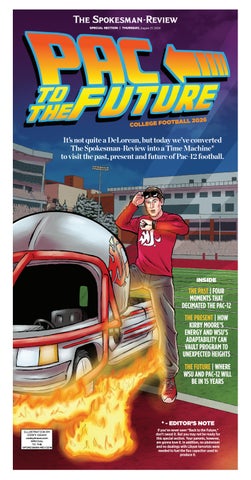
It’s not quite a DeLorean, but today we’ve converted The Spokesman-Review into a Time Machine* to visit the past, present and future of Pac-12 football.
INSIDE
THE PAST | FOUR MOMENTS THAT DECIMATED THE PAC-12 THE PRESENT | HOW KIRBY MOORE’S ENERGY AND WSU’S ADAPTABILITY CAN VAULT PROGRAM TO UNEXPECTED HEIGHTS THE FUTURE | WHERE WSU AND PAC-12 WILL BE IN 15 YEARS
* - EDITOR’S NOTE If you’ve never seen “Back to the Future,” don’t sweat it. But you may not be ready for this special section. Your parents, however, are gonna love it. In addition, no plutonium and no dealings with Libyan terrorists were needed to fuel the flux capacitor used to produce it.
T2 • Thursday • August 27, 2026
THE SPOKESMAN-REVIEW
INSIDE
IMPROVED EAGLES POISED TO MCFLY TO PLAYOFFS
Armed with a wealth of experience and young talent, Eastern Washington looks to end its five-year postseason drought. PAGE 4
VANDALS READY TO BUTT HEADS WITH BIG SKY FOES After struggles a season ago, coach Thomas Ford Jr. expects his Vandals to punch back with emphasis on depth, toughness. PAGE 6
DENSITY, OR RATHER, DESTINY AWAITS FOR NEW-LOOK COUGS Washington State ready to take on a new Pac-12 Conference behind first-year coach Kirby Moore and a stout defense. PAGE 8
DEFENDING CHAMPION PIRATES PLANNING NWC RERUN IN 2026 Whitworth returns an experienced group as it looks to capture back-to-back conference titles for first time in program history. PAGE 19
ILLUSTRATION BY CODEY DAUCH FOR THE SPOKESMAN-REVIEW
BACK IN GOOD OLD 1996
Since arriving 30 years ago, Aaron Best has set standard as Eastern Kinda Guy
Head coach Aaron Best watches a scrimmage at ONE Spokane Stadium on Aug. 13. Best, pictured as a player below, joined EWU as a long snapper and center in 1996.
By Dan Thompson THE SPOKESMAN-REVIEW
What’s certain is that in 1996, Aaron Best became a member of the Eastern Washington football team. But the story on how Best ended up in Cheney depends on who you ask. “I recruited him,” said Mike Kramer, Eastern’s head coach at the time. Best isn’t so sure. “He didn’t recruit me,” Best said of Kramer, with a smirk. “My dad sent me to the big man camp here (in Cheney) and (Kramer) was drooling over Chad Ward. He had no idea who I was other than I was (my dad’s) son.” Ward, a blue-chip offensive line recruit, ended up at the University of Washington and an NFL draft selection. Best ended up at Eastern Washington University, and in the 30 years since, he’s hardly left. Overlooked. Misread. Undeserving of the credit. Best, now in his 10th year as the Eagles’ head football coach, has been judged by outsiders throughout his playing and coaching career, all but one year of which has been spent in Cheney. But to those within the program, Best represents the best of Eastern Washington – both the athletic department and the university as a whole as an Eastern Kinda Guy. “Aaron has an incredible way of developing young men,” EWU Director of Athletics Tim Collins said. “He has coined the phrase ‘EKG’ and there is no one more EKG than Aaron. He lives up to the standard he set, so that all of us around him, we’re trying to match his expectation.” Under Best’s leadership, Eastern hasn’t consistently won like it did during the era of Beau Baldwin, his predecessor who went 85-32 in nine seasons and whose departure in 2016 allowed Best to ascend to the position he has held since. Its four straight losing seasons are not exactly lost on the current players and staff. “I don’t think he gets enough credit for everything he does for our program,” defensive coordinator Zach Bruce said of Best. “I think he gets a bad rap at times. We haven’t won, and we all should get a bad rap.” But within the program, the Eagles insist that this year’s team is going to break through, and that even though it still faces so many of the headwinds that the program has faced for decades, Eastern Washington is well-positioned to surprise its doubters – and that no one was better positioned to get the team through this half-decade than Best. “He is a true Eag,” former EWU Director of Athletics Lynn Hickey said this week. “My evaluation of him was, with all the things that were against him, he continued to really promote the program and to run things the right way. … That’s hard to do when you’re trying to fight for your program.”
JAMES SNOOK/ FOR THE S-R
‘Not just a long-snapper’
Regardless of how he got to Cheney in 1996, Best immediately impressed Kramer. Brought in as a long snapper, a role he filled for four years, Best proved to Kramer that he was worthy of what Bob Lucey, the longtime Curtis High School head coach, said of him. “Bob Lucey said this might be the toughest man I’ve ever coached,” Kramer said. “He didn’t say kid. He said man. I thought, ‘ah, bingo.’ ” After two losing seasons in 1994 and 1995, the Eagles went 6-5 in 1996 and 12-2 in 1997, reaching the Division I-AA semifinals for the first time . “We knew he’d be the heir-apparent at center,” Kramer said of Best, who started at center in 1998 and 1999. “He blossomed into a great player, not just a long-snapper.” With limited aspirations to be a football coach, Best still stuck around in 2000 as a student assistant. The next year he became a graduate assistant. In 2002, under Paul Wulff, his former position coach, Best became the Eagles’ offensive line coach. He held that job through 2006, and after that, for one year, he left Cheney, to be offensive line coach for the Toronto Argonauts of the Canadian Football League.
Given the chance to return to his old position as offensive line coach in 2008 when Baldwin took over as head coach, Best took it, and he has been on Eastern’s staff ever since. From 2009 to 2013, Best continued to coach the offensive line while also coordinating an offense that was good enough to win a national championship following the 2010 season. From 2014 to 2016 he coordinated the Eagles’ running game. It was during that stint Best started to consider whether he might want to be a head coach someday. He said he started to consider the choices Baldwin made in the game on Saturday and then followed up more deliberately on Sunday. When Baldwin left after the 2016 season to become offensive coordinator at Cal, Best applied and won the job to replace him. A job Best said “he wasn’t going to die on a hill” trying to get was his. “I wasn’t going to step on anybody’s toes to get there,” Best said. “I loved my job as an offensive line coach.” The Eagles won seven games in Best’s first year in 2017 and then went 12-3 and reached the national championship game in his next season. They followed See BEST, 7
THE SPOKESMAN-REVIEW
August 27, 2026 • Thursday • T3
BIG SKY PREDICTIONS
HOW WILL EASTERN, IDAHO FARE IN A LOADED BIG SKY TOPPED BY FCS CHAMP MSU? By Dan Thompson
THE SPOKESMAN-REVIEW
Up until this summer, Tom Wistrcill, in his annual state of the conference addresses, would declare the Big Sky Conference to be the best in the FCS, even though during his first seven years as commissioner the league didn’t win a national title. But in July, Wistrcill Big Sky forecast had a new, shiny piece of evidence to back up his Predicted order of finish: claim: Montana State’s 1 – Montana State national title at the end 2 – UC Davis of the 2025 season – the 3 – Montana league’s first since East4 – Eastern Washington ern Washington won it in 5 – Northern Arizona 2010. 6 – Idaho State “We can talk about be7 – Idaho ing the best conference,” 8 – Northern Colorado Wistrcill said, “but at 9 – Southern Utah some point you have to 10 – Cal Poly win the big game. And 11 – Portland State we’ve been the deepest 12 – Weber State conference. We’ve had 13 – Utah Tech the most teams in the playoffs before. But it’s been a while since we’ve won a national championship.” Montana State already tops every prominent national FCS preseason poll and even more clearly stands above the rest of the league.
The favorite
Montana State: Considering that the Bobcats return quarterback Justin Lamson, defensive back Caden Dowler and wide receiver Taco Dowler, and that they have 14 players on the Big Sky Preseason All-Conference team, they are the clear favorite to win the Big Sky for the fourth time in five years.
Playoff favorites
UC Davis, Montana: The Aggies reached last year’s playoff quarterfinals, the Grizzlies lost in the semifinals to the Bobcats, and there is little reason to doubt the pedigree of either team this year. Montana returns Preseason Offensive MVP Eli Gillman, who rushed for 1,540 yards
GEOFF CRIMMINS/FOR THE SPOKESMAN-REVIEW
Idaho coach Thomas Ford Jr. enters his second season with a team that should be competitive in the Big Sky. over 15 games last season, as well as starting senior quarterback Keali’i Ah Yat. The Aggies had to replace their 2025 starting quarterback, Caden Pinnick, who transferred to Washington State. But head coach Tim Plough has led the Aggies to the playoffs in each of his two seasons, and last year he did so despite losing defensive back Rex Connors to injury early on. Connors, too, is back this season.
Competitive core
Northern Arizona, Idaho State, Idaho, Eastern Washington, Southern Utah: The quality of this tier is what makes the Big Sky the deepest in the FCS. Idaho dealt with injuries last year (4-8 overall, 2-6 Big Sky) and is looking to bounce back. Idaho State (6-6, 5-3) returns starting quarterback Jordan Cooke. Northern Arizona (7-5, 4-4) returns Ty Pennington, its starting quarterback, and Southern Utah finished 7-5 overall and 6-2 in the United Athletic Conference last year.
Eastern Washington belongs in this tier because of its returning talent on defense, its continuity on offense, and because of just how close it was to winning two more games than it did last year, when it finished 4-4 in league play and 5-7 overall.
Dark horse
Northern Colorado: Head coach Ed Lamb led the Bears to a 4-8 record last season. Eleven years ago at Southern Utah, he led the Thunderbirds to a Big Sky title. He knows what it takes to win, and he’s had four years now to build a program in Greeley.
Still building
Weber State, Cal Poly, Portland State, Utah Tech: The Wildcats, Mustangs and Vikings all have new head coaches and significant turnover on their rosters. Newcomer Utah Tech (2-10, 1-7 UAC) hasn’t yet shown it will compete in the Big Sky.
T4 • Thursday • August 27, 2026
THE SPOKESMAN-REVIEW
DESTINATION 2026
EWU EAGLES
Continuity will be key to return to winning ways, reach postseason again By Dan Thompson
THE SPOKESMAN-REVIEW
As he watched the season from the sidelines in practice and in games, running back Malik Dotson determined that last year’s Eastern Washington football team was better than its 5-7 overall record would suggest. Back on the field as a grad senior, Dotson said he thinks the team is poised for something special. “Our whole thing going into this offseason was ‘good to great,’ ” Dotson said. “A lot of the guys, they are young in eligibility, but in experience, they’re a veteran.” It’s been five years since EWU last posted a winning record, but there is widespread optimism within the program the Eags will get back to the postseason.
AT A GLANCE
Offense
Eastern’s young offensive line gained a year of experience last season, and most of its starters and rotation players return, led by redshirt sophomores Mark Johnson and Gavin Allen. Their play will be crucial to revving up an offense that averaged Coach: Aaron Best 23.4 points per game, Asst. head coach/ fourth-fewest in the Big Off. coordinator: Sky. Marc Anderson EWU head coach AarDef. coordinator: on Best said he’d like to Zach Bruce see the Eagles establish 2025 record: 5-7 a running game without Ticket information: involving quarterbacks Available through www. goeags.evenue.net/list/FB Nate Bell, Jake Schakel and Kaden Rolfsness. or call 509-359-6059 He would also like to see Stadium: Roos Field more explosive plays. (8,500) Achieving those two goals would demand more production for a group of running backs that includes the grad senior Dotson, redshirt sophomore Kevin Allen III and sophomore Wilson Medina, plus newcomers Jaxon Bell, Israel Robles, De’Markus Barnes and CJ Bozeman. Just as the offensive line should benefit from retention, so too should the offensive coaching staff, which is the same this year as it was last year. “Fast forward a year, and we feel our whole staff is light years ahead of where we were because we had an entire year to work together,” WRs coach Casey Brink said. “That confidence gets absorbed into the players.”
Defense
By shaving 39 yards per game off its total defense and six points off its scoring defense from 2024 to 2025, the Eagles’ statistical improvement was notable. They also ranked third in the league with 15 interceptions and third with 11 fumbles forced. But opponents also converted 81 of 189 third downs, a rate (42.9%) that ranked third-lowest in the Big Sky. “We were not good on third down,” said Zach Bruce, who was promoted to D-coordinator before the season. “Last year I think we tried to get a little too creative with things at times, and I don’t think our players knew exactly what was coming from a play-calling standpoint.” So, Bruce said, if the Eagles can better anticipate what the offense will do and then limit explosive plays – while also excelling in takeaways – that would make for a successful season defensively. “Last year we had 15 (interceptions), and that was really good,” redshirt sophomore cornerback Ambrose Marsh said. “We set that standard for ourselves, so now it’s up to us to build on that standard, and ... exceed it.”
Special teams
Eastern returns Soren McKee, one of the most experienced kickers in the Big Sky. But range has never been his strength, nor has he regularly handled kickoffs. The Eagles signed Chiawana High School graduate Morgan Dodson, who showed off his strong leg during Eastern’s scrimmage at ONE Spokane Stadium. He could handle kickoffs and long field goals.
JAMES SNOOK/FOR THE SPOKESMAN-REVIEW
Eastern Washington redshirt junior QB Nate Bell took a majority of the starting reps during training camp. Bell played in 10 games last season, throwing for 1,003 yards, seven touchdowns, six interceptions and led the team in rushing yards.
AUG 29, 2 PM TV:ESPN+ At Northern Arizona
OCT 10, 4 PM TV:SWX Vs. Northern Colorado
Bitchin’ (Best case): QB Nate Bell has the offense humming and shows that he’s an accurate thrower, while the Eagles’ O-line makes room for a running game to keep the Eagles balanced. The defense locks in on third downs and stymies NAU QB Ty Pennington. Heavy (Worst case): The Eagles’ defense makes the same mistakes it did two years ago in Flagstaff and the offense can’t get anything going with Bell. Final: EWU 27, NAU 20
Bitchin’ (Best case): The Eagles do what they’ve done against the Bears for two decades, dashing ahead early and using the game as a chance to build confidence and depth. Soren McKee gets to kick a lot of extra points and even a 50-yard field goal with the wind at his back. Heavy (Worst case): Ed Lamb has the Bears believing, and they play the proverbial four good quarters. Final: EWU 31, UNC 10
SEPT 5, 4 PM TV:ESPN+
OCT 17, 4 PM TV:SWX
Vs. Northern Iowa
Bitchin’ (Best case): Eastern smothers the Panthers’ offense, which last year scored the fewest points in the Missouri Valley Football Conference, and creates four turnovers that set up the Eagles’ offense with short fields. Heavy (Worst case): The offense does what it did last year against UNI and struggles to move the ball in the first half, then plays from behind and can’t finish the comeback. Final: EWU 28, UNI 13
SEPT 12, 11 AM TV:ESPN+ At South Dakota
Bitchin’ (Best case): Behind a couple early touchdowns by Eastern’s offense, the Eagles’ defense can play aggressively, forcing the Coyotes to throw the ball more. EWU’s ballhawks in the secondary like Jaylon Jenkins, Bryce Smith and Ambrose Marsh can take some risks, and those risks pay off. Heavy (Worst case): South Dakota settles into midseason form, looks like an FCS playoff team and jumps ahead early. Final: USD 34, EWU 17
SEPT 19, 4:15 PM TV:BIGTEN At Washington
Bitchin’ (Best case): The Eagles leave Seattle beaten but not injured, and their offense shows that it can move the ball a couple drives against an FBS defense. Their special teams pin Washington deep in its own zone, making the Huskies work for their yards. Heavy (Worst case): It’s a replay of Eastern’s matchups against FBS teams the last two years, as the offense struggles and the defense can’t force punts early when it matters. Final: UW 49, EWU 17
SEPT 26, 4 PM TV:SWX Vs. Cal Poly
Vs. Montana State
Bitchin’ (Best case): Eastern is in the game late, and this time they make a big kick to break a tie, force a turnover and then don’t fumble the ball right back. The fans storm Roos Field after the program’s biggest win in five years. Heavy (Worst case): The Eagles’ offense stagnates into a predictable state and the Bobcats pounce, taking a four-score lead in the first quarter. Final: MSU 35, EWU 24
OCT 31, 1 PM TV:SWX Vs. Montana
Bitchin’ (Best case): After giving the Bobcats a good fight two weeks earlier, the Eagles get healthy during the bye week and their supporters show up in droves for tailgating, outnumbering the visiting Griz fans. On the field, the Eagles play like they did in the second half last year in Missoula. Heavy (Worst case): The Eagles play like they did in the first half in Missoula, but for four quarters. Final: EWU 34, Montana 29
Jaxon Branch
At Idaho
Bitchin’ (Best case): Eagle Red outnumbers the Vandal Gold in the Kibbie Dome as the Eagles push toward the playoffs and the Vandals try to salvage a .500 season. Eastern’s defense puts together an elite performance with four turnovers and two scores of its own. Heavy (Worst case): Joshua Wood has his way with Eastern’s defense and the Eagles can’t stay on the field offensively. Final: EWU 24, Idaho 17
NOV 14, 1 PM TV:ESPN+ At Utah Tech
Bitchin’ (Best case): Utah Tech’s first season in the Big Sky is humbling, and the Eagles keep the Trailblazers winless in league play. Three QBs play for the Eagles in a blowout, setting up an important home finale with a playoff spot on the line. Heavy (Worst case): Utah Tech gets a program-vaulting upset over a swooning Eagles team. Final: EWU 38, Utah Tech 7
OCT 3, 7:30 PM TV:ESPN2
NOV 21, 1 PM TV:SWX
At UC Davis
Bell ringer: Nate Bell’s strong preseason earned him the No. 1 reps at QB and the chance to lead the Eagles. Home for Halloween: EWU hosts three games in October, including one against Montana on Oct. 31. Defensive dominance: A talented defense looks to address its lingering weaknesses of getting third-down stops and limiting big plays.
NOV 7, 2 PM TV:SWX
Bitchin’ (Best case): Bell comes through the nonconference schedule healthy and confident throwing the football because the Eagles have established a running game behind a cohesive offensive line, and the Eagles give the Mustangs a barrage offensively. Heavy (Worst case): The Mustangs show improvement under highly capable first-year coach Tim Skipper, and they take advantage of Eastern’s turnovers to seize control early. Final: EWU 27, Cal Poly 14
Bitchin’ (Best case): Davis hasn’t figured out its quarterback situation and Eastern’s defense has figured out how to burst into the pocket. EWU’s offense has developed enough weapons so that the Connors brothers aren’t able to slow down everyone. Heavy (Worst case): Tim Plough has found another great young QB and Davis learns from its past struggles against Eastern. Final: UC Davis 35, EWU 28
3 THINGS TO WATCH
Vs. Portland State
Bitchin’ (Best case): The Eagles leave the FCS playoff committee no good reason to leave them out of the field as Eastern routs its rival in all three phases. Heavy (Worst case): The Vikings have stuck with first-year coach Chris Fisk, who has them playing for a winning record in league play, and they pull off the upset on a rainy afternoon in Cheney. Final: EWU 42, PSU 27
PLAYERS TO WATCH
Offense: WR Jaxon Branch dominated scrimmages last spring and this preseason, and the Eagles haven’t had a clear No. 1 receiver since Efton Chism III. Defense: S Jaylon Jenkins has the accolades, but CB Ambrose Marsh and S Bryce Smith are poised to join him on all-Big Sky teams.
THE SPOKESMAN-REVIEW
August 27, 2026 • Thursday • T5
D E S I G N E D B E A U T I F U L LY. B U I LT T O P E R F O R M . WINDOW COVERINGS
P R E M I U M Q UA L I T Y Fine materials. Expert craftsmanship.
C U S TO M S O LU T I O N S Tailored to your home. Designed for the way you live.
E L E VAT E D L I V I N G Comfort. Style. Inside and out.
BOOK YOUR APPOINTMENT NOW!
CDA 208.664.5858 | SANDPOINT 208.659.8555 BLINDS FOR ANY BUDGET!
WWW.BESTBLINDSANDAWNINGS.COM
BOOK YOUR APPOINTMENT NOW!
SPOKANE 509.892.5463 COEUR D’ALENE 208.664.5858 PULLMAN/MOSCOW 208.553.3553 BLINDS FOR ANY BUDGET!
WWW.BESTBLINDSANDAWNINGS.COM
T6 • Thursday • August 27, 2026
THE SPOKESMAN-REVIEW
DESTINATION 2026
IDAHO VANDALS
In second season as coach, Ford puts extra emphasis on team’s physicality, depth By Peter Harriman
THE SPOKESMAN-REVIEW
Deep into the rigors of preseason camp, players have been exhorted by coaches in about every way imaginable and in the saltiest language possible. On a recent morning, though, the Idaho Vandals might have heard a new one to get them to focus at the bitter end of practice on an overly warm day when everyone was tired as they pointed for the season opener at Cal Poly San Luis Obispo. “Do you WANT to be on the plane?” It spoke to a Vandals team with depth so plentiful it was still sorting itself out, according to coach Thomas Ford Jr., and to a team that had business to atone for after three straight season-ending losses capped off a 4-8 record last year that ended three consecutive trips to the NCAA playoffs.
AT A GLANCE
Offense
Ford says the group most ready to get the season under way is the offensive line. It returns veterans like seniors Charlie Vliem and Layton Vining, senior transfer from Division II Pace University Howard Stedford, and players like Moscow High grad Tyler Skinner, Coach: Thomas Ford a senior, who has been Off. coordinator: making a case for regular Ian Shoemaker playing time since last Def. coordinator: spring. Lee Stalker The quarterbacks are 2025 record: 4-8 “much more experiTicket information: enced,” says Ford, led Available through www. by senior Joshua Wood, govandals.evenue.net/ who is coming into his events/FBSI or call 208second season at Idaho 885-6466 with about 1,000 snaps Stadium: Kibbie Dome on his resume. (15,250) Ford noted “a really strong tight end room,” led by senior Chance Bogan. The Vandals are deep at running back, with senior Hayden Kincheloe, juniors Ferrari Miller and Damonte Bias and freshman Kenny Golston. Wood seemed to have to introduce himself to a different group of wide receivers every week last year as injuries annihilated the Vandals’ pass catchers. Receivers like Tony Harste, Ryan Jezioro and Daveon Superales return healthy with veterans like Marquawn McCraney and transfers like Lonyatta Alexander Jr. from Montana State and Zack Card from Oregon State. Offensive coordinator Ian Shoemaker characterized the offense as being “physical in the run game, dynamic enough to beat you downfield and sideline to sideline.”
Defense
The Vandals expect their defense to be anchored by a solid front. Key contributors will be massive sophomore Ma’ake Apo, 6-4, 340, seniors Frederick Lujan III, Mitchel Jaskowiak and Julian Lee, who returns from an injury that cost him most of last season. Idaho may also feature a ferocious pass rush off the edge from senior transfers Jamarion and Javen Augustus, twins from Northern Iowa and Coastal Carolina respectively. Senior Cruz Hepburn leads a talented group of linebackers bolstered by junior Darrell Gipson, a transfer from the University of Cincinnati, and featuring sophomores vying for playing time, like Niko Speer. In the secondary, shifting Khaled Rawls from corner to safety for his final season looks to be paying dividends. Ford says Rawls has an intuitive grasp of the position, and junior cornerback Aaron Kinsey, from Rogers High School, is poised for a breakthrough.
Special teams
Senior Cameron Pope appears to have locked down the job as punter. Juniors Owen Forsman and Owen Adams, who both saw time on kickoffs and field goals last year, are back, and junior kicker/punter Tyler Kinsman has transferred from Oregon.
GEOFF CRIMMINS/FOR THE SPOKESMAN-REVIEW
Idaho quarterback Joshua Wood has all the tools to be one of the best in the Big Sky. As a redshirt sophomore he threw for 1,898 yards and 14 touchdowns, while making big contributions in the rushing game.
AUG 28, 7 PM TV:ESPN
OCT 17, NOON TV:SWX
At Cal Poly
Vs. Montana
Bitchin’ (Best case): In a battle of teams that finished 4-8 last year, Idaho jumps out quickly. Joshua Wood finds Ryan Jezioro and Tony Harste for TDs, and Wood runs for one in the first half. Vandals control the second half on the ground behind. Heavy (Worst case): Upbeat Mustangs with defensive-minded new coach Tim Skipper pull out a close one with home field advantage. Final: Idaho 21, Cal Poly 17
SEPT 3, 6 PM TV:ESPNU At Utah
Bitchin (Best case): The Grizzlies have to deal with Wood on two healthy legs. He played on a sprained knee the entire second half in a loss against Montana last year. This time, he throws for 300 yards and a touchdown and runs for two more. Heavy (Worse case): Head coach Bobby Hauck is gone, but QB Keali’I Ah Yat returns. The Grizzlies’ defensive upgrades keep The Little Brown Stein in Missoula. Final: Montana 21, Idaho 20
OCT 24, 2 PM TV:SWX Vs. Southern Utah
Bitchin’ (Best case): The Utes are still getting organized under first-year coach Morgan Scalley. Utes have a talented but young defensive line and a rebuilt linebacker corps, and Idaho can trade scores with them late. Heavy (Worst case): Talent prevails. The Utes, who outscored opponents 113-41 in the first quarter last year, are back. They take control early, shut down the Vandals. Final: Utah 28, Idaho 17
Bitchin (Best case): The Vandals put on a homecoming show. They strike early and often with rushing touchdowns by Miller, Bias and Golston. Wood finds tight ends Bogan and Gus Donnerberg in the end zone in the second half. Heavy (Worse case): The Thunderbirds finished 2025 on a six-game winning streak and carry that momentum back into the Big Sky. Final: Idaho 34, SSU 28
SEPT 12, 1 PM TV: SWX
OCT 31, 1 PM TV;ESPN+
Vs. Lamar
At Portland State
Bitchin’ (Best case): The Cardinals love to run and are built to stop the run. But on Idaho’s first possession Damonte Bias turns the corner and races 60 yards down the sideline. The Vandals force Lamar into a situation where it has to throw and can’t keep up. Wood passes for 320 yards and two more scores. Heavy (Worst case): Preseason All-America DE Andrew Huff disrupts Idaho’s passing game and the Cardinals win low scoring. Final: Idaho 35, Lamar 14
Bitchin (Best case): The Vikings can only rebuild so much from a 1-11 season in 2025. PSU often plays above its record against the Vandals, but not this time. Heavy (Worse case): The Vandals look ahead to avenge a loss against rival Eastern Washington and get surprised by the Vikings. Final: Idaho 42, PSU 7
SEPT 19, 1 PM TV:SWX
Bitchin (Best case): Seven returning starters on defense for the Eagles, led by defensive lineman Isaiah Perez and Buck Buchanan Award preseason nominee Jaylon Jenkins in the secondary, can make Idaho’s offense work for it. But the Vandals at home can handle the Eagles. Heavy (Worse case): This could be another trap game. Riding high with seven wins and the prospect of a return to the FCS Playoffs, the Vandals look ahead of the Eagles to their final home game against their nemesis and Big Sky power UC Davis. Oops. Final: EWU 17, Idaho 14
Vs. Abilene Christian
Bitchin’ (Best case): Home field advantage counts for just enough, and Idaho ekes out a close win against last year’s playoff participant and two-time defending United Athletic Conference champions. Heavy (Worst case): The Wildcats’ quarterback, Marco Davila, is comfortable behind all-UAC offensive linemen Luke Roaten and Colter Lynch and tight ends Itty Henry and Larry Benton III in Abilene Christian’s two-tight end sets. Henry is neither itty nor bitty as a blocker and receiver and catches a pair of touchdowns. Final: Idaho 17, ACU 14
OCT 2, 7:30 PM TV:ESPN Vs. Montana State
Bitchin’ (Best case): The game of the year. The Vandals face the defending national champions at home in an ESPN game. They rise to the challenge against the Bobcats and their 26 returning key contributors from last season. Running backs Ferrari Miller, Kenny Golston and Hayden Kincheloe help Idaho control the clock, and senior punter Cameron Pope pins MSU and forces it to play on a long field all night. Heavy (Worst case): The 2026 Bobcats are even better than the 2025 version. Final: Idaho 21, MSU 14
OCT 10, NOON TV:ESPN+ At Weber State
Bitchin’ (Best case): The Wildcats have 75 new players and a new coach, Eric Kjar. This massive rebuilding can’t stand up against experience. Depth across both lines allow Idaho to disorganize and overwhelm WSU. Heavy (Worst case): The Wildcats and transfer quarterback Devin Brown have coalesced quickly behind Kjar and handle the Vandals at home. Final: Idaho 31, Weber State 10
3 THINGS TO WATCH
Thomas Ford Jr., Year 2: Ford is putting a renewed emphasis on “trusting the process” to navigate adversity down the stretch. Scary start to October: Idaho entertains defending champ Montana State on Oct. 2 in a game broadcast on ESPN. Physical dominance: With a more talented and deeper team, Ford expects the Vandals to regularly overpower foes. Cruz Hepburn
NOV 7, 2 PM TV:SWX Vs. Eastern Washington
NOV 14, 1 PM TV:SWX Vs. UC Davis
Bitchin (Best case): Idaho has to win this game sometime, right? The Vandals are 1-6 all time against the Aggies, and they lost last year, 28-14. But at 7-2 and in their final home game, the Vandals can probably lock up a playoff spot with a victory. Wood leads the way in a close and exciting come-from-behind win. Heavy (Worse case): The Aggies get to dodge Big Sky contenders Montana State, Idaho State and Northern Arizona and come into the Kibbie Dome with momentum. Final: UC Davis 31, Idaho 20
NOV 21, 3 PM TV;ESPN+ At Idaho State
Bitchin (Best case): It comes down to this. The Vandals need a win to reach the playoffs and they make it happen. Wood finishes the regular season with another 300-yard passing, two touchdown game, and senior safety Khalid Rawls has an interception, two tackles for loss and 10 tackles overall to lead the defense. Heavy (Worse case): The Bengals beat the Vandals convincingly last year and find a way to do it again. Final: Idaho 31, ISU 17
PLAYERS TO WATCH
Offense: Freshman RB Kenny Golston made a strong bid in camp for playing time. He is a former Oklahoma high school 2A-11 District 4 offensive player of the year. Golston is the complete package as a runner – strong, agile, with breakaway speed. Defense: LB Cruz Hepburn had a strong 2026 and the fifth-year senior will be directing new defensive coordinator Lee Stalker’s multiple shifting defense.
THE SPOKESMAN-REVIEW
August 27, 2026 • Thursday • T7
BEST
dumb jock,” Kramer said. “He’s not at all.” Best said he likes that reputation. “I’ve probably developed a bit of a softer heart, but I’ve still had the tough shell,” Best said. “I always want the tough shell. But I would say that not everybody I come in contact with knows I have a valentine, and sometimes I like that.” Not everyone sees Best’s children running up to him after practice or sitting off to the side during postgame news conferences. They don’t all see him holding the children of his assistant coaches like Anderson and Bruce have. Best’s longevity and loyalty lends him to criticism, too, that he is too loyal or that he’s overstayed his welcome. After all, Eastern hasn’t had four straight losing seasons since Dick Zornes did in the ’80s and ’90s. But to Anderson, Best has been the steady force that has held the program together. “The kind of longevity we have doesn’t happen everywhere,” Anderson said. “We’re working back to where we want the result to be on the field. He’s done a good job putting everything in a healthy spot. Now it’s our job and the players’ job to help make that play out on the field.” Best still has the passion. Wide receivers coach Casey Brink, already in his fifth college football program as a player and coach since 2016, said he sees it every day. “The excitement and energy he brings every single day is unique,” Brink said. “He doesn’t really want to be seen as the boss who walks around; he wants to be seen as a member of the crew who is working hard alongside everybody else.” There is work to be done for the Eagles and Best, whose contract runs through the end of the 2027 season, and the job isn’t exactly what Best thought it would be when he took it 10 years ago. But Best seems not to have lost the love of football – and the love of Eastern Washington – that has kept him in Cheney this long. “I never wanted to be (a head coach),” he said. “I toyed with the thought, thinking, you know what? This can’t be too bad coaching 100. I already coach 20. Why just add 80 more? Boy, was I wrong. It’s a totally different job.” But the unpredictability of it is also part of what Best appreciates. “I loved my job as an offensive line coach, and I don’t know that I had an itch, but I pondered what the life of a head coach would be,” Best said. “But I also did as a dad, and then you become a dad, and sometimes it is what you think it is, and sometimes it isn’t. “It’s been a new day every day,” he said. “It’s been a new day every day.”
Continued from 2 that up with three more winning seasons, including a 5-2 spring campaign during the COVID-19 pandemic and a 10-3 season in 2021. Hickey, who was at Eastern from 2018 to 2023, was at Best’s side during those good years. But she also heard the naysayers. “I was taken aback by people not giving Aaron credit for the success we had,” she said. “In 2018, he took us to that national championship game for the second time in program history. He was a coach here. He was recruiting those guys. Then you look at the success we had in 2021, a year after COVID, that’s a reflection of Aaron Best.” After that, Hickey said, Best was “pulling us out of the trenches of what the program went through during and after COVID.” The headwinds were strong, Hickey pointed out. There were plenty on campus, with calls from pockets in the university to cut or eliminate sports in the athletic department. At the conference level, Eastern had long lacked the top-level facilities of some of its rivals, such as Montana and Montana State, and then programs like Sacramento State and UC Davis were making significant investments in theirs, too. For a long time, Hickey said, the Eagles were able to live on their success in the 2010s and on the pride of being an Eagle. It’s what kept alive a tradition of riding yellow school buses to the airport for flights to football games or competing with facilities that were gradually being outdone by conference rivals. “For a long time, Eastern was able to survive on that,” Hickey said. But in 2022, the Eagles went 3-8. Over the next two years, they finished 4-7 and 4-8. And those successful years faded farther and farther into the past. “We had a time during COVID when our recruiting was affected and our staff turnover was higher than normal,” said EWU offensive coordinator Marc Anderson, who joined the football program in 2014 and is its second-longest tenured member behind Best. “The last couple years we’ve been able to settle in more.” Hickey, who has settled back in College Station, Texas, with her family since she left Cheney, said Best was the right person to help Eastern through the last five years. “What he has done and his level of commitment needs to be commended,” she said, “because a lot of people would have stepped away from that. And he did not leave. He could have gone somewhere else, maybe not as a head coach, but he was going to have opportunities to stay in the
JAMES SNOOK/FOR THE SPOKESMAN-REVIEW
Eastern Washington coach Aaron Best smiles as he runs off the field during a scrimmage on April 25 at Roos Field in Cheney. (coaching) field.”
‘They all move when we move’
The 2025 season was much more promising for the Eagles. They went 5-7 overall and 4-4 in Big Sky play, improving Best’s overall mark as head coach to 57-47 and 42-28 in league games. He is currently the Big Sky’s most tenured coach. His peers envy that longevity. “I don’t want to begin to count the number of schools my three children have had to attend with all the moves,” NAU head coach Brian Wright said this summer. “I think with Aaron, first and foremost, I think he’s a quality individual and a great football coach. … What a standard and a staple in this conference, to have somebody who has stuck with a place like that.” Ed Lamb was Southern Utah’s head coach from 2008 to 2015, BYU’s assistant head coach from 2016 to 2022 and now Northern Colorado’s head coach since then, said he knows the value of being in one spot and the impact it has on a coach’s family. “What we’ve learned, particularly when we got our first head coaching job – and when I say ‘we’ it’s my wife and I and really the whole family, because they all move when we move – we always plan to stay where we’re at,” Lamb said. “So I think it’s a sign of success when you do that, but things happen.” Yet none of those things have happened for Best. He and Kim, his wife, have raised
three children – Texis, Tenli and Tank – entirely in Cheney. Earlier this summer, on a day off from preseason camp, Best dropped off Tank at Eastern Oregon, where he is playing linebacker on the football team. “He’s been (in Cheney) as long as I’ve been alive,” EWU strength and conditioning coach Mike Perez said. “When it comes to the whole organization and program, he can see it all and manage it. That’s where I respect him so much because I am still learning every single day from him.” Those who have been around him longest, like Anderson and Bruce, who played at Eastern from 2012 to 2016, Best has proven again and again to be a family man who is fiercely loyal. But that loyalty, Anderson said, is something a person has to earn. Anderson also recognizes that Best’s outer shell can be intimidating. “He doesn’t sugarcoat. You’re not trying to guess his feelings,” Anderson said. That honesty is something offensive lineman Gavin Allen said he appreciates about Best. “He’s definitely really hard on us,” Allen said, “and it’s such a good thing to have a coach that’s like that: someone who will push us to be at the best that we can be, especially up front. It’s such a physical and mental game up there.” Kramer said Best defies the stereotypes of an old offensive lineman. “People look at him and think he’s a
T8 • Thursday • August 27, 2026
THE SPOKESMAN-REVIEW
DESTINATION 2026
WSU
COUGARS
Moore has positioned team to meet the challenges of new Pac-12 schedule By Greg Woods
THE SPOKESMAN-REVIEW
Washington State’s era of new just keeps rolling on. For the second straight year, there are a lot of updates around the Cougars program, from the top down. It’s the first year for head coach Kirby Moore, who comes over from Missouri, where he worked three years as offensive coordinator. It’s the first year for the reshuffled Pac-12. And it’s the first season for the Cougars’ crop of newcomers, who get the challenge of navigating it all. How will WSU manage? What’s clear about the Cougars’ season is this: They will open the season in only the most challenging of ways. WSU’s season-opener is a road matchup against rival Washington in the Apple Cup, the first to open the season in the programs’ history, and only six days later the Cougars get a road test at Kansas State. That game is set for 9 a.m. WSU gets a bit of reprieve the following week, when FCS Coach: Kirby Moore Duquesne comes to Asst. head coach: town, but things ramp Justin Green back up the week afOff. coordinator: ter with a home tilt Matt Miller against former Pac-12 Def. coordinator: foe Arizona. Add it all Trent Bray up and it’s a grueling 2025 record: 7-6 start to Moore’s first Ticket information: season, three Power 4 Available through www. foes in less than four wsucougars.evenue.net/ weeks’ time. list/F or call 1-800-GOThose tales have COUGS yet to be told, which Stadium: Gesa Field is why it can be diffi(35,117) cult to gauge Moore’s mentality so far out. He can sound like a broken record, talking about daily improvement and taking things day-by-day, but there might be a method to it all. “I wanna make sure everyone understands why we’re doing something, why we’re practicing at 11,” Moore said. “Why we’re doing this in the weight room, why we’re meeting at this time, because every decision should start with our players. I love our staff, but the players are gonna make plays out here on Saturday. No staff member is gonna make any plays.” As far as the players go, there are several to keep an eye on. The Cougars’ starting quarterback will be UC Davis transfer Caden Pinnick, who put up an impressive redshirt freshman season with the Aggies: He completed 240 of 345 passes (70%) for 3,206 yards and 32 touchdowns against 10 interceptions, winning Big Sky Freshman of the Year honors. He also registered 125 carries for 437 yards and three scores, good for an average rush of 3.5 yards, underscoring his dual-threat capabilities. Then there’s the Cougars’ running back trio of Kirby Vorhees, Maxwell Woods and Leo Pulalasi, all of whom decided to return to WSU in a key offseason development. Vorhees and Pulalasi flirted with the transfer portal – Vorhees announced he was planning to enter, while Pulalasi entered and later withdrew his name – but they will be wearing crimson and gray this fall, which is great news for the offensive-minded Moore. Look for all three to make a splash, and don’t be surprised if freshmen tailbacks Tre Hill Jr. or Marquez Wimberly get a few scattered carries. Even so, if fall camp was any indication, the strength of this WSU team might be its defense. That unit earned the edge in just about every fall camp practice. Safety Jaylen Thomas snagged
AT A GLANCE
See WSU, 9
TYLER TJOMSLAND/THE SPOKESMAN-REVIEW
Washington State quarterback Caden Pinnick will assume the starting role after a breakout freshman season at UC Davis, where he threw for 3,206 yards and 32 touchdowns, while adding 437 yards on the ground.
SEPT 6, 1 PM TV:NBC
OCT 17, 3 PM TV:USA
At No. 17 Washington
At Oregon State
Bitchin’ (Best case): With a chance to capitalize on a UW defense that doesn’t have much tape of the WSU offense, QB Caden Pinnick and RB Kirby Vorhees provide enough offense to let their defense do the rest. Heavy (Worst case): Pinnick shows his lack of FBS experience as the Huskies’ defense tees off on a Cougar offense that left something to be desired during fall camp. Final: UW 24, WSU 10
SEPT 12, 9 AM TV:TNT
Bitchin’ (Best case): Oregon State’s first campaign under new head coach Jamarcus Shepard continues to struggle as WSU uses a hellacious defensive effort to earn its first win in Corvallis since 2020. Heavy (Worst case): The ghosts of Reser Stadium continue to haunt the Cougars, whose offense falls apart when it matters most. Final: OSU 22, WSU 17
OCT 24, 3 PM TV:USA Vs. Boise State
At Kansas State
Bitchin’ (Best case): WSU’s pass rush torches an injury-riddled K-State offensive line, safety Jaylen Thomas snares an interception and the Cougs’ defense gives their offense a chance to eke out a win on the road. Heavy (Worst case): On a short week and an early kickoff time, WSU never generates much offense and limps to a second straight defeat to open the season. Final: K-State 20, WSU 7
Bitchin’ (Best case): WSU establishes a robust ground attack, taking star edge rusher Jayden Virgin-Morgan away from what he does best, and the Cougs’ pass rush flummoxes QB Maddux Madsen. Heavy (Worst case): Virgin-Morgan and Boise State’s defense hands WSU its worst offensive outing of the season, turning over Pinnick multiple times in a blowout win in the Broncos’ first trip to Pullman since 2017. Final: BSU 23, WSU 17
SEPT 19, 12:30 PM TV:USA
OCT 31, 4 PM TV:CBSSN
Vs. Duquesne
At San Diego State
Bitchin’ (Best case): Pinnick and the Cougars offense wakes up and demolishes Duquesne’s defense, inspiring confidence among the team and fans leading into a showdown with Arizona the following week. Heavy (Worst case): A challenging open to the season wears down the Cougars, who don’t have the manpower to generate enough offense as the Dukes’ defense forces a pair of turnovers and stuns the hosts. Final: WSU 27, Duquesne 3
Bitchin’ (Best case): The Cougars’ offense roars to life against an unproven SDSU defense, which can’t contain Vorhees or Woods, helping the visitors earn their first signature road win in the Kirby Moore era. Heavy (Worst case): WSU suffers its first letdown on defense all season, unable to contain the SDSU tandem of QB Jayden Denegal and RB Lucky Sutton as the Aztecs cruise to an easy win. Final: SDSU 24, WSU 12
SEPT 26, 4:30 PM TV:CBS
NOV 14, 7:30 PM TV:CBSSN
Vs. Arizona
Bitchin’ (Best case): WSU’s defense limits veteran quarterback Noah Fifita and produces several turnovers, swinging the tide of the game in time for Pinnick and the Cougars’ offense to pull an upset at home. Heavy (Worst case): Pinnick and WSU’s offense never shows up, showing the unit’s limitations against an upper-tier Power 4 team and losing several costly turnovers. Final: Arizona 23, WSU 20
OCT 3, 6:30 PM TV:USA Vs. Fresno State
NOV 21, 3 PM TV:USA At Texas State
Bitchin’ (Best case): Texas State’s defense is the question mark of the team, and WSU exposes it as such, getting a big game from WR Darrius Clemons as the Cougars escape with a stunner of a road win. Heavy (Worst case): Bobcat QB Brad Jackson uses a high-powered offense to carve up a WSU defense worn down by the grind of the season, stonewalling McLain and Zunk. Final: TSU 24, WSU 10
OCT 9, 6 PM TV:KSKN
NOV 28, TBD TV:TBD
At Utah State
Defensive experience: Trent Bray returns to his role of defensive coordinator, where he built strong Oregon State defenses. Tough start: WSU faces three Power 4 opponents in its first four games of the season. Birth of a rivalry: Cougs host new Pac-12 power Boise State for the first time since 2017. Daniel Blood
Vs. Colorado State
Bitchin’ (Best case): WSU secures an easy win over a rebuilding Colorado State squad, its offense hitting its stride and dismantling an inexperienced CSU defense, which can’t slow down Pinnick and Co. Heavy (Worst case): CSU QB Hauss Hejny shows why he originally landed at Oklahoma State, picking apart the middle of WSU’s defense, where linebackers DJ Warner and Keith Brown struggle to contain things. Final: WSU 27, CSU 14
Bitchin’ (Best case): The Cougars’ swarming defense makes QB Khristian Martin pay for his inexperience, picking him off twice, and their ground game neutralizes star DB Simeon Harris to produce enough offense. Heavy (Worst case): Pinnick tests Harris one too many times, leading to a costly interception, and the Bulldogs show why they’re picked to finish near the top of the Pac-12. Final: WSU 17, FSU 16
Bitchin’ (Best case): WSU capitalizes on a new and unproven Utah State defense, which can’t slow down Vorhees or running back Maxwell Woods before they run roughshod and help the Cougars cruise to a win. Heavy (Worst case): The Aggies’ newlook defense lets their home-field advantage fuel an upset, forcing critical turnovers on Pinnick and the Cougs’ offense. Final: WSU 17, USU 14
3 THINGS TO WATCH
Oregon State (FLEX)
Bitchin’ (Best case): With a chance to reflect on the teams’ first meeting in Corvallis, WSU demonstrates why its program is in a better place than the other Pac-12 holdover, beating the Beavers again in Pullman. Heavy (Worst case): The Beavers’ offense wakes up and spoils the Cougars’ senior night, with QB Maalik Murphy enjoying his best game of the season. Final: WSU 22, OSU 10
PLAYERS TO WATCH
Offense: Wide receiver newcomers Darrius Clemons and Daniel Blood, transfers from Oregon State and Missouri, respectively, are set to spearhead the Cougs’ passing attack. Defense: A year after combining for 71/2 sacks at their previous schools, defensive ends Matyus McLain and Linus Zunk get ready to wreak havoc in opponents’ backfields.
THE SPOKESMAN-REVIEW
August 27, 2026 • Thursday • T9
COMMENTARY
WSU’s future is whatever you make it, so make it a good one This is a new competitive landscape, and if you’re viewing the structural changes as anything other than opportunities, you’re already losing ground. If Washington State football fans can be patient, and keep the big-picture goals in sight, the new terrain might provide a better path to future DAVE DAVE success. Especially BOLING BOLINGfor those who can remain somewhat fluid in their defiof success. SPOKESMAN nition SPOKESMAN WSU’s affiliation this season COLUMNIST COLUMNIST continues to be called the Pacific-12 Conference, although there’s only two hold-overs from its fully loaded incarnation, with the fillers being pulled up from what had been considered leagues of lesser repute. We may also note that the Pac-12 appellation misses the mark to the degree that it is not exclusively Pacific, and far from numerically accurate, with eight football-playing members. Further, literally, one of the new rivals (Texas State) is located in San Marcos, Texas, roughly 2,000 miles south of Pullman, and geographically much closer to Nicaragua (1,464 miles) than it is to Spokane (2,018). But, until the college-football shapers get real and call the major conferences ESPN, CBS, Fox and NBC – with sub-divisions called Basic Cable, Premium Cable and Streaming – we won’t quibble about still going by the Pac-12 title. So, while the whole adaptation to the new environment may be uncomfortable and require some recalibration of identity and expectations, there may be some hidden factors that could compensate. It may take some time, but it’s best to get over the
WSU
Continued from 8 three interceptions, including two on Pinnick, while defensive end duo Matyus McLain (Idaho transfer) and Linus Zunk (Vanderbilt transfer) figure to terrorize all kinds of offensive lines this fall. Flank those two around the Cougars’ defensive line, far and away the deepest position group on the team, and you start to see the problems the whole unit could cause opposing offenses. The Cougars’ interior starters will likely be returner Kaden Beatty and transfer Paul Hutson III, but look for pieces like SMU transfer Damarjhe Lewis, Eastern Washington transfer Jirah Leaupepetele and Saint Francis transfer Balaam Miller to earn key roles as well. “Obviously, both coming over in their first year, have experience at the previous schools they were at, playing experience,” defensive ends coach Andrew Browning said of McLain and Zunk. “Being older
TYLER TJOMSLAND/THE SPOKESMAN-REVIEW
Washington State hopes to make a grand entrance to the new Pac-12 Conference this season. initial feeling of relegation to a lower division. Fans can cherish memories of historic blood-feud rivalries and great victories in the past, but those days irretrievably expired. Money has made it so. How to spin this whole reconstitution to avoid that sense of loss? When the conference produced its new logo in spring, it offered a few strained explanations of the look, the press release claiming it had “Superhero Energy,” and it was “Aggressive. Modern. Unapologetic.” Less embarrassing and more to the point, it made the fair description: “Where Tradition Meets Transformation.” Transformation. Yes. College sports have been about little else. Money, of course, having the greatest transformative powers. Still, those with emotional ties to WSU, and most of the other schools in this new Pac-12 football fraternity, have to be heartened by recent events. For instance, when longtime Big Ten doormat Indiana won the national championship, thrashing Alabama 38-3 in the second round of the playoffs, every traditional underdog was given reason to bark. Vanderbilt, Tulane and James Madison finished higher than USC and Michigan and Penn State in the final polls. In times of massive change, the old, tradition-bound institutions may become vulnerable, while creative and innovative programs can rise by being more adaptable. WSU, with a new coaching staff and a committed administration, could be one of those programs carving a different path to the College Football Playoffs. Keep in mind, at least one Group of Six team is reserved a place in the 12-team CFP. Last season, two G6 teams, Tulane and James Madi-
too in the room. We have a relatively younger room in general. Those guys have acquainted themselves with their teammates really well, and they’ve been a really good lead-by-example. And I think probably the biggest thing I’ve noticed is they’ve found their voice a little bit within our group and within the defense, and that’s been really good to see.” All that said, WSU hardly has an easy rest of the schedule, no matter how the first four games go. Perhaps most notably, their one bye week doesn’t arrive until after Week 9, after the Cougars’ road game against San Diego State. That game will be a real test, as will away games against Oregon State (Oct. 17) and Texas State (Nov. 21), a pick to finish in the top half of the new conference. Can the Cougars withstand enough of those games to earn six wins and make a bowl game, which the program has done in nine of the last 10 full seasons? If so, it probably means that Pinnick made the transition from FCS football to FBS ball without a hitch, and that the
Cougars’ defense established itself as one of the Pac-12’s finest units. For a program that became famous for its offense, that development would register as new, too. “I think I’m just always trying to find a better way to do things,” Moore said, “whether that’s probably life-related. Even our trainer, I was asking him a question about, you know, there’s some new studies out about, hey, you drink your coffee an hour later. It’s supposed to be better for you in the morning when you wake up. I think there’s football things. There’s meeting things. We’re teachers first. That’s what I grew up around. My mom was an elementary school principal. Dad was a high school football coach and a teacher. I think the head coaches that I’ve been around – there’s been a lot of really good ways to do things and making sure what’s the best fit for Washington State.” Greg Woods can be reached at 509-459-5587 or at gregw@ spokesman.com.
son, were included among the Power 4 candidates. It’s not hard at all to see WSU in the future playing at a level with or above Tulane and James Madison. Last season, WSU lost to James Madison, 24-20, on the road, and looked on the threshold of an upset road win. Tulane, meanwhile, got clobbered (45-10) by Ole Miss in the regular season, while WSU pushed Ole Miss in a narrow, 24-21, road loss at Oxford, Mississippi. Most predictions suggest the rebuilding Cougars will likely finish in the middle of the pack in the new Pac-12 this fall. Boise State and San Diego State are considered likely title contenders. With respect, those two schools are a long way from posing the challenges that Oregon, Washington, USC, etc., the Cougars used to face. If the goal is to win enough games to boost the winloss record and claim a conference championship and get into the playoffs, the new Pac-12 provides far more chances than the old Pac-12. We may then observe a best-case corollary in which WSU football treats the new Pac-12 the way Gonzaga exploited the West Coast Conference competition during the Zags’ transformation into a powerhouse. The Zags had some creative young coaches – one who stayed through the building phases – an engaged administration, and a situation where they weren’t getting pounded by better-sourced programs every outing. BSU, SDSU, Fresno State, etc., can turn into new rivals, and make for exciting games, but the challenge of rising to elite win totals is less daunting than it ever was for WSU. Regardless of the new logo’s contention, if the Cougars can continue to be aggressive, modern and unapologetic, they might not need superhero energy after all.
HOW TO WATCH THE COUGS By Greg Woods
THE SPOKESMAN-REVIEW
To watch all 12 Washington State football games this season, including eight in the new-look Pac-12, fans will need access to a few different networks. In coach Kirby Moore’s debut season, the Cougars have five games on USA Network, which comes from a new fiveyear deal the sides struck this year. They have one game on the CW, which broadcast a majority of WSU games the previous two seasons; two games on CBS Sports Network and one game apiece on these networks: NBC, TNT and CBS. Here is where to find those channels on cable in Spokane. NBC Comcast/Xfinity: Channel 54 DISH Network: Channel 138 DirecTV: Channel 245 USA Network DIRECTV: Channel 242 DISH Network: Channel 105
The CW (KSKN) Comcast Xfinity: Channel 111 Charter Spectrum: Channel 1212 Dish Network & DirecTV: Channel 22 CBS Sports Network Xfinity: Channel 412 DirecTV: Channel 221 Dish Network: Channel 158 Here is a list of each game and how to watch. At Washington, Sept. 6: NBC (KHQ in Spokane) At Kansas State, Sept. 12: TNT Vs. Duquesne, Sept. 19: USA Network Vs. Arizona, Sept. 26: CBS Vs. Fresno State, Oct. 3: USA Network At Utah State, Oct. 9: KSKN At Oregon State, Oct. 17: USA Network Vs. Boise State, Oct. 24: USA Network At San Diego State, Oct. 31: CBS Sports Network Vs. Colorado State, Nov. 14: CBS Sports Network At Texas State, Nov. 21: USA Network
T10 • Thursday • August 27, 2026
THE SPOKESMAN-REVIEW
August 27, 2026 • Thursday • T11
ANALYSIS
GREAT SCOTT? HARDLY ...
1.21
How reversing four moments in history might have saved the original Pac-12
JIGOWATTS OF POSITIVE ENERGY
The Pac-12’s return from near-extinction is the inspired result of a harrowing process in which a handful of executives at the conference office, Washington State and Oregon State made all the right moves. In that regard, the rescue operation stands in stark contrast to the previous JON 12 years, when two bumbling WILNER commissioners, their coterie of acolytes and clueless university SYNDICATED presidents did everything wrong. It’s extraordinarily difficult to COLUMNIST destroy a 100-year-old conference that produced the likes of Jackie Robinson, Tiger Woods, Ronnie Lott, Annika Sörenstam, Steve Prefontaine and Barry Bonds, not to mention Mr. William Theodore Walton. In fact, survival hinged on a seemingly simple task. Given numerous off-ramps to tranquility throughout the 2010s and early 2020s, Pac-12 leaders instead led the conference down the path to implosion. You know the endgame. USC and UCLA left for the Big Ten in the summer of 2022. A year later, eight more schools headed for the exit, leaving Washington State and Oregon State adrift in the realignment seas for 13 months until the reclamation project eventually took shape. Could changing a moment (or four) have preserved the original Pac-12, thus allowing the Cougars and Beavers to maintain their Power Five status and ensuring a competitive balance across the college athletics landscape? Therein lies the waste, folks. Had Pac-12 executives taken a different approach with just one strategic initiative during their decade of delusion – one out of a dozen! – the original conference would be intact today. Here are four examples of failed strategy that led to the Pac-12’s implosion in August 2023.
First-year coach Moore’s upbeat personality can take Cougars to a brighter future
Long and short of it
Former commissioner Larry Scott was lauded from coast to coast when he secured a 12-year, $3 billion media rights deal with Fox and ESPN in the spring of 2011, following the decision to add Utah and Colorado and create divisions. The cash component soon lost luster as other major conferences signed more lucrative contracts. But the duration of Scott’s agreement proved downright disastrous for the Pac-12 because it locked in the schools until the summer of 2024. While the value of sports rights continued to soar in the 2010s, the schools were stuck in cement shoes, unable to return to the negotiating table to take advantage. And sure enough, Scott was outmaneuvered. In the spring of 2016, Big Ten commissioner Jim Delany finalized a media rights contract for his conference that lasted a mere six years, meaning it expired one year before the termination of the Pac12’s deal. That jumped the Big Ten in front of the Pac-12 in the contract cycle. With Fox’s backing, Delany’s successor, Kevin Warren, dangled an offer in front of USC and UCLA that they could not refuse. Had Scott taken a shorter media deal initially – or had he built an opt-out provision into the original version – the Pac-12 could have returned to the negotiating table prior to the Big Ten in 2022 and secured an agreement that both increased the Pac12’s revenue and prevented the L.A. schools from leaving.
By Greg Woods
THE SPOKESMAN-REVIEW
Kirby Moore does a funny thing when he gets ready to address the media. He’ll walk up to the collection of reporters, whether standing up after practice or sitting down for a more formal news conference, and he does something different. Instead of waiting for everyone to get set, to receive his first question, he starts chatting. He’ll offer a brief overview of what’s been going on around the program – summer workouts, fall camp, a player’s hot stretch, whatever – and then proceed with things. “Any questions?” he’ll say. It’s a humorous way for Moore to get things started. He might not mean for it
to be, but it does highlight a part of his personality, an element to what makes Moore, well, Moore: His bright character, the way his positive energy imbues a Cougar program that needs a little bit of that in its current era. Notably, it stands in stark contrast to his predecessor. Former head coach Jimmy Rogers, who decamped after one season for the same job at Iowa State, did some nice things with the Cougars. He made a bowl game, extending the program’s streak, and he gave Power 4 foes Virginia and Ole Miss legitimate scares on the road. But one thing he didn’t seem to place much importance on centered on See MOORE, 13
Pac-12 Networks whiff
After signing with ESPN and Fox, Scott received approval from the presidents to create a media company wholly owned by the schools and install himself as the chief executive. Launched in the fall of 2012, the Pac-12 Networks featured first-rate production, one national network and six regional feeds. But in both expanse and expense, the media company far exceeded the value of the content it delivered. The result was an ongoing struggle for distribution and revenue that would hinder the schools for 12 years. The greatest whiff, of course, was not partnering with DirecTV – a fatal flaw rooted in the Pac-12 Networks’ business model.
TYLER TJOMSLAND/THE SPOKESMAN-REVIEW
Washington State head coach Kirby Moore shouts to his players during a spring football scrimmage on April 18 at Gesa Field in Pullman.
See WILNER, 12
The evolution of the Pac-12 Conference Dec 2
1915 The Pacific Coast Conference is founded during a meeting at the Imperial Hotel in Portland. The four founding members are Cal, Oregon, Oregon Agricultural College (Oregon State) and Washington. Washington State joins a year later, when conference play begins.
1922
1959
1962-64
The PCC expands to eight teams with the addition of USC and Idaho.
The PCC dissolves amid a “pay-toplay” scandal that results in fines and postseason bans. Cal, UCLA, USC and Washington were making underthe-table payments to athletes and providing illegal housing and jobs in order to get players. The Athletic Association of Western Universities (AAWU) is formed, with members Cal, Stanford, UCLA, USC and Washington. Four other schools — Idaho, Oregon, Oregon State and Washington State — compete as independents before rejoining the conference.
WSU joins the AAWU, followed by Oregon and Oregon State two years later.
1924 Montana becomes the PCC’s ninth member.
1926 WIKIMEDIA COMMONS
The Imperial Hotel circa 1915, where the original Pacific Coast Conference was founded.
Membership reaches 10 schools with the addition of UCLA.
1950 Montana leaves the PCC, leaving the PCC as a nine-team conference through the ’50s.
1968 Commissioner Thomas J. Hamilton rebrands conference the Pac-8.
WSU had a 6-2 record against Colorado as Pac-12 foes.
1978
2011
The conference adds Arizona and Arizona State, becoming the Pac-10.
After 33 years with membership unchanged, Colorado and Utah join what becomes the Pac-12.
S-R PHOTO ARCHIVE
June 30
Aug. 4
Sept. 12
2022
2023
2024
UCLA and USC announce they are leaving the Pac-12 for the Big Ten.
Oregon and Washington announce they are leaving for the Big Ten while Arizona, Arizona State and Utah head to the Big 12.
Boise State, Colorado State, Fresno State, and San Diego State announce they are leaving the Mountain West for the Pac-12. Utah State joins 12 days later.
June 30
Oct. 1
2025
July 27
2023 When a long-awaited TV deal fails to materialize, Colorado announces it is leaving for the Big 12.
Sept. 1
2023 Cal and Stanford announce they are joining the ACC, leaving OSU and WSU as the Pac-12’s only members.
2024 TYLER TJOMSLAND/THE SPOKESMAN-REVIEW
WSU upset UW in the 2024 Apple Cup 24-19, the first meeting after the Huskies left the Pac-12.
Gonzaga joins the Pac-12, which still needs an eighth member for football.
Texas State gives Pac-12 eight football-playing members, the minimum required by the NCAA as an FBS conference.
T12 • Thursday • August 27, 2026
THE SPOKESMAN-REVIEW
ILLUSTRATION BY CODEY DAUCH/FOR THE SPOKESMAN-REVIEW
If my WSU,Pac-12 calculations are correct, you’re going to see some serious stuff Well, you’ve done it now Cougar Fan. You helped Doc Dennis Erickson get his 2004 Toyota Camry up to 88 miles per hour just as lighting hit the Bryan Hall Clock Tower on WSU’s campus. You leapt forward into the future. How? I don’t know, watch Interstellar or Rick and Morty if you have questions about the science. The point is the year is 2041, and you’re here. President Zendaya’s Public Funding for Newspaper Columnists Act sailed through Congress, so I’m still here, too. I am sure you have lots of questions about the state of the world, whether AI took everyone’s jobs, and what crazy new flavors of Oreos exist in the future. No? You just want to know how the Cougs are doing? Sigh, all right. Well, the first thing to know is nobody uses TV anymore. Everyone watches the games on their Nvidia Goggles. Even in the stadium, it’s the craziest thing … All right, all right. You want to hear about the team. But first, you’ve got to understand how we got to this point.
Around the time you left, people were so fed up with the state of college sports that Congress was getting involved. Broadly, people understood that constant transfers were destroying the ability of fans to form connections with specific players and that the endless money shower was at risk. What happened over the next five years? Not much good. While the schools kept trying to establish consistent rules around transfers, they kept losing in court. Meanwhile, the mega franchises of the Big Ten and SEC conferences continued to tighten their grip on other institutions. They gobbled up playoff and marquee TV spots year after year. This growing imbalance meant that when it came time for media negotiations, the remaining conferences – such as the rebuilt Pac-12 – were offered progressively worse deals. The effect on Washington State University was particularly severe. The Pac-12’s second media deal, finalized in 2031, provided even less revenue than the agreement that began in 2026. That earlier deal was already a bitter pill, amounting to not much more than a third of what WSU
WILNER
Continued from 10 DirecTV was willing to partner with the Pac-12, but only at a cheaper price than other carriers (e.g., Comcast) were paying. Because of the so-called “Most Favored Nation” clause in the distribution deals, Scott would have been forced to drop the subscription price for every carrier if he lowered the number for DirecTV, thereby wrecking what slim profits existed. The Pac-12 Networks nightmare lasted 12 years, limiting exposure for the Pac-12’s most important export (football) and reducing the chief import (cash). Scott’s original financial projections showed $3 million per school (per year) as the bare minimum each campus could expect. Over time, that amount became the best-case scenario. No school was more frustrated by the dearth of exposure and cash than USC.
Refusing ESPN’s lifeboat
In late 2018, ESPN approached Scott and offered to take over distribution of the Pac-12 Networks in exchange for a long-haul Tier 1 media rights deal, according to a report in the Sports Business Journal
used to make from football broadcasts after adjusting for inflation. The SEC and Big Ten’s flirting and dancing around each other was finally consummated with the formation of a super conference in 2032. What’s more, they insisted their new mega conference – aptly titled the Monied Enemies Getting Along Conference – receive 22 automatic berths to the 24-team playoff. Adding injury to insult, the MEGA Conference invited UNLV to join, leaving the Pac-12 kicking itself for passing on the chance to add a school from one of the country’s fastest growing regions and arguably its biggest hotspot for sports tourism. Things seemed dire. What was a school like WSU to do? Well, now that you mention it, on the field things didn’t really change that much. The rich schools could still only take so many players, and while homegrown Cougars stars would often leave if the money got to be too good, someone new would fill in just fine. Iconic games and thrilling finishes led to new rivalries in the Pac-12, and while the money wasn’t as good, about the same number of people watched WSU take on Oregon State and Boise State as ever before. Seeing an opportunity with so
several months after the fact. Scott and the presidents declined the lifeboat, preferring instead to maintain full control of the struggling networks under the presumption that the wholly-owned media company would eventually be worth a fortune. As Arizona State president Michael Crow told 98.7 FM in Phoenix in early 2020: The Pac-12 Networks “will be unbelievably valuable as we move into this internet streaming world and people want to see the hundreds of live events we have.” Of course, that jackpot never materialized. Quite the opposite, in fact: The networks became an anchor that eventually undermined the stability of the conference. Had Scott and the presidents embraced ESPN’s offer, instead of clinging to their own distorted dreams, the resulting long-term contract would not have given USC and UCLA a path into the Big Ten. They would have been locked into the conference through the 2020s.
Expansion ... or contraction
The summer of 2021 did not produce the final nail, but it was telling nonetheless. In late July, Texas and Oklahoma made the first
many schools locked out of the College Football Playoff, the TV Networks pitched an alternative season-ending tournament. Much like the NIT in college basketball for the schools who do not make the NCAA Tournament. And much like the NIT when the NCAA Tournament was limited to a small number of teams, the alternative college football playoffs were really popular. Cal and Stanford, seeing no benefit to flying across the country to face Atlantic Coast foes, finally came back home, joining the new Pac-12, which regularly sends teams to the finals of this National Football Tournament. A year earlier, Nebraska shocked college football by announcing its intention to join the Pac-12, tired as the Cornhuskers are of finishing 20th or worse in the MEGA Conference. There are more than a few rumors online that UW and UCLA may like to do the same, though the Pac-12 commissioner has already declared that any other former Pac-12 schools will need to accept half shares. Anyway, it’s probably time for you to go back to your own time. If you need to get that old Camry up to speed, I recommend hijacking the new bullet train between Spokane and Pullman.
move in a wave of conference realignment that ripples to this day. Their announced departure from the Big 12 to the SEC left the former devastated and its remaining schools desperate for an escape hatch. They called the Pac-12, but commissioner George Kliavkoff, who replaced Scott, and the university presidents determined that none of the Big 12 schools were good fits competitively, financially and institutionally. Had the conference agreed to expand – not with all the Big 12 schools but with a handful, plus BYU – it would have been fortified against the L.A. thunderbolt that struck a year later. In the realignment game, there is strength in numbers. The final twist of the knife came when the Big 12, which survived only because its schools were not deemed worthy of membership in the Pac-12, rose up and raided its rival in that fateful summer of 2023. Now here we are three years later, with the rebuilt conference preparing for its inaugural football season and the scars of implosion visible across the region. Time after time, leaders of the former Pac-12 had off-ramps to salvation available. Time after time, propelled by their own hubris, they kept speeding down the road to the abyss.
THE SPOKESMAN-REVIEW
MOORE
Continued from 11 his outward expressions, carrying a middling energy around in media availabilities, public speaking opportunities and the like. Before we can assess his head coaching ability, that seems to be the biggest difference between the two head coaches. Moore’s energy stands out like a skyscraper in a Palouse wheat field, perhaps offering a glimpse into the kind of offense he’s bringing to the Cougs’ program. “He brought some things he’d seen at Missouri, and then kinda put his little twist on it, his little swag on it, I guess,” said senior wide receiver Daniel Blood, a transfer from Missouri, where Moore worked the previous three seasons as offensive coordinator. “So some things are the same, and then some things are just, his swag put on it.” A native of nearby Prosser, Moore certainly earned the opportunity. His first job was in 2014 as the College of Idaho’s wide receivers coach, which he parlayed into a GA gig at Washington for the 2015-16 seasons. Then he moved on to Fresno State, where he coached wideouts for four seasons before taking over the offensive coordinator reins in 2022, which helped propel him to the same job with the Tigers, with whom he worked from 2023-25. Since he’s arrived at WSU, which has been picked to finish around the middle of the rebuilt Pac-12, he’s infused the same kind of energy in all his interactions. “The biggest thing is that he treats us like adults, and he treats us like we’re pros,” wide receiver Branden Ganashamoorthy said. “If you’re not gonna go to certain things, there’s consequences for those certain things, just like in the next level. He has
August 27, 2026 • Thursday • T13
a great philosophy of ‘this play.’ And a lot of people don’t understand – football is such a mental sport. You gotta play this play. If you think about the next play or the play behind you, you’re gonna mess up. I think he instills a great culture and a great just ‘this play’ philosophy that is so important to players and to the staff. He takes care of us, and he takes care of the staff like the best I’ve ever had.” Perhaps the best evidence comes from the players, the foundation of the program and the engine that makes the whole thing go. He’s joked before that as much as he loves his staff, they won’t be the ones making plays on Saturdays. The players are. That mentality certainly stood out to quarterback Caden Pinnick, who will likely earn the starting role when WSU’s season-opener at rival Washington rolls around. He was coveted by Colorado, but after taking a visit to WSU in the winter, he decided to commit. “When I first got here, coach Moore stood out to me the most,” Pinnick said after one spring practice. “It was kinda that leadership kind of feeling. He didn’t overly show that he was a head coach. You know, he was very humble, very relaxed. Came and introduced him to me and my mom, very nice to my mom. So that spoke levels.” Still, the best example of Moore’s light personality came at the beginning of fall camp. A day before the Cougars embarked on the 15-practice slate, he sat in front of a group of reporters and talked about the team’s summer, about one day when the team ran up College Hill, a particularly steep slope. In the crowd of players scaling the hill, Moore was in there, too. “Got a couple reps in there. I was worried there at the end,” Moore joked. “I wanted to make sure that Achilles stayed intact.”
GEOFF CRIMMINS/FOR THE SPOKESMAN-REVIEW
WSU coach Kirby Moore arrives for his first season in Pullman after serving as Missouri’s offensive coordinator.
BOISE STATE THE CLEAR FRONTRUNNER, WITH WSU SOMEWHERE IN THE MIDDLE PAC-12 PREDICTIONS By Jon Wilner
BAY AREA NEWS GROUP
Everything is set for the inaugural season of the rebuilt Pac-12, which returns to competition Labor Day weekend and begins intra-conference play Oct. 3. How will it look seven short weeks later? This is how we see it:
1. Boise State
An easy call given the known commodities on both sides of scrimmage and, let’s not forget, the sideline. Third-year coach Spencer Danielson has the record (21-7), the culture and the personnel to claim yet another conference title (albeit in a different conference). The combination of veteran quarterback Maddux Madsen, big-play tailback Dylan Riley and a well-stocked defense make Boise State a threat to return to the College Football Playoff. All eyes will be on the season opener at Oregon, but we view the Week 2 home date with Memphis as a better indicator of Boise State’s playoff prospects.
2. Fresno State
Admittedly, this placement requires a leap of faith that second-year coach Matt Entz will coax and cajole enough efficiency from his QBs to allow the other units to thrive. Khristian Martin, a transfer from Maryland, is considered the frontrunner, but his inexperience suggests the learning curve could be steep, at least initially. The Bulldogs have perhaps the Pac-12’s best tailback in Rayshon Luke and are solid on every level of defense. Also, they get Boise State at home (Oct. 10) in what could shape the race.
3. Texas State
First, we’ll acknowledge the Bobcats are the most difficult team in the conference to project because of their transition from the Sun Belt – they are the outlier. That said, there is no doubting the quality of their quarterback play with the dynamic Brad Jackson, who accounted for 38 touchdowns last season, and a handful of proven receivers. A repeat performance from the playmakers seems necessary considering the retooled defensive line and secondary. All in all, we expect a bumpy start and strong finish.
4. San Diego State
The Aztecs should field one of the conference’s most productive offenses with senior quarterback Jayden Denegal and star tailback Lucky Sutton. But the secondary was hit hard by attrition; the top edge rushers (Trey White and Ryan Henderson) are gone; and
the departure of defensive mastermind Rob Aurich (to Nebraska) has not received enough attention from the prognosticating public. Will the regression on one side of scrimmage fully offset progress on the other? Probably not. But the Aztecs won’t have San Jose State, Nevada and Wyoming to beat up on, either.
5. Washington State
Give first-year coach Kirby Moore high marks for hiring former Oregon State boss Trent Bray to run WSU’s defense, and our hunch is that quarterback Caden Pinnick will manage the transition from UC Davis without much trouble. But there are enough questions about the skill-position talent and the defensive front to make us slightly wary of slotting the Cougars in the top half of the conference. Of course, the Hotline refuses to pick ties even though eight teams playing seven games likely will result in a logjam somewhere. For example: WSU could finish 4-3 and in a three-team tie for third.
6. Utah State
Our dim forecast for the Aggies begins at the beginning: Their non-conference schedule, with trips to Washington and Utah, could leave the depth chart battered and bruised when they commence Pac-12 play with ... a trip to Boise State. And it’s not like coach Bronco Mendenhall will be sending a veteran lineup through that gauntlet, either. The Aggies are revamping several positions, including quarterback and the offensive line. A late-season surge is possible if the lineup isn’t decimated.
7. Oregon State
The Hotline hasn’t been wrong about anything in at least 90 seconds, and we could be completely misreading the state of play in Corvallis. But from here, Year 1 under coach JaMarcus Shephard looks grim. The schedule includes trips to Boise State and Fresno State; the lines of scrimmage look flawed; there are too few playmakers; and we have no idea what to make of the quarterback situation. There’s an old saying: When you have two quarterbacks, you really have no quarterbacks. Well, the Beavers have three.
8. Colorado State
In hiring Jim Mora, the Rams took exactly the type of calculated risk necessary to elevate their program at just the right time. But Mora’s roster includes more than 60 new players – many followed him from Connecticut – and there are enough unknowns that the Hotline is hesitant to project a brighter outlook. The list of uncertainties starts at QB, where Oklahoma State transfer Hauss Hejny is locked in a competition with K’saan Farrar, one of the UConn transplants.
T H E
C R A F T
B E E R
O F
EWU ATHLETICS The Inferno
T14 • Thursday • August 27, 2026
THE SPOKESMAN-REVIEW
THE SPOKESMAN-REVIEW
August 27, 2026 • Thursday • T15
HOW TO WATCH THE ENTIRE COLLEGE FOOTBALL SEASON By Steven Louis Goldstein THE ATHLETIC
Here’s our FBS breakdown, starting with the Power 4 conferences. All times listed are PST.
ACC
Main channels: ABC, ACC Network, ESPN, The CW Other channels: ACC Network Extra, ESPN2, ESPNU Conference championship game: Saturday, Dec. 5, 9 a.m. on ABC The ACC Network is operated by ESPN, and The CW is now available on ESPN Unlimited. That means every ACC home game streams somewhere under the Disney umbrella. The ACC is often featured on ESPN’s Friday night spot, which will have the new broadcast trio of Mike Monaco, Jordan Rodgers and Dana Boyle. Wes Durham, the ACC Network’s longtime play-by-play caller, returns to the booth yet again. And Thom Brennaman calls the conference on The CW. What you’ll need to watch: ABC is free over the air. ESPN, ACC Network and their subsidiaries are included with most pay TV sports packages, as is The CW. All of those channels stream with ESPN Unlimited. Average monthly cost: $0 extra with a pay TV base (or an antenna for ABC), or $39.99 with ESPN Unlimited.
Big Ten
Main channels: Big Ten Network, CBS, Fox, NBC Other channels: FS1, NBCSN, Peacock Conference championship game: Saturday, Dec. 5, 5 p.m. on Fox A complicated three-network weave is in place through 2029-30. CBS, Fox and NBC have an actual draft to split up the marquee listings. Fox, which has a 61% stake in the Big Ten Network, gets the most telecasts. Fox’s “Big Noon Saturday” opens the season by traveling to Indiana, then Michigan, then Ohio State. All three of those are called by the team of Gus Johnson, Joel Klatt and Jenny Taft. The network currently has eight Friday night showcases scheduled this season. Big Ten games on CBS mostly land on Saturday afternoons. Brad Nessler is the enduring play-by-play voice there, with analyst Charles Davis taking over for the retired Gary Danielson. NBC has “Big Ten Saturday Night,” which puts Noah Eagle and Todd Blackledge on the mic. Some of the NBC Sports games are Peacock exclusives. What you’ll need to watch: CBS, Fox and NBC are all free over the air. FS1, NBCSN and BTN are available on most pay TV sports or premium packages. CBS also streams on Paramount+, Fox streams on Fox One and NBC streams on Peacock. Average monthly cost: $0 extra with a pay TV base (or an antenna for ABC, Fox and NBC); $8.99 for Paramount+, $19.99 for Fox One and $12.99 for Peacock with live sports.
5, 5 p.m. on ABC American matchups tend to fall on Thursdays, Fridays and Saturdays. The annual Army-Navy special gets CBS treatment on Saturday, Dec. 12 at 3 p.m. Average monthly cost: $0 extra with the right pay TV plan (or an antenna for ABC and CBS); $39.99 with ESPN Unlimited.
Big 12
Main channels: ABC, ESPN, Fox, TNT Other channels: ESPN2, ESPNU, ESPN+, FS1, HBO Max Conference championship game: Friday, Dec. 4, 5 p.m. on ABC Similar to the Big Ten arrangement, Big 12 games are spread across three main providers. On Aug. 29, ESPN has TCU’s trip to Ireland for a Week 0 tilt with North Carolina. Fox gets Arizona State versus Kansas on Sept. 19, in what becomes the first FBS game on U.K. soil. Both of those networks have Friday Big 12 games throughout the season. Meanwhile, TNT Sports holds the rights to 13 telecasts. Its stacked studio team comprises Champ Bailey, Victor Cruz, Takeo Spikes and host Adam Lefkoe. What you’ll need to watch: ABC is free over the air, while the other channels are offered by most pay TV providers. ESPN networks are streaming on ESPN Unlimited, Fox networks are on Fox One and TNT is on HBO Max. Average monthly cost: $0 extra with a pay TV base (or an antenna for ABC and Fox); $39.99 for ESPN Unlimited, $19.99 for Fox One and $10.99 for HBO Max with ads.
SEC
Main channels: ABC, ESPN, SEC Network Other channels: ESPN2, ESPNU, ESPN+, SECN+ Conference championship game: Saturday, Dec. 5, 1 p.m. on ABC Like the ACC, SEC football broadcasts are covered by Disney’s long reach, with an ABC/ESPN deal running through 2033-34. ESPN also operates the SEC Network in partnership with the conference. There are three main Saturday windows. Early games are set from noon to 1 p.m., late-afternoon games start at 3:30-4:30 p.m., and night games kick off between 6 and 8 p.m. A flex window also exists between the afternoon and night slots. The “ABC Saturday Night Football” centerpiece usually features an SEC matchup, with play-by-play announcer Chris Fowler and analyst Kirk Herbstreit on the call alongside reporter Holly Rowe. What you’ll need to watch: ABC is free over the air. ESPN, SEC Network and their subsidiaries are included in most pay TV sports packages. They also stream with ESPN Unlimited. Average monthly cost: $0 extra with a pay TV base (or an antenna for ABC), or $39.99 with ESPN Unlimited. Pac-12 Conference championship game: Friday, Dec. 4, 5 p.m. on CBS The Pac-12 is back. Rick Allen and Will Blackmon are in the booth for The CW’s Pac-12 broadcasts. Former coach Brian Kelly (yup, that guy) is set to call Texas Tech at Oregon State in Week 2 and BYU at Colorado State in Week 3, both on CBS. Average monthly cost: $0 extra with the right pay TV plan (or an antenna for CBS); $8.99 for Paramount+.
American
Main channels: ABC, CBSSN, ESPN Other channels: CBS, ESPN2, ESPNU, ESPN+ Conference championship game: Saturday, Dec.
Champ[ionship Talent Requires Championship SUPPORT The Cougar Collective is an independent, volunteerled movement fueling the next chapter of Washington State Athletics. We empower fans to directly support WSU student-athletes, keeping elite talent in Pullman to compete and dominate the new Pac-12!
JOIN THE 1890 CLUB For as little as $18.90 per month, Cougs everywhere can create unstoppable momentum! Direct NIL support keeps top Coug talent right here in Pullman to lead WSU into the new Pac-12 era. Don’t want to commit to a monthly payment? Pay an upfront annual membership! Or visit olcrimson.com to shop for Ol’ Crimson merchandise or products!
Scan the QR Code to Do Your Part in helping WSU dominate the new Pac-12 TOGETHER WE CAN DO MORE WITH MOORE
Conference USA Main channels: CBSSN, ESPN2, ESPNU, ESPN+ Other channels: ESPN Conference championship game: Friday, Dec. 4, 4 p.m. on CBSSN There are now 10 members after the departures of Louisiana Tech and UTEP. CUSA has 18 weekday matchups in October, 10 of which are on CBSSN. Average monthly cost: $0 extra with the right pay TV plan; $39.99 with ESPN Unlimited. MAC Main channels: CBSSN, ESPN2, ESPNU, ESPN+ Other channels: ESPN Conference championship game: Saturday, Dec. 5, 9 a.m. on ESPN The Mid-American Conference is celebrated for its Tuesday and Wednesday spots in November. Sacramento State replaces Northern Illinois for the 2026 season. Average monthly cost: $0 extra with the right pay TV plan; $39.99 with ESPN Unlimited. Mountain West Main channels: CBSSN, FS1, MW+, The CW Other channels: CBS, Fox, FS2 Conference championship game: Friday, Dec. 4, 6 p.m. on Fox North Dakota State, Northern Illinois and UTEP are new additions. The CW has its own MWC broadcast crew with Jack McMullen on play-by-play and Cody Kessler as the color commentator. Average monthly cost: $0 extra with the right pay TV plan (or antenna for CBS and Fox); $19.99 for Fox One and $10.99 for MW+. Sun Belt Main channels: ESPN2, ESPNU, ESPN+ Other channels: ESPN Conference championship game: Friday, Dec. 4, 4 p.m. on ESPN The conference swaps out Texas State for Louisiana Tech this year. Its 14 members have some Tuesday, Thursday and Friday dates along with the standard Saturdays. Average monthly cost: $0 extra with the right pay TV plan; $39.99 with ESPN Unlimited. Notre Dame Main channels: NBC Other channels: Peacock, road game partners The NCAA’s famous sovereign program has its own setup with NBC Sports through 2029. The majority are on the main NBC channel. The Fighting Irish visit Purdue (Big Ten), North Carolina (ACC), BYU (Big 12) and Syracuse (ACC) in 2026, with broadcasts going to those respective conferences. What you’ll need to watch the home games: NBC is free over the air, and those games can also be streamed on Peacock. Average monthly cost: $0 extra with an antenna for NBC or $12.99 for the Peacock plan with live sports.
T16 • Thursday • August 27, 2026
THE SPOKESMAN-REVIEW
TRIBUNE NEWS SERVICE
UW linebacker Jacob Manu, right, delivering a hit against Michigan in a 2025 game, anchors a Husky defense that should be elite this season.
WASHINGTON’S LEAP YEAR COMMENTARY
UW 2026 SCHEDULE
Defense biggest reason to believe in Huskies
Sept. 6: Vs. Washington State, 1 p.m. (NBC) Sept. 12: Vs. Utah State, 12:30 p.m. (Big Ten) Sept. 19: Vs. EWU, 4:15 p.m. (Big Ten) Sept. 26: Vs. Minnesota, TBD (TBD) Oct. 3: At Southern California, TBD (TBD) Oct. 9: Vs. Iowa, 6 p.m. (Fox 28) Oct. 16: At Purdue, 5 p.m. (Fox 28) Oct. 31: At Nebraska, TBD (TBD) Nov. 7: Vs. Penn State, TBD (TBD) Nov. 14: At Michigan State, TBD (TBD) Nov. 21: Vs. Indiana, TBD (TBD) Nov. 28: At Oregon, TBD (TBD)
By Mike Vorel SEATTLE TIMES
Demond Williams Jr. is the Huskies’ headliner. The defense is their heart. That sentence may sound strange for a Jedd Fisch program, which is often predicated on points and a prolific passing game. Given Williams’ dual-threat dynamism in his second full season under center, and a physically ferocious offensive line, the Huskies’ offense should offer ample intrigue. But given the offseason exits of running backs Jonah Coleman and Adam Mohammed and wide receiver Denzel Boston, UW’s skill talent is suddenly suspect. The Husky offense may go through growing pains. The good news? History says the defense is about to dominate. UW defensive coordinator Ryan Walters has chiseled a résumé of second-season surges. In his second season at Missouri in 2019, the Tigers improved from 51st nationally in scoring defense and 61st in total defense to 15th in both areas. And in his second season at Illinois in 2022, the Illini made seismic strides, from 29th in scoring defense and 47th in total defense to first and third, respectively. He did that in the Big Ten and SEC, at programs with recruiting rankings and resources that trailed supposedly bluer bloods. So why can’t he do it again at Washington? He can and will. At least, if you listen to his linebackers. “My confidence is through the roof right now,” fourth-year linebacker Xe’ree Alexander said two days before the start of fall practice. “Honestly, we’ll be a Top 10 defense in the country for sure. I wouldn’t be surprised if we make it into that Top Five. We have a really solid plan. We know what the expectations are and the standards. I think we’re a championship-level defense.” That certainly seems true on the second level, where linebackers Alexander, Jacob Manu, Taariq “Buddah” AlUqdah and Zaydrius Rainey-Sale form a mauling quartet. A 2023 first-team All-Pac-12 performer at Arizona, Manu played sparingly last season after recovering from a torn ACL. Now healthy, linebackers coach Brian Odom referred to Manu as “a program-changing player. And it’s not just between the white lines
THINGS TO WATCH
TRIBUNE NEWS SERVICE
Defensive coordinator Ryan Walters is in his second season at UW. that he does it. He’s a tremendous leader. He’s intense, very instinctual.” Add Manu to Alexander (the 2025 L.A. Bowl defensive MVP), Al-Uqdah (who recovered five fumbles in 2024 while playing for Washington State) and Rainey-Sale (the top-ranked recruit in Washington in the 2025 class), and you get a lethal linebacker room. “This group is as good as I’ve ever been around in my career,” said Odom, whose previous coaching stops include USC, Oklahoma, Missouri, WSU, Houston, Arizona and more. UW’s secondary also seems stout, led by corners Emmanuel Karnley and Dylan Robinson, nickel Rahshawn Clark and safeties Alex McLaughlin and Rylon Dillard-Allen. The Huskies return a cadre of core contributors from a group that ranked 15th in the nation in scoring defense (18.7 points per game), 18th in opponent yards per play (4.78) and 21st in total defense (311.4 yards allowed per game) in 2025. But to bridge the gap from good to great, UW’s defense must become less … well, defensive. “What we’ve been talking about defensively is generating more havoc plays,” Walters said Tuesday. “I felt like last year for whatever reason – personnel, guys available, the opponents – a lot of times we were playing defense, in terms of just trying not to let guys get in the end zone. But the theme this year and what I want to be able to get to is always being on the hunt. “Let’s go attack people. Let’s not play safe and cautious, but let’s go be aggressive. Year 2 in the system helps. The guys we’ve got coming back helps. The added pieces help. But also, I have
to be more aggressive as a play-caller, to sometimes get those guys ignited just by the nature of what’s called from snap to snap.” While UW’s defense excelled in other areas, it managed just 4.2 tackles for loss per game last fall, sitting 121st in the country. UW defended, but it didn’t disrupt. And with an almost entirely new defensive interior, plus a patchwork crew of pass rushers (Isaiah Ward, Jacob Lane, Russell Davis II, freshman Ramzak Fruean, etc.), Walters must find ways to pressure opposing quarterbacks. But in that regard, the Huskies’ schedule could also help. UW plays just three of the Top 25 scoring offenses from 2025: USC (on the road Oct. 3), Indiana (at home Nov. 21) and Oregon (on the road Nov. 28). Big picture, Walters’ greatest strength may be his tactical fluidity. Though the 40-year-old coordinator and former Purdue coach found previous success with five-down fronts and man coverage, he shifted to four-down fronts and a Cover 3 zone last fall to suit the Huskies’ strengths. He adapted to his defense, not the other way around. As Odom said: “That’s a credit to Ryan, because most coordinators are going to run their system, and they’re not going to be willing to look at what’s best for players. That’s something that Ryan did, look at what we did well and built on that and really evolved from there.” Fisch’s offense, and his quarterback, will command headlines. But if UW crashes the College Football Playoff party, its defense will be the biggest reason.
All bought in?: Coach Jedd Fisch and quarterback Demond Williams Jr. both flirted with leaving the program last offseason. Will the two most important roles in the team be focused on Montlake or elsewhere? Long homestand: UW plays its first four games at Husky Stadium, a place where it has won 25 of its last 27 games. That should serve as a good runway into an Oct. 3 date at USC. Trust the big fellas: The Huskies should have one of the strongest offensive lines in the conference with offensive tackle Drew Azzopardi and center Landen Hatchett expected to be taken in the 2027 NFL draft.
Demond Williams Jr.
PLAYERS TO WATCH
Offense: QB Demond Williams may have flirted with the transfer portal, but remains the Huskies leader. He’s one of the most high-ceiling players in the country with his ability to evade tacklers and make game-breaking plays, but needs to cut back on mistakes. Defense: S Alex McLaughlin returns for his senior season after earning all-Big Ten honorable mention honors while totaling 94 tackles and two interceptions.
THE SPOKESMAN-REVIEW
August 27, 2026 • Thursday • T17
BIG TEN PREDICTIONS
OREGON, OHIO STATE ARE LOADED, BUT CAN INDIANA REPEAT? By Stewart Mandel THE ATHLETIC
The reigning king of college football could be especially entertaining this season, thanks largely to scheduling luck. Unlike the past two years, when the top teams barely played each other, my predicted top four – Indiana, Oregon, Ohio State and USC – play five of a possible six matchups against each other. We’ll find out whether reigning darlings, Big Ten forecast Curt Cignetti and InPredicted order of finish: diana, can reload af1. Indiana (11-1, 8-1) ter losing Fernando 2. Oregon (11-1, 8-1) Mendoza and a core of 3. Ohio State (10-2, 7-2) veterans; whether Or4. USC (10-2, 7-2) egon star Dante Moore 5. Minnesota (8-4, 5-4) can solidify himself as 6. Penn State (8-4, 5-4) a top-three draft pick; 7. Washington (8-4, 5-4) whether USC’s Lincoln 8. UCLA (7-5, 5-4) Riley can finally lead 9. Michigan (7-5, 5-4) the Trojans to glory; 10. Wisconsin (7-5, 5-4) and whether Michigan 11. Illinois (7-5, 4-5) coach Kyle Whitting12. Iowa (7-5, 4-5) ham and/or Penn State 13. Maryland (6-6, 3-6) coach Matt Campbell 14. Nebraska (6-6, 3-6) can turn their new 15. Northwestern (5-7, 2-7) teams into contenders 16. Rutgers (4-8, 2-7) overnight. 17. Purdue (4-8, 2-7) We’ll also get to en18. Michigan State (3-9, 1-8) joy one last college ride for Ohio State sensation Jeremiah Smith. Here are my predicted standings, plus 10 other predictions for the Big Ten in 2026. Big Ten championship: Indiana over Oregon Playoff teams: Indiana, Oregon, Ohio State, USC 1. Indiana wins it again. I had Indiana/Oregon/Ohio State ranked Nos. 1, 2 and 3, respectively, in my spring Top 25, so clearly, I see very little separation between them. I’m riding with Cignetti’s crew because they will be dominant on both lines of scrimmage, gash people on the ground and the coach will maximize TCU transfer QB Josh Hoover.
GETTY IMAGES
Ohio State running back Bo Jackson carries the ball during a game against Washington last season. Both teams are expected to feature high powered offenses this year. 2. Ohio State gets (a little) exposed. It may seem bold to pick the Buckeyes to lose twice, but they play at Texas, Indiana, USC and Iowa and also host Oregon and Michigan. That’s a brutal slate for anyone. Replacing three top-11 picks on defense (including Arvell Reese, Sonny Styles and Caleb Downs) is a tough ask as well. 3. USC finally makes the Playoff. Riley has a talented veteran QB (Jayden Maiava), a strong O-line and now mad scientist Gary Patterson as defensive coordinator. The schedule is rough, but they just need to beat one of Oregon or Ohio State at home and avoid one of their recent road flops against an inferior foe. 4. The QB play will be unbelievable. The list is special at the top and deep throughout. In addition to Oregon’s Moore, Ohio State’s Julian Sayin, Washington’s Demond Williams Jr., Hoover and Maiava, keep an eye on risers like Maryland’s Malik Washington and Minnesota’s Drake Lindsey. 5. Matt Campbell will have ups and downs. Opinions on Penn State seem to fall into two categories: 1) The schedule is so easy they should go 12-0. Or 2) This isn’t Iowa State; they’ll stink. Year 1 will fall somewhere in between. He brought plenty of talent from Ames, Iowa, but it’s still a huge culture change in one offseason. 6. So will Kyle Whittingham. Michigan hired a future Hall of Fame coach to replace Sherrone Moore, and the longtime Utes coach inherited talented players like RB Jordan Marshall and CB Jyaire Hill. The problem is, five-star QB Bryce Underwood might have a lower ceiling than expected. That
could cost the Wolverines some games against a challenging schedule (Oklahoma, Iowa and Penn State at home; Minnesota, Oregon and Ohio State on the road). 7. Luke Fickell redeems himself. Granted a midseason reprieve by former athletic director Chris McIntosh, Fickell dug out of a six-game losing streak to beat two Top 25 foes down the stretch. Wisconsin finally invested in its roster, and Fickell may finally have a QB in Old Dominion’s Colton Joseph. Wisconsin goes from 4-8 to at least 7-5. 8. Bob Chesney announces himself with a winning season. UCLA made the best hire of the coaching carousel in a guy who took James Madison to the Playoff and won at every level before that. QB Nico Iamaleava is back, and Chesney brought JMU stars like RB Wayne Knight (1,770 all-purpose yards in 2025) and DE Sahir West (7 sacks). Expect a jump after eight total wins in the past two years. 9. Nebraska spins its wheels. The Huskers were 6-2 in late October when Matt Rhule got a new contract. They finished 7-6 as savior QB Dylan Raiola got hurt, then transferred to Oregon. Nebraska is experienced, but Rhule has a lot riding on former Virginia/UNLV QB Anthony Colandrea. He gets them to a low-level bowl. 10. The Big Ten sets a record for bowl teams. The league is strong at the top, followed by a big, muddy middle. But there are few clearly “bad” teams, outside of Purdue and (likely) Michigan State. I’ve got 14 schools making it to six wins, one above the mark shared by the SEC (two times) and ACC (once).
We care about you...
not just for you.
Since
1997
Locally Owned and Operated
Services:
Memory Care
Assisted Living
Personalized Care Plans
Meal Services
Centrally Located- Near Churches, Shopping, Hospitals and Dining
1617 N. Calispel, Spokane, WA 99205
Call
509-325-7339
www.fairviewassistedliving.com
T18 • Thursday • August 27, 2026
THE SPOKESMAN-REVIEW
ABC
Washington State alum Keith Jackson, right, was joined in the ABC booth by Bob Griese to call some of the biggest games in college football.
DID COLLEGE FOOTBALL PEAK IN THE 1990S? The case for a golden age goes beyond nostalgia By Austin Meek THE ATHLETIC
For anyone born between 1978 and 1986, it is not hard to identify the moment when college football reached its cultural zenith. College football peaked in the latter half of the 1990s, the era of puffy Starter jackets, the voice of Keith Jackson bellowing “Whoa, Nellie!” and the dawn of EA Sports’ NCAA Football video game series on PlayStation. This era provided one of the greatest Heisman Trophy races (Charles Woodson over Peyton Manning and Ryan Leaf in 1997), one of the greatest national championship races (undefeated UCLA and undefeated Kansas State losing within hours of each other on Dec. 5, 1998) and several of the greatest individual seasons: Ricky Williams at Texas, Randy Moss at Marshall, Woodson at Michigan. The case for the 1990s as a golden age of college football is clear to me, an elder millennial. Not everyone sees it the same way. A Reddit thread titled, “What do you consider to be the best era of college football?” produced more than 200 replies but no consensus, with most answers ranging from the 1970s to the 2010s. One poster astutely observed that the responses revealed more about the person answering the question than they revealed about the sport. “Yeah this is literally just a question of when you were between the ages of 12 and 24,” wrote someone called NazRiedfan. The Redditor was right: There is no “best” era of college football. The sport began during Reconstruction, boomed in the 1920s and has been a cultural force ever since. Perhaps, in longing for the days of VHS tapes and bean bag chairs, my fellow 40-somethings and I are longing to be 13 again. By many objective measures, the 1990s were not an exceptional time for college football. Fans who enjoyed parity instead saw a decade dominated by a handful of powerhouse programs: Tom Osborne’s Nebraska dynasty, Bobby Bowden’s Florida State teams, Steve Spurrier’s Fun ‘n’ Gun Florida Gators. A 2019 ESPN ranking of college football’s greatest games featured only one game from the ’90s in the top 40 – Kordell Stewart’s Hail Mary to give Colorado a last-second win against Michigan in 1994 – compared with nine from the 1980s and five from the 2000s. Still, I wanted to believe that my fondness for college football in the ’90s involved something more than simple nostalgia. I decided to run this theory past Chuck Klosterman, whose credentials on the topic include a collection of essays called “The Nineties” and another called “Football.” When I mentioned the premise of the story, Klosterman’s first thought was, “That’s crazy.” In thinking about it more, he said, he could see a case for the 1990s as the best era to be a consumer of college football, even if the sport itself peaked earlier, perhaps sometime in the 1960s or 1970s. The argument boils down to this: Football is a sport best watched on television, and the ’90s were the best time to watch college football on TV. Before the advent of multi-camera TV broadcasts, the nuances of most football plays were invisible to the casual fan. In his book “Football,” Klosterman gives the
example of a fan occupying one of the 107,601 seats at Michigan Stadium. That fan might get the best view of one play throughout the game, whereas fans watching on TV get the best view of every play. “Football is always, always, always better on television than it is in person,” Klosterman writes. Before the mid-1980s, the NCAA tightly controlled which games could be televised, in part to protect ticket sales. On a given Saturday, the average fan might see one game on TV, likely a regional broadcast on ABC, and maybe one national game, depending on the schedule. That changed with the 1984 NCAA v. Board of Regents of the University of Oklahoma Supreme Court decision, which opened the door for conferences to control their TV rights. This era marked the beginning of college football Saturdays as we know them today: an all-day, cross-country journey enjoyed from the comfort of the couch. Fans weren’t just seeing their local team and the big national games. They were seeing college football in all its glorious weirdness, including smaller conferences. “That was an incredible time to watch college football,” Klosterman said. “It was almost like you were seeing things that in the past you’d only read about. You were seeing games, you were seeing stadiums and you were seeing these things that, in the past, had almost been an extension of print media.” The Supreme Court decision empowered the College Football Association, a consortium of schools from the SEC, ACC, Big Eight, and Southwest Conference, plus Notre Dame, to band together to sell their TV rights. The CFA found a willing partner in ESPN, the fledgling cable network that launched in 1979. ESPN paid $9.3 million to broadcast its first slate of CFA games in 1984. After several years of airing games only in delay, ESPN aired college football live for the first time. The arrival of college football coincided with a period of rapid growth for ESPN, which went from 35 million homes in 1984 to 77 million by the end of the 1990s. The ’90s brought several innovations that changed the way fans watched college football, including Thursday night games and ESPN’s “Bowl Week.” Both were spearheaded by Mike Aresco, the former commissioner of the Big East and American conferences who oversaw college sports programming at ESPN and later at CBS. “College football rode the growth of cable, for sure,” Aresco said. “Bowl season became a huge deal. Whether people felt they mattered or not, people loved to watch the games.” In 1993, ESPN launched a spin-off channel, ESPN2, to air more live sports. The new channel targeted a younger male audience with graffiti-splashed graphics and anchors wearing leather jackets. One of its first segments featured actor Billy Crystal sitting in the desert, watching New York Mets games via a satellite dish while filming the movie “City Slickers.” “The advertising agencies are saying, ‘Give us an alternative to MTV,’ so ESPN2, when it launched, was a little funky,” said Tom Odjakjian, who was director of college sports at ESPN and ESPN2 when the new channel launched. Odjakjian, a graduate of Lafayette College, had a hand in picking the first college football game to air on
ESPN2: the annual showdown between Lafayette and Lehigh, the most-played rivalry in college football. Money was tight, so ESPN2 used a local TV station’s production of the game and sent its own announcers as a test run for its first batch of bowl games later that year. “Now they’re very conscious of the on-screen graphics and branding and things like that, but back in the early days, sometimes we just couldn’t worry about all that,” said Odjakjian, who left ESPN in 1994 and worked as an associate commissioner for the Big East and the American before his retirement in 2022. Over time, the graphics improved and the games grew bigger. The CFA disbanded in 1997, leaving each conference in charge of its TV rights. The Bowl Championship Series arrived the following year, providing college football with a mechanism to set a No. 1-versus-No. 2 national championship game. When CBS negotiated a deal to broadcast SEC games to a national audience, some in the industry doubted that affiliates outside the Southeast would want to carry them. Aresco, who by then had moved from ESPN to CBS, could see that college football’s regional distinctions were fading. Even if they didn’t live in the South or root for a team from the SEC, fans had a reason to care about the big SEC games that shaped the BCS race. “Privately, a lot of consultants criticized it,” Aresco said of the CBS deal with the SEC. “They didn’t say we were crazy, but they thought we were misguided. My position was, ‘What are they going to do, carry old movies or infomercials?’ ” In the span of a few decades, college football’s tightly restricted TV schedule gave way to a full slate of games on ESPN, ABC, CBS, ESPN2, Fox Sports Net and other channels. Fans got to see the great players and great teams of the 1990s in a way they hadn’t seen players and teams from other eras. Today, watching a full weekend of college football means juggling multiple logins, devices and streaming services. And when fans are watching, they’re not just watching – they’re also scrolling, texting, shopping, placing bets on their phones or otherwise dividing their attention. Longing for college football in the ’90s is, in part, a longing for a time when TV restrictions were lifted but before the internet displaced cable TV as a cultural force. “The ’90s is kind of that sweet spot in between,” said Christian Anderson, a professor of higher education at South Carolina who edited a book, “The History of American College Football.” “There’s something of a common language, just like with late-night TV. In the ’90s, there was ‘The Tonight Show’ and ‘The Late Show.’ On Thursday night, you’d watch ‘Seinfeld.’ Everyone had this common experience.” Those common experiences still exist. Indiana’s victory against Miami in the College Football Playoff championship game averaged more than 30 million viewers, making it the most-watched non-NFL sporting event in nearly a decade. Though fans are still watching college football in huge numbers, many say the sport’s upheaval has made it less enjoyable. For most of its history, college football was a regional sport with a collection of arcane rules, traditions and rivalries that weren’t supposed to make sense to everyone. In the 1990s, cable TV brought that regional sport to a national audience. By watching college football, fans also changed it. Everything that followed – the big money, the chaos of conference realignment, the demise of rivalries, games kicking off at all hours of the day and night – happened because people loved watching college football on TV. “In the ’90s, there was still some connection to the deep past that is harder to do now,” Klosterman said. “These programs were still connected to, like, the programs of legend and lore. Maybe what we’re talking about when we’re saying the ’90s were so great is maybe that was the end of it.” Thinking about it that way made it easier for me to see what my fellow millennials and I miss about college football in the 1990s. It wasn’t just the experience of being a kid, at least not entirely. It was the experience of being a kid at a perfect moment in college football’s TV revolution. A time after the cameras came on but before anyone knew what it meant.
THE SPOKESMAN-REVIEW
August 27, 2026 • Thursday • T19
DESTINATION 2026 SEPT 12, 1 PM Vs. Eastern Oregon
Bitchin’ (Best case): QB Logan Lacio relies on his experienced group of trusted receivers to gain an early lead before holding on in the regular-season opener. Heavy (Worst case): Pirates struggle to find early season rhythm again and loses in a low-scoring battle against the competitive NAIA program. Final: Whitworth 21, EOU 13
SEPT 19, 7 PM At Redlands
Bitchin’ (Best case): Drew Cody and the Pirates’ defense hold up their end as Tyson Hoke and Deacon Dietz both find the end zone to get payback for last year’s home loss. Heavy (Worst case): Whitworth’s rushing attack struggles to get going on the road against a formidable defense and can not overcome an early deficit. Final: Whitworth 17, Redlands 14
OCT 3, 1 PM Vs. Pacific
Bitchin’ (Best case): Lacio brings the Pine Bowl crowd to its feet over and over again, finding four different receivers for touchdowns in a dominant Northwest Conference home opener. Heavy (Worst case): Turnovers bite the Pirates’ offense early and the Whitworth defense gives up a handful of plays over the top, allowing the Boxers to secure an upset victory on the road. Final: Whitworth 42, Pacific 21
OCT 10, 1 PM At George Fox
Bitchin’ (Best case): Whitworth does just enough on the ground to open up the passing game, earning the Pirates a hard-fought win on the road in a tough environment. Heavy (Worst case): DE Kuyper Assink and an aggressive George Fox defense finds a way to limit the run and pressure Lacio, forcing a game-sealing interception to pick up a big win. Final: Whitworth 24, George Fox 20
OCT 17, 1 PM Vs. Linfield
Bitchin’ (Best case): The Whitworth defense is able to contain a proficient Linfield offense and makes a few big, late plays to win on Homecoming weekend and put a stronghold on the top of the NWC. Heavy (Worst case): Linfield QB Luke McNabb uses both his legs and arm to pick apart a secondary that was middle of the pack in the conference last year and will have a newcomer at a starting cornerback position. Final: Linfield 27, Whitworth 24
OCT 24, 1 PM Vs. Lewis & Clark
Bitchin’ (Best case): Lacio picks a part of the Lewis & Clark defense from beginning to end, running away with the win before the River Otters can keep up. Heavy (Worst case): A few costly turnovers keeps L&C in the game, allowing the River Otters to win on a last-minute field goal. Final: Whitworth 41, L&C 28
OCT 31, 1 PM At Pacific Lutheran
Bitchin’ (Best case): The Whitworth rushing offense really starts to find its groove as Nathan Owens finds space out of the backfield and Kurt Solano powers in for several rushing touchdowns in a quality road victory. Heavy (Worst case): Lacio and the offense is slowed down by a sneaky Pacific Lutheran team on the road, leading to a down-to-the-wire grind, which favors the home team. Final: Whitworth 21, PLU 10
NOV 7, NOON Vs. Willamette
Bitchin’ (Best case): The Pirates dominate the Bearcats on both sides of the ball as they did in 2025, and will be expected to again. Heavy (Worst case): Whitworth falls asleep at the wheel and allows Willamette to stay in a down-tothe-wire game that could go either way. Final: Whitworth 42, Willamette 10
NOV 14, NOON At Puget Sound
Bitchin’ (Best case): Lacio puts up a career day through the air against the worst passing defense in the Northwest Conference in 2025. Heavy (Worst case): Whitworth ends up in another fourth quarter shootout as it did with the Loggers last season, but can’t find a way to pull ahead on the road. Final: Whitworth 48, UPS 21
JESSE TINSLEY/THE SPOKESMAN-REVI
Whitworth quarterback Logan Lacio (7) looks for his receivers during preseason practice Aug. 19 at Whitworth University in Spokane.
WHITWORTH With championship core, Pirates have pieces to stay atop NWC By Ethan Myers
THE SPOKESMAN-REVIEW
A year after graduating the largest senior class in a decade and having to rebuild the team on both sides of the ball, this year’s preseason camp looks a little different for Whitworth coach Rod Sandberg. While losing a few key seniors from last season’s run, Sandberg returns the majority of starters from a squad that, after a slow start, eventually found its rhythm and stormed through Northwest Conference play undefeated. But that does not alter Sandberg’s approach to the season, as the reigning Northwest Conference coach of the year is always looking for an edge, and encouraging his players to do the same, as the Pirates seek to capture back-to-back conference titles for the first time in program history. “You have to start every year at ground zero and you just got to build,” Sandberg said, reflecting on high roster retention. “It doesn’t change what we do. What it does change is our confidence. I think last year – who are we? What are we going to be? I think we had to gain that through some adversity. “This year, I think, we come in knowing that we’re capable of a lot, so let’s start that way and not have to get there.” Sandberg is happy with the energy in camp so far as practices ramp up just weeks away from Whitworth’s first exhibition game in the Pine Bowl on Sept. 5 against the Utah Islanders, an independent collegiate-development program. Along with a number of returning key contributors, the Pirates also brought in a handful of intriguing transfers and possess a rising sophomore class that has made early impressions in camp. Whitworth, which bowed out in the first round of the 2025 DIII playoffs, sits atop the preseason Northwest Conference poll.
Offense
After trotting out four different opening-day starters at quarterback over the last four seasons, the Pirates will look for Logan Lacio to build on the success he found under center last year. The senior field general will have plenty of familiar faces to throw to, as the Pirates return five of the top seven pass catchers from last year, including several 2025 All-Northwest Conference selections – receivers Tyson Hoke and Deacon Dietz, and tight end Nate Peterson. Lacio can expect to have strong protection in the pocket as well, as Whitworth returns last season’s entire starting offensive line, which also featured a couple All-Northwest Conference
players. “Its a blessing to return all of them and have them back,” Lacio said. The offense’s biggest question mark will be replacing Luis Salgado, the record-setting running back. The Pirates return a pair of well-featured backups to the position – seniors Kurt Solano and Nathan Owens. “I don’t know if we can replace Luis, but we can be really, really special at that position,” Sandberg said. “… That group is good. We have six of them. We can win games – we can win big games – with all six of them. So we might not have superstar Luis, but we have some guys collectively that can do a lot of different things.”
Defense
The Pirates will once again lean on 2025 FirstTeam All-Northwest Conference linebacker Drew Cody to lead a physical defense, which topped the Northwest Conference last season in points allowed per game. “The defense is looking really good,” Cody said. “We have a lot of young guys that are balling right now … We worked hard this summer, all the dudes. You can tell they’ve come back bigger, faster, stronger and it’s just exciting and it adds a whole new layer to our defense.” Despite losing a handful of rotational players, the Pirates boast strong depth to fill any defensive gaps. Eastern Washington transfer and Mt. Spokane graduate Ethan Williamson has stood out as a newcomer who could contribute right away, while a number of hungry underclassmen will have opportunities to crack the starting rotation. “We have some studs up front. I think our (defensive) tackles are going to dominate,” Sandberg said. “They’re big, they’re physical, they’re strong … On the edge, we have some speed. We have some guys that are going to be really, really a problem to block.” In the secondary, Whitworth gets back several key pieces, but will look to fill a cornerback position alongside senior Omari Williams, who took home All-Northwest Conference honors in 2024 and 2025. Mateo Ngueta, a 6’4” sophomore defensive back, may be an early contender for a jump in playing time.
Special teams
Whitworth will be an experienced group in 2026, and that includes its special teams unit. All three of Whitworth’s All-Northwest Conference kickers in 2025 will return in 2026. Senior placekicker Iden Bone was named to D3football. com’s preseason All-America team earlier this month. Gonzaga Prep graduate Matthew Herzog returns as punter and Jake Gaffaney will be kickoff specialist again.
3 THINGS TO WATCH
Battle at RB: Nathan Owens will showcase his expanded game in a position by committee. Top D again?: Several contributors return, but the defense will need help from underclassmen to be the top scoring defense again. Rivalry alive and well: Linfield will be looking for revenge after a fourth quarter home loss in 2025.
PLAYERS TO WATCH
Offense: QB Logan Lacio, with a year under his belt in the system, will look to top his nearly 2,500yard, 19-TD season. Defense: LB Drew Cody, an All-NWC first-teamer, will lead a defense that hopes to give a handful of highscoring foes fits.
T20 • Thursday • August 27, 2026
THE SPOKESMAN-REVIEW
E D A UPGR P U E N I L G N I YOUR START
292
$
36
for
/mo^
mo
3,999
$
Due at Signing
E E Y O L EMP NG PRICI COUNT DIS DEALER
SAVE
up to
4000
$
*
Off TSRP
FIND YOUR NEXT MVP
AT FINDLAY DOWNTOWN TOYOTA. 1128 W 3rd Ave, Spokane, WA 99201 (509) 455-8770
FINDLAYTOYOTASPOKANE.COM Qualified lessees can lease a new 2026 Tacoma SR5 4X4 DOUBLE CAB 4Wheel Drive for $292 per month for 36 months with $3,999 Due At Signing. VIN 3TMLB5JN3TM296826. STOCK 76050. Based on 10,000 miles/yr. Security Deposit waived. Lease includes $500 cash incentive and excludes tax, title, license, registration fees, and dealer options and charges. Terms available on approved credit through Toyota Financial Services (TFS) at participating Toyota dealers. Not all customers qualify. Security deposit required with exception of prior Toyota Financial Services (TFS) financing history and/or TFS credit rating in which a security deposit may be waived. Tax, title, license are extra. Dealer contribution may vary and could affect lease payment. Individual dealer prices, monthly payment, and other terms and offers may vary. A $200 dollar dealer documentary fee may be added. SEE STORE FOR FURTHER DETAILS. 08/31/26. *UP TO $4,000 DOLLAR DISCOUNT APPLIES TO ALL 2027 MODELS, ALL 2027 TRIMS OFF LANDCRUISER TSRP. Example: 2027 Toyota Land Cruiser, 2.4L 4-Cylinder i-FORCE MAX Hybrid Engine, 326 net combined horsepower, 8-Speed Electronically Controlled Automatic Transmission, Full-Time 4-Wheel Drive. VIN JTEABFAJ8VK075125. Stock 76072. Total SRP $69,945. SEE STORE FOR DETAILS. OFFER EXPIRESS 08/30/26.