Every time you use an Alpine Bank Loyalty Debit Card, we donate a dime to local community causes. And those dimes add up! In 2024, we donated more than $2.6 million to organizations across Colorado. Request a card today!
VOICES OF WESTERN COLORADO
Locals Weigh in on “Current”
WHAT’S UP IN THE WEST
• A Runway to the Future at Grand Junction Regional Airport
• Wingate Playground Project is in Motion
• HESTIVAL 2026: Ochard Dreams + Outdoor Gear
BLOSSOM
Clifford Duncan Ute Learning Garden
HOME + GARDEN
Environmentally-Smart SURPStone: Love + Plastic
DRINK
Steady State: A Citrusy, Floral
Gin Cocktail with Earl Grey Tea
DRINK
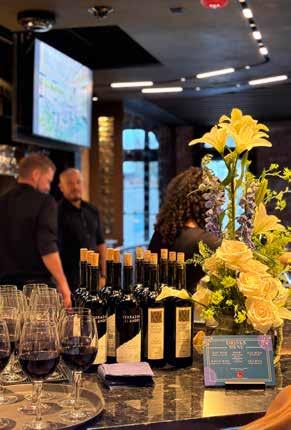
Colterris Collections: A Treasure in the Heart of Palisade
EAT
Spring Recipes: The Magic of Mushrooms
SPRING REVIVAL
BOOK + BEVERAGE
• Cash and Gravity By Perrin Pring
• Peach Street Distillers Gin and Tonic
INSTAGRAM + PODCAST PICKS
COMMUNITY STYLE
Hat Trick: Trends + Tips for Styling Fashion’s Western Topper
MAKER
Mesas to Monuments Quilt Show to Feature 174 Artworks: Every Stitch an ‘Act of Love’
ART
Connection Fuels Creativity: Telluride’s Newest Artist Gatherings Turn Conversation Into Creative Fuel
MUSIC
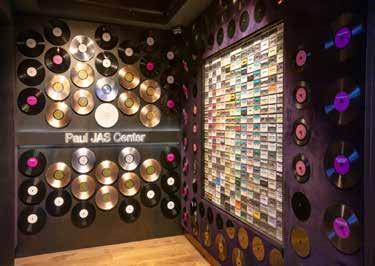
A New Home for Music: Inside the Opening of the Paul JAS Center
FOOD
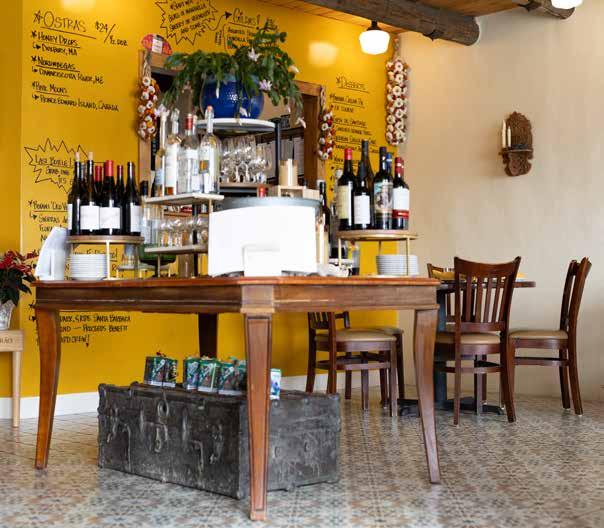
Sherry, Oysters + Churro Lamb: The Boathouse Anchors Mancos Dining Scene
WELLNESS + FITNESS
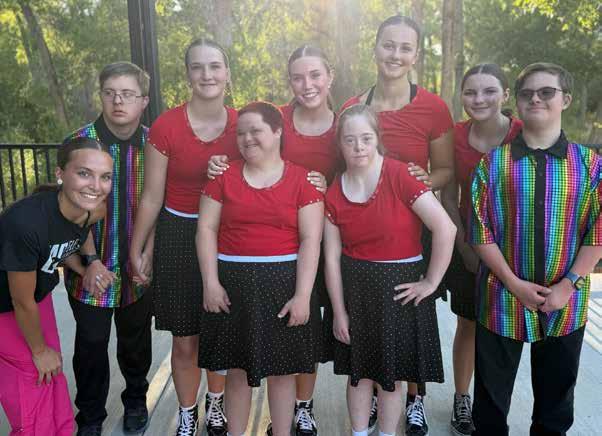
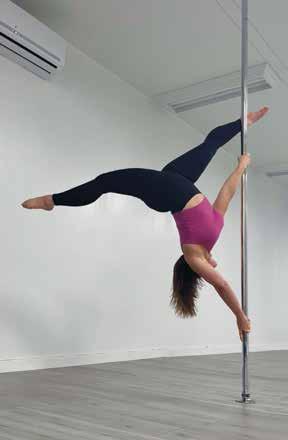
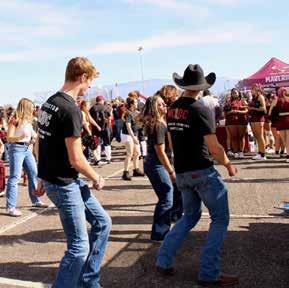
Cut Loose: Adult Dance Classes
Are Keeping the Western Slope in Motion
Phipps
CURRENT
Spring asks us to move. Across Western Colorado the season arrives in motion. Snowmelt begins high above town, rivers rise through the valleys and trails slowly return beneath our feet. Bikes come down from rafters, gardens soften and conversations migrate back onto sidewalks and patios. The landscape shifts first, then the community follows. This issue is built around the idea of current. Not the rush of a packed calendar, but the shared energy that carries a place forward when people participate in it together.
You’ll find it in gathering spaces, from the accessible playground at Wingate Park to children’s museums designed for curiosity and connection. It shows up in your local libraries, where knowledge moves across generations, and in dance classes where strangers become partners for an evening.
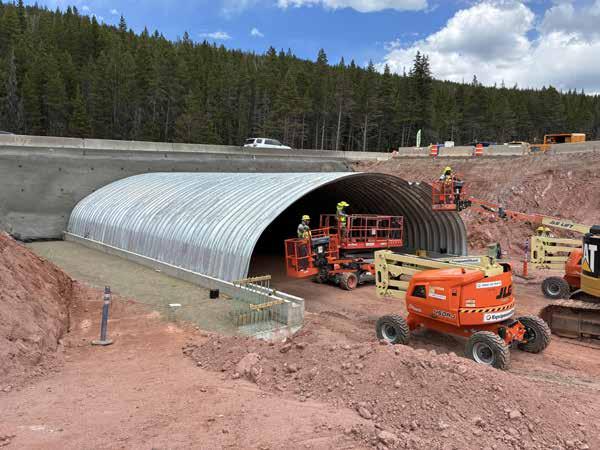
Creativity moves in a current, too. Artists meet through the Telluride Arts Creative Exchange, quilters stitch community into pattern and musicians fill the Paul JAS Center in Aspen with dynamic sound. Outside, wildlife crossings reshape migration paths and hikers return to desert trails as spring blooms begin.
Spring reminds us that belonging is active. Community is not something we watch happen. It is something we enter, and once inside it, we help carry the momentum forward.
Here’s to longer light, open doors and moving with the place you live.
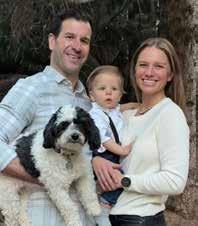
Kim Fuller with Bobby L’Heureux + Emery and Pepper
Publishers of Spoke+Blossom Founders of Jaunt Media Collective
Keep in touch with us between issues! Check out our website, spokeandblossom.com, for updates and events, and follow us on social media.
Scan this QR code with your smart phone to be taken directly to our website.
This magazine is shareable and recyclable. Please don’t throw it in the trash.
Founder
Robin Brown
Publisher
Jaunt Media Collective
Editor-In-Chief
Kim Fuller
Managing Editor
Lexi Marshall
Art Director
Kitty Nicholason
Community Engagement
Chloe Wasserstrom
Partnerships
Bobby L’Heureux
Contributors
Bree Bell
Jeremy Belton
Julie Bielenberg
Lisa Blake
Tonya Bray
Xavier Fane
Kim Fuller
Jayme Henderson
Kylea Henseler
Nancy Ihlenfeldt
Anne Jenkins
Paige Kaptuch
Kristen Lummis
Holly Mandarich
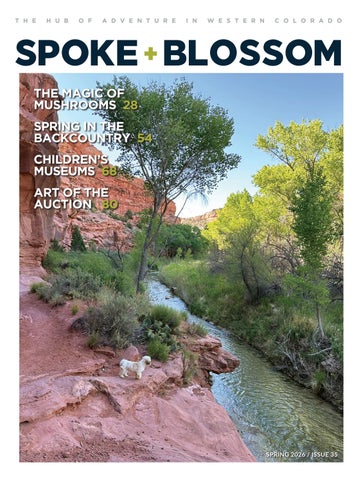
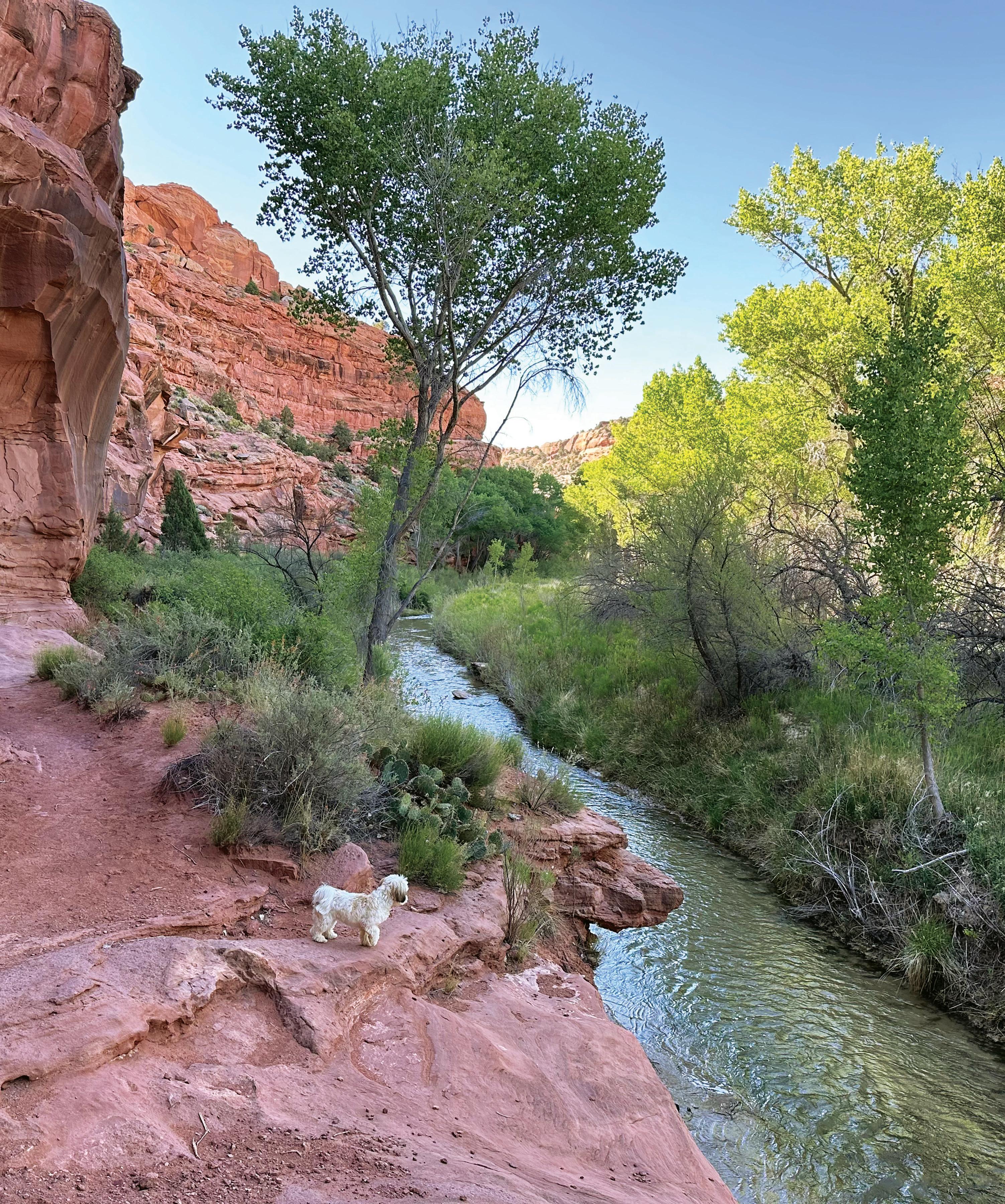
Cover Photograph
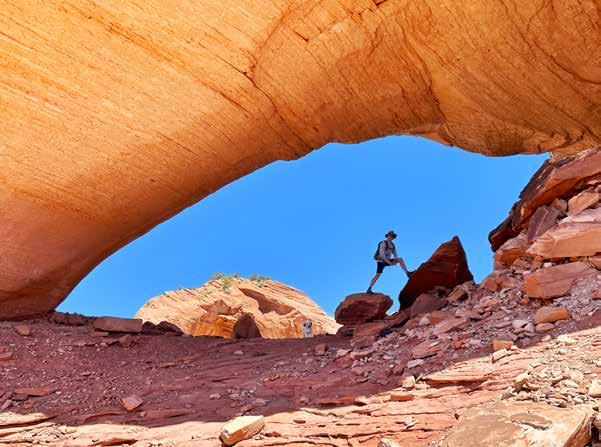
Phipps Arch Trail
Lexi Marshall
Cat Mayer
Maureen McGuire
Mindful Family
Photography
Mountain Roots
Photography
Nickolas Paullus
Niki Richardson
Mary Smith
Sharon Sullivan
Chloe Wasserstrom
Jennifer Weintraub
Melanie Wiseman
Photo by Melanie Wiseman
Spoke+Blossom Magazine
Jaunt Media Collective 2077 N. Frontage Road / D Vail, CO 81657
For advertising, contact ads@spokeandblossom.com 815.414.9642
Get in touch! We would love to hear from you. Please send your comments to letters@spokeandblossom.com.
Mary calls Hotchkiss home. When she’s not roaming the Western Slope on her bike, she’s further afield with her husband David. No matter where she travels, she likes to dig into local culture, usually by eating or hopefully finding an auction.
SHARON SULLIVAN
Sharon is an award-winning journalist who writes for various newspapers, magazines and nonprofit organizations. In her free time she enjoys hiking on Colorado’s beautiful public lands.
NICKOLAS PAULLUS
Nickolas is a family man, writer, cook, grower, board-gamer and forager in roughly that order. He is currently finishing work on his second book, Giant Steps, a personal reflection on the intersection of flora, fauna and self on the Western Slope.
ANNE JENKINS
PAIGE KAPTUCH
Paige’s stories have appeared in Runner’s World, Apple News Narrated, The Rumpus, North American Review, Swamp Pink, Epiphany, The Forge and more. She lives, writes and runs in Grand Junction. Her debut novel is in the works. Follow her at paigekaptuch.com.
Anne is a Wingate Playground Project’s grant writer and a proud Grand Junction native. She lives in the valley with her husband and three children. Passionate about the community, equal access and education, she advocates for inclusive spaces where all children can thrive.
TONYA RENEE BRAY
Tonya Renee is a Colorado-based writer, ski instructor and life coach. Her work focuses on people and intentional mountain living. When not writing or coaching, she can be found mountain biking, ski touring and trail running her way through life.
CURRENT
The pulse of spring in Western Colorado — moving in flow with the community, tuned to the rhythms of the season and carried forward by the shared momentum of adventure and leisure. “Current” captures the feeling of being fully present and plugged in: connected to the people, places and experiences that shape this region, and riding the energy that emerges when a community moves together.
We Asked These Western Slope Locals to Weigh in on This Topic
Compiled by S+B Staff
Co-Founder of FarmersMarket.store
“For me, ‘current’ means living in the moment and staying in rhythm with the land and the people around us. On the Western Slope, spring brings renewed movement, fields being planted, river water flowing in the canals and food shifting back to what’s fresh and local. Seasonal eating is current. It connects us to this place, supports local farmers and grounds daily life in what’s happening right now. At FarmersMarket.store, we use modern tools, online ordering, local food hubs and delivery to make seasonal eating easier. Being current means using today’s technology to strengthen our local food system and community.”
MARTA CZAJKOWSKA
Transformational Coach at Masters of Badassery
“As a coach who guides people to the edge of their known selves, I see ‘current’ as a cure for the stuck and the numb, a crack in the crust of the dull and the dense. It is the river remembering its path, moving without permission, teaching us how to move, too. Spring doesn’t strive — it thaws into presence. A single breath of now swells into wholeness, like the pulse of blood inside the body of the land. Current is myth in motion, threshold made water. When stone yields to flow, it carries not just water, but remembering: inevitably, it flows toward love.”
Co-Owner of Fogle Custom Homes “As a local community member and the co-owner of Fogle Custom Homes, to me the word ‘current’ means staying connected to the community we serve. It’s about understanding our community and its needs. Current is about honoring tradition while embracing innovation. Listening to local families, staying engaged in neighborhood conversations and creating homes that truly fit the lifestyles of our community. It also means giving back, showing up and investing in the health of our community. Staying with the current means building more than homes, it means strengthening the community and embracing our responsibility to build with care, relevance and integrity.”
JAMIE WOOD
SARAH FOGLE
what's up in the west
A RUNWAY TO THE FUTURE AT GRAND JUNCTION REGIONAL AIRPORT
Words by Lexi Marshall | Photos courtesy of Grand Junction Regional Airport
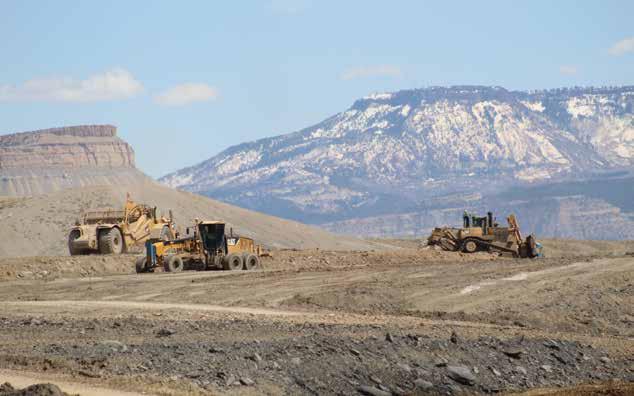
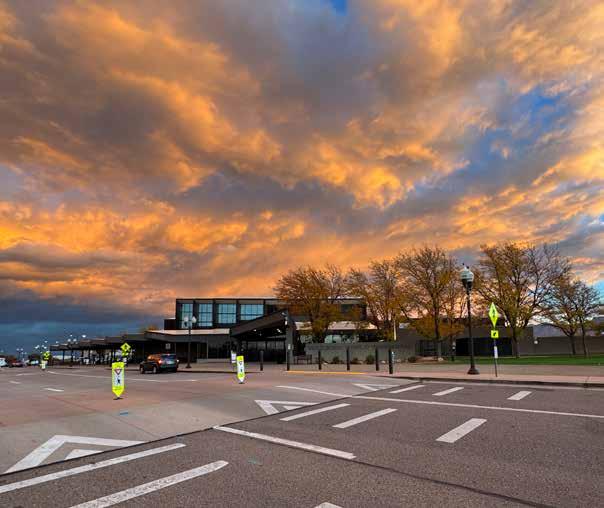
Big changes are taking shape just north of the existing runway at Grand Junction Regional Airport (GJT), and they are coming sooner than expected. In 2025, GJT received about $55 million in Federal Aviation Administration (FAA) grants, including an additional $38 million dedicated to paving work, for a new primary runway. For a regional airport, this is a major win with long-term ripple effects for safety, travel and the local economy.
“This grant is important for a few reasons,” says Angela Padalecki, chief executive officer of the GJT. “First, it provides significant funding years earlier than what the FAA had previously planned.” That timing matters. With funding arriving ahead of schedule, the airport can accelerate construction and potentially open the new runway as early
as 2028, two years earlier than the original 2030 target.
The runway replacement project is large and complex with total costs expected to exceed $200 million, but Padalecki emphasizes that the financial burden on the airport itself is far smaller. “The scale of the project demands we rely on grants,” she says. “The total project costs will likely exceed $200 million, but costs to the airport are strictly our matching contributions which will be less than $20 million.” Those funds are generated through airport user fees rather than local tax dollars, and both federal and state aviation grants come from aviation excise taxes rather than general government funds.
Beyond infrastructure, the economic impact is already being felt locally. “Virtually all of the work to date has been completed by Colorado
Virtually all of the work to date has been completed by Colorado contractors.
contractors, and all of the construction has obviously been in Grand Junction,” Padalecki says. “An influx of an extra $200 million into the Grand Junction economy is powerful.” Because the funding is aviation-specific, she notes that it does not compete with other projects in the valley and instead adds to the region’s overall growth.
From an operational standpoint, the new runway is designed to maintain what already sets GJT apart. The airport’s primary runway is the largest between Denver, Salt Lake City and Phoenix, and can accommodate nearly every aircraft flying today even in summer heat. The replacement runway will match that size at 10,500 feet long and 150 feet wide, and will sit parallel to the existing one, allowing the airport to avoid shutting down operations during construction. “We are building a replacement runway to minimize operational impacts during
construction and bring the primary runway up to current safety standards,” Padalecki says. Community members should not expect major disruptions anytime soon. With dirt work complete and paving set to begin after bids went out in early 2026, most visible activity will simply be the sight of progress from the air. Some runway closures may occur closer to the planned late 2028 opening, but the airport is focused on minimizing impacts to travelers.
Looking ahead, Padalecki sees the project as foundational to Western Colorado’s future. “The new runway opening should set the community up with a runway that can carry it another 50 years into the future,” she says, adding a favorite aviation saying: “One mile of road can take you one mile, but one mile of runway can take you anywhere.” At GJT, that runway will remain two miles long and ready to take the region wherever it needs to go next. :
Grand Junction Regional Airport
what's
WINGATE PLAYGROUND PROJECT IS IN MOTION EVERY CHILD DESERVES TO PLAY
Words by Anne Jenkins | Photo by Morgan Gaertner
9-year-old Madilynn Gaertner loves the same things most kids do — hide-and-seek, climbing high and chasing friends across the playground. She’s bright, sassy, glitter-loving and determined to keep up. But unlike most children, she can’t access much of her school playground.
Wood chips stop her walker. The structure requires crawling, which becomes unsafe when other kids are running around her. She watches her friends climb and explore while she stays behind on the hard surfaces.
“I wish I could do everything,” she says.
At Canyon View Park in Grand Junction— one of the few playgrounds she can navigate — Madilynn climbs to the third level, races her brother Connor and explores independently. “I get to go up high,” she says proudly.
But at school, it’s different. “It makes me sad,” she says. “They leave me behind and don’t want to stay on the hard stuff.”
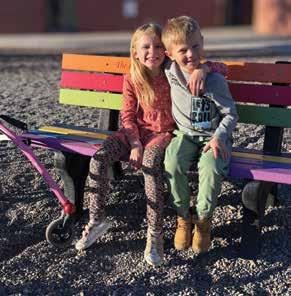
Connor, age 5, doesn’t see disability — he sees his sister and his favorite playmate. Connor wants to see playgrounds change. “[We need] hard ground so I can run and sis can play with me wherever I go,” he says. “And a bench so we can sit together when we’re tired.”
Madilynn’s parents, Morgan and Ryan, moved to Grand Junction for a more inclusive environment. They’ve found community here, but they’ve also seen how much work remains.
“She can climb and slide at Canyon View,” Morgan says. “But at Wingate, she misses out. She shouldn’t have to choose between independence and safety. No child should feel isolated.”
Wingate’s playground was built in 1982 and has seen few improvements since. Many children with disabilities cannot safely access it, leaving them out of the joy and developmental benefits of play.
But progress is underway.
Parents, teachers, neighbors and local businesses have united around a shared belief: every child deserves to play.
In 2024, Phase I added nearly 2,000 square feet of poured-in-place rubber surfacing, an adaptive swing and an accessible spinner — opening the playground to children who had long been sidelined.
In 2025, a new climbing structure was installed in honor of a former Wingate student. It’s more than equipment — it’s a tribute, a gathering place and a tool for cognitive, social and physical growth.
And the best part? Every child uses it. Inclusion benefits everyone. Wingate’s playground serves 15,911 nearby residents, including 1,844 community members with disabilities.
Phase I gave them access. Phase II (potentially in summer 2027) will give them experiences — more movement, more imagination, more joy. :
Madilynn and Connor Gaertner enjoy sharing a colorful bench at the playground.
ORCHARD DREAMS + OUTDOOR GEAR
HESTIVAL 2026
Words + Photos by Julie Bielenberg
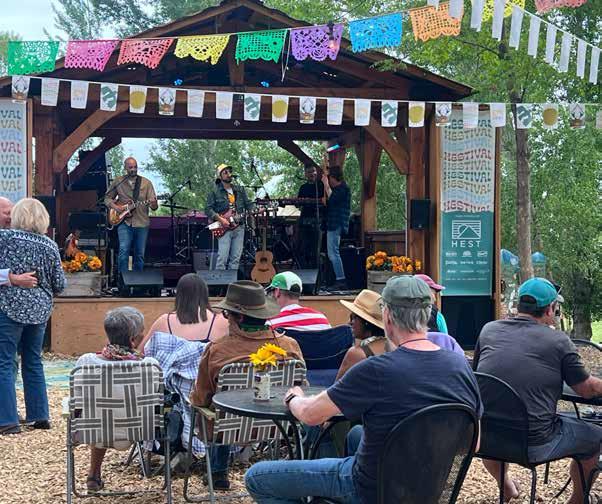
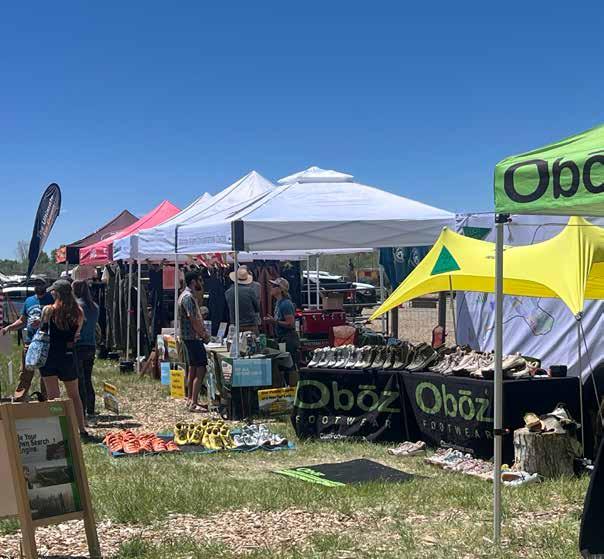
There’s something exciting, thrilling, even magical when the fruit trees burst into a sea of white blossoms and the scent of fresh-cut grass drifts across the afternoon horizon. That’s exactly why over 1,000 outdoor enthusiasts migrate to Hotchkiss each May for the most idyllic blend of a blossom festival and a gear showcase ever imagined — HESTIVAL.
Hosted by the sleep-system innovators at HEST, the festival partners with The Conservation Alliance annually to curate a weekend that celebrates the best of the Western Slope: farm-to-table flavors, live rhythms and
vast, sun-drenched landscapes. Attendees don’t just visit the orchard, they inhabit it. Families can pitch tents directly beneath the canopy (yes, you’ll fall asleep under a ceiling of apple and peach blossoms), test-drive new gear on guided hikes and toast to the season with local cider and spirits. Even Sunday brunch is elevated by a live soundtrack from regional musicians.
“The community we’re building at HESTIVAL continues to inspire us,” says Aaron Ambuske, founder of HEST. “Now in its fifth year, we are excited to evolve HESTIVAL as an intentional, pet-friendly gathering designed for every level
of adventurer.” It’s a place where a toddler might experience their very first night in a tent, or a gravel-bike enthusiast from the Front Range can find the perfect excuse to scout the rugged backroads of the North Fork Valley.
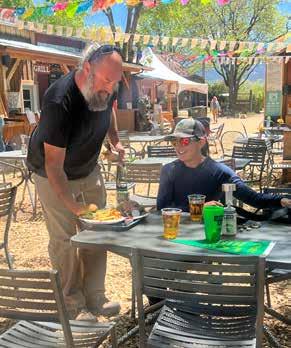
The experience is as seamless as it is soulful. This past year, my teenage son, our dog and I spent our days weaving through the vendor village and refueling on Big B’s classic BBQ. We opted for the HEST “turn-key” camping setup, which meant trading in our outdated sleeping pads for a cozy, fully-outfitted HEST sanctuary before dancing the night away under the blossoms.
If you’re looking for a weekend that balances high-end outdoor gear with the simple, grounded joy of community, Hotchkiss is the place to be this May 1-3, 2026. :
Before they were forcibly relocated to reservations in the mid-to-late 1800s, the Ute people in Colorado traveled with the seasons through different ecosystems to gather plants for food, medicinal and other uses. The Ute Indians continue to reside in Western Colorado and eastern Utah.
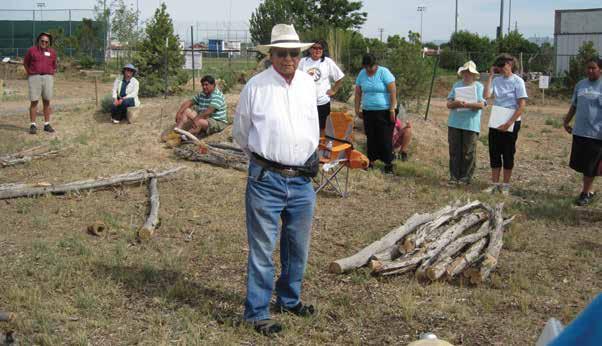
20 years ago, Ute elders began collaborating with various federal land agencies and Colorado State University (CSU) Tri-River Area Extension to create the Clifford Duncan Ute Learning Garden on Orchard Mesa in Grand Junction.
Betsy Chapoose, director of cultural rights and protection for the Ute Indian Tribe, conceived the idea of a Ute Ethnobotany Project in 2009, an ongoing research and educational project that seeks to preserve the traditional plant knowledge of the Ute people. The Ute Learning Garden was created as a physical manifestation of the ethnobotany project.
Ute elders and leaders began working with area archaeologists, the Bureau of Land
Management, U.S. Forest Service and National Park Service to create a demonstration garden that teaches visitors about Ute customs, and how they used, and continue to use, native plants that grow in the region — for food, medicine, soap, shoes and other items.
The ethnobotany garden was planted in 2011 with the help of the Ute Indian Tribe of the Uintah and Ouray Reservation, Southern Ute Indian Tribe and Ute Mountain Ute Tribe.
“We worked with all three tribes,” says Lauren Ratzloff, associate program coordinator for the Ute Learning Garden. “They helped us decide what plants to install here. Ute kids and elders helped with the planting.”
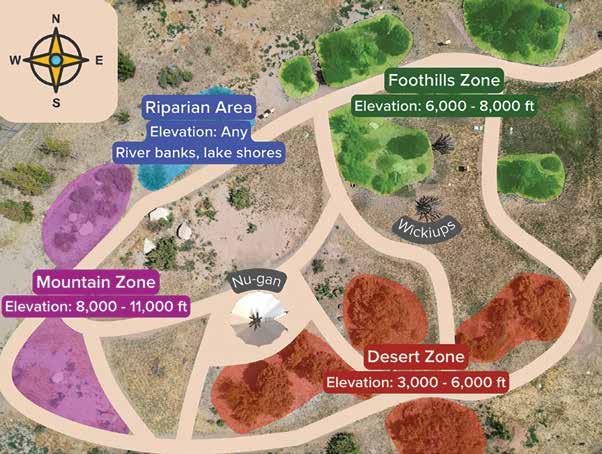
The garden takes visitors through three different life zones — desert, foothills and mountain — to reflect the seasonal rounds of the ancient Utes, who migrated with the seasons to access available animal and plant resources. Interpretive signs highlight important moments in Ute history and Ute-animal relationships.
| Photos courtesy of Clifford Duncan Ute Learning Garden
Signage in front of a huge yucca plant explains how the yucca’s roots were pounded to make soap, and how the stringy fibers coming out of its sword-like leaves were used to make rope. In fact, CSU Extension employees are currently making rope from the yucca plant to use for a planned shade structure on the property, says Jeff Pieper, CSU Extension’s commercial horticulture and natural resource specialist. The yucca plant also contains edible flowers and fruits.
Prickly pear cactus grows in another area of the garden, a plant that provided the Utes with edible fruits, as well as pads for medicinal purposes. You’ll also see sagebrush — a plant that people continue to use for ceremonial and medicinal purposes.
Additionally, the garden includes replicas of ancient Ute dwellings — primitive wood structures called wickiups — which archaeologists continue to find in remote areas of the Four Corners region. In the springtime, a nu-gan (the Ute word for teepee) is set up on the premises, where children gather for storytelling,
and visitors learn the culturally significant way to enter and leave a nugan, says Pieper.
The ethnobotany garden is named for the late Clifford Duncan, a Ute elder and leader who played an important role in establishing the garden and adding the nugan and wickiup structures to the site.
The Clifford Duncan Ute Learning Garden draws approximately 300 to 400 visitors each year, says Ratzloff, who helps lead free tours of the garden. “We also talk about ecology in general, ‘Leave No Trace’ ethics and pollinators,” she says. “Kids really get it — even really young kids get how we can take care of the earth.”
The Ute Learning Garden is located at 2775 U.S. Hwy 50, behind the CSU Extension office on the west end of the Mesa County Fairgrounds. The site is open daily, and is free for the public to visit via a tour or on their own. Groups who call in advance can request a tour led by volunteer docents, many of whom are master gardeners. :
For more information, visit tra.extension.colostate. edu/gardening-hort/ute-learning-garden.
ENVIRONMENTALLY-SMART SURPSTONE
LOVE + PLASTIC
Words by Kristen Lummis
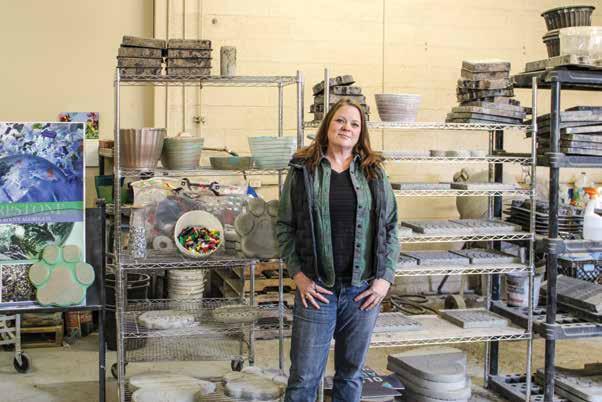
Jill Layton has a love/hate relationship with plastic, especially the single-use type that clogs landfills and degrades the environment. She hates that. But as the founder and owner of SURPStone, a company that utilizes shredded plastic as aggregate in concrete, she has come to appreciate “orphan” plastics, which she intentionally repurposes in her warehouse workspace at the Grand Junction Business Incubator Center (BIC).
SURPStone stands for Single-Use Repurposed Plastic Stone. “We take unusable plastics that don’t have an affordable end market and use this plastic in place of pebbles and sand in concrete,” Layton explains. This mixture is used to create unique landscaping pavers and garden tiles.
Speaking at a ribbon cutting for SURPStone in November 2024, Layton shared her passion for waste reduction. “I love reusing anything if I can
make it into something new. SURPStone allows me to make an impact on the community I love by removing plastic waste from our landfill, and creating something new and enduring from it by turning trash plastic into eco-groovy aggregate.”
Layton’s company is an example of a circular economy, where trash is utilized in a novel way for economic gain, rather than hitting the landfill. She collects plastic from four primary sources: Curbside Recycling, a local engineering firm, eBricks and BIC. Examples of the plastic items SURPStone collects include toy building bricks, plastic hangers, toothbrushes and singleuse containers.
The Business Incubator Center is thrilled to have SURPStone on its campus. “When businesses like SURPStone succeed, the entire community benefits,” explains BIC’s Robyn Miley. “We are always interested when a unique
ROBYN MILEY, THE BUSINESS INCUBATOR CENTER
idea like Jill’s comes through our Incubator Intensive Program. Supporting economic diversity is central to our mission, which means working with businesses across many industries. A business rooted in circular economy adds an important and timely dimension to that mix.”
Now moving into her second year of commercial production, Layton has numerous retail partners carrying her decorative tiles and landscaping pavers. For 2026, consumers can find SURPStone products at New Way Refillery and Bookcliff Gardens in Grand Junction, Fruita True Value, Co-op Country in Palisade and Delta Ace Hardware. She is also forging partnerships with construction companies, such as Willow Wind Construction, who are using SURPStone landscaping pavers at a larger scale.
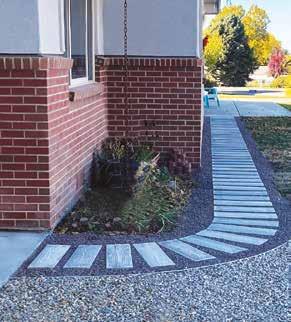
Layton shares that garden tiles, especially those shaped like paws, are her biggest sellers, noting that if consumers would like a memorial stone for their pet, she is happy to work with them to incorporate ashes and/or pet toys shredded into the stone. Other hot sellers include heart, turtle and frog-shaped stones. As for pavers, 12inch square mosaic tiles and tiles resembling wooden planks are popular.
Moving forward, Layton hopes to develop a pre-made bagged concrete mix that can be sold directly to consumers, a process that will require extensive engineering and testing. Maintaining a high-quality product is important to Layton.
“I have to make sure that I’m happy with the product that I put out,” she says, “because I care about it and I don’t want people to look at the idea of a recycled product and think that it doesn’t work.”
SURPStone is a major career change for Layton, who previously worked in publishing, human resources and office administration. When she enrolled at Colorado Mesa University (CMU), Layton was interested in graphic design. Then in her first class she was asked to list three things she was good at, three of her hobbies and three things she would do if money was no object. From this, SURPStone emerged as a venture which would feed her passion for sustainability. She credits CMU faculty for their support, BIC for their numerous business assistance programs and her life partner Jonathan Belk, who provided an initial investment.
Reflecting on what she laughingly calls “making mud pies,” Layton admits that SURPStone is her dream job. “It combines so many of the things that I was good at in my early career and made it all into something that matters to me. If you are going to have a business, you better love it or you’re going to burn out real fast,” she explains, adding, “I love it.” :
SURPStone pavers with a geometrical design
SURPStone pavers made to look like wood
JILL LAYTON
JILL LAYTON
A CITRUSY, FLORAL GIN COCKTAIL WITH EARL GREY TEA
STEADY STATE
Words + Photo by Jayme Henderson
Winter’s drab color palette is brightening, melodic birdsongs are filling the air, and days are lengthening past the dinner hour. Even my chickens are welcoming spring’s arrival and are thankfully laying eggs again on a regular basis. That brings us to the star ingredient of this cocktail: an egg white. Its addition in this recipe takes a refreshing, citrusy gin sour and transforms it into an ethereal, dreamy experience with a luxurious consistency.
Loose-leaf tea, lavender buds or lemon zest, for garnish
LAVENDER
½ cup honey
½ cup water
HONEY SYRUP
1 heaping tsp dried lavender buds
1. In a small saucepan, combine all ingredients and heat to a simmer over medium-low heat, stirring along the way.
2. Remove the pan from heat and let the lavender fully steep until the mixture reaches room temperature.
3. Strain the solids and store in the refrigerator for up to two weeks.
This gin-based cocktail is an aromatic, textural celebration of spring’s arrival. An Earl Grey tea-infused gin dials up complementary tannins and brings out the spirit’s citrus tones, while a lavender honey syrup adds a rich, floral note. Although the eye-catching botanical garnishes are not necessarily meant to be consumed, they do add a decidedly fun crunch and offer olfactory clues to the flavor profile of the cocktail, encouraging the drinker to slow down and savor. :
1. Prepare the Lavender Honey Syrup and Earl Grey-Infused Gin at least 30 minutes before making the cocktail recipe. See recipes below.
2. In a mixing tin, combine the gin, lemon juice, lavender-honey syrup, Italicus Bergamot Liqueur and egg white.
3. Dry shake vigorously for 30 seconds.
4. Add ice, shake for another 15 seconds and double-strain into a chilled coupe glass.
5. Garnish with loose-leaf tea, lavender buds and lemon zest.
EARL GREY-INFUSED GIN
8 ounces gin
4 tsp loose-leaf Earl Grey tea or four tea bags (like The Spice & Tea Exchange’s Earl Grey Creme Tea)
1. Pour gin into a sealable glass jar and add the Earl Grey tea.
2. Shake well and set aside for at least 30 minutes.
3. Taste for balance. You don’t want to oversteep and create an overly tannic infusion.
4. Strain and store at room temperature indefinitely.
HELPFUL COCKTAIL TOOLS + TECHNIQUES
Hawthorne Strainer
A Hawthorne strainer is the most popular kind of strainer and the one most-often used in making cocktails. Stainless steel coils cover the strainer plate, mostly preventing large pieces of fruit or ice from passing into cocktails. This strainer easily fits in any mixing tin or pint glass.
Fine-Mesh Strainer
You most likely already have a finemesh strainer or tea strainer in your kitchen. It allows you to strain your finished cocktail, leaving behind any ice shards, pulp or pieces of fruit, seeds or herbs. A fine-mesh strainer is used in this recipe to strain the ice, when held underneath the Hawthorne strainer.
Double-Strain
This clarification technique involves straining a cocktail twice, using both of the strainers listed above, resulting in a particulate-free, smooth drink. After a cocktail is shaken, it is strained with a Hawthorne strainer directly through a fine-mesh strainer that is held over a cocktail glass. This technique is used when clarity and texture are desired.
Dry Shake
A dry shake is performed when ingredient integration is desired without the dilution of ice. Most often, it is done with egg white cocktails, when extra time is needed to mix and aerate the ingredients, without watering down the cocktail with ice. After a dry shake, ice is added, and a second shake is done to chill the drink for serving.
A TREASURE IN THE HEART OF PALISADE
COLTERRIS COLLECTIONS
Words by Melanie Wiseman
“W
ow!” is the first thing most people say when entering Colterris Collections.
“It happens every time,” says founder and owner Scott High. “This private collection for public viewing is the largest display of these types of objects in the world.”
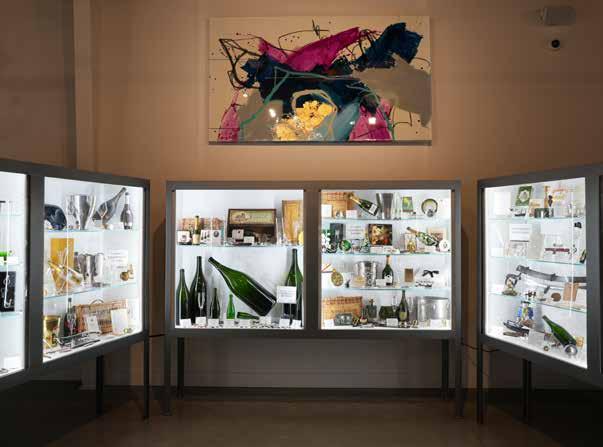
Over 54 years, High judiciously collected 18,000 antique corkscrews, thousands of other wine-related items and the stories that helped paint a picture about each piece. Collectables
include personal articles of kings and queens, a pope, shepherds, warriors, Hollywood actors and famous musicians. A 200 A.D. Roman glass wine vessel in mint condition and 10,000-yearold mammoth ivory handle Laguiole corkscrewknife top the collection’s oldest. Over half of the collection is from Europe and the balance from the United States.
High never intended to display his collection, but with two of his children
involved in this huge venture and the desire to share his passion, Colterris Collections opened in June of 2025.
“I would love to spread my gospel about the world of wine,” says High. “I hope the collection will fuel the image and enhance the overall reputation of Western Colorado as a wine producing area.”
Jessica Burford, president and CEO of the Palisade Chamber of Commerce, couldn’t agree more.
“Colterris Collections is a wonderfully unique treasure in the heart of our region. Their
commitment to excellence, collaboration and creativity enriches the visitor and community experience. I would say this is another incredible, don’t-miss Palisade spot for wine lovers and history buffs.”
THE COLLECTION BEGINS
Raised in south Denver by parents who were wine merchants, High was drawn to his father’s pontifications about wine at 12 years old. He made a habit of biking to the library to check out books on wine and flooding wine reps and California winemakers with questions.
Scott High enjoys answering most questions about his collection. “The two questions I hear most often are the ones I’m not going to answer: ‘Where did you get this and how much did you pay for it?’” says High with a grin.
DANCING IN MY HEAD
PHOTOGRAPHY
With separate areas for tasting, seating and gathering, the unique experience attracts family and friend reunions, special events and year-round field trips for intrigued history and wine lovers.
Over 54 years, Scott High judiciously collected 18,000 antique corkscrews, thousands of other wine-related items and the stories that helped paint a picture about each piece.
DANCING
PHOTOGRAPHY
At 16, a corkscrew topped with a beer logo at an antique store caught his attention. Curious, he learned that before 1900, beer bottles had corks requiring corkscrews as openers. He made his first collection purchase. It was 1971.
High devoured books on wine through college and took summer classes at the esteemed Geisenheim Viticulture Center in Germany.
“The more I learned about wine, the more I found I didn’t know,” says High. “The history, geography, artistry, chemistry, biology, botany, food science.”
His collection grew while globe-trotting during a 35-year career in wine wholesale, falling in love with Palisade and relocating to the Western Slope with his family in 1999. They now own two Palisade Colterris Wineries, 59 acres of peaches and cherries and over 120 acres of wine grapes, as well as Colterris Collections.
THE COLLECTION ON DISPLAY
The monumental task of displaying the collection was a family affair — unpacking 600 boxes, sorting, categorizing and labeling. Over 4,000 corkscrews and a total of 8,000 pieces were selected for display in the 7,480-squarefoot showroom. 14,000 more corkscrews and thousands of other items are in storage for future display refreshing and renewing.
“The two questions I hear most often are the ones I’m not going to answer: ‘Where did you get this and how much did you pay for it?’” says High with a grin.
What he is passionate about sharing are the stories behind most collection pieces, often including humor. Did you know Napoleon was into Champagne or Queen Elizabeth loved Mateus Rosé? Or that the collection includes examples of how alcohol was hidden during prohibition in fake containers imitating a cigar, salted pretzel, billy club and even a tamale?
Word of the collection is spreading beyond the valley. Aspen and Vail concierges are visiting and referring groups for inspirational day trips. Taking a break from Aspen, 23 doctors from Vietnam recently toured the collection. With separate areas for tasting, seating and gathering, the unique experience attracts family and friend
reunions, special events and year-round field trips for intrigued history and wine lovers.
“Colorado Colterris is a distinctive, worldclass treasure trove,” says Johanna van Waveren, community engagement director for Eureka! McConnell Science Museum. “The sheer scale of the collection — and its unforgettable view into the history and artistry of wine culture — are captivating.”
High can tout the largest collection of its type in the world, as he’s experienced the others, which pale in comparison. Other influential experts in the field concur.
“I’ve already had people in the Napa Valley wine business ask me to move the collection to Napa Valley because there is nothing like this in California,” says High. “I have no intention of moving it.”
Immersing yourself in Palisade’s Colterris Collections will fill your glass and leave you thirsting to return for more. :
Colterris Collections 3708 G Rd. Palisade, CO colterris.com/colterris-collections
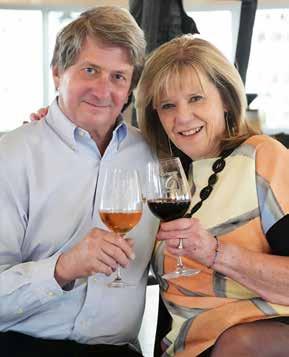
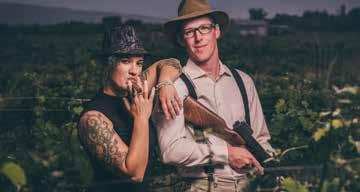
Scott and Theresa High
THE MAGIC OF MUSHROOMS
Cozy Cooking From Garden to Table
Words by Maureen McGuire | Photos by Cat Mayer
When I was a young child, I was reluctant to eat mushrooms. They were very mysterious. There are all different kinds of all different colors. Some are delicious and some are poisonous, and I had many questions on how we figured out which were which. After a heavy rain, they would appear in the garden overnight, like magic. I would imagine tiny fairies, gnomes or leprechauns sitting on them like chairs, having tea or holding court.
Now that I am (much) older, I am still awed by mushrooms and all of their many varieties,
though they are less mysterious. I enjoy many different varieties of mushroom, and have noticed more and more varieties at local farmers markets and farm stands, in the grocery and on menus at local restaurants. I am amazed at how versatile they are and how voluminous they can be. I continue to be delighted when mushrooms of the non-edible varieties appear overnight in my garden, only to melt in the hot Western Colorado sun by noon. I just might still imagine the fae using them for furniture next to the plots of fennel and carrots. : SPRING RECIPES
MUSHROOM AND BARLEY SOUP SERVES 6-8
3 stalks celery, diced
1 large yellow onion, diced
3 cloves garlic, minced
2 pounds mushrooms (any variety), minced (I used the food processor)
½ tsp salt
4 Tbsp butter
2 Tbsp flour
1 cup dry white wine
8 cups veggie or chicken stock
1 cup barley
½ cup of heavy cream (approx)
1 lb chopped kale
1 bay leaf
½ tsp sage
¼ tsp thyme
Pinch of summer savory, if available
Salt and pepper to taste
1. Use medium to medium-high heat. In a large pot, sauté the celery, onion, mushrooms, salt and butter until tender and the onion and celery is translucent. Add garlic, and continue to sauté.
2. Sprinkle the flour and cook for a minute or two. Add the wine and stir spiritedly, to ensure nothing is stuck to the bottom of the pan. Add the stock, barley and herbs. Simmer for about one hour with low heat, or until the barley is tender.
3. Add kale until wilted and adjust seasonings if needed.
4. Finish with cream just before serving.
MUSHROOM AND CHICKEN GALETTE
SERVES 2-4
1 pie crust for 9-inch pie
1 cup ricotta
½ large shallot, sliced thin
¼ tsp salt
¼ tsp ground black pepper
1 egg
¼ tsp herbs de Provence
2 cups shredded cooked chicken
2 cups mixed mushrooms, roughly chopped (I used lion’s mane, shitake and maitake)
Additional egg for egg wash
Arugula tossed with lemon juice, olive oil, salt and pepper
1. Preheat oven to 350 degrees Fahrenheit. On a parchment-lined baking sheet, place the crust.
2. In a bowl, mix the ricotta, salt, pepper, herbs and one egg. Spread on crust, leaving about 1-inch border. Sprinkle the shallot, mushrooms and chicken on top of the ricotta.
3. Gently fold the edge of the crust around the edges of the toppings. Brush the edges with egg wash.
4. Bake for 35-45 minutes or until the crust is golden and the ricotta has set. Cool five minutes. Top with arugula.
MUSHROOM DIP
1 lb mushrooms (I used a mix of crimini and button)
1 shallot
8 ounces cream cheese
¾ cup raw almonds
1 egg
2 Tbsp ground flax seeds
¼ tsp thyme
Salt and pepper to taste
1. Preheat the oven to 350 degrees Fahrenheit.
2. In a food processor, chop the almonds and shallot. Add the mushrooms and process until ground, but not paste.
3. Put the mixture and the rest of the ingredients in a bowl and mix well.
4. Add to an oven-safe dish and bake covered for 35-45 minutes or until set.
5. Serve on bread or crackers as a warm appetizer.
SPRING RENEWAL IN OURAY
Grotto Spa at The Western Hotel
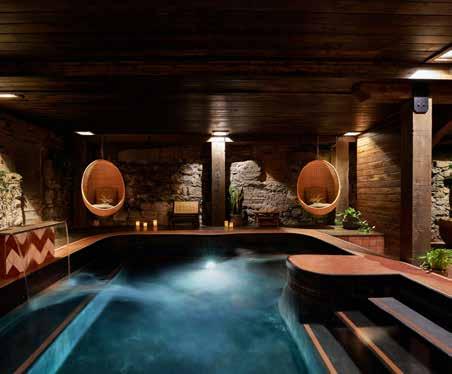
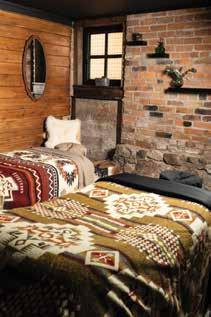
In a town known for dramatic peaks and restorative waters, The Western Hotel & Spa in Ouray offers a different kind of immersion — one rooted in history, quiet luxury and intentional slowing down. Originally established in 1881 and thoughtfully restored in 2023, the storied timber-frame building now houses an intimate collection of suites and, tucked beneath it, a sanctuary designed for deep renewal: Grotto Spa.
Descending into the spa feels like stepping into another era. Original 1891 stonework surrounds a calming, softly lit space where mountain adventure gives way to sensory restoration. The experience flows naturally as you soak in a Nordic wellness in the thermal soaking pool, awaken circulation in the cold plunge, then linger in the cedar dry sauna while the scent of wood and steam settles the nervous system.
Spring in the San Juans invites long walks, waterfall chasing and sunwarmed afternoons, and the Grotto offers the perfect counterbalance as a restorative sanctuary. Signature treatments blend regional inspiration with modern wellness: the Southwest Azul Corn Glow polishes skin with blue corn and botanicals, while the Grotto Ultimate Retreat pairs massage and facial into one comprehensive reset. Couples can
reconnect during the Shared Serenity Lovers Ritual, a two-hour experience designed to restore both body and presence.
The ambiance mirrors the hotel: Western in spirit yet refined in execution. Candlelight, mineral textures and quiet corners encourage guests to linger rather than rush. It’s
less about indulgence and more about recalibration — the kind of pause that lets the mountains sink in.
After a day exploring in Western Colorado, Grotto Spa becomes the place where adventure settles into memory.
thewesternouray.com
RETURNING TO THE BODY’S WISDOM
Sheri Covey + the Rocky Mountain Ortho Bionomy Center
In spring, we instinctively look for ways to reset, to soften what winter tightened and restore energy where it’s been depleted. For Grand Junction–based practitioner and instructor Sheri Covey, that seasonal impulse mirrors what she has spent three decades helping others rediscover: the body already knows how to heal.
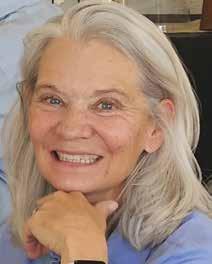
Covey is an Advanced Practitioner and Advanced Instructor of OrthoBionomy and founder of the Rocky Mountain Ortho Bionomy Center, home to the only full educational program of its kind in the world. Since
first encountering the work in 1994, she has built both a thriving clinical practice and a training school that has produced practitioners across the country. Her teaching style is warm, progressive and often infused with humor, reflecting a modality rooted not in force, but in cooperation.
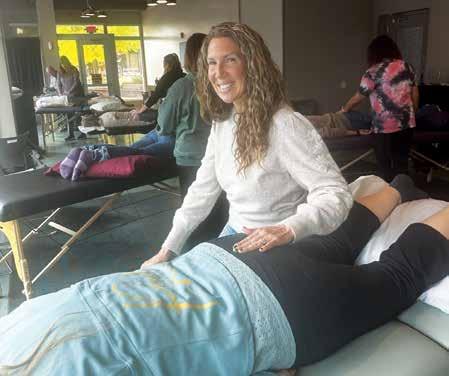
Ortho-Bionomy is a gentle neurological and structural bodywork approach derived from osteopathy. Rather than manipulating tissue or pushing through resistance, it engages the nervous system to help the body recognize its own patterns and naturally reorganize. Through
comfortable positioning and subtle cues, the work invites muscles, fascia and deeper systems, including lymphatic, visceral and endocrine, to release held tension and return toward balance.
Clients often come seeking relief from chronic or acute pain such as spine and joint issues, headaches, whiplash, digestion challenges or recovery from injury and surgery. Just as often, they find something less
measurable but equally tangible: a sense of calm, regulation and reconnection. The premise is simple. When the body feels safe, it recalibrates.
Covey believes the power of the work lies in respect for the whole person, body, mind and emotional experience, and in teaching clients to recognize those changes themselves. Sessions are quiet, collaborative and deeply restorative, offering space for the nervous system to shift out of holding patterns and into healing.
For those drawn beyond receiving, and into learning, the Rocky Mountain Ortho Bionomy Center offers a 10-week practitioner training spread over a year and a half, with programs held annually in Grand Junction and Denver.
Spring asks us to come back to life gently. Covey’s work offers a way to do exactly that, not by fixing the body, but by reminding it how to remember itself.
970.209.9400
rmobcenter.com
Sheri Covey
GET 15% OFF AT CHECKOUT USING CODE WELL15
MAGNESIUM SUPPORT FROM HEALTH & WISDOM
Up to 60% of adults are magnesium deficient — often without knowing it. Stress, medications and age can all deplete this essential mineral your body needs for every organ.
Since 1999, Health & Wisdom has provided pure, medical-grade topical magnesium to help restore balance naturally and affordably.
A simple soak or topical application supports:
• Restful sleep
• Stress and anxiety relief
• Reduced inflammation and joint pain
• Faster recovery and less stiffness
• Stronger immune function
Laura and Leroy Collinwood provide personal service, fast shipping and products that truly make a difference. Experience the time-honored ritual of magnesium soaking with Health & Wisdom’s bath crystals, soaps, oils and gels.
417.424.1040 health-and-wisdom.com
Mountain Revival
Nestled in Vail, this small, cozy wellness studio is a favorite among locals and visitors alike. A two-time “Best of Vail” winner for massage and recognized for best spa and holistic practice, Mountain Revival offers massages, facials and a recovery room with infrared sauna, cold plunge and mobility tools, plus memberships and packages.
970.401.2439
mtnrevivalvail.com
Synergy Center for Wellness
Discover the difference at Synergy Center for Wellness, with two convenient and chic locations in Avon and Eagle. This Pilates studio delivers an exceptional wellness experience led by instructors who bring nearly 50 years of combined experience. Using equipment and props, they help you heal, lengthen and tone your body. Each week, enjoy nearly 30 hours of classes. synergyvail.com
Vail Trail Running Series
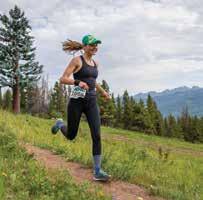
The Vail Trail Running Series challenges runners on mountain courses around the Vail Valley. From historic routes (including the 50th Annual Vail Hill Climb on July 5!) to flowing alpine trails, each race ends with a celebration featuring podium awards, donuts and custom T-shirts. Don’t miss this iconic series! See the 2026 schedule at vailrec.com.
MADE
Where the River Sings INSIDE HOLIDAY
RIVER EXPEDITIONS’ CANYON
CONCERTS
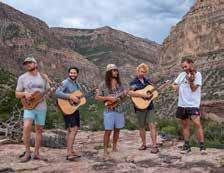
There’s something timeless about music outdoors — the way a guitar sounds softer under the stars, or how a melody seems to echo longer when it’s carried by canyon walls instead of speakers. Holiday River Expeditions’ Canyon Concerts series takes that familiar magic and elevates it into something unforgettable: multi-day river trips paired with intimate, live performances from professional touring musicians, set deep within some of the West’s most stunning canyons.
“It’s like the campfire guitar tradition we’ve all grown up with — just turned all the way up,” says Justin Malloy, sales and communications manager of Holiday River Expeditions. Except here, the soundtrack is provided by acclaimed string bands playing fiddles, mandolins, guitars and upright basses — no amps, no electricity, just pure acoustic sound shaped by nature itself.
Unlike a traditional concert — or even a traditional rafting trip — music
on a Canyon Concert doesn’t stay in one place. Bands may perform on the beach at camp, in a natural amphitheater reached by hike or even while floating downstream with rafts lashed together. “There’s never a dull moment,” Malloy says. “The music becomes part of the journey, not just something you sit down to watch.”
That blend of adventure and artistry is what transforms an already incredible river trip into something deeper and more joyful. “It makes it a party,” Malloy says. Guests still experience everything that makes a multi-day river trip so special: splashy whitewater, quiet hikes, stargazing and long conversations with friends and strangers alike. Live music simply weaves those moments together.
One Canyon Concert moment, in particular, captures that magic. Malloy recalls a trip chartered for a 50th birthday celebration. On the final night, coinciding with the birthday, the group transformed the beach into a glowing stage with lights and glow sticks while the band played medleys of the guest of honor’s favorite songs. What followed was a full-blown dance party in the sand, complete with an enthusiastic attempt at “the worm.”
“They described it as ‘magical in the best way,’” Malloy says. “And honestly, that’s Canyon Concerts in a nutshell.”
For musicians, the experience is just as special. Dante Giacobassi of
The Pickpockets — a band he describes as “funky bluegrass” with island and reggae influences — says the acoustic nature of their music makes river trips a perfect match. “It’s fun to get back to the roots of bluegrass and play under the stars with nothing but your acoustics and your own instrument,” he says. Natural acoustics — cave walls, cliffs, canyon bends — become part of the performance. “It’s incredible the sound difference it can make. That’s something very unique to these river trips.”
What truly sets Canyon Concerts apart, though, is access. This isn’t a crowd pressed up against a stage — it’s an intimate, immersive experience. Guests share meals with the musicians, hear the stories behind the songs and gain insight into the creative process itself.
And while the music may feel effortless, everything else is carefully handled. Holiday River Expeditions’ seasoned guides manage the logistics, navigate the rapids, cook exceptional meals and lead unforgettable hikes. “Your only responsibility,” Malloy says, “is to have fun.”
For those ready to book, one thing is clear: don’t wait. Seats are limited, and Canyon Concerts routinely sell out faster than other trips.
2026 Trips with Availability
4-Day Yampa River with Pompe n’ Honey May 20-23
4-Day Westwater Canyon with The Last Wild Buffalo July 16-19
4-Day Gates of Lodore with Theoretical Blonde July 23-26
4-Day Westwater Canyon with The Wasatch Valley Drifters September 4-7
WWords + Photos by Paige Kaptuch
A Thrilling Sci-Fi Western Paired With the Author’s Favorite Local Spring Sip
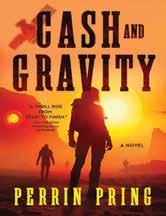
THE BOOK CASH AND GRAVITY
BY PERRIN PRING
hat happens when you mix thriller, sci-fi and the West? It’s a story that only local author and Colorado National Monument ranger Perrin Pring can tell. She describes her forthcoming novel, Cash and Gravity, as the story of Chevy Cole, a female Launch Tech marine living in a world where mega corporations battle for Earth’s remaining metals to cobble together new technology that might, one day, get them permanently off the planet.
During a battle in a dusty corner of Nevada, Chevy stumbles upon a crash site containing a super soldier carrying the world’s first mobile fusion device. After her corporation steals the device, Chevy is forced to partner with Dolon — a man so analog he still uses cash and navigates by paper map — to flee their pursuers, embarking on a low-tech, high-stakes road trip across the American West.
Pring has always been a writer and she’s always played hard outside — a combination that fuels many of her stories. A native Coloradan, Pring holds a Master of Fine Arts in creative writing and screenwriting from UC RiversidePalm Desert and comes from a long line of ranchers, including ancestors who helped settle Colorado Springs.
She grew up on the Front Range skiing and whitewater kayaking and now spends much of her time recreating on public lands — telemarking, camping, hunting, trail running and exploring the West. Pring’s deep connection to the outdoors and movement breathes life into her storytelling.
The idea for Cash and Gravity came about in 2020 after Pring and her husband spent six days
on the Green River running the Gates of Lodore, and they were just coming out of the wilderness at a time when COVID-19 was a new reality the world was facing. She says, “Cash and Gravity is hopeful, but it’s set in an unhopeful time. It’s about a woman who takes up a lot of space, and she’s allowed to. The country is crumbling, the forests are burning, she’s being chased by a mega corporation which will stop at nothing to kill her, but no one is telling her to smile or be quiet, or proceed through the world less like a man and more like a woman. It’s a book about a woman being allowed to succeed and fail in the same way the male characters can.”
Cash and Gravity releases May 26, 2026
Preorder here: simonandschuster.com
Buy local: Out West Books outwestbooks.co
THE BEVERAGE
PEACH STREET DISTILLERS GIN AND TONIC
Perrin’s pick: Peach Street Distillers gin and tonic. “I love gin and tonics because they are light, cool and hopeful. And the characters in Cash and Gravity are pushed to the very brink, and yet, they retain their hope.”
Peach Street Distillers’ Missy Wylie comments that their Jackalope Gin “does the storytelling: hand-picked juniper, coriander and botanicals offering piney depth and bright citrus, all crafted by hand in the heart of beautiful Palisade.” :
Peach Street Distillers
144 Kluge Ave. Building #2, Palisade, CO peachstreetdistillers.com
INSTAGRAM + PODCAST PICKS
Compiled by S+B Staff
@earlymorningproduce
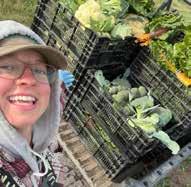
Early Morning Produce (formerly Early Morning Orchard) is a female-owned farm growing year-round fruits and vegetables through regenerative practices. Based in Palisade, their page offers a behind-the-scenes look at life on the farm, along with educational insights that help followers reconnect with where their food truly comes from.
Consciously Unconscious Podcast
If modern life feels equal parts enlightened and unhinged, Consciously Unconscious leans all the way in. Hosted by best friends Amanda Fowler and Jessa Fragnoli, the show pairs sharp, laugh-out-loud banter with thoughtful conversations about the human experience. The duo dives into everything from relationships, identity and the stories we tell ourselves.
@kelleydallasphotography
Colorado-based and world obsessed, Kelley Dallas captures landscapes, people and travel with a lens that blends artistry and authenticity. Inspired daily by the sweeping vistas of the Rocky Mountains, she seeks out awe-inspiring locations across the globe while documenting the stories of the people she meets.
Backpacker Radio Podcast
If your spring trail plans need a little spark, Backpacker Radio delivers it every Monday. Hosted by Zach “Badger” Davis and Juliana “Chaunce” Chauncey, the podcast blends long-form interviews, practical backpacking advice and plenty of trail banter into roughly three fresh hours each week. With more than 6 million lifetime downloads, it’s earned its reputation as the top hiking podcast.
@claws_gj
CLAWS, the largest cat rescue on the West Slope, is a sanctuary where all Cats Lives Are Worth Saving. This nonprofit provides lifelong care for abandoned and homeless cats, offering shelter, medical treatment and love without discrimination based on age, circumstance or medical history.
Wisecrack Podcast
What happens when a hometown comedy gig turns into the stuff of nightmares? In Wisecrack, standup comic Edd Hedges returns to familiar streets expecting an easy charity set — and instead becomes tangled in a story far darker than any joke he’s written. After TV crime producer Jodi Tovay discovers his routine, what begins as curiosity snowballs into a deep dive that blurs the line between performance and police file.
TRENDS + TIPS FOR STYLING FASHION’S WESTERN TOPPER
HAT TRICK
Words by Jennifer Weintraub
Few pieces carry as much charisma as the cowboy hat. It’s less of an accessory and more of an attitude. Slip on one and you’ll find yourself standing a little taller and striding with confidence.
Once reserved for ranches and rodeos, the cowboy hat is a Western classic that has lassoed the attention of style-conscious crowds from ski towns to city streets. Equal parts utility and allure, the hat blends grit with glam, heritage with hype.
The trick for this Western trend? Wearing it right.
A HAT WITH HISTORY
The cowboy hat wasn’t born in a boutique. It was built for survival.
In the late 1800s, John B. Stetson, son of a hat maker, crafted the first cowboy hat after moving West. Inspired by the broad-brimmed sombreros of Mexican vaqueros, he designed a hat that protected cowboys, shielding them from the sun and repelling the rain on the open range. Built for function and durability, it soon became a symbol of the rugged and untamed spirit of the American West.
As its popularity grew, the cowboy hat became more than just gear — it became an
identity. Riders began shaping brims and crowns to suit their style. They slipped on leather bands, silver conchos or a lucky feather on the trail.
Fast forward to today, and the cowboy hat has outridden its utilitarian beginnings. It’s a form of personal expression and a fashion statement.
CRACKING THE COWBOY HAT CODE
If you’ve ever muttered, “I just don’t look good in hats,” here’s the truth: you haven’t met the right one yet.
A cowboy hat isn’t a one-size-fits-all; it’s an art. Carrie Calvin, owner of Gypsum-based Sunward, knows this dance well. First, she analyzes your height, proportions, head size and even the shape of your head. “Fit is everything,” she says. “If it’s not comfortable, you’re not going to wear it.”
At its core, a cowboy hat comes down to two main pieces: the crown (the top of the hat) and the brim (the rim). The height of the crown and the style of the brim will dramatically change the look and how the world perceives you in that hat.
Face shape plays a significant role in the structure and style of a hat. “Typically, tall guys can pull off a cattleman-style hat with with a high crown and wider brim, but if you’re skinny
with a narrow face, the proportions can look overwhelming,” Calvin explains.
Elongated faces look best with balance — a crown that doesn’t exaggerate length and a curved brim to create harmony with the long lines. Round faces look great with angles: think a higher crown and a slanted brim to sharpen the silhouette. On the flip side, square faces benefit from softening. Rounded crowns and a gently curved brim can smooth out strong jawlines and broad foreheads.
Brim size depends on your body size. “On a smaller person, an oversized brim can swallow your frame,” Calvin explains. The fix? Trim the brim slightly, and suddenly, the hat looks proportional to the person. That’s the beauty of a custom hat: every crease, curve and detail can be tailored to fit your head and personality.
The right cowboy hat doesn’t just sit on your head. It elevates your look, balances your proportions and adds a little swagger to your step.
TRENDS IN THE WILD
Cowboy hats may be steeped in tradition, but today’s styles prove that they are not stuck in the past. Modern makers are reshaping and reimagining this Western classic without losing its roots.
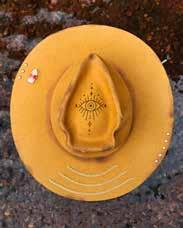
SHAPE The classics — like the cattleman and the pinch front — are timeless. But modern hatters are pushing boundaries and getting playful, carving crowns into shapes like roses, diamonds and arrowheads. “I love these crown shapes because they’re different, but still subtle,” says Calvin.
Brims are traditionally curved, ranging from a subtle roll to the more dramatic “taco” curve, but flat brims have emerged as the darling of modern Western fashion, Calvin explains. They are sleek, clean and polished without losing the historical origins of the hat. Another option for those who lean more urban: the pencil curl. This is a tight, rounded curl on the edge of the brim, which lifts it slightly away from the face.
COLOR Black, brown and cream will never ride out of style. But if you’re ready to stand out
from the herd, bolder hues are trotting into the spotlight.
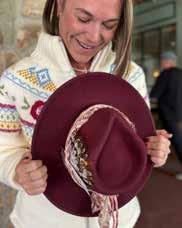
“The brighter pops of color are trendier. This season, the color is maroon,” says Sally January, owner of Alpine Kind, a family of retail shops in the Vail Valley with a do-it-yourself hat bar offering. “It’s a little more fun and special because it’s not the traditional color for a cowboy hat, but still very wearable.”
PERSONALIZATION Customization has always been a part of cowboy hat culture, but modern tools take things up a notch.
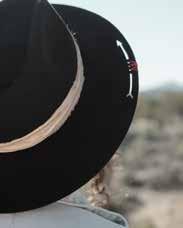
Laser cutters etch intricate designs across crowns and brims, while piercings, earrings and stitched edges add a fashion-forward edge. The result? A hat that’s less about blending in and more about broadcasting your personality to the world.
STAMPING YOUR STORY
Cowboy hats come alive once they’re personalized. That’s when it goes from stock to signature style.
“There are so many ways to make your hat special and unique,” January says. If you’re not sure where to start, she recommends layering three key elements.
“We encourage people to start with a vintage or one-of-a-kind fabric as their foundation. Something with a texture or pattern that has personality,” January says. “Next, we add a complementary accent, like velvet, silk or vintage fabric. And the third element is something natural, like a feather, leather or twine. It’s the third thing that always puts the puzzle together.”
Another easy option? Wrap a handillustrated silk scarf around the crown. Change it with the season or use it in other ways throughout your wardrobe.
Whether you opt for bold details or subtle refinement, make it yours.
Every cowboy hat tells a tale. The shape you choose, the details you add and the way it fits all weave into your personal story. It’s attitude stitched into a silhouette.
Whether you’re riding dusty trails or roaming the streets, the cowboy hat is proof that Western heritage has fashion staying power. :
MESAS TO MONUMENTS QUILT SHOW TO FEATURE 174 ARTWORKS
EVERY STITCH AN ‘ACT OF LOVE’
Words
Karen Murray Boston started quilting 14 years ago after her husband bought her a quilting lesson for Valentine’s Day — which means he can’t complain about the time or money she spends on her hobby, she says jokingly. The sewing pastime apparently runs in the family. A quilt his great-great-grandmother made with the embroidered names of Civil War veterans hangs in the International Quilt Museum in Lincoln, Nebraska.
Boston belongs to Sunset Slope Quilters, a group of approximate 180 members celebrating its 40th anniversary this year. The club is also gearing up for its 2026 Mesas to Monuments Quilt Show, May 1-2. The exhibit, which happens every other year, will feature 174 quilts — both traditional and antique quilts, as well as art quilts. The event also includes a trunk show,
an antique quilt bed turning and a silent auction both days.
About half of its members meet monthly at a local church for a “show and tell” of whatever they’re working on, to learn new techniques from guest speakers and plan collaborative quilts to give away. “A main reason we get together is to make quilts for the community,” says member Shari Keivit.
In 2024, the group donated more than 250 quilts for various organizations serving homeless youth and other unhoused community members, hospice patients and survivors of domestic abuse. Sunset Slope Quilters also donate quilts to oncology and pediatric patients at the Community Hospital and St. Mary’s Regional Hospital, Habitat for Humanity homebuilders and to the local chapter of Sleep in Heavenly Peace, an
by Sharon Sullivan | Photos courtesy of Sunset Slope Quilters
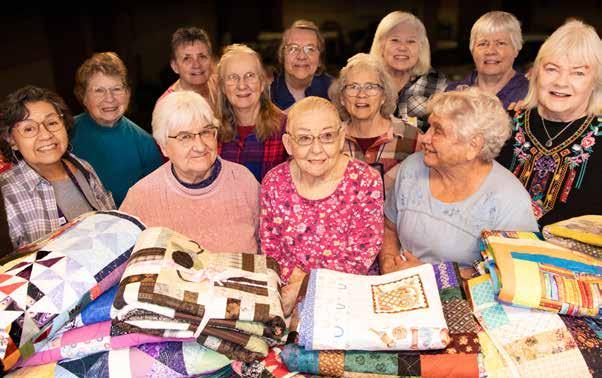
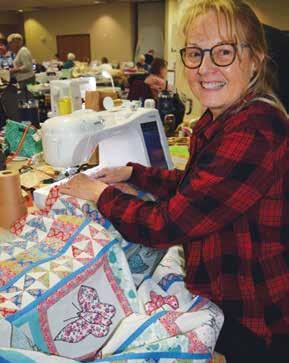
With nearly 250 combined years of membership, Sunset Slope Quilters’ Orchard Stitchers — one of the guild’s dedicated sewing groups — organizes and delivers all donated quilts each year. Pictured in the center, Joan Walker has been an active member of the guild for more than 25 years.
organization that partners with Grand Junction High School students to make bed frames for kids in the community who don’t have their own beds.
Donated quilts are made by many hands, with one person piecing the fabrics together, while others do the quilting, the binding and so on. Typically, three to seven people work together on the quilts, all made with donated fabric. “At least once a month, we’re contacted by someone with a bundle of fabric to give away,” says Keivit. What they don’t use is re-donated to other groups who can use it.
“We sort through it and take the cream of the crop,” says member Jane Yater.
Additionally, in 2025, the group made 250 Christmas stockings to give to Mesa County foster children. Members then donated money to purchase items to fill the stockings.
In addition to their monthly business meetings, Sunset Slope Quilters gather once a quarter for a two-day “Sit and Sew” where they bring projects to work on. And, once a year in January, 50 members attend a retreat in Moab for three days of sewing at a local hotel.
In addition to their biennial quilt show, Sunset Slope Quilters hang a new quilt each month at St. Mary’s Advance Medical Pavilion. Plus, the
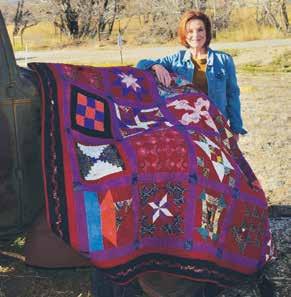
Karen Murray Boston says she was “born too late,” which fuels her passion for vintage and heritage crafts. A hobby farmer and triathlete, she began quilting 12 years ago after discovering a Civil War-era family quilt on her husband’s side — now housed at the International Quilt Museum in Lincoln, Nebraska. Pictured here, her Underground Railroad Quilt incorporates both African and Australian fabrics, honoring the legacy of the enslaved from both regions.
Quilts have the ability to tell so many stories. Cindy Williams works on a quilt with blocks made by her grandmother. While she passed when Williams was young, the blocks form a generational connection between the two women and a link to the past.
group hosts mini shows and fundraisers at Barnes & Noble Booksellers in the spring and winter. The Mesa County Central Library is now hosting a mini quilt show through April 9 at 443 N. 6th Street in Grand Junction.
“The Mesas to Monuments show is a sharing of what we love so much,” says Keivit, who recently gave her mother-in-law a quilt. “Each stitch is an act of love. A quilt is a way to send a hug; it provides warmth. It’s very personal. We’re hoping people can feel that, our caring.”
The show will include several categories, from hand-quilted, appliquéd and embroidered pieces to machine stitching work. The show is from 10 a.m. to 5 p.m. on Friday, and 10 a.m. to 4 p.m. on Saturday at the Grand Junction Convention Center, located at 159 Main Street. Admissions is $8; 12 and under free.
Sunset Slope Quilters meet at the First Presbyterian Church, 3940 27 ½ Road, the second Wednesday of each month at 9 a.m. The group welcomes members of all abilities. :
For more information, visit sunsetslopequilters.com/40th-anniversary.
TELLURIDE’S NEWEST ARTIST GATHERINGS TURN CONVERSATION INTO CREATIVE FUEL
CONNECTION FUELS CREATIVITY
Words by Jennifer Weintraub | Photo courtesy of Telluride Arts
Art is not meant to exist in isolation. While creativity may begin in solitude — late nights in the studio, quiet mornings with a notebook — it rarely thrives there. The most eclectic ideas often come from unexpected places: a conversation in a cafe, a moment in nature or a spark lit by another artist.
That belief sits at the heart of the Creative Exchange, a new artist-focused program launched by Telluride Arts. Designed to foster conversation, collaboration and connection, the program proves that creativity flourishes when it is shared.
WHEN ARTISTS GATHER, IDEAS MULTIPLY
Telluride Arts has been advocating for artists since 1971, making it the town’s oldest nonprofit and a cornerstone of the artist community.
“What’s cool and funky about Telluride is the artist culture and the creative community we have,” explains Jessica Galbo, executive director.
When she started her role last fall, she noticed artists seeking more connection.
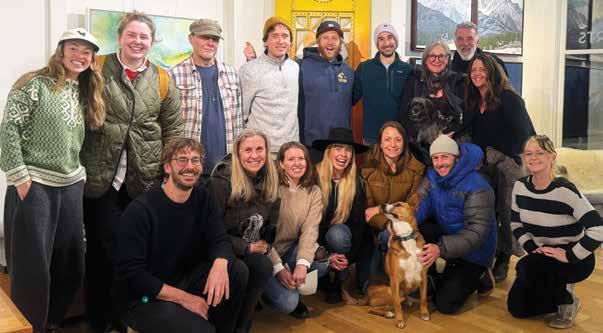
By the end of 2025, Galbo launched two new monthly gatherings: Creative Exchange and Salon Night. Held on the second and third Thursdays of each month from 5:30-6:30 p.m., the events are open to creatives of all disciplines and experience levels.
“People create in isolation in their studios. These groups give artists a way to come together and feel connected to the community,” says Galbo.
THE CREATIVE EXCHANGE: REAL TALK FOR REAL ARTISTS
At its core, Creative Exchange is a space for honest conversation. Emerging artists learn from established ones and seasoned creatives gain fresh perspectives from new voices. Each session is led by a rotating artist who sets the topic, ranging from navigating creative ruts to pricing work and building a sustainable career,
with time intentionally built in for questions and dialogue.
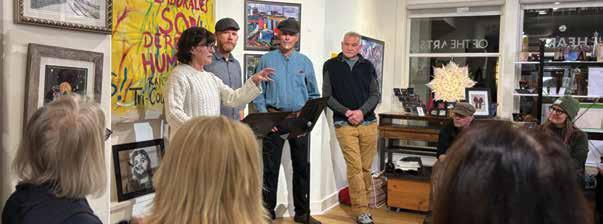
The inaugural session was led by Tammi Brazee, a fine arts painter from Ridgway, who shared how she formed a small critique group of fellow painters. Her creative circle regularly leans on each other to talk about concepts, sketches and roadblocks.
The energy in the room was immediate. Artists weren’t just listening — they were recognizing the stories being shared.
“In a rural area, it’s easy to isolate yourself in your studio and not come out,” she says. “I would see other artists at gallery openings, but we were like ships passing in the night. The Creative Exchange gives us an organized way to come together.”
FINDING BALANCE BETWEEN ART AND WORK
Telluride’s landscape has a way of drawing creatives in — its natural beauty reverberating off canyon walls and inviting reflection. Alex Ferrari, a photographer and director, moved to Telluride in 2022 after experiencing burnout in the commercial photography world. What he found was a place to reconnect with art on his own terms.
Ferrari shared his experience navigating the tricky balance between making art for love and making art for a living. “Sometimes, creating art can get really muddy,” Ferrari says. “I got to the point where I was only doing it for the job, and it sucked the creativity out of me.”
His talk explored the tension many artists face between freedom and financial reality.
“Artists feel like they have a gift. They can do it
completely for fun, or you could go to the other extreme, where you’re only doing it for the money.”
For Ferrari, Telluride — and this group — has helped him land somewhere in between. The Creative Exchange became a sounding board for every stage of the process, from doubt to discovery.
SALON NIGHT: WHERE IDEAS ROAM FREE
Salon Night offers an informal, unstructured gathering inspired by the Parisian salons: lively social hubs where artists and intellectuals gathered to swap ideas and discuss philosophy. Telluride’s version swaps Parisian parlors for a mountaintown backdrop, but the spirit remains the same.
In a rural mountain town, that openness matters. Mountain living comes with its challenges, but it also fosters a deep sense of community. “The majority of artists are willing to share information with others because we know how hard it is to make your way in the world as an artist,” Brazee says.
CREATIVITY IS BETTER WHEN IT’S SHARED
What Telluride Arts is building goes beyond programming. These gatherings are creating a cultural rhythm, a reminder for artists that they don’t have to do it alone.
When creatives come together, ideas expand. And in Telluride, that shared energy is shaping a future where art isn’t just created, it’s supported and sustainable. :
telluridearts.org
INSIDE THE OPENING OF THE PAUL JAS CENTER
A NEW HOME FOR MUSIC
Words by Lexi Marshall | Photos courtesy of the Paul JAS Center
Music has a way of flowing farther than expected — down alleyways, through snow-softened streets, into conversations that linger long after the last note fades. This past December, that feeling gained a permanent address.
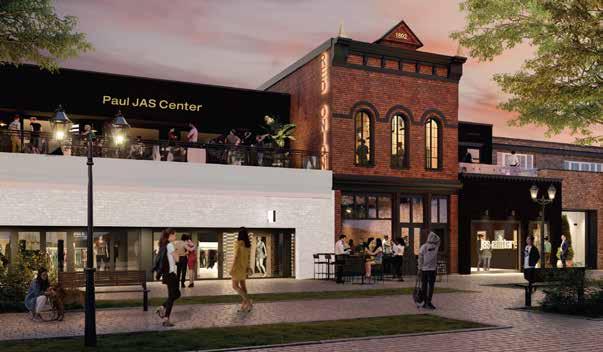
After decades of presenting world-class music in temporary and intimate settings across the Roaring Fork Valley, Jazz Aspen Snowmass (JAS) officially opened the doors to its first
permanent home: the Paul JAS Center. The downtown Aspen venue debuted with 10 nights of performances, marking not just the opening of a building but a new chapter for a community long shaped by live music.
Those inaugural performances — spanning the holidays and into early January — felt intentionally reflective. Trombone Shorty and Orleans Avenue opened the celebration, followed by Christian McBride, The New Mastersounds,
Grand Opening January 2026
Dee Dee Bridgewater, Shelly Berg, The Motet and more. Beneath the marquee names was a deeper story: one of continuity, access and the belief that music thrives best when it belongs to everyone.
“These shows [were] a great window into the range of musical genres that JAS will present … from jazz and blues to soul, R&B and Funk, and featuring both instrumentalists and vocalists,” says Jim Horowitz, JAS founder, president and CEO.
The symbolism of the opening night artist was no accident. Trombone Shorty first played JAS in the summer of 2001 at the JASummer Nights Gala — when he was just 15 years old and already a New Orleans music prodigy. Over the years, he returned to Aspen for milestone performances in 2012 and 2014. His return nearly 25 years later mirrored JAS’s own evolution from seasonal festival to year-round cultural anchor.
Alongside performances, the Paul JAS Center now houses a state-of-the-art recording and broadcast studio, hosts year-round education programs and serves as a gathering space for community groups and nonprofit collaborations. It is a deliberate expansion of JAS’s long-held philosophy that music is not just something to be consumed but something to be participated in.
PAUL JAS CENTER SPRING CALENDAR
Mar 13: Jontavious Willis (Blues)
Mar 14: Shemekia Copeland (Blues & Soul)
Mar 19–20: Dan Wilson Quartet ft. Nigel Hall & Jessica Yafanaro (Soul Jazz)
Mar 21: Southern Avenue (Memphis Soul & Roots)
Mar 22: Jazz Brunch — Sammy Miller & the Congregation
Mar 25–26: OKAN (from Cuba) with DanceAspen
Mar 27: Cimafunk (Afro-Caribbean Funk & Hip-Hop)
Mar 28: Alfredo Rodriguez ‘Coral Way’ (Pan-Latin Jazz)
Apr 9: Ghost-Note (Funk, Hip-Hop & Jazz)
COMMUNITY NIGHTS (TUESDAYS)
Mar 3: James Horowitz Trio ft. Jimmer Bolden
Mar 17: St. Paddy’s Day Silent Disco ($25)
Mar 31: Open Mic Night
Apr 7: Share Your Voice Showcase
After decades of presenting world-class music in temporary and intimate settings across the Roaring Fork Valley, Jazz Aspen Snowmass (JAS) officially opened the doors to its first permanent home: the Paul JAS Center.
ANDY PAUL
The Paul JAS Center is named for Andy Paul, chairman of the Jazz Aspen Snowmass board and the lead donor behind the organization’s first permanent home.
Grand Opening January 2026
Grand Opening January 2026
Paul JAS Center lobby
That belief has already taken root through weekly Community Nights, which launched in January and continues every Tuesday. Designed as low-barrier entry points into the space, these evenings feature food and drink specials, local entertainment, games and open-mic nights — most of them free. The series kicked off with a performance by local musician and 2025 JAS “Share Your Voice” Songwriting Competition winner Tristan Trincado and has since included DJ nights, trivia and Mardi Gras celebrations.
In many ways, Community Nights echo the same impulse that inspired the JAS Café series in 2011: intimacy over spectacle, connection over polish. The Paul JAS Center has also introduced flexible layouts including a “Café-Dance” format that allows guests to sit and listen or stand and move with the music. Lower-priced standingroom tickets are designed to make shows more accessible, particularly for locals.
“Bringing the Paul JAS Center to life in downtown Aspen’s core is a dream come true for JAS that will allow us to serve this community in ways only a permanent and secure venue can ensure and for generations to come,” Horowitz says. “JAS has created a stylish, warm and uniquely intimate space that will take its place as a beloved new ‘gathering spot’ in Aspen.”
The venue’s ambitions remain grounded in everyday experience. From Family Jams designed for infants through age five to middleand high-school songwriting workshops led by board-certified music therapist Mack Bailey, programming emphasizes music as a shared language across ages and backgrounds. Even the culinary partnership with Epicure leans into community, bringing local creativity into bar menus, brunches and supper-club events.
Aspen has never lacked for music. What it lacked, until now, was a place where that music could live year-round — where education, performance and gathering coexist under one roof. With its doors now open and its calendar full, the Paul JAS Center stands as both a culmination and a beginning: a space where sound, story and community finally have room to follow the current together. :
THE BOATHOUSE ANCHORS MANCOS DINING SCENE
SHERRY, OYSTERS + NAVAJO-CHURRO LAMB
Words + Photos by Tonya Bray
From the snow-covered knife ridge of the La Plata Mountains, the Mancos River is formed. Its tributaries flow from the snowmelt of the 13,000-foot peaks to a little cow town called Mancos, Colorado.
Jenn Stewart came to Durango in search of a more enriching life of sunshine, something different than her Ohio home. She wanted to live a life of purpose, “not just to work for money and die.”
Dave Stewart grew up in Maryland where his fondest memories are shucking oysters as a child. He migrated west to Boulder to attend the University of Colorado and eventually landed in Durango.
Like two tributaries on the river of life, they met in Durango. Dave was working at a local restaurant and Jenn owned and operated a catering business. They were introduced by friends one evening while Dave was working in
the kitchen of a local restaurant. He introduced Jenn to raw oysters. Their shared love of food drew them together, and they eventually married. Seeking good wine, food and sunshine, they honeymooned in Spain.
They opened The Boathouse on Electra Lake together in 2017, but had to close the space several years later because the lake — the restaurant’s sole source of water for cooking and cleaning — had dried up. They were eager to find a new home for their inspirations, and through a series of meetings and events, landed in Mancos, where they acquired a small space from a retiring restaurateur.
The Boathouse on Grand was reborn in October of 2023.
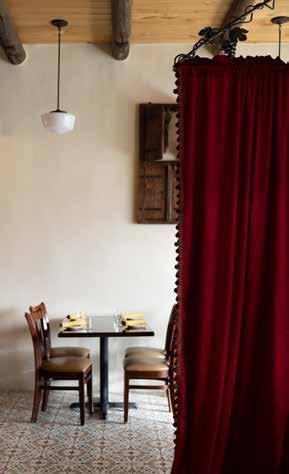
The Boathouse is anchored in the tastes of Spain. Inside, the walls evoke the warmth of the Iberian Peninsula. While the restaurant has the trappings of a modern fine dining experience, Jenn calls it “fun dining.”
According to Dave, Mancos was a good change from Durango because it’s closer to the source of the ingredients — the myriad local farms which are the lifeblood of the area. Being so close to the farms and the farmers allows him to plan for the year. In winter, conversations around what to plant, what has worked well in the past and what doesn’t require too much water lead to what’s on the menu.
“It’s super important to support people we know,” says Dave. And that’s the ethos of The Boathouse. It all comes back to community. The convergence of people who care about each other, the land, the food and the experience of community.
Plates change with the seasons and the availability of local vegetables and animals. This spring, The Boathouse will serve Navajo-Churro lamb from Willoughby & Ewe in a collaboration with the farm. The risotto highlights the freshest local produce.
A meal at The Boathouse almost certainly necessitates a glass of sherry, whether with oysters, a specialty there (flown in three times per week from the East Coast) or one of Jenn’s handmade cakes. The sherry menu is extensive and includes selections hand-picked during the
couple’s annual excursions to the south of Spain. While Jenn and Dave Stewart are connoisseurs of sherry, they also bring back the tastes of Rioja and the playful bubbles of cava.
This is a popular celebration spot for locals, but also a place to come for oysters and beer after work. As Dave puts it, “We encourage the locals to come in either way.” The restaurant feels like an extension of their home. The dress code is wide open. Work pants and slacks, flannels and dresses. The clientele mirrors the ethos of the restaurant and Mancos: their depth is not evident at first glance. This cow town is rich with culture and personality.
After dinner service slows to a stop, the team finally sits down together to chill. Eating food that Jenn creates — often pasta or pizza — and having a glass of wine while eating good food after a hectic shift. It’s a moment for the family to come together and rehash the evening and share the joy of food and drink.
It’s quiet and dark as the doors are locked and the exhausted team heads home. In the stillness of Grand Avenue, you can just hear the Mancos River slipping through on its way to meet more streams and run into the ocean. :
ADULT DANCE CLASSES ARE KEEPING THE WESTERN SLOPE IN MOTION
CUT LOOSE
Words by Kylea Henseler
You can dance if you want to, but you don’t have to leave your friends behind. At studios, bars and community centers across the Western Slope, dance classes welcome people of all ages and skill levels to leave the real world far behind.
“Dance is for everybody,” says Monument Country Dance Club founder Tyler Thorp. He started the Grand Junction-based club in 2024, and it now welcomes dozens of participants for weekly line and swing dance lessons.
Thorp, and other dancers and instructors around the region, believe the benefits of dance are numerous; it’s a full-body workout, outlet for creative expression and unique social opportunity. And it comes in all forms, for people of all abilities willing to take the chance.
Whether learning all the steps to the Footloose line dance, swinging your partner round and round, practicing a classical style or even holding up your bodyweight while executing stunning pole techniques is your jam, there’s somewhere to try it on the Western Slope.
“Each style has its own benefits and its own energy,” says Kaleigh Hinkson, owner of Elevation Academy of Dance in Montrose.
Dance allows participants to tune into their own body and feelings. According to Ecstatic Paonia Rhythm Sanctuary organizer Tanya Blacklight, “the benefits are ancient.” She notes dance is seen as a traditional, healing practice in many cultures, and provides benefits for physical, mental and spiritual wellness that can still be felt today.
Of course, stepping out on the dance floor, be it in a crowded bar or quiet studio, can seem nerve-racking, especially for those who have never tried it.
Hannah Mallory, owner of pole dancing school Chrome Athletics, says most of her students have no background in dance, and that’s just fine; everyone progresses at their own pace. Students, she says, can come into class with any level of experience and any goal — or no goal at all except having fun.
“We’re adults,” she says. “We can choose to make it what we want.”
WHERE TO DANCE ON THE WESTERN SLOPE
If you’re ready to cut loose, there are a variety of dance classes and clubs waiting for you.
Monument Country Dance Club Grand Junction instagram.com/monument_country_dc
Monument Country Dance Club members are dancing every weekend, and the group’s free line
and swing classes draw 30 to 70 participants on Thursday, Friday and Saturday nights at Quincy Bar and Mama Ree’s.
There’s no judgment, no experience required, and Thorp says solo swing dancers are welcome to join in the fun.
“Just jump in,” he says.
Elevation Academy of Dance
Montrose
elevationacademyofdance.org
Elevation Academy of Dance offers a mix of more traditional dance classes, special events like recurring country dance nights and adaptive dance opportunities for adult students.
Hinkson offers a rotating schedule of courses like tap, dance and ballet just for adults, and notes Elevation’s Unified Dance Group offers practice and performance opportunities for people with all abilities.
The group’s goal, she says, is “providing a supportive, nonjudgmental environment where dancers can feel safe, seen and celebrated.”
Chrome Athletics
Grand Junction chromeathletics.com
Pole dancing is a full-body workout, but Mallory says, “Strength is built as you go — you don’t need it to start.”
She teaches courses for all levels, and students can pop in for a private girls’ night, drop by for lessons as they see fit or attend classes multiple times per week. As a certified personal trainer, Mallory aims to help students safely progress and develop mind-muscle connections, and she says her classes and choreography are designed to be adapted by athletes of all levels.
Ecstatic Paonia Rhythm Sanctuary
Paonia facebook.com/ecstaticpaonia
Ecstatic dances are held around the world, including twice a month at Paonia’s Blue Sage Center for the Arts.
These unique events are for all ages, and Blacklight explains they allow participants to
dance however they like, guided by a few rules: no drinking, no talking once the dancing begins and respecting those around you.
Each begins with a warmup where participants can speak their intentions, and then the DJ takes it away, providing a playlist that allows the group to move freely before closing with a quick debrief. :
Hannah Mallory
Healthspan in the High Country
A NEW MODEL FOR LIVING BETTER, LONGER
BY LAURA LIEFF
Quality of life is a term that matters to everyone as it speaks to living a happy and healthy existence. In fact, many people live in the mountains to enhance their quality of life, which aligns with the thesis of Healthspan. By focusing on helping clients remain active, strong and mentally sharp, Healthspan takes a proactive, data-driven approach to optimizing health at every stage through lifestyle interventions at Vail Health.
“In the past 100 years, medical advances have extended the average lifespan, but have done very little to improve the quality of those years,” says Josiah Middaugh, Vail Healthspan program director and lead exercise physiologist. “At the same time, we have this modern problem of comfort, instant gratification and abundance that has paved the path towards chronic disease.”
Journey to Lasting Change
Vail Health’s eight-month, multidisciplinary wellness program takes an all-encompassing approach to testing a variety of factors — including fitness, body composition, sleep and nutrition — to guide and support individuals.
“We recognized early on that we need to optimize for each individual,” says Middaugh. “Our clients encompass 20- to 80-year-olds with a wide range of fitness levels and unique health profiles. It is important to address all components of health as each decade of life has challenges and opportunities.”
Middaugh explains that the eight-month timeframe gives patients enough space to make new health habits permanent as Healthspan is meant to be a “real, sustainable change that will alter the trajectory of people’s lives.”
A Team Approach to Whole-Body Health
The program’s network of care integrates clinicians (trained in functional, metabolic and lifestyle medicine), coaches (strength and endurance specialists) and nutritionists (who develop personalized health assessments). It also includes
journey.
Sleep & Stress Resilience (strategies to improve sleep quality), Wearable Integration (real-time biometrics and AI-driven insights to track progress and personalize recommendations), Healthspan Masterclasses (weekly, online classes) and Community & Accountability (help with engagement and motivation).
Middaugh adds, “We think of each client as being CEO of their own healthcare, so they start the program with a certain purpose or direction that may evolve as they learn more about their bodies and capabilities.”
Vail Health offers three different tiers of programs to match clients’ goals and lifestyles, as well as other focused assessment packages and individual tests.
Community-Centered Care
Another key aspect that sets Healthspan apart is the combination of in-person testing and remote access while emphasizing the importance of community impact, educational components and long-term value.
Healthspan provides free community events and educational opportunities to make knowledge accessible to everyone.
“Many that self-select for the program are already focused on their health, but we are also very eager to serve those that need it the most and could see the most dramatic health benefits,” says Middaugh.
For more information, visit vailhealthspan.com.
Josiah Middaugh (right) guides a Healthspan participant through the VO2 Max test as part of the Thrive assessment, which creates a baseline for the personalized health
USING MODERN TOOLS TO READ CHANGING TERRAIN
NAVIGATING SPRING IN THE BACKCOUNTRY
Words by Kim Fuller | Images courtesy of onX Backcountry
Spring is one of the most unpredictable seasons in the mountains. Snowpack shifts daily, access roads open and close, and a single route can involve winter and summer conditions in the same outing.
In Western Colorado, where steep terrain and spotty cell service are the norm, preparation and adaptability are often what separate smooth days from complicated ones.
Digital mapping tools have become part of that preparation, working alongside traditional skills like avalanche education, weather awareness and route-finding. Andy Sovick, product manager of content for onX Maps and founder of Beacon Guidebooks, sees mapping technology as a way to support better decisions when plans inevitably change. Here he discusses the GPS navigation app, onX Backcountry, which
HOLLY MANDARICH
I’ve tested but only skimmed the depth of its capabilities.
“Your map shouldn’t disappear when your plan does, and that’s why onX Backcountry is focused on giving our users clarity when it counts,” he says. “Through specifically tailored tools and offline features like 3D mapping, custom route-building and terrain assessment, we’re empowering folks to make smarter decisions in the backcountry even when they don’t have cell service.”
Backcountry recreation today spans multiple seasons and sports. Ski touring in March gives way to hiking and biking by late spring, often on the same trail systems. Understanding terrain year-round is becoming increasingly important.
“Tons of our users — and I think it’s safe to say tons of folks who get out in the backcountry — engage in multiple activities like hiking, mountain biking, ski touring and climbing,” Sovick explains. “We make it easy by giving users content and tools for all of their pursuits in one place, empowering folks to both plan and navigate in the field.”
For users, that means treating the landscape as dynamic rather than static — conditions, hazards and access points change, even when the route stays the same.
TERRAIN AWARENESS IN THE COLORADO MOUNTAINS
From the Elk Mountains to the San Juans, Western Colorado offers dramatic terrain paired
with limited connectivity. Knowing where you are is only part of the equation; knowing what’s around and below you matters just as much.
“Having downloadable maps (topo, satellite and 3D) for offline use is probably top of the list for me since it doesn’t take much to lose cell service here,” says Sovick, who is based in Gunnison. “It’s pretty handy to toggle the ‘cellular service layers’ on to check and see whether or not I’ll lose service.”
Land ownership is another practical concern. “Our layers for public and private land boundaries continue to be one of the most relevant and critical functions,” he says, noting how quickly access issues can complicate otherwise straightforward outings.
Understanding exposure is equally critical in steep terrain. “Tools that help you understand exposure in real time add a crucial layer of awareness beyond simply knowing where you are,” adds Sovick.
While avalanche forecasts describe regional hazard, translating that information to specific slopes requires terrain awareness. The Avalanche Terrain Exposure Scale (ATES) helps classify terrain from non-avalanche to extreme.
“The Avalanche Terrain Exposure Scale is our magic wand to understanding avalanche terrain,” Sovick says. “It’s a simple system that classifies terrain from non-avalanche, up to extreme, and helps users decide how to navigate it or avoid it altogether.”
He notes that more recreational users are beginning to factor ATES into trip planning, similar to how avalanche forecasts are now standard reading before winter outings.
VISUALIZING RISK + ADJUSTING PLANS
For skiers, understanding where avalanches could travel — not just where they might start — can affect route choices and group management.
“One of the coolest tools in our bag that many people don’t know about is the Avalanche Simulator,” Sovick says. “It literally illustrates the avalanches a mountain is capable of producing.”
Seeing potential paths can help users avoid runout zones and better evaluate exposure, especially when routes pass beneath steep slopes.
Spring also brings rapidly changing snowlines and trail conditions.
“You can see satellite imagery that was updated within three to 14 days to check snow coverage,” Sovick says, explaining how recent
and archived imagery can help set realistic expectations for access and conditions. Realtime precipitation radar can also help predict muddy trails or incoming storms.
Experience doesn’t eliminate uncertainty in the mountains, and proper preparation can make all the difference.
“Sometimes, the thing that saves your bacon is a feature as simple as our ‘Tracker’ that leaves a breadcrumb trail in case you need to find your way back,” Sovick says.
“I’ve been playing in the backcountry, quite obsessively, for my whole life, and I’d like to think I know the Elk Mountains extremely well,” he notes. “However, what I’ve learned above all else over the decades is that the mountains don’t care how experienced or smart I am.”
The takeaway is simple yet crucial: Even on days expected to be tame, bring the tools that give you a leg up and increase your margins of safety.
In spring, when conditions are in constant transition, that extra margin can save the day. :
GEAR FOR THE SEASON
A masterclass in precision and balance, this fly rod is lightweight, responsive and remarkably sensitive, so you’ll feel even the faintest strike through the rod. Smooth to cast and confident in changing conditions, it performs beautifully from technical trout streams to bigger water. $595
Victorinox Evoke
Wood Swiss Army Knife
A modern take on a classic companion, this knife blends heirloom style with everyday functionality. Sleek wooden scales meet timeless Swiss utility, offering tools that are reliable, intuitive and beautifully crafted. It’s sharp enough for adventure and refined enough for everyday carry. $140 victorinox.com
Compiled by S+B Staff
Thule RoundTrip
MTB Duffel
Part gear hauler, part mobile bike workshop. This rugged duffel keeps your kit organized, protected and ready to roll — whether you’re shuttling to the trailhead or loading up for a weekend escape. $179.95 thule.com
KETL Mtn. Apparel Tomfoolery
Chino Travel Pants
Stretchy, durable and quietly technical, these chinos move effortlessly from trail to travel day to dinner. Made with performance fabric that breathes, bends and resists wrinkles, they’re built for movement without looking like “outdoor pants.” We love that they are adventure-ready with a polished, puttogether look. $94.95 ketlmtn.com
La Sportiva Prodigio 2
Trail Running Shoes
Built for runners who crave speed and feel, these trail runners blend plush cushioning with precise control. Light, responsive and grippy on mixed terrain, they make every mile feel like a smooth conversation with the trail. $170 lasportivausa.com
Outerknown Hooded Blanket Shirt
Cozy as your favorite blanket, polished enough for town. This versatile layer lives somewhere between shirt, jacket and hug. It’s perfect for cool mornings, spring sunsets and everything in between. $198 outerknown.com
Exped Typhoon 15
Waterproof Backpack
Built with durable, welded seams and a roll-top closure, this no-frills pack keeps your essentials dry in any weather. Whether you’re paddling, hiking or commuting in a downpour, it delivers dependable protection without fuss. $89.95 expedusa.com
spoke
Nomadix Changing Poncho
This is your portable privacy, beach towel and cozy layer all in one. Made from ultra-absorbent, quickdrying recycled fabric, this stylish poncho is soft against the skin and practical in the elements. Ideal for river dips, cold plunges and chilly dawns at the trailhead. $69.95
YETI Daytrip 6L Lunch Bag
Built for wherever spring days take you, this lunch bag combines allday insulation with a sleek, easy-tocarry design. Made from food-safe materials, it keeps meals fresh from morning meetings to afternoon trailheads. A secure MagSnap closure and exterior pockets make it a graband-go essential. $80 yeti.com
GCI Outdoor Comfort Pro Rocker
Lean back, rock gently and let the day slow down. Designed with spring-action rocking legs and breathable mesh support, this lightweight camp chair brings porch-like comfort to any campsite, tailgate, riverbank or backyard hang. Easy to pack, even easier to relax into. $75 gcioutdoor.com
ROLL Recovery Solace Slide
Slip into instant relief with these style-forward recovery sandals. Engineered with targeted compression zones that gently stimulate circulation, they cradle and massage tired feet with every step. Perfect for after a long run, ride, hike or travel day — a soft reset for sore legs. $110 rollrecovery.com
Words by Kristen Lummis | Photos courtesy of Ashley Teal
In 2021, Colorado Mesa University (CMU)
alumna Ashley Teal became the first coach of the university’s first shooting sports team. Having graduated from CMU just months before, Teal was undaunted and thrilled. In many ways, heading up a collegiate team was her dream. A competitor in both shotgun and archery since she was a child, Teal and her older brother Kyle unofficially represented CMU in the Scholastic Clay Target Program while students. However, at that time, the university had neither the budget nor enough interested student-athletes to create an official club team.
Being independent, self-funded athletes was nothing new for either of the Teal siblings. Teal shares that they developed an interest in sport shooting through their grandfather, who bought them their first bows and shotguns. While he became their mentor, their parents also enjoyed shooting and coaching, making the sports a family affair. In elementary school, Ashley and Kyle competed in 4-H shooting sports. “4-H took us to a lot of places,” she says. “We would compete at the local, regional and state level and then we both made the national team for four years in different disciplines.” Upon aging out of 4--H,
the Teals continued competing, participating in international competitions. On the state level, Teal is a multiple Colorado women’s state champion in both archery and shotgun.
By the fall of 2021, things at CMU had changed. This time, when a student suggested creating a shooting sports team, the university was ready to commit. All the student had to do was find teammates and a coach.
Teal was tapped for the job and during that first year, she coached 10 student-athletes — five women and five men — competing in shotgun, specifically shooting clay targets. In 2022, CMU added archery, and five students joined that team. This year, during the 2025-2026 season, Teal’s shotgun team has a roster of 13 men and six women, while archery has six women and five men. Two women on the team compete in both shotgun and archery.
Shooting sports season runs from September to March with three national competitions each for shotgun and archery. These competitions are far-flung and require a lot of travel. En route to an archery competition in Las Vegas in January, Georgia Kerr, a freshman from Arizona who competes in both disciplines, shared her excitement about the CMU teams.
“Being on the shooting sports teams here at CMU means I get to be a part of something bigger
than just myself. I get to contribute to a team, and in return, I get to form new friendships, travel and experience new things all while doing sports that I love,” Kerr explains.
Shooting, whether shotgun or archery, requires precision, calm and focus, all of which are important life skills. Both Kerr and Teal mentioned that the skills they’ve developed in competition have a positive impact on their lives. When asked about her coaching style, Teal turns philosophical. “Growing up, my life probably wouldn’t be the way it is now if I had not been in 4-H shooting sports. It shaped me into who I am and I enjoyed it so much,” she shares. “I always tell my students that I don’t care if we win or lose. Winning is a bonus. Yes, it’s fun. Yes, it looks good. But at the end of the day, as long as we are getting better and we’re having fun doing it, I think we all win.”
Summing up, Teal reflects on her family. “It’s like my grandfather’s legacy,” she says, noting that she also has two young nephews who enjoy competitive shooting. “It was a big part of our lives growing up and eventually when I have children, it’ll be them, right?”
Given that she is engaged to marry CMU’s assistant shooting sports coach Sam Coleman, the family’s positive legacy is likely to be long. :
CMU archery team
WHY WILDLIFE CROSSINGS ARE A WIN FOR EVERYONE
CROSSWALKS FOR CRITTERS
Words by Jennifer Weintraub | Photo courtesy of Colorado Department of Transportation
On Colorado’s highways, the wild world and the modern one collide every day. Mountains, meadows and migration routes were here long before roadways intersected them.
Now, as traffic barrels through the state, wildlife crossings are slowly stitching those landscapes back together.
Wildlife passages aren’t just conservation projects — they are smart, practical solutions that protect animals and humans while keeping our roadways moving.
WHEN ROADWAYS CUT THROUGH THE WILD
Highways and roads do more than connect towns; they also slice through our ecosystem.
Major highways fragment habitats, breaking up the natural territories animals depend on to survive. When a species can’t move freely, its world shrinks. Genetic diversity is nature’s insurance policy. Without it, wildlife populations grow weaker over time due to inbreeding and vulnerability to disease.
Additionally, animals need food, water, shelter and breeding grounds. Many of those necessities have been separated by ribbons of high-speed asphalt. By restoring safe passage between habitats, wildlife crossings help keep Colorado’s animals healthy and resilient by allowing them to migrate, adapt to changing climates and navigate landscapes as they were meant to.
It’s not just animals that benefit from wildlife crossings: it’s safer for humans, too. If you’ve ever had to suddenly veer to avoid a deer through your windshield, you know how unpredictable and dangerous wildlife collisions can be.
Studies show that wildlife crossings reduce collisions by up to 90%. Wildlife crossings are not only safer but also create significant cost savings. Animal-vehicle accidents can rack up big bills, including medical expenses, vehicle damage and cleanup costs.
Colorado’s web of wildlife crossings across the state has made it a national leader in wildlifehighway safety and habitat connectivity.
BIG CONSTRUCTION, BIGGER BENEFITS
Vail Pass is a crucial wildlife corridor.
“The I-70 mountain corridor is unique because of its high elevation, forested and relatively undeveloped nature,” explains Michelle Cowardin, wildlife movement coordinator for Colorado Parks and Wildlife.
Meanwhile, roughly 23,000 vehicles a day roar through the same 12-mile section of White River National Forest between Vail and Copper Mountain.
On East Vail Pass, five large bridges already span eastbound lanes, but the westbound side only has one. The imbalance has created barriers for animals trying to navigate the highway safely in both directions.
“Due to the high volume of vehicles on I-70, most animals no longer attempt to cross the interstate, and connectivity for wildlife has been severed north and south of the highway,” Cowardin says.
To address those challenges, the Colorado Department of Transportation included a wildlife connectivity plan in its $325 million West Vail Pass construction project. By the end of 2026, the project will deliver five new wildlife underpasses between mile markers 187 and 190. This includes three smaller culverts designed for lynx, coyotes, bears and lions, two larger underpasses for larger species and extensive eight-foot fencing.
“The West Vail project will reconnect an ecosystem that has been lost for decades due to high traffic volumes. Reconnecting these areas will allow safe movement not only for deer, elk, moose and bighorn sheep, but also for large, roaming and dispersing carnivore species,” says Cowardin.
These upgrades are part of a broader statewide effort to weave wildlife safety into transportation planning.
CRUCIAL CORRIDORS
Vail Pass crossings serve the usual Rocky Mountain crowd. But there’s another, far more elusive traveler, too: the Canadian lynx.
Reintroduced to Colorado in the late 1990s, lynx are rare and protected under the Endangered Species Act. They have been documented on both the north and south sides of West Vail Pass.
A safe passage is critical to their survival, allowing them to navigate the landscape without playing Frogger.
Stop in for our Grab n’ Go Deli sandwiches, salads and soups, fresh local produce, meats, cheeses, eggs and other Colorado-made products.
The structures, which last at least
Wildlife crossings may look like simple bridges and tunnels, but they represent something much larger: a smarter and safer way to coexist with the natural
75 years, protect drivers, save money and ensure Colorado’s wildlife can roam free. Turns out, sharing the road doesn’t have to be complicated after all. :
I-70 West Vail Pass
I-70 West Vail Pass
BONUS: MAVERICK NATURAL BRIDGE
PHIPPS ARCH TRAIL
In a remote part of southern Utah, the once lesser visited Escalante area is now a popular destination for adventure seekers. Spring and fall months find Lower Calf Creek Falls and hikes off Hole-in-the-Rock Road buzzing with activity. For an experience full of variety, awe and solitude, venture into the nearby hidden gem hike to Phipps Arch. A fun short spur to Maverick Natural Bridge is an extra bonus.
The trail is located within Grand StaircaseEscalante National Monument, above Phipps Wash, a tributary of the Escalante River and roughly halfway between the towns of Escalante and Boulder, Utah.
Phipps Arch adjectives include “robust,” “beefy,” “chunky” and “massive.” Penetrating a Navajo Sandstone dome, it spans approximately
100 by 30 feet high. The shaded interior provides a welcome refuge from the sun and comfortable location to enjoy inspiring birds-eye views. A photographer’s dream, explore the surrounding swirling red and white Navajo slickrock at leisure. Hiking this trail in late spring gifted us with stunning, showy displays of brilliant prickly pear cactus blooms.
Plan on getting your feet wet at three Escalante River crossings, which can range from ankle-deep to 18 inches depending on the season and runoff levels. Or, if tempted like we were, enjoy a refreshing plunge.
THE TRAIL
Allow four to six hours for this 6.5-mile outand-back day hike with a full spectrum of
Words + Photos by Melanie Wiseman
Escalante ecosystems, from the dry mesa top to the riparian canyon and Escalante River. Phipps Arch Trail is an unmarked, unmaintained — yet well recognizable — path requiring a decent map and route-finding skills. The trail is considered moderate except for the steep scramble up to Phipps Arch itself.
After crossing beneath the Highway 12 bridge, the trail follows a bench on the left side of the river, through shady cottonwoods and willows. The first river crossing and major bend in the river comes at 0.8 miles. Opposite the ford, the trail continues on a bench which soon gives way to Kayenta slickrock reaching into the river. Here you’ll wade shallow water at the river’s edge for about 30 yards.
At 1.5 miles, Phipps Wash enters from the right. The route crosses the river once more en route to sandy Phipps Canyon, where you leave the Escalante River. Phipps Arch is about a mile up Phipps Wash; however, after roughly half a mile, a sandstone tower marks a side canyon and short spur to Maverick Natural Bridge — a
thin, 20-foot sliver of slickrock tucked into an alcove and well worth the detour.
After returning to Phipps Canyon, continue another 0.5 mile or so to a large side canyon veering left. The trail going up to Phipps Arch begins immediately. As we found out, going up the side canyon much at all means you’ve gone too far. Simply put, when the worn path disappears, it’s time to look for the numerous cairns marking the steep climb up slickrock slopes and ledges. From the wash to the arch, the trail gains about 335 feet in just over 0.3 mile. You are soon rewarded with your first panorama of Phipps Arch, totally worth the effort.
GETTING THERE
Parking is 14.6 miles south of Boulder, Utah and 13.3 east of Escalante, Utah on Highway 12. The prominently signed Escalante River Trailhead parking is located immediately north of the Escalante River Bridge (there is also parking along the road on the south side of the bridge). This parking is also for Phipps Arch Trail. :
CHILDREN’S MUSEUMS OF WESTERN COLORADO
Words by Nickolas Paullus
There are countless reasons a family might move to Western Colorado. Boundless trails, farm-fresh food, a more intimate community. It’s a vibrant place to raise a child.
There is little, however, that is crafted with families in mind, to say nothing of kid-centric spaces. Recreation centers and libraries offer some resources, but are shared spaces that primarily cater to adults.
Enter the children’s museums. These are spaces for learning and play, curated with young brains and hearts in mind. And year after year, the scope and distribution of these spaces is growing across Western Colorado.
The EUREKA! McConnell Science Museum in Grand Junction has been nurturing young minds since 1999. At the behest of John McConnell, a retired physicist, the space seeks to put “science in the hands of kids.” With rotating exhibits (many of which are still built by McConnell to this day), the museum has grown significantly over the years, and is now housed in the Colorado Mesa University campus’ Confluence Hall.
The space is versatile, with summer camps, multiple pre-K groups and 55+ exploration groups for “life-long learners.” Outreach is also core to the tenets of the museum, with a significant scholarship program, as well as the
At EUREKA!, “the principles of play directly lead learners to scientific thought,” says Jenn Moore, executive director. There is an “intention to make scientific concepts approachable and fun. We believe in the power of play.”
The spirit of play is requisite at the Montrose Children’s Museum as well. Initially serving the community as a mobile museum, now with a permanent location, the museum can “fill a gap by offering a safe, welcoming environment where kids can explore science, art, problem solving and social skills,” says director and founder Mallory Shaffer.
The museum is diverse, mixing musical instruments with hands-on activities like building circuit boards. There’s a crafting corner, veterinarian office, cardboard workshop
and sluice for unearthing gems. A fun space, certainly, because “play is how young children make sense of the world,” says Shaffer. “When kids pretend to run a grocery store, they’re developing real cognitive and social skills. It looks simple, but it’s foundational.”
Sarah Broadwell, executive director at The Trailhead Children’s Museum in Crested Butte, reiterates that “different types of play support different elements of learning and development.”
The Trailhead has exhibits “that are intended to inspire dramatic, imaginary, sensory, problem solving, collaborative and creative play.” Diverse play begets diverse benefits, and so spaces like The Trailhead can “support the physical, mental, emotional and social development of children and families.”
Much of this is born from the freedom in a space like a children’s museum. Where in many
XAVIER FANE & JEREMY BELTON
The Trailhead Children’s Museum in Crested Butte
EUREKA! SCIENCE MUSEUM (BOTH)
EUREKA! McConnell Science Museum in Grand Junction
Montrose Children’s Museum
spaces kids are expected to act with decorum, at The Trailhead, kids are encouraged to express themselves. “The Art Bar is an open-ended space where everyone has access to high quality and unique materials and are encouraged to experiment, make messes and create with no bounds,” says Broadwell. This is foundational in a place like Crested Butte, where the museum is “one of the only spaces that is solely devoted to children.”
This is huge for children, but also, as Broadwell notes, for parents. “We are a place where parents can connect with one another, connect with their kids, and find support, validation and fun.”
The Powerhouse, a STEAM (science, technology, engineering, the arts and mathematics)-centric museum in Durango, further lends credence to the notion of museum as community hub.
Like much of Western Colorado, resources for many families are lacking in Durango, so spaces like The Powerhouse provide enriching experiences for the community. Programming ranges from dance to gardening, music and yoga, and encourages engagement from children and caregivers alike. “We host the San Juan Regional Science Fair, regional Lego League, Destination Imagination, as well as Camp Discovery, our signature summer camp program,” adds deputy director Sydnie Golden.
The space is open year-round and is “housed in a 133-year-old historic building which still retains some historic pieces of equipment,” remarks Golden about the building, which is on the National Register of Historic Places. While it was a power station, it’s built in the style of a Spanish Mission and as such evokes a smalltown community. The kind of space, as Golden says, “that can support our multi-generational community. We want to be a place where kids play and families connect.”
The space’s namesake, The Powerhouse, sheds some light on the role of a children’s museum in Western Colorado. There’s a luminosity to these kinds of spaces — an ability to enlighten young heart and minds and in the process, illuminate their communities. :
WHERE THE ORCHARD MEETS THE EARTH
INSIDE THE CAVE SUITES AT HONEY ROCK LANDING
Words + Photos by Kim Fuller
We arrive at Honey Rock Landing in the soft light of late afternoon, rows of orchard trees stretching out between Delta and Grand Junction. It’s quiet in the way that instantly shifts your nervous system — the kind of place where you take a deeper breath without realizing it. Then you see them: Cave Suites tucked directly into the hillside, nearly hidden until you’re right up on them.
A STAY BUILT INTO STONE
Built into a shelf of Entrada Sandstone, the suites feel both grounded and surprisingly spacious. Upstairs, two beds create a cozy sleeping area
that can fit a family. Downstairs, there’s a full kitchen, a generous breakfast bar, living space and front terrace designed for lingering. The high-ceiling bathroom is complete with a soaking tub and may be the most convincing argument for a slow morning.
But Honey Rock Landing isn’t just about where you sleep. It’s about inviting people into a way of life that owners Colby and Leslie Barrett describe as “prosocial farming.”
“We purchased the farm at Honey Rock Landing and began implementing several initiatives that are good for the land and good for our community,” Leslie shares. “Some of
them aren’t as good for the bottom line, but we believe our efforts in agritourism will help us make ‘prosocial farming’ more economically sustainable.”
That vision shows up everywhere: regenerative organic growing practices, solar panels, electrified farm equipment, partnerships with Food Bank of the Rockies and Colorado Canyons Association, and Colorado Juice Company, a business they launched to reduce food waste. But one of their biggest goals is simply getting people onto the farm.
“This is our most basic inspiration for the Cave Suites,” Leslie says. “Picking your own food is such a magical experience, you can’t help but invite other people to share in that experience. We wanted to invite people to really experience the magic of Honey Rock Landing by resting, observing and participating on the farm.”
WHY THE FOOD TASTES DIFFERENT HERE
Staying here reframes how you think about food. “When people really experience the fruits of a small, local, organic farm, suddenly the seasonal farmers market pear is so much more appealing than the tasteless grocery store strawberries imported from the southern hemisphere,” Leslie explains. “The bruised peach is coveted, because you know it’s ripe … you appreciate that some variation in size, color and texture just means the food is real.”
Even if food isn’t your main motivation, the setting alone is reason to stay. The farm sits along the Gunnison River, bordered by the Dominguez–Escalante National Conservation Area, with biking trails and raft access directly from the property.
“The stretch of river between our farm and the Bridgeport takeout is beautiful,” Leslie says,
noting that fruit harvest weeks are the highlight of the year — though spring blossoms, cozy fall stays and even winter visits inside the passivesolar greenhouse make this a true four-season destination.
The cave concept itself came from practical beginnings. “We noticed a shelf of Entrada Sandstone peeking out from underneath a desert hill bordering our blocks of fruit trees,” Leslie says. “We decided to try blasting into the stone to create a geothermally regulated cold storage facility. And it was beautiful! So we kept going.”
A PLACE STILL BECOMING
That first experiment evolved into three Cave Suites that sleep six, plus an event space and farm store — with plans underway for an entire cave house inspired by the Berber house and Turkish hammam, complete with an underground pool. Along the way, they refined their process, using a giant rock saw to preserve the integrity of the stone.
“Colby is a geotechnical engineer, and we employed experienced miners for the blasting, so it wasn’t just farmers hurling C4,” Leslie laughs. “It was more of an educated adventure.”
For guests, the experience changes with the calendar. During the week, stays are quiet and self-guided, with farm-fresh foods provided to cook on your own. On summer weekends, the farm comes alive with tours, farm-to-table dinners, movement and mindfulness classes, star-gazing, bonfires, cooking and gardening workshops, u-picks and bouquet making.
Still in their finishing stages, the Cave Suites feel like a discovery — a place just coming into its own. And that sense of intention, of building something both beautiful and meaningful, is what lingers long after you leave.
“We feel like Honey Rock Landing hits a tourism sweet spot of beauty, sustainability, good food and a variety of memorable experiences in nature,” says Leslie. “Our hope is to host people from all over the world for a few days they’ll remember forever. If we happen to revolutionize the way some people interact with our food systems, that’s the cherry on top.” :
WHERE THE SIGNAL DROPS AND THE VALLEY WAKES UP
DESOLATION HOTEL HOPE VALLEY
Spring arrives quietly in Hope Valley, California. Snow loosens its grip, meadow grasses push through and the West Fork of the Carson River swells with meltwater that flashes silver beneath the sun. At Desolation Hotel Hope Valley, this seasonal shift feels less like a change and more like a return — to color, to movement, to the simple rhythm of days shaped by light, weather and the land itself.
Tucked into 165 acres of meadow and alpine forest in Alpine County — California’s least populous county — Desolation Hotel Hope Valley is a modern wilderness retreat that leans into its remoteness. The cabins, yurts and campsites nudge guests to trade notifications for birdsong and screen time for sky time. The result is a rare quiet that settles in quickly, especially in spring, when the valley feels newly awake.
WHERE WILDERNESS DOES THE WORK
The property’s setting does much of the work on its own. Sierra Nevada peaks frame the horizon, while dense alpine forest gives way to open meadows. From the resort, hiking and biking trails spill directly into the landscape, offering immediate access to fly fishing, bird watching and long, wandering walks that require no itinerary beyond curiosity. Along the way, small surprises reveal themselves, like a tucked-away rope net made for lingering between the trees.
As evening falls, campfire s’mores and stargazing take center stage. The individual wood-fired saunas become a gathering place of their own, steam rising into the cool mountain air as tired muscles soften and conversation slows.
Words by Lexi Marshall | Photos courtesy of Desolation Hotel Hope Valley
Though the experience feels intentionally pared back, Hope Valley’s history runs deep. Long before it was a resort, this land was stewarded by the Washoe tribe, whose relationship to the valley emphasized respect, sustainability and balance. In the mid-1800s, Mormon settlers arrived, naming the area for the hope they felt upon discovering fertile land after long journeys west. Over time, the site became a resting place for travelers along routes like the Emigrant Trail and Pony Express, later evolving into Sorensen’s Resort — a beloved refuge for generations of outdoor enthusiasts.
ROOTED IN HISTORY
That legacy remains tangible today. Recently renovated and renamed, Desolation Hotel
Hope Valley honors its past while offering contemporary comforts. 28 restored historic cabins blend rustic character with modern touches — gas fireplaces, thoughtful kitchens, refined linens — while luxury yurts, Airstream glamping trailers and campsites provide options for every version of going remote. It’s a place where “roughing it” can mean anything from a deep soaking tub beneath a skylight to falling asleep beside a crackling fire ring.
Sustainability is woven throughout the property as a continuation of long-standing stewardship. The resort draws water from a nearby well, provides eco-friendly bath products, maintains electric vehicle charging stations and plants a tree for every guest night booked.
Luxury yurt site
In rebuilding, the team collaborated with the Washoe tribe to learn proper environmental practices, worked with a trails group to restore local paths — including the Connector Trail linking the resort and campground — and volunteered across the county to help protect the surrounding landscape.
CLOSE TO EVERYWHERE, FAR FROM EVERYTHING
Spring is an especially compelling time to experience it all. Trails like Popo’s Trail and the Picket Peak route offer sweeping valley views without the height of summer crowds, while the Connector Trail makes an easy morning walk to coffee or an evening stroll to dinner at Sorensen’s Cafe. The restaurant itself feels almost improbably refined for such a remote setting, serving seasonal, contemporary fare that nods to its roots.
Hope Valley sits within easy reach of some of the West’s most iconic destinations. Lake Tahoe, Grover Hot Springs State Park, Kirkwood
Mountain Resort and Heavenly Valley are all less than 30 minutes away, connected by scenic stretches of Highway 88 and 89. Yet many guests find they don’t feel the urge to leave. There’s something about Hope Valley that encourages stillness as much as adventure. Maybe it’s the way the valley shifts colors by the hour, or how history feels present without being heavy. Or maybe it’s simply what happens when the signal drops and the landscape takes over — a quiet current that has, for centuries, carried peace, renewal and hope.
GETTING THERE
The closest major airport is Reno-Tahoe International Airport (RNO), with direct flights from Denver and easy rental car access for the scenic drive to Hope Valley. For those driving from Western Colorado, Hope Valley is reachable via a scenic cross-state route, making it an ideal day-long road trip destination for Grand Junction-based travelers. :
THE ART OF THE AUCTION
Words by Mary Smith
It’s a frosty Saturday morning inside a pole barn tucked in the hills near Paonia. Antique furniture crowds the walls, along with taxidermy, highway signs and vintage bikes. Soft light reflects off dusty gilt-edge mirrors. Card tables are piled with tools and records, cigar boxes filled with old brochures, tarnished belt buckles, Ziplock bags of doll parts and postage stamps. A lamp base made of petrified wood. A ceramic monkey smoking a cigar.
We’re settling in for a busy day at North Fork Auction, owned by Luke and Kelley McCrain and their sons Cole and Jace. Along with a dedicated crew, they have been cleaning up, consolidating and liquidating local estates — mostly through auctions — since 2012.
Inside the barn the wood stove is going and the McCrain boys are doing a brisk business selling breakfast burritos. Friends gossip around old church pews draped with faded quilts. Anticipation fills the air mixed with the scent of wool, old paper, two-cycle oil and a whiff of nostalgia. Steam rises off hot coffee in foam cups. Right at 10 a.m., Luke hustles the crowd inside with some good-natured ribbing, the auctioneer checks his mic and bidding begins.
Sometimes it starts slow, the auctioneer using his chant to warm people up and get bids flowing. As competition builds, more and more bidders want a piece of the action. The auctioneer keeps his rhythmic call rolling, ring
NIKI RICHARDSON
men pointing and yelling out “yep,” tracking buyers raising numbers around the room. Tension rises as the numbers climb higher until there’s a pause before the auctioneer finally yells “SOLD” and we’re on to the next lot.
You can bid on anything at auctions. Pristine vintage Airstreams to tiny hidden treasures in the bottom of box lots. Check those boxes carefully — you never know when you’ll find that perfect textile (like old feedbag dresses) or some actual gems mixed in with dusty costume jewelry.
Calvin Story of Durango’s Treasure Auction Service says a good auctioneer can sell anything. “I sold an entire bowling alley once. Pins, balls, lanes, everything,” he shares. With over 40 years in the business, Story has seen it all — from a man buying a truck with oatmeal containers full of $100 bills to a gun auction that helped nab a felon. Across the Western Slope, these sales are a chance to tap into the community and occasionally, someone walks out a legend.
The McCrains share that same philosophy. “When a customer says ‘sell it all,’ we do. One time, we sold dirty dishes right out of the kitchen sink,” Luke says. No matter what you’re looking for, you’ll find it at an auction.
BEFORE THE BIDDING
Back in 1996, Jill Herbert perfected her auction chant by listening to a $100 instructional tape she ordered from the Missouri Auction School. She was running a consignment business in Rifle and her auctioneer pulled a no-show. Herbert decided to do the job herself. “I listened to that tape driving down the road and learned how to chant. Then I decided I better actually go to the Missouri Auction School. I went, graduated, and the rest is history,” she says as the founder of Boots N Laces Auctioneering.
Chanting is only a fraction of the job; at heart, this is an intimate business. For sellers, the grief of loss, compounded by paperwork and legalities, can be overwhelming. “It’s so important that we honor that person’s life,” Kelley says. “You have all their possessions spread out — private things made public. It’s an honor to help people tidy things up at the end.”
The McCrains knew they wanted to do more than just buy and sell stuff. “We wanted it to feel like Cheers,” Kelley says, “a place where everybody knows your name.”
WHERE EVERYBODY KNOWS YOUR NAME
Every auction company cultivates their own style and a loyal tribe of regulars. Herbert doesn’t have an auction barn of her own, but travels with her loyal and hard-working team to farms, ranches and estates for on-site auctions. “I have regulars that are like, ‘we don’t care what she’s selling. We’re going.’”
The McCrains knew they wanted to do more than just buy and sell stuff. “We wanted it to feel like Cheers,” Kelley says, “a place where everybody knows your name.”
Luke went to auctions growing up in Paonia. “We’d go down there as kids and buy a bike for $5,” he recalls. Auctions came and went in Paonia over the years. For a while there wasn’t an auction scene at all. “At our first auction, people came in and said, ‘I haven’t seen you since the last auction,’” Kelley says, delighted to return that outlet to the community. “We started it out for financial reasons, but money isn’t the priority. Meeting people, keeping the family involved, that’s what’s important.”
“People love coming to auctions because they want to see their friends and make new friends where everybody’s gathered,” Herbert says.
There’s a feeling that you’re part of something bigger at an auction. On the surface it’s about liquidating assets, but dig deeper and you realize that you’re honoring someone’s life in a uniquely American way.
COME FOR ONE THING, LEAVE WITH ANOTHER
Auctions swap the slow browse of a garage sale for a casino-like rush. Locking in on a “must-have” treasure is like watching a roulette wheel spin; you’re just one bid away from hitting the jackpot, and it’s that tension that keeps you in your seat. You never know where that ball will drop.
Back at North Fork Auction, we’re settled into the rhythm of the day. People are piling up treasures, early birds are loading out and the patient faithful are waiting for the tail end of the sale where you can find some real hidden gems.
Niki Richardson of Hotchkiss went to her first auction at the McCrain’s a few years ago. “It
was intimidating at first, but now I love it,” she shares. Her favorite auction buy? Two hubcaps for her mom’s vintage Volkswagen Bug. “Two of my mom’s original Bug hubcaps had been stolen years ago, and there were the two replacements! I’ll never know the whole story, but now this set is complete.”
It’s a mixed crowd at the auction. Young and old, people on their own, couples, families with kids, even a couple small dogs tucked inside sweaters. Kelley jokes, “We’d prefer if married couples didn’t come together, they kind of hold each other back.”
Sometimes the bidding gets heated, but at this small-town auction where almost everybody knows your name, it’s all good natured. If you’re intimidated about buying at an auction, don’t be.
You can bid on anything at auctions. Pristine vintage Airstreams to tiny hidden treasures in the bottom of box lots.
NIKI
RICHARDSON
“Just jump in and enjoy it,” Kelley says. “Be open — you might come for one thing and walk away with something unexpected.” The McCrains still talk about the old sewing basket from a household clean-out. Inside were some wooden spools wrapped in paper and secured with rubber bands. Kelley remembers handling the spools before setting the basket aside. “We sold that basket for $5 or whatever,” Kelley says. “At some point, the buyer comes running up and says, ‘Kelley, you won’t believe it, there was $800 in bills wrapped up under that paper!’”
In the end, auctions remind us that that value is always in the eye of the bidder. Whether
it’s a bowling pin or a belt buckle, everyone leaves with a reminder to never judge a book — or a property — by its cover.
LOCAL AUCTION HOUSES
If you’re ready to experience the Western Slope auction scene, start with these local family-run operations:
Boots N Lace Auctioneering Grand Junction, CO 970.241.1743
bootsandlaceauctioneering.com
North Fork Auction Paonia, CO
970.209.0910
northforkauction.net
Treasure Auction Service Hesperus, CO
970.385.4273
treasureauctionservice.com
AUCTION “HOW-TO”: A SURVIVAL GUIDE BEFORE THE BIDDING Plan Ahead
Most auction teams promote events in advance. Using promotional photos to research value ahead of time is smart, especially if you’re headed out to a remote location that might not have Wi-Fi or a signal.
Arrive Early
Set your alarm clock! Popular spring and summer auctions can get crowded. Give yourself time for parking and a solid preview.
Register
Sign in and grab a bidder number (usually a small cardboard sign). While you can bid with a nod or just by raising your hand, having your number ready makes the clerk’s job much easier.
Research
Use the preview to look up values online or check for damage. Check if there is a Guarantee (a minimum bid the seller must meet to sell the item). Go through any box lots you’re interested in and be ready to recognize them if they come up as part of a buyer’s choice situation. No moving around items into different boxes. This kind of “cherry picking” is illegal. Auction teams put boxes together to create value — don’t tamper with the collections.
DURING THE ACTION
The Opening
The first price the auctioneer calls isn’t always the lowest bid. If no one bids, breathe deep and hold tight. They may drop the price until someone starts the bidding.
Discover
Each
The “Choice” Rule
If the auctioneer says some version of “choice of the table,” the high bidder gets to pick one (or more) items from a group. Say you want three different items — you pay your winning bid amount multiplied by three. Auctioneer teams may consolidate single items into a group to encourage bidding. Be ready to take it all!
Stay Focused
Things move fast. Use a notebook to track your successful bids and lot numbers so you don’t lose track of your budget or your haul.
Bring Supplies
Be ready for a long day. Pack water, snacks and maybe a chair (if you don’t plan to buy one!). Most sales have an outhouse, but don’t miss a treasure because you were looking for a coffee.
CASHING OUT
Be Patient
It takes time for paper slips to travel from the floor to the cashier. Remembering the last item you bought helps the cashier wrap up.
Clarify Payment
Understand if they prefer cash, check or card. If you are planning to buy a vehicle or a firearm, ask about specific title transfers and regulations.
Load Out
Most teams expect you to take your treasures home that same day. Bring a truck if you’re planning on a big haul.
The Parking Lot Side-Hustle
If you win a “box lot” and only want one item inside, you might find another bidder willing to buy the leftovers for $5 or $10 right there. Just check with the auction house first — most auctioneers don’t mind but it doesn’t hurt to ask.
THE STANDARD FLOW FOR EVERY ITEM THAT CROSSES THE BLOCK
The auctioneer identifies the lot and highlights any special features.
The auctioneer suggests a high starting price or notes if there is a guarantee. If no one bids, they lower the price until someone jumps in.
Once the first hand goes up, the price climbs in set increments (e.g., $5, $25 or $100 jumps).
When bidding slows, the auctioneer gives a “warning” (“Going once, going twice ...”).
Hammer time! The auctioneer calls “SOLD.”
The clerk or recorder notes your bidder number, and the next item for bid immediately comes up.
TAKING IT TO THE NEXT LEVEL
Here are a few strategies to try once you’re comfortable bidding.
Bid Jumping
When you place a bid much higher than the current increment (e.g. offering $100 when the bid has moved from $10 to $20 to $30) — a boss move used to establish your intent and end the bidding quickly.
Lighthouse Bidding
When you keep your number or hand raised throughout the bidding process. Another gentle intimidation tactic that shows the other bidders you are serious about winning.
Cutting or Peeling the Bid
In higher dollar situations, you can try and reduce the incremental increase. For example, the bid moves by $50 from $200 to $250 but there are no takers. You can signal that you are willing to go higher, but not by the full amount requested. You might shout out “$225!” Give it a try — it’s up to the auctioneer whether they accept the bid or not. :
WHO GETS TO DECIDE WHAT WE READ? AN OP-ED
BANNED BOOKS
Words by Nickolas Paullus
Modern life is to be spoiled for choices. A diversity of restaurants, stores, scientific studies and bird identification apps have all but filled every corner of our lives.
In the realm of media, this comes in the form of vast streaming service collections, which more often than not are called “libraries.” The name speaks to the prototypical home of diversity of choice: the public library.
The first public lending library, the Franklin Public Library in Franklin, Massachusetts, is lauded as the first resource of its kind in the U.S. Since its inception in 1790, the model has spread across the country to encompass over 100,000 public, school and government libraries
(according to estimates by the American Library Association).
The books are even more voluminous. Colorado itself is home to some 270 public libraries, with over 10 million physical books in its collections. This diversity of choice is likely the very virtue which has helped the American public library reach every corner of the country. Choice.
FROM CHOICE TO CONTROL
And yet, despite this celebration of a plurality of voice and subject, the library has faced one particular boogeyman since its inception: censorship.
Many works through the 18th and 19th centuries were publicly scrutinized, and ultimately banned. Religious critique, racial commentary and contraception were all challenged, and in certain instances banned, throughout the country. This pattern continued throughout the 20th century in the U.S., with such classics as Catcher in the Rye, Catch-22 and Tropic of Cancer often at the forefront of challenges.
Much of the rhetoric then, as well as now, has centered on notions of decency, and child protection.
In the 1990s, Focus on the Family, a conservative evangelical church in Colorado Springs, came to cultural prominence in the region. In neighboring Douglas County, James LaRue (the current, but soon to be retired, director of the Garfield County Public Library here on the Western Slope), faced a concerted effort from the group and its followers, fielding nearly a challenge a week. Most of these challenges were focused on children’s books with LGBTQ+ themes.
LaRue, a long-time librarian, administrator and former executive director of the American Library Association’s Office for Intellectual Freedom, says that some alleged the material was pornographic, age inappropriate and that pro-censorship rhetoric was supposedly about keeping children safe.
MORAL PANIC MEETS THE LIBRARY
And yet, as LaRue recounts in his book, On Censorship: A Public Librarian Examines Cancel Culture in the U.S., the protest was about informational conservatism. Focus on the Family, and like groups around the country, encouraged families to forgo libraries altogether, to fight liberal ideologies, a “gay agenda,” and used morality to justify this censorship.
This is highly reflective of the modern culture of book banning and censorship. Moral imperatives, decency and safety. These are concerted group efforts at censorship, often
James Larue’s book On Censorship is accompanied by a few of the most challenged books of 2024.
NICKOLAS PAULLUS
Mesa County Libraries have never had a book banned. However, there is a formal Request for Reconsideration process that allows community members to raise concerns about specific titles. When a form is submitted, the book is reviewed by a team of library staff who evaluate criteria such as circulation rates (is it wanted by the community?), scholarly reviews (how it was rated and for which audience) and, at times, how other libraries categorize the title. The team also considers the principles outlined in the Freedom to Read statement.
political or religious oriented — no matter if books are educational, autobiographical, classic or contemporary. Censorship becomes an action of moral imperative, a suggestion that there is an objective good and bad, and that the groups proposing the bans are sole custodians of that absolute.
And yet while much of the rhetoric is conservative, this same imperative comes from the other side of the aisle as well.
Classic American literature is ripe with misogyny and racism, because the landscape, the time period itself, was ripe with those biases. That reality is challenged often, whether in popular instances like Mark Twain’s novels, Dr. Seuss’ early work and Harper Lee’s To Kill a Mockingbird. There’s valid critique to these works, what with slurs, white savior narratives and abundant stereotypes.
Much of historical censorship, however, centers on whitewashing the past. Without
contemporary art reflective of the antebellum South, anti-Civil Rights sentiment and the like, that reality and its repercussions can be glossed over or suppressed altogether.
“How does it protect a child, to keep them ignorant?” asked LaRue when questioned
“Censorship becomes an action of moral imperative, a suggestion that there is an objective good and bad, and that the groups proposing the bans are sole custodians of that absolute.”
about challenges related to decency and appropriateness. Much of library advocacy stems from the notions that awareness and exposure to loaded topics — such as abuse, bigotry, gender identity or sex education — is important. Power, compassion, belonging and safety are rooted in education and awareness. Not ignorance.
The entrance to the large children’s section at the Mesa County Libraries in downtown Grand Junction. MCL is celebrating its 125th Anniversary this year.
KITTY NICHOLASON
The American landscape is diverse, much more so than it was even 100 years ago. The material in the library, if it is to be contemporary and valuable, needs to reflect those shifting demographics, ideologies and interests. LaRue stresses that a library is not a static space, but ever changing, with materials having a “definite lifespan” before new books, voices and topics take their place.
In response to censorship, book bans and challenges, those who advocate for intellectual freedom are organizing as well.
“Book bans have mobilized, have even radicalized librarians,” says LaRue. The rhetoric of public libraries has always been centered on freedom of information and freedom of access. And so many librarians have bound together to protect their hallowed institutions.
According to PEN America (a non-profit dedicated to intellectual freedom), some 6,800 books were banned in school libraries in 20242025. In response, school librarians across the nation banded together — groups like the Freedom Fighters in Texas, which formed after the state drafted a list of over 800 books that were to be removed from school library shelves.
The struggle is national, international even, and PBS even produced a documentary called
The Librarians, highlighting grassroots movements to protect libraries. Close to home, here on the Western Slope, each and every library system has faced challenges. Nearby Utah and Idaho are two of the states spearheading massive book bans, and as such Western Colorado is a new front on the battle against censorship.
LIBRARIES ON THE FRONT LINE
LaRue highlights that one tactic censorship groups use is to focus on staff and administration, leveraging county and local politics to propel those with a similar agenda into libraries. In late 2025, Mesa County Libraries became the focal point of one such regional battle.
In December, the county commissioner appointed two new trustees to the Mesa County Library Board of Trustees. In the aftermath, at a crowded public hearing, discourse ranged from questions about a suspect appointment process, risks of ideological censorship, worries of a partisan board and access for marginalized communities.
When personal ideology informs library curation, diversity of voice is stifled. LaRue suggests there are four paths of censorship, including personal prejudice, parental panic and demographic panic. The fourth is “a will to power.” When books about race and gender are disproportionately those that are banned, it is clear that marginalized groups are most at risk. Censorship seeks to maintain a status quo, an intellectual monopoly, free of inclusivity.
“We should be centering new narratives, but instead of catering to shifting demographics, there’s a push to tighten down,” shares LaRue.
The stacks of a library are a microcosm of our wildly diverse reality. And to censor that reality is to flatten, to cheapen what makes life so vibrant.
So, support your local library, fight censorship and advocate for intellectual freedom. Consider joining a library advocacy group and attend your local library board meetings. Show appreciation for your local library and librarians. And check out banned books, marginalized books, diverse books and read. Read. :
Three challenged books in the children’s section of the Grand Junction library.
RUNNING THROUGH HISTORY
REMAINING NATIVE
Words by Paige Kaptuch | Photos courtesy of Paige Bethmann
Remaining Native, a film by Paige Bethmann, was a juried pick for the 2025 Mountainfilm Festival in Telluride and a recipient of a 2024 Mountainfilm Commitment Grant. Mountainfilm shares that it was “honored to include Remaining Native in [its] 2025 film lineup.” The movie centers on high school athlete Ku Stevens, who chases his running aspirations while exploring his heritage and grappling with the lasting wounds left by Indian boarding schools across generations.
ORIGIN STORY
It’s 2021, in Nevada’s high desert near Reno, and 17-year-old Ku Stevens, a talented Yerington Paiute runner, has a dream of competing for the University of Oregon. He’s training hard and it’s paying off in the local arena even though it’s unclear if he’s fast enough yet to be recruited. But there’s something else on his mind, and it bubbles up often while he runs: his family history, the trauma his great grandfather experienced as a
child when federal officials took him away to the Stewart Indian School in Carson City, Nevada, 50 miles from his family. Stevens decides that the only way he can understand, is to run it. What did it feel like for his 8-year-old great grandfather to run away from the boarding school, trying to get home, to cover that distance alone over rough terrain? Stevens plans the route — from Yerington to Stewart — and invites others to join and witness this experience.
Across the country in New York, Paige Bethmann, a Haudenosaunee filmmaker, hears about Stevens’ plan. She’s moved. “When the news broke that year of the 215 unmarked graves of native children found in Kamloops, Canada, it brought up a lot of memories for me, of my grandmother telling me stories about her mother who attended an Indian boarding school and how that really affected my family and my community,” Bethmann shares. “I had just lost my grandmother, and was figuring out how to channel my own grief and also honoring my own family story.”
Bethmann takes her camera and small crew out to Nevada to witness Stevens’ run, and the family invites her to stay and document his story — both his journey as a competitive runner, but also to follow how he explores the generational trauma from the Stewart School. “When you come from an Indigenous community,” she explains, “you can’t just show up and leave and take something, especially when you’re asking questions around historical trauma.” She stayed in Nevada for three years.
CREATION
What comes from Bethmann’s time in Yerington with Stevens and his family is artful storytelling inspired by her grandmother, carefully honed to create the film Remaining Native “My grandmother, Barbara Bethmann, was a traditional Mohawk storyteller. When I was a little girl, I would listen to her tell stories, and most of the time they were our creation stories: how the birds got their songs, and the story of maple syrup. I was always lit up by those,” Bethmann says. The cinematography speaks to this. The natural beauty of the landscape is uniquely captured by Bethmann.
There are so many ways to tell a story, especially one that examines hidden abuse and trauma. Bethmann’s intention is to spark conversations and healing. “When I started making the film, I reached out to the Native American Boarding School Healing Coalition, which is at the forefront of trying to advocate for descendants and survivors of boarding schools,” she says. “I really wanted to make sure that I was coming in with this aspect of community care and not just viewing it as like a historical account, but something that is actively influencing our lives and today. I tried to stay close to this story of Ku’s great grandfather and not speak for anybody else’s experience.”
At some parts in the film, Stevens narrates, speaking directly to the viewer to “imagine you are 8 years old.” Bethmann says it was important for the film that viewers new to the history in this story emotionally connect. When she asked Stevens how he wanted people to feel, he said, “I want them to imagine you’re running down this
hill and you’re almost home, and you see your valley, and you see your family there.”
Remaining Native is a film about generational trauma, but it’s also an inspiring film about an athlete wanting something that seems unattainable and working hard to earn it. We follow Stevens’ journey racing cross country and track through the end of his high school years, with stakes high at each event as he tries to secure his future. Bethmann talks about how important running is in the Native community. “There’s always been an inherent understanding that running is medicine. The first time I saw Ku run, he was like a gazelle. It’s really hard to show how hard he’s working — he just looks so at ease. I was thinking about how, when he’s running at home, on the land, he’s running on top of this deep memory, and I had to figure out how to visually articulate what ancestral muscle memory looks like and feels like with the elements of breathing and the sound of the natural world,” she says. On top of the embodiment of running in Remaining Native,
there’s the tension and suspense of Stevens achieving his competitive goals — complete with exciting track scenes, cross country finishes, college visits, proud parents and screaming crowds, a thread that draws the viewer through the intertwining stories of past and present.
SPARKING CONVERSATION AND COMMUNITY
After 2021, Stevens’ 50 mile “Remembrance Run” became an annual multi-day community
event that the film highlights as inviting both the Native and greater running communities from far and wide. Bethmann comments that “I’ve always wanted to make sure that the film leaves viewers with hope and understanding that the
best thing we can do to support Indigenous people is by letting Indigenous people be Indigenous. I really love sharing the film with Native youth, and having people see themselves reflected in the film, and knowing that we have to support this younger generation coming up to be able to step into these roles like Ku did, is really powerful.”
As the film tours, it often holds 5k fun runs in conjunction with the screening, including a run sponsored by Nike at the Remaining Native world premiere at South by Southwest. “I love when we can gather locally where people can run with us and participate in a way that gives them some semblance of what the Remembrance Run is like. That’s been the most meaningful part for me.” :
Paige Bethmann
Ku Stevens
SPRING 2026
MARCH
Colorado Grain Chain Summit
Salida, CO
March 7
Connect with Colorado’s grain community and experts in the field, from grain producers, food manufacturers, chefs, bakers, millers, maltsters, brewers, distillers and local food distributors. This single-day event inspires business to use local grains to foster sustainable growth and increased market impact. coloradograinchain.com
Snowball Sweepstakes at Powderhorn Mountain Resort Mesa, CO
March 7
Support the local Rotary Club and receive the opportunity to win a cash prize. In a bouncy, chaotic race to the bottom, Powderhorn Mountain Resort staff will be rolling inflatable, numbered “snowballs” down Wonderbump terrain. You win if your numbered ball reaches the bottom first. powderhorn.com
Leadville Ski Joring
Leadville, CO
March 7-8
As the horse gallops through downtown Leadville, the skier ascends over jumps and shreds through the streets. Come see this unique and loved competition for yourself that has captivated locals and visitors alike since 1949. The skiers are timed through the course and compete for cash prizes. Spectators and competitors bring
Compiled by Chloe Wasserstrom
camaraderie and embody the small mountain town charm.
leadvilleskijoring.com
Vail Cup: Giant Slalom
Vail, CO
March 14
Founded in 1963, Ski Club Vail launched its first Rocky Mountain Ski Association race, sparking the creation of the Vail Cup. Over 60 years later, the Vail Cup remains a family-friendly series. This dual Giant Slalom format has opposite courses for boys and girls. Each athlete competes twice at the Golden Peak Race Venue. vailcup.com
Vin.Yasa at Carboy Winery
Palisade, CO
March 14
Start your Saturday with a relaxing and all-levels yoga class. This is a breath-focused class, emphasizing comfort, flexibility and confidence levels. To follow, enjoy light bites and a glass of Carboy tap wine or sparkling wine. carboywinery.com
Candide Quartet Chamber Concert
Grand Junction, CO
March 20
Experience the Candide Quartet, featuring Amelia Krinke, in an intimate setting at Two Rivers Winery & Chateau. This Juilliardtrained ensemble delivers string classics with passion and precision. Share the evening with a friend and immerse yourself in the magic of chamber music. visitgrandjunction.com
CMU Music presents the U.S. Army Jazz Ambassadors Grand Junction, CO
March 20
The internationally acclaimed U.S. Army Jazz Ambassadors — the official touring big band of the United States Army — bring a highenergy, genre-spanning evening of swing, bebop, Latin, contemporary jazz, standards and patriotic music to The Asteria Theatre. Presented by Colorado Mesa University’s Department of Music, the concert features world-class musicianship from a 19-member ensemble with a storied national and international touring history. cmustages.com
Ski With a Naturalist Salida, CO
March 20
Take a guided beginner ski theor snowboard tour at Monarch Mountain. Your talented naturalist will highlight Monarch’s forest ecology, wildlife and recreational history. salidachamber.org
Duke’s Ditch Banked Slalom at Powderhorn Mesa, CO
March 21
This snowboarding event celebrates the sport’s heritage with a race honoring the late Duke Taylor. Taylor was instrumental in making snowboarding accessible to the Western Slope. Riders will navigate a race course built on Lower Maverick. powderhorn.com
Maverick Classic & Beer Fest
Grand Junction, CO
March 28-29
Join Colorado Mesa University’s Cycling Team for a high-energy criterium and road race in Grand Junction. Everyone is welcome to compete, cheer on competitors and support the community. The criterium race will take place on Saturday and the road race will take place on Sunday. grandjunctionsports.org
APRIL
Taste of Vail
Vail, CO
April 1-4
The nonprofit, founded by food and wine lovers, celebrates exceptional local and global chefs and wineries. They collaborate with innovative chefs, vintners, brewers and distillers eager to share their unique creations. tasteofvail.com
Wine & Whimsy
Palisade, CO
April 3
Step into a world of charm, creativity and sparkle. Sip, shop and shine as you explore an eclectic mix of whimsical home décor, artful kitchenware, handcrafted bags, hair accessories, temporary tattoos and more. All the while, sip on your favorite vino from Carboy Winery. This is a collaborative event with Carboy Winery, Harlow Lifestyle and Gift and West Slope Mercantile. carboywinery.com
Pond Skim: Tentative Closing Day at Powderhorn Mountain Resort Mesa, CO
April 5
To commemorate closing day and celebrate a glorious season, Powderhorn Mountain Resort will again replace the Lower Peace Park with a pond skim. Wear your
brightest costume, enjoy the DJ’s tunes and take advantage of the free giveaways and food. powderhorn.com
Desert RATS
Trail Running Festival Fruita, CO
April 9-12
Three days, four distances and thousands of sacred steps in colorful Colorado. Enjoy views of the Colorado River as you summit through the flowy singletrack, climb up the mesa and experience the beauty of the desert. desertrats.utmb.world
Spring Into Dance
Grand Junction, CO
April 10-11
Celebrate the creativity and vision of the next generation of dance with original student choreography at the Moss Performing Arts Center. Each piece showcases a wide variety of styles and themes, reflecting fresh expression, passion, innovation and movement. The performances are brought to life by talented student performers. cmustages.com
Elevate Kids Fun Run Grand Junction, CO
April 12
Take a step to help kids in Grand Junction. Proceeds benefit Elevate Kids, a nonprofit organization supporting local elementary and middle school physical education programs. The event is for all ages and abilities as you enjoy the scenery of the Colorado River. Choose to participate in the 2.5K, 5K or 10K. visitgrandjunction.com
Jingle Jangle Jabroni: RMOC Splitfest 2026
Buena Vista, CO
April 17-19
This Rocky Mountain Outdoor Center event is a casual gathering
for backcountry splitters to take some turns together, enjoy live music, learn about avalanche concerns and relax around the campfire at the riverside campground. colorfulcolorado.com
Heaven Meets Earth Grand Junction, CO
April 25
Experience the Grand Junction Symphony and Chorus for Duruflé’s “Requiem” — a moving journey of reflection and hope. Let the serene, powerful music lift your spirit in a season finale that lingers long after the final note. visitgrandjunction.com
Southwest Arbor Fest Grand Junction, CO
April 25
Help the trees and greenery of Grand Junction this Arbor Day. Take home a free tree seedling or participate in a silent auction to bring home a tree for your yard. You will have the opportunity to sign up for Grand Junction’s private ash treatment cost-share program. gjcity.org
Most Eggcellent 10k, 5k & Easter Egg Hunt
Buena Vista, CO
April 26
This festive spring event offers scenic 10K and 5K runs with captivating views of Mount Princeton. Plus, there will be an Easter egg hunt for kids, blending fitness and family fun with community spirit. buenavistarec.com
MAY
Mike The Headless Chicken Festival
Fruita, CO
May 2026
Honor and celebrate the legendary story of Mike, Fruita’s most famous headless chicken. The weekend is
slated to be filled with joy, laughter, live music, food trucks, local vendors, games, contests and fun for the whole family. Run or walk Mike’s 5K race on May 31, 2026. fruita.org
Sip Into Spring: A Celebration of Colorado Wine Palisade, CO
May 2026
Grand Valley Bank presents a blend of the best wine, food, art and music. There will be unique wines, live music, local artisans, highly curated food, local craft vendors, intimate wine tastings and more. Step into the Orchard River View and sip the day away. sipintospringcolorado. mailchimpsites.com
Sunset Slope Quilters
2026 Mesas to Monuments Quilt Show
Grand Junction, CO
May 1-2
More than 200 quilts will be on display from 15-20 vendors at this nonjuried show, offering a firsthand look at the latest quilt trends. There will be a silent auction comprised of new and gently loved quilts. Start or add to your collection of quilts, or give the gift of creativity and coziness. visitgrandjunction.com
Grand Junction Rides & Vibes
MTB Music Festival
Grand Junction, CO
May 8-9
The lively festival, centered on mountain bike races returns, featuring Kids Ride with a Doctor, King and Queen of the Climb, a
team challenge and 30- and 40mile races. Riders tackle scenic ascents and descents as bands perform alongside food trucks and community activities in downtown Grand Junction. gjridesandvibes.com
Grand Valley River Fest
Grand Junction, CO
May 16
Kick off summer with a riverside celebration featuring slackline competitions, a paddleboard safety throw bag tournament, music, riverside education events, local food trucks, crafts from Trail Life Brewing and more. This event grows in popularity each year and is fun for the whole family. Don’t miss your opportunity to win a paddleboard!
grandvalleyriverfest.com
Vallecito Lake Heavy
Half Marathon
Durango, CO
May 17
Nestled in the heart of the San Juan Mountains, this race course takes runners completely around the Vallecito Reservoir. The race is the only way to run the entire way around the lake, as a portion traverses private property that is not typically open to the public. Durango Running Club members receive a 10% discount. durangorunningclub.org
Boneyard Boogie
Eagle, CO
May 17
Start the trail running season with the Boneyard Boogie, a 14K or 6K race through Eagle’s scenic
singletrack that winds through pinyon groves and juniper shrubs. vailrec.com
Mountainfilm Festival
Telluride, CO
May 21-26
These five days are dedicated to documentary film. Mountainfilm inspires audiences to create a better world through film, art and ideas. The festival showcases documentaries that celebrate activism, the environment, creativity and blooming spirits. mountainfilm.org
Colorado Stampede PRCA ProRodeo
Grand Junction, CO
May 22-24
Spend your weekend at the Mesa County Fairgrounds! This locally loved event includes bareback riding, breakaway roping, team roping, steer wrestling, saddle bronc riding, tie-down roping, barrel racing and bull riding. coloradostampederodeo.com
Iron Horse Bicycle Classic
Durango, CO
May 22-24
This legendary three-day cycling festival is one of Colorado’s oldest cycling traditions. The festival features iconic road, gravel and MTB events, including a 47-mile race from Durango to Silverton, up and over two high mountain passes. ironhorsebicycleclassic.com
MEGAN + SEAN HENRY
Words by Chloe Wasserstrom | Photos by Mountain Roots Photography
20years ago, two Colorado natives met in a figure drawing class at Colorado Mesa University, sketching their lives to make it as artists in the Grand Valley. Today, Megan and Sean Henry teach art by day. Outside of the classroom, the Grand Junction couple are the creatives and owners behind Mountain Roots Photography. Megan is the creative director and Sean is the lead photographer. Together, they work with the Western Slope’s landscape to document people’s stories.
True to their photography brand name, Megan and Sean are rooted in community. Megan teaches art at Independence Academy Charter School, and Sean is the art teacher at Grand Junction High School. They say they never get tired of watching others grow. Many of their photography clients once were Megan’s elementary school students and then Sean’s high school students, and now Megan and Sean get to capture their engagement, wedding and family portraits.
“We are all going through life, and that looks different for everyone,” Sean says. “It is fun to play a role in that — as teachers we get to be a part of the [life] experience firsthand. There are not a lot of photographers that get to have that relationship.”
Megan and Sean cultivate presence as educators and as photographers. In each role, they create space for people to feel comfortable,
seen and confident. “Life is hard enough,” Sean says. “We want to help others feel good about themselves.”
Mountain Roots Photography specializes in portrait work, including family, wedding, engagement, senior photos, personal and professional portraits. Megan says the focus felt like a seamless extension of their shared passions, for she and Sean work closely with kids and across many artistic mediums, capturing and working with others as they are. Their goal is to capture memories people want to return to.
A typical spring day for the couple includes walking through downtown Grand Junction, securing their favorite cup-of-joe from Kiln Coffee Bar and a bite from Main Street Bagels before they find a spot in town to sit, draw, write and practice their visual journaling together. Megan describes visual journaling as a combination of art and writing: “It’s a way of capturing the places that we go and the feelings and emotions that go with it.” She adds that they especially enjoy visual journaling when they are traveling and leading others around the world. The Henrys are looking forward to doing just this on their upcoming 10-day trip in Greece this March. The couple is leading 50 fellow travelers on the journey, sharing their love for travel and taking inspiring photos along the way.
The Western Slope itself serves as the backdrop for the majority of Mountain Roots Photography’s sessions and the Henrys’ way of life. You can often find Megan and Sean at the Colorado National Monument, around Mount Garfield and on Palisade’s several vineyards and orchards.
Rather than working in an indoor studio, Megan and Sean spend as much time as they can with their cameras in the grand outdoors, intentionally flowing with Western Colorado’s current. :
BRIGHTER
PATHS TO HOMEOWNERSHIP. At Canvas, we’ve helped generations of Coloradans turn the dream of buying a home into reality. With a dedicated team, competitive rates, and mortgage solutions tailored to you, we make the process simple and personal. From your first set of keys to your next milestone, we’re here to help you feel at home. Learn more at canvas.org/mortgage. 970.416.5000 canvas.org
WHERE WELLNESS IS A WAY OF LIFE
One of Colorado's most enduring attractions since 1888. Home to the world's largest hot springs pool, plus a collection of other mineral baths at varying temperatures, seasonal water attractions, award-winning athletic club, and two beautiful hotel properties. Guests can stay at either the 107-room Lodge or the new 16-room boutique Hotel 1888. Take a water break at Glenwood Hot Springs Resort.