SUSTAINABLE PACKAGING NEWS Nanotechnology takes Off Emily Newton’s exclusive article highlights the growing importance of nanotechnology in today’s packaging industry. Beverage Packaging The latest innovations in beverage packaging and sustainable solutions Taking the lead in Issuesustainability22:4-September 2022 Recycled PackagingMaterialsMachinery Sustainable and efficient packaging machinery Waste Reduction Print Solutions
TEMA CONDUTTORE 2O22 L’ESPANSIONETRASFERIMENTOMATCHMAKINGDIGITALE:DELLE CONOSCENZE PRESENTAZIONI DI ESPOSITORI E PRODOTTI myFACHPACK Restate aggiornati: FACHPACK.DE/EN FIERA EUROPEA PER LE SOLUZIONI, LE TECNOLOGIE E I PROCESSI DI IMBALLAGGIO PENSARE INSIEME OGGI GLI IMBALLAGGI DI DOMANI 27.–29.9.2O22 PUNTI SALIENTI DEL PROGRAMMA : FORUM PACKBOX FORUM TECHBOX FORUM INNOVATIONBOX E TANTI ALTRI MOMENTI IMPORTANTI.




























Moving into our busy Trade show calendar, we are pleased to be able to offer you the latest issue of Sustainable Packaging News, which is designed to provide you with some valuable answers to the many pressing challenges facing our industry today. Once again, there are key insights into the latest digital technologies and the advances being made in the area of Nano-Technology. This ground-breaking technology is set to revolutionise productivity and efficiency across the breadth of the packaging industry. Other key features include downgauging, chemical recycling, print solutions and beverage packaging, to name but a few. Looking to the future we are sending you our best wishes for a healthy and productive few months ahead in the run-up to Christmas! spnews.com
Philip Yorke ( Editor ) September 2022 SUSTAINABLE PACKAGING NEWS 3 SUSTAINABLE PACKAGING NEWS Nanotechnology takes Off Emily Newton’s exclusive article highlights the growing importance of nanotechnology in today’s packaging industry. Beverage Packaging The latest innovations in beverage packaging and sustainable solutions Taking the lead in Issuesustainability22:4-September 2022 Recycled PackagingMaterialsMachinery Sustainable and efficient packaging machinery Waste Reduction Print Solutions news_packaging WELCOME TO SPN MAGAZINE sustainable-packaging-news/linkedin.com/company/ Director Kevin Gambrill Editor Philip Yorke Writer Designer Dom Thorby Emily Newton
SUSTAINABLE PACKAGING NEWS


All these issues affect the health of our industry worldwide, with many countries facing political upheaval on top of everything else! However, there could be some light at the end of the tunnel…we just hope that it is not the headlamp of an oncoming express! If half the promises being made by our two leadership combatants are kept, then that could help to ease the UK situation - and if the banks and politicians ceased to talk us into another recession, then that might help too!
Dear Readers, I hope that you all had an enjoyable summer break and are keeping safe and well. Looking at the market as a whole, it would appear that the health of our packaging industry is under threat as never before. Having survived over two years of Covid restrictions, we are now confronted with National industrial strike action, not least from our container ports such as Felixstowe and the unprecedented rise in the cost of energy and other commodities. When one adds to this the problems of a fullscale war in Europe and a fractured supply chain, it is a miracle that the industry is coping as well as it is. Of course, staying calm and carrying-on clearly helps, but when things are beyond our control, mitigating their impact is probably the best that we can do.
Welcome to

4 SUSTAINABLE PACKAGING NEWS Contents CONTENTS REGULAR FEATURESTOPICSDOWnGAUGInG 14 Nanotechnology takes-off SUPPLY-CHAIn SLEUTHS 6 Carbon reduction - the challenges ahead DIGITAL DIGEST 8 Reward4Waste 10 Nulogy - Meeting sustainability goals 820-20 VISIOn 12 Hot Topic - The heatwave in Europe 12 RECYCLED MATERIALS 18 SP GROUP - An FMCG First! 22 Assan Alüminyum - In-house recycling 25 Recyclable packaging innovations BEVERAGE PACKAGInG 26 Competek - Sustainability predictions 28 CCL - Bottle labels 30 CCT - Aluminum Lug Jar Lid 32 Elopak - Tethered Cap Solution 34 New UK beverage plant PACKAGInG MACHInERY 44 Papermaking 4.0 portfolio 44 IMA ILAPAK - Material gains 48 ATS-Tanner - TruePaper PRInT SOLUTIOnS 54 Digital coffee is more sustainable! 56 Sustainability and flexibility COMPOSTABLE AnD BIODEGRADABLE 58 Compostable’s - Public Pressure Grows 60 Compostable takeaway food packaging WASTE REDUCTIOn 35 Returnable transit packaging EVEnT nEWS 66 Let’s go K-2022!

SUSTAINABLE PACKAGING NEWS 5 35 CONTENTS 22 54 Issue 1 Sep 202028 32 14
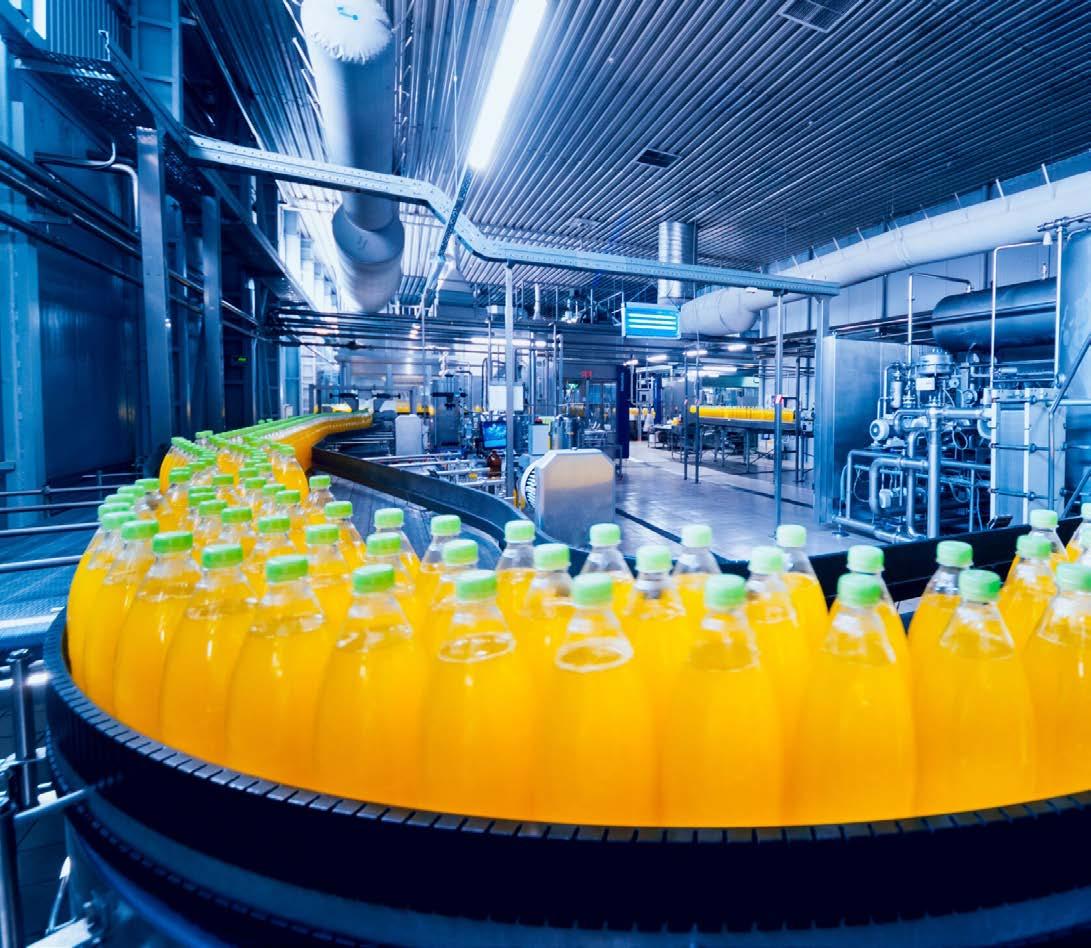
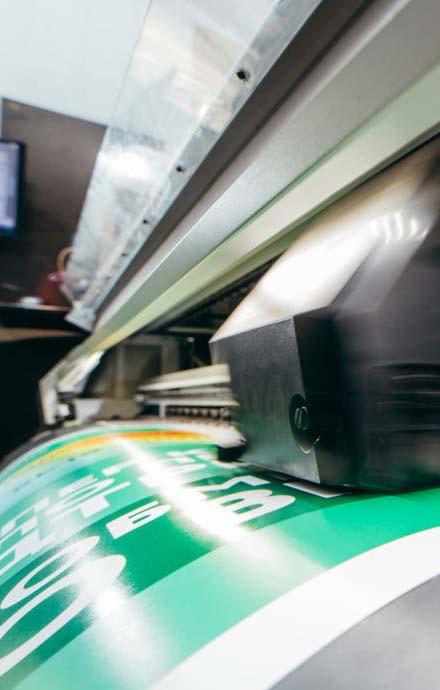
Sustainability’ has become such an over-used buzzword across so many business sectors that it has almost lost its meaning. And, let’s face it, the term was always a little vague and open to interpretation. For many printing companies, it has been a tick in a box. However, clients need and expect their supply chain partners to mirror their own values and customer commitments. As a result, the industry has stepped up to consider print solutions that offer improved environmental credentials on a cradle-to-cradle basis.
SUPPLY-CHAIN Supply-chain Sleuths “ like so many other areas of business improvement, the real catalyst for change is proving to be commercial ”
But, like so many other areas of business improvement, the real catalyst for change is proving to be commercial rather than ideological. At Herbert Walkers, we were always committed to doing the right thing and supporting our clients with sustainable solutions, which has helped us build client loyalty and win new business. However, our drive towards sustainability was focused on outputs and the product we sell, rather than operational savings –be they financial or environmental.
Carbon reduction - the challenges ahead
Mike Lammas, managing director of packaging and greetings cards printing company, Herbert Walkers, discusses the challenges of carbon reduction for the sector and the steps the company is taking to make it achievable.

Mike Lamas
Courtesy
Image Herbert Walker
Catalyst for change
SPN: Carbon reduction is of prime importance to us all. There is gathering momentum in the packaging industry to give it equal urgency and status to sustainability, to which it is inextricably linked. SPN invited a leading UK print company director to talk about its strategy for greater carbon reduction”
6 SUSTAINABLE PACKAGING NEWS
SLEUTHS
It is early days on our journey to carbon reduction. Even as we carry out the benchmarking process to establish a baseline for our current energy use, however, developing a strategy to reduce it and prevent waste, it is already clear that we can achieve a substantial improvement. Moreover, the process will also deliver, financial, operational and productivity benefits, highlighting the importance of sustainability as a valuable facet of business management.
By understanding more about where and how we’re using energy, we can identify areas where we can improve efficiency and reduce waste so that both energy saving measures and staff behaviour change are targeted in ways that will have most impact in terms of reducing both our bills and our carbon footprint. Every little helps, but it’s both the quick wins and the big wins that have the most value for our business and the planet. So where is the best place to start? At Herbert Walkers, we are starting by improving our knowledge of how much energy we’re using, when we’re using it and how we’re using it. To do that, we are working with a specialist consultancy that has placed monitoring equipment on our machines to identify the kWh for each of them and track it hour by hour through each week. By doing this over a period of time, we can see where the peaks and troughs lie, and consider strategies for evolving our operational practices to improve energy efficiency. One of the most immediate areas for action is the evidence of energy consumption during non-operational hours. The energy used when machines are on standby is considerable when viewed across our entire operation and, while there are good reasons for keeping machines on standby in some cases, there are also measures we can put in place to work around these, which will help us manage costs and enable us to reduce our carbon footprint.
SUSTAINABLE PACKAGING NEWS 7 SUPPLY-CHAIN SLEUTHS
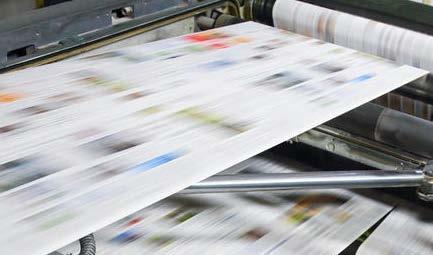
Now, we are embarking on that data-informed, target driven carbon reduction journey, and it begins with identifying where we are and the routes we need to take to get us to where we – and our clients – want us to be.
Firstly, let’s be clear, sustainability has been a long-term commitment and a process of continuous improvement for us, aligned to our ISO 14001 certification. We’ve worked with material suppliers to offer a greater range of sustainable substrates and finishes, we’ve switched to a renewables only energy supplier and installed LED lighting throughout our factory and offices, determined to be accountable on sustainability rather than simply greenwashing. But, until recently we were not benchmarking, setting goals or putting measures in place to monitor and measure progress.
False assumptions
The journey starts by letting go of some of the old assumptions; namely that printing is inherently a heavy energy usage sector and we must just accept it. While that’s a fact, it is not a fact that we should accept without question.
The perfect storm that has been brewing with pandemicrelated supply chain challenges, price volatility, and rising energy costs means that there is now a compelling reason to take a 360 approach to sustainability, and we have been surprised and inspired by what that deep dive is revealing.
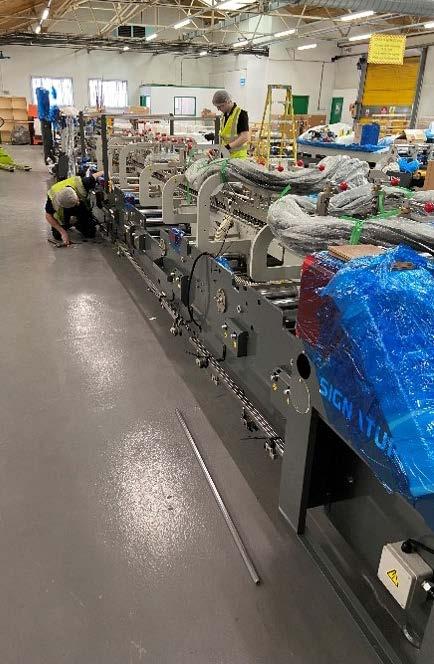
SPN comment: Walking the tight rope between carbon emissions and sustainability requires a balanced approach and one which Herbert Walkers appersr to have achieved admirably. Hopefully this overview will benefit many of our readers who are struggling to meet all the latest regs on carbon emissions and sustainability!
Carbon reduction is inextricably linked to efficiency, so the commercial benefits of this strategy not only include mitigating energy cost increases and demonstrating our environmental commitment to clients, but productivity gains too.
Increasing productivity gains
Image Courtesy Herbert Walker
8 SUSTAINABLE PACKAGING NEWS
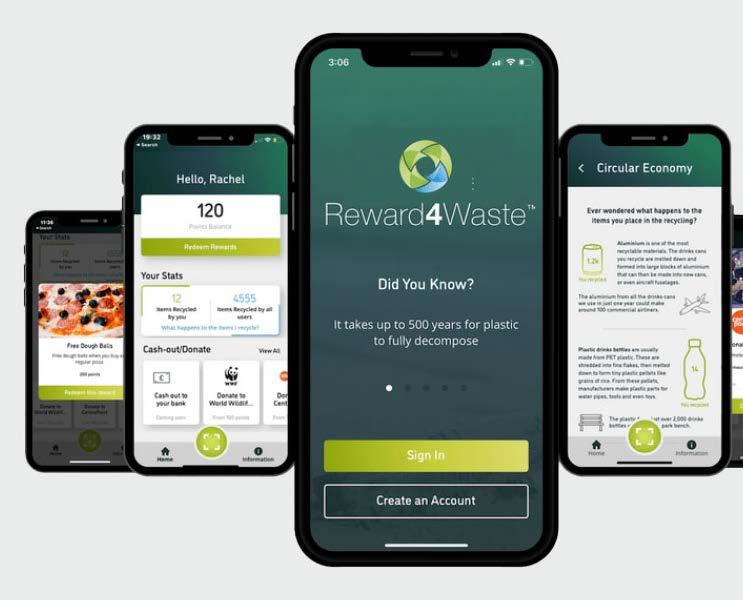
Considering rewards for good recycling behaviour, 52 per cent of respondents claimed they would be more inclined to recycle if there was a reward for doing so. Well over a half, 57 per cent, strongly or somewhat strongly agreed with the statement “I would like to be rewarded for good recycling with treats and offers from brands and retailers”, while around a quarter, 26 per cent, neither agreed nor disagreed.
Just one in ten disagreed with the statement outright.
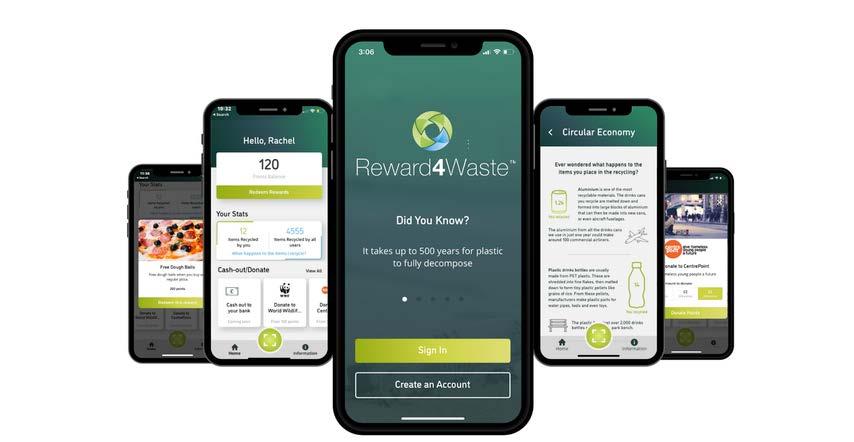
The research, commissioned by Reward4Waste and conducted last month (July 2022) by research agency, OnePoll, amongst a representative sample of 2000 adults, suggests that nearly two thirds, 63 per cent, of people would prefer a digital deposit return scheme using an app at home or on-the-go; either as a stand-alone facility or as part of a hybrid system.
DIGITAL DIGEST
Just 25 per cent would opt for a return-to-store system only, while 12 per cent either did not know or were unsure of what system they would prefer. Exploring the full scope of a DRS, 54 per cent wanted to see glass bottles included (currently glass is likely to be excluded in England and NI, but not in Scotland or Wales).
Digital Digest
“Ease of use and rewards for good recycling behaviour are key to DRS success,” says Reward4Waste chairman. New research exploring the nation’s views of use of technology for recycling purposes, has highlighted consumer’s preference for a digital system of deposit return scheme which can be extended to include products beyond drinks containers, and ‘rewards’ people for good recycling behaviour.
And asked to select other items they would like to see included, 50 per cent cited drinks cartons; 47 per cent food containers; 41 per cent newspapers; 36 per scrap paper and 35 per cent toilet roll tubes.
Rewarding Recycling
Tony McGurk concludes: “This is all very encouraging news for us. In trials, the Reward4Waste Digital DRS app secures approval rates in the high nineties. This research confirms that there is an appetite to try a digital system even without trial and, once in place, we know that it’s a proven outright winner.”
“A Digital DRS will also provide opportunities for brand owners and retailers to recognise, encourage and reward good recycling behaviour, and in doing so help meet the challenging recycling targets currently being set.
Asked about their wider use of technology, 56 per cent agreed that technology could help with environmental issues such as recycling and 37 per cent believed that by 2050, apps to help with recycling would be mainstream. Thinking about tech they could imagine being mainstream by 2050, an app to help with recycling came in third place after a smart fridge that manages shelf life and restocks itself, and autonomous, self-driving cars which topped the poll.
“Notwithstanding the obvious call for glass drinks bottles to be included in the initial scheme, it’s also interesting to see how consumers are keen to see a deposit return scheme extended beyond drinks containers to include other product packaging and recyclable waste.
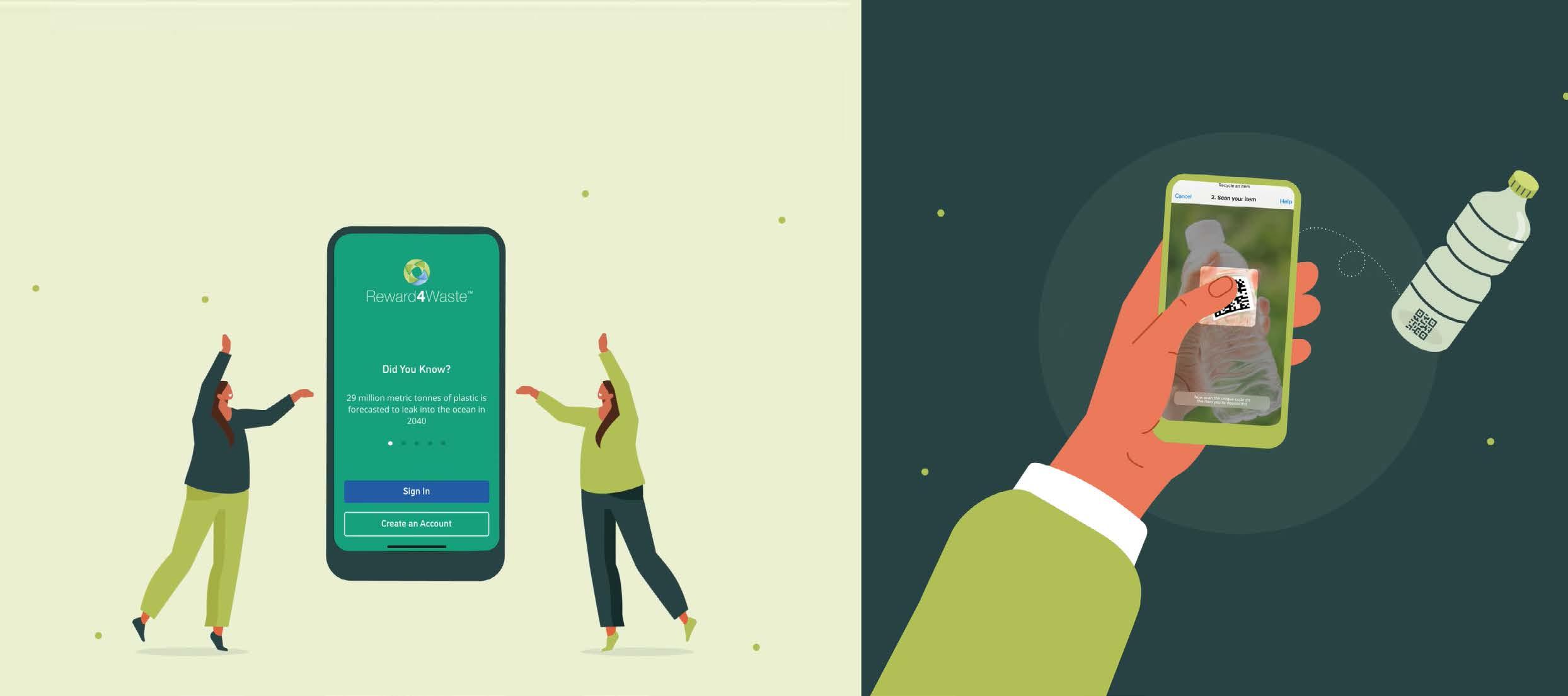
Tony McGurk, chairman, Reward4Waste, said: “I hope Government ministers currently considering the different DRS options will note that a digital DRS, where people use a smartphone app to scan a unique code on their drinks containers and recycling bin to capture that return and redeem the deposit, is the clear first choice for consumers.
“A digital DRS can be easily extended and makes use of existing collection systems, such as home kerbside collections, so would actually cause least disruption to households and to local authority waste management systems.”
Asked to consider how frequently they might use in-store reverse vending machines if such a system was introduced, a third of respondents believed they would make weekly deposits, while 16 per cent thought bi-weekly, and 15 per cent monthly.
To see an animation showing how the Reward4Waste Digital DRS works visit: https://reward4waste.com/solutions/deposit-return-scheme/ Tony McGurk, chairman, Reward4Waste
SUSTAINABLE PACKAGING NEWS 9 DIGITAL DIGEST
Meeting sustainability goals?
How digitalisation is helping global contract-packers and manufacturers to meet their sustainability goals.

“Consumers are now much more aware of sustainability issues and are demanding more sustainably produced products. Investors are also choosing companies that have sustainability first mind sets, to help them meet both consumer demand and adhere to governmental pressure to strengthen their environmental regulations. Being “green” is increasingly becoming an integral part of doing business.
Nulogy
“We have all seen the pictures over the last few years of produce rotting in fields, raw materials being disposed of due to spoilage, and packaging waste ending up in landfillor worse - all whilst reports of empty supermarket shelves become more prevalent.
Growing consumer awareness
Josephine Coombe, Managing Director of Nulogy in Europe, discusses how digitalisation is helping contract packers, manufacturers, and brands alike improve resource efficiency, reduce waste, and improve their sustainability footprint.
10 SUSTAINABLE PACKAGING NEWS DIGITAL DIGEST

“ Digitalisation, through cloud-based software platforms such as Nulogy, enables contract packers and leading consumer goods companies to increase their speed to market and gain much greater visibility across their operations ”
SUSTAINABLE PACKAGING NEWS 11
“This has enabled the business to find ways of achieving greater efficiency and reduce the amount of waste produced by improving its workflows. By making its production unit more efficient, digitalisation has helped to deliver greater sustainability for Marsden’s clients. Similarly, SGL Co-Packing, a leading provider of high quality and ultra-flexible contract packing and contract manufacturing services in the UK, is using digitalisation to drive improved waste recording, batch traceability and provide safeguards against the incorrect processing of orders.
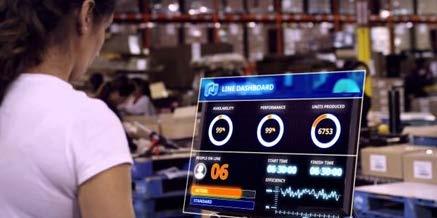
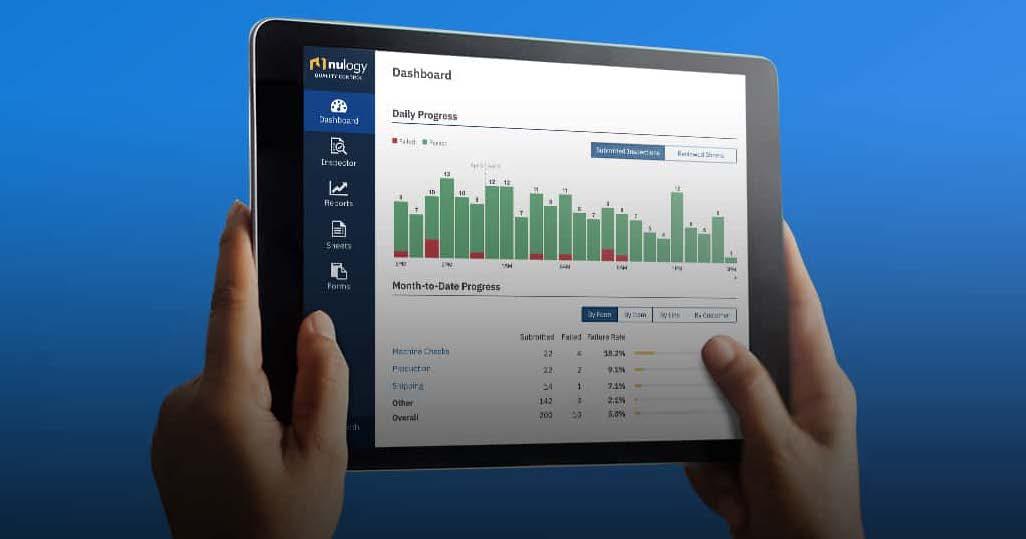
“Digitalisation, through cloud-based software platforms such as Nulogy, enables contract packers and leading consumer goods companies to increase their speed to market and gain much greater visibility across their operations. By knowing exactly what stock levels and order requirements exist, users maximise efficiencies in packing operations to deliver better service with far less waste from issues such as over stocking, expedited deliveries or unused inventory.
Minimising waste
“From providing live access and updates during production, to ensuring easy identification and isolation of stock or the ability to check that all components are available for each bill of materials; waste is minimised, and resource efficiencies maximised across the business.
SPN: Anything that helps companies to achieve their sustainability goals with a view to supporting the circular economy, is always worth looking at. In the case of Nulogy’s cloud-based digital offering, the gains in efficiency are significant.
“ By making its production unit more efficient, digitalisation has helped to deliver greater sustainability for Marsden’s clients ”
Streamlining operations
“It is estimated by McKinsey that more than 80 per cent of all potential sustainable improvements are tied up in the end-toend supply chain. Contract packers and manufacturers have a growing role to play in minimising waste and need to know exactly what materials and inventory there is in the system to avoid inefficiencies and waste. This requires enhanced visibility, agility and collaboration and it is here that digitalisation is helping companies.

“By streamlining their operations, outsourced suppliers are seeing greater efficiencies and reduced waste, enabling both themselves and their clients to see significant improvements in the drive to meeting sustainability targets. For example, in the UK, Marsden Packaging, a specialist in primary and secondary packaging services for the food and pharmaceutical sectors, has been using digitalisation to power its operations for over five years.
“Clearly, digitalisation is helping provide the visibility and tools to help contract packing and manufacturing businesses reduce their impact by enhancing their ability to manage materials and inventory. Cloud-based software solutions such as Nulogy are already generating value, meeting brand and consumer demand for greater sustainability, and will continue to enable businesses to innovate and drive out waste in this growing part of the global supply chain”
DIGITAL DIGEST
Alongside these developments, we must continue to ensure food safety isn’t compromised. For example, we recently tested a fibre-based barrier to replace the aluminium layer in our aseptic packages. Continued innovation such as this will help the industry to ensure sustainability works safely and effectively for everyone. Consumer engagement Consumer engagement will also be essential to achieving circularity. With a 2022 Deloitte study revealing 48% of people have not adopted a more sustainable lifestyle as they feel they have not got enough information, we must ensure they feel confident in using recyclable, renewable packaging. This requires transparency and working with third party organisations across the supply chain. And with 58% of UK consumers not understanding what a Deposit Return Scheme (DRS) entails, we must also invest in education to establish a better informed recycling culture.
When it comes to our food systems, one fundamental way to curb this damage is through establishing a closed-loop circular economy. And with plastic packaging accounting for nearly 70% of plastic waste in the UK, our industry must lead this action. We need high-performance packaging that delivers safe food, while decarbonising our food systems. We can make this happen by considering a package’s full lifecycle.
Reviewing the efficiency of the materials used in packaging, from how they are sourced to their environmental and societal impact, is the first hurdle. For example, our Tetra Rex® Plantbased carton is the world’s first fully renewable beverage carton. It is Forest Stewardship Council™ (FSC)-certified and made entirely of paperboard, from responsibly managed forests and other controlled sources. The plastic inside it is also plant-based, made from Bonsucro-certified sugarcane.
To this end, we recently co-ordinated the signing of a letter to Environment Secretary George Eustice MP, from 20 crossparty MPs, appealing to the Government to widen the scope of materials included its proposals for a DRS.
Efficient material usage
12 SUSTAINABLE PACKAGING NEWS 20-20 Vision 20-20 VISION
Hot Topic
Alex Henriksen, MD Tetra Pak North Europe told SPN: “When the UK recorded its hottest ever temperature in July 2022, it was a stark indication that progress on climate change must be escalated. Fast. Thus developing a closed-loop circular packaging economy is a given imperative”.
The best recycling results can only be achieved with fully supportive infrastructure. This requires collaboration to ensure policies support proactive recycling and an ‘all-in’ DRS is established.
All-in recycling infrastructure
Refocusing the industry
We must refocus our industry’s approach to delivering a circular economy by investing in research, consumer education and policy. Fortunately, we don’t work isolation and tackling the climate crisis is no exception. We are calling for cross-industry partnerships to tangibly achieve a circular economy – urgently. Henriksen spells out the challenges facing all of us in our global mission to achieve net zero by 2050 and a circular economy that will contribute to saving our planet for future generations.
The extreme heatwave that was inflicted upon Europe throughout July is yet another indicator of the damage that can be done if climate change goes on unchecked.

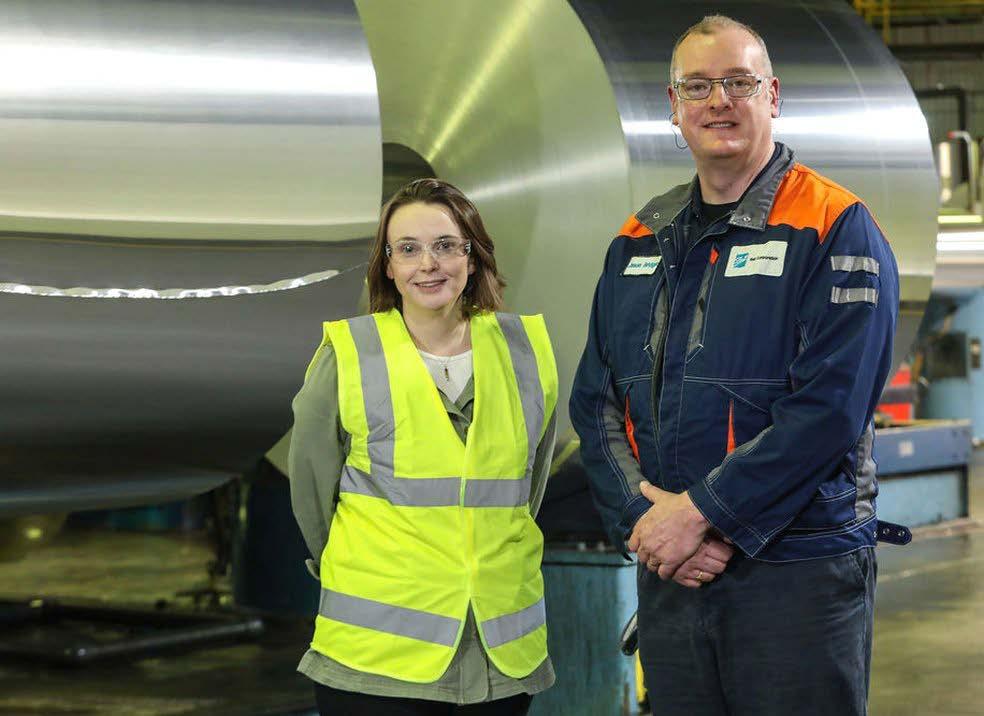
rasselstein ® –infinitely recyclable! Packaging Steel Our packaging steel is the perfect material for multi-recycling. Because it is virtually 100% recyclable, it can be recovered over and over again without any reduction in quality. This is because its inherent properties are retained during the recycling process. So we can work together to do something good for our environment. www.thyssenkrupp-steel.com
Emily Newton
nanotechnology takes-off

Emily Newton is the Editor-in-Chief of Revolutionized. She has more than five years experience creating content for the supply chain and manufacturing sectors. Newton’s exclusive article highlights the growing importance of nanotechnology in today’s packaging industry.

“ Downgauging has become a common practice in the packaging industry, particularly as a tactic to meet sustainability goals. By making packaging components thinner, businesses can tell customers they use less raw material to make their packaging. However, as experts within the industry have pointed out, downgauging can often backfire and sacrifice the integrity of the packaging, compromising its whole purpose. Could nanotechnology hold the key ”.
14 SUSTAINABLE PACKAGING NEWS DOWNGAUGING
Newton told Sustainable packaging news, “If companies downguage packaging so much that it is no longer effective at protecting the product inside, what is the point? Drop tests that were once the standard in years past are becoming a challenge for modern packaging to withstand. Of course, it is important to create packaging that is environmentally conscious and minimise the amount of material used in packaging. Is there a middle ground between using less material and still creating a functional packaging product? This is the dilemma the packaging industry faces. Businesses want to meet demands for more sustainable packaging, but downgauging is not the one-size-fits-all solution to that challenge. Nanotechnology could be the key to downgauging packaging without compromising packaging quality.
“ When people hear the term nanotechnology, microscopic robots and science fiction may jump to mind. However, nanotechnology in packaging takes the form of nanomaterials and nanocomposites ”
With nanomaterials and nanocomposites, packaging could be downgauged without reducing its structural integrity. In fact, nanotechnology for downgauging may even be able to improve packaging performance overall and add new features that would otherwise not be possible.
In effect, using nanotechnology for packaging design allows for freedom of design even on thin, downgauged materials. Plus, eliminating dyes from packaging contributes to sustainability efforts in addition to the downgauging itself. This is good for the environment and will earn the favor of consumers, who are becoming increasingly packagingconscious. Custom packaging will be more memorable and more effective, and with environmentally friendly nanoparticle coloring, it will demonstrate innovation to investors and customers alike.
Implementing nanotechnology
When people hear the term nanotechnology, microscopic robots and science fiction may jump to mind. However, nanotechnology in packaging takes the form of nanomaterials and nanocomposites – an intersection of nanotechnology and materials science. Nanomaterials have been in use for decades, even centuries, with nanoparticles of gold and other valuable metals being used as far back as Medieval times. Even in the packaging industry, the use of nanomaterials is an established technology. For instance, nanomaterials are often used as a coating on packaging, giving it special properties without adding thickness. The general benefits of using nanotechnology in packaging include increasing shelf life, improving heat resistance, and creating strong-but-thin films. As a result, it could be a highly effective technology for improving the downgauging process.
How nanotechnology enhances Downgauging
SUSTAINABLE PACKAGING NEWS 15 DOWNGAUGING
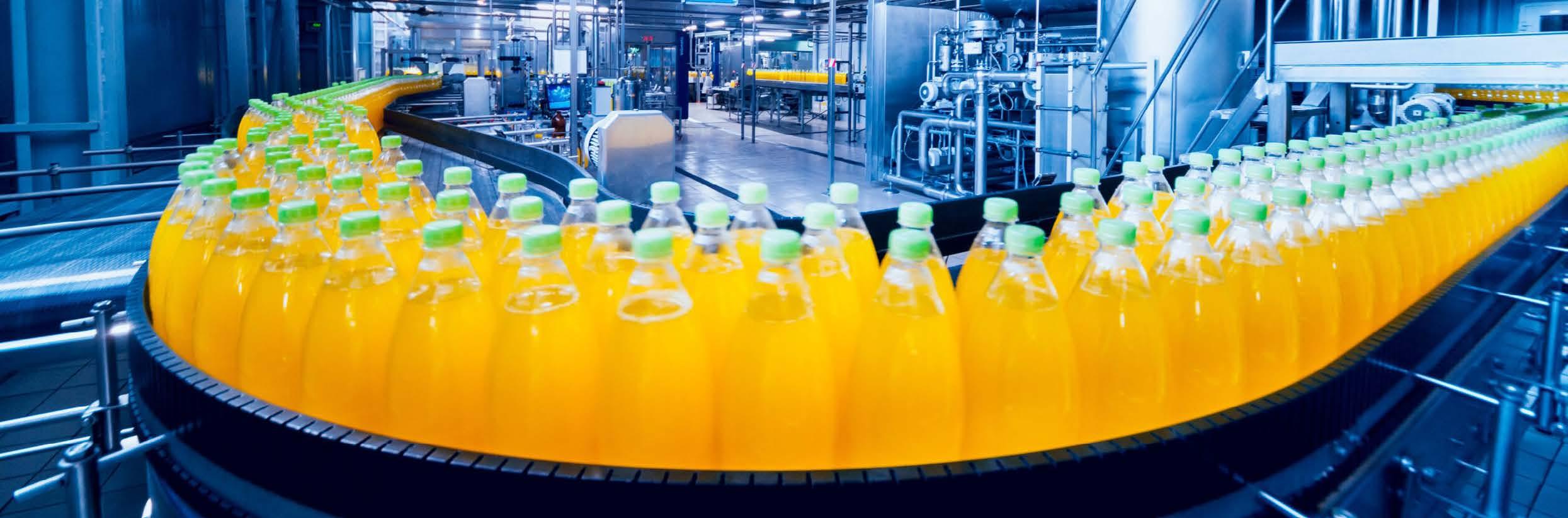
Nanotechnology is a broad term that refers to technologies that operate on a scale of 100 nanometers or less.
“Nanotechnology for downgauging has immense potential.

Nanotechnology for packaging can help packaging designers downgauge their products and make them more sustainable while also making them more attractive. One of the core principles of effective packaging – particularly in e-commerce and retail – is adding splashes of color. Nanomaterials can be used to color packaging without using dyes.
By giving materials a nano-scale film of certain nanomaterials, packaging can be colored effectively without the need for any ink at all. This is important to note since dyes and inks can be extremely harmful to ecosystems when dyed items become waste. Dyes can pollute water sources and inhibit plants’ ability to perform photosynthesis, which can destabilize entire ecosystems due to the unnatural death of plant food sources.
“Nanotechnology for downgauging could be the key to improving packaging quality while reducing the use of raw materials. Downgauging has become a popular practice to improve the sustainability of packaging by using less material. However, downgauging is also impacting the integrity of the packaging itself. By bringing together nanotechnology and packaging, businesses can enhance their packaging using nanomaterials while also downgauging it to reduce its environmental impact.
There are virtually limitless nanomaterials out there. It is a whole field of materials science on its own. So, there is a nanocomposite for practically any application a packaging company might need. Nanomaterials can improve thermal properties, improve water resistance, create better seals to keep food fresh, improve durability, improve elasticity, and more. Due to the nano scale of these materials, nanocomposites can meet downgauging goals while also meeting quality standards.

“One particularly useful application for nanotechnology in packaging is smart or “active” packaging. Nanomaterials need not be static; many nanomaterials have chemical properties that packaging companies can use to create an entirely new kind of packaging technology. For instance, some nanomaterials will respond to exposure to oxygen by changing color. Similar nanomaterials exist for CO2, water, and other chemical compounds. Studies have suggested that these reactive nanomaterials could be integrated into packaging for things like meat or other perishable foods.
DOWNGAUGING More Quality - Less Material
The nanomaterial phase of the packaging material is used to enhance certain properties, such as those weakened by downgauging. This is especially effective with polymers. For instance, a food packaging company might find that, by downgauging the plastic packaging for a cup of yogurt, the plastic for the cup becomes too brittle. They could opt for a nanocomposite instead. By identifying the right nanomaterial for their unique needs, the packaging company could create a new yogurt cup that uses the same downgauged amount of material but retains high elasticity and drop resistance.
As with the other applications of nanotechnology for downgauging and packaging, nanomaterials enable smart packaging without actually increasing the amount of material needed. Downgauging can still be used to the extent the packaging company sees fit. Less raw material can still be used. Yet, the thinner, more sustainable packaging can also include features that add value for consumers thanks to nanomaterials. Sustainable Downgauging
nanomaterial has some incredible benefits, especially when it comes to downgauging. Cellulose is a green and recyclable material, so it is already a great option for sustainable packaging. As a component for nanomaterials, cellulose nanofibers can strengthen materials and improve heat resistance. Plus, they can also increase the surface area for other nanomaterials due to the physical construction of the cellulose fibers themselves. Remarkably, cellulose-based nanomaterials can even improve water resistance while also improving the biodegradability of materials, as well.
With nanomaterials and nanocomposites, packaging companies can give their products incredibly durable characteristics while still using less material. Extensive studies have found that the sprawling range of nanomaterials can be used to do everything from improving tensile strength to increasing heat resistance in packaging. Nanocomposites are the key to achieving this. These materials combine traditional packaging with nanoparticles, such as nanotubes, nano-whiskers, nanofibers, or nanospheres.
“Perhaps the most valuable benefit of nanotechnology for downgauging is the ability to use nanomaterials to compensate for reduced structural characteristics that result from downgauging. It comes as no surprise that when a material is downgauged, it becomes weaker. A thinner material will naturally be less durable than a thicker material. As mentioned above, this leaves businesses in a tight spot because they need to downgauge in order to use less material, but they don’t want to give customers an inferior product, either.
Smart Packaging
16 SUSTAINABLE PACKAGING NEWS
If the “sensor” nanomaterial is exposed to a harmful chemical compound or substance, it will change color, indicating to customers and personnel that the food is no longer safe to eat. The great thing about these nanoparticle sensors is that they aren’t electronic. They don’t require any kind of fuel at all. They simply utilize the inherent chemical properties of the nanoparticles that make up the material.
“While sustainability is not the only reason to downgauge packaging, it is driving much of the modern popularity of downgauging. So, if sustainability is one of the primary goals, why not use nanotechnology for downgauging to improve sustainability even further? One particular type of nanomaterial is extremely helpful for this: cellulose-based Thisnanofibers.typeof
SUSTAINABLE PACKAGING NEWS 17 COMPOSTABLE AND BODEGrADABLE THE AEVENTPACKAGINGFORNEWERA. TO WELCOMESCANPACKNEW SCANPACK.SE #SCANPACK2022 Scanpack is four days packed to the brim with inspiration, networking, new business contacts, seminars and workshops. A hub for creativity aimed at sharing ideas on technology, materials and solutions giving you the competitive edge to be relevant in a circular future. The most important packaging exhibition in northern Europe. USE PROMO CODE SPNFREE2022 FOR A FREE TICKET (VALUE: 175 SEK) REGISTER AT SCANPACK.SE GOTHENBURG4-7OCT.2022
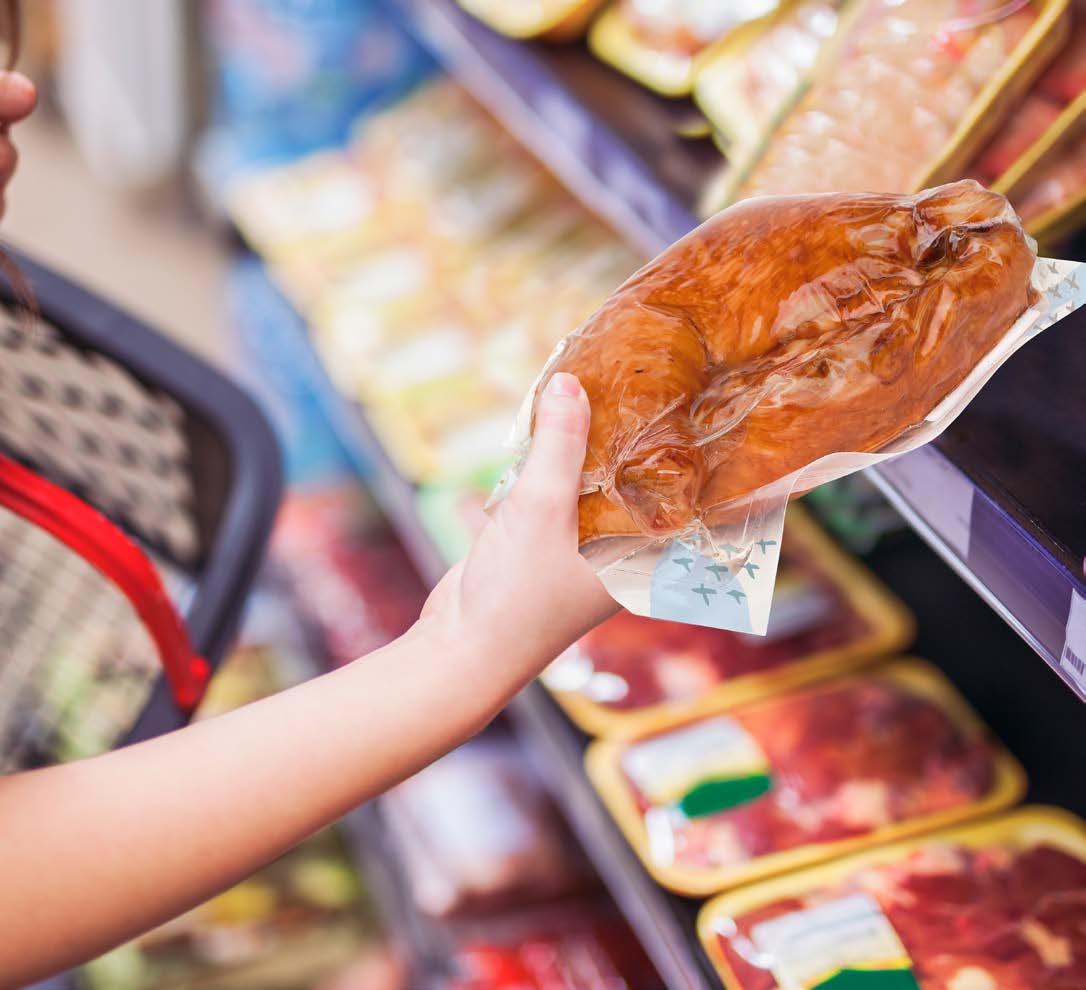
The Spanish company, SP Group has launched the first recyclable, retortable, high-barrier solution for the vacuum- packed and FMCG market.
SP GROUP
The company specialises in the manufacture of flexible, rigid thermoformable films for vacuum packing, and has just launched the first high-barrier recyclable, retortable solution for vacuum packing. This consists of a top film and a base web for vacuum packing. It has been specially designed with the FMCG market in mind. This solution is part of the company’s ECO range, which comprises all SP Group’s recyclable, monomaterial packaging solutions.
The PP HB ECOTOP top film is also compatible with rigid polypropylene thermoformable trays, thus providing a recyclable, monomaterial solution that is perfect for products that require MAP, rather than vacuum packing. This packaging solution was designed with the food sector in mind, in particular for products that require vacuum packing, such as prepared vegetables (corn-on the-cob, beetroot, etc.) and pre-prepared dishes. The SP Group’s PP HB ECOTOP is the ideal top film for pre-prepared food products requiring hot-fill processes, such as rice pots, jams, baby food, etc. Both materials are perfect for products being exported to Germany, where polypropylene is the main recycling stream.
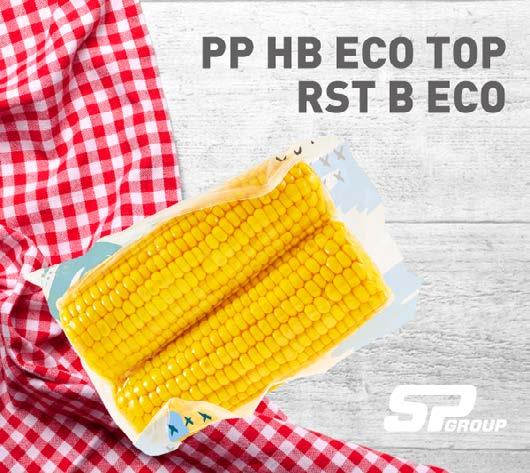
This special solution has been developed in response to the guidelines set by the European Union as part of the Horizon 2030/2050 sustainability programme. This sets out the requirement for all plastic packaging to be made recyclable, reusable or compostable. The combination of the PP HB ECOTOP top film with the RST B ECO thermoformable base web is a fully recyclable packaging solution because more than 90% of it is polypropylene. The remaining materials do not interfere in the recycling process. This solution replaces conventional PA/PP and PA/PP EVOH coextrusions (which are difficult to recycle), whilst having very similar features and properties to multi-material structures – it also has good puncture-resistance and mechanical performance.
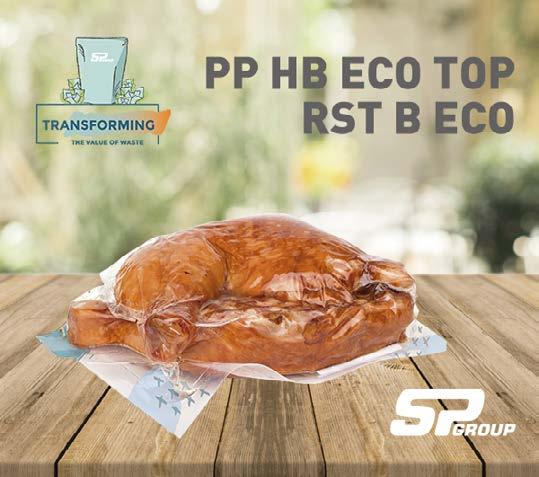
An FMCG First!
18 SUSTAINABLE PACKAGING NEWS rECYCLED MATErIALS
The SP Group is committed to delivering sustainability through innovation and to producing versatile, customised and ever more sustainable packaging. As a pioneering company in terms of sustainability, it seeks to create new cutting-edge materials that comply with the guidelines set out by the European Commission. Their primary objective is to provide their clients with real solutions that help them meet those guidelines. If you want to learn more their growing sustainable range, you can visit them on: Stand 646, HALL 7, FACHPACK 2022.
A material’s ability to withstand heat treatments, such as retort processing, is essential for prolonging the shelf life of food products, preserving all its properties, reducing food waste, and vastly improving environmental sustainability. With sustainability being the buzzword on everyone’s lips today, there is great demand for fully recyclable structures that lengthen shelf life to ensure that products can be stored longer.
• redesign
By implementing the practices of this guide and choosing to operate more sustainably, businesses will not only play a vital role in helping to reduce waste and lower global CO2 emissions, but can also cut costs, boost business growth and significantly enhance public perception.
Generate a steady stream of profitability for your business with proven ecologically friendly inks and coatings from Sun Chemical. Our data-driven approach provides more transparency through continuous monitoring and reporting— and that kind of data can help your bottom line thrive. See how in our Sustainability Report. who can use sustainability data to keep profitability flowing through their business? working for you. Request your copy of the latest Sustainability Report at www.sunchemical.com/sustainability you can.
• recycle – Feed
•
•
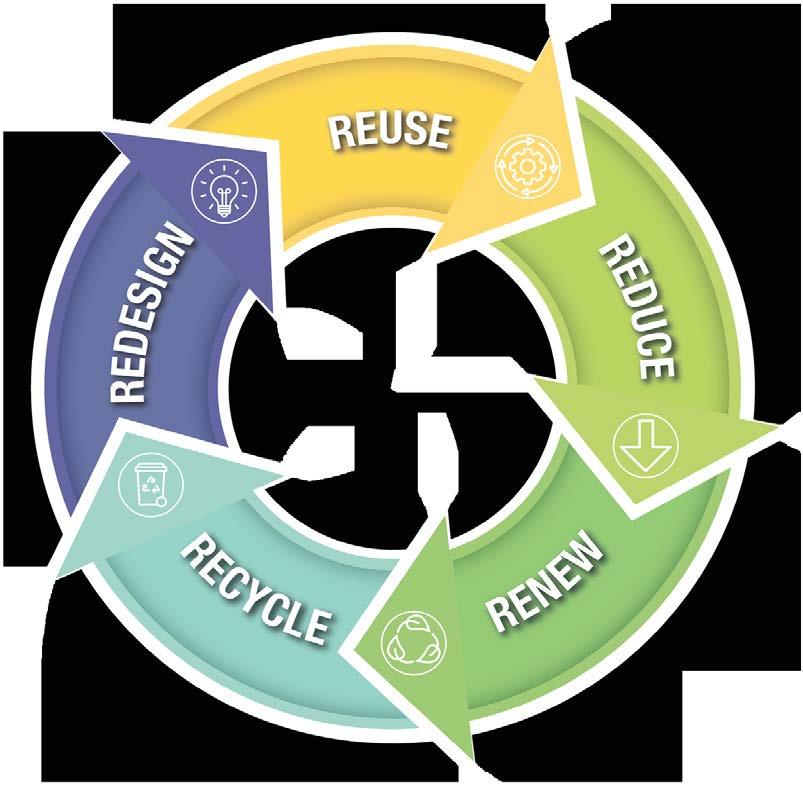
Sun Chemical has produced Sustainable Growth – a guide to help customers grow their businesses sustainably and contribute to the circular economy. This ‘how-to’ guide is built around 5Rs: reuse - Reduce single use packaging reduce - Packaging doing more, with less renew – Benefit with bio-renewable materials the circular economy – Re-evaluate for greater efficiency
As sustainability becomes an increasingly important issue for the planet’s inhabitants, individuals and businesses alike are taking more and more steps to reduce their carbon footprints, as well as striving to contribute to the circular economy. The circular economy is a new and inclusive economic paradigm that aims to minimise pollution and waste, extend product lifecycles, and enable broad sharing of physical and natural assets. It pushes a competitive economy that creates green jobs and keeps resource use within planetary boundaries. A key part of living and operating more sustainably means contributing to the circular economy and packaging businesses are well-placed to do so.
•
Download the guide https://www.sunchemical.com/sustainable-growth-with-the-5rs/here:

Sun Chemical - Sustainable Growth SPONSOrED
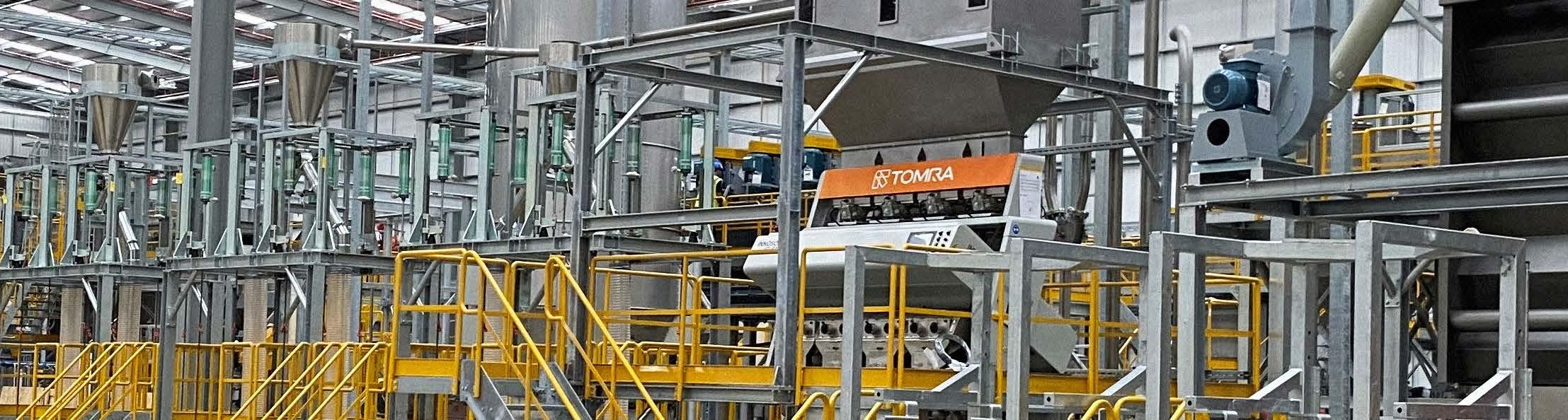
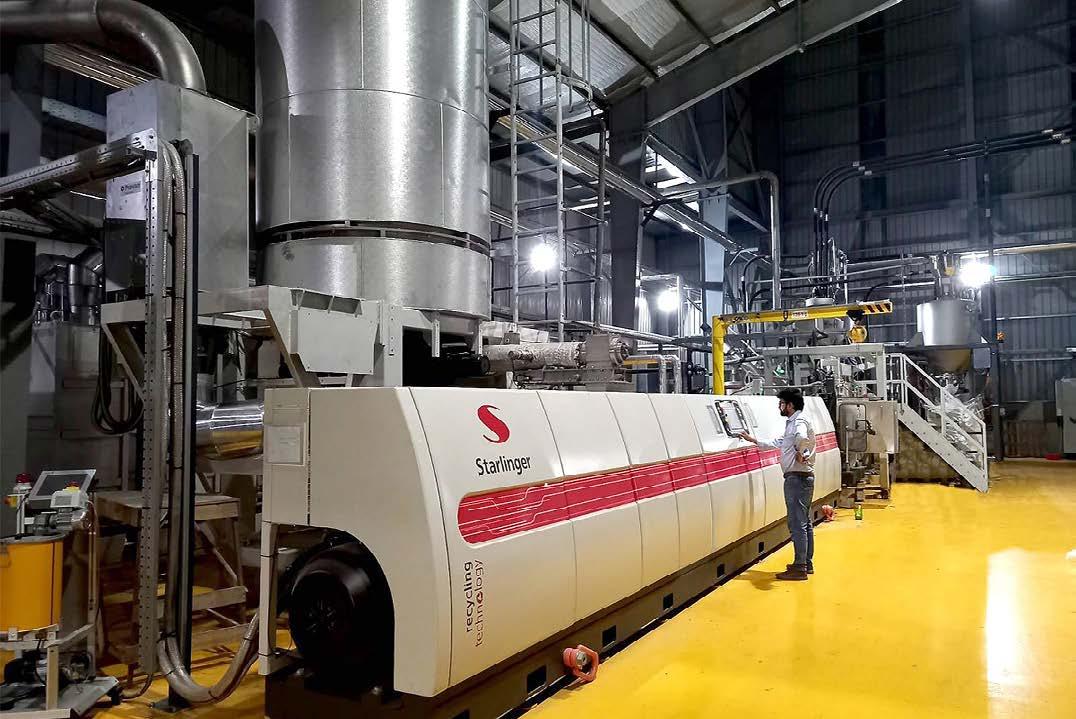
Berry Global’s unique CleanStream® recycling technology, is the first closed-loopsystem to mechanically process domestically recovered household waste.
This includes recycling polypropylene (PP) back into foodgrade packaging. The company has been granted a coveted Letter of “No Objection” (LNO) from the US Food & Drug Administration (FDA).
Berry Global receives FDA’s coveted approval
Dhaka-based food manufacturer Akij Food and Beverage Ltd. (AFBL), a member of Akij Venture Group, is now producing its own rPET for the company’s brand beverage bottles.
CleanStream® is Berry’s proprietary, world-leading process and the first to be able to identify and separate food use items from mixed domestic collections. One of its major benefits is that it can operate within existing waste management infrastructures. Automated sorting and decontamination processes that integrate online sensor technologies and machine learning algorithms remove the need for the use of marker or other digital technologies.
20 SUSTAINABLE PACKAGING NEWS rECYCLED MATErIALS
The LNO confirms that the post-consumer recycled (PCR) PP produced by the CleanStream® process can be used in levels up to 100% recycled content for food contact applications.
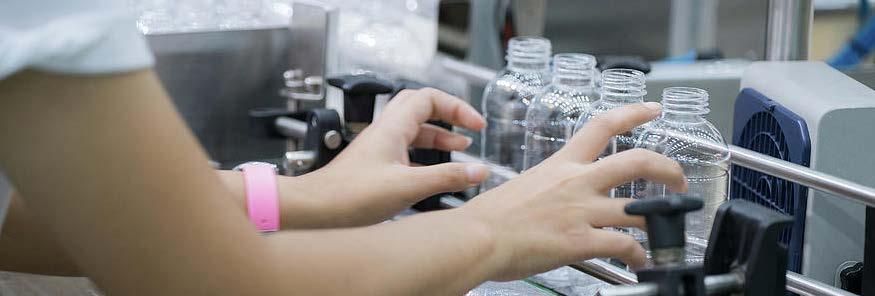
AFBL decided to start bottle-to-bottle recycling to reduce the growing environmental burden, as well as for economic reasons. “On a competitive market, recycling is the best solution to improve environmental conditions”, said Mohammed Sadikur Rahaman, Plant Operations Director at AFBL. “If you look inside our state-of-the-art recycling facility, you see mountains of used plastic bottles which were thrown away after being used once and became a threat for our environment. Now, each year billions of them will be turned into PET flakes and pellets in order to become new bottles.”
AFBL RecyclingBottile-to-bottle
Award-winning solution minimises waste
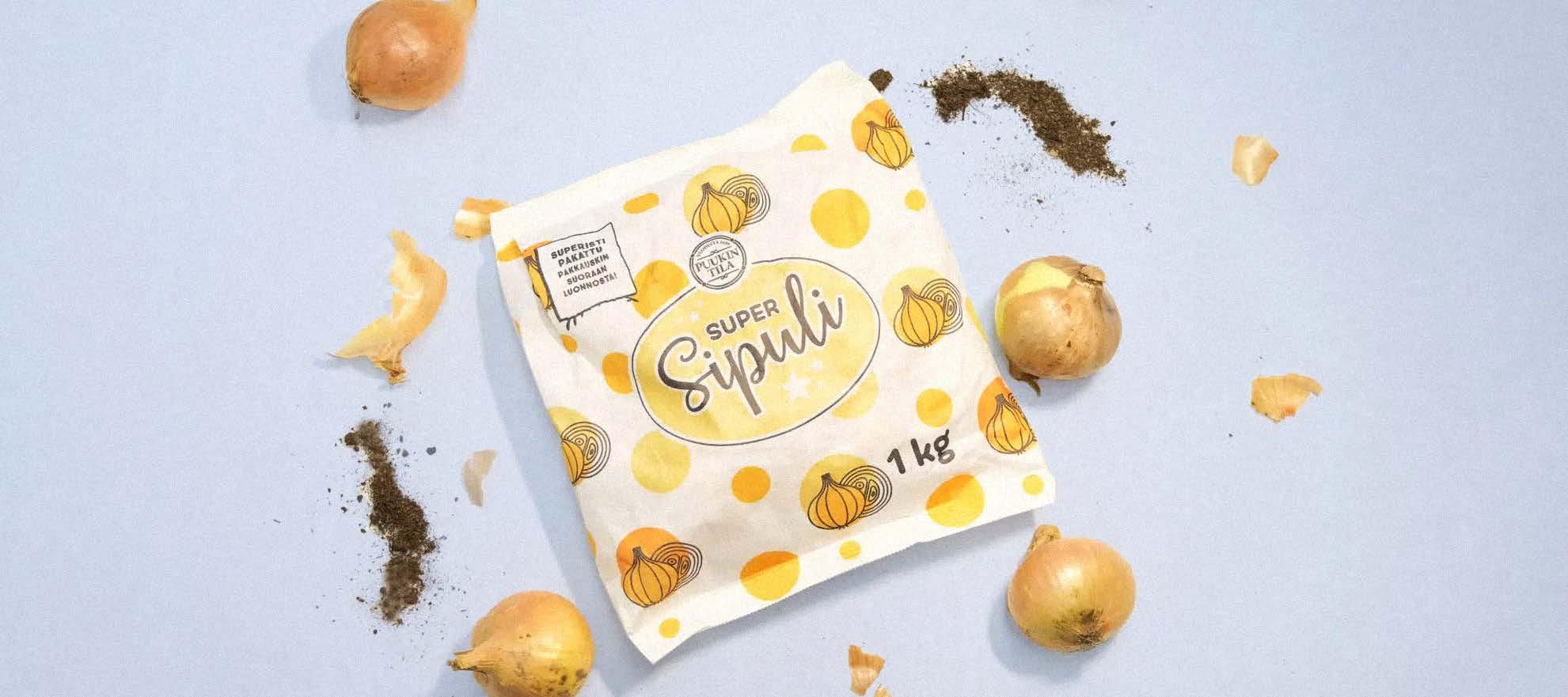
Petri Puukki, the owner of Puukin Tila, is very pleased with the results. He added, “We wanted to make a real difference and pack our locally produced onions in a truly sustainable way. Our new material keeps onions fresher for longerand by-the-way, this new packaging also looks fresh!”
SUSTAINABLE PACKAGING NEWS 21
Paptic® is a wood-fibre-based substrate that replaces plastics in packaging. The lightweight material is soft, with excellent puncture and tear resistance as well as having good heat-sealing properties. Katja Jokiaho, Head of Sales from Paptic, clarifies: “Many products are overpackaged because there are no alternatives to plastic-based solutions. Various products benefit from being packed in breathable materials.” Sustainability was a major consideration both in the packaging’s construction and design.
Mirva Koskinen, Brand and sales manager at Marvaco said,“Our aim was to create a simple, sustainable design for onion packaging by reducing ink consumption and the number of colours used in printing. We therefore reduced the number of inks to only three colours, but still, the colourful design was possible due to the printing process. With Flint Group’s water-based inks, we were able to eliminate the use of heavy metals and minimise waste. The Cradle-to-Cradle Gold-status certified inks offer full industrial compostability”
Introducing an award-winning, soft, cellulose-based pouch, that enhances brands and extends shelf life.
SPN has discovered this new, recyclable vegetable packaging pouch made of Paptic® material, that has been awarded a ScanStar at a Scandinavian Packaging Association sustainability competition.
The competition jury sawd value in that there is greater potential to use this solution in other packaging applications other than those for vegetable packaging. It has excellent printability and replaces plastic in a diverse range of packaging requirements.
Soft Cell
The unique packaging solution developed by Puukin Tila was designed to replace plastic in vegetable packaging and its end-use. It is a soft, durable pouch, designed to enhance perceived brand value, and keep products fresher for longer. The Paptic® material is cellulose-based, recyclable, moisture resistant, and converts easily with existing package production lines.
The competition entry package was invented when Paptic Ltd and Marvaco Ltd joined forces to respond to a call from Puukin Tila to replace plastic in onion packaging. Paptic®, fiber-based material, and Marvaco Expanded Gamut Printing with Flint Group C2C inks made the new, truly sustainable vegetable packaging possible. In the optimised packaging, all sustainability aspects were considered, including the substrate, design, printing, and inks.
rECYCLED MATErIALS
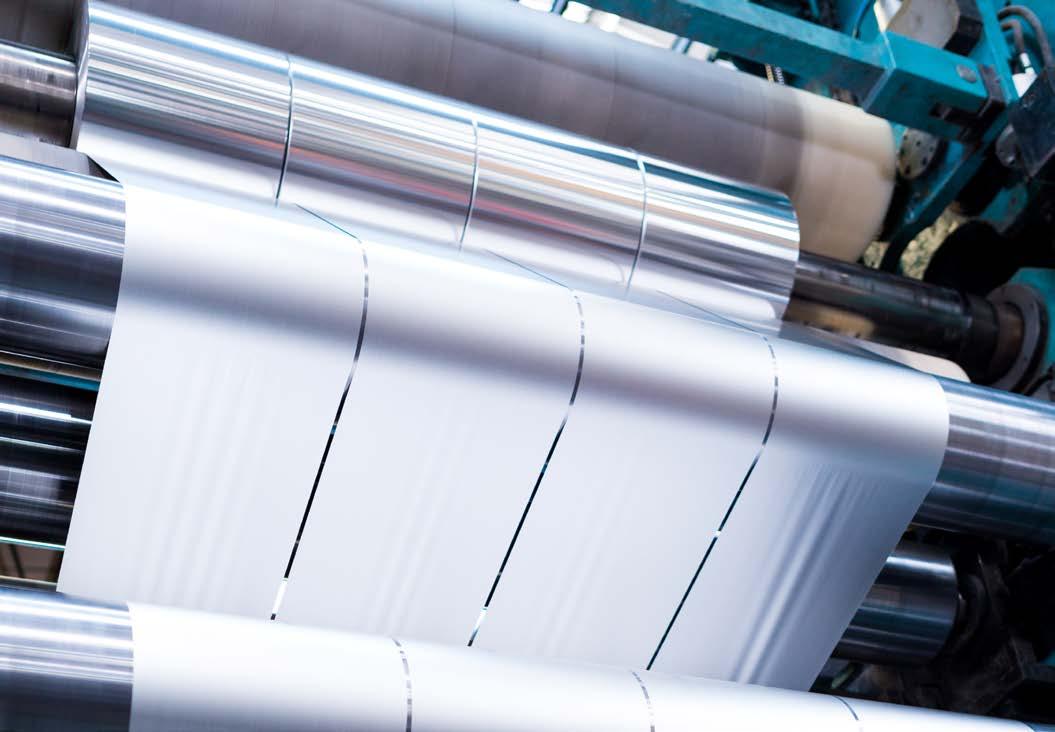
Aluminium is one of the most versatile materials to be used in food packaging applications, as it has many extraordinary properties. These properties include impermeability, allowing for a prolonged shelf-life and therefore reducing food waste, 100% and infinite recyclability, enabling it to play a key role in the contribution to circular economy, as well as lightness, allowing for resource efficiency in packaging material production and transport.
Aluminium is infinitely recyclable and therefore a sustainable material of choice by nature for packaging applications. Assan Alüminium aims to contribute to the transition to a circular economy through its sustainability -oriented activities, including its in-house recycling facility and renewable energy production. The company further leverages the advantages to of Aluminium, to create value for its business partners.
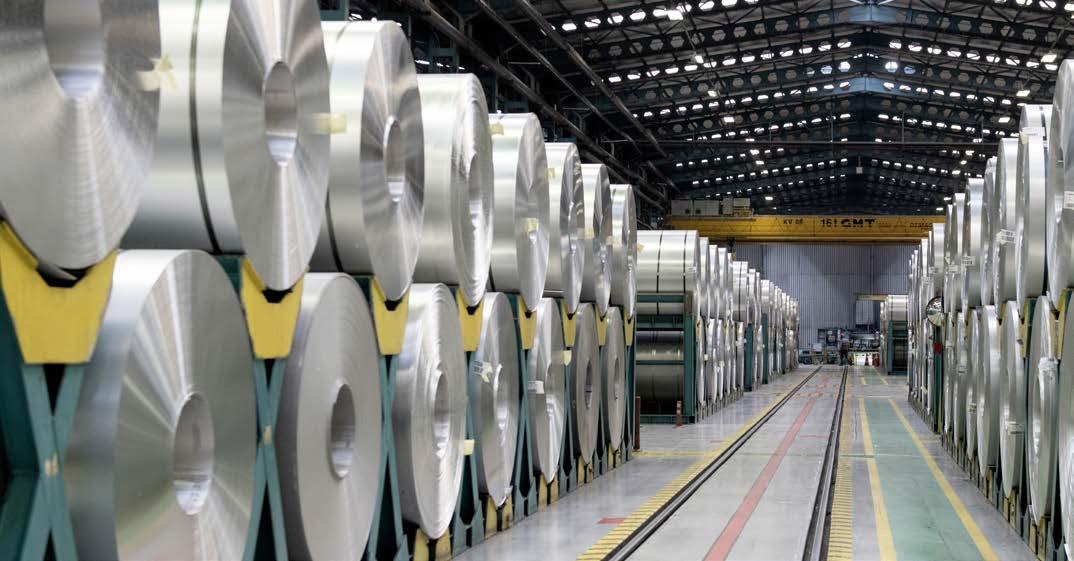
“One of the easiest materials to recycle is Aluminium and there are plenty of companies taking full advantage of this fact. In addition Assan Aluminium also contributes to the transition to a circular economy via its advanced, in-house recycling processes”
Assan Alüminyum
Optimising in-house recycling
22 SUSTAINABLE PACKAGING NEWS rECYCLED MATErIALS
From a sustainability perspective, the approach on recycling in aluminium products is different than it is in alternative products. The recyclability of aluminium is a good indicator of sustainability, while recycled content is not.
rECYCLED MATErIALS

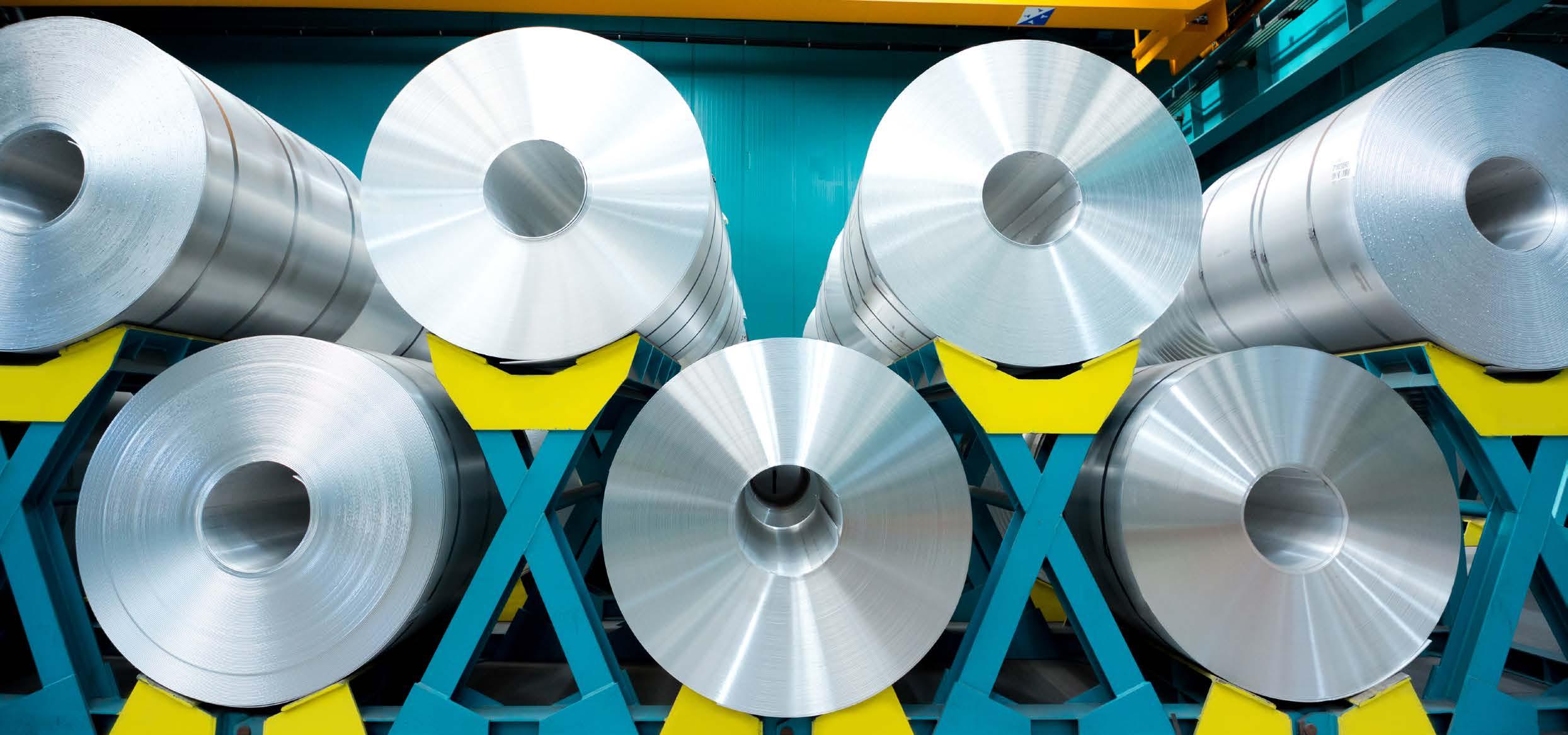
The primary reason for this is that the availability of scrap in global aluminium markets is very limited. Secondly, the consumption of aluminium is increasing rapidly, as it is a major contributor for the sustainability of other industries. Therefore, the available quantity of scrap will always be lower than the necessary amount for recycling. Additionally, if specific and high rates of recycled content are to be adopted as targets, it is quite likely that the carbon emissions caused by the transportation of scrap will result in a less sustainable aluminium product. Despite these limitations, Assan Alüminyum purchases and processes as much scrap as possible for its in-house recycling facility, therefore reducing its carbon footprint overall, as recycled aluminium is 95% less energy intensive than primary aluminium. In line with its core value of sustainability, the company recently developed a recycle-friendly alloy for some specific applications, with a high non-primary aluminium content to support the transition to circular economy. Assan Alüminium also produces renewable energy at an equivalent rate to its annual consumption. The company Assan Alüminium’s production and recycling facilities have recently been certified against the Aluminium Stewardship Initiative (ASI) Performance Standards. As ASI sets the global benchmark for sustainability for the whole global aluminium value chain, this certification confirms that the company’s operations are in compliance with global sustainability principles.
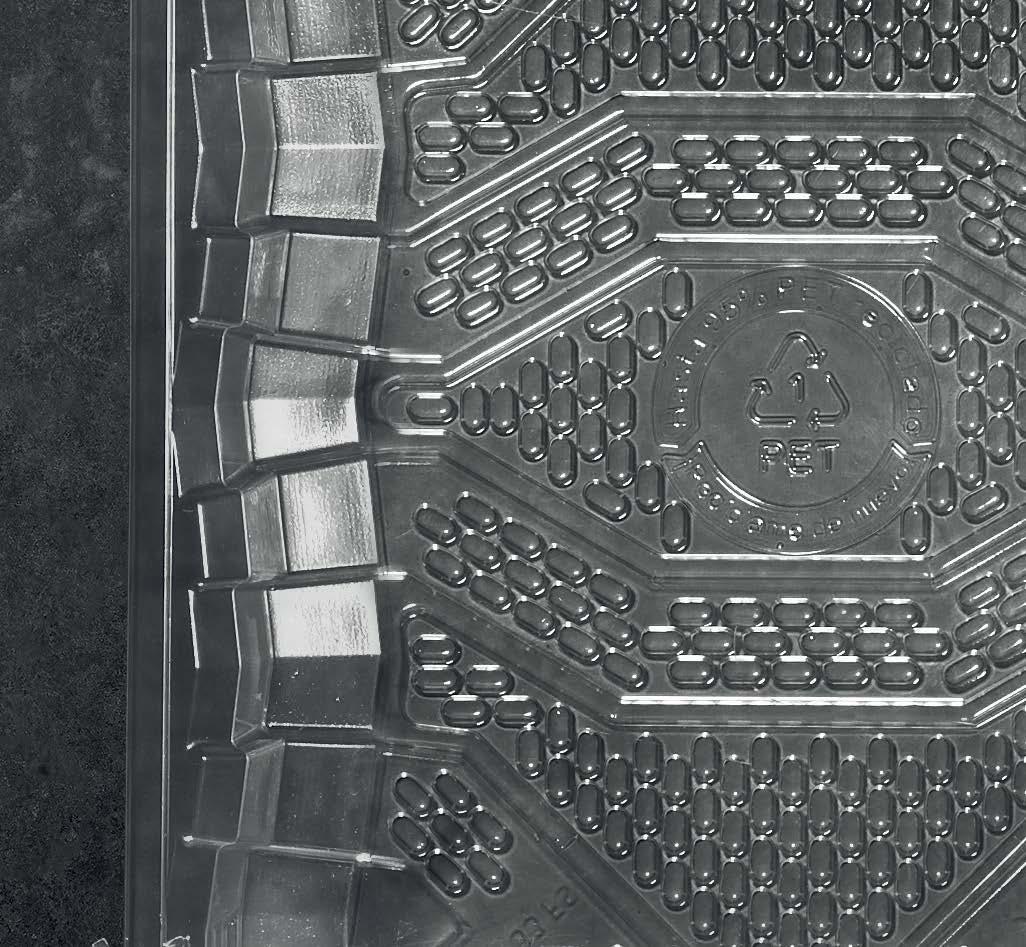
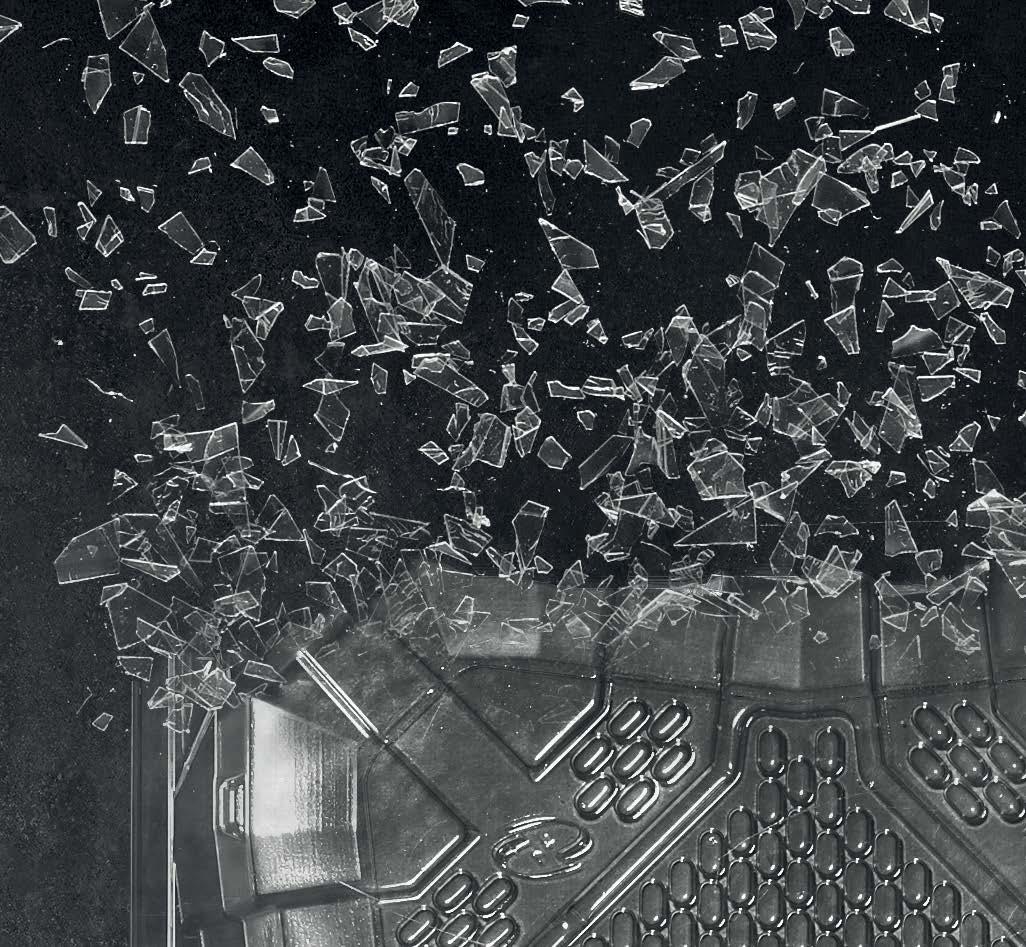
Tray Tra Giving trays new life, time and again Our goal is to revolutionise the recycling of food packaging, committing to a closed loop. We are on a mission to recover used food packaging and turn it back into more of the same. Thanks to kp Tray2Tray®, our plastic trays and rigid films can come back time and again as safe, protective, fully recyclable food packaging. The possibilities are endless.
kpfilms.com Sustainable protection of everyday needs kpinfo@kpfilms.com
© 2022 Klöckner Pentaplast. All rights reserved.







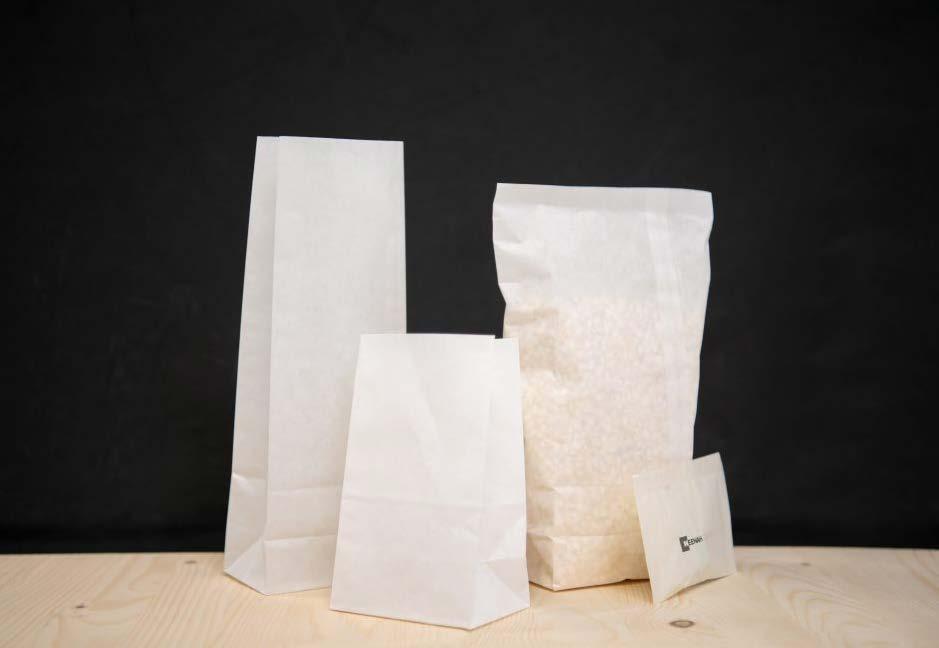
Coated paper materials for the production of bags & sachets.
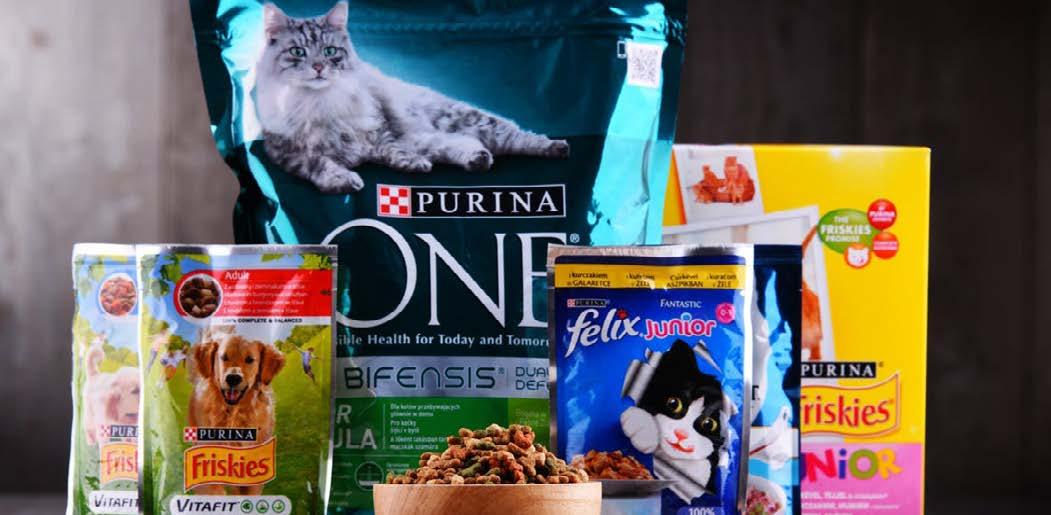
Purina launches its first “designed to be recyclable” pouch ranges in the UK.
PackagingSustainableMaterials
Sustainability and recyclability are the megatrends of the future. Especially in the packaging sector and not all possibilities have been exhausted. International company Neenah Gessner have already started thinking about the future and have developed a packaging material that is 100% ecodegradable. But it also offers many other advantages for the processor of packaging materials.
Following success in the UK, Barilla Rolls Out its New 100% Recyclable Packaging.
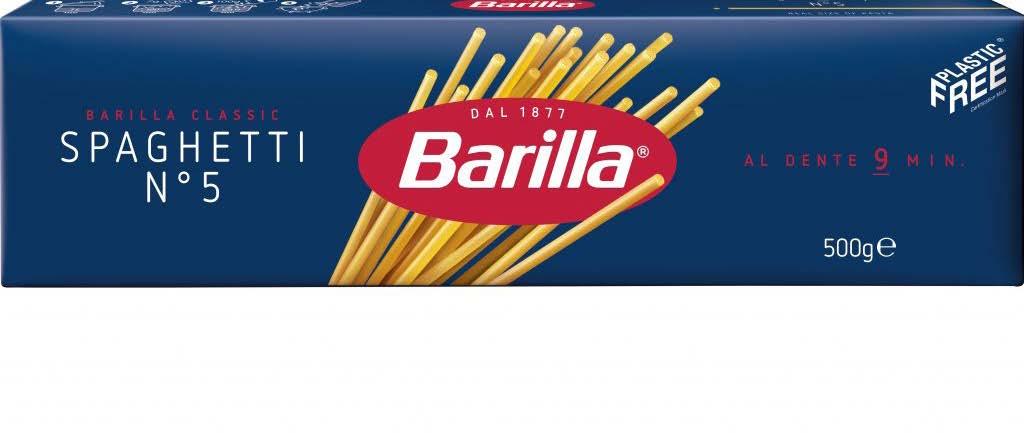
Plastic-Free July is a global movement raising awareness of plastic pollution and encouraging consumers to take a stand. Barilla, the largest producer of pasta in the world, has listened and following the successful roll-out of its 100% recyclable packaging in the UK, will be taking the plastic free pack across Europe. The new, 100% recyclable packaging will be implemented across the brand’s best-selling products, including Penne, Fusilli, Spaghetti, Lasagne, Linguine, Tortiglioni and Mezze Penne Tricolore.
SUSTAINABLE PACKAGING NEWS 25 rECYCLED MATErIALS
new Purina launch
Purina is pushing forward in its plan to make pet care packaging easier to recycle, launching its first full pouch ranges “designed to be recyclable” this year. This new packaging will be introduced in more than 20 countries across Europe, including the UK, Ireland, Belgium and Italy.
Plastic-free future from July!
In relation to sustainability, what would you say have been your most important milestones?
We are now working on new innovative solutions to support the industry in creating sustainable PET Bottles. Competek was founded just one year ago and we immediately introduced to the market Starlite Base, which joined with Supervent to make lighter bottles, reduce blowing pressure and save on energy costs making this technology available for all blowing machines.
What do you consider to be the most promising market opportunities for your company at this time?
26 SUSTAINABLE PACKAGING NEWS BEVErAGE PACKAGING
SPN Invited Competek to answer some searching questions about the Beverage packaging industry and their predictions in terms of sustainability and the circular
“ We know that Sustainability is not just a trend and something everyone is talking about, nowadays sustainability is a must ”
Competekeconomy.
How ‘sustainability-aware’ would you say your company is and what recent measures have you taken to improve your overall contribution to the circular economy?
We know that Sustainability is not just a trend and something “everyone is talking about”, nowadays sustainability is a must, something we owe to our planet and the world population. This is why Competek main objective is to support FMCG industry players providing them Sustainable Packaging Solutions. Competek provides a 360° service that goes from packaging engineering to moulds manufacturing and line conversion to adapt the line to handle the new packaging. We provide solution for the light weighting of your PET bottle, energy saving and the implementation of the new regulation in Europe (Recycling PET and Tethercaps).
Sustainability Predictions
Surely in 2022, 2023 and 2024 Competek will be focused on tethered cap implementation, develop lightweight bottles, convert existing lines and support in the classification rpet materials. Nevertheless, we will continue providing out customers solutions to reach relevant energy savings exploiting starlite plus supervent technology.
The one-stop-shop partner providing sustainable packaging solutions for all lines.
What are the key drivers for change in your industry sector and how much is the on-going pressure for greater sustainability and recycling affecting your productivity?

LINEMOLDSCONVERSION
All our solutions are designed to help customers to obtain an overall benefit. Packaging services give an important support to the customer that wants to improve its packaging in terms of performance, sustainability, look. We then provide high quality moulds, manufactured to reduce blowing costs thanks to the exclusive supervent technology and we complete the portfolio with line conversion: one partner able to upgrade all lines whatever the brand. Are you planning the launch of any new products in the foreseeable future that you can tell us about?
How has the Covid 19 pandemic and subsequent war in Ukraine, affected your production and manufacturing capabilities? During the Pandemic we created our company, we joined COMEP with the technical team of PET Engineering so we haven’t a real benchmark. What make us so proud is that despite both crises we have been able to guide the customer in installations in remote, with great results and we continuously provided our unrivalled support.
PACKAGING SERVICES
In the Food, Beverage, Home and Personal care industry change is mainly driven by consumers and production needs. On one hand, the consumer knows more than even what he wants and expect its favourite brands to answer on time especially on sustainability, on the other hand companies need to react fast, reduce costs and comply with environmental friendly solutions.
As we are keen to understand more about the latest trends shaping the packaging industry in your sector, what do you consider to be the most significant recent developments?

We can see a generic trend towards lightweight bottle, to offset the increase of raw material costs and transportation costs. Another important trend is linked to the SUP directive, so we are talking about tethered cap and Recycled PET. What sounds interesting is that PET containers are increasing rather than decreasing, which means that little by little consumers are understanding that PET is not as bas as we have always thought.
“ companies need to react fast ”
Right now the team is working on two big projects, one in linked to a new bottle concept that will bring substantial reduction in costs while the other is linked to a new mold technology. 2023 will be a year full of new innovations.

BEVErAGE PACKAGING SUSTAINABLE PACKAGING NEWS 27
Can you describe your product portfolio and its sustainability credentials?
5 reasons why bottle labels can be high-tech powerhouses
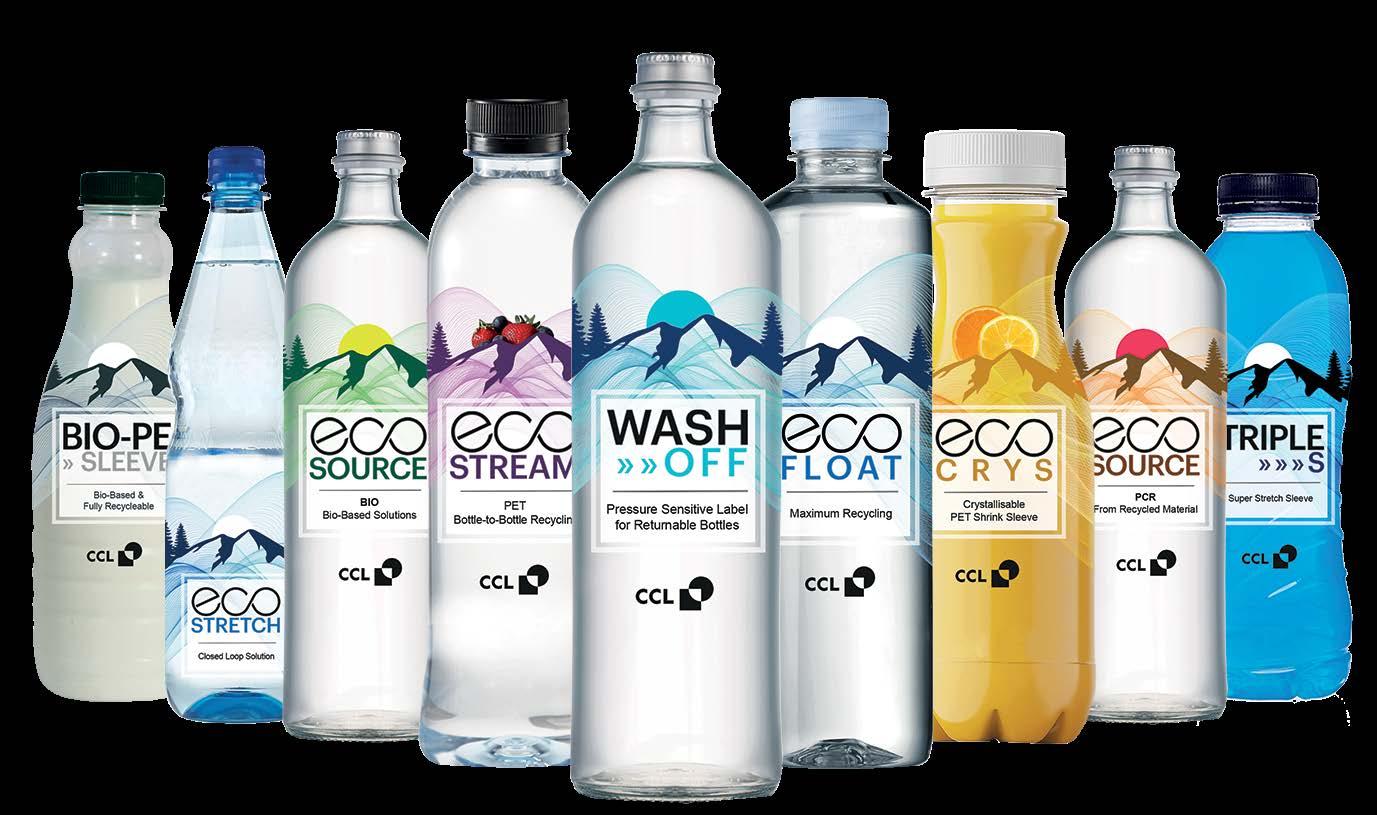
1. Looking to boost PET recycling? Consider your label!
Returnable bottle schemes are on the rise – and will increase in the future. It is very important to use a label that can be washed off easily and without leaving any traces on the washing lines of the bottlers. Glass bottles are washed at a different and higher temperature than refillable PET bottles, so it is important to choose the right “WashOff” label that fulfils the demands of the ecosystem that is in place. The WashOff solutions of CCL have been carefully engineered with extra shrink in the labels for them to pull off the bottle by themselves on the washing lines without contaminating the water basin.
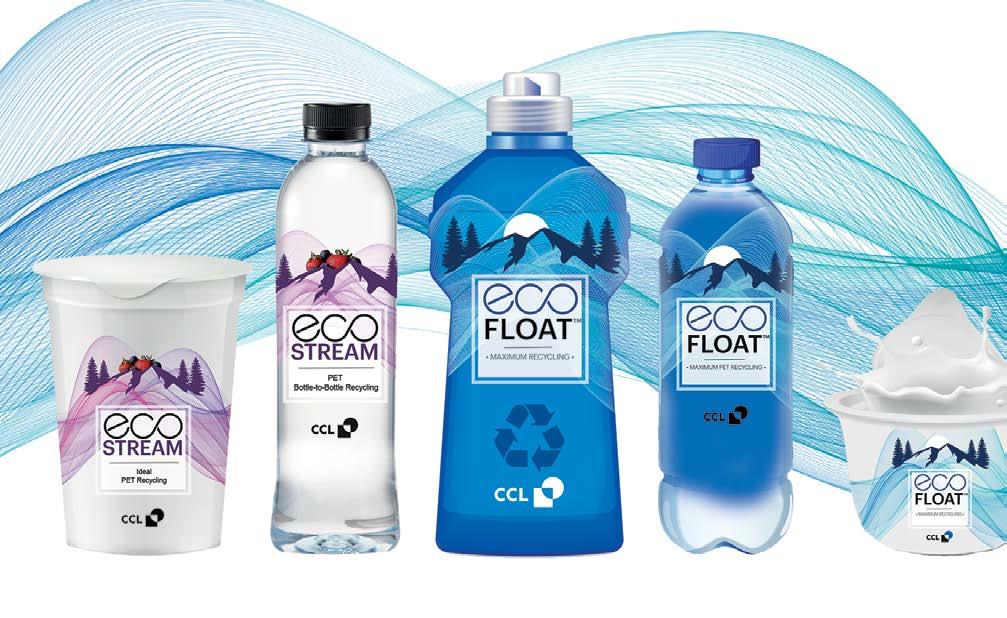
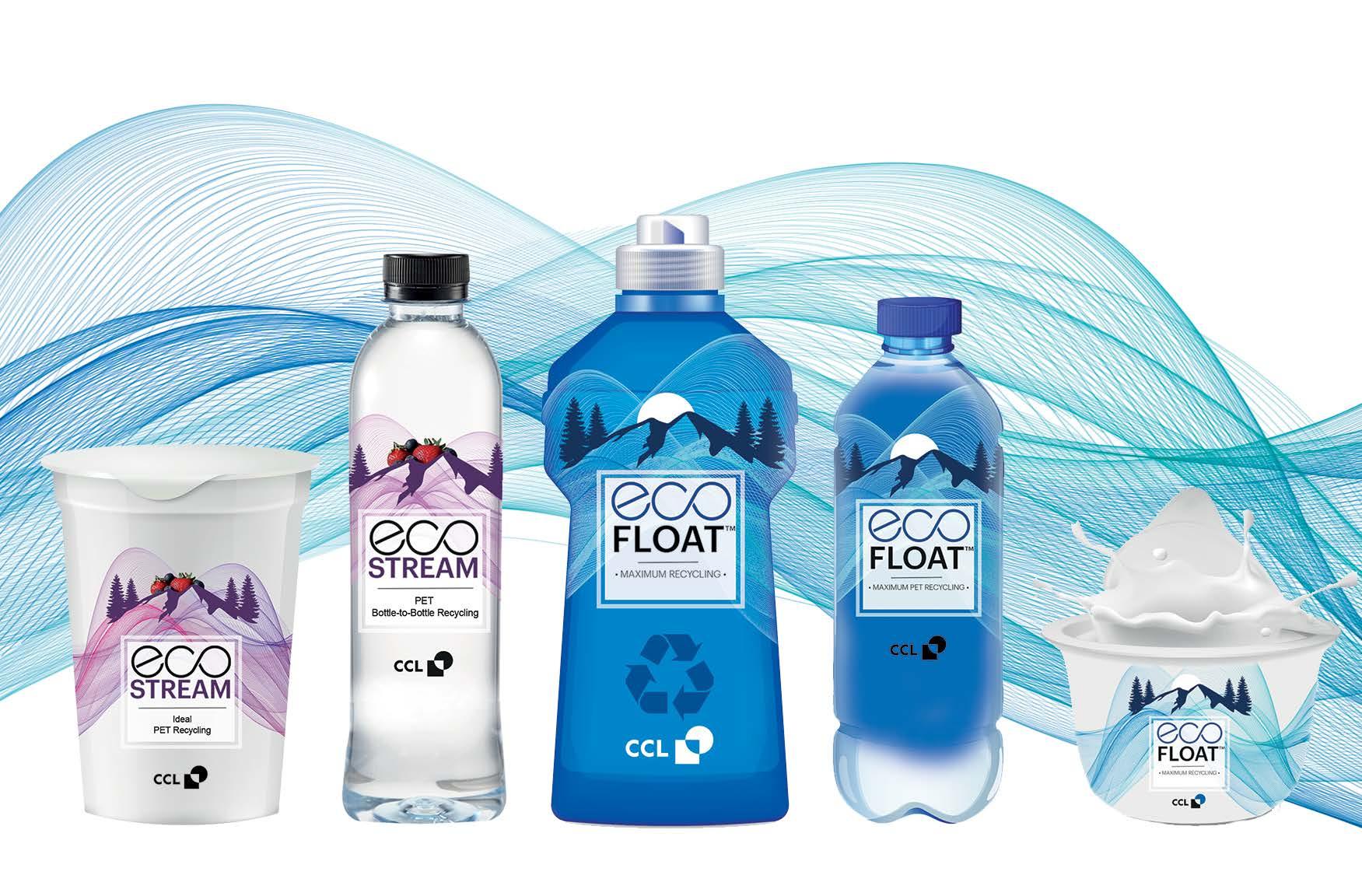
“For successful PET recycling it is important that the label or sleeve has a low density and floats! CCL offers EcoFloat shrink sleeves, EcoStream pressure-sensitive labels and Stretch Sleeve solutions that are made from polyolefin materials and are floatable.
Often brands and consumers think of label and sleeve decoration merely as a small part of the overall packaging. Think again! Many of them have been engineered to perform a certain way at the end-of-life of the packaging – thus supporting recycling!
They detach automatically from the PET bottle in the sorting and recycling facility, taking printing inks and adhesives with them – for clean washing water. This enables a very high quality and quantity yield that is the basis for bottle-to-bottle recycling, closing the packaging loop”, explains Marika Knorr, Head of Sustainability and Communication.
2. Refillable glass or PET bottles for multiple trips? Take a close look at your label!
CCL
28 SUSTAINABLE PACKAGING NEWS CCL
“The last two pandemic years have accelerated digitalization in many areas, including packaging”, says Simon Pearce, Vice President Beverage Sales & Marketing. “We will be showcasing label solutions for the beverage market that can transform packaging into a virtual communication channel where brands can really get creative top connect with the consumer.”
4. PCR content from household waste for labels and sleeves – yes please!
Other solutions CCL is working on are labels that include RFID and NFC technology which is the basis of intelligent labeling of the future to for example prevent food waste.
Dive deeper!
CCL will showcase their “Sustainable Label Family” and Digital Labels at the drinktec 2022 trade fair in Munich from September 12 to 16. Visit us in hall C6 at booth 344 You can find more information on our special drinktec website: www.drinktecisback.ccllabel.com has invested in new extrusion lines for materials that fit the need of brands that use HDPE and PP containers
”
“ CCL
3. HDPE and PP Recycling –the right label can increase the quality!
In the recent years there has been more development regarding high-quality HDPE and PP recycling. The “Design for Recycling” guidelines recommend using label and sleeve materials that are made from the same plastic family as the primary packaging. CCL has invested in new extrusion lines for polyolefin materials that fit the need of brands that use HDPE and PP containers and want to use these with recycled content in the future. CCL’s label material makes sure that there is no contamination of the recycling streams.
polyolefin
CCL SUSTAINABLE PACKAGING NEWS 29
5. Connected packaging –Intelligent label solutions for the future
Smart labeling technology can also be used to tackle the sorting and recycling challenges – by using digital watermarks on the packaging that are invisible to the eye but give the packaging a digital passport. This digital passport can be detected in the sorting facilities and so the package is sorted into the right recycling stream. “We are licensed partners of the Digimarc technology and are members of the HolyGrail 2.0 consortium – which is driving smart sortation on a large scale across the whole value chain”, adds Pearce.
Integrating Post-Consumer Resins directly from household waste into film that can then be used for labels and sleeves has been an area of focus for CCL Label. As we are backwards-integrated with our in-house film development sister company Innovia, we are able to develop especially engineered film materials that have similar properties to film made from virgin material, thus resulting in a lower overall carbon footprint and integrating recycled materials – moving towards a circular economy.
“With years of experience in the food and retail industries, we immediately recognised the value of the EEASY Lid for brands and consumers,” said Friedrich Berlemann, CEO of Trade Consult. “Beyond accessibility that we desperately need in packaging, the aluminum lug version of the EEASY Lid is more sustainable than traditional steel alternatives.
The EEASY Lid was displayed at PLMA’s New Product Expo a little earlier in the year, which featured the latest innovations in packaging, fresh, frozen, refrigerated foods, dry grocery, beverages, cosmetics, health and beauty, household and kitchen, auto aftercare, garden, housewares and DIY products.
Lifting-the-lid on consumer CCT Unveils World’s First Aluminum Lug Jar Lid to European Markets
CCT has partnered with Germany-based Trade Consult –a sales and marketing company focusing on the grocery industry and food manufacturers, in order to secure interest and schedule meetings with both national brands and private label companies, coordinating overall execution of the EEASY Lid into the European marketplace.
30 SUSTAINABLE PACKAGING NEWS BEVErAGE PACKAGING
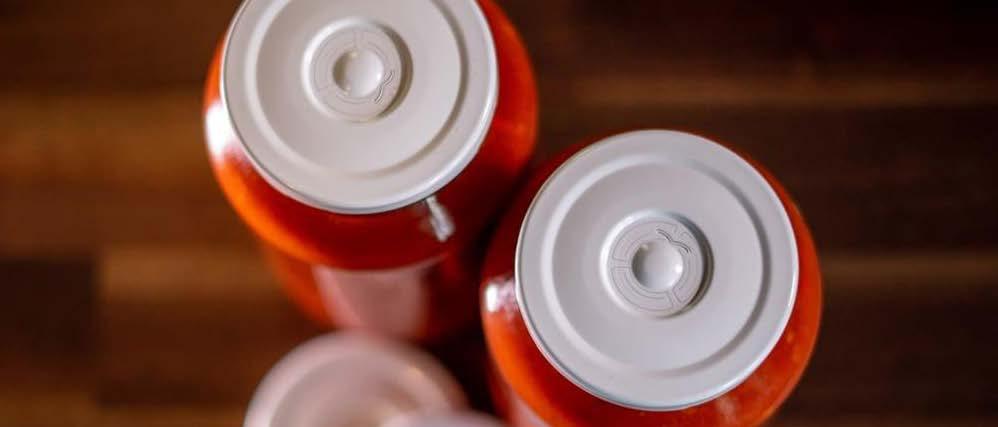
“By raising awareness of the EEASY Lid at PLMA, we had the opportunity to show that consumers are willing to purchase products that are easier to use on an everyday basis,” said Brandon Bach, CCT president. “We have seen the consumer demand for a jar lid that is easier to open, and we have spent eight years of R&D to create the EEASY Lid with accessibility in mind. This is a win for companies looking to meet consumer needs and a win for consumers to open a jar lid with ease.”
With European markets holding sustainability to a high standard, the EEASY Lid checks all the boxes for packaging innovation.” Last year, CCT opened its new 12,000 square foot, state-of-the-art technology centre at the company’s headquarters in Dayton, Ohio.
CCT has the capability to produce roughly 800 aluminum lug EEASY Lids per minute – more than 250 million annually.
“ We have seen the consumer demand for a jar lid that is easier to open”
Easy does it
convenience
Consumer Convenience Technologies (CCT), makers of the EEASY Lid, the first jar lid innovation in over 75 years, has announced it is now producing the world’s first aluminum lug lid, meaning CCT’s innovative EEASY Lid is now available in both lug and CT versions, and both are made of aluminum.
Let us stay attached throughout use and all the way to recycling. www.elopak.comEasy opento staysClosureup disposalSpace-saving plasticLess K€ G We toattachedareeachother
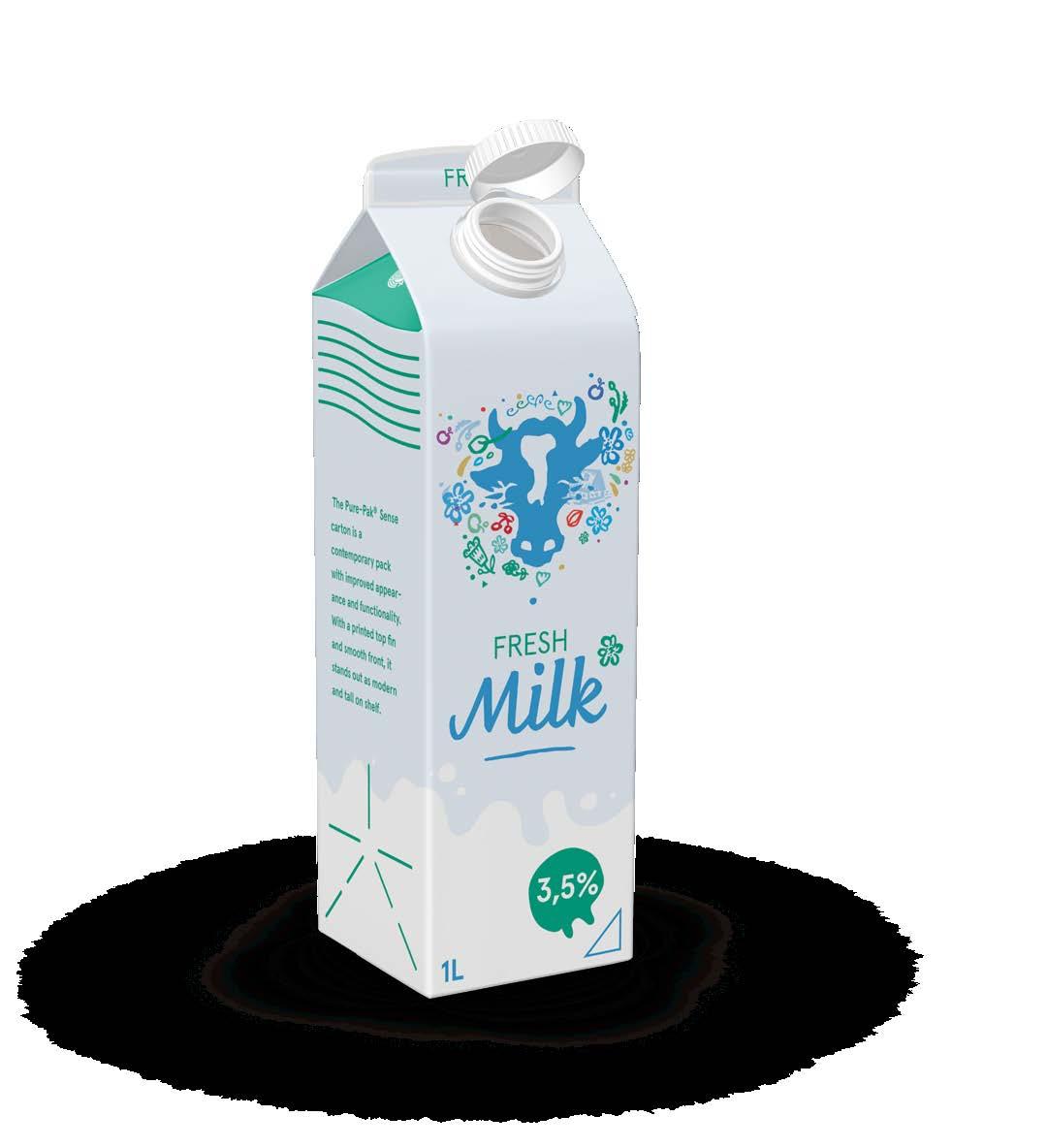
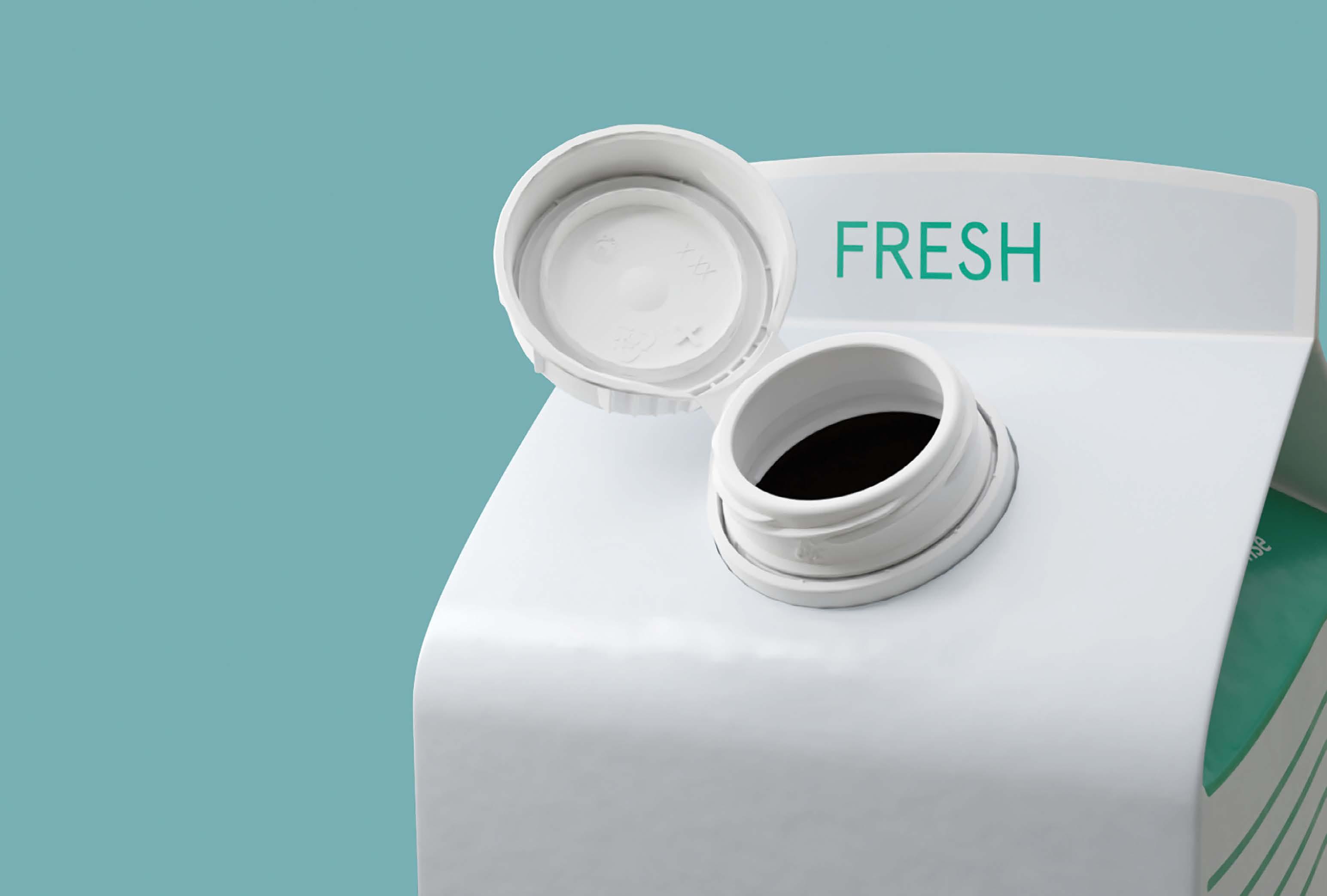
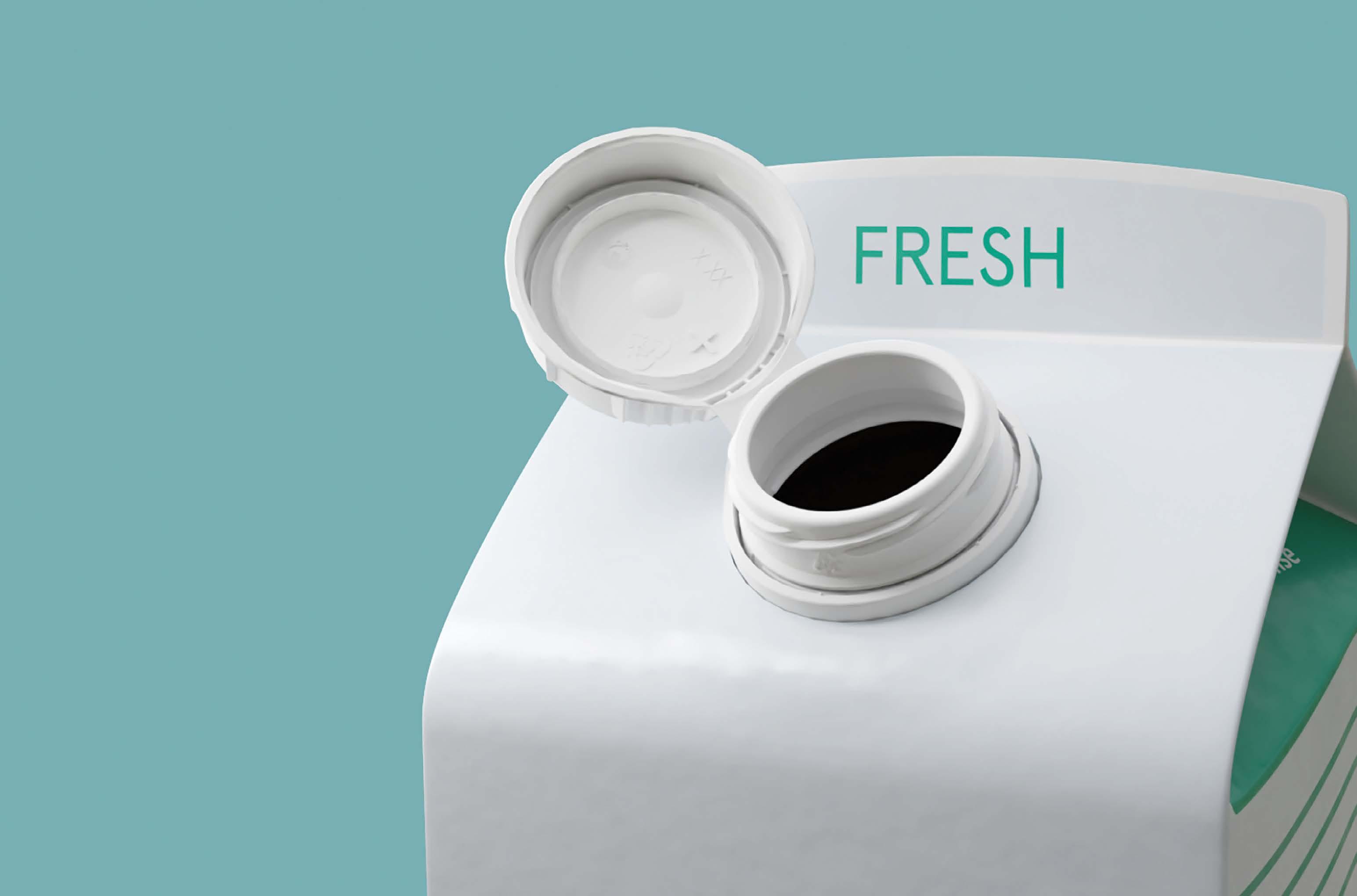
32 SUSTAINABLE PACKAGING NEWS ELOPAK Earlier this year Elopak announced the roll out of its tethered cap solution - the Pure-TwistFlip™. This latest packaging innovation is being adopted by brands that are both looking to deliver on their customer’s priorities as well as to promote their own corporate values. Elopak’s Tethered Cap Solution - Pure genius Elopak
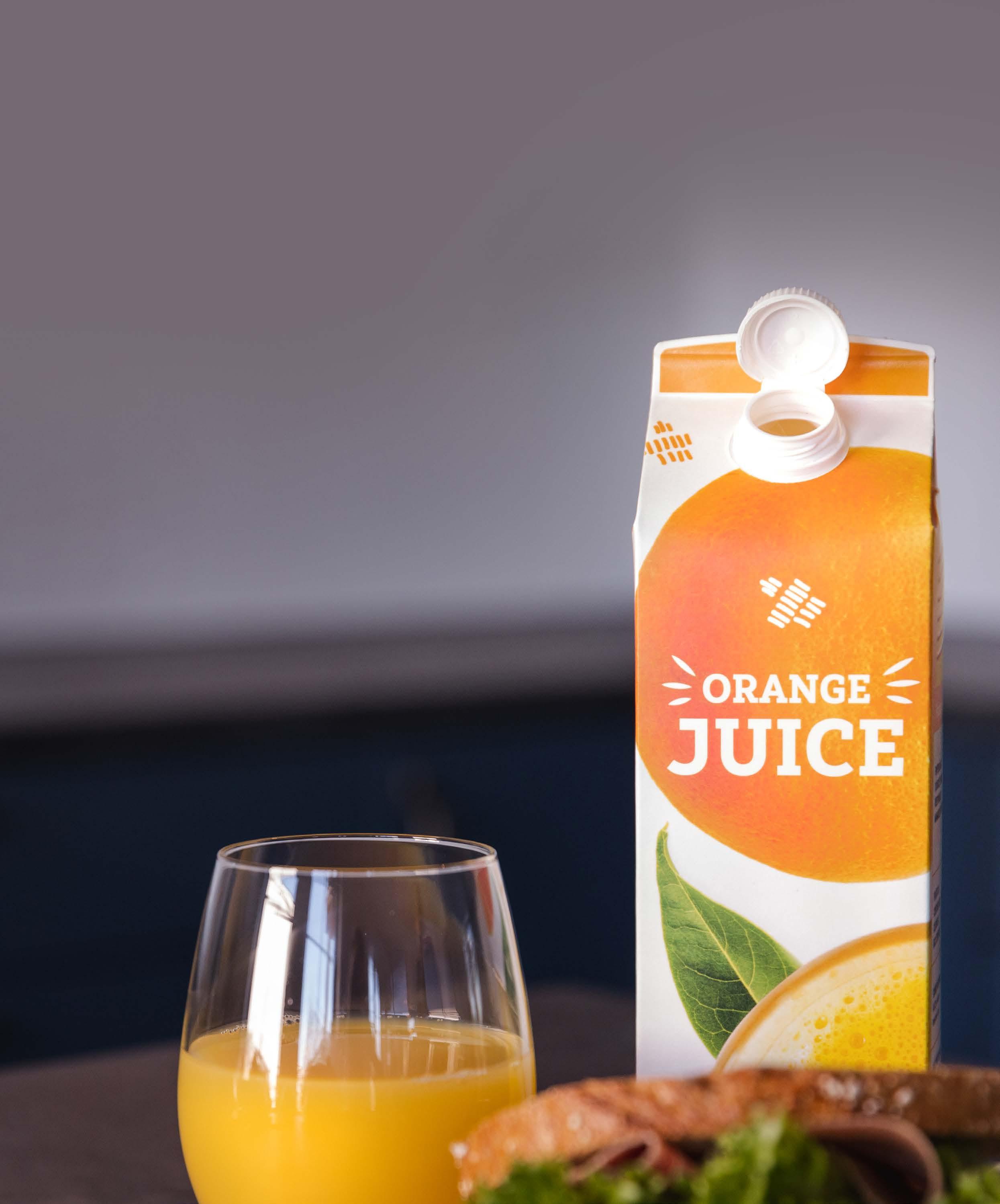
The change to the new Pure-TwistFlip™ cap can be implemented on existing filling lines with relatively little technical and time expenditure. With the professional support of Elopak’s on-site team of technicians, it is possible to make a smooth transition to this new generation of carton screw caps. Research on consumer preferences undertaken by Elopak suggests the transition is a popular one, with shoppers valuing both the environmental benefits and convenience of the Pure-TwistFlip™. Of those surveyed 67% identified it as their first choice compared to other closures.
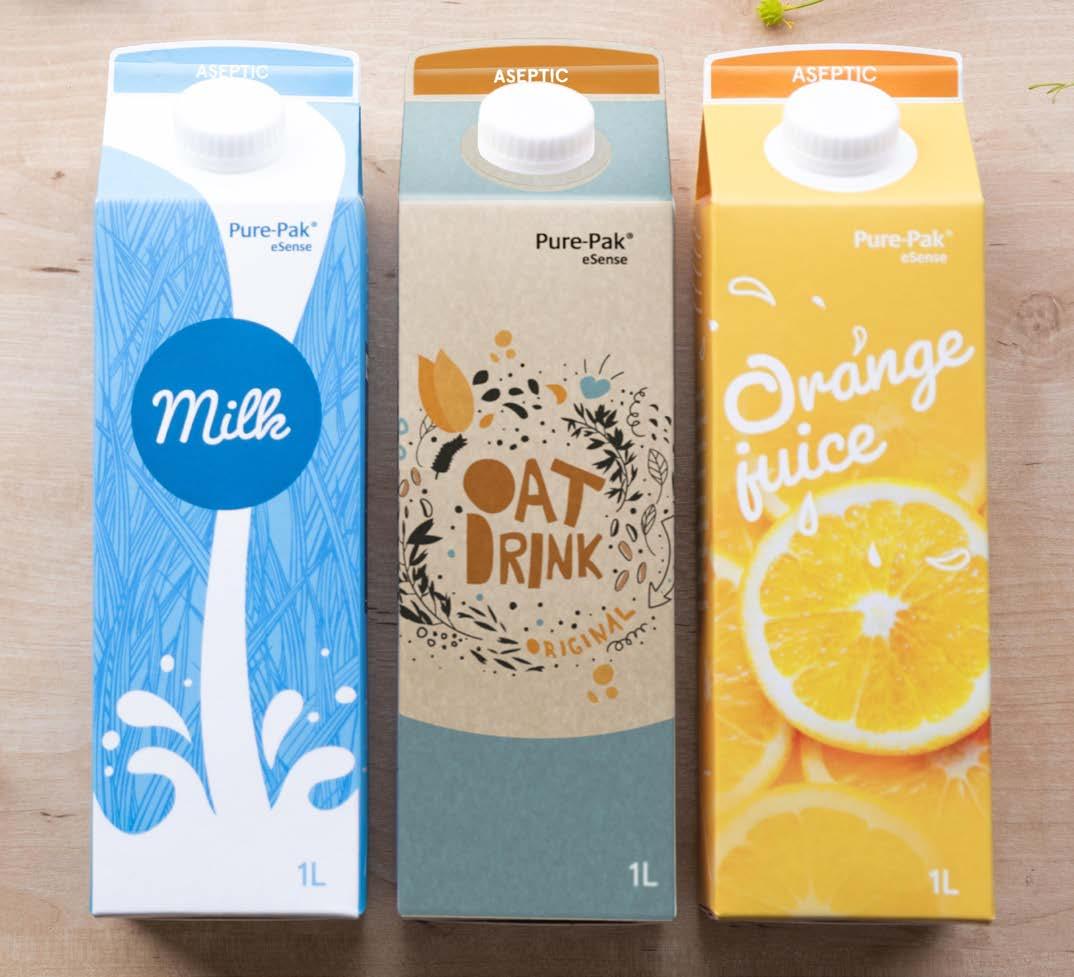
Elopak continues to invest in sustainability-focused innovations as part of the company’s growth strategy. Other recent innovations launched include the Pure-Pak® eSensea more environmentally friendly aseptic carton made without an aluminium layer. The Pure-Pak® eSense was designed using technology from Elopak’s fresh portfolio and extends the environmental credentials of the company’s cartons to customers in the aseptic segment. Made with sustainably sourced paperboard and a polyolefin blend barrier, the PurePak® eSense unlocks the opportunity of a renewable aseptic carton and results in up to 50% lower carbon footprint than a standard Pure-Pak® aseptic carton.
“ Elopak continues to invest in sustainability-focused innovations as part of the company’s growth strategy ”
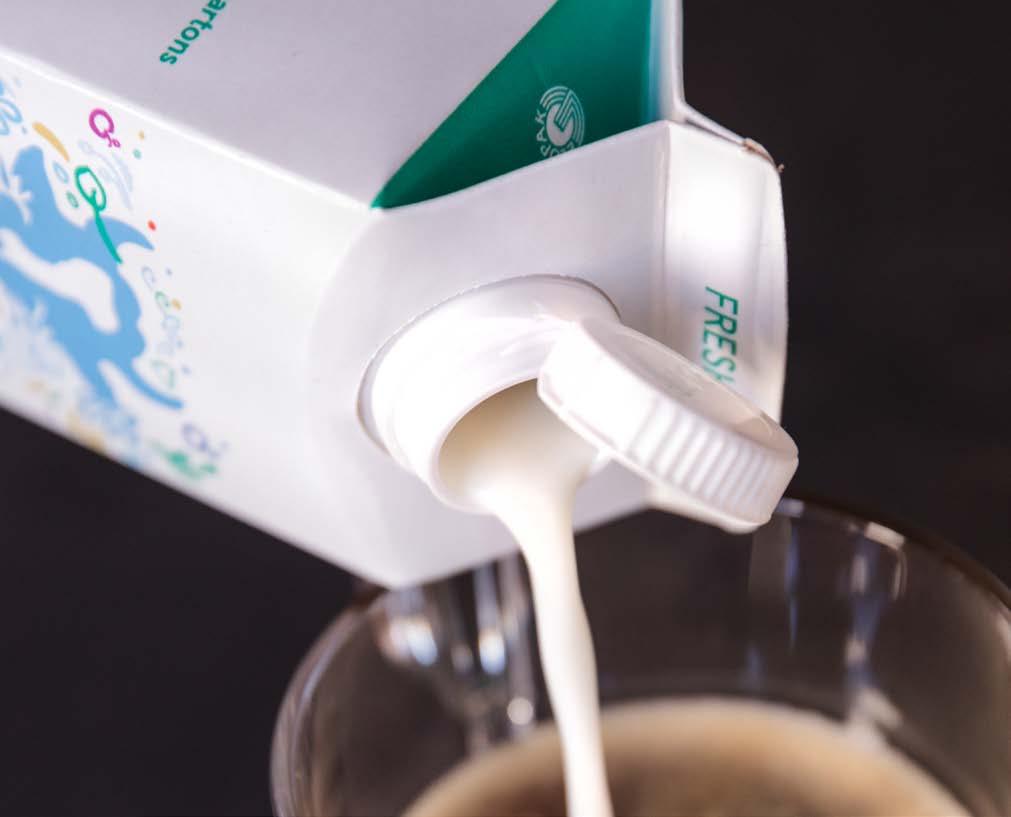
Unlike conventional screw caps, the Pure-TwistFlip™ has been designed so that the screw cap remains attached to the carton throughout its entire lifecycle, thereby reducing the risk of it being littered. This conforms with the European Union’s directive on single-use plastics, which is due to come into force in 2024 and is aimed at reducing the impact of marine littering.
As well as being recyclable, the smallest Pure-TwistFlip™ for fresh products is also Elopak’s lightest screw cap to date, meaning it helps companies to reduce their overall use of plastics. It can be combined with any Pure-Pak® carton to create an original packaging solution that prioritises the environment, safety and consumer convenience. Pure-Pak® cartons are made using renewable, recyclable and sustainably sourced materials to offer customers a natural and convenient alternative to plastic bottles.
Among those to have already adopted this latest innovation are German dairy NordseeMilch who began packaging their high animal welfare milk (Tierwohl-Milch) using the Pure-TwistFlip™ in April 2022.
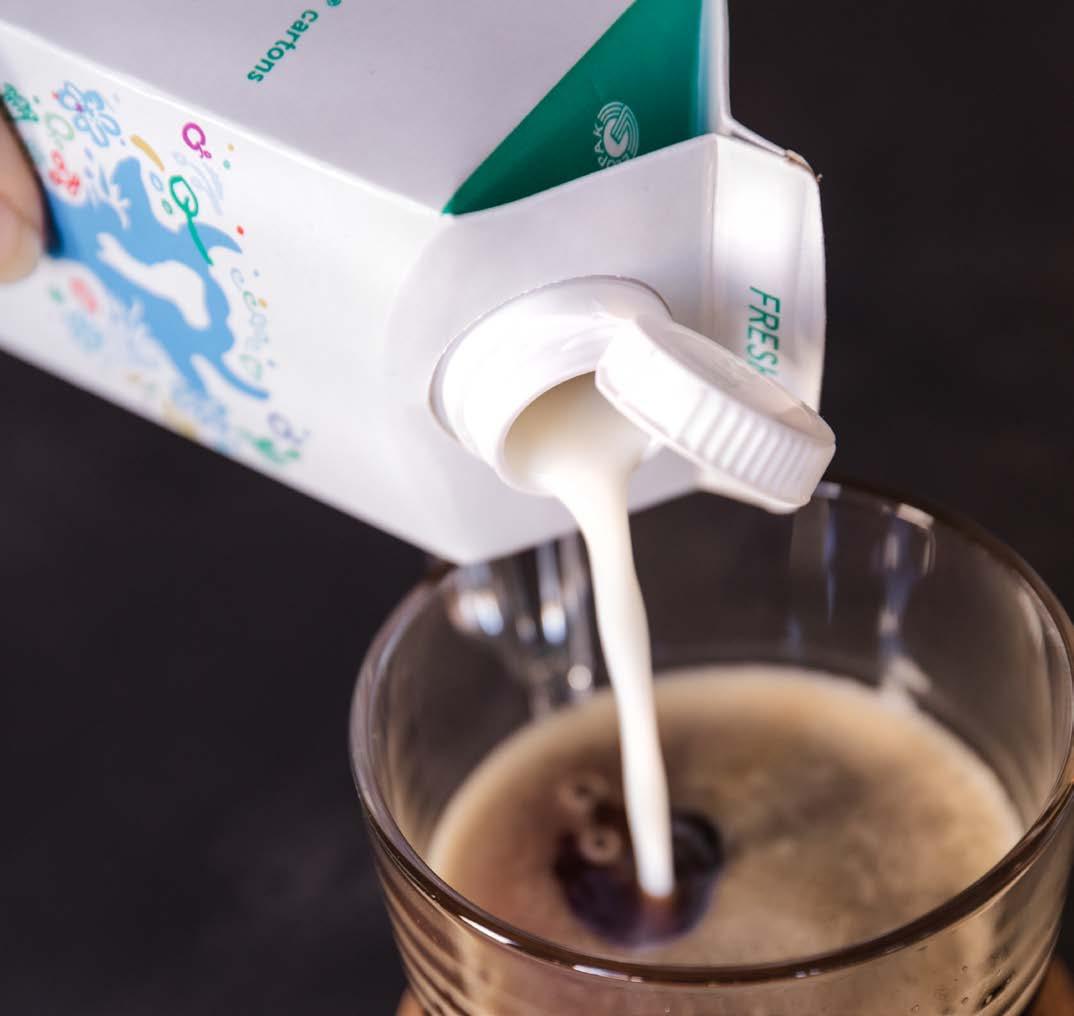
For NordseeMilch, adopting the Pure-TwistFlip™ was a move that reflected the company’s wider environmental values, with sustainable packaging also playing an important role in helping them to position and market their products.
As one of the innovation leaders in the German dairy industry, NordseeMilch wanted to fly the flag and bring the new tethered closure to the market. The two companies have been working together for over 20 years and Elopak worked closely with NordseeMilch to bring the Pure-TwistFlip™ to the shelves. More brands are now set to follow in their footprints and adopt this latest addition to Elopak’s portfolio of opening features.
SUSTAINABLE PACKAGING NEWSELOPAK33
Over one billion recyclable cans a year
new beverage plant is largest ever in UK
Local MP Philip Hollobone said: “I’m delighted to see this project go ahead. With its rich heritage, the production skills in Kettering are outstanding and it’s great to see a leading international company like Ball join the ranks of our existing Themanufacturers.Ketteringfacility will be Ball’s third can-making site in the UK, joining established plants in Milton Keynes and Wakefield and taking the new total in the EMEA region to 26.
Local and government leaders, including North Northamptonshire MP, Philip Hollobone, formally launched construction at Ball Corporation’s new factory at the SEGRO Park Kettering Gateway, a little earlier in the year.
In its first year, the plant will be producing over one billion fully recyclable cans and generate 200 local jobs. The multinational can-maker is working with key public services including Job Centre Plus to boost employment. Highly recycled aluminium cans have a UK recycling rate of 82% and a European average of 76%. Ball, which has had its climate change plan approved by the Science Based Targets Initiative, is constructing the Kettering plant according to BREEAM ‘Excellent’ Sustainability and Environmental Standards. Other features include a rainwater harvesting system and innovative technology to mitigate machinery exhaust emissions. Ball said these technologies will make the Kettering plant the most advanced facility of its type, demanding 20% less energy and 70% less water than traditional can-making processes. The manufacturing industry has long been a major source of employment for Kettering and the surrounding area, with the Ball facility joining a contemporary local industrial community which includes Mercedes-AMG, Siemens and Weetabix.
Carey Causey, president of Ball Beverage Packaging Europe, Middle East, Africa and Asia (EMEA), said: “As environmental awareness increases, consumers are insisting on more sustainable drinks packaging. This new facility, in one of the UK’s best-known manufacturing locations, will help us to support our customers’ growth, creating fully recyclable cans which can play a role in a truly circular economy and support the local community.”
Aluminium is fast becoming the industry’s beverage packaging of choice as it is light and 100% recyclable. With accelerating demand for aluminium drinks cans growing fast in the UK and around the world, Ball is investing in the new facility to meet the needs of its customers. This new facility will be the largest ever beverage packaging plant in the UK. Set for completion in January 2023, the site will occupy 56,000 sqm, with space to expand production later.
34 SUSTAINABLE PACKAGING NEWS BEVErAGE PACKAGING
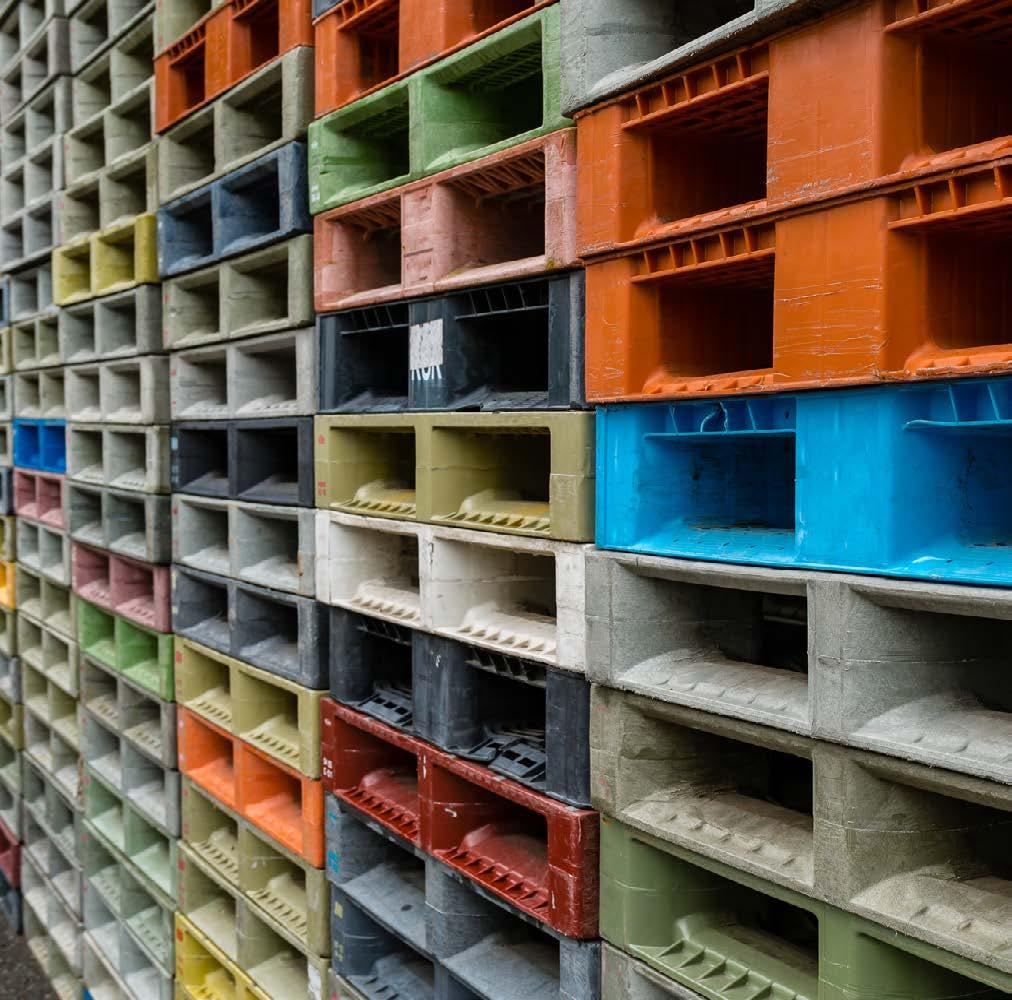
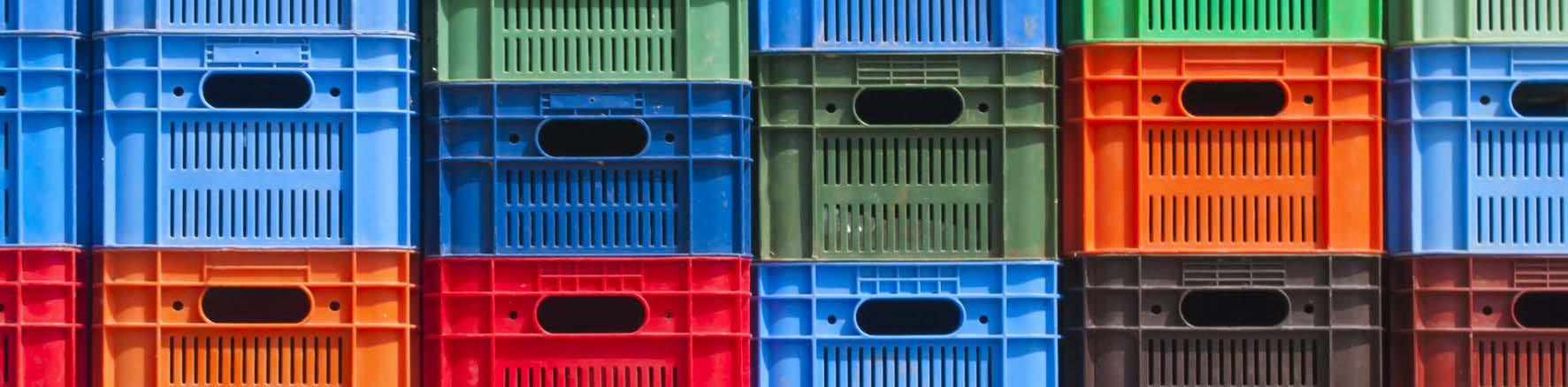
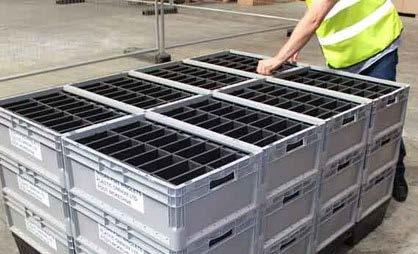
There are plenty of benefits when it comes to utilising returnable Transit Packaging, (RTP) as Philip Yorke discovered when looking at the latest posts on the subject. Returnable transit packaging (RTP), such as plastic crates, pallets, and shipping boxes are already widely used in many industries, including automotive and aerospace, but it is fast becoming a viable option for other businesses too.
Growth in rentals Assessing its customer base, the business has noted increased interest in renting transit packaging rather than up front acquisition, which appears to be accelerated by the imminent UK Plastic Packaging Tax. Market conditions are pushing asset management to the forefront and opening up new production paths and in particular, Schoeller Allibert notes growing interest in plastic container rental over Geropurchase.Liotti,
Retail Account Director, at Schoeller Allibert UK, explains: “There’s a real wave of change happening in the manufacturing and retail industries. Sustainability is now front and centre of operations, which for many businesses means streamlining and reducing any areas of potential waste. In essence, this means a changing view of the supply chain and where that all-important capital is going. As such, we are seeing more and more businesses choosing to rent over purchasing. It seems to be that the agility this gives the supply chain is particularly valuable. “ Sustainability is now front and centre of operations, which for many businesses means streamlining ”
In simple terms, returnable transit packaging can be manufactured from a durable material (such as plastic) and intended for use over multiple trips. This extended lifecycle when compared with single trip packaging (such as corrugated cardboard packaging) essentially means that they can offer a lower cost per trip. The initial cost of buying returnable packaging is higher than for an equivalent number of corrugated boxes, but this is soon recovered. With a longer lifespan, the cost per trip falls significantly, making a reusable packaging setup much more cost effective in the medium to long term than its single-trip counterpart. Schoeller Allibert, a leading global manufacturer of returnable and recyclable transit packaging, has shared its perspective on how retailers are addressing their approach to logistics packaging ownership in response to incoming regulatory changes.
SUSTAINABLE PACKAGING NEWS 35 WASTE rEDUCTION
-RTPAreturn on investment
Eliminating waste helps profits
Single trip corrugated packaging will often require secondary packaging – most typically in the form of tape, strapping or other methods of closure. Plastic totes or boxes with integrated lids and bases do not require tape and eliminates the cost of purchasing this additional inventory. It also prevents one of the main barriers to recycling (i.e. having to separate tape from corrugated boxes once they have been used). Similarly, greasy, or moist items would need additional papers, plastic linings, or bags to prevent to corrugated material of the outer packaging being damaged.
Jim Hardisty, Managing Director of Goplasticpallets.com –
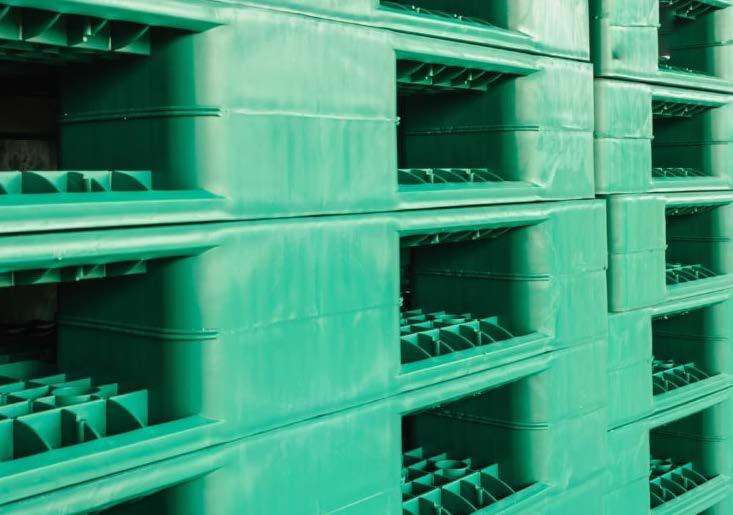
Buying a plastic pallet that lasts 10 years is much more sustainable than buying alternatives that need to be replaced more frequently. The increased resources needed to make cardboard or wooden pallets, and then the question of what to do with them once they have come to the end of their use, does not apply to our plastic pallets”.
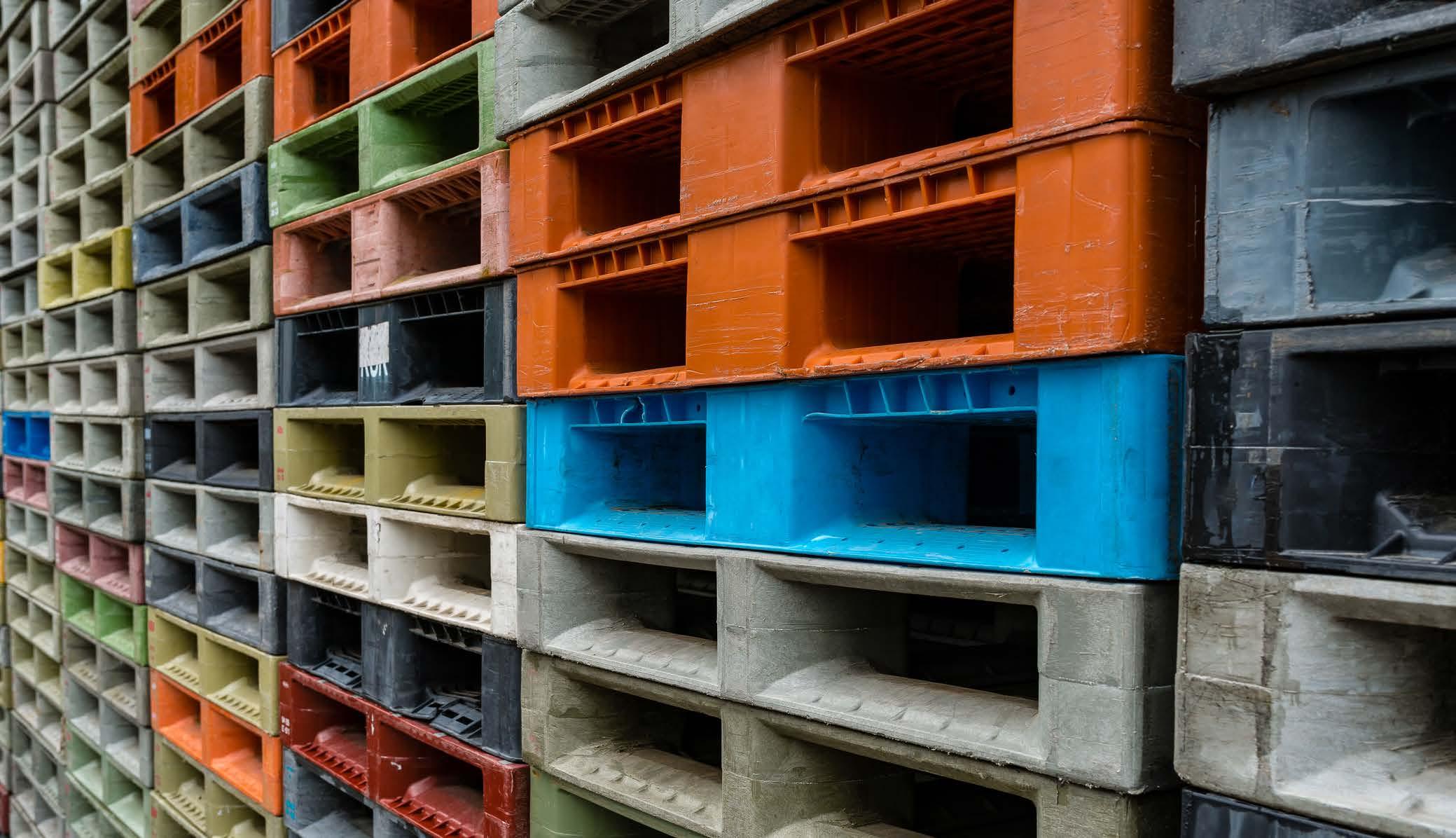
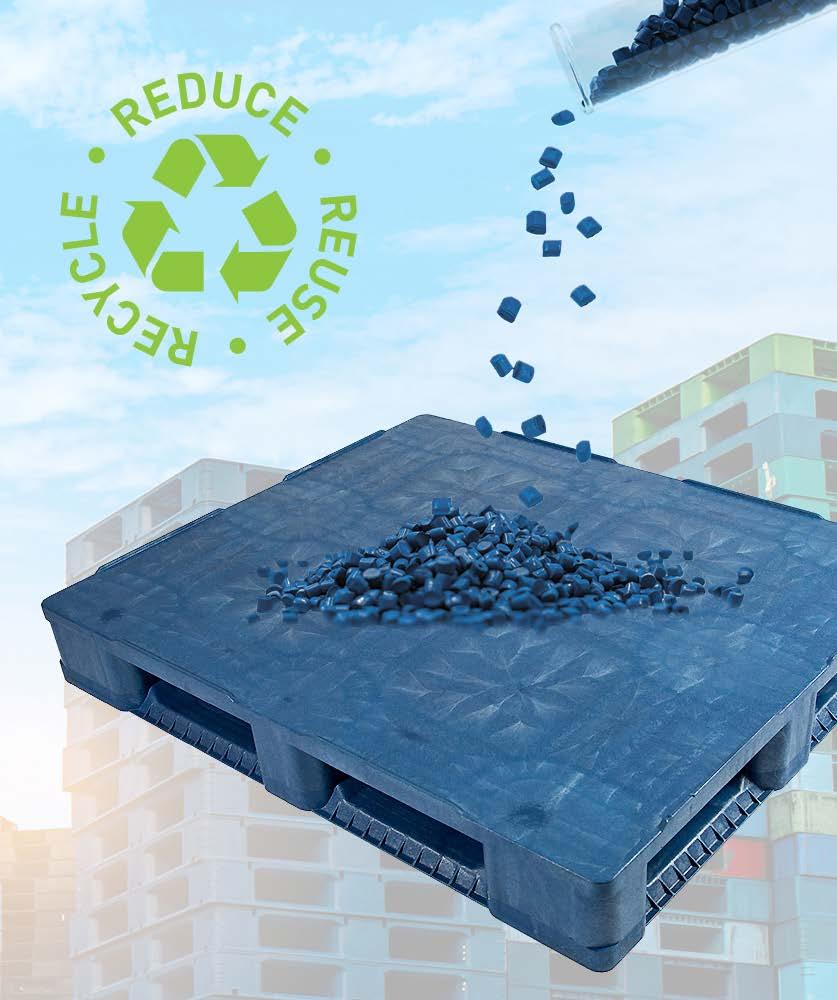
The Responsible Plastic Pallet Company says that “organisations and consumers need to fully embrace a plastic circular economy sooner rather than later to help tackle plastic pollution. We desperately need more consumers, businesses, and policy makers to buy into a plastic circular economy. The current ‘take, make, dispose’ culture we have come to adopt when using plastic just isn’t sustainable and is damaging the planet, almost beyond repair. Plastic isn’t necessarily the problem, but plastic waste is.
“ consumers need to fully embrace a plastic circular economy sooner rather than later to help tackle plastic pollution ”
Buying into a plastic-circular economy
36 SUSTAINABLE PACKAGING NEWS WASTE rEDUCTION
As plastics are resistant to this, they won’t necessarily require these additional items.
Sustainable Recycled Plastic Pallets
Flexible up-scaling
Rental services enable customers to flexibly upscale their fleet as required and benefit from high quality returnable transit packaging solutions for a fixed monthly cost, without capital expenditure investment. Assets are equipped with a tag and unique ID and customers can choose the duration and type of contract. At the end of the contract, the containers are returned to the manufacturer where they are thoroughly washed, inspected and, if necessary, repaired. All assets are re-used, meaning that customers can replace their inefficient legacy fleet with best-in-class RTP containers. At the end of the working life, materials are not wasted, they get recycled and reused to create new high-quality assets.
One criticism of returnable packaging – and specifically moulded totes or containers – is that it can often result in very inefficient return journeys. This is because, as the containers do not fold flat, they still take up a whole vehicle load. Whilst this is fine in scenarios where goods may be delivered, finished or have some other process applied and then returned, it can make it uneconomical for a one way trip. An easy solution to this however is to use collapsible transit packaging. This can be folded down and returned without taking up much space on the return trip. Thousands, perhaps millions of tonnes of perfectly good corrugated boxes are effectively baled, pulped and turned back into… cardboard boxes. This is essentially using a lot of energy to re-produce the same product you started with, and of course, this isn’t taking into account the amount of cardboard that unintentionally ends up in landfill too.
Plastic pallets are not contributing to deforestation, leaving trees to capture carbon. 96% of Goplasticpallets.com’s plastic pallets are made from recycled materials and all of our products can be recycled at the end of their long life. Reusable and recyclable products are the ideal way to help businesses minimise their impact on the environment. With single trip corrugated, there is often a cost of disposal once they have completed their (one and only) journey. Whilst a lot of this burden will fall on the recipient of the cardboard packaging, there are costs for businesses in terms of buying PRNs under the Packaging Waste Regulations. Returnable transit packaging will eliminate the need for customers to dispose of / recycle large volumes of cardboard boxes and the associated costs. Instead, customers can simply collapse them and send as a return load following their next delivery. The majority of RTP containers can be recycled at the end of their serviceable life too.
The 360 degree approach This 360° approach to product and service innovation, is a win win for the industry and fundamentally a better model for achieving supply chain resiliency, the cardboard shortage doesn’t need to be seen as being just an obstacle. It could be a real jumping-off point – a kickstart towards meaningful change. We are excited to see businesses on their journey from linear cardboard packaging solutions to circular returnable transit packaging and play our part in helping to future-proof the retail industry at the same time.
Collapsible transit packaging
SUSTAINABLE PACKAGING NEWS 37 WASTE rEDUCTION
Selenis recently took a giant step forward in their continuous drive towards a global circular economy when they scaled-up their production of PETG resins with recycled content to full production volumes.
38 SUSTAINABLE PACKAGING NEWS SELENIS
Selenis
One Giant Step for the Circular Economy
“Meeting consumer demand for transparency and the verification of company claims, remains high on the agenda throughout the plastic value chain, as the target of placing 10 million tons of recycled materials on the European market by 2025 is approaching. With the renewal of their Recyclass certifications, Selenis has proved yet again that their sustainability claims are unrivalled and based entirely upon valid circular solutions”
The Selenis molecular recycling process recovers monomers through chemical recycling. Glycolysis is used to break-up PET waste and reduce it to its polymer building blocks – namely, monomers. Next, they are reintroduced to the value chain as recycled polyester raw materials.
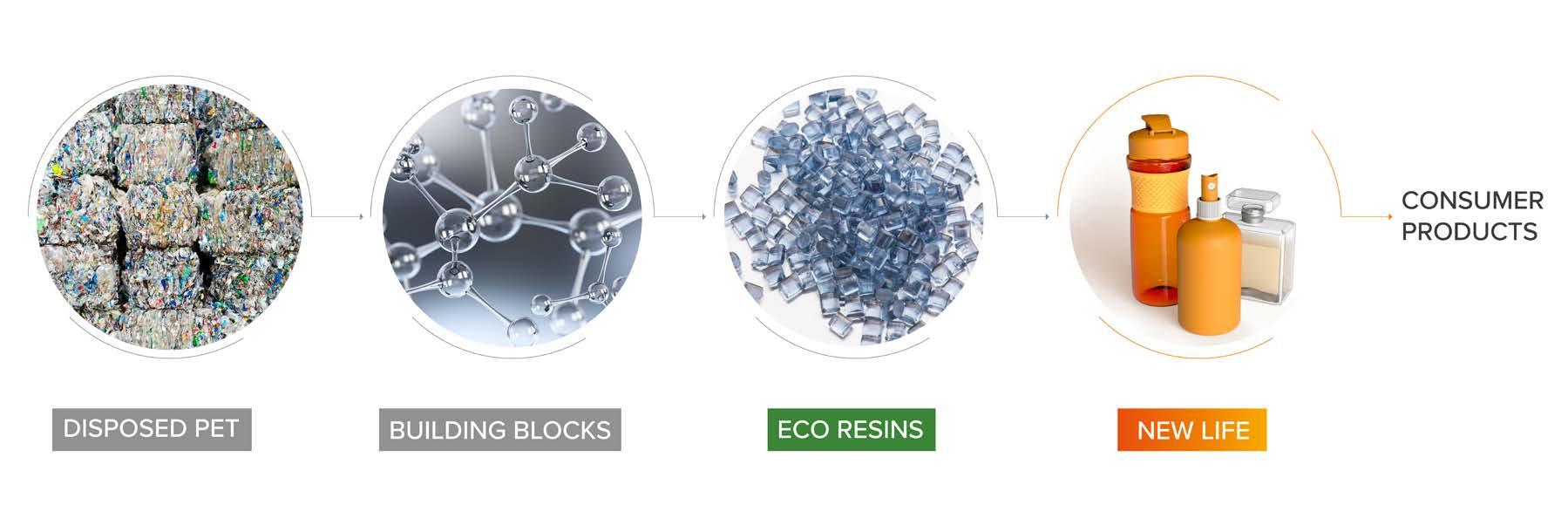
Verifiable certification and traceability
The secret is the process
With the growing pressure to demonstrate to consumers that products are genuinely circular manufacturers, brand owners and retailers are increasingly looking for a reliable and transparent certification.
SELENIS SUSTAINABLE PACKAGING NEWS 39
Progress through partnerships
The RecyClass Certification was the solution for Selenis, as it attests to the physical traceability of recycled plastics as described in EN 15343:2007. This follows a controlled blending chain of custody approach ISO/IEC 22095 where origins of plastic waste are verified, starting with the recycler and moving up the value chain. The certification also allows for an adequate determination of the share of the post and pre-consumer plastic. With Selenis, all the recycled content is post-consumer. This advanced tool has become a key enabler in developing recycled plastics packaging.
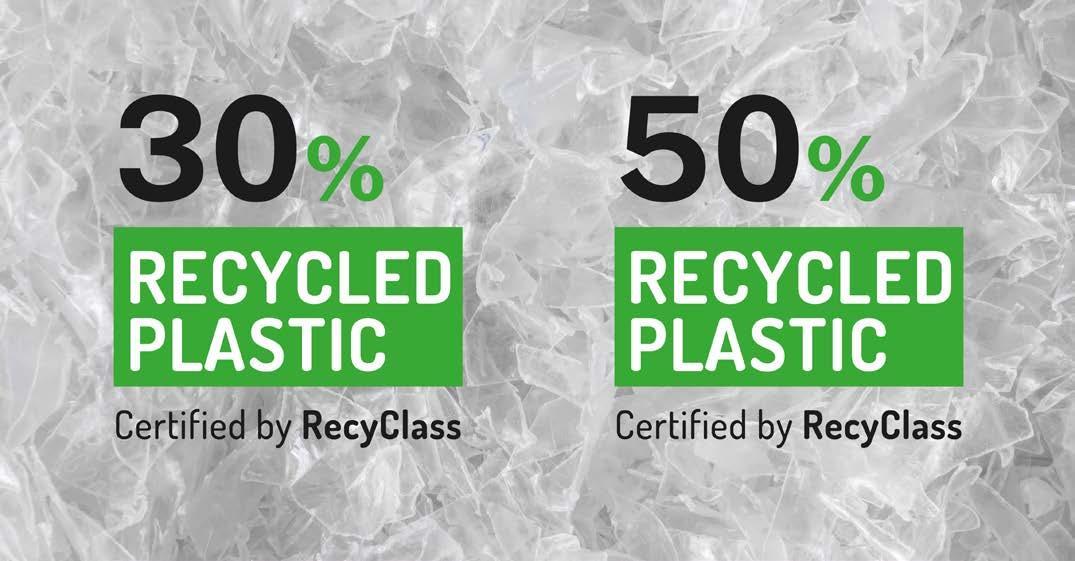

What is unique about Selenis’s break-through technology is that it combines the recycled PET with virgin raw materials at specific dosages, according to production throughput and the desired percentage of recycled content. This in turn, results in the production of new polyesters with high levels of post-consumer recycled content. In addition, prior to polycondensation, the co-monomers are subjected to a fine filtration process to remove impurities. During polycondensation the final IV and properties are obtained, according to product specifications and their application requirements.
Today, with this step, Selenis contributes significantly to solving the world’s problem of plastic waste by turning it into the building-blocks of their products They are used in a variety of applications including packaging, cosmetics, personal care, durable goods, and heat shrink sleeves, to name but a few!
The development of the unique Selenis Eco-Resins was made possible thanks to the partnerships created with their clients who were interested in the development of a sustainable solution and willing to become involved in proving the products’ efficiency and performance. In 2021, shortly after scaling up the production of their recycled content products, Selenis sought to certify the traceability of these products through Recyclass Certification. In May 2022, Selenis renewed this certification, guaranteeing the use of 30% and 50% post-consumer recycled content in their Eco Resins and establishing trust in their recycled-content products.
This certification confirms that Selenis possesses all the required procedures to ensure the traceability of recycled plastics incorporated into their products. Legislative pressure, 2030 targets, and brand owners faced with consumers looking for products with lower environmental claims have prompted the need for reliable certification and labelling of environmental claims to prove sustainability and eliminate greenwashing based on false claims used purely as a marketing tool.
Albéa
To create a responsible packaging is to be aware that the Earth’s resources are limited and that the circular economy is the solution to preserve them. For Albéa and the whole packaging industry, the transformation of plastic packaging into a new raw material without ever becoming waste is a huge challenge. This implies rethinking the processes to reduce the consumption of materials, whatever they may be, and to strengthen the collecting, sorting, reusability, and, above all, the recycling of cosmetic plastic packaging. It also implies creating short, efficient, circular circuits with the least environmental impact.
Transparency & circularity
40 SUSTAINABLE PACKAGING NEWS ALBEA
Albéa’s CSR Report :
Towards Responsible packaging
Albéa is moving forward with its 2020-2025 CSR roadmap that puts transparency and circular economy at the heart of its strategy. In this context, the company has just published its 4th CSR report, highlighting the joint endeavour of partners and all employees around the world to respond to the climate change challenge by making cosmetic packaging circular.
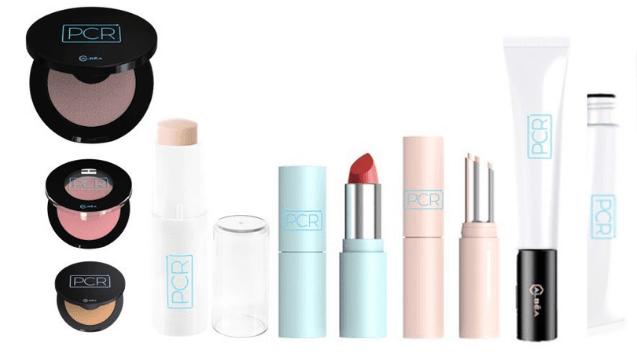
A virtuous packaging needs the involvement of everyone. This is why the company puts transparency, i.e. the CSR commitment of all the players in the value chain, at the heart of its efforts - and at the heart of its new CSR Report.
This fourth report showcases how the teams, the customers, the suppliers and all the stakeholders are joining forces to build a more cohesive industry, design a transparent and virtuous value chain that meets the challenges of society, rethink packaging to make it circular – and all this while addressing the biggest issue of all times: climate change.
Download Albéa’s CSR report “ Albéa innovates every day around the principle of the 5 Rs: Reduce, Reuse, Recycle, Reincorporate and Renew ”
To provide assurance that their products are responsible, brands need to be able to rely on responsible suppliers who can support them with these ambitious transparency processes. This is the very definition of due diligence for companies seeking to prevent environmental, human rights and corruption risks within their own activities, as well as among their subcontractors and suppliers, whether in France or abroad. In turn, these suppliers should then demand this from their own suppliers.
SUSTAINABLE PACKAGING NEWSALBEA41
Thus, Albéa innovates every day around the principle of the 5 Rs: Reduce, Reuse, Recycle, Reincorporate and Renew. But the group has also added a sixth R: Rethink. Circularity is about continuously rethinking packaging from the very beginning of the product design. It is also about imagining new uses, improving logistics and relocating production as close as possible to the end consumer. This massive challenge is now mobilizing not only the company but the entire value chain.
For Albéa, the current situation presents a historic opportunity to reinvent a value chain that is both transparent and virtuous. The company is therefore working towards building a recognized, strategic and above all united cosmetics industry by collaborating with partners and customers and engaging in several sustainability initiatives.

Albéa intends to participate in a responsible sector, driven upstream by consumers and brands committed to proactive sustainable development policies. Consumers around the world are increasingly committed to preserving resources and fighting against global warming. They therefore want more transparency about where the products they buy come from and how they were made. Regulations are changing and environmental labeling is emerging, because guaranteeing a responsible product for the end consumer means being able to evaluate and prove in complete transparency.
Transparency across the value chain

Responsibility requires solidarity
The sixth “R” As many other key players in the industry, Albéa is committed to this approach and adheres to the roadmap laid out by the Ellen MacArthur Foundation through five priorities: reducing the amount of material used, lightening weight, eliminating problematic or unnecessary materials; designing for reuse; offering truly recyclable packaging; reintegrating post-consumer recycled material; and eliminating the use of non-renewable virgin raw materials as much as possible, by using bio-sourced resins, for example.
“Despite the many on-going challenges facing the packaging industry, machine designers and engineers are turning to digitalisation and robotics ever more, to streamline their machinery and increase their output. Thereby making major strides in the industry’s mission towards greater sustainability and a circular economy”.
42 SUSTAINABLE PACKAGING NEWS PACKAGING MACHINErY
For maximum savings in pulp and paper production with the help of automation and digitalization, Voith and its wholly owned subsidiary BTG are merging their product portfolios. The two established data platforms, Voith’s OnCumulus and BTG’s dataPARC, will be merged into an integrated, hybrid system OnCumulussolution.willhenceforth be offered under the name dataPARC cloud, while BTG’s MACS advanced process control solutions will join the OnEfficiency product family, thereby strengthening the Efficiency Solutions of the Voith’s Papermaking 4.0 portfolio. With the combined product portfolio, customers benefit from the best offerings of both companies – for the entire pulp and paper production.
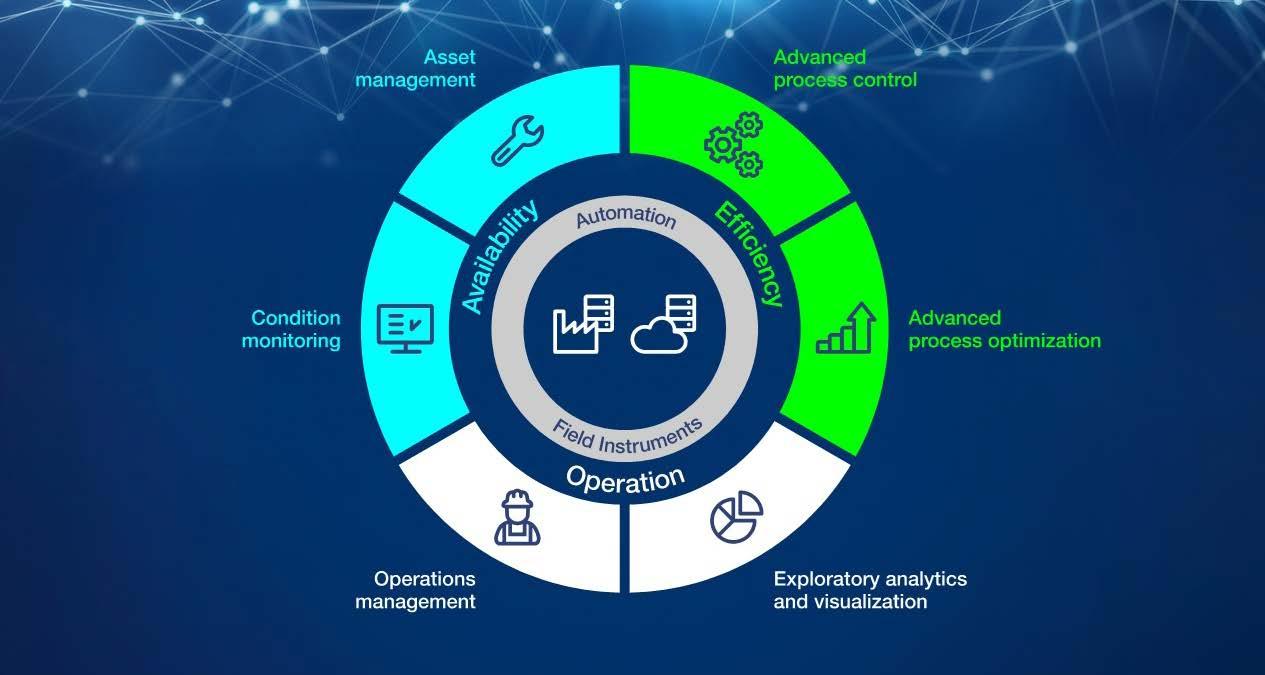
Merging of minds –and expertise
With extensive know-how and bundled experience, the leading full-line supplier Voith and its subsidiary BTG are optimising their Papermaking 4.0 digitalisation and automation portfolio to increase the overall customer experience.
“Many years of know-how, bundled experience and an excellent partnership between Voith and BTG are the basis for the optimised digitalisation and automation portfolio Papermaking 4.0,” says Peter Eisen, Vice President Digital Product Management at Voith Paper. “As the leading full-line supplier, our goal is to enable paper manufacturers worldwide to achieve significant productivity and cost advantages.”
NOP (No-Plastic Program) means we promote eco-friendly plastic substitutes for the packages manufactured on IMA machines. rough the research and testing of alternative processes and materials together with our partners we foster plastic-free and sustainable, compostable, biodegradable or recyclable packaging solutions. According to these objectives, IMA established OPENLab: the Group’s network of technological laboratories and testing area, dedicated to the research on sustainable materials, technologies and production optimization processes.
Chicago,InternationalEXPOUSA
Discover more about IMA NOP on ima.it/imazero and IMA OPENLab on ima.it/open-lab PACK
October 23rd-26th Stand 2514
At IMA ILAPAK, dedicated technical solutions have been designed to better manage these materials and avoid the stressing of sealing joints. The company has developed and implemented new geometric profiles of sealing jaws that are combined with devices that assist the flow of mono plastic wrapping materials to perfection. To summarise, the monomaterial will guarantee the use of less plastic and provide a 100% recyclable solution.
Material gains
IMA ILAPAK
44 SUSTAINABLE PACKAGING NEWS IMA ILAPAK
The IMA Group’s unique network of technological laboratories and extensive testing facilities dedicated to the research on sustainable materials, technologies and production optimisation processes As a result, it can now help customers more than ever, to reduce plastic content, or switch to new sustainable materials, whilst maintaining the same production performance levels.
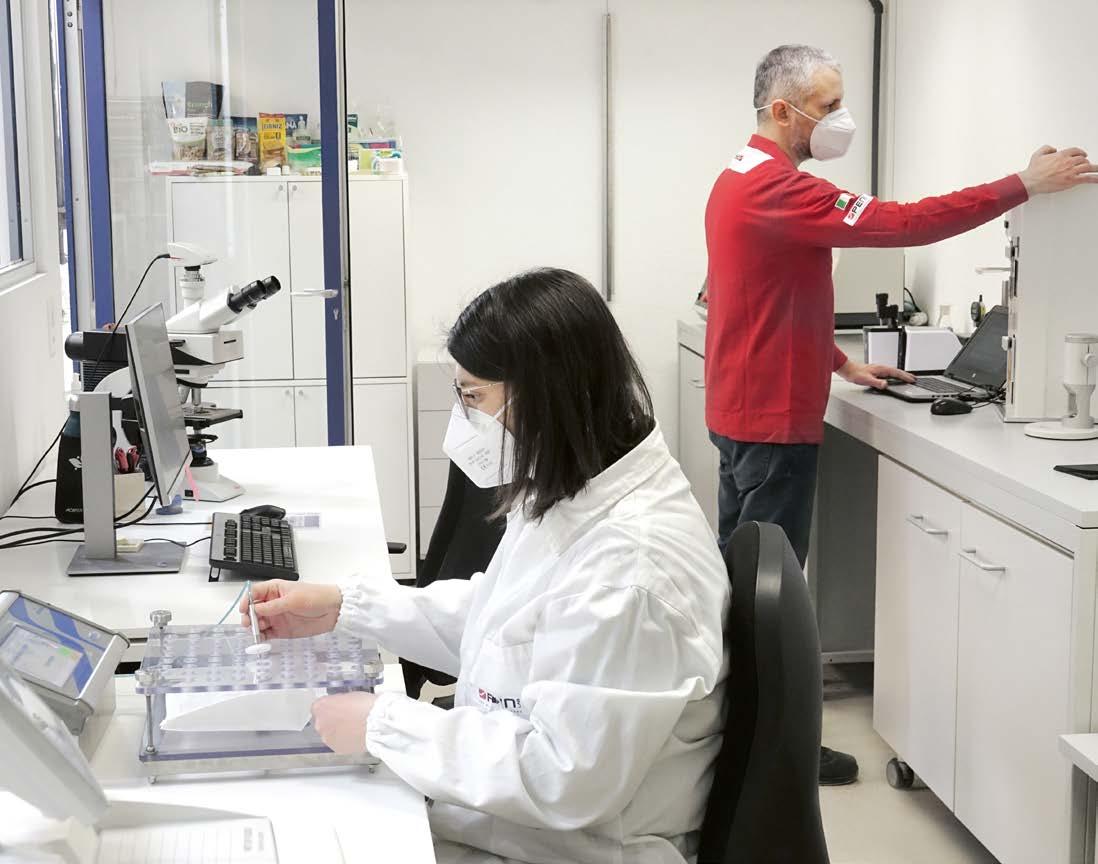
IMA ILAPAK DELTA WW OF-HSX full electric flow wraper
In fact, IMA ILAPAK can now offer more sustainable solutions through downgauging, or the adoption of recyclable mono plastic materials. These solutions allow customers to have films with thinner gauges than standard ones, but it also means that they are more delicate when processing and sealing on any packaging machinery.
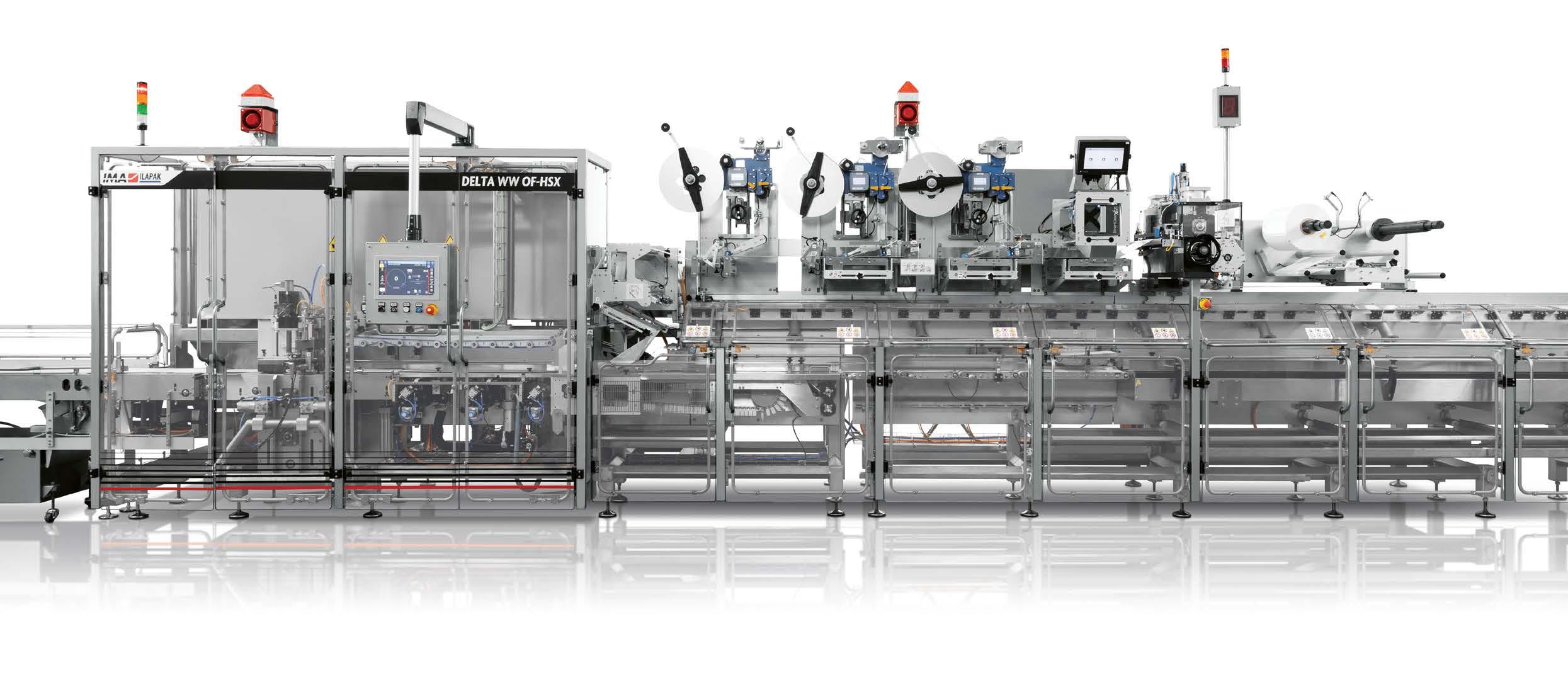
Sustainability has always been a priority at IMA ILAPAK and its proven experience in the sustainable materials field continues to gather pace thanks to OpenLab.
“ the mono-material will guarantee the use of less plastic ”
Comparing the Delta WW OF-HSX to a standard flow wrapper and considering the same operating hours and speed –170ppm - in one year, the Delta consumes 1.500 kWh, whereas a standard machine consumes 27.400 kWh (Including air network losses). This project leads to less energy consumption, greater sustainability, less environmental impact, and lower operating costs, while at the same time providing a better performance and greater efficiency.
This major project is comprised of four strong pillars: LOW (Low-Impact Program) preserves resources; NOP (No-Plastic Programme) reduces plastic use; E-MOB (Sustainable Mobility Programme) fosters sustainable mobility; YOU (Human-Centric Programme) promotes human rights. In addition, all solutions created by IMA ILAPAK are fully aligned with the IMA Group’s certified sustainability programmes. “ the fully electronic machine was nominated for the Sustainability Award ”
IMA ILAPAK has launched the all-electric flowrapper: the new Delta WW OF-HSX. An innovative and sustainable HFFS packaging machine that drastically reduces energy consumption the faster the machine operates.
The company has also implemented ultrasonic sealing as an alternative to heat sealing. This technology achieves excellent results with paper-based packaging materials. In addition, it does not that does not exploit heat, which is essential with paper being a thermal insulator. What’s more, when using an ultrasonic system, the sealing area is significantly reduced, result, in less material being used.
Move to paper dramatically reducing plastic
The vision and tangible commitment of IMA ILAPAK towards greater sustainability, has allowed its customers to use the latest new-generation, eco-friendly materials. The company’s unique technology will significantly reduce the use of plastic materials, as well as substantially reduce energy consumption wherever it may be installed.
Such commitment fully reflects the IMA ZERO values, the IMA Group’s Sustainable Development programme, designed to reduce environmental impact in the manufacturing sector.
IMA ILAPAK SUSTAINABLE PACKAGING NEWS 45
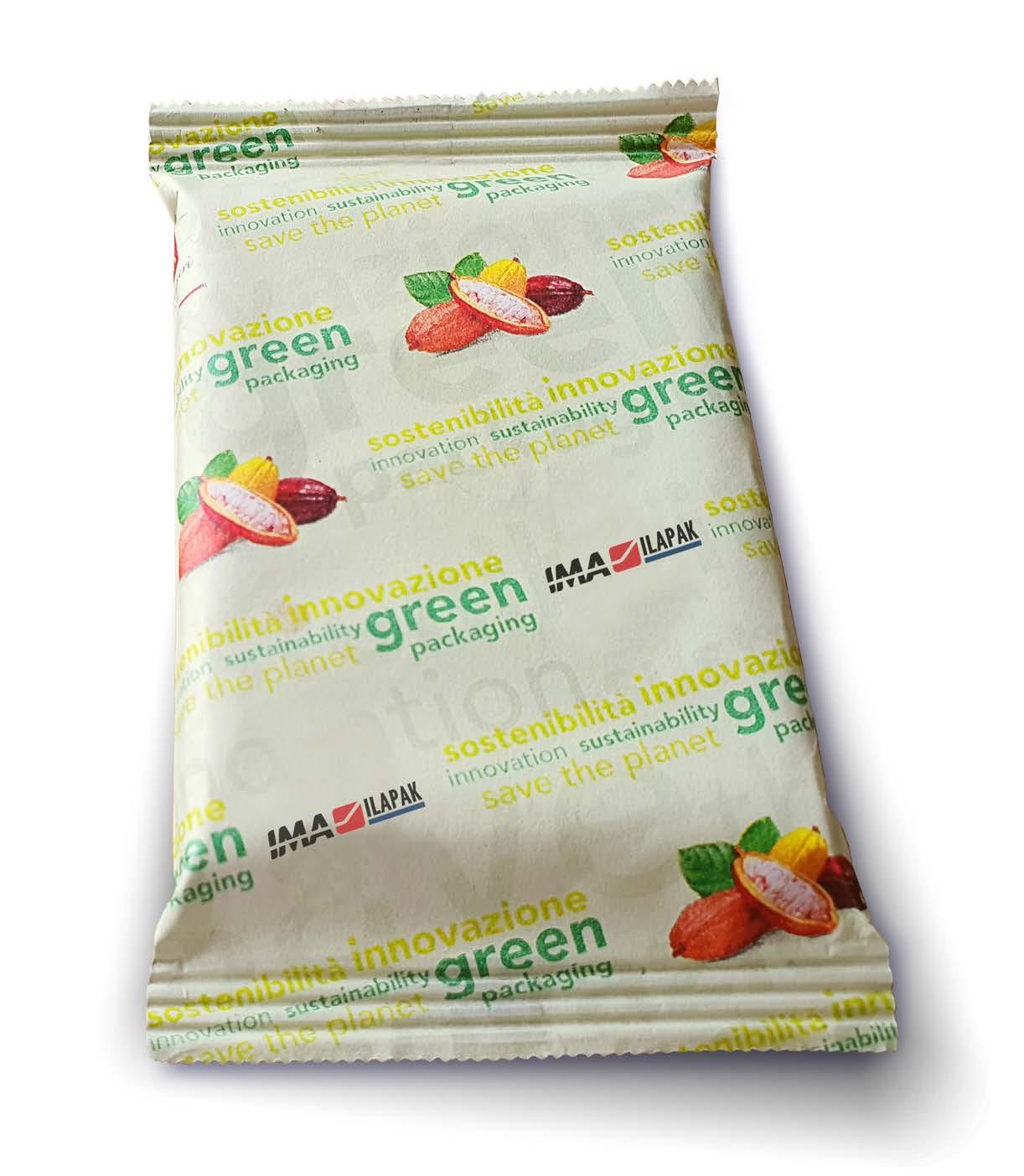
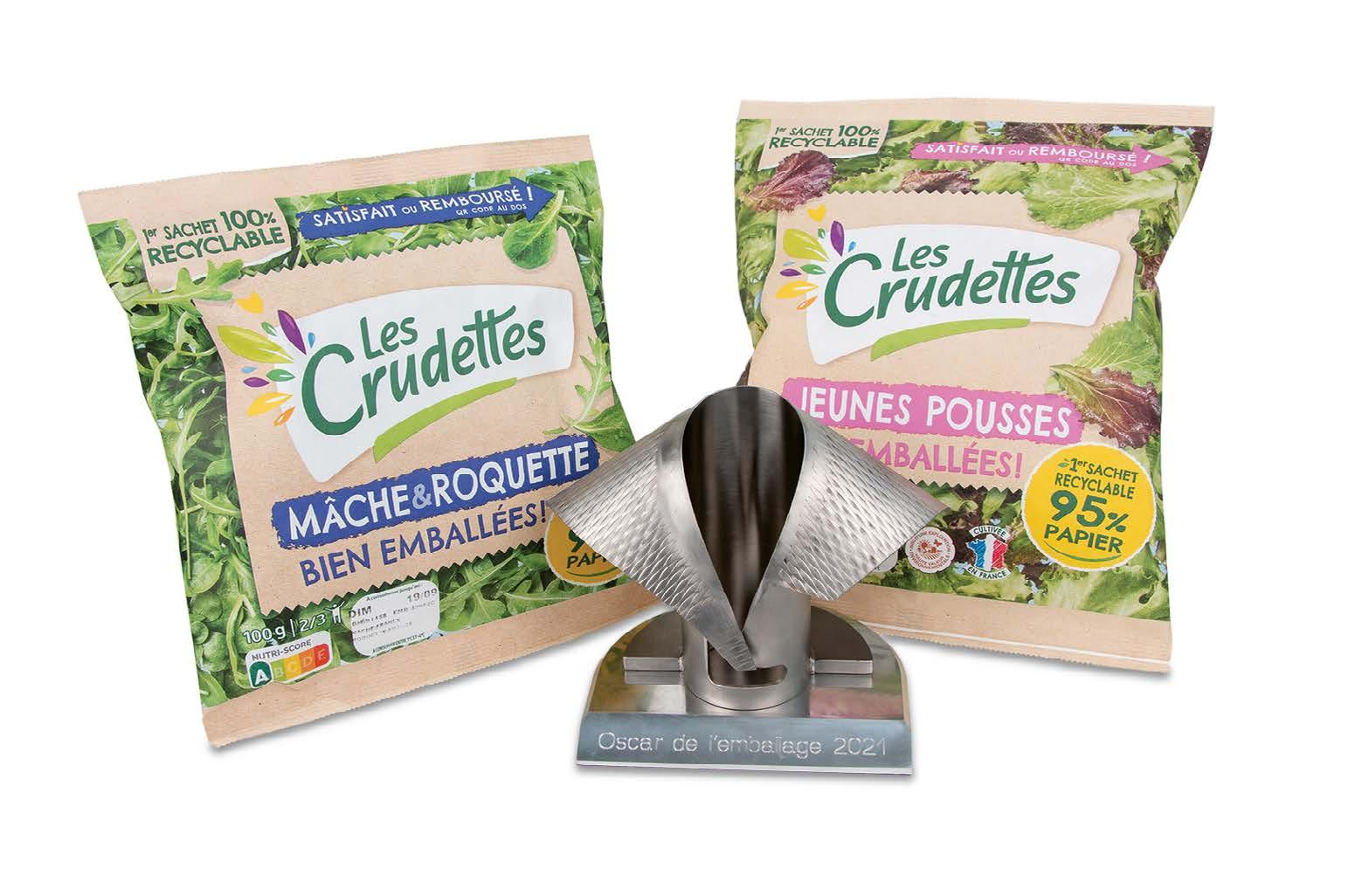
With paper-based wrapping materials, IMA ILAPAK can dramatically reduce the use of plastic to a much lower level and to a more acceptable percentage, thereby guaranteeing a high level of recyclability and increased sustainability.
Reducing energy consumption
IMA ILAPAK has re-engineered its folding boxes, as well as its forming tubes, and other parts that come directly into contact with films. This ensures the perfect sliding of a rigid and critical material such as paper - which by its nature, is subject to breakage or deterioration if not handled properly.
Thanks to its ground-breaking features, the fully electronic machine was nominated for the Sustainability Award 2022 by SPS Italia, in the category “Excellence Award: Best project for sustainability”, as it aims at energy saving thanks to its absence of pneumatic applications. Not only does it save energy and therefore money, but it also offers a far better performance than a standard pneumatic machine. This solution is capable of ensuring the same configurationof the sealing elements, up to 170 ppm with traditional laminated films and up to 130ppm with fully recyclable materials.
FACH PACK NÜRNBERG SEPTEMBER 27. – 29.; 2022 HALL 1 BOOTH 1-219 WELCOME A WORLD OF PACKAGING SOLUTIONS DESIGNED FOR SUSTAINABILITY. BROUGHT TO LIFE BY SCHUBERT. How can packaging be both environmentally friendly and cost-efficient? With our TLM packaging machines. They enable you to use the thinnest materials possible, cutting them to size to reduce consumption and dramatically decrease your use of resources. It’s great for the planet and you benefit from a real competitive edge. We call it Mission Blue and we promise: The mission goes on. www.mission-blue.com







The company’s vertical banding machines US-2000 RST-V and US-2000 RD-V as well as the horizontal US-2000 RST model, which is specially designed for ring-shaped products, where band-closed products can be accessed through their opening. Depending on the application and requirements, either manually or with the help of a robot, raw or printed bands made of paper or foil can be used for heavy products such as ball bearings, metal frames, and direct drive motors. Banding machines with extra-strong RST motors can utilise banding material that is capable of carrying 30 kg or more. Thanks to TruePaper, banding not only means significantly lower material consumption compared to the conventional variants, but also noticeably fewer manual work steps.
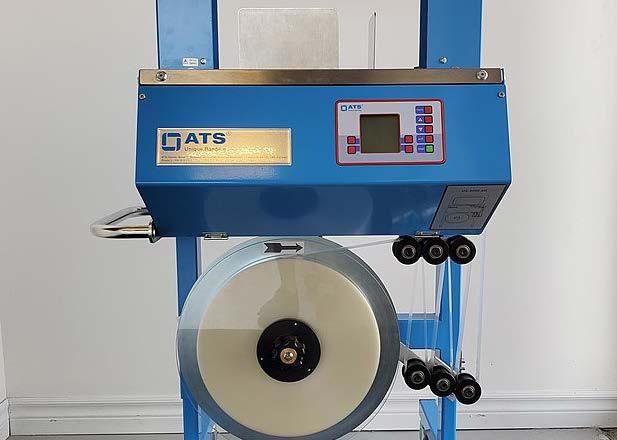
No matter whether it’s tubes, bicycle locks, ball-bearings, clothes hangers, cables, direct drive motors, ring lights, frames - these products all have one thing in common: their irregular shape means that they are likely to be held together with cable ties, string or tape. In which case they also need to have additional stickers or cardboard sleeves and labels added, to provide price information as well as codes for product tracking. This means additional labour is required thus adding to the cost of materials. In which case, consumers are also confronted with the tedious task of unpacking the product and the disposal of a lot of waste materials.
Top Band has Euro-vision
When it comes to paper bands there are two big winners: one is the environment and the other is the consumer. The latest innovative offering from ATS Tanner, is ‘TruePaper’ which provides manufacturers with countless sustainability benefits. These range from fullrecyclability to saving materials and costs - as well as the planet. This unique product is 100% recyclable, utrasonically heat-sealable and made from 95% pure, virgin wood fibres. In addition, it is perfect for use for banding in direct contact with food as Philip Yorke reports.
The clear, environmentally-friendly alternative
Smart banding replaces cable ties, labels and tags
SPN: “ True to form, ATS Tanner has made yet another groundbreaking product that ticks all the boxes. At SPN we are more than happy to play our part in spreading the good news about such well-considered and environmentally friendly products ”.
Automation with the help of a robot is also made much easier, and more cost-effective. Consumers can easily open the band by hand at the ultrasonically welded seam. The tedious removal of stickers and adhesive residues is thus also eliminated. Tools and aids such as scissors, pliers, knives or cleaning agents can remain in the cupboard.
48 SUSTAINABLE PACKAGING NEWS PACKAGING MACHINErY
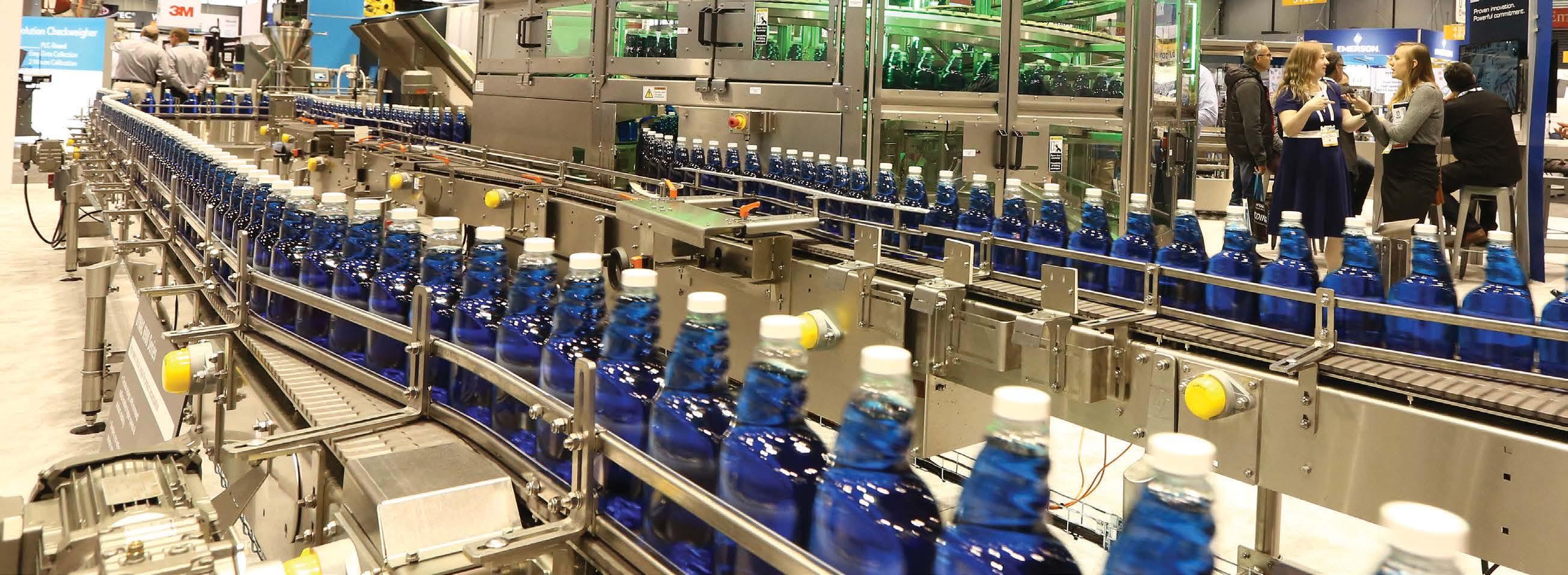

These days, paper bands can be relied upon to hold products together securely, yet they can be easily opened anywhere. Bands made from high-quality paper can be printed exactly as required for maximum visual appeal and just like film bands, they can also be printed with specific product information during the banding process. Furthermore, ATS Tanners’ special paper bands are also available fully FSC certified in order to meet strict US regulations.
ATS-Tanner
SUSTAINABLE PACKAGING NEWS 49 SEE IT. EXPLORE IT. EXPERIENCE IT. PACK EXPO International is back in Chicago, giving you the unmissable opportunity to explore technology, materials and reinforce industry connections. Discover innovative solutions for packaging and processing, automation, sustainability, e-commerce, and more at the most comprehensive packaging and processing event in the world in 2022! LEARN MORE & REGISTER NOW FOR ONLY $30 2000+SUPPLIERSLEADING FULL-SCALEMACHINERY 100+ SESSIONSFREE 40+INDUSTRIESVERTICAL October 23–26, 2022 Chicago, IL USA McCormick Place PACKEXPOINTERNATIONAL.COM 7 PAVILIONS INCLUDING 3 NEW HOTSPOTS:

Zünd offering more at Fachpack
flexo-platemakingBreakthrough solution isCrystalCleanConnectnowwidelyavailable!
There are many different ways to optimise production and improve efficiency and profitability. And this is where Zünd comes in, with a wide range of automation solutions – from the automated and standardised preparation of print and cut files, to providing packaging manufacturers with production monitoring and analysis, whilst streamlining the picking & sorting of cut parts, and simplifying logistics.
At Booth 438 in Hall 7A, Zünd will be demonstrating how intelligent, automated production can provide even SMEs with substantial savings and eliminate errors at the source.
50 SUSTAINABLE PACKAGING NEWS
PACKAGING MACHINErY
Consistent, industrial manufacturing relies on digital, automated processes. For Fachpack 2022 in Nuremberg, Germany, Zünd will be presenting packaging manufacturers with a portfolio of more new solutions for the effective automation of their production processes.
Visitors to Fachpack will be able to see the Robot PortaTable 130 in action with a Zünd G3 M-2500 cutter. A Board Handling System BHS provides automated board loading/off-loading. Larger orders can be left to run unattended because of this automated material.
The material-handling solution is a Robot PortaTable 130 and consists of a roller table with a collaborative robot arm mounted on it. The Robot PortaTable 130 does not require fencing and can be quickly moved to another Zünd cutter.

Esko and Asahi Photoproducts have announced that CrystalCleanConnect, The fully automated flexo platemaking line developed in partnership between the two companies, is now widely available following a successful first year of trading.
For example, industry specialists will be able to see how finished parts are picked completely automatically and placed in predefined locations with robots controlled by the Pick&Place interface option.
each detail matters for unrivalled performance Extrusion lines –engineered to perform. Only a company who has a constant focus on the productivity of its customers thinks ahead and creates extrusion solutions that leave the rest standing. SML specialises in the development of extrusion lines for film, sheet, coating and lamination as well as multifilament spinning lines. www.sml.at Be sure not to miss SML at the K’2022 Hall 17 / C39 & C42 SM-234_Ins_182x116mm_Messehinweis_k_ENG.indd 1 31.08.22 17:37











Digital is well suited to short run production, as there are no plate costs. Using online web-to-pack portals is reducing administration and prepress costs for producing press-ready artwork and will further boost the acceptance of digital labels and packaging in the future.
- economic Short Runs
“ Smithers identifies the key drivers that are making digital print such an attractive option: Economic short runs ”
This situation is changing with more fragmentation and versioning, as new small businesses and boutique retailers join the market. There are many more short runs and high prepress and finishing costs, often added as a “one-off” charge when an initial order is putting off some new designs and products. The ability for digital to produce short runs economically has changed the label sector and it will do so for other parts of the packaging market. Eliminating the minimum order quantity will open high-quality packaging and labels to many more players and significantly grow the overall market.
This is allowing brands, design agencies and retailers to become more creative, with many of them launching innovative campaigns to enhance approval ratings; while other businesses across the value chain are evolving new, lucrative business models.
The Digital Print Market continues to grow and Smithers’ recent research bears this out. Here is an excerpt from their latest publication. SPN have selected its most important points for our readers.
In the long run
The market for digital print is seeing expansion for all formats – except labels where it is already well-established. Digital print platforms are opening up a whole world of possibilities for boosting emotional engagement with consumers is creating new revenue streams. This is allowing brands, design agencies and retailers to become more creative, with many launching innovative campaigns to enhance approval ratings; whilst other businesses across the value chain can evolve new, lucrative business models. Smithers identifies the key drivers that are making digital print such an attractive option: Economic short runs. As with most print products, the average run length for packaging jobs is decreasing. Analogue processes are well suited to minimise the costs of long and medium runs which in the past accounted for the bulk of pack and label work.
52 SUSTAINABLE PACKAGING NEWS PrINT SOLUTIONS
www.monta.de/en/biopack-printable
monta biopack® 860 DP
The eco-friendly SPONSOrED
Its robust PLA carrier, combined with its high-performance natural rubber adhesive, ensures long-lasting and reliable sealing of medium heavy to heavy cartons and offers minimal material usage as just one single layer of tape ensures a reliable carton closure. It is the perfect choice where a higher adhesive strength is required or where a more eco-friendly alternative to other conventional film tapes is preferred, while still allowing for an individual print design. monta biopack® 860 DP is also ideal for sealing biodegradable bags and films, and for bundling flowers.
packaging tape with marketing benefit
Sustainable design Made in Germany
Like all monta Greenline tapes, monta biopack® 860 DP is carbon neutral; monta compensates all unavoidable CO2 emissions by investing in certified offset projects.
The new tape is based on the same technology as monta biopack®: manufactured with a robust PLA film carrier made from corn starch and coated with a high-performance natural rubber adhesive, its raw materials are approximately 90% biobased. monta biopack® completely biodegrades under industrial composting conditions and meets the strict requirements on disintegration (composting), biodegradation, ecotoxicity and material characteristics of EN 13432, ASTM D 6400-04, AS 4736 (2006) and ISO 17088 (2012).
Inspired by a great interest for a certified sustainable packaging tape that also conveys the brand message of their customers, German tape manufacturer monta has released a directly printable version of their sustainable monta biopack® tape.
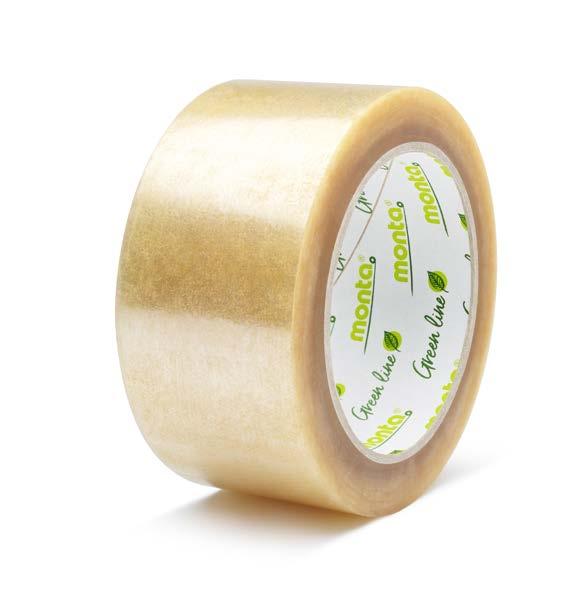
Certified by TÜV Austria with their OK COMPOST INDUSTRIAL conformity mark. Directly printable for individual & sustainable branding Users benefit from the new possibility to integrate their corporate design into an individually designed adhesive tape as advertising medium, plus the certified sustainability of the tape: The transparent monta biopack® 860 DP is also OK COMPOST INDUSTRIAL certified by TÜV Austria!
Demo at Fachpack in nuremberg, Germany monta will present their complete monta Greenline range at Fachpack and will demonstrate how this sustainable packaging tape, imprinted with logo or advertising slogan, safely transports goods including marketing message to their destination.
Based on proven and sustainable technology
Digital coffee is more sustainable!

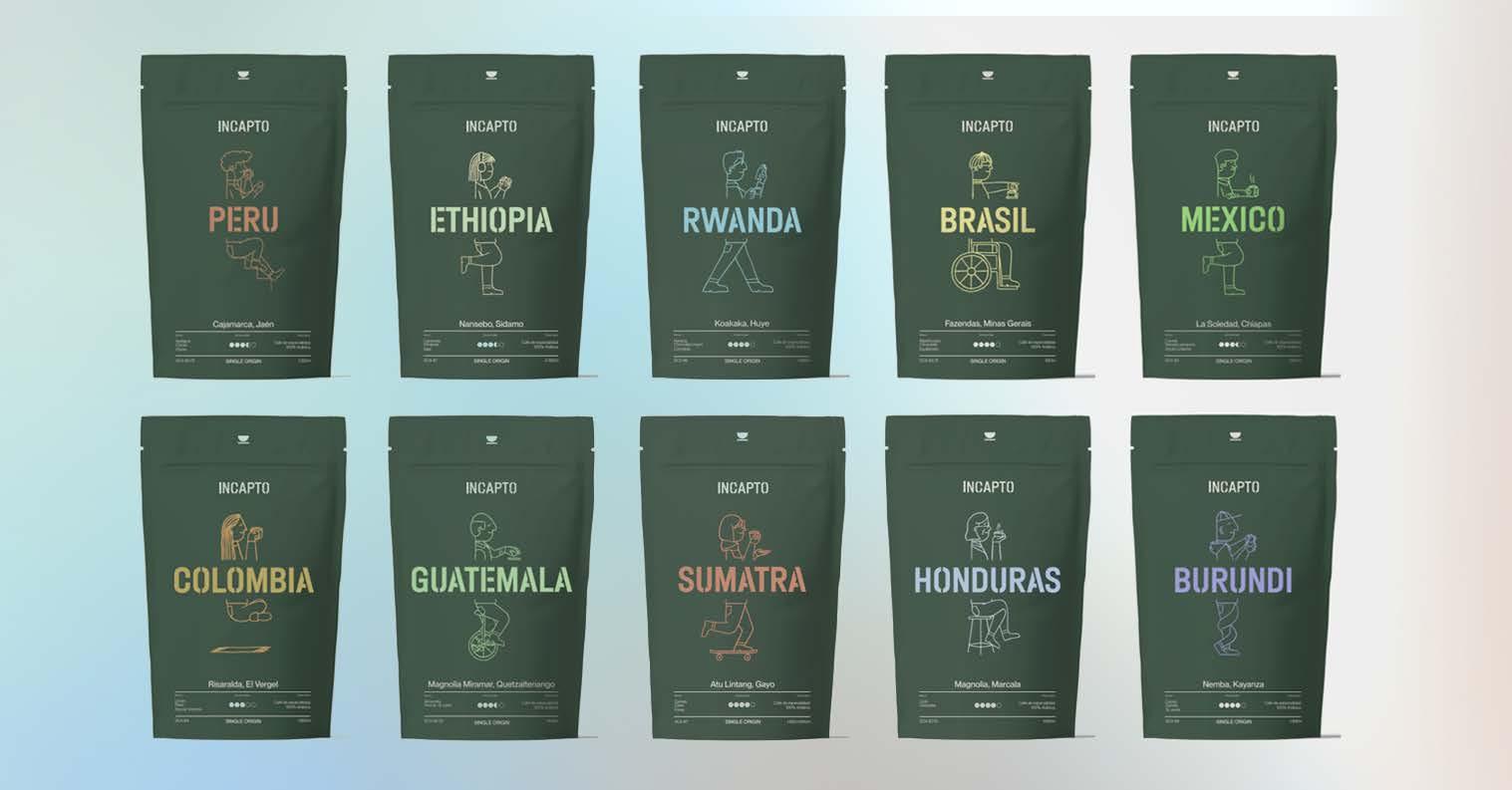
Incapto’s non-capsulated coffee offers new options towards sustainable consumption with HP’s latest Indigo digital print technology. Today HP continues to innovate and promote technological solutions based on one of its main pillars, sustainability, thereby helping customers and partners to develop innovative services and products that respect the environment. In 2020, Incapto was born with the purpose of revolutionising the coffee industry with the aim of moving towards a better and more sustainable market, being an alternative to coffee in capsules with the aim of changing the consumption habits of today’s consumers.
54 SUSTAINABLE PACKAGING NEWS PrINT SOLUTIONS
HP Indigo digital printing has become Incapto’s strategic partner to produce its flexible packaging and corrugated shipping cases to accelerate their sustainability innovation journey while strengthening their brand equity. Under the slogan “good for you, good for the planet”, Incapto created an accessible coffee, reducing environmental impact, without generating unnecessary waste such as aluminum capsules, resulting in a cheaper price per coffee. HP is committed to supporting companies that share its fundamental pillar of sustainability, such as Incapto.
SUSTAINABLE PACKAGING NEWS 55 PrINT SOLUTIONS
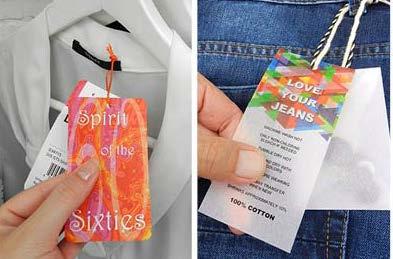
With its ENDURO and PICOFILM ranges, Sihl offers new solutions for the decentralised, on-demand printing of loop tags, hangtags and stick-on labels in short runs. Their tearproof properties allow these grades to be used very safely – even when subjected to heavy loads.
ARTYSIO Packaging
Captive audience
With HP’s digital printing capabilities, Incapto is able to explore new forms of personalisation and the co-creation of its packaging as a form of communication to reinforce engagement with consumers. By making its captive audience feel included, it thereby drives social impact and amplifies its purpose. From the outset, it was very important to help Incapto adopt HP Indigo digital printing technology. The first step of the joint collaboration was the HP Garage Innovation Workshop. Next, with HP’s customisation options, HP helped to create a packaging that provided diversity for the brand. Then, HP connected Incapto to its network of PSPs to carry out the first production runs and an agreement has since been signed for the company’s flexible packaging to be printed on an HP Indigo 20000 in Spain over the next few months. HP Indigo digital printing technology has unmatched colour and ink capabilities, media and application versatility, high coverage printing and the greatest versatility for the highest print quality, making HP the perfect partner to help Incapto achieve its goals.
Sihl
Print solutions on demand
Innovative and functional packaging solutions for aqueous inkjet printing. offers new solutions!

This enables you to produce as quickly as possible, flexible, individualised packaging according to your requirements – high quality, functional packaging for your products. Go from PRINT to PACK in minutes with the Afinia FP-230 printer with integrated inline lamination & cutting.
tearproof
More sustainability and flexibility for printers and packaging manufacturers –that is the promise of HYDRO-X Green Line Premium, the new water-based ink mixing system from hubergroup Print Solutions.
Greater sustainability and flexibility
56 SUSTAINABLE PACKAGING NEWS PrINT SOLUTIONS
Customers can use the modular system to select precisely those components from the portfolio that their products require. All components are Cradle to Cradle Certified® at Bronze level so that packaging can be designed to be both sustainable and colourful.
Key industry players are coming together!
Sustainability showcase for large format printing
Sparck Technologies showcasing new packaging systems.
Key industry players are coming together at swissQprint’s UK headquarters to demonstrate a more affordable, sustainable approach to workflow and print & cut technology in the drive towards net zero. swissQprint has engaged with Zund, Antalis and Compass Business Finance to show production leaders and decision makers in digital printing what can be achieved.
Fit-to-Size packaging
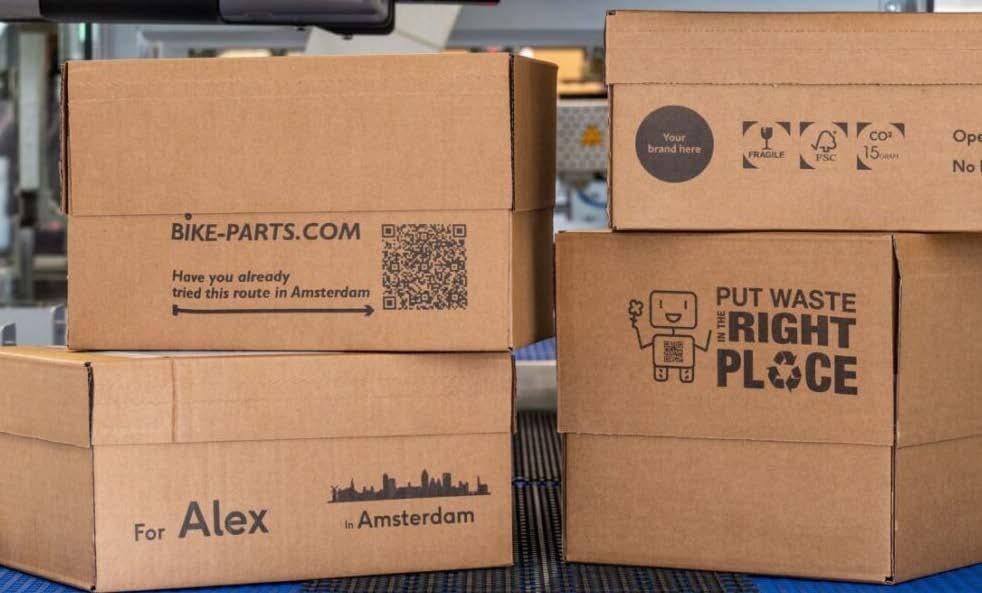
Sparck Technologies reveals new print on demand for ‘fit-to-size’ ecommerce packaging at IMHX 2022. Sparck Technologies, the leading manufacturer and provider of automated packaging solutions, will be showcasing its newly introduced flexible print-on-box capability for its advanced ‘fit-to-size’ packaging systems at IMHX 2022, 6th – 8th September, NEC Birmingham, UK (stand 5F112)
This unique combination of printed memory with an encrypted printed code, creates one of the most secure anti-counterfeit solutions on the market. It is ideal for use in applications as wide ranging as tracking and ensuring the safety of pharmaceutical products, to securing tax or duty stamps for government agencies.

SPN. “When it comes to countering counterfeiting, Xerox printed memory encrypted products can make all the difference. Every label is uniquely encrypted rendering it virtually impossible to counterfeit, whilst also offering an inexpensive option when compared to holograms or RFID tags”.
“Our printed memory products provide a cost efficient, highly secure method of authenticating and verifying information about a product as it moves through various distribution channels or as it is used.” Traditional anti-counterfeiting methods such as invisible ink, holograms and RFID tags can be copied, and are often expensive to implement. In contrast, Xerox Printed Memory with Cryptographic Security offers brand owners a solution that is inexpensive and difficult to counterfeit because every label is uniquely encrypted. www.brueckner.com Hall 03, C90 19. – 26. Oct, Düsseldorf, Germany

PrINT SOLUTIONS
Memories - are made of this
The cryptographic security feature was developed by PARC, a Xerox company and is a value-added feature in printed memory labels. “This makes it possible to ensure the integrity of a product from the time it leaves the factory to the time it gets into the hands of a customer” said Steve Simpson, Xerox vice president responsible for Xerox Printed Memory.
Special Counterfeiting feature


58 SUSTAINABLE PACKAGING NEWS COMPOSTABLE AND BIODEGrADABLE
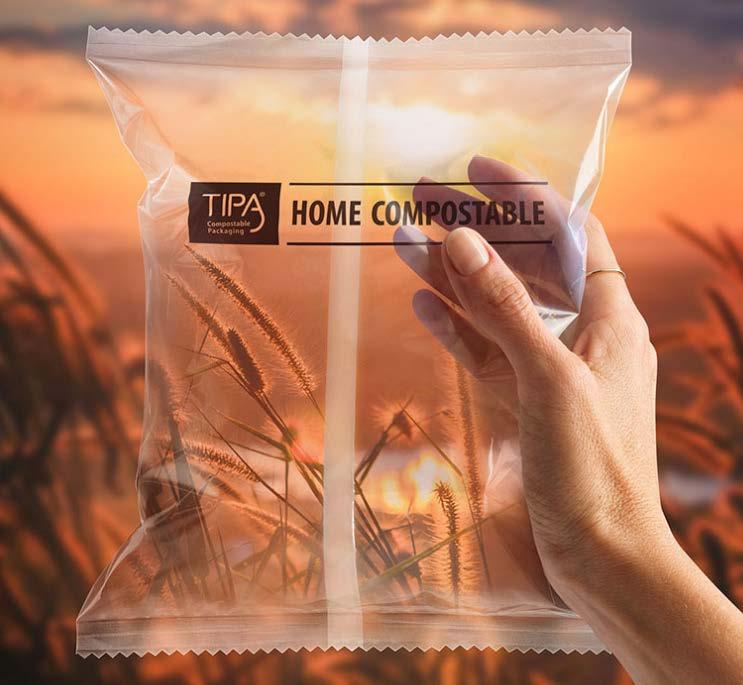
“ There is an undeniable move towards compostable packaging as consumer pressure grows on consumer goods manufacturers throughout the world. From Australia to Italy and the America’s, people are making their voices heard. Here is the latest overview from SPN. ” new Landmark Consumer Poll Australian public call for more compostable packaging and not plastic. In a new Landmark poll, it was revealed that 85 percent of the Australian public believe more food should be wrapped in compostable packaging as an alternative to plastic. In addition, 44 percent said that they would pay more for the change. This latest Poll finds that 85 percent of Australian public believe more food should be wrapped in compostable packaging as the dangers of the threats to our planet become better understood “ It is very reassuring to see the sheer volume of transition there is today towards Compostable and Biodegradable packaging”
-Compostable’sPublicPressureGrows
SUSTAINABLE PACKAGING NEWS 59 COMPOSTABLE AND BIODEGrADABLE
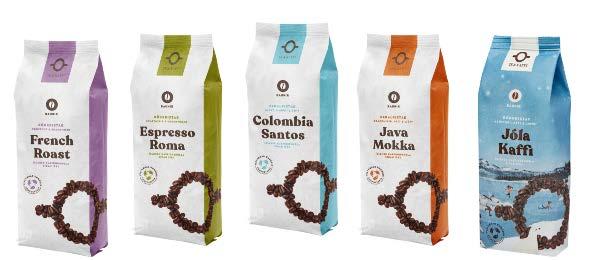
The growing demand from Europe for Roberts Mart’s compostable packaging goes on unabated. Roberts Mart & Co Ltd has added a major beverage company in Iceland to a developing portfolio of European customers for its compostable packaging. As the drive towards more sustainable solutions for the food and drink sector gathers pace, the specialist printed flexible packaging company is responding with its own greener alternatives.
Amsterdam goes Compostable
Cool Compostables Herz Lolli Compostable Packaging and the German confectionery brand, Cool, has chosen NatureFlex™ compostable cellulose films from Futamura to package its confectionery product Ӧcoologisch Herz Lolli with NatureFlex.
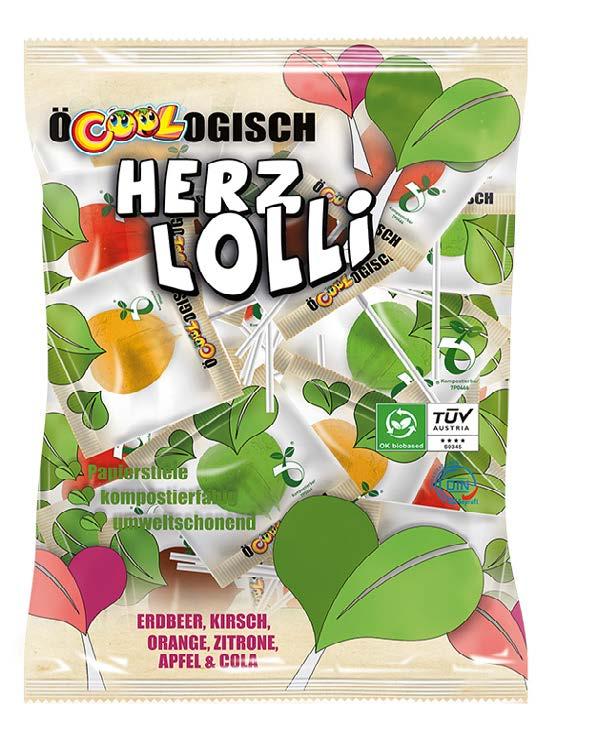
Italian consumers demand change
SPN Says, “The writing is on the wall – if companies want to gain the competitive edge, they must look towards compostable packaging, especially for FMCG packaged products. It is very reassuring to see the sheer volume of transition there is today towards Compostable and Biodegradable packaging”.
The Italian public urges clothing brands to switch out plastic, to embrace compostable packaging. A recent new poll has today revealed overwhelming support for clothing deliveries to be packaged in compostable bags over conventional plastic bags. The new Italian poll finds more than 9-in-10 Italian adults would rather have their clothing deliveries sent in compostable bags Some 86 percent are concerned about increasing the harmful plastic waste generated by packaging companies.
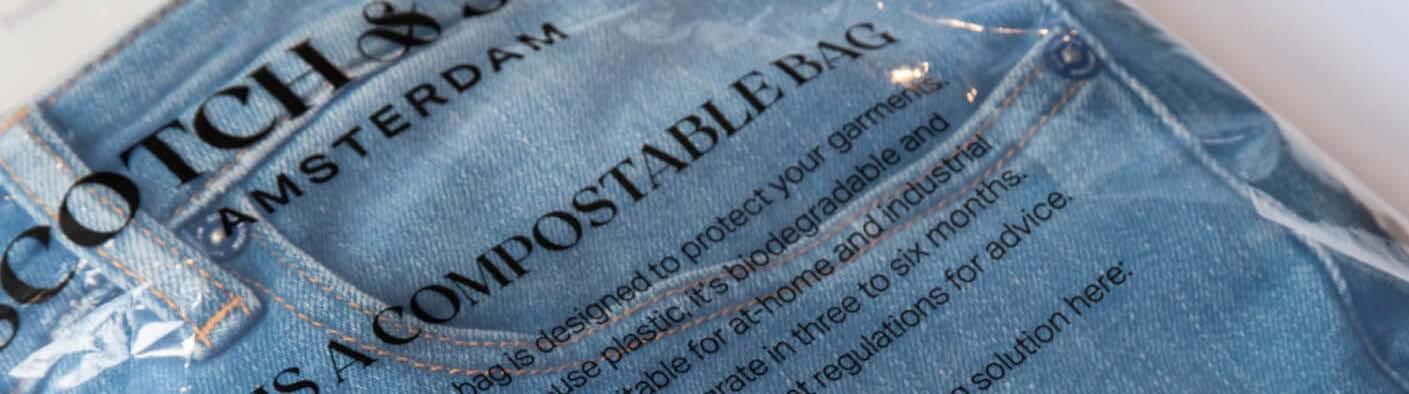
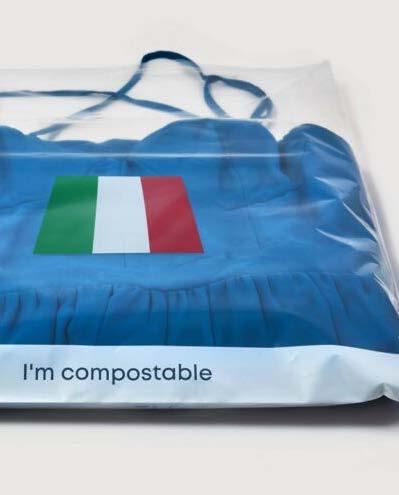
The brand commits to replace one million polybags by mid-2022. In honour of World Soil Day, Amsterdambased fashion brand Scotch & Soda today announced its partnership with TIPA®, a company that creates compostable and biodegradable packaging solutions. The integration of bioplastic TIPA® bags is part of Scotch & Soda’s commitment to a more sustainable future.
Following the release of a new report by Ricardo Energy & Environment advising the UK Government on packaging materials, Parkside Flexibles is welcoming the findings that promote compostable packaging and its potential to increase food waste recycling rates. The study revealed that 72% of the packaging experts questioned across the UK, France, Germany, Italy and Spain, believe that compostable packaging will help.
Parkside Welcomes Compostable Packaging Report
Growing demand from Europe
The iconic Amsterdam fashion brand, “Scotch & Soda Partners “has partnered with Tipa to integrate composable packaging into its supply chain.
In preparation for its European market launch, a 100%-ecological and compostable rigid takeaway food packaging made in EU is now available thanks to BFG Packaging. The new range of products are made entirely of FSC wood fibre, purchased from the EU market. The new products are made in Romania by a top European player in the field of highquality rigid takeaway food packaging, following an investment of over EUR 20 million.
Entirely new range
”We announce an important milestone for the European industry of rigid takeaway food packaging. European companies now have the option of contracting 100% ecological and compostable rigid takeaway food packaging made in EU. The new range of products are a successful alternative to plastic food containers, including the ones made of expanded polystyrene, which will be excluded from the EU markets by the transposition of Directive (EU) 2019/904 on reducing the environmental impact of certain plastic products. This is our solution and our way of supporting the environmental agenda of the European Commission and European Parliament while also contributing to the sustainable development of the European industry of rigid takeaway food packaging,” said Karel Hoet, President, BFG Packaging.
60 SUSTAINABLE PACKAGING NEWS COMPOSTABLE AND BIODEGrADABLE now, EU’s own 100%
The new range of products is the only ”Made in EU” alternative for ecological and compostable rigid takeaway food packaging to imports from China. In the context of the major challenges that affect the logistical chain from China to the European market – e.g. from Covid-19 related deadlocks and delays, to shortages of shipment containers and overall increasing transportation cost – the announcement made by BFG Packaging brings a major opportunity in successfully addressing all these coordinates.
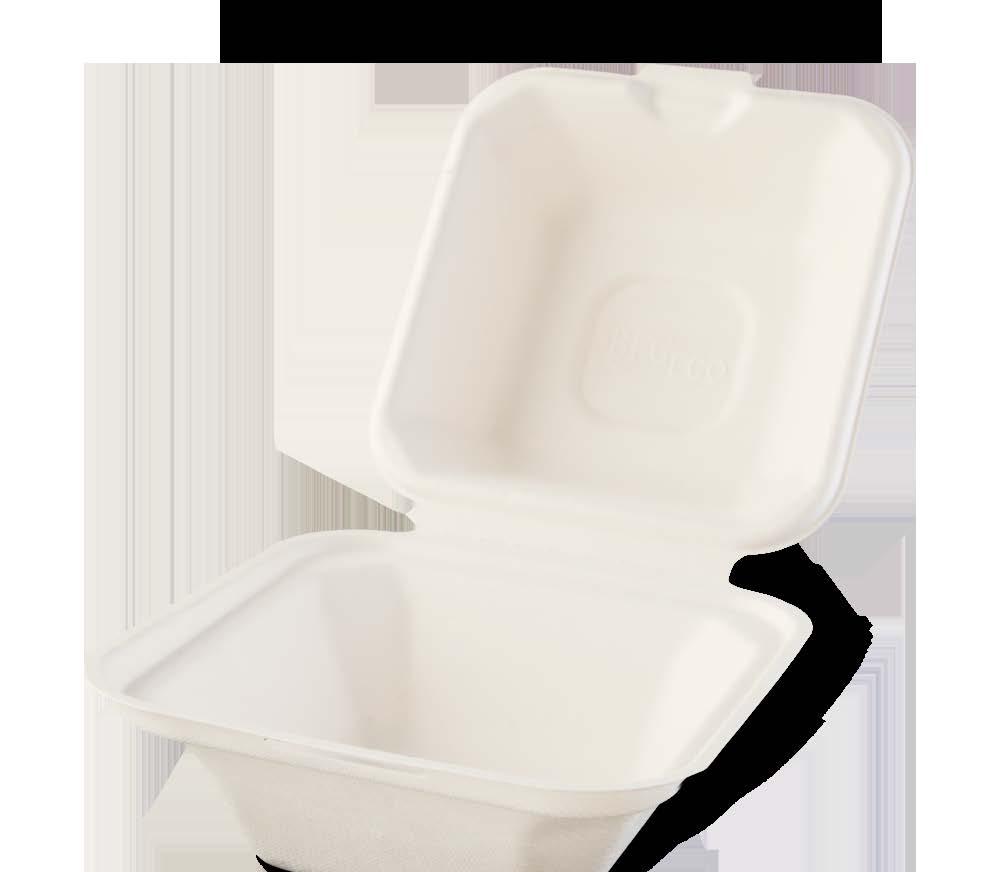
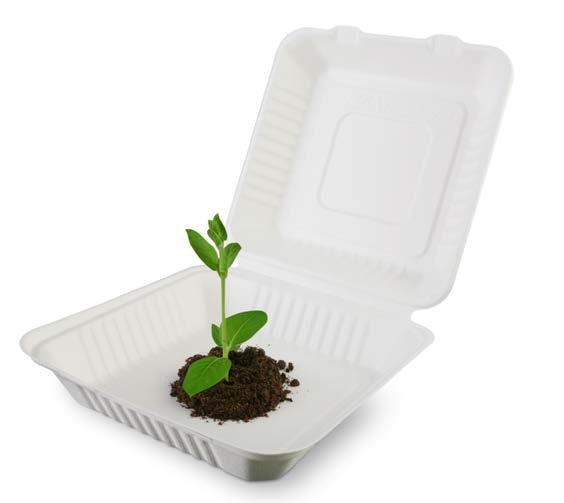
Faster, more sustainable Sourcing the new 100% ecological rigid takeaway food packaging from Romania will allow European companies to eliminate logistical bottlenecks, thus ensuring a faster delivery to clients across Europe, whilst also reducing the overall carbon footprint of transport activities.
BFG
“ an important milestone for the European industry of rigid takeaway food packaging ”
Eco-Rigid wood-fibre packaging

FIP in Lyon
NETSTAL demonstrates biodegradable packaging on all-electric high-performance machine. At FIP in Lyon NETSTAL presented an innovative thin-wall packaging application. On the fully electric ELION 1200-510, drinking cups will be produced in two cavities.
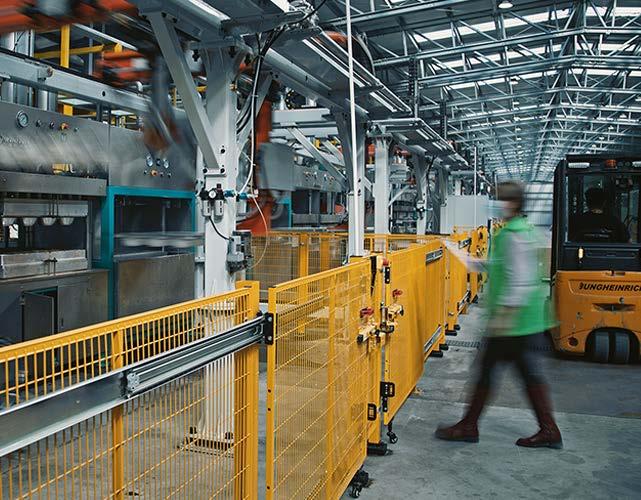
Biodegradable packaging for strawberries

SUSTAINABLE PACKAGING NEWS 61 COMPOSTABLE AND BIODEGrADABLE
This new material can help to reduce food waste and plastic waste. Scientists from Nanyang Technological University (NTU) and Harvard T.H. Chan School of Public Health, U.S., have jointly developed a biodegradable food packaging that can keep fruits fresh longer than the usual synthetic plastic packaging. NTU & Harvard scientists develop biodegradable food packaging that can keep strawberries fresh for a longer period.
BFG Packaging has completed the first phase of its investment in a new production unit, dedicated to the range of 100% ecological and compostable rigid takeaway food packaging. BFG Packaging is now working on the second phase of development of the new production unit. In this second phase, which is expected to be completed in early 2023, production capacity will triple.
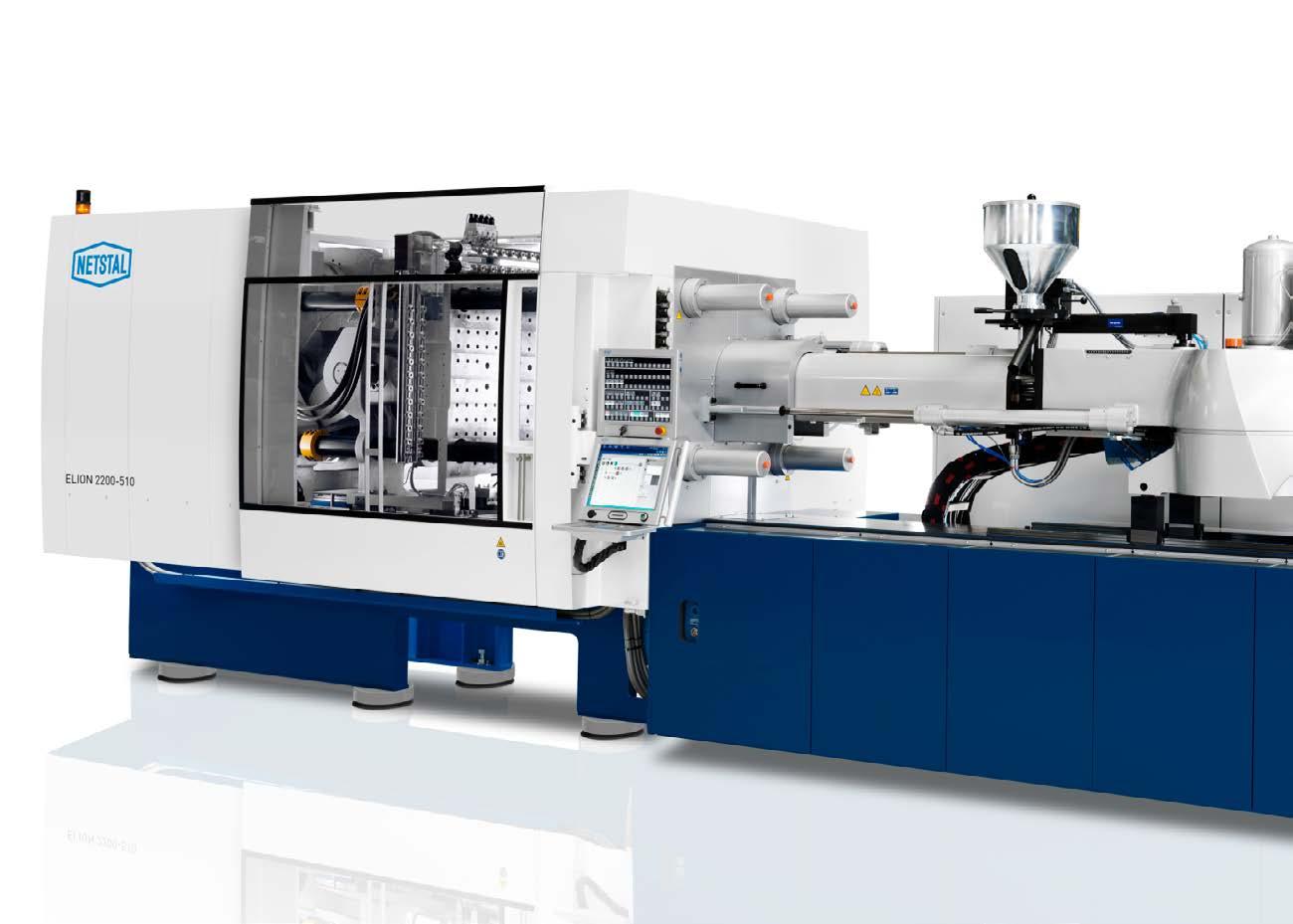
“ BFG Packaging’s new products will make a difference for the better in the services provided to millions of European consumers ”
NETSTAL uses KANEKA Biodegradable Polymer Green Planet™, 100% plant-derived biopolymer for this sustainable application.
Once the process of transposing Directive (EU) 2019/904 in the national legal framework will be finalised by all EU member states, BFG Packaging’s new products will make a difference for the better in the services provided to millions of European consumers, as well as for the environment and ultimately for the communities.
Increased Production of Biodegradable and Compostable Packaging!
Seal Packaging launches UKCA marked plastic-free paper cups to eliminate plastic at festivals. Seal Packaging has launched the UK’s first ever UKCA mark registered certified plastic-free paper cups. Supporting the calls for a ‘Plastic-free pint’ In July, a cross-party group of more than 20 MPs called on the government to outlaw single-use plastic pint cups in a bid to combat plastic pollution.
“By replacing the traditional plastic film with this new biobased barrier coating, we can increase the eco-friendliness of food packaging products. The solution can also enable wider use of fibre-based material in food packaging”, Tuomas Aspiala, Group Commercial Manager, Teknos explains.
Promateris thus strengthens its position as a regional leader by developing new distribution channels.
62 SUSTAINABLE PACKAGING NEWS COMPOSTABLE AND BIODEGrADABLE

Seal Packaging launches UKCA marked plastic-free paper cups to eliminate plastic at festivals.
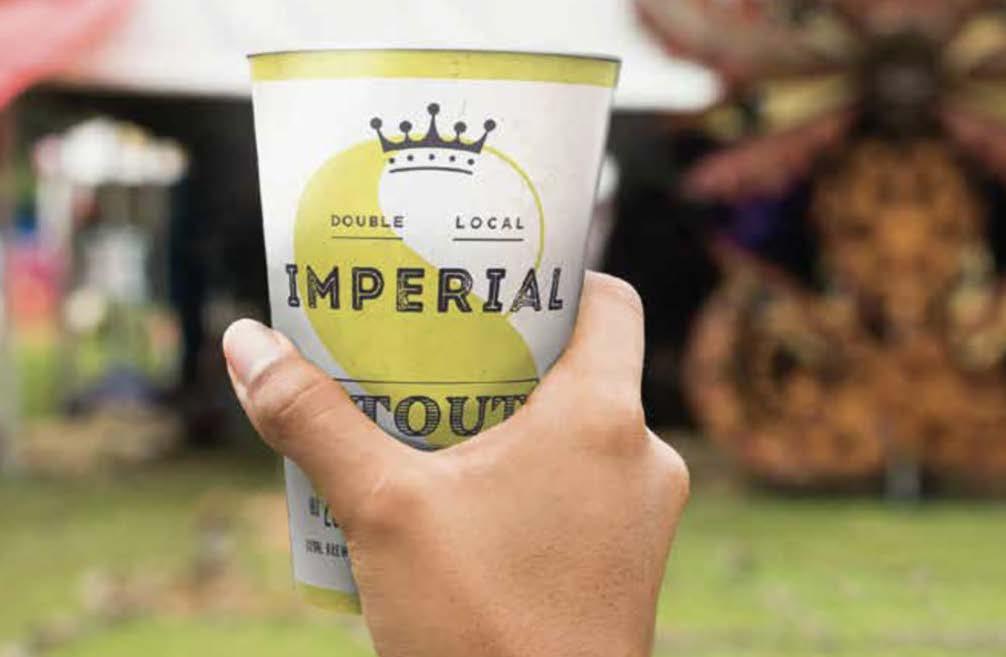
Increased Production new Bio solutions
Teknos and Brightplus have developed bio-based and biodegradable solutions for food packaging.
The coating manufacturer Teknos is developing a new, bio-based barrier coating for food packaging together with biosourced materials company Brightplus. The objective of the cooperation is to develop bio-based and biodegradable solutions for more environmentally friendly food packaging.
The Promateris Group closes 2020 with EUR 23.7 million in consolidated sales, an increase of 39% compared to the previous year. The growth is largely generated by the increase in production of biodegradable and compostable packaging.
Music to the ears…
Collaborating to drive the circular economy forward
Why collaboration matters
Most of the people concerned are sadly powerless, unable to do anything significant to change their situation for the better — they are victims of a global economic crash.
Strictly speaking, the solution is two-fold — first cut consumption; then go circular. Over-consumption is not just an economic and an environmental issue, but a social one, too.
SUSTAINABLE PACKAGING NEWS 63 AVErY DENNISON
In a parallel scenario that is worryingly similar, we are all also victims of a planetary environmental crash, that is both ongoing and worsening, as we recklessly overspend the Earth’s natural capital every year, depleting and exhausting resources. However, the big difference here is that we can do something about it - if we collaborate… Earth Overshoot Day (EOD) marks the date in the calendar year when humanity has used all the biological resources that the planet is able to regenerate during an entire twelvemonth cycle. In other words, from that point on, society is running in the red every additional day, week and month of the year, effectively overdrawn at the natural bank. In 2022, EOD will fall on July 28 — meaning we have consumed everything within less than seven months; and the cupboard is bare for the remaining five months of the year.
The disparity between world regions, nations and communities in terms of the ‘have’s’ and ‘have-nots’ is so inequitable, it amounts to discrimination.
To make bad news worse, EOD is creeping forward year-onyear. Back in 1971, when the calculation was first made using UN statistics, the date was actually Christmas Day, December 25. So, the rate of overshoot is accelerating rapidly in the wrong direction. The problem is serious; the solution is the Circular Economy.
Circular innovation is part of the solution
Avery Dennison
“ The problem is serious; the solution is the Circular Economy ”
Each year, for example, roughly one third of all food produced ends up going to waste. This waste amounts to a staggering 1.3bn tons of food, worth around $1tn. The cost to people, profit and the planet is huge. Not surprisingly, therefore, the first two (of 17) UN Sustainable Development Goals (SDGs) call for No Poverty and Zero Hunger.
SDG 12 targets Responsible Consumption and Production. Addressing consumption is a challenge for behavior change, with complex political and cultural implications. Tackling production is primarily a matter for circular innovation.
As the global economy slips into recession, as inflation spikes and interest rates rise, families and individuals around the world face the scary prospect of going into debt, as they start living beyond their means. Some households are already in financial distress.
Policy and regulation are not the only drivers for brand owners, however, adds Schou: “Recent supply-chain disruption illustrated to all partners in the value chain that we have to recycle, reuse and reduce as much as possible.
“ the packaging industry needs to move forward at speed and scale ”

Niels Christian Schou, Director Marketing Programs at Avery COO,RobertoDennisonReyes,ECORGlobal
“We knew there had to be routes to utilize the good quality liner material, converting waste into resources. We are not recycling experts, though, nor do we have the relevant capabilities, so, as founding members of Circular Economy for Labels (CELAB) consortium, we have connected with specialist partners like ECOR to find solutions.”
The vision behind the collaboration is clear, says Roberto Reyes, COO, ECOR Global: “There are two drivers creating this market breakthrough. First, is Avery Dennison’s deep commitment to extend the useful life of their labels as valuable fibers that often are landfilled, or incinerated.
In addition, consumers and mainstream media are also now calling for solutions on the packaging waste topic.”
Liner recycling and industry-wide collaboration Launched to limit waste, AD Circular is the Avery Dennison program for recycling used paper and filmic label liners in countries across Europe. Its success will be built upon collaborations with innovation partners, explains Schou:

In response, the packaging industry needs to move forward at speed and scale — and the only way this can realistically happen is through collaboration. Therefore, Avery Dennison felt motivated and obligated to find innovative solutions that work — being easy, affordable and supplier neutral, so they can be rolled-out industry-wide.
64 SUSTAINABLE PACKAGING NEWS AVErY DENNISON A specific example of a production problem that circular innovation can fix is liner waste. Production of 100,000 labels for the packaging industry can generate 100.12kg of liner waste. Market intelligence specialist AWA estimates the total pressure-sensitive release liner by-product in the European market to be a whooping 688,000 tons or 10,228 Million Sqm in With2021.paper shortages a growing concern, there is added pressure on the packaging industry to innovate around recycling, optimize resource-use and minimise waste. As a result, the state-of-play is evolving rapidly, with a circular mindset now emerging, says Niels Christian Schou, Director Marketing Programs at Avery Dennison: “We are witnessing a significant increase in awareness across the entire ecosystem, with circularity moving from a nice-tohave to a must-have. The European Green Deal and Fit for 55 package are going to be game changers for the industry, leading to many brand owners realizing that it is now becoming mandatory to act, and act responsible.”
As well as being employed for new label materials and liners, the fibers can then be used in new applications, such as envelopes, boxes and decorative papers, plus plywood.

Working together on the AD Circular program, ECOR found a way to extract value out of the used label release liners by converting these byproducts into FiberAlloyTM composite panels. These are made via a proprietary natural process that diverts valuable bio-based fibers away from traditional waste processing systems. The result is the world’s first non-toxic, fully recyclable panel.
Sustainability leadership on show
AVErY DENNISON SUSTAINABLE PACKAGING NEWS 65
When it comes to the recycling technology underpinning the innovation, this starts with the waste liner material glassine, which is a paper product originally made from wood pulp.
The glassine is first re-pulped and cleaned from impurities — mainly silicon and pigments — and transformed into recycled fibers.
In terms of the process, AD Circular makes things easy, with liner recycling at the touch of a button, literally.
Such a closed-loop, circular supply-chain solution is an industry first, says Reyes: “This collaboration represents the first time label release liners were activated into a new material suitable for a wide array of applications, including packaging, flooring and furniture. Our work together might have started small — with product testing and development for the trade-show booth project — but big things begin with baby Ultimately,steps.”the circularity challenge calls on key players in the packaging economy to lead by example — and to do so by collaborating, creatively — concludes Schou: “If we do not put aside commercial priorities and set up cross-sector collaboration, our industry will fail in creating quality recycled material streams to satisfy the high and growing demand. This is not a one-company responsibility; it is an industry imperative.”
The website can not only be used to schedule pick-up of used liners, but also to provide key data via regularly updated analytics and certificates on the volume of material recycled and total CO2 emissions saved. This level of transparency around sustainability metrics is clearly valuable not only to converters, but also to the likes of brand-owners, plus retail clients and customers upstream who are reporting on environmental impacts tracked by CSR and ESG.
With non-toxic coatings to facilitate surface treatments including high-quality print, the applications for these panels made from upcycled liner waste are extensive. They were even seen on show as part of a display stand at the Label Expo, in Brussels.
Hot Topics of K 2022 Circular Economy Digitisation Climate Protection


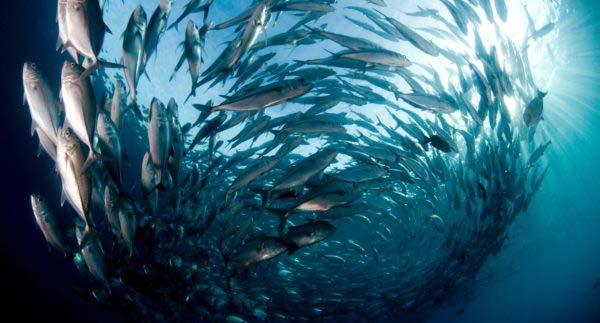
Special show Plastics shape the future

The focus of the special show at K 2022 is how the future can be shaped with plastics. The circular economy, digitalisation and climate protection are just some of the topics. Through new technologies and materials, the industry is facing up to the global challenges of our time and developing solutions in dialogue with all stakeholders. The event was organised by the German plastics industry under the auspices of PlasticsEurope Deutschland e.V. and Messe Düsseldorf GmbH.
66 SUSTAINABLE PACKAGING NEWS K 2022 Let’s go K-2022! The paradigm shift for our planet calls for new food for thought – also in the plastics and rubber industry. • Leading the way in sustainability, the circular economy and open to political discourse – K 2022 meets these challenges. • K offers the perfect place for meetings to present innovations.