

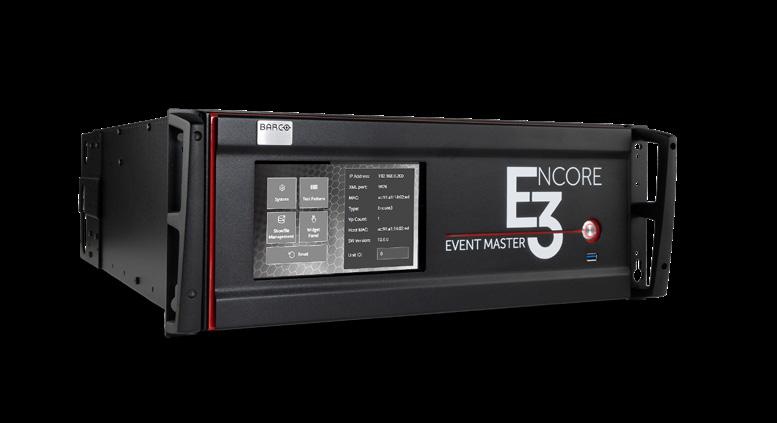
With Barco’s newest Encore3, screen management just became increasingly versatile. Yes, we heard the ‘we want more’ call of all you live event AV professionals. Here’s our answer: broader canvas space, more system resources, reduced set-up time and better flexibility. All boxed into one future-proof solution, for expanded peace of mind.
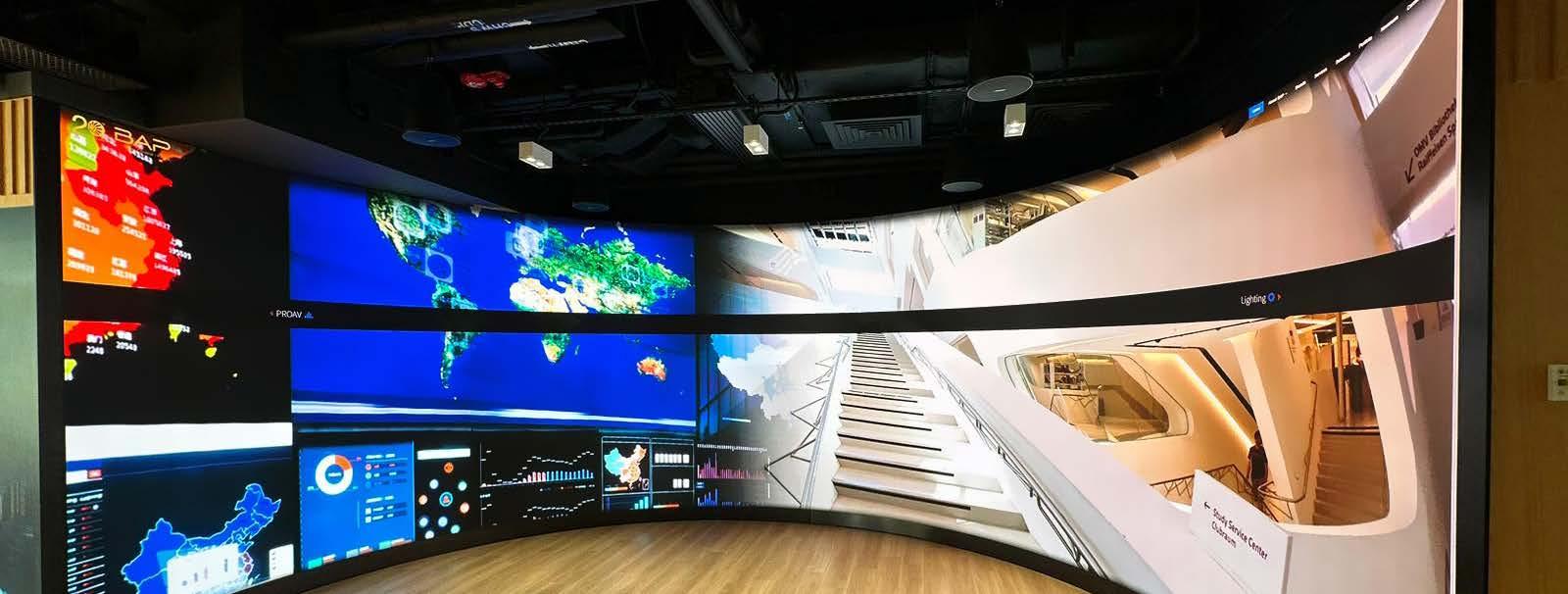
54 FEATURE | AV in Education: Designing for Two Equal Audiences
59 INDIA: SBI Philosophy in Design and Integration 65 CHINA: NEXO Sound Meets Strict Performance Criteria in Zhengzhou Innovation must serve pedagogy—not novelty. Spatial audio, interactive displays, projection systems and even AR/VR should only be deployed where they directly enhance the learning objective.

Chris Pitsillides Chief Technology Officer of ESCO

Thomas Richard Prakasam Publisher/Editorial Director thomas@spinworkz.com

As education across Asia Pacific evolves, AV has shifted from backend support to a strategic driver of modern pedagogy. In our Feature column, Finson Lam of BAP Technology Consultants and Chris Pitsillides of ESCO explore how integrators are transforming campus-wide AV ecosystems to meet rising expectations. Also contributing, is Nigil Antony of Global Schools Group, who adds that today’s learning spaces are not reactive, but deliberately designed for continuity, collaboration and future readiness.
In our Voicebox column, Sachin Jain, Director, PLAY TECHNOLOGIES, touches on a timely and relevant subject. He questions if AI has changed the underlying architecture of AV systems or is it simply a new label on mature technologies? He highlights that the question is not whether AI is useful; the question is: Is it actually AI?
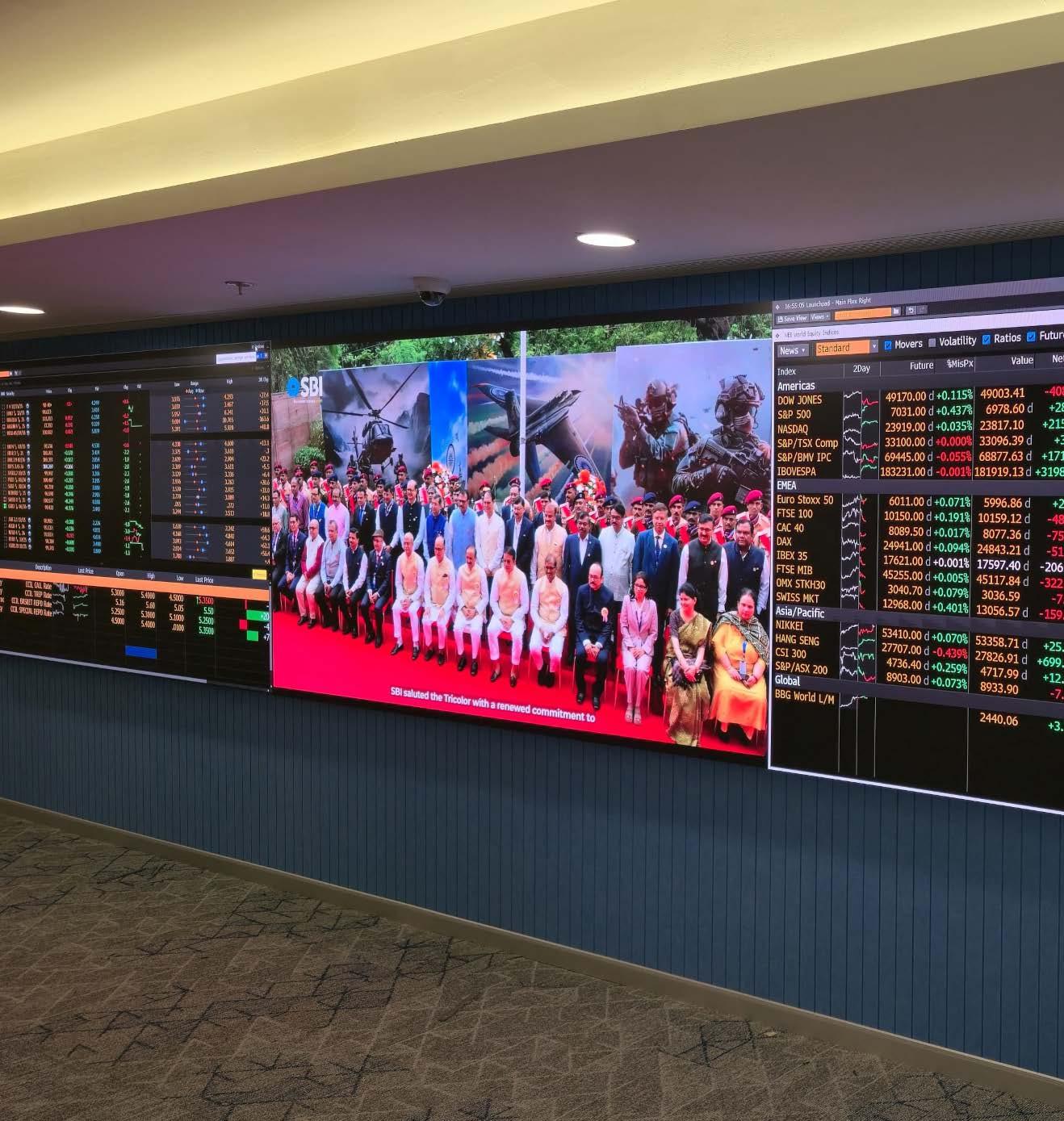
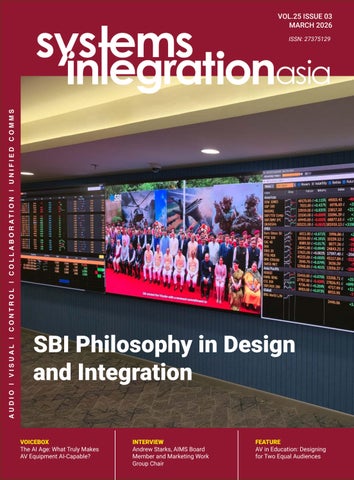
Our Installation column highlights how the State Bank of India recently revamped its legacy AV systems with modern digital AV set-up that is both sophisticated to stand the technological challenges of time, and holistic to meet the variety of requirements.

EDITOR, INDIA AND ME
Ram Bhavanashi ram@spinworkz.com


DIRECTOR
INDUSTRY ENGAGEMENT
Andy Tan andytan@spinworkz.com
MEDIA REP
CHINA,HONG KONG, TAIWAN
Judy Wang
Worldwide Focus Media
+86-13810325171
judywang2000@vip.126.com

ADMIN & CIRCULATION
Julie Tan admin@spinworkz.com

DESIGN & LAYOUT
Hazel Gundaya
Tel: (65) 63162716
Disclaimer: Systems Integration Asia is published 12 times a year. All rights reserved. No part of this magazine is to be reproduced, whether mechanicalor electronic without the prior written consent of the publisher. Views expressed in this magazine do not necessarily reflect those of the editor or the publisher. Unsolicited contributions are welcome but the editor reserves the discretion to use them. Whilst every care is taken to ensure the accuracyand honesty in both editorial and advertising content at press time, the publisher will not be liable for any inaccuracies.
Please be informed that products and company names mentioned in this publication may be protected with tradenames, trademarks or registered trademarks of their respective owners. Our non inclusion of such symbols is not an indication of us not recognising the copyright but rather to have a common look across our articles. Misuse of tradenames, trademarks or registered trademarks is strictly prohibited. It is the obligation of our readers to check if company names and products are protected with tradenames, trademarks or registered trademarks.
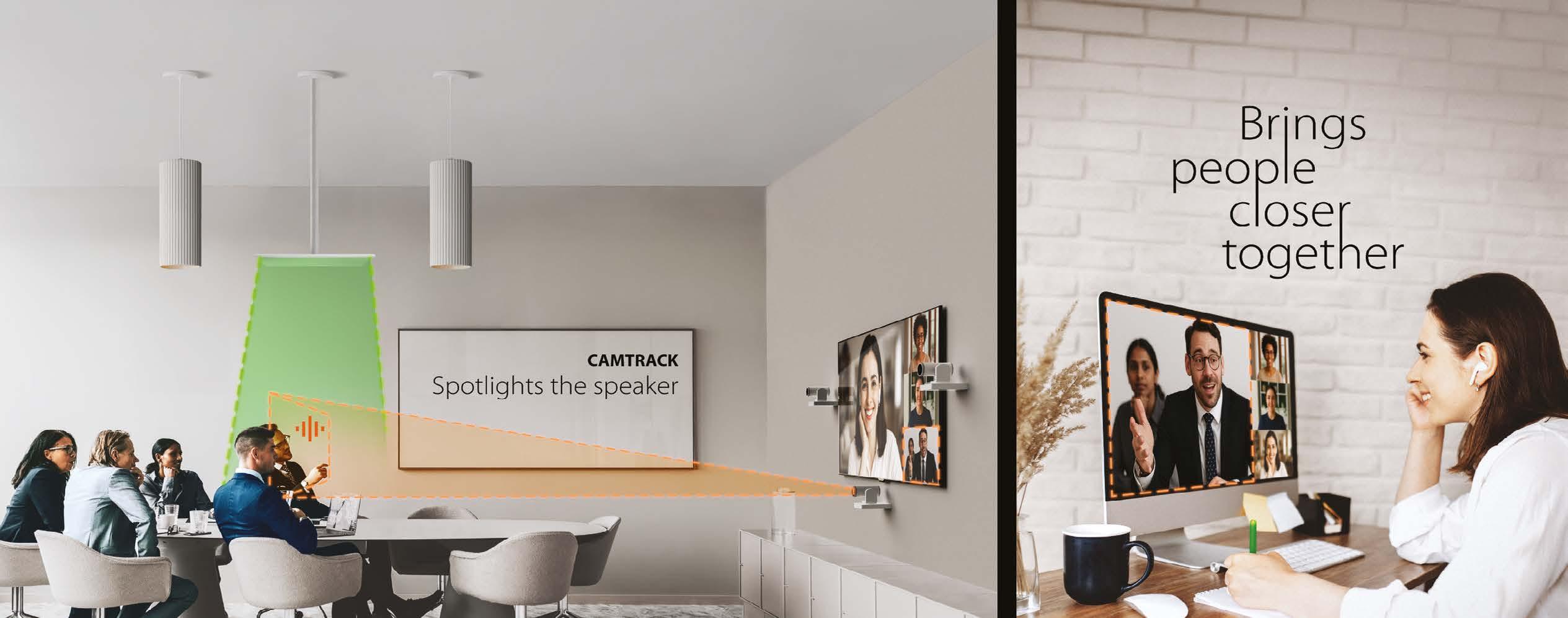

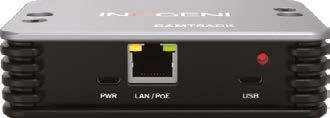
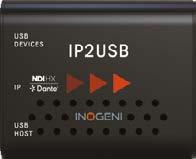
INOGENI’s CAMTRACK is the most exible, and cost-e ective voice-activated multi-camera switcher designed for modern conferencing environments.
CAMTRACK integrates with SHURE microphones to detect the active speaker’s voice, triggering PTZ camera presets and AI tracking (when supported). It then communicates with an INOGENI switcher to route the appropriate video feed seamlessly into the conferencing system. The system provides automated camera control and video switching for conference rooms, hybrid meetings, and live events.


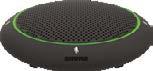
Complete SHURE integration – Works seamlessly with advanced multi-zone microphones (MXA901 and MXA920), multi-channels (MXA310, MXA710 and MXA910) as well as wireless MXW neXt and MXCW conference systems.
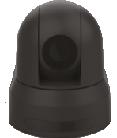
Broad PTZ camera support – CAMTRACK works with an extensive list of PTZ camera manufacturers, including Canon Aver, Sony, Panasonic and virtually any PTZ IP camera.




Intelligence setting in, needs an intelligent understanding
by Sachin Jain, Director, PLAY TECHNOLOGIES

The world has been through many ‘ages’ – historical and technological. In the modern era too, it’s been through age of Industrial, Information, and Digital. Now, it’s the turn of AI. While the world tended to call it Artificial Intelligence, it’s, in essence, the Age of Intelligence. With the impact apparently setting to change the world order, it may be time for the AV industry to map this ‘age of intelligence’ in a proper perspective- lest landing in chaos that’s looming on other segments.
Has AI changed the underlying architecture of AV systems or is it simply a new label on mature technologies? The question is not whether AI is useful; the question is: Is it actually AI? We must distinguish between genuine machine-learning innovations and the AI washing of 15-year-old technologies.
A feature should only be labelled AI driven if it moves from deterministic logic to probabilistic inference.
• Automation (Deterministic): Follows a fixed If-This-Then-That rule. If a sensor sees motion, turn on the lights. It is reliable but rigid
• AI (Probabilistic): Processes that check datasets to make a best guess based on context. It doesn't just see motion; it understands that the motion is a person walking toward a podium and predicts they are about to start a presentation.
It needs to act superfast to assess the context if the person is really climbing up the podium, to start a presentation – or something else –and initiate necessary system architecture to facilitate the process to precision.
If a system doesn't learn from data or adapt to unknown variables over time, it’s simply wellwritten code, not AI.
Audio is perhaps the most common area of AI washing.
For decades, Pro AV systems have relied on:
• Noise gates
• Expanders
• Automatic Gain Control (AGC)
• Beamforming
• Acoustic Echo Cancellation (AEC)
These are highly engineered, mathematically precise signal-processing techniques. However, they are deterministic. A noise gate does not understand speech; it simply opens or closes based on amplitude thresholds. If the threshold is -40 dB, anything below that is attenuated.
This works well in predictable environments. It fails when loud non-human sounds like a vacuum cleaner or construction drilling, sit within the same frequency band and amplitude range as speech.
Rebranding this as AI noise suppression does not change the architecture.
AI based Innovative Approach - Neural Audio Processing
Deep Neural Networks (DNNs) are trained on massive datasets of speech and noise. Instead of reacting to amplitude, they analyse spectrogram patterns and identify the texture of human speech.
In practical terms:
• It can isolate speech even if background noise is equally loud
• It performs non-linear suppression rather than simple frequency filtering
• It improves performance across diverse acoustic environments
This is a shift from signal-level filtering to content-level classification.
Earlier tracking systems relied on:
• Pixel-differential detection.
• Infrared blob tracking
• Preset-based PTZ recall
• Audio-triggered camera switching
If a cluster of pixels moved – for example, if a curtain moves or a shadow shifts – the camera panned. If someone spoke loudly, the system switched presets.
Marketing language today may call this ‘AI intelligent tracking,’ but technically, it is still rule-based automation.
Modern AI-enabled cameras integrate edge processors that are capable of:
• Skeletal tracking
• Facial landmark detection
• Multi-person framing
• Object classification
These systems do not merely detect movement. They recognise that a human presenter is writing on a whiteboard, distinguish them from a poster on the wall, and ignore irrelevant background activity.
Automation is where the industry faces its greatest AI washing challenge. Most Smart Building features are still just advanced scheduling. Turning on the AC at 8:30 AM because it’s a Monday is not Intelligent Energy Management, it's a timer.
Activating lights based on occupancy sensor or using PID loops for temperature control is automation. It is reliable and effective, but it is deterministic.
Marketing may describe this as AI energy optimisation, but since the logic is static, it remains rule-based control.
True AI-driven automation analyses historical occupancy patterns, meeting room booking data, weather forecasts, real-time energy pricing. For example, it may pre-cool a conference room at 7:30 AM because it predicts a 20-person meeting at 8:00 AM and anticipates the thermal load of the facility. This is not reactionary. It is probabilistic forecasting.
The shift is from that if temperature > 24°C, increase cooling to given past behaviour, visà-vis the day’s weather, and schedule data, facilitating optimal cooling to start at 7:32 AM. That is a fundamental difference in system intelligence.
Practical AI in automation lies in Predictive Telemetry. Imagine a system that monitors the fan speed and power consumption of a laser projector. Instead of waiting for a fan or laser light failure alert (which is just an SNMP alert), the AI analyzes subtle patterns over weeks and predicts a 90% chance of failure within the next 200 hours.
If a feature does not change computational architecture or require model based inference, it is likely automation, not AI. Real AI changes system architecture. It alters hardware requirements, data flows, cybersecurity posture, and service models.
Certain manufacturers, of late, have begun to demonstrate what a transition toward real probabilistic AI looks like in practice. Shure, for instance, through its IntelliMix platform, is making a serious pitch toward moving beyond traditional DSP by embedding trained neural models for AI Denoiser and AI Deverb. Instead of relying purely on static thresholds, these modules analyse spectro-temporal speech characteristics and apply probabilistic masking based on confidence levels. It simply does not mute sound below a certain decibel, instead these systems use DNNs trained on millions of hours of audio to distinguish the texture of human speech from noise. It classifies content
and adapts suppression intensity according to contextual inference. The system is making a high-confidence best guess to reconstruct speech even when it overlaps with random distractions.
Similarly, the Q-SYS ecosystem has been making some serious strides to move beyond simple ‘If-This-Then-That’ logic through its Vision Suite and Seervision integration. Rather than reacting to shifting pixels, their computer vision models perform skeletal tracking to infer a presenter's intent. Features such as Speaker Spotlight do not simply switch presets based on audio peaks; they triangulate microphone data with vision models to infer speaker position and likelihood, adjusting framing based on probabilistic confidence rather than deterministic triggers.
Through the Q-SYS Reflect, they are harnessing the potential of Predictive Telemetry, shifting the maintenance model from waiting for a failure alert to analysing subtle data patterns that predict a hardware fault weeks in advance. These non-cosmetic AI embedded processes in the AV industry are altering compute requirements, signal flow design, and the very philosophy of automation within the AV ecosystem.
The perspective can be said to be still the formative stage, and it may be sometime more for the industry to define itself with the ‘intelligence adopted.

The author is Director at PLAY TECHNOLOGIES, one of the leading AV design consultancy and systems integration firms from Mumbai, with presence across IMEA regions. He can be contacted at Sachin.jain@playtechnologies.in

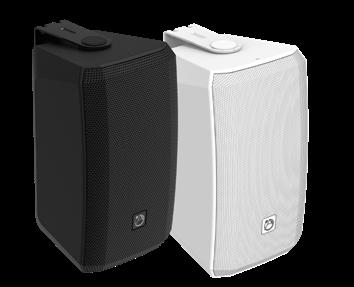
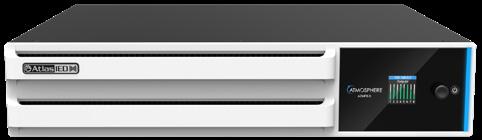
From DSP to Amplifiers to Loudspeakers, AtlasIED offers the entire sound system for hospitality environments.
CHINA: As China’s professional audiovisual market accelerates into a new stage of scale and convergence, Beijing InfoComm China 2026 offers international professionals a timely, onthe-ground view of where demand, deployment and opportunity are taking shape.
As global Pro-AV professionals reassess where meaningful growth and long-term deployment are emerging, China’s professional audiovisual market is entering a pivotal phase of transformation. The focus is shifting away from isolated product innovation toward how AV, IT and emerging digital technologies are being integrated to support real-world applications at scale.
With global Pro-AV revenue forecasted to grow from US$332 billion in 2025 to US$402 billion by 2030, China stands out as the primary growth engine, underpinned by large-scale digital infrastructure investment, enterprise modernisation, and sustained demand across education, commercial and public-sector environments — collectively projected to reach US$97.5 billion by 2028. For international manufacturers, consultants, system integrators and end users, the opportunity is significant, but navigating the market efficiently increasingly requires first-hand exposure and contextual understanding.
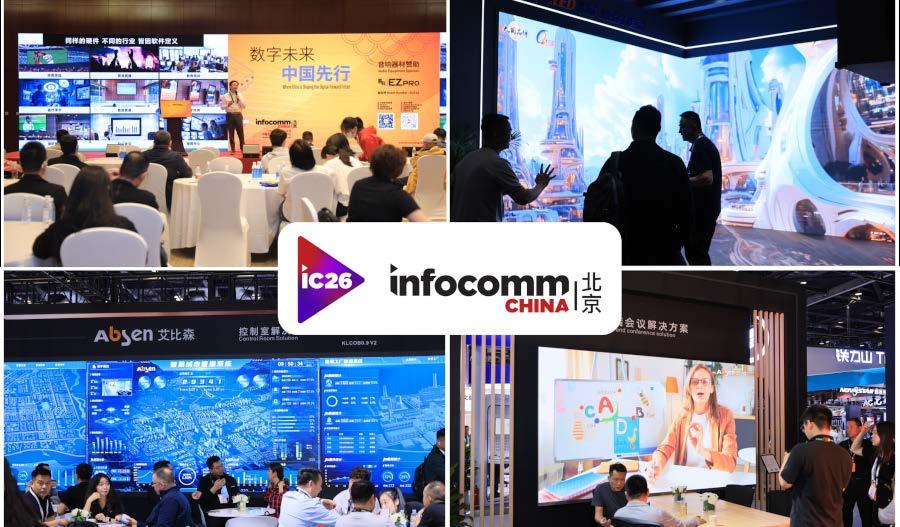
China’s Pro-AV sector is being reshaped by the convergence of AV, IT and emerging digital technologies. As hybrid work becomes standard practice and immersive experiences shift from “nice-to-have” to essential across corporate, education, retail and cultural venues, demand for integrated, scalable AV solutions continues to accelerate. Technologies such as AI-enabled automation, real-time collaboration platforms and interactive display ecosystems are rapidly becoming baseline requirements rather than differentiators.
It is against this backdrop that Beijing InfoComm China 2026 comes into focus. Taking place 15–17 April 2026 at the China National Convention Center (CNCC), Beijing, InfoComm China marks 20 years as the country’s most established Pro-AV trade platform. Over two decades, the show has evolved alongside the market itself, serving as a practical marketplace where manufacturers, solution providers, system integrators and end users converge to evaluate technologies, exchange insights and form partnerships.
With more than 400 exhibiting companies and over 25,000 professional visitors, the show offers international attendees a concentrated view of how Pro-AV solutions are being designed, integrated and deployed across China today — from enterprise and education to largescale public and cultural projects.
For 2026, Beijing InfoComm China will place additional emphasis on curated technology zones focused on immersive applications, converged systems and AI-driven AV.
These zones are designed to help visitors quickly identify relevant use cases, system architectures and integration approaches — particularly valuable for overseas professionals assessing partnerships, sourcing strategies or market entry opportunities.
Discover what’s available for international visitors and plan your visit by registering via the official Beijing InfoComm China website.
To support overseas professionals navigating both the market and the show, InfoComm Asia has expanded its International Visitors initiatives including English-language support, guided show floor tours and dedicated onsite services designed to make engagement more efficient and productive.
Complementing the onsite experience is China’s Pro-AV Market Overview & Opportunities Playbook, developed specifically for international audiences. The playbook consolidates current market data, technology trends and 10+ real-world case studies, offering practical insight into how Pro-AV innovation is being implemented across sectors — from enterprise collaboration environments to largescale public installations.
Download the complimentary China’s Pro-AV Market Overview & Opportunities Playbook to gain deeper insight into market dynamics, technology trends and real-world applications shaping China’s Pro-AV ecosystem.
As China’s role in the global Pro-AV landscape continues to expand, Beijing InfoComm China offers international professionals a structured, informed and accessible way to do exactly that.
Beijing InfoComm China


GLOBAL: Audiotonix is expanding its influence at the sharp end of professional audio, announcing an agreement to acquire three highly respected names in microphones and wireless audio: DPA Microphones, Wisycom and Austrian Audio. The acquisitions are now subject to regulatory approval, with completion expected in H1 2026.
The move signals a strategic step forward for Audiotonix as it continues to build a tightly integrated ecosystem that spans the signal chain, from performer to production.
With more than 60 years of Danish microphone design heritage, DPA Microphones is synonymous with precision, consistency and durability. Its microphones are trusted across
live sound, theatre, broadcast, film and fixed installation, where accuracy and reliability are non-negotiable.
Italian wireless specialist Wisycom brings deep expertise in advanced RF technology, delivering robust solutions for broadcast, live events, corporate productions and location sound. Known for tackling complex RF environments, Wisycom has become a go-to brand for engineers operating in demanding conditions.
Completing the trio is Vienna-based Austrian Audio, a company rooted in decades of acoustical know-how. With a growing portfolio of microphones, headphones and audio tools, Austrian Audio blends innovation with a strong connection to its engineering heritage.
Together, the three brands join an already formidable Audiotonix portfolio that includes Allen & Heath, Calrec, DiGiCo, DiGiGrid, Fourier Audio, Group One Limited, Harrison, JH Audio, KLANG:technologies, Slate Digital, Solid State Logic, sonible and Sound Devices.
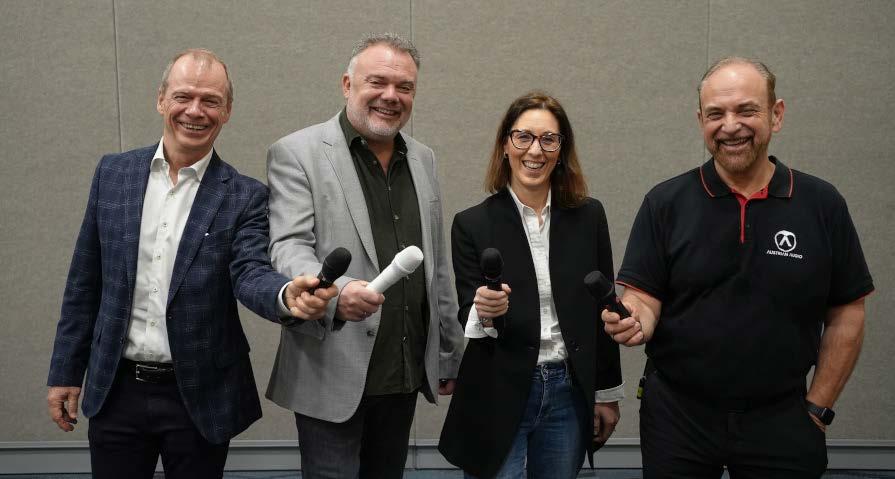
“With the development work we have been investing in with Sound Devices, it makes technological sense to add Wisycom to the team. The next logical step is to move closer to the performer with microphones, and DPA, as a premium brand, is the ultimate choice. Austrian Audio, with their decades of microphone and headset design experience, have immense potential and will help complement our existing and future portfolio. We always aim to work with brands that add value for our customers, and the future potential of this trio as part of Audiotonix is not hard to imagine,” stated James Gordon, CEO of Audiotonix.
Kalle Hvidt Nielsen, CEO at DPA Microphones, commented, “DPA Microphones, Wisycom, and Austrian Audio are premium brands known for their strong and visionary product offering,
used by many high-end customers who are familiar with all the Audiotonix brands. We share many location sound professionals with Sound Devices who rely on best-in-class audio quality and top-notch reliability and so by joining Audiotonix, DPA Microphones, Wisycom, and Austrian Audio get the opportunity to offer more premium solutions to discerning, quality focused customers”. Kalle concludes, “The synergy across the brands enhances the group’s capacity to deliver substantial advantages to all professional customers who demand the best. I look forward to more collaboration and moving the state-of-the-art forward in new verticals”.

GLOBAL: Hewshott, the global consultancy specialising in AV, IT, Theatre, and Acoustics, has completed a significant leadership transition as UK Managing Director Daniel Lee acquires the business and assumes the role of Group CEO.
The transition marks a new chapter for Hewshott while safeguarding its 24-year legacy of independence, ethical practice, and exceptional client experience. Founder and outgoing Group CEO Peter Hunt will continue to lead Hewshott Australia as Managing Director, alongside maintaining his long-standing industry association roles.
Carefully planned over time, the leadership change is designed to ensure stability, continuity, and long-term growth. Building on the strong foundations laid by Peter from the company’s inception, Dan’s vision is to strengthen Hewshott’s global presence and bring greater unity, visibility, and influence across regions while remaining firmly anchored to the principles that define the Hewshott way.
“Everything Peter’s done has meant that I’m starting from a place where I don’t have to fix anything, because nothing’s broken,” explained Dan. “The power of Hewshott means I can just continue amplifying what we already do.”
As the built environment increasingly focuses on experience rather than just infrastructure, Hewshott’s role has evolved accordingly. The consultancy’s value lies in uncovering what clients truly need and shaping environments that respond to those needs holistically.
Dan notes that this evolution has been underway for several years. Hewshott has been transitioning from a traditional technology design consultancy into a fully integrated experience-design partner. By bringing together AV, IT, acoustics, theatre, smart building, and studio disciplines, the model has already seen strong success in the UK and is now set to expand globally.
“It’s not a shift away from technology but a broadening towards designing spaces where experience leads, and technology quietly enables,” explained Dan. “One that’s based entirely on what the desired outcomes are for a particular space, building, or set of users.”
Reflecting on the journey, Peter emphasised that Hewshott has always been built on people rather than products, expressing gratitude to the clients and teams who have shaped the company over the years.
“Where we are today, the company is very strong,” expressed Peter. “We couldn’t have done it without our clients, nor could we do this without our staff, both in equal measures, past and present. Every single one of them is very special to me, and I know that means as much to Dan, too.”
Hewshott
I NDIA: Adamson has appointed Lewminadio Technologies LLP as its exclusive distributor for India, marking a significant step in expanding the brand’s reach across a rapidly growing professional Indian audio market. This partnership builds on Adamson’s longstanding success in the country, where its systems have powered many of India’s most ambitious concerts, festivals, worship gatherings, and large-format events. Lewminadio will ensure that Adamson clients across India will benefit from improved product availability, stronger national support, and a highly knowledgeable team capable of guiding both new and established clients toward the right solutions for their projects.
“We are honoured to be appointed as the exclusive distributor for Adamson in India. Adamson’s reputation for engineering integrity and consistent performance aligns strongly with Lewminadio’s approach to the market. Our focus will be on strengthening the brand’s national presence through reliable distribution, structured market development, and responsive local support across key professional audio segments,” said Annu Jamloki, Co-Founder of Lewminadio Technologies.
Lewminadio enters this partnership with a reputation founded on engineering excellence, strong market understanding, and a genuine commitment to customer advancement. The driving forces behind Lewminadio are Sudarshan Srinivasan and Annu Jamloki. Through their shared vision and unwavering commitment, they have built a strong foundation and a top-class team.
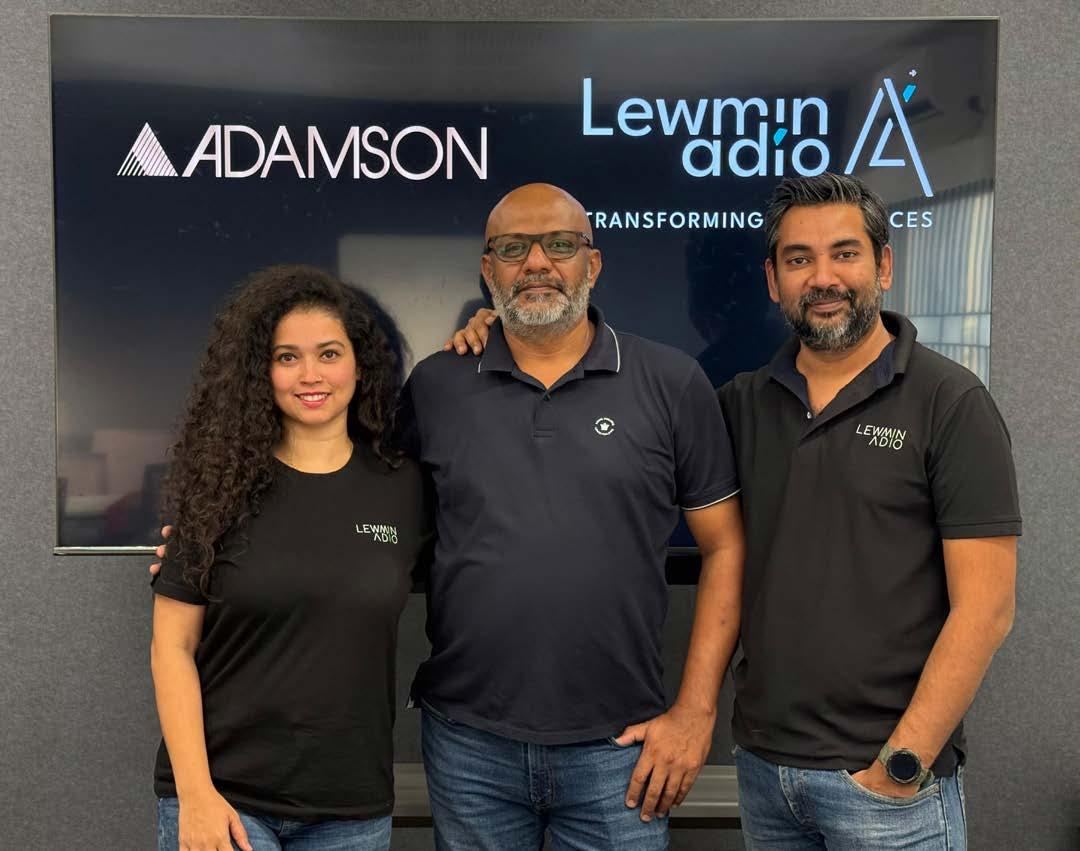
Sudarshan, a respected electroacoustic engineer whose practical expertise in system design, alignment, tuning, and deployment has made him one of India’s trusted advisors to renowned artists, leading rental companies, consultants, and system integrators. His experience enables Lewminadio to understand client needs and recommend Adamson solutions with accuracy and confidence.
Annu’s background further strengthens the distributor’s leadership credentials, with experience spanning system integration, OEM operations and strategic market development. Her emphasis on education, communication and collaborative growth positions Lewminadio to drive both brand visibility and customer engagement for Adamson at a national scale.
“Lewminadio brings a strong blend of engineering expertise and deep market understanding. Their team is well-equipped to support existing clients, educate new users, and introduce Adamson technology to a wider range of applications across India. We are excited to see what they can bring to the market,” said Lee Stevens, APAC Sales Director, Adamson.
Adamson
Lewminadio Technologies LLP
GLOBAL: HK Audio is entering a new chapter in its corporate journey, formally transitioning leadership to a seasoned internal management team as part of a carefully planned generational change.
Effective 1 January 2026, company founder and long-standing Managing Director Lothar Stamer initiated the handover of day-to-day management responsibilities to three senior executives who have played central roles in shaping HK Audio’s success over many years: Christian Jordan (Chief Sales Officer / Chief Marketing Officer), Holger Kartes (Chief Technology Officer / Chief Operations Officer), and Stefan Persch (Chief Financial Officer). The transition will take place gradually throughout
2026 to ensure continuity and strategic alignment.
By choosing an internal succession model, HK Audio is deliberately prioritising continuity, institutional knowledge and a deep understanding of the international professional audio market. Each member of the new leadership team brings extensive experience, long-standing industry relationships and a proven track record within the company.
Christian Jordan has been instrumental in building HK Audio’s global sales and marketing strategy, significantly strengthening the brand’s international positioning. Holger Kartes represents technological excellence across the entire value chain, from production and global supply chains to the ongoing development of HK Audio’s “Made in Germany” product and system solutions. As CFO, Stefan Persch provides financial leadership, ensuring economic stability, sustainable growth and sound corporate governance.
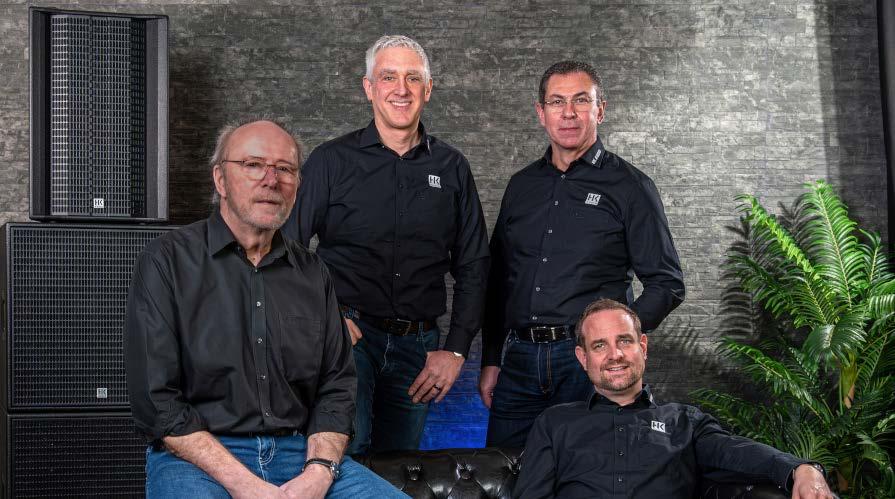
“HK Audio has always been more than just a company to me – it is an idea, an attitude and a promise to our customers,” says Lothar Stamer, founder of HK Audio. “With Christian Jordan, Holger Kartes and Stefan Persch, we are handing over responsibility to a team that knows the brand, the market and our values down to the last detail. I am convinced that HK Audio is excellently positioned for the future with this leadership.”
The incoming leadership team shares that confidence. “We are taking on this task with great respect for what has been achieved and with a clear view of what lies ahead,” explains the future leadership trio. “HK Audio is on an international growth trajectory. Our joint task will be to further build on this momentum – with
strong products, reliable partnerships and a clear strategic focus.”
With this leadership transition, HK Audio reinforces its ambition to remain a key player in the global professional audio market. A strong management structure, ongoing technological innovation and a globally established brand provide a solid foundation for the company’s next phase of development.
After more than four decades of delivering quality, reliability and professional audio solutions, HK Audio enters 2026 well-equipped to continue shaping the future of live and installed sound.
HK
Audio
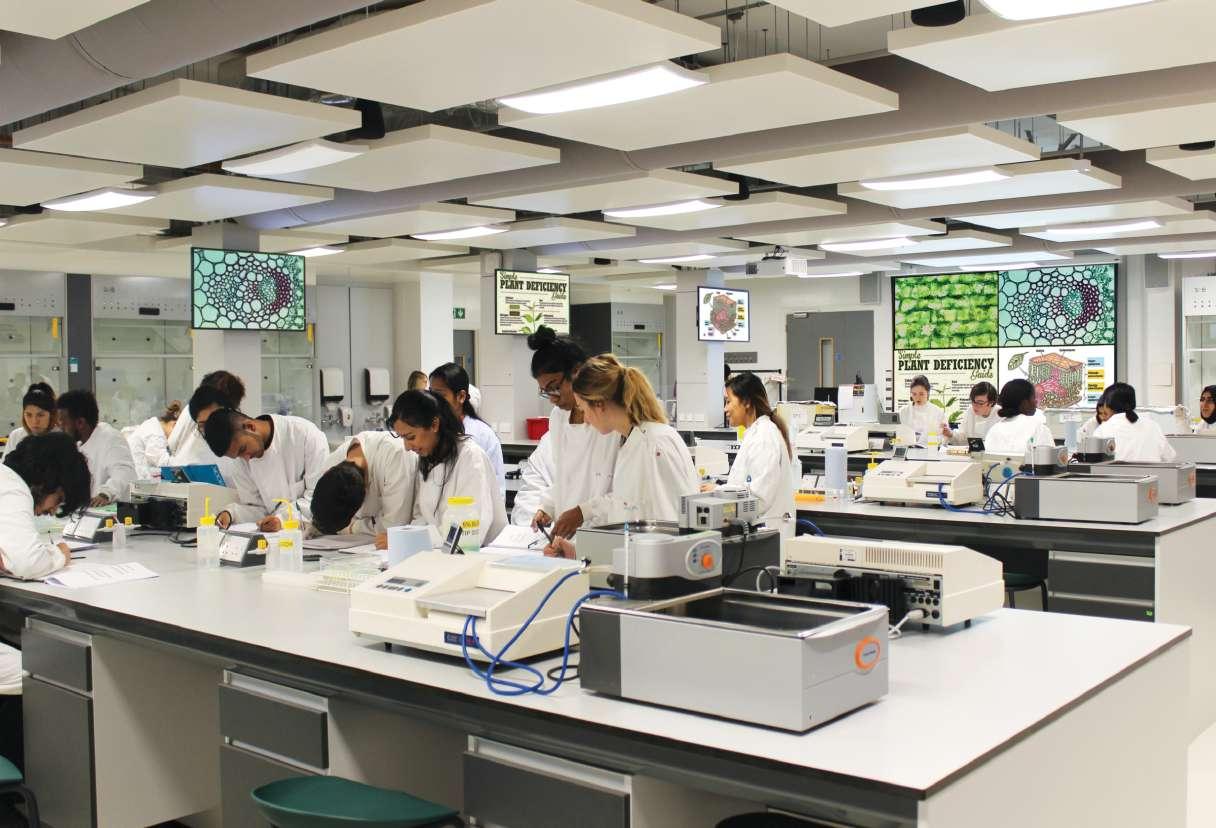
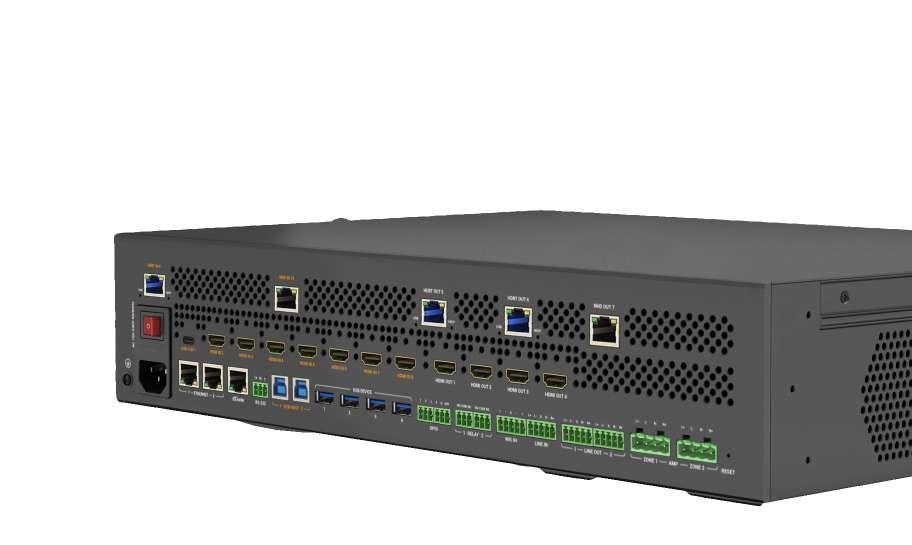
The MX-1007-HYB delivers interruption-f ree 4K60 switching, simplified connectivity, and scalable AV distribution; built for classrooms, lecture halls, and campus presentation spaces.
• 4K60 seamless switching for smooth presentations with no blanking or disruption
• Full-featured USB-C connectivity for transmitting AV, USB, power delivery, and network through a single cable
• AV over IP input and output
• Integrated Dante® audio for flexible, networked sound in modern learning environments
• Built-in DSP power amplifier



GLOBAL: The HDBaseT Alliance, the Professional AV industry’s largest interoperable ecosystem, celebrated 15 years of HDBaseT technology and its lasting impact on the global AV landscape.
From reshaping system design to simplifying deployment and elevating user experience, HDBaseT has continually evolved since its inception. At ISE 2026, the Alliance invited attendees to join the celebration, entering what it called “An HDBaseT World”, a live showcase of interoperability, innovation, and collaboration.
Founded by LG Electronics, Samsung Electronics, Sony Pictures Entertainment, and Valens Semiconductor, HDBaseT introduced uncompressed, long-distance, plug-and-play connectivity over a single Category cable. Today, it underpins a worldwide ecosystem of manufacturers, certified installers, and integrators working across video conferencing, education, immersive experiences, home entertainment, live events, and digital signage.
At this year’s show, Valens Semiconductor, inventor of HDBaseT technology and a co-founder of the Alliance, presented live demonstrations highlighting next-generation multimedia signal distribution solutions designed to simplify increasingly complex AV system architectures.

“The HDBaseT Alliance is proud to have been the driving force behind the industry’s evolution for 15 years and counting,” said HDBaseT Alliance President Effi Goldstein. At ISE 2026, I am eagerly anticipating the launch of our members’ innovative products. By leveraging HDBaseT technology, our members provide integrators and installers with interoperable, reliable building blocks they can trust as expectations rise for performance, simplicity, and user experience.”
Throughout the show, the HDBaseT Alliance booth hosted a range of activities and experiences, including a Power Wall display featuring 70 new products and solutions from more than 30 Alliance members, illustrating the breadth of HDBaseT across multiple verticals. Visitors could also pick up the 2026 edition of the HDBaseT World Showcase booklet at the booth.
In addition, HDBaseT Extended, the Alliance’s interview series hosted by Commercial Integrator Editor-in-Chief Dan Ferrisi, brought together leading Pro AV experts to discuss the current state and future direction of the industry.
HDBaseT Alliance
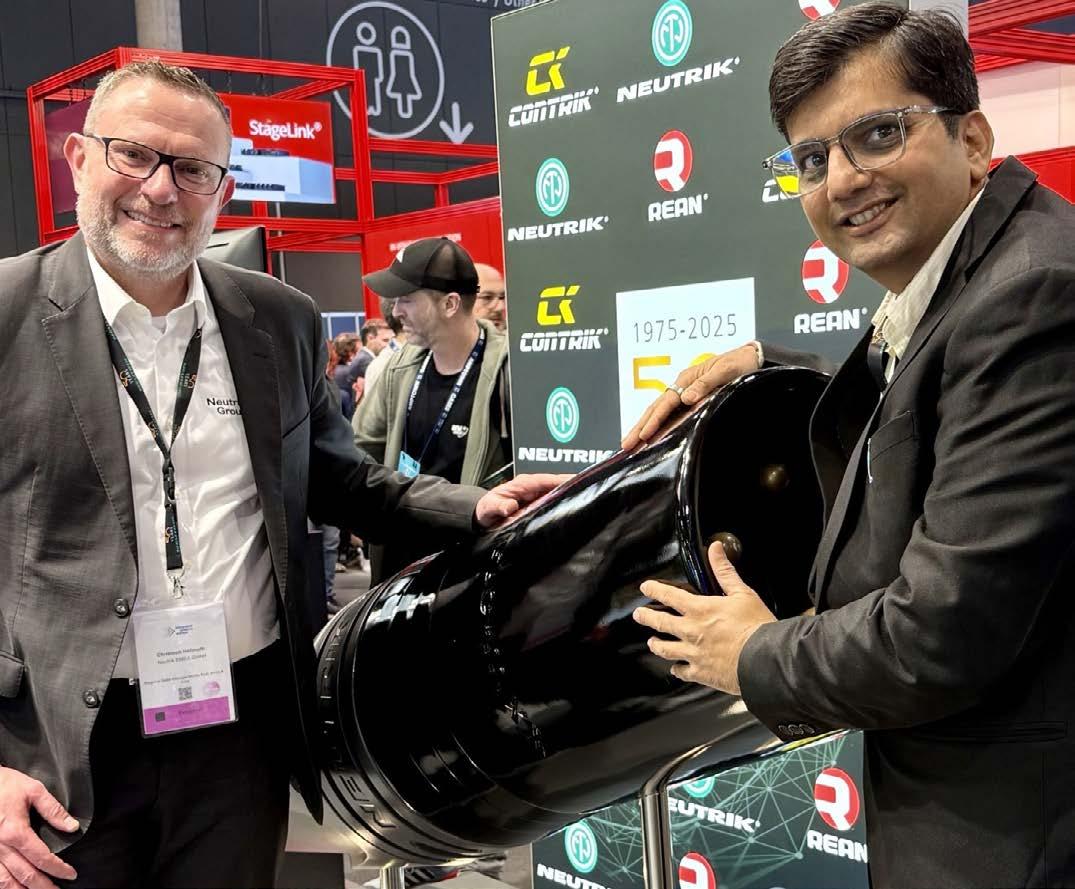
INDIA: The Neutrik Group has announced the expansion of its NEUTRIK brand distribution network in India with the appointment of RISHABH Incorporated in Mumbai and 4 SQUARES Corporation based in Bangalore. The two companies join existing distribution partner COMCON Technologies in Delhi, with immediate effect, in creating a new nationwide distribution network for the world-leading AV connectivity brand.
Chris Hellmuth, Neutrik Group Regional Sales Manager MEAI, stated, “India represents a considerable opportunity for NEUTRIK, where the potential for expansion and growth requires more partners across different geographical areas to provide sufficient market penetration throughout the subcontinent.”
Commenting on the company’s appointment, Managing Director of RISHABH Incorporated & Kiran Sales Corporation, Biren Sheth, stated: “We thank Neutrik Group and the management
of Neutrik EMEA for placing their trust in us and providing this opportunity. Partnership is not just a contract, it’s a shared vision; one in this instance that fully aligns with our mission of bringing world-class solutions to local markets.”
For 4 SQUARES Corporation, Managing Director Tijo George remarked, ”This appointment reflects our shared commitment to performance, reliability and market excellence. We sincerely thank Neutrik Group for welcoming 4 SQUARES Corporation into the NEUTRIK distribution network in India.
“With our strong regional footprint, technical expertise, and agile supply capabilities, we are ready to accelerate NEUTRIK’s reach and deliver world-class connectivity solutions closer to customers across the regions.”
“Neutrik EMEA is delighted to welcome both Rishabh and 4 SQUARES to the Neutrik family, as partners in India, to enhance the reach and availability of our product to customers,” says Mark Perrins, Managing Director Neutrik UK Ltd. and Neutrik France. “Neutrik very much appreciates the size and complexities of the Indian market. The company is working hard to meet demand with the fast pace of growth in these core markets throughout the entire country, through a revised strategy of distribution and available channel stock.
“Enlargement of the Neutrik family in any region is always a positive and welcome sign. We look forward to long-standing, fruitful partnerships with Rishabh, 4 SQUARES and COMCON within this new network.”
The continuing opportunity for increased awareness of Neutrik Group’s CONTRIK and REAN brands, within the new distributor network, is maintained with RISHABH’s distribution of REAN and 4 SQUARES’ distribution of CONTRIK.
Neutrik Group
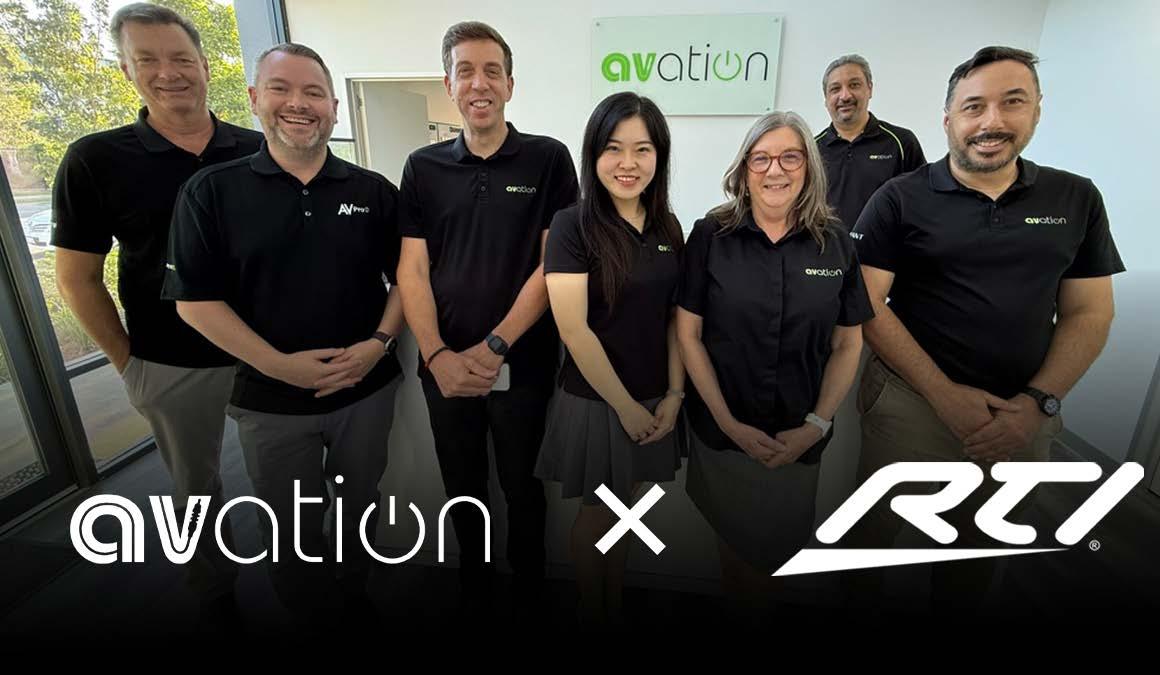
AUSTRALIA: RTI has announced Avation as its official distributor for both commercial and residential products across Australia, reinforcing the brand’s long-term commitment to the region.
Based in Queensland and founded in 2010, Avation has built a strong reputation among technology integrators and home theatre specialists for its smart home, audio/ video, and luxury lighting solutions. Beyond distribution, the company is widely recognised for its customer-focused approach, offering comprehensive product training, technical support, and system design expertise across residential and commercial control, automation, lighting, and AV applications.
The appointment brings together two companies with established histories in the Australian market and a shared focus on supporting integrators with scalable, reliable solutions.
“We are excited to reconnect with the highly professional team at Avation and very much look forward to increasing RTI’s visibility with integrators throughout Australia,” stated James Trumper, VP, International Sales at AVPro Global. “We are confident that our newest product introductions and awardwinning Integration Designer software
represent important opportunities for both new and existing dealers. Our fully scalable and customizable control solutions are problem solvers for both residential and commercial projects, helping integrators exceed client expectations every time.”
Avation Managing Director Mark Hamilton welcomed the partnership, highlighting RTI’s long-standing reputation in the region, “The Avation team and I are looking forward to working with RTI, envisioning a successful venture presenting products and services to top integrators from one of the most trusted brands in control and automation,” explained Mark Hamilton, Managing Director of Avation. “RTI has an impressive legacy here in Australia, and I am confident that the latest features and innovations will appeal to our expansive network of dealers.”
Since 1992, RTI has remained at the forefront of control and automation technology, enabling integrators to create intelligent environments that enhance lifestyle experiences and streamline operations. Its portfolio of control processors, user interfaces, and software platforms is backed by award-winning support services designed to meet the demands of projects of any scale.
RTI
GLOBAL: ETC has taken a significant step toward shaping the future of architectural lighting control with the acquisition of Pharos Architectural Controls a long-time collaborator and innovator in dynamic lighting systems.
Based in the UK, Pharos develops and manufactures advanced lighting control solutions for architectural environments, themed entertainment and large-scale visual installations. The move formalises a partnership that spans more than two decades and builds on Pharos’ 21-year track record of innovation, reliability and customer-first service—qualities that have been instrumental in the evolution of ETC’s architectural lighting portfolio.
As the design and engineering force behind ETC’s Mosaic product family, Pharos has long operated in close alignment with ETC’s culture of agile development, exceptional technical support and commitment to product excellence. ETC CEO Dick Titus sees the acquisition as a natural progression of that relationship.
ETC’s CEO Dick Titus said, “We look forward to growing our long-standing partnership with Pharos. Their in-house development team continues to push the boundaries of dynamic lighting control, and their work will further strengthen ETC’s offerings in the global architectural lighting market.”

Pharos’ established presence and strong sales network across EMEA and APAC also position ETC for accelerated global growth. The highly regarded Pharos brand adds a complementary platform that enables ETC to expand its reach while deepening its capabilities in architectural control.
Importantly, Pharos will continue to operate as a stand-alone company. Existing sales, service, supply and licensing partnerships will remain unchanged, ensuring continuity for customers and partners worldwide.
Pharos CEO Simon Hicks describes the acquisition as a milestone for the company’s future. “This is an exciting new chapter for Pharos and a fantastic opportunity for the team and our product. ETC provides a long-term home for the company, ensuring continuity of service for our customers, and we can now tap into a wealth of resources to help us accelerate our ambitious product development roadmap.”
Looking ahead, ETC plans to build on this strong foundation by leveraging Pharos’ innovation, global footprint and customerfocused approach, delivering enhanced value and new opportunities for clients across architectural and entertainment lighting markets worldwide.
ETC
AUSTRALIA: Part of the Yamaha group of companies, NEXO has announced new arrangements for the distribution of their products in Australia.
Effective April 1st, 2026, distribution will be shared by three existing NEXO dealers in the country, each with extensive experience in supplying and supporting NEXO customers working in a range of applications, and now each with direct, distributor-level access to sales and technical support from NEXO’s French-based HQ.
“Alongside growing NEXO’s presence in Australia, our absolute priority is to continue the high levels of support that NEXO users there already enjoy, which is why we’re partnering with companies that have a proven track record
of supplying NEXO systems with excellent reputations for technical service”, commented NEXO Asia Sales Manager Joe White.
The three new NEXO distribution partners in Australia are Factory Sound with locations in Melbourne and Sydney; Gold Coast-based Captivate AV and the LSV Group headquartered in Melbourne.
Commenting on the new partnership, Factory Sound General Manager Artie Jones said, “We purchased our first PS8/10/15 systems for the Factory Sound store in 2004. Over the following 20+ years, we have watched NEXO grow in Australia, being adopted by many production companies, integrators, and owner-operators. Factory Sound is very proud to be able to continue the good work started in Australia by Group Technologies, and we look forward to continuing to supply and support the many existing and new potential NEXO customers in Australia in the future.”

For Captivate AV, Managing Director Chris Lang commented, “For the past 10 years, we have used NEXO products exclusively for our high-end audio solutions in both fixed installations and in our rental inventory. NEXO’s extensive range and modularity between series has enabled us to deploy countless creative solutions, exceeding expectations in every scope and scale. Now moving into a new phase of distributorship, we are excited to share our breadth of experience and passion for the NEXO brand with existing dealers and new prospective dealers, integrators and rental houses around Queensland and beyond.”
GLOBAL: Christie Digital Systems USA has announced an agreement in principle to sell its Broadcast and Professional Video business to Vista PHX, Corp . a newly formed company created by industry veterans and former Vista Systems owners Clark Williams and Jeff Wilson. The transaction is expected to close by the end of February.
More than a corporate divestment, the move represents a return to origins for some of the professional AV industry’s most respected video processing platforms, including the iconic Spyder, placing them back in the hands of the engineers and visionaries who originally designed and built them.
At the LSV Group, Brands Manager Andrew Stanley said, “NEXO’s reputation for precision engineering and world-class professional audio fits naturally with our group’s long-standing commitment to the Australian market, with NEXO forming a core part of our audio strategy across touring, live events and installed sound for many years. LSV Group is proud to be appointed as an Australian distribution partner for NEXO and looks forward to working in close collaboration with NEXO HQ and alongside our friends and colleagues at Factory Sound and Captivate AV to further strengthen NEXO’s longterm presence and customer support across Australia.”
Under the agreement, Vista PHX, Corp., headquartered in Phoenix, Arizona, will acquire Christie’s intellectual property and essential operational infrastructure for the Spyder, Phoenix, Terra, and Mastering Gateway product lines. Operations will continue in Phoenix, reinforcing continuity for customers and partners alike.
The transaction effectively brings these platforms back to their birthplace, where they were originally developed and manufactured. At the centre of the transition is Spyder, long regarded as a benchmark
for uncompromising performance in live events, broadcast production, and high-end installations worldwide.
Alongside Spyder, the Phoenix distributed content management system, Terra SDVoE platform, and Mastering Gateway Series further position Vista PHX as a focused, end-to-end provider of mission-critical video processing solutions.
“Bringing Spyder and the other innovative video processing product lines back under independent ownership is significant,” said Clark Williams, CEO of Vista PHX, Corp. “For our customers, this acquisition means continuity where it matters and acceleration where it counts. The same team, the same engineering DNA—now with the clarity and autonomy to move faster and invest deeper in the platform our customers rely on.”
For Christie, the divestiture reflects a sharpened focus on long-term strategic priorities. Michael Phipps, President of Christie, views the transition as a positive step for all parties involved.
Michael Phipps, President, Christie, commented on the transition. "The divestiture of the Broadcast and Professional Video group reflects our continued focus on our long-term strategic priorities. We believe that returning the video processing family of products to Clark Williams, Jeff Wilson, and
the Vista PHX team will best position them for sustained growth under owners whose core mission is centred on these products. We are committed to ensuring a smooth and responsible transition for employees, customers, and partners."
Vista PHX, Corp. has outlined a clear commitment to continuity and quality. All existing warranties and service agreements will be honoured, with technical support standards maintained and strengthened. The company will continue to own, develop and support platforms including Spyder X80, Spyder X20, Phoenix, Terra and Mastering Gateway, with an explicit focus on reliability, performance and long-term product vision. Led by Clark Williams (CEO) and Jeff Wilson (CFO), Vista PHX brings decades of handson experience in designing, deploying and supporting some of the industry’s most demanding video systems—experience that customers already associate with these platforms.
For many in the broadcast and live events community, the announcement marks a defining moment: a return to focused leadership, deep product expertise and a renewed commitment to the technologies that power some of the world’s most complex visual experiences.
Christie

Following a standout keynote at Integrated Systems Europe (ISE) 2026, AVI-SPL has confirmed a major strategic investment in artificial intelligence through an executive advisory engagement with Sol Rashidi, one of the world’s leading authorities on enterprise AI transformation.
Rashidi took the main stage at ISE 2026 to address how organisations can move beyond AI experimentation and into scalable, enterprise-grade execution. Building on that message, AVI-SPL's engagement with Rashidi formalises the company's commitment to embedding AI across customer solutions, service delivery, operations, and the employee experience.
“AI is not a future initiative for us; it is a strategic priority today,” said Julian Phillips, Senior Vice President and Managing Director, XTG at AVI-SPL. “Our customers are already asking us how to use AI in practical, responsible ways to improve experiences, operations, and outcomes, and we are already exploring multiple business cases and applications. Partnering with Sol ensures we are not just experimenting, but building a disciplined, enterprise-ready approach to AI that creates real value.”
Turning ISE Insight into Enterprise Action AVI-SPL has positioned artificial intelligence as a core pillar of its long-term strategy, recognising its role in reshaping how
technology-enabled environments are designed, managed, and experienced. The advisory engagement with Rashidi represents the company's first major strategic investment in AI leadership, signalling a shift from exploration to execution.
Rather than focusing solely on automation or incremental efficiency gains, Rashidi is advising AVI-SPL on how AI can responsibly enhance customer experiences, strengthen service delivery, improve operational resilience, and empower employees across its global organisation.
Rashidi is widely recognised for guiding global enterprises through large-scale AI transformations. At ISE 2026, she emphasised the need for clear governance, measurable outcomes, and human-centric design principles reflected in her Human Amplification Index™ (HAI™), which evaluates whether AI initiatives genuinely increase human capability.
“Most organisations are still talking about AI in theoretical terms," said Sol Rashidi. "AVISPL is focused on applying AI at enterprise scale, with the right guardrails, and with a clear focus on amplifying human contribution. Our work together will focus on moving from experimentation to execution in a way that builds trust and delivers real outcomes."
Through the engagement, Rashidi is working directly with AVI-SPL's executive leadership team to shape AI strategy, governance, and prioritisation across customer-facing solutions, managed services, internal productivity, and long-term innovation.
“This is not about chasing hype,” Phillips added. “It is about building a thoughtful, enterprise-grade approach to AI that strengthens our business, our customer outcomes, and our industry leadership.
AVI-SPL
MIDDLE EAST: AVIXA has announced the launch of InfoComm EDGE Dubai 2026 a new two-day experiential showcase taking place on 27–28 October at Dubai’s Festival Arena. Designed to move beyond the limits of a traditional trade show, InfoComm EDGE will offer senior decision-makers a handson, immersive way to experience what professional AV can deliver at scale.
Built specifically for leaders shaping complex projects across government, enterprise, education, retail, leisure, and entertainment, the event is curated for audiences outside the core pro AV trade. InfoComm EDGE combines the technology, insight, and networking associated with InfoComm and ISE, but reframes it around real-world application and outcomes, creating a space where ideas are experienced rather than explained.
At the heart of the event is a new show format centred on experiential storytelling. Hosted within more than 7,200 square metres of flexible indoor and outdoor space, the Festival Arena will be configured around a central stage rather than a conventional booth layout. Live activations, designed and delivered by the regional integration community, will guide attendees through narrative-led journeys that demonstrate capability, integration, and delivery excellence.
“Experience lies at the heart of InfoComm EDGE. The GCC is a region that has an unquenchable thirst for innovation, and it has the vision and resources to turn its dreams into reality,” said David Labuskes, CTS, CAE,

RCDD, Chief Executive Officer of AVIXA. “We have an established pro AV community in the region at the forefront of this innovation, which has both the talent and the creativity to deploy the buyer-focused activations that will form the core of InfoComm EDGE.”
“It's challenging for high-level decisionmakers to visualise solutions as they walk around a conventional trade show floor, stand by stand," said Cara Turner, Event Director, InfoComm EDGE. "That's why, for InfoComm EDGE, we are taking a unique approach by co-creating an event with the design and deployment community for the first time."
InfoComm EDGE will feature many neverbefore-seen live, innovative, and experiential activations. Rather than sales pitches, it will present narrative-led journeys supported by standards-aligned thinking that inspires, reduces risk, and improves outcomes for the end customer. In short, InfoComm EDGE will be a trusted environment focused on capability, integration, and delivery excellence.
AV integrators interested in submitting designs, manufacturers seeking to explore sponsorship opportunities, and individuals interested in attending the event should visit the InfoComm EDGE website.
AVIXA
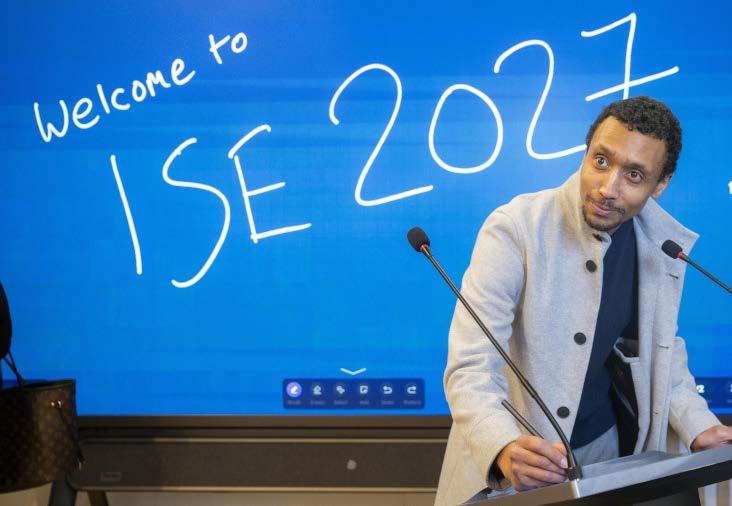
GLOBAL: Integrated Systems Europe (ISE) 2026 closed its doors after four days of inspiring firsts that pushed beyond expectations to redefine the possible and reinvigorate the AV and systems integration industry. ISE 2026 broke all records, welcoming 92,170 visitors from around the world. A total of 1,751 exhibitors, including 323 making their debut at the event, contributed to the largest total show floor space in the event’s history at 101,000 sqm.
ISE 2026 delivered exceptional attendance growth, underlining the continued expansion and global appeal of the show. By Tuesday, the event had already welcomed 55,156 unique attendees, a 10% increase compared with Tuesday 2025 (49,981). By Wednesday, total unique attendance across all show days reached 76,035, while the show recorded its largest single day ever, with 64,198 visitors onsite, almost equalling the prepandemic record attendance of an entire ISE show (64,908 at ISE 2019 in Amsterdam). Momentum continued through Thursday, as total unique attendance climbed to 87,648,
officially marking the highest attendance in ISE history. Overall, ISE 2026 achieved an 8% increase in total attendance compared with 2025, demonstrating unprecedented energy, scale, and industry engagement, and confirming its position as the world's leading event for the audiovisual and systems integration community. The total number of registrations reached 120,914, with over 212,000 visits across the four days.
“As ISE 2026 comes to a close, I’m truly inspired by the passion and strength of our community,” said Mike Blackman, Managing Director of Integrated Systems Events.
“Over four extraordinary days, we celebrated groundbreaking technology, ignited bold ideas, forged lasting connections, and set new benchmarks for our industry. What excites me most is the creativity, energy, and diversity of our exhibitors and partners, and the unwavering dedication of the ISE team that makes it all possible.”
At ISE 2026, Spark debuted as a show of unity for creativity and technology – a new initiative driving innovation and knowledge sharing across the creative industries. The new event format brought together the creators of tomorrow, uniting the brightest minds from Broadcast, Live Events, Marketing, Design, and Gaming into one immersive experience. Spark served as a hub for creative professionals, technologists, and decisionmakers to connect, share ideas, and explore the future of creativity. With an outstanding line-up of partners and speakers, Spark 2026 showcased how technology transformed the audience experience, on screen, in physical spaces, and live, and demonstrated how innovation and collaboration are shaping the next generation of creative work.
In another first, ISE announced the ISE Foundation, an initiative spearheaded by ISE, and backed by co-owners AVIXA and CEDIA, with support from the City of Barcelona and the Government of Catalonia. The ISE Foundation aims to empower the AV and systems integration community, with an emphasis on teamwork, innovation, and lasting impact under the tagline “Powering On, Together”. The foundation launched at a press conference, with distinguished speakers David Labuskes, CEO of AVIXA; Daryl Friedman, Global President & CEO of CEDIA; Raquel Gil, Deputy Mayor of Barcelona; and Miquel Sàmper, Minister for Business and Labour, Government of Catalonia.
The keynote sessions at ISE 2026, delivered by Matt Clark and Sol Rashidi, electrified the event, drawing full-capacity audiences. Clark took attendees “Behind the Façade: Building a Performance-led Mapping at Casa Batlló, from Concept to Implementation,” revealing the creative and technical mastery behind the mapping at one of Barcelona’s most iconic landmarks. Rashidi’s “The AI Reality Check: What It Takes to Scale and the Future of Leadership” offered a compelling look at how AI is reshaping industries and the leadership needed to navigate this transformation. Together, their presentations showcased ISE as the ultimate stage for innovation, creativity, and forward-thinking industry leadership.
ISE’s partnership with Barcelona continues to play a vital role in the event’s success. The 2026 show featured a notable delegation of VIPs and government officials, including
representatives from Latin American countries, reflecting Barcelona’s status as a global technology hub. Attendees included leaders in national and regional governments, as well as experts in digitalisation and AI policy, highlighting ISE’s impact on international collaboration and regional growth.
“ISE jumpstarts every year as the largest gathering of AV professionals. But beyond the numbers is a more remarkable story: people connecting with one another from different corners of the world and exchanging ideas that will live on past the convention centre walls," said David Labuskes, CTS, CAE, RCDD, Chief Executive Officer of AVIXA. "The week was full of brilliant minds that push this exciting industry forward. AVIXA is proud to collaborate with the ISE and CEDIA teams to deliver such a vibrant forum."
“ISE 2026 once again demonstrated the extraordinary power of collaboration across our global technology ecosystem,” said Daryl Friedman, Global President and CEO of CEDIA. “As co-owners of ISE, we are proud to see the event continue to expand its influence as a platform where innovation, education, and partnership converge. The energy on the show floor and throughout the conference programme reflects a thriving industry that is not only embracing emerging technologies, but shaping how they enhance the spaces where people live, work, and connect.”
As the industry looks ahead, ISE 2026 leaves a lasting impression as a showcase of cutting-edge solutions and a catalyst for collaboration and progress across the AV and systems integration landscape. ISE will return for ISE 2027 from 2 – 5 February 2027 at Fira de Barcelona Gran Via – save the dates and prepare to push beyond even further.
ISE

GLOBAL:
Visionary has reinforced its commitment to scalable, real-world IPTV and digital signage deployments with the appointment of industry veteran Ryan Nowak as Vice President of IPTV & Signage Solutions.
Based in Santa Barbara, California, Visionary is widely recognised for its AV-over-IP innovation. In his new role, Nowak will oversee system architecture, deployment strategy and technical alignment for Visionary’s IPTV platform, working closely with customers, partners and internal teams to support global growth across enterprise, education, healthcare, sports and broadcast markets.
Nowak brings more than two decades of hands-on experience in IPTV systems engineering, large-scale deployments and product strategy. Most recently at VITEC, he served as Strategic Growth Unit Product Director for Engage and Connect solutions, following senior roles that included Head of Product Management for Platforms and Director of Deployments. Across these positions, he led complex IPTV and signage rollouts in diverse and demanding network environments.
Earlier in his career, Nowak spent over ten years with the Green Bay Packers as a technology systems engineer, supporting liveevent operations and maintaining technology systems across Lambeau Field and other managed facilities. This combination of stadium-scale operational experience and platform leadership underpins his reputation for designing IPTV solutions that perform reliably under real-world pressure.
“Ryan’s background uniquely bridges realworld deployment experience and long-term platform strategy,” said Scott Freshman, chief operating officer for Visionary. “His understanding of how IPTV and signage systems perform in complex, large-scale environments will be invaluable as we continue to expand our solution offerings and support our global customer base.”
“Visionary has built a strong reputation for practical, high-performance IPTV solutions,” Nowak said. “I look forward to working with the team to ensure our systems continue to meet the operational and technical demands of today’s customers while supporting future growth.”
Visionary’s IPTV and digital signage solutions are built around PackeTV, its browserbased management software that serves as the control layer for system configuration, monitoring and content delivery. Designed for enterprise-scale IP networks, PackeTV enables administrators to manage live broadcast television, streamed sources, recorded media and on-demand content through a single web interface, without the need for proprietary client software.
With Nowak’s appointment, Visionary signals a clear focus on deployment-driven product strategy as IPTV and signage continue to converge across global AV ecosystems.
Visionary

GLOBAL: Rise has announced the launch of Elevate, a focused leadership accelerator designed to propel mid-level women in broadcast media technology into senior decision-making roles.
Building on its established mentoring and career development initiatives, Elevate marks a strategic expansion of Rise’s commitment to gender diversity. The six-week hybrid programme, running from June to July 2026, targets women who are already managing teams and are ready to step into more senior leadership positions.
Combining virtual sessions with three mandatory in-person events in London, Elevate integrates expert-led development, real-world leadership challenges and structured peer collaboration. Participants will work alongside senior industry mentors while building a practical leadership toolkit that can be immediately applied within their organisations.
The curriculum addresses core leadership competencies, including performance management, feedback and appraisals, commercial negotiation, team goal setting and P&L ownership. Group-based business
challenges are designed to translate theory into operational impact, while cross-industry networking fosters long-term professional relationships.
The programme is open to women across the broadcast ecosystem, spanning engineering, operations, technology, production, sales, marketing, project management and commercial roles. Applications are accepted both directly and via employer nomination. Participation is capped at 30 to maintain depth of engagement and mentor access. While international applicants are welcome, attendance at the London-based sessions is required.
Deborah Cross, Operations Director at Rise, said the initiative is about more than individual advancement. She noted that many women encounter structural barriers at the point where leadership expectations intensify, and that Elevate is designed to provide the tools, networks and visibility needed to retain and advance experienced talent within the sector.
With the broadcast industry facing ongoing skills shortages and transformation, Rise positions Elevate as a business-critical intervention aimed at strengthening leadership pipelines, improving retention and building a more resilient and representative sector.
As a not-for-profit organisation, Rise has structured the programme at competitive rates to prioritise accessibility.
If you would like to apply, or if you have a woman on your team you would like to support, Rise encourages organisations to plan ahead and include Women in Broadcast: Elevate in their professional development budgets. Further information and application details can be found here Rise
SINGAPORE: Setting the tone for the year ahead, Digiworz CHIP programme was launched in January 2026 with a focused AVoIP Interoperable Design Roundtable, bringing together industry specialists to address the convergence of Audio Video over IP (AVoIP) across live production, broadcast, and ProAV environments.
The roundtable centred on practical interoperability between leading protocols, including DANTE, ST 2110, and AES67, highlighting the increasing need for unified network strategies as projects span worship facilities, studio production, immersive environments, and broadcast applications.
The session featured five experienced subject matter experts: Dominic Koh, Technical Director, Munique Group (Live & Broadcast Production); Frank Lee, Consultant, Munique Group (Studio Production); James Tan, Integration Specialist, Atech Integration Engineering (House of Worship); Hikam Ali, AV Consultant, One Circle (House of Worship); and HC Wong, Immersive Production Designer, FXMedia.
Drawing on decades of combined experience — from traditional pre-networked AV systems to today’s fully converged IP workflows — the panel addressed critical knowledge gaps and reinforced the importance of strong network fundamentals. Discussions emphasised that reliable, interoperable, and future-ready AV
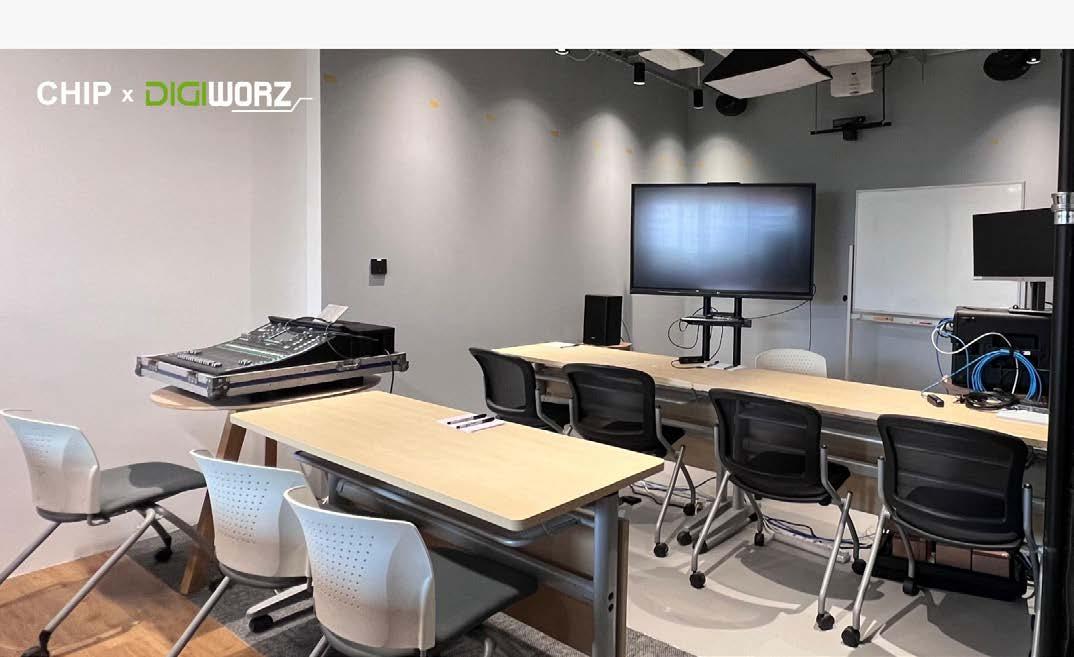
The CHIP Get In-Person with Dante training programme was launched at Digiworz office.
infrastructures depend not only on protocol alignment but also on structured training and continuous upskilling.
In conjunction with the roundtable, the inaugural “CHIP: Get In-Person with DANTE” training program was launched. Based on the DANTE Certification Program Levels 1 and 2, the course reflects DANTE’s role since 2013 as a leading Audio over IP (AoIP) protocol, recognised for seamless interoperability with AES67 and ST 2110 ecosystems.
The programme was organised by Chip Chong of Digiworz, who also leads the training sessions. A 3rd Edition Certified DANTE Training Partner, Chip recently completed his DANTE Mastery Certificate under the guidance of Senior Trainers Holger Wiesenberg and Miguel Garcia.
The initiative is further supported by Vince Lepore and the broader DANTE team, strengthening advanced AoIP education across the Southeast Asia region.
The sessions were held at the newly launched Digiworz Tech Immersive (DTI)

Room. Digiworz, led by CK Ng and Alex Boh, designs and integrates AVoIP solutions across education, corporate, IT, and government sectors — from hybrid unified communications systems to fully converged workplace AV environments.
Additional roundtables, intermediatelevel workshops, and Master Classes are scheduled throughout 2026 as part of the continued effort to advance interoperable AVoIP design practices.
The CHIP Programme is an in-person classroom workshop built around the C.H.I.P. framework — a structured approach to AVoIP design and AV network system maintenance.
At its core, CHIP represents four guiding principles:
C
Understanding how leading protocols and platforms coexist within converged AV networks.
Designing and maintaining systems that are stable, scalable, and optimised for real-world deployment.
Ensuring seamless integration across devices, manufacturers, and industry standards.
Applying disciplined workflow, documentation, and network foresight to deliver reliable outcomes.
Designed for both newcomers and experienced practitioners, the programme supports those entering the AV industry, professionals expanding their skillsets, and anyone seeking deeper insight into DANTE — the technology that has helped popularise Audio over IP networking since 2013.
The workshop emphasises hands-on learning within a respectful and collaborative environment. Participants are encouraged to ask questions, test configurations, and learn through experimentation. Mistakes are viewed not as setbacks, but as essential steps toward technical mastery.
Learning within the CHIP Programme is intentionally bi-directional. Every participant contributes perspective and experience, and every attendee leaves with practical knowledge, applied skills, and greater confidence in designing interoperable AVoIP systems.
For inquiries or to join upcoming programs, please contact: chip@digiworz.com
Digiworz
GLOBAL: DirectOut has announced the formation of a new three-member Management Board, marking a strategic leadership evolution aimed at supporting the company’s rapid international growth and the increasing complexity of the professional audio sector.
The newly appointed Board includes Luca Giaroli as Chief Executive Officer, René In der Stroth as Chief Financial Officer, and Jan Ehrlich, who transitions from his previous role as CEO to Chief Operating Officer. The leadership restructure is designed to create a clearer operational focus while positioning the company for sustained expansion across global markets.
Giaroli brings extensive institutional knowledge to the CEO role, having previously served as Chief Strategy Officer and Chief Solutions Officer. He played a central role in reshaping DirectOut from a hardwarefocused manufacturer into a provider of integrated audio solutions. His leadership was instrumental in the development of the PRODIGY.MP platform and the Audio Solution Model (ASM), both of which have influenced contemporary approaches to digital audio system design and deployment.
“DirectOut has experienced remarkable growth over the past years in people, partners, technologies, and revenue," explains
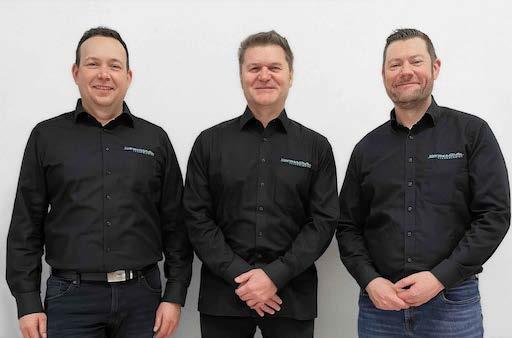
(L-R) René In der Stroth, Luca Giaroli, Jan Ehrlich.
Giaroli. "This evolution brings complexity that requires a broader and more specialised leadership team. We are building something bigger together, not just a company, but a place where innovation meets purpose, and where every team member plays a vital role in our success."
René In der Stroth will lead financial operations, with a focus on aligning fiscal strategy to the company’s accelerated growth trajectory and maintaining competitiveness in a dynamic global market. Meanwhile, Jan Ehrlich will concentrate on operational performance and administrative efficiency from the company’s headquarters in Mittweida, ensuring internal processes scale effectively alongside business growth.
Chief Technology Officer Claudio BeckerFoss will continue to play a critical role, working closely with the CEO to align technological innovation with long-term strategic objectives. His leadership in product development and system architecture remains central to DirectOut’s audio solutions portfolio, reinforcing the performance, flexibility, and reliability standards expected by the professional audio industry.
DirectOut
GLOBAL: The Alliance for IP Media Solutions (AIMS) marked a defining moment for professional AV-over-IP at Integrated Systems Europe 2026 (ISE 2026), with the official launch of Internet Protocol Media Experience (IPMX) as a fully developed, certifiable standard.
The show became the first major industry platform to showcase formally certified IPMX products — a milestone that signals IPMX’s transition from specification to deployable, market-ready technology.
The launch at ISE follows the inaugural IPMX Product Testing and Certification Event held January 19–23, 2026, at the European Broadcasting Union headquarters in Geneva. Hosted by AIMS in collaboration with the Video Services Forum (VSF), the Advanced Media Workflow Association (AMWA), and the EBU, the event marked the first opportunity for manufacturers to formally certify products built to the IPMX specification.
The Geneva certification event was the culmination of extensive technical groundwork — including plugfests, preparation sessions, and test-suite development — conducted over the past year. Products that successfully completed the rigorous validation process now qualify to carry the IPMX branding, confirming verified compliance with transport, interoperability, and control requirements defined in the TR-10 series of specifications.
This certification milestone effectively moves IPMX from a developing framework into a standards-based ecosystem ready for realworld deployment.
At ISE, AIMS showcased the first wave of certified IPMX-compliant products. The display was complemented by a live demonstration highlighting real-world IPMX deployments and practical implementation in Pro AV environments.
The demonstration underscored IPMX’s ease of deployment and operation — key considerations for system integrators and end users seeking reliable, interoperable AVover-IP solutions without the constraints of proprietary systems.
Partner kiosks within the AIMS booth featured member companies including Packet Storm, Providius, Evertz, MegaPixel, and Meinberg. These demonstrations showcased interoperability across a broad spectrum of standards and technologies, including SMPTE ST 2110, AES67, JPEG XS, and Audinate’s Dante platform.
Developed by AIMS in collaboration with Video Services Forum (VSF) and the Advanced Media Workflow Association (AMWA), IPMX builds upon SMPTE ST 2110, implementing a standards-based approach tailored to both broadcast and Pro AV markets.
While simplifying the deployment of ST 2110-based systems, IPMX introduces features designed specifically for Pro AV workflows, including:

* Asynchronous audio and video support for live production and presentation environments
* 4K60 transmission over a single gigabit network
* HDCP support for content protection
* A control layer based on AMWA’s NMOS specifications, reducing reliance on proprietary control protocols
By integrating NMOS-based control and interoperable media transport, IPMX aims to create a predictable, multi-vendor ecosystem — addressing one of the long-standing challenges in AV-over-IP deployments.
ISE 2026 also marked the 10-year anniversary of AIMS. The anniversary underscores AIMS’
decade-long commitment to advancing open standards for media-over-IP and fostering collaboration across broadcast and Pro AV communities.
With formal certification now in place and interoperable products entering the market, IPMX represents a significant step toward shifting the AV-over-IP landscape away from proprietary silos and toward a truly open, standards-based ecosystem.
For integrators, manufacturers, and end users alike, ISE 2026 may well be remembered as the moment IPMX moved from promise to practice — and from specification to industry standard.
Alliance for IP Media Solutions
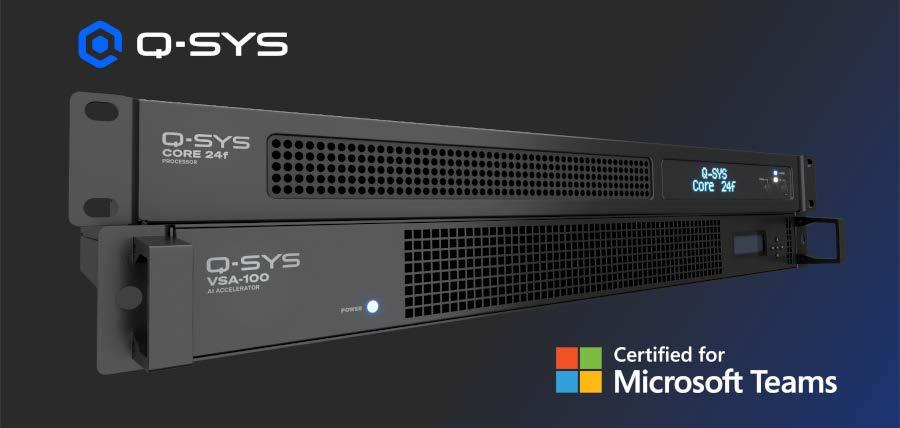
QSC has strengthened its Microsoft Teams offering with the certification of two key Q-SYS products: the Q-SYS Core 24f processor and the Q-SYS VisionSuite VSA-100 AI accelerator.
The new certifications further expand QSC’s growing portfolio of Certified for Microsoft Teams solutions, reinforcing the company’s commitment to delivering enterprise-grade collaboration environments built on tightly integrated hardware, software and cloudmanaged technologies. For organisations designing modern workplaces, the certification provides added assurance of performance, scalability and reliability within Microsoft Teams Rooms deployments.
The Q-SYS VisionSuite VSA-100 brings AIdriven intelligence to the meeting space, enabling advanced room automation and dynamic, autonomous camera framing for more natural and engaging collaboration experiences.
By intelligently responding to participant movement and room activity, the VSA-100 helps remove friction from hybrid meetings while enhancing visual communication.
Complementing this capability, the Q-SYS Core 24f processor offers a powerful and flexible foundation for high-performance collaboration spaces. With robust processing power, increased network capacity and extensive onboard I/O, the Core 24f is designed to support advanced audio, video and control workflows in Microsoft Teams Rooms, including immersive features such as spatial audio.
With these latest certifications, QSC continues to align the Q-SYS platform with Microsoft Teams standards, enabling integrators and IT teams to deploy collaboration solutions with confidence while future-proofing investments in workplace technology.
QSC
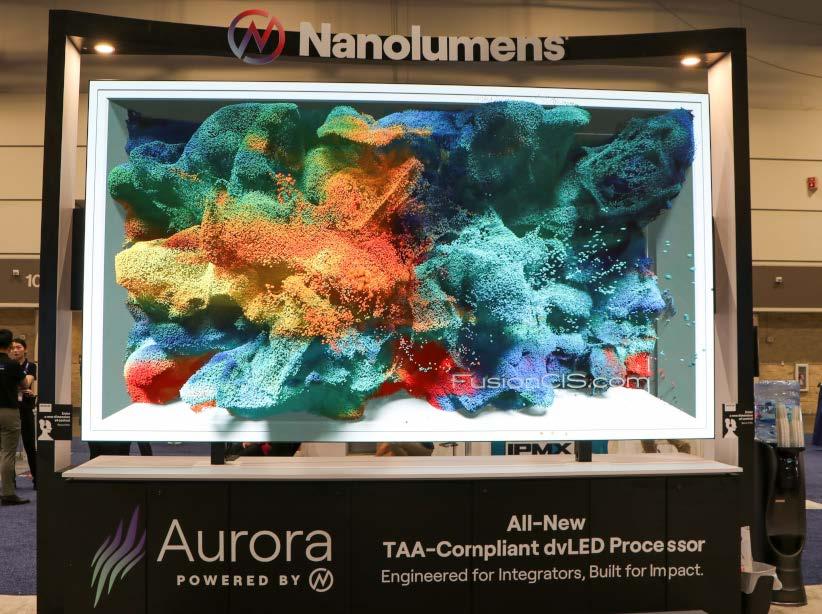
Nanolumens has expanded the capabilities of its Aurora video processing platform with two significant upgrades designed for high-security, mission-critical environments: Active Directory integration and a new Eye Guard visual comfort technology. The enhancements position Aurora as a more scalable and operator-focused solution for organisations managing complex display networks.
The platform now supports Lightweight Directory Access Protocol compatibility with Active Directory infrastructures, allowing enterprises to manage authentication and user permissions through existing IT security frameworks. By enabling centralised credential control, the update simplifies administration while strengthening cybersecurity across large organisations and distributed environments such as transportation hubs and corporate campuses.
Alongside security improvements, Nanolumens has introduced Eye Guard, a proprietary algorithm developed to reduce eye strain during prolonged monitoring sessions. The feature is intended for professionals working in controlintensive environments, including network and security operations centres, where extended screen exposure is unavoidable, and operator performance is closely tied to visual comfort.
Originally launched in mid2025, Aurora was designed to operate exclusively with Nanolumens displays, delivering an integrated processing ecosystem for applications requiring reliability, simplified management and consistent performance.
The TAA-compliant system’s latest updates demonstrate the company’s ongoing investment in enterprise-grade functionality, particularly for sectors where centralised control, uptime and human performance are essential.
With these additions, Aurora is positioned to better support organisations seeking secure, scalable video infrastructure without compromising the usability needs of the teams responsible for continuous monitoring.
Nanolumens/Aurora
Barco UniSee 500+ is the next evolution of the company’s widely adopted UniSee 500 LCD video wall platform. Designed for always-on environments where performance cannot slip, the new platform delivers a noticeable leap in image quality while cutting power consumption by 25%, a rare combination that benefits operators, facilities, and operating budgets alike.
The UniSee 500+ is purpose-built for 24/7 control rooms, high-end corporate boardrooms, and experience centres where visual clarity, reliability, and ergonomics are mission-critical. Visitors to ISE 2026 in Barcelona experienced the platform live and saw firsthand how Barco continues to refine the benchmark for professional LCD video walls.
Since its introduction eight years ago, the Barco UniSee platform has reshaped expectations for LCD video walls. Its patented NoGap™ technology virtually eliminated bezels, delivering a near-seamless canvas, while the UniSee Mount system set a new standard for precision, safety, and ease of installation.
The result has been widespread adoption across thousands of installations worldwide and recognition through multiple industry awards, including the Red Dot Design Award. UniSee quickly became the reference platform for organisations that demand uncompromising visual performance with the lowest total cost of ownership in its class. With UniSee 500+, Barco builds on that legacy—without reinventing what already works.
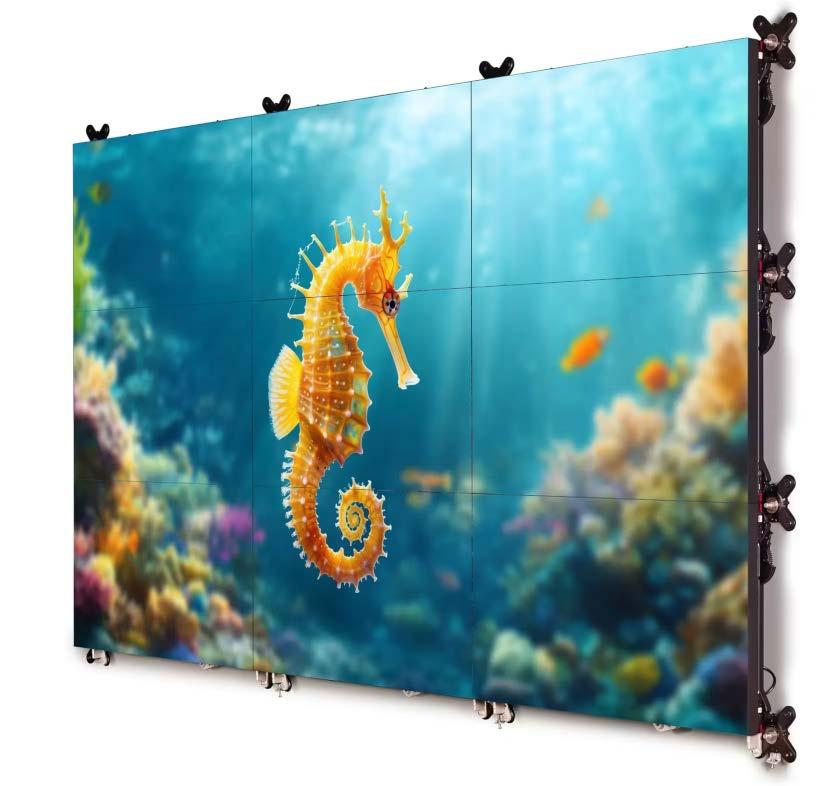
At the heart of UniSee 500+ is a new generation of advanced LCD modules. For the first time in the 500-nit segment, Barco introduces smart local dimming, delivering sharper contrast and more precise visual detail exactly where it matters.
Enhanced inter-panel communication improves uniformity across the entire video wall, minimising visible transitions and inconsistencies. Meanwhile, comprehensive calibration of colour, brightness, and contrast ensures the display can be fine-tuned to perfection and stay that way throughout its operational lifetime. For control room operators, this translates into clearer information, faster interpretation, and reduced visual fatigue.
In environments where screens are monitored continuously, ergonomics are not a luxury. UniSee 500+ addresses this directly
with meaningful upgrades for operator comfort and system safety.
The platform now meets EMC Class B certification, significantly reducing electromagnetic emissions compared to the previous Class A standard. This results in a safer working environment, less interference with nearby equipment, and easier compliance across installations.
Heat radiation has also been reduced, contributing to more comfortable control room conditions during long shifts. Expanded software monitoring provides deeper visibility into panel health and lifecycle indicators, enabling proactive maintenance, minimising downtime, and protecting long-term performance.
UniSee 500+ proves that sustainability and performance can go hand in hand. With 25% lower power consumption than its
predecessor, the platform delivers immediate operational savings while supporting organisational energy and sustainability goals.
These improvements have earned UniSee 500+ Barco’s A+ Eco score, reinforcing its position as one of the most environmentally responsible solutions in its category, without compromise.
Barco UniSee 500+ is TAA compliant and will be available for order from end Q1 2026 through Barco’s global partner network. The platform remains fully compatible with the established UniSee ecosystem, including the UniSee Mount, InvisiMount: Barco’s sleek mounting solution with no visible wall crosses. It is also compatible with existing power supply options, ensuring seamless upgrades and new deployments.
Barco/UniSee 500+
Pleneo is taking aim at one of enterprise collaboration’s most persistent challenges: scaling simplicity into large and complex meeting spaces. With the launch of its first hardware ecosystem, Pleneo is extending its Room OS platform beyond standardised meeting rooms into auditoria, town halls and allhands environments, while maintaining a single, predictable operating model.
As organisations roll out AI-enabled meeting experiences across global estates, large rooms have increasingly become the weak link. Inconsistent room designs, fragmented audio and video systems, and manual configuration often undermine reliability, usability and the effectiveness of AI-driven tools. Pleneo’s new hardware ecosystem is designed to eliminate that friction by bringing the same operational consistency to medium, large and specialist spaces.
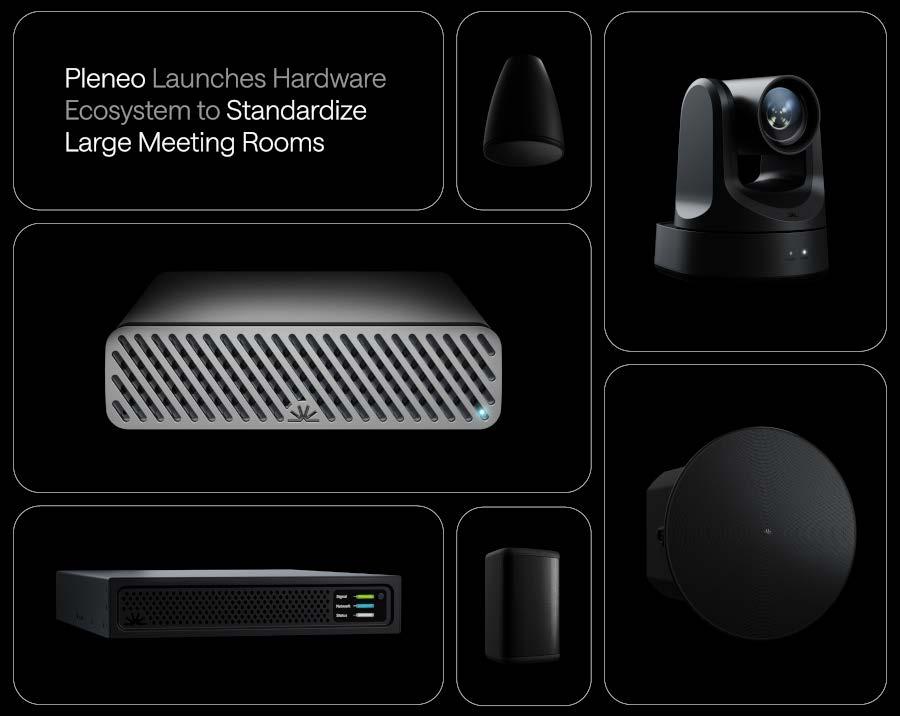
At the core of every Pleneo deployment is RoomHub, which delivers Room OS intelligence directly into the room. With this release, Pleneo expands the hardware surrounding RoomHub to create a fully Room OS–native solution for medium and large spaces.
The new RoomVision camera range provides native video capture optimised for Room OS environments. RoomVision offers 12× optical zoom with 1080p output for medium-sized rooms, while RoomVision XL increases this to 20× optical zoom with 4K output for larger venues. Both models include onboard AI presenter tracking, AI autoframing and support for IQ Director voice tracking, ensuring accurate participant capture across a range of meeting formats.
On the audio side, RoomDesign Ceiling introduces a PoE-powered, networked 6.5-inch in-ceiling loudspeaker designed specifically for speech clarity and immersive sound. Automatic AudioIQ room calibration simplifies installation by removing the need for specialist tuning, while flexible mounting and finish options support a wide range of architectural requirements.
For larger or more demanding spaces, Pleneo is introducing RoomAmp Pro X, an all-in-one Room OS device hub designed for challenging layouts and distributed audio systems.
RoomAmp Pro X combines room management, audio and video intelligence, cloud connectivity and amplification into a single halfrack-width unit. With four channels delivering up to 200W each and support for 100V, 70V or 8-ohm systems, it enables large-scale loudspeaker deployments while preserving the same deployment and management experience used in standard meeting rooms. Built-in Auracast™ support also enables assistive listening without additional infrastructure.
To complete the ecosystem, Pleneo is launching the RoomDesign Pro loudspeaker family, available in ceiling, pendant and surfacemount formats, alongside the RoomAmp Pro 200 networked amplifier for scalable, multiroom and large-venue installations.
As AI-driven meeting features such as transcription, translation, summaries and speaker attribution become standard, their effectiveness increasingly depends on consistent, high-quality audio and video inputs, particularly in larger spaces where performance often degrades.
By standardising room behaviour and ensuring predictable system performance, Pleneo’s hardware ecosystem provides the physical foundation needed for AI-enabled meeting assistants to operate accurately and reliably across the enterprise, while enabling faster, more scalable deployments.
Pleneo/RoomDesign Pro
There are major updates across Absen’s core product families, each addressing a distinct segment of the professional AV landscape.
The SA1.5 COB represents the next evolution of Absen’s Saturn rental platform. Designed with a 1.5mm pixel pitch and advanced flip-chip COB technology, the display delivers enhanced visual quality and robustness for demanding rental environments. Its dual-layer die-cast magnesium cabinet improves durability while supporting fast locking, full front and rear maintenance access, and backward compatibility with existing SA-series accessories. By bringing COB into small-pitch stage applications, SA1.5 positions itself at the forefront of next-generation rental LED.
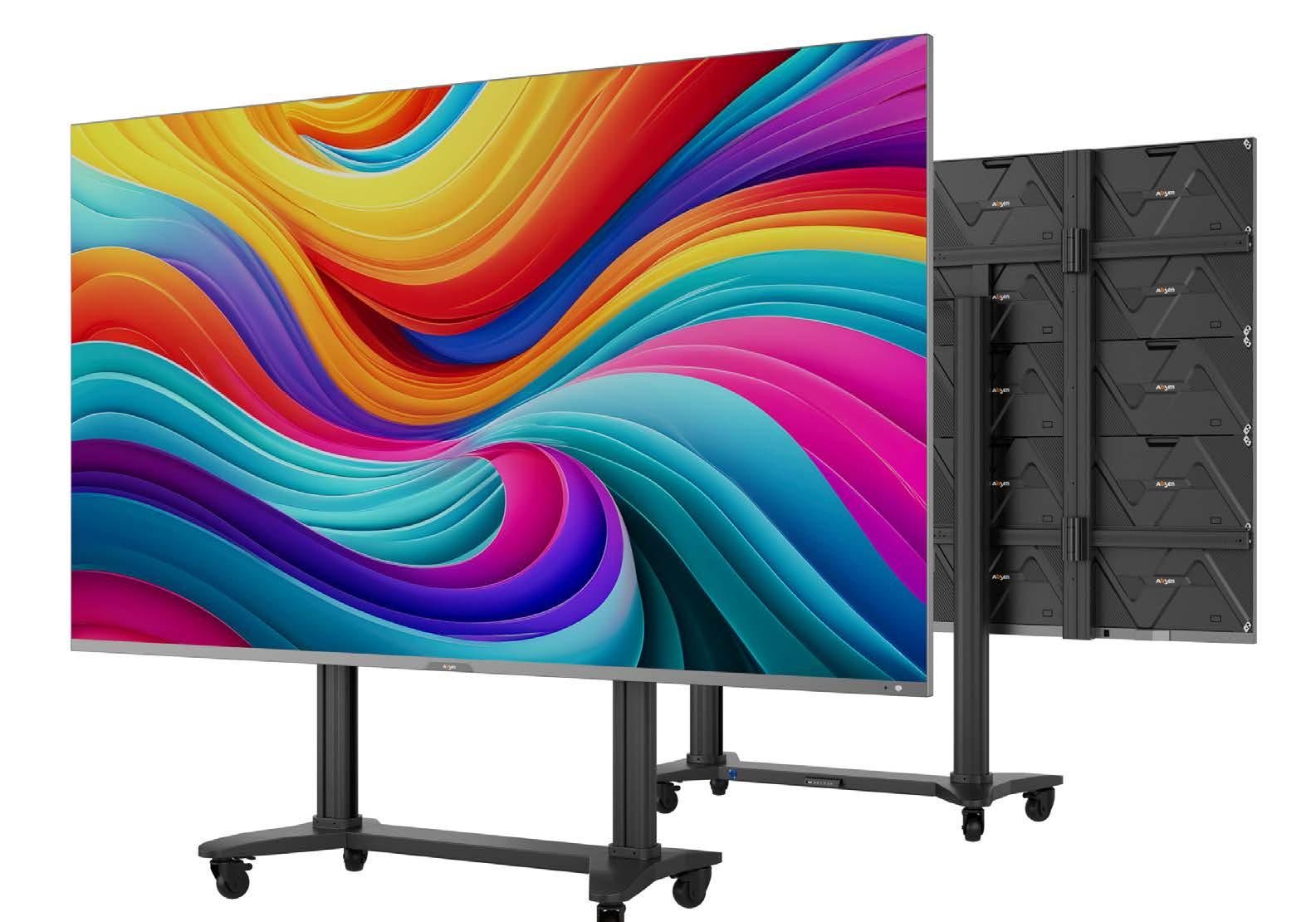
Absen’s flagship CL V3 (Clear Cobalt Series V3) pushes visual performance further through Micro LED technology and the company’s Black Matrix process, achieving deep black levels and exceptional contrast. Panel-level integrated packaging protects critical components, ensuring reliable operation across a wide range of environments and setting a new benchmark for premium professional displays.
For outdoor applications, AW Pro introduces an ultra-HD fine-pitch solution built specifically for digital out-of-home. Featuring P1.25 flip-chip COB technology, AW Pro delivers sharp, close-view visuals even in outdoor conditions. A streamlined mechanical design and intelligent cluster management simplify installation and maintenance, while all-weather reliability makes it suited to modern urban environments.
Absen has also debuted the X136F foldable screen , an all-in-one LED solution that builds on the success of the Absen Icon X series. Its foldable design dramatically simplifies transport, setup and deployment, making large-format LED more practical for corporate meeting rooms and educational spaces.
Absen

Vizrt is extending its broadcast heritage into the enterprise with the launch of two new AIpowered solutions for Zoom: InteractifAI and CaptivAIte.
Developed in close partnership with Zoom, the AI-first collaboration platform, the new tools bring broadcast-quality graphics, augmented reality (AR) and automation directly into Zoom Meetings and Zoom Rooms, transforming how organisations deliver product launches, training sessions, town halls and executive communications to internal and external audiences worldwide.
Designed for simplicity and scale, InteractifAI enables everyday Zoom users to overlay professional, on-brand graphics directly onto
participant video streams, thus eliminating static slide decks and elevating visual storytelling.
Using an intuitive interface with one-click templates, users can add dynamic elements such as names, job titles, agendas, logos, QR codes and live data sources, all customised to brand guidelines. As a Zoom App built on the Zoom Surface Framework, InteractifAI runs natively alongside Zoom Meetings, allowing participants to see broadcast-quality visuals instantly—without interrupting the flow of the presentation.
The solution supports real-time interactivity by pulling in content from social media, documents and multiple file formats, enabling presenters to maintain eye contact and engagement without stepping off-screen or managing complex workflows.
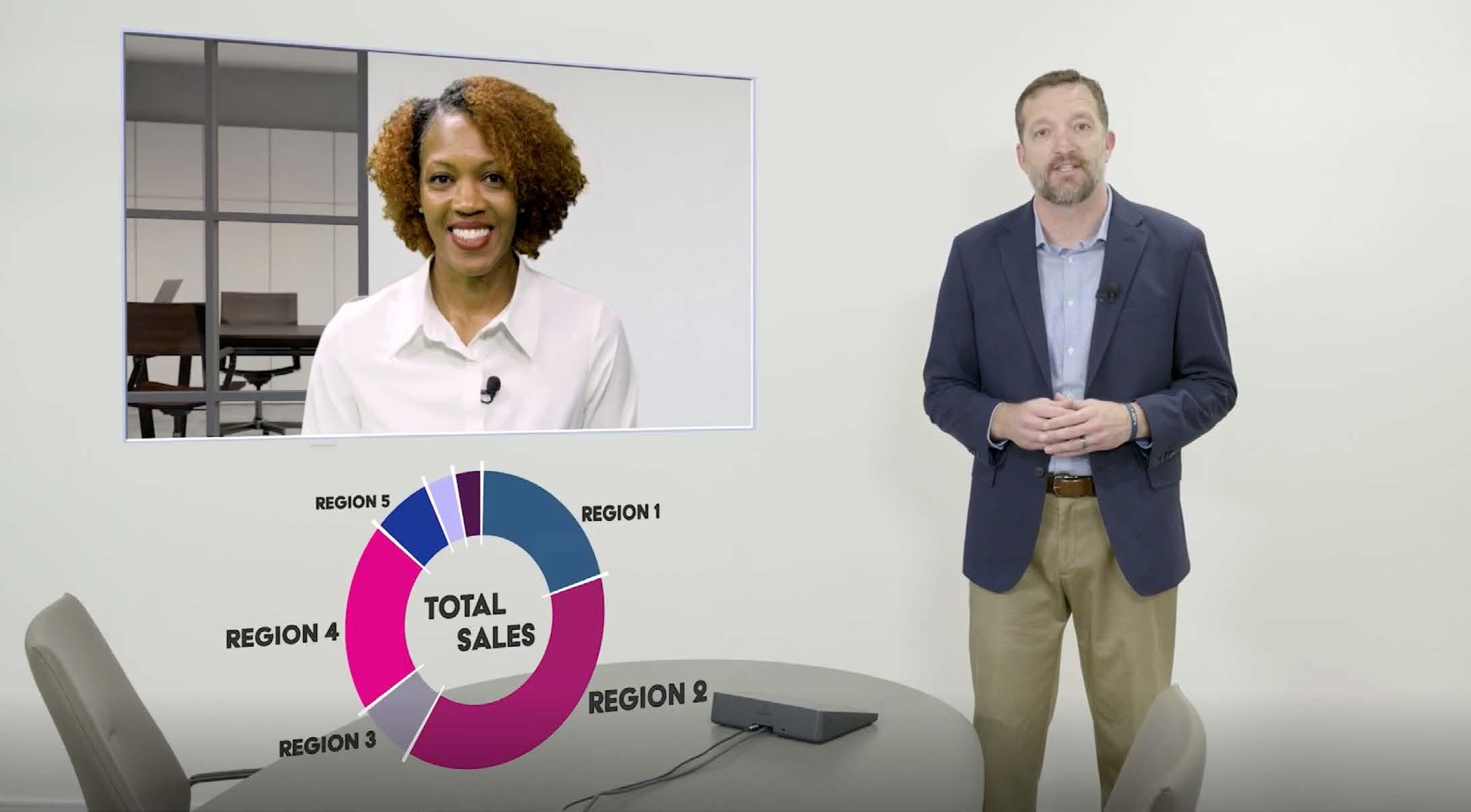
For higher-impact enterprise environments, CaptivAIte brings AI-driven augmented reality directly into Custom AV Zoom Rooms, transforming meeting spaces into professional-grade production studios.
Powered by Vizrt’s AI Keyer, CaptivAIte enables real-time AR graphics creation and insertion without the need for green screens or complex setups. Presenters can replace flat slides with immersive visuals, while features such as remote contributor “teleportation” add a new dimension to hybrid collaboration.
The solution builds on Zoom's recent integration of NDI, the AV-over-IP video connectivity standard, streamlining workflows and allowing presenters to focus entirely on message delivery while maximising audience impact.
The launch underscores the long-standing collaboration between Vizrt and Zoom, with Vizrt now joining the Zoom ISV Exchange Program. This enables customers to purchase InteractifAI and CaptivAIte directly through Zoom, simplifying procurement and deployment.
InteractifAI and CaptivAIte are available to Zoom users now.
Vizrt/Zoom
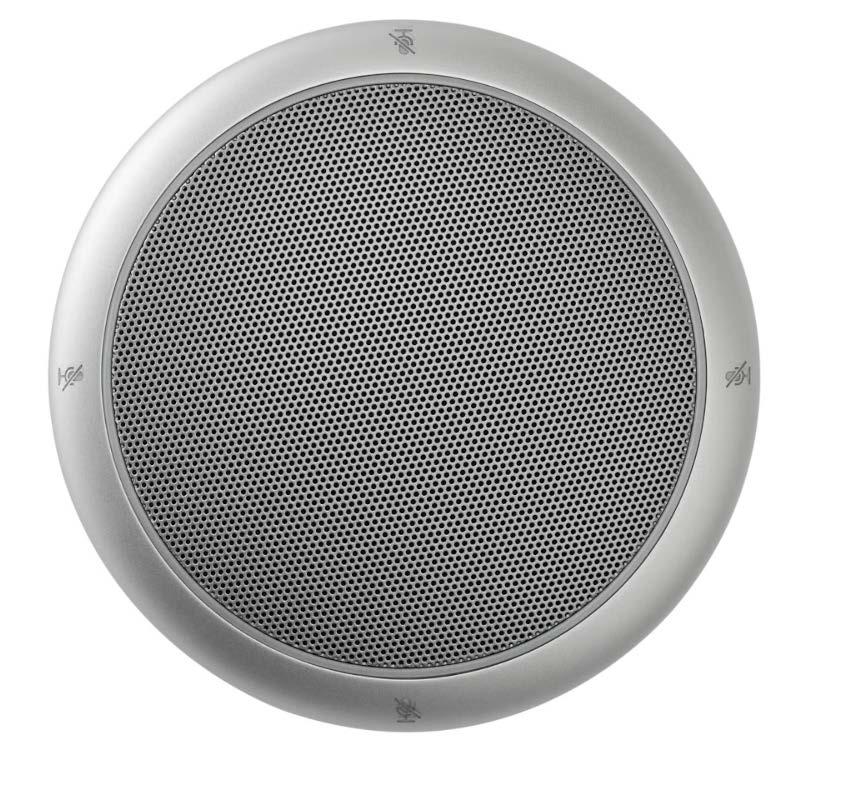
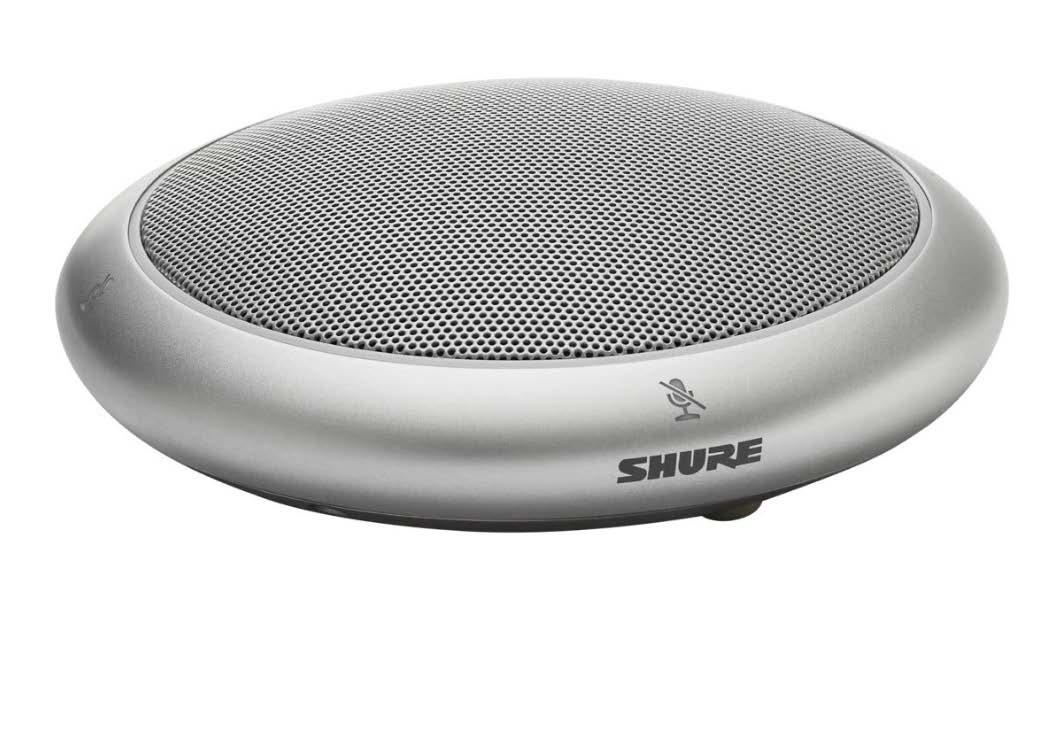
Shure has introduced the new Microflex Advance MXA320 Table Array Microphone, marking the next phase in the company’s enterprise collaboration portfolio expansion. Building on the familiar industrial design of the widely adopted MXA310, the MXA320 has been engineered as a low-profile, networked table microphone solution that prioritises ease of deployment and scalability for IT and AV professionals across a wide range of conferencing environments.
The MXA320 delivers a refined audio experience through enhanced Steerable Coverage Technology, enabling more precise voice capture and improved intelligibility during meetings. Certified for both Microsoft Teams and Zoom, the microphone integrates
onboard IntelliMix processing, simplified configuration via Designer software, ShureCloud compatibility, and an integrated mute control, all within a compact footprint designed for modern collaboration spaces.
The Microflex Advance MXA320 Table Array Microphone is scheduled for release in Spring 2026 through Shure’s authorised channel partners, including the Middle East and Africa regions.
Shure/Microflex Advance MXA320




The Alliance for IP Media Solutions (AIMS) marked a defining moment for professional AV-over-IP with the official launch of Internet Protocol Media Experience (IPMX) as a fully developed, certifiable standard. ISE 2026 became the first major industry platform to showcase formally certified IPMX products — a milestone that signals IPMX’s transition from specification to deployable, marketready technology. SI Asia took the opportunity to chat with Andrew Starks, AIMS Board Member and Marketing Work Group Chair , about this significant moment and the future moving forward.
ISE 2026 marks the official launch of IPMX as a fully developed, certifiable standard. What were the most critical technical and organisational milestones that enabled IPMX to move from a developing specification to a deployable, certified ecosystem?
IPMX certification was the result of a series of technical and organisational milestones over several years.
Organisationally, the foundation was laid in 2019 when AIMS formally approached
both the Video Services Forum (VSF) and Advanced Media Workflow Association (AMWA) to collaborate on bringing open, broadcast-based standards into the Pro AV market through the IPMX brand. Both organizations agreed to participate, and each played a distinct role. VSF created the IPMX Working Group and developed the core technical recommendations in the TR-10 documents. AMWA extended NMOS to address Pro AV requirements, including EDID handling and additional control-plane signaling necessary for HDCP and related IPMX capabilities. That decision to align across organizations in 2019 was the true starting point of IPMX as a coordinated industry effort.
At ISE 2020, AIMS formally launched the IPMX initiative and brand. That moment, just before the COVID shutdown, marked the public beginning of the effort. At that show, Macnica demonstrated the first public implementations of ST 2110-22 running 4K video over 1GbE infrastructure at the AIMS booth, showing that high-quality, standardsbased transport could operate within typical Pro AV network constraints.
From a technical perspective, the critical milestone was not inventing new transport, but defining behavior with enough precision to achieve real-world interoperability in
Pro AV environments. ST 2110 and NMOS already existed, but Pro AV required additional constraints and requirements. NMOS could no longer be optional as it was in broadcast systems. It needed to be mandatory, and it needed tighter definition to ensure consistent discovery, registration, and connection management in a wide variety of environments. The VSF TR-10 specifications and the AIMS IPMX definition documents provided that additional structure. They clarified profiles, timing models, compression options, HDCP handling, and operational expectations so that multivendor systems would behave predictably in practice.
The first large-scale, hands-on interoperability milestone came in 2023 at the initial IPMX “dirty hands” testing event hosted at the NFL facility in Inglewood, California. That event brought early adopters together to validate assumptions, expose edge cases, and refine specifications based on actual device behavior. It was a turning point from paper specification to demonstrated multivendor interoperability.
The formal completion of the first IPMX Product Testing and Certification Event on February 23, 2026 marked the final transition from development to accountability. At that moment, IPMX moved from a promising technical framework to a verified, certifiable ecosystem.
The inaugural IPMX Product Testing and Certification Event was hosted at the European Broadcasting Union in collaboration with the VSF and AMWA. How significant was this event in validating realworld interoperability, and what did you learn from the first wave of product testing?
The inaugural IPMX Product Testing and Certification Event at the EBU was far more than a technical checkpoint. It was the moment IPMX was born.
For the first time, we ran the full certification process end to end. Devices were independently tested. Procedures were validated. Administrative workflows were exercised. The public IPMX Registry made its first appearance. On top of validating the specifications, we showed that the ecosystem could function with transparency and accountability.
Holding the event at the European Broadcasting Union, in collaboration with AIMS, VSF and AMWA, was both symbolically and practically significant. It reinforced that IPMX is not only a vendor initiative. It is a coordinated effort across organizations that have decades of experience developing open media standards. For many of us who worked on IPMX, it felt like a historic moment. For the first time in decades, Broadcast and Pro AV were not operating on parallel infrastructures. They were validating products against a shared foundation.
From a technical standpoint, the event confirmed that multivendor interoperability is achievable, but it requires patience and precision. It takes far longer than most expect to define an open, interoperable framework that behaves consistently across vendors. Making something flexible is relatively straightforward. Making it both flexible and simple to deploy is much harder. That lesson was reinforced during the development of ST 2022 and ST 2110, both of which originated in the VSF before becoming SMPTE standards. That experience proved invaluable to IPMX.
IPMX is built on SMPTE ST 2110 and integrates AMWA NMOS for control. In practical deployment terms, how does IPMX reduce integration complexity compared to proprietary AV-over-IP systems?
At a technical level, most proprietary AV-overIP systems rely on the same foundational IT technologies. They use UDP, multicast,
standard Ethernet switching, and in many cases PTP for timing. Audio ecosystems such as Dante and AES67 are already familiar in Pro AV, and AES67 forms the basis for both ST 2110-30 and IPMX uncompressed audio.
The difference is not in the packets themselves as much as it is in how behavior is defined, constrained, and verified.
Proprietary platforms often provide strong integration within a single vendor ecosystem. However, interoperability across vendors depends on whether implementation details align, and that alignment is not always enforced. In some cases, silicon platforms make interoperability possible, but do not mandate uniform behavior at the system level.
IPMX approaches the problem differently. It builds on ST 2110 for media transport and makes NMOS mandatory for discovery and connection management, with additional constraints to ensure consistent behavior across implementations. Profiles and definition documents clarify how devices must handle timing models, compression, HDCP, privacy encryption, and other operational requirements. Certification then verifies that those behaviors are implemented correctly, not simply claimed.
In practical deployment terms, this reduces integration complexity in multivendor environments. System integrators are not forced to reverse engineer control workflows or rely on vendor-specific gateways to bridge ecosystems. Instead, devices share a common transport and control framework from the outset.
Ultimately, IPMX reduces complexity not by simplifying the underlying networking, but by standardizing expectations across vendors. That predictability lowers integration risk and supports long-term system scalability.
IPMX brings broadcast-grade standards into the Pro AV space. How does it successfully balance the robustness of ST 2110 workflows with the simplicity and scalability required for corporate, education, and live event environments?
IPMX retains availability for robust, broadcast-grade transport while introducing operational flexibility, defined profiles, and scalable timing models that align with how Pro AV systems are deployed.
ST 2110 was designed for tightly synchronized, large-scale live production environments where deterministic timing is essential. That model remains critical in broadcast facilities. IPMX preserves that capability by supporting fully synchronous operation with PTP for environments that require frame-accurate alignment.
At the same time, IPMX recognizes that many Pro AV deployments do not operate inside tightly engineered timing domains. Corporate, education, and event environments often require simpler deployment models and must coexist with broader IT infrastructure. IPMX therefore supports both synchronous and asynchronous operation. Systems can operate with or without PTP, allowing integrators to scale complexity according to the application rather than imposing a single timing model on every deployment.
Another important element is stream selfdescription. IPMX leverages RTP and RTCP sender reports to provide dynamic media description and timing information directly within the stream. This allows receivers to understand format characteristics and timing behavior without relying entirely on static configuration. In practical terms, that reduces friction during setup and enables more dynamic system behavior.
The timing model itself was also refined for Pro AV use cases. The TR-10-1 specifications define receiver buffer models that are intentionally more tolerant than traditional broadcast assumptions. Rather than requiring ultra-tight alignment at every stage, the VRX buffer definitions provide clear bounds for latency and jitter while allowing flexibility in how endpoints implement buffering. This relaxed but defined timing behavior enables interoperability across devices with different performance envelopes, including software implementations, while maintaining predictable results.
Compression profiles further contribute to scalability. IPMX includes profiles for JPEG XS to enable visually lossless transport over 1GbE infrastructure, which is common in Pro AV. Work is also underway to expand support for widely deployed codecs such as H.264 and H.265, reflecting the practical realities of existing infrastructure and workflow requirements.
The result is not a simplification of ST 2110, but an adaptation and additional constraints.
At Integrated Systems Europe 2026, we are seeing the first formally certified IPMX products. What message does this send to system integrators and end users who have been cautious about adopting open AV-overIP standards?
The message is that IPMX is real, and it is deployable.
With the first wave of formally certified products introduced at ISE 2026, IPMX moves beyond specification and early demonstrations into a verified ecosystem. Certification confirms that these products have been independently tested for multivendor interoperability.
The launch included 48 certified products, which is a strong starting point. More importantly, it establishes momentum. Certification creates clarity for manufacturers and confidence for integrators. It defines what compliance means and provides transparency through the IPMX Registry.
For system integrators, consultants, and end users who have been cautious about open AV-over-IP standards, this is the inflection point. Open systems are now represented by validated interoperable products.
The next step belongs to the market. When end users and consultants begin specifying IPMX in projects, manufacturers respond. The more demand there is for open, multivendor solutions, the broader and deeper the ecosystem becomes.
For anyone who has been waiting for proof that an open AV-over-IP ecosystem can function at scale, that proof is now visible. It is time to begin planning, specifying, and deploying IPMX-based systems.
Features such as 4K60 over 1GbE, asynchronous audio and video, HDCP support, and JPEG XS compression are central to IPMX. Which of these capabilities do you believe will have the most immediate impact in real-world Pro AV deployments and why?
In the near term, 4K60 over 1GbE will likely have the most immediate impact simply because it aligns with how most Pro AV networks are already built. One gigabit switching remains the dominant infrastructure in corporate, education, and event environments. Many proprietary platforms already operate effectively within that bandwidth envelope. What matters in the IPMX context is that this level of performance is now available within an open, multivendor framework.
JPEG XS plays an important role in achieving that balance. It enables high image quality with predictable latency while staying within practical bandwidth limits. For integrators, this means they can design systems that meet user expectations without forcing unnecessary network upgrades.
That said, some of the most consequential capabilities may be less visible to end users. HDCP handling, aligned with DCP requirements and supported through a standardized key exchange mechanism called HKEP, is essential in real-world deployments. Studio protected content is common in Pro AV. Having a defined, interoperable way to manage HDCP across vendors removes a significant source of integration risk.
Privacy Encryption Protocol is another capability that will grow in importance. As AV systems become more integrated into enterprise IT environments, encryption is no longer optional. IPMX provides a standardized path for multivendor encrypted AV transport, which is particularly relevant in corporate, government, and higher education settings.
IS-11 support for EDID management also deserves attention. EDID behavior has historically been a source of unpredictable results in mixed systems. A structured, interoperable approach to EDID control reduces troubleshooting time and increases system predictability.
So while 4K60 over 1GbE may drive initial adoption because it fits existing infrastructure models, the longer-term impact will come from the less visible elements: interoperable HDCP, standardized encryption, and defined control-plane behavior. Those are the capabilities that make open AV-over-IP systems viable at scale.
The AV-over-IP market has long been dominated by proprietary platforms. Do you see IPMX as a disruptive force in this landscape, and how do you anticipate manufacturers responding over the next 12–24 months? Please also let us know as of now how many manufacturers are ready to deploy IPMX platform solutions and when will this hit the market?
I PMX is not disruptive in the sense of replacing everything that exists. It is disruptive in the sense that it changes expectations.
The AV-over-IP market has matured rapidly over the past decade, largely through proprietary ecosystems. Those platforms delivered important innovation and proved that AV could move successfully onto IT infrastructure. IPMX builds on that foundation, but introduces a different value proposition: multivendor interoperability anchored in open standards.
At launch, we have 48 certified products from 11 manufacturers. That represents meaningful participation across silicon providers, endpoint manufacturers, and infrastructure vendors. It is an important starting point, not the end state.
Over the next 12 to 24 months, we expect two parallel responses from the market.
First, manufacturers that are already aligned with open standards will expand their IPMX portfolios. As additional certification events take place this year and next, the number of certified products will grow. We have additional testing events planned, and the goal is to transition toward regularly scheduled, independently administered certification within the next 18 to 24 months. That level of institutionalization is what turns a standard into a long-term ecosystem.
Second, we will see increased interest from vendors that have historically operated within proprietary frameworks. Some may choose to add IPMX support alongside their existing platforms. Others will monitor demand signals from consultants and end users. Open standards adoption in this industry has always been demand-driven. When specifications begin appearing in RFPs, participation accelerates.
The broader pattern, based on past industry transitions, is gradual convergence rather than abrupt replacement. IPMX will coexist with proprietary systems for years. The difference is that system designers now have a credible, certified open alternative.
For manufacturers, the message is clear. The ecosystem is forming. Certified products are shipping. Additional test events are scheduled. Now is the time to evaluate where IPMX fits within long-term product strategy.
For integrators and end users, the message is equally clear. Open, multivendor AV-over-IP is no longer a future concept. It is entering the market now, and its trajectory over the next two years will be shaped by how actively it is specified and deployed.
Now that certification is in place and products are entering the market, what are the next priorities for IPMX in 2026 and beyond — particularly in terms of training, ecosystem expansion, and global adoption?
The next phase for IPMX is about scale and enablement.
Training is a top priority. An open standard only succeeds if the market understands how to deploy it correctly. We are launching the IPMX training platform this year, with early access opening soon and the first formal sessions beginning at NAB. The goal is to
provide structured education for designers, technicians, and engineers so that IPMX deployments are predictable and repeatable across regions and vertical markets.
On the certification front, we have additional testing events scheduled this year. These events will expand both participation and scope. Upcoming milestones include adding formal certification for HDCP and Privacy Encryption Protocol, both of which are critical for enterprise and institutional deployments. We are also working toward expanding codec support to include H.264 and H.265, reflecting the practical realities of existing infrastructure and workflow requirements.
Interoperable USB transport has already been specified and will move to “dirty hands” interoperability events to continue refining implementation details through direct, multivendor collaboration.
Ecosystem expansion is equally important. IPMX was designed to be global from the outset, and adoption efforts are underway across North America, Europe, and Asia. As more certified products enter the market and training expands, the focus shifts to helping consultants, integrators, and end users confidently specify IPMX in real projects.
The next stage is less about defining the standard and more about operationalizing it. Certification, training, expanded profiles, and global engagement together form the foundation for long-term adoption.
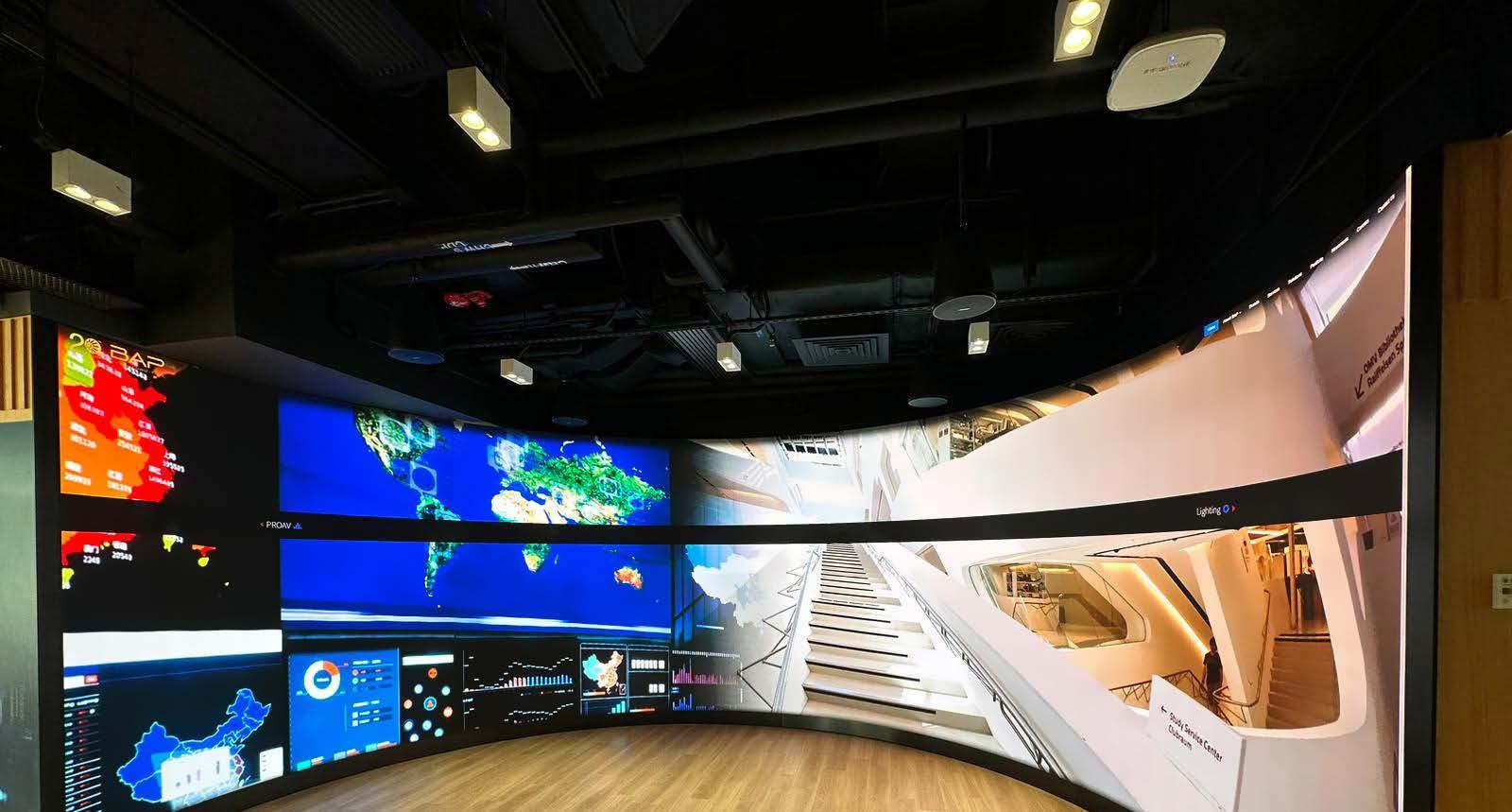
Hybrid is no longer a contingency plan. It is the new baseline.
As educational institutions across Asia Pacific and beyond rethink how learning is delivered, AV is no longer viewed as a support function—it is becoming a strategic enabler of pedagogy. For this feature, Finson Lam, Managing Director of BAP Technology Consultants , and Chris Pitsillides, Chief Technology Officer of ESCO , share how systems integrators are reshaping classrooms, immersive labs and campuswide AV ecosystems to meet evolving expectations.
Their message is clear: the future of education AV lies in intentional design,
measurable outcomes and long-term adaptability.
For years, hybrid learning was treated as an extension—an add-on camera, a conferencing licence, a temporary fix. That mindset has shifted.

“Hybrid classroom is no longer an addon; it’s the default operation mode of the modern classroom,” says Finson Lam. Instead of layering remote capabilities
onto physical spaces, integrators must now design hybrid classrooms as a single, unified learning system—where in-room and remote students are treated as equal participants.
This requires deep integration between AV systems, Learning Management Systems (LMS) and collaboration platforms to ensure visual clarity, audio intelligibility and interaction parity.

From a technical perspective, Chris Pitsillides explains that equity begins with infrastructure:
* Multi-camera tracking systems
* Intelligent speaker framing
* Ceiling-based microphone arrays
* Comprehensive content capture—including whiteboards and student discussions
The goal is to eliminate the “passive observer” experience typical of legacy video conferencing. Camera placement must capture classroom dynamics—not just the lecturer—while an audio-first design ensures remote participants can hear and be heard as naturally as those physically present.
Critically, workflows, sightlines and teaching modes must be planned upfront. As both experts stress, system integrators should be designing for two equal audiences.
Experiential learning spaces—immersive labs, simulation rooms and interactive studios— are gaining traction as institutions prioritise active, hands-on education.
“Students primarily learn by doing,” says Chris. But innovation must serve pedagogy— not novelty. Spatial audio, interactive displays, projection systems and even AR/VR should only be deployed where they directly
enhance the learning objective.
Finson echoes this principle of “fit for purpose.” The most successful immersive environments are those where technology directly supports teaching outcomes. In STEM, medical and design-focused spaces, solutions such as:
* Large-format LED displays
* Real-time data visualisation systems
* AR/VR-ready infrastructure
* Spatial audio environments have proven especially effective.
Balancing innovation with budget, however, requires discipline. Both leaders advocate a modular approach. Core AV infrastructure should be future-ready, while immersive elements can be introduced in phases as curriculum needs and funding evolve.
Standards-based technologies—AV-over-IP architectures, open APIs and interoperable control systems—help avoid vendor lockin and protect long-term investment. The result is scalability without costly full-system replacement.
Educators operate under immense time pressure. If technology slows down a class, it undermines its purpose.
“The AV should be invisible—that’s the indicator it’s working well,” says Chris.
For Finson, the key lies in separating operational simplicity from technical complexity. Most classroom scenarios should launch in one or two touches— “Start Class” or “Hybrid Session”—with the system automatically configuring cameras, microphones, displays and collaboration tools.
Behind that simplicity lies rigorous engineering:
* Fail-safe system design
* Redundancy at critical layers
* Real-world pre-commissioning tests
* Continuous diagnostics and proactive maintenance
When reliability is embedded into the architecture, educators can focus entirely on pedagogy rather than troubleshooting.
Cost Centre to Strategic Asset: The Rise of AV Analytics
AV data is quietly transforming how institutions evaluate and justify technology investments.
Usage analytics, system monitoring and occupancy data now provide objective insights into how spaces are actually used— not merely how they were intended to be used.
Chris notes that analytics reveal which spaces are fully utilised and which technologies truly support teaching. Finson adds that such data enables evidence-based decisions: reallocating resources, refining room design or justifying further investment to stakeholders.
From a systems integration standpoint, analytics also enable predictive maintenance, reducing downtime and extending equipment life.
In this data-rich environment, AV shifts from being perceived as a necessary expense to becoming a measurable learning enabler.
If there is one consistent theme from both leaders, it is this: future-proofing is not about predicting the next device. Instead, it is about building flexible, softwarecentric ecosystems.
Chris emphasises the importance of robust network infrastructure as the backbone of
adaptability. A strong, scalable network allows institutions to integrate AI-driven tools, add or remove devices and adjust teaching methodologies without wholesale redesign.
Finson points toward network-based architectures, virtualised signal processing and open control systems capable of integrating intelligent camera behaviour and real-time learning analytics. Future deployments must anticipate deeper interaction between AV, institutional IT systems, LMS platforms and emerging AI engines.
Most importantly, future-proofing means designing for change:
* Flexible room layouts
* Scalable infrastructure
* Open, interoperable systems
* Early collaboration between AV, IT and academic stakeholders
In this model, AV is no longer a short-term technical deployment—it becomes a longterm strategic platform supporting evolving pedagogy and rising student expectations.
The transformation of learning spaces is no longer incremental. Hybrid equity, immersive experiences, intuitive operation, measurable performance and adaptable infrastructure are becoming baseline expectations.
As institutions navigate AI-driven tools, data-informed teaching and shifting learner behaviours, the role of systems integrators is expanding—from technology installers to strategic education partners.
And in this new era of AV in Education, success will belong to those who design not for today’s classroom, but for tomorrow’s learner.
BAP Technology Consultants
ESCO

As hybrid learning cements itself as the global standard, educational institutions are rethinking not just technology—but the very architecture of engagement. At the forefront of this shift is Nigil Antony, PMP, CTS, Divisional Manager – Technology at Global Schools Group (GSG) , who oversees technology strategy across campuses.
For Nigil, the evolution of learning spaces has been neither reactive nor experimental. Instead, it has been deliberate—rooted in continuity, collaboration and future readiness.
Long before hybrid became a buzzword, GSG classrooms were designed with audio reinforcement systems embedded from day one. That early foundation proved critical when the pandemic accelerated the need for fully remote and hybrid instruction.
To ensure seamless continuity, GSG installed video conferencing equipment— including cameras and codecs—across all learning spaces. The result was immediate connectivity:
* Classroom-to-classroom collaboration
* Classroom-to-remote student engagement
* Campus-to-campus interaction across global locations
What began as a response to disruption has since evolved into a permanent hybrid learning model. Today, GSG is systematically deploying hybrid learning rooms across all its campuses worldwide, reinforcing the belief that hybrid education is not a temporary solution but a structural transformation.
The focus is not merely on connectivity—but on maintaining meaningful engagement for both in-person and remote learners.
Experiential learning has always played a critical role in education. Traditional laboratories remain essential—but Nigil believes technology can elevate their impact.
Simulation-ready labs now enhance student output in controlled, safe environments, enabling deeper experimentation and practical application. Across GSG schools, TV and Radio studios are also central to student expression—serving as platforms to record, broadcast and share ideas.
With the growing importance of podcasts and digital media, these facilities are being transformed into fully equipped production studios with the latest technologies. In what Nigil describes as the “content era,” students are not just consuming information—they are creating it.
By integrating advanced production capabilities into learning spaces, GSG ensures students develop both technical
fluency and creative confidence, strengthening their readiness for the future.
In a market flooded with emerging AV innovations, Nigil emphasises a disciplined approach: technology adoption must align with pedagogical goals.
At GSG, investment decisions are never made in isolation. Technologists collaborate closely with the primary “users” of the system— parents, students and teachers. Surveys are conducted, pros and cons are evaluated, and awareness is raised before adoption.
The goal is clear: 100% utilisation.
If new systems require extensive training to avoid becoming “white elephants,” so be it. Multiple training sessions are conducted to ensure effective use. For Nigil, unused technology represents not innovation—but inefficiency.
Introducing new AV-enabled spaces is only half the journey. Ensuring faculty confidence and competence is equally critical.
Nigil acknowledges that change management can be challenging. GSG begins by demonstrating how current teaching practices can be enhanced through technology—not replaced by it. Establishing this mindset is the first step toward adoption.
Once confidence is built, structured training follows—often delivered in partnership with system integrators or OEM trainers. Nigil notes a measurable difference between in-house and third-party training outcomes, reinforcing the importance of specialised expertise in driving successful implementation.
The strategy is clear: empower educators first, and technology adoption will follow naturally.
Looking ahead, Nigil sees higher education demanding even more advanced AV integration. As student numbers grow and global collaboration intensifies, learning spaces must function as highly capable virtual studios—capable of connecting seamlessly with institutions worldwide.
To fully leverage emerging technologies such as AI and blockchain, Nigil envisions each learning space equipped with a high-end “X-Factor” studio capability—environments that support collaboration, creativity and realtime global interaction.
In this model, the classroom is no longer confined by walls or geography. It becomes a globally connected hub for knowledge exchange.
For Global Schools Group, AV is not a short-term upgrade—it is a long-term educational strategy. By embedding hybrid capability, enhancing immersive production environments, aligning technology with pedagogy and prioritising faculty empowerment, GSG is building learning spaces designed for both resilience and reinvention.
As hybrid education becomes the norm and student expectations continue to evolve, institutions that treat AV as a strategic enabler—rather than a technical accessory— will define the next chapter of global learning.
Global Schools Group
India’s largest public sector bank strategic hub has premier AV design
By Ram Bhavanashi
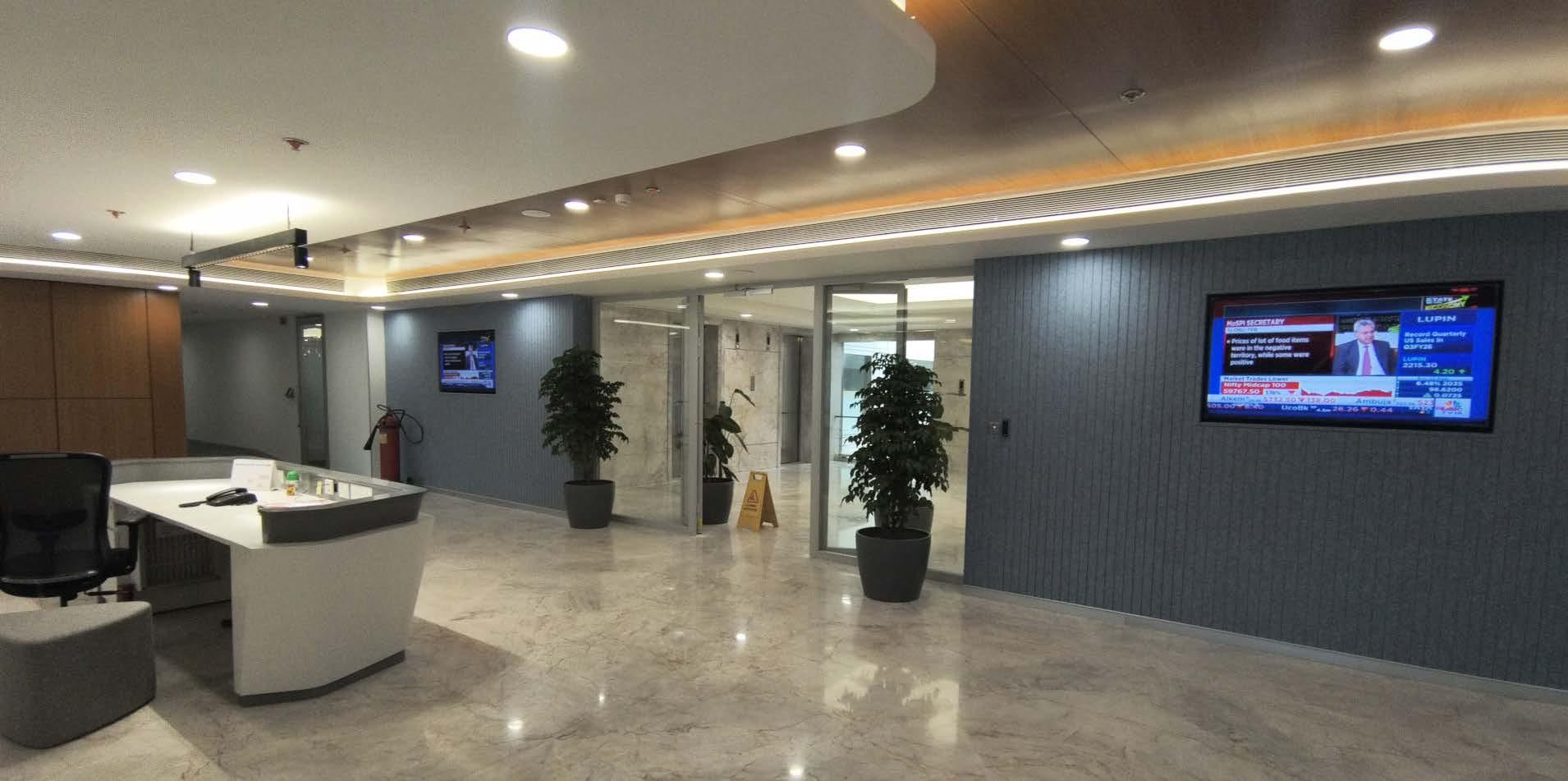
State Bank of India (SBI) – a cornerstone of the country’s economy – transcends the sheer terminology of a bank. A Fortune 500 financial institution – ranked 43rd in terms of total assets and 163rd in overall global positioning – it stands synonymous for the country’s economic identity, strength and stability. A vast operational network of as many as 23,165 branches in the country and nearly 250 branches spread across 30 countries worldwide, it is one of reputed banking systems in the world- administered via a well-oiled network of strategic hubs.
One very premier hub playing central to all is the bank’s corporate local head office (LHO) at Bandra-Kurla Complex in Mumbai. Its sheer positioning in the country’s financial system, and global order, this LHO needed a very high-quality yet foolproof audio-visual communication system to be able conduct both regular and high-profile meetings.
The bank recently revamped its legacy AV systems with modern digital AV set-up that is both sophisticated to stand the technological challenges of time, and holistic to meet the variety of requirements. Two leading AV design and integration firms from Mumbai – EYTE Technologies, and Godrej Interio AV Department – executed this prestigious AV project. An SI Asia exclusive.
Project Name: State Bank of India (SBI Local Head Office)
Project Location: Bandra-Kurla Complex, Mumbai
Project Segment: Banking/Finance
Project Owner: State Bank of India
Project Overall Budget: ₹ 53 Crore
Project AV Vost: ₹ 12.5 Crore
Project Management Consultant: EYTE Technologies Pvt. Ltd.
Project Design Consultants: EYTE Technologies Pvt. Ltd.
Project Architects/Interior Designers: Worksphere Architects
Project Acoustic Consultants: Worksphere Architects
Project Systems Integrators: Godrej Interio AV Department
Project Highlights: Fixed 288” LED Video Wall and 110” LED Video in Dealing Floor; Fixed 136” LED video wall in multi-purpose hall; ceiling-suspended displays in Dealing Area; Large wall mount display in boardroom; Integration of the bank’s dealing system application with video wall and displays; AI-based multi camera system in Boardroom and Multipurpose Room; iPad & Touch panel in Auditorium, Dealing Area, Multipurpose Hall for AV control.
Key AV Brands: Sennheiser (microphones) | QSC (speakers) | Crestron / QSC (Controllers / touch panels) | Samsung (LED Walls) | Sony (Displays) | Poly (Video conferencing Codec, VC bars)
The LHO – or the local head office of State Bank of India (SBI) – at the Bandra-Kurla-Complexit’s very positioning speaks volumes about the crucial nature of the functions it handles. So, when the bank’s management decided to replace its existing legacy AV systems with modern AV enablement, it was as challenging as prestigious.
Large, complex, high-secure, modern, innovative, and yet cost-effective- arguably one of the most prideful projects for any solution provider.

“The immediate priority on day one was to submit raceway and conduit drawings to synchronize AV infrastructure with the ongoing interior fitouts and civil execution
activities across multiple floors,” informs Abdul Waheed, Managing Director of EYTE Technologies, the AV design management consultant for project.
The project spanned four operational floors encompassing a diverse range of functional environments that included reception lounges, meeting rooms of varying capacities, executive and senior management cabins, auditoriums, conference halls, audit rooms, recreational zones, gymnasium, cafeterias, VIP dining areas, breakout spaces, and high- security dealing areas.
The existing AV ecosystem was limited and inconsistent, prompting the vision to implement a secure, scalable, and futureready AV framework capable of supporting
hybrid collaborations, secure executive communication, training sessions, and largescale internal events while maintaining operational simplicity and strict IT security compliance.
The requirement assessment phase involved detailed consultations with multiple stakeholder groups, including administration teams, IT security departments, facility management personnel, and senior leadership representatives. During th e early stages of engagement, the dealing area was identified as the highest priority zone due to its critical operational nature and the necessity for uninterrupted visibility of real-time financial data.
The design vision though holistic, it began from the Reception, and the lounges in Reception area, since the intended vision of taking customers and visiting dignitaries through the institution’s philosophy begins there. These zones demanded a blend of aesthetics and functionality, with technology’s role being to enhance communication experience without overwhelming the ambience.

“One primary challenge was maintaining optimal visibility across varying seating angles and lighting conditions while ensuring that information remained clear and engaging,” recalls Hardik Mehta, EYTE’s Design team Head who front-ended the whole project from day one. “A careful assessment of viewing distances, ambient light levels, and wall placements, the advisory direction emphasized large-format professional display solutions integrated with centralized digital signage systems,” informs Hardik. “This approach enabled uniform branding, real-time information updates, and controlled content management across all Reception touchpoints.”
The Meeting Spaces – across the facility –were to support everyday interactions, hybrid collaborations. Varied in sizes of 6, 7, 8, and 13 pax rooms, they formed the operational backbone for the whole communication architecture. These meeting rooms also comprised Audit Rooms functioning as collaborative meeting environments.
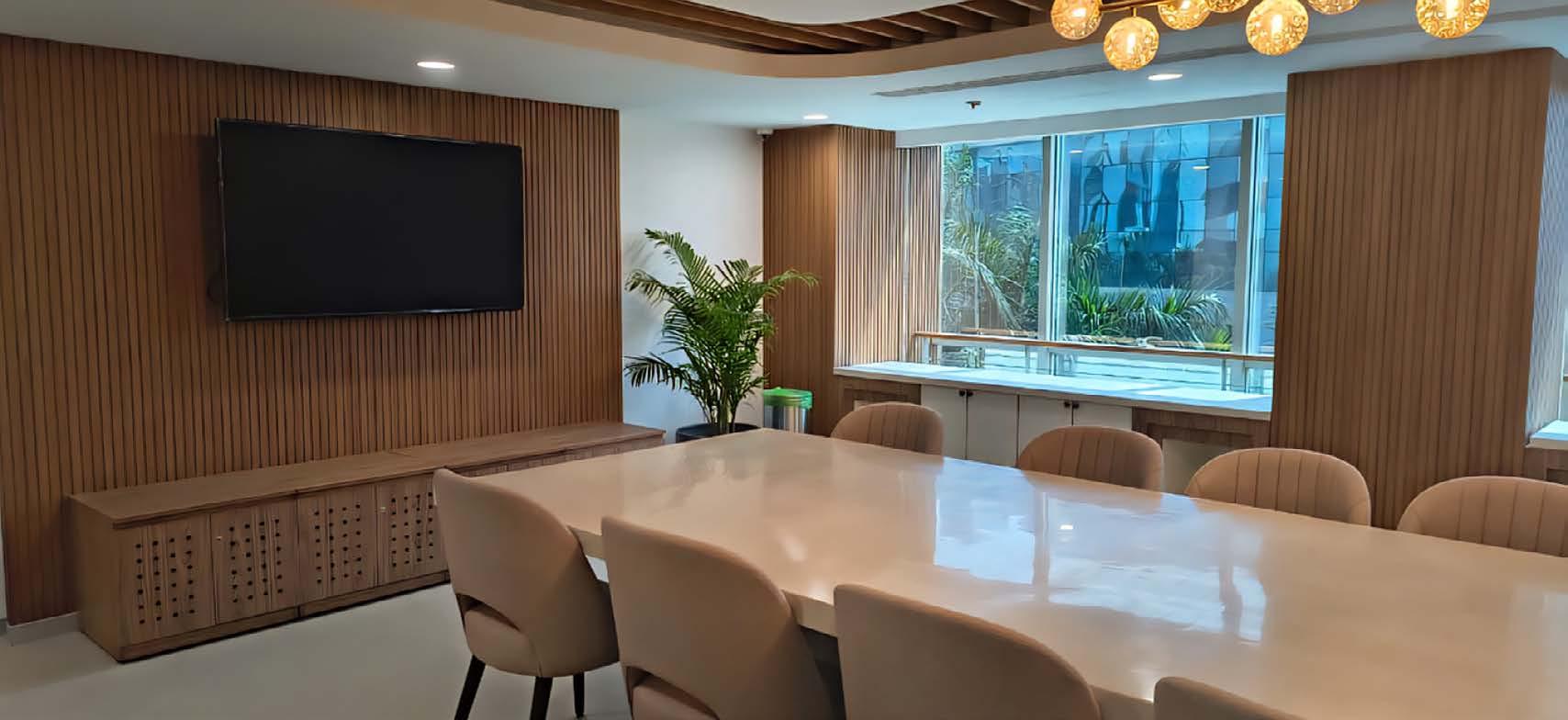
All this with clean table surfaces, minimal cable clutter, fast connectivity, and effortless meeting initiation without technical assistancewhich meant the systems had to be compact, scalable, and uniform in consistency and user experience. Recommendations centered around all-in-one video conferencing bars with integrated cameras and microphones, wireless presentation gateways enabling BYOD compatibility, discreet table or ceiling microphone options where required, and touch-enabled control panels featuring touch functionality. All this architecture is augmented with room scheduling panels outside each room.
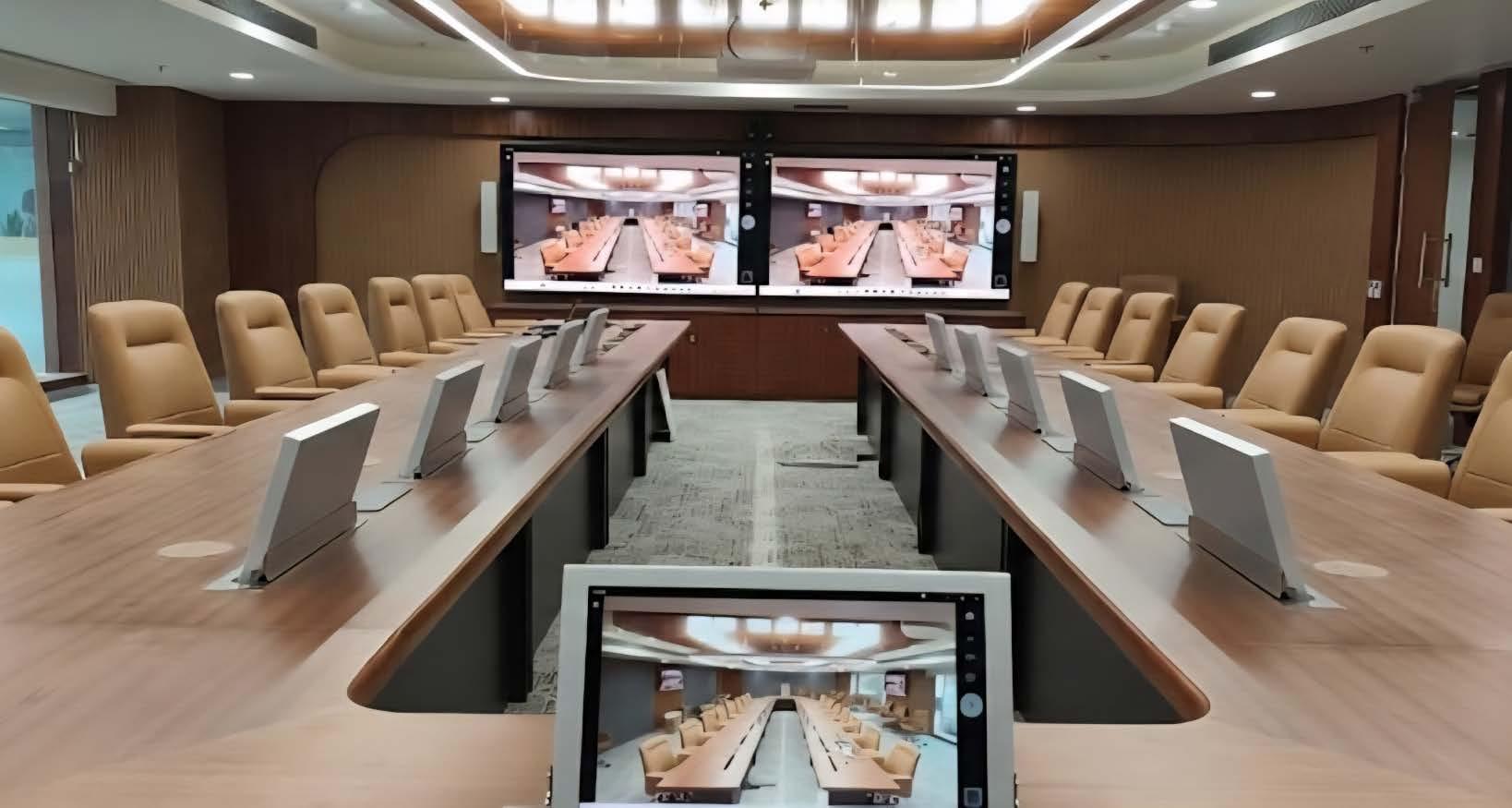
A Large Conference Room was envisioned as a formal collaboration and leadership discussion environment where inter-departmental reviews, vendor presentations, and hybrid meetings would regularly occur. Its higher seating capacity and elongated table layout demanded special attention speech intelligibility, and participant visibility from every seating position. The brief here again was to have a balanced and clutter-free executive setup rather than an equipment-heavy environment.
It was proposed to have a combination of largeformat professional displays or high- brightness laser projection systems, distributed ceiling speaker layouts, auto-framing PTZ cameras, motorized retractable table-top monitors , and wireless and wired presentation gateways along with centralized touch-based AV control panels.
While meeting rooms altogether comprised one uniform set, the LHO restructuring demanded Multipurpose Hall, which is a 40-pax auditorium designed to host leadership briefings, internal training sessions, departmental gatherings, and
hybrid town-hall interactions. It was proposed to have a large-format active LED video wall as the primary display surface, supported by auxiliary professional displays and a dedicated confidence display for presenters. This set-up to be augmented by a network- based video distribution architecture while video capture and collaboration readiness were addressed through multiple PTZ network cameras integrated with an AI-assisted multi-camera tracking system.
Further, the Wireless presentation capability along with a dedicated video conferencing codec further enhanced interoperability for external participants and bring-your- own-device scenarios.
The audio ecosystem was structured around front-of-house loudspeakers, ground-stacked subwoofers, and strategically positioned delay speakers powered through network amplifiers, ensuring balanced sound pressure levels and uniform speech intelligibility throughout the hall.
A central digital signal processor with integrated control capability formed the backbone of audio management, supported by wireless handheld microphones and a podium-mounted gooseneck microphone for formal addresses.
Operational simplicity and environmental integration were achieved through a touchbased centralized control interface, coordinated lighting control integration, and a high-capacity network switch dedicated to audio, video, and control traffic. All backend equipment was planned within a structured AV rack system with organized cable management to maintain serviceability, thermal efficiency, and long-term reliability.
Given the high-profile functionality vision and stature, the LHO design demanded dedicated chambers for top executives and senior management ranks such as DGM (Risk, Funds, RTMU Head), CGM, DMD, and other executives. Unlike collaborative meeting rooms, these spaces demanded a minimal visual footprint, controlled user access, and simplified device interaction while still supporting formal video conferencing and internal reviews.
Design recommendations centered around wall-mounted professional 4K displays paired with compact video-conferencing bars, enabling high-quality visual output and integrated camera-audio functionality without occupying desk space. The set-up also included multimedia switcher transmitters with HDMI, USB-C, and network connectivity, allowing seamless wired and wireless presentation.
Further, a centralized control processor with touch-tablet based graphical user interface in each cabin would enable unified operation of all devices. In select executive cabins, extension microphones and cable expansion kits were also considered to enhance audio pickup range for multi-participant discussions.
For Audit Rooms, focus was on maintaining privacy while ensuring smooth hybrid collaboration without unnecessary technological complexity.
While these spaces were conceived as informal engagement and hospitality zones rather than structured meeting environments, the technology approach emphasized subtle visual communication and light background audio readiness, allowing announcements or internal messaging without disturbing the relaxed ambience.
It was proposed to have professional wallmounted 4K displays across VIP dining, cafeteria, and recreational areas, hile for cafeteria it was suggested having additional HDMI distribution and receiver units powered by audio de-embedding unit and compact amplifier to enable multi-screen content sharing and distributed background sound. Ceiling speakers with wide coverage were included to ensure even audio distribution without visible clutter.
These wellness and informal interaction spaces were planned with minimal yet purposeful technology integration, ensuring utility without visual or technical clutter. Aesthetics were to be respected while placing displays for informational, motivational, or entertainment content.
For breakout and lounge areas, the design remained intentionally light, comprising a single professional display with set-top box readiness.
That its critical role in spreading the bank’s philosophy went without saying, it had to special in appeal, yet simple in nature. The AV here had
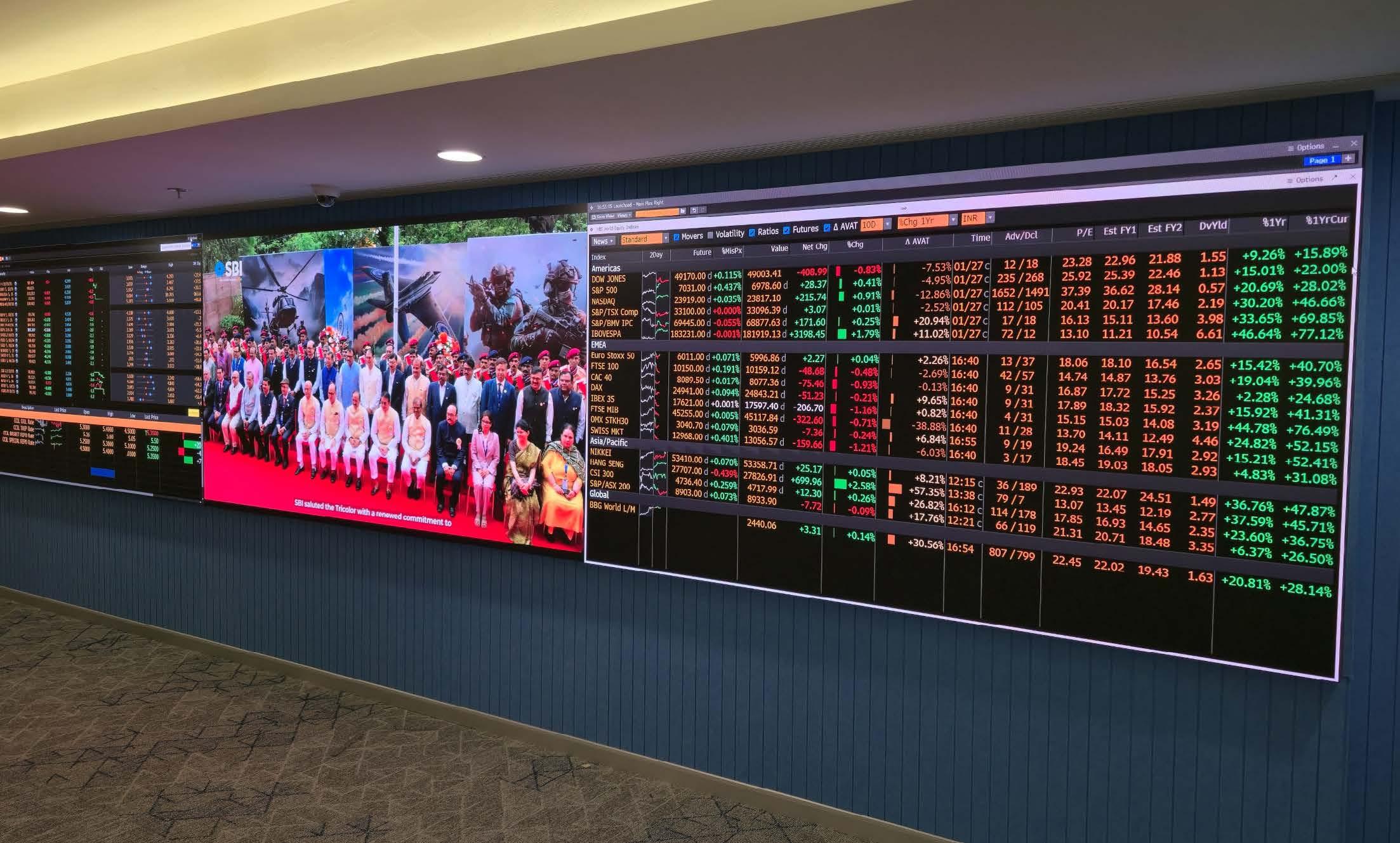
The Dealing Area.
to enable real-time financial data, live feeds, and uninterrupted visual monitoring. It required specialized multi-display planning, signal redundancy consideration, and structured distribution architecture to ensure zero information downtime.
The design suggested a dual-side large-format micro-LED video wall supported by dedicated visualization servers, dealing keyboards, and system feed transmitters/receivers. Satellite feed provisions and integration with existing infrastructure were also considered to maintain compatibility with pre-installed operational systems.
The integration incorporated a ceiling-mounted display grid comprising multiple professional 55-inch panels installed in both back-to-back and single-sided configurations. This was supported by a scalable AV-over-IP encoder decoder ecosystem, managed high-capacity network switching, tablet-based AV control
interfaces, and localized AV racks for structured equipment housing. Dedicated satellite feed inputs and structured cabling pathways were included to ensure signal reliability and organized routing.
Addressing security concerns and IT policy compliance, the overall AV solution met all organizational requirements, ensuring safe and efficient deployment across collaborative workspaces and dynamic communication areas.
The successful execution of the project stands as a testament to the dedication, expertise, seamless symmetry between the design consultant and the systems integrator that came out winner with precision and accolades from the project process owner.
EYTE Godrej Interio
Flagship medical innovation hub deploys a high-performance NEXO sound system to meet demanding intelligibility standards in its new international conference facility
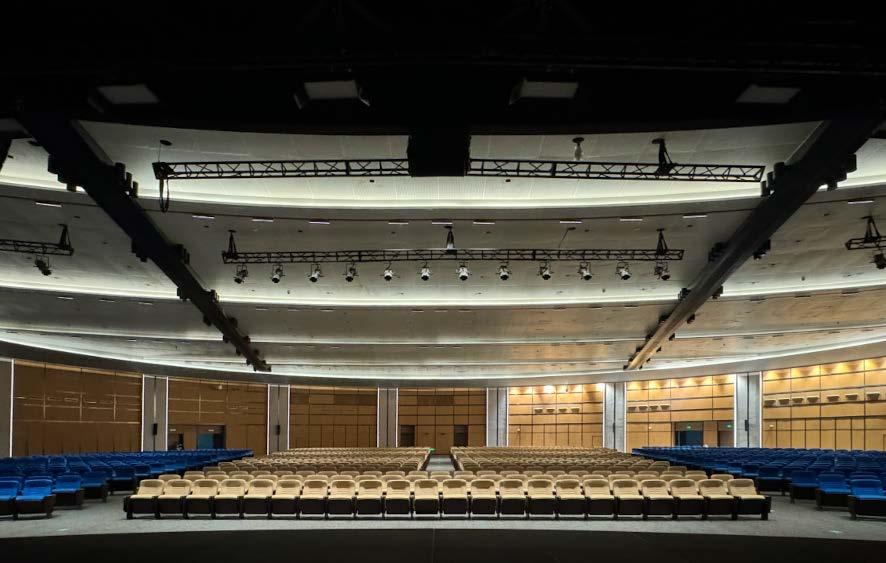
The capital of east-central China's Henan province, Zhengzhou, is known for its rich history as an ancient Shang Dynasty capital. Historic sites like the Henan Museum and Shaolin Monastery sit alongside modern developments like Zhongyuan Medical Science City, a transformative 130 square kilometre development which is set to become a flagship international centre for medical innovation.
Bringing together province-wide resources in medicine, education, research, production and funding, the location is already home to leading clinical and industrial research institutes and biomedical enterprises, with a 40,000 square metre International Exchange Centre providing a venue on site for conferences and exhibitions, along with accommodation, banqueting and office space.
Project Name: Zhongyuan Medical Science City
Project Location: Zhengzhou, Henan Province
Project Segment: Healthcare
Systems Designer and Integrator: Shanghai Haoyun Intelligent Technology Co., Ltd
AV Highlight: High-intelligibility, uniform speech reinforcement across a large conference hall with scalable coverage and reliable system control for conferences and events
Key AV Brand: NEXO
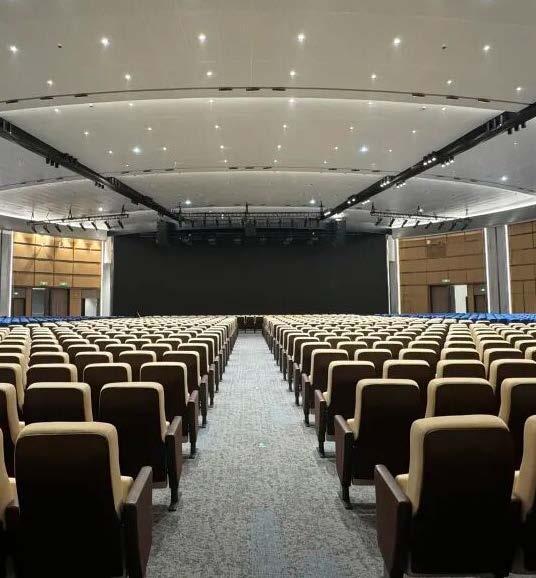
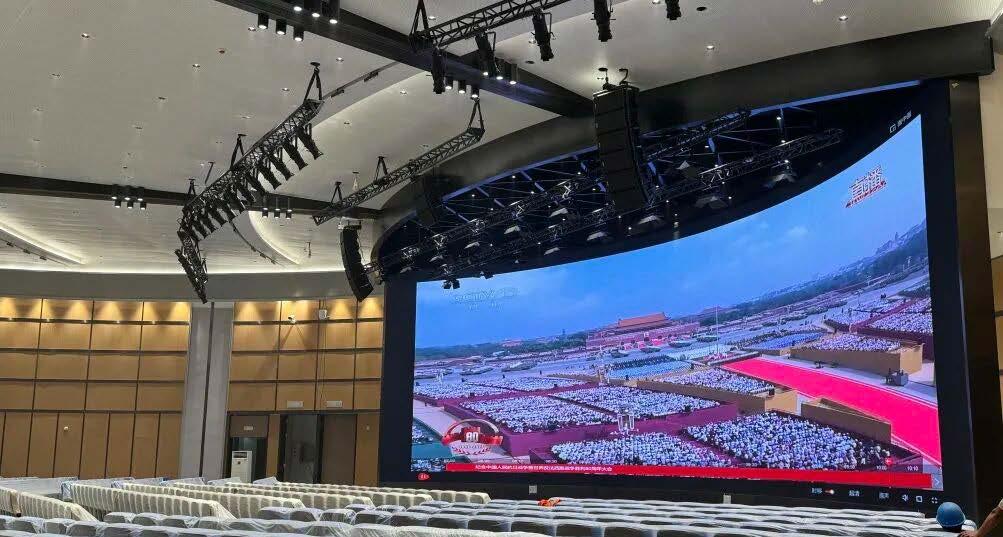
In the large main conferencing hall, particularly stringent performance criteria were set for the sound system with a focus on speech intelligibility, sound field uniformity, reliability and versatility.
So, the team at AV technology specialists Shanghai Haoyun Intelligent Technology Co., Ltd. designed and installed a NEXO GEO S12 line array system comprising left and right main clusters of 6 boxes, with a central 3-box cluster and LF extension from 2 pairs of LS18 subs on the stage.
Eight of NEXO’s groundbreaking ID84 column speakers are spaced equidistantly to the left and right of the audience seating area, with ID24 super-compact speakers used for front fills.
Return monitoring for presenters is provided by 4 of NEXO’s acclaimed P12 point source speakers in a system powered by NEXO NXAMP Powered TD Controllers.
Commenting on the installation, NEXO Asia Sales Manager Joe White noted, “This is a very large conferencing hall in which the ID84 columns supplement the main line array system really well to deliver excellent speech intelligibility to every corner of the room.
Congratulations to the team at Shanghai Haoyun for another highly successful NEXO installation.”
NEXO