![]()


Are you ready to embark on your next on-water adventure? Before you set sail, here are ve things to know about boat insurance.
1. Boat insurance isn’t just for accidents
With comprehensive coverage, you’ll also be protected nancially for theft, vandalism, and unexpected events like storms if you need repairs or replacements due to damage.
2. Accidents can happen to anyone
When accidents happen, boat insurance offers liability coverage for damages or injuries you cause while boating, up to speci ed limits. It can also cover lawsuit costs if you’re sued.
3. Boat insurance can cover medical payments
Boat insurance offers a range of optional medical payments coverage limits, helping to cover medical expenses if you’re in an accident or someone is hurt on your boat, regardless of fault.
4. Most lenders require boat insurance
If you nanced your boat, you’ll likely need boat insurance since most lenders require boat insurance to protect their investment. Additionally, some marinas or municipalities require proof of insurance for docking.
5. Progressive offers specialized boat coverages Ever worry about getting stuck on the water?
Progressive’s Sign & Glide® On-Water Towing coverage** can help. It’s an additional coverage that steps in if your boat is disabled or breaks down on the water, paying for on-water towing, jump starts, soft ungroundings, and fuel delivery. Fuel cost isn’t included.
Don’t let unforeseen circumstances disrupt your voyage. Cruise with con dence thanks to Progressive Boat insurance. Because when it comes to your boat, peace of mind is the ultimate luxury.
Progressive Casualty Ins. Co. and af liates. Product features are subject to policy terms and conditions and may not be available in all states or for all vehicles and coverage selections.
*No. 1 rating based on boat market share data from Rate lings.com.
Sign & Glide® is an optional coverage you can add to any Progressive Boat policy and costs $30/annually ($50/annually in Florida). Prices are subject to change.
Scan to get a quote in as little as 4 minutes.
Go to progressive.com to learn more.


35
See the Bay: So Close, Yet So Far Away From it All—Sailing to Rock Hall
Known as the Pearl of the Chesapeake, Rock Hall checks nearly every box on a cruiser’s wish list.
By Captain Mark Einstein
Presented by OsPrey Marine restOratiOn
37
What’s New in Electronics for Sailors?
Recent advances in marine electronics for sailors focus on increased connectivity, faster processing speeds, and more specialized, user-friendly sailing data.
By Captain Mike Martel
40
Safety Series Part 2: Teaching New Crew Communication Is Key for Safety Expert onboard communications tips for skippers and crew members.
By Captain Cheryl Duvall
43
Bluewater Dreaming: Go With the Wind! A New England Summer Cruise To Remember
A fabulous summer cruise to Maine filled with new anchorages, helpful cruisers, and untouched nature. By Staff
Presented by M yacht services
55
FAQ for Sailing Parents
The top questions sailing parents ask when their children register for junior programs and answers from top program directors.
By Beth Crabtree
66
The Racer’s Edge: Winning Starts, a Repeatable Process That Works
The best teams follow a disciplined routine before every race, By Scott Nixon of Quantum Sails
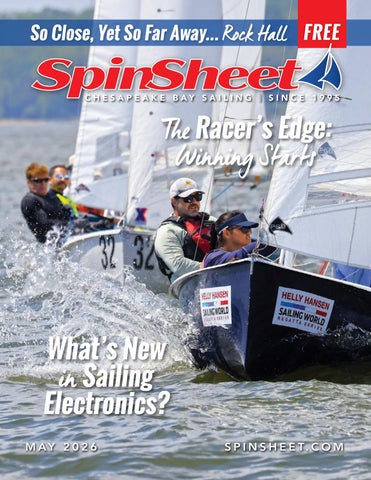
Will Keyworth took this month’s cover shot at the 2024 edition of the Helly Hansen Sailing World Regatta Series Annapolis. This year’s event unfolds May 1-3.


612 Third Street, Suite 3C, Annapolis, MD 21403 (410) 216-9309 spinsheet.com
PUBLISHER
Mary Iliff Ewenson, mary@spinsheet.com
ASSOCIATE PUBLISHER
Chris Charbonneau, chris@spinsheet.com
EDITOR
Molly Winans, molly@spinsheet.com
SENIOR EDITORS
Beth Crabtree, beth@spinsheet.com
Kaylie Jasinski, kaylie@spinsheet.com
COPY EDITOR
Lucy Iliff, lucy@spinsheet.com
FOUNDING EDITOR
Dave Gendell
ADVERTISING SALES
Eric Richardson, eric@spinsheet.com
CUSTOMER SERVICE MANAGER
Brooke King, brooke@spinsheet.com
DISTRIBUTION / BROKERAGE / CLASSIFIEDS MANAGER
Beatrice M. Mackenzie, beatrice@spinsheet.com
ART DIRECTOR / PRODUCTION MANAGER
Zach Ditmars, zach@spinsheet.com
GRAPHIC DESIGNER / PRODUCTION ASSISTANT
Royal Jackson, royal@spinsheet.com
CONTRIBUTING WRITERS
Kim Couranz, Chelsea Co, Captain Cheryl Duvall, Tom Guay
John Herlig, Eva Hill, Pamela Tenner Kellett, Craig Ligibel, Gwen Mayes, Steven Toole, Cindy Wallach, Ed Weglein (Historian)
CONTRIBUTING PHOTOGRAPHERS
Walter Cooper, Ben Cushwa, Mark Hergan, Will Keyworth, Ted Morgan, Al Schreitmueller, Cindy Wallach
DISTRIBUTION
Larry Botts, Bob and Joann Bruffy, Martin and Betty Casey,
Jennifer and Al Diederichs, Gregory and Dorothy Greenwell, Dave Harlock, Jim Persing, Mark Schlichter
SpinSheet is a monthly magazine for and about Chesapeake Bay sailors. Reproduction of any part of this publication is strictly prohibited without prior consent of the officers of SpinSheet Publishing Company. SpinSheet Publishing Company accepts no responsibility for discrepancies in advertisements. SpinSheet is available by first class subscription for $45 per year, and back issues are Member Of:
available for $4 each. Mail payment to SpinSheet Subscriptions, 612 Third Street, Suite 3C Annapolis, MD, 21403. SpinSheet is distributed free of charge at more than 800 establishments along the shores Chesapeake Bay. Businesses or organizations wishing to distribute SpinSheet should contact the SpinSheet office at (410) 216-9309 or beatrice@spinsheet.com.


By Molly Winans
Think of three sailing magazines you read regularly or occasionally. How many times per year do they come out? Do they skip a few months in winter? And the last questions, which may be reality checks… when was the last time you read a recent copy? Are they still in business?
We at SpinSheet have survived challenging times for print magazines; this current era is no exception. The demise of other print publications disheartens us. We mourn it. We will miss reading Sailing World, as we miss reading Sailing. Losing these well-loved national publications hits close to home and shrinks the sailing community’s connective fibers. But the sailing community holds fast. We’re still here for you.
In our 31st year, the team at SpinSheet persists, with a deep connection to the sailing community. Honestly, times are tough for all, including our advertisers. We must demonstrate our relevance to them over and over again, season after season. It’s not easy, but we persist. With fewer sailing magazines out there, making sure our readers know about our advertisers’ products and services feels more pressing than ever.
Our readers know this, of course, but we’re much more than a magazine. In addition to publishing 12 monthly issues of SpinSheet Magazine, we offer the following free resources:
1. Start Sailing Now, a website filled with tips for new sailors, sailing schools, and helpful resources.
2. Interviews with more than 100 sailors who got hooked on sailing as adults and share their advice to new sailors
3. A free online crew finder where people find boats to sail on or crew for their boat.

4. Four in-person SpinSheet Crew Parties to connect sailors to skippers and sailing organizations.
5. A directory of 200 sailing clubs and monthly club updates in the magazine, including how new members can get involved.
6. The SpinSheet Century Club, a challenge to SpinSheet readers to log 100 days on the water on any kind of boat during the calendar year.
7. The SpinSheet Racing Team, a challenge to racing sailors that rewards spending more time on the water.
8. A regularly updated events calendar, focused on affordable, local waterfront and on-water events that are open to all.
9. Updated listings of boats for sale, classified ads, and Chesapeake marinas.
10. Whether at one of the regional boat shows, the many waterfront events we attend, or the office, Team SpinSheet gives free expert advice to aspiring sailors.
No matter where you are in your sailing journey, I’m guessing that you’ve used three or more of these free reader services. I bet you know someone who could benefit from them. Please tear out this page and share it with a friend who’d like to get into or back into sailing.
If you love SpinSheet and would like us to be around for the next 30 years, here’s how you can help:
• When you visit one of our advertisers, tell them you saw their ad in SpinSheet. Tell them we’re awesome.
• Wherever you pick up SpinSheet, thank the business for carrying it.
• Sign up for our newsletter at spinsheet.com.
• Like or follow us on Facebook and Instagram.
• Share our articles online and in person.
• Send a letter to editor@spinsheet.com about an article or SpinSheet resource that has impacted you.
Keep reading SpinSheet… we love you!


Iam a relatively inexperienced sailor and have a new-to-me 34-foot Catalina that I was going to take out for the first time this spring. When I got to the club, I looked at the wind and decided that it was more than I wanted to deal with today. I’ve questioned my choice but just finished reading your article on risk tolerance (“Risk Tolerance and Trusting Your Instincts,” page 16 April SpinSheet), and it once again confirmed my thoughts that you really need to pay attention to that inner voice that sometimes cautions you. It’s not about eliminating risk but rather managing it.
John Theune

SpinSheet Century Club member
Chris Perez stopped by our office to pick up his 2025 burgee and noted that he was soon to become a grandparent. The next day he sent this note:
We welcomed Olivia Cole Erickson to the family yesterday around noon. Baby and parents did a fantastic job, and we got to visit her later that afternoon. I got out for a sunrise cruise this morning and dedicated it to her. It is always nice to be on the water at that hour, but I didn’t escape the effect of a ton of pollen in the air!
Chris Perez

We love SpinSheet in print. I am also excited about the new weekly racing email news.
Youth Sailing Virginia (YSV) is a community sailing program that teaches life skills through sailing on Mill Creek near the entrance of Hampton Roads. To support youth programs, YSV teaches family/adult sailing in 18-foot Typhoon weekenders.
On February 7, one of the YSV Typhoons broke her mooring and ended up on the rocks at the edge of Mill Creek. Wind, cold, and ice prevented recovery. YSV, with support from the Virginia Conservation Police, Virginia Marine Police, Veolia, and the Fort Monroe Authority, recovered the Typhoon on March 31.
YSV’s mission includes commitment to Chesapeake Bay stewardship and the Commonwealth’s work to ensure no abandoned boats litter the Bay. We are working on a Typhoon repair and replacement plan to continue to grow adult sailing opportunities in Hampton Roads.
Alan Bomar Fort Monroe, VA
Isaw your request for sailing selfies and immediately thought of this one my daughter Alexandra took of us last fall! She and I were sailing off Annapolis in her boat, a Dixie 27 named Evenstar. This may be one of my very favorite sailing pics. What a great day!
John Stefancik
Looking through SpinSheet, you have a photo of The Crazy Crab (“Southern Chesapeake Cruise Planner,” page 32, March issue). Unfortunately, they are closed permanently, and I believe the domain name is up for sale.
Bruce Neumann

Send your questions, comments and stories to editor@spinsheet.com

On Sunday, May 17, at Nauticus in Norfolk, VA, students, job seekers, and other individuals curious about opportunities in the maritime industry may attend the Reimagined Maritime Careers Festival from 9 a.m. to 5 p.m. This event, presented by Regional Maritime Training System, is your chance to connect with industry experts, learn about diverse career paths, and experience hands-on demonstrations that bring the world of maritime to life.
The festival will feature opportunities to meet and greet with professionals from across the maritime field; explore interactive exhibits and career opportunities; take an exclusive VIP tour aboard the Battleship Wisconsin; and do family-friendly activities such as coloring books, story time, live music by Joe Gosman, food trucks, and more!
Schedule of Events:
Tours
Battleship 101
10 a.m. and 1 p.m.
Command & Control
11 a.m. and 2 p.m.
Life in the Engine Room
12 p.m. and 3 p.m.
VIP Battleship Experience
2 p.m.
Sailing workshop
Enjoy a one-hour intro sail aboard a Harbor 20 with an experienced instructor who will introduce you to the basics of sailing. No experience needed, just a love for water! Every half hour from 10 a.m. to 4 p.m. All ages welcome!
Hands-on exhibits and experiences:
Regional Maritime Training System: Learn more about the RMTS training and career opportunities.
Colonna’s Shipyard Ship Coatings Station. Participants will apply different coats of paint to small steel shims, demon-

strating how various coatings are applied to marine ships and emphasizing the importance of corrosion control in the shipyard industry.
The Hampton Roads Workforce Council Activity Booth: Explore career pathways and workforce resources, with the opportunity to participate in an interactive foil boat challenge.
QED Systems Inc. Engineering and Welding Experience: Discover maritime engineering through informational materials, a welding simulator, and interactive electrical demonstrations.
Virginia Digital Maritime Center (ODU) AquaTrak Sphero Challenge: Students will design an attachment for a Sphero Bolt to carry a load across the AquaTrak. They’ll test their designs to see if they can transport the load without taking on water or losing it. Additional tabletop activities may also be available.
Integrity Staffing Services: Connect with staffing professionals and explore job opportunities through an informational display.
Auxiliary Systems, Inc.: Learn about maritime ship repair through informational materials, company insights, and take-home resources.
Advanced Technology Institute Interactive Welding Experience: Discover maritime welding technology through curriculum information, welding samples, and an interactive welding display.
Fairlead Welding Careers and Technology Display: Explore maritime welding careers through video displays and engagement with welders and test coordinators.
East Coast Repair and Fabrication Ship Repair Trivia Challenge: Test your knowledge of the ship repair industry with a fun and interactive spin-the-wheel trivia game.
The Reimagined Maritime Careers Festival unfolds at Nauticus, One Waterside Drive, Norfolk, VA 23510. Tickets cost $1 in advance and $5 on the day of the event. Members enter for free. Learn more about the event and membership at nauticus.org/maritime-careers-festival.


Whitehall Yacht Yard:
Owner-operated marina & boatyard, DIY or skilled contractors with management available if desired. Competitive pricing with great value and beautifully situated on Whitehall Creek.
$ Deepwater slips
$ Travelift
$ Crane service
$ Dry storage for 200+ boats
$ 100+ slips for boats 22 to 45 feet,
$ New aluminum high-beam lift slips to 29’ LOA
For three generations, John White’s family boatyard has been known for attention to detail, customer
and dependability. If you seek a protected, serene home or haulout location for your boat, John and his team will treat you properly.
Visit Annapolis & Anne Arundel County (VAAAC) recently launched the Be Revolutionary: America 250 Exploration Trail, a new countywide visitor experience honoring the 250th anniversary of the signing of the Declaration of Independence. More than 50 historic, cultural, and community sites will share their own revolutionary stories, highlighting the bold people, unforgettable places, and powerful ideas that have shaped Anne Arundel County across generations. The trail invites residents and visitors to explore these stories at their own pace, discover the revolutionary spirit that continues to define the region, and reflect on what their own revolutionary story is or will be.
“America’s 250th gives us a rare opportunity to celebrate the ideas and individuals that helped shape our nation and the partners who continue to move our community forward,” said Kristen Pironis, CEO of VAAAC. “What makes the Be
Revolutionary trail so meaningful is that every site has embraced its own revolutionary story, whether it began in 1776 or with a business opening its doors in 2026. Together, these stories reflect a diverse, inclusive, and ever evolving county—one powered by the dreamers, innovators, and artists who continue to shape our future.”
Anne Arundel County’s Revolutionary legacy is unparalleled, offering some of the most authentic 1770s streetscapes in the nation and serving as the backdrop for defining moments such as the burning of the Peggy Stewart, George Washington’s resignation of his military commission in the Maryland State House, and the ratification of the Treaty of Paris that officially ended the American Revolution.
The Be Revolutionary: America 250 Exploration Trail is hosted through a free Bandwango pass, requiring no app download. Visitors sign up through the portal featured on the VAAAC America250 website or by scanning the QR code

displayed on any of the trail’s interpretive panels. Once activated, the pass provides a map of all participating sites, descriptions and hours of operation, a simple check-in system using QR codes, and an automatic point tracking toward prizes.
The trail will run through December 31, 2026, with an additional 30 days for participants to redeem prizes.
Visit VAAAC.org
On March 18 at the US Sailing New England Regional Symposium, Chesapeake Region Accessible Boating (CRAB) President and CEO Paul “Bo” Bollinger received the Gay S. Lynn Memorial Trophy in recognition of his unwavering commitment and contributions to adaptive sailing.
Since taking the helm of CRAB in 2016, Bollinger has championed the rapid
scaling of the organization. One of his first accomplishments was the procurement of a new fleet of Beneteau First 22A sailboats that were customized to accommodate a wide range of disabled guests. He was instrumental in acquiring a power catamaran that was modified to host wheelchair guests for fishing. The latest additions to the fleet are radio-controlled sailboats for guests who do not wish to leave the dock.

Bollinger’s greatest achievement was the search for a new homeport for CRAB in Annapolis. He was responsible for leading the public funding, planning, design, and construction of the new state of the art and fully accessible and sustainable facility called the Annapolis Adaptive Boating Center. Under his leadership, CRAB
has undergone tremendous growth and transformation. The nonprofit instructs 140 skippers and crew to perform “The CRAB Way” while sailing with more than 1800 guests every year.
In his role as a board member, executive director, and now president and CEO of CRAB, Bollinger continues to leave a lasting imprint on adaptive sailing that has positively impacted the lives of tens of thousands of disabled guests. Bollinger has welcomed US and international delegations at the ABC to learn more about CRAB’s facilities and operations.
Gay S. Lynn was an active member of the adaptive sailing community as a racing judge and jury chief at international adaptive sailing events and served on the Para Sailing Committee. Recipients of the Gay S. Lynn Memorial Trophy have made an outstanding contribution to adaptive sailing over an extended period of time, as Lynn did.
Learn about CRAB and how you can get involved at crabsailing.org
Think about the marine service providers that you have dealt with during the past two years. Who stands out? Whom would you refer to friends? Who saved your boating season by getting you back out on the water? Whom can you count on to come through with excellent workmanship in a timely manner?
Eastport Yacht Club (EYC) Foundation seeks to celebrate these leaders in the marine industry by recognizing a new class of Marine Wizards in June. Nominations from the boating public and industry peers are due by May 22, and the Wizards will be presented their awards on June 4 at EYC.
What is a Marine Wizard? Well, Merriam Webster Dictionary defines a wizard as a very clever or skillful person, but closer to home, the EYC foundation defines a Marine Wizard as someone who demonstrates extraordinary skills in the marine trades, is known for
providing excellent customer service, and is considered “the best of the best” in the industry.
The awards are presented in conjunction with the send-off party for the Mustang Survival Annapolis to Bermuda Race in June. Recipients are selected by an EYC Foundationappointed committee and receive an
honorary two-year membership to EYC, courtesy of the club.
This is a fantastic way to celebrate the men and women who keep our boats ship shape. Without them, where would we be? On a couch? Ouch! Find the nomination form at eycfoundation. org/marine-wizards and nominate your favorite Marine Wizard today!


Ready to witness some high-level foiling? Gather your crew and head up to New York City on the weekend of May 30-31 to be a part of the SailGP festivities and to catch all the racing action. With the Statue of Liberty and the Manhattan skyline as a backdrop, there is really nothing like watching the teams compete in New York Harbor.
This year, New York is the only US stop, and since the city is just a few hours travel time from Chesapeake Country, why not check it out? Racing takes place in the afternoons, leaving plenty of time for sightseeing on Saturday and Sunday mornings.
If you’ve attended the New York stop in previous years, you’ll recall that spectator viewing was from Governor’s Island. This year a new on-water spectator viewing experience from ferries will provide fans with an exciting and immersive way to watch the action up close, with premium views of the racecourse and exclusive amenities onboard some of the spectator boats. Three
ticket packages are offered: Classic—a laid-back on-water setting with food and beverages available for purchase; Premium—offering uninterrupted views, gourmet food and drinks, and live commentary; and Platinum—with premium viewing, curated dining, complimentary beer and wine, live commentary, and an après-sail party with a DJ. Single-day
and two-day ticket packages are available. In addition, an on-land viewing and entrainment option is available for corporate and group events.
Find current team standings, learn more about the event, and purchase tickets at sailgp.com. Use the SpinSheet discount code S6SPIN10 to save 10 percent.

The race formerly known as the East of Maui - Eastport Yacht Club Chesapeake Standup Challenge will now be known as the East of Maui - EWE Spirit Chesapeake Standup Challenge. This popular standup paddle (SUP) race will take place out of Eastport Yacht Club (EYC), as always, June 27.
Never done a standup paddleboard (SUP) race but are intrigued by the idea? This SpinSheet-approved SUP race is the one to start with! There
are race classes for all levels: a one-mile fun race, a three-mile challenge, and a seven-mile challenge for more competitive, experienced racers. This race starts in Annapolis Harbor, and the longest of the three courses goes to Tolly Point on the Chesapeake Bay. The shorter courses run one or three miles out and back from EYC.
The first race starts off the docks at EYC at 8:30 a.m. The racers and safety boats will cross the mouth of Back Creek in a large group shortly after that, before continuing along the shoreline past the entrance to Chesapeake Harbor and Lake Ogleton toward the tip of Bay Ridge, returning to finish off EYC by 10 a.m. SUP

Racers on the long course paddle out to Tolly Point on the Chesapeake Bay and back to EYC.
The Chesapeake Standup Challenge has become a tradition, and thanks to organizers, it’s well-organized and welcoming to newcomers! Upon your arrival at EYC before the pre-race meeting at 8:10 a.m., you may drop off your board and re-park your car on the street in the neighborhood. After the pre-race meeting, racers enter the water in a surprisingly organized fashion and get lined up at the start for each class. It’s a friendly crowd, so don’t be intimidated! (Our slow-paddling editor loved it.)
This year’s race will be dedicated to Geoff Ewenson. A portion of your entry fee will be donated to the EWE Spirit Foundation. New this year is the addition of the EWE Spirit Kids Race for eight- to 13-year-olds. The Kids Race is free, and boards will be provided for it by Capital SUP. The Kids Race will start after all the other racers have finished. Register on paddleguru.com
Yes, really, you will have the opportunity to bet on adults racing Optis at Severn Sailing Association’s (SSA) Mid-Life Classic Regatta and fundraiser on Friday, May 15.
“The Mid-Life Classic gives adults the chance to relive their youth—squeezing back into Optis, competing with friends, and maybe proving they’ve still got it. Add in a little friendly betting, and it becomes a great way to have fun while raising meaningful support for our Junior Program,” says Travis Carlisle, junior program director.
Modeled after a Kentucky Derby–style party, 50 percent of all bets (must be 21-plus to race and/or bet) will go directly to support the SSA Junior Program. Size up the sailors and place your wagers in $5 increments. Each competitor will be rallying bets for bragging rights!
Don’t have your own Opti? SSA will have charters available.
Beyond the three competitive and entertaining races held just off the SSA docks, there will be live race commentary for the spectator crowd, multiple prize categories for the racers, plus great food and beverages throughout the evening.
The fun starts at 5:30 p.m. when betting opens and the skippers meeting gets underway. A parade of competitors will commence at 6 p.m., followed by the first warning at 6:30. Betting closes before the final race. Bring the whole family for a great night supporting SSA’s future sailors.
SSA is actively seeking racers, event sponsors, and donations. For more information contact Samantha Tyson at (443) 716-8088 or samanthamtyson@gmail.com


By Mike Pitchford
The close-up sighting of a majestic tall ship often has one in awe, not unlike the feeling conjured up standing on a windswept beach looking out over a stormy ocean. There is something about this throwback to the age of sail that captures the imagination and lifts us to a special place, even if only momentarily. Whether you have had that feeling or not, stand by for a visit by dozens of tall ships this June that will surely put a smile on your face.
Sail250 America is a multiple port gathering of dozens of tall ships in celebration of our Nation’s 250th anniversary. The Chesapeake Bay will be blessed with two main ports of call for the visiting Fleet, Norfolk from June 19 to 23 and Baltimore from June 25 to 28. In addition, some of the fleet will visit other Bay ports including Alexandria, Cape Charles, Chesapeake, Hampton, Onancock, Portsmouth, Richmond, Smithfield, and Yorktown, VA. Virginia Beach will get into the spirit as host of the international fleet of ships at the Lynnhaven Anchorage prior to the parade of sail into downtown Norfolk. As you can imagine, there will be land-side festivals adjoining all tall ship visits on the Bay. Fun is at hand!
Let’s talk about that parade of sail. Beginning at 7:30 a.m. on Friday June

19 from the Lynnhaven Anchorage, the fleet will promenade in full dress (cadets manning the yards) into downtown Norfolk before docking there. As they arrive, give or take around noon, they will be “announced” by an overflight of the Blue Angels.
If you have never witnessed this combination of old and new arriving simultaneously on and above the Elizabeth River in downtown Norfolk, it is a sight to behold. There is

nothing quite like those majestic ships of yore and a half dozen FA-18 Super Hornets screaming down the river at 500 feet. Gives me goosebumps…
We will have many more details on the Norfolk and Baltimore visits in the June issue of SpinSheet. For now, let’s travel back in history to see how this massive demonstration of sail power came to be.
In the early 1960s Operation Sail, OpSail for short, was founded. It had the blessing and endorsement of then

President John F. Kennedy. The nonprofit organization was established with the express purpose of fostering global goodwill amid growing Cold War tensions. The organization’s route to that mission was promoting cooperation between nations as well as celebrating maritime history and sail training efforts around the world.
The OpSail website describes it this way: “OpSail promotes goodwill, camaraderie, and cooperation among nations. The events also provide sail training, which teaches steadfastness, initiative, courage, leadership, and discipline. The events also give sailing enthusiasts an opportunity to gather and share their knowledge and traditions.”
then to now, many governments continue to support military sail training. Fifteen of them will grace the Bay in June.
The United States has been included in six OpSail visits and their naturally associated festivals:
• 1964 World’s Fair
• 1976 United States Bicentennial
• 1986 Statue of Liberty Centennial
• 1992 Columbus Quincentennial
• 2000 Celebration of the New Millennium
many of our ancestors to the Americas, brought cultures and commodities across oceans, brought us to that critical pitch of communication and commerce that has made today’s global awareness possible. Operation Sail has allowed us to see clearly how vessels from all lands—the voyaging canoes of Polynesia, the junks and sampans of Asia, the dhows of the Arab world, the barques and full-riggers of Europe and America—connected and transformed the world.”
The first OpSail gathering of tall ships adjoined the 1964 World’s Fair in New York. Boating Magazine, in its early 1964 issue included an article titled “Gathering of Great Ships” by Anthony Anable, Jr. The article noted the historical juxtaposition of sail training in a modern world: “In this modern age of nuclear power and Polaris missiles, it may seem odd that so many nations train their naval and merchant marine cadets under sail.” From
• 2012 War of 1812 and “The StarSpangled Banner” Bicentennial
The U.S. Coast Guard cutter Eagle has been the host vessel for all six OpSail events. She will lead the upcoming Sail250 events as well.
OpSail has passed the proverbial baton to Sail250 America. Sail250 is a consortium of five local organizations that represent the major ports of call (New Orleans, LA; Norfolk, VA; Baltimore, MD; New York, NY; and Boston, MA).
A famous sailor who had some small success in television news, Walter Cronkite, said this of OpSail: “Operation Sail reminds us that ships brought so
Find the perfect home for your boat in SpinSheet’s Chesapeake Bay Marinas Directory!


Our very own Chesapeake Bay will host two of the five main events along with ancillary port calls by smaller portions of the fleet. You should now be making plans to visit one of those sights and celebrate your own maritime heritage. And stay tuned to SpinSheet for more details to guide your visits. Visit sail250.org

Our All Killer, No Filler Crab Cakes Ship www.goldbelly.com/boatyard-bar-and-grill

Saturday, June 13, 2026 I 5:30–10 p.m.
CBF’s Philip Merrill Environmental Center Dance in the sand, enjoy live music, food and drinks. Benefits the Bay. Tickets: cbf.org/bandsinthesand

1-2 Chestertown Pride Festival
At Wilmer Park in Chestertown, MD. Live entertainment and performers, local vendors and artisans, family friendly activities, food and refreshments, and more.
2 Annapolis Book Festival
Held on the campus of Key School at 534 Hillsmere Drive, Annapolis, MD, from 10 a.m. to 5 p.m. The free, multigenerational festival brings together nationally renowned authors with thousands of book fans for author talks, panel discussions, book signings, and other activities.
2 Anne Arundel County River Days
11 a.m. to 3 p.m. at the Smithsonian Environmental Research Center in Edgewater, MD. All events are free and open to the public. Each festival will feature fun activities for all ages, including boat rides, water activities, environmental educators, live music, games, crafts, food trucks, and more. Boat rides are free, but capacity is limited and tickets will be available first come, first served.
2 Chesapeake Light Craft Open House
9 a.m. to 4 p.m. at Chesapeake Light Craft in Annapolis, MD. Free and family-friendly. Boatbuilding seminars, informative demonstrations, also a mini boat show in the lot with many of CLC’s prototypes and demo models on display.
2 Clean the Bay Day
Each year on a single day, for just three hours, thousands of Virginians simultaneously descend on the rivers, streams, beaches, and inland parks of the Chesapeake Bay watershed to remove harmful litter and debris. Register: cbf.org
2 Sailing Open House at Peninsula Sailors
Discover the benefits of joining a sailing club and take a free ride on a sailboat during the Open House at Peninsula Sailors at Port Covington Marina in Baltimore.
2
Solomons Maritime Festival 10 a.m. to 4 p.m. at the Calvert Marine Museum in Solomons, MD. Free! Celebrate Southern Maryland traditions with cooking demonstrations, traditional live music, toy boat building, Quilts of Valor display, Chesapeake Bay Retriever demonstrations, antique boats and motors, dockside tours on the Dee of St. Mary’s, plus 30-minute cruises on the Wm. B. Tennison
2 Solomons Small Craft Gathering
The event will coincide with the Calvert Marine Museum’s Solomons Maritime Festival. All small craft propelled by wind, paddle, oar, pedal, or motor are welcome.
2-3 Boater Safety Course
Teaches participants the basics needed to safely and confidently operate a vessel on Maryland waterways. Individuals and families with children 10 and up are welcome to participate. $30. At the Chesapeake Bay Maritime Museum in St. Michaels, MD.
2-3 Havre de Grace Decoy and Wildlife Art Festival
The 44th annual festival takes place indoors at the STAR Centre (700 Congress Avenue), featuring waterfowl decoys, art, and collectibles. Admission costs $10 for the weekend.
2-3 Susquehanna Flats Marine Exhibition
This outdoor event features boat dealers, marine services, and more and will be held in conjunction with the Havre de Grace Decoy and Wildlife Art Festival at the STAR Centre (700 Congress Avenue). Free admission for the marine event.
5 CBMM Speaker Series
The Last Navigator: A Young Man, an Ancient Mariner, the Secrets of the Sea. Explore a world of ocean navigation largely unknown to the West, a world in which the traditional navigator’s only directional tools are the stars, the ocean swells and the flight paths of birds with speaker Steve Thomas. 5:30 p.m. at the Chesapeake Bay Maritime Museum in St. Michaels, MD (and available virtually). Suggested ticket price $8 per person.
Do you have an upcoming event? Send the details to: kaylie@spinsheet.com
5 - Aug 25
Tunesday Floating Concert Series Every Tuesday, local musicians play live music aboard a floating stage: an anchored 40-foot catamaran provided by Chronic Sailing. These events are free, family-friendly, and open to the community. Off Back Creek Nature Park in Annapolis. 6-8:30 p.m.
10 Mother’s Day Take your mom sailing!
16-17 Havre de Grace Garden Mart
Native plants, perennials, herbs, annuals, and vegetables for sale, as well as nature inspired artisans and craft vendors on site, with garden decor, kids’ activities, food vendors, and more. This FREE event will be located at the Havre de Grace Maritime Museum, the Lighthouse Keeper’s House grounds, and Concord Point Park, rain or shine.
18 Weld It, Build It, Sail It: A Reimagined Maritime Careers Festival
10 a.m. to 5 p.m. at Nauticus, One Waterside Drive, Norfolk. Whether you’re a student, job seeker, or just curious about opportunities in the maritime industry, this event is your chance to connect with industry experts, learn about diverse career paths, and experience hands-on demonstrations that bring the world of maritime to life. Features: meet and greets with professionals from across the maritime field, interactive exhibits and career opportunities, VIP tour aboard the Battleship Wisconsin, Sails Up Workshop aboard Harbor 20 sailboats, family friendly activities, live music and food trucks. Presented by Regional Maritime Training System.
19 Blue Angels Flight Rehearsal Tentative flight rehearsal date for U.S. Naval Academy Commissioning Week; 2 p.m. in Annapolis.
20 Blue Angels Flight Demonstration
Tentative flight demonstration date for U.S. Naval Academy Commissioning Week; 2 p.m. in Annapolis.
24 Crisfield Soft Shell Festival 12 to 5 p.m. at City Dock, Crisfield, MD. Watermen’s Hall of Fame, crabcakes, soft shell crabs, local seafood, beer/wine, artisan vendors, live music, and more. Free admission.
30
The Downtown Sailing Center’s BIPOC Sailing Nights, held monthly from May to September, provide a dedicated space for Black, Indigenous, and People of Color to explore sailing, build community, and enjoy time of the water. No membership is required; non-members can sign up for a small fee. Baltimore, MD.
1-3
Helly Hansen Sailing World Regatta Series Annapolis Hosted by Annapolis YC, Presented by Sailing World.
2 MRSA Spring Fling Regatta Magothy River Sailing Association.
8 - Aug 28
EYC Beer Can Races Hosted by Eastport YC, Annapolis, MD.
9 AYC Spring Race to Oxford Hosted by Annapolis YC.
9 EYC Severn River Challenge Match Race Invitational Hosted by Eastport YC, Annapolis, MD.
9
OPCYC Yankee Station Series 1 Hosted by Old Point Comfort YC, Hampton, VA.
9 RRYC Spring Series 2 Hosted by Rappahannock River YC, Irvington, VA.
16 BBSA Cape Henry Cup Hosted by Broad Bay Sailing Association, Southern Chesapeake.
16 Cape Henry Cup Hosted by Broad Bay Sailing Association, Southern Bay.
16 EWE Spirit Cup Hosted by the EWE Spirit Foundation and Sailing Club of the Chesapeake, Annapolis, MD.
16 Five Forts Race Hosted by Maryland YC and Rock Creek Racing Association, Northern Chesapeake.
16 Frost Goode Race Hosted by the Southern Maryland Sailing Association, Solomons, MD.
16 Hampton Roads Hospice Regatta Hosted by Hampton YC, Hampton, VA.
16-17 US Sailing Match Race Qualifier Hosted by Eastport YC, Annapolis, MD.
22 Down the Bay Race Hosted by Hampton YC, Hampton, VA.
23 Annapolis to Miles River Race Hosted by Eastport and Miles River Yacht Clubs.
23 CHESSS Poplar Island Race Hosted by Chesapeake Shorthanded Sailing Society.
25 OPCYC Yankee Station Series 2 Hosted by Old Point Comfort YC, Hampton, VA.
29-30 Typhoon Nationals Hosted by Rappahannock River YC, Irvington, VA.
29-31 Southern Bay Race Week Hosted by Hampton YC.
30 CHESSS Solo Cup Hosted by Chesapeake Shorthanded Sailing Society.
30 PSA Moonlight Race Hosted by Potapskut Sailing Association, Pasadena, MD.
30-31 Mubadala New York Sail Grand Prix Sail GP, New York.
13 Baltimore Floatilla Five-mile paddle across the Baltimore Harbor from Canton to the Inner Harbor and back. Kayaks, canoes, standup paddleboards, and rowboats are welcome. The purpose of the event is to advocate for better recreational water access and to highlight environmental issues on the waterfront.
13 Bands in the Sand 5:30 to 10 p.m. at the Philip Merrill Environmental Center in Annapolis, MD. All tickets include: unlimited food and drinks, access to the Atlas Restaurant Group Oyster Reef Complimentary shuttles from remote parking lots, a tax-deductible donation that supports CBF’s education and restoration efforts throughout the year.
Chesapeake Calendar presented by
(cont.)
15 Storm Trysail Jr. Safety at Sea Held at Annapolis Yacht Club Sailing Center. Participants must be proficient at basic sailing. Minimum age is 13. The deadline is May 31. No fee.
19-21 38th Annual Antique & Classic Boat Festival and Coastal Arts Fair Father’s Day weekend at the Chesapeake Bay Maritime Museum in St. Michaels, Md. One of the largest classic boat shows in the Mid-Atlantic region. Boating history talks, free boat rides, maritime vendors, juried artists, nautical flea market, children’s activities, Field of Dreams (boats for sale), food vendors, and more.
19-21 Norfolk Harborfest At Town Point Park along the Downtown Norfolk waterfront, VA. Tall ships, parade of sail, fireworks, live music, artisan food and beverages, interactive family games, and more. America’s largest, longest-running, free maritime festival.
19-23 Sail 250 Virginia Host city: Norfolk, VA. For this milestone occasion, a fleet of the world’s most magnificent international tall ships and military ships, in an epic peacetime gathering, will sail into the port of Virginia. 2026 marks the 250th anniversary of our nation’s founding in 1776.
20 Summer Sailstice
An international celebration of sailing. Free to join! Sign up to be eligbile to win bonus prizes.
24-30 Sail 250 Maryland and Air Show Baltimore
A global gathering of international tall ships, military ships, and aircraft celebrating the 250th Anniversary of the founding of the United States. Baltimore, MD.
27 East of Maui EWE Spirit Chesapeake Stand Up Challenge 2026
NEW NAME, SAME GREAT RACE! This is an open water race set in Annapolis Harbor and the mouth of the Severn River. There will be three course options: The 7 mile Challenge for more experienced paddlers and a 3-3.5 mile Challenge suitable for more recreational paddlers. There is also a one mile Just for fun Race. This year’s race will be dedicated to our friend Geoff Ewenson. A portion of your entry fee will be donated to the EWE Spirit Foundation. New this year is the addition of the EWE Spirit Kids Race for 8-13 year olds. The Kids Race is FREE, and boards will be provided for the Kids race by Capital SUP. The Kids Race will start after all the Challenge racers have finished. Register on Paddle Guru.
3-6 Santa Maria Cup Hosted by Eastport YC, Annapolis, MD.
5 Annapolis Bermuda Ocean Race Presented by Mustang Survival, hosted by Eastport YC, Annapolis, MD.
5 Don Backe Memorial CRAB Regatta Hosted by Annapolis YC.
6 NERYC Invitational Regatta Hosted by North East River YC, North East, MD.
6 Veteran’s Cup
Hosted by Old Point Comfort YC, Hampton, VA.
6-7 Snipe Colonial Cup Hosted by Severn Sailing Association, Annapolis, MD.
7 Broad Bay Regatta Hosted by Broad Bay Sailing Association, Southern Chesapeake.
11-14 Snipe National Championships Hosted by Severn Sailing Association, Annapolis, MD.
13 Cock Island Race Hosted by Portsmouth Boat Club, Portsmouth, VA.
13 CYC Duet Regatta Hosted by Cambridge YC, Cambridge, MD.
13 Maryland Cures Cancer Regatta Hosted by Eastport YC, Annapolis, MD.
13 The Duet – Doublehanded Distance Race Hosted by Cambridge YC, Cambridge, MD.
19 Newport Bermuda Race Organized by the Bermuda Race Foundation, Newport, RI.
20 Sailstice Fun Regatta Hosted by Peninsula Sailors at Port Covington Marina in Baltimore Peninsula. Day sail to celebrate the summer solstice. No entry fees/no official scoring.
20 BBSA Summer Solstice Race Hosted by Broad Bay Sailing Association, Southern Chesapeake.
20 EYC One Design Classic Hosted by Eastport YC, Annapolis, MD.
25-26 Junior Annual and USODA Chesapeake Bay Championships Hosted by Hampton YC, Hampton, VA.
26-27 EYC Boomerang Race
Hosted by Eastport YC, Annapolis, MD.
27 CCVR Moonlight Triangle Race Hosted by CCV Racing and Hampton YC.
27 SMSA Smith Point Race Hosted by Southern Maryland Sailing Association, Solomons, MD.
27-28 MRYC Log Canoe Centennial Series
Hosted by the Miles River YC, St. Michaels, MD.
28 SMSA Summer Invitational Hosted by Southern Maryland Sailing Association, Solomons, MD.
28 Wolcott Memorial Regatta Norfolk Yacht and Country Club, Norfolk, VA.
30 AYC Junior Annual Regatta Hosted by Annapolis YC.
For more details and links to event websites, visit spinsheet.com/calendar


As told to Beth Crabtree
A stroll along the waterfront promenade in Washington, DC, about a dozen years ago literally changed Matt Haynes’s life. It was there that he noticed a fleet of sailboats and thought, “I should give sailing a try.” In his late 20s at the time, Matt had grown up around powerboating and fishing, but sailing was something he had never tried. In the spirit of encouraging other adults to give sailing a go, Matt agreed to answer a few questions about his sailing experiences.
DC Sail took you from sailing student to volunteer?
Haynes: Yes. The sailboats that I spied along the Anacostia River belonged to DC Sail, so I began there. I took beginner lessons in 2013, and advanced through the introduction to FJs (racing) course, and participated in the adult racing program.
For the past six to seven years, I’ve been a volunteer instructor for DC Sail’s adult learn-to-sail program. I am happy and proud to help usher in new sailors, and it’s an interesting way to meet people from all walks of life. We follow a set curriculum and start adults on Flying Scots. These boats are very stable, making them great for beginners. While it feels great to give back and is gratifying to see in someone else what I’ve experienced, teaching has other benefits too. It is a great reinforcer of skills and has offered me many opportunities for personal development.
You grew up on powerboats. What about sailing appeals to you?
I grew up powerboating and fishing in the Virginia Beach/Newport News area,
so I was accustomed to being close to the water, but sailing offered a new way to experience it. With a powerboat you point and go where you want, but with sailing you must work with nature. On a powerboat you might go 30-40 mph and get quickly to your destination, but you take a pounding. With sailing, you must build skills to see, read, and harness the wind. Once the concepts are understood and you put them into action on the sailboat, it’s a very rewarding experience. I’ve found that the sense of accomplishment carries over to other aspects of my life.
Tell us about your international charter experiences.
Toward the end of my first year of sailing, I met someone who put on sailing trips. I decided to join his next group charter, which was in Greece. The trip opened a new avenue for international travel. Now my annual holiday is planned around sailing with sightseeing before and after. It’s given me new life experiences that I would have missed taking a more traditional vacation.
To charter abroad, I earned an international captain’s license. I most
frequently vacation charter in the Mediterranean: Greece, Italy, Croatia, Spain, Majorca. I’ve also gone to the British Virgin Islands, and they are great, but the best time to sail there is in the winter when I like to take a ski holiday.
One fun tradition that has come out of chartering internationally began with bringing home a bottle of wine from places I visited. Now it has evolved such that I buy a case or two and ship it home. When I return, I host a party to share the wine with my friends, pairing it with local food from the area where I sailed. It creates a circular feedback loop of good vibes, and it has been a wonderful way to share my experiences.
Sailing also opened the opportunity to meet your spouse?
Sailing is an integral part of my life and, yes, it led to a first date with the woman who is now my wife. We met on an app. My profile had some sailing photos, which caught her attention. She is a racing sailor, and her first leisure sail was on charter with me! I proposed in Tuscany last year during a holiday planned around sailing. Our wedding last October was aboard DC Sail’s Spirit of


America. The boat was decked out with flowers, and my friend, Captain Patrick, was the captain and officiant. We anchored in the river and exchanged vows and sailed to Alexandria, VA, where we first met.
What would you say to someone who is curious about learning to sail?
People often think sailing will be unaffordable, but cost shouldn’t be a barrier. Sailing isn’t nearly as expensive as I would have thought. Some clubs offer yearlong memberships for the same price as renting a powerboat for a day. In the DC area, you might consider DC Sail, where membership comes with lessons.


I would highly encourage anyone to give it a go. Even if you’ve never been on a boat before, it’s easy to get into sailing. For me, learning in a group setting was important. If you can take

• The Sailing Academy thesailingacademy.com
your first four-or-so lessons with the same people, you will not only develop sailing skills, but you will also develop relation-
New sailors or those returning to sailing may want to seek instruction or coaching at a sailing school or club. Many such organizations exist on the Chesapeake Bay and its tributaries. They offer certifications for beginners, returning sailors hoping to brush up on seamanship skills, cruisers seeking bareboat chartering or navigation experience, and racers wanting to hone their skills. The following is a sampling of schools and clubs that offer sailing instruction on the Chesapeake. For a more complete list of schools offering certifications outside this region, visit US Sailing or American Sailing.
• Annapolis Naval Sailing Association ansa.org
• Annapolis Sailing School annapolissailing.com
• Blue Water Sailing School bwss.com
ships with friends. To find that community aspect, and access to boats too, consider membership in a sailing club.

• Captain In You Sailing Schools, Inc. captaininyou.com
• Chronic Sailing chronicsailing.com
• DC Sail dcsail.org
• Gratitude Sailing Institute gratitudesailing.com
• SailTime sailtime.com/annapolis
• Sail Solomons sailsi.com
• The Sailing Academy thesailingacademy.com
• West River Sailing Club learn2sailwrsc.com

By Thomas Guay
Sailor alert! Can you help us? A special opportunity lies just ahead, and an enterprising scientist needs your sharp eyes. A small group of students and volunteers is on a mission this year to track the mating habitat of a curious, ancient Chesapeake creature—one that dots, and sometimes overwhelms, DelMarVa’s Atlantic shoreline.
We’re talking about horseshoe crabs: where they come from, what purpose they serve, how they’re doing, and where they mate and lay their eggs.
Your help is needed not on the Atlantic coast but right here in the Chesapeake Bay, where sailors, powerboaters, and nature-attuned landlubbers can help track where these ancient survivors gather.

A Bit of History: Horseshoe crabs have roamed the oceans and coastal bays for more than 400 million years. They predate the dinosaurs—talk about resilience! They’re also a keystone species, providing a crucial link in the food chain. When they lay millions of tiny green eggs along sandy beaches, they fuel migrating shorebirds on their long journeys north.
Some fun facts:
• Horseshoe crabs aren’t crabs at all; they’re more closely related to spiders.
• They have 10 walking legs used to push along the seabed.
• They spend most of the year “walking” the ocean floor, feeding on worms, clams, and other small organisms.
• They have 10 “eyes,” or more accurately, multiple light-sensitive organs adapted for seeing in low-light conditions.
• They’re only found on the east coasts of continents (sorry California).
• They don’t sting; their tail (telson) is used for navigation.
In the modern era, horseshoe crabs’ blue blood plays a critical role in ensuring the safety of injectable medicines. They are also harvested for bait. Under these market pressures, populations in some regions have declined, raising concerns about impacts on migratory birds and overall ecosystem health. Since the Chesapeake Bay is a major flyway for migratory birds, this could portend trouble ahead.


The Big Question: How many horseshoe crabs are in the Chesapeake Bay? Is the population stable, shrinking, or growing. If it’s declining, the next question is why: climate change, harvest pressure, water quality, or something else? There’s just one problem.
How Many Do We Have? “Nobody knows for sure,” says Professor Tammy Domanski (PhD) with the Biology Department and Environmental Center at Anne Arundel Community College (AACC). “There’s never been a proper population survey in the Bay.”
Some localized habitat work has been done around Cove Point and Flag Pond to assess environmental impacts. But Bay-wide? The data simply doesn’t exist.
To create that dataset, Dr. Domanski and her students began tracking these ancient creatures. The best time to count them is during mating season (late April through early July). Domanski’s team began surveying them a few years


This protected creek provides an extra margin of safety for the 360 slips that can accommodate vessels between 15 & 55 feet long with up to a 6 foot draft. Space is Limited Contact Us to Reserve Your Spot!

ago at Sandy Point State Park and later expanded to 10 areas in the mid-Bay.
The Tricky Part: Here’s why most of us never see them: horseshoe crabs come ashore only to mate, only during high tides around full and new moons. That means Domanski’s team is counting at around 4 a.m., perfect for those who enjoy their coffee, as a certain Eastport singer might say, at “o-dark-something in the morning.”
Where Is This Habitat?: Favored habitat for horseshoe crab mating is on sandy beaches with gently sloping underwater topography. That’s where these armored romantics meet up. Horseshoe crabs are known to frequent brackish waters where the salinity is at least six parts per thousand (ppt). This means their habitat may extend well into Bay tributaries.
This reporter spotted two large females at Jonas and Anne Catharine Green Park on the Severn last June. Do they lay their eggs in these areas? That wasn’t clear… it was late, 6:30 a.m., so the action was over.
What You’ll See: At the right time and place, the scene is remarkable. Females come ashore at high tide so that they don’t have to “walk” too far to lay their tiny green eggs in the sand. They’re
followed by clusters of males, often forming snake-like chains. As the female lays her eggs, the males fertilize them as they pass over.
Where Cruisers Come In: Domanski’s team surveys public beaches such as Sandy Point, but horseshoe crabs also visit tributaries. That’s where you can help. If you’re anchored out and heading ashore at dawn (maybe giving the dog a break), you may witness this spawning activity firsthand. With a simple checklist, you can contribute valuable data.
If you’re on the beach during early morning high tides around a full or new moon, look for clusters of crabs. Take a photo. Note the location and time, and report how many you observed to help guide future surveys. If you miss the action, walk the high-tide line and look for clusters of small green eggs in the sand. Once you’re back aboard, keep an eye out for migratory birds enjoying a well-earned breakfast.
You can report sightings through the Maryland DNR Horseshoe Crab Tracker; visit dnr.maryland.gov/fisheries/pages/ survey/horseshoe-crab.aspx and click on the “map” link. To volunteer with the AACC surveys, contact Professor Domanski at: tldomanski@aacc.edu
About the Author: Thomas Guay is an observational scientist, river rat, and musician with the Eastport Oyster Boys. He founded Eco-Ed Endeavors to “turn students into scientists.” He is also the author of the historical novel Chesapeake Bound (McBooks Press): thomasguay.com
Do you think you can log 100 days on the water in 2026? At print time, our Super Centurion David Sites had already logged 93! Don’t let David's notorious overachieving discourage you from embarking today in your SpinSheet Century Club challenge. If you start on May 1, there are still 245 days left in the year. Our editor has only logged two days this season, so if you’re at ground zero, we’re in this together. May is a magnificent month to jump start your on-water log.
The water temperature in Annapolis has finally crept into the 60s, so paddling or dinghy sailing are on the menu without having to dress as for an Arctic excursion. May brings sweet sailing breezes, club raftups, and great racing from the EWE Spirit Cup to the Miles River Race. Of course, our powerboating members don’t need an excuse to turn the key and go. Boating and angling opportunities abound.
Log your days on any vessel at spinsheet.com/100-days, and if you take a particularly fun selfie with boating friends, send it to editor@spinsheet.com. Encourage your friends to join the fun; all are welcome. Let’s get out on the water!


By Captain Mark Einstein
Some Chesapeake destinations feel farther away than they really are.
Rock Hall, MD, is one of them. For many Chesapeake Bay sailors, it is surprisingly close by the chart, yet it still delivers the feeling that you have truly gotten away and discovered something special. That may be part of its lasting appeal.
From Annapolis, Baltimore, the Chester River, the Sassafras, and many other Upper, Middle, and even Lower Bay ports, Rock Hall is an easy and rewarding sail. In a time when fuel costs are on many cruisers’ minds, that matters. Rock Hall makes a strong case for the kind of cruising that keeps things simple. Trim the sails, use less fuel, and enjoy the journey as much as the destination.
Known as the Pearl of the Chesapeake, Rock Hall checks nearly every box on a cruiser’s wish list. There is plenty of first class marina dockage, along with secure and secluded anchorages that still leave you close enough to shore to experience it
all. Whether you tie up or drop the hook, you are never far from restaurants, music, provisions, or a stroll through town.
That easy access is part of what makes Rock Hall such a natural stop. There are marine supply outlets when you need them, motels and bed and breakfasts for visiting friends or family, and enough shoreline beauty to remind you why arriving by boat still feels special. The scenery remains largely unspoiled, and that counts for a lot.
Once ashore, getting around is refreshingly easy. Rock Hall offers a free, air-conditioned shuttle that loops through town, connecting marinas and key stops. That means a crew can go from cockpit to cocktails with very little effort.
There is plenty worth stepping off the boat for. On weekends, waterfront restaurants offer award-winning land and sea fare, live music and dancing, while a short walk up to Main Street brings cruisers to a collection of shops, restaurants, a new brew pub, and a cool funky wine bar. The town has an easy uncluttered feel to it,

the kind of pace and place where you can wander without much of a plan and still have a good evening.
Music lovers should make a point of visiting The Mainstay, Rock Hall’s iconic performance venue. Well-known around the region, it offers a year-round schedule of concerts featuring national and local acts, along with free weekly Thursday Pub Nites beginning at 5:30 p.m. and monthly open-mic nights. The Thursday gatherings are as much a community tradition as a music event, with live music, complimentary pizza, and a cash bar. The open mic offers musicians a chance to bring an instrument and join in.
Rock Hall also has a lively events calendar that gives cruisers another reason to plan a visit around a particular weekend.

Some of the best known are the Fourth of July, Pirates and Wenches Weekend, and Fall Fest, all local favorites that add a dose of fun and color to an already welcoming waterfront town.
Perhaps what lingers most after a visit, though, is not the marina, the music, or even the convenience. It is the feeling of the place itself. Rock Hall’s motto is “Nice People Live Here,” and unlike many town slogans, this one turns out to be less branding than simple fact.
For Chesapeake sailors looking for a destination that is easy to reach, easy to enjoy, and somehow still feels like getting away, Rock Hall remains one of those rare places that is so close yet seems so far away.
Find Capt. Mark and his First and Only Mate Suzanne at bluecrabcharters.com

SpinSheet readers may remember
Tim Dull’s See the Bay story in March, highlighting a few of his favorite Southern Bay cruising destinations from his annual fall cruise aboard his Tartan 34 Skymark. Tim cruises north from Norfolk every year with Rock Hall as his northernmost destination for Kinetic Multisports’ Waterman’s Triathlon. Some tips from Skylark’s log for traveling from Swann Creek into Rock Hall
Harbor: “The channel has silted a bit more on the port hand, but they have a set of small green buoys they move about as needed… For boats unfamiliar to this harbor, it is best to follow the main channel around to the left as you enter and keep the reeded mud flats off to starboard as you motor past all the marinas and seafood spots on the shore to your left. Rock Hall is still alive! I instead cut through the flats using the auxiliary channel marked by

Red “2A” and Red “4A,” which led near directly to Rock Hall Landing Marina.”
Although he’s an experienced triathlete, Tim had not trained for this event and only had his beach cruiser bike (rather than his faster tri-bike) onboard Skymark A chance encounter with old friends, Erin and Kevin (who were returning from a shakedown cruise from Maine), inspired him to do the Sunday “sprint tri” for the fun of it. His friends, also triathletes, cheered him on.
He writes: “I was not in last place and finished before the awards program started. My beach bike, with wicker basket, was a hit at the awards party, just proving you do not need to have expensive equipment to participate in this sport.”
Later that day, back in quiet Swann Creek, Tim anchored Skymark near his friends’ 44-foot catamaran Water Wings
The three of them celebrated with dinner “on the patio” and chatted late into the evening—proving that even in “far away” Chesapeake cruising destinations such as Rock Hall, you can run into cruising friends.
Two upcoming tris in Rock Hall: May 30-31 and October 3-4: kineticmultisports.com/races/rockhall. ~MW
By Capt. Michael L. Martel
In 2026, after a tough winter, most East Coast sailors look forward once again to the prospect of a good sailing season. As is frequently the story, for sailors, “It’s all about the information”—how we get it and how reliable it may be, since such basic data as wind speed and sea state are critical to the captain, who must make decisions often on the spur of the moment. Indeed, although instruments provide information, we’re now well into a world where we are not only fed data, but we’re also provided with some assistance in interpreting that data in terms of making accurate choices about how to use it. Recent advances in marine electronics for sailors focus on increased connectivity, faster processing speeds, and more specialized, user-friendly sailing data. Key developments include Starlink satellite internet, advanced AI-assisted navigation, and integrated wearable technology.

The Garmin GNX Wireless Sail Pack 52 is a wireless sailing instrument system, differentiating it from wired systems, and includes a full set of wind, depth, speed, and temperature sensors. With a GNX Wireless Sail Pack, the skipper has all the equipment needed to know what’s going on with the wind and the water. It includes Garmin GNX Wind and GNX 20 marine instruments, gWind Wireless 2 transducer and the DST810 thru-hull smart transducer.
• GNX Wind and GNX 20 instruments have highly visible monochrome LCD displays.
• The gWind Wireless 2 transducer eliminates running wires through masts up to 50 feet.
• The DST810 transducer provides water depth, water speed, and water temperature data.
• Wireless connectivity to devices with Bluetooth technology enables DST810 calibration directly through Airmar’s Cast app.
• Easy plug-and-play installation with NMEA 2000 network.
More information: garmin.com; $889
GPS
Icom’s new fixed-mount, Class D DSC Black M330G marine VHF radio is ideal for small spaces and features a rich set of functions, making it easy to install. This GNSS/GPS version includes a GPS receiver and an easy-to-install external GPS puck antenna for better accuracy and performance. The small GPS puck antenna will provide location, bearing, and speed by using information from GPS, GLONASS, and SBAS. The M330G series continues to feature the exclusive AquaQuake draining technology. It features 25 watts of power, a full-dot matrix display, an IPX7 waterproof rating, an intuitive interface, and a new speaker design.
More information: icomamerica.com/lineup/ products/IC-M330; $399.99

The Starlink Mini is a compact, portable satellite internet kit with a built-in router, designed for easy travel even in a backpack. It offers high-speed (100+ Mbps) connectivity with low power usage (20-40W), ideal for mobile users. Key features include DC power input, a kickstand, and compatibility with Roam plans. This really is a major development allowing for affordable, high-speed, low-latency internet on smaller boats, allowing for seamless streaming, remote work, and navigation updates.
More information: starlink.com; $199

TankAssure is a versatile solution that works with any polyethylene, fiberglass, or metal tank(s). Its submersible set-and-forget sensor makes installation easy while eliminating wire management issues. The low-profile wall indicator ensures there are no protruding switches for an unobtrusive look on a vessel. TankAssures integrated Blocked Vent Detector technology guarantees efficient diagnosis of tanks along with effective odor control measures. With the Raritan App, you can monitor tank capacity remotely from anywhere aboard, giving accurate readouts of its current level at all times. This feature allows users to stay informed about their vessel’s fuel levels without having to physically check them manually.
The app allows you to monitor tank capacity wirelessly from anywhere on your vessel. Calibration is simple; enter the tank’s height value. Unlike the panel monitor, each tank can be labeled directly through the app. It provides the ability to enable customized alerts, such as Full, Empty, Blocked Vent, and more. Disconnected from the app? No problem. Your alerts will become push notifications, so you are genuinely never disconnected from being able to monitor your tanks.
More information: wholesalemarine.com; $343.99

The Garmin quatix 8 Smartwatch is a dedicated marine smartwatch with an AMOLED display, featuring specific apps for tack assist, race start, and anchor drag alerts, while controlling onboard Garmin systems. Features (among many) include voice command via built-in speaker and microphone, enabling chartplotter voice control, boat data streaming, anchor drag and tide alerts, sailing apps, wireless helm control, and more. It’s dive rated to 40 meters.
More information: garmin.com; $1049.99


The B&G Zeus SR chartplotter features its most powerful 8-core processor, which delivers a smoother, faster user experience, eliminating annoying lag when switching from one app to the next. The speed also revolutionizes the CMAP charting experience, allowing users to zoom and pan more smoothly than ever. When you’re underway, real-time feedback from your sensors delivers the data you need to the helm in an instant, confirming your instincts and giving you the confidence to sail. A redesigned interface makes Zeus SR quicker and easier to use. The smartphone-like display is immediately familiar, helping sailors navigate with ease between their favorite apps, pinning those they use most often for easy access. And with a selection of modes, it’s never been easier to find the tools you need when you need them. More information: bandg.com/zeus-sr; $2899
The next-generation of Raymarine’s most popular chartplotter lineup is its Axiom 2 seven-, nine-, and 12-inch chartplotters, which have been upgraded with a six-core processor, 64 GB of memory, and Gigabit-speed RayNet networking. This puts their speed and performance on par with the rest of the Axiom 2 Pro and Axiom 2 XL lineup, the company’s fastest lineup ever. Axiom 2 models are available in a chartplotter configuration with built-in GPS/GNSS or as a combination Axiom 2 RV model with built in RealVision 3D and 600watt digital sonar included. They are networkable with other Axiom products and support Raymarine’s full range of accessories such as radar, weather, FLIR Marine cameras, instrumentation, and more.
More information: raymarine.com; $1200+

The new RCU-1 Wireless Autopilot Remote Control gives boaters full control of their Raymarine Evolution autopilot systems from anywhere onboard using Bluetooth technology. The remote has a built-in heading sensor that supports a gesture-based control system called "point and go." Simply point the remote control in the direction you want the boat to go and touch a button on the remote. The pilot adds a waypoint destination, and the boat heads in that direction, automatically. When the boat is on autopilot and steering to wind angle, Solo Sailor mode constantly monitors the connection between the remotecontrol unit and its receiver. Should the wearer of the remote fall overboard, the autopilot will automatically turn the boat head-to-wind, effectively stalling the boat’s forward motion and allowing the wearer to swim back to the boat and climb onboard.
More information: raymarine.com; $549.99


By Captain Cheryl Duvall
Whether you own a boat or occasionally charter, at some point you may need to instruct new crew for day sailing or near-shore passages. How and what you communicate are key to ensuring a safe journey, even if your guests don’t desire an active role in handling the boat.
Since communication is a shared responsibility between skipper and crew, this article provides recommendations for both roles. Not all suggestions will be relevant, depending on the type of boat, trip duration, or level of crew participation.
Every time
There are a few tasks and communications that should be performed by skippers every time they sail with new crew, or if it’s been a while since their crew were onboard:
• Know the vessel. If it’s not your own vessel or a boat you sail often, be sure to reserve time to thoroughly review the boat before the crew arrive. You are responsible for the safety of your guests, and it’s your job to confirm safety equipment, thru-hulls, instrumentation, boat documentation, capacity, fuel, etc.
• Know your crew. Know who is expected and their prior boating experience. Don’t assume, especially if you haven’t sailed with them before. If
kids under 13 will join you, per USGC regulations, they must wear properly sized lifejackets when underway.
• Begin with boating safety: Welcome guests by demonstrating how to board a boat safely, including how to pass items from shore. After all are aboard, share information about the boat and intended journey. This orientation should include a safety briefing, locating safety equipment including fire extinguishers, medical kit, horn, and lifejackets.
• Focus on sailboat safety: Describe that sailboats may “tilt” and that body weights may need to shift on lighter boats. Point out potential injury risks unique to sailboats, such as booms, loaded lines, and winches. Demonstrate safe operation and the

need for clear communications so that all crew are aware of intentions. It’s helpful to demonstrate handhold locations above and below decks, with the adage “one hand for the boat.”
• Ask about expectations: Ask the crew what level of participation they desire. Some may simply want to sit back and enjoy, while others may be excited to learn and assist where possible. Knowing their expectations ahead of time will inform how much you communicate.
• Avoid the firehose. If the crew are relatively new to sailing, avoid teaching too much at once. Explain the basics of what they may need to know, appropriate to the length of your journey. A sunset cruise won’t require as much instruction as a seven-day

charter. If the voyage is longer, break instruction into shorter segments to allow absorption.
• Post vital info. Consider posting vital information at the helm and navigation station, starting with the name of your vessel and how to call for help on channel 16. On the Chesapeake, it’s also helpful to list the boat’s draft and air draft (for bridges and overhead cables) and show guests how to read instruments and charts.
• Use checklists. Have a checklist for new crew and review that tasks have been done correctly, especially if distractions have occurred. We’ve heard stories of dinghies drifting away because cleat hitches weren’t tied correctly in the excitement of greeting friends.
• Adjust language. Depending on the length of time underway (days vs. an afternoon), consider asking the crew to learn basic terminology, but adjust your language to fit your crew’s experience. While they may be able to remember starboard and port, it’s helpful to use plain language. For example, I often


number our vessel’s four cleats on each side, from bow to stern. It’s easier to understand “remove #1 first, then #4, and step on the boat before untying #3.”
• Confirm understanding. Confirm your crew’s understanding without patronizing, asking them to repeat back in their own words. And remember to acknowledge the crew when they demonstrate safety, especially as a team.
If you will sail with new crew for multiple outings or over several days, you can teach along the way, focusing on important tasks as they arise:
• Allow adequate time: Avoid rushing, especially with new crew. Plan for tasks to take longer, especially when leaving or approaching a dock, or when tacking or gybing underway. You may think it only takes five seconds to hang a fender, but your crew may need more time to tie the appropriate knot, even if you just showed them an hour ago.


• Conduct drills: Practice safety drills while underway in calm conditions. Minimally, you can verbally discuss what-if scenarios. Ideally, you can conduct MOB drills with a floatable cushion or by picking up trash. Use your frequent weather checks to prompt these discussions, such as, “What would we do if a squall suddenly developed?”

• Practice knots: Review frequently used knots and take turns tying them. Minimally, the crew should know how to tie cleat and clove hitches, bowline, and stopper knots.
• Assign consistency: Consider assigning consistent tasks to develop competence. When I chartered a canal boat last year, I appointed one crew member in charge of connecting electricity and water as soon as we docked. Two other crew were responsible for handling the lines while docking, launching, and going through locks. After crew members were comfortable in their roles and practicing sound seamanship, we cross-trained to increase overall safety and shared knowledge.
Communication is two-way, so crew have responsibilities, too. Whether you are an active crew or a laid-back guest, consider these communication tips to keep everyone safe:
• Come prepared. Ask what you need to bring and what’s expected of you. Minimally, wear proper
clothing (layers, non-marking and non-skid footwear, hat, sunglasses), apply sunscreen, and bring water. If you have a tendency for seasickness, take necessary precautions. And never bring hard luggage to a boat.
• Be honest: Be honest about your preferences for participation and your boating experience. Don’t play the expert if you aren’t one. That can be very dangerous, especially at sea.
• Check the checklist: Follow the checklist and apply common sense. If sharing tasks, confirm that others have done their assignments. I’ve been on boats where the crew have forgotten to close hatches, close ports, raise swim platforms, store loose items, unlock the wheel, and more. Some of these are minor, but any can be dangerous depending on the situation.
• Speak up. If you see something, say something. Even experienced captains can misjudge the height of a bridge or not see a boat crossing ahead. As Molly Winans wrote last month in her editor’s note, safety is increased when everyone feels free to speak up (spinsheet.com/risk-tolerance).

On Belle Bateau, we greet crew with a five- to 10-minute briefing, during which we acquaint them with safety equipment and our vessel. Our fourpart intro includes:
1. Take care of yourself on the boat.
2. Take care of others on the boat.
3. Take care of others off the boat.
4. Take care of the boat.
• Bring a tough skin. Respect the captain and obey what she/ he commands. Captains may sometimes bark orders. It’s not personal. It’s for everyone’s safety. Ask for clarification following the urgency, not in the middle of it.
Whether you enjoyed a two-hour sail or a two-week charter, it’s helpful to end each day with a quick debrief for both skipper and crew. Encourage honest feedback with the expressed intent of improving communication to ensure safety for future outings. Then, toast to another safe day on the water!

About the author: Captain Cheryl Duvall is President of the Chesapeake Area Professional Captains Association (CAPCA). You may see her at the helm of her Gozzard 44 Belle Bateau or on Watermark’s Miss Anne in the Annapolis Harbor. Email her at cherylduvall@mac.com.

One New England cruise wasn’t enough for Annapolis sailors Harald Mangold and Cindy Sweet. In 2024, they sailed their X-Yachts X-4.3 MK2 Xiberger to Newport, RI, multiple ports on Long Island Sound from Oyster Bay, Mystic, Port Jefferson, etc., and all the islands south of Cape Cod. They enjoyed it so much that they headed farther north in 2025 for a two-anda-half-month journey.
Local racing sailors may recognize the boat name Xiberger, as Mangold’s Cape Fear 38, which he raced in Annapolis Yacht Club Wednesday Night Races, Oxford, Solomons, and other local races for two decades. Two years ago, he donated the Cape Fear to Patriot Sailing (in Solomons) and bought the X-Yachts performance cruiser with continued racing and longer cruises in mind. So, it was only fitting that the summer cruise began at the end of June with Block Island Race Week with the whole Xiberger racing family onboard.
After race week, Mangold and Sweet set off on their own to go through the Cape Cod Canal. They ventured “down east” with stops

at Provincetown and Marblehead, MA; Portsmouth, NH; and Kittery and Portland, ME. From there they sailed slowly up and down the Maine coast with stops from Booth Bay to Camden, to Acadia’s Northeast and Southwest Harbor, and another couple of days farther down east all the way to Roque Island before doubling back on what they missed on the way up.
For the first ocean passage to Block Island, a few regular racing crew members sailed onboard, and at the trip’s end, another couple sailed
home with them from Marblehead (with a few stops along the way). Mangold and Sweet sailed the rest of the longer passages—80- to 100-mile days— doublehandedly.
“Our favorite sail and cruising weapon was our roller furler Code 65 sail,” says Mangold. “At times we just sailed wing-on-wing with the jib and code sail or main and code sail, making super fast and safe passages. The key was to plan our days and distances based on the wind forecast, and we managed to avoid motoring most of the time.”
When asked how cruising in New England differs from cruising on the Chesapeake, Mangold says, “No sweating! It’s stunningly beautiful. There’s cold and clear water and millions of very annoying lobster pots; oh, and unforgiving rocks (no we did not hit any, but they are scary), big tides, and currents.”
He adds, “Fog is a real thing. I wouldn’t sail to New England without radar and AIS. Radar and knowing how to use it is a must; so is AIS overlay on your chartplotter. I used one in Chart/AIS mode and the other plotter in radar mode, with or without the chart, depending on all the clutter.”
The couple noted that there was an unspoken rule in Maine: if no one is there, you may snag a mooring. This made for some pleasant surprises and peaceful evenings onboard.
As members of the Cruising Club of America, the couple had access to a cruising network with outstanding recommendations and sometimes in-person invitations and greetings on docks. It made the journey more memorable with warm welcomes in many ports.

Both Sweet and Mangold struggled to choose favorites among the many wonderful places they visited. Mangold says, “Highlights included a night at Seguin Island, Stonington, Isle Au Haut, and so much more.”
An unexpected anchorage at Richmond Island, just South of Porland, stayed in mind as a special place. Sweet says, “There was this private island with a trail, berries everywhere, and wild sheep with black and white socks.”
In general in Maine, she says, “We saw so much untouched nature.”

Among favorite destinations, she adds, “Northeast Harbor and Acadia Park, Rockport, Camden, Marblehead, and a little cove called Maple Juice Cove where we met Heidi and Cabot Lyman of LymanMorse (the loveliest people) and rode our bikes to the Olson House made famous by Andrew Wyeth.”
“We could go back three times and still not see it all,” Sweet says.
When it came to exploration onshore and provisioning, their Brompton folding bikes with baskets proved invaluable. These bikes have different speeds for hills, which was necessary at many destinations; not to mention that in addition to discovering more places, the couple managed to get some cardio exercise. They also hiked extensively.
The couple were pleased to have sailed most of the time and to have used only two tanks of diesel gas all summer. They also like the cooler weather, not having to use air conditioning, and wearing wintry clothing and wrapping up in a blanket.
When asked what advice they would share with others hoping to cruise New England, Sweet says, “Go with the wind!”
Mangold says, “Plan your days (and trip) based on wind and weather, not with hard dates to be in places. There is so much to see. It does not matter if you check off all the places. We anchored or used moorings exclusively, never grabbed a slip. We loved having good lithium batteries and solar panels, eliminating the need to run engine for charging’s sake.” Although European travels will take up their summer schedule (including racing Beneteau First 45s out of Split, Croatia), when they’re in town, you will find Xiberger racing and cruising out of Back Creek, Annapolis. #


By Zuzana Prochazka
Sicily’s volcanic island playground is something to add to your bucket list. The Aeolians were designated a UNESCO World Heritage Site 25 years ago, and although that sounds like ancient history, it’s barely a notch on the belt of these islands that have been fuming and snorting along the horizon here for millennia. This volcanic archipelago has hosted humanity for more than 6000 years, and it’s a geologic wonder created by Africa’s slow march north toward Europe. Sailing here was an otherworldly experience.
We chartered from Dream Yacht Worldwide’s Portorosa base on Sicily, which is an island itself right at the tip of the boot of Italy in the Mediterranean. Our Dufour 53 monohull The Big Sleep was ominously named but special in that she had a hybrid electric propulsion system, which we were lucky to play with for the week. It
proved to be foolproof with two hours of electric power supplemented by a genset that turned on automatically when the batteries dropped to a 40-percent charge. The good news was that it was easy. The bad news was that we relied on it heavily because the god of wind, Aeolus, for which the islands are named, was absent for the week.
Starting off on the shoulder season in the latter half of September, we had the place nearly to ourselves, but we still chose a counterclockwise itinerary to dodge the rest of the charter convoy. We pointed the bow at Stromboli, 20 miles away on the horizon, and arrived in time to hook up to a mooring under the steaming cauldron. Volcanos rise abruptly from the sea leaving little space for anchoring in reasonable depths, so although the mooring here was expensive (over $100), it was really the only

game in town. The moorings come with assistance from a man in a dinghy because the hawsers are so thick, we’d have broken quite a few boathooks trying to hoist them aboard.
That evening, we gazed up at the fireworks 3000 feet overhead. A light whiff of sulfur floated on the breeze, and we could make out the sound of rocks tumbling down Stromboli’s northern face. She was mesmerizing and dwarfed everything in the vicinity with her pyrotechnics going off every 30 minutes.
Not being able to take our eyes off her, we circumnavigated Stromboli the next morning, watching her white plume angle off sharply. The wind up there was good, but it wasn’t making its way down to the water’s surface, so we motored over to Panarea and Salina with their tiny alleys packed with boutiques and eateries serv-


ing up rustic Italian food that upscale American restaurants would envy.
Our last stop was the largest island of Lipari where we tied up at a small dock run by what seemed to be an entire family. These mini-marinas are typical in the Aeolians, but be careful when choosing one. We tied to one near a municipal ferry dock, which left us bucking and tossing every time the big beasts came
Tand went. One boat across from us broke a dock line and another a cleat, so these moorages can be a wild ride and are not for the faint of heart or the queasy of stomach.
Lipari is a treat with its 16th century Norman castle, now a museum and monastery. The town is a labyrinth of cobbled streets bursting with boutiques and cafes. Pumice and obsidian are mined on Lipari, so it’s possible to buy jewelry, handicrafts, and even dishes made of these stones.
Our last afternoon found us anchored on the southern side of Lipari at Spiaggia Praia di Vinci, a black sand beach overlooking the steam seeping out of the island of Vulcano next door. It’s a great place for a leisurely swim and although only about 30 feet deep, the bottom here is loose and crumbly pumice; so we stayed only for a lunch hook.
Historic Palermo is worth a visit. We stayed a couple of days after the charter to see the Palermo Cathedral, the Palazzo di Normani, and the amazing open-air food markets with their huge selections of capers and local nuts. Everywhere, we found the Testa di Moro, ceramic heads of a man and woman that are part of Sicilian lore which is ghoulish but funny. Presumably, a local girl fell in love with a visiting Moor, but when she learned he already had a wife back home, she killed him and used his skull to plant herbs. How’s that for a romantic deterrent?
The Aeolians rumble, steam, and periodically blow their tops in fiery fury that’s made more dramatic if witnessed from the deck of a boat. I never realized that sailing under a volcano was a bucket list item for me, but now that I’ve done it, I can say it’s a must for anyone seeking to sail someplace out of the ordinary. With a healthy charter trade in the area, it’s an easy box to tick and will make you the envy of dinner conversations for years to come.
hese sailboat charter companies specialize in sailing destinations such as the Chesapeake Bay, Northeast United States, Northwest United States, Caribbean, Mediterranean, Southeast Asia, and South Pacific. Contact them and book your charter dream vacation today!

Attention, Sailing Clubs! It’s spring commissioning time, and club members are prepping for the season, pulling out their spring checklists, and finalizing their cruising schedules. Share your news and events in the SpinSheet’s Club Notes Section. Send a 350-word write-up and one or more clear photos of smiling faces or pretty boats to beth@spinsheet.com to let sailors around the Bay know about your club’s sailing adventures, social gatherings, and educational events.
By Linda Sweeting
Selby Bay Yacht Club (SBYC) members shook off winter by gathering by our firepit on Saturday, March 21, for a Sock Burning Party and potluck. This was the perfect end-of-winter celebration.
The day cooperated beautifully; bright sunshine, crisp air, and just enough calm breeze to keep the flames tame in the firepit and the smoke pointing down wind. Surrounded by members clutching their worn winter socks, our fire pit was soon ready for its annual offering. Commodore Tom Campbell made sure everyone had a favorite beverage in hand, and past commodore Jeff McKinney further set the tone with a spirited reading of “Ode to the Sock Burners,” by Jefferson Holland, Eastport’s Poet Laureate (1995).
Next came the main event, socks arcing through the air (mostly) into the firepit as the flames leapt up to claim them. With winter officially sent up in smoke, everyone migrated to the potluck table for a spread of delicious dishes. We have some of the best cooks around and this potluck did not disappoint. Relaxing in the warm sunshine, swapping stories and laughs about the past season’s
cold-weather trials and tribulations and early season plans for upcoming boating adventures made the afternoon fly by.
SBYC is a family oriented, petfriendly, member-owned yacht club located on scenic Selby Bay off the South River. Our docks are just minutes from the Chesapeake Bay, making
it easy to enjoy many of the most popular cruising destinations, including Annapolis, Kent Island, Rock Hall, St. Michaels, and many others. Our 72-slip marina can accommodate both powerboats and sailboats. We have a few slips available for the upcoming season. For more information see selbybayyc.com.

Set The bait: “Want to go sailing?” my boyfriend of three months asked me. Well, duh! We experienced a beautiful Chesapeake Bay sailing weekend that spring of 1989 along with 15 crew aboard four 38-foot sailboats. Months later, friends took us sailing for a week on the Chesapeake Bay and encouraged us to consider buying a local 26-foot Columbia. We loved the Bay’s extraordinarily scenic sights, the wind on our faces, the peaceful exhilaration while under sail, and the tranquility of a starlit night on the water.
Get a Strike: We took the bait and surrendered to being acquired by the Columbia which we named Cygnet (young swan). Our first sailing summer included racing with America’s Boating Club Wilmington (ABCW) during their weeklong cruise.
Set the Hook: The hook was firmly set, as evidenced by the acquisition of two more sailboats after Cygnet. However, and as hooks can sometimes set with
By Carol Hanson
“strings attached,” we quickly realized a need for training in safe boat handling. Bring it Home Safely: We enrolled in ABCW’s Basic Boating and Sail courses. Not only did we learn what we didn’t know we needed to learn, but we met many others who were hooked the same way and were ‘in the same boat’ with us! Our similar boating passions and good-not-so-good experiences spawned camaraderie and friendship, which, when combined with diverse backgrounds and instructor expertise and knowledge, made these courses invaluable facets of many dimensions.
Over the years we continued with courses on Boat Handling, Marine Navigation, Advanced Marine Navigation, Engine Maintenance, Marine Electronics, as well as seminars on Weather, Confidence in Docking, and Man Overboard. Additional courses continue to be added. ABCW continues to improve boating skills for experienced and new boaters through education and

promotion of safe boating practices, while encouraging the likeminded connection of camaraderie and teamwork. The Basic Boating Course is mandatory in Maryland for anyone born after July 1, 1972, and is available through ABCW.
Want to go sailing? Join us! It’s our happy place! Learn more at abc-wilmington.com or contact wspsboaters@gmail.com.


The Chesapeake Bay Tartan Sailing Club (CBTSC) season is underway, and Tartan members are excited about our event schedule.
In April we had the Ladies Luncheon at the Annapolis Yacht Club, where the views are some of the best on Spa Creek. This month we have the Wye River Rendezvous sponsored by the Eastport Yacht Club in conjunction with other clubs. Right after that, our commodore Michael Mininsohn will lead Tartan boats on a Spring Southern Bay Cruise. The event runs from May 26 through June 14, but boats are welcome to come and go based on their schedules. The plan is to make it far enough south so that our Virginia members can join the fleet for a bit.
With just enough time to do laundry and re-provision, the Summer Sailstice will be upon us, and we might as well just stay out and hit the Sail250 Maryland/Baltimore Air Show from June

By Greg Shields

24-30th. It is hard to do back-to-back events like this, but it will give you lots of days on the water if you are gunning for the SpinSheet Century Club (spinsheet.com/join-spinsheet-century-club)! Check out cbtsc.org for events in July and beyond.
By Jeff Halpern
The Chesapeake Shorthanded Sailing Society (CHESSS) has wrapped up its winter lecture and round table discussion series. This year’s gatherings featured Peter GibbonsNeff Jr. discussing his Mini-Transat campaign and his future single-handed racing objectives and a round table discussion with Golden Globe singlehander, Guy deBoer about his prior race and his planned entry in the next event. By the time this goes to press, CHESSS will have run our ever-popular Poplar Island Race (a report is to follow in the June issue).
On May 30 CHESSS will premiere a new CHESSS-sponsored race. Dubbed the Solo-Cup, this new point-to-point race is restricted solely to singlehanders and will offer spinnaker and non-spinnaker classes.
When CHESSS was being formed, there was a debate as to whether the
Other than that, our members are happy that our brand survived the recent boat manufacturer’s re-organization, and if you want more of the details you can watch “Tartan Yachts and the Catalina Fallout: How One Brand Survived” at youtube.com/watch?v=zA5xlRp2WbM
second and third ‘S’ in the name ‘CHESSS’ should stand for ‘shorthanded sailing society’ or a ‘singlehanded society.’ In a near even split, shorthanded beat singlehanded. This race honors those founding members who favored singlehanding. A raftup will follow when our band of gregarious introverts can gather and gab. Both racing and cruising members are invited.
There has been an increasing number of clubs that have been adding CHESSS Class starts. For example, CHESSS is hoping for significant shorthanded participation in the May 9 Spring Race to Oxford hosted by Annapolis Yacht Club.
For the non-racer CHESSS members (and racers who cruise), there will be the usual number of CHESSS rendezvous this summer. For more information, please visit chesss.clubexpress.com.
By Mary Ann Gordon
The Sailing Club, Inc. has a full schedule planned for this season, and we are inviting all those interested to signup for one or more of our trips. Our club is all about cruising in interesting places using other people’s boats! We are a bareboat charter club with an emphasis on teaching safe sailing. Our membership ranges from those who own boats to those new to sailing and from sailors who learned to sail at age 13 to sailors who learned to sail at age 46.
This month we offer On Water Training, May 16-17, a weekend devoted to boat systems review, lines and line handling, and boat handling under power and sail, featuring hands-on practice with experienced teachers.
In June we head to Mallorca, Spain, for a week of cruising the northern and eastern coasts of this popular Mediterranean island. Late in the month we will

celebrate the 250th birthday of the United States with tall ships, naval vessels, a Blue Angels airshow, Coast Guard rescue demonstrations, and a variety of music festivals in Baltimore Harbor. We’re including two quiet nights at anchor bracketing the celebration.
We also have planned a three-day weekend departing from Rock Hall, MD, to two beautiful anchorages and a second cruise from Rock Hall to Oxford, MD. On the way we’ll moor in Annapolis
Harbor, sail to the Choptank River, taking the fun (and sometimes nail-biting!) shortcut through the Knapps Narrows, and spend a day in Oxford, one of Maryland’s oldest and most charming waterfront towns.
On all our sails, everyone helps out to the best of their knowledge and abilities. We share both the work and the fun. The club has been teaching safe sailing for more than 40 years. Go to thesailingclub.org for all the details on this season’s trips.


By Craig Ligibel
The members of the Chesapeake Catboat Association (CCBA) have been having so much fun on the water that they forgot to celebrate the club’s 50th anniversary several years back. Records show the group was organized around 1973 with the objective of preserving, sailing, and enjoying traditional catboats on the Chesapeake Bay. The fleet numbers more than 65 members representing almost a dozen states. Most members live and sail within a stone’s throw of the Chesapeake Bay. They sail a variety of catboats ranging from 16- to 25-footers.
Catboats were once the dominant small workboats along the Atlantic Coast. However, by the mid-1900s, more modern sailing designs had decreased the popularity of catboat racing and more reliable engines had decreased the efficiency of sailboats as working craft. Many people felt that the catboat had outlived its purpose.

Enter Breck Marshall who oversaw the redesign of the catboat utilizing modern materials such as fiberglass. Today Marshall boats populate catboat fleets across the US. The Marshall family continues to be involved, with company president Geoff Marshall often traveling far and wide to test out new designs and get in touch with his far-flung customer base. Learn more at marshallcat.com
In general, catboats are wide-beamed sailboats with their mast positioned well forward. They feature a gaff-rigged sail with a boom that often overhangs the transom. They are stable, shallow-draft, easy to sail but difficult to sail well, and spacious for cruising and social sailing.
OThese traits make them ideal for the Bay’s shoal waters and protected rivers, which helped the class gain a following here.
The birth of the CCBA coincided with the reemergence of the catboat as a fun-tosail, seaworthy, approachable family boat suitable for racing or cruising. This year’s activities include a new event called the South River Stampede. After a Le mans start, catboaters will sail from a member’s dock on the river to a local watering hole, have a libation, and then sail back.
If you would like to see the whole calendar, learn more about the Bay’s catboats, or even take a ride, go to chesapeakecatboats.org for this year’s cruising schedule.
By Rick Lee
n March 28, Peninsula Sailors gathered members and guests to start off our year with a spring social which included a sock-burning ceremony and a fabulous taco bar picnic. Since we had a fire going, we demonstrated how to use a fire extinguisher, making use of the expired units removed from our boats last year.
We welcomed several people looking to find out more about our club, and several have since joined as members. As the sailing season is about
to get underway, we discussed the many organized weekend and overnight trips we have planned for this year and covered various processes and procedures for our club.
This month we will undertake a DelMarVa circumnavigation sailing adventure, a one-week 450nm voyage to include ocean sailing and overnight sailing. It is an exceptional skills building and learning experience for many of our members. At the end of the month, we will sail to Langford Creek for an overnight stay at a quite peaceful location that is a favorite spot of many members.

# Our new tradition: sock-burning!
June and July are filled with more outstanding trips. In June we will sail from Baltimore to Annapolis for an overnight stay and visit to Annapolis Arts Week festivities. We will celebrate the Sailstice with a local regatta in Baltimore (non-member sailboats welcome), and we will join the Sail250 festivities locally at the Port Covington Marina.
July Fourth weekend, we sail north to the Sassafras River and visit Georgetown, MD, for a two-night stay, returning to Baltimore to watch the fireworks display from our sailboats in the harbor. In July we also plan to sail to the Magothy River for an overnight drop-the-hook and raftup event.
More sails are planned for the remainder of the season. It will be a fun filled season for Peninsula Sailors, and we welcome you to come visit us. There is a real sense of community and volunteerism promoted here. If you would like to join us, send a note to info@sailbp.com.
By Julie Day
The Pentagon Sailing Club’s (PSC) Women on Water (WoW) group held its annual symposium in March. Three women, all accomplished sailors, were chosen to share their stories with the group.
At the start, PSC commodore Darryl Dennis introduced the club’s “old salts” as well as present and past members of PSCs governing body, the “Bridge.” He emphasized that the club is an all-volunteer organization with a mission to encourage and develop seamanship skills. Darryl went on to describe the club’s class-
room and on-the-water training on the Potomac and the Bay, the club’s racing program, and boat rentals and maintenance of the club’s five 22-foot Catalina Capris.
WoW Commodore Joanne Spahn introduced the panelists: Captain Cheryl Duvall, Captain and folklorist Amy Skillman, and PSC instructor Chloe Wawerek. Each member of the panel was invited to share their sailing journey, how they help others, how to build sailing confidence, and what recommendations they could offer PSC.

By David Cox
Did you know that more than 9000 Penguin sailboats have been built, many of them in a garage, basement, or woodshed? Penguin fleets were very successful for many years, and I believe they should make a comeback. Why choose a Penguin today with all the other options? Sailing a Penguin builds relationships. If you and your crew are compatible in a Penguin, you will establish a lifelong relationship. When I was a kid, we didn’t use dollies, and it took eight young sailors to launch a Penguin from the beach and pull it back out of the water. We helped everyone with their boat; it was a community effort, and just hanging out with the group after racing established lifelong friendships.
A Penguin is a two-person boat, and, in my opinion, a beginning sailor will learn more quickly in a boat with an experienced sailor(s). Not all good sailors want to steer
the boat or sail alone, and teamwork is an important skill that isn’t learned in a oneperson boat.
Much of Penguin sailing has been multigenerational, with a parent racing with a son or daughter, or both. I began as crew for my brother at age seven. When I started my own family, we too bonded while racing Penguins, and last fall my son and daughter, now adults, raced a Penguin together in a frostbite regatta. So, yes, this design is special to me.
Finally, Penguins are affordable to buy or build, and most of the maintenance and repair work can be done by the average sailor. In my experience. sanding, painting, and especially varnish work are very rewarding. The pride of ownership that comes with a wood boat with beautiful varnish and a smooth bottom is especially gratifying when you beat the fiberglass boats.
Among the more memorable answers was Cheryl’s response to her husband’s decision to stop sailing after a trip down the ICW. She realized that he was doing all the work. Rather than end their sailing careers, Cheryl took docking lessons, enrolled in every sailing class she could find, and acquired offshore sailing experience. They are still sailing together!
Amy described growing up in a maledominated household where her brothers took over all the sailing and yet expected her to contribute. She finally asked, “How am I going to learn if you don’t show me?”
Chloe talked about combining her love of racing with instructing new sailors. Following the last day of the ASA 101/103 on-water class, Chloe sets up a racing course on the Anacostia for her students.
These stories are just a few of the highlights provided by the panel. At the close of the session, each woman offered the following advice. Amy: Don’t let fear stop you. Chloe: Find one person in the sailing community to welcome you. Cheryl: Immerse yourself in sailing; see videos, read, and talk to people.
For more information visit pentagonsailing.org, or facebook.com/pentagonsailingclub.
On July 5, the Tred Avon Yacht Club will host a Sweaty Penguin Regatta focused on helping new, young sailors learn how to race while having fun and spending quality time with friends and family. Find the Notice of Race at penguinclass.org, where you will also find more information about the class, as well as more Penguin race dates.

# Bonding in a boat. Photo by Will Keyworth
By Rick Lober
Club Beneteau Chesapeake Bay (CB2) is a vibrant community of like-minded Beneteau and Lagoon sailors who share a passion for cruising and experiencing the best of Chesapeake Bay sailing. The club numbers 61 Beneteau sailboats and growing.
Recently CB2 held its spring luncheon and meeting at Pirates Cove Restaurant in Galesville, MD. At the meeting members discussed activities for the upcoming season. Our plans include a spring raftup at Little Round Bay, a Solomons cruise for Memorial Day, a Beneteau Owners Rendezvous at Rock Hall, a seven-day cruise in the Middle Bay, a July fourth rendezvous in Baltimore, the Commodores Crab

Feast and Labor Day Cruise at Langford Bay, a concert cruise at Shaw Bay (Eastport Oyster Boys!), and a Late Fall Foliage Cruise and boat show party.
Membership is open to any Beneteau owner on the Bay, and dues are only $50 per year. Whether you’re looking for new
By Michelle Bamberger
The Chesapeake Bay Sabre Association (CBSA) invites all current and former Sabre (or Back Cove) owners based in the Chesapeake region to join us as guests for one of our upcoming seasonal rendezvous:
Summer Cruise on the Chesapeake, July 11-19: A nine-day cruise for sailboats and power yachts on the central and southern portions of the
Chesapeake Bay. Beginning with the Sabre and Back Cove meetup in St. Michaels (sabreandbackcoveyachts-rendezvous.com/ invitation-rsvp), visit Herrington Harbour, Solomons Island, and the St. Mary’s and Patuxent Rivers. We will cross the Bay to visit Oxford and the Wye-East River before wrapping up back on the western shore on the West River near Galesville.
Rock Hall/Osprey Point Rendezvous, August 29-30: We will rendezvous at Rock

sailing tips, lasting friendships, or unforgettable adventures on the water, CB2 is the place to be. If you are the proud owner of a Beneteau monohull or Lagoon catamaran, we’d love to welcome you to CB2.
Visit cb2.org to join in the fun and camaraderie.
Hall and stay at Osprey Point, a nearby marina, or anchor out. Dinner on Saturday night at the Inn at Osprey Point. Reservations are required.
September Cruise on the Bay, September 15-19: A five-day cruise on the northern end of the Chesapeake. We’ll start at Still Pond Anchorage, visit Havre de Grace, Garrett Island, and Worton Creek. Ends with a Margaritaville-themed raftup on Reed Creek on the Chester River.
Margaritaville Raftup, September 1920: On Reed Creek off the Chester River. Recently, our club recently hosted its annual meeting at the West River Sailing Club, and the highlight of the meeting was the talk given by Steve Bountress of Historic Ships of Baltimore, a maritime museum dedicated to renovation of four military vessels and a lighthouse, as well as educational outreach (historicships.org).
Come on out and give us a try! If interested in attending one of these events, please contact Michelle at mjb57@cornell. edu or (607) 342-7877. Membership dues are only $20 per year. For more information about CBSA visit cbsa-sabre.com
In the coming weeks, yacht clubs and sailing hubs around the Bay will roll out their welcome mats for young sailors enrolled in summer youth programs. Youth programs come in a variety of ‘flavors’ and teach everything from introductory skills to racing strategies and from boating safety to Chesapeake ecosystems and history. No matter which variety appeals to you and the young sailor in your life, sailing camps help kids feel confident and competent in boats and develop life skills that go far beyond sailing.
Parents who are new to the junior sailing scene will likely have a few questions, so we’ve reached out to several local junior programs for answers to some of the questions most frequently asked by parents.
Will my child enjoy sailing camp?
“Parents can be assured that their children will have a blast if they are outgoing and comfortable around water and can swim and tread water for a minute while wearing a lifejacket,” says Sharlene Wilkins, junior sailing program director at North East River Yacht Club. “Children will quickly learn the basics, and there is no stopping them from there.”

What are the class sizes, and how are the kids grouped (age, ability, or both?)
Max Plarr, sailing director at Hampton Yacht Club, explains, “Every program is unique, but the standard set by US Sailing for the student-to-instructor ratio is 8:1, so class sizes should be between six to eight kids. Classes are usually formed by ability, such as learn-to-sail (beginner), intermediate, and advanced or a race team. Most classes are subdivided by age, as the maturity level, focus, and instruc-

tional approach vary greatly between the basic age groups, which are roughly fiveto seven-year-olds, eight- to 12-yearolds, and teens ages 13-15 and 16-18.
Does my child need to know how to swim?
If your child isn’t a proficient swimmer, it’s best to speak with the junior sailing program director about your individual situation and the camp’s expectations. Most programs have some type of ‘swim test,’ but the requirements to pass can


vary and are often tied to the child’s age and the type of sailing they will be doing. Sometimes, they simply require that the child is able to swim a certain distance while wearing their lifejacket. Regardless of their swimming skills, all junior sailors will be required to wear a lifejacket when sailing.
What should my child wear?
“When attending sailing camp, young sailors should arrive ready to get wet, with a bathing suit already on underneath their clothes, especially on the first day of camp (when most programs will administer a swim test),” says Michaela “KayKay” Turner, camp director for Kidship at Annapolis Sailing School.
She continues, “Closed-toe water shoes with hard soles are important to protect little feet on boats and docks. For sun protection, we recommend long-sleeved rash guard shirts. Most importantly, sunscreen should be applied before camp, and kids should be comfortable reapplying it themselves throughout the day.”
What if the weather doesn’t cooperate?
Although you don’t need to worry about kids sailing in hazardous conditions, most programs will sail in light rain, so send a rain jacket if showers are in the forecast. Instructors are prepared to facilitate onshore learning, activities,
Turn to SpinSheet for Youth and

and games when it is stormy. On the other hand, if there is no wind, they are equally prepared for entertaining instruction and games, both on and off boats.
Travis Carlisle, junior program director at Severn Sailing Association, explains, “Even if there is too much or too little wind, we will still do something! Junior programs typically have contingency plans in place for inclement weather days. There are a lot of games and learning opportunities, even if we can’t get out on the water during the program. For example, they could do land drills, compete in rigging races, practice knots, or learn weather patterns.”
What should my child bring?
“Each day, sailors should bring the essentials to stay comfortable and safe on the water,” says Turner. “That will include sunscreen, a wide-brim hat, sunglasses with a strap, and a water bottle (large, insulated bottles are best). A bathing suit (worn to camp), a towel, and a change of clothes are also key. Pro tip: put dry clothes in a zip-lock bag inside their backpack to keep everything organized (and your car dry on the ride home).
“Sailors in full-day programs should pack a lunch and an extra snack, as kids build up big appetites when they are active all day. Finally, if your program
doesn’t provide lifejackets, be sure to bring a US Coast Guard-approved lifejacket (also called a personal floatation device or PFD).”
What should my child not bring?
The answer to this question may vary by program. Phones and electronics are items that most often come to mind. Many programs allow campers to bring phones but require that they be put away during program activities.
Turner explains Annapolis Sailing School’s approach: “To maintain a safe, focused, and distraction-free environment, electronic devices such as cell phones, tablets, smartwatches, and gaming devices should stay at home. It’s also best to leave toys at home, as Bay water can be tough on personal belongings. For safety reasons, jewelry should not be worn to camp since it can get caught on lifejackets, rigging, or other equipment.”
If the program is at a sailing club, must we be members?
Most sailing clubs that offer summer camps either (1) do not require membership for youth programs or (2) offer a junior membership for the summer. In other words, membership shouldn’t be a barrier to entry, and some programs offer scholarships to offset or cover the cost of enrollment fees. Reach out to the program that you are interested in for details specific to that school or camp.
Collegiate coverage all season long. We will bring you regatta recaps, coach profiles, clinic information, and other junior sailing news. Submit your story ideas and photos to beth@spinsheet.com Find more youth coverage at spinsheet.com; click on the Racing tab and select Youth and Collegiate.


Racing opportunities abound in Chesapeake country, especially from now through Labor Day, when you may race nearly every day! We used to call Monday “laundry day” in Annapolis, as sailors race out of Severn Sailing Association on Tuesday evenings, Annapolis Yacht Club on Wednesdays, J/World on Thursdays, Eastport Yacht Club on Fridays, and many different Saturday to Sunday series on weekends.
Annapolis Sailing School Keelboat Club members race on Mondays, but there’s no other formal racing that day. However, since they tend to be free, Monday evenings are ideal for racing
clinics, coaching sessions, and team practice. If there’s wind on a weeknight, you’ll find Chesapeake sailors capturing it.
Sailors who’ve been around for a while may know the “Ten Commandments of Beer Can Sailing” by the late Rob Moore of Latitude 38. Here’s number one, the most important one to remember:
“Thou shalt not take anything other than safety too seriously. If you can only remember one commandment, this is the one. Relax, have fun, and keep it light. Late to the start? So what. Over early? Big deal. No instructions? Improvise. Too windy? Quit. Not enough
wind? Break out the beer. The point is to have fun, but stay safe. Like the ad says, ‘Safe boating is no accident.’”
Get out there and love every minute of spring racing season! Our SpinSheet Racing Results email will start on Monday, May 4 and go out every Monday at lunchtime through Halloween. We will cover Chesapeake Bay racing results from any day of the week that we can find posted online. If you’d like us to consider posting your club’s results, reach out to molly@spinsheet.com.
Find racing photos at spinsheet. com/photos. We welcome more racing photos, especially in areas other than Annapolis.

Charleston Race Week at Patriots Point (CRW) celebrated its 30th anniversary in style by welcoming 153 boats across 14 classes April 16-19. Dozens of Chesapeake sailors competed and at print time, were headed home. We will publish their analysis of the event in our June issue; in the meantime, here is CRW’s initial report, edited with a Chesapeake focus.
No CRW class was more competitive than J/70, which was the largest of this year’s regatta with 30 entries and featuring numerous fully professional teams. Texas skipper Bruno Pasquinelli added another chapter to his impressive history of top tier performance at the event by capturing the J/70 championship for the third time. The Dallas resident steered Stampede to first or second place in five of nine races in totaling 21 points, seven less than Annapolis skipper Paul Green and the Progress team.
Although Green proved successful in the end with a bullet finish, earlier in the regatta Jib Edwards and his Wicked team gave him a run for his money placing

third, second, and first in three of nine races, finishing in fifth place.
There was a regatta within a regatta this year as CRW welcomed the ORC Sportboat North American Championship. Organizers expanded the regatta to four days for the inaugural event, which drew 18 boats in two classes. A distance race around Charleston Harbor on Thursday was followed by three days of short-course, windward-leeward competition.
It was a stiff test for participating teams with skippers Joost-Olan Sheehan and Mike Beasley emerging as the first North American champs. Sheehan and
his talented team aboard Warrior Won counted all top three results in topping ORC A, which consisted of six Cape 31 and five Melges 32 designs. Accomplished professional Zeke Horowitz dispensed tactical advice for Sheehan, who placed first in two windward-leeward races after posting a second in the distance race.
Black Sheep was at a perceived disadvantage as the smallest, slowest entry in ORC B, but Beasley put together a topnotch team that sailed extremely well from the back end of the eight-boat fleet.
Joe Gibson trimmed and called tactics for his longtime friend as the J/80 won

the distance race as well as three of the windward-leeward starts in amassing 13 points—six clear of the GP 26 Rattle-N-Rum
“For what it’s worth, prior preparation prevents poor performance. We put a lot of time in beforehand just getting the boat ready and there are lots of people I need to thank,” Beasley said. “I’m just so proud of the whole team. We got better every day and just sailed consistently strong. When you have a team that is so committed to winning it means a lot. I think friendship builds speed.”
Gibson and Beasley, longtime industry professionals from Annapolis, have now teamed up to secure class honors at this event five times.
Jeff Todd is one of the most renowned skippers in the history of J/22 class and has a long list of notable accomplishments on his resume. Todd, a former North Sails professional, has competed at CRW in a wide range of classes over the years, but had never before brought his own boat. An-

napolis resident and longtime teammate Chris Ryan made the trip because both of their daughters now live in the area.
Todd, who is 65 years old and on the verge of retirement, showed a fleet of 10 boats how it’s done by winning six of nine races for a low score of 11 points.
“Old guys can still get it done. We were going against the younger generation and managed to edge them out,”


he said. “It was a good experience all around. We were able to go sailing during the day and spend time with the family when we were off the water. We were treated to beautiful weather and good hospitality here in Charleston.”
Stay tuned for more CRW coverage in SpinSheet’s June issue. Learn more at charlestonraceweek.com.


One of racing sailors’ favorite harbingers of spring, the Helly Hansen Sailing World Regatta Series Annapolis (HHSW), unfolds May 1-3 out of Annapolis Yacht Club (AYC). At print time, 212 competing boats in 16 classes had registered.
Returning podium finishers from 2025 in the 17-boat J/22 fleet will be Jeff Hayden on Polar Express, Brad Julien on Yard Sale, and fresh from a win at Charleston Race Week at Patriots Point, Jeff Todd on Hot Toddy
In the 23-boat Lightning class, David Stark on Team PatStrong and third-place finisher Clint Neuman on Sundog will compete again. Second place finisher Britton Steele on BrewJax will be back in the Melges 15 division, fighting for first in 2026.
The Viper 640 class will run its Atlantic Coast Championship at the HHSW with Cole Constantineau on Meow! and Bill Vickers on Gnixe ready to compete for the top position once again.
Fierce competitors from 2025 will return in the 23-boat J/105 class: Ray Wulff on Patriot, Ben duPont on Warbride, and Bill Zartler on Deja Voodoo. In the 30-boat J/70 class, the largest of the event, if 2025 history teaches us anything, Paul Green on Progress and Alec Cutler on Hedgehog are the teams to keep your eyes on as racing unfolds.
TThe J/80 class will compete in its East Coast Championship (ECC) concurrently with the event; 20 boats have registered; last year’s firstand second-place finishers, Warren Flannery on Feisty and J.R. Maxwell on Scamp will again compete.
The five-boat J/29 division will also contest its ECC at the event with top competitor from 2025, Michael Baugh on Persephone back in action. Andy Graff on Exile and Chris and Liz Chadwick on Church Key will be back to defend their podium finishes in the J/88 class, as will all top finishers from 2025 in the J/24 class: Pat FitzGerald on Rush Hour, Pete Kassal on Spaceman Spiff, and Peter Rich on Buxom.

Although there are only five competitors in the J/30 division, keep your eyes on the results as three boats will compete from Valhalla Sailing Project, a local nonprofit dedicated to getting veterans sailing and connected to community, along with past top finishers Dan Watson on Avita and Jim Burdick on One Love.
The 19-boat Harbor 20 class will be stacked with local competitors, with manytime winner Garth Hichens on Sugar and last year’s third-place finisher Margaret Podlich and Peter Trogdon on Skimmer being two among many to watch.
Pat Seidel on the Cal 25 Chicken Little and Alisa Finney on Fahrvergnugen, firstand second-place competitors in 2025, will be back on the racecourse. In the PHRF fleet (last year ORC), James Sagerholm on the J/30 Aunt Jean, Bruce Irvin on the Corby 40 Time Machine, and Todd Lalumiere on the Brooklyn Boat Yard Sloop 75 Isobel will compete.
There will also be Melges 24 and WASZP divisions filled with Chesapeake talent.
AYC’s race committee volunteers will run several racing circles with assistance from Eastport YC and Severn Sailing Association. Daily award parties will take place after racing at AYC’s Regatta Center. Will Keyworth will take photos for SpinSheet on the water; make sure to put on your best post-race smile when you see us with a camera at the parties.
Learn more at sailingworld.com/regattaseries-annapolis. Find photos after the event at spinsheet.com/photos.
he sixth annual EWE Spirit Cup unfolds May 16 off Annapolis. The hosts, Sailing Club of the Chesapeake and the EWE Spirit Foundation, have set a goal to have 75 boats on the line for this fun pursuit race around government marks. The pursuit course is open to any wind-powered boat. There will be spin and non-spin and one-design for any class that has five or more entries. Organizers hope to make this year’s edition their largest event yet, and that means they need your help! Past participants are challenged with inviting one new boat onto the racecourse. Sailors are also encouraged to participate in peer to peer fundraising with their teams to help the EWE Spirit Foundation meet their $40,000 goal.

After racing, sailors are invited to a fun after-race gathering at Horn Point Marina to celebrate their racing accomplishments, win fun awards for the best “Stepping Out Shirts,” and help to fund local charities—to do good and have fun!
The EWE Spirit Foundation’s mission is to honor the legacy of Geoff Ewenson by helping those facing immediate hardship bridge financial and social support gaps. Learn more about the foundation and how it has given more than $600,000 to community members in need since its inception. Register and learn more at ewespirit.org/ewe-spirit-cup


• Fun pursuit-style race with the option of sailing clockwise or counter-clockwise.
• Pursuit race awards for PHRF Spin & Non-Spin & any one-design class with 5 or more entries by May 13
• Award for top boat with junior sailors onboard • River course for Harbor 20s & Melges 15s
• Cake & beer! • Awards for the best stepping out shirts
• Award for top fundraising team/boat • Red Vans for top fundraising individual
THANK YOU TO OUR SPONSORS


Sailing Club of the Chesapeake


The weekend after Memorial Day, sailors head to Hampton Yacht Club (HYC) in Hampton, VA, for its signature event: Southern Bay Race Week (SBRW), May 29-31. Kick off this fantastic regatta for one-design and cruising classes with a welcome party featuring marine industry vendors, and relax with a rum drink at the Goslings Leisure Lounge upstairs to the sound of steel drums. Racing takes place Friday through Sunday with an 11 a.m. first warning.
SBRW runs three circles of competition. Keelboats race in the PHRF or

ORC Class for A, B, C, NS, and one circle is offered solely for the Cruising discipline. The One Design Circle is located off of Hampton Flats, conveniently close to the club for classes that are not motor assisted.
Courses feature drop-mark windward-leeward and the SBRW Cruising open course in the Bay.
At print time, 37 competing teams had registered; that number is expected to double before race day. If you have never attended this terrific event or experienced the notorious hospitality at HYC, get thee to SBRW pronto! Learn more at hamptonyc.com/southern-bayrace-week

By Gary Bahena
The Race to Cock Island was created in 1987 to bring big boat racing back to Portsmouth and to showcase and promote the hospitality and history of Olde Towne Portsmouth. From its beginning, the race and events were designed by sailors.
From the official history of the race: founding chairman Mo Whitlow met with all the regional class champions and notable competitors asking them, “What would it take for you to come to Portsmouth for a weekend event and a
race starting in the Portsmouth-Norfolk Harbor?” The answer was “free rum, free music, and free dockage.” The race was on!
The 38th annual Cock Island Race will kick off in Historic Olde Towne, Portsmouth, across from Norfolk, with festivities beginning on Friday, June 12. Check-in (with free food and beverages) runs from 5 to 8 p.m., and the mandatory skipper’s briefing starts at 6:30. A free continental breakfast is provided on race morning, the 13th, starting at 7:30 a.m.,
and the first warning signal is at 9 a.m. at the northern end of the Portsmouth Seawall off Tidewater Yacht Marina. The post-race party runs from 4-9 p.m. with more free food, beverages, live music, and an awards ceremony at 6 p.m.
This year’s party returns to its long-time haunt at Portside at North Street Ferry Basin and Landing, just a two-minute walk from Tidewater Yacht Marina (who is providing discounted transient dockage). Find more at cockislandrace.com

Interested in getting into sailboat racing? Looking for an entry-level one-design fleet or a path into boat ownership? Join Leo of the Annapolis Cal 25 Fleet aboard Harlequin for a Sunday daysail on a classic Cal 25. The Chesapeake Bay Cal 25 Association is built around a welcoming community, affordable one-design racing, and hands-on learning that helps sailors grow on and off the water.
These daysails are a great way to see what the fleet is all about. You can get a feel for the boat, learn more about racing, and meet sailors who can help you take the next step, whether that means crewing, racing regularly, or working toward owning a boat of your own. The fleet also shares knowledge on tuning, maintenance, tactics, and teamwork, which makes it a strong place to learn and improve.
Join us at 1 p.m. on May 31 and June 7, 14, and 21. Contact Leo at leosurla35@gmail.com


By Kim Couranz
Igrew up as a crew member, first as a tween on big boats and crewing in college. As I emerged into the “real world” of working, I wanted to keep sailing. When I moved to the Annapolis area, making friends while crewing on boats both big and small was an important part of my life. But owning my own boat was out of the financial question—and it wasn’t something that I, steeped in “crewness,” ever really considered anyway. So, I focused on becoming the best crew I could be. I grew my technical and tactical skills. I learned more about weather. I focused on sail trim and how sails affect each other. I took a deep dive into rig tuning and how changing the rig affects the sails. I figured out how to be a good teammate by identifying my strengths and weaknesses and those of my fellow crew to figure out how we could best work together, like a jigsaw puzzle.
Building all those skills made me a better sailor who just happened to be sitting in a crew spot rather than the driver’s seat. But I felt like I was missing an element. What did the helm really feel
like, and what was the perspective from the back of the boat?
I was finally able to buy a used Laser and take hold of the tiller. I was curious… but also super intimidated. When I registered for a regatta, it was my name in the skipper column. It felt like a really big change.
My first outings were definitely a work in progress. (My more recent ones, years later, are, too.) I fumbled with boathandling, had my head in the boat so much that I’d miss wind shifts and opportunities, and had a complete lack of confidence. Imposter syndrome was strong; what was I doing driving a boat?
Over time, I built tiller skills, which helped me get my head out of the boat a bit. Getting to look around the racecourse let me make better decisions. Better decisions led to better race results and a slow build in confidence. That improvement was mine, due to my work. I was really a skipper!
When you boil it down, good sailing skills can be applied to any position on a small boat. If you’re a tried-and-true crew
thinking about giving driving a try, go for it! You already know more than you think. You’ve spent considerable time absorbing sail trim, boat handling, and decision-making. You know what works and what doesn’t. You just need to trust that you know these things, and act on it. Bottom line is that the biggest shift from crewing to driving isn’t technical finesse; it’s a mental mindset.
It may be that you end up preferring crewing to driving. For the most part, that’s where I fall—I really enjoy teamwork, and trimming headsails, so crewing feels more natural to me. But developing helm and driving skills can really benefit your crewing. Skippering a boat, where your actions determine where your boat goes on the racecourse and how you interact with other competitors, works your brain in different ways. It forces you to think three steps ahead all the time. Add that mindset to your crewing, and you’ve launched your skills forward.
I go through this process again each spring. Over the winter, I generally

crew on Snipes. As the waters warm (a touch of claustrophobia keeps me out of the drysuits needed for small-boat frostbiting), I’ll once again get out on my ILCA with my hand at the helm. It’s always a little rough as I need to recalibrate tacking angles, acceleration toward the starting line, how much boat there is in front of me, and (let’s be honest) not capsizing. (I promise, no close tacks until I feel comfortable!) But I know I’ll get there. If you’re thinking about giving it a try, consider this your gentle nudge. If you’re already crewing on dinghies, as a first step, perhaps ask your skipper to let you drive back in from racing. Are there low-key series (such as Severn Sailing Association’s Tuesday Evening Sailing One-Designs or TESOD) you can dip your toe into? If you don’t try, you’ll never know. And know that becoming a skipper doesn’t mean that you’re leaving the crewing world behind; it’s giving you more flexibility in how you spend time on boats. I’ll see you out on the water soon. I may be driving; I may be crewing. I’ll definitely be smiling.
About the Author: Kim Couranz has earned several national and world titles in Laser Radials (ILCA 6), Snipes, and Lightnings. She has also raced J/22s, J/24s, and Ynglings on an international level.


By Scott Nixon of Quantum Sails
On the Chesapeake Bay, races are often decided in the first five minutes, more often than not, right on the starting line. Short courses, shifty breeze, and current all magnify the importance of getting off the line clean, fast, and in control of your race with options to execute your game plan. The good news? Consistent great starts aren’t luck; they’re the result of a repeatable process. The best teams follow a disciplined routine before every race, allowing them to execute under pressure and adapt to changing conditions.
Build your prestart routine
Every strong start begins well before the sequence. Your prestart routine should eliminate uncertainty and give your team confidence in the plan. Start by pinging the line accurately at slow speed, making sure the bow is square to the line. Then, sail the line to determine bias, understanding whether the pin or boat end is favored, or if it’s square. Also useful: sail through the line and check your
pings and starting device for accuracy. Have the bow person drop their arm when you sail through the line as the back of the boat reviews the meters to the line.
On the Chesapeake, current is always a factor. Check it at both ends of the line. It’s not uncommon for one end to have significantly more pressure or relief, which can override a slight geometric bias. If you’ve
decided to win an end, it’s critical to understand how the current will affect your normal laylines.
Finally, sail the laylines to both ends so that you know exactly where they are during the sequence. This becomes critical in the final minute when decisions happen fast. Often you can use a land sight to confirm where you are on the pin and boat laylines.
Practice before it counts
One of the biggest mistakes teams make is skipping practice starts. Even one or two short practice runs before the first race can dramatically improve timing and coordination.
These don’t need to be full sequences; two- or three-minute drills are enough. The goal is to sync up the helm, trimmers, and bow team with the conditions of the day. You’ll dial in acceleration, confirm settings, and establish your minimum controllable speed. That “feel” translates directly into confidence and muscle memory when the real start begins.
The four keys to a great start
At its core, a successful start comes down to four simple principles: the 4 B’s:
1 Be on time.
2 Be moving.
3 Be on starboard.
4 Be at the favored end.
They sound simple, but executing all four simultaneously—under pressure, in traffic—is what separates top teams from the rest of the fleet. The goal is to hit the line at target speed, target heel, and a few seconds after the gun.
Choose the right starting spot
Where you start on the line should reflect both the conditions and your team’s strengths. Pin-end starts can be powerful, especially when the left side of the course is favored. But they’re high-risk, particularly when there is pin-end bias. Crowding, limited escape options, and the need for precise timing make this a tough place to execute consistently. The reward, however, is real: the pin boat can put the bow down and easily sail targets, while boats tight to windward must sail higher and slightly slower to maintain their lane.
A more reliable option in many fleets is just up from the pin: the “middle pin” zone. It offers a balance of opportunity and flexibility, allowing
you to access the left side while still keeping lanes open. Many regattas are won by teams that can consistently get off the line clean in this area, since it gives them options heading up the all-important first beat.
Mid-line starts are the most conservative. They’re often less crowded and give you the ability to play shifts, but they require confidence in your boat speed and your ability to be very close to the line at the gun. Utilizing starting software or GPS-based starting units, such as the Vakaros or Velocitek, can really help identify how far back you are from the line and eliminate mid-line sag.
Toward the boat end, similar tradeoffs apply. The boat end can be heavily favored in certain conditions, but it comes with congestion and risk. Starting just down from the boat often provides a safer, more repeatable approach while still protecting the right side.
The key is aligning your starting position with your race strategy. Don’t just chase the bias; start where you can execute cleanly. I’m a strong advocate for starting in less dense areas of the line when the bias is less than 10 degrees, especially in larger fleets where sailing in clear air for the first five minutes is essential to reaching the top third of the fleet at the first mark.
The ultimate goal off the line is simple: sail straight as long as possible in clear air. To do that, you need a lane: a cushion to leeward that allows you to put the bow down and accelerate without being pinched. Most of your prestart positioning should be focused on creating and protecting this space.
A strong start isn’t just about hitting the line at speed; it’s about setting up the next five minutes. If you’re forced to tack early or sail in disturbed air, even a “good” start quickly unravels.
your prestart moves
Great starters have a toolbox of moves they can deploy depending on the situation. A late leeward approach
can create a strong lane just before the gun. Aiming at approaching port-tackers can force them to tack early, opening space for your final setup. Double tacks, when executed cleanly, can help reset positioning if you get squeezed.
For many heavy keelboats, a “high kill” technique is especially effective: sailing just below headto-wind with main and headsail trimmed, maintaining minimal boat speed while keeping the boat fully loaded on its foils and ready to accelerate instantly.
These are not one-size-fits-all tactics. The key is practicing them so that your team knows when and how to use each one.
Teamwork makes the difference
Starts are a full-team effort. The middle of the boat manages time, calling the sequence clearly and consistently. The bow provides critical spatial awareness and helps guide the boat to the line. Trimmers focus on maintaining target speed and mode, adjusting instantly to changes. The helm and tactician must stay aligned, balancing positioning, timing, and the bigger strategic picture.
Clear, concise communication is essential. In the final minute, there’s no room for confusion.
On the Chesapeake, where passing lanes are limited and shifts can be subtle, the start often dictates the race. The smaller the course, the greater the impact. The teams that win consistently aren’t guessing. They’re prepared. They’ve pinged the line, checked the current, practiced their timing, and committed to a plan. Most importantly, they stay focused on the big picture. Avoid getting drawn into small prestart battles that don’t serve your overall strategy.
Put in the work before the gun, and your results will show. Good starts aren’t magic; they’re a process. And it’s one you can master with practice and discipline.

Crusader Yacht Sales is a fullservice sail and power brokerage company located in Bert Jabin Yacht Yard. We represent premier brands including Jeanneau Sailboats, Excess Catamarans, Tartan Yachts, Nimbus and Nordic Tugs. Our experienced team of professional yacht brokers, inhouse closing, service, and parts departments support every step of your ownership journey. Visit us at 7350 Edgewood Road, Annapolis, MD 21403, call 410.269.0939, or visit us online at www.CrusaderYachts.com

S&J Yachts, Brokers for Fine Yachts Since 2004, S&J Yachts has provided expert support for buyers and sellers across the East Coast. Our experienced team offers proven marketing, trusted guidance, and personalized service to help you list with confidence or discover the perfect sail or power yacht. With five regional offices and a reputation for professionalism, we’re committed to delivering exceptional results. S&J Yachts 410.639.2777, info@sjyachts.com ,www.sjyachts.com
To find more used boats, visit spinsheet.com
To advertise in the Brokerage and Classified sections, contact beatrice@spinsheet.com

YachtView.com wants to be your concierge Annapolis brokerage to sell your power or sailing yacht. We offer complimentary, secure dockage with electrical hookups for vessels ranging from 25’ to 80’ until sold. Our commission is 8% for direct sales or 10% co-brokered. We advertise on YachtView.com, YachtWorld.com, YachtTrader.com, and Yachtr.com for excellent MLS exposure. Located 15 minutes from BWI and downtown Annapolis for easy customer access. Visit YachtView.com or contact Capt. John Kaiser, Jr. for a detailed yacht appraisal today! Yacht View Brokerage, John Kaiser, Jr., Full-time yacht broker since 1988, call/text: 443.223.7864, John@YachtView.com, www.YachtView.com
Shared Sailboats Available Join one of the longest running sailing clubs in the region! Mid-Atlantic Sailing Association shares an O’Day 322 on the Bay and a Catalina 27 on the Potomac. Only a few slots available! Inquire at www.masasailing.org or call Karl at 301.467.9987.
OWN ONE-THIRD of a CATALINA 30 at HERRINGTON HARBOUR SOUTH 1989 Catalina 30 is being placed in a three person LLC partnership. Share ownership, maintenance, and exclusive weekly use every three weeks in a beautiful marina setting. Prefer responsible, good natured, experienced partners. Boat just purchased... needs some upgrades. Ran a previous three-person partnership very successfully! Contact: John Forster – call/text 202.906.9200 or JohnForDC@hotmail.com

SAIL CLUB ANNAPOLIS 32’ Hunter Vision Sloop, fully equipped. Annual dues $950/year. Daily rate $100/day. Contact: 434.808.3512 or garudabuss@gmail.com
2003 Wesmac 38 Custom finished lobster style cruiser. Volvo 473 HP. Diesel. Original owner/yard maintained. Inside storage. Asking: $275,000 Contact Bruce: 860.235.5035 Photos/more info, visit: www.tinyurl.com/Wesmac38

2017 White Formula Whisper 18’ Foiling Catamaran Carbon Fiber foiling catamaran for 1 or 2 crew. Includes CF mast, dual traps, main, jib, & gennaker. Weighs 240lbs fully rigged. Includes trailer, dolly, & many extras. $16,000 Contact John: 214.498.3689 or johngunter54@gmail.com More info/photos: www.tinyurl.com/WhisperCat

1981 Crosby 22’ Catboat Optional bowsprit and furling headsail. New head, sink, galley pump. Inboard diesel. Clean, many extras. $7,500 Potomac River. 704.425.4108. For more info/photos, visit: www.tinyurl.com/Marshall1981

1981 S2 7.3 24’ Sloop w/ roller furling, large genoa and 110 working jib. New bottom w/ 3 coats Interlux 2000 in 2020. New Ray Marine depth and speed. 5Hp Tohatsu outboard delivers hull speed. Shore Power. 6000 BTU Webasto Marine air conditioner. Older Bimini. Located near Georgetown on the Sassafras River. $5,000 Contact: 267.566.5851
1978 26’ C&C Sloop Diesel Have moved. Needs TLC, not sailed in a couple of years. Contact: 301.785.4985.
1985 Sabre 28 Universal diesel, professionally maintained. Deck needs paint. New sailcover. Interior in good shape. Currently at Calvert Marina. PRICE REDUCED **$5,500** Call Mark for details and photos, 508.648.2950

29’ Beneteau First 29 ‘85 Spacious, highly stable, comfortable cruiser, keen racer, firm, fast in all wind conditions, delightfully balanced w/ 5.5-foot keel. Two cabins, a well-lit saloon. $15,000 Call Rich 703.501.5683.

(Nelly) 1980 Sabre 34 Keel/ Centerboard Sleeps 5, Edison Wheel Steering, Lewmar Two-Speed Tailing Winches, Cabin Heater, Newer Batteries, Yanmar 24HP Diesel (~1670 hrs.), 110% Jib, 130% Genoa, Mainsail. $15,900 Located: Worton Creek Marina. Contact: surftuf@aol.com or 610.299.3598. More info/pics: www.tinyurl.com/Nelly34
35’ Hunter Legend 1987 Comfortable, fast cruiser. Has modern upgrades, electric toilet, AC/DC refrigerator, autopilot, windlass, chartplotter, VHF radio, newer foresail – she is ready! $18,000/OBO For more information, contact: ingomartensinc@hotmail.com


35’ J Boats J/35 1986 J/35 Maggie is for sale. She’s well-known and fast, has won a lot on the Bay and is a great racer/ cruiser, with an extensive practice and club racing-ready sail inventory, a custom V-berth and other amenities for cruising and many extras. $19,990 negotiable. Email Jim at J35ForSale@proton.me or call 41O.9O3.78O1. More photos: www.tinyurl.com/J35Maggie
38’ Irwin CC MKII 1989 Well-kept, Records/receipts, Many new replacements – canvas, full enclosure, fuel tank, air head, H2O heater, GPS, etc. Many accessories – dingy davits, anchors, air conditioning, parts, etc. $29,999 Contact: 443.223.9365. Boat Trader Listing: www.tinyurl.com/38IrwinMK

Gozzard 44 Cutter 1997 Belle Bateau is ready to cruise now! Classic lines, open interior, bow/stern thrusters, hydronic heating, 6 solar panels, new standing rigging, washer/dryer, much more! $290,000 Contact broker Hilary Howes: 202.701.8911 or hilary@integrityyachtsales.com. For more info/photos, visit: www.tinyurl.com/BelleBateau
45’ Beneteau First 456 ‘84 Recent Awlgrip. Main, genoa, asym in good condition. Stackpack. AirMarine AC. 150-gal water. Hardtop w/ 2 solar panels. Rudder replaced (2021). Engine (2016). Contact: Ron Wilson, 412.303.3996. For photos/more information, visit www.us43990.com

2022 Tartan 245 24’ Like-new Tartan Caraluna 245. Freshwater-kept, modern, trailerable performance daysailer w/ carbon rig, Torqeedo, brand new Triad trailer. Available in Annapolis. Shows like new and available now! Reduced $43,900 Call Matt 410.212.2628 or www.CrusaderYachts.com

2001 Beneteau 331 33’ “Maho Dreams” – The Beneteau Oceanis 331 is a versatile 33-foot cruising sailboat offering comfortable accommodations, easy handling, solid performance, economical design, family-friendly interior, and reliable capability. Reduced $55,000 Call Jeff Jordan 410.320.5183 or www.CrusaderYachts.com

2022 Saffier 33 LIFE Highperformance daysailer/racer. Carbon rig and boom, laminate Elvstrøm sails, w/ A2 Spin and Code-0 on furlers. Ready to go very light Chesapeake use. Sporty, fast and modern design –Offers Encouraged! Annapolis/Jabin Reduced $329,000 – over 500k to replace! Call Mike Titgemeyer 410.703.7986 or www.CrusaderYachts.com
To find more used boats, visit spinsheet.com

2002 Jeanneau 37 37’ “Opie Bea” – Repowered Beta diesel, lithium/ Victron system, 660W solar, new Quantum sails, updated B&G electronics. Proven, dialed-in Chesapeake cruiser ready to sail. Asking $95,000 Call Gordon Bennett 410.739.4432 or www.CrusaderYachts.com

2023 Jeanneau Sun Odyssey 380 38’
Owner’s moving up! Hull #83, cruise equipped, Air Con, Bow Thruster, Radar, AIS, Full Canvas, Folding Prop and more! Excellence performance and Ocean Pack Equipment. On site at Crusader office until end of AprilExcellent opportunity over $450K replacement value! Asking $299,000 Call Jeff Jordan 410.320.5183 or www.CrusaderYachts.com

2020 Tartan 395 39’ “Top O’ Nok”Two cabin w/ A/C, generator, bow thruster, two fridges, freezer, carbon fiber mast, Raymarine instruments, watermaker, solar panels, Kato Davits, dodger, bimini and connector. Asking $399,900 Call Denise Hanna 410.991.8236 or www.CrusaderYachts.com

2005 Pacific Seacraft 40 40’ AC; boom-furling, cover, varnished teak; Many upgrades; Recent: sails, rigging, electronics, blue ‘awlgrip.” Reduced $295,000 Call Rod Rowan 410.593.7531 or www.CrusaderYachts.com

2022 Beneteau Oceanis 40.1 42’ “Bluebird” is an immaculate and wellequipped cruiser w/ a spacious layout, shoal draft, and is ICW friendly. Turnkey condition. On the hard at Jabins. $389,900 Call Matt Weimer 410.212.2628 or www.CrusaderYachts.com

2007/2024 Tartan 440 44’ Tartan 4400 factory update and refit - New carbon rig and updated CCR sailplane, new sails, new electrical and electronics. Complete factory refit June 2024. Rebuilt as new! Asking $499,900 (over $700K invested) Call Mike Titgemeyer 410.703.7986 or www.CrusaderYachts.com

2008 Jeanneau 45DS 45’ “Bluefin” is a single owner, 3 cabin, shoal draft. This boat has been well-maintained and chocked full of upgrades. Ready to sail away. Asking $198,000 Call Jeff Jordan 410.320.5183 or www.CrusaderYachts.com

2005 Beneteau 473 47’ “Sanctuary” is a 2 cabin, 2 head w/ extra storage. Professionally maintained and consistently upgraded, she is ICW friendly, and set up for off-grid living. Asking $174,900 Call Matt Weimer 410.212.2628 or www.CrusaderYachts.com
SpinSheet.com


60
43 Slocum 43 1984 $190,000
42 Bavaria C42 2023 ........................................... $399,500
42 Bavaria Ocean 42 1999 $105,000
42 Beneteau Oceanis 42 CC 2002 ....................... $114,900 42 Catalina 425 2019 $325,000 42 Southerly 420 2024 ......................................... $598,000 42 Tayana Vancouver 42 1986 $124,900 42 Trintella 42 1984 ............................................. $110,000 41 Island Packet SP Cruiser ‘07, ‘08 2 from $249,000 41 Jeanneau Sun Odyssey 409 2013 .................... $189,000

2012 Jeanneau 57 57’ “Remedy” is not your typical Jeanneau 57. She has been transformed into a true bluewater expedition yacht. From engineered running backstays to a fully integrated storm sail plan, watertight aft lazarette and expanded fuel tankage w/ 1,000+ NM motoring range. Asking $695,000 Call Jeff Jordan 410.320.5183 or www.CrusaderYachts.com

(Cool Breeze) 37’ Beneteau 373 ‘07 $95,000 Curtis Stokes 410.919.4900 curtis@curtisstokes.net www.curtisstokes.net

(Red Sky) 37’ Hunter ‘98 $64,500 Curtis Stokes 410.919.4900 curtis@curtisstokes.net www.curtisstokes.net

(Shari) 40’ Freedom ‘95 $119,500 Curtis Stokes 410.919.4900 curtis@curtisstokes.net www.curtisstokes.net

(Siddhartha) 41’ Hunter H41 Deck Salon ‘08 $137,500 Curtis Stokes 410.919.4900 curtis@curtisstokes.net www.curtisstokes.net

(Snowmane) 50’ Beneteau Oceanis Leave 10% Brokerage Fees in Your Wake Jay Porterfield • Knot 10 Sail (410) 977-9460 • jay@knot10.com

409 Chester Avenue, Suite A Annapolis, MD 21403 1.855.266.5676 | info@curtisstokes.net www.curtisstokes.net

(Talisman) 34’ Catalina ‘88 $22,500 Curtis Stokes 410.919.4900 curtis@curtisstokes.net www.curtisstokes.net

(Skye) 35’ Bristol ‘86 $85,000 Curtis Stokes 410.919.4900 curtis@curtisstokes.net www.curtisstokes.net

SpinSheet.com

(Little Wing) 38’ Beneteau ‘98 $62,500 Curtis Stokes 410.919.4900 curtis@curtisstokes.net www.curtisstokes.net

(Aurora) 40’ Nauticat ‘85 $145,000 Curtis Stokes 410.919.4900 curtis@curtisstokes.net www.curtisstokes.net

(Antilles Passage) 43’ Beneteau Oceanis ‘10 $124,500 Curtis Stokes 410.919.4900 curtis@curtisstokes.net www.curtisstokes.net

(Wind Kist) 43’ Hunter ‘91 $67,900 Jack Kelly 609.517.2822 jack@curtisstokes.net www.curtisstokes.net

(Blue) 46’ Beneteau ‘97 $125,000 Curtis Stokes 410.919.4900 curtis@curtisstokes.net www.curtisstokes.net
2005 Jeanneau Sun Odyssey 40.3 Well-maintained, 3-cabin layout, Annapolis area. $97,900 Knot 10 Yacht Sales – Call Jay 410.977.9460 or Jay@Knot10.com, www.Knot10.com
2019 Lagoon 42 Owner version. Updates
2009
10 Yacht Sales – Call Jay 410.977.9460 or Jay@Knot10.com

28’ Bristol Channel Cutter 1985 If you are looking for a beautiful, tough, pocket world cruiser… it would be hard to find better! This legendary Sam L. Morse BCC is exceptionally wellequipped, very well-maintained & ready for serious cruising! Detailed records of all maintenance and upgrades available. $85,000 S&J Yachts, 410.639.2777, www.sjyachts.com
For classified ads, email beatrice@spinsheet.com, call 410.216.9309, or list your boat online at: spinsheet.com/spinsheet-buysell

34’ Island Packet 349 2019 Oneowner boat, clean & well-equipped for cruising the east coast & Bahamas. Bimini, dodger, davits, new genset, new sails, A/C w/ reverse cycle heat & jet bow thruster for quiet, close quarter handling. $299,900 S&J Yachts, 410.639.2777, www.sjyachts.com

38’ Lagoon 380S 2005 S2 catamaran— owner’s layout, Yanmar diesels, generator, A/C, solar, watermaker, spacious salon and cabins. Safe, comfortable family cruiser. Ready for fun adventures! $199,000 S&J Yachts, 410.639.2777, www.sjyachts.com

38’ Sabre 386 2004 Elegant & capable — performance & quality in a timeless design. 3cabin/1 head layout w/ ample space & storage. Shoal draft, upgraded systems, & meticulous care make ‘Zia’ an ideal cruiser or club racer. $169,500 S&J Yachts, 410.639.2777, www.sjyachts.com

41’ Island Packet SP Cruiser ‘08 Switching from sail to power? Sit inside in comfort & trim all sails at the push of a button. Enjoy sailing or power like a displacement trawler. Large centerline berth. Spacious galley. Shoal draft. $249,000 S&J Yachts 410.639.2777 www.sjyachts.com

42’ Bavaria C42 2023 BIG SAVINGS $109,000 – European Yacht of the Year Winner! Fully commissioned and ready for your enjoyment. Modern hull shape provides increased stability, performance & space below deck. 3 cabin/2 head w/ attractive mahogany interior. ICW rig, furling mainsail, B&G electronics, Autopilot, Bow thruster, A/C & more… $399,500 S&J Yachts, 410.639.2777, www.sjyachts.com

42’ Catalina 425 2019 The 425 has a functional, spacious cockpit, a comfortable, carefully detailed interior, & all the 5 Series features that have redefined the Catalina brand. Lightly used, meticulously cared for, and thoughtfully equipped for serious cruising or liveaboard life. $325,000 S&J Yachts, 410.639.2777, www.sjyachts.com

44’ Norseman 447 1981 NEW LISTING! Solidly built cruising yacht, designed by Robert Perry, featuring aft cockpit, cutter rig w/ new standing rigging (2022), & an inviting interior w/ 2 cabins, 2 heads, & lots of storage. $135,000 S&J Yachts, 843-872-8080, www.sjyachts.com

44’ Island Packet 440 2006 NEW LISTING - Highly regarded bluewater cruiser known for comfort, safety & performance. Meticulously cared for. 2 lg staterooms w/ centerline berths, 2 heads, gourmet galley… Equipped w/ everything needed to begin your cruising adventures. $329,000 S&J Yachts, 410.639.2777, www.sjyachts.com

48’ Beneteau Oceanis 48 2014 ICWfriendly mast, in-mast furling, B&G electronics, bow thruster, & drop-down swim platform. 3-cabin layout, spacious cockpit, & elegant owner’s suite. $289,000 S&J Yachts, 410.639.2777, www.sjyachts.com
To find more used boats, visit spinsheet.com

42’ Southerly 420 2024 Just completed the ‘24 ARC. Solid blue water cruiser w/ variable draft swing keel: draws 2’ 9” w/ keel up & 8’ 11” down. 2cabin/2head layout, bow/stern thrusters, in-mast furling main & more! $598,000 S&J Yachts, 843.872.8080, www.sjyachts.com

43’ Broadblue 435 2010 Oceancertified 43’ catamaran, ideal for bluewater cruising. Features twin 40Hp diesels, cutter rig, 776 sq. ft. sail area for impressive light-wind performance. Spacious, well-built w/ watertight bulkheads and EU Category A certification. Rare U.S. opportunity. $349,000 S&J Yachts, 410.639.2777, www.sjyachts.com
your
Find the perfect home for your boat in SpinSheet’s Chesapeake Bay Marinas Directory!


Seaside Treasures – Bring the Coast Home Shop charming nautical, beach décor and more for your lake cottage or seaside home! A family-run business since 2001. Use coupon “SPINSHEET10” for 10% off! Visit online at www.SeasideTreasures.com or email ContactUs@SeasideTreasures.com!
Offshore Passage Opportunities Your Offshore Sailing Network. Celebrating thirty years helping sailors sail offshore for free. Learn by doing. Gain Quality Sea Time! Call 800.4.PASSAGe (800.472.7724). Keep the Dream Alive for the Price of a Good Winch Handle! Since 1993. admin@sailopo.com www.sailopo.com
Endurance Yacht Delivery Local and long distance. Twenty-five years of experience with clean insurance approved resume. Power and sail. Please call Captain Simon Edwards 410.212.9579 or email stredwards@gmail.com www.enduranceyachtdelivery.com


Fleet Operations Coordinator Needed ASAP! Seasonal position. Role includes conducting sailboat checks, coordinating the cleaning company and summer intern, helping customers get on board. Must be service-oriented, able to test boat systems, and do some basic repairs. Thursday to Monday, 4+ hours daily based on the charter/rental schedule. Pay is approximately $25/hour. Email resume to: info@sailsi.com www.sailsi.com
HIRING NOW – EXPERIENCED RIGGER AND MARINE TECHNICIAN M Yacht Services is expanding our team. Seeking a highly skilled rigger and systems technician with a minimum of 5 years’ experience. Top-tier compensation. Benefits include health insurance, paid time off, 401k, team gear, continued professional development, yearly bonus, company-sponsored events and head-of-department incentives. Email your resume to hr@myachtservices.net or call 410.280.2752.
US ONE-DESIGN is hiring in Annapolis! US ONEDESIGN is seeking a motivated, enthusiastic, and customer-focused Sales Associate / Shop Support team member to join our new Annapolis, Maryland location. This role is ideal for someone who enjoys hands-on work, engaging with sailors, and supporting both sales and day-to-day shop operations in a fastpaced, growing environment. Seasonal, part-time, or full-time opportunities available. Contact: Scott Williamson, 703.395.9654, Scott@usonedesign.com
Yacht Sales - Curtis Stokes and Associates, Inc. is hiring new salespeople for our Chesapeake area operation. Candidates must be honest, ethical and have boating experience. This is a commission only position. Contact Curtis Stokes at 410.919.4900 or curtis@curtisstokes.net www.curtisstokes.net


Find all the latest listings online at spinsheet.com


30’-50’ Deepwater Slips for Sale & Rent Flag Harbor Condo Marina on western shore of Chesapeake in St. Leonard, MD. Slip sales & rentals 410.586.0070/ fhca@flagharbor.com. Storage & Repairs 410.586.1915/ flagharborservices@gmail.com www.flagharbor.com
Sailor’s Wharf Marina on Mill Creek off White Hall Bay, 20-to-45-foot slips with water & 30-amp electric. 1651 Orchard Beach Road, Annapolis, MD 21409. For more information, please call 443.336.3615 or email sailorswharfmarina@gmail.com


Seattle Yachts Annapolis is now Crusader Yacht Sales—again! All business operations have been acquired by Crusader Yachts Sales and owners Mike and Tia Titgemeyer are excited to be back in an ownership and management role for this legacy Annapolis boat dealership. This transition ensures continuity, experience, and a strong commitment to the boating community. Crusader will continue to represent Jeanneau Sailboats, Excess Catamarans, Tartan Yachts, Nordic Tugs, and Nimbus Boats. Conveniently located at Bert Jabin Yacht Yard, its team looks forward to providing the same expert, personalized service—whether buying your next boat or preparing to sell. “Thank you for your continued support, and we look forward to helping you navigate your next adventure on the water,” the company shared in a press release. crusaderyachts.com
The Viper 640 class has appointed SERO Sailing as the new official class builder, marking an exciting new chapter for the popular high-performance one-design class. With a vibrant racing calendar, expanding fleets, and a reputation for exciting, tactical competition, the Viper 640 continues to attract sailors seeking both performance and community. This appointment strengthens support for the sailors who have made the Viper 640 one of the most active sportboat fleets in the world. “After a long search, we are excited to appoint SERO Sailing as the class builder. During our site visit we were impressed with the professional production facility and strong customer support team,” said Steve Chapman, chair of the Viper 640 Class Association. “Having a builder closely connected to the North American fleet will help keep the class strong, accessible, and growing.” The move reflects SERO Sailing’s commitment to investing in the future of the class while ensuring owners and fleets benefit from closer collaboration, responsive support, readily available parts, and consistent boat availability. SERO Sailing CEO Chris McLellan says, “I have a great deal of respect for what the Viper 640 class has built. It’s an exceptional boat and an even stronger community. Our team is honored to take on the role of builder and is committed to delivering high-quality boats, reliable supply, and a long-term partnership with the class.” SERO Sailing plans to begin production in June, working closely with the class to maintain strict one-design standards while delivering the quality and performance that Viper sailors demand. SERO intends to campaign its initial production boat at events this coming summer. Sailors interested in purchasing a new boat, spare parts, or accessories are encouraged to contact SERO. viper640.org; seroinnovation.com


Salt Yacht Brokerage announces the addition of Ed “Cap” Pickering to the team. Cap will be taking the helm at Salt Yacht Brokerage Company, bringing a wealth of experience and innovation. Tom Lippincott will continue to serve his clients and work alongside Cap and broker Connie Ranney to maintain the highest level of service. Born and raised in Rock Hall on Maryland’s Eastern Shore, Ed, known to locals as Cap, grew up on the water. His love of the sea and sense of duty followed him through college and beyond. He holds the rank of Lieutenant in the U.S. Navy Reserves and a U.S. Coast Guard 3rd Mate’s License. After years of owning and operating a remodeling company in the area, Cap returned to the waterfront once again, serving as dockmaster at his family’s marina for five years. In the fall of 2019, he combined his passion for boats with years of direct sales experience and became a yacht broker serving Maryland’s Eastern Shore with a large brokerage company. Over the past five years, he has worked with both national and regional brokerages before ultimately choosing a more locally focused firm, joining Salt Yacht Brokerage in October 2025. Cap has logged more than 18,000 nautical miles in a short period of time, adding broad on-the-water experience and perspective that benefits both buyers and sellers. saltyachts.com
Let’s give a warm welcome to these new SpinSheet distribution stops!
• Gott Auto Body in Annapolis, MD
• Three B’s Bakery & Grill in Pasadena, MD
• McDaniel Yacht Basin in North East, MD

By Staff
The Claiborne-Annapolis Ferry shuttled passengers and vehicles across the Chesapeake Bay from the Western Shore at Annapolis to the east at Claiborne, a community near St. Michaels, from 1919 to 1952. In its later years, the company ferried about two million passengers and one million cars annually. When the Gov. William Preston Lane, Jr. Memorial Bridge (also known as the Chesapeake Bay Bridge) opened in 1952, ferry service stopped, and not just for the Claiborne-Annapolis company; ferries around the Bay soon became obsolete.
In 1915, $50,000 was appropriated by the State Roads Commission to establish a state-owned ferry, but with the onset of World War I, planning was put off until 1919. The first official run of the new company was made on June 19, 1919 by the sidewheeler Gov. Emerson C. Harrington. She was named after the 48th Governor of Maryland and made two trips daily, crossing the Chesapeake in an hour and a half.
When Governor Harrington’s term of office was over in 1921 he became president of the company. By 1928, it had been reorganized and renamed the Claiborne-Annapolis Ferry Company (previously the Claiborne-Annapolis Ferry, Inc.).
In the summer of 1930, a second, shorter route was added that traveled from Annapolis Harbor to Matapeake on Kent Island. The Claiborne route was amended to stop at Romancoke on Kent Island, and from there passengers could catch another ferry from Matapeake to Annapolis. Business began to increase rapidly with these route changes, and over the years more ferryboats were added to the line.
In 1937, a new terminal was built at Sandy Point on the Western Shore near Annapolis. The ferry Gov. Harry W. Nice was placed into service in 1938 and capable of transporting 65 vehicles and 730 passengers. Today, part of the Sandy Point terminal still stands to the right of the southbound span of the Bay Bridge.
When plans for building a bridge across the Bay became imminent, the state knew the ferry companies would soon be put out of business. So, in 1941, the Maryland State Roads Commission purchased the Claiborne-Annapolis Ferry Company and renamed it the Chesapeake Bay Ferry System. Two years later, the United States Naval Academy absorbed the property containing the Annapolis Harbor terminal, prompting the western terminal to be moved to Sandy Point for the remainder of the route’s run.
By 1952, all ferry service for the former Claiborne-Annapolis Ferry Company had ceased. Rumor has it that on one of the final crossings a few weeks before the bridge opened, the ferry John M. Dennis “accidentally” rammed the bridge. How and why varies depending on the account told. The final crossing was completed on July 30, 1952, the same day the Chesapeake Bay Bridge opened to traffic.
This article first appeared in PropTalk in 2017.


At Quantum Sails, performance is more than speed. It’s about giving every sailor access to the same knowledge, technology, support, and expertise that fuels champions. Our world-class designers and experts back every Quantum sailor, no matter the feat.