THE ULTIMATE OUTBOARD MOTOR

Delaware
Pontoon Express | 302-945-0654
22572 Harbeson Rd, Harbeson, DE pontoonexpress.com
Maryland
Scott’s Cove Marina | 410-784-7624 10551 Eldon Willing Rd, Chance, MD scottscovemarina.com
Smith’s Marina | 410.923.3340 529 Ridgely Rd, Crownsville, MD 21032 smithsmarina.com
Hidden Harbour Marina | 301-261-9200 600 Cabana Blvd, Deale, MD hiddenharbour.net
Maryland Boat Sales | 410-574-3988
2426 Holly Neck Rd, Essex, MD mdboatsales.com
Middle River Landing Marina | 410-686-0771
2426 1901 Old Eastern Ave, Essex, MD chesapeakemarine.net/middleriverlandingmarina
Powersports of Crofton | 410-697-5965
7045 State Route 3 North, Gambrils, MD hondaofcrofton.com
Danny’s Marine LLC | 410-228-0234 3559 Chateau Dr, E. New Market, MD dannysmarine.com
PYY Marine | 410-255-1771 1132 Pasadena Yacht Yard Rd, Pasadena, MD pyymarine.com
Thornes Marine | 410-957-4481 1237 Greenbackville Rd, Stockton, MD thornesmarine.com
Virginia
Sandpiper Marine | 757-787-7783 21530 Taylor Rd, Accomac, VA 23301 sandpipermarine.net
Centerville Waterway Marina | 757.547.4498 100 N Centerville Turnpike, Chesapeake, VA centervillemarina.com
Seaworthy Marine | 757-442-3666 4200 Main Street, Exmore, VA seaworthymarineservices.com
Jett’s Marine, Inc. | 804-453-3611 18477 Northumberland Hwy, Reedville, VA jettsmarine.com
Friday’s Marine | 804-758-4131 (Malise Marine Sales & Service) 14879 GW Memorial Hwy, Saluda, VA facebook.com/fridaysmarine
Legasea Marine | 757-898-3000 821 Railway Rd, Yorktown, VA legaseamarine.com


DELAWARE
Cedar Creek Marina | 302.422.2040 100 Marina Lane, Milford, DE cedarcreekmarina.com
MARYLAND
Fairwinds Marina | 410.216.0205 1000 Fairwinds Dr, Annapolis, MD 21409 fairwindsmarina.com
Tri-State Marine | 410.562.6247 222 Severn Ave #12, Annapolis, MD tristatemarine.com

See your authorized participating
MARYLAND
Beacon Light Marina | 410.335.6489 825 Bowleys Quarters Rd, Baltimore, MD beaconlightmarina.com
Tri-State Marine | 410.867.1447 5861 Deale Churchton Rd, Deale, MD tristatemarine.com
Jim’s Marine, Inc. | 410.648.5106 96 East Cross St, Galena, MD jims-marine.com
Anchor Boats, Inc. | 410.287.8280 448 N Mauldin Ave, North East, MD anchorboat.com
VIRGINIA
Centerville Waterway Marina | 757.547.4498 100 N Centerville Turnpike, Chesapeake, VA centervillemarina.com
Jett’s Marine, Inc. | 804.453.3611 18477 Northumberland Hwy, Reedville, VA jettsmarine.com
Legasea Marine | 757.898.3000 821 Railway Rd, Yorktown, VA legaseamarine.com


Shad Fishing for Beginners
Fun and feisty, going after shad is a great way to get your fishing season started. By
Staff
Ragged Edge of the Northern Neck
Changing shorelines and developing hotspots provide angling opportunity.
By Wayne Young
Hitting Fifty
When water temps hit 50 degrees at the mouth of the Chesapeake, be ready for these five options to bust loose.
By Staff
40
Pickup Stix
Finding the best rod transportation option for pickup trucks.
By Ian Rubin
42
Rainy Daze
Fishing in the rain can get a bit uncomfortable, but it can also make for an epic bite.
By Lenny Rudow
Living in the Shadows
Sometimes what you can’t see tells you everything you need to know.
By Lenny Rudow
Pocket Bass Boat
Modify an old aluminum skiff to turn it into a bass fishing machine.
By Ron Ballanti
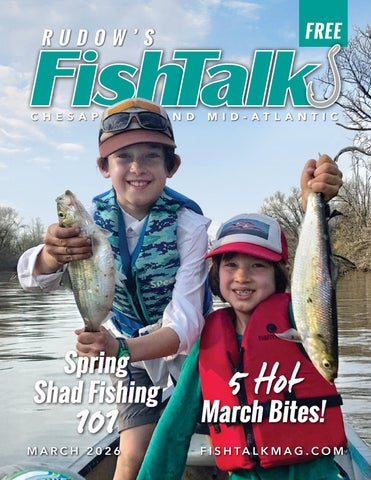
Grayson and Ryeland can’t wait for the spring shad run!


ANGLER IN CHIEF
Lenny Rudow, lenny@fishtalkmag.com
PUBLISHER
Mary Iliff Ewenson, mary@fishtalkmag.com
ASSOCIATE PUBLISHER
Chris Charbonneau, chris@fishtalkmag.com
MANAGING EDITOR
Molly Winans, molly@fishtalkmag.com
SENIOR EDITORS


Beth Crabtree, beth@fishtalkmag.com
Kaylie Jasinski, kaylie@fishtalkmag.com
COPY EDITOR
Lucy Iliff, lucy@fishtalkmag.com
FISHING REPORTS EDITOR
Dillon Waters
ADVERTISING SALES
Eric Richardson, eric@fishtalkmag.com
CUSTOMER SERVICE MANAGER
Brooke King, brooke@fishtalkmag.com
DISTRIBUTION / BROKERAGE / CLASSIFIEDS MANAGER
Beatrice M. Mackenzie, beatrice@fishtalkmag.com
ART DIRECTOR / PRODUCTION MANAGER
Zach Ditmars, zach@fishtalkmag.com
GRAPHIC DESIGNER / PRODUCTION ASSISTANT


Royal Snyder, royal@fishtalkmag.com
COASTAL CORRESPONDENT EMERITUS
John Unkart
CONTRIBUTING WRITERS
Adam Greenberg, Jim Gronaw, Chuck Harrison, Capt. Monty Hawkins, Eric Packard, David Rudow, Wayne Young
DISTRIBUTION
Larry Botts, Bob and Joann Bruffy, Martin and Betty Casey, Jennifer and Al Diederichs, Gregory and Dorothy Greenwell, Dave Harlock, Jim Persing, Mark Schlichter
Rudow’s FishTalk is a monthly magazine for and about Chesapeake and Mid-Atlantic anglers. Reproduction of any part of this publication is strictly prohibited without prior consent of the officers of Rudow’s FishTalk LLC. Rudow’s FishTalk LLC accepts no responsibility for discrepancies in advertisements.
Rudow’s FishTalk is available by first class subscription for $45 a year, and back issues are available for $4 each. Mail payment to Rudow’s FishTalk Subscriptions, 612 Third Street, Suite 3C, Annapolis, MD, 21403.
Rudow’s FishTalk is distributed free of charge at more than 850 establishments along the shores of the Chesapeake and the DelMarVa Peninsula. Businesses or organizations wishing to distribute Rudow’s FishTalk should contact the Rudow’s FishTalk office, (410) 216-9309 or beatrice@fishtalkmag.com.
Member Of:

612 Third Street, Suite 3C, Annapolis, MD 21403 (410) 216-9309 FishTalkMag.com © 2026 Rudow’s FishTalk LLC

ve things you should know about boat insurance
Are you ready to embark on your next on-water adventure? Before you set sail, here are ve things to know about boat insurance.
1. Boat insurance isn’t just for accidents
With comprehensive coverage, you’ll also be protected nancially for theft, vandalism, and unexpected events like storms if you need repairs or replacements due to damage.
2. Accidents can happen to anyone
When accidents happen, boat insurance offers liability coverage for damages or injuries you cause while boating, up to speci ed limits. It can also cover lawsuit costs if you’re sued.
3. Boat insurance can cover medical payments
Boat insurance offers a range of optional medical payments coverage limits, helping to cover medical expenses if you’re in an accident or someone is hurt on your boat, regardless of fault.
4. Most lenders require boat insurance
If you nanced your boat, you’ll likely need boat insurance since most lenders require boat insurance to protect their investment. Additionally, some marinas or municipalities require proof of insurance for docking.
5. Progressive offers specialized boat coverages
Ever worry about getting stuck on the water?
Progressive’s Sign & Glide® On-Water Towing coverage** can help. It’s an additional coverage that steps in if your boat is disabled or breaks down on the water, paying for on-water towing, jump starts, soft ungroundings, and fuel delivery. Fuel cost isn’t included.
Don’t let unforeseen circumstances disrupt your voyage. Cruise with con dence thanks to Progressive Boat insurance. Because when it comes to your boat, peace of mind is the ultimate luxury.
Progressive Casualty Ins. Co. and af liates. Product features are subject to policy terms and conditions and may not be available in all states or for all vehicles and coverage selections.
*No. 1 rating based on boat market share data from Rate lings.com.
**Sign & Glide® is an optional coverage you can add to any Progressive Boat policy and costs $30/annually ($50/annually in Florida). Prices are subject to change.
Scan to get a quote in as little as 4 minutes.
Go to progressive.com to learn more.
Fishing vs. Therapy
By Lenny Rudow
In this topsy-turvy world mental health has taken on more importance than ever, and seeking mental health guidance has become more common than ever. But, are we going about maintaining our sanity the wrong way?
The Nobel Prize-winning author John Steinbeck has been quoted as saying, “I am surprised that the dour brotherhood of psychoanalysts has not attacked fishing, since it seems to me it is in competition. Two hours with a fishing rod is worth 10 hours on the couch and is less expensive.”
Steinbeck might have been on to something here, except maybe about the “less expensive” part. Unless your fishing is limited to cane poles and hand-dug earthworms, fishing can be quite an expensive habit. That’s especially true if you need a new fishing boat. Even so, could fishing still be a better mental health investment than therapy? Let’s crunch some numbers.
Kayak Anglers – You can get away with spending $2500 and get a pretty decent fishing kayak. Add $1000 for accessories because there isn’t a kayak angler alive who can resist adding snazzy crates, swivel-mount rodholders, fishfinders, and more. Then chalk up another $500 for rods and reels. Now let’s amortize that $4000 total over a five-year period. Let’s say you fish 30 times a year at an average of six-hour trips per year. Over five years that’s 900 hours of fishing at an average cost of $4.44 per hour. There isn’t a therapist on the face of the planet who works that cheap, and if you find one who does you should run—fishing wins, hands-down.
Small boat anglers – The least expensive small fishing boats around tend to be aluminum rigs with 40- to 60-hp outboards, and $10,000 is enough to get a basic but new 15’ or 16’ model with a trailer. Now pony up another $500 for the rods, reels, and tackle. We have to add in fuel and maintenance costs with a boat, too, so figure on chipping in another $500 annually. And now you’ll need boat ramp

permits and title and tag fees, for another $250 a year. Over five years the total cost will shake out to $14,000. Sticking with our guestimate of 900 hours of fishing over this time period, we’re now spending $15.55 per hour. Considering that $100 an hour is downright cheap for therapy, again, fishing proves to be the better investment by a longshot.
Center console anglers – If you want to hit the open Bay in a center console on a regular basis you’ll want a 24’ or 25’ fiberglass rig with 250 horses on the transom. $120,000 is barely enough to get you out of the gate. Your gear costs more, too, so you’d better plan to spend $1000. If you burn an average of 20 gallons of fuel per trip you’ll now be spending $2400 on gas every year, and setting aside $2000 a year in maintenance is a must. That means you’ll be spending around $143,000 to stay sane for the next five years, at an hourly cost of around $158.88.
Wait a sec—don’t call that therapist so fast. Since your boat is fiberglass you’ll want to wax it regularly, which has an indisputably therapeutic effect. Credit yourself for 20 hours for that free “therapy”
rubbing and buffing per year, and the cost comes down to $143 per hour. You could buy a spot on that comfy couch at this rate so we’ll call therapy versus fishing a financial wash at this point. Go with the fishing option, however, and you’ll have a LOT more fun.
Offshore anglers – You say you’re ready to drop a cool three mil on that 50’ custom Carolina convertible? Awesome, but you’d better plan on also spending $50,000 on gear, and every time you leave the dock you’ll blow through $500 in fuel. (That’s $75,000 in diesel through the five-year period… best not to think about this too much). Plus, now you have $10,000 in annual mooring costs and maintenance is a whopping $50,000 per year. Total cost is $3.425 million, which equates to $3805.55 per hour of fishing. While it’s certainly tempting to go this route, if you opt to do so, unless my math is off you really are in dire need of mental help.
# Image courtesy of ChatGPT


Access Denied
Dear FishTalk,
Iwent to get in on the rockfish bite at Solomons this winter, and they had up a new sign saying people using the ramp for commercial purposes, like guides, weren’t allowed. Access is already a huge issue for anglers, and I’m not a guide, but I have been taken out by guides using this ramp in the past. Now they can’t use it… why?! This reminds me of the whole Discovery Village debacle, and how they had used the government waterway improvement funds, which people were saying the county would have to pay back if they didn’t keep it available to the public. I Googled “Solomons Island Boat Ramp Waterway Improvement Fund” and sure enough, this fund was used for the 2019 ramp replacement. I guess the boat taxes and registration fees guides pay are redirected to some different fund? Who will they deny access to next? Is this even legal?
-Craig P., via email
Dear Craig, Waterway Improvement Funds are to “improve and promote the recreational and commercial capabilities, conditions, and safety of Maryland’s waterways for the benefit of the general boating public.” It certainly does not seem legit to single out any one user group and say they can’t use it. Board of Calvert County Commissioners, are you paying attention?

Spotted in the Airport Halfway Around the World
Dear FishTalk, Look! I thought you’d appreciate this!
-Chris
H., via email


Out of Line
Dear FishTalk, What’s the easiest way to catch a fish?
Have someone throw it to you. -Anonymous
Dear Anonymous, You’ve given us a lot of laughs with these fish puns through the years, but enough is enough—it’s time to scale back.

Highly Recommended
Dear FishTalk, I wanted to share a few awesome photos and talk about the incredible experience my dad and I had fishing with Griffin’s Guide Service. We went out on January 20th — one of the coldest days of the winter — and Captain Gio was nothing but professional and motivated. He simply told us to bundle up and assured us we were still going fishing, then put us right on the fish despite the tough conditions. We landed five rockfish, all around 40”, with the biggest measuring an impressive 43.5”. It was an absolute blast from start to finish. The trip exceeded our expectations, and it’s easy to see why Griffin’s Guide Service comes so highly recommended. We originally found them through this magazine, and after our experience, I couldn’t agree more with the praise. They truly deserve the recognition and continued business and I’d highly recommend them to anyone looking for a topnotch fishing adventure.
Send your fish photos, questions, and comments to lenny@fishtalkmag.com
Logan J., via email
Dear Logan,We’re glad you had a great trip and having hung out with that crew we agree—they are indeed top-notch!
New Boat?


FISH NEWS

By Lenny Rudow
Regulation Roundup
At its winter meeting the MidAtlantic Fishery Management Council addressed the regulation of several items of interest to anglers in our area. Flounder were considered, with no change in coast-wide regulations expected for the 2026 and 2027 seasons (Maryland has already announced that 2026 flounder regs will mirror 2025). Individual states may make minor changes to their seasons, but the overall harvest remains the same.
The council approved a liberalization of black sea bass harvest, allowing for an increase of 20 percent since biomass has been increasing and remains well above target levels. Individual states will determine seasons, minimum sizes, and bag limits, but this is one of those rare cases where we can hope for an increase in fishing days or limits rather than a cut.
The council also addressed the Recreational Sector Separation Amendment for flounder, scup, black sea bass, and bluefish. This regards separate management (read: catch limits) for recreational and for-hire (charter boat) anglers. Although recreational and for-hire anglers are all currently alleged to be managed as one, the for-hire segment of the sector already enjoys more liberal catch limits for blue-

fish. (In Delaware, Maryland, and Virginia recreational anglers on for-hire boats are allowed two fish more than recreational anglers on their own boats, or anglers fishing from shore). The council essentially punted on the issue to “further refine draft alternatives.” They also discussed modifying or eliminating the tilefish reporting framework, with action planned for the spring 2026 meeting, and approved a draft 2026 Implementation Program outlin-
He’s Number One! He’s Number One!
The first Virginia fisherman to claim the title of Master Angler VI made the grade this winter, when Stephen Miklandric caught a four-pound, threeounce saugeye on the Appomattox River in January. Hitting Master Angler VI means you’ve caught trophy-sized fish of all 30 species listed by the state—and nobody’s ever hit that mark before. The Saugeye is an extremely unusual catch as they’re only present in a handful of far southwest rivers and were only added to the Online Virginia Angler Recognition Program in 2019. In all, Miklandric has recorded an eyepopping 1816 citation-worthy freshwater fish.
Ting anticipated work over the next year in context with the council’s five-year plan.
In addition to the MAFMC announcements, the state of Maryland has made a change in yellow perch regulations. Excluding reservoirs, lakes, ponds, and impoundments, the daily catch limit has been halved to five fish due to low recruitment over the past six years. The season remains open year-round with a nine-inch minimum size.
March Mayhem
here are some great events to check out as we get ready for spring and the 2026 fishing season. On March 7 from 8 a.m. to 2:30 p.m., the Great Bridge Fisherman’s Association Fishing Flea Market takes place at the Virginia Beach Field House in Virginia Beach, VA. Fly anglers will want to head for the Maryland Fly Fishing Show on March 21, from 9 a.m. to 4 p.m. at West Village Commons at Towson University in Towson, MD. And on March 22 the Annapolis Saltwater Fishing Expo will take place from 9 a.m. to 3 p.m. at the Annapolis Elks Lodge in Edgewater, MD. FishTalk will be on hand for this one, so stop by and say hi to the crew.
# 2026 flounder harvest limits will remain unchanged from last year.

Susquehanna Salmon
The water discharge permit requested by Norwegian company AquaCon to build an indoor salmon aquaculture facility in Port Deposit, MD, five miles upstream from the Susquehanna Flats, has been put on pause for review—but not for the reasons one might think. After the Chesapeake Bay Foundation filed a lawsuit challenging the discharge permit issued by the Maryland Department of the Environment (MDE), AquaCon submitted a permit modification request asking the MDE to strengthen six different provisions. Yes, you read that right, the permit’s on hold because the applicant asked for tighter requirements, not the MDE, and it took a lawsuit to make it happen.


# Growing millions of salmon in Port Deposit, just upstream of critical habitat for rockfish, perch, shad, and more? What could go wrong? Image via Google Earth
HOT NEW GEAR
Editor’s Note: We wish we could personally test every item that appears on these pages, but that simply isn’t possible. So that you know the difference between when we’ve physically tested a piece of gear and when we’re writing about it because it’s newsworthy and we think you’ll want to know about it, we’ve developed this FishTalk Tested button. When you see it printed next to something in this section, it means we’ve personally run it through the wringer.
Data Delivery
The first in a new series of books brought to you by FishTalk, “FishTalk’s Guide to Fishing for Beginners and Intermediate Anglers” is now available. Written by Team FishTalk and including over 50 how-to/where-to articles from the pages of our magazine, the book includes a wide range of intel which will be invaluable to anglers who are just getting started, recently moved to the area, or need to learn the basic tactics, rigs, gear, and target species in the Mid-Atlantic region. Chesapeake Bay, inshore coastal, and freshwater fishing are all included, and the book is divvied up into three different sections: Basic Tactics and Methods, Fishing by Species, and Tackle and Gear.
When we decided to start this series of books we figured it would be best to start with the basics, since there’s been a tremendous influx of new anglers of all ages in the past few years. We’ve also heard a lot of feedback from anglers expanding their repertoire from freshwater to saltwater or vice-versa, who wanted to learn how to target one fishery or another that they hadn’t tackled yet. So, this work includes all of the articles from our “Beginners” series, along with a selection of intermediate-level articles that introduce anglers to popular methods and lures applied here in the Mid-Atlantic region. When it comes to the most popular target species, we’ve included the many articles that apply. The chapter on striped bass, for example, includes multiple articles ranging from “Striped Bass for Beginners” to “Finding Striped Bass in Chesapeake Tributaries” to “Live-Lining for Striped Bass from Shore.”
“FishTalk’s Guide to Fishing for Beginners and Intermediate Anglers” has over 65,000 words and runs close to 300 pages, including black-and-white photos, diagrams, and illustrations. We’re so confident you’ll love the fishing information between its covers that we’ve decided to give readers an iron-clad guarantee: if this book doesn’t help you catch more fish, we’ll eat our bait (if we’re using soft crab or shrimp). Price: $24.99. Visit amazon.com to order up a healthy heap of FishTalk-style angling intel.


TRapturous Rod
here’s a new Fenwick Eagle flying around, and after spending a few months slinging this rod we’ve come to the realization that this redesign is revolutionary. Now built with a blend of 24-and 30-ton intermediate and high modulus graphite, the Eagles offer up extreme sensitivity and a lightning-fast action that we found ideal for snap-jigging on stripers. The lineup includes six models in 7’0” and 7’6” lengths, in medium light, medium, and medium heavy actions that can handle six- to 12-, eight- to 17-, and 12- to 25-pound test lines. We particularly like the interlocking nature of the grips and reel seat, which feel comfortable in hand and deliver fantastic sensitivity. We’d give it two thumbs up, if we could set the rod down long enough to make hand signals. Price: $139.99 to $149.99. Visit fenwickfishing.com to learn more.
# CAUTION! This book may trigger unprovoked trips to the bait shop and spontaneous tackle-buying sprees.


High-Speed Heavyweight
If you’re searching for a new champion of high-speed trolling, the Rapala Sarda is sure to be in the running. Previously available as a seven-inch, seven-ounce version, there’s now an 8.5-inch, 12-ounce heavyweight model available. Construction is one-piece ribbed stainless-steel for the ultimate in ruggedness, hooks are forged VMC TechSets, and there are a whopping 13 different color patterns. Amazingly, the Sarda can be trolled at up to 14 knots. Price is amazing, too: $69.49. Visit rapala.com to buy the most impressive— and expensive—lure on your boat.

Sling-A-Pult
They say that the tug is the drug, but in this case, the idea of giving a tug on this aft-mounted tubular slingshot handle just makes us shrug. We can’t imagine why anyone would trade in their rod for a Fishing Slingshot Rod Compact Catapult, but if you want to, errr… give it a shot, so be it. According to the maker the antislip design ensures comfort in cold or sweaty conditions without hand fatigue (WOOHOO!!) and proves invaluable for maintaining focus on the activity while keeping your bait ready. Accurate bait delivery! Thoughtful present idea to delight fishing lovers! Innovative and unique design! (Well, that one we can’t argue with). Price: $30.75. You can find it on Ail Express if you’re desperate to confuse everyone at the lake, including the fish.
Value Driven
We anglers tend to go a little crazy when it comes to our angling budgets. And by “crazy,” we mean we spend too much—sometimes way too much. If you’re looking for some new tackle options that will help you get the 2026 angling season started off right without breaking the bank, check out these three relatively low-cost options.

Okuma Safyre Spinning Reels
Most decent freshwater/saltwater gobetweens break the $100 barrier and keep right on going, but one new option that will help you economize is the Okuma Safyre. Available in 1000 through 5000 sizes with gear ratios from 5.2:1 to 6.2:1, the Safyre has seven ball-bearings, carbonite drag washers, and an aluminum spool and handle. The Hydro Block II body delivers IPX3 “splash proof” protection. Small sizes put out up to 11 pounds of drag, medium sizes boast 18 pounds, and large sizes can handle 24 pounds of drag. Price: $89.99 to $99.99. Visit okumafishingusa.com.


Maryland Fairwinds Marina | 410.216.0205
Fairwinds Dr, Annapolis, MD fairwindsmarina.com PYY Marine | 410.255.1771 1132 Pasadena Yacht Yard Rd, Pasadena, MD pyymarine.com Richardson Marine | 410.745.9279 9649 New Rd, McDaniel, MD 21647 richardsonsmarinerepair.com
Marina | 410.923.3444 529 Ridgley Rd, Crownsville, MD 21032 smithsmarina.com Thornes Marine | 410.957.4481 1237 Greenbackville Rd, Stockton, MD thornesmarine.com
Delaware
Virginia
Legasea Marine | 757.898.3000 821 Railway Rd, Yorktown, VA legaseamarine.com
Shimano Stimula Rods
You say you need an inexpensive rod you can hand to an amateur without feeling guilty about handicapping them, nor worrying about damage? The Shimano Stimula will do the trick. Available in 5’6”, 6’0”, 6’6”, and 7’0” lengths, all in fast action, we picked up a pair of two-piece six-footers to put under the truck seat so we’d always have rods at hand. No, they aren’t the fastest nor the most sensitive rods on the face of the planet, but considering the cost we’re surprised at just how nice they feel in-hand. Plus, we can toss them in the truck or hand them to an exuberant kid who’s never cast before without stressing over what might happen, so these get our tightwad stamp of approval. Price: $29.99. Visit fish.shimano.com to learn more.
Kastking Lethal Blaze Twin-Tip Baitcaster Combo
No one’s going to argue that the new two-piece Kastking Lethal Blaze Twin-Tip Baitcaster Combo is the smoothest or most sensitive rig ever built, however, it comes with an unusual perk: a second top half to the rod, so if the tip snaps or the ferrules crack you already have a backup. Reels have a fivebutton magnetic brake, five ball-bearings, and a 7.3:1 gear ratio. Rods are fast action in 6’4”, 6’10”, and 7’4” lengths. Price: $89.99. Visit kastking.com for more information.


Guide to Fishing For Beginners and Intermediate Anglers For Chesapeake Bay, Mid-Atlantic Coastal, and Regional Freshwater Fishing
Guide to Kayak Fishing the Chesapeake and Mid-Atlantic Available on Kindle and in Paperback

CHESAPEAKE CALENDAR
MARCH
through Mar 31
The Great Chesapeake Invasives Count Help collect important data while competing for great prizes! Log your invasive species catches (northern snakehead, blue catfish, flathead catfish) on iAngler, and FishTalk will present live, monthly prize drawings. Register: ccamd.org
4 Free State Fly Fishers Club Meeting
Cody Rugmer, Tochterman’s Fly Shop manager, will speak about his experiences fly fishing for smallmouth bass on the lower Susquehanna River. 7 p.m. at the FSFF Club House, Davidsonville Family Rec Center (3789 Queen Anne Bridge Rd, Davidsonville, MD).
7
17th Annual GBFA
Fishing Flea Market
8 a.m. to 2:30 p.m. at the Virginia Beach Field House (2020 Landstown Centre Way). Presented by the Great Bridge Fisherman’s Association. New and used rods and reels, fresh and saltwater gear, custom lures, boats and trailers, food, and more. Admission: $5 cash (children 12 and under are free).
7
FSFF Club Fly Tying
10 a.m. to 12 p.m. at the Free State Fly Fishers Clubhouse at the Davidsonville Family Rec. Center (3789 Queen Anne Bridge Rd, Davidsonville, MD). Tying: Stealth Bomber. All materials will be provided. Bring your vise and tools. Limited availability of tools for new fly tyers.
7 Herrington Harbour Online Seminar
10 a.m. to 12 p.m. Herrington Harbour’s free online seminar, “Boater Safety and Crew Management,” will be presented by The Herring Bay Yacht Club. Meet seasoned Bay captains who love to share their local knowledge. The seminar will cover the best boating destinations and the most breathtaking places to drop anchor. A link to the live stream will be sent prior to the seminar.
12
CCA Angler’s Night Out
6 to 8 p.m. at Twin Arch Tavern in Mt. Airy, MD. Join CCA for a night with Captain Tim Sughrue of School of Rockfish Guide Service, who will break down strategies for finding and catching rockfish in our local waters. Free and open to all.
14
CCA Virginia’s Save a Fish - Build a Reef Banquet
6 to 9 p.m. at Arlington Fairfax Elks Lodge in Fairfax, VA. Enjoy dinner, appetizers, beer, wine & farm raised oysters while ensuring the health and conservation of our marine resources and anglers’ access to them.
14 Herrington Harbour Online Seminar 10 a.m. to 12 p.m. Herrington Harbour’s free online seminar, “Spring Commissioning Tips,” will be presented by Captain Frank Lanier. He will share expert spring commissioning tips to help you start spring safely and smoothly. Drawing on decades of on-the-water experience, he walks through the critical checks and pre-departure planning. A link to the livestream will be sent prior to the seminar.
14-15
Essex-Middle River Fishing Club
Annual Fundraising Banquet
7 CCA Kent Narrows Chapter
5:30 to 9 p.m. at the Kent Island Volunteer Fire Department in Chester, MD. Oyster bar, dinner, open bar, live music, and more. This fundraising dinner directly supports CCA Maryland’s focus on ensuring the health of our marine resources and anglers’ access to them, and our objective to conserve, promote, and enhance our marine resources for the benefit of the general public.
12-26 Understanding and Avoiding Thunderstorms on the Chesapeake WEBINAR
This 3-part live webinar series by Mark Thornton of LakeErieWX will examine the various types of thunderstorms and ingredients that lead to their formation, why thunderstorms often “pop-up” late on summer afternoons, and why some storms have short lifespans while others persist for several hours. Will introduce resources for forecasting and monitoring thunderstorms. March 12, 19, and 26 from 7 to 8:30 p.m. $90 for the series.
Fishing Flea Market 8 a.m. to 2 p.m. both days at the Rosedale Volunteer Fire Company (8037 Philadelphia Rd, Rosedale, MD). Admission $5, under 13 are free. New and used freshwater, saltwater, and offshore fishing tackle, boating supplies, crabbing supplies, charter captains, nautical crafts, fishing apparel. Plenty of great food and beverages.
17
Essex-Middle River Fishing Club March Monthly Meeting
The guest speaker will be Aaron Zale on first aid in emergencies. Held at the FOP Lodge 34 located at 730 Wampler Road in Middle River, MD 21220. Meetings start at 7:30 p.m. Open to all. Food and drinks are available.
M ARCH
(continued)
17 PSWSFA Monthly Meeting
Peninsula Saltwater Sportfisherman’s Association. Regular monthly meetings are held on the 3rd Tuesday of the month at 7 p.m. at Peninsula Baptist Church (2605 Cunningham Dr, Hampton, VA). Meetings consist of an educational speaker, monthly tournament awards, and a discussion of fishing news and club business. Meetings are free and you do not need to be a member to attend.
18 Annapolis Anglers Club Monthly Meeting
Speaker, food and drink, table raffle, and 50/50. Food starts at 6 p.m., followed by meeting at 7 p.m. At the American Legion Post 7, Crownsville Road, Annapolis, MD.
21 Fishing/Kayak Show
Big Bass USA is partnering with Caroline County Chamber of Commerce to host a fishing/kayak show at the 4H park in Denton, MD. Details TBD.


21 Haven Harbour Seminar Series: Session 3
Haven Harbour Yacht Services will host monthly educational seminars from 9 a.m. to 12 noon at Haven Harbour South’s Ark & Dove Restaurant. Free and open to roughly 35 attendees per class. Coffee and pastries will be provided. Topics: Spring commissioning, products, services, and best practices. Guest speakers to attend.
21 Maryland Fly Fishing Show
9 a.m. to 4 p.m. at West Village Commons at Towson University in Towson, MD. The event brings together fishing enthusiasts throughout the mid-Atlantic region with high-quality flyfishing dealers for a day of tackle review, sales, demonstrations, seminars, clinics, and conversation.
22 Annapolis Saltwater Fishing Expo 9 a.m. to 3 p.m. at the Annapolis Elks Lodge in Edgewater, MD. Presented by Annapolis Anglers Club. Local tackle dealers, charter captains and guides. Seminars by Shawn Kimbro, Mike and Nate Berkheimer, Tim Sughrue, and Lenny Rudow. Food and beverages including BBQ truck, oysters, ice cream, and full bar.
21-22 Southern Maryland Fishing and Outdoor Adventure Fair 8 a.m. to 3 p.m. Saturday, 9 a.m. to 2 p.m. Sunday at the St. Mary’s County Fairgrounds in Leonardtown, MD. Admission $5 cash at entrance, kids 12 and under are free. Vendors will be selling rods, reels, lures, fishing tackle, outdoor gear, piers, paintings, crafts, and charter fishing trips. Children’s activities include a casting contest and bean toss competitions. Maryland Boater Safety Course Saturday at 9 a.m. followed by exam and certification Sunday at 9 a.m. Presented by the Southern Maryland Recreational Fishing Organization. For further information send an email to: smrfo2021@gmail.com
26 CCA Annapolis Chapter Angler’s Night Out 5:30 to 7:30 p.m. at West End Grill in Annapolis. Free and open to the public. Speaker TBD.
28 Fishing/Hunting/Boating Flea Market
Held by the Mid-Shore Fishing Club. 8 a.m. to 3 p.m. at the American Legion Post 91 (98 Sunburst Highway) in Cambridge, MD. $5 entrance fee. Children 12 and under are free.


28 Free State Fly Fishers HandsOn Session Tom Parham, MD DNR, will demonstrate the “Eyes On The Bay - Click Before You Cast” web-based resource available on the MD DNR website. 10 a.m. to 12 p.m. Noon FSFF Club House, Davidsonville Family Rec Center (3789 Queen Anne Bridge Rd, Davidsonville, MD).
APRIL
1 Free State Fly Fishers Club
Meeting Mark Stanley, MD DNR Central Region Freshwater Fisheries Manager, will present on the Gunpowder River fishery. 7 to 8:30 p.m. at the FSFF Club House, Davidsonville Family Rec Center, 3789 Queen Anne Bridge Rd, Davidsonville, MD 21035.
4 Free State Fly Fishers Tying Session Mark Bange ties some favorite panfish flies. All materials are provided. Bring your vise and tools. Limited availability of tools for new fly tyers. 10 a.m. 12 noon at the FSFF Club House, Davidsonville Family Rec Center, 3789 Queen Anne Bridge Rd, Davidsonville, MD 21035.
11
CCA Central Region Chapter Annual Celebration of Conservation 6 to 9 p.m. at Linganore Wine Cellar in Mt. Airy, MD. Oyster bar, dinner, open bar, live music, raffles, silent and live auctions. This fundraising dinner directly supports CCA Maryland’s focus on ensuring the health of our marine resources and anglers’ access to them.
15
Annapolis Anglers Club
Monthly Meeting
Speaker, food and drink, table raffle, and 50/50. Food starts at 6 p.m., followed by meeting at 7 p.m. At the American Legion Post 7, Crownsville Road, Annapolis, MD.
16
CCA Southern Maryland Chapter Angler’s Night Out 5:30 to 7:30 p.m. at Ruddy Duck in Solomons, MD. Free and open to the public. Speaker TBD.
17-19 Bay Bridge Boat Show at Safe Harbor Narrows Point At Safe Harbor Narrows Point in Grasonville, MD.
18
Free State Fly Fishers Saturday Hands-On Session
Mark Bange will share his expertise in catching panfish on the fly and explain why it can make you a better fly fisher overall. 10 a.m. 12 Noon at the FSFF Club House, Davidsonville Family Rec Center, 3789 Queen Anne Bridge Rd, Davidsonville, MD 21035.
21
Essex-Middle River Fishing Club April Monthly Meeting
The guest speaker will be Francis Zell on Preparing for Fishing Trips. Held at the FOP Lodge 34 located at 730 Wampler Road in Middle River, MD 21220. Meetings start at 7:30 p.m. Open to all. Food and drinks are available.
21
PSWSFA Monthly Meeting Peninsula Saltwater Sportfisherman’s Association. 7 p.m. at Peninsula Baptist Church (2605 Cunningham Dr, Hampton, VA). Meetings consist of an educational speaker, monthly tournament awards, and a discussion of fishing news and club business. Meetings are free and open to the public.

March 22, 2026 |


Reader Photos


# Frank reeled in a perfect slot striper at the mouth of the Choptank.
# Dave caught this 30” flounder while aboard the Ocean Princess. What a fish!
# Pete tied into a magnificent rockfish to ring in the new year.
# Evan celebrated the new year with some awesome C&R action.
# Hitting the wrecks paid off bigtime for Steve.
# Christian tied into some beauts while fishing with Fish With Weaver.


# Fred found some yellow perch during a brief but much-appreciated warm spell this winter.

# They say “find the birds.” Well, Christian did—oops!
Gavin caught a three-pounder somewhere south of the MidAtlantic region this winter — nice one, Gavin.


# Brendon’s first fish of 2026 was a chunky one!
#


THE MONTH


# Jim tied into this 46.25” rockfish while fishing in the cold and rain near Hampton Roads.
# Marcy and Beau tangled with some beautiful rockfish in the chilly weather.
# An excellent fish in the boat, for Alex!
# That might not be the biggest rockfish in the world, but it suited Marcy just fine.
# Marissa enjoyed a fine fall on the Chesapeake.
# Kevin drove the boat and Hailey caught the fish!


# Christian traveled to Spain, Florida, and El Salvador this winter, and found some interesting fish to catch in each place!
# Kevin found some winter stripers and enjoyed serious pullage.
# Logan braved the winter weather to fish with Capt. Gio from Griffin’s Guide Service, with excellent results.
# Pete and his friend Larry enjoyed some excellent action trolling down the Potomac last fall.
# Eric, Capt. Charlie, and the crew bagged a 94-incher – W-O-W!


# Tina and Marc found the wahoo in Cabo San Lucas this winter, while the rest of us were freezing our keisters off.
# A throwback to last summer: Liv and Beau dipped for Chesapeake gold—and scored.
# Adam tied into a chunky blue catfish in the nation’s capital.
# Owen pitched a doubleheader while trolling on the Potomac.
By Lenny Rudow
Grady-White Freedom 345: Angling Attitude with Lots of Latitude
What’s an angler to do when he or she wants a family boat to go along with their fishing machine? Oh, and you say yacht-level comfort and quality is a requirement, too? You could buy three boats to check all three boxes, but checking out the new Grady-White Freedom 345 probably makes a lot more sense. Grady-White’s dual console line is a big one, stretching from a Freedom 215 all the way up to a Freedom 415 that, make no mistake about it, qualifies as a yacht in just about every way. And while bringing the LOA down seven feet from the 415, somehow the builder manages to maintain that yacht-like feeling and quality in a much more manageable package. Consider that on this boat you’ll enjoy such perks as air conditioning in both cabins and at the helm; electrically extending loungers, tables, and berths; a wet bar with a refrigerator, sink, and 1300-watt grill; and the Siren Connected Boat system with remote monitoring and geolocation. Also make no mistake about the boat’s level of family-friendliness. With a cabin including a settee that converts to a berth, a

TV, and a microwave on the port side, the kids will have a place to duck out of the weather and weekending aboard becomes a possibility. What about the head? Grady-White locates it in the helm console, so it’s kept separate from the living quarters and has plenty of elbow room. When it’s sunny out the kids will love hanging in the bow

Quick Facts
LOA: 33’6”
Beam: 11’7”
Draft (min.): 2’3”
Displacement: 12,510 lbs.
Transom Deadrise: 20 degrees
Fuel Capacity: 300 gal.
Max. Power: 1050 hp
cockpit, which converts between forward facing loungers, a sunpad, or a dinette. But the biggest family asset of all on the Freedom 345 is undoubtedly the boat’s overall dual console design, because it allows you to cruise with the bow closed off and the helm deck completely sealed off from the weather. Move aft of that helm deck, and you have acres and acres of angling territory. The big lounger retracts out of the way at the press of a button, and the aft seat folds flush up against the transom. Now you can take advantage of the 30-gallon livewell in the transom, four flush-mount rodholders, four hard top pipework rocket launchers, and fore and aft washdowns. With a little
# At the press of a button that settee turns into a berth.
Hot New Fishboats
luck you’ll also be using one or more of the four integrated fishboxes, which provide a total 143.5 gallons of fish-stowing capacity.
One note about those fishboxes, all of which are insulated and all of which drain overboard: the aft transom box can be turned into a digitally controlled refrigerator/freezer. Grady-Whites are, as a rule, thoroughly outfitted boats that include the vast majority of the items other builders consider optional as standard features. But this is one item that’s left to the choice of the buyer. Anglers who head offshore on a regular basis will probably also want to opt for the 18’ outriggers, and one more
very tempting option is the Seakeeper 3 gyroscopic stabilization system.
You’ll also be making a decision about the power choice. The Freedom 345 is available with either twin Yamaha F450 XTO outboards, or triple Yamaha F350s. Performance is quite similar either way with the most efficient cruise coming at around 30 mph and 1.1-ish mpg, but the triple engine rig enjoys a top-end advantage with a wide-open throttle speed of about 56 mph, versus 52 mph for the twins. The other factor to consider, of course, is cost and maintenance, which will be substantially lower going with twins versus triples. Either
way, Grady-White includes the Helm Master EX system with a joystick as standard gear.
Fishing boat? Check. Family boat? Double-check. Yacht-level quality and outfitting? Check again. The GradyWhite Freedom 345 gives you the freedom to enjoy all of the above—without having to buy three boats.
For more information visit the Grady-White website, or FishTalk supporter Tri-State Marine in Deale and Annapolis, MD (410) 867-1447, tristatemarine.com.
Scout 188 Sportfish: Exceeding Expectations
Have you ever seen a center console fishing boat under the 19’ mark with seating for six people? Nope. How about one with a forward console lounger? Not likely. How about one that features digital switching? Heck no. These are all goodies you expect in significantly bigger boats, and all are present on the new Scout 188 Sportfish. In recent years Scout has made plenty of headlines with their larger, more luxurious boats, but this company’s roots lie in building small, easily trailerable fishing machines. And with the 188 Sportfish it seems the company is setting out to prove that they still have a talent for it. Along with packing in more features than one would think is possible, Scout also gives it a serious quality boost over what one usually sees in boats of this size. Consider the helm seat, for example, which has a real metal frame and a cooler underneath as opposed to the common all-in-one swing-back cooler seat. But that seat back still swings, so you can sit facing forward or aft with a backrest, or set it in the middle to serve as a leaning post. Or, check out the grab rails at the swim platform, stern, and bow, all of which are blind-fastened stainless-steel. And note that Scout wraps the brow above the forward deck with a bolster when you opt for the forward cushion, so use it as a seat and you have a built-in backrest all around. The coup de gras, however, is seen when you
pop open the bilge access hatch in the transom. No one would ever expect to see a fully finished, gel-coated bilge on a boat of this size. But there it is.
On the fishing front the 188 Sportfish boasts four flush-mount holders in the transom plus a rack of three vertical holders on the console, along with under-gunwale racks. Under the port aft jump seat there’s a 13-gallon livewell, and there’s stowage space under the starboard seat. Lift up that forward console lounger when you’ve reeled in dinner to ice down the catch.
For hitting the Bay with the cards stacked in your favor, we’d vote for adding in a couple of critical optional fishing features. The electric trolling
motor on the bow will be considered a must by many anglers, and either a Minn Kota Riptide Terrova 80 or a 36” 24-V Garmin Kraken are available. You can also get a Garmin 943xs with a GT 21 transducer. Some fishermen will
Quick Facts
LOA: 18’11”
Beam: 7’6”
Draft (min.): 10”
Displacement: 1645 lbs.
Transom Deadrise: 11 degrees
Fuel Capacity: 39 gal.
Max. Power: 115 hp

find the Power Pole a nice addition, and a pair of LED underwater lights can be added in as well.
Scout even adds in a few comfort features on the 188 Sportfish. There are six cupholders, a USB/USB-C port, and the port-side swim platform sports a telescopic reboarding ladder that folds down into a recess. You can add a stereo system and Bimini top, too.
Even as they build all those 40’ and 50’ sportfishing luxury yachts, does Scout still have the drive and the know-how to build a small, easily trailered center console fishboat? Yes. The 188 Sportfish proves it beyond the shadow of a doubt.

# The pieces and parts you’ll find on the 188 Sportfish are significantly upgraded from those usually seen on boats of this size.
For more information visit the Scout website, or FishTalk supporter Anchor Boats in North East, MD (410) 287-8280, anchorboat.com
Innovex Caribe:
Who needs a fishfinder when you can look down and see the fish with your own eyes? That seems to be the concept behind the Caribe Clear Bottom Fishing Kayak. It’s half sit-in and half sit-on-top, with a recessed halfcockpit, and the “Fishing Adaptor” kit includes four rodholders and a dry storage compartment which the manufacturer says could be used as a livewell. They also claim that since light passes through a portion of the hull, it’s less likely to spook fish as opposed to “regular” fishing kayaks. That seems like a reach to us, but we have to admit, this thing could be one heck of a lot of fun to fish from.
Quick Facts
LOA: 12’0”
Beam: 2’7”
Draft (min.): 10”
Displacement: 63 lbs.
Fuel Capacity: Three chicken salad sandwiches
Max. Power: You and a paddle
For more information ignore the pop-up that says your connection is not private and attackers may...

For more fishboat reviews, visit: FishTalkMag.com/fishboat-reviews
SHAD FISHING for Beginners
By Staff
Fun and feisty, going after shad is a great way to get your fishing season started.
Shad are an early arrival in Chesapeake tributaries, first arriving in the rivers when water temperatures rise over the 50-degree mark usually at some time in mid to late March. In some areas (Maryland and Potomac River Fisheries Commission waters) shad must be released, and in others (Virginia tributaries) hickory shad can be kept while American shad must be released. But in all of the Chesapeake’s waters anglers tend to agree on one thing: catching shad during the spring run is a ton of fun, and a great way to kick off the fishing season.
What Are Shad?
Shad come in two flavors in our waterways: hickory and American. Hickories generally run a pound or two and the first catches begin in mid to late March, increase in numbers in early to mid-April, and run through about the end of April or early May. Americans

arrive slightly later than hickories and can get a lot bigger, sometimes pushing over five pounds. The most definitive way to differentiate between the species is to look at the jaw. With the mouth closed, the lower jaw protrudes well past the upper jaw in the case of hickory shad. On American shad the jaws are of about equal length.
Shad are sometimes called “poor man’s tarpon” because they often leap and thrash like a tarpon on the end of the line. Most anglers feel that they fight like most fish twice their size. And one thing all anglers will agree on is that these fish can be exceptionally picky. It’s not uncommon for two anglers fishing side by side with different color or style lures to experience radically different results. And these fish can change their preference from one day to the next. On Saturday they may insist on pink and black darts, and on Sunday the bite might be limited to

gold spoons—there’s just no telling. Which brings us to…
The Best Lures for Shad Fishing
Although we use shad darts for casting to countless different species these lures earned their name as the original offering for shad. Due to the shad’s unpredictable preferences shad anglers should carry a wide selection of darts with multiple colors and patterns in multiple sizes.
Small spoons are the second lure of choice for these fish. Tiny spoons, really, usually an inch or less long. Again, shad may hit one type of spoon one day and a different one the next, so you’ll want to keep a wide range of colors and finishes on hand.
To offer up multiple options at the same time most shad anglers will tie tandem rigs, often with a dart up top

# Some surprisingly small creeks and rivers have excellent shad runs.

and a spoon on the bottom. That way, when you’re not getting strikes you can switch one, then the other, testing out different colors and sizes until you discover what the fish want on any given day.
The Best Gear for Shad Fishing
You can cast for shad with a wide range of rigs, and spinning or casting gear in the six- to 12-pound class usually fits the bill. Many anglers also enjoy casting fly fishing gear for shad, while using resin spoons or bead-eye streamers.
When choosing your gear bear in mind where you’ll be fishing for them. In larger rivers with rocky shorelines or when fishing from a pier a longer rod will help you sail those darts and spoons far out from shore. But in smaller rivers and creeks if you’re fishing from shore a short rod is a better choice since you’ll be dealing with overhanging trees and branches.
The Best Places To Fish for Shad
Most of the significant Chesapeake tributaries have a run of shad to some degree, with larger tribs like the James, Potomac, and Susquehanna being the headline venues. Areas

relatively close to the fall line, where the fish stack up prior to spawning, tend to be the hottest zones. In the James, for example, this would be near Richmond; on the Potomac it’s in Washington, DC; and in the Susquehanna and its offshoots it’s near the Conowingo Dam. There are also many smaller creeks and feeders—some small enough to easily cast across—that have excellent shad runs. Again, the best action will generally be within a few miles of where the tidal/non-tidal boundary is.

In small waters it’s usually not too difficult to locate the fish, but in the bigger rivers it can be more of a challenge. Here, you’ll want to scan the river’s surface and look for a seam in the current. These visible water barriers tend to congregate the fish, and are your best visual indication of where they’ll likely be staging. Whether you’re walking along the bank, paddling or pedaling a kayak, or motoring in a boat, move along until you see one of these seams then set up shop.
Next you’ll need to figure out what depth the fish are holding at. Cast out beyond the seam, allow the offering to sink for three to five seconds, then retrieve through the seam. On the next toss try a 10-count. Then try a 15-count, and so on, until the rig is reaching bottom before you begin the retrieve. When you get a strike, mimic the count you were using on the next few casts and see if you’ve nailed down the depth of the fish. Usually, the bulk of them will be staging at about the same depth.
By this point in the season many of us are thoroughly sick and tired of being bottled up indoors most of the time. We’re all waiting in anticipation for those warm spring days to heat up the angling action. And shad are a great way to get the season started with some fast and furious action. Load up on those darts and spoons, anglers!
# Tiny spoons are a staple for shad anglers.
# Fly casting resin spoons or bead-eye streamers is a great way to target shad.
Fishing for Beginners SHAD FISHING in Virginia
By Grayson McCormack
If you have a few spare hours and are sitting around the house with nothing to do, why not consider grabbing a rod and some shad darts and heading out for some shad fishing on one of Virginia’s many tidal rivers? Shad are one of the most fun freshwater fish to hook on light tackle due to their impressive leaps and strong fighting ability. It’s no surprise that anglers line up on the banks and flood the tidal rivers of Virginia with boats in the spring to chase this fish. They are fun to target for both beginners and lifelong anglers.
Even though shad are born in freshwater, they spend most of their lives in saltwater. Each spring, they return to Virginia’s tidal rivers to spawn. Typically, the larger fish migrate upstream earlier, while the smaller fish follow slightly later. I’ll tell you some of the places to target shad in Virginia where I’ve had the most luck: the Rappahannock River around the fall line in Fredericksburg, the James River around the fall line in Richmond, the Chickahominy River below Walkers


Dam, the Nottaway River, the Appomattox River, the Pamunkey River, and the Mattaponi River. In these rivers, the best shad fishing won’t be much past the fall lines, and likely in two to 15’ of water depending on where you are fishing.
Now, let’s look at your tackle. A lightweight five- or six-foot light action rod matched with a small spinning reel, spooled with six- to eight-pound monofilament line (I prefer six pound), will be the perfect combo. For lures, shad will take a variety. Some of the best are shad darts, small spoons, and crappie jigs; I feel crappie jigs are slightly superior. It’s a good idea to keep a variety of lures, colored jigs, and darts because some days the shad will bite red and green chartreuse and completely ignore it the next day.
Your retrieving pattern can be just as important as the color lure you are using. I have had days when the shad will only bite my lure if I drag it on the bottom of the riverbed, and other days when the only way I can get a bite is by fishing my dart like a jerk bait. Changing up your retrieving pattern every five to 10 casts until you find what pattern is working that day is your best bet.
A canoe, kayak, or Jon boat could help you cover more water, but remember to bring a landing net if you go this route. Shad have a bad habit of dehooking themselves as you swing them into the boat. Most people release shad anyway, but if prepared properly shad can make a good meal. Some people eat the shad roe, others make shad cakes. Find a recipe you like and try it out—happy shad fishing!
For more articles on how to learn to fish, visit fishtalkmag.com/tag/fishing-beginners

# Grayson with a shad caught from a Virginia trib.

Ragged Edge of the Northern Neck
Changing shorelines and developing hotspots provide angling opportunity.
By Wayne Young
Major changes in landform have occurred to unprotected shorelines along Virginia’s Northern Neck shoreline. In some locations, such as Hog Island and Hull Creek, major shoreline losses have occurred, also changing local bottom and shoreline features. Entrances to some of the creeks and rivers have shoaled or sanded in, and inside some of the larger Virginia tidal creeks and rivers with open entrances, there are oyster ground leases where oysters are grown commercially in cages spread out across vast areas of tributary bottoms. Thus, there is a diverse array of structure of interest for sportfishing. In this piece, we’ll look at the shoreline and near shore features from Ragged Point to Bonum Creek
Ragged Point Light
During the Spring striper trophy season years back, my fishing partner and I were trolling over to Ragged Point where bait was shooting off the upriver edge of the natural channel west of the point on a strong ebb. The geographic and bathymetric configuration of the edge at this turn and constriction in the river channels

pushes currents out towards the middle of the river and over towards Piney Point, producing a “bait chute” that concentrates and delivers baitfish to waiting striped bass in the spring and fall. Some big stripers liked what we were offering.
A rock icebreaker is on the west side of the Ragged Point Light at Site 1. Rock

piles were constructed to protect navigation light structures and lighthouses from ice moving down the Bay or rivers, or in some locations such as the Sharps Island icebreaker, pushed back up the water bodies by tidal currents and wind. Although rarely needed now, these relics serve as artificial reefs. When fishing the Ragged Point icebreaker try casting jigs and lures. Also try jigging around the legs of the light structure.
Ragged Point to Gardner Creek
Back along the shoreline, there is a sanded-in inlet on the upriver (west) side of Ragged Point. The west side of the inlet is formed by a rock jetty. The east side is a wooden bulkhead. These structures jut out abruptly from the shoreline and disrupt the current flow. Try tossing jigs and lures to the end of the jetties when current is present. On the downriver side of the point, check the ledge that extends south and curves back to Ragged Point. It’s positioned to intercept bait moving upriver on flood currents creating conditions where predators can wait in ambush.
# Track where we found a line of bait rolling down the Virginia side of the deepwater channel and large stripers waiting to be fed. Bottom right – Fishing partner Steve Criste with a 43” striper.
# Chart 1: Top - Geographic references for the Virginia shoreline from Ragged to Smith Point. Bottom - Features along the Virginia shoreline between Ragged Point and Bonum Creek.
Ragged Edge of the Northern Neck
Site 2 southeast of Ragged Point marks two rock jetties that guard the entrance to Tim’s at Coles Point. Site 3 marks pier ruins which extend well off the shoreline out to 325’. There is a submerged rectangular frame with crossmembers just inside the pier ruins’ outer end on the northwest side resembling the ruins of a duck blind. About 3000 yards south-southeast of Ragged Point Light just past “Stinking Point” (who knows where that place name came from?), there’s a little rock armored point at Site 4. It juts out about 150’ at its southeastern end where there is an old, awash jetty. Immediately to the south is a little shallow cove with debris on the bottom that could be the remains of a duck blind. At the midpoint of the cove, there is a rock-armored rectangular pad with two short rock groins that jut out at a right angle. If fishing along the shoreline, this would be a “stand off and cast in” spot that might hold a few fish.
Site 5 marks the northside entrance to Gardner Creek. The shoreline approaching this point is armored with rock. The rock extends past the point slightly to create a short groin. Immediately to the west along the south side of the point are six jetties. The positioning of the point makes it a casting spot. On the south side of the entrance, the shoreline falls off to the southeast as shown in Image 3. The shoreline here is unarmored except for a series of failing wooden jetties or bulkheads that project out from the shoreline at a right angle. Water depths are shallow, so this is also a spot where you’ll want to stand off and cast in.
Gardner Creek to Sandy Point
Additional jetties dot the shoreline south of Gardner Creek down to the opening to Jackson Creek where Site 6 marks a large number of rock jetties and groins. They begin with a short but substantial rock jetty on the north side of the creek entrance. A rectangularly-shaped block is submerged on the northeast tip of the jetty. There are three similar blocks just off the northwest tip of the jetty, at least one of which appears to cover and uncover. The other two are submerged in the satellite images that were reviewed. The north-

west side of the jetties is very shallow. Northwest of the jetty about 250 yards at coordinates 38°06.541 x 76°35.817 is a charted marker. Satellite images show what appears to be a small cluster of pilings at this location.
The southeast side of the creek entrance is unprotected. However, about 150 yards southeast there is a series of over two dozen closely spaced rock groins. They begin at the northwest end with a short rock breakwater just offshore and run southeast about 400 yards. After this, the shoreline is armored with rock all the way southeast to Bonum Creek inlet which is well-protected by two rock jetties at Site 7. The upriver jetty runs towards the northeast for 200 yards. There are subsurface rocks between the visible end of
the jetty and the marker. The jetty on the southeast side runs towards the northnortheast about 100 yards. The longer of the two is well positioned to intercept baitfish moving downriver on ebbs.
The shoreline from Bonum Creek southeast to Sandy Point is natural without prominent structure. At Sandy Point, the shoreline turns towards the south and is protected by a series of jetties that are mostly sanded-in until a residential waterfront is encountered. The shoreline turns back towards the southeast and runs towards Lynch Point. When the fish are feeding along the shoreline, there’s a lot of structure to toss to. And, if they’re not biting, there’s always Tim’s at Coles Point to check out, especially if that’s where you put in.
As well as being a regular contributor to FishTalk, Wayne Young is the author of multiple books detailing wrecks and fishing reefs in the Chesapeake Bay, Delaware Bay, and beyond. All are available at Amazon.com, and you can find his Facebook page at “Chesapeake Bay Fishing Reefs.”
# Image 3: Top – Gardner and Jackson Creek shorelines. Bottom – Long jetty on upriver side of Bonum Creek entrance. Images from USCG The National Map Advanced Viewer.

By Staff
Hitting Fifty
When water temps hit 50 degrees at the mouth of the Chesapeake, be ready for these five options to bust loose.
The mouth of the Chesapeake is the first chunk of Bay Country to wake up for spring in a big angling way, and 50 is the magic number that makes it happen. When the water warms up and hits the 50-degree mark our options go from few to phenomenal, as resident fish start shaking off their winter slumber and migratory species first begin to arrive. We can’t predict exactly when in March the buoys will be reading 50 and in some years uncooperative weather can delay the event, but it will likely happen sometime during this month. And when it does these five angling opportunities will come alive.

Tog at the CBBT
Yes you can catch them when the water’s a bit cooler, but as it hits that 50-degree mark the tog will spring into action in a big way. Most of the bigger fish will be reeled in from the nearby oceanic hotspots like The Tower Reef, the Triangle Reef, and the wrecks off Cape Henry, but there will be plenty of fish including some nice ones close to home and in (at times) more protected waters at the bridge-tunnel complex. Kiptopeke and The Cell offer shots at ‘em, too.
Rig up a beefy rod with plenty of backbone—you’ll need to yank those fish away from the structure—and a Snafu, Carolina, or dropper loop rig with a 3/0 or 4/0 J-hook. Use crab baits of one variety or another while remembering that fiddlers and fleas usually work best inside the confines of the Bay but larger green or white crab are often the ticket if you head outside of the Chesapeake. Drop those baits as close as possible to structure and let them sit static while you remain on a hair trigger; the old joke is that it’s best to set the hook a half a second before the fish bites. Remember that tog are frustrating fish, and don’t be surprised if you lose several baits before you manage to hook one.


Black Drum in the Surf and on the Shoals
Surf anglers who brave chilly suds will be rewarded with the first big fish of the spring to swim within casting distance of the suds, black drum. The first fish generally show up just after that magic temperature mark has been hit, but expect their numbers to remain on the low side for most of the month unless we enjoy an early warmup. As March draws to a close it’s likely their numbers will begin ramping up significantly, with the peak coming in April. Until then a one- or two-fish day is considered successful, but after a long winter sitting indoors reeling in one black drum is more than enough to get many anglers excited.
While casting from Assateague is the best-known way to target these fish, if you can get to any of the southern inlets and beaches by boat and soak baits along the shoal edges you’ll have an excellent shot at hooking up. Some big black drum will show up at the mouth of the Bay and the surrounding shoals during this same timeframe.
Use top-and-bottom rigs with 6/0 to 8/0 hooks and sand flea or crab baits to get these fish on the line. A favorite of surf fishermen, who need a rugged bait to survive a roaring surf and long casts with heavy weights, is to slide a strip of Fishbites clam flavor onto the hook then add a jumbo flea or two. Boat anglers often reach for whole clams. Halved blue crabs, even hard ones, are another favorite of the black drum.
Slot Reds at the Inlets
Redfish can be found in the Lynnhaven, Rudee, and Little Creek inlets well before the water warms up this much, but when it hits 50 degrees expect the action to pick up significantly. When the sun’s out and warming up the shallows, the reds will move up onto mud flats. And on chilly or cloudy days expect the fish to be along channel edges with eight to 10’ of water or more and near structure like piers. Remember that many piers will be blanks and a few lucky ones tend to hold the lion’s share of the fish, so stay on the move until you get bites. Then set up camp and go to work.
Small jigs and plastics on eighth- and quarterounce heads work well when the redfish are shallow and upsizing to a half-ounce or so will catch them in the deeper zones. Fresh shrimp is always a good offering, and live bull minnow can prove surprisingly effective, too. Both baits can be fished on a bare hook weighted down enough to sit on bottom. Fair warning: expect a crowd in these waters on weekends with nice spring weather.

Elizabeth River Specks
This is another fishery that hearty anglers can tap into while the water is still in the 40s, but the bite gets juiced as the waters warm up. You’ll get some reds here too (as well as catching some specks in the inlets), but if you want to target those spring speckled trout in specific this is the place to be.
Expect the fish to be relatively deep—10’ to 15’ is a good bet. But tie on light jigheads, anyway, and be patient because the trout will usually still be on the lethargic side this month. A slow, enticing, bottom-bouncing presentation is often the ticket to success. Though it will take a while to sink to bottom with a quarter- or halfounce head, and keeping your jig there will be difficult in some situations, their sluggish fall is often what it takes to trigger bites. Three- and four-inch paddletails are a good choice and flavored tails like Gulp!s can prove exceptionally enticing, too. Also remember that neutrally buoyant deep-diving jerkbaits can work wonders at this time of year, especially if you give them a slow crank-pause-twitch-crank.

Flounder on Edges and Inlets
While many anglers think of April as the beginning of flounder season, most years the early-birds start catching a few fish in March as the temperature breaks our magic barrier. As with those early black drum you can’t expect fast and furious action, and catching two or three fish this early in the season makes for a great day. But the early fish are often big ones—and it’s definitely exciting to go home with fish in the cooler this early in the season.
While many people head for the inlets and coastal bays to take their first shot at these flatfish, there’s also bound to be some caught in the deepwater structure surrounding the Cape Henry area. How to best target these fish differs radically depending on the area and the depths you’re fishing. In the inlets the flounder may move uber-shallow on a sun-warmed afternoon, sometimes up onto flats just a couple-few feet deep. When the falling tide is draining pockets of sun-warmed water marsh and creek mouths can be good. In either scenario casting light jigs in the shallows can be productive, as can fishing a small bucktail tipped with a twister-tail or a live minnow.


At low and incoming tide, however, the fish will likely be hugging channel edges. And when fishing at the mouth of the Bay you’ll also find the fish down deep. In both of these situations there will usually be plenty of current to contend with, so drifting or slow-trolling with bait on heavily weighted rigs like Fluke Killers is usually a better move. While Gulp! can work, too, and often out-performs the real thing during the summer, at this time of year it’s very difficult to beat a Fluke Killer rig tipped with the classic squid and minnow. Strip baits cut from the belly of bluefish, false albacore, or a flounder you caught last season works quite well, too.
On top of these five fisheries other opportunities are sure to pop up this month. The first bull redfish should arrive on the shoals of the ESVA at some point, we can expect some big striped bass to show up after they spawn and start heading north, and perch runs will be happening up in the tribs. Spring is here, people, and we’ll soon be hitting 50. Watch for that mark to arrive, because our first spring bites of 2026 are right around the corner.
Pickup Stix
Finding the best rod transportation option for pickup trucks.
By Ian Rubin
There’s not anything much worse than the gut-wrenching feeling of arriving at the ramp or fishing spot and finding out your onepiece fishing rod is no longer in one piece. Whether it’s the rolltop slamming on your rods, miscalculated overhead clearance, or just slamming the door on your rod tips, most pickup truck owners have learned
a lesson or two the hard way. Owning a pickup gives anglers a ton of options to stow and transport their precious gear, but this also means there are even more ways to snap your favorite pole before even hitting the water. What are the different types of rod holders, the pros and cons of each, and which is best for the style of fishing and truck type?

Inside the Cab
The easiest and probably safest way to travel with freshwater and inshore rods is by simply passing your rods in the passenger side door, resting them on the console inside of your truck, and keeping them in the vehicle. While efficient, this is not always feasible especially if you have passengers in the car or if you only have a single cab. And it’s also not riskfree; you’ll need to be careful not to jam the tips of your rods into the back or roof when placing them in, and also be mindful about shutting the door on rod tips.
Vertical Bed Racks
Next up are vertical truck bed rod racks. These will work with any spinning, baitcasting, or conventional rod, however, these are best suited for offshore rods with gimbals. These are by far the best
Path of Destruction
If you’re stuck with dropping rods into the bed of a pickup, always remember to lay them down butt-forward. If they’re tipforward and you suddenly hit the brakes, the tips will smash into the front of the bed as the weight and momentum of the reels pole-vaults them forward. We’ve seen four or five rods get ruined at the same time this way. And whether you’re in a pickup or a car, always remember: do NOT lean rods up inside of an open door for even one second. This is another scenario where we’ve seen multiple rigs destroyed in one fell swoop, when a gust of wind caught the door and slammed it shut on the rods.
# There are rod racks available for rigs with and without toolboxes.
option for bent butt rods as well, which take up a lot of space in the cab. There are tons of options out there from DIY PVC racks to custom aluminum welded racks. Some of these racks are telescopic and removable while others are welded onto the toolbox or drilled in. Just be mindful of the clearance overhead, or tree branches, drive-throughs, and parking garages can make for a nasty surprise. Picking a rack with an angle will provide a little more clearance. Also make sure to select a rack that has good support and an indent for the reel seat.
Roll-Top Workarounds
Trucks with a roll top on the bed are more limited when it comes to vertical rod racks. If you mainly use freshwater, inshore, and fly rods, a cheap yet effective option is using a foam mount on your tailgate to rest the rod tips in. These usually buckle onto the tail gate or are adhered on. If you have a roll top make sure to buckle it down to prevent it from unraveling and snapping your rod tips (I learned this one from experience— buckle it down even if you just have a short ride!)
Roof Storage
If you have roof racks on top of your cab or if you have a camping shell on the bed, using roof rod racks is a great way to store them horizontally and out of the way. There are tons of racks made for storing rods on the top of your truck or

vehicle, ranging from tubes and hard molded cases to simple foam mounts. Some of the hard molded boxes even have locks on them, which is super handy if you’re on a road trip and worry about leaving rods unattended. This is also an excellent option if you like to keep rods on hand, safe and protected, at all times wherever you go.
Surf Rod Hitch Racks
Anglers who regularly travel with long surf rods and drive on the OSV beach zone tend to gravitate towards heavy

duty vertical hitch rod racks which go in front of the front grill or back bumper. These are great if you fish the surf often and transport long 12’ or 15’ surf rods. Most of these are aluminum and super heavy duty to withstand corrosion.
Final Protection Tips
Next time you are about to throw your rods into the bed and hope you don’t hit any potholes along the way, consider investing or making a rod rack to provide some peace of mind. There are endless options of racks to buy as well as numerous DIY routes you can take. Regardless of how you choose to travel with your rods and reels, it’s never a bad idea to cover your reels with neoprene covers and rods with rod socks. Putting a cover on your reels will prevent them from rubbing against each other or the bed of the truck, and help keep out grime and rain. Similarly, rod socks add a little piece of mind against scratching the blanks or snapping the tips of your rods.
There are plenty of ways to transport your rods and there is no one correct solution, it just comes down to choosing a method that will accommodate the rods for the types of fishing you do and protect them during transit. Hopefully, one of these methods will do the trick for you.
# Roof storage is convenient and may be lockable.
# Racks that angle the rods will help reduce overhead clearance.
Rainy Daze

Fishing in the rain can get a bit uncomfortable, but it can also make for an epic bite.
By Lenny Rudow
You waited all week for your day off, you have the rods and gear loaded and ready to go, and now the ever-changing weather report calls for rain—dang and darn! Or, should that be a “WooHoo!”?
It’s often said that the fish are already wet so they don’t mind the rain, and while it’s true that your comfort level may drop a notch, it’s also true that rainy conditions can elevate the bite. So grab the raincoat and bibs, suit up, and as you pursue your piscatorial passion in the precipitation remember these rainy weather fishing tips.
1. Try topwater (in light rain) or subsurface (in heavy downpours). Thick clouds and low light will often extend the topwater bite well beyond the usual peak activity periods of sunrise and sunset, and in light rain it often works great. In a heavy downpour, however, the profile of a topwater lure can get lost on the disturbed sur-
face of the water. The fish will often still be looking up and feeding close to surface, so cast a lure that tracks just underneath it like a twitchbait or a shallow diver. This is also a good time to try lures with rattles or spinners, which have an attraction that goes beyond vision alone.
2. Forgo the flash. Bright, flashy lures reflect the most direct sunlight. But in dull, low-light and rainy conditions, matte colors and lusterless surfaces better mimic the appearance of baitfish and often trigger more bites.
3. Look for currents and breaks created by runoff. A cove with runoff flowing in at the end can have higher oxygen content and be several degrees cooler than the main body of water, which makes it attractive to the fish during the summer months. In heavy rainfall there may also be a break where discolored runoff flows in, which cre-
ates an ambush point for predators. Similarly, culverts that are normally dry but start discharging rainwater can bring in the fish.
4. Head for dam spillways. This tactic can cut both ways—if the rainfall is too heavy, the water may be muddied up and the currents could be roaring. But a relatively tame increase in water flow can trigger lots of action from fish that have been holding in a placid dam pool.
5. Move in closer that usual to cover and place your baits or lures right up against it. You’d always like to do this, of course, but normally hang back as far as possible to avoid spooking the fish. Well, the rain disturbs the surface and makes it harder for them to see you. That means you can get closer than usual and make more precise, accurate casts without spooking them.
# It rained from start to finish on this trip to an Eastern Shore millpond, but Max caught one fish after another.
6. When fishing shallows or weedbeds in the Bay, bring your sunglasses despite the rain. Yeah, you’ll need to wipe them down every time you put them on and it might make it tough to see, but in the uber-glare you can’t gauge water conditions very well with the naked eye. Water that looks perfectly clean may well be discolored, or vice versa. While you certainly won’t want to wear those sunglasses at all times, being able to slide them on for a moment or two and look around with a polarized perspective will help you ID pockets of clean water versus areas that are mucked up.
7. Choose an appropriate target and tactic. If the sky is shrouded with clouds and there’s barely any light, choosing to target a species like flounder, which are sight feeders who hunt best in bright sunlight,
Prerequisite Disclosure
We are NOT talking about fishing in stormy conditions here, people. When there’s thunder and lightning involved, it’s a very bad idea to stand out in the open holding a graphite lightning rod of sorts—stay indoors.
is probably not the best move. Nor would it make much sense to try sight fishing for cobia with the low light and constantly disturbed surface. If you’re fishing and not catching, ask yourself if a different target species or a change in the method of your madness is in order.
The most important tip of all? Don’t let that liquid sunshine trap you indoors. Getting motivated may be tougher than usual, and yes you may experience some discomfort. But you may also discover that there’s truth to that old saying. The fish are, in fact, always wet—and rainy days can make for epic action.

# The low light conditions of a light rain can make for epic topwater action.
Sometimes what you can’t see tells you everything you need to know.
By Lenny Rudow
Have you ever needed to hang a picture, and tried to bang a nail into the wall with the handle of a screwdriver? Well, sure you have. The better question is, do you still try it today even though you learned long ago that you’ll have to bang 10 times as long, the nail will likely go in crooked, and there’s a good chance you’ll bash some unintended surface—quite possibly a finger—in the process? Some of us are slower learners than others. Full disclosure: I am one of those slow learners.
This trait, along with a strong aversion to reading owner’s manuals, can make it tough for some of us to learn new electronics. And when I upgraded to a Humminbird Apex 16 there was plenty to learn—especially when it came to utilizing the unit’s side-scanning abilities. Few people who don’t have a vested interest in brands will argue against Humminbird’s primacy in the side-scan department, but to take full advantage of its abilities you have to do a lot of interpretation. And one thing I’ve (finally) learned to never overlook when using side-scan is what I can’t see: the blank spots on the screen where something has cast a shadow.
Lighten Up
Anything that blocks the high-frequency scanning beams sent out by this unit (which are more easily obstructed than lower frequency beams utilized by oldschool fishfinders) will leave a visible shadow on the MFD screen, in the same way shadows are cast when light is blocked by an object. If something is on the bottom the shadow will appear attached to it, just as your shadow is attached to you when you’re standing on terra firma. But if the item is suspended in the water column the shadow will be separated from it, just as a flying bird’s shadow is separated from the bird itself. Step number one in interpreting these shadows is simply making sure that you’ll see them. Adjusting the sensitivity and contrast in tandem will have a big effect on what you see on-screen, and this is true

# We see on the down-looker that fish are stacked from about 18’ down; note how a fish located less than 30’ off to the side shows strong shadow separation, indicating it’s significantly off bottom. But the mark at the far right, 90’ from the boat, doesn’t seem to cast a shadow at all. Considering what we know from marks on the down-looker, the best guess is that the shadow is missing because it’s out of range, not because the fish is near the surface. Screenshot via Humminbird Apex.
not just for the objects themselves, but also for their shadows. Tone down the contrast too much and those shadows can become invisible. Crank the sensitivity too far and they may blend into the background. There is no “right” setting because it will change with the conditions and the depth, so the critical thing here is simply to remember to keep adjusting and re-adjusting.
Shadow Boxing
So how do you interpret those shadows to turn what you’re seeing into useful angling intel? If you’re looking at a shadow being cast by structure, the size of the
shadow gives you some insight into the height of the object. An item sitting on the bottom that doesn’t cast a shadow is probably very low in profile. A small shadow tells you it’s not a terribly tall item, and a big shadow indicates a more substantial item.
Simple, right? But not so fast, because there’s a catch: the shallower the water is the longer a shadow an item will cast. The variable here is the angle at which the beam shooting out from your transducer interacts with the item in question. Consider a three-foot-tall pile of riprap lying on the bottom in five feet of water. This will cast a huge shadow.
But that same pile of rocks in 50’ of water will cast a much smaller shadow, because your boat’s elevation is 10 times as great and the beam shot out from the transducer is at a much higher angle to the obstruction. More of the beam goes over it and hits bottom beyond it, rather than being blocked and creating more shadow.
And there’s another catch: the farther an item is from your boat, the longer a shadow it will cast. Let’s say that pile of rocks was 50’ off to the side of the boat and now let’s move it out to 100’. Again, we’ve changed the angle between your transducer and the object, which has the effect of making the shadow longer. When it comes to fish the dynamic gets even more complex because they’re smaller targets, often suspended off the bottom as opposed to sitting on it. If you see shadows from the fish with little separation from the bottom that indicates they’re deep, and if there’s a lot of separation that indicates the fish are higher in the water column. If you see

fish marks with no shadows, they may be sitting right on bottom. But fish that are right up at the surface probably won’t show a shadow either, because the angle between the transducer and the fish is so slight that the shadow is likely beyond the unit’s range. And on top of that the confounding factor of the fish’s distance also comes into play, just as it did with static objects.
Current conditions and a knowledge of what the fish have been doing lately can help you interpret what you see on the fishfinder screen, too. If there’s a bird show going off and you see marks
25’ off to the side with no shadows, for example, you can be fairly certain those are fish up at the surface as opposed to hugging the bottom.
With time and experience, although it will always be a guess to some degree, you’ll get better and better at guessing where those fish sit in the water column. Spend enough time on the water playing with that side-scan and even us slow learners will eventually learn. Now if you’ll excuse me, there’s some drywall I have to go patch. I have a putty knife somewhere, but I think this screwdriver will do the trick.
# With lots of shadow separation in fairly shallow (10.7’) water we know these fish are well off bottom; a fast retrieve high in the water column is in order. Screenshot via Humminbird Apex.
# The angle between your unit’s transducer beam and the target will make a big difference in shadow size.

Pocket Bass Boat
Modify an old aluminum skiff to turn it into a bass fishing machine.
By Ron Ballanti
It’s cool to see an old boat you’ve known for many years take on a new life. Not just a facelift, but a retrofit that unlocks new angling opportunities for seasons to come.
This’s what we achieved with a recent project. We took an aluminum boat designed for one thing and—with some foundation work and key additions of new technology—turned it into
something new. Specifically, we took a vintage 1990 Western 14’ aluminum skiff that spent its first three decades trolling mountain lakes, and turned it into a pocket bass boat destined for redhot bass fishing action on Lake Casitas.
The journey started when my fishing buddy Butch bought the boat from


my brother Steve. Your ultra-basic tin skiff, she featured an electric start 15-hp Tohatsu tiller-steered outboard, two full-width bench seats, and up front, a basic Minn Kota 12-volt 55-lb. thrust trolling motor with a foot pedal control. We used it to troll various trout lures at slow speeds. We couldn’t, however, help


# The first catch on the “new” boat!
# With the Humminbird Helix 7 CHIRP Mega DI GPS 64 and a foot pedal on the bow, we’re ready for some serious bassin’.


casting envious stares towards those sparkly tournament bass boats nearby, all using their high-tech electronics and Spot-Lock GPS anchoring to stay perfectly positioned off points and dropoffs and hover over schools of suspended bass feeding on shad.
This started discussions about how we might modify the boat to make it a more effective bass rig. We’d never be able to race across the lake at 70 mph or neatly store a dozen or more rigged outfits in
under-deck rod lockers. But perhaps we could maneuver along the shoreline better and—most importantly—use Spot-Lock to hold our position over structure and fish when the need arose.
The afternoon breeze at Lake Casitas often has a way of invigorating the bite after a typical mid-morning lull. Unfortunately, it also makes it harder for us to fish our Carolina-rigged plastic worms, drop-shot flukes, and other vertical techniques that are so deadly
off deep-water points and ledges. Trying to fish this way from a boat being pushed around by the wind is ineffective and ends up in snags and lost gear. For this reason, the number one priority for this refit project was to add the Spot-Lock capability.
It wouldn’t be a matter of simply buying a trolling motor with this feature and bolting it on, however. Several modifications would have to be made first. For this lightweight boat, we knew the most basic Spot-Lock capable trolling motor would have more than enough thrust to maneuver and hold position in the wind. This led us to the 45” shaft Minn Kota Terrova 80-pound-thrust trolling motor, the most affordable option. But that would require a 24-volt system to power it. A serendipitous meeting with Lithium Pros during the 2025 International Boatbuilders Exposition & Conference (IBEX) helped us decide on a Lithium Pros 24-Volt, 65 amp-hour LiFePO4 battery that would fit within the space under the bow seat.
The existing trolling motor was already overhanging the small triangular aluminum pad at the boat’s bow, so creating room for the larger footprint of the Terrova would require some modification. The decision was made to cut out the existing pad and, using a TIG welder, replace it with a triangular piece of quarter-inch aluminum roughly twice the size. This would provide additional mounting space and strength to accommodate the larger footprint of the Terrova, as well as its increased weight and torque.


We could have hooked everything up and stopped there, but what fun would that be? Now that the old girl would have the same position-holding capabilities as the real bass boats, what other tweaks could make her even better?
The boat always seemed a little loose and rattly. Whenever we opened up the 15-hp outboard the hull vibrated in protest and with each impact off a wave, you felt the bench seats shift slightly under your weight. To address this, we firmed up many of the internal weld points and added new ones, then installed new heavier marine plywood

# Mounting the Minn Kota Terrova meant we had to first TIG weld on a larger bow plate that could accommodate it.

and carpet on the cockpit floor and seat tops. A fresh coat of paint for the interior contributed even more to that “new-to-me” boat feeling.
This process led to another crazy idea: rather than stay with the existing bench seat/bow seat configuration, why not create a single platform running from the aft edge of the center bench to the bow? So, another deck of carpeted plywood was created for this purpose, with a low pedestal seat through-bolted to support a fisherman while he operates the trolling motor and/or casts. The aft bench seat would be used by the driver, while the second angler could sit at the aft edge of the forward platform when the boat was underway.
As they say on every TV infomercial, “but wait, there’s more!” Now that we had a bow platform and a Spot-Lock trolling motor, some more tech would inch us ever closer to true bass boat functionality. There was just enough space in the bow to mount a Humminbird Helix 7 CHIRP Mega DI GPS 64 sonar. We fabricated an aluminum “glove box” door that would accommodate the unit and yet swing up to provide a little extra stowage. We rounded out the additional tech by then adding a built-in battery charger, a 24V/12V convertor (to power the Humminbird), a digital battery gauge, and two On/Off main circuit breakers.
All told, the project took about 35 hours of actual work time when you combine cutting, fitting, and carpeting the wood decking; cutting, welding, and bending the aluminum; mounting and installing the trolling motor and electronics; and painting the interior to give it a fresh new look. Total cost was pushed close to $4000. I’m sure you’re asking yourself, “isn’t that a lot of money to spend on an old boat/ motor/trailer purchased for $3000?” Of course—but it’s the result that matters, not the cost. As with any boat retrofit project, one thing kept adding to another and the scope of the job kept growing. We kept thinking, “this would be useful” and “why don’t we make this better?” We started out to just add a trolling motor, but you know how that goes.

#
We’ve only logged one fishing trip since the project, but so far, the results have exceeded expectations. The 80-pound thrust Terrova is almost too powerful, and we’ve yet to exceed the lower end of the throttle settings to hold position. As this is a V-hull boat, you do need to move around thoughtfully and deliberately when up in the bow. Truthfully, it isn’t as bad as I worried it could be and the added weight and structural integrity of the plywood


decking helps. We’re not sure how the boat might behave with only one angler onboard. Without the weight of a second person in the stern to counterbalance the load, I expect it may be necessary for a solo angler to fish and operate the trolling motor from the center of the boat.
We’ll probably get some stares from all the bass pros and weekend warriors on the lake. But given this old girl’s new capabilities, I like our chances to catch fish with the best of them. #
A single 24-volt LiFePO4 battery powers the entire system and an onboard charger makes plugging in easy.
A Casual Kayak
Angler’s Review of the Hobie Mirage Passport 10.5 R
By Lenny Rudow
We finally pulled the trigger at last year’s Annapolis Boat Show: the Rudows got a fishing kayak. I can’t say it’s mine exactly, because my wife provided the main motivation. I generally fish from boats and although I clearly see the advantages of fishing from a kayak in certain situations, have always remained enamored by the feeling of a deck under my feet. She, however, being far less jaded, said it was time to get a pedal kayak. So, we were soon loading a Hobie Mirage Passport 10.5 R into the back of the truck.
The Passport 10.5 is among the smallest of the dedicated fishing kayaks. It doesn’t have reverse (for that you need to step up a model), nor are there a ton of the integrated features you might find on some larger, more expensive fishing kayaks. But it does deliver that allimportant pedal drive to leave your hands free for fighting fish, a pair of molded-in rodholders, a pair of accessory mounting tracks, and a very comfortable aluminumframed seat. Personally, I love the small size because it minimizes weight, and wrestling 65 pounds in and out of the truck is a lot easier than wrestling 100 or so pounds around for both me and my wife. Critically, it also MSRPs under the $2000 mark.
So, what customizations have I done to it? None. There’s no fishfinder, no additional rodholders, and no highpriced accessories. We opted to get a set of wheels to ease transport, a flag with a light to boost visibility, and a quality life jacket—and still kept the total cost below that $2000 bar.
Construction-wise I have no complaints. The steering system isn’t exactly heavy-duty, but the same can be said of every fishing kayak I’ve seen yet. Multiple parts of the boat include plastic and

bungees that need to be protected from UV rays during storage if you expect them to last, but again, that’s the norm for fishing kayaks. The pedal drive seems plenty beefy—my knees are likely to give out before it does—the anchor points are strong, and the rotomolded hull seems as strong as any. We’ve stacked kayaks on several trips (including one six-hour haul) without causing any damage.
Sure, we give up a bit when it comes to size and capability, but the simple, unmodified Passport is great for fishing ponds, lakes, and creeks with shallow depths; working piers along a shoreline; and straightforward drift fishing. Trolling is possible but only in a handicapped sense, because there are only two rodholders and they’re both behind the seat. You can pull two lines and wait to feel for the added resistance of a fish (while perpetually craning your neck to get a glimpse of a rod tip) and/or hold a rod in one hand, but it certainly isn’t as effective as having a kayak fitted out for the task.
It’s also tough to hold position without reverse, which makes fishing vertically over structure or channel edges frustrating at best and a longshot at worst. Of course, without a fishfinder, locating such things are a longshot in the first place.
All of that said, I’m 100 percent satisfied with the Passport—and then some. If I know trolling will be in the cards I’ll tow the little boat, instead. If I want to fish bigger waters or park over structure I get on the big boat and hit Spot Lock.
If you’re looking for a kayak that gives you the most versatility as an angler, you don’t have a bigger boat that you can jump on whenever you like, and 90 percent of your angling will take place via kayak, the unmodified Passport 10.5 probably wouldn’t be the best pick for you, personally. But if you plan on being a casual kayak angler, you want to keep things light and easy, and you don’t want to break the bank, this simple little rig will be a great option to consider.
FISHING FORECAST
Gathered from our reports by Dillon Waters
Editor’s Note: We all know printed fishing reports are generalized, and weeks have passed before the report gets into your hands. For timely, up-to-date reports, visit our website FishTalkMag.com. Current reports will be published every Friday by noon — just in time for your weekend fishing adventures. In the meantime, here’s our monthly prognostication.
Coastal
This month may start off on the slow side with tautog likely the only option, but the list of opportunities expands fast during the month of March. A lot depends on the weather, of course, but at some point this month we’ll almost certainly hear about the first flounder of 2026 being caught in the coastal inlets and bays. Early forays in the surf should produce black drum, along with the prerequisite dogfish and skates. And anglers fishing the coastal bay tribs will get their shots at yellow perch, too.
Freshwater
As the lakes and ponds warm up in the springtime sun just about every species on the menu will start snapping. Freshwater fish hit pre-spawn mode in March, which means they’ll be putting on the feed bag to regain some energy after a long winter and prior to expending all that energy on reproduction. Expect the month to begin with fish like bass and crappie remaining fairly deep, especially in large bodies of water like reservoirs, but as water temps climb they’ll transition shallower. The smaller the water body, the faster the transition will likely be.

Way North
As the month begins perch will be pushing upriver on their spawning runs, and by the time it ends the first of the shad will hopefully show up. Throughout that time (barring any unexpected regulatory changes) the Flats will be open for catch and release and the fishing can be excellent. Bass fishing can be a highlight in these same waters this month, and a blast of warm weather can trigger excellent action on the Flats and in the rivers for this species, too.
Upper Bay
At this time of year those big blue catfish often spread throughout the Upper Bay, and last March, Tolchester to the Sassafras was a hot zone with plenty of 10- to 20-pounders around and some larger fish caught as well. Up inside the tribs, meanwhile, the perch runs should be picking up steam and the pickerel should be chomping with vigor.
Middle Bay
Now’s the time to hit the tribs for the yellow perch run, armed with minnow and grass shrimp fished on darts and bottom rigs. We’ve also had some catch and release action on rockfish, some trophy sized, during March the past few years. There are well-defined areas you can and can’t target them, as well as some gear restrictions, so be sure to check the DNR striped bass regulations and maps before hitting the water.
Lower Bay
At some point this month, usually a week or two ahead of the northern tribs, shad will start running up the rivers. Catfish fishing should be excellent in those same rivers this month, and we note that last year when the shad began running in the Lower Bay tribs the blue catfish went on feeding frenzies in the James, Rappahannock, and Potomac.
# Tony landed smack-dab in the middle of the yellow perch run in March the year before last.
Tangier, Pocomoke, and Lower Shore
March is an excellent month to check out the Eastern Shore tributaries as the perch runs heat up, bass go on the attack, and crappie action improves as well. Don’t overlook the millponds, either, because drifting minnow under bobbers (look for the remnant weedbeds) can produce epic catches of crappie after we have a few days of warm weather.
Way South
As winter gives way to spring catching reds and specks in the Way South zone will go from possible to probable with the inlets providing the destinations. Meanwhile, tautog action should heat up around the CBBT and surrounding structure. Watch for that 50-degree mark, people, watch for it. Before the month is out hopefully we’ll also see the first of the black drum and bull reds show up on the shoals, so break out the gear and hit the bait shop.


# You can bet that fishing reports editor Dillon Waters has his eyes out for the arrival of those shad.
MARKETPLACE &
WATERFRONT Jobs – Dock Hands and Ticket Sales/Customer Service Full-Time & PartTime positions available, April–October. Dock Hands earn hourly pay plus tips $$ tying up boats at a lively Annapolis dock bar. Office role handles ticket sales and provides customer service for Schooner Woodwind guests. Boating and customer service experience a plus. For more info or to apply, visit: www.schoonerwoodwind.com/employment


Boating


Event Space

BOE Marine announces the opening of its newly expanded boat outfitting showroom. The showroom features upgrades that any boater would love from marine electronics, to lights, to trolling motors. Please drop in to get ideas for your next boat upgrade. The showroom is located on Kent Island at 325 Cleat St, Stevensville, MD. Subscribe to Boe Marine’s Facebook page to get alerted on events throughout the year, including seminars, industry representative presentations, and boating get-togethers. BOE would like to make its showroom available for any boating related groups, clubs, or fishing tournaments to use for FREE. The showroom features lots of open space for presentations, and both an indoor and outdoor bar for hospitality. BOE describes it as a “really cool space,” and would like to make it available to the industry. Please contact jim@boemarine.com to check availability and schedule your event. boemarine.com
Formula Boats announces its 70th anniversary in business, growing from a small shop near Miami, FL, to a 600,000-square-foot world headquarters in Decatur, IN. “We have evolved along with the entire fiberglass boat industry, making bold advances in manufacturing and design that made us the premier luxury powerboat builder in the world,” the company shared. “Thunderbird was founded by Woody Woodson in 1956 in the Miami, FL, area, and Richard C. Cole was the original designer. Decisively proving its staying power and stability, an 18-foot Thunderbird made the first successful sterndrive crossing from Miami to Nassau in 1959. Vic Porter began building fiberglass boats in 1958 and went on to play a key role in the growth of several major brands, including Duo, Signa, and eventually Formula. Formula, founded


Top 20 Dealer


Pocket Yacht Company has been recognized in the Boating Industry Top 100 Dealer Awards for 2025, ranking them among the Top 20 dealers in the country. This recognition reflects excellence across customer experience, operations, marketing, and leadership, and the crew at Pocket Yacht couldn’t be more grateful. “What makes this achievement even more meaningful is the opportunity to represent such incredible Americanmade products,” the company shared in a press release. “Fluid Motion, the builder of Ranger Tugs, Cutwater Boats, and Solara Boats, continues to be an exceptional partner, producing American-made boats that raise the bar for quality, innovation, and craftsmanship across the industry. Most of all, this award belongs to our customers and owners. Ranger, Cutwater, and Solara owners are truly unlike anyone else in the industry—passionate, loyal, and deeply connected to their boats and the lifestyle that comes with them. Your trust and enthusiasm drive everything we do. A heartfelt thank you to our employees, whose dedication and hard work make achievements like this possible, and to our business partners who support us every step of the way. We’re proud of where we are, grateful for who we work with, and excited for what’s ahead!” pocketyachtco.com
70th Anniversary
by Don Aronow in 1962, became famous for its deep-V hull and offshore racing success, a design influence that remains today. After multiple ownership changes, Porter purchased Thunderbird/Formula in 1976, brought the next generation into the business, ended tri-hull production, and refocused the company on Formula’s offshore deep-V legacy. Formula has taken a winding path to where we now are, with a succession of owners and famous names such as Woody Woodson and Don Aronow. Vic and the Porter family have privately
owned and guided the company through an evolution of shaping industry trends and ever-changing technology, with the understanding that quality, smart design, engineering and customer satisfaction would be the hallmark of the business. And for 70 years, the customers we serve have responded. Please celebrate with us! Visit our history page (formulaboats.com/ about/history) and enjoy a more detailed trip through our past and see how we have become a premier brand, with big plans and hopes for the next seven decades.”
New Places To Pick Up FishTalk
Let’s give a warm welcome to these new FishTalk distribution stops!
• Larry’s Outdoor Store in Rock Hall, MD
• Betty’s Bar in Chestertown, MD