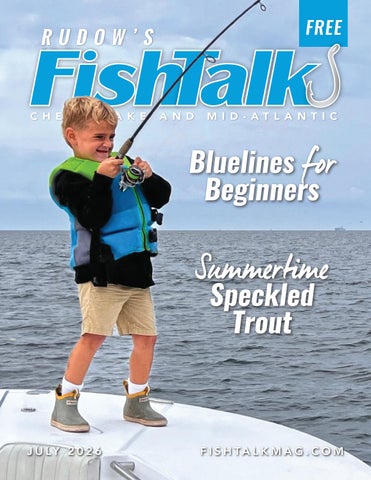
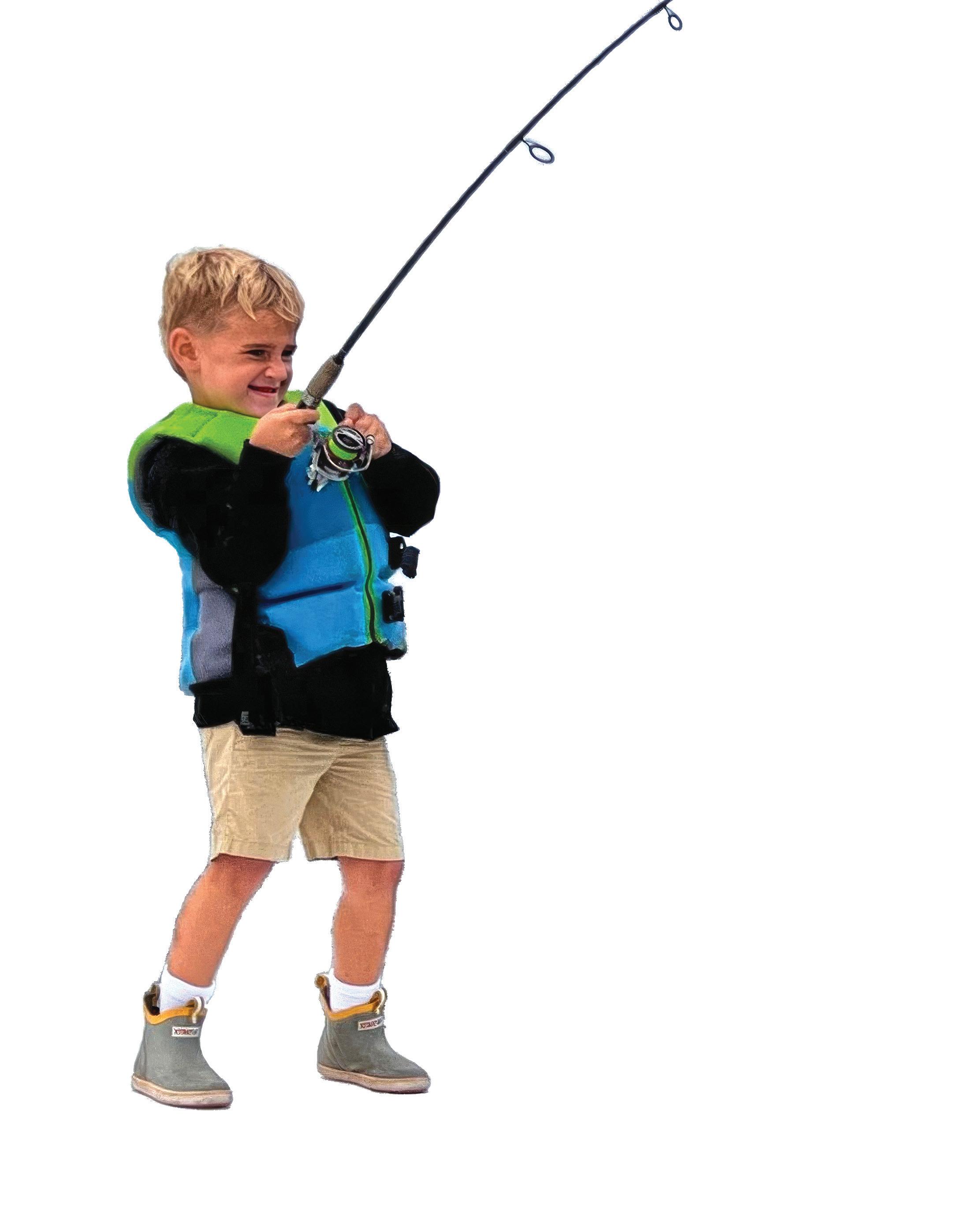
Bluelines forBeginners Summertime Speckled Trout
See Your Local Suzuki Marine Dealer For All the Details
Delaware
Pontoon Express | 302-945-0654 22572 Harbeson Rd, Harbeson, DE pontoonexpress.com
Maryland
Danny’s Marine LLC | 410-228-0234 3559 Chateau Dr, E. New Market, MD dannysmarine.com
Hidden Harbour Marina | 301-261-9200 600 Cabana Blvd, Deale, MD hiddenharbour.net
Maryland Boat Sales | 410-574-3988 2426 Holly Neck Rd, Essex, MD mdboatsales.com
Middle River Landing Marina | 410-686-0771 1901 Old Eastern Ave, Essex, MD chesapeakemarine.net/middleriverlandingmarina
Powersports of Crofton | 410-697-5965 7045 State Route 3 North, Gambrils, MD hondaofcrofton.com
PYY Marine | 410-255-1771 1132 Pasadena Yacht Yard Rd, Pasadena, MD pyymarine.com
Scott’s Cove Marina | 410-784-7624 10551 Eldon Willing Rd, Chance, MD scottscovemarina.com
Smith’s Marina | 410-923-3340 529 Ridgely Rd, Crownsville, MD 21032 smithsmarina.com
Thornes Marine | 410-957-4481 1237 Greenbackville Rd, Stockton, MD thornesmarine.com
Virginia
Centerville Waterway Marina | 757.547.4498 100 N Centerville Turnpike, Chesapeake, VA centervillemarina.com
Friday’s Marine | 804-758-4131 (Malise Marine Sales & Service) 14879 GW Memorial Hwy, Saluda, VA facebook.com/fridaysmarine
Jett’s Marine, Inc. | 804-453-3611 18477 Northumberland Hwy, Reedville, VA jettsmarine.com
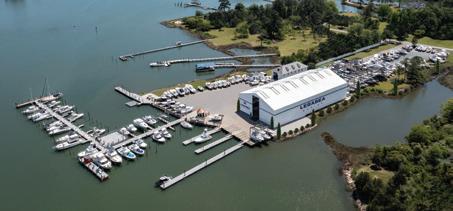
Legasea Marine | 757-898-3000 821 Railway Rd, Yorktown, VA legaseamarine.com
Sandpiper Marine | 757-787-7783 21530 Taylor Rd, Accomac, VA 23301 sandpipermarine.net
Seaworthy Marine | 757-442-3666
4200 Main Street, Exmore, VA seaworthymarineservices.com











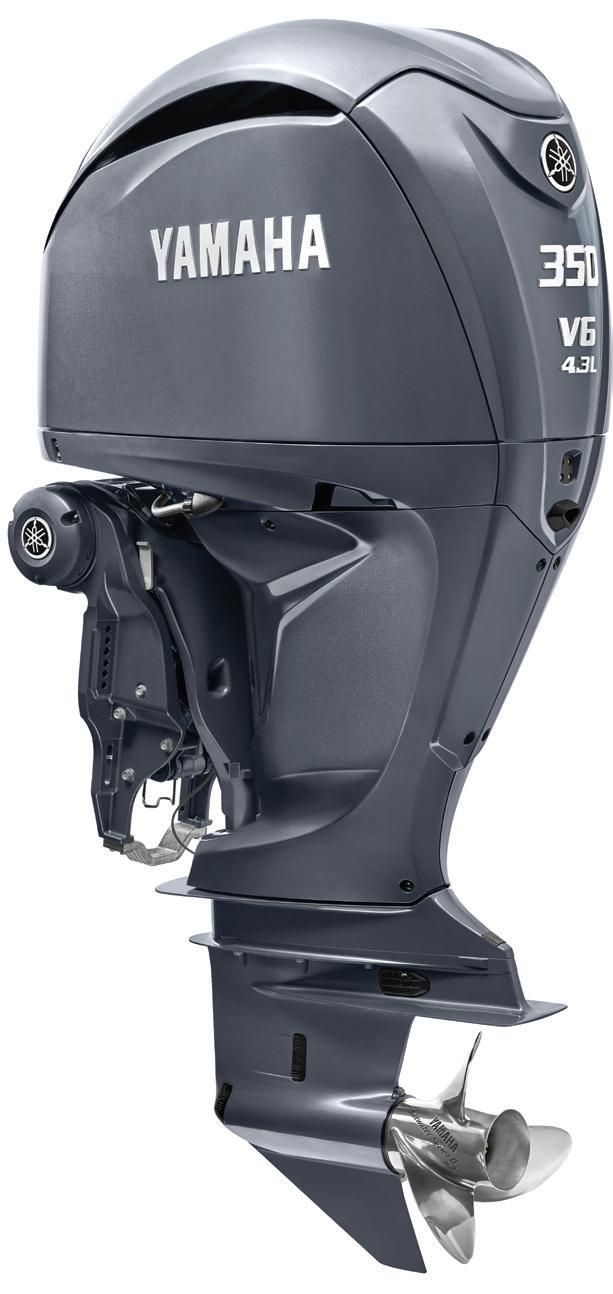
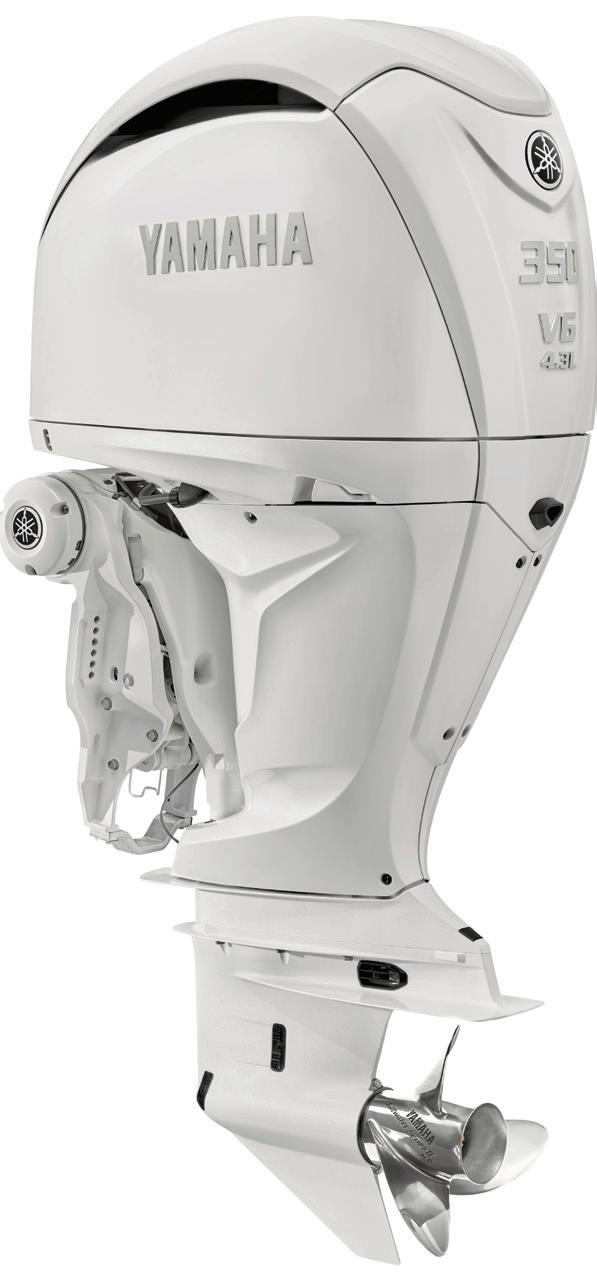
350-HP OUTBOARD
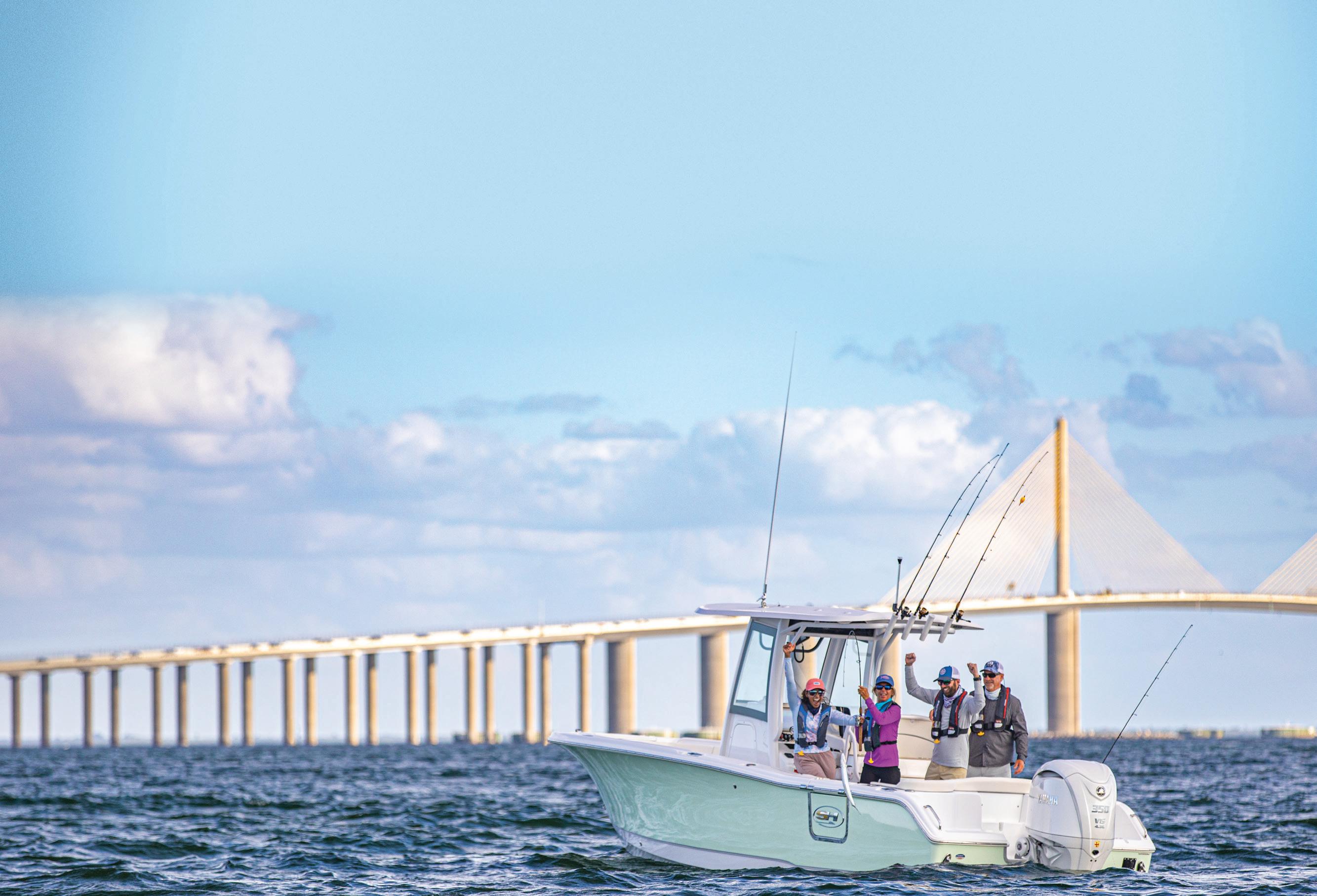
At 629 pounds, Yamaha’s new V6 Offshore F350 is a featherweight knockout. Stealing all the best design cues and advanced features from its V6 and V8 siblings, the new F350 is the dawn of a new power platform. It’s also the lightest F350 in its class—by more than 65 pounds. Pair it with Helm Master® EX and Siren 3 Pro for exhilarating boating and incredible control in a powerfully light design. THE ALL-NEW YAMAHA 4.3L V6 OFFSHORE F350.

DELAWARE
DELAWARE
Rudy Marine | 302.945.2254 32606 DuPont Blvd, Dagsboro, DE rudymarine.com
Cedar Creek Marina | 302.422.2040 100 Marina Lane, Milford, DE cedarcreekmarina.com
North Bay Marina | 302.436.4211 36543 Lighthouse Rd, Selbyville, DE northbaymarina.com
MARYLAND
Rt 113 Boat Sales | 302.436.1737 52 Cemetary Rd, Selbyville, DE rt113boatsales.net
Stella Marine Services - Located at Fairwinds Marina | 410.220.2056 1000 Fairwinds Dr, Annapolis, MD 21409 stellamarineservices.com
MARYLAND
Fairwinds Marina | 410.216.0205
Tri-State Marine | 410.562.6247 222 Severn Ave #12, Annapolis, MD tristatemarine.com
1000 Fairwinds Dr, Annapolis, MD 21409 fairwindsmarina.com
Tri-State Marine | 410.562.6247 7320 Edgewood Rd, Annapolis, MD tristatemarine.com
Annapolis Inflatables/Fawcett Boat Supplies 410.267.8681
919 Bay Ridge Rd, Annapolis, MD annapolisinflatables.net
North Point Yacht Sales | 410.280.2038 7330 Edgewood Rd, Ste 1, Annapolis, MD
northpointyachtsales.com
Beacon Light Marina | 410.335.6489
MARYLAND
825 Bowleys Quarters Rd, Baltimore, MD beaconlightmarina.com
VIRGINIA
Annapolis Boat Sales, LLC | 410.604.6962 1629 Postal Rd, Chester, MD annapolisboatsales.com
Beacon Light Marina | 410.335.6489 825 Bowleys Quarters Rd, Baltimore, MD beaconlightmarina.com
Tri-State Marine | 410.867.1447 5861 Deale Churchton Rd, Deale, MD tristatemarine.com
Tri-State Marine | 410.867.1447 5861 Deale Churchton Rd, Deale, MD tristatemarine.com
Jim’s Marine, Inc. | 410.648.5106 96 East Cross St, Galena, MD jims-marine.com
Jim’s Marine, Inc. | 410.648.5106 96 East Cross St, Galena, MD jims-marine.com
Bosun’s Maryland | 410.286.1350 411 Winchester Creek Rd, Grasonville, MD bosuns.com/about-us-maryland
Anchor Boats, Inc. | 410.287.8280 448 N Mauldin Ave, North East, MD anchorboat.com
Hudson Marine | 410.643.6768
219 Hess Rd, Grasonville, MD 21638 hudsonmarinellc.com
Rudy Marine | 443.995.3785 3033 Kent Narrows Way S, Grasonville, MD rudymarine.com
Anchor Boats, Inc. | 410.287.8280
448 N Mauldin Ave, North East, MD anchorboat.com
Campbell’s Boatyards - Jack’s Point | 410.226.5105 106 Richardson St, PO Box 410, Oxford, MD campbellsboatyards.com
Centerville Waterway Marina | 757.547.4498 100 N Centerville Turnpike, Chesapeake, VA centervillemarina.com
|
20880 Rock Hall Ave, Rock Hall,
Jett’s Marine, Inc. | 804.453.3611 18477 Northumberland Hwy, Reedville, VA jettsmarine.com
Legasea Marine | 757.898.3000 821 Railway Rd, Yorktown, VA legaseamarine.com

37
Places That We Never Know!
Unexpected wrecks and obstructions. By Wayne Young
40
A Sea Bass Boom
Different management attitudes could cause black sea bass populations to soar. By Capt. Monty Hawkins 42
Midsummer Specks
Scaling down to catch speckled trout when the heat is on.
By Staff
44
Blueline Tilefish Fishing for Beginners
You’ll have to take a long cruise through the ocean to reach blueline tilefish, but once you find ‘em the action can be fast and furious.
By Lenny Rudow
46
The Patapsco, Perhaps?
The verdict is in: Baltimore has been voted the number-one summer vacation spot on the East Coast. By the rockfish.
By Staff
48
Could it be Croaker???
With a little luck one day soon we’ll be catching a mess of these tasty—and noisy—fish.
By Lenny Rudow
50
Reservoir Rings
Tips for catching freshwater yellow perch.
By Lenny Rudow
Tilghman is HOOKED UP! Photo by Nicholas Fratino
Maryland
PYY Marine | 410.255.1771
1132 Pasadena Yacht Yard Rd, Pasadena, MD pyymarine.com
Richardson’s Marine Repair | 410.745.9279 25145 Saint Michaels Rd, St. Michaels, MD 21663 richardsonsmarinerepair.com
Smith’s Marina | 410.923.3444 529 Ridgley Rd, Crownsville, MD 21032 smithsmarina.com
Stella Marine Services - Located at South River Marina | 410-798-1717 1061 Turkey Point Rd, Edgewater, MD stellamarineservices.com
Thornes Marine | 410.957.4481 1237 Greenbackville Rd, Stockton, MD thornesmarine.com
Top Knotch Marine | 410.253.1299 1735 Little Creek Rd, Chester MD tkmsvc.com
Delaware
Carlisle’s Marine | 302.389.0100 49 Artisan Dr, Smyrna, DE carlislesmarine.com
Virginia
Legasea Marine | 757.898.3000 821 Railway Rd, Yorktown, VA legaseamarine.com
612 Third Street, Suite 3C, Annapolis, MD 21403 (410) 216-9309 FishTalkMag.com
ANGLER IN CHIEF
Lenny Rudow, lenny@fishtalkmag.com
PUBLISHER
Mary Iliff Ewenson, mary@fishtalkmag.com
ASSOCIATE PUBLISHER
Chris Charbonneau, chris@fishtalkmag.com
MANAGING EDITOR
Molly Winans, molly@fishtalkmag.com
SENIOR EDITORS
Beth Crabtree, beth@fishtalkmag.com
Kaylie Jasinski, kaylie@fishtalkmag.com
COPY EDITOR
Lucy Iliff, lucy@fishtalkmag.com
FISHING REPORTS EDITOR
Dillon Waters
ADVERTISING SALES
Eric Richardson, eric@fishtalkmag.com
CUSTOMER SERVICE MANAGER
Brooke King, brooke@fishtalkmag.com
DISTRIBUTION / BROKERAGE / CLASSIFIEDS MANAGER
Beatrice M. Mackenzie, beatrice@fishtalkmag.com
ART DIRECTOR / PRODUCTION MANAGER
Zach Ditmars, zach@fishtalkmag.com
GRAPHIC DESIGNER / PRODUCTION ASSISTANT Royal Jackson, royal@fishtalkmag.com
COASTAL CORRESPONDENT EMERITUS John Unkart
CONTRIBUTING WRITERS
Adam Greenberg, Jim Gronaw, Chuck Harrison, Capt. Monty Hawkins, Eric Packard, David Rudow, Wayne Young
DISTRIBUTION
Bob and Joann Bruffy, Jennifer and Al Diederichs, Gregory and Dorothy Greenwell, Dave Harlock, Shona Haven, Jim Persing, Mark Schlichter
Rudow’s FishTalk is a monthly magazine for and about Chesapeake and Mid-Atlantic anglers. Reproduction of any part of this publication is strictly prohibited without prior consent of the officers of Rudow’s FishTalk LLC. Rudow’s FishTalk LLC accepts no responsibility for content in advertisements. Rudow’s FishTalk is available by first class subscription for $45 a year, and back issues are available for $4 each. Mail payment to Rudow’s FishTalk Subscriptions, 612 Third Street, Suite 3C, Annapolis, MD, 21403. Rudow’s FishTalk is distributed free of charge at more than 850 establishments along the shores of the Chesapeake and the DelMarVa Peninsula. Businesses or organizations wishing to distribute Rudow’s FishTalk should contact the Rudow’s FishTalk office, (410) 216-9309 or beatrice@fishtalkmag.com.
© 2026 Rudow’s FishTalk LLC
Rudow’s FishTalk Recycles
ve things you should know about boat insurance
Are you ready to embark on your next on-water adventure? Before you set sail, here are ve things to know about boat insurance.
1. Boat insurance isn’t just for accidents
With comprehensive coverage, you’ll also be protected nancially for theft, vandalism, and unexpected events like storms if you need repairs or replacements due to damage.
2. Accidents can happen to anyone
When accidents happen, boat insurance offers liability coverage for damages or injuries you cause while boating, up to speci ed limits. It can also cover lawsuit costs if you’re sued.
3. Boat insurance can cover medical payments
Boat insurance offers a range of optional medical payments coverage limits, helping to cover medical expenses if you’re in an accident or someone is hurt on your boat, regardless of fault.
4. Most lenders require boat insurance If you nanced your boat, you’ll likely need boat insurance since most lenders require boat insurance to protect their investment. Additionally, some marinas or municipalities require proof of insurance for docking.
5. Progressive offers specialized boat coverages Ever worry about getting stuck on the water?
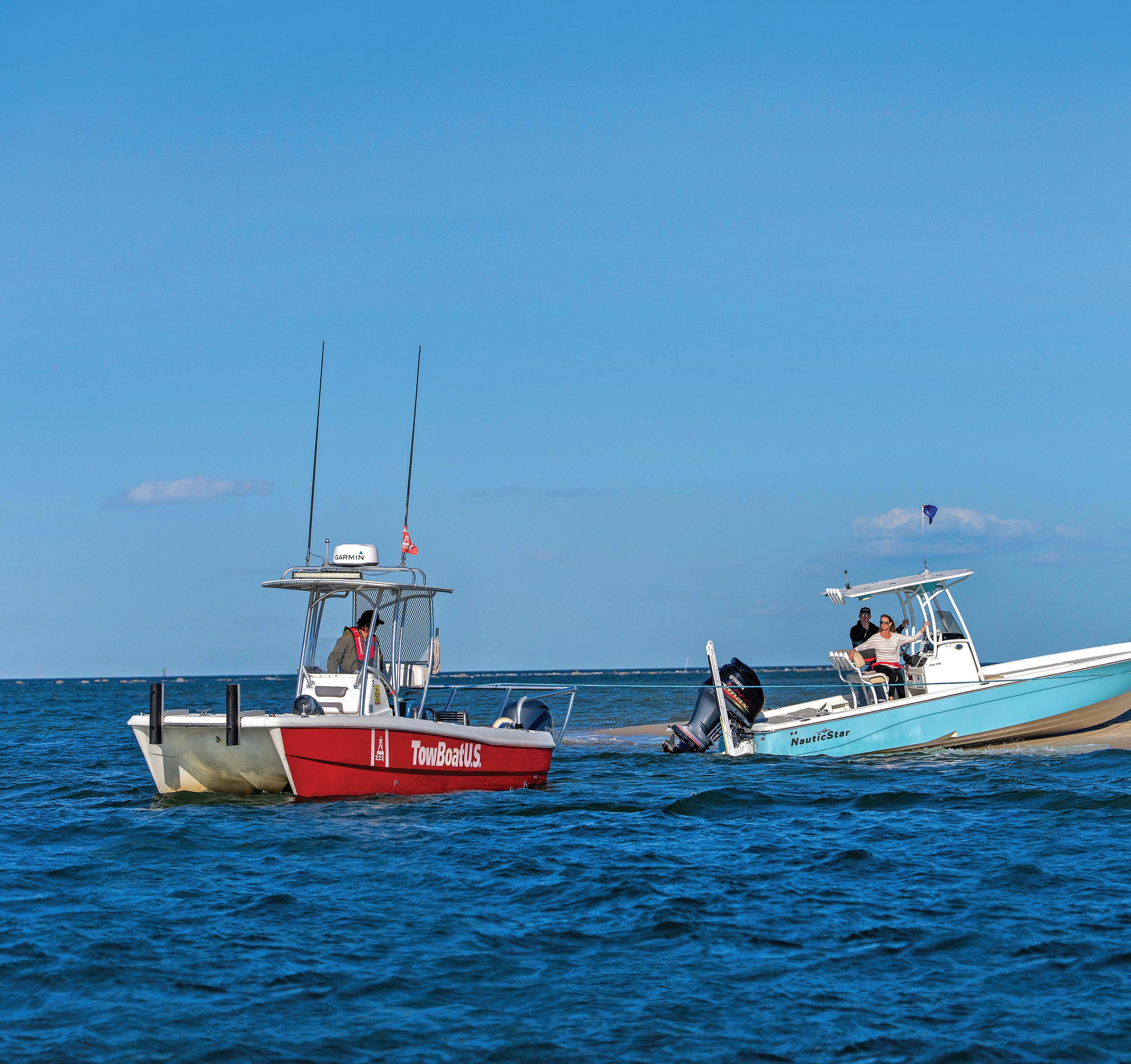
Progressive’s Sign & Glide® On-Water Towing coverage** can help. It’s an additional coverage that steps in if your boat is disabled or breaks down on the water, paying for on-water towing, jump starts, soft ungroundings, and fuel delivery. Fuel cost isn’t included.
Don’t let unforeseen circumstances disrupt your voyage. Cruise with con dence thanks to Progressive Boat insurance. Because when it comes to your boat, peace of mind is the ultimate luxury.
Progressive Casualty Ins. Co. and af liates. Product features are subject to policy terms and conditions and may not be available in all states or for all vehicles and coverage selections.
*No. 1 rating based on boat market share data from Rate lings.com.
**Sign & Glide® is an optional coverage you can add to any Progressive Boat policy and costs $30/annually ($50/annually in Florida). Prices are subject to change.
Scan to get a quote in as little as 4 minutes.
Go to progressive.com to learn more.
Notes from the Cockpit
By Lenny Rudow
This spring the water clarity in the Middle Bay was the best I’ve ever seen for the time of year. At multiple times in multiple places (Bloody Point, the powerplant, and outside the Choptank) it was possible to see bottom in eight feet of water. And this season not only did I enjoy the best spring rockfish bite I’ve seen in five or six years, but also the fish looked fatter and significantly healthier than usual.
Coincidence?
I’m not the only one to notice the greatly enhanced water clarity, and I’m sure many of you Bay anglers reading this right now are nodding your heads in agreement. In fact, it was a popular topic of conversation among many of us. And many people wondered: are we seeing a real improvement in water quality here?
I truly wish the answer was yes, but I’m pretty darn sure it’s not. I’m not a scientist and I don’t have the data to back it up, but there’s no doubt in my
mind that for as long as I’ve been around when we’ve had times of very little rainfall the Bay water quality has improved. Unfortunately, just as soon as we have a big, hard rain, water quality goes right back down the tubes. All the nutrients, chemicals, and garbage we humans allowed to accumulate on dry land get flushed right into the Chesapeake. Not long after, those visibility- and oxygenkilling algae blooms follow. This year we had a relatively dry spring, and the rain that we did get was for the most part on the gentle side and spread out rather than in torrents. So, we were treated to a glimpse of what might be.
We can imagine what might be if the Bay’s water quality was always this good, and the visibility was always so magnificent. But we don’t have to imagine. We have history:
“The abundance of oysters is incredible. There are whole banks of them so that the ships must avoid them. They surpass those in England by far in size,
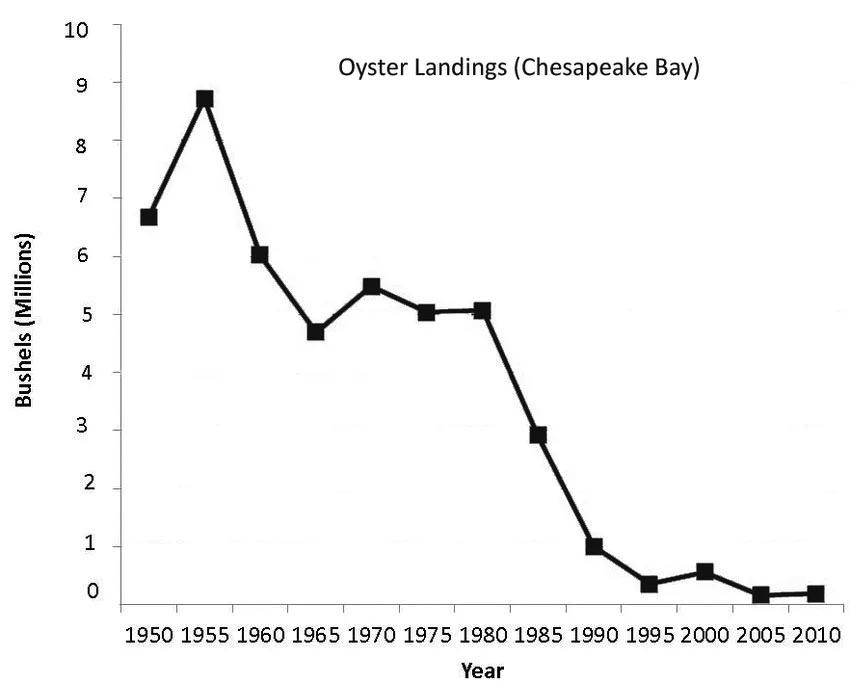
# Before that, we just don’t know. Graphic by U.S. Fisheries Statistics
indeed, they are four times as large. I often cut them in two, before I could put them into my mouth.”
– Francis Louis Michel, 1701
“The main river (James) abounds with sturgeon, very large and excellent good, having also at the mouth of every brook and in every creek both store and exceedingly good fish of diverse kinds. In the large sounds near the sea are multitudes of fish, banks of oysters, and many great crabs.”
– Christopher Newport, 1607
“Sturgeon and shad are in such prodigious numbers that one day within the space of two miles only, some gentlemen in canoes caught above six hundred of the former with hooks… and of the latter above five thousand have been caught at one single haul of a seine.”
– Andrew Burnaby, 1759
“Herring are not as large as the European ones, but better and more delicious… when they spawn, all streams and waters are completely filled with them, and one might believe, when he sees such terrible amounts of them, that there was as great a supply of herring as there is water. In a word, it is unbelievable, indeed, indescribable, as also incomprehensible, what quantity is found there.”
– William Byrd II, 1700
“Heaven and Earth never agreed better to frame a place for means of habitation.”
– Captain John Smith, 1608
We have a lot of work and a long road ahead of us before we’re likely to again enjoy visibility of eight feet in May and June, much less bring the Bay back to its former glory. But at least that last quote is still true today.



Clearly Delightful
Dear FishTalk, Iappreciated the Notes from the Cockpit column in the May edition, on the importance of water quality and joining groups like CCA that fight for it. But I also noticed that this spring the water quality in the Bay has been much, much better than I usually see. On one fishing trip in early May near Cove Point I was able to see bottom in eight feet of water. I know that sounds crazy, and in 20 years of fishing the area I’ve never seen that before, but it’s true. Imagine if it were like that all the time!
Kevin P., via email
Dear Kevin, We noticed far better than normal water quality in the South River and Eastern Bay this spring, too. (See this month’s Notes from the Cockpit column). When there’s very little rainfall water clarity does often improve, but as soon as we get a significant amount of runoff turbidity and algae blooms follow. While we certainly want to remain hopeful, we don’t doubt that the awesome water quality we enjoyed this spring was temporary—which should serve as a reminder to us all that the nutrients, gunk, and chemicals we humans allow to pile up in the Chesapeake’s watershed eventually make their way into the Bay itself.
It Never Ends…
Dear FishTalk:
Q: How could the shrimper afford to buy a new boat?
A: He prawned everything he had.

Send your fish photos, questions, and comments to lenny@fishtalkmag.com
-Anonymous
YOUR BOATING HUB
YORKTOWN & VIRGINIA BEACH







FISH NEWS
By Lenny Rudow
Mending Marshes
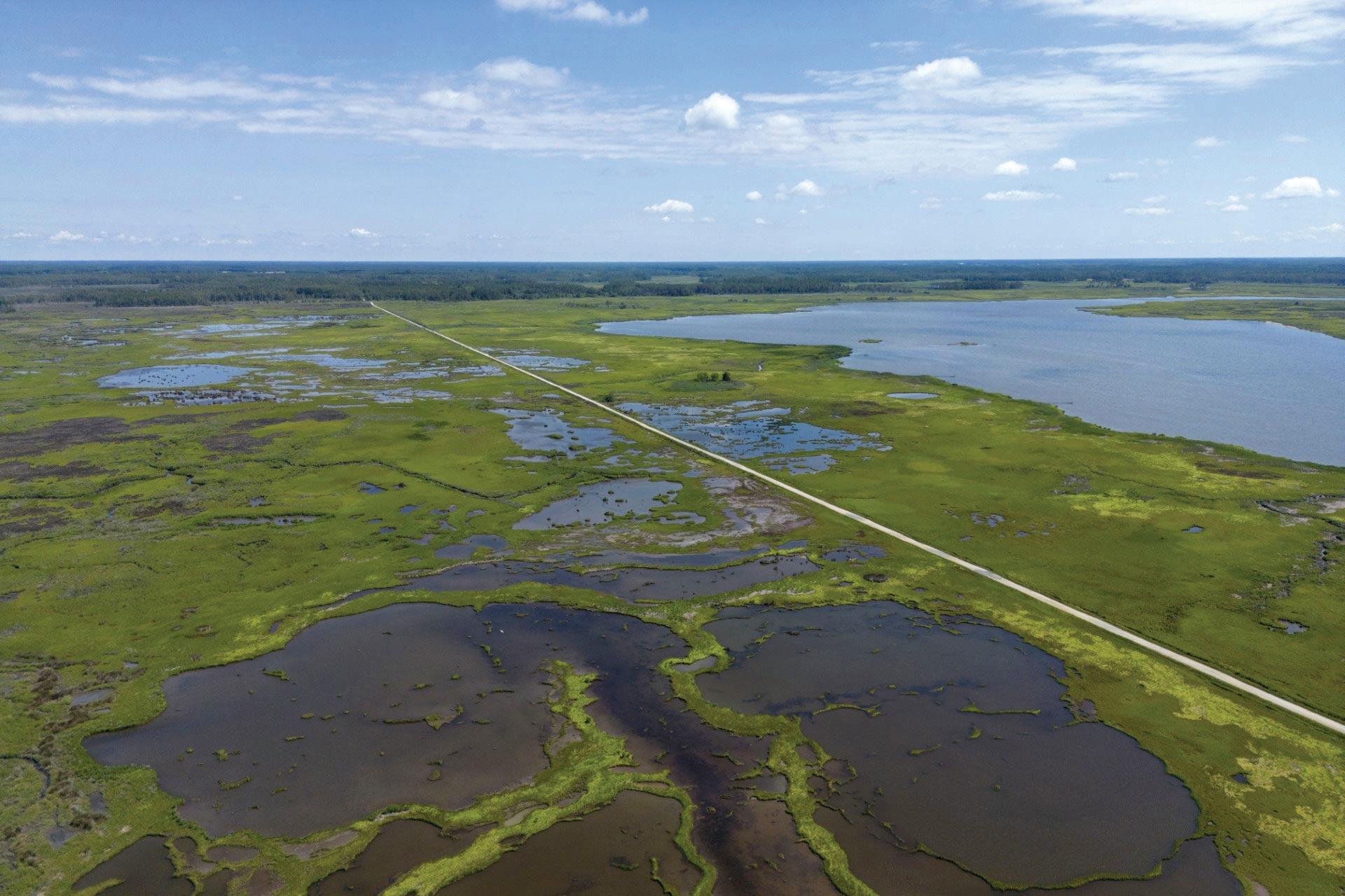
The National Audubon Society announced it has received a $13 million grant for largescale Chesapeake Bay marshland restoration. While Audubon’s main focus lies with birds, our feathered friends are just one beneficiary of salt marshes—this habitat is among the most productive on the planet, serving as a nursery area for fish species such as striped bass, speckled trout, red and black drum, and more. And Audubon says the grant will allow for the restoration of 600 acres of tidal marsh and wetlands.
“Salt marshes are in crisis along the Atlantic, Pacific, and Gulf coasts, and in Maryland much of this vital habitat is at immediate risk of being lost,” said Dr. Elizabeth Gray, chief executive officer of the National Audubon Society.
“This investment allows Audubon and our partners to accelerate large-scale restoration at the scale this moment demands, putting proven solutions on the ground that restore marshes, support birds and other wildlife, sustain
Tfisheries, and help protect coastal communities from flooding and storm surge.”
The grant will fund a suite of restoration approaches, which may include a technique called “runnelling” that involves excavating
Snapping at MRIP
narrow, sinuous channels to allow trapped water to escape from the marsh surface into adjacent tidal creeks. Projects will also include restoring tidal connectivity by enlarging or unblocking culverts.
he effects of the dreaded Marine Recreational Information Program (MRIP), which have tainted fisheries management in virtually all of our home waters, have also made their odious effects known nationwide—but recent developments in southern states show that with time and effort, they can be combatted. Most anglers will have heard of the red snapper season debacle, where the fishery was exceedingly limited or shut down altogether even as snapper populations exploded. Several years ago, Gulf states convinced the feds to turn over management of that fishery, and those states then enjoyed months-long fishing seasons—and today snapper numbers remain exceptionally strong. Yet in the south Atlantic states for the 2024 season federal regulators allowed just one day of fishing. In 2025 they allowed just two days.
Now, Florida, Georgia, South Carolina, and North Carolina have been issued “Exempted Fishing Permits” by the federal government, allowing these states to toss MRIP nonsense out the window and regulate red snapper on their own. This gives Florida anglers 39 days of fishing, and the other South Atlantic states 62 days of fishing. If these fisheries remain strong, it will prove that the Gulf model works elsewhere. Meanwhile, NOAA claims that MRIP is “transitioning toward an improved partnership-driven framework that better meets regionally specific needs.”
# Salt marsh is one of the most productive habitats on the planet, and Chesapeake marshland is in dire need of restoration.
Photo courtesy of Sydney Walsh/Audubon
Angler in Chief in the News
The Maryland DNR announced that FishTalk’s own Angler in Chief Lenny Rudow has been named the 2026 Maryland Sport Fisheries Achievement Award recipient (Woot! Woot!). The award is to recognize an individual who has provided sustained effort in habitat management, conservation, education, research, or other meaningful contributions that benefit fish and recreational fishing in Maryland.
“Fishing is my life and Maryland is my home, so to be recognized with this award means more to me than I can even say,” Rudow said. “Thank you, Maryland, thank you anglers, thank you fishing community for always being there when I needed you. I promise I’ll work as hard as I can for as long as I can to help bring new anglers into the fold, promote fishing in Maryland, and rejuvenate our many diverse fisheries. I hope everyone who happens to read these words will open up their calendar right now, look for the next open day, and mark it ‘Going Fishing!”
The Good Kind of Citation
The Virginia Marine Resources Commission has announced some changes to the Saltwater Fishing Tournament program for 2026. Youth anglers under 15 can now earn citations for 20 species of fish with reduced sizes, including receiving the Saltwater Fishing Tournament Junior Expert Angler citation plaque. And adult anglers with an eye on conservation can now register their fish for a catch-and-release citation via a catch-and-release QR code. Get the details at the VMRC website, mrc.virginia.gov
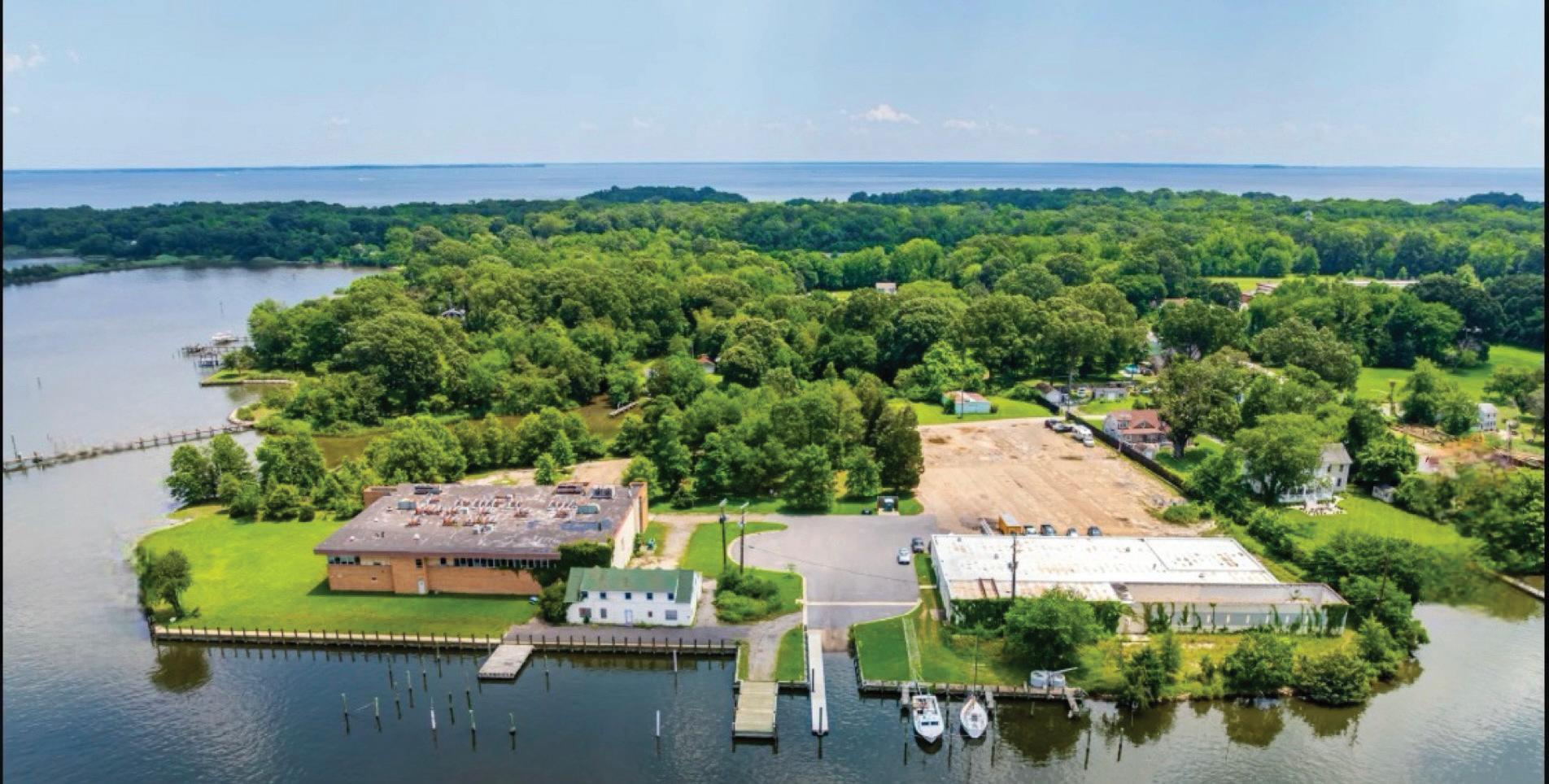
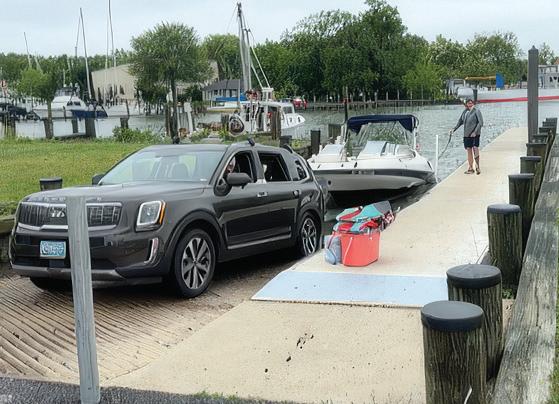
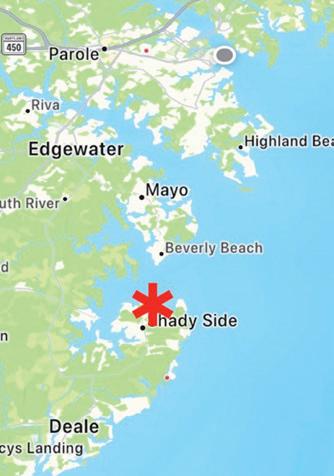

Tucked inside Parish Creek at the mouth of the West River.
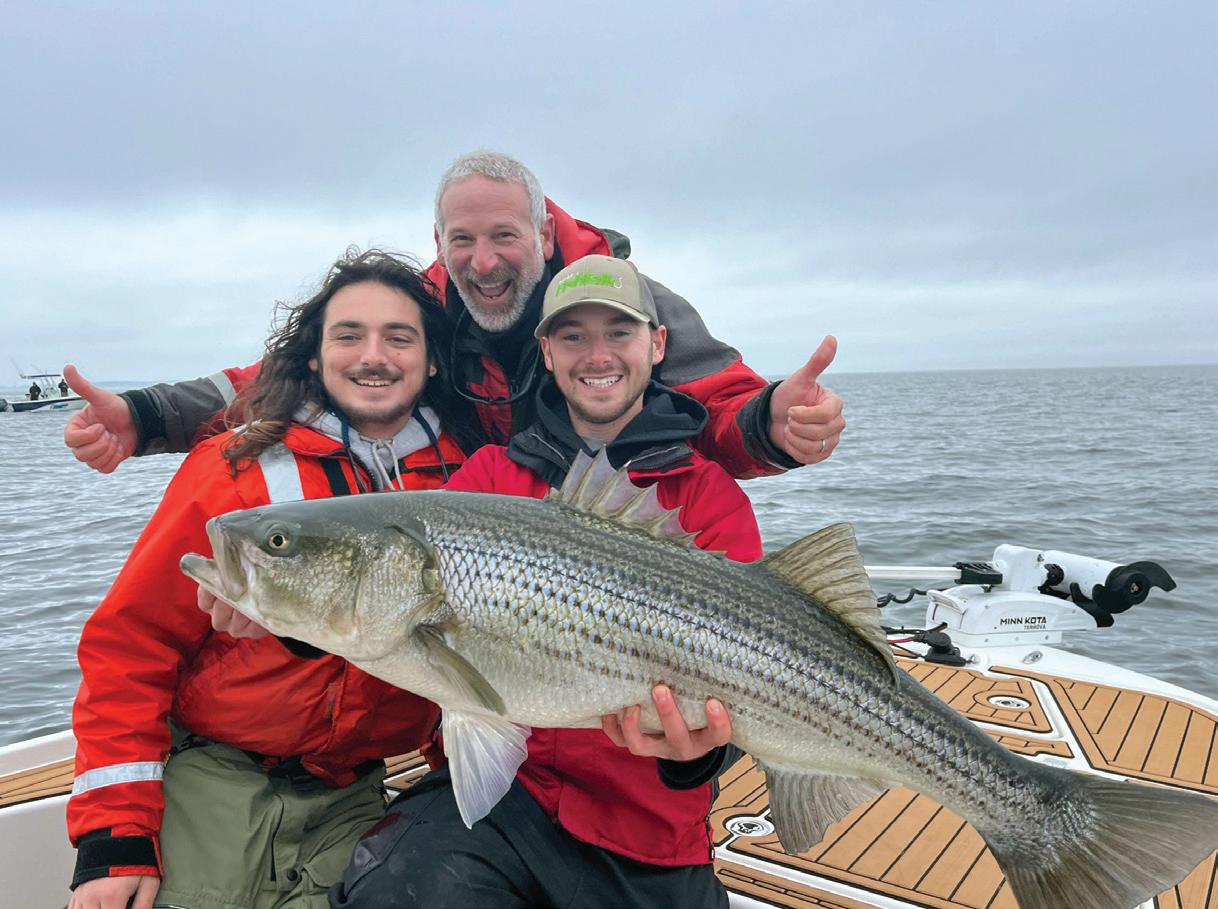
# Angler in Chief Lenny Rudow (center) with his sons David and Max, enjoying the Chesapeake Bay on Christmas in their very favorite way. Photo by Zach Ditmars
TOURNAMENT NEWS
Tuna Time!
The Ocean City Tuna Tournament takes off July 9 through 12 for the 39th consecutive competition. Following two years in a row of million-dollar-plus payouts, this one is expected to attract more than 100 boats, each fishing two out of the three days of angling action. This is a trolling-only tournament (no green sticks or danglers), and there are numerous added-entry categories. Visit octunatournament.com for all the details.
Feeling Sheepish
July 18 is the Peninsula Saltwater Sport Fisherman’s Association (PSWSFA) annual Sheepshead Tournament. First place brings a $2500 prize with additional prizes through third place plus a Heaviest Oyster Toad division and a calcutta. It’s hosted at Wallace’s Bait and Tackle in Fox Hill, and each boat weighs in its single heaviest fish. The PSWSFA is the oldest saltwater fishing club in Virginia and this is a fun bunch of fishermen, so check out the club and the tournament at pswsfa.com
TSize Matters
he arrival of July means it’s time for the Big Fish Classic, which isn’t just about catching the biggest fish but is also about winning big bucks—last year’s purse topped $1.2 million. Teams will fish one of two 32-hour slots July 24 to 26, including overnight angling and fishing anywhere within 125 nautical miles of the OCMD sea buoy. Restrictions are few and far between, with trolling, chunking, live baiting, and a whole lot more permitted as long as competitors stay within the bounds of the law. There are a few rules to note, however, so check out bigfishclassic.com to get the full scoop.


























HOT NEW GEAR
Editor’s Note: We wish we could personally test every item that appears on these pages, but that simply isn’t possible. So that you know the difference between when we’ve physically tested a piece of gear and when we’re writing about it because it’s newsworthy and we think you’ll want to know about it, we’ve developed this FishTalk Tested button. When you see it printed next to something in this section, it means we’ve personally run it through the wringer.
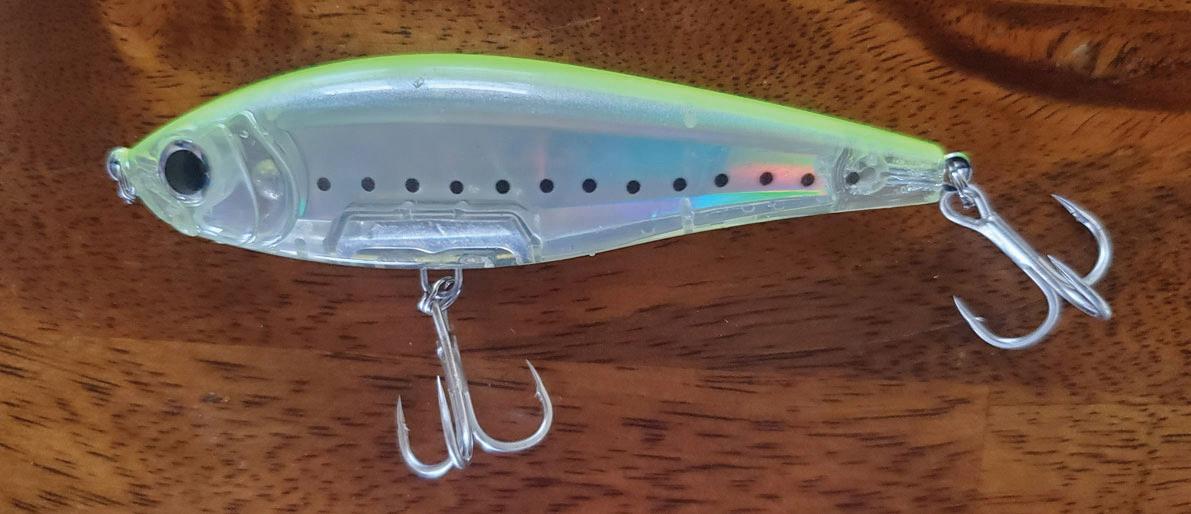
We’re in Suspense
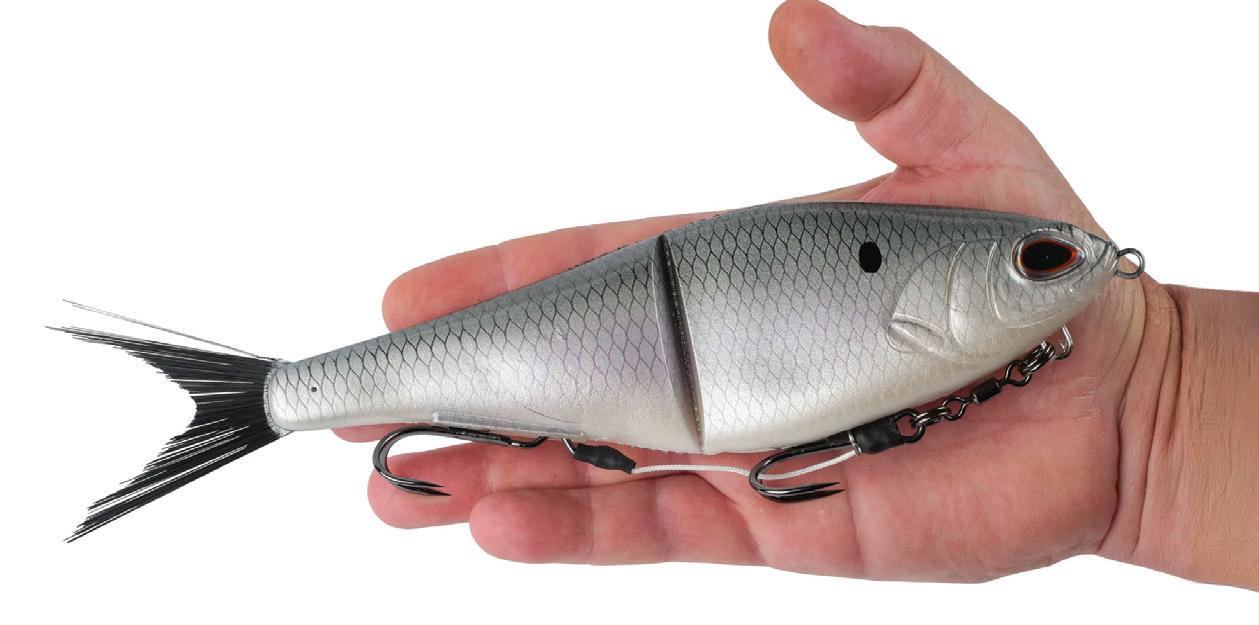
Well, we were in suspense when we first got our hands on an Addiction Baits Suspending Stalker. But after taking a few casts we were left with no doubt that these things catch fish. Tossing a 3.75” Chartreuse Suspending Stalker it was easy to get a fish-attracting erratic retrieve and the front-weighting keeps it suspended on an even keel when you give a pause, twitch, and BOOM! Fish on. These run just a foot or so under the surface and are ideal for specks in the shallows or over weedbeds, though we’d recommend swapping the treble hooks for singles if you’re fishing in an area likely to hold rockfish because they’ll whack these lures with abandon, too. Bone, blue mackerel, bunker, and golden shiner color patterns are all available. Price: $7.99. Visit addictionbaits.com and scratch your itch to twitch.

Light Might
We don’t know what nano resin technology is, but that’s one of the things H2OX says makes their Carbon Spinning rod so light yet strong. What we do know for sure is that this rod is indeed incredibly light and shows zero signs of weakness. We tried using one while flinging jigs on half-ounce heads to stripers holding on riprap, and it felt awesome in hand. The rear 4K carbon fiber handle is surprisingly comfortable and doesn’t get slick when wet, and the front grip is cork. The Carbon Spinning is available in 7’6’” medium/moderate and 7’0” moderate/fast actions. We tested the 7’0” moderate/fast, which is rated for eight to 17-pound test and quarter to three quarter ounce lures. The price is a pleasant surprise, too. MSRP: $79.99. Visit academy.com if you enjoy carbonation.
YBetter Bibs
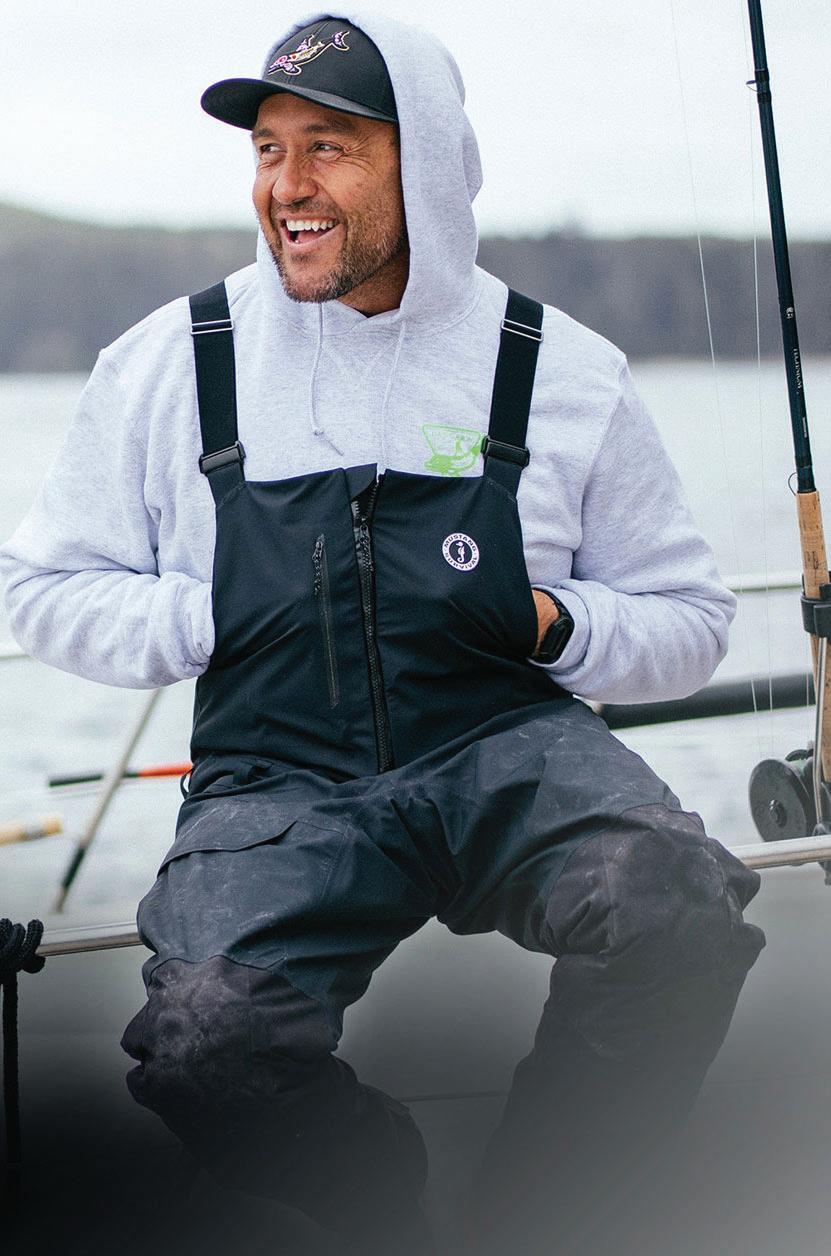
ou know wearing bibs is a must on an open center console headed out into the Bay, but you hate how uncomfortable they are? You’re not alone, but Mustang Survival might have the answer: their new Taku Waterproof Bibs. Takus are made with three-layer Marine Spec SP fabric with a 70D nylon face, a breathable bi-component membrane with hydrophobic PU coating, and a nylon tricot backer for next-to-skin comfort. Seams, knees, and hems are reinforced with 500D Cordura, and there are removable knee pads. Integrated handwarmer chest pockets will boost your comfort level on cold, windy days, and the hems can be perfectly fitted over your deck boots with hook-and-loop adjustments. Price: $479.99. Visit mustangsurvival.com if you’re an all-weather angler who can’t stand regular bibs.
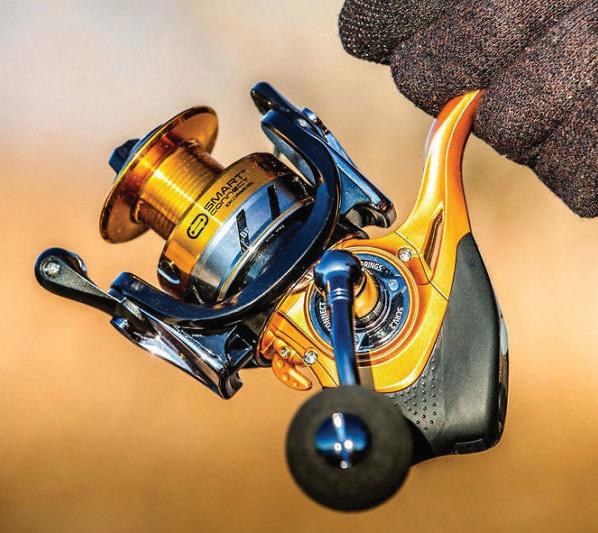
This Is SO Smart!
Behold, the Smart Connect fishing reel. This line-cranking conundrum has internal sensors that “monitor when a fish bites, then relay the info to your phone so you can reel them in.” Because you should really have no idea if a fish is biting while you stand there holding your fishing rod. You can connect up to four reels at a time with the app, and there are five different sensitivity settings. We were a bit suspicious about the whole concept at first, but then we found an affiliate blogger in Idaho who said it was a “great quality reel,” and “I also love the quality of this reel,” and “they have given us a great quality product,” so the Smart

Choppy Waters
Big glide-baits were hot this spring for casting to mega-rock in the shallows, and right on time, Berkley has a new offering of interest. Their Powerbait Chop Block lineup has been expanded to include a full range of sizes with 6”, 8”, and 10” swimbaits in Matte Carp (bronze) and Hickory Shad (silver/black) color patterns, in addition to the existing dozen color patterns. The Chop Block is a two-segment soft glide-bait which is designed to be worked with wide, slow glides or in a fast, choppy motion. A mesh-reinforced joint boosts longevity, and hooks are Fusion 19. Price: $15.99/$24.99/$29.99. Visit berkley-fishing.com to glide with the tide.
Reading for Yakkers
By Wayne Young elmarva Peninsula waters may look like lazy marshland with placid tidal rivers and creeks, but there’s a diverse array of features from wrecks and ruins to bold natural formations hidden below the surface. How to scope and fish them is unlocked by Robert “Bob” Lombardi’s informational and instructive “Lower Eastern Shore of Maryland and Virginia: A Chesapeake Bay Backwater Kayak Fishing Guide” (second edition). Bob’s years as a teacher and extensive on-the-water experience as a light tackle kayak angler who fishes the lower DelMarVa Peninsula uniquely prepared him to convey what he has learned about fishing these waters. His book weaves together practical knowledge, techniques, and tactics into a free flowing, must read volume for newcomers to recreational fishing as well as seasoned veterans. Price: amazon.com to start reading up.



MFDs 9"-24"









TZT16X | 22X | 24X































TZT10X | 13X















TZT9E | 13E



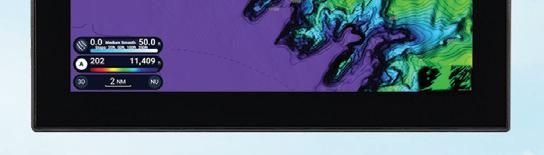

















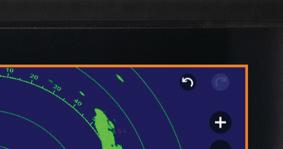
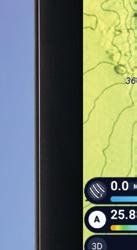
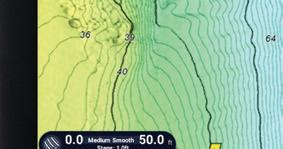
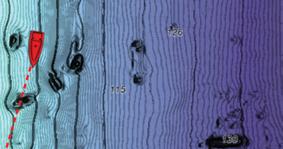
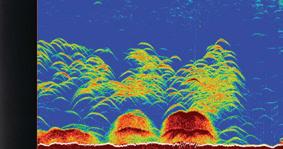
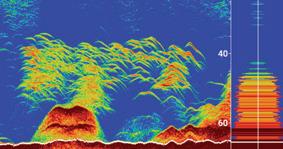
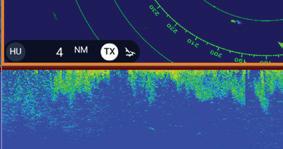
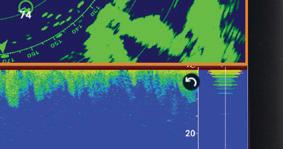
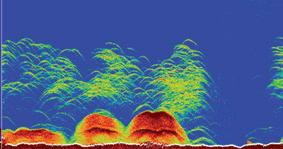
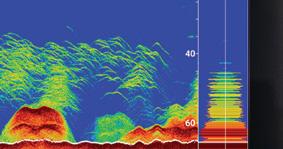
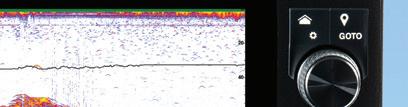
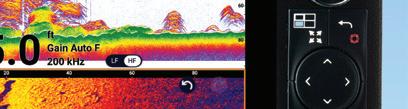
When helm space is at a premium, the 9" and 13" TZtouchE MFDs give you maximum screen area to view their eye-popping TZ MAPS charts and builtin TruEcho CHIRP™ Fish Finder with Side-Scan.
When and 13 TZtouchE view and in

Furuno... The reason to level up your helm!
Plus, TZtouchE is fully networkable with the TZtouchXL family of 10", 13", 16", 22", & 24" MFDs and a wide range of best-in-class sensors – legendary Furuno Radars, Sonars, Fish Finders, Autopilots, and more. Marine Electronics


Case Study
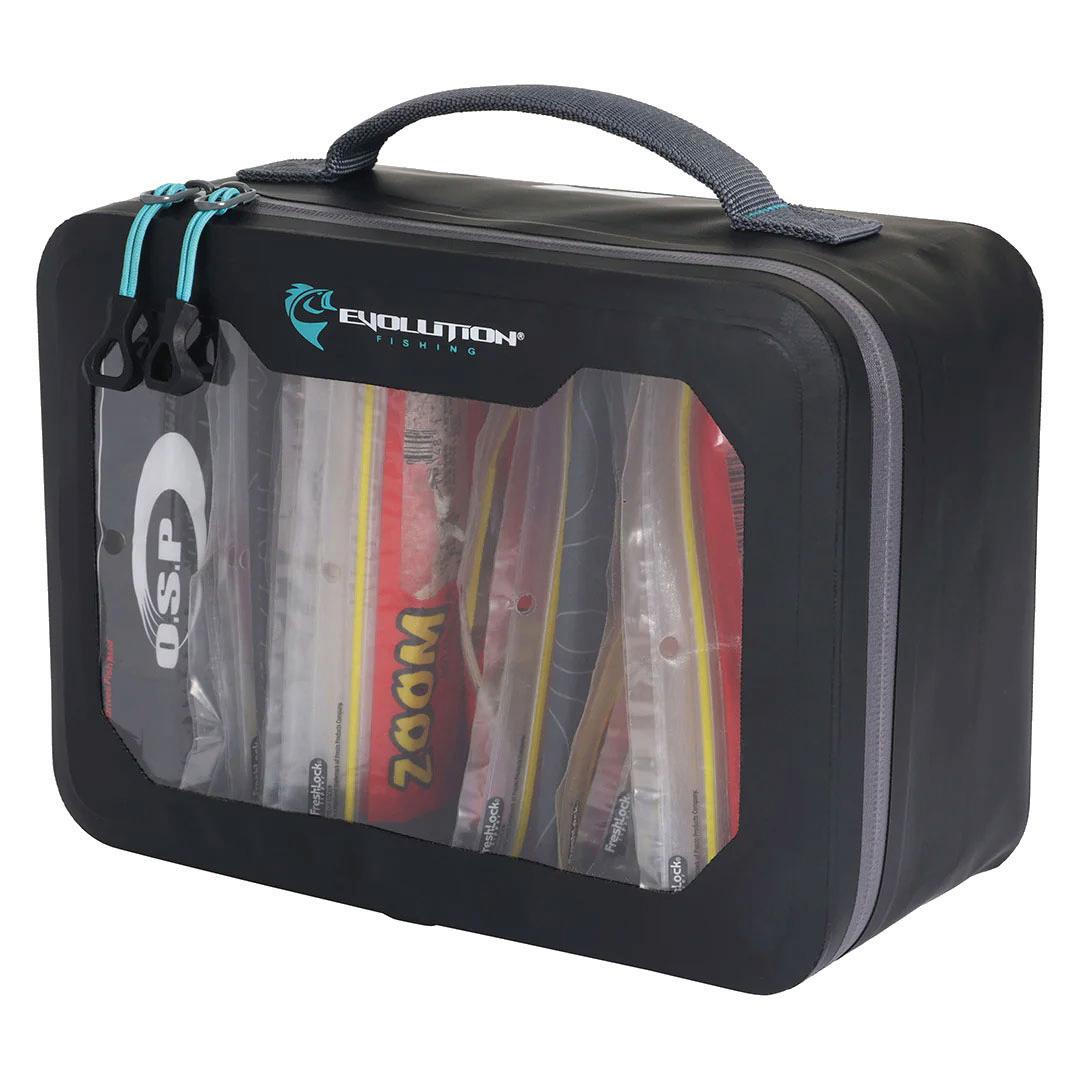
Sick and tired of fishing through bags of plastics as you search for the preferred pouch? Evolution Outdoors says they have the answer with the Fishing Plastix Case. This 5.25” deep case is designed for stowing all those bags of plastics in an orderly fashion. A molded EVA interior has two removable dividers and is kept sealed off from the elements in a waterproof welded tarpaulin shell. The clear top lets you eyeball what’s inside, and the zipper is water-resistant. Price: $39.99. Check it out at evolutionoutdoors.com if you’re ready for your tackle storage to evolve.

Rockin’ It
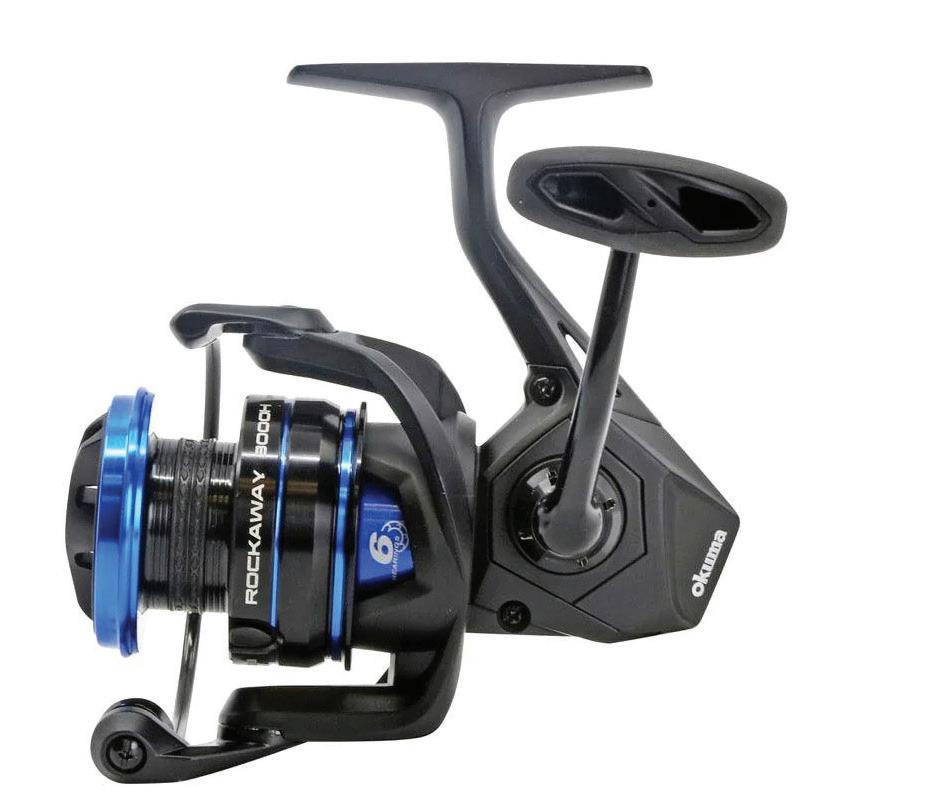
If you need a new spinning reel that can hold up to the rigors of surf fishing, you’ll want to check out Okuma’s Rockaway SI Surf reels. These feature a C-40X carbon body and oversized gears, a machined aluminum anodized spool, plus a heat-resistant multidisc Carbonite washer drag system. Critically, the Hydro Block body prevents water intrusion to the drag and pinion gear, and there’s no anti-reverse switch to further reduce the chances of water intrusion—so if you get smacked with a wave when you’re wading out to make the next cast the reel won’t be toast. The Rockaway SI Surf reels come in 2500 to 5000 sizes, in 6.0:1 and 6.2:1 gear ratios, and put out a max drag of 18 to 24 pounds. Price: $99.99 to $109. Visit Okumafishingusa.com before you reach the beach.
Power Play
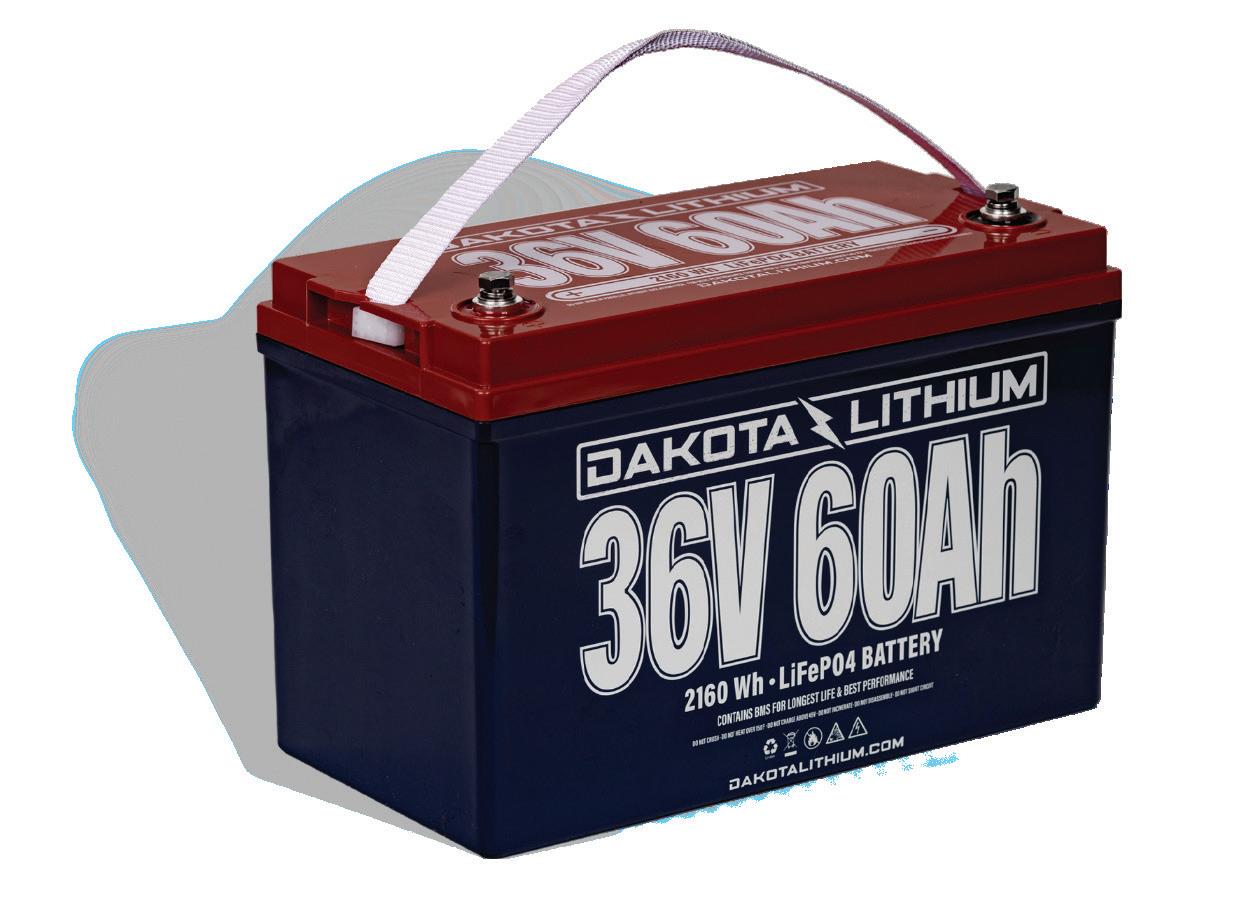
Those big, juicy LiFePO4 lithium-ion trolling motor batteries sound great, but they’re also eye-poppingly expensive. Are they really worth all the additional cost? We’ve been putting a Dakota Lithium 36V 60 Ah to work—hard work—aboard the FishTalker for three and a half years. The weight savings is substantial, with this battery tipping the scales at 44 pounds (versus around 120 pounds for three 12-volt leadacid deep cycle batteries). And we love the wiring simplicity of having a single battery versus multiples. The biggest eye-opener we discovered during this long-term test, however, has been this battery’s staying power. It’s virtually impossible to completely drain it down in a single day of regular fishing (it happened once when we over-used the electric motor going between spots), and it can hold the boat Spot-Locked in the full-blast roaring current of the CCNPP—where it’s working at speeds of 8, 9, or 10 continuously—for five to six hours. That’s better performance than we’ve seen from many 100 Ah lead-acid rigs. We’ve had no glitches from the battery and thus far love this thing. Cost has come down over time but remains pretty impressive; price: $1700. Visit dakotalithium.com or locally go through BOE Marine, boemarine.com, which did a fantastic installation job on the FishTalker (and charged exactly the same as Dakota’s website for the battery itself).



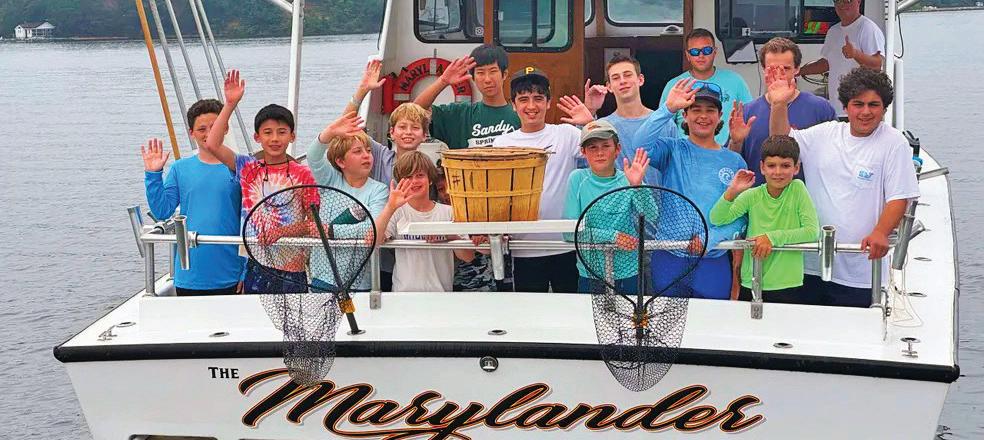
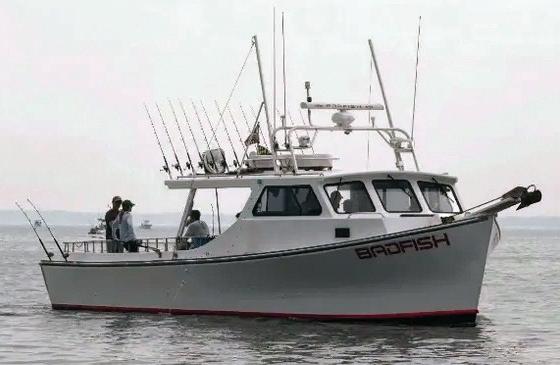
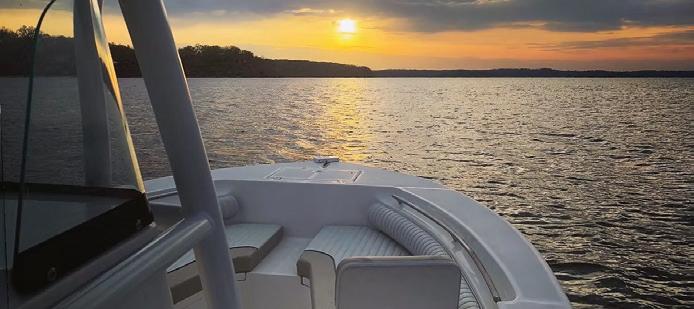
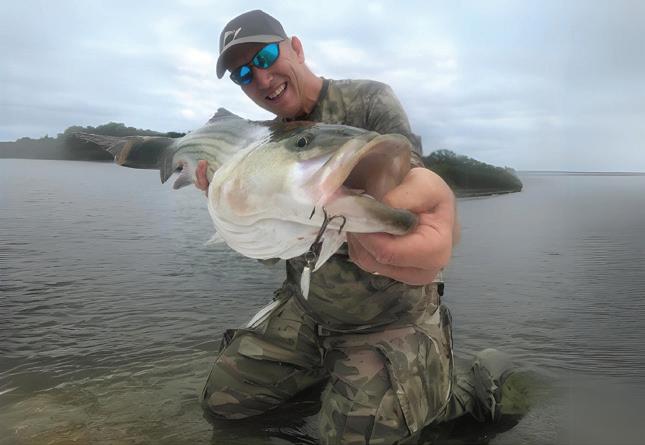
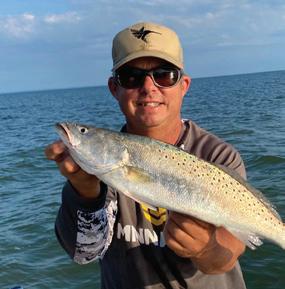
Whether you like light tackle jigging, fly fishing, trolling, or bottom fishing, there’s a local expert who can lend a hand. If you’re just now trying to learn how to fish you can jump-start the learning process by stepping aboard a Chesapeake Bay or Mid-Atlantic fishing charter. For more information visit fishtalkmag.com/charter-fishing-guide









Ask an Expert
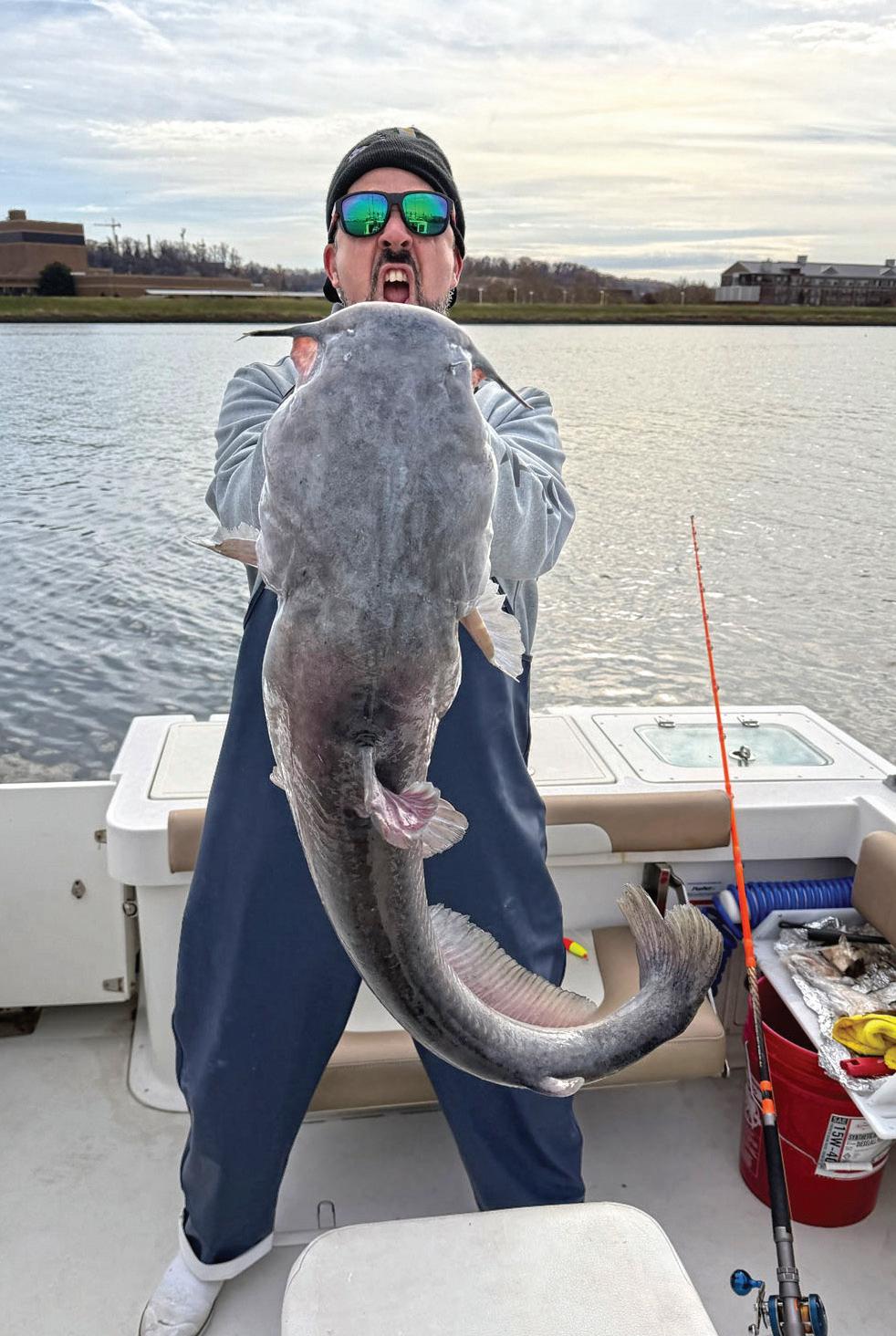
This month we check in with Captain Tim Blanchard of Fish the Potomac. The Fish the Potomac fleet casts into the waters in and around the nation’s capital year-round, targeting multiple species but with an emphasis on reeling in the prolific blue catfish that the river’s become known for.
Q: You’re faced with a lot of ever-changing conditions on the Potomac. How does high water and a lot of runoff affect the bite? How do you react to that to keep catching?
A: Step one: stop blaming the river. High water doesn’t shut fish off—it just rearranges the furniture. Blue cats love current, but they’re not trying to swim laps in the middle of it. When it’s ripping, they slide into current breaks behind bridge pilings, down-current of structure, inside bends, and anywhere they can let food come to them like a conveyor belt. Runoff? That’s the dinner bell. Everything edible gets swept into the system. Boat control and position become everything in this situation. You want your bait in the soft seams—not tumbling through the hydraulic washing machine. And this is where technology has changed the game. We just invested in a mobile real-time imaging sonar rig (Garmin LiveScope), and it’s like turning the lights on underwater. Instead of guessing where fish might be positioned, you can literally see how they’re set up. Are they glued to bottom? Suspended just off it? Sliding in and out of current breaks? It’s part fishing, part underwater chess match.
Q: Same question, but for low water. How do you react as an angler?
A: Low water is when the river gets picky. Clearer water, less flow, the fish feel and see more. Slamming a hatch? They know. Bad anchor drop? They know. Acting like you’re filming a reality show on deck? They absolutely know. But low water also makes fish predictable. They’ll hug defined structure like subtle channel edges, humps, hard-bottom transitions.
Q: What about seasonality? Walk us through some of the differences between spring, summer, fall, and winter
A: Blue cats on the Potomac have seasonal personalities. Spring: Water temps climbing, pre-spawn feedbag mode. This is when people stop calling them “trash fish” and start texting photos to their buddies.
Summer: They spread out more. Current is king. Early mornings and evenings matter. You’ll work harder, but when you dial it in, it’s steady.
Fall: My favorite. Cooling water flips the switch. They feed consistently and bulk up heading into winter.
Winter: Criminally underrated. Fish group up in deeper wintering areas. If you slow down and fish vertically, it can be lights-out.
Q: Speaking of winter, how would you rate the winter blue cat action on the Potomac? Do you use different winter strategies, after most people have hung up their rods?
A: Winter blue cat action? It’s sneaky good. They don’t migrate and they don’t hibernate. They stack up. Slower presentations, tighter vertical setups, more patience, less random soaking, more targeted hunting. Plus, there’s something deeply satisfying about boating a 30-pound blue cat while most people are inside debating playoff brackets.
Q: Open mic — what haven’t we talked about that all the anglers out there need to know when it comes to catching blue catfish on the river?
A: Two things. First: Blue cats aren’t dumb. If they were, we wouldn’t still be figuring them out. They respond to current, structure, forage, and seasonal shifts just like any respected gamefish. Fish them intentionally and your success rate skyrockets. Second: Stop overcomplicating it. Get fresh bait, learn good boat control, and pay attention to what the river is telling you that day.
No More Gas Station
Mystery Bait at 5 a.m.
One of the biggest frustrations for DC anglers has always been access to legit bait and proper catfish tackle. That’s finally changing. By the time this article runs, you’ll be able to get dialed-in gear and fresh bait right here in town at the DC Tackle Shop at The Yards Marina, 301 Water Street, SE.
Thank you, Captain Tim! To fish with Fish the Potomac visit fishthepotomac.com or call (202) 703-1141.
CHESAPEAKE CALENDAR
JULY
Through Mar 31
CCA Great Chesapeake Invasives Count Fishery managers need help understanding which invasive species are being caught and where in order to support the science-based management of our natural resources. Log your catch and get entered to win great prizes each month! Register: ccamd.org
1 Queen Anne’s County Independence Day Celebration 6 p.m. at the Chesapeake Heritage and Visitor Center. Fireworks launch at 9:15 p.m. Food trucks, live music, and more.
2 AMM Tides and Tunes Concert Series
7 to 9 p.m. at the Annapolis Maritime Museum. Free; donations greatly appreciated. Live music by The Grilled Lincolns. Food and drinks available for purchase. Zero waste event; bring or buy a cup. Bring a chair or blanket; no dogs. No parking onsite.
2 Live with Lenny Join us on the first Thursday of each month at 6 p.m. on YouTube or Facebook. Tune in for an interactive live stream with Angler in Chief Lenny Rudow where he discusses various seasonal fishing tips and tricks for targeting a variety of fish species.
3 Chesapeake Beach Independence Day Celebration Festivities begin at 5 p.m. at Kellam’s Field Complex and include a full evening of fun. Fireworks are launched from barges in the Chesapeake Bay near Veterans Memorial Park at dusk (approximately 9 p.m.).
3
Oxford Fireworks Celebrate Independence Day on the Strand, the beautiful riverside street along the Tred Avon River. Fireworks begin at dusk.
3 Rappahannock Patriotic Decorated Boat Parade Presented by Rappahannock River Yacht Club on Carters Creek in Irvington, VA. Parade will be begin at 2 p.m. Boats will gather near Custom Yachts.
3 Rock Hall Fireworks 9 p.m. over the harbor in Rock Hall, MD.
3
Salute to Cecil County Veterans 4 to 10 p.m. at North East Community Park in North East, MD. Free, family-friendly event to honor the men and women who have served our country. A spectacular fireworks show over the North East River at dusk.
4 15th annual Solomons Fourth of July Boat Parade
Show your American pride and dress up your boat or you person and join in on the fun. The starting cannon will sound at 12 p.m. sharp on Mill Creek in Solomons at 38.331264 x 76.450065. There is no registration just jump in behind the last boat and form a line. Stay on channel 68 for the duration of the parade.
4
America 250 Middle River Fireworks Extravaganza
View the most spectacular waterfront fireworks show on the Chesapeake Bay. Weather may affect start time. No rain date. No public viewing location.
4 Annapolis Fourth of July
Get ready for a full day of events culminating in fireworks over Spa Creek at approximately 9:15 p.m.
4 Cambridge Fireworks
Watch a beautiful display of fireworks over the Choptank River at dusk (a little after 9 p.m.).
4 Easton Fireworks
On July 4th, the Easton Carnival will kick-off with live music at 7 p.m., followed by opening ceremonies at 7:30 p.m., and fireworks after dusk. In the event of rain, the fireworks will be pushed to July 5th.
4
Fourth of July in Baltimore
The celebration kicks off at the Inner Harbor Amphitheatre at 6 p.m., followed by a live band performance along the Waterfront Promenade. The fireworks show at the Waterfront Promenade takes place at 9 p.m., and at 9:30 there will be a drone show at Middle Branch Park.
4
Fourth of July in Kinsale
Get ready for live music, food, and drinks at The Slips, where the crowd gathers to celebrate the 4th of July and watch fireworks launched at 9:15 p.m. over the Yeocomico River in Kinsale, VA.
4 Fourth of July in Solomons
Organizers are adding a second fireworks barge and launching twice as many fireworks for an unforgettable display over the Patuxent River. Join the celebration July 4 from 4 to 10 p.m. for a full day of family fun.
Do you have an upcoming event? Send the details to: kaylie@fishtalkmag.com

traditional bell ringing ceremony marking the historic call for liberty, a lively outdoor concert, and a spectacular fireworks display over the York River at 9:15 p.m.
5 Big Band Night at CBMM 6 to 10 p.m. at the Chesapeake Bay Maritime Museum in St. Michaels, MD. Music, dancing, fireworks, and fun for the whole family. Ticketed event.
st 7-9, 2026 Augu
Come by land or sea to the Town of Rock Hall for a Pirates & Wenches Theme Party you won't soon forget



JULY (continued)
5
Chesapeake City Fireworks Free family fun event in Pell Gardens with food and craft vendors and live music starting at 5 p.m. The fireworks will start at dark (approximately 9:30 p.m.) and will be shot off from the hill behind Schaefer’s.
5 Havre de Grace Independence Day
2 p.m. parade down Union Avenue, 7:30 p.m. concert at Concord Point Park, and fireworks over the Susquehanna River at 9:15 p.m.
5 KCWA Watermen’s Day and Boat Docking Presented by Kent County Watermen’s Association on the Rock Hall bulkhead in Rock Hall, MD. Celebrates the men and women of Rock Hall, who have and still do, make a living fishing local waters. Boat docking contest, food, music, and more.
8 Frederick Saltwater Anglers Monthly Meeting
6:30 p.m. at 289 Willowdale Dr, Frederick, MD 21702. Speaker and vendor TBD.
9
AMM Tides and Tunes Concert Series
7 to 9 p.m. at the Annapolis Maritime Museum. Free; donations greatly appreciated. Live music by One Night Only.
11 Anne Arundel County River Days
11 a.m. to 3 p.m. at Quiet Waters Park in Annapolis. All events are free and open to the public. Each festival will feature fun activities for all ages, including boat rides, water activities,
11 Antique Outboard Motor Club Meet
8:30 to 2:30 p.m. at Flying Point Park (511 Kennard Ave) in Edgewood, MD. Everything vintage outboard motors and associated marine items. For more info contact Al Barnes (on_travel_2015B@yahoo.com) or Lee at (410) 833-6152.
11
Chesapeake City Antique and Classic Boat Show 9 a.m. to 5 p.m. in Chesapeake City, MD. Boats located at Chesapeake Inn Marina (B Dock) and Pell Gardens. Nautical vendors, crafts, and hopefully swap meets.
16
AMM Tides and Tunes Concert Series


21 Essex-Middle River Fishing Club July Monthly Meeting Speaker: Don Cocavitch on Upper Bay Fishing. 7:30 p.m. at the FOP Lodge 34 (730 Wampler Road in Middle River, MD 21220). Open to all. Food and drinks are available.
21 PSWSFA Monthly Meeting Peninsula Saltwater Sportfisherman’s Association. Regular monthly meetings are held on the 3rd Tuesday of the month at 7 p.m. at Peninsula Baptist Church (2605 Cunningham Dr, Hampton, VA). Meetings consist of an educational speaker, monthly tournament awards, and a discussion of fishing news and club business. Meetings are free and you do not need to be a member to attend.
23
AMM Tides and Tunes Concert Series
7 to 9 p.m. at the Annapolis Maritime Museum. Free; donations greatly appreciated. Live music by Sweet Leda.
30
AMM Tides and Tunes Concert Series
7 to 9 p.m. at the Annapolis Maritime Museum. Free; donations greatly appreciated. Live music by John Frase Project.
AUGUST
1
Mid-Shore Fishing Club Kids Fishing Derby Bring the kids, ages 5-12, to enjoy a morning of fishing at Long Wharf Park in Cambridge, MD, from 9 a.m. to 12 p.m. Hosted by the Mid-Shore Fishing Club. All children must be accompanied by a guardian. You must pre-register at Midshorefishingclub@gmail.com with the subject line “Kids Fishing Derby” or call Bob at (410) 365-5723. Space is limited to the first 100 children who register. Bait and tackle will be provided. Feel free to bring your own rod and reel. There will be water and pizza for the kids at 11 a.m. First and second place prizes will be awarded for the largest white perch, catfish, spot, croaker, and mystery fish. Check the latest updates from the Mid-Shore Fishing Club on their Facebook page. Rain Date: August 8.
6
AMM Tides and Tunes Concert Series
7 to 9 p.m. at the Annapolis Maritime Museum. Free; donations greatly appreciated. Live music by Honest Lee Soul. Food and drinks available for purchase. Zero waste event; bring or buy a cup. Bring a chair or blanket; no dogs. No parking onsite.
7-9
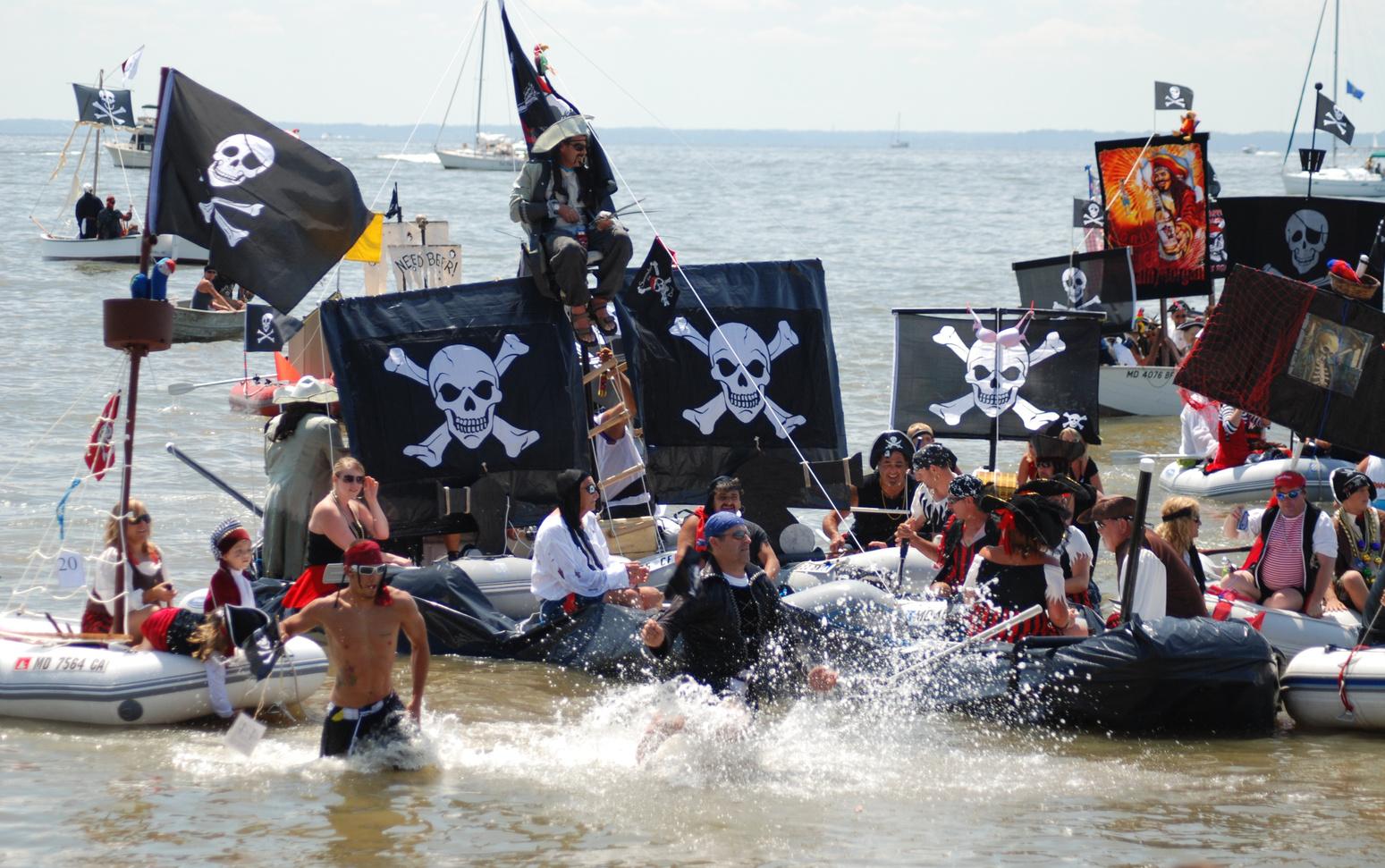
Pirates and Wenches Weekend
A town-wide family friendly event in Rock Hall, MD. Rum tasting, sea shanty sing-a-long, dinghy parade and poker run, live music, kids treasure dig, Buccaneers Ball, and more.
12 Frederick Saltwater Anglers Monthly Meeting 6:30 p.m. at 289 Willowdale Dr, Frederick, MD 21702. Speaker and vendor TBD.
13
AMM Tides and Tunes Concert Series
7 to 9 p.m. at the Annapolis Maritime Museum. Free; donations greatly appreciated. Live music by Jarflys.
18 Essex-Middle River Fishing Club August Monthly Meeting Speaker: Lenny Rudow, Angler in Chief of FishTalk Magazine. 7:30 p.m. at the FOP Lodge 34 (730 Wampler Road in Middle River, MD 21220). Open to all. Food and drinks are available.
18
PSWSFA Monthly Meeting Peninsula Saltwater Sportfisherman’s Association. Regular monthly meetings are held on the 3rd Tuesday of the month at 7 p.m. at Peninsula Baptist Church (2605 Cunningham Dr, Hampton, VA). Meetings consist of an educational speaker, monthly tournament awards, and a discussion of fishing news and club business. Meetings are free and you do not need to be a member to attend.
20 AMM Tides and Tunes Concert Series 7 to 9 p.m. at the Annapolis Maritime Museum. Free; donations greatly appreciated. Live music by Jah Works.
22 Sassafras River Docking Contest and River Days 10 a.m. to 4 p.m. at the former IJK docks at the north end of Georgetown Yacht Haven. This event will include dozens of local vendors as well as food trucks, live music, drinks, and more. Fundraiser for the annual Georgetown Labor Day Fireworks and local community.
26 Free State Fly Fishers “Beer Tie” Eat, drink, tie, or just hang out. Bring your vise, tools, and materials and/ or fish stories. Not instructor-led, but everyone helps each other out. Look for tying vises and FSFF hats on the enclosed front porch area. 6 to 8 p.m. at Killarney House Irish Pub, 584 W Central Ave, Davidsonville, MD.
29 Anne Arundel County River Days 11 a.m. to 3 p.m. at the Annapolis Maritime Museum. All events are free and open to the public. Each festival will feature fun activities for all ages, including boat rides, water activities, environmental educators, live music, games, crafts, food trucks, and more. Boat rides are free, but capacity is limited and tickets will be available first come, first served.Top of FormBottom of Form
For links to the websites for these events and more, visit fishtalkmag.com/calendar

Reader Photos
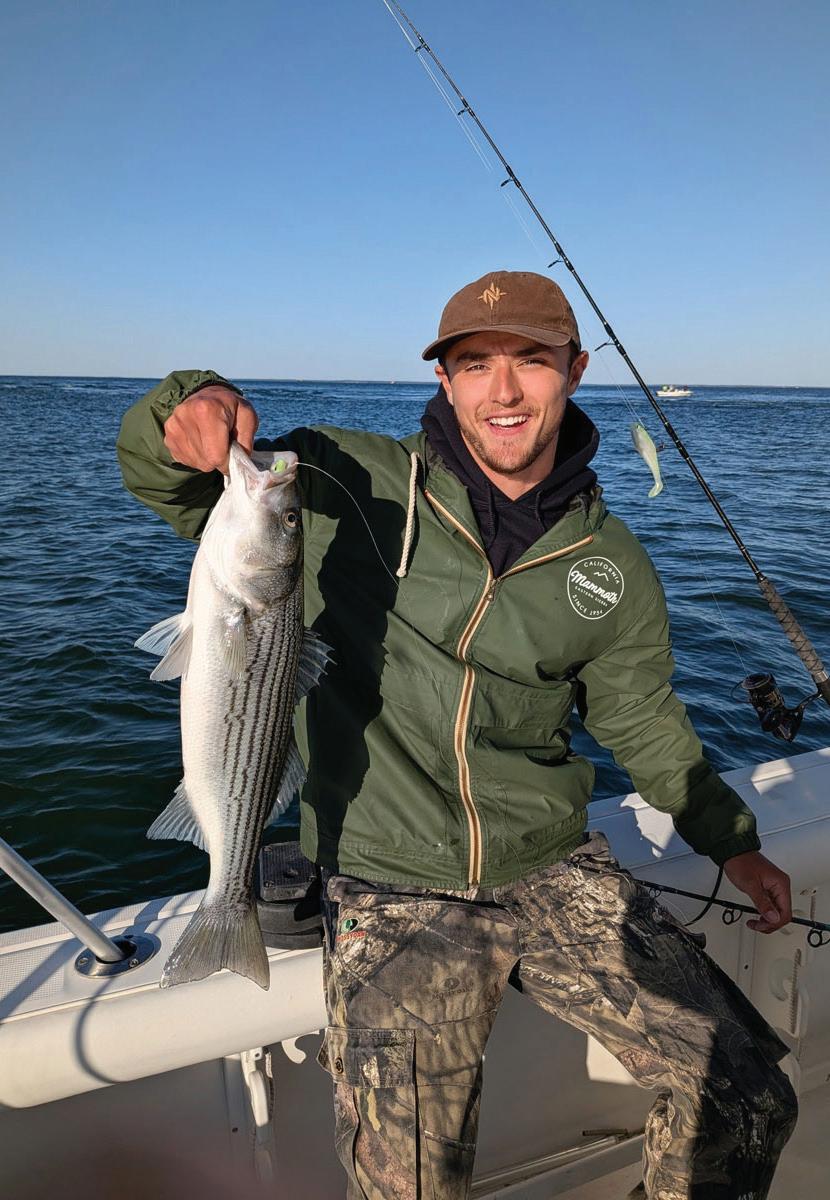
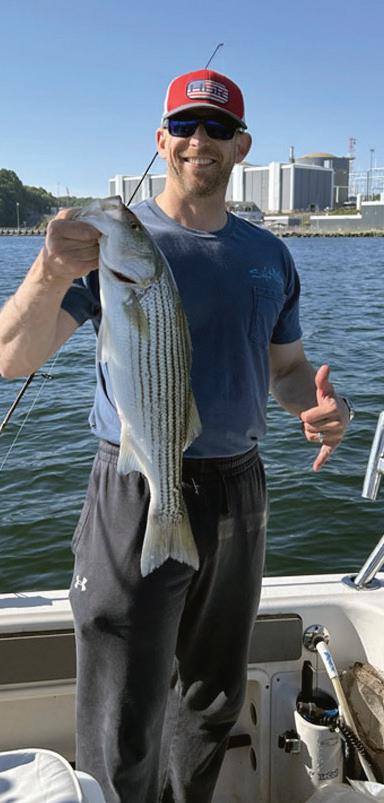
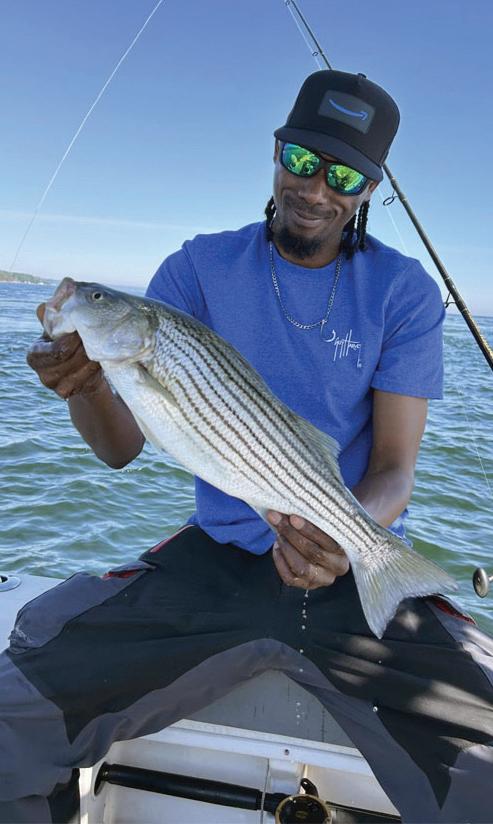
# Craig and Vince got ‘em biting at the powerplant.
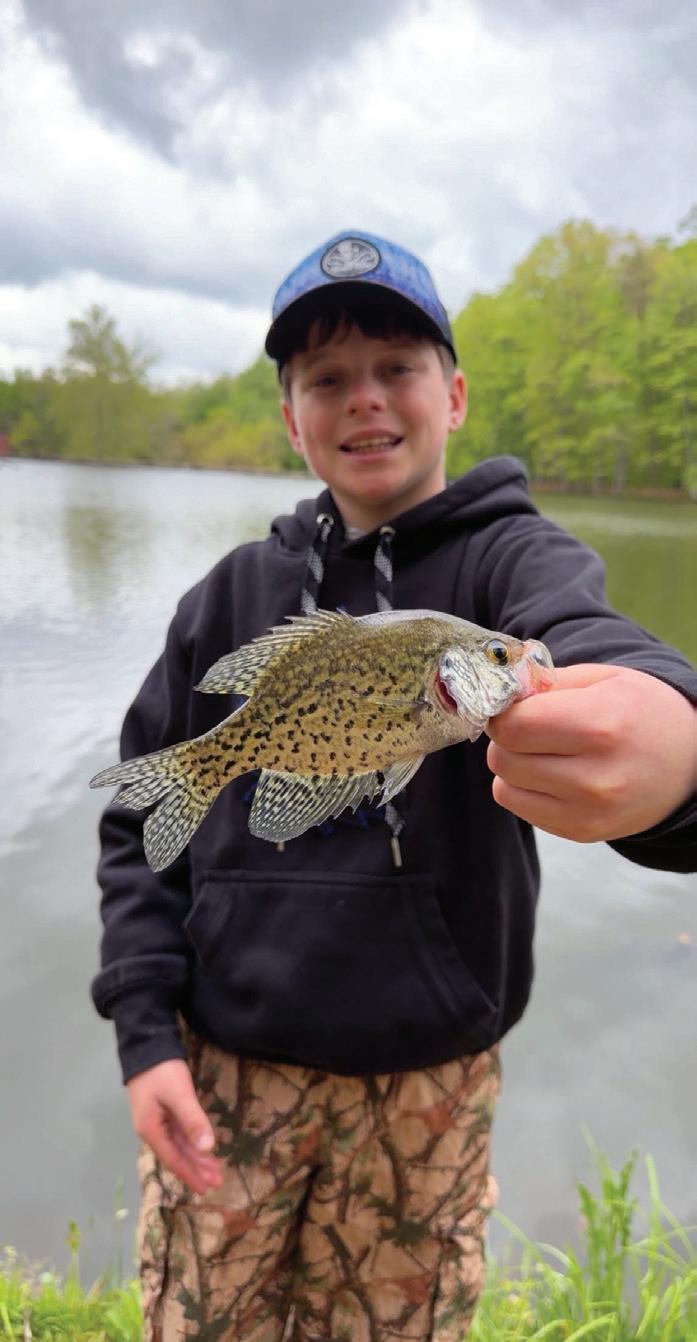
# Peter had a great day fishing with Kevin and caught this nice crappie.
# Gibbie reeled up a nice slot fish near Taylors Island shortly after the season opened up.
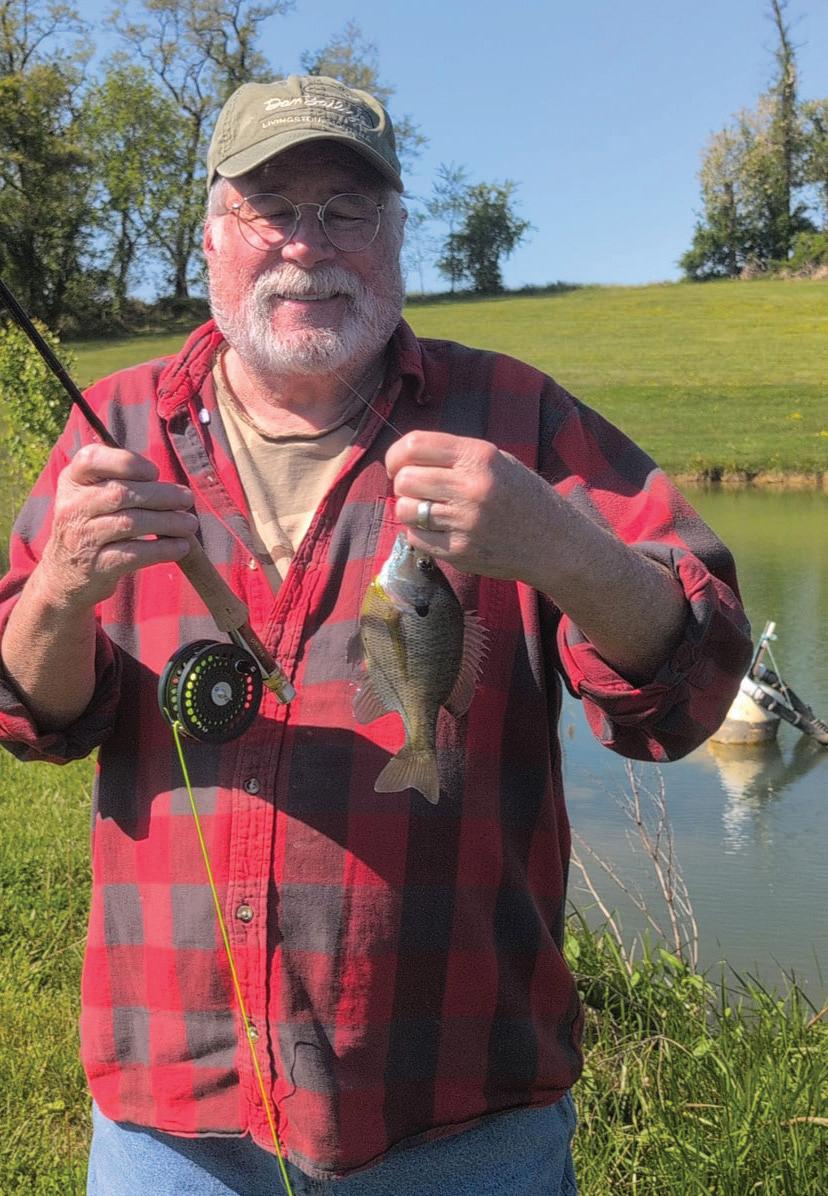
# William enjoyed some bluegill action on the fly.
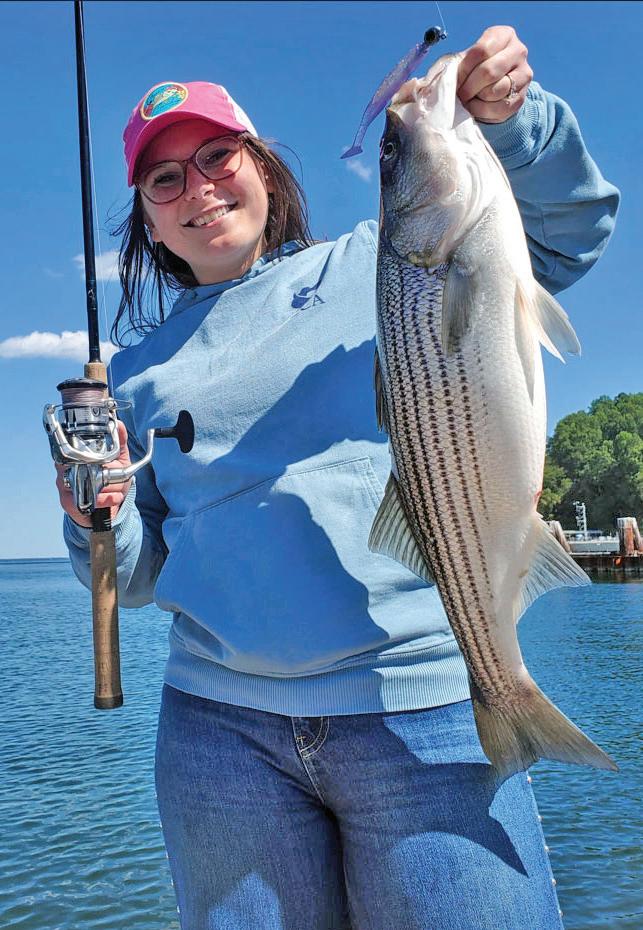
# Mollie fooled a rockfish into biting by offering up her very glittery pretty perfectly purple paddletail.
into some nice stripers this spring while
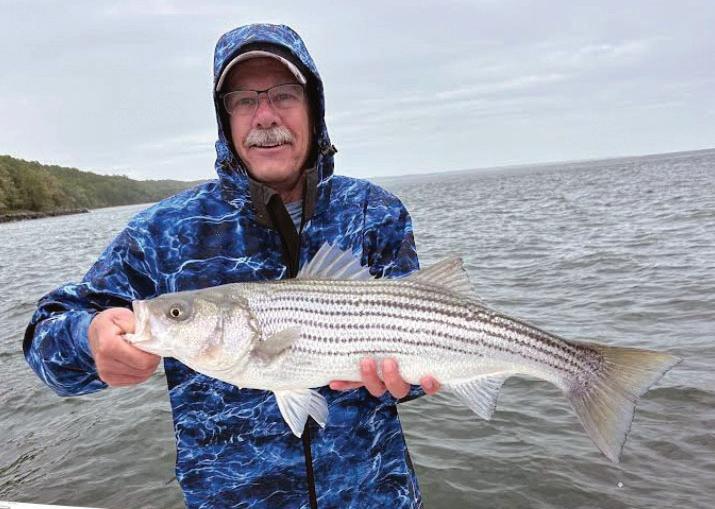
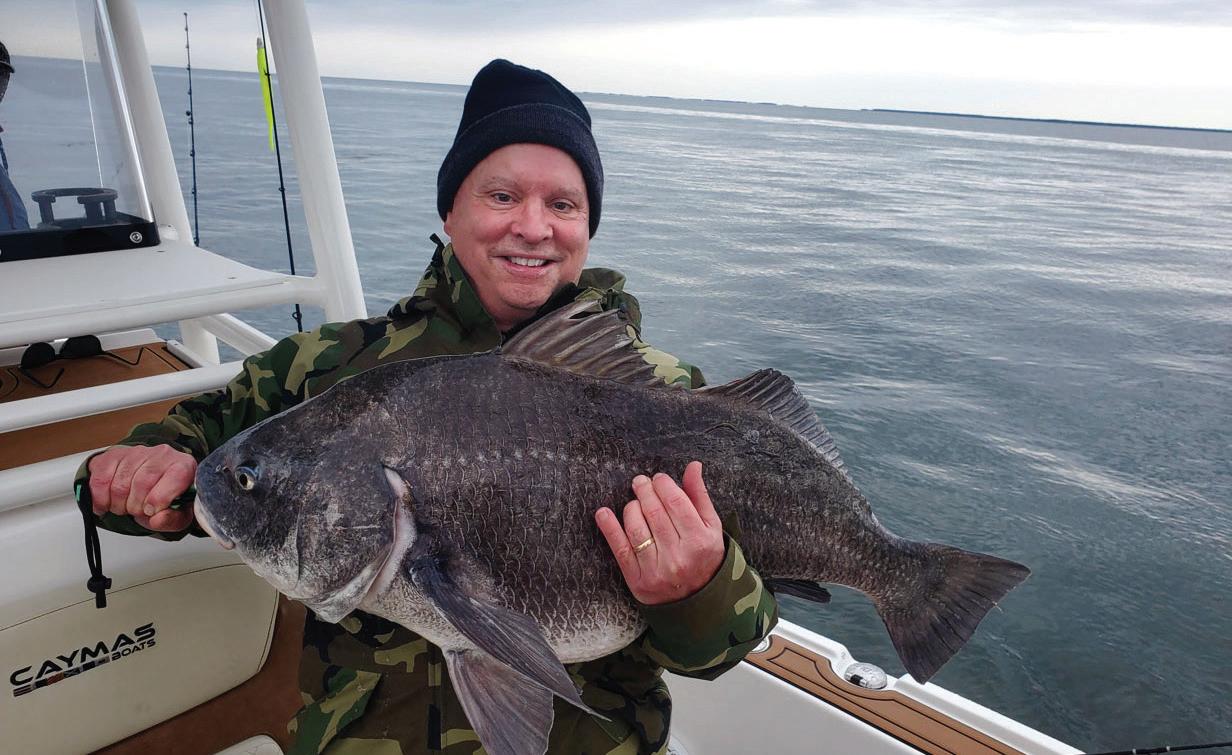
# Johnny was fishing in the marsh behind Chincoteague when he experienced a very unusual catch! Okay, not really – as you may suspect this awesome golden tilefish was actually pulled up about 70 miles to the east.
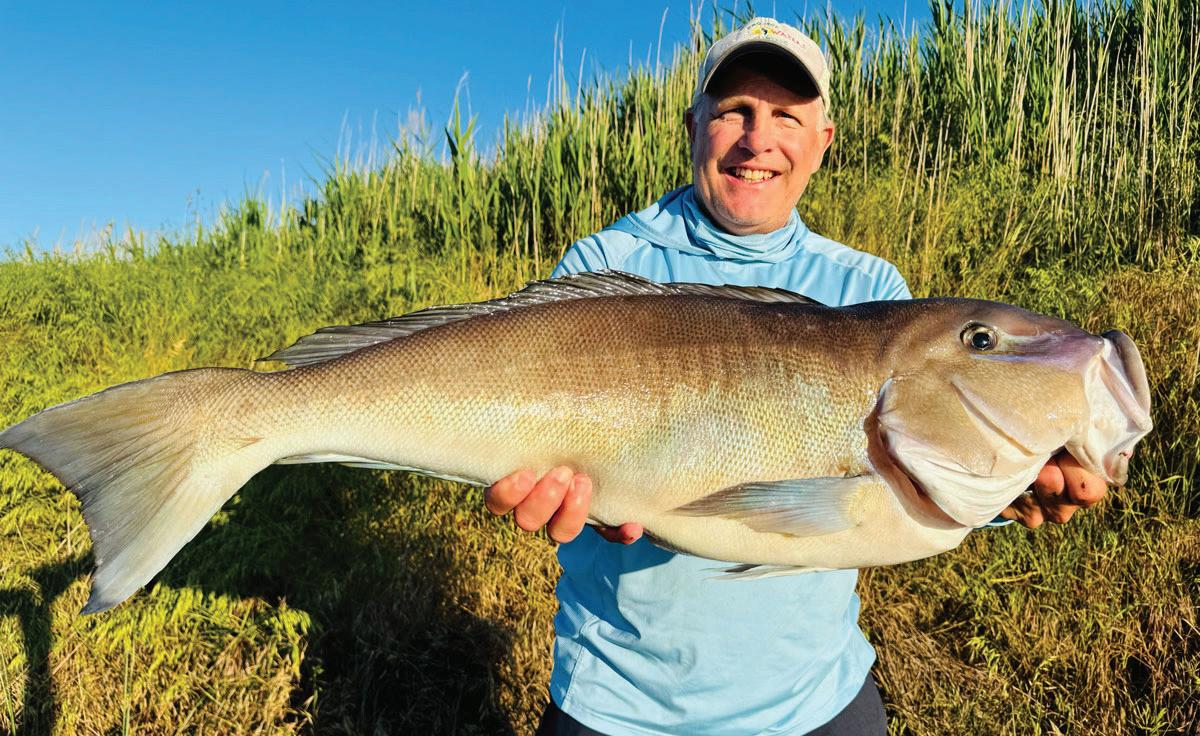
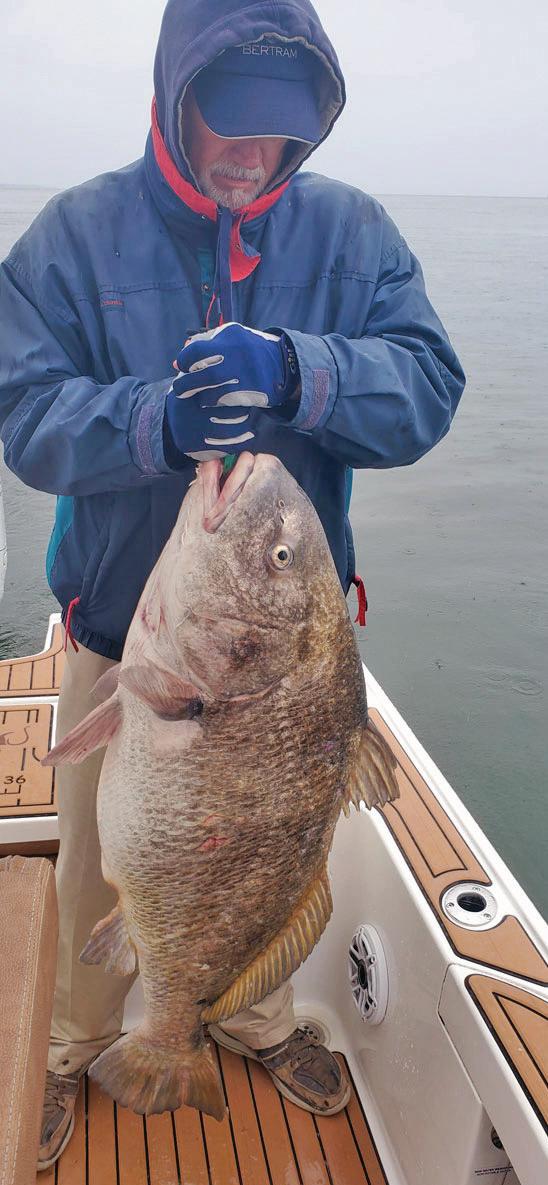
# Bill got the B-I-G one.
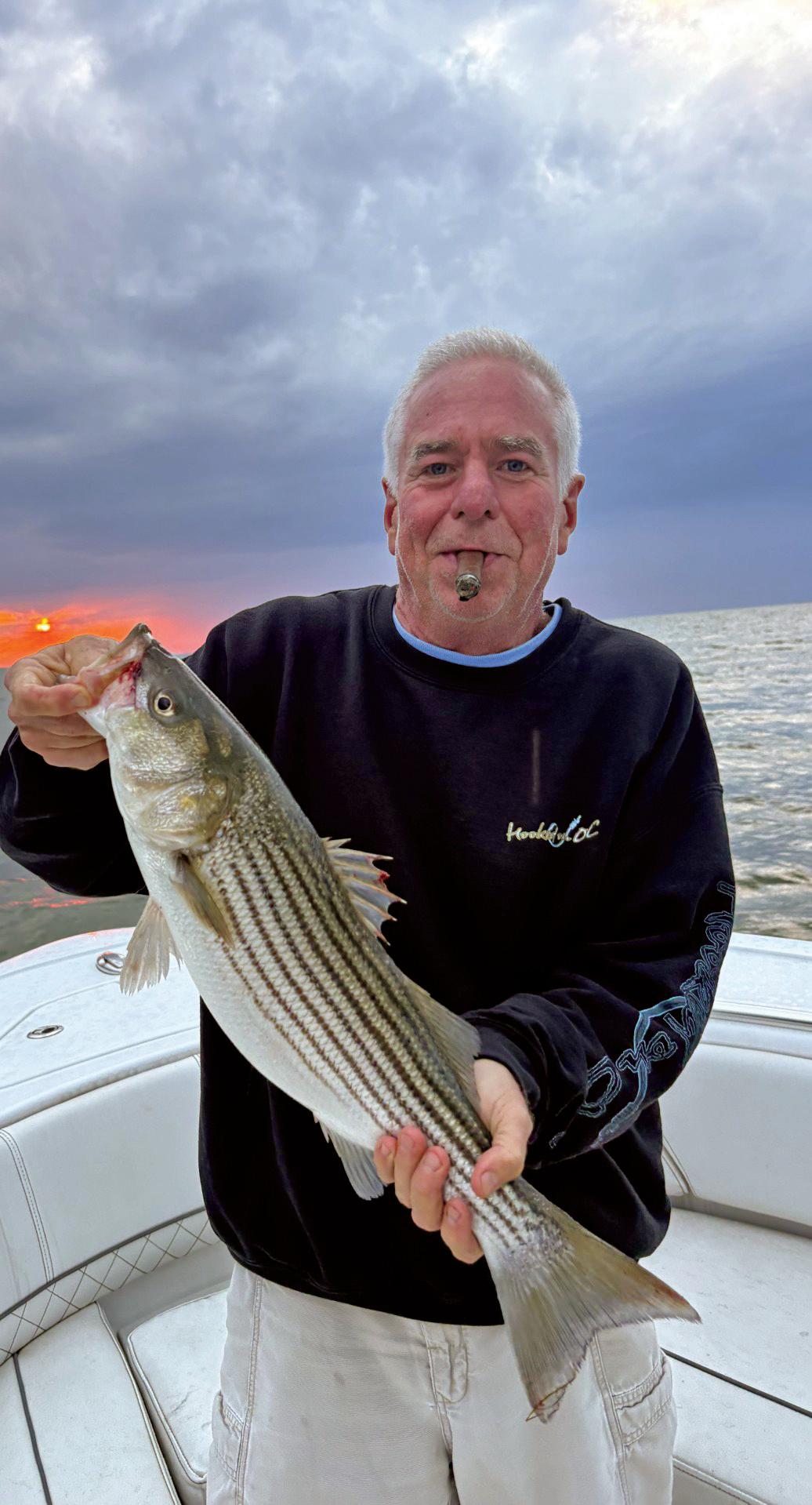
Brian had some spring fun on topwater.
#
# WTG Tom! WTG Tom!
# Rich tied
fishing with Walleye Pete of Four Seasons Guide Service.
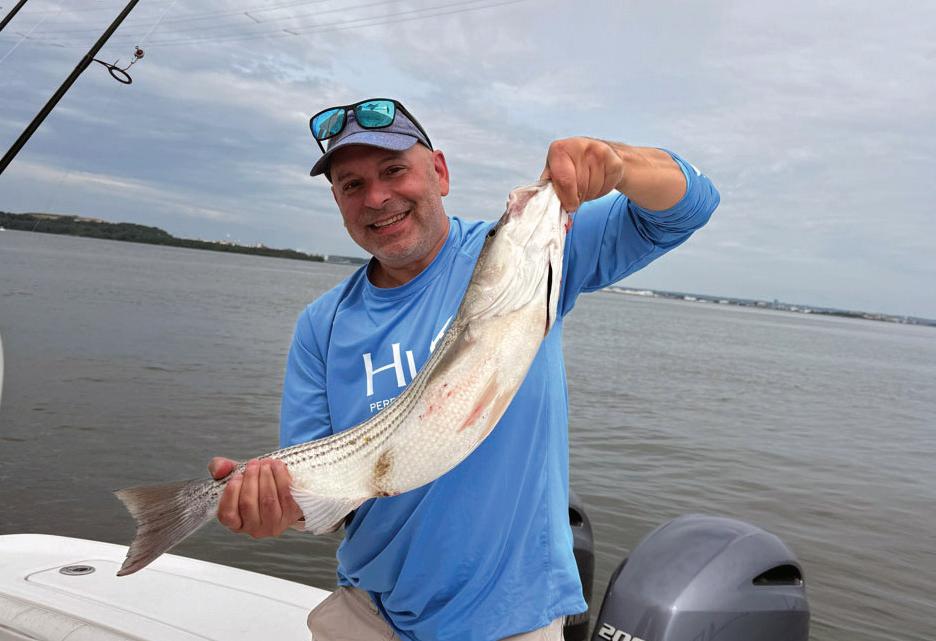
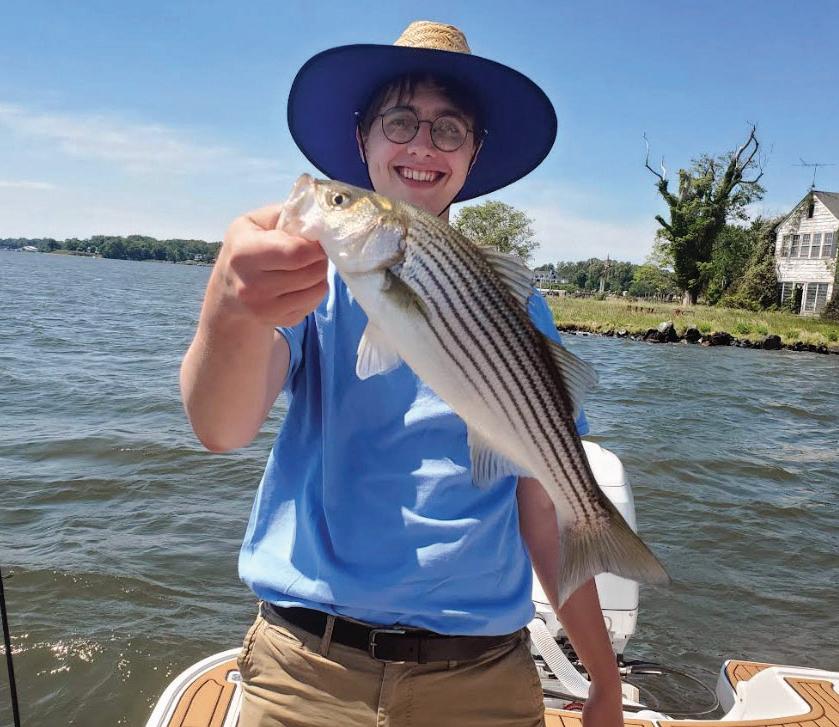
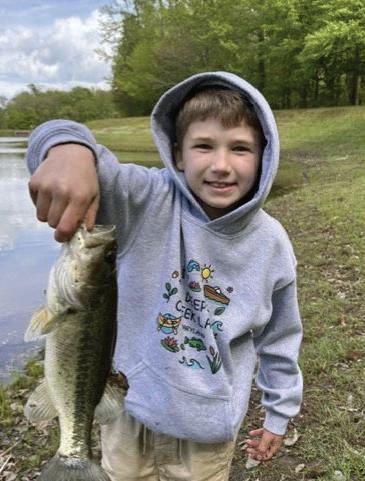
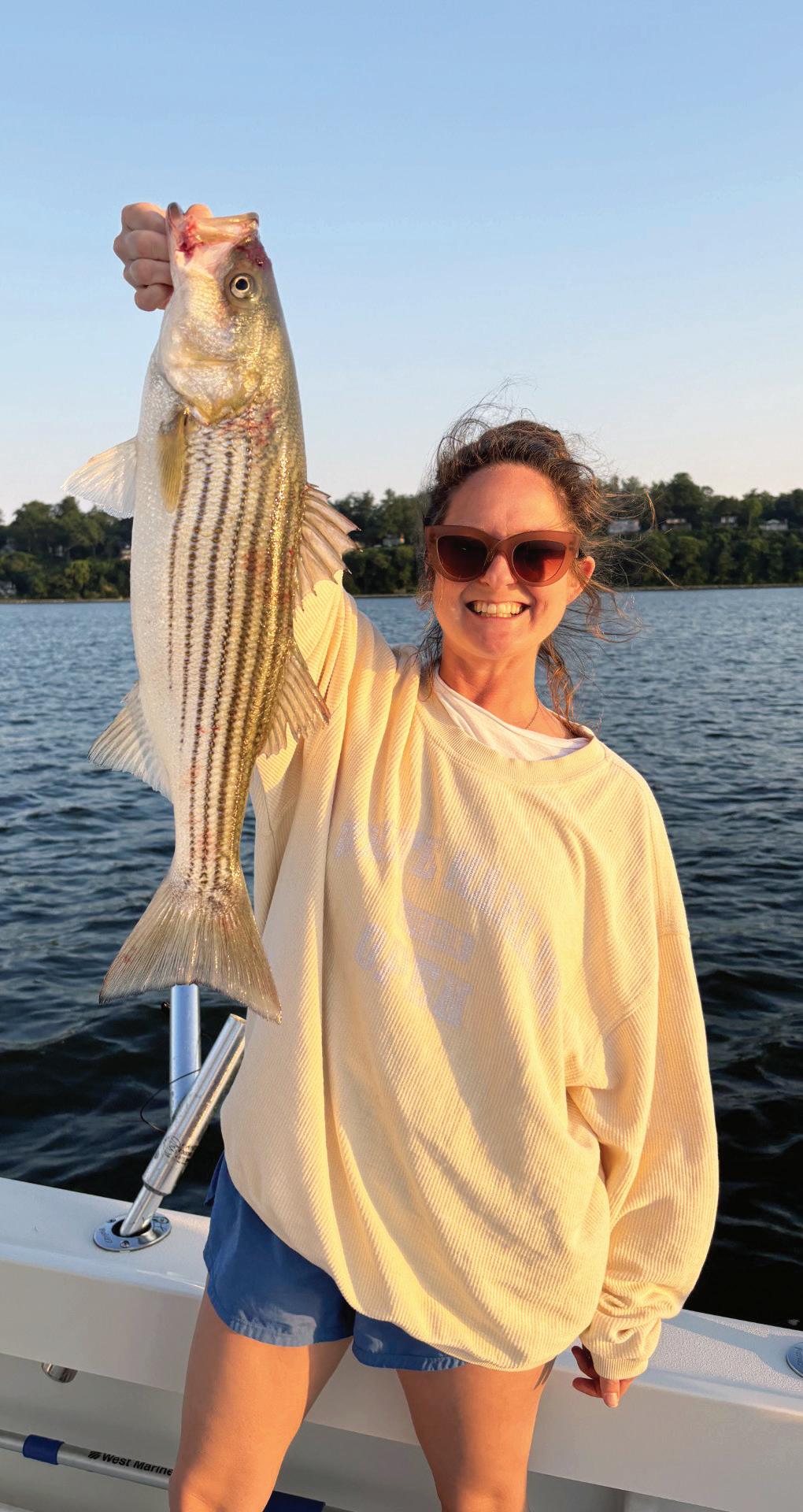
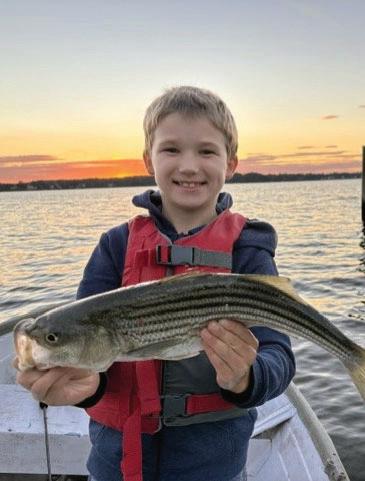
# Ryan and his little white paddletail fooled this rockfish into biting.
# Kaitlin caught a nice one in Round Bay.
# Bill tied into a nice one at the mouth of the Patapsco.
# Ethan made the rounds of a true Maryland angler, wetting his lines in Deep Creek Lake, the Potomac, and the Severn River.
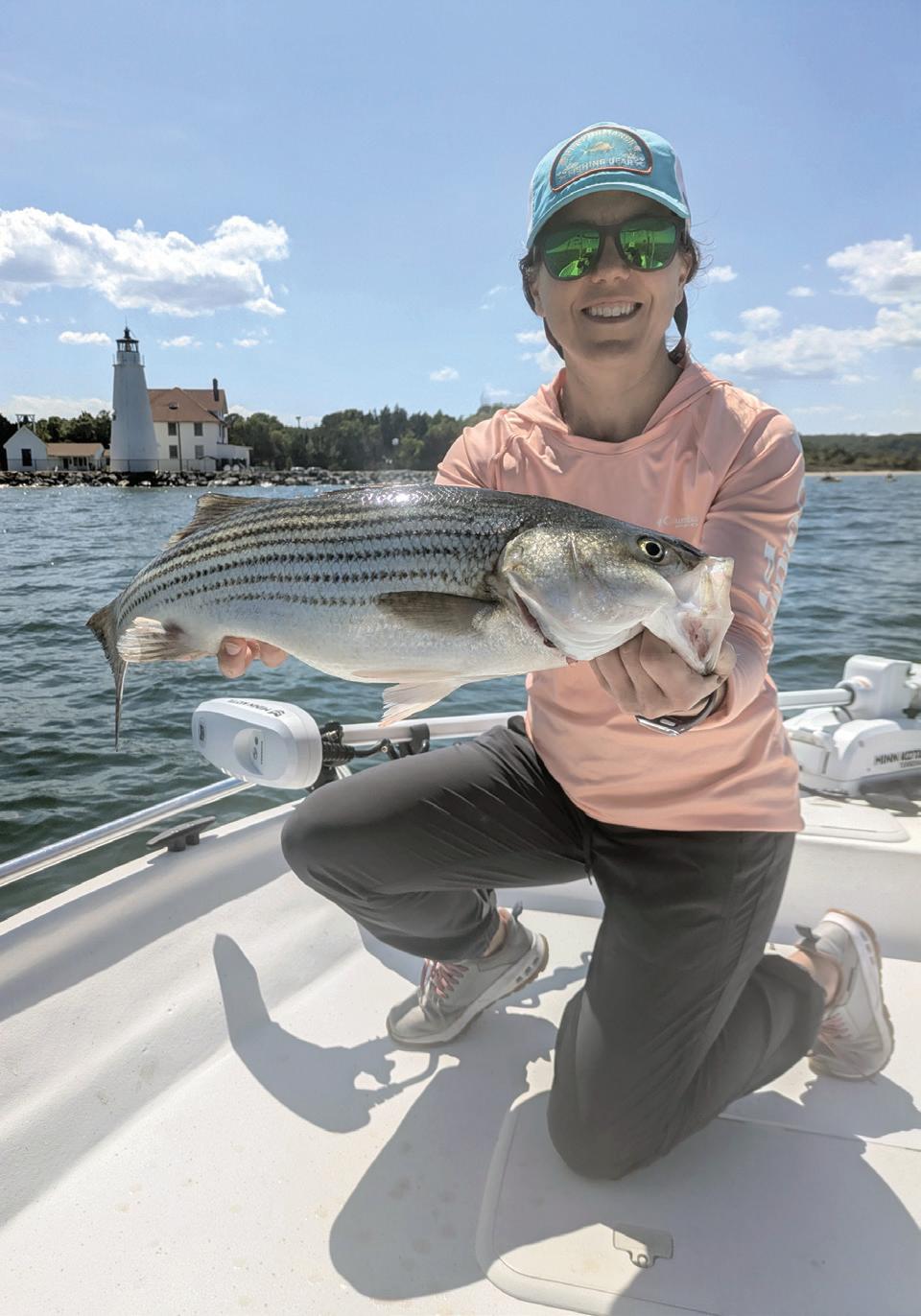
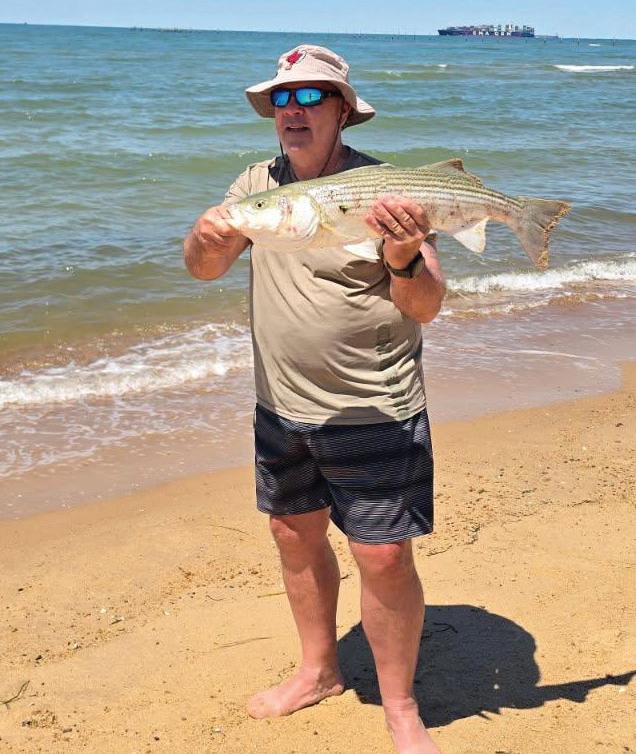
# Keith was casting from the surf at First Landing when he tied into this striper.
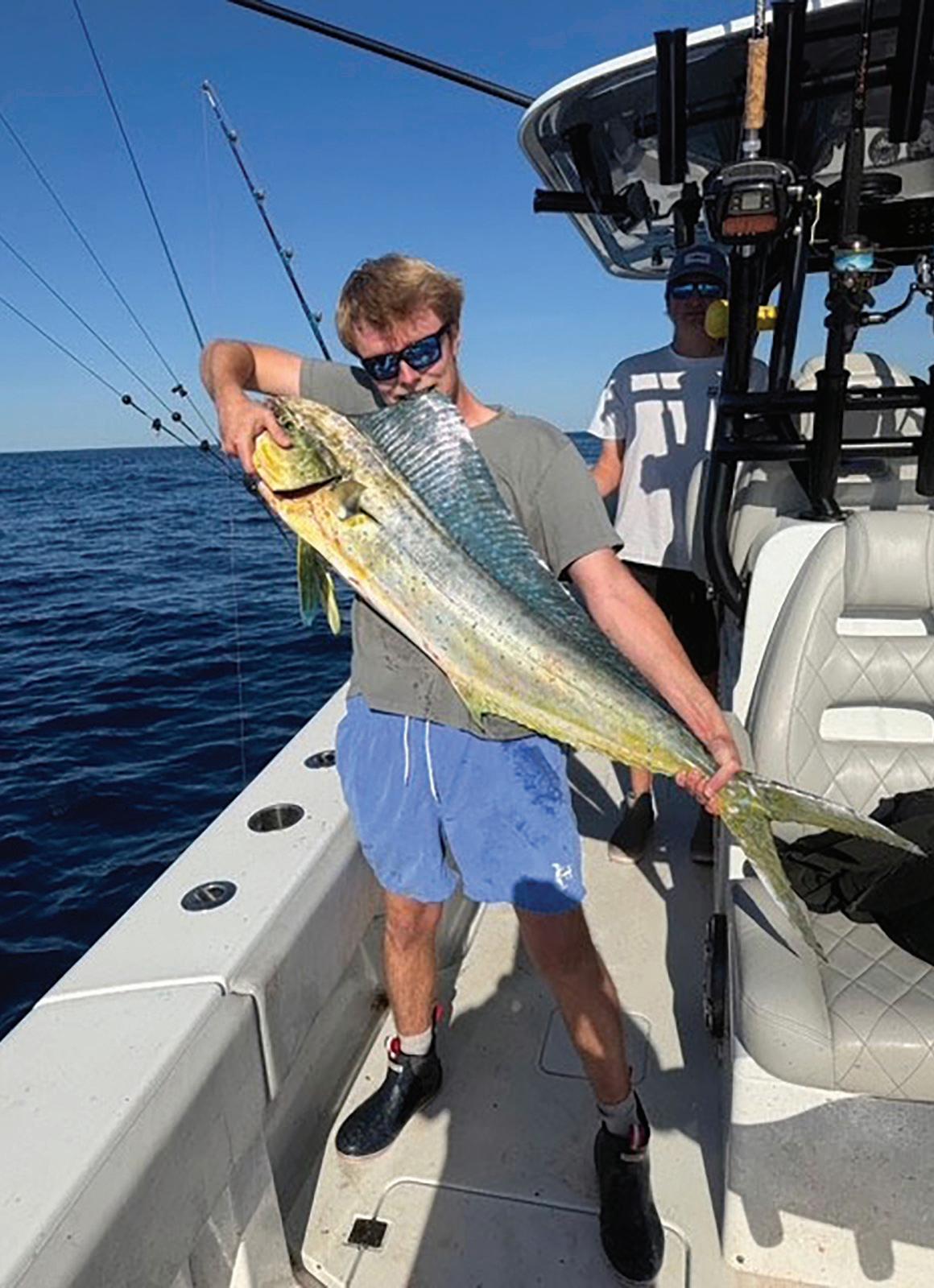
# Michael found a mahi!
# Mike had an excellent day of catching in Dundee Creek.
# Amanda found a beauty on Mother’s Day.
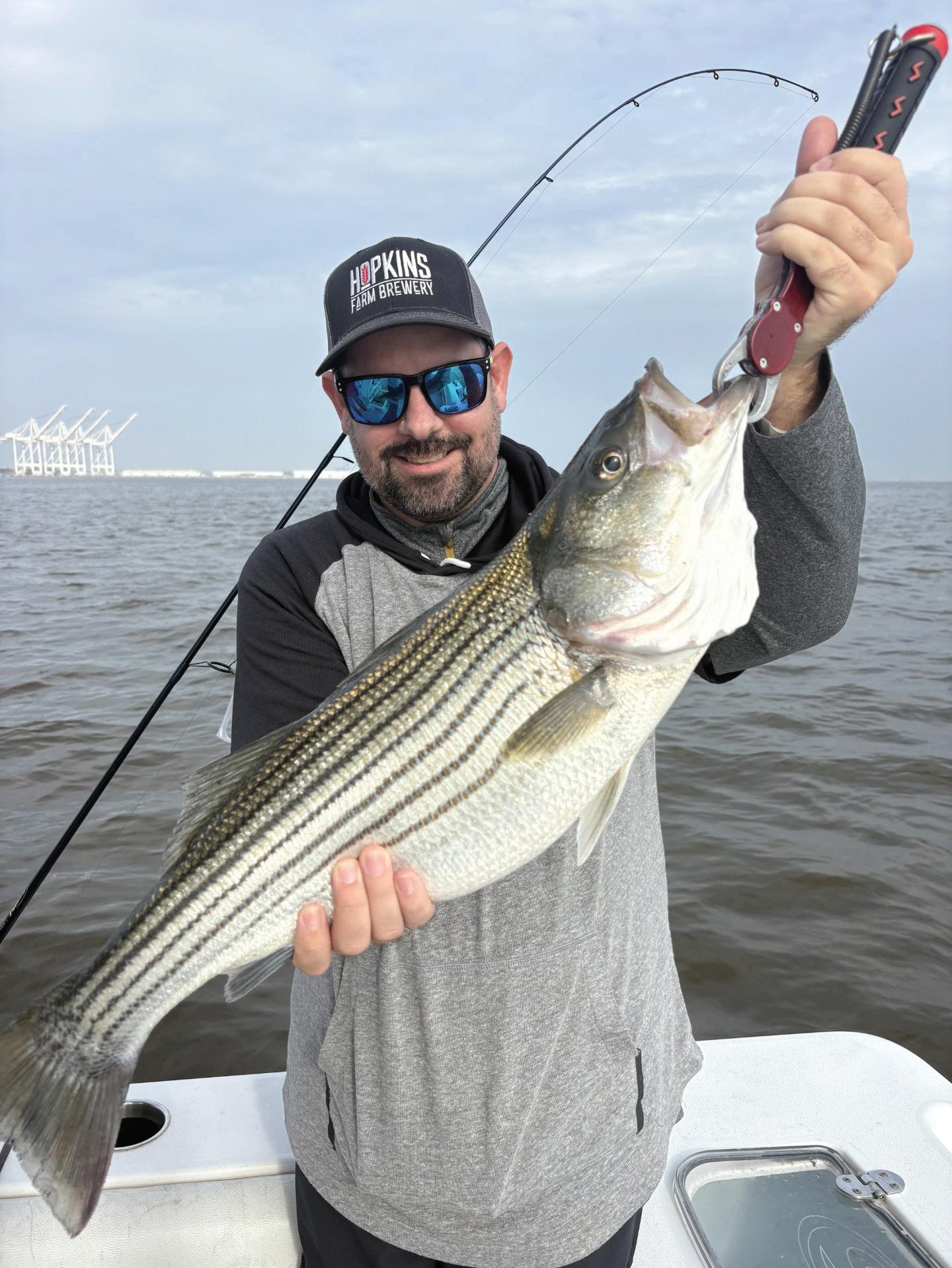
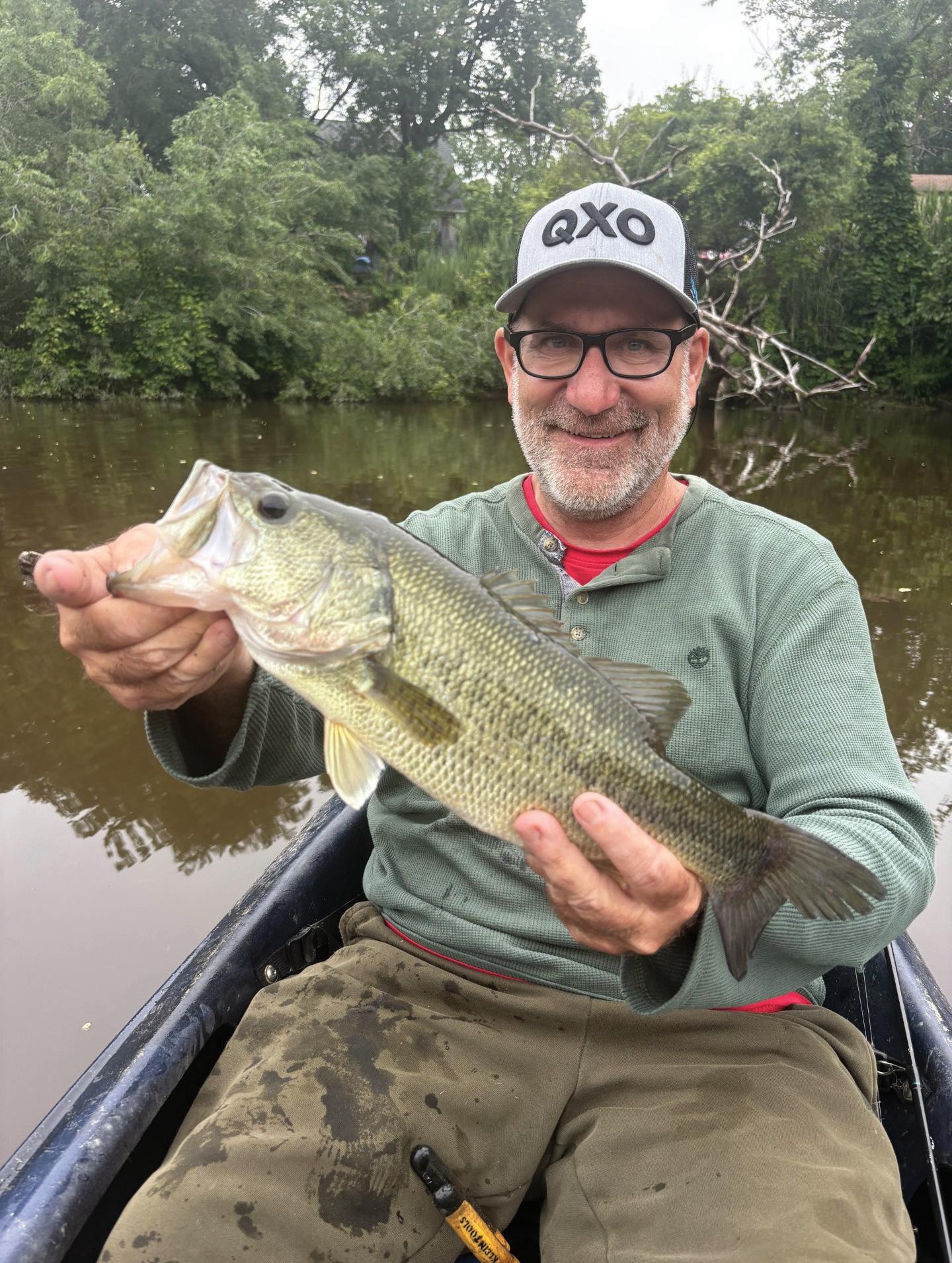
# Chris landed a nice one.
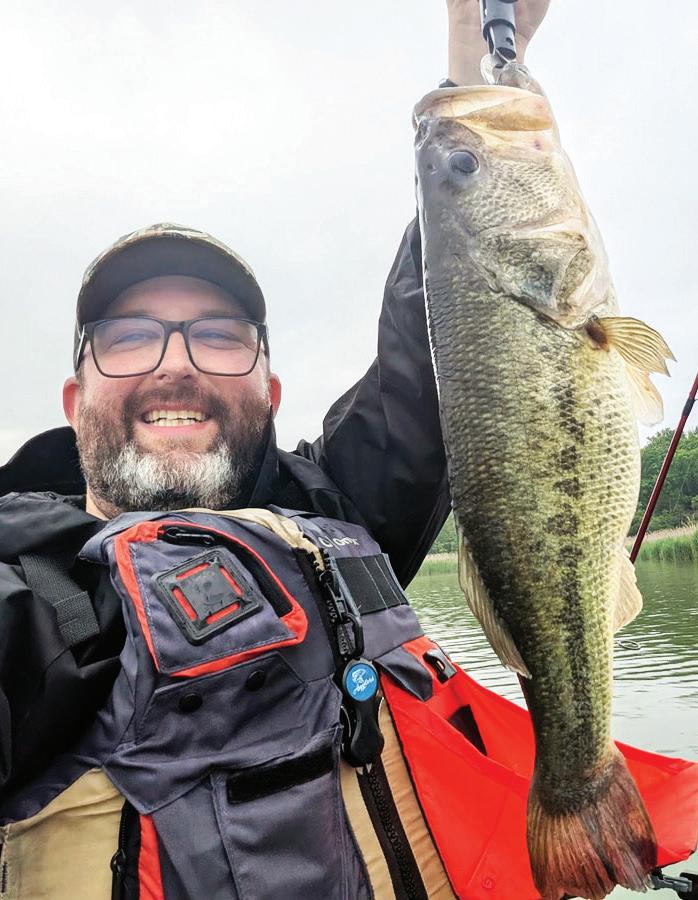
# Brian put the kayak to work and found the bass.
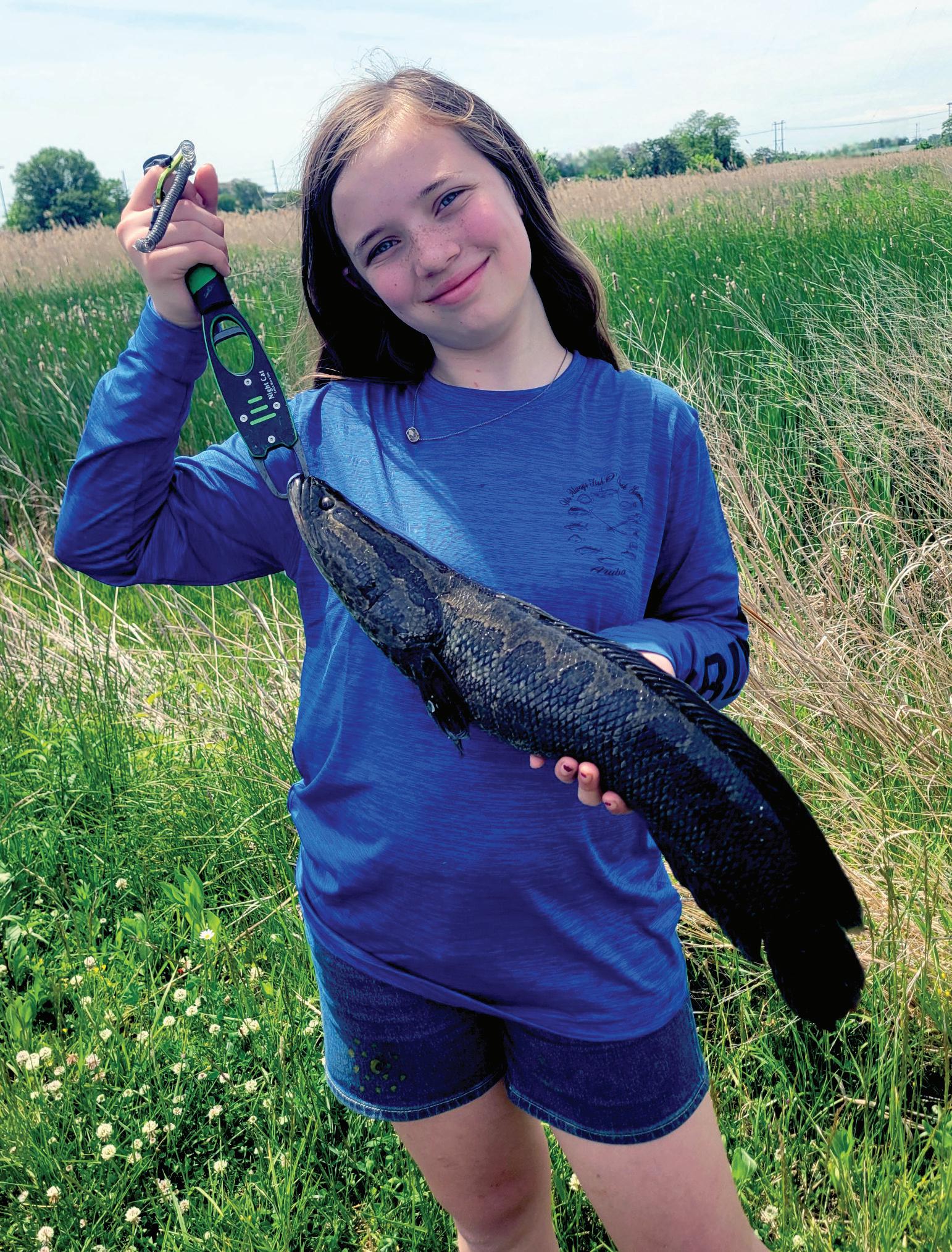
# Lucy tied into a snakish creature!
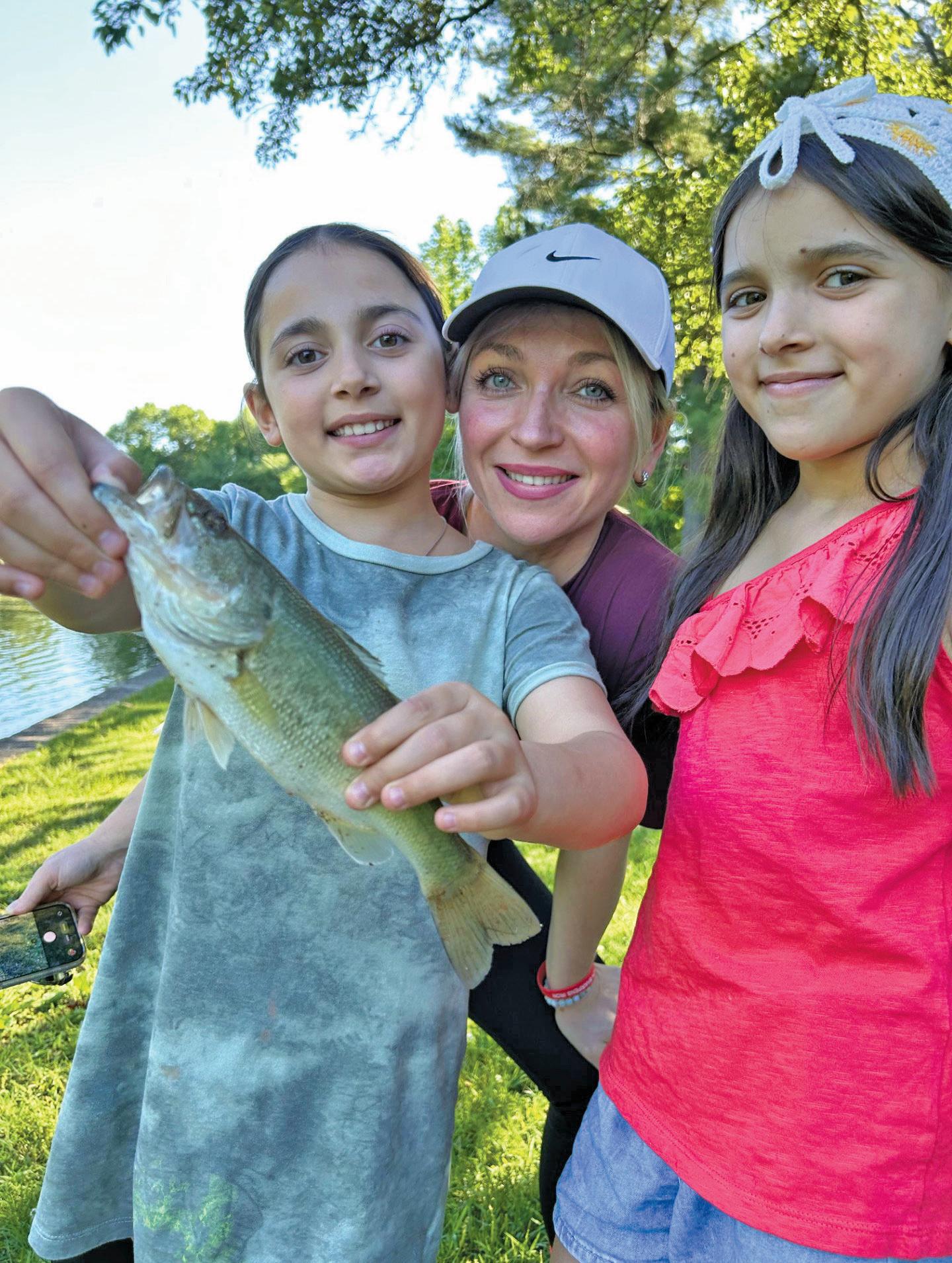
# Alexandria, Ana, and Angelina cast into the pond and came up with this bass.
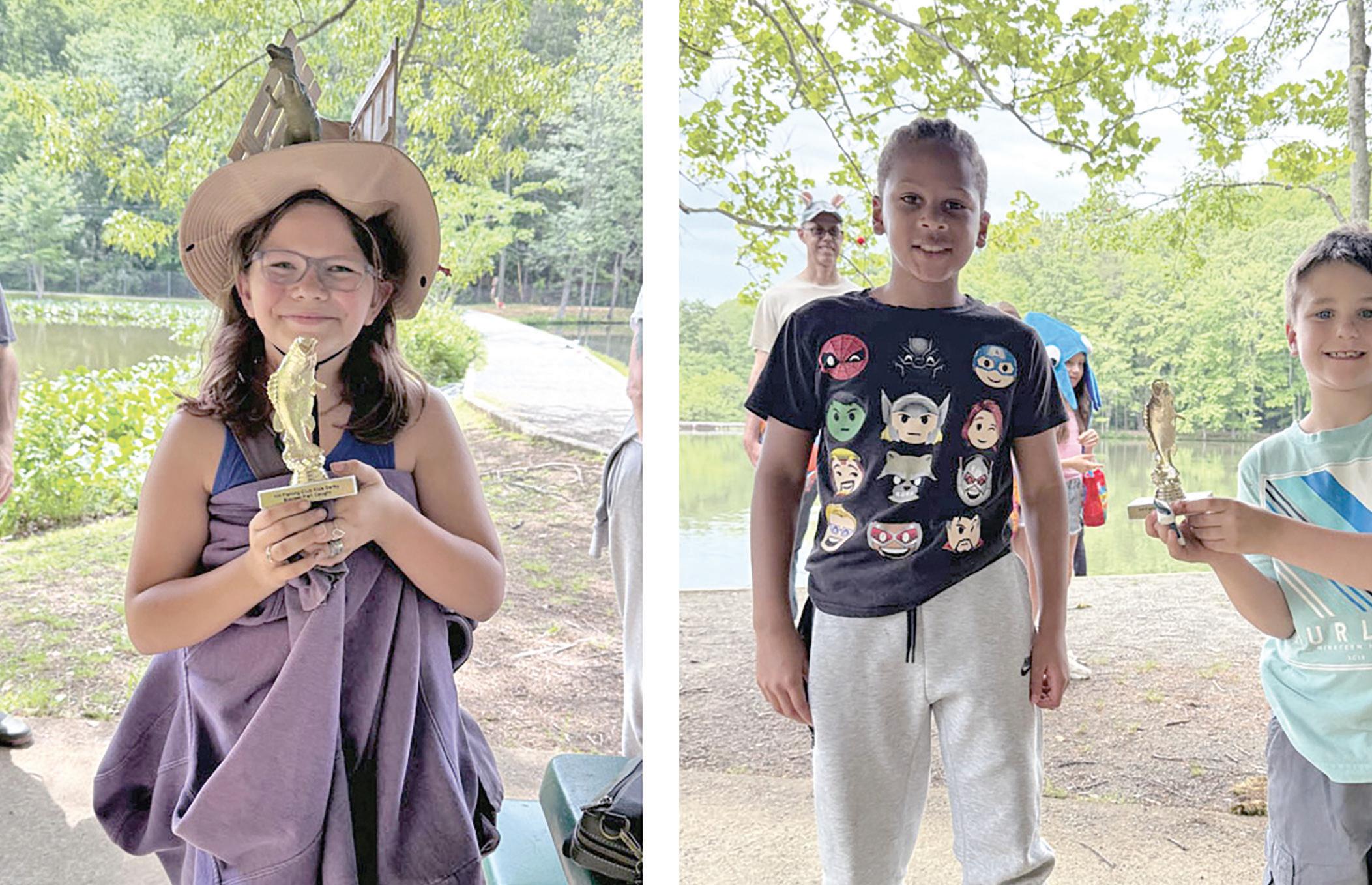
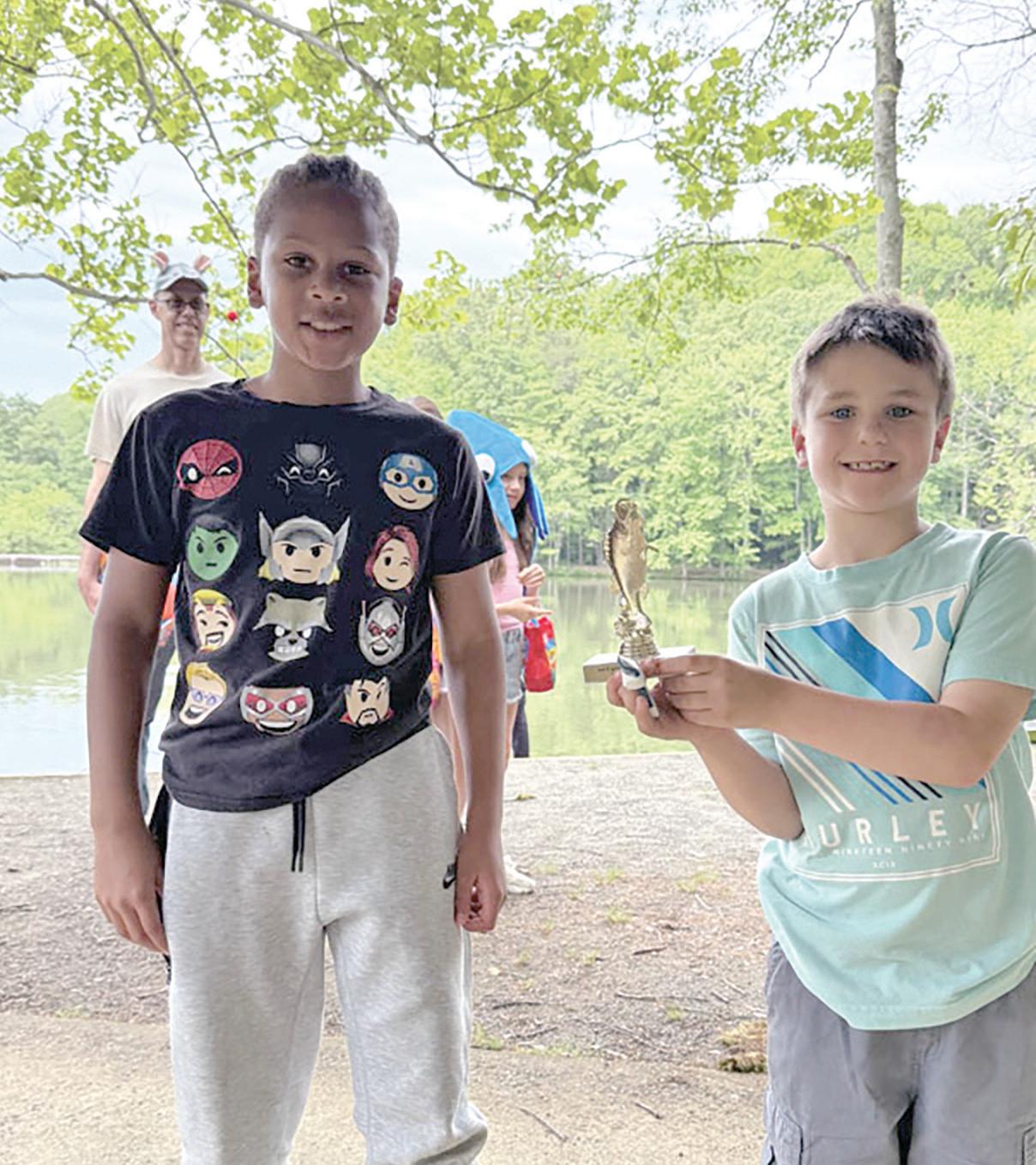
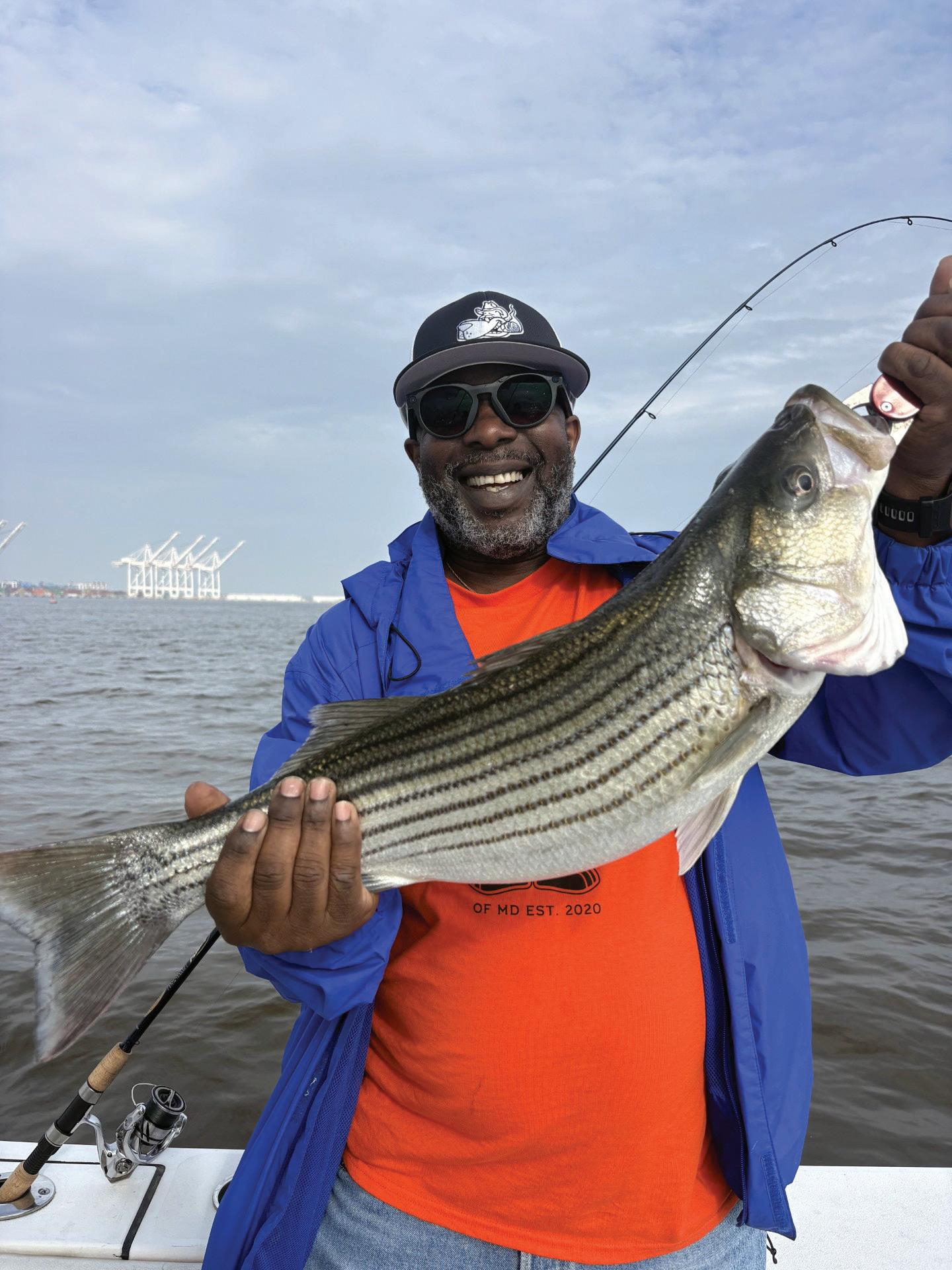
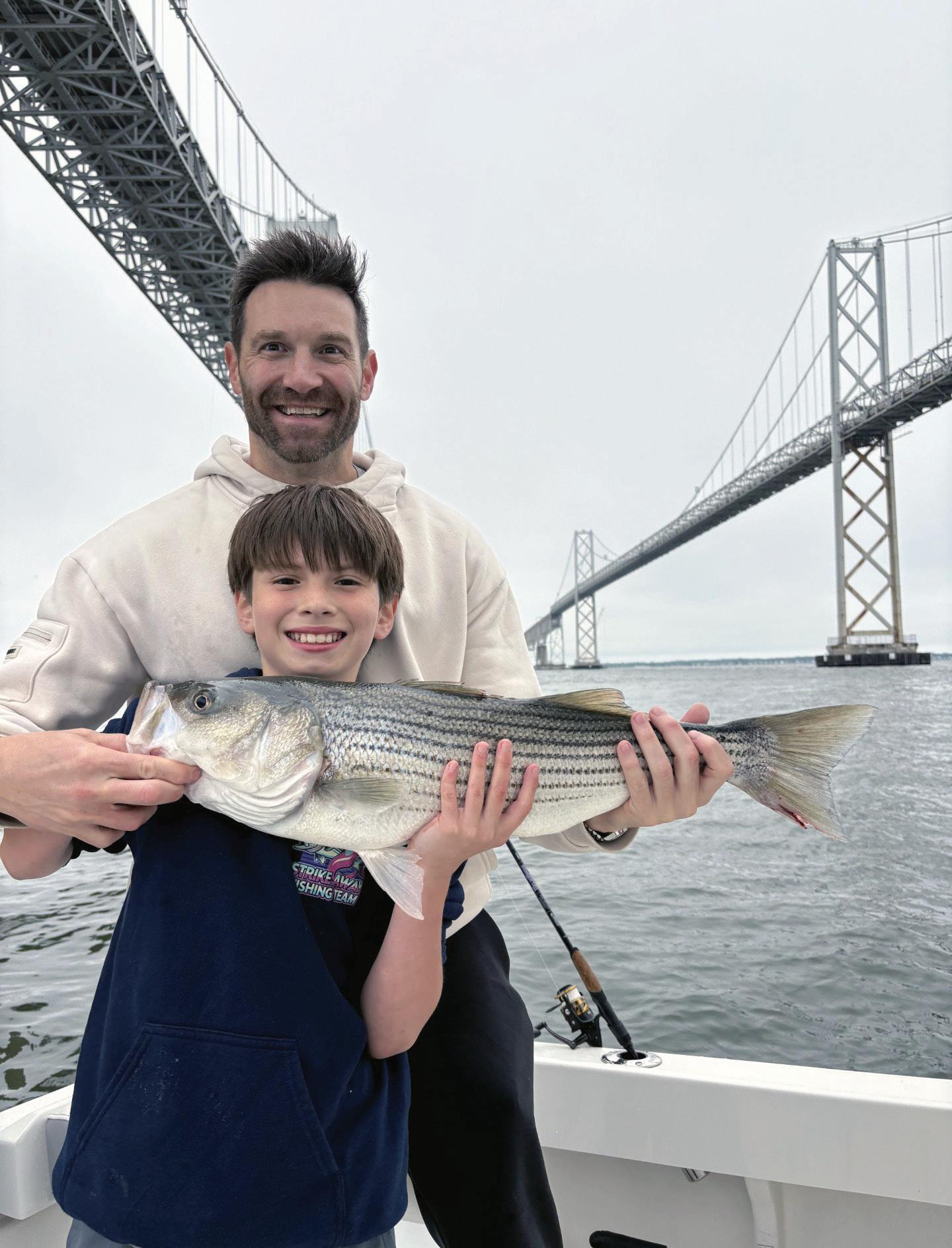
# Marcus is happy, happy, happy!
# Colt and Chris caught some nice ones over the weekend.
# Lillie won for the biggest fish (and craziest fishing hat), and Matt and Hudson tied for the most fish caught at the Heavy Hitter FC Kids Fishing Derby in Annapolis.
Hull Boss Boats: There’s
a New Boss in Town
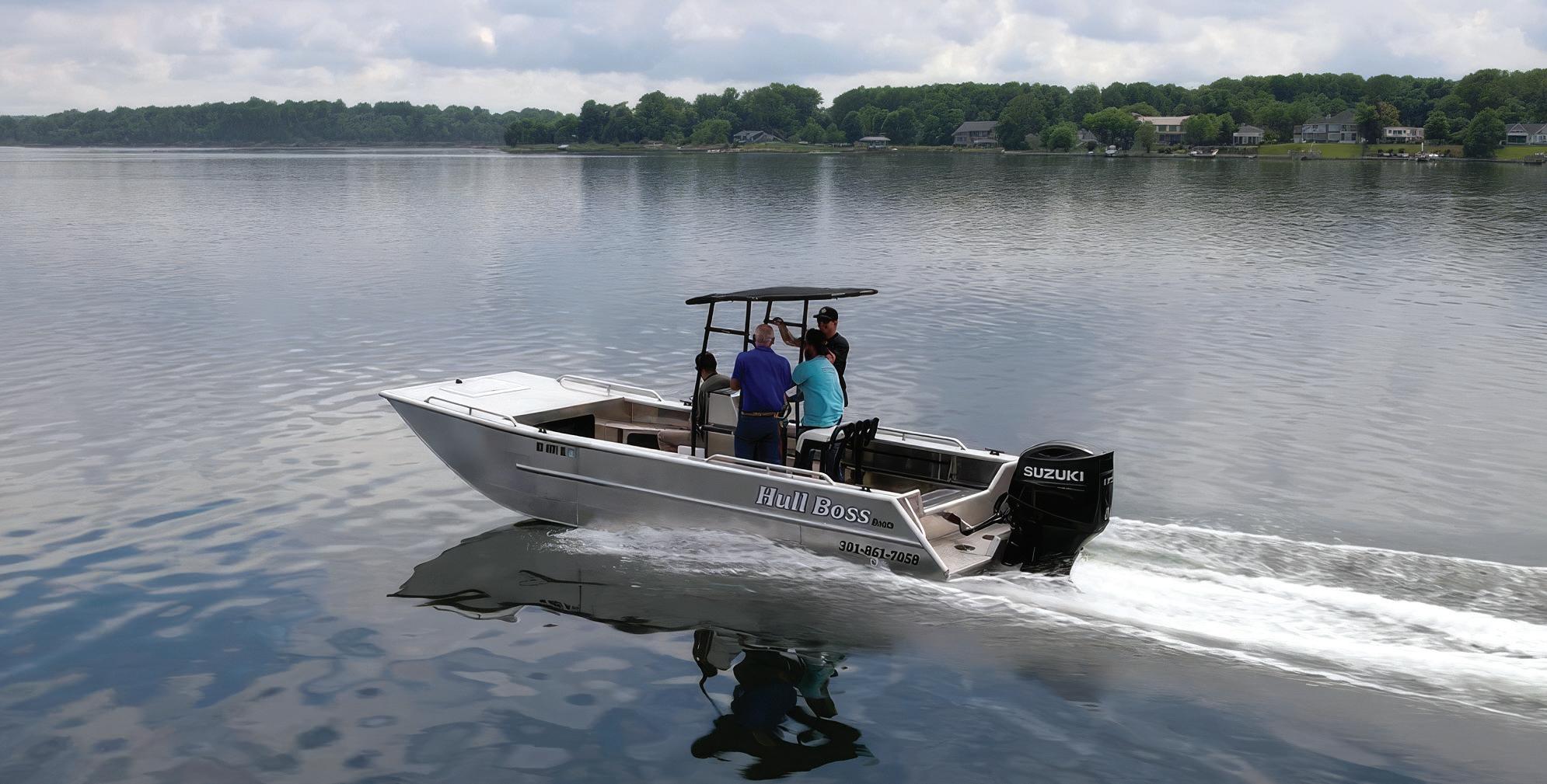
Fiberglass boats are great for the average recreational angler, but have you ever noticed that the serious professionals like commercial fishermen, marine construction workers, and SAR personnel, prefer aluminum builds? There are a number of reasons why: aluminum doesn’t shatter upon impact, aluminum boats can be custom-built to meet your exact demands, and they can take workhorse-like loads along with excessive use and abuse without taking damage. These are also the top reasons why someone who’s seriously nautically inclined might opt for a Hull Boss.
Hull Boss boats are custom-welded in Southern Maryland, by Phelps Brothers Welding, a family-owned operation that’s been around for over a decade. One of the coolest things about their custom creations is that no two are the
Specifications
Since each Hull Boss is custom-built, the specifications are variable from one build to the next.
same. As Hull Boss puts it, “Your needs shape our designs.” You want a multipurpose center console with a T-top? You’ve got it. You need a foredeck with stowage underneath? No problem. You
want a wide-open deck with room to stack one bushel basket after the next? Done.
The model we tested was a 21-footer, powered by a Suzuki 175. Designed to
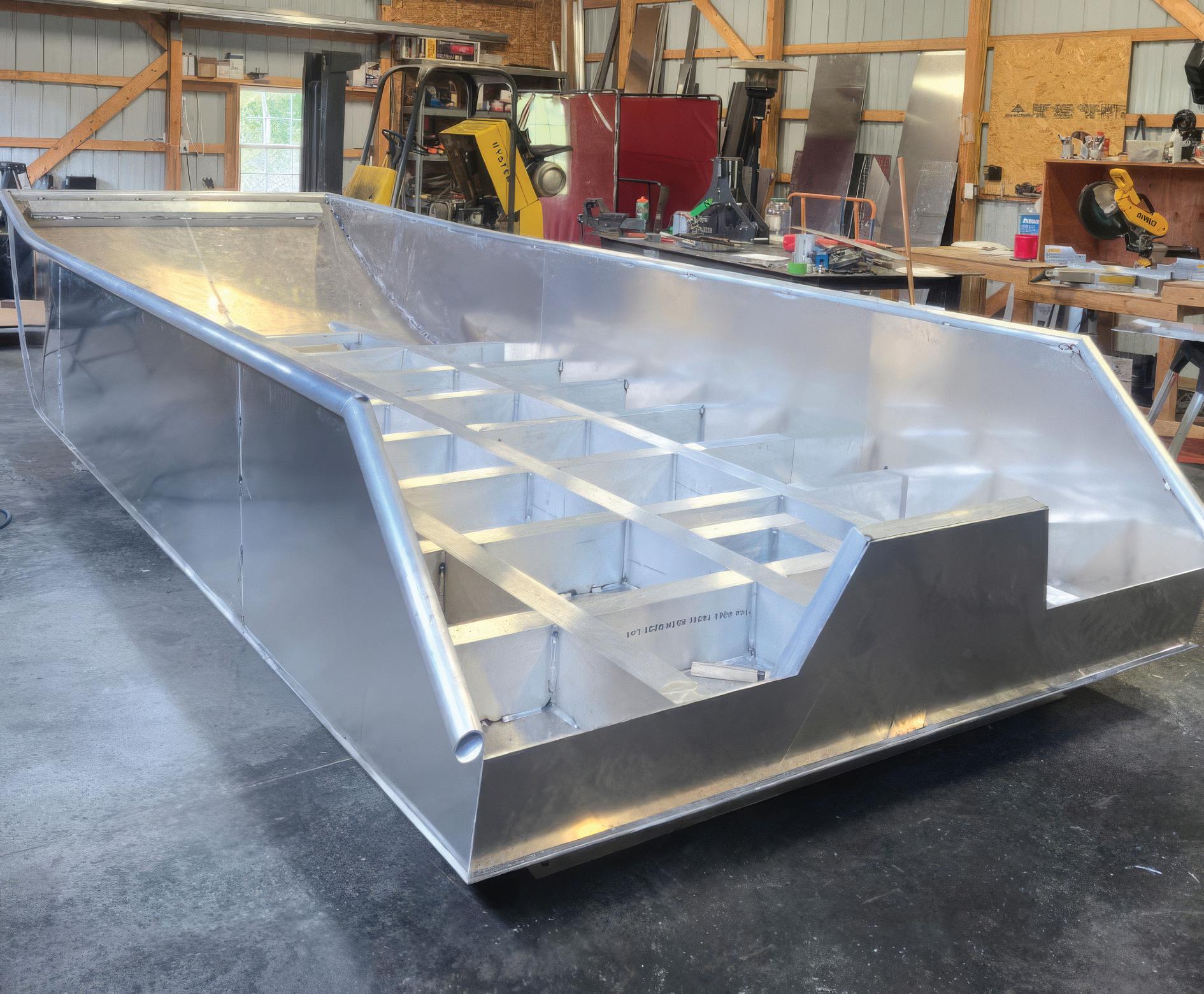
# The structural support of the Hull Boss is far beyond what you’d see in a recreational aluminum boat.
meet the needs of a working waterman, it was built with a rather eye-opening 0.250” thick hull bottom. Yes, you read that right. Look up the specs on most 21’ recreational aluminum boats and you’ll see a hull thickness of 0.10” or 0.125”—the Hull Boss is literally twice as thick. And if you could yank the deck off those recreational boats and compare the two stringer and bulkhead structures you’d also see quite a bit more beefiness in the Hull Boss’s structural support. The bottom line? Whether you’re running full-tilt and a partially submerged log gets in the way of the hull or you’re stacking thousands of pounds of blue catfish on the deck, the chances of damaging this boat are exceptionally remote.
There’s an added bonus to this sort of construction, too, in its seakeeping abilities. When we tested the Hull Boss the Patuxent River was calm, but we hit plenty of boat wakes and thanks to all that heft, the usual beating associated with running aluminum boats across the waves was absent. Mariners who have experience on aluminum rigs will walk away impressed after a sea trial.
With that 175 on the transom performance was eye-opening, too. Set at a mellow 3500 rpm we cruised along at 25 mph. At 4500 rpm cruising speed
was right around 35 mph. And when we opened up the throttle we zipped along at 46 mph. That was with four people aboard plus fuel and video gear, and the builder told us they’ve broken 50 when they had a lighter load.
If you might be dropping a 10-pound trot-line weight to the deck (oops!), bouncing off of rocks (oops, again!), or tossing mountains of mammoth catfish on the deck (yay!), this boat is going to be a top pick. For those who demand commercial grade, there is indeed a new boss in town.
For more information contact Hull Boss, Nanjemoy MD, (301) 861-7058 or hullbossboats.com
Phenom 34: No Parallel
There are a million cool fishboats, plenty of totally awesome fishboats, and a handful that qualify as unequalled uber-cool utterly awesome totally SICK fishing machines. The Phenom 34 is one such boat.
The 34 is the smallest in the Phenom fleet, which also includes a 37 and a 43 (which we reviewed last year; you can also see our video of the boat at FishTalk’s Youtube channel). But it’s no less intensely awesome than its larger siblings. Start with performance. The boat rides on a hull with an aggressive 65-degree entry tapering back to 23 degrees of deadrise at the transom. Two steps have “shutter steps” in front of the hullside vents to prevent water from wrapping around and entering behind them. And three chamfer-edged (beveled) strakes further reduce water adhesion with the hull. The design also incorporates a keel flat and transducer pocket. The net result? Drop triple Mercury V10 400-hp Verados on the transom and top-end reaches a blistering 76.5 mph. Cruise at 4500 rpm is 54.9 mph, significantly more speed than most boats deliver at wide-open. Even if you opt for twins rather than triples (banish the thought!) you’ll still see a top-end in excess of 60 mph and a cruise in the low 40s.
Phenom matches the epic performance with epic luxury. Rocking and rolling is a
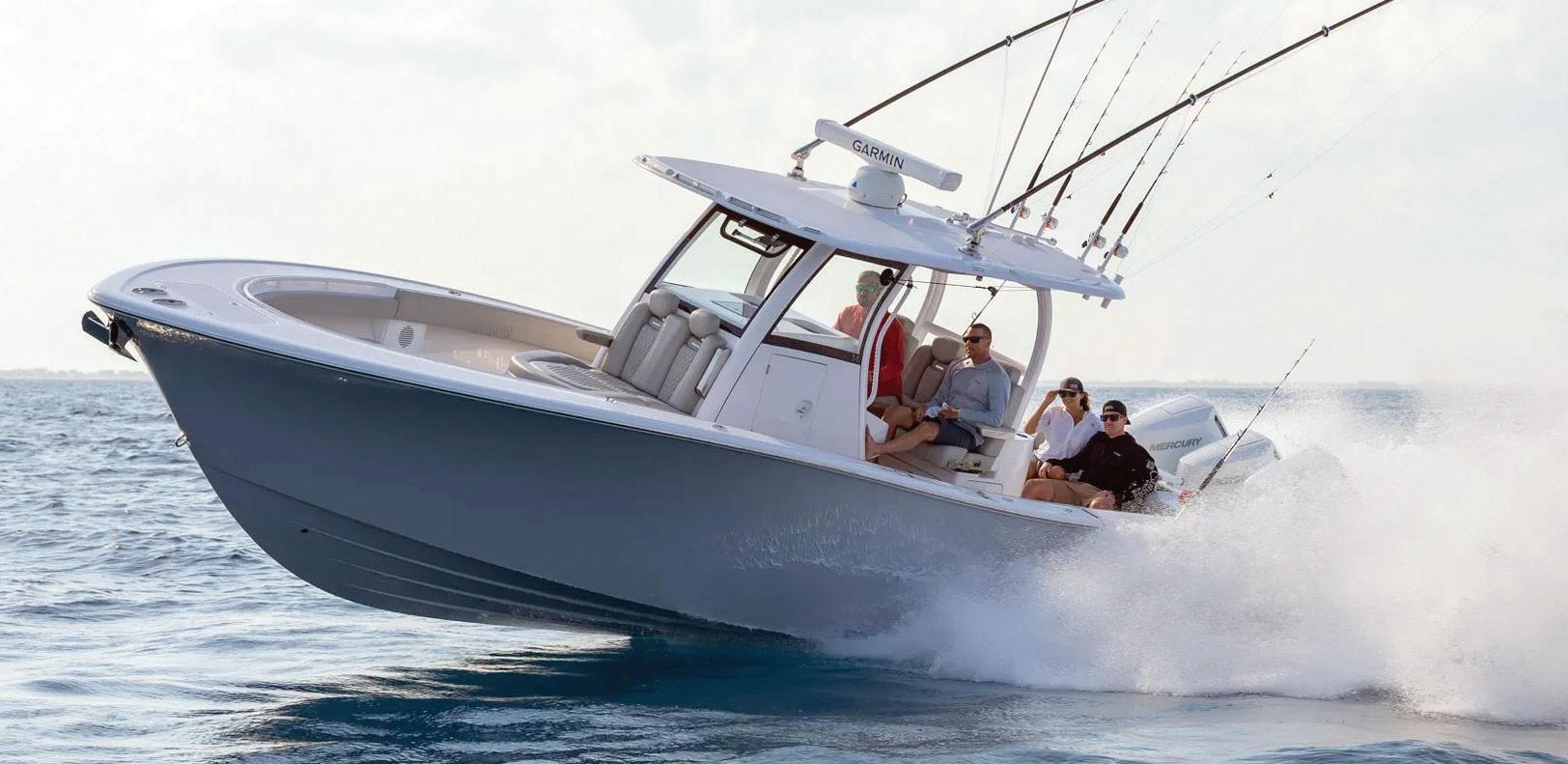
thing of the past thanks to the standard Seakeeper 3 gyroscopic stabilizer. You’ll find ladder-back seat backs with diamondstitched Sileather multi-texture fabrics up front, and triple-wide sportscar-like heated chairs on electric slides at the helm. You’ll listen to tunes via a 14 speaker, twin subwoofer stereo system with a pair of JL Audio MVI amps with digital signal processing. And you’ll step into a console head compartment with six feet of headroom, rod holders in the sole, and cabinetry that comes pre-stocked with emergency tools and a first aid kit.
All that ooh la la makes for a comfy day on the water, but doesn’t have a darn thing to do with stuffing the fishbox. Luckily, the people at Phenom don’t just pay fishing
lip service but actually put a priority on it. The livewells are a great example. Each 30 gallon well has two pumps, a primary and a backup, fed via a sea chest with high-speed pick-ups. They’re pressurized to eliminate sloshing, and to prevent water from spilling out the pressure is controlled with Phenom’s own custom algorithm which maintains 0.1 PSI at all times. Added bonus: the wells also have viewing ports on the front so you can eyeball your baits whenever you’d like.
Once you reel in the catch you can slide it on ice in the aft 62-gallon fishboxes, which are surrounded by over four inches of insulation. Plug ‘em, and you have a pair of 35.5 gallon fishboxes forward. Each gunwale houses three Gemlux screwless
Quick Facts
LOA: 33’6”
Beam: 10’5”
Displacement: 9700 lbs.
Draft (min.): 2’3.5”
Transom Deadrise: 23 degrees
Fuel Capacity: 350 gal.
Water Capacity: 30 gal.
Max. Power: 1200 hp
mounted rodholders, there are seven rocket launchers on the hard top, overhead teaser reels are in the hard top, and Hubble electric reel outlets fore and aft in the cockpit on both sides. And electronics are already taken care of with a stock pair of 17” Garmin 8617 MFDs at the helm. The piéce de résistance, however, may well be the tackle station in the back of the leaning post under the integrated cooler/ rigging station. There are three bulk stowage drawers flanked by four tackle boxes plus another drawer to either side. If you can’t fit all your gear in there, it’s time to open up your own tackle shop.
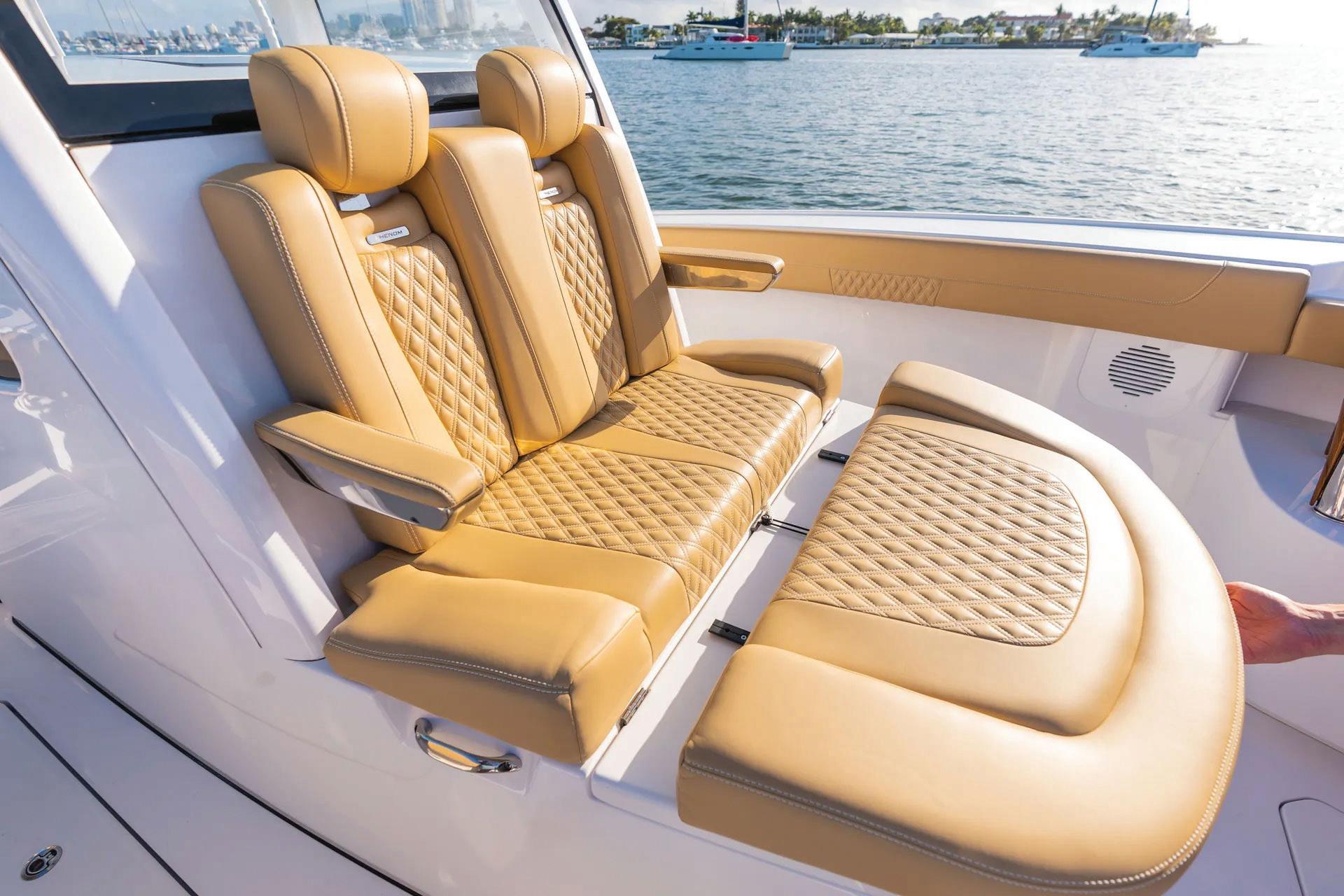
# Every detail is accounted for on the Phenom, right down to a slide mechanism on the lounger that allows easy access to the cooler underneath.
There’s actually quite a long list of uber-cool details about this boat that we still haven’t touched upon: a chaise lounge with cushions on a slide so they don’t bunch up or have to be removed when accessing the cooler underneath, underwater lighting in the hull steps, Joystick Piloting, OnDeck remote monitoring… the
list goes on and on. But there’s so darn much to cover on this boat, we simply don’t have enough room to talk about it all. And if you find the Phenom of interest and plan to go look at one we’d recommend clearing your schedule for the entire day. And also plan for ubercool utterly awesome totally SICK.
For more information visit the Phenom website or FishTalk supporters Legasea Marine, Yorktown, VA (757) 898-3000, legaseamarine.com
Tideline 28 Bluewater: Coming Soon!
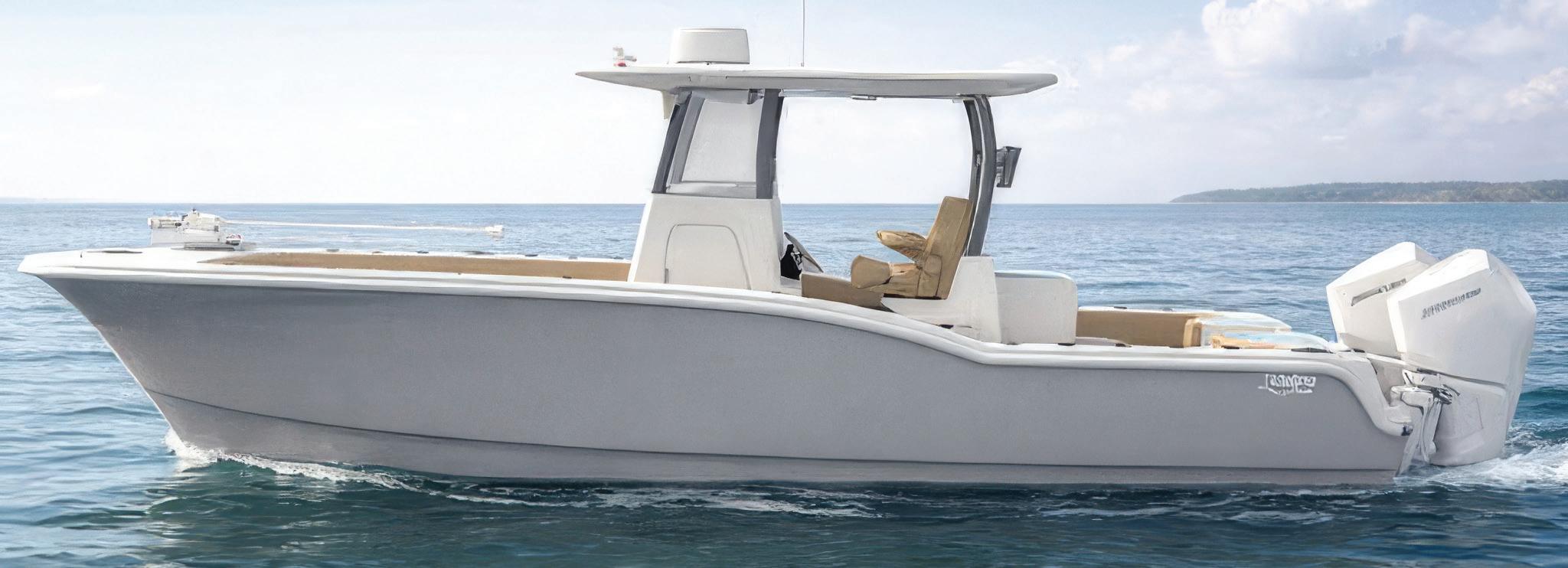
Tideline has announced a new model, the 28 Bluewater, expected to be launched this summer. The 28’ long, 10’ wide powercat features a non-stepped planing hull, 50 gallons of stock livewell capacity with the option for double that amount, twin outboards up to 350 horses each, and a whopping 290 gallons of fuel capacity. It will draw a mere 18” and can be had with a 36-volt bow-mount electric trolling motor, so this should be one of the few truly oceanic-capable cats around that can also sneak into the shallows when the reds and specks are biting. Visit tidelineboats.com for more details, and stay tuned!
Places That We Never Know! Wrecks and Obstructions
By Wayne Young
“We boarded the steamer all happy and gay, and got off in Seward the nineteenth of May,” according to Shorty Gustafson in his folksong Cheechako about newcomers to Alaska. Back when Shorty traveled by steamboat, many vessels didn’t make it to their destinations. Thousands were lost around the nation’s coasts including a Bering Sea crab boat that put out a mayday one very cold, stormy night back during my time aboard the buoy tender Ironwood We had made an emergency repair to the vessel’s shaft coupling in Dutch Harbor the night before and advised the captain to arrange a permanent repair before going fishing. He didn’t follow our advice.
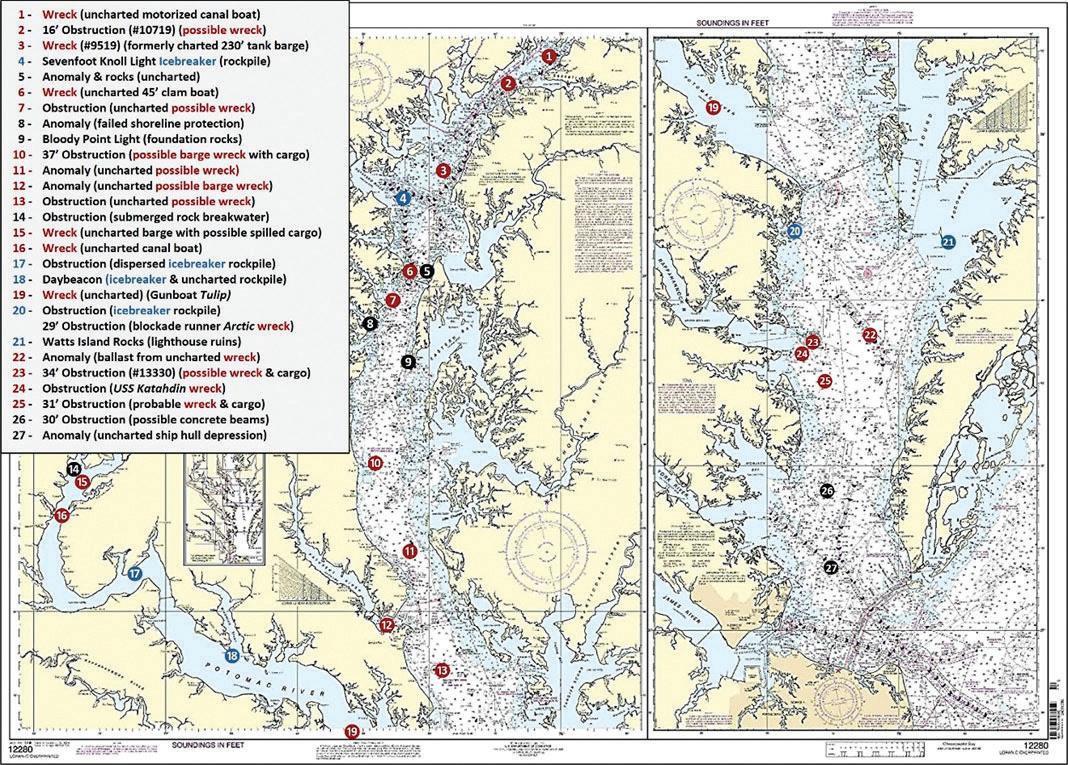
The Chesapeake Bay and its tributaries were (and are) no exception to marine casualties. Just check Coast Survey’s online Automated Wreck and Obstruction Information System (AWOIS) map viewer and see for yourself. The risk of maritime casualties continues, although with less frequency, and the collapse of the Francis Scott Key Bridge from a ship strike with tragic loss of workers on the bridge is a shocking reminder that bad stuff happens. But our fishing story is about what happened farther back in the past. The potpourri of wrecks and obstructions shown on Chart 1 illustrate what to look for.
Some known wrecks aren’t charted because their exact position is unknown, they’re covered by sediment, or they aren’t
considered a danger to navigation. A select few aren’t charted due to archeological and historic preservation concerns (hence no coordinates for them in the following text). For example, a known uncharted wreck marked in general as Site 1 lies between the Chesapeake and Delaware Canal and Pooles Island. It’s thought to be the remains of the wooden vessel A. Woodall that burned in December 1924 during a winter transit, with the loss of the entire crew. The bulwarks of this low-profile wreckage match a long, narrow canal boat configuration.
Site 2 marks a 16’ least-depth obstruction northwest of Howell Point, west of the ship channel at coordinates 39°22.911 x 76°07.094. It was found during a National
Ocean Survey (NOS) 1999 hydrographic survey. Although charted as an obstruction, the configuration suggests a wreck. There’s also anecdotal information that this was a paddle-wheeler which burned to the deck and sank. Boiler explosions and fires were a significant threat back in the days of steamboats.
Site 3 marks the location of a sunken 230’ fuel barge at reported coordinates 39°12.807 x 76°15.981, with a least depth of 10’. The barge grounded in 1980 and sank 10 years before the Gales Lump Fish Haven was established. NOAA accepted the survey team’s recommendation to remove the barge as a charted wreck since it was by then inside the fish haven. Although consistent with charting protocols for fish havens, the deletion resulted in the wreck being lost to common knowledge.
Site 4 is a rock icebreaker that covers and uncovers which protected the former Seven Foot Knoll lighthouse from winter
ice. Charts show a riprap symbol which means rocks are there, but not necessarily around the light structure. Electronic charts don’t always include this symbol although in some cases rocks are charted. These rocks are northeast of the light tower at coordinates 39°09.320 x 76°24.537.
About 1200 yards north northeast of the Bay Bridge (Site 5, Chart 2) just west of the old riverbed, look for scattered rocks and an anomaly at coordinates 38° 59.878 x 76° 21.094. It could possibly be a mostly buried, broken up wreck, or it could be an elongated outcropping.
An uncharted wreck is nestled on the edge of the Sandy Point Shoal at coordinates 39°00.156 x 76°23.462, Site 6. Depths drop from 15’ to 24’. This feature looks like a rugged knob along the shoal’s northeast corner until zooming in; the wreck is about 40’ to 50’ long with the stern in a scour. Anecdotal information is that it was a clam boat. There are also
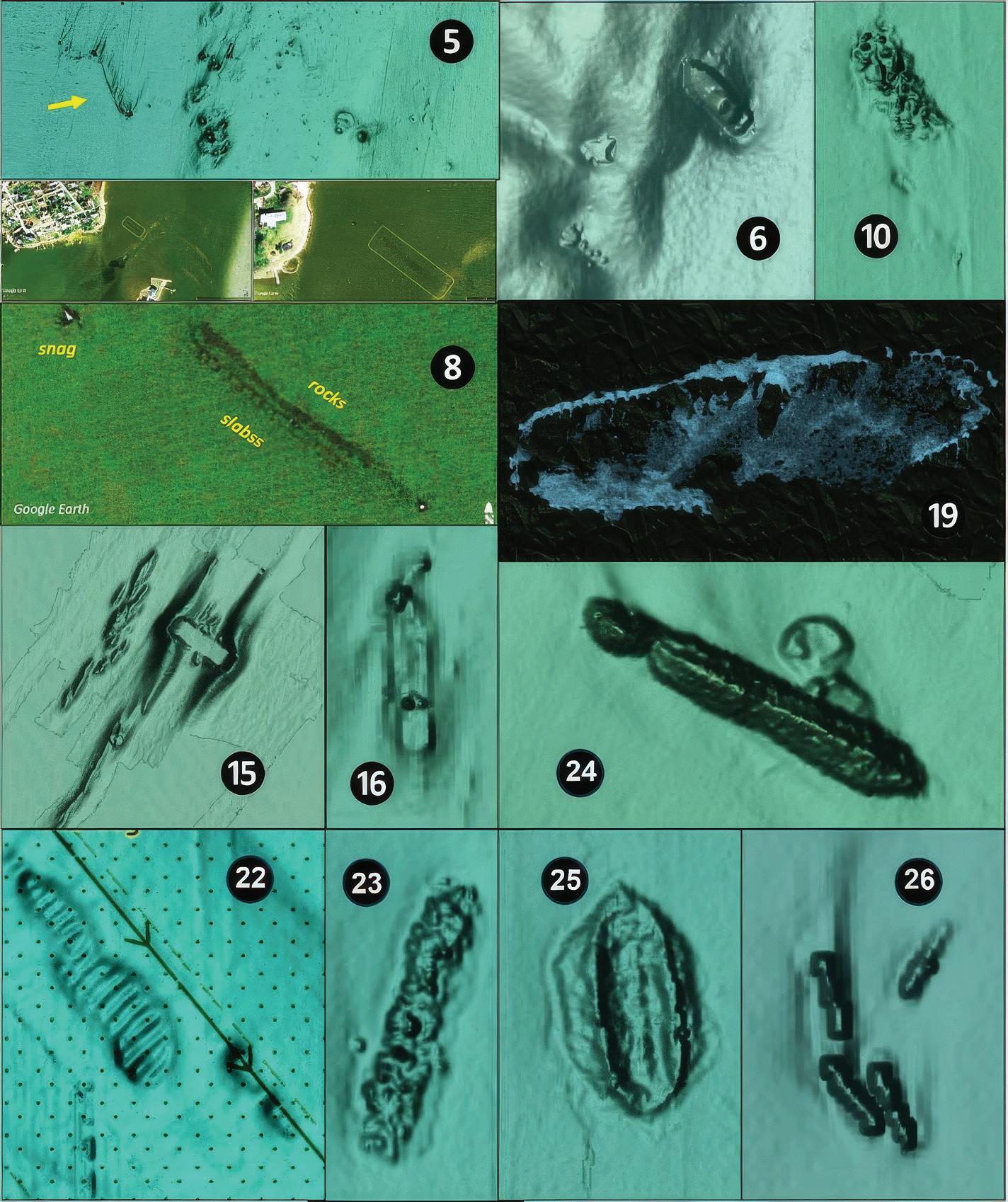
two small obstructions immediately to its southwest.
Site 7 is an uncharted obstruction that’s possibly a wreck at coordinates 38°57.717 x 76°25.110. Site 8 is what appears to be a failed 125’ long shoreline protection structure at the entrance to Ramsey Lake. Charted as a lowland islet at coordinates 38°54.312 x 76°29.659, it’s actually a submerged double line of slabs and rocks revealed by crosschecking with satellite imagery using Google Earth. The feature is one of the many nearshore spots covered in “West Side Story,” FishTalk Magazine (April 2023). Site 9 marks Bloody Point Light. Efforts were made to stabilize the bottom for lighthouse construction with mats and rocks. So, if you snagged while jigging, you may have hooked into what is now scattered rock.
Just east of Plum Point Fish Haven at coordinates 38°37.080 x 76°28.539, is another charted obstruction, Site 10, which may be a wreck. Its BAG profile suggests a 200’ long, 35’ wide hull form with the forward half mostly covered in sediment. The back half is covered with objects that could be cargo. Site 11 marks the location of an elongated uncharted anomaly at coordinates 38°27.474 x 76°25.680. Its profile suggests a wreck. Site 12 in the mouth of the Patuxent River marks an anomaly at coordinates 38°18.568 x 76°27.756. Zooming in reveals what appears to be the corner of a mostly buried barge. For features in this area, see “Poking Around the Pax” (March 2024). Site 13 marks another uncharted obstruction, this one at coordinates 38°12.138 x 76°17.776. The elongated profile also suggests a wreck.
Over in the Potomac River, look for a 100-yard-long submerged rock breakwater (Site 14) at coordinates 38°36.636 x 77° 14.706, on the west side of Occoquan Bay (see “Occoquan Bay: An Angling Oasis,” May 2024). Look for an uncharted capsized barge with what could be distributed spilled cargo around coordinates 38°35.274 x 77°14.010 (Site 15). Site 16 is a known but uncharted historic Civil War wreck off Shipping Point. This commandeered wooden canalboat was scuttled by Confederates who were trying to evacuate cannons for the defense of Fredericksburg, but had to abandon their mission when approached by a Union gunboat.
Multiple lighthouses in the middle and lower Potomac River were threatened by winter ice resulting in the placement of icebreaker rockpiles. Some are visible at
# Chart 2: Images of various wrecks and obstructions. BAG screenshots from NOAA Bathymetric Data Viewer. Satellite images courtesy of Google Earth.
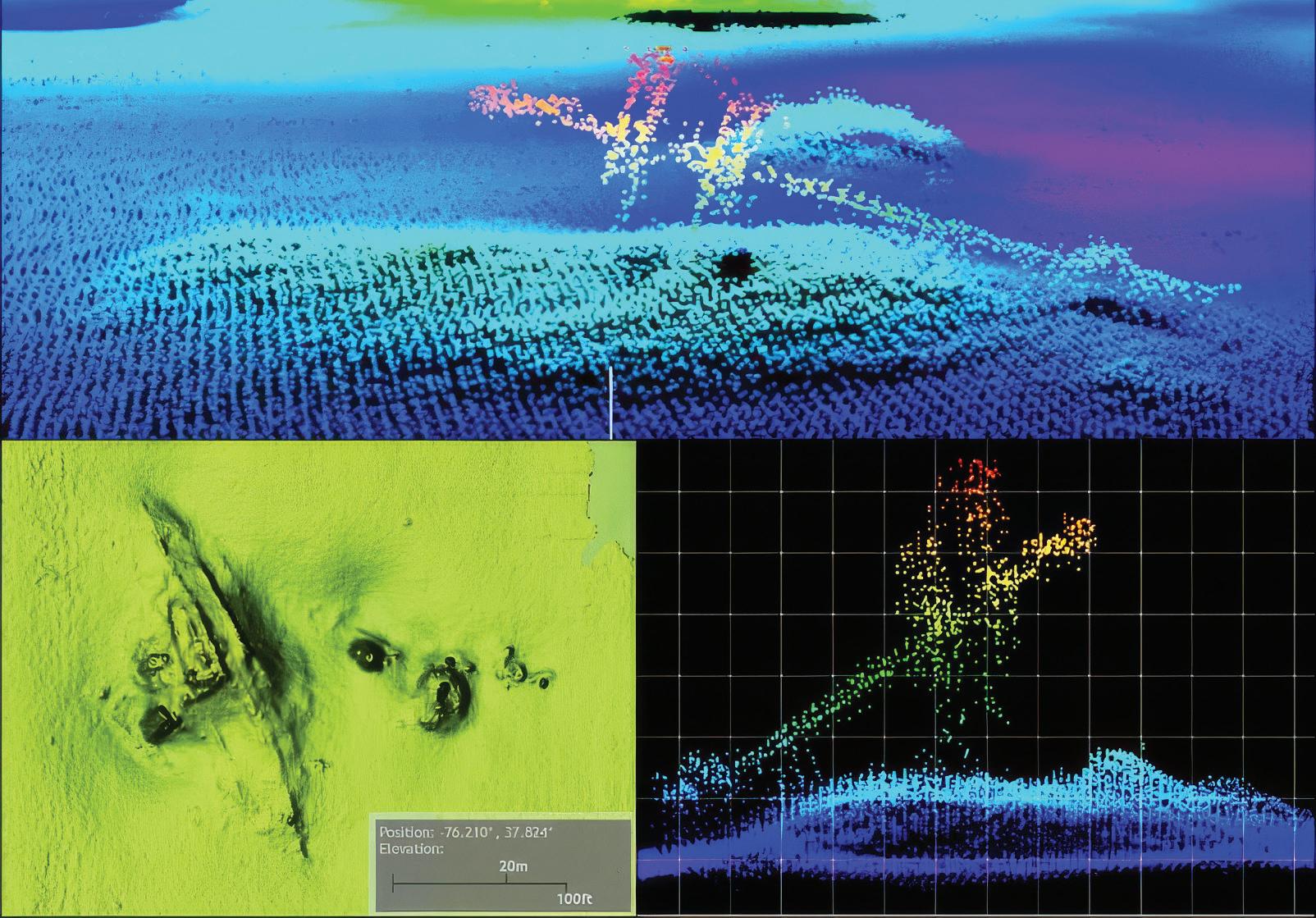
the surface but some were knocked down and are subsurface, such as the distributed scattered rocks at Site 17, coordinates 38°24.217 x 77°04.894. The former lighthouse now day beacon on Cobb Point Bar has both a visible icebreaker as well as a submerged rockpile, the latter at coordinates 38°14.570 x 76°49.609. These features are detailed in “This Is Potomac River” (Young, 2024).
Site 19 marks another uncharted historic Civil War wreck, this one the Gunboat Tulip. A defective boiler which the captain had fired up for more speed due to the threat of hostile shore fire blew up, killing most of the crew. The remains are still there as shown by side-scan sonar.
Site 20 is the location of yet another subsurface rock icebreaker, this one at the entrance to the Great Wicomico River at coordinates 37°48.249 x 76°16.033. Although rocks are charted, they’re not marked by a warning beacon. This pile collects a boat or three every year (but it’s also a promising spot to check for stripers). Straight out from Taskmakers Creek at coordinates 37°49.460 x 76°12.481 is a charted 29’ obstruction. This is actually the wreck of a sailing vessel with at least one square-rigged mast. Historical records suggest it’s the Confederate blockade runner Arctic, which was boarded and burned.
Look for more subsurface rocks south of Watts Island and 400 yards northeast of Watts Island Warning Light at coordinates 37°46.957 x 76°53.647. There are two rock symbols (Site 21) where the BDV Digital Elevation Models Color Shaded Relief data layer shows mounds. This is actually the ruins of a masonry lighthouse structure, and based on historic pictures, possibly failed riprap and bulkhead shoreline protection. It’s very shallow, but a good fishing spot. Approach with great care.
Look for rocks at Site 22, coordinates 37°39.693 x 76°08.604, in the middle of Rappahannock Shoal Channel halfway between Buoys 57 and 59. By appearance it’s ballast rock that was placed between ribs of a wreck which has disintegrated. Site 23 southeast of Rappahannock Spit marks a 34’ least-depth obstruction at coordinates 37°34.128 x 76°09.863. It rises about five feet off the bottom. The image suggests an upright barge wreck with cargo. Look for a 100 yard long, narrow, eight-foot least-depth obstruction at Site 24 at 37°34.303 x 76°15.026. Based on historical records and profile, this is the “lost” target ship Katahdin. For details, see “Ironclad Reef” (March 2021).
Site 25 marks a 31’ least-depth obstruction at coordinates 37°29.972 x
76°08.210. It’s most likely a sunken scow with a cargo of stone, based on BAG and side-scan sonar images. Look for what appears to be an unofficial artificial reef at Site 26, at coordinates 37°16.564 x 76°10.759. Four elongated objects resembling concrete beams are seen in the BAG image. First found during a 1971 survey covering an area that’s about 100’ long and 30’ wide, it’s located in a dredged material disposal area. A guess is that a vessel depositing dredged material simply dumped unwanted materials overboard.
This scouting voyage ends with a nonwreck: what looks like a ship hull form in the middle of the York River Entrance Channel southeast of Buoy “1YR” at coordinates 37°07.463 x 76°09.521. It’s actually a ship-shaped depression. A guess is that a loaded tanker inbound during very low water conditions plowed its way to a stop in soft sediment and later refloated without further mishap.
There’s obviously potential for more structure out there than is charted. Keep an eye on the side-scan and down-looking sonar displays when transiting at speeds where these electronics present good images of bottom features, and if you find an uncharted wreck, avoid anchoring on it and share the coordinates with state historical authorities.
# Wreck thought to be the remnants of blockage runner Arctic. BAG screenshot from NOAA Bathymetric Data Viewer. Multibeam sonar images from NOS DR H12040 (2009).
Different management attitudes could cause black sea bass populations to soar.
By Capt. Monty Hawkins
Recreational anglers have long blamed commercial fishermen for many fisheries ills. Commercial fishers look at vastly inflated MRIP catch numbers and point the finger squarely at recreational anglers. Well, mercy…
I think management, however well intentioned, is way off with sea bass. Certainly not on purpose. Indeed, bad recreational catch estimates they are forced to use despite having no faith in the data’s truthfulness, and failing to understand how sex-changing (protogynous hermaphrodites) species like black sea bass respond to size limit management, led them astray long ago. The fix is simple, though it’s surely not going to be easily embraced. The damage from ever larger size limits is not subtle. I believe—can show—that with size limits above 11” one or two year-classes are removed from the spawning stock, many before they ever contribute. Because 70 percent or more of newly transitioned males are 12” to 13” in spring,
summer growth will push them into the recreational size limit (they were already in commercial size limit at 11”). Many newly transitioned males are then taken just as they are entering their first spawn. That alone plausibly cuts the population’s lifetime spawning opportunity by roughly two-thirds.
In a nutshell: Larger size limits delay spawning and pack reefs with newly dominant males that are, or soon will be, legal to harvest. This reduces both spawning participation and juvenile access to habitat.
I’ve partyboat fished for sea bass for 46 years from Ocean City, MD. My anglers used to sometimes catch more sub-nineinch sea bass in a single day than they now catch in an entire
year. That’s not an estimate, it’s solidly in the data. Where on earth did all those fish disappear to? Management keeps trying to increase the population by raising size limits. This is standard operating procedure and works for many species, but because sea bass are forever tuned to a “King of the Hill” hierarchy, larger and larger size limits in sea bass have backfired in the worst way. The larger the size limit, the more reefs become tightly controlled by older male sea bass. Younger age classes are excluded from those reefs.
If you’ve ever watched David Attenborough’s work, you’ve almost certainly seen the clashes of males when it comes time for reproduction. Even in tiny frogs the lesser male is literally kicked off a blade of grass and the victor breeds successfully. It’s everywhere in nature. And sea bass are well known for dominant males defending territory and spawning with multiple females in a harem-like structure.
Without the sanctuary of reef habitat for age-one sea bass, and perhaps age
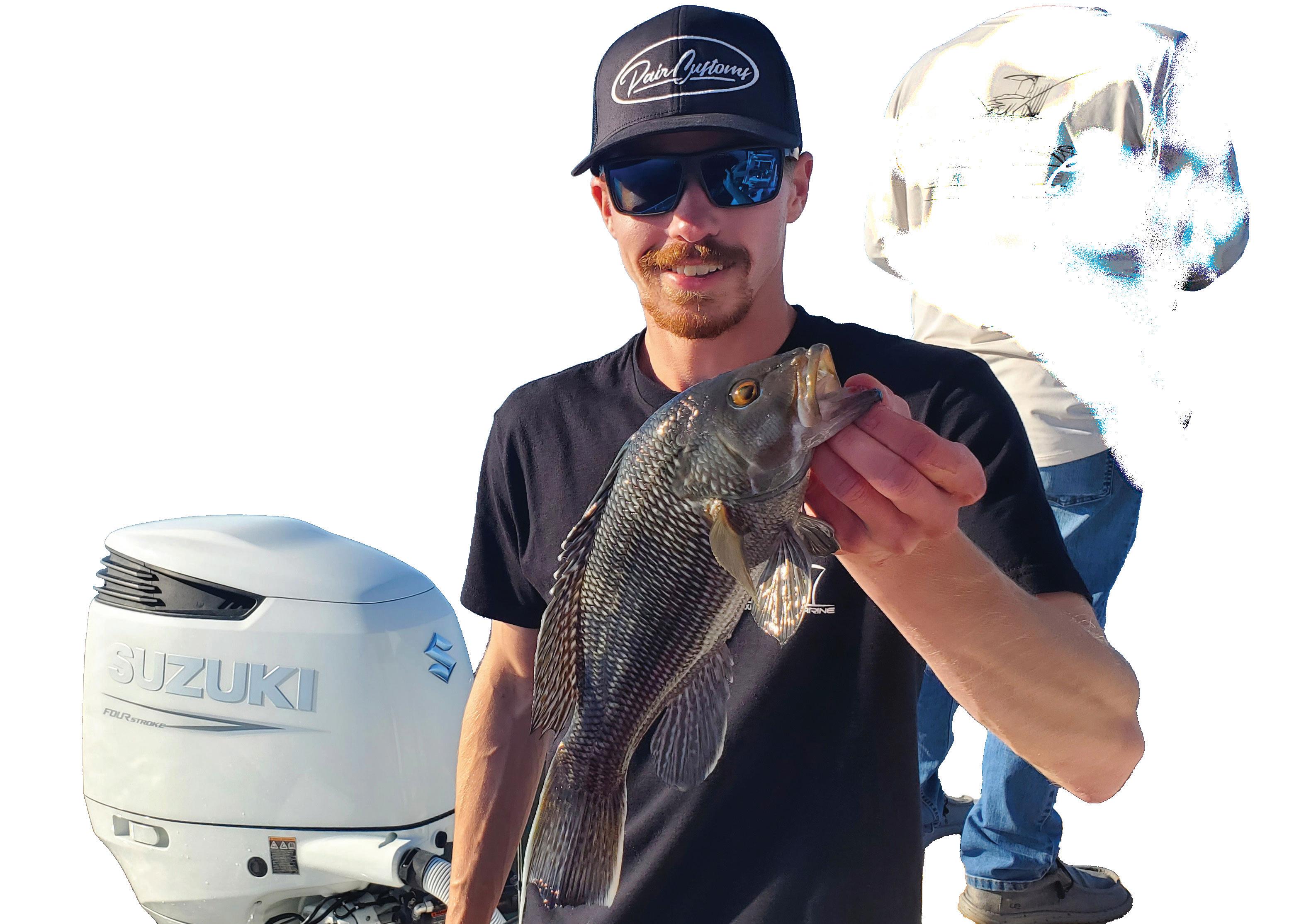
# Small female black sea bass switch to males at two to five years old, generally between nine and 13” long.
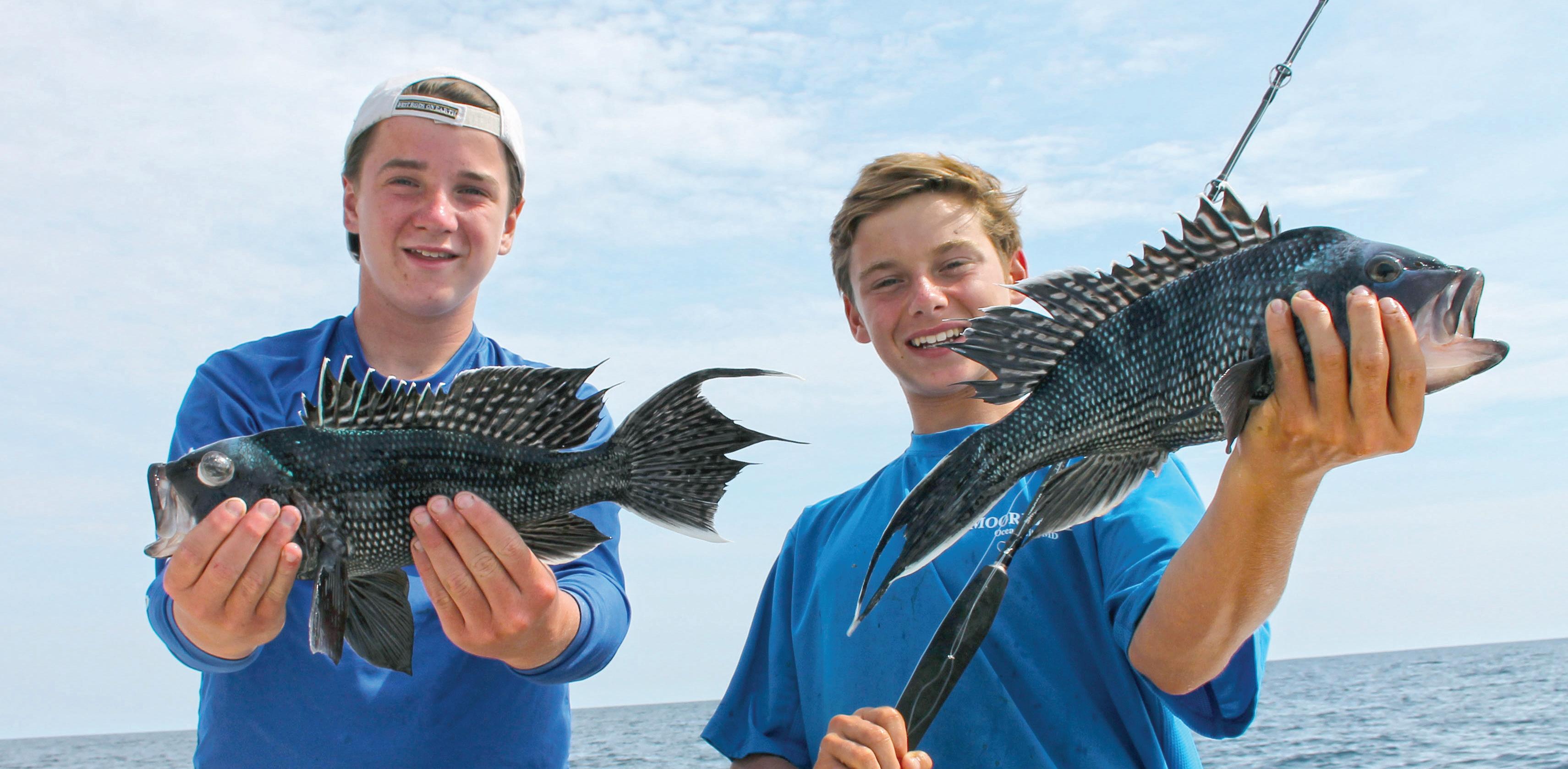
two at times, we lose big parts of whole year-classes through increased predation. They become a snack for flounder, any number of different shark species, bluefish, monkfish, etc., instead of becoming a fish that will spawn several times and perhaps become one we can keep. There will always be plenty of predation on young sea bass. We don’t need to multiply it. Regulation is converting what should be our future catch and spawning stock into present day oceanic calories.
I believe filling every reef with 13” fish creates a chokepoint via natural mortality for age-one fish. Sea bass that would have been recruited if they had access to habitat where they could feed, avoid predation, and swiftly grow to maturity are nearly absent. Yet when we had an 11” size limit they were amazingly numerous. Today there are far fewer sea bass surviving year one at all.
In 2003 I wrote: “Our sea bass are at habitat capacity. The only way we can add more is by increasing habitat.” Mother Nature was about to show me she could take care of herself. From 2004 until 2016 our sea bass population basically trended down. In 2015 I wrote it was the worst spring run of sea bass in all history. I also predicted we’d see a swift rise from there owing to the MD Wind Energy Area event. That’s exactly what happened.
A huge experiment was conducted quite by accident from 2013 to 2023. I filmed many reefs in and around the MD Wind Energy Area (MD WEA) on the last day of August 2015. Three years of surveys us-
ing sub-bottom profilers had just stopped. We found no sea bass on reefs that should have been packed with thousands. None. The MD WEA, and at least four miles surrounding it (sound doesn’t recognize permit boundaries), may as well have become Death Valley.
The fish didn’t die. Nothing did. So far as I could tell, sea bass, flounder and marine mammals simply moved away. All that vacant habitat, patches of natural reef and a few small wrecks spread through 525 square miles of noise-affected bottom, created the perfect large-scale experiment for what I’d long claimed about making small sea bass spawn.
Here’s what I predicted: “We’ll see very small male sea bass in the MD WEA because there are no large males threatening.” That would be interesting. That would force a return to age-one all-hands-ondeck spawning.
Sea bass recolonized the wind area in 2016. Finding no competitors, no King of the Hill, many age-one nine-inch female sea bass switched to male and we saw what seemed an exponential population increase. Yet reefs inshore of the wind area saw no increase in population whatsoever. Aside from the brand-new artificial reefs, our inshore habitat seemed to continue downward in population. There’s the crux of it: manage sea bass to behave in this catastrophe spawning mode.
Fishing improved wonderfully into 2022. Now those reefs and all others are again up to a size limit population. Spawning is again diminished. Or, is it
the habitat gap that really holds up larger population increases? Whichever or both— an 11” size limit would again ignite sea bass spawning production.
I fish the same variety of reef habitats as I always have. We use the same hooks and the same baits. If nine-inch sea bass were prolific, my clients would be cursing them. As anyone who reef fishes off DelMarVa will attest, we still have undersized throwbacks. With recruitment slowed, however, the population will slide slowly downward from 2023 until we test the 2015 low again. Given no large-scale habitat disruption or management action to rekindle recruitment, we’ll slide past the 2015 low and go ever more slowly downward until a stasis is reached. That’s not going to be the fishing legacy I intend to leave.
We’ve had a few lucky breaks over the years given the WEA recolonization and even a reduction in sea bass effort owing to a spike in summer flounder and then Covid restrictions, but I feel certain we will be discussing this very issue in just a few years. I’d far prefer to see it fixed beforehand. If managed for spawning production instead of reacting to statistics that fluctuate wildly, I believe that after a few years managers would have to increase commercial and recreational quotas to prevent sea bass stocks from crashing owing to an overuse of resources. There would be too many for the ocean to support.
Wouldn’t that be a switch.
# Once reaching large sizes male sea bass (which tend to have a hump on their head, more color, and long fin filaments) rule the roost, chasing smaller bass away from their territory—and away from shelter.
Midsummer Specks
Scaling down to catch speckled trout when the heat is
By Staff
Con.
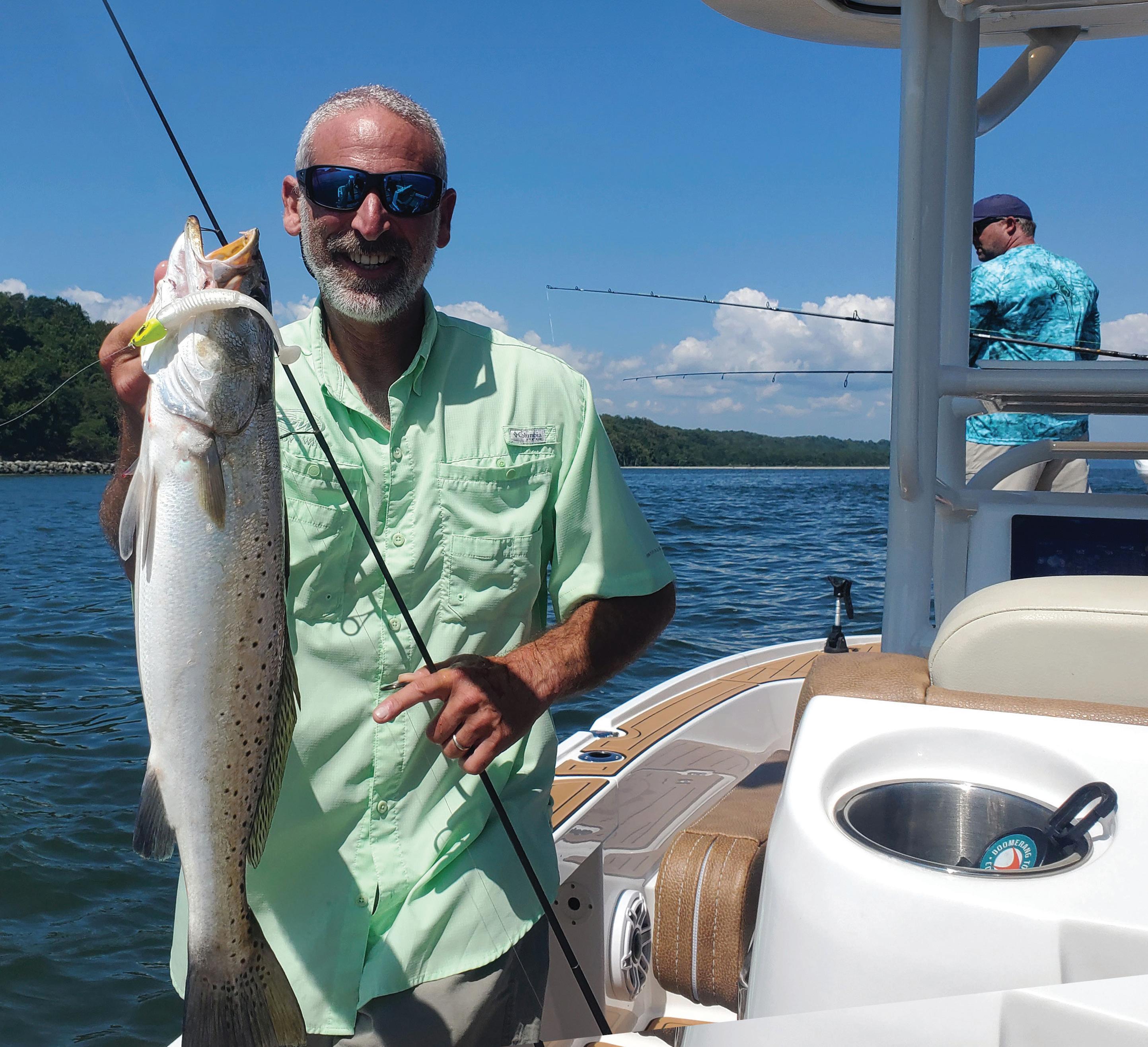
ountless Chesapeake Bay anglers who enjoy light tackle angling in the shallows look forward to spring, when the speckled trout bite cranks up. Except in Virginia waters this year, of course, which have been closed for harvesting specks due to the significant winter stun we experienced last winter. Many anglers believe the closure was a good move, preventing the taking of any specks before they had a chance to spawn. Some will disagree. But all will likely be psyched to catch some specks when July arrives and the closure ends.
# A rockpile in 10’ of water can be an awesome place to prospect for midsummer specks; this one was caught in late August.
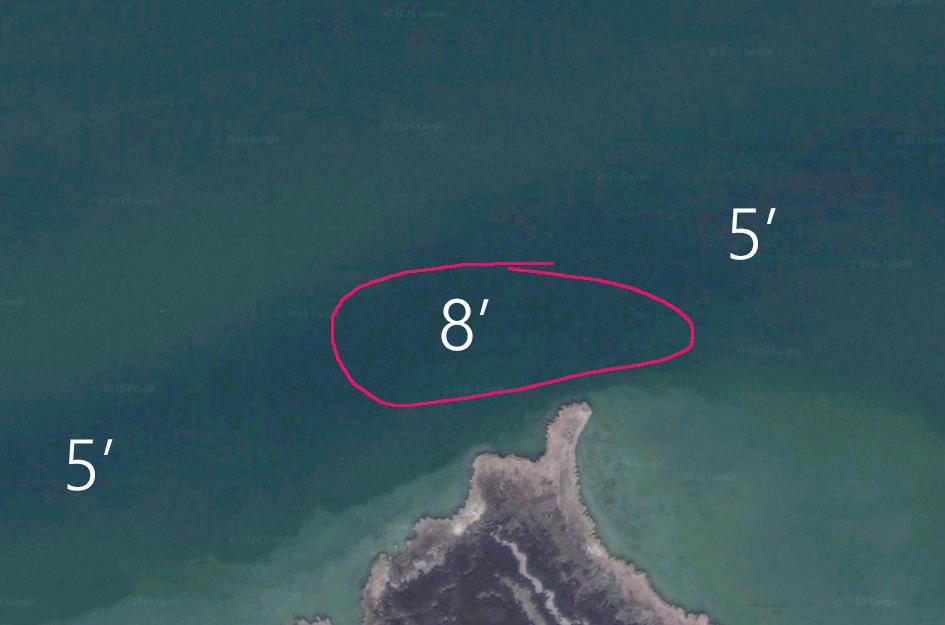
# This spot in the Tangier is a good example of a midsummer speck zone; you’ll find the fish scattered in the shallows at daybreak, but by 9:30 or 10 a.m. fishing in the deepest part of the channel where it brushes close to the point is usually best.
There’s just one problem: by the time July arrives, the best fishing is long past. Most of the fish have abandoned the shallows as the water temps begin to peak for summer, and finding those speckled critters is a lot harder than it was a month or two ago. Harder—but not impossible.
The Heat of the Moment
Like many species, during the heat of summer specks are looking for places where they can cool off a bit. Shade, deep water, and moving water are all key features. Above all, however, is time of day. On blazing-hot summer days you probably want to mow your lawn early or late, not at noon when the big ball of fire in the sky will have you sweating buckets, right? Fish aren’t very different. They’ll move into the shallows for some breakfast very early, and they’ll return very late to look for some dinner, but avoid actively feeding in sun-drenched waters during the peak of the heat. During midday hours it’s much, much harder to catch fish. But it’s not impossible. This is when shade, structure, and depth take over as key features. As the sun gets higher and higher in the sky more and more fish will shift away from the shallows and begin staging around nearby channel edges, points, riprap, and wrecks. Anywhere the water is moving gets bonus points. Often the best spots will be just a stone’s throw from the shallow water hotspots where you find fish early and late, but instead of being a foot or two deep they’re eight to 15’ deep.
Offerings To Make While You’re Melting
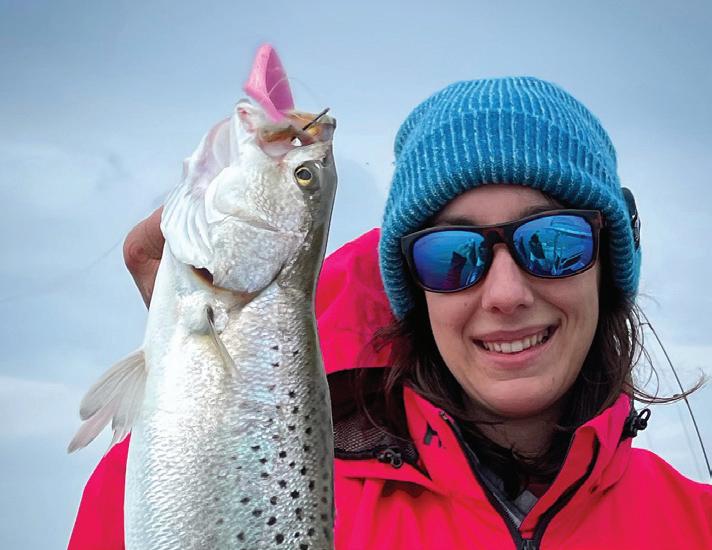
As a general rule of thumb you’ll catch more specks if you downsize during the heat of summer. The five-inch plastics that were so effective a month or two ago will still get hit now and again, but not as much as a four-incher. Sometimes dropping all the way down to a 3.5” lure will work even better. But that makes our job harder, because we’re fishing in deeper waters with current present. Find a wreck sitting in 12’ or 15’ and it can get very difficult to find bottom with anything less than half an ounce, and if the water’s moving or there’s a breeze grabbing your line, you may need 3/4 of an ounce to feel confident finding bottom. Meanwhile, specks generally find a slower sink most attractive, so you don’t want to just tie on a big hunk of lead that sinks like a rock.
There are two ways to combat this issue. First, you can use compact but heavy jigheads with short shanks so they better fit the small plastics. Or second, you can tie on a tandem rig with
a pair of smaller heads that deliver the weight you need when combined. (Those double-bucktails many folks up here call fluke rigs are commonly called speck rigs along the Gulf coast). Whichever route you go, remember that using a light-action rod with 10or 12-pound braid spooled on a 3500 or smaller reel will work a lot better than a heavier rig, because it delivers the sensitivity you need to feel your offering touch down.
Speaking of the lure touching down: the moment it does, pop your rod tip to make it jump right back up, then allow the lure to fall again. When midsummer specks are deep, hopping your lure right along the bottom is usually the best way to trigger an attack.
Thus far 2026 may not have been the best season ever for speckled sea trout, but you know you want to get out there and catch a few. So grab your sunglasses and suntan lotion, load the cooler with ice, and head for your favorite shallow water hotspots at daybreak. And then after that, go deep.
Pretty in Pink
Whites, yellows, and chartreuse are always good color picks, but there will be times when specks demolish bubblegum pink while ignoring everything else (except maybe Electric Chicken… which has bubblegum pink in it). If you’re planning to target specks, never leave home without it.
BLUELINE TILEFISH for Beginners
By Lenny Rudow
You’ll have to take a long cruise through the ocean to reach blueline tilefish, but once you find ‘em the action can be fast and furious.
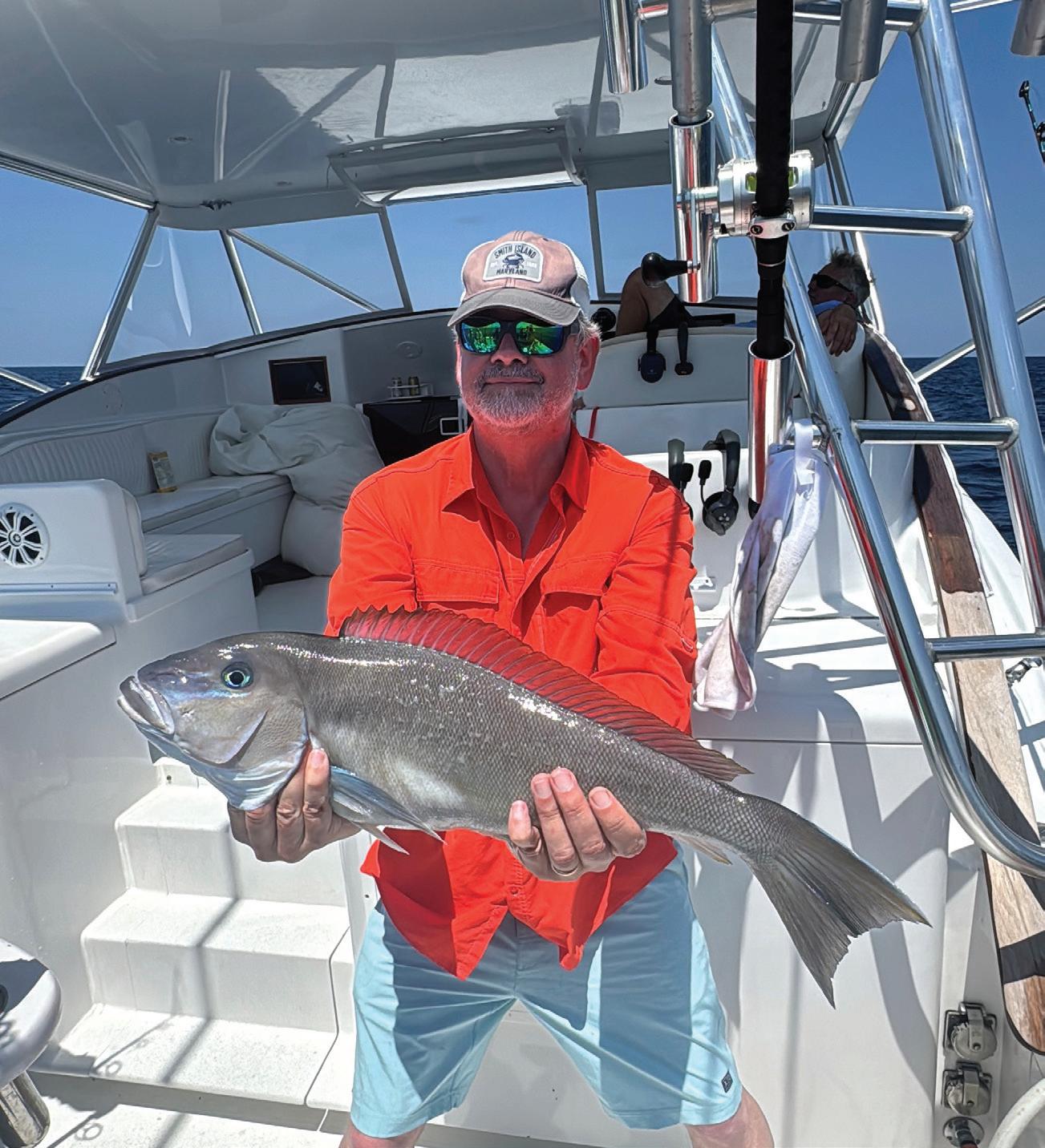
Even if you have plenty of angling experience in different aquatic venues, attacking the deep blue is like starting from scratch. And no matter how hard you work at it and how fast you pick things up there will still be days when you troll, troll, troll to no avail. When the tuna bite has dropped off a cliff, the mahi-mahi have gone MIA, and the ocean seems bereft of billfish, there’s one almost surefire way to save the day: turn your attention to blueline tilefish.
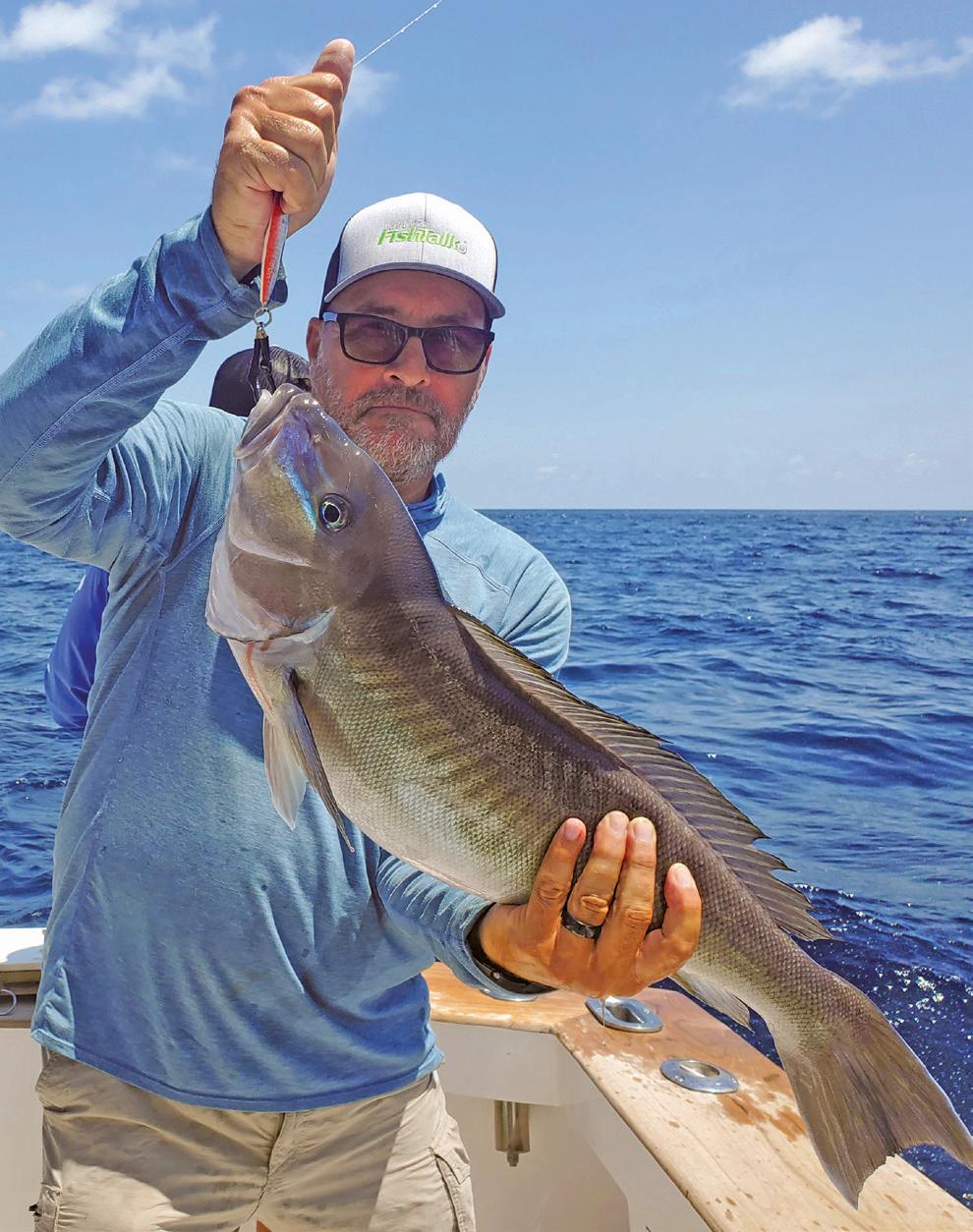
What Are Blueline Tilefish?
Blueline tilefish, sometimes called gray tilefish, are bottom fish usually found off the DelMarVa coast on patches of live bottom, rock, or shell in 200’ to 400’ feet of water. Often the best spots will be right in the middle of that depth range. Most of the fish you catch will be in the two- to five-pound range, but sometimes you hook into 10-pounders and on rare occasions, fish pushing 20 pounds.
Bluelines feed mostly on crustaceans like crabs or shrimp, small fish, worms, and squid. They can live to be 20-plus years old and their stocks are generally believed to be quite healthy, although the Mid-Atlantic stock has not been officially assessed. Years ago they were under almost no fishing pressure, but in recent decades as more and more recreational boats have been able to get offshore faster and faster—and more and more of them draw a blank on targeted pelagic species—fishing for blueline tilefish as a backup plan has become common.
Record Blueline Tilefish
The biggest blueline tilefish ever caught in our zone are:
• Delaware – 25 pounds, eight ounces
• Maryland – 21 pounds, three ounces
• Virginia – 23 pounds, five ounces
# Fast sinking jigs baited with squid chunks are a great offering for blueline tilefish.
# Chris caught a nice tile aboard the Schedule Sea.
Permit Required
To catch and keep tilefish of any type the boat needs a (free) Private Recreational Tilefish Permit. Go to mafmc.org/tilefish for the full scoop and to apply for a permit.
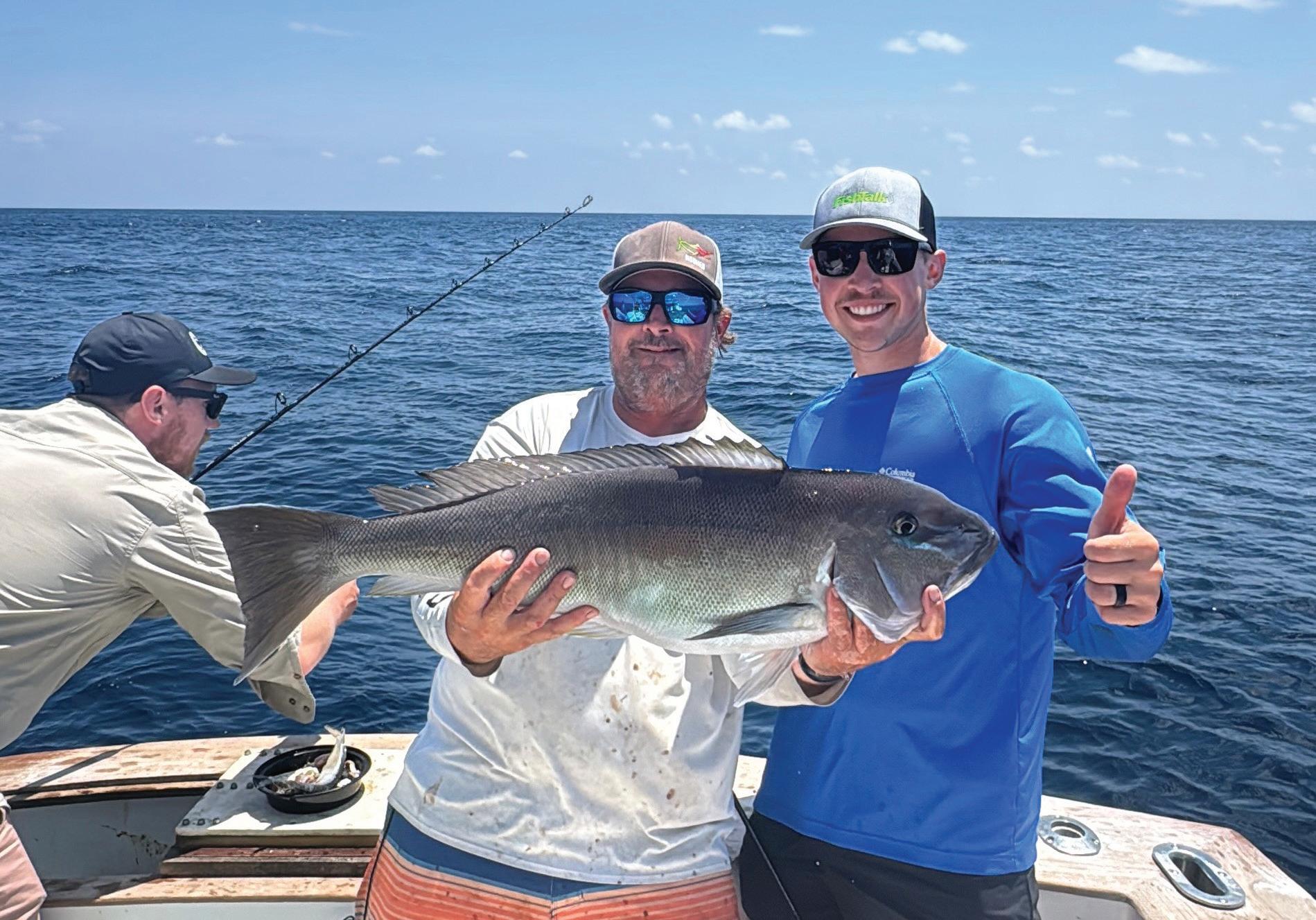
How To Find a Blueline Tilefish Hotspot
As long as you’re in the appropriate depth range bluelines will commonly be found in many of the same areas you’d fish for pelagics. Just inshore of Poormans, at the Rocky Bottom, and inshore of the end of the tip of Washington Canyon all hold bluelines. To nail down a specific location the best thing to do is dedicate some time to prospecting. The fish will hang together in concentrations, but often over very large areas. So you might catch one here or there, but when you drift across a good area you can often catch one after the next on a single quarter-mile or so drift.
Another way to find blueline spots is to keep an eye out for orange polyballs as you cruise through the ocean. When you see commercial fishing gear inshore of the canyon edges and in that 200’ to 400’ range, it’s often set over live bottom for either these fish or black sea bass (which you’ll often catch mixed in with the bluelines). Even if you’re trolling around early in the day looking for pelagics, as
#
Tempted by Tilefish
Blueline tilefish are exceptionally tasty, with a slightly oily white meat that’s reminiscent of croaker fillets. They’re great when pan-seared, cooked with white wine sauce, or baked in a garlic butter sauce. When you fillet them, note that you’ll want to cut out the extra row of bones running through the center of the fillet about halfway up towards the pectoral fins.
you go by those balls mark the spot on your GPS so you can come back and check it out later. Also eyeball your fishfinder as you troll around in waters that are the right depth. You’ll be able to spot fish right on bottom on the meter when you pass over a good blueline spot, especially if you zoom in down deep.
How To Catch Blueline Tilefish
Most days the bluelines aren’t shy about biting, and finding them isn’t half the battle—it’s 90 percent of it. Commonly if you stop over a good spot and drop the baits, within moments of the weight hitting bottom you’ll have a bite. As for what sort of bait to try, squid is the go-to offering most anglers use.
“Meat curtain” rigs with four to six 8/0 circle hooks on short droppers are a commonly used rig, or some anglers will simply tie up large top-and-bottom rigs. You’ll need plenty of weight to get down and stay down that deep, though, so carry a few one- to three-pound weights.
Another option that works very well is using 12- to 18-ounce jigs. These need to be baited unless the fish are uber-aggressive, but a fast-sinking jig rigged on bluewater jigging gear with 40- or 50-pound braid mainline works wonderfully as a squid-delivery method in 250’ or 300’ of water. Octo-jigs with twin hooks are often the most productive, and you can bait each hook up with a separate squid strip so if you miss the first bite you don’t have to reel all the way back up to rebait right away.
Tip: you can usually catch better numbers with a meat curtain, but jigs tend to tempt the biggest bluelines in the school and often produce the poolwinners.
Okay—ready to take a shot at blueline tilefish? Grab some squid, head off into the Atlantic, and try dropping down deep. It may not be like catching tuna or billfish, but a mess of blueline tilefish can save the day. And once you get a mouthful, you’ll be back for more. #
Reports editor Dillon Waters got a nice one aboard the Schedule Sea, too.
The1 Patapsco6, Perhaps5? The1 Patapsco6, Perhaps5? The1 Patapsco6, Perhaps5?
The verdict is in: Baltimore has been voted the number-one summer vacation spot on the East Coast.
By the rockfish.
OBy Staff
kay, maybe rockfish don’t really go on vacation and even if they did, they aren’t exactly visiting the National Aquarium. But considering that there’s a major metropolitan area perched on its periphery, the number of rockfish that chooses to hang out in the Patapsco is utterly shocking. As is the number of white perch. And there’s also a healthy population of catfish and carp, and in upriver areas and creeks there are snakehead to be found. What gives? None of the fish we’ve polled have been willing to comment. But there’s gobs of structure to be found in this river, and while the water quality may not be the best it’s certainly not as bad as it used to be. So the next time someone says “let’s go to Baltimore,” whip out this article and show them the five places you’d like to go.
The Big City. Sort of. You can see it from here, anyway, but what we’re interested in are the docks and riprap slightly downriver of the skyscrapers. Spots like Harbor Point, Hull Street Park, the north side of Lazaretto Point, and Fort McHenry have riprapped shorelines that can all be productive for rock and perch. Some of the piers can be quite productive, too, not the recreational marinas but the big old commercial piers. Look for the ones that are ancient and
falling apart (or just pilings are left) and remember that it’s very deep around them, so probing 10’ to 20’ down can prove productive during midday hours when fish are looking for a cooler climate and the bite gets tricky.
Ferry Bar Park and Channel. This zone of the Patapsco also has gobs of structure including both riprap and piers. Plus it has the Hanover Street Bridge, which creates
a fish-attracting light-line for those bold enough to try night fishing in the area. A relatively strong influx of freshwater here makes it a carp hotspot at times. Kayak trollers are known to do well trolling east-west along the channel edges from the underwater point east of Ferry Bar Point to the shallows on the other side of the bridge. One word of caution for boat anglers: it’s very shallow and easy to run aground on the big mud flat south of Ferry Bar Channel.
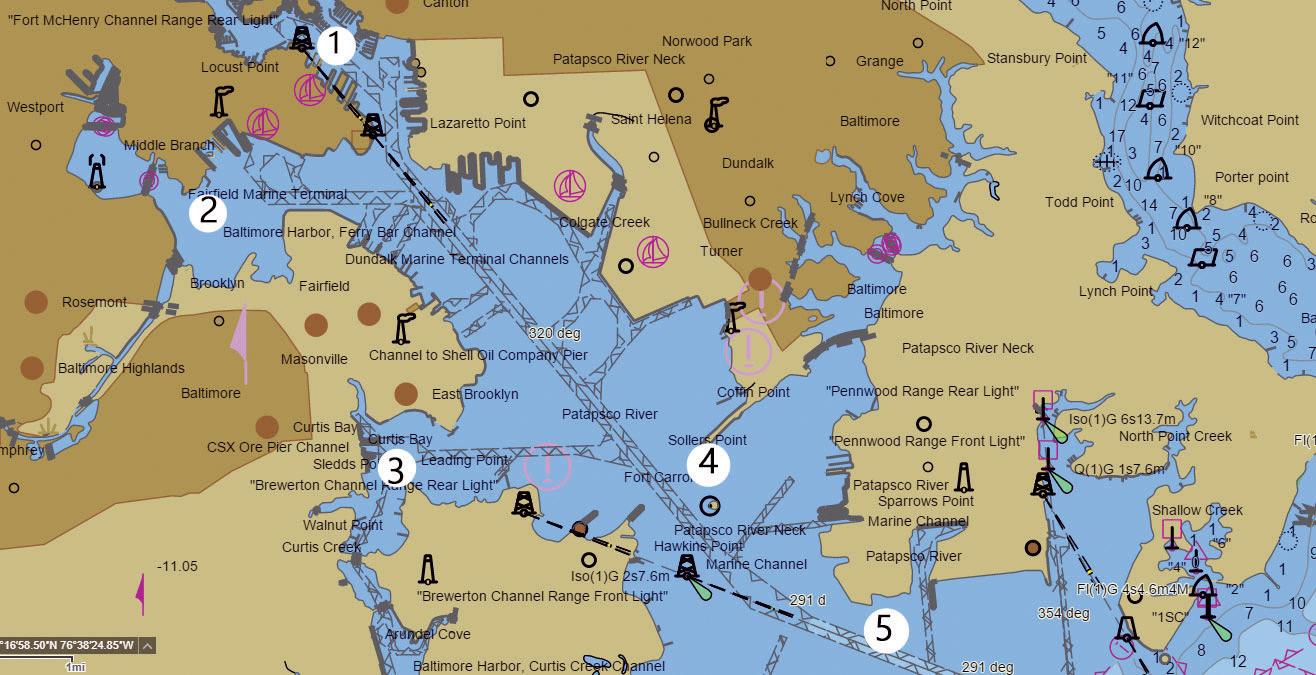
Dip Your Toe In
Baltimore has several spots which are license-free fishing areas, so you can try wetting a line in the Patapsco even if you’re not exactly a dedicated angler and you don’t have a boat or kayak. Canton Pier, Broening Park, and Canton Waterfront Park are all exempt from the usual requirements. Learn more at the DNR’s License-Free Fishing Area webpage.
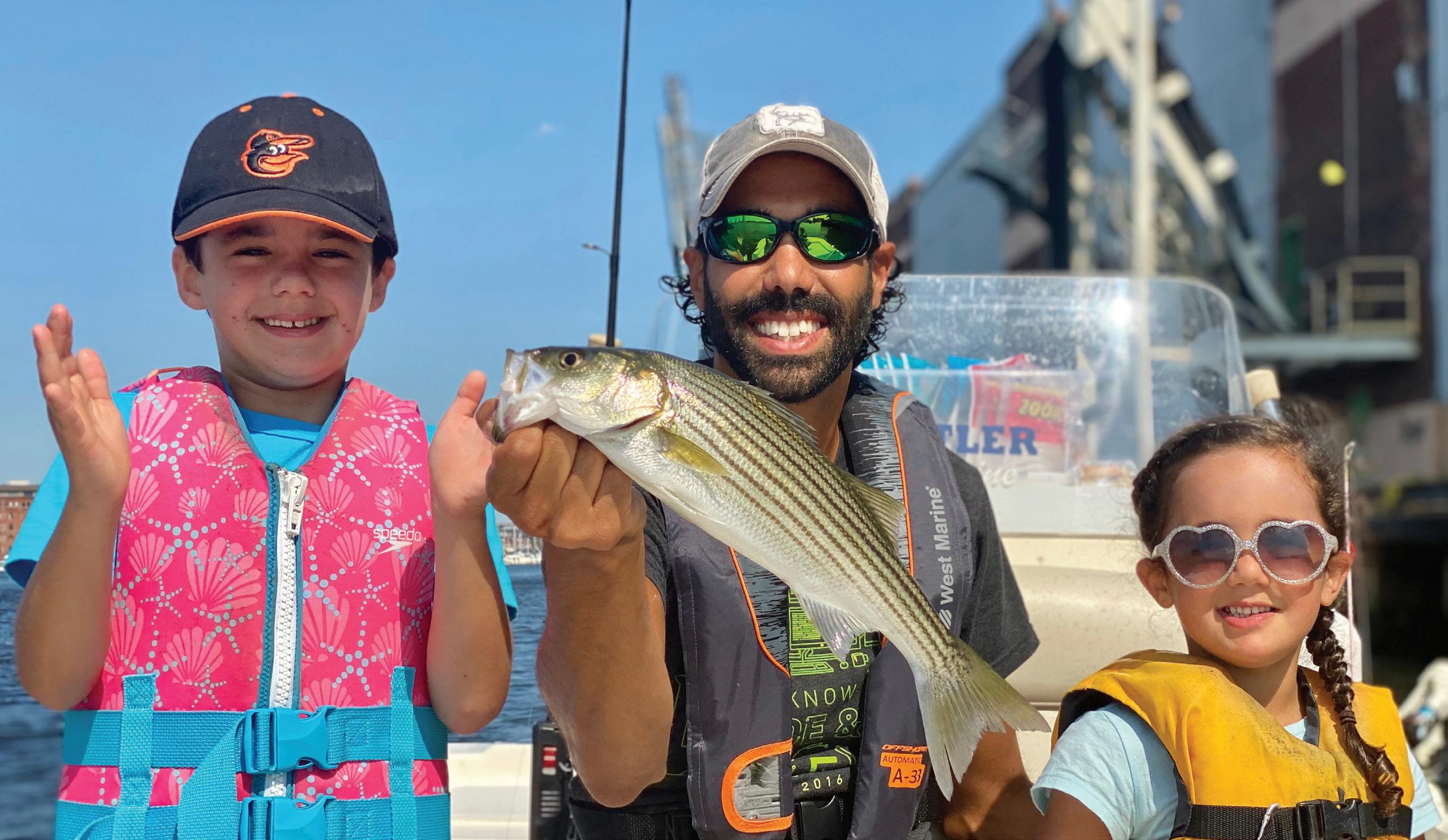
Curtis Creek. Although thoroughly industrial in most areas, Curtis Creek has surprisingly good fishing (and crabbing, too). The points to either side at the creek’s mouth and the riprap on the second set in are a good starting point for perch and rockfish, and the drop-offs between them are a solid bet for catfish. As you go up the creek there are several ship “graveyards” which offer excellent structure for casting to rock and perch, and once you get up beyond the Furnace/ Marley split you’re in snakehead territory.
The Key Bridge and Fort Carroll. Well… the structure around the bridge used to be THE spot, but
as it stands you’ll have to take note of the safety zones and restricted areas. Fort Carroll, on the other hand, remains approachable 360-degrees. This tends to be an all-or-nothing kind of spot for rockfish. Sometimes there are lots around, other times there are none. Perch anglers have more consistent results here, especially if they cast Perch Hounders up to the edges or bottom rigs baited with bloodworms when the fish are deeper. And in the late fall it isn’t at all uncommon to encounter schools of rockfish breaking water under birds in this area.
Sparrows Point. Though it certainly doesn’t look very fishy, the slag-covered shorelines of Sparrows
Point does sometimes hold fish and is worth checking out; casting jigs on half-ounce heads up to the shoreline and bouncing them back will fool the rockfish. An even better bet is often the big pier at the mouth of the little harbor on the south side. It has a zillion pilings in deep water, and when the sun’s high in the sky live spot cast right up to the edges of the pilings or slinging jigs into their shadows often produces rockfish.
While many of these areas aren’t exactly picturesque, they do hold fish. And there’s a certain charm to getting a bent rod in an urban landscape. If that sounds intriguing, it might be time to start planning your Baltimore vacation. #
# Adam and the kids caught ‘em up in the shadow of Baltimore.
Could it be Croaker???
With a little luck one day soon we’ll be catching a mess of these tasty—and noisy—fish.
By Lenny Rudow
In the grand scheme of things it wasn’t all that long ago that croaker were a summertime mainstay for Chesapeake Bay anglers. Sure, it’s been over a decade since we saw the runs of big “horse” croaker, but for several years now we’ve seen more and more small croaker mixed in with the catch while fishing for spot, and in the last couple of years it’s been possible to put together a dinner’s worth of keepers in southern areas of the Bay. Could this species be on a rebound? We can’t say for sure. But in late April of this year reports of croaker catches, including some keepers, were already trickling in from Ocean View, the mouth of the James, and nearby locations. And considering the recent trends it seems that it might be possible to catch a few, at least, if you’re willing to focus in on them. If, that is, you can remember how and where those tasty, noisy fish can be caught.
Hardhead Hotspots
Like most other fish, croaker will and do change where they frequent from year to year whether they’re thick or few in number. That said, also like other fish, there are common factors to look for as you lay out a gameplan with different spots to try. You’ve heard of Maslow’s Hierarchy of Basic Needs, right? Five critical things are needed for a human’s physical survival: food, drink, shelter, sleep, and oxygen. This explains why you don’t often find people living in the middle of the desert, where there’s a distinct lack of food, water, and shelter. Many parts of the open Bay are like a great desert, too, with
pockets of life that are more or less like an oasis in the desert.
Intelligent anglers will think of fish and where they hang out in exactly the same way as Maslow’s Hierarchy relates to people. We can eliminate drink from the list—fish do, after all live in water—and perhaps substitute “rest” for “sleep,” but otherwise the Hierarchy holds true. Find an area with structure that provides food, shelter, rest, and sufficient oxygen levels, and you will likely find fish. Go to an area that has none of the above, and generally speaking your bait won’t get bit.
Croaker are bottom feeders with a downturned mouth, and they feast mostly on small crustaceans, worms, and mollusks. While looking for spots that fulfill the “food” part of the Hierarchy they’ll gravitate towards live bottom, reef sites with biofouling, and oyster bars. Though they do go shallow sometimes croaker tend to like slightly deeper water than some species, and usually 10’ to 25’ is a good bet. When they’re in the southernmost portions of the Bay expect to find them in places as varied as Wreck Shoal, Kiptopeke, Cherrystone Reef, and Nandua-
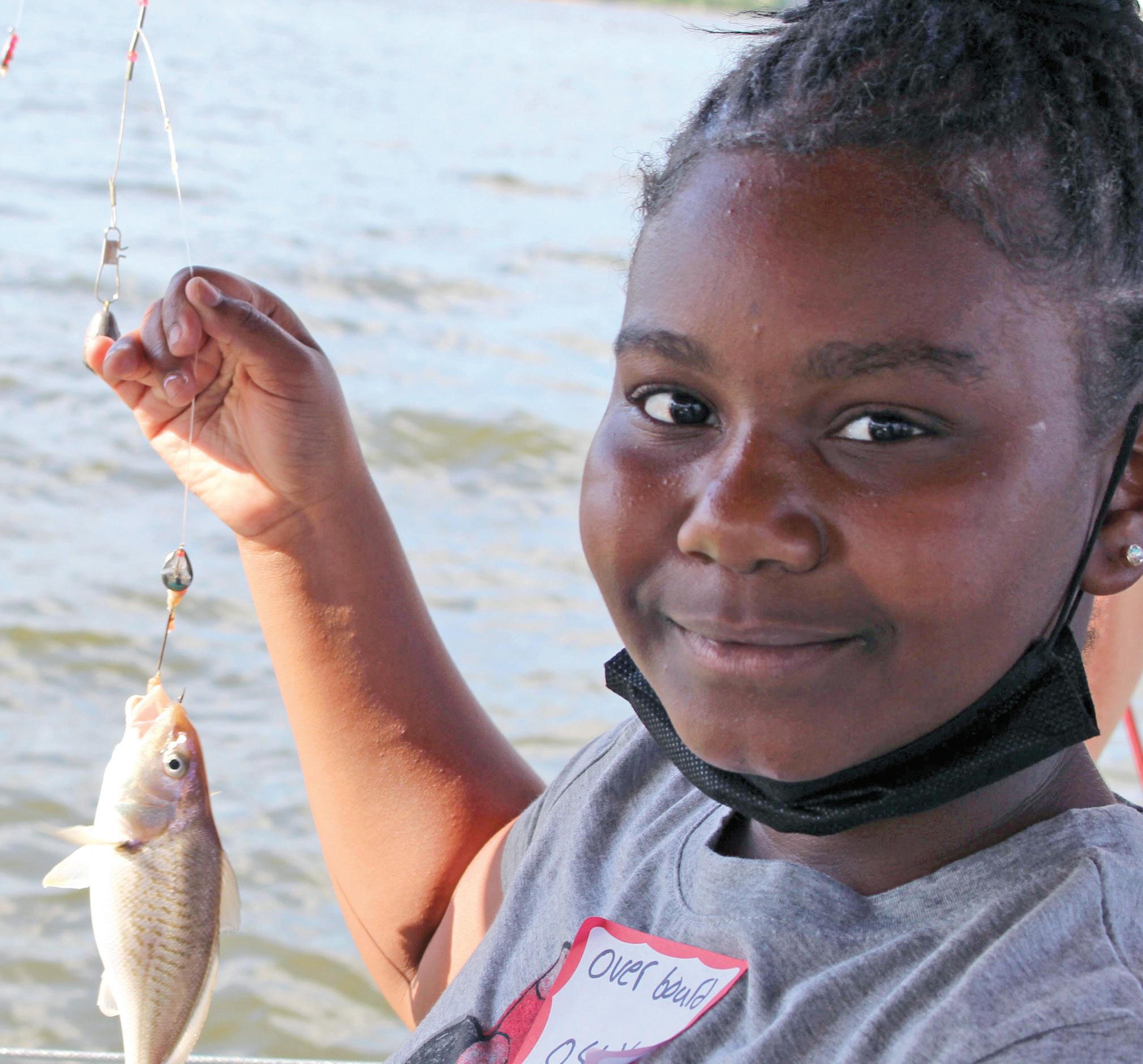
# There’s no better fish than croaker when it comes to entertaining kids.
# Croaker used to be a mainstay, and while you might not catch 100 in an afternoon these days, that doesn’t mean you can’t target them and go home with a few for dinner.
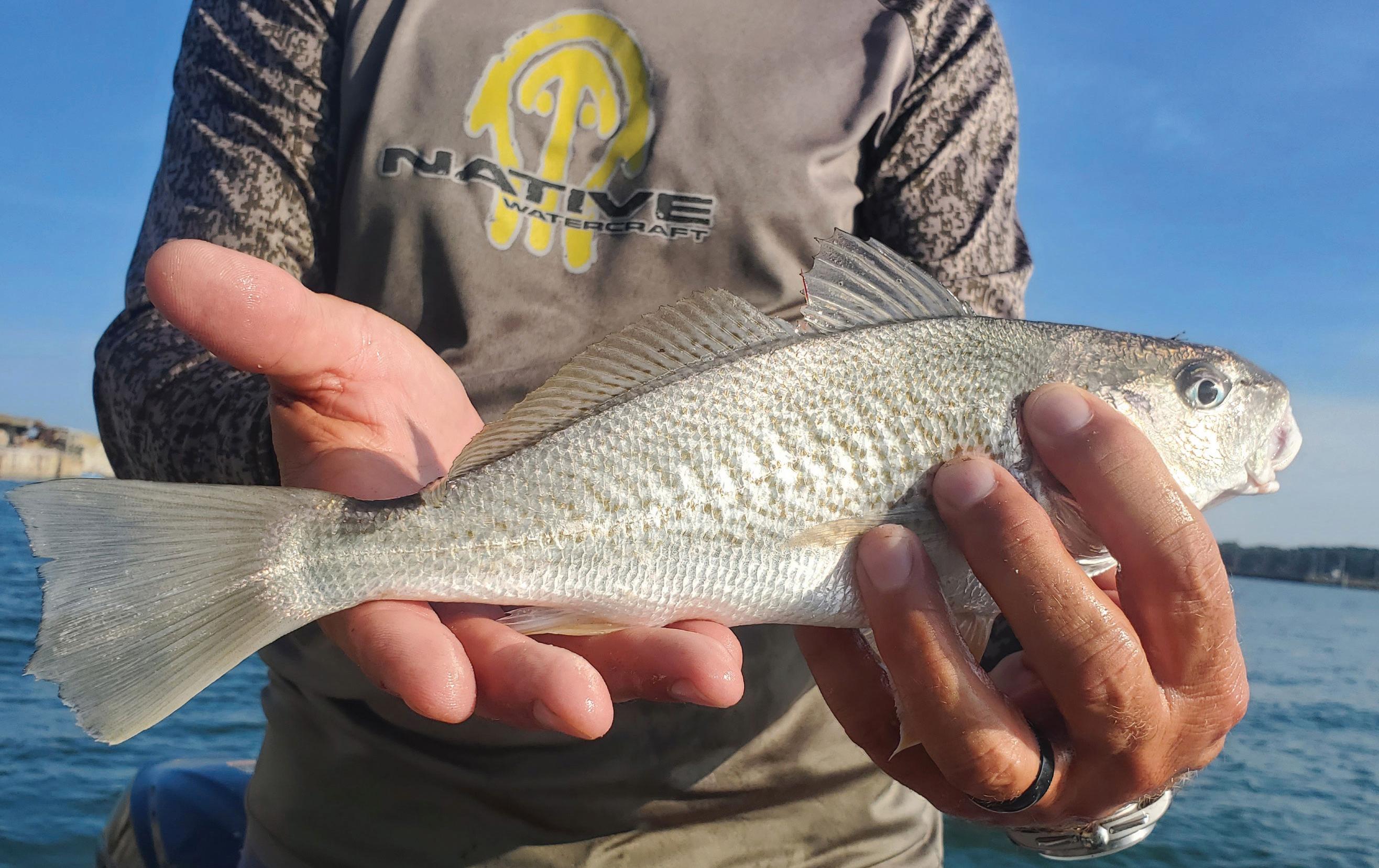
Pungoteague. When they shuffle north areas like the oystery edges of the Tangier Sound channels, the live bottom south of the Target Ship, and Butler’s Rock can become thick with them. They may keep going up the Bay to the Gooses reef, the Choptank’s Cook Point Reef, Cedarhurst, and some years they’ve been thick as far up as Snake Reef above the Magothy.
But—and this is a big but— remember that one of the croaker’s favorite foods are worms. To find them, croaker will sometimes move en masse into deep cuts with undercut banks and sharp drops. The cuts through Deale Island and Wroten Island, for example, have swarmed with them in the past. And after dark they’ll sometimes move shallow over muddy bottom, which has led to epic evening bites in past years off Herring Bay and Franklin Manor.
Simple Pleasures
One of the great things about croaker fishing is that this species
will reliably bite on the simplest of rigs and baits: you just can’t beat bloodworms on bottom rigs. Shrimp, Fishbites, peeler crab, and any number of other baits will work, too, but if the fish are present and willing to eat bloodworms never fail. A half-inch tidbit threaded onto a number four or number two hook is all it takes, though if larger croaker are around you may want to upsize a bit. Add enough lead to the rig to keep it on bottom when you cast out from a pier or shoreline, as you drift, or when you anchor up.
Rods of six or seven feet with moderate action are best since some give in the tip helps keep tension of the line without pulling the weight off bottom, and longer rods can be advantageous for shoreline anglers trying to make long casts to deeper water. Reels can be anywhere from the 3000 to 4000 size with 10- to 15-pound test line.
We don’t know when or if croaker will make a major-league comeback. But their numbers have been strong enough in recent years that if you target them and spend some time and
effort you’ll likely be rewarded by that jackhammer-like strike a time or two—and hopefully you’ll even be able to put together a mess of croaker for the frying pan.
When the Sun Goes Down
Croaker often get very active after dark. It’s generally not “necessary” to wait for the sun to go down to catch them, but often the hottest action is after the sun’s gone down. If you’d like to try night fishing on the Bay or its tributaries, this is an excellent species to target.
Comical Catch
Even if the croaker are undersized, croaker are a top target when fishing with kids. They do plenty of croaking and grunting when you reel them in and there isn’t a kid around who won’t start laughing and smiling when they hear the fish “talking” to them. If you’re trying to entertain youthful anglers for an afternoon, croaker fishing is ideal.
Reservoir Rings
Tips for catching freshwater yellow perch.
By Lenny Rudow
Living in the Mid-Atlantic zone we enjoy fishing in freshwater, we enjoy fishing in saltwater, and at many times in many places we can target the very same species. Pickerel? Yep, they’re in water both salty and sweet. Stripers? They can be found in plenty of landlocked situations. Yellow perch? You betcha. But there’s a catch: if you fish using the same lures and tactics in both bays and lakes, in one venue or the other you’re likely to fall short. This is particularly true for yellow perch, which can act so differently between freshwater and the salty stuff that targeting them requires an entirely different mindset.
BAITS are the first topic to address. Yellow perch will eat minnow in both types of waterways, but different minnow. In reservoirs and lakes they’ll readily take shiners. But don’t grab a bunch of bull minnow out of the trap and figure on using them in freshwater. You’ll still get bites sometimes, but not nearly as many as if you offer up the shiners that they’re accustomed to dining on.
The night crawlers that rarely work well in the Bay and tributaries, meanwhile, can be quite productive in freshwater. And there’s one bait that rarely occurs to salt-oriented anglers for freshwater yellow perch which is an absolute
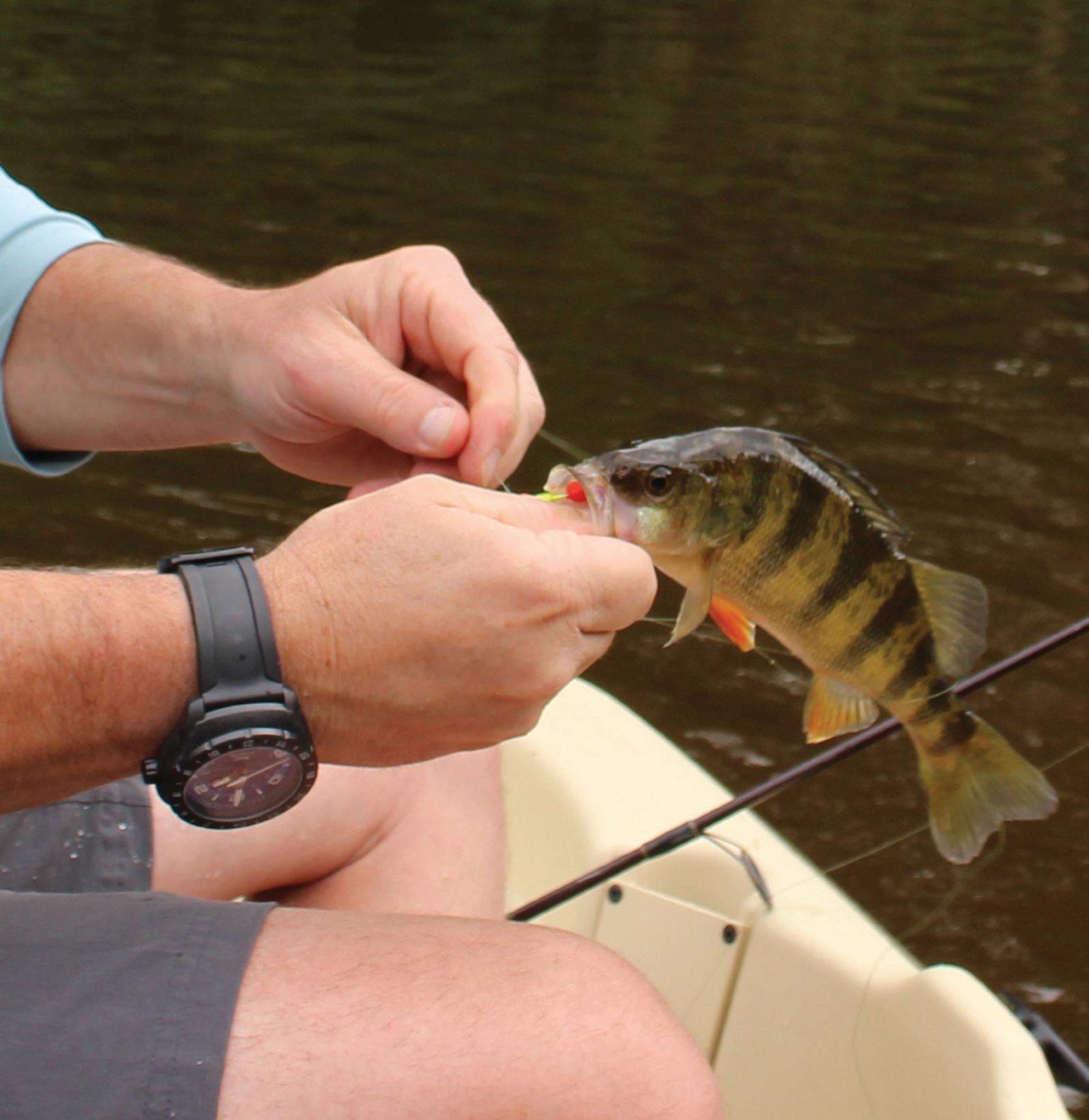
killer: crayfish tails. Rip one off, thread it onto a hook from the top to the tailfins, and pop it out through the underside. The crayfish tail readily conforms to the shape of the hook and when you put it in the vicinity of a yellow perch living in freshwater, it can rarely resist.
LURES that are effective in saltwater, on the other hand, often do carry over quite well. Spinners in particular, as well as tube jigs and small crankbaits. But there’s a catch. These only work well when you can present them at the proper depth. And in reservoirs and large lakes that depth may be very different than where you’re used to finding yellow perch—especially during the summer months. Which leads us to…
FINDING the fish in freshwater venues is quite different from hitting the spring runs in tributaries. During the spring and fall expect the perch to be hanging out in depths similar to crappie and bass. They’ll be looking for the same types of spots, too, like weedbeds or underwater points with cover and bait. But when the heat of summer sets in the yellows are a bit less enthusiastic about sky high temperatures than other species, and they often be the first to retreat to deeper waters.
Depending on the specific lake and other environmental variables, they’ll often be found 20-plus feet down. In this scenario channels in relatively shallow lakes, and/or rocky ledges and trees laying on bottom in deeper lakes, are top spots to prospect. That said, you’ll have a much easier time nailing down productive depths if you can ID a thermocline. Then, look for areas where a drop-off or structure intersects with it and start hunting for the fish.
In sweetwater finding the fish can be tough but getting bites can be even
# Red/white tube jigs can be a killer for freshwater yellow perch.
Millpond Yellows
Yellow perch can be found in most of the Eastern Shore millponds, but they can be stunningly difficult to locate. Where you find one, however, you often find a big cluster. The best way to focus on them is to stay on the move while casting ultralight gear with a good searchbait, like a small crankbait, tube jig (they love 2.5” red/ whites), or underspin. You can work all the way around the shoreline of most of the millponds in an afternoon and with a little luck, if you cast-move-cast continually you’ll figure out where they’re hanging before running out of pond.
tougher. During the summer months you’re more likely to find small pods than large schools, and like many species they don’t feed particularly hard at this time of year. When you can locate them on the fishfinder dropping down bait on a top-and-bottom or drop-shot rig is a go-to method, and vertically jigging with tubes, blade-baits, or small jigging spoons is another good option.
Tip: When the fish are excruciatingly scattered, which you will see sometimes in large lakes and reservoirs, locate an area where the thermocline hits a drop-off and try slow-trolling along at the depth of the thermocline. This can be particularly effective with a drop-shot rig and shiners.
CATCHING freshwater yellow perch is really no different from doing so in saltwater, however, there’s one final tidbit we want to point out: Forget about slow retrieves and letting baits sit in place. In these venues you’ll find the perch far more aggressive and they enjoy attacking lures pulled at a fast-moving, erratic pace. The difference here isn’t so much the environment as it is the water temps. Many Bay dwellers are accustomed to fishing for perch when the run’s going off and water temps are in the low 50s at best. When you’re fishing in 70- or 80-degree water the speed of everything has kicked up a notch—and that includes the yellow perch.
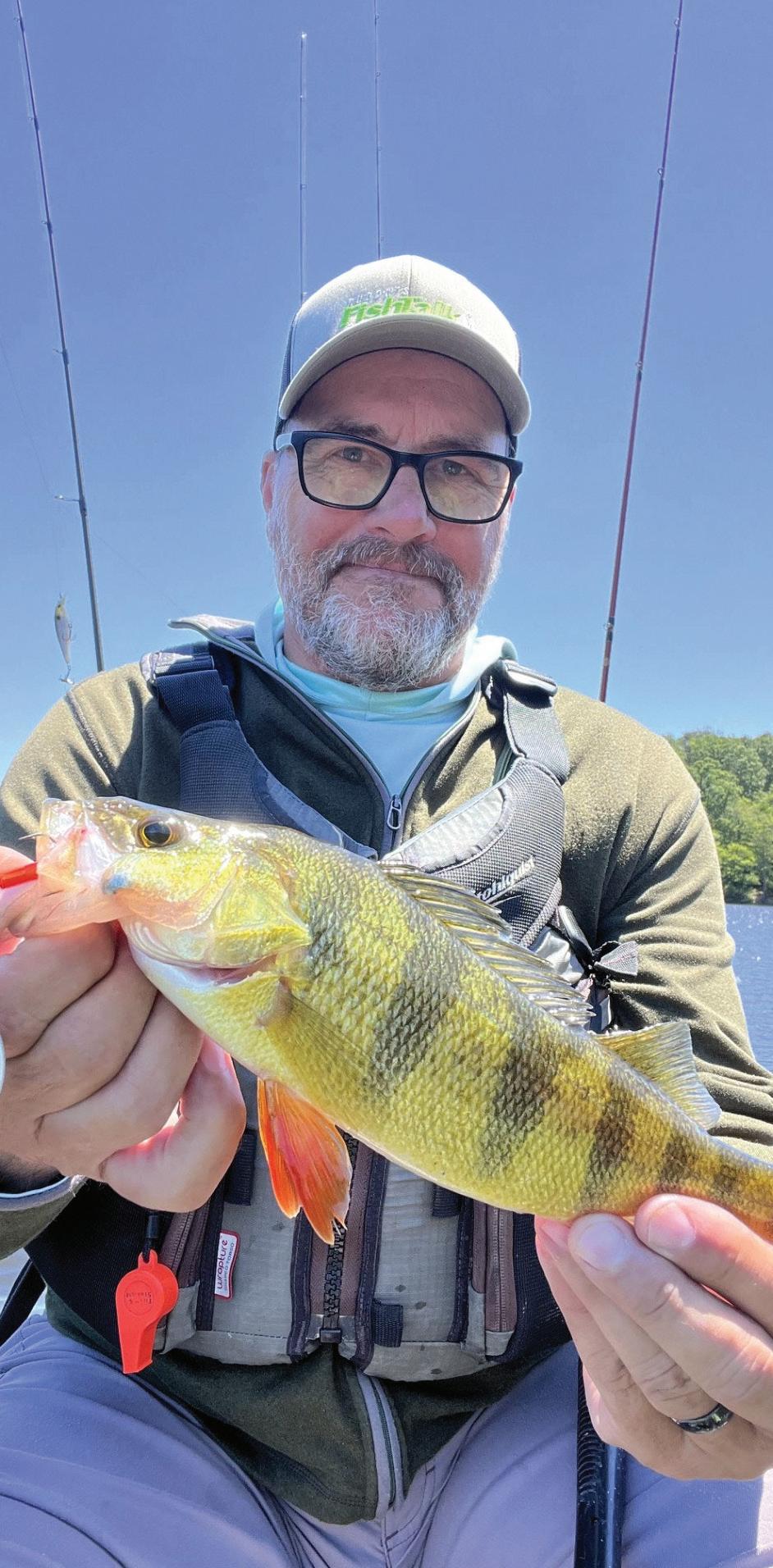
# Eric found a Mepps did the trick on yellow perch at St. Mary’s Lake early this summer. Photo courtesy of Eric Packard.
Paddler’s Edge
Avoiding Blind Casts
By Eric Packard
Quite a few kayak anglers have electronics on their boat today, some even with real-time imaging sonar. But what about those of us who can’t or don’t want to invest in those rather expensive devices? What are we to do? Well, we go old school. We look at the weather, read the water, and use knowledge gained from years of fishing without electronics. We’re trying to avoid blindly casting in the hope of lucking into a fish.
Starting with the weather, look at wind direction and warm or cold fronts moving into the region. Unstable weather will affect fish activity. When you have a stable period and the weather hasn’t changed much over a few days or weeks fish activity will remain stable as well. That is, if you’re catching fish in a particular location or pattern the fish will most likely remain in that pattern for several days. On the other hand, patterns will often change after unsettled weather.
After a high-pressure system has moved in and you have blue skies it can mean poor fishing. This is the time you should present reaction baits such as crankbaits, jerk baits, and spinner baits. Keep in mind that if you have wind on a blue-bird sky day the wind may break the water’s surface, allowing fish to rise and seek shallower water. Wind can make fishing difficult, but it can also be beneficial. A wind blowing on a cold sunny spring or fall day will push warmer surface water against the shoreline, attracting bait and game fish. Wind blowing across a point will do the same and also provide currents with oxygenated water. I always look for pinch points, points of land, shorelines, and guts that are being affected by the wind. These areas will often hold a fish or two regardless of other weather factors.
Moving away from weather, let’s look at the shoreline. Casting along a shoreline in the dead of winter or on a hot summer day may not be productive due to water temperature
being too uncomfortable for the fish. Then again, on a warm sunny winter afternoon, fish may be up shallow trying to soak up the sun. Or, on a hot summer bluebird sky day fish may be in the shade of a tree. Not only do fish seek out shade during the heat of summer, but in freshwater areas fish may be feeding on bugs that fall on the water.
Riprap is also a productive shoreline for taking a cast or two. The rock provides spaces for baitfish to hide and feed and they in turn provide food for sport fish. On a sunny but cold spring or fall day the rock warms quickly, bringing fish in to seek warmth and to feed. Changes along the shoreline from stone to sand or to dirt or a grassy bank attract fish for feeding on insects and bait fish that are attracted to these changes in zones.
Shallow flats are always a good choice to take a cast over. Wearing a good pair of polarized sunglasses
is beneficial for this type of fishing, where you may see fish moving from one grass patch to another. That should be a great place to work a jerkbait over or along the grass edges.
Stump and lily pad fields, along with laydowns, are also good choices to take a few casts around, through, or against. Casting a spinnerbait or square-billed crankbait in and around stump fields and laydowns can produce fish. Or, tossing a plastic frog or plastic worm rigged weedless can generate a bite in a lily pad field.
Once you find a pattern for the bite of the day, take note of the conditions. You can apply it to other areas on the lake, bay, river, or creek. All the while you are building a memory of these conditions to be used on future outings. So get out there and take a cast, but not a blind cast—use your experience and knowledge until you find that pattern for the day, the oldschool way.
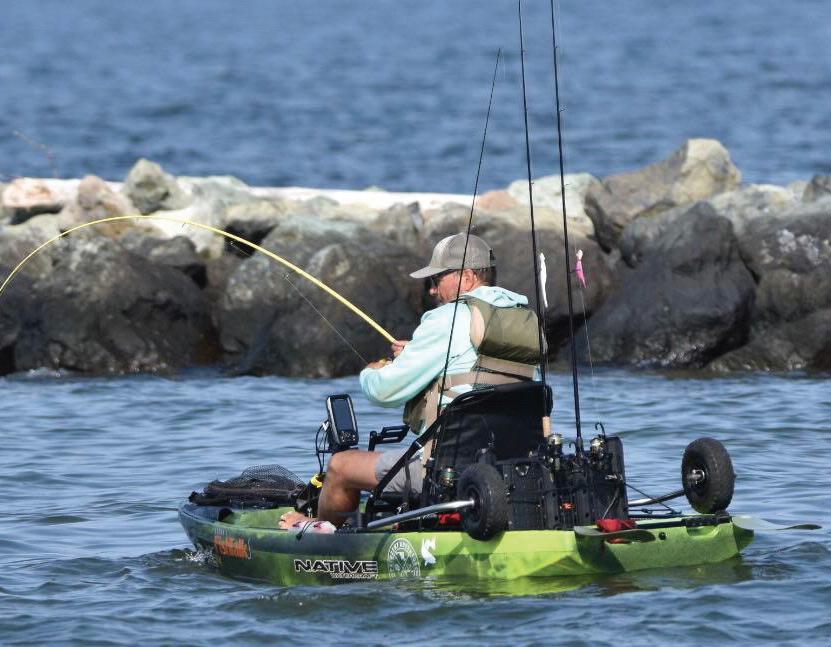
# The author hooked up while tossing jigs to the riprap.



Gathered from our reports by Dillon Waters
We all know printed fishing reports are generalized, and weeks have passed before the report gets into your hands. Sign up for our email list and you’ll get a weekly overview of the bites on the Bay, along the Mid-Atlantic coast, and in freshwater venues. Subscribe for Premium Access to FishTalk’s fishing reports, and you’ll get all the latest intel and location-specific info we can muster every Friday by noon. Visit FishTalkMag.com for details and in the meantime, here’s our monthly outlook based on over eight years of fishing reports history.
Coastal
With summer now in full swing many of the coastal bays will be crowded, but that doesn’t mean you can’t find flounder along the channel edges and sheepshead near inlet rocks or bridge pilings. The summertime sheepshead bite has been getting better and better in recent years so grab some fiddler crabs or sand fleas and drop ‘em tight to the structure. Offshore anglers will be focused on finding tuna, billfish, and mahi; the tuna bite has varied radically through the years and we can’t say if they’ll stick around or go MIA during July, but most summers some billfish are out there and the mahi-bite should prove reliable. Bailing at the balls is a nearsurefire tactic, and if we get lucky they’ll move in close to home and stage around bass pots 12 to 25 miles from the beach.
Freshwater
July can be a tough month on the freshwater scene, and there’s no doubt that the best way to get bites will be fishing at dawn, dusk, and under heavy cloud cover. Dawn and dusk will become doubly important at reservoirs that double as resorts, like Lake Anna and Deep Creek, where daytime boat traffic can be enough to squelch the bite. When the sun is high and bass or crappie are on the agenda remember to focus on shaded areas and spots that have some current to keep things cool and elevate oxygen levels. Luckily snakeheads don’t mind the heat, so if chasing Chesapeake Channa is in the plans be sure to head for the shallows, probe weedy zones, and keep a sharp eye out for fry balls.
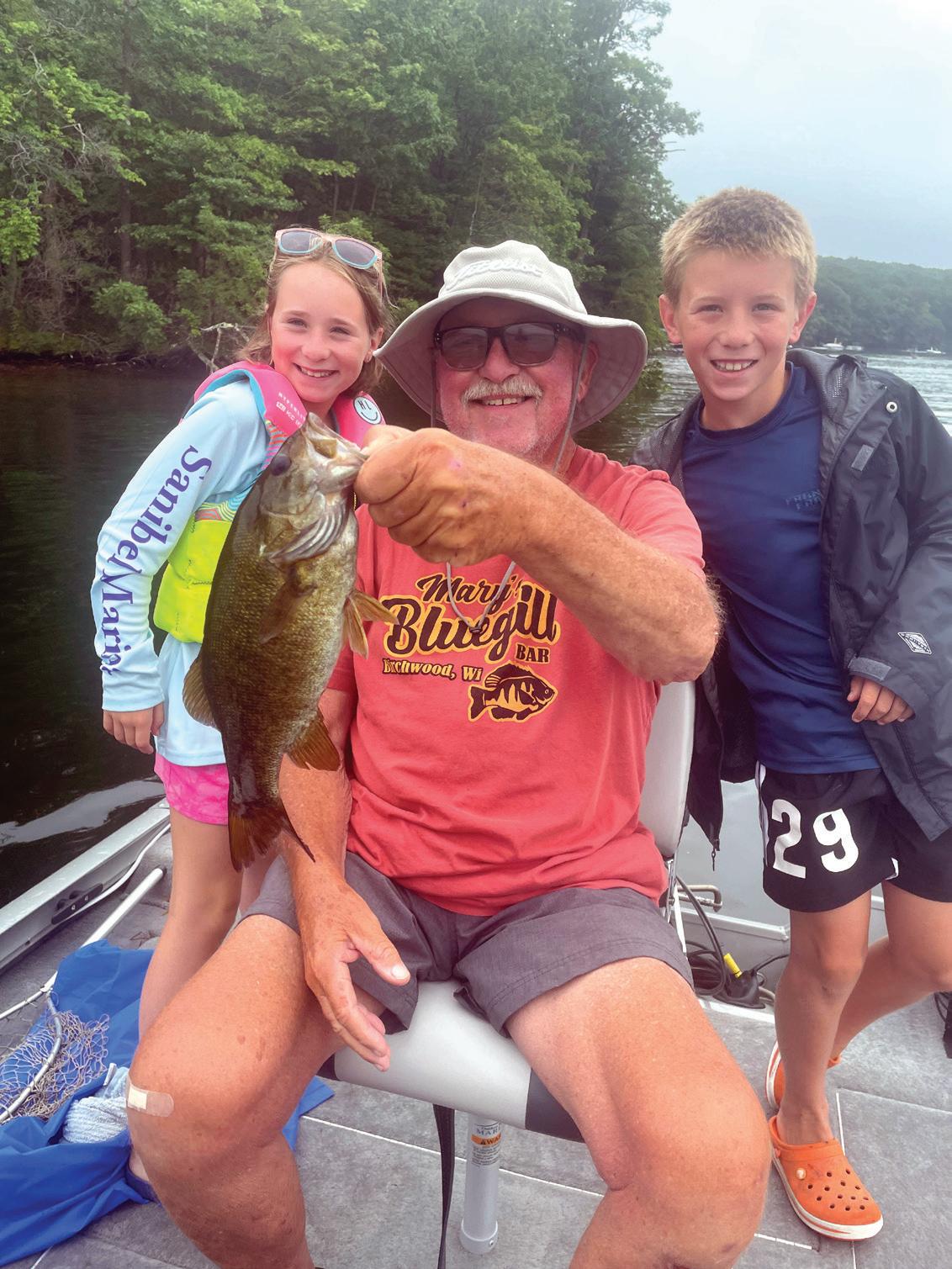
# Fishing in heavily trafficked lakes like Deep Creek can get tough in July, but you can still make some awesome catches as Jayson, Grandpa Mark, and Madison proved last summer.

FOR THOSE WHO LIVE WITH PURPOSE &
Way North
There’s a good chance of finding a rich mix of fish on the Flats right about now, including stripers, largemouth bass, and snakeheads. Fishing topwater at dawn and dusk could produce any or all of the above. Once the heat of the day sets in expect things to get between slow and very slow, with one exception: blue catfish. Mid-summer is a great time to target them, and if you anchor up anywhere within sight of the Route 95 bridge or a channel edge in any of the northern rivers, you have an excellent shot at ‘em. Remember that FishTalk supporter Fishbites has a new line of mess-free catfish bait nuggets and these make targeting cats a piece of cake (we found the white shad flavor and pink shrimp to be top picks).
Upper Bay
Most Upper Bay anglers will likely be focused on finding rockfish this month, and remember, as of August 1 they become off-limits. Expect live-lining spot and tossing jigs to be top options in July, with the mouth of the Patapsco, Tolchester, Love Point, and the Bay Bridge pilings all likely hotspots. Hopefully we’ll have a better white perch bite this summer than last year’s lackluster action, however, since they’ve had spawning success similar to that of the rockfish for the past few years our expectations aren’t through the roof. Another option to consider if you’re heading up a trib or creek is to target snakeheads, which now inhabit… well, just about all of them.
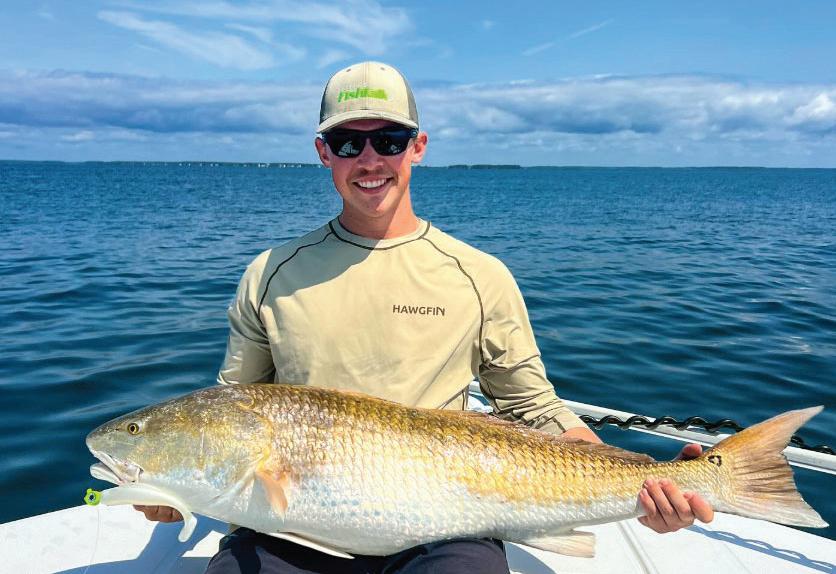
Middle Bay
Enjoy another month of targeting rockfish, because when July ends we’ll be giving them a break. Dawn and dusk are bound to be best, particularly when casting topwater to shallows like tributary piers and the Poplar Island rocks. Will the reds be back? Will bluefish, croaker, flounder, or Spanish mackerel show up? Any or all of these fish could appear in force during July, but as usual it’s a crap shoot. That said, last year’s showing of bluefish was better than expected, particularly in the Sharps Island zone and the channel edges near Solomons. Also note that last year’s run of spot, including eating-sized fish, was exceptionally strong in the lower Patuxent—hopefully that will prove true again in 2026.

Lower Bay
Maryland waters remain open for rockfish this month, Virginia waters are closed, and PRFC waters shut down July 7. Fortunately, there are plenty of other species to target in this zone, and if this July is anything like last year, a highlight will be the presence of unusually big bluefish (including some up to 30-plus inches). The Target Ship was a hotspot, with trollers pulling spoons and hoses doing best but jiggers catching their fair share, too. Hopefully the big bull reds will pull a repeat performance, too, chasing bait in open water and near channel edges. We’re also hoping for an uptick in the cobia action in this part of the Bay, where last year’s bite would be best described as so-so.
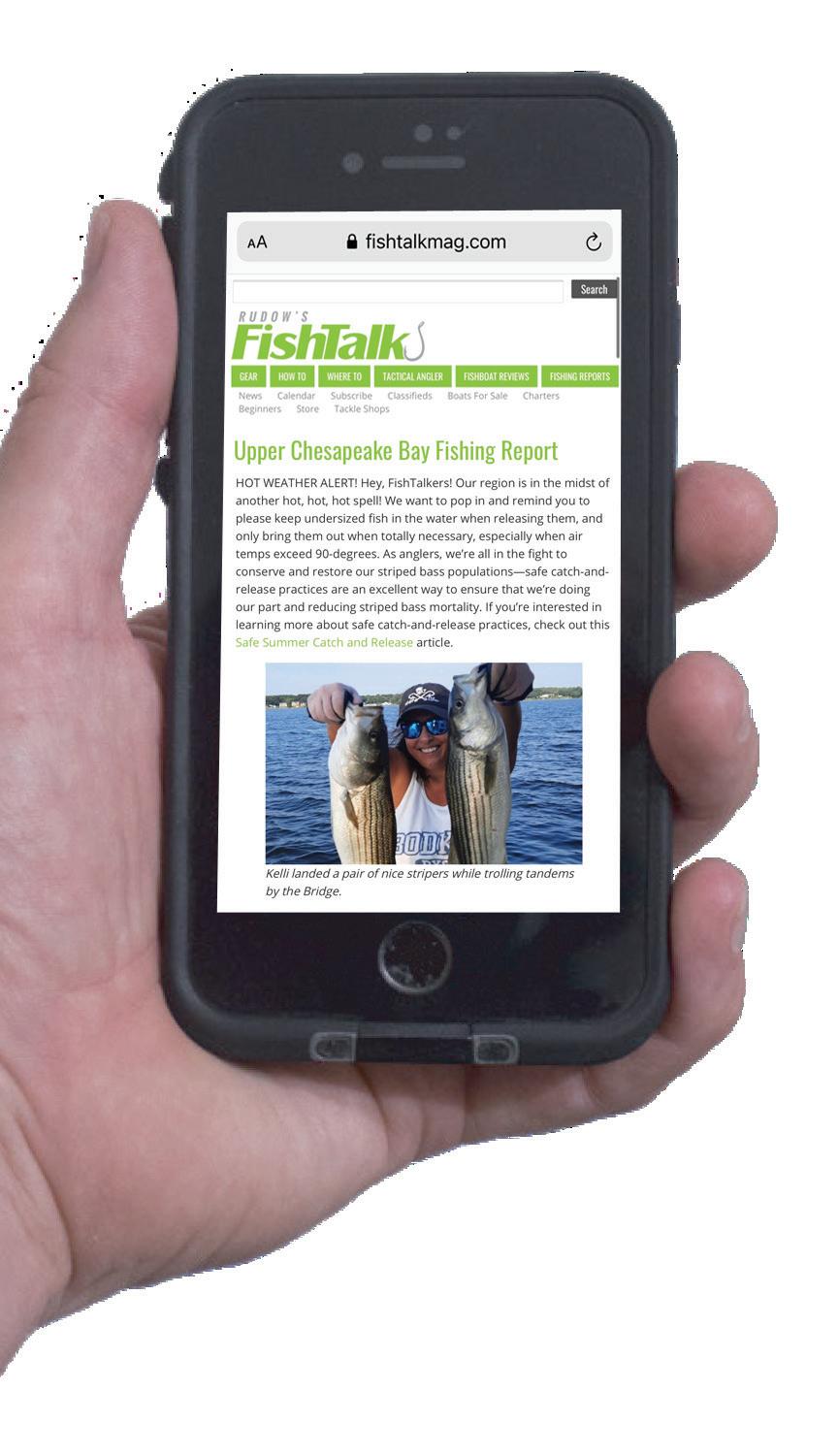

Tangier, Pocomoke, and Lower Shore

Anglers who regularly probe these waters are undoubtedly hoping for a rerun of last year’s bluefish action in open water and around wrecks and reefs, because by now the water temps are likely to stifle most of the shallow water action other than right at dawn and dusk. Bear in mind that topwater and shallow-running crankbaits produced excellent catches. Bottom fishing may provide an excellent option, too, as last year’s crop of mixed spot, croaker, kingfish, and even puffer fish proved better than usual.
Way South
If this year is like last year you’ll want to get out there and try sight fishing for cobia sooner rather than later, because as July progressed and pressure on the fish increased the bite only became tougher and tougher. Last July also proved a bit less productive for slot redfish action on the east side, so let’s hope that changes. Sheepshead were tougher than usual to come by, too, but early indications are that they’re back in better numbers already this season. And the bull reds hanging out near the CBBT Islands? They should be ready and willing to pounce on live croaker and spot right about now. Also note that there were large numbers of sub-legal and barely-legal weakfish caught last summer, particularly around Kiptopeke, and they may well be back now in keeper sizes—fingers are crossed.
FishTalk’s



MARKETPLACE & CLASSIFIED SECTIONS
EQUIPMENT
SPADEFISH STORE - Your Marine & Fishing Headquarters Your source for Fishing Gear, Equipment and Electronics. 20,000+ products in stock. Fast shipping from our NJ Warehouse! Visit us online: www.spadefish.store or www.spadefish.net
HELP WANTED
Help Us Get Our Magazines into Local Hands – SPF Seeking Annapolis Area Distribution Driver! SpinSheet, PropTalk, and FishTalk (SPF) are seeking a part-time delivery driver to bring our magazines to readers in the Annapolis area, about three days a month. Pay is based on stops completed. Applicants must have a valid driver’s license in good standing, a reliable vehicle, and be able to lift up to 25 pounds. Interested? Email info@spf-360.com to learn more.
MARINE SERVICES


TACKLE SHOPS

TACKLE

Boating

Additional Approval
The BoatUS Foundation for Boating Safety and Clean Water announces that its free state-approved boating safety course has been approved in 15 additional states, giving more recreational boaters access to essential education on safe and legal operation of boats. The course will cover important rules regarding navigation, safety equipment, emergency preparedness, and environmental stewardship. Boaters in Arizona, Delaware, District of Columbia, Hawaii, Louisiana, Maine, Maryland, New Mexico, North Carolina, Ohio, Oregon, South Dakota, Tennessee, Virginia, and West Virginia now have a convenient free online course option that meets their state-specific boating education requirements. “Expanding into 15 additional states means more boaters can access boater safety education at no cost,” said Lynne O’Hearn, BoatUS Foundation program manager. “We believe cost should never be a barrier to learning how to boat safely, and these new state-approved courses help ensure more people have the education they need before they leave the dock.” Designed for completion in two to four hours, the self-paced course offers five interactive lessons that immerse students in a virtual boating experience, guiding them through different destinations while tracking progress. The curriculum is supported by dynamic, video-based learning and concludes with a 60-question final exam with unlimited retake opportunities and can be completed at the student’s own pace. Upon successful completion, most states issue a printable certificate that can be used immediately, though requirements and validity may vary by state. To take a state-approved free boating safety course in your state, please visit boatus.org/free-courses/free-boating-safetycourse. For more information about BoatUS Foundation’s additional free boating courses, visit boatus.org/free-courses.

Summer Sale

Riverside Marine announces huge savings on all in-stock boats during the month of June. Purchase a boat this month and receive a free rod holder flag pole with an American flag. Now is the time to get a new boat to be on the water for the 4th of July. They will host a demo weekend June 19-20 from 9 a.m. to 4 p.m. each day. Purchase a boat during the demo weekend and be entered to win a Riverside Summer Fun Package worth over $500! There will be a multitude of boats available for demo rides including but not limited to the Sportsman Open 302, Sportsman Heritage 231, Trophy T29EX, Trophy T22SC, Bayliner V20, Bayliner VR6, and more. Learn more at riversideboats.com
Showroom Pricing
With 65 years of serving the Chesapeake boating community, Tri-State Marine continues to evolve—and with that comes an announcement of its most customer-friendly change yet. TriState has moved to new lower everyday showroom pricing on its entire Grady-White and Parker lineup. Fair prices, a great deal, and a buying experience built around the customer, every day. And the difference is real—the average price reduction across the current in-stock inventory is nearly $9000. Here’s what customers can expect: transparent, fair showroom pricing on every boat (easy to compare), and every price includes freight, prep, a Coast Guard safety kit, fuel, electronics installation, new owner orientation, and 20-hour service. One price. Everything included. No catches. No surprises. The boat you’ve always wanted is now more attainable than ever. Stop by either of Tri-State Marine’s showrooms in Deale or Annapolis and experience the company’s impressive lineup of over 35 of the latest Grady-White and Parker models in stock. Great boats. Great people. Even better pricing. tristatemarine.com
New Places To Pick Up FishTalk
Let’s give a warm welcome to these new FishTalk distribution stops!
• McDaniel Yacht Basin in North East, MD
• The North East Market in North East, MD
• Bay Boatworks in North East, MD