








Delaware
Pontoon Express | 302-945-0654
22572 Harbeson Rd, Harbeson, DE pontoonexpress.com
Maryland
Danny’s Marine LLC | 410-228-0234 3559 Chateau Dr, E. New Market, MD dannysmarine.com
Hidden Harbour Marina | 301-261-9200 600 Cabana Blvd, Deale, MD hiddenharbour.net
Intercoastal Marine | 410-335-0458 2925 Eastern Blvd, Baltimore, MD intercoastalmarinemd.com
Maryland Boat Sales | 410-574-3988 2426 Holly Neck Rd, Essex, MD mdboatsales.com
Middle River Landing Marina | 410-686-0771 2426 1901 Old Eastern Ave, Essex, MD chesapeakemarine.net/middleriverlandingmarina
Powersports of Crofton | 410-697-5965 7045 State Route 3 North, Gambrils, MD hondaofcrofton.com
PYY Marine | 410-255-1771 1132 Pasadena Yacht Yard Rd, Pasadena, MD pyymarine.com
Scott’s Cove Marina | 410-784-7624 10551 Eldon Willing Rd, Chance, MD scottscovemarina.com
Smith’s Marina | 410.923.3340 529 Ridgely Rd, Crownsville, MD 21032 smithsmarina.com
Thornes Marine | 410-957-4481 1237 Greenbackville Rd, Stockton, MD thornesmarine.com
Centerville Waterway Marina | 757.547.4498 100 N Centerville Turnpike, Chesapeake, VA centervillemarina.com
Friday’s Marine | 804-758-4131 (Malise Marine Sales & Service) 14879 GW Memorial Hwy, Saluda, VA facebook.com/fridaysmarine
Jett’s Marine, Inc. | 804-453-3611 18477 Northumberland Hwy, Reedville, VA jettsmarine.com
Legasea Marine | 757-898-3000 821 Railway Rd, Yorktown, VA legaseamarine.com
Sandpiper Marine | 757-787-7783 21530 Taylor Rd, Accomac, VA 23301 sandpipermarine.net
Seaworthy Marine | 757-442-3666 4200 Main Street, Exmore, VA seaworthymarineservices.com













Cedar Creek Marina | 302.422.2040 100 Marina Lane, Milford, DE cedarcreekmarina.com
Fairwinds Marina | 410.216.0205 1000 Fairwinds Dr, Annapolis, MD 21409 fairwindsmarina.com
Tri-State Marine | 410.562.6247 222 Severn Ave #12, Annapolis, MD tristatemarine.com
See your authorized participating
Beacon Light Marina | 410.335.6489 825 Bowleys Quarters Rd, Baltimore, MD beaconlightmarina.com
Tri-State Marine | 410.867.1447 5861 Deale Churchton Rd, Deale, MD tristatemarine.com
Jim’s Marine, Inc. | 410.648.5106 96 East Cross St, Galena, MD jims-marine.com
Anchor Boats, Inc. | 410.287.8280 448 N Mauldin Ave, North East, MD anchorboat.com
Centerville Waterway Marina | 757.547.4498 100 N Centerville Turnpike, Chesapeake, VA centervillemarina.com
Jett’s Marine, Inc. | 804.453.3611 18477 Northumberland Hwy, Reedville, VA jettsmarine.com
Legasea Marine | 757.898.3000 821 Railway Rd, Yorktown, VA legaseamarine.com


35
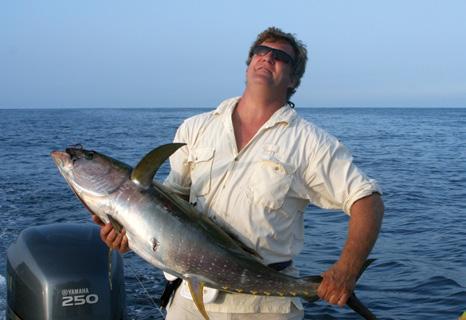
The Thunnus Among Us: Catching Yellowfin Tuna, Part I
It’s go time—get ready for early season yellowfin with some last-minute fine tuning. By Staff presented by siriusXM Marine
39
Spring Fling
Rockfish in... April?! By
Lenny Rudow
42
How To Catch Bull Redfish in the Bay— From Shore
No boat? No problem. Let’s take a hike through the marshes of DelMarVa and catch some bull reds from the shoreline. By Adam Greenberg
44
Spring Fishing Tips for Beginners
As temperatures begin to warm up your angling options will begin to bloom. By Staff
46
Spring Push
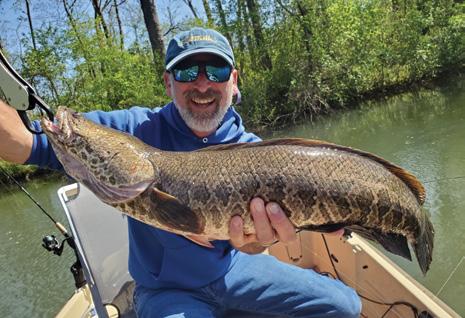
As the water warms up, snakeheads aggregate in unusual numbers—don’t miss out on the opportunity. By Lenny Rudow
48
Spot Check on the Severn
The Severn River is chock-full of awesome angling opportunity. By Wayne Young
50
It’s Show Time
The Bay Bridge Boat Show at Safe Harbor Narrows Point is right around the corner—start the fishing season with a new boat bang! By Staff
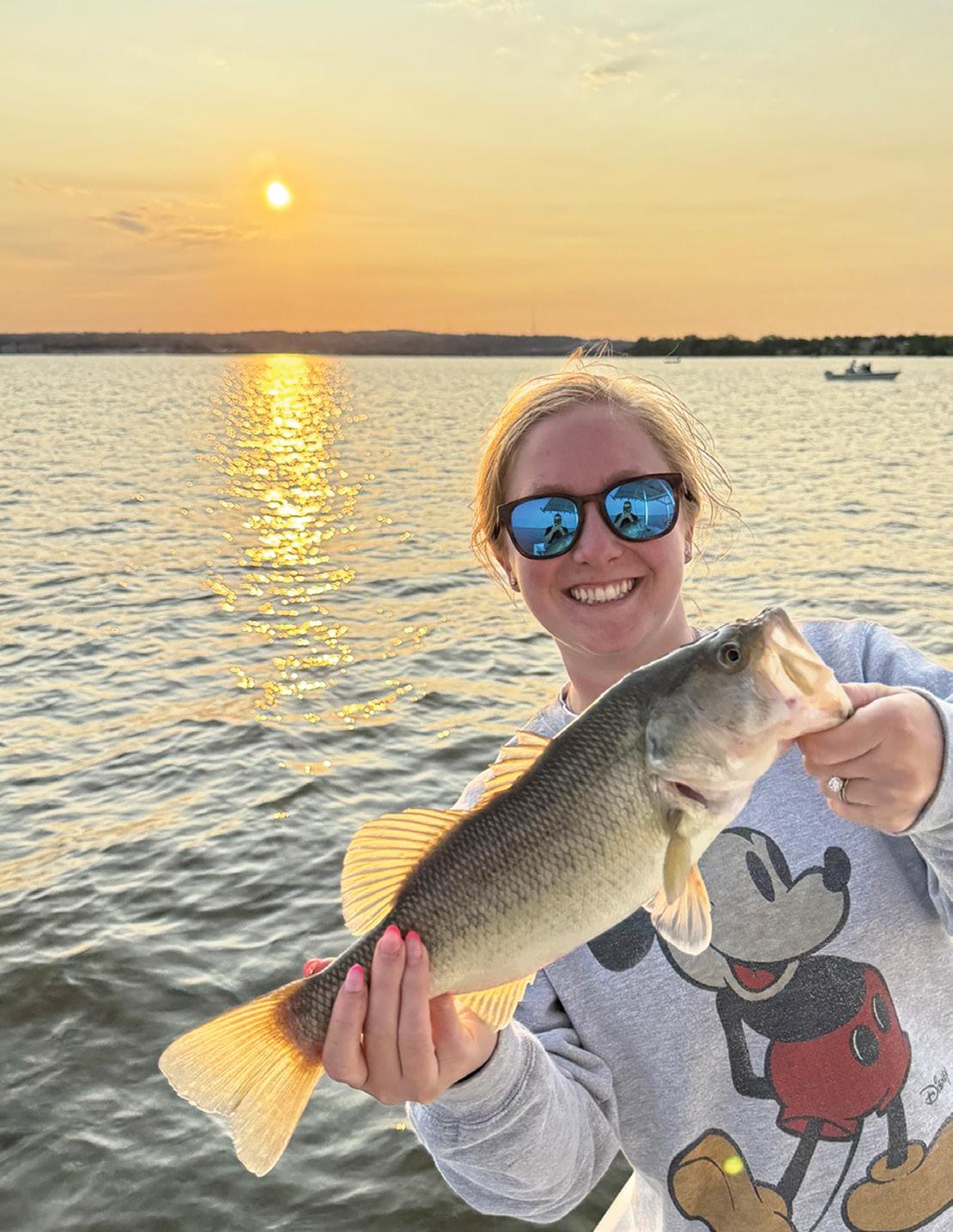
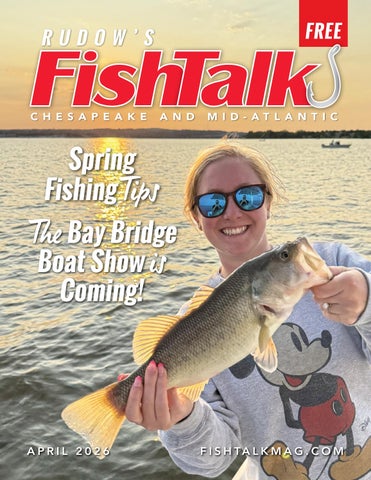
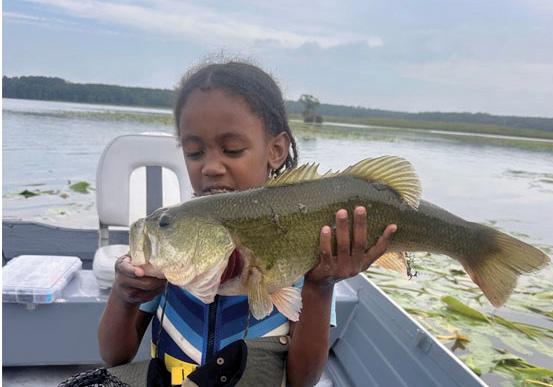
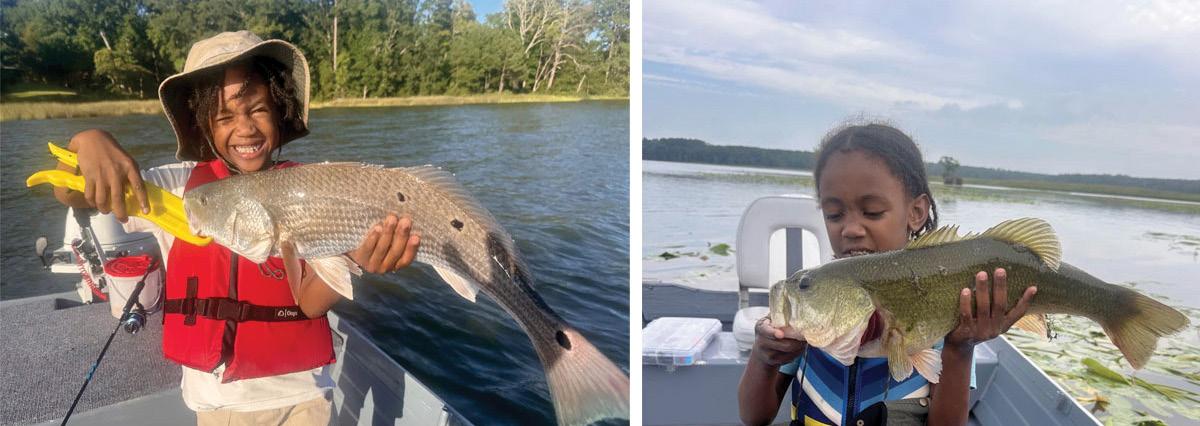
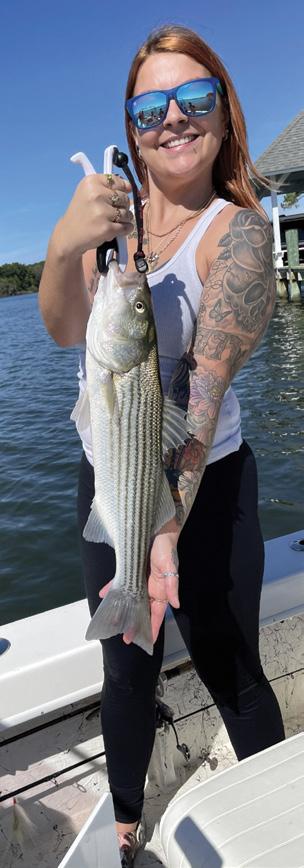
Becca was living large — largemouth, that is — on the Flats last spring.

Maryland
Fairwinds Marina | 410.216.0205
1000 Fairwinds Dr, Annapolis, MD fairwindsmarina.com
PYY Marine | 410.255.1771
1132 Pasadena Yacht Yard Rd, Pasadena, MD pyymarine.com
Richardson Marine | 410.745.9279
9649 New Rd, McDaniel, MD 21647 richardsonsmarinerepair.com
Smith’s Marina | 410.923.3444 529 Ridgley Rd, Crownsville, MD 21032 smithsmarina.com
Thornes Marine | 410.957.4481 1237 Greenbackville Rd, Stockton, MD thornesmarine.com
Top Knotch Marine | 410.253.1299 1735 Little Creek Rd, Chester MD tkmsvc.com
Delaware
Carlisle’s Marine | 302.389.0100 49 Artisan Dr, Smyrna, DE carlislesmarine.com
Virginia
Legasea Marine | 757.898.3000
821 Railway Rd, Yorktown, VA legaseamarine.com
ANGLER IN CHIEF
Lenny Rudow, lenny@fishtalkmag.com
PUBLISHER
Mary Iliff Ewenson, mary@fishtalkmag.com
ASSOCIATE PUBLISHER
Chris Charbonneau, chris@fishtalkmag.com
MANAGING EDITOR
Molly Winans, molly@fishtalkmag.com
SENIOR EDITORS
Beth Crabtree, beth@fishtalkmag.com
Kaylie Jasinski, kaylie@fishtalkmag.com
COPY EDITOR
Lucy Iliff, lucy@fishtalkmag.com
FISHING REPORTS EDITOR
Dillon Waters
ADVERTISING SALES
Eric Richardson, eric@fishtalkmag.com
CUSTOMER SERVICE MANAGER
Brooke King, brooke@fishtalkmag.com
DISTRIBUTION / BROKERAGE / CLASSIFIEDS MANAGER
Beatrice M. Mackenzie, beatrice@fishtalkmag.com
ART DIRECTOR / PRODUCTION MANAGER
Zach Ditmars, zach@fishtalkmag.com
GRAPHIC DESIGNER / PRODUCTION ASSISTANT Royal Snyder, royal@fishtalkmag.com
COASTAL CORRESPONDENT EMERITUS John Unkart
CONTRIBUTING WRITERS
Adam Greenberg, Jim Gronaw, Chuck Harrison, Capt. Monty Hawkins, Eric Packard, David Rudow, Wayne Young
DISTRIBUTION
Larry Botts, Bob and Joann Bruffy, Martin and Betty Casey, Jennifer and Al Diederichs, Gregory and Dorothy Greenwell, Dave Harlock, Jim Persing, Mark Schlichter
Rudow’s FishTalk is a monthly magazine for and about Chesapeake and Mid-Atlantic anglers. Reproduction of any part of this publication is strictly prohibited without prior consent of the officers of Rudow’s FishTalk LLC. Rudow’s FishTalk LLC accepts no responsibility for discrepancies in advertisements.
Rudow’s FishTalk is available by first class subscription for $45 a year, and back issues are available for $4 each. Mail payment to Rudow’s FishTalk Subscriptions, 612 Third Street, Suite 3C, Annapolis, MD, 21403.
Rudow’s FishTalk is distributed free of charge at more than 850 establishments along the shores of the Chesapeake and the DelMarVa Peninsula. Businesses or organizations wishing to distribute Rudow’s FishTalk should contact the Rudow’s FishTalk office, (410) 216-9309 or beatrice@fishtalkmag.com.

612 Third Street, Suite 3C, Annapolis, MD 21403 (410) 216-9309 FishTalkMag.com © 2026 Rudow’s FishTalk LLC


By Lenny Rudow
Greetings, FishTalkers—spring is finally in the air! This winter was a long, tough slog, with fishing somewhere between impossible and miserable much of the time. But in the coming days perch will be running, shad will appear in our creeks and rivers, and the Bay will come alive with the arrival of southern species. We’ll all be hoping for warm weekend days and red-hot bites. More importantly, we’ll be hoping and praying for a good rockfish spawn in the Chesapeake. Considering the sort of winter we just had the conditions are better than they have been in recent years, so let’s all cross our fingers for a change in their spawning success as we move into spring of 2026.
Speaking of change: as most of you know, for the past eight years FishTalk has been bringing you not only this free monthly magazine but also weekly fishing reports, completely free of charge. We’ve done so because we know how important it is to anglers to gather as much pre-fishing intel as possible before each and every trip. Especially for those of us who have limited fishing opportunities due to work and family obligations, it’s very, very difficult to keep up to date on where the current bites are and what the fish are hitting. We get that, we care, and we’ll be boosting our efforts to deliver high-quality intel. In fact, starting in April we plan to restructure the reports to include more extensive information on the happening hotspots as well as what tactics and lures are proving to be effective, with direct links to articles on the website that explain each in detail.
That’s the good news, but there’s also some not so good news: With expenses increasing on everything from paper to payroll, we simply cannot continue doing things the way we’ve done them to date. FishTalk the magazine will continue to be free and available throughout our readership area, and we’ll continue producing a free report on the general bite, but beginning May 1 we’re going to start asking
everyone to sign up for a subscription to access the detailed weekly fishing reports and portions of our website.
Wait a sec! Don’t throw down the magazine in disgust just yet! The subscription will be very inexpensive, breaking down to $6.25 a month on an annual basis ($75/year) with the option to go monthby-month for $15. And we’re going to do our darndest to make sure that those of you who opt to subscribe receive the value you deserve and then some. Through April everyone will be able to see for themselves what the newly enhanced reports will look like.
Up until now we’ve never had to ask you, the reader, to chip in a dime. And you may have wondered how we could possibly manage to do so. It has at times been challenging and there have been ups and downs. But in the past year it’s become apparent that if FishTalk is to have a future, we have to make this change.
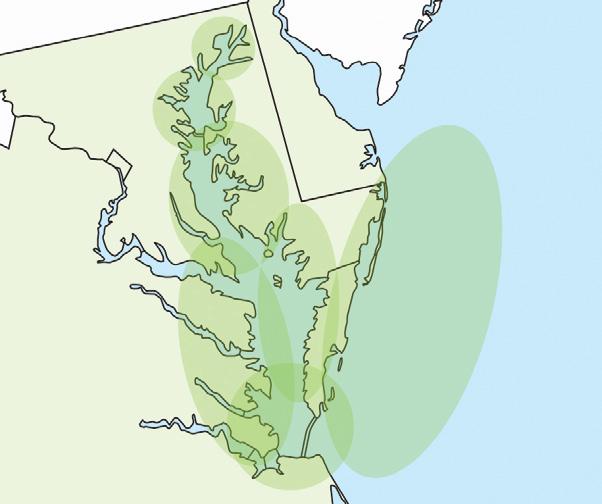
# Our weekly fishing reports include detailed intel from eight specific regions throughout the Chesapeake Bay and Mid-Atlantic.
I want everyone to understand that when I say “we” I mean FishTalk as a whole, including myself, our staff, our contributors, and — critically — you the reader. I spoke with many of you FishTalkers to gauge your feelings about making this change, as well as other ways to potentially improve the economic dynamic. We’ve had endless meetings in the office about the topic. Charging for the reports and web access may not be ideal, but it is the best way we can come up with to keep the wheels on the bus. I sincerely hope you’ll decide to sign up for the fishing reports, and help us continue bringing FishTalk to each and every corner of Chesapeake country for the 2026 fishing season and beyond.
Are you ready to embark on your next on-water adventure? Before you set sail, here are ve things to know about boat insurance.
1. Boat insurance isn’t just for accidents
With comprehensive coverage, you’ll also be protected nancially for theft, vandalism, and unexpected events like storms if you need repairs or replacements due to damage.
2. Accidents can happen to anyone
When accidents happen, boat insurance offers liability coverage for damages or injuries you cause while boating, up to speci ed limits. It can also cover lawsuit costs if you’re sued.
3. Boat insurance can cover medical payments
Boat insurance offers a range of optional medical payments coverage limits, helping to cover medical expenses if you’re in an accident or someone is hurt on your boat, regardless of fault.
4. Most lenders require boat insurance
If you nanced your boat, you’ll likely need boat insurance since most lenders require boat insurance to protect their investment. Additionally, some marinas or municipalities require proof of insurance for docking.
5. Progressive offers specialized boat coverages Ever worry about getting stuck on the water?
Progressive’s Sign & Glide® On-Water Towing coverage** can help. It’s an additional coverage that steps in if your boat is disabled or breaks down on the water, paying for on-water towing, jump starts, soft ungroundings, and fuel delivery. Fuel cost isn’t included.
Don’t let unforeseen circumstances disrupt your voyage. Cruise with con dence thanks to Progressive Boat insurance. Because when it comes to your boat, peace of mind is the ultimate luxury.
Progressive Casualty Ins. Co. and af liates. Product features are subject to policy terms and conditions and may not be available in all states or for all vehicles and coverage selections.
*No. 1 rating based on boat market share data from Rate lings.com.
**Sign & Glide® is an optional coverage you can add to any Progressive Boat policy and costs $30/annually ($50/annually in Florida). Prices are subject to change.
Scan to get a quote in as little as 4 minutes.
Go to progressive.com to learn more.
Dear Readers, Happy April Fools!
Dear FishTalk,
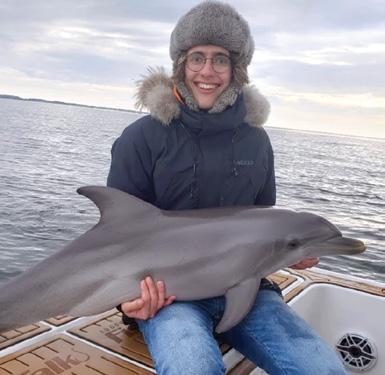
Last week I went out for an early season trip and was surprised to see there are already dolphin in the Bay around the Choptank. While we were watching the playful creatures a small and I assume young one swam up to the boat, leapt out of the water, and landed in my lap! My fast-thinking fiancé quickly snapped off this pic just before the dolphin wiggled over the side and back off the boat. It was the experience of a lifetime!
-Ryan G.
Dear FishTalk,
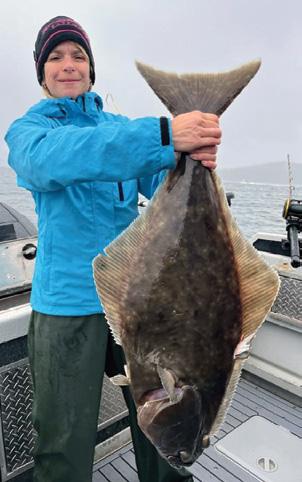
wanted to send in this catch, I’m super-proud of it. I caught this 35-pound Atlantic halibut while bottom fishing outside of Calvert Cliffs. I know the powerplant’s warmwater discharge attracts some strange catches, but I didn’t even know Atlantic halibut would enter the Bay!
-Stacey
G.
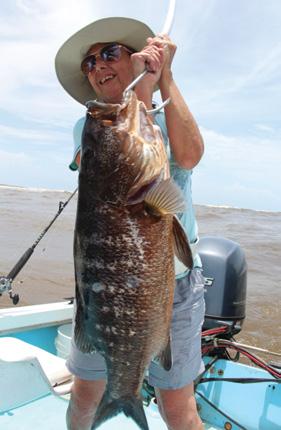
Dear FishTalk,
Does Virginia have a record for cubera snapper? This fish ate a live croaker by the third island of the CBBT last July. Since then a few friends have suggested I should have taken it to be weighed and applied for a record. Is it too late now?
-Melissa R.
Send your fish photos, questions, and comments to lenny@fishtalkmag.com
FishTalkMag.com



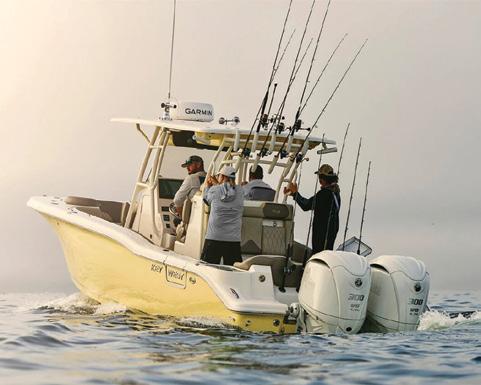

By Lenny Rudow
What exactly is “fish 691?”
This Potomac River muskie was first captured and tagged by Maryland DNR staff while electro-fishing all the way back in 2013. At the time it was a hair over 30 inches. Two years later, it was recaptured and measured at 36.5 inches. Fast forward to 2017 and it was captured yet again, now measuring 39.75 inches, and using a cross-section of a fin the fish was aged at seven years. This time the biologists tagged her with a radio transmitter, and it was monitored all summer and fall, with biologists learning that she stayed close to home and rarely left her home pool in the river. Over the winter the transmitter’s battery died, but in 2021 the fish was captured yet again. Now measuring 43.75 inches and weighing almost 21 pounds, the fish was retagged with a new transmitter—number 691—and monitored throughout the year. When the tag went dark, however, nobody saw nor heard from fish 691 for the next five years. Then on the fourth day of 2026 (for the first time ever on hook and line by a recreational fisherman), fish 691 was caught by angler Garrett Davis and reported to the DNR. Davis snapped off a few quick pictures and slipped fish 691 back into the Potomac River. Now 16 years old, she’s still out there today.
Trout stocking has been going strong since February throughout our readership area, and Maryland has announced a 26-percent increase in trout stocking this spring, with about 240,000 brown, golden, and rainbow trouts ready for planting. The state is also making improvements at the Albert Powell Fish Hatchery and expects to increase production in the future. Visit your state’s trout stocking webpage for a stocking schedule or to learn more.
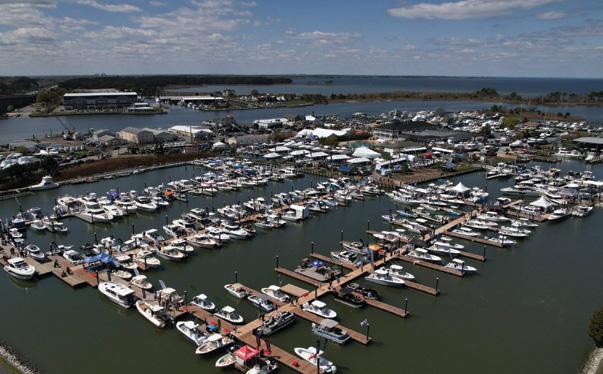
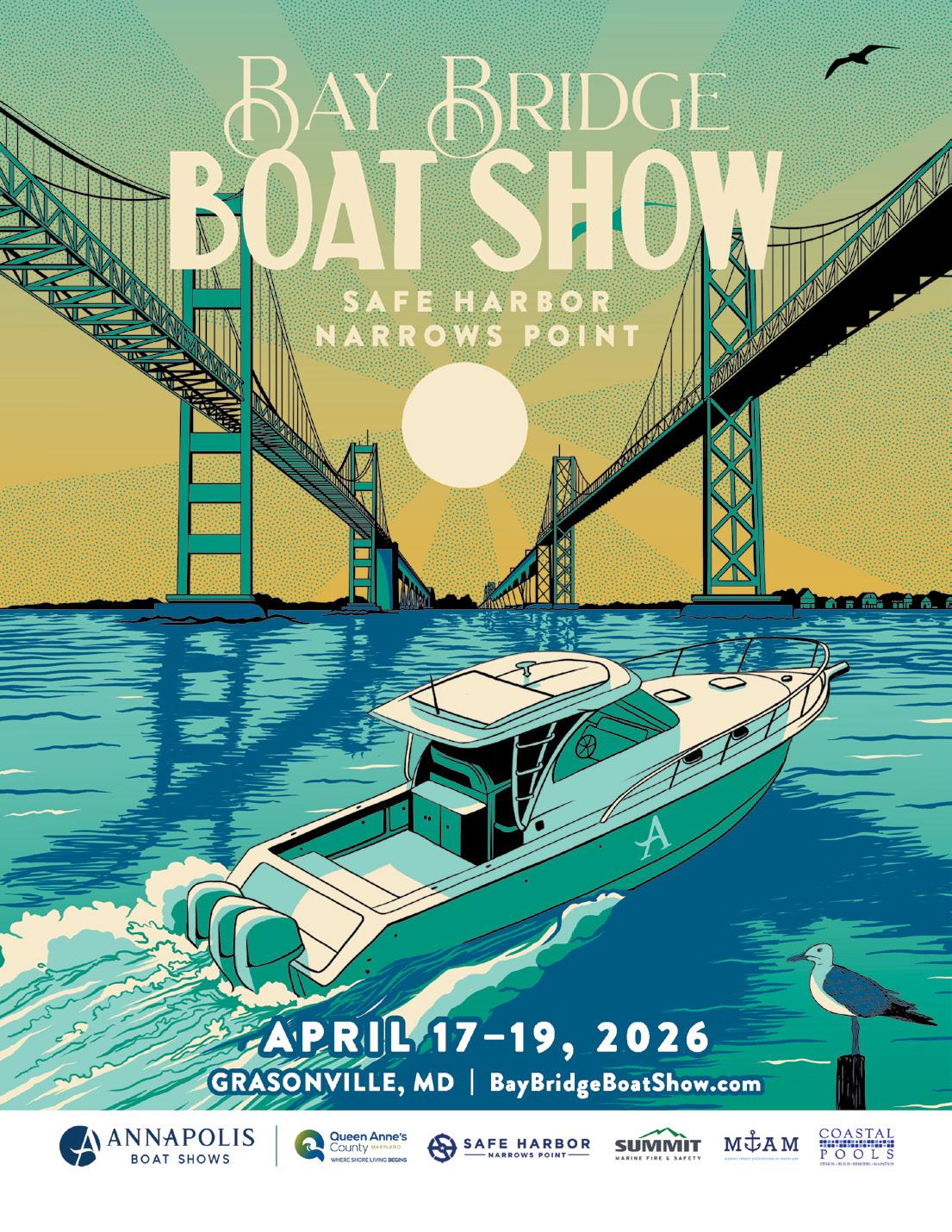
If you’re looking for a cool new fishing machine for the 2026 season, your best chance of finding one is coming up fast, April 17 to 19, at the Bay Bridge Boat Show at Safe Harbor Narrows Point in Grasonville, MD. There will be hundreds of boats on display ranging from skiffs to center consoles to pilothouses, the PropTalk Demo Dock for on-the-water sea trials, educational opportunities, and cool fun stuff like the Phillips Warf Environmental Center’s Fishmobile. Visit annapolisboatshows.com to get the full scoop or pre-purchase tickets and mark off April 17 to 19 on the calendar.
Legendary fishing guide Carroll Lee
“C. L.” Marshall, of Tangier Sound Charters, is vying for a spot in the Maryland House of Delegates representing District 38A. He’s said he is running on an Eastern Shore platform focused on supporting agriculture, fishing, and economic development. Currently a Pocomoke City councilman and having served on the Worcester County Tourism Advisory Board, Marshall has spent countless days fishing on the Tangier Sound and Chesapeake Bay and would bring that perspective to Annapolis.
“I get to share every day with a new group of folks who love the Chesapeake experience,” he says. “During this time I learn much about their connection with the Bay and feelings about the things that occur around it. Trust me, you can learn more about a man fishing with him than you can in any interview. I’ll be consistent in defending the Chesapeake, the Lower Shore counties, our farmers, and our fishermen.”
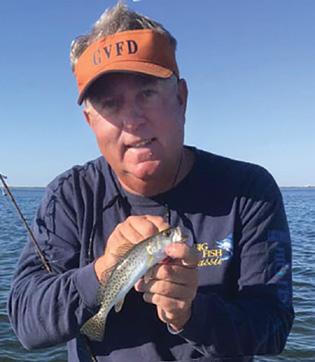
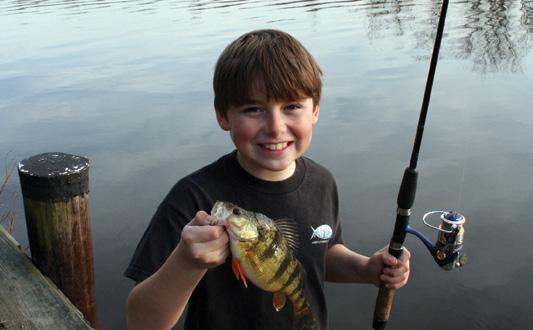
Kid’s Fishing Days throughout the state of Virginia are kicking off for the spring. Many provide equipment and instruction and take place in waters where the Virginia Department of Wildlife Resources has stocked trout; visit the Virginia DWR Kids Fishing Days webpage for dates and details. Maryland’s Youth Fishing Rodeos are also cranking up for 2026, providing kids with fishing opportunities across the state. With a full slate of events running this month through the summer, there are dozens of rodeos planned in 15 different counties, most of which provide all the gear and bait you need to put a smile on that young angler’s face. Visit the DNR Youth Fishing Rodeo webpage for details.
A# You want to make a kid smile? You know what to do—check out the kid’s fishing events coming up throughout Chesapeake country.
pril is a big month for flounder anglers who have been waiting for the spring invasion of flatties up and down the coast. And they’ve also been waiting for Captain Zed’s annual Spring Flounder Tournament, which starts on the 24th and runs all the way through Sunday, May 3, in Wachapreague, VA. This competition boasts a hefty $5000 top prize for the heaviest flounder weighed in, along with additional prizes for junior and female anglers. Visit theislandhouserestaurant.com to find out all the specifics. April 24 through May 3 is also the stretch of angling action for Captain Steve’s 2026 Spring Flounder Tournament, based in Chincoteague, VA. There are over $2500 in winnings on the line in cash and prizes in this one; visit stevesbaitandtackle.com to learn more. April 24 certainly is a popular date among flounder anglers, because it also marks the start of the Frederick Saltwater Anglers Club Flounder Frenzy, in Chincoteague, VA. Fishing runs through the weekend, and the total weight of your top four fish stringer wins. Visit wefishsalt.com to learn more about Frederick Saltwater Anglers and the Flounder Frenzy.

Editor’s Note: We wish we could personally test every item that appears on these pages, but that simply isn’t possible. So that you know the difference between when we’ve physically tested a piece of gear and when we’re writing about it because it’s newsworthy and we think you’ll want to know about it, we’ve developed this FishTalk Tested button. When you see it printed next to something in this section, it means we’ve personally run it through the wringer.
You say you wish you had all of the kayak fishing intel ever produced by Team FishTalk within easy reach? You can now make that happen, because the second book in the FishTalk library is now in print. “FishTalk’s Guide to Kayak Fishing the Chesapeake and Mid-Atlantic” includes 50-plus articles—over 41,000 words—dedicated to helping peddlers and paddlers catch more, bigger fish.
The book is divvied into four different sections, including:
• Kayak Fishing Tactics
• Species-Specific Tactics
• Chesapeake Region Kayak Fishing Where-to
• Fishing Kayak Rigging and Gear
There are pieces covering the tactics you need to know to target just about every species found in Chesapeake Country, both saltwater and fresh. There’s also a healthy dose of intel on where to try kayak fishing, including launch points and site-specific angling intel. And we’ve put together reams of info on how to choose, rig, and customize your mini but mighty angling machine. If you’re a FishTalk reader then you already know this information is solid. If fact, we even back it up with our patented guarantee: If this book doesn’t help you catch more, bigger fish, we’ll eat our bait!*
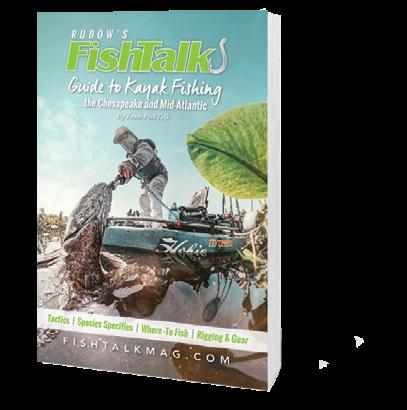
The information in this book comes from seven different authors, all known for being straight shooters as well as top casters. As you may have guessed, there’s a ton of contributor Eric Packard’s words of kayak fishing wisdom on these pages, as well as a healthy dose of kayak fishing—and even some kayak crabbing—advice from FishTalk’s own Zach Ditmars.
We know that the kayak angling crew is an enthusiastic one, and being a member of the Plastic Navy requires very specific gear, modulated tactics, and a different kind of attitude. If you know exactly what we’re talking about, you’re going to love “FishTalk’s Guide to Kayak Fishing the Chesapeake and Mid-Atlantic.” Price: $24.99. Visit FishTalkMag.com and click on the “Store” tab or order from Amazon to soak up the intel. *If we’re fishing with soft crabs or shrimp.
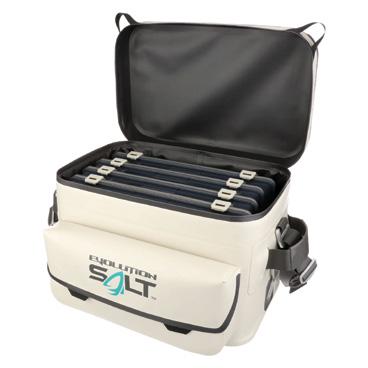
ou drive a Bentley, dine on fillet, fish from a quad-engine center console, and you’re looking for a new tackle bag? The Evolution Sol 25 Saltwater and its big brother the Sol 65 are right up your alley. These tackle bags may be the most expensive that we’ve ever seen, but they’re constructed to be the best of the best. The shells are 840D TPU nylon, hardware is aluminum, the top hatches and bases are foam, and enclosures are magnetically secured. The 25 comes with four 3700 waterproof tackle trays and has a front bulk pocket, with 25 liters of total storage capacity. The Sol 65 holds five tackle trays and has room left over for a full day’s gear. If you’re sick and tired of tackle bags that fall apart after a season or two—or you just want to impress your fishing buddies—these should do the trick. Now the moment you’ve all been waiting for: Price is $349.99 for the 25 and $599.99 for the 65. Visit saltbyevolution.com if you fish with a blank check.
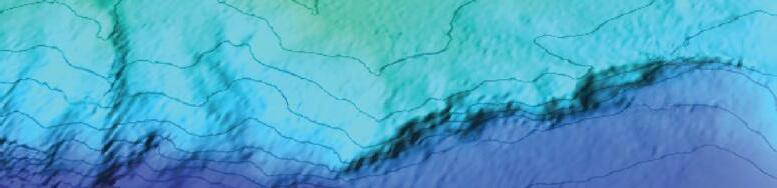
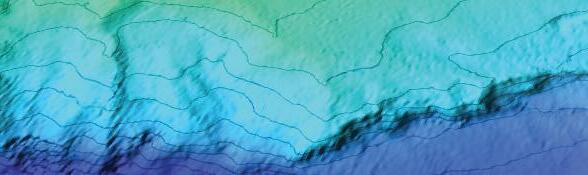


















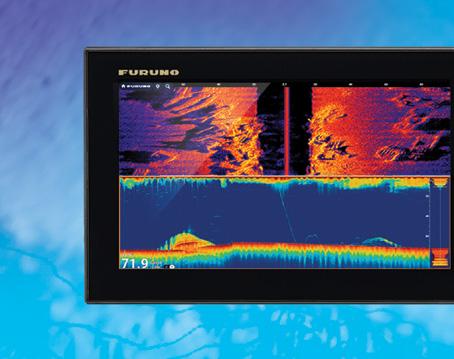
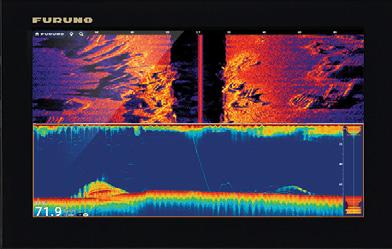








































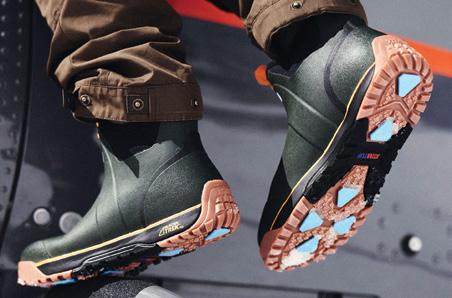
It’s tough to find a good pair of deck boots, but it’s even tougher to find a good pair of deck boots that keep your feet warm in January and February (especially this past winter!!). That’s when we tested out a pair of Xtratuf Ice Fleece Lined Ankle Deck Boots. And we not only wore them on the boat, we also tried them out during a day of ice fishing. That’s not as crazy as it sounds, because these deck boots have Xtratuf’s “Glacier Trek Pro” ice-gripping compound on the soles. And the conditions were ideal to put them to the test, because after the sun shined brightly for an hour or two there was a skim of water over super-slick ice. We found these boots significantly grippier than the norm and while we wouldn’t say it’s like wearing ice cleats, we will note that a couple of the anglers who were not wearing these boots wiped out a time or two. We also found them plenty warm, and with temperatures ranging from the mid-20s to the mid-30s and two layers of decent socks on, our feet never felt chilly. We also loved the easy-off pull loops. These boots are 100-percent waterproof and come in sizes 7 to 14 for men and 5 to 11 for women.
Price: $140. Visit xtratuf.com and your feet will thank you.
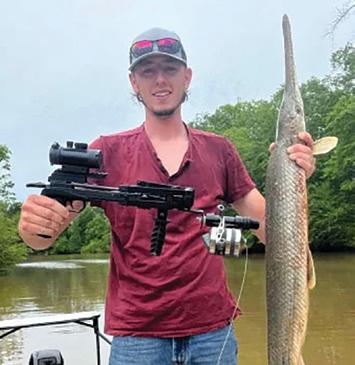
If you love bow fishing but you hate tugging on that pesky drawstring—or maybe you just wish you could tug a lot harder—you’ll be interested in the Ballista Bat. This crossbow is designed for all sorts of bolt-based activities including bowfishing, and has an attachment in the front for the bowfishing reel of your choice. It doses out a potent 130 pounds of pull (they claim the most of any compound pistol-style crossbow in the world), shoots at 300 FPS (enough for land-based hunting, too), and can be reloaded in two seconds. Yes, if you miss that fish your bolt might go deep enough into the mud to open a new spring. No, you usually can’t spot fish that are out of range with a normal bow when bowfishing at night anyway. But who cares? Using this thing you could take down a blue cat the size of a Volkswagen.
Price: $299.95. Visit ballista.co to shoot right through those snakeheads.
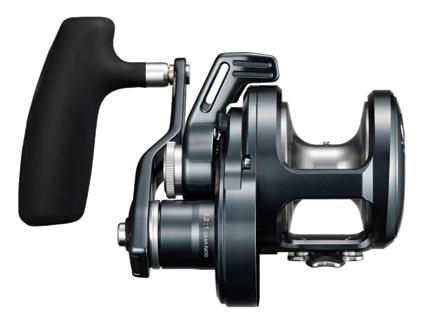
The Shimano Ocea LD is a new conventional big-game jigging reel that can take on just about anything you can hook. It puts out an arm-ripping 44 pounds of drag, holds 560 yards of 40-pound Power Pro or 340 yards of 65-pound, and comes in 5.7:1 (42” per crank) or 6.2:1 (46” per crank) gear ratios. Six ball bearings keep those cranks smooth as silk, and the reel weighs in at 24.3 ounces. Shimano says that a new drag design boosts force while decreasing side-load pressure, resulting in 30 percent lighter rotation during battle.
Price: $649.99. Visit fish.shimano.com to check it out.
By Zach Ditmars
Magellan Outdoors released a new line of fishing apparel designed in collaboration with pro angler Jacob Wheeler. I met Jacob a few times at the ICAST fishing tackle show and we’ve watched him compete in tourneys a bunch on TV—honestly, he’s a pretty cool dude so I was happy to try out his new threads.
The Long Sleeve Camo Canvas Shirt Jacket is made of washed cotton canvas and has four zippered pockets. The material feels quite durable with reinforced elbows. This will come in handy trudging through the brush as I hike to those hickory shad spots this spring. Bonus, it has one of those sunglass chamois thingies inside on the bottom of the front. The reversible Insulated Long Sleeve Jacket features a water-repellant polyester shell on one side and a 60-percent cotton, 40-percent polyester flannel on the other. I wore this relatively lightweight jacket out fishing on a cold December day and was impressed by how much warmth it provided while I was cruising down the Patapsco. That’s due to the Seawool faux down insulation, which is made from oyster shells and recycled plastic water bottles. The 60-percent cotton, 40-percent polyester blended lightweight Angler Flannel Hoodie, meanwhile, is super soft and comfortable, and moisture wicking fabric and UPF 50 sun rating make this a great choice for brisk spring and fall fishing days. Buttoned chest pockets with zippered side pockets give you plenty of places to stash your jigs. Ouch— my finger! I always forget when I put those in there...
These new performance-fitted clothes from Magellan are designed to be stylish for casual wear but with all the technical capabilities suitable for fishing. Price: $79.99/$49.99/$37.48. Get dressed at academy.com.
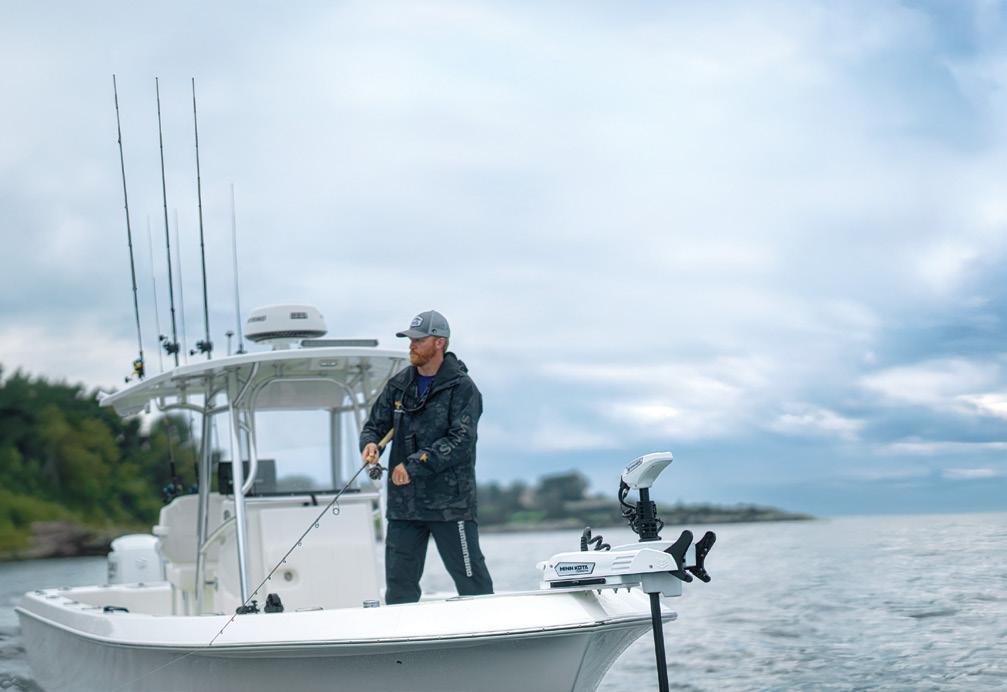
Imagine if all you had to focus on was fishing
Minn Kota® Riptide Terrova® trolling motors are built to deliver saltwater dependability, season after season, so you can own your spot and stay locked into the moments that matter.
By Zach Ditmars
Freedom Baits USA is a lure company based on Maryland’s Eastern Shore. You may recognize their Bare Knuckle Shad soft plastic from the world-famous Roy Rig. These baits have a unique caudal fin above the paddletail, giving them an aggressive swimming action. They come in several sizes, from 2.3” up to 8”, and are available in a variety of colors. The silver mullet color is a great bunker imitation, and the rockfish were quick to snatch them up. The Bare Knuckle Shad is a great offering for a variety of fresh and saltwater species. They pair up nicely with their Lights Out Jig Heads which come in 3/16-, 1/4-, and 1/2-ounce sizes. Price: $5.99 per pack. Check them out at freedombaitsusa.com
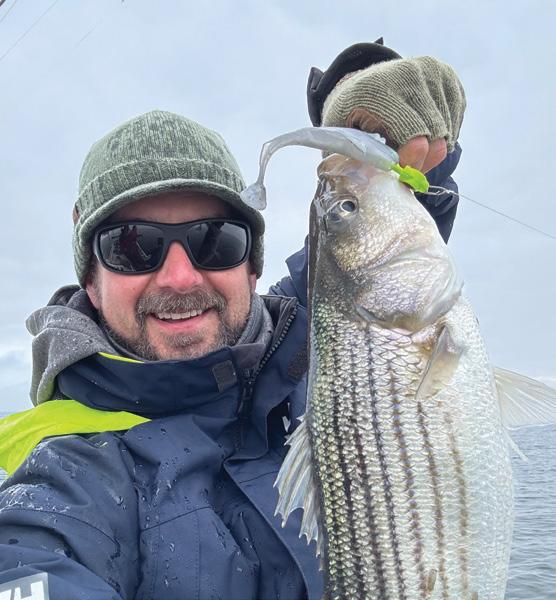





This month we talk with Captain Jason Yost, who specializes in light tackle and fly fishing in southeast Virginia’s saltwater and marsh systems.
Q: When you’re on the hunt for specs and reds, what are the top three factors you look for in a spot?
A: The first thing I would look for would be bait. The second thing I look for is some kind of current and preferably an outgoing tide as opposed to an incoming—as long as there’s water moving. The third things I look for are water temperature, the sky conditions, and the water depth all combined. If I’m looking for reds, I like to be around oysters, grass, or marsh.
Q: What’s your favorite light tackle lure for redfish and speckled trout?
A: My favorite lure for reds and specs would be a jig head with plastic. I use a lot of Zman and Slick lures, on heads anywhere from the 1/8th ounce up to a 1/2 ounce. My go-to colors seem to be purple demon, new penny, and white. For reds I also like Buggs Baits. They make an amazing jig that the reds absolutely destroy. When fly fishing I use a lot of critter flies for reds. They are simple crustacean-looking flies that I make with little eyes, a lot of black and purple, or natural colors. For the specs I use a lot more Deceiver flies or baitfish patterns. For those the colors include pink/white, orange/ white, and purple/yellow.
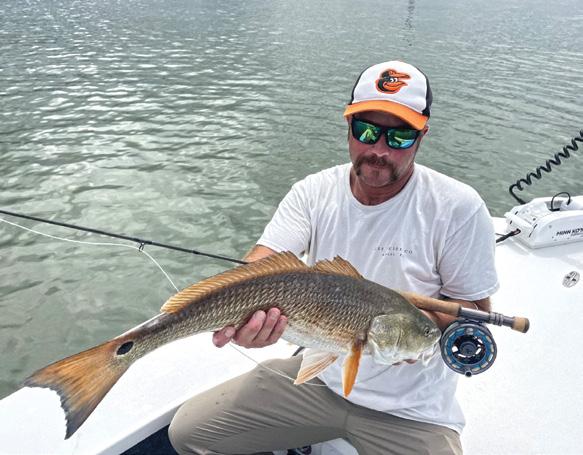
Q: You fish from a boat that’s very specialized. Tell us a little bit about it and why you choose it.
A: After a lot of research and consideration I chose a flats boat. It was a hard decision at first because we have a lot of big water around here, but we also have a lot of places that I fish off of the beaten path. I run a 17’ Mitzi skiff, a solid rig built in North Carolina. It has a 60 horse Suzuki and a polling platform and I have a 23’ carbon-fiber push pole. I can get as shallow as a few inches, with two anglers in addition to myself on the boat, which comes in very handy when I’m fishing for reds. It’s the perfect skiff for sight fishing, has a large casting deck, and is comfortable. This type of boat does not make a lot of disturbance in the water and is very stealthy.
Q: You sometimes target tarpon and that’s sort of the “Holy Grail” of fish for a lot of Chesapeake anglers— people see them, but can’t get them to eat. Give us your top tips for getting a tarpon on the line
A: These first seem to only eat when they’re ready to eat... Live bait and fresh bait are a definite go-to for fishing for them, but they’ll also eat a fly that’s properly presented. I typically throw tarpon bunnies or tarpon toads that I tie, with a lot of black and purple. For live bait and fresh bait, I use float rigs and a weighted bottom rig very similar to a Hatteras-style red drum rig.
Q: You take lots of different people fishing so we’re betting you see plenty of mistakes. What’s the worst mistake you see anglers make on a regular basis?
A: I see anglers setting hooks too soon, and horsing fish too much which leads to pulling the fish off or breaking the line. With fly fishing I mainly see bad casts or too many false casts, and also strip-setting the hook too hard or holding on for too long after setting the hook, which can break the leader.
Q: Open mic time: what do you want to tell everyone out there that we haven’t covered?
A: I’d love to get some better conservations going out there for the fish. I don’t mind keeping fish but be realistic about how much you need. A lot of fish end up freezer-burned and thrown out, and the last two winters have been hard on the fish. Handling fish poorly is something I see done, too. Use good judgment when picking them up, make sure the surface is wet, and properly release them. As for tarpon, leave them in the water, fight them as quickly as possible, and leave their scales alone… and don’t report the catch, lol!
Thank you, Captain Jason! If you’re interested in a trip with Custom Tides Guide Service, visit customtidesguideservice.com, email customtidesguideservice@yahoo.com, or give Captain Jason a text or call at (757) 650-2291.
One of the most difficult ways to learn how to fish the Chesapeake Bay and Atlantic Ocean is trial and error. Then there’s the boat issue; we don’t all have one. Luckily, the Bay is full of knowledgeable guides and charter captains ready to show you the ropes. Below you will find a directory of professional guides, charter boats, and head boats to get you started on your quest for the perfect fish. Whether you like to fly fish, troll, or bottom fish, there’s likely a local expert who can lend a hand.














1 Free State Fly Fishers Club Meeting Mark Stanley, MD DNR Central Region Freshwater Fisheries Manager, will present on the Gunpowder River fishery. 7 to 8:30 p.m. at the FSFF Club House, Davidsonville Family Rec Center, 3789 Queen Anne Bridge Rd, Davidsonville, MD 21035.
2 Live with Lenny! Tune in Thursday at 6 p.m. on Facebook or YouTube for a new episode. Presented by CCA Maryland.
4 Free State Fly Fishers Tying Session Mark Bange ties some favorite panfish flies. All materials are provided. Bring your vise and tools. Limited availability of tools for new fly tyers. 10 a.m. to 12 p.m. at the FSFF Club House, Davidsonville Family Rec Center, 3789 Queen Anne Bridge Rd, Davidsonville, MD 21035.
8 Frederick Saltwater Anglers Monthly Meeting 6:30 p.m. at 289 Willowdale Dr, Frederick, MD 21702. Speaker and vendor TBD.
11 CCA Central Region Chapter Annual Celebration of Conservation 6 to 9 p.m. at Linganore Wine Cellar in Mt. Airy, MD. Oyster bar, dinner, open bar, live music, raffles, silent and live auctions. This fundraising dinner directly supports CCA Maryland’s focus on ensuring the health of our marine resources and anglers’ access to them, and our objective to conserve, promote, and enhance our marine resources for the benefit of the general public.
15 Annapolis Anglers Club Monthly Meeting Speaker, food and drink, table raffle, and 50/50. Food starts at 6 p.m., followed by meeting at 7 p.m. At the American Legion Post 7, Crownsville Road, Annapolis, MD.
16 CCA Southern Maryland Chapter Angler’s Night Out 5:30 to 7:30 p.m. at Ruddy Duck in Solomons, MD. Free and open to the public. Speaker TBD.
17-19 Bay Bridge Boat Show at Safe Harbor Narrows Point Friday through Sunday at Safe Harbor Narrows Point in Grasonville, MD. Climb aboard a wide array of powerboats of every style and size. Also, plenty of on-site parking available, food and beer stations, and live entertainment. Tickets: baybridgeboatshow.com
18 Free State Fly Fishers Saturday Hands-On Session Mark Bange will share his expertise in catching panfish on the fly and explain why it can make you a better fly fisher overall. 10 a.m. to 12 p.m. at the FSFF Club House, Davidsonville Family Rec Center, 3789 Queen Anne Bridge Rd, Davidsonville, MD 21035.
21 Essex-Middle River Fishing Club April Monthly Meeting The guest speaker will be Francis Zell on Preparing for Fishing Trips. Held at the FOP Lodge 34 located at 730 Wampler Road in Middle River, MD 21220. Meetings start at 7:30 p.m. Open to all. Food and drinks are available.
21 PSWSFA Monthly Meeting Peninsula Saltwater Sportfisherman’s Association. Regular monthly meetings are held on the 3rd Tuesday of the month at 7 p.m. at Peninsula Baptist Church (2605 Cunningham Dr., Hampton, VA). Meetings consist of an educational speaker, monthly tournament awards, and a discussion of fishing news and club business. Meetings are free and you do not need to be a member to attend.
22 Free State Fly Fisher “Beer Tie”
Eat, drink, tie, or just hang out. Bring your vise, tools, and materials and/ or fish stories. Not instructor-led, but everyone helps each other out. 6 to 8 p.m. at Killarney House Irish Pub (584 W Central Ave Davidsonville, MD, on the heated, enclosed front porch. Look for tying vises and FSFF hats).
24 FSA Etzler Flounder Frenzy Frederick Saltwater Anglers. Location: 2246 Curtis Merritt Harbor Dr, Chincoteague, VA 23336.
27 Regulations and Procedures for Inspected and Uninspected Passenger Vessels Presented by CAPCA. 7 to 8:30 p.m. (hybrid event): in person at the Annapolis Elks Lodge and online on Zoom. Free. Speaker: Chief Warrant Officer 2 (CWO2) Christopher Clark.
2 Anne Arundel County River Days
11 a.m. to 3 p.m. at the Smithsonian Environmental Research Center in Edgewater, MD. All events are free and open to the public. Each festival will feature fun activities for all ages, including boat rides, water activities, environmental educators, live music, games, crafts, food trucks, and more. Boat rides are free, but capacity is limited and tickets will be available first come, first served.
2-3 Havre de Grace Decoy and Wildlife Art Festival
The 44th annual festival takes place indoors at the STAR Centre (700 Congress Avenue), featuring waterfowl decoys, art, and collectibles. May 2 (9 a.m. to 5 p.m.) and May 3 (9 a.m. to 3 p.m.). Admission costs $10 for the weekend.
2-3 Susquehanna Flats Marine Exhibition
This outdoor event features boat dealers, marine services, and more and will be held in conjunction with the Havre de Grace Decoy and Wildlife Art Festival at the STAR Centre (700 Congress Avenue). Free admission for the marine event. May 2 (9 a.m. to 5 p.m.) and May 3 (9 a.m. to 3 p.m.). Send questions to president@ decoymuseum.com
6 Free State Fly Fishers Cub Meeting
Join us for a “smorgasbord” of presentations, about 10 minutes each, of club members’ favorite fly fishing trips over the last year(ish). 7 to 8 p.m. at the FSFF Club House, Davidsonville Family Rec Center, 3789 Queen Anne Bridge Rd, Davidsonville MD 21035.
10 Mother’s Day Take mom fishing!
13 Frederick Saltwater Anglers Monthly Meeting
6:30 p.m. at 289 Willowdale Dr, Frederick, MD 21702. Speaker and vendor TBD.
14 CCA Annapolis Chapter Angler’s Night Out 5:30 to 7:30 p.m. at West End Grill in Annapolis, MD. Glen Odor of Big Fish Daily will introduce Fishtechy, an innovative AIpowered system that instantly measures fish from a simple photo. Free and open to all.
16 Free State Fly Fishers Saturday Hands-On Session
Andy Grosko, FSFF past president, will examine the invasive fish species found in local and regional waters and their effect on our fly fishing experiences. 10 a.m. to 12 p.m. at the FSFF Club House, Davidsonville Family Rec Center, 3789 Queen Anne Bridge Rd, Davidsonville MD 21035.
19 PSWSFA Monthly Meeting Peninsula Saltwater Sportfisherman’s Association. Regular monthly meetings are held on the 3rd Tuesday of the month at 7 p.m. at Peninsula Baptist Church (2605 Cunningham Dr, Hampton, VA). Meetings consist of an educational speaker, monthly tournament awards, and a discussion of fishing news and club business. Meetings are free and you do not need to be a member to attend.
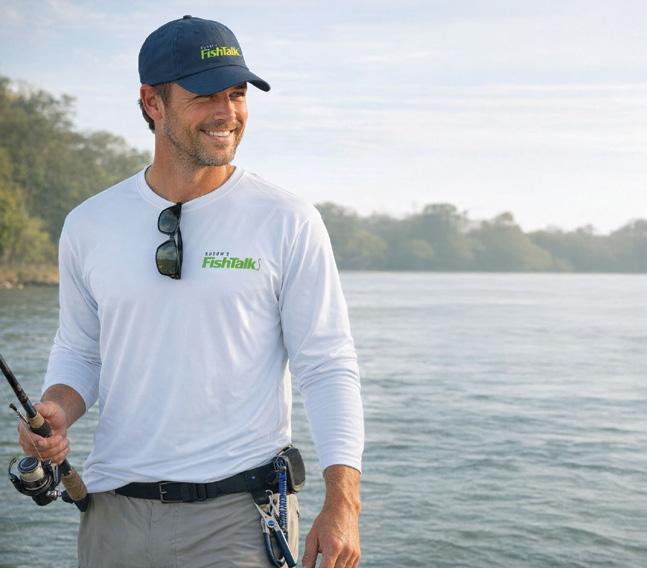
This garment-washed 100% cotton twill cap has the FishTalk logo embroidered on the front. One size fits all
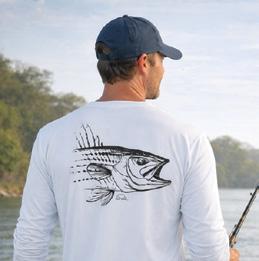
Moisture wicking UPF 44+ performance shirts with original artwork by Eric Packard on the back. Available in short or long sleeve in men’s, women’s, and youth sizes.

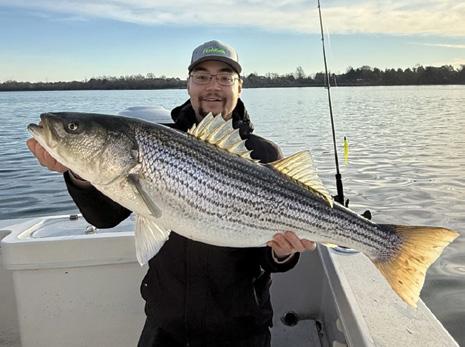
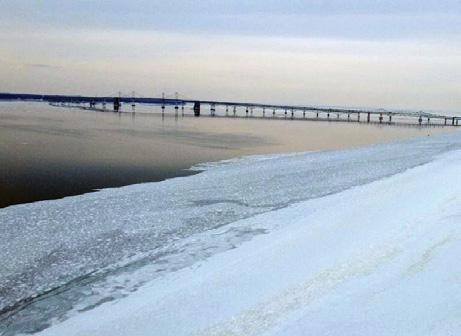
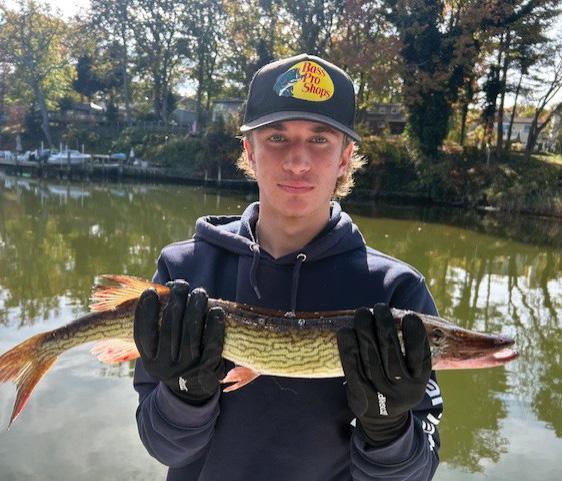
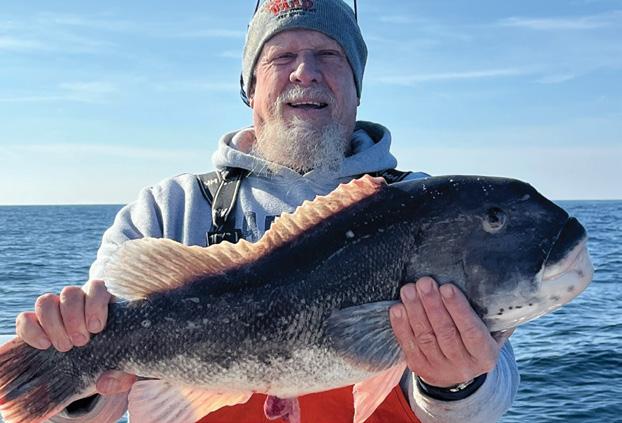
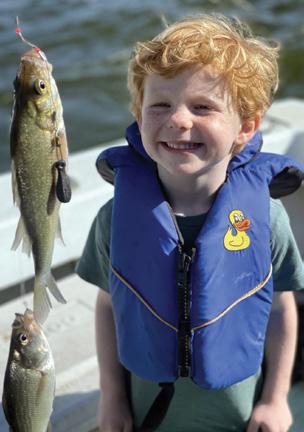
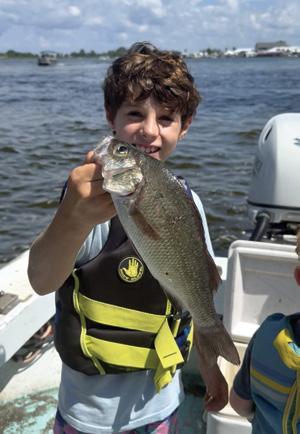
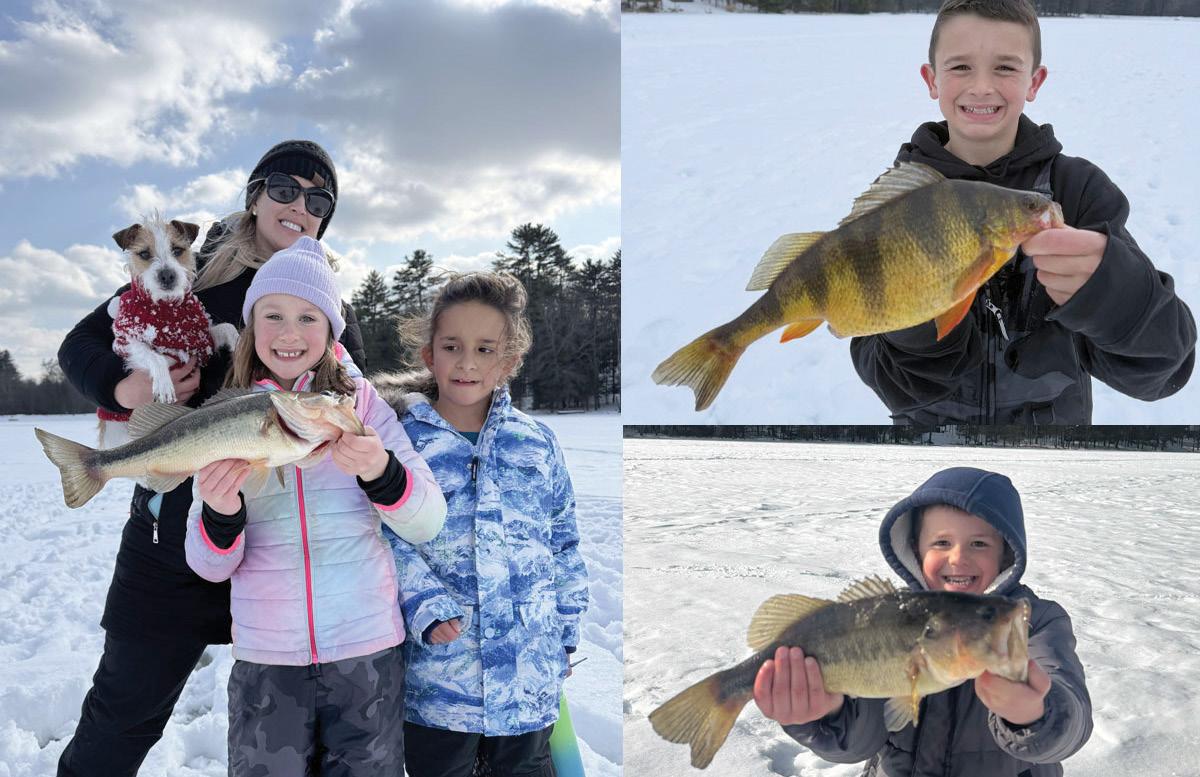
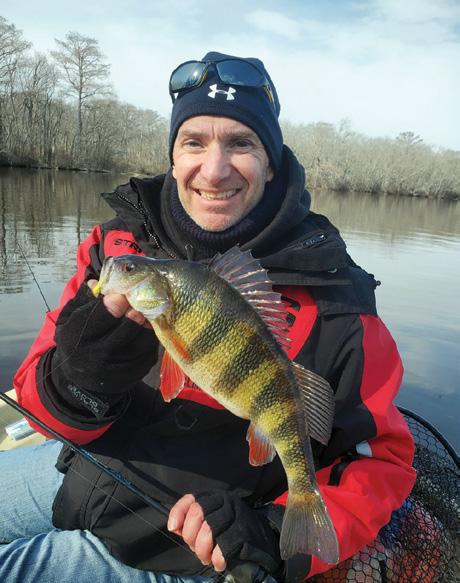
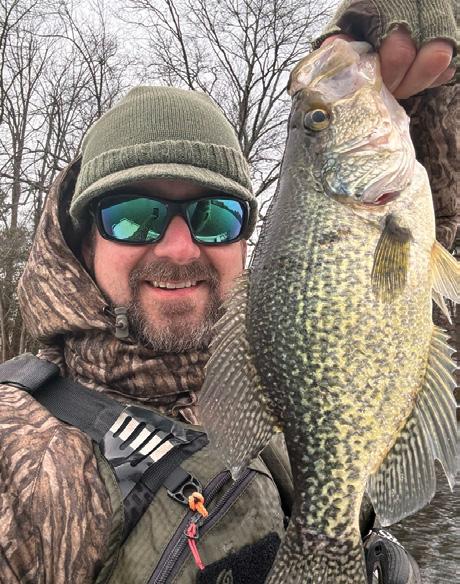
# Yes it was cold out there, but that didn’t stop Kevin from having some fun.
# During the difficult winter months our Reports Editor Dillon Waters looked longingly at what might be…
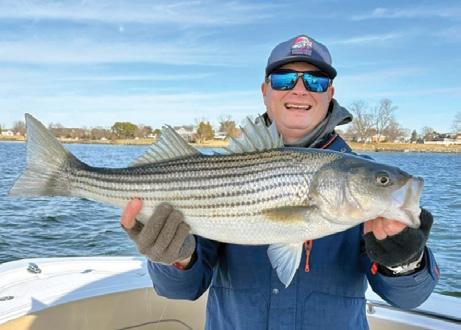
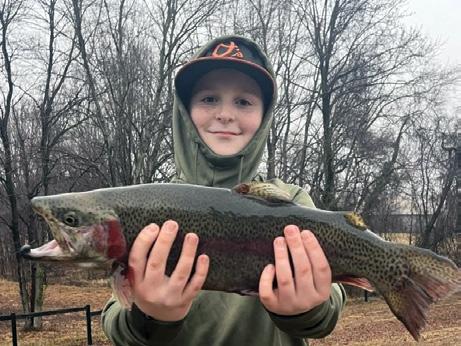
got
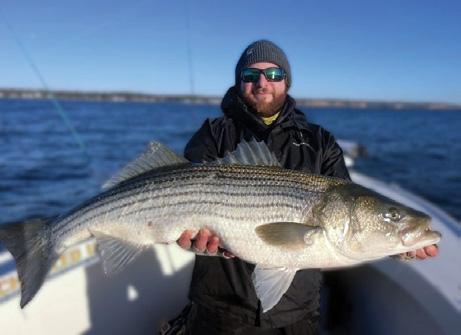
the
# Eric made it through the long, long winter with some fishing between the cold-blasts.
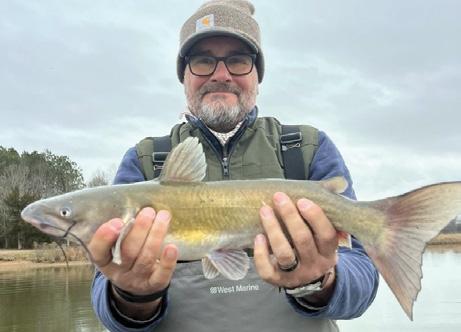
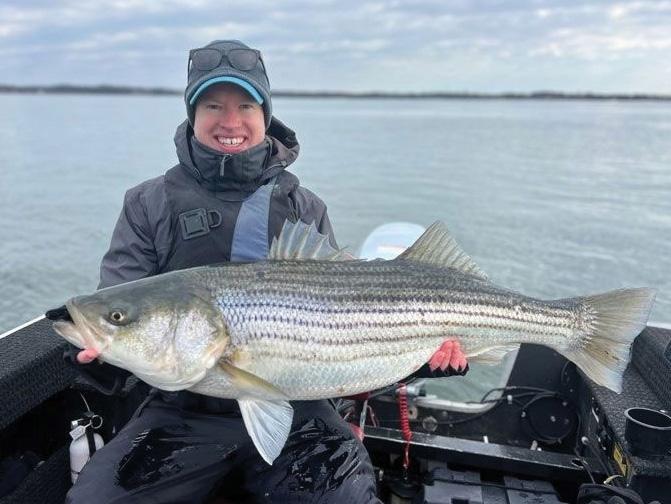
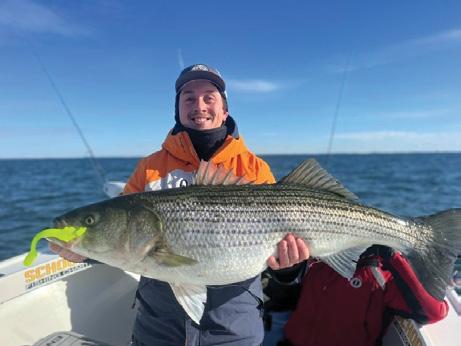
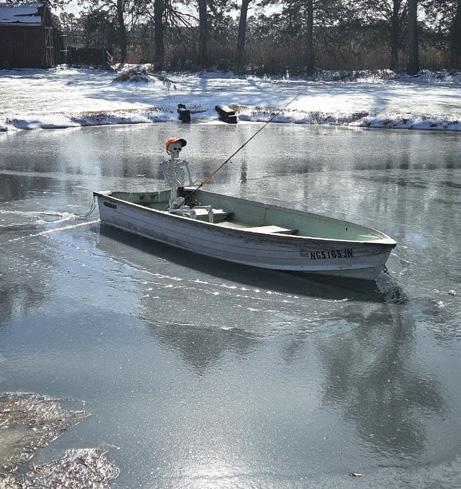
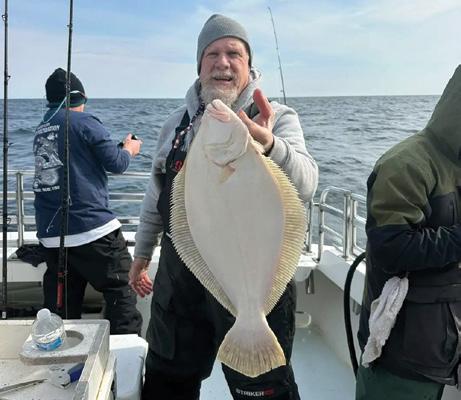
out
this February when he caught the first flounder of 2026—and then caught a second one.
By Lenny Rudow
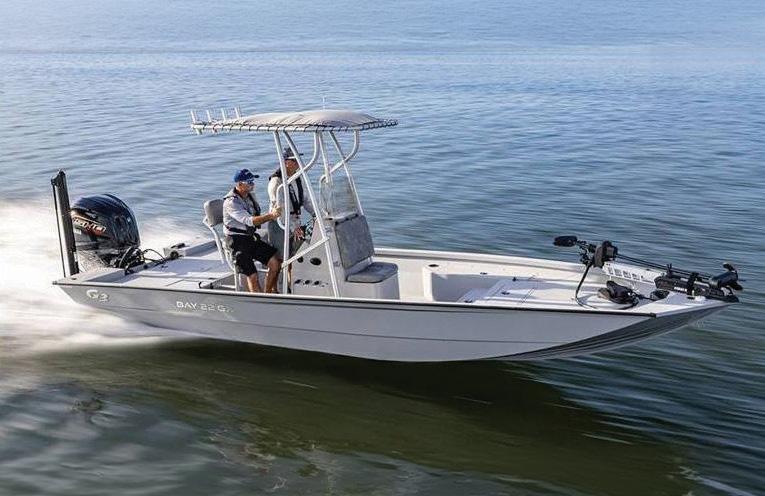
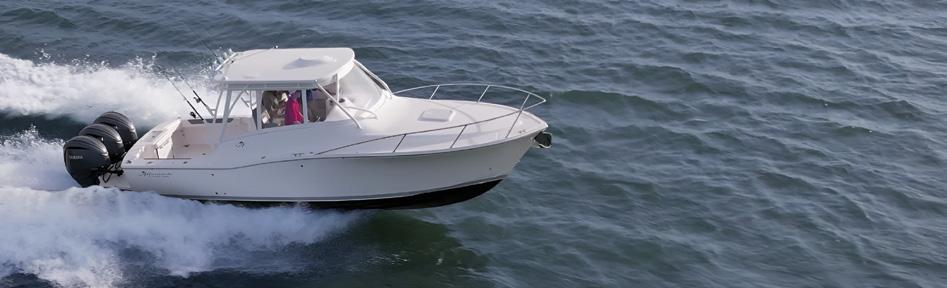
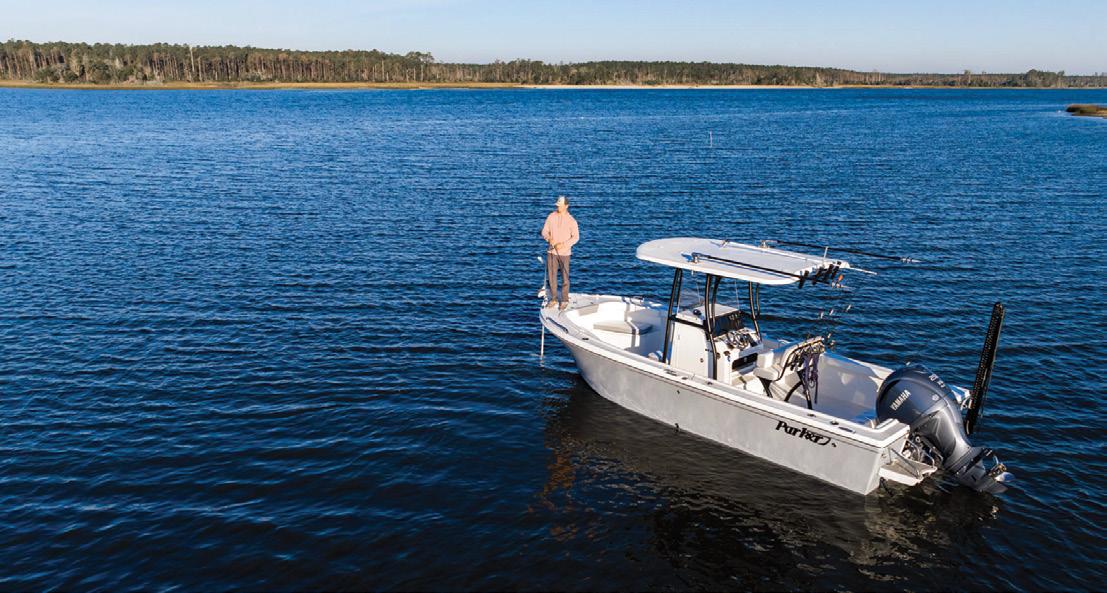
Just what is the perfect sized boat for fishing the Chesapeake’s myriad waterways? Something that can take you everywhere from creeks and marshes to the CBBT, and maybe even out into the ocean when conditions are right? Truth be told there’s no one answer to this question because everyone has their own priorities and limitations—this is a judgment call and the best call will change from person to person. That said, an awful lot of anglers out there would land on something between 21 and 26 feet long. Something like the Parker 230 Coastal Elite.
Anyone who pays attention to the world of fishing boats will know that Parkers have undergone a lot of evolution in recent years, and the 230 Coastal Elite is certainly a good example. The interior is significantly upgraded from old-school Parker center consoles, with more comfortable cushions available in a slew of colors and patterns, coaming bolsters all around, powder-coating on the T-top, and a longer list of standard features (including goodies like a Garmin GPSMAP 1242xsv, a console pad with a wireless cell phone charger, and a six-speaker Wet Sounds stereo system). But the boat’s construction
has been brought up a notch, too, with touches like Coose core in the transom and gunwales of the full fiberglass liner. Note that this boat now comes with a lifetime limited hull warranty that’s transferrable to a second owner.
The hull design of the 230 Coastal Elite is that of the Parker Mod Vs, which minimizes draft, maximizes stability, and gives you an edge when it comes to accessing shallow water hotspots. Opt for the 75” Garmin Force Kraken trolling motor on the bow, and you’ll soon be sneaking through 15” of water while you toss those poppers and chuggers. The bow has flanking seats that do double duty as elevated casting positions (there’s an option for a full forward platform), and unlike many boats of this nature the gunwales and forepeak are wide enough to stand up on and cast, too.
Rod holder placement is an angling highlight, with eight standard-issue flush-mounts in the gunwales, four fore and four aft. The T-top sports four rocket launchers plus a pair of kingfish holders. There are a couple of options for the leaning post, and while the stock model has four rocket launchers with a cooler spot underneath the one we like best sports five rocket launchers, a 30-gallon insulated livewell, plus tackle
LOA: 23’2”
Beam: 8’6”
Displacement: 4200 lbs.
Draft (hull): 1’3”
Transom Deadrise: 16 degrees
Fuel Capacity: 109 gal.
Water Capacity: 10 gal.
Max HP: 300 hp
stowage. Additional angling goodies include under-gunwale racks (for rods up to 7’6”), spreader and courtesy lights, and options for dual Power Poles.
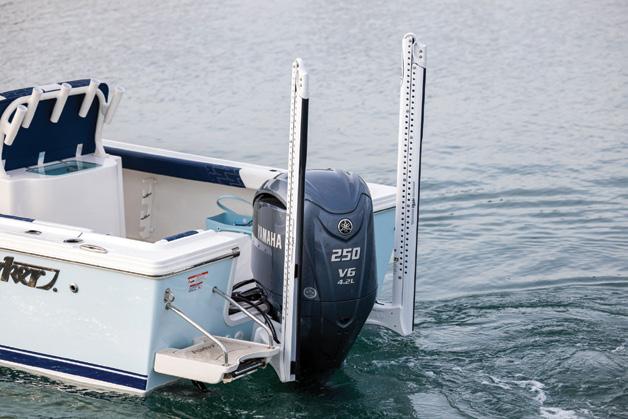
The 230 Coastal Elite is available with Yamaha power up to 300 horses, the stock motor being an F200. With the F200 you’ll be cruising in the low 30s and topping out at around 40 mph. Up the ante and enjoy speeds in the mid- to upper-40s. As you do so be sure to find some waves and see how the boat feels underfoot. While some old-school Mod V models had a reputation for getting bumpy when running fast in choppy waters, the modern construction methods and materials now used by Parker changes the dynamic. Also be sure to jump
# Power poles, upgraded leaning posts, and bow-mount trolling motors are all in the mix.
from side to side and stand up on a gunwale to get a feel for just how stable a platform it provides.
Of course, a boat’s size, how fishable it is, or how much you might want it is irrelevant if the price tag is out of your ballpark. And when looking at the numbers we found that the 2300 Coastal Elite is actually a nice surprise. Despite delivering a good number of high-end perks the boat is priced a lot more reasonably than many in this day and age. We eschew putting numbers down in ink on these pages because so many variables are involved and boat pricing changes so much, but if you look at the current MSRP on the website you’ll be looking at a real-world number for a well-rigged boat. And if you judge a 23-footer to be ideal for your purposes, the 2300 Coastal Elite is definitely a boat you’ll want to check out.
For more information visit the Parker Boats website or FishTalk supporters Legasea Marine, Yorktown, VA (757) 898-3000, legaseamarine.com; and Tri-State Marine, Deale, Middle River, and Annapolis, MD (410) 867-1447, tristatemarine.com
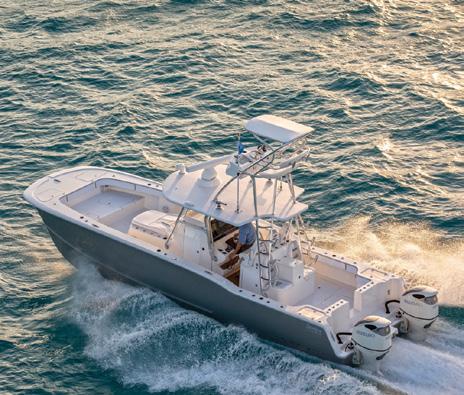
Where can you find a splash of North Carolina in the southwestern Pacific? Simply head for the Makaira Boats plant in Northland, New Zealand, where the hulls feature Carolina flare. Wait a sec—it might be just a tad bit easier to roll over to the Eastern Shore and visit Cambridge, MD, because you can now find Makaira boats there, too, at Black Dog Marine.
Why would one want to check out a Makaira in the first place? These are very unusual, downright exceptional boats, and when we first set foot on a Gen3 26 we were absolutely blown away. The first thing you need to know about the Makaira Gen3 26 is that it’s aluminum, not fiberglass. But it’s constructed in such a way that the downside to most aluminum boats, a drumming and/or flexing
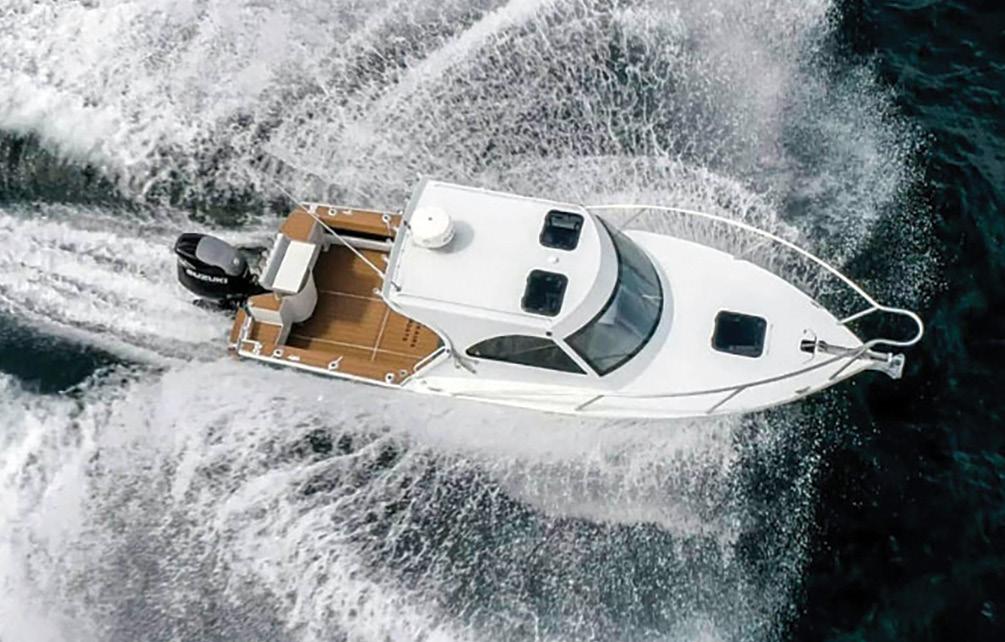
as the boat strikes waves, is eliminated. Makaira builds the hull around a 5/16”-thick keel bar and welds in far more stringers and frames than usual, so that each section of hull is supported six inches apart longitudinally and no more than two feet apart latitudinally. Meanwhile, that hull plating is 0.31” thick 5083 H116 aluminum. As a point of reference, most of the aluminum boats we see around here are 0.1” or 0.125” thick, and this is the first boat designed for recreational use we’ve
LOA: 26’2”
Beam: 8’9”
Displacement: 6900 lbs.
Draft (min): 1’8”
Transom Deadrise: 19 degrees
Fuel Capacity: 124 gal.
Water Capacity: 10 gal.
Max HP: 450 hp
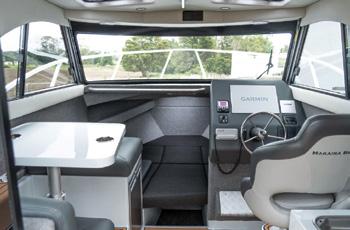
# The pilothouse on the Makaira Gen3 26 provides full protection for you and the crew.
# Wiring on this boat, a critical feature often given little attention, is second to none.
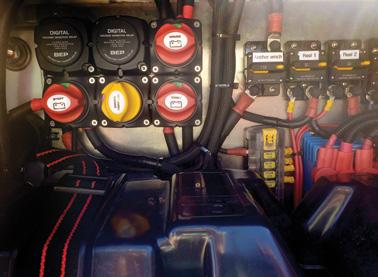
When you look at the Makaira Gen3 26 be darn sure to take a peek at the wiring. It’s all clearly labeled, well loomed and supported, with heat-shrink protection at the connections. It’s rare we see a wiring job this exceptional and if you’ve ever had a boat with glitchy wiring you know just how critical this can be.
come across to use plating over 0.2”
The Makaira is also the first of its kind we’ve run across that meets the bar for Lloyd’s Register Special Service Craft certification.
Now combine that uber-beefy construction with the Carolina flare in the bow, another trait you won’t find on other aluminum boats. Add in a
variable-degree deadrise bottom which enters the water with an extremely aggressive 50-degree deadrise, a Seakeeper Ride vessel attitude control system, and a bracket-mounted motor. The net result? When you go for a sea trial you’ll wonder why all boats aren’t built this way.
You’ll also wonder why all boats aren’t built with the same level of fishability.

Few 26-footers have a bowdeck as broad, and there’s room for a couple of anglers to cast from up there, but of course on a cabin boat like this most of the action takes place in the cockpit. And the Gen3 26 is prepared for that action. A 21-gallon transom livewell is flanked by stowage compartments for tackle, there’s a removable transom bait table with three rocket launchers, six flush-mount rodholders are in the gunwales, nine rocket launchers line the hard top, there’s a raw water washdown tucked under a gunwale, and additional tackle stowage under the aft cabin seat. On the boat we checked out at the Miami International Boat Show there was even a pair of tuna tubes integrated into the transom. Armed for bear? Youbetcha—and then some.
The cabin and helm deck can be fully enclosed aft, enclosed with curtains, or left open. If you do a lot of wintertime fishing you might want the full enclosure but the easy in-and-out of


an open aft bulkhead will be attractive to many anglers. Either way, you can always get a nice breeze inside because the side windows slide open. The dinette to port is adjustable and has a filler so it can convert into a berth for two, there’s a small galley unit aft of the helm seat, and a v-berth and head in the lower cabin. Makaira makes excellent use of the available space inside, adding drawers wherever possible, a refrigerator in the passenger’s seat-base, and a bulk stowage compartment in the sole. Anglers will also want to note that rigging
with heavy-hitting electronics won’t be an issue, because the helm is designed for a standard 16” Garmin MFD and can take a massive 22” unit if you opt to upgrade.
The Gen3 26 can be run with up to 450-hp in either single or twin-engine form. The boat we checked out sported a pair of 225-hp Mercury outboards,
which reportedly take the Makaira up to a 50-mph top-end.
The bottom line? Forget everything you knew about aluminum boats and the way they compare with fiberglass, because the Makaira turns it upside-down. It’s almost as if you were suddenly on the opposite side of the planet. Or, maybe just standing on a boat that was built there.
For more information visit the Makaira website or FishTalk supporter Brown Dog Marine, in Cambridge, MD, (410) 310-8931 or browndogmarine.com.
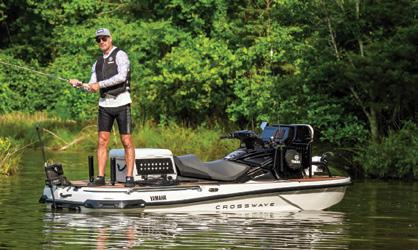
You love fishing from PWCs but you wish you had more room and stability?
The latest angling platform to emerge in the world of personal watercraft is the big, bodacious Yamaha CrossWave. With 10 percent more LOA and 25 percent more beam than Yamaha’s previously largest PWC, the CrossWave has gobs of space and enough stability to walk 360 degrees around. Yet with a 1.9L HO engine and a 155 mm high-pressure jet pump it still can hit speeds of 55 mph. T-tracks allow customization with rodholders, coolers, and more—it can even be rigged with a trolling motor on the bow and a mini pole anchor on the stern.
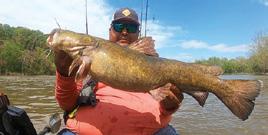





It’s go time—get ready for early season yellowfin with some last-minute fine tuning.
By Staff
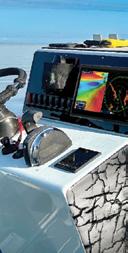
You know that yellowfin tuna will soon be caught up and down the line from the Norfolk clear up to the Wilmington, so how will you decide which specific destination to plug into the chartplotter? Offshore anglers will be watching the SST charts for swirls of oceanic warmth headed our way with their fingers crossed this month, as we all hope for an early run of fish. This bite will be red-hot or non-existent depending on currents and weather patterns far beyond our control, but if we get a lucky break and an eddy escapes from the Gulf stream a wave of fish may well head our way. There’s only one way to make sure you don’t miss out on the action: keep one eye on the SiriusXM Marine satellite views and the other on the Coastal fishing reports and be ready to pull the trigger the moment the fish come within shooting distance.
You know all those rigs you pulled last year? Now’s the time to find out which are still in good shape and which need to be replaced. Unwind all those skirted rigs and
feel every inch for chaffing or kinks. Check every crimp by pulling with every ounce of strength you’ve got. Wherever you feel or see anything sub-par chop it away and make it fresh. Remember that dinks or medium ballyhoo are usually best for yellowfin of the size you’re likely to encounter during the spring migration (30 to 60 pounders on average), and make sure you have plenty of rigs with skirts of various colors ready to roll.
Another item you’ll want to doublecheck is your bird/Green Machine rig. You say you don’t have one? Make it up before those fish come to town, because it’s a killer. Put a bird up front with 18’ of 200-pound test behind it. Then add three Green Machines, one at 12’, one at 15’, and the hook bait at 18’. Run it in the shotgun, way back.
Spreader bars, splash bars, and sidewinders are also must-haves for the spread, and while these usually feature stout construction that lasts for years, it’s always a good idea to check the lines for chafe, the bars for bends, and the lures for deterioration. If those bars are more than five or six years old it’s probably a good idea to replace ‘em.
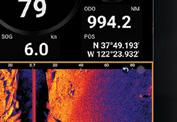
Another critical part of the prep is making sure you’re fully armed and ready for electronic warfare. If your boat’s been sitting all winter don’t assume the MFD and all of the accessory components are ready to roll. Turn everything on and give it a test. If it’s a relatively new system you may also want to dedicate an afternoon to cruising around and playing with the chartplotter, fishfinder, and radar, because it’s easy to forget which buttons to push or where to swipe after a long winter.
Next, make sure your SiriusXM subscription is up to date so you get the latest offshore weather
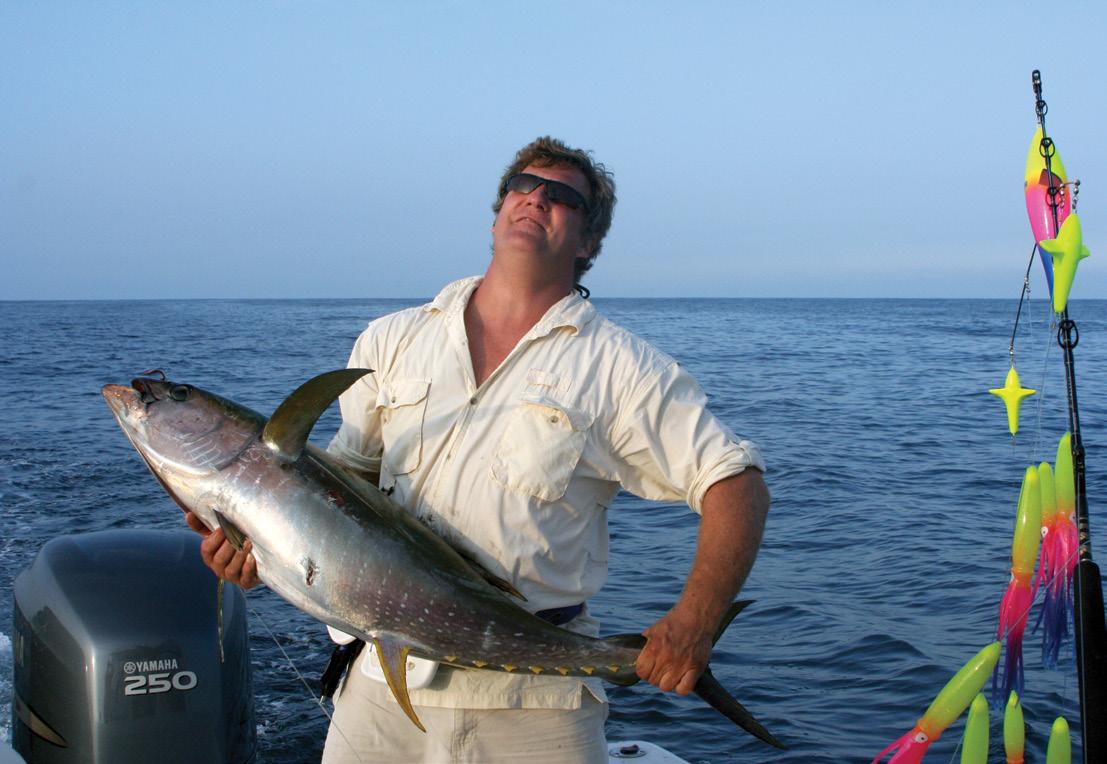
# Splash bars, spreader bars, and/or sidewinders are a must-have in the spread.
presented by
intel beamed right to your chartplotter. Being able to see what the wind is doing, where the storms are and where they’re heading, and how the forecast is changing not only gives you a serious safety boost, it also allows you to run farther and fish harder since you know when and where the conditions are changing. Plus, you can look at those SST breaks and plankton charts via Fish Mapping. If you haven’t done so yet get the Fish Mapping app on your phone—it’s free for subscribers—
so you can pull up all this info at any time in just about any place (read: while you’re supposed to be working).
Now consider your spread: will you just send lines back willy-nilly? Or do you have a plan? While casual anglers tend to put out a mix of lines including some or all of the offerings we talked about earlier, tuna-hunters who are serious about success will go a step farther and plot out ways to set a spread with
added appeal. Drawing it out with an old-fashioned pencil and a piece of paper can be very helpful, and will help you visualize how slight changes can have significant effects. As you do so, remember:
• Place single baits 15’ or 20’ aft of large attention-getters like splash bars. Often predators will be attracted to the commotion, and see that trailing bait as a straggler who’s easy to pick off.
• Run another attention-getter (like that bird rig) on the line that’s farthest back. Your boat is essentially your biggest “teaser,” and lines that are way back don’t have the advantage of being close to the boat nor to other lures and rigs that pull in the fish.
• Keep it simple when it comes to flat lines run close to the transom. Naked and skirted ballyhoo often do best in those spots.
• Remember that bigger single offerings aft of smaller ones can appear like a relatively small predator chasing bait. A larger ballyhoo rigged behind a bullet head/skirt, for example, is likely to have better results running behind a naked dink than vice-versa.
• If you’re running a small boat with small single-line outriggers, consider different offerings to try and bulk up the spread without tangling. A skirted ballyhoo or daisy chain running from a far-corner rocket launcher, for example, may be in danger of tangling the rigger line. A diving Marauder run in that spot should work out better.
Prep work and planning are critical to success in any endeavor, and that certainly holds true for tuna fishing. Now start staring at those SST charts and wait for an eddy. Any day now, any day…
#
goes where
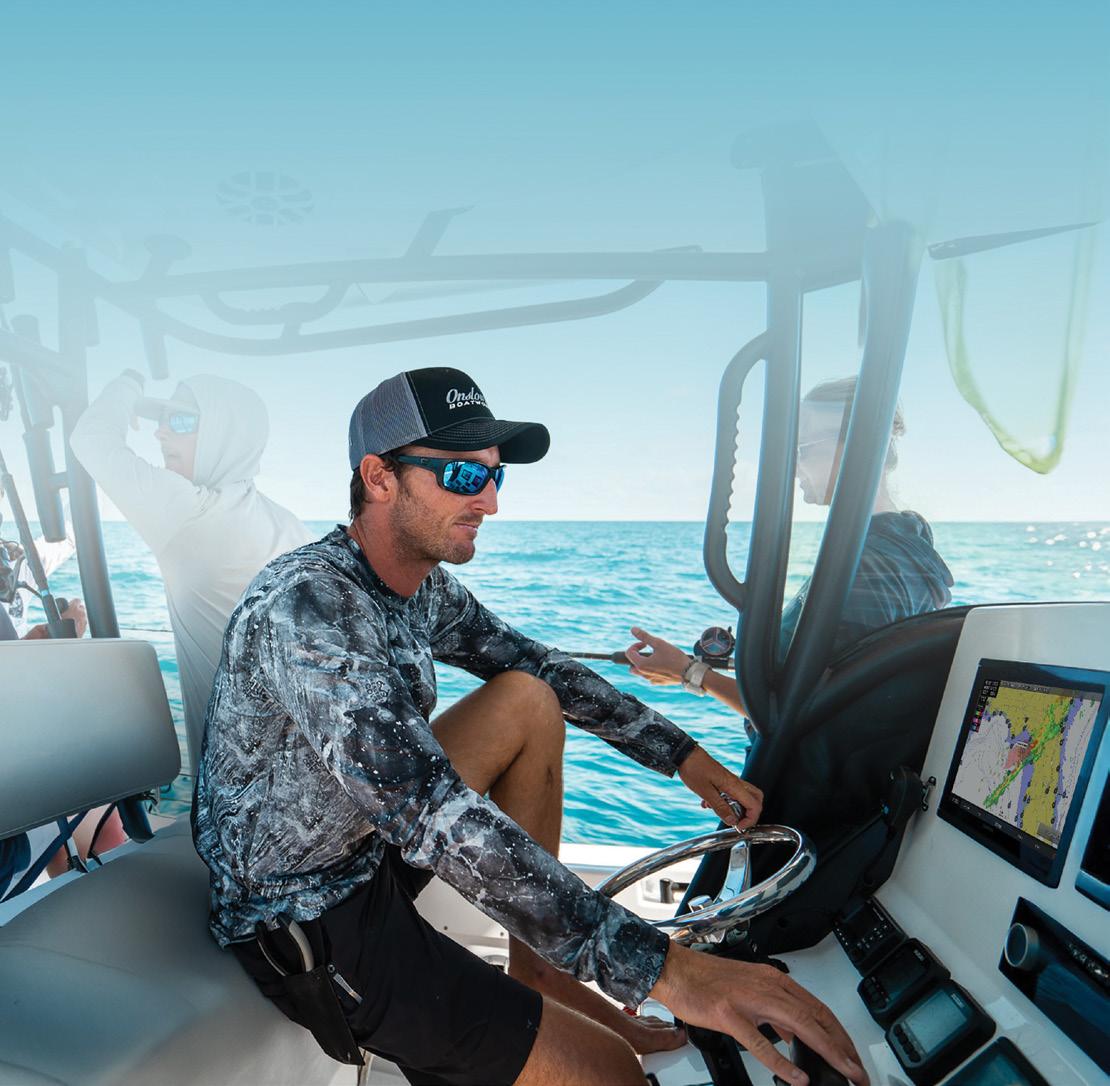
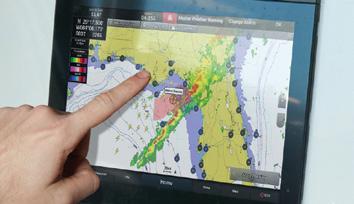
SiriusXM Marine puts essential offshore information — such as Weather Warnings, Marine Zone Reports, buoy observations and more — right on your display. Because the data is delivered by satellite, it continues updating without buffering or downloads, even far from cell coverage. You’ll see the conditions that matter most for planning and adjusting your trip offshore up to 150 NM of the contiguous U.S.

There simply is no substitute for firsthand experience, which is one of the reasons we’ve been thrilled that SiriusXM teamed up with FishTalk to bring you this offshore series about yellowfin tuna. We’ve used it and we believe in it, thanks to the way it boosts your fishing prowess by delivering SST and additional angling data if you get Fish Mapping, and in the way it boosts your offshore safety factor by bringing the very latest weather data possible directly to your chartplotter. But there’s more: unlike many systems, SiriusXM Marine also delivers wind data to the helm. As long as it’s calm enough to fish, why worry about wind? A stiff breeze can alter the locations of temp breaks, gather or break up weedlines, and cause colliding bodies of water to mix. The wind can also help to accelerate a current when it’s moving in the same direction, slow a current down when it’s moving the opposite way, and/or cause waves to stack up. In an area where two different currents converge this can make the difference between fishable conditions and unfishable ones. On the flip side of the coin a little bit of chop can also be a good thing as far as the bite goes, and on relatively calm days finding the edge where glassy waters become slightly riled can lead to more bites. The bottom line? Having the
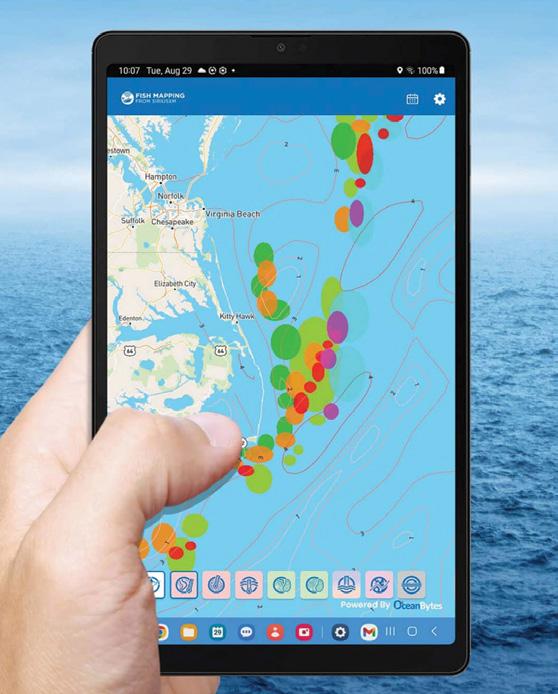
wind intel SiriusXM provides at your fingertips adds one more datapoint to consider as you decide which way to point the bow. Added bonus: that wind
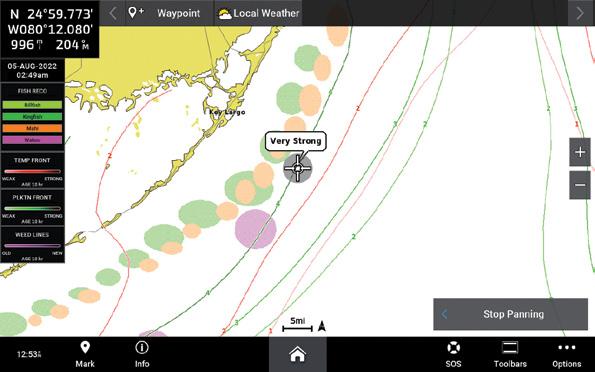
and weather data will also help you make better informed decisions when the conditions look iffy, which can make the difference between greenlighting a trip or sitting at the dock.
Of course, we can’t expect someone who’s never harnessed SiriusXM at sea to understand just how valuable it can prove to be. Fortunately, there are several ways to get a free trial as long as you have the hardware, which many boats already do. Check out siriusxm.com/marine to find out what options are currently available, get that firsthand experience for yourself, and we’d bet you’ll become a believer before that trial runs out.
# Being able to check on wind speed and direction, as well as SST and Fish Mapping, will boost your offshore abilities.
By Lenny Rudow
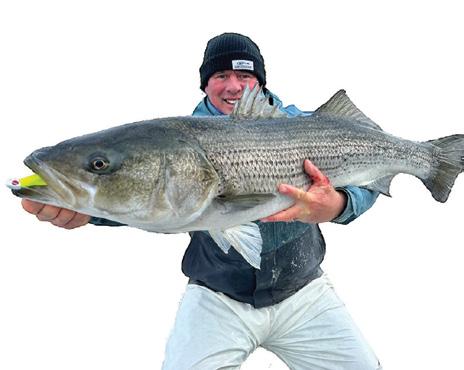
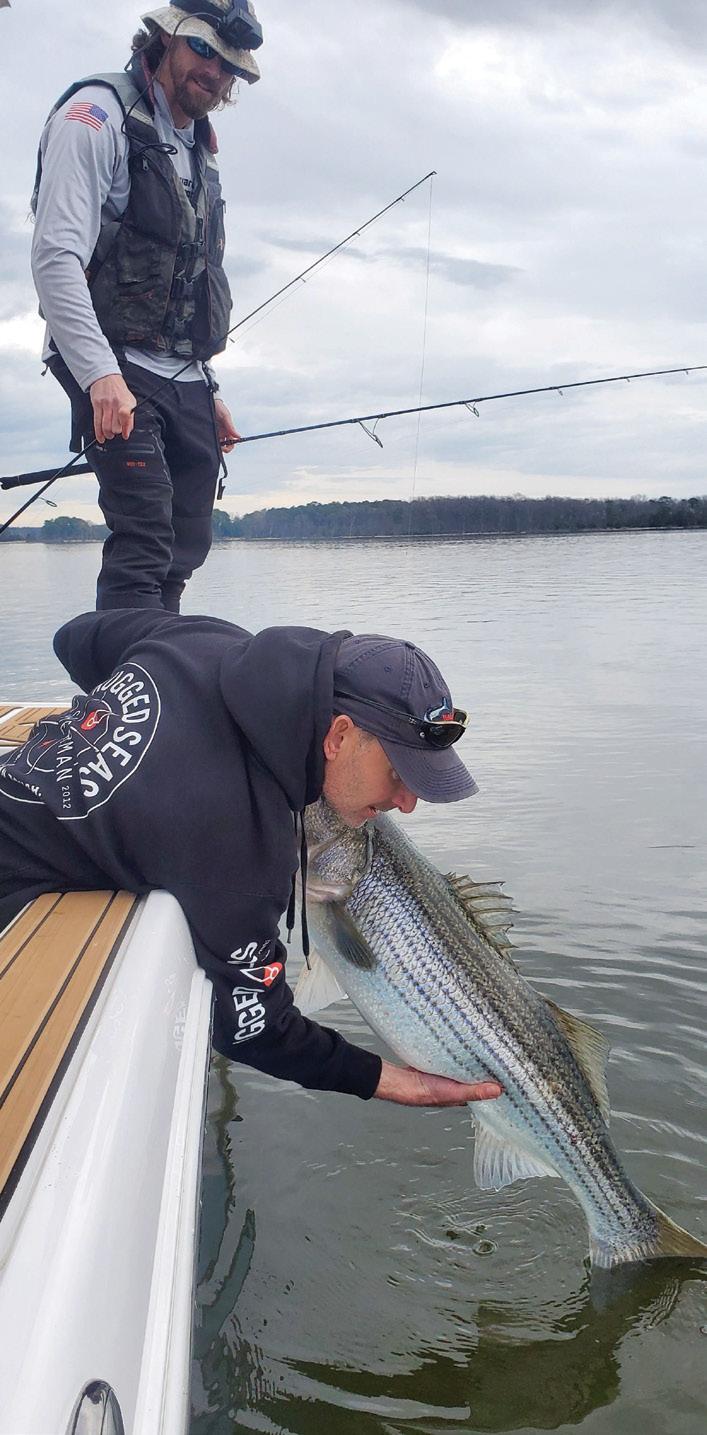
Attention Maryland Anglers: It appears that we may once again legally catch and release rockfish during the month of April in Maryland waters. This could change via politics or legal maneuvering but as we go to press the possibility is very strong. Check the current regs before leaving the dock, but if it happens let’s be ready!
Chesapeake Bay anglers in the state of Maryland will remember that for years, going all the way back to the moratorium, we were able to enjoy catch and release fishing for stripers in areas of the Bay nowhere near the spawning grounds during the month of April. Then a few years back the state instituted a no-target rule, closing down every inch of the Bay’s waters to all of us. That had zero effect on the fish’s spawning success—it actually grew worse through that timeframe—but it did have the effect of shutting down recreational anglers, guides, and charters. Tackle shops and marina businesses took a beating, too. For 2026, however, April catch and release fishing is back. Added bonus: this month you’ll even have a chance of tying into the rockfish of a lifetime.
Of course, every responsible angler wants to make darn sure they play according to the rules, many of which are set up to ensure that we minimize harm to the fish and the fishery. We need to remember that the regulations are constantly subject to change, and there’s some possibility that there’s been a change between the time we published this article and the time you read it. So it’s always a smart move to give the regs a look and make sure everything is as expected before you go fishing. Visit
the DNR fisheries regulations webpage (dnr.maryland.gov) for the latest updates. That said, regulations are expected to mirror those for March, including:
• No stinger hooks allowed.
• Barbless hooks required for trolling.
• No more than six lines when trolling.
• The usual circle hook regulations apply when using bait.
• The use of eels for bait is not allowed. Also, as in March, areas anywhere near the rockfish’s spawning grounds remain closed completely to any targeting of rockfish, including catch and release. The area open to catch and release fishing runs through the main-stem Bay from a line between Abby Point and Worton Point to the Virginia line including the Tangier and Pocomoke Sounds. Note that the Susquehanna Flats, which are open to catch and release during March, are closed during the month of April. The DNR has some very helpful maps on the website which clearly show the areas that are open versus closed. Again, remember that the details are subject to change so always double-check before fishing.
One of the reasons April is appropriate for catch and release fishing is that this month has ideal conditions for it, with studies showing a spectacularly low release mortality rate—1.6 percent in water under 59 degrees and below, while the average water temperature for April is 54.9 degrees. That means 98.4 percent of the fish should survive an encounter. But the word to use here is “should,” not “will,” because how you handle those fish will have an impact. We know we’ve harped on responsible catch and release best practices on these pages in the past and we hate to seem redundant, but each and every time one of us manages to catch one of these trophies we’re holding the future in our hands. It’s too important to gloss over. So:
# Back in the days before April fishing was nixed Jeff “pre-fished” on a regular basis—and back then April was a red-hot month.
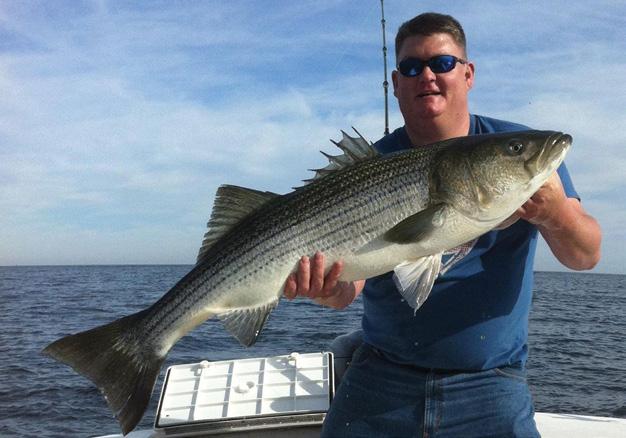
• Go with heavier gear than you normally might to minimize fight-time and reduce the chances of a fish fighting to the point of exhaustion. Fishing 30-pound braid/40-pound leader or heavier on a 4500 or larger reel and a medium-heavy or heavy rod is the move—leave your summer gear at home. Be sure your drag is set appropriately, and make the battle short and sweet.
• Even if you’re not trolling, why not crimp down the barbs on your hooks? If you play it right you’ll still catch the fish, getting the hook out will be a piece of cake, and you’ll feel great when that fish swims off quickly and strongly.
• Ideally, don’t “land” the fish but instead bring it up to the boat and to get a picture lift it out of the water for just a couple of seconds. Sure, we understand that an angler catching his or her PB will certainly want to bring the fish in and hold it up briefly for a good photograph. In that case, lip the fish with one hand while staying clear of the gills and gill plate, slide the other hand under the fish just aft of its belly as you lift its head,
You don’t have a boat, yours is still under shrink-wrap, or you just want to stack the deck in your favor? Consider hiring a guide—many of those featured in our Charter guide (p. 24 and fishtalkmag.com/charter) will be booking catch and release trips this month!
and hold it horizontally. As you begin the process take a gulp of air and hold your breath. When you run out of air remind yourself that the fish can’t breathe either, and get it back into the water asap. We can’t stress it enough: minimize time out of the water. If you’ve already caught a trophy and taken that on-the-boat picture, from that point forward consider getting inwater photos, only.
• We understand that in some scenarios (again thinking of those PBs) you’ll want to use a landing net. But never, ever, use a landing net with knotted nylon. (If you still have one please throw it away). Use a proper release net with the mesh covered in rubberized coating, to prevent removing slime and dislodging scales from the fish. And never dump a fish onto the deck where it can flop around on fiberglass and injure itself. Instead, the netter should maintain control while the angler removes the fish from the net using the same method as described for removing one from the water. Once the fish is secured by the angler the netter can drop the net, remove the hook, and do his or her best paparazzi impression.
• Remember, nets aren’t the only thing that can remove the fish’s protective coat of slime. Touching the fish with anything that’s dry, like your hands, a rag, or clothing, can also cause harm. Before handling a fish wet your gloves or hands, and only use a sitting position
resting the fish on your legs if you’re wearing bibs you can wet. Plan ahead by bringing backup gloves and pack a towel so you can dry yourself off if necessary.
So, how are you going to get one of those striped beasts on the line? Trolling and jigging are the two main tactics you’re likely to employ. Many light tackle enthusiasts will default to jigging, and I’ll be the first to agree that feeling the strike and reeling in a fish on a spinning rod is more fun than waiting for a rod to go down and cranking the fish in. However, I’ll also be the first to admit that at this time of year when fishing for trophy-class rockfish in specific, trollers do a heck of a lot of the catching. So, if you’re more focused on bending a rod than bagging a trophy and catching fish in the 20s and 30s with an outside shot at a trophy makes you happy, jigging will be the way to go. But if staring a big beast in the face is your number-one priority trolling is the move.
You say you want the best shot at catching a fish over 40”? The big fish are often scattered in April, so meandering through open water makes an encounter most likely.
• Still set out planer boards even though you’re limited to six rods, because the planer lines do catch the lion’s share of the fish on many days.
• Run tandem rigs with no additional weight off the planers. Some anglers like to put four lines on the boards then run a couple of umbrellas, weighted or unweighted, from the boat.
• Stick with nine-inch shad, in white and chartreuse. On rare occasions mix things up a bit by using chartreuse and white.
• Troll perpendicular to the current; this mitigates current/speed issues, and it also puts the lure in front of the fish’s face as it swims against or with the current.
• Try to troll at around 2.8 to 3.0 mph.
#
that get hit by current, like this well-known hotspot in Eastern Bay, are often a good bet for jiggers this early in the season.
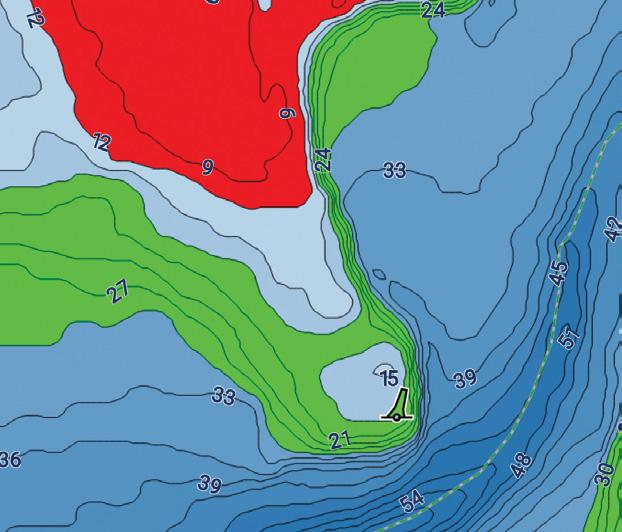
Kayak anglers can get in on this action too, though you’ll need to watch for an appropriate weather-window when the open waters are fishable. Note that water temps at this time of year are still downright dangerous, so it’s best to buddy-boat with a friend and wear a dry suit just as you would in the middle of winter.
• Stick with relatively shallow (four to 10’ deep) water along points and contours where shallow flats transition to greater depths.
• Mornings and evenings will be your best bet.
• Relatively large swimming plugs like X-Raps and Crystal Minnow of six or more inches that run from two to six feet deep are good offerings. You’ll need to swap the store-bought treble hooks for singles.
You say catching smaller fish is just fine, especially since there’s always a shot of hooking up with a cow? Then April jigging is the move.
• The usual soft plastics work great, but larger baits generally get more attention than smaller ones. Tossing seven- to
nine-inchers often works noticeably better than fishing with four- to six-inch baits. In shallower areas big jerkbaits can be highly effective, too.
• If you spot active fish on bait, great—but don’t plan on it. The big fish are often on the move at this time of year, the smaller fish have rarely schooled up beyond forming small wolfpacks, and finding a feeding frenzy is very rare. Instead, focus on structure.
• Remember that you can find fish surprisingly shallow once water temps rise above the 50-degree mark. Casting to shorelines is not out of line, especially those with good structure and nice drop-offs to four or more feet of water.
• Underwater humps and points that get hit by current can be big producers this early in the spring, especially if they’re surrounded by relatively deep water. Also look along ledges and channel edges that get smacked by moving water.
People, it’s April. And for 2026 that means (we think as of now!) we’re back in business. Replace those leaders, dust off that tacklebox, and inspect those hooks, because catch and release fishing will end that cabin fever once and for all. once again.
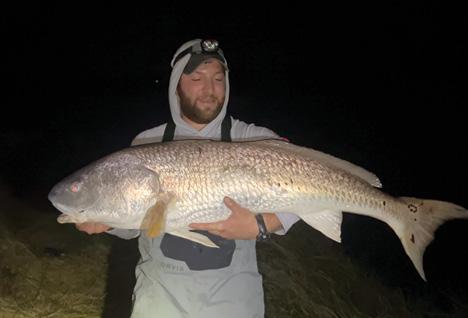
No boat? No problem. Let’s take a hike through the marshes of DelMarVa and catch some bull reds from the shoreline.
By Adam Greenberg
Legendary surfcaster “Crazy” Alberto Knie preaches the idea of fishing “non-human” hours when chasing trophies. While everyone else is asleep in their beds dreaming of screaming drags and bent rods, you are living it. So, years ago when I first found myself in the middle of the marsh at 3 a.m., covered in a cloud of mosquitos and knee-deep in muck, I knew I was in the right place. Until this night, catching a bull redfish from shore in the Chesapeake seemed like a distant fantasy. Until this night, I believed a boat with expensive electronics and a hundred gallons of fuel was a necessity. And on this night, I stood shaking with adrenaline and elation as I cradled the first bull redfish I’d ever caught in my arms.
Is it possible to catch bull redfish from shore in the daylight? Of course. However, the most consistent success I’ve had has come under the shadow of night. There are a couple of reasons for this. Redfish of “bull” class size can be anywhere from 20 to 60 years old. This means that these creatures have grown wise and wary of fishermen in their travels throughout the Bay and along the
coast. Fishing pressure and boat traffic are typically much lower in the nighttime, so these fish feel more comfortable letting their guard down. That’s a win for you, the angler. The reds will come closer to the shoreline and be less apprehensive about chomping your bait. In addition to this, prey is more vulnerable and becomes an easier target in the dark. Baitfish will school up tightly and head for the shallows, and crabs will hug
the bank. Bull reds will primarily rely on scent and their lateral line as opposed to sight to detect food when hunting at night, which is why fishing with bait is the easiest way to trigger a bite.
That being said, don’t throw stealthy tactics out the window just because a fish cruising the shallows may not be able to see you in the dark. Mr. Bull can still feel the vibrations of your voice or footsteps, and he’ll certainly smell the bug spray
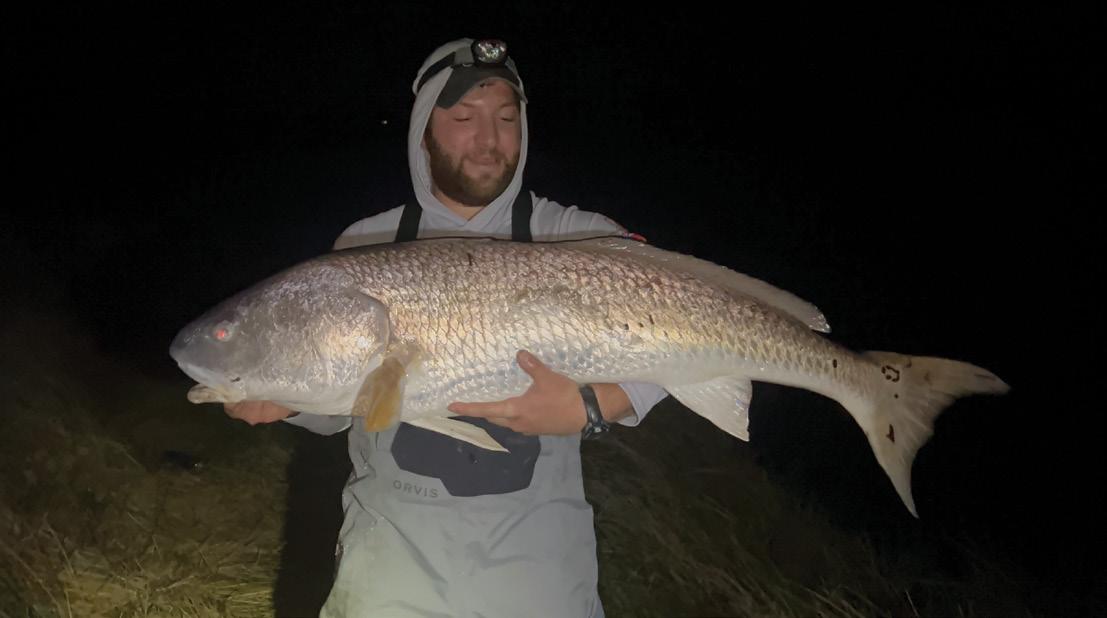
The author admires a beautiful bull he caught from the shore.
you had on your hands while baiting your hook. Minimize walking up and down the bank you’re fishing, converse with your buddies in a whisper, and rinse your hands before touching the bait. One more tip for nighttime stealth: only use your headlamp when you need to. That white light dancing across the water every time you turn your head could spook fish. Invest in some glow sticks that go on your rod tip so you can see the bites, and you’ll only need to turn on your lamp when absolutely necessary.
Just like anglers chasing bull reds from the beach, surf rods are ideal when using bait to catch them in the marsh. You want enough length for long casts to where the fish are feeding. It’s also essential to use a rod that can handle throwing up to six ounces, as you’ll want the bait glued to the bottom no matter the strength of the current. I like a rod in the eight to 10’ range, medium-heavy or heavy power. If you’re newer to surf rods start with an eight-footer. You’ll have an easier time getting accustomed to the casting mechanics of the longer stick.
As far as reels go, any spinning reel in the 5000 to 8000 size range is great. Spool up with 30-pound braid, and use an FG knot to tie on a leader of 40- to 50-pound monofilament. Make the leader as long as your rod plus half its length again, to provide enough stretch to absorb the shock of casting heavy lead. It will also provide some abrasion resistance against hard structure or the rough scales of bull redfish. Add a sinker slide (a fishfinder rig) to the monofilament leader and tie off to a barrel swivel. Now, snell an 8/0 to 10/0 circle hook to a 10” or so length of 80-pound fluorocarbon leader, and attach it to the other end of the barrel swivel with the knot of your choice. It may seem like overkill, but the strong jaws and abrasive mouths of bull redfish can do some damage to the line.
The best bait you can use for these behemoths is live peeler crab. Many anglers rip off the top shell before hooking the crab, but I like to leave it on. This helps the bait stay intact longer, as many little critters will surely be pecking at your peeler while it soaks on the bottom and waits for a big fish
to swim by. I’ll use shears to quickly dispatch the crab by cutting it in half, then remove the claws. Hook the peeler through the body cavity and out the backfin knuckle to keep it pinned. If live peelers aren’t an option, go with live or fresh spot. Cut the baitfish a few inches from the tail and then hook it through the mouth.
Chasing bull reds from shore with artificial lures is undoubtedly a more difficult game to play, but for those who want the challenge, pack a mediumheavy rod paired with a 5000-size reel. Spool up with 20- to 30-pound braid and tie a 40- to 50-pound fluorocarbon leader of about three feet. Remember, you’ll be catering to the olfactory and vibratory sense of these fish as opposed to the visual sense. In other words, use lures that are stinky and loud. Any Gulp! bait that resembles a crab or baitfish is a good option. Reds, as well as many other inshore species, go crazy for Gulp!. If you opt for a different brand of soft plastic, slather it in ProCure. Insert a rattle or tie your lure behind a popping cork for added commotion during retrieval.
There’s a ton of public access to fish for bull reds on the Eastern Shore of the Chesapeake. Obvious places like the Hooper’s Island Bridge in Maryland or the Kiptopeke State Park Fishing Pier in Virginia are great areas to start, however, I have found the best success while “marsh hopping.”
Marsh hopping is similar to the concept of pond hopping for largemouth bass or creek hopping for snakeheads. I’ll simply drive around the Eastern Shore, from south of Cambridge all the way to Cape Charles, and test out different spots until I strike gold. Just be sure to explore within the confines of the law.
When getting ready for a marsh hopping trip, I’ll open Google Maps and Navionics and look for a couple of factors to determine which spots to hit. Bull redfish tend to feed on large mud or grass flats where prey like crabs and baitfish will congregate, so I’ll search for marsh shorelines with those areas within casting range. It’s also very important to check ease of access before marching into the marsh during the dead of night. Is the spot you’ve scouted
Ryan does battle with a bull using his 10-foot surf rod and 6500 size reel.
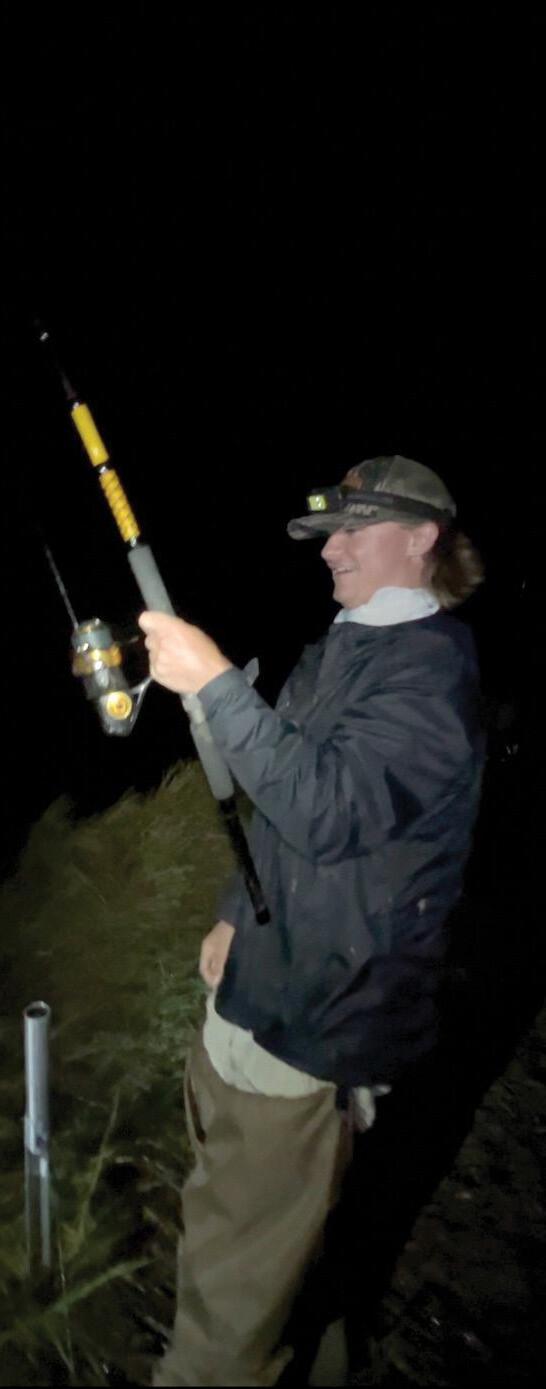
roadside, just a few feet from where you can park? Or will it require an extensive hike through the muck? The latter will require you to closely monitor tides while fishing so that the water doesn’t rise to the point where you can’t get back out to your vehicle.
The pursuit of catching bull redfish from shore in the Chesapeake Bay is one that is highly challenging yet immensely rewarding. With any luck, sharing what I’ve learned in my journey will give a mighty boost to yours. No boat needed. Just two feet, a fishing rod, and a dream. Now get out there and catch some bulls from shore!
By Staff
As temperatures begin to warm up your angling options will begin to bloom.
We’ve been bottled up indoors, the rods and reels have been gathering dust, and the tacklebox is serving as an end table—but all that’s about to end. With winter on its way out and spring taking over, a wide range of species are beginning to bite once again. But spring does bring its own set of unique challenges, as well as new opportunities. As you prep your gear and make those angling plans, keep these spring fishing tips in mind.
Here in Bay country numerous anadromous species which return to freshwater venues to spawn every spring will be packing into the tributaries. This concentrates their population into an area that grows smaller and smaller the farther upstream they travel. At some times in some places, it will seem like there are so many fish you could walk across the water on them. Some species, like striped bass, are off-limits during this timeframe, but
some others are fair game. White and yellow perch fishing in particular shines during spring, and the shad runs provide great catch-and-release action. So keep your eyes on FishTalk’s fishing reports to stay up to date on when and where the fish are running.
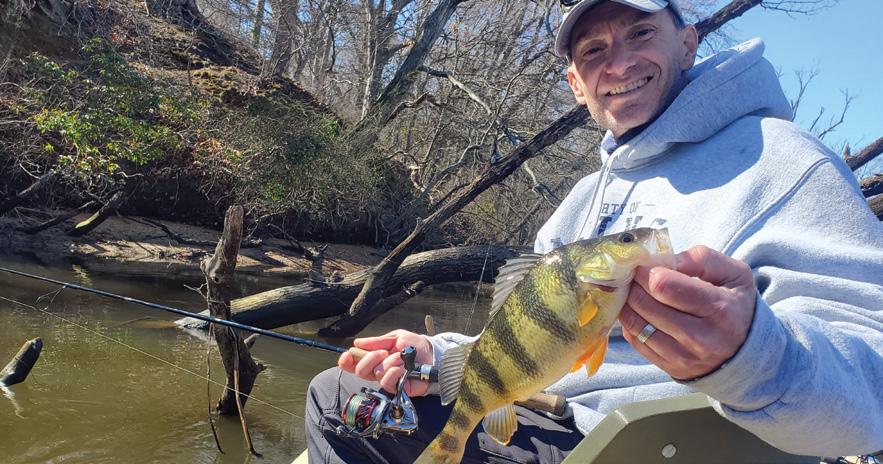
While freshwater fish don’t migrate, they do also have a spring spawn that congregates the fish. In most cases, such as bass, crappie, and bluegill, the fish will be building nests in shallow waters where they’ll lay their eggs. In many cases the nests and the adult fish guarding them will be visible.
As spring warms up the waters we’ll also see the appearance of migratory fish in the Chesapeake and along the coast as our summer visitors return to these waters. Red and black drum, flounder, and bluefish are a few of the earlier arrivals, and many more species will follow as spring moves on towards summer. Expect fishing for them to be relatively slow when the reports of their arrival first start trickling in, but remember that their numbers can increase rapidly. Particularly after a week-long warm spell fishing can go from slow to red-hot very overnight.
The opposite can be true too, however, so if there’s a cold snap following the early reports you may want to bide your time just a little bit longer.
Naturally the exact way you’ll target the fish will differ from one species to the next. That said, there are some general tips we can give you that should help get a bend in your rod.
• Most fish become rather aggressive as the water warms up and they feed hard after a long winter of waiting, so don’t be afraid to try fast, erratic retrieves.
• When fishing in one of the areas that has a spawning run, the fish can be spectacularly choosy about what baits they hit. During the perch run, for example, one day you’ve got to have grass shrimp to catch them and another day all they’ll eat is minnow. This is a good time to haul multiple bait options.
• At this time of year swings in temperature can have a major effect on the fish. A few days of cooler weather or cloudy skies can send them deep, while warm, clear, sunny days can trigger a shift to shallower depths.
• This is one time of year when fishing in the warmer part of the day, the afternoon, often tops the early morning bite. This can be especially true on warm, clear, sunny days.
• In tidal waters look for areas where a falling tide drains shallow flats and bays. Predators will often hunt in areas where the sun-warmed water is flowing out. Again, the effect is often most prominent in the afternoon on clear days with strong sunlight.
Spring is a time of tremendous transition, so it’s not safe to make hard and fast declarations about what lures or baits will or won’t work the best. Plus, choosing lures versus baits can be a very different decision from one species to the next. That said, these generalized tips do hold true through the season.
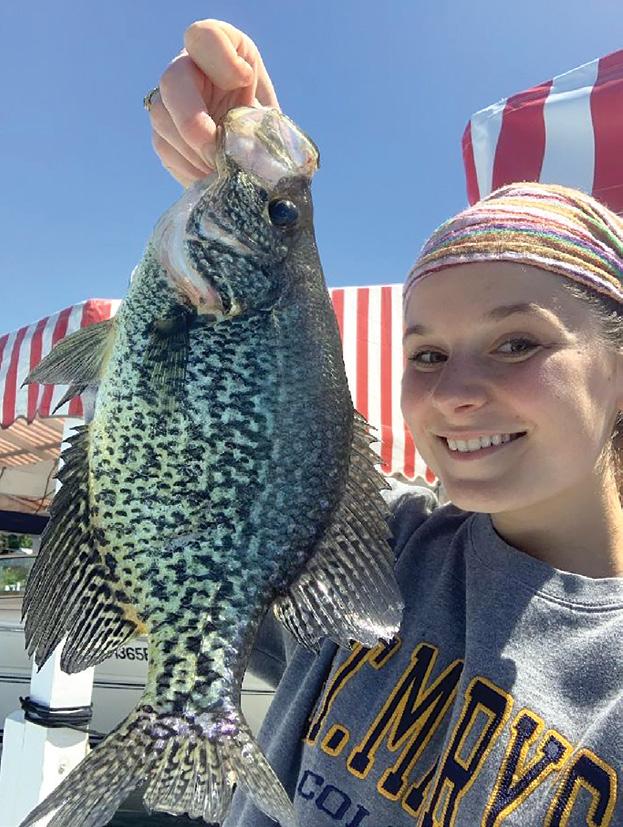
• Pay attention to water temperature. When it’s in the low comfort range for any given species expect bait to work better than lures, and when it reaches well into the fish’s comfort range know that the effectiveness of artificials should grow.
• Pay attention to weather patterns. A cold rain can shut down the bite in contained waterways, and if it’s heavy it can muddy up those that flow. Extended gentle rain, however, can raise water levels and trigger action without muddying the waters.
• Many people believe that adding scents and flavors to lures helps the most during spring, when fish might still be moving on the slower side and need that extra temptation.
• In scenarios where sight fishing is possible (such as casting to bedded bass in freshwater or hunting for redfish over shallow mudflats on a sunny afternoon) stick with lures. It’s usually easier to cast accurately with a lure, you don’t have to worry about casting off your bait, and it’s a lot faster to re-cast after a bite.
Whew – the long winter is finally in the rearview mirror, and now the 2026 fishing season can crank up in earnest. TGIS!

As the water
By Lenny Rudow
Snakeheads are a furious, frustrating, and fantastic fish to target. And although this species is still relatively new to Chesapeake country, at this point many of us have been targeting them for years. With time and experience comes insight, and one thing that’s become apparent to dedicated sharpies is that although April can be a difficult time to get these fish to bite, it’s also when they gather in large numbers in fairly tight areas.

The reason for this phenomenon, which has come to be known as the “spring push,” remains unproven. These fish certainly aren’t spawning as of yet and weed growth remains sparse. It’s impossible to dismiss the

fact that the spring push coincides with the spawning runs of fish like white perch, river herring, and shad, but it’s also impossible to justify this with the snakehead’s seeming unwillingness to eat at times. Yes, there are days with epic bites, but more often fish have to be tempted or triggered to get them on the line and they certainly don’t seem to be gorging themselves. On the flip side of the equation, might it be hard to get them to bite because natural prey is so plentiful? Theories abound; facts are in short supply. Whatever the reasons, however, the spring push provides us with an excellent opportunity to find good numbers of fish—and hopefully whack ‘em.
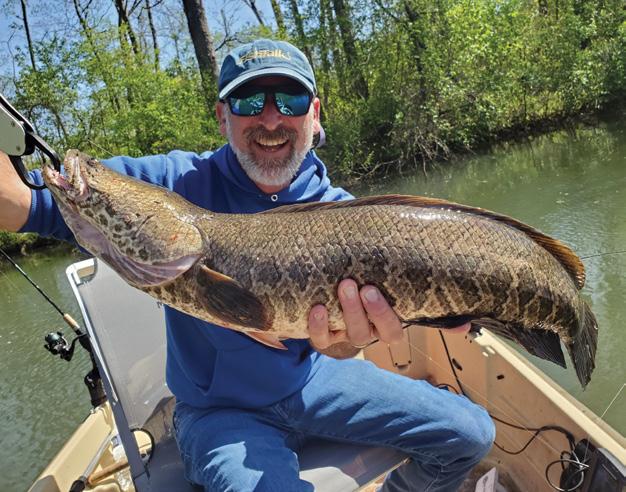

It won’t be too shocking to hear that the push takes place in those same rivers, creeks, and tributaries that those aforementioned species spawn in. I can only personally vouch for its occurrence on the west side Middle Bay tribs because that’s where I’ve seen it with my own eyes, but reputable anglers tell me it happens throughout Chesapeake country.
To find the pushing fish you’ll want to head for an area where the water is fresh or almost completely fresh but still just barely subject to tidal swings. Having deep water (and in this case “deep” means just three or four feet) close by is good but not necessary. Same goes for deadfall along the shoreline. Water clarity is also pertinent, not necessarily because the fish prefer it so much as because it’s easier to spot them.
Yes, spot them—the best spring push action comes when you can sight fish (more on that later). This makes bright, sunny, calm days the best conditions for this fishery. Since the water’s still quite cold at this point in the year the fish tend to be up near the surface when the sun’s shining brightly, especially in the mid-afternoon, soaking in the warmth. This makes prospecting for hotspots a game of keeping on the move and looking for the fish, rather than blindly casting at shoreline targets as you go.
Most of the time you’ll ease along staring at a shoreline to no avail for quite a while, but when you find that magic zone and spot a snakehead, solid numbers are likely close by. The fish will still be scattered, certainly not schooled, but in the same vicinity.

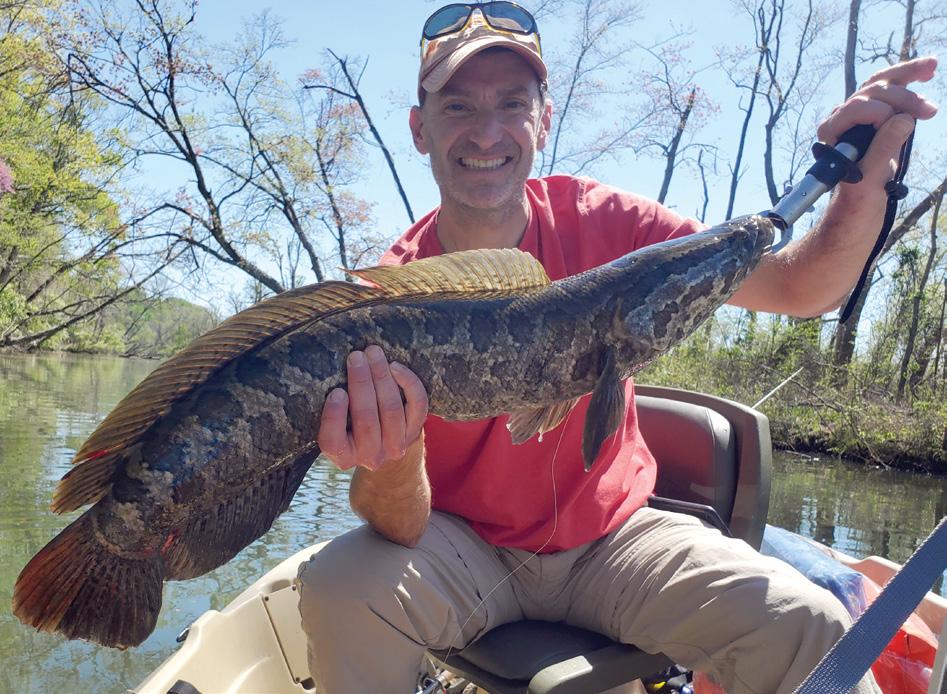
So it’s usually best to stay mobile and move along at jogging speed until the first fish is sighted, then slow to a crawl and check out every inch of water nearby. Most often you’ll spot a shadow or a dark spot sitting under or next to a tree limb or rock, and sometimes you’ll see them right up against the bank where a recess or depression provides a hiding spot.
I can’t say if it’s due to the specific spots I fish or if it’s common across the board, but in my experience the concentration of fish will run through an area around 100 to 200 yards long before dwindling out or hitting an area that’s inaccessible due to depth, logjams, or other impediments. Note that I generally go for the snakes in a small boat, so kayakers may have an access advantage, here.
For whatever reason, when spotting these snakes it can be very, very tough to get a bite. They don’t seem to want to chase anything more than a few inches, and a live minnow wiggling a foot or two away is often ignored. Cast a spinnerbait or jerkbait right on top of the fish’s head and it’ll spook, darting off to never be seen again. Cast a topwater lure beyond the fish and pull it back with ideal positioning and the snakehead will pretend it doesn’t exist. So… how do you get these fish biting?
While I’m certain there are other tactics that will prove successful, one that gives you a 50-50 shot at just about every fish you spot is a four- or five-inch fluke rigged weightless. Sometimes you can cast this beyond the fish, bring it just a few inches from its face, and a slow twitch-sink-twitch will buy a bite. If the snakehead ignores the lure after three or

four well-placed attempts, drop the fluke right on top of its head. Yes, this is likely to spook the fish—which is exactly what you want. It triggers a fight-or-flight response and the snakehead will do one of two things: half the time it will zoom off and disappear, and half the time it will attack with a vengeance. Those might not be the best odds in the world, but when it comes to fishing they aren’t all that bad, either.
Snakehead fishing during April can be just as frustrating as fishing for them at any time of the year. This phenomenon won’t last for more than a few weeks, and heavy rain or a sudden cold snap can bring it screeching to a halt. But if sight fishing for snakes sounds like fun and you want multiple shots at fish packed close together, it’s time to start planning a trip around the spring push. #
The Severn River is chock-full of awesome angling opportunity.
By Wayne Young
The Severn River offers sheltered waters with extensive structure and lots of fishing opportunity for days when going out on the Bay is a no-go. Much of this structure consists of oyster reef restoration projects that were constructed over the past decade. This structure is in addition to road and railroad bridge foundation ruins, an artificial reef, bridge piers, and a reef ball water quality field test and fishing reef.
Working from Annapolis upriver, there are two deepwater anchorages (Site 1), one at the mouth of Back Creek and Annapolis Harbor South Anchorage Area at the entrance to Spa Creek. The latter has four large rectangular excavations with drop-offs from about five to nine feet around their perimeters. When the area isn’t heavily populated by sailboats, note that the outer edges of the dredged anchorages have drop-offs of between about 10’ up to about 40’ along the perimeters. In particular, the southeast side of the submerged end of the Horn Point shelf has about a 10’ drop-off that’s worth a look on an ebb tide.
Site 2 marks a submerged point at the entrance to a small boat basin on the north side of the river across from Spa Creek. It juts out sharply into the ebb current flow and has about a 10’ drop-off. A small hump on a shelf just upriver at Site 3 is more substantial than charted. It’s about 60 yards long with a five foot drop-off on the northeast side and a 10’ drop-off on the southwest side.
Turning the corner and heading upriver from Spa Creek, the river bottom quickly gets very interesting. Between the Route 50 and Route 450 Bridges (Chart 2) features a state reef, the foundation ruins of the first Route 450 Bridge, a public fishing pier, ruins of an old railroad bridge, and constructed oyster reefs supporting ongoing oyster restoration initiatives. These various bottom features also provide lots of recreational fishing opportunity.
Oyster restoration was one of the early objectives for Maryland’s artificial reef program. Perhaps this explains why the Severn River State Reef was shown on nautical charts (Site 4) as an oyster reef
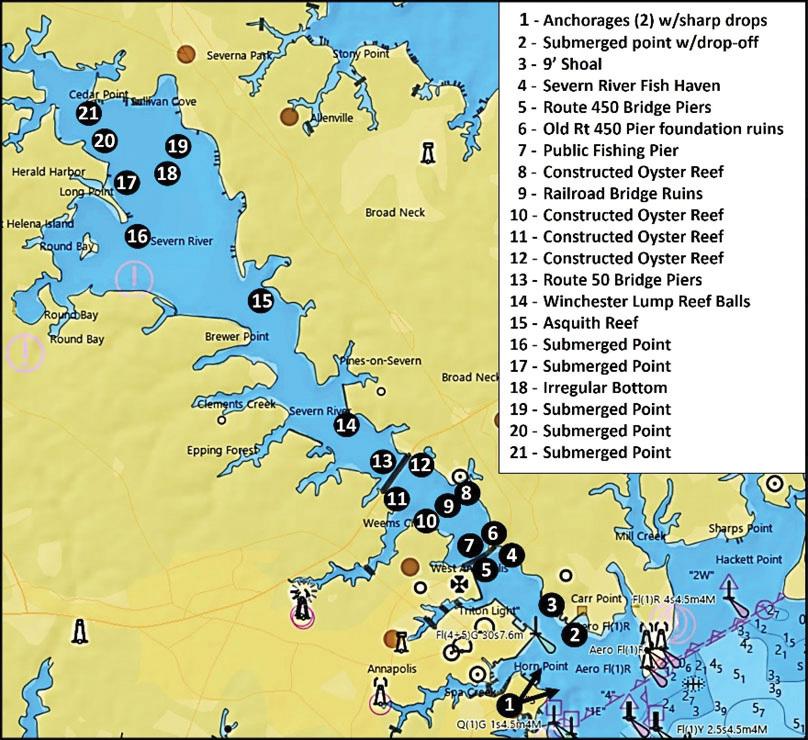
(sometimes oyster bed) rather than as a fish haven. It was permitted in 1994 to receive rubble from demolition of the old Route 450 Bridge (Site 5). Tucked alongside the Route 450 Bridge, the reef site has little room for maneuvering. Access from the upriver side of the bridge is constrained by bridge piers and a restricted area that is closed to boats. Boats are required to stay out of the area marked by white and orange buoys in front of the northeast end of the old 450 bridge, which is now a recreational fishing pier (Site 6). However, foundation ruins of the old bridge extend all the way across the river (Site 7). This is a sheltered area when northeasterly winds are blowing, but fishing here can be tough due to snags, and drift fishing is nearly impossible.
Site 8 on the northeast side of the river just below the railroad bridge ruins (Site 9) is a constructed oyster reef. The substrate for the reef was placed on top of a submerged point. Just to the southeast is another submerged point. Between them is
a trench. Try working across the entire site. Before the extensive highway system folks coming down to Annapolis from Baltimore and surrounding areas often came by train, over the old Baltimore and Annapolis Railroad Bridge. Its foundation ruins are located about halfway between the Route 450 and Route 50 bridges. The charted ruins extend across the river. This is a fishing hotspot generally, and the former swing span turntable in particular. Try here for stripers. Site 10 on the upriver side of the ruins along the southwestern shoreline is another constructed oyster reef that’s a good possibility for white perch.
There are five constructed oyster reefs charted downriver from the Route 50 Bridge. Site 11 on the southwest side parallels the shoreline for about 125 yards along the northeast edge of a shelf. A smaller semi-circular constructed reef juts from its northwest end. This reef’s position and shape should disrupt current flow and create turbulence. Site 12 marks three
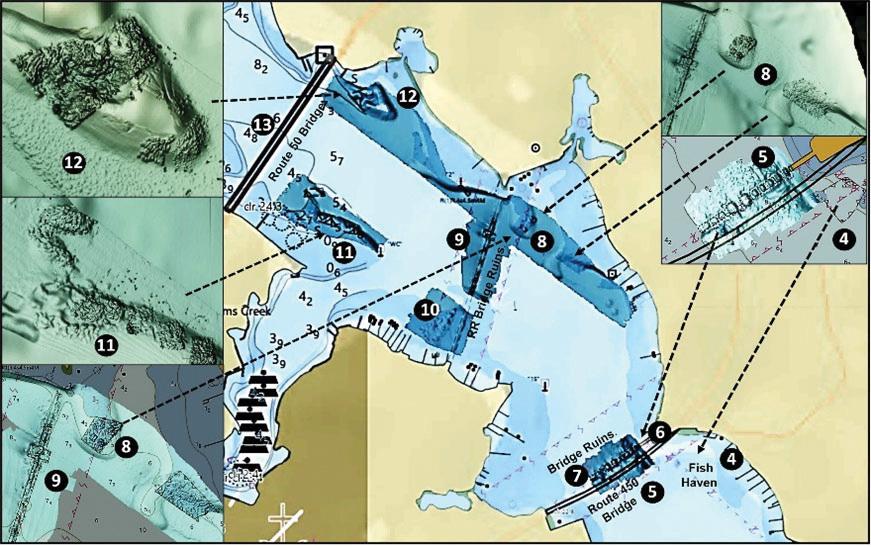
constructed oyster reefs on the northeastern side of the river. The southernmost reef on the western edge of a shelf that angles out into the river puts this reef in position to receive ebb current flow. Site 13 is the Route 50 Bridge. Try a test jig or two at the bridge piers for stripers.
Site 14 on Winchester Lump, although another constructed reef, is substantially different from the aforementioned reefs consisting of substrates placed as a bed for seeding with oyster spat on shell. Located just below the south-side entrance to Chase Creek, it consists of 240 reef balls with hatchery-set oyster spat. They’re
distributed across the site in small clusters (Chart 4). The reef is a field experiment to test whether such reefs can break up dead zones of low oxygen. The reef balls were deployed by the Chesapeake Bay Foundation (CBF) during 2018 in partnership with the University of Maryland Center for Environmental Science (UMCES), and the Naval Academy monitoring performance. Check here for perch and stripers.
Site 15 marks Asquith Reef located off the mouth of Asquith Creek, on the northeastern side of the river. The project was a partnership effort with CBF, Maryland Artificial Reef Initiative (MARI), and
Maryland Department of Natural Resources (MDNR). The base material is composed of 5063 tons of recycled and crushed concrete rubble from bridge decking. This substrate was overseeded with oyster shell and oyster spat on shell.
Structure further up the river consists of natural formations, primarily submerged extensions of points. However, there is a wide area of holes and narrow trenches marked in general as Site 18 east southeast of Kyle Point and from there upriver about 3,000 yards. The trenches and holes are widely distributed and as much as 10’ deeper than the surrounding bottom. My impression from various sonar data displays is that they’re excavations, possibly from relic oyster shell mining. Regardless of how they got there, these are features to prospect. The larger of the features are between Kyle Point and Round Bay. Try the 34’ least depth deep trench at coordinates 39°03.116 x 76°33.074. And don’t forget to check the point and the sharp edge on the west side of Round Bay at Site 19. The upper Severn River and its feeder creeks are winter pickerel fishing destinations.
Bay tributaries are akin to large tidal lakes which often offer sheltered waters when the main stem is too rough to fish. The Severn River is one of the more diverse in terms of the structure available for prospecting. There’s also a public boat ramp up Spa Creek at Truxton Park in Annapolis, which provides a well-protected launching area with modest parking for vehicles with boat trailers.
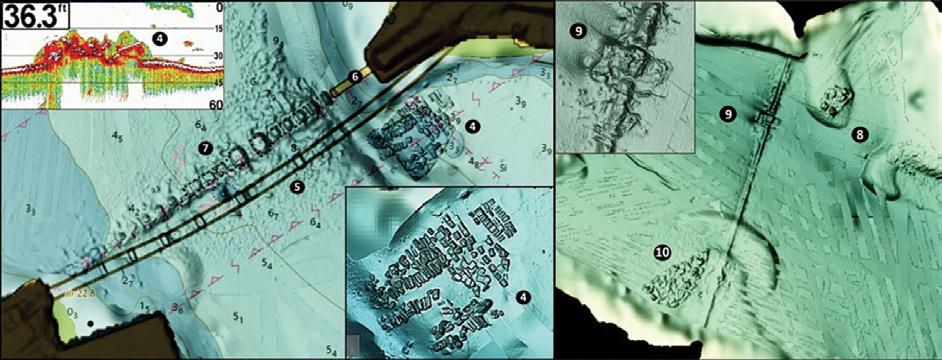
# Center consoles and cabin boats and DCs, oh my!
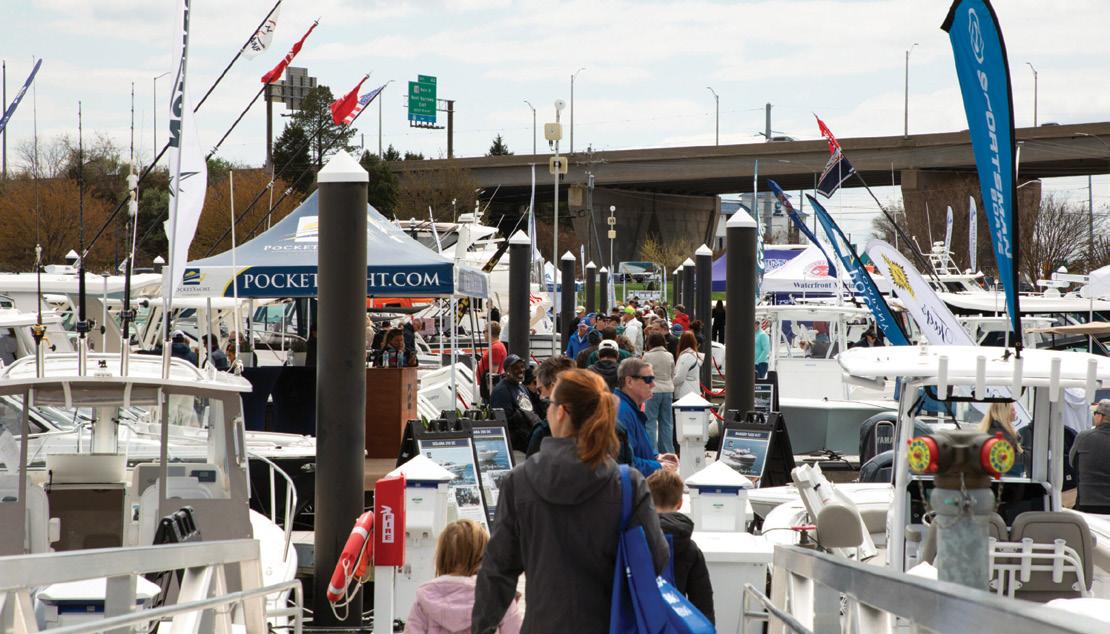
The Bay Bridge Boat Show at Safe Harbor Narrows Point is right around the corner—start the fishing season with a new boat bang!
By Staff
We love casting from the shoreline, trolling from the kayak, and tossing bait out from the dock, but for many of us no form of fishing is quite as exciting as being on the Bay or along the coast while aboard a boat. And if you don’t yet have a boat or are looking to upgrade, no time or place offers better opportunity than the spring boat show — specifically, the Bay Bridge Boat Show at Safe Harbor Narrows Point. This is the largest show in our region, boasting hundreds of boats of all shapes and sizes. Added bonus: there’s plenty more to see and experience at the show on top of all the fabulous fiberglass fishing machines.
Historically people have bought boats at shows because they could get the best deal, and it’s still true today that some
dealers offer special discounts at the shows to move boats off the lot. But there’s a much better reason to hit the show as you search for your new ride: the ability to see multiple boats of similar sizes and prices side by side, all on the very same day.
Let’s say you’re ISO a 24’ center console. You’ll have dozens to choose from, and to see them all you’d have to drive to dozens of different dealerships spread throughout the region. It would
be quite literally impossible to do so in a day, and tough to do so even if you had an entire week off work and an unlimited travel budget. At the Bay Bridge Boat Show at Safe Harbor Narrows Point, however, you’ll be able to walk from one to the next. Each will be fresh in your mind as you check out the other, and you’ll be able to make direct comparisons, whittle down your list, and go back and forth between the top contenders multiple times.
The Bay Bridge Boat Show at Safe Harbor Narrows Point (428 Kent Narrows Way N, Grasonville, MD) runs Friday April 17 through Sunday April 19. Show hours are 10 a.m. to 6 p.m. Friday and Saturday, and 10 a.m. to 5 p.m. on Sunday. Parking ($10 cash only) is available at the Old Outlets off Exit 41 and benefits the Kent Island High School Swim Team. General admission is $20 and can be pre-purchased via annapolisboatshows.com; kids under 15 are free.
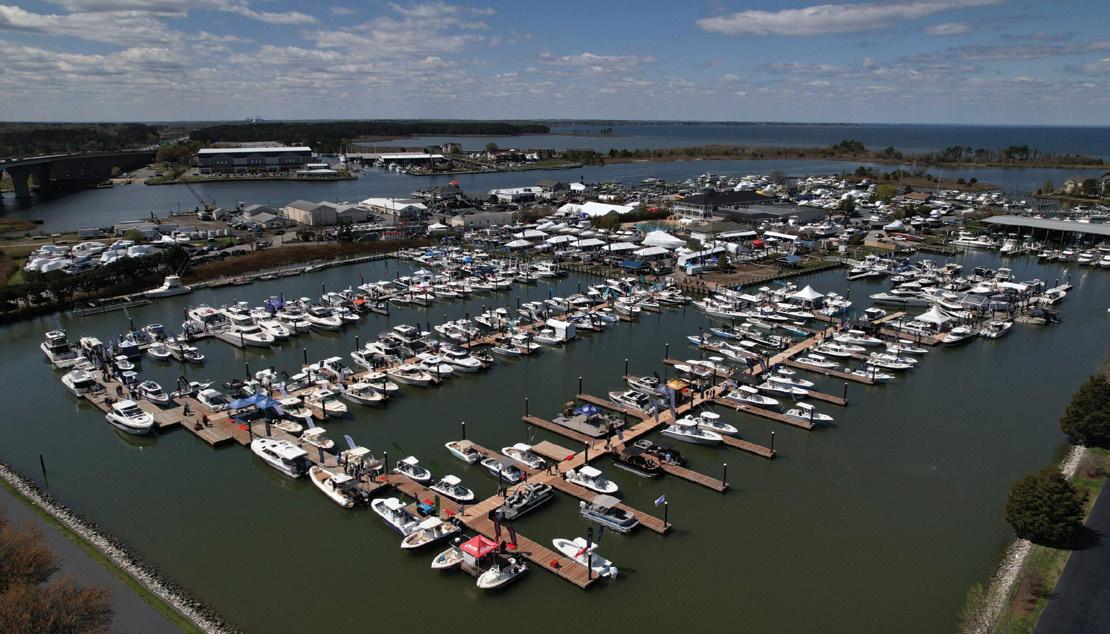
Wait a sec—in this day and age doesn’t everyone just look at a bunch of pictures on websites and make a choice? That might be okay when you’re buying boots and bags, but definitely not for boats. When making a decision this big you’ll want to sit in those seats, open those hatches, and enter those head compartments. You can’t tell from pictures how well they’ll fit your own body nor how easy they are to use. Critically, you also can’t tell how well they’re built. You need to see the boat with your own eyes and feel it with your own hands in order to make an informed, educated decision. And this is your chance to do so with all the competitors in one place at one time.
Now’s the time to visit those websites and look at all those pictures, before show time draws close. Decide on the right genre of boat for your family, whether that’s a center console, a dual console, or a cabin boat, and make a list of all the models that appeal to you. Also be sure to list out the features that are important to you and check which come standard on any given boat and which will be a cost-adding option, because that will have a big impact on
# You couldn’t see all these boats in a month if you tried going from dealer to dealer.
In addition to the main attraction—the boats—there’s plenty to see and do at the show. Demo rides will be happening at the PropTalk Demo Dock, where you can try before you buy. The Fishmobile from the Phillips Wharf Environmental Center will be on site so you can get up close and personal with crabs, fish, and other critters living in the Chesapeake. And there will be a full slate of free daily seminars where you can learn about everything from the basics of boating to fishing tactics and techniques.
FishTalk’s own Angler in Chief Lenny Rudow will be serving up a seminar on “Catching Rockfish in 2026: Top Tactics and Tips.” Fishing for striped bass in the Chesapeake has evolved in recent years as anglers learn to cope with slot limits, fewer fish, and changing environmental conditions, so the AIC will run through the tactics and tips anglers use to catch more, bigger rockfish in the modern era. Join him in the seminar tent at 3 p.m. on Saturday—and remember, while at the show it’s free to attend the seminar!
the bottom line. Though you might find this model or that one appealing, remind yourself not to get too excited or make too many decisions before you get to see all those boats up close and in person.
When you’re at the show checking out each boat take plenty of pictures and note which stand out. After you’ve made your rounds, visit the food court or the poolside bar and take a breather. Go back through the lists and photos. And think hard on which boats deserve a spot on your short-list of top options. Then ask yourself a few questions that go beyond the boats themselves. Are you comfortable with the
price tag and/or monthly payments? Do you feel good about the dealership and salesperson you’re dealing with? What sort of warranty does the manufacturer provide?
Now circle back and take a long, hard look at the top contenders one more time. Make your final decision, then ask the final question: are any other major factors standing in your way?
No? Then, congratulations. This spring you’ll be fishing the Bay or along the coast in a brand new boat. Your boat. #
By Eric Packard
During spring and throughout summer red drum, speckled trout, and striped bass cruise the shallows here in the Chesapeake and its tributaries. Whether I launch my kayak on the St Mary’s River, the Potomac, the Piankatank, or on a shallow flat of the Bay, I might see schools of fish feeding. Tell-tale signs are what I look for while scanning the water include: tailing fish, surface feeding, shadows moving rapidly, shore birds feeding or birds hovering, or ever so slight movements on the water’s surface. All of these tell me that fish and/ or bait is in the area. And I’m a firm believer that once these clues are spotted, kayaks have the upper hand in shallow
water fishing. They only draft inches of water and are perfectly suited for it. There will be instances when you’ll notice a school of red drum, approach them silently, and can get surprisingly close. Then, which rod do you grab to cast? The one rigged with topwater, a jig, or a popping cork? The fish may be fast on the move and you may need to chase them down, casting in front of them. They may be meandering along slowly. They may be related to structure and staying more or less in the same spot. Or, you may work a school that’s in a feeding frenzy. Realizing things change very quickly you have to be ready to make onthe-spot changes in your tactics.
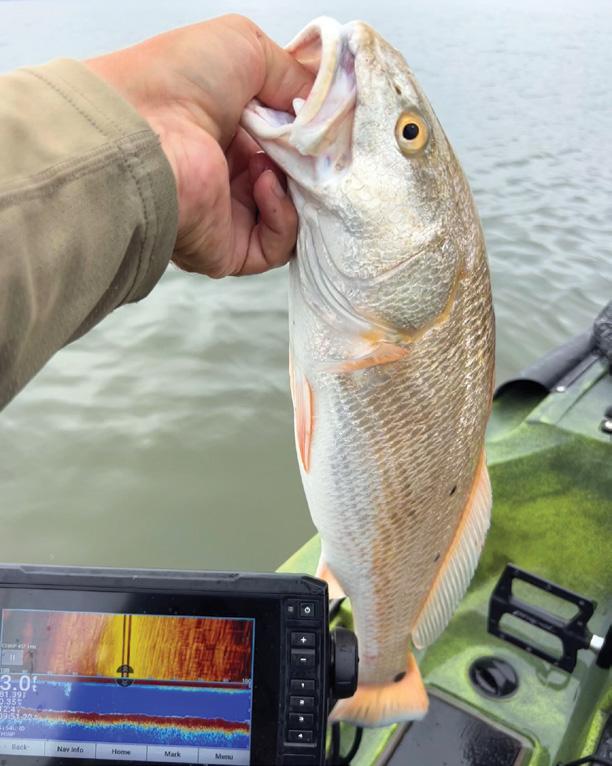
In these changing situations on the flats I may carry up to six rods, each rigged with a different bait. One with a popping cork, set up with a small jig 16” to 18” from the cork. Another, a topwater bait. Others may have light jigs, each rigged with a different color plastic of different lengths and profiles. Anther rod I’ll rig with a hard bait.
In the early part of the day it’s often effective to start by casting topwater baits, skipping them across the surface. As the morning moves on, switch to jigging, throwing the jigs and hopping them over grass or near structure. Where you notice areas that have no grass or structure stop swimming the bait at the edge of the grass and jig it along the bottom. If you see a school of fish feeding you can throw the jig or try the popping a cork, casting beyond them and working the cork up towards the fish. At times, a topwater bait will work here, too.
If you don’t see bird activity or schooling fish, try trolling a hard bait and/or a swim bait over grass and/or along drop offs. Try this at just under two mph. This is another time when being on a kayak shines, because even with a trolling motor on a big boat trolling such slow speeds in shallow water can be difficult. And if you locate a concentration of fish, then you can fancast the area with a light jig. Casting into deeper water and working the bait up and along a drop off usually becomes more effective as the day advances. As the day grows longer, into the evening, you can return to the tactics used in the morning.
Start hunting for redfish, speckled trout, and stripers in the shallows once the grasses start to show up on the shallow flats. Some of these grasses will only stay around for a few months then die off, others remain all summer. Scattered rock, oyster beds, and the edges of drop offs near grass will also hold fish.
Stealth is needed here.
A slow, shallow drafting, quiet boat is best for stalking these fish. Stay low and stay quiet. Whether you’re hopping, skipping, or jigging that bait, think: kayak.



Gathered from our reports by Dillon Waters
We all know printed fishing reports are generalized, and weeks have passed before the report gets into your hands. For timely, up-to-date reports, visit our website FishTalkMag.com. Current reports will be published every Friday by noon. However, there are some big changes in store for FishTalk’s fishing reports; see this month’s Notes from the Cockpit column for the details. In the meantime, here’s our monthly prognostication.
April is a month of change along the coast, as our resident fish kick into gear and southern visitors begin arriving in serious numbers. Tautog will have the feed bag on as the waters warm up, rockfish will be hitting in the back bays, and by now you can bet the flounder action has kicked off in those waterways as well. But we’ll also see the surf come to life this month as black drum start showing up in good numbers. Remember that before April was out last spring, some big bull reds made their initial appearance in the suds as well.
Pick a species — any species. Whether you enjoy chasing bass, crappie, pickerel, or trout, this is a great month to enjoy fast action (though we should note that in tidal areas pickerel are closed for harvest through the month in MD). For many species this is the pre-spawn season, so depending on what the weather does, expect those finned critters to be in transition. One week they may be deep, the next they could move shallow. Snakehead fans should also remember that this is usually when the “spring push” happens and areas near spawning grounds can see concentrations of fish forming.
# Bass are in pre-spawn mode right about now and should be working hard to fatten up in waterways throughout the region.
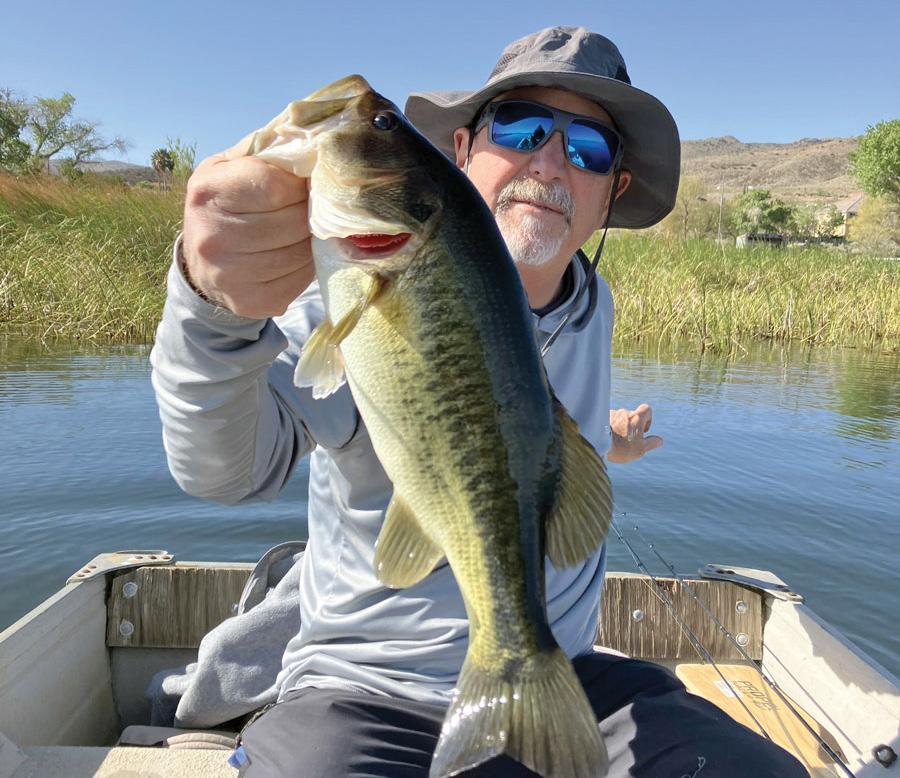
April is the prime month for shad catch-and-release action, so grab those darts and spoons and head for the creeks or the dam. Where the shad go the blue catfish follow, so this is also prime time to put some cut fish chunks on bottom and hold on tight. We can expect the white perch to peak as they make their runs this month, too. Another great bite that should be going off right about now (as long as the weather isn’t a wash-out) is the largemouth bass pre-spawn fishery on the Flats and in the North East River. Last season chatterbaits and spinnerbaits had them striking.

Spring is here and that means lots of angling opportunities are cranking up in a big way. As the month begins white perch will be in fine form in areas that get a run, and although that action usually drops out by late April, snakeheads should pick up the slack in the upper reaches of the creeks and rivers. Catfish, meanwhile, present an awesome opportunity for fishing bait on bottom from the Bay Bridge up. After a wet winter there’s a good chance they’ll be spread throughout the range but remember that Sandy Point, Podickory, and the Heart-Miller area are often solid bets.
White perch fans should have plenty to keep them busy through much of the month, so grab some grass shrimp and shad darts and head for the river, creeks, and salt ponds that get a good run. As we go to press Maryland hasn’t yet announced if anglers will be allowed to catch and
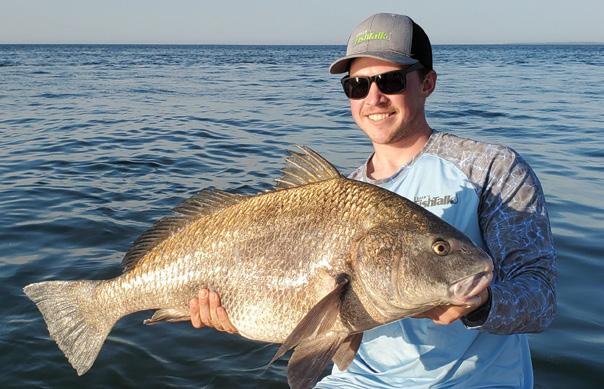
release rockfish this April in the open Bay, but if it’s allowed, there should be the opportunity to catch the striper of a lifetime. Remember people, treat those
big fish with TLC — see “Set the Catch and Release Bar” at FishTalkMag.com if you need a refresher on best practices for safely handling those fish.
Tune in Thursday, April 2, 2026 at 6 p.m. for a new episode!
Presented by
New episodes air on the first Thursday of the month on our Facebook page (facebook.com/fishtalkmag) and YouTube channel (youtube.com/fishtalkmagazine). View past episodes at fishtalkmag.com/live-with-lenny
Scan this code to follow us on Facebook and YouTube or sign up to get notified about upcoming LIVE video streams via email at fishtalkmag.com/live-with-lenny
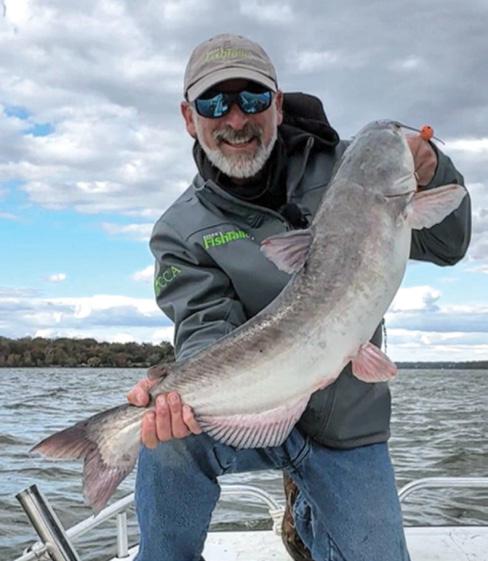

April Bonus: last spring good numbers of big black drum invaded the Middle Bay this month. Will they be back? We sure hope so, and you can bet we’ll be out looking for them.
Last April there were so many bites popping off in the Lower Bay it was tough to keep track. White perch and peak shad in the upper tributaries kicked off the action, and blue cats were slamming baits in the same areas. By mid-month snakeheads joined the party and anglers who could tempt them into biting with flukes and frogs (which isn’t always so easy when they’re in a pre-spawn state of mind) enjoyed some explosive hits on warm sunny afternoons. And by the end of the month we were hearing about black drum, speckled trout, and even a few reds showing up in the mix for anglers from the Rappahannock south.
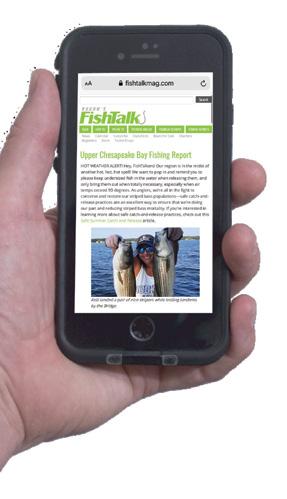

Thank goodness spring is here, and the bite should go from slow to stupendous in this neck of the woods. We weren’t more than a week into April in 2025 before rumblings of big black drum had been heard, and crab baits fished on bottom near drop-offs and shoals produced rather epic catches including fish north of the 50-pound mark by the middle of the month. Before May arrived bull reds had joined into the frenzy and along the southern reaches of the Eastern Shore slot reds were hitting as well. Specks are a bit of a question-mark considering the winter we just went through, but those that are around should start making their presence known in the shallows this month, too.

It’s time people — the specks and reds should both be feeding hard this month, so let’s hope that the rather rugged winter wasn’t too tough on them. Luckily migratory fish should show up in April, too, and if past is any prediction we’ll start seeing the big bull redfish show up before flipping any more pages on the calendar. This month should also prove prime for tautog fans working the CBBT and other area structure, so grab some crabs and fleas. Shore-bound anglers are undoubtedly happy to see April arrive as well, because this is when the bottom fish reappear within casting distance of the piers and shorelines. Before April turns into May there’s a chance we’ll see the first bluefish show up, too; last year they made it in just under the wire.


WATERFRONT Jobs – Dock Hands and Ticket Sales/Customer Service Full-Time & PartTime positions available, April–October. Dock Hands earn hourly pay plus tips $$ tying up boats at a lively Annapolis dock bar. Office role handles ticket sales and provides customer service for Schooner Woodwind guests. Boating and customer service experience a plus. For more info or to apply, visit: www.schoonerwoodwind.com/employment

Let’s give a warm welcome to these new FishTalk distribution stops!
• Gott Auto Body in Annapolis, MD
• Back Bay Anglers Club in Virginia Beach, VA
• Tidewater Anglers Club in Virginia Beach, VA



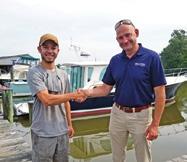
Argo Navigation announced its acquisition of SpotOn Fishing, a fishing-focused app known for its industry-leading map detail and advanced weather visualization. The move expands Argo’s mapping capabilities, giving users access to high-resolution bathymetry, detailed 3D structure views, and advanced weather overlays, including radar, lightning strikes, wind, currents, and sea surface temperatures. Together, these tools help boaters and anglers better understand on-water conditions and make more informed decisions before and during a trip. SpotOn Fishing has built inshore, offshore, and freshwater maps using highly accurate bathymetric data that reveals underwater structure with exceptional clarity. Its advanced weather layers add real-time and frequently updated data directly to the map, allowing users to visualize changing conditions such as storms, wind shifts, currents, and temperature patterns without switching between tools or apps.
“This acquisition is about giving boaters a clearer picture of what’s happening above and below the water. By combining SpotOn’s exceptional map detail and weather visualization with Argo’s intelligent routing, we’re helping users make better decisions—before they leave the dock and while they’re underway,” said Jeff Foulk, founder of Argo Navigation. Additionally, Argo will bring its industry-leading autorouting technology to SpotOn Fishing. Argo’s routing delivers fast, accurate routes based on vessel draft, height, and navigational constraints. The result will be a smarter, safer navigation experience for SpotOn users heading to their fishing destinations. SpotOn Fishing will continue to operate as a standalone app as its mapping and weather capabilities are integrated into the Argo platform, while Argo’s industry-leading autorouting technology is introduced within SpotOn. Over the coming months, users across both platforms will gain access to expanded features—including detailed bathymetry, relief shading, weather layers, community routes, enhanced chat tools, and advanced autorouting—delivering a smarter, more connected navigation experience for boaters everywhere. argonav.io



The American Boat & Yacht Council (ABYC) announced that Dave Broadbent, ABYC senior director of business development, has been appointed SkillsUSA National Technical Chair for Marine Service Technology. SkillsUSA is a national nonprofit organization that serves students preparing for careers in skilled trades and technical fields through hands-on training, leadership development, and national competitions. “Having the marine industry represented at the national level helps students see marine service as a rewarding career path and ensures what they learn aligns with the skills employers need,” said Broadbent. He will provide technical leadership for the Marine Service Technology competition at the SkillsUSA Championships, the organization’s annual national competition that brings together top students from across the United States to demonstrate their skills. As National Technical Chair, Broadbent will support the development and review of contest criteria, and collaborate with educators, judges and industry partners to ensure a fair, current and highquality competition. In addition to its work with SkillsUSA, ABYC supports workforce development through school partnerships, its marine service technology curriculum, the Marine Trades Accreditation Program, industry collaboration, and training and certification programs. abycinc.org
Annapolis Yacht Club (AYC) recently announced a multi-year partnership with Boston Whaler as the Official Powerboat of Wednesday Night Racing. Spend one Wednesday evening watching the start of a race and you’ll see numerous Whalers in the spectator fleet, many flying the club’s burgee. At any given time, you’ll see members on their Boston Whalers tying up at AYC’s docks to bring friends and family ashore to enjoy the club’s amenities. Over the years they have been an integral part of AYC’s Junior Program supporting numerous summer program classes and the busy practice schedule for Optis and 420s. In addition to other club assets, AYC’s 19-foot Boston Whalers have joined the race committee for weekend regattas and signature events as well as supporting the Harbor 20 course on Wednesday nights. One of the club’s Whalers has become the workhorse of the dockmaster’s office including the staff’s support for race committee, summer mooring tender service, and the oyster recovery program. Beginning this spring with the start of the 2026 AYC Wednesday Night Race Series, you’ll see the team from Boston Whaler’s Chesapeake Whalertowne in the starting area in support of AYC’s legacy of yacht racing at the club. annapolisyc.com