SP’S MILITARY YEARBOOK 2021-2022 CONTENTS HEREWITH



www.spsnavalforces.com


PAGE 3
Indian Navy Ships: New Launches & Deliveries

SP's Correspondent
PAGE 4
Germany and India: Shared Concerns

Ranjit Kumar
PAGE 5
L&T and Navantia Sign a Teaming Agreement for Project 75 (India)
India’s Submarine Force Levels: Cause for Worry
SP’s News Network
PAGE 7
Exercise Malabar 2023
SP's Correspondent
APPOINTMENT
Vice Admiral Rajesh Pendharkar takes over Eastern Naval Command

Vice Admiral Rajesh Pendharkar assumed charge as the Flag Officer Commanding-inChief (FOC-in-C), Eastern Naval Command (ENC) on August 1, 2023.
Commissioned into the Indian Navy in January 1987, Vice Admiral Pendharkar is an Anti-Submarine Warfare specialist. He has held various Operational, Staff and Command Appointments in the course of his distinguished career spanning over 36 years. He has commanded three frontline ships including the Missile Corvette INS Kora, Stealth Frigate INS Shivalik and the Aircraft Carrier INS Viraat. His important staff appointments include as the Principal Directors in the Directorate of Net-Centric Operations and the Directorate of Personnel.
n VICE ADMIRAL A.K. CHAWLA (RETD)

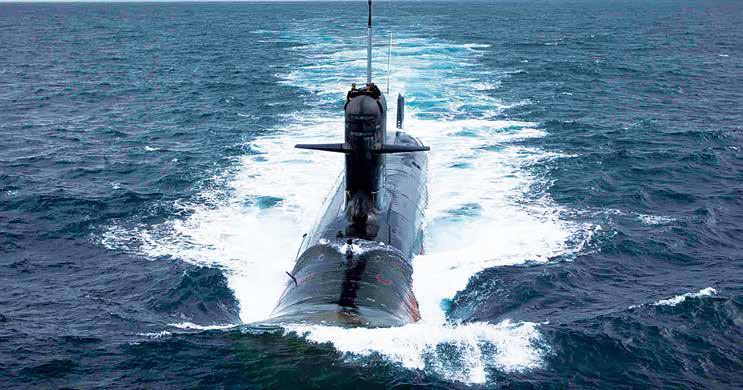
THE RECENT INKING OF a ‘nonbinding and non-financial MoU’ between Mazagon Docks Limited (MDL) and ThyssenKrupp Marine Systems (TKMS) on June 7, 2023 to provide engineering and design consultancy support to MDL, has once again brought to the fore the urgent necessity for India to revive its domestic conventional submarine production line, which has fallen idle after the launch of the sixth and last Scorpene class submarine being built at MDL, INS Vagsheer, in April 2022. The submarine, which started sea trials in May 2023, is currently undergoing sea trials prior being commissioned into the Indian Navy.
India's Ambitious Submarine Building Plan
Under the now well-known 30-year submarine building plan, approved by the Vajpayee government in 1999, India was to build 24 submarines over a 30-year period (1999-2029), with progressively greater indigenous content, until the final batch would be fully designed and built in India. Media reports also indicate that a few years
ago the Indian Navy had approached the Government to amend the 30-year submarine building plan by replacing six conventional submarines with an unspecified number of indigenously designed and built nuclear attack submarines (SSNs). Having gained enough experience in the design and construction of ballistic missile armed nuclear submarines (SSBNs) it would make eminent sense for India to use the in-house expertise for building SSNs, whenever this programme is approved by the government. Based on past experience of other countries who have designed and built SSNs, especially China, it is estimated that the first indigenous SSN will take at least 15 years to be launched, after the construction programme is approved. The proposed indigenous SSN construction programme would take India into an elite club of SSNbuilders and operators, which today comprises the US, Russia, UK, China and France.
As far as India’s conventional submarine building plan is concerned, several positive developments have taken place with regard to the indigenisation of critical capabilities for conventional submarines. After the successful demonstration of the indigenous Air Independent Technology (AIP) module by India’s Defence Research & Development
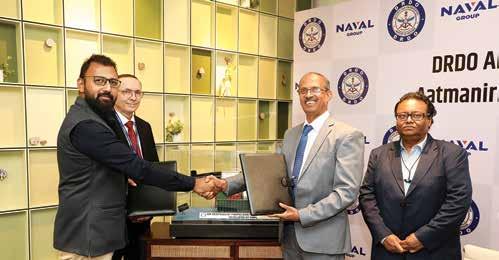
Organisation (DRDO) on a land-based prototype in 2021, a pact was inked between DRDO and Naval Group, France, in January 2023, to install the first module on board INS Kalvari during its forthcoming major refit. Once trials are successful, it would form the basis of equipping future indigenous submarines, apart from the other P-75 boats. AIP submarines are also called the ‘poor man’s SSN’ as it allows them to remain submerged for greater lengths of time without surfacing, which makes them more difficult to detect. India has also become self-sufficient in the design and fabrication of advanced sonars, combat management suites and communication equipment for our submarines. The indigenous heavyweight torpedo, Varunastra, is making steady progress with the first successful underwater target engagement announced by the Indian Navy on June 6, 2023. The DRDO had intimated that a variant of Varunastra will one day arm our future submarines.
In January 2022, the Indian Navy had also certified the use of indigenous submarinebuilding steel, being made at the Rourkela Steel Plant (under the Steel Authority of India) for use in the construction of future submarines to be built in India. The announcement of the ‘strategic partnership’
3/2023 1
ROUNDUP
Volume 18 No. 3 June-July 2023
THE ONLY NAVAL MAGAZINE FOR NAVIES ACROSS ASIA-PACIFIC
`100.00 (India-Based Buyer Only)
LEAD STORY
India's Submarine power amidst Geopolitical shifts is an urgent
Restoring
imperative
INS Kalvari, first Scorpene Submarine by MDL
PHOTOGRAPH: MDL AVAIL YOUR COPY NOW ! www.spsmilitaryyearbook.com SP’s Military Yearbook 2021 –2022
S-80 Submarine
multifaceted ways, several of which we delve into within the pages of this issue. One pressing matter that comes to the forefront is the imperative need to restore India's submarine power amidst these geopolitical shifts.
In a thought-provoking piece, Vice Admiral A.K. Chawla (Retd) sheds light on the urgency for India to reinvigorate its domestic conventional submarine production line. He writes that submarines form a critical component of maritime power and their declining numbers should make decision makers take immediate steps for restoring force levels to the necessary numbers by expediting the indigenous production
model in 2017 was another positive step in the acquisition process of large and complex weapon systems, such as submarines.
Foreign Collaboration and Challenges
However, despite many positive achievements, the progress on the construction of the submarines remains excruciatingly slow. Only six of the 24 submarines have been built thus far, over the past 24 years of the envisaged 30-year plan period. Progress for the next batch under Project 75(I), with AIP capability, acquisition for which was commenced over a decade ago, is still at the RFP response stage under the ‘Strategic Partnership’ model. The current RFP was issued in July 2021 to MDL and Larsen & Toubro (L&T), from the public and private sector respectively. These two shipbuilders were to partner with a foreign Original Equipment Manufacturer (OEM) to build the six submarines. However, the timeline for bid submission has been extended several times, with the current date being August 1, 2023. The non-submission of bids is reportedly due to issues with some stipulations of the RFP. As per news reports, DCNS France pulled out of the project citing inability to meet the provisions of the AIP system mentioned in the RFP. Two other OEMs, Navantia, Spain and ROE-Russia did not have an AIP, leaving only South Korea and Germany in the fray. Past track record indicates that it will take at least a decade for the first P-75(I) submarine to be constructed after the conclusion of the contract – in the case of the Scorpene programme, the first submarine was commissioned in 2017, 11 years after the contract was signed with DCNS, France. Since it will take at least a couple of years for the contact to be signed after the submission of bids, and assuming that the bids are now indeed submitted by August 1, 2023, the first P-75(I) submarine is likely to be ready for trials only by 2035.
Current Status of the Submarine Fleet
The Indian Navy’s current conventional submarine force levels comprise the six new Scorpene class submarines,the seven remaining Russian-origin EKM and four German-origin HDW submarines. The EKM and HDW submarines are ageing, having been commissioned between 1986 and 2000, and will have to be de-inducted progressively over the next decade, after reaching the end of their service life. It is, therefore, evident that a serious degradation in force levels of conventional submarines looms before us, which needs to be addressed urgently. The construction of next two batches of conventional and nuclear submarines takes on added urgency in the face of enhanced inductions of submarines, both in Pakistan
of both conventional and nuclear attack submarines.
Within these pages, we also bring you insights into the Indian Navy's ongoing modernisation plans, bolstered by the launch and delivery of new indigenous ships. These additions to the naval fleet underscore the Navy's steadfast commitment to augmenting its capabilities in the maritime domain. These developments align harmoniously with India's broader strategic objectives, reinforcing its stature as a dominant regional maritime power.
There is coverage and analysis of the visit of the German Defence Minister Boris Pistorius to India to restart Indo-German De-
fence Relations. The old relationship between the two countries has been lying dormant for many years, and now hopefully will get revived, in view of the shared security concerns in the region.
Furthermore, we explore the Teaming Agreement between L&T and Navantia, Spain, a significant stride towards participating in the Indian Navy's prestigious Project 75 (India) submarine programme.
This issue also provides a comprehensive overview of Exercise Malabar 2023, where the Indian Navy's indigenous frontline warships, INS Sahyadri and INS Kolkata, joined forces with ships and aircraft from the US Navy (USN), Japan Maritime Self De-
fence Force (JMSDF), and The Royal Australian Navy (RAN).
As we navigate through these intricacies of geopolitics and maritime advancements, we invite you to delve into this issue of SP’s Naval Forces, where each article unravels a facet of our ever-evolving maritime world.
Wish you all discerning readers happy reading!
Jai Hind!
JAYANT BARANWAL Publisher & Editor-in-Chief

levels could dip to single digits, and even fall below those with Pakistan. Faced with China’s growing naval strength in the IndoPacific, the US and UK have combined forces to arm Australia with SSNs under the AUKUS trilateral security pact. However, India not being part of a military alliance will require its owncredible underwater capabilities.
and China. Pakistan had signed a contract with China in 2015 to construct eight Yuanclass (Type 039-A) conventional AIP-capable submarines at an estimated cost of $5 billion – the first four in China and the last four in KSEW, Karachi. Work on these submarines is progressing expeditiously with the first boat scheduled to be delivered in end 2023. Given the speed of construction at Chinese shipyards, especially as the Yuan class is a proven design; it is quite likely that the first four submarines will be commissioned on schedule. Steel cutting ceremony for the fifth submarine, to be built at KSEW, was also held in December 2021. Once all eight submarines are delivered, probably over the next decade, the Pakistan Navy’s sea denial capability will be greatly enhanced.
The Yuan class submarines have already been deployed in the IOR and one boat also visited Karachi in 2015, where it reportedly embarked Pakistan Navy personnel for ‘experience’ sorties. Subsequent training of Pakistani crew in China will ensure quick operationalisation of these submarines. Meanwhile, China’s own submarine (and ship) building programme is proceeding apace, and as per the latest assessment given to the US Congress by the US Department of Defence in March 2023, now comprises a force level of 56 modern conventional submarines and nine nuclear attack submarines (not counting its six SSBNs).
This decline in the Indian Navy’s submarine force levels comes at a juncture when India is facing a challenging geopolitical environment, with confrontation with China in particular having peaked since the Galwan clashes in 2020. China had commenced regular deployments of both its conventional and nuclear submarines to the IOR since 2013, apart from its warships, under the pretext of anti-piracy patrols over the past decade. China’s Djibouti naval base is also capable of berthing and supporting
both nuclear and conventional submarines. Karachi and Gwadar are two additional ports that China could use for supporting submarine operations in the waters around us. With Russia now being embroiled in a prolonged war against Ukraine, Its reliability as an arms supplier has become more tenuous than it already was since the end of the Cold War, due to Western sanctions against the country and Russia’s own commitment to the war. As such, with Russia and China reaching new heights of bilateral ties under their ‘no limits’ friendship, Russia’s unstinted support in a possible SinoIndian conflict cannot be taken for granted.
India is today the world’s fifth largest economy and is likely to move up to the third position by 2030. Our economy is substantially dependent on the seas, both for trade as also for energy security. Submarines are a potent weapon platform that can threaten not only warships, but also merchant ships during an armed conflict. Submarines, especially AIP-equipped boats and SSNs are also force multipliers in any conflict at sea, and the side having an edge in this regard has a definite advantage over its adversary, besides being a significant deterrent to conflict itself. In this regard it may be prudent to recollect the force imbalance at sea during the 1965 Indo-Pak War, when the Pakistan Navy had one submarine, the PNS Ghazi (later sunk in the 1971 War) and the Indian Navy did not yet possess a submarine arm.
Course Correction in Submarine Imbalance

The growing imbalance in force levels of submarines between India and its two adversaries, is therefore, cause for worry. Indeed, unless replacements for submarines scheduled to be decommissioned over the next decade are not contracted in good time, there is a distinct possibility that the Indian Navy’s conventional submarine force
To achieve this, India is faced with a twin conundrum – the need to urgently bolster its declining submarine force levels, which is time critical, while also ensuring that it attains the goal of indigenous capability in submarine design production, which will a much longer time period to achieve. Consequently, a multi-pronged strategy will need to be followed to achieve both objectives. The design and eventual construction of an indigenous conventional submarine needs to be pursued through inhouse R&D, supplemented by transfer of technology for key equipment, and executed in a time-bound manner. In parallel, we need to pursue the early induction of conventional submarines through foreign collaboration, preferably under a governmentto-government agreement, as exemplified by the recent understanding between India and the US to co-produce fighter jet engines in India. The recent MoU between TKMS and MDL is a positive step in this direction.
In the interim, the capability gap arising out of the delay in the induction of conventional submarines needs to be filled by going in for at least three additional Scorpenes, with advancements in technology and design, and a higher level of indigenisation (including the indigenous AIP). This would have the advantage of faster replenishment of force levels and commonality of platforms, with all its attendant benefits, besides feeding into our indigenous submarine programme. This would also ensure the continued use of the infrastructure and employment of human expertise available at MDL, which has been built up in a painstaking manner over the past decade, and needs to be gainfully utilised, before it can be channelized for the P-75(I). In parallel, the project for the indigenous production of SSNs needs to be given the green signal at the earliest.
To enable the Indian Navy to meet its requirement of ensuring India’s maritime security in its vast area of operation in the Arabian Sea, Bay of Bengal and the Indian Ocean, there is a need to take urgent steps to redress this situation. Submarines form a critical component of maritime power and their declining numbers should make decision makers take immediate steps for restoring force levels to the necessary numbers, principally by expediting the indigenous production of both conventional and nuclear attack submarines. Our national security cannot brook any further delay." SP
www.spsnavalforces.com 3/2023 2
EDITORIAL LEAD STORY
DRDO & Naval Group France sign agreement to safely integrate the indigenous system in Kalvari-class Submarines
PHOTOGRAPH: PIB
In the current geopolitical landscape, numerous factors demand our attention and define our world in
Indian Navy Ships: New Launches & Deliveries
Indian Navy's ongoing modernisation plans are receiving a significant boost through the launch and deliveries of new indigenous ships. These recent additions to the fleet reflect the Navy's commitment to enhancing its capabilities in the maritime domain. With each new vessel, the Navy gains enhanced operational reach, improved surveillance capabilities, and heightened deterrence. These developments align with India's broader strategic goals, reinforcing its position as a dominant regional maritime power.
n SP'S CORRESPONDENT
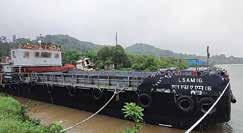
Launch of Second MCA Barge, Yard 76 (LSAM 8)
(IN) by facilitating Transportation, Embarkation and Disembarkation of articles/ ammunition to IN Ships both alongside jetties and at outer harbours.
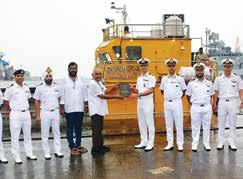
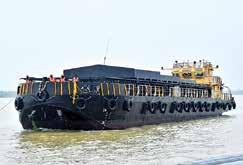
Delivery of First MCA Barge, LSAM 7 (Yard 75)
Second Missile Cum Ammunition (MCA) Barge, Yard 76 (LSAM 8) was launched on August 18, 2023. The availability of MCA Barges will provide impetus to Operational commitments of Indian Navy (IN) by facilitating Transportation, Embarkation and Disembarkation of articles/ammunition to IN Ships both alongside jetties and at outer harbours.
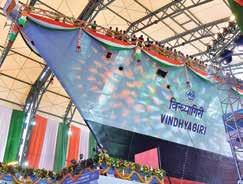
Launch of Y-3024 (Vindhyagiri)
First Barge of the series LSAM 7 (Yard 75) has been delivered to Indian Navy on July 18, 2023. The Barge has been built under the classification rules of Indian Register of Shipping (IRS) with a service life of 30 years.
Launch of ‘Sanshodhak’, Fourth Ship of Survey Vessel (Large)
‘Sanshodhak’, the fourth of four ships of Survey Vessels (Large) (SVL) Project, being built by L&T/GRSE for Indian Navy was launched on June 13, 2023. The ship named ‘Sanshodhak’, meaning ‘Researcher’, signifies the primary role of the ship as a Survey Vessel. As per the build strategy, the
first ship would be built at GRSE, Kolkata and construction of the remaining three ships upto outfitting stage, has been subcontracted to L&T Shipbuilding.
Launch of 'Anjadip' Third Ship of ASW SWC (GRSE)
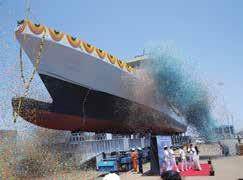
being built by GRSE for Indian Navy, was launched on June 13, 2023 at L&T. As per the build strategy, four ships are being built at GRSE, Kolkata and construction of balance four ships has been sub-contracted to L&T. Arnala class of ships will replace the in-service Abhay class ASW Corvettes of Indian Navy.
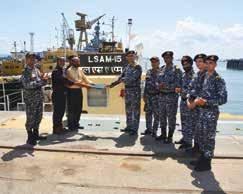
Delivery of First ACTCM Barge, LSAM 15 (Yard 125)
‘Anjadip’, the 3rd of eight ships of ASW Shallow Water Craft (SWC) Project
First Barge of the series LSAM 15 (Yard 125) has been delivered to Indian Navy on June 9, 2023. The Barge has been built under the classification rules of Indian Register of Shipping (IRS) with a service life of 30 years. With all major/auxiliary equipment sourced from indigenous manufacturers, the Barge is proud flag bearer of ‘Make in India’ initiative of Ministry of Defence. SP
Vindhyagiri, the sixth Stealth Frigate of Project 17A being built at GRSE, was launched on August 17, 2023. Project 17A Frigates are the follow-on class of the Project 17 (Shivalik Class) Frigates, with improved stealth features, advanced weapons & sensors and platform management systems. Seven Project 17A Frigates are under various stages of construction at MDL and GRSE. The design of Advanced Stealth Frigates also showcases the prowess of the Warship Design Bureau, in designing technologically advanced warships for the Indian Navy.
Launch of Second ACTCM Barge, Yard 126 (LSAM 16)
Ammunition Cum Torpedo Cum Missile (ACTCM) Barge, Yard 126 (LSAM 16) was launched on July 19, 2023. The availability of ACTCM Barges will provide impetus to Operational commitments of Indian Navy
3/2023 3
N AVAL MODERNISATION / MAKE IN INDIA Sin título-1 1 01/06/2023 6:25:04
PHOTOGRAPHS: Indian Navy
Germany and India: Shared Concerns
Both countries revive their defence partnership, rekindling technological co-operation and strengthening Indo-Pacific security
n RANJIT KUMAR
EUROPE'S BIGGEST ECONOMY, A technological powerhouse and major European power, Germany is eager to revive the kind of defence ties that existed in eighties, when Germany not only supplied two HDW Type-209 diesel submarines to India but helped Indian naval shipyard Mazagon Dock manufacture two more submarines, besides German assistance in supplying and local manufacture of MTU engines for India's indigenous Arjun tank. However, the alleged irregularities and scandal in the HDW deal marred future India Germany defence cooperation. Consequently, India also declined the option of making two more submarines in Mazagon Dock. As a result India German defence ties went dormant and is yet to recover.
To revive the old relationship, which could be termed unparalleled, as in the height of cold war, Germany was the only Western country that helped India to produce Made in India submarines and for this agreed to assist MDL, Mumbai in capacity building to manufacture two more submarines. Then India's standing in the comity of nations was not so high as it is today. Since India wants to manufacture six advanced diesel subs locally, Germany has once again offered to manufacture all the six proposed subs with an Indian partner. Though Indian side remained silent over the German offer.
However, the event in Mumbai on June 7, for signing of Memorandum of Understanding between MDL and TKMS during which German defence minister was present gave enough indication that MDL is confident of grabbing the over $5 billion deal for the possible construction of six submarines. Said Boris Pistorius, "we have thus sent a very important signal today, a milestone, one could say, for a new flagship project in a key technology. The Indian partners were full of praise for the German technology, the reliability and the longevity of the equipment, submarines, and ships of the last decades."
To promote this deal under the Project 75(I) programme of Indian Navy, estimated to be worth `43,000 crores, the German defence minister visited India from June 5-8, 2023. During his meeting with Indian defence minister the German defence minister made a strong pitch for German offer of producing Made in India German submarines of Thyssenkrupp Marine Systems. Though there are other strong contenders for the submarine deal, German defence minister was hopeful of bagging the deal during his media interaction. The RFP for the deal was first issued almost eight years ago and since then there seems to be no forward movement. Now the Indian Ministry of Defence has extended the time to submit fresh bid till August 1, 2023. Earlier there were reports that Indian defence ministry officials along with naval commanders were negotiating government to government deal with their German counterparts. The German defence minister claimed good progress in these negotiations. These submarines are to be made under the Ministry of Defence Strategic Partnership model. The company has chosen
MDL as its strategic partner in India. Other contenders are from Spain (Navantia) and South Korea (Daewoo) Naval experts say that after the withdrawal of French Naval Group, Germany has a better chance of grabbing the over $5 billion deal. Sources said that Indian Shipyard Mazagon Dock had gained good experience of manufacturing the German submarines, but this time the government is also considering the issue of utilising the private sector shipyards. The Government to Government route adopted for acquiring the French Rafale fighters may also be considered to expedite the process as the Indian navy submarine strength has gone down to precarious low level. Indian Navy's four German submarines are now over three decades old. Six Russian Kilo class submarines are also crossing their service life. They all need urgent replacement.
To revive the dormant defence cooperation both sides had formed a High Defence Committee way back in 2006, though India
and Germany have strategic partnership since 2000, which is being strengthened through intergovernmental consultations since 2011 at the level of Heads of Governments. Though economic and diplomatic relations continue to be in excellent health, with Germany becoming India's largest trade partner in European Union worth Euro 30 billion. But defence cooperation at the ground level could not pickup. The last time a German defence minister, Ursula Von de Leyen, visited India was in 2015, when she not only lobbied for European fighters for Indian Air Force, but also pushed for the submarine deal.
Earlier Germany had put many restrictions in its arms export policy but after the Russia-Ukraine war Germany has lifted many controls. Hence, Germany is ready for transfer of technology in any weapon platform manufacturing programme. Germany wants to play a bigger role in Indopacific hence the German forces would like to deepen cooperation with India. For this Germany would be holding joint naval exercise with India next year and send its warships to India on goodwill visits.
Pistorius told Indian defence minister that our connection, our strategic partnership should and must gain momentum. Defence is a pillar of this partnership. Germany wants to intensify military cooperation with other branches of navy and the Air Force as whole. To strengthen cooperation between German and Indian defence industries, Indian defence minister ap-
prised his German counterpart of investment opportunities in India's two defence corridors, one in Tamil Nadu and the other in Uttar Pradesh. Indian defence industry could participate in the supply chains of German defence industry and add value to its ecosystem, besides contributing to supply chain resilience. Rajnath Singh also stressed that India and Germany could build a more symbiotic relationship based on shared goals and add complementarity of strength.
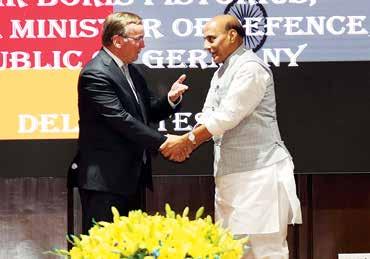
In the aftermath of Russia Ukraine war, NATO members feel increased threat perception, hence they are strengthening their military capabilities, which is an opportunity for Indian and German defence firms to work in a joint venture mode to meet the needs of European countries, India could be an ideal location for these joint ventures as India offers skilled workforce and competitive costs whereas Germany has high technology and financial strength.
Germany wants to deepen strategic and defence partnership with India in view of shared concerns in security arena regarding current situation in Indo-pacific maritime area specially the Malacca Strait, and the effects of shipping traffic on Indian waters. That is why the two countries have planned naval interactions in Indopacific through joint exercises. Shared strategic interests and concerns would lead to deeper defence cooperation and interdependence between the European and Asian power. SP
www.spsnavalforces.com 3/2023 4 B I-LATERAL / INDO-GERMAN RELATIONS
Germany's offer to produce 'Made in India' submarines signifies a significant milestone in the revival of defence ties
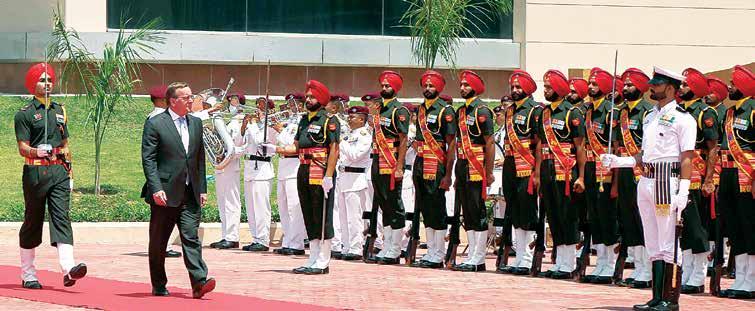
(Top) German Defence Minister Boris Pistorius was given a Guard of Honour on his arrival in India;
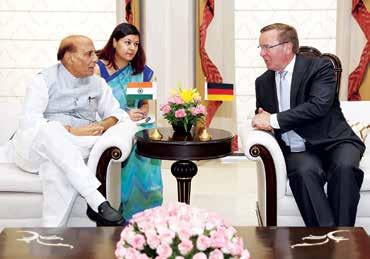
(Above) (L-R) Germany's Defence Minister being received by Indian Defence Minister Rajnath Singh. Both Defence Ministers engaged in a productive discussion.
PHOTOGRAPHS: PIB
L&T and Navantia Sign a Teaming Agreement for Project 75 (India)
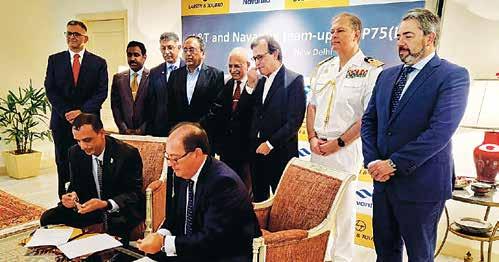




LARSEN & TOUBRO AND Navantia, Spain signed a Teaming Agreement (TA) on July 10, 2023 for the purpose of submission of a techno-commercial bid for the Indian Navy's prestigious P-75 (India) submarine programme. The agreement was signed in the presence of S.N. Subrahmanyan, L&T CEO & MD and Augustin Alvarez Blanco, Naval Construction Vice President, and Member of the Board – Navantia. Also present at the occasion were José María Ridao Domínguez, Ambassador of Spain in India and Captain (Navy) Fernando Alvarez, Spanish Defence Attaché, along with senior officials from both L&T Defence and Navantia. The event was held in the premises of the Spanish Embassy in New Delhi. Project 75(I) requires the Indian bidder to tie up with a Foreign Collaborator (FC) and execute the programme for delivery of six conventional submarines equipped with Air-Independent Propulsion (AIP), while achieving targeted indigenous content. Expected to be valued at over Euro 4.8 billion, the project is the India's largest defence acquisition project. This would also be followed by a 30-year lifecycle sustenance contract of similar value. P-75(I) would be the first programme to be processed under the ambitious Strategic Partnership (SP) model of acquisition of the Ministry of
Defence. L&T and Navantia signed an MoU for the programme on April 11, 2023 at Madrid, which has now culminated in this TA.

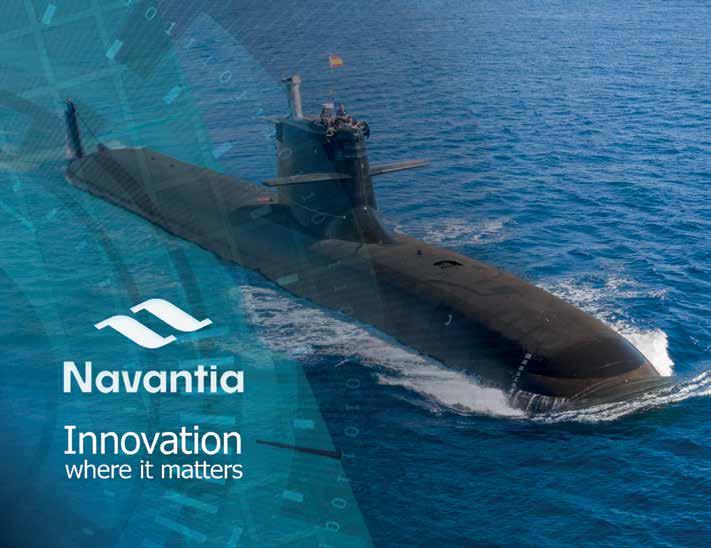
As per the agreement, Navantia would carry out the design of P-75(I) submarines based on its S80 class of submarines, the first of which was launched in 2021 and is undergoing sea trials prior to its delivery to Spanish Navy at the end of 2023. Apart from S80 class, Navantia has been involved in design and construction of Scorpéne class of submarines together with DCNS (Now Naval Group) of France, which have been exported to Chile and Malaysia. Navantia has also
been involved in the Scorpene submarines (Kalvari class) built in India including handholding of the Indian yard.
P-75(I) programme calls for integration of an AIP system. Navantia's state-of-theart 3rd Generation AIP solution is the most advanced and efficient AIP system in the world, apart from also being the most compact, easiest to exploit and maintain and environment friendly. It uses bioethanol as a source of hydrogen which is known to be cost efficient, easily available, and does not call for any special infrastructure. High density of hydrogen in ethanol improves
the AIP system's efficiency. Ethanol, being in liquid form, eliminates the risks associated with storing hydrogen. In addition, wide availability of ethanol enables the system to be refueled anywhere in the world.

L&T and Navantia are also seeking cooperation in other military programmes as well as in green energy opportunities, including offshore wind through Navantia Seanergies division.
Commenting on the occasion, S.N. Subrahmanyan, CEO & MD, L&T said, "L&T is proud to collaborate with Navantia for this prestigious programme of strategic importance for the nation's security. Navantia's glorious 300-year-old track record in naval construction & technical expertise gives us a competitive advantage in this programme and offer the Bio-Ethanol Stealth Technology (BEST) and environmentally Green AIP solution. We are committed to providing the most contemporary solution for Indian Navy's requirements at a competitive price."
Alvarez Blanco commented, "It gives us great joy to be in a position to be the design and technology partner for P-75(I). We are also in collaboration with L&T for the Landing Platform Dock (LPD) programme whose tender is eagerly awaited. With these two prestigious programmes for the Indian Navy, Navantia is proud to be making a key contribution towards fulfilling the defence needs of India, a nation with which Spain shares excellent relationship." SP
3/2023 5 S UBMARINES / MOU Pragati Maidan Exhibition Centre, New Delhi, India International Event for Internal Security of India 26 27 28 OCT ‘ 2023 Supported By: Organized By : Scan Me STRENGTH IN UNITY : COLLABORATING FOR INDIA’S INTERNAL SECURITY EXHIBITOR QUERY VISITOR QUERY VISIT THE SHOW Gayatri Chibba (Marketing Director) 9810591686 gayatri@interads.in BOOK YOUR SPACE Harish Khanduri (Project Manager) 8800138543 harish@interads.in Rights to admission reserved with Inter Ads Exhibitions Pvt. Ltd., below 18 years of Age are not allowed. www.milipolindia.com Media Partner : n SP’S NEWS NETWORK
L&T and Navantia signed an MoU for the programme on April 11, 2023 at Madrid, which has now culminated in this Teaming Agreement on July 10, 2023
PHOTOGRAPH: Navantia
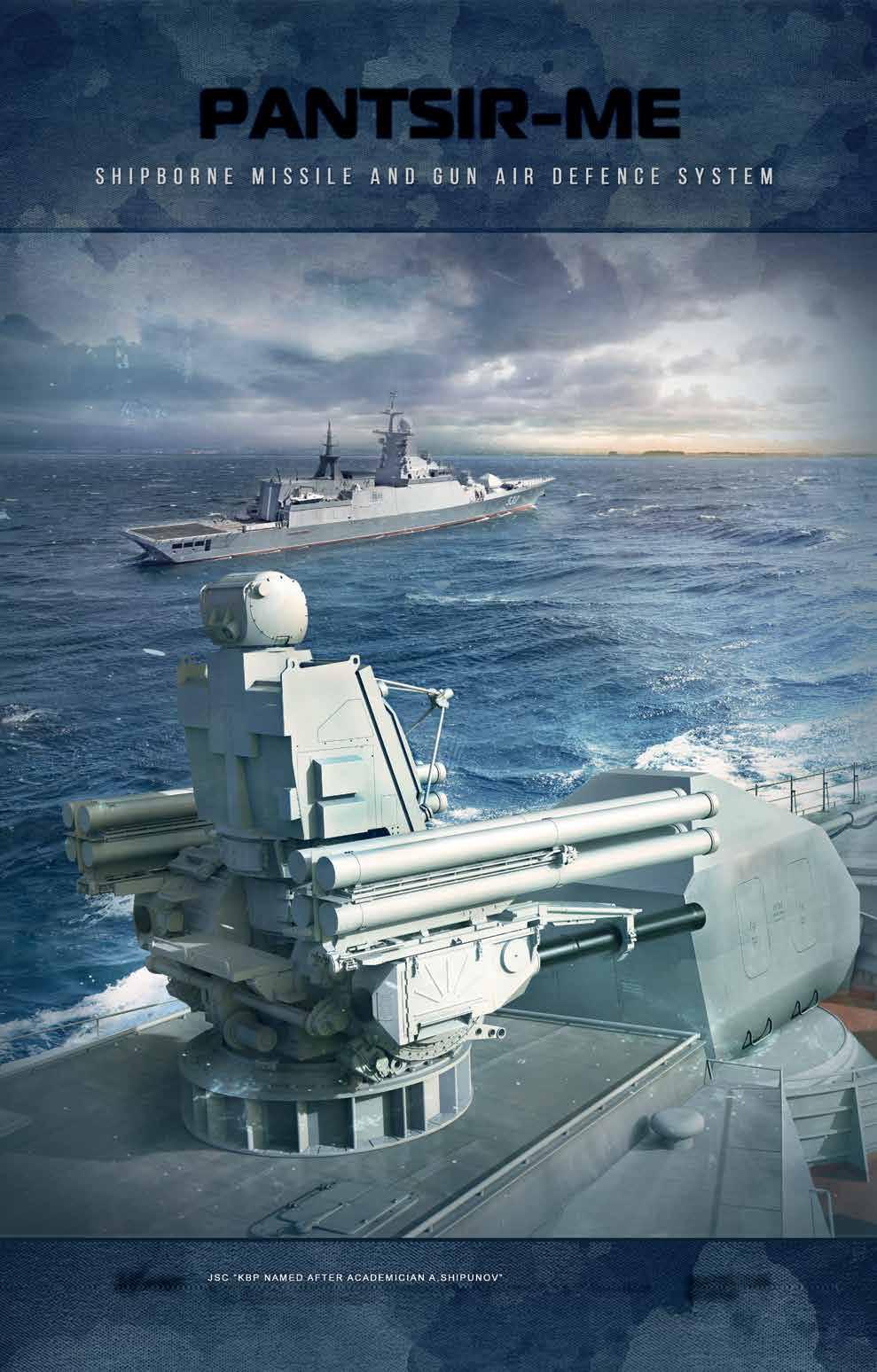
Pantsir-ME Shipborne ADGMS Repel Any Attack
JSC Rosoboronexport and JSC NPO High Precision Weapons actively promote the Pantsir-ME shipborne air-defence missile and artillery system developed and produced by the Instrument Design Bureau JSC KBP named after Academician A. Shipunov
THE CURRENT TRENDS IN the development of the navies, force the maritime powers to equip their ships with reliable assets to counteract air threats, i.e. cruise missiles, unmanned aerial systems, helicopters and planes. A sophisticated system of countering practically all the possible aerial kill assets has been developed in Russia. ‘PantsirME’ can be installed on most Russian warships and is very well fit for ships manufactured by other countries. I am confident that it has very good export prospects in the Arab countries, SouthEast Asia and Latin America,” said Rosoboronexport’s Director General Alexander Mikheev.
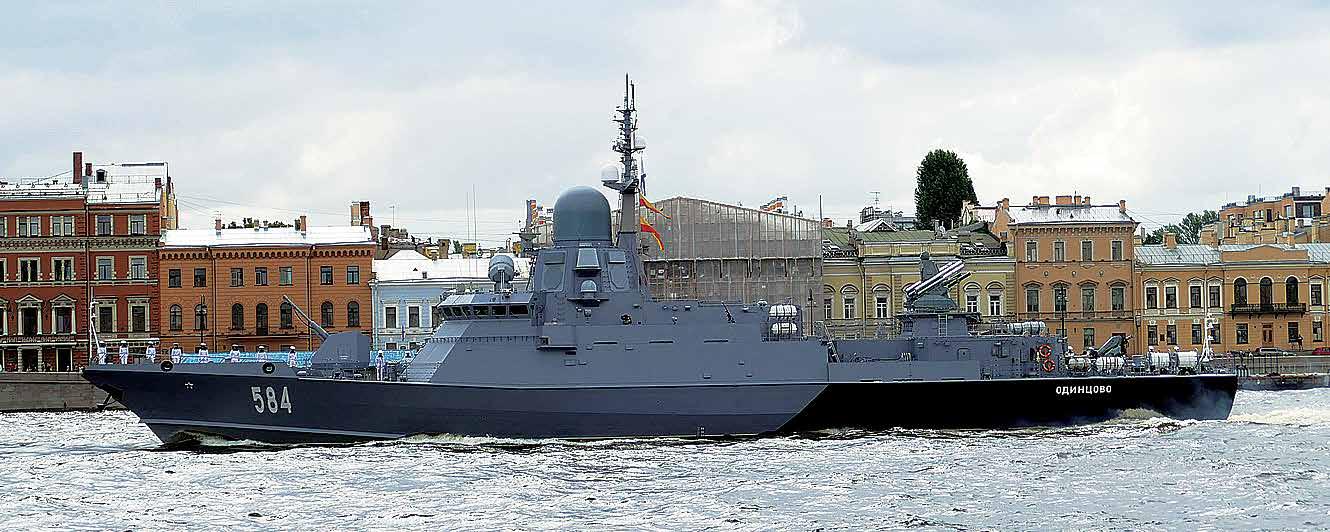
The Pantsir-ME air-defence missile and artillery system can be set up on ships with water displacement of more than 300 tons. The system provides a reliable protection of vessels from all the existing and prospective air assault weapons in the whole spectrum of their combat capabilities with an unconditional probability of kill, which is practically equivalent to one, includ-
ing low-flying anti-ship missiles and unmanned aerial vehicles.
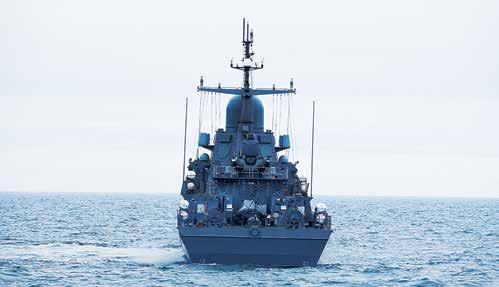
The Pantsir-ME air-defence missile and artillery system features:
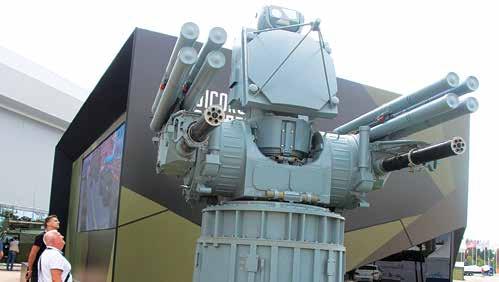
z highly effective combination of armament;
z automated, multichannel, highly-accurate fire control system;
z short time of response;
z substantial missile load;
z high jamming immunity;
z automation of combat processes.
“Currently the Pantsir-ME air-defence missile and artillery system has no direct countertypes in the world market in the segment of shipborne air defence systems, and such will hardly pop up in the near future,” noted Sergey Abramov, the Industrial Director of the Armaments cluster in the Rostec State Corporation.
The system is capable of simultaneous firing at four targets attacking the ship while the kill zone for guided anti-aircraft missiles reaches 20 kilometers in distance and up to 15 kilometers in height. Besides, Pantsir-ME can first utilise its missile weapons, and then, in case of a miss, the target
Main Characteristics
will be hit by the artillery fire with a 100 percent guarantee.
The system includes a high-intelligent multimode adaptive radio-optical control system. All the stages of operator workfrom the target acquisition to the firing - are completely automated. A combined use of the radio and optical control system provides for the all-weather and roundthe-clock operability of the system. All this permits a guaranteed elimination of targets
at long distances and in close proximity. Pantsir-ME consists of control and combat modules, storage and feeding systems. Main armament: two 30-mm artillery machineguns, rails for 8 TLCs with missiles, a power drive and a radar-optical control system. The high effectiveness of intercepting anti-ship missiles is explained by high performance tactical and technical characteristics of the Pantsir-ME air-defence missile and artillery system. SP
www.spsnavalforces.com 3/2023 6
“
WEAPON SYSTEMS Engagement Zone: Elevation Artillery/missiles, m 0...3000/ 2...15000 Range Artillery/missiles, m 500...4000/ 1500...20000 Artillery rate of fire, rpm 10000 Number of channels to engage targets 4 Max speed of a target, m/s 1000 Ammunition load missiles / rounds, un. 32/1000 Time of response, s 3...5 Weight with ammunition load, kg 7100
PHOTOGRAPHS: A/V/Karpenko (www.bastion-karpenko.ru), Rosoboronexport, High Precision Weapons
Exercise Malabar 2023
Publisher and Editor-in-Chief
Jayant Baranwal
Deputy Managing Editor Neetu Dhulia
Principal Correspondent
Ayushee Chaudhary
Contributors
India
Admiral Sunil Lanba (Retd)
Vice Adm A.K. Chawla (Retd)
Vice Adm Shekhar Sinha (Retd)
Vice Adm K.N. Sushil (Retd)
Vice Adm Satish Soni (Retd) Saloni Salil Europe
Alan Peaford, Doug Richardson, Andrew Brookes (UK) USA & Canada
Lon Nordeen (USA), Anil R. Pustam (West Indies) West Asia/Africa
H.R. Heitman (S. Africa)
Chairman & Managing Director
Jayant Baranwal
Executive Vice President (Planning & Business Development) Rohit Goel
Manager – HR & Admin Bharti Sharma
Deputy Manager – Circulation Rimpy Nischal circulation@spsnavalforces.com
Group Research Associate Survi Massey
Design Team
Sr. Designer: Vimlesh Kumar Yadav
Designer: Sonu S. Bisht
Group Director – Sales & Marketing Neetu Dhulia
Director – Sales Rajeev Chugh
SP’s Website
Sr. Web Developer: Shailendra Prakash Ashish
Web Developer: Ugrashen Vishwakarma
Published bimonthly by Jayant Baranwal on behalf of SP Guide Publications Pvt Ltd. All rights reserved. No part of this publication may be reproduced, stored in a retrieval system, or transmitted in any form or by any means, photocopying, recording, electronic, or otherwise without the prior written permission of the publishers.
Printed in India by Kala Jyothi Process Pvt Ltd
© SP Guide Publications, 2023
Subscription/ Circulation
Annual Inland: `600 • Overseas: US$180 E-mail: subscribe@spguidepublications.com subscribe@spsnavalforces.com
Letters to the Editor editor@spsnavalforces.com
For Advertising Details, Contact: neetu@spguidepublications.com rajeev.chugh@spguidepublications.com
n SP'S CORRESPONDENT
INDIAN NAVY'S INDIGENOUS FRONTLINE warships INS Sahyadri and INS
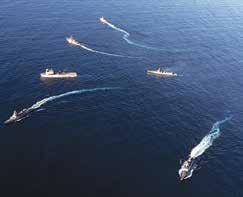
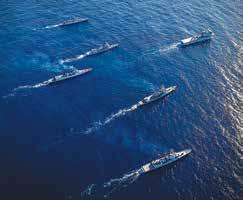
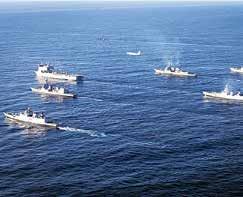
Kolkata participated in Exercise Malabar 2023 off Sydney, Australia from August 11-21, 2023 along with ships and aircraft from the US Navy (USN), Japan Maritime Self Defence Force (JMSDF) and the Royal Australian Navy (RAN).
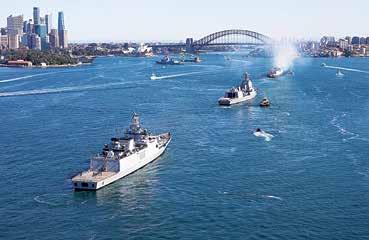
The Indian Navy was represented by indigenously built Destroyer INS Kolkata, Frigate INS Sahyadri and P-8I Maritime Patrol Aircraft. Other participating units included RAN ships HMAS Choules and HMAS Brisbane, USS Raphael Peralta, JS Shiranui, along with submarines, fighter aircraft, maritime patrol aircraft and shipborne helicopters.
INS Sahyadri is the third ship of the indigenously designed and built Project-17 class multi-role stealth frigates while INS Kolkata is the first ship of the indigenously designed and built Project-15A class destroyers. Both ships have been built at Mazagon Dock Ltd, Mumbai and are fitted with state-of-the-art array of weapons and
sensors to detect and neutralise threats in surface, air and underwater domains.
Malabar series of maritime exercise commenced in 1992 as a bilateral exercise between Indian Navy and US Navy and has grown in stature over the years to include four prominent navies in the Indo-Pacific Region. The 2020 edition witnessed the maiden participation of the Royal Australian Navy (RAN). This year marks the 27th edition of Malabar which was hosted by Royal Australian Navy (RAN).
Malabar 2023 was conducted in two phases. The Harbour Phase involved wideranging activities such as cross-deck visits, professional exchanges, sports fixtures and several interactions for planning and conduct of the Sea Phase. The Sea Phase included various complex and high intensity exercises in all three domains of warfare, encompassing anti-surface, anti-air and antisubmarine exercises including live weapon firing drills. The sea phase of Exercise Malabar witnessed complex and high intensity exercises in air, surface and undersea domains, weapon firings and cross deck helicopter operations. The joint exercises at sea
honed the war-fighting skills and enhanced interoperability between the four navies to undertake advanced maritime operations. The seamless integration of air assets also showcased the exceptional coordination and interoperability between the Indian, Australian and US maritime patrol aircraft units.
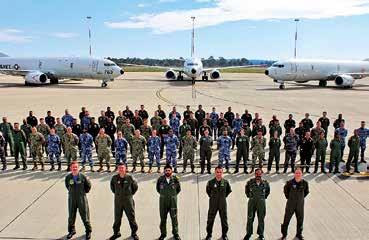
The exercise not only reaffirmed the ability of the four navies to operate together as an integrated force but also highlighted their shared commitment to maritime security and regional stability through collaborative training and mutual understanding.
The 27th edition of the exercise concluded on the East Coast of Australia off Sydney on August 21, 2023. At the culmination of five days of multifarious exercises, Exercise Malabar vividly showcased the strong cooperation, shared values and the collective ability of the four participating nations to ensure a free, open and inclusive Indo-Pacific promoting peace and security for all. The exercise provides an opportunity to the Indian Navy to enhance and demonstrate interoperability and also gain from the best practices in maritime security operations from its partner nations. SP
SP GUIDE PUBLICATIONS PVT LTD
POSTAL ADDRESS
Corporate Office A 133 Arjun Nagar, Opp Defence Colony, New Delhi 110003, India Tel: +91(11) 24644693, 24644763, 24658322
Fax: +91 (11) 24647093
E-mail: info@spguidepublications.com
Representative Office
MOSCOW, RUSSIA
LAGUK Co., Ltd, Yuri Laskin, Krasnokholmskaya, Nab., 11/15, app. 132, Moscow 115172, Russia. Tel: +7 (495) 911 2762, Fax: +7 (495) 912 1260 www.spguidepublications.com www.spsnavalforces.com
RNI Number: DELENG/2008/25836
3/2023 7 NAVAL
EXERCISES
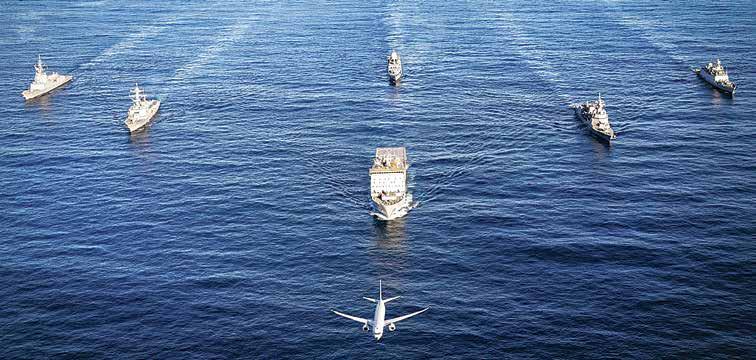
Exercise Malabar 2023 task group ships in formation off the coast of New South Wales, Australia. Navies of Australia, India, Japan and the United States participated in the exercise being held in Australia for the first time. Exercise Malabar 2023 witnessed complex & high intensity exercises in air, surface & undersea domains, honed war-fighting skills & enhanced interoperability between the four participating navies to undertake advanced maritime operations. INS Sahyadri & INS Kolkata represented Indian Navy along with P-8I. During the exercise, Indian Navy's P-8I crew celebrated the 77th Independence Day at Brisbane, Australia.
PHOTOGRAPHS: Indian Navy, indiannavy / Twitter, Royal Australian Navy