Viewpoint: Chinese Submarines to Pakistan – Eye on IOR Page 14
`55.00 (India-based buyer only)
SP’s
mai An SP Guide Publication
Vol: 6 Issue 21-22 ❚ November 1-30 • 2016
www.spsmai.com
ONLY Fortnightly on Military aerospace internal security
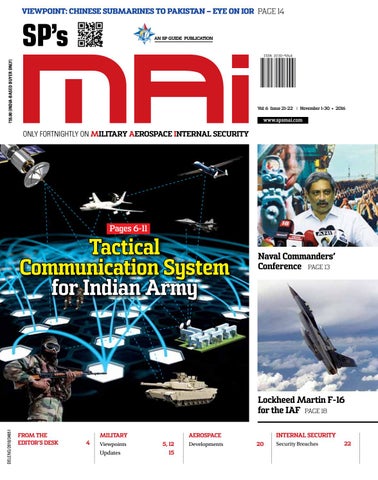
Pages 6-11
Tactical Communication System for Indian Army
Naval Commanders’ Conference PAGE 13
DELENG/2010/34651
Lockheed Martin F-16 for the Iaf PAGE 18 From the editor’s DESK
4
military Viewpoints
Updates
INTERNAL security
AEROSPACE 5, 12
15
Developments
20
Security Breaches
22
“In a country like India with limited support from the industry and market, initiating 50 years ago (in 1964) publishing magazines relating to Army, Navy and Aviation sectors without any interruption is a commendable job on the part of SP Guide “ Publications. By this, SP Guide Publications has established the fact that continuing quality work in any field would result in success.” Narendra Modi, Hon’ble Prime Minister of India (*message received in 2014)
spotlight VIEWPOINT: CHINESE SUBMARINES TO PAKISTAN – EYE ON IOR PAGE 14
T
he fast patrol vessel ICGS Rani Gaidinliu of the Indian Coast Guard was commissioned at Visakhapatnam by Director General Rajendra Singh, PTM, TM, Indian Coast Guard (ICG), in the presence of Inspector General Rajan Bargotra, TM Commander Coast Guard Region (East), and other senior dignitaries of the Central and state governments. The ship has been named after famous freedom fighter Rani Gaidinliu from Manipur.
The 51-metre fast patrol vessel (FPV), ICGS Rani Gaidinliu, the fourth of its class, has been designed and built indigenously by the Hindustan Shipyard Limited (HSL). The vessel is equipped with the most advanced and sophisticated navigational and communication sensors and equipment. The ship is propelled by three MTU 4000 series diesel engines of 2,720 kW capacity at 2,100 rpm each coupled with three 71S2 Rolls-Royce Kamewa Jets and can achieve a maximum speed of 34 knots. This is the fourth FPV among the five vessels
`55.00 (INDIA-BASED BUYER ONLY)
mai AN SP GUIDE PUBLICATION
Vol: 6 Issue 21-22 ❚ November 1-30 • 2016
www.spsmai.com
ONLY FORTNIGHTLY ON MILITARY AEROSPACE INTERNAL SECURITY
Pages 6-11
Tactical Communication System for Indian Army
Cover:
Naval Commanders’ Conference PAGE 13
Indian Army’s Tactical Communication System (TCS) seems to be finally getting ready to kickstart early next year, after 17 years. Lockheed Martin F-16 for the IAF PAGE 18
DELENG/2010/34651
Commissioning of 4th inshore patrol vessel Icgs Rani Gaidinliu
SP’s
FROM THE EDITOR’S DESK
4
MILITARY Viewpoints
Updates
1_SP's MAI Cover 21 to 22-2016.indd 1
Developments
Cover images: Anoop Kamath, Indian Navy, Lockheed Martin
INTERNAL SECURITY
AEROSPACE 5, 12
20
Security Breaches
22
15
11/11/16 6:05 PM
Publisher And Editor-in-Chief
Jayant Baranwal
Assistant Group editor
R. Chandrakanth
SR Technical Group EditorS
Air Marshal B.K. Pandey (Retd) Lt General Naresh Chand (Retd) Lt General V.K. Kapoor (Retd) R. Adm S.K. Ramsay (Retd) SPECIAL Contributor
Lt General P.C. Katoch (Retd) Chairman & Managing Director
Jayant Baranwal
planning & business development
Executive Vice President: Rohit Goel ADMIN & COORDINATION
Bharti Sharma
Asst – Admin, HR & Infra
Pooja Tehlani
design & LAYOUT
Creative Director: Anoop Kamath Designers: Vimlesh Kumar Yadav, Sonu Bisht Research Assistant - Graphics: Survi Massey SALES & MARKETING
Photograph: Indian Coast Guard
Director: Neetu Dhulia General Manager Sales: Rajeev Chugh
being constructed by HSL. Speaking during the commissioning of the vessel, DG ICG lauded the efforts of the Coast Guard in guarding the coastal security. Explaining the role of ICGS Rani Gaidinliu, the DG ICG said that the FPV will primarily focus on surveillance at the sea, coastal patrol, anti-smuggling operations, protection of fishermen apart from the routine search and rescue operations. ICGS Rani Gaidinliu has a complement of 5 officers and 34 men and is commanded by Commandant Ramesh V. Talke. The ship will be based at Krishnapatnam under the administrative and operational control of the Commander, Coast Guard Region (East). ICGS Rani Gaidinliu on joining will enhance Coast Guard’s capability in furthering its mandate of maritime safety, security of the eastern seaboard. SP
SP’s websites
Sr Web Developer: Shailendra P. Ashish Web Developer: Ugrashen Vishwakarma © SP Guide Publications, 2016 Subscription/ Circulation
Annual Inland: `1,320 • Foreign: US$ 325 E-mail: subscribe@spguidepublications.com subscribe@spsmai.com LETTERS TO THE EDITOR
editor@spsmai.com
FOR Advertising details, contact:
advertise@spsmai.com neetu@spguidepublications.com rajeev.chugh@spguidepublications.com SP GUIDE PUBLICATIONS PVT LTD
A-133 Arjun Nagar (Opposite Defence Colony) New Delhi 110003, India.
Tel: +91 (11) 24644693, 24644763, 24620130 Fax: +91 (11) 24647093 E-mail: info@spguidepublications.com Representative Office
204, Jal Vayu Vihar Kalyan Nagar Bengaluru 560043 Tel : +91 (80) 23682204 MOSCOW, RUSSIA
LAGUK Co., Ltd, Yuri Laskin Krasnokholmskaya, Nab., 11/15, app. 132, Moscow 115172, Russia. Tel: +7 (495) 911 2762, Fax: +7 (495) 912 1260
Owned, published and printed by Jayant Baranwal, printed at Kala Jyothi Process Pvt Ltd and published at A-133, Arjun Nagar (Opposite Defence Colony), New Delhi 110003, India. All rights reserved. No part of this publication may be reproduced, stored in a retrieval system, or transmitted in any form or by any means, photocopying, recording, electronic, or otherwise without prior written permission of the Publishers.
www.spguidepublications.com Issue 21-22 • 2016 SP’S MAI 3
From the
Editor’s Desk
Tactical Communication System finally on the horizon
T
he good news is that the Indian Army finally may get its Tactical Communication System (TCS), so essential in today’s battlefield scenario, a scenario which is asymmetrical and involves widespread deployment of technologies. According to Lt General P.C. Katoch (Retd) the Indian Army is all set to get TCS early 2017, after 17 years when it should have been fielded first. Better late than never. He writes that in 1996 the army’s network had become outdated and needed to be fast replaced, but things crawled along. The existing Army Radio Engineering Network (AREN) system, earlier designed as the backbone of army’s communication that was designed to roll forward, came up for urgent review having become outdated. It was then the concept of TCS was born and moves were afoot to replace AREN. It was clear then that the system had to be replaced as an upgrade was felt thoroughly inadequate. But the Indian bureaucracy took its own sweet time to give approvals, having gone through approvals thrice by the Defence Ministers. The bureaucracy did not see the urgency to replace legacy radio systems which were not at all designed to connect to broadreaching IP-based networks. About 17 years had been wasted. Lt General Naresh Chand (Retd) is confident that the TCS will be fielded, without wanting to guess considering how the mandarins in the Ministry of Defence (MoD) work. Developed countries which have realised that development of tactical radio systems have long gestation period, they have invested heavily much in advance. Recently some newspapers reported that Cyrus Mistry (ex-Chairman of Tata Group) duly advised the board of directors on the AirAsia bribing with `22 crore for merely a few meetings with Chief Ministers of states in India. Quite surprisingly the concerned authorities and ministries have maintained a constant silence on this issue. The question arises herein is if the wrongdoing of AirAsia will lead to its banning or not, if not then why victimise the defence and security authorities’ suppliers only which further affects the systematic progress of the modernisation of the armed forces which leads to visible
4 SP’S MAI Issue 21-22 • 2016
and invisible cascading effects. Air Marshal B.K. Pandey (Retd) questions this not really level-playing approach in this issue. On the international front, the Chinese President Xi Jinping is becoming stronger and stronger. Within China, he has been termed as ‘Core Leader’ as he is striding tall and authoritative. Jinping’s policy towards India has been that of combative engagement. Some 350 transgressions across the line of actual control (LAC) in 2015 alone and the China-Pakistan nexus with People’s Liberation Army (PLA) deployed in Gilgit-Baltistan, China-Pakistan Economic Corridor (CPEC) and Chinese soldiers making appearance at Pakistani posts across the line of control (LoC) certainly bodes ill will for India. Added to that is the Chinese sale of eight attack submarines to Pakistan, what is its biggest ever military deal estimated to be over $5 billion. The submarines are reportedly export variants of the PLA’s Type 039A Yuan class, with a depth of 300 metres. The submarines will be delivered by 2023. Four of the submarines are to be built at the Karachi shipyard, with the rest in China. According to Hu Wenming, Chairman of China Shipbuilding Heavy Industry, the export of these eight attack submarines is aimed at promoting China’s ‘One Belt, One Road’ initiative, launched by J inping in 2013, in which Pakistan is the fulcrum. Happy reading!
Jayant Baranwal
Publisher & Editor-in-Chief www.spsmai.com
MILITARY Viewpoint
Air marshal b.k. pandey (Retd)
Why victimise defence only? The forensic audit report by Deloitte on AirAsia India has revealed fraudulent transactions of `22 crore to parties in India and Singapore that do not exist
T
he murky controversy that has been raging in the Tata the tune of `22 crore to parties in India and Singapore that in fact do business empire in the wake of the unceremonious ouster not exist. The report states that “Rajendra Dubey, Director in a Sinof its Chairman Cyrus Mistry in the past few weeks has gapore-based firm HNR Trading, received `12.28 crore for governsuddenly taken a turn for the worse on account of the ment/regulatory framework, though there is no evidence of actual damaging concerns raised by the outgoing Chairman service provided”. The Deloitte audit report maintains that senior pertaining to business ethics and culture of the newly established executives of the Tata Group were aware of the irregular payment low-cost carrier AirAsia India, a venture by the Malaysia-based to Dubey through HNR Trading. Deloitte stumbled upon another AirAsia Berhad, in which Tata Sons hold a 49 per cent stake. The transaction in which `10.05 crore was transferred to a shell company otherwise immaculate reputation of the Tata Group has been under- called Link Media Immigration Services. The audit report indicated mined and badly tarnished by the questionable and shady financial that the payment was made on Chandilya’s direction and that site transactions by the owners of AirAsia Berhad while establishing its visits revealed the addresses were not genuine. Apart from the payments that did not appear to be above board, joint venture airline in India. The dubious financial transactions in question are not in conformity with the culture of the House of Tatas AirAsia India has been mired in other controversies. An aviation analyst, who headed operations at IndiGo and are not in tune with the reputation of this and Air India, had observed that contrary global business conglomerate. to Indian foreign direct investment and It was in early 2013 that Tony Fernandes, While the government aviation policies that require the control the Chief Executive of Malaysia-based leadof a foreign subsidiary to be vested in an ing low-cost carrier AirAsia Berhad, made is ruthless in dealing Indian entity, AirAsia Berhad continued to public its plans to join hands with the Indian with even minor cases of exercise strategic control over the operaconglomerate Tata Group along with a third tions of AirAsia India. In 2014, Subramainvestor, Arun Bhatia of Telestra Tradeplace to allegations of corruption nian Swamy, Member of the Rajya Sabha launch its subsidiary airline in India. Tony Ferin defence procurement, from BJP, had challenged the clearance nandes revealed that his airline had applied granted to the airline AirAsia India, chargfor sanction by the Indian Foreign Investment surprisingly, it remains ing that “either the responses filed by the Promotion Board for 49 per cent stake in the authorities before the court were false and joint venture. Since its inception, the Indian unresponsive to misleading or the Director General of Civil airline industry had not been open to foreign allegations of serious Aviation had acted illegally and in utter discarriers for investment. However, it was the regard of the law”. Swamy had argued that Manmohan Singh-led government under UPA financial impropriety by AirAsia India’s licence be revoked since the II that made the necessary changes in the existAirAsia India new venture had received foreign investing regulations paving the way for foreign airment approval without having established lines to join hands with Indian carriers or with operations in the country. entrepreneurs to set up airlines in India in the In its response to the allegations of financial impropriety by the private sector. However, investment by foreign carriers was limited to 49 per cent. The leading private carrier in India Jet Airways was management and the promoters of AirAsia India, the Ministry of the first in the race, having established a successful partnership with Civil Aviation (MoCA) has been somewhat subdued. A statement the Abu Dhabi-based Etihad Airways. This was followed by AirAsia from the MoCA said, “We are waiting for any input from any quarBerhad and Singapore Airlines that set up Vistara once again in part- ter. We have not received anything so far”. If the government can be overtly proactive in dealing with a heavy hand with allegations of the nership with Tata Sons. As per a forensic audit report by Deloitte India, the ethical con- smallest cases of corruption in the procurement of military hardcerns raised by Cyrus Mistry pertain to payments alleged to have ware which is subject to an extremely stringent selection process, it been made to Rajendra Dubey, an aide of Mittu Chandilya, the erst- is somewhat incongruous that the response by MoCA to allegations while Chief Executive of AirAsia India, for arranging access since of financial impropriety by foreign airlines to attain their business August 2013 to the political leadership of the country as also of the goals in India, should be so passive and meek. SP various states involved, in the process of setting up of the joint venture airline. The audit report has revealed fraudulent transactions to The views expressed herein are the personal views of the author. Issue 21-22 • 2016 SP’S MAI 5
MILITARY Report
Illustration: Anoop Kamath
Lt General P.C. Katoch (Retd)
Tactical Communication System for Indian Army
I
ndian Army’s Tactical Communication System (TCS), which should have been fielded in year 2000, seems to be finally getting ready to kick-start early next year; after 17 years. In 1996, the existing Plan Army Radio Engineering Network (AREN) system, earlier designed as the backbone of army’s communication that was designed to roll forward, came up for urgent review having become outdated. The TCS was born out of realisation that AREN had to be replaced and an upgrade would not be sufficient, as was envisaged earlier especially since legacy radio systems were not designed to connect to broad-reaching IP-based networks. The extraordinary delay of over a decade-and-a-half in TCS was on account of excessive ‘red tape’ befitting a case study, in that the TCS
6 SP’S MAI Issue 21-22 • 2016
had been approved thrice by the Defence Ministers but every time the whole case was worked afresh after closing the previous case file – an extreme in red tape-ism and lackadaisical approach to vital issues. Since 2002, the Ministry of Defence (MoD) had been vacillating on categorisation of the TCS project under Make (High-Tech Systems) and Make (Strategic, Complex and Security Sensitive Systems), since private sector participation is allowed in the former category and not latter, and classifying it as former category was attributed to the secrecy of the “frequency hopping algorithm” contained in a tiny microchip. The frequency hopping algorithm provides anti-jamming and electronic countermeasures (ECM) functionality. Tactical communications networks need to be multi-hop wirewww.spsmai.com
MILITARY Report tive command and control system though some less networks in which switches and end points Decisive victory modern frequency hopping radio sets with are mobile nodes. In a tactical environment, integral encryption have been introduced into system performance degraded when switching in future conflicts service in recent years. Also, as the alternative nodes or communication links fail to operate, will be difficult to to the surrendered 3G spectrum by the military, narrow band electronic jamming is widespread the new optical fibre cable (OFC) network being and bandwidth is at premium. Fast and adapachieve without laid will provide modern landline communicative algorithms for performance analysis are desirable for optimising the network. Further, robust and survivable tions in peace stations and to limited extent in the Tactical Battle Area (TBA). However, this by tactical networks commonly use pre-emptive communications, both no means compensates for the TCS being static algorithms to achieve low blocking probabilicommunications. ties for high-priority connections when the in the strategic and The TCS is vital for operational preparedloss of equipment or electronic warfare in the tactical domain ness and force multiplication endeavour. Decibattlefield is considerable. Under unfavourable sive victory in future conflicts will be difficult conditions, Adaptive Channel Hopping (ACH) to achieve without robust and survivable comalgorithm lets sensors switch to a new operating channel/ ACH reduces the channel scanning and selection latency munications, both in the strategic and tactical domain. We should by ordering available channels using link quality indicator measure- learn from the TCS in foreign militaries as to how they have tackled ments and mathematical weights. Plenty of research on the hopping the challenges of spectrum, bandwidth, laws of physics, etc. Britalgorithms is being done internationally in the public domain and ish Win-T programme developed by BAE Systems, Canada’s Tactical Command, Control and Communications Systems (TCCCS) details such as configuring the programme are country specific. In year 2014 there was news about Tata Consultancy Services developed by CDC Systems of UK, America’s JTRS and Contact having assisted the Indian Army replace its legacy messaging sys- programme of France, all have lessons for us including how these tem with an automated messaging system; a messaging system countries have optimised participation and contribution of private that relays secured information from one user to another, using sector, use of commercial off the shelf (COTS), time bound closure the concept of mobile nodes which can be deployed in far-flung of procurement procedures keeping in mind criticality of the project locations including in disaster relief situations with highly secure and electronics manufacturing, and IT delivery self-sufficiency. As per recent media reports quoting a senior MoD official who system having multiple levels of security incorporating Fortiora Suite of security products. But this is only a small part of upgrading spoke on condition of anonymity, the government is all set to award networked communications, which form the backbone of an effec- a project under the ‘Make in India’ category for a TCS for the army
The first ground-air comms network tailorable to your mission needs.
The TruNet™ networked communications solution gives your forces the power to
Full cross-domain interoperability
network as never before. It’s the first family of ground, handheld and airborne software
Tailorable to mission requirements
defined radios to ensure secure connectivity across the entire battlespace. No matter
Easy integration with legacy platforms
what your unique mission requirements, TruNet can flex to meet them. Now you have
More nodes/power, low latency
true control of your networked communications. rockwellcollins.com/TruNet © 2016 Rockwell Collins. All rights reserved.
Issue 21-22 • 2016 SP’S MAI 7
MILITARY Report ‘early next year’. Under the programme, two indigenous domestic development agency (DA) consortiums will be awarded contracts to build one TCS prototype each at a cost of $150 million in 18 months. The government will provide 80 per cent of the funding for the prototype developments. MoD has reportedly shortlisted the DPSU Bharat Electronics Limited (BEL), and private sector firm Larsen & Toubro (L&T) is set to team with Tata Power SED and HCL Technologies to build a TCS prototype. Each TCS prototype will include a transmission system; a field wireless system based on 4G long-term evaluation technology; routing and switching systems; multiple mobile-platform engineering systems; a network management system; and a security subsystem. The Defence Research and Development Organisation’s (DRDO) Centre for Artificial Intelligence and Robotics (CAIR) is reportedly developing a homemade security solution albeit CAIR does not have the capacity to develop security solutions itself and will probably outsourcing the same to laboratories of a DPSU, as has been the practice in the past. The Indian Army plans to induct seven TCS systems for plains and desert areas at a cost of $4 billion over the next 10 years. Once the two prototypes are handed over to the Indian Army, they will undergo technical evaluation, be tested on the ground and then shortlisted for production. Once a plain- and desert-friendly TCS is inducted, the army will place an additional order of seven mountain-friendly TCS systems. According to an army official, the two selected DAs will need to tie up with overseas defence companies to build Indian Army-specific 100 Mbps (megabits per second) transmission systems, in addition to other critical systems, while the rest of the systems they can build on their own. Also the two DAs must be able to upgrade the fast-changing military communication technologies for the TCS.
Since the TCS will be a dedicated strategic project, the army wants to eventually sanitise the technologies built into the prototype and the final system. It is not clear to the DAs how the army will sanitise each of the technologies, either homegrown or imported, that will be incorporated in the TCS prototypes. But such sanitisation by the army will lead to direct interference in the developed TCS prototype. This may create problems especially where technologies are being imported. DAs will also have to get undertakings from original equipment manufacturers (OEMs) for unrestricted use of the imported technologies. Additionally, the MoD wants to retain the intellectual property rights of the systems, but the private sector DA is demanding that it should be vested. Then there is also the grudge by private sector DAs of government granting special favour to BEL in developing the prototype for TCS; MoD has waived off the import duty in the case of BEL, but the privatesector DA has been asked to pay import duty on the products that they import for the TCS prototype, which the latter consider highly unfair. When exactly the TCS will get kick-started ‘early next year’ is anybody’s guess. Going by the lackadaisical manner in which critical voids like TCS are handled by MoD it is difficult to guess whether fielding of the TCS in the army will take another 15 or 20 or 25 year. There appears to be no urgency even knowing that in 2005, when Pakistan purchased RF-5800H-MP Harris radios at a cost of $76 million, they already had state-of-the-art TCS equipment. In fact our abovementioned ‘recent’ media report about MoD choosing two DAs and likely to award the TCS as ‘Make in India’ project for developing TCS prototypes is exact duplication of what had been reported more than a year back. Even then it had been reported that: BEL and the consortium of L&T, Tata Power SED and HCL had reportedly been selected by the government for developing the prototype of the
Photograph: PIB
Electronic Warfare Jammer
8 SP’S MAI Issue 21-22 • 2016
www.spsmai.com
MILITARY Report TCS; the government will pay 80 per cent of the development cost (FICV) development project but according to MoD sources, FICV is while 20 per cent will be funded by the industry, and for TCS, both a stand-alone armoured vehicle in contrast to which the TCS is the the selected parties will make the prototype system and the best bid- network-centric backbone that connects crucial systems in the electronic battlefield; connecting sensors, shooters, decision systems der will then execute the whole project. The TCS is to have a new generation meshed network exploit- and the command and control set up. Across the world, there is increasing overlap of communications ing the growth in microprocessor, radio, mobility and satellites; based on lightweight high mobility vehicles which will form highly and information systems with militaries optimising Information and mobile communication nodes connected as a grid; largely based on Communication Technology (ICT). Command, Control, Communitested COTS technologies; high bandwidth with voice, video and cations, Computers, Information and Intelligence, Surveillance and data; high capacity point-to-point radio backbone with multiple Reconnaissance (C4I2SR) System provides great operational advanredundancies; high capacity point-to-multipoint wireless access at tage for the defence establishment; force multiplier for commanders the user end; robust and survivable trunk and access radios; redun- at all levels. Communications, information and their confluence are dancy and scalability based on satellites; inbuilt protection against vital for our military given present and future conflict scenarios. In cyber and electronic attacks using firewalls and frequency hopping the jointmanship paradigm our military has only taken some nascent spread spectrum techniques; encryption and multi-level network steps. Actually, we are decades away from integration in its true form security; real-time management of spectrum; integration with leg- and spirit. We need to take measures from the existing state of ‘coopacy systems, strategic networks, national communication systems; erative functioning’ and ‘patchy jointness’ to ‘de-conflicted operaeffective interoperability within the army and other services during tions’, advancing to ‘joint’ and finally ‘integrated operations’. Unless vital steps as indicated above are taken, shedding joint operations; lightweight user terminals; and the baggage of legacy thinking, jointmanship will finally effective integration of all Operational Command, Control, be elusive and our goal of achieving net-centric Information Systems. warfare (NCW) capabilities will remain utopian. What the bureaucracy in MoD doesn’t Communications, Additionally, true synergy between the three serappear to realise is that the critical void of the vice can hardly be achieved without a Chief of Computers, TCS has a adverse effect not only in respect of Defence Staff (CDS), an issue on which the govtesting and fielding of other operational informaInformation and ernment continues to dither despite establishtion systems in the army but also in supporting ment of CDS strongly recommended by the Karthe Tactical Command, Control, CommunicaIntelligence, gil Review Committee and the follow-up Group tions and Information (Tac C3I) System coming Surveillance and of Ministers (GoP) headed by then Deputy Prime up in the army, particularly in the Battlefield Minister and Home Minister L.K. Advani. Management System (BMS), Battlefield SurveilReconnaissance The Defence Acquisition Council (DAC) has lance System (BSS) and the Command Inforjust cleared deals worth over `82,000 crore for mation and Decision Support System (CIDSS), (C4I2SR) System procurement of 83 Tejas jets and 464 T-90 tanks besides others, all of which require wide-band provides great plus 15 light combat helicopters (LCH) and 15 data capabilities to facilitate real-time transmission of images and battlefield video while operational advantage mini unmanned aerial vehicles (UAVs), which is all very good. But MoD must take a call on vital on the move all the way down to the cuttingfor the defence void of the TCS, delayed over a decade-and-a-half, edge including infantry battalions, armoured that seriously affects ground operations. A holistic and artillery regiments. The Indian Army has a establishment; approach to the military’s equipping has woefully complete Corps nominated as test bed but none remained in vogue. We must speedily establish of the Operational Information Systems (OIS) force multiplier for a reliable and robust ICT network which allows under development and already fielded could commanders at all interoperability of the three services within thembe tested as required at full Corps level. This was selves, and with the requisite government agenbecause of lack of the TCS. Truncated test bed levels cies spanning the strategic, operational and tactifor operational information systems result in cal domains. Development and production of the avoidable problems coming up at fielding and equipping stage that could have been corrected in the test bed stage TCS, which will provide a robust, snoop proof, mobile cellular network itself. Concurrent are avoidable additional costs accruing through for the Indian Army’s voice and data communications during battle will likely cost upwards of `10,000 crore. If the more than a year old required immediately post-fielding these systems. The TCS together with the Tac C3I are the very nerve centre of news of the Das for developing the TCS prototype is correct, then logithe TBA (Tactical Battlefield Area) as future battles will take place cally there is no requirement to grant another 18 months for prototype concurrently in the three domains of information, physical and the development when official announcement of selection of Das is made cognitive. The strategic value of information can hardly be optimised “early next year” unless it is to provide extra time to BEL who in any without efficient battlefield management, in which TCS plays a vital case may go for ‘cut and paste’. It is no secret that the only operational role. The battlefield of tomorrow requires traverse communications. system fielded in the army, the Artillery Command, Control and ComNot only is interoperability imperative intra-service and inter-ser- munication System (ACCCS) is over 90 per cent of Elbit of Israel though vice in the military, it is required across the entire security sector marketed by BEL. The army’s modernisation plan has been seriously since unconventional warfare and asymmetric threats are border- affected by the void of the TCS. This must be developed and fielded at less in contrast to classical conventional battlefields. Communica- the earliest keeping in mind its criticality, timelines, capability to deliver tion systems need to meet multi-mission requirements, functioning and complexity of sensors and requirement of multiple nodes in delivthrough cyber and electronic warfare environment while engaged in ering the trinity of voice, data and video speedily and securely. SP battle. Development of software defined radios and cognitive radios are operational breakthroughs. The TCS is India’s second project The writer is former Director General of Information Systems, under the make procedure, after the Future Infantry Combat Vehicle Indian Army Issue 21-22 • 2016 SP’S MAI 9
MILITARY Report
Lt General Naresh Chand (Retd)
Tactical Communication System—An update
PHOTOGRAPH: SP Guide Pubns
Mobile Integrated Network Terminal
T
he communications in the tactical battle area is provided by static and mobile communications. Static communications are being developed through a new optical fibre cable network being laid as an alternative to the 3G spectrum surrendered by the armed forces. This will be linked with Army Static Communications (ASCON) system through a Battle Management System (BMS). ASCON provides voice and data links between static headquarters and those in peacetime locations. It is expected to be of modular design so that it can be upgraded when required. BMS is meant for communications from the battalion headquarters forward to the companies and platoons. Army Radio Engineering Network (AREN) was the backbone mobile communications of the Indian Army since 1987 when it was
10 SP’S MAI Issue 21-22 • 2016
first fielded during exercise Brass Stack. Later on during a major exercise where Indian Army’s all strike corps were launched, it was felt that with the rapid advancements in communication and information technology, there was a need to field a successor to AREN. Offensive operations are spread over a large geographical area with rapidly changing contours of a mobile battle. Thus the communications supporting it has to be dedicated, reliable, secure, mobile and capable of quickly adapting to multiple threat contingencies. However mobile communications is still under consideration/development. Since the gestation period to launch a new defence system is unduly long in India thus the blueprint for a future communication for the mobile and offensive operations of Indian Army was laid as early as 2000 through a de novo approach of Tactical Communication System (TCS). www.spsmai.com
MILITARY Report TCS
Army tactical networks need to be mobile, flexible, versatile and reliable. It is also required to communicate with legacy and other Internet protocol based systems. Frequency hopping is an essential element for preventing jamming and affecting electronic counter-measures. In a tactical system, mobility is essential for switches and end points to enable multi-hopping radio network. Their algorithms have to be adaptive and fast for optimising the network. During loss of communication equipment due to enemy action or jamming, Adaptive Channel Hopping (ACH) algorithm enable networks to reconnect themselves thus preventing loss of communications during critical phases of the battle. Thus extensive search is going on in the field of ACH algorithm. The complexity of TCS is due to the diversity of the sensors, type of nodes required to link from the soldier upwards to headquarters at various levels, and the sheer numbers required. For example, radio sets required at tactical level range from HF (3-30 MHz), VHF, (30-300 MHz) and UHF (300-3,000 MHz). Other key programmes like F-INSAS also depend on the early and successful implementation of TCS. It is experienced that participation of private sector and use of commercial off the shelf technology leverages new systems to be fielded in a time bound manner.
Photograph: Kunal Verma / SP Guide Pubns
Approach for Implementation
The TCS project went through many twists and turns, overseen by three Defence Ministers. TCS2000 became TCS-2010 so that it appeared to be a recent projection. The Ministry of Defence (MoD) had a genuine problem as private companies can participate in Make (High-Tech Systems) category but not in Make (Strategic, Complex and Security Sensitive Systems). Earlier the reason to categorise the project as Make (Strategic, Complex and Security Sensitive Systems) was due to the secrecy of the ‘frequency hopping algorithm’. TCS was also India’s first ‘make’ big-ticket contract (a shade less than $2 billion which will go up if the project is delayed any further). Finally MoD decided to follow a similar approach to the US by giving the development contract to two consortiums namely one led by PSU Bharat Electronics Limited and the other joint consortium of Larsen & Toubro (56.67 per cent), Tata Power (Strategic Electronics Division 33.33 per cent) and HCL (10 per cent). It also decided to fund 80 per cent of the development cost (estimated at `300 crore) with 20 per cent funded by the respective companies. Both the consortiums will field one system each for comparative trials. MoD will then select the better system and that consortium will be awarded the contract to build seven systems to be fielded by seven corps. BEL is supported by the Defence Research
and Development Organisation for certain technologies like the Centre for Artificial Intelligence and Robotics is developing indigenous security solutions which are essential in such a system. Then there is the requirement of Micro-electromechanical Systems which are necessary to be addressed as they effect issues of weight and power requirement for components. It is reported that the DPSU and the private companies have submitted a detailed project report (DPR) which defines every system, subsystem, and capability of the TCS. This is an essential document to guide and evaluate the final product.
Concerns of the Private Companies
The consortium of private companies has conveyed their concerns to the MoD. One of the major one is regarding the intellectual property rights which the MoD wants to retain as it is funding 80 per cent of the development but the companies wants it to be vested which can imply that it is fully and unconditionally guaranteed as their legal right. The Army (Corps of Signals) also wants to sanitise the technologies built into the TCS due to the sensitivity of the system as it is a dedicated strategic project but the companies feel that the army will interfere with the development of the system at every stage.
Conclusion
Due to the long gestation period, the question crops up as to whether it will be ever fielded and the answer is a big ‘yes’. The other question is ‘when’, which even the MoD cannot answer. Compare this with the development of tactical radio sets in other countries. US Army has its Joint Tactical Radio System (JTRS) which is a family of radios ranging from lowcost terminals with limited waveform support to multiband, multi-mode, multiple channel radios supporting advanced narrowband and wideband waveform capabilities. The radio sets can be integrated with computer networking features and conform to open physical and software architectures. The JTRC family of radios cover an operating spectrum from 2 to 2,000 MHz, and would be capable of transmitting voice, video and data. They are to resume full rate production by Thales and General Dynamics Mission Systems during 2017. Even Pakistan has acquired from Harris the export version of the Harris’ Falcon II AN/PRC-150 in 2005 for $76 million and in 2007 for $68 million. These sets fit into the network-centric communications for superior command and control, are battle-proven for secure, reliable mission-critical voice, data and video. Both these countries would have had the network in place to complete the system. India has to catch up fast and the earlier it does better it will be. SP The writer is former Director General of Air Defence, Indian Army Issue 21-22 • 2016 SP’S MAI 11
MILITARY Viewpoint
Lt General P.C. Katoch (Retd)
Xi Jinping – China’s ‘Core Leader’
Photograph: PIB
T
he Communist Party of China (CPC) has anointed President Xi Jinping as the ‘Core Leader’ of China, which places him on par with Mao Zedong and Deng Xiaoping. Xi Jinping is expected to take China to the next level of becoming a ‘Great Power’. On assuming power, it was Mao Zedong who had famously said, “Tibet is the palm of China and Ladakh, Nepal, Sikkim, Bhutan and NEFA (now Arunachal Pradesh) are its fingers”. So much for the so-called “historical” claims of China to the state of Arunachal Pradesh! It also explains why China invaded and annexed Tibet. China annexed Tibet, Xinjiang and Aksai Chin for not only territorial gains but also because of the minerals and oil wealth in these regions. Deng Xiaoping reiterated Mao’s ‘fingers’ quote and passed it on to Xi Jinping. Significantly, Xi Jinping was Secretary Defence when China under Deng Xiaoping invaded Vietnam in 1979 to “teach Vietnam a lesson”. It may also be recalled that while China had been laying illegal claim to Tawang plateau, in year 2005 she suddenly enlarged her claim to entire 90,000 sq km of Arunachal Pradesh. The Central Military Commission (CMC) of China till last year had only one civilian member – President Xi Jinping, Chairman of CMC. But concurrent to China’s military reforms this year, Xi Jinping donned military uniform and became the Commander-in-Chief of the People’s Liberation Army (PLA). The military reforms established five Theatre Commands, the Rocket Force and the Strategic Support Force, latter combining the functions of intelligence, technical reconnaissance, electronic warfare, cyber warfare and space warfare. The CPC is supreme and all militias too have been brought under the CMC making Xi Jinping the most powerful man in China. He has now become the strongest ever having been anointed ‘Core Leader’. Xi Jinping’s policy towards India has been that of combative engagement. Some 350 transgressions across the line of actual control (LAC) in 2015 alone and the China-Pakistan nexus with PLA deployed in Gilgit-Baltistan, CPEC and Chinese soldiers making appearance at Pakistani posts across the line of control (LoC) certainly bodes ill will for India. PLA has tested several new class and variants of offensive platforms like missiles, hypersonic glide vehicles and has developed ballistic missile defence. In September last year, China unveiled the DF-26 IRBM for precision strike against theatre level ground targets 12 SP’S MAI Issue 21-22 • 2016
and her nuclear ICBM force is being modernised to include the road and rail mobile CSS-X-20 (DF-41) capable of carrying MIRVs. China’s Western Theatre Command is responsible for her border with Myanmar, India, Bhutan, Pakistan-occupied Kashmir (PoK) and Afghanistan. China, individually and in concert Pakistan, has been engaged in war at the subconventional level against India. Not only is China providing support to Indian Maoists and North East insurgents, Chinese intelligence established the United Liberation Front of Western South East Asia (UNLFWSEA) in Myanmar last May, combining nine major North East insurgent groups including the NSCN (K) and ULFA under a common umbrella. So, future conflicts / skirmishes will likely be hybrid in multiple domains. China’s sudden claim to entire Arunachal Pradesh ensured the Sino-Indian border resolution remains unresolved in perpetuity. Though Myanmar refused to barter its sovereignty in exchange of PLA presence on her territory, like Pakistan but China has lethally armed the United Wa State Army (UWSA) in Shan state of Myanmar, even with missile fitted helicopters. China has developed advanced border infrastructure, strategic roads-rail, dual use airfields, logistics, lethal weapon systems and strategic communications within the Western Theatre Command, which gives the PLA terrific mobilisation speed. We need to take cognisance and move faster in developing own border infrastructure. Also noteworthy are China’s joint military exercises especially Chinese President Xi Jinping in high altitude areas involving rapid mobilisation, capture of passes and use of PGMs, which are certainly aimed at us, not Taiwan or anyone else. Not only the areas of Eastern Ladakh and Arunachal need additional troop deployment, we must create adequate sectoral reserves to respond to Chinese adventurism. At the strategic level, we must be able to respond to mainland China, conventionally and asymmetrically in all domains of war, especially in the SEZs along her eastern seaboard. This is the paradigm which India needs to focus on that requires revamping of our national security infrastructure, down to how we would optimally employ components of our national power at the strategic, operational and tactical level. There is every possibility that the new Core Leader of China may have the ambitions of Hitler. SP The views expressed herein are the personal views of the author. www.spsmai.com
MILITARY Report
Rear admiral s. ramsay (retd)
Naval Commanders’ Conference
Photograph: Indian Navy
T
he biannual Naval Commanders’ Conference 02/2016 ity and their deployment as force multipliers in any future scenario. was held under the aegis of Integrated Headquarters, The CNS also reviewed the progress of various infrastructure projects that are in the pipeline and shall be vital to contribute towards Ministry of Defence (Navy) from October 25 to 27, 2016. During the inaugural session, Raksha Mantri address- capacity building. Coastal security construct was deliberated and reviewed during ing the Naval Commanders complimented all personnel of the Indian Navy for ensuring maritime security of the country. the conference. The CNS expressed his satisfaction over the steady Taking note of the wide expanse of naval activities spread across progress made in strengthening the coastal security apparatus, viz. the oceans, he appreciated the high tempo of operations sustained induction of fast interceptor crafts, immediate support vessels and in the last six months and efforts put in for maritime security and NC3 I project. He asserted the need to remain ever vigilant and coastal security in the areas of interest of the country. The Raksha focused towards our coastal security responsibilities through proMantri also reviewed the pace of modernisation of the Indian Navy, active coordination with other maritime agencies and coastal states considering the increasing variety of asymmetric threats. progress of various acquisition and infrastructure related cases. One of the focus areas discussed during the conference was Admiral Sunil Lanba, the Chief of the Naval Staff (CNS), presided over the three-day conference which was his first after assum- the induction of manpower, aspects pertaining to training and skill development, and welfare of ing the office on May 31, 2016. all personnel. Consequent to He addressed the Naval Com2016 being observed as the manders on various important ‘Year of the Civilian Personnel’ issues pertaining to operational in the Indian Navy, progress of readiness, capability enhancevarious policy initiatives taken ment, infrastructure developtowards enhancing transparment and human resource ency in personnel policies and management, all crucial imporimproving the ‘ease of doing tance for the Indian Navy. business’ in the service were Coming in the close aftermath also reviewed. of recent events, the conferThe CNS stated that ence provided an invaluable men and women behind the opportunity for the top-level machine are the Navy’s greatleadership of the Indian Navy est strength and are our greatest to review the operational enviasset and their morale and wellronment and readiness of the being should always remain our maritime forces to deal with primary concern. The discusthe entire range of prevailing Raksha Mantri Manohar Parrikar being welcomed for his address during the sions also focused on the future as well as emerging challenges inaugural session of the Naval Commanders Conference in New Delhi road map for employment of and threats. Such a review at women in the Navy. the macro level is undertaken The conference also provided the Naval Commanders an opporfor the mid-course correction, if deemed necessary for the charted tunity to interact with Ministry of Defence officials and Defence course to be pursued in a proficient manner. As is customary, the conference, held over three days, deliber- Research and Development Organisation wherein a range of issues ated upon the ever-increasing dynamism in the maritime domain, were discussed. In his closing address, the CNS complimented all personnel especially in India’s neighbourhood, and the enhanced range of tasking and consequential expectations thereof from the Indian of the Indian Navy for their professionalism and patriotism and Navy. The deliberations during the conference encompassed a exhorted them to prepare themselves and the Indian Navy to meet comprehensive review of operational preparedness, training and all future maritime security challenges before the country. Combat resource availability to efficiently carry out the roles, responsibili- readiness should remain our collective focus at any given time and ties and mission assigned to the Indian Navy. Commanders also operational effectiveness should be the touchstone of all our efforts, took stock of the progress achieved in integrating newly inducted he said. The Navy’s role is not only vital for national security, but also state-of-the-art naval platforms into the overall operational capabil- for national prosperity and development, he concluded. SP Issue 21-22 • 2016 SP’S MAI 13
MILITARY Viewpoint
Lt General P.C. Katoch (Retd)
Chinese Submarines to Pakistan – Eye on IOR
Photograph: Photograph provided to CRS by Navy Office of Legislative Affairs, December 2010
C
hina recently confirmed the sale of eight attack submarines to Pakistan, what is its biggest ever military deal estimated to be over $5 billion. The submarines are reportedly export variants of the People’s Libaration Army’s (PLA) Type 039A — also known as Type 41 — Yuan class submarines, with a depth of 300 metres. Their weaponry will be tailor-made suiting Pakistan’s naval requirements. The first four diesel-powered electric submarines will be delivered by 2023, and the rest by 2028. Four of the submarines are to be built at the Karachi shipyard, with the rest in China. According to Hu Wenming, Chairman of China Shipbuilding Heavy Industry, the export of these eight attack submarines is aimed at promoting China’s ‘One Belt, One Road’ initiative, launched by President Xi Jinping in 2013, in which Pakistan is the fulcrum. Hu added he hoped exports of submarines to Pakistan would take place in the future “on a regular basis” and that China’s “iron brother” plays a key strategic role in the neighbourhood. According to reports from Pakistan, the deal will be financed by a low interest rate loan from China to cover costs of the project, including the manufacture of four submarines at Karachi. The 3,000-kmslong China-Pakistan Economic Corridor (CPEC) which actually Chinese Type 041 Yuan class dieselis China’s strategic highway to electric submarines SSK the Indian Ocean. The CPEC is supposedly to service China’s energy and goods demands from the Gulf albeit moving the same goods by sea is 11 times cheaper. CPEC is a masterstroke of Xi Jinping which gives China tremendous strategic advantage while costing little to the Chinese Government: should Straits of Malacca and Sunda get blocked, China has CPEC as alternative; Gwadar as Chinese nuclear submarine base (being built gratis) dominates eastern end of Persian Gulf, giving leverage to China; CPEC connection to Pakistan’s Omari naval base makes it accessible to China, giving greater domination over the Arabian Sea coupled with Gwadar and Karachi, and; rail link of CPEC and multiple development projects provide avenue for movement and deployment of weapon systems, even rail-mounted missiles to support future operations in the Indian Ocean region. Gwadar is the fulcrum where the CPEC and China’s Maritime Silk Route (MST) converge, with strategic implications for 14 SP’S MAI Issue 21-22 • 2016
India and the region. The China-Pakistan nexus does not bode well for India. The strategic lodgment of China in Gilgit-Baltistan and development of the CPEC has resulted in Pakistan heightening proxy war on both India and Afghanistan. It is pretty clear that China wants to keep India confined to South Asia and keep our economic development in check as she considers India an economic competitor. In her pursuit of revolution in military affairs (RMA), China went for mass development and deployment of submarines, giving greater precedence over acquiring aircraft carriers. China’s sale of submarines to Pakistan would in all probability be deployed in the Arabian Sea to challenge Indian interests in the Indian Ocean region. Pakistan has already indicated plans to arm these Chinese submarines with nuclear weapons. In a related interesting development, Sergei Chemezov, CEO of Russia’s Rostec State Corporation, has indicated that his company is ready to strike a $12-billion deal with India to manufacture six conventional submarines. According to him, these these submarines with Air Independent Propulsion systems will be built under the P75(I) project of India. Chemezov, close aide of President Putin, said that Russia is India’s close ally, not just business partner; Russia stood by India in its “darkest hour” and would do the same in future, if necessary. He stressed that it would never be possible for the Americans and Europeans to offer India what Moscow could, adding, “We are ready not just to deliver most serious weapons, most important weapons, but continue to give our state-of-the-art technology. Next year will mark 70 years of our relationship. It is a long time. There is no doubt that Russia has been India’s most trusted friend who has also given us latest technology. Amongst other equipment, Russia leased the first nuclear submarine to us and now is giving the S-400 system that will be a game changer in the subcontinent since it can take on aircraft and even drones at a range of 400 km. However, there is little doubt that the Indian Ocean is fast becoming the centre of gravity of future conflict and the unholy China-Pakistan nexus will usher in much turbulence. SP The views expressed herein are the personal views of the author. www.spsmai.com
MILITARY updates Vice Admiral G.S. Pabby, assumes charge as Chief of Materiel, Indian Navy
Vice Admiral S.V. Bhokare take charge as Commandant, Indian Naval Academy
V
V
ice Admiral G.S. Pabby, AVSM, VSM has assumed charge as the Chief of Materiel of the Indian Navy on October 31, 2016. The Admiral is a graduate with honours in mechanical engineering and M. Tech in systems and controls from IIT Mumbai. During his illustrious career spanning over three-and-a-half decades, the Admiral has served onboard a wide range of front line ships including Russian Petya class of ships, Russian Kashin class destroyers and indigenously designed and built Delhi class destroyers. He has done a variety of challenging jobs in the Naval Dockyard Mumbai, covering almost all facets of complex engineering functions related to major refits and upgrades of ship board equipment and systems. He has also been associated with planning and creation of new infrastructure in the dockyard. SP
ice Admiral S.V. Bhokare, YSM, NM took charge as the Commandant of the Indian Naval Academy (INA), Ezhimala, on October 20, 2016. Vice Admiral Bhokare is a specialist in navigation and direction and a graduate of National Defence Academy, Khadakwasla and Defence Services Staff College, Wellington, Tamil Nadu. He attended the Higher Command Course at Army War College, Mhow, and holds a masters degree in defence and strategic studies from Australian Defence College, Canberra. The officer belongs to the elite submarine arm of the Indian Navy. In his illustrious career spanning 32 years, he commanded three front line subma-
Indian amphibious warship INS Shardul enters Mauritius
Photographs: Indian Navy
I
n a demonstration of India’s commitment to its ties with Mauritius and to promote maritime security in the Indian Ocean region, Indian naval ship Shardul was at Port Louis on a three-day visit. INS Shardul, an amphibious ship of the Indian Navy, is currently on a month-long deployment in the southern Indian Ocean in keeping with the vision of SAGAR – Security and Growth for All in the Region. Accordingly, the Indian Navy will be progressing maritime security cooperation with Mauritius National Coast Guard (MNCG) towards ensuring a secure and stable regional maritime environment for unhindered economic development in the region. INS Shardul’s visit is part of its mission to carry out surveillance in the Mauritius EEZ with NCG personnel embarked onboard. During the current deployment, Shardul has also escorted MCGS Victory, a ship built at the Goa Shipyard Limited and handed over to the NCG on September 26, 2016. SP
rines, INS Sindhughosh, Sindhudhvaj and Sindhushastra, as well as guided missile frigate INS Beas and submarine base INS Vajrabahu. He has also held various prestigious staff and operational appointments including Command of Submarine Squadron as Commodore Commanding Submarines (West) and Chief Staff Officer (Operations) at Eastern Naval Command. On being promoted to the rank of Rear Admiral, the officer was appointed as Flag Officer Submarines (FOSM) from September 2012 for three years and Flag Officer Commanding Eastern Fleet (FOCEF) from 2015 onwards. He is the first officer from the submarine arm to take over the reins as Commandant of INA. SP
Issue 21-22 • 2016 SP’S MAI 15
MILITARY updates US Navy commissions newest littoral combat ship
Vice Admiral S.N. Ghormade is Director General of Naval Operations
Photographs: Indian Navy, Lockheed Martin, PIB
V
ice Admiral S.N. Ghormade assumed the charge of Director General of Naval Operations on October 21 — at the IHQ MoD (N). The Flag Officer was commissioned into the Indian Navy on January 1, 1984. He is a graduate of National Defence Academy (NDA), Khadakwasla, Pune; United States Naval Staff College at Naval War College, Newport, Rhode Island; and the Naval War College, Mumbai. During his career spanning over 32 years, he has been through a myriad of operational and staff appointments. His operational appointments include commands of the guided missile frigate INS Brahmaputra, submarine rescue vessel INS Nireekshak and minesweeper INS Allepey and second in command of guided missile frigate INS Ganga. His important staff appointments ashore include Principal Director of Personnel, Director Naval Plans and Joint Director Naval Plans at Naval Headquarters (as separate assignments), Director (Military Affairs) at the Ministry of External Affairs, Local Work Up Team (West), Instructor at Navigation Direction School and National Defence Academy. Upon promotion to the Flag Rank in 2012, the Flag Officer has held the appointments of Assistant Chief of Personnel (Human Resources Development) and Flag Officer Commanding Karnataka Naval Area. Prior taking over as DGNO he was the Flag Officer Commanding Maharashtra Naval Area. SP
16 SP’S MAI Issue 21-22 • 2016
T
he US Navy commissioned the nation’s seventh littoral combat ship (LCS) USS Detroit (LCS 7) on the Detroit River, officially placing the ship designed and constructed by a Lockheed Martin-led industry team into active service. USS Detroit, the fourth Freedom-variant in the LCS class, completed acceptance trials in July and was delivered to the US Navy on August 12. It joins three other Freedom-variant ships in the fleet: USS Freedom (LCS 1), USS Fort Worth (LCS 3) and USS Milwaukee (LCS 5). Collectively, Freedom-variant ships have sailed over 2,25,000 nautical miles and successfully completed two overseas deployments. “The entire Lockheed Martin-led LCS team is honoured to have delivered USS Detroit and witness the ship being commissioned and brought to life in her namesake city,” said Joe North, Vice President of Littoral Ships and Systems. “For decades to come, USS Detroit will serve in the defence of our great nation, enabling the US Navy to carry out its missions around the world and representing our nation where and when needed.” The Lockheed Martin-led industry team is currently in full-rate production of the Freedom-variant, with six ships under construction at Fincantieri Marinette Marine (FMM) and three more in long-lead material procurement. The ship’s modular design and affordable price enables the US Navy to provide presence where and when needed at a fraction of the cost of other platforms. SP
Army Chief visits LAC
I
ndian Army chief General Dalbir Singh Suhag visited forward areas in Uttarakhand along the line of actual control (LAC) with China recently to review operational preparedness and infrastructure development in the region. “The chief visited forward areas like Mana Pass, Harsil and the like in the crucial central sector of the LAC to take stock of the situation. Formation commanders also gave a detailed briefing to him on the operational and administrative preparedness.” While the 778-km line of control (LoC) with Pakistan remains volatile with heavy exchanges of fire, especially after Indian forces conducted ‘surgical strikes’ on terror launch pads in Pakistan-occupied Kashmir
on September 29, not a single shot has been fired along the unresolved 4,057-km LAC for decades. SP www.spsmai.com
MILITARY updates Indo-Sri Lanka joint military exercise Mitra Shakti 2016 concludes
T 10th Indo-Nepal joint exercise Surya Kiran commences
I
ndo-Nepal joint military exercise Surya Kiran X commenced at Army Battle School, Saljhandi, Nepal. It is the tenth in the series of such exercise between the two nations and is scheduled from October 31 to November 13, 2016. The Surya Kiran series of exercises are being conducted annually, alternatively in Nepal and India. Notably in the series of military training exercises undertaken by India with various countries, Surya Kiran series with Nepal is the largest in terms of troop’s participation.
India-Bangladesh exercise Sampriti 2016 begins in Bangladesh
T
Photographs: Indian Army
he sixth edition of India-Bangladesh joint military exercise ‘Sampriti 2016’ concluded on November 18. The exercise is on counter-terrorism operations in mountainous and jungle terrain under the United Nations Mandate. To achieve interoperability in joint operations the troops from both sides would acquaint themselves with respective approach of the
The Indian Army is represented by the elite Kumaon Regt, while Jabar Jung Battalion of Nepal Army is participating in this edition of the joint exercise on behalf of Nepal Army. The aim of this exercise is to conduct battalion level joint training with emphasis on counter-terrorism in mountainous terrain. Aspects of disaster management have also been included in the exercise. The joint battalion level exercise will enhance defence cooperation and relations between the two nations. It is an ideal platform for the contingent of both nations to share their experience and gain mutually. The exercise will be yet another step towards taking traditional friendship between the two nations to greater heights. SP
two armies towards the conduct of such operations. A comprehensive training programme spanning 14 days has been drawn up for the purpose. The Mahar Regiment is representing the Indian contingent. Sampriti series of bilateral exercises is one of the major bilateral defence cooperation initiatives between India and Bangladesh. The previous joint exercise with the Bangladesh Army was conducted successfully in the year 2015 at Binnaguri, West Bengal. The Indian contingent is scheduled to return to India on termination of the exercise in the third week of November 2016. SP
he Indo-Sri Lankan military exercise Mitra Shakti 2016 culminated on November 6, 2016, after 14 days of intense military training. The exercise concluded with an impressive closing ceremony held at Sinha Regimental Centre, Ambepussa. A platoon each from an infantry battalion of the Rajputana Rifles Regiment, Indian Army, and Sinha Regiment, Sri Lankan Army participated in the fourth edition of this bilateral exercise. The joint exercise was conducted from Octo-
ber 24 to November 6, 2016, and focused on enhancing interoperability while carrying out counter-insurgency (CI) and counter-terrorism (CT) operations under a UN mandate. The exercise also provided an opportunity to both the armies for greater cultural understanding, sharing experiences and strengthening mutual trust and cooperation. The participating contingents expressed immense satisfaction at the standards achieved during the validation phase of the exercise. The contingents of both armies carry home, cherished memories of bonhomie and the professional association established. SP
Issue 21-22 • 2016 SP’S MAI 17
Aerospace Report
Air marshal b.k. pandey (Retd)
Lockheed Martin F-16 for the Iaf Decision by Lockheed Martin to transfer the F-16 production line to India would be contingent on whether the Government of India selects this aircraft for the Indian Air Force
PHOTOGRAPHs: Lockheed Martin
The proposal is in a nascent stage and should it fructify, the MoD ought to seek clarity on issues related to transfer of technology and sharing of costs
O
n the evening of November 7 this year, Abhay Paranjape, National Executive for Lockheed Martin Aeronautics, Business Development in India, Randall L. Howard, Director of Business Development, Lockheed Martin Aeronautics Company Integrated Fighter Group, and Mark D. Johnson, F-35 Media Relations, Lockheed Martin Aeronautics Company, carried out a briefing for few selected members of the Bengaluru-based media. The three senior executives were accompanied by a team from the Lockheed Martin plant at Fort Worth, Texas. Their visit to Bengaluru was meant primarily for interaction with the aerospace industry located here, both in the public and private sector. This initiative by Lockheed Martin was apparently a consequence of communication to the company from the Indian Ministry of Defence (MoD) seeking a proposal to manufacture a fighter aircraft in 18 SP’S MAI Issue 21-22 • 2016
F-16 in flight at sunset
India under the ‘Make in India’ programme of Prime Minister Narendra Modi. In their response to the communication from the MoD, the American aerospace and defence major Lockheed Martin has offered to transfer lock, stock, and barrel, their only functioning production line of the F-16 from its present location in Fort Worth in the US to one in India as decided upon by the Government of India. Lockheed Martin believes that on account of the advantage of cost of production being significantly lower in India, there should logically be increase in global demand. For India, this move will generate a large number of skilled jobs, an attractive proposition indeed! However, the decision by Lockheed Martin to transfer the F-16 production line to India would be contingent on whether the Government of India selects this aircraft for the combat fleet of the Indian www.spsmai.com
Aerospace Report Air Force (IAF). The platform will be then manufactured exclusively in India to meet the requirement of the IAF as also of other operators of the aircraft across the world. As per Lockheed Martin, indications are that the production facility of the fighter aircraft would be located somewhere in central India in the proximity of a fighter base. When queried about the possible contenders in the race for this project, executives of Lockheed Martin were of the view that as the MoD appeared to be inclined to go for a single-engine combat aircraft, it is unlikely that the Boeing F/A-18 would be competing for this project. In their opinion, the only other original equipment manufacturer (OEM) involved in the production of fighter aircraft in the race would then be Saab of Sweden with their offer of the new E version of the single-engine JAS-39 Gripen. However, as per a statement by the Minister of Defence Manohar Parrikar, the MoD is likely to select a second combat platform for production in India. In the absence of a clear statement from the MoD regarding preference for a single-engine fighter, it would not be logical to exclude twin-engine combat aircraft from the race. Hence the F/A-18, the Dassault Rafale and the Russian Su-35, all twin-engine platforms could well enter the race at least in the second project if not in the first. As per Lockheed Martin, the initial requirement indicated by the MoD would be for 100 aircraft of which 14 would be supplied by the company in fly-away condition. This figure appears to be rather low given the fact that the combat fleet of the IAF is currently deficient by 180 aircraft and by the time the production line is relocated in India and delivery of the aircraft commences, the deficiency in the combat fleet is likely to go up to around 300 platforms. Also to restore the operational capability of the IAF quickly enough, it would be advisable to enhance the percentage of aircraft acquired in flyaway condition to enable the IAF make the fleet operational as soon as possible and arrest the rapidly eroding combat capability.
Brief History of the Fighting Falcon
The origins of the F-16, called the Fighting Falcon, can be traced back to 1976. It was then developed for the United States Air Force (USAF) by General Dynamics, now Lockheed Martin, as an air superiority fighter to operate only by day. However, it was soon transformed into an all-weather, multi-role combat aircraft and has had a highly successful track record since then. In the last four decades, the company has received orders for a total of 4,588 aircraft from 27 countries of which 4,573 have been delivered so far. With 138 versions produced, the platform has undergone more than 1,000 upgrades. Although no longer being procured by the USAF, upgraded versions are still being built for export customers. Currently the F-16 is being operated by 25 countries across the globe including our not so friendly neighbour Pakistan. As of 2015, it is the second most common fighter aircraft currently operational in the world.
The F-16 Block 70
The state-of-the-art F-16 Block 70 is a fourth-plus-generation aircraft being developed by Lockheed Martin exclusively for the IAF.
This platform is an evolution of the proven design and is equipped with next-generation technology that will provide the required combat capabilities in a scalable and affordable package. The unique technological features of this platform include avionics equipment of the latest technology. These are as under: • Advanced data transfer equipment. • Active electronically scanned array radar. • Common data entry electronics unit. • Digital flight control computer. • Embedded GPS/INS. • Improved programmable display generator. • Joint helmet mounted cueing system. • Night vision imaging system. Of the avionics equipment listed above, what merits special mention is the APG 83 Scalable Agile Beam Radar (SABR) which is an AESA radar that actually gives the platform fifth-generation capability. The beam agility of the APG 83 enables interleaved air-to-air and air-to-surface operations that can be tailored to meet specific mission requirements. It provides long-range search and track capability against at least 20 airborne targets simultaneously in a cone of 120 degrees and provides a far greater system reliability. The APG 83 can also detect and track fixed and moving targets on the ground or over the sea. The high resolution synthetic aperture mode enables autonomous and all-environment precision targeting. The system can continue to function effectively even in the most challenging electronic warfare environment.
Strategic Perspective
Transfer of production line of the F-16 aircraft to India and closure of the facility in the US would have implications for Pakistan which still operates a large fleet of this aircraft. The Pakistan Air Force (PAF) will not be able to procure any more of these platforms. This would also disrupt the supply of spares to the PAF. This would compel Pakistan to move closer to China for collaboration in the regime of the military. However, the deal with Lockheed Martin if it does go through will provide further boost to US-India defence ties which may be in conformity with the priorities of the new dispensation in the United States.
The Final Word
As the production line for the F-16 in Fort Worth is planned to be shut down by the end of this decade, it is understandable that the OEM is looking for options to continue product support for the air forces of 25 nations that continue to operate this platform as also to meet the demand for additional aircraft from the existing customers and possibly new customers. The proposal to relocate production line to India is as yet in a nascent stage and should it fructify, the MoD would have to seek clarity on two major issues namely transfer of technology and sharing of costs. Lockheed Martin appears extremely keen to see the project through. However, the policies of the new government in the US in respect of collaboration in the regime of aerospace and defence industry will be critical to the success of the theme of Lockheed Martin of “For India, From India, Exported to the World”. SP Issue 21-22 • 2016 SP’S MAI 19
Aerospace Developments Award of President’s Standard to 501 Signal Unit and 30 Squadron
T
he President of India and the Supreme Commander of Indian Armed Forces, Pranab Mukherjee, awarded the prestigious President’s Standard to 501 Signal Unit and 30 Squadron on November 10, 2016, at a magnificent ceremonial parade held at Air Force Station in Ambala. The Station Com‑ mander of 501 Signal Unit Group Captain Vineet Jindal and Com‑ manding Officer of 30 Squadron Wg Cdr Abhay Arun Phansalkar received the President’s Standard. The ceremony was also graced by Kaptan Singh Solanki, Governor of Haryana, Monohar Lal Khattar, Chief Minister of Haryana and senior government offi‑ cials from Haryana Government, Air Chief Marshal Arup Raha Chief of Air Staff and Air Marshal S.B. Deo. AOC-in-C, Western Air Command, Air Marshal Ravinder Kumar Dhir, South Western Air Command, along with other dig‑ nitaries were also present on the occasion, besides a host of serv‑ ing and retired officials of the recipient units. The event included a ceremonial parade, aerobatic display by Sarang and Surya Kiran Aerobatic Team and a synchronised drill demonstration by Air Warrior Drill Team. Addressing the parade, President Mukherjee said that 501 Signal Unit and 30 Squadron had a rich tradition of valour and courage and had rendered dis‑ tinguished service to the nation both during peace and war since their inception. He added that their personnel, both past and present, had put in relentless efforts in pursuit of excellence and set an example for others to emulate. A photo exhibition was also organised on the occasion. To mark this glorious chapter in the annals of the history of IAF, the
GA-ASI conducts first flight of Avenger Extended Range
Photographs: IAF, GA-ASI
G
eneral Atomics Aeronautical Systems Inc. (GA‑ASI), a lead‑ ing manufacturer of Remotely Piloted Aircraft (RPA) sys‑ tems, radars, and electro-optic and related mission systems solutions, recently announced the successful first flight of its new Avenger® Extended Range (ER) aircraft, an extended range version of its multi-mission jet-powered Predator® C Avenger which has accumulated over 13,000 flight hours to date. The flight occurred on October 27 at the company’s Gray Butte Flight Operations Facility in Palmdale, California. “The first flight of Avenger ER is a significant achievement in the evolu‑ tion of Predator C’s proven performance and multi-mis‑ sion capability,” said Linden Blue, CEO, GA-ASI. “The increased endurance and high payload capacity will deliver tremendous capabil‑ ity to our customers, who need persistent situational awareness and strike mis‑ sion affordability.” With an increased wing‑ span of 76 feet and 2,200 pounds of additional fuel,
20 SP’S MAI Issue 21-22 • 2016
President of India Pranab Mukherjee and Chief of the Air Staff, Air Chief Marshal Arup Raha, sharing a lighter moment during President’s Standard presentation at Air Force Station in Ambala
President of India also released First Day Covers for both the units. The President’s Standard are bestowed upon a unit in recognition of the dedication and meritorious service rendered by it, which represents the honour of a unit and is displayed with pride on cer‑ emonial occasions. It is akin to the “Nishaan’ that used to be car‑ ried by our erstwhile fighting forces, whose personnel would fight till the last man and last drop of blood to protect the ‘Nishaan’. The award of President’s Standard serves not only as a source of inspi‑ ration and esprit-de-corps among the fighting forces, but also a symbol of excellence. SP
Avenger ER extends the legacy Avenger’s already impressive endur‑ ance from 15 hours to 20 hours. The RPA provides an optimal bal‑ ance of long loiter intelligence, surveillance and reconnaissance (ISR) and precision-strike capability, supporting a wide array of sen‑ sors and weapons payloads to perform ISR and ground support mis‑ sions. Like the legacy Avenger, Avenger ER features avionics based upon the combat-proven Predator B/MQ-9 Reaper® has a 44-foot long fuselage, 3,000-pound payload bay, and is capable of flying at over 400 ktas. Avenger ER, along with its predecessor, is designed to carry payloads such as the all-weather GA-ASI Lynx® Multi-mode Radar the MS-177 electro-optical/infrared (EO/IR) sensor, and the 2,000-pound joint direct attack munition (JDAM). GA-ASI developed Avenger on internal research and development (IRAD) funds with the intent of mak‑ ing a RPA that has a quickresponse, armed reconnais‑ sance capability. First flown in April 2009, the aircraft’s fuselage was extended by four feet in 2012 to accom‑ modate larger payloads and fuel. Avenger received a FAAissued Experimental Certifi‑ cate (EC) in 2016, enabling it to operate in the US National Airspace System (NAS). SP www.spsmai.com
Aerospace Developments Lockheed Martin delivers C-5M Super Galaxy
T
he newest C-5M Super Galaxy was fer‑ ried from the Lockheed Martin facility to the 433rd Airlift Wing, the US Air Force Reserve Command unit at Joint Base San Antonio-Lackland, Texas. The aircraft, formerly assigned to Westover Air Reserve Base, Massachusetts, was flown to Stewart Air National Guard Base, New York, for interior paint restora‑ tion and to receive its new Texas state flag tail flash prior to final delivery. It will be the fourth C-5M assigned to Lackland. An Air Force Reserve Command aircrew led by Brig. General James J. Fontanella, the commander of the Force Generation Center (FCG) at Headquarters Air Force Reserve Command, Robins Air Force Base, Georgia, ferried the aircraft. SP
DCNS and Airbus Helicopters join forces
D
CNS, a world leader in naval defence, and Airbus Helicopters, the world’s leading helicopter manufacturer, are joining forces to design the future tactical component of France’s Naval Aerial Drone (Système de Drones Aériens de la Marine SDAM) programme. By pooling naval and aerospace skills and expertise, the team‑ ing of DCNS and Airbus Helicopters will be equipped to address all technical chal‑ lenges arising from the naval integration of the drones through the creation of a robust system architecture that can evolve and adapt to meet every need. For DCNS, drones are the roving eyes of the battle system; their missions are overseen by each ship’s combat management system, ensuring increased effectiveness in real-time in support of naval operations. Offering a genuine tactical advantage, the VTOL (verti‑ cal take-off and landing) drone is an organic component of warships and augments the operational potential of naval forces. Under the terms of the partnership, Airbus Helicopters will be responsible for designing and developing the VSR700 drone as well as the various technologies needed for drones to perform aerial missions, such as data liaison, payload and a “see and avoid” capability enabling the drone’s inte‑ gration into airspace. SP
Air Chief inaugurates 64th International Congress of Aviation and Space Medicine
Photographs: Lockheed Martin, IAF
T
he Chief of the Air Staff Air Chief Marshal Arup Raha inaugurated the 64th International Congress of Avia‑ tion and Space Medicine, organised by the Indian Society of Aviation Medicine (ISAM) in Delhi recently. He stressed upon the fact that the mod‑ ern aircraft, with advanced technology are highly capable, however human capabili‑ ties both physical, physiological and psy‑ chological at times cause a constraint in full exploitation of these machines to their full potential. This gap is ably bridged by avia‑ tion medicine specialists who take an active part to ensure that the man-machine com‑ bination is optimised by being a friend, phi‑ losopher and guide to aircrew and all others associated with aviation. Air Marshal Pawan Kapoor, DGMS (Air) and the President of ISAM, said that the
Singapore orders H225M helicopters
A
irbus Helicopters has signed a contract with the Singapore Min‑ istry of Defence for the acquisition of H225M — medium-lift helicopters. “We are greatly honoured that Singa‑ pore has selected the H225M as its nextgeneration medium-lift helicopter,” said Guillaume Faury, CEO of Airbus Heli‑ copters. “The Super Puma has served Singapore well for the last 30 years. The addition of the H225M to the RSAF fleet will bring a step change in capa‑ bilities thanks to a proven, versatile and extremely modern platform, that is able to cope with the most challenging mis‑ sions”, he added. Singapore’s fleet of H225M will be used for a wide spectrum of operations including search and rescue (SAR), aero‑ medical evacuation (AME), and humani‑ tarian assistance and disaster relief (HADR) operations. A proven platform with exceptional payload, a world-class automatic flight control system and long endurance, the H225M has demonstrated its versatility and performance even in the harshest operational environments. The H225M is the latest evolution of the successful Super Puma/Cougar fam‑ ily of military helicopters, with more than 500 units delivered worldwide. Singapore is the latest nation to order the H225M, after France, Brazil, Mexico, Malaysia, Indonesia, Thailand and Kuwait. SP
Air Chief visits Russia
A theme of the congress ‘Learn & Overcome’ focused on the desire to overcome all stum‑ bling blocks in the way of progress of aviation and further build on our contributions to the cause of aerospace safety and human perfor‑ mance optimisation. Dr Pooshan Navathe, a renowned aviation medicine expert, deliv‑ ered the prestigious Dr Andre Allard lecture wherein he brought out how more and more aircrew with different medical issues can continue to fly without hampering aerospace safety. All this is possible because of the advancement of medical science and the use of evidence based medicine to ensure that trained aircrew both military and civil con‑ tinues to remain in the cockpit. SP
ir Chief Marshal Arup Raha, Chief of the Air Staff, was on an official visit to the Russian Federation from October 24 to 29, 2016. The Chief of the Air Staff was visiting Russia on the invitation of the Commander of Russian Federation Aerospace Forces. The visit was intended to take the existing defence cooperation between the air forces of the two countries to the next level. The areas of cooperation presently include military and technical cooperation, exchange visits and air exercises. During his visit to Russia, Air Chief Marshal Raha held talks with senior military leaders and dis‑ cussed a wide range of bilateral issues on the ongoing defence cooperation. Air Chief Marshal Raha’s visit to Russia would provide further impetus towards increasing defence cooperation and deepening the bonds of friendship between the two air forces. SP
Issue 21-22 • 2016 SP’S MAI 21
Internal Security Breaches
President-elect Donald Trump rushed off the stage at Reno in a false alarm
A
Photograph: Wikipedia, SBI
man holding a sign saying ‘Republicans Against Trump’ at a Donald Trump rally in Reno, Nevada, recently was tackled by security agents, after shouts that he had a gun. Trump returned to the stage at a rally minutes later. The Secret Service later confirmed that someone in front of the stage had shouted “gun”, but that “upon a thorough search of the subject and the surrounding area, no weapon was found”. Austyn Crites, the man at the centre of the disturbance, said he was attacked when he brought out his sign. SP
SBI to re-issue six lakh debit cards
Michael Caine is Michael Caine
I
Lockdown at US Naval base in Japan
n one of the biggest card replacements in Indian banking, State Bank of India (SBI) recently said that it will re-issue around six lakh debit cards to customers, which have been blocked following a malware-related security breach in a non-SBI ATM network. “It’s a security breach, but not in our bank’s system. Many other banks also have this breach — right now and since a long time,” Shiv Kumar Bhasin, SBI’s Chief Technology Officer (CTO) said, adding that customers who used their cards only at SBIrun ATMs have not been affected by this. “A few ATMs have been affected by a malware. When people use their card on infected switches or ATMs, there is a high probability that their data will be compromised,” Bhasin said. Several customers of the bank have found their ATM cards to be blocked. SBI has informed branches about the cards being blocked and fresh cards would be issued to customers. “Customers need not panic. They can either approach their branch, call up phone banking or use the Internet for ‘re-carding’. They can also set their PINs from their homes using Internet banking,” Bhasin said. SP
22 SP’S MAI Issue 21-22 • 2016
M
aurice Micklewhite is dead; long live Michael Caine. The legendary British actor has officially adopted the name you know and impersonate him by after getting fed up with increased airport security checks. “I changed my name when all the stuff started with ISIS and all that,” Caine told The Sun, going on to describe his experiences with security guards thusly: “He would say, ‘Hi Michael Caine,’ and suddenly I’d be giving him a passport with a different name on it. I could stand there for an hour. So I changed my name.” Hey, we live in a global-surveillance state, but at least this song is accurate now. SP
A
brief lockdown had been placed on a US Navy base in Japan recently after a report of shots being fired in one of the base’s building. “All clear at Fleet Activities Sasebo. No evidence of a shooter. No casualties. Base has returned to normal operations,” US Naval Forces Japan tweeted. The US Fleet Activities Sasebo is a US Navy base located in Sasebo, Japan, on the island of Kyushu. Commander Ron Flanders, a spokesman for US Naval Forces Japan, said, “We have returned the base at Fleet Activities Sasebo to normal operations. All clear, no casualties and no evidence of a shooter.” Earlier that morning, US Fleet Activities Sasebo posted on its Facebook page, “THIS IS NOT A DRILL!!! On November 3, 2016, at 9:33 a.m. security received a report of gunshots heard inside building 141 (MCMRON). The building was evacuated.” The post continued, “Security and fire are on scene and have established a perimeter. Security is currently clearing the building, please standby for further information. So far there are no reports of injuries. Please remain sheltered in place until further notice.” SP www.spsmai.com
D
IND IA FO IA R 20 17
(IN ASIA)
AE RO
ME
SIMPLY THE LARGEST
WE AT SP’S, SP GUIDE PUBLICATIONS FOUNDED IN 1964 HENCE A BACKGROUND OF OVER 52 YEARS, BRING THE COLLECTION OF THE LARGEST NUMBER OF PUBLICATIONS (NINE IN TOTAL) AT UPCOMING AERO INDIA 2017 PUBLISHED DAILY ON DAY 1, DAY 2, DAY 3
EMAIL US AT: ADVERTISING@ SPGUIDEPUBLICATIONS.COM
SHOW SPECIAL CALL US:
SHOW SPECIAL
+91 11 24644763 +91 11 24644693 +91 11 24620130
SHOW SPECIAL
+91 11 24658322
SHOW SPECIAL
CONTACT US: ROHIT GOEL +91 99999 19071
SHOW SPECIAL SHOW SPECIAL
NEETU DHULIA +91 98107 00864 RAJEEV CHUGH +91 93128 36347